
By Kieran Bhattacharya
    Senior Project 2013
Why should you even have to go
to high school?
 Increase general knowledge.
 Strengthen social skills.
 Develop work ethic.
 Choose career path.
 Prepare for college.
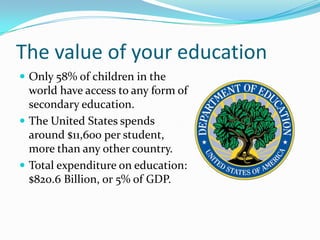
The value of your education
 Only 58% of children in the
  world have access to any form of
  secondary education.
 The United States spends
  around $11,600 per student,
  more than any other country.
 Total expenditure on education:
  $820.6 Billion, or 5% of GDP.
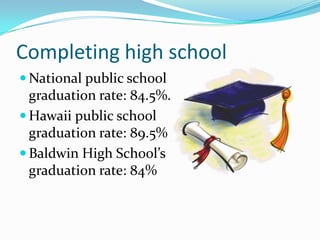
Completing high school
 National public school
  graduation rate: 84.5%.
 Hawaii public school
  graduation rate: 89.5%
 Baldwin High School’s
  graduation rate: 84%
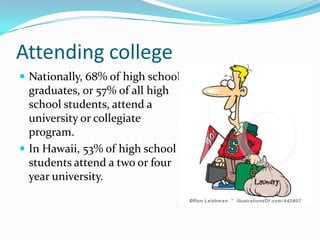
Attending college
 Nationally, 68% of high school
  graduates, or 57% of all high
  school students, attend a
  university or collegiate
  program.
 In Hawaii, 53% of high school
  students attend a two or four
  year university.
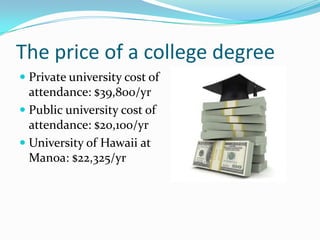
The price of a college degree
 Private university cost of
  attendance: $39,800/yr
 Public university cost of
  attendance: $20,100/yr
 University of Hawaii at
  Manoa: $22,325/yr
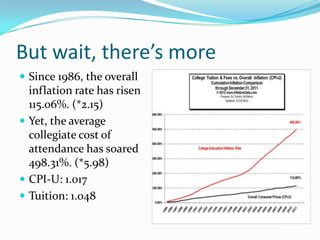
But wait, there’s more
 Since 1986, the overall
  inflation rate has risen
  115.06%. (*2.15)
 Yet, the average
  collegiate cost of
  attendance has soared
  498.31%. (*5.98)
 CPI-U: 1.017
 Tuition: 1.048
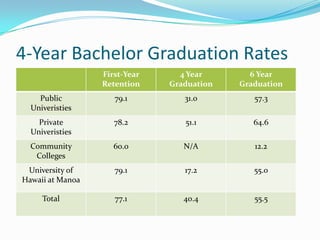
4-Year Bachelor Graduation Rates
                  First-Year     4 Year       6 Year
                  Retention    Graduation   Graduation
    Public           79.1         31.0         57.3
  Univeristies
    Private          78.2         51.1         64.6
  Univeristies
  Community          60.0         N/A          12.2
   Colleges
 University of       79.1         17.2         55.0
Hawaii at Manoa

     Total           77.1         40.4         55.5
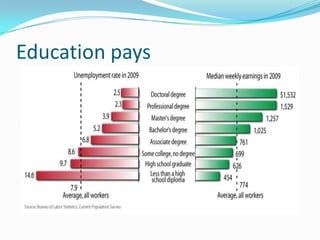
Education pays
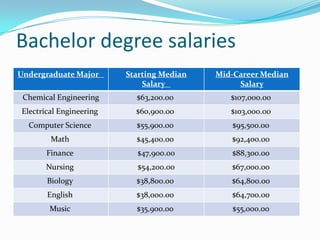
Bachelor degree salaries
Undergraduate Major      Starting Median   Mid-Career Median
                             Salary             Salary
 Chemical Engineering      $63,200.00         $107,000.00
Electrical Engineering     $60,900.00         $103,000.00
  Computer Science         $55,900.00         $95,500.00
        Math               $45,400.00         $92,400.00
       Finance             $47,900.00         $88,300.00
       Nursing             $54,200.00         $67,000.00
       Biology             $38,800.00         $64,800.00
       English             $38,000.00         $64,700.00
        Music              $35,900.00         $55,000.00
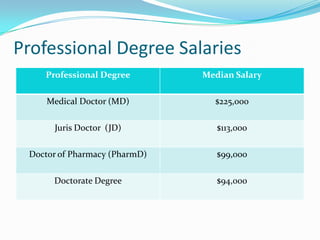
Professional Degree Salaries
    Professional Degree        Median Salary

     Medical Doctor (MD)         $225,000

      Juris Doctor (JD)           $113,000

 Doctor of Pharmacy (PharmD)      $99,000

      Doctorate Degree            $94,000
The AP Program
 Created in 1955 by the
  Collegeboard, the same
  organization who administers
  the SAT Reasoning Test.
 Designed to “Offer standardized
  courses to high school students
  generally recognized to be
  equivalent to undergraduate
  courses in college.”
Benefits of AP classes
 Scholarships – 31% of
  universities consider students’
  AP coursework when
  determining scholarship
  distribution.
 Weighted GPA – AP grades are
  recorded on a curve, allowing
  students to transcend a 4.0
  GPA.
Benefits of AP classes
 Class rank – Taking and
 succeeding in multiple AP
 classes can significantly
 increase one’s GPA, raising
 their class rank, which is an
 extremely important
 component in admissions
 for competitive universities
 and scholarships.
AP Exams
 Students who complete a
  year-long AP class take a
  corresponding AP exam.
 These culminating,
  standardized exams are
  administered by the
  CollegeBoard.
 Scoring is scaled from 1 to 5.
 A score of 3 typically yields
  some college credit.
AP Exam Score Credits
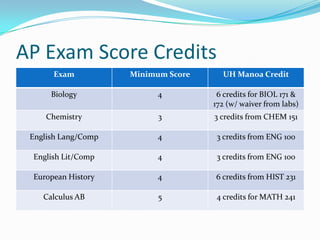
      Exam           Minimum Score     UH Manoa Credit

      Biology              4          6 credits for BIOL 171 &
                                     172 (w/ waiver from labs)
     Chemistry             3         3 credits from CHEM 151

 English Lang/Comp         4          3 credits from ENG 100

 English Lit/Comp          4          3 credits from ENG 100

 European History          4         6 credits from HIST 231

    Calculus AB            5         4 credits for MATH 241
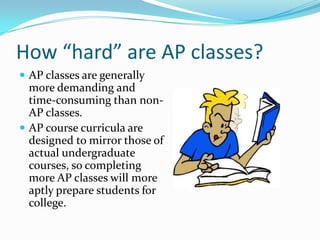
How “hard” are AP classes?
 AP classes are generally
  more demanding and
  time-consuming than non-
  AP classes.
 AP course curricula are
  designed to mirror those of
  actual undergraduate
  courses, so completing
  more AP classes will more
  aptly prepare students for
  college.
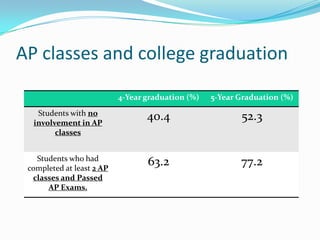
AP classes and college graduation

                           4-Year graduation (%)   5-Year Graduation (%)

   Students with no
  involvement in AP
                                  40.4                    52.3
        classes


   Students who had
 completed at least 2 AP
                                  63.2                    77.2
  classes and Passed
      AP Exams.
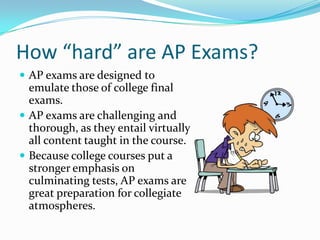
How “hard” are AP Exams?
 AP exams are designed to
  emulate those of college final
  exams.
 AP exams are challenging and
  thorough, as they entail virtually
  all content taught in the course.
 Because college courses put a
  stronger emphasis on
  culminating tests, AP exams are
  great preparation for collegiate
  atmospheres.
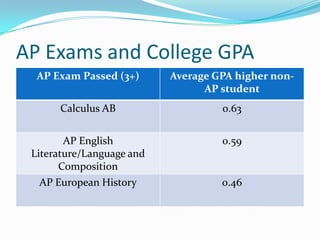
AP Exams and College GPA
  AP Exam Passed (3+)      Average GPA higher non-
                                 AP student
      Calculus AB                   0.63


        AP English                  0.59
 Literature/Language and
       Composition
   AP European History              0.46
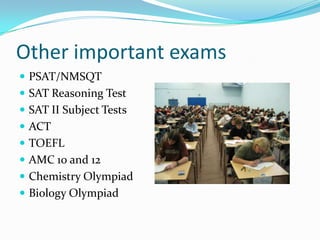
Other important exams
 PSAT/NMSQT
 SAT Reasoning Test
 SAT II Subject Tests
 ACT
 TOEFL
 AMC 10 and 12
 Chemistry Olympiad
 Biology Olympiad
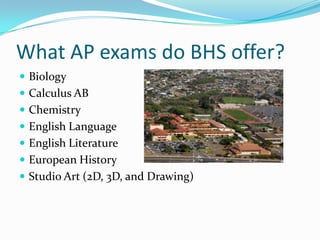
What AP exams do BHS offer?
 Biology
 Calculus AB
 Chemistry
 English Language
 English Literature
 European History
 Studio Art (2D, 3D, and Drawing)
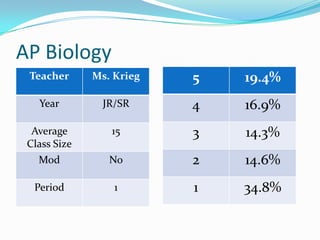
AP Biology
 Teacher      Ms. Krieg   5   19.4%
   Year         JR/SR     4   16.9%
  Average        15       3   14.3%
 Class Size
   Mod           No       2   14.6%
  Period          1       1   34.8%
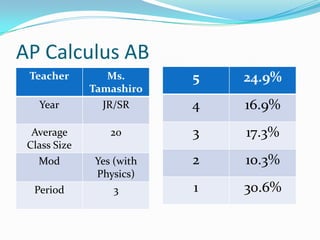
AP Calculus AB
 Teacher         Ms.      5   24.9%
              Tamashiro
   Year         JR/SR     4   16.9%
  Average        20       3   17.3%
 Class Size
   Mod        Yes (with   2   10.3%
              Physics)
  Period          3       1   30.6%
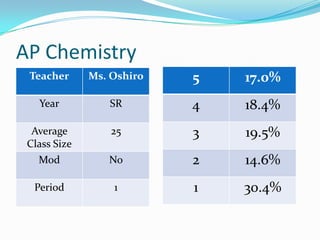
AP Chemistry
 Teacher      Ms. Oshiro   5   17.0%
   Year          SR        4   18.4%
  Average         25       3   19.5%
 Class Size
   Mod           No        2   14.6%
  Period          1        1   30.4%
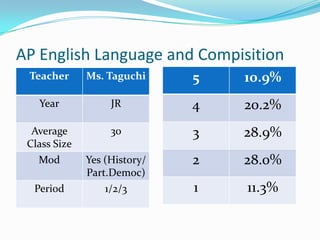
AP English Language and Compisition
 Teacher      Ms. Taguchi     5   10.9%
   Year            JR         4   20.2%
  Average          30         3   28.9%
 Class Size
   Mod        Yes (History/   2   28.0%
              Part.Democ)
  Period          1/2/3       1   11.3%
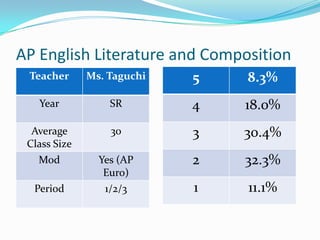
AP English Literature and Composition
 Teacher      Ms. Taguchi   5   8.3%
   Year           SR        4   18.0%
  Average         30        3   30.4%
 Class Size
   Mod          Yes (AP     2   32.3%
                 Euro)
  Period         1/2/3      1   11.1%
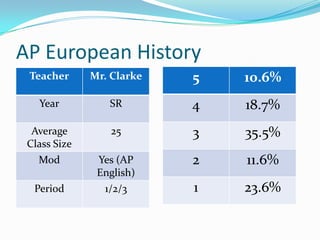
AP European History
 Teacher      Mr. Clarke   5   10.6%
   Year          SR        4   18.7%
  Average         25       3   35.5%
 Class Size
   Mod         Yes (AP     2   11.6%
               English)
  Period        1/2/3      1   23.6%
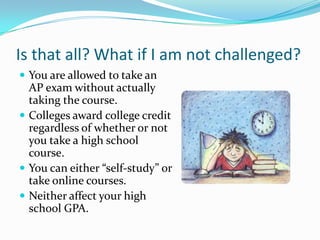
Is that all? What if I am not challenged?
 You are allowed to take an
  AP exam without actually
  taking the course.
 Colleges award college credit
  regardless of whether or not
  you take a high school
  course.
 You can either “self-study” or
  take online courses.
 Neither affect your high
  school GPA.
Is that all? What if I am not challenged?
 Recommended AP
    Exams for self-study:
   Calculus BC
   Environmental Science
   Psychology
   Statistics
   US Government and
    Politics
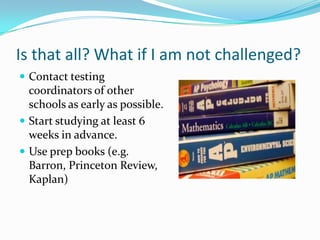
Is that all? What if I am not challenged?
 Contact testing
  coordinators of other
  schools as early as possible.
 Start studying at least 6
  weeks in advance.
 Use prep books (e.g.
  Barron, Princeton Review,
  Kaplan)
For more information
 [MY WEBSITE]
 Collegeboard.org
 Talk.collegeconfidential.com
 Collegedata.com

Senior project power point

  • 1.
    By Kieran Bhattacharya Senior Project 2013
  • 2.
    Why should youeven have to go to high school?  Increase general knowledge.  Strengthen social skills.  Develop work ethic.  Choose career path.  Prepare for college.
  • 3.
    The value ofyour education  Only 58% of children in the world have access to any form of secondary education.  The United States spends around $11,600 per student, more than any other country.  Total expenditure on education: $820.6 Billion, or 5% of GDP.
  • 4.
    Completing high school National public school graduation rate: 84.5%.  Hawaii public school graduation rate: 89.5%  Baldwin High School’s graduation rate: 84%
  • 5.
    Attending college  Nationally,68% of high school graduates, or 57% of all high school students, attend a university or collegiate program.  In Hawaii, 53% of high school students attend a two or four year university.
  • 6.
    The price ofa college degree  Private university cost of attendance: $39,800/yr  Public university cost of attendance: $20,100/yr  University of Hawaii at Manoa: $22,325/yr
  • 7.
    But wait, there’smore  Since 1986, the overall inflation rate has risen 115.06%. (*2.15)  Yet, the average collegiate cost of attendance has soared 498.31%. (*5.98)  CPI-U: 1.017  Tuition: 1.048
  • 8.
    4-Year Bachelor GraduationRates First-Year 4 Year 6 Year Retention Graduation Graduation Public 79.1 31.0 57.3 Univeristies Private 78.2 51.1 64.6 Univeristies Community 60.0 N/A 12.2 Colleges University of 79.1 17.2 55.0 Hawaii at Manoa Total 77.1 40.4 55.5
  • 9.
  • 10.
    Bachelor degree salaries UndergraduateMajor Starting Median Mid-Career Median Salary Salary Chemical Engineering $63,200.00 $107,000.00 Electrical Engineering $60,900.00 $103,000.00 Computer Science $55,900.00 $95,500.00 Math $45,400.00 $92,400.00 Finance $47,900.00 $88,300.00 Nursing $54,200.00 $67,000.00 Biology $38,800.00 $64,800.00 English $38,000.00 $64,700.00 Music $35,900.00 $55,000.00
  • 11.
    Professional Degree Salaries Professional Degree Median Salary Medical Doctor (MD) $225,000 Juris Doctor (JD) $113,000 Doctor of Pharmacy (PharmD) $99,000 Doctorate Degree $94,000
  • 12.
    The AP Program Created in 1955 by the Collegeboard, the same organization who administers the SAT Reasoning Test.  Designed to “Offer standardized courses to high school students generally recognized to be equivalent to undergraduate courses in college.”
  • 13.
    Benefits of APclasses  Scholarships – 31% of universities consider students’ AP coursework when determining scholarship distribution.  Weighted GPA – AP grades are recorded on a curve, allowing students to transcend a 4.0 GPA.
  • 14.
    Benefits of APclasses  Class rank – Taking and succeeding in multiple AP classes can significantly increase one’s GPA, raising their class rank, which is an extremely important component in admissions for competitive universities and scholarships.
  • 15.
    AP Exams  Studentswho complete a year-long AP class take a corresponding AP exam.  These culminating, standardized exams are administered by the CollegeBoard.  Scoring is scaled from 1 to 5.  A score of 3 typically yields some college credit.
  • 16.
    AP Exam ScoreCredits Exam Minimum Score UH Manoa Credit Biology 4 6 credits for BIOL 171 & 172 (w/ waiver from labs) Chemistry 3 3 credits from CHEM 151 English Lang/Comp 4 3 credits from ENG 100 English Lit/Comp 4 3 credits from ENG 100 European History 4 6 credits from HIST 231 Calculus AB 5 4 credits for MATH 241
  • 17.
    How “hard” areAP classes?  AP classes are generally more demanding and time-consuming than non- AP classes.  AP course curricula are designed to mirror those of actual undergraduate courses, so completing more AP classes will more aptly prepare students for college.
  • 18.
    AP classes andcollege graduation 4-Year graduation (%) 5-Year Graduation (%) Students with no involvement in AP 40.4 52.3 classes Students who had completed at least 2 AP 63.2 77.2 classes and Passed AP Exams.
  • 19.
    How “hard” areAP Exams?  AP exams are designed to emulate those of college final exams.  AP exams are challenging and thorough, as they entail virtually all content taught in the course.  Because college courses put a stronger emphasis on culminating tests, AP exams are great preparation for collegiate atmospheres.
  • 20.
    AP Exams andCollege GPA AP Exam Passed (3+) Average GPA higher non- AP student Calculus AB 0.63 AP English 0.59 Literature/Language and Composition AP European History 0.46
  • 21.
    Other important exams PSAT/NMSQT  SAT Reasoning Test  SAT II Subject Tests  ACT  TOEFL  AMC 10 and 12  Chemistry Olympiad  Biology Olympiad
  • 22.
    What AP examsdo BHS offer?  Biology  Calculus AB  Chemistry  English Language  English Literature  European History  Studio Art (2D, 3D, and Drawing)
  • 23.
    AP Biology Teacher Ms. Krieg 5 19.4% Year JR/SR 4 16.9% Average 15 3 14.3% Class Size Mod No 2 14.6% Period 1 1 34.8%
  • 24.
    AP Calculus AB Teacher Ms. 5 24.9% Tamashiro Year JR/SR 4 16.9% Average 20 3 17.3% Class Size Mod Yes (with 2 10.3% Physics) Period 3 1 30.6%
  • 25.
    AP Chemistry Teacher Ms. Oshiro 5 17.0% Year SR 4 18.4% Average 25 3 19.5% Class Size Mod No 2 14.6% Period 1 1 30.4%
  • 26.
    AP English Languageand Compisition Teacher Ms. Taguchi 5 10.9% Year JR 4 20.2% Average 30 3 28.9% Class Size Mod Yes (History/ 2 28.0% Part.Democ) Period 1/2/3 1 11.3%
  • 27.
    AP English Literatureand Composition Teacher Ms. Taguchi 5 8.3% Year SR 4 18.0% Average 30 3 30.4% Class Size Mod Yes (AP 2 32.3% Euro) Period 1/2/3 1 11.1%
  • 28.
    AP European History Teacher Mr. Clarke 5 10.6% Year SR 4 18.7% Average 25 3 35.5% Class Size Mod Yes (AP 2 11.6% English) Period 1/2/3 1 23.6%
  • 29.
    Is that all?What if I am not challenged?  You are allowed to take an AP exam without actually taking the course.  Colleges award college credit regardless of whether or not you take a high school course.  You can either “self-study” or take online courses.  Neither affect your high school GPA.
  • 30.
    Is that all?What if I am not challenged?  Recommended AP Exams for self-study:  Calculus BC  Environmental Science  Psychology  Statistics  US Government and Politics
  • 31.
    Is that all?What if I am not challenged?  Contact testing coordinators of other schools as early as possible.  Start studying at least 6 weeks in advance.  Use prep books (e.g. Barron, Princeton Review, Kaplan)
  • 32.
    For more information [MY WEBSITE]  Collegeboard.org  Talk.collegeconfidential.com  Collegedata.com