Unconscious Memory Representations in Perception
Processes and mechanisms in the brain 1st Edition
Istvan Czigler - Downloadable PDF 2025
https://ebookfinal.com/download/unconscious-memory-representations-in-
perception-processes-and-mechanisms-in-the-brain-1st-edition-istvan-
czigler/
Visit ebookfinal.com today to download the complete set of
ebooks or textbooks
Here are some recommended products that we believe you will be
interested in. You can click the link to download.
Memory and Brain Dynamics Oscillations Integrating
Attention Perception Learning and Memory 1st Edition Erol
Basar
https://ebookfinal.com/download/memory-and-brain-dynamics-
oscillations-integrating-attention-perception-learning-and-memory-1st-
edition-erol-basar/
Speech and Brain Mechanisms Wilder Penfield
https://ebookfinal.com/download/speech-and-brain-mechanisms-wilder-
penfield/
A User s Guide to the Brain Perception Attention and the
Four Theaters of the Brain 1st Edition John J. Ratey
https://ebookfinal.com/download/a-user-s-guide-to-the-brain-
perception-attention-and-the-four-theaters-of-the-brain-1st-edition-
john-j-ratey/
Brain Aging Models Methods and Mechanisms 1st Edition
David R. Riddle
https://ebookfinal.com/download/brain-aging-models-methods-and-
mechanisms-1st-edition-david-r-riddle/
Perception beyond Inference The Information Content of
Visual Processes 1st Edition Liliana Albertazzi
https://ebookfinal.com/download/perception-beyond-inference-the-
information-content-of-visual-processes-1st-edition-liliana-
albertazzi/
The Visual World in Memory Current Issues in Memory 1st
Edition James Brockmole
https://ebookfinal.com/download/the-visual-world-in-memory-current-
issues-in-memory-1st-edition-james-brockmole/
Brain and Visual Perception The Story of a 25 Year
Collaboration 1st Edition David H. Hubel
https://ebookfinal.com/download/brain-and-visual-perception-the-story-
of-a-25-year-collaboration-1st-edition-david-h-hubel/
Brain Arousal and Information Theory Neural and Genetic
Mechanisms 1st Edition Donald Pfaff
https://ebookfinal.com/download/brain-arousal-and-information-theory-
neural-and-genetic-mechanisms-1st-edition-donald-pfaff/
The Unconscious of Thought in Leibniz Spinoza and Hume 1st
Edition Gil Morejón
https://ebookfinal.com/download/the-unconscious-of-thought-in-leibniz-
spinoza-and-hume-1st-edition-gil-morejon/
Unconscious Memory Representations in Perception
Processes and mechanisms in the brain 1st Edition Istvan
Czigler Digital Instant Download
Author(s): Istvan Czigler, Istvan Winkler (Editors)
ISBN(s): 9789027288356, 9027288356
Edition: 1
File Details: PDF, 5.72 MB
Year: 2010
Language: english
Unconscious Memory Representations in Perception
Volume 78
Unconscious Memory Representations in Perception. Processes and mechanisms
in the brain
Edited by István Czigler and István Winkler
Advances in Consciousness Research (AiCR)
Provides a forum for scholars from different scientific disciplines and fields of
knowledge who study consciousness in its multifaceted aspects. Thus the Series
includes (but is not limited to) the various areas of cognitive science, including
cognitive psychology, brain science, philosophy and linguistics. The orientation of
the series is toward developing new interdisciplinary and integrative approaches
for the investigation, description and theory of consciousness, as well as the
practical consequences of this research for the individual in society.
From 1999 the Series consists of two subseries that cover the most important
types of contributions to consciousness studies:
Series A: Theory and Method. Contributions to the development of theory
and method in the study of consciousness; Series B: Research in Progress.
Experimental, descriptive and clinical research in consciousness.
This book is a contribution to Series B.
Editor
Maxim I. Stamenov
Bulgarian Academy of Sciences
Editorial Board
David J. Chalmers
Australian National University
Axel Cleeremans
Université Libre de Bruxelles
Gordon G. Globus
University of California Irvine
Christof Koch
California Institute of Technology
Stephen M. Kosslyn
Harvard University
Steven Laureys
University of Liège, Belgium
George Mandler
University of California at San Diego
John R. Searle
University of California at Berkeley
Petra Stoerig
Universität Düsseldorf
Unconscious Memory
Representations in Perception
Processes and mechanisms in the brain
Edited by
István Czigler
Institute for Psychology, Hungarian Academy of Sciences/
Debrecen University, Hungary
István Winkler
Institute for Psychology, Hungarian Academy of Sciences/
University of Szeged, Hungary
John Benjamins Publishing Company
Amsterdam/Philadelphia
Library of Congress Cataloging-in-Publication Data
Unconscious memory representations in perception : processes and mechanisms in the
brain / edited by István Czigler, István Winkler.
p. cm. (Advances in Consciousness Research, issn 1381-589X ; v. 78)
Includes bibliographical references and index.
1. Implicit memory. I. Czigler, István. II.Winkler, István.
BF378.I55U53   2010
153.1’3--dc22 2009053346
isbn 978 90 272 5214 2 (Hb ; alk. paper)
isbn 978 90 272 8835 6 (Eb)
© 2010 – John Benjamins B.V.
No part of this book may be reproduced in any form, by print, photoprint, microfilm, or any
other means, without written permission from the publisher.
John Benjamins Publishing Co. · P.O. Box 36224 · 1020 me Amsterdam · The Netherlands
John Benjamins North America · P.O. Box 27519 · Philadelphia pa 19118-0519 · usa
The paper used in this publication meets the minimum requirements of
American National Standard for Information Sciences – Permanence of
Paper for Printed Library Materials, ansi z39.48-1984.
8
TM
Table of contents
Contributors vii
Preface ix
1.	�������������� ����������������������� �������� �������
Conscious and unconscious aspects of working memory 1
Amanda L. Gilchrist and Nelson Cowan
2. Markers of awareness? EEG potentials evoked by faint 
and masked events, with special reference to the “attentional blink” 37
Rolf Verleger
3. In search for auditory object representations  71
István Winkler
4. Representation of regularities in visual stimulation: Event-related 
	potentials reveal the automatic acquisition 107
István Czigler
5. Auditory learning in the developing brain 133
Minna Huotilainen and Tuomas Teinonen
6. Neurocomputational models of perceptual organization 147
Susan L. Denham, Salvador Dura-Bernal, Martin Coath
and Emili Balaguer-Ballester
7. Are you listening? Language outside the focus of attention 179
Yury Shtyrov and Friedemann Pulvermüller
8. Unconscious memory representations underlying music-syntactic 
	processing and processing of auditory oddballs  209
Stefan Koelsch
vi Unconscious Memory Representations in Perception
9. On the psychophysiology of aesthetics: Automatic and controlled 
	processes of aesthetic appreciation 245
Thomas Jacobsen
Appendix: Using electrophysiology to study unconscious memory 
representations 259
Alexandra Bendixen
Index 273
Alexandra Bendixen
Institute for Psychology I
University of Leipzig
Seeburgstr. 14-20
D-04103 Leipzig, Germany
alexandra.bendixen@uni-leipzig.de
Amanda L. Gilchrist and Nelson Cowan
Department of Psychological Sciences
18 McAlester Hall
University of Missouri
Columbia, MO 65211 USA
CowanN@missouri.edu
István Czigler
Institute for Psychology
Hungarian Academy of Sciences
1394 Budapest, P. O. Box 398, Hungary
czigler@cogpsyphy.hu
Susan L. Denham
Centre for Theoretical and Computational
Neuroscience
University of Plymouth
Drake Circus Plymouth PL4 8AA, UK
sdenham@plymouth.ac.uk
Minna Huotilainen and Tuomas Teinonen
University of Helsinki
P.O. Box 9 (Siltavuorenpenger 20 D)
FIN-00014 University of Helsinki
minna.huotilainen@helsinki.fi
Thomas Jacobsen
Experimental Psychology Unit
Faculty of Humanities and Social Sciences
Helmut Schmidt University 
University of the Federal Armed 
Forces Hamburg
Holstenhofweg 85
22043 Hamburg, German
Jacobsen@hsu-hh.de
Stefan Koelsch
Department of Psychology
Pevensey Building
University of Sussex
Brighton, BN1 9QH, UK
koelsch@cbs.mpg.de
Yury Shtyrov and Friedemann Pulvermüller
Medical Research Council, Cognition and 
Brain Sciences Unit
15 Chaucer Road
Cambridge, CB2 7EF, UK
yury.shtyrov@mrc-cbu.cam.ac.uk
Rolf Verleger
Department of Neurology
University of Lübeck
23538 Lübeck, Germany
rolf.verleger@neuro.uni-luebeck.de
István Winkler
Institute for Psychology
Hungarian Academy of Sciences
H-1394 Budapest, P. O. Box 398, Hungary
iwinkler@cogpsyphy.hu
Contributors
Preface
The study of processes underlying conscious experience is a traditional topic of
philosophy, psychology, and neuroscience. In contrast, until recently, the role of
implicit (non-conscious) memory systems needed to establish veridical percep-
tion received much less discussion. With many new results and novel theoretical
models emerging in recent years, it is time to take a look at the state of art in psy-
chology and neuroscience about the role non-conscious processes and memory 
representations play in perception.
Although behavioral studies (e.g. priming)  in cognitive psychology yielded 
indirect evidence about many of the characteristics of implicit memory represen-
tations, cognitive neuroscience and computational modeling can provide more
direct insights into the structure and contents of these representations and the
into various processes related to them. This book presents several different ap-
proaches of the study of implicit memory representations, using both psychologi-
cal, neuroscience and computational modeling methods, assessing these repre-
sentations in relatively simple situations, such as perceiving discrete auditory and 
visual stimulus events, as well as in high‑level cognitive functions, such as speech
and music perception and aesthetic experience.
Each chapter reviews a different topic, its theoretical and major empirical
issues. A large part of the results reviewed in this book were obtained through
recording event-related brain potentials (ERP). This is because ERPs offer high
temporal resolution, and as a consequence, they are sensitive indicators of the
dynamics of human information processing. Non‑expert readers are offered 
with an appendix to help to understand and assess the ERP data reviewed in
the various chapters. However, ERPs provide less precise information regarding 
the sources of the observed neural activity in the brain. Therefore, an increas-
ing amount of research utilizes more recent brain imaging methods, such as
functional magnetic resonance imaging (fMRI), whose spatial resolution exceed 
that of the ERPs. Although the experimental paradigms used in brain imag-
ing are often not yet as highly specific as those worked out through the years in
behavioral or ERP research, some of these studies already brought significant
new insights into the working of implicit memories. Common to all chapters is
Preface
the approach that empirical evidence is evaluated in terms of its importance to
models of the processes underlying conscious perception.
In the first chapter, Gilchrist and Cowan review the role of working memory 
in conscious as well as in non-conscious cognitive processing. Verleger’s chapter
discusses ERP components related to subjective experience and non-conscious
processes. Winkler suggests that predictive representations of acoustic regulari-
ties form the core of auditory perceptual objects, while Denham, Dura-Berna,
Coath and Balaguer-Ballester describe a neurocompuational approach to model
the processes underlying perceptual objects. The role of sensory memory in au-
tomatic visual change detection and perception is discussed in Czigler’s chapter.
Huotilainen and Teinonen focus on the role of learning and implicit memory in
perceptual development. Shtyrov and Pulvermüller’s chapter describes a novel
paradigm for studying the memory representations involved in speech percep-
tion. They evaluate the relevant theories in light of their results and provide new 
insights into the non-conscious processes underlying speech perception. Koelsch
presents an advanced theory of the perception of musical structure, emphasizing 
the role of non-conscious processes and implicit memory representations. Finally,
the role of non-conscious and conscious processes in aesthetic appreciation is
explored in Jacobsen’s chapter. In the Appendix, Bendixen provides a concise de-
scription of the ERP method.
In summary, this book provides a theoretical and empirical overview of the
various topics of and approaches to the question: What is the role of non-con-
scious memory representations in perception?
We thank Maxim Stamenov for his initiative and stimulating advice. Zsuzsa
d’Albini’s technical help is greatfully acknowledged. Our work was supported by 
the Hungarian Research Fund (OTKA 71600) and the European Community’s
Seventh Framework Programme (grant n° 231168 – SCANDLE).
 István Czigler and István Winkler
 Budapest, November 2009
chapter 1
Conscious and unconscious aspects
of working memory
Amanda L. Gilchrist and Nelson Cowan
University of Missouri, Columbia, USA
1.1 Working-memory models and consciousness
A simple (and, alas, oversimplified) history of working memory models helps to
lend perspective to the present endeavor. George Miller (1956) is generally cred-
ited with kicking off a renaissance in the study of temporary memory related to
the conscious mind, in his published speech on the limit of temporary memory to
“the magical number seven plus or minus two” (though many researchers failed 
to understand his humorous intent in describing a magical number surrounded 
by confidence intervals). Shortly afterward, Miller et al. (1960) coined the term 
working memory to describe the memory for current goals and a small amount of
information that allows one’s immediate plans to be carried out. Several models
using something like this working memory concept will now be described.
1.1.1 Information-flow models
Broadbent (1958) proposed a very simple model of memory that took into ac-
count the latest evidence; in that model, a large amount of sensory information
was encoded in a temporary buffer (like what is now called working memory).
However, only a small proportion of it ever made its way into the limited-capacity 
part of memory, where it was analyzed and categorized with the benefit of the vast
amount of information saved in long-term memory, and eventually added to that
long-term bank of knowledge. Atkinson and Shiffrin (1968) then developed that
sort of memory framework into a more explicit model in which mathematical
simulations were made of the transfer of information from one store to another
through encoding, retrieval, and rehearsal processes.
Amanda L. Gilchrist and Nelson Cowan
1.1.2 Multi-component models
Baddeley and Hitch (1974) soon found  that this simple treatment of working 
memory would not do. In addition to information temporarily held in a form like-
ly to be related to consciousness (James 1890), they argued in favor of other stor-
age faculties that operated automatically, outside of voluntary control. Broadbent
(1958) already had conceived of sensory memory that way, but sensory memory 
was not enough. There was said to be a phonologically-based temporary memory 
store that was vulnerable to interference from additional verbal items, no matter
whether their source was visual or auditory. Similarly, there was a visuo-spatial
temporary memory store responsive to the spatial layout and visual qualities of
items; in theory, this store would be vulnerable to interference from spatial infor-
mation even if its source were auditory. Baddeley (1986) later thought he could do
without the central store or primary memory entirely; whereas Baddeley (2000)
essentially restored it in the form of an episodic buffer.
1.1.3 Activation-based models
A form of model that will become the centerpiece of this chapter is the acti-
vation-based model. In that sort of model (Anderson 1983; Cowan 1988; Hebb
1949; Norman 1968; Treisman 1964) a temporary form of storage such as working 
memory is viewed not as a separate location in the mind or brain, but rather as a
state of activation of some of the information in the long-term memory system.
Hebb (1949) envisioned this activated memory as a cell assembly that consisted 
of a neural firing pattern occurring repeatedly so long as the idea it represented 
was active. Treisman (1964) and Norman (1968) distinguished between sublimi-
nal amounts of activation, which might influence behavior but not consciously,
and supraliminal amounts, which attracted attention to the activated item, es-
pecially if it was pertinent to the person’s current goals and concerns. Anderson
(1983) used the process of activation as a way to bring long-term knowledge into
working memory.
The instance of the activation-based models that we will discuss in most de-
tail is the one that Cowan (1988, 1999) designed as a way to express what he
believed to be known at the time. There were awkward aspects of the box-based 
models of the time, such as the well-known ones of Atkinson and Shiffrin (1968)
and Baddeley (1986). These models did not readily express the assumption that
information co-exists in several forms at once. Sensory information can be ac-
companied by more categorical information that is drawn from long-term mem-
ory into working memory. For example, the acoustic properties of a speech sound 
elicit the appropriate sound category that is stored in long-term memory. Other
Conscious and unconscious aspects of working memory	 
sensory information persists without invoking long-term memory information.
Cowan (1988, 1999) represented this state of affairs with embedded processes.
Temporarily-activated features of memory can include both sensory and abstract
features. Some of these features become active enough, or active in the right way,
to become part of the individual’s current focus of attention, which is of limited 
capacity. The focus of attention is controlled in part voluntarily, and in part invol-
untarily through the brain’s reactions to abrupt physical changes in the environ-
ment (such as a sudden change in lighting or a loud noise).
In the original model of Broadbent (1958), unattended sensory information
was filtered out so that it faded away without ever reaching the capacity-limited 
store. This model became untenable when it was found that aspects of unattended 
sounds can attract attention (as when one’s own name is presented; see Moray 
1959) so Treisman (1964) proposed that the filter only attenuated, rather than
completely blocking out, sensory input that was unattended. Potentially pertinent
input could still result in attention being attracted to that input. Cowan (1988)
solved this problem in another way, by indicating that all sensory input made
contact with long-term memory, but with extra activation for the deliberately-at-
tended input or the abruptly-changing input that attracts attention involuntarily.
This is the converse of the filtering concept.
Cowan (2001) suggested that the focus of attention in the embedded pro-
cess model of Cowan (1988, 1999) is limited to about 4 separate items in nor-
mal adults. This leaves open the basis of individual differences in capacity limits.
Cowan and colleages have suggested that there is a basic difference between in-
dividuals and age groups in the size of the focus of attention (Chen and Cowan
2009a; Cowan 2001; Cowan et al. 2005, 2009; Gilchrist et al. 2008, 2009). An al-
ternative basis of individual differences and age differences, still in keeping with
the model, is that individuals appear to differ in the ability to control or allocate
attention or executive function (Engle et al. 1999; Miyake et al. 2001) or, more
specifically, to inhibit irrelevant items and prevent them from cluttering up the
limited-capacity store (Lustig et al. 2007). These possibilities are not mutually 
exclusive and both of them are compatible with the basic embedded processes
model. (Indeed, for a structural equation model similar to Engle et al. or Miyake
et al., see Cowan et al. 2005.)
Cowan’s embedded process model assumes that storage and processing both
use attention, and that certain processing challenges must be kept in check us-
ing attentional capacity that otherwise could be devoted to the temporary stor-
age of information. These challenges include stimuli that elicit strong habitual
responses, and irrelevant distracters. Indeed, recent research has suggested that
processing, such as tone identification, can interfere with very different storage,
such as that of visual arrays of objects (Stevanovski and Jolicoeur 2007); and that,
Amanda L. Gilchrist and Nelson Cowan
conversely, storage, such as that of verbal list items, can interfere with very dif-
ferent processing, such as that in a speeded, nonverbal, choice reaction time task 
(Chen and Cowan 2009b). It remains to be seen whether attention holds multiple
items at once directly or, alternatively, is used to refresh items one at a time before
their activation is lost (Barrouillet et al. 2007).
1.1.4 Conscious and unconscious processing in different models
Although these models were constructed with the aim of explaining behavior,
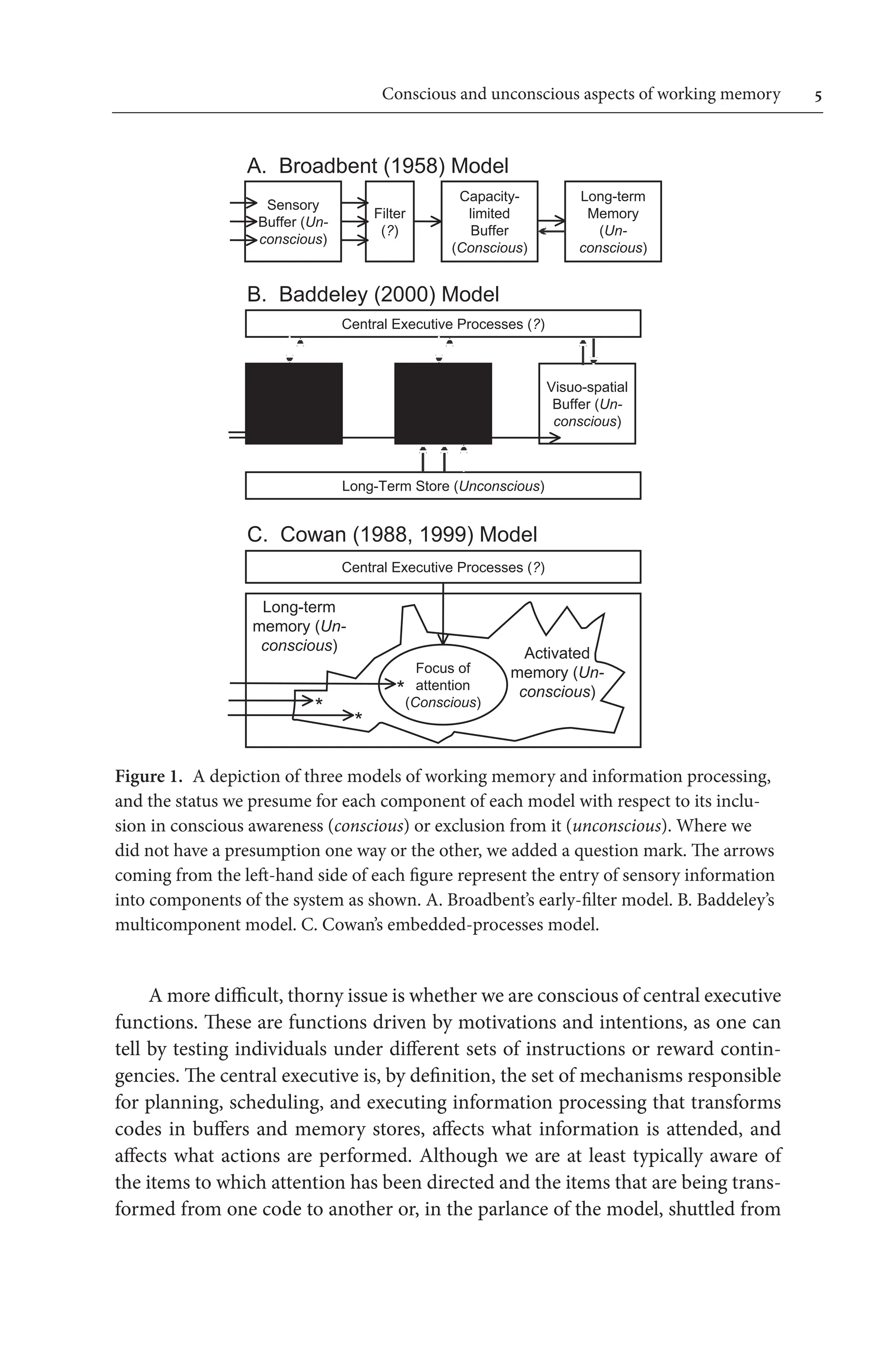
they also seem relevant to the issue of consciousness. Figure 1 shows three of the
models with our interpretation of what, within each model, is likely to correspond 
to conscious and unconscious processes. Figure 1A depicts the original model of
Broadbent (1958). In that model, incoming stimulation from the environment
was said to be held in a temporary store, or buffer, and to go nowhere except for
the small amount that is encoded into the limited-capacity buffer. Given that sen-
sory memory is much richer than what individuals can report (which was shown
for auditory stimuli by Broadbent himself, among others, and for visual stimuli by 
Sperling 1960), the model must consider the contents of the sensory buffer to be
unconscious. Likewise, the vast information in long-term memory could not all
be in consciousness at the same time. It is the limited-capacity buffer that would 
hold the contents of conscious awareness.
Figure 1B shows the model of Baddeley (2000). Baddeley’s models, ever since
Baddeley and Hitch (1974), implicitly have assumed more automatic processing 
than was made clear by Broadbent (1958). In particular, the entry of informa-
tion into the phonological and visuo-spatial buffers is said to occur automatically,
resulting in ready-to-use codes. These, however, need not be in consciousness.
For example, Baddeley (1986) summarized research indicating that unattended 
speech could interfere with working memory for printed words, given that pho-
nological codes are in memory for both types of stimulus at once, leading to cor-
ruption of the material to be remembered. In contrast, the episodic buffer, which
was added to the model by Baddeley (2000) in order to account for temporary 
knowledge of abstract features, seems more likely to be linked to conscious aware-
ness. Although to our knowledge Baddeley has not stated as much, abstract infor-
mation has the advantage that it could refer to any stimulus. Consciousness seems
to have the quality of unity in that our subjective experiences are such that there
is only one pool of consciousness; for example, if we are looking at a work of art
and listening to a tour guide’s description of it, we feel conscious of the work of
art, the verbal description, and perhaps the tour guide all at once. In the Baddeley 
(2000) model, the only buffer capable of representing and inter-relating all of this
information is the episodic buffer.
Conscious and unconscious aspects of working memory	 
A more difficult, thorny issue is whether we are conscious of central executive
functions. These are functions driven by motivations and intentions, as one can
tell by testing individuals under different sets of instructions or reward contin-
gencies. The central executive is, by definition, the set of mechanisms responsible
for planning, scheduling, and executing information processing that transforms
codes in buffers and memory stores, affects what information is attended, and 
affects what actions are performed. Although we are at least typically aware of
the items to which attention has been directed and the items that are being trans-
formed from one code to another or, in the parlance of the model, shuttled from 
Figure 1. A depiction of three models of working memory and information processing,
and the status we presume for each component of each model with respect to its inclu-
sion in conscious awareness (conscious) or exclusion from it (unconscious). Where we
did not have a presumption one way or the other, we added a question mark. The arrows
coming from the left-hand side of each figure represent the entry of sensory information
into components of the system as shown. A. Broadbent’s early-filter model. B. Baddeley’s
multicomponent model. C. Cowan’s embedded-processes model.
Sensory
Buffer (Un-
conscious)
Filter
(?)
Capacity-
limited
Buffer
(Conscious)
A. Broadbent (1958) Model
Long-term
Memory
(Un-
conscious)
B. Baddeley (2000) Model
Visuo-spatial
Buffer (Un-
conscious)
Central Executive Processes (?)
Long-Term Store (Unconscious)
Phonological
Buffer (Un-
conscious)
Episodic
Buffer
(Conscious)
Central Executive Processes (?)
C. Cowan (1988, 1999) Model
Long-term
memory (Un-
conscious) Activated
memory (Un-
conscious)
Focus of
attention
(Conscious)
*
*
*
Amanda L. Gilchrist and Nelson Cowan
one buffer to another, we may not be aware of the process by which the transfor-
mations are accomplished. Because of the theoretical difficulty of this question,
we leave a question mark in the central executive. Basically, it is not clear to us
whether it is feasible to consider processes to be in consciousness, or whether it
is only information in stores that is held open to conscious reflection. One reso-
lution of this question is that processes may give rise to stored representations
that are held in consciousness, whereas other processes operate without atten-
tion and consciousness directed to them. Indeed, when one becomes too aware
of the central executive processes governing a complex behavior, it can lead to
poor performance or “choking” (Beilock and Carr 2005); as Fyodor Dostoevsky’s
character complained in the short novel, Notes From Underground, in such cases
consciousness is a disease.
Finally, Figure 1C shows the activation-based, embedded processes model
of Cowan (1988, 1999). For our purposes, this model has the advantage that the
access to consciousness is a key aspect of the model. This access to conscious-
ness is synonymous with the focus of attention. Elements of memory outside of
the focus of attention, whether active or not, are outside of conscious awareness.
If the line between the focus of attention and the rest of activated memory is
seen as a blurry or gradual one, then the focus of attention might be viewed as
being the same as primary memory as described by James (1890). One reason
to demarcate conscious versus unconscious processing in the model is that the
information in conscious awareness is assumed to gain access to much deeper
and extensive perceptual and conceptual analysis using long-term memory in-
formation than information that is outside of conscious awareness. Therefore,
directing conscious awareness is an important skill for harnessing information
processing to succeed at a task.
One of the strong suits of Baddeley’s models is that they have been well-
grounded  in research on patients with brain injury. One can find  instances
in which patients appear to be deficient in temporary phonological storage or
rehearsal (e.g., Baddeley  et al. 1988), attention-related working memory  (e.g.,
Jefferies et al. 2004), or long-term episodic storage (e.g., Baddeley and Warrington
1970). None of these cases are especially problematic for the Cowan model, ei-
ther. It is acknowledged in the model that phonological activation is one type of
activated memory and that rehearsal of it can take place without much attention.
Attention-related working memory and automatic activation are both intrinsic
to the Cowan model, as is long-term storage. There is no reason why specific le-
sions could not selectively impair these aspects of memory. Although patients
with long-term episodic storage impairments obviously would be unable to ac-
tivate information that was not stored in the first place, information in semantic
Conscious and unconscious aspects of working memory	 
memory can become temporarily activated by new stimuli and, in that way, used 
in short-term storage tasks.
An important issue that was addressed in enough detail by Cowan (1988,
1999) is where information about the individual’s goals is held. When the goals
keep shifting or when there is information that undermines the goal, the goal
presumably must be kept in the focus of attention, using up some of the limited 
capacity of that store. An example of this is the Stroop effect, in which the goal is
to name the color of ink but the word spells out a different color. Kane and Engle
(2003) showed that individuals with high working memory span carry out this
task more successfully than low spans if a conflict only occurs on a small propor-
tion of the trials. In contrast, if the goal becomes routine and it is not undermined 
by conflicting stimuli, that goal need not use up some of the limited capacity of
the focus of attention and may be held instead in a portion of long-term memory 
(or in the central executive itself if it can be considered to have a memory, which
was sometimes assumed by Baddeley, but not by Cowan).
1.1.5 More detail on the embedded-processes model
Thus, the embedded-processes model, rather than being composed of separable
structures, includes within the long-term memory system a currently activated
subset of memory and, within that in turn, a subset that is the current focus of
attention. The activated portion of memory was said to include unlimited infor-
mation at once but it was assumed to lose its activation through time-based de-
cay within 10 to 20 seconds, provided that activated items are not attended or
rehearsed. The focus of attention comprises a limited number of items that are
not only highly activated, but are also most rapidly accessible and are in one’s
awareness (‘in mind’). In contrast to the time-limited decay of activated long-
term memory, the focus of attention was assumed not to decay but was limited to
only several separate, meaningful items at once.
The focus of attention functions as a zoom lens with respect to its comprising 
information (see also LaBerge and Brown 1989). It can ‘zoom in’ on a particular
item, leading to more focused and precise allocation of attention to a single item,
with remaining items in the focus receiving considerably less attention and detail;
this suggests that attentional resources can be allocated on the basis of prioritiza-
tion if necessary. In contrast, if multiple items need to be processed simultaneous-
ly, the focus of attention can ‘zoom out’, leading to a greater breadth of processing,
but with less precision overall.
How information enters into awareness depends upon several different fac-
tors that are accounted for in the model. The first factor involves the origin of
Amanda L. Gilchrist and Nelson Cowan
information; items may enter into the focus of attention from either an inter-
nal (e.g., information contained in long-term memory) or an external (e.g., sen-
sory information from the environment) source. The embedded-process model
accounts for such differences through the inclusion of two different means to
control the focus of attention. Attention is directed towards internally-generated 
items in memory via a central executive. Cowan (1999) defined the central execu-
tive as a subset of cognitive processes that are modified by task-based instruc-
tions, goals, and incentives. Consider how such effortful allocation of attention
might operate in a general fluency task. Participants are presented with a given
category, such as ‘animals’; they are to name as many animals as they can from 
memory. In this case, the central executive can direct a search of memory, select-
ing only those items that are relevant to the task (e.g., ‘ostrich’, but not ‘ostro-
goth’). Attention is directed towards these items, allowing access to the focus of
attention. Additionally, participants must monitor their responses, to keep from 
recalling a named item multiple times – the central executive can further select
only those animal names that have not yet been recalled. These two processes may 
be repeated until no further animal names can be recalled – the central executive
may terminate memory search and retrieval of category exemplars, thus ending 
the task. Contrasting the above description, allocating attention to external sen-
sory information occurs through filtering through the central executive (similar
to internally-generated information), as well as through orienting to changes in
environmental stimuli. Information from the sensory stores enters the contents
of memory; whether information gains access to the focus of attention depends
upon item features (as when one listens to one person’s voice while ignoring other
people in the room).
Processing within the embedded-process model also depends upon the rela-
tive familiarity or novelty of presented stimuli. In general, features that remain
fixed over time or are not novel do not capture attention, though these features
may be activated in memory if they are already sufficiently familiar and have been
deemed task-relevant via the central executive. Rather, unchanging features are
often subject to habituation and lose perceptual salience over time; it should be
noted that for these cases, access to the focus of attention will be more likely to
occur through voluntary control of attention through the central executive. In
contrast, novel or dynamic features present in the environment demand orient-
ing and allocation of attention, and are thus involuntarily captured in the focus
of attention.
Recent research provides additional evidence for a procedural, activation-
based working memory system. Oberauer (2002, 2005) proposes a model that
is quite similar to the embedded-process model described above. All memory is
contained within the contents of long-term memory, a subset of which is activated.
Conscious and unconscious aspects of working memory	 
The model proposed by Oberauer differs from the model proposed by Cowan in
one important respect – the size of the focus of attention. Whereas the embedded-­
process model has a focus of attention containing four items, the Oberauer work-
ing memory model defines this as a region of direct access. Like Cowan’s focus
of attention, the region of direct access holds approximately three or four items
or chunks that are immediately accessible and available for cognitive processing.
Unlike the embedded-process model, this direct-access region contains an addi-
tional nested process, which is the focus of attention. Here, the focus of attention
holds only one item or chunk to use for a subsequent cognitive process.
1.1.6	 Further embedding of Oberauer (2002)
In a series of experiments examining shifts of attention and updating in lists of
words or digits, Oberauer (2002, 2005) found that the direct access region pro-
posed depends on currently-relevant lists, and that the focus of attention holds
the item that was most recently updated in a task. Participants were presented 
with two lists of either 1 or 3 items, which were to be updated when a particular
item was cued. For example, a participant might receive a visually-presented digit
list: 4 7 2. One of these list items (e.g., the last item) might be cued for updating 
with –2, indicating to subtract two from the last item’s current value. Thus, the
new list should now be 4 7 0 – this must be retained for a later test of recall. In
addition to indicating which corresponding item was to be updated, cues also
indicated which of the two lists was currently relevant to the task. A critical ma-
nipulation occurred when another cueing and subsequent updating instruction
was presented to participants. Participants may be asked to update a previously-
updated item within the task-relevant list (i.e., no switch) or another item in a
task-relevant list (i.e., an object switch); finally, they may be instructed to shift
their attention towards the previously-irrelevant list, termed a list switch. For up-
dating items within the same list, response time for object switches is longer than
when no item switch is required. All relevant-list items are contained within the
region of direct access; they are immediately available for processing. The differ-
ences in response times for switching items versus no item switch suggest a shift
of the focus of attention towards the newly-cued item; presumably, if all items
were equally held, as they are in the Cowan model, item switches within an ac-
tive list should not result in increased response time. In addition to support for a
one-item-limited focus of attention, Oberauer has found that list, but not object,
switches result in increased response time for updating and recall of list items.
This has been taken as evidence that switching lists may involve moving previous-
ly-relevant items from the direct-access region into activated long-term memory,
Another Random Scribd Document
with Unrelated Content
The text on this page is estimated to be only 14.25%
accurate
224 D E V I s E s cAri/î ejl le chef, ^ (on grand Vicaire
/ceant a Rome fuccejfeur '^/tfible de Suint Pierre^ domoiirant donc
ynis^n la Bergerie du fouuerain maître , quife daigne bien dire notre
bon Pajleur^mcttatjon amepour/ê,s ouailles»
Cejèroit^ntrefgrandhicn^ four la tran^ Aâ, 10, quilitéde l'Eglife
Chrétienne yijue par t objet
The text on this page is estimated to be only 7.36%
accurate
H E R O I Q^^ E S. 225 Viuicad extremum. A vie jufques
au bout. Lit Foi , ^ Sémour kfbn Prince, doit du^ yer
in'yioUbUjfinsfaute nifainte, wfànes OH dernier haut, Car quelque
l/ent qui a'yien-* ney qui foufle^Ufoy ne s'en doit iamais
eftaindreiains fluflojl rallumer^ tout ainji que fait lefen daBraffeiet de
corde darque^ P
The text on this page is estimated to be only 6.44%
accurate
Il6 D E V I s E s bH:^rieJes Ver fins ^mettoknv U ferfeBion
de toutes 'Vertus en l'amour ^ l^eneration de leur Roy, Captiue
liberté. â /p[ ian . Sortans du Sénat les coniureV^ meurtriers de Jule
Cejâr , aucuns d^entreux fortoyent parKome^ le Chaf eau fus yne
Lance ^ j/iî
The text on this page is estimated to be only 13.69%
accurate
H E k O I Q^' E S. ^ij ijîoit le fio-ne de Liberté^ four ejlre
lors U coutume de donner le Chapeau es Serfs , qui ejlojient qui
ttes^ francs , ^ en cette forte iceux meurtriers allojent par les
rues^enhortant le peuple a^reprendre fbn autorité Ci'ile, Y)e
manière qu'ils c'uidoient adonc eflre en ^raye Liberté combien
toutefois cuti leur en a'^'int tout le contraire , ^jeu que l'an ne
futpafé ^ quils nefujfent tous perdus  tue'^y la plus pan de leur
propre alumelle. Et parainjïtpou'yerentque la licence de commettre
'^iceSy  mefcbanc€te%en ce monde^ que nous ejitmons Liberté^
eft entièrement Servitude, ^Icut en fait ^n Emblème , ou il dit que
les Brutes,^ conjurateurs en frent batre des ej^eces de Monoyes, Le
bonnet eflfignpde Liberté^ (n quand on reçoit '^/n Docteur on luy
done le bonnet^ il Je trou'ycra ^n jour lié de difccurir de part 
d'autre fi les anciens ont eu cono-noifj'ance de ces bonnefX^  dS
quelle s façons ils cou'yroien t leurs tefîes. j
The text on this page is estimated to be only 9.41%
accurate
M« Devises Police fouuerainc. Bn la Volkefourveminefont
deux chofes^ les Lettres  Plumes^pour le conJêil^ lef. feefour
l'exécution, Heureux celui dit Phne l'Or^eur auquel ce bonheur ejl
donédu Ciel défaire desgejles dignes d'ejlre ecriff ou de^ çrire,
chojes dignes d'ejlre leus^
The text on this page is estimated to be only 4.74%
accurate
H E R O i Qjr E S, 225 Superrticio religioni proxima.
Superllition proche de religion. Qj^d le diable^fitr (à cautele ^
maltte pv eut introduire ^en ce monde ^quelque grûi abtfSy
C^rnejchancete^ il tajlhe roujiours de de^iiijerc^c ouvrir Jkmenterie
de quelque ombre de '^eritç: emotes que ce ne jhit tout que
illufion^jôrtilege^  erJchStement,^inJt qu'il fît quand fremiti*emen
î il enracina Vofinion^  coutume d' augurer ^ enfaifint iroire au Roy
Tarquin Prifc.  au peuple . . Romain y une l'^ufùre Vecius Naums ^
a- '^
The text on this page is estimated to be only 10.39%
accurate
ijo; Devises uoitcoupéalfec'yn Rajbir^ rentière Pierre a^ui
foire ^commc aufi quand 'ne Vieroe ^fJiale tire C5 met kjcc ^n
grand 'yaiffaafi attaché déjà /ceinture ^que tom les cables , hr^ Ç^
engins de Rome^n'alf oient peu el^ranler. Tite-Liue ejî plein de
tel'^faux miracles^ comme quand U feint, qu'^n heufa parlc^ ^
Jules Obfeques en a fait '^n entier recueil^ D elfes Vodone^
Frammon^  aultres tel%^ faux orachs neJloit'Çepas dès pures
piperies, Demalmep^aifls. tà}^.rM■à Y ne Ventofe , par fin feu 
application^ ne tire que le mau'^aisfan^'. Et le mefchat en ■ ^* fin
cœur y ne retient que les mau^^aifès chofes. Telles VentQufis , ^
Us Pompes fer'Vent de
The text on this page is estimated to be only 6.05%
accurate
^^l H E R O I QJVr E S. praulfer cefecret de Fjfiqtie , que
nature abhorre le If ui de y Fons- inuocantis. Fontaine de celui qui
inuoque. Smfôn^înuo imnt Dieu afôn aide , pfen- j^g^ j,^^^^ t-tnt
prej^é d'extrems fbif fut /ecouru d'eau lu diuinement^ laquelle
'^intafluerfar t^ne des o-roffes dents de la mafchoire d'^j7je,auec
laquelle leàitSanso aiioit occis mille Filijlms, E/jquqy apperc que la
Sim:licite mérite de^ receuoir la^race de Dieu,par lir.fufion deji^
vee de fafàinte parole^qui ejl la ^r^je Fontaine 'V»Mf . P iiij
The text on this page is estimated to be only 9.23%
accurate
232 Devises ^ L ctnge enfeigna a ^gar de teau pourfiu^
yer U V/c àjôn petit Ifma'él trop altère. Entre les louantes que le
profete Dayid donne kjon TDteu , c'eji qu'ilkftitfburdre de lean en
abondance du mitlieu desrongs ^ Jlerilesjablons de l' Bgyfte.
EcIVnrautre. £n quelque diferent qui aulenne , il nejl pojiible que
l''^/ne des parties pitijp con tendre contre l'autre ^quelque bon
droit^ou force qui yfoit^ quelle nait toufioursfa part de /'?nui
0^fajcherie:fi du dûmage ne peut 'auoir.
The text on this page is estimated to be only 7.47%
accurate
H E R O r Qjr E S. 25J Et en ejl comme du ieu de U Panoie
, autrement dit du TiYon .aucjuel n y a celui des deux tireurs, posé
que le plus Jort'^ierte à emporter le Batojjyqui tiy emploie toute Jà
puifjancc. Confulcori peiCmum, ' Trermechantau Confeiller. Le mal 
punition tombe toufiours Jui ceux qui concilient U mal , ou
enfei^nent de
The text on this page is estimated to be only 18.35%
accurate
^4- . ^ Devises nmlfitiye, ^mjï qu il en prent es
Efianda^rs^ En/€imes^
The text on this page is estimated to be only 6.27%
accurate
H E R O I QJ'' E S. 23.5: Ville^en destin ,  contre iceux
mal confèilLns augures , Mauiiais confeil à mauvais CQDleiUer
doinaiageable. Visnefcia vinci. //■ ii-' Stylare Cheronefien
mentionne par Vlt4- p; tanjue , laifptntkLtfindeftsiours ocfante
enfans majleSy comme ce nombre netoit pas mer'^feilleux , 'Veu
que la pluralité des fem^ mes étoit Icrs perm'pjeur prejc;îta à tons
'-urarci.
The text on this page is estimated to be only 6.70%
accurate
rîiae. 236 D E V î S E 5 ne trouffe ou liajfe de dards ^ à ce
qt/'ils ifJâiaJJent l'^n après ittttrey.de la romfrcLefquels toutefois
nen pouuans y entra bout^'^ lui àyans rejhondu qu'il netoit
poj^ible : lui mejmes defaijant icelle trouffe , leur enfit ro^ fre toué
les dards , feparément. Leur remon^ tram par tel moyen ^ que tant
quihperfèye^ rayent d'ejîre unanimes ^ C5 ^'« accord^ qutls
feroient toufiourspuiffans  ^ans: maii aufi là ou ils fe '^/iendroyent
w fcparer^ C^ difiraire^ce neferoit de us quefoihleffe^^ abieâtioN,
Mefme exemple foauoit-il auj^î mettre en auant des pierres de lifle
Cydadsque ScyreJefquelles^Jêlon Pline, eflans entie^ res , nagent
fus ïeau : (^ bripes s'en'^cnt k fonds. Cette Del/ife donques de
dards affermbleî^fuyuat thifloire ^ la nature des pierres que deffm
^ fgntfe la force de l^nion eflre tn'incible:prinàpalement quand elle
eji ceinte du bon lien de Prudence figurée par ce Serpent ^que 'y
oyeX^en tortille^' cette trouffe , came pour yn Carquoy s, Conc or
did. res par.. vcerefcuncdifcordia maximal dilabrztur^dit Salujies
Gerion que les Poètes ont fùn/ayotr trois corSynejloit que la
concorde de trois frères reo-nans en Ejpagne^quï nepcw rent et të
dejfais^que par la dmîjion . '
The text on this page is estimated to be only 6.44%
accurate
H E H O ï Q^ E S, ^37 Lux publica Prmpipis ignés. La
lumière au public, ce font les feux du Prince. LefLtmbeau de feu
ardant , auije portait f4r les Rom4ins dcunnt le Prince , ainfi que lo/t
'^oitfarflufiei4rs Monnaies , qu Me 
The text on this page is estimated to be only 11.42%
accurate
z^S Devises dailles antiqties^ duquel fctit mention He^
rodian , en ce qu'd traite de l inauguration de Htrodiâ.
lEmfereurGordian ^poz^ioit e'yidemment repre/enter , (jue tel
Prince , Empereur , Chef d* armée ^Capitaine ^ ou anj^i
Preteur^am mef mes du reme des Rois auoit charge , pou^ ^oir
défaire droite C^ iuflice aux partieSydeuqyent ejîre plus clers^plus
luifins^^ lumiere a tous autres. Ce que le Soleil ejî au Ciel , cela
mejme ejl îè^é-oy enfon Royaume, Sans celuy là le Ciel Jeroit
ténébreux , lair épais ^ la terre diure ^ Jîerije. Sans celuy çy les
Royamte^roient expo/èT^aux brigandages de ceux de dedans^ aux
incwrfions de ceux de dehors y  la 'yiè nejeroitpof'yie. S^
The text on this page is estimated to be only 6.08%
accurate
In Te contexta recurric. Tifluererourne en foy,
Benedicescoronxanni Benignitati s tux/iit le P0mîjle,fni/àrjt mention
de U ' ^' grande (rrace,cjue U bontê^benignite^ proyidence
di~ine nous faitmous en'^ioyant ^xnnuellernent Ifnç lic'')/olHtion^
couronce de ai 
Welcome to our website – the ideal destination for book lovers and
knowledge seekers. With a mission to inspire endlessly, we offer a
vast collection of books, ranging from classic literary works to
specialized publications, self-development books, and children's
literature. Each book is a new journey of discovery, expanding
knowledge and enriching the soul of the reade
Our website is not just a platform for buying books, but a bridge
connecting readers to the timeless values of culture and wisdom. With
an elegant, user-friendly interface and an intelligent search system,
we are committed to providing a quick and convenient shopping
experience. Additionally, our special promotions and home delivery
services ensure that you save time and fully enjoy the joy of reading.
Let us accompany you on the journey of exploring knowledge and
personal growth!
ebookfinal.com

Unconscious Memory Representations in Perception Processes and mechanisms in the brain 1st Edition Istvan Czigler

  • 1.
    Unconscious Memory Representationsin Perception Processes and mechanisms in the brain 1st Edition Istvan Czigler - Downloadable PDF 2025 https://ebookfinal.com/download/unconscious-memory-representations-in- perception-processes-and-mechanisms-in-the-brain-1st-edition-istvan- czigler/ Visit ebookfinal.com today to download the complete set of ebooks or textbooks

  • 2.
    Here are somerecommended products that we believe you will be interested in. You can click the link to download. Memory and Brain Dynamics Oscillations Integrating Attention Perception Learning and Memory 1st Edition Erol Basar https://ebookfinal.com/download/memory-and-brain-dynamics- oscillations-integrating-attention-perception-learning-and-memory-1st- edition-erol-basar/ Speech and Brain Mechanisms Wilder Penfield https://ebookfinal.com/download/speech-and-brain-mechanisms-wilder- penfield/ A User s Guide to the Brain Perception Attention and the Four Theaters of the Brain 1st Edition John J. Ratey https://ebookfinal.com/download/a-user-s-guide-to-the-brain- perception-attention-and-the-four-theaters-of-the-brain-1st-edition- john-j-ratey/ Brain Aging Models Methods and Mechanisms 1st Edition David R. Riddle https://ebookfinal.com/download/brain-aging-models-methods-and- mechanisms-1st-edition-david-r-riddle/
  • 3.
    Perception beyond InferenceThe Information Content of Visual Processes 1st Edition Liliana Albertazzi https://ebookfinal.com/download/perception-beyond-inference-the- information-content-of-visual-processes-1st-edition-liliana- albertazzi/ The Visual World in Memory Current Issues in Memory 1st Edition James Brockmole https://ebookfinal.com/download/the-visual-world-in-memory-current- issues-in-memory-1st-edition-james-brockmole/ Brain and Visual Perception The Story of a 25 Year Collaboration 1st Edition David H. Hubel https://ebookfinal.com/download/brain-and-visual-perception-the-story- of-a-25-year-collaboration-1st-edition-david-h-hubel/ Brain Arousal and Information Theory Neural and Genetic Mechanisms 1st Edition Donald Pfaff https://ebookfinal.com/download/brain-arousal-and-information-theory- neural-and-genetic-mechanisms-1st-edition-donald-pfaff/ The Unconscious of Thought in Leibniz Spinoza and Hume 1st Edition Gil Morejón https://ebookfinal.com/download/the-unconscious-of-thought-in-leibniz- spinoza-and-hume-1st-edition-gil-morejon/
  • 5.
    Unconscious Memory Representationsin Perception Processes and mechanisms in the brain 1st Edition Istvan Czigler Digital Instant Download Author(s): Istvan Czigler, Istvan Winkler (Editors) ISBN(s): 9789027288356, 9027288356 Edition: 1 File Details: PDF, 5.72 MB Year: 2010 Language: english

  • 7.
  • 8.
    Volume 78 Unconscious MemoryRepresentations in Perception. Processes and mechanisms in the brain Edited by István Czigler and István Winkler Advances in Consciousness Research (AiCR) Provides a forum for scholars from different scientific disciplines and fields of knowledge who study consciousness in its multifaceted aspects. Thus the Series includes (but is not limited to) the various areas of cognitive science, including cognitive psychology, brain science, philosophy and linguistics. The orientation of the series is toward developing new interdisciplinary and integrative approaches for the investigation, description and theory of consciousness, as well as the practical consequences of this research for the individual in society. From 1999 the Series consists of two subseries that cover the most important types of contributions to consciousness studies: Series A: Theory and Method. Contributions to the development of theory and method in the study of consciousness; Series B: Research in Progress. Experimental, descriptive and clinical research in consciousness. This book is a contribution to Series B. Editor Maxim I. Stamenov Bulgarian Academy of Sciences Editorial Board David J. Chalmers Australian National University Axel Cleeremans Université Libre de Bruxelles Gordon G. Globus University of California Irvine Christof Koch California Institute of Technology Stephen M. Kosslyn Harvard University Steven Laureys University of Liège, Belgium George Mandler University of California at San Diego John R. Searle University of California at Berkeley Petra Stoerig Universität Düsseldorf
  • 9.
    Unconscious Memory Representations inPerception Processes and mechanisms in the brain Edited by István Czigler Institute for Psychology, Hungarian Academy of Sciences/ Debrecen University, Hungary István Winkler Institute for Psychology, Hungarian Academy of Sciences/ University of Szeged, Hungary John Benjamins Publishing Company Amsterdam/Philadelphia
  • 10.
    Library of CongressCataloging-in-Publication Data Unconscious memory representations in perception : processes and mechanisms in the brain / edited by István Czigler, István Winkler. p. cm. (Advances in Consciousness Research, issn 1381-589X ; v. 78) Includes bibliographical references and index. 1. Implicit memory. I. Czigler, István. II.Winkler, István. BF378.I55U53   2010 153.1’3--dc22 2009053346 isbn 978 90 272 5214 2 (Hb ; alk. paper) isbn 978 90 272 8835 6 (Eb) © 2010 – John Benjamins B.V. No part of this book may be reproduced in any form, by print, photoprint, microfilm, or any other means, without written permission from the publisher. John Benjamins Publishing Co. · P.O. Box 36224 · 1020 me Amsterdam · The Netherlands John Benjamins North America · P.O. Box 27519 · Philadelphia pa 19118-0519 · usa The paper used in this publication meets the minimum requirements of American National Standard for Information Sciences – Permanence of Paper for Printed Library Materials, ansi z39.48-1984. 8 TM
  • 11.
    Table of contents Contributorsvii Preface ix 1. �������������� ����������������������� �������� ������� Conscious and unconscious aspects of working memory 1 Amanda L. Gilchrist and Nelson Cowan 2. Markers of awareness? EEG potentials evoked by faint and masked events, with special reference to the “attentional blink” 37 Rolf Verleger 3. In search for auditory object representations 71 István Winkler 4. Representation of regularities in visual stimulation: Event-related potentials reveal the automatic acquisition 107 István Czigler 5. Auditory learning in the developing brain 133 Minna Huotilainen and Tuomas Teinonen 6. Neurocomputational models of perceptual organization 147 Susan L. Denham, Salvador Dura-Bernal, Martin Coath and Emili Balaguer-Ballester 7. Are you listening? Language outside the focus of attention 179 Yury Shtyrov and Friedemann Pulvermüller 8. Unconscious memory representations underlying music-syntactic processing and processing of auditory oddballs 209 Stefan Koelsch

  • 12.
    vi Unconscious MemoryRepresentations in Perception 9. On the psychophysiology of aesthetics: Automatic and controlled processes of aesthetic appreciation 245 Thomas Jacobsen Appendix: Using electrophysiology to study unconscious memory representations 259 Alexandra Bendixen Index 273
  • 13.
    Alexandra Bendixen Institute forPsychology I University of Leipzig Seeburgstr. 14-20 D-04103 Leipzig, Germany alexandra.bendixen@uni-leipzig.de Amanda L. Gilchrist and Nelson Cowan Department of Psychological Sciences 18 McAlester Hall University of Missouri Columbia, MO 65211 USA CowanN@missouri.edu István Czigler Institute for Psychology Hungarian Academy of Sciences 1394 Budapest, P. O. Box 398, Hungary czigler@cogpsyphy.hu Susan L. Denham Centre for Theoretical and Computational Neuroscience University of Plymouth Drake Circus Plymouth PL4 8AA, UK sdenham@plymouth.ac.uk Minna Huotilainen and Tuomas Teinonen University of Helsinki P.O. Box 9 (Siltavuorenpenger 20 D) FIN-00014 University of Helsinki minna.huotilainen@helsinki.fi Thomas Jacobsen Experimental Psychology Unit Faculty of Humanities and Social Sciences Helmut Schmidt University University of the Federal Armed Forces Hamburg Holstenhofweg 85 22043 Hamburg, German Jacobsen@hsu-hh.de Stefan Koelsch Department of Psychology Pevensey Building University of Sussex Brighton, BN1 9QH, UK koelsch@cbs.mpg.de Yury Shtyrov and Friedemann Pulvermüller Medical Research Council, Cognition and Brain Sciences Unit 15 Chaucer Road Cambridge, CB2 7EF, UK yury.shtyrov@mrc-cbu.cam.ac.uk Rolf Verleger Department of Neurology University of Lübeck 23538 Lübeck, Germany rolf.verleger@neuro.uni-luebeck.de István Winkler Institute for Psychology Hungarian Academy of Sciences H-1394 Budapest, P. O. Box 398, Hungary iwinkler@cogpsyphy.hu Contributors
  • 15.
    Preface The study ofprocesses underlying conscious experience is a traditional topic of philosophy, psychology, and neuroscience. In contrast, until recently, the role of implicit (non-conscious) memory systems needed to establish veridical percep- tion received much less discussion. With many new results and novel theoretical models emerging in recent years, it is time to take a look at the state of art in psy- chology and neuroscience about the role non-conscious processes and memory representations play in perception. Although behavioral studies (e.g. priming) in cognitive psychology yielded indirect evidence about many of the characteristics of implicit memory represen- tations, cognitive neuroscience and computational modeling can provide more direct insights into the structure and contents of these representations and the into various processes related to them. This book presents several different ap- proaches of the study of implicit memory representations, using both psychologi- cal, neuroscience and computational modeling methods, assessing these repre- sentations in relatively simple situations, such as perceiving discrete auditory and visual stimulus events, as well as in high‑level cognitive functions, such as speech and music perception and aesthetic experience. Each chapter reviews a different topic, its theoretical and major empirical issues. A large part of the results reviewed in this book were obtained through recording event-related brain potentials (ERP). This is because ERPs offer high temporal resolution, and as a consequence, they are sensitive indicators of the dynamics of human information processing. Non‑expert readers are offered with an appendix to help to understand and assess the ERP data reviewed in the various chapters. However, ERPs provide less precise information regarding the sources of the observed neural activity in the brain. Therefore, an increas- ing amount of research utilizes more recent brain imaging methods, such as functional magnetic resonance imaging (fMRI), whose spatial resolution exceed that of the ERPs. Although the experimental paradigms used in brain imag- ing are often not yet as highly specific as those worked out through the years in behavioral or ERP research, some of these studies already brought significant new insights into the working of implicit memories. Common to all chapters is
  • 16.
    Preface the approach thatempirical evidence is evaluated in terms of its importance to models of the processes underlying conscious perception. In the first chapter, Gilchrist and Cowan review the role of working memory in conscious as well as in non-conscious cognitive processing. Verleger’s chapter discusses ERP components related to subjective experience and non-conscious processes. Winkler suggests that predictive representations of acoustic regulari- ties form the core of auditory perceptual objects, while Denham, Dura-Berna, Coath and Balaguer-Ballester describe a neurocompuational approach to model the processes underlying perceptual objects. The role of sensory memory in au- tomatic visual change detection and perception is discussed in Czigler’s chapter. Huotilainen and Teinonen focus on the role of learning and implicit memory in perceptual development. Shtyrov and Pulvermüller’s chapter describes a novel paradigm for studying the memory representations involved in speech percep- tion. They evaluate the relevant theories in light of their results and provide new insights into the non-conscious processes underlying speech perception. Koelsch presents an advanced theory of the perception of musical structure, emphasizing the role of non-conscious processes and implicit memory representations. Finally, the role of non-conscious and conscious processes in aesthetic appreciation is explored in Jacobsen’s chapter. In the Appendix, Bendixen provides a concise de- scription of the ERP method. In summary, this book provides a theoretical and empirical overview of the various topics of and approaches to the question: What is the role of non-con- scious memory representations in perception? We thank Maxim Stamenov for his initiative and stimulating advice. Zsuzsa d’Albini’s technical help is greatfully acknowledged. Our work was supported by the Hungarian Research Fund (OTKA 71600) and the European Community’s Seventh Framework Programme (grant n° 231168 – SCANDLE). István Czigler and István Winkler Budapest, November 2009
  • 17.
    chapter 1 Conscious andunconscious aspects of working memory Amanda L. Gilchrist and Nelson Cowan University of Missouri, Columbia, USA 1.1 Working-memory models and consciousness A simple (and, alas, oversimplified) history of working memory models helps to lend perspective to the present endeavor. George Miller (1956) is generally cred- ited with kicking off a renaissance in the study of temporary memory related to the conscious mind, in his published speech on the limit of temporary memory to “the magical number seven plus or minus two” (though many researchers failed to understand his humorous intent in describing a magical number surrounded by confidence intervals). Shortly afterward, Miller et al. (1960) coined the term working memory to describe the memory for current goals and a small amount of information that allows one’s immediate plans to be carried out. Several models using something like this working memory concept will now be described. 1.1.1 Information-flow models Broadbent (1958) proposed a very simple model of memory that took into ac- count the latest evidence; in that model, a large amount of sensory information was encoded in a temporary buffer (like what is now called working memory). However, only a small proportion of it ever made its way into the limited-capacity part of memory, where it was analyzed and categorized with the benefit of the vast amount of information saved in long-term memory, and eventually added to that long-term bank of knowledge. Atkinson and Shiffrin (1968) then developed that sort of memory framework into a more explicit model in which mathematical simulations were made of the transfer of information from one store to another through encoding, retrieval, and rehearsal processes.

  • 18.
    Amanda L. Gilchristand Nelson Cowan 1.1.2 Multi-component models Baddeley and Hitch (1974) soon found that this simple treatment of working memory would not do. In addition to information temporarily held in a form like- ly to be related to consciousness (James 1890), they argued in favor of other stor- age faculties that operated automatically, outside of voluntary control. Broadbent (1958) already had conceived of sensory memory that way, but sensory memory was not enough. There was said to be a phonologically-based temporary memory store that was vulnerable to interference from additional verbal items, no matter whether their source was visual or auditory. Similarly, there was a visuo-spatial temporary memory store responsive to the spatial layout and visual qualities of items; in theory, this store would be vulnerable to interference from spatial infor- mation even if its source were auditory. Baddeley (1986) later thought he could do without the central store or primary memory entirely; whereas Baddeley (2000) essentially restored it in the form of an episodic buffer. 1.1.3 Activation-based models A form of model that will become the centerpiece of this chapter is the acti- vation-based model. In that sort of model (Anderson 1983; Cowan 1988; Hebb 1949; Norman 1968; Treisman 1964) a temporary form of storage such as working memory is viewed not as a separate location in the mind or brain, but rather as a state of activation of some of the information in the long-term memory system. Hebb (1949) envisioned this activated memory as a cell assembly that consisted of a neural firing pattern occurring repeatedly so long as the idea it represented was active. Treisman (1964) and Norman (1968) distinguished between sublimi- nal amounts of activation, which might influence behavior but not consciously, and supraliminal amounts, which attracted attention to the activated item, es- pecially if it was pertinent to the person’s current goals and concerns. Anderson (1983) used the process of activation as a way to bring long-term knowledge into working memory. The instance of the activation-based models that we will discuss in most de- tail is the one that Cowan (1988, 1999) designed as a way to express what he believed to be known at the time. There were awkward aspects of the box-based models of the time, such as the well-known ones of Atkinson and Shiffrin (1968) and Baddeley (1986). These models did not readily express the assumption that information co-exists in several forms at once. Sensory information can be ac- companied by more categorical information that is drawn from long-term mem- ory into working memory. For example, the acoustic properties of a speech sound elicit the appropriate sound category that is stored in long-term memory. Other
  • 19.
    Conscious and unconsciousaspects of working memory sensory information persists without invoking long-term memory information. Cowan (1988, 1999) represented this state of affairs with embedded processes. Temporarily-activated features of memory can include both sensory and abstract features. Some of these features become active enough, or active in the right way, to become part of the individual’s current focus of attention, which is of limited capacity. The focus of attention is controlled in part voluntarily, and in part invol- untarily through the brain’s reactions to abrupt physical changes in the environ- ment (such as a sudden change in lighting or a loud noise). In the original model of Broadbent (1958), unattended sensory information was filtered out so that it faded away without ever reaching the capacity-limited store. This model became untenable when it was found that aspects of unattended sounds can attract attention (as when one’s own name is presented; see Moray 1959) so Treisman (1964) proposed that the filter only attenuated, rather than completely blocking out, sensory input that was unattended. Potentially pertinent input could still result in attention being attracted to that input. Cowan (1988) solved this problem in another way, by indicating that all sensory input made contact with long-term memory, but with extra activation for the deliberately-at- tended input or the abruptly-changing input that attracts attention involuntarily. This is the converse of the filtering concept. Cowan (2001) suggested that the focus of attention in the embedded pro- cess model of Cowan (1988, 1999) is limited to about 4 separate items in nor- mal adults. This leaves open the basis of individual differences in capacity limits. Cowan and colleages have suggested that there is a basic difference between in- dividuals and age groups in the size of the focus of attention (Chen and Cowan 2009a; Cowan 2001; Cowan et al. 2005, 2009; Gilchrist et al. 2008, 2009). An al- ternative basis of individual differences and age differences, still in keeping with the model, is that individuals appear to differ in the ability to control or allocate attention or executive function (Engle et al. 1999; Miyake et al. 2001) or, more specifically, to inhibit irrelevant items and prevent them from cluttering up the limited-capacity store (Lustig et al. 2007). These possibilities are not mutually exclusive and both of them are compatible with the basic embedded processes model. (Indeed, for a structural equation model similar to Engle et al. or Miyake et al., see Cowan et al. 2005.) Cowan’s embedded process model assumes that storage and processing both use attention, and that certain processing challenges must be kept in check us- ing attentional capacity that otherwise could be devoted to the temporary stor- age of information. These challenges include stimuli that elicit strong habitual responses, and irrelevant distracters. Indeed, recent research has suggested that processing, such as tone identification, can interfere with very different storage, such as that of visual arrays of objects (Stevanovski and Jolicoeur 2007); and that,
  • 20.
    Amanda L. Gilchristand Nelson Cowan conversely, storage, such as that of verbal list items, can interfere with very dif- ferent processing, such as that in a speeded, nonverbal, choice reaction time task (Chen and Cowan 2009b). It remains to be seen whether attention holds multiple items at once directly or, alternatively, is used to refresh items one at a time before their activation is lost (Barrouillet et al. 2007). 1.1.4 Conscious and unconscious processing in different models Although these models were constructed with the aim of explaining behavior, they also seem relevant to the issue of consciousness. Figure 1 shows three of the models with our interpretation of what, within each model, is likely to correspond to conscious and unconscious processes. Figure 1A depicts the original model of Broadbent (1958). In that model, incoming stimulation from the environment was said to be held in a temporary store, or buffer, and to go nowhere except for the small amount that is encoded into the limited-capacity buffer. Given that sen- sory memory is much richer than what individuals can report (which was shown for auditory stimuli by Broadbent himself, among others, and for visual stimuli by Sperling 1960), the model must consider the contents of the sensory buffer to be unconscious. Likewise, the vast information in long-term memory could not all be in consciousness at the same time. It is the limited-capacity buffer that would hold the contents of conscious awareness. Figure 1B shows the model of Baddeley (2000). Baddeley’s models, ever since Baddeley and Hitch (1974), implicitly have assumed more automatic processing than was made clear by Broadbent (1958). In particular, the entry of informa- tion into the phonological and visuo-spatial buffers is said to occur automatically, resulting in ready-to-use codes. These, however, need not be in consciousness. For example, Baddeley (1986) summarized research indicating that unattended speech could interfere with working memory for printed words, given that pho- nological codes are in memory for both types of stimulus at once, leading to cor- ruption of the material to be remembered. In contrast, the episodic buffer, which was added to the model by Baddeley (2000) in order to account for temporary knowledge of abstract features, seems more likely to be linked to conscious aware- ness. Although to our knowledge Baddeley has not stated as much, abstract infor- mation has the advantage that it could refer to any stimulus. Consciousness seems to have the quality of unity in that our subjective experiences are such that there is only one pool of consciousness; for example, if we are looking at a work of art and listening to a tour guide’s description of it, we feel conscious of the work of art, the verbal description, and perhaps the tour guide all at once. In the Baddeley (2000) model, the only buffer capable of representing and inter-relating all of this information is the episodic buffer.
  • 21.
    Conscious and unconsciousaspects of working memory A more difficult, thorny issue is whether we are conscious of central executive functions. These are functions driven by motivations and intentions, as one can tell by testing individuals under different sets of instructions or reward contin- gencies. The central executive is, by definition, the set of mechanisms responsible for planning, scheduling, and executing information processing that transforms codes in buffers and memory stores, affects what information is attended, and affects what actions are performed. Although we are at least typically aware of the items to which attention has been directed and the items that are being trans- formed from one code to another or, in the parlance of the model, shuttled from Figure 1. A depiction of three models of working memory and information processing, and the status we presume for each component of each model with respect to its inclu- sion in conscious awareness (conscious) or exclusion from it (unconscious). Where we did not have a presumption one way or the other, we added a question mark. The arrows coming from the left-hand side of each figure represent the entry of sensory information into components of the system as shown. A. Broadbent’s early-filter model. B. Baddeley’s multicomponent model. C. Cowan’s embedded-processes model. Sensory Buffer (Un- conscious) Filter (?) Capacity- limited Buffer (Conscious) A. Broadbent (1958) Model Long-term Memory (Un- conscious) B. Baddeley (2000) Model Visuo-spatial Buffer (Un- conscious) Central Executive Processes (?) Long-Term Store (Unconscious) Phonological Buffer (Un- conscious) Episodic Buffer (Conscious) Central Executive Processes (?) C. Cowan (1988, 1999) Model Long-term memory (Un- conscious) Activated memory (Un- conscious) Focus of attention (Conscious) * * *
  • 22.
    Amanda L. Gilchristand Nelson Cowan one buffer to another, we may not be aware of the process by which the transfor- mations are accomplished. Because of the theoretical difficulty of this question, we leave a question mark in the central executive. Basically, it is not clear to us whether it is feasible to consider processes to be in consciousness, or whether it is only information in stores that is held open to conscious reflection. One reso- lution of this question is that processes may give rise to stored representations that are held in consciousness, whereas other processes operate without atten- tion and consciousness directed to them. Indeed, when one becomes too aware of the central executive processes governing a complex behavior, it can lead to poor performance or “choking” (Beilock and Carr 2005); as Fyodor Dostoevsky’s character complained in the short novel, Notes From Underground, in such cases consciousness is a disease. Finally, Figure 1C shows the activation-based, embedded processes model of Cowan (1988, 1999). For our purposes, this model has the advantage that the access to consciousness is a key aspect of the model. This access to conscious- ness is synonymous with the focus of attention. Elements of memory outside of the focus of attention, whether active or not, are outside of conscious awareness. If the line between the focus of attention and the rest of activated memory is seen as a blurry or gradual one, then the focus of attention might be viewed as being the same as primary memory as described by James (1890). One reason to demarcate conscious versus unconscious processing in the model is that the information in conscious awareness is assumed to gain access to much deeper and extensive perceptual and conceptual analysis using long-term memory in- formation than information that is outside of conscious awareness. Therefore, directing conscious awareness is an important skill for harnessing information processing to succeed at a task. One of the strong suits of Baddeley’s models is that they have been well- grounded in research on patients with brain injury. One can find instances in which patients appear to be deficient in temporary phonological storage or rehearsal (e.g., Baddeley et al. 1988), attention-related working memory (e.g., Jefferies et al. 2004), or long-term episodic storage (e.g., Baddeley and Warrington 1970). None of these cases are especially problematic for the Cowan model, ei- ther. It is acknowledged in the model that phonological activation is one type of activated memory and that rehearsal of it can take place without much attention. Attention-related working memory and automatic activation are both intrinsic to the Cowan model, as is long-term storage. There is no reason why specific le- sions could not selectively impair these aspects of memory. Although patients with long-term episodic storage impairments obviously would be unable to ac- tivate information that was not stored in the first place, information in semantic
  • 23.
    Conscious and unconsciousaspects of working memory memory can become temporarily activated by new stimuli and, in that way, used in short-term storage tasks. An important issue that was addressed in enough detail by Cowan (1988, 1999) is where information about the individual’s goals is held. When the goals keep shifting or when there is information that undermines the goal, the goal presumably must be kept in the focus of attention, using up some of the limited capacity of that store. An example of this is the Stroop effect, in which the goal is to name the color of ink but the word spells out a different color. Kane and Engle (2003) showed that individuals with high working memory span carry out this task more successfully than low spans if a conflict only occurs on a small propor- tion of the trials. In contrast, if the goal becomes routine and it is not undermined by conflicting stimuli, that goal need not use up some of the limited capacity of the focus of attention and may be held instead in a portion of long-term memory (or in the central executive itself if it can be considered to have a memory, which was sometimes assumed by Baddeley, but not by Cowan). 1.1.5 More detail on the embedded-processes model Thus, the embedded-processes model, rather than being composed of separable structures, includes within the long-term memory system a currently activated subset of memory and, within that in turn, a subset that is the current focus of attention. The activated portion of memory was said to include unlimited infor- mation at once but it was assumed to lose its activation through time-based de- cay within 10 to 20 seconds, provided that activated items are not attended or rehearsed. The focus of attention comprises a limited number of items that are not only highly activated, but are also most rapidly accessible and are in one’s awareness (‘in mind’). In contrast to the time-limited decay of activated long- term memory, the focus of attention was assumed not to decay but was limited to only several separate, meaningful items at once. The focus of attention functions as a zoom lens with respect to its comprising information (see also LaBerge and Brown 1989). It can ‘zoom in’ on a particular item, leading to more focused and precise allocation of attention to a single item, with remaining items in the focus receiving considerably less attention and detail; this suggests that attentional resources can be allocated on the basis of prioritiza- tion if necessary. In contrast, if multiple items need to be processed simultaneous- ly, the focus of attention can ‘zoom out’, leading to a greater breadth of processing, but with less precision overall. How information enters into awareness depends upon several different fac- tors that are accounted for in the model. The first factor involves the origin of
  • 24.
    Amanda L. Gilchristand Nelson Cowan information; items may enter into the focus of attention from either an inter- nal (e.g., information contained in long-term memory) or an external (e.g., sen- sory information from the environment) source. The embedded-process model accounts for such differences through the inclusion of two different means to control the focus of attention. Attention is directed towards internally-generated items in memory via a central executive. Cowan (1999) defined the central execu- tive as a subset of cognitive processes that are modified by task-based instruc- tions, goals, and incentives. Consider how such effortful allocation of attention might operate in a general fluency task. Participants are presented with a given category, such as ‘animals’; they are to name as many animals as they can from memory. In this case, the central executive can direct a search of memory, select- ing only those items that are relevant to the task (e.g., ‘ostrich’, but not ‘ostro- goth’). Attention is directed towards these items, allowing access to the focus of attention. Additionally, participants must monitor their responses, to keep from recalling a named item multiple times – the central executive can further select only those animal names that have not yet been recalled. These two processes may be repeated until no further animal names can be recalled – the central executive may terminate memory search and retrieval of category exemplars, thus ending the task. Contrasting the above description, allocating attention to external sen- sory information occurs through filtering through the central executive (similar to internally-generated information), as well as through orienting to changes in environmental stimuli. Information from the sensory stores enters the contents of memory; whether information gains access to the focus of attention depends upon item features (as when one listens to one person’s voice while ignoring other people in the room). Processing within the embedded-process model also depends upon the rela- tive familiarity or novelty of presented stimuli. In general, features that remain fixed over time or are not novel do not capture attention, though these features may be activated in memory if they are already sufficiently familiar and have been deemed task-relevant via the central executive. Rather, unchanging features are often subject to habituation and lose perceptual salience over time; it should be noted that for these cases, access to the focus of attention will be more likely to occur through voluntary control of attention through the central executive. In contrast, novel or dynamic features present in the environment demand orient- ing and allocation of attention, and are thus involuntarily captured in the focus of attention. Recent research provides additional evidence for a procedural, activation- based working memory system. Oberauer (2002, 2005) proposes a model that is quite similar to the embedded-process model described above. All memory is contained within the contents of long-term memory, a subset of which is activated.
  • 25.
    Conscious and unconsciousaspects of working memory The model proposed by Oberauer differs from the model proposed by Cowan in one important respect – the size of the focus of attention. Whereas the embedded-­ process model has a focus of attention containing four items, the Oberauer work- ing memory model defines this as a region of direct access. Like Cowan’s focus of attention, the region of direct access holds approximately three or four items or chunks that are immediately accessible and available for cognitive processing. Unlike the embedded-process model, this direct-access region contains an addi- tional nested process, which is the focus of attention. Here, the focus of attention holds only one item or chunk to use for a subsequent cognitive process. 1.1.6 Further embedding of Oberauer (2002) In a series of experiments examining shifts of attention and updating in lists of words or digits, Oberauer (2002, 2005) found that the direct access region pro- posed depends on currently-relevant lists, and that the focus of attention holds the item that was most recently updated in a task. Participants were presented with two lists of either 1 or 3 items, which were to be updated when a particular item was cued. For example, a participant might receive a visually-presented digit list: 4 7 2. One of these list items (e.g., the last item) might be cued for updating with –2, indicating to subtract two from the last item’s current value. Thus, the new list should now be 4 7 0 – this must be retained for a later test of recall. In addition to indicating which corresponding item was to be updated, cues also indicated which of the two lists was currently relevant to the task. A critical ma- nipulation occurred when another cueing and subsequent updating instruction was presented to participants. Participants may be asked to update a previously- updated item within the task-relevant list (i.e., no switch) or another item in a task-relevant list (i.e., an object switch); finally, they may be instructed to shift their attention towards the previously-irrelevant list, termed a list switch. For up- dating items within the same list, response time for object switches is longer than when no item switch is required. All relevant-list items are contained within the region of direct access; they are immediately available for processing. The differ- ences in response times for switching items versus no item switch suggest a shift of the focus of attention towards the newly-cued item; presumably, if all items were equally held, as they are in the Cowan model, item switches within an ac- tive list should not result in increased response time. In addition to support for a one-item-limited focus of attention, Oberauer has found that list, but not object, switches result in increased response time for updating and recall of list items. This has been taken as evidence that switching lists may involve moving previous- ly-relevant items from the direct-access region into activated long-term memory,
  • 26.
    Another Random ScribdDocument with Unrelated Content
  • 27.
    The text onthis page is estimated to be only 14.25% accurate 224 D E V I s E s cAri/î ejl le chef, ^ (on grand Vicaire /ceant a Rome fuccejfeur '^/tfible de Suint Pierre^ domoiirant donc ynis^n la Bergerie du fouuerain maître , quife daigne bien dire notre bon Pajleur^mcttatjon amepour/ê,s ouailles» Cejèroit^ntrefgrandhicn^ four la tran^ Aâ, 10, quilitéde l'Eglife Chrétienne yijue par t objet
  • 28.
    The text onthis page is estimated to be only 7.36% accurate H E R O I Q^^ E S. 225 Viuicad extremum. A vie jufques au bout. Lit Foi , ^ Sémour kfbn Prince, doit du^ yer in'yioUbUjfinsfaute nifainte, wfànes OH dernier haut, Car quelque l/ent qui a'yien-* ney qui foufle^Ufoy ne s'en doit iamais eftaindreiains fluflojl rallumer^ tout ainji que fait lefen daBraffeiet de corde darque^ P
  • 31.
    The text onthis page is estimated to be only 6.44% accurate Il6 D E V I s E s bH:^rieJes Ver fins ^mettoknv U ferfeBion de toutes 'Vertus en l'amour ^ l^eneration de leur Roy, Captiue liberté. â /p[ ian . Sortans du Sénat les coniureV^ meurtriers de Jule Cejâr , aucuns d^entreux fortoyent parKome^ le Chaf eau fus yne Lance ^ j/iî
  • 32.
    The text onthis page is estimated to be only 13.69% accurate H E k O I Q^' E S. ^ij ijîoit le fio-ne de Liberté^ four ejlre lors U coutume de donner le Chapeau es Serfs , qui ejlojient qui ttes^ francs , ^ en cette forte iceux meurtriers allojent par les rues^enhortant le peuple a^reprendre fbn autorité Ci'ile, Y)e manière qu'ils c'uidoient adonc eflre en ^raye Liberté combien toutefois cuti leur en a'^'int tout le contraire , ^jeu que l'an ne futpafé ^ quils nefujfent tous perdus tue'^y la plus pan de leur propre alumelle. Et parainjïtpou'yerentque la licence de commettre '^iceSy mefcbanc€te%en ce monde^ que nous ejitmons Liberté^ eft entièrement Servitude, ^Icut en fait ^n Emblème , ou il dit que les Brutes,^ conjurateurs en frent batre des ej^eces de Monoyes, Le bonnet eflfignpde Liberté^ (n quand on reçoit '^/n Docteur on luy done le bonnet^ il Je trou'ycra ^n jour lié de difccurir de part d'autre fi les anciens ont eu cono-noifj'ance de ces bonnefX^ dS quelle s façons ils cou'yroien t leurs tefîes. j
  • 33.
    The text onthis page is estimated to be only 9.41% accurate M« Devises Police fouuerainc. Bn la Volkefourveminefont deux chofes^ les Lettres Plumes^pour le conJêil^ lef. feefour l'exécution, Heureux celui dit Phne l'Or^eur auquel ce bonheur ejl donédu Ciel défaire desgejles dignes d'ejlre ecriff ou de^ çrire, chojes dignes d'ejlre leus^
  • 36.
    The text onthis page is estimated to be only 4.74% accurate H E R O i Qjr E S, 225 Superrticio religioni proxima. Superllition proche de religion. Qj^d le diable^fitr (à cautele ^ maltte pv eut introduire ^en ce monde ^quelque grûi abtfSy C^rnejchancete^ il tajlhe roujiours de de^iiijerc^c ouvrir Jkmenterie de quelque ombre de '^eritç: emotes que ce ne jhit tout que illufion^jôrtilege^ erJchStement,^inJt qu'il fît quand fremiti*emen î il enracina Vofinion^ coutume d' augurer ^ enfaifint iroire au Roy Tarquin Prifc. au peuple . . Romain y une l'^ufùre Vecius Naums ^ a- '^
  • 38.
    The text onthis page is estimated to be only 10.39% accurate ijo; Devises uoitcoupéalfec'yn Rajbir^ rentière Pierre a^ui foire ^commc aufi quand 'ne Vieroe ^fJiale tire C5 met kjcc ^n grand 'yaiffaafi attaché déjà /ceinture ^que tom les cables , hr^ Ç^ engins de Rome^n'alf oient peu el^ranler. Tite-Liue ejî plein de tel'^faux miracles^ comme quand U feint, qu'^n heufa parlc^ ^ Jules Obfeques en a fait '^n entier recueil^ D elfes Vodone^ Frammon^ aultres tel%^ faux orachs neJloit'Çepas dès pures piperies, Demalmep^aifls. tà}^.rM■à Y ne Ventofe , par fin feu application^ ne tire que le mau'^aisfan^'. Et le mefchat en ■ ^* fin cœur y ne retient que les mau^^aifès chofes. Telles VentQufis , ^ Us Pompes fer'Vent de
  • 39.
    The text onthis page is estimated to be only 6.05% accurate ^^l H E R O I QJVr E S. praulfer cefecret de Fjfiqtie , que nature abhorre le If ui de y Fons- inuocantis. Fontaine de celui qui inuoque. Smfôn^înuo imnt Dieu afôn aide , pfen- j^g^ j,^^^^ t-tnt prej^é d'extrems fbif fut /ecouru d'eau lu diuinement^ laquelle '^intafluerfar t^ne des o-roffes dents de la mafchoire d'^j7je,auec laquelle leàitSanso aiioit occis mille Filijlms, E/jquqy apperc que la Sim:licite mérite de^ receuoir la^race de Dieu,par lir.fufion deji^ vee de fafàinte parole^qui ejl la ^r^je Fontaine 'V»Mf . P iiij
  • 40.
    The text onthis page is estimated to be only 9.23% accurate 232 Devises ^ L ctnge enfeigna a ^gar de teau pourfiu^ yer U V/c àjôn petit Ifma'él trop altère. Entre les louantes que le profete Dayid donne kjon TDteu , c'eji qu'ilkftitfburdre de lean en abondance du mitlieu desrongs ^ Jlerilesjablons de l' Bgyfte. EcIVnrautre. £n quelque diferent qui aulenne , il nejl pojiible que l''^/ne des parties pitijp con tendre contre l'autre ^quelque bon droit^ou force qui yfoit^ quelle nait toufioursfa part de /'?nui 0^fajcherie:fi du dûmage ne peut 'auoir.
  • 41.
    The text onthis page is estimated to be only 7.47% accurate H E R O r Qjr E S. 25J Et en ejl comme du ieu de U Panoie , autrement dit du TiYon .aucjuel n y a celui des deux tireurs, posé que le plus Jort'^ierte à emporter le Batojjyqui tiy emploie toute Jà puifjancc. Confulcori peiCmum, ' Trermechantau Confeiller. Le mal punition tombe toufiours Jui ceux qui concilient U mal , ou enfei^nent de
  • 44.
    The text onthis page is estimated to be only 18.35% accurate ^4- . ^ Devises nmlfitiye, ^mjï qu il en prent es Efianda^rs^ En/€imes^
  • 45.
    The text onthis page is estimated to be only 6.27% accurate H E R O I QJ'' E S. 23.5: Ville^en destin , contre iceux mal confèilLns augures , Mauiiais confeil à mauvais CQDleiUer doinaiageable. Visnefcia vinci. //■ ii-' Stylare Cheronefien mentionne par Vlt4- p; tanjue , laifptntkLtfindeftsiours ocfante enfans majleSy comme ce nombre netoit pas mer'^feilleux , 'Veu que la pluralité des fem^ mes étoit Icrs perm'pjeur prejc;îta à tons '-urarci.
  • 47.
    The text onthis page is estimated to be only 6.70% accurate rîiae. 236 D E V î S E 5 ne trouffe ou liajfe de dards ^ à ce qt/'ils ifJâiaJJent l'^n après ittttrey.de la romfrcLefquels toutefois nen pouuans y entra bout^'^ lui àyans rejhondu qu'il netoit poj^ible : lui mejmes defaijant icelle trouffe , leur enfit ro^ fre toué les dards , feparément. Leur remon^ tram par tel moyen ^ que tant quihperfèye^ rayent d'ejîre unanimes ^ C5 ^'« accord^ qutls feroient toufiourspuiffans ^ans: maii aufi là ou ils fe '^/iendroyent w fcparer^ C^ difiraire^ce neferoit de us quefoihleffe^^ abieâtioN, Mefme exemple foauoit-il auj^î mettre en auant des pierres de lifle Cydadsque ScyreJefquelles^Jêlon Pline, eflans entie^ res , nagent fus ïeau : (^ bripes s'en'^cnt k fonds. Cette Del/ife donques de dards affermbleî^fuyuat thifloire ^ la nature des pierres que deffm ^ fgntfe la force de l^nion eflre tn'incible:prinàpalement quand elle eji ceinte du bon lien de Prudence figurée par ce Serpent ^que 'y oyeX^en tortille^' cette trouffe , came pour yn Carquoy s, Conc or did. res par.. vcerefcuncdifcordia maximal dilabrztur^dit Salujies Gerion que les Poètes ont fùn/ayotr trois corSynejloit que la concorde de trois frères reo-nans en Ejpagne^quï nepcw rent et të dejfais^que par la dmîjion . '
  • 48.
    The text onthis page is estimated to be only 6.44% accurate H E H O ï Q^ E S, ^37 Lux publica Prmpipis ignés. La lumière au public, ce font les feux du Prince. LefLtmbeau de feu ardant , auije portait f4r les Rom4ins dcunnt le Prince , ainfi que lo/t '^oitfarflufiei4rs Monnaies , qu Me 
  • 49.
    The text onthis page is estimated to be only 11.42% accurate z^S Devises dailles antiqties^ duquel fctit mention He^ rodian , en ce qu'd traite de l inauguration de Htrodiâ. lEmfereurGordian ^poz^ioit e'yidemment repre/enter , (jue tel Prince , Empereur , Chef d* armée ^Capitaine ^ ou anj^i Preteur^am mef mes du reme des Rois auoit charge , pou^ ^oir défaire droite C^ iuflice aux partieSydeuqyent ejîre plus clers^plus luifins^^ lumiere a tous autres. Ce que le Soleil ejî au Ciel , cela mejme ejl îè^é-oy enfon Royaume, Sans celuy là le Ciel Jeroit ténébreux , lair épais ^ la terre diure ^ Jîerije. Sans celuy çy les Royamte^roient expo/èT^aux brigandages de ceux de dedans^ aux incwrfions de ceux de dehors y la 'yiè nejeroitpof'yie. S^
  • 50.
    The text onthis page is estimated to be only 6.08% accurate In Te contexta recurric. Tifluererourne en foy, Benedicescoronxanni Benignitati s tux/iit le P0mîjle,fni/àrjt mention de U ' ^' grande (rrace,cjue U bontê^benignite^ proyidence di~ine nous faitmous en'^ioyant ^xnnuellernent Ifnç lic'')/olHtion^ couronce de ai 
  • 52.
    Welcome to ourwebsite – the ideal destination for book lovers and knowledge seekers. With a mission to inspire endlessly, we offer a vast collection of books, ranging from classic literary works to specialized publications, self-development books, and children's literature. Each book is a new journey of discovery, expanding knowledge and enriching the soul of the reade Our website is not just a platform for buying books, but a bridge connecting readers to the timeless values of culture and wisdom. With an elegant, user-friendly interface and an intelligent search system, we are committed to providing a quick and convenient shopping experience. Additionally, our special promotions and home delivery services ensure that you save time and fully enjoy the joy of reading. Let us accompany you on the journey of exploring knowledge and personal growth! ebookfinal.com