CHAPTER 5
Back to Agenda Page
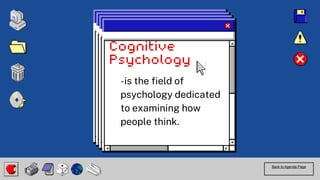
-is the field of
psychology dedicated
to examining how
people think.
Back to Agenda Page
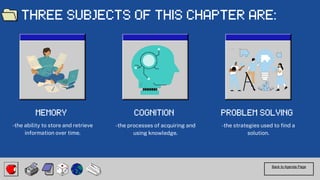
-the ability to store and retrieve
information over time.
-the processes of acquiring and
using knowledge.
-the strategies used to find a
solution.
HOW OUR PERCEPTIONS BECOME
MEMORIES
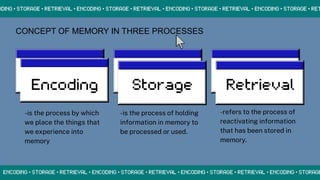
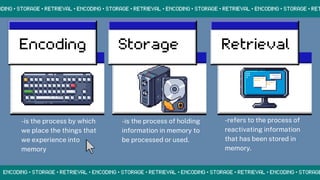
-is the process by which
we place the things that
we experience into
memory
-is the process of holding
information in memory to
be processed or used.
-refers to the process of
reactivating information
that has been stored in
memory.
CONCEPT OF MEMORY IN THREE PROCESSES
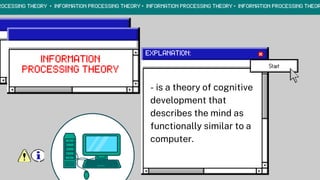
- is a theory of cognitive
development that
describes the mind as
functionally similar to a
computer.
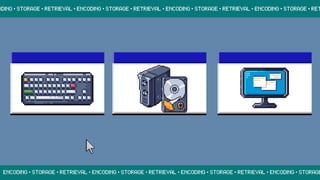
-is the process by which
we place the things that
we experience into
memory
-is the process of holding
information in memory to
be processed or used.
-refers to the process of
reactivating information
that has been stored in
memory.
Back to Agenda Page
• is the process of holding information in memory to be
processed or used.
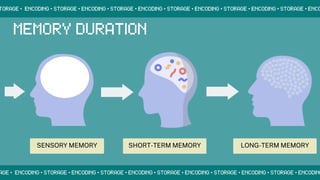
• Another way of understanding memory is to think about
it in terms of stages that describe the length of time
that information remains available to us; how long it can
be stored.
Back to Agenda Page
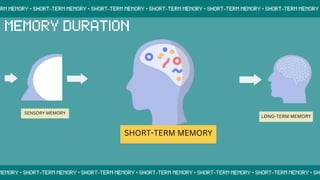
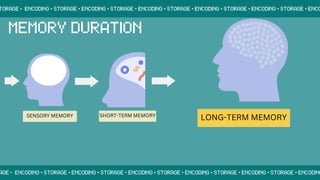
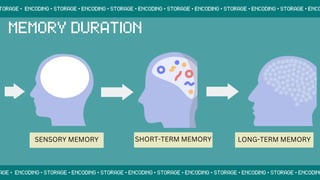
SENSORY MEMORY SHORT-TERM MEMORY LONG-TERM MEMORY
SENSORY MEMORY
SHORT-TERM MEMORY LONG-TERM MEMORY
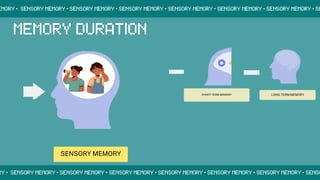
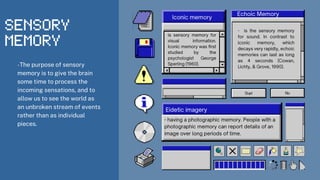
-The purpose of sensory
memory is to give the brain
some time to process the
incoming sensations, and to
allow us to see the world as
an unbroken stream of events
rather than as individual
pieces.
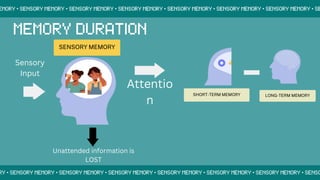
SENSORY MEMORY
SHORT-TERM MEMORY LONG-TERM MEMORY
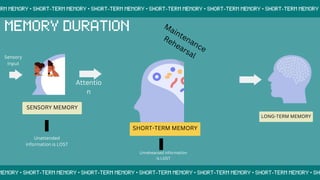
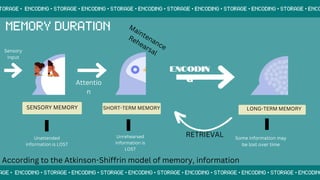
Sensory
Input
Unattended information is
LOST
Attentio
n
SENSORY MEMORY
SHORT-TERM MEMORY
LONG-TERM MEMORY
-In Short-term memory (STM) small
amounts of information can be
temporarily kept for more than a
few seconds, but usually for less
than one minute (Baddeley, Vallar,
& Shallice, 1990).
-Information in short-term memory
is not stored permanently but
rather becomes available for us to
process, and the processes that we
use to make sense of, modify,
interpret, and store information in
STM are known as working memory.
Attentio
n
SHORT-TERM MEMORY
LONG-TERM MEMORY
Unrehearsed information
is LOST
SENSORY MEMORY
Sensory
Input
Unattended
information is LOST
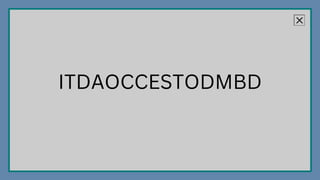
ITDAOCCESTODMBD
???????????????
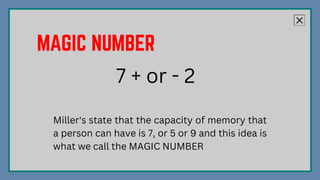
7 + or - 2
Miller's state that the capacity of memory that
a person can have is 7, or 5 or 9 and this idea is
what we call the MAGIC NUMBER
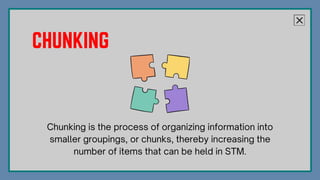
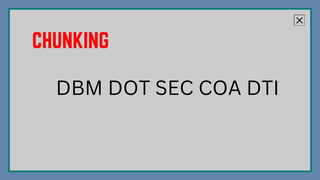
DBM DOT SEC COA DTI
SENSORY MEMORY SHORT-TERM MEMORY
LONG-TERM MEMORY
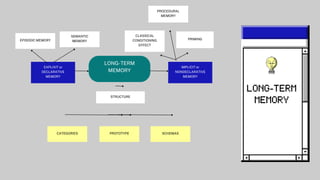
LONG-TERM
MEMORY
EXPLIXIT or
DECLARATIVE
MEMORY
STRUCTURE
IMPLICIT or
NONDECLARATIVE
MEMORY
CLASSICAL
CONDITIONING
EFFECT
EPISODIC MEMORY
CATEGORIES PROTOTYPE
SEMANTIC
MEMORY
PRIMING
PROCEDURAL
MEMORY
SCHEMAS
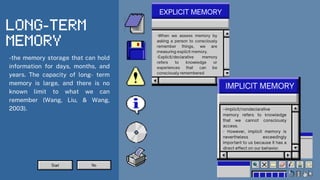
-the memory storage that can hold
information for days, months, and
years. The capacity of long- term
memory is large, and there is no
known limit to what we can
remember (Wang, Liu, & Wang,
2003).
Back to Agenda Page
refers to the firsthand
experiences that we have had.
refers to our knowledge of facts
and concepts about the world.
-When we assess memory by asking a person to consciously remember things, we are
measuring explicit memory.
-Explicit/declarative memory refers to knowledge or experiences that can be consciously
remembered
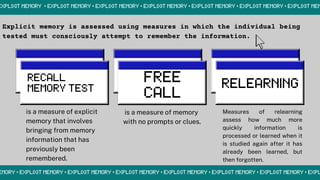
is a measure of explicit
memory that involves
bringing from memory
information that has
previously been
remembered.
is a measure of memory
with no prompts or clues.
Measures of relearning
assess how much more
quickly information is
processed or learned when it
is studied again after it has
already been learned, but
then forgotten.
Explicit memory is assessed using measures in which the individual being
tested must consciously attempt to remember the information.
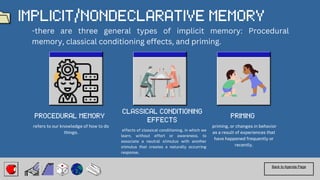
effects of classical conditioning, in which we
learn, without effort or awareness, to
associate a neutral stimulus with another
stimulus that creates a naturally occurring
response.
Back to Agenda Page
refers to our knowledge of how to do
things.
priming, or changes in behavior
as a result of experiences that
have happened frequently or
recently.
-there are three general types of implicit memory: Procedural
memory, classical conditioning effects, and priming.
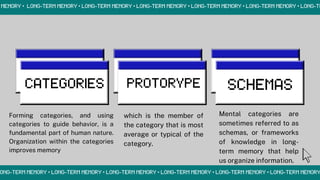
Forming categories, and using
categories to guide behavior, is a
fundamental part of human nature.
Organization within the categories
improves memory
which is the member of
the category that is most
average or typical of the
category.
Mental categories are
sometimes referred to as
schemas, or frameworks
of knowledge in long-
term memory that help
us organize information.
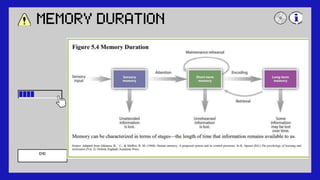
SENSORY MEMORY SHORT-TERM MEMORY
LONG-TERM MEMORY
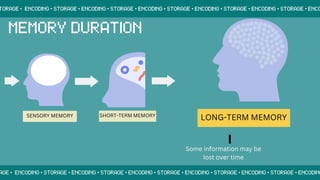
Some information may be
lost over time
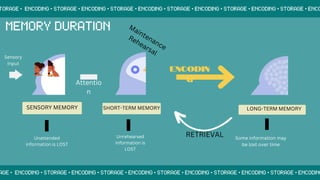
SENSORY MEMORY SHORT-TERM MEMORY LONG-TERM MEMORY
Unrehearsed
information is
LOST
SENSORY MEMORY SHORT-TERM MEMORY LONG-TERM MEMORY
Sensory
Input
Unattended
information is LOST
Attentio
n
Some information may
be lost over time
RETRIEVAL
ENCODIN
G
Back to Agenda Page
• is the process by which we place the things that we
experience into memory.
• “Not everything we experience can or should be
encoded. We tend to encode things that we need to
remember and not bother to encode things that are
irrelevant.”
Back to Agenda Page
• we process new information in ways that make it
more relevant or meaningful (Craik & Lockhart,
1972; Harris & Qualls, 2000).
MNEMONICS
MNEMONICS
Acronyms &
Acrostics
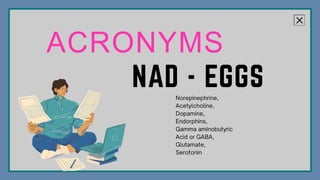
ACRONYMS
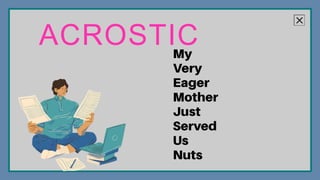
ACROSTIC
• is an important cause of memory failure and
forgetting in humans.
INEFFECTIVE ENCODING or an
ENCODING FAILURE
• is powerful evidence that the self-concept helps us
organize and remember information.
Unrehearsed
information is
LOST
SENSORY MEMORY SHORT-TERM MEMORY LONG-TERM MEMORY
Sensory
Input
Unattended
information is LOST
Attentio
n
Some information may
be lost over time
RETRIEVAL
ENCODIN
G
According to the Atkinson-Shiffrin model of memory, information
Memory and Cognition: Encoding and Storage.pptx

Memory and Cognition: Encoding and Storage.pptx

  • 1.
  • 2.
    Back to AgendaPage -is the field of psychology dedicated to examining how people think.
  • 3.
    Back to AgendaPage -the ability to store and retrieve information over time. -the processes of acquiring and using knowledge. -the strategies used to find a solution.
  • 4.
    HOW OUR PERCEPTIONSBECOME MEMORIES
  • 5.
    -is the processby which we place the things that we experience into memory -is the process of holding information in memory to be processed or used. -refers to the process of reactivating information that has been stored in memory. CONCEPT OF MEMORY IN THREE PROCESSES
  • 6.
    - is atheory of cognitive development that describes the mind as functionally similar to a computer.
  • 8.
    -is the processby which we place the things that we experience into memory -is the process of holding information in memory to be processed or used. -refers to the process of reactivating information that has been stored in memory.
  • 10.
  • 11.
    • is theprocess of holding information in memory to be processed or used. • Another way of understanding memory is to think about it in terms of stages that describe the length of time that information remains available to us; how long it can be stored. Back to Agenda Page
  • 12.
    SENSORY MEMORY SHORT-TERMMEMORY LONG-TERM MEMORY
  • 13.
  • 14.
    -The purpose ofsensory memory is to give the brain some time to process the incoming sensations, and to allow us to see the world as an unbroken stream of events rather than as individual pieces.
  • 15.
    SENSORY MEMORY SHORT-TERM MEMORYLONG-TERM MEMORY Sensory Input Unattended information is LOST Attentio n
  • 16.
  • 17.
    -In Short-term memory(STM) small amounts of information can be temporarily kept for more than a few seconds, but usually for less than one minute (Baddeley, Vallar, & Shallice, 1990). -Information in short-term memory is not stored permanently but rather becomes available for us to process, and the processes that we use to make sense of, modify, interpret, and store information in STM are known as working memory.
  • 18.
    Attentio n SHORT-TERM MEMORY LONG-TERM MEMORY Unrehearsedinformation is LOST SENSORY MEMORY Sensory Input Unattended information is LOST
  • 19.
  • 20.
  • 21.
    7 + or- 2 Miller's state that the capacity of memory that a person can have is 7, or 5 or 9 and this idea is what we call the MAGIC NUMBER
  • 23.
    DBM DOT SECCOA DTI
  • 24.
    SENSORY MEMORY SHORT-TERMMEMORY LONG-TERM MEMORY
  • 25.
  • 26.
    -the memory storagethat can hold information for days, months, and years. The capacity of long- term memory is large, and there is no known limit to what we can remember (Wang, Liu, & Wang, 2003).
  • 27.
    Back to AgendaPage refers to the firsthand experiences that we have had. refers to our knowledge of facts and concepts about the world. -When we assess memory by asking a person to consciously remember things, we are measuring explicit memory. -Explicit/declarative memory refers to knowledge or experiences that can be consciously remembered
  • 28.
    is a measureof explicit memory that involves bringing from memory information that has previously been remembered. is a measure of memory with no prompts or clues. Measures of relearning assess how much more quickly information is processed or learned when it is studied again after it has already been learned, but then forgotten. Explicit memory is assessed using measures in which the individual being tested must consciously attempt to remember the information.
  • 29.
    effects of classicalconditioning, in which we learn, without effort or awareness, to associate a neutral stimulus with another stimulus that creates a naturally occurring response. Back to Agenda Page refers to our knowledge of how to do things. priming, or changes in behavior as a result of experiences that have happened frequently or recently. -there are three general types of implicit memory: Procedural memory, classical conditioning effects, and priming.
  • 30.
    Forming categories, andusing categories to guide behavior, is a fundamental part of human nature. Organization within the categories improves memory which is the member of the category that is most average or typical of the category. Mental categories are sometimes referred to as schemas, or frameworks of knowledge in long- term memory that help us organize information.
  • 31.
    SENSORY MEMORY SHORT-TERMMEMORY LONG-TERM MEMORY Some information may be lost over time
  • 32.
    SENSORY MEMORY SHORT-TERMMEMORY LONG-TERM MEMORY
  • 33.
    Unrehearsed information is LOST SENSORY MEMORYSHORT-TERM MEMORY LONG-TERM MEMORY Sensory Input Unattended information is LOST Attentio n Some information may be lost over time RETRIEVAL ENCODIN G
  • 34.
  • 35.
    • is theprocess by which we place the things that we experience into memory. • “Not everything we experience can or should be encoded. We tend to encode things that we need to remember and not bother to encode things that are irrelevant.” Back to Agenda Page
  • 36.
    • we processnew information in ways that make it more relevant or meaningful (Craik & Lockhart, 1972; Harris & Qualls, 2000).
  • 37.
  • 38.
  • 39.
  • 40.
  • 41.
    • is animportant cause of memory failure and forgetting in humans. INEFFECTIVE ENCODING or an ENCODING FAILURE
  • 42.
    • is powerfulevidence that the self-concept helps us organize and remember information.
  • 43.
    Unrehearsed information is LOST SENSORY MEMORYSHORT-TERM MEMORY LONG-TERM MEMORY Sensory Input Unattended information is LOST Attentio n Some information may be lost over time RETRIEVAL ENCODIN G According to the Atkinson-Shiffrin model of memory, information