Metadata and its Use in the
Field of Information
Retrieval Environment
by

Dr. Umesha Naik

Prof. D Shivalingaiah

Department of Library and Information Science
Mangalore University
Metadata and its Use in the Field of Information Retrieval Environment
1. Introduction
• Metadata is one of the most important aspects of
content management and website design.
• It is an essential tool for understanding information
stored in data warehouses and has become increasingly
important in HTML, XML-based web applications.
• The information available in the internet is easily and
vast accessible that library and information users
expect information services based on metadata.
• The Dublin Core Metadata Initiative was motivated
by the guiding principle of producing a metadata
element
• OCLC initiated a project in 1994 to experiment with
cataloging Web resources by using the AACR2 and
MARC format.
Metadata and its Use in the Field of Information Retrieval Environment

2
2. Applications of Metadata
Cataloguing (Item and Collections)
MARC
Resource Discovery
Web Search Engine
Electronic Commerce
E-commerce, E-management
Intelligent Software Agents
Tools and Techniques
Digital Signatures
Digital Objects
Content Rating
Search Engine and Ranking tools.
Intellectual Property Rights
Copy right
Privacy Preferences & Policies
Protection, Proxy,and its Use in the Field of Information Retrieval Environment
Metadata Firewall etc.

3
3. Types of Metadata
Descriptive Metadata
Structural Metadata
Administrative Metadata

Metadata and its Use in the Field of Information Retrieval Environment

4
4. Functions of Metadata
4.1 Resource Discovery

•Allowing resources to be found by relevant
criteria;
• Identifying resources;
• Bringing similar resources together;
• Distinguishing dissimilar resources;
• Giving location information.

Metadata and its Use in the Field of Information Retrieval Environment

5
4. Functions of Metadata
4.2 Organizing e-resources

•Organizing links to resources based on audience or
topic.
•Building these pages dynamically from metadata
stored in databases.

4.3 Facilitating Interoperability

•Using defined metadata schemes, shared transfer
protocols, and crosswalks between schemes,
resources across the network can be searched more
seamlessly.
 Cross-system search, e.g., using Z39.50
protocol;
 Metadata harvesting, e.g., OAI protocol.
6

Metadata and its Use in the Field of Information Retrieval Environment
4. Functions of Metadata
4.4 Digital identification

•Elements for standard numbers, e.g., ISBN
•The location of a digital object may also be given
using:
 a file name
 a URL
 some persistent identifiers, e.g., PURL
(Persistent URL); DOI (Digital Object
Identifier)
 Combined metadata to act as a set of
identifying data, differentiating one object
from another for validation purposes.
Metadata and its Use in the Field of Information Retrieval Environment

7
4. Functions of Metadata
4.5 Archiving and Preservation
• Challenges:
 Digital information is fragile and can be
corrupted or altered;
 It may become unusable as storage
technologies change.
• Metadata is key to ensuring that resources will
survive and continue to be accessible into the
future. Archiving and preservation require special
elements:
 to track the lineage of a digital object,
 to detail its physical characteristics, and
 to document its behavior in order to emulate it
in future technologies.
Metadata and its Use in the Field of Information Retrieval Environment

8
4. Functions of Metadata
4.6 Character Encodings
• Used for communicating text characters
in a computing environment
• Hundreds
of
character
encoding
standards exist
• Character conversion is complex and
expensive

Metadata and its Use in the Field of Information Retrieval Environment

9
4. Functions of Metadata
4.7 Unicode
• A
single,
“comprehensive”
global
encoding standard
• Includes characters from scripts of all
major modern, most minor, and selected
ancient languages

Metadata and its Use in the Field of Information Retrieval Environment

10
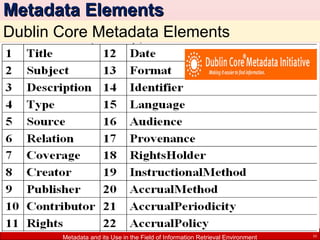
Metadata Elements
Dublin Core Metadata Elements

Metadata and its Use in the Field of Information Retrieval Environment

11
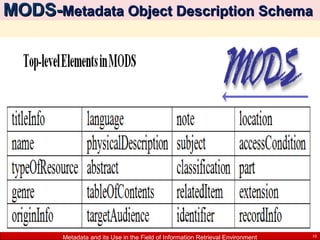
MODS-Metadata Object Description Schema

Metadata and its Use in the Field of Information Retrieval Environment

12
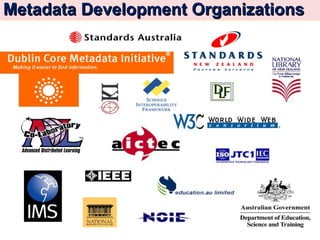
Metadata Development Organizations

Metadata and its Use in the Field of Information Retrieval Environment

13
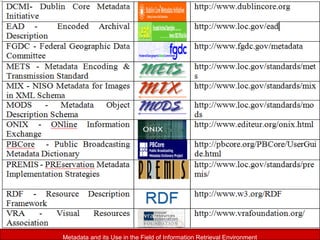
Metadata and its Use in the Field of Information Retrieval Environment
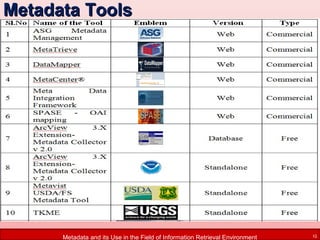
Metadata Tools

Metadata and its Use in the Field of Information Retrieval Environment

15
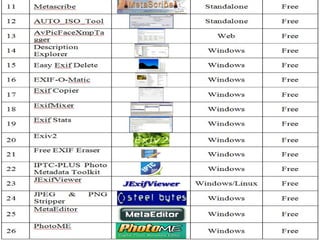
a

Metadata and its Use in the Field of Information Retrieval Environment

16
Conclusion
• Metadata is a standard and an essential tool in
this digital era
• To improve access to information regardless
of the location, format and structure of the
resources.
• Such technology greatly improved the
publication and dissemination of information
and resulted in a widely faster increase in the
volume and complexities of digital resources.

Metadata and its Use in the Field of Information Retrieval Environment

17
Thank You
Metadata and its Use in the Field of Information Retrieval Environment

18

Umesha naik metadata

  • 1.
    Metadata and itsUse in the Field of Information Retrieval Environment by Dr. Umesha Naik Prof. D Shivalingaiah Department of Library and Information Science Mangalore University Metadata and its Use in the Field of Information Retrieval Environment
  • 2.
    1. Introduction • Metadatais one of the most important aspects of content management and website design. • It is an essential tool for understanding information stored in data warehouses and has become increasingly important in HTML, XML-based web applications. • The information available in the internet is easily and vast accessible that library and information users expect information services based on metadata. • The Dublin Core Metadata Initiative was motivated by the guiding principle of producing a metadata element • OCLC initiated a project in 1994 to experiment with cataloging Web resources by using the AACR2 and MARC format. Metadata and its Use in the Field of Information Retrieval Environment 2
  • 3.
    2. Applications ofMetadata Cataloguing (Item and Collections) MARC Resource Discovery Web Search Engine Electronic Commerce E-commerce, E-management Intelligent Software Agents Tools and Techniques Digital Signatures Digital Objects Content Rating Search Engine and Ranking tools. Intellectual Property Rights Copy right Privacy Preferences & Policies Protection, Proxy,and its Use in the Field of Information Retrieval Environment Metadata Firewall etc. 3
  • 4.
    3. Types ofMetadata Descriptive Metadata Structural Metadata Administrative Metadata Metadata and its Use in the Field of Information Retrieval Environment 4
  • 5.
    4. Functions ofMetadata 4.1 Resource Discovery •Allowing resources to be found by relevant criteria; • Identifying resources; • Bringing similar resources together; • Distinguishing dissimilar resources; • Giving location information. Metadata and its Use in the Field of Information Retrieval Environment 5
  • 6.
    4. Functions ofMetadata 4.2 Organizing e-resources •Organizing links to resources based on audience or topic. •Building these pages dynamically from metadata stored in databases. 4.3 Facilitating Interoperability •Using defined metadata schemes, shared transfer protocols, and crosswalks between schemes, resources across the network can be searched more seamlessly.  Cross-system search, e.g., using Z39.50 protocol;  Metadata harvesting, e.g., OAI protocol. 6 Metadata and its Use in the Field of Information Retrieval Environment
  • 7.
    4. Functions ofMetadata 4.4 Digital identification •Elements for standard numbers, e.g., ISBN •The location of a digital object may also be given using:  a file name  a URL  some persistent identifiers, e.g., PURL (Persistent URL); DOI (Digital Object Identifier)  Combined metadata to act as a set of identifying data, differentiating one object from another for validation purposes. Metadata and its Use in the Field of Information Retrieval Environment 7
  • 8.
    4. Functions ofMetadata 4.5 Archiving and Preservation • Challenges:  Digital information is fragile and can be corrupted or altered;  It may become unusable as storage technologies change. • Metadata is key to ensuring that resources will survive and continue to be accessible into the future. Archiving and preservation require special elements:  to track the lineage of a digital object,  to detail its physical characteristics, and  to document its behavior in order to emulate it in future technologies. Metadata and its Use in the Field of Information Retrieval Environment 8
  • 9.
    4. Functions ofMetadata 4.6 Character Encodings • Used for communicating text characters in a computing environment • Hundreds of character encoding standards exist • Character conversion is complex and expensive Metadata and its Use in the Field of Information Retrieval Environment 9
  • 10.
    4. Functions ofMetadata 4.7 Unicode • A single, “comprehensive” global encoding standard • Includes characters from scripts of all major modern, most minor, and selected ancient languages Metadata and its Use in the Field of Information Retrieval Environment 10
  • 11.
    Metadata Elements Dublin CoreMetadata Elements Metadata and its Use in the Field of Information Retrieval Environment 11
  • 12.
    MODS-Metadata Object DescriptionSchema Metadata and its Use in the Field of Information Retrieval Environment 12
  • 13.
    Metadata Development Organizations Metadataand its Use in the Field of Information Retrieval Environment 13
  • 14.
    Metadata and itsUse in the Field of Information Retrieval Environment
  • 15.
    Metadata Tools Metadata andits Use in the Field of Information Retrieval Environment 15
  • 16.
    a Metadata and itsUse in the Field of Information Retrieval Environment 16
  • 17.
    Conclusion • Metadata isa standard and an essential tool in this digital era • To improve access to information regardless of the location, format and structure of the resources. • Such technology greatly improved the publication and dissemination of information and resulted in a widely faster increase in the volume and complexities of digital resources. Metadata and its Use in the Field of Information Retrieval Environment 17
  • 18.
    Thank You Metadata andits Use in the Field of Information Retrieval Environment 18