Downloaded 34 times



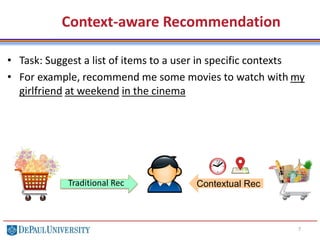


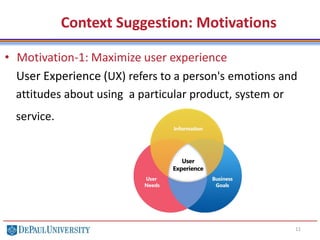


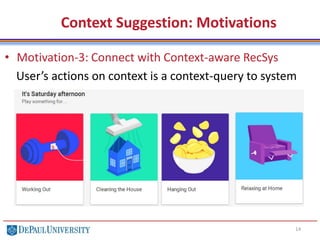


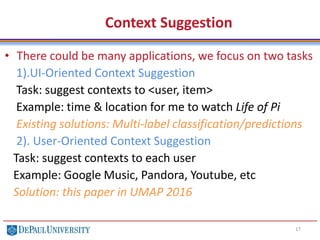


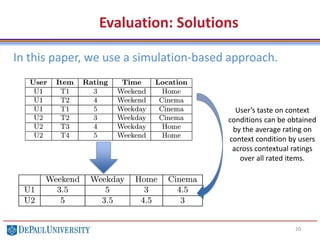
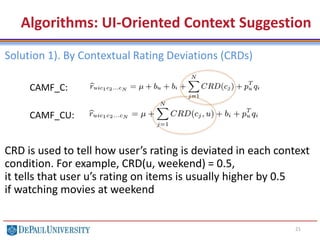
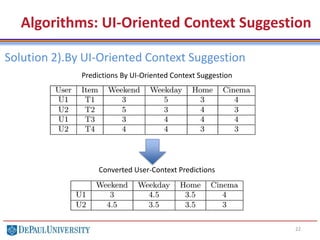
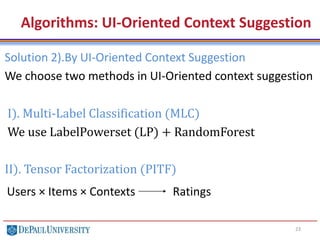
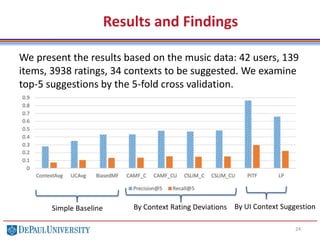


This paper proposes a method called user-oriented context suggestion that suggests contexts to users based on their preferences. It aims to maximize user experience by recommending not just good items, but appropriate contexts for those items. Two algorithms are developed: one based on contextual rating deviations that identifies how a user's ratings change across contexts, and another that adapts techniques from item-oriented context suggestion. An evaluation on a music dataset finds the tensor factorization approach performs best, with the contextual rating deviations method also outperforming a simple baseline. Future work includes collecting better evaluation data and trying other contextual recommendation algorithms.
![[IUI 2017] Criteria Chains: A Novel Multi-Criteria Recommendation Approach](https://cdn.slidesharecdn.com/ss_thumbnails/slideiui2017-170302210229-thumbnail.jpg?width=640&height=640&fit=bounds)
![[SAC 2015] Improve General Contextual SLIM Recommendation Algorithms By Facto...](https://cdn.slidesharecdn.com/ss_thumbnails/slidesacsrc2015-150419112525-conversion-gate01-thumbnail.jpg?width=640&height=640&fit=bounds)
![[EMPIRE 2016] Adapt to Emotional Reactions In Context-aware Personalization](https://cdn.slidesharecdn.com/ss_thumbnails/ppt-160915033930-thumbnail.jpg?width=640&height=640&fit=bounds)
![[Decisions2013@RecSys]The Role of Emotions in Context-aware Recommendation](https://cdn.slidesharecdn.com/ss_thumbnails/slide2013recsys-131009180526-phpapp02-thumbnail.jpg?width=640&height=640&fit=bounds)

![[RecSys 2014] Deviation-Based and Similarity-Based Contextual SLIM Recommenda...](https://cdn.slidesharecdn.com/ss_thumbnails/ppt-150112200821-conversion-gate02-thumbnail.jpg?width=640&height=640&fit=bounds)
![[UMAP 2015] Integrating Context Similarity with Sparse Linear Recommendation ...](https://cdn.slidesharecdn.com/ss_thumbnails/slide2015umap2015contextsimilaritycars-150630105917-lva1-app6892-thumbnail.jpg?width=640&height=640&fit=bounds)
![[WI 2017] Affective Prediction By Collaborative Chains In Movie Recommendation](https://cdn.slidesharecdn.com/ss_thumbnails/slidewiemo-170812014141-thumbnail.jpg?width=640&height=640&fit=bounds)
![[ADMA 2017] Identification of Grey Sheep Users By Histogram Intersection In R...](https://cdn.slidesharecdn.com/ss_thumbnails/slideadmagsuser-171102023252-thumbnail.jpg?width=640&height=640&fit=bounds)
![[IUI2015] A Revisit to The Identification of Contexts in Recommender Systems](https://cdn.slidesharecdn.com/ss_thumbnails/atlanta-150305180748-conversion-gate01-thumbnail.jpg?width=640&height=640&fit=bounds)
![[WI 2017] Context Suggestion: Empirical Evaluations vs User Studies](https://cdn.slidesharecdn.com/ss_thumbnails/slidewicontextsuggestion-170812014320-thumbnail.jpg?width=640&height=640&fit=bounds)

![[CIKM 2014] Deviation-Based Contextual SLIM Recommenders](https://cdn.slidesharecdn.com/ss_thumbnails/ppt-150110073757-conversion-gate01-thumbnail.jpg?width=640&height=640&fit=bounds)
![[RIIT 2017] Identifying Grey Sheep Users By The Distribution of User Similari...](https://cdn.slidesharecdn.com/ss_thumbnails/slidegsuser-171004030338-thumbnail.jpg?width=640&height=640&fit=bounds)


![[UMAP2013]Tutorial on Context-Aware User Modeling for Recommendation by Bamsh...](https://cdn.slidesharecdn.com/ss_thumbnails/tutorialcontext-aware-recommendationumap2013-130704190441-phpapp01-thumbnail.jpg?width=640&height=640&fit=bounds)


![[WI 2014]Context Recommendation Using Multi-label Classification](https://cdn.slidesharecdn.com/ss_thumbnails/slidewic2014context-140805210546-phpapp01-thumbnail.jpg?width=640&height=640&fit=bounds)
![[ECWEB2012]Differential Context Relaxation for Context-Aware Travel Recommend...](https://cdn.slidesharecdn.com/ss_thumbnails/slide2012ecweb2012differentialcontextrelaxationforcontext-awaretravelrecommendation-120909113927-phpapp02-thumbnail.jpg?width=640&height=640&fit=bounds)


![[WISE 2015] Similarity-Based Context-aware Recommendation](https://cdn.slidesharecdn.com/ss_thumbnails/ppt2015wise-151105004039-lva1-app6892-thumbnail.jpg?width=640&height=640&fit=bounds)


![[SAC2014]Splitting Approaches for Context-Aware Recommendation: An Empirical ...](https://cdn.slidesharecdn.com/ss_thumbnails/slide2014sacsplittingapproachesforcontext-awarerecommendation-140211171234-phpapp01-thumbnail.jpg?width=640&height=640&fit=bounds)
![[UMAP2013] Recommendation with Differential Context Weighting](https://cdn.slidesharecdn.com/ss_thumbnails/slide2013umap2013differentialcontextweighting-130611091905-phpapp01-thumbnail.jpg?width=640&height=640&fit=bounds)
![[SOCRS2013]Differential Context Modeling in Collaborative Filtering](https://cdn.slidesharecdn.com/ss_thumbnails/slide2013socrs2013differentialcontextmodelingincollaborativefiltering-130519153030-phpapp01-thumbnail.jpg?width=640&height=640&fit=bounds)


![[CARS2012@RecSys]Optimal Feature Selection for Context-Aware Recommendation u...](https://cdn.slidesharecdn.com/ss_thumbnails/slide2012recsys-cars2012optimalfeatureselectionforcontext-awarerecommendationusingdifferentialrelaxation-120909114054-phpapp01-thumbnail.jpg?width=640&height=640&fit=bounds)
![[HetRec2011@RecSys]Experience Discovery: Hybrid Recommendation of Student Act...](https://cdn.slidesharecdn.com/ss_thumbnails/slide2011recsys-hetrec2011experiencediscoveryhybridrecommendationofstudentactivitiesusingsocialnetworkdata-120909113502-phpapp01-thumbnail.jpg?width=640&height=640&fit=bounds)


