ULIP Final Presentation
Peter Samuel Oloi
HR Learning Intern
A lover of science & knowledge
Organizational Learning Culture in Unilever Indonesia:
A business, economics, and psychology approach.
Today’s Presentation Menu:
• Background:
- External
- Internal
- Theory & Research
• Implementation
- Projects
- Analysis & Improvement Suggestion
• New Ideas
• Conclusion
BACKGROUND: External
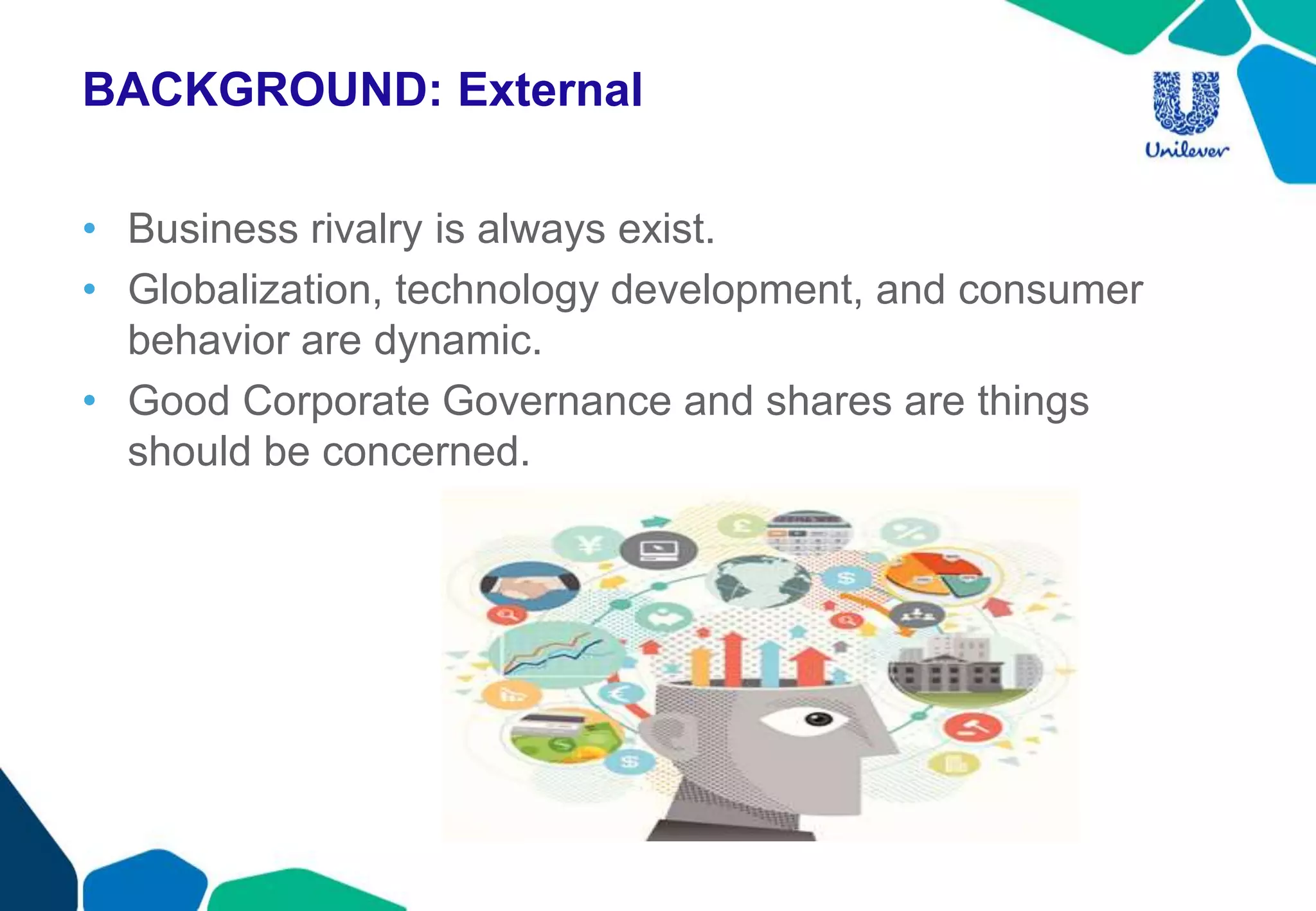
• Business rivalry is always exist.
• Globalization, technology development, and consumer
behavior are dynamic.
• Good Corporate Governance and shares are things
should be concerned.
BACKGROUND: Internal
• Unilever Indonesia is driving to achieve success in order
to actualize its vision.
• Unilever Indonesia is facing challenges based on
external background.
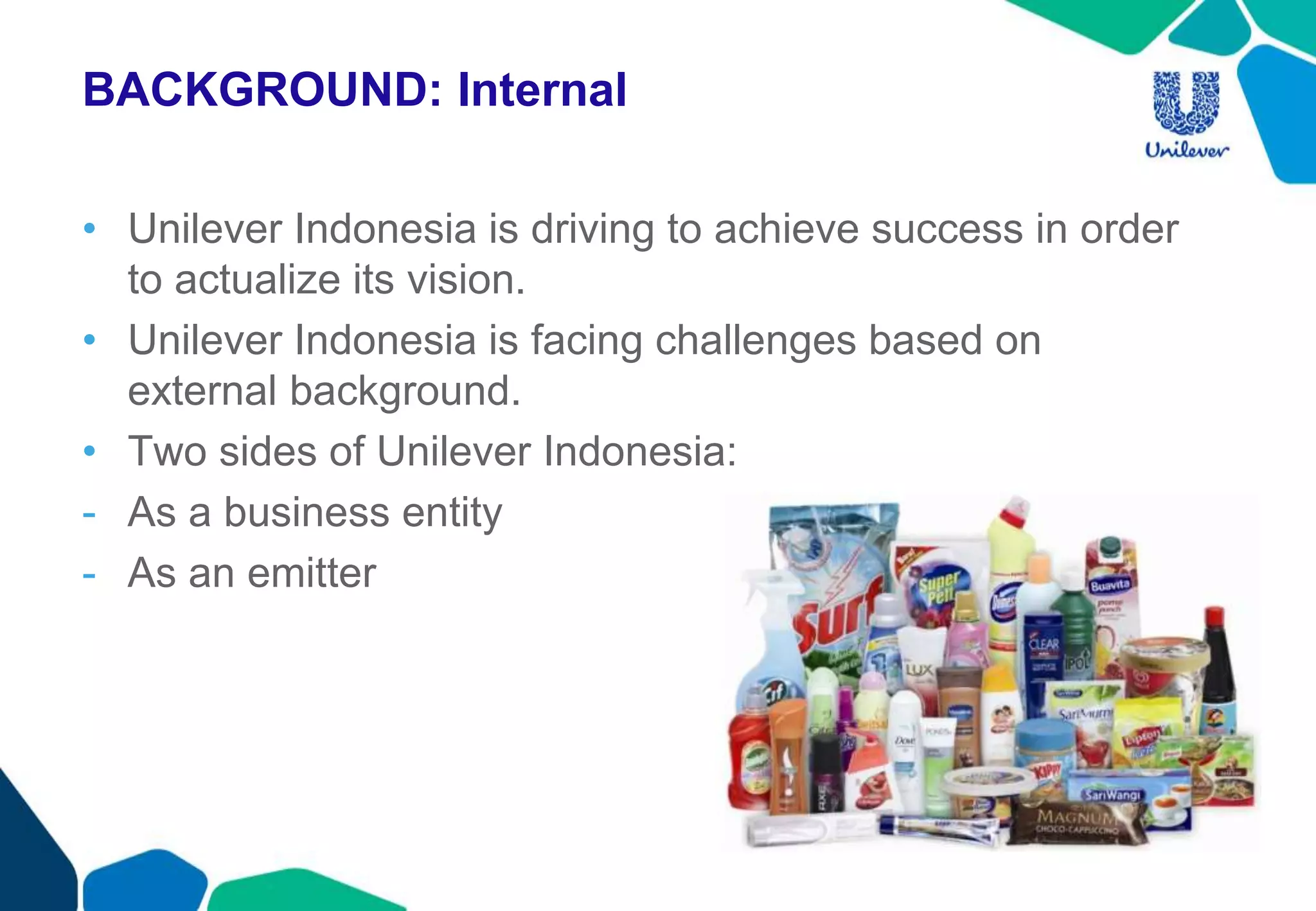
• Two sides of Unilever Indonesia:
- As a business entity
- As an emitter
BACKGROUND: Theory & Research
• What are organizational learning and organizational
learning culture?
• Why should both be considered?
• How to execute them all?
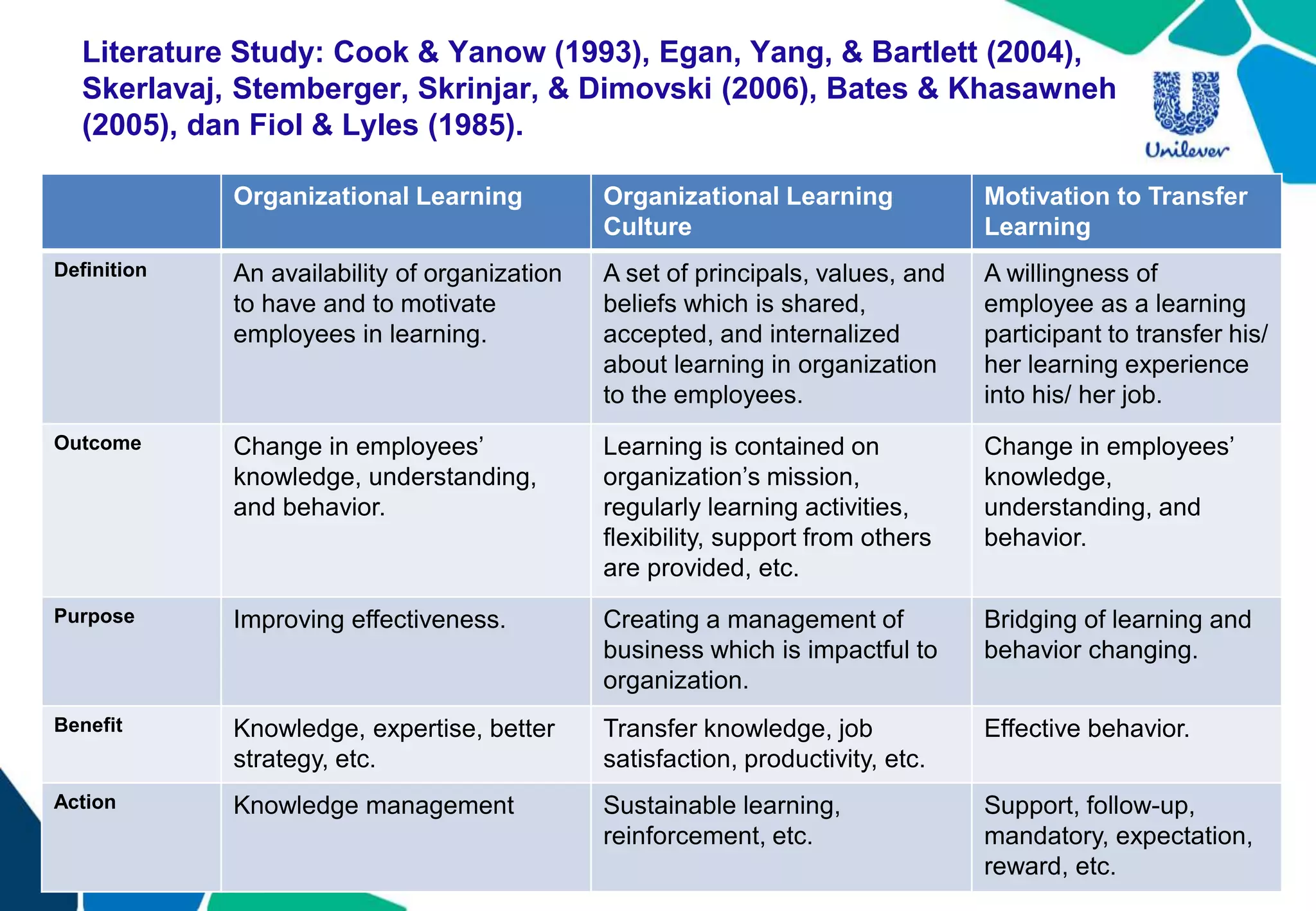
Literature Study: Cook & Yanow (1993), Egan, Yang, & Bartlett (2004),
Skerlavaj, Stemberger, Skrinjar, & Dimovski (2006), Bates & Khasawneh
(2005), dan Fiol & Lyles (1985).
Organizational Learning Organizational Learning
Culture
Motivation to Transfer
Learning
Definition An availability of organization
to have and to motivate
employees in learning.
A set of principals, values, and
beliefs which is shared,
accepted, and internalized
about learning in organization
to the employees.
A willingness of
employee as a learning
participant to transfer his/
her learning experience
into his/ her job.
Outcome Change in employees’
knowledge, understanding,
and behavior.
Learning is contained on
organization’s mission,
regularly learning activities,
flexibility, support from others
are provided, etc.
Change in employees’
knowledge,
understanding, and
behavior.
Purpose Improving effectiveness. Creating a management of
business which is impactful to
organization.
Bridging of learning and
behavior changing.
Benefit Knowledge, expertise, better
strategy, etc.
Transfer knowledge, job
satisfaction, productivity, etc.
Effective behavior.
Action Knowledge management Sustainable learning,
reinforcement, etc.
Support, follow-up,
mandatory, expectation,
reward, etc.
IMPLEMENTATION: Projects
• Learning Activities
• Simplification
• Learning Award
• Library Online
• Video Café
• E-Learning Competition
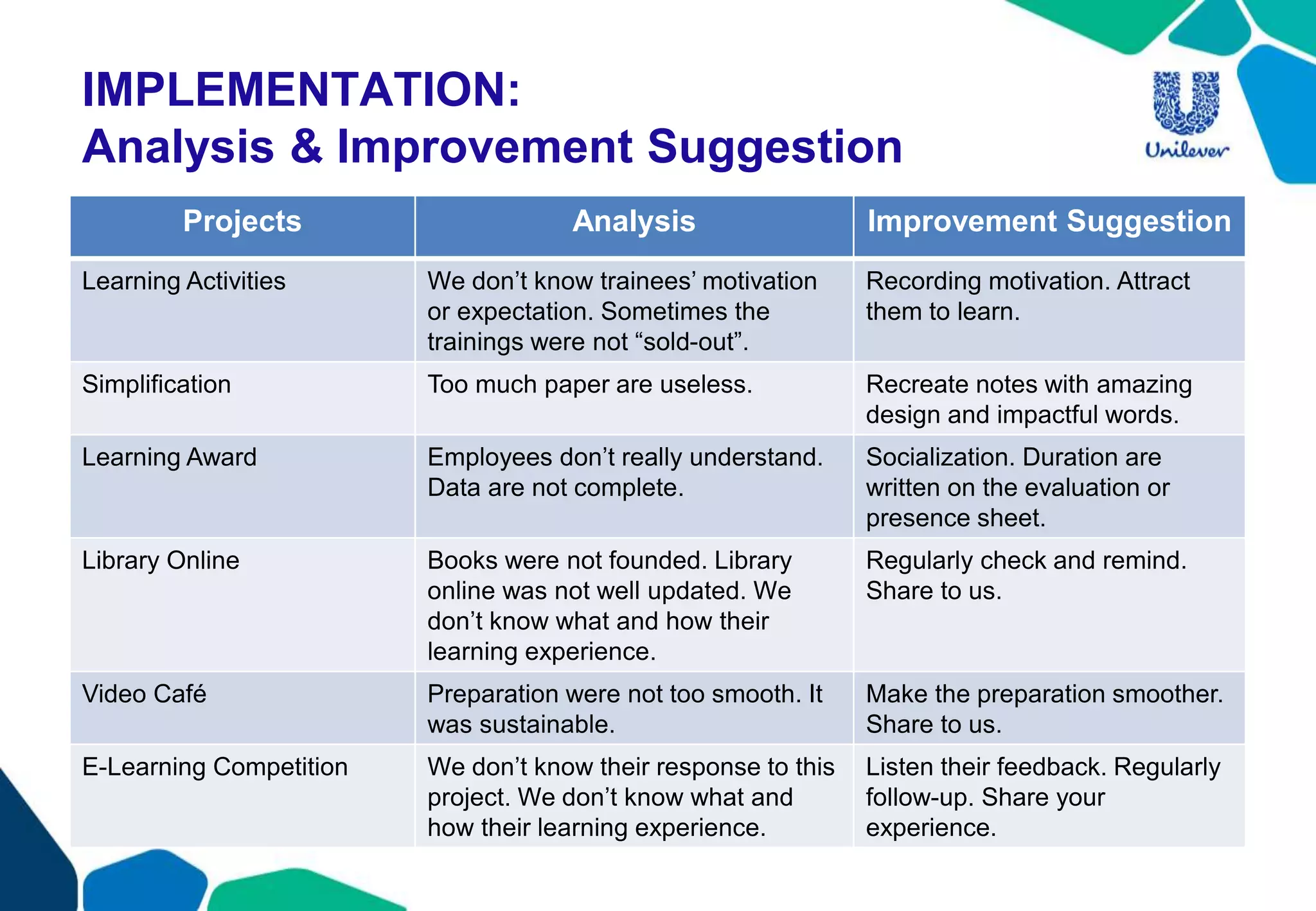
IMPLEMENTATION:
Analysis & Improvement Suggestion
Projects Analysis Improvement Suggestion
Learning Activities We don’t know trainees’ motivation
or expectation. Sometimes the
trainings were not “sold-out”.
Recording motivation. Attract
them to learn.
Simplification Too much paper are useless. Recreate notes with amazing
design and impactful words.
Learning Award Employees don’t really understand.
Data are not complete.
Socialization. Duration are
written on the evaluation or
presence sheet.
Library Online Books were not founded. Library
online was not well updated. We
don’t know what and how their
learning experience.
Regularly check and remind.
Share to us.
Video Café Preparation were not too smooth. It
was sustainable.
Make the preparation smoother.
Share to us.
E-Learning Competition We don’t know their response to this
project. We don’t know what and
how their learning experience.
Listen their feedback. Regularly
follow-up. Share your
experience.
NEW IDEAS
• 1 Article 1 Week
- Employee write article and share it to the employees.
- Sources from: their own experience, learning activities,
library online, video café, e-learning competitions,
outside articles, etc.
• Unilever Business Challenge
- Business challenge in common (case, solving problem or
making improvement, and presentation).
- Participants are employees from different function.
- Benefit is to participants and company itself.
CONCLUSION
• Unilever Indonesia should strive to success and give
benefit to all stakeholders.
• Organizational learning and organizational learning
culture are really important to achieve above dream.
• We have been doing well in creating organizational
learning and develop organizational learning culture.
Let’s improve it!
THANK YOU!
I’m welcome to your feedback. 

ULIP Final Presentation - Peter

  • 1.
    ULIP Final Presentation PeterSamuel Oloi HR Learning Intern A lover of science & knowledge Organizational Learning Culture in Unilever Indonesia: A business, economics, and psychology approach.
  • 2.
    Today’s Presentation Menu: •Background: - External - Internal - Theory & Research • Implementation - Projects - Analysis & Improvement Suggestion • New Ideas • Conclusion
  • 3.
    BACKGROUND: External • Businessrivalry is always exist. • Globalization, technology development, and consumer behavior are dynamic. • Good Corporate Governance and shares are things should be concerned.
  • 4.
    BACKGROUND: Internal • UnileverIndonesia is driving to achieve success in order to actualize its vision. • Unilever Indonesia is facing challenges based on external background. • Two sides of Unilever Indonesia: - As a business entity - As an emitter
  • 5.
    BACKGROUND: Theory &Research • What are organizational learning and organizational learning culture? • Why should both be considered? • How to execute them all?
  • 6.
    Literature Study: Cook& Yanow (1993), Egan, Yang, & Bartlett (2004), Skerlavaj, Stemberger, Skrinjar, & Dimovski (2006), Bates & Khasawneh (2005), dan Fiol & Lyles (1985). Organizational Learning Organizational Learning Culture Motivation to Transfer Learning Definition An availability of organization to have and to motivate employees in learning. A set of principals, values, and beliefs which is shared, accepted, and internalized about learning in organization to the employees. A willingness of employee as a learning participant to transfer his/ her learning experience into his/ her job. Outcome Change in employees’ knowledge, understanding, and behavior. Learning is contained on organization’s mission, regularly learning activities, flexibility, support from others are provided, etc. Change in employees’ knowledge, understanding, and behavior. Purpose Improving effectiveness. Creating a management of business which is impactful to organization. Bridging of learning and behavior changing. Benefit Knowledge, expertise, better strategy, etc. Transfer knowledge, job satisfaction, productivity, etc. Effective behavior. Action Knowledge management Sustainable learning, reinforcement, etc. Support, follow-up, mandatory, expectation, reward, etc.
  • 7.
    IMPLEMENTATION: Projects • LearningActivities • Simplification • Learning Award • Library Online • Video Café • E-Learning Competition
  • 8.
    IMPLEMENTATION: Analysis & ImprovementSuggestion Projects Analysis Improvement Suggestion Learning Activities We don’t know trainees’ motivation or expectation. Sometimes the trainings were not “sold-out”. Recording motivation. Attract them to learn. Simplification Too much paper are useless. Recreate notes with amazing design and impactful words. Learning Award Employees don’t really understand. Data are not complete. Socialization. Duration are written on the evaluation or presence sheet. Library Online Books were not founded. Library online was not well updated. We don’t know what and how their learning experience. Regularly check and remind. Share to us. Video Café Preparation were not too smooth. It was sustainable. Make the preparation smoother. Share to us. E-Learning Competition We don’t know their response to this project. We don’t know what and how their learning experience. Listen their feedback. Regularly follow-up. Share your experience.
  • 9.
    NEW IDEAS • 1Article 1 Week - Employee write article and share it to the employees. - Sources from: their own experience, learning activities, library online, video café, e-learning competitions, outside articles, etc. • Unilever Business Challenge - Business challenge in common (case, solving problem or making improvement, and presentation). - Participants are employees from different function. - Benefit is to participants and company itself.
  • 10.
    CONCLUSION • Unilever Indonesiashould strive to success and give benefit to all stakeholders. • Organizational learning and organizational learning culture are really important to achieve above dream. • We have been doing well in creating organizational learning and develop organizational learning culture. Let’s improve it!
  • 11.
    THANK YOU! I’m welcometo your feedback. 