Confidential Customized for Lorem Ipsum LLC Version 1.0
Knowledge Management
at Unilever Indonesia (ULI)
Prepared by Syndicate 6 of Blemba 25
29318399 Aditya Tejo Widagdo | 29318333 Andi Firmansyah | 29318317 Cikita Tiara |
29318445 Fadila Pratika HS Alimuddin | 29318346 Herdiana Wiyono |
29318417 Ike Suyanti | 29318446 Rifqi Agustin Hakim
Overview
1. Background of ULI
2. Knowledge at ULI
3. ULI as the Most Admired Knowledge Enterprise
4. Knowledge Strategy
5. Knowledge Approach
6. Lesson Learned
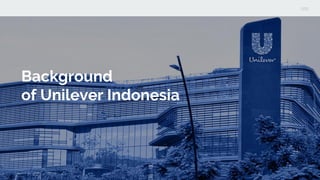
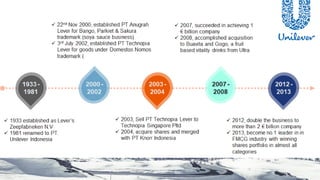
Background
of Unilever Indonesia
Knowledge
at Unilever
Performance Culture &
Internal Knowledge
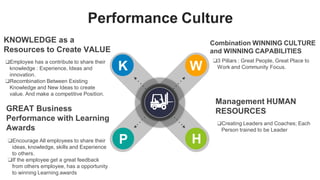
Performance Culture
❑Employee has a contribute to share their
knowledge : Experience, Ideas and
innovation.
❑Recombination Between Existing
Knowledge and New Ideas to create
value. And make a competitive Position.
KNOWLEDGE as a
Resources to Create VALUE
K W
P H
❑3 Pillars : Great People, Great Place to
Work and Community Focus.
Combination WINNING CULTURE
and WINNING CAPABILITIES
❑Creating Leaders and Coaches; Each
Person trained to be Leader
Management HUMAN
RESOURCES
❑Encourage All employees to share their
ideas, knowledge, skills and Experience
to others.
❑If the employee get a great feedback
from others employee, has a opportunity
to winning Learning awards
GREAT Business
Performance with Learning
Awards
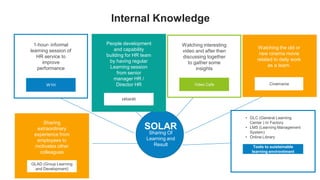
Internal Knowledge
Sharing Of
Learning and
Result
SOLAR
1-hour- informal
learning session of
HR service to
improve
performance
W1H
People development
and capability
building for HR team
by having regular
Learning session
from senior
manager HR /
Director HR
HR4HR
Watching interesting
video and after then
discussing together
to gather some
insights
Video Cafe
Watching the old or
new cinema movie
related to daily work
as a team.
Cinemania
Sharing
extraordinary
experience from
employees to
motivates other
colleagues
GLAD (Group Learning
and Development)
• GLC (General Learning
Center ) In Factory
• LMS (Learning Management
System)
• Online Library
Tools to suisteinable
learning environtment
External Knowledge &
Practice of Knowledge
Management Strategy
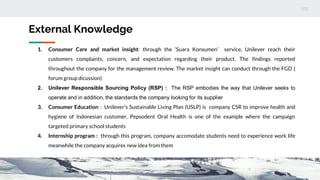
External Knowledge
1. Consumer Care and market insight: through the ‘Suara Konsumen’ service, Unilever reach their
customers complaints, concern, and expectation regarding their product. The findings reported
throughout the company for the management review. The market insight can conduct through the FGD (
forum group dicussion)
2. Unilever Responsible Sourcing Policy (RSP) : The RSP embodies the way that Unilever seeks to
operate and in addition, the standards the company looking for its supplier
3. Consumer Education : Unilever’s Sustainable Living Plan (USLP) is company CSR to improve health and
hygiene of Indonesian customer. Pepsodent Oral Health is one of the example where the campaign
targeted primary school students
4. Internship program : through this program, company accomodate students need to experience work life
meanwhile the company acquires new idea from them
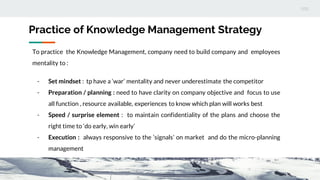
Practice of Knowledge Management Strategy
To practice the Knowledge Management, company need to build company and employees
mentality to :
- Set mindset : tp have a ‘war’ mentality and never underestimate the competitor
- Preparation / planning : need to have clarity on company objective and focus to use
all function , resource available, experiences to know which plan will works best
- Speed / surprise element : to maintain confidentiality of the plans and choose the
right time to ‘do early, win early’
- Execution : always responsive to the ‘signals’ on market and do the micro-planning
management
Unilever Indonesia as
the Most Admired
Knowledge Enterprise
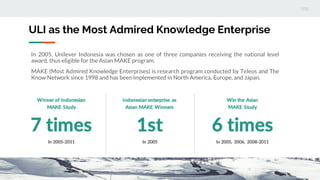
ULI as the Most Admired Knowledge Enterprise
In 2005, Unilever Indonesia was chosen as one of three companies receiving the national level
award, thus eligible for the Asian MAKE program.
MAKE (Most Admired Knowledge Enterprises) is research program conducted by Teleos and The
Know Network since 1998 and has been implemented in North America, Europe, and Japan.
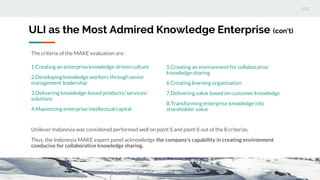
ULI as the Most Admired Knowledge Enterprise (con’t)
The criteria of the MAKE evaluation are:
1.Creating an enterprise knowledge-driven culture
2.Developingknowledge workers through senior
management leadership
3.Delivering knowledge-based products/ services/
solutions
4.Maximizing enterprise intellectual capital
5.Creating an environment for collaborative
knowledge sharing
6.Creating learning organization
7.Delivering value based on customer knowledge
8.Transforming enterprise knowledge into
shareholder value
Unilever Indonesia was considered performed well on point 5 and point 6 out of the 8 criterias.
Thus, the Indonesia MAKE expert panel acknowledge the company’s capability in creating environment
conducive for collaborative knowledge sharing.
KNOWLEDGE
STRATEGY
The Knowledge Strategy of ULI
1. Keep providing consumers with innovative, superior and economical products, one of which
is by applying a wealth of knowledge and international expertise.
1. Create and accept new ideas and continuous learning to achieve long-term success.
1. Maintaining knowledge updates and knowledge sharing to interested parties continuously.
1. Focus on meeting customer needs, employee development and creating an environment
conducive to various knowledge by providing adequate system and facility support.
KNOWLEDGE
APPROACH
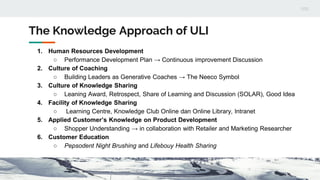
1. Human Resources Development
○ Performance Development Plan → Continuous improvement Discussion
2. Culture of Coaching
○ Building Leaders as Generative Coaches → The Neeco Symbol
3. Culture of Knowledge Sharing
○ Leaning Award, Retrospect, Share of Learning and Discussion (SOLAR), Good Idea
4. Facility of Knowledge Sharing
○ Learning Centre, Knowledge Club Online dan Online Library, lntranet
5. Applied Customer’s Knowledge on Product Development
○ Shopper Understanding → in collaboration with Retailer and Marketing Researcher
6. Customer Education
○ Pepsodent Night Brushing and Lifebouy Health Sharing
The Knowledge Approach of ULI
Lesson Learned
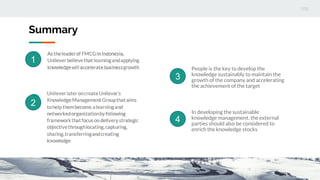
Summary
People is the key to develop the
knowledge sustainably to maintain the
growth of the company and accelerating
the achievement of the target
In developing the sustainable
knowledge management, the external
parties should also be considered to
enrich the knowledge stocks
3
4
1
2
Thank you.

Knowledge Management at Unilever Indonesia

  • 1.
    Confidential Customized forLorem Ipsum LLC Version 1.0 Knowledge Management at Unilever Indonesia (ULI) Prepared by Syndicate 6 of Blemba 25 29318399 Aditya Tejo Widagdo | 29318333 Andi Firmansyah | 29318317 Cikita Tiara | 29318445 Fadila Pratika HS Alimuddin | 29318346 Herdiana Wiyono | 29318417 Ike Suyanti | 29318446 Rifqi Agustin Hakim
  • 2.
    Overview 1. Background ofULI 2. Knowledge at ULI 3. ULI as the Most Admired Knowledge Enterprise 4. Knowledge Strategy 5. Knowledge Approach 6. Lesson Learned
  • 3.
  • 5.
  • 7.
  • 8.
    Performance Culture ❑Employee hasa contribute to share their knowledge : Experience, Ideas and innovation. ❑Recombination Between Existing Knowledge and New Ideas to create value. And make a competitive Position. KNOWLEDGE as a Resources to Create VALUE K W P H ❑3 Pillars : Great People, Great Place to Work and Community Focus. Combination WINNING CULTURE and WINNING CAPABILITIES ❑Creating Leaders and Coaches; Each Person trained to be Leader Management HUMAN RESOURCES ❑Encourage All employees to share their ideas, knowledge, skills and Experience to others. ❑If the employee get a great feedback from others employee, has a opportunity to winning Learning awards GREAT Business Performance with Learning Awards
  • 9.
    Internal Knowledge Sharing Of Learningand Result SOLAR 1-hour- informal learning session of HR service to improve performance W1H People development and capability building for HR team by having regular Learning session from senior manager HR / Director HR HR4HR Watching interesting video and after then discussing together to gather some insights Video Cafe Watching the old or new cinema movie related to daily work as a team. Cinemania Sharing extraordinary experience from employees to motivates other colleagues GLAD (Group Learning and Development) • GLC (General Learning Center ) In Factory • LMS (Learning Management System) • Online Library Tools to suisteinable learning environtment
  • 10.
    External Knowledge & Practiceof Knowledge Management Strategy
  • 11.
    External Knowledge 1. ConsumerCare and market insight: through the ‘Suara Konsumen’ service, Unilever reach their customers complaints, concern, and expectation regarding their product. The findings reported throughout the company for the management review. The market insight can conduct through the FGD ( forum group dicussion) 2. Unilever Responsible Sourcing Policy (RSP) : The RSP embodies the way that Unilever seeks to operate and in addition, the standards the company looking for its supplier 3. Consumer Education : Unilever’s Sustainable Living Plan (USLP) is company CSR to improve health and hygiene of Indonesian customer. Pepsodent Oral Health is one of the example where the campaign targeted primary school students 4. Internship program : through this program, company accomodate students need to experience work life meanwhile the company acquires new idea from them
  • 12.
    Practice of KnowledgeManagement Strategy To practice the Knowledge Management, company need to build company and employees mentality to : - Set mindset : tp have a ‘war’ mentality and never underestimate the competitor - Preparation / planning : need to have clarity on company objective and focus to use all function , resource available, experiences to know which plan will works best - Speed / surprise element : to maintain confidentiality of the plans and choose the right time to ‘do early, win early’ - Execution : always responsive to the ‘signals’ on market and do the micro-planning management
  • 13.
    Unilever Indonesia as theMost Admired Knowledge Enterprise
  • 14.
    ULI as theMost Admired Knowledge Enterprise In 2005, Unilever Indonesia was chosen as one of three companies receiving the national level award, thus eligible for the Asian MAKE program. MAKE (Most Admired Knowledge Enterprises) is research program conducted by Teleos and The Know Network since 1998 and has been implemented in North America, Europe, and Japan.
  • 15.
    ULI as theMost Admired Knowledge Enterprise (con’t) The criteria of the MAKE evaluation are: 1.Creating an enterprise knowledge-driven culture 2.Developingknowledge workers through senior management leadership 3.Delivering knowledge-based products/ services/ solutions 4.Maximizing enterprise intellectual capital 5.Creating an environment for collaborative knowledge sharing 6.Creating learning organization 7.Delivering value based on customer knowledge 8.Transforming enterprise knowledge into shareholder value Unilever Indonesia was considered performed well on point 5 and point 6 out of the 8 criterias. Thus, the Indonesia MAKE expert panel acknowledge the company’s capability in creating environment conducive for collaborative knowledge sharing.
  • 16.
  • 17.
    The Knowledge Strategyof ULI 1. Keep providing consumers with innovative, superior and economical products, one of which is by applying a wealth of knowledge and international expertise. 1. Create and accept new ideas and continuous learning to achieve long-term success. 1. Maintaining knowledge updates and knowledge sharing to interested parties continuously. 1. Focus on meeting customer needs, employee development and creating an environment conducive to various knowledge by providing adequate system and facility support.
  • 18.
  • 19.
    1. Human ResourcesDevelopment ○ Performance Development Plan → Continuous improvement Discussion 2. Culture of Coaching ○ Building Leaders as Generative Coaches → The Neeco Symbol 3. Culture of Knowledge Sharing ○ Leaning Award, Retrospect, Share of Learning and Discussion (SOLAR), Good Idea 4. Facility of Knowledge Sharing ○ Learning Centre, Knowledge Club Online dan Online Library, lntranet 5. Applied Customer’s Knowledge on Product Development ○ Shopper Understanding → in collaboration with Retailer and Marketing Researcher 6. Customer Education ○ Pepsodent Night Brushing and Lifebouy Health Sharing The Knowledge Approach of ULI
  • 20.
  • 21.
    Summary People is thekey to develop the knowledge sustainably to maintain the growth of the company and accelerating the achievement of the target In developing the sustainable knowledge management, the external parties should also be considered to enrich the knowledge stocks 3 4 1 2
  • 22.