Ulcerative Colitis
http://mbbshelp.com
Definition
is an idiopathic chronic inflammatory disorder limited to
the colon.
Ulcerative colitis is a lifelong illness that has a profound
emotional and social impact on patients who are
affected.
Ulcerative colitis as visualized with a colonoscope.
The rectum is involved in more than 95% of cases,
although some authorities believe that the rectum is
always involved in untreated patients. Ulcerative
colitis extends proximally from the anal verge in an
uninterrupted pattern to involve part or all of the
colon.
http://mbbshelp.com
 Prevalence rates may be lower in South America, Asia,
and Africa.
 Race
 Ulcerative colitis occurs more frequently in white
people.
 The incidence of ulcerative colitis is reported to be 2-4
times higher in Jewish people. However, population
studies in North America do not completely support this
assertion.
 Sex
 Ulcerative colitis seems to have a female
preponderance. Ulcerative colitis affects 30% more
females than males.
 Age
 The incidence of ulcerative colitis peaks in people aged
15-25 years and in people aged 55-65 years, although
it can occur in people of any age.1
http://mbbshelp.com
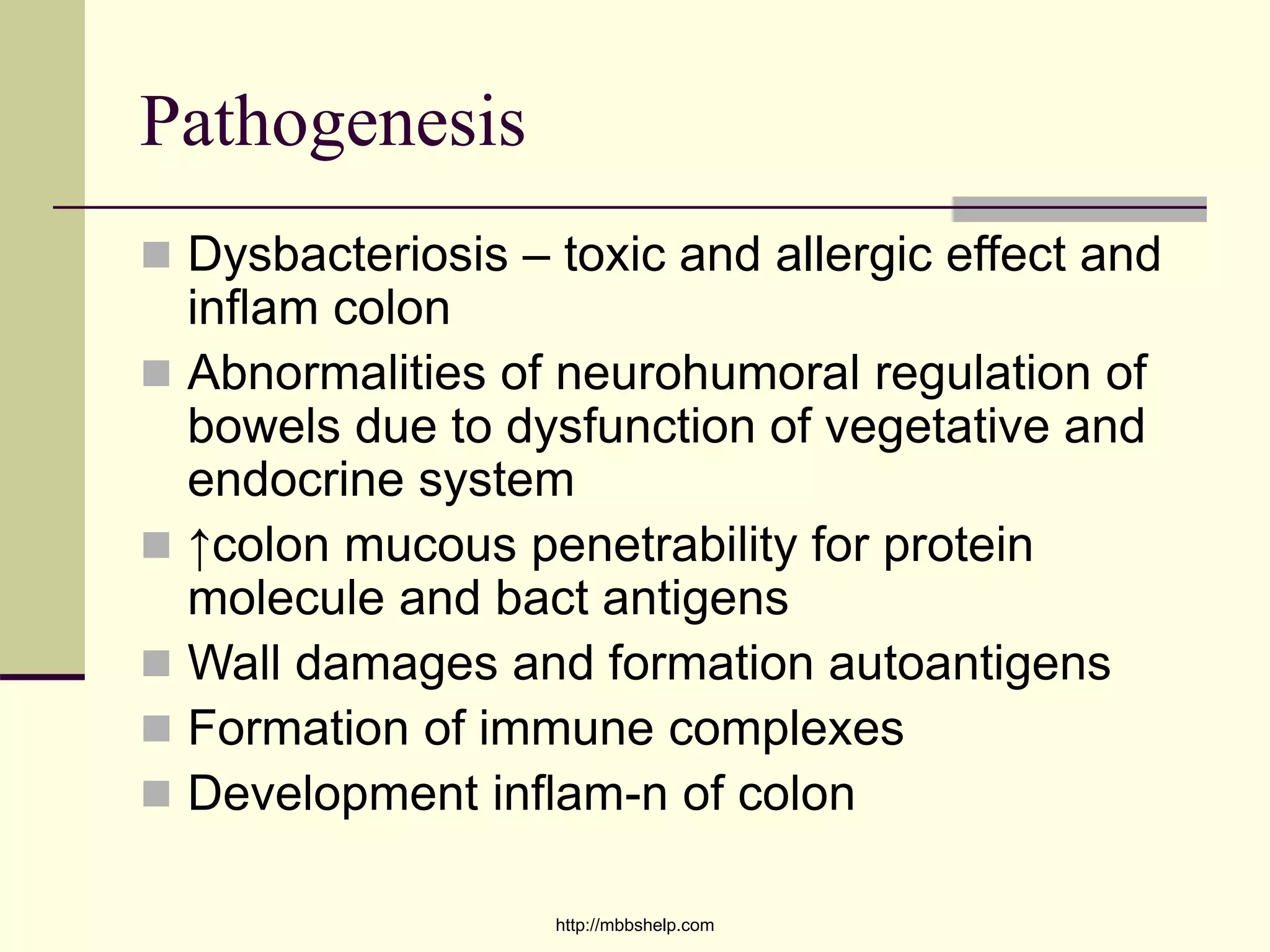
Pathogenesis
 Dysbacteriosis – toxic and allergic effect and
inflam colon
 Abnormalities of neurohumoral regulation of
bowels due to dysfunction of vegetative and
endocrine system
 ↑colon mucous penetrability for protein
molecule and bact antigens
 Wall damages and formation autoantigens
 Formation of immune complexes
 Development inflam-n of colon
http://mbbshelp.com
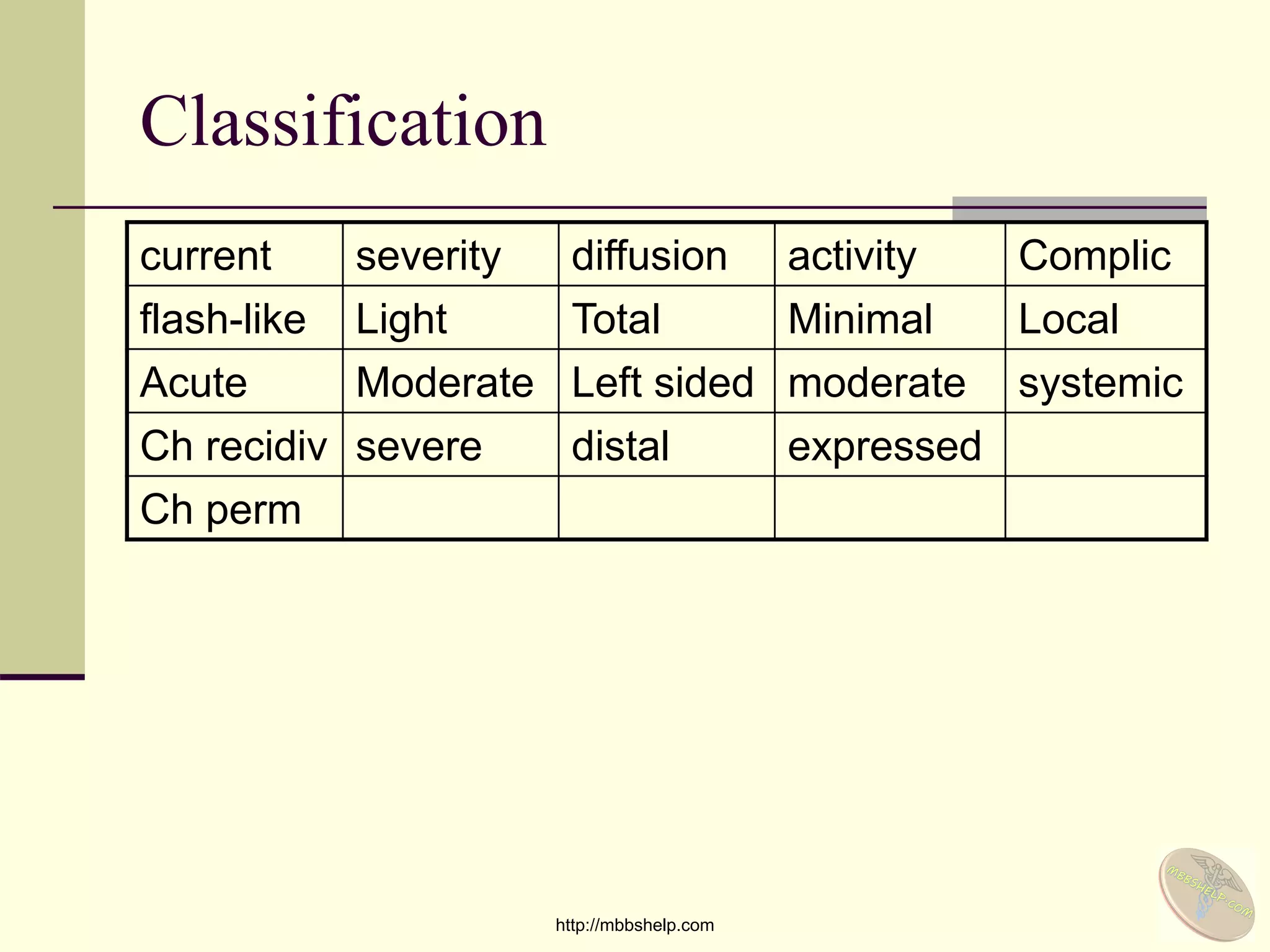
Classification
current severity diffusion activity Complic
flash-like Light Total Minimal Local
Acute Moderate Left sided moderate systemic
Ch recidiv severe distal expressed
Ch perm
http://mbbshelp.com
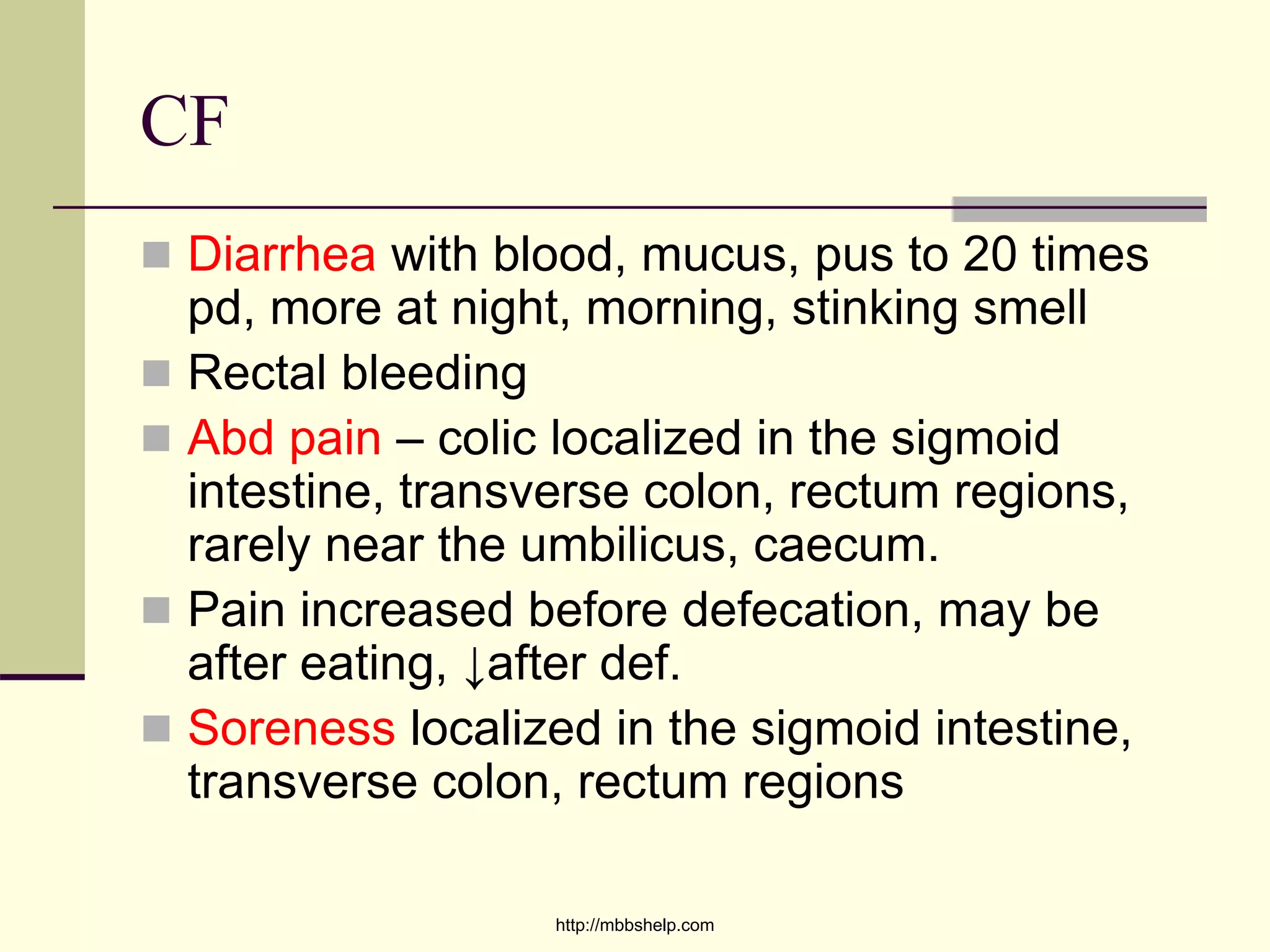
CF
 Diarrhea with blood, mucus, pus to 20 times
pd, more at night, morning, stinking smell
 Rectal bleeding
 Abd pain – colic localized in the sigmoid
intestine, transverse colon, rectum regions,
rarely near the umbilicus, caecum.
 Pain increased before defecation, may be
after eating, ↓after def.
 Soreness localized in the sigmoid intestine,
transverse colon, rectum regions
http://mbbshelp.com
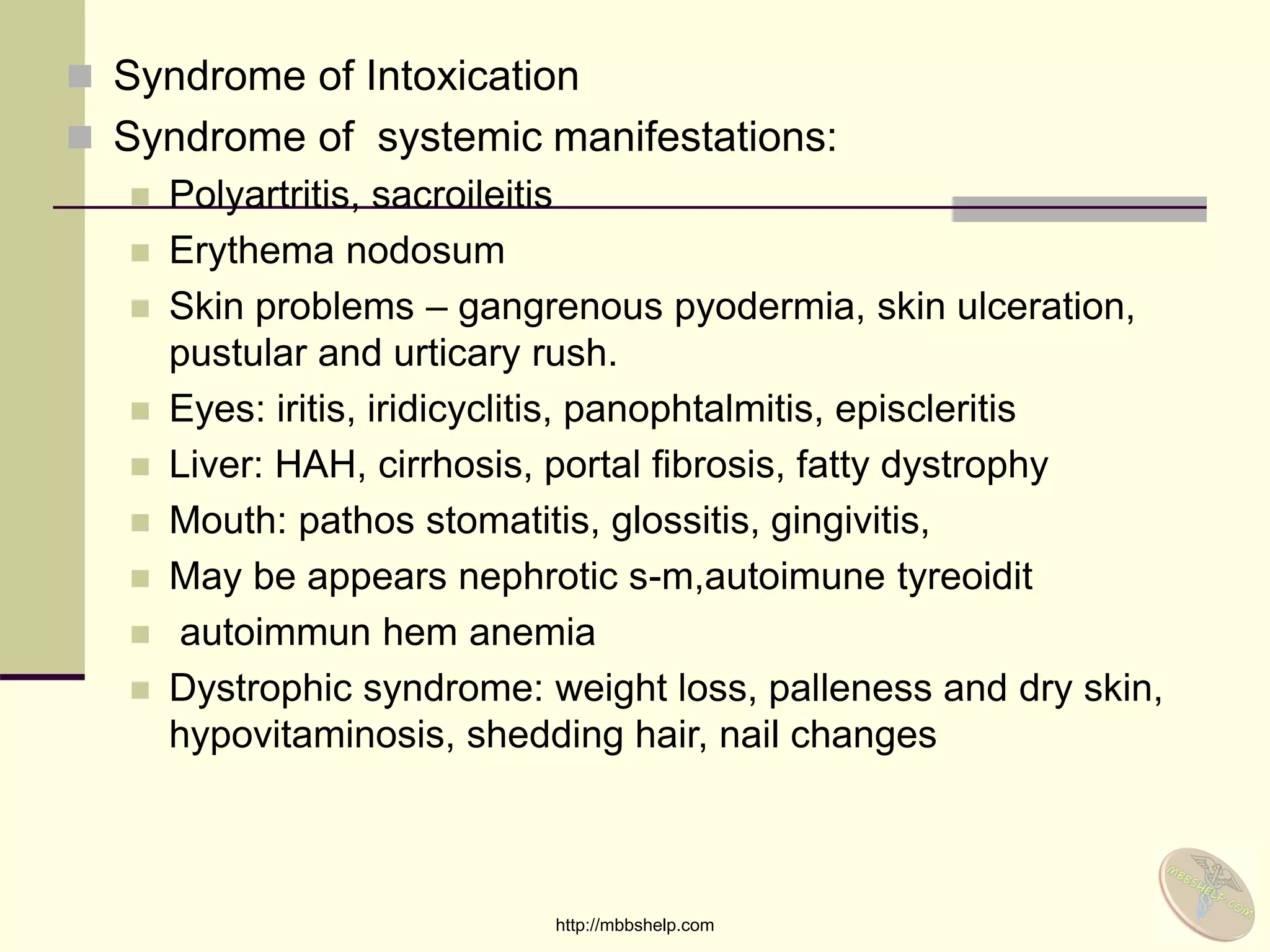
 Syndrome of Intoxication
 Syndrome of systemic manifestations:
 Polyartritis, sacroileitis
 Erythema nodosum
 Skin problems – gangrenous pyodermia, skin ulceration,
pustular and urticary rush.
 Eyes: iritis, iridicyclitis, panophtalmitis, episcleritis
 Liver: HAH, cirrhosis, portal fibrosis, fatty dystrophy
 Mouth: pathos stomatitis, glossitis, gingivitis,
 May be appears nephrotic s-m,autoimune tyreoidit
 autoimmun hem anemia
 Dystrophic syndrome: weight loss, palleness and dry skin,
hypovitaminosis, shedding hair, nail changes
http://mbbshelp.com
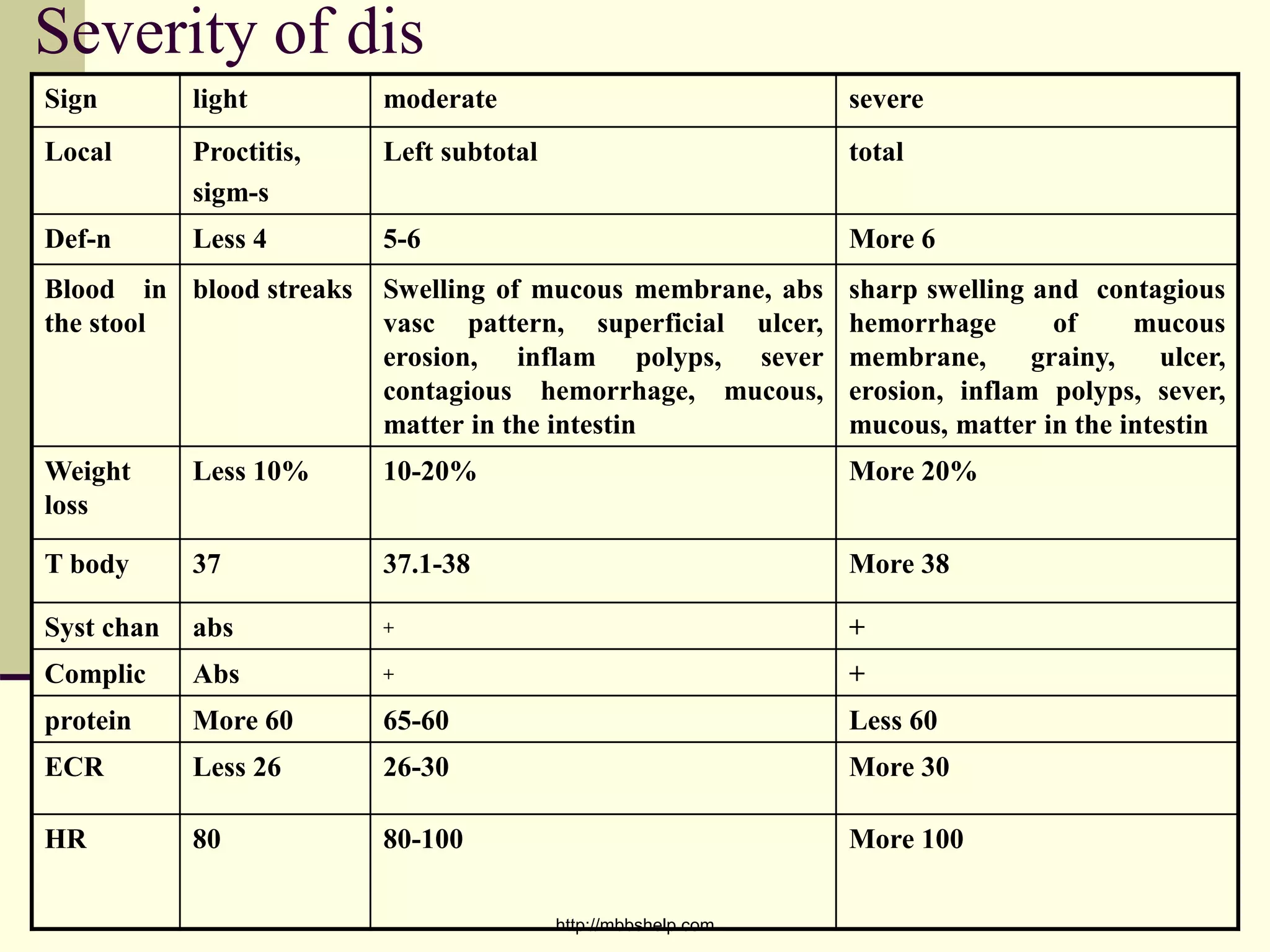
Severity of dis
Sign light moderate severe
Local Proctitis,
sigm-s
Left subtotal total
Def-n Less 4 5-6 More 6
Blood in
the stool
blood streaks Swelling of mucous membrane, abs
vasc pattern, superficial ulcer,
erosion, inflam polyps, sever
contagious hemorrhage, mucous,
matter in the intestin
sharp swelling and contagious
hemorrhage of mucous
membrane, grainy, ulcer,
erosion, inflam polyps, sever,
mucous, matter in the intestin
Weight
loss
Less 10% 10-20% More 20%
T body 37 37.1-38 More 38
Syst chan abs + +
Complic Abs + +
protein More 60 65-60 Less 60
ECR Less 26 26-30 More 30
HR 80 80-100 More 100
http://mbbshelp.com
Complication
 Perforation
 Toxic dilatation of colon
 Enteric hemorrhage
 Stricture of colon
 Inflammatory polyps
 Colon cancer
http://mbbshelp.com
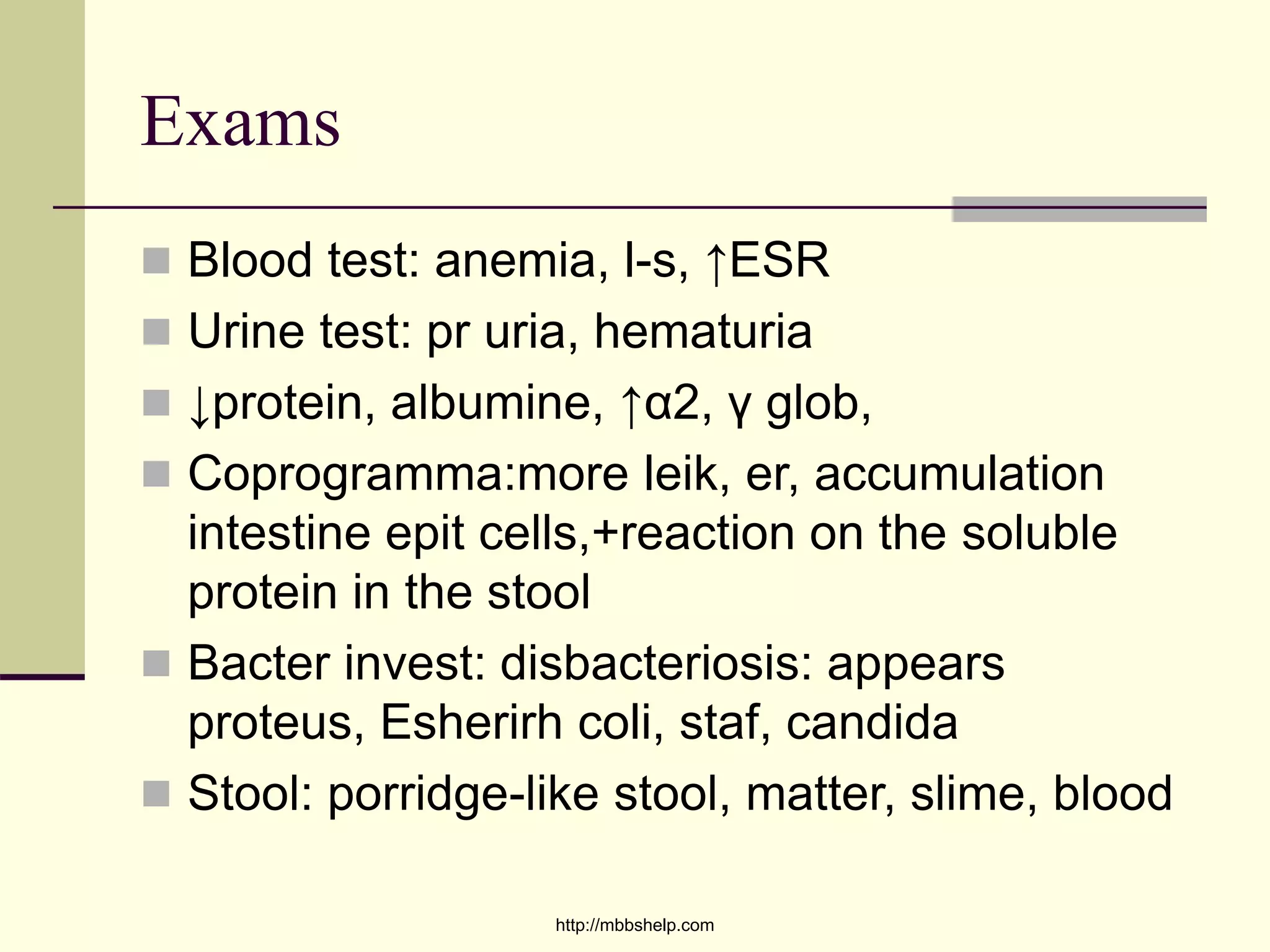
Exams
 Blood test: anemia, l-s, ↑ESR
 Urine test: pr uria, hematuria
 ↓protein, albumine, ↑α2, γ glob,
 Coprogramma:more leik, er, accumulation
intestine epit cells,+reaction on the soluble
protein in the stool
 Bacter invest: disbacteriosis: appears
proteus, Esherirh coli, staf, candida
 Stool: porridge-like stool, matter, slime, blood
http://mbbshelp.com
 X ray: swelling, granular muc membrane of
colon, pseudopolyps, haustration is absent,
rigidity, constriction, contraction and
thickening of colon
http://mbbshelp.com
Dif dS
 Dysenteries (shigellosis)
 Amebiasis (stool raspberry jelly-like, accumulation
glassy slime, revealing amebas)
 Chron’s disease
 Colitis
http://mbbshelp.com
Treatment
 Medical Care
 Prior to initiating therapy, an accurate assessment is needed;
this assessment should include a thorough history and physical
examination. A colonoscopy is preferable.
 An appropriate medical regimen for ulcerative colitis is
determined by the severity and the extent of disease.
 Aminosalicylates, such as mesamine, have generally been the
initial drug therapy for IBD.
 The need for dosing mesalamine multiple times a day has been
recently questioned. A study by Sandborn et al compared the
efficacy and safety of once-daily delayed-release mesalamine
(Asacol 400 mg) with twice-daily dosing for remission
maintenance.2 At 6 months, 90.5% of patients receiving once-
daily dosing had maintained clinical remission, compared with
91.8% of those receiving twice-daily dosing. At month 12, both
groups had identical clinical maintenance rates of 85.4%.2
http://mbbshelp.com
Surgical Care
 Considerations for total colectomy are as follows:
 Refractory disease with failure to medical therapy
 Evidence of carcinoma or dysplasia
 Severe hemorrhage
 Fulminant colitis not responsive to treatment
 Toxic megacolon
 Perforation (free or walled-off)
 Obstruction and stricture with suspicion for cancer
 Systemic complications from medications, particularly
steroids
 Failure to thrive in children
http://mbbshelp.com

Ulcerative Colitis.pdf

  • 1.
  • 2.
    Definition is an idiopathicchronic inflammatory disorder limited to the colon. Ulcerative colitis is a lifelong illness that has a profound emotional and social impact on patients who are affected. Ulcerative colitis as visualized with a colonoscope. The rectum is involved in more than 95% of cases, although some authorities believe that the rectum is always involved in untreated patients. Ulcerative colitis extends proximally from the anal verge in an uninterrupted pattern to involve part or all of the colon. http://mbbshelp.com
  • 3.
     Prevalence ratesmay be lower in South America, Asia, and Africa.  Race  Ulcerative colitis occurs more frequently in white people.  The incidence of ulcerative colitis is reported to be 2-4 times higher in Jewish people. However, population studies in North America do not completely support this assertion.  Sex  Ulcerative colitis seems to have a female preponderance. Ulcerative colitis affects 30% more females than males.  Age  The incidence of ulcerative colitis peaks in people aged 15-25 years and in people aged 55-65 years, although it can occur in people of any age.1 http://mbbshelp.com
  • 4.
    Pathogenesis  Dysbacteriosis –toxic and allergic effect and inflam colon  Abnormalities of neurohumoral regulation of bowels due to dysfunction of vegetative and endocrine system  ↑colon mucous penetrability for protein molecule and bact antigens  Wall damages and formation autoantigens  Formation of immune complexes  Development inflam-n of colon http://mbbshelp.com
  • 5.
    Classification current severity diffusionactivity Complic flash-like Light Total Minimal Local Acute Moderate Left sided moderate systemic Ch recidiv severe distal expressed Ch perm http://mbbshelp.com
  • 6.
    CF  Diarrhea withblood, mucus, pus to 20 times pd, more at night, morning, stinking smell  Rectal bleeding  Abd pain – colic localized in the sigmoid intestine, transverse colon, rectum regions, rarely near the umbilicus, caecum.  Pain increased before defecation, may be after eating, ↓after def.  Soreness localized in the sigmoid intestine, transverse colon, rectum regions http://mbbshelp.com
  • 7.
     Syndrome ofIntoxication  Syndrome of systemic manifestations:  Polyartritis, sacroileitis  Erythema nodosum  Skin problems – gangrenous pyodermia, skin ulceration, pustular and urticary rush.  Eyes: iritis, iridicyclitis, panophtalmitis, episcleritis  Liver: HAH, cirrhosis, portal fibrosis, fatty dystrophy  Mouth: pathos stomatitis, glossitis, gingivitis,  May be appears nephrotic s-m,autoimune tyreoidit  autoimmun hem anemia  Dystrophic syndrome: weight loss, palleness and dry skin, hypovitaminosis, shedding hair, nail changes http://mbbshelp.com
  • 8.
    Severity of dis Signlight moderate severe Local Proctitis, sigm-s Left subtotal total Def-n Less 4 5-6 More 6 Blood in the stool blood streaks Swelling of mucous membrane, abs vasc pattern, superficial ulcer, erosion, inflam polyps, sever contagious hemorrhage, mucous, matter in the intestin sharp swelling and contagious hemorrhage of mucous membrane, grainy, ulcer, erosion, inflam polyps, sever, mucous, matter in the intestin Weight loss Less 10% 10-20% More 20% T body 37 37.1-38 More 38 Syst chan abs + + Complic Abs + + protein More 60 65-60 Less 60 ECR Less 26 26-30 More 30 HR 80 80-100 More 100 http://mbbshelp.com
  • 9.
    Complication  Perforation  Toxicdilatation of colon  Enteric hemorrhage  Stricture of colon  Inflammatory polyps  Colon cancer http://mbbshelp.com
  • 10.
    Exams  Blood test:anemia, l-s, ↑ESR  Urine test: pr uria, hematuria  ↓protein, albumine, ↑α2, γ glob,  Coprogramma:more leik, er, accumulation intestine epit cells,+reaction on the soluble protein in the stool  Bacter invest: disbacteriosis: appears proteus, Esherirh coli, staf, candida  Stool: porridge-like stool, matter, slime, blood http://mbbshelp.com
  • 11.
     X ray:swelling, granular muc membrane of colon, pseudopolyps, haustration is absent, rigidity, constriction, contraction and thickening of colon http://mbbshelp.com
  • 12.
    Dif dS  Dysenteries(shigellosis)  Amebiasis (stool raspberry jelly-like, accumulation glassy slime, revealing amebas)  Chron’s disease  Colitis http://mbbshelp.com
  • 13.
    Treatment  Medical Care Prior to initiating therapy, an accurate assessment is needed; this assessment should include a thorough history and physical examination. A colonoscopy is preferable.  An appropriate medical regimen for ulcerative colitis is determined by the severity and the extent of disease.  Aminosalicylates, such as mesamine, have generally been the initial drug therapy for IBD.  The need for dosing mesalamine multiple times a day has been recently questioned. A study by Sandborn et al compared the efficacy and safety of once-daily delayed-release mesalamine (Asacol 400 mg) with twice-daily dosing for remission maintenance.2 At 6 months, 90.5% of patients receiving once- daily dosing had maintained clinical remission, compared with 91.8% of those receiving twice-daily dosing. At month 12, both groups had identical clinical maintenance rates of 85.4%.2 http://mbbshelp.com
  • 14.
    Surgical Care  Considerationsfor total colectomy are as follows:  Refractory disease with failure to medical therapy  Evidence of carcinoma or dysplasia  Severe hemorrhage  Fulminant colitis not responsive to treatment  Toxic megacolon  Perforation (free or walled-off)  Obstruction and stricture with suspicion for cancer  Systemic complications from medications, particularly steroids  Failure to thrive in children http://mbbshelp.com