BIOLOGICAL EFFECTS OF
IONIZING RADIATION
Reddy varun kumar
Group – 9
Semester – 9
Guided by : Skorobogatova mam
WHAT IS IONIZING RADIATION?
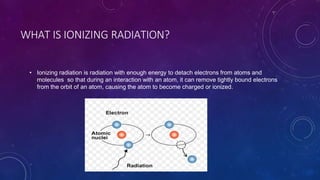
• Ionizing radiation is radiation with enough energy to detach electrons from atoms and
molecules so that during an interaction with an atom, it can remove tightly bound electrons
from the orbit of an atom, causing the atom to become charged or ionized.
WHY RADIATION IS HARMFUL ?
• Radiation can cause biological damages on cells either indirect or direct
action. If radiation falls on a human body, it produces moving electrons. The
electrons cause further ionization, excitation, resulting in chemical and
molecular changes. Radiation can also pruduce free radicals, which are
unpaired electrons that are chemically reactive.
• Human body consist of 70% water, most of the radiation damage is caused by
water especially by OH radicals.
• These radicals can further interact with DNA, RNA or protein molecules and
cause damage tissue and affect its normal function.
• E. g : chromosome break and aberration.
TYPES OF BIOLOGICAL EFFECTS
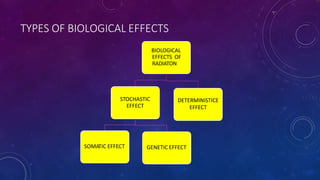
BIOLOGICAL
EFFECTS OF
RADIATON
STOCHASTIC
EFFECT
SOMATIC EFFECT GENETIC EFFECT
DETERMINISTICE
EFFECT
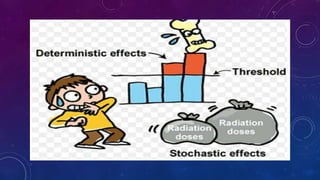
DETERMINISTIC EFFECT
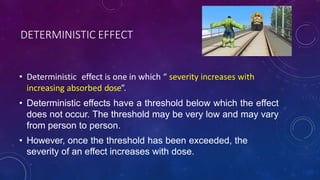
• Deterministic effect is one in which “ severity increases with
increasing absorbed dose”.
• Deterministic effects have a threshold below which the effect
does not occur. The threshold may be very low and may vary
from person to person.
• However, once the threshold has been exceeded, the
severity of an effect increases with dose.
PROPERTIES OF DETERMINISTIC EFFECT
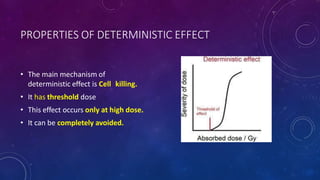
• The main mechanism of
deterministic effect is Cell killing.
• It has threshold dose
• This effect occurs only at high dose.
• It can be completely avoided.
STOCHASTIC EFFECT
• A stochastic effect is one in which “the probability of occurrence
increases with increasing absorbed dose rather than its severity”.
• The stochastic effect is further classified into SOMATIC and
GENETIC effect .
• Stochastic means random and the severity of this effect is
independent of the radiation dose.
PROPERTIES OF STOCHASTIC EFFECT
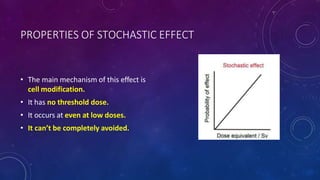
• The main mechanism of this effect is
cell modification.
• It has no threshold dose.
• It occurs at even at low doses.
• It can’t be completely avoided.
SOMATIC EFFECT
• Radiation effect occurs on an exposed individual
during his life time is called somatic effect .
• Cancer induction is the largest risk of radiation
exposure encountered in radiology.
• Cancer risk is generally higher for children than adults.
• It may induce both benign and malignant tumor.
GENETIC EFFECT
• The genetic effect is not seen in the person
irradiated but is passed on to future
generations.
• The radiation induced mutations affect the
health of off –spring.
• Genetic damage can not be repaired.
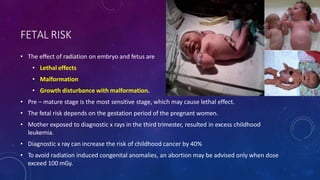
FETAL RISK
• The effect of radiation on embryo and fetus are
• Lethal effects
• Malformation
• Growth disturbance with malformation.
• Pre – mature stage is the most sensitive stage, which may cause lethal effect.
• The fetal risk depends on the gestation period of the pregnant women.
• Mother exposed to diagnostic x rays in the third trimester, resulted in excess childhood
leukemia.
• Diagnostic x ray can increase the risk of childhood cancer by 40%
• To avoid radiation induced congenital anomalies, an abortion may be advised only when dose
exceed 100 mGy.
HOW TO REDUCE RADIATION?
• We are following some rules and
providing some protective material
to minimize the radiation with
adequate technique.
• Those are
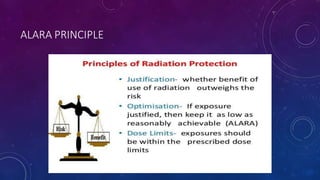
ALARA PRINCIPLE
Benefits should be more Risks should not be more
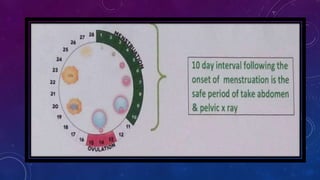
TEN-DAY RULE
• ICRP is introduced this rule and its mainly
applied to the women Who are in child
bearing age(11-55)
• To avoid irradiating to a fetus before the
mother realized that she was pregnant or
not.
• Care must be taken to protect the fetus
from radiation when the examination is not
avoidable.
• When the technologist unsure of pregnancy
10 day rule must be used.
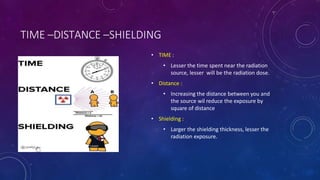
TIME –DISTANCE –SHIELDING
• TIME :
• Lesser the time spent near the radiation
source, lesser will be the radiation dose.
• Distance :
• Increasing the distance between you and
the source wil reduce the exposure by
square of distance
• Shielding :
• Larger the shielding thickness, lesser the
radiation exposure.
PROTECTIVE MATERIALS
FOOD ITEMS
SOME COMMON THINGS
• Only essential investigations should be taken .
• Avoid the necessity of retakes.
• Use anti scatter grid or air gap technique .
• Don’t perform any examination which has not been
prescribed.
• X ray beam must be well collimated.
• The focal spot to skin distance must be as long as
possible with good radiographic technique.
• Don’t spend more time in radiation area.
• Before performing any x ray investigations on female
of childbearing age (11-55) the patient must be asked
whether there is any chance to be pregnant.
• The person who’s presence is needed they only
present in x ray rooms.
varun radio.pptx

varun radio.pptx

  • 1.
    BIOLOGICAL EFFECTS OF IONIZINGRADIATION Reddy varun kumar Group – 9 Semester – 9 Guided by : Skorobogatova mam
  • 3.
    WHAT IS IONIZINGRADIATION? • Ionizing radiation is radiation with enough energy to detach electrons from atoms and molecules so that during an interaction with an atom, it can remove tightly bound electrons from the orbit of an atom, causing the atom to become charged or ionized.
  • 4.
    WHY RADIATION ISHARMFUL ? • Radiation can cause biological damages on cells either indirect or direct action. If radiation falls on a human body, it produces moving electrons. The electrons cause further ionization, excitation, resulting in chemical and molecular changes. Radiation can also pruduce free radicals, which are unpaired electrons that are chemically reactive. • Human body consist of 70% water, most of the radiation damage is caused by water especially by OH radicals. • These radicals can further interact with DNA, RNA or protein molecules and cause damage tissue and affect its normal function. • E. g : chromosome break and aberration.
  • 5.
    TYPES OF BIOLOGICALEFFECTS BIOLOGICAL EFFECTS OF RADIATON STOCHASTIC EFFECT SOMATIC EFFECT GENETIC EFFECT DETERMINISTICE EFFECT
  • 6.
    DETERMINISTIC EFFECT • Deterministiceffect is one in which “ severity increases with increasing absorbed dose”. • Deterministic effects have a threshold below which the effect does not occur. The threshold may be very low and may vary from person to person. • However, once the threshold has been exceeded, the severity of an effect increases with dose.
  • 7.
    PROPERTIES OF DETERMINISTICEFFECT • The main mechanism of deterministic effect is Cell killing. • It has threshold dose • This effect occurs only at high dose. • It can be completely avoided.
  • 8.
    STOCHASTIC EFFECT • Astochastic effect is one in which “the probability of occurrence increases with increasing absorbed dose rather than its severity”. • The stochastic effect is further classified into SOMATIC and GENETIC effect . • Stochastic means random and the severity of this effect is independent of the radiation dose.
  • 9.
    PROPERTIES OF STOCHASTICEFFECT • The main mechanism of this effect is cell modification. • It has no threshold dose. • It occurs at even at low doses. • It can’t be completely avoided.
  • 11.
    SOMATIC EFFECT • Radiationeffect occurs on an exposed individual during his life time is called somatic effect . • Cancer induction is the largest risk of radiation exposure encountered in radiology. • Cancer risk is generally higher for children than adults. • It may induce both benign and malignant tumor.
  • 12.
    GENETIC EFFECT • Thegenetic effect is not seen in the person irradiated but is passed on to future generations. • The radiation induced mutations affect the health of off –spring. • Genetic damage can not be repaired.
  • 13.
    FETAL RISK • Theeffect of radiation on embryo and fetus are • Lethal effects • Malformation • Growth disturbance with malformation. • Pre – mature stage is the most sensitive stage, which may cause lethal effect. • The fetal risk depends on the gestation period of the pregnant women. • Mother exposed to diagnostic x rays in the third trimester, resulted in excess childhood leukemia. • Diagnostic x ray can increase the risk of childhood cancer by 40% • To avoid radiation induced congenital anomalies, an abortion may be advised only when dose exceed 100 mGy.
  • 14.
    HOW TO REDUCERADIATION? • We are following some rules and providing some protective material to minimize the radiation with adequate technique. • Those are
  • 15.
  • 16.
    Benefits should bemore Risks should not be more
  • 17.
    TEN-DAY RULE • ICRPis introduced this rule and its mainly applied to the women Who are in child bearing age(11-55) • To avoid irradiating to a fetus before the mother realized that she was pregnant or not. • Care must be taken to protect the fetus from radiation when the examination is not avoidable. • When the technologist unsure of pregnancy 10 day rule must be used.
  • 19.
    TIME –DISTANCE –SHIELDING •TIME : • Lesser the time spent near the radiation source, lesser will be the radiation dose. • Distance : • Increasing the distance between you and the source wil reduce the exposure by square of distance • Shielding : • Larger the shielding thickness, lesser the radiation exposure.
  • 20.
  • 21.
  • 22.
    SOME COMMON THINGS •Only essential investigations should be taken . • Avoid the necessity of retakes. • Use anti scatter grid or air gap technique . • Don’t perform any examination which has not been prescribed. • X ray beam must be well collimated. • The focal spot to skin distance must be as long as possible with good radiographic technique. • Don’t spend more time in radiation area. • Before performing any x ray investigations on female of childbearing age (11-55) the patient must be asked whether there is any chance to be pregnant. • The person who’s presence is needed they only present in x ray rooms.