POST OPERATIVE
COMPLICATIONS
ULCERATIVE COLITIS
DR SUJAN SHRESTHA
MCh, FIRST YEAR
TUTH, IOM
Ulcerative colitis
•Emergency surgical complications
•Postoperative complications
•Colorectal malignancy
Emergency surgical complications
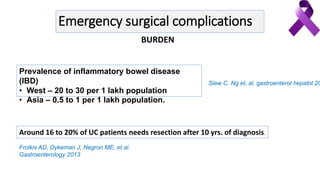
Prevalence of inflammatory bowel disease
(IBD)
• West – 20 to 30 per 1 lakh population
• Asia – 0.5 to 1 per 1 lakh population.
Siew C. Ng et, al. gastroenterol hepatol 20
Around 16 to 20% of UC patients needs resection after 10 yrs. of diagnosis.
Frolkis AD, Dykeman J, Negron ME, et al.
Gastroenterology 2013
BURDEN
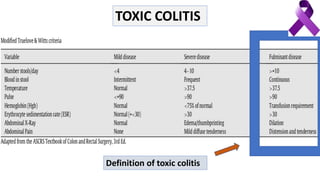
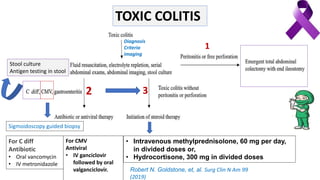
TOXIC COLITIS
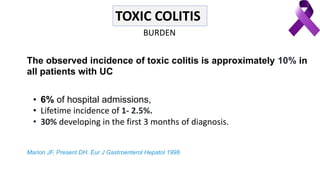
The observed incidence of toxic colitis is approximately 10% in
all patients with UC
Marion JF, Present DH. Eur J Gastroenterol Hepatol 1998
• 6% of hospital admissions,
• Lifetime incidence of 1- 2.5%.
• 30% developing in the first 3 months of diagnosis.
BURDEN
TOXIC COLITIS
Definition of toxic colitis
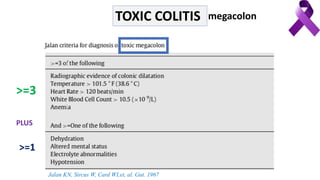
Toxic megacolon
Jalan KN, Sircus W, Card WI,et, al. Gut. 1967
TOXIC COLITIS
>=3
PLUS
>=1
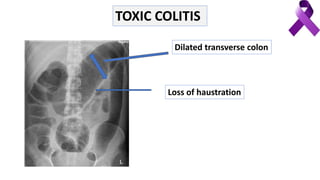
Dilated transverse colon
Loss of haustration
TOXIC COLITIS
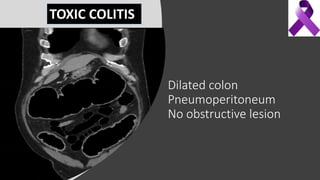
Dilated colon
Pneumoperitoneum
No obstructive lesion
TOXIC COLITIS
Diagnosis
Criteria
imaging
Stool culture
Antigen testing in stool
Sigmoidoscopy guided biopsy
For C diff
Antibiotic
• Oral vancomycin
• IV metronidazole
For CMV
Antiviral
• IV ganciclovir
followed by oral
valganciclovir.
• Intravenous methylprednisolone, 60 mg per day,
in divided doses or,
• Hydrocortisone, 300 mg in divided doses
TOXIC COLITIS
Robert N. Goldstone, et, al. Surg Clin N Am 99
(2019)
1
2 3
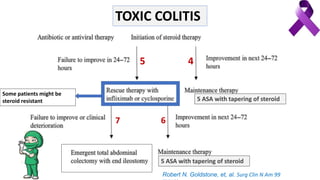
Some patients might be
steroid resistant 5 ASA with tapering of steroid
5 ASA with tapering of steroid
TOXIC COLITIS
Robert N. Goldstone, et, al. Surg Clin N Am 99
45
67
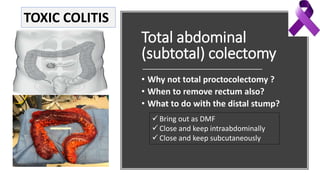
Total abdominal
(subtotal) colectomy
• Why not total proctocolectomy ?
• When to remove rectum also?
• What to do with the distal stump?
 Bring out as DMF
 Close and keep intraabdominally
 Close and keep subcutaneously
TOXIC COLITIS
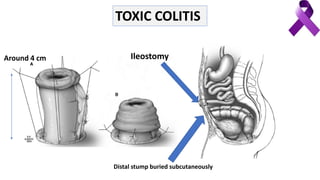
TOXIC COLITIS
Ileostomy
Distal stump buried subcutaneously
Around 4 cm
TOXIC COLITIS
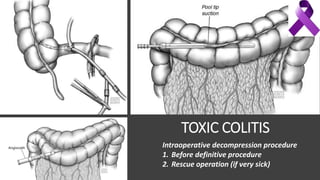
Intraoperative decompression procedure
1. Before definitive procedure
2. Rescue operation (if very sick)
TOXIC COLITIS
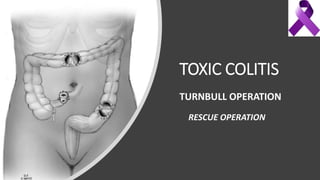
TURNBULL OPERATION
RESCUE OPERATION
A total proctocolectomy should be avoided
• It is associated with greater postoperative morbidity and mortality
• Subtotal colectomy allows for future reconstructive options elective
completion proctectomy with ileal pouch anal anastomosis.
• Patients without a definitive diagnosis of either UC or CD, a subtotal
colectomy may assist with establishing the correct diagnosis thus guide
future interventions
Indication of emergency proctocolectomy
• Acute perforation of the rectum or exsanguinating hemorrhage.
Berg DF, Bahadursingh AM, Kaminski DL, et al. Am J Surg
2002
TOXIC COLITIS
A B C
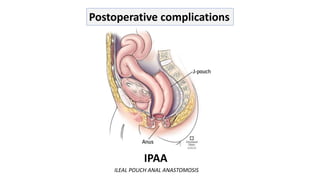
Postoperative complications
IPAA
ILEAL POUCH ANAL ANASTOMOSIS
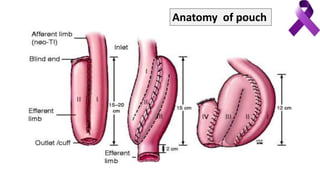
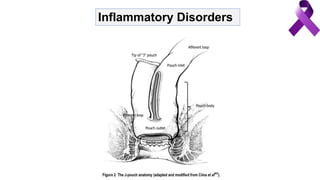
Anatomy of pouch
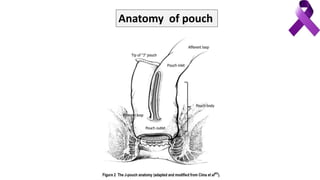
Anatomy of pouch
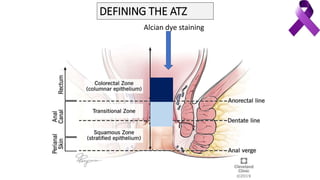
DEFINING THE ATZ
“The zone interposed between uninterrupted crypt
bearing colorectal-type mucosa above and
uninterrupted squamous epithelium below” 1
Alcian dye technique
• Columnar epithelium stains dark blue, the
squamous epithelium does not stain, and the
ATZ stains pale blue
• 6 mm below to 20 mm above the dentate line[
Computer mapping
• The median upper and lower borders
of the ATZ, measured from the lower
margin of the internal sphincter, were
1.82 and 1.27 cm
Fenger C. The anal transitional zone. Acta Pathol Microbiol Scand [A]
1979
Thompson-Fawcett MW, Br J Surg 1998
Anal Transitional Zone
Alcian dye staining
DEFINING THE ATZ
The rectum is able to sense distension, however, that results in a brief reflexive relaxation of
the internal anal sphincter and contraction of the external anal sphincter, thus allowing the anal
mucosa to sample the rectal contents. This sampling is thought to aid the ATZ in
discrimination between gas, liquid, and solid stool.
The retained ATZ following stapled RPC IPAA is therefore at risk for chronic
inflammation from recurrent or persistent disease, dysplasia, and possibly malignancy.
Pouch failure and pouch excision World J Gastroenterol 2009 February 21Jennifer Holder-Murray
DEFINING THE ATZ
Vansar
Associated
Complications
After Restorative
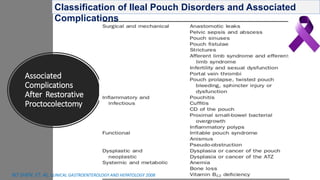
Proctocolectomy
Classification of Ileal Pouch Disorders and Associated
Complications
BO SHEN, ET, AL. CLINICAL GASTROENTEROLOGY AND HEPATOLOGY 2008
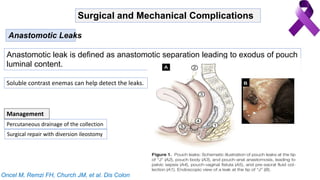
Surgical and Mechanical Complications
Anastomotic Leaks
Anastomotic leak is defined as anastomotic separation leading to exodus of pouch
luminal content.
Soluble contrast enemas can help detect the leaks.
Percutaneous drainage of the collection
Surgical repair with diversion ileostomy
Management
Oncel M, Remzi FH, Church JM, et al. Dis Colon
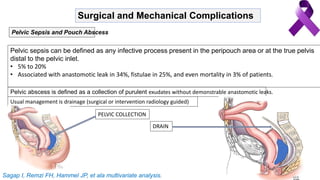
Pelvic Sepsis and Pouch Abscess
Surgical and Mechanical Complications
Pelvic sepsis can be defined as any infective process present in the peripouch area or at the true pelvis
distal to the pelvic inlet.
• 5% to 20%
• Associated with anastomotic leak in 34%, fistulae in 25%, and even mortality in 3% of patients.
Pelvic abscess is defined as a collection of purulent exudates without demonstrable anastomotic leaks.
Sagap I, Remzi FH, Hammel JP, et ala multivariate analysis.
Usual management is drainage (surgical or intervention radiology guided)
PELVIC COLLECTION
DRAIN
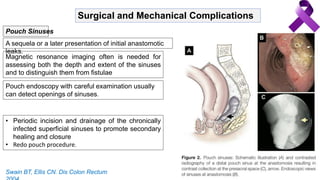
Surgical and Mechanical Complications
Pouch Sinuses
A sequela or a later presentation of initial anastomotic
leaks.
Magnetic resonance imaging often is needed for
assessing both the depth and extent of the sinuses
and to distinguish them from fistulae
Pouch endoscopy with careful examination usually
can detect openings of sinuses.
• Periodic incision and drainage of the chronically
infected superficial sinuses to promote secondary
healing and closure
• Redo pouch procedure.
Swain BT, Ellis CN. Dis Colon Rectum
Pouch Fistulae
Surgical and Mechanical Complications
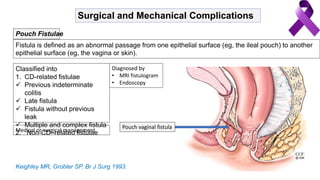
Fistula is defined as an abnormal passage from one epithelial surface (eg, the ileal pouch) to another
epithelial surface (eg, the vagina or skin).
Classified into
1. CD-related fistulae
 Previous indeterminate
colitis
 Late fistula
 Fistula without previous
leak
 Multiple and complex fistula
2. Non-CD–related fistulae
Diagnosed by
• MRI fistulogram
• Endoscopy
Medical or surgical management
Keighley MR, Grobler SP. Br J Surg 1993.
Pouch vaginal fistula
Surgical and Mechanical Complications
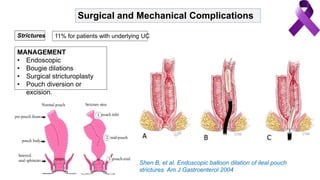
Strictures 11% for patients with underlying UC
MANAGEMENT
• Endoscopic
• Bougie dilations
• Surgical stricturoplasty
• Pouch diversion or
excision.
Shen B, et al. Endoscopic balloon dilation of ileal pouch
strictures. Am J Gastroenterol 2004
Surgical and Mechanical Complications
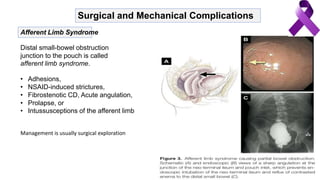
Afferent Limb Syndrome
Surgical and Mechanical Complications
Distal small-bowel obstruction
junction to the pouch is called
afferent limb syndrome.
• Adhesions,
• NSAID-induced strictures,
• Fibrostenotic CD, Acute angulation,
• Prolapse, or
• Intussusceptions of the afferent limb
Management is usually surgical exploration
Surgical and Mechanical Complications
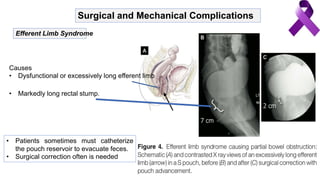
Efferent Limb Syndrome
Causes
• Dysfunctional or excessively long efferent limb
• Markedly long rectal stump.
• Patients sometimes must catheterize
the pouch reservoir to evacuate feces.
• Surgical correction often is needed
Inflammatory Disorders
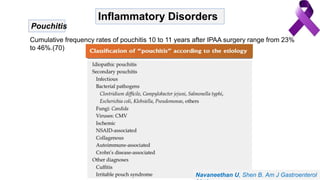
Pouchitis
Cumulative frequency rates of pouchitis 10 to 11 years after IPAA surgery range from 23%
to 46%.(70)
Navaneethan U, Shen B. Am J Gastroenterol
Inflammatory Disorders
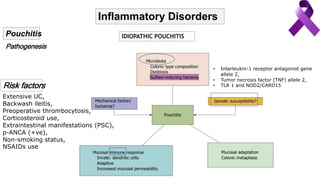
Pouchitis IDIOPATHIC POUCHITIS
Pathogenesis
• Interleukin-1 receptor antagonist gene
allele 2,
• Tumor necrosis factor (TNF) allele 2,
• TLR 1 and NOD2/CARD15Risk factors
Extensive UC,
Backwash ileitis,
Preoperative thrombocytosis,
Corticosteroid use,
Extraintestinal manifestations (PSC),
p-ANCA (+ve),
Non-smoking status,
NSAIDs use
Inflammatory Disorders
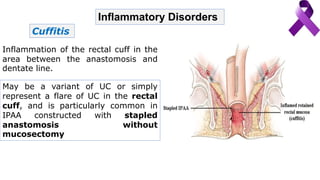
Cuffitis
Inflammation of the rectal cuff in the
area between the anastomosis and
dentate line.
May be a variant of UC or simply
represent a flare of UC in the rectal
cuff, and is particularly common in
IPAA constructed with stapled
anastomosis without
mucosectomy
Inflammatory Disorders
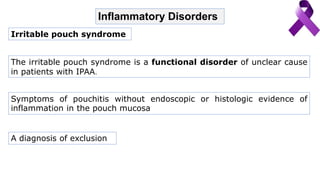
Irritable pouch syndrome
The irritable pouch syndrome is a functional disorder of unclear cause
in patients with IPAA.
Symptoms of pouchitis without endoscopic or histologic evidence of
inflammation in the pouch mucosa
A diagnosis of exclusion
Inflammatory Disorders
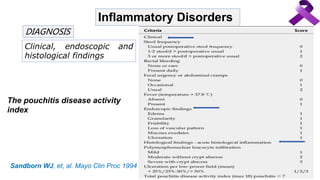
DIAGNOSIS
Clinical, endoscopic and
histological findings
The pouchitis disease activity
index
Sandborn WJ, et, al. Mayo Clin Proc 1994
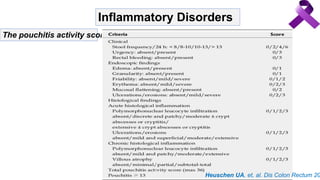
Inflammatory Disorders
The pouchitis activity score
Heuschen UA, et, al. Dis Colon Rectum 20
Inflammatory Disorders
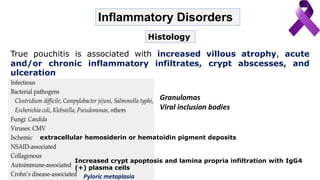
Histology
True pouchitis is associated with increased villous atrophy, acute
and/or chronic inflammatory infiltrates, crypt abscesses, and
ulceration
Granulomas
Viral inclusion bodies
Increased crypt apoptosis and lamina propria infiltration with IgG4
(+) plasma cells
extracellular hemosiderin or hematoidin pigment deposits
Pyloric metaplasia
Inflammatory Disorders
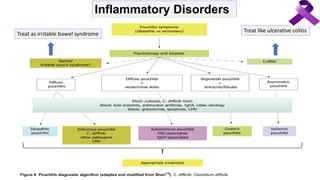
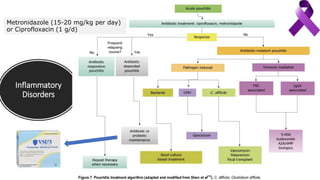
Treat as irritable bowel syndrome
Treat like ulcerative colitis
Inflammatory
Disorders
Metronidazole (15-20 mg/kg per day)
or Ciprofloxacin (1 g/d)
Crohn’s Disease of the Pouch
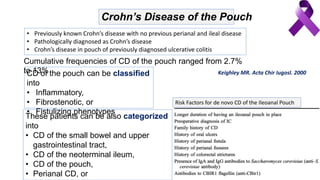
• Previously known Crohn’s disease with no previous perianal and ileal disease
• Pathologically diagnosed as Crohn’s disease
• Crohn’s disease in pouch of previously diagnosed ulcerative colitis
Cumulative frequencies of CD of the pouch ranged from 2.7%
to 13%CD of the pouch can be classified
into
• Inflammatory,
• Fibrostenotic, or
• Fistulizing phenotypes
These patients can be also categorized
into
• CD of the small bowel and upper
gastrointestinal tract,
• CD of the neoterminal ileum,
• CD of the pouch,
• Perianal CD, or
Risk Factors for de novo CD of the Ileoanal Pouch
Keighley MR. Acta Chir Iugosl. 2000
Crohn’s Disease of the Pouch
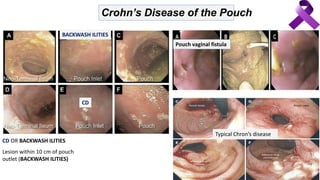
CD OR BACKWASH ILITIES
Lesion within 10 cm of pouch
outlet (BACKWASH ILITIES)
CD
BACKWASH ILITIES
Pouch vaginal fistula
Typical Chron’s disease
Crohn’s Disease of the Pouch
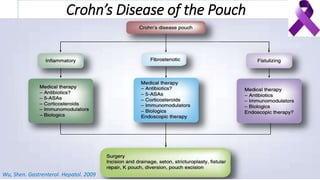
Wu, Shen. Gastrenterol. Hepatol. 2009
Ulcerative colitis complications management

Ulcerative colitis complications management

  • 1.
    POST OPERATIVE COMPLICATIONS ULCERATIVE COLITIS DRSUJAN SHRESTHA MCh, FIRST YEAR TUTH, IOM
  • 2.
    Ulcerative colitis •Emergency surgicalcomplications •Postoperative complications •Colorectal malignancy
  • 3.
    Emergency surgical complications Prevalenceof inflammatory bowel disease (IBD) • West – 20 to 30 per 1 lakh population • Asia – 0.5 to 1 per 1 lakh population. Siew C. Ng et, al. gastroenterol hepatol 20 Around 16 to 20% of UC patients needs resection after 10 yrs. of diagnosis. Frolkis AD, Dykeman J, Negron ME, et al. Gastroenterology 2013 BURDEN
  • 4.
    TOXIC COLITIS The observedincidence of toxic colitis is approximately 10% in all patients with UC Marion JF, Present DH. Eur J Gastroenterol Hepatol 1998 • 6% of hospital admissions, • Lifetime incidence of 1- 2.5%. • 30% developing in the first 3 months of diagnosis. BURDEN
  • 5.
  • 6.
    Toxic megacolon Jalan KN,Sircus W, Card WI,et, al. Gut. 1967 TOXIC COLITIS >=3 PLUS >=1
  • 7.
    Dilated transverse colon Lossof haustration TOXIC COLITIS
  • 8.
  • 9.
    Diagnosis Criteria imaging Stool culture Antigen testingin stool Sigmoidoscopy guided biopsy For C diff Antibiotic • Oral vancomycin • IV metronidazole For CMV Antiviral • IV ganciclovir followed by oral valganciclovir. • Intravenous methylprednisolone, 60 mg per day, in divided doses or, • Hydrocortisone, 300 mg in divided doses TOXIC COLITIS Robert N. Goldstone, et, al. Surg Clin N Am 99 (2019) 1 2 3
  • 10.
    Some patients mightbe steroid resistant 5 ASA with tapering of steroid 5 ASA with tapering of steroid TOXIC COLITIS Robert N. Goldstone, et, al. Surg Clin N Am 99 45 67
  • 11.
    Total abdominal (subtotal) colectomy •Why not total proctocolectomy ? • When to remove rectum also? • What to do with the distal stump?  Bring out as DMF  Close and keep intraabdominally  Close and keep subcutaneously TOXIC COLITIS
  • 12.
    TOXIC COLITIS Ileostomy Distal stumpburied subcutaneously Around 4 cm
  • 13.
    TOXIC COLITIS Intraoperative decompressionprocedure 1. Before definitive procedure 2. Rescue operation (if very sick)
  • 14.
  • 15.
    A total proctocolectomyshould be avoided • It is associated with greater postoperative morbidity and mortality • Subtotal colectomy allows for future reconstructive options elective completion proctectomy with ileal pouch anal anastomosis. • Patients without a definitive diagnosis of either UC or CD, a subtotal colectomy may assist with establishing the correct diagnosis thus guide future interventions Indication of emergency proctocolectomy • Acute perforation of the rectum or exsanguinating hemorrhage. Berg DF, Bahadursingh AM, Kaminski DL, et al. Am J Surg 2002 TOXIC COLITIS
  • 16.
  • 17.
  • 18.
  • 19.
  • 20.
    DEFINING THE ATZ “Thezone interposed between uninterrupted crypt bearing colorectal-type mucosa above and uninterrupted squamous epithelium below” 1 Alcian dye technique • Columnar epithelium stains dark blue, the squamous epithelium does not stain, and the ATZ stains pale blue • 6 mm below to 20 mm above the dentate line[ Computer mapping • The median upper and lower borders of the ATZ, measured from the lower margin of the internal sphincter, were 1.82 and 1.27 cm Fenger C. The anal transitional zone. Acta Pathol Microbiol Scand [A] 1979 Thompson-Fawcett MW, Br J Surg 1998 Anal Transitional Zone
  • 21.
  • 22.
    The rectum isable to sense distension, however, that results in a brief reflexive relaxation of the internal anal sphincter and contraction of the external anal sphincter, thus allowing the anal mucosa to sample the rectal contents. This sampling is thought to aid the ATZ in discrimination between gas, liquid, and solid stool. The retained ATZ following stapled RPC IPAA is therefore at risk for chronic inflammation from recurrent or persistent disease, dysplasia, and possibly malignancy. Pouch failure and pouch excision World J Gastroenterol 2009 February 21Jennifer Holder-Murray DEFINING THE ATZ Vansar
  • 23.
    Associated Complications After Restorative Proctocolectomy Classification ofIleal Pouch Disorders and Associated Complications BO SHEN, ET, AL. CLINICAL GASTROENTEROLOGY AND HEPATOLOGY 2008
  • 24.
    Surgical and MechanicalComplications Anastomotic Leaks Anastomotic leak is defined as anastomotic separation leading to exodus of pouch luminal content. Soluble contrast enemas can help detect the leaks. Percutaneous drainage of the collection Surgical repair with diversion ileostomy Management Oncel M, Remzi FH, Church JM, et al. Dis Colon
  • 25.
    Pelvic Sepsis andPouch Abscess Surgical and Mechanical Complications Pelvic sepsis can be defined as any infective process present in the peripouch area or at the true pelvis distal to the pelvic inlet. • 5% to 20% • Associated with anastomotic leak in 34%, fistulae in 25%, and even mortality in 3% of patients. Pelvic abscess is defined as a collection of purulent exudates without demonstrable anastomotic leaks. Sagap I, Remzi FH, Hammel JP, et ala multivariate analysis. Usual management is drainage (surgical or intervention radiology guided) PELVIC COLLECTION DRAIN
  • 26.
    Surgical and MechanicalComplications Pouch Sinuses A sequela or a later presentation of initial anastomotic leaks. Magnetic resonance imaging often is needed for assessing both the depth and extent of the sinuses and to distinguish them from fistulae Pouch endoscopy with careful examination usually can detect openings of sinuses. • Periodic incision and drainage of the chronically infected superficial sinuses to promote secondary healing and closure • Redo pouch procedure. Swain BT, Ellis CN. Dis Colon Rectum
  • 27.
    Pouch Fistulae Surgical andMechanical Complications Fistula is defined as an abnormal passage from one epithelial surface (eg, the ileal pouch) to another epithelial surface (eg, the vagina or skin). Classified into 1. CD-related fistulae  Previous indeterminate colitis  Late fistula  Fistula without previous leak  Multiple and complex fistula 2. Non-CD–related fistulae Diagnosed by • MRI fistulogram • Endoscopy Medical or surgical management Keighley MR, Grobler SP. Br J Surg 1993. Pouch vaginal fistula
  • 28.
    Surgical and MechanicalComplications Strictures 11% for patients with underlying UC MANAGEMENT • Endoscopic • Bougie dilations • Surgical stricturoplasty • Pouch diversion or excision. Shen B, et al. Endoscopic balloon dilation of ileal pouch strictures. Am J Gastroenterol 2004
  • 29.
  • 30.
    Afferent Limb Syndrome Surgicaland Mechanical Complications Distal small-bowel obstruction junction to the pouch is called afferent limb syndrome. • Adhesions, • NSAID-induced strictures, • Fibrostenotic CD, Acute angulation, • Prolapse, or • Intussusceptions of the afferent limb Management is usually surgical exploration
  • 31.
    Surgical and MechanicalComplications Efferent Limb Syndrome Causes • Dysfunctional or excessively long efferent limb • Markedly long rectal stump. • Patients sometimes must catheterize the pouch reservoir to evacuate feces. • Surgical correction often is needed
  • 32.
    Inflammatory Disorders Pouchitis Cumulative frequencyrates of pouchitis 10 to 11 years after IPAA surgery range from 23% to 46%.(70) Navaneethan U, Shen B. Am J Gastroenterol
  • 33.
    Inflammatory Disorders Pouchitis IDIOPATHICPOUCHITIS Pathogenesis • Interleukin-1 receptor antagonist gene allele 2, • Tumor necrosis factor (TNF) allele 2, • TLR 1 and NOD2/CARD15Risk factors Extensive UC, Backwash ileitis, Preoperative thrombocytosis, Corticosteroid use, Extraintestinal manifestations (PSC), p-ANCA (+ve), Non-smoking status, NSAIDs use
  • 34.
    Inflammatory Disorders Cuffitis Inflammation ofthe rectal cuff in the area between the anastomosis and dentate line. May be a variant of UC or simply represent a flare of UC in the rectal cuff, and is particularly common in IPAA constructed with stapled anastomosis without mucosectomy
  • 35.
    Inflammatory Disorders Irritable pouchsyndrome The irritable pouch syndrome is a functional disorder of unclear cause in patients with IPAA. Symptoms of pouchitis without endoscopic or histologic evidence of inflammation in the pouch mucosa A diagnosis of exclusion
  • 36.
    Inflammatory Disorders DIAGNOSIS Clinical, endoscopicand histological findings The pouchitis disease activity index Sandborn WJ, et, al. Mayo Clin Proc 1994
  • 37.
    Inflammatory Disorders The pouchitisactivity score Heuschen UA, et, al. Dis Colon Rectum 20
  • 38.
  • 39.
  • 40.
  • 41.
    Inflammatory Disorders Histology True pouchitisis associated with increased villous atrophy, acute and/or chronic inflammatory infiltrates, crypt abscesses, and ulceration Granulomas Viral inclusion bodies Increased crypt apoptosis and lamina propria infiltration with IgG4 (+) plasma cells extracellular hemosiderin or hematoidin pigment deposits Pyloric metaplasia
  • 42.
    Inflammatory Disorders Treat asirritable bowel syndrome Treat like ulcerative colitis
  • 43.
    Inflammatory Disorders Metronidazole (15-20 mg/kgper day) or Ciprofloxacin (1 g/d)
  • 44.
    Crohn’s Disease ofthe Pouch • Previously known Crohn’s disease with no previous perianal and ileal disease • Pathologically diagnosed as Crohn’s disease • Crohn’s disease in pouch of previously diagnosed ulcerative colitis Cumulative frequencies of CD of the pouch ranged from 2.7% to 13%CD of the pouch can be classified into • Inflammatory, • Fibrostenotic, or • Fistulizing phenotypes These patients can be also categorized into • CD of the small bowel and upper gastrointestinal tract, • CD of the neoterminal ileum, • CD of the pouch, • Perianal CD, or Risk Factors for de novo CD of the Ileoanal Pouch Keighley MR. Acta Chir Iugosl. 2000
  • 45.
    Crohn’s Disease ofthe Pouch CD OR BACKWASH ILITIES Lesion within 10 cm of pouch outlet (BACKWASH ILITIES) CD BACKWASH ILITIES Pouch vaginal fistula Typical Chron’s disease
  • 46.
    Crohn’s Disease ofthe Pouch Wu, Shen. Gastrenterol. Hepatol. 2009

Editor's Notes

  • #2 Good morning
  • #3 Surgical overview is already discussed by my senior dr nirajan so I will be talking on 2 aspects of ulcerative colitis Colorectal malignancy in ulcerative colitis need to be address separately so it will be not discussed in this presentation
  • #5 MOST IMPORTANT SURGICAL EMERGENCY IN ULCERATIVE COLITIS IS TOXIC COLITIS
  • #6 AS DISCUSSED IN PREV CLASSES MODIFIED TRULOVE AND WITTS CRITERIA IS IMPORTANT CLASS
  • #8 Dilated transverse colon more than 6 cm If more than 8 cm there is high chance of perforation
  • #13 BROOKS METHOD IS COMMONLY FOLLOWED TECHNIQUE FOR CREATING ILEOSTOMY WHERE AROUND 4 CM OF MATURATION OF ILEOSTOMY IS DONE BY THREE POINT SUTURING OF THE STOMA
  • #23 preservation of the ATZ, should be reserved for those patients in whom multiple preoperative endoscopic biopsies rule out dysplasia or carcinoma in the entire colon. Transanal mucosectomy and handsewn IPAA should be performed in patients with biopsy-proven dysplasia, irrespective of the location and severity.
  • #34 Pochitis pathogenesis is not well understood Many factors comes into play particularly flora, local immune