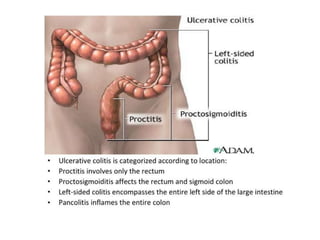
Ulcerative colitis

        By : Dr. Safia Zahir
             PGR,S-II
Ulcerative Colitis
• Ulcerative colitis is a chronic inflammatory
  condition causing continuous mucosal
  inflammation of the colon without granuloma
  on biopsy, affecting the rectum and a variable
  extent of the colon in continuity, which is
  characterized by a relapsing and remitting
  course.
Incidence
• The incidence of ulcerative colitis in Western
countries is about 5–16 new cases per 100,000 per
year with an onset most commonly but not
exclusively between 15–45 years of age . The
prevalence ranges from 50–220 cases per 100,000.
Familial, geographic, ethnic and cultural variations
have been identified. (1,2)
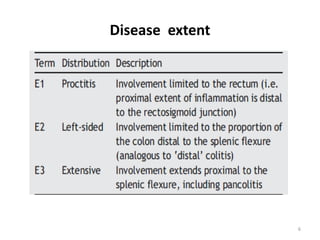
Disease extent


                 6
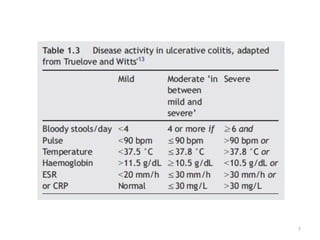
7
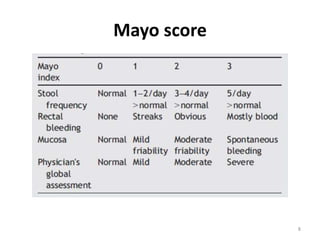
Mayo score


             8
Extraintestinal manifestations
• Arthritis (20%)

• Ankylosing spondylitis (3-5%)

• Erythema nodosum (10-15%)

• Pyoderma gangrenosum (rare)

• Primary sclerosing cholangitis(5-8%)-
  Risk of colon CA increased 5x
  compared to UC alone
UC Diagnosis
• Rule out infectious causes
    Fecal leukocytes
       • Confirm inflammatory origin to diarrhea, urgency
          etc
    Stool cultures, Ova & Parasites
       • Campylobacter, Salmonella, Shigella, C. diff …
• Proctosigmoidoscopy
     Diffuse, confluent disease from dentate line
proximally
• Colonoscopy and biopsy is recommended for making
   diagnosis and determining severity of disease
• On barium enema, shortened colon in UC, with loss of
  haustrations & destruction of mucosal pattern (“lead pipe
  colon”)
     Ileitis in UC (without the skip pattern)
   Mucosal surface irregular and friable
   • Rule out Crohn’s –
   • Small bowel follow-through
• Indeterminate Colitis
   Treat as UC until/if declares itself Crohn’s
UC Diagnosis


• On plain radiography
  Irregular colon with “thumb printing” (air in colonic wall)
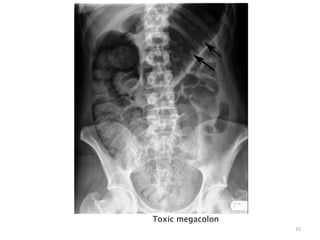
  Toxic megacolon :long, continuous segment of air-filled colon
   greater than 6 cm in diameter (esp. in transverse colon)

• CT & U/S best for demonstrating mesenteric inflammation,
  intra-abdominal abscesses and fistulas
Specific complications of Ulcerative
                  colitis..

•   Toxic megacolon
•   Colonic Perforation
•   Massive hemorrhage
•   Dysplasia and colorectal cancer
•   Stricture
Toxic Megacolon

• Incidence: 5~7%
• 50% patient present megacolon as their first ulcerative colitis
  attack
• Fever, tachycardia, leukocytosis, abdominal distention and
  tenderness
• Mortality:15~30%(decline in recent years), usually due to
  delayed surgery or MODS (3)
Toxic megacolon
                  15
Perforation
• Incidence:3~5% with megacolon existence
  – 1% without megacolon

• Most common at Sigmoid colon

• Most common cause of death

• Corticosteroid
  – can mask fatal peritonitis
Risk for carcinoma in UC
• Disease duration
   – 25% at 25 yrs, 35% at 30 yrs,
     45% at 35 yrs, and 65% at 40 yrs
• Pancolonic disease
   – Left-sided only pts less likely to
     develop cancer than pancolitis
     pts
• Continuously active disease
• Severity of Inflammation
   – Colonic stricture must be
     considered to be cancer until
     proven otherwise
Risk for carcinoma in UC
• Colonoscopic surveillance
  -colonoscopy at 10 years after diagnosis
 - Followup according to risk stratification
 - Dysplasia or malignancy on biopsy,
  proceed to total colectomy
Conservative Treatment
• Anti-inflammatory agents (aminosalicylates, corticosteroids)

• Immunosupressants

• Antibiotics

• TNF (Tumor Necrosis Factor) inhibitors

• Anti-diarrheal agents

• Antispasmodic agents

• Supportive therapy

• ** 75% of ulcerative colitis patients respond well to medical
  management
Indications for surgery in UC:
• SURGICAL EMERGENCIES

  – Massive life threatening hemorrhage(>6 units
    over 24hrs)
  – Toxic megacolon with impending perforation
  – Fulminant colitis unresponsive to IV
    corticosteroids
  – Colonic perforation
  – Total obstruction from stricture
• Timing of emergency surgery
   -severity of episode/predicated outcome
   -presence of complications
   -patients general condition
   -nutritional status
   -duration and course of UC
   -extent of colonic involvement
   -compliance and complication of drug therapy
  -patients consent and acceptance
• Elective:
  – Intractability despite max therapy.
  – Mucosal dysplasia
  – Dysplasia-associated lesion or mass (DALM)
  – Intolerable side effects of medications
  – Patient with significant risk to develop CRC
  – Stricture formation without obstruction
Surgical Options
Emergency operation:

– Subtotal colectomy with end ileostomy

– Proctocolectomy with end ileostomy

– Blow-hole colostomy with end ileostomy
   Subtotal colectomy with end ileostomy
    - long rectal stump is left and is exteriorised as a
     mucosal fistula
     -short rectal stump
    - Advantages : Allows option for IPAA; low risk
    -Disadvantages :
        • Requires second operation
        • may develop rectal recurrence of disease.
        - Contraindication : Massive hemorrhage from colon and
        rectum
• Proctocolectomy with end ileostomy:


  – Advantages: Definitive treatment
  – Disadvantages :
     • No option for IPAA
     • moderate risk for perineal nerve damage
  – Contraindication : Severely toxic or unstable
    patient
  Blow-hole colostomy with end ileostomy
   -colonic decompression and proximal diversion using a
skin level colostomy and loop ileostomy-is rarely
performed except in pregnant patients, colonic micro
perforation, high lying splenic flexure, and dense adhesions

    – Advantages: Short, simple decompression procedure
    – Disadvantages : Diseased colon and rectum retained
ELECTIVE PROCEDURES
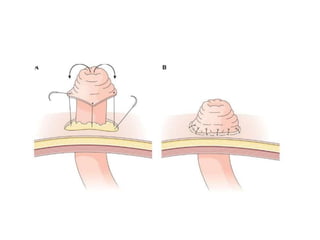
– Total proctocolectomy with Brooke ileostomy
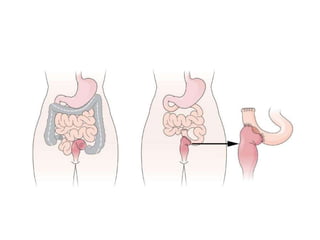
– Subtotal colectomy with ileorectal anastomosis
– Total proctocolectomy with Kock pouch
– Total colectomy, mucosal proctectomy and hand-
  sewn IPAA with temporary diverting loop ileostomy
  (two-stage operation)
– Total proctocolectomy without mucosectomy and
  stapled IPAA with temporary diverting loop ileostomy
  (two-stage operation)
– Laparoscopic total proctocolectomy with or without
  mucosectomy and IPAA
Total proctocolectomy with Brooke ileostomy

 Indications : Patients wanting to avoid risks of IPAA;
  elderly; poor sphincter function; rectal cancer
 Contraindications :Patient aversion to permanent

  ileostomy; obesity; life-threatening emergencies
 Advantages: Eliminates all disease-bearing mucosa; single

  operation , prevents further inflammation and progression
  dysplasia/carcinoma
 Disadvantages: Potential for nerve injury in the perineal and
pelvic dissection; permanent ileostomy; delayed perineal
wound healing; mechanical problems with stoma, high risk
SBO
Subtotal colectomy with ileorectal anastomosis

  – Indications: No rectal involvement; avoid permanent
    stoma and IPAA; young women of childbearing age to
    preserve fertility
  – Contraindications : Poor sphincter tone or dysfunction;
    active rectal or perianal disease; colonic or rectal
    dysplasia; or frank cancer
  – Advantages: One-stage operation; complete continence
    with good function; low risk of pelvic nerve injury;
    eliminates stoma.
  – Disavantages:
    30% recurrence rate requiring conversion to ileostomy
   risk of rectal cancer requiring longlife surveillance
Total proctocolectomy with
         continent ileostomy
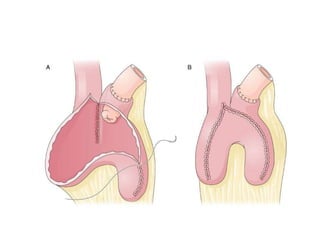
• Introduced by Kock in 1969; popular in the 1970s
  because it offered control of evacuations

• A single-chambered reservoir is fashioned by suturing
  several limbs of ileum together after the antimesenteric
  border has been divided

• The outflow tract is intussuscepted into the reservoir to
  create a valve that provides obstruction to the pouch
  contents
• As the pouch distends, pressure over the valve causes it close and
  retain stool, permitting patients to wear a simple bandage over a
  skin-level stoma

• 2-4x/d, the patient introduces a tube through the valve to evacuate
  the pouch
Total proctocolectomy with Kock pouch

– Indications : Alternative to conventional ileostomy for
  patients desiring to preserve continence; poor
  sphincter tone; low rectal cancer; failed IPAA;
  conversion from ileostomy
– Contraindications : Possibility of Crohn's disease;
  previous resection of small bowel; patients over 60
  years old; obesity; coexisting medical illness
– Advantages: Avoids ileostomy; patients remain
  continent; good quality of live; improved body image
  over ileostomy
– Disadvantages: High reoperation rate (35%) due to
  nipple valve dysfunction or failure; high fistula rate;
  pouchitis
Total proctocolectomy with ileal pouch-
   anal anastamosis (IPAA or J-pouch)

• Operative Techniques:

    – Stage I : abdominal colectomy, mucosal proctectomy,
      endorectal IPAA, and diverting loop ileostomy
    – Stage II : closure of ileostomy

• Near-total proctocolectomy with preservation of the anal sphincter
  complex

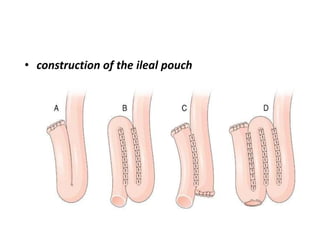
• A single-chambered pouch is fashioned from the distal 30 cm of the
  ileum and sutured to the anus using a double-stapled technique
Total proctocolectomy with ileal pouch-
        anal anastamosis (IPAA)
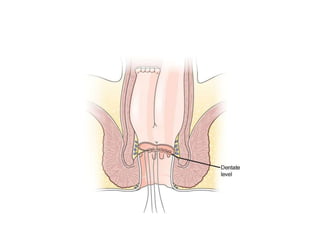
 • Alternatively, a hand-sewn anastomosis may be fashioned
   between the pouch and the anus after stripping the distal rectal
   mucosa from the internal anal sphincter (mucosectomy)
         • Mucosectomy has been complicated by cancer arising at the
           anastomosis and extraluminally in the pelvis, evidently from
           islands of glands that remained after the mucosa was
           incompletely removed.
         • The mucosectomy technique may conceal retained rectal
           mucosa in up to 20% of patients
         • Avoiding the mucosectomy preserves the anal transition zone,
           which contains nerve endings involved in differentiating liquid
           and solid stool from gas, and is thus thought to provide
           superior postoperative continence.
 • Temporary fecal diversion (ie diverting loop ileostomy)
         • Recommended in high-risk patients, especially those taking
           steroids preoperatively
Total Proctocolectomy with Ileal Pouch–Anal
                 Anastomosis
– Indications : Procedure of choice for ulcerative
  colitis; colonic dysplasia or cancer; indeterminate
  colitis
– Contraindications : Poor resting tone or anal
  sphincter dysfunction; low rectal cancers
– Advantages: Completely restorative;
  mucosectomy eliminates all disease-bearing
  mucosa; no disease recurrence; no cancer risk;
  good function, continence, and quality of life.
– Disadvantages:
   • Two-stage procedure
   • potential for nerve injury in the perineal and
     pelvic dissection
   • reduced fertility in females
   • mucosectomy and hand-sewn IPAA are
     technically demanding and difficult to learn
   • septic complications
   • pouchitis
• construction of the ileal pouch
• Post-IPAA:
  – 4 weeks after - barium radiographic study
  – 8 weeks after - anal manometry + clousre of
    ileostomy
  – 1 – 3 – 6 – 12 month F/U then every year
  – flexible fiberoptic pouchoscopy with surveillance
    biopsies of the ileal pouch approximately every 5
    years.
Complications
•   Pouch Failure
•   Pouchitis
•   Crohn's Disease
•   dysplasia and carcinoma of the ileal pouch
Pouch Failure
• significant long-term complication of IPAA
  – Prior anal pathology
  – Abnormal anal manometry
  – Pouch-perineal or pouch-vaginal fistulae
  – Pelvic sepsis
  – Anastomotic stricture, and dehiscence
• Brooke ileostomy or Kock pouch
Pouchitis
• nonspecific, idiopathic inflammation of the
  ileal pouch
• most common and significant late, long-term
  complication
• > 50% of ulcerative colitis patients
• Rare in IPAA for FAP
• Presentation :
  – stool frequency
  – watery diarrhea
  – fecal urgency
  – Incontinence
  – abdominal cramping
  – fever, and malaise


• flexible ileal pouchoscopy
• the greatest risk for experiencing an episode
  is during the initial 6-month period following
  closure of the temporary diverting loop
  ileostomy.
• Risk continues to rise steadily for the next 18–
  36 months before leveling off at around 4
  years
• Management :
  – Broad-spectrum antibiotics
     • Acute:
        – Ciprofloxacin 250 mg BID
        – Metronidazole 250 mg QID
     • Chronic: ( treatment for 3 months )
        – Ciprofloxacin 250 mg OD
        – Metronidazole 250 mg OD
        – topical anti-inflammatory agents, corticosteroids
     • Refractory :
        – undiagnosed Crohn's disease ?
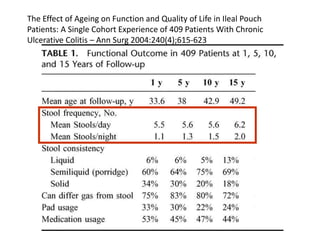
The Effect of Ageing on Function and Quality of Life in Ileal Pouch
Patients: A Single Cohort Experience of 409 Patients With Chronic
Ulcerative Colitis – Ann Surg 2004:240(4);615-623
References

1. 5 Lashner BA. Epidemiology of inflammatory bowel disease.Gastroenterol Clin
North Am 1995; 24:467–74
2. Corrao G, Tragnone A, Caprilli R, Trallori G, Papi C, AndreoliA, et al. Risk of
inflammatory bowel disease attributable to smoking, oral contraception and
breastfeeding in Italy: a nationwidecase-control study. Cooperative Investigators of the
Italian Group for the Study of the Colon and the Rectum(GISC). Int J Epidemiol 1998;
27:397–404.
3. Caprilli R, Latella G, Vernia P, Frieri G. Multiple organ dysfunction in ulcerative colitis.
Am J Gastroenterol 2000;
   95:1258–62.

4. Andreas M. Kaiser, Robert W. Beart Jr. Surgical management of ulcerative
colitis. SWISS MED WKLY 2 0 0 1 ; 1 3 1 : 3 2 3 – 3 3 7
Ulcerative colits ppt

Ulcerative colits ppt

  • 1.
    Ulcerative colitis By : Dr. Safia Zahir PGR,S-II
  • 2.
    Ulcerative Colitis • Ulcerativecolitis is a chronic inflammatory condition causing continuous mucosal inflammation of the colon without granuloma on biopsy, affecting the rectum and a variable extent of the colon in continuity, which is characterized by a relapsing and remitting course.
  • 3.
    Incidence • The incidenceof ulcerative colitis in Western countries is about 5–16 new cases per 100,000 per year with an onset most commonly but not exclusively between 15–45 years of age . The prevalence ranges from 50–220 cases per 100,000. Familial, geographic, ethnic and cultural variations have been identified. (1,2)
  • 6.
  • 7.
  • 8.
  • 9.
    Extraintestinal manifestations • Arthritis(20%) • Ankylosing spondylitis (3-5%) • Erythema nodosum (10-15%) • Pyoderma gangrenosum (rare) • Primary sclerosing cholangitis(5-8%)- Risk of colon CA increased 5x compared to UC alone
  • 10.
    UC Diagnosis • Ruleout infectious causes Fecal leukocytes • Confirm inflammatory origin to diarrhea, urgency etc Stool cultures, Ova & Parasites • Campylobacter, Salmonella, Shigella, C. diff … • Proctosigmoidoscopy Diffuse, confluent disease from dentate line proximally • Colonoscopy and biopsy is recommended for making diagnosis and determining severity of disease
  • 11.
    • On bariumenema, shortened colon in UC, with loss of haustrations & destruction of mucosal pattern (“lead pipe colon”) Ileitis in UC (without the skip pattern) Mucosal surface irregular and friable • Rule out Crohn’s – • Small bowel follow-through • Indeterminate Colitis Treat as UC until/if declares itself Crohn’s
  • 12.
    UC Diagnosis • Onplain radiography Irregular colon with “thumb printing” (air in colonic wall) Toxic megacolon :long, continuous segment of air-filled colon greater than 6 cm in diameter (esp. in transverse colon) • CT & U/S best for demonstrating mesenteric inflammation, intra-abdominal abscesses and fistulas
  • 13.
    Specific complications ofUlcerative colitis.. • Toxic megacolon • Colonic Perforation • Massive hemorrhage • Dysplasia and colorectal cancer • Stricture
  • 14.
    Toxic Megacolon • Incidence:5~7% • 50% patient present megacolon as their first ulcerative colitis attack • Fever, tachycardia, leukocytosis, abdominal distention and tenderness • Mortality:15~30%(decline in recent years), usually due to delayed surgery or MODS (3)
  • 15.
  • 16.
    Perforation • Incidence:3~5% withmegacolon existence – 1% without megacolon • Most common at Sigmoid colon • Most common cause of death • Corticosteroid – can mask fatal peritonitis
  • 17.
    Risk for carcinomain UC • Disease duration – 25% at 25 yrs, 35% at 30 yrs, 45% at 35 yrs, and 65% at 40 yrs • Pancolonic disease – Left-sided only pts less likely to develop cancer than pancolitis pts • Continuously active disease • Severity of Inflammation – Colonic stricture must be considered to be cancer until proven otherwise
  • 18.
    Risk for carcinomain UC • Colonoscopic surveillance -colonoscopy at 10 years after diagnosis - Followup according to risk stratification - Dysplasia or malignancy on biopsy, proceed to total colectomy
  • 19.
    Conservative Treatment • Anti-inflammatoryagents (aminosalicylates, corticosteroids) • Immunosupressants • Antibiotics • TNF (Tumor Necrosis Factor) inhibitors • Anti-diarrheal agents • Antispasmodic agents • Supportive therapy • ** 75% of ulcerative colitis patients respond well to medical management
  • 20.
    Indications for surgeryin UC: • SURGICAL EMERGENCIES – Massive life threatening hemorrhage(>6 units over 24hrs) – Toxic megacolon with impending perforation – Fulminant colitis unresponsive to IV corticosteroids – Colonic perforation – Total obstruction from stricture
  • 21.
    • Timing ofemergency surgery -severity of episode/predicated outcome -presence of complications -patients general condition -nutritional status -duration and course of UC -extent of colonic involvement -compliance and complication of drug therapy -patients consent and acceptance
  • 22.
    • Elective: – Intractability despite max therapy. – Mucosal dysplasia – Dysplasia-associated lesion or mass (DALM) – Intolerable side effects of medications – Patient with significant risk to develop CRC – Stricture formation without obstruction
  • 23.
  • 24.
    Emergency operation: – Subtotalcolectomy with end ileostomy – Proctocolectomy with end ileostomy – Blow-hole colostomy with end ileostomy
  • 25.
     Subtotal colectomy with end ileostomy - long rectal stump is left and is exteriorised as a mucosal fistula -short rectal stump - Advantages : Allows option for IPAA; low risk -Disadvantages : • Requires second operation • may develop rectal recurrence of disease. - Contraindication : Massive hemorrhage from colon and rectum
  • 26.
    • Proctocolectomy withend ileostomy: – Advantages: Definitive treatment – Disadvantages : • No option for IPAA • moderate risk for perineal nerve damage – Contraindication : Severely toxic or unstable patient
  • 27.
     Blow-holecolostomy with end ileostomy -colonic decompression and proximal diversion using a skin level colostomy and loop ileostomy-is rarely performed except in pregnant patients, colonic micro perforation, high lying splenic flexure, and dense adhesions – Advantages: Short, simple decompression procedure – Disadvantages : Diseased colon and rectum retained
  • 28.
    ELECTIVE PROCEDURES – Totalproctocolectomy with Brooke ileostomy – Subtotal colectomy with ileorectal anastomosis – Total proctocolectomy with Kock pouch – Total colectomy, mucosal proctectomy and hand- sewn IPAA with temporary diverting loop ileostomy (two-stage operation) – Total proctocolectomy without mucosectomy and stapled IPAA with temporary diverting loop ileostomy (two-stage operation) – Laparoscopic total proctocolectomy with or without mucosectomy and IPAA
  • 29.
    Total proctocolectomy withBrooke ileostomy  Indications : Patients wanting to avoid risks of IPAA; elderly; poor sphincter function; rectal cancer  Contraindications :Patient aversion to permanent ileostomy; obesity; life-threatening emergencies  Advantages: Eliminates all disease-bearing mucosa; single operation , prevents further inflammation and progression dysplasia/carcinoma Disadvantages: Potential for nerve injury in the perineal and pelvic dissection; permanent ileostomy; delayed perineal wound healing; mechanical problems with stoma, high risk SBO
  • 31.
    Subtotal colectomy withileorectal anastomosis – Indications: No rectal involvement; avoid permanent stoma and IPAA; young women of childbearing age to preserve fertility – Contraindications : Poor sphincter tone or dysfunction; active rectal or perianal disease; colonic or rectal dysplasia; or frank cancer – Advantages: One-stage operation; complete continence with good function; low risk of pelvic nerve injury; eliminates stoma. – Disavantages: 30% recurrence rate requiring conversion to ileostomy risk of rectal cancer requiring longlife surveillance
  • 33.
    Total proctocolectomy with continent ileostomy • Introduced by Kock in 1969; popular in the 1970s because it offered control of evacuations • A single-chambered reservoir is fashioned by suturing several limbs of ileum together after the antimesenteric border has been divided • The outflow tract is intussuscepted into the reservoir to create a valve that provides obstruction to the pouch contents
  • 34.
    • As thepouch distends, pressure over the valve causes it close and retain stool, permitting patients to wear a simple bandage over a skin-level stoma • 2-4x/d, the patient introduces a tube through the valve to evacuate the pouch
  • 35.
    Total proctocolectomy withKock pouch – Indications : Alternative to conventional ileostomy for patients desiring to preserve continence; poor sphincter tone; low rectal cancer; failed IPAA; conversion from ileostomy – Contraindications : Possibility of Crohn's disease; previous resection of small bowel; patients over 60 years old; obesity; coexisting medical illness – Advantages: Avoids ileostomy; patients remain continent; good quality of live; improved body image over ileostomy – Disadvantages: High reoperation rate (35%) due to nipple valve dysfunction or failure; high fistula rate; pouchitis
  • 37.
    Total proctocolectomy withileal pouch- anal anastamosis (IPAA or J-pouch) • Operative Techniques: – Stage I : abdominal colectomy, mucosal proctectomy, endorectal IPAA, and diverting loop ileostomy – Stage II : closure of ileostomy • Near-total proctocolectomy with preservation of the anal sphincter complex • A single-chambered pouch is fashioned from the distal 30 cm of the ileum and sutured to the anus using a double-stapled technique
  • 38.
    Total proctocolectomy withileal pouch- anal anastamosis (IPAA) • Alternatively, a hand-sewn anastomosis may be fashioned between the pouch and the anus after stripping the distal rectal mucosa from the internal anal sphincter (mucosectomy) • Mucosectomy has been complicated by cancer arising at the anastomosis and extraluminally in the pelvis, evidently from islands of glands that remained after the mucosa was incompletely removed. • The mucosectomy technique may conceal retained rectal mucosa in up to 20% of patients • Avoiding the mucosectomy preserves the anal transition zone, which contains nerve endings involved in differentiating liquid and solid stool from gas, and is thus thought to provide superior postoperative continence. • Temporary fecal diversion (ie diverting loop ileostomy) • Recommended in high-risk patients, especially those taking steroids preoperatively
  • 39.
    Total Proctocolectomy withIleal Pouch–Anal Anastomosis – Indications : Procedure of choice for ulcerative colitis; colonic dysplasia or cancer; indeterminate colitis – Contraindications : Poor resting tone or anal sphincter dysfunction; low rectal cancers – Advantages: Completely restorative; mucosectomy eliminates all disease-bearing mucosa; no disease recurrence; no cancer risk; good function, continence, and quality of life.
  • 40.
    – Disadvantages: • Two-stage procedure • potential for nerve injury in the perineal and pelvic dissection • reduced fertility in females • mucosectomy and hand-sewn IPAA are technically demanding and difficult to learn • septic complications • pouchitis
  • 41.
    • construction ofthe ileal pouch
  • 43.
    • Post-IPAA: – 4 weeks after - barium radiographic study – 8 weeks after - anal manometry + clousre of ileostomy – 1 – 3 – 6 – 12 month F/U then every year – flexible fiberoptic pouchoscopy with surveillance biopsies of the ileal pouch approximately every 5 years.
  • 44.
    Complications • Pouch Failure • Pouchitis • Crohn's Disease • dysplasia and carcinoma of the ileal pouch
  • 45.
    Pouch Failure • significantlong-term complication of IPAA – Prior anal pathology – Abnormal anal manometry – Pouch-perineal or pouch-vaginal fistulae – Pelvic sepsis – Anastomotic stricture, and dehiscence • Brooke ileostomy or Kock pouch
  • 46.
    Pouchitis • nonspecific, idiopathicinflammation of the ileal pouch • most common and significant late, long-term complication • > 50% of ulcerative colitis patients • Rare in IPAA for FAP
  • 47.
    • Presentation : – stool frequency – watery diarrhea – fecal urgency – Incontinence – abdominal cramping – fever, and malaise • flexible ileal pouchoscopy
  • 48.
    • the greatestrisk for experiencing an episode is during the initial 6-month period following closure of the temporary diverting loop ileostomy. • Risk continues to rise steadily for the next 18– 36 months before leveling off at around 4 years
  • 49.
    • Management : – Broad-spectrum antibiotics • Acute: – Ciprofloxacin 250 mg BID – Metronidazole 250 mg QID • Chronic: ( treatment for 3 months ) – Ciprofloxacin 250 mg OD – Metronidazole 250 mg OD – topical anti-inflammatory agents, corticosteroids • Refractory : – undiagnosed Crohn's disease ?
  • 50.
    The Effect ofAgeing on Function and Quality of Life in Ileal Pouch Patients: A Single Cohort Experience of 409 Patients With Chronic Ulcerative Colitis – Ann Surg 2004:240(4);615-623
  • 51.
    References 1. 5 LashnerBA. Epidemiology of inflammatory bowel disease.Gastroenterol Clin North Am 1995; 24:467–74 2. Corrao G, Tragnone A, Caprilli R, Trallori G, Papi C, AndreoliA, et al. Risk of inflammatory bowel disease attributable to smoking, oral contraception and breastfeeding in Italy: a nationwidecase-control study. Cooperative Investigators of the Italian Group for the Study of the Colon and the Rectum(GISC). Int J Epidemiol 1998; 27:397–404. 3. Caprilli R, Latella G, Vernia P, Frieri G. Multiple organ dysfunction in ulcerative colitis. Am J Gastroenterol 2000; 95:1258–62. 4. Andreas M. Kaiser, Robert W. Beart Jr. Surgical management of ulcerative colitis. SWISS MED WKLY 2 0 0 1 ; 1 3 1 : 3 2 3 – 3 3 7