A CLINICAL TRIAL TO EVALUATE THE EFFICACY OF
PICCHA VASTHI IN REDUCING THE SIGNS AND
SYMPTOMS OF ULCERATIVE COLITIS
Simi Ravindran
Dr.Simi Ravindran
Assistant professor
Govt.Ayurveda college Kannur
simisreehari@gmail.com
Wats up-9496370179
Contents
Introduction
Anatomy and physiology of colon
Ulcerative colitis- Modern view
Anatomy and physiology
Ulcerative colitis -Ayurvedic perspective
Drug review
Methodology of research
Conclusion
Anatomy
• The large intestine constitutes the terminal part of the digestive
system.
• It is responsible for recovery of 1-1.5 l of electrolyte –rich fluid
entering it.
• Allow the body to maintain fluid and electrolyte balance.
• Formation of low volume, solid stools, and permits less frequent
defecation.
• Provide environment of low oxygen tension conducive to bacterial
colonization. .
• Approximately 1.5 m long and capacity when filled by enema is 2L
of volume, resident volume is 200 ml, and intracolonic volume is
750 ml.
• Histology
• Mucosa
• Submucosa
• Circular muscles
• Longitudinal muscle
• Serosa
Concentration of fecal effluent through water and
electrolyte absorption
Bacterial Growth
Production of Vitamins & Electrolytes
Muscular Action of the colon
Stool Transit & Defecation
Physiology
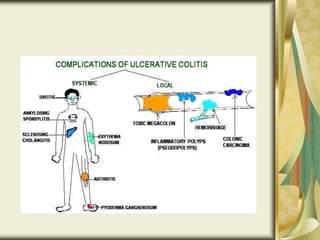
Ulcerative colitis
Etymology
Ulcerative: means relating to, causing, or marked by an ulcer
or ulcers.
Colitis: means inflammation of the colon.
Defenition
Ulcerative colitis is an inflammatory disorder that causes
ulcers and irritation in the inner lining of the colon of the
colonic mucosa, characterized by relapses and remissions.
Etiology
• Genetic predisposition
• Infections
• Allergy
• Psychosomatic illness
• Environmental factors
• Autoimmune diseases
Clinical feautures
• Bloody diarrhea
• Increased bowel
frequency
• Passage of mucus with
stool
• Abdominal cramps
• Abdominal distension
• Anorexia
• Signs -tachycardia, fever,
abdominal tenderness or
distension.
• malaise, weight loss
Related to activity-
• Apthous Ulcers
• Erythema Nodosum
• Finger Clubbing
• Occular-conjunctivitis
• Episcleritis
• Iritis
• Arthritis
• Osteoporosis
Unrelated to activity
• Gallstones
• Sacroiliitis
• Arthralgia
• Nutritional Deficiency
Ulcerative Colitis-Types
Ulcerative proctitis:limited to the rectum. diarrhea, bloody
stool, pain in the rectal area, and a sense of urgency to
empty the bowel.
Proctosigmoiditis: rectum and the sigmoid colon.diarrhea,
bloody stool, cramps and pain in the rectal area, and
moderate pain on the left side of the abdomen
Left-sided colitis: Left-sided colitis affects the entire left
side of the colon, from the rectum to splenic flexure.
diarrhea, bleeding, weight loss ,loss of appetite, and
sometimes severe pain on the left side of abdomen.
Pancolitis: If the entire colon is affected, the term pancolitis
is used ("pan" meaning total).
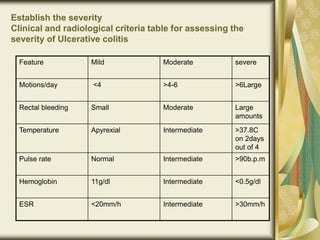
Establish the severity
Clinical and radiological criteria table for assessing the
severity of Ulcerative colitis
Feature Mild Moderate severe
Motions/day <4 >4-6 >6Large
Rectal bleeding Small Moderate Large
amounts
Temperature Apyrexial Intermediate >37.8C
on 2days
out of 4
Pulse rate Normal Intermediate >90b.p.m
Hemoglobin 11g/dl Intermediate <0.5g/dl
ESR <20mm/h Intermediate >30mm/h
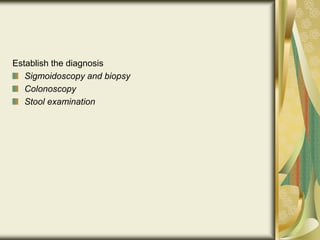
Establish the diagnosis
Sigmoidoscopy and biopsy
Colonoscopy
Stool examination
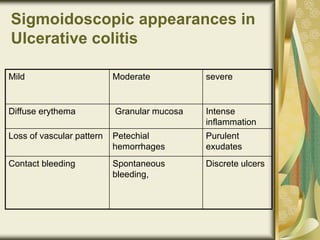
Sigmoidoscopic appearances in
Ulcerative colitis
Mild Moderate severe
Diffuse erythema Granular mucosa Intense
inflammation
Loss of vascular pattern Petechial
hemorrhages
Purulent
exudates
Contact bleeding Spontaneous
bleeding,
Discrete ulcers
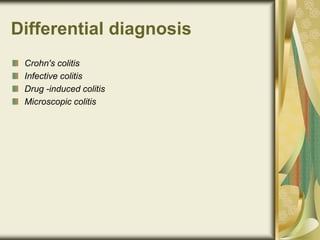
Differential diagnosis
Crohn's colitis
Infective colitis
Drug -induced colitis
Microscopic colitis
Crohn's colitis
Radiology- Discontinuous,asymmetrical,deep
ulcers,common strictures and fistulae
Histology- transmural Distribution, lymphocytes infiltrates
Clinical -Bloody diarrhea is about 50%,common abdominal
mass, perianal diseases
Management
The principals of management are
Prompt treatment of acute attacks.
Maintenance therapy to reduce the relapse rate.
Selection of patients for colectomy.
Detection of colorectal carcinoma.
Patient education is essential to ensure early presentation
during relapse.
5-ASA Compounds
Medications to Suppress the Immune System
Surgery
• standard ileostomy
• continent ostomy
• ileo-anal pull-through
Prognosis
The pattern of relapse and remission one year after
diagnosis tends to continue for any individual.
90% have intermittent activity and 50% are in remission at
any one time.20% will relapse every year and 10% have
continous symptoms
Prolonged remission on maintance therapy occurs ,with 50-
60%remaining in remission for more than 2 years,but <5%
are symptom- free for 15 years
Anatomy-Ayurvedic view
Kosta
Asayas
Grahani
Pittadhara kala
Pureesha dhara kala
Guda
Siras
Dhamni
Asthi
Snayu
Nidanas
Atisara
Grahani
Agnidusti
Annavaha sroto dusti
Pureeshavaha sroto dusti
manasika nidanas
Blood with stool-saraktha malam
• Paittika atisaram(Su.u.40)
• Raktartisara(ch.chi 19)
• Raktaja pravahika(Ma.NI3/22)
• Raktarsas(Ma.NI4/16)
• Pittarsas(Ma.NI4/16)
• Adhogaraktapitta(As.Hr.chi2/8)
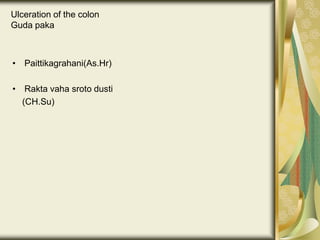
Ulceration of the colon
Guda paka
• Paittikagrahani(As.Hr)
• Rakta vaha sroto dusti
(CH.Su)
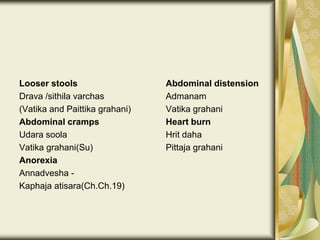
Looser stools
Drava /sithila varchas
(Vatika and Paittika grahani)
Abdominal cramps
Udara soola
Vatika grahani(Su)
Anorexia
Annadvesha -
Kaphaja atisara(Ch.Ch.19)
Abdominal distension
Admanam
Vatika grahani
Heart burn
Hrit daha
Pittaja grahani
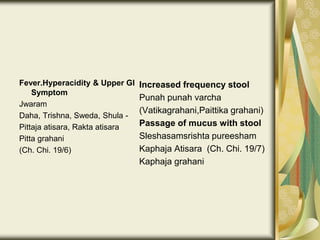
Fever.Hyperacidity & Upper GI
Symptom
Jwaram
Daha, Trishna, Sweda, Shula -
Pittaja atisara, Rakta atisara
Pitta grahani
(Ch. Chi. 19/6)
Increased frequency stool
Punah punah varcha
(Vatikagrahani,Paittika grahani)
Passage of mucus with stool
Sleshasamsrishta pureesham
Kaphaja Atisara (Ch. Chi. 19/7)
Kaphaja grahani
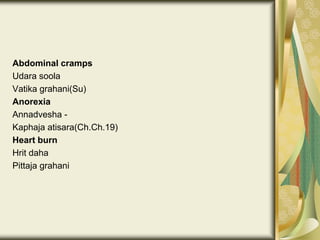
Abdominal cramps
Udara soola
Vatika grahani(Su)
Anorexia
Annadvesha -
Kaphaja atisara(Ch.Ch.19)
Heart burn
Hrit daha
Pittaja grahani
Gurgling sounds in the abdomen
Vayu cha Antah Kosthe
Antrakujanam Vatika grahani
Vatika atisara
Pakvasaya gata vata kopa(Ch.Chi.19/5)
Urgency of defecation
Kshipra varcha prvartanam
Bhaya,soka athisara
Weight loss
Karsyam
Vatgika grahani
Loss of concentration
Manasadanam
(Nanatmaja roopa of vata)
Low backache
Parva ruk
Adhakaya rogas
Pakvasaya gata vata kopa(Ch. Chi. 28/28-29)
Chronicity
Chirakalanubandhini
Sangraha Grahani ( M.N. 4 : 13)
Diseases akin to Ulcerative colitis
• Atisara :Pittaja, Raktaja, Vataja, Kaphaja Atisara.
• Pravahika: (raktaja Pravahika).
• Grahani : (paittika,vatika).
• Pakvashayagata Vatakopa (site& adhara kaya rogas).
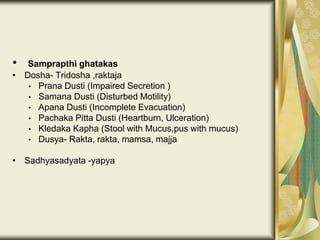
• Samprapthi ghatakas
• Dosha- Tridosha ,raktaja
• Prana Dusti (Impaired Secretion )
• Samana Dusti (Disturbed Motility)
• Apana Dusti (Incomplete Evacuation)
• Pachaka Pitta Dusti (Heartburn, Ulceration)
• Kledaka Kapha (Stool with Mucus,pus with mucus)
• Dusya- Rakta, rakta, mamsa, majja
• Sadhyasadyata -yapya
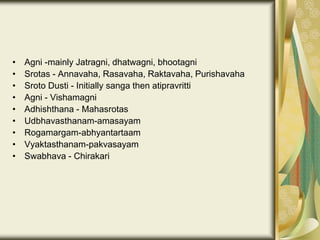
• Agni -mainly Jatragni, dhatwagni, bhootagni
• Srotas - Annavaha, Rasavaha, Raktavaha, Purishavaha
• Sroto Dusti - Initially sanga then atipravritti
• Agni - Vishamagni
• Adhishthana - Mahasrotas
• Udbhavasthanam-amasayam
• Rogamargam-abhyantartaam
• Vyaktasthanam-pakvasayam
• Swabhava - Chirakari
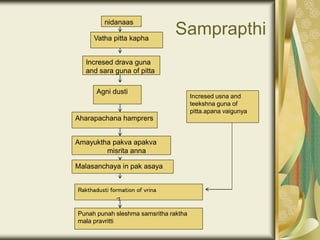
Samprapthi
nidanaas
Vatha pitta kapha
Incresed drava guna
and sara guna of pitta
Agni dusti
Aharapachana hamprers
Amayuktha pakva apakva
misrita anna
Malasanchaya in pak asaya
Rakthadusti formation of vrina
Punah punah sleshma samsritha raktha
mala pravritti
Incresed usna and
teekshna guna of
pitta.apana vaigunya
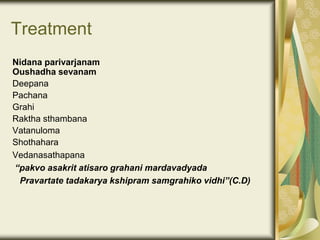
Treatment
Nidana parivarjanam
Oushadha sevanam
Deepana
Pachana
Grahi
Raktha sthambana
Vatanuloma
Shothahara
Vedanasathapana
“pakvo asakrit atisaro grahani mardavadyada
Pravartate tadakarya kshipram samgrahiko vidhi”(C.D)
Pathya,apathya
Pathya sevanam -Kasayarasa pradhana ahara, deepana,
laghu guna yukta ahara, purana sali, vilepi,lajamanda ,small
fishes,jambu phala, vilva , salooka, kapitha
,bakuji,dadima,madhu, mudga yusha, changeri, rambha
pushpa, kamalakanda, Jambu, Kapittha, Takra etc.
Apathyas :Rooksha ,guru ahara, virudhasana, godhooma,
masha,yava, vasthuka, madhu sigru, koosmanda, tumbi,
badara All saka varga, punarnava atishita Jala, dushta Jala,
guru, snigdha, drava, ati ruksha, & saraka substances,
viruddha bhojana, etc.
Apathya vihara
Langhana,Vamana karma,Poorna visrama, Nidra, Activities
making mind happy.
Snana, abhyanga, avagaha, guru ,snigda bhojana, vyayama,
agni santapa should be avoided by atisara rogi as per the
text of Chakradatta.
Piccha vasthi
Etymology
Picha-means
• slimy/saliva
• The gum of Bombax heptaphyllum
Vasthi-
• See,abiding,dwelling,staying
Defenition
“Alpaya Matraya Niroohakhyo vastihi picchavastihi”(Aruna
datta)
Indications
• Pravahika
• Complication of vasthi
• Parisrava
• Treatment of jivadana
Ingredients Dose
saindhava 3 gm
makshika 120 ml
Madhuytastyadi taila 120 ml
Mahatiktaka grutha 120 ml
Salmali vrinta putapaka
mixed with ksheera
240 ml
Kalka of yasti and tagara 48 gm
Astanga hridaya atisara chikitsa
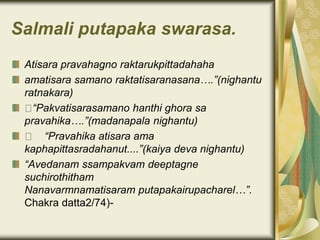
Salmali putapaka swarasa.
Atisara pravahagno raktarukpittadahaha
amatisara samano raktatisaranasana….”(nighantu
ratnakara)
“Pakvatisarasamano hanthi ghora sa
pravahika….”(madanapala nighantu)
“Pravahika atisara ama
kaphapittasradahanut....”(kaiya deva nighantu)
“Avedanam ssampakvam deeptagne
suchirothitham
Nanavarmnamatisaram putapakairupacharel…”.
Chakra datta2/74)-
Mahatiktaka grutham
Grahani chikitsa theindication is there “pittagrahanyam tal
peyam kustoktamtiktakam cha yal” .Mahatiktaka grutham
is indicated in the kusta chikitsa .phala sruti includes paittika
grahani.athisaras
Madhuyastyadi tailam
A combination of Madhura rasa drugs, mentioned in
vatasonitha prakarana, having raktha prasadana and
brumhana properties.The main ingredient is yastimadhu
,which is pittasamana,can used in four
forms.pana,nasya,anuvasana,abhyanga.
Yastimadhu -:
Botanical name- Glycyrrhiza glabraLinn
Family- leguminosae
Sandhaniya, Varnya, Sonitasthapana (Cu.),)
Madhur,Guru, Singdha ,Madhura Vipaka, Sheeta Veerya,Effect on dosha :
tridosha samana,rakta Dosha prasamana,Karma : Vrana Ropana, Daha
Samana.
Tagara
Botanical name- Valeriana jatamansi Jones
Family- Valerianaceae
Rasam:madhura,tiktha,Guna:laghu,snigda,seetha,
Action on doshas-tridosa nasanam,raktha dosha nasanam
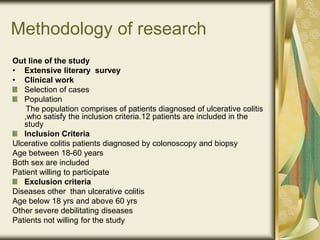
Methodology of research
Out line of the study
• Extensive literary survey
• Clinical work
Selection of cases
Population
The population comprises of patients diagnosed of ulcerative colitis
,who satisfy the inclusion criteria.12 patients are included in the
study
Inclusion Criteria
Ulcerative colitis patients diagnosed by colonoscopy and biopsy
Age between 18-60 years
Both sex are included
Patient willing to participate
Exclusion criteria
Diseases other than ulcerative colitis
Age below 18 yrs and above 60 yrs
Other severe debilitating diseases
Patients not willing for the study
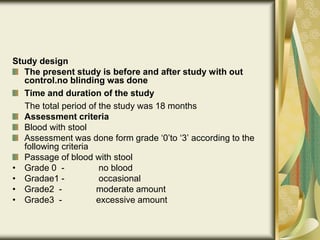
Study design
The present study is before and after study with out
control.no blinding was done
Time and duration of the study
The total period of the study was 18 months
Assessment criteria
Blood with stool
Assessment was done form grade ‘0’to ‘3’ according to the
following criteria
Passage of blood with stool
• Grade 0 - no blood
• Gradae1 - occasional
• Grade2 - moderate amount
• Grade3 - excessive amount
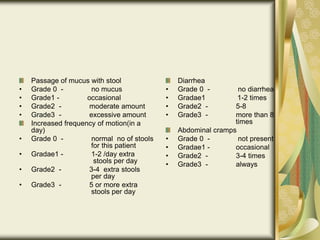
Passage of mucus with stool
• Grade 0 - no mucus
• Grade1 - occasional
• Grade2 - moderate amount
• Grade3 - excessive amount
Increased frequency of motion(in a
day)
• Grade 0 - normal no of stools
for this patient
• Gradae1 - 1-2 /day extra
stools per day
• Grade2 - 3-4 extra stools
per day
• Grade3 - 5 or more extra
stools per day
Diarrhea
• Grade 0 - no diarrhea
• Gradae1 1-2 times
• Grade2 - 5-8
• Grade3 - more than 8
times
Abdominal cramps
• Grade 0 - not present
• Gradae1 - occasional
• Grade2 - 3-4 times
• Grade3 - always
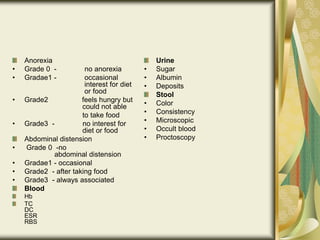
Anorexia
• Grade 0 - no anorexia
• Gradae1 - occasional
interest for diet
or food
• Grade2 feels hungry but
could not able
to take food
• Grade3 - no interest for
diet or food
Abdominal distension
• Grade 0 -no
abdominal distension
• Gradae1 - occasional
• Grade2 - after taking food
• Grade3 - always associated
Blood
Hb
TC
DC
ESR
RBS
Urine
• Sugar
• Albumin
• Deposits
Stool
• Color
• Consistency
• Microscopic
• Occult blood
• Proctoscopy
Hypothetical conclusion
Null hypothesis
Piccha vasthi is not significant in the reducing signs and symptoms of
Ulcerative colitis.
Alternate hypothesis
Piccha vasthi is significant in reducing the signs and symptoms of Ulcerative
colitis.
Observation analysis and
interpretation
The data relating to the study were conveniently segregated into four
heading as follows:-
Demographic data.
Out of the total patients, females and males were in equal ratio.
75% of the people were married and 25% were unmarried
The study reveals that 66.7% of patients are Hindus, 25% are in Christian
religion and 8.3% are Muslims.
While considering the socio-economic status 41.7% are from middle class
33. 3% from high class and 25% are poor class.
58.3% of the patients are from rural areas and 41.7% from urban areas.
In this study, 41.7% are educated, up to high school level, 25% are
graduates, 16.7% have pre degree, and 16.7% were illiterate.
66.7% of the patients underwent the study have sedentary and mental
stress ,while 25% have physical exercise and 8.3% were have both physical
and mental stress.
Prakriti:
• Vata-Pitta Prakriti dominated -50% of the people are belonging to vatha pitta
prakruti,30% were kapha pitta prakruti,20% were vath kapha prakruti..
• Half of the patients have day work, 33.3% have night work and 16.7% have
irregular timings in work.
• 41.7% working more than 8 hours, 33.3% working in between 6-8 hours,
and 16.7% work less than 6 hours.
• 75% have irregular intake of food habits and 25% regular intake of food.
• 50 % have no addiction and 25% have addiction of smoking and
the rest quarter having the addiction of alcohol.
• 58.3% have moderate exercise and 41.7% have heavy exercise.
• Data related to chronicity reveals that half of the patients have
chronicity between 5-10 years ,16.7% have 10-15 years and 33.3%
have 0-5 years of duration.
• The symptoms of Ulcerative colitis precipitated by emotional stress
accompanied by food in 50% of the patients .In 16.7% food is the
causative factor for aggravating symptoms, and in 33.3%
,emotional stress is the aggravating factor.
• 58.3% have feeling of anxiety and 41.7% , not have feeling
of anxiety.
• Initial insomnia presnt is 50% of the patients and absent in rest.
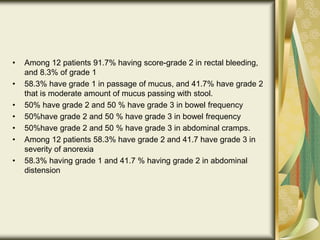
• Among 12 patients 91.7% having score-grade 2 in rectal bleeding,
and 8.3% of grade 1
• 58.3% have grade 1 in passage of mucus, and 41.7% have grade 2
that is moderate amount of mucus passing with stool.
• 50% have grade 2 and 50 % have grade 3 in bowel frequency
• 50%have grade 2 and 50 % have grade 3 in bowel frequency
• 50%have grade 2 and 50 % have grade 3 in abdominal cramps.
• Among 12 patients 58.3% have grade 2 and 41.7 have grade 3 in
severity of anorexia
• 58.3% having grade 1 and 41.7 % having grade 2 in abdominal
distension
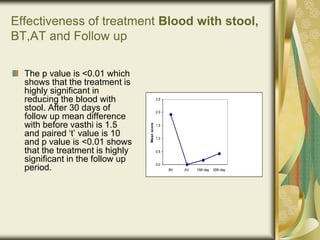
Effectiveness of treatment Blood with stool,
BT,AT and Follow up
The p value is <0.01 which
shows that the treatment is
highly significant in
reducing the blood with
stool. After 30 days of
follow up mean difference
with before vasthi is 1.5
and paired ‘t’ value is 10
and p value is <0.01 shows
that the treatment is highly
significant in the follow up
period.
0.0
0.5
1.0
1.5
2.0
2.5
BV AV 15th day 30th day
Mean
score
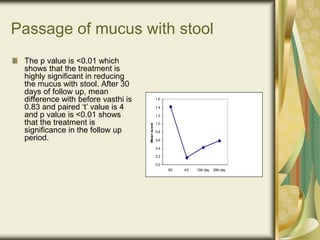
Passage of mucus with stool
The p value is <0.01 which
shows that the treatment is
highly significant in reducing
the mucus with stool. After 30
days of follow up, mean
difference with before vasthi is
0.83 and paired ‘t’ value is 4
and p value is <0.01 shows
that the treatment is
significance in the follow up
period.
0.0
0.2
0.4
0.6
0.8
1.0
1.2
1.4
1.6
BV AV 15th day 30th day
Mean
score
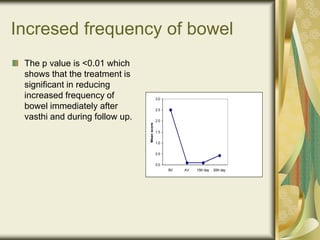
Incresed frequency of bowel
The p value is <0.01 which
shows that the treatment is
significant in reducing
increased frequency of
bowel immediately after
vasthi and during follow up.
0.0
0.5
1.0
1.5
2.0
2.5
3.0
BV AV 15th day 30th day
Mean
score
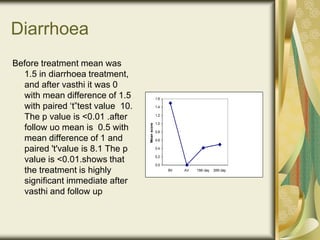
Diarrhoea
Before treatment mean was
1.5 in diarrhoea treatment,
and after vasthi it was 0
with mean difference of 1.5
with paired ‘t”test value 10.
The p value is <0.01 .after
follow uo mean is 0.5 with
mean difference of 1 and
paired 't'value is 8.1 The p
value is <0.01.shows that
the treatment is highly
significant immediate after
vasthi and follow up
0.0
0.2
0.4
0.6
0.8
1.0
1.2
1.4
1.6
BV AV 15th day 30th day
Mean
score
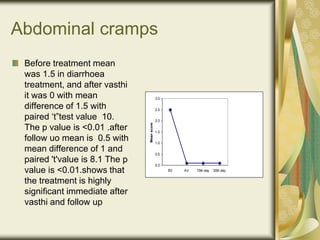
Abdominal cramps
Before treatment mean
was 1.5 in diarrhoea
treatment, and after vasthi
it was 0 with mean
difference of 1.5 with
paired ‘t”test value 10.
The p value is <0.01 .after
follow uo mean is 0.5 with
mean difference of 1 and
paired 't'value is 8.1 The p
value is <0.01.shows that
the treatment is highly
significant immediate after
vasthi and follow up
0.0
0.5
1.0
1.5
2.0
2.5
3.0
BV AV 15th day 30th day
Mean
score
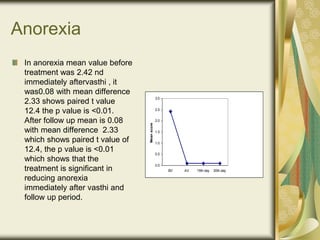
Anorexia
In anorexia mean value before
treatment was 2.42 nd
immediately aftervasthi , it
was0.08 with mean difference
2.33 shows paired t value
12.4 the p value is <0.01.
After follow up mean is 0.08
with mean difference 2.33
which shows paired t value of
12.4, the p value is <0.01
which shows that the
treatment is significant in
reducing anorexia
immediately after vasthi and
follow up period.
0.0
0.5
1.0
1.5
2.0
2.5
3.0
BV AV 15th day 30th day
Mean
score
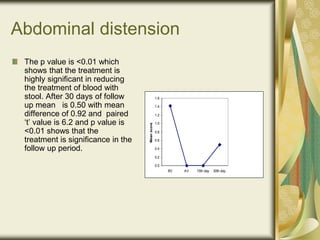
Abdominal distension
The p value is <0.01 which
shows that the treatment is
highly significant in reducing
the treatment of blood with
stool. After 30 days of follow
up mean is 0.50 with mean
difference of 0.92 and paired
‘t’ value is 6.2 and p value is
<0.01 shows that the
treatment is significance in the
follow up period.
0.0
0.2
0.4
0.6
0.8
1.0
1.2
1.4
1.6
BV AV 15th day 30th day
Mean
score
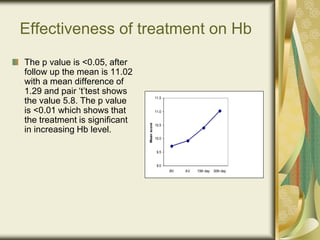
Effectiveness of treatment on Hb
The p value is <0.05, after
follow up the mean is 11.02
with a mean difference of
1.29 and pair ‘t’test shows
the value 5.8. The p value
is <0.01 which shows that
the treatment is significant
in increasing Hb level.
9.0
9.5
10.0
10.5
11.0
11.5
BV AV 15th day 30th day
Mean
score
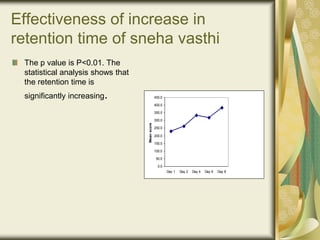
Effectiveness of increase in
retention time of sneha vasthi
The p value is P<0.01. The
statistical analysis shows that
the retention time is
significantly increasing.
0.0
50.0
100.0
150.0
200.0
250.0
300.0
350.0
400.0
450.0
Day 1 Day 2 Day 4 Day 6 Day 8
Mean
score
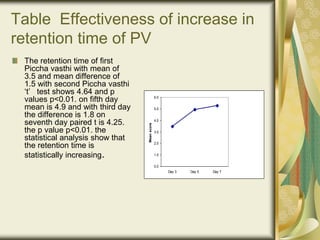
Table Effectiveness of increase in
retention time of PV
The retention time of first
Piccha vasthi with mean of
3.5 and mean difference of
1.5 with second Piccha vasthi
‘t’ test shows 4.64 and p
values p<0.01. on fifth day
mean is 4.9 and with third day
the difference is 1.8 on
seventh day paired t is 4.25.
the p value p<0.01. the
statistical analysis show that
the retention time is
statistically increasing.
0.0
1.0
2.0
3.0
4.0
5.0
6.0
Day 3 Day 5 Day 7
Mean
score
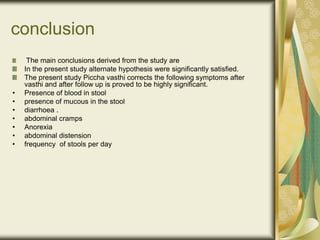
conclusion
The main conclusions derived from the study are
In the present study alternate hypothesis were significantly satisfied.
The present study Piccha vasthi corrects the following symptoms after
vasthi and after follow up is proved to be highly significant.
• Presence of blood in stool
• presence of mucous in the stool
• diarrhoea .
• abdominal cramps
• Anorexia
• abdominal distension
• frequency of stools per day
• With the statistical analysis highly significant improvement were
observed in the heamatological values in Hb levels.
• The retension time is incresing because of getting asayabala after
vasthi
• Ahara paka ,dathu parinama and dathu posana are the main
processes deranged in the disease,which emaciated the patient
more and more with the progression of the disease.
• Mahatiktaka grutha present in the Picchavasthi of aid excellent
ropana as well as daha prasamana property,enhancing the general
guna of the Piccha vasthi.

Ulcerative colitis ayurvedic view

  • 1.
    A CLINICAL TRIALTO EVALUATE THE EFFICACY OF PICCHA VASTHI IN REDUCING THE SIGNS AND SYMPTOMS OF ULCERATIVE COLITIS Simi Ravindran Dr.Simi Ravindran Assistant professor Govt.Ayurveda college Kannur simisreehari@gmail.com Wats up-9496370179
  • 2.
    Contents Introduction Anatomy and physiologyof colon Ulcerative colitis- Modern view Anatomy and physiology Ulcerative colitis -Ayurvedic perspective Drug review Methodology of research Conclusion
  • 3.
    Anatomy • The largeintestine constitutes the terminal part of the digestive system. • It is responsible for recovery of 1-1.5 l of electrolyte –rich fluid entering it. • Allow the body to maintain fluid and electrolyte balance. • Formation of low volume, solid stools, and permits less frequent defecation. • Provide environment of low oxygen tension conducive to bacterial colonization. . • Approximately 1.5 m long and capacity when filled by enema is 2L of volume, resident volume is 200 ml, and intracolonic volume is 750 ml. • Histology • Mucosa • Submucosa • Circular muscles • Longitudinal muscle • Serosa
  • 4.
    Concentration of fecaleffluent through water and electrolyte absorption Bacterial Growth Production of Vitamins & Electrolytes Muscular Action of the colon Stool Transit & Defecation Physiology
  • 5.
    Ulcerative colitis Etymology Ulcerative: meansrelating to, causing, or marked by an ulcer or ulcers. Colitis: means inflammation of the colon. Defenition Ulcerative colitis is an inflammatory disorder that causes ulcers and irritation in the inner lining of the colon of the colonic mucosa, characterized by relapses and remissions.
  • 6.
    Etiology • Genetic predisposition •Infections • Allergy • Psychosomatic illness • Environmental factors • Autoimmune diseases
  • 7.
    Clinical feautures • Bloodydiarrhea • Increased bowel frequency • Passage of mucus with stool • Abdominal cramps • Abdominal distension • Anorexia • Signs -tachycardia, fever, abdominal tenderness or distension. • malaise, weight loss Related to activity- • Apthous Ulcers • Erythema Nodosum • Finger Clubbing • Occular-conjunctivitis • Episcleritis • Iritis • Arthritis • Osteoporosis Unrelated to activity • Gallstones • Sacroiliitis • Arthralgia • Nutritional Deficiency
  • 8.
    Ulcerative Colitis-Types Ulcerative proctitis:limitedto the rectum. diarrhea, bloody stool, pain in the rectal area, and a sense of urgency to empty the bowel. Proctosigmoiditis: rectum and the sigmoid colon.diarrhea, bloody stool, cramps and pain in the rectal area, and moderate pain on the left side of the abdomen Left-sided colitis: Left-sided colitis affects the entire left side of the colon, from the rectum to splenic flexure. diarrhea, bleeding, weight loss ,loss of appetite, and sometimes severe pain on the left side of abdomen. Pancolitis: If the entire colon is affected, the term pancolitis is used ("pan" meaning total).
  • 9.
    Establish the severity Clinicaland radiological criteria table for assessing the severity of Ulcerative colitis Feature Mild Moderate severe Motions/day <4 >4-6 >6Large Rectal bleeding Small Moderate Large amounts Temperature Apyrexial Intermediate >37.8C on 2days out of 4 Pulse rate Normal Intermediate >90b.p.m Hemoglobin 11g/dl Intermediate <0.5g/dl ESR <20mm/h Intermediate >30mm/h
  • 10.
    Establish the diagnosis Sigmoidoscopyand biopsy Colonoscopy Stool examination
  • 11.
    Sigmoidoscopic appearances in Ulcerativecolitis Mild Moderate severe Diffuse erythema Granular mucosa Intense inflammation Loss of vascular pattern Petechial hemorrhages Purulent exudates Contact bleeding Spontaneous bleeding, Discrete ulcers
  • 12.
    Differential diagnosis Crohn's colitis Infectivecolitis Drug -induced colitis Microscopic colitis
  • 13.
    Crohn's colitis Radiology- Discontinuous,asymmetrical,deep ulcers,commonstrictures and fistulae Histology- transmural Distribution, lymphocytes infiltrates Clinical -Bloody diarrhea is about 50%,common abdominal mass, perianal diseases
  • 15.
    Management The principals ofmanagement are Prompt treatment of acute attacks. Maintenance therapy to reduce the relapse rate. Selection of patients for colectomy. Detection of colorectal carcinoma. Patient education is essential to ensure early presentation during relapse.
  • 16.
    5-ASA Compounds Medications toSuppress the Immune System Surgery • standard ileostomy • continent ostomy • ileo-anal pull-through
  • 17.
    Prognosis The pattern ofrelapse and remission one year after diagnosis tends to continue for any individual. 90% have intermittent activity and 50% are in remission at any one time.20% will relapse every year and 10% have continous symptoms Prolonged remission on maintance therapy occurs ,with 50- 60%remaining in remission for more than 2 years,but <5% are symptom- free for 15 years
  • 18.
  • 19.
  • 20.
    Blood with stool-sarakthamalam • Paittika atisaram(Su.u.40) • Raktartisara(ch.chi 19) • Raktaja pravahika(Ma.NI3/22) • Raktarsas(Ma.NI4/16) • Pittarsas(Ma.NI4/16) • Adhogaraktapitta(As.Hr.chi2/8)
  • 21.
    Ulceration of thecolon Guda paka • Paittikagrahani(As.Hr) • Rakta vaha sroto dusti (CH.Su)
  • 22.
    Looser stools Drava /sithilavarchas (Vatika and Paittika grahani) Abdominal cramps Udara soola Vatika grahani(Su) Anorexia Annadvesha - Kaphaja atisara(Ch.Ch.19) Abdominal distension Admanam Vatika grahani Heart burn Hrit daha Pittaja grahani
  • 23.
    Fever.Hyperacidity & UpperGI Symptom Jwaram Daha, Trishna, Sweda, Shula - Pittaja atisara, Rakta atisara Pitta grahani (Ch. Chi. 19/6) Increased frequency stool Punah punah varcha (Vatikagrahani,Paittika grahani) Passage of mucus with stool Sleshasamsrishta pureesham Kaphaja Atisara (Ch. Chi. 19/7) Kaphaja grahani
  • 24.
    Abdominal cramps Udara soola Vatikagrahani(Su) Anorexia Annadvesha - Kaphaja atisara(Ch.Ch.19) Heart burn Hrit daha Pittaja grahani
  • 25.
    Gurgling sounds inthe abdomen Vayu cha Antah Kosthe Antrakujanam Vatika grahani Vatika atisara Pakvasaya gata vata kopa(Ch.Chi.19/5) Urgency of defecation Kshipra varcha prvartanam Bhaya,soka athisara
  • 26.
    Weight loss Karsyam Vatgika grahani Lossof concentration Manasadanam (Nanatmaja roopa of vata)
  • 27.
    Low backache Parva ruk Adhakayarogas Pakvasaya gata vata kopa(Ch. Chi. 28/28-29) Chronicity Chirakalanubandhini Sangraha Grahani ( M.N. 4 : 13)
  • 28.
    Diseases akin toUlcerative colitis • Atisara :Pittaja, Raktaja, Vataja, Kaphaja Atisara. • Pravahika: (raktaja Pravahika). • Grahani : (paittika,vatika). • Pakvashayagata Vatakopa (site& adhara kaya rogas).
  • 29.
    • Samprapthi ghatakas •Dosha- Tridosha ,raktaja • Prana Dusti (Impaired Secretion ) • Samana Dusti (Disturbed Motility) • Apana Dusti (Incomplete Evacuation) • Pachaka Pitta Dusti (Heartburn, Ulceration) • Kledaka Kapha (Stool with Mucus,pus with mucus) • Dusya- Rakta, rakta, mamsa, majja • Sadhyasadyata -yapya
  • 30.
    • Agni -mainlyJatragni, dhatwagni, bhootagni • Srotas - Annavaha, Rasavaha, Raktavaha, Purishavaha • Sroto Dusti - Initially sanga then atipravritti • Agni - Vishamagni • Adhishthana - Mahasrotas • Udbhavasthanam-amasayam • Rogamargam-abhyantartaam • Vyaktasthanam-pakvasayam • Swabhava - Chirakari
  • 31.
    Samprapthi nidanaas Vatha pitta kapha Increseddrava guna and sara guna of pitta Agni dusti Aharapachana hamprers Amayuktha pakva apakva misrita anna Malasanchaya in pak asaya Rakthadusti formation of vrina Punah punah sleshma samsritha raktha mala pravritti Incresed usna and teekshna guna of pitta.apana vaigunya
  • 32.
    Treatment Nidana parivarjanam Oushadha sevanam Deepana Pachana Grahi Rakthasthambana Vatanuloma Shothahara Vedanasathapana “pakvo asakrit atisaro grahani mardavadyada Pravartate tadakarya kshipram samgrahiko vidhi”(C.D)
  • 33.
    Pathya,apathya Pathya sevanam -Kasayarasapradhana ahara, deepana, laghu guna yukta ahara, purana sali, vilepi,lajamanda ,small fishes,jambu phala, vilva , salooka, kapitha ,bakuji,dadima,madhu, mudga yusha, changeri, rambha pushpa, kamalakanda, Jambu, Kapittha, Takra etc. Apathyas :Rooksha ,guru ahara, virudhasana, godhooma, masha,yava, vasthuka, madhu sigru, koosmanda, tumbi, badara All saka varga, punarnava atishita Jala, dushta Jala, guru, snigdha, drava, ati ruksha, & saraka substances, viruddha bhojana, etc.
  • 34.
    Apathya vihara Langhana,Vamana karma,Poornavisrama, Nidra, Activities making mind happy. Snana, abhyanga, avagaha, guru ,snigda bhojana, vyayama, agni santapa should be avoided by atisara rogi as per the text of Chakradatta.
  • 35.
    Piccha vasthi Etymology Picha-means • slimy/saliva •The gum of Bombax heptaphyllum Vasthi- • See,abiding,dwelling,staying Defenition “Alpaya Matraya Niroohakhyo vastihi picchavastihi”(Aruna datta)
  • 36.
    Indications • Pravahika • Complicationof vasthi • Parisrava • Treatment of jivadana
  • 37.
    Ingredients Dose saindhava 3gm makshika 120 ml Madhuytastyadi taila 120 ml Mahatiktaka grutha 120 ml Salmali vrinta putapaka mixed with ksheera 240 ml Kalka of yasti and tagara 48 gm Astanga hridaya atisara chikitsa
  • 38.
    Salmali putapaka swarasa. Atisarapravahagno raktarukpittadahaha amatisara samano raktatisaranasana….”(nighantu ratnakara) “Pakvatisarasamano hanthi ghora sa pravahika….”(madanapala nighantu) “Pravahika atisara ama kaphapittasradahanut....”(kaiya deva nighantu) “Avedanam ssampakvam deeptagne suchirothitham Nanavarmnamatisaram putapakairupacharel…”. Chakra datta2/74)-
  • 39.
    Mahatiktaka grutham Grahani chikitsatheindication is there “pittagrahanyam tal peyam kustoktamtiktakam cha yal” .Mahatiktaka grutham is indicated in the kusta chikitsa .phala sruti includes paittika grahani.athisaras Madhuyastyadi tailam A combination of Madhura rasa drugs, mentioned in vatasonitha prakarana, having raktha prasadana and brumhana properties.The main ingredient is yastimadhu ,which is pittasamana,can used in four forms.pana,nasya,anuvasana,abhyanga.
  • 40.
    Yastimadhu -: Botanical name-Glycyrrhiza glabraLinn Family- leguminosae Sandhaniya, Varnya, Sonitasthapana (Cu.),) Madhur,Guru, Singdha ,Madhura Vipaka, Sheeta Veerya,Effect on dosha : tridosha samana,rakta Dosha prasamana,Karma : Vrana Ropana, Daha Samana. Tagara Botanical name- Valeriana jatamansi Jones Family- Valerianaceae Rasam:madhura,tiktha,Guna:laghu,snigda,seetha, Action on doshas-tridosa nasanam,raktha dosha nasanam
  • 41.
    Methodology of research Outline of the study • Extensive literary survey • Clinical work Selection of cases Population The population comprises of patients diagnosed of ulcerative colitis ,who satisfy the inclusion criteria.12 patients are included in the study Inclusion Criteria Ulcerative colitis patients diagnosed by colonoscopy and biopsy Age between 18-60 years Both sex are included Patient willing to participate Exclusion criteria Diseases other than ulcerative colitis Age below 18 yrs and above 60 yrs Other severe debilitating diseases Patients not willing for the study
  • 42.
    Study design The presentstudy is before and after study with out control.no blinding was done Time and duration of the study The total period of the study was 18 months Assessment criteria Blood with stool Assessment was done form grade ‘0’to ‘3’ according to the following criteria Passage of blood with stool • Grade 0 - no blood • Gradae1 - occasional • Grade2 - moderate amount • Grade3 - excessive amount
  • 43.
    Passage of mucuswith stool • Grade 0 - no mucus • Grade1 - occasional • Grade2 - moderate amount • Grade3 - excessive amount Increased frequency of motion(in a day) • Grade 0 - normal no of stools for this patient • Gradae1 - 1-2 /day extra stools per day • Grade2 - 3-4 extra stools per day • Grade3 - 5 or more extra stools per day Diarrhea • Grade 0 - no diarrhea • Gradae1 1-2 times • Grade2 - 5-8 • Grade3 - more than 8 times Abdominal cramps • Grade 0 - not present • Gradae1 - occasional • Grade2 - 3-4 times • Grade3 - always
  • 44.
    Anorexia • Grade 0- no anorexia • Gradae1 - occasional interest for diet or food • Grade2 feels hungry but could not able to take food • Grade3 - no interest for diet or food Abdominal distension • Grade 0 -no abdominal distension • Gradae1 - occasional • Grade2 - after taking food • Grade3 - always associated Blood Hb TC DC ESR RBS Urine • Sugar • Albumin • Deposits Stool • Color • Consistency • Microscopic • Occult blood • Proctoscopy
  • 45.
    Hypothetical conclusion Null hypothesis Picchavasthi is not significant in the reducing signs and symptoms of Ulcerative colitis. Alternate hypothesis Piccha vasthi is significant in reducing the signs and symptoms of Ulcerative colitis.
  • 46.
    Observation analysis and interpretation Thedata relating to the study were conveniently segregated into four heading as follows:- Demographic data. Out of the total patients, females and males were in equal ratio. 75% of the people were married and 25% were unmarried The study reveals that 66.7% of patients are Hindus, 25% are in Christian religion and 8.3% are Muslims. While considering the socio-economic status 41.7% are from middle class 33. 3% from high class and 25% are poor class. 58.3% of the patients are from rural areas and 41.7% from urban areas. In this study, 41.7% are educated, up to high school level, 25% are graduates, 16.7% have pre degree, and 16.7% were illiterate. 66.7% of the patients underwent the study have sedentary and mental stress ,while 25% have physical exercise and 8.3% were have both physical and mental stress.
  • 47.
    Prakriti: • Vata-Pitta Prakritidominated -50% of the people are belonging to vatha pitta prakruti,30% were kapha pitta prakruti,20% were vath kapha prakruti.. • Half of the patients have day work, 33.3% have night work and 16.7% have irregular timings in work. • 41.7% working more than 8 hours, 33.3% working in between 6-8 hours, and 16.7% work less than 6 hours. • 75% have irregular intake of food habits and 25% regular intake of food.
  • 48.
    • 50 %have no addiction and 25% have addiction of smoking and the rest quarter having the addiction of alcohol. • 58.3% have moderate exercise and 41.7% have heavy exercise. • Data related to chronicity reveals that half of the patients have chronicity between 5-10 years ,16.7% have 10-15 years and 33.3% have 0-5 years of duration. • The symptoms of Ulcerative colitis precipitated by emotional stress accompanied by food in 50% of the patients .In 16.7% food is the causative factor for aggravating symptoms, and in 33.3% ,emotional stress is the aggravating factor. • 58.3% have feeling of anxiety and 41.7% , not have feeling of anxiety. • Initial insomnia presnt is 50% of the patients and absent in rest.
  • 49.
    • Among 12patients 91.7% having score-grade 2 in rectal bleeding, and 8.3% of grade 1 • 58.3% have grade 1 in passage of mucus, and 41.7% have grade 2 that is moderate amount of mucus passing with stool. • 50% have grade 2 and 50 % have grade 3 in bowel frequency • 50%have grade 2 and 50 % have grade 3 in bowel frequency • 50%have grade 2 and 50 % have grade 3 in abdominal cramps. • Among 12 patients 58.3% have grade 2 and 41.7 have grade 3 in severity of anorexia • 58.3% having grade 1 and 41.7 % having grade 2 in abdominal distension
  • 50.
    Effectiveness of treatmentBlood with stool, BT,AT and Follow up The p value is <0.01 which shows that the treatment is highly significant in reducing the blood with stool. After 30 days of follow up mean difference with before vasthi is 1.5 and paired ‘t’ value is 10 and p value is <0.01 shows that the treatment is highly significant in the follow up period. 0.0 0.5 1.0 1.5 2.0 2.5 BV AV 15th day 30th day Mean score
  • 51.
    Passage of mucuswith stool The p value is <0.01 which shows that the treatment is highly significant in reducing the mucus with stool. After 30 days of follow up, mean difference with before vasthi is 0.83 and paired ‘t’ value is 4 and p value is <0.01 shows that the treatment is significance in the follow up period. 0.0 0.2 0.4 0.6 0.8 1.0 1.2 1.4 1.6 BV AV 15th day 30th day Mean score
  • 52.
    Incresed frequency ofbowel The p value is <0.01 which shows that the treatment is significant in reducing increased frequency of bowel immediately after vasthi and during follow up. 0.0 0.5 1.0 1.5 2.0 2.5 3.0 BV AV 15th day 30th day Mean score
  • 53.
    Diarrhoea Before treatment meanwas 1.5 in diarrhoea treatment, and after vasthi it was 0 with mean difference of 1.5 with paired ‘t”test value 10. The p value is <0.01 .after follow uo mean is 0.5 with mean difference of 1 and paired 't'value is 8.1 The p value is <0.01.shows that the treatment is highly significant immediate after vasthi and follow up 0.0 0.2 0.4 0.6 0.8 1.0 1.2 1.4 1.6 BV AV 15th day 30th day Mean score
  • 54.
    Abdominal cramps Before treatmentmean was 1.5 in diarrhoea treatment, and after vasthi it was 0 with mean difference of 1.5 with paired ‘t”test value 10. The p value is <0.01 .after follow uo mean is 0.5 with mean difference of 1 and paired 't'value is 8.1 The p value is <0.01.shows that the treatment is highly significant immediate after vasthi and follow up 0.0 0.5 1.0 1.5 2.0 2.5 3.0 BV AV 15th day 30th day Mean score
  • 55.
    Anorexia In anorexia meanvalue before treatment was 2.42 nd immediately aftervasthi , it was0.08 with mean difference 2.33 shows paired t value 12.4 the p value is <0.01. After follow up mean is 0.08 with mean difference 2.33 which shows paired t value of 12.4, the p value is <0.01 which shows that the treatment is significant in reducing anorexia immediately after vasthi and follow up period. 0.0 0.5 1.0 1.5 2.0 2.5 3.0 BV AV 15th day 30th day Mean score
  • 56.
    Abdominal distension The pvalue is <0.01 which shows that the treatment is highly significant in reducing the treatment of blood with stool. After 30 days of follow up mean is 0.50 with mean difference of 0.92 and paired ‘t’ value is 6.2 and p value is <0.01 shows that the treatment is significance in the follow up period. 0.0 0.2 0.4 0.6 0.8 1.0 1.2 1.4 1.6 BV AV 15th day 30th day Mean score
  • 57.
    Effectiveness of treatmenton Hb The p value is <0.05, after follow up the mean is 11.02 with a mean difference of 1.29 and pair ‘t’test shows the value 5.8. The p value is <0.01 which shows that the treatment is significant in increasing Hb level. 9.0 9.5 10.0 10.5 11.0 11.5 BV AV 15th day 30th day Mean score
  • 58.
    Effectiveness of increasein retention time of sneha vasthi The p value is P<0.01. The statistical analysis shows that the retention time is significantly increasing. 0.0 50.0 100.0 150.0 200.0 250.0 300.0 350.0 400.0 450.0 Day 1 Day 2 Day 4 Day 6 Day 8 Mean score
  • 59.
    Table Effectiveness ofincrease in retention time of PV The retention time of first Piccha vasthi with mean of 3.5 and mean difference of 1.5 with second Piccha vasthi ‘t’ test shows 4.64 and p values p<0.01. on fifth day mean is 4.9 and with third day the difference is 1.8 on seventh day paired t is 4.25. the p value p<0.01. the statistical analysis show that the retention time is statistically increasing. 0.0 1.0 2.0 3.0 4.0 5.0 6.0 Day 3 Day 5 Day 7 Mean score
  • 60.
    conclusion The main conclusionsderived from the study are In the present study alternate hypothesis were significantly satisfied. The present study Piccha vasthi corrects the following symptoms after vasthi and after follow up is proved to be highly significant. • Presence of blood in stool • presence of mucous in the stool • diarrhoea . • abdominal cramps • Anorexia • abdominal distension • frequency of stools per day
  • 61.
    • With thestatistical analysis highly significant improvement were observed in the heamatological values in Hb levels. • The retension time is incresing because of getting asayabala after vasthi • Ahara paka ,dathu parinama and dathu posana are the main processes deranged in the disease,which emaciated the patient more and more with the progression of the disease. • Mahatiktaka grutha present in the Picchavasthi of aid excellent ropana as well as daha prasamana property,enhancing the general guna of the Piccha vasthi.