Ulcerative colitis
-By Karuna Deswal
Intern (Batch 2018-19)
Introduction
Inflammatory bowel disease (IBD) is an immune-mediated chronic intestinal
condition,Ulcerative colitis (UC) and Crohn’s disease (CD) are the two major types
of IBD.UC is a mucosal disease that usually involves the rectum and extends
proximally to involve all or part of the colon.
About 40-50% of patients have a disease limited to the rectum and recto-
colitis.sigmoid, 30-40% have disease extending beyond the sigmoid but not
involving the whole colon and 20% have a total colitis.
Prevalence of IBD known to be high in western countries but now there is rising
incidence and prevalence of disease in India topping the Southeast Asian (SEA)
countries.
Aetiology
Genetic predisposition.
Environmental factors may trigger disease (viral or
bacterial pathogens, dietary).
Immunologic imbalance or disturbances.
Defect in intestinal barrier causing hypersensitive
mucosa & increased permeability.
Defect in repair of mucosal injury, which may develop
into a chronic condition.
Pathology
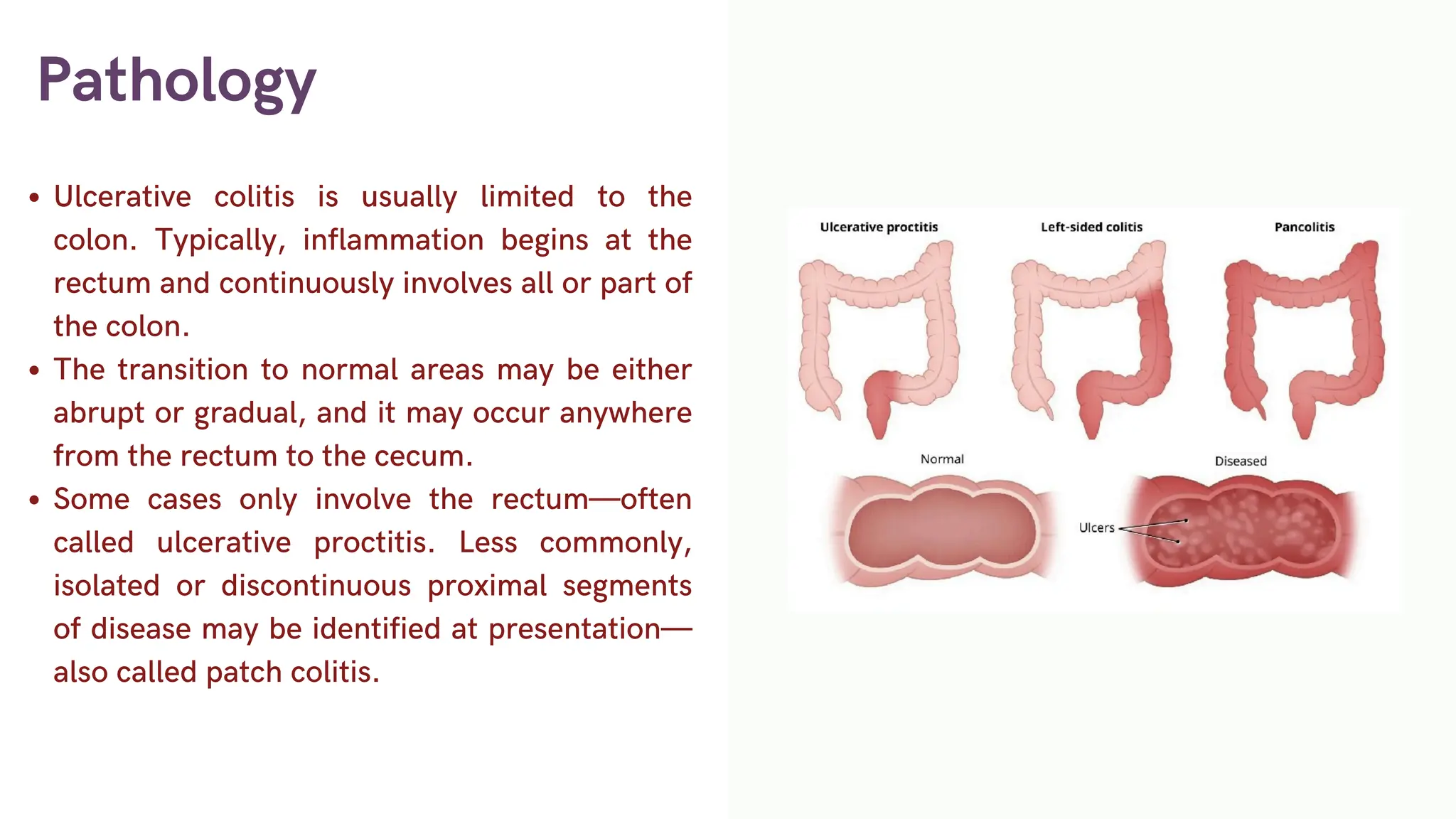
Ulcerative colitis is usually limited to the
colon. Typically, inflammation begins at the
rectum and continuously involves all or part of
the colon.
The transition to normal areas may be either
abrupt or gradual, and it may occur anywhere
from the rectum to the cecum.
Some cases only involve the rectum—often
called ulcerative proctitis. Less commonly,
isolated or discontinuous proximal segments
of disease may be identified at presentation—
also called patch colitis.
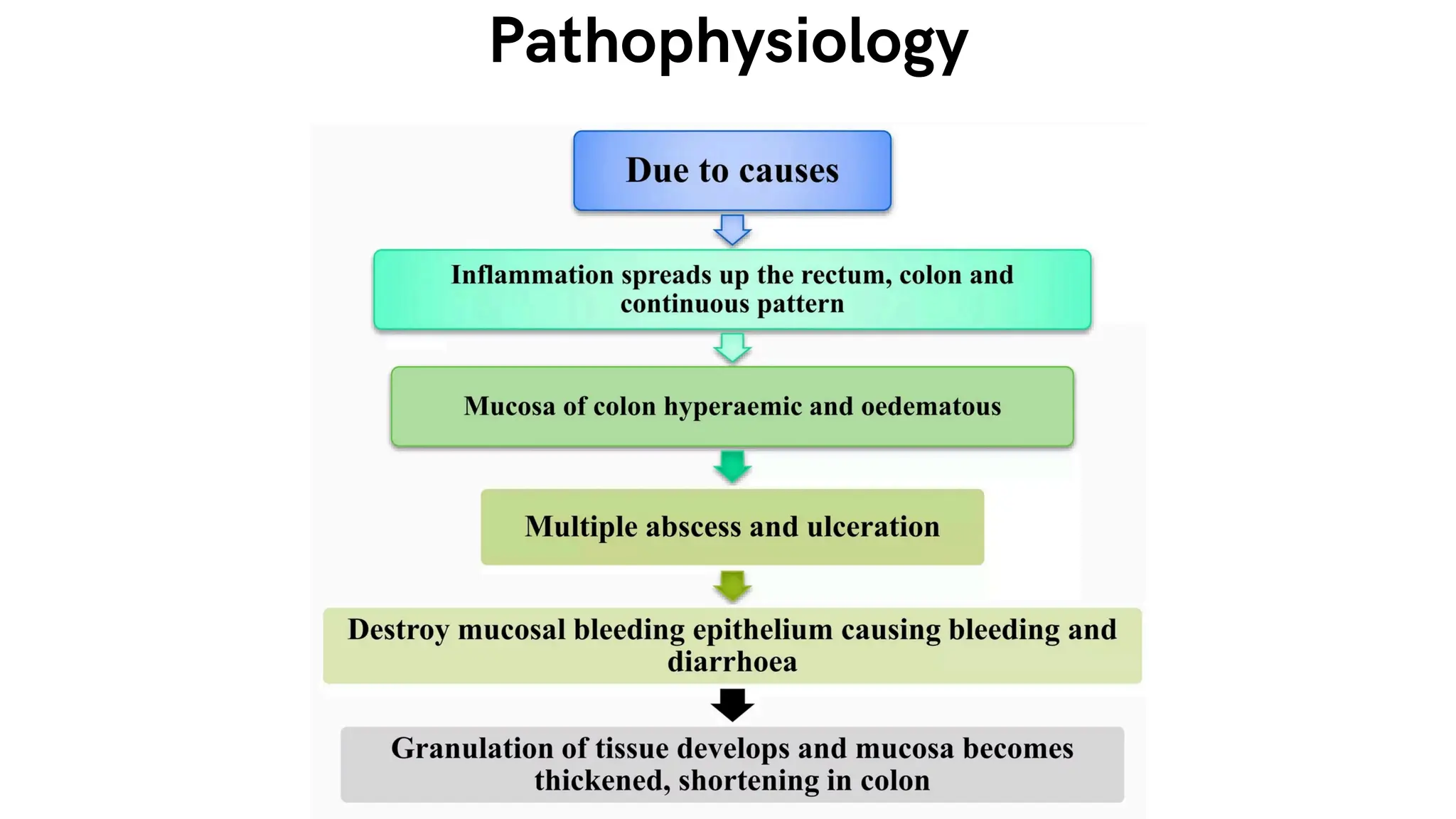
Pathophysiology
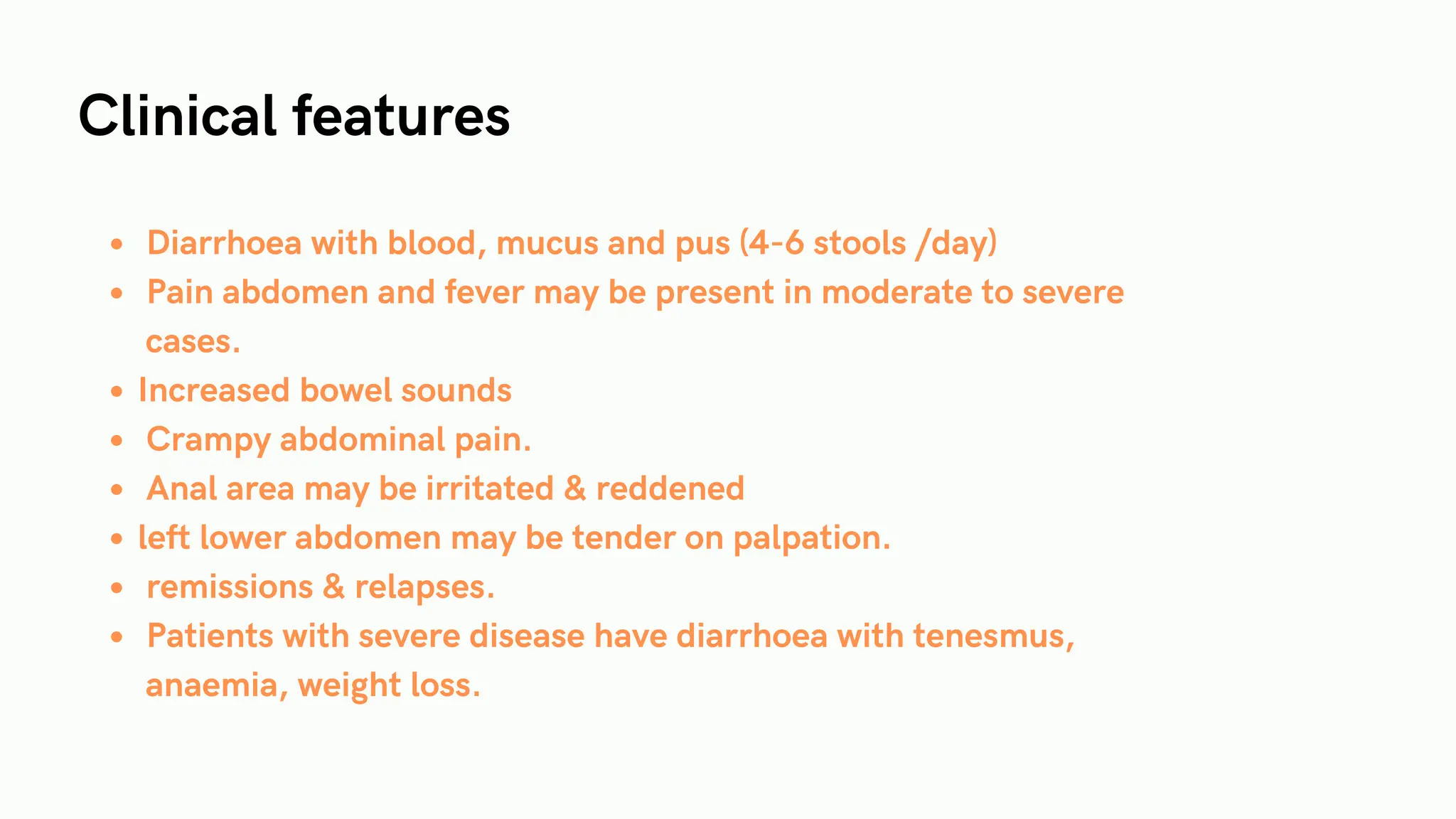
Clinical features
Diarrhoea with blood, mucus and pus (4-6 stools /day)
Pain abdomen and fever may be present in moderate to severe
cases.
Increased bowel sounds
Crampy abdominal pain.
Anal area may be irritated & reddened
left lower abdomen may be tender on palpation.
remissions & relapses.
Patients with severe disease have diarrhoea with tenesmus,
anaemia, weight loss.
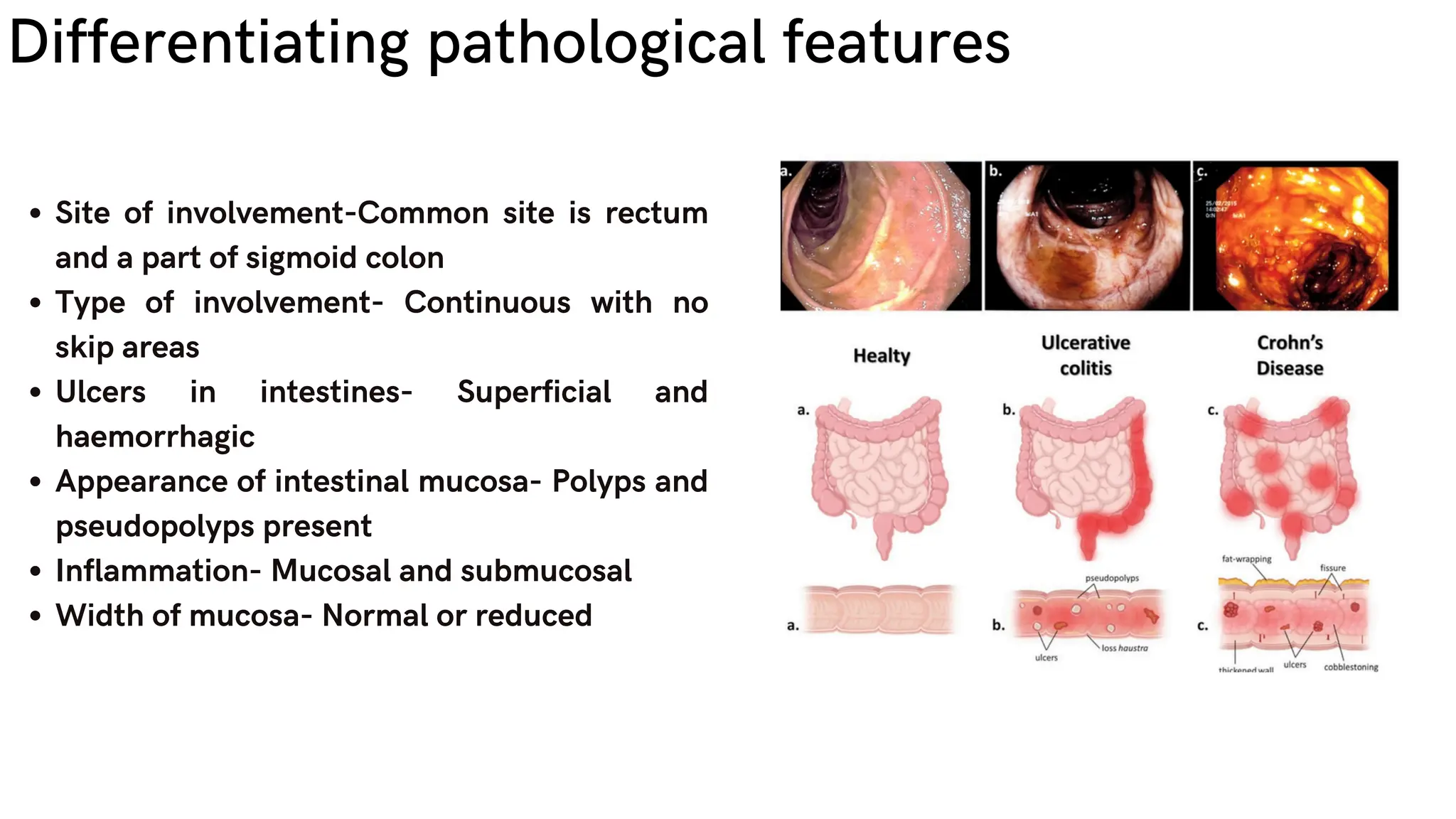
Site of involvement-Common site is rectum
and a part of sigmoid colon
Type of involvement- Continuous with no
skip areas
Ulcers in intestines- Superficial and
haemorrhagic
Appearance of intestinal mucosa- Polyps and
pseudopolyps present
Inflammation- Mucosal and submucosal
Width of mucosa- Normal or reduced
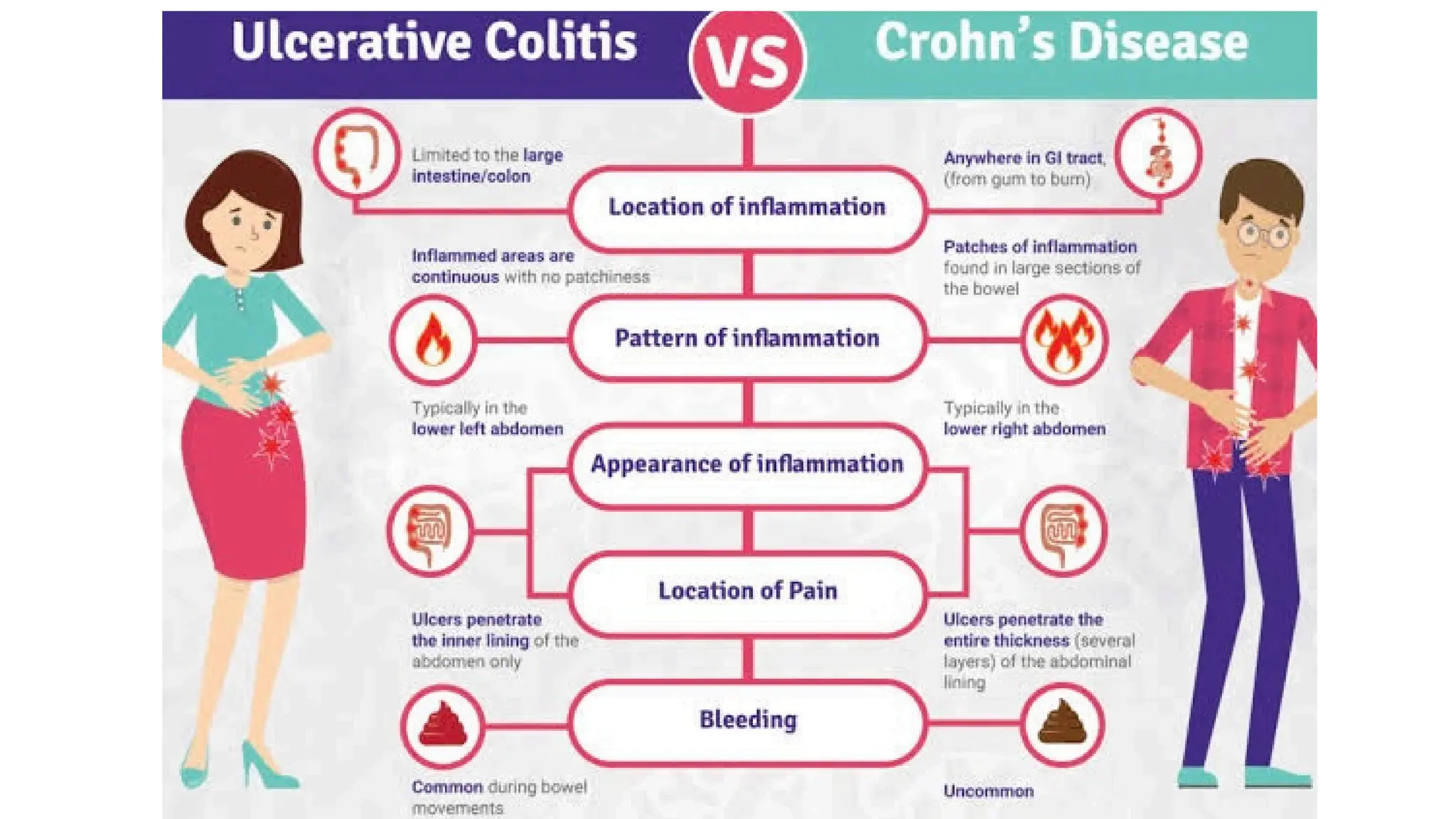
Differentiating pathological features
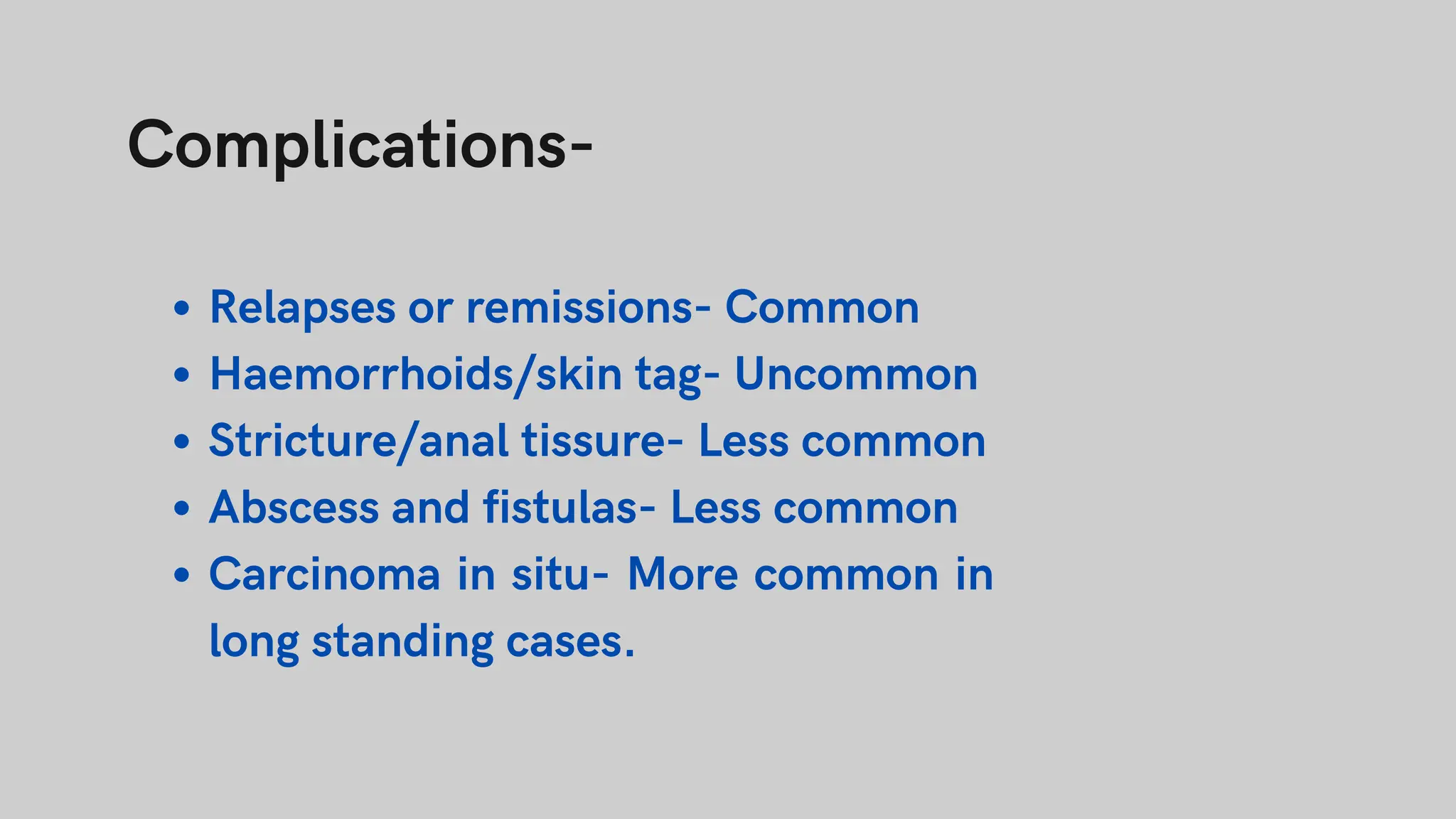
Complications-
Relapses or remissions- Common
Haemorrhoids/skin tag- Uncommon
Stricture/anal tissure- Less common
Abscess and fistulas- Less common
Carcinoma in situ- More common in
long standing cases.
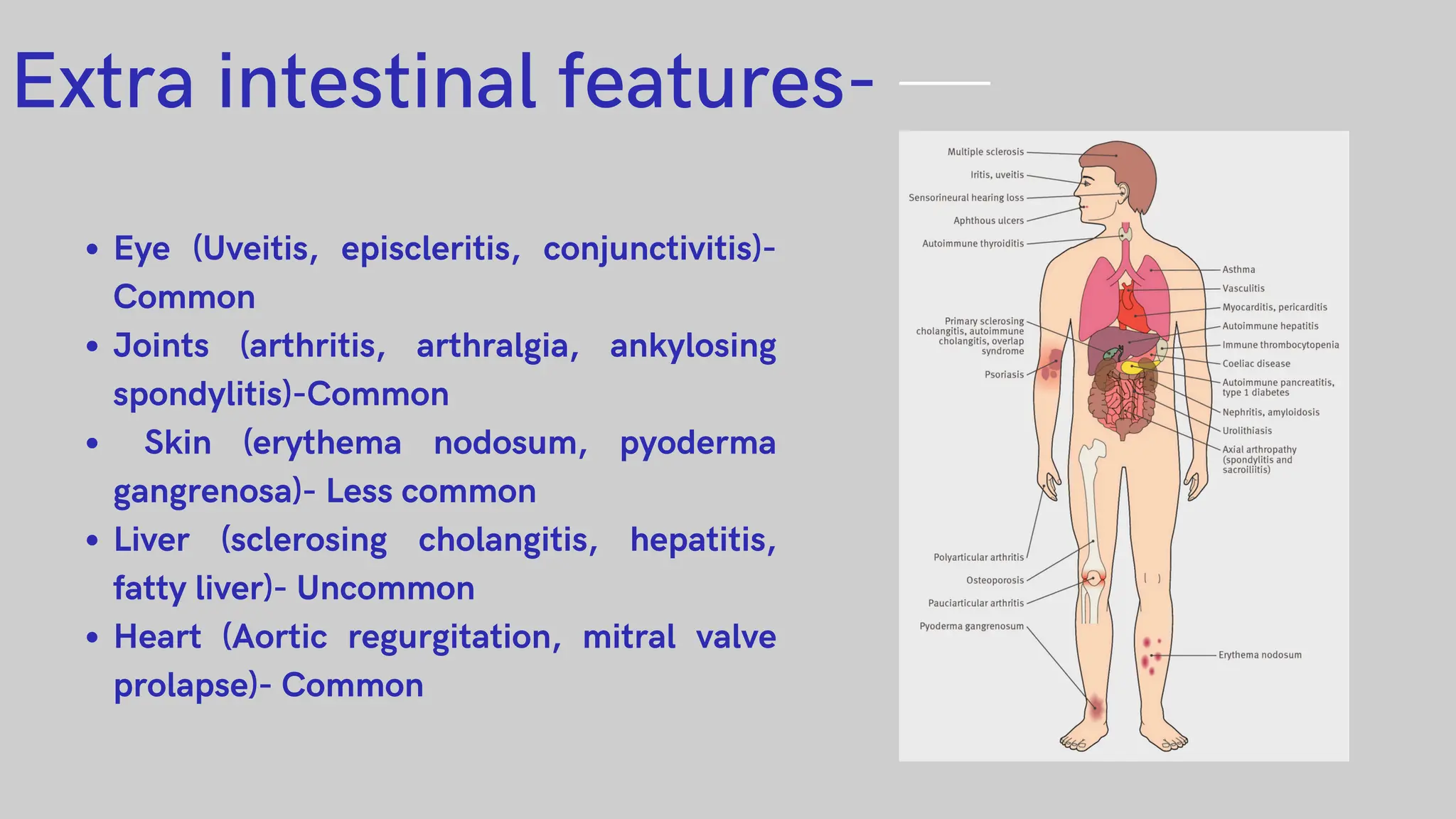
Extra intestinal features-
Eye (Uveitis, episcleritis, conjunctivitis)-
Common
Joints (arthritis, arthralgia, ankylosing
spondylitis)-Common
Skin (erythema nodosum, pyoderma
gangrenosa)- Less common
Liver (sclerosing cholangitis, hepatitis,
fatty liver)- Uncommon
Heart (Aortic regurgitation, mitral valve
prolapse)- Common
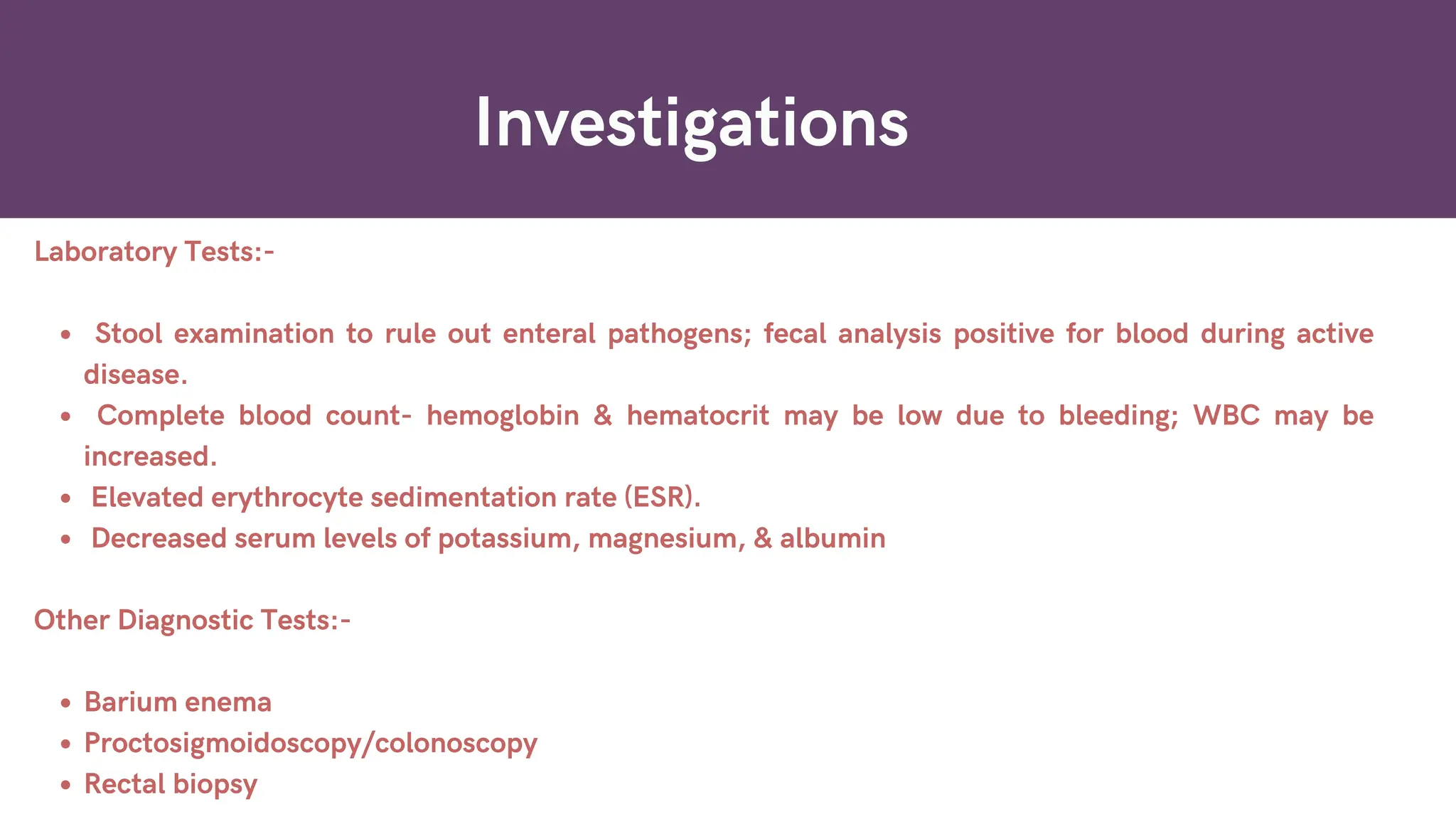
Investigations
Laboratory Tests:-
Stool examination to rule out enteral pathogens; fecal analysis positive for blood during active
disease.
Complete blood count- hemoglobin & hematocrit may be low due to bleeding; WBC may be
increased.
Elevated erythrocyte sedimentation rate (ESR).
Decreased serum levels of potassium, magnesium, & albumin
Other Diagnostic Tests:-
Barium enema
Proctosigmoidoscopy/colonoscopy
Rectal biopsy
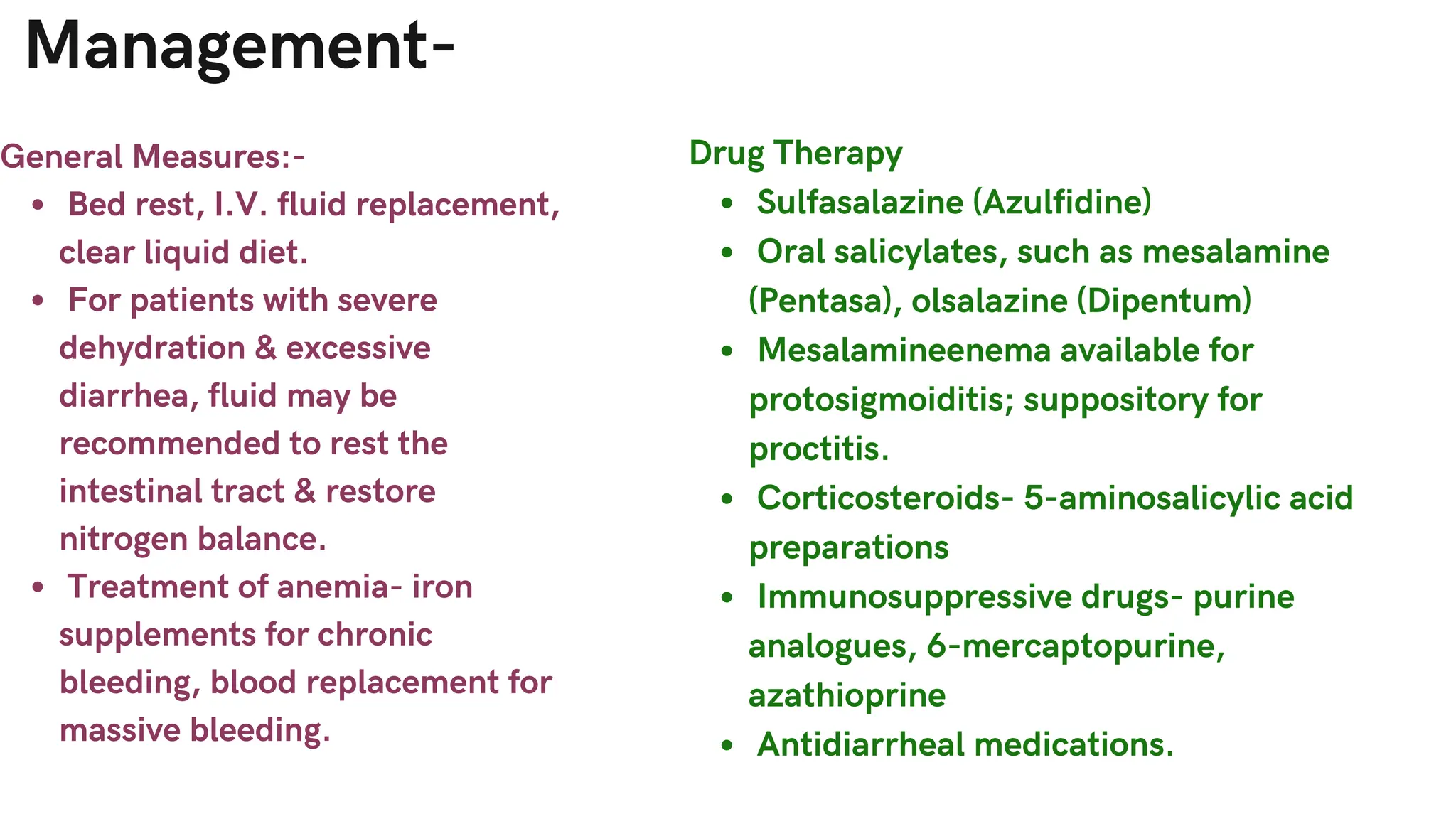
Management-
General Measures:-
Bed rest, I.V. fluid replacement,
clear liquid diet.
For patients with severe
dehydration & excessive
diarrhea, fluid may be
recommended to rest the
intestinal tract & restore
nitrogen balance.
Treatment of anemia- iron
supplements for chronic
bleeding, blood replacement for
massive bleeding.
Drug Therapy
Sulfasalazine (Azulfidine)
Oral salicylates, such as mesalamine
(Pentasa), olsalazine (Dipentum)
Mesalamineenema available for
protosigmoiditis; suppository for
proctitis.
Corticosteroids- 5-aminosalicylic acid
preparations
Immunosuppressive drugs- purine
analogues, 6-mercaptopurine,
azathioprine
Antidiarrheal medications.
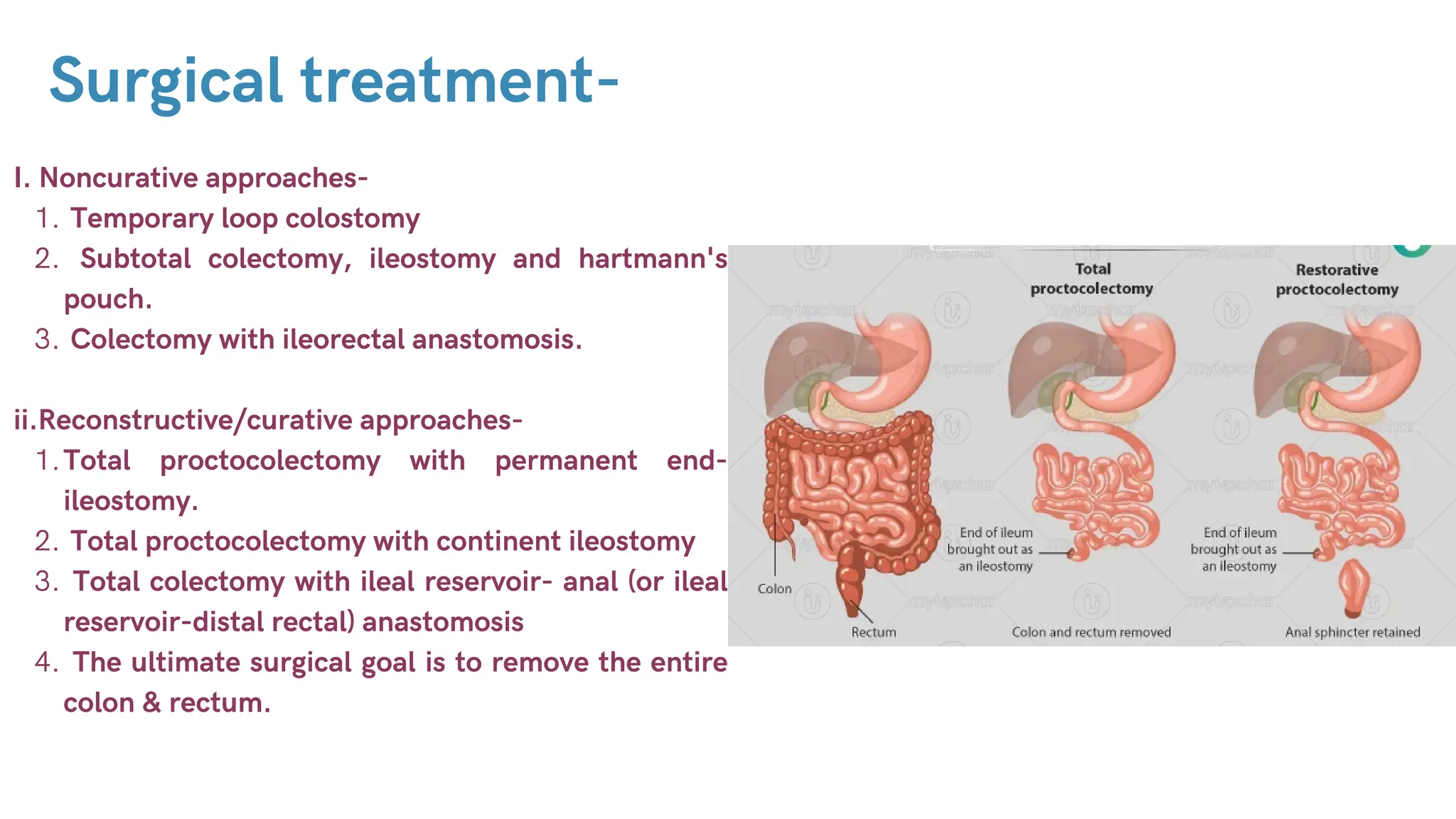
Surgical treatment-
I. Noncurative approaches-
Temporary loop colostomy
1.
Subtotal colectomy, ileostomy and hartmann's
pouch.
2.
Colectomy with ileorectal anastomosis.
3.
ii.Reconstructive/curative approaches-
Total proctocolectomy with permanent end-
ileostomy.
1.
Total proctocolectomy with continent ileostomy
2.
Total colectomy with ileal reservoir- anal (or ileal
reservoir-distal rectal) anastomosis
3.
The ultimate surgical goal is to remove the entire
colon & rectum.
4.
Foods to limit or avoid-
-High fibre foods-such as broccoli, cabbage, cauli
flower
-Lactose products-such as cow’s milk, cheese, ice
cream
-Certain beverages- such as alcohol, coffee, tea,
soda
-High fat foods-such as butter, creams, fried and
higly processed foods
-Acidic fruits-such as orange, grapes, tomatoes
-Some meats including red meat and processed meat
-Spicy food
Food that can be consumed-
Low fiber fruits such as bananas,
honeydew melon, cooked or peeled fruits,
avocado, and mango
Non-cruciferous vegetables such as
potatoes, sweet potatoes, cucumbers, and
carrots
Refined grain foods such as white pasta,
white rice, oatmeal, and certain breads
Omega-3 fatty acid-rich foods such as
salmon, mackerel, and walnuts
Low fat protein sources such as fish,
chicken, lamb, turkey, and eggs
Foods to eat and avoid-
According to ayurveda-
Agnimandhya is the root cause of this disease. In all kinds of Atisara, sign of Ama and
pakva should be determined first. This is the first line of Atisara treatment.
The basic principle to consider during treatment mentioned as Ama or Pakva features of
the patient. Agni Dipana, Ama Pachana, Grahi, Stambhana, Dhatu Poshaka, Sattvavajaya
Chikitsa should be given according to the condition of the patient.
Keeping in mind the strength of the patient, In case of amavasta Langhana should be done
first, then drinking of Yevagu made with Deepan, Pachana drugs like sunthi, chitrak etc is
beneficial.
Grahi drugs should be avoided in Amavastha condition as it may cause Pliha Vridhi,
Pandu,anaha, Prameha, Kustha , Jwara, Śopha,, Gulma , Grahani, Arsha,Shula, Alasaka,
Hrid Graha.
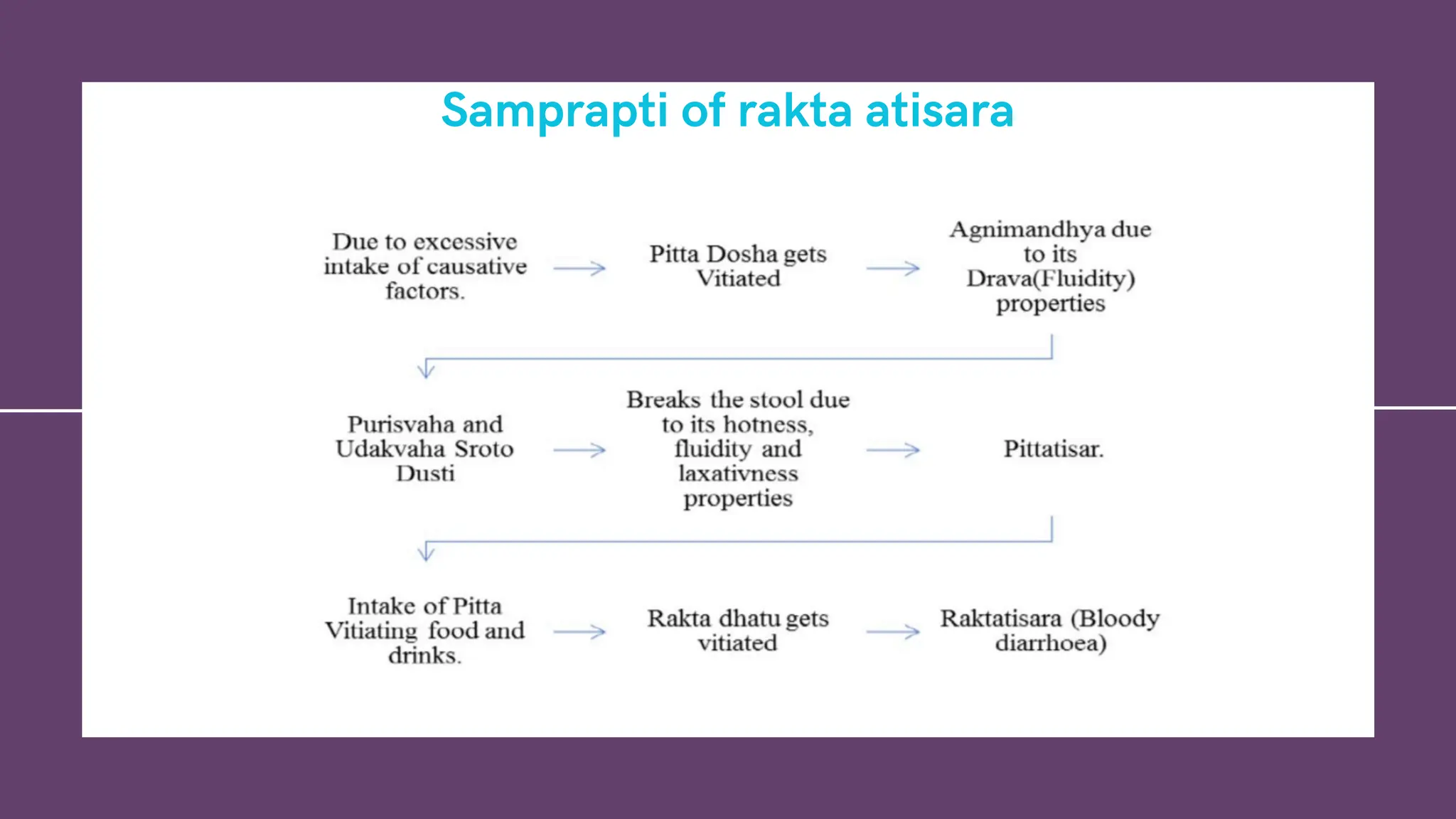
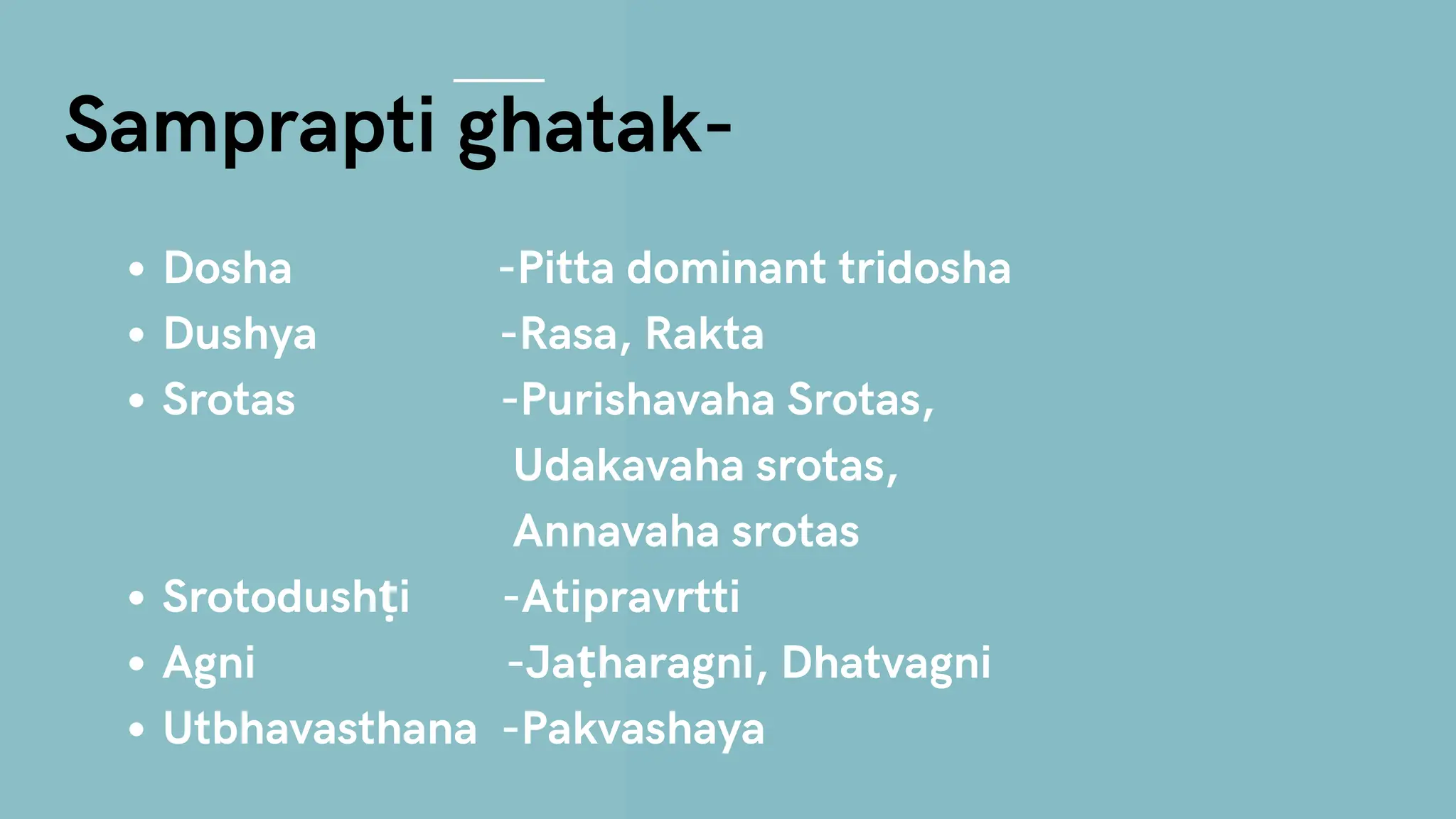
Samprapti of rakta atisara
Dosha -Pitta dominant tridosha
Dushya -Rasa, Rakta
Srotas -Purishavaha Srotas,
Udakavaha srotas,
Annavaha srotas
Srotodushṭi -Atipravrtti
Agni -Jaṭharagni, Dhatvagni
Utbhavasthana -Pakvashaya
Samprapti ghatak-
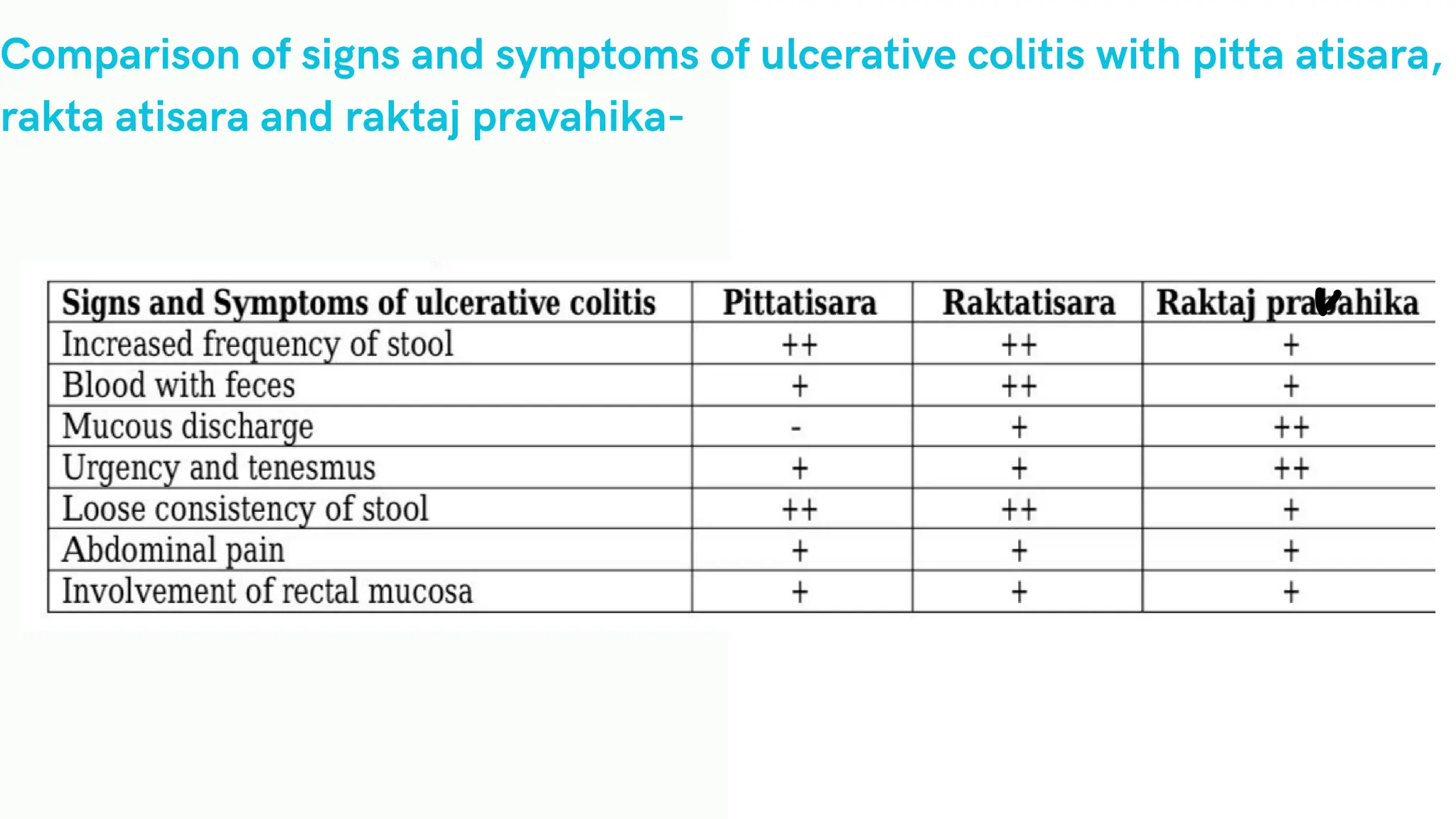
Comparison of signs and symptoms of ulcerative colitis with pitta atisara,
rakta atisara and raktaj pravahika-
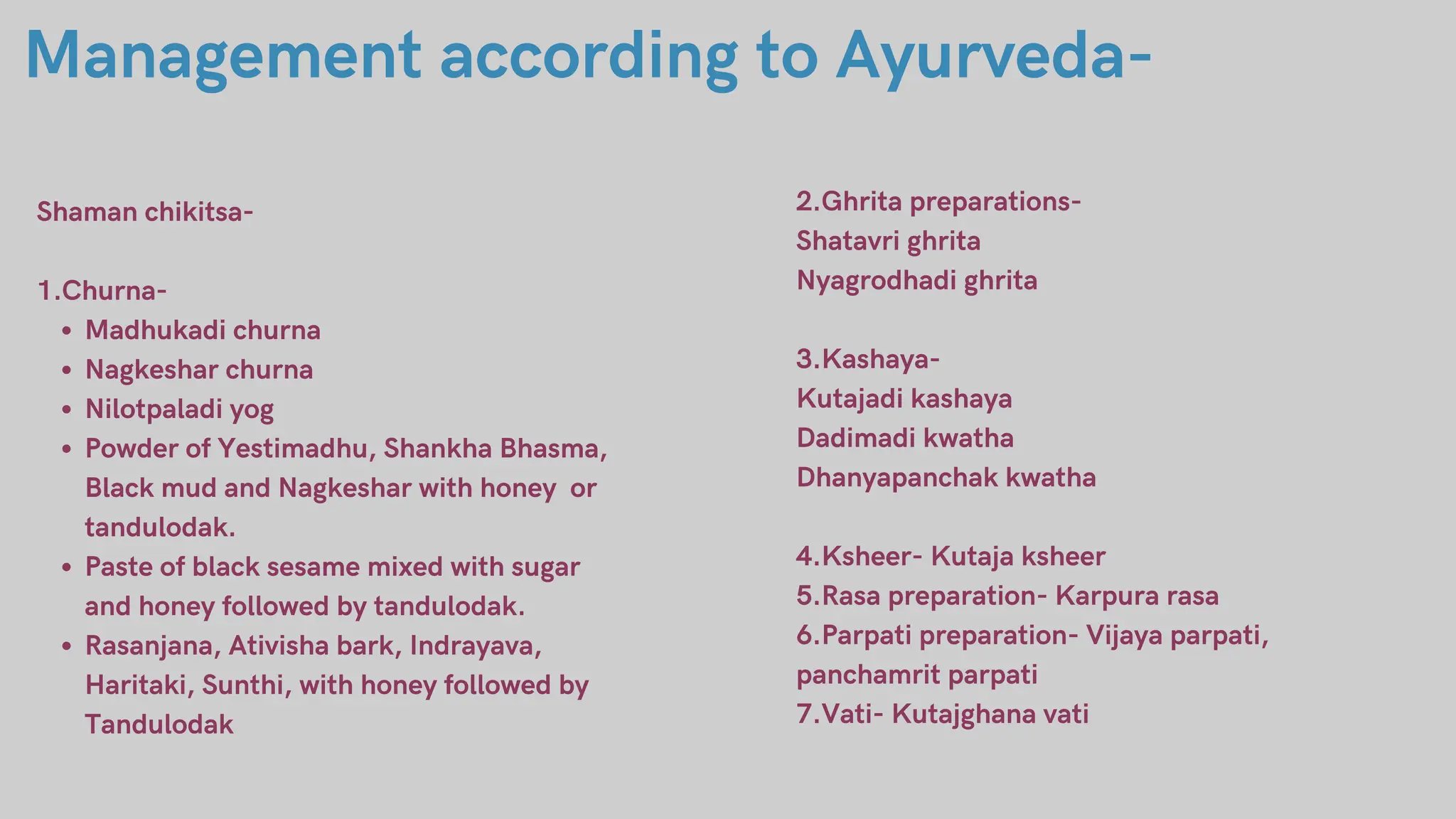
2.Ghrita preparations-
Shatavri ghrita
Nyagrodhadi ghrita
3.Kashaya-
Kutajadi kashaya
Dadimadi kwatha
Dhanyapanchak kwatha
4.Ksheer- Kutaja ksheer
5.Rasa preparation- Karpura rasa
6.Parpati preparation- Vijaya parpati,
panchamrit parpati
7.Vati- Kutajghana vati
Management according to Ayurveda-
Shaman chikitsa-
1.Churna-
Madhukadi churna
Nagkeshar churna
Nilotpaladi yog
Powder of Yestimadhu, Shankha Bhasma,
Black mud and Nagkeshar with honey or
tandulodak.
Paste of black sesame mixed with sugar
and honey followed by tandulodak.
Rasanjana, Ativisha bark, Indrayava,
Haritaki, Sunthi, with honey followed by
Tandulodak
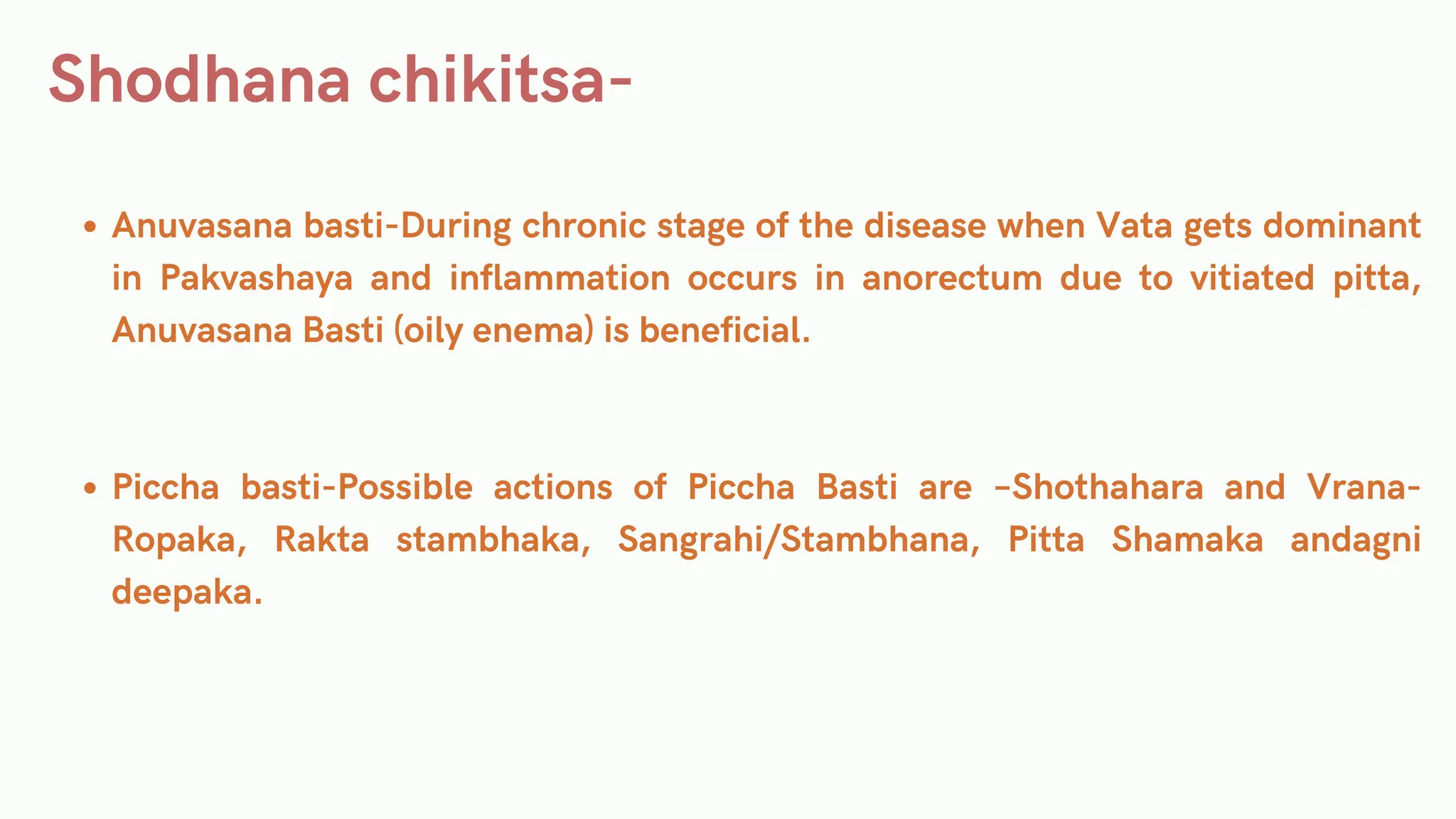
Shodhana chikitsa-
Anuvasana basti-During chronic stage of the disease when Vata gets dominant
in Pakvashaya and inflammation occurs in anorectum due to vitiated pitta,
Anuvasana Basti (oily enema) is beneficial.
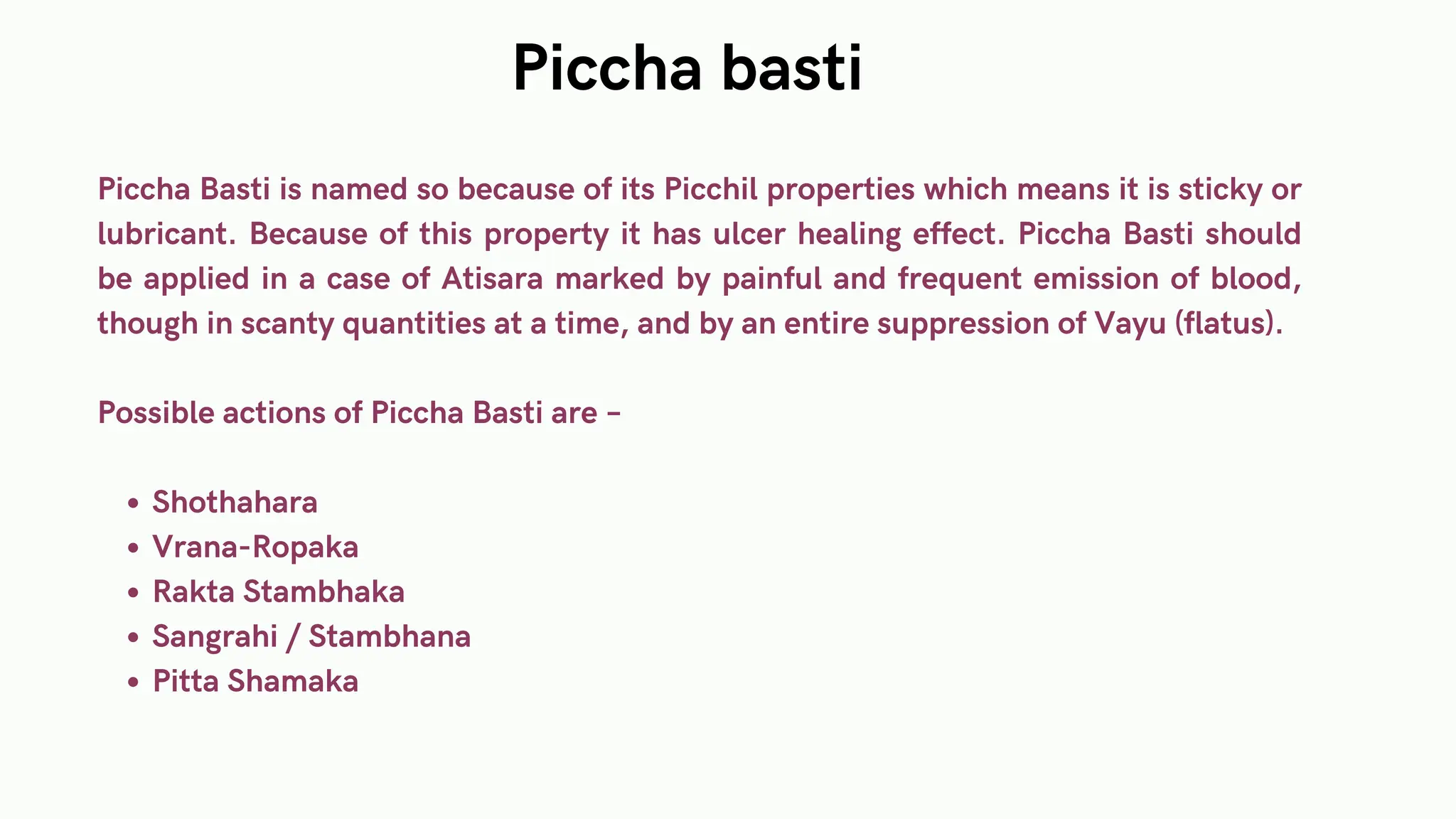
Piccha basti-Possible actions of Piccha Basti are –Shothahara and Vrana-
Ropaka, Rakta stambhaka, Sangrahi/Stambhana, Pitta Shamaka andagni
deepaka.
Piccha Basti is named so because of its Picchil properties which means it is sticky or
lubricant. Because of this property it has ulcer healing effect. Piccha Basti should
be applied in a case of Atisara marked by painful and frequent emission of blood,
though in scanty quantities at a time, and by an entire suppression of Vayu (flatus).
Possible actions of Piccha Basti are –
Shothahara
Vrana-Ropaka
Rakta Stambhaka
Sangrahi / Stambhana
Pitta Shamaka
Piccha basti
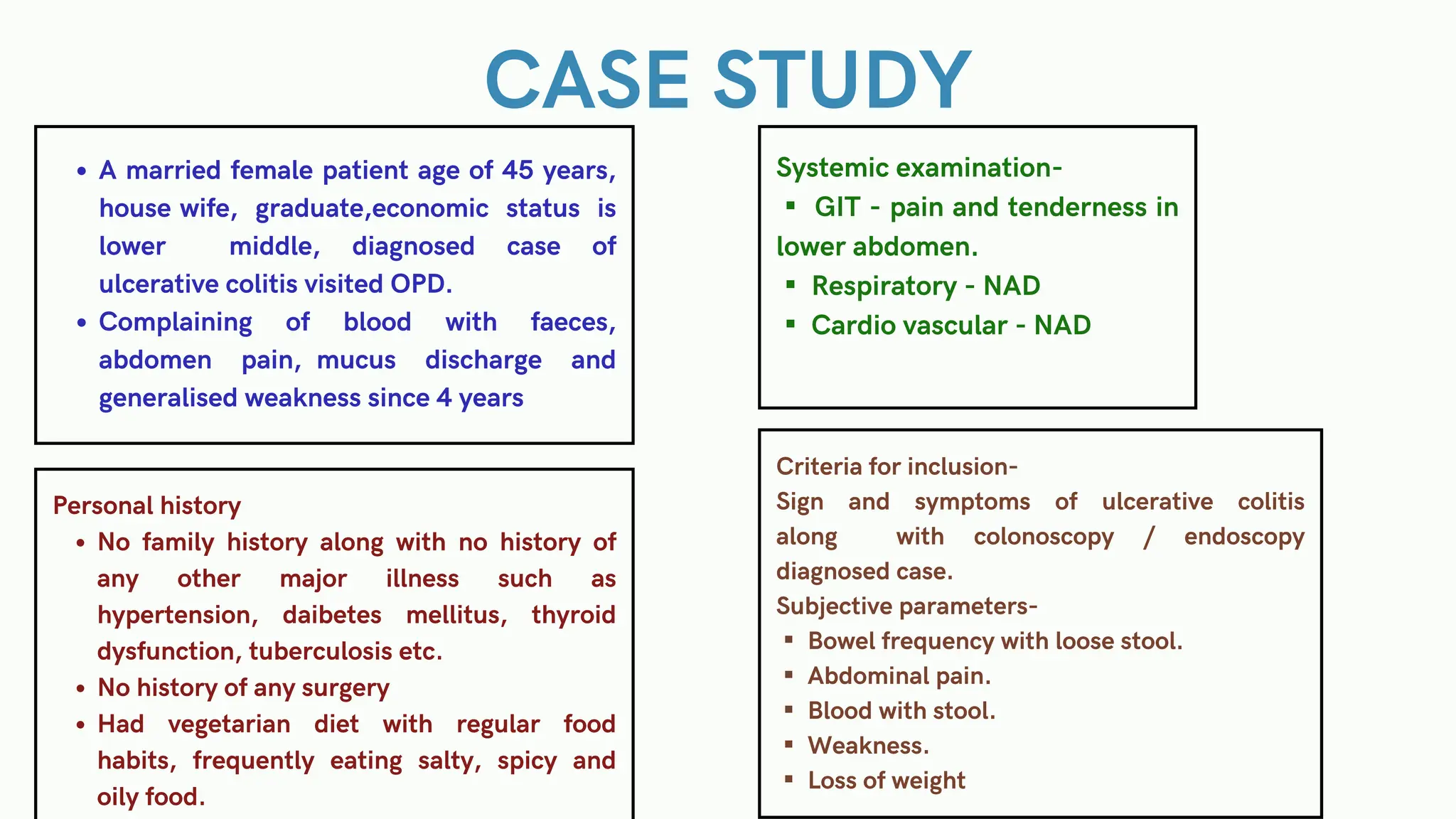
CASE STUDY
A married female patient age of 45 years,
house wife, graduate,economic status is
lower middle, diagnosed case of
ulcerative colitis visited OPD.
Complaining of blood with faeces,
abdomen pain, mucus discharge and
generalised weakness since 4 years
Personal history
No family history along with no history of
any other major illness such as
hypertension, daibetes mellitus, thyroid
dysfunction, tuberculosis etc.
No history of any surgery
Had vegetarian diet with regular food
habits, frequently eating salty, spicy and
oily food.
Systemic examination-
▪ GIT - pain and tenderness in
lower abdomen.
▪ Respiratory - NAD
▪ Cardio vascular - NAD
Criteria for inclusion-
Sign and symptoms of ulcerative colitis
along with colonoscopy / endoscopy
diagnosed case.
Subjective parameters-
▪ Bowel frequency with loose stool.
▪ Abdominal pain.
▪ Blood with stool.
▪ Weakness.
▪ Loss of weight
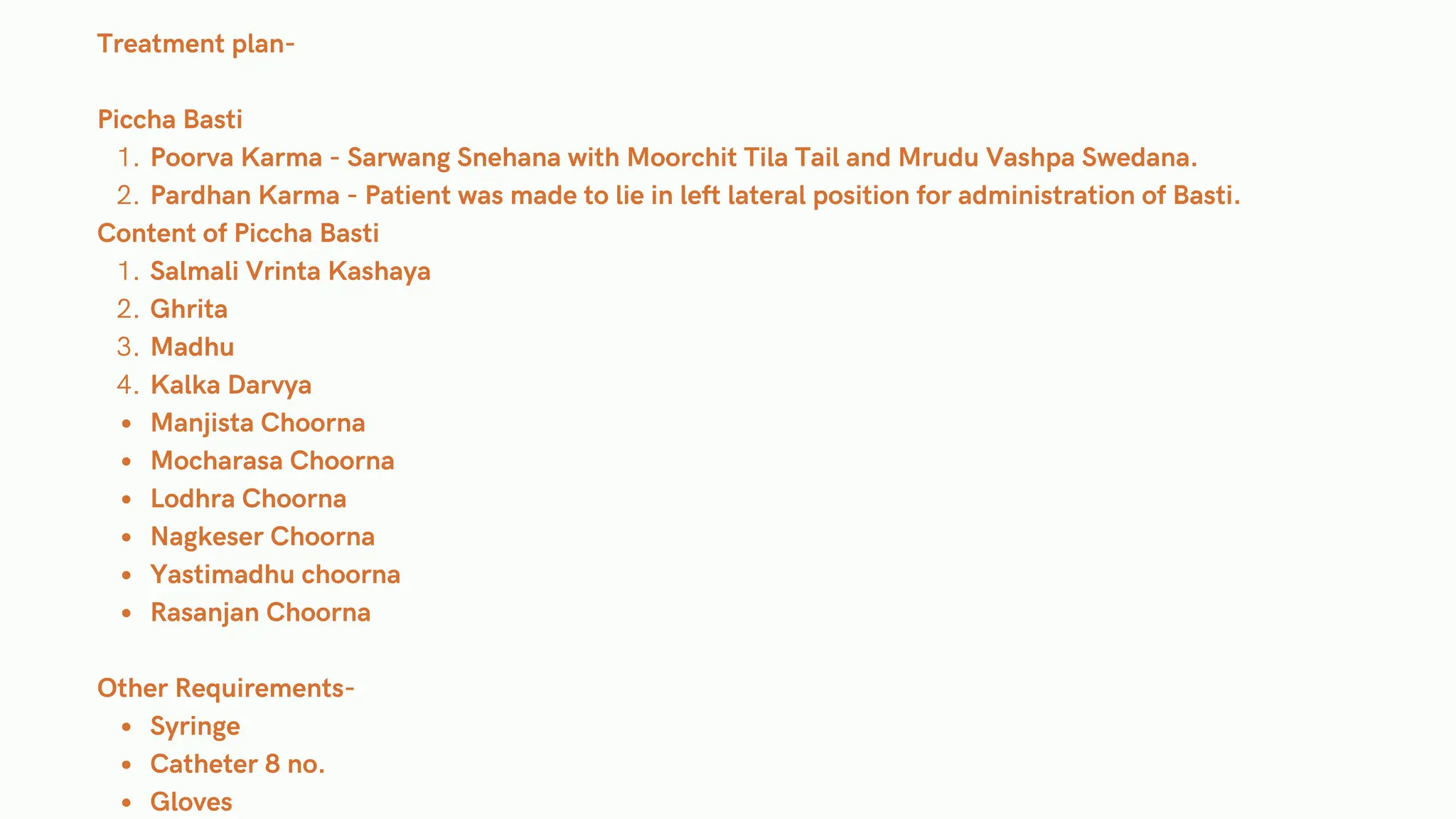
Treatment plan-
Piccha Basti
Poorva Karma - Sarwang Snehana with Moorchit Tila Tail and Mrudu Vashpa Swedana.
1.
Pardhan Karma - Patient was made to lie in left lateral position for administration of Basti.
2.
Content of Piccha Basti
Salmali Vrinta Kashaya
1.
Ghrita
2.
Madhu
3.
Kalka Darvya
4.
Manjista Choorna
Mocharasa Choorna
Lodhra Choorna
Nagkeser Choorna
Yastimadhu choorna
Rasanjan Choorna
Other Requirements-
Syringe
Catheter 8 no.
Gloves
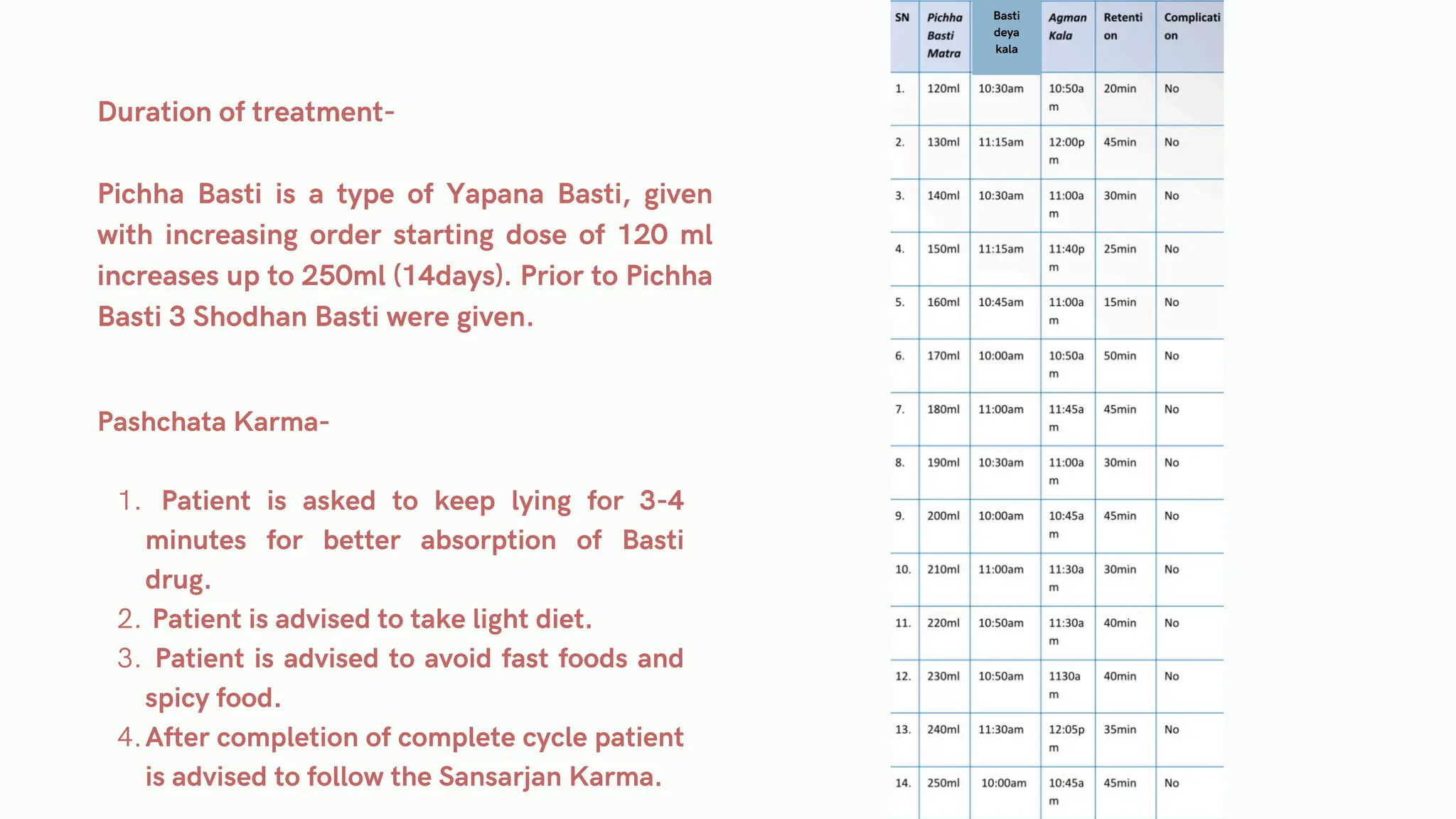
Duration of treatment-
Pichha Basti is a type of Yapana Basti, given
with increasing order starting dose of 120 ml
increases up to 250ml (14days). Prior to Pichha
Basti 3 Shodhan Basti were given.
Pashchata Karma-
Patient is asked to keep lying for 3-4
minutes for better absorption of Basti
drug.
1.
Patient is advised to take light diet.
2.
Patient is advised to avoid fast foods and
spicy food.
3.
After completion of complete cycle patient
is advised to follow the Sansarjan Karma.
4.
Basti
deya
kala
Result
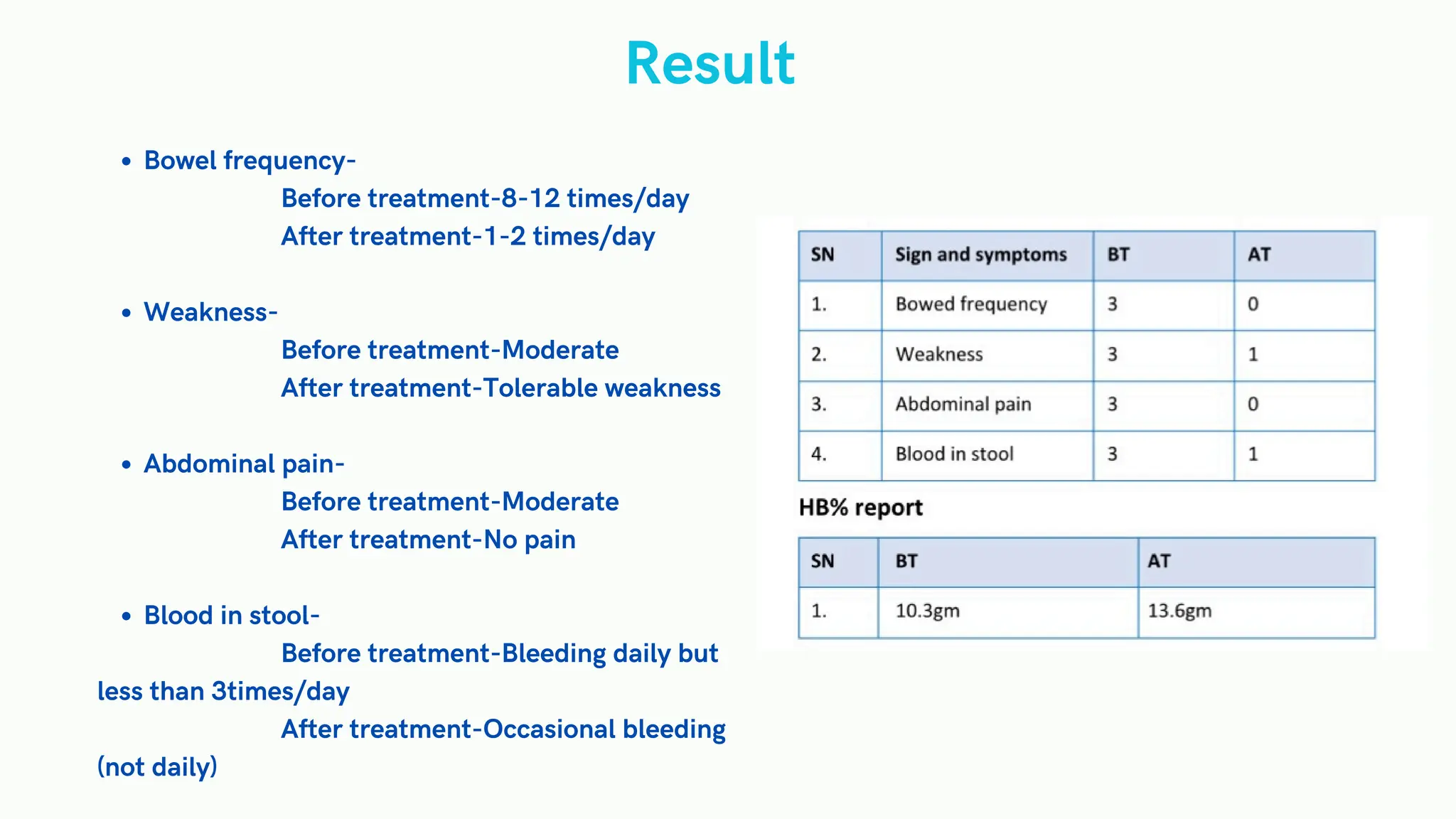
Bowel frequency-
Before treatment-8-12 times/day
After treatment-1-2 times/day
Weakness-
Before treatment-Moderate
After treatment-Tolerable weakness
Abdominal pain-
Before treatment-Moderate
After treatment-No pain
Blood in stool-
Before treatment-Bleeding daily but
less than 3times/day
After treatment-Occasional bleeding
(not daily)
Thank you

Ulcerative colitis and its ayurvedic corelation

  • 1.
    Ulcerative colitis -By KarunaDeswal Intern (Batch 2018-19)
  • 2.
    Introduction Inflammatory bowel disease(IBD) is an immune-mediated chronic intestinal condition,Ulcerative colitis (UC) and Crohn’s disease (CD) are the two major types of IBD.UC is a mucosal disease that usually involves the rectum and extends proximally to involve all or part of the colon. About 40-50% of patients have a disease limited to the rectum and recto- colitis.sigmoid, 30-40% have disease extending beyond the sigmoid but not involving the whole colon and 20% have a total colitis. Prevalence of IBD known to be high in western countries but now there is rising incidence and prevalence of disease in India topping the Southeast Asian (SEA) countries.
  • 3.
    Aetiology Genetic predisposition. Environmental factorsmay trigger disease (viral or bacterial pathogens, dietary). Immunologic imbalance or disturbances. Defect in intestinal barrier causing hypersensitive mucosa & increased permeability. Defect in repair of mucosal injury, which may develop into a chronic condition.
  • 4.
    Pathology Ulcerative colitis isusually limited to the colon. Typically, inflammation begins at the rectum and continuously involves all or part of the colon. The transition to normal areas may be either abrupt or gradual, and it may occur anywhere from the rectum to the cecum. Some cases only involve the rectum—often called ulcerative proctitis. Less commonly, isolated or discontinuous proximal segments of disease may be identified at presentation— also called patch colitis.
  • 5.
  • 6.
    Clinical features Diarrhoea withblood, mucus and pus (4-6 stools /day) Pain abdomen and fever may be present in moderate to severe cases. Increased bowel sounds Crampy abdominal pain. Anal area may be irritated & reddened left lower abdomen may be tender on palpation. remissions & relapses. Patients with severe disease have diarrhoea with tenesmus, anaemia, weight loss.
  • 7.
    Site of involvement-Commonsite is rectum and a part of sigmoid colon Type of involvement- Continuous with no skip areas Ulcers in intestines- Superficial and haemorrhagic Appearance of intestinal mucosa- Polyps and pseudopolyps present Inflammation- Mucosal and submucosal Width of mucosa- Normal or reduced Differentiating pathological features
  • 9.
    Complications- Relapses or remissions-Common Haemorrhoids/skin tag- Uncommon Stricture/anal tissure- Less common Abscess and fistulas- Less common Carcinoma in situ- More common in long standing cases.
  • 10.
    Extra intestinal features- Eye(Uveitis, episcleritis, conjunctivitis)- Common Joints (arthritis, arthralgia, ankylosing spondylitis)-Common Skin (erythema nodosum, pyoderma gangrenosa)- Less common Liver (sclerosing cholangitis, hepatitis, fatty liver)- Uncommon Heart (Aortic regurgitation, mitral valve prolapse)- Common
  • 11.
    Investigations Laboratory Tests:- Stool examinationto rule out enteral pathogens; fecal analysis positive for blood during active disease. Complete blood count- hemoglobin & hematocrit may be low due to bleeding; WBC may be increased. Elevated erythrocyte sedimentation rate (ESR). Decreased serum levels of potassium, magnesium, & albumin Other Diagnostic Tests:- Barium enema Proctosigmoidoscopy/colonoscopy Rectal biopsy
  • 12.
    Management- General Measures:- Bed rest,I.V. fluid replacement, clear liquid diet. For patients with severe dehydration & excessive diarrhea, fluid may be recommended to rest the intestinal tract & restore nitrogen balance. Treatment of anemia- iron supplements for chronic bleeding, blood replacement for massive bleeding. Drug Therapy Sulfasalazine (Azulfidine) Oral salicylates, such as mesalamine (Pentasa), olsalazine (Dipentum) Mesalamineenema available for protosigmoiditis; suppository for proctitis. Corticosteroids- 5-aminosalicylic acid preparations Immunosuppressive drugs- purine analogues, 6-mercaptopurine, azathioprine Antidiarrheal medications.
  • 13.
    Surgical treatment- I. Noncurativeapproaches- Temporary loop colostomy 1. Subtotal colectomy, ileostomy and hartmann's pouch. 2. Colectomy with ileorectal anastomosis. 3. ii.Reconstructive/curative approaches- Total proctocolectomy with permanent end- ileostomy. 1. Total proctocolectomy with continent ileostomy 2. Total colectomy with ileal reservoir- anal (or ileal reservoir-distal rectal) anastomosis 3. The ultimate surgical goal is to remove the entire colon & rectum. 4.
  • 14.
    Foods to limitor avoid- -High fibre foods-such as broccoli, cabbage, cauli flower -Lactose products-such as cow’s milk, cheese, ice cream -Certain beverages- such as alcohol, coffee, tea, soda -High fat foods-such as butter, creams, fried and higly processed foods -Acidic fruits-such as orange, grapes, tomatoes -Some meats including red meat and processed meat -Spicy food Food that can be consumed- Low fiber fruits such as bananas, honeydew melon, cooked or peeled fruits, avocado, and mango Non-cruciferous vegetables such as potatoes, sweet potatoes, cucumbers, and carrots Refined grain foods such as white pasta, white rice, oatmeal, and certain breads Omega-3 fatty acid-rich foods such as salmon, mackerel, and walnuts Low fat protein sources such as fish, chicken, lamb, turkey, and eggs Foods to eat and avoid-
  • 15.
    According to ayurveda- Agnimandhyais the root cause of this disease. In all kinds of Atisara, sign of Ama and pakva should be determined first. This is the first line of Atisara treatment. The basic principle to consider during treatment mentioned as Ama or Pakva features of the patient. Agni Dipana, Ama Pachana, Grahi, Stambhana, Dhatu Poshaka, Sattvavajaya Chikitsa should be given according to the condition of the patient. Keeping in mind the strength of the patient, In case of amavasta Langhana should be done first, then drinking of Yevagu made with Deepan, Pachana drugs like sunthi, chitrak etc is beneficial. Grahi drugs should be avoided in Amavastha condition as it may cause Pliha Vridhi, Pandu,anaha, Prameha, Kustha , Jwara, Śopha,, Gulma , Grahani, Arsha,Shula, Alasaka, Hrid Graha.
  • 16.
  • 17.
    Dosha -Pitta dominanttridosha Dushya -Rasa, Rakta Srotas -Purishavaha Srotas, Udakavaha srotas, Annavaha srotas Srotodushṭi -Atipravrtti Agni -Jaṭharagni, Dhatvagni Utbhavasthana -Pakvashaya Samprapti ghatak-
  • 18.
    Comparison of signsand symptoms of ulcerative colitis with pitta atisara, rakta atisara and raktaj pravahika-
  • 19.
    2.Ghrita preparations- Shatavri ghrita Nyagrodhadighrita 3.Kashaya- Kutajadi kashaya Dadimadi kwatha Dhanyapanchak kwatha 4.Ksheer- Kutaja ksheer 5.Rasa preparation- Karpura rasa 6.Parpati preparation- Vijaya parpati, panchamrit parpati 7.Vati- Kutajghana vati Management according to Ayurveda- Shaman chikitsa- 1.Churna- Madhukadi churna Nagkeshar churna Nilotpaladi yog Powder of Yestimadhu, Shankha Bhasma, Black mud and Nagkeshar with honey or tandulodak. Paste of black sesame mixed with sugar and honey followed by tandulodak. Rasanjana, Ativisha bark, Indrayava, Haritaki, Sunthi, with honey followed by Tandulodak
  • 20.
    Shodhana chikitsa- Anuvasana basti-Duringchronic stage of the disease when Vata gets dominant in Pakvashaya and inflammation occurs in anorectum due to vitiated pitta, Anuvasana Basti (oily enema) is beneficial. Piccha basti-Possible actions of Piccha Basti are –Shothahara and Vrana- Ropaka, Rakta stambhaka, Sangrahi/Stambhana, Pitta Shamaka andagni deepaka.
  • 21.
    Piccha Basti isnamed so because of its Picchil properties which means it is sticky or lubricant. Because of this property it has ulcer healing effect. Piccha Basti should be applied in a case of Atisara marked by painful and frequent emission of blood, though in scanty quantities at a time, and by an entire suppression of Vayu (flatus). Possible actions of Piccha Basti are – Shothahara Vrana-Ropaka Rakta Stambhaka Sangrahi / Stambhana Pitta Shamaka Piccha basti
  • 22.
    CASE STUDY A marriedfemale patient age of 45 years, house wife, graduate,economic status is lower middle, diagnosed case of ulcerative colitis visited OPD. Complaining of blood with faeces, abdomen pain, mucus discharge and generalised weakness since 4 years Personal history No family history along with no history of any other major illness such as hypertension, daibetes mellitus, thyroid dysfunction, tuberculosis etc. No history of any surgery Had vegetarian diet with regular food habits, frequently eating salty, spicy and oily food. Systemic examination- ▪ GIT - pain and tenderness in lower abdomen. ▪ Respiratory - NAD ▪ Cardio vascular - NAD Criteria for inclusion- Sign and symptoms of ulcerative colitis along with colonoscopy / endoscopy diagnosed case. Subjective parameters- ▪ Bowel frequency with loose stool. ▪ Abdominal pain. ▪ Blood with stool. ▪ Weakness. ▪ Loss of weight
  • 23.
    Treatment plan- Piccha Basti PoorvaKarma - Sarwang Snehana with Moorchit Tila Tail and Mrudu Vashpa Swedana. 1. Pardhan Karma - Patient was made to lie in left lateral position for administration of Basti. 2. Content of Piccha Basti Salmali Vrinta Kashaya 1. Ghrita 2. Madhu 3. Kalka Darvya 4. Manjista Choorna Mocharasa Choorna Lodhra Choorna Nagkeser Choorna Yastimadhu choorna Rasanjan Choorna Other Requirements- Syringe Catheter 8 no. Gloves
  • 24.
    Duration of treatment- PichhaBasti is a type of Yapana Basti, given with increasing order starting dose of 120 ml increases up to 250ml (14days). Prior to Pichha Basti 3 Shodhan Basti were given. Pashchata Karma- Patient is asked to keep lying for 3-4 minutes for better absorption of Basti drug. 1. Patient is advised to take light diet. 2. Patient is advised to avoid fast foods and spicy food. 3. After completion of complete cycle patient is advised to follow the Sansarjan Karma. 4. Basti deya kala
  • 25.
    Result Bowel frequency- Before treatment-8-12times/day After treatment-1-2 times/day Weakness- Before treatment-Moderate After treatment-Tolerable weakness Abdominal pain- Before treatment-Moderate After treatment-No pain Blood in stool- Before treatment-Bleeding daily but less than 3times/day After treatment-Occasional bleeding (not daily)
  • 26.