
UK Export Controls Overview
Export Growth Seminar
Belfast, 2 July 2014
Richard Tauwhare
Green Light Exports Consulting
1
Brief for today
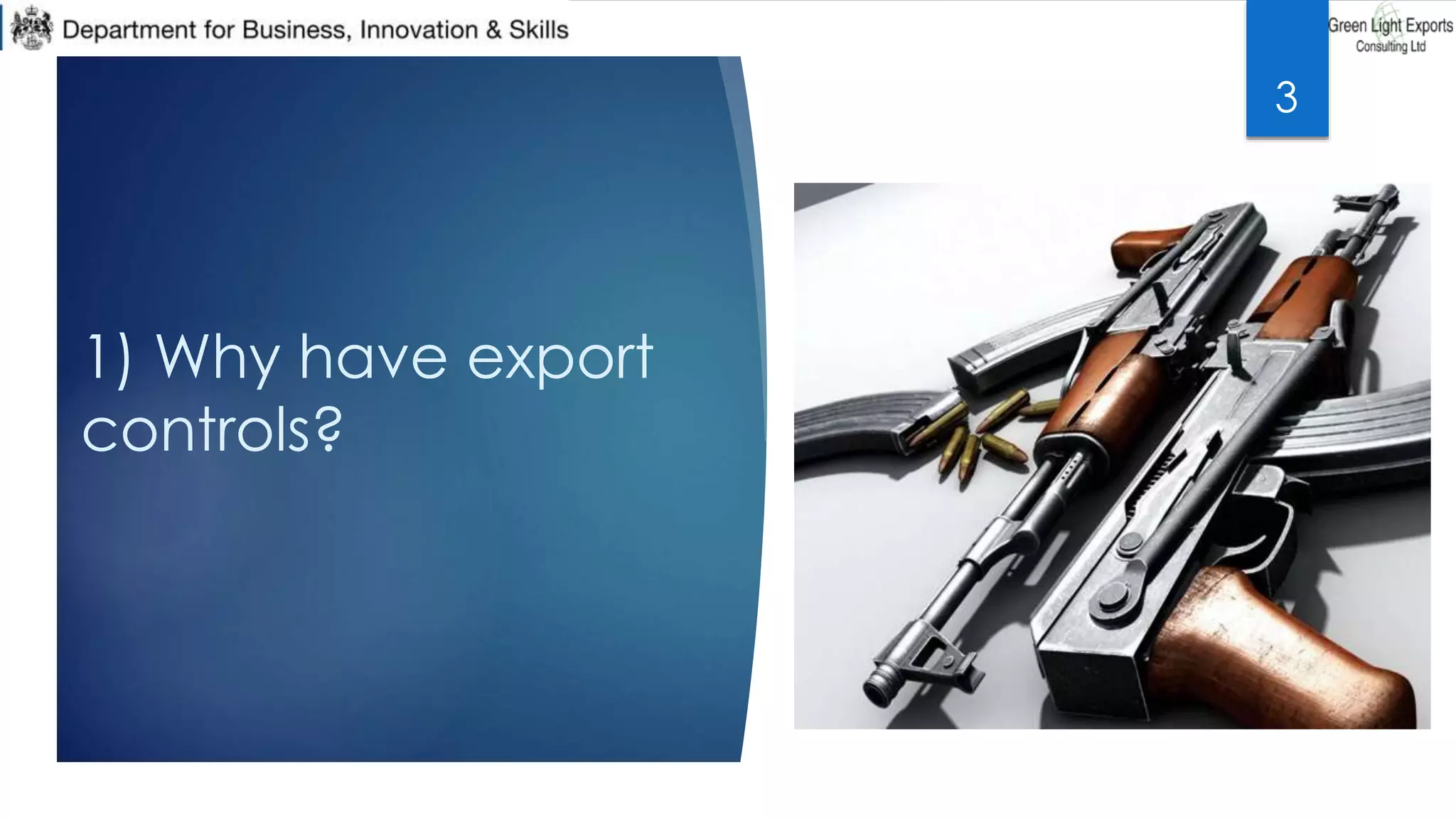
1) Why have export controls?
2) What is controlled?
3) Licensing
4) Enforcement
5) Minimise delays and risks
2
1) Why have export
controls?
3
UK Government Policy
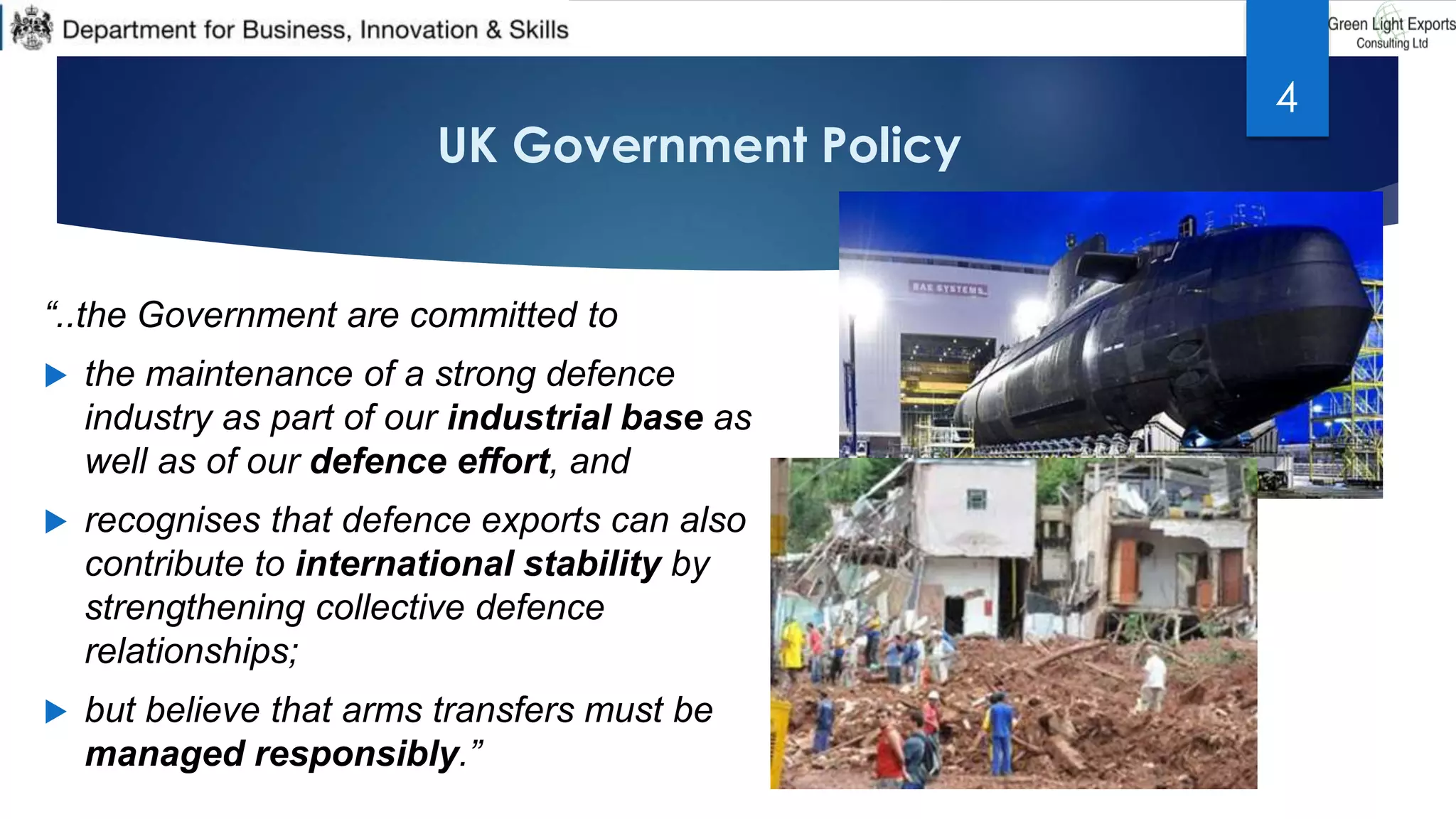
“..the Government are committed to
 the maintenance of a strong defence
industry as part of our industrial base as
well as of our defence effort, and
 recognises that defence exports can also
contribute to international stability by
strengthening collective defence
relationships;
 but believe that arms transfers must be
managed responsibly.”
4
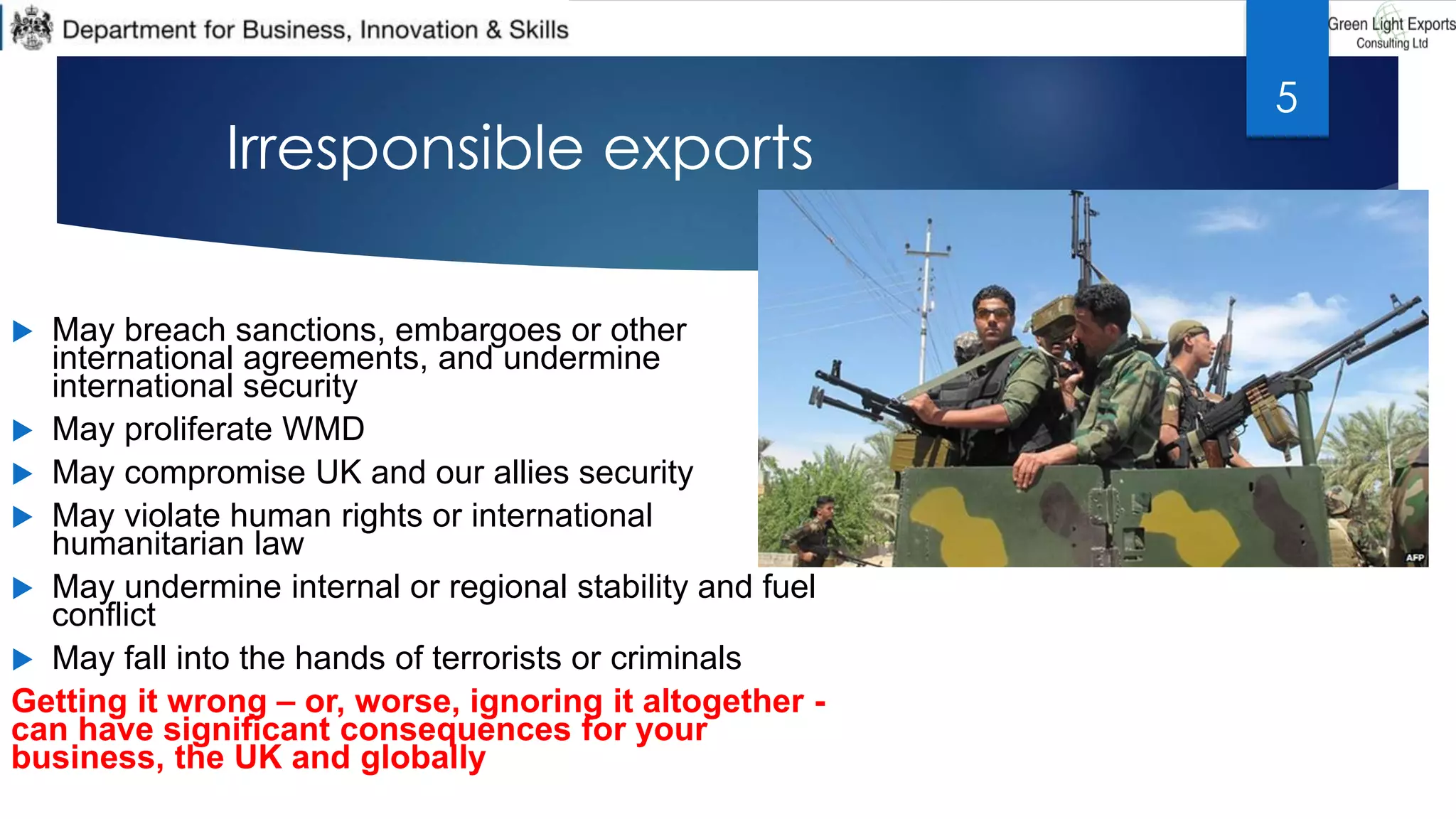
 May breach sanctions, embargoes or other
international agreements, and undermine
international security
 May proliferate WMD
 May compromise UK and our allies security
 May violate human rights or international
humanitarian law
 May undermine internal or regional stability and fuel
conflict
 May fall into the hands of terrorists or criminals
Getting it wrong – or, worse, ignoring it altogether -
can have significant consequences for your
business, the UK and globally
Irresponsible exports
5
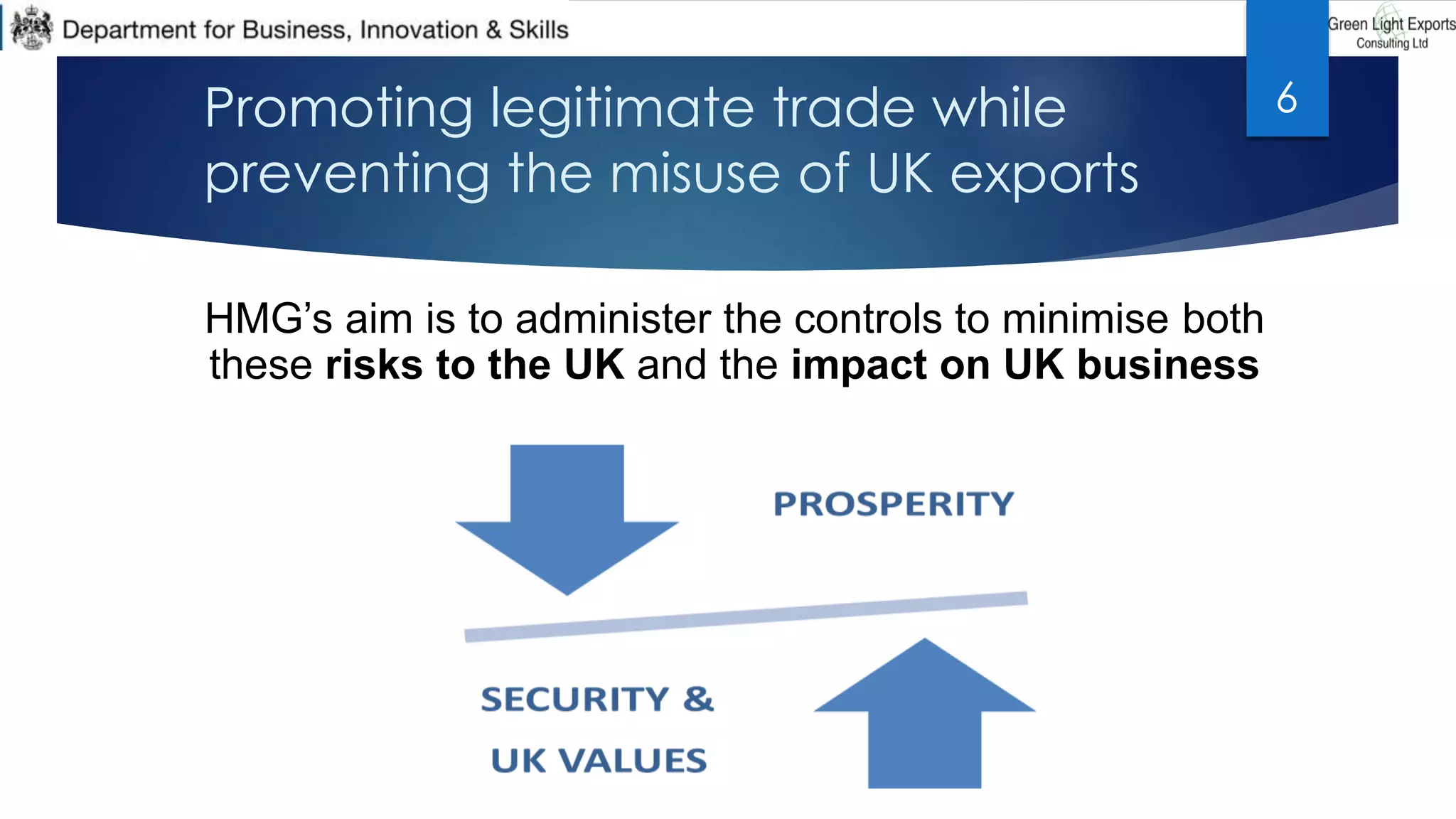
Promoting legitimate trade while
preventing the misuse of UK exports
6
HMG’s aim is to administer the controls to minimise both
these risks to the UK and the impact on UK business
Where do the controls come from?
 International Treaties, Conventions and Regimes
 National defence interests and foreign policy objectives
 Human Rights considerations
UK Law
 Export Control Act 2002
 Export Control Order 2008 (as amended)
 Export of Radioactive Sources (Control) Order 2006
EU Law
 Council Regulation (EC) No. 428/2009 (the Dual Use Regulation)
 Council Regulation (EC) No. 1236/2005 (the “Torture Regulation”)
7
Towards a Level Playing Field
 Export Controls are not unique to the UK – all countries have some form of controls
 The UK is firmly committed to implementing export controls rigorously. We work closely
with others countries to encourage and where necessary help them to meet the same
standards.
 The strategic export controls that the UK operates are comprehensive are closely based on
internationally-agreed standards and lists, compiled and up-dated by experts who meet
regularly to discuss and agree what needs to be controlled or de-controlled. UK experts
play a leading role in all these international fora
 The regimes and EU seek to ensure a level playing field by policing members’ adherence
to the agreed controls and seeking to ensure that if a licence is denied by one member the
other members abide by that decision
8
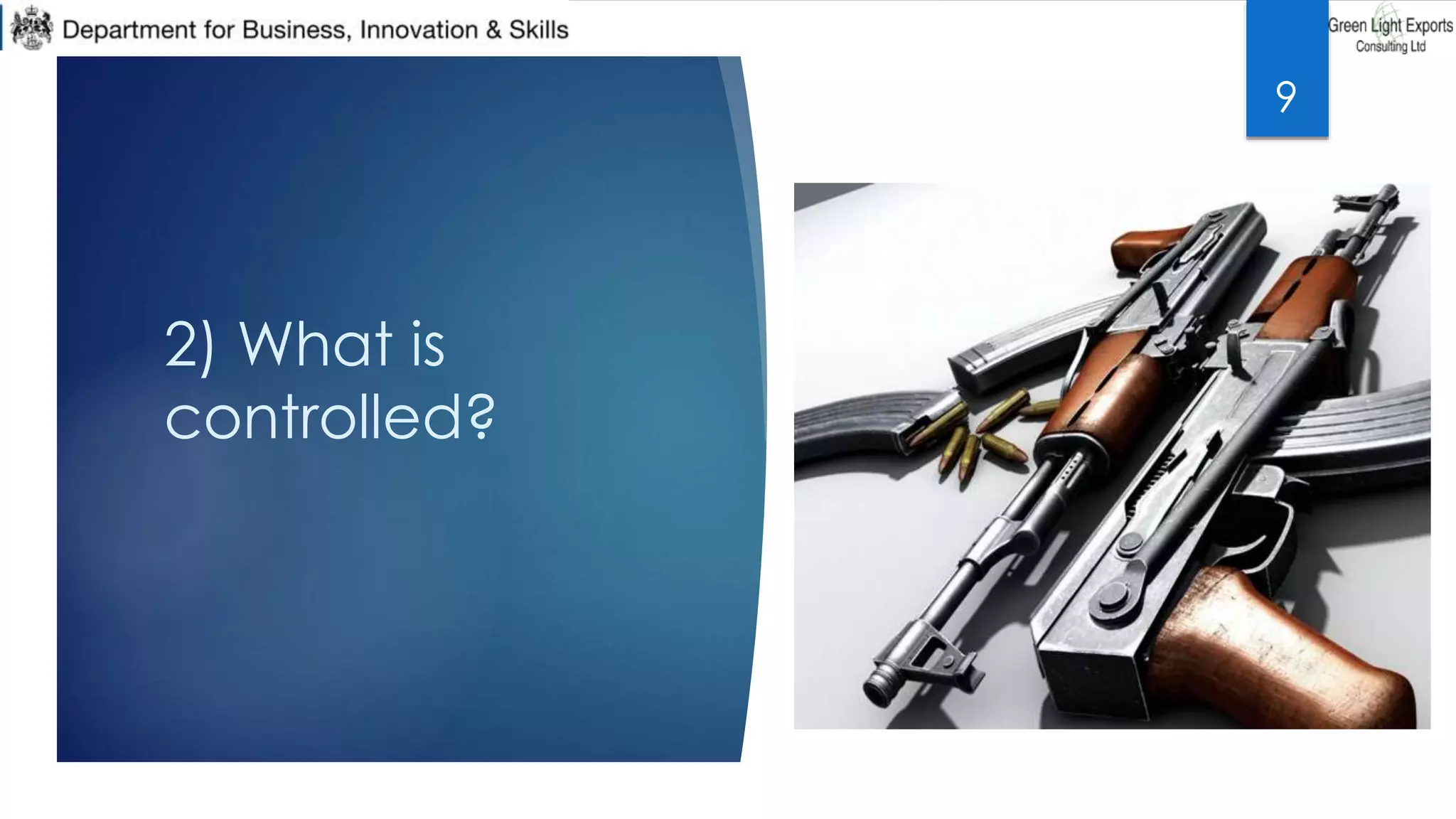
2) What is
controlled?
9
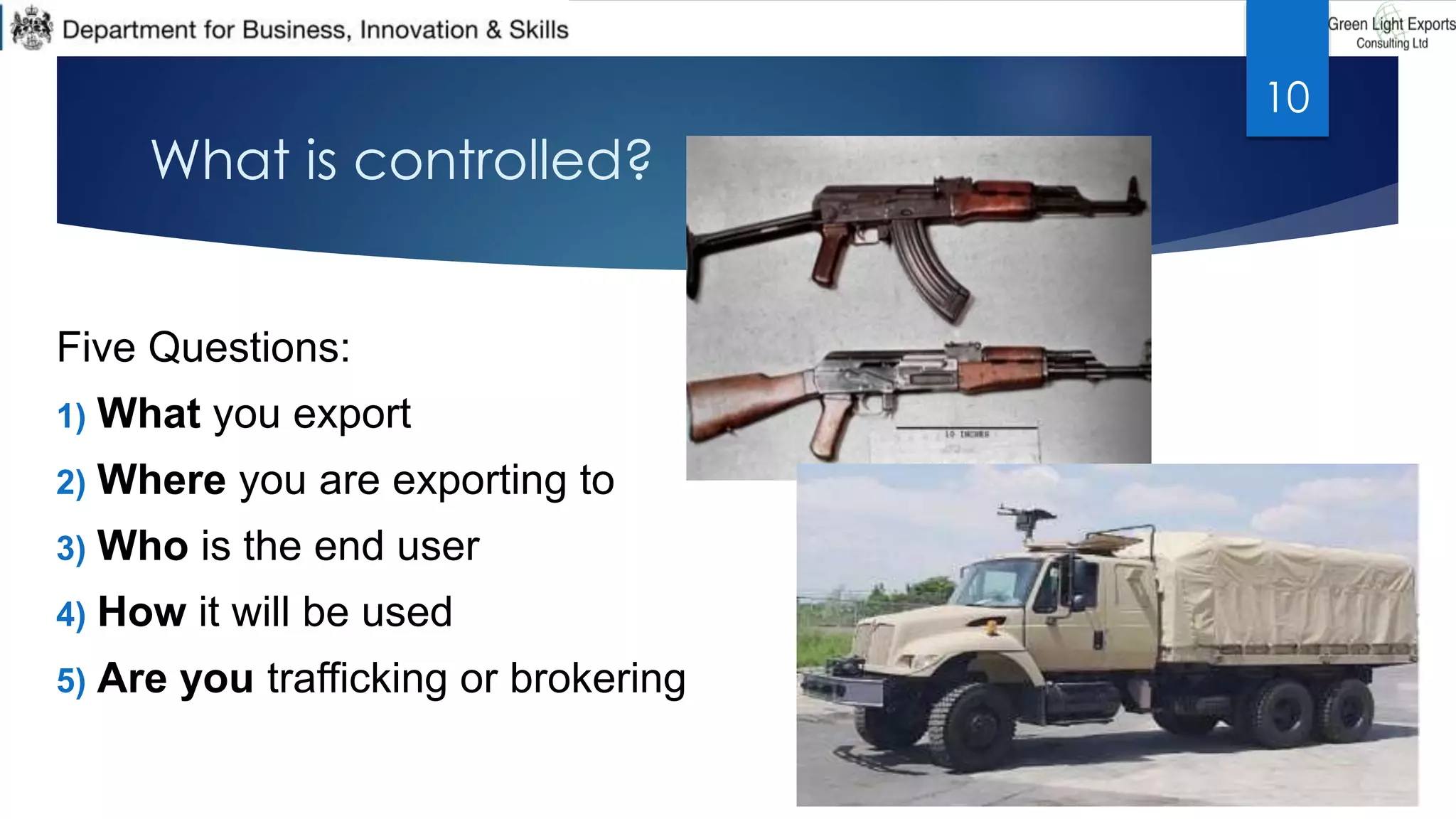
What is controlled?
Five Questions:
1) What you export
2) Where you are exporting to
3) Who is the end user
4) How it will be used
5) Are you trafficking or brokering
10
WHAT: UK Strategic Export Control List
A comprehensive compilation of the 7 lists of items which are controlled under UK and EU law:
 UK Lists
1) UK Military List (Schedule 2 of the Export Control Order 2008)
2) UK Dual-Use List (Schedule 3 of the Export Control Order 2008)
3) UK National Security and Paramilitary List (Article 9 of Export Control Order 2008)
4) UK National Radioactive Sources List (Schedule in Article 2 of Export of Radioactive Sources (Control) Order 2006)
 EU Lists
5) EU Dual-Use List for exports outside the EU (Annex I of the EU Dual-Use Regulation 428/2009)
6) EU Dual-Use List for exports both within and outside the EU (Annex IV to EU Dual-Use Regulation 428/2009)
7) EU Human Rights List (Annexes II and III of 2005 EC Regulation 1236/2005)
 NB The lists are updated regularly: check the BIS website and subscribe to Notices for Exporters
11
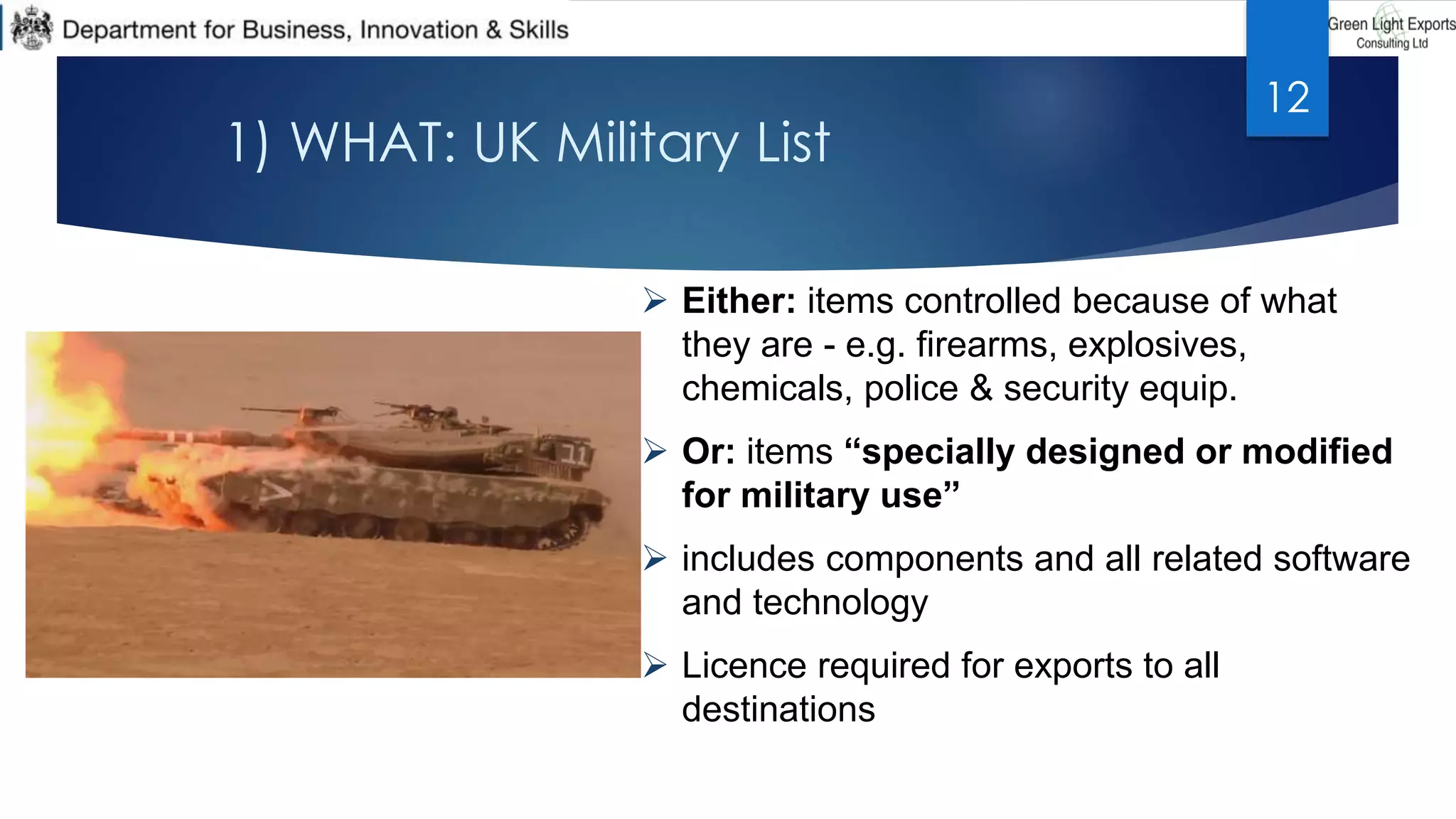
1) WHAT: UK Military List
 Either: items controlled because of what
they are - e.g. firearms, explosives,
chemicals, police & security equip.
 Or: items “specially designed or modified
for military use”
 includes components and all related software
and technology
 Licence required for exports to all
destinations
12
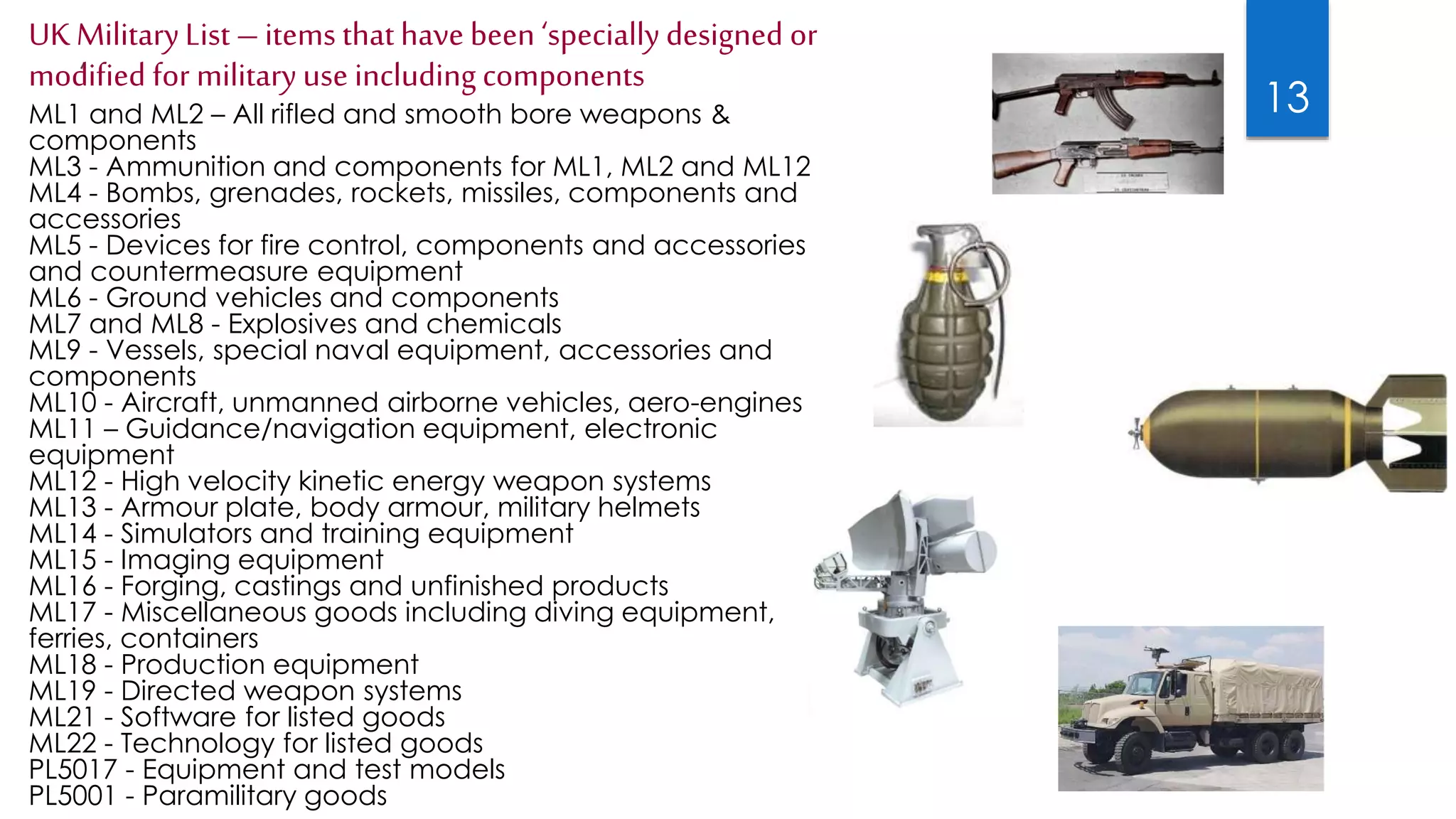
UK MilitaryList – items that have been ‘specially designed or
modified for military use including components
ML1 and ML2 – All rifled and smooth bore weapons &
components
ML3 - Ammunition and components for ML1, ML2 and ML12
ML4 - Bombs, grenades, rockets, missiles, components and
accessories
ML5 - Devices for fire control, components and accessories
and countermeasure equipment
ML6 - Ground vehicles and components
ML7 and ML8 - Explosives and chemicals
ML9 - Vessels, special naval equipment, accessories and
components
ML10 - Aircraft, unmanned airborne vehicles, aero-engines
ML11 – Guidance/navigation equipment, electronic
equipment
ML12 - High velocity kinetic energy weapon systems
ML13 - Armour plate, body armour, military helmets
ML14 - Simulators and training equipment
ML15 - Imaging equipment
ML16 - Forging, castings and unfinished products
ML17 - Miscellaneous goods including diving equipment,
ferries, containers
ML18 - Production equipment
ML19 - Directed weapon systems
ML21 - Software for listed goods
ML22 - Technology for listed goods
PL5017 - Equipment and test models
PL5001 - Paramilitary goods
13
1) WHAT: Dual-Use Lists
 ‘Dual-Use’ = items which have both military AND civil applications
 EU Regulation:
 Annex I: only require a licence for export outside the EU
 Annex IV: require a licence within and outside the EU
 Includes related software and technology
 Brokering controls on goods which may be for WMD end-use
 Additional UK national dual-use controls on eg execution chemicals, tasers,
CIED, radioactive sources
14
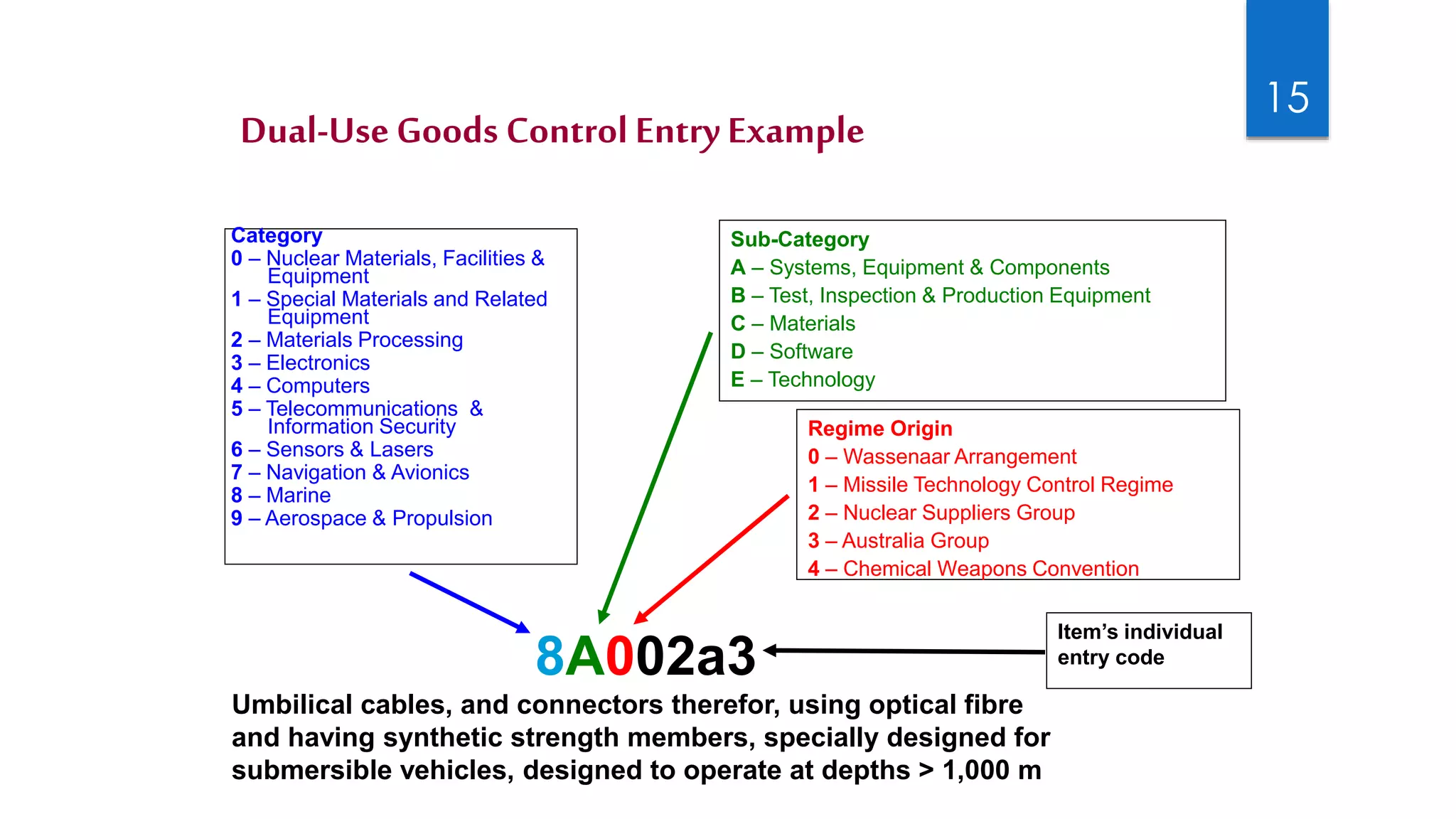
Category
0 – Nuclear Materials, Facilities &
Equipment
1 – Special Materials and Related
Equipment
2 – Materials Processing
3 – Electronics
4 – Computers
5 – Telecommunications &
Information Security
6 – Sensors & Lasers
7 – Navigation & Avionics
8 – Marine
9 – Aerospace & Propulsion
8A002a3
Umbilical cables, and connectors therefor, using optical fibre
and having synthetic strength members, specially designed for
submersible vehicles, designed to operate at depths > 1,000 m
Sub-Category
A – Systems, Equipment & Components
B – Test, Inspection & Production Equipment
C – Materials
D – Software
E – Technology
Regime Origin
0 – Wassenaar Arrangement
1 – Missile Technology Control Regime
2 – Nuclear Suppliers Group
3 – Australia Group
4 – Chemical Weapons Convention
Item’s individual
entry code
Dual-UseGoods Control EntryExample
15
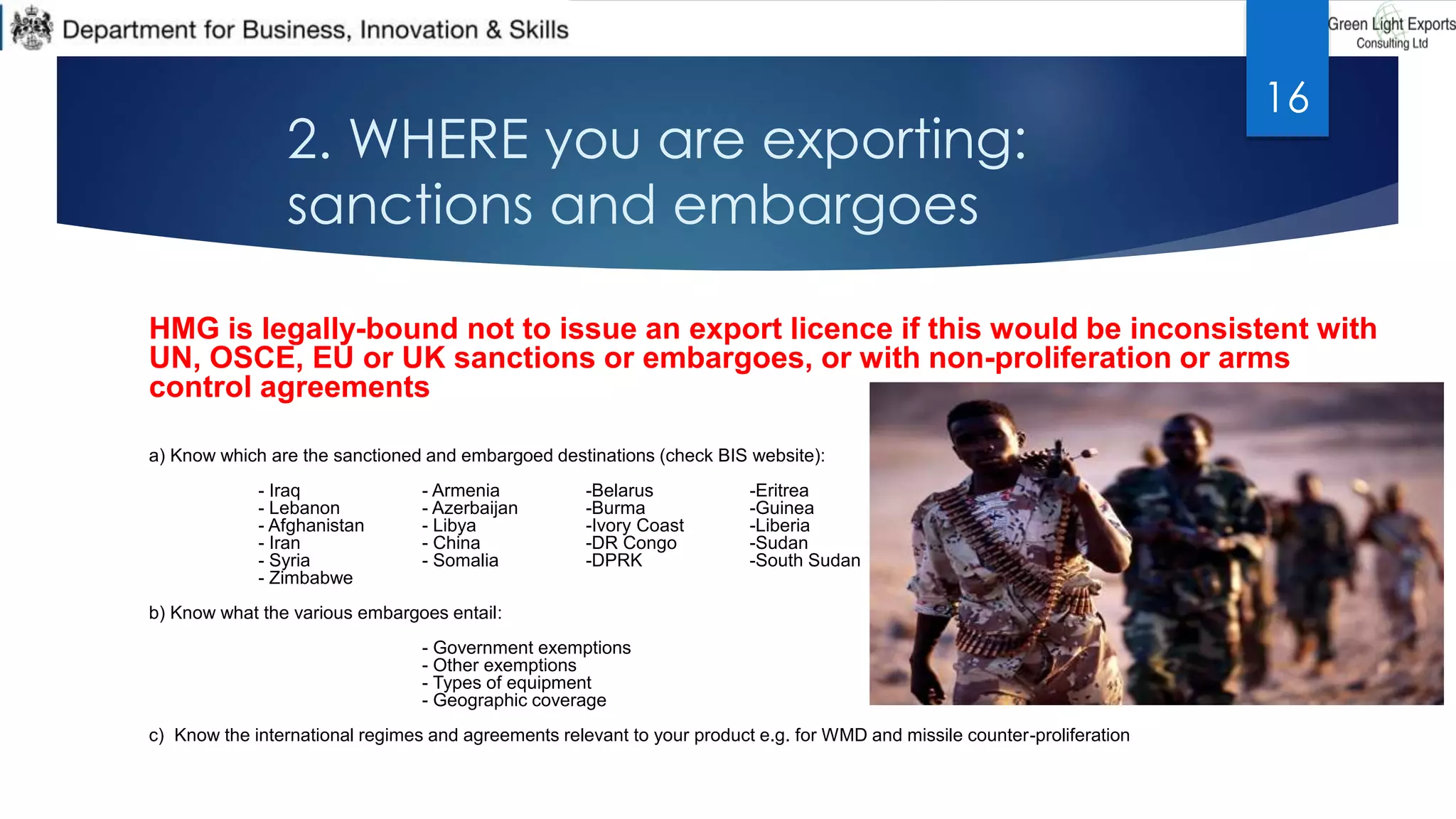
2. WHERE you are exporting:
sanctions and embargoes
HMG is legally-bound not to issue an export licence if this would be inconsistent with
UN, OSCE, EU or UK sanctions or embargoes, or with non-proliferation or arms
control agreements
a) Know which are the sanctioned and embargoed destinations (check BIS website):
- Iraq - Armenia -Belarus -Eritrea
- Lebanon - Azerbaijan -Burma -Guinea
- Afghanistan - Libya -Ivory Coast -Liberia
- Iran - China -DR Congo -Sudan
- Syria - Somalia -DPRK -South Sudan
- Zimbabwe
b) Know what the various embargoes entail:
- Government exemptions
- Other exemptions
- Types of equipment
- Geographic coverage
c) Know the international regimes and agreements relevant to your product e.g. for WMD and missile counter-proliferation
16
3) WHO is the end user
 Check the HM Treasury list whether the Person or
Entity you are exporting to is subject to an asset
freeze. If so, you will need a licence - only granted
exceptionally
 If your export contains any US-sourced elements,
or you do business with the US, also check the US
sanctions lists. Not applicable under UK law but
the US applies extra-territoriality
17
4. HOW will it be used: End Use Controls
 WMD End Use: If an item may be intended for WMD purposes, a licence
is required for:
- All exports or transfers of goods, software or technology from the UK;
- Any transfers of software and technology within the UK or by a UK
person outside the UK (including basic scientific research except if it
is ‘in the public domain’)
 Military End Use: For components or production equipment that the
exporter has been told, knows or suspects are or may be intended for a
military end use in a country subject to an arms embargo, or for use in a
military list item which has been exported in breach of export controls.
 If in doubt, apply to BIS for the End Use advice service
18
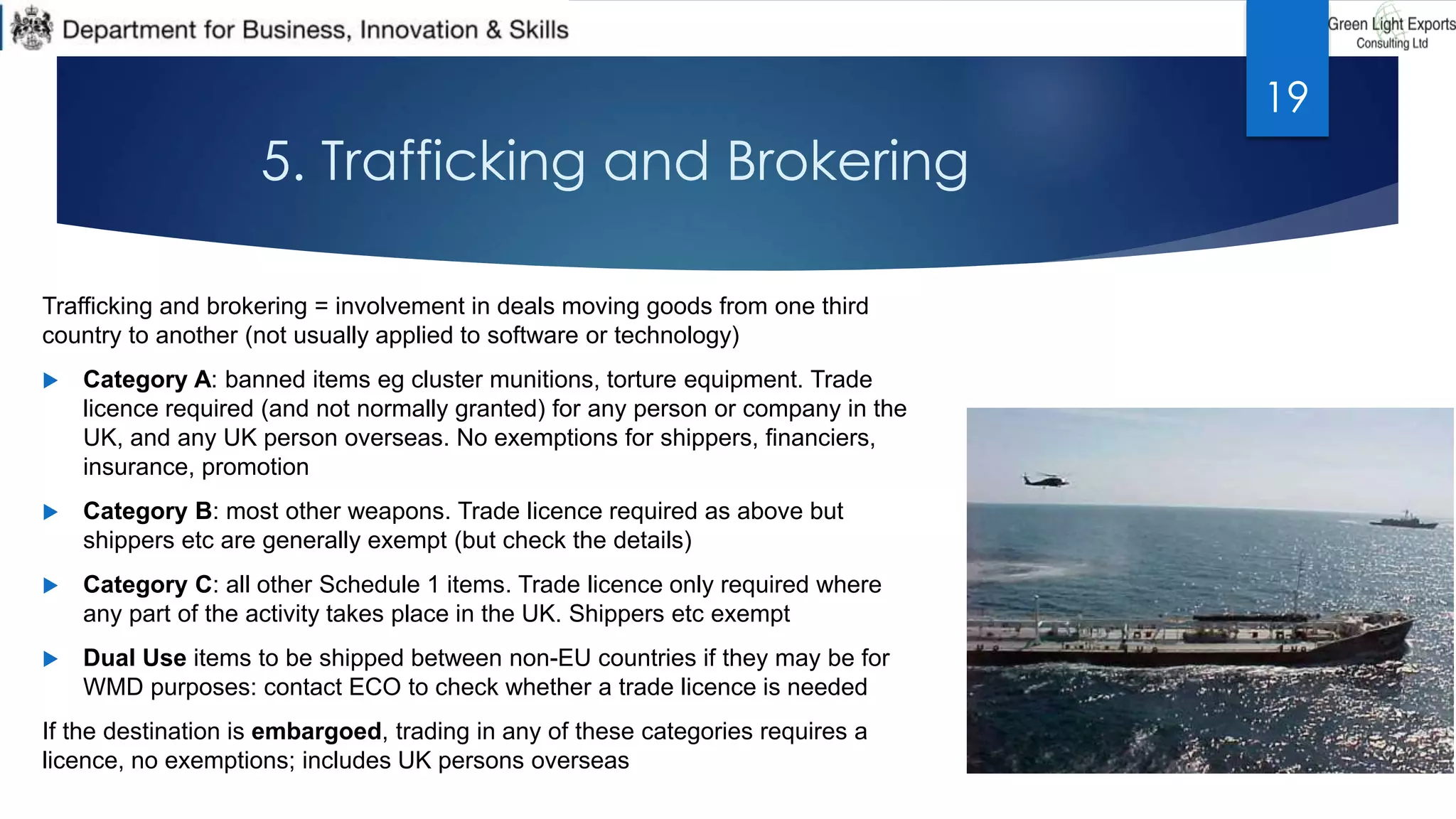
5. Trafficking and Brokering
Trafficking and brokering = involvement in deals moving goods from one third
country to another (not usually applied to software or technology)
 Category A: banned items eg cluster munitions, torture equipment. Trade
licence required (and not normally granted) for any person or company in the
UK, and any UK person overseas. No exemptions for shippers, financiers,
insurance, promotion
 Category B: most other weapons. Trade licence required as above but
shippers etc are generally exempt (but check the details)
 Category C: all other Schedule 1 items. Trade licence only required where
any part of the activity takes place in the UK. Shippers etc exempt
 Dual Use items to be shipped between non-EU countries if they may be for
WMD purposes: contact ECO to check whether a trade licence is needed
If the destination is embargoed, trading in any of these categories requires a
licence, no exemptions; includes UK persons overseas
19
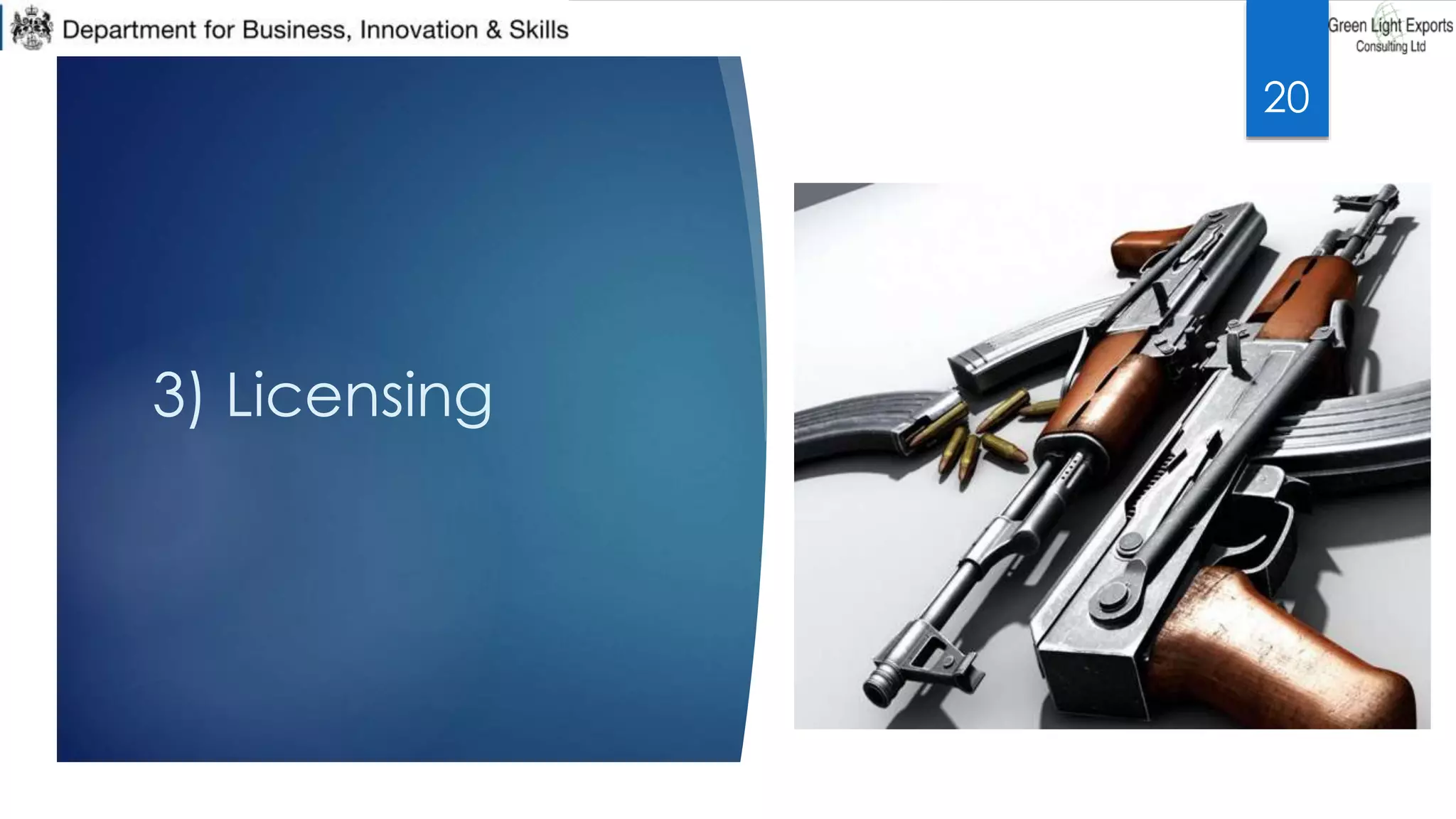
3) Licensing
20
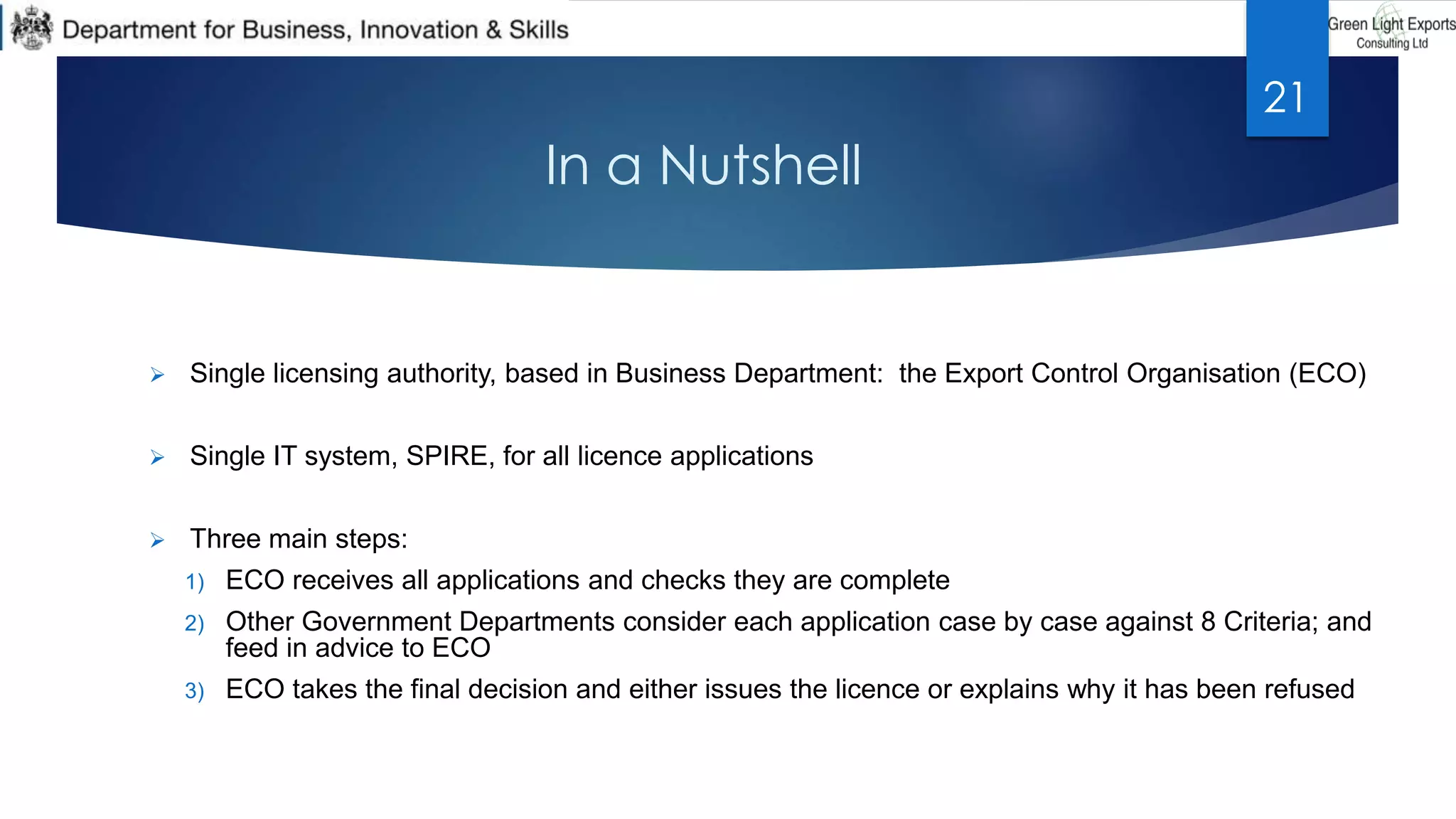
In a Nutshell
 Single licensing authority, based in Business Department: the Export Control Organisation (ECO)
 Single IT system, SPIRE, for all licence applications
 Three main steps:
1) ECO receives all applications and checks they are complete
2) Other Government Departments consider each application case by case against 8 Criteria; and
feed in advice to ECO
3) ECO takes the final decision and either issues the licence or explains why it has been refused
21
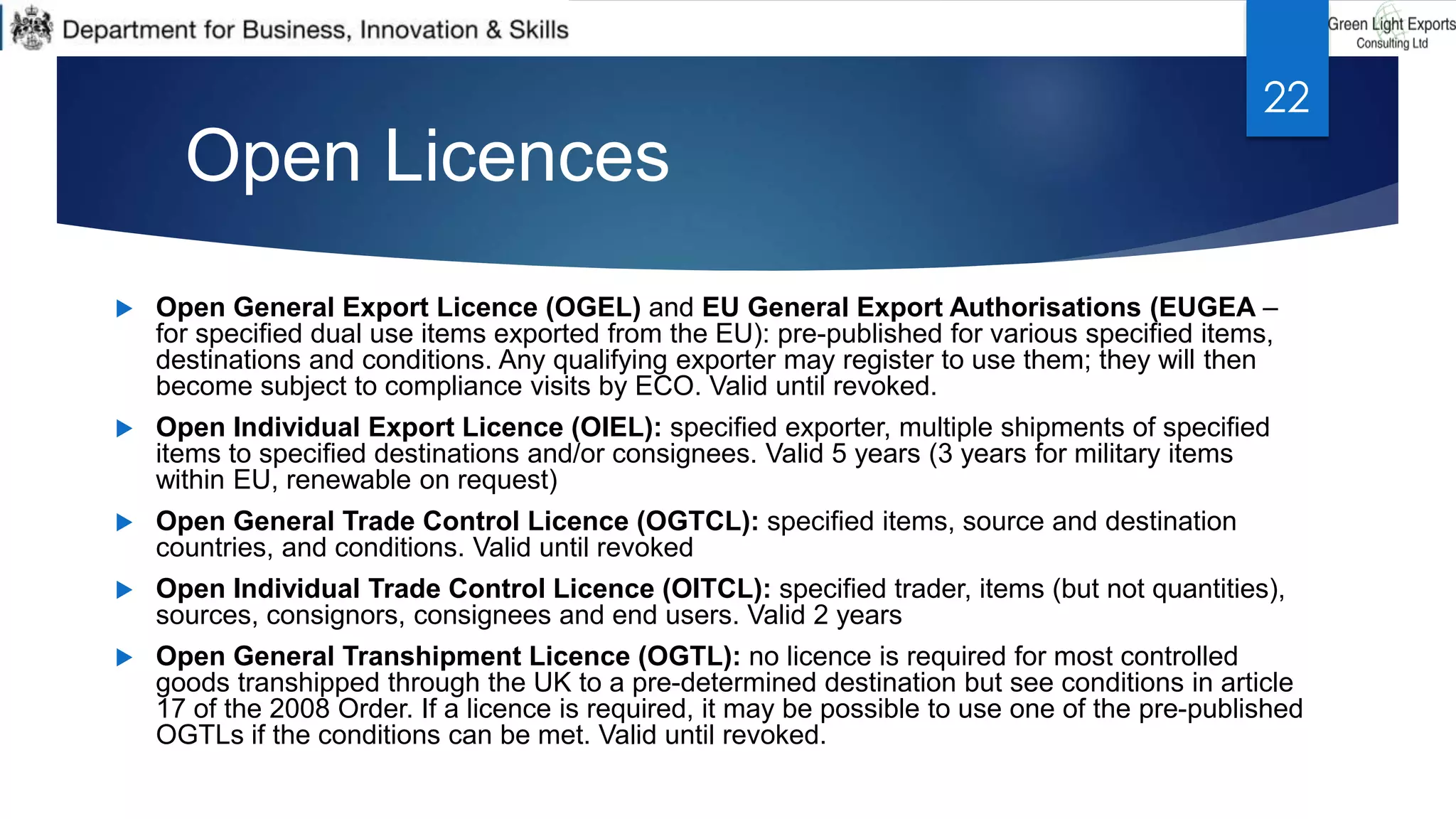
 Open General Export Licence (OGEL) and EU General Export Authorisations (EUGEA –
for specified dual use items exported from the EU): pre-published for various specified items,
destinations and conditions. Any qualifying exporter may register to use them; they will then
become subject to compliance visits by ECO. Valid until revoked.
 Open Individual Export Licence (OIEL): specified exporter, multiple shipments of specified
items to specified destinations and/or consignees. Valid 5 years (3 years for military items
within EU, renewable on request)
 Open General Trade Control Licence (OGTCL): specified items, source and destination
countries, and conditions. Valid until revoked
 Open Individual Trade Control Licence (OITCL): specified trader, items (but not quantities),
sources, consignors, consignees and end users. Valid 2 years
 Open General Transhipment Licence (OGTL): no licence is required for most controlled
goods transhipped through the UK to a pre-determined destination but see conditions in article
17 of the 2008 Order. If a licence is required, it may be possible to use one of the pre-published
OGTLs if the conditions can be met. Valid until revoked.
Open Licences
22
Open General Licences
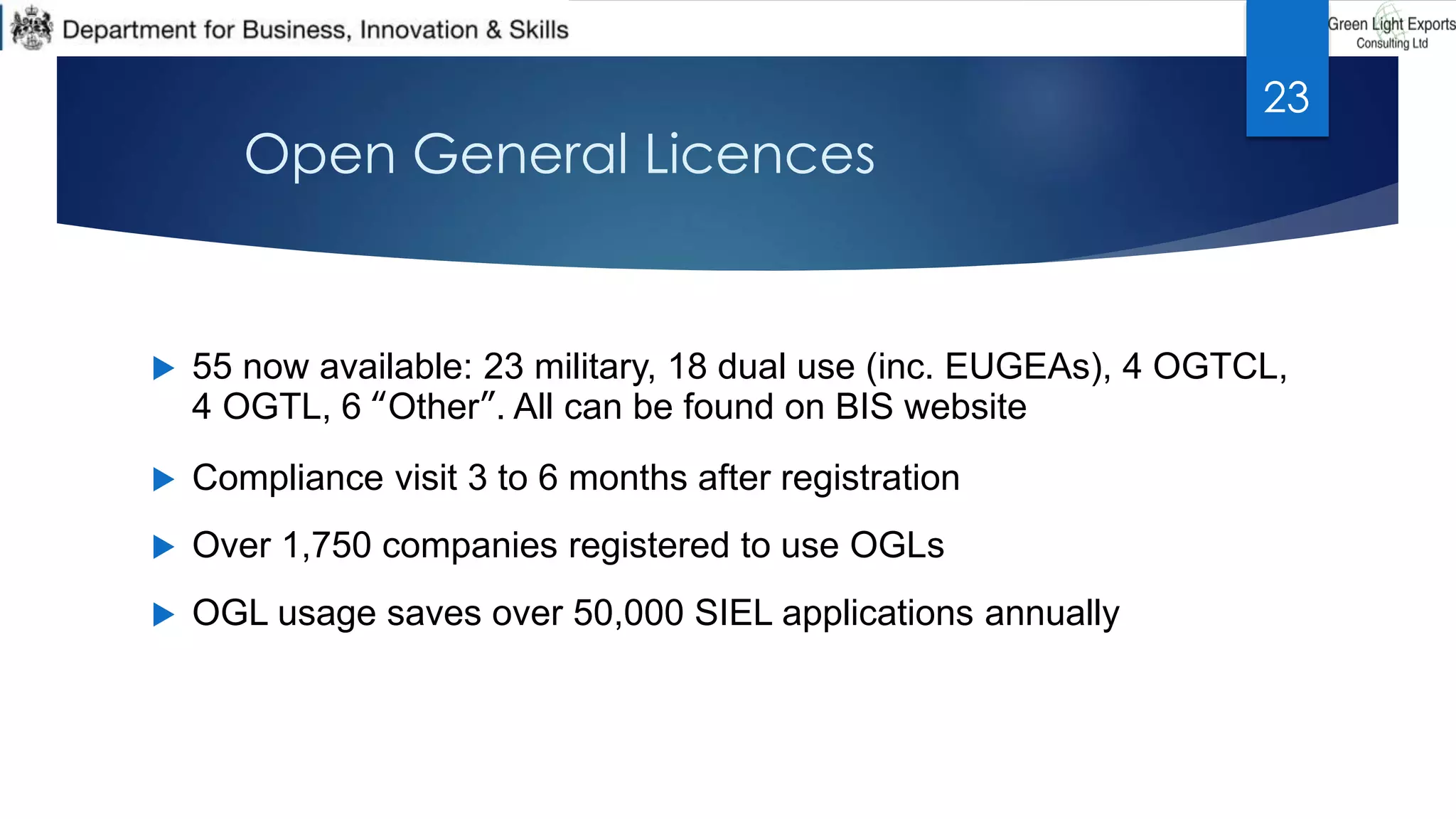
 55 now available: 23 military, 18 dual use (inc. EUGEAs), 4 OGTCL,
4 OGTL, 6 “Other”. All can be found on BIS website
 Compliance visit 3 to 6 months after registration
 Over 1,750 companies registered to use OGLs
 OGL usage saves over 50,000 SIEL applications annually
23
Standard Licences
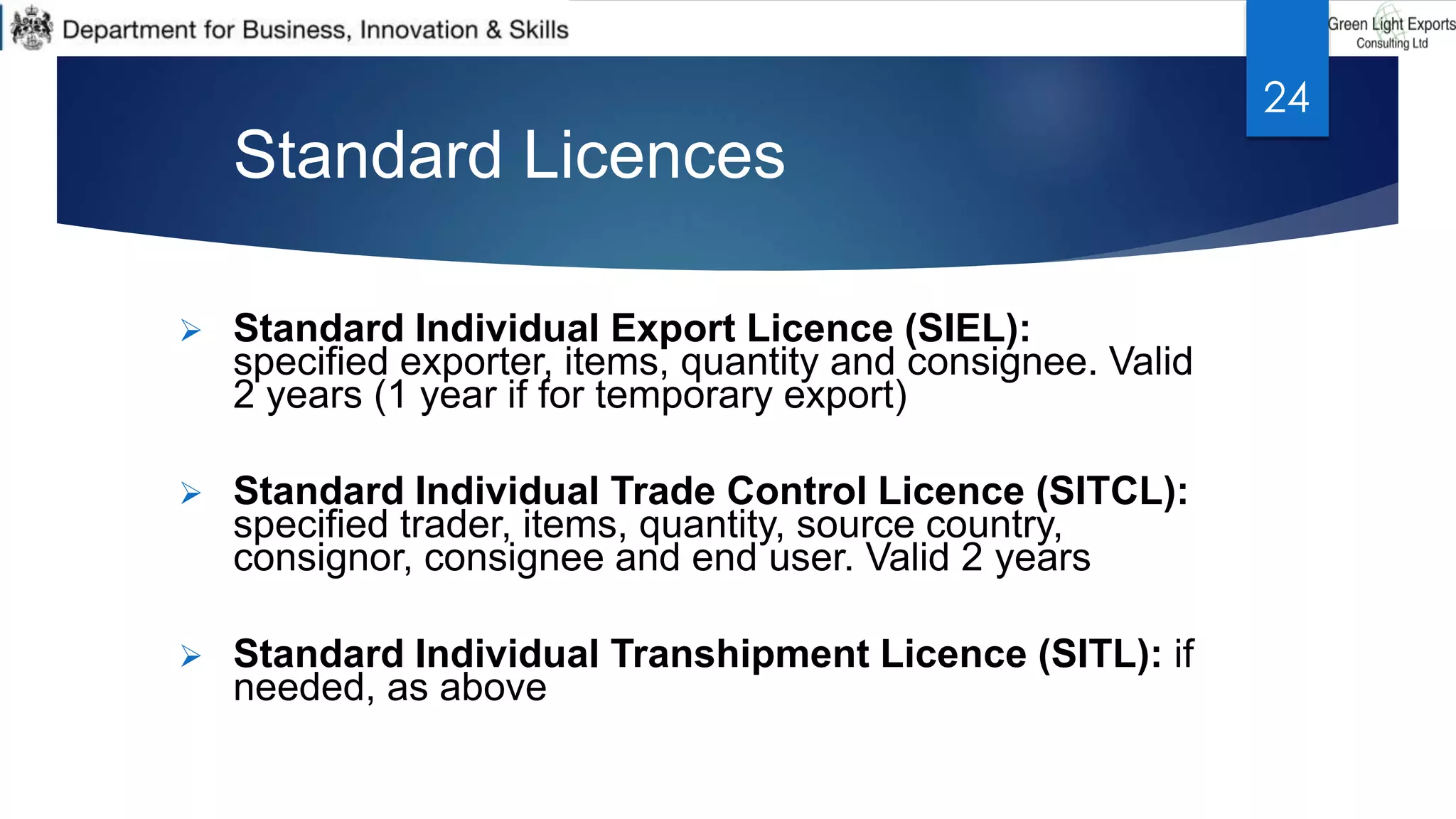
 Standard Individual Export Licence (SIEL):
specified exporter, items, quantity and consignee. Valid
2 years (1 year if for temporary export)
 Standard Individual Trade Control Licence (SITCL):
specified trader, items, quantity, source country,
consignor, consignee and end user. Valid 2 years
 Standard Individual Transhipment Licence (SITL): if
needed, as above
24
MOD F680
 Purpose:
 to control the release of information or equipment
that is protectively marked ‘Official-Sensitive
(Restricted)’ or above to any foreign entity overseas
or when demonstrating it to them in the UK
 Activities covered:
 market survey; promotion; demonstration overseas
and in the UK; software for demonstration OGEL;
Supply, Local Assembly and Local Manufacture
25
How Licence Applications are Assessed:
The Consolidated EU and National Arms Export Licensing Criteria
1. UK’s International Commitments (DECC, FCO, MOD)
2. Human Rights and Internal Repression (FCO)
3. Internal Situation of recipient country (FCO)
4. Regional Stability (FCO)
5. National Security of UK and allies (MOD, CESG)
6. Behaviour of recipient country (FCO)
7. Diversion (FCO, MOD)
8. Economic Sustainability (DfID)
+ Other Factors – commercial, political, strategic
26
Criteria 1-4 are
mandatory
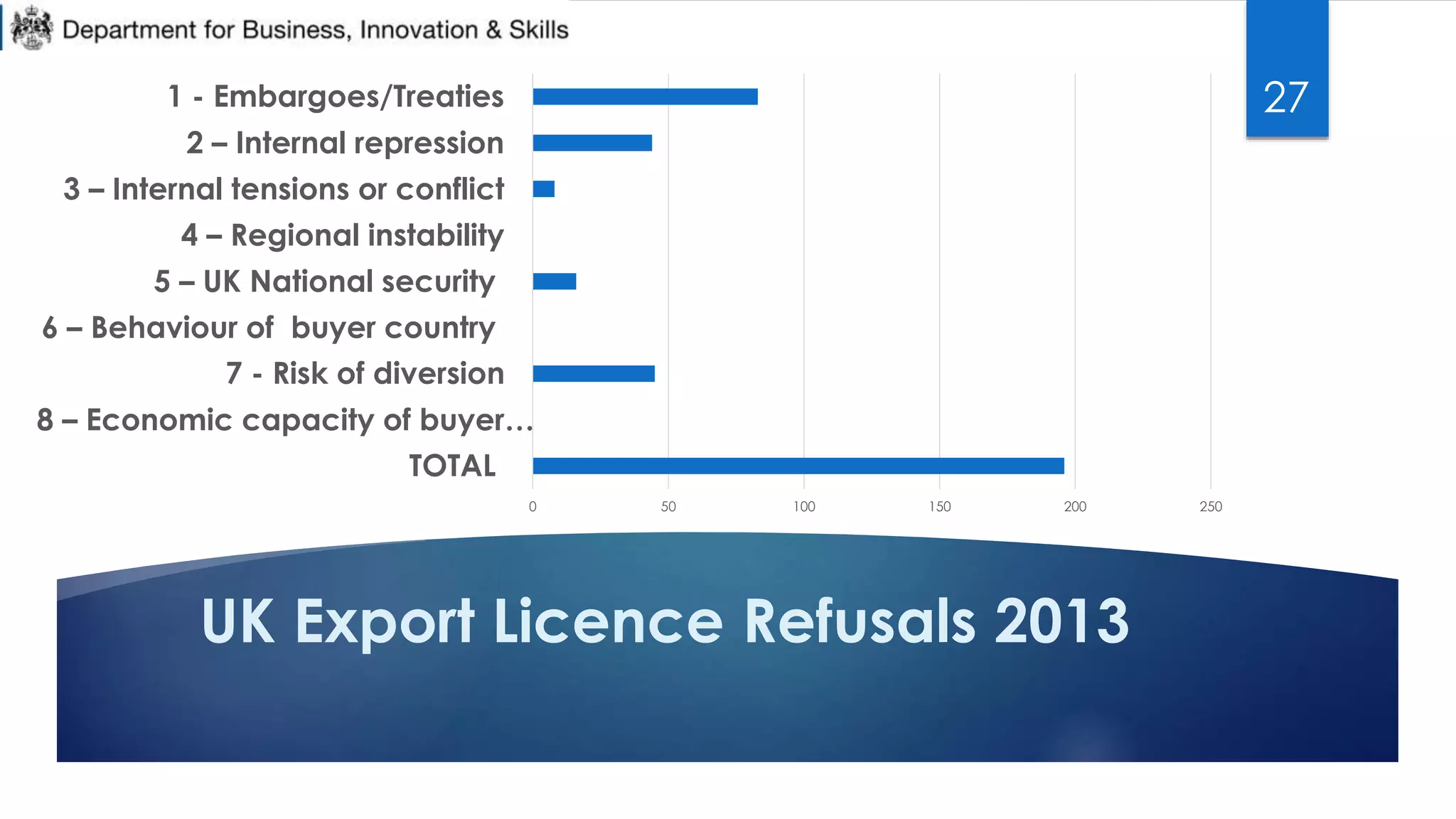
UK Export Licence Refusals 2013
0 50 100 150 200 250
TOTAL
8 – Economic capacity of buyer…
7 - Risk of diversion
6 – Behaviour of buyer country
5 – UK National security
4 – Regional instability
3 – Internal tensions or conflict
2 – Internal repression
1 - Embargoes/Treaties 27
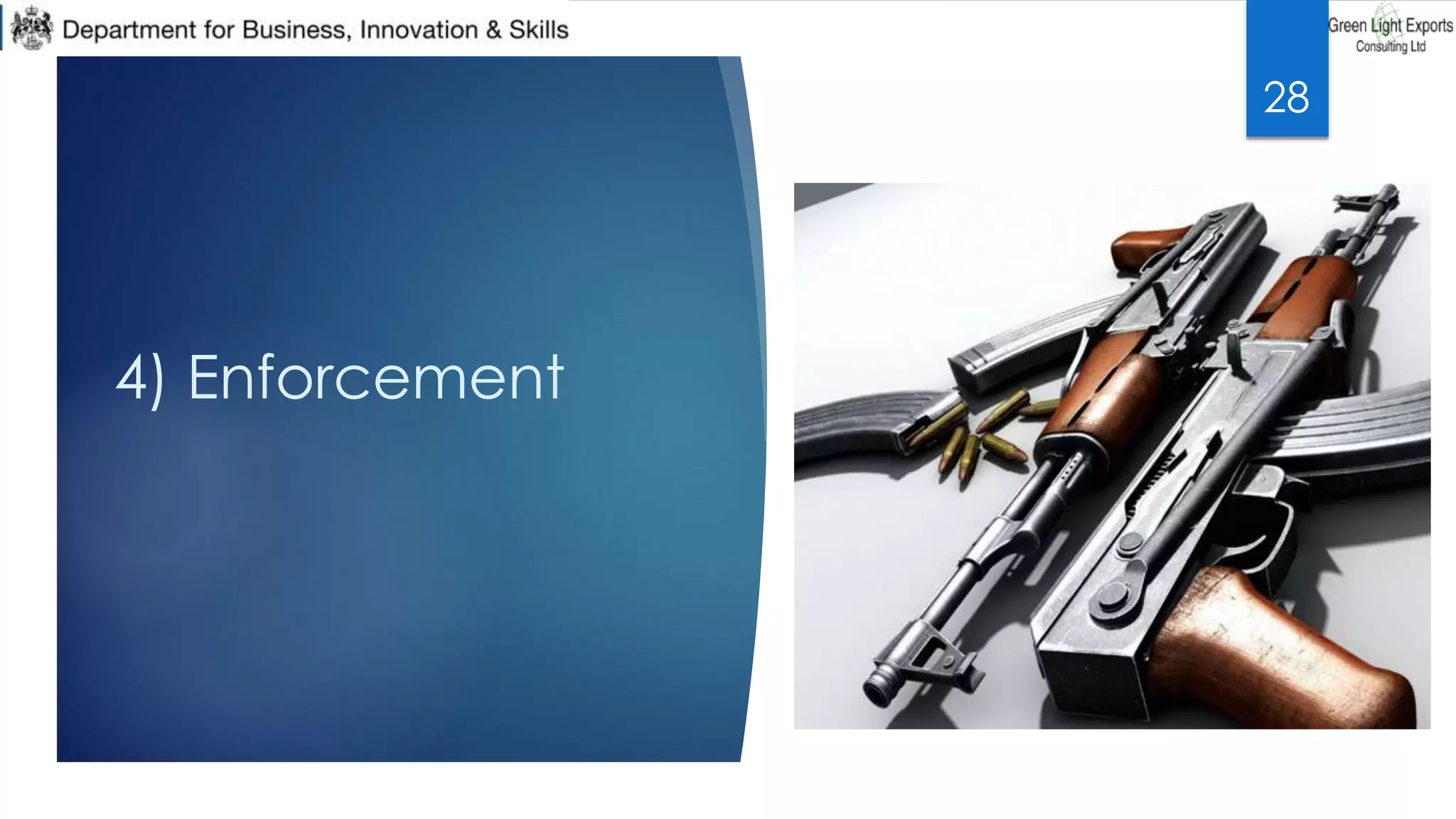
4) Enforcement
28
29
Enforcement
 HMRC and the Crown Prosecution Service
 Strict liability offence, e.g. export or attempted export of controlled goods
without a licence - penalties can vary depending on type of offence.
Ignorance is not an excuse.
 Warning letters
 Revocation of licence
 Seizing goods
 Penalty of up to 3x the value of the goods
 with knowledge of WMD end-use, up to 2 yrs imprisonment
 Deliberate act with intent to evade controls
 Magistrates court - £5,000 or 3 x value of the goods (whichever greater)
and/or 6 months imprisonment
 Crown Court - 10 years imprisonment and unlimited fine
 Crown Court - up to 10 years imprisonment and unlimited fines
29
Voluntary Disclosure
 HMG do not seek to penalise people for an honest
mistake.
 Voluntary Disclosure gives exporters and HMRC the option
to settle the matter without legal proceedings
 Most end with a warning letter, some with a compound
penalty. But a prosecution is not ruled out
30
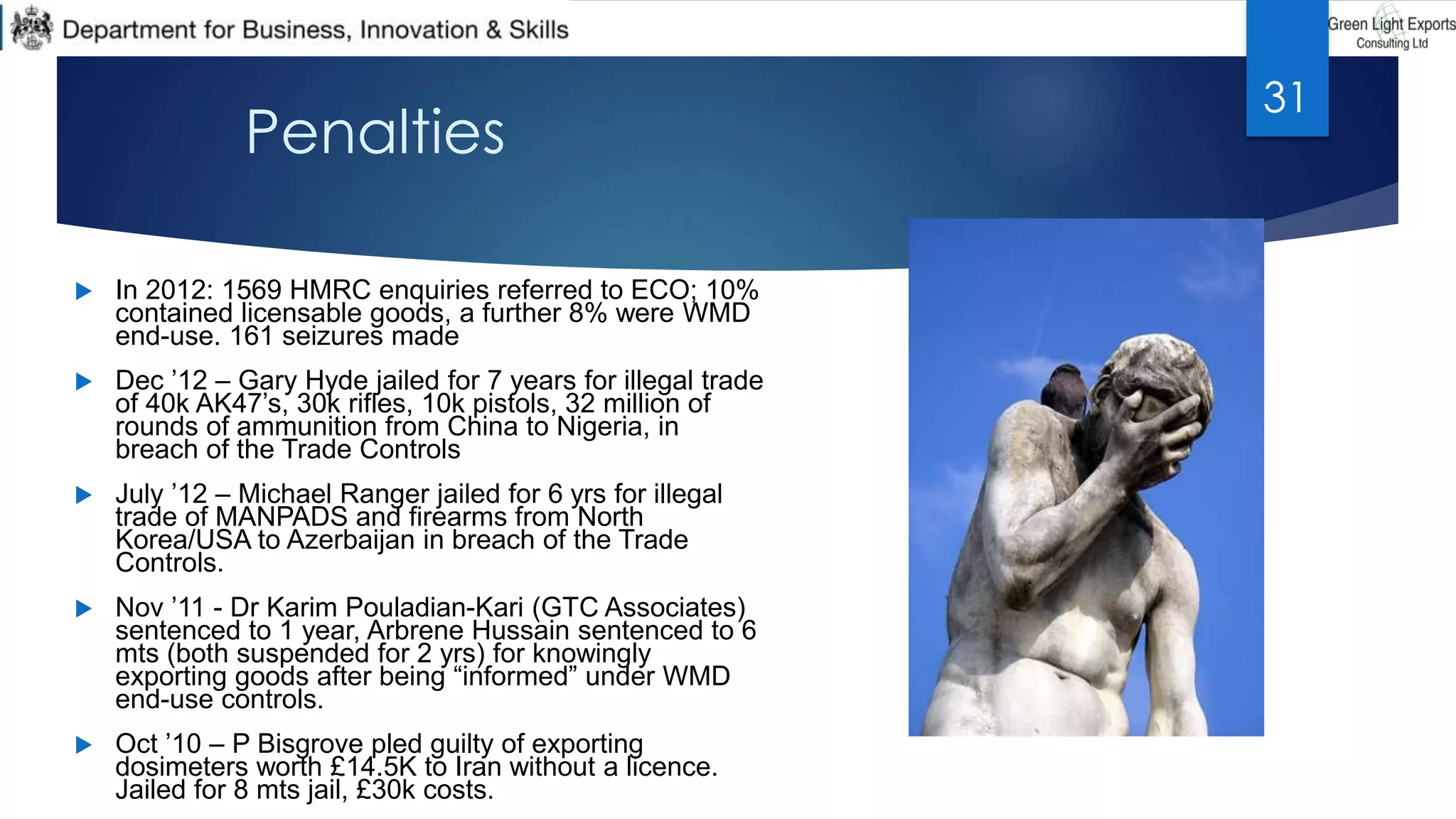
Penalties
 In 2012: 1569 HMRC enquiries referred to ECO; 10%
contained licensable goods, a further 8% were WMD
end-use. 161 seizures made
 Dec ’12 – Gary Hyde jailed for 7 years for illegal trade
of 40k AK47’s, 30k rifles, 10k pistols, 32 million of
rounds of ammunition from China to Nigeria, in
breach of the Trade Controls
 July ’12 – Michael Ranger jailed for 6 yrs for illegal
trade of MANPADS and firearms from North
Korea/USA to Azerbaijan in breach of the Trade
Controls.
 Nov ’11 - Dr Karim Pouladian-Kari (GTC Associates)
sentenced to 1 year, Arbrene Hussain sentenced to 6
mts (both suspended for 2 yrs) for knowingly
exporting goods after being “informed” under WMD
end-use controls.
 Oct ’10 – P Bisgrove pled guilty of exporting
dosimeters worth £14.5K to Iran without a licence.
Jailed for 8 mts jail, £30k costs.
31
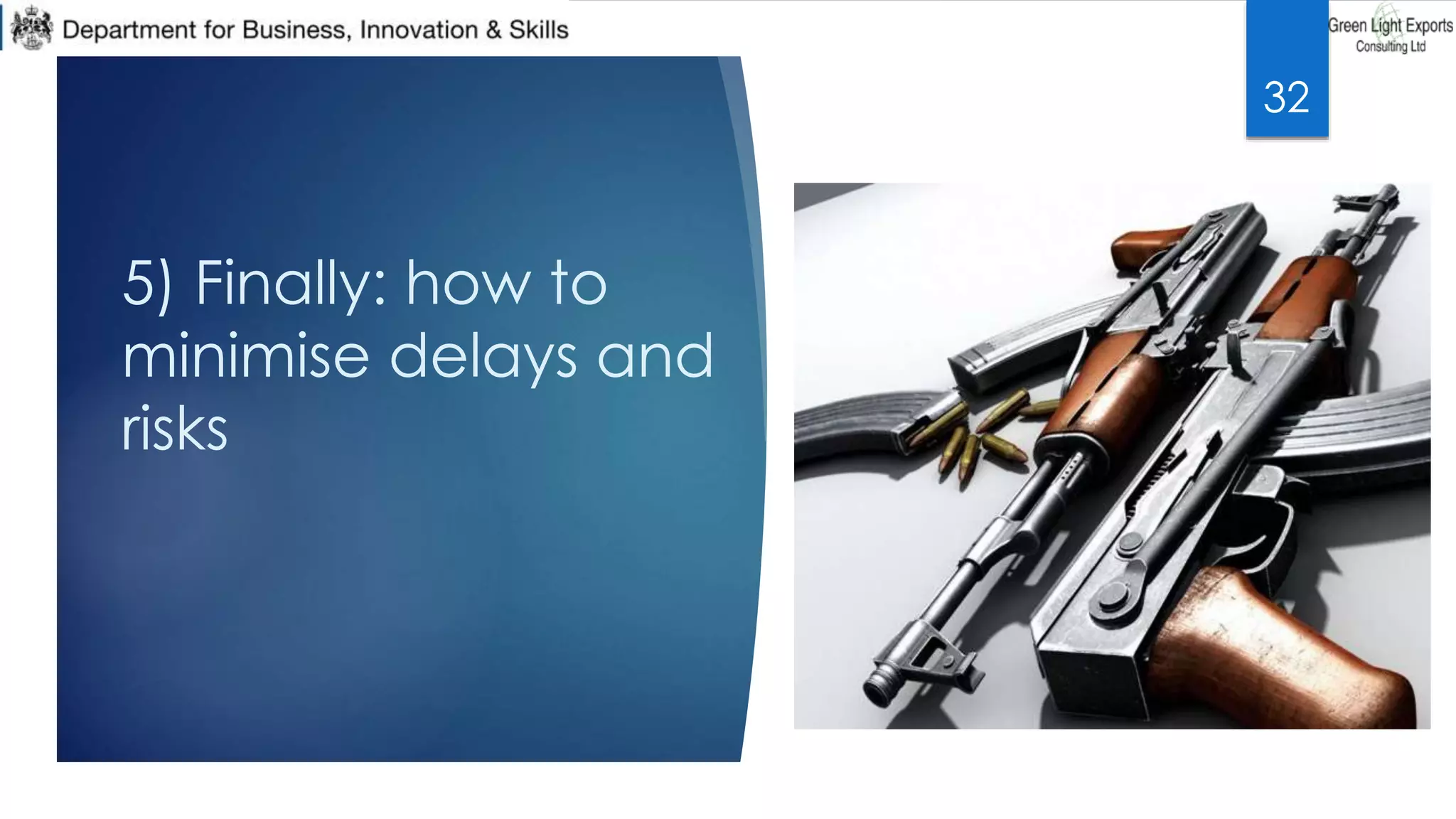
5) Finally: how to
minimise delays and
risks
32
Minimise Risks in Licence Applications
1. Understand where and why your items are in the control lists
2. Think about associated software and technology and how it is
transferred
3. Be aware of political situation of the country of destination and any
sanctions or embargoes
4. Are there any end use concerns
5. Ensure staff have appropriate level of awareness and training
6. Read the terms and conditions of all licences
7. Build export control checks into your processes and record-keeping
8. Register and/or apply for applicable licences in plenty of time
33
Make your licence application faster
The median processing time for a SIEL is 13 days: but 23 days if further
information has to be requested from you
 Give both technical and non-technical information about the product. Say
what it is and what it does
 Say who exactly is the end user; have you dealt with them before, do they
have a credible and legitimate use for your export?
 Get the end user, and only the end user, to sign clearly (not electronically)
the End User Undertaking
34
Help and Advice
Support from BIS:
 Internet Guides and Access to SPIRE
 Check OGELs available www.ecochecker.bis.gov.uk
 Awareness seminars and workshops http://tinyurl.com/eco-training-courses
 “Notices to Exporters” http://blogs.bis.gov.uk/exportcontrol
 Advice: eco.help@bis.gsi.gov.uk or 020 7215 4594
Support from Green Light Exports:
 Training and advice tailored to your needs on all aspects of UK, EU and US export controls
 Identifying exports which are likely to be refused a licence before you invest resources in marketing etc.
 Identifying opportunities within the constraints of sanctions and embargoes
 assessing the risks of sensitive exports which are not yet controlled e.g. some cyber surveillance kit
35
Thank you -
Any questions?
36
Richard Tauwhare
Green Light Exports Consulting
Email: richard@greenlightexports.co.uk
Web: www.greenlightexports.co.uk
Phone: +44(0)770 311 0880

UK Export Controls Overview

  • 1.
    UK Export ControlsOverview Export Growth Seminar Belfast, 2 July 2014 Richard Tauwhare Green Light Exports Consulting 1
  • 2.
    Brief for today 1)Why have export controls? 2) What is controlled? 3) Licensing 4) Enforcement 5) Minimise delays and risks 2
  • 3.
    1) Why haveexport controls? 3
  • 4.
    UK Government Policy “..theGovernment are committed to  the maintenance of a strong defence industry as part of our industrial base as well as of our defence effort, and  recognises that defence exports can also contribute to international stability by strengthening collective defence relationships;  but believe that arms transfers must be managed responsibly.” 4
  • 5.
     May breachsanctions, embargoes or other international agreements, and undermine international security  May proliferate WMD  May compromise UK and our allies security  May violate human rights or international humanitarian law  May undermine internal or regional stability and fuel conflict  May fall into the hands of terrorists or criminals Getting it wrong – or, worse, ignoring it altogether - can have significant consequences for your business, the UK and globally Irresponsible exports 5
  • 6.
    Promoting legitimate tradewhile preventing the misuse of UK exports 6 HMG’s aim is to administer the controls to minimise both these risks to the UK and the impact on UK business
  • 7.
    Where do thecontrols come from?  International Treaties, Conventions and Regimes  National defence interests and foreign policy objectives  Human Rights considerations UK Law  Export Control Act 2002  Export Control Order 2008 (as amended)  Export of Radioactive Sources (Control) Order 2006 EU Law  Council Regulation (EC) No. 428/2009 (the Dual Use Regulation)  Council Regulation (EC) No. 1236/2005 (the “Torture Regulation”) 7
  • 8.
    Towards a LevelPlaying Field  Export Controls are not unique to the UK – all countries have some form of controls  The UK is firmly committed to implementing export controls rigorously. We work closely with others countries to encourage and where necessary help them to meet the same standards.  The strategic export controls that the UK operates are comprehensive are closely based on internationally-agreed standards and lists, compiled and up-dated by experts who meet regularly to discuss and agree what needs to be controlled or de-controlled. UK experts play a leading role in all these international fora  The regimes and EU seek to ensure a level playing field by policing members’ adherence to the agreed controls and seeking to ensure that if a licence is denied by one member the other members abide by that decision 8
  • 9.
  • 10.
    What is controlled? FiveQuestions: 1) What you export 2) Where you are exporting to 3) Who is the end user 4) How it will be used 5) Are you trafficking or brokering 10
  • 11.
    WHAT: UK StrategicExport Control List A comprehensive compilation of the 7 lists of items which are controlled under UK and EU law:  UK Lists 1) UK Military List (Schedule 2 of the Export Control Order 2008) 2) UK Dual-Use List (Schedule 3 of the Export Control Order 2008) 3) UK National Security and Paramilitary List (Article 9 of Export Control Order 2008) 4) UK National Radioactive Sources List (Schedule in Article 2 of Export of Radioactive Sources (Control) Order 2006)  EU Lists 5) EU Dual-Use List for exports outside the EU (Annex I of the EU Dual-Use Regulation 428/2009) 6) EU Dual-Use List for exports both within and outside the EU (Annex IV to EU Dual-Use Regulation 428/2009) 7) EU Human Rights List (Annexes II and III of 2005 EC Regulation 1236/2005)  NB The lists are updated regularly: check the BIS website and subscribe to Notices for Exporters 11
  • 12.
    1) WHAT: UKMilitary List  Either: items controlled because of what they are - e.g. firearms, explosives, chemicals, police & security equip.  Or: items “specially designed or modified for military use”  includes components and all related software and technology  Licence required for exports to all destinations 12
  • 13.
    UK MilitaryList –items that have been ‘specially designed or modified for military use including components ML1 and ML2 – All rifled and smooth bore weapons & components ML3 - Ammunition and components for ML1, ML2 and ML12 ML4 - Bombs, grenades, rockets, missiles, components and accessories ML5 - Devices for fire control, components and accessories and countermeasure equipment ML6 - Ground vehicles and components ML7 and ML8 - Explosives and chemicals ML9 - Vessels, special naval equipment, accessories and components ML10 - Aircraft, unmanned airborne vehicles, aero-engines ML11 – Guidance/navigation equipment, electronic equipment ML12 - High velocity kinetic energy weapon systems ML13 - Armour plate, body armour, military helmets ML14 - Simulators and training equipment ML15 - Imaging equipment ML16 - Forging, castings and unfinished products ML17 - Miscellaneous goods including diving equipment, ferries, containers ML18 - Production equipment ML19 - Directed weapon systems ML21 - Software for listed goods ML22 - Technology for listed goods PL5017 - Equipment and test models PL5001 - Paramilitary goods 13
  • 14.
    1) WHAT: Dual-UseLists  ‘Dual-Use’ = items which have both military AND civil applications  EU Regulation:  Annex I: only require a licence for export outside the EU  Annex IV: require a licence within and outside the EU  Includes related software and technology  Brokering controls on goods which may be for WMD end-use  Additional UK national dual-use controls on eg execution chemicals, tasers, CIED, radioactive sources 14
  • 15.
    Category 0 – NuclearMaterials, Facilities & Equipment 1 – Special Materials and Related Equipment 2 – Materials Processing 3 – Electronics 4 – Computers 5 – Telecommunications & Information Security 6 – Sensors & Lasers 7 – Navigation & Avionics 8 – Marine 9 – Aerospace & Propulsion 8A002a3 Umbilical cables, and connectors therefor, using optical fibre and having synthetic strength members, specially designed for submersible vehicles, designed to operate at depths > 1,000 m Sub-Category A – Systems, Equipment & Components B – Test, Inspection & Production Equipment C – Materials D – Software E – Technology Regime Origin 0 – Wassenaar Arrangement 1 – Missile Technology Control Regime 2 – Nuclear Suppliers Group 3 – Australia Group 4 – Chemical Weapons Convention Item’s individual entry code Dual-UseGoods Control EntryExample 15
  • 16.
    2. WHERE youare exporting: sanctions and embargoes HMG is legally-bound not to issue an export licence if this would be inconsistent with UN, OSCE, EU or UK sanctions or embargoes, or with non-proliferation or arms control agreements a) Know which are the sanctioned and embargoed destinations (check BIS website): - Iraq - Armenia -Belarus -Eritrea - Lebanon - Azerbaijan -Burma -Guinea - Afghanistan - Libya -Ivory Coast -Liberia - Iran - China -DR Congo -Sudan - Syria - Somalia -DPRK -South Sudan - Zimbabwe b) Know what the various embargoes entail: - Government exemptions - Other exemptions - Types of equipment - Geographic coverage c) Know the international regimes and agreements relevant to your product e.g. for WMD and missile counter-proliferation 16
  • 17.
    3) WHO isthe end user  Check the HM Treasury list whether the Person or Entity you are exporting to is subject to an asset freeze. If so, you will need a licence - only granted exceptionally  If your export contains any US-sourced elements, or you do business with the US, also check the US sanctions lists. Not applicable under UK law but the US applies extra-territoriality 17
  • 18.
    4. HOW willit be used: End Use Controls  WMD End Use: If an item may be intended for WMD purposes, a licence is required for: - All exports or transfers of goods, software or technology from the UK; - Any transfers of software and technology within the UK or by a UK person outside the UK (including basic scientific research except if it is ‘in the public domain’)  Military End Use: For components or production equipment that the exporter has been told, knows or suspects are or may be intended for a military end use in a country subject to an arms embargo, or for use in a military list item which has been exported in breach of export controls.  If in doubt, apply to BIS for the End Use advice service 18
  • 19.
    5. Trafficking andBrokering Trafficking and brokering = involvement in deals moving goods from one third country to another (not usually applied to software or technology)  Category A: banned items eg cluster munitions, torture equipment. Trade licence required (and not normally granted) for any person or company in the UK, and any UK person overseas. No exemptions for shippers, financiers, insurance, promotion  Category B: most other weapons. Trade licence required as above but shippers etc are generally exempt (but check the details)  Category C: all other Schedule 1 items. Trade licence only required where any part of the activity takes place in the UK. Shippers etc exempt  Dual Use items to be shipped between non-EU countries if they may be for WMD purposes: contact ECO to check whether a trade licence is needed If the destination is embargoed, trading in any of these categories requires a licence, no exemptions; includes UK persons overseas 19
  • 20.
  • 21.
    In a Nutshell Single licensing authority, based in Business Department: the Export Control Organisation (ECO)  Single IT system, SPIRE, for all licence applications  Three main steps: 1) ECO receives all applications and checks they are complete 2) Other Government Departments consider each application case by case against 8 Criteria; and feed in advice to ECO 3) ECO takes the final decision and either issues the licence or explains why it has been refused 21
  • 22.
     Open GeneralExport Licence (OGEL) and EU General Export Authorisations (EUGEA – for specified dual use items exported from the EU): pre-published for various specified items, destinations and conditions. Any qualifying exporter may register to use them; they will then become subject to compliance visits by ECO. Valid until revoked.  Open Individual Export Licence (OIEL): specified exporter, multiple shipments of specified items to specified destinations and/or consignees. Valid 5 years (3 years for military items within EU, renewable on request)  Open General Trade Control Licence (OGTCL): specified items, source and destination countries, and conditions. Valid until revoked  Open Individual Trade Control Licence (OITCL): specified trader, items (but not quantities), sources, consignors, consignees and end users. Valid 2 years  Open General Transhipment Licence (OGTL): no licence is required for most controlled goods transhipped through the UK to a pre-determined destination but see conditions in article 17 of the 2008 Order. If a licence is required, it may be possible to use one of the pre-published OGTLs if the conditions can be met. Valid until revoked. Open Licences 22
  • 23.
    Open General Licences 55 now available: 23 military, 18 dual use (inc. EUGEAs), 4 OGTCL, 4 OGTL, 6 “Other”. All can be found on BIS website  Compliance visit 3 to 6 months after registration  Over 1,750 companies registered to use OGLs  OGL usage saves over 50,000 SIEL applications annually 23
  • 24.
    Standard Licences  StandardIndividual Export Licence (SIEL): specified exporter, items, quantity and consignee. Valid 2 years (1 year if for temporary export)  Standard Individual Trade Control Licence (SITCL): specified trader, items, quantity, source country, consignor, consignee and end user. Valid 2 years  Standard Individual Transhipment Licence (SITL): if needed, as above 24
  • 25.
    MOD F680  Purpose: to control the release of information or equipment that is protectively marked ‘Official-Sensitive (Restricted)’ or above to any foreign entity overseas or when demonstrating it to them in the UK  Activities covered:  market survey; promotion; demonstration overseas and in the UK; software for demonstration OGEL; Supply, Local Assembly and Local Manufacture 25
  • 26.
    How Licence Applicationsare Assessed: The Consolidated EU and National Arms Export Licensing Criteria 1. UK’s International Commitments (DECC, FCO, MOD) 2. Human Rights and Internal Repression (FCO) 3. Internal Situation of recipient country (FCO) 4. Regional Stability (FCO) 5. National Security of UK and allies (MOD, CESG) 6. Behaviour of recipient country (FCO) 7. Diversion (FCO, MOD) 8. Economic Sustainability (DfID) + Other Factors – commercial, political, strategic 26 Criteria 1-4 are mandatory
  • 27.
    UK Export LicenceRefusals 2013 0 50 100 150 200 250 TOTAL 8 – Economic capacity of buyer… 7 - Risk of diversion 6 – Behaviour of buyer country 5 – UK National security 4 – Regional instability 3 – Internal tensions or conflict 2 – Internal repression 1 - Embargoes/Treaties 27
  • 28.
  • 29.
    29 Enforcement  HMRC andthe Crown Prosecution Service  Strict liability offence, e.g. export or attempted export of controlled goods without a licence - penalties can vary depending on type of offence. Ignorance is not an excuse.  Warning letters  Revocation of licence  Seizing goods  Penalty of up to 3x the value of the goods  with knowledge of WMD end-use, up to 2 yrs imprisonment  Deliberate act with intent to evade controls  Magistrates court - £5,000 or 3 x value of the goods (whichever greater) and/or 6 months imprisonment  Crown Court - 10 years imprisonment and unlimited fine  Crown Court - up to 10 years imprisonment and unlimited fines 29
  • 30.
    Voluntary Disclosure  HMGdo not seek to penalise people for an honest mistake.  Voluntary Disclosure gives exporters and HMRC the option to settle the matter without legal proceedings  Most end with a warning letter, some with a compound penalty. But a prosecution is not ruled out 30
  • 31.
    Penalties  In 2012:1569 HMRC enquiries referred to ECO; 10% contained licensable goods, a further 8% were WMD end-use. 161 seizures made  Dec ’12 – Gary Hyde jailed for 7 years for illegal trade of 40k AK47’s, 30k rifles, 10k pistols, 32 million of rounds of ammunition from China to Nigeria, in breach of the Trade Controls  July ’12 – Michael Ranger jailed for 6 yrs for illegal trade of MANPADS and firearms from North Korea/USA to Azerbaijan in breach of the Trade Controls.  Nov ’11 - Dr Karim Pouladian-Kari (GTC Associates) sentenced to 1 year, Arbrene Hussain sentenced to 6 mts (both suspended for 2 yrs) for knowingly exporting goods after being “informed” under WMD end-use controls.  Oct ’10 – P Bisgrove pled guilty of exporting dosimeters worth £14.5K to Iran without a licence. Jailed for 8 mts jail, £30k costs. 31
  • 32.
    5) Finally: howto minimise delays and risks 32
  • 33.
    Minimise Risks inLicence Applications 1. Understand where and why your items are in the control lists 2. Think about associated software and technology and how it is transferred 3. Be aware of political situation of the country of destination and any sanctions or embargoes 4. Are there any end use concerns 5. Ensure staff have appropriate level of awareness and training 6. Read the terms and conditions of all licences 7. Build export control checks into your processes and record-keeping 8. Register and/or apply for applicable licences in plenty of time 33
  • 34.
    Make your licenceapplication faster The median processing time for a SIEL is 13 days: but 23 days if further information has to be requested from you  Give both technical and non-technical information about the product. Say what it is and what it does  Say who exactly is the end user; have you dealt with them before, do they have a credible and legitimate use for your export?  Get the end user, and only the end user, to sign clearly (not electronically) the End User Undertaking 34
  • 35.
    Help and Advice Supportfrom BIS:  Internet Guides and Access to SPIRE  Check OGELs available www.ecochecker.bis.gov.uk  Awareness seminars and workshops http://tinyurl.com/eco-training-courses  “Notices to Exporters” http://blogs.bis.gov.uk/exportcontrol  Advice: eco.help@bis.gsi.gov.uk or 020 7215 4594 Support from Green Light Exports:  Training and advice tailored to your needs on all aspects of UK, EU and US export controls  Identifying exports which are likely to be refused a licence before you invest resources in marketing etc.  Identifying opportunities within the constraints of sanctions and embargoes  assessing the risks of sensitive exports which are not yet controlled e.g. some cyber surveillance kit 35
  • 36.
    Thank you - Anyquestions? 36 Richard Tauwhare Green Light Exports Consulting Email: richard@greenlightexports.co.uk Web: www.greenlightexports.co.uk Phone: +44(0)770 311 0880