Export Control Fundamental for Compliance Managers   ICPA Jasper Helder, Baker & McKenzie, Amsterdam [email_address]
Compliance checklist (1) What is your product? Understand your product Does it fall within a control list?
Compliance checklist (2) For what will/can your product be used? What is (or could be) the end-use that the product is being supplied for?  Will the supply be caught by a controlled end-use?
Compliance checklist (3) Whom are you supplying to? Who is your customer? Does your customer raise end-use concerns? Is your customer a “prohibited party”? What about other third parties? (Parents, affiliates, directors, primary contractors, sub-contractors, end-users)
Compliance checklist (4) Where are you supplying to? What country is the customer/end-user based in? Does it raise end-use concerns? Is it subject to any relevant sanctions regime?
The US controls – where the action is(?)
When are US Trade Restrictions Relevant to Non-US Transactions? Whenever the transaction involves  either : “ US origin”/“US content” goods, software or technology OR “ US persons”
Restrictions on US Origin/Content Items Exports from the US  Reexports from third countries of 100% US origin items (e.g. UK to Iran) Exports/reexports of non-US items with more than  de minimis  controlled US content In some limited cases, exports/reexports of certain non-US items with no US content but based on US technology
Deemed Exports/Reexports Any release of technology/software to a foreign national is a deemed export/reexport to that foreign national’s home country (e.g. to Iranian or Indian engineer based in UK) Releases: Visual inspection of US origin equipment/facilities Oral exchanges of information in US or abroad Application to situations abroad of personal knowledge/technical expertise acquired in US
Destination Cuba, Iran, Sudan, Syria, North Korea Virtually all exports/reexports prohibited Other countries  Check Country Chart (Part 738 of EAR) to see if licence required based on ECCN ‘Reason for Control’
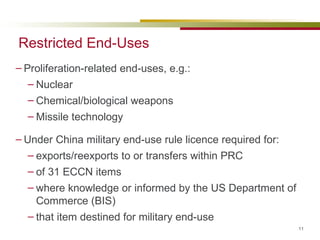
Restricted End-Uses Proliferation-related end-uses, e.g.: Nuclear Chemical/biological weapons Missile technology Under China military end-use rule licence required for: exports/reexports to or transfers within PRC of 31 ECCN items where knowledge or informed by the US Department of Commerce (BIS) that item destined for military end-use
Restrictions on “US Persons” Sanctioned countries Sanctioned persons
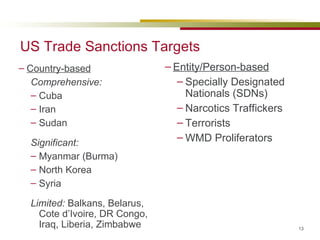
US Trade Sanctions Targets Country-based Comprehensive: Cuba Iran Sudan Significant: Myanmar (Burma) North Korea Syria  Limited:  Balkans, Belarus, Cote d’Ivoire, DR Congo, Iraq, Liberia, Zimbabwe Entity/Person-based Specially Designated Nationals (SDNs) Narcotics Traffickers Terrorists WMD Proliferators
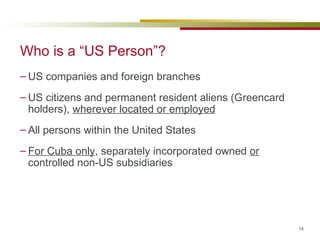
Who is a “US Person”? US companies and foreign branches US citizens and permanent resident aliens (Greencard holders),  wherever located or employed All persons within the United States For Cuba only , separately incorporated owned  or  controlled non-US subsidiaries
Basic Prohibitions All forms of US person involvement in transactions that directly/indirectly involve a sanctioned country/person US Person  facilitation  of transactions by non-US Persons
Examples of Prohibited Activities Supply of product/services Approvals/directions Financing, bank guarantees, warranties Referral of orders to non-US persons Negotiation/review of commercial terms/contracts Strategising business Other support (technical, legal, credit review, etc.) Changing or ignoring company policies/procedures to eliminate US person involvement Limited permissible activities: Legal advice on compliance with sanctions Receipt and review of reports on sanctioned country business (passive)
US controls v. EU controls comparison Key differences between EU and US systems Extraterritorial impact of US controls More unilateral controls in US (controlled product lists and sanctions) No deemed export rules in EU  No re-export rules in EU Dealing in illegally exported items under US controls Enforcement and penalties Statute of limitations  Just because you are compliant with US controls does not mean you are compliant with EU controls!
The EU system
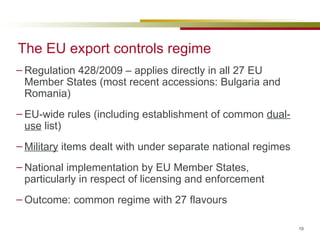
The EU export controls regime Regulation 428/2009 – applies directly in all 27 EU Member States (most recent accessions: Bulgaria and Romania) EU-wide rules (including establishment of common  dual-use  list) Military  items dealt with under separate national regimes National implementation by EU Member States, particularly in respect of licensing and enforcement Outcome: common regime with 27 flavours
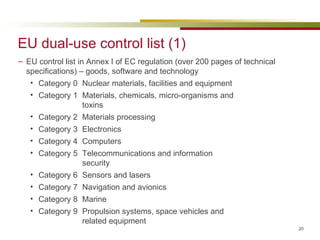
EU dual-use control list (1) EU control list in Annex I of EC regulation (over 200 pages of technical specifications) – goods, software and technology Category 0 Nuclear materials, facilities and equipment Category 1 Materials, chemicals, micro-organisms and  toxins Category 2 Materials processing Category 3 Electronics Category 4 Computers Category 5 Telecommunications and information  security Category 6 Sensors and lasers Category 7 Navigation and avionics Category 8 Marine Category 9 Propulsion systems, space vehicles and  related equipment
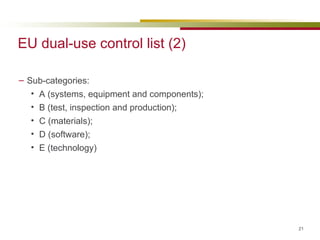
EU dual-use control list (2) Sub-categories:  A (systems, equipment and components);  B (test, inspection and production);  C (materials);  D (software);  E (technology)
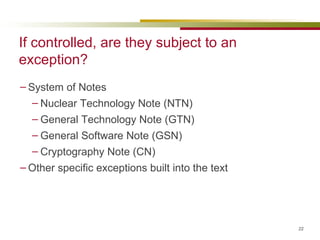
If controlled, are they subject to an exception? System of Notes Nuclear Technology Note (NTN) General Technology Note (GTN) General Software Note (GSN) Cryptography Note (CN) Other specific exceptions built into the text
Examples of controlled dual-use items Infrared imaging cameras Bearings Chemicals Valves Pumps  Alloys Detonators and igniters Pulsed neutron generators Spectrometers Accelerometers Gyros Encryption items Related software and technology
Exports of EU Annex I items Only exports to outside EU caught (apart from limited exceptions) and require export licence Shipment from UK to UK Continental Shelf is an export to outside EU No re-export controls (in US sense) No ‘deemed export’ rules
What is an export? Physical/tangible shipments (including technology on documents or other fixed media) Hand carries Intangible transfers: email intranet and electronic downloads fax telephone (if relevant controlled parts are read out or described)  video conferencing
Intra-Community transfers No licence required for transfer to another Member State of significant majority of Annex I items (but must keep records) Licence is required for transfer of most sensitive items listed in Annex IV (e.g. certain explosives, switching devices, pulsed neutron generators, pressure sensors and cryptanalytic software) Member States may under national law require licence if known final destination outside EU and no processing or working to be performed Licence may be required for intra-Community transfer where item ultimately intended for WMD end-use outside EU All relevant commercial documents for all Annex I items must clearly indicate that the items are subject to controls if exported from the Community
Transit rules Transit of Annex I items through EU (i.e. simply passing through EU territory) can be prohibited if items are/may be intended for WMD end-use Member States can extend this prohibitions under national law to: all items (not just Annex I items) military end-use in embargoed countries
WMD end-use/ “Catch-all” clause WMD end-use: chemical, biological or nuclear weapons and related missile delivery systems  Any  items may also require export licence if exporter is aware OR has been informed by authorities OR has grounds for suspecting (optional control under national law) that item is or may be intended for a WMD end-use WMD controls are very complex.  Tread carefully and do not automatically assume not applicable to your business! Increased sensitivity in current international political climate Most likely area for strict enforcement in EU
WMD End-Use “items in question are or may be intended in their entirety or in part, for use in connection with the development, production, handling, operation, maintenance, storage, detection, identification  or  dissemination of chemical, biological or nuclear weapons or other nuclear explosive devices,  or  the development, production maintenance or storage of missiles capable of delivering such weapons”
Military end-use (1) Any item requires export licence if exporter: is aware OR has been informed that item is or may be intended for military end-use in countries under an arms embargo agreed by EU, OSCE or UN Armenia, Azerbaijan, Burma, DR Congo, DPRK, Iran, Iraq, Ivory Coast, Lebanon, Liberia, Sierre Leone, Somalia, Uzbekistan, Zimbabwe
Military end-use (2) Incorporation into item on national ML item  Use of production, test or analytical equipment in production, development or maintenance of national ML items Use of unfinished products for production of national ML items Use as parts or components in national ML items exported without licence
Brokering activities Brokering: negotiation or arrangement of purchase, sale or supply of items between two non-EU countries selling or buying items between two non-EU countries Licence required if broker aware or informed Annex I item intended for WMD end-use Member States may under national law extend to: non-Annex I items grounds for suspecting WMD end use
Licensing The EU does not issue export licences (other than CGEA) Member States may grant or refuse an export licence (other than CGEA)
The Community General Export Authorisation (“CGEA”) ‘ Administered’ at EU level Covers all items listed in Annex I, with certain exceptions Valid throughout the Community (EU27) Covers exports to Australia, Canada, Japan, New Zealand, Norway, Switzerland, and the US  What if you know at time of export item is or maybe intended for onward shipment from CGEA territory?
National licences For exports of all other items :  licence from Member State  where the “exporter” is established national licences can be individual, global or general licence valid throughout the Community issue of licence may be subject to requirements and conditions (e.g. end-user undertaking) for global licences, Authority must take into account whether exporter has proportionate and adequate compliance means and procedures
Record-keeping Exporter must keep documents or records for at least 3 years from the end of the calendar year in which the transfer took place (including intra-Community transfers) More stringent obligations in relation to cryptography exports
Enforcement Enforcement, prosecution and penalties are left to Member States Penalties must be proportionate, dissuasive and effective – generally a mixture of criminal and administrative
EU sanctions
EU sanctions policy EU follows so-called “smart” sanctions policy Mostly follows UN multilateral regime Some unilateral regimes (e.g. Burma, Zimbabwe or extended Iran regime) EU sanctions regulations directly applicable in all 27 EU Member States Licensing, penalties and enforcement left to Member States
Whom do EU sanctions apply to? Within the territory of EU (including transit and airspace) On board aircraft or vessels under EU Member State jurisdiction Nationals of EU Member States, wherever located Any legal person, entity or body incorporated or constituted under laws of EU Member State Any legal person, entity or body in respect of any business done in EU
Preferred EU sanctions measures (1) Freeze on funds and economic resources of designated persons (DPs) Prohibition on making funds and economic resources available directly/indirectly to or for the benefit of DPs Complexity when dealing with non-DP related to DP Investment ban against DPs or certain sectors (e.g. granting credit or purchasing shares)
Preferred EU sanctions measures (2) Arms embargo (including arms-related financial or technical assistance) Other country-specific measures (e.g. for Iran, Burma, DPRK covering supply of specific items) Internal repression lists Covers direct and indirect measures  Also covers acts intended to circumvent prohibitions or to promote prohibited activities Currently no comprehensive trade embargo
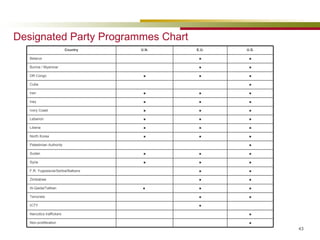
Designated Party Programmes Chart ■ Palestinian Authority ■ Non-proliferation ■ Narcotics traffickers ■ ICTY ■ ■ Terrorists ■ ■ ■  Al-Qaida/Taliban ■ ■ Zimbabwe ■ ■ F.R. Yugoslavia/Serbia/Balkans ■ ■ ■ Syria ■ ■ ■ Sudan ■ ■ ■ North Korea ■ ■ ■ Liberia ■ ■ ■ Lebanon ■ ■ ■ Ivory Coast ■ ■ ■ Iraq ■ ■ ■ Iran ■ Cuba ■ ■ ■ DR Congo ■ ■ Burma / Myanmar ■ ■ Belarus U.S. E.U. U.N. Country
Watch out for “internal repression” There are a number of EU sanctions that deal with "equipment that might be used for internal repression“ Need to pay particular attention to what is on the controlled Annex. Why? If one looks at e.g. Cote d’Ivoire, controlled annex includes: Firing sets, detonators, igniters, boosters & detonating cord Linear cutting charges Other explosive not controlled on UK Military List Technology
Sanctions - Iran UN SC Resolution 1737 27 th . February 2007, EU issued Common Position travel bans and asset freezes on certain officials named in UNSCRs or designated by the UN Sanctions Committee at a later date, as well as "other persons or entities directly associated with or providing support for" Iran's nuclear activities;  a ban on exports of goods or technology that could contribute to enrichment-related activities as defined by the Nuclear Suppliers' Group and Missile Technology Control Regime and the implementation of steps to prevent teaching from being provided to Iranian nationals in "proliferation sensitive subjects."
The EU rules Common Positions 2007/140/CFSP 2007/246/CFSP Implemented by Regulation 423/2007 which is amended by Regulation 423/2007 (Annex IV) Decision 242/2007 (Annex V) Regulation 618/2007 (military goods) Regulation 1110/2008 (revised annexes) consolidated version
Regulation 423/2007 as amended Prohibited  to sell, supply, transfer or export, directly or indirectly, goods and technology on  Annex I , whether or not originating in the Community, to any natural or legal person, entity or body in, or for use in, Iran or to participate, knowingly and intentionally, in activities the object or effect of which is to circumvent that prohibition. Prohibited  to purchase, import or transport the goods and technology listed in  Annex I , from Iran, whether the item concerned originates in Iran or not.
Regulation 423/2007 as amended Prohibited  to provide, directly or indirectly, technical assistance, or brokering services related to (i) Annex I and Ia goods and technology and (ii) to the provision, manufacture, maintenance and use of goods listed in Annex I to any natural or legal person, entity or body in, or for use in, Iran (“technical assistance and brokering”) Prohibited  to provide investment to any entity in Iran manufacturing Annex I and Ia goods or technology (“investment”);
Regulation 423/2007 as amended Prohibited  to provide, directly or indirectly, financing or financial assistance related to the Annex I and Ia goods and technology (“financing”)  Prohibited  to participate, knowingly and intentionally, in activities the object or effect of which is to circumvent that prohibition
Regulation 423/2007 as amended A  licence required  to sell, supply, transfer or export, directly or indirectly, goods and technology on Annex II, whether or not originating in the Community, to any natural or legal person, entity or body in, or for use in, Iran A  licence required  to engage in “technical assistance and brokering”, “investment” or “financing” for Annex II items
Regulation 423/2007 as amended Freeze of funds for all persons on Annexes IV and V (but can add new credit as long as frozen – includes interest and credit related to obligations prior to 31/12/2006) No new funds made available to either group directly or indirectly No evasion of either rule above
Licensing – a bit of a mess? licence required  to  sell ,  supply ,  transfer  or  export , directly or indirectly, goods and technology on Annex II, whether or not originating in the Community, to any natural or legal person, entity or body in, or for use in, Iran A licence required for sale, supply and transfer?
Licensing – a bit of a mess? UK, Netherlands, Portugal – licence required for  all  relevant activities Germany – licence required for any relevant activities involving export from Germany Italy, Spain, Commission – licence only required for export from EU
UK  Specific WMD rules BIS introduced a list of Iranian entities that raise end-use concerns http://www.BIS.gov.uk/europeandtrade/strategic-export-control/licensing-policy/end-use-control/page29307.html Not  “notice” to exporters under UK rules Encouraging exporters to make “Ratings Enquiry” focussing on end-users
Sanctions - DPRK UN SC Resolution 1718  EU implementation: Common Position 2006/795/CFSP & EU Regulation 329/2007 as amended by 117/2008 UK implementation:  The North Korea  (United Nations Measures) Order 2006 (S.I. 2006/2958); The North Korea (United Nations Measures) (Overseas Territories) Order 2006 (S.I. 2006/3327); & The Export Control Order 2008 (SI 2008/3231)  Recent expansion of sanctions under UN SC Resolution 1874 – implementation imminent in EU/UK
Sanctions - DPRK Military embargo (expanded) Luxury goods embargo (maintained) New blanket ban on lending to DPRK for all purposes DPRK cargoes now to be searched for prohibited goods, including on high seas Blacklist of individuals/entities (expanded) Humanitarian aid carve-out
Sanctions - Sudan UN SC Resolutions 1556 (2004) and 1591 (2005) – specific to: - North/South/West Darfur  - All belligerents within those regions - All parties (including Sudanese government) to N’djamena Ceasefire Agreement EU legislation - Applicable to whole of Sudan - Originally preceded UN measures -  Common Position 2004/31/CFSP & Regulation 131/2004 - Subsequently implemented UN SC Resolutions - Common Position 2005/411/CFSP & Regulation 838/2005
Sanctions - Sudan Military embargo – across whole of Sudan Blacklist of individuals in Darfur region Humanitarian aid carve out across whole of Sudan - Non-lethal military equipment - Material intended for EU / UN crisis management - Mine clearance equipment - Protective military clothing for UN / EU personnel
Sanctions - Burma No UN SC Resolutions EU:  Common Position 1996/635/CFSP &  Regulation 817/2006, further renewed by Regulation  194/2008. UK implementation: The Burma (Sale, Supply, Export, Technical Assistance, Financing and Financial Assistance) (Penalties and Licences) Regulations 2006 (SI 2006/2682) &  The Export Control (Burma) Order 2008 (SI 2008/1098)
Sanctions - Burma Military embargo Embargo on export of equipment used for torture/internal repression Embargo on export of mining machinery/equipment  Import restrictions on timber, precious/semi precious stones and mining products (unless for personal use) Extensive blacklist of individuals/entities Humanitarian aid & de-mining carve-outs
Sanctions - Belarus No UN SC Resolutions EU withdrew Belarus GSP status resulting in increase in import duty for Belarus products (Regulation 1933/2006) EU blacklist of certain government officials subject to travel bans and asset freeze UK: The Belarus (Restrictive Measures) (Overseas Territories) Order 2006 No telecommunications or encryption specific sanctions
Sanctions - Lebanon UN SC Resolution 1701 (2006) EU implementation:  Common Position 2006/625/CFSP  and Regulation 1412/2006 UK implementation: The Export Control (Lebanon, etc) Order 2006 (SI 2006/2683); The Lebanon (Technical Assistance, Financing and Financial Assistance) (Penalties and Licences) Regulations 2006, SI 2006/2681; and The Export Control Order 2008  (SI 2008/3231)   
Sanctions - Lebanon Military embargo No entries on UN blacklist Lebanese individuals/entities still relevant for screening against UK HMT financial sanctions list Humanitarian aid and government end-user carve outs
EU sanctions - terrorism Regulation 881/2002 targets persons and entities associated with Usama bin laden, Al Qaida and Taliban Regulation 2580/2001 targets persons, groups and entities involved in terrorist activities or associated with those who are Prevention of financing of global terrorism
EU blocking sanctions Targets extra-territorial effects of US sanctions against Cuba (Helms-Burton and CACR) and Iran (ISA) Obligation of non-compliance with targeted US laws; European Commission may authorise compliance Obligation to notify European Commission of direct and indirect effects of targeted laws on economic and financial interests Compliance with US rules can be blocked Any recovery in US (or under US jurisdiction can be “clawed back”)
EU blocking sanctions Potential solutions to Catch 22 situation? Genuine commercial reason not to deal US parent has full responsibility for Cuba US parent or EU subsidiary relies on non-listed US laws (EAR?) US parent in management role at some point, and points to  its  need to comply with US law: HQ just can’t do the necessary step
Consequences of non-compliance Enforcement left to Member States: mix of criminal and administrative penalties UK penalties include: Up to 7 years’ prison and/or an unlimited fine for freeze-related violations Up to 10 years’ prison and/or an unlimited fine for export-related violations Unlimited fine for violations of blocking law Reputational risks can be more damaging
Export Control Fundamental for Compliance Managers   ICPA Jasper Helder, Baker & McKenzie, Amsterdam [email_address]

Export Control Fundamental for Compliance managers

  • 1.
    Export Control Fundamentalfor Compliance Managers ICPA Jasper Helder, Baker & McKenzie, Amsterdam [email_address]
  • 2.
    Compliance checklist (1)What is your product? Understand your product Does it fall within a control list?
  • 3.
    Compliance checklist (2)For what will/can your product be used? What is (or could be) the end-use that the product is being supplied for? Will the supply be caught by a controlled end-use?
  • 4.
    Compliance checklist (3)Whom are you supplying to? Who is your customer? Does your customer raise end-use concerns? Is your customer a “prohibited party”? What about other third parties? (Parents, affiliates, directors, primary contractors, sub-contractors, end-users)
  • 5.
    Compliance checklist (4)Where are you supplying to? What country is the customer/end-user based in? Does it raise end-use concerns? Is it subject to any relevant sanctions regime?
  • 6.
    The US controls– where the action is(?)
  • 7.
    When are USTrade Restrictions Relevant to Non-US Transactions? Whenever the transaction involves either : “ US origin”/“US content” goods, software or technology OR “ US persons”
  • 8.
    Restrictions on USOrigin/Content Items Exports from the US Reexports from third countries of 100% US origin items (e.g. UK to Iran) Exports/reexports of non-US items with more than de minimis controlled US content In some limited cases, exports/reexports of certain non-US items with no US content but based on US technology
  • 9.
    Deemed Exports/Reexports Anyrelease of technology/software to a foreign national is a deemed export/reexport to that foreign national’s home country (e.g. to Iranian or Indian engineer based in UK) Releases: Visual inspection of US origin equipment/facilities Oral exchanges of information in US or abroad Application to situations abroad of personal knowledge/technical expertise acquired in US
  • 10.
    Destination Cuba, Iran,Sudan, Syria, North Korea Virtually all exports/reexports prohibited Other countries Check Country Chart (Part 738 of EAR) to see if licence required based on ECCN ‘Reason for Control’
  • 11.
    Restricted End-Uses Proliferation-relatedend-uses, e.g.: Nuclear Chemical/biological weapons Missile technology Under China military end-use rule licence required for: exports/reexports to or transfers within PRC of 31 ECCN items where knowledge or informed by the US Department of Commerce (BIS) that item destined for military end-use
  • 12.
    Restrictions on “USPersons” Sanctioned countries Sanctioned persons
  • 13.
    US Trade SanctionsTargets Country-based Comprehensive: Cuba Iran Sudan Significant: Myanmar (Burma) North Korea Syria Limited: Balkans, Belarus, Cote d’Ivoire, DR Congo, Iraq, Liberia, Zimbabwe Entity/Person-based Specially Designated Nationals (SDNs) Narcotics Traffickers Terrorists WMD Proliferators
  • 14.
    Who is a“US Person”? US companies and foreign branches US citizens and permanent resident aliens (Greencard holders), wherever located or employed All persons within the United States For Cuba only , separately incorporated owned or controlled non-US subsidiaries
  • 15.
    Basic Prohibitions Allforms of US person involvement in transactions that directly/indirectly involve a sanctioned country/person US Person facilitation of transactions by non-US Persons
  • 16.
    Examples of ProhibitedActivities Supply of product/services Approvals/directions Financing, bank guarantees, warranties Referral of orders to non-US persons Negotiation/review of commercial terms/contracts Strategising business Other support (technical, legal, credit review, etc.) Changing or ignoring company policies/procedures to eliminate US person involvement Limited permissible activities: Legal advice on compliance with sanctions Receipt and review of reports on sanctioned country business (passive)
  • 17.
    US controls v.EU controls comparison Key differences between EU and US systems Extraterritorial impact of US controls More unilateral controls in US (controlled product lists and sanctions) No deemed export rules in EU No re-export rules in EU Dealing in illegally exported items under US controls Enforcement and penalties Statute of limitations Just because you are compliant with US controls does not mean you are compliant with EU controls!
  • 18.
  • 19.
    The EU exportcontrols regime Regulation 428/2009 – applies directly in all 27 EU Member States (most recent accessions: Bulgaria and Romania) EU-wide rules (including establishment of common dual-use list) Military items dealt with under separate national regimes National implementation by EU Member States, particularly in respect of licensing and enforcement Outcome: common regime with 27 flavours
  • 20.
    EU dual-use controllist (1) EU control list in Annex I of EC regulation (over 200 pages of technical specifications) – goods, software and technology Category 0 Nuclear materials, facilities and equipment Category 1 Materials, chemicals, micro-organisms and toxins Category 2 Materials processing Category 3 Electronics Category 4 Computers Category 5 Telecommunications and information security Category 6 Sensors and lasers Category 7 Navigation and avionics Category 8 Marine Category 9 Propulsion systems, space vehicles and related equipment
  • 21.
    EU dual-use controllist (2) Sub-categories: A (systems, equipment and components); B (test, inspection and production); C (materials); D (software); E (technology)
  • 22.
    If controlled, arethey subject to an exception? System of Notes Nuclear Technology Note (NTN) General Technology Note (GTN) General Software Note (GSN) Cryptography Note (CN) Other specific exceptions built into the text
  • 23.
    Examples of controlleddual-use items Infrared imaging cameras Bearings Chemicals Valves Pumps Alloys Detonators and igniters Pulsed neutron generators Spectrometers Accelerometers Gyros Encryption items Related software and technology
  • 24.
    Exports of EUAnnex I items Only exports to outside EU caught (apart from limited exceptions) and require export licence Shipment from UK to UK Continental Shelf is an export to outside EU No re-export controls (in US sense) No ‘deemed export’ rules
  • 25.
    What is anexport? Physical/tangible shipments (including technology on documents or other fixed media) Hand carries Intangible transfers: email intranet and electronic downloads fax telephone (if relevant controlled parts are read out or described) video conferencing
  • 26.
    Intra-Community transfers Nolicence required for transfer to another Member State of significant majority of Annex I items (but must keep records) Licence is required for transfer of most sensitive items listed in Annex IV (e.g. certain explosives, switching devices, pulsed neutron generators, pressure sensors and cryptanalytic software) Member States may under national law require licence if known final destination outside EU and no processing or working to be performed Licence may be required for intra-Community transfer where item ultimately intended for WMD end-use outside EU All relevant commercial documents for all Annex I items must clearly indicate that the items are subject to controls if exported from the Community
  • 27.
    Transit rules Transitof Annex I items through EU (i.e. simply passing through EU territory) can be prohibited if items are/may be intended for WMD end-use Member States can extend this prohibitions under national law to: all items (not just Annex I items) military end-use in embargoed countries
  • 28.
    WMD end-use/ “Catch-all”clause WMD end-use: chemical, biological or nuclear weapons and related missile delivery systems Any items may also require export licence if exporter is aware OR has been informed by authorities OR has grounds for suspecting (optional control under national law) that item is or may be intended for a WMD end-use WMD controls are very complex. Tread carefully and do not automatically assume not applicable to your business! Increased sensitivity in current international political climate Most likely area for strict enforcement in EU
  • 29.
    WMD End-Use “itemsin question are or may be intended in their entirety or in part, for use in connection with the development, production, handling, operation, maintenance, storage, detection, identification or dissemination of chemical, biological or nuclear weapons or other nuclear explosive devices, or the development, production maintenance or storage of missiles capable of delivering such weapons”
  • 30.
    Military end-use (1)Any item requires export licence if exporter: is aware OR has been informed that item is or may be intended for military end-use in countries under an arms embargo agreed by EU, OSCE or UN Armenia, Azerbaijan, Burma, DR Congo, DPRK, Iran, Iraq, Ivory Coast, Lebanon, Liberia, Sierre Leone, Somalia, Uzbekistan, Zimbabwe
  • 31.
    Military end-use (2)Incorporation into item on national ML item Use of production, test or analytical equipment in production, development or maintenance of national ML items Use of unfinished products for production of national ML items Use as parts or components in national ML items exported without licence
  • 32.
    Brokering activities Brokering:negotiation or arrangement of purchase, sale or supply of items between two non-EU countries selling or buying items between two non-EU countries Licence required if broker aware or informed Annex I item intended for WMD end-use Member States may under national law extend to: non-Annex I items grounds for suspecting WMD end use
  • 33.
    Licensing The EUdoes not issue export licences (other than CGEA) Member States may grant or refuse an export licence (other than CGEA)
  • 34.
    The Community GeneralExport Authorisation (“CGEA”) ‘ Administered’ at EU level Covers all items listed in Annex I, with certain exceptions Valid throughout the Community (EU27) Covers exports to Australia, Canada, Japan, New Zealand, Norway, Switzerland, and the US What if you know at time of export item is or maybe intended for onward shipment from CGEA territory?
  • 35.
    National licences Forexports of all other items : licence from Member State where the “exporter” is established national licences can be individual, global or general licence valid throughout the Community issue of licence may be subject to requirements and conditions (e.g. end-user undertaking) for global licences, Authority must take into account whether exporter has proportionate and adequate compliance means and procedures
  • 36.
    Record-keeping Exporter mustkeep documents or records for at least 3 years from the end of the calendar year in which the transfer took place (including intra-Community transfers) More stringent obligations in relation to cryptography exports
  • 37.
    Enforcement Enforcement, prosecutionand penalties are left to Member States Penalties must be proportionate, dissuasive and effective – generally a mixture of criminal and administrative
  • 38.
  • 39.
    EU sanctions policyEU follows so-called “smart” sanctions policy Mostly follows UN multilateral regime Some unilateral regimes (e.g. Burma, Zimbabwe or extended Iran regime) EU sanctions regulations directly applicable in all 27 EU Member States Licensing, penalties and enforcement left to Member States
  • 40.
    Whom do EUsanctions apply to? Within the territory of EU (including transit and airspace) On board aircraft or vessels under EU Member State jurisdiction Nationals of EU Member States, wherever located Any legal person, entity or body incorporated or constituted under laws of EU Member State Any legal person, entity or body in respect of any business done in EU
  • 41.
    Preferred EU sanctionsmeasures (1) Freeze on funds and economic resources of designated persons (DPs) Prohibition on making funds and economic resources available directly/indirectly to or for the benefit of DPs Complexity when dealing with non-DP related to DP Investment ban against DPs or certain sectors (e.g. granting credit or purchasing shares)
  • 42.
    Preferred EU sanctionsmeasures (2) Arms embargo (including arms-related financial or technical assistance) Other country-specific measures (e.g. for Iran, Burma, DPRK covering supply of specific items) Internal repression lists Covers direct and indirect measures Also covers acts intended to circumvent prohibitions or to promote prohibited activities Currently no comprehensive trade embargo
  • 43.
    Designated Party ProgrammesChart ■ Palestinian Authority ■ Non-proliferation ■ Narcotics traffickers ■ ICTY ■ ■ Terrorists ■ ■ ■ Al-Qaida/Taliban ■ ■ Zimbabwe ■ ■ F.R. Yugoslavia/Serbia/Balkans ■ ■ ■ Syria ■ ■ ■ Sudan ■ ■ ■ North Korea ■ ■ ■ Liberia ■ ■ ■ Lebanon ■ ■ ■ Ivory Coast ■ ■ ■ Iraq ■ ■ ■ Iran ■ Cuba ■ ■ ■ DR Congo ■ ■ Burma / Myanmar ■ ■ Belarus U.S. E.U. U.N. Country
  • 44.
    Watch out for“internal repression” There are a number of EU sanctions that deal with "equipment that might be used for internal repression“ Need to pay particular attention to what is on the controlled Annex. Why? If one looks at e.g. Cote d’Ivoire, controlled annex includes: Firing sets, detonators, igniters, boosters & detonating cord Linear cutting charges Other explosive not controlled on UK Military List Technology
  • 45.
    Sanctions - IranUN SC Resolution 1737 27 th . February 2007, EU issued Common Position travel bans and asset freezes on certain officials named in UNSCRs or designated by the UN Sanctions Committee at a later date, as well as "other persons or entities directly associated with or providing support for" Iran's nuclear activities; a ban on exports of goods or technology that could contribute to enrichment-related activities as defined by the Nuclear Suppliers' Group and Missile Technology Control Regime and the implementation of steps to prevent teaching from being provided to Iranian nationals in "proliferation sensitive subjects."
  • 46.
    The EU rulesCommon Positions 2007/140/CFSP 2007/246/CFSP Implemented by Regulation 423/2007 which is amended by Regulation 423/2007 (Annex IV) Decision 242/2007 (Annex V) Regulation 618/2007 (military goods) Regulation 1110/2008 (revised annexes) consolidated version
  • 47.
    Regulation 423/2007 asamended Prohibited to sell, supply, transfer or export, directly or indirectly, goods and technology on Annex I , whether or not originating in the Community, to any natural or legal person, entity or body in, or for use in, Iran or to participate, knowingly and intentionally, in activities the object or effect of which is to circumvent that prohibition. Prohibited to purchase, import or transport the goods and technology listed in Annex I , from Iran, whether the item concerned originates in Iran or not.
  • 48.
    Regulation 423/2007 asamended Prohibited to provide, directly or indirectly, technical assistance, or brokering services related to (i) Annex I and Ia goods and technology and (ii) to the provision, manufacture, maintenance and use of goods listed in Annex I to any natural or legal person, entity or body in, or for use in, Iran (“technical assistance and brokering”) Prohibited to provide investment to any entity in Iran manufacturing Annex I and Ia goods or technology (“investment”);
  • 49.
    Regulation 423/2007 asamended Prohibited to provide, directly or indirectly, financing or financial assistance related to the Annex I and Ia goods and technology (“financing”) Prohibited to participate, knowingly and intentionally, in activities the object or effect of which is to circumvent that prohibition
  • 50.
    Regulation 423/2007 asamended A licence required to sell, supply, transfer or export, directly or indirectly, goods and technology on Annex II, whether or not originating in the Community, to any natural or legal person, entity or body in, or for use in, Iran A licence required to engage in “technical assistance and brokering”, “investment” or “financing” for Annex II items
  • 51.
    Regulation 423/2007 asamended Freeze of funds for all persons on Annexes IV and V (but can add new credit as long as frozen – includes interest and credit related to obligations prior to 31/12/2006) No new funds made available to either group directly or indirectly No evasion of either rule above
  • 52.
    Licensing – abit of a mess? licence required to sell , supply , transfer or export , directly or indirectly, goods and technology on Annex II, whether or not originating in the Community, to any natural or legal person, entity or body in, or for use in, Iran A licence required for sale, supply and transfer?
  • 53.
    Licensing – abit of a mess? UK, Netherlands, Portugal – licence required for all relevant activities Germany – licence required for any relevant activities involving export from Germany Italy, Spain, Commission – licence only required for export from EU
  • 54.
    UK SpecificWMD rules BIS introduced a list of Iranian entities that raise end-use concerns http://www.BIS.gov.uk/europeandtrade/strategic-export-control/licensing-policy/end-use-control/page29307.html Not “notice” to exporters under UK rules Encouraging exporters to make “Ratings Enquiry” focussing on end-users
  • 55.
    Sanctions - DPRKUN SC Resolution 1718 EU implementation: Common Position 2006/795/CFSP & EU Regulation 329/2007 as amended by 117/2008 UK implementation: The North Korea  (United Nations Measures) Order 2006 (S.I. 2006/2958); The North Korea (United Nations Measures) (Overseas Territories) Order 2006 (S.I. 2006/3327); & The Export Control Order 2008 (SI 2008/3231) Recent expansion of sanctions under UN SC Resolution 1874 – implementation imminent in EU/UK
  • 56.
    Sanctions - DPRKMilitary embargo (expanded) Luxury goods embargo (maintained) New blanket ban on lending to DPRK for all purposes DPRK cargoes now to be searched for prohibited goods, including on high seas Blacklist of individuals/entities (expanded) Humanitarian aid carve-out
  • 57.
    Sanctions - SudanUN SC Resolutions 1556 (2004) and 1591 (2005) – specific to: - North/South/West Darfur - All belligerents within those regions - All parties (including Sudanese government) to N’djamena Ceasefire Agreement EU legislation - Applicable to whole of Sudan - Originally preceded UN measures - Common Position 2004/31/CFSP & Regulation 131/2004 - Subsequently implemented UN SC Resolutions - Common Position 2005/411/CFSP & Regulation 838/2005
  • 58.
    Sanctions - SudanMilitary embargo – across whole of Sudan Blacklist of individuals in Darfur region Humanitarian aid carve out across whole of Sudan - Non-lethal military equipment - Material intended for EU / UN crisis management - Mine clearance equipment - Protective military clothing for UN / EU personnel
  • 59.
    Sanctions - BurmaNo UN SC Resolutions EU: Common Position 1996/635/CFSP & Regulation 817/2006, further renewed by Regulation 194/2008. UK implementation: The Burma (Sale, Supply, Export, Technical Assistance, Financing and Financial Assistance) (Penalties and Licences) Regulations 2006 (SI 2006/2682) & The Export Control (Burma) Order 2008 (SI 2008/1098)
  • 60.
    Sanctions - BurmaMilitary embargo Embargo on export of equipment used for torture/internal repression Embargo on export of mining machinery/equipment Import restrictions on timber, precious/semi precious stones and mining products (unless for personal use) Extensive blacklist of individuals/entities Humanitarian aid & de-mining carve-outs
  • 61.
    Sanctions - BelarusNo UN SC Resolutions EU withdrew Belarus GSP status resulting in increase in import duty for Belarus products (Regulation 1933/2006) EU blacklist of certain government officials subject to travel bans and asset freeze UK: The Belarus (Restrictive Measures) (Overseas Territories) Order 2006 No telecommunications or encryption specific sanctions
  • 62.
    Sanctions - LebanonUN SC Resolution 1701 (2006) EU implementation: Common Position 2006/625/CFSP and Regulation 1412/2006 UK implementation: The Export Control (Lebanon, etc) Order 2006 (SI 2006/2683); The Lebanon (Technical Assistance, Financing and Financial Assistance) (Penalties and Licences) Regulations 2006, SI 2006/2681; and The Export Control Order 2008 (SI 2008/3231)  
  • 63.
    Sanctions - LebanonMilitary embargo No entries on UN blacklist Lebanese individuals/entities still relevant for screening against UK HMT financial sanctions list Humanitarian aid and government end-user carve outs
  • 64.
    EU sanctions -terrorism Regulation 881/2002 targets persons and entities associated with Usama bin laden, Al Qaida and Taliban Regulation 2580/2001 targets persons, groups and entities involved in terrorist activities or associated with those who are Prevention of financing of global terrorism
  • 65.
    EU blocking sanctionsTargets extra-territorial effects of US sanctions against Cuba (Helms-Burton and CACR) and Iran (ISA) Obligation of non-compliance with targeted US laws; European Commission may authorise compliance Obligation to notify European Commission of direct and indirect effects of targeted laws on economic and financial interests Compliance with US rules can be blocked Any recovery in US (or under US jurisdiction can be “clawed back”)
  • 66.
    EU blocking sanctionsPotential solutions to Catch 22 situation? Genuine commercial reason not to deal US parent has full responsibility for Cuba US parent or EU subsidiary relies on non-listed US laws (EAR?) US parent in management role at some point, and points to its need to comply with US law: HQ just can’t do the necessary step
  • 67.
    Consequences of non-complianceEnforcement left to Member States: mix of criminal and administrative penalties UK penalties include: Up to 7 years’ prison and/or an unlimited fine for freeze-related violations Up to 10 years’ prison and/or an unlimited fine for export-related violations Unlimited fine for violations of blocking law Reputational risks can be more damaging
  • 68.
    Export Control Fundamentalfor Compliance Managers ICPA Jasper Helder, Baker & McKenzie, Amsterdam [email_address]

Editor's Notes

  • #9 Under the EAR Not limited to exports/reexports to sanctioned countries Whether a license is required depends on combination of: - classification - destination - restricted end-user - restricted end-uses Cf. EU – if on list license requirement exists
  • #10 - Last in time rule e.g. Iranian national with UK permanent residency - Office of Inspector General Proposal to change to country of birth met huge resistance and dropped. - Possible modified rule.
  • #13 Mostly under OFAC sanctions Overlap with EAR