Malaysia 
1
Malaysia: Headlines 
 Fast expanding domestic market and 
hub for South East Asia 
 Security threats in Sabah, borders, 
South China Sea, peacekeeping 
 Licensing concerns mostly limited to 
the human rights record of the police, 
which is improving 
 And transit/transhipment of items of 
WMD proliferation concern - also 
improving 
2
Licence Approvals and 
Refusals in 2013 
Approvals 
 Ballistic shields and helmets for 
police 
 OIEL for respirators to Special 
Action Unit of police, armed 
forces, fire and rescue services, 
but not regular police (require 
SIEL – unlikely to be denied) 
 IMSI grabber for police (no 
utility in crowd control) 
 Ammunition for the police 
Refusals 
 In 2013: one OIEL for imaging 
cameras. No SIELs refused 
3 
2013: Military £31m, Dual Use £53m
Political Context 
 Constitutional Monarchy 
 multi-ethnic society of 28.4 million 
people, with a majority Muslim 
population 
 a federation of 13 states and three 
federal territories. The communities 
coexist in relative harmony, although 
there is little racial interaction 
 Although since 1971 Malays have 
benefited from positive 
discrimination, ethnic Chinese 
continue to hold economic power. 
Malays remain the dominant group in 
politics while the Indians are among 
the poorest. 
4
Political: PM Najib 
5 
 The long-governing National Front - a coalition of ethnic 
Malays, Chinese and Indians - won the 2013 national 
elections with a weakened majority to extend its 
unbroken, 56-year rule. 
 Mr Najib Razak assumed the post of prime minister 
following the resignation of his predecessor in 2009, 
and was sworn in for a second term after the 2013 
elections 
 The son of the country's second prime minister and 
nephew of the third, Mr Najib is a British-trained 
economist. He first entered parliament at the age of 23 - 
becoming the youngest MP in Malaysian history. He has 
held numerous cabinet posts - including finance and 
defence
Political 
 Mr Najib’s rise to power was marked by a 
government crackdown on the resurgent 
opposition, with allegations that strong-arm 
tactics were being used to stifle dissent 
 But he has pledged radical reforms and a more 
transparent government. One of his priorities is 
to close a widening ethnic and religious divide 
 He has announced his intention to repeal the 
Internal Security Act and other restrictive 
legislation, and appears to be moving towards 
greater respect for’ civil and political rights. 
6
Economy 
7 
 Malaysia's economic prospects have 
been dented by the global economic 
downturn, which has hit export markets 
hard 
 But it remains a vibrant economy, 
growing by over 7% 
 It presents opportunities not just for 
sales but also for investment and is an 
ideal entry point to the wider ASEAN 
market.
UK Relations 
 A substantial and growing number of UK companies 
have a presence in Malaysia and many use the 
country as a hub for their regional business 
interests. 
 One-third of the 21,000 skilled jobs in Malaysia’s 
Multimedia Super Corridor have been created by 
British firms. 
 Around 40,000 Malaysians take UK qualifications in 
their home country and 13,000 travel to the UK each 
year to study. They include the Prime Minister, who 
studied at Nottingham University and Malvern 
College 
8
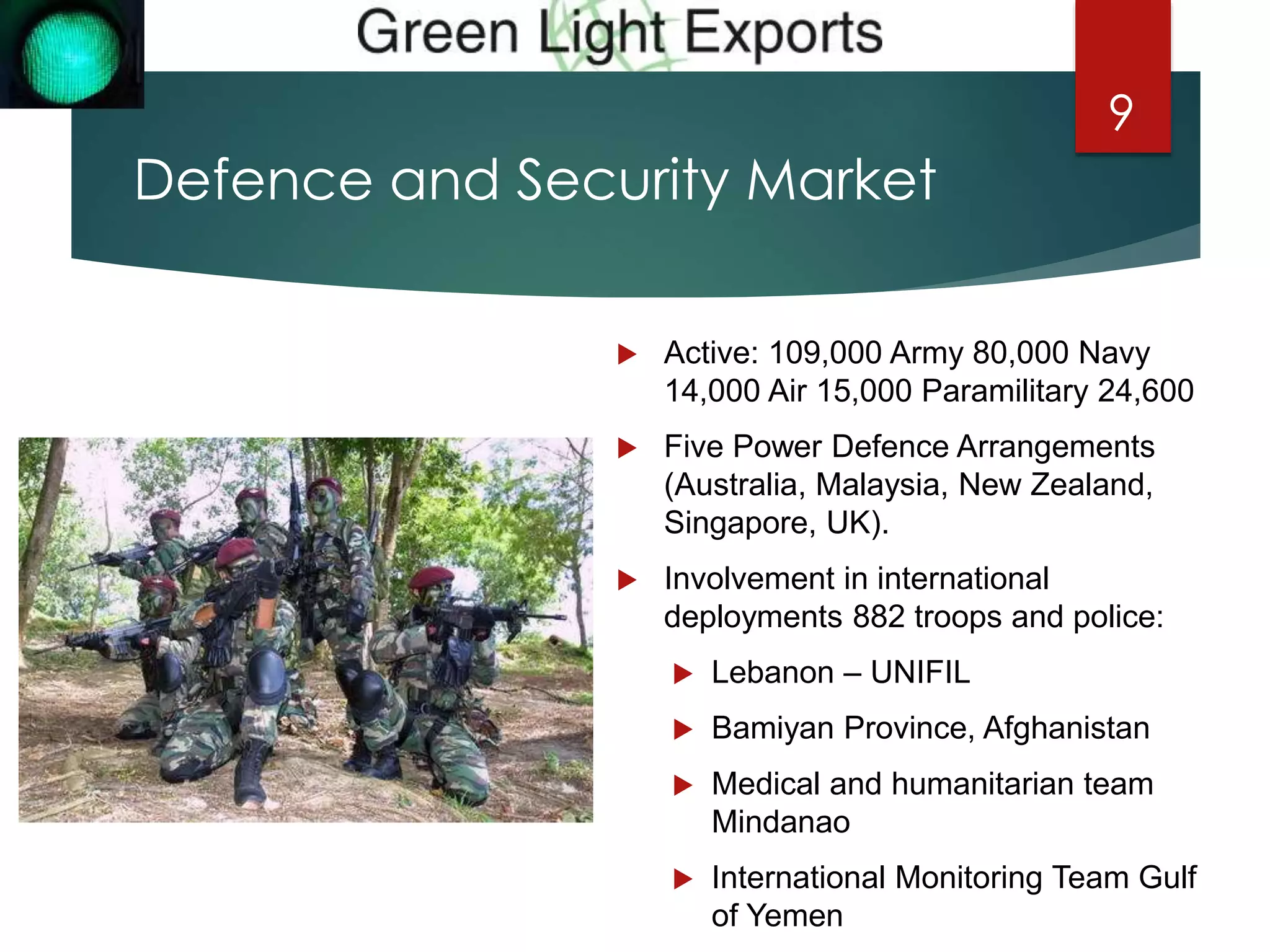
Defence and Security Market 
 Active: 109,000 Army 80,000 Navy 
14,000 Air 15,000 Paramilitary 24,600 
 Five Power Defence Arrangements 
(Australia, Malaysia, New Zealand, 
Singapore, UK). 
 Involvement in international 
deployments 882 troops and police: 
 Lebanon – UNIFIL 
 Bamiyan Province, Afghanistan 
 Medical and humanitarian team 
Mindanao 
 International Monitoring Team Gulf 
of Yemen 
9
Defence and Security Market 
 reigned in its defence spending in recent years; however, there are indications that spending is 
once again on the increase with the announcement of major vehicle, ship, and multi-role combat 
programmes. 
 Defence budget currently $4.7bn, of which some $3bn on imports 
 planning to modernise its armed forces, which are historically land dominated but have recently 
diversified through a recognition that peninsular Malaysia is effectively a maritime nation. 
 Priorities are: Sabah, China/South China Sea, border security 
 Royal Malaysian Navy has grown its ability to project force and is in the process of 
transforming from a coastal to a deep water navy 
 the air force is seeking to extend its range by the acquisition of surveillance and longer range 
strike aircraft. 
 support, maintenance and upgrade programmes are a priority 
 Malaysia regularly contributes to UN peacekeeping missions (it currently has a major deployment 
to Lebanon) and is developing its expeditionary forces. 
10
Defence and Security Market 
 The Government’s defence acquisition policy is 
inextricably linked to its wider aspirations to develop 
industry and move itself up the value chain to 
becoming a manufacturing hub with the potential to 
export to the wider Asia- Pacific region. 
 In order to achieve this step change it needs to attract 
both foreign investment and technology transfer. It is 
therefore essential to be responsive to these drivers 
and be prepared to contribute to the country’s 
technological development by means of technology 
transfer, shared development and local manufacture. 
 The willingness of exporters to establish a joint 
venture with local industry is a key discriminator from 
the Government’s perspective. 
11
Export Licensing Criteria Concerns 
1. UK’s International Commitments 
2. Human Rights and Internal Repression 
3. Internal Situation of recipient country 
4. Regional Stability 
5. National Security of UK and allies 
6. Behaviour of recipient country 
7. Diversion 
8. Economic Sustainability 
+ Other Factors – commercial, political, strategic 
12 
Criteria 1-4 are 
mandatory
Concerns: Criteria 1 & 7 
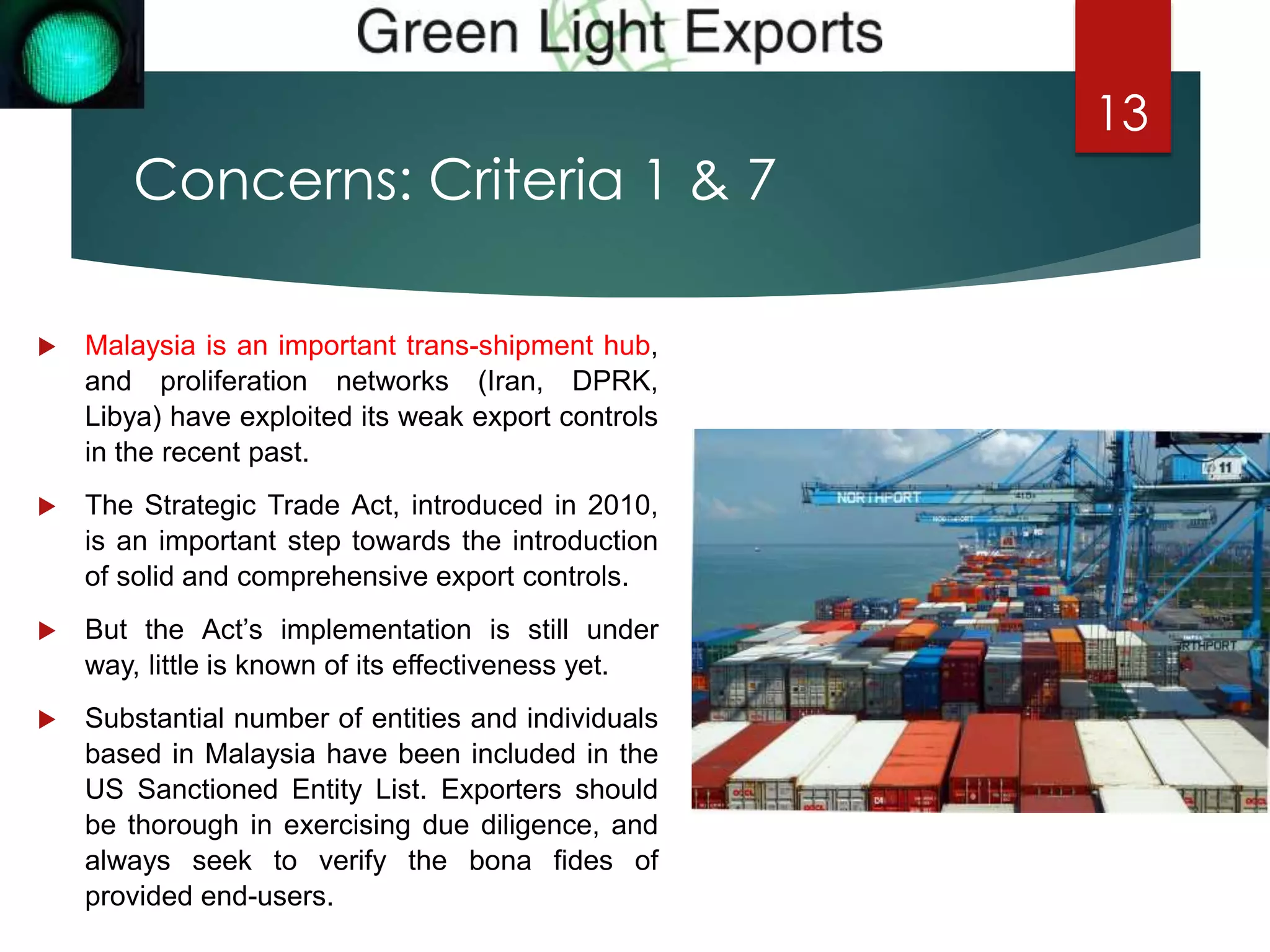
 Malaysia is an important trans-shipment hub, 
and proliferation networks (Iran, DPRK, 
Libya) have exploited its weak export controls 
in the recent past. 
 The Strategic Trade Act, introduced in 2010, 
is an important step towards the introduction 
of solid and comprehensive export controls. 
 But the Act’s implementation is still under 
way, little is known of its effectiveness yet. 
 Substantial number of entities and individuals 
based in Malaysia have been included in the 
US Sanctioned Entity List. Exporters should 
be thorough in exercising due diligence, and 
always seek to verify the bona fides of 
provided end-users. 
13
Concerns: Criterion 2: 
Human Rights 
14 
 Malaysia's human rights record has come in for international criticism. 
Internal security laws allow suspects to be detained without charge or trial. 
 Main concerns with the Royal Malaysian Police, over the policing of 
demonstrations and the use of teargas and water cannons. Last used 
disproportionate force during a protest rally in April 2012. 
 Since then there have been a large number of street rallies and 
demonstrations, including a huge opposition rally in Kuala Lumpur in 
January 2013 (150,000+ people). All passed off peacefully without 
interference from the police – even when it had been made clear that one 
of the rallies was technically illegal 
 HMG and Malaysian government discussing public order training 
 no Criterion 2 concerns with the Malaysia armed forces or fire and 
rescue services, nor the Special Action Unit of the police (not involved in 
crowd control - an elite high-profile counter-terrorism and special 
operations tactical unit, which was established with the assistance of 22 
New Zealand SAS Regiment. This unit performs SWAT duties, VIP 
protection, and undercover missions.)
Criteria 3/4: Internal Tensions 
 Eastern Sabah Security Zone 
(ESSZONE) established by Prime 
Minister Najib in response to 
incursions in 2013 by Sulu militants 
from the Philippines which provoked a 
significant Malaysian military response 
15
Concerns: Criterion 4: Regional 
Tensions 
 Competing claims with China 
to a small number of islands 
in the Spratlys – which may 
have oil and gas 
 Disputes are usually 
resolved through dialogue. 
Malaysia has downplayed 
Chinese naval incursions into 
their waters. 
16
Conclusions 
 Domestic defence market, constrained in recent years, 
likely to resume growth in light of security threats in 
Sabah, borders, South China Sea, and peacekeeping 
requirements 
 licensing concerns mostly limited to the human rights 
record of the police, though this is improving 
 no significant licensing concerns with military 
 transit/transhipment of items of WMD proliferation 
concern - also improving 
17
Any questions? 
18 
Richard Tauwhare 
Green Light Exports Consulting 
Email: richard@greenlightexports.co.uk 
Web: www.greenlightexports.co.uk 
Phone: +44(0)770 311 0880

Malaysia: Defence and Security Export Risk and Opportunities

  • 1.
  • 2.
    Malaysia: Headlines Fast expanding domestic market and hub for South East Asia  Security threats in Sabah, borders, South China Sea, peacekeeping  Licensing concerns mostly limited to the human rights record of the police, which is improving  And transit/transhipment of items of WMD proliferation concern - also improving 2
  • 3.
    Licence Approvals and Refusals in 2013 Approvals  Ballistic shields and helmets for police  OIEL for respirators to Special Action Unit of police, armed forces, fire and rescue services, but not regular police (require SIEL – unlikely to be denied)  IMSI grabber for police (no utility in crowd control)  Ammunition for the police Refusals  In 2013: one OIEL for imaging cameras. No SIELs refused 3 2013: Military £31m, Dual Use £53m
  • 4.
    Political Context Constitutional Monarchy  multi-ethnic society of 28.4 million people, with a majority Muslim population  a federation of 13 states and three federal territories. The communities coexist in relative harmony, although there is little racial interaction  Although since 1971 Malays have benefited from positive discrimination, ethnic Chinese continue to hold economic power. Malays remain the dominant group in politics while the Indians are among the poorest. 4
  • 5.
    Political: PM Najib 5  The long-governing National Front - a coalition of ethnic Malays, Chinese and Indians - won the 2013 national elections with a weakened majority to extend its unbroken, 56-year rule.  Mr Najib Razak assumed the post of prime minister following the resignation of his predecessor in 2009, and was sworn in for a second term after the 2013 elections  The son of the country's second prime minister and nephew of the third, Mr Najib is a British-trained economist. He first entered parliament at the age of 23 - becoming the youngest MP in Malaysian history. He has held numerous cabinet posts - including finance and defence
  • 6.
    Political  MrNajib’s rise to power was marked by a government crackdown on the resurgent opposition, with allegations that strong-arm tactics were being used to stifle dissent  But he has pledged radical reforms and a more transparent government. One of his priorities is to close a widening ethnic and religious divide  He has announced his intention to repeal the Internal Security Act and other restrictive legislation, and appears to be moving towards greater respect for’ civil and political rights. 6
  • 7.
    Economy 7 Malaysia's economic prospects have been dented by the global economic downturn, which has hit export markets hard  But it remains a vibrant economy, growing by over 7%  It presents opportunities not just for sales but also for investment and is an ideal entry point to the wider ASEAN market.
  • 8.
    UK Relations A substantial and growing number of UK companies have a presence in Malaysia and many use the country as a hub for their regional business interests.  One-third of the 21,000 skilled jobs in Malaysia’s Multimedia Super Corridor have been created by British firms.  Around 40,000 Malaysians take UK qualifications in their home country and 13,000 travel to the UK each year to study. They include the Prime Minister, who studied at Nottingham University and Malvern College 8
  • 9.
    Defence and SecurityMarket  Active: 109,000 Army 80,000 Navy 14,000 Air 15,000 Paramilitary 24,600  Five Power Defence Arrangements (Australia, Malaysia, New Zealand, Singapore, UK).  Involvement in international deployments 882 troops and police:  Lebanon – UNIFIL  Bamiyan Province, Afghanistan  Medical and humanitarian team Mindanao  International Monitoring Team Gulf of Yemen 9
  • 10.
    Defence and SecurityMarket  reigned in its defence spending in recent years; however, there are indications that spending is once again on the increase with the announcement of major vehicle, ship, and multi-role combat programmes.  Defence budget currently $4.7bn, of which some $3bn on imports  planning to modernise its armed forces, which are historically land dominated but have recently diversified through a recognition that peninsular Malaysia is effectively a maritime nation.  Priorities are: Sabah, China/South China Sea, border security  Royal Malaysian Navy has grown its ability to project force and is in the process of transforming from a coastal to a deep water navy  the air force is seeking to extend its range by the acquisition of surveillance and longer range strike aircraft.  support, maintenance and upgrade programmes are a priority  Malaysia regularly contributes to UN peacekeeping missions (it currently has a major deployment to Lebanon) and is developing its expeditionary forces. 10
  • 11.
    Defence and SecurityMarket  The Government’s defence acquisition policy is inextricably linked to its wider aspirations to develop industry and move itself up the value chain to becoming a manufacturing hub with the potential to export to the wider Asia- Pacific region.  In order to achieve this step change it needs to attract both foreign investment and technology transfer. It is therefore essential to be responsive to these drivers and be prepared to contribute to the country’s technological development by means of technology transfer, shared development and local manufacture.  The willingness of exporters to establish a joint venture with local industry is a key discriminator from the Government’s perspective. 11
  • 12.
    Export Licensing CriteriaConcerns 1. UK’s International Commitments 2. Human Rights and Internal Repression 3. Internal Situation of recipient country 4. Regional Stability 5. National Security of UK and allies 6. Behaviour of recipient country 7. Diversion 8. Economic Sustainability + Other Factors – commercial, political, strategic 12 Criteria 1-4 are mandatory
  • 13.
    Concerns: Criteria 1& 7  Malaysia is an important trans-shipment hub, and proliferation networks (Iran, DPRK, Libya) have exploited its weak export controls in the recent past.  The Strategic Trade Act, introduced in 2010, is an important step towards the introduction of solid and comprehensive export controls.  But the Act’s implementation is still under way, little is known of its effectiveness yet.  Substantial number of entities and individuals based in Malaysia have been included in the US Sanctioned Entity List. Exporters should be thorough in exercising due diligence, and always seek to verify the bona fides of provided end-users. 13
  • 14.
    Concerns: Criterion 2: Human Rights 14  Malaysia's human rights record has come in for international criticism. Internal security laws allow suspects to be detained without charge or trial.  Main concerns with the Royal Malaysian Police, over the policing of demonstrations and the use of teargas and water cannons. Last used disproportionate force during a protest rally in April 2012.  Since then there have been a large number of street rallies and demonstrations, including a huge opposition rally in Kuala Lumpur in January 2013 (150,000+ people). All passed off peacefully without interference from the police – even when it had been made clear that one of the rallies was technically illegal  HMG and Malaysian government discussing public order training  no Criterion 2 concerns with the Malaysia armed forces or fire and rescue services, nor the Special Action Unit of the police (not involved in crowd control - an elite high-profile counter-terrorism and special operations tactical unit, which was established with the assistance of 22 New Zealand SAS Regiment. This unit performs SWAT duties, VIP protection, and undercover missions.)
  • 15.
    Criteria 3/4: InternalTensions  Eastern Sabah Security Zone (ESSZONE) established by Prime Minister Najib in response to incursions in 2013 by Sulu militants from the Philippines which provoked a significant Malaysian military response 15
  • 16.
    Concerns: Criterion 4:Regional Tensions  Competing claims with China to a small number of islands in the Spratlys – which may have oil and gas  Disputes are usually resolved through dialogue. Malaysia has downplayed Chinese naval incursions into their waters. 16
  • 17.
    Conclusions  Domesticdefence market, constrained in recent years, likely to resume growth in light of security threats in Sabah, borders, South China Sea, and peacekeeping requirements  licensing concerns mostly limited to the human rights record of the police, though this is improving  no significant licensing concerns with military  transit/transhipment of items of WMD proliferation concern - also improving 17
  • 18.
    Any questions? 18 Richard Tauwhare Green Light Exports Consulting Email: richard@greenlightexports.co.uk Web: www.greenlightexports.co.uk Phone: +44(0)770 311 0880