EU Dual Use Export Controls Update The new EU Dual Use Regulation 428/2009 TechAmerica Export Controls Committee meeting December 10, 2009 Jasper Helder, partner Trade & Customs Bird & Bird LLP T + 31 646 17 94 82 E  jasper.helder @ twobirds.com W  www.twobirds.com / customs
Agenda EU Legislative Framework Export licensing requirements Intra-EU licensing requirements Sensitive items Transit controls Intra EU transfers for subsequent export Brokering licensing requirements Intangible exports Export licenses National implementation
EU legislative framework  (1) Common regime: Regulation (EC) 1334/2000 Lastly amended by Regulation (EC) 1167/2008 Replaced by Regulation (EC) 428/2009, “Recast” Effective as per August 2009 Consolidation of amendments of the 1334/2000 regulation Implementation of UN Security Council Resolution 1540/2004 Amendments of Annex I Control List: http://trade.ec.europa.eu/doclib/docs/2009/june/tradoc_143396.en09%20CN07_03.pdf
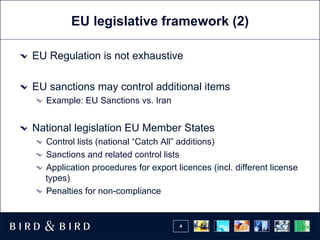
EU legislative framework  (2) EU Regulation is not exhaustive EU sanctions may control additional items Example: EU Sanctions vs. Iran National legislation EU Member States Control lists (national “Catch All” additions) Sanctions and related control lists Application procedures for export licences (incl. different license types) Penalties for non-compliance
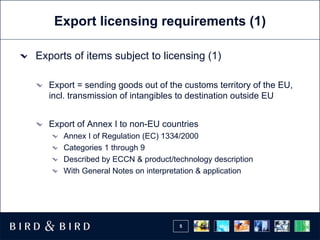
Export licensing requirements (1) Exports of items subject to licensing (1) Export = sending goods out of the customs territory of the EU, incl. transmission of intangibles to destination outside EU Export of Annex I to non-EU countries Annex I of Regulation (EC) 1334/2000 Categories 1 through 9 Described by ECCN & product/technology description With General Notes on interpretation & application
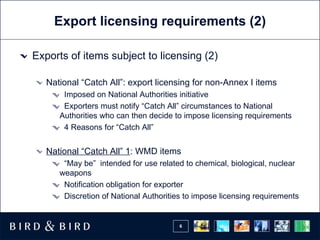
Export licensing requirements (2) Exports of items subject to licensing (2) National “Catch All”: export licensing for non-Annex I items Imposed on National Authorities initiative Exporters must notify “Catch All” circumstances to National Authorities who can then decide to impose licensing requirements 4 Reasons for “Catch All” National “Catch All” 1 : WMD items  “ May be”  intended for use related to chemical, biological, nuclear weapons Notification obligation for exporter Discretion of National Authorities to impose licensing requirements
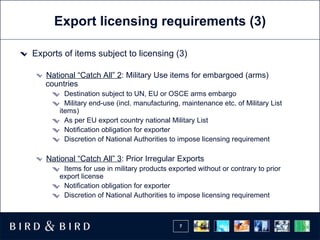
Export licensing requirements (3) Exports of items subject to licensing (3) National “Catch All” 2 : Military Use items for embargoed (arms) countries Destination subject to UN, EU or OSCE arms embargo Military end-use (incl. manufacturing, maintenance etc. of Military List items) As per EU export country national Military List Notification obligation for exporter Discretion of National Authorities to impose licensing requirement National “Catch All” 3 : Prior Irregular Exports  Items for use in military products exported without or contrary to prior export license Notification obligation for exporter Discretion of National Authorities to impose licensing requirement
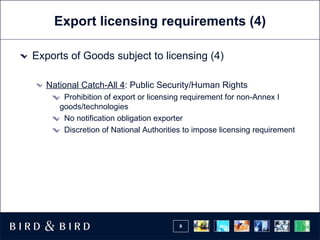
Export licensing requirements (4) Exports of Goods subject to licensing (4) National Catch-All 4 : Public Security/Human Rights Prohibition of export or licensing requirement for non-Annex I goods/technologies No notification obligation exporter Discretion of National Authorities to impose licensing requirement
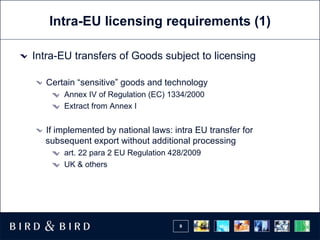
Intra-EU licensing requirements (1) Intra-EU transfers of Goods subject to licensing  Certain “sensitive” goods and technology Annex IV of Regulation (EC) 1334/2000  Extract from Annex I If implemented by national laws: intra EU transfer for subsequent export without additional processing  art. 22 para 2 EU Regulation 428/2009 UK & others
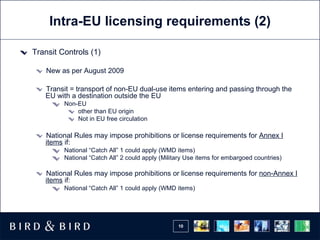
Intra-EU licensing requirements (2) Transit Controls (1) New as per August 2009 Transit = transport of non-EU dual-use items entering and passing through the EU with a destination outside the EU Non-EU other than EU origin Not in EU free circulation National Rules may impose prohibitions or license requirements for  Annex I items  if: National “Catch All” 1 could apply (WMD items)  National “Catch All” 2 could apply (Military Use items for embargoed countries) National Rules may impose prohibitions or license requirements for  non-Annex I items  if: National “Catch All” 1 could apply (WMD items)
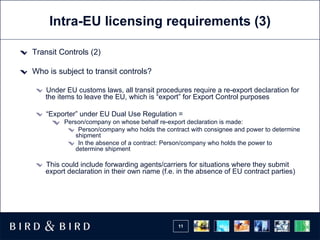
Intra-EU licensing requirements (3) Transit Controls (2) Who is subject to transit controls? Under EU customs laws, all transit procedures require a re-export declaration for the items to leave the EU, which is “export” for Export Control purposes “ Exporter” under EU Dual Use Regulation = Person/company on whose behalf re-export declaration is made: Person/company who holds the contract with consignee and power to determine shipment In the absence of a contract: Person/company who holds the power to determine shipment This could include forwarding agents/carriers for situations where they submit export declaration in their own name (f.e. in the absence of EU contract parties)
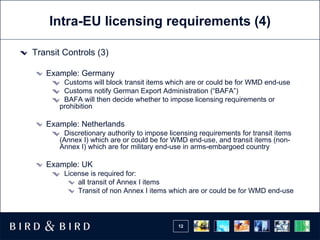
Intra-EU licensing requirements (4) Transit Controls (3) Example: Germany Customs will block transit items which are or could be for WMD end-use Customs notify German Export Administration (“BAFA”) BAFA will then decide whether to impose licensing requirements or prohibition Example: Netherlands Discretionary authority to impose licensing requirements for transit items (Annex I) which are or could be for WMD end-use, and transit items (non-Annex I) which are for military end-use in arms-embargoed country Example: UK License is required for: all transit of Annex I items  Transit of non Annex I items which are or could be for WMD end-use
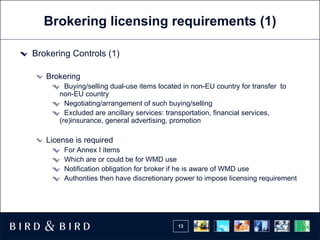
Brokering licensing requirements (1) Brokering Controls (1) Brokering  Buying/selling dual-use items located in non-EU country for transfer  to non-EU country Negotiating/arrangement of such buying/selling Excluded are ancillary services: transportation, financial services, (re)insurance, general advertising, promotion License is required  For Annex I items Which are or could be for WMD use Notification obligation for broker if he is aware of WMD use Authorities then have discretionary power to impose licensing requirement
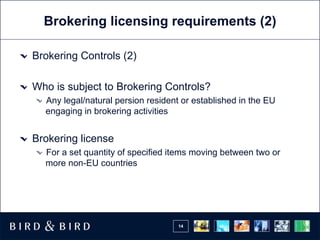
Brokering licensing requirements (2) Brokering Controls (2) Who is subject to Brokering Controls? Any legal/natural persion resident or established in the EU engaging in brokering activities Brokering license For a set quantity of specified items moving between two or more non-EU countries
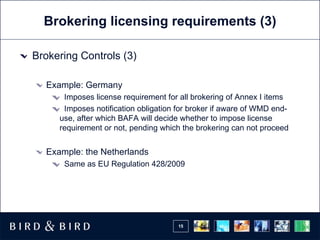
Brokering licensing requirements (3) Brokering Controls (3) Example: Germany Imposes license requirement for all brokering of Annex I items Imposes notification obligation for broker if aware of WMD end-use, after which BAFA will decide whether to impose license requirement or not, pending which the brokering can not proceed Example: the Netherlands Same as EU Regulation 428/2009
Intangible exports Intangible Exports T ransmission of software or technology by electronic media, fax, telephone to a destination outside the EU, including  making available in an electronic form such software and technology Clarification EU Commission 26 January 2009:  Transit of software, technology or technical assistance on carrier medium can be subject to transit controls
EU Export licences (1) Community General Export Authorisation For exports to: Australia, Canada, Japan, New Zealand, Norway, Switzerland, USA Certain specific ECCN’s are excluded (certain nuclear items/software, pathogenes and GMO, missile related parts & technology) Exporter must register with national authorities to use CGEA  May also be done retroactively, but no later than 30 days after export License automatically granted CGEA can not be applied when: Exporter is notified of or aware of possible: military end use in arms embargoed country  WMD end use Goods are destined for free zone or free warehouse in of the 7 CGEA destination countries
EU Export licences (2) Individual export License One exporter, one end-user/consignee, one or more dual use items Global export license One exporter, more end-users/consignees in more non-EU countries, for type/category of dual use items National general export license Under national legislation One exporter, one end-user/consignee, one or more dual use items Certain ECCN are excluded (same as GCEA) Can not be applied in case of national “Catch Alls” 1 through 3 Exporter is notified/aware of potential WMD, military end use )
EU Export licences (3) Project Licence Cross border projects involving exports from multiple EU countries License application in EU country where contractual exporter is established Only for individual export license (one exporter, one consignee, may include multiple dual use items) For all destinations other than GCEA countries (Annex I items), and all destinations (Annex IV items) Exporter must indicate location of other goods/technologies in application Consultation between EU country that receives application and other EU countries Objections must be raised within 10 working days May be extended in ‘exceptional cases’ up to 30 days Objections are binding: one EU country refuses no license granted! No response: no objections
EU Export Licences (4) Licensing criteria: Previously: obligations of EU countries under non-proliferation regimes, EU CFSP and/or other sanctions & embargoes (UN etc.) Now also: Exporters Internal Compliance Program = relevant factor Global license applications Brokering license applications EU countries favour no connection between licensing & ICP
Recordkeeping Previously: in accordance with the practice in force in the respective EU country  Commercial documents such as invoices, manifests and transport documents containing sufficient information to identify: the description of the dual-use items the quantity of the dual-use items the name and address of the exporter and of the consignee where known, the end-use and end-user of the dual-use items Current: extended recordkeeping obligation for: Brokering nature of the items, technology or software  the period during which the items were transferred/subject of provision of intermediation services  destination of the transfers. 3 years after export During 26 January 2009 conference, EU Commission re-emphasised current obligations to state ECCN and Controls on commercial documents (sales contract, order confirmation, invoice, dispatch note)
Implementation (1) Common feature: Export of listed goods/technologies is prohibited Listed: EU Dual Use Reg Annex I May be supplemented on national level May be supplemented by EU Sanctions regulations “ Catch All” decisions on national level Unless licensed by national administration Categories of licenses are specified in EU Dual Use Reg Additional (reporting and other) requirements may be imposed in licenses Unlicensed export/non-compliance with license conditions commonly defined as criminal offence
Implementation (2) Transparency of administration varies substantially Some EU countries provide published guidance (e.g. UK, Germany, France), some do not (e.g. Belgium, Italy) Concrete licensing criteria  Controlled or “of concern” entities/individual lists Published standardised license conditions (e.g. UK) “ Catch all” additions to EU Dual Use control list may or may not be published Some EU countries provide for institutionalised “control status” verification procedures (e.g. UK “rating enquiry”) License application processing time varies between EU countries
Implementation (3) Licensing approach varies Some EU countries: emphasis on global licenses & ICP Some EU countries: emphasis on individual specific licenses 8 Member States have created "National General export authorisations“ Austria, France, Italy, Germany, Greece, Sweden, Netherlands, UK (OGEL, standardized conditions)
Thank you for your attention Jasper Helder Bird & Bird LLP T + 31 6 46 17 94 82 E  jasper.helder @ twobirds.com W www.twobirds.com/customs

EU Dual Use Export Controls Update

  • 1.
    EU Dual UseExport Controls Update The new EU Dual Use Regulation 428/2009 TechAmerica Export Controls Committee meeting December 10, 2009 Jasper Helder, partner Trade & Customs Bird & Bird LLP T + 31 646 17 94 82 E jasper.helder @ twobirds.com W www.twobirds.com / customs
  • 2.
    Agenda EU LegislativeFramework Export licensing requirements Intra-EU licensing requirements Sensitive items Transit controls Intra EU transfers for subsequent export Brokering licensing requirements Intangible exports Export licenses National implementation
  • 3.
    EU legislative framework (1) Common regime: Regulation (EC) 1334/2000 Lastly amended by Regulation (EC) 1167/2008 Replaced by Regulation (EC) 428/2009, “Recast” Effective as per August 2009 Consolidation of amendments of the 1334/2000 regulation Implementation of UN Security Council Resolution 1540/2004 Amendments of Annex I Control List: http://trade.ec.europa.eu/doclib/docs/2009/june/tradoc_143396.en09%20CN07_03.pdf
  • 4.
    EU legislative framework (2) EU Regulation is not exhaustive EU sanctions may control additional items Example: EU Sanctions vs. Iran National legislation EU Member States Control lists (national “Catch All” additions) Sanctions and related control lists Application procedures for export licences (incl. different license types) Penalties for non-compliance
  • 5.
    Export licensing requirements(1) Exports of items subject to licensing (1) Export = sending goods out of the customs territory of the EU, incl. transmission of intangibles to destination outside EU Export of Annex I to non-EU countries Annex I of Regulation (EC) 1334/2000 Categories 1 through 9 Described by ECCN & product/technology description With General Notes on interpretation & application
  • 6.
    Export licensing requirements(2) Exports of items subject to licensing (2) National “Catch All”: export licensing for non-Annex I items Imposed on National Authorities initiative Exporters must notify “Catch All” circumstances to National Authorities who can then decide to impose licensing requirements 4 Reasons for “Catch All” National “Catch All” 1 : WMD items “ May be” intended for use related to chemical, biological, nuclear weapons Notification obligation for exporter Discretion of National Authorities to impose licensing requirements
  • 7.
    Export licensing requirements(3) Exports of items subject to licensing (3) National “Catch All” 2 : Military Use items for embargoed (arms) countries Destination subject to UN, EU or OSCE arms embargo Military end-use (incl. manufacturing, maintenance etc. of Military List items) As per EU export country national Military List Notification obligation for exporter Discretion of National Authorities to impose licensing requirement National “Catch All” 3 : Prior Irregular Exports Items for use in military products exported without or contrary to prior export license Notification obligation for exporter Discretion of National Authorities to impose licensing requirement
  • 8.
    Export licensing requirements(4) Exports of Goods subject to licensing (4) National Catch-All 4 : Public Security/Human Rights Prohibition of export or licensing requirement for non-Annex I goods/technologies No notification obligation exporter Discretion of National Authorities to impose licensing requirement
  • 9.
    Intra-EU licensing requirements(1) Intra-EU transfers of Goods subject to licensing Certain “sensitive” goods and technology Annex IV of Regulation (EC) 1334/2000 Extract from Annex I If implemented by national laws: intra EU transfer for subsequent export without additional processing art. 22 para 2 EU Regulation 428/2009 UK & others
  • 10.
    Intra-EU licensing requirements(2) Transit Controls (1) New as per August 2009 Transit = transport of non-EU dual-use items entering and passing through the EU with a destination outside the EU Non-EU other than EU origin Not in EU free circulation National Rules may impose prohibitions or license requirements for Annex I items if: National “Catch All” 1 could apply (WMD items) National “Catch All” 2 could apply (Military Use items for embargoed countries) National Rules may impose prohibitions or license requirements for non-Annex I items if: National “Catch All” 1 could apply (WMD items)
  • 11.
    Intra-EU licensing requirements(3) Transit Controls (2) Who is subject to transit controls? Under EU customs laws, all transit procedures require a re-export declaration for the items to leave the EU, which is “export” for Export Control purposes “ Exporter” under EU Dual Use Regulation = Person/company on whose behalf re-export declaration is made: Person/company who holds the contract with consignee and power to determine shipment In the absence of a contract: Person/company who holds the power to determine shipment This could include forwarding agents/carriers for situations where they submit export declaration in their own name (f.e. in the absence of EU contract parties)
  • 12.
    Intra-EU licensing requirements(4) Transit Controls (3) Example: Germany Customs will block transit items which are or could be for WMD end-use Customs notify German Export Administration (“BAFA”) BAFA will then decide whether to impose licensing requirements or prohibition Example: Netherlands Discretionary authority to impose licensing requirements for transit items (Annex I) which are or could be for WMD end-use, and transit items (non-Annex I) which are for military end-use in arms-embargoed country Example: UK License is required for: all transit of Annex I items Transit of non Annex I items which are or could be for WMD end-use
  • 13.
    Brokering licensing requirements(1) Brokering Controls (1) Brokering Buying/selling dual-use items located in non-EU country for transfer to non-EU country Negotiating/arrangement of such buying/selling Excluded are ancillary services: transportation, financial services, (re)insurance, general advertising, promotion License is required For Annex I items Which are or could be for WMD use Notification obligation for broker if he is aware of WMD use Authorities then have discretionary power to impose licensing requirement
  • 14.
    Brokering licensing requirements(2) Brokering Controls (2) Who is subject to Brokering Controls? Any legal/natural persion resident or established in the EU engaging in brokering activities Brokering license For a set quantity of specified items moving between two or more non-EU countries
  • 15.
    Brokering licensing requirements(3) Brokering Controls (3) Example: Germany Imposes license requirement for all brokering of Annex I items Imposes notification obligation for broker if aware of WMD end-use, after which BAFA will decide whether to impose license requirement or not, pending which the brokering can not proceed Example: the Netherlands Same as EU Regulation 428/2009
  • 16.
    Intangible exports IntangibleExports T ransmission of software or technology by electronic media, fax, telephone to a destination outside the EU, including making available in an electronic form such software and technology Clarification EU Commission 26 January 2009: Transit of software, technology or technical assistance on carrier medium can be subject to transit controls
  • 17.
    EU Export licences(1) Community General Export Authorisation For exports to: Australia, Canada, Japan, New Zealand, Norway, Switzerland, USA Certain specific ECCN’s are excluded (certain nuclear items/software, pathogenes and GMO, missile related parts & technology) Exporter must register with national authorities to use CGEA May also be done retroactively, but no later than 30 days after export License automatically granted CGEA can not be applied when: Exporter is notified of or aware of possible: military end use in arms embargoed country WMD end use Goods are destined for free zone or free warehouse in of the 7 CGEA destination countries
  • 18.
    EU Export licences(2) Individual export License One exporter, one end-user/consignee, one or more dual use items Global export license One exporter, more end-users/consignees in more non-EU countries, for type/category of dual use items National general export license Under national legislation One exporter, one end-user/consignee, one or more dual use items Certain ECCN are excluded (same as GCEA) Can not be applied in case of national “Catch Alls” 1 through 3 Exporter is notified/aware of potential WMD, military end use )
  • 19.
    EU Export licences(3) Project Licence Cross border projects involving exports from multiple EU countries License application in EU country where contractual exporter is established Only for individual export license (one exporter, one consignee, may include multiple dual use items) For all destinations other than GCEA countries (Annex I items), and all destinations (Annex IV items) Exporter must indicate location of other goods/technologies in application Consultation between EU country that receives application and other EU countries Objections must be raised within 10 working days May be extended in ‘exceptional cases’ up to 30 days Objections are binding: one EU country refuses no license granted! No response: no objections
  • 20.
    EU Export Licences(4) Licensing criteria: Previously: obligations of EU countries under non-proliferation regimes, EU CFSP and/or other sanctions & embargoes (UN etc.) Now also: Exporters Internal Compliance Program = relevant factor Global license applications Brokering license applications EU countries favour no connection between licensing & ICP
  • 21.
    Recordkeeping Previously: inaccordance with the practice in force in the respective EU country Commercial documents such as invoices, manifests and transport documents containing sufficient information to identify: the description of the dual-use items the quantity of the dual-use items the name and address of the exporter and of the consignee where known, the end-use and end-user of the dual-use items Current: extended recordkeeping obligation for: Brokering nature of the items, technology or software the period during which the items were transferred/subject of provision of intermediation services destination of the transfers. 3 years after export During 26 January 2009 conference, EU Commission re-emphasised current obligations to state ECCN and Controls on commercial documents (sales contract, order confirmation, invoice, dispatch note)
  • 22.
    Implementation (1) Commonfeature: Export of listed goods/technologies is prohibited Listed: EU Dual Use Reg Annex I May be supplemented on national level May be supplemented by EU Sanctions regulations “ Catch All” decisions on national level Unless licensed by national administration Categories of licenses are specified in EU Dual Use Reg Additional (reporting and other) requirements may be imposed in licenses Unlicensed export/non-compliance with license conditions commonly defined as criminal offence
  • 23.
    Implementation (2) Transparencyof administration varies substantially Some EU countries provide published guidance (e.g. UK, Germany, France), some do not (e.g. Belgium, Italy) Concrete licensing criteria Controlled or “of concern” entities/individual lists Published standardised license conditions (e.g. UK) “ Catch all” additions to EU Dual Use control list may or may not be published Some EU countries provide for institutionalised “control status” verification procedures (e.g. UK “rating enquiry”) License application processing time varies between EU countries
  • 24.
    Implementation (3) Licensingapproach varies Some EU countries: emphasis on global licenses & ICP Some EU countries: emphasis on individual specific licenses 8 Member States have created "National General export authorisations“ Austria, France, Italy, Germany, Greece, Sweden, Netherlands, UK (OGEL, standardized conditions)
  • 25.
    Thank you foryour attention Jasper Helder Bird & Bird LLP T + 31 6 46 17 94 82 E jasper.helder @ twobirds.com W www.twobirds.com/customs