UK ECONOMIC ROUND UP
JUNE 2014
These slides reflect the opinions of the author and
not the official position of the ONS
-8
-7
-6
-5
-4
-3
-2
-1
0
0 1 2 3 4 5 6 7 8 9 10 11 12 13 14 15 16 17 18 19 20 21 22 23 24
Year 1 Year 2 Year 3 Year 4 Year 5 Year 6
% away from
pre-downturn
level of output
Downturn
beginning
2008 Q1
Source: ONS
UK GDP
-8
-7
-6
-5
-4
-3
-2
-1
0
0 1 2 3 4 5 6 7 8 9 10 11 12 13 14 15 16 17 18 19 20 21 22 23 24
Year 1 Year 2 Year 3 Year 4 Year 5 Year 6
% away from
pre-downturn
level of output
Downturn
beginning
2008 Q1
Not yet back to
pre-downturn level:
Source: ONS
UK GDP
-8
-7
-6
-5
-4
-3
-2
-1
0
0 1 2 3 4 5 6 7 8 9 10 11 12 13 14 15 16 17 18 19 20 21 22 23 24
Year 1 Year 2 Year 3 Year 4 Year 5 Year 6
% away from
pre-downturn
level of output
Downturn
beginning
2008 Q1
Not yet back to
pre-downturn level:
Source: ONS
UK GDP – Comparisons to Past Downturns
-8
-7
-6
-5
-4
-3
-2
-1
0
0 1 2 3 4 5 6 7 8 9 10 11 12 13 14 15 16 17 18 19 20 21 22 23 24
Year 1 Year 2 Year 3 Year 4 Year 5 Year 6
% away from
pre-downturn
level of output
Downturn
beginning
2008 Q1
Downturn
beginning
1979 Q2
Not yet back to
pre-downturn level:
Source: ONS
UK GDP – Comparisons to Past Downturns
-8
-7
-6
-5
-4
-3
-2
-1
0
0 1 2 3 4 5 6 7 8 9 10 11 12 13 14 15 16 17 18 19 20 21 22 23 24
Year 1 Year 2 Year 3 Year 4 Year 5 Year 6
% away from
pre-downturn
level of output
Downturn
beginning
2008 Q1
Downturn
beginning
1979 Q2
Downturn
beginning
1973 Q2
Not yet back to
pre-downturn level:
Source: ONS
UK GDP – Comparisons to Past Downturns
-8
-7
-6
-5
-4
-3
-2
-1
0
0 1 2 3 4 5 6 7 8 9 10 11 12 13 14 15 16 17 18 19 20 21 22 23 24
Year 1 Year 2 Year 3 Year 4 Year 5 Year 6
% away from
pre-downturn
level of output
Downturn
beginning
2008 Q1
Downturn
beginning
1979 Q2
Downturn
beginning
1973 Q2
Downturn
beginning
1990 Q2
Not yet back to
pre-downturn level:
Source: ONS
UK GDP – Comparisons to Past Downturns
300
310
320
330
340
350
360
370
380
390
400
2000Q1
2000Q3
2001Q1
2001Q3
2002Q1
2002Q3
2003Q1
2003Q3
2004Q1
2004Q3
2005Q1
2005Q3
2006Q1
2006Q3
2007Q1
2007Q3
2008Q1
2008Q3
2009Q1
2009Q3
2010Q1
2010Q3
2011Q1
2011Q3
2012Q1
2012Q3
2013Q1
2013Q3
2014Q1
In Q1 2008 GDP for the UK was
estimated at over £392 billion
In Q3 2009 GDP for the UK was
estimated at £365 billion
Billions (£)
Source: ONS
UK GDP Level
% away from
pre-downturn
level of output
Growth with
no downturn
Growth after
downturn
is faster than
pre-downturn
Time
Post Recession Possibilities: Scenario 1
% away from
pre-downturn
level of output
Growth after
downturn
is the same as
pre-downturn
Growth with
no downturn
Time
Post Recession Possibilities: Scenario 2
% away from
pre-downturn
level of output
Growth after
downturn
is the same as
pre-downturn
Growth with
no downturn
Time
Why is this bad?
Post Recession Possibilities: Scenario 2
% away from
pre-downturn
level of output
Growth after
downturn
is the same as
pre-downturn
Growth with
no downturn
Why is this bad?
In this scenario the economy will
not recover “lost output”.
The output that would have
occurred if the economy had
stayed on trend.
Time
Post Recession Possibilities: Scenario 2
% away from
pre-downturn
level of output
Growth after
downturn
is slower than
pre-downturn
Growth with
no downturn
Time
Post Recession Possibilities: Scenario 2
% away from
pre-downturn
level of output
Growth after
downturn
is slower than
pre-downturn
Growth with
no downturn
This scenario is even worse!
The amount of “lost output”
will be even bigger!
Time
Post Recession Possibilities: Scenario 2
• Recent OECD forecasts suggest that the
UK’s trend rate of growth will return to it’s
pre-downturn level
• Thus suggesting the UK recovery may look
like Scenario 2:
Time
% away from
pre-downturn
level of output
OECD Forecasts
• Services
• Construction
• Production
• Agriculture
OECD Forecasts
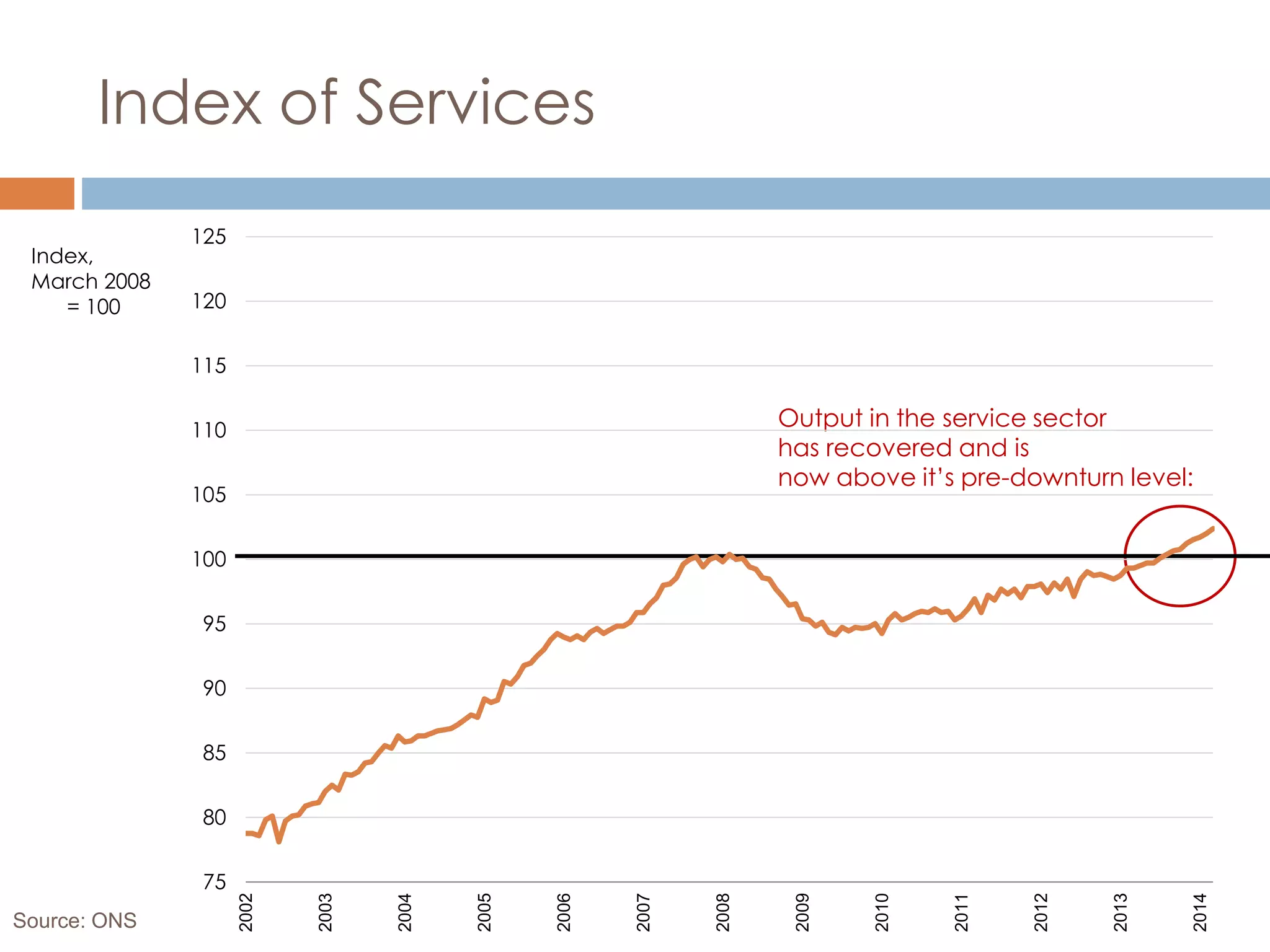
Index,
March 2008
= 100
Output in the service sector
has recovered and is
now above it’s pre-downturn level:
Source: ONS
75
80
85
90
95
100
105
110
115
120
125 2002
2003
2004
2005
2006
2007
2008
2009
2010
2011
2012
2013
2014
Index of Services
84
88
92
96
100
104
2002
2003
2004
2005
2006
2007
2008
2009
2010
2011
2012
2013
2014
Index,
March 2008
= 100
Output in the production
sector has not recovered
to it’s pre-downturn level:
Source: ONS
Index of Production
80
85
90
95
100
105
110
115
120
2002
Q1
2003
Q1
2004
Q1
2005
Q1
2006
Q1
2007
Q1
2008
Q1
2009
Q1
2010
Q1
2011
Q1
2012
Q1
2013
Q1
2014
Q1
Index,
March 2008
= 100
Output in the construction
sector has not recovered
to it’s pre-downturn level:
Source: ONS
Index of Construction
• Employment
• Wages
• Hours Worked
The Labour Market
70.0
70.5
71.0
71.5
72.0
72.5
73.0
73.5
74.0
2002Q1
Q3
2003Q1
Q3
2004Q1
Q3
2005Q1
Q3
2006Q1
Q3
2007Q1
Q3
2008Q1
Q3
2009Q1
Q3
2010Q1
Q3
2011Q1
Q3
2012Q1
Q3
2013Q1
Q3
2014Q1
Per cent
Not yet back to pre-downturn level:
Source: ONS
Employment Rate (16 – 64 year olds)
880
890
900
910
920
930
940
950
960
970
980
2002Q1
Q3
2003Q1
Q3
2004Q1
Q3
2005Q1
Q3
2006Q1
Q3
2007Q1
Q3
2008Q1
Q3
2009Q1
Q3
2010Q1
Q3
2011Q1
Q3
2012Q1
Q3
2013Q1
Q3
2014Q1
Millions of actual
hours worked
The employment rate is still below
it’s pre-downturn level but actual
hours worked has surpassed
it’s pre-downturn level.
What could explain this?
Source: ONS
Hours Worked
880
890
900
910
920
930
940
950
960
970
980
2002Q1
Q3
2003Q1
Q3
2004Q1
Q3
2005Q1
Q3
2006Q1
Q3
2007Q1
Q3
2008Q1
Q3
2009Q1
Q3
2010Q1
Q3
2011Q1
Q3
2012Q1
Q3
2013Q1
Q3
2014Q1
Millions of actual
hours worked
The employment rate is still below
it’s pre-downturn level but actual
hours worked has surpassed
it’s pre-downturn level.
What could explain this?
Population increase!
Source: ONS
Hours Worked
300
350
400
450
500
550
600
20
00
20
01
20
02
20
03
20
04
20
05
20
06
20
07
20
08
20
09
20
10
20
11
20
12
20
13
20
14
Source: ONS
Average Weekly Wages
300
350
400
450
500
550
600
20
00
20
01
20
02
20
03
20
04
20
05
20
06
20
07
20
08
20
09
20
10
20
11
20
12
20
13
20
14
Growth in average weekly wages
has been slower since the downturn
Source: ONS
Average Weekly Wages
-4.0
-3.0
-2.0
-1.0
0.0
1.0
2.0
3.0
4.0
5.0
6.0
Jan-
Mar
2009
Jan-
Mar
2010
Jan-
Mar
2011
Jan-
Mar
2012
Jan-
Mar
2013
Jan-
Mar
2014
Annual Growth Rates in Earnings and Consumer Prices
Earnings ex.
bonuses
Earnings inc.
bonuses
Consumer Prices Index
Source: ONS
Wages and Prices
-4.0
-3.0
-2.0
-1.0
0.0
1.0
2.0
3.0
4.0
5.0
6.0
Jan-
Mar
2009
Jan-
Mar
2010
Jan-
Mar
2011
Jan-
Mar
2012
Jan-
Mar
2013
Jan-
Mar
2014
Annual Growth Rates in Earnings and Consumer Prices
Earnings ex.
bonuses
Earnings inc.
bonuses
Consumer Prices Index
Growth in earnings inc. bonuses has risen
above growth in consumer prices for the
first time since 2010. However, growth in
earnings ex. bonuses is still below.
Source: ONS
Wages and Prices
Public Sector Debt and House Prices
0
20
40
60
80
100
120
140
160
180
1993
1994
1995
1996
1997
1998
1999
2000
2001
2002
2003
2004
2005
2006
2007
2008
2009
2010
2011
2012
2013
2014
Ex. interventions
Inc. interventions
132%
Note: Interventions mainly refer to the nationalisation of certain commercial banks
76%
Source: ONS
% of GDP
Public Sector Debt
0%
50%
100%
150%
200%
250%
300%
350%
400%
450%
1979
1980
1981
1982
1983
1984
1985
1986
1987
1988
1989
1990
1991
1992
1993
1994
1995
1996
1997
1998
1999
2000
2001
2002
2003
2004
2005
2006
2007
2008
2009
2010
2011
2012
2013
Increase in
House Prices
over a decade
RPI
(ex. housing)
If you bought your house in 1970
and sold it in 1980 on average
you would have seen the price
of your house quadruple
But on average the prices of
other products would have only
been around 2.5 times higher
Source: ONS
Wealth effect?
% increase
House Prices
0%
50%
100%
150%
200%
250%
300%
350%
400%
450%
1979
1980
1981
1982
1983
1984
1985
1986
1987
1988
1989
1990
1991
1992
1993
1994
1995
1996
1997
1998
1999
2000
2001
2002
2003
2004
2005
2006
2007
2008
2009
2010
2011
2012
2013
Increase in
House Prices
over a decade
RPI
(ex. housing)
If you bought your house in 1970
and sold it in 1980 on average
you would have seen the price
of your house quadruple
But on average the prices of
other products would have only
been around 2.5 times higher
Source: ONS
Wealth effect?
% increase
But, on average the prices of
other products would have
risen by a similar amount: 43%
If you bought your house in 2003
and sold it in 2013 on average
you would have seen the price
of your house rise by 45%
House Prices
• You may also like:
• http://www.ons.gov.uk/ons/rel/elmr/gdp-and-
the-labour-market/q1-2014--may-gdp-
update/sty-gdp-g7-economies.html
• http://www.ons.gov.uk/ons/rel/elmr/economi
c-review/june-2014/art-june-er.html
If you liked this presentation . . .

UK Economic Round Up: June 2014

Editor's Notes

  • #11 Why is this bad? In this scenario the economy will have not recovered “lost output”. The output that should have occurred if the economy had stayed on trend.
  • #12 Why is this bad? In this scenario the economy will have not recovered “lost output”. The output that should have occurred if the economy had stayed on trend.
  • #13 Why is this bad? In this scenario the economy will have not recovered “lost output”. The output that should have occurred if the economy had stayed on trend.
  • #14 This scenario is even worse! Lost output will be even higher!
  • #15 This scenario is even worse! Lost output will be even higher!
  • #17 Pie chart represents how much each sector contributes to the UK economy
  • #23 Population increase will be a major factor in explaining this.
  • #24 Population increase will be a major factor in explaining this.
  • #27 A positive picture – after divergence in recent years, earnings growth and the CPI are closing in on each other. This means that people’s earnings are growing at a similar rate to price increases. However, regular pay (earnings excluding bonuses) is still increasing at a slower rate than inflation.
  • #28 A positive picture – after divergence in recent years, earnings growth and the CPI are closing in on each other. This means that people’s earnings are growing at a similar rate to price increases. However, regular pay (earnings excluding bonuses) is still increasing at a slower rate than inflation.
  • #31 The picture is roughly the same for London
  • #32 The picture is roughly the same for London