Leaders conference
UK data management environment and support
John Kaye - JiscCNI Leaders conference
Preservation Challenges
»Introduction
»UK RDM Policy Environment
»UK RDM Systems
»UK Researcher Behaviour
»Jisc RDM Solution – Research Data Shared Service
Jisc Digital Futures
3 July, 2018 Jisc CNI UK Data Management and Support
Store
services
Playlists Diagnostic
tool builder
Curation
and remix
Learner
Analytics Services
Digital
capability
Learning
analytics
Digital
launchpad
Apprentice
workforce
development
Digital
leadership
Summer of
student
innovation
Analytics
academy
Analytics
labs
Qualification
verification
App
and
content
store
Research data
discovery
Research
data
usage
metrics
Equipment
data
Repository and
preservation platform
Research
data
shared
service
?
4
UK Policy
» Awareness of regulatory environment
» Data access statement
» Policies and processes
» Data storage
» Structured metadata descriptions
» DOIs for data
» Data securely preserved for a minimum of 10 years
from last use
» University roadmaps in place 2012, mandate in place
from 1 May 2015
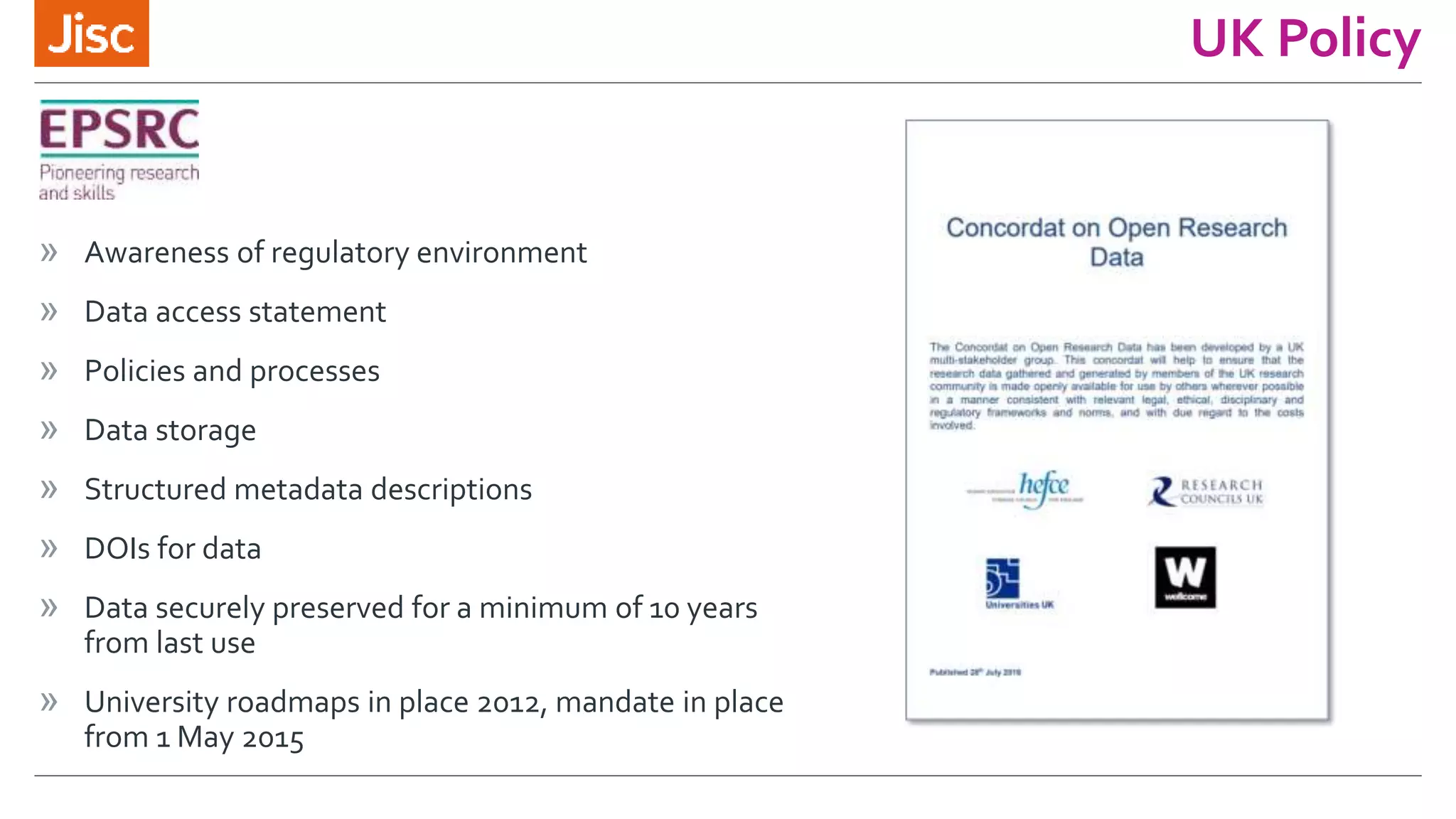
Concordat on Open Research Data
Principles of the Concordat on Open Research Data (July 2016) between research funders and universities:
1. Open access to research data is an enabler of high quality research, a facilitator of innovation and safeguards good research practice.
2. There are sound reasons why the openness of research data may need to be restricted but any restrictions must be justified and
justifiable.
3. Open access to research data carries a significant cost, which should be respected by all parties.
4. The right of the creators of research data to reasonable first use is recognised.
5. Use of others’ data should always conform to legal, ethical and regulatory frameworks including appropriate acknowledgement.
6. Good data management is fundamental to all stages of the research process and should be established at the outset.
7. Data curation is vital to make data useful for others and for long-term preservation of data
8. Data supporting publications should be accessible by the publication date and should be in a citeable form.
9. Support for the development of appropriate data skills is recognised as a responsibility for all stakeholders.
10.Regular reviews of progress towards open research data should be undertaken.
Developed by Universities, funders and other UK stakeholders together – signed by UUK, RCUK, HEFCE,
Wellcome.
Now need to develop the practical plans for this…
Issues Raised by Research Managers
» Encourage open data and open research, but find it difficult or almost not within their
remit to tell researchers what to do.
» Challenges
› Large data volumes (what to keep?)
› Duplication of datasets
› Cost of long-term storage
› More evidence that re-use of data is happening
› Making data management plans more dynamic
› Reviewing and understanding local requirements and ownership over this area
› Need for a stronger community in this area
› Reporting from systems currently in use
› Integrations between systems in use
› Clearer funder policies
Source: RDSS Market Research 2017
Repository systems within institutions
*Source: Jisc analysis (various sources- see spreadsheet for further information)
61%
18%
10%
4%
1% 1% 1% 1% 1% 1% 1% 1%
Repository systems in place within HE organisations
Based on 143 entries where
data was available*
64 organisations missing data
Based on information gathered from across the organisation, EPrints seems to dominate the repository space currently with DSpace and
Pure also being key providers.
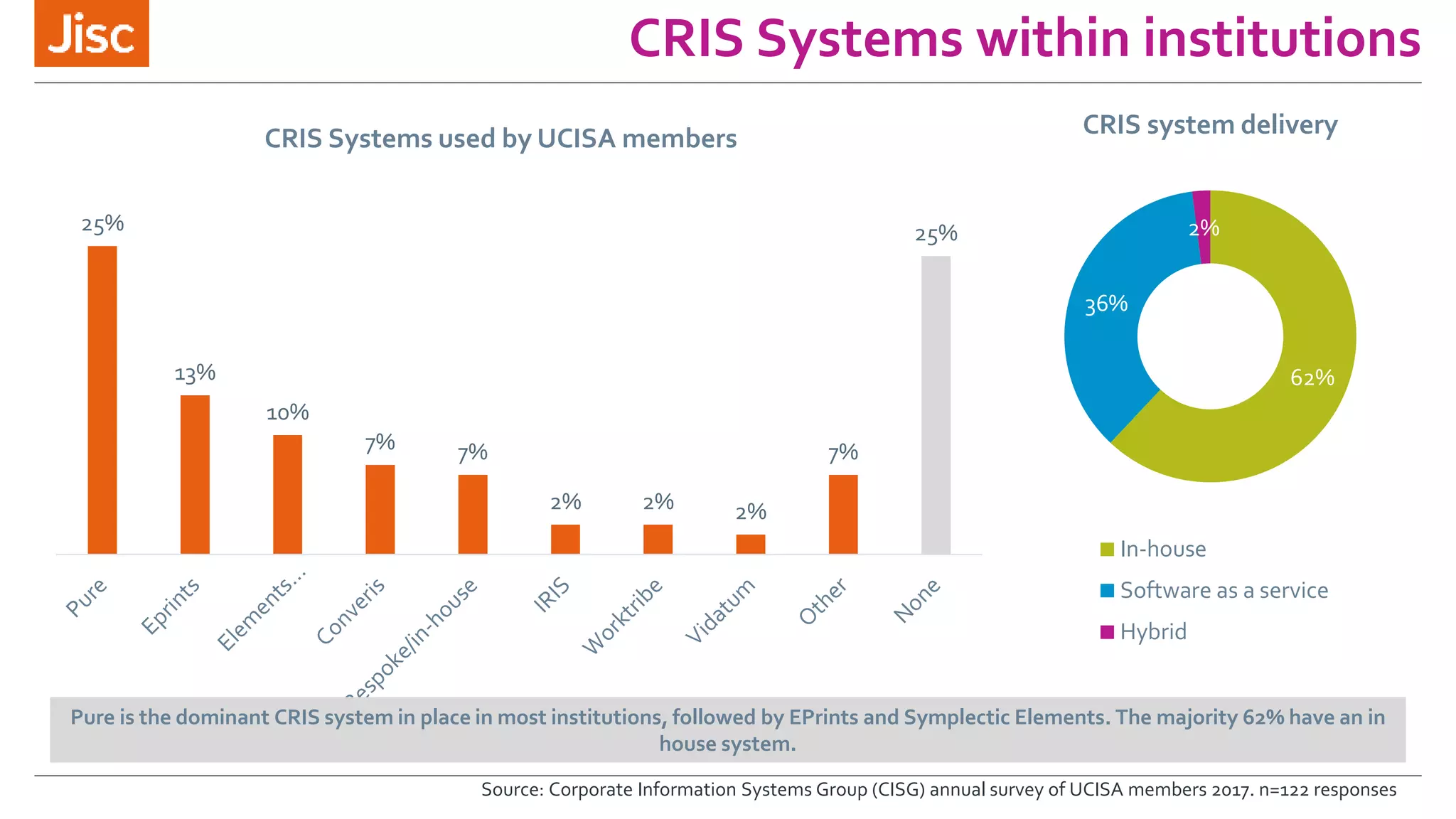
CRIS Systems within institutions
Source: Corporate Information Systems Group (CISG) annual survey of UCISA members 2017. n=122 responses
25%
13%
10%
7% 7%
2% 2% 2%
7%
25%
CRIS Systems used by UCISA members
62%
36%
2%
CRIS system delivery
In-house
Software as a service
Hybrid
Pure is the dominant CRIS system in place in most institutions, followed by EPrints and Symplectic Elements. The majority 62% have an in
house system.
CRIS system trends
Source: Corporate Information Systems Group (CISG) annual survey of UCISA members 2017 n=122, 2016 n=113, 2015 n=87
25%
27%
25%
3%
12% 13%14%
12%
10%
36%
25% 25%
0%
5%
10%
15%
20%
25%
30%
35%
40%
2015 2016 2017
Trends in top 3 CRIS systems 2015-2017
Pure Eprints Elements (Symplectic) None
2015 2016 2017
Pure 25% 27% 25%
EPrints 3% 12% 13%
Elements
(Symplectic)
14% 12% 10%
Converis 0% 8% 7%
Bespoke/in-
house
6% 6% 7%
IRIS 1% 1% 2%
Worktribe 1% 4% 2%
Vidatum 1% 0% 2%
Radar 1% 1% 1%
Haplo 0% 1% 1%
Ideate 0% 1% 1%
InfoEd 0% 1% 1%
Other 6% 2% 2%
None 36% 25% 25%
Not known 1% 1% 0%
Looking at trend data on CRIS systems over the last 3 years, the proportion of UCISA
members reporting to have a CRIS system has risen in this time. Whilst Pure's market
share appears to have remained static, data indicates that EPrints have increased
market share and Symplectic have seen a slight decline
Issues Raised by Research Managers
» Encourage open data and open research, but find it difficult or almost not within their
remit to tell researchers what to do.
» Challenges
› Large data volumes (what to keep?)
› Duplication of datasets
› Cost of long-term storage
› More evidence that re-use of data is happening
› Making data management plans more dynamic
› Reviewing and understanding local requirements and ownership over this area
› Need for a stronger community in this area
› Reporting from systems currently in use
› Integrations between systems in use
› Clearer funder policies
A sector-wide approach to research data management
Jisc shared serviceToday’s RDM cottage industry
No sector-wide
visibility of RDM
effectiveness
Only 20% of research data
from the 1990s is still
usable
Majority of research
institutions want a
solution which cuts
the pain
Share and optimise cost and
benefit across the sector
Grow value of research data and
increase research productivity
A single, cost-effective, pre-
integrated solution available
to all
Research Funders
require data to be
managed and
EPSRC have put
onus on institution
to preserve and
make research
data available as a
condition of
funding
Stand-alone solutions need every
institution to manage and
maintain on limited
budgets
c.200 UK public
sector institutions
perform around £6b of
funded research
per year in public
purse every year
3 July, 2018 Jisc CNI UK Data Management and Support 12
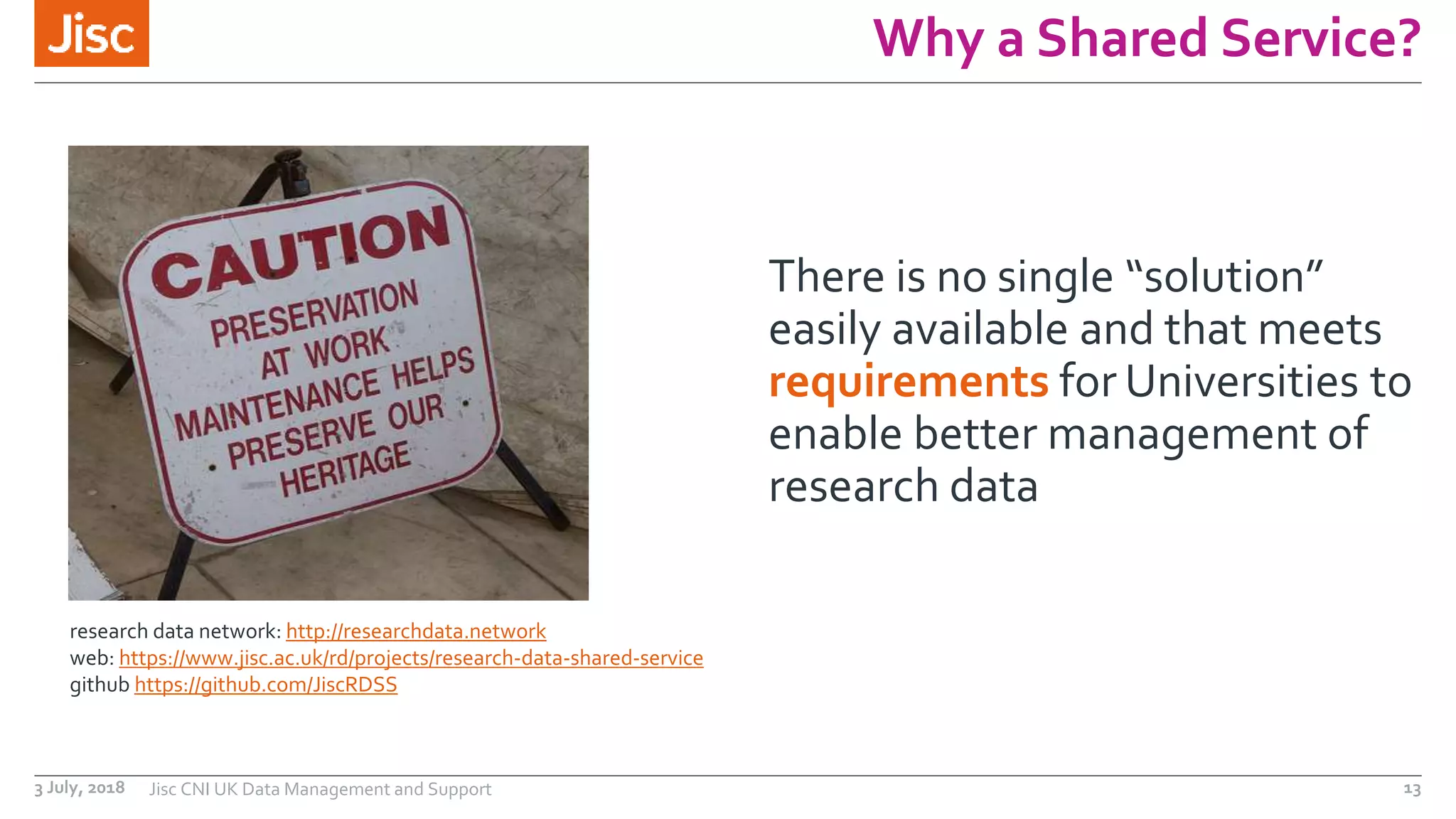
Why a Shared Service?
There is no single “solution”
easily available and that meets
requirements for Universities to
enable better management of
research data
research data network: http://researchdata.network
web: https://www.jisc.ac.uk/rd/projects/research-data-shared-service
github https://github.com/JiscRDSS
3 July, 2018 Jisc CNI UK Data Management and Support 13
Key researcher issues
3 July, 2018 Jisc CNI UK Data Management and Support 14
Source: Jisc DAF Survey results 2016
Capture & reuse Preserve Report
Advise &
best practise
Following input from our ExpertAdvisory Group, the Research Data Network, funders, and
dialogue with global users and vendors, Jisc RDSS will provide the following
core researcher functional needs:
Filling a gap
75% of respondents
look first to their
institution to
preserve their data
Uptake of RDM
Only 40% of
respondents have a
Research Data
Management plan
Advocacy
Only 16% of
respondents are
currently accessing
university RDM
support services
Metadata
Only 18% of
respondents say
they follow
established
metadata guidelines
Public datasets
>70% recognise that
research is a public
good and should be
publicly released
Sensitive data
41% of respondents
have some form of
sensitive data
University services to support RDM
“Support is woeful in the university currently, in particular
long-term data archiving is critically required. Most of my
non-current data is rotting on CD's and hard-drives.”
University services to support RDM
“Please, individualise the support.Workshop are useless,
emails with information are useless, brochures are useless,
posters are useless.”
University services to support RDM
“Please, individualise the support.Workshop are useless,
emails with information are useless, brochures are useless,
posters are useless.”
Preservation of research data
“I currently spend about £1,200 pa on data storage from my
own salary. I have the highest data needs in my School, and
there is no plan in place for storing my data.”
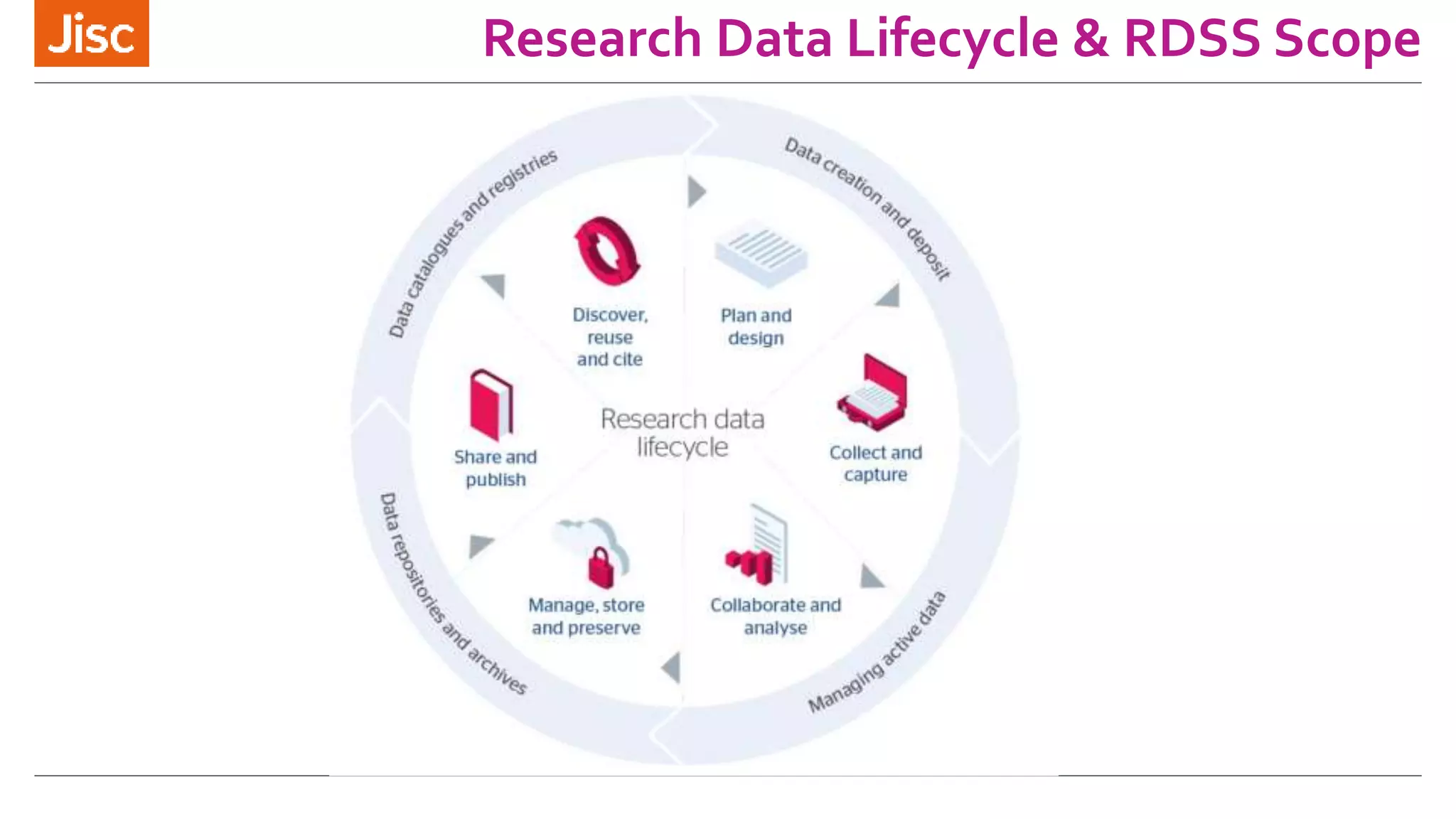
Research Data Lifecycle & RDSS Scope
RDSS Development History
3 July, 2018 Jisc CNI UK Data Management and Support 20
Service workflow summary
21
Repository
Messaging
Preservation
service
Reporting
and
analytics
Archival
data
storage
National research data aggregation
Or
1.a. Researcher
deposits data
2. Data added to
aggregation
3. Data is automatically
preserved
4. Use of data and service
is monitored
7. Data stored long term
6. Researchers find and
reuse data
Institutional or external
services
5. Other services are
updated
3 July, 2018 Jisc CNI UK Data Management and Support
1.b. Record of data
external deposit
Layer
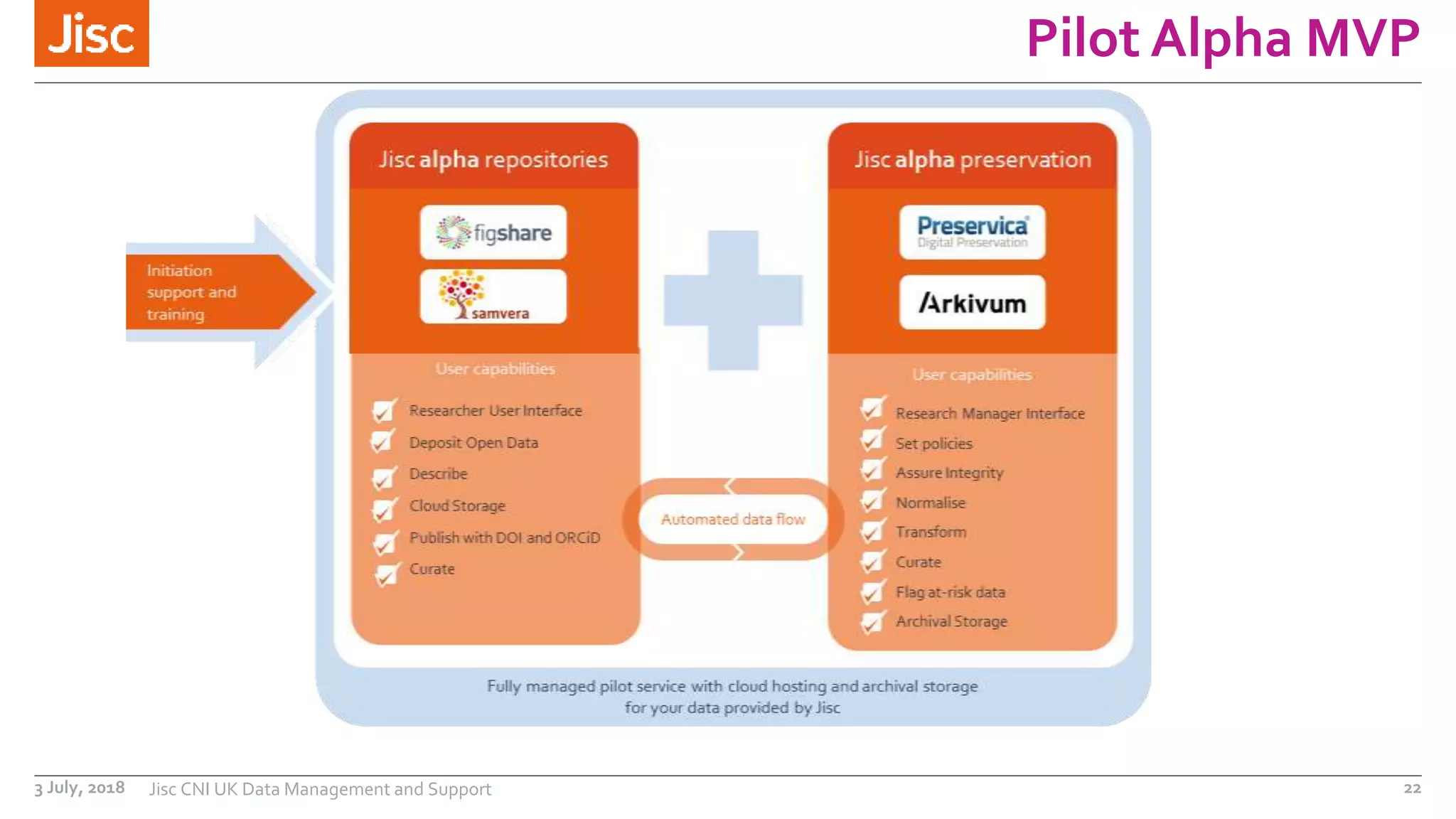
Pilot Alpha MVP
3 July, 2018 Jisc CNI UK Data Management and Support 22
Data Model
https://github.com/JiscRDSS/rdss-canonical-data-model
RDSS Data
Model
Alpha Phase
3 July, 2018 Jisc CNI UK Data Management and Support 23
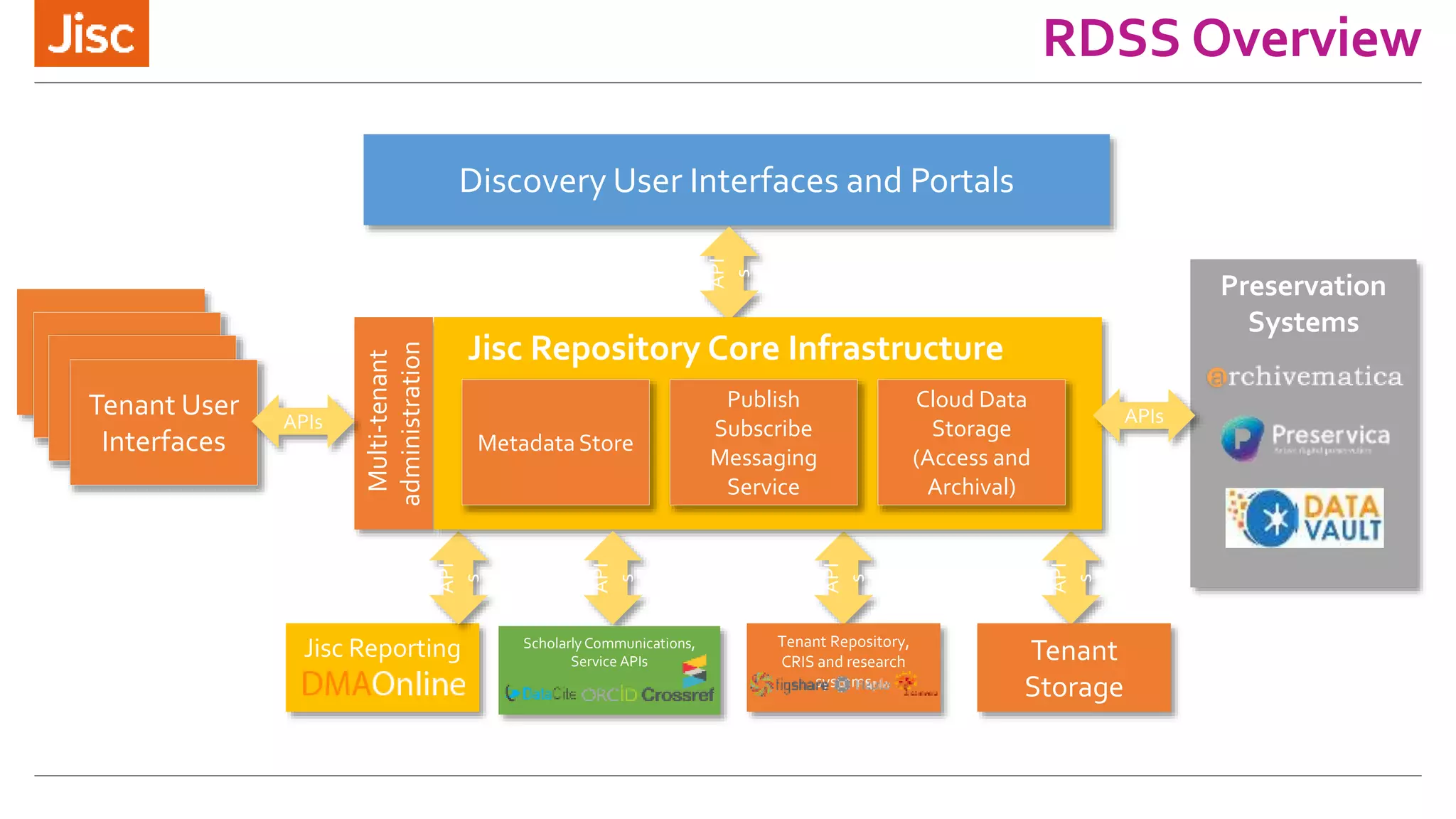
RDSS Overview
Preservation
Systems
Multi-tenant
administration
Discovery User Interfaces and Portals
API
s
User
InterfacesUser
InterfacesUser
InterfacesTenant User
Interfaces
APIs
Jisc Reporting
API
s
API
s
API
s
Tenant
Storage
API
s
Jisc Repository Core Infrastructure
APIs
Metadata Store
Publish
Subscribe
Messaging
Service
Cloud Data
Storage
(Access and
Archival)
Tenant Repository,
CRIS and research
systems
Scholarly Communications,
Service APIs
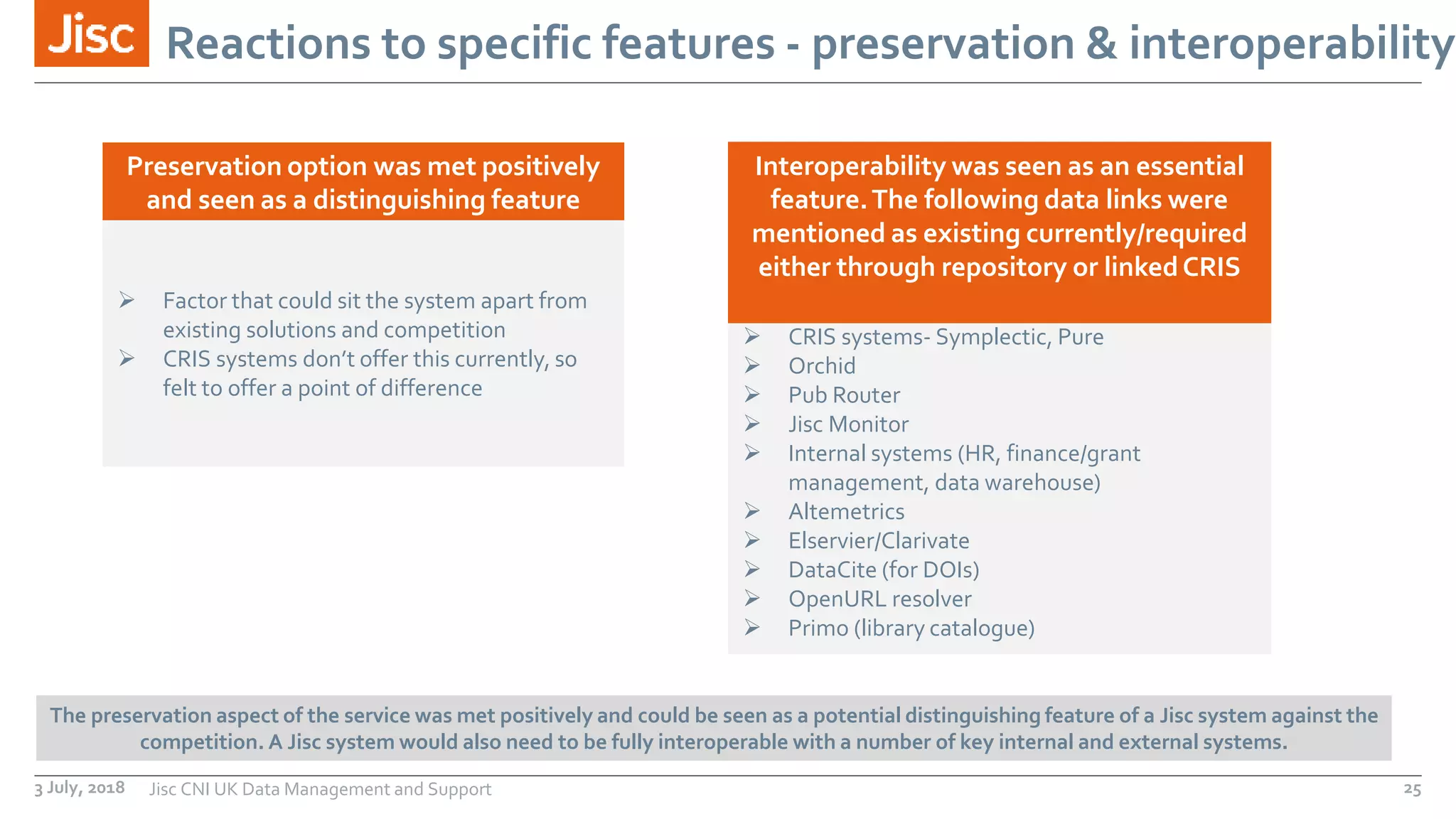
Reactions to specific features - preservation & interoperability
Preservation option was met positively
and seen as a distinguishing feature
The preservation aspect of the service was met positively and could be seen as a potential distinguishing feature of a Jisc system against the
competition. A Jisc system would also need to be fully interoperable with a number of key internal and external systems.
 Factor that could sit the system apart from
existing solutions and competition
 CRIS systems don’t offer this currently, so
felt to offer a point of difference
 CRIS systems- Symplectic, Pure
 Orchid
 Pub Router
 Jisc Monitor
 Internal systems (HR, finance/grant
management, data warehouse)
 Altemetrics
 Elservier/Clarivate
 DataCite (for DOIs)
 OpenURL resolver
 Primo (library catalogue)
Interoperability was seen as an essential
feature.The following data links were
mentioned as existing currently/required
either through repository or linkedCRIS
3 July, 2018 Jisc CNI UK Data Management and Support 25
Demo
Pre-recorded short demo
showing data being uploaded
into a test Samvera repository
instance, with automatic ingest
into Preservica.
3 July, 2018 Jisc CNI UK Data Management and Support 26
https://www.youtube.com/watch?v=d-l1ARNUwWA&t=13s
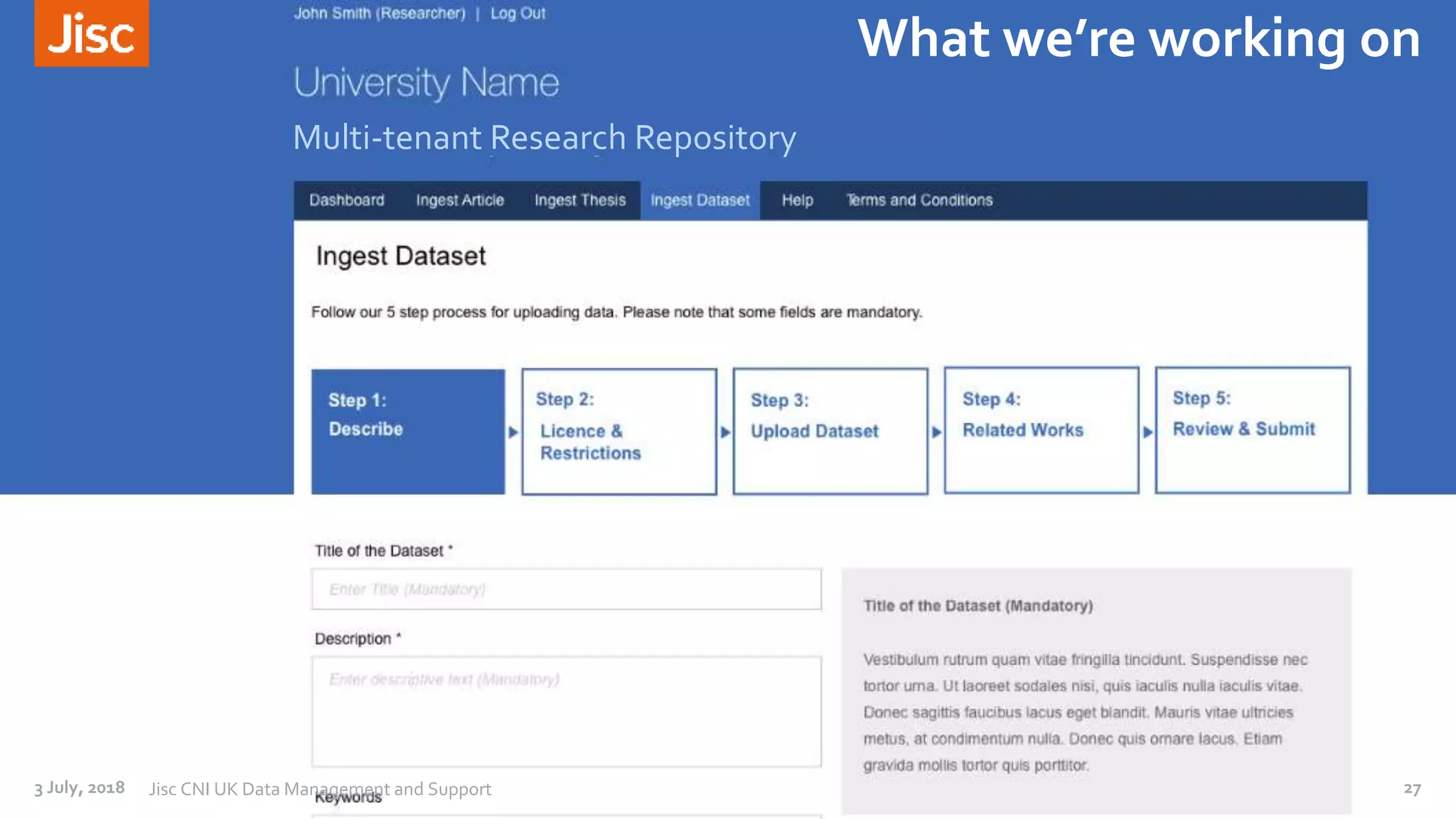
Multi-tenant Research Repository
What we’re working on
3 July, 2018 Jisc CNI UK Data Management and Support 27
rdmtoolkit.jisc.ac.uk
3 July, 2018 Jisc Research Data HEAP Workshop #JiscRDM 28
3 standard service options
End-to-end
service
Repository+
service
Preservation+
service
Service to be launched in
Q4 2018
+ is for integrations and
reporting
All 3 options include:
 Financial benefits
 Standards
 Advisory
 Network membership
3 July, 2018 Jisc CNI UK Data Management and Support 29
RDSS Priorities
»First priority is research data
› Research output (Article/Thesis etc.)
› Research data
› Research software/code
› Provenance metadata (method)
»But also…..
› Preservation systems tailored for
multiple digital objects and data
types
› Use cases and pilots for objects
beyond research data
3 July, 2018 Jisc CNI UK Data Management and Support 30
https://creativecommons.org/licenses/by/2.0/
https://www.flickr.com/photos/cogdog/
Preservation Challenges
»Automated preservation workflow
› Lack of resources
› Preservation sausage machine
»Interactive preservation workflow
› Work with the researcher and their data
»Appropriate Workflow
› What is an appropriate workflow?
Jisc national shared research platform
3 July, 2018 Jisc CNI UK Data Management and Support 32
Information sources
» Publications Router
» Publishers
» Crossref
» ORCID
» DataCite
» PubMed
» Sherpa policy tools
University systems
» (Single Sign-On,
Finance, HR..)
Information
destinations
» Google etc.
» Discovery services
» JiscCORE
(global OA aggregation)
» Jisc Monitor
(compliance checking)
» JiscCollections
» Funders systems
» OpenAIRE + for EU
Preservation
services
Reports and
dashboards
University X repository
Open Access publications
Research datasets
University Y repository
Open Access publications
Research datasets
University Z repository
Open Access publications
Research datasets
jisc.ac.uk
Except where otherwise noted, this work
is licensed under CC-BY-NC-ND
John Kaye
Jisc Digital Futures
John.kaye@jisc.ac.uk
3 July, 2018 Jisc CNI UK Data Management and Support 33
Clifford Lynch, Executive director, CNI
Research data management: the current US landscape

UK data management environment and support

  • 1.
  • 2.
    UK data managementenvironment and support John Kaye - JiscCNI Leaders conference
  • 3.
    Preservation Challenges »Introduction »UK RDMPolicy Environment »UK RDM Systems »UK Researcher Behaviour »Jisc RDM Solution – Research Data Shared Service
  • 4.
    Jisc Digital Futures 3July, 2018 Jisc CNI UK Data Management and Support Store services Playlists Diagnostic tool builder Curation and remix Learner Analytics Services Digital capability Learning analytics Digital launchpad Apprentice workforce development Digital leadership Summer of student innovation Analytics academy Analytics labs Qualification verification App and content store Research data discovery Research data usage metrics Equipment data Repository and preservation platform Research data shared service ? 4
  • 5.
    UK Policy » Awarenessof regulatory environment » Data access statement » Policies and processes » Data storage » Structured metadata descriptions » DOIs for data » Data securely preserved for a minimum of 10 years from last use » University roadmaps in place 2012, mandate in place from 1 May 2015
  • 6.
    Concordat on OpenResearch Data Principles of the Concordat on Open Research Data (July 2016) between research funders and universities: 1. Open access to research data is an enabler of high quality research, a facilitator of innovation and safeguards good research practice. 2. There are sound reasons why the openness of research data may need to be restricted but any restrictions must be justified and justifiable. 3. Open access to research data carries a significant cost, which should be respected by all parties. 4. The right of the creators of research data to reasonable first use is recognised. 5. Use of others’ data should always conform to legal, ethical and regulatory frameworks including appropriate acknowledgement. 6. Good data management is fundamental to all stages of the research process and should be established at the outset. 7. Data curation is vital to make data useful for others and for long-term preservation of data 8. Data supporting publications should be accessible by the publication date and should be in a citeable form. 9. Support for the development of appropriate data skills is recognised as a responsibility for all stakeholders. 10.Regular reviews of progress towards open research data should be undertaken. Developed by Universities, funders and other UK stakeholders together – signed by UUK, RCUK, HEFCE, Wellcome. Now need to develop the practical plans for this…
  • 7.
    Issues Raised byResearch Managers » Encourage open data and open research, but find it difficult or almost not within their remit to tell researchers what to do. » Challenges › Large data volumes (what to keep?) › Duplication of datasets › Cost of long-term storage › More evidence that re-use of data is happening › Making data management plans more dynamic › Reviewing and understanding local requirements and ownership over this area › Need for a stronger community in this area › Reporting from systems currently in use › Integrations between systems in use › Clearer funder policies Source: RDSS Market Research 2017
  • 8.
    Repository systems withininstitutions *Source: Jisc analysis (various sources- see spreadsheet for further information) 61% 18% 10% 4% 1% 1% 1% 1% 1% 1% 1% 1% Repository systems in place within HE organisations Based on 143 entries where data was available* 64 organisations missing data Based on information gathered from across the organisation, EPrints seems to dominate the repository space currently with DSpace and Pure also being key providers.
  • 9.
    CRIS Systems withininstitutions Source: Corporate Information Systems Group (CISG) annual survey of UCISA members 2017. n=122 responses 25% 13% 10% 7% 7% 2% 2% 2% 7% 25% CRIS Systems used by UCISA members 62% 36% 2% CRIS system delivery In-house Software as a service Hybrid Pure is the dominant CRIS system in place in most institutions, followed by EPrints and Symplectic Elements. The majority 62% have an in house system.
  • 10.
    CRIS system trends Source:Corporate Information Systems Group (CISG) annual survey of UCISA members 2017 n=122, 2016 n=113, 2015 n=87 25% 27% 25% 3% 12% 13%14% 12% 10% 36% 25% 25% 0% 5% 10% 15% 20% 25% 30% 35% 40% 2015 2016 2017 Trends in top 3 CRIS systems 2015-2017 Pure Eprints Elements (Symplectic) None 2015 2016 2017 Pure 25% 27% 25% EPrints 3% 12% 13% Elements (Symplectic) 14% 12% 10% Converis 0% 8% 7% Bespoke/in- house 6% 6% 7% IRIS 1% 1% 2% Worktribe 1% 4% 2% Vidatum 1% 0% 2% Radar 1% 1% 1% Haplo 0% 1% 1% Ideate 0% 1% 1% InfoEd 0% 1% 1% Other 6% 2% 2% None 36% 25% 25% Not known 1% 1% 0% Looking at trend data on CRIS systems over the last 3 years, the proportion of UCISA members reporting to have a CRIS system has risen in this time. Whilst Pure's market share appears to have remained static, data indicates that EPrints have increased market share and Symplectic have seen a slight decline
  • 11.
    Issues Raised byResearch Managers » Encourage open data and open research, but find it difficult or almost not within their remit to tell researchers what to do. » Challenges › Large data volumes (what to keep?) › Duplication of datasets › Cost of long-term storage › More evidence that re-use of data is happening › Making data management plans more dynamic › Reviewing and understanding local requirements and ownership over this area › Need for a stronger community in this area › Reporting from systems currently in use › Integrations between systems in use › Clearer funder policies
  • 12.
    A sector-wide approachto research data management Jisc shared serviceToday’s RDM cottage industry No sector-wide visibility of RDM effectiveness Only 20% of research data from the 1990s is still usable Majority of research institutions want a solution which cuts the pain Share and optimise cost and benefit across the sector Grow value of research data and increase research productivity A single, cost-effective, pre- integrated solution available to all Research Funders require data to be managed and EPSRC have put onus on institution to preserve and make research data available as a condition of funding Stand-alone solutions need every institution to manage and maintain on limited budgets c.200 UK public sector institutions perform around £6b of funded research per year in public purse every year 3 July, 2018 Jisc CNI UK Data Management and Support 12
  • 13.
    Why a SharedService? There is no single “solution” easily available and that meets requirements for Universities to enable better management of research data research data network: http://researchdata.network web: https://www.jisc.ac.uk/rd/projects/research-data-shared-service github https://github.com/JiscRDSS 3 July, 2018 Jisc CNI UK Data Management and Support 13
  • 14.
    Key researcher issues 3July, 2018 Jisc CNI UK Data Management and Support 14 Source: Jisc DAF Survey results 2016 Capture & reuse Preserve Report Advise & best practise Following input from our ExpertAdvisory Group, the Research Data Network, funders, and dialogue with global users and vendors, Jisc RDSS will provide the following core researcher functional needs: Filling a gap 75% of respondents look first to their institution to preserve their data Uptake of RDM Only 40% of respondents have a Research Data Management plan Advocacy Only 16% of respondents are currently accessing university RDM support services Metadata Only 18% of respondents say they follow established metadata guidelines Public datasets >70% recognise that research is a public good and should be publicly released Sensitive data 41% of respondents have some form of sensitive data
  • 15.
    University services tosupport RDM “Support is woeful in the university currently, in particular long-term data archiving is critically required. Most of my non-current data is rotting on CD's and hard-drives.”
  • 16.
    University services tosupport RDM “Please, individualise the support.Workshop are useless, emails with information are useless, brochures are useless, posters are useless.”
  • 17.
    University services tosupport RDM “Please, individualise the support.Workshop are useless, emails with information are useless, brochures are useless, posters are useless.”
  • 18.
    Preservation of researchdata “I currently spend about £1,200 pa on data storage from my own salary. I have the highest data needs in my School, and there is no plan in place for storing my data.”
  • 19.
  • 20.
    RDSS Development History 3July, 2018 Jisc CNI UK Data Management and Support 20
  • 21.
    Service workflow summary 21 Repository Messaging Preservation service Reporting and analytics Archival data storage Nationalresearch data aggregation Or 1.a. Researcher deposits data 2. Data added to aggregation 3. Data is automatically preserved 4. Use of data and service is monitored 7. Data stored long term 6. Researchers find and reuse data Institutional or external services 5. Other services are updated 3 July, 2018 Jisc CNI UK Data Management and Support 1.b. Record of data external deposit Layer
  • 22.
    Pilot Alpha MVP 3July, 2018 Jisc CNI UK Data Management and Support 22
  • 23.
    Data Model https://github.com/JiscRDSS/rdss-canonical-data-model RDSS Data Model AlphaPhase 3 July, 2018 Jisc CNI UK Data Management and Support 23
  • 24.
    RDSS Overview Preservation Systems Multi-tenant administration Discovery UserInterfaces and Portals API s User InterfacesUser InterfacesUser InterfacesTenant User Interfaces APIs Jisc Reporting API s API s API s Tenant Storage API s Jisc Repository Core Infrastructure APIs Metadata Store Publish Subscribe Messaging Service Cloud Data Storage (Access and Archival) Tenant Repository, CRIS and research systems Scholarly Communications, Service APIs
  • 25.
    Reactions to specificfeatures - preservation & interoperability Preservation option was met positively and seen as a distinguishing feature The preservation aspect of the service was met positively and could be seen as a potential distinguishing feature of a Jisc system against the competition. A Jisc system would also need to be fully interoperable with a number of key internal and external systems.  Factor that could sit the system apart from existing solutions and competition  CRIS systems don’t offer this currently, so felt to offer a point of difference  CRIS systems- Symplectic, Pure  Orchid  Pub Router  Jisc Monitor  Internal systems (HR, finance/grant management, data warehouse)  Altemetrics  Elservier/Clarivate  DataCite (for DOIs)  OpenURL resolver  Primo (library catalogue) Interoperability was seen as an essential feature.The following data links were mentioned as existing currently/required either through repository or linkedCRIS 3 July, 2018 Jisc CNI UK Data Management and Support 25
  • 26.
    Demo Pre-recorded short demo showingdata being uploaded into a test Samvera repository instance, with automatic ingest into Preservica. 3 July, 2018 Jisc CNI UK Data Management and Support 26 https://www.youtube.com/watch?v=d-l1ARNUwWA&t=13s
  • 27.
    Multi-tenant Research Repository Whatwe’re working on 3 July, 2018 Jisc CNI UK Data Management and Support 27
  • 28.
    rdmtoolkit.jisc.ac.uk 3 July, 2018Jisc Research Data HEAP Workshop #JiscRDM 28
  • 29.
    3 standard serviceoptions End-to-end service Repository+ service Preservation+ service Service to be launched in Q4 2018 + is for integrations and reporting All 3 options include:  Financial benefits  Standards  Advisory  Network membership 3 July, 2018 Jisc CNI UK Data Management and Support 29
  • 30.
    RDSS Priorities »First priorityis research data › Research output (Article/Thesis etc.) › Research data › Research software/code › Provenance metadata (method) »But also….. › Preservation systems tailored for multiple digital objects and data types › Use cases and pilots for objects beyond research data 3 July, 2018 Jisc CNI UK Data Management and Support 30 https://creativecommons.org/licenses/by/2.0/ https://www.flickr.com/photos/cogdog/
  • 31.
    Preservation Challenges »Automated preservationworkflow › Lack of resources › Preservation sausage machine »Interactive preservation workflow › Work with the researcher and their data »Appropriate Workflow › What is an appropriate workflow?
  • 32.
    Jisc national sharedresearch platform 3 July, 2018 Jisc CNI UK Data Management and Support 32 Information sources » Publications Router » Publishers » Crossref » ORCID » DataCite » PubMed » Sherpa policy tools University systems » (Single Sign-On, Finance, HR..) Information destinations » Google etc. » Discovery services » JiscCORE (global OA aggregation) » Jisc Monitor (compliance checking) » JiscCollections » Funders systems » OpenAIRE + for EU Preservation services Reports and dashboards University X repository Open Access publications Research datasets University Y repository Open Access publications Research datasets University Z repository Open Access publications Research datasets
  • 33.
    jisc.ac.uk Except where otherwisenoted, this work is licensed under CC-BY-NC-ND John Kaye Jisc Digital Futures John.kaye@jisc.ac.uk 3 July, 2018 Jisc CNI UK Data Management and Support 33
  • 34.
    Clifford Lynch, Executivedirector, CNI Research data management: the current US landscape

Editor's Notes

  • #6 Research organisations have primary responsibility for ensuring that researchers manage their data effectively. They need established infrastructure and processes to ensure: Retained EPSRC-funded research data is preserved for a minimum of ten years Effective data curation is provided throughout full data lifecycle Knowledge of publicly-funded research data holdings Discoverability; recording of third party access requests Notice and justification of access restrictions, for example ‘commercially confidential’ Awareness and use of relevant law, for example FOI Awareness and compliance with research data policies Adequate RDM resource allocation for example from quality-related research (QR) funding or research grants
  • #7 Developed through stakeholder consultation with Jisc, universities, publishers and BL Valuable process – now need to implement Taskforce established as part of Tickell advice to government to recommend what’s required to make this happen
  • #13 Responsibilities split across institution. Librarians, Research Office, IT, Archivists (role going forward)
  • #14 More effective Research Data Management must happen to comply with Funder Mandates, ensure data is not lost, and to realise a whole range of positive benefits A shared service (provided by Jisc) seems to offer a number of benefits: Cost savings and efficiencies Common approaches and practice – do this together Research system standardisation and interoperability ( do it once rather than many times! , & also address it across essential systems so we can key once and share) Address market gaps
  • #21 We worked with a lot of people! How and why we’ve got to where we are Pilots Worked with 16 pilot institutions of various sizes - need to get various groups together Library, RO, IT, Archives where they exist. Created a procurement framework  Pilots 17 institutions Cross spectrum use cases Large and small Collaborative development Multiple suppliers and solution vendors Drivers More than £5 million investment over 2 years Open access Sector defined requirements “R@R” co-design Over half the HEI sector involved
  • #25 Overview of system
  • #28 Where are we now Multi tenant user interface Workflows
  • #29 Where are we now Multi tenant user interface Workflows
  • #31 First priority is research data However research data is not good enough on it’s own for research publication the ideal is to store, or link to the complete research package Research output (Article/Thesis etc.) Research data Research software/code Provenance metadata (method) Without this research is often not re-usable or repeatable. But…..we are aware that we are providing preservation systems that are tailored to deal with all kinds of digital objects and data. We are exploring use cases and pilots for objects beyond research data.
  • #32 Automated preservation workflow: lack resources (staff, skills, budget, time) to do a comprehensive job of preserving all their research datasets and will instead want a low-cost, fully automated, 'black box' approach to digital preservation of at least some of their data. They want a 'preservation sausage machine' whereby research data is fed in at one end and out of the other comes 'preservation packages' containing the research data in a form that is better described and structured for long-term usability. Interactive preservation workflow: Institution will want to work closely with both the Research Data and the Researcher as part of an iterative process of quality control and digital This is a more interactive and resource intensive process than 'automated' preservation, but can yield better results and may be more appropriate for specific types of research or institution. The most appropriate workflow to use will depend on many factors, e.g. the experience an institution has with digital preservation, the resources at its disposal, the research discipline or type of data involved, the requirements of the research funder, the institutions policy and so on.