Rika Yorozu 
UNESCO Institute for Lifelong Learning 
r.yorozu@unesco.org 
10 October 2014
What is a learning city? : 
UNESCO’s working definition 
A Learning City is a city which effectively mobilises its resources in every 
sector to 
• promote inclusive learning from basic to higher education; 
• re-vitalise learning in families and communities; 
• facilitate learning for and in the workplace; 
• extend the use of modern learning technologies; 
• enhance quality and excellence in learning; and 
• nurture a culture of learning throughout life. 
In so doing it will create and reinforce individual empowerment and social 
cohesion, economic and cultural prosperity, and sustainable 
development. 
10/16/2014
Why a global network?
What are the benefits of joining the GNLC? 
• Being part of a group of cities with common 
interests, tackling similar issues/challenges, and 
envisioning similar development agendas. 
• Communicating with a network of experts and 
professionals specialised in the field of lifelong 
learning for sustainable development. 
• Open access to global repository of know-how 
and best practices in developing learning cities. 
• Showcasing the experiences of learning cities 
through the communication channel of the 
network.
A total of 23 collaborating partners of the 
GNLC
Achievements so far 
 Beijing Declaration on 
Building Learning Cities from 
the First International 
Conference on Learning 
Cities (2013) 
 The Key Features of 
Learning Cities 
 Piloting the key features in 
10 cities
Learning cities in action 
?
Why monitor the progress of building a 
learning city? 
 There is no magic line over which a city will pass in order 
to become a learning city. Building a learning city is a 
continuous process. 
 The concept of the learning city is not abstract. It takes a 
pragmatic approach to putting lifelong learning into 
action. 
 If a city has the political will and commitment to build a 
learning city, it needs a set of indicators by which it can 
measure and monitor its performance and progress.
Key Features of Learning Cities: Framework
A total of 10 cities completed the piloting. 
(UK) 
(Hungary) 
Mexico City 
(Mexico) 
Kaunas 
Timisoara (Lithuania) 
(Romania) 
Konya 
(Turkey) 
Beijing 
(China)
The possible measurements: Wider benefits of building 
a learning city
More information: 
GNLC website Electronic Newsletter 
http://learningcities.uil.unesco.org
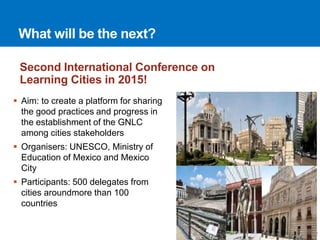
What will be the next? 
Second International Conference on 
Learning Cities in 2015! 
 Aim: to create a platform for sharing 
the good practices and progress in 
the establishment of the GNLC 
among cities stakeholders 
 Organisers: UNESCO, Ministry of 
Education of Mexico and Mexico 
City 
 Participants: 500 delegates from 
cities aroundmore than 100 
countries
Contact us 
Learningcities 
@unesco.org 
Literacy and Basic Skills 
Mailing List 
r.yorozu@unesco.org

Global Network of Learning Cities

  • 1.
    Rika Yorozu UNESCOInstitute for Lifelong Learning r.yorozu@unesco.org 10 October 2014
  • 2.
    What is alearning city? : UNESCO’s working definition A Learning City is a city which effectively mobilises its resources in every sector to • promote inclusive learning from basic to higher education; • re-vitalise learning in families and communities; • facilitate learning for and in the workplace; • extend the use of modern learning technologies; • enhance quality and excellence in learning; and • nurture a culture of learning throughout life. In so doing it will create and reinforce individual empowerment and social cohesion, economic and cultural prosperity, and sustainable development. 10/16/2014
  • 3.
    Why a globalnetwork?
  • 4.
    What are thebenefits of joining the GNLC? • Being part of a group of cities with common interests, tackling similar issues/challenges, and envisioning similar development agendas. • Communicating with a network of experts and professionals specialised in the field of lifelong learning for sustainable development. • Open access to global repository of know-how and best practices in developing learning cities. • Showcasing the experiences of learning cities through the communication channel of the network.
  • 5.
    A total of23 collaborating partners of the GNLC
  • 6.
    Achievements so far  Beijing Declaration on Building Learning Cities from the First International Conference on Learning Cities (2013)  The Key Features of Learning Cities  Piloting the key features in 10 cities
  • 7.
  • 8.
    Why monitor theprogress of building a learning city?  There is no magic line over which a city will pass in order to become a learning city. Building a learning city is a continuous process.  The concept of the learning city is not abstract. It takes a pragmatic approach to putting lifelong learning into action.  If a city has the political will and commitment to build a learning city, it needs a set of indicators by which it can measure and monitor its performance and progress.
  • 9.
    Key Features ofLearning Cities: Framework
  • 10.
    A total of10 cities completed the piloting. (UK) (Hungary) Mexico City (Mexico) Kaunas Timisoara (Lithuania) (Romania) Konya (Turkey) Beijing (China)
  • 11.
    The possible measurements:Wider benefits of building a learning city
  • 12.
    More information: GNLCwebsite Electronic Newsletter http://learningcities.uil.unesco.org
  • 13.
    What will bethe next? Second International Conference on Learning Cities in 2015!  Aim: to create a platform for sharing the good practices and progress in the establishment of the GNLC among cities stakeholders  Organisers: UNESCO, Ministry of Education of Mexico and Mexico City  Participants: 500 delegates from cities aroundmore than 100 countries
  • 14.
    Contact us Learningcities @unesco.org Literacy and Basic Skills Mailing List r.yorozu@unesco.org