Expanding learning time and space

            Kiichi Oyasu
      (APPEAL UNESCO Bangkok)


Jayagiri Capacity Building for NFE Program
              Implementation
        Thailand, Nov 18 – 23, 2007
Narrow View            Broad View
  of Education           of Education

                                SCHOOL
     SCHOOL
                                           l
                                      o rma n
                                   Inf atio
                           NO       Edu
                                       c
                             N-
                           Ed FOR
                              uc     M
                                ati AL
                                   on


                         Lifelong Learning:
  Schooling is only
                           School is only
component of education
                            one component
EFA & Lifelong Education
 EFA & Lifelong Education


       Continuing Education
       (non-formal & informal)
Age

                                 Non-formal basic
      School Education           education

         Population (%)                        3
Community Learning
         Centres (CLCs)
• Local education institutions outside the
  formal education system

• Set up and managed by local people

• Various learning opportunities for
  community development and improvement
  of people’s quality of life.

• Use of existing infrastructure
  e.g. schools, temples, mosque
  health centres, public halls
Participating Countries
    Participating Countries
Bangladesh, Bhutan,
Cambodia, China,
India, Indonesia, Iran,
Kazhakstan, Lao
PDR, Malaysia,
Myanmar, Mongolia,
Nepal, Pakistan,
Papua New Guinea,
Philippines, Samoa,
Sri Lanka, Thailand,
Uzbekistan, Vietnam,
Afghanistan,
Kyrgyzstan, Maldives
CLC functions
CLC functions


                6
Main programmes delivered
   Main programmes delivered
          through CLCs
         through CLCs
   Literacy                Information
                            and library
Equivalency
programme                  Sports and
                           recreation
   Skill
 training                   Community
                           development
            Community
            consultation
Equivalency programmes
• Alternative educational programmes
  equivalent to existing formal general or
  vocational education
• More flexible than formal school system
  –   Policy
  –   Target learners
  –   Curriculum &Materials
  –   Capacity building of personnel
  –   Delivery mechanism (e.g. schools, CLCs)
  –   Assessment & accreditation
Content and process – life skills


   Income generation programme (IGP)
   not only practical skills for production but
   also other life skills are required            9
Life skills programmes through NFE
     Life skills programmes through NFE
                    •Main components
 Literacy skills    (3Rs): Reading,      Generic skills
                    Writing,
                    Numeracy


                    Cannot be obtained
                       in isolation
                                          •Problem solving
                                          •Critical thinking
                                          •Entrepreneurial
                                          skills
                    Contextual skills
•Livelihood/
income generation
•Health
•Gender
•Family
•Environment                                             10
Regional Project on ICT for
  Community Empowerment
        Information                 Policy
        Sharing                     dialogues


                Resource                          Con
                                                     tent
   ls
Too             development, delivery
                and feedback


           ICT for community empowerment through CLCs       11
Community empowerment

                         • ICT for effective management
                           tools for community activities
                           – accounting, database,
                           training with VCD
                         • Youths as the driving force to
                           introduce computer based
                           activities of the project.

• Awareness promotion with ICT e.g. mobile van, TV and
  radio
• Step by step from formulating people, economic
  empowerment, confidence building for decision making
                                                     12
Content and material
   Content and material
       development
      development
Attractive, relevant and learner friendly:

• Learner Generated Material, e.g.
  using digital camera and ppt.
• Use of local languages and widsom
• Learning process: Learner friendly-
  self instructional learning
• VCD/DVD for skill training orientation
• Soft ware for Self help Group
  accounting
• Learning materials of enterprise
  development and skill development.
CLCs: Positive findings
        CLCs: Positive findings
•   CLCs become ‘common word’ for
    community based learning institutions
    –   Policy dialogue, planning, standardizing,
        exchange of experiences
•   CLCs provide a multi-purpose venue for
    individual and community development:
    –   quality of life improvement,
    –   confidence building,
    –   empowerment of disadvantaged people
    –   Unity and coordination.
•   Learning environment was developed in a
    community targeting all ages:
    –   parents’ more interests in children’s education,
    –   discussions about global/developmental issues.
CLCs: Challenges
         CLCs: Challenges
• Policy support for resource allocation and
  mobilization (financial, material and human).
• Maximum use of local resources and capacity
• Capacity of personnel and leadership.
• External support to support maintaining the
  quality of activities.
• Flexible programming to cope with diverse
  and changing needs.
• Decentralized management – role of central
  and local government and community.
Effective implementation and
  Effective implementation and
      sustainability of CLCs
      sustainability of CLCs
 Community             Political
 Ownership             support

 Resource              Monitoring
Mobilization           Evaluation

    Capacity    Linkage &
    Building     Network
Kominkan Summit in Okayama
   Kominkan Summit in Okayama
Community development
  and ESD

27 Oct – 3 Nov 2007

Bangladesh, Cambodia,
  Indonesia, Japan,
  Mongolia, Nepal,
  Philippines, Thailand
  Vietnam
Government, NGO,
  education & research
Kominkan Summit in Okayama
    Kominkan Summit in Okayama
•    Key notes on Kominkan
     and CLCs
•    Presentations by
     participants and
     discussions
•    Visit to Kominkan and
     Lifelong Learning Centre
•    Summary discussions
•    Public Symposium
Kominkan Summit in Okayama
    Kominkan Summit in Okayama
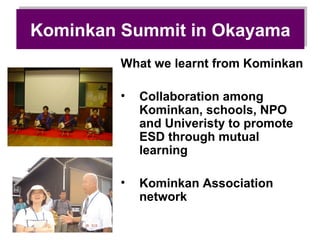
What we learnt from Kominkan

•   Need based programming:
    e.g. elderly population,
    island development

•   Community participation in
    planning, implementation
    and management: e.g.
    volunteer

•   Periodical Newsletters
Kominkan Summit in Okayama
        What we learnt from Kominkan

        •   Collaboration among
            Kominkan, schools, NPO
            and Univeristy to promote
            ESD through mutual
            learning

        •   Kominkan Association
            network
Kominkan Summit in Okayama
    Kominkan Summit in Okayama

Suggestions to Kominkan

•    Institutionalization and expansion
•    Coping with changing & new needs
•    Systematic linkage between Kominkan and
     the Lifelong Learning Centre
•    Mobilizing resources outside of
     government budge
•    Participation of entire community esp.
     men and youths in planning and
     management
Okayama declaration (1 Nov
    Okayama declaration (1 Nov
              07 )
             07 )
•   Kominkan /CLCs as information and
    learning centres for sustainable
    community development, participated and
    owned by the community
•   Collaboration among all stakeholders
    including government, NGOs, schools,
    universities.
•   Promoting linkages and networks
    including Association and Sister
    Kominkan

Expanding Learning Time and Space

  • 1.
    Expanding learning timeand space Expanding learning time and space Kiichi Oyasu (APPEAL UNESCO Bangkok) Jayagiri Capacity Building for NFE Program Implementation Thailand, Nov 18 – 23, 2007
  • 2.
    Narrow View Broad View of Education of Education SCHOOL SCHOOL l o rma n Inf atio NO Edu c N- Ed FOR uc M ati AL on Lifelong Learning: Schooling is only School is only component of education one component
  • 3.
    EFA & LifelongEducation EFA & Lifelong Education Continuing Education (non-formal & informal) Age Non-formal basic School Education education Population (%) 3
  • 4.
    Community Learning Centres (CLCs) • Local education institutions outside the formal education system • Set up and managed by local people • Various learning opportunities for community development and improvement of people’s quality of life. • Use of existing infrastructure e.g. schools, temples, mosque health centres, public halls
  • 5.
    Participating Countries Participating Countries Bangladesh, Bhutan, Cambodia, China, India, Indonesia, Iran, Kazhakstan, Lao PDR, Malaysia, Myanmar, Mongolia, Nepal, Pakistan, Papua New Guinea, Philippines, Samoa, Sri Lanka, Thailand, Uzbekistan, Vietnam, Afghanistan, Kyrgyzstan, Maldives
  • 6.
  • 7.
    Main programmes delivered Main programmes delivered through CLCs through CLCs Literacy Information and library Equivalency programme Sports and recreation Skill training Community development Community consultation
  • 8.
    Equivalency programmes • Alternativeeducational programmes equivalent to existing formal general or vocational education • More flexible than formal school system – Policy – Target learners – Curriculum &Materials – Capacity building of personnel – Delivery mechanism (e.g. schools, CLCs) – Assessment & accreditation
  • 9.
    Content and process– life skills Content and process – life skills Income generation programme (IGP) not only practical skills for production but also other life skills are required 9
  • 10.
    Life skills programmesthrough NFE Life skills programmes through NFE •Main components Literacy skills (3Rs): Reading, Generic skills Writing, Numeracy Cannot be obtained in isolation •Problem solving •Critical thinking •Entrepreneurial skills Contextual skills •Livelihood/ income generation •Health •Gender •Family •Environment 10
  • 11.
    Regional Project onICT for Community Empowerment Information Policy Sharing dialogues Resource Con tent ls Too development, delivery and feedback ICT for community empowerment through CLCs 11
  • 12.
    Community empowerment • ICT for effective management tools for community activities – accounting, database, training with VCD • Youths as the driving force to introduce computer based activities of the project. • Awareness promotion with ICT e.g. mobile van, TV and radio • Step by step from formulating people, economic empowerment, confidence building for decision making 12
  • 13.
    Content and material Content and material development development Attractive, relevant and learner friendly: • Learner Generated Material, e.g. using digital camera and ppt. • Use of local languages and widsom • Learning process: Learner friendly- self instructional learning • VCD/DVD for skill training orientation • Soft ware for Self help Group accounting • Learning materials of enterprise development and skill development.
  • 14.
    CLCs: Positive findings CLCs: Positive findings • CLCs become ‘common word’ for community based learning institutions – Policy dialogue, planning, standardizing, exchange of experiences • CLCs provide a multi-purpose venue for individual and community development: – quality of life improvement, – confidence building, – empowerment of disadvantaged people – Unity and coordination. • Learning environment was developed in a community targeting all ages: – parents’ more interests in children’s education, – discussions about global/developmental issues.
  • 15.
    CLCs: Challenges CLCs: Challenges • Policy support for resource allocation and mobilization (financial, material and human). • Maximum use of local resources and capacity • Capacity of personnel and leadership. • External support to support maintaining the quality of activities. • Flexible programming to cope with diverse and changing needs. • Decentralized management – role of central and local government and community.
  • 16.
    Effective implementation and Effective implementation and sustainability of CLCs sustainability of CLCs Community Political Ownership support Resource Monitoring Mobilization Evaluation Capacity Linkage & Building Network
  • 17.
    Kominkan Summit inOkayama Kominkan Summit in Okayama Community development and ESD 27 Oct – 3 Nov 2007 Bangladesh, Cambodia, Indonesia, Japan, Mongolia, Nepal, Philippines, Thailand Vietnam Government, NGO, education & research
  • 18.
    Kominkan Summit inOkayama Kominkan Summit in Okayama • Key notes on Kominkan and CLCs • Presentations by participants and discussions • Visit to Kominkan and Lifelong Learning Centre • Summary discussions • Public Symposium
  • 19.
    Kominkan Summit inOkayama Kominkan Summit in Okayama What we learnt from Kominkan • Need based programming: e.g. elderly population, island development • Community participation in planning, implementation and management: e.g. volunteer • Periodical Newsletters
  • 20.
    Kominkan Summit inOkayama Kominkan Summit in Okayama What we learnt from Kominkan • Collaboration among Kominkan, schools, NPO and Univeristy to promote ESD through mutual learning • Kominkan Association network
  • 21.
    Kominkan Summit inOkayama Kominkan Summit in Okayama Suggestions to Kominkan • Institutionalization and expansion • Coping with changing & new needs • Systematic linkage between Kominkan and the Lifelong Learning Centre • Mobilizing resources outside of government budge • Participation of entire community esp. men and youths in planning and management
  • 22.
    Okayama declaration (1Nov Okayama declaration (1 Nov 07 ) 07 ) • Kominkan /CLCs as information and learning centres for sustainable community development, participated and owned by the community • Collaboration among all stakeholders including government, NGOs, schools, universities. • Promoting linkages and networks including Association and Sister Kominkan