Dr. Assem A. Zeyada M.D.
Emeritus Professor of Internal
Medicine
Consultant of Endocrinology
Cairo University & Hospitals
Do We Know What Is
Type 2 Diabetes?
Definition
Diabetes, Hyperglycemia or Something
else?
Diabetes (G) = Siphon, meaning diarrhea of the Kidneys
Mellitus (G) = Honey like
Joslin 1916
we need standards for diagnosis of diabetes
Fajans 1978
Diabetes should be considered as a heterogeneous
group of disorders affecting carbohydrate protein
and fat metabolism due to relative or absolute
insulin deficiency with specific microvascular
complications and high incidence of macrovascular
complications
ADA 1997
A group of metabolic disorders characterized by
hyperglycemia due to defects in insulin secretion
and or action with consequent long term damage,
dysfunction and failure of various organs
Type 2 Diabetes
2015
Where are we?
The Plague of the century
The Global burden for governments
economy worldwide
The Ghost we are fighting
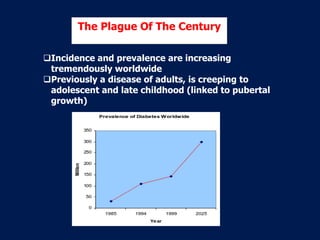
Incidence and prevalence are increasing
tremendously worldwide
Previously a disease of adults, is creeping to
adolescent and late childhood (linked to pubertal
growth)
The Plague Of The Century
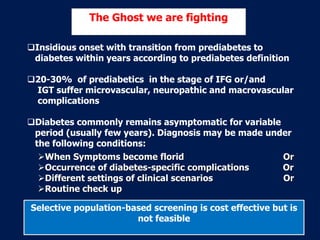
Insidious onset with transition from prediabetes to
diabetes within years according to prediabetes definition
20-30% of prediabetics in the stage of IFG or/and
IGT suffer microvascular, neuropathic and macrovascular
complications
Diabetes commonly remains asymptomatic for variable
period (usually few years). Diagnosis may be made under
the following conditions:
The Ghost we are fighting
When Symptoms become florid Or
Occurrence of diabetes-specific complications Or
Different settings of clinical scenarios Or
Routine check up
Selective population-based screening is cost effective but is
not feasible
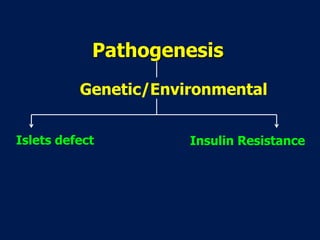
Pathogenesis
Genetic/Environmental
Islets defect Insulin Resistance
Genetic/Environmental
Despite Herculean efforts, single nucleotide
polymorphisms (Diabeto SNPs)exceed 30 and most are
unknown . Many ethnic groups are not yet studied
In conclusion: Robust Genetic Prediction and personalized
Diabetes Intervention remains a distant hope
With time many deleterious factors are identified which
empower the continuity of the plague
Long Term Exposure to traffic related air pollution in
healthy physically active and non smokers; contributes to
the development of Diabetes
Anderson Z, J Raachou-Nielsen O et al
Diabetes Care 2012;35:92-98
Genetic Basis
DAGOGO-JACK S.Commentary
Diabetes Care 2012;35:193-195
Environmental Hazards: beside unhealthy life style
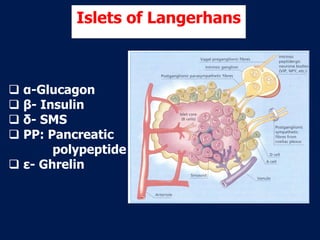
Islets of Langerhans
 α-Glucagon
 β- Insulin
 δ- SMS
 PP: Pancreatic
polypeptide
 ε- Ghrelin
Islets Defect
Islet Dysharmony
 Islet paracrinopathy:
sensitivity of α-cell to
endogenous insulin
hyperglucagonemia
 Many yet unknown
During the show many come into the play e.g
hypertension, Dyslipidemia, mitochondrial
dysfunction, oxidative stress and amyloid
Islets in Type 2 DM
β - Cell mass
 Programmed in
utero
 Apoptosis exceeds
neogenesis
 Islets derived
cytokines
β - Cell defect
 programmed in
utero
- AIR
- Lost 1st phase
insulin secretion
- Diabetes
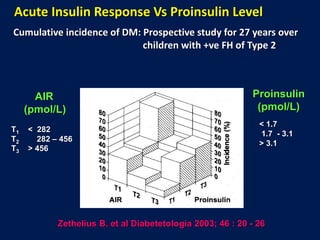
Acute Insulin Response Vs Proinsulin Level
Cumulative incidence of DM: Prospective study for 27 years over
children with +ve FH of Type 2
AIR
(pmol/L)
Proinsulin
(pmol/L)
T1 < 282
T2 282 – 456
T3 > 456
< 1.7
1.7 - 3.1
> 3.1
Zethelius B. et al Diabetetologia 2003; 46 : 20 - 26
Insulin resistance
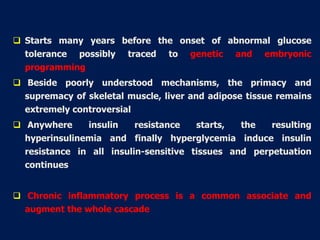
 Starts many years before the onset of abnormal glucose
tolerance possibly traced to genetic and embryonic
programming
 Beside poorly understood mechanisms, the primacy and
supremacy of skeletal muscle, liver and adipose tissue remains
extremely controversial
 Anywhere insulin resistance starts, the resulting
hyperinsulinemia and finally hyperglycemia induce insulin
resistance in all insulin-sensitive tissues and perpetuation
continues
 Chronic inflammatory process is a common associate and
augment the whole cascade
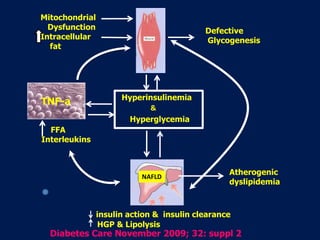
Hyperinsulinemia
Hyperglycemia
FFA
Interleukins
Mitochondrial
Dysfunction
Intracellular
fat
Defective
Glycogenesis
Diabetes Care November 2009; 32: suppl 2
NAFLD
&
insulin action & insulin clearance
HGP & Lipolysis
TNF-a
Atherogenic
dyslipidemia
 Healthy diet and calorie restriction aiming at B.wt
reduction especially in obese
 Increased physical activity. Beside helping body weight
reduction is beneficial regarding depression and dyslipidemia
Self Management Diabetes Education (SMDE)
 considered now the gold standard , but handicaps are
many with increasing life stresses
Pharmacotheray
 The ideal drug(s) is still unknown. Metformin remains the
best and the denominator for all drug combinations
Bariatric Surgery
 When indicated for the proper patient , proved effective in
improving diabetes and other CVRs
In Management
Life Style Modification
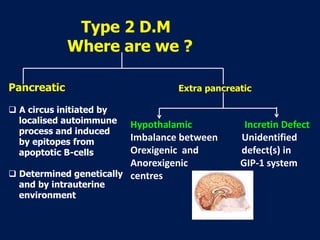
Extra pancreatic
Type 2 D.M
Where are we ?
Pancreatic
 A circus initiated by
localised autoimmune
process and induced
by epitopes from
apoptotic B-cells
 Determined genetically
and by intrauterine
environment
Hypothalamic Incretin Defect
Imbalance between Unidentified
Orexigenic and defect(s) in
Anorexigenic GIP-1 system
centres
 Type 2 diabetes is a state of hyperglycemia emanating from
islet dysfunction and insulin resistance which occur early in life
and progress steadily. The mechanisms behind both are poorly
understood
 Alternatively it may represent a component of dysmetabolic
syndrome again of unknown nature
 For the moment no ideal therapeutic approach exists and
chronic complications continue
 Still gloomy. We are facing an epidemic with enormous human
suffering and economic costs
 Lessons from UKPDs, Accord, ADVANCE, VDAT and others
advocate early intervention at the onset or even before
hyperglycemia and aggressive treatment in the young
especially with increasing body weight
Conclusion
Thank You
Endless story

Ueda2016 do we know what is type 2 -assem zeyada

  • 1.
    Dr. Assem A.Zeyada M.D. Emeritus Professor of Internal Medicine Consultant of Endocrinology Cairo University & Hospitals Do We Know What Is Type 2 Diabetes?
  • 2.
    Definition Diabetes, Hyperglycemia orSomething else? Diabetes (G) = Siphon, meaning diarrhea of the Kidneys Mellitus (G) = Honey like
  • 3.
    Joslin 1916 we needstandards for diagnosis of diabetes Fajans 1978 Diabetes should be considered as a heterogeneous group of disorders affecting carbohydrate protein and fat metabolism due to relative or absolute insulin deficiency with specific microvascular complications and high incidence of macrovascular complications ADA 1997 A group of metabolic disorders characterized by hyperglycemia due to defects in insulin secretion and or action with consequent long term damage, dysfunction and failure of various organs
  • 4.
    Type 2 Diabetes 2015 Whereare we? The Plague of the century The Global burden for governments economy worldwide The Ghost we are fighting
  • 5.
    Incidence and prevalenceare increasing tremendously worldwide Previously a disease of adults, is creeping to adolescent and late childhood (linked to pubertal growth) The Plague Of The Century
  • 6.
    Insidious onset withtransition from prediabetes to diabetes within years according to prediabetes definition 20-30% of prediabetics in the stage of IFG or/and IGT suffer microvascular, neuropathic and macrovascular complications Diabetes commonly remains asymptomatic for variable period (usually few years). Diagnosis may be made under the following conditions: The Ghost we are fighting When Symptoms become florid Or Occurrence of diabetes-specific complications Or Different settings of clinical scenarios Or Routine check up Selective population-based screening is cost effective but is not feasible
  • 7.
  • 8.
  • 9.
    Despite Herculean efforts,single nucleotide polymorphisms (Diabeto SNPs)exceed 30 and most are unknown . Many ethnic groups are not yet studied In conclusion: Robust Genetic Prediction and personalized Diabetes Intervention remains a distant hope With time many deleterious factors are identified which empower the continuity of the plague Long Term Exposure to traffic related air pollution in healthy physically active and non smokers; contributes to the development of Diabetes Anderson Z, J Raachou-Nielsen O et al Diabetes Care 2012;35:92-98 Genetic Basis DAGOGO-JACK S.Commentary Diabetes Care 2012;35:193-195 Environmental Hazards: beside unhealthy life style
  • 10.
    Islets of Langerhans α-Glucagon  β- Insulin  δ- SMS  PP: Pancreatic polypeptide  ε- Ghrelin
  • 11.
  • 12.
    Islet Dysharmony  Isletparacrinopathy: sensitivity of α-cell to endogenous insulin hyperglucagonemia  Many yet unknown During the show many come into the play e.g hypertension, Dyslipidemia, mitochondrial dysfunction, oxidative stress and amyloid Islets in Type 2 DM β - Cell mass  Programmed in utero  Apoptosis exceeds neogenesis  Islets derived cytokines β - Cell defect  programmed in utero - AIR - Lost 1st phase insulin secretion - Diabetes
  • 13.
    Acute Insulin ResponseVs Proinsulin Level Cumulative incidence of DM: Prospective study for 27 years over children with +ve FH of Type 2 AIR (pmol/L) Proinsulin (pmol/L) T1 < 282 T2 282 – 456 T3 > 456 < 1.7 1.7 - 3.1 > 3.1 Zethelius B. et al Diabetetologia 2003; 46 : 20 - 26
  • 14.
  • 15.
     Starts manyyears before the onset of abnormal glucose tolerance possibly traced to genetic and embryonic programming  Beside poorly understood mechanisms, the primacy and supremacy of skeletal muscle, liver and adipose tissue remains extremely controversial  Anywhere insulin resistance starts, the resulting hyperinsulinemia and finally hyperglycemia induce insulin resistance in all insulin-sensitive tissues and perpetuation continues  Chronic inflammatory process is a common associate and augment the whole cascade
  • 16.
    Hyperinsulinemia Hyperglycemia FFA Interleukins Mitochondrial Dysfunction Intracellular fat Defective Glycogenesis Diabetes Care November2009; 32: suppl 2 NAFLD & insulin action & insulin clearance HGP & Lipolysis TNF-a Atherogenic dyslipidemia
  • 17.
     Healthy dietand calorie restriction aiming at B.wt reduction especially in obese  Increased physical activity. Beside helping body weight reduction is beneficial regarding depression and dyslipidemia Self Management Diabetes Education (SMDE)  considered now the gold standard , but handicaps are many with increasing life stresses Pharmacotheray  The ideal drug(s) is still unknown. Metformin remains the best and the denominator for all drug combinations Bariatric Surgery  When indicated for the proper patient , proved effective in improving diabetes and other CVRs In Management Life Style Modification
  • 18.
    Extra pancreatic Type 2D.M Where are we ? Pancreatic  A circus initiated by localised autoimmune process and induced by epitopes from apoptotic B-cells  Determined genetically and by intrauterine environment Hypothalamic Incretin Defect Imbalance between Unidentified Orexigenic and defect(s) in Anorexigenic GIP-1 system centres
  • 19.
     Type 2diabetes is a state of hyperglycemia emanating from islet dysfunction and insulin resistance which occur early in life and progress steadily. The mechanisms behind both are poorly understood  Alternatively it may represent a component of dysmetabolic syndrome again of unknown nature  For the moment no ideal therapeutic approach exists and chronic complications continue  Still gloomy. We are facing an epidemic with enormous human suffering and economic costs  Lessons from UKPDs, Accord, ADVANCE, VDAT and others advocate early intervention at the onset or even before hyperglycemia and aggressive treatment in the young especially with increasing body weight Conclusion
  • 20.