EN
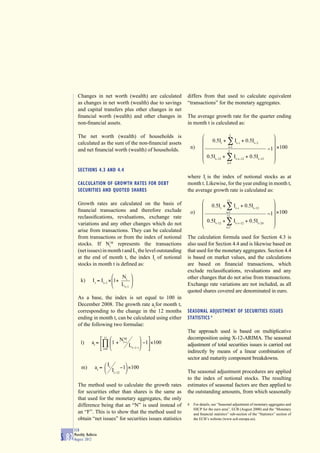
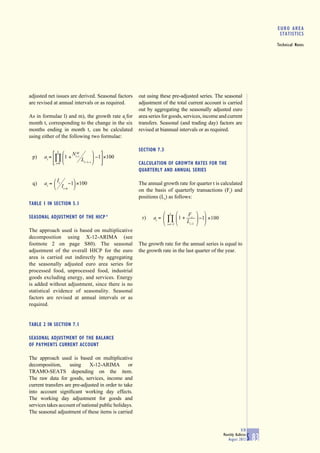
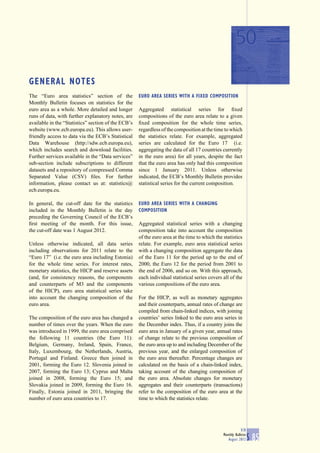
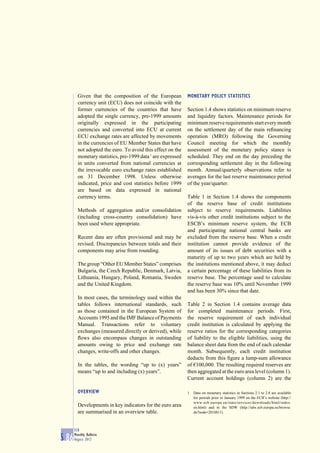
0812012


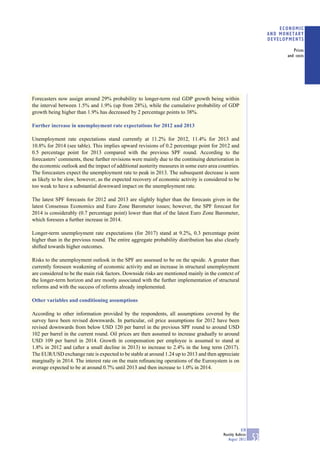
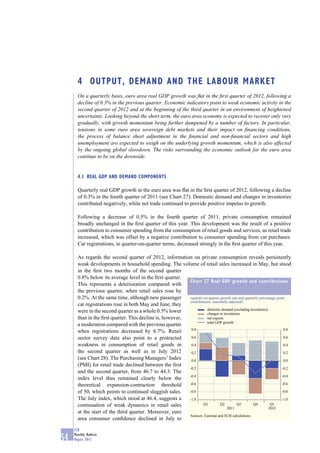
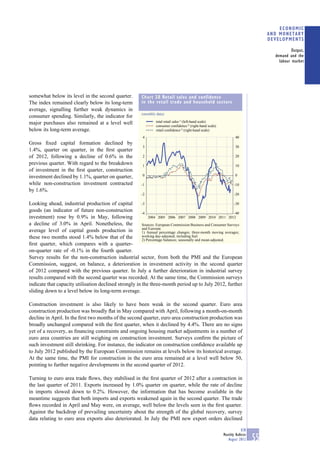
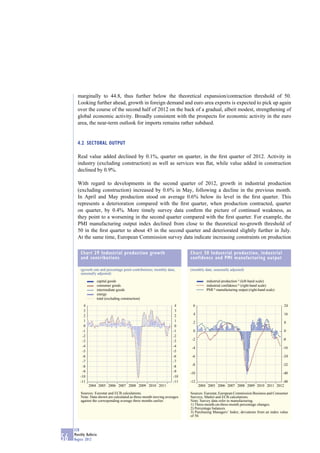
                        0112012
                        0212012   M O N T H LY B U L L E T I N
MONTHLY BULLETIN


                                                  AUGUST

                        0312012
                        0412012
                        0512012
                        0612012
                        0712012
                        0812012
EUROPEAN CENTRAL BANK


                        0912012
                        1012012
                        1112012
                        1212012
M O N T H LY B U L L E T I N
                               A U G U S T 2012


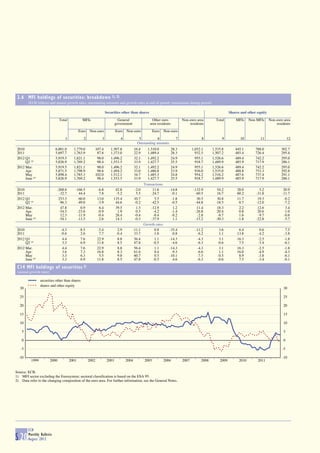
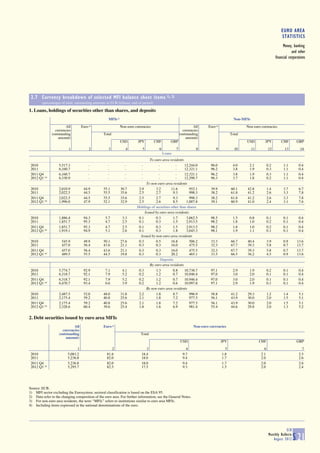
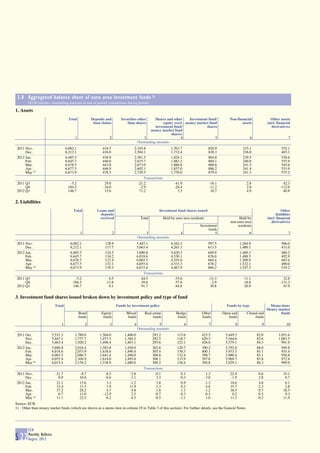
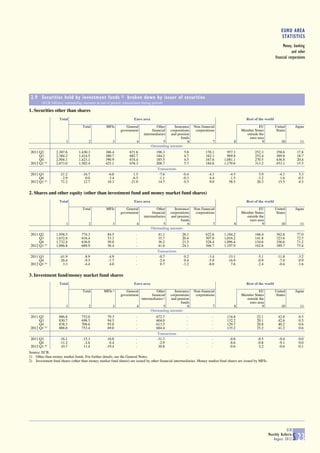
  In 2012 all ECB
       publications
    feature a motif
        taken from
the €50 banknote.
© European Central Bank, 2012

Address
Kaiserstrasse 29
60311 Frankfurt am Main
Germany

Postal address
Postfach 16 03 19
60066 Frankfurt am Main
Germany

Telephone
+49 69 1344 0

Website
http://www.ecb.europa.eu

Fax
+49 69 1344 6000

This Bulletin was produced under the
responsibility of the Executive Board of
the ECB. Translations are prepared and
published by the national central banks.

All rights reserved. Reproduction for
educational and non-commercial purposes
is permitted provided that the source is
acknowledged.

The cut-off date for the statistics included
in this issue was 1 August 2012.

ISSN 1561-0136 (print)
ISSN 1725-2822 (online)
CONTENTS
EDITORIAL                                           5

ECONOMIC AND MONETARY
DEVELOPMENTS
The external environment of the euro area           9
Monetary and financial developments                18
Prices and costs                                  45
Output, demand and the labour market              54

Boxes:
1 Recent developments in oil prices               13
2 The results of the euro area bank
  lending survey for the second quarter
  of 2012                                         21
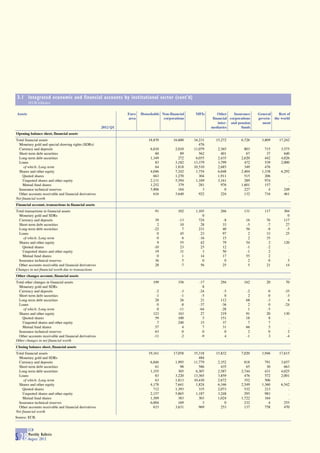
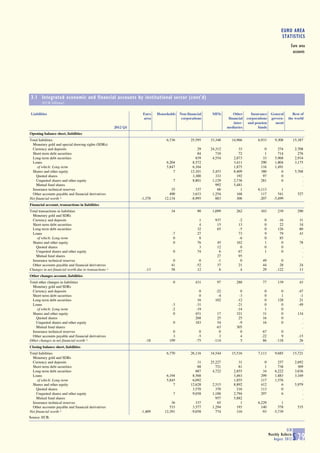
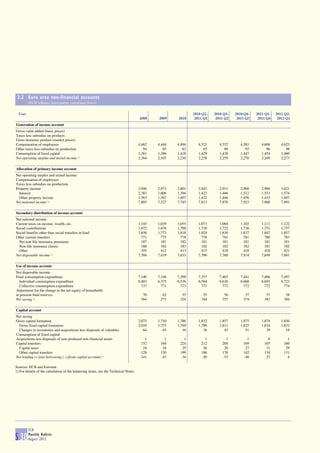
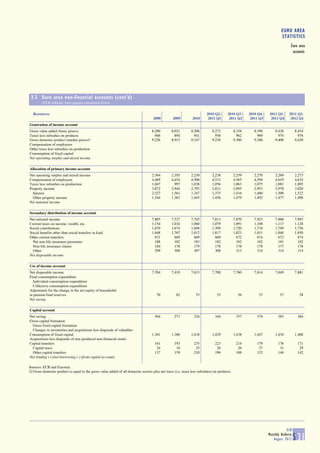
3 Integrated euro area accounts for the
  first quarter of 2012                            40
4 Results of the ECB Survey
  of Professional Forecasters for the
  third quarter of 2012                           49
5 Adjustment processes within the euro
  area: developments in Ireland, Greece,
  Spain, Cyprus and Portugal                      59

ARTICLES
Heterogeneity in euro area financial
conditions and policy implications                63
Assessing the financing conditions
of the euro area private sector during
the sovereign debt crisis                         77

EURO AREA STATISTICS                              S1

ANNEXES
Chronology of monetary policy
measures of the Eurosystem                           I
Publications produced by the European
Central Bank                                        V
Glossary                                         VII


                                                     ECB
                                         Monthly Bulletin
                                            August 2012     3
ABBREVIATIONS
      COUNTRIES                                        LU               Luxembourg
      BE               Belgium                         HU               Hungary
      BG               Bulgaria                        MT               Malta
      CZ               Czech Republic                  NL               Netherlands
      DK               Denmark                         AT               Austria
      DE               Germany                         PL               Poland
      EE               Estonia                         PT               Portugal
      IE               Ireland                         RO               Romania
      GR               Greece                          SI               Slovenia
      ES               Spain                           SK               Slovakia
      FR               France                          FI               Finland
      IT               Italy                           SE               Sweden
      CY               Cyprus                          UK               United Kingdom
      LV               Latvia                          JP               Japan
      LT               Lithuania                       US               United States


      OTHERS
      BIS              Bank for International Settlements
      b.o.p.           balance of payments
      BPM5             IMF Balance of Payments Manual (5th edition)
      CD               certificate of deposit
      c.i.f.           cost, insurance and freight at the importer’s border
      CPI              Consumer Price Index
      ECB              European Central Bank
      EER              effective exchange rate
      EMI              European Monetary Institute
      EMU              Economic and Monetary Union
      ESA 95           European System of Accounts 1995
      ESCB             European System of Central Banks
      EU               European Union
      EUR              euro
      f.o.b.           free on board at the exporter’s border
      GDP              gross domestic product
      HICP             Harmonised Index of Consumer Prices
      HWWI             Hamburg Institute of International Economics
      ILO              International Labour Organization
      IMF              International Monetary Fund
      MFI              monetary financial institution
      NACE             statistical classification of economic activities in the European Union
      NCB              national central bank
      OECD             Organisation for Economic Co-operation and Development
      PPI              Producer Price Index
      SITC Rev. 4      Standard International Trade Classification (revision 4)
      ULCM             unit labour costs in manufacturing
      ULCT             unit labour costs in the total economy

      In accordance with EU practice, the EU countries are listed in this Bulletin using the
      alphabetical order of the country names in the national languages.

    ECB
    Monthly Bulletin
4   August 2012
EDITORIAL
Based on its regular economic and monetary              of their role are necessary conditions. The
analyses, the Governing Council decided at              Governing Council, within its mandate to
its meeting on 2 August to keep the key ECB             maintain price stability over the medium
interest rates unchanged, following the decrease        term and in observance of its independence in
of 25 basis points in July. As stated in July,          determining monetary policy, may undertake
inflation should decline further in the course of        outright open market operations of a size
2012 and be below 2% again in 2013. Consistent          adequate to reach its objective. In this context,
with this picture, the underlying pace of               the concerns of private investors about seniority
monetary expansion remains subdued. Inflation            will be addressed. Furthermore, the Governing
expectations for the euro area economy continue         Council may consider undertaking further
to be firmly anchored in line with the Governing         non-standard monetary policy measures
Council’s aim of maintaining inflation rates             according to what is required to repair monetary
below, but close to, 2% over the medium term.           policy transmission. Over the coming weeks,
At the same time, economic growth in the euro           the Eurosystem will design the appropriate
area remains weak, with the ongoing tensions            modalities for such policy measures.
in financial markets and heightened uncertainty
weighing on confidence and sentiment. A further          With regard to the economic analysis, on a
intensification of financial market tensions has          quarterly basis, euro area real GDP growth
the potential to affect the balance of risks for        was flat in the first quarter of 2012, following
both growth and inflation on the downside.               a decline of 0.3% in the previous quarter.
                                                        Economic indicators point to weak economic
The Governing Council extensively discussed             activity in the second quarter of 2012 and at the
the policy options to address the severe                beginning of the third quarter, in an environment
malfunctioning in the price formation process           of heightened uncertainty. Looking beyond
in the bond markets of euro area countries.             the short term, the Governing Council expects
Exceptionally high risk premia are observed             the euro area economy to recover only very
in government bond prices in several countries          gradually, with growth momentum being further
and financial fragmentation hinders the effective        dampened by a number of factors. In particular,
working of monetary policy. Risk premia that are        tensions in some euro area sovereign debt
related to fears of the reversibility of the euro are   markets and their impact on financing conditions,
unacceptable, and they need to be addressed in a        the process of balance sheet adjustment in the
fundamental manner. The euro is irreversible.           financial and non-financial sectors and high
                                                        unemployment are expected to weigh on the
In order to create the fundamental conditions           underlying growth momentum, which is also
for such risk premia to disappear, policy-makers        affected by the ongoing global slowdown.
in the euro area need to push ahead with fiscal
consolidation, structural reform and European           The risks surrounding the economic outlook for
institution-building with great determination.          the euro area continue to be on the downside.
As implementation takes time and financial               They relate, in particular, to the tensions
markets often only adjust once success becomes          in several euro area financial markets and
clearly visible, governments must stand ready to        their potential spillover to the euro area real
activate the EFSF/ESM in the bond market when           economy. Downside risks also relate to possible
exceptional financial market circumstances and           renewed increases in energy prices over the
risks to financial stability exist – with strict         medium term.
and effective conditionality in line with the
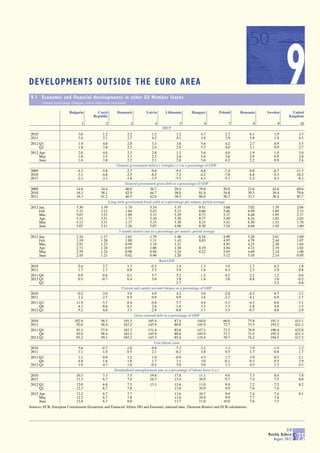
established guidelines.                                 Euro area annual HICP inflation was 2.4% in
                                                        July 2012, according to Eurostat’s flash estimate,
The adherence of governments to their                   unchanged from the previous month. On the
commitments and the fulfilment by the EFSF/ESM           basis of current futures prices for oil, inflation

                                                                                                            ECB
                                                                                                Monthly Bulletin
                                                                                                   August 2012     5
rates should decline further in the course of 2012    factors to weak MFI loan growth is confirmed
      and be below 2% again in 2013. Over the policy-       by the euro area bank lending survey for the
      relevant horizon, in an environment of modest         second quarter of 2012. This survey also shows
      growth in the euro area and well-anchored long-       that the net tightening of banks’ credit standards
      term inflation expectations, underlying price          at the euro area level was broadly stable in the
      pressures should remain moderate.                     second quarter of 2012, as compared with the
                                                            previous quarter, for loans to both enterprises
      Risks to the outlook for price developments           and households.
      continue to be broadly balanced over the
      medium term. Upside risks pertain to further          Looking ahead, it is essential for banks to
      increases in indirect taxes, owing to the need for    continue to strengthen their resilience where
      fiscal consolidation, and higher than expected         this is needed. The soundness of banks’ balance
      energy prices over the medium term. The main          sheets will be a key factor in facilitating both an
      downside risks relate to the impact of weaker         appropriate provision of credit to the economy
      than expected growth in the euro area, in             and the normalisation of all funding channels.
      particular resulting from a further intensification
      of financial market tensions. Such intensification      To sum up, the economic analysis indicates
      has the potential to affect the balance of risks on   that price developments should remain in line

      the downside.                                         with price stability over the medium term. A

                                                            cross-check with the signals from the monetary
      Turning to the monetary analysis, the underlying      analysis confirms this picture.
      pace of monetary expansion remained subdued.
      The annual growth rate of M3 stood at 3.2%            While significant progress has been achieved
      in June 2012, slightly higher than the 3.1%           with fiscal consolidation over recent years,
      observed in the previous month and close to           further decisive and urgent steps need to be
      the rate observed at the end of the first quarter.     taken to improve competitiveness. From 2009 to
      Overall, inflows into broad money in the second        2011, euro area countries, on average, reduced
      quarter were weak. Annual growth in M1                the deficit-to-GDP ratio by 2.3 percentage
      increased further to 3.5% in June, in line with       points, and the primary deficit improved by
      the increased preference of investors for liquid      about 2½ percentage points. Fiscal adjustment
      instruments in an environment of low interest         in the euro area is continuing in 2012, and it
      rates and high uncertainty.                           is indeed crucial that efforts are maintained
                                                            to restore sound fiscal positions. At the same
      The annual growth rate of loans to the private        time, structural reforms are as essential as fiscal
      sector (adjusted for loan sales and securitisation)   consolidation efforts and the measures to repair
      declined to 0.3% in June (from 0.5% in May).          the financial sector. Some progress has also
      As net redemptions of loans to non-financial           been made in this area. For example, unit labour
      corporations and households (both adjusted for        costs and current account developments have
      loan sales and securitisation) were observed in       started to undergo a correction process in most
      June, the annual growth rates of loans to both        of the countries strongly affected by the crisis.
      non-financial corporations and households              However, further reform measures need to be
      (adjusted for loan sales and securitisation)          implemented swiftly and decisively. Product
      decreased further in June, to -0.3% and 1.1%          market reforms to foster competitiveness and
      respectively. To a large extent, subdued loan         the creation of efficient and flexible labour
      growth reflects the current cyclical situation,        markets are preconditions for the unwinding
      heightened risk aversion and the ongoing              of existing imbalances and the achievement of
      adjustment in the balance sheets of households        robust, sustainable growth. It is now crucial that
      and enterprises, all of which weigh on credit         Member States implement their country-specific
      demand. A considerable contribution of demand         recommendations with determination.

    ECB
    Monthly Bulletin
6   August 2012
EDITORIAL


This issue of the Monthly Bulletin contains
two articles. The first article reviews the
sources of heterogeneity in financial conditions,
discusses the related challenges for the single
monetary policy and clarifies the role of other
policies in overcoming structural imbalances
and divergences. The second article assesses
the financing conditions of the euro area private
sector during the sovereign debt crisis.


                                                               ECB
                                                   Monthly Bulletin
                                                      August 2012     7
ECONOMIC
                                                                                                                                       AND MONETARY
ECONOMIC AND MONETARY                                                                                                                  DEVELOPMENTS

DEVELOPMENTS                                                                                                                                  The external
                                                                                                                                              environment
                                                                                                                                         of the euro area

1 THE EXTERNAL ENVIRONMENT
  OF THE EURO AREA
The recovery in the global economy continues to proceed, albeit unevenly, gradually and subject
to considerable fragilities. Having moderated in the second quarter of 2012, weak global growth
momentum appears to have continued into the third quarter of the year, particularly in Europe.
Global inflation has continued to ease in recent months, mainly in response to receding commodity
prices in the first half of the year.


1.1 DEVELOPMENTS IN THE WORLD ECONOMY

Global growth remains gradual, diverse across regions and subject to considerable fragilities.
The recent release of real GDP growth data for the second quarter in some major economies has
corroborated the flow of economic data indicators which had been indicating a moderation in
the growth momentum in the global economy. According to the latest survey data, weak growth
dynamics have continued into the start of the third quarter of 2012, particularly in Europe.
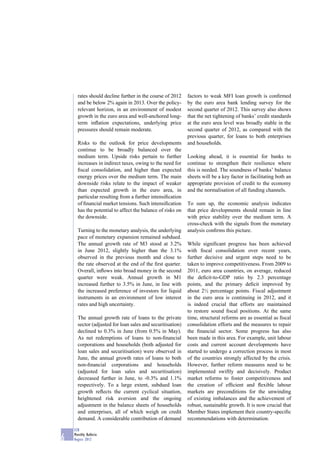
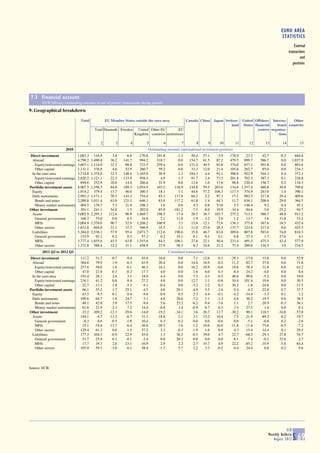
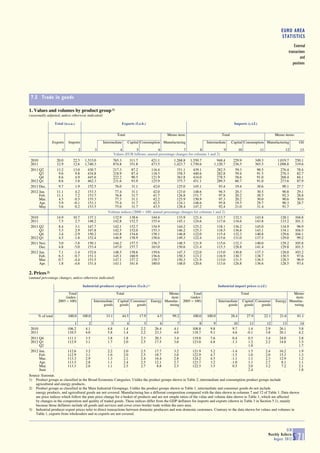
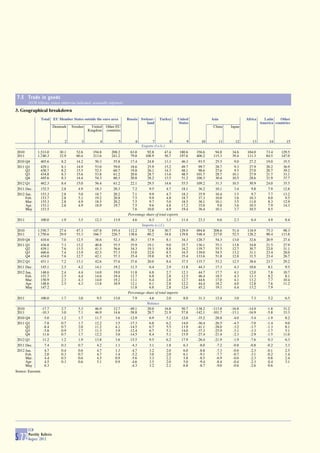
In July the global manufacturing PMI for output posted a small decline to 48.9, from 49.6 in June
(see Chart 1). Europe remained the primary source of weakness, but the decrease in the PMI was
also associated with a decrease in the global PMI index excluding the euro area. Overall, persistent
structural impediments continue to restrain the pace of growth in most advanced economies.
In emerging markets, activity has continued to expand at a faster pace than in advanced economies,
although growth momentum has also been receding on account of past policy tightening and weaker
external demand.

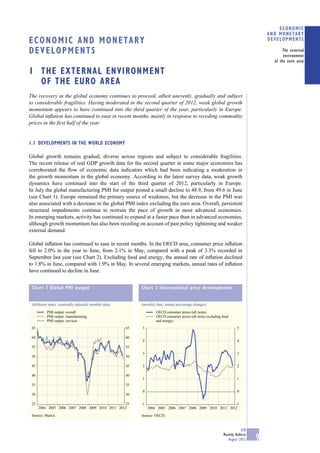
Global inflation has continued to ease in recent months. In the OECD area, consumer price inflation
fell to 2.0% in the year to June, from 2.1% in May, compared with a peak of 3.3% recorded in
September last year (see Chart 2). Excluding food and energy, the annual rate of inflation declined
to 1.8% in June, compared with 1.9% in May. In several emerging markets, annual rates of inflation
have continued to decline in June.


 Chart 1 Global PMI output                                   Chart 2 International price developments


 (diffusion index; seasonally adjusted; monthly data)        (monthly data; annual percentage changes)

          PMI output: overall                                         OECD consumer prices (all items)
          PMI output: manufacturing                                   OECD consumer prices (all items excluding food
          PMI output: services                                        and energy)
 65                                                     65   5                                                           5

 60                                                     60
                                                             4                                                           4
 55                                                     55
                                                             3                                                           3
 50                                                     50

 45                                                     45   2                                                           2

 40                                                     40
                                                             1                                                           1
 35                                                     35
                                                             0                                                           0
 30                                                     30

 25                                              25          -1                                              -1
      2004 2005 2006 2007 2008 2009 2010 2011 2012                2004 2005 2006 2007 2008 2009 2010 2011 2012

 Source: Markit.                                             Source: OECD.


                                                                                                                            ECB
                                                                                                                Monthly Bulletin
                                                                                                                   August 2012     9
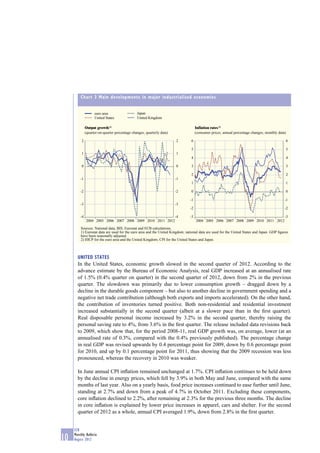
Chart 3 Main developments in major industrialised economies


                    euro area                   Japan
                    United States               United Kingdom

              Output growth 1)                                                      Inflation rates 2)
              (quarter-on-quarter percentage changes; quarterly data)               (consumer prices; annual percentage changes; monthly data)

          2                                                             2       6                                                                6

                                                                                5                                                                5
          1                                                             1
                                                                                4                                                                4

          0                                                             0       3                                                                3

                                                                                2                                                                2
         -1                                                             -1
                                                                                1                                                                1

         -2                                                             -2      0                                                                0

                                                                               -1                                                            -1
         -3                                                             -3
                                                                               -2                                                            -2

         -4                                                             -4     -3                                                            -3
              2004 2005 2006 2007 2008 2009 2010 2011 2012                          2004 2005 2006 2007 2008 2009 2010 2011 2012

         Sources: National data, BIS, Eurostat and ECB calculations.
         1) Eurostat data are used for the euro area and the United Kingdom; national data are used for the United States and Japan. GDP figures
         have been seasonally adjusted.
         2) HICP for the euro area and the United Kingdom; CPI for the United States and Japan.


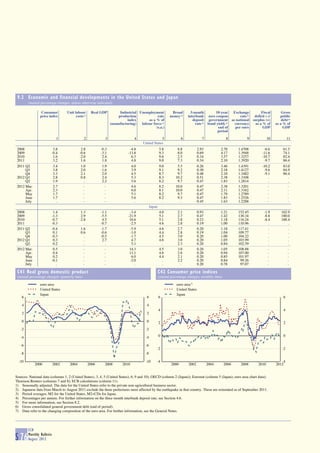
       UNITED STATES
       In the United States, economic growth slowed in the second quarter of 2012. According to the
       advance estimate by the Bureau of Economic Analysis, real GDP increased at an annualised rate
       of 1.5% (0.4% quarter on quarter) in the second quarter of 2012, down from 2% in the previous
       quarter. The slowdown was primarily due to lower consumption growth – dragged down by a
       decline in the durable goods component – but also to another decline in government spending and a
       negative net trade contribution (although both exports and imports accelerated). On the other hand,
       the contribution of inventories turned positive. Both non-residential and residential investment
       increased substantially in the second quarter (albeit at a slower pace than in the first quarter).
       Real disposable personal income increased by 3.2% in the second quarter, thereby raising the
       personal saving rate to 4%, from 3.6% in the first quarter. The release included data revisions back
       to 2009, which show that, for the period 2008-11, real GDP growth was, on average, lower (at an
       annualised rate of 0.3%, compared with the 0.4% previously published). The percentage change
       in real GDP was revised upwards by 0.4 percentage point for 2009, down by 0.6 percentage point
       for 2010, and up by 0.1 percentage point for 2011, thus showing that the 2009 recession was less
       pronounced, whereas the recovery in 2010 was weaker.

       In June annual CPI inflation remained unchanged at 1.7%. CPI inflation continues to be held down
       by the decline in energy prices, which fell by 3.9% in both May and June, compared with the same
       months of last year. Also on a yearly basis, food price increases continued to ease further until June,
       standing at 2.7% and down from a peak of 4.7% in October 2011. Excluding these components,
       core inflation declined to 2.2%, after remaining at 2.3% for the previous three months. The decline
       in core inflation is explained by lower price increases in apparel, cars and shelter. For the second
       quarter of 2012 as a whole, annual CPI averaged 1.9%, down from 2.8% in the first quarter.


     ECB
     Monthly Bulletin
10   August 2012
ECONOMIC
                                                                                                                     AND MONETARY
                                                                                                                     DEVELOPMENTS

                                                                                                                            The external
                                                                                                                            environment
                                                                                                                       of the euro area


On 1 August 2012 the Federal Open Market Committee (FOMC) stated that economic activity had
decelerated somewhat over the first half of 2012 and acknowledged that growth in employment had
been slow in recent months. The FOMC decided to keep the target range for the federal funds rate
at 0% to 0.25% and anticipated that economic conditions were likely to warrant exceptionally low
levels for the federal funds rate at least through late 2014.

JAPAN
In Japan, the economy shows signs that the pace of expansion of economic activity moderated
somewhat recently, following strong GDP growth in the first quarter of 2012. In recent months,
survey data have been indicating a weakening of sentiment in the manufacturing sector. This is
reflected in the industrial production figures for June, which showed a decline in activity for the
third consecutive month. This softening in manufacturing activity is partly related to weak exports,
which declined for the second consecutive month in real terms in June amid the strong yen and
a slowing of external demand for Japanese goods. As a result of muted export growth and steadily
rising energy imports since the nuclear plant shutdown following the disaster in March last year,
Japan recorded the largest half-yearly trade deficit in its post-war history in the first half of 2012.
However, sentiment in the non-manufacturing sector remains resilient, as domestic demand is firm
amid solid private consumption and ongoing public reconstruction efforts.

Annual CPI inflation declined in June to -0.2% (from 0.2% in the previous month), owing mainly to
falling prices for energy and consumer durables. Excluding fresh food, annual CPI inflation declined
to -0.2% in June, compared with -0.1% in May, whereas the annual rate of change of CPI inflation
excluding food and energy remained unchanged at -0.6%. At its latest monetary policy meeting
on 12 July, the Bank of Japan decided to maintain its target for the uncollateralised overnight call
rate within a range of 0.0% to 0.1%. Moreover, the Bank of Japan increased its outright purchases
of Treasury discount bills by about JPY 5 trillion, while reducing its fixed rate funds-supplying
operations by the same amount.

UNITED KINGDOM
The preliminary estimate of real GDP growth for the United Kingdom shows that activity declined
by 0.7% quarter on quarter in the second quarter of 2012, driven mainly by a fall in the construction
and production industries. Although temporary factors also contributed to the decline, the third
consecutive quarter of output contraction points to a weakness in underlying activity growth in the
United Kingdom. The latest high-frequency data provide mixed signals, but broadly confirm the
weakness in the economy. Survey indicators in the manufacturing sector weakened considerably in
July, and remain at a level consistent with a contraction in activity. In the services sector, although
confidence has declined, survey indicators still point to an expansion in activity. Consumer
confidence has remained weak, although the labour market situation has shown some signs of
improvement. Looking ahead, the economic recovery is likely to gather pace only very gradually,
with significant downside risks, as domestic demand is expected to remain constrained by tight
credit conditions, ongoing household balance sheet adjustment and substantial fiscal tightening.

Annual CPI inflation declined to 2.4% in June, from 2.8% in May, while CPI inflation excluding
energy and unprocessed food slowed from 2.4% to 2.2%. The fall in inflation was mainly due to
lower prices of commodities and clothing. Looking ahead, the existence of spare capacity and the
sluggish recovery in economic activity should contribute to a further dampening of inflationary
pressures. At its meeting on 5 July, the Bank of England’s Monetary Policy Committee maintained
the policy rate at 0.5% and, at the same time, increased the size of its asset purchase programme by
GBP 50 billion, to GBP 375 billion.

                                                                                                         ECB
                                                                                             Monthly Bulletin
                                                                                                August 2012     11
CHINA
       In China, recent data releases confirm that economic activity has slowed down. In the second quarter
       of 2012, real GDP growth slowed from a year ago, to 7.6%, down from 8.1% in the first quarter.
       In quarter-on-quarter terms, growth accelerated slightly to 1.8%, from 1.6%, driven by consumption
       and investment. The contribution of net exports remained slightly negative. HSBC’s manufacturing
       PMI index rose from 48.2 in June to 49.3 in July, its highest level since February. For the first time
       since October 2011, the number of cities reporting house price increases in June, compared with
       May, was larger than those reporting declines, suggesting that house prices could have bottomed
       out. Sold floor space also seems to be close to stabilising. In June, exports rose by much more
       than imports, compared with a year ago (11.3%, compared with 6.3%), leading to a sharply higher
       trade balance. However, the 12-month rolling trade balance stayed within the range observed since
       early 2010. Annual CPI inflation continued to decline in June, to 2.2%. On 25 July the Hong Kong
       Monetary Authority announced that Hong Kong banks could start offering a full range of renminbi
       services to non-residents starting on 1 August, including the unlimited exchange of renminbi against
       Hong Kong dollars and vice versa. This is part of a series of moves to establish Hong Kong as one
       of the main off-shore trading centres for renminbi.


       1.2 COMMODITY MARKETS

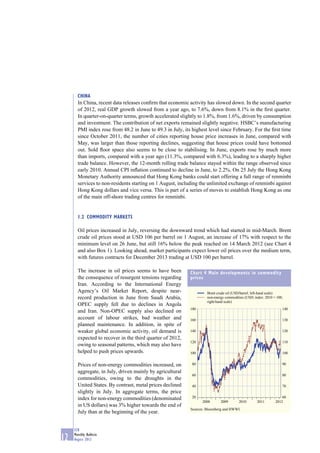
       Oil prices increased in July, reversing the downward trend which had started in mid-March. Brent
       crude oil prices stood at USD 106 per barrel on 1 August, an increase of 17% with respect to the
       minimum level on 26 June, but still 16% below the peak reached on 14 March 2012 (see Chart 4
       and also Box 1). Looking ahead, market participants expect lower oil prices over the medium term,
       with futures contracts for December 2013 trading at USD 100 per barrel.

       The increase in oil prices seems to have been        Chart 4 Main developments in commodity
       the consequence of resurgent tensions regarding      prices
       Iran. According to the International Energy
       Agency’s Oil Market Report, despite near-                     Brent crude oil (USD/barrel; left-hand scale)
       record production in June from Saudi Arabia,                  non-energy commodities (USD; index: 2010 = 100;
                                                                     right-hand scale)
       OPEC supply fell due to declines in Angola
                                                            180                                                    140
       and Iran. Non-OPEC supply also declined on
       account of labour strikes, bad weather and           160                                                    130
       planned maintenance. In addition, in spite of
       weaker global economic activity, oil demand is       140                                                    120
       expected to recover in the third quarter of 2012,
                                                            120                                                    110
       owing to seasonal patterns, which may also have
       helped to push prices upwards.                       100                                                    100


       Prices of non-energy commodities increased, on        80                                                    90

       aggregate, in July, driven mainly by agricultural
                                                             60                                                    80
       commodities, owing to the droughts in the
       United States. By contrast, metal prices declined     40                                                    70
       slightly in July. In aggregate terms, the price
       index for non-energy commodities (denominated         20                                                    60
                                                                  2008       2009       2010        2011       2012
       in US dollars) was 3% higher towards the end of
                                                            Sources: Bloomberg and HWWI.
       July than at the beginning of the year.


     ECB
     Monthly Bulletin
12   August 2012
ECONOMIC
                                                                                                                                                    AND MONETARY
                                                                                                                                                    DEVELOPMENTS

                                                                                                                                                           The external
                                                                                                                                                           environment
                                                                                                                                                      of the euro area


Box 1

RECENT DEVELOPMENTS IN OIL PRICES

Brent crude oil prices fell from above USD 125 per barrel in mid-March to a low of USD 90 at
the end of June. Developments in the supply/demand balance in the first half of the year shed
some light on this decline. In particular, the combination of declining demand and growing
supply exerted downward pressure on prices over this period.

Oil market fundamentals

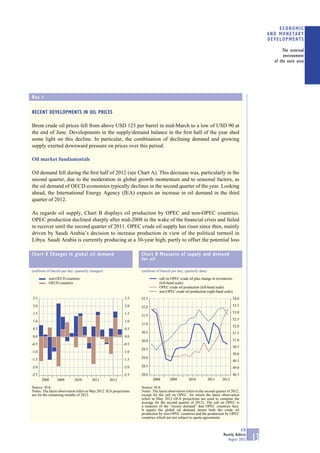
Oil demand fell during the first half of 2012 (see Chart A). This decrease was, particularly in the
second quarter, due to the moderation in global growth momentum and to seasonal factors, as
the oil demand of OECD economies typically declines in the second quarter of the year. Looking
ahead, the International Energy Agency (IEA) expects an increase in oil demand in the third
quarter of 2012.

As regards oil supply, Chart B displays oil production by OPEC and non-OPEC countries.
OPEC production declined sharply after mid-2008 in the wake of the financial crisis and failed
to recover until the second quarter of 2011. OPEC crude oil supply has risen since then, mainly
driven by Saudi Arabia’s decision to increase production in view of the political turmoil in
Libya. Saudi Arabia is currently producing at a 30-year high, partly to offset the potential loss

Chart A Changes in global oil demand                                Chart B Measures of supply and demand
                                                                    for oil

(millions of barrels per day; quarterly changes)                    (millions of barrels per day; quarterly data)

           non-OECD countries                                                   call on OPEC crude oil plus change in inventories
           OECD countries                                                       (left-hand scale)
                                                                                OPEC crude oil production (left-hand scale)
                                                                                non-OPEC crude oil production (right-hand scale)
2.5                                                          2.5    32.5                                                          54.0
2.0                                                          2.0    32.0                                                          53.5

1.5                                                          1.5                                                                  53.0
                                                                    31.5
1.0                                                          1.0
                                                                                                                                  52.5
                                                                    31.0
                                                                                                                                  52.0
0.5                                                          0.5
                                                                    30.5                                                          51.5
0.0                                                          0.0
                                                                    30.0                                                          51.0
-0.5                                                        -0.5
                                                                                                                                  50.5
                                                                    29.5
-1.0                                                        -1.0
                                                                                                                                  50.0
-1.5                                                        -1.5    29.0
                                                                                                                                  49.5
-2.0                                                        -2.0    28.5                                                          49.0
-2.5                                                        -2.5    28.0                                                          48.5
       2008     2009        2010        2011       2012                    2008        2009         2010            2011   2012

Source: IEA.                                                        Source: IEA.
Notes: The latest observation refers to May 2012. IEA projections   Notes: The latest observation refers to the second quarter of 2012,
are for the remaining months of 2012.                               except for the call on OPEC, for which the latest observation
                                                                    refers to May 2012 (IEA projections are used to compute the
                                                                    average for the second quarter of 2012). The call on OPEC is
                                                                    a measure of the “excess demand” that OPEC countries face.
                                                                    It equals the global oil demand minus both the crude oil
                                                                    production by non-OPEC countries and the production by OPEC
                                                                    countries which are not subject to quota agreements.


                                                                                                                                        ECB
                                                                                                                            Monthly Bulletin
                                                                                                                               August 2012     13
Chart C Crude oil industry inventories                                   Chart D Estimated spare capacity of OPEC
         in OECD countries                                                        producers

         (millions of barrels)                                                    (millions of barrels per day)

                        five-year average                                                  Algeria                Libya
                        2008                                                               Angola                 Nigeria
                        2010                                                               Ecuador                Qatar
                        2011                                                               Iran                   Saudi Arabia
                        2012                                                               Iraq                   United Arab Emirates
                                                                                           Kuwait                 Venezuela
         1,050                                                      1,050         7                                                               7

                                                                                  6                                                               6

                                                                                  5                                                               5
         1,000                                                      1,000
                                                                                  4                                                               4

                                                                                  3                                                               3
           950                                                      950
                                                                                  2                                                               2

                                                                                  1                                                               1

           900                                                      900           0                                                 0
             Jan.       Mar.     May        July   Sep.     Nov.                  Jan.   July Jan. July Jan. July Jan. July Jan. July
                                                                                         2008      2009      2010      2011      2012

         Source: IEA.                                                             Source: Bloomberg.
         Notes: The latest observation refers to May 2012. The grey area          Note: The latest observation refers to 31 May 2012.
         indicates the range of inventories from 2008 to 2011.


         of Iranian oil resulting from the EU sanctions.1 By contrast, non-OPEC production increased
         in the first quarter of 2012 and fell in the second, in parallel with oil prices.

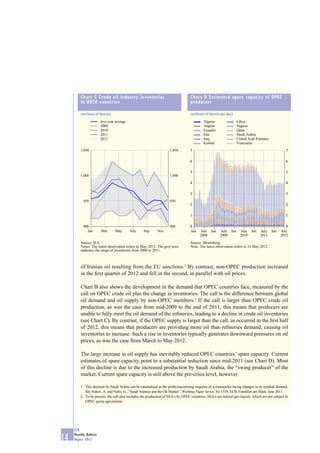
         Chart B also shows the development in the demand that OPEC countries face, measured by the
         call on OPEC crude oil plus the change in inventories. The call is the difference between global
         oil demand and oil supply by non-OPEC members.2 If the call is larger than OPEC crude oil
         production, as was the case from mid-2009 to the end of 2011, this means that producers are
         unable to fully meet the oil demand of the refineries, leading to a decline in crude oil inventories
         (see Chart C). By contrast, if the OPEC supply is larger than the call, as occurred in the first half
         of 2012, this means that producers are providing more oil than refineries demand, causing oil
         inventories to increase. Such a rise in inventories typically generates downward pressures on oil
         prices, as was the case from March to May 2012.

         The large increase in oil supply has inevitably reduced OPEC countries’ spare capacity. Current
         estimates of spare capacity point to a substantial reduction since mid-2011 (see Chart D). Most
         of this decline is due to the increased production by Saudi Arabia, the “swing producer” of the
         market. Current spare capacity is still above the pre-crisis level, however.

         1 This decision by Saudi Arabia can be rationalised as the profit-maximising response of a monopolist facing changes in its residual demand.
           See Nakov, A. and Nuño, G., “Saudi Aramco and the Oil Market”, Working Paper Series, No 1354, ECB, Frankfurt am Main, June 2011.
         2 To be precise, the call also includes the production of NGLs by OPEC countries. NGLs are natural gas liquids, which are not subject to
           OPEC quota agreements.


     ECB
     Monthly Bulletin
14   August 2012
ECONOMIC
                                                                                                                                                       AND MONETARY
                                                                                                                                                       DEVELOPMENTS

                                                                                                                                                              The external
                                                                                                                                                              environment
                                                                                                                                                         of the euro area


 Oil market outlook and risks

 Looking ahead, oil price developments will depend on the evolution of the supply/demand balance.
 The IEA expects oil demand to rebound in the coming months, thus exceeding the historical
 barrier of 90 million barrels per day in 2012. This may place upward pressure on prices. Supply
 is currently sufficient to cope with this potential increase in demand. However, the reduction in
 spare capacity will also lead to some tightness in the market.

 Regarding the balance of risks, the main downside risk to the outlook is a sharper than expected
 global economic slowdown. The main upside risk is a sudden disruption to supply, e.g. if the
 tensions surrounding Iran were to intensify. In such a scenario, given the current level of spare
 capacity, it would be difficult to fully offset the loss of Iran’s production.


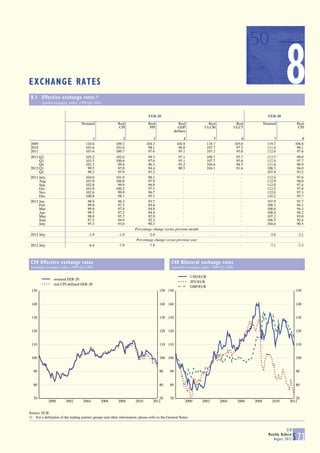
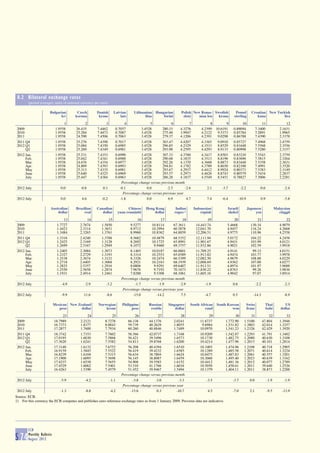
1.3 EXCHANGE RATES

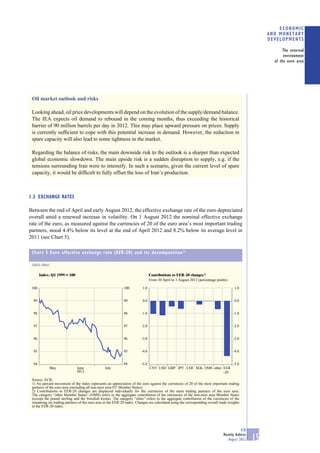
Between the end of April and early August 2012, the effective exchange rate of the euro depreciated
overall amid a renewed increase in volatility. On 1 August 2012 the nominal effective exchange
rate of the euro, as measured against the currencies of 20 of the euro area’s most important trading
partners, stood 4.4% below its level at the end of April 2012 and 8.2% below its average level in
2011 (see Chart 5).

 Chart 5 Euro effective exchange rate (EER-20) and its decomposition 1)

 (daily data)

       Index: Q1 1999 = 100                                                     Contributions to EER-20 changes 2)
                                                                                From 30 April to 1 August 2012 (percentage points)

 100                                                         100          1.0                                                         1.0


  99                                                         99           0.0                                                         0.0


  98                                                         98          -1.0                                                         -1.0


  97                                                         97          -2.0                                                         -2.0


  96                                                         96          -3.0                                                         -3.0


  95                                                         95          -4.0                                                         -4.0


  94                                                         94          -5.0                                                         -5.0
                May           June               July                           CNY USD GBP JPY CHF SEK OMS other EER
                              2012                                                                                -20

 Source: ECB.
 1) An upward movement of the index represents an appreciation of the euro against the currencies of 20 of the most important trading
 partners of the euro area (including all non-euro area EU Member States).
 2) Contributions to EER-20 changes are displayed individually for the currencies of the main trading partners of the euro area.
 The category “other Member States” (OMS) refers to the aggregate contribution of the currencies of the non-euro area Member States
 (except the pound sterling and the Swedish krona). The category “other” refers to the aggregate contribution of the currencies of the
 remaining six trading partners of the euro area in the EER-20 index. Changes are calculated using the corresponding overall trade weights
 in the EER-20 index.


                                                                                                                                           ECB
                                                                                                                               Monthly Bulletin
                                                                                                                                  August 2012     15
Table 1 Euro exchange rate developments 1)

         (daily data; units of national currency per euro; percentage changes)

                                                                             Appreciation (+)/ depreciation (-) of the euro as at 1 August 2012
                                                              Level on                       since:                           compared with:
                              Weight in EER-20           1 August 2012           30 April 2012      2 January 2012               average for 2011
         Chinese renminbi                     18.8                 7.832                   -5.6                  -3.9                         -12.9
         US dollar                            16.9                 1.230                   -6.9                  -4.9                         -11.6
         Pound sterling                       14.9                 0.788                   -3.1                  -5.7                          -9.3
         Japanese yen                          7.2                  96.2                   -9.1                  -3.3                         -13.3
         Swiss franc                           6.5                 1.201                    0.0                  -1.2                          -2.5
         Polish zloty                          6.2                 4.106                   -1.6                  -8.2                          -0.4
         Czech koruna                          5.0                 25.36                    2.0                  -0.6                           3.1
         Swedish krona                         4.7                 8.319                   -6.7                  -6.8                          -7.9
         Korean won                            3.9                 1,386                   -7.1                  -7.2                         -10.1
         Hungarian forint                      3.2                 280.4                   -2.2                 -10.8                           0.4
         NEER 2)                                                    94.9                   -4.4                  -4.6                          -8.2

         Source: ECB.
         1) Bilateral exchange rates in descending order based on the corresponding currencies’ trade weights in the EER-20 index.
         2) Euro nominal effective exchange rate against the currencies of 20 of the most important trading partners of the euro area (EER-20).


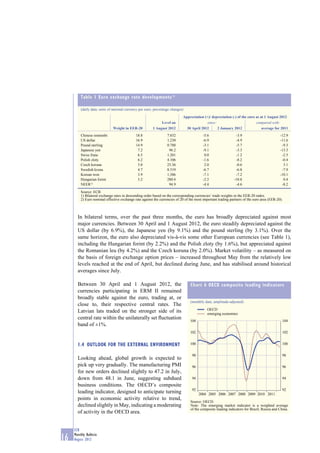
       In bilateral terms, over the past three months, the euro has broadly depreciated against most
       major currencies. Between 30 April and 1 August 2012, the euro steadily depreciated against the
       US dollar (by 6.9%), the Japanese yen (by 9.1%) and the pound sterling (by 3.1%). Over the
       same horizon, the euro also depreciated vis-à-vis some other European currencies (see Table 1),
       including the Hungarian forint (by 2.2%) and the Polish zloty (by 1.6%), but appreciated against
       the Romanian leu (by 4.2%) and the Czech koruna (by 2.0%). Market volatility – as measured on
       the basis of foreign exchange option prices – increased throughout May from the relatively low
       levels reached at the end of April, but declined during June, and has stabilised around historical
       averages since July.

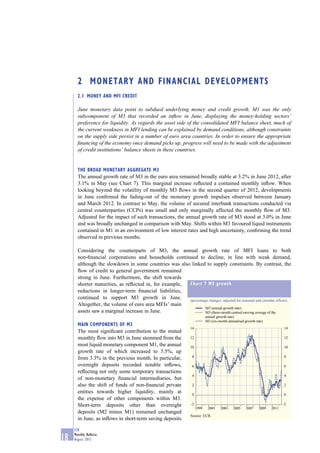
       Between 30 April and 1 August 2012, the                                     Chart 6 OECD composite leading indicators
       currencies participating in ERM II remained
       broadly stable against the euro, trading at, or
                                                                                   (monthly data; amplitude-adjusted)
       close to, their respective central rates. The
                                                                                              OECD
       Latvian lats traded on the stronger side of its                                        emerging economies
       central rate within the unilaterally set fluctuation                        104                                                           104
       band of ±1%.
                                                                                  102                                                           102


       1.4 OUTLOOK FOR THE EXTERNAL ENVIRONMENT                                   100                                                           100


                                                                                    98                                                          98
       Looking ahead, global growth is expected to
       pick up very gradually. The manufacturing PMI                                96                                                          96
       for new orders declined slightly to 47.2 in July,
       down from 48.1 in June, suggesting subdued                                   94                                                          94
       business conditions. The OECD’s composite
                                                                                    92                                                          92
       leading indicator, designed to anticipate turning                                 2004 2005 2006 2007 2008 2009 2010 2011
       points in economic activity relative to trend,
                                                                                   Source: OECD.
       declined slightly in May, indicating a moderating                           Note: The emerging market indicator is a weighted average
                                                                                   of the composite leading indicators for Brazil, Russia and China.
       of activity in the OECD area.


     ECB
     Monthly Bulletin
16   August 2012
ECONOMIC
                                                                                                                  AND MONETARY
                                                                                                                  DEVELOPMENTS

                                                                                                                         The external
                                                                                                                         environment
                                                                                                                    of the euro area


The outlook for the external environment of the euro area remains subject to high uncertainty,
related to tensions in key financial market segments as well as fiscal and global imbalances.
Moreover, geopolitical tensions in the Middle East pose an upside risk to oil prices and a downside
risk to the global economy.


                                                                                                      ECB
                                                                                          Monthly Bulletin
                                                                                             August 2012     17
2 MONETARY AND FINANCIAL DEVELOPMENTS
       2.1 MONEY AND MFI CREDIT

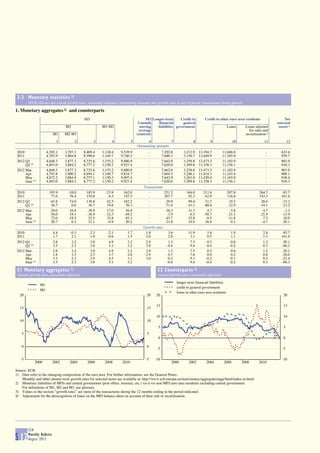
       June monetary data point to subdued underlying money and credit growth. M1 was the only
       subcomponent of M3 that recorded an inflow in June, displaying the money-holding sectors’
       preference for liquidity. As regards the asset side of the consolidated MFI balance sheet, much of
       the current weakness in MFI lending can be explained by demand conditions, although constraints
       on the supply side persist in a number of euro area countries. In order to ensure the appropriate
       financing of the economy once demand picks up, progress will need to be made with the adjustment
       of credit institutions’ balance sheets in these countries.


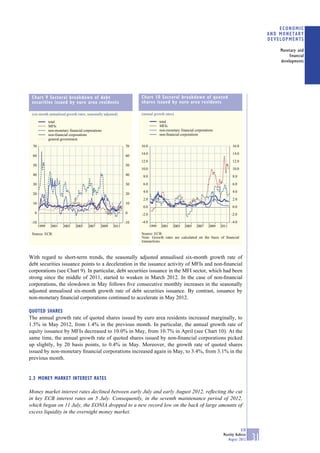
       THE BROAD MONETARY AGGREGATE M3
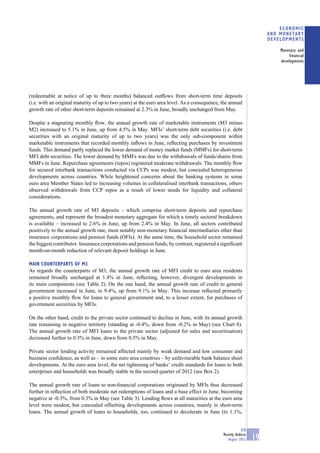
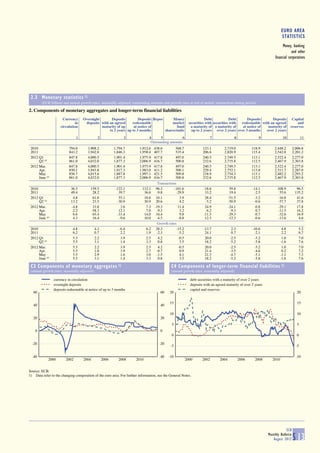
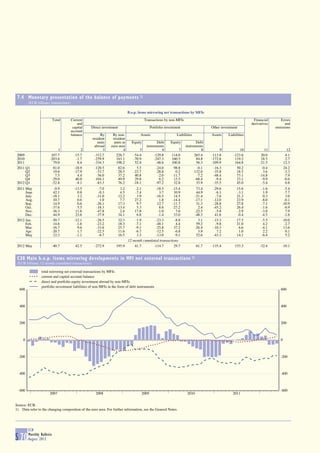
       The annual growth rate of M3 in the euro area remained broadly stable at 3.2% in June 2012, after
       3.1% in May (see Chart 7). This marginal increase reflected a contained monthly inflow. When
       looking beyond the volatility of monthly M3 flows in the second quarter of 2012, developments
       in June confirmed the fading-out of the monetary growth impulses observed between January
       and March 2012. In contrast to May, the volume of secured interbank transactions conducted via
       central counterparties (CCPs) was small and only marginally affected the monthly flow of M3.
       Adjusted for the impact of such transactions, the annual growth rate of M3 stood at 3.0% in June
       and was broadly unchanged in comparison with May. Shifts within M3 favoured liquid instruments
       contained in M1 in an environment of low interest rates and high uncertainty, confirming the trend
       observed in previous months.

       Considering the counterparts of M3, the annual growth rate of MFI loans to both
       non-financial corporations and households continued to decline, in line with weak demand,
       although the slowdown in some countries was also linked to supply constraints. By contrast, the
       flow of credit to general government remained
       strong in June. Furthermore, the shift towards
       shorter maturities, as reflected in, for example, Chart 7 M3 growth
       reductions in longer-term financial liabilities,
       continued to support M3 growth in June.          (percentage changes; adjusted for seasonal and calendar effects)
       Altogether, the volume of euro area MFIs’ main
                                                                 M3 (annual growth rate)
       assets saw a marginal increase in June.                   M3 (three-month centred moving average of the
                                                                              annual growth rate)
                                                                              M3 (six-month annualised growth rate)
       MAIN COMPONENTS OF M3
                                                                  14                                                          14
       The most significant contribution to the muted
       monthly flow into M3 in June stemmed from the               12                                                          12
       most liquid monetary component M1, the annual              10                                                          10
       growth rate of which increased to 3.5%, up
       from 3.3% in the previous month. In particular,             8                                                          8

       overnight deposits recorded notable inflows,                 6                                                          6
       reflecting not only some temporary transactions
                                                                   4                                                          4
       of non-monetary financial intermediaries, but
       also the shift of funds of non-financial private             2                                                          2
       entities towards higher liquidity, mainly at                0                                                          0
       the expense of other components within M3.
       Short-term deposits other than overnight                   -2                                                          -2
                                                                       1999    2001    2003    2005     2007    2009   2011
       deposits (M2 minus M1) remained unchanged
                                                                  Source: ECB.
       in June, as inflows in short-term saving deposits

     ECB
     Monthly Bulletin
18   August 2012
ECONOMIC
                                                                                                                      AND MONETARY
                                                                                                                      DEVELOPMENTS

                                                                                                                          Monetary and
                                                                                                                               financial
                                                                                                                          developments


(redeemable at notice of up to three months) balanced outflows from short-term time deposits
(i.e. with an original maturity of up to two years) at the euro area level. As a consequence, the annual
growth rate of other short-term deposits remained at 2.3% in June, broadly unchanged from May.

Despite a stagnating monthly flow, the annual growth rate of marketable instruments (M3 minus
M2) increased to 5.1% in June, up from 4.5% in May. MFIs’ short-term debt securities (i.e. debt
securities with an original maturity of up to two years) was the only sub-component within
marketable instruments that recorded monthly inflows in June, reflecting purchases by investment
funds. This demand partly replaced the lower demand of money market funds (MMFs) for short-term
MFI debt securities. The lower demand by MMFs was due to the withdrawals of funds/shares from
MMFs in June. Repurchase agreements (repos) registered moderate withdrawals. The monthly flow
for secured interbank transactions conducted via CCPs was modest, but concealed heterogeneous
developments across countries. While heightened concerns about the banking systems in some
euro area Member States led to increasing volumes in collateralised interbank transactions, others
observed withdrawals from CCP repos as a result of lower needs for liquidity and collateral
considerations.

The annual growth rate of M3 deposits – which comprise short-term deposits and repurchase
agreements, and represent the broadest monetary aggregate for which a timely sectoral breakdown
is available – increased to 2.6% in June, up from 2.4% in May. In June, all sectors contributed
positively to the annual growth rate, most notably non-monetary financial intermediaries other than
insurance corporations and pension funds (OFIs). At the same time, the household sector remained
the biggest contributor. Insurance corporations and pension funds, by contrast, registered a significant
month-on-month reduction of relevant deposit holdings in June.

MAIN COUNTERPARTS OF M3
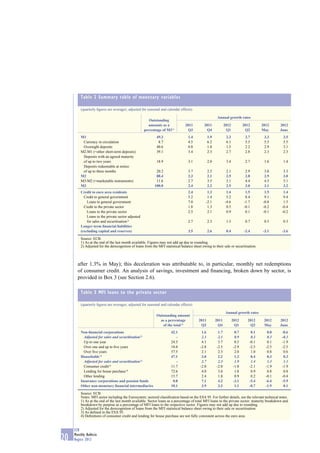
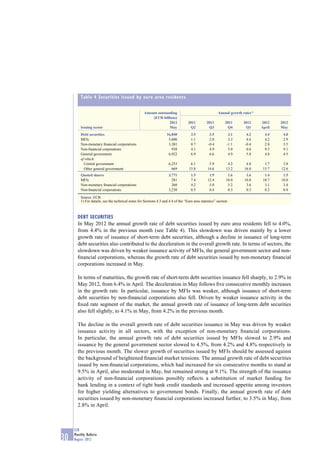
As regards the counterparts of M3, the annual growth rate of MFI credit to euro area residents
remained broadly unchanged at 1.4% in June, reflecting, however, divergent developments in
its main components (see Table 2). On the one hand, the annual growth rate of credit to general
government increased in June, to 9.4%, up from 9.1% in May. This increase reflected primarily
a positive monthly flow for loans to general government and, to a lesser extent, for purchases of
government securities by MFIs.

On the other hand, credit to the private sector continued to decline in June, with its annual growth
rate remaining in negative territory (standing at -0.4%, down from -0.2% in May) (see Chart 8).
The annual growth rate of MFI loans to the private sector (adjusted for sales and securitisation)
decreased further to 0.3% in June, down from 0.5% in May.

Private sector lending activity remained affected mainly by weak demand and low consumer and
business confidence, as well as – in some euro area countries – by unfavourable bank balance sheet
developments. At the euro area level, the net tightening of banks’ credit standards for loans to both
enterprises and households was broadly stable in the second quarter of 2012 (see Box 2).

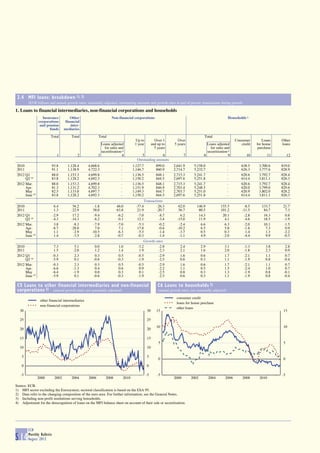
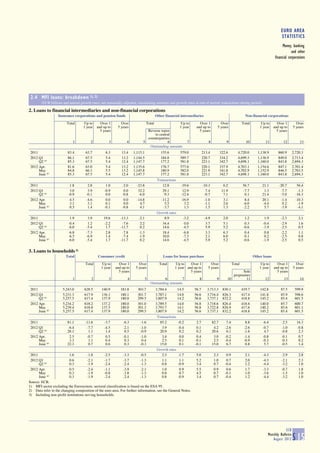
The annual growth rate of loans to non-financial corporations originated by MFIs thus decreased
further in reflection of both moderate net redemptions of loans and a base effect in June, becoming
negative at -0.3%, from 0.3% in May (see Table 3). Lending flows at all maturities at the euro area
level were modest, but concealed offsetting developments across countries, mainly in short-term
loans. The annual growth of loans to households, too, continued to decelerate in June (to 1.1%,


                                                                                                          ECB
                                                                                              Monthly Bulletin
                                                                                                 August 2012     19
Table 2 Summary table of monetary variables

         (quarterly figures are averages; adjusted for seasonal and calendar effects)

                                                                                                        Annual growth rates
                                                       Outstanding
                                                      amounts as a              2011         2011             2012          2012      2012       2012
                                                    percentage of M3 1)          Q3           Q4               Q1            Q2       May        June
         M1                                                 49.3                  1.4            1.9           2.3           2.7       3.3         3.5
          Currency in circulation                            8.7                  4.5            6.2           6.1           5.5       5.5         5.5
          Overnight deposits                                40.6                  0.8            1.0           1.5           2.2       2.9         3.1
         M2-M1 (=other short-term deposits)                 39.1                  3.4            2.3           2.7           2.8       2.3         2.3
          Deposits with an agreed maturity
          of up to two years                                18.9                  3.1            2.0           3.4           2.7       1.6         1.4
          Deposits redeemable at notice
          of up to three months                             20.2                  3.7            2.5           2.1           2.9       3.0         3.3
         M2                                                 88.4                  2.3            2.1           2.5           2.8       2.9         3.0
         M3-M2 (=marketable instruments)                    11.6                  2.7            3.5           3.1           4.4       4.5         5.1
         M3                                                100.0                  2.4            2.2           2.5           3.0       3.1         3.2
         Credit to euro area residents                                            2.4          1.3             1.4           1.5       1.5         1.4
           Credit to general government                                           5.2          1.4             5.2           8.4       9.1         9.4
             Loans to general government                                          7.0         -2.1            -4.6          -1.7      -0.8         1.5
           Credit to the private sector                                           1.8          1.3             0.5          -0.1      -0.2        -0.4
             Loans to the private sector                                          2.5          2.1             0.9           0.1      -0.1        -0.2
             Loans to the private sector adjusted
             for sales and securitisation 2)                                      2.7            2.3           1.3           0.7       0.5         0.3
         Longer-term financial liabilities
         (excluding capital and reserves)                                         3.5            2.6           0.4          -2.4      -3.1        -3.6

         Source: ECB.
         1) As at the end of the last month available. Figures may not add up due to rounding.
         2) Adjusted for the derecognition of loans from the MFI statistical balance sheet owing to their sale or securitisation.


       after 1.3% in May); this deceleration was attributable to, in particular, monthly net redemptions
       of consumer credit. An analysis of savings, investment and financing, broken down by sector, is
       provided in Box 3 (see Section 2.6).

         Table 3 MFI loans to the private sector

         (quarterly figures are averages; adjusted for seasonal and calendar effects)

                                                                                                               Annual growth rates
                                                            Outstanding amount
                                                              as a percentage            2011          2011          2012     2012     2012      2012
                                                               of the total 1)            Q3            Q4            Q1       Q2      May       June
         Non-financial corporations                                    42.1                 1.6          1.7           0.7       0.1      0.0      -0.6
           Adjusted for sales and securitisation 2)                      -                 2.3          2.1           0.9       0.3      0.3      -0.3
           Up to one year                                             24.5                 4.1          3.7           0.5      -0.1      0.1      -1.9
           Over one and up to five years                               18.0                -2.8         -2.5          -2.9      -2.5     -2.5      -2.5
           Over five years                                             57.5                 2.1          2.3           2.0       1.0      0.8       0.6
         Households 3)                                                47.1                 3.0          2.2           1.2       0.4      0.3       0.3
           Adjusted for sales and securitisation 2)                      -                 2.7          2.3           1.9       1.4      1.3       1.1
           Consumer credit 4)                                         11.7                -2.0         -2.0          -1.8      -2.1     -1.9      -1.9
           Lending for house purchase 4)                              72.6                 4.0          3.0           1.8       0.9      0.8       0.8
           Other lending                                              15.7                 2.4          1.8           0.9       0.2     -0.1      -0.4
         Insurance corporations and pension funds                      0.8                 7.1          4.2          -3.1      -5.4     -6.4      -5.9
         Other non-monetary financial intermediaries                   10.1                 3.9          3.3           1.1      -0.7     -1.9       0.1

         Source: ECB.
         Notes: MFI sector including the Eurosystem; sectoral classification based on the ESA 95. For further details, see the relevant technical notes.
         1) As at the end of the last month available. Sector loans as a percentage of total MFI loans to the private sector; maturity breakdown and
         breakdown by purpose as a percentage of MFI loans to the respective sector. Figures may not add up due to rounding.
         2) Adjusted for the derecognition of loans from the MFI statistical balance sheet owing to their sale or securitisation.
         3) As defined in the ESA 95.
         4) Definitions of consumer credit and lending for house purchase are not fully consistent across the euro area.


     ECB
     Monthly Bulletin
20   August 2012
ECONOMIC
                                                                                                                                                      AND MONETARY
                                                                                                                                                      DEVELOPMENTS

                                                                                                                                                          Monetary and
                                                                                                                                                               financial
                                                                                                                                                          developments


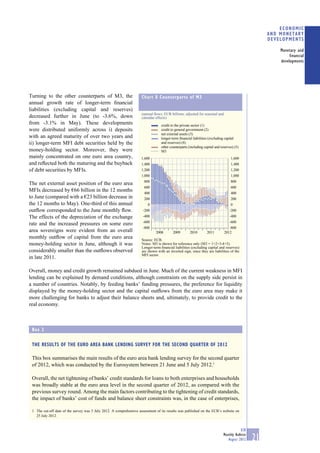
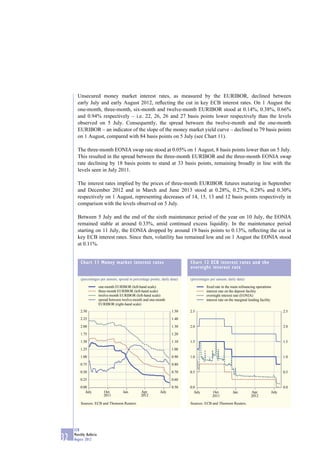
Turning to the other counterparts of M3, the                         Chart 8 Counterparts of M3
annual growth rate of longer-term financial
liabilities (excluding capital and reserves)
                                                                     (annual flows; EUR billions; adjusted for seasonal and
decreased further in June (to -3.6%, down                            calendar effects)
from -3.1% in May). These developments                                            credit to the private sector (1)
were distributed uniformly across i) deposits                                     credit to general government (2)
                                                                                  net external assets (3)
with an agreed maturity of over two years and                                     longer-term financial liabilities (excluding capital
ii) longer-term MFI debt securities held by the                                   and reserves) (4)
                                                                                  other counterparts (including capital and reserves) (5)
money-holding sector. Moreover, they were                                         M3
mainly concentrated on one euro area country,                        1,600                                                         1,600
and reflected both the maturing and the buyback                       1,400                                                         1,400
of debt securities by MFIs.                                          1,200                                                         1,200
                                                                     1,000                                                         1,000
                                                                      800                                                          800
The net external asset position of the euro area
                                                                      600                                                          600
MFIs decreased by €66 billion in the 12 months                        400                                                          400
to June (compared with a €23 billion decrease in                      200                                                          200
the 12 months to May). One-third of this annual                          0                                                         0
outflow corresponded to the June monthly flow.                          -200                                                        -200
The effects of the depreciation of the exchange                       -400                                                        -400
                                                                      -600                                                        -600
rate and the increased pressures on some euro
                                                                      -800                                                       -800
area sovereigns were evident from an overall                                  2008        2009        2010        2011        2012
monthly outflow of capital from the euro area                         Source: ECB.
money-holding sector in June, although it was                        Notes: M3 is shown for reference only (M3 = 1+2+3-4+5).
                                                                     Longer-term financial liabilities (excluding capital and reserves)
considerably smaller than the outflows observed                       are shown with an inverted sign, since they are liabilities of the
                                                                     MFI sector.
in late 2011.

Overall, money and credit growth remained subdued in June. Much of the current weakness in MFI
lending can be explained by demand conditions, although constraints on the supply side persist in
a number of countries. Notably, by feeding banks’ funding pressures, the preference for liquidity
displayed by the money-holding sector and the capital outflows from the euro area may make it
more challenging for banks to adjust their balance sheets and, ultimately, to provide credit to the
real economy.


 Box 2

 THE RESULTS OF THE EURO AREA BANK LENDING SURVEY FOR THE SECOND QUARTER OF 2012

 This box summarises the main results of the euro area bank lending survey for the second quarter
 of 2012, which was conducted by the Eurosystem between 21 June and 5 July 2012.1

 Overall, the net tightening of banks’ credit standards for loans to both enterprises and households
 was broadly stable at the euro area level in the second quarter of 2012, as compared with the
 previous survey round. Among the main factors contributing to the tightening of credit standards,
 the impact of banks’ cost of funds and balance sheet constraints was, in the case of enterprises,

 1 The cut-off date of the survey was 5 July 2012. A comprehensive assessment of its results was published on the ECB’s website on
   25 July 2012.


                                                                                                                                          ECB
                                                                                                                              Monthly Bulletin
                                                                                                                                 August 2012     21
stable vis-à-vis the first quarter of 2012, whilst it increased somewhat in the case of households.
         As regards demand for loans to enterprises, a significant fall in net terms was reported for the
         second quarter of 2012, although the balance was somewhat less negative than in the first quarter
         of the year. As in the first quarter, according to reporting banks, the net fall in the second quarter
         was driven mainly by weaker financing needs owing to fixed investment. The ongoing decline in
         net demand for loans to households for house purchase abated in the second quarter, as compared
         with the first quarter, whereas net demand for consumer credit remained broadly unchanged.
         Looking ahead, survey participants expect a similar degree of net tightening of credit standards
         for loans to enterprises, and some moderation in the case of housing loans and consumer credit.
         Net demand for loans to both enterprises and households is expected to continue to decline in the
         third quarter of 2012, although to a lesser extent than in the second quarter.

         Loans and credit lines to enterprises

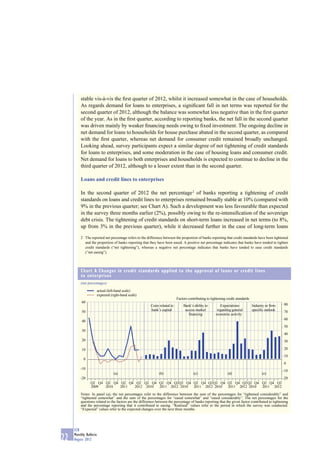
         In the second quarter of 2012 the net percentage 2 of banks reporting a tightening of credit
         standards on loans and credit lines to enterprises remained broadly stable at 10% (compared with
         9% in the previous quarter; see Chart A). Such a development was less favourable than expected
         in the survey three months earlier (2%), possibly owing to the re-intensification of the sovereign
         debt crisis. The tightening of credit standards on short-term loans increased in net terms (to 8%,
         up from 3% in the previous quarter), while it decreased further in the case of long-term loans

         2 The reported net percentage refers to the difference between the proportion of banks reporting that credit standards have been tightened
           and the proportion of banks reporting that they have been eased. A positive net percentage indicates that banks have tended to tighten
           credit standards (“net tightening”), whereas a negative net percentage indicates that banks have tended to ease credit standards
           (“net easing”).


         Chart A Changes in credit standards applied to the approval of loans or credit lines
         to enterprises
         (net percentages)

                        actual (left-hand scale)
                        expected (right-hand scale)
                                                                           Factors contributing to tightening credit standards
          60
                                                        Costs related to       Bank’s ability to         Expectations            Industry or firm-   80
          50                                            bank’s capital          access market          regarding general         specific outlook    70
                                                                                  financing           economic activity
                                                                                                                                                     60
          40
                                                                                                                                                     50
          30
                                                                                                                                                     40
          20                                                                                                                                         30

          10                                                                                                                                         20
                                                                                                                                                     10
           0
                                                                                                                                                     0
         -10
                                                                                                                                                     -10
                                   (a)                        (b)                     (c)                     (d)                       (e)
         -20                                                                                                                                         -20
                Q2 Q4 Q2 Q4 Q2 Q4 Q2 Q2 Q4 Q2 Q4 Q2 Q2 Q4 Q2 Q4 Q2 Q2 Q4 Q2 Q4 Q2 Q2 Q4 Q2 Q4 Q2
                2009  2010  2011 2012 2010 2011 2012 2010 2011 2012 2010 2011 2012 2010 2011 2012

         Notes: In panel (a), the net percentages refer to the difference between the sum of the percentages for “tightened considerably” and
         “tightened somewhat” and the sum of the percentages for “eased somewhat” and “eased considerably”. The net percentages for the
         questions related to the factors are the difference between the percentage of banks reporting that the given factor contributed to tightening
         and the percentage reporting that it contributed to easing. “Realised” values refer to the period in which the survey was conducted.
         “Expected” values refer to the expected changes over the next three months.


     ECB
     Monthly Bulletin
22   August 2012
ECONOMIC
                                                                                                                                               AND MONETARY
                                                                                                                                               DEVELOPMENTS

                                                                                                                                                   Monetary and
                                                                                                                                                        financial
                                                                                                                                                   developments


(to 11%, down from 15%). In addition, the net tightening of credit standards for loans to small
and medium-sized enterprises (SMEs) increased (to 6%, up from 1%), whereas it remained
broadly stable for loans to large firms (at 16%, down from 17%).

Looking at the underlying factors, the net percentage of euro area banks reporting that the cost
of funds and balance sheet constraints contributed to a tightening of credit standards remained
unchanged in comparison with the first quarter of 2012, standing at 7%. On balance, there was
little change, in particular as regards banks’ access to market funding (6%, after 8% in the previous
quarter) and their liquidity position (3%, up from 2%). In addition, the impact of risk perceptions
on the tightening of credit standards also remained broadly stable. While expectations regarding
the economic outlook contributed substantially more to tighter credit standards (22%, after 17%),
the impact of industry-specific risks (24%, after 23%) as well as collateral risk (8%, after 11%)
remained relatively stable. Moreover, other factors, such as competitive pressures from other
banks and non-banks, were reported to have contributed to an easing of credit standards in the
second quarter of 2012 (on average, -1%, compared with -4% in the first quarter).

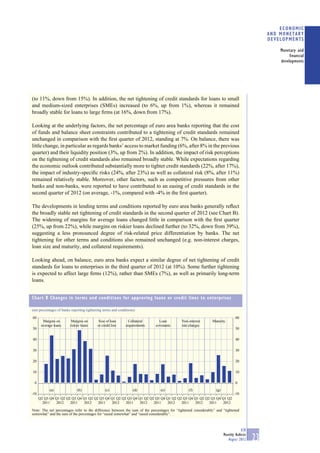
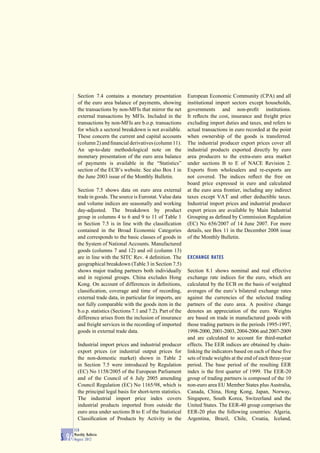
The developments in lending terms and conditions reported by euro area banks generally reflect
the broadly stable net tightening of credit standards in the second quarter of 2012 (see Chart B).
The widening of margins for average loans changed little in comparison with the first quarter
(25%, up from 22%), while margins on riskier loans declined further (to 32%, down from 39%),
suggesting a less pronounced degree of risk-related price differentiation by banks. The net
tightening for other terms and conditions also remained unchanged (e.g. non-interest charges,
loan size and maturity, and collateral requirements).

Looking ahead, on balance, euro area banks expect a similar degree of net tightening of credit
standards for loans to enterprises in the third quarter of 2012 (at 10%). Some further tightening
is expected to affect large firms (12%), rather than SMEs (7%), as well as primarily long-term
loans.


Chart B Changes in terms and conditions for approving loans or credit lines to enterprises

(net percentages of banks reporting tightening terms and conditions)

60                                                                                                                             60
        Margins on        Margins on        Size of loan       Collateral     Loan          Non-interest       Maturity
       average loans     riskier loans     or credit line    requirements   covenants       rate charges
50                                                                                                                             50

40                                                                                                                             40

30                                                                                                                             30

20                                                                                                                             20

10                                                                                                                             10

 0                                                                                                                             0
            (a)               (b)               (c)               (d)          (e)              (f)              (g)
-10                                                                                                                           -10
      Q2 Q3 Q4 Q1 Q2 Q2 Q3 Q4 Q1 Q2 Q2 Q3 Q4 Q1 Q2 Q2 Q3 Q4 Q1 Q2 Q2 Q3 Q4 Q1 Q2 Q2 Q3 Q4 Q1 Q2 Q2 Q3 Q4 Q1 Q2
        2011    2012   2011    2012   2011    2012   2011    2012   2011    2012   2011    2012   2011    2012

Note: The net percentages refer to the difference between the sum of the percentages for “tightened considerably” and “tightened
somewhat” and the sum of the percentages for “eased somewhat” and “eased considerably”.


                                                                                                                                   ECB
                                                                                                                       Monthly Bulletin
                                                                                                                          August 2012     23
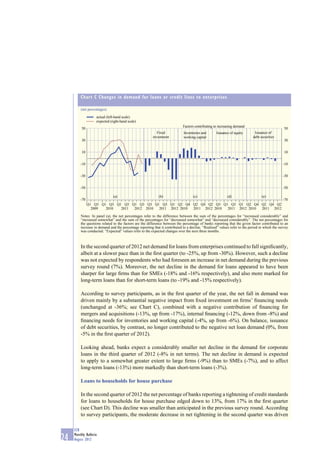
Chart C Changes in demand for loans or credit lines to enterprises

         (net percentages)
                    actual (left-hand scale)
                    expected (right-hand scale)
                                                                             Factors contributing to increasing demand
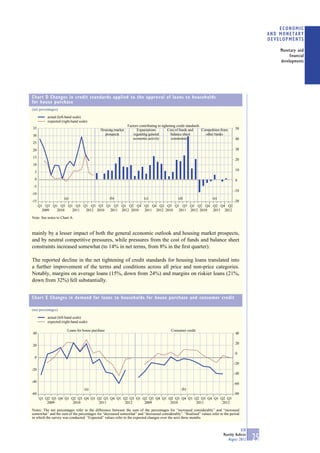
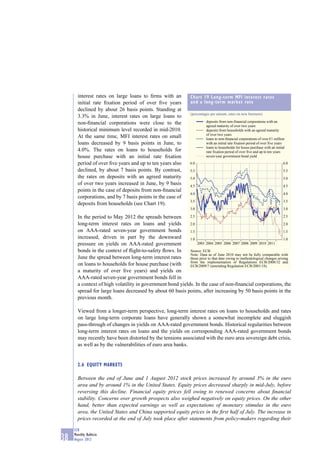
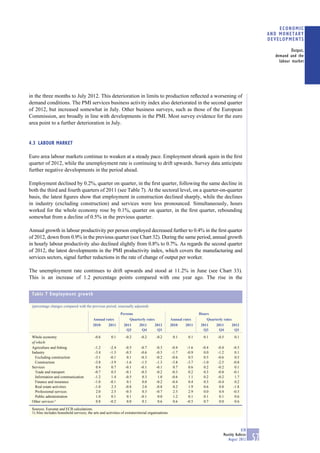
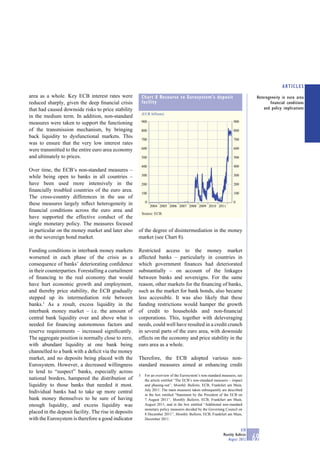
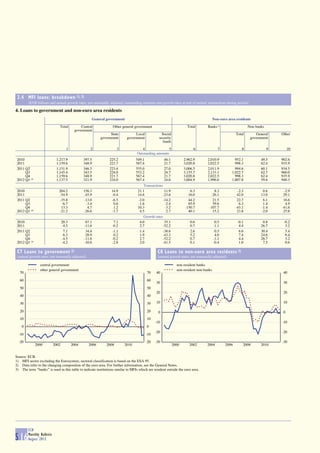
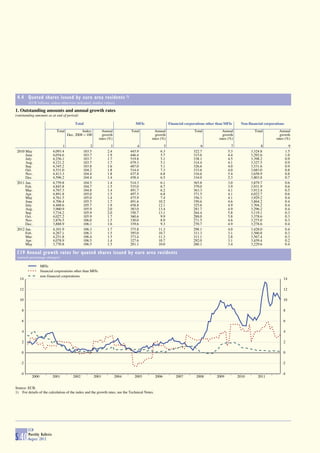
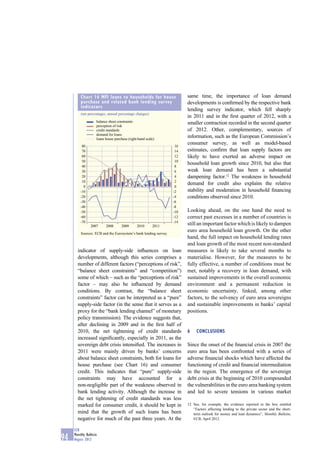
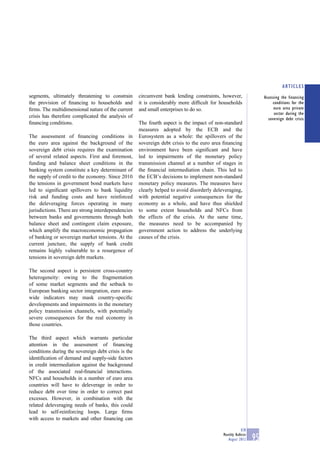
          50                                                                                                                                     50
                                                            Fixed            Inventories and       Issuance of equity        Issuance of
                                                         investment          working capital                                debt securities
          30                                                                                                                                     30


          10                                                                                                                                     10


         -10                                                                                                                                    -10


         -30                                                                                                                                    -30


         -50                                                                                                                                    -50

                               (a)                           (b)                    (c)                    (d)                    (e)
         -70                                                                                                                                    -70
               Q1 Q3 Q1 Q3 Q1 Q3 Q1 Q3 Q3 Q1 Q3 Q1 Q2 Q4 Q2 Q4 Q2 Q3 Q1 Q3 Q1 Q2 Q4 Q2 Q4 Q2
                 2009  2010  2011 2012 2010 2011 2012 2010 2011 2012 2010 2011 2012 2010 2011 2012

         Notes: In panel (a), the net percentages refer to the difference between the sum of the percentages for “increased considerably” and
         “increased somewhat” and the sum of the percentages for “decreased somewhat” and “decreased considerably”. The net percentages for
         the questions related to the factors are the difference between the percentage of banks reporting that the given factor contributed to an
         increase in demand and the percentage reporting that it contributed to a decline. “Realised” values refer to the period in which the survey
         was conducted. “Expected” values refer to the expected changes over the next three months.


         In the second quarter of 2012 net demand for loans from enterprises continued to fall significantly,
         albeit at a slower pace than in the first quarter (to -25%, up from -30%). However, such a decline
         was not expected by respondents who had foreseen an increase in net demand during the previous
         survey round (7%). Moreover, the net decline in the demand for loans appeared to have been
         sharper for large firms than for SMEs (-18% and -16% respectively), and also more marked for
         long-term loans than for short-term loans (to -19% and -15% respectively).

         According to survey participants, as in the first quarter of the year, the net fall in demand was
         driven mainly by a substantial negative impact from fixed investment on firms’ financing needs
         (unchanged at -36%; see Chart C), combined with a negative contribution of financing for
         mergers and acquisitions (-13%, up from -17%), internal financing (-12%, down from -8%) and
         financing needs for inventories and working capital (-4%, up from -6%). On balance, issuance
         of debt securities, by contrast, no longer contributed to the negative net loan demand (0%, from
         -5% in the first quarter of 2012).

         Looking ahead, banks expect a considerably smaller net decline in the demand for corporate
         loans in the third quarter of 2012 (-8% in net terms). The net decline in demand is expected
         to apply to a somewhat greater extent to large firms (-9%) than to SMEs (-7%), and to affect
         long-term loans (-13%) more markedly than short-term loans (-3%).

         Loans to households for house purchase

         In the second quarter of 2012 the net percentage of banks reporting a tightening of credit standards
         for loans to households for house purchase edged down to 13%, from 17% in the first quarter
         (see Chart D). This decline was smaller than anticipated in the previous survey round. According
         to survey participants, the moderate decrease in net tightening in the second quarter was driven

     ECB
     Monthly Bulletin
24   August 2012
ECONOMIC
                                                                                                                                                     AND MONETARY
                                                                                                                                                     DEVELOPMENTS

                                                                                                                                                         Monetary and
                                                                                                                                                              financial
                                                                                                                                                         developments


Chart D Changes in credit standards applied to the approval of loans to households
for house purchase
(net percentages)

          actual (left-hand scale)
          expected (right-hand scale)
                                                             Factors contributing to tighening credit standards
35                                          Housing market         Expectations          Cost of funds and      Competition from     50
30                                            prospects          regarding general         balance sheet          other banks
                                                                economic activity          constraints                               40
25
20                                                                                                                                   30

15
                                                                                                                                     20
10
                                                                                                                                     10
 5
 0                                                                                                                                   0
 -5
                                                                                                                                    -10
-10
                     (a)                          (b)                   (c)                   (d)                    (e)
-15                                                                                                                                 -20
      Q1 Q3 Q1 Q3 Q1 Q3 Q1 Q3 Q3 Q1 Q3 Q1 Q2 Q4 Q2 Q4 Q2 Q3 Q1 Q3 Q1 Q2 Q4 Q2 Q4 Q2
        2009  2010  2011 2012 2010 2011 2012 2010 2011 2012 2010 2011 2012 2010 2011 2012

Note: See notes to Chart A.


mainly by a lesser impact of both the general economic outlook and housing market prospects,
and by neutral competitive pressures, while pressures from the cost of funds and balance sheet
constraints increased somewhat (to 14% in net terms, from 8% in the first quarter).

The reported decline in the net tightening of credit standards for housing loans translated into
a further improvement of the terms and conditions across all price and non-price categories.
Notably, margins on average loans (15%, down from 24%) and margins on riskier loans (21%,
down from 32%) fell substantially.


Chart E Changes in demand for loans to households for house purchase and consumer credit

(net percentages)

          actual (left-hand scale)
          expected (right-hand scale)

                       Loans for house purchase                                           Consumer credit
40                                                                                                                                   40

                                                                                                                                     20
20

                                                                                                                                     0
 0
                                                                                                                                    -20
-20
                                                                                                                                    -40

-40
                                                                                                                                    -60
                                   (a)                                                           (b)
-60                                                                                                                                 -80
      Q1 Q2 Q3 Q4 Q1 Q2 Q3 Q4 Q1 Q2 Q3 Q4 Q1 Q2 Q3 Q1 Q2 Q3 Q4 Q1 Q2 Q3 Q4 Q1 Q2 Q3 Q4 Q1 Q2 Q3
          2009        2010        2011        2012     2009        2010        2011        2012

Notes: The net percentages refer to the difference between the sum of the percentages for “increased considerably” and “increased
somewhat” and the sum of the percentages for “decreased somewhat” and “decreased considerably”. “Realised” values refer to the period
in which the survey was conducted. “Expected” values refer to the expected changes over the next three months.


                                                                                                                                         ECB
                                                                                                                             Monthly Bulletin
                                                                                                                                August 2012     25
Looking ahead, banks expect a somewhat lower degree of net tightening of credit standards in
         the case of loans for house purchase (5%) in the third quarter of 2012.

         Similar to the negative net loan demand by firms, euro area banks reported a further contraction,
         in net terms, in the demand for housing loans (to -21%, up from -43%; see Chart E), while
         the balance became significantly less negative. This net decline appeared to be driven mainly
         by the ongoing deterioration of housing market prospects (-25%, up from -31%) and consumer
         confidence (-27%, up from -37%).

         Looking ahead, banks expect a further net decline in the demand for housing loans (-10% in net
         terms) for the third quarter of 2012, albeit at a slower pace.

         Consumer credit and other lending to households

         For the second quarter of 2012, euro area banks reported a broadly stable net tightening of
         credit standards (7%, up from 5%; see Chart F). Pressures from cost of funds and balance sheet
         constraints on credit standards increased (to 8%, from 3% in the first quarter of 2012), whereas
         risk perceptions (related to the economic outlook and consumers’ creditworthiness) remained
         broadly unchanged. With regard to the terms and conditions on consumer credit, banks reported,
         on balance, that the widening of margins on riskier loans declined (to 13%, from 17% in the first
         quarter), whereas the widening of margins on average consumer loans remained broadly stable
         (at 11%, compared with 10% in the first quarter of 2012). The contribution of non-price terms
         and conditions on consumer credit remained broadly neutral.

         Looking ahead, in net terms, only 2% of banks expect a further tightening of credit standards for
         consumer credit and other lending to households in the third quarter of 2012.


         Chart F Changes in credit standards applied to the approval of consumer credit and other
         lending to households
         (net percentages)

                    actual (left-hand scale)
                    expected (right-hand scale)
                                                                     Factors contributing to tightening credit standards
          30                                                                                                                                  50
                                                  Creditworthiness         Expectations          Risk on collateral        Competition from
                                                   of consumers          regarding general          demanded                 other banks
          25                                                            economic activity                                                     40

          20
                                                                                                                                              30
          15

          10                                                                                                                                  20

           5                                                                                                                                  10

           0
                                                                                                                                              0
          -5
                               (a)                      (b)                      (c)                     (d)                      (e)
         -10                                                                                                                                  -10
               Q1 Q3 Q1 Q3 Q1 Q3 Q1 Q3 Q3 Q1 Q3 Q1 Q2 Q4 Q2 Q4 Q2 Q3 Q1 Q3 Q1 Q2 Q4 Q2 Q4 Q2
                2009  2010  2011  2012 2010 2011 2012 2010 2011 2012 2010 2011 2012 2010 2011 2012

         Note: See notes to Chart A.


     ECB
     Monthly Bulletin
26   August 2012
ECONOMIC
                                                                                                                                                        AND MONETARY
                                                                                                                                                        DEVELOPMENTS

                                                                                                                                                            Monetary and
                                                                                                                                                                 financial
                                                                                                                                                            developments


In the second quarter of 2012 net demand for consumer credit continued to decline markedly
(-27% in net terms, down from -26% in the previous quarter; see Chart E). This was mainly
due to lower spending on durable consumer goods (-28%, unchanged to the first quarter) and a
decrease in consumer confidence (-26%, up from -28% in the first quarter).

Looking ahead, banks expect a smaller net decline in the demand for consumer credit in the third
quarter of 2012 (at -8% in net terms).

Ad hoc question on the impact of the financial turmoil

As in previous survey rounds, the July 2012 euro area bank lending survey contained an ad hoc
question aimed at assessing the extent to which the financial market tensions affected banks’
access to retail and wholesale funding markets in the second quarter of 2012, and the extent to
which they might still have an effect in the third quarter of the year.

On balance, euro area banks reported some deterioration – probably related to the
re-intensification of the sovereign debt crisis – in their access to retail and wholesale funding
across all categories compared to the first quarter of 2012, although considerably less so than in
the fourth quarter of 2011. Banks’ access to longer-term market segments for retail and wholesale
funding deteriorated somewhat more than access to short-term market segments, possibly
indicating some reluctance of investors with respect to longer-term investments (see Chart G).
In addition, conditions for securitisation appeared to have worsened considerably in the second
quarter of 2012, both for true-sale securitisation and for banks’ ability to transfer risks off their


Chart G Change in the access to wholesale funding over the past three months

(net percentages of banks reporting deteriorated market access)

            Q3 2011               Q2 2012
            Q4 2011               Q3 2012 – expected
            Q1 2012
80                                                                                                                                      80

60                                                                                                                                      60

40                                                                                                                                      40

20                                                                                                                                      20

 0                                                                                                                                      0

-20                                                                                                                                    -20

-40                                                                                                                                    -40

-60                                                                                                                                    -60
            1              2             3              4         5             6               7               8           9

      1 Short-term deposits                                           6 Medium to long-term debt securities
      2 Long-term deposits and other retail funding instruments       7 Securitisation of corporate loans
      3 Very short-term money market                                  8 Securitisation of loans for house purchase
      4 Short-term money market                                       9 Ability to transfer credit risk off balance sheet
      5 Short-term debt securities

Note: The net percentages are defined as the difference between the sum of the percentages for “deteriorated considerably” and
“deteriorated somewhat” and the sum of the percentages for “eased somewhat” and “eased considerably”.


                                                                                                                                            ECB
                                                                                                                                Monthly Bulletin
                                                                                                                                   August 2012     27
balance sheets (synthetic securitisation). Looking ahead, euro area banks expect a further – albeit
         more moderate – deterioration in the conditions for access to both retail and wholesale funding
         in the third quarter of 2012.

         Ad hoc question on the impact of the sovereign debt crisis on banks’ funding conditions
         and credit standards

         The questionnaire for the July 2012 survey included, for the third time, an ad hoc question aimed
         at assessing the impact of the sovereign debt crisis on banks’ funding conditions and their credit
         standards. On average, 18% of the euro area banks in net terms – compared with 4% in the first
         quarter of 2012 – attributed the deterioration in funding conditions to the sovereign debt crisis,
         through either direct exposures to sovereign debt, reduced collateral value of government bonds
         or other effects. In fact, the decline in the collateral value in the second quarter was quoted as a
         reason for the deterioration in their funding conditions (-3%). In the previous quarter the increase
         in collateral value had had a positive impact on funding conditons. This suggests that the adverse
         effects of the sovereign debt crisis on banks’ funding conditions increased again in the course of
         the second quarter. This notwithstanding, the impact on euro area banks’ credit standards remained
         contained and changed only moderately in comparison with the previous quarter (about 7%, on
         average, for both loans to non-financial corporations and loans to households; see Chart H).


         Chart H Impact of the sovereign debt crisis on banks’ funding conditions and credit standards

         (net percentages of banks reporting an impact on funding conditions or on the tightening of credit standards)

                       Q4 2011
                       Q1 2012
                       Q2 2012
         40                                                                                                                                             40

         35                                                                                                                                             35

         30                                                                                                                                             30

         25                                                                                                                                             25

         20                                                                                                                                             20

         15                                                                                                                                             15

         10                                                                                                                                             10

          5                                                                                                                                             5

          0                                                                                                                                             0

         -5                                                                                                                                             -5
                   1             2       3          1             2          3          1            2          3          1           2          3
                                                          Loans or credit                   Loans to households               Loans to households
                                                        lines to enterprises                 for house purchase             for consumer credit and
                                                                                                                          other lending to households
                   Impact on your bank’s                                         Impact on your bank’s credit standards
                     funding conditions

              1 Direct exposure to sovereign debt
              2 Value of sovereign collateral available for wholesale market transactions
              3 Other effects

         Note: The net percentages are defined as the difference between the sum of the percentages for “contributed to a deterioration of funding
         conditions/tightening of credit standards considerably” and “contributed somewhat” and the sum of the percentages for “contributed to
         an easing of funding conditions/easing of credit standards somewhat” and “contributed considerably".


     ECB
     Monthly Bulletin
28   August 2012
ECONOMIC
                                                                                                                                                  AND MONETARY
                                                                                                                                                  DEVELOPMENTS

                                                                                                                                                      Monetary and
                                                                                                                                                           financial
                                                                                                                                                      developments


 Ad hoc questions on the impact of Basel III and other changes in bank regulation

 The questionnaire for the July 2012 survey also included two ad hoc questions that aimed at
 assessing the extent to which the new regulatory capital requirements set out in “Basel III” 3
 (or any other specific national regulations concerning banks’ capital that have recently been
 approved, or are expected to be approved in the near future) affect banks’ lending policies via
 the potential impact on their capital positions and the credit standards they apply to loans.

 The results of the July 2012 bank lending survey confirmed that the adjustment shown in the
 January 2012 survey is still ongoing. Banks reported, in net terms, a further decline in their
 risk-weighted assets, albeit less strong than expected in January (-41% in the first half of 2012
 compared with -34% in the second half of 2011). This decline was and is expected to remain
 focused on riskier, as opposed to average, loans. The increase in banks’ capital positions was
 less marked than in January (35% versus 42%), but was slightly above expectations. On balance,
 34% of the banks expect an increase in their capital position in the second half of 2012. Contrary
 to the January survey results for the second half of 2011, however, in the first half of 2012 the
 increase in banks’ capital position was mainly achieved via retained earnings rather than via the
 issue of new shares.

 In net terms, about 25% of the participating euro area banks indicated that their credit standards
 for loans to large enterprises were tightened as a result of adjustments implemented in view of the
 new national regulations and/or capital requirements set out in “Basel III”. While credit standards
 for loans to SMEs were affected to a lesser extent (8%), in the case of loans to households,
 in net terms, 12% of euro area banks reported a tightening of credit standards owing to the new
 regulatory capital requirements for housing loans, and 7% for consumer credit.

 Overall, while the downsizing of risk-weighted assets generally progressed further in the first
 half of 2012, banks did not, on balance, speed up the improvement of their capital positions over
 the same period. Looking ahead, a lower net percentage of euro area banks plan on reducing
 their risk-weighted assets in the second half of 2012, as compared with the first half of the year.
 They would also continue to reinforce their capital base to the same extent as in the first half
 of the year. For the second half of 2012, banks expect an increase in net tightening of credit
 standards owing to regulatory pressures which should affect primarily loans to enterprises, while
 not much change is expected, on balance, in the case of loans to households.
 3 See Basel Committee on Banking Supervision, Basel III: A global regulatory framework for more resilient banks and banking systems,
   Bank for International Settlements, 16 December 2010 (available at http://www.bis.org/publ/bcbs189.pdf).


2.2 SECURITIES ISSUANCE

The annual growth rate of debt securities issuance by euro area residents stood at 4.0% in
May 2012, down from 4.4% in the previous month. This slowdown was driven mainly by a lower
growth rate of issuance of short-term debt securities, although issuance of long-term debt securities
also decelerated. Overall, the weakening in issuance activity was broadly based across all but one
sector. At the same time, the annual growth rate of quoted share issuance edged up slightly in May,
to 1.5%.


                                                                                                                                      ECB
                                                                                                                          Monthly Bulletin
                                                                                                                             August 2012     29
Table 4 Securities issued by euro area residents


                                                     Amount outstanding                                  Annual growth rates 1)
                                                         (EUR billions)
                                                                   2012             2011         2011        2011       2012      2012    2012
         Issuing sector                                            May               Q2           Q3          Q4         Q1       April   May
         Debt securities                                             16,840           3.5          3.5          3.1       4.2       4.4    4.0
         MFIs                                                         5,600           1.1          2.0          3.3       4.6       4.2    2.9
         Non-monetary financial corporations                           3,381           0.7         -0.4         -1.1      -0.4       2.8    3.5
         Non-financial corporations                                      938           4.1          4.9          5.0       6.6       9.5    9.1
         General government                                           6,922           6.9          6.6          4.9       5.8       4.8    4.5
         of which:
           Central government                                         6,253          6.1          5.9          4.2        4.8       3.7    3.8
           Other general government                                     669         15.8         14.6         13.2       16.8      15.7   12.6
         Quoted shares                                                3,771           1.5         1.9          1.6        1.6       1.4    1.5
         MFIs                                                           281           7.4        12.4         10.0       10.8      10.7   10.0
         Non-monetary financial corporations                             260           4.2         5.0          5.2        3.6       3.1    3.4
         Non-financial corporations                                    3,230           0.5         0.4          0.3        0.3       0.2    0.4

         Source: ECB.
         1) For details, see the technical notes for Sections 4.3 and 4.4 of the “Euro area statistics” section.


       DEBT SECURITIES
       In May 2012 the annual growth rate of debt securities issued by euro area residents fell to 4.0%,
       from 4.4% in the previous month (see Table 4). This slowdown was driven mainly by a lower
       growth rate of issuance of short-term debt securities, although a decline in issuance of long-term
       debt securities also contributed to the deceleration in the overall growth rate. In terms of sectors, the
       slowdown was driven by weaker issuance activity of MFIs, the general government sector and non-
       financial corporations, whereas the growth rate of debt securities issued by non-monetary financial
       corporations increased in May.

       In terms of maturities, the growth rate of short-term debt securities issuance fell sharply, to 2.9% in
       May 2012, from 6.4% in April. The deceleration in May follows five consecutive monthly increases
       in the growth rate. In particular, issuance by MFIs was weaker, although issuance of short-term
       debt securities by non-financial corporations also fell. Driven by weaker issuance activity in the
       fixed rate segment of the market, the annual growth rate of issuance of long-term debt securities
       also fell slightly, to 4.1% in May, from 4.2% in the previous month.

       The decline in the overall growth rate of debt securities issuance in May was driven by weaker
       issuance activity in all sectors, with the exception of non-monetary financial corporations.
       In particular, the annual growth rate of debt securities issued by MFIs slowed to 2.9% and
       issuance by the general government sector slowed to 4.5%, from 4.2% and 4.8% respectively in
       the previous month. The slower growth of securities issued by MFIs should be assessed against
       the background of heightened financial market tensions. The annual growth rate of debt securities
       issued by non-financial corporations, which had increased for six consecutive months to stand at
       9.5% in April, also moderated in May, but remained strong at 9.1%. The strength of the issuance
       activity of non-financial corporations possibly reflects a substitution of market funding for
       bank lending in a context of tight bank credit standards and increased appetite among investors
       for higher yielding alternatives to government bonds. Finally, the annual growth rate of debt
       securities issued by non-monetary financial corporations increased further, to 3.5% in May, from
       2.8% in April.


     ECB
     Monthly Bulletin
30   August 2012
ECONOMIC
                                                                                                                                                 AND MONETARY
                                                                                                                                                 DEVELOPMENTS

                                                                                                                                                     Monetary and
                                                                                                                                                          financial
                                                                                                                                                     developments


 Chart 9 Sectoral breakdown of debt                                 Chart 10 Sectoral breakdown of quoted
 securities issued by euro area residents                           shares issued by euro area residents

 (six-month annualised growth rates; seasonally adjusted)           (annual growth rates)

              total                                                               total
              MFIs                                                                MFIs
              non-monetary financial corporations                                 non-monetary financial corporations
              non-financial corporations                                          non-financial corporations
              general government
 70                                                           70    16.0                                                       16.0

                                                                    14.0                                                       14.0
 60                                                           60
                                                                    12.0                                                       12.0
 50                                                           50
                                                                    10.0                                                       10.0
 40                                                           40     8.0                                                       8.0

 30                                                           30     6.0                                                       6.0

                                                                     4.0                                                       4.0
 20                                                           20
                                                                     2.0                                                       2.0
 10                                                           10
                                                                     0.0                                                       0.0
  0                                                           0     -2.0                                                       -2.0

 -10                                                          -10   -4.0                                                       -4.0
       1999    2001    2003    2005     2007    2009   2011                1999   2001    2003    2005    2007   2009   2011

 Source: ECB.                                                       Source: ECB.
                                                                    Note: Growth rates are calculated on the basis of financial
                                                                    transactions.


With regard to short-term trends, the seasonally adjusted annualised six-month growth rate of
debt securities issuance points to a deceleration in the issuance activity of MFIs and non-financial
corporations (see Chart 9). In particular, debt securities issuance in the MFI sector, which had been
strong since the middle of 2011, started to weaken in March 2012. In the case of non-financial
corporations, the slowdown in May follows five consecutive monthly increases in the seasonally
adjusted annualised six-month growth rate of debt securities issuance. By contrast, issuance by
non-monetary financial corporations continued to accelerate in May 2012.

QUOTED SHARES
The annual growth rate of quoted shares issued by euro area residents increased marginally, to
1.5% in May 2012, from 1.4% in the previous month. In particular, the annual growth rate of
equity issuance by MFIs decreased to 10.0% in May, from 10.7% in April (see Chart 10). At the
same time, the annual growth rate of quoted shares issued by non-financial corporations picked
up slightly, by 20 basis points, to 0.4% in May. Moreover, the growth rate of quoted shares
issued by non-monetary financial corporations increased again in May, to 3.4%, from 3.1% in the
previous month.


2.3 MONEY MARKET INTEREST RATES

Money market interest rates declined between early July and early August 2012, reflecting the cut
in key ECB interest rates on 5 July. Consequently, in the seventh maintenance period of 2012,
which began on 11 July, the EONIA dropped to a new record low on the back of large amounts of
excess liquidity in the overnight money market.


                                                                                                                                     ECB
                                                                                                                         Monthly Bulletin
                                                                                                                            August 2012     31
Unsecured money market interest rates, as measured by the EURIBOR, declined between
       early July and early August 2012, reflecting the cut in key ECB interest rates. On 1 August the
       one-month, three-month, six-month and twelve-month EURIBOR stood at 0.14%, 0.38%, 0.66%
       and 0.94% respectively – i.e. 22, 26, 26 and 27 basis points lower respectively than the levels
       observed on 5 July. Consequently, the spread between the twelve-month and the one-month
       EURIBOR – an indicator of the slope of the money market yield curve – declined to 79 basis points
       on 1 August, compared with 84 basis points on 5 July (see Chart 11).

       The three-month EONIA swap rate stood at 0.05% on 1 August, 8 basis points lower than on 5 July.
       This resulted in the spread between the three-month EURIBOR and the three-month EONIA swap
       rate declining by 18 basis points to stand at 33 basis points, remaining broadly in line with the
       levels seen in July 2011.

       The interest rates implied by the prices of three-month EURIBOR futures maturing in September
       and December 2012 and in March and June 2013 stood at 0.28%, 0.27%, 0.28% and 0.30%
       respectively on 1 August, representing decreases of 14, 15, 13 and 12 basis points respectively in
       comparison with the levels observed on 5 July.

       Between 5 July and the end of the sixth maintenance period of the year on 10 July, the EONIA
       remained stable at around 0.33%, amid continued excess liquidity. In the maintenance period
       starting on 11 July, the EONIA dropped by around 19 basis points to 0.13%, reflecting the cut in
       key ECB interest rates. Since then, volatility has remained low and on 1 August the EONIA stood
       at 0.11%.


         Chart 11 Money market interest rates                               Chart 12 ECB interest rates and the
                                                                            overnight interest rate

         (percentages per annum; spread in percentage points; daily data)   (percentages per annum; daily data)

                        one-month EURIBOR (left-hand scale)                           fixed rate in the main refinancing operations
                        three-month EURIBOR (left-hand scale)                         interest rate on the deposit facility
                        twelve-month EURIBOR (left-hand scale)                        overnight interest rate (EONIA)
                        spread between twelve-month and one-month                     interest rate on the marginal lending facility
                        EURIBOR (right-hand scale)
         2.50                                                       1.50    2.5                                                           2.5
         2.25                                                       1.40

         2.00                                                       1.30    2.0                                                           2.0
         1.75                                                       1.20

         1.50                                                       1.10    1.5                                                           1.5
         1.25                                                       1.00

         1.00                                                       0.90    1.0                                                           1.0
         0.75                                                       0.80

         0.50                                                       0.70    0.5                                                           0.5
         0.25                                                       0.60

         0.00                                                       0.50    0.0                                                           0.0
            July           Oct.        Jan.       Apr.       July              July        Oct.         Jan.         Apr.          July
                           2011                   2012                                    2011                       2012

         Sources: ECB and Thomson Reuters.                                  Sources: ECB and Thomson Reuters.


     ECB
     Monthly Bulletin
32   August 2012
ECONOMIC
                                                                                                                     AND MONETARY
                                                                                                                     DEVELOPMENTS

                                                                                                                         Monetary and
                                                                                                                              financial
                                                                                                                         developments


The Eurosystem conducted several refinancing operations between 5 July and 1 August. In the main
refinancing operations of the seventh maintenance period, which were conducted on 10, 17, 24 and
31 July, the Eurosystem allotted €163.7 billion, €156.8 billion, €130.7 billion and €132.7 billion
respectively. The Eurosystem also conducted two longer-term refinancing operations (LTROs) in
July, both as fixed rate tender procedures with full allotment, namely a special-term refinancing
operation with a maturity of one maintenance period on 10 July (in which €24.4 billion was allotted)
and a three-month LTRO on 25 July (in which €8.5 billion was allotted).

The Eurosystem also conducted four one-week liquidity-absorbing operations as variable rate tender
procedures on 10, 17 and 24 June and 31 July with a maximum bid rate of 0.75% and allotment
rates at 0.03%, 0.02%, 0.02% and 0.02% respectively. With these operations, the Eurosystem
fully absorbed the liquidity associated with purchases carried out under the Securities Markets
Programme.

The seventh maintenance period of the year, which began on 11 July, was characterised by high
levels of excess liquidity in the overnight money market, but average daily recourse to the deposit
facility declined to €352.4 billion, after €770.6 billion in the previous maintenance period. This
development is a consequence of the reduction of the deposit facility rate to 0.0%, which led to
a shift in holdings from the deposit facility to the respective current account. Consequently, the
average amount held on the current account increased to €501.5 billion, from €111.5 billion in the
previous maintenance period.


2.4 BOND MARKETS

Yields on AAA-rated long-term government bonds decreased by around 40 basis points in the
euro area between the end of June and early August 2012, mainly as a result of concerns about
growth, the cut in key ECB interest rates, and increased risk aversion. In the United States,
long-term government bond yields declined by around 10 basis points over the same period. In the
euro area, yields on bonds of AAA-rated issuers fell, while bond yields of most countries under
financial assistance programmes, as well as of Italy and Spain, increased. Uncertainty about future
bond market developments in the euro area, as measured by implied bond market volatility, fell in
the first half of July before recording an increase at the end of the month. Market-based indicators
show that inflation expectations remain fully consistent with price stability.


Between the end of June and 1 August 2012 yields on AAA-rated long-term euro area government
bonds decreased by approximately 40 basis points, to around 1.8%. In the United States, long-term
government bond yields decreased somewhat less, falling by 10 basis points over the same period
to stand at around 1.5% on 1 August. Long-term yields in both economic areas fell sharply in the
period to 20 July, with the biggest decline recorded in the euro area. After 20 July long-term yields
increased in both the euro area and the United States (see Chart 13). Long-term bond yields in the
euro area and the United States reached all-time low levels during the reference period owing to
flight-to-safety flows, as well as a deterioration in growth prospects. In particular, the IMF lowered
its global growth forecast and pointed to downside risks related to insufficient political action in the
euro area, while in the United States the Federal Reserve System signalled its willingness to act to
accommodate low growth, but mentioned no specific policies. In addition, the cut in the key ECB
interest rates in early July contributed to the decline in yields on AAA-rated long-term euro area
government bonds.

                                                                                                         ECB
                                                                                             Monthly Bulletin
                                                                                                August 2012     33
Chart 13 Long-term government bond yields                             The outcome of the Eurogroup meeting on
                                                                               20 July failed to convince market participants
                                                                               of the determination of governments to take
         (percentages per annum; daily data)
                                                                               the necessary steps to resolve the crisis and
                        euro area (left-hand scale)
                        United States (left-hand scale)
                                                                               to implement the agreements made at the
                        Japan (right-hand scale)                               European Council meeting at the end of
         3.20                                                           2.60   June. This affected not only bond markets
         3.00                                                           2.40   in countries under financial stress, but also
                                                                               markets for AAA-rated bonds. Towards the
         2.80                                                           2.20
                                                                               end of the month Moody’s changed its rating
         2.60                                                           2.00
                                                                               outlook to negative for Germany, Luxembourg
         2.40                                                           1.80   and the Netherlands, which also put downward
         2.20                                                           1.60   pressure on prices of AAA-rated long-term
                                                                               government bonds.
         2.00                                                           1.40

         1.80                                                           1.20
                                                                               The nominal interest rate differential between
         1.60                                                           1.00   ten-year government bond yields in the United
         1.40                                                           0.80   States and those in the euro area decreased in
         1.20                                                           0.60
                                                                               the period under review and stood at around
                Aug.      Oct.      Dec.      Feb.        Apr.   June          30 basis points on 1 August. In Japan, ten-year
                          2011                            2012
                                                                               government bond yields fell slightly over
         Sources: EuroMTS, ECB, Bloomberg and Thomson Reuters.
         Notes: Long-term government bond yields refer to ten-year             the period under review to stand at 0.8% on
         bonds or to the closest available bond maturity. The euro area        1 August. During the reference period, bond
         bond yield is based on the ECB’s data on AAA-rated bonds,
         which currently include bonds from Germany, France, the               yields in Japan reached the lowest level recorded
         Netherlands, Austria and Finland.
                                                                               since 2003.

       Investors’ uncertainty about near-term bond market developments in the euro area, as measured by
       option-implied volatility, decreased in the period to 20 July, but thereafter increased to a level close
       to that seen at the end of June. In the United States, implied volatility also declined at the beginning
       of the month, before reversing this decline. Implied bond market volatility has declined in both
       economic areas from the peaks recorded in November 2011, but more so in the United States.
       Liquidity premia on German government bonds relative to those on comparable agency bonds were
       broadly unchanged in the period under review.

       With regard to sovereign bond spreads in the euro area, market attention focused mainly on Spain,
       as several Spanish regions requested financial assistance from the central government, fuelling
       speculation in the market that Spain will need a full financial assistance programme. More generally,
       in the period under review the yield spreads on ten-year sovereign bonds vis-à-vis German sovereign
       bonds increased for Spain, Italy and most of the countries under financial assistance programmes,
       while spreads declined by between 20 basis points and 40 basis points for Belgium, France, the
       Netherlands, Austria and Finland. In July Spanish bond yields hit the highest level recorded since
       the introduction of the euro, amid fears about the sustainability of government debt and constrained
       access to the funding market. Spreads on Irish bonds decreased slightly and the yields on
       long-term Irish bonds fell to the lowest level seen since the start of the financial assistance
       programme. Ireland resumed debt issuance with a Treasury bill auction in early July and also
       issued long-term bonds later in the month, which was earlier than envisaged in announced plans.
       In late July the bond markets in countries under financial stress benefited from a number of official
       statements.


     ECB
     Monthly Bulletin
34   August 2012
ECONOMIC
                                                                                                                                                               AND MONETARY
                                                                                                                                                               DEVELOPMENTS

                                                                                                                                                                   Monetary and
                                                                                                                                                                        financial
                                                                                                                                                                   developments


    Chart 14 Euro area zero coupon inflation-                              Chart 15 Euro area zero coupon break-even
    linked bond yields                                                     inflation rates and inflation-linked swap
                                                                           rates
    (percentages per annum; five-day moving averages of daily data;         (percentages per annum; five-day moving averages of daily data;
    seasonally adjusted)                                                   seasonally adjusted)

                  five-year forward inflation-linked bond yield                         five-year forward break-even inflation rate
                  five years ahead                                                      five years ahead
                  five-year spot inflation-linked bond yield                            five-year forward inflation-linked swap rate
                  ten-year spot inflation-linked bond yield                             five years ahead
    3.0                                                           3.0      2.8                                                                 2.8

    2.5                                                           2.5
                                                                           2.6                                                                 2.6
    2.0                                                           2.0

    1.5                                                           1.5
                                                                           2.4                                                                 2.4

    1.0                                                           1.0

    0.5                                                           0.5      2.2                                                                 2.2


    0.0                                                           0.0
                                                                           2.0                                                                 2.0
    -0.5                                                          -0.5

    -1.0                                                          -1.0     1.8                                                                 1.8
           Aug.     Oct.      Dec.     Feb.      Apr.     June                   Aug.      Oct.     Dec.      Feb.     Apr.      June
                    2011                         2012                                      2011                        2012

    Sources: Thomson Reuters and ECB calculations.                         Sources: Thomson Reuters and ECB calculations.
    Notes: Since the end of August 2011 real rates have been               Notes: Since the end of August 2011 break-even inflation rates
    computed as a GDP-weighted average of separate real rates              have been computed as a GDP-weighted average of separately
    for France and Germany. Before this date real rates were               estimated break-even rates for France and Germany. Before this
    computed by estimating a combined real yield curve for France          date break-even inflation rates were computed by comparing
    and Germany.                                                           yields from the nominal yield curve of AAA-rated euro area
                                                                           government bonds with a combined real yield curve derived
                                                                           from French and German inflation-linked government bonds.


The yields on five-year and ten-year inflation-linked euro area government bonds fell by around
50 basis points in the period under review, to stand at -0.8% and -0.2% respectively on 1 August
(see Chart 14). The very depressed level of long-term real rates reflects investors’ rather gloomy
perception of medium-term growth prospects, as well as the flight to safe assets. Regarding
inflation perceptions, the implied forward break-even inflation rate in the euro area (five-year
forward five years ahead) rose by around 20 basis points, to 2.6%, in the period under review
(see Chart 15). The inflation-linked swap rate with the same time horizon rose by around 10 basis
points over the same period to stand at 2.3% on 1 August. Overall, taking into account not only
market volatility and distortions amid high liquidity premia, but also inflation risk premia, market-
based indicators suggest that inflation expectations remain fully consistent with price stability.1

The general pattern of yields on AAA-rated long-term euro area government bonds can be broken
down into changes in interest rate expectations (and related risk premia) at different horizons
(see Chart 16). The term structure of forward rates prevailing on 1 August was shifted downwards
by around 50 basis points compared with that seen at the end of June. Safe-haven flows, the lowering
of the ECB’s deposit rate to zero and speculation about the possibility of negative deposit rates have
led to negative short-term bond yields in a number of euro area countries in both the primary market
and the secondary market. The broadly unchanged slope of the term structure reflects the fact that

1     For a more thorough analysis of the anchoring of long-term inflation expectations, see the article entitled “Assessing the anchoring of
      longer-term inflation expectations”, Monthly Bulletin, ECB, July 2012.

                                                                                                                                                   ECB
                                                                                                                                       Monthly Bulletin
                                                                                                                                          August 2012     35
Chart 16 Implied forward euro area                                     changes in short-term yields were transmitted
         overnight interest rates                                               through the yield structure to long-term interest
                                                                                rates, partly as a result of investors’ search for
         (percentages per annum; daily data)
                                                                                positive returns.
                        1 August 2012
                        29 June 2012
                                                                                Between the end of June and 1 August 2012
          4.0                                                            4.0
                                                                                spreads on investment-grade corporate bonds
          3.5                                                            3.5
                                                                                issued by non-financial corporations fell
          3.0                                                            3.0    (relative to the Merrill Lynch EMU AAA-
          2.5                                                            2.5    rated government bond index). Over the same
          2.0                                                            2.0
                                                                                period spreads on investment-grade corporate
                                                                                bonds issued by financial corporations declined
          1.5                                                            1.5
                                                                                more sharply for lower rated issuers, while
          1.0                                                            1.0
                                                                                spreads for the AA and AAA-rated bonds
          0.5                                                            0.5    were broadly unchanged. Overall, recent
          0.0                                                            0.0    developments in corporate bond yields suggest
         -0.5                                                           -0.5
                                                                                a slight improvement in market-based financing
            2012         2014     2016     2018       2020       2022           conditions for firms.
         Sources: ECB, EuroMTS (underlying data) and Fitch Ratings
         (ratings).
         Notes: The implied forward yield curve, which is derived from
         the term structure of interest rates observed in the market, reflects   2.5 INTEREST RATES ON LOANS AND DEPOSITS
         market expectations regarding future levels of short-term interest
         rates. The method used to calculate these implied forward yield
         curves is outlined in the “Euro area yield curve” section of the
                                                          In June 2012 MFI interest rates on deposits
         ECB’s website. The data used in the estimate are AAA-rated
         euro area government bond yields.
                                                          exhibited a mixed pattern of developments,
                                                          slightly declining for short maturities, while
       edging up for longer maturities. Interest rates on loans to households for house purchase and
       loans to non-financial corporations declined, for both short and long maturities. The spread
       between long-term interest rates on loans and the yield on AAA-rated seven-year government
       bonds fell in June, in a context of volatile government bond yields.


       In June 2012 short-term MFI interest rates on deposits exhibited a mixed pattern of developments.
       The rate on overnight deposits from households and non-financial corporations declined slightly,
       by 1 basis point and 2 basis points respectively. The rate on deposits from households redeemable
       at notice of over three months fell by about 3 basis points. By contrast, the rates on deposits from
       households with an agreed maturity of up to one year edged up by around 6 basis points, while
       those on deposits from non-financial corporations with an agreed maturity of up to one year rose by
       around 4 basis points (see Chart 17).

       Most short-term MFI interest rates on loans declined in June 2012. Interest rates on overdrafts for
       non-financial corporations moderated by 3 basis points, as did interest rates on corporate loans with
       an initial maturity of less than one year. The fall in MFI interest rates on short-term corporate loans
       reflects a more pronounced decline in the interest rate on small corporate loans (i.e. loans of up to
       €1 million), which fell by 7 basis points to 4.1%, while the rate applied to large loans (i.e. loans of
       more than €1 million) decreased only slightly, by about 1 basis point. Hence, the spread between
       short-term MFI interest rates on small loans and those on large loans narrowed in June, but remained
       at a historically high level of 151 basis points. MFI interest rates on short-term loans to households
       for house purchase also decreased in June, by 4 basis points, while those on consumer credit,
       which are generally quite volatile, increased slightly, by 2 basis points. Overall, and given that the

     ECB
     Monthly Bulletin
36   August 2012
ECONOMIC
                                                                                                                                                            AND MONETARY
                                                                                                                                                            DEVELOPMENTS

                                                                                                                                                                Monetary and
                                                                                                                                                                     financial
                                                                                                                                                                developments


 Chart 17 Short-term MFI interest rates                                  Chart 18 Spreads of short-term MFI interest
 and a short-term market rate                                            rates vis-à-vis the three-month money
                                                                         market rate
 (percentages per annum; rates on new business)                          (percentage points; rates on new business)

          deposits from households redeemable at notice of up                       loans to non-financial corporations of over €1 million
          to three months                                                           with a floating rate and an initial rate fixation period
          deposits from households with an agreed maturity                          of up to one year
          of up to one year                                                         loans to households for house purchase with a floating
          overnight deposits from non-financial corporations                        rate and an initial rate fixation period of up to one year
          loans to households for consumption with a floating                       deposits from households with an agreed maturity
          rate and an initial rate fixation period of up to one year                of up to one year
          loans to households for house purchase with a floating
          rate and an initial rate fixation period of up to one year
          loans to non-financial corporations of over €1 million
          with a floating rate and an initial rate fixation period
          of up to one year
          three-month money market rate
 10                                                                10   3.0                                                                3.0
  9                                                                9    2.5                                                                2.5

  8                                                                8    2.0                                                                2.0

  7                                                                7    1.5                                                                1.5
                                                                        1.0                                                                1.0
  6                                                                6
                                                                        0.5                                                                0.5
  5                                                                5
                                                                        0.0                                                                0.0
  4                                                                4
                                                                        -0.5                                                              -0.5
  3                                                                3
                                                                        -1.0                                                              -1.0
  2                                                                2    -1.5                                                              -1.5
  1                                                                1    -2.0                                                              -2.0
  0                                                                0    -2.5                                                              -2.5
      2003 2004 2005 2006 2007 2008 2009 2010 2011                             2003 2004 2005 2006 2007 2008 2009 2010 2011

 Source: ECB.                                                            Source: ECB.
 Note: Data as of June 2010 may not be fully comparable with             Notes: For loans, the spreads are calculated as the lending rate
 those prior to that date owing to methodological changes arising        minus the three-month money market rate. For deposits, the
 from the implementation of Regulations ECB/2008/32 and                  spread is calculated as the three-month money market rate minus
 ECB/2009/7 (amending Regulation ECB/2001/18).                           the deposit rate. Data as of June 2010 may not be fully comparable
                                                                         with those prior to that date owing to methodological changes
                                                                         arising from the implementation of Regulations ECB/2008/32
                                                                         and ECB/2009/7 (amending Regulation ECB/2001/18).


EURIBOR decreased by 1 basis point in the same month, the spread between the EURIBOR and
short-term interest rates on loans to households for house purchase decreased to 245 basis points,
while the spread vis-à-vis large short-term loans to non-financial corporations remained broadly
unchanged (see Chart 18).

Taking a longer-term perspective, since the beginning of 2012 short-term MFI interest rates
on loans have decreased. This trend may still reflect the pass-through of changes in market
rates to bank lending rates following the cuts in the key ECB interest rates in November and
December 2011, as well as the improvements in banks’ liquidity position, against the background
of the two three-year longer-term refinancing operations conducted in December 2011 and
February 2012 and the broadening of the Eurosystem’s collateral framework. Moreover, the
cut in the key ECB interest rates in July is also expected to gradually contribute to lower bank
funding costs in the coming months.

Turning to longer maturities, in June 2012 MFI interest rates on loans tended to decline, while rates
on deposits increased. Interest rates on large loans to non-financial corporations declined sharply
in June, while the fall was more moderate in the case of other lending categories. In particular,

                                                                                                                                                ECB
                                                                                                                                    Monthly Bulletin
                                                                                                                                       August 2012     37
interest rates on large loans to firms with an                Chart 19 Long-term MFI interest rates
       initial rate fixation period of over five years                and a long-term market rate
       declined by about 26 basis points. Standing at
                                                                    (percentages per annum; rates on new business)
       3.3% in June, interest rates on large loans to
       non-financial corporations were close to the                            deposits from non-financial corporations with an
                                                                              agreed maturity of over two years
       historical minimum level recorded in mid-2010.                         deposits from households with an agreed maturity
                                                                              of over two years
       At the same time, MFI interest rates on small                          loans to non-financial corporations of over €1 million
       loans decreased by 9 basis points in June, to                          with an initial rate fixation period of over five years
                                                                              loans to households for house purchase with an initial
       4.0%. The rates on loans to households for                             rate fixation period of over five and up to ten years
       house purchase with an initial rate fixation                            seven-year government bond yield
       period of over five years and up to ten years also            6.0                                                             6.0
       declined, by about 7 basis points. By contrast,              5.5                                                             5.5
       the rates on deposits with an agreed maturity                5.0                                                             5.0
       of over two years increased in June, by 9 basis              4.5                                                             4.5
       points in the case of deposits from non-financial
                                                                    4.0                                                             4.0
       corporations, and by 7 basis points in the case of
                                                                    3.5                                                             3.5
       deposits from households (see Chart 19).
                                                                    3.0                                                             3.0

       In the period to May 2012 the spreads between        2.5                                                          2.5

       long-term interest rates on loans and yields         2.0                                                          2.0
       on AAA-rated seven-year government bonds             1.5                                                          1.5
       increased, driven in part by the downward            1.0                                                          1.0
       pressure on yields on AAA-rated government               2003 2004 2005 2006 2007 2008 2009 2010 2011

       bonds in the context of flight-to-safety flows. In     Source: ECB.
                                                            Note: Data as of June 2010 may not be fully comparable with
       June the spread between long-term interest rates     those prior to that date owing to methodological changes arising
                                                            from the implementation of Regulations ECB/2008/32 and
       on loans to households for house purchase (with      ECB/2009/7 (amending Regulation ECB/2001/18).
       a maturity of over five years) and yields on
       AAA-rated seven-year government bonds fell in
       a context of high volatility in government bond yields. In the case of non-financial corporations, the
       spread for large loans decreased by about 60 basis points, after increasing by 50 basis points in the
       previous month.

       Viewed from a longer-term perspective, long-term interest rates on loans to households and rates
       on large long-term corporate loans have generally shown a somewhat incomplete and sluggish
       pass-through of changes in yields on AAA-rated government bonds. Historical regularities between
       long-term interest rates on loans and the yields on corresponding AAA-rated government bonds
       may recently have been distorted by the tensions associated with the euro area sovereign debt crisis,
       as well as by the vulnerabilities of euro area banks.


       2.6 EQUITY MARKETS

       Between the end of June and 1 August 2012 stock prices increased by around 3% in the euro
       area and by around 1% in the United States. Equity prices decreased sharply in mid-July, before
       reversing this decline. Financial equity prices fell owing to renewed concerns about financial
       stability. Concerns over growth prospects also weighed negatively on equity prices. On the other
       hand, better than expected earnings as well as expectations of monetary stimulus in the euro
       area, the United States and China supported equity prices in the first half of July. The increase in
       prices recorded at the end of July took place after statements from policy-makers regarding their

     ECB
     Monthly Bulletin
38   August 2012
ECONOMIC
                                                                                                                                                    AND MONETARY
                                                                                                                                                    DEVELOPMENTS

                                                                                                                                                        Monetary and
                                                                                                                                                             financial
                                                                                                                                                        developments


commitment to take the necessary steps to solve the crisis. Stock market uncertainty, as measured by
implied volatility, increased towards the end of July in both the euro area and the United States.


Between the end of June and 1 August 2012 stock prices in the euro area, as measured by the
broad-based Dow Jones EURO STOXX index, increased by around 3%, while those in the
United States, as measured by the Standard & Poor’s 500 index, increased by around 1%
(see Chart 20). Stock prices in Japan, as measured by the Nikkei 225 index, decreased by around
4% over the same period.

Developments in broad-based equity indices in the euro area and the United States were relatively
similar throughout July. Equity markets decreased from 20 July before reversing this decline at
the end of the month. During the first half of July equity prices were supported by expectations
of monetary stimulus in the euro area, the United States and China. Better than expected earnings
reports also supported equity prices. On the other hand, generally negative macroeconomic releases
and lowered growth forecasts put downward pressure on equity prices. The decline in equity prices
after 20 July was mainly due to renewed concerns about financial stability in the euro area. Although
the terms of the recapitalisation package for Spain’s financial sector were agreed at the Eurogroup
meeting on 20 July, market participants did not deem it sufficient to break the negative feedback
loop between sovereigns and the financial sector. A short-selling ban imposed by Spain and Italy
did not seem to calm the equity markets either. The decline in equity prices was reversed at the end


 Chart 20 Stock price indices                                       Chart 21 Implied stock market volatility


 (index: 1 August 2011 = 100; daily data)                           (percentages per annum; five-day moving average of daily data)
              euro area                                                         euro area
              United States                                                     United States
              Japan                                                             Japan
 115                                                         115    45                                                              45
 110                                                         110
                                                                    40                                                              40
 105                                                         105

 100                                                         100    35                                                              35

  95                                                         95
                                                                    30                                                              30
  90                                                         90

  85                                                         85     25                                                              25

  80                                                         80     20                                                              20
  75                                                         75
                                                                    15                                                              15
  70                                                         70

  65                                                         65     10                                                              10
       Aug.     Oct.     Dec.   Feb.        Apr.   June                  Aug.      Oct.         Dec.   Feb.    Apr.      June
                2011                        2012                                   2011                        2012

 Source: Thomson Reuters.                                           Source: Bloomberg.
 Note: The indices used are the Dow Jones EURO STOXX broad          Notes: The implied volatility series reflects the expected standard
 index for the euro area, the Standard & Poor’s 500 index for the   deviation of percentage changes in stock prices over a period of
 United States and the Nikkei 225 index for Japan.                  up to three months, as implied in the prices of options on stock
                                                                    price indices. The equity indices to which the implied volatilities
                                                                    refer are the Dow Jones EURO STOXX 50 index for the euro
                                                                    area, the Standard & Poor’s 500 index for the United States and
                                                                    the Nikkei 225 index for Japan.


                                                                                                                                        ECB
                                                                                                                            Monthly Bulletin
                                                                                                                               August 2012     39
of July after statements from policy-makers regarding their commitment to take the necessary steps
       to solve the crisis.

       Equity price developments diverged across the euro area in July. Until 20 July Spanish and
       Italian equity prices fell while equity prices rose in most other countries. Thereafter all equity
       markets declined, with Spanish and Italian equity prices recording the sharpest decline. Spanish
       and Italian equities also led the subsequent recovery. Overall, in the reference period Spanish
       and Italian equity prices declined by 4% and 2% respectively, while, for example, German equity
       prices recorded an increase of 5%. In the euro area as a whole, financial equity prices declined
       by around 1% in the period under review, whereas non-financial equity prices recorded a
       3% increase.

       Stock market uncertainty, as measured by implied volatility, fell in the first half of July before
       increasing from 20 July. Implied volatility in the euro area stood at 24% on 1 August. In the
       United States, implied stock market volatility also declined in the first half of July, before increasing
       at the end of the reference period. Implied volatility in the United States, standing at 16%, continues
       to be lower than that recorded in the euro area. In both economic areas, the levels of stock market
       uncertainty in the middle of July were close to the lowest levels recorded so far this year. However,
       after increasing again, the implied volatilities in the two economic areas returned to the average
       level for 2012 at the end of July (see Chart 21).


         Box 3

         INTEGRATED EURO AREA ACCOUNTS FOR THE FIRST QUARTER OF 2012 1

         The integrated euro area accounts released on 1 August 2012, covering data up to the first
         quarter of 2012, offer comprehensive information on the income, spending, financing and
         portfolio decisions of institutional sectors in the euro area. In the first quarter of 2012, the further
         weakening of economic activity kept the correction of imbalances that had begun during the
         recovery phase at a standstill, as was the case in the previous quarter. The household saving ratio
         stabilised close to historically low levels and household net worth declined, while government
         deficits decreased only slightly. The net borrowing of non-financial corporations (NFCs)
         returned to positive territory, but this was due to declining retained earnings, while gross capital
         formation contracted and inventories were reduced at a higher rate. At the same time, the euro
         area’s external balance remained in surplus for the second consecutive quarter.

         Euro area income and net lending/net borrowing

         Annual growth in euro area nominal disposable income fell further in the first quarter of 2012,
         to 1.7%, after the significant decrease of 1 percentage point, to 1.8%, in the previous quarter
         (see Chart A). As income growth slowed down, euro area gross saving growth also fell from
         3.8% to 1.4% on an annual basis. This was reflected across sectors in a sharp decline in NFCs’
         retained earnings (savings), a slower growth of financial corporations’ retained earnings and,
         in contrast to what was observed in previous quarters, no further correction of government
         1 Detailed data can be found on the ECB’s website at http://sdw.ecb.europa.eu/browse.do?node=2019181


     ECB
     Monthly Bulletin
40   August 2012
ECONOMIC
                                                                                                                                              AND MONETARY
                                                                                                                                              DEVELOPMENTS

                                                                                                                                                  Monetary and
                                                                                                                                                       financial
                                                                                                                                                  developments


Chart A Euro area gross disposable                                 Chart B Euro area net lending/net
income - contributions by sector                                   borrowing

(annual percentage changes; percentage point contributions)        (as a percent of GDP; four-quarter moving sum)

            households                                                         households
            financial corporations                                             financial corporations
            non-financial corporations                                         non-financial corporations
            government                                                         government
            euro area                                                          euro area
8                                                             8    8                                                           8

6                                                             6    6                                                           6

                                                                   4                                                           4
4                                                             4
                                                                   2                                                           2
2                                                             2
                                                                   0                                                           0
0                                                             0
                                                                   -2                                                         -2
-2                                                            -2
                                                                   -4                                                         -4

-4                                                            -4   -6                                                         -6

-6                                                            -6   -8                                                         -8
     2000      2002     2004      2006   2008    2010                   2000      2002     2004      2006   2008    2010

Sources: Eurostat and ECB.                                         Sources: Eurostat and ECB.


dissaving. At the same time, the growth of capital formation in the euro area as a whole and in all
non-financial institutional sectors entered negative territory.

All in all, net lending/net borrowing of the euro area (or the external balance – which can broadly
be defined as the difference between savings and capital formation) remained in positive territory
for the second consecutive quarter on a seasonally adjusted basis, and returned to positive
territory in four-quarter accumulated terms. From a sectoral viewpoint, the improvement in
net lending/net borrowing was due in particular to financial corporations, which have made a
very positive contribution to overall euro area net lending since the beginning of the crisis. This
reflects the increase in the retained earnings of financial corporations as a result of their efforts
to improve their capital positions. Moreover, the improvement in the euro area external balance
also reflects the slight decrease in the net borrowing of the government sector (see Chart B, in
four-quarter sums). On the financial side, the increase in net lending was mainly reflected in
lower net inflows in debt securities and, to a lesser extent, in shares and other equity. These
were only partly offset by lower net outflows in currency and deposits. Moreover, foreign
repatriation flows abated, especially in the form of deposits which declined at a slower pace
than in previous quarters.

Behaviour of institutional sectors

After two quarters of decline, the annual growth rate of households’ nominal gross disposable
income increased to 1.8% in the first quarter of 2012, from 1.4% in the previous quarter (see Chart C),
despite a significant decrease in employee compensation growth. This development was driven
by higher growth in net property income and social benefits, which increased for the first time
since the third quarter of 2010. Real disposable income growth remained in negative territory


                                                                                                                                  ECB
                                                                                                                      Monthly Bulletin
                                                                                                                         August 2012     41
Chart C Households’ nominal gross                                  Chart D Household income and consumption
         disposable income                                                  growth, and saving ratio

         (annual percentage changes; percentage point contributions)        (annual percentage changes; percentage of gross disposable
                                                                            income, four-quarter moving sum)

                     net social benefits and contributions                              household income growth (left-hand scale)
                     direct taxes                                                       nominal consumption growth (left-hand scale)
                     net property income                                                savings ratio, seasonally adjusted (right-hand scale)
                     gross operating surplus and mixed income
                     compensation of employees
                     real gross disposable income
                     gross disposable income
          8                                                            8    7                                                                   17.0

                                                                            6                                                                   16.5
          6                                                            6
                                                                            5                                                                   16.0

                                                                            4                                                                   15.5
          4                                                            4
                                                                            3                                                                   15.0

          2                                                            2    2                                                                   14.5

                                                                            1                                                                   14.0
          0                                                            0
                                                                            0                                                                   13.5

                                                                            -1                                                                  13.0
         -2                                                            -2
                                                                            -2                                                                  12.5
         -4                                                            -4   -3                                                                  12.0
              2000      2002     2004     2006     2008         2010             2000     2002      2004      2006      2008     2010

         Sources: Eurostat and ECB.                                         Sources: Eurostat and ECB.


         (-0.5%, year on year) for the third consecutive quarter on the back of elevated inflation. As private
         consumption also increased at a modest rate of 1.9%, year on year, close to that of income, the
         saving ratio of households stabilised at 13.3% on a seasonally adjusted basis (see Chart D).

         With subdued non-financial investment (the annual growth rate of which was negative),
         households’ net lending increased slightly, a development which was also reflected in declining
         loan growth (1.2%, down by 0.3 percentage point), while the financial investment growth rate
         remained broadly unchanged at 2.1%. Previous portfolio movements away from M3 components
         and insurance technical reserves continued, while the contribution to overall financial investment
         growth made by investment in market instruments, in particular equity, increased. Sales of
         investment fund shares decelerated.

         The gross operating surplus of euro area non-financial corporations declined further on a
         seasonally adjusted basis as value added continued to contract faster than wages. As a result,
         retained earnings (savings) declined by 3.8% in annual terms. Together with a very marginal
         increase in gross capital formation (which grew by only 0.2%, compared with 3.5% in the
         previous quarter) this decrease more than offset an acceleration in destocking, resulting in an
         increase in their net borrowing position (see Chart E). The annual growth of NFCs’ financing
         and financial investment remained broadly unchanged at 2.1% and 3.2% respectively. The lower
         contribution of MFI loan financing to total financing growth was again broadly compensated for
         by larger contributions of unquoted equity and debt securities. Inter-company financing continued
         to play an important buffering role, its overall contribution remaining broadly stable despite a
         slight decline in trade credits (see Chart F). The gradual reduction in NFC leverage observed


     ECB
     Monthly Bulletin
42   August 2012
ECONOMIC
                                                                                                                                                          AND MONETARY
                                                                                                                                                          DEVELOPMENTS

                                                                                                                                                              Monetary and
                                                                                                                                                                   financial
                                                                                                                                                              developments


Chart E Non-financial corporations saving,                                Chart F Loans granted by non-financial
capital investment and net lending(+)/net                                 corporations and their trade credit
borrowing(-)                                                              receivable and payable
(EUR billions, seasonally adjusted)                                       (four-quarter moving sum in EUR billions; annual percentage
                                                                          changes)

              retained earnings (gross saving) net of capital transfers                 trade credit receivable (left-hand scale)
              non-financial investment                                                  trade credit payable (left-hand scale)
              of which gross fixed capital formation                                    loans granted by non-financial corporations
              net borrowing (+)/net lending (-)                                         (left-hand scale)
                                                                                        annual growth rate of GDP (right-hand scale)
400                                                                400    400                                                              8

                                                                          300
300                                                                300
                                                                          200                                                              4

                                                                          100
200                                                                200
                                                                             0                                                             0
100                                                                100    -100

                                                                          -200                                                            -4
  0                                                                0
                                                                          -300

-100                                                              -100    -400                                                            -8
       2000     2002     2004      2006     2008      2010                       2000     2002     2004     2006      2008     2010

Sources: Eurostat and ECB.                                                Sources: Eurostat and ECB.
Note: Seasonally adjusted by the ECB.                                     Note: trade credit receivables and payables are estimated by the
                                                                          ECB based on partial information.


since mid-2009 continued in the first quarter of 2012, but this was mainly due to increases in the
valuation of equity holdings.

The budget balance of the general government improved only slightly, standing at -4.0% of
GDP (four-quarter moving sum) in the first quarter of 2012, compared with -4.1% of GDP in
the fourth quarter of 2011. This practically halted the upward trend which had started in the first
quarter of 2010, when the budget balance reached its lowest level of -6.7% of GDP. The outcome
was due mainly to decreasing revenues in the context of a slowing economy, in particular via
direct taxes on NFCs and net social security contributions. The net issuance of government
bonds in the first quarter of 2012 was fully absorbed by banks, which took advantage of the
three-year LTROs and used the proceeds to buy mainly government bonds. Non-residents, as well
as insurance corporations and pension funds, were also net buyers of government bonds in the
quarter, both having offloaded government bonds in the previous quarter. However, investment
funds accelerated their selling of government bonds, continuing the trend initiated in 2010.

The disposable income of financial corporations continued to show a robust increase in the first
quarter of 2012, mainly on account of property income earned. Holding gains were registered
in debt securities as sovereign yields fell in the countries under stress, while gains on equity
were also registered for the second consecutive quarter, as a result of the positive stock market
sentiment during the first weeks of the year (see Chart G). Financial institutions continued to
increase their capital by large amounts via equity issuance and retained earnings. However, the
increase of 0.1 percentage point in the net assets-to-total assets ratio at market value, to 12.6%,
observed in the quarter was due rather more to holding gains than to such capital accumulation, as


                                                                                                                                              ECB
                                                                                                                                  Monthly Bulletin
                                                                                                                                     August 2012     43
Chart G Other economic flows in financial                          Chart H Change in net worth of households
         corporations’ assets

         (quarterly flow; EUR billion)                                       (four-quarter moving sum; percentage of gross disposable income)

                          quoted shares                                                  change in net worth
                          unquoted shares                                                change in net worth due to net saving 1)
                          mutual fund shares                                             other flows in financial asset liabilities 2)
                          debt securities                                                other flows in non-financial assets 3)
                          loans
                          other
                          total
            800                                                    800      70                                                                  70

            600                                                    600
                                                                            50                                                                  50
            400                                                    400

            200                                                    200
                                                                            30                                                                  30
              0                                                    0

           -200                                                   -200      10                                                                  10

           -400                                                   -400
                                                                            -10                                                                 -10
           -600                                                   -600

           -800                                                   -800
                                                                            -30                                                                 -30
         -1,000                                                   -1,000

         -1,200                                                   -1,200    -50                                                                 -50
                        2008      2009         2010   2011                        2000     2002       2004       2006      2008          2010

         Sources: Eurostat and ECB.                                         Sources: Eurostat and ECB.
         Note: Total refers to “other economic flows”, which mainly relate   Note: data on nonfinancial assets are estimates by the ECB.
         to (realised and unrealised) holding gains and losses (including   1) This item comprises net saving, net capital transfers received
         loan write-offs).                                                  and the discrepancy between the non-financial and the financial
                                                                            accounts.
                                                                            2) Mainly holding gains and losses on shares and other equity.
                                                                            3) Mainly holding gains and losses on real estate and land.


         the aggregated balance sheet still increased faster than capital, largely as a result of the provision
         of financing via the three-year LTROs.

         Household balance sheet dynamics

         In the first quarter of 2012, the net worth of households decreased as a result of falling property
         prices. In four-quarter accumulated terms, the decrease equalled 4.9% of their gross disposable
         income (see Chart H), due to holding losses in net financial and non-financial assets, which more
         than outweighed net saving. The losses in non-financial assets were mainly caused by falling
         property prices over the last two quarters, whereas the losses in net financial assets were mostly
         related to the market downturn in the third quarter of 2011 (the latter being compensated for to
         some extent by holding gains as a result of increasing stock prices and falling interest rates in the
         first quarter of 2012). The household debt-to-assets ratio increased further to reach a historical
         peak of 14.5% as a result of decreases in the value of non-financial assets and relatively low
         savings.


     ECB
     Monthly Bulletin
44   August 2012
ECONOMIC
                                                                                                                                   AND MONETARY
                                                                                                                                   DEVELOPMENTS

                                                                                                                                            Prices
                                                                                                                                         and costs


3 PRICES AND COSTS
Euro area annual HICP inflation was 2.4% in July 2012, according to Eurostat´s flash estimate,
unchanged from the previous month. On the basis of current futures prices for oil, inflation
rates should decline further in the course of 2012 and be below 2% again in 2013. Over the
policy-relevant horizon, in an environment of modest growth in the euro area and well-anchored
long-term inflation expectations, underlying price pressures should remain moderate. Risks to the
outlook for price developments continue to be broadly balanced over the medium term.


3.1 CONSUMER PRICES

Headline HICP inflation was 2.4% in July 2012, unchanged from May and June (see Table 5).
Reflecting the rebound in oil prices since the end of June and supported by the weekly Oil Bulletin,
there was an increase in the energy component in July which was only partly counteracted by base
effects.

In June 2012, the last month for which an official breakdown is available, HICP inflation remained
at 2.4%, unchanged from the previous month. The stable inflation rate masks a drop in the annual
rate of increase of the energy component and a strong increase in that of unprocessed food.

Looking at the main HICP aggregates in more detail, energy inflation dropped to 6.1% in June from
7.3% in May, driven by a strong decline in energy prices on a monthly basis (-1.7%). This was on
account of falling crude oil prices, which more than offset an upward base effect. In particular, the
annual rate of increase in the price of fuels for personal transportation and that of liquid fuels fell
sharply in June, while that of electricity remained unchanged.

Unprocessed food inflation surged to 3.1% in June from 1.8% in May, reflecting an upward base
effect and much higher annual rates of increase in the prices of fruit and vegetables, while those
of meat and fish declined somewhat. By contrast processed food inflation continued to decline,
reaching 3.2% in June. At the beginning of the year the rates of change in this sub-component
stood slightly above 4%. The decline in processed food inflation reflected, in particular, lower price
increases on an annual basis of bread and cereals and of milk, cheese and eggs, while tobacco prices
increased at a higher rate than in May.


 Table 5 Price developments

 (annual percentage changes, unless otherwise indicated)

                                                   2010     2011      2012    2012   2012   2012   2012         2012
                                                                      Feb.    Mar.   Apr.   May    June         July
 HICP and its components
 Overall index 1)                                    1.6     2.7        2.7    2.7    2.6    2.4    2.4           2.4
  Energy                                             7.4    11.9        9.5    8.5    8.1    7.3    6.1             .
  Unprocessed food                                   1.3     1.8        2.2    2.2    2.1    1.8    3.1             .
  Processed food                                     0.9     3.3        4.1    3.9    3.7    3.4    3.2             .
  Non-energy industrial goods                        0.5     0.8        1.0    1.4    1.3    1.3    1.3             .
  Services                                           1.4     1.8        1.8    1.8    1.7    1.8    1.7             .
 Other price indicators
 Industrial producer prices                          2.9     5.9        3.7    3.5    2.6    2.3       .             .
 Oil prices (EUR per barrel)                        60.7    79.7       89.7   94.2   91.4   86.0   76.4          83.4
 Non-energy commodity prices                        44.6    12.2       -7.5   -5.2   -3.8   -0.2    0.9           4.6

 Sources: Eurostat, ECB and ECB calculations based on Thomson Reuters data.
 1) HICP inflation in July 2012 refers to Eurostat’s flash estimate.


                                                                                                                       ECB
                                                                                                           Monthly Bulletin
                                                                                                              August 2012     45
Chart 22 Breakdown of HICP inflation: main components

         (annual percentage changes; monthly data)

                   total HICP (left-hand scale)                        total HICP excluding energy and unprocessed food
                   unprocessed food (left-hand scale)                  (left-hand scale)
                   energy (right-hand scale)                           processed food (right-hand scale)
                                                                       non-energy industrial goods (left-hand scale)
                                                                       services (left-hand scale)
          5                                             25    4                                                           8
          4                                             20
                                                              3                                                           6
          3                                             15
          2                                             10    2                                                           4
          1                                             5
          0                                             0     1                                                           2

         -1                                             -5
                                                              0                                                           0
         -2                                             -10
         -3                                             -15   -1                                                          -2
              2004 2005 2006 2007 2008 2009 2010 2011              2004 2005 2006 2007 2008 2009 2010 2011

         Source: Eurostat.


       Excluding all food and energy items, which represent around 30% of the HICP basket, annual
       HICP inflation remained at 1.6% in June 2012, unchanged for the fourth consecutive month. HICP
       inflation excluding food and energy, which is determined predominantly by domestic factors,
       such as wages, profit mark-ups and indirect taxes, consists of two main components: non-energy
       industrial goods and services.

       The annual rate of change in non-energy industrial goods was unchanged at 1.3% in June. Services
       inflation decreased marginally, from 1.8% in May to 1.7% in June. This reflected a lower annual
       rate of recreational services, which more than compensated higher annual rates of communication
       and transport services.


       3.2 INDUSTRIAL PRODUCER PRICES

       No new data have become available on industrial producer prices at the euro area level since the
       July issue of the Monthly Bulletin was published. Available country data suggest that the annual
       rate of change in euro area producer prices (excluding construction) will most likely decrease
       further in June. Industrial producer price inflation (excluding construction) fell to 2.3% in May 2012
       from 2.6% in April. The decline in the annual rate of the overall index was broadly based across the
       main components, in particular energy, food and non-food consumer goods components. Over the
       same period, producer price inflation excluding construction and energy fell to 1.1%, from 1.3%.
       At later stages of the production chain, the consumer food and non-food goods components declined
       further. The latter fell from 0.9% to 0.7% in May, continuing its fall from the historically high
       levels seen at the end of 2011. This decrease, together with lower import price inflation, signals
       some easing of pipeline pressures for the non-energy industrial goods component of the HICP.

       Survey indicators for selling prices in industry, which lead PPI developments, decreased further in
       June 2012 (see Chart 24). European Commission survey data on selling price expectations eased,
       reflecting a downward revision of expectations in the consumer goods industries, while the other
       components remained unchanged. With regard to the Purchasing Managers’ Index, the composite

     ECB
     Monthly Bulletin
46   August 2012
ECONOMIC
                                                                                                                                                 AND MONETARY
                                                                                                                                                 DEVELOPMENTS

                                                                                                                                                          Prices
                                                                                                                                                       and costs


 Chart 23 Breakdown of industrial producer                            Chart 24 Producer input and output price
 prices                                                               surveys

 (annual percentage changes; monthly data)                            (diffusion indices; monthly data)

           total industry excluding construction (left-hand scale)              manufacturing; input prices
           intermediate goods (left-hand scale)                                 manufacturing; prices charged
           capital goods (left-hand scale)                                      services; input prices
           consumer goods (left-hand scale)                                     services; prices charged
           energy (right-hand scale)
 10                                                              25   90                                                         90
  8                                                              20
                                                                      80                                                         80
  6                                                              15
  4                                                              10   70                                                         70
  2                                                              5    60                                                         60
  0                                                              0
  -2                                                            -5    50                                                         50

  -4                                                            -10   40                                                         40
  -6                                                            -15
                                                                      30                                                         30
  -8                                                            -20
 -10                                                            -25   20                                                         20
       2004 2005 2006 2007 2008 2009 2010 2011                             2004 2005 2006 2007 2008 2009 2010 2011

 Sources: Eurostat and ECB calculations.                              Source: Markit.
                                                                      Note: An index value above 50 indicates an increase in prices,
                                                                      whereas a value below 50 indicates a decrease.


index for output prices continued to decline, reaching 47.1 in July – which is the lowest level
since February 2010. Compared with June a larger number of companies reported price declines
in manufacturing and, especially, in the services sector, allegedly as companies sought to increase
sales through discounting. As regards input prices, the composite index eased slightly to 51.1 in
July (from 51.3 in June), reflecting a further sharp drop to 43.6, from 45.3, in the manufacturing
component. By contrast, input prices increased at a slightly faster pace in the services sector owing
to higher input costs compared with June on account of higher food, oil and transport costs. Both
output and input price indices currently stand well below their long-term average levels.


3.3 LABOUR COST INDICATORS

Recently released labour cost indicators show some signs of moderation in wage pressures in the
first quarter of 2012 (see Table 6 and Chart 25), probably reflecting weak economic activity and the
continued slack in the labour market.

 Table 6 Labour cost indicators

 (annual percentage changes, unless otherwise indicated)

                                            2010            2011      2011          2011           2011         2011           2012
                                                                       Q1            Q2             Q3           Q4             Q1
 Negotiated wages                             1.7             2.0      2.0            1.9            2.1          2.0           2.0
 Hourly labour cost index                     1.5             2.8      2.5            3.3            2.6          2.8           2.0
 Compensation per employee                    1.7             2.2      2.1            2.2            2.3          2.2           1.9
 Memo items:
  Labour productivity                         2.5             1.3      2.2            1.3            1.2          0.9            0.4
  Unit labour costs                          -0.8             0.8     -0.2            0.9            1.2          1.4            1.5

 Sources: Eurostat, national data and ECB calculations.


                                                                                                                                     ECB
                                                                                                                         Monthly Bulletin
                                                                                                                            August 2012     47
Chart 25 Selected labour cost indicators                           Hourly labour costs in the euro area slowed to
                                                                            2.0% in the first quarter of 2012, down from
                                                                            2.8% in the previous quarter. This decrease was
         (annual percentage changes; quarterly data)
                                                                            widespread across sectors (Chart 26). Non-wage
                        compensation per employee                           costs grew at the same pace as the wages and
                        negotiated wages
                        hourly labour cost index                            salaries component of euro area hourly labour
         4.5                                                        4.5     costs. Preliminary information suggests that
                                                                            euro area negotiated wages increased somewhat
         4.0                                                        4.0     in May, mostly driven by the significant hike in
                                                                            German negotiated wage growth.
         3.5                                                        3.5

                                                                            Compensation per employee grew by 1.9% in
         3.0                                                        3.0
                                                                            the first quarter of this year, after displaying
         2.5                                                        2.5
                                                                            an annual growth rate of 2.2% in the previous
                                                                            quarter. As annual labour productivity growth
         2.0                                                        2.0     moderated more than compensation per
                                                                            employee, unit labour costs growth increased to
         1.5                                                        1.5     1.5% year on year in the first three months of
                                                                            2012, from 1.4% in the fourth quarter of 2011.
         1.0                                                        1.0     Looking ahead, in a context of subdued labour
               2004 2005 2006 2007 2008 2009 2010 2011
                                                                            market conditions, overall wage pressures
         Sources: Eurostat, national data and ECB calculations.
                                                                            should remain limited.


         Chart 26 Sectoral labour cost developments

         (annual percentage changes; quarterly data)

                   industry excluding construction, CPE                                industry excluding construction, hourly LCI
                   construction, CPE                                                   construction, hourly LCI
                   market services, CPE                                                market services, hourly LCI
                   services, CPE
          7                                                          7         7                                                     7

          6                                                          6         6                                                     6

          5                                                          5         5                                                     5

          4                                                          4         4                                                     4

          3                                                          3         3                                                     3

          2                                                          2         2                                                     2

          1                                                          1         1                                                     1

          0                                                          0         0                                                     0

         -1                                                          -1       -1                                                     -1

         -2                                                          -2       -2                                                     -2
               2004 2005 2006 2007 2008 2009 2010 2011                             2004 2005 2006 2007 2008 2009 2010 2011

         Sources: Eurostat and ECB calculations.
         Note: CPE stands for compensation per employee and LCI stands for labour cost index.


     ECB
     Monthly Bulletin
48   August 2012
ECONOMIC
                                                                                                                                          AND MONETARY
                                                                                                                                          DEVELOPMENTS

                                                                                                                                                   Prices
                                                                                                                                                and costs


3.4 THE OUTLOOK FOR INFLATION

Euro area annual HICP inflation was 2.4% in July 2012, according to Eurostat´s flash estimate,
unchanged from the previous month. On the basis of current futures prices for oil, inflation
rates should decline further in the course of 2012 and be below 2% again in 2013. Over the
policy-relevant horizon, in an environment of modest growth in the euro area and well-anchored
long-term inflation expectations, underlying price pressures should remain moderate.

The latest ECB Survey of Professional Forecasters (see Box 4) shows that respondents’ outlook for
inflation stands at 2.3% for 2012 and 1.7% for 2013. Compared with the previous round, this implies
no revision for 2012 and a downward revision of 0.1 percentage point for 2013. These forecasts are
well within the ranges reported in the June 2012 Eurosystem staff macroeconomic projections for the
euro area. Longer-term inflation expectations (for 2017) remain unchanged at 2.0 %.

Risks to the outlook for price developments continue to be broadly balanced over the medium
term. Upside risks pertain to further increases in indirect tax increases, owing to the need for fiscal
consolidation, and higher than expected energy prices over the medium term. The main downside
risks relate to the impact of weaker than expected growth in the euro area, in particular resulting from
a further intensification of financial market tensions. Such intensification has the potential to affect the
balance of risks on the downside.


 Box 4

 RESULTS OF THE ECB SURVEY OF PROFESSIONAL FORECASTERS FOR THE THIRD QUARTER OF 2012

 This box reports the results of the ECB Survey of Professional Forecasters (SPF) for the
 third quarter of 2012. The survey was conducted between 16 and 19 July 2012 and received
 50 responses.1 The results imply broadly unchanged inflation expectations for 2012 and 2013
 compared with the previous survey round, while GDP growth expectations have been revised
 downwards for both years. As regards longer-term inflation expectations, the average point
 forecast remains unchanged at 2.0%.

 Shorter-term inflation expectations broadly unchanged

 The SPF inflation expectations for 2012 and 2013 stand at 2.3% and 1.7% respectively (see table).
 This implies no revision for 2012 and a downward revision of 0.1 percentage point for 2013.
 Principally, participants explained this revision as owing to the decline in energy and commodity
 prices, weaker growth prospects and more limited wage pressures. Inflation expectations for 2014
 (the additional year comes in with the third-quarter survey) stand at 1.9%.

 The SPF inflation expectations for 2012 and 2013 are within the ranges reported in the June 2012
 Eurosystem staff macroeconomic projections and are very similar to those published in the Euro
 1 The survey collects information on expectations for euro area inflation, real GDP growth and unemployment from experts
   affiliated with financial or non-financial institutions that are based in the EU. Data are available on the ECB’s website at
   www.ecb.europa.eu/stats/prices/indic/forecast/html/index.en.html


                                                                                                                              ECB
                                                                                                                  Monthly Bulletin
                                                                                                                     August 2012     49
Results of the SPF, Eurosystem staff macroeconomic projections, Consensus Economics
         and the Euro Zone Barometer
         (annual percentage changes, unless otherwise indicated)

                                                                                                             Survey horizon
         HICP inflation                                                           2012                     2013            2014            Longer-term 2)
         SPF Q3 2012                                                              2.3                   1.7                1.9                  2.0
         Previous SPF (Q2 2012)                                                   2.3                   1.8                 -                   2.0
         Eurosystem staff macroeconomic projections (June 2012)                 2.3-2.5               1.0-2.2               -                    -
         Consensus Economics (July 2012)                                          2.3                   1.7                 -                   1.9
         Euro Zone Barometer (July 2012)                                          2.3                   1.8                2.0                  2.2
         Real GDP growth                                                         2012                     2013            2014            Longer-term 2)
         SPF Q3 2012                                                              -0.3                  0.6                1.4                  1.8
         Previous SPF (Q2 2012)                                                   -0.2                  1.0                 -                   1.8
         Eurosystem staff macroeconomic projections (June 2012)                 -0.5-0.3              0.0-2.0               -                    -
         Consensus Economics (July 2012)                                          -0.5                  0.5                 -                   1.6
         Euro Zone Barometer (July 2012)                                          -0.4                  0.5                1.4                  1.8
         Unemployment rate 1)                                                    2012                     2013            2014            Longer-term 2)
         SPF Q3 2012                                                              11.2                    11.4             10.8                 9.2
         Previous SPF (Q2 2012)                                                   11.0                    10.9              -                   8.9
         Consensus Economics (July 2012)                                          11.1                    11.4              -                    -
         Euro Zone Barometer (July 2012)                                          11.1                    11.3             11.5                 10.5

         1) As a percentage of the labour force.
         2) Longer-term expectations refer to 2017 in the SPF for the third quarter of 2012 and Consensus Economics. They refer to 2016 in the
         SPF for the second quarter and the Euro Zone Barometer.


         Zone Barometer and Consensus Economics surveys in July. The aggregate probability distributions
         have become more concentrated: in the interval between 2.0% and 2.4% for 2012, and in the interval
         between 1.5% and 1.9% for 2013 (see Chart A).


         Chart A Aggregate probability distribution of average annual inflation expectations for 2012
         and 2013 in the latest SPF rounds
         (probability in percentages)

                    Q1 2012 SPF
                    Q2 2012 SPF
                    Q3 2012 SPF

              a) 2012                                                                    b) 2013

         60                                                             60         40                                                                   40


         50                                                             50
                                                                                   30                                                                   30
         40                                                             40


         30                                                             30         20                                                                   20


         20                                                             20
                                                                                   10                                                                   10
         10                                                             10


          0                                                             0           0                                                                   0
                ≤0.9    1.0-1.4   1.5-1.9   2.0-2.4   2.5-2.9   ≥ 3.0                     ≤0.4     0.5-    1.0-   1.5-   2.0-     2.5-   3.0-   ≥ 3.5
                                                                                                   0.9     1.4    1.9    2.4      2.9    3.4

         Source: ECB.
         Note: The aggregate probability distribution corresponds to the average of individual probability distributions provided by SPF forecasters.


     ECB
     Monthly Bulletin
50   August 2012
ECONOMIC
                                                                                                                                                     AND MONETARY
                                                                                                                                                     DEVELOPMENTS

                                                                                                                                                              Prices
                                                                                                                                                           and costs


Some respondents mentioned the possibility of increases in energy and commodity prices
as upward risks to their baseline inflation forecasts. Further increases in indirect taxes and
administered prices were also cited as a potential upside risk. The main downside risks given
were weaker economic activity and higher unemployment in the event of a further aggravation
of the debt crisis in some euro area countries.

Longer-term inflation expectations unchanged at 2.0%

The average point forecast for longer-term inflation remains at 2.0%. At two decimal places,
expectations stand on average at 2.02%, after 1.99% in the previous survey round. The median
and the mode of the point forecasts are also stable at 2.0%. The share of respondents providing a
point forecast of 2.0% has risen from 39% to 45% (see Chart B). The SPF longer-term inflation
expectations are broadly in line with the latest longer-term forecast from Consensus Economics,
but 0.2 percentage point lower than that from the latest Euro Zone Barometer.

The aggregate probability distribution has shifted slightly towards higher outcomes compared
with the previous SPF round. The probability of inflation being at or above 2.0% increased from
49% in the previous SPF round to 52%.

Disagreement about longer-term inflation expectations, as measured by the standard deviation
of the point forecasts, decreased to 0.2 percentage point (from 0.3 percentage point). Aggregate
uncertainty surrounding longer-term inflation expectations, as measured by the standard deviation
of the aggregate probability distribution, has declined somewhat but remains at very high levels
(see Chart C).2
2 For a discussion regarding uncertainty measures, see the box entitled “Measuring perceptions of macroeconomic uncertainty”,
  Monthly Bulletin, ECB, January 2010.


Chart B Cross-sectional distribution of                           Chart C Disagreement and uncertainty about
longer-term (five years ahead) inflation                          longer-term inflation expectations
point forecasts
(percentage of respondents)                                       (percentage points; percentages)

         Q1 2012 SPF                                                          standard deviation of point forecasts (left-hand scale)
         Q2 2012 SPF                                                          aggregate uncertainty (left-hand scale)
         Q3 2012 SPF                                                          probability of inflation at or above 2% (right-hand scale)
50                                                      50       0.9                                                                 90
45                                                      45       0.8                                                                 80
40                                                      40       0.7                                                                 70
35                                                      35
                                                                 0.6                                                                 60
30                                                      30
                                                                 0.5                                                                 50
25                                                      25
                                                                 0.4                                                                 40
20                                                      20
                                                                 0.3                                                                 30
15                                                      15
10                                                      10       0.2                                                                 20

 5                                                      5        0.1                                                                 10
 0                                                      0        0.0                                                                 0
     ≤1.5 1.6 1.7 1.8 1.9 2.0 2.1 2.2 2.3 2.4 ≥2.5                     2001      2003       2005      2007      2009       2011

Source: ECB.                                                      Source: ECB.
                                                                  Note: Aggregate uncertainty is defined as the standard deviation
                                                                  of the aggregate probability distribution (assuming discrete
                                                                  probability density function with probability mass concentrated
                                                                  in the middle of the interval).


                                                                                                                                         ECB
                                                                                                                             Monthly Bulletin
                                                                                                                                August 2012     51
GDP growth expectations revised downwards for 2012 and 2013

         GDP growth expectations for 2012 have been revised downwards marginally, by 0.1 percentage
         point, to stand at -0.3%. For 2013 the expectations have decreased significantly, by 0.4 percentage
         point, to 0.6%. Expectations for 2014 stand at 1.4% (see table).

         Compared with the latest Eurosystem staff macroeconomic projections, real GDP growth
         expectations in the SPF are within the ranges for all years; compared with the latest forecasts
         from Consensus Economics and the Euro Zone Barometer, they are slightly higher for 2012 and
         2013 and the same for 2014.

         According to the respondents, the main factors behind the downward revisions are the
         intensification of fiscal consolidation in some euro area countries and higher uncertainty
         surrounding the resolution of the sovereign debt crisis.

         The aggregate probability distributions for 2012 and 2013 have shifted towards lower outcomes.
         For 2012 the respondents assign the highest probability to the interval between -0.5% and -0.1%:
         44.9% compared with 36.6% in the previous SPF round. Downside risks to euro area GDP
         growth prevail, deriving mainly from an escalation of the sovereign debt crisis. Other downside
         risks include a further fall in confidence, higher levels of uncertainty and lower external demand
         owing to a slowdown in the global economy. The main upside risk to the baseline outlook is seen
         to be the depreciation of the euro potentially supporting exports.

         Longer-term growth expectations (for 2017) stand at 1.8%. At the same time, the aggregate
         probability distribution has shifted to the downside compared with the previous SPF round.

         Chart D Aggregate probability distribution of average annual real GDP growth expectations
         for 2012 and 2013 in the latest SPF rounds
         (probability in percentages)

                    Q1 2012 SPF
                    Q2 2012 SPF
                    Q3 2012 SPF

              a) 2012                                                                     b) 2013

         50                                                               50         40                                                               40


         40                                                               40
                                                                                     30                                                               30


         30                                                               30

                                                                                     20                                                               20

         20                                                               20


                                                                                     10                                                               10
         10                                                               10


          0                                                               0           0                                                               0
              <-1.0 -1.0-   -0.5-   0.0-    0.5-   1.0-    1.5-   ≥ 2.0                   <-1.0 -1.0- -0.5- 0.0- 0.5- 1.0- 1.5- 2.0- 2.5- ≥ 3.0
                     -0.6    -0.1   0.4     0.9    1.4     1.9                                  -0.6 -0.1 0.4 0.9 1.4 1.9 2.4 2.9

         Source: ECB.
         Note: The aggregate probability distribution corresponds to the average of the individual probability distributions provided by SPF forecasters.


     ECB
     Monthly Bulletin
52   August 2012
ECONOMIC
                                                                                                                 AND MONETARY
                                                                                                                 DEVELOPMENTS

                                                                                                                          Prices
                                                                                                                       and costs


Forecasters now assign around 29% probability to longer-term real GDP growth being within
the interval between 1.5% and 1.9% (up from 28%), while the cumulative probability of GDP
growth being higher than 1.9% has decreased by 2 percentage points to 38%.

Further increase in unemployment rate expectations for 2012 and 2013

Unemployment rate expectations stand currently at 11.2% for 2012, 11.4% for 2013 and
10.8% for 2014 (see table). This implies upward revisions of 0.2 percentage point for 2012 and
0.5 percentage point for 2013 compared with the previous SPF round. According to the
forecasters’ comments, these further revisions were mainly due to the continuing deterioration in
the economic outlook and the impact of additional austerity measures in some euro area countries.
The forecasters expect the unemployment rate to peak in 2013. The subsequent decrease is seen
as likely to be slow, however, as the expected recovery of economic activity is considered to be
too weak to have a substantial downward impact on the unemployment rate.

The latest SPF forecasts for 2012 and 2013 are slightly higher than the forecasts given in the
latest Consensus Economics and Euro Zone Barometer issues; however, the SPF forecast for
2014 is considerably (0.7 percentage point) lower than that of the latest Euro Zone Barometer,
which foresees a further increase in 2014.

Longer-term unemployment rate expectations (for 2017) stand at 9.2%, 0.3 percentage point
higher than in the previous round. The entire aggregate probability distribution has also clearly
shifted towards higher outcomes.

Risks to the unemployment outlook in the SPF are assessed to be on the upside. A greater than
currently foreseen weakening of economic activity and an increase in structural unemployment
are considered to be the main risk factors. Downside risks are mentioned mainly in the context of
the longer-term horizon and are mostly associated with the further implementation of structural
reforms and with the success of reforms already implemented.

Other variables and conditioning assumptions

According to other information provided by the respondents, all assumptions covered by the
survey have been revised downwards. In particular, oil price assumptions for 2012 have been
revised downwards from below USD 120 per barrel in the previous SPF round to around USD
102 per barrel in the current round. Oil prices are then assumed to increase gradually to around
USD 109 per barrel in 2014. Growth in compensation per employee is assumed to stand at
1.8% in 2012 and (after a small decline in 2013) to increase to 2.4% in the long term (2017).
The EUR/USD exchange rate is expected to be stable at around 1.24 up to 2013 and then appreciate
marginally in 2014. The interest rate on the main refinancing operations of the Eurosystem is on
average expected to be at around 0.7% until 2013 and then increase to 1.0% in 2014.


                                                                                                     ECB
                                                                                         Monthly Bulletin
                                                                                            August 2012     53
4 OUTPUT, DEMAND AND THE LABOUR MARKET
       On a quarterly basis, euro area real GDP growth was flat in the first quarter of 2012, following a
       decline of 0.3% in the previous quarter. Economic indicators point to weak economic activity in the
       second quarter of 2012 and at the beginning of the third quarter in an environment of heightened
       uncertainty. Looking beyond the short term, the euro area economy is expected to recover only very
       gradually, with growth momentum being further dampened by a number of factors. In particular,
       tensions in some euro area sovereign debt markets and their impact on financing conditions,
       the process of balance sheet adjustment in the financial and non-financial sectors and high
       unemployment are expected to weigh on the underlying growth momentum, which is also affected
       by the ongoing global slowdown. The risks surrounding the economic outlook for the euro area
       continue to be on the downside.


       4.1 REAL GDP AND DEMAND COMPONENTS

       Quarterly real GDP growth in the euro area was flat in the first quarter of 2012, following a decline
       of 0.3% in the fourth quarter of 2011 (see Chart 27). Domestic demand and changes in inventories
       contributed negatively, while net trade continued to provide positive impetus to growth.

       Following a decrease of 0.5% in the fourth quarter of 2011, private consumption remained
       broadly unchanged in the first quarter of this year. This development was the result of a positive
       contribution to consumer spending from the consumption of retail goods and services, as retail trade
       increased, which was offset by a negative contribution to consumer spending from car purchases.
       Car registrations, in quarter-on-quarter terms, decreased strongly in the first quarter of this year.

       As regards the second quarter of 2012, information on private consumption reveals persistently
       weak developments in household spending. The volume of retail sales increased in May, but stood
       in the first two months of the second quarter
       0.8% below its average level in the first quarter.
                                                           Chart 27 Real GDP growth and contributions
       This represents a deterioration compared with
       the previous quarter, when retail sales rose by
       0.2%. At the same time, although new passenger      (quarter-on-quarter growth rate and quarterly percentage point
                                                           contributions; seasonally adjusted)
       car registrations rose in both May and June, they
                                                                      domestic demand (excluding inventories)
       were in the second quarter as a whole 0.5% lower               changes in inventories
       than in the first quarter. This decline is, however,            net exports
                                                                      total GDP growth
       a moderation compared with the previous quarter
                                                            0.8                                                         0.8
       when registrations decreased by 6.7%. Retail
       sector survey data also point to a protracted        0.6                                                         0.6

       weakness in consumption of retail goods in           0.4                                                         0.4
       the second quarter as well as in July 2012           0.2                                                         0.2
       (see Chart 28). The Purchasing Managers’ Index       0.0                                                         0.0
       (PMI) for retail trade declined between the first
                                                           -0.2                                                        -0.2
       and the second quarter, from 46.7 to 44.3. The
                                                           -0.4                                                        -0.4
       index level thus remained clearly below the
       theoretical expansion-contraction threshold         -0.6                                                        -0.6

       of 50, which points to continued sluggish sales.    -0.8                                                        -0.8
       The July index, which stood at 46.4, suggests a     -1.0                                                        -1.0
       continuation of weak dynamics in retail sales                Q1         Q2         Q3        Q4         Q1
                                                                                   2011                       2012
       at the start of the third quarter. Moreover, euro
                                                           Sources: Eurostat and ECB calculations.
       area consumer confidence declined in July to

     ECB
     Monthly Bulletin
54   August 2012
ECONOMIC
                                                                                                                                        AND MONETARY
                                                                                                                                        DEVELOPMENTS

                                                                                                                                                   Output,
                                                                                                                                          demand and the
                                                                                                                                            labour market


somewhat below its level in the second quarter.             Chart 28 Retail sales and confidence
The index remained clearly below its long-term              in the retail trade and household sectors
average, signalling further weak dynamics in
                                                            (monthly data)
consumer spending. Similarly, the indicator for
major purchases also remained at a level well                       total retail sales 1) (left-hand scale)
                                                                    consumer confidence 2) (right-hand scale)
below its long-term average.                                        retail confidence 2) (right-hand scale)
                                                            4                                                           40
Gross fixed capital formation declined by
                                                            3                                                           30
1.4%, quarter on quarter, in the first quarter
of 2012, following a decline of 0.6% in the                 2                                                           20
previous quarter. With regard to the breakdown              1                                                           10
of investment in the first quarter, construction
investment declined by 1.1%, quarter on quarter,            0                                                           0

while non-construction investment contracted                -1                                                         -10
by 1.6%.
                                                            -2                                                         -20

Looking ahead, industrial production of capital         -3                                                     -30
goods (an indicator of future non-construction          -4                                                     -40
investment) rose by 0.9% in May, following                  2004 2005 2006 2007 2008 2009 2010 2011 2012
a decline of 3.0% in April. Nonetheless, the            Sources: European Commission Business and Consumer Surveys
                                                        and Eurostat.
average level of capital goods production in            1) Annual percentage changes; three-month moving averages;
these two months stood 1.4% below that of the           working day-adjusted; including fuel.
                                                        2) Percentage balances; seasonally and mean-adjusted.
first quarter, which compares with a quarter-
on-quarter rate of -0.1% in the fourth quarter.
Survey results for the non-construction industrial sector, from both the PMI and the European
Commission, suggest, on balance, a deterioration in investment activity in the second quarter
of 2012 compared with the previous quarter. In July a further deterioration in industrial survey
results compared with the second quarter was recorded. At the same time, the Commission surveys
indicate that capacity utilisation declined strongly in the three-month period up to July 2012, further
sliding down to a level below its long-term average.

Construction investment is also likely to have been weak in the second quarter. Euro area
construction production was broadly flat in May compared with April, following a month-on-month
decline in April. In the first two months of the second quarter, euro area construction production was
broadly unchanged compared with the first quarter, when it declined by 4.4%. There are no signs
yet of a recovery, as financing constraints and ongoing housing market adjustments in a number of
euro area countries are still weighing on construction investment. Surveys confirm the picture of
such investment still shrinking. For instance, the indicator on construction confidence available up
to July 2012 published by the European Commission remains at levels below its historical average.
At the same time, the PMI for construction in the euro area remained at a level well below 50,
pointing to further negative developments in the second quarter of 2012.

Turning to euro area trade flows, they stabilised in the first quarter of 2012 after a contraction in
the last quarter of 2011. Exports increased by 1.0% quarter on quarter, while the rate of decline
in imports slowed down to 0.2%. However, the information that has become available in the
meantime suggests that both imports and exports weakened again in the second quarter. The trade
flows recorded in April and May were, on average, well below the levels seen in the first quarter.
Against the backdrop of prevailing uncertainty about the strength of the global recovery, survey
data relating to euro area exports also deteriorated. In July the PMI new export orders declined

                                                                                                                            ECB
                                                                                                                Monthly Bulletin
                                                                                                                   August 2012     55
marginally to 44.8, thus further below the theoretical expansion/contraction threshold of 50.
       Looking further ahead, growth in foreign demand and euro area exports is expected to pick up again
       over the course of the second half of 2012 on the back of a gradual, albeit modest, strengthening of
       global economic activity. Broadly consistent with the prospects for economic activity in the euro
       area, the near-term outlook for imports remains rather subdued.


       4.2 SECTORAL OUTPUT

       Real value added declined by 0.1%, quarter on quarter, in the first quarter of 2012. Activity in
       industry (excluding construction) as well as services was flat, while value added in construction
       declined by 0.9%.

       With regard to developments in the second quarter of 2012, growth in industrial production
       (excluding construction) increased by 0.6% in May, following a decline in the previous month.
       In April and May production stood on average 0.6% below its level in the first quarter. This
       represents a deterioration compared with the first quarter, when production contracted, quarter
       on quarter, by 0.4%. More timely survey data confirm the picture of continued weakness, as
       they point to a worsening in the second quarter compared with the first quarter. For example, the
       PMI manufacturing output index declined from close to the theoretical no-growth threshold of
       50 in the first quarter to about 45 in the second quarter and deteriorated slightly further in July.
       At the same time, European Commission survey data indicate increasing constraints on production

         Chart 29 Industrial production growth                             Chart 30 Industrial production, industrial
         and contributions                                                 confidence and PMI manufacturing output

         (growth rate and percentage point contributions; monthly data;    (monthly data; seasonally adjusted)
         seasonally adjusted)

                        capital goods                                                industrial production 1) (left-hand scale)
                        consumer goods                                               industrial confidence 2) (right-hand scale)
                        intermediate goods                                           PMI 3) manufacturing output (right-hand scale)
                        energy
                        total (excluding construction)
           4                                                          4     6                                                         24
           3                                                          3
           2                                                          2     4                                                         16
           1                                                          1     2                                                         8
           0                                                          0
          -1                                                         -1     0                                                         0
          -2                                                         -2
          -3                                                         -3     -2                                                        -8
          -4                                                         -4     -4                                                        -16
          -5                                                         -5
          -6                                                         -6     -6                                                        -24
          -7                                                         -7
          -8                                                         -8     -8                                                        -32
          -9                                                         -9    -10                                                        -40
         -10                                                         -10
         -11                                                         -11   -12                                              -48
               2004 2005 2006 2007 2008 2009 2010 2011                           2004 2005 2006 2007 2008 2009 2010 2011 2012

         Sources: Eurostat and ECB calculations.                           Sources: Eurostat, European Commission Business and Consumer
         Note: Data shown are calculated as three-month moving averages    Surveys, Markit and ECB calculations.
         against the corresponding average three months earlier.           Note: Survey data refer to manufacturing.
                                                                           1) Three-month-on-three-month percentage changes.
                                                                           2) Percentage balances.
                                                                           3) Purchasing Managers’ Index; deviations from an index value
                                                                           of 50.


     ECB
     Monthly Bulletin
56   August 2012
ECONOMIC
                                                                                                                                                        AND MONETARY
                                                                                                                                                        DEVELOPMENTS

                                                                                                                                                                   Output,
                                                                                                                                                          demand and the
                                                                                                                                                            labour market


in the three months to July 2012. This deterioration in limits to production reflected a worsening of
demand conditions. The PMI services business activity index also deteriorated in the second quarter
of 2012, but increased somewhat in July. Other business surveys, such as those of the European
Commission, are broadly in line with developments in the PMI. Most survey evidence for the euro
area point to a further deterioration in July.


4.3 LABOUR MARKET

Euro area labour markets continue to weaken at a steady pace. Employment shrank again in the first
quarter of 2012, while the unemployment rate is continuing to drift upwards. Survey data anticipate
further negative developments in the period ahead.

Employment declined by 0.2%, quarter on quarter, in the first quarter, following the same decline in
both the third and fourth quarters of 2011 (see Table 7). At the sectoral level, on a quarter-on-quarter
basis, the latest figures show that employment in construction declined sharply, while the declines
in industry (excluding construction) and services were less pronounced. Simultaneously, hours
worked for the whole economy rose by 0.1%, quarter on quarter, in the first quarter, rebounding
somewhat from a decline of 0.5% in the previous quarter.

Annual growth in labour productivity per person employed decreased further to 0.4% in the first quarter
of 2012, down from 0.9% in the previous quarter (see Chart 32). During the same period, annual growth
in hourly labour productivity also declined slightly from 0.8% to 0.7%. As regards the second quarter
of 2012, the latest developments in the PMI productivity index, which covers the manufacturing and
services sectors, signal further reductions in the rate of change of output per worker.

The unemployment rate continues to drift upwards and stood at 11.2% in June (see Chart 33).
This is an increase of 1.2 percentage points compared with one year ago. The rise in the


 Table 7 Employment growth

 (percentage changes compared with the previous period; seasonally adjusted)

                                                              Persons                                             Hours
                                           Annual rates            Quarterly rates                 Annual rates       Quarterly rates
                                           2010    2011         2011    2011       2012            2010    2011    2011    2011       2012
                                                                 Q3       Q4        Q1                              Q3       Q4        Q1
 Whole economy                              -0.6        0.1      -0.2       -0.2       -0.2         0.1     0.1     0.1      -0.5      0.1
 of which:
 Agriculture and fishing                     -1.2       -2.4      -0.5       -0.7       -0.3        -0.4    -1.6     -0.4     -0.4      -0.3
 Industry                                   -3.4       -1.3      -0.5       -0.6       -0.5        -1.7    -0.9      0.0     -1.2       0.1
   Excluding construction                   -3.1       -0.1       0.1       -0.3       -0.2        -0.6     0.5      0.5     -0.6       0.5
   Construction                             -3.8       -3.9      -1.6       -1.5       -1.3        -3.8    -3.7     -1.0     -2.5      -0.8
 Services                                    0.4        0.7      -0.1       -0.1       -0.1         0.7     0.6      0.2     -0.2       0.1
   Trade and transport                      -0.7        0.5      -0.1       -0.5       -0.2        -0.3     0.2      0.3     -0.8      -0.1
   Information and communication            -1.2        1.4      -0.5        0.3        1.0        -0.6     1.1      0.2     -0.2       1.7
   Finance and insurance                    -1.0       -0.1       0.1        0.0       -0.2        -0.4     0.4      0.3     -0.4       0.2
   Real estate activities                   -1.0        2.3      -0.8        2.0       -0.8         0.2     1.9      0.6      0.8      -1.8
   Professional services                     2.0        2.5      -0.3        0.3       -0.7         2.5     2.9      0.0      0.4      -0.5
   Public administration                     1.0        0.1       0.1       -0.1        0.0         1.2     0.1      0.1      0.1       0.6
 Other services 1)                           0.8       -0.2       0.0        0.1        0.6         0.6    -0.5      0.7      0.0       0.6

 Sources: Eurostat and ECB calculations.
 1) Also includes household services, the arts and activities of extraterritorial organisations.


                                                                                                                                            ECB
                                                                                                                                Monthly Bulletin
                                                                                                                                   August 2012     57
Chart 31 Employment growth and employment expectations

         (annual percentage changes; percentage balances; seasonally adjusted)

                   employment growth in industry                                            employment expectations in construction
                   (excluding construction; left-hand scale)                                employment expectations in the retail trade
                   employment expectations in manufacturing                                 employment expectations in the services sector
                   (right-hand scale)
          4                                                              20      25                                                               25
          3                                                              15      20                                                               20
          2                                                              10      15                                                               15
          1                                                              5
                                                                                 10                                                               10
          0                                                              0
                                                                                  5                                                               5
         -1                                                              -5
                                                                                  0                                                               0
         -2                                                              -10
                                                                                  -5                                                             -5
         -3                                                              -15
                                                                                 -10                                                             -10
         -4                                                              -20
         -5                                                              -25     -15                                                             -15

         -6                                                              -30     -20                                                             -20

         -7                                              -35                     -25                                               -25
              2004 2005 2006 2007 2008 2009 2010 2011 2012                              2004 2005 2006 2007 2008 2009 2010 2011 2012

         Sources: Eurostat and European Commission Business and Consumer Surveys.
         Note: Percentage balances are mean-adjusted.


       unemployment rate has been particularly large among younger workers (see Chart D in Box 5,
       which describes the adjustment processes in the four euro area countries currently under financial
       assistance programmes and in Cyprus). Survey indicators point towards further job losses, at
       an accelerated pace, in both industry and services at the beginning of the third quarter of 2012
       (see Chart 31). Moreover, the unemployment rate expected for 2012 and 2013 has been revised
       upwards in the latest Survey of Professional Forecasters (see Box 4 in Section 3).


         Chart 32 Labour productivity per person                                 Chart 33 Unemployment
         employed

         (annual percentage changes)                                             (monthly data; seasonally adjusted)

                   whole economy (left-hand scale)                                           monthly change in thousands (left-hand scale)
                   industry (excluding construction; right-hand scale)                       percentage of the labour force (right-hand scale)
                   services (left-hand scale)
          7                                                               14     700                                                             11.5
          6                                                               12
                                                                                 600                                                             11.0
          5                                                               10
          4                                                               8      500                                                             10.5
          3                                                               6
          2                                                               4      400                                                             10.0
          1                                                               2      300                                                             9.5
          0                                                               0
         -1                                                              -2      200                                                             9.0
         -2                                                              -4      100                                                             8.5
         -3                                                              -6
         -4                                                              -8         0                                                            8.0
         -5                                                              -10
                                                                                 -100                                                            7.5
         -6                                                              -12
         -7                                                              -14     -200                                                            7.0
              2004 2005 2006 2007 2008 2009 2010 2011                                   2004 2005 2006 2007 2008 2009 2010 2011
         Sources: Eurostat and ECB calculations.                                 Source: Eurostat.


     ECB
     Monthly Bulletin
58   August 2012
ECONOMIC
                                                                                                                                                   AND MONETARY
                                                                                                                                                   DEVELOPMENTS

                                                                                                                                                              Output,
                                                                                                                                                     demand and the
                                                                                                                                                       labour market


4.4 THE OUTLOOK FOR ECONOMIC ACTIVITY

Economic indicators point to weak economic activity in the second quarter of 2012 and at the
beginning of the third quarter in an environment of heightened uncertainty. Looking beyond
the short term, the euro area economy is expected to recover only very gradually, with growth
momentum being further dampened by a number of factors. In particular, tensions in some euro
area sovereign debt markets and their impact on financing conditions, the process of balance sheet
adjustment in the financial and non-financial sectors and high unemployment are expected to weigh
on the underlying growth momentum, which is also affected by the ongoing global slowdown.

The risks surrounding the economic outlook for the euro area continue to be on the downside.
They relate, in particular, to the tensions in several euro area financial markets and their potential
spillover to the euro area real economy. Downside risks also relate to possible renewed increases in
energy prices over the medium term.


 Box 5

 ADJUSTMENT PROCESSES WITHIN THE EURO AREA: DEVELOPMENTS IN IRELAND, GREECE, SPAIN,
 CYPRUS AND PORTUGAL

 This box describes developments in the four                           Chart A Current account positions (national
 euro area countries currently under financial                          accounts)
 assistance programmes (“programme countries”) 1
                                                                       (as a percentage of GDP)
 and in Cyprus.2 Adjustment processes and,
 more      recently,    accelerated     corrections                                2008
                                                                                   2011
 have started in all these countries suffering                                     2013
 from significant macroeconomic imbalances.                               5                                                         5
 However, although some progress has been
 made – and additional adjustment is expected                            0                                                         0
 by 2013 – considerable efforts are still needed to
 increase competitiveness, reduce unemployment
                                                                        -5                                                        -5
 and restore the sustainability of public finances.

 Recent progress in the adjustment                                     -10                                                        -10

 of imbalances
                                                                       -15                                                        -15
 On the external side, the current account
 positions of all five countries have recently                          -20                                                        -20
 improved on their 2008 levels, with Ireland                                  GR          PT      CY     ES       IE       EA

 already reaching a balanced current account                           Source: The European Commission’s European Economic
                                                                       Forecast – spring 2012.
 position in 2010 (see Chart A). In all countries,                     Note: Countries are grouped in ascending order for 2008.

 1 While Ireland, Greece and Portugal are under joint EU-IMF financial assistance programmes, the Spanish programme, approved
   on 20 July 2012, is restricted to financial assistance from the EU only and targeted specifically at the recapitalisation of financial
   institutions. However, progress in the commitments under the excessive deficit procedure and on structural reforms, with a view to
   correcting macroeconomic imbalances, will be regularly reviewed in parallel with the financial sector conditionality. In the case of
   Spain, the IMF provides only technical assistance.
 2 On 27 June 2012 the Cypriot authorities submitted requests for financial assistance from the EU and the IMF.


                                                                                                                                       ECB
                                                                                                                           Monthly Bulletin
                                                                                                                              August 2012     59
this has mostly resulted from developments          Chart B General government primary
                                                             balance
         in trade balances over the period 2010-11,
         which were also reflected in strong positive         (as a percentage of GDP)
         contributions from net trade to real GDP                       2008               2011
         growth. In most cases, the strong net trade                    2009               2012
                                                                        2010               2013
         contributions resulted from a combination of
                                                               6                                                             6
         relatively strong export growth (particularly in
         Spain and Portugal) and very weak or negative         4                                                             4

         import growth (notably in Greece and Cyprus).         2                                                             2
         The European Commission’s European                    0                                                             0
         Economic Forecast – spring 2012 foresees a           -2                                                            -2
         continued improvement in the current account
                                                              -4                                                            -4
         positions of all programme countries; for
                                                              -6                                                            -6
         Cyprus, the European Commission expects
         only a very limited reduction in the current         -8                                                            -8

         account by 2013, as export growth, in               -10                                                            -10
         particular, is forecast to remain very weak.        -12                                                            -12
                                                                     IE       GR        ES        PT      CY        EA
         Apart from the trade outlook, current account
         developments in some of the countries are also      Sources: Eurostat, European Commission’s European Economic
                                                             Forecast – spring 2012 and ECB calculations.
         largely driven by energy-related imports and        Notes: The 2009-11 levels of the primary balance for Ireland
                                                             are adjusted for large one-off effects on account of capital
         net interest payments. These have contributed,      support to the banking sector. The data in the chart still include
                                                             a large one-off effect for Portugal, recorded in 2011. Except for
         for example, to the large current account deficit    the euro area, countries are grouped in ascending order for 2008.
         that is expected to persist for Greece in 2013.
         Overall, despite the expected improvements, the current account deficit in 2013 is still expected
         to remain higher than desirable, particularly in Greece, but also in Cyprus and Portugal.

         On the fiscal side, Ireland, Greece and Portugal have undertaken considerable consolidation efforts
         since entering the financial assistance programme. This has led to significant improvements in
         the general government primary balance (see Chart B), largely on account of the wide range of
         fiscal and structural reforms implemented as part of the programmes. According to the European
         Commission’s spring 2012 forecast, this improvement is expected to continue in 2013. Portugal
         is the only country receiving financial assistance that is expected to record a primary surplus.
         Similarly, in Spain, fiscal adjustment is well under way and the primary balance is improving,
         although, in 2010 and 2011, deficit reduction was lower than expected. Overall, the debt-to-GDP
         ratios of all programme countries are still projected to rise in 2013.

         Restoring competitiveness

         The increase in export growth and the reduction in current account deficits partly reflect
         improvements in competitiveness which are linked to a decline in unit labour costs (see Chart C).
         When comparing developments up to 2007 with those up to 2011, differentials in the average
         annual growth of unit labour costs relative to that in the euro area have already fallen somewhat,
         with all five countries recapturing some of the losses in competitiveness incurred previously.
         Part of the correction seen thus far reflects countries’ structural measures to correct relative
         price and cost developments in a more lasting manner. However, part of it is also the result
         of labour shedding, for example in low-productivity sectors, which has increased aggregate
         productivity, particularly in Ireland and Spain, but also, to a lesser extent, in Greece and Portugal.
         The flip side of this has been a rise in unemployment rates, which has been particularly pronounced

     ECB
     Monthly Bulletin
60   August 2012
ECONOMIC
                                                                                                                                                     AND MONETARY
                                                                                                                                                     DEVELOPMENTS

                                                                                                                                                                Output,
                                                                                                                                                       demand and the
                                                                                                                                                         labour market


Chart C Average annual increase in unit                           Chart D Total and youth unemployment
labour costs relative to the euro area

(in percentage points)                                            (as a percentage of the labour force)

          1999-2007                                                            2008
          1999-2011                                                            2011
          1999-2013                                                            2013

                                                                                      total                 under the age of 25
2.5                                                        2.5    60                                                                 60


2.0                                                        2.0
                                                                  50                                                                 50

1.5                                                        1.5
                                                                  40                                                                 40

1.0                                                        1.0
                                                                  30                                                                 30
0.5                                                        0.5

                                                                  20                                                                 20
0.0                                                        0.0

                                                                  10                                                                 10
-0.5                                                       -0.5


-1.0                                                       -1.0    0                                                                 0
        IE         ES        CY         PT        GR                    ES PT GR IE CY EA ES PT GR IE CY EA

Sources: Eurostat and the European Commission’s European          Sources: Eurostat and the European Commission’s European
Economic Forecast – spring 2012.                                  Economic Forecast – spring 2012.
Notes: Countries are grouped in descending order for the period   Note: Except for the euro area, countries are grouped in descending
1999-2007. Data for Greece and Spain are only available           order according to the total unemployment rate in 2008.
from 2001.


among younger workers (see Chart D). As                           Chart E Compensation per employee relative
Chart E suggests, this may also have been partly                  to the euro area
due to delayed actions by the wage bargaining
                                                                  (indices: 2002 = 100, euro area = 100)
partners, both in the private and the public
                                                                                Ireland              Cyprus
sector. In particular, in the case of Spain, the                                Greece               Portugal
authorities finally approved in February 2012                                    Spain
a far-reaching and comprehensive labour                           125                                                               125
market reform that could have proved very
beneficial in avoiding labour shedding if it had                   120                                                               120
been passed some years ago. After the onset
                                                                  115                                                               115
of the global financial crisis in 2008, with the
exception of Ireland, wage moderation only set
                                                                  110                                                               110
in with a significant delay (in Portugal in 2010)
or has remained very limited (in Spain and                        105                                                               105
Cyprus, at the end of 2011). Going forward, a
strong decline in compensation per employee                       100                                                               100
is expected: (i) for Spain, as a result of further
cuts in public sector wages and the impact of                      95                                                               95
labour market reforms in moderating private
sector wage claims; and (ii) for Greece, as a                      90                                                               90
                                                                        2002      2004        2006   2008       2010     2012
result of the recent reforms in private sector
                                                                  Sources: Eurostat and the European Commission’s European
wage-setting.                                                     Economic Forecast – spring 2012.


                                                                                                                                         ECB
                                                                                                                             Monthly Bulletin
                                                                                                                                August 2012     61
Need for further structural and fiscal reforms

         As there is still a substantial need for rebalancing, all countries will need to undertake further
         far-reaching reforms and introduce appropriate measures to increase both price and non-price
         competitiveness, reduce unemployment and restore the sustainability of public finances.

         Regarding competitiveness, given the low level of competition, further significant reductions in
         unit labour costs and excess profit margins are particularly urgent, especially in countries where
         unemployment is very high. To achieve this, first, flexibility in the wage determination process has
         to be strengthened, for example, where relevant, by relaxing employment protection legislation,
         abolishing wage indexation schemes, lowering minimum wages and permitting wage bargaining
         at the firm level. And second, the competitiveness adjustment must be strengthened through
         permanent increases in labour productivity, for example through privatisation, innovations in
         processes and the development of new products, measures to boost the skills of the labour force,
         and initiatives to create a more favourable business environment. This calls for courageous policy
         action on structural reforms (e.g. the liberalisation of closed professions and immigration, a
         reorientation of spending towards education and R&D, and reforms of key framework conditions,
         such as amending judicial and regulatory frameworks to enhance their business friendliness)
         and boldness in the face of lobbying by privileged groups and vested interests. Excessive profit
         margins are particularly prevalent in domestically-oriented sectors (predominantly the services
         sectors). Structural reform measures can address the issue of excessive rents by removing
         obstacles to (international) competition, particularly in the sheltered professions, for example by
         lowering entry barriers for new firms and, more generally, by reducing red tape.

         On the fiscal side, ensuring strict adherence to the agreed fiscal consolidation paths remains
         essential in order to lock in the benefits of the consolidation efforts undertaken so far and credibly
         anchor financial market expectations.


     ECB
     Monthly Bulletin
62   August 2012
ARTICLES

HETEROGENEITY IN EURO AREA FINANCIAL
CONDITIONS AND POLICY IMPLICATIONS
The current crisis has been associated with significant heterogeneity in financial conditions,
following a period of low and more homogeneous financing costs. Money markets have become
impaired, especially across national borders, and sovereign bond yields have diverged significantly.
Overall, there is increased evidence that country-specific effects have become more important in
driving financial conditions.

The financial system is the primary channel through which monetary policy affects the economy
and ultimately prices. Stable, efficient and integrated financial markets are the basis for a smooth
transmission of monetary policy across countries. The current degree of heterogeneity in financial
conditions therefore poses a major challenge for the single monetary policy.

The underlying causes of the increase in heterogeneity originate in the accumulation of fiscal,
macroeconomic and financial imbalances in several euro area countries prior to the crisis, fuelled
in particular by decreasing interest rates around the start of EMU and by inadequate national and
European policy responses. When the crisis erupted, the unsustainable nature of these imbalances
became evident. The repricing of risks caused the real imbalances to spill over to financial
developments. Financial integration halted as financial flows across euro area countries reversed.
Destabilising and self-reinforcing linkages between the deterioration in public finances, the severe
economic recession and the fragility of banks’ balance sheets triggered a negative feedback loop
between fiscal, real and financial developments in certain countries. The lack of a credible backstop
mechanism made it difficult to break this negative spiral in a monetary union characterised by
decentralised economic policies.

With a view to maintaining price stability in the euro area, the ECB has introduced a number of
measures to ensure a more homogeneous pass-through of its key interest rates to the economy.
However, these measures cannot provide a structural solution to the underlying causes of
heterogeneous financial conditions. Rather, this involves governments acting at the national and
the euro area/European levels in the various policy areas where the appropriate policies and
mechanisms have to be put in place. Such action is needed, in particular with regard to public
finances, structural economic reforms and financial stability. It includes the need to move towards
a “financial union”, with the further transfer of competences to the European level as regards
euro area financial sector crisis management and resolution. Such policies would also create better
conditions to support a smooth transmission of monetary policy across countries.


1   INTRODUCTION                                     economy. Stable, efficient and integrated
                                                     financial markets are the basis for the smooth
The current crisis has been associated with          transmission of monetary policy across
significant heterogeneity in financial conditions.     countries. Thus, the current heterogeneity in
This poses a particular challenge for the conduct    financial conditions poses a major challenge for
and transmission of monetary policy in a             the single monetary policy.
currency union such as EMU. More broadly,
it raises questions about the appropriateness of     Although some degree of national differentiation
the fiscal, structural and financial architecture in   in financial developments is a normal feature
the euro area.                                       of a monetary union, heterogeneity in financial
                                                     conditions across the euro area has increased
The financial system is the primary channel           significantly, as some countries have been
through which monetary policy affects the            affected more substantially by the financial


                                                                                                        ECB
                                                                                            Monthly Bulletin
                                                                                               August 2012     63
crisis. Money markets have become increasingly       services and deeper financial integration
       impaired, especially across national borders, and    were associated with a strong convergence in
       yields in sovereign bond markets have diverged       financial conditions across euro area countries.
       significantly.                                        In addition to policy initiatives to foster financial
                                                            integration – for example, the Financial Services
       The ECB has introduced a number of measures          Action Plan (FSAP) – other factors contributed
       to ensure a more homogeneous pass-through of         to the decline in nominal interest rates: in
       its key interest rates to the economy. It cannot,    particular, a more stable and benign economic
       however, provide a structural solution to the        and financial environment, and a price stability-
       underlying causes of heterogeneous financial          oriented monetary policy created the conditions
       conditions. For that, national governments           for lower interest rates.
       must put in place the appropriate policies and
       mechanisms at the national and euro area/European    The financial market segment closest to the
       levels. Such policies would also create better       single monetary policy, i.e. the euro area money
       conditions for supporting a smooth transmission of   market, was highly integrated from the start of
       monetary policy across countries.                    EMU. The cross-sectional standard deviation
                                                            of the EONIA lending rates across euro area
       Against this background, this article reviews the    countries fell to close to zero following the
       causes of heterogeneity in financial conditions       introduction of the euro. A considerable degree
       in recent years and examines how they relate         of convergence was also seen in government
       to macroeconomic imbalances and policy               and corporate bond markets. Charts 1 to 3
       failures before the crisis. It explains the ECB’s    illustrate the low level of dispersion in the rates
       monetary policy response and discusses the role      charged by banks to households for residential
       of other policies – notably fiscal, structural and    mortgages and to non-financial corporations
       prudential policies – in overcoming structural       for new loans, as well as in sovereign bond
       imbalances and divergences. Section 2 describes      yields. The overall result was a low level of
       developments in financial conditions over time        heterogeneity in financial conditions across euro
       and relates the return of heterogeneous financial     area countries.
       conditions to the sudden repricing of risks after
       years of accumulated imbalances in public            The financial crisis that erupted in
       finances, in the macroeconomy and in banking.         September 2008 with the default of
       Section 3 reviews the impact on monetary             Lehman Brothers, following a period of
       policy of this renewed heterogeneity, as well        financial turmoil from August 2007, marked
       as the main actions that the ECB has taken to        a halt in the trend towards more homogenous
       promote a more homogeneous transmission of           financial conditions. Secured and unsecured
       monetary policy across the euro area. Section 4      money markets became increasingly impaired,
       focuses on the need to address the institutional     especially across national borders. Sovereign
       shortcomings of EMU that contributed to the          bond yields also started to diverge at that time,
       emergence of heterogeneity in order to tackle        but this became more pronounced following the
       the crisis. Section 5 draws some conclusions.        onset of the sovereign debt crisis in May 2010.
                                                            This spilled over into corporate bond markets,
                                                            with effects at the country level becoming a
       2     HETEROGENEITY IN EURO AREA FINANCIAL           more important driving factor behind yield
             CONDITIONS OVER TIME                           developments. The return of differentiated
                                                            financial conditions is also illustrated in
       The two decades preceding the crisis witnessed       Charts 1 to 3.
       a substantial decline in nominal interest rates
       and financing costs in all euro area countries.       The resuming heterogeneity in financial
       The completion of the Single Market in financial      conditions mainly reflects differences in the

     ECB
     Monthly Bulletin
64   August 2012
ARTICLES
 Chart 1 Interest rates on new loans                             Chart 2 Interest rates on new loans                                     Heterogeneity in euro area
 to households for house purchase                                to non-financial corporations                                                  financial conditions
                                                                                                                                             and policy implications
 (percentages per annum)                                         (percentages per annum)

        BE                 FR               AT                           BE                 FR              AT
        DE                 IT               PT                           DE                 IT              PT
        IE                 LU               FI                           IE                 LU              FI
        ES                 NL                                            ES                 NL
 8                                                          8    8                                                               8

 7                                                          7    7                                                               7

 6                                                          6    6                                                               6

 5                                                          5    5                                                               5

 4                                                          4    4                                                               4

 3                                                          3    3                                                               3

 2                                                          2    2                                                               2

 1                                                          1    1                                                               1

 0                                                          0    0                                                               0
     2004 2005 2006 2007 2008 2009 2010 2011                          2004 2005 2006 2007 2008 2009 2010 2011

 Source: ECB.                                                    Source: ECB.
 Note: Data are not available for all euro area countries over   Note: Data are not available for all euro area countries over
 the entire period.                                              the entire period.


way euro area countries have been affected by                    Chart 3 Sovereign bond yields
the crisis. Prior to the crisis, the convergence
of financial conditions masked divergences in                     (percentage per annum)
national policies and the accumulation of fiscal,
                                                                          BE                             IT
macroeconomic and financial imbalances in                                  DE                             NL
several euro area countries. These imbalances                             IE                             AT
                                                                          GR (right-hand scale)          PT (right-hand scale)
were not adequately addressed, either at the                              ES                             FI
national or the European level. They created                              FR

vulnerabilities in these countries and paved                     25                                                          50

the way for the sudden return of differentiated
financial conditions when risks were repriced.                    20                                                          40


Imbalances related, for example, to government                   15                                                          30
financial positions in some euro area countries.
Following the start of EMU, government
                                                                 10                                                          20
finances benefited from the easier access to
financing that emanated from the elimination of
exchange rate risk, and an underappreciation of                  5                                                           10

risk by financial market participants. However,
progress towards sound and sustainable public                    0                                                           0
finances was limited, owing partly to a loose and,                1990      1994      1998         2002   2006      2010

over time, more relaxed interpretation of                        Source: Datastream.
                                                                 Note: Data reflect yields on ten-year government bonds, which
European budget rules. Market discipline                         are not available for all euro area countries over the entire
                                                                 period.
was also weak, as reflected in the very limited


                                                                                                                                 ECB
                                                                                                                     Monthly Bulletin
                                                                                                                        August 2012     65
dispersion in interest rates on government bonds.     the default of Lehman Brothers. These countries
       As a result, in particular those governments          were hit by a severe recession that aggravated
       that had experienced high interest rates before       problems in public finances and adversely
       joining EMU witnessed a major relaxation of           affected banks’ balance sheets. A global
       financial conditions. Structural fiscal positions       repricing of risks took place, leading real
       remained weak and vulnerable to changes in            economic imbalances to spill over to financial
       economic and financial conditions.                     developments (see Chart 4 for a depiction of
                                                             the main linkages between the economy, the
       Imbalances also related to private sector             banking sector and government bond markets).
       developments. Like governments, households            Financial integration partly halted and reversed,
       and non-financial corporations benefited from           especially when confidence in some national
       lower financing costs after the start of EMU.          banking systems deteriorated with the sovereign
       This led to increased spending in some countries      debt crisis.
       that had previously experienced high interest
       rates, including on real estate. As a result of       Banks in the countries concerned suffered from
       strong domestic demand, inflation rates in these       lower credit demand and losses on
       countries were above average. Unit labour             non-performing loans. Financial concerns
       costs rose, causing losses in competitiveness,        increased further from the onset of the sovereign
       but rigidities in wage and price formation            debt crisis in May 2010, with wide government
       also played a role. Furthermore, owing to the         bond spreads creating portfolio losses on
       apparently good economic performance, there           national government bond holdings. Reduced
       was less incentive to undertake (politically          confidence in banks’ health and in the financial
       costly) structural reforms in product and labour      capacity of the national governments concerned
       markets. This resulted in a deterioration in          to recapitalise banks, if necessary, limited
       current account balances and housing booms.           banks’ access to money and bond markets. As a
       Increasing financial integration in the euro area,     result, bank bond spreads widened substantially
       combined with abundant global liquidity, as
       well as investors and national supervisors taking
       insufficient account of increasing risks, provided      Chart 4 Main linkages between the economy,
       the necessary financing to these countries;             the banking sector and government bond
                                                              markets
       deficits were financed partly by surpluses in
       other euro area countries. Banks also built up                Risk to fiscal
                                                                                 al
                                                                                                                 Recapitalisation
                                                                     sustainability
                                                                                  y
       imbalances, as they greatly expanded their
                                                                                          Government
       balance sheets following the improvement in                                        bond market
       financial conditions and rise in credit demand
       from households and corporations. Banks’
                                                                           Consolidation,                  Portfolio
       lending practices and bank supervision were                          confidence                      losses
       insufficiently prudent to mitigate the heightened
       risks.
                                                                                       Lower bank income
                                                                                       Lo
       These imbalances created the conditions for
                                                                 Macroeconomic                                     Banking
       increased financial heterogeneity during the                 conditions                                       sector
       crisis. In the private sector, the unsustainable
                                                                                           Lower lending
       nature of rapidly rising labour costs, house prices                            volu
                                                                                      volume “(credit crunch)”
       and current account deficits in the financially          Source: ECB.
       stressed countries (Ireland, Greece, Portugal          Note: Arrows indicate the channel through which deteriorating
                                                              conditions in one area affect the other two areas. For instance,
       and, subsequently, Spain and Italy) became             deteriorating macroeconomic conditions reduce bank’s income,
                                                              e.g. from less lending activity, and increase risks to fiscal
       clear when economic and financial conditions            sustainability, e.g. as deficits automatically increase, which is
                                                              likely to be reflected in higher government bond yields.
       deteriorated severely and confidence fell with

     ECB
     Monthly Bulletin
66   August 2012
ARTICLES
in the countries most affected by the crisis,                      at a later stage, Spain and Italy also became the                              Heterogeneity in euro area
despite government guarantees (see Chart 5).                       subject of intensified market scrutiny. The lack                                       financial conditions
This had adverse consequences for banks’                           of confidence in governments’ willingness to                                        and policy implications
lending to the real economy, which were                            tackle the crisis, in combination with the lack of
compounded by deleveraging pressures from                          an effective resolution mechanism, also spread
regulatory requirements, including higher                          to other governments. This phenomenon is
capital requirements.1                                             referred to as “contagion”.

Public finances deteriorated sharply on                             Financial integration halted partly with a
account of the crisis, against the background                      reversal of the financing flows to the countries
of persistently high debt ratios and substantial                   in question, as can be seen from government
banking sector support, especially in countries                    debt securities being increasingly purchased
with a very large banking sector in relation to                    domestically, with non-domestic euro area
GDP. Rapidly increasing public deficits, debt                       banks selling these bonds (see Chart 6).2
and contingent liabilities raised questions about
the sustainability of public finances in some euro                  1    For further information on developments in lending to the
area countries, as reflected in higher sovereign                         real economy, see the article entitled “Assessing the financing
bond yields (see Chart 3) and a drying-up of                            conditions of the euro area private sector during the sovereign
                                                                        debt crisis” in this issue of the Monthly Bulletin.
liquidity in some markets. The sovereign debt                      2    Another indication of decreased financial integration in the euro
crisis that erupted in May 2010 was initially                           area is the relative decline in the use of non-domestic collateral
                                                                        in the Eurosystem’s refinancing operations. For further details,
centred around adverse fiscal developments in
                                                                        see Financial integration in Europe, ECB, Frankfurt am Main,
Greece, but then spread to Ireland and Portugal;                        April 2012, p. 68.


 Chart 5 Bank bond spreads at issuance                                 Chart 6 MFI purchases of government debt
 by country group with and without                                     securities
 government guarantee
 (basis points)                                                        (three-month flows in EUR billions; seasonally adjusted)

          euro area excluding IE, GR, ES, IT and PT                               domestic
          euro area excluding IE, GR, ES, IT and PT; government                   other euro area countries
          guaranteed
          IE, GR, ES, IT and PT
          IE, GR, ES, IT and PT; government guaranteed
 450                                                         450       150                                                           150
 400                                                         400
 350                                                         350       100                                                           100

 300                                                         300
                                                                        50                                                           50
 250                                                         250
                                                             200
 200                                                                      0                                                          0
                                                             150
 150
                                                             100        -50                                                         -50
 100
                                                             50
  50
   0                                                         0         -100                                                         -100
 -50                                                        -50
 -100                                                       -100       -150                                                         -150
        2003 2004 2005 2006 2007 2008 2009 2010 2011                          2006    2007    2008     2009    2010    2011

 Sources: Bloomberg, Dealogic DCM Analytics and ECB                    Source: ECB.
 calculations.                                                         Note: The chart shows purchases by MFIs in one euro area
 Notes: Spreads are computed with respect to swaps. Data               country of government debt issued by that country and purchases
 relate to the country of operation of the issuer, on an               of that debt by MFIs in other euro area countries.
 unconsolidated basis. The chart includes senior unsecured
 fixed rate investment-grade bonds and medium-term notes with
 a time to maturity at issuance of between one and ten years.
 Only euro-denominated issuances with a face value of at least
 €100 million are included.


                                                                                                                                          ECB
                                                                                                                              Monthly Bulletin
                                                                                                                                 August 2012     67
Chart 7 Loans to non-financial corporations                     domestic banks required those governments
         (adjusted for securitisation)                                   to finance additional support to the banking
                                                                         sector. Breaking such a negative feedback loop
         (annual percentage change)
                                                                         in a monetary union that is characterised by
                    euro area         FR                                 decentralised economic policies is complicated
                    DE                IT
                    ES                EU-IMF programme countries         further by a lack of effective supranational
          35                                                       35    institutions as regards public finances, structural
          30                                                       30    reforms and competitiveness, as well as financial
                                                                         stability.
          25                                                       25

          20                                                       20

          15                                                       15    3   THE ECB’S RESPONSE TO INCREASED
          10                                                       10
                                                                             FINANCIAL HETEROGENEITY
           5                                                       5
                                                                         An integrated financial market with broadly
           0                                                       0     homogeneous financial conditions is the basis
          -5                                                       -5    for a smooth transmission of monetary policy
         -10                                                       -10
                                                                         across the euro area. However, financial
               2003 2004 2005 2006 2007 2008 2009 2010 2011              conditions in the countries of the euro area have
         Source: ECB.                                                    never been identical, given differing financial
         Note: “EU-IMF programme countries” refers to Ireland, Greece    structures across countries. This has caused
         and Portugal.
                                                                         some differentiation in the transmission of
                                                                         monetary policy, given the predominantly bank-
       The reversal of financing flows severely affected                   based nature of financing to households and
       loan supply to the private sector. As Chart 7                     non-financial corporations in the euro area; but
       shows, the growth rate of loans to non-financial                   as long as financial heterogeneity was limited,
       corporations, for instance, turned negative                       it was not a source of concern. However, during
       around the end of 2009 and did not subsequently                   the various phases of the crisis (i.e. the financial
       recover in the countries subject to an EU-IMF                     turmoil from August         2007, the financial
       adjustment programme (i.e. Ireland, Greece and                    crisis starting in September 2008 and the
       Portugal) or in Spain, although it did recover                    sovereign debt crisis as of May 2010), financial
       in the other euro area countries. Apart from                      heterogeneity has increased significantly,
       supply-side factors, this also reflects subdued                    reaching levels not seen so far during EMU.
       demand from non-financial corporations on the
       back of weak growth prospects, while some                         As a result, the ECB’s monetary policy stance
       of the largest non-financial corporations may                      could no longer be transmitted to short-term and
       have increased their recourse to bond market                      longer-term interest rates, as in the past, with
       financing.                                                         rates reflecting increased market and liquidity
                                                                         risk. With the financing conditions of banks
       Tackling the problems in public finance, in                        also affected, there was the risk that credit flows
       the macroeconomy and in banks’ balance                            to households and corporations would dry up,
       sheets is complicated because of their close                      impairing the effectiveness of monetary policy
       linkages. During a crisis, these links may be                     and creating downside risks to price stability in
       destabilising and potentially self-reinforcing.                   the euro area as a whole.
       For instance, substantial holdings of domestic
       government debt in their portfolios made                          In response to the exceptional degree of
       banks in the affected countries vulnerable to                     financial heterogeneity, the monetary policy of
       rises in government bond yields, while at the                     the ECB continued to be guided by its mandate
       same time, the weakened financial position of                      of maintaining price stability for the euro

     ECB
     Monthly Bulletin
68   August 2012
ARTICLES
area as a whole. Key ECB interest rates were               Chart 8 Recourse to Eurosystem’s deposit                               Heterogeneity in euro area
reduced sharply, given the deep financial crisis            facility                                                                      financial conditions
that had caused downside risks to price stability                                                                                     and policy implications
                                                           (EUR billions)
in the medium term. In addition, non-standard
measures were taken to support the functioning             900                                                       900

of the transmission mechanism, by bringing                 800                                                       800
back liquidity to dysfunctional markets. This
                                                           700                                                       700
was to ensure that the very low interest rates
were transmitted to the entire euro area economy           600                                                       600

and ultimately to prices.                                  500                                                       500

                                                           400                                                       400
Over time, the ECB’s non-standard measures –
while being open to banks in all countries –               300                                                       300

have been used more intensively in the                     200                                                       200
financially troubled countries of the euro area.
                                                           100                                                       100
The cross-country differences in the use of
these measures largely reflect heterogeneity in               0                                                       0
                                                                 2004 2005 2006 2007 2008 2009 2010 2011
financial conditions across the euro area and
                                                           Source: ECB.
have supported the effective conduct of the
single monetary policy. The measures focused
in particular on the money market and later also       of the degree of disintermediation in the money
on the sovereign bond market.                          market (see Chart 8).

Funding conditions in interbank money markets          Restricted access to the money market
worsened in each phase of the crisis as a              affected banks – particularly in countries in
consequence of banks’ deteriorating confidence          which government finances had deteriorated
in their counterparties. Forestalling a curtailment    substantially – on account of the linkages
of financing to the real economy that would             between banks and sovereigns. For the same
have hurt economic growth and employment,              reason, other markets for the financing of banks,
and thereby price stability, the ECB gradually         such as the market for bank bonds, also became
stepped up its intermediation role between             less accessible. It was also likely that these
banks.3 As a result, excess liquidity in the           funding restrictions would hamper the growth
interbank money market – i.e. the amount of            of credit to households and non-financial
central bank liquidity over and above what is          corporations. This, together with deleveraging
needed for financing autonomous factors and             needs, could well have resulted in a credit crunch
reserve requirements – increased significantly.         in several parts of the euro area, with downside
The aggregate position is normally close to zero,      effects on the economy and price stability in the
with abundant liquidity at one bank being              euro area as a whole.
channelled to a bank with a deficit via the money
market, and no deposits being placed with the          Therefore, the ECB adopted various non-
Eurosystem. However, a decreased willingness           standard measures aimed at enhancing credit
to lend to “suspect” banks, especially across
                                                       3    For an overview of the Eurosystem’s non-standard measures, see
national borders, hampered the distribution of              the article entitled “The ECB’s non-standard measures – impact
liquidity to those banks that needed it most.               and phasing-out”, Monthly Bulletin, ECB, Frankfurt am Main,
                                                            July 2011. The main measures taken subsequently are described
Individual banks had to take up more central
                                                            in the box entitled “Statement by the President of the ECB on
bank money themselves to be sure of having                  7 August 2011”, Monthly Bulletin, ECB, Frankfurt am Main,
enough liquidity, and excess liquidity was                  August 2011, and in the box entitled “Additional non-standard
                                                            monetary policy measures decided by the Governing Council on
placed in the deposit facility. The rise in deposits        8 December 2011”, Monthly Bulletin, ECB, Frankfurt am Main,
with the Eurosystem is therefore a good indicator           December 2011.

                                                                                                                          ECB
                                                                                                              Monthly Bulletin
                                                                                                                 August 2012     69
growth by correcting the negative effects that the                  refinancing operations was especially high for
       money markets were having on the transmission                       banks in those countries most affected by the
       channels. For example, in October 2008 the                          crisis. At the end of 2008 and 2009 it was at
       ECB decided to adopt a fixed rate tender                             elevated levels in the countries subject to an
       procedure with full allotment in its refinancing                     EU-IMF adjustment programme. In 2011 it was
       operations. Given the constraints in the funding                    banks mainly in Italy, Spain and France that drove
       markets for banks, the maturities of the longer-                    demand for ECB refinancing. The very high levels
       term refinancing operations (LTROs) were also                        of participation in 2011 reflected the allotment of
       successively extended, up to three years for the                    the first three-year LTRO. By contrast, recourse
       operations conducted in December 2011 and                           to refinancing operations by German banks
       February 2012. Moreover, the already broad                          decreased, reflecting capital inflows.
       collateral framework has been extended further,
       with corresponding risk control measures to                         The degree of heterogeneity in banks’ financing
       mitigate the Eurosystem’s risk exposure. This                       needs can also be seen from TARGET2 balances
       action has given collateral-constrained banks                       (see Chart 10).4 TARGET2 is the Eurosystem’s
       the opportunity to still participate in refinancing                  real-time gross settlement system. NCBs’
       operations.                                                         balances reflect their net claim/liability that
                                                                           results from commercial banks’ cross-border
       As a result of the ECB’s greater intermediation                     payments via TARGET2. The increasing
       role in the money market, the use of its
       refinancing facilities increased dramatically, with
                                                                           4    For more details, see the box entitled “TARGET2 balances in the
       a corresponding expansion of the Eurosystem’s                            Eurosystem in a context of impaired money markets”, Annual
       balance sheet. Chart 9 shows that recourse to                            Report 2011, ECB, Frankfurt am Main, April 2012.


         Chart 9 Participation in refinancing                                  Chart 10 TARGET2 balances
         operations

         (EUR billions)                                                        (EUR billions)

                        DE              IT                                                     end-2007
                        ES              EU-IMF programme countries                             end-2010
                        FR              other                                                  end-2011
         400                                                         400       500                                                       500

         350                                                         350       400                                                       400

         300                                                         300
                                                                               300                                                       300
         250                                                         250
                                                                               200                                                       200
         200                                                         200
                                                                               100                                                       100
         150                                                         150
                                                                                 0                                                       0
         100                                                         100

          50                                                         50        -100                                                     -100

            0                                                        0         -200                                                     -200
                2005     2006   2007   2008   2009   2010   2011                      1 2 3 4 5 6 7 8 9 10 11 12 13 14 15 16 17
                                                                                      1   DE      5   EE    9   SK   13   FR    17 IT
                                                                                      2   NL      6   MT   10   AT   14   GR
                                                                                      3   LU      7   SI   11   BE   15   IE
                                                                                      4   FI      8   CY   12   PT   16   ES

         Source: NCBs.                                                         Source: NCBs.
         Note: “EU-IMF programme countries” refers to Ireland, Greece
         and Portugal. Data show end-of-year figures.


     ECB
     Monthly Bulletin
70   August 2012
ARTICLES
TARGET2 liabilities of some NCBs mainly             debt crisis and the fragmentation of financial                             Heterogeneity in euro area
reflect funding stress in their respective banking   markets, as described in the previous sections,                                  financial conditions
systems, with financial outflows being                have revealed several shortcomings in the                                     and policy implications
compensated by increased recourse to the            institutional set-up of EMU. This section first
Eurosystem’s refinancing operations.                 reviews the weaknesses in the institutional
                                                    design prior to the crisis; second, it describes
From May 2010 government bond markets               the progress achieved so far in addressing said
became adversely affected alongside a sudden        shortcomings; and third, it looks at what still
and sometimes excessive repricing of risks.         remains to be done.
Malfunctioning in some government bond
markets was reflected in the drying-up of            The crisis has highlighted two major
liquidity. Changes in the key ECB interest rates    weaknesses in the institutional set-up of EMU.
are normally transmitted via short-term market      First, the policy framework in place to ensure
rates along the yield curve to longer-term          economic and financial convergence across
rates and to the economy, but this process was      euro area countries and foster flexibility of their
hampered in those countries with malfunctioning     economies is not fully effective. Incentives and
government bond markets. These markets              rules to support sound national fiscal, financial
play an important role in the transmission          and macroeconomic policies were not sufficient
process (e.g. by generally setting a floor for       to prevent imbalances from building up prior
corporate bonds and acting as a primary source      to the crisis. Furthermore, the absence of an
of collateral in repo transactions). Without        explicit mechanism for correcting imbalances
further action, more bond markets would have        has led to a delay in necessary adjustments in
been likely to be affected via contagion, with      several countries. Structural rigidities, in turn,
negative repercussions on the funding of the        caused these adjustments to be more costly once
economy, economic growth, employment and            the crisis erupted.
price stability.
                                                    Second, the pre-crisis financial stability
Therefore, in May 2010 the ECB started to           framework was characterised by a limited
purchase bonds of some governments outright         degree of harmonisation and coordination
in the secondary market under its Securities        across euro area countries. The absence of any
Markets Programme (SMP). After a period of          euro area-wide financial stability and crisis
relative calm at the beginning of 2011,             management made it challenging to identify
interventions increased again in the second half    and correct systemic risk prior to the crisis;
of that year. The ECB acted in markets where        and it was equally challenging to contain
liquidity was at very low levels, thus helping to   the spread of financial instabilities across
repair the usual transmission process.5 In          countries and markets when this risk actually
addition, the refinancing operations, and in         materialised. The crisis management and
particular the three-year LTROs, have supported     financial sector repair, such as the rescue and
sovereign bond markets, as some banks decided       resolution of financial institutions, was left to
to use part of the liquidity to buy government      national authorities, despite large cross-border
bonds.                                              activities in the financial sector. This resulted
                                                    in the retrenchment of the financial system
                                                    within national borders, sowing the seeds for
4   THE ROLE OF FISCAL, MACROECONOMIC               the subsequent adverse feedback loop between
    AND FINANCIAL POLICIES IN ADDRESSING            sovereigns’ and banks’ financial conditions.
    THE INSTITUTIONAL SHORTCOMINGS OF EMU
                                                    5   To preserve the effectiveness of these monetary policy
The linkages between fiscal, structural and              operations, the Eurosystem does not provide information on the
financial imbalances that led to the sovereign           country distribution of SMP interventions.

                                                                                                                      ECB
                                                                                                          Monthly Bulletin
                                                                                                             August 2012     71
Heterogeneity manifested itself not only             peer pressure, the reformed framework is also
       through increased divergence, but also through       intended to reinforce market discipline by making
       greater contagion in the absence of a credible       it easier for markets to monitor national policies.
       institutional backstop. Powerful propagation
       and amplification mechanisms emerged – from           Second, progress has been made regarding the
       the sovereign market to the banking sector,          euro area financial framework. The need to
       from the financial to the real sphere, and across     detect and address systemic risk led to the
       borders – so that deteriorating conditions in one    creation of the European Systemic Risk Board
       particular country had the potential to affect the   (ESRB) for macro-prudential policy, whereas
       euro area as a whole.                                the coordination of micro-prudential supervision
                                                            was reinforced by the establishment of three
       Addressing these shortcomings is necessary to        different European authorities. The aim of the
       restore more homogenous financial conditions          reform of the supervision framework was to
       and eliminate financial imbalances. This will         improve the quality and consistency of
       be crucial for monetary policy to operate more       supervision, reinforce the supervision of cross-
       effectively and ensure its smooth transmission       border groups, strengthen crisis prevention and
       to the euro area economy as a whole. As already      management across the euro area, and establish
       discussed in Section 3, although the ECB’s           a set of common standards applicable to all
       non-standard measures can bring temporary            financial institutions (i.e. a “single rulebook”).
       relief, they do not tackle the underlying causes     Regarding financial regulation, the current
       of the prevailing financial imbalances. This          overhaul of the regulatory framework and the
       can only be achieved through policy measures         capital adequacy targets set at the European
       at the national and euro area/European levels.       level should help to strengthen the banking
       In particular, macroeconomic policies need to        system, prevent excessive leverage and foster
       address general financial imbalances, whereas         the provision of credit to the economy. Other
       financial policies should aim to achieve more         important regulatory reforms are also under
       homogenous financial conditions.                      way, in areas such as short selling, credit rating
                                                            agencies’ regulation, the “shadow banking
       Recognising the need to address these                system”, and the establishment of an appropriate
       shortcomings has led to a series of overarching      regulatory framework for over-the-counter
       reforms relating to the overall economic             derivatives.7 Moreover, another non-crisis-
       governance framework, financial supervision           related project, namely TARGET2-Securities,
       and regulation, and crisis management.               should contribute to safer processing, improved
                                                            efficiency and lower costs for cross-border
       First, some measures have been taken at the          transactions, thereby supporting more integrated
       European level to enhance fiscal discipline and       euro area financial markets.
       the competitiveness of euro area economies.
       Almost all EU Member States have signed the          Third, and lastly, the need to tackle contagion
       Treaty on Stability, Coordination and Governance     was addressed through the establishment of the
       in the Economic and Monetary Union, which
       includes the “fiscal compact”, featuring
       the adoption of budget rules and correction          6   These issues have been dealt with in more detail in the article
                                                                entitled “Monetary and fiscal policy interactions in a monetary
       mechanisms within national legislation. Euro             union”, Monthly Bulletin, ECB, Frankfurt am Main, July 2012,
       area-wide macroeconomic surveillance has                 and in the article entitled “A fiscal compact for a stronger
                                                                Economic and Monetary Union”, Monthly Bulletin, ECB,
       also been strengthened through the adoption of
                                                                Frankfurt am Main, May 2012. The remainder of this section
       different measures, such as the “six pack” and           therefore focuses primarily on supervision issues.
       the “two pack”, which are intended to enhance        7   These issues have been dealt with in detail in the Special
                                                                Feature D entitled “Institutional reform in the European Union
       the prevention and correction of fiscal and               and financial integration”, Financial Integration in Europe,
       macroeconomic imbalances.6 Besides greater               ECB, Frankfurt am Main, April 2012.

     ECB
     Monthly Bulletin
72   August 2012
ARTICLES
European Financial Stability Facility (EFSF)           interactions, but no safeguards in place to                             Heterogeneity in euro area
and its successor, the European Stability              address systemic risk – can pose substantial                                   financial conditions
Mechanism (ESM). The ESM will provide                  threats to financial stability and economic                                  and policy implications
temporary financial support to euro area                growth.
countries, with the aim of providing bridge
funding for the period of time needed to               With respect to supervision, crisis management
implement a deep adjustment programme to               and resolution policies, the need for adequate
correct imbalances and regain market access,           instruments to deal with financial crises in a
thus avoiding contagion through destabilising          monetary union can be illustrated by means of
cross-country spillovers.8                             two polar cases. In the first case, regulation,
                                                       supervision and crisis management would
Looking ahead, it is important that governments        continue to be organised along national lines,
deliver on the agreed measures. These measures         with some elements of cross-border cooperation.
constitute a significant improvement to the             Such a framework would, however, require much
institutional framework, and, if implemented,          more stringent rules and closer cooperation –
should reinforce the resilience of the euro            especially to deal with systemic institutions,
area financial system and help to mitigate the          i.e. the “too big to fail” problem – than has
risks of the vicious spirals of instability and        been the case in the euro area so far. In the
heterogeneity seen during the crisis. That being       second case, regulation, supervision and crisis
said, further policy actions may be needed, such       management are centralised, and the pooling of
as structural financial sector policies, further        risks across countries would de facto create a
policies to address macro-financial imbalances,         financial union. Resources to rescue the financial
and policies aimed at achieving better crisis          system, from private or public sources, would
management and resolution. In particular, a            be pooled into a single central mechanism,
harmonised bank recovery and resolution regime         increasing efficiency compared with a situation
at the European level would help to break the          in which each country has its own authority.
link between sovereigns and banks that has
contributed significantly to the development of         Against this background, several proposals
substantial financial heterogeneity in the euro         have been made for an EU framework for bank
area, including the build-up of contagion risks.       recovery and resolution (see the box). The
At the same time, it would also help to reduce the     latest proposal by the European Commission
heterogeneity in interbank activity and financial       represents progress towards a financial union
flows, as reflected in the TARGET2 balances.             and a step forward compared with the pre-crisis
                                                       situation, in which national regimes were not
Generally speaking, policies need to be directed       harmonised and lacked resolution authorities.
towards more integrated euro area financial             The euro area summit of 29 June 2012, which
markets that are both more efficient and more           laid the foundations for an effective single
resilient. In this regard, the benefits of integrated   supervisory mechanism, is an important step in
financial markets are manifold. They support            the right direction. Further progress, however,
balanced monetary and financial conditions              needs to be made, especially with regard to a
and thereby foster a smooth transmission of            euro area deposit insurance scheme and the
monetary policy within the euro area. They             setting-up of a truly integrated resolution regime
also improve the resilience of the financial            to address the issue of cross-border systemically
system through increased competition, more             important financial institutions.
liquid markets and better diversification and
risk sharing. At the same time, as evidenced by
the crisis, an incomplete process of financial          8   See the article entitled “The European Stability Mechanism”,
integration – with increased cross-border                  Monthly Bulletin, ECB, Frankfurt am Main, July 2011.


                                                                                                                       ECB
                                                                                                           Monthly Bulletin
                                                                                                              August 2012     73
Box

         TOWARDS A NEW EU FRAMEWORK FOR BANK RECOVERY AND RESOLUTION

         The financial crisis has highlighted the need for an EU framework for bank recovery and
         resolution, ideally based on the new international standard on resolution regimes (Key Attributes
         of Effective Resolution Regimes for Financial Institutions), published by the Financial Stability
         Board (FSB) in October 2011. The new framework should pursue two equally important and
         interrelated objectives: i) reducing the risks of taxpayers by ensuring that banks can be allowed to
         fail in an orderly way; and ii) breaking the link between banks and sovereigns which has created
         a vicious circle in some EU Member States. To satisfy these two goals, the EU’s resolution
         regime needs to ensure that the financial industry bears the costs of resolution by means of a
         credible, efficient resolution financing arrangement, using resolution tools that allow for losses
         to be imposed on shareholders and creditors.

         On 6 June 2012 the European Commission presented its proposal for a new EU framework
         on bank recovery and resolution, which includes elements for prevention (e.g. resolution and
         recovery plans) as well as for early intervention and resolution. In accordance with the FSB’s
         Key Attributes, the Commission’s proposal provides the resolution authorities with a common
         toolkit, consisting of a series of powers and tools (i.e. the bridge bank, the sale of business, the
         asset separation and bail-in) that would allow them to deal with banks in difficulty – as a going
         concern (i.e. through bail-in) or as a gone concern (i.e. through a bridge bank or a combination
         of resolution tools). The directive also introduces a European system of financing arrangements
         composed of: i) national financing arrangements; ii) the borrowing between national financing
         arrangements; and (iii) the mutualisation of national financing arrangements in the case of a
         group resolution. Such financing arrangements would be supported by contributions from banks,
         so that in a period of no longer than ten years after the entry into force of the directive, the
         available financial means of the financing arrangements amount to at least 1% of the value of the
         covered deposits.

         The European Commission’s proposal represents a significant step forward from the current
         situation, in which national regimes lack the necessary resolution powers and there is an
         insufficient level of harmonisation. The initiative to create a common EU language for resolution
         that is very close to the international standard will not only facilitate the handling of future
         crises, but also improve cooperation between the relevant authorities across jurisdictions. A key
         priority, therefore, for the near future is the consistent implementation of the directive among
         the EU Member States and the FSB’s Key Attributes at the international level. However, how
         all this will work in practice for large cross-border banks in the EU’s Single Market remains an
         open question.

         The financial crisis has highlighted the complexity of resolution for the cross-border systemically
         important financial institutions. In this respect, the EU needs to make further progress towards a
         truly integrated resolution regime that adequately reflects the cross-border nature of its banking
         sector. Such an integrated resolution regime would enhance market discipline by mitigating
         moral hazard, maintain stability by ensuring the continuity of basic services of institutions being
         wound up, allocate losses efficiently and protect taxpayers.


     ECB
     Monthly Bulletin
74   August 2012
ARTICLES
    The medium-term vision for such an integrated resolution regime could ultimately be the                        Heterogeneity in euro area
    establishment of an EU-level resolution authority responsible for all the major cross-border banks                    financial conditions
    in the EU. Such an authority would work on the basis of a single crisis management, resolution                     and policy implications
    and insolvency framework for EU banks. Developments along these lines are already taking
    place in the field of prudential regulation. The decision taken at the euro area summit of 29 June
    2012 to introduce a single supervisory mechanism on the basis of Article 127(6) of the Treaty on
    the Functioning of the European Union represents an important step towards a financial union.
    This will be coupled with the implementation of the new Basel rules, which will partly take the
    form of an EU regulation, thereby eliminating the room for national differences in transposition.

    Such an integrated resolution system should be based on robust arrangements to finance the
    measures of the EU resolution authority. These arrangements should be shaped in such a
    way that the thorny issue of public burden-sharing is replaced, insofar as possible, by private
    burden-sharing. To this end, resources could be pooled in a single pan-EU resolution fund. This
    would help to break the link between the creditworthiness of banks and that of their sovereigns
    and, at the same time, ensure a level playing field and consistent application of the relevant rules
    throughout the EU.


5     CONCLUSION                                       However, the ECB’s non-standard measures are
                                                       only temporary in nature and cannot tackle the
The financial and sovereign debt crisis has greatly     underlying causes of financial imbalances and
increased the degree of heterogeneity in financial      heterogeneous financial conditions. Structural
conditions in the euro area. Unsustainable public      corrections are needed as regards public
finances, large macroeconomic imbalances                finances, macroeconomic imbalances and
and impaired domestic banking systems have             financial stability, which are the responsibility
led to a deterioration in financial conditions in       of the national governments of the euro area
some parts of the euro area where the financial         countries. Appropriate policies are already being
benefits of entering EMU had been particularly          implemented, in part, at both the national and
large and rising imbalances were not contained         euro area/European levels, but these may require
by appropriate policies.                               faster implementation than is currently foreseen,
                                                       as well as additional decisive steps. These
This high degree of heterogeneity posed                include the further transfer of competences to
challenges for the conduct of the single monetary      the European level as regards euro area financial
policy. Nevertheless, the ECB’s monetary policy        sector crisis management and resolution, hence
has contributed to alleviating heterogeneity in        a move towards a financial union. The decision
financial conditions. Throughout the crisis, the        taken at the euro area summit of 29 June 2012
ECB’s measures have continued to be guided             to introduce a single supervisory mechanism on
by its mandate of maintaining price stability          the basis of Article 127(6) of the Treaty on the
in the euro area as a whole, helping to reduce         Functioning of the European Union represents
uncertainty and related risk premia in interest        an important step in the right direction.
rates. The ECB’s non-standard monetary policy
measures, such as the three-year LTROs and
the SMP, supported money market and bond
market conditions in the financially troubled
countries, and contributed to ensuring a more
homogeneous transmission of the euro area’s
monetary policy.

                                                                                                           ECB
                                                                                               Monthly Bulletin
                                                                                                  August 2012     75
ASSESSING THE FINANCING CONDITIONS OF
THE EURO AREA PRIVATE SECTOR DURING
THE SOVEREIGN DEBT CRISIS                                                                                                      ARTICLES
Maintaining access to external financing for the euro area non-financial private sector is essential                   Assessing the financing
for the functioning of the economy. To monitor developments that have a bearing on this access to                         conditions for the
financing, a proper assessment of financing conditions is necessary and, thus, a framework that can                          euro area private
                                                                                                                           sector during the
be used to understand the channels through which financial shocks, particularly emanating from                          sovereign debt crisis
the sovereign debt markets, propagate from the financial system to the real economy. This article
describes such a framework and uses it to analyse how the financing conditions of euro area firms
and households have evolved since the start of the sovereign debt crisis.

While the ECB’s policy response has, to a significant extent, sheltered the non-financial private
sector from the sovereign debt crisis, and has avoided major disruptions in the financing of the
economy, the financing environment of both banks and the non-financial private sector of countries
affected by the sovereign debt crisis remains challenging. This is particularly reflected in persistent
cross-country heterogeneity as well as in the strong link between sovereign market tensions, the
funding and balance sheet conditions of banks, and the financing of non-financial corporations
(NFCs) and households in the euro area.


1   INTRODUCTION                                     There are strong interdependencies between
                                                     banks and governments, through both balance
The financial crisis, which started in August 2007,   sheet and contingent claim exposures. These
impaired several segments of the global financial     interdependencies mutually reinforce the
system, affecting the financing conditions of both    macroeconomic propagation of banking or
the financial and non-financial sectors. In the        sovereign market tensions. Second, given the
period since the beginning of 2010 tensions in       fragmentation of some market segments and the
the financial system have reignited as a result of    setback to European banking sector integration,
concerns about the financing of some euro area        persistent cross-country heterogeneity needs to
sovereigns. The euro area has been particularly      be considered. Third, a proper assessment of
affected and financing conditions have on the         financing conditions hinges on the distinction
whole remained tight over the period. Moreover,      between demand and supply-side factors in
they have become increasingly diverse across         credit intermediation. Finally, the impact of
euro area countries.                                 non-standard measures adopted by the ECB
                                                     and the Eurosystem as a whole needs to be
This situation has occurred despite the fact         identified. The impact of some measures that
that the key ECB interest rates are at very low      have prevented the materialisation of tail risks
levels. The ECB has implemented various              may not be immediate or direct.
non-standard measures to address the impairments
in the monetary policy transmission mechanism        The article analyses developments in the financing
that affect several segments of the euro area        of banks, NFCs and households, primarily at the
financial system. Such measures have often            euro area level, since the start of the sovereign
provided governments with more time to put           debt crisis in 2010. While the primary focus is
in place structural measures that are required to    on the financing of the euro area non-financial
address the fundamental causes of the crisis.        private sector, particular attention is paid to
                                                     the transmission of changes in banks’ funding
To assess the impact of the sovereign debt           conditions to the financing of the non-financial
crisis on the financing conditions of the euro        private sector. To this end, a framework is
area private sector, several interrelated aspects    described in which the various dimensions of
must be considered. First and foremost,              financing conditions, such as financing volumes,
funding and balance sheet conditions in the          financial prices, bank retail rates and lending
banking system warrant careful scrutiny.             standards, are considered together.

                                                                                                         ECB
                                                                                             Monthly Bulletin
                                                                                                August 2012     77
The article consists of six sections. Section 2      debt crisis on these components and details
       presents a framework that can be used to             distinct channels of propagation of sovereign
       understand how tensions in the financial system       debt tensions to the financing conditions of the
       propagate to the economy as a whole. The key         private sector.
       role played by banks in the financing of the euro
       area economy is discussed. Recent developments       Central to these conditions are developments
       in the euro area banking sector are then analysed    in benchmark interest rates. These comprise
       in detail in Section 3. It is shown that banks’      mainly the key ECB interest rates, money
       access to funding has become a major concern         market rates and government bond yields,
       in terms of their potential to constrain loan        with the latter containing the term structure of
       supply to the non-financial private sector and,       risk-free rates, domestic sovereign credit risk
       ultimately, to weigh negatively on economic          and liquidity premia (see Chart 1). These rates
       activity. However, at times of high stress and       are the main determinants of the conditions of
       funding problems, standard and non-standard          direct financing in financial markets for both
       measures taken by the Eurosystem have enabled        non-financial and financial corporations and,
       euro area banks to continue to provide credit to     consequently, for the wholesale market funding
       the economy. Section 4 describes the external        and deposit funding of banks. In the euro area,
       financing of NFCs, its determinants and its           bank-based financing is the predominant source
       linkages with banks’ funding. It highlights          of external debt financing for the non-financial
       the transmission of changes in banks’ funding        private sector. Therefore, factors that have an
       conditions to the prices and terms applied to        impact on credit intermediation through banks
       credit supplied to firms, and provides some           also exert a particularly strong influence on the
       evidence of asymmetries across corporations,         financing conditions of firms and households.
       in particular across large and small firms. At the
       same time, the subdued movements recorded            More specifically, the effects of the sovereign
       in loans over the period are shown to reflect         debt crisis on banks’ funding and liquidity
       mainly weak demand. Section 5 examines the           positions, as well as on their balance sheet
       financing of households, with a particular focus      structures and capital positions, have
       on loans for house purchase, which constitute        had an impact on banks’ lending rates,
       the lion’s share of credit to households.            non-price conditions and lending volumes to the
       Section 6 concludes with a discussion of the         non-financial private sector. In addition, in the
       extent to which the policy response has so far       case of market-based financing, the sovereign
       alleviated some of the tensions and a review of      debt crisis has affected the external finance
       the remaining challenges.                            premium for borrowers via its impact on their
                                                            credit risk, as well as via its overall impact on
                                                            the market pricing of risk.
       2     A FRAMEWORK FOR THE ANALYSIS OF
             FINANCING CONDITIONS IN THE EURO AREA          Broadly speaking, there are three propagation
             AND THE IMPACT OF THE SOVEREIGN DEBT           channels for the sovereign debt crisis through
             CRISIS                                         which tensions and disruptions in government
                                                            bond markets can affect private sector financing
       This section provides an overview of the             conditions and have an impact on the monetary
       components and linkages forming the financing         policy transmission mechanism: a price channel,
       conditions of the private sector in the euro area    a balance sheet channel and a liquidity channel.1
       and their interaction with the sovereign debt
       crisis. It first distinguishes different components
       that influence the financing conditions of
                                                            1   In part, this classification departs from standard classifications of
       bank-based and market-based debt financing.               the monetary policy transmission mechanism as they typically
       Next, it highlights the effects of the sovereign         assume a perfect functioning of government bond markets.

     ECB
     Monthly Bulletin
78   August 2012
ARTICLES
 Chart 1 A stylised illustration of credit intermediation and debt financing conditions of the                                                     Assessing the financing
 non-financial private sector, as well as the interaction with developments in sovereign debt                                                           conditions for the
                                                                                                                                                         euro area private
                                                                                                                                                         sector during the
        Market-based financing                Benchmark interest rates                         Bank-based financing                                  sovereign debt crisis


                                               Key ECB interest rates

   Market price         Borrowers’                                                   Banks’           Banks’
     of risk            credit risk                                              funding and       balance sheet      Borrowers’
                                                                                   liquidity        and capital       credit risk
                                                 Money market rates
                                                                                   positions         positions


                                              Government bond yields
                                               - Term structure
                                               - Domestic credit risk
       External finance premium                - Liquidity premia


          Firms’ debt securities                                                   Lending conditions for firms and households
          issuance conditions

                                                                                                               Non-price terms
                                                                                   Bank lending rates
                                                                                                               and conditions


 Source: ECB.
 Notes: The brown shaded areas indicate parts of the credit intermediation process affected by developments in sovereign debt markets.
 The darker shading signifies stronger effects.


The most direct effects are exerted via the price                    such increases in government bond yields have a
channel, through which substantial increases in                      strong impact on banks’ funding conditions
government bond yields – and more specifically                        (represented by the arrow to “Banks’ funding and
in domestic sovereign credit risk – can lead                         liquidity positions” in Chart 1), which may be
directly to higher financing costs for the private                    passed through to bank lending rates.2
sector via capital markets as well as via bank
lending rates. Most prominently and directly,                        As regards the balance sheet channel, revaluations
government bond yields affect financing                               of government bonds may directly entail changes
conditions as they typically function as benchmark                   in the size of the balance sheet, both for banks
interest rates, particularly in that they reflect the                 and for their customers. These changes may
term structure of risk-free rates, but to some                       additionally be amplified by regulatory responses
extent also in that they contain the domestic                        to banks’ sovereign exposures, posing a threat to
sovereign credit risk and the liquidity premium                      the stability of the banking system. For banks, if
(see the middle of Chart 1). In the case of capital                  the market valuation of sovereign bond holdings
markets, the correlation of government bond                          falls below the book value, this may imply an
yields with yields on bonds issued by financial                       erosion of their capital base both directly, via
institutions is expected to be higher than with                      revaluation effects on the banks’ own government
yields on bonds issued by NFCs, as the credit risk                   bond holdings, and indirectly, via a deterioration
of banks and sovereigns is – particularly in                         in the creditworthiness of their borrowers
periods of severe financial market tensions –                         (represented by the arrow to “Banks’ balance sheet
more closely and directly connected than they are
with the credit risk of the non-financial sector.                     2   In addition, increases in government bond yields may directly
                                                                         affect bank lending rates through variable rate agreements on
Via a change in the refinancing costs of banks                            loans or mortgages. However, such agreements are usually
associated with changes in bank bond spreads,                            linked or indexed to money market rates.

                                                                                                                                       ECB
                                                                                                                           Monthly Bulletin
                                                                                                                              August 2012     79
and capital positions” in Chart 1). The resulting                   the liquidity channel. As euro area banks have
       higher leverage negatively affects banks’ market                    increasingly relied on wholesale market funding,
       funding conditions and may force them to shrink                     their exposure to changes in conditions applied
       their balance sheets, with adverse effects on their                 to market financing has likewise increased.
       capacity to extend loans to the private sector. This                Given their high liquidity in normal times,
       revaluation effect may be amplified by effects                       government bonds are prime collateral used
       transmitted through the price channel, given                        in European repo markets and may serve as a
       that changes in government bond yields affect                       benchmark for determining the haircut for other
       the prices of other privately issued securities to                  assets used in such transactions. Disruptions
       some extent. In addition, banks’ deposit base may                   in the government bond market can thus spill
       deteriorate if households and NFCs withdraw                         over to other market segments, leading to a
       funds in response to banks’ weaker financial                         deterioration in banks’ market access to liquidity
       soundness. Likewise, such revaluations affect                       (represented by the arrow to “Banks’ funding
       the non-financial private sector’s holdings of                       and liquidity positions” in Chart 1). If the
       government bonds and other affected securities,                     ratings of sovereign bonds in a collateral pool
       which has a negative impact on the credit risk of                   are downgraded, it can lead to a review of the
       households and firms (represented by the arrows                      pool’s eligibility for use as collateral, triggering
       to “Borrowers’ credit risk” in both the bank-based                  margin calls and a reduction in the volume of
       and market-based financing panels of Chart 1).                       accessible collateralised credit. This, in turn,
       This implies a higher external finance premium                       could have repercussions on banks’ ability to
       for the non-financial private sector and further                     use government bonds as collateral for secured
       tightening of the financing conditions applied by                    interbank lending and to issue their own bonds,
       banks and financial markets.                                         ultimately resulting in an increase in banks’
                                                                           funding costs. The box provides a synthesised
       Finally, changes in government bond yields                          view of financing conditions indices for the
       indirectly affect banks’ funding conditions via                     euro area.


         Box

         FINANCING CONDITIONS INDICES FOR THE EURO AREA

         Several international organisations and large financial institutions have developed financing
         conditions indices (FCIs).1 Isolating financing conditions from monetary conditions is especially
         useful at the current juncture, which is characterised by low monetary policy rates but substantial
         stress in the financial system. This box reviews briefly the methodology used to construct such
         FCIs and looks at some results obtained for the euro area as a whole.

         As discussed in the article, financing conditions are multifaceted and are therefore characterised
         by a large set of indicators. With a view to assessing the impact of financing conditions on
         economic activity, it may be useful to synthesise these indicators in a single measure of the
         overall financing environment. This will often result in an extreme simplification, as changes in
         FCIs can result from various factors, such as supply conditions in parts of the financial system,
         risk aversion or market sentiment.

         1 See, for instance, the indices of the IMF, the OECD (regularly used in the “Economic Outlook”) and Goldman Sachs (systematically
           used in the “Global FX Monthly Analyst”).


     ECB
     Monthly Bulletin
80   August 2012
ARTICLES

Research on financing conditions was preceded by extensive analysis of the impact of monetary                                                         Assessing the financing
                                                                                                                                                          conditions for the
conditions on the economy. The original idea behind the development of monetary conditions                                                                 euro area private
indices (MCIs) was that interest rates set by central banks may give an incomplete picture of the                                                          sector during the
impulses imparted by monetary policy to economic activity. A number of authors later extended                                                          sovereign debt crisis
the idea of MCIs to other asset prices relevant for the analysis of economic activity (such as
long-term interest rates, equity prices and house prices, among others) as well as to variables
that provide signals regarding the various dimensions of the financing situation in the economy
considered. The resulting measures were called FCIs. Extensive work has been done to analyse
financing conditions in the United States and, to a lesser extent, in the euro area.

Hence, FCIs are intended to provide a broader measure of financing conditions than is provided
by MCIs, which usually focus on the short-term interest rate and the exchange rate. In the same
way as MCIs, FCIs are computed as a weighted sum of deviations of certain variables from their
long-run trends:
                                                              p
                                                    FCIt = Σ ai (xi,t − xi)
                                                                       ⎯                                                           (1)
                                                             i =1


where xi is a set of variables characterising the financial system, such as the short-term interest
rate, the ten-year government bond yield, the real effective exchange rate, stock prices and credit
conditions.2 For each variable, the deviation from the average is incorporated in the FCI with
a weight ai . By construction, the sum of the weights is equal to one. Also by construction, the
FCI has no meaning in absolute terms, as the index is normalised at some period. FCIs differ in
several respects. The three most important differences across FCIs lie in the methodology used
to compute the weights attached to the variables, the control for endogeneity of the financial
variables, and whether or not the policy interest rate is included among the financial indicators.

The weights can be computed using various models and estimation techniques. For instance,
they can be estimated such that a given change in the index is indicative of an impact on overall
GDP over a certain horizon. In this case, the weights are generated from simulations using
large-scale macroeconomic models or econometric models (such as vector autoregression models
or reduced-form demand equations). Because the analysis requires an econometric estimation of
the impact of financial conditions on macroeconomic outcomes, the number of variables has to
be kept low under this approach.3

A pitfall of such an approach is that, while it does not account for the shock driving the change,
the source of the shock has a bearing. For instance, a decline in stock prices can reflect either
weaker demand prospects or an unexpected tightening of monetary policy – neither of which
should affect the FCI – or higher risk aversion or more difficult access to external financing –
both of which should be reflected in a tightening in the FCI. Recent research proposes more
complex FCIs, using econometric techniques which allow a more structural decomposition
of each variable included in the index so as to interpret the original source of a change while
retaining the ability to consider a large number of signals.

2 See Guichard, S., Haugh, D. and Turner, D. (2009), “Quantifying the Effect of Financial Conditions in the Euro Area, Japan, United
  Kingdom and United States”, OECD Economics Department Working Papers, No 677; or Matheson, T. (2011), “Financial Conditions
  Indexes for the United States and Euro Area”, IMF Working Paper No 11/93.
3 For an illustration based on the US economy, see, for instance, Swiston, A. (2008), “A U.S. Financial Conditions Index: Putting Credit
  Where Credit is Due”, IMF Working Paper No 164.


                                                                                                                                         ECB
                                                                                                                             Monthly Bulletin
                                                                                                                                August 2012     81
Turning to an illustration of such research,4, 5                       Chart A Estimated financing conditions
                                                                                indices for the euro area
         a panel of 36 series is used, a few of which
         refer to the real economy: manufacturing                               (twelve-month moving averages)
         production, HICP inflation and oil prices. The                                   Two-step FCI
         bulk of the series refer to conditions in the                                   OECD
                                                                                         Goldman Sachs
         banking sector, stock market or debt market:
                                                                                3                                                     3
         stock prices, bank lending rates, government
         bond yields, bank liquidity ratios and capital                         2                                                     2 looser
         ratios, bank loans and debt securities issuance.
         While this panel of series represents only a                           1                                                     1
         partial view of the financial sector, it enables
                                                                                0                                                     0
         euro area developments since the beginning of
         the 1990s to be considered.                                           -1                                                    -1


         By nature, each indicator is affected by specific -2                                                     -2

         shocks, but also by common shocks, such as -3                                                           -3
         demand shocks, nominal shocks, monetary                                                                    tighter
         policy shocks and changes in financing -4                                                                -4
                                                             1999 2001 2003 2005 2007 2009 2011
         conditions. None are observable but the impact
                                                           Source: ECB computations, OECD and Goldman Sachs.
         of demand shocks, price shocks and monetary       Notes: An increase in the indicator denotes a loosening of
         policy shocks can be isolated by projecting       financing conditions. The latest observation is for May 2012.

         each series of the dataset on series often used
         as a proxy in the literature: manufacturing production, HICP inflation and the three-month
         EURIBOR. This represents the first estimation step. After having isolated from each series the
         changes that are a result of demand, inflation and monetary policy developments, the remaining
         component is assumed to reflect the financing conditions and the idiosyncratic component.

         In the second estimation step, standard factor model techniques are used to isolate the common
         component. In this box, the standard Stock and Watson technique is used to isolate for each
         variable the effects of non-financing and idiosyncratic shocks from the overall financing
         conditions.6 The resulting FCI – called the two-step FCI – is the common component of all the
         series from which the impact of demand factors, nominal factors and monetary policy has been
         purged.

         Over the longer term, the two-step FCI co-moves considerably with the OECD indicator and
         the Goldman Sachs indicator (see Chart A). The estimates track successfully both worldwide
         and euro area-specific financial events. From 2005 to 2007 all three indicators point to looser
         financing conditions in the euro area compared with the historical average. In the course of
         2008 the indicators move to indicate a tightening in financing conditions. Financing conditions
         deteriorated sharply during the financial crisis in 2008-09, following the collapse of Bear Sterns
         in early 2008 and particularly after Lehman Brothers filed for bankruptcy in September 2008.
         The indices reach a historical minimum at the end of 2008, before financing conditions started
         to loosen.

         4 The work is based on internal ECB analysis used for the preparation of monetary policy discussions.
         5 For more technical discussions on a similar indicator, see, for instance, Hatzius, J., Hooper, P., Mishkin, F., Schoenholtz, K.L. and
           Watson, M. (2010), “Financial Conditions Indexes: A Fresh Look After the Financial Crisis”, NBER Working Paper No 16150.
         6 For a presentation of standard factor model estimation techniques, see Stock, J.H. and Watson, M. (2002), “Macroeconomic Forecasting
           Using Diffusion Indexes”, Journal of Business & Economic Statistics 20, pp. 147-162.


     ECB
     Monthly Bulletin
82   August 2012
ARTICLES

    While the three indicators co-move strongly                  Chart B The two-step financing conditions                             Assessing the financing
                                                                 index since the beginning of the financial                                 conditions for the
    over the longer term, the two-step FCI appears               crisis                                                                      euro area private
    to vary much more strongly from the beginning                (three-month moving average)                                                sector during the
    of 2009. This is the case, for instance, for 2010            0.50                                        0.50
                                                                                                                                         sovereign debt crisis
    and 2011 – periods in which the other two                                            SMP New non-
                                                                                             standard               looser
    indices hardly move. This possibly reflects the                      Lehman
                                                                 0.25   Brothers             measures        0.25
    fact that the important role played by financial
    factors over this period is, by construction,
    better captured by the two-step FCI. Unlike                  0.00                                        0.00
    the other two indicators, the two-step FCI
    encompasses a large range of financial series.               -0.25                                       -0.25


    In particular, focusing on the most recent
                                                         -0.50                                             -0.50
    period, the two-step FCI indicates that financing
    conditions started to tighten at the beginning
    of 2010 amid concerns about some euro area -0.75                                                       -0.75

    sovereign debts, but the announcement of the                                                                 tighter
    Securities Markets Programme by the ECB in -1.00                                                       -1.00
    May 2010 brought this deterioration to a halt.              2007 2008 2009 2010 2011

    Triggered by renewed fiscal concerns, financing         Source: ECB calculations.
                                                          Notes: An increase in the indicator denotes a loosening of
    conditions tightened again between mid-2011           financing conditions. The latest observation is for May 2012.
                                                          SMP denotes the Securities Markets Programme.
    and October 2011. The announcement of further
    non-standard measures by the ECB in the last
    quarter of 2011 has led to a clear improvement in financial market conditions (see Chart B). These
    results support the view that non-standard measures have succeeded in alleviating financial market
    tensions in the euro area, though the financial environment appears to have tightened again recently
    following the intensification of turmoil in euro area sovereign debt markets.


3      FUNDING OF EURO AREA BANKS                              impaired, especially in a number of euro area
                                                               countries. Following heightened concerns
As banks are highly leveraged institutions, the                about some sovereigns in the middle of 2010
impact of changes in their funding conditions,                 and, subsequently, in the second half of 2011,
whether affecting prices or quantities, are                    the risk aversion of investors has increased.
magnified on the asset side of the balance sheet.               Moreover, the valuation of the sovereign bond
It is therefore extremely important to monitor                 portfolio held by euro area banks has declined.
banks’ access to funding in order to assess their              These factors have been reflected in the funding
ability to provide credit to the real economy.                 conditions of euro area banks both via valuation
Focusing on debt markets, this section provides                losses and via increases in the perceived risks
an analysis of bank funding volumes and costs                  relating to bank assets.
since the beginning of 2010 in the light of the
framework described above.                                     Since the beginning of the financial crisis the
                                                               expected default frequency of euro area banks
PERCEIVED RISK AND THE COST OF BANK                            has increased, particularly in the middle of 2010
FUNDING                                                        and in the middle of 2011 when the sovereign
Since the beginning of the sovereign debt crisis               debt crisis escalated (see Chart 2). Although this
the effectiveness of the bank lending channel                  evolution is partly explained by perceptions of a
for the transmission of the monetary policy                    weaker outlook for economy activity, the lower
stimulus to the economy has been increasingly                  valuation of bank assets, partly associated with

                                                                                                                           ECB
                                                                                                               Monthly Bulletin
                                                                                                                  August 2012     83
Chart 2 Expected default frequency of listed                              Chart 3 Banks’ composite cost of deposit
         euro area banks                                                           funding and non-secured market debt
                                                                                   funding
         (probability of default within the next twelve months; percentages)       (percentages per annum; monthly data)

                    median                                                                      euro area              France
                    25% quantile                                                                Germany                Italy
                    75% quantile                                                                Spain                  Netherlands
         10                                                               10       6                                                                 6

                                                                                   5                                                                 5
          8                                                               8

                                                                                   4                                                                 4
          6                                                               6
                                                                                   3                                                                 3
          4                                                               4
                                                                                   2                                                                 2

          2                                                               2
                                                                                   1                                                                 1


          0                                                               0        0                                                                 0
                2007      2008       2009        2010       2011                         2007        2008       2009        2010       2011

         Sources: Moody’s KMV and ECB calculations.                                Sources: Merrill Lynch Global index and ECB calculations.
         Notes: The data are based on a sample of listed euro area banks.          Notes: The data comprise the weighted average of deposit rates
         The latest observation is for May 2012.                                   on new business and the cost of market debt funding. The outlier
                                                                                   (2008/09) is smoothed out. The latest observation is for May 2012.


       concerns about the sustainability of several euro                       period for the euro area as a whole with,
       area sovereigns’ debt, is likely to have played a                       however, very diverse situations across
       key role. As a result of this perceived increased                       countries. At the turn of 2011 the decline
       risk, banks in a number of euro area countries                          recorded in the composite cost of private
       have found it increasingly difficult to finance                           financing mainly reflected a decline in the cost
       their activities, purchase securities and provide                       of market debt financing owing to an
       loans to the economy.                                                   improvement in market confidence, which was
                                                                               partly triggered by the two three-year longer-
       On the price side, euro area banks’ costs of                            term refinancing operations (LTROs).
       private financing, which include financing via
       both deposits and debt securities issuance but                          BANK FUNDING CONDITIONS
       exclude Eurosystem financing, increased                                  On the funding side, since the beginning of
       steadily from the beginning of 2010 until the                           2010 banks in a number of euro area countries
       end of 2011 (see Chart 3).3 The increase in risk                        have encountered increasing difficulties in
       aversion and the decline in confidence in bank                           obtaining funding for their activities via
       assets caused by the sovereign debt crisis                              market sources (see Chart 4). Indeed, both
       impaired the transmission of the cuts in monetary                       short-term and long-term MFI debt issuance
       policy rates in November and December 2011                              remained subdued over the period. Short-
       to the funding costs of banks. This was                                 term MFI debt, an important component of
       particularly the case in some euro area countries                       volatile funding sources, actually declined
       where investors required higher risk premia to                          substantially between 2010 and the second
       hold bank debt. In these countries, the wholesale                       half of 2011. Several factors contributed to the
       funding costs of euro area banks have not fully                         low issuance activity. It was in part the result
       responded to the monetary stimulus.
       Nevertheless, euro area banks also fund their                           3       Eurosystem financing is not shown in the chart. Given the lower
                                                                                       interest rate paid by banks for credit provided by the Eurosystem,
       activities with deposits, for which the                                         the increasing recourse to Eurosystem financing has partly
       remuneration has declined slightly over the                                     compensated for the increase in the cost of private financing.

     ECB
     Monthly Bulletin
84   August 2012
ARTICLES
of the maturing of government-guaranteed                          components of market funding, namely the                                              Assessing the financing
bonds, which were not renewed. It also                            money market, debt securities and securitisation                                           conditions for the
reflected adjustments to liquidity requirements                    (see Chart 5). More specifically, the sovereign                                              euro area private
                                                                                                                                                              sector during the
as well as changes to banks’ funding structure                    debt crisis was found to be a major factor                                              sovereign debt crisis
triggered by their desire to be less dependent                    adversely affecting the funding conditions of
on short-term market debt. Moreover, the                          banks at the end of 2011.4
level of confidence and risk aversion of debt
market participants also played a role. In this                   While it is clear that the sovereign debt crisis has
context, some MFIs have a high share of short-                    affected bank funding conditions, it is extremely
term debt securities relative to their total debt                 difficult to assess the impact on the real economy
securities issued, which need to be rolled over
frequently and thus imply a higher liquidity                      4     In the bank lending survey, respondents were asked about the
risk. This structural characteristic, namely the                        impact of sovereign debt on bank funding. For the last quarter
funding pattern of banks, may explain why, on                           of 2011 on balance about 30% of euro area banks attributed
                                                                        the deterioration in funding conditions to the sovereign debt
some occasions, bank funding costs reacted to                           crisis, particularly via (i) its impact on collateral values; (ii) the
differing extents to equivalent shocks.                                 impact on their balance sheets through their own sovereign
                                                                        bond holdings; and (iii) via other effects, such as the weaker
                                                                        financial positions of governments or spillover effects on other
Information from the euro area bank lending                             assets, including the loan book. In the second quarter of 2012 on
survey conducted by the Eurosystem each                                 average 22% of participating banks – in net terms – attributed a
                                                                        deterioration in funding conditions to the sovereign debt crisis
quarter suggests that banks’ access to market                           which contrasts with on average only 4% in the first quarter
funding deteriorated in 2011, across all the main                       of 2012.


 Chart 4 Main liabilities of euro area credit                         Chart 5 Funding conditions of euro area
 institutions                                                         banks

 (three-month flows in EUR billions, adjusted for seasonal and         (net percentages of banks reporting a deterioration in market
 calendar effects)                                                    access)

              capital and reserves
              volatile funding sources
              stable funding sources
              claims of the Eurosystem
 1,250                                                    1,250       60                                                                60
 1,000                                                    1,000       50                                                                50

   750                                                    750         40                                                                40
                                                                      30                                                                30
   500                                                    500
                                                                      20                                                                20
   250                                                    250
                                                                      10                                                                10
     0                                                    0
                                                                       0                                                                0
  -250                                                   -250         -10                                                               -10
  -500                                                   -500         -20                                                               -20
  -750                                                   -750         -30                                                               -30
 -1,000                                                  -1,000       -40                                                               -40
          2007     2008     2009     2010     2011                          2010 2011 2012 2010 2011 2012 2010 2011 2012
                                                                             Money market   Debt securities Securitisation
 Sources: BSI statistics and ECB calculations.                        Sources: ECB and the Eurosystem’s bank lending survey.
 Notes: The reporting sector comprises MFIs excluding the             Notes: The data for the third quarter are based on survey
 Eurosystem. Stable funding sources include deposits of the           respondents’ expectations. The net percentages are defined as the
 non-financial sector, excluding central government; longer-term       difference between the sum of the percentages for “deteriorated
 deposits of non-monetary financial intermediaries; deposits           considerably” and “deteriorated somewhat” and the sum of the
 of non-resident non-banks; and MFI debt securities with a            percentages for “eased somewhat” and “eased considerably”.
 maturity of more than one year. Volatile funding sources
 include deposits of MFIs excluding the Eurosystem; short-term
 deposits of non-monetary financial intermediaries; deposits of
 central governments; deposits of non-resident banks; and MFI
 debt securities with a maturity of up to one year. The latest
 observation is for May 2012.


                                                                                                                                            ECB
                                                                                                                                Monthly Bulletin
                                                                                                                                   August 2012     85
of developments on the funding side of euro            Chart 6 MFIs’ transactions broken down
       area banks. The results of the bank lending            by main asset categories
       survey suggest that the funding problems in
                                                              (EUR billions; three-month moving sums; seasonally adjusted)
       the euro area banking sector spilled over to the
       banks’ management of their assets and therefore                    shares and equity
                                                                          debt securities
       to the real economy. Indeed, throughout 2011                       external assets
                                                                          loans
       credit standards on loans to NFCs tightened,
       particularly in some euro area countries.              1,000                                                   1,000


       DELEVERAGING FORCES
                                                               600                                                    600
       In the context of the sovereign debt crisis,
       the funding conditions of euro area banks
       have deteriorated. Moreover, the valuation              200                                                    200
       losses triggered by changes in the price of
       their sovereign debt holdings have, in some
       cases, depleted bank capital. This has led to           -200                                                  -200
       deleveraging forces in order to restore both
       bank solvency – by reducing their risk-weighted
       assets in order to counter the decline in their         -600                                                  -600
                                                                      2007     2008     2009     2010     2011
       regulatory capital ratio – and bank liquidity, by
       reducing the amount of assets to be financed.           Sources: BSI statistics and ECB calculations.
                                                              Notes: The latest observation is for April 2012. The data
                                                              comprise the MFI reporting sector excluding the Eurosystem.

       Since the beginning of 2010 the level of euro
       area MFIs’ asset holdings has remained almost         time as a significant reallocation within the
       unchanged. However, major changes have                portfolio whereby, on balance, euro area banks
       occurred in the composition of their holdings         overwhelmingly purchased debt securities
       (see Chart 6). In the second half of 2011 MFIs        issued by the governments of their respective
       reduced their holdings of external assets, mainly     jurisdictions and sold securities issued by
       by reducing their asset positions vis-à-vis           governments of other EU Member States.
       non-resident banks. Indeed, deleveraging has
       primarily been achieved through a reduction in        NON-STANDARD MEASURES AND THE FLOW
       the international exposure of euro area banks.        OF CREDIT TO THE ECONOMY
       This decline was largely offset by an increase        Since the beginning of the sovereign debt crisis
       in MFI credit to non-MFIs. Over the same              the funding pressures on euro area banks have
       period, for the euro area as a whole, lending         remained acute but have not materialised in the
       to the private sector did not decline. This           form of major bank deleveraging, as banks’
       masked diverse developments across countries,         total asset holdings have remained stable. The
       however. There are two reasons for the relative       non-standard measures implemented by the
       resilience of loans. First, lending constitutes the   Eurosystem are found to have alleviated some
       core of euro area MFIs’ business and, second,         of the tensions on the funding side of euro area
       loans are rather illiquid assets, particularly        banks (see the box). The Securities Markets
       with the securitisation and syndication markets       Programme has resulted in a partial transfer
       at a standstill. At the turn of 2011 banks            to the Eurosystem of the risk arising from the
       accumulated securities other than shares, issued      holding of some sovereigns’ debt, which has
       mainly by the general government sector and           eased the decline in bond prices and therefore
       the other financial intermediaries sector, and,        limited the adverse valuation effect for banks
       to a lesser extent, by credit institutions (in part   holding such bonds. The two three-year LTROs,
       these securities benefited from government             conducted by the Eurosystem in December 2011
       guarantees). This occurred at the same                and February 2012, have considerably mitigated

     ECB
     Monthly Bulletin
86   August 2012
ARTICLES
the rollover risks associated with bank debt.        THE COST OF BANK FINANCING AND RISK                                                  Assessing the financing
The non-standard measures also comprise              DISCRIMINATION                                                                            conditions for the
the broadening of the Eurosystem’s collateral        As regards the pricing of corporate loans,                                                 euro area private
                                                                                                                                                sector during the
policy. Changes in an asset’s eligibility for use    composite euro area lending rates for NFCs had                                         sovereign debt crisis
as collateral have alleviated some concerns          steadily increased from mid-2010 to the end of
regarding the refinancing of relatively illiquid      2011, largely reflecting the impact of the
assets.                                              sovereign debt crisis on benchmark interest rates
                                                     and banks’ funding conditions, as well as
In most euro area economies, banks have              markets’ repricing of risks. It was not until the
so far continued to provide credit to the            beginning of 2012 that composite euro area
economy in a context of weak demand, and             lending rates for NFCs started to gradually
deleveraging pressures have led to a reduction       decline in aggregate terms. This reduction in loan
in the international exposure of the euro area       rates followed a decline in market interest rates
banking sector. Nevertheless, in some countries,     and, particularly, the cuts in the key ECB interest
especially those with an EU/IMF financial             rates in November and December 2011, as well
assistance programme, access to bank financing        as the non-standard monetary measures
has been hampered by credit supply constraints.      announced by the ECB in October 2011 which
Risks for the real economy remain acute, as the      aimed at further alleviating euro area banks’
environment for the euro area banking sector         funding conditions. These adjustments of
remains challenging. Indeed, recently, renewed       aggregate bank retail rates to changes in monetary
uncertainty regarding political reactions and        policy rates are broadly in line with the generally
worse than expected data releases has been           somewhat lagged pass-through of changes in key
accompanied by a worsening of the funding            ECB interest rates, which hinges on a number of
conditions of the banking sector, especially in      structural, financial and cyclical factors.5
some countries.                                      Nonetheless, the aggregate decline in corporate

                                                     5       For further details, see the article entitled “Recent developments
4   THE FINANCING OF EURO AREA                               in the retail bank interest rate pass-through in the euro area”,
                                                             Monthly Bulletin, ECB, August 2009.
    NON-FINANCIAL CORPORATIONS

Since 2010 the impact on euro area NFCs of               Chart 7 Composite MFI interest rates on
the sovereign debt crisis and its intensification         loans to NFCs across euro area countries
in the second half of 2011 have been primarily
                                                         (percentages per annum)
reflected in an increase in heterogeneity in the
financing environment across the euro area.               8                                                                 8

This heterogeneity largely mirrors the divergent         7                                                                 7
effects of the crisis on domestic government             6                                                                 6
bond yields across the euro area which, in turn,         5                                                                 5
implies substantially different effects propagated       4                                                                 4
through the various channels discussed in
                                                         3                                                                 3
Section 2. Nonetheless, larger euro area firms
                                                         2                                                                 2
reacted increasingly flexibly to changes in the
availability of bank loans, by tapping financial          1                                                                 1

markets and drawing on trade credit to bridge            0                                                                 0
                                                             2003 2004 2005 2006 2007 2008 2009 2010 2011
potential financing gaps. This section sets out in
greater detail the developments in the financing          Sources: ECB and ECB calculations.
                                                         Notes: The composite rates are aggregated using outstanding
environment of euro area NFCs and the effects            amounts as weights. The latest observation is for May 2012. The
                                                         brown shaded area denotes the range and the blue shaded area
of the tensions emerging from sovereign bond             denotes the interquartile range. The dashed line refers to the euro
                                                         area average.
markets.

                                                                                                                              ECB
                                                                                                                  Monthly Bulletin
                                                                                                                     August 2012     87
lending rates in the first half of 2012 masks                 were particularly pronounced in the countries
       ongoing divergences in lending rate developments             most affected by the intensification of the
       across countries (see Chart 7). No sizeable relief           sovereign debt crisis. In part, these spreads may
       was observed for those countries most affected               also reflect the fact that small and medium-sized
       by the recent intensification of the sovereign debt           enterprises (SMEs) are more dependent on their
       crisis, for which the effects exerted through the            respective domestic banking sectors and are
       propagation channels described above are                     subject to tighter credit conditions, compared
       particularly pronounced.                                     with larger firms that have greater access to
                                                                    global financial markets.
       At the same time, the results of the bank lending
       survey generally suggest an increase in risk                 BANK-BASED FINANCING AND THE IMPACT
       discrimination by banks in their pricing of loans,           OF DEMAND AND SUPPLY-SIDE FACTORS
       with increasing numbers of banks reporting a                 As regards the volume of loans, bank lending
       widening of margins on riskier loans compared                to NFCs recorded only weak growth after a
       with average loans. This is in line with the                 temporary recovery in the second half of 2010,
       overall widening of the spread between bank                  with annual growth rates (adjusted for loan
       lending rates for small loans and those for large            sales and securitisation) declining from 1.6% in
       loans to NFCs in the euro area as a whole since              January 2011 to 0.2% in May 2012 (see Chart 9).
       the beginning of 2011 (see Chart 8), following a             With the intensification of the sovereign debt
       temporary decline in the second half of 2010.6               crisis, the countries most adversely affected by
       The difference between the loan pricing                      sovereign market tensions recorded particularly
       conditions for small and large firms, which                   weak loan developments (see also Chart 7 in
       primarily results from the divergence in firm-
       specific risks, highlights the more adverse                   6     It is assumed that small loans are predominantly granted to SMEs
       conditions faced by small corporations, which                      and large loans mainly to large firms.


         Chart 8 Spread between bank lending rates                      Chart 9 MFI loans to NFCs and related bank
         for small and large MFI loans to NFCs                          lending survey indicators

         (three-month moving averages; basis points)                    (net percentages; annual percentage changes)

                        euro area                                                 balance sheet constraints
                        Germany                                                   perception of risk
                        Spain                                                     credit standards
                        France                                                    demand for loans
                        Italy                                                     loans to NFCs (right-hand scale)
                        Netherlands
         250                                                  250       80                                                           16
                                                                        70                                                           14
                                                                        60                                                           12
         200                                                  200
                                                                        50                                                           10
                                                                        40                                                           8
         150                                                  150       30                                                           6
                                                                        20                                                           4
                                                                        10                                                           2
         100                                                  100        0                                                           0
                                                                        -10                                                         -2
                                                                        -20                                                         -4
          50                                                  50
                                                                        -30                                                         -6
                                                                        -40                                                         -8
            0                                                 0         -50                                                         -10
                 2007        2008     2009    2010     2011                   2007      2008       2009      2010      2011

         Sources: ECB and MIR Statistics.                               Sources: ECB and the Eurosystem’s bank lending survey.


     ECB
     Monthly Bulletin
88   August 2012
ARTICLES
 Chart 10 Expected default frequency                                   and towards overall corporate deleveraging,                      Assessing the financing
 of listed euro area non-financial firms                               also played a role in firms’ weak demand for                           conditions for the
                                                                       external funds.                                                        euro area private
 (probability of default within the next twelve months; percentages)                                                                          sector during the
                                                                                                                                          sovereign debt crisis
         median                                                        In addition, on the supply side, in contrast to the
         25% quantile
         75% quantile                                                  low levels of net tightening of credit standards
 7                                                                7    observed between 2010 and mid-2011, the
                                                                       substantial net tightening of credit standards
 6                                                                6    by banks in the second half of 2011 (in the
                                                                       bank lending survey, on balance 35% of
 5                                                                5
                                                                       participating banks indicated a tightening
                                                                       in the fourth quarter of 2011 compared
 4                                                                4
                                                                       with 4% in the first quarter) contributed to
 3                                                                3    overall subdued developments in euro area
                                                                       firms’ bank financing (see Chart 9). This
 2                                                                2    was largely attributable to the intensification
                                                                       of the sovereign debt crisis, which had a
 1                                                                1    substantial impact on banks’ refinancing
                                                                       conditions as well as on their balance sheet
 0                                                                0
      2007        2008       2009        2010        2011
                                                                       and capital positions and, ultimately, on their
                                                                       credit standards. Indeed, banks participating
 Sources: Moody’s KMV and ECB calculations.
 Notes: The data are based on a sample of listed euro area             in the bank lending survey indicated that
 non-financial firms. The latest observation is for May 2012.
                                                                       sovereign market tensions led to a substantial
                                                                       deterioration in their funding conditions in
the article entitled “Heterogeneity in euro area                       the last quarter of 2011 through balance sheet
financial conditions and policy implications”).                         and liquidity management constraints, as well
These developments were largely driven by                              as through other, more indirect, channels.
firms’ external financing needs. After a short-                          They also reported that vulnerabilities to risks
lived recovery between mid-2010 and early                              stemming from the sovereign debt crisis have
2011, euro area NFCs’ external financing                                significantly contributed to the tightening of
needs remained subdued in 2011 and the first                            their credit standards.
half of 2012. This was primarily on account of
weak economic activity, increasing uncertainty                         These developments were partly mitigated at
in the economic environment and related                                the beginning of 2012 by a significant drop in
weaker capital formation, which was amplified                           the number of banks reporting a net tightening
particularly in the second half of 2011 by the                         of credit standards for corporate loans in the
intensification of the sovereign debt crisis. The                       April and July 2012 rounds of the bank lending
overall increase in uncertainty was accompanied                        survey (falling, on balance, to 9% and 10%
by a sharp deterioration in markets’ assessments                       respectively). This decline was very closely
of firms’ credit risk, as measured, for instance,                       related to the ECB’s non-standard measures as
by expected default frequencies, which rose                            announced in October 2011, the two three-year
substantially during this period (see Chart 10).                       LTROs and the widening of the collateral pool
Across the larger euro area countries, this                            to include credit claims. In parallel, the adverse
rise was particularly pronounced for Italian                           impact of the sovereign debt crisis on banks
firms, while it was rather subdued for Dutch                            was reported to be less pronounced in the first
and German firms. At the same time, a higher                            quarter of 2012, although it regained momentum
propensity among firms to retain their earnings,                        in the second quarter as tensions in euro area
by drawing on their cumulated cash reserves,                           sovereign debt markets increased.


                                                                                                                            ECB
                                                                                                                Monthly Bulletin
                                                                                                                   August 2012     89
Similar, albeit more pronounced, developments                      in Germany and the Netherlands. Nonetheless,
       are reported for SMEs, with a particular decline                   after the first quarter of 2012 divergences
       in small loans 7 recorded in the second half                       widened again across the larger euro area
       of 2011. The decline was accompanied by a                          countries, with yields declining at the aggregate
       further perceived deterioration in the availability                level but rising for Spain and Italy amid
       of bank loans between October 2011 and                             mounting sovereign market tensions. Broadly
       March 2012, as reported by SMEs in the latest                      similar developments were observed for the
       round of the “Survey on the access to finance of                    non-investment grade segments of the corporate
       small and medium-sized enterprises (SMEs) in                       bond market – albeit for these segments the
       the euro area” (20% in net terms reported a                        cost of market debt was significantly higher.
       deterioration, up from 14% in the previous                         Moreover, for these segments, the rise in
       survey round), and is in line with the increase                    costs was particularly pronounced for firms
       in spreads between small and large loans                           in Spain and Italy. Indeed, in the context of a
       described above.8                                                  sluggish economic outlook, there is potentially
                                                                          a high degree of heterogeneity in the spillover
       MARKET-BASED FINANCING AND                                         risk at the country level, especially in the case
       DISINTERMEDIATION                                                  of spillovers of country-specific sovereign
       Turning to euro area firms’ debt financing via                       risk to the NFC sector, even though the latest
       markets, the pricing of market-based debt has                      non-standard measures announced by the
       moderated as yields on investment grade NFC                        ECB have limited the threat of sizeable credit
       bonds have declined since November 2011                            curtailments in the euro area.
       (see Chart 11). The decline was substantial and,
       initially, broadly based, and was accompanied                      There are indications that trade credit partly
       by a reduction in the dispersion across the larger                 cushions firms’ financing needs in periods of
       euro area economies, with corporate bond yields                    reduced access to bank loans. Moreover, listed
       declining more sharply in Italy and Spain than                     companies have accumulated sizeable cash
                                                                          reserves, particularly in Germany and France,
                                                                          which may reflect in part precautionary cash
         Chart 11 Cost of market debt – investment
         grade NFC bonds                                                  holdings as companies perceive banks to be
                                                                          less able or willing to provide credit in times of
         (percentages per annum)                                          financial crisis.
                    euro area             France
                    Germany               Italy
                    Spain                 Netherlands
                                                                          Concerning the volumes of firms’ market debt
                                                                          financing, after strong net debt issuance activity
         10                                                         10
                                                                          in the first half of 2010, a gradual slowdown
          9                                                         9
                                                                          was recorded in parallel with a weakening in the
          8                                                         8
                                                                          decline in bank lending to firms (see Chart 12).
          7                                                         7     At the beginning of 2011 the slowdown in net
          6                                                         6     debt issuance by euro area firms continued,
          5                                                         5     while cumulated net flows of bank lending to
          4                                                         4     firms remained in positive territory. Conversely,
          3                                                         3
                                                                          at the turn of 2011 debt issuance rebounded,
                                                                          while cumulated net lending by euro area banks
          2                                                         2
                                                                          dropped. Overall, as shown in Chart 12, since the
          1                                                         1

          0                                                         0
                2007      2008     2009      2010       2011              7   Small loans can be seen as an approximation for loans to SMEs.
                                                                          8   A comprehensive report, detailed statistical tables and additional
         Sources: Merrill Lynch Global Index and ECB calculations.            breakdowns were published on 27 April 2012 in the “Statistics”
         Notes: Data comprise the weighted average based on outstanding       section of the ECB’s website under Monetary and Financial
         volumes. The latest observation is for May 2012.
                                                                              Statistics/Surveys/Access to finance of SMEs.


     ECB
     Monthly Bulletin
90   August 2012
ARTICLES
 Chart 12 Euro area firms’ external debt                        At the same time, the financing conditions                                      Assessing the financing
 financing via banks and markets                                of riskier borrowers seem to be particularly                                        conditions for the
                                                                responsive to developments in the sovereign                                          euro area private
 (cumulated net flows over twelve months)                                                                                                             sector during the
                                                                debt crisis. Moreover, in response to changes in                                 sovereign debt crisis
           MFI loans                                            the availability of bank loans, euro area firms are
           debt securities
                                                                likely to react increasingly flexibly, by tapping
 700                                                     700
                                                                financial markets and drawing on trade credit to
 600                                                     600
                                                                bridge potential financing gaps.
 500                                                     500

 400                                                     400

 300                                                     300    5     THE FINANCING OF EURO AREA HOUSEHOLDS
 200                                                     200

 100                                                     100    THE SOVEREIGN DEBT CRISIS AND HOUSEHOLD
   0                                                     0
                                                                FINANCING
                                                                As in the case of NFCs, the sovereign debt crisis
 -100                                                    -100
                                                                and, in particular, its intensification in mid-2011
 -200                                                    -200
                                                                has primarily increased the heterogeneity in the
 -300                                                    -300   financing environment of households across euro
        2007   2008      2009   2010       2011   2012
                                                                area countries, rather than significantly affecting
 Sources: ECB and ECB calculations.
                                                                the aggregate level of the cost or the volume of
                                                                financing for households in the euro area as a
start of the financial crisis and particularly since             whole. This is largely the result of the divergent
the second half of 2009 a closer substitutional                 effects of the sovereign debt crisis on government
link can be observed between developments                       bond yields across the euro area, which, in turn,
in bank loans to euro area firms and in the                      implied substantially different effects propagating
debt financing of euro area firms via markets.                    through the various channels discussed in
This link suggests that large euro area firms                    Section 2. Most importantly, the aggregate effects
have increasingly drawn on markets for their                    were mitigated by supportive standard and non-
debt financing, with access to bank financing                     standard monetary policy measures implemented
becoming increasingly difficult. These signs                     by the ECB and the Eurosystem as a whole.
of disintermediation were again apparent at
the turn of 2011, with the sovereign debt crisis                At the same time, when comparing the impact
hitting banks particularly hard, further impairing              of the sovereign debt crisis on the financing
their ability to lend. More recently, however,                  conditions of households with the impact on
the substantial decline in banks’ net tightening                NFCs, a number of issues should be borne in
of credit standards for loans to enterprises                    mind. First, euro area households rely much
following the three-year LTROs suggests less                    more heavily on banks for their external
pressure from loan supply conditions. This may                  financing compared with NFCs. 9 Second, the
in part be reflected in actual loan growth, albeit               market for bank lending to households is
with some time lag, depending on the impact of                  significantly less integrated than the market for
more recent countervailing pressures stemming                   lending to NFCs, although loan securitisation
from sovereign debt market tensions.                            markets, which are mainly concerned with loans
                                                                to households for house purchase, have increased
Overall, euro area firms’ needs for debt financing                the level of integration.10 Nevertheless, the
are likely to remain somewhat contained in the
short run, on account of both a fragile economic                9  See the article entitled “The external financing of households and
environment and a higher propensity among                          non-financial corporations: a comparison of the euro area and the
                                                                   United States”, Monthly Bulletin, ECB, April 2009.
firms to retain their earnings, bolster their cash               10 See the Eurosystem report entitled “Financial integration in
holdings and deleverage their balance sheets.                      Europe”, April 2012.

                                                                                                                                   ECB
                                                                                                                       Monthly Bulletin
                                                                                                                          August 2012     91
sovereign debt crisis has had heterogeneous                             purchase have fluctuated between 3.3% and
       effects on the financing environment of euro                             3.9% since early 2010 (see Chart 13). The
       area households through a number of channels.                           annual growth rate of loans to households
       The latter include channels which affect lending                        (adjusted for loan sales and securitisation)
       conditions (price and non-price conditions) and                         increased gradually from around 2.0% in early
       loan volumes offered by banks as a result of                            2010 to around 3.0% between mid-2010 and
       diverse developments in government bonds                                mid-2011, then gradually declined to stand at
       yields across euro area countries. Indeed, as                           2.0% at the end of 2011 and at 1.3% in May 2012
       discussed above, government bonds yields tend                           (see Chart 14). At the same time, the apparent
       to be highly correlated with bank bond yields                           relative stability of euro area aggregate levels of
       and, consequently, with lending rates applied by                        household lending rates and loan growth masks
       banks on loans to households. This correlation                          an increase in heterogeneous developments
       largely reflects the pass-through of changes in                          across countries. However, although the degree
       bank funding conditions to lending rates. Other                         of cross-country heterogeneity has increased
       channels operate via changes in the demand for                          since 2010, it is still significantly lower than the
       credit. They include, for example, wealth effects                       level observed before the crisis, especially in the
       stemming from valuation changes affecting the                           period 2004-06.
       nominal value of government bonds held by
       households.                                                             A notable development in this respect is that
                                                                               the relative contributions of different euro
       DEVELOPMENTS IN HOUSEHOLD FINANCING                                     area countries to euro area household loan
       SINCE 2010                                                              growth have changed markedly in recent years.
       Since 2010 aggregate euro area household                                Household loan growth, in particular in Spain
       lending rates and the growth rate of loans have                         and some of the countries with EU/IMF financial
       not changed markedly. For example, composite                            assistance programmes, was characterised
       lending rates on loans to households for house                          before the financial crisis by double digit growth


         Chart 13 Composite MFI interest rates                                  Chart 14 MFI loans to households across
         on loans to households for house purchase                              euro area countries
         across euro area countries
         (percentages per annum)                                                (annual percentage changes)

         8                                                                8     40                                                                 40

         7                                                                      35                                                                 35
                                                                          7
                                                                                30                                                                 30
         6                                                                6
                                                                                25                                                                 25
         5                                                                5
                                                                                20                                                                 20
         4                                                                4     15                                                                 15

         3                                                                3     10                                                                 10

                                                                                  5                                                                5
         2                                                                2
                                                                                  0                                                                0
         1                                                                1
                                                                                 -5                                                               -5
         0                                                                0     -10                                                               -10
             2003 2004 2005 2006 2007 2008 2009 2010 2011                             2003 2004 2005 2006 2007 2008 2009 2010 2011

         Sources: ECB and ECB calculations.                                     Sources: ECB, BSI and ECB calculations.
         Notes: The composite rates are aggregated using outstanding            Notes: Data are adjusted for securitisation and it is assumed that all
         amounts as weights. The latest observation is for May 2012. The        private sector loans securitised before 2009 are loans to households.
         reddish brown shaded area denotes the range and the blue shaded        The latest observation is for May 2012. The reddish brown shaded
         area denotes the interquartile range. The dashed line refers to the    area denotes the range and the blue shaded area denotes the
         euro area average.                                                     interquartile range. The dashed line refers to the euro area average.


     ECB
     Monthly Bulletin
92   August 2012
ARTICLES
 Chart 15 MFI lending for house purchase                                        negative effects of distortions in the monetary                              Assessing the financing
 and house prices in euro area countries                                        policy transmission mechanism.11 As a result,                                     conditions for the
                                                                                with a few exceptions mainly comprising the                                        euro area private
 (annual growth rates)                                                                                                                                             sector during the
                                                                                countries with EU/IMF financial assistance                                      sovereign debt crisis
       x-axis: loans for house purchase                                         programmes, the effect of the distortions in the
       y-axis: residential property prices
 15                                                                       15
                                                                                monetary policy transmission mechanism on
                                                  AT
                                                                                bank lending to households has been limited as
 10                                                                       10    regards both loan volumes and interest rates.

   5                                                                      5
                           BE                DE             FR                  At the same time, the intensification of the
                                                       IT        FI
   0                                                                      0     tensions in sovereign debt markets in the second
                                    PT
                                                                                half of 2011, which increasingly hampered euro
  -5       NL                                                             -5    area banks’ access to market-based funding, led
                          GR                                                    to an increased risk of a curtailment of lending
 -10                                                                      -10
                               ES                                               to households by credit institutions in a number
 -15                                                                      -15   of euro area countries. This risk appeared to start
                                IE                                              to materialise towards the end of 2011 and was
 -20                                                                      -20
    -8       -6      -4        -2        0    2    4         6        8         reflected, for example, in the net redemptions
 Source: ECB.
                                                                                of MFI loans to households observed in
 Notes: The data refer to the first quarter of 2012, except                      December 2011. However, the new non-standard
 for Belgium (fourth quarter of 2011) and Italy (second half
 of 2011).                                                                      measures announced in the last quarter of 2011,
                                                                                and particularly the three-year LTROs, have
                                                                                alleviated funding pressures on euro area credit
rates, reflecting housing market booms. Those                                    institutions, thereby helping to reduce the risk of
growth rates have declined markedly since 2008                                  disorderly deleveraging by the banking sector.
and became negative in 2010. The declines
largely reflect the need to correct past excesses                                HOUSEHOLD FINANCING AND THE IMPACT
and are in line with house price developments in                                OF DEMAND AND SUPPLY-SIDE FACTORS
those markets (see Chart 15). By contrast, since                                Even when the need to correct past excesses
2010 household loan growth in the euro area                                     in loans to households is taken into account,
has increasingly been driven by the contribution                                household loan growth is currently relatively
of countries that previously experienced more                                   weak by historical standards. This is likely to
moderate loan growth, such as France, in part                                   reflect both weak credit demand and constraints
benefiting from government support schemes.                                      on the supply side of bank credit.
Furthermore, in Germany, while the annual
growth rate of residential property prices is                                   While quantifying the strength of various supply
currently high from a historical perspective,                                   and demand forces related to loan developments
the level is not extraordinary when considered                                  is a difficult task and associated estimates are
from a euro area perspective, or when assessed                                  surrounded by high uncertainty, qualitative
against the level of lending for house purchases.                               evidence can be obtained from indicators derived
                                                                                from the bank lending survey, which provides
In addition to these rebalancing effects in the                                 information on loan demand and the credit
composition of euro area household loan growth,                                 standards applied by banks. Net tightening of
the relative stability of euro area household                                   credit standards reported in the bank lending
lending rates and loan growth can be associated                                 survey can be seen, as a first approximation, as an
in part with the impact of the non-standard
measures adopted by the ECB throughout the
                                                                                11 See, for example, the article entitled “The ECB’s non-standard
crisis, which have, to some extent, helped to                                      measures – impact and phasing-out”, Monthly Bulletin, ECB,
shield households in the euro area from the                                        July 2011.

                                                                                                                                                 ECB
                                                                                                                                     Monthly Bulletin
                                                                                                                                        August 2012     93
Chart 16 MFI loans to households for house                     same time, the importance of loan demand
         purchase and related bank lending survey                       developments is confirmed by the respective bank
         indicators
                                                                        lending survey indicator, which fell sharply
         (net percentages; annual percentage changes)
                                                                        in 2011 and in the first quarter of 2012, with a
                    balance sheet constraints                           smaller contraction recorded in the second quarter
                    perception of risk
                    credit standards                                    of 2012. Other, complementary, sources of
                    demand for loans
                    loans house purchase (right-hand scale)
                                                                        information, such as the European Commission’s
          80                                                       16
                                                                        consumer survey, as well as model-based
          70                                                       14   estimates, confirm that loan supply factors are
          60                                                       12   likely to have exerted an adverse impact on
          50                                                       10
                                                                        household loan growth since 2010, but also that
          40                                                       8
          30                                                       6    weak loan demand has been a substantial
          20                                                       4    dampening factor.12 The weakness in household
          10                                                       2
                                                                        demand for credit also explains the relative
           0                                                       0
         -10                                                      -2    stability and moderation in household financing
         -20                                                      -4    conditions observed since 2010.
         -30                                                      -6
         -40                                                      -8
         -50                                                      -10   Looking ahead, on the one hand the need to
         -60                                                      -12   correct past excesses in a number of countries is
         -70                                                      -14
                2007      2008      2009       2010      2011
                                                                        still an important factor which is likely to dampen
         Sources: ECB and the Eurosystem’s bank lending survey.
                                                                        euro area household loan growth. On the other
                                                                        hand, the full impact on household lending rates
                                                                        and loan growth of the most recent non-standard
       indicator of supply-side influences on loan                       measures is likely to take several months to
       developments, although this series comprises a                   materialise. However, for the measures to be
       number of different factors (“perceptions of risk”,              fully effective, a number of conditions must be
       “balance sheet constraints” and “competition”)                   met, notably a recovery in loan demand, with
       some of which – such as the “perceptions of risk”                sustained improvements in the overall economic
       factor – may also be influenced by demand                         environment and a permanent reduction in
       conditions. By contrast, the “balance sheet                      economic uncertainty, linked, among other
       constraints” factor can be interpreted as a “pure”               factors, to the solvency of euro area sovereigns
       supply-side factor (in the sense that it serves as a             and sustainable improvements in banks’ capital
       proxy for the “bank lending channel” of monetary                 positions.
       policy transmission). The evidence suggests that,
       after declining in 2009 and in the first half of
       2010, the net tightening of credit standards                     6    CONCLUSIONS
       increased significantly, especially in 2011, as the
       sovereign debt crisis intensified. The increases in               Since the onset of the financial crisis in 2007 the
       2011 were mainly driven by banks’ concerns                       euro area has been confronted with a series of
       about balance sheet constraints, both for loans for              adverse financial shocks which have affected the
       house purchase (see Chart 16) and consumer                       functioning of credit and financial intermediation
       credit. This indicates that “pure” supply-side                   in the region. The emergence of the sovereign
       constraints may have accounted for a                             debt crisis at the beginning of 2010 compounded
       non-negligible part of the weakness observed in                  the vulnerabilities in the euro area banking system
       bank lending activity. Although the increase in                  and led to severe tensions in various market
       the net tightening of credit standards was less
       marked for consumer credit, it should be kept in                 12 See, for example, the evidence reported in the box entitled
                                                                           “Factors affecting lending to the private sector and the short-
       mind that the growth of such loans has been                         term outlook for money and loan dynamics”, Monthly Bulletin,
       negative for much of the past three years. At the                   ECB, April 2012.

     ECB
     Monthly Bulletin
94   August 2012
ARTICLES
segments, ultimately threatening to constrain        circumvent bank lending constraints, however,                  Assessing the financing
the provision of financing to households and          it is considerably more difficult for households                     conditions for the
firms. The multidimensional nature of the current     and small enterprises to do so.                                      euro area private
                                                                                                                          sector during the
crisis has therefore complicated the analysis of                                                                      sovereign debt crisis
financing conditions.                                 The fourth aspect is the impact of non-standard
                                                     measures adopted by the ECB and the
The assessment of financing conditions in             Eurosystem as a whole: the spillovers of the
the euro area against the background of the          sovereign debt crisis to the euro area financing
sovereign debt crisis requires the examination       environment have been significant and have
of several related aspects. First and foremost,      led to impairments of the monetary policy
funding and balance sheet conditions in the          transmission channel at a number of stages in
banking system constitute a key determinant of       the financial intermediation chain. This led to
the supply of credit to the economy. Since 2010      the ECB’s decisions to implement non-standard
the tensions in government bond markets have         monetary policy measures. The measures have
led to significant spillovers to bank liquidity       clearly helped to avoid disorderly deleveraging,
risk and funding costs and have reinforced           with potential negative consequences for the
the deleveraging forces operating in many            economy as a whole, and have thus shielded
jurisdictions. There are strong interdependencies    to some extent households and NFCs from
between banks and governments through both           the effects of the crisis. At the same time,
balance sheet and contingent claim exposure,         the measures need to be accompanied by
which amplify the macroeconomic propagation          government action to address the underlying
of banking or sovereign market tensions. At the      causes of the crisis.
current juncture, the supply of bank credit
remains highly vulnerable to a resurgence of
tensions in sovereign debt markets.

The second aspect is persistent cross-country
heterogeneity: owing to the fragmentation
of some market segments and the setback to
European banking sector integration, euro area-
wide indicators may mask country-specific
developments and impairments in the monetary
policy transmission channels, with potentially
severe consequences for the real economy in
those countries.

The third aspect which warrants particular
attention in the assessment of financing
conditions during the sovereign debt crisis is the
identification of demand and supply-side factors
in credit intermediation against the background
of the associated real-financial interactions.
NFCs and households in a number of euro area
countries will have to deleverage in order to
reduce debt over time in order to correct past
excesses. However, in combination with the
related deleveraging needs of banks, this could
lead to self-reinforcing loops. Large firms
with access to markets and other financing can

                                                                                                        ECB
                                                                                            Monthly Bulletin
                                                                                               August 2012     95
EURO AREA STATISTICS


                                   ECB
                       Monthly Bulletin
                          August 2012     S 1
CONTENTS 1
         EURO AREA OVERVIEW
         Summary of economic indicators for the euro area                                                                                                            S5

1        MONETARY POLICY STATISTICS
         1.1 Consolidated financial statement of the Eurosystem                                                                                                       S6
         1.2 Key ECB interest rates                                                                                                                                  S7
         1.3 Eurosystem monetary policy operations allotted through tender procedures                                                                                S8
         1.4 Minimum reserve and liquidity statistics                                                                                                                S9

2        MONEY, BANKING AND OTHER FINANCIAL CORPORATIONS
         2.1 Aggregated balance sheet of euro area MFIs                                                                                                             S10
         2.2 Consolidated balance sheet of euro area MFIs                                                                                                           S11
         2.3 Monetary statistics                                                                                                                                    S12
         2.4 MFI loans: breakdown                                                                                                                                   S14
         2.5 Deposits held with MFIs: breakdown                                                                                                                     S17
         2.6 MFI holdings of securities: breakdown                                                                                                                  S20
         2.7 Currency breakdown of selected MFI balance sheet items                                                                                                 S21
         2.8 Aggregated balance sheet of euro area investment funds                                                                                                 S22
         2.9 Securities held by investment funds broken down by issuer of securities                                                                                S23
         2.10 Aggregated balance sheet of euro area financial vehicle corporations                                                                                   S24
         2.11 Aggregated balance sheet of euro area insurance corporations and pension funds                                                                        S25

3        EURO AREA ACCOUNTS
         3.1 Integrated economic and financial accounts by institutional sector                                                                                      S26
         3.2 Euro area non-financial accounts                                                                                                                        S30
         3.3 Households                                                                                                                                             S32
         3.4 Non-financial corporations                                                                                                                              S33
         3.5 Insurance corporations and pension funds                                                                                                               S34

4        FINANCIAL MARKETS
         4.1 Securities other than shares by original maturity, residency of the issuer and currency                                                                S35
         4.2 Securities other than shares issued by euro area residents, by sector of the issuer and instrument type                                                S36
         4.3 Growth rates of securities other than shares issued by euro area residents                                                                             S38
         4.4 Quoted shares issued by euro area residents                                                                                                            S40
         4.5 MFI interest rates on euro-denominated deposits from and loans to euro area residents                                                                  S42
         4.6 Money market interest rates                                                                                                                            S44
         4.7 Euro area yield curves                                                                                                                                 S45
         4.8 Stock market indices                                                                                                                                   S46

5        PRICES, OUTPUT, DEMAND AND LABOUR MARKETS
         5.1 HICP, other prices and costs                                                                                                                           S47
         5.2 Output and demand                                                                                                                                      S50
         5.3 Labour markets                                                                                                                                         S54

6        GOVERNMENT FINANCE
         6.1 Revenue, expenditure and deficit/surplus                                                                                                                S56
         6.2 Debt                                                                                                                                                   S57
         6.3 Change in debt                                                                                                                                         S58

1   For further information, please contact us at: statistics@ecb.europa.eu. See the ECB’s Statistical Data Warehouse in the “Statistics” section of the ECB’s website
    (http://sdw.ecb.europa.eu) for longer runs and more detailed data.

                                                                                                                                                            ECB
                                                                                                                                                Monthly Bulletin
                                                                                                                                                   August 2012     S 3
6.4      Quarterly revenue, expenditure and deficit/surplus                                                           S59
       6.5      Quarterly debt and change in debt                                                                           S60

7      EXTERNAL TRANSACTIONS AND POSITIONS
       7.1 Summary balance of payments                                                                                      S61
       7.2 Current and capital accounts                                                                                     S62
       7.3 Financial account                                                                                                S64
       7.4 Monetary presentation of the balance of payments                                                                 S70
       7.5 Trade in goods                                                                                                   S71

8      EXCHANGE RATES
       8.1 Effective exchange rates                                                                                         S73
       8.2 Bilateral exchange rates                                                                                         S74

9      DEVELOPMENTS OUTSIDE THE EURO AREA
       9.1 Economic and financial developments other EU Member States                                                        S75
       9.2 Economic and financial developments in the United States and Japan                                                S76

       LIST OF CHARTS                                                                                                       S77

       TECHNICAL NOTES                                                                                                      S79

       GENERAL NOTES                                                                                                        S85


                                                                    Conventions used in the tables
                                                                    “-”         data do not exist/data are not applicable
                                                                    “.”         data are not yet available
                                                                    “…”         nil or negligible
                                                                    “billion”   109
                                                                    (p)         provisional
                                                                    s.a.        seasonally adjusted
                                                                    n.s.a.      non-seasonally adjusted

      ECB
      Monthly Bulletin
S 4   August 2012
EURO AREA OVERVIEW
        Summary of economic indicators for the euro area
        (annual percentage changes, unless otherwise indicated)

1. Monetary developments and interest rates 1)
                              M1 2)              M2 2)            M3 2), 3)             M3 2), 3)       MFI loans to          Securities other            3-month              10-year
                                                                                      3-month              euro area        than shares issued        interest rate           spot rate
                                                                                moving average              residents     in euro by non-MFI          (EURIBOR;         (% per annum;
                                                                                     (centred)       excluding MFIs             corporations 2)      % per annum;               end of
                                                                                                         and general                                        period            period) 4)
                                                                                                       government 2)                                     averages)
                                   1                 2                  3                       4                   5                         6                  7                      8
 2010                            8.5              1.8                 0.5                      -                 0.6                       4.2                0.81                   3.36
 2011                            2.0              2.3                 2.2                      -                 2.4                       0.9                1.39                   2.65
 2011 Q3                         1.4              2.3                 2.4                      -                 2.5                       0.5                1.56                   2.48
      Q4                         1.9              2.1                 2.2                      -                 2.1                      -0.4                1.50                   2.65
 2012 Q1                         2.3              2.5                 2.5                      -                 0.9                       0.4                1.04                   2.60
      Q2                         2.7              2.8                 3.0                      -                 0.1                         .                0.69                   2.32
 2012 Feb.                       2.6              2.8                 2.8                    2.8                 0.8                       0.4                1.05                   2.59
      Mar.                       2.8              3.0                 3.2                    2.9                 0.6                       2.2                0.86                   2.60
      Apr.                       1.8              2.5                 2.6                    2.9                 0.2                       3.0                0.74                   2.47
      May                        3.3              2.9                 3.1                    3.0                -0.1                       3.2                0.68                   1.89
      June                       3.5              3.0                 3.2                      .                -0.2                         .                0.66                   2.32
      July                         .                .                   .                      .                   .                         .                0.50                   1.87

2. Prices, output, demand and labour markets 5)
                             HICP 1)           Industrial              Hourly              Real GDP            Industrial             Capacity         Employment       Unemployment
                                                producer               labour                   (s.a.)        production          utilisation in             (s.a.)       (% of labour
                                                   prices                costs                                  excluding        manufacturing                              force; s.a.)
                                                                                                             construction                   (%)

                                    1                      2                     3                     4                   5                    6                   7                    8
 2010                             1.6                    2.9                  1.5                   2.0                  7.3                76.7                -0.6                 10.1
 2011                             2.7                    5.9                  2.8                   1.5                  3.5                80.3                 0.1                 10.1
 2011 Q4                          2.9                    5.1                  2.8                   0.7                 -0.2                79.7                -0.2                 10.6
 2012 Q1                          2.7                    3.7                  2.0                   0.0                 -1.6                79.8                -0.4                 10.9
      Q2                          2.5                      .                    .                     .                    .                78.8                   .                 11.2
 2012 Feb.                        2.7                    3.7                    -                     -                 -1.6                   -                   -                 10.9
      Mar.                        2.7                    3.5                    -                     -                 -1.5                   -                   -                 11.0
      Apr.                        2.6                    2.6                    -                     -                 -2.4                79.7                   -                 11.1
      May                         2.4                    2.3                    -                     -                 -2.6                   -                   -                 11.2
      June                        2.4                      .                    -                     -                    .                   -                   -                 11.2
      July                        2.4                      .                    -                     -                    .                77.8                   -                    .

3. External statistics
(EUR billions, unless otherwise indicated)

                         Balance of payments (net transactions)                 Reserve assets                Net           Gross          Effective exchange rate of        USD/EUR
                                                                                (end-of-period      international    external debt            the euro: EER-20 6)         exchange rate
                  Current and                                       Combined         positions)       investment (as a % of GDP)            (index: 1999 Q1 = 100)
                       capital                Goods                 direct and                           position
                    accounts                                         portfolio                  (as a % of GDP)                                   Nominal    Real (CPI)
                                                                   investment
                            1                      2                          3               4                 5                 6                     7            8                  9
 2010                    -0.4                   15.1                      51.2           591.2              -13.4           120.3                   103.6        101.6             1.3257
 2011                     8.4                    4.9                    156.9            667.1              -12.1           120.6                   103.4        100.7             1.3920
 2011 Q3                  4.4                    2.8                      15.8           646.6              -13.1           122.4                   103.5        100.6             1.4127
      Q4                 40.8                   14.6                     -59.4           667.1              -11.5           120.6                   102.1         99.4             1.3482
 2012 Q1                 -4.1                    5.3                     -82.4           671.2              -11.0           121.0                    99.5         97.0             1.3108
      Q2                    .                      .                         .           701.5                  .                .                   98.2         95.9             1.2814
 2012 Feb.               -1.6                    3.3                       8.5           696.4                  .                .                   99.6         97.2             1.3224
      Mar.                9.6                   10.2                     -50.9           671.2                  .                .                   99.8         97.4             1.3201
      Apr.                1.7                    5.4                      -8.3           679.7                  .                .                   99.5         97.2             1.3162
      May                -1.1                    6.3                      38.9           695.7                  .                .                   98.0         95.7             1.2789
      June                  .                      .                         .           701.5                  .                .                   97.2         94.9             1.2526
      July                  .                      .                         .               .                  .                .                   95.3         93.0             1.2288
Sources: ECB, European Commission (Eurostat and Economic and Financial Affairs DG) and Thomson Reuters.
Note: For more information on the data, see the relevant tables later in this section.
1) Data refer to the changing composition of the euro area. For further information, see the General Notes.
2) Annual percentage changes for monthly data refer to the end of the month, whereas those for quarterly and yearly data refer to the annual change in the period average.
    See the Technical Notes for details.
3) M3 and its components exclude holdings by non-euro area residents of money market fund shares/units and debt securities with a maturity of up to two years.
4) Based on AAA-rated euro area central government bond yield curves. For further information, see Section 4.7.
5) Data refer to the Euro 17, unless otherwise indicated.
6) For a definition of the trading partner groups and other information, please refer to the General Notes.


                                                                                                                                                                            ECB
                                                                                                                                                                Monthly Bulletin
                                                                                                                                                                   August 2012     S 5
1                                    MONETARY POLICY STATISTICS
 1.1 Consolidated financial statement of the Eurosystem
        (EUR millions)

1. Assets

                                                             29 June 2012   6 July 2012   13 July 2012   20 July 2012   27 July 2012

Gold and gold receivables                                         433,779      433,779        433,780        433,779        433,777
Claims on non-euro area residents in foreign currency             260,867      261,048        261,355        261,449        260,373
Claims on euro area residents in foreign currency                  51,856       54,213         55,500         52,707         57,547
Claims on non-euro area residents in euro                          17,455       16,874         17,210         15,694         15,923
Lending to euro area credit institutions in euro                1,260,858    1,243,549      1,248,517      1,241,265      1,207,579
  Main refinancing operations                                     180,378      163,629        163,707        156,752        130,669
  Longer-term refinancing operations                            1,079,725    1,078,273      1,083,736      1,083,736      1,075,498
  Fine-tuning reverse operations                                        0            0              0              0              0
  Structural reverse operations                                         0            0              0              0              0
  Marginal lending facility                                           706        1,347            696            740          1,184
  Credits related to margin calls                                      48          299            378             37            227
Other claims on euro area credit institutions in euro             186,363      184,197        186,975        179,215        225,939
Securities of euro area residents in euro                         602,322      601,781        602,493        602,133        601,840
  Securities held for monetary policy purposes                    281,046      281,261        281,511        280,928        280,840
  Other securities                                                321,276      320,520        320,982        321,205        321,000
General government debt in euro                                    30,092       30,041         30,041         30,041         30,041
Other assets                                                      258,637      259,523        263,775        263,466        261,124

Total assets                                                    3,102,227    3,085,006      3,099,646      3,079,749      3,094,144


2. Liabilities

                                                             29 June 2012   6 July 2012   13 July 2012   20 July 2012   27 July 2012

Banknotes in circulation                                          893,740      897,508        897,671        896,376        897,332
Liabilities to euro area credit institutions in euro            1,105,531    1,100,607      1,081,996      1,056,719      1,066,884
  Current accounts (covering the minimum reserve system)          116,654       91,789        479,749        493,000        515,712
  Deposit facility                                                772,855      795,203        386,826        349,434        337,025
  Fixed-term deposits                                             210,500      210,500        211,500        211,500        211,500
  Fine-tuning reverse operations                                        0            0              0              0              0
  Deposits related to margin calls                                  5,522        3,116          3,922          2,784          2,647
Other liabilities to euro area credit institutions in euro          3,714        6,592          6,572          3,682          3,827
Debt certificates issued                                                0            0              0              0              0
Liabilities to other euro area residents in euro                  158,474      147,342        145,779        158,044        152,124
Liabilities to non-euro area residents in euro                    149,908      139,707        172,236        173,154        184,990
Liabilities to euro area residents in foreign currency              3,291        3,994          4,869          5,905          5,426
Liabilities to non-euro area residents in foreign currency          9,552        9,707         10,022          8,438          8,954
Counterpart of special drawing rights allocated by the IMF         56,886       56,886         56,886         56,886         56,886
Other liabilities                                                 225,543      227,074        228,028        224,957        222,132
Revaluation accounts                                              409,840      409,840        409,840        409,840        409,840
Capital and reserves                                               85,748       85,748         85,749         85,749         85,749

Total liabilities                                               3,102,227    3,085,006      3,099,646      3,079,749      3,094,144
Source: ECB.


        ECB
        Monthly Bulletin
S 6     August 2012
EURO AREA
                                                                                                                                                                      STATISTICS
                                                                                                                                                                                 Monetary
                                                                                                                                                                                    policy
                                                                                                                                                                                 statistics


 1.2 Key ECB interest rates
        (levels in percentages per annum; changes in percentage points)

          With effect from: 1)              Deposit facility                                 Main refinancing operations                            Marginal lending facility

                                                                             Fixed rate tenders   Variable rate tenders
                                                                                    Fixed rate       Minimum bid rate
                                              Level              Change                  Level                   Level              Change                 Level                 Change

                                                  1                      2                    3                       4                     5                  6                         7
 1999 1 Jan.                                   2.00                     -                 3.00                       -                     -                4.50                        -
       4 2)                                    2.75                 0.75                  3.00                       -                   ...                3.25                   -1.25
      22                                       2.00                -0.75                  3.00                       -                   ...                4.50                    1.25
       9 Apr.                                  1.50                -0.50                  2.50                       -                -0.50                 3.50                   -1.00
       5 Nov.                                  2.00                 0.50                  3.00                       -                 0.50                 4.00                    0.50
 2000 4 Feb.                                   2.25                 0.25                  3.25                       -                 0.25                 4.25                    0.25
      17 Mar.                                  2.50                 0.25                  3.50                       -                 0.25                 4.50                    0.25
      28 Apr.                                  2.75                 0.25                  3.75                       -                 0.25                 4.75                    0.25
       9 June                                  3.25                 0.50                  4.25                       -                 0.50                 5.25                    0.50
      28 3)                                    3.25                   ...                    -                    4.25                   ...                5.25                      ...
       1 Sep.                                  3.50                 0.25                     -                    4.50                 0.25                 5.50                    0.25
       6 Oct.                                  3.75                 0.25                     -                    4.75                 0.25                 5.75                    0.25
 2001 11 May                                   3.50                -0.25                     -                    4.50                -0.25                 5.50                   -0.25
      31 Aug.                                  3.25                -0.25                     -                    4.25                -0.25                 5.25                   -0.25
      18 Sep.                                  2.75                -0.50                     -                    3.75                -0.50                 4.75                   -0.50
       9 Nov.                                  2.25                -0.50                     -                    3.25                -0.50                 4.25                   -0.50
 2002 6 Dec.                                   1.75                -0.50                     -                    2.75                -0.50                 3.75                   -0.50
 2003 7 Mar.                                   1.50                -0.25                     -                    2.50                -0.25                 3.50                   -0.25
       6 June                                  1.00                -0.50                     -                    2.00                -0.50                 3.00                   -0.50
 2005 6 Dec.                                   1.25                 0.25                     -                    2.25                 0.25                 3.25                    0.25
 2006 8 Mar.                                   1.50                 0.25                     -                    2.50                 0.25                 3.50                    0.25
      15 June                                  1.75                 0.25                     -                    2.75                 0.25                 3.75                    0.25
       9 Aug.                                  2.00                 0.25                     -                    3.00                 0.25                 4.00                    0.25
      11 Oct.                                  2.25                 0.25                     -                    3.25                 0.25                 4.25                    0.25
      13 Dec.                                  2.50                 0.25                     -                    3.50                 0.25                 4.50                    0.25
 2007 14 Mar.                                  2.75                 0.25                     -                    3.75                 0.25                 4.75                    0.25
      13 June                                  3.00                 0.25                     -                    4.00                 0.25                 5.00                    0.25
 2008 9 July                                   3.25                 0.25                     -                    4.25                 0.25                 5.25                    0.25
       8 Oct.                                  2.75                -0.50                     -                       -                     -                4.75                   -0.50
       9 4)                                    3.25                 0.50                     -                       -                     -                4.25                   -0.50
      15 5)                                    3.25                   ...                 3.75                       -                -0.50                 4.25                      ...
      12 Nov.                                  2.75                -0.50                  3.25                       -                -0.50                 3.75                   -0.50
      10 Dec.                                  2.00                -0.75                  2.50                       -                -0.75                 3.00                   -0.75
 2009 21 Jan.                                  1.00                -1.00                  2.00                       -                -0.50                 3.00                      ...
      11 Mar.                                  0.50                -0.50                  1.50                       -                -0.50                 2.50                   -0.50
       8 Apr.                                  0.25                -0.25                  1.25                       -                -0.25                 2.25                   -0.25
      13 May                                   0.25                   ...                 1.00                       -                -0.25                 1.75                   -0.50
 2011 13 Apr.                                  0.50                 0.25                  1.25                       -                 0.25                 2.00                    0.25
      13 July                                  0.75                 0.25                  1.50                       -                 0.25                 2.25                    0.25
       9 Nov.                                  0.50                -0.25                  1.25                       -                -0.25                 2.00                   -0.25
      14 Dec.                                  0.25                -0.25                  1.00                       -                -0.25                 1.75                   -0.25
 2012 11 July                                  0.00                -0.25                  0.75                       -                -0.25                 1.50                   -0.25

Source: ECB.
1) From 1 January 1999 to 9 March 2004, the date refers to the deposit and marginal lending facilities. For main refinancing operations, changes in the rate are effective from the
    first operation following the date indicated. The change on 18 September 2001 was effective on that same day. From 10 March 2004 onwards, the date refers both to the deposit
    and marginal lending facilities and to the main refinancing operations (with changes effective from the first main refinancing operation following the Governing Council
    decision), unless otherwise indicated.
2) On 22 December 1998 the ECB announced that, as an exceptional measure between 4 and 21 January 1999, a narrow corridor of 50 basis points would be applied between the
    interest rates for the marginal lending facility and the deposit facility, aimed at facilitating the transition to the new monetary regime by market participants.
3) On 8 June 2000 the ECB announced that, starting from the operation to be settled on 28 June 2000, the main refinancing operations of the Eurosystem would be conducted as
    variable rate tenders. The minimum bid rate refers to the minimum interest rate at which counterparties may place their bids.
4) As of 9 October 2008 the ECB reduced the standing facilities corridor from 200 basis points to 100 basis points around the interest rate on the main refinancing operations.
    The standing facilities corridor was restored to 200 basis points as of 21 January 2009.
5) On 8 October 2008 the ECB announced that, starting from the operation to be settled on 15 October, the weekly main refinancing operations would be carried out through a
    fixed rate tender procedure with full allotment at the interest rate on the main refinancing operations. This change overrode the previous decision (made on the same day)
    to cut by 50 basis points the minimum bid rate on the main refinancing operations conducted as variable rate tenders.


                                                                                                                                                                          ECB
                                                                                                                                                              Monthly Bulletin
                                                                                                                                                                 August 2012     S 7
1.3 Eurosystem monetary policy operations allotted through tender procedures 1), 2)
        (EUR millions; interest rates in percentages per annum)

1. Main and longer-term refinancing operations 3)
                   Date of               Bids          Number of             Allotment        Fixed rate tender                      Variable rate tender                          Running for
                settlement           (amount)         participants           (amount)               procedures                           procedures                                   (...) days

                                                                                                       Fixed rate        Minimum             Marginal             Weighted
                                                                                                                          bid rate              rate 4)         average rate
                                              1                   2                   3                         4                 5                  6                     7                  8
                                                                               Main refinancing operations
 2012 25 Apr.                          46,369                   82              46,369                       1.00                -                   -                    -                   7
       2 May                           34,420                   77              34,420                       1.00                -                   -                    -                   7
       9                               39,287                   80              39,287                       1.00                -                   -                    -                   7
      16                               42,988                   84              42,988                       1.00                -                   -                    -                   7
      23                               37,852                   84              37,852                       1.00                -                   -                    -                   7
      30                               51,176                   87              51,176                       1.00                -                   -                    -                   7
       6 June                         119,370                   96             119,370                       1.00                -                   -                    -                   7
      13                              131,747                   94             131,747                       1.00                -                   -                    -                   7
      20                              167,253                  101             167,253                       1.00                -                   -                    -                   7
      27                              180,378                  105             180,378                       1.00                -                   -                    -                   7
       4 July                         163,629                   92             163,629                       1.00                -                   -                    -                   7
      11                              163,707                   90             163,707                       0.75                -                   -                    -                   7
      18                              156,752                   98             156,752                       0.75                -                   -                    -                   7
      25                              130,669                   98             130,669                       0.75                -                   -                    -                   7
       1 Aug.                         132,768                   97             132,768                       0.75                -                   -                    -                   7
                                                                           Longer-term refinancing operations
 2012 1 Mar.                            6,496                   30              6,496                      1.00                  -                   -                    -                  91
      1 5) 6)                         529,531                  800            529,531                          .                 -                   -                    -               1,092
     14                                 9,754                   19              9,754                      1.00                  -                   -                    -                  28
     29                                25,127                   48             25,127                      1.00                  -                   -                    -                  91
     11 Apr.                           11,389                   20             11,389                      1.00                  -                   -                    -                  28
     26 5)                             21,338                   39             21,338                         .                  -                   -                    -                  91
      9 May                            12,988                   20             12,988                      1.00                  -                   -                    -                  35
     31 5)                              8,307                   33              8,307                         .                  -                   -                    -                  91
     13 June                           18,905                   21             18,905                      1.00                  -                   -                    -                  28
     28 5)                             26,295                   50             26,295                         .                  -                   -                    -                  91
     11 July                           24,398                   27             24,398                      0.75                  -                   -                    -                  28
     26 5)                              8,450                   36              8,450                         .                  -                   -                    -                  98
2. Other tender operations
Date of settlement                          Type of          Bids Number of            Allotment Fixed rate tender                      Variable rate tender                          Running
                                          operation      (amount) participants         (amount)        procedures                           procedures                                       for
                                                                                                                                                                                      (...) days
                                                                                                           Fixed rate   Minimum        Maximum           Marginal     Weighted
                                                                                                                         bid rate        bid rate           rate 4) average rate
                                                     1             2              3               4                  5            6             7             8             9           10
 2012 25 Apr.         Collection of fixed-term deposits     411,451              70        214,000                  -            -           1.00          0.26          0.26             7
        2 May         Collection of fixed-term deposits     389,405              58        214,000                  -            -           1.00          0.26          0.26             7
        9             Collection of fixed-term deposits     441,270              74        214,000                  -            -           1.00          0.26          0.26             7
      16              Collection of fixed-term deposits     468,092              75        214,000                  -            -           1.00          0.26          0.26             7
      23              Collection of fixed-term deposits     459,846              70        212,000                  -            -           1.00          0.26          0.26             7
      30              Collection of fixed-term deposits     420,004              66        212,000                  -            -           1.00          0.26          0.26             7
        6 June        Collection of fixed-term deposits     420,651              71        212,000                  -            -           1.00          0.26          0.26             7
      13              Collection of fixed-term deposits     318,560              72        212,000                  -            -           1.00          0.26          0.26             7
      20              Collection of fixed-term deposits     387,534              66        210,500                  -            -           1.00          0.26          0.26             7
      27              Collection of fixed-term deposits     288,426              62        210,500                  -            -           1.00          0.26          0.26             7
        4 July        Collection of fixed-term deposits     398,078              73        210,500                  -            -           1.00          0.26          0.26             7
      11              Collection of fixed-term deposits     424,810              95        211,500                  -            -           0.75          0.03          0.02             7
      18              Collection of fixed-term deposits     440,138              78        211,500                  -            -           0.75          0.02          0.02             7
      25              Collection of fixed-term deposits     397,541              69        211,500                  -            -           0.75          0.02          0.01             7
        1 Aug.        Collection of fixed-term deposits     463,066              72        211,500                  -            -           0.75          0.02          0.01             7
Source: ECB.
1) The amounts shown may differ slightly from those in Section 1.1 owing to operations that have been allotted but not settled.
2) With effect from April 2002, split tender operations (i.e. operations with a one-week maturity conducted as standard tender procedures in parallel with a main refinancing
    operation) are classified as main refinancing operations.
3) On 8 June 2000 the ECB announced that, starting from the operation to be settled on 28 June 2000, the main refinancing operations of the Eurosystem would be conducted as
    variable rate tender procedures. The minimum bid rate refers to the minimum interest rate at which counterparties may place their bids. On 8 October 2008 the ECB announced
    that, starting from the operation to be settled on 15 October 2008, the weekly main refinancing operations would be carried out through a fixed rate tender procedure with full
    allotment at the interest rate on the main refinancing operations. On 4 March 2010 the ECB decided to return to variable rate tender procedures in the regular three-month
    longer-term refinancing operations, starting with the operation to be allotted on 28 April 2010 and settled on 29 April 2010.
4) In liquidity-providing (absorbing) operations, the marginal rate refers to the lowest (highest) rate at which bids were accepted.
5) In this longer-term refinancing operation, the rate at which all bids are satisfied is indexed to the average minimum bid rate in the main refinancing operations over the life of the
    operation. The interest rates displayed for these indexed longer-term refinancing operations have been rounded to two decimal places. For the precise calculation method,
    please refer to the Technical Notes.
6) After one year counterparties will have the option to repay any part of the liquidity that they have been allotted in this operation, on any day that coincides with the
     settlement day of a main refinancing operation.


        ECB
        Monthly Bulletin
S 8     August 2012
EURO AREA
                                                                                                                                                                                     STATISTICS
                                                                                                                                                                                               Monetary
                                                                                                                                                                                                  policy
                                                                                                                                                                                               statistics


 1.4 Minimum reserve and liquidity statistics
        (EUR billions; period averages of daily positions, unless otherwise indicated; interest rates as percentages per annum)

1. Reserve base of credit institutions subject to reserve requirements
        Reserve            Total     Liabilities to which a positive reserve coefficient is applied 1)                   Liabilities to which a 0% reserve coefficient is applied
            base
           as at                              Overnight deposits and                         Debt securities      Deposits with an agreed                   Repos                   Debt securities
(end of period):                     deposits with an agreed maturity                 issued with a maturity      maturity or notice period                                  issued with a maturity
                                     or notice period of up to 2 years                       of up to 2 years               of over 2 years                                         of over 2 years


                               1                                     2                                    3                              4                   5                                       6
 2008                   18,169.6                              10,056.8                                848.7                        2,376.9             1,243.5                                 3,643.7
 2009                   18,318.2                               9,808.5                                760.4                        2,475.7             1,170.1                                 4,103.5
 2010                   18,948.1                               9,962.6                                644.3                        2,683.3             1,335.4                                 4,322.5
 2011                   18,970.0                               9,790.9                                687.7                        2,781.2             1,303.5                                 4,406.8
 2012 Jan.              19,111.4                               9,901.1                                684.7                        2,784.2             1,343.8                                 4,397.7
      Feb.              19,090.1                               9,870.4                                700.9                        2,768.7             1,356.6                                 4,393.6
      Mar.              19,178.8                               9,981.7                                725.5                        2,758.8             1,336.0                                 4,376.8
      Apr.              19,172.3                              10,013.4                                726.5                        2,736.0             1,349.9                                 4,346.5
      May               19,253.7                              10,031.7                                716.1                        2,736.6             1,406.7                                 4,362.6


2. Reserve maintenance
     Maintenance                           Required               Credit institutions’                                 Excess                     Deficiencies                    Interest rate on
          period                            reserves                current accounts                                 reserves                                                   minimum reserves
      ending on:
                                                   1                                      2                                  3                                  4                                     5
 2008                                          217.2                                  218.7                               1.5                                0.0                                  3.25
 2009                                          210.2                                  211.4                               1.2                                0.0                                  1.00
 2010                                          211.8                                  212.5                               0.7                                0.5                                  1.00
 2011                                          207.7                                  212.2                               4.5                                0.0                                  1.25
 2012 13 Mar.                                  104.3                                  108.9                               4.6                                0.0                                  1.00
      10 Apr.                                  105.4                                  109.6                               4.3                                0.0                                  1.00
       8 May                                   105.2                                  110.5                               5.3                                0.0                                  1.00
      12 June                                  106.6                                  110.8                               4.2                                0.0                                  1.00
      10 July                                  106.9                                  111.5                               4.6                                0.0                                  1.00
       7 Aug.                                  107.0                                    .                                  .                                  .                                     .

3. Liquidity
    Maintenance                          Liquidity-providing factors                                                  Liquidity-absorbing factors                                 Credit        Base
         period                                                                                                                                                             institutions’      money
     ending on:                                        Monetary policy operations of the Eurosystem                                                                              current
                                                                                                                                                                                accounts
                     Eurosystem’s            Main      Longer-term       Marginal           Other      Deposit           Other Banknotes          Central        Other
                        net assets     refinancing      refinancing       lending       liquidity-     facility      liquidity-        in     government        factors
                           in gold      operations       operations        facility     providing                   absorbing circulation        deposits         (net)
                      and foreign                                                     operations 2)               operations 3)                  with the
                         currency                                                                                                             Eurosystem
                                1               2                3               4                5          6             7            8              9            10               11             12
 2008                       580.5           337.3            457.2             2.7              0.0      200.9           4.9        731.1          107.8         114.3            218.7        1,150.7
 2009                       407.6            55.8            593.4             0.7             24.6       65.7           9.9        775.2          150.1        -130.2            211.4        1,052.3
 2010                       511.1           179.5            336.3             1.9            130.4       44.7          70.8        815.9           94.4         -79.1            212.5        1,073.1
 2011                       622.1           238.0            389.0             4.4            260.3      253.7         200.5        869.4           63.8         -85.9            212.2        1,335.3
 2012 14 Feb.               698.3           120.6            683.6             2.3            282.4      489.0         218.5        870.1          100.1              1.6         108.1        1,467.1
      13 Mar.               688.2            89.1            860.1             2.2            288.1      621.0         219.5        868.8          129.0            -19.4         108.9        1,598.6
      10 Apr.               667.6            56.4          1,093.4             3.0            280.6      771.3         215.8        871.2          146.3            -13.3         109.6        1,752.1
       8 May                659.3            47.0          1,088.7             1.0            281.3      771.4         214.0        872.7          137.1            -28.5         110.5        1,754.6
      12 June               656.8            58.1          1,071.0             1.6            281.1      770.8         212.8        880.8          117.8            -24.2         110.8        1,762.3
      10 July               666.7           160.7          1,074.9             1.8            280.7      770.6         210.9        892.5          138.8             60.6         111.5        1,774.6
Source: ECB.
1) A coefficient of 1% is applied as of the maintenance period beginning on 18 January 2012. A coefficient of 2% is applied to all previous maintenance periods.
2) Includes liquidity provided under the Eurosystem’s covered bond purchase programmes and the Eurosystem’s Securities Markets Programme.
3) Includes liquidity absorbed as a result of the Eurosystem’s foreign exchange swap operations.
    For more information, please see: http://www.ecb.europa.eu/mopo/liq/html/index.en.html


                                                                                                                                                                                        ECB
                                                                                                                                                                            Monthly Bulletin
                                                                                                                                                                               August 2012     S 9
2                                             MONEY, BANKING AND OTHER
                                              FINANCIAL CORPORATIONS
 2.1 Aggregated balance sheet of euro area MFIs 1)
        (EUR billions; outstanding amounts at end of period)

1. Assets
                    Total             Loans to euro area residents                         Holdings of securities other than                Money      Holdings           External         Fixed Remaining
                                                                                         shares issued by euro area residents               market    of shares/            assets         assets   assets 3)
                                                                                                                                              fund other equity
                                    Total      General        Other           MFIs            Total      General    Other        MFIs       shares/   issued by
                                            government     euro area                                  government euro area                   units 2) euro area
                                                           residents                                             residents                             residents
                        1              2               3          4               5              6             7        8            9            10               11            12             13               14
                                                                                                      Eurosystem
 2010             3,212.4      1,566.8            18.6          0.9        1,547.3        573.6            425.4      9.4        138.7             -              18.6       684.1              8.0         361.4
 2011             4,700.3      2,728.5            18.0          1.0        2,709.5        717.2            556.9     10.1        150.2             -              20.3       779.2              8.1         447.0
 2012 Q1          5,238.2      3,289.9            18.0          1.0        3,270.9        744.4            578.0     10.6        155.9             -              21.0       774.4              8.1         400.5
      Q2 (p)      5,572.7      3,656.6            17.0          1.0        3,638.7        730.1            569.9     10.1        150.0             -              20.9       793.8              8.2         363.2
 2012 Mar.        5,238.2      3,289.9            18.0          1.0        3,270.9        744.4            578.0     10.6        155.9             -              21.0       774.4              8.1         400.5
      Apr.        5,252.9      3,345.0            17.4          1.0        3,326.6        738.3            572.2     10.9        155.2             -              21.0       789.8              8.1         350.8
      May         5,424.4      3,500.7            17.4          1.0        3,482.3        732.6            566.3     11.0        155.2             -              20.5       811.1              8.1         351.5
      June (p)    5,572.7      3,656.6            17.0          1.0        3,638.7        730.1            569.9     10.1        150.0             -              20.9       793.8              8.2         363.2
                                                                                        MFIs excluding the Eurosystem
 2010            32,205.6     17,761.3         1,217.9     11,026.1        5,517.3      4,948.9      1,524.2 1,538.3         1,886.4             59.9        1,233.1        4,320.9        223.5          3,657.9
 2011            33,538.3     18,481.9         1,159.6     11,161.5        6,160.7      4,765.2      1,395.8 1,517.7         1,851.7             50.2        1,211.8        4,253.0        232.3          4,544.0
 2012 Q1         33,782.9     18,629.6         1,137.5     11,161.2        6,330.9      4,964.4      1,528.3 1,517.1         1,919.1             60.5        1,231.5        4,258.4        220.9          4,417.4
      Q2 (p)     34,211.8     18,672.4         1,168.0     11,188.6        6,315.9      4,908.2      1,587.5 1,453.2         1,867.6             63.7        1,203.8        4,295.2        220.9          4,847.6
 2012 Mar.       33,782.9     18,629.6         1,137.5     11,161.2        6,330.9      4,964.4      1,528.3 1,517.1         1,919.1             60.5        1,231.5        4,258.4        220.9          4,417.4
      Apr.       33,886.0     18,619.5         1,142.1     11,154.4        6,322.9      4,935.5      1,527.3 1,510.7         1,897.6             60.8        1,242.1        4,266.1        221.5          4,540.4
      May        34,811.1     18,636.3         1,143.9     11,172.9        6,319.6      4,944.1      1,546.8 1,510.0         1,887.3             62.0        1,225.1        4,388.0        221.7          5,333.8
      June (p)   34,211.8     18,672.4         1,168.0     11,188.6        6,315.9      4,908.2      1,587.5 1,453.2         1,867.6             63.7        1,203.8        4,295.2        220.9          4,847.6


2. Liabilities
                            Total        Currency                          Deposits of euro area residents                          Money               Debt         Capital      External            Remaining
                                                 in                                                                                 market         securities           and      liabilities          liabilities 3)
                                        circulation             Total             Central       Other general           MFIs          fund           issued 5)      reserves
                                                                              government         government/                        shares/
                                                                                                   other euro                        units 4)
                                                                                                area residents

                               1                   2                   3                  4                   5              6               7                8              9            10                     11
                                                                                                      Eurosystem
 2010                  3,212.4                 863.7         1,394.8                   68.0                 8.7       1,318.1               -               0.0          428.5         153.8                371.7
 2011                  4,700.3                 913.7         2,609.0                   63.8                12.1       2,533.1               -               0.0          481.2         285.3                411.1
 2012 Q1               5,238.2                 894.8         3,219.6                  136.0                 9.2       3,074.4               -               0.0          508.8         208.1                406.9
      Q2 (p)           5,572.7                 918.9         3,425.9                  142.4                11.3       3,272.2               -               0.0          519.6         284.9                423.4
 2012 Mar.             5,238.2                 894.8         3,219.6                  136.0                 9.2       3,074.4               -               0.0          508.8         208.1                406.9
      Apr.             5,252.9                 898.8         3,212.9                  100.7                10.6       3,101.6               -               0.0          517.4         212.9                410.9
      May              5,424.4                 908.1         3,324.0                  110.4                 9.9       3,203.8               -               0.0          522.0         255.9                414.4
      June (p)         5,572.7                 918.9         3,425.9                  142.4                11.3       3,272.2               -               0.0          519.6         284.9                423.4
                                                                                        MFIs excluding the Eurosystem
 2010                 32,205.6                    -         16,513.5                  196.2       10,542.5        5,774.7                612.3          4,848.0      2,045.5          4,213.7             3,972.5
 2011                 33,538.3                    -         17,265.1                  195.5       10,750.9        6,318.7                570.5          5,008.2      2,231.1          3,803.0             4,660.5
 2012 Q1              33,782.9                    -         17,468.5                  192.5       10,805.4        6,470.7                558.5          5,066.5      2,259.7          3,939.2             4,490.4
      Q2 (p)          34,211.8                    -         17,658.5                  191.8       10,838.7        6,628.0                560.7          4,995.1      2,282.3          3,880.1             4,835.1
 2012 Mar.            33,782.9                    -         17,468.5                  192.5       10,805.4        6,470.7                558.5          5,066.5      2,259.7          3,939.2             4,490.4
      Apr.            33,886.0                    -         17,489.5                  189.1       10,807.4        6,493.0                568.0          5,037.7      2,248.5          3,974.0             4,568.2
      May             34,811.1                    -         17,558.6                  206.8       10,808.7        6,543.0                581.6          5,025.1      2,250.0          4,034.8             5,361.1
      June (p)        34,211.8                    -         17,658.5                  191.8       10,838.7        6,628.0                560.7          4,995.1      2,282.3          3,880.1             4,835.1
Source: ECB.
1) Data refer to the changing composition of the euro area. For further information, see the General Notes.
2) Amounts issued by euro area residents. Amounts issued by non-euro area residents are included in external assets.
3) In December 2010 a change was made to the recording practice for derivatives in one Member State, leading to an increase in this position.
4) Amounts held by euro area residents.
5) Amounts issued with a maturity of up to two years and held by non-euro area residents are included in external liabilities.


        ECB
        Monthly Bulletin
S 10    August 2012
EURO AREA
                                                                                                                                                                                                  STATISTICS
                                                                                                                                                                                                  Money, banking
                                                                                                                                                                                                        and other
                                                                                                                                                                                            financial corporations


 2.2 Consolidated balance sheet of euro area MFIs 1)
        (EUR billions; outstanding amounts at end of period; transactions during period)

1. Assets
                      Total        Loans to euro area residents                  Holdings of securities other than shares                Holdings               External             Fixed           Remaining
                                                                                      issued by euro area residents                     of shares/                assets             assets             assets 2)
                                                                                                                                     other equity
                                      Total          General           Other              Total       General              Other        issued by
                                                  government        euro area                      government           euro area other euro area
                                                                    residents                                           residents        residents
                          1              2                 3               4                  5            6                      7                  8                 9                    10                 11
                                                                                        Outstanding amounts
 2010             25,762.1        12,263.6           1,236.5        11,027.1            3,497.4           1,949.7        1,547.7                 800.6           5,005.0             231.5               3,964.1
 2011             26,767.5        12,340.1           1,177.6        11,162.5            3,480.5           1,952.7        1,527.8                 739.4           5,032.2             240.4               4,934.8
 2012 Q1          26,737.2        12,317.7           1,155.5        11,162.2            3,633.9           2,106.2        1,527.6                 755.9           5,032.8             229.0               4,768.0
      Q2 (p)      27,204.4        12,374.5           1,185.0        11,189.5            3,620.7           2,157.4        1,463.3                 731.5           5,088.9             229.1               5,159.7
 2012 Mar.        26,737.2        12,317.7           1,155.5        11,162.2            3,633.9           2,106.2        1,527.6                 755.9           5,032.8             229.0               4,768.0
      Apr.        26,828.4        12,314.9           1,159.5        11,155.4            3,621.1           2,099.4        1,521.6                 767.0           5,055.9             229.6               4,840.0
      May         27,782.4        12,335.2           1,161.3        11,173.9            3,634.2           2,113.1        1,521.1                 750.6           5,199.1             229.9               5,633.5
      June (p)    27,204.4        12,374.5           1,185.0        11,189.5            3,620.7           2,157.4        1,463.3                 731.5           5,088.9             229.1               5,159.7
                                                                                           Transactions
 2010                 575.8          409.9             203.3           206.5             139.4        140.4                    -1.0                5.7            -112.5                2.4                130.8
 2011               1,029.4           60.4             -55.6           116.0             125.3        149.3                   -24.0              -30.2             -37.1                7.8                903.0
 2012 Q1              106.7           -0.2             -21.2            21.1             153.7        149.8                     3.9               19.3              69.0              -12.2               -122.4
      Q2 (p)          447.8           53.4              32.2            21.3              -3.0          40.3                  -43.3              -11.7             -66.8                0.1                475.6
 2012 Mar.           -174.7           -1.7              -2.8             1.1              23.8          35.4                  -11.6               12.6              33.2               -3.8               -238.9
      Apr.            128.0           -1.5               7.0            -8.4              -8.7          -3.5                   -5.2               20.8             -12.8                0.6                129.5
      May             835.4            6.7               1.7             5.0              28.4          28.9                   -0.4               -9.6              24.4                0.3                785.2
      June (p)       -515.5           48.1              23.5            24.7             -22.7          14.9                  -37.7              -22.9             -78.3               -0.8               -439.0


2. Liabilities
                        Total Currency in            Deposits of       Deposits of Money market                     Debt               Capital            External         Remaining                   Excess of
                               circulation              central      other general fund shares/                securities                 and            liabilities       liabilities 2)             inter-MFI
                                                    government        government/        units 3)                issued 4)            reserves                                                         liabilities
                                                                   other euro area                                                                                                               over inter-MFI
                                                                          residents                                                                                                                        assets
                              1               2                3                    4               5                     6                 7                     8                    9                       10
                                                                                        Outstanding amounts
 2010                25,762.1         808.6               264.2           10,551.2                552.4             2,823.0           2,022.9              4,367.5             4,344.2                       28.2
 2011                26,767.5         857.5               259.3           10,763.0                520.3             3,006.4           2,219.6              4,088.3             5,071.5                      -18.5
 2012 Q1             26,737.2         844.9               328.5           10,814.6                498.0             2,991.6           2,271.9              4,147.3             4,897.3                      -56.7
      Q2 (p)         27,204.4         867.8               334.2           10,850.0                497.0             2,977.5           2,308.7              4,165.0             5,258.5                      -54.4
 2012 Mar.           26,737.2         844.9               328.5           10,814.6                498.0             2,991.6           2,271.9              4,147.3             4,897.3                      -56.7
      Apr.           26,828.4         847.6               289.8           10,818.0                507.1             2,985.0           2,269.8              4,187.0             4,979.1                      -54.9
      May            27,782.4         856.3               317.2           10,818.6                519.6             2,982.5           2,277.0              4,290.6             5,775.6                      -55.1
      June (p)       27,204.4         867.8               334.2           10,850.0                497.0             2,977.5           2,308.7              4,165.0             5,258.5                      -54.4
                                                                                            Transactions
 2010                   575.8           38.6               11.8                 332.7           -98.5                  39.4              99.8                -26.2               143.2                       35.0
 2011                 1,029.4           49.1               -0.8                 167.8           -29.1                  50.7             137.8               -198.7               899.2                      -46.6
 2012 Q1                106.7          -12.4               69.3                  58.5            19.8                  -0.4              17.8                116.8              -153.1                       -9.6
      Q2 (p)            447.8           22.8                8.1                  38.4            -0.6                 -48.8              47.7                -75.5               476.9                      -21.1
 2012 Mar.             -174.7            2.4              -13.8                  23.9            10.7                   7.4               9.6                 58.4              -250.2                      -23.3
      Apr.              128.0            2.7              -36.3                  -5.4             9.2                 -13.6               4.1                 13.9               152.4                        0.9
      May               835.4            8.7               27.4                  11.2            12.6                 -35.1              17.8                 12.3               803.2                      -22.8
      June (p)         -515.5           11.4               17.0                  32.5           -22.4                  -0.1              25.8               -101.8              -478.7                        0.7
Source: ECB.
1) Data refer to the changing composition of the euro area. For further information, see the General Notes.
2) In December 2010 a change was made to the recording practice for derivatives in one Member State, leading to an increase in this position.
3) Amounts held by euro area residents.
4) Amounts issued with a maturity of up to two years and held by non-euro area residents are included in external liabilities.


                                                                                                                                                                                                ECB
                                                                                                                                                                                    Monthly Bulletin
                                                                                                                                                                                       August 2012        S 11
2.3 Monetary statistics 1)
        (EUR billions and annual growth rates; seasonally adjusted; outstanding amounts and growth rates at end of period; transactions during period)

1. Monetary aggregates 2) and counterparts
                                              M3                                       M3 Longer-term       Credit to          Credit to other euro area residents                  Net
                                                                                  3-month     financial      general                                                           external
                                  M2                     M3-M2                     moving    liabilities government                              Loans     Loans adjusted       assets 3)
                                                                                   average                                                                   for sales and
                           M1     M2-M1                                          (centred)                                                                 securitisation 4)
                             1          2            3         4             5          6            7                 8           9                10                   11            12
                                                                                 Outstanding amounts
 2010                 4,702.1     3,707.3     8,409.4    1,130.4     9,539.9            -         7,292.8       3,212.9    13,394.7        11,048.8                       -       623.4
 2011                 4,785.9     3,804.8     8,590.6    1,149.7     9,740.3            -         7,680.3       3,156.7    13,449.9        11,185.0                       -       929.7
 2012 Q1              4,848.3     3,877.3     8,725.6    1,155.2     9,880.9            -         7,662.0       3,258.8    13,473.3        11,182.9                       -       903.9
      Q2 (p)          4,893.0     3,884.2     8,777.2    1,150.2     9,927.4            -         7,620.0       3,309.8    13,358.3        11,156.1                       -       910.3
 2012 Mar.            4,848.3     3,877.3     8,725.6    1,155.2     9,880.9            -         7,662.0       3,258.8    13,473.3        11,182.9                       -       903.9
      Apr.            4,793.8     3,900.2     8,694.1    1,140.7     9,834.7            -         7,664.5       3,246.1    13,414.1        11,163.4                       -       900.1
      May             4,872.2     3,884.9     8,757.1    1,150.3     9,907.4            -         7,642.9       3,263.8    13,420.4        11,165.0                       -       938.4
      June (p)        4,893.0     3,884.2     8,777.2    1,150.2     9,927.4            -         7,620.0       3,309.8    13,358.3        11,156.1                       -       910.3
                                                                                     Transactions
 2010                  195.9        -10.0      185.9       -23.9       162.0             -          251.2         344.0       211.6              207.8               264.7        -85.7
 2011                   77.6         76.4      154.0        -6.5       147.5             -          207.7          92.3        62.8              116.8               143.3        161.6
 2012 Q1                65.8         74.0      139.8        42.5       182.2             -          -29.9          99.4        51.7               19.2                28.6        -15.3
      Q2 (p)            36.7          0.0       36.7        19.6        56.3             -          -71.4          43.1       -88.0              -32.9               -34.1        -23.2
 2012 Mar.              29.0         10.9       39.9        17.0        56.9             -          -36.3          31.3         4.7               -5.8                -4.7         -1.3
      Apr.             -56.0         19.1      -36.9       -12.3       -49.2             -           -3.9          -6.5       -50.7              -21.1               -21.9        -13.9
      May               72.0        -19.5       52.5        32.8        85.3             -          -45.7          32.8        -0.5              -11.8                -7.5         10.9
      June (p)          20.7          0.3       21.1        -0.9        20.2             -          -21.8          16.9       -36.8                0.1                -4.7        -20.1
                                                                                     Growth rates
 2010                      4.4       -0.3          2.3      -2.1         1.7          1.8             3.6           11.9         1.6               1.9                  2.4       -85.7
 2011                      1.7        2.1          1.8      -0.6         1.5          2.0             2.8            3.1         0.5               1.1                  1.3       161.6
 2012 Q1                   2.8        3.2          3.0       4.9         3.2          2.9             1.3            7.5         0.5               0.6                  1.2       -20.1
      Q2 (p)               3.5        2.3          3.0       5.1         3.2          3.0            -0.4            9.4        -0.4              -0.2                  0.3       -66.3
 2012 Mar.                 2.8        3.2          3.0       4.9         3.2          2.9             1.3            7.5         0.5               0.6                  1.2       -20.1
      Apr.                 1.8        3.3          2.5       3.7         2.6          2.9             0.7            7.6         0.0               0.2                  0.8       -26.0
      May                  3.3        2.3          2.9       4.5         3.1          3.0            -0.2            9.1        -0.2              -0.1                  0.5       -23.4
      June (p)             3.5        2.3          3.0       5.1         3.2           .             -0.4            9.4        -0.4              -0.2                  0.3       -66.3

 C1 Monetary aggregates 1)                                                                    C2 Counterparts 1)
 (annual growth rates; seasonally adjusted)                                                   (annual growth rates; seasonally adjusted)
                                                                                                            longer-term financial liabilities
                 M1
                                                                                                            credit to general government
                 M3
                                                                                                            loans to other euro area residents
  20                                                                                   20    20                                                                                    20

                                                                                             15                                                                                    15
  15                                                                                   15

                                                                                             10                                                                                    10
  10                                                                                   10
                                                                                              5                                                                                    5
    5                                                                                  5
                                                                                              0                                                                                    0

    0                                                                                  0
                                                                                             -5                                                                                   -5

   -5                                                                                 -5    -10                                                                                   -10
             2000          2002      2004       2006      2008        2010                              2000        2002        2004        2006         2008        2010

Source: ECB.
1) Data refer to the changing composition of the euro area. For further information, see the General Notes.
    Monthly and other shorter-term growth rates for selected items are available at: http://www.ecb.europa.eu/stats/money/aggregates/aggr/html/index.en.html
2) Monetary liabilities of MFIs and central government (post office, treasury, etc.) vis-à-vis non-MFI euro area residents excluding central government.
    For definitions of M1, M2 and M3, see glossary.
3) Values in the section ‘‘growth rates’’ are sums of the transactions during the 12 months ending in the period indicated.
4) Adjustment for the derecognition of loans on the MFI balance sheet on account of their sale or securitisation.


        ECB
        Monthly Bulletin
S 12    August 2012
EURO AREA
                                                                                                                                                                         STATISTICS
                                                                                                                                                                         Money, banking
                                                                                                                                                                               and other
                                                                                                                                                                   financial corporations


 2.3 Monetary statistics 1)
        (EUR billions and annual growth rates; seasonally adjusted; outstanding amounts and growth rates at end of period; transactions during period)

2. Components of monetary aggregates and longer-term financial liabilities
                      Currency      Overnight       Deposits         Deposits Repos      Money                         Debt            Debt     Deposits     Deposits            Capital
                              in     deposits with an agreed     redeemable             market              securities with securities with redeemable with an agreed               and
                     circulation              maturity of up      at notice of             fund              a maturity of a maturity of     at notice of  maturity of          reserves
                                                   to 2 years up to 3 months        shares/units              up to 2 years over 2 years over 3 months    over 2 years
                                1               2                3             4      5             6                    7                 8              9               10             11
                                                                                Outstanding amounts
 2010                      794.0       3,908.2             1,794.7       1,912.6   438.6          568.7             123.1         2,719.0             118.9        2,448.2        2,006.8
 2011                      843.2       3,942.6             1,846.3       1,958.4   407.7          535.4             206.6         2,820.9             115.4        2,542.8        2,201.2
 2012 Q1                   847.8       4,000.5             1,901.4       1,975.9   417.8          497.0             240.5         2,749.5             113.1        2,522.4        2,277.0
      Q2 (p)               861.0       4,032.0             1,877.3       2,006.9   416.7          500.8             232.6         2,735.8             112.5        2,467.9        2,303.8
 2012 Mar.                 847.8       4,000.5             1,901.4       1,975.9   417.8          497.0             240.5         2,749.5             113.1        2,522.4        2,277.0
      Apr.                 850.1       3,943.8             1,917.3       1,983.0   411.2          500.1             229.4         2,752.1             113.8        2,511.7        2,287.0
      May                  856.7       4,015.6             1,887.8       1,997.1   421.5          509.8             218.9         2,754.3             113.1        2,482.2        2,293.2
      June (p)             861.0       4,032.0             1,877.3       2,006.9   416.7          500.8             232.6         2,735.8             112.5        2,467.9        2,303.8
                                                                                     Transactions
 2010                       36.5         159.5             -122.1         112.1     96.3        -101.6              -18.6              59.8           -14.1          108.9          96.5
 2011                       49.4          28.2               39.7          36.6     -9.8         -29.9               33.2              19.4            -2.5           55.6         135.2
 2012 Q1                     4.8          61.0               55.1          18.8     10.1           3.9               28.4             -51.5            -3.2          -16.8          41.6
      Q2 (p)                13.2          23.5              -30.9          30.9     20.6           4.2               -5.2             -50.9            -0.6          -57.7          37.8
 2012 Mar.                  -4.8          33.8                3.6           7.3    -19.3          11.4               24.9             -24.1            -0.8          -29.1          17.8
      Apr.                   2.2         -58.3               12.1           7.0     -9.3           3.2               -6.2              -9.3             0.7          -11.5          16.2
      May                    6.6          65.4              -33.4          14.0     34.4           9.8              -11.5             -29.3            -0.7          -32.6          16.9
      June (p)               4.3          16.4               -9.6          10.0     -4.5          -8.8               12.5             -12.3            -0.6          -13.6           4.6
                                                                                     Growth rates
 2010                        4.8              4.3             -6.4           6.2    28.3         -15.2              -13.7               2.3           -10.6               4.8         5.2
 2011                        6.2              0.7              2.2           1.9    -2.3          -5.2               24.1               0.7            -2.1               2.2         6.7
 2012 Q1                     5.5              2.2              3.9           2.5     4.2          -0.5               20.0              -2.5            -5.2               1.0         7.0
      Q2 (p)                 5.5              3.1              1.4           3.3     0.8           3.5               18.2              -5.2            -5.8              -1.6         7.6
 2012 Mar.                   5.5              2.2              3.9           2.5     4.2          -0.5               20.0              -2.5            -5.2               1.0         7.0
      Apr.                   5.5              1.0              3.9           2.7    -0.7           0.9               21.4              -3.5            -4.6               0.2         7.2
      May                    5.5              2.9              1.6           3.0    -1.5           4.1               21.3              -4.7            -5.1              -1.1         7.3
      June (p)               5.5              3.1              1.4           3.3     0.8           3.5               18.2              -5.2            -5.8              -1.6         7.6

 C3 Components of monetary aggregates 1)                                                      C4 Components of longer-term financial liabilities 1)
 (annual growth rates; seasonally adjusted)                                                   (annual growth rates; seasonally adjusted)

                 currency in circulation                                                                    debt securities with a maturity of over 2 years
                 overnight deposits                                                                         deposits with an agreed maturity of over 2 years
                 deposits redeemable at notice of up to 3 months                                            capital and reserves
  60                                                                                  60     20                                                                                      20

                                                                                             15                                                                                      15
  40                                                                                  40

                                                                                             10                                                                                      10
  20                                                                                  20
                                                                                              5                                                                                      5
    0                                                                                 0
                                                                                              0                                                                                      0

  -20                                                                                 -20
                                                                                             -5                                                                                     -5

  -40                                                                                 -40   -10                                                                                     -10
             2000        2002       2004            2006     2008     2010                                2000      2002       2004            2006    2008       2010


Source: ECB.
1) Data refer to the changing composition of the euro area. For further information, see the General Notes.


                                                                                                                                                                           ECB
                                                                                                                                                               Monthly Bulletin
                                                                                                                                                                  August 2012     S 13
2.4 MFI loans: breakdown 1), 2)
        (EUR billions and annual growth rates; seasonally adjusted; outstanding amounts and growth rates at end of period; transactions during period)

1. Loans to financial intermediaries, non-financial corporations and households
                    Insurance          Other                        Non-financial corporations                                                            Households 3)
                 corporations       financial
                  and pension          inter-
                        funds      mediaries
                         Total         Total              Total                                                                         Total
                                                                                       Up to           Over 1         Over                                    Consumer         Loans   Other
                                                            Loans adjusted             1 year        and up to      5 years               Loans adjusted         credit    for house   loans
                                                              for sales and                            5 years                              for sales and                   purchase
                                                            securitisation 4)                                                             securitisation 4)
                              1            2              3                4               5           6                  7             8                9           10          11         12
                                                                                        Outstanding amounts
 2010                      93.8      1,128.4       4,668.6                 -          1,127.7           899.0      2,641.9       5,158.0                  -       638.5     3,700.6    819.0
 2011                      91.1      1,138.9       4,722.3                 -          1,146.7           860.9      2,714.7       5,232.7                  -       626.3     3,777.6    828.9
 2012 Q1                   88.0      1,153.3       4,699.8                 -          1,136.5           848.1      2,715.3       5,241.7                  -       620.6     3,792.7    828.4
      Q2 (p)               83.8      1,128.2       4,692.3                 -          1,150.2           844.5      2,697.6       5,251.8                  -       614.4     3,811.1    826.3
 2012 Mar.                 88.0      1,153.3       4,699.8                 -          1,136.5           848.1      2,715.3       5,241.7                  -       620.6     3,792.7    828.4
      Apr.                 81.3      1,131.2       4,702.3                 -          1,151.9           846.9      2,703.4       5,248.5                  -       620.0     3,799.0    829.6
      May                  82.5      1,133.8       4,697.7                 -          1,149.3           844.7      2,703.7       5,251.0                  -       620.9     3,802.0    828.2
      June (p)             83.8      1,128.2       4,692.3                 -          1,150.2           844.5      2,697.6       5,251.8                  -       614.4     3,811.1    826.3
                                                                                             Transactions
 2010                       6.4         56.2          -1.8             46.0             -37.4        -26.3            62.0         146.9            155.5          -8.5       133.7     21.7
 2011                       1.3        -22.9          58.0             63.8              21.9        -20.7            56.7          80.5            101.2         -11.5        84.7      7.3
 2012 Q1                   -2.9         17.2          -9.4             -6.2              -7.0         -8.7             6.2          14.3             20.1          -2.8        16.3      0.8
      Q2 (p)               -4.3        -34.3          -6.2              0.1              12.1         -3.4           -15.0          11.9              4.1          -4.6        18.5     -1.9
 2012 Mar.                  3.8         -8.3          -7.9             -7.0              -5.3         -0.2            -2.4           6.6              6.3          -2.0        10.1     -1.5
      Apr.                 -6.7        -28.0           7.0              7.1              17.8         -0.6           -10.2           6.5              5.8          -1.6         7.3      0.9
      May                   1.1         -2.9         -10.5             -6.3              -5.3         -1.4            -3.7           0.5              0.3           1.4         1.3     -2.2
      June (p)              1.4         -3.5          -2.8             -0.7              -0.3         -1.4            -1.1           4.9             -2.0          -4.4         9.9     -0.5
                                                                                             Growth rates
 2010                       7.3          5.1           0.0               1.0             -3.2         -2.8              2.4           2.9              3.1          -1.3        3.8      2.8
 2011                       1.5         -2.0           1.2               1.4              1.9         -2.3              2.1           1.6              2.0          -1.8        2.3      0.9
 2012 Q1                   -0.3          2.3           0.3               0.5             -0.5         -2.9              1.6           0.6              1.7          -2.1        1.1      0.7
      Q2 (p)               -5.9          0.1          -0.6              -0.3             -1.9         -2.5              0.6           0.3              1.1          -1.9        0.8     -0.4
 2012 Mar.                 -0.3          2.3           0.3               0.5             -0.5         -2.9              1.6           0.6              1.7          -2.1        1.1      0.7
      Apr.                 -6.6         -1.3           0.4               0.6              0.9         -2.2              1.1           0.5              1.5          -2.4        1.0      0.7
      May                  -6.4         -1.9           0.0               0.3              0.1         -2.5              0.8           0.3              1.3          -1.9        0.8     -0.1
      June (p)             -5.9          0.1          -0.6              -0.3             -1.9         -2.5              0.6           0.3              1.1          -1.9        0.8     -0.4

 C5 Loans to other financial intermediaries and non-financial                                            C6 Loans to households 2)
 corporations 2) (annual growth rates; not seasonally adjusted)                                          (annual growth rates; not seasonally adjusted)

                                                                                                                     consumer credit
                  other financial intermediaries
                                                                                                                     loans for house purchase
                  non-financial corporations
                                                                                                                     other loans
   30                                                                                           30      15                                                                              15

   25                                                                                           25
                                                                                                        10                                                                              10
   20                                                                                           20

   15                                                                                           15
                                                                                                         5                                                                              5
   10                                                                                           10

    5                                                                                           5
                                                                                                         0                                                                              0
    0                                                                                           0

   -5                                                                                           -5      -5                                                                             -5
                 2000       2002       2004        2006        2008            2010                                2000        2002         2004       2006        2008     2010

Source: ECB.
1) MFI sector excluding the Eurosystem; sectoral classification is based on the ESA 95.
2) Data refer to the changing composition of the euro area. For further information, see the General Notes.
3) Including non-profit institutions serving households.
4) Adjustment for the derecognition of loans on the MFI balance sheet on account of their sale or securitisation.


        ECB
        Monthly Bulletin
S 14    August 2012
EURO AREA
                                                                                                                                                                                     STATISTICS
                                                                                                                                                                                       Money, banking
                                                                                                                                                                                             and other
                                                                                                                                                                                 financial corporations


 2.4 MFI loans: breakdown 1), 2)
        (EUR billions and annual growth rates; not seasonally adjusted; outstanding amounts and growth rates at end of period; transactions during period)

2. Loans to financial intermediaries and non-financial corporations
                   Insurance corporations and pension funds                            Other financial intermediaries                                       Non-financial corporations
                         Total      Up to      Over 1       Over               Total                     Up to       Over 1           Over                Total        Up to      Over 1        Over
                                    1 year   and up to    5 years                                       1 year     and up to        5 years                           1 year    and up to     5 years
                                               5 years                       Reverse repos                           5 years                                                      5 years
                                                                                 to central
                                                                             counterparties
                             1           2          3           4          5              6                   7              8              9               10           11            12          13
                                                                              Outstanding amounts
 2011                    83.4        63.7         6.3        13.4    1,115.1              155.6         579.0            213.4          322.6         4,720.0       1,138.9        860.9      2,720.3
 2012 Q1                 86.1        67.5         5.4        13.2    1,144.5              184.8         589.7            220.7          334.2         4,699.3       1,136.9        849.0      2,713.4
      Q2 (p)             85.3        67.5         5.4        12.4    1,147.7              177.2         581.8            223.1          342.7         4,698.1       1,160.0        843.8      2,694.3
 2012 Apr.               81.6        63.0         5.4        13.2    1,135.6              176.7         577.6            220.1          337.9         4,703.1       1,154.6        847.1      2,701.4
      May                84.8        66.1         5.5        13.2    1,145.8              180.9         582.0            221.9          341.8         4,702.9       1,152.9        846.5      2,703.5
      June (p)           85.3        67.5         5.4        12.4    1,147.7              177.2         581.8            223.1          342.7         4,698.1       1,160.0        843.8      2,694.3
                                                                                        Transactions
 2011                      1.8        2.8         1.0        -2.0      -23.8               12.8          -19.6           -10.3            6.2             56.7         21.1        -20.7         56.4
 2012 Q1                   3.0        3.9        -0.9         0.0       32.2               29.1           12.9             7.4           11.9             -7.7          1.3         -7.7         -1.3
      Q2 (p)              -0.9       -0.1         0.0        -0.8       -6.0                -9.3         -12.4            -0.7            7.1              0.1         21.4         -5.0        -16.3
 2012 Apr.                -4.5       -4.6         0.0         0.0      -14.8              -11.2          -16.9            -1.0            3.1              8.4         20.1         -1.4        -10.3
      May                  3.1        3.1         0.1         0.0        4.7                 5.5           3.2            -1.1            2.6             -6.0         -4.4          0.2         -1.9
      June (p)             0.5        1.4        -0.1        -0.8        4.1                -3.7           1.3             1.5            1.3             -2.2          5.7         -3.9         -4.1
                                                                                        Growth rates
 2011                      1.9        3.9        19.6       -13.3       -2.1                 8.9          -3.2            -4.9            2.0               1.2          1.9         -2.3         2.1
 2012 Q1                  -0.4        1.2        -2.2        -7.6        2.2               34.4            0.0             3.7            5.1               0.3         -0.4         -2.9         1.6
      Q2 (p)              -6.0       -5.4         1.7       -11.7        0.2               14.6           -4.5             5.9            5.2              -0.6         -1.9         -2.5         0.5
 2012 Apr.                -6.8       -7.3         2.8        -7.8       -1.3               18.4           -6.8             3.3            6.3               0.4          0.8         -2.2         1.1
      May                 -6.5       -6.9         1.4        -7.4       -1.9               10.0           -7.3             2.1            6.0               0.1          0.2         -2.5         0.8
      June (p)            -6.0       -5.4         1.7       -11.7        0.2               14.6           -4.5             5.9            5.2              -0.6         -1.9         -2.5         0.5


3. Loans to households 3)
                        Total                Consumer credit                               Loans for house purchase                                               Other loans

                                     Total      Up to      Over 1       Over             Total     Up to    Over 1            Over                Total                Up to      Over 1        Over
                                               1 year    and up to    5 years                      1 year and up to         5 years                                   1 year    and up to     5 years
                                                           5 years                                          5 years                                  Sole                         5 years
                                                                                                                                               proprietors
                            1            2          3            4             5            6          7             8              9       10         11                12            13          14
                                                                                   Outstanding amounts
 2011                 5,243.0       628.5       140.9       183.8      303.7           3,784.4         14.5       56.7      3,713.3      830.1            419.7       142.8          87.5      599.9
 2012 Q1              5,231.3       617.9       136.1       180.1      301.7           3,787.1         14.0       56.6      3,716.4      826.3            417.4       141.8          85.9      598.6
      Q2 (p)          5,257.5       617.4       137.9       180.0      299.5           3,807.9         14.2       56.6      3,737.1      832.2            418.8       145.2          85.4      601.5
 2012 Apr.            5,234.2       618.2       137.2       180.0      301.0           3,789.5         14.0       56.8      3,718.6      826.4            418.6       140.0          85.7      600.7
      May             5,239.4       618.8       137.5       180.0      301.3           3,793.7         14.1       56.8      3,722.8      826.9            417.6       140.2          85.6      601.1
      June (p)        5,257.5       617.4       137.9       180.0      299.5           3,807.9         14.2       56.6      3,737.1      832.2            418.8       145.2          85.4      601.5
                                                                                        Transactions
 2011                    81.1        -11.6       -3.7         -6.3       -1.6             85.2         -0.2        2.7           82.7       7.4             8.8        -6.4          -2.5       16.3
 2012 Q1                 -6.4         -7.7       -4.5         -2.1       -1.0              3.9         -0.4        0.1            4.2      -2.6            -2.6        -0.7          -1.0       -0.8
      Q2 (p)             28.1          1.1        1.4          0.5       -0.9             20.9          0.2        0.2           20.6       6.1            -1.6         4.7          -0.8        2.3
 2012 Apr.                2.5         -0.7        0.5         -0.1       -1.0              3.4          0.0        0.4            3.0      -0.2            -1.4        -0.8          -0.1        0.7
      May                 3.3          1.1        0.4          0.3        0.4              2.5          0.1       -0.1            2.5      -0.4            -0.9        -0.3          -0.3        0.2
      June (p)           22.3          0.7        0.6          0.3       -0.3             15.0          0.1       -0.1           15.0       6.7             0.8         5.7          -0.5        1.4
                                                                                        Growth rates
 2011                     1.6         -1.8       -2.5        -3.3         -0.5             2.3    -1.7             5.0            2.3       0.9             2.1        -4.3          -2.9         2.8
 2012 Q1                  0.6         -2.1       -1.7        -3.7         -1.3             1.1     1.1             5.2            1.0       0.7             2.0        -4.3          -2.1         2.3
      Q2 (p)              0.3         -1.9       -2.4        -2.4         -1.3             0.8    -0.9             3.4            0.7      -0.4             1.2        -4.4          -3.2         1.0
 2012 Apr.                0.5         -2.4       -1.1        -3.9         -2.1             1.0     0.9             5.5            0.9       0.6             1.7        -3.3          -0.7         1.8
      May                 0.3         -1.9       -0.8        -3.8         -1.3             0.8     0.7             4.5            0.7      -0.1             1.0        -3.6          -1.5         1.0
      June (p)            0.3         -1.9       -2.4        -2.4         -1.3             0.8    -0.9             3.4            0.7      -0.4             1.2        -4.4          -3.2         1.0
Source: ECB.
1) MFI sector excluding the Eurosystem; sectoral classification is based on the ESA 95.
2) Data refer to the changing composition of the euro area. For further information, see the General Notes.
3) Including non-profit institutions serving households.


                                                                                                                                                                                       ECB
                                                                                                                                                                           Monthly Bulletin
                                                                                                                                                                              August 2012     S 15
2.4 MFI loans: breakdown 1), 2)
        (EUR billions and annual growth rates; not seasonally adjusted; outstanding amounts and growth rates at end of period; transactions during period)

4. Loans to government and non-euro area residents
                                                    General government                                                                  Non-euro area residents
                              Total           Central             Other general government                            Total       Banks 3)                    Non-banks
                                          government
                                                                State            Local              Social                                            Total       General     Other
                                                          government        government            security                                                     government
                                                                                                    funds
                                     1              2                3                4                5                  6                7              8               9        10
                                                                                   Outstanding amounts
 2010                       1,217.9             397.5           225.2             549.1               46.1          2,962.9       2,010.9            952.1           49.5     902.6
 2011                       1,159.6             348.9           221.7             567.4               21.7          3,020.8       2,022.5            998.3           62.4     935.9
 2011 Q2                    1,151.9             346.5           223.4             555.0               27.0          3,006.5       2,011.9            994.6           60.1     934.5
      Q3                    1,145.4             343.5           224.0             553.2               24.7          3,155.7       2,133.1          1,022.7           62.7     960.0
      Q4                    1,159.6             348.9           221.7             567.4               21.7          3,020.8       2,022.5            998.3           62.4     935.9
 2012 Q1 (p)                1,137.5             321.9           224.0             567.4               24.0          3,004.9       1,996.0          1,007.8           59.6     948.3
                                                                                        Transactions
 2010                         204.2             156.3             14.9              21.1              11.9             6.3            8.3              -2.3           0.6      -2.9
 2011                         -54.9             -45.9             -0.4              14.6             -23.6            16.0          -26.1              42.0          13.0      29.1
 2011 Q2                      -35.8             -13.0             -6.5              -2.0             -14.2            44.2           21.5              22.7           6.1      16.6
      Q3                       -6.7              -3.4              0.6              -1.6              -2.4            65.9           59.6               6.3           1.4       4.9
      Q4                       13.3               4.7              1.2              10.3              -3.2          -150.7         -107.7             -43.1          -1.4     -41.6
 2012 Q1 (p)                  -21.2             -26.6             -1.7               4.5               2.7            40.1           15.2              23.8          -2.0      25.8
                                                                                        Growth rates
 2010                             20.3           67.1              7.1               4.0              35.1              0.6              0.5           -0.1           0.8      -0.2
 2011                             -4.5          -11.6             -0.2               2.7             -52.2              0.7             -1.1            4.4          26.7       3.2
 2011 Q2                           7.1           34.4             -1.1               1.4             -38.6              2.6              0.5            6.6          30.4       5.4
      Q3                           6.3           28.9              0.2               1.9             -43.3              5.2              4.0            7.4          24.6       6.4
      Q4                          -4.5          -11.6             -0.2               2.7             -52.2              0.7             -1.1            4.4          26.7       3.2
 2012 Q1 (p)                      -4.2          -10.6             -2.8               2.0             -41.5              0.1             -0.4            1.0           7.5       0.6

 C7 Loans to government 2)                                                                       C8 Loans to non-euro area residents 2)
 (annual growth rates; not seasonally adjusted)                                                  (annual growth rates; not seasonally adjusted)

                 central government                                                                            non-resident banks
                 other general government                                                                      non-resident non-banks
   70                                                                                     70    40                                                                             40

   60                                                                                     60
                                                                                                30                                                                             30
   50                                                                                     50
                                                                                                20                                                                             20
   40                                                                                     40

   30                                                                                     30    10                                                                             10

   20                                                                                     20      0                                                                            0
   10                                                                                     10
                                                                                                -10                                                                           -10
    0                                                                                     0
                                                                                                -20                                                                           -20
  -10                                                                                     -10

  -20                                                                                     -20   -30                                                                           -30
               2000        2002          2004      2006       2008        2010                               2000      2002       2004         2006       2008       2010


Source: ECB.
1) MFI sector excluding the Eurosystem; sectoral classification is based on the ESA 95.
2) Data refer to the changing composition of the euro area. For further information, see the General Notes.
3) The term ‘‘banks’’ is used in this table to indicate institutions similar to MFIs which are resident outside the euro area.


        ECB
        Monthly Bulletin
S 16    August 2012
EURO AREA
                                                                                                                                                                                                             STATISTICS
                                                                                                                                                                                                               Money, banking
                                                                                                                                                                                                                     and other
                                                                                                                                                                                                         financial corporations


 2.5 Deposits held with MFIs: breakdown 1), 2)
        (EUR billions and annual growth rates; outstanding amounts and growth rates at end of period; transactions during period)

1. Deposits by financial intermediaries
                                         Insurance corporations and pension funds                                                                     Other financial intermediaries
                        Total Overnight               With an agreed            Redeemable                 Repos      Total Overnight             With an agreed                   Redeemable                    Repos
                                                       maturity of:             at notice of:                                                      maturity of:                    at notice of:

                                                       Up to         Over     Up to        Over                                                        Up to        Over         Up to         Over                    With
                                                      2 years      2 years 3 months     3 months                                                      2 years     2 years     3 months      3 months                 central
                                                                                                                                                                                                                    counter-
                                                                                                                                                                                                                     parties
                            1              2               3              4        5              6          7              8              9              10            11             12           13         14        15
                                                                                                Outstanding amounts
 2010                   716.9           84.6            79.3        528.3        2.6             0.3         21.9   2,185.3          358.5             305.7     1,149.6            10.7           0.5     360.3       255.0
 2011                   704.0           92.1            79.9        512.4        4.0             0.2         15.5   2,220.7          390.0             284.9     1,190.7            14.7           0.5     339.9       260.0
 2012 Q1                711.3           98.4            86.8        504.6        4.5             0.2         16.9   2,211.1          420.1             265.9     1,148.9            15.5           0.4     360.4       275.9
      Q2 (p)            693.5           99.4            80.0        499.5        5.8             0.2          8.7   2,154.9          408.7             254.1     1,089.8            13.6           0.3     388.3       295.9
 2012 Mar.              711.3           98.4            86.8        504.6        4.5             0.2         16.9   2,211.1          420.1             265.9     1,148.9            15.5           0.4     360.4       275.9
      Apr.              718.6          105.9            87.7        503.6        4.7             0.2         16.5   2,200.9          405.1             269.7     1,141.1            15.1           0.5     369.3       280.7
      May               709.6          103.9            86.5        501.7        5.4             0.2         11.9   2,185.5          414.6             265.0     1,111.9            14.3           0.3     379.4       289.6
      June (p)          693.5           99.4            80.0        499.5        5.8             0.2          8.7   2,154.9          408.7             254.1     1,089.8            13.6           0.3     388.3       295.9
                                                                                                     Transactions
 2010                   -26.5           -3.3            -8.4        -16.6        0.2             0.0        1.6      157.9            45.1             -37.6         53.9            -8.0           0.4 104.2              -
 2011                     1.9           11.7             4.2        -14.2        1.1            -0.1       -0.9       13.9            28.9             -29.1         10.4             3.9           0.1 -0.3             5.5
 2012 Q1                  7.9            6.4             6.7         -7.1        0.5             0.0        1.4       -6.5            31.1             -18.2        -40.6             0.8          -0.2 20.6            15.5
      Q2 (p)            -14.9            1.2            -7.1         -4.8        1.3             0.0       -5.6      -27.1           -12.1             -13.2        -50.1            -1.7           0.0 50.0            42.2
 2012 Mar.              -10.3           -8.7            -0.4         -2.2        0.3             0.0        0.7      -40.6            11.7             -11.7        -27.7             1.4           0.0 -14.4          -10.3
      Apr.                7.0            7.6             0.3         -0.8        0.2             0.0       -0.3      -14.4           -15.6               3.6         -8.6            -0.2           0.1   6.3            2.2
      May                -6.6           -1.9            -1.4         -1.9        0.7             0.0       -2.1        1.7             7.1              -6.2        -32.9            -0.9          -0.2 34.7            33.6
      June (p)          -15.3           -4.4            -6.0         -2.1        0.4             0.0       -3.2      -14.5            -3.7             -10.6         -8.6            -0.6           0.0   9.0            6.5
                                                                                                     Growth rates
 2010                    -3.6           -3.4            -9.6           -3.0      9.7               -        7.8         8.2           14.4             -11.1          5.0          -48.5             -      41.1            -
 2011                     0.3           14.4             5.6           -2.7     43.3               -       -5.2         0.7            8.1              -9.3          0.8           36.1             -      -0.2          2.1
 2012 Q1                  1.5           17.9            14.8           -3.8     43.3               -      18.7          0.9           11.8             -13.2         -1.3           31.5             -       8.1         14.6
      Q2 (p)             -0.3           17.0            10.1           -4.2     70.4               -     -30.6         -1.9            9.1             -15.7         -5.5           10.1             -       8.9          9.4
 2012 Mar.                1.5           17.9            14.8           -3.8     43.3               -      18.7          0.9           11.8             -13.2         -1.3           31.5             -       8.1         14.6
      Apr.                1.1           23.3            10.3           -3.9     14.4               -       -3.9        -1.3            6.0             -14.3         -2.7           37.0             -       5.5         12.5
      May                 1.2           21.3            15.5           -4.1     35.0               -       -7.8        -2.4           10.1             -17.4         -4.9           19.7             -       4.9          7.9
      June (p)           -0.3           17.0            10.1           -4.2     70.4               -     -30.6         -1.9            9.1             -15.7         -5.5           10.1             -       8.9          9.4


 C9 Total deposits by sector 2)                                                                                 C10 Total deposits and deposits included in M3
 (annual growth rates)                                                                                          by sector 2) (annual growth rates)
                                                                                                                            insurance corporations and pension funds (total)
                  insurance corporations and pension funds (total)                                                          other financial intermediaries (total)
                                                                                                                                                                                      3)
                  other financial intermediaries (total)                                                                    insurance corporations and pension funds (included in M3)
                                                                                                                                                                            4)
                                                                                                                            other financial intermediaries (included in M3)
  40                                                                                                   40      40                                                                                                        40

                                                                                                               30                                                                                                        30
  30                                                                                                   30

                                                                                                               20                                                                                                        20
  20                                                                                                   20
                                                                                                               10                                                                                                        10
  10                                                                                                   10
                                                                                                                0                                                                                                        0

    0                                                                                                  0
                                                                                                              -10                                                                                                       -10

  -10                                                                                                  -10    -20                                                                                                       -20
                 2000           2002           2004         2006         2008      2010                              2004        2005          2006       2007       2008        2009       2010         2011
Source: ECB.
1) MFI sector excluding the Eurosystem; sectoral classification is based on the ESA 95.
2) Data refer to the changing composition of the euro area. For further information, see the General Notes.
3) Covers deposits in columns 2, 3, 5 and 7.
4) Covers deposits in columns 9, 10, 12 and 14.


                                                                                                                                                                                                           ECB
                                                                                                                                                                                               Monthly Bulletin
                                                                                                                                                                                                  August 2012        S 17
2.5 Deposits held with MFIs: breakdown 1), 2)
        (EUR billions and annual growth rates; outstanding amounts and growth rates at end of period; transactions during period)

2. Deposits by non-financial corporations and households
                                           Non-financial corporations                                                                         Households 3)
                   Total Overnight With an agreed maturity of: Redeemable at notice of:    Repos     Total Overnight With an agreed maturity of: Redeemable at notice of:                     Repos
                                           Up to         Over       Up to         Over                                             Up to              Over             Up to         Over
                                          2 years      2 years   3 months      3 months                                           2 years           2 years         3 months      3 months
                       1         2              3           4              5          6       7          8            9                 10                  11              12           13        14
                                                                                Outstanding amounts
 2010            1,670.7   1,036.4          455.5        87.2           75.8        1.5     14.2   5,739.1   2,244.5               901.0                 665.0          1,788.5     110.3      29.8
 2011            1,685.9   1,044.1          453.5        97.7           72.3        2.0     16.3   5,894.0   2,255.7               948.3                 723.7          1,837.0     106.7      22.7
 2012 Q1         1,663.6   1,019.5          451.6       100.6           76.0        2.2     13.8   5,945.1   2,223.2               995.4                 736.9          1,864.7     105.0      19.9
      Q2 (p)     1,677.6   1,057.5          420.0       104.5           80.5        1.7     13.5   5,996.5   2,286.9               973.3                 740.9          1,877.4     103.4      14.6
 2012 Mar.       1,663.6   1,019.5          451.6       100.6           76.0        2.2     13.8   5,945.1   2,223.2               995.4                 736.9          1,864.7     105.0      19.9
      Apr.       1,650.1   1,012.5          442.6       102.2           77.0        1.8     14.0   5,968.3   2,246.3               992.3                 738.8          1,868.2     105.0      17.6
      May        1,661.2   1,031.7          430.8       102.3           79.5        1.7     15.2   5,961.6   2,244.0               983.6                 740.9          1,872.4     104.3      16.3
      June (p)   1,677.6   1,057.5          420.0       104.5           80.5        1.7     13.5   5,996.5   2,286.9               973.3                 740.9          1,877.4     103.4      14.6
                                                                                    Transactions
 2010               78.1      40.3           23.2         9.0            7.8       -0.2    -2.1     132.9        81.7               -98.9                 58.7           113.6       -14.6     -7.5
 2011                2.3       3.6           -2.7         8.7           -7.3        0.4    -0.5     134.3         7.4                42.6                 50.5            43.5        -2.6     -7.0
 2012 Q1           -20.7     -23.1           -2.8         4.3            3.2        0.2    -2.4      52.4       -32.0                47.2                 13.6            29.0        -2.6     -2.8
      Q2 (p)         9.2      33.0          -32.3         4.4            4.3       -0.5     0.2      48.1        61.7               -23.3                  4.0            12.6        -1.6     -5.3
 2012 Mar.          34.4      29.5            2.9         0.3            1.9        0.0    -0.3      25.8         4.8                13.3                  2.9             6.3        -0.7     -0.9
      Apr.         -13.7      -6.8           -9.1         1.6            0.8       -0.4     0.1      21.9        21.9                -3.1                  1.8             3.5         0.1     -2.3
      May            7.4      16.1          -12.8         0.6            2.5       -0.1     1.1      -9.3        -3.4               -10.1                  2.0             4.1        -0.7     -1.3
      June (p)      15.5      23.8          -10.4         2.2            1.0        0.0    -1.0      35.5        43.2               -10.1                  0.1             5.0        -0.9     -1.7
                                                                                    Growth rates
 2010                4.9       4.1            5.3        11.2           11.4      -10.1   -12.8        2.4         3.8                -9.9                 9.7              6.8      -11.7    -20.2
 2011                0.1       0.3           -0.6         9.9           -9.3       29.0    -5.2        2.3         0.3                 4.7                 7.5              2.4       -2.4    -23.6
 2012 Q1             0.9       1.8           -1.8        12.0           -6.5        3.5    -4.0        2.9         0.0                 9.6                 7.3              2.8       -4.8    -36.4
      Q2 (p)         0.8       3.8           -7.7        12.0            0.0      -20.5   -12.5        2.8         1.1                 7.2                 4.9              3.3       -5.4    -56.5
 2012 Mar.           0.9       1.8           -1.8        12.0           -6.5        3.5    -4.0        2.9         0.0                 9.6                 7.3              2.8       -4.8    -36.4
      Apr.          -0.1       1.0           -3.3        11.6           -5.5      -13.1   -20.2        2.8        -0.2                 9.4                 6.7              2.8       -4.0    -45.7
      May            0.1       2.8           -6.4        10.3           -1.9      -16.0   -27.0        2.7         0.4                 8.2                 5.9              3.0       -4.7    -52.4
      June (p)       0.8       3.8           -7.7        12.0            0.0      -20.5   -12.5        2.8         1.1                 7.2                 4.9              3.3       -5.4    -56.5

 C11 Total deposits by sector 2)                                                             C12 Total deposits and deposits included in M3
 (annual growth rates)                                                                       by sector 2) (annual growth rates)
                                                                                                        non-financial corporations (total)
                  non-financial corporations (total)                                                    households (total)
                  households (total)                                                                    non-financial corporations (included in M3) 4)
                                                                                                        households (included in M3) 5)
  14                                                                                  14     20                                                                                                20

  12                                                                                  12
                                                                                             15                                                                                                15
  10                                                                                  10

    8                                                                                 8      10                                                                                                10
    6                                                                                 6

    4                                                                                 4       5                                                                                                5

    2                                                                                 2
                                                                                              0                                                                                                0
    0                                                                                 0

   -2                                                                                 -2      -5                                                                                              -5
           2000         2002        2004       2006       2008        2010                         2004     2005          2006       2007         2008           2009      2010   2011
Source: ECB.
1) MFI sector excluding the Eurosystem; sectoral classification is based on the ESA 95.
2) Data refer to the changing composition of the euro area. For further information, see the General Notes.
3) Including non-profit institutions serving households.
4) Covers deposits in columns 2, 3, 5 and 7.
5) Covers deposits in columns 9, 10, 12 and 14.


        ECB
        Monthly Bulletin
S 18    August 2012
EURO AREA
                                                                                                                                                                             STATISTICS
                                                                                                                                                                            Money, banking
                                                                                                                                                                                  and other
                                                                                                                                                                      financial corporations


 2.5 Deposits held with MFIs: breakdown 1), 2)
        (EUR billions and annual growth rates; outstanding amounts and growth rates at end of period; transactions during period)

3. Deposits by government and non-euro area residents
                                                  General government                                                                Non-euro area residents
                                Total        Central             Other general government                          Total         Banks 3)                   Non-banks
                                         government
                                                                State           Local               Social                                         Total         General             Other
                                                          government      government              security                                                    government
                                                                                                    funds
                                   1               2               3                 4              5                  6                7              8                 9                 10
                                                                                    Outstanding amounts
 2010                       426.7              196.2            47.7            108.7                74.1        3,484.4         2,487.5          996.9              45.9            950.9
 2011                       441.8              195.5            48.6            112.6                85.2        3,153.0         2,175.4          977.5              44.3            933.2
 2011 Q2                    520.6              266.4            55.0            111.7                87.5        3,272.2         2,287.4          984.8              47.7            937.1
      Q3                    464.2              211.4            54.3            110.5                88.0        3,343.0         2,295.3        1,047.7              50.0            997.7
      Q4                    441.8              195.5            48.6            112.6                85.2        3,153.0         2,175.4          977.5              44.3            933.2
 2012 Q1 (p)                466.7              192.5            65.0            113.4                95.9        3,311.7         2,328.6          981.4              54.8            926.6
                                                                                          Transactions
 2010                         50.0              47.4             4.3               -5.0              2.9             0.7           -83.9            84.7              7.5             77.1
 2011                         16.9               3.3             0.6                2.3             10.6          -334.0          -313.5           -20.5             -2.1            -18.4
 2011 Q2                      45.7              30.9             2.7                3.9              8.2           -20.1           -41.9            21.8              6.4             15.4
      Q3                     -56.7             -55.1            -1.0               -1.2              0.4             0.9           -45.0            45.9              1.4             44.5
      Q4                     -22.5             -15.9            -5.9                2.1             -2.7          -234.1          -151.5           -82.6             -6.2            -76.4
 2012 Q1 (p)                  25.4              -2.9            16.5                1.3             10.9           190.3           176.9            11.7             11.1              0.6
                                                                                          Growth rates
 2010                           13.3            32.2             9.9               -4.4              4.1             0.3            -3.2             9.9             12.7               9.6
 2011                            3.9             1.3             1.3                2.1             14.3            -9.7           -12.8            -2.0             -4.3              -1.9
 2011 Q2                        26.9            61.3             1.2               -2.6             14.0            -5.2            -8.5             3.2              5.0               3.1
      Q3                        10.6            21.6            -7.8               -1.9             17.3            -5.6           -10.5             7.0              3.3               7.2
      Q4                         3.9             1.3             1.3                2.1             14.3            -9.7           -12.8            -2.0             -4.3              -1.9
 2012 Q1 (p)                    -1.7           -18.3            23.5                5.7             21.2            -1.9            -2.8            -0.2             30.0              -1.6

 C13 Deposits by government and non-euro area residents 2)
 (annual growth rates)

                 general government
                 non-resident banks
                 non-resident non-banks
   30                                                                                                                                                                                 30

   25                                                                                                                                                                                 25

   20                                                                                                                                                                                 20

   15                                                                                                                                                                                 15

   10                                                                                                                                                                                 10

    5                                                                                                                                                                                 5

    0                                                                                                                                                                                 0

   -5                                                                                                                                                                                 -5

  -10                                                                                                                                                                                 -10

  -15                                                                                                                                                                                 -15

  -20                                                                                                                                                                                 -20
          1999           2000           2001       2002         2003        2004           2005          2006       2007         2008       2009           2010        2011


Source: ECB.
1) MFI sector excluding the Eurosystem; sectoral classification is based on the ESA 95.
2) Data refer to the changing composition of the euro area. For further information, see the General Notes.
3) The term ‘‘banks’’ is used in this table to indicate institutions similar to MFIs which are resident outside the euro area.


                                                                                                                                                                              ECB
                                                                                                                                                                  Monthly Bulletin
                                                                                                                                                                     August 2012     S 19
2.6 MFI holdings of securities: breakdown 1), 2)
        (EUR billions and annual growth rates; outstanding amounts and growth rates at end of period; transactions during period)

                                                                    Securities other than shares                                                           Shares and other equity
                                Total            MFIs                         General                 Other euro             Non-euro area        Total        MFIs     Non-MFIs     Non-euro area
                                                                            government               area residents              residents                                               residents

                                               Euro    Non-euro             Euro   Non-euro             Euro    Non-euro
                                   1              2             3              4            5           6                7                8           9           10          11                  12
                                                                                           Outstanding amounts
 2010                      6,001.0        1,779.0         107.4        1,507.8            16.4     1,510.0            28.3          1,052.1     1,535.8        445.1       788.0            302.7
 2011                      5,697.7        1,763.9          87.8        1,373.0            22.9     1,489.4            28.3            932.5     1,507.2        485.4       726.4            295.4
 2012 Q1                   5,919.5        1,821.1          98.0        1,496.2            32.1     1,492.2            24.9            955.1     1,526.6        489.4       742.2            295.0
      Q2 (p)               5,826.9        1,769.2          98.4        1,553.5            33.9     1,427.7            25.5            918.7     1,489.9        485.9       717.9            286.1
 2012 Mar.                 5,919.5        1,821.1          98.0        1,496.2            32.1     1,492.2            24.9            955.1     1,526.6        489.4       742.2            295.0
      Apr.                 5,871.5        1,798.9          98.6        1,494.2            33.0     1,486.8            23.9            936.0     1,535.0        488.8       753.3            292.8
      May                  5,898.4        1,785.3         102.0        1,512.1            34.7     1,485.3            24.8            954.2     1,516.2        487.6       737.4            291.1
      June (p)             5,826.9        1,769.2          98.4        1,553.5            33.9     1,427.7            25.5            918.7     1,489.9        485.9       717.9            286.1
                                                                                                 Transactions
 2010                       -268.6         -166.5            -6.8         42.8            -2.0        11.6         -14.8            -132.9         54.2         28.0         5.2              20.9
 2011                        -32.7           44.4             7.8         -5.2             5.5       -24.7          -0.1             -60.5         16.7         60.2       -31.8             -11.7
 2012 Q1                     253.3           60.0            13.0        135.4            10.7          5.5         -1.8              30.5         30.8         11.7        19.3              -0.2
      Q2 (p)                 -96.3          -49.0            -3.9         44.6            -0.2       -42.5          -0.5             -44.8        -18.5          0.7       -12.0              -7.2
 2012 Mar.                    47.8            0.9             6.4         39.5             1.5       -12.9           1.2              11.4         18.3          2.2        12.6               3.4
      Apr.                   -54.5          -23.6            -0.9          1.9             0.5         -4.2         -1.4             -26.8         20.4          0.8        20.6              -1.0
      May                     12.3          -11.9            -0.4         28.4            -0.4         -0.4         -0.2              -2.8         -8.7          1.6        -9.7              -0.6
      June (p)               -54.1          -13.5            -2.6         14.3            -0.3       -37.9           1.1             -15.2        -30.3         -1.8       -22.8              -5.7
                                                                                                 Growth rates
 2010                           -4.3           -8.5          -5.4            2.9         -11.1          0.8        -35.4              -11.2         3.6          6.4         0.6               7.5
 2011                           -0.6            2.6           7.7           -0.4          33.7         -1.6         -0.8               -6.2         1.1         13.8        -4.2              -3.8
 2012 Q1                         4.4            7.6          22.9            8.8          56.4          1.1        -14.3               -4.3         3.1         16.3        -2.5              -1.8
      Q2 (p)                     3.3            6.9          11.8            8.5          47.8         -0.5         -4.6               -6.3        -0.6          7.5        -3.4              -6.1
 2012 Mar.                       4.4            7.6          22.9            8.8          56.4          1.1        -14.3               -4.3         3.1         16.3        -2.5              -1.8
      Apr.                       3.6            7.3          16.8            8.3          61.6          0.4         -9.3               -6.6         1.1         16.0        -4.9              -4.3
      May                        3.3            6.3           5.5            9.8          60.7          0.5        -10.1               -7.5        -0.5          8.9        -3.8              -6.1
      June (p)                   3.3            6.9          11.8            8.5          47.8         -0.5         -4.6               -6.3        -0.6          7.5        -3.4              -6.1

 C14 MFI holdings of securities 2)
 (annual growth rates)

                 securities other than shares
                 shares and other equity
  30                                                                                                                                                                                         30

  25                                                                                                                                                                                         25

  20                                                                                                                                                                                         20

  15                                                                                                                                                                                         15

  10                                                                                                                                                                                         10

    5                                                                                                                                                                                        5

    0                                                                                                                                                                                        0

   -5                                                                                                                                                                                        -5

  -10                                                                                                                                                                                        -10
          1999           2000           2001          2002           2003          2004          2005           2006         2007        2008       2009         2010       2011


Source: ECB.
1) MFI sector excluding the Eurosystem; sectoral classification is based on the ESA 95.
2) Data refer to the changing composition of the euro area. For further information, see the General Notes.


        ECB
        Monthly Bulletin
S 20    August 2012
EURO AREA
                                                                                                                                                                            STATISTICS
                                                                                                                                                                              Money, banking
                                                                                                                                                                                    and other
                                                                                                                                                                        financial corporations


 2.7 Currency breakdown of selected MFI balance sheet items 1), 2)
        (percentages of total; outstanding amounts in EUR billions; end of period)

1. Loans, holdings of securities other than shares, and deposits
                                                    MFIs 3)                                                                                 Non-MFIs
                        All        Euro   4)                  Non-euro currencies                               All     Euro   4)                 Non-euro currencies
                 currencies                                                                              currencies
               (outstanding                      Total                                                 (outstanding                       Total
                   amount)                                                                                 amount)
                                                              USD        JPY         CHF       GBP                                                USD         JPY           CHF        GBP
                          1               2         3            4         5           6           7             8             9            10         11         12          13          14
                                                                                           Loans
                                                                                To euro area residents
 2010              5,517.3            -             -           -          -          -           -     12,244.0          96.0             4.0     2.1            0.2        1.1         0.4
 2011              6,160.7            -             -           -          -          -           -     12,321.1          96.2             3.8     1.9            0.3        1.1         0.4
 2011 Q4           6,160.7            -             -           -          -          -           -     12,321.1          96.2             3.8     1.9            0.3        1.1         0.4
 2012 Q1 (p)       6,330.9            -             -           -          -          -           -     12,298.7          96.3             3.7     1.8            0.2        1.1         0.4
                                                                              To non-euro area residents
 2010              2,010.9          44.9         55.1         30.7       2.9        3.2        11.6        952.1          39.9            60.1    42.8            1.4        3.7         6.7
 2011              2,022.5          44.5         55.5         35.6       2.5        2.7         9.3        998.3          38.2            61.8    41.2            2.6        3.3         7.8
 2011 Q4           2,022.5          44.5         55.5         35.6       2.5        2.7         9.3        998.3          38.2            61.8    41.2            2.6        3.3         7.8
 2012 Q1 (p)       1,996.0          47.9         52.1         32.9       2.5        2.6         8.5      1,007.8          39.1            60.9    41.0            2.4        3.1         7.6
                                                                        Holdings of securities other than shares
                                                                             Issued by euro area residents
 2010              1,886.4          94.3          5.7          3.3       0.1        0.3         1.7      3,062.5          98.5             1.5     0.8            0.1        0.1         0.4
 2011              1,851.7          95.3          4.7          2.5       0.1        0.3         1.5      2,913.5          98.2             1.8     1.0            0.2        0.1         0.4
 2011 Q4           1,851.7          95.3          4.7          2.5       0.1        0.3         1.5      2,913.5          98.2             1.8     1.0            0.2        0.1         0.4
 2012 Q1 (p)       1,919.1          94.9          5.1          2.6       0.1        0.3         1.8      3,045.3          98.1             1.9     1.1            0.1        0.1         0.4
                                                                          Issued by non-euro area residents
 2010                545.9          49.9         50.1         27.6       0.3        0.5        16.8        506.2          33.3            66.7    40.4            3.9        0.9       13.6
 2011                457.0          56.4         43.6         21.1       0.3        0.3        16.0        475.5          32.3            67.7    39.3            5.8        0.7       13.7
 2011 Q4             457.0          56.4         43.6         21.1       0.3        0.3        16.0        475.5          32.3            67.7    39.3            5.8        0.7       13.7
 2012 Q1 (p)         489.5          55.5         44.5         19.8       0.3        0.3        20.2        465.1          33.5            66.5    36.2            4.5        0.9       13.6
                                                                                        Deposits
                                                                                By euro area residents
 2010              5,774.7          92.9          7.1          4.1       0.3        1.3         0.8     10,738.7          97.1             2.9     1.9            0.2        0.1         0.4
 2011              6,318.7          92.1          7.9          5.2       0.2        1.2         0.7     10,946.4          97.0             3.0     2.0            0.1        0.1         0.4
 2011 Q4           6,318.7          92.1          7.9          5.2       0.2        1.2         0.7     10,946.4          97.0             3.0     2.0            0.1        0.1         0.4
 2012 Q1 (p)       6,470.7          93.4          6.6          3.9       0.2        1.2         0.6     10,997.8          97.1             2.9     1.9            0.1        0.1         0.4
                                                                              By non-euro area residents
 2010              2,487.5          52.0         48.0         31.8       2.2        1.8         8.7        996.9          58.8            41.2    29.3            1.2        1.4         5.1
 2011              2,175.4          59.2         40.8         25.6       2.1        1.8         7.2        977.5          56.1            43.9    30.0            2.0        1.5         5.1
 2011 Q4           2,175.4          59.2         40.8         25.6       2.1        1.8         7.2        977.5          56.1            43.9    30.0            2.0        1.5         5.1
 2012 Q1 (p)       2,328.6          60.4         39.6         25.4       1.8        1.6         6.9        981.4          55.4            44.6    29.8            2.0        1.3         5.2


2. Debt securities issued by euro area MFIs
                            All                  Euro 4)                                                        Non-euro currencies
                     currencies
                   (outstanding                                           Total
                       amount)
                                                                                                       USD                          JPY                     CHF                        GBP
                               1                      2                       3                            4                          5                       6                            7
 2010                    5,083.2                   81.6                    18.4                          9.7                        1.8                     2.1                          2.5
 2011                    5,236.8                   82.0                    18.0                          9.4                        1.7                     2.0                          2.6
 2011 Q4                 5,236.8                   82.0                    18.0                          9.4                        1.7                     2.0                          2.6
 2012 Q1 (p)             5,295.7                   82.5                    17.5                          9.3                        1.5                     2.0                          2.4


Source: ECB.
1) MFI sector excluding the Eurosystem; sectoral classification is based on the ESA 95.
2) Data refer to the changing composition of the euro area. For further information, see the General Notes.
3) For non-euro area residents, the term ‘‘MFIs’’ refers to institutions similar to euro area MFIs.
4) Including items expressed in the national denominations of the euro.


                                                                                                                                                                               ECB
                                                                                                                                                                   Monthly Bulletin
                                                                                                                                                                      August 2012     S 21
2.8 Aggregated balance sheet of euro area investment funds 1)
        (EUR billions; outstanding amounts at end of period; transactions during period)

1. Assets
                                      Total             Deposits and         Securities other        Shares and other     Investment fund/               Non-financial               Other assets
                                                         loan claims             than shares              equity (excl. money market fund                       assets             (incl. financial
                                                                                                     investment fund/               shares                                            derivatives)
                                                                                                  money market fund
                                                                                                               shares)
                                           1                       2                          3                      4                   5                              6                         7
                                                                                          Outstanding amounts
 2011 Nov.                           6,082.1                  418.5                   2,345.8                     1,703.7                    826.9                 235.1                     552.1
      Dec.                           6,212.1                  416.0                   2,504.1                     1,732.4                    838.3                 236.0                     485.3
 2012 Jan.                           6,485.5                  436.9                   2,581.5                     1,824.1                    864.8                 239.5                     538.6
      Feb.                           6,645.7                  446.0                   2,635.7                     1,883.1                    884.1                 240.8                     555.9
      Mar.                           6,678.5                  443.0                   2,673.0                     1,886.8                    888.6                 241.5                     545.6
      Apr.                           6,677.5                  446.9                   2,692.1                     1,857.0                    886.2                 241.4                     553.9
      May (p)                        6,673.9                  478.5                   2,729.5                     1,770.0                    879.4                 241.3                     575.2
                                                                                              Transactions
 2011 Q3                               -5.2                     29.0                      -21.2                     -41.9                     -16.1                  2.8                      42.3
      Q4                             -184.5                    -34.0                       -2.9                     -26.4                     -11.2                  2.0                    -112.0
 2012 Q1                              146.7                     15.6                       71.2                       3.3                      10.7                  4.9                      40.8


2. Liabilities
                                          Total            Loans and                                    Investment fund shares issued                                                        Other
                                                             deposits                                                                                                                    liabilities
                                                             received                       Total            Held by euro area residents                       Held by             (incl. financial
                                                                                                                                                          non-euro area               derivatives)
                                                                                                                                     Investment               residents
                                                                                                                                          funds
                                                1                      2                        3                       4                     5                        6                          7
                                                                                          Outstanding amounts
 2011 Nov.                              6,082.1                 128.9                     5,447.1                 4,162.3                    597.5               1,284.9                     506.0
      Dec.                              6,212.1                 117.7                     5,663.4                 4,263.3                    613.5               1,400.1                     431.0
 2012 Jan.                              6,485.5                 124.5                     5,880.8                 4,420.5                    649.9               1,460.3                     480.2
      Feb.                              6,645.7                 134.2                     6,018.6                 4,530.1                    676.0               1,488.5                     492.9
      Mar.                              6,678.5                 127.4                     6,065.5                 4,555.6                    684.4               1,509.9                     485.6
      Apr.                              6,677.5                 132.1                     6,055.4                 4,533.3                    678.2               1,522.1                     490.0
      May (p)                           6,673.9                 139.3                     6,015.4                 4,467.9                    666.2               1,547.5                     519.2
                                                                                              Transactions
 2011 Q3                                   -5.2                   6.5                       -44.5                   -55.6                    -31.3                 11.1                       32.8
      Q4                                 -184.5                 -13.6                       -39.6                   -57.6                     -2.9                 18.8                     -131.3
 2012 Q1                                  146.7                   9.1                        91.7                    64.8                     30.8                 26.9                       45.9


3. Investment fund shares issued broken down by investment policy and type of fund
                            Total                                          Funds by investment policy                                                   Funds by type            Memo item:
                                                                                                                                                                                Money market
                                               Bond           Equity             Mixed        Real estate            Hedge            Other           Open-end       Closed-end        funds
                                               funds           funds             funds             funds              funds           funds              funds            funds

                                 1                  2              3                  4                5                    6                 7              8                 9                 10
                                                                                          Outstanding amounts
 2011 Oct.                 5,531.3         1,789.0           1,504.0            1,406.0             293.2             115.6           423.5            5,449.3              82.0           1,051.6
      Nov.                 5,447.1         1,757.7           1,473.5            1,384.2             292.5             118.7           420.5            5,364.6              82.6           1,083.5
      Dec.                 5,663.4         1,920.2           1,496.4            1,403.1             295.6             122.1           426.0            5,579.1              84.3             991.9
 2012 Jan.                 5,880.8         2,016.4           1,583.8            1,458.0             302.8             129.7           390.2            5,792.8              88.0             949.8
      Feb.                 6,018.6         2,053.9           1,638.6            1,490.4             305.4             130.3           400.1            5,933.5              85.1             935.4
      Mar.                 6,065.5         2,086.5           1,641.4            1,498.0             308.6             132.4           398.7            5,980.4              85.1             956.8
      Apr.                 6,055.4         2,106.9           1,614.0            1,495.6             308.1             133.9           397.0            5,969.7              85.8             972.4
      May (p)              6,015.4         2,156.2           1,538.9            1,480.0             309.2             136.4           394.8            5,929.1              86.3             999.9
                                                                                              Transactions
 2011 Nov.                   -21.7             -8.7             -8.5              -5.8               -0.1               0.1                 1.3          -22.4               0.6              19.1
      Dec.                     0.9             10.6             -6.6              -3.1                3.3              -0.3                -3.0           -1.9               2.8               0.7
 2012 Jan.                    21.1             15.6              3.3              -1.2                3.8               0.9                -1.3           16.6               4.6               6.1
      Feb.                    33.4             13.3              1.9              11.9                1.3               0.2                 4.8           35.7              -2.3               2.8
      Mar.                    37.2             28.2              4.7               4.8                1.8              -1.1                -1.2           36.5               0.7              18.5
      Apr.                     0.7             11.0            -12.9               2.5               -0.7               0.3                 0.5            0.2               0.5               9.3
      May (p)                 11.1             22.5             -6.2              -4.5               -0.5              -1.1                 1.0           11.3              -0.2              11.9
Source: ECB.
1) Other than money market funds (which are shown as a memo item in column 10 in Table 3 of this section). For further details, see the General Notes.


        ECB
        Monthly Bulletin
S 22    August 2012
EURO AREA
                                                                                                                                                                     STATISTICS
                                                                                                                                                                       Money, banking
                                                                                                                                                                             and other
                                                                                                                                                                 financial corporations


 2.9 Securities held by investment funds 1) broken down by issuer of securities
        (EUR billions; outstanding amounts at end of period; transactions during period)

1. Securities other than shares
                   Total                                             Euro area                                                              Rest of the world
                                  Total           MFIs         General             Other        Insurance   Non-financial                          EU            United         Japan
                                                            government          financial    corporations    corporations                Member States           States
                                                                           intermediaries     and pension                                  outside the
                                                                                                    funds                                   euro area
                        1             2               3               4                  5              6               7           8                9               10            11
                                                                                 Outstanding amounts
 2011 Q2         2,387.6        1,430.3           386.4           671.6             196.3            5.8           170.1        957.3             252.3           358.6          17.8
      Q3         2,384.2        1,414.5           380.7           682.7             184.2            4.7           162.1        969.8             252.4           369.8          18.7
      Q4         2,504.1        1,423.1           390.9           674.4             185.5            4.5           167.6      1,081.1             270.5           436.8          20.4
 2012 Q1 (p)     2,673.0        1,502.4           425.1           678.3             208.7            5.7           184.6      1,170.6             313.2           453.1          15.5
                                                                                    Transactions
 2011 Q3           -21.2          -16.7            -6.0             1.5              -7.6            -0.4            -4.3        -4.5               5.9            -4.1           5.3
      Q4            -2.9            0.0             3.4            -6.5              -1.1            -0.3             4.4        -1.5              -3.2             1.6          -0.3
 2012 Q1 (p)        71.2           12.7            10.3           -21.9              14.7             0.5             9.0        58.5              20.3            15.5          -4.3


2. Shares and other equity (other than investment fund and money market fund shares)
                   Total                                             Euro area                                                              Rest of the world

                                  Total           MFIs         General             Other        Insurance   Non-financial                          EU            United         Japan
                                                            government          financial    corporations    corporations                Member States           States
                                                                           intermediaries     and pension                                  outside the
                                                                                                    funds                                   euro area
                        1             2               3               4                  5              6               7           8                9               10            11
                                                                                 Outstanding amounts
 2011 Q2         1,958.5          774.3            84.5               -              41.1           26.1           622.6      1,184.2             166.4           362.8          77.0
      Q3         1,632.6          616.4            53.3               -              35.7           20.4           507.0      1,016.2             141.8           323.6          72.5
      Q4         1,732.4          636.0            50.0               -              36.2           21.5           528.4      1,096.4             154.6           356.6          71.2
 2012 Q1 (p)     1,886.8          688.9            56.4               -              41.6           24.1           566.7      1,197.9             162.6           389.7          75.4
                                                                                     Transactions
 2011 Q3           -41.9           -8.9            -4.9               -               -0.7            0.2            -3.4       -33.1              -5.1           -11.8          -3.2
      Q4           -26.4           -9.5            -1.7               -               -2.4            0.4            -5.9       -16.9              -0.9            -7.4           0.9
 2012 Q1 (p)         3.3           -4.4             4.0               -                0.7           -1.2            -8.0         7.6              -2.4            -0.4          -1.6


3. Investment fund/money market fund shares
                   Total                                             Euro area                                                              Rest of the world

                                  Total          MFIs 2)       General              Other       Insurance   Non-financial                          EU            United         Japan
                                                            government          financial    corporations    corporations                Member States           States
                                                                          intermediaries 2)   and pension                                  outside the
                                                                                                    funds                                   euro area
                        1             2               3               4                  5              6               7           8                9               10            11
                                                                                 Outstanding amounts
 2011 Q2           886.8          752.0            79.3               -             672.7              -               -       134.8               22.1            42.8           0.5
      Q3           830.7          698.5            94.5               -             604.0              -               -       132.2               20.1            42.6           0.5
      Q4           838.3          708.6            95.0               -             613.5              -               -       129.7               20.8            40.2           0.6
 2012 Q1 (p)       888.6          753.4            69.0               -             684.4              -               -       135.2               25.2            41.2           0.6
                                                                                     Transactions
 2011 Q3           -16.1          -15.3            16.0               -              -31.3             -               -         -0.8              -0.5             -0.4          0.0
      Q4           -11.2           -2.6             0.4               -               -2.9             -               -         -8.6              -0.8             -9.1          0.0
 2012 Q1 (p)        10.7           11.4           -19.4               -               30.8             -               -         -0.6               2.2             -0.6         -0.1
Source: ECB.
1) Other than money market funds. For further details, see the General Notes.
2) Investment fund shares (other than money market fund shares) are issued by other financial intermediaries. Money market fund shares are issued by MFIs.


                                                                                                                                                                         ECB
                                                                                                                                                             Monthly Bulletin
                                                                                                                                                                August 2012     S 23
2.10 Aggregated balance sheet of euro area financial vehicle corporations
        (EUR billions; outstanding amounts at end of period; transactions during period)

1. Assets
                Total      Deposits                                                           Securitised loans                                          Securities    Other     Shares                               Other
                           and loan                                                                                                                     other than securitised and other                              assets
                             claims           Total                                       Originated in euro area                            Originated     shares      assets    equity
                                                                                                                                                outside
                                                                     MFIs               Other financial in-                 Non-     General euro area
                                                                                       termediaries, insur-             financial government
                                                                          Remaining ance corporations                corporations
                                                                          on the MFI and pension funds
                                                                      balance sheet 1)
                       1          2               3              4                  5                     6                         7             8               9            10               11             12         13
                                                                                           Outstanding amounts
 2011 Q1      2,255.4         351.2       1,484.8        1,184.8                    595.3                    142.5           21.8             5.9         129.9            241.6               89.0       36.3          52.4
      Q2      2,217.9         340.0       1,462.9        1,166.7                    585.5                    144.7           20.4             5.2         126.0            232.6               88.6       35.7          58.2
      Q3      2,201.7         321.4       1,465.9        1,178.9                    590.5                    142.8           20.5             5.1         118.5            232.3               86.9       37.8          57.5
      Q4      2,273.2         324.8       1,533.7        1,244.2                    583.1                    147.8           20.8             4.8         116.1            229.0               90.0       36.8          58.9
 2012 Q1      2,226.8         318.4       1,503.7        1,209.6                    553.7                    143.2           20.5             4.8         125.7            217.3               86.2       35.6          65.6
                                                                                                         Transactions
 2011 Q1        -96.5         -25.0           -39.3          -44.3                        -                     5.3              -0.3         -0.1              0.2          -9.9              -2.4       -5.1         -14.8
      Q2        -43.0         -11.1           -25.0          -21.4                        -                     2.0              -0.7         -0.3             -4.4          -7.9               0.0        0.0           1.1
      Q3        -26.1         -18.5             1.9           11.4                        -                    -2.1              -0.1          0.0             -7.3          -2.2              -2.1       -1.1          -4.2
      Q4         69.9           3.4            65.9           64.1                        -                     4.2               0.3         -0.4             -2.4          -2.9               2.3       -1.0           2.2
 2012 Q1        -54.0          -6.1           -28.3          -19.5                        -                    -4.5              -0.3          0.0             -4.0         -13.2              -2.8       -0.9          -2.7

2. Liabilities
                                  Total               Loans and deposits                                 Debt securities issued                                 Capital and reserves                     Other liabilities
                                                                received
                                                                                                     Total      Up to 2 years           Over 2 years
                                          1                                     2                        3                  4                      5                                       6                               7
                                                                                                     Outstanding amounts
 2011 Q1                        2,255.4                                135.1                    1,884.4                  70.0               1,814.4                                 36.3                               199.6
      Q2                        2,217.9                                135.9                    1,841.7                  66.4               1,775.3                                 35.2                               205.2
      Q3                        2,201.7                                134.1                    1,823.0                  63.8               1,759.2                                 34.7                               210.0
      Q4                        2,273.2                                150.8                    1,883.7                  66.7               1,817.0                                 33.9                               204.7
 2012 Q1                        2,226.8                                152.6                    1,824.7                  59.8               1,764.9                                 32.7                               216.7
                                                                                                      Transactions
 2011 Q1                          -96.5                                 -1.1                      -82.7                   -6.6                -76.1                                  -6.0                               -6.7
      Q2                          -43.0                                  1.4                      -47.0                   -7.5                -39.5                                  -0.8                                3.3
      Q3                          -26.1                                 -2.2                      -24.3                   -3.0                -21.3                                  -1.7                                2.1
      Q4                           69.9                                 16.5                       62.0                    2.9                 59.1                                  -1.0                               -7.6
 2012 Q1                          -54.0                                  1.1                      -56.4                   -7.9                -48.5                                  -0.9                                2.2


3. Holdings of securitised loans originated by euro area MFIs and securities other than shares
                                        Securitised loans originated by euro area MFIs                                                                         Securities other than shares

               Total                             Euro area borrowing sector          2)                                  Non-euro         Total                       Euro area residents                           Non-euro
                                                                                                                              area                                                                                       area
                           Households            Non-          Other    Insurance                         General       borrowing                      Total           MFIs          Non-MFIs                       residents
                                             financial      financial corporations                     government           sector
                                          corporations intermediaries and pension                                                                                                                  Financial
                                                                            funds                                                                                                                    vehicle
                                                                                                                                                                                                corporations
                   1                  2                  3                  4                    5               6                  7         8            9              10         11                   12              13
                                                                                                     Outstanding amounts
 2011 Q1     1,184.8           803.6              261.3               17.9                    0.2              7.2           34.0        241.6         124.3            42.3        82.0               36.5            117.4
      Q2     1,166.7           788.6              253.1               19.3                    0.4              9.8           35.5        232.6         124.2            41.0        83.2               35.4            108.4
      Q3     1,178.9           795.4              254.2               18.7                    0.4              9.6           32.9        232.3         122.2            42.1        80.1               33.8            110.1
      Q4     1,244.2           828.0              262.5               17.9                    0.2              6.6           33.6        229.0         120.1            40.7        79.4               33.4            108.9
 2012 Q1     1,209.6           818.9              239.6               17.8                    0.2              6.4           29.9        217.3         115.3            40.3        75.0               30.5            102.1
                                                                                                         Transactions
 2011 Q1       -44.3            -52.2                  3.2             -0.4                    0.0             0.0               -1.6      -9.9         -5.7            -3.1        -2.7               -0.1             -4.2
      Q2       -21.4            -20.8                  0.2              0.8                    0.2             2.6               -3.8      -7.9          0.4            -0.4         0.7               -0.7             -8.3
      Q3        11.4              6.2                 -0.4             -0.7                    0.0            -0.2               -1.2      -2.2         -3.1            -0.2        -2.9               -1.2              1.0
      Q4        64.1             32.0                  8.1             -0.7                   -0.1            -3.0                0.3      -2.9         -1.6            -1.5         0.0               -0.2             -1.4
 2012 Q1       -19.5            -13.1                 -7.8              0.0                    0.0            -0.2                0.0     -13.2         -5.5            -0.8        -4.8               -2.8             -7.7
Source: ECB.
1) Loans securitised using euro area financial vehicle corporations which remain on the balance sheet of the relevant MFI - i.e. which have not been derecognised. Whether or not
loans are derecognised from the balance sheet of the MFI depends on the relevant accounting rules. For further information, see the General Notes.
2) Excludes securitisations of inter-MFI loans.


        ECB
        Monthly Bulletin
S 24    August 2012
EURO AREA
                                                                                                                                                                              STATISTICS
                                                                                                                                                                             Money, banking
                                                                                                                                                                                   and other
                                                                                                                                                                       financial corporations


 2.11 Aggregated balance sheet of euro area insurance corporations and pension funds
       (EUR billions; outstanding amounts at end of period)

1. Assets
                          Total       Currency              Loans      Securities      Shares and        Investment Money market Prepayments of                     Other Non-financial
                                           and                        other than      other equity      fund shares   fund shares     insurance                  accounts        assets
                                       deposits                           shares                                                  premiums and                 receivable/
                                                                                                                                    reserves for              payable and
                                                                                                                                    outstanding                  financial
                                                                                                                                         claims                derivatives

                              1               2                 3               4               5                  6                  7                 8                 9             10
2009 Q2                 6,325.4           781.2             439.9         2,381.9           815.0            1,187.9               97.2             245.6             226.8          149.8
     Q3                 6,517.2           782.9             437.5         2,429.4           790.8            1,363.1               94.8             247.9             221.7          148.9
     Q4                 6,642.0           785.8             433.9         2,469.5           805.2            1,442.2               95.2             252.7             209.4          148.1
2010 Q1                 6,871.3           782.5             440.1         2,592.4           810.6            1,519.9               94.0             261.4             227.0          143.5
     Q2                 6,889.7           783.7             443.6         2,620.6           789.7            1,506.8               90.8             267.1             242.2          145.3
     Q3                 7,064.0           782.0             450.1         2,710.8           807.7            1,547.4               86.9             269.1             264.8          145.1
     Q4                 6,997.3           773.1             454.5         2,646.6           835.5            1,577.6               76.8             269.4             216.8          147.0
2011 Q1                 7,091.4           773.6             455.4         2,703.1           846.1            1,593.8               74.4             274.9             220.8          149.2
     Q2                 7,102.9           776.5             462.6         2,713.1           844.3            1,597.2               77.5             265.4             218.2          148.0
     Q3                 7,098.9           793.4             459.3         2,741.8           791.4            1,548.6               85.2             264.7             266.6          147.9
     Q4                 7,084.3           786.9             467.1         2,683.3           796.9            1,585.9               87.2             259.5             267.9          149.5
2012 Q1                 7,373.0           796.9             467.7         2,812.0           819.2            1,701.2               88.4             265.5             270.9          151.2


2. Holdings of securities other than shares
                              Total                                                 Issued by euro area residents                                                     Issued by non-euro
                                                                                                                                                                           area residents
                                                    Total               MFIs             General         Other financial              Insurance       Non-financial
                                                                                      government         intermediaries        corporations and        corporations
                                                                                                                                  pension funds
                                  1                     2                  3                    4                         5                   6                   7                      8
2009 Q2                     2,381.9               1,983.2              546.3              1,060.5                     223.4                14.1               138.9                  398.7
     Q3                     2,429.4               2,025.1              553.8              1,090.2                     228.5                15.2               137.4                  404.3
     Q4                     2,469.5               2,060.7              545.6              1,119.8                     239.0                16.7               139.5                  408.9
2010 Q1                     2,592.4               2,170.9              575.8              1,198.5                     233.8                16.1               146.8                  421.4
     Q2                     2,620.6               2,196.4              577.8              1,204.4                     247.1                16.7               150.4                  424.2
     Q3                     2,710.8               2,278.7              593.2              1,260.5                     252.5                19.1               153.3                  432.1
     Q4                     2,646.6               2,219.0              587.0              1,228.6                     230.8                17.9               154.7                  427.6
2011 Q1                     2,703.1               2,284.0              606.8              1,251.9                     254.4                18.8               152.2                  419.1
     Q2                     2,713.1               2,285.4              626.8              1,269.1                     214.3                16.2               158.9                  427.7
     Q3                     2,741.8               2,309.5              635.1              1,265.0                     230.5                17.8               161.0                  432.3
     Q4                     2,683.3               2,259.6              615.4              1,189.2                     274.1                20.2               160.8                  423.7
2012 Q1                     2,812.0               2,356.7              648.0              1,231.7                     279.1                20.8               177.2                  455.2


3. Liabilities and net worth
                                                                                      Liabilities                                                                               Net worth

                          Total         Loans        Securities      Shares and                        Insurance technical reserves                                  Other
                                      received            other     other equity                                                                                  accounts
                                                    than shares                                      Net equity of     Net equity of       Prepayments of       receivable/
                                                                                           Total      households        households               insurance     payable and
                                                                                                            in life      in pension          premiums and         financial
                                                                                                        insurance               fund           reserves for     derivatives
                                                                                                          reserves          reserves    outstanding claims
                             1               2                 3              4               5                 6                   7                    8                9             10
2009 Q2                6,176.4           267.2              33.0          395.4         5,281.3           2,881.4             1,598.9                801.0            199.5          149.0
     Q3                6,337.7           256.3              36.1          442.1         5,407.2           2,970.8             1,637.0                799.4            195.9          179.5
     Q4                6,440.2           239.6              39.5          438.8         5,524.6           3,037.9             1,686.1                800.6            197.8          201.8
2010 Q1                6,638.0           255.7              39.5          456.8         5,695.7           3,125.3             1,746.3                824.1            190.2          233.3
     Q2                6,715.3           258.0              40.8          428.6         5,793.9           3,154.1             1,815.1                824.7            194.0          174.4
     Q3                6,873.9           282.7              39.7          437.5         5,933.7           3,217.2             1,896.5                819.9            180.4          190.1
     Q4                6,828.1           258.9              42.2          445.1         5,913.5           3,254.9             1,839.3                819.2            168.4          169.1
2011 Q1                6,893.4           271.0              40.1          462.2         5,944.9           3,285.8             1,821.9                837.3            175.1          198.0
     Q2                6,915.3           271.4              43.0          450.7         5,974.7           3,303.0             1,841.2                830.5            175.5          187.6
     Q3                7,028.5           279.2              41.9          405.4         6,113.0           3,289.4             1,994.8                828.9            188.9           70.4
     Q4                7,044.1           274.5              41.6          405.4         6,135.8           3,294.9             2,017.2                823.7            186.8           40.2
2012 Q1                7,220.1           283.2              44.6          438.7         6,267.0           3,341.4             2,077.9                847.6            186.6          152.8


Source: ECB.


                                                                                                                                                                              ECB
                                                                                                                                                                  Monthly Bulletin
                                                                                                                                                                     August 2012     S 25
3                                         EURO AREA ACCOUNTS
 3.1 Integrated economic and financial accounts by institutional sector
         (EUR billions)

  Uses                                                                                         Euro    Households Non-financial    Financial      General    Rest of
                                                                                               area                corporations corporations   government the world

                                                                                     2012 Q1
External account
Exports of goods and services                                                                                                                                   595
Trade balance 1)                                                                                                                                                -17
Generation of income account
Gross value added (basic prices)
Taxes less subsidies on products
Gross domestic product (market prices)
Compensation of employees                                                                      1,104          115          693           56           240
Other taxes less subsidies on production                                                          16            4            5            3             4
Consumption of fixed capital                                                                     367           97          209           11            50
Net operating surplus and mixed income 1)                                                        580          273          266           40             2
Allocation of primary income account
Net operating surplus and mixed income
Compensation of employees                                                                                                                                         6
Taxes less subsidies on production
Property income                                                                                  692           38          269          312            73       115
  Interest                                                                                       395           36           68          218            73        53
  Other property income                                                                          297            2          201           93             0        61
Net national income 1)                                                                         1,951        1,591          103           48           209
Secondary distribution of income account
Net national income
Current taxes on income, wealth, etc.                                                            253          212           32            8             0         1
Social contributions                                                                             426          426                                                 1
Social benefits other than social transfers in kind                                              458            1           18           35           405         1
Other current transfers                                                                          203           69           25           48            62         8
  Net non-life insurance premiums                                                                 46           33           11            1             1         2
  Non-life insurance claims                                                                       46                                     46                       1
  Other                                                                                          112           36           14            1            61         6
Net disposable income 1)                                                                       1,913        1,428           59           55           371
Use of income account
Net disposable income
Final consumption expenditure                                                                  1,846        1,359                                     487
  Individual consumption expenditure                                                           1,666        1,359                                     307
  Collective consumption expenditure                                                             180                                                  180
Adjustment for the change in the net equity of households in pension fund reserves                15            0            0           15             0         0
Net saving/current external account 1)                                                            67           83           59           40          -116        15
Capital account
Net saving/current external account
Gross capital formation                                                                         448           138          254           12            45
  Gross fixed capital formation                                                                 433           135          242           11            45
  Changes in inventories and acquisitions less disposals of valuables                            15             3           13            0             0
Consumption of fixed capital
Acquisitions less disposals of non-produced non-financial assets                                   1           -1             4           0            -2        -1
Capital transfers                                                                                 26            6            -1           2            19         4
  Capital taxes                                                                                    5            5             0           0                       0
  Other capital transfers                                                                         20            1            -1           2            19         4
Net lending (+)/net borrowing (-) (from capital account) 1)                                      -13           48            22          39          -122        13
Statistical discrepancy                                                                            0           10           -10           0             0         0

Sources: ECB and Eurostat.
1) For details of the calculation of the balancing items, see the Technical Notes.


         ECB
         Monthly Bulletin
S 26     August 2012
EURO AREA
                                                                                                                                                                    STATISTICS
                                                                                                                                                                           Euro area
                                                                                                                                                                            accounts


 3.1 Integrated economic and financial accounts by institutional sector (cont'd)
        (EUR billions)

   Resources                                                                                             Euro      Households Non-financial    Financial      General    Rest of
                                                                                                         area                  corporations corporations   government the world

                                                                                        2012 Q1
External account
Imports of goods and services                                                                                                                                                   577
Trade balance
Generation of income account
Gross value added (basic prices)                                                                         2,067              489           1,172     110            295
Taxes less subsidies on products                                                                           245
Gross domestic product (market prices)2)                                                                 2,312
Compensation of employees
Other taxes less subsidies on production
Consumption of fixed capital
Net operating surplus and mixed income
Allocation of primary income account
Net operating surplus and mixed income                                                                     580              273               266    40               2
Compensation of employees                                                                                1,108            1,108                                                   2
Taxes less subsidies on production                                                                         259                                                     259            2
Property income                                                                                            696              248               106   320             21          110
  Interest                                                                                                 383               63                42   270              8           65
  Other property income                                                                                    313              185                65    50             13           45
Net national income
Secondary distribution of income account
Net national income                                                                                      1,951            1,591               103    48            209
Current taxes on income, wealth, etc.                                                                      254                                                     254            0
Social contributions                                                                                       425                1                18    50            356            1
Social benefits other than social transfers in kind                                                        457              457                                                   2
Other current transfers                                                                                    166               87                14    47             19           45
  Net non-life insurance premiums                                                                           46                                       46                           2
  Non-life insurance claims                                                                                 45               35                 8     1              0            2
  Other                                                                                                     75               51                 5     0             18           42
Net disposable income
Use of income account
Net disposable income                                                                                    1,913            1,428               59     55            371
Final consumption expenditure
  Individual consumption expenditure
  Collective consumption expenditure
Adjustment for the change in the net equity of households in pension fund reserves                          15               15                                                  0
Net saving/current external account
Capital account
Net saving/current external account                                                                         67               83               59     40           -116           15
Gross capital formation
  Gross fixed capital formation
  Changes in inventories and acquisitions less disposals of valuables
Consumption of fixed capital                                                                               367               97               209    11             50
Acquisitions less disposals of non-produced non-financial assets
Capital transfers                                                                                           28               10               12      1               5          2
  Capital taxes                                                                                              5                                                        5          0
  Other capital transfers                                                                                   23               10               12      1               0          2
Net lending (+)/net borrowing (-) (from capital account)
Statistical discrepancy

Sources: ECB and Eurostat.
2) Gross domestic product is equal to the gross value added of all domestic sectors plus net taxes (i.e. taxes less subsidies) on products.


                                                                                                                                                                        ECB
                                                                                                                                                            Monthly Bulletin
                                                                                                                                                               August 2012     S 27
3.1 Integrated economic and financial accounts by institutional sector (cont'd)
          (EUR billions)

 Assets                                                           Euro   Households Non-financial    MFIs        Other     Insurance   General      Rest of
                                                                  area               corporations             financial corporations   govern-   the world
                                                                                                                 inter- and pension      ment
                                                        2012 Q1                                              mediaries         funds
Opening balance sheet, financial assets
Total financial assets                                                       18,870        16,600   34,231     15,272         6,726      3,809      17,242
  Monetary gold and special drawing rights (SDRs)                                                      476
  Currency and deposits                                                       6,810         2,010   11,079      2,365           803        715       3,575
  Short-term debt securities                                                     60            89      562        401            67         37         640
  Long-term debt securities                                                   1,349           272    6,055      2,435         2,620        442       4,026
  Loans                                                                          83         3,182   13,379      3,799           472        539       2,000
     of which: Long-term                                                         64         1,818   10,510      2,685           349        476            .
  Shares and other equity                                                     4,046         7,242    1,754      6,048         2,404      1,338       6,292
    Quoted shares                                                               663         1,270      304      1,911           515        206            .
    Unquoted shares and other equity                                          2,131         5,594    1,169      3,161           289        974            .
    Mutual fund shares                                                        1,252           379      281        976         1,601        157            .
  Insurance technical reserves                                                5,906           164        3          0           227          4         249
  Other accounts receivable and financial derivatives                           616         3,640      922        224           132        734         461
Net financial worth
Financial account, transactions in financial assets
Total transactions in financial assets                                          91           102     1,105        266           131       117          304
  Monetary gold and SDRs                                                                                 0                                               0
  Currency and deposits                                                          39           -13      724         -8            16        76          117
  Short-term debt securities                                                      2            10       28         33            -5        -7           27
  Long-term debt securities                                                     -22             7      231         40            56        -8           -5
  Loans                                                                           0            45       23         97             2        33           25
     of which: Long-term                                                          0             6      -16         15             2        35             .
 Shares and other equity                                                          9            55       42         79            54         2          120
    Quoted shares                                                               -10            23       25         12            -1        -2             .
    Unquoted shares and other equity                                             19            31        3         50            -1         2             .
    Mutual fund shares                                                            0             1       14         17            55         2             .
 Insurance technical reserves                                                    36             5        0          0             2         0            5
 Other accounts receivable and financial derivatives                             28            -7       56         25             5        21           14
Changes in net financial worth due to transactions
Other changes account, financial assets
Total other changes in financial assets                                        199           356       -17        294           162        20           70
  Monetary gold and SDRs                                                                                 8
  Currency and deposits                                                         -2            -3       -24         -5            -2         0          -35
  Short-term debt securities                                                    -1            -1        -5          0             2         0           -3
  Long-term debt securities                                                     28            26        21        112            68        -3            4
  Loans                                                                          0            -8       -37        -36             2         0          -24
     of which: Long-term                                                         0           -11       -64        -28             1        -5             .
  Shares and other equity                                                      123           343        27        219            91        20          130
    Quoted shares                                                               59           100         5        151            18         8             .
    Unquoted shares and other equity                                             7           240        15         37             7         7             .
    Mutual fund shares                                                          57             4         7         31            66         5             .
  Insurance technical reserves                                                  63             0         0          0             2         0            2
  Other accounts receivable and financial derivatives                          -11            -2        -9          4            -1         3           -4
Other changes in net financial worth
Closing balance sheet, financial assets
Total financial assets                                                       19,161        17,058   35,318     15,832         7,020      3,946      17,615
  Monetary gold and SDRs                                                                               484
  Currency and deposits                                                       6,846         1,995   11,779      2,352           818        791       3,657
  Short-term debt securities                                                     61            98      586        435            65         30         663
  Long-term debt securities                                                   1,355           305    6,307      2,587         2,744        431       4,025
  Loans                                                                          83         3,220   13,365      3,859           476        572       2,001
     of which: Long-term                                                         63         1,813   10,430      2,672           352        506            .
  Shares and other equity                                                     4,178         7,641    1,824      6,346         2,549      1,360       6,542
    Quoted shares                                                               712         1,393      335      2,073           532        213            .
    Unquoted shares and other equity                                          2,157         5,865    1,187      3,248           295        983            .
    Mutual fund shares                                                        1,309           383      303      1,024         1,722        164            .
  Insurance technical reserves                                                6,004           169        3          0           232          4         255
  Other accounts receivable and financial derivatives                           633         3,631      969        253           137        758         470
Net financial worth
Source: ECB.


          ECB
          Monthly Bulletin
S 28      August 2012
EURO AREA
                                                                                                                                                     STATISTICS
                                                                                                                                                            Euro area
                                                                                                                                                             accounts


 3.1 Integrated economic and financial accounts by institutional sector (cont'd)
        (EUR billions)

 Liabilities                                                       Euro    Households   Non-financial    MFIs        Other       Insurance    General        Rest of
                                                                   area                  corporations             financial   corporations    govern-     the world
                                                                                                                     inter-    and pension      ment
                                                        2012 Q1                                                  mediaries           funds
Opening balance sheet, liabilities
Total liabilities                                                               6,736         25,595    33,348      14,966          6,933        9,308          15,387
  Monetary gold and special drawing rights (SDRs)
  Currency and deposits                                                                           29    24,312          33              0          274           2,708
  Short-term debt securities                                                                      84       710          72              1          714             276
  Long-term debt securities                                                                      839     4,554       2,873             33        5,968           2,934
  Loans                                                                         6,204          8,572                 3,411            290        1,804           3,175
     of which: Long-term                                                        5,847          6,104                 1,875            116        1,491                .
  Shares and other equity                                                           7         12,101     2,453       8,409            380            6           5,768
    Quoted shares                                                                              3,300       333         192             97            0               .
    Unquoted shares and other equity                                               7           8,801     1,129       2,736            281            6               .
    Mutual fund shares                                                                                     992       5,481                                           .
  Insurance technical reserves                                                     35             337       66           1          6,113            1
  Other accounts payable and financial derivatives                                490           3,633    1,254         168            117          541             527
Net financial worth 1)                                            -1,378       12,134          -8,995      883         306           -207       -5,499
Financial account, transactions in liabilities
Total transactions in liabilities                                                 34              90     1,099         262            103          239             290
  Monetary gold and SDRs
  Currency and deposits                                                                            1      937           -2              0          -16              31
  Short-term debt securities                                                                       4       15           13              0           22              34
  Long-term debt securities                                                                       32       65           -5              0          126              80
  Loans                                                                            -7             27                    73              9           79              43
     of which: Long-term                                                            0              8                    -6              0           85                .
  Shares and other equity                                                           0             76       45          162              1            0              78
    Quoted shares                                                                                  3       12            0              0            0                .
    Unquoted shares and other equity                                               0              74        6           67              1            0                .
    Mutual fund shares                                                                                     27           95                                           .
  Insurance technical reserves                                                     0               0       -1            0             49            0
  Other accounts payable and financial derivatives                                41             -52       37           21             44           28              24
Changes in net financial worth due to transactions 1)               -13           58              12        6            4             29         -122              13
Other changes account, liabilities
Total other changes in liabilities                                                 0             431       97          288             77          139              43
  Monetary gold and SDRs
  Currency and deposits                                                                            0      -22            0              0            0             -47
  Short-term debt securities                                                                       0       -4           -3              0            1              -1
  Long-term debt securities                                                                       16      102          -12              0          128              21
  Loans                                                                            -3            -31                   -21              0            0             -49
     of which: Long-term                                                           -2            -19                   -14              1            0               .
  Shares and other equity                                                           0            451        17         321             31            0             134
    Quoted shares                                                                                268        25          25             16            0               .
    Unquoted shares and other equity                                               0             183        54          -9             16            0               .
    Mutual fund shares                                                                                     -63         305                                           .
  Insurance technical reserves                                                     0               0         0           0             67            0
  Other accounts payable and financial derivatives                                 3              -5         3           4            -22            9             -15
Other changes in net financial worth 1)                             -18          199             -75      -114           5             86         -118              26
Closing balance sheet, liabilities
Total liabilities                                                               6,770         26,116    34,544      15,516          7,113        9,685          15,721
  Monetary gold and SDRs
  Currency and deposits                                                                           31    25,227          31              0          257           2,692
  Short-term debt securities                                                                      88       721          81              1          738             309
  Long-term debt securities                                                                      887     4,722       2,855             34        6,222           3,036
  Loans                                                                         6,194          8,568                 3,463            299        1,883           3,169
     of which: Long-term                                                        5,845          6,092                 1,855            117        1,576                .
  Shares and other equity                                                           7         12,628     2,515       8,892            412            6           5,979
    Quoted shares                                                                              3,570       370         216            113            0               .
    Unquoted shares and other equity                                               7           9,058     1,188       2,794            297            6               .
    Mutual fund shares                                                                                     957       5,882                                           .
  Insurance technical reserves                                                     36             337       65           1          6,229            1
  Other accounts payable and financial derivatives                                533           3,577    1,294         193            140          578             535
Net financial worth 1)                                            -1,409       12,391          -9,058      774         316            -93       -5,739
Source: ECB.


                                                                                                                                                         ECB
                                                                                                                                             Monthly Bulletin
                                                                                                                                                August 2012     S 29
3.2 Euro area non-financial accounts
         (EUR billions; four-quarter cumulated flows)

  Uses                                                                                                       2010 Q2-   2010 Q3-   2010 Q4-   2011 Q1-   2011 Q2-
                                                                                     2008    2009    2010     2011 Q1    2011 Q2    2011 Q3    2011 Q4    2012 Q1
Generation of income account
Gross value added (basic prices)
Taxes less subsidies on products
Gross domestic product (market prices)
Compensation of employees                                                            4,462   4,444   4,494      4,521      4,552      4,581      4,606      4,623
Other taxes less subsidies on production                                                94      85      83         85         88         93         96         98
Consumption of fixed capital                                                         1,361   1,386   1,418      1,429      1,438      1,447      1,454      1,460
Net operating surplus and mixed income 1)                                            2,364   2,105   2,210      2,238      2,259      2,270      2,269      2,273

Allocation of primary income account
Net operating surplus and mixed income
Compensation of employees
Taxes less subsidies on production
Property income                                                                      3,946   2,973   2,801      2,845      2,911      2,968      2,986      3,021
  Interest                                                                           2,383   1,606   1,394      1,423      1,466      1,512      1,553      1,574
  Other property income                                                              1,563   1,367   1,407      1,422      1,446      1,456      1,433      1,447
Net national income 1)                                                               7,805   7,527   7,745      7,813      7,870      7,923      7,960      7,993

Secondary distribution of income account
Net national income
Current taxes on income, wealth, etc.                                                1,145   1,029   1,055      1,073      1,084      1,102      1,111      1,122
Social contributions                                                                 1,672   1,676   1,700      1,710      1,722      1,736      1,751      1,757
Social benefits other than social transfers in kind                                  1,656   1,773   1,818      1,824      1,830      1,837      1,847      1,857
Other current transfers                                                                771     775     778        778        781        781        780        783
  Net non-life insurance premiums                                                      187     181     182        181        181        181        181        181
  Non-life insurance claims                                                            188     182     183        182        182        182        181        182
  Other                                                                                395     412     413        415        418        418        418        421
Net disposable income 1)                                                             7,704   7,419   7,633      7,700      7,760      7,814      7,849      7,881

Use of income account
Net disposable income
Final consumption expenditure                                                        7,140   7,146   7,309      7,357      7,403      7,441      7,466      7,497
  Individual consumption expenditure                                                 6,403   6,375   6,536      6,584      6,630      6,668      6,693      6,723
  Collective consumption expenditure                                                   737     771     773        773        773        772        772        774
Adjustment for the change in the net equity of households
in pension fund reserves                                                               70      62      55         55         56         57         57         58
Net saving 1)                                                                         564     273     324        344        357        374        383        384

Capital account
Net saving
Gross capital formation                                                              2,075   1,710   1,786      1,832      1,857      1,875      1,874      1,850
 Gross fixed capital formation                                                       2,010   1,755   1,769      1,796      1,811      1,825      1,834      1,832
 Changes in inventories and acquisitions less disposals of valuables                    64     -45      16         36         45         51         39         18
Consumption of fixed capital
Acquisitions less disposals of non-produced non-financial assets                        1       1       1          1          1          1          0          1
Capital transfers                                                                     152     184     224        212        204        169        165        160
 Capital taxes                                                                         24      34      25         26         26         27         31         29
 Other capital transfers                                                              128     150     199        186        178        142        134        131
Net lending (+)/net borrowing (-) (from capital account) 1)                          -141     -43     -34        -50        -53        -46        -25          4

Sources: ECB and Eurostat.
1) For details of the calculation of the balancing items, see the Technical Notes.


         ECB
         Monthly Bulletin
S 30     August 2012
EURO AREA
                                                                                                                                                                         STATISTICS
                                                                                                                                                                                Euro area
                                                                                                                                                                                 accounts


 3.2 Euro area non-financial accounts (cont'd)
        (EUR billions; four-quarter cumulated flows)

  Resources                                                                                                               2010 Q2-      2010 Q3-      2010 Q4-   2011 Q1-      2011 Q2-
                                                                                     2008         2009          2010       2011 Q1       2011 Q2       2011 Q3    2011 Q4       2012 Q1
Generation of income account
Gross value added (basic prices)                                                    8,280        8,021         8,206         8,272            8,338      8,390       8,426          8,454
Taxes less subsidies on products                                                      946          894           941           958              962        969         974            976
Gross domestic product (market prices)2)                                            9,226        8,915         9,147         9,230            9,300      9,360       9,400          9,430
Compensation of employees
Other taxes less subsidies on production
Consumption of fixed capital
Net operating surplus and mixed income

Allocation of primary income account
Net operating surplus and mixed income                                              2,364        2,105         2,210         2,238            2,259      2,270       2,269          2,273
Compensation of employees                                                           4,469        4,454         4,506         4,533            4,565      4,594       4,619          4,635
Taxes less subsidies on production                                                  1,047          997         1,038         1,056            1,063      1,075       1,081          1,085
Property income                                                                     3,872        2,944         2,792         2,831            2,895      2,953       2,978          3,020
  Interest                                                                          2,327        1,561         1,347         1,375            1,416      1,460       1,500          1,522
  Other property income                                                             1,544        1,383         1,445         1,456            1,479      1,492       1,477          1,498
Net national income

Secondary distribution of income account
Net national income                                                                 7,805        7,527         7,745         7,813            7,870      7,923       7,960          7,993
Current taxes on income, wealth, etc.                                               1,154        1,034         1,060         1,079            1,091      1,108       1,117          1,128
Social contributions                                                                1,670        1,674         1,698         1,709            1,720      1,734       1,749          1,756
Social benefits other than social transfers in kind                                 1,648        1,767         1,812         1,817            1,823      1,831       1,840          1,850
Other current transfers                                                               671          669           669           669              672        674         672            674
  Net non-life insurance premiums                                                     188          182           183           182              182        182         181            182
  Non-life insurance claims                                                           184          178           179           178              178        178         177            178
  Other                                                                               299          308           307           308              313        314         314            314
Net disposable income

Use of income account
Net disposable income                                                               7,704        7,419         7,633         7,700            7,760      7,814       7,849          7,881
Final consumption expenditure
  Individual consumption expenditure
  Collective consumption expenditure
Adjustment for the change in the net equity of households
in pension fund reserves                                                               70            62           55             55             56         57           57            58
Net saving

Capital account
Net saving                                                                            564          273           324           344             357        374          383           384
Gross capital formation
 Gross fixed capital formation
 Changes in inventories and acquisitions less disposals of valuables
Consumption of fixed capital                                                        1,361        1,386         1,418         1,429            1,438      1,447       1,454          1,460
Acquisitions less disposals of non-produced non-financial assets
Capital transfers                                                                     161          193           235           223             214        179          176           171
 Capital taxes                                                                         24           34            25            26              26         27           31            29
 Other capital transfers                                                              137          159           210           196             188        152          146           142
Net lending (+)/net borrowing (-) (from capital account)

Sources: ECB and Eurostat.
2) Gross domestic product is equal to the gross value added of all domestic sectors plus net taxes (i.e. taxes less subsidies) on products.


                                                                                                                                                                             ECB
                                                                                                                                                                 Monthly Bulletin
                                                                                                                                                                    August 2012     S 31
3.3 Households
        (EUR billions; four-quarter cumulated flows; outstanding amounts at end of period)

                                                                                                                        2010 Q2-      2010 Q3-      2010 Q4-   2011 Q1-   2011 Q2-
                                                                                   2008         2009          2010       2011 Q1       2011 Q2       2011 Q3    2011 Q4    2012 Q1
Income, saving and changes in net worth
Compensation of employees (+)                                                     4,469        4,454         4,506         4,533          4,565        4,594      4,619      4,635
Gross operating surplus and mixed income (+)                                      1,522        1,444         1,450         1,462          1,476        1,484      1,489      1,492
Interest receivable (+)                                                             351          240           212           218            227          235        241        245
Interest payable (-)                                                                249          146           126           130            136          142        146        147
Other property income receivable (+)                                                785          718           721           728            734          743        744        754
Other property income payable (-)                                                    10           10            10            10             10           10         10         10
Current taxes on income and wealth (-)                                              872          842           848           857            864          876        881        892
Net social contributions (-)                                                      1,667        1,672         1,695         1,705          1,717        1,731      1,746      1,753
Net social benefits (+)                                                           1,643        1,762         1,806         1,812          1,818        1,825      1,835      1,845
Net current transfers receivable (+)                                                 70           71            72            70             71           70         70         71
= Gross disposable income                                                         6,042        6,020         6,088         6,121          6,163        6,193      6,215      6,241
  Final consumption expenditure (-)                                               5,240        5,157         5,293         5,337          5,380        5,416      5,438      5,463
  Changes in net worth in pension funds (+)                                          69           61            55            55             55           56         57         58
     = Gross saving                                                                 871          923           849           839            838          833        834        836
       Consumption of fixed capital (-)                                             373          376           383           385            386          387        388        389
       Net capital transfers receivable (+)                                          -1           10            12            11             11           10          8          7
       Other changes in net worth (+)                                            -1,688         -777           770           746            584         -118       -576       -756
        = Changes in net worth                                                   -1,190         -220         1,248         1,211          1,047          339       -122       -302
Investment, financing and changes in net worth
Net acquisition of non-financial assets (+)                                         646          551           559           566            570         576        579        577
Consumption of fixed capital (-)                                                    373          376           383           385            386         387        388        389
Main items of financial investment (+)
  Short-term assets                                                                 448            9            40           100            114         127        125        145
    Currency and deposits                                                           437          121           118           137            135         146        118        156
    Money market fund shares                                                         -4          -41           -59           -41            -35         -24        -22        -22
    Debt securities 1)                                                               15          -72           -19             5             14           5         29         11
  Long-term assets                                                                   40          463           368           264            240         228        185        179
    Deposits                                                                        -24           76            55            41             51          51         50         50
    Debt securities                                                                  27           -2           -20             4             17          39         43         21
    Shares and other equity                                                         -96          164            96            17             -4         -17        -31          8
      Quoted and unquoted shares and other equity                                    75          123            92            43             22          30         28         51
      Mutual fund shares                                                           -172           41             4           -25            -27         -47        -58        -43
    Life insurance and pension fund reserves                                        133          226           236           201            177         154        122        100
Main items of financing (-)
  Loans                                                                             257          111           129           125            140         126         93         76
     of which: From euro area MFIs                                                   83           65           147           170            168         148         81         34
Other changes in assets (+)
  Non-financial assets                                                             -375       -1,094           620           663            296          258       -239       -576
  Financial assets                                                               -1,392          294           173           107            273         -403       -386       -232
    Shares and other equity                                                      -1,138           92            92           120            232         -330       -373       -331
    Life insurance and pension fund reserves                                       -239          190           117            48             67          -24         18         98
Remaining net flows (+)                                                              73           45             1            20             79           66         95         70
= Changes in net worth                                                           -1,190         -220         1,248         1,211          1,047          339       -122       -302
Balance sheet
Non-financial assets (+)                                                        27,989        27,069        27,865        27,903         27,947       28,206     27,817     27,515
Financial assets (+)
   Short-term assets                                                              5,775        5,774         5,817         5,852          5,890        5,889      5,957      5,969
     Currency and deposits                                                        5,321        5,475         5,598         5,596          5,648        5,656      5,729      5,754
     Money market fund shares                                                       317          243           186           204            191          188        169        154
     Debt securities 1)                                                             137           55            34             52            50           45         60         61
   Long-term assets                                                             10,760        11,573        12,105        12,177         12,186       11,762     11,909     12,163
     Deposits                                                                       913          969         1,026         1,036          1,055        1,069      1,081      1,092
     Debt securities                                                              1,344        1,397         1,331         1,330          1,354        1,333      1,349      1,355
     Shares and other equity                                                      3,811        4,099         4,286         4,318          4,253        3,828      3,878      4,024
       Quoted and unquoted shares and other equity                                2,882        2,987         3,094         3,154          3,087        2,762      2,794      2,869
       Mutual fund shares                                                           929        1,112         1,192         1,164          1,166        1,066      1,083      1,155
     Life insurance and pension fund reserves                                     4,692        5,108         5,461         5,494          5,523        5,533      5,601      5,692
Remaining net assets (+)                                                            340          351           392           388            467          485        471        453
Liabilities (-)
   Loans                                                                          5,820        5,942         6,106         6,113          6,171        6,190      6,204      6,194
     of which: From euro area MFIs                                                4,914        4,968         5,213         5,256          5,304        5,313      5,281      5,269
= Net worth                                                                     39,045        38,824        40,073        40,207         40,317       40,151     39,951     39,906
Sources: ECB and Eurostat.
1) Securities issued by MFIs with a maturity of less than two years and securities issued by other sectors with a maturity of less than one year.


        ECB
        Monthly Bulletin
S 32    August 2012
EURO AREA
                                                                                                                                                                       STATISTICS
                                                                                                                                                                              Euro area
                                                                                                                                                                               accounts


 3.4 Non-financial corporations
        (EUR billions; four-quarter cumulated flows; outstanding amounts at end of period)

                                                                                                                        2010 Q2-      2010 Q3-      2010 Q4-   2011 Q1-      2011 Q2-
                                                                                   2008         2009          2010       2011 Q1       2011 Q2       2011 Q3    2011 Q4       2012 Q1
Income and saving
Gross value added (basic prices) (+)                                              4,758        4,499         4,638         4,686          4,732        4,770       4,794           4,811
Compensation of employees (-)                                                     2,833        2,777         2,808         2,831          2,858        2,883       2,905           2,915
Other taxes less subsidies on production (-)                                         46           40            34            35             37           40          42              44
= Gross operating surplus (+)                                                     1,879        1,682         1,796         1,820          1,837        1,847       1,847           1,852
  Consumption of fixed capital (-)                                                  767          784           803           809            816          821         826             830
  = Net operating surplus (+)                                                     1,112          898           993         1,011          1,021        1,025       1,020           1,022
    Property income receivable (+)                                                  644          535           583           586            583          588         568             565
      Interest receivable                                                           239          169           153           154            158          164         169             171
      Other property income receivable                                              405          366           430           432            425          424         400             394
    Interest and rents payable (-)                                                  421          297           257           263            272          281         288             290
     = Net entrepreneurial income (+)                                             1,335        1,137         1,319         1,334          1,332        1,332       1,300           1,297
      Distributed income (-)                                                      1,023          919           919           939            953          975         976             985
      Taxes on income and wealth payable (-)                                        236          152           168           176            178          183         187             187
      Social contributions receivable (+)                                            68           70            69            69             70           70          70              71
      Social benefits payable (-)                                                    65           68            69            69             69           69          70              70
      Other net transfers (-)                                                        48           46            44            44             43           43          43              44
       = Net saving                                                                  31           23           188           175            158          131          95              81
Investment, financing and saving
Net acquisition of non-financial assets (+)                                         369           75           157           189            200         211          209            189
  Gross fixed capital formation (+)                                               1,077          906           944           964            977         990          998            999
  Consumption of fixed capital (-)                                                  767          784           803           809            816         821          826            830
  Net acquisition of other non-financial assets (+)                                  59          -47            15            34             38          43           37             21
Main items of financial investment (+)
  Short-term assets                                                                  62           95            45            36             45           2          -33             10
    Currency and deposits                                                            14           88            68            65             68          45            0              9
    Money market fund shares                                                         33           39           -23           -25            -24         -40          -43            -18
    Debt securities 1)                                                               15          -32            -1            -4              1          -3           11             19
  Long-term assets                                                                  632          221           538           529            583         577          495            479
    Deposits                                                                         41           -2            17            44             39          54           66             51
    Debt securities                                                                 -33           18            21            19             25          13           -2             -4
    Shares and other equity                                                         326           99           286           293            334         319          248            232
    Other (mainly intercompany loans)                                               298          106           213           173            185         190          183            200
Remaining net assets (+)                                                              5           20            11             4            -23         -30          -42            -47
Main items of financing (-)
  Debt                                                                              648           63           252           261            315         297          256            252
     of which: Loans from euro area MFIs                                            394         -112           -15            27             75          79           46             -4
     of which: Debt securities                                                       48           88            67            46             45          49           44             66
  Shares and other equity                                                           311          240           238           248            260         260          208            228
    Quoted shares                                                                     5           53            31            29             28          29           27             20
    Unquoted shares and other equity                                                307          186           207           219            232         231          181            208
Net capital transfers receivable (-)                                                 74           83            72            71             70          70           71             69
= Net saving                                                                         31           23           188           175            158         131           95             81
Financial balance sheet
Financial assets
   Short-term assets                                                              1,848        1,932         1,965         1,933          1,923        1,917       1,940           1,933
     Currency and deposits                                                        1,538        1,632         1,694         1,669          1,676        1,681       1,705           1,679
     Money market fund shares                                                       192          213           191           184            173          158         146             156
     Debt securities 1)                                                             118           87            79             80            75           78          89              98
   Long-term assets                                                               9,403       10,299        11,014        11,187         11,279       10,647      10,856          11,325
     Deposits                                                                       255          243           266           276            261          294         305             316
     Debt securities                                                                212          228           264           275            269          266         272             305
     Shares and other equity                                                      6,279        7,084         7,506         7,640          7,683        6,936       7,096           7,485
     Other (mainly intercompany loans)                                            2,657        2,744         2,977         2,997          3,066        3,151       3,182           3,220
Remaining net assets                                                                250          247           129           195            142          141         200             253
Liabilities
   Debt                                                                           9,313        9,369         9,607         9,648          9,731        9,808       9,831           9,880
     of which: Loans from euro area MFIs                                          4,870        4,711         4,691         4,726          4,751        4,763       4,717           4,701
     of which: Debt securities                                                      700          824           888           864            877          920         923             975
   Shares and other equity                                                      11,120        12,388        13,036        13,322         13,298       11,857      12,101          12,628
     Quoted shares                                                                2,941        3,502         3,813         3,922          3,914        3,142       3,300           3,570
     Unquoted shares and other equity                                             8,179        8,886         9,224         9,401          9,385        8,715       8,801           9,058
Sources: ECB and Eurostat.
1) Securities issued by MFIs with a maturity of less than two years and securities issued by other sectors with a maturity of less than one year.


                                                                                                                                                                           ECB
                                                                                                                                                               Monthly Bulletin
                                                                                                                                                                  August 2012     S 33
3.5 Insurance corporations and pension funds
        (EUR billions; four-quarter cumulated flows; outstanding amounts at end of period)

                                                                                                                        2010 Q2-      2010 Q3-      2010 Q4-   2011 Q1-   2011 Q2-
                                                                                   2008         2009          2010       2011 Q1       2011 Q2       2011 Q3    2011 Q4    2012 Q1
Financial account, financial transactions
Main items of financial investment (+)
  Short-term assets                                                                  70          -47           -16           -20            -29           8         49         74
     Currency and deposits                                                           57          -33            -9            -9            -15           5         16         31
     Money market fund shares                                                        12            0           -17           -21            -18          -7         11         30
     Debt securities 1)                                                               1          -14            10            10              4          10         22         13
  Long-term assets                                                                  130          288           288           271            284         234        123        102
     Deposits                                                                         7           14            -5             5              8          10          9         -1
     Debt securities                                                                 75          104           177           173            157          96         27          6
     Loans                                                                           21            7            29            19             18          15          6          8
     Quoted shares                                                                  -10          -49            13            15             15          10          5          3
     Unquoted shares and other equity                                                13          -20             4             6              6          11         -7        -10
     Mutual fund shares                                                              25          232            71            51             80          92         82         96
Remaining net assets (+)                                                              8           17            11            -7            -42         -40        -41        -64
Main items of financing (-)
  Debt securities                                                                     4            5             0             0              3           3          3          3
  Loans                                                                              32           -2             9            10             14          14          6          8
  Shares and other equity                                                             7            3             1             4              2           3          3          3
  Insurance technical reserves                                                      123          240           273           221            186         150        117        102
    Net equity of households in life insurance and pension fund reserves            121          233           253           201            172         139        116        103
    Prepayments of insurance premiums and reserves for
    outstanding claims                                                                1             7           20             20            14          11          2          -1
= Changes in net financial worth due to transactions                                 43            12            0              8             8          31          1          -4
Other changes account
Other changes in financial assets (+)
  Shares and other equity                                                          -553          202           111             50            76          -99      -112        -17
  Other net assets                                                                   41           29            -7            -87           -62          -74        17        143
Other changes in liabilities (-)
  Shares and other equity                                                          -172           10            -7             -6            12          -41        -47       -31
  Insurance technical reserves                                                     -253          167           131             57            72          -11         25       105
    Net equity of households in life insurance and pension fund reserves           -243          196           122             56            74          -10         24        98
    Prepayments of insurance premiums and reserves for
    outstanding claims                                                              -10           -29            9              1            -3          -1           1         7
= Other changes in net financial worth                                              -86            55          -21            -88           -70        -122         -72        51
Financial balance sheet
Financial assets (+)
  Short-term assets                                                                 377          325           314           311            312          344        348        368
     Currency and deposits                                                          224          195           190           181            181          199        193        208
     Money market fund shares                                                       101           93            77            79             81           87         87         95
     Debt securities 1)                                                              52           37            46            50             50           58         67         65
  Long-term assets                                                                5,084        5,650         6,034         6,112          6,141        6,040      6,019      6,284
     Deposits                                                                       599          612           604           617            619          618        610        610
     Debt securities                                                              2,277        2,452         2,617         2,660          2,674        2,676      2,620      2,744
     Loans                                                                          433          436           466           466            471          469        472        476
     Quoted shares                                                                  491          513           553           563            557          508        515        532
     Unquoted shares and other equity                                               313          301           298           297            295          295        289        295
     Mutual fund shares                                                             971        1,335         1,497         1,508          1,525        1,474      1,513      1,627
Remaining net assets (+)                                                            236          208           230           221            210          240        242        229
Liabilities (-)
  Debt securities                                                                    23           31            33            31             34           31         34         34
  Loans                                                                             281          272           286           291            294          301        290        299
  Shares and other equity                                                           416          429           424           439            426          381        380        412
  Insurance technical reserves                                                    5,160        5,566         5,971         6,021          6,046        6,051      6,113      6,229
    Net equity of households in life insurance and pension fund reserves          4,359        4,789         5,164         5,199          5,228        5,234      5,303      5,401
    Prepayments of insurance premiums and reserves
    for outstanding claims                                                          800          778           807           822            818         817        810        828
= Net financial wealth                                                             -182         -116          -136          -139           -136        -140       -207        -93


Source: ECB.
1) Securities issued by MFIs with a maturity of less than two years and securities issued by other sectors with a maturity of less than one year.


        ECB
        Monthly Bulletin
S 34    August 2012
FINANCIAL MARKETS
 4.1 Securities other than shares by original maturity, residency of the issuer and currency
         (EUR billions and period growth rates; seasonally adjusted; transactions during the month and end-of-period outstanding amounts; nominal values)

                                                                                                                   By euro area residents
                                                                                                                                                                                         4
                             Total in euro 1)
                                                                             In euro                                                           In all currencies
              Outstanding Gross issues          Net issues Outstanding Gross issues           Net issues Outstanding Gross issues         Net issues          Annual        Seasonally adjusted 2)
                 amounts                                      amounts                                       amounts                                       growth rates
                                                                                                                                                                                           6-month
                                                                                                                                                                             Net issues growth rates
                          1                2            3                4             5                6             7             8                 9             10               11          12
                                                                                               Total
 2011 May         16,585.5             922.6       101.7          14,406.9       866.0             91.0       16,187.2         963.8             118.2              3.6           41.8              1.8
      June        16,616.6             852.3        31.1          14,429.3       800.4             22.4       16,203.1         897.3              23.0              3.8           49.1              3.2
      July        16,586.8             852.6       -30.3          14,419.6       825.3            -10.4       16,216.7         907.2             -11.1              3.6           14.3              2.4
      Aug.        16,618.5             808.3        31.9          14,452.2       773.9             32.8       16,225.9         859.8              20.5              3.2           49.3              2.4
      Sep.        16,650.0           1,002.0        31.8          14,457.4       926.1              5.7       16,270.7       1,026.6               7.5              3.3           59.8              3.0
      Oct.        16,700.7           1,034.6        51.5          14,535.7       993.0             79.0       16,314.2       1,086.6              69.5              3.3           59.3              3.4
      Nov.        16,786.5           1,063.4        85.2          14,628.8     1,016.3             92.2       16,443.9       1,127.4             100.5              2.5           11.7              3.0
      Dec.        16,847.6           1,127.2        61.0          14,688.6     1,084.8             59.8       16,530.9       1,176.0              58.7              4.0          184.6              4.7
 2012 Jan.        16,944.6           1,190.2        97.1          14,777.4     1,117.0             89.0       16,603.0       1,246.1              81.4              3.9           67.3              5.4
      Feb.        17,127.0           1,118.7       173.0          14,920.4     1,045.8            143.5       16,745.7       1,163.3             161.2              4.2          106.6              6.1
      Mar.        17,141.6           1,199.2       109.3          14,869.7     1,090.3             43.5       16,736.4       1,224.8              80.5              4.7           90.2              6.5
      Apr.               .                 .           .          14,854.8       799.4             -5.0       16,740.9         902.6               1.3              4.4          -24.0              5.4
      May                .                 .           .          14,895.5       860.5             42.3       16,840.2         973.3              56.2              4.0          -24.4              4.9
                                                                                           Long-term
 2011 May         15,158.8            275.9         75.0          13,058.8       243.5           66.6         14,611.3         266.5              80.2              4.5           14.9              3.4
      June        15,210.7            259.5         51.4          13,108.8       228.2           49.4         14,658.9         257.1              52.5              4.6           42.7              3.7
      July        15,192.6            203.3        -20.4          13,097.8       192.1          -13.3         14,670.4         213.8             -12.8              4.4           25.9              2.7
      Aug.        15,188.8            123.1         -3.7          13,098.3       113.5             0.5        14,651.8         123.5              -8.1              4.0           29.9              2.5
      Sep.        15,179.3            229.2         -8.9          13,084.9       189.8          -12.7         14,679.2         213.9              -5.3              4.0           41.4              2.8
      Oct.        15,252.6            278.3         75.3          13,164.3       251.0           81.3         14,725.1         268.0              69.7              4.0           73.8              3.2
      Nov.        15,323.4            211.0         70.5          13,246.1       191.8           81.2         14,842.3         212.5              91.6              3.3            8.9              3.1
      Dec.        15,374.3            238.0         49.8          13,310.9       228.8           63.8         14,933.9         246.4              66.0              4.0          136.0              4.4
 2012 Jan.        15,459.0            347.7         85.1          13,372.5       301.8           62.0         14,976.8         330.8              50.8              3.9           77.4              5.1
      Feb.        15,626.4            350.7        157.0          13,508.3       308.3          135.4         15,107.2         338.9             146.1              4.2           95.3              6.0
      Mar.        15,627.7            352.4         96.6          13,466.1       278.8           52.5         15,090.7         329.2              76.1              4.7           79.7              6.5
      Apr.               .                .            .          13,448.7       175.0            -7.4        15,096.1         206.4               5.2              4.2          -14.7              5.2
      May                .                .            .          13,501.5       207.1           52.7         15,206.9         242.9              71.6              4.1            4.1              5.2

 C15 Total outstanding amounts and gross issues of securities other than shares issued by euro area residents
 (EUR billions)

                  total gross issues (right-hand scale)
                  total outstanding amounts (left-hand scale)
                  outstanding amounts in euro (left-hand scale)
 18000                                                                                                                                                                                          1800

 16000                                                                                                                                                                                          1600

 14000                                                                                                                                                                                          1400

 12000                                                                                                                                                                                          1200

 10000                                                                                                                                                                                          1000

  8000                                                                                                                                                                                          800

  6000                                                                                                                                                                                          600

  4000                                                                                                                                                                                          400

  2000                                                                                                                                                                                          200

     0                                                                                                                                                                                          0
          1994     1995       1996      1997    1998       1999      2000    2001      2002      2003       2004    2005     2006       2007       2008      2009         2010    2011


Sources: ECB and BIS (for issues by non-euro area residents).
1) Total euro-denominated securities other than shares issued by euro area residents and non-euro area residents.
2) For details of the calculation of the growth rates, see the Technical Notes. The six-month growth rates have been annualised.


                                                                                                                                                                                         ECB
                                                                                                                                                                             Monthly Bulletin
                                                                                                                                                                                August 2012     S 35
4.2 Securities other than shares issued by euro area residents, by sector of the issuer and instrument type
        (EUR billions ; transactions during the month and end-of-period outstanding amounts; nominal values)

1. Outstanding amounts and gross issues
                                            Outstanding amounts                                                                       Gross issues 1)
                   Total          MFIs     Non-MFI corporations           General government             Total          MFIs     Non-MFI corporations           General government
                             (including                                                                            (including
                           Eurosystem)       Financial Non-financial       Central          Other                Eurosystem)       Financial Non-financial        Central        Other
                                          corporations corporations    government         general                               corporations corporations     government        general
                                            other than                                government                                  other than                                government
                                                 MFIs                                                                                  MFIs
                       1             2               3             4              5              6           7              8              9           10              11            12
                                                                                         Total
 2010            15,872          5,246          3,288            853         5,932            554       1,007            625             80             69            205            29
 2011            16,531          5,528          3,292            871         6,216            624       1,000            609             98             62            191            39
 2011 Q2         16,203          5,362          3,243            835         6,167            597         932            551             86             60            192            43
      Q3         16,271          5,424          3,223            857         6,160            607         931            580             79             60            180            33
      Q4         16,531          5,528          3,292            871         6,216            624       1,130            714            137             70            172            36
 2012 Q1         16,736          5,630          3,325            903         6,208            671       1,211            764            105             70            223            49
 2012 Feb.       16,746          5,602          3,287            889         6,314            654       1,163            742             82             68            218            53
      Mar.       16,736          5,630          3,325            903         6,208            671       1,225            787            117             76            203            41
      Apr.       16,741          5,608          3,358            920         6,190            665         903            557             58             73            190            24
      May        16,840          5,600          3,381            938         6,253            669         973            585             99             70            187            33
                                                                                      Short-term
 2010             1,540            572            120             70           724             54        759             534              34            57            115            19
 2011             1,597            701            106             79           634             77        748             511              48            53            107            29
 2011 Q2          1,544            581            121             75           702             65        654             440              31            51            102            32
      Q3          1,592            612            110             86           712             72        747             512              42            53            114            26
      Q4          1,597            701            106             79           634             77        888             629              76            60             94            28
 2012 Q1          1,646            710            122             83           641             91        878             609              61            54            125            29
 2012 Feb.        1,639            714            114             84           644             83        824             571              52            53            122            27
      Mar.        1,646            710            122             83           641             91        896             633              66            57            114            26
      Apr.        1,645            709            126             95           633             83        696             483              33            62            103            15
      May         1,633            691            128            103           629             82        730             512              27            63            104            25
                                                                                     Long-term 2)
 2010            14,332          4,674          3,168            784         5,207            499        248              91              46            12             90             9
 2011            14,934          4,826          3,185            792         5,583            547        252              98              51             9             84            10
 2011 Q2         14,659          4,780          3,122            760         5,465            532        277             111              55             9             90            12
      Q3         14,679          4,812          3,113            771         5,448            535        184              67              36             7             66             7
      Q4         14,934          4,826          3,185            792         5,583            547        242              85              61            10             78             8
 2012 Q1         15,091          4,921          3,202            820         5,567            580        333             155              44            16             98            20
 2012 Feb.       15,107          4,888          3,173            805         5,671            571        339             171              30            15             97            27
      Mar.       15,091          4,921          3,202            820         5,567            580        329             154              52            19             89            15
      Apr.       15,096          4,899          3,232            825         5,557            582        206              75              26            10             87             8
      May        15,207          4,908          3,253            835         5,624            586        243              73              73             8             83             7
                                                                            of which: Long-term fixed rate
 2010             9,478          2,633          1,099            672         4,697            377        156              50              13            10             77             6
 2011            10,028          2,777          1,151            698         4,994            408        151              54              12             8             70             7
 2011 Q2          9,863          2,743          1,140            667         4,912            401        173              62              20             8             74             8
      Q3          9,888          2,773          1,149            679         4,887            400        112              35               8             6             58             5
      Q4         10,028          2,777          1,151            698         4,994            408        123              41               7             9             61             5
 2012 Q1         10,240          2,890          1,200            725         5,003            421        228             103              17            14             83            11
 2012 Feb.       10,214          2,845          1,165            711         5,076            417        243             107              18            14             88            16
      Mar.       10,240          2,890          1,200            725         5,003            421        223             106              17            17             75             7
      Apr.       10,254          2,884          1,208            731         5,008            423        134              37               9             9             73             6
      May        10,382          2,892          1,248            741         5,075            425        160              43              36             7             71             3
                                                                          of which: Long-term variable rate
 2010             4,383          1,761          1,964            106           432            121          78             34              29              1            10             4
 2011             4,403          1,780          1,881             90           513            139          84             37              32              1            11             3
 2011 Q2          4,295          1,764          1,836             89           477            129          84             42              23              1            13             4
      Q3          4,285          1,766          1,806             88           491            134          56             26              21              0             5             3
      Q4          4,403          1,780          1,881             90           513            139        106              36              51              1            15             3
 2012 Q1          4,340          1,763          1,842             92           486            157          89             45              23              1            10             8
 2012 Feb.        4,385          1,774          1,850             91           520            151          82             56              11              1             5            10
      Mar.        4,340          1,763          1,842             92           486            157          92             42              30              2            11             7
      Apr.        4,340          1,749          1,863             91           479            158          59             31              14              1            11             3
      May         4,362          1,747          1,889             91           477            159          68             22              33              1             8             4

Source: ECB.
1) Monthly data on gross issues refer to transactions during the month. For the purposes of comparison, quarterly and annual data refer to the respective monthly averages.
2) The residual difference between total long-term debt securities and fixed and variable rate long-term debt securities consists of zero coupon bonds and revaluation effects.


        ECB
        Monthly Bulletin
S 36    August 2012
EURO AREA
                                                                                                                                                                        STATISTICS
                                                                                                                                                                                   Financial
                                                                                                                                                                                    markets


 4.2 Securities other than shares issued by euro area residents, by sector of the issuer and instrument type
         (EUR billions unless otherwise indicated; transactions during the period; nominal values)

2. Net issues
                                          Non-seasonally adjusted 1)                                                              Seasonally adjusted 1)
                   Total          MFIs     Non-MFI corporations            General government           Total            MFIs     Non-MFI corporations          General government
                             (including                                                                             (including
                           Eurosystem)       Financial Non-financial        Central         Other                 Eurosystem)       Financial Non-financial       Central         Other
                                          corporations corporations     government        general                                corporations corporations    government         general
                                            other than                                government                                   other than                                government
                                                 MFIs                                                                                   MFIs
                       1              2              3             4              5              6            7             8               9           10             11                 12
                                                                                         Total
 2010              45.4           -1.2              4.7           5.0          31.6           5.3       45.3             -1.4            4.8           5.0            31.8               5.1
 2011              52.4           22.7             -3.1           3.7          23.4           5.6       52.6             23.1           -2.8           3.8            23.1               5.3
 2011 Q2           64.3            5.4             -2.4           2.7          47.5          11.0       38.9              1.0           -7.6          -0.2            34.2              11.5
      Q3            5.6           12.8            -10.0           4.5          -3.8           2.0       41.1             20.4            5.2           6.3             5.6               3.7
      Q4           76.2           29.7             20.8           3.3          17.6           4.9       85.2             47.1           -4.8           6.5            36.1               0.3
 2012 Q1          107.7           38.1             12.4          11.7          29.6          15.9       88.0             17.0           28.1           9.8            14.8              18.4
 2012 Feb.        161.2           73.0             11.0          10.5          45.0          21.8      106.6             39.8           19.9           8.3            16.3              22.3
      Mar.         80.5           24.5             37.3          13.7         -11.6          16.5       90.2             18.3           55.9          14.0           -11.3              13.3
      Apr.          1.3          -29.6             30.5          14.7          -8.2          -6.2      -24.0            -37.8           27.7           9.0           -15.8              -7.2
      May          56.2          -30.7             15.9          12.0          59.3          -0.3      -24.4            -60.3           -1.4           5.2            33.0              -1.0
                                                                                      Long-term
 2010              54.0            1.9             2.0            5.3          41.3          3.5         54.3             2.0            2.2           5.3            41.4               3.5
 2011              48.0           12.1            -1.8            2.8          31.0          3.9         48.5            12.2           -1.5           2.8            31.1               3.9
 2011 Q2           67.1           17.1            -5.7            2.4          46.7          6.5         35.6             6.0          -10.0          -0.6            35.1               5.0
      Q3           -8.7            3.1            -6.4            0.9          -6.9          0.6         32.4            10.9            7.4           2.2             9.1               2.7
      Q4           75.8            0.8            22.1            5.5          43.8          3.6         72.9            14.9           -1.3           7.1            48.9               3.2
 2012 Q1           91.0           35.1             7.1           10.4          27.3         11.1         84.1            24.3           21.1          10.5            17.4              10.8
 2012 Feb.        146.1           64.4             5.5            8.8          49.7         17.6         95.3            39.3            9.2           7.7            20.3              18.9
      Mar.         76.1           31.7            28.8           14.9          -8.4          9.1         79.7            27.9           46.0          14.7           -14.1               5.2
      Apr.          5.2          -26.2            26.9            3.0          -0.4          1.9        -14.7           -37.2           26.9          -0.1            -3.6              -0.7
      May          71.6          -11.2            13.8            4.0          63.1          1.8          4.1           -33.8            0.3          -0.9            37.2               1.4

 C16 Net issues of securities other than shares: seasonally adjusted and non-seasonally adjusted
 (EUR billions; transactions during the month; nominal values)

                 net issues
                 seasonally adjusted net issues
  300                                                                                                                                                                               300

  250                                                                                                                                                                               250

  200                                                                                                                                                                               200

  150                                                                                                                                                                               150

  100                                                                                                                                                                               100

    50                                                                                                                                                                              50

     0                                                                                                                                                                              0

   -50                                                                                                                                                                              -50

 -100                                                                                                                                                                               -100

 -150                                                                                                                                                                               -150

 -200                                                                                                                                                                               -200
               2003              2004              2005             2006              2007             2008               2009             2010               2011


Source: ECB.
1) Monthly data on net issues refer to transactions during the month. For the purposes of comparison, quarterly and annual data refer to the respective monthly averages.


                                                                                                                                                                            ECB
                                                                                                                                                                Monthly Bulletin
                                                                                                                                                                   August 2012     S 37
4.3 Growth rates of securities other than shares issued by euro area residents 1)
        (percentage changes)

                                Annual growth rates (non-seasonally adjusted)                                             6-month seasonally adjusted growth rates
                  Total            MFIs      Non-MFI corporations          General government            Total             MFIs     Non-MFI corporations          General government
                              (including                                                                              (including
                            Eurosystem)        Financial Non-financial       Central         Other                  Eurosystem)       Financial Non-financial       Central        Other
                                            corporations corporations    government        general                                 corporations corporations    government        general
                                              other than                               government                                    other than                               government
                                                   MFIs                                                                                   MFIs
                        1             2                3             4             5              6            7              8               9           10            11               12
                                                                                          Total
 2011 May           3.6             1.7             0.2           4.3            6.1         17.4            1.8            3.0           -4.2           3.7           2.7          15.9
      June          3.8             1.8             0.4           4.2            6.5         16.1            3.2            2.9           -2.1           1.8           5.2          20.1
      July          3.6             1.9             0.3           4.9            6.2         13.3            2.4            1.2           -3.0           2.9           5.1          15.9
      Aug.          3.2             2.0            -1.3           5.2            5.6         15.3            2.4            1.3           -3.9           4.4           4.9          22.0
      Sep.          3.3             2.4            -0.7           4.8            5.1         14.2            3.0            2.4           -0.4           4.4           4.0          16.8
      Oct.          3.3             2.9            -0.3           4.7            4.7         12.9            3.4            3.0            0.3           7.1           4.2          12.9
      Nov.          2.5             3.2            -2.2           5.1            3.0         13.6            3.0            3.4           -0.4           6.6           3.4          11.0
      Dec.          4.0             5.2            -1.1           5.4            4.7         12.1            4.7            7.7            0.1           9.4           4.1           4.0
 2012 Jan.          3.9             4.4            -1.1           6.2            4.8         15.4            5.4            7.6            0.8           9.7           4.5          14.9
      Feb.          4.2             4.5            -0.5           6.9            4.8         19.8            6.1            7.8            3.0           9.5           4.7          17.7
      Mar.          4.7             4.8             1.9           8.0            4.5         17.9            6.5            7.2            4.3          11.7           5.0          19.1
      Apr.          4.4             4.2             2.8           9.5            3.7         15.7            5.4            5.4            5.3          11.8           3.3          18.7
      May           4.0             2.9             3.5           9.1            3.8         12.6            4.9            2.3            7.4          11.6           4.1          14.3
                                                                                       Long-term
 2011 May           4.5             2.0            -0.6           5.2            9.1         12.1            3.4            3.6           -4.9           3.1           7.9          11.1
      June          4.6             2.4            -0.4           4.4            9.4          9.4            3.7            3.0           -2.3           1.5           7.8          12.0
      July          4.4             2.6            -0.6           4.8            8.7          9.8            2.7            1.4           -3.0           2.1           6.6          12.2
      Aug.          4.0             2.7            -1.9           4.4            8.4         10.3            2.5            1.2           -3.9           2.9           6.8          12.1
      Sep.          4.0             2.7            -1.2           3.4            7.9          9.4            2.8            2.2           -0.5           1.2           5.0           9.3
      Oct.          4.0             2.6            -0.4           3.5            7.6          8.7            3.2            1.8            0.9           3.0           5.3           8.5
      Nov.          3.3             2.8            -2.3           4.0            6.4         10.0            3.1            1.9            0.2           4.9           4.9           9.1
      Dec.          4.0             3.1            -0.7           4.4            7.2          9.4            4.4            3.3            1.2           7.5           6.5           6.9
 2012 Jan.          3.9             2.5            -0.7           5.7            7.0         11.1            5.1            3.5            1.7           9.5           7.3          10.1
      Feb.          4.2             3.0            -0.5           6.5            7.0         13.5            6.0            4.7            3.1          10.2           7.3          15.2
      Mar.          4.7             3.5             1.6           7.6            6.2         12.7            6.5            5.0            3.8          14.2           7.4          16.3
      Apr.          4.2             2.7             2.6           7.2            5.4         11.7            5.2            3.5            4.2          11.4           5.5          15.0
      May           4.1             1.9             3.3           7.1            5.5         10.6            5.2            1.8            6.5           9.3           6.1          12.1

 C17 Annual growth rates of long-term debt securities, by sector of the issuer, in all currencies combined
 (annual percentage changes)

                general government
                MFIs (including Eurosystem)
                non-MFI corporations
  35                                                                                                                                                                                35


  30                                                                                                                                                                                30


  25                                                                                                                                                                                25


  20                                                                                                                                                                                20


  15                                                                                                                                                                                15


  10                                                                                                                                                                                10


    5                                                                                                                                                                               5


    0                                                                                                                                                                               0


   -5                                                                                                                                                                               -5
        1994     1995       1996     1997      1998       1999   2000     2001     2002     2003      2004         2005   2006     2007     2008     2009       2010   2011


Source: ECB.
1) For details of the calculation of the growth rates, see the Technical Notes. The six-month growth rates have been annualised.


        ECB
        Monthly Bulletin
S 38    August 2012
EURO AREA
                                                                                                                                                                             STATISTICS
                                                                                                                                                                                        Financial
                                                                                                                                                                                         markets


 4.3 Growth rates of securities other than shares issued by euro area residents 1) (cont'd)
        (percentage changes)

                                             Long-term fixed rate                                                                     Long-term variable rate
                  Total          MFIs       Non-MFI corporations           General government                 Total           MFIs     Non-MFI corporations          General government
                            (including                                                                                   (including
                          Eurosystem)         Financial Non-financial        Central          Other                    Eurosystem)       Financial Non-financial       Central         Other
                                           corporations corporations     government         general                                   corporations corporations    government         general
                                             other than                                 government                                      other than                                government
                                                  MFIs                                                                                       MFIs
                     13             14               15           16                17             18           19              20              21           22             23                 24
                                                                                 In all currencies combined
 2010               8.8            5.7               6.4          19.7            9.9             8.8          -0.6           -4.0            0.7          -2.0            6.4             27.6
 2011               6.4            5.0               3.4           6.3            7.8             7.7          -0.7           -1.4           -5.4          -2.0           22.3             16.1
 2011 Q2            6.5            4.6               3.7           6.4            8.2             8.0          -0.5           -2.0           -4.7          -1.6           23.5             18.4
      Q3            6.6            6.3               4.2           5.2            7.4             8.9          -1.5           -1.3           -7.8          -2.4           25.7             13.0
      Q4            5.6            5.7               2.6           4.5            6.1             8.1          -1.1           -0.5           -7.0          -2.6           21.0             13.9
 2012 Q1            5.8            5.7               2.1           6.6            6.4             9.0          -0.1            0.2           -5.3          -0.7           15.3             21.5
 2011 Dec.          5.5            5.7               0.9           5.0            6.3             8.0           0.2            0.4           -4.8          -1.0           18.7             14.3
 2012 Jan.          5.7            5.3               2.0           6.5            6.4             8.7          -0.6           -0.5           -5.6          -0.9           15.6             19.3
      Feb.          6.1            5.7               2.9           6.9            6.7            10.1          -0.2            0.4           -5.9          -0.2           15.3             24.4
      Mar.          5.9            6.5               2.1           8.0            5.9             8.3           0.6            0.9           -3.8          -0.9           11.4             26.9
      Apr.          5.5            5.7               2.1           7.8            5.6             7.3          -0.2           -0.4           -3.3          -0.3            6.4             25.9
      May           5.2            4.9               2.0           7.5            5.7             5.7           1.0           -1.5            0.0          -0.6            7.6             26.0
                                                                                            In euro
 2010               9.1            5.6               7.4          20.1           10.0             8.3          -0.4           -3.3            0.4          -2.5            5.9             26.2
 2011               6.5            4.3               3.6           6.6            8.1             7.2          -0.2            0.0           -6.0          -2.9           22.2             15.3
 2011 Q2            6.6            3.8               4.0           6.5            8.5             7.3           0.3           -0.6           -4.8          -2.8           23.5             18.1
      Q3            6.7            5.5               4.4           6.0            7.6             8.6          -1.2           -0.2           -8.6          -3.7           25.6             11.1
      Q4            5.8            5.5               2.6           4.7            6.4             8.6          -0.7            1.0           -7.8          -3.7           20.8             12.3
 2012 Q1            6.2            6.0               2.6           6.5            6.6             9.8           0.4            2.1           -5.9          -2.0           15.0             20.2
 2011 Dec.          5.7            5.7               0.8           5.1            6.5             8.6           0.5            1.8           -5.8          -2.1           18.4             13.1
 2012 Jan.          6.1            5.5               2.6           6.2            6.6            10.0           0.2            1.5           -5.9          -2.2           15.3             18.2
      Feb.          6.5            6.1               3.5           6.6            6.8            10.7           0.5            2.5           -6.3          -1.6           15.1             22.6
      Mar.          6.2            7.0               2.4           8.4            6.1             9.1           0.8            2.8           -5.3          -2.2           11.3             26.1
      Apr.          5.7            6.0               2.0           8.2            5.8             7.0          -0.1            1.8           -5.1          -1.9            6.2             25.4
      May           5.4            5.5               1.2           8.1            5.7             5.3           1.2            1.0           -1.9          -1.9            7.4             24.8

 C18 Annual growth rates of short-term debt securities, by sector of the issuer, in all currencies combined
 (annual percentage changes)

                general government
                MFIs (including Eurosystem)
                non-MFI corporations
  80                                                                                                                                                                                       80


  60                                                                                                                                                                                       60


  40                                                                                                                                                                                       40


  20                                                                                                                                                                                       20


    0                                                                                                                                                                                      0


  -20                                                                                                                                                                                     -20


  -40                                                                                                                                                                                     -40


  -60                                                                                                                                                                                     -60
        1994     1995      1996     1997      1998         1999   2000    2001       2002      2003     2004          2005   2006     2007     2008     2009       2010    2011


Source: ECB.
1) Annual percentage changes for monthly data refer to the end of the month, whereas those for quarterly and yearly data refer to the annual change in the period average.
    See the Technical Notes for details.


                                                                                                                                                                                 ECB
                                                                                                                                                                     Monthly Bulletin
                                                                                                                                                                        August 2012     S 39
4.4 Quoted shares issued by euro area residents 1)
        (EUR billions, unless otherwise indicated; market values)

1. Outstanding amounts and annual growth rates
(outstanding amounts as at end of period)

                                         Total                                   MFIs                   Financial corporations other than MFIs     Non-financial corporations
                             Total            Index:         Annual           Total          Annual                    Total            Annual             Total          Annual
                                     Dec. 2008 = 100         growth                          growth                                     growth                            growth
                                                           rates (%)                       rates (%)                                  rates (%)                         rates (%)

                                 1                 2              3               4                 5                      6                 7                 8                  9
 2010 May                  4,093.4             103.5            2.4           445.9               6.3                  322.7               5.3           3,324.8                1.5
      June                 4,054.6             103.7            1.9           446.4               5.7                  315.6               4.4           3,292.6                1.0
      July                 4,256.1             103.7            1.7           519.8               5.1                  338.1               4.5           3,398.2                0.9
      Aug.                 4,121.2             103.7            1.7           479.3               5.1                  314.4               4.1           3,327.5                0.9
      Sep.                 4,345.2             103.8            1.6           487.0               5.1                  326.6               4.0           3,531.6                0.9
      Oct.                 4,531.0             104.2            1.8           514.4               7.3                  333.6               4.0           3,683.0                0.8
      Nov.                 4,413.3             104.4            1.8           437.8               6.8                  316.6               5.4           3,658.9                0.8
      Dec.                 4,596.2             104.4            1.4           458.4               6.5                  334.0               2.3           3,803.8                0.7
 2011 Jan.                 4,759.8             104.5            1.4           514.3               6.1                  365.8               3.0           3,879.7                0.6
      Feb.                 4,845.8             104.7            1.5           535.0               6.7                  379.0               3.9           3,931.9                0.6
      Mar.                 4,767.3             104.8            1.4           491.7               6.2                  363.3               4.1           3,912.4                0.5
      Apr.                 4,891.8             105.0            1.5           497.5               6.8                  371.5               4.1           4,022.7                0.6
      May                  4,761.5             105.0            1.4           475.9               7.4                  356.3               4.1           3,929.2                0.4
      June                 4,706.4             105.5            1.7           491.6              10.2                  350.6               4.6           3,864.2                0.4
      July                 4,488.6             105.7            1.9           458.8              12.1                  325.6               4.9           3,704.2                0.4
      Aug.                 3,960.9             105.9            2.0           383.0              13.4                  281.7               4.9           3,296.2                0.4
      Sep.                 3,734.2             105.9            2.0           350.7              13.1                  264.4               5.8           3,119.1                0.3
      Oct.                 4,027.2             105.9            1.7           360.6               9.9                  288.0               5.8           3,378.6                0.3
      Nov.                 3,876.5             106.0            1.5           330.0               8.9                  271.5               4.6           3,275.0                0.3
      Dec.                 3,888.9             106.1            1.6           339.6               9.3                  270.7               4.9           3,278.6                0.4
 2012 Jan.                 4,101.9             106.3            1.7           375.8              11.3                  298.1               4.0           3,428.0                0.4
      Feb.                 4,267.1             106.3            1.5           395.0              10.7                  311.3               3.1           3,560.8                0.3
      Mar.                 4,251.8             106.4            1.5           373.4              11.3                  311.1               2.8           3,567.4                0.3
      Apr.                 4,078.9             106.5            1.4           327.6              10.7                  292.0               3.1           3,459.4                0.2
      May                  3,770.8             106.5            1.5           281.1              10.0                  260.1               3.4           3,229.6                0.4

 C19 Annual growth rates for quoted shares issued by euro area residents
 (annual percentage changes)

                  MFIs
                  financial corporations other than MFIs
                  non-financial corporations
   14                                                                                                                                                                       14

   12                                                                                                                                                                       12

   10                                                                                                                                                                       10

    8                                                                                                                                                                       8

    6                                                                                                                                                                       6

    4                                                                                                                                                                       4

    2                                                                                                                                                                       2

    0                                                                                                                                                                       0

   -2                                                                                                                                                                      -2

   -4                                                                                                                                                                      -4
           2000            2001         2002           2003            2004     2005            2006        2007        2008        2009          2010       2011


Source: ECB.
1) For details of the calculation of the index and the growth rates, see the Technical Notes.


        ECB
        Monthly Bulletin
S 40    August 2012
EURO AREA
                                                                                                                                                                  STATISTICS
                                                                                                                                                                           Financial
                                                                                                                                                                            markets


 4.4 Quoted shares issued by euro area residents
        (EUR billions; market values)

2. Transactions during the month

                               Total                                   MFIs                       Financial corporations other than MFIs      Non-financial corporations
               Gross issues Redemptions      Net issues Gross issues Redemptions     Net issues Gross issues Redemptions       Net issues Gross issues Redemptions   Net issues
                         1               2           3             4            5             6              7           8             9           10           11              12
2010 May               3.2             0.8         2.4           1.9          0.0           1.9            0.1         0.0           0.1          1.3          0.8             0.4
     June              8.4             0.4         8.0           2.2          0.0           2.2            0.4         0.0           0.4          5.8          0.4             5.4
     July              3.6             0.8         2.7           0.7          0.0           0.7            0.5         0.0           0.5          2.4          0.8             1.6
     Aug.              1.4             1.2         0.2           0.0          0.0           0.0            0.0         0.0           0.0          1.4          1.2             0.2
     Sep.              1.6             0.2         1.4           0.2          0.0           0.2            0.0         0.0           0.0          1.4          0.2             1.2
     Oct.             16.3             0.2        16.0          14.0          0.0          14.0            0.2         0.1           0.1          2.0          0.2             1.9
     Nov.             13.5             1.5        12.0           5.9          0.0           5.9            5.5         0.1           5.4          2.1          1.4             0.7
     Dec.              3.7             3.5         0.2           0.2          0.0           0.2            0.9         0.3           0.5          2.7          3.2            -0.5
2011 Jan.              6.0             1.3         4.7           1.6          0.0           1.6            2.6         0.0           2.6          1.8          1.3             0.5
     Feb.              7.1             0.2         6.9           2.9          0.0           2.9            3.2         0.0           3.2          1.1          0.2             0.8
     Mar.              4.4             1.0         3.5           0.1          0.0           0.1            1.0         0.2           0.8          3.3          0.7             2.6
     Apr.              9.4             0.5         8.8           2.7          0.0           2.7            0.1         0.0           0.1          6.5          0.5             6.0
     May               8.6             8.8        -0.2           6.8          2.1           4.6            0.2         0.0           0.2          1.6          6.6            -5.0
     June             23.7             1.3        22.5          14.7          0.0          14.7            2.3         0.3           2.0          6.7          1.0             5.7
     July             12.4             0.7        11.7           9.3          0.0           9.3            1.6         0.0           1.6          1.5          0.7             0.8
     Aug.              7.1             1.0         6.1           5.5          0.0           5.5            0.3         0.2           0.1          1.3          0.8             0.5
     Sep.              2.9             2.9         0.0           0.0          0.9          -0.9            2.3         0.0           2.3          0.5          2.0            -1.4
     Oct.              2.4             0.4         2.0           0.0          0.0           0.0            0.1         0.0           0.1          2.3          0.4             1.9
     Nov.              2.6             1.5         1.1           0.7          0.0           0.7            1.4         0.0           1.4          0.5          1.5            -1.0
     Dec.              5.5             1.0         4.5           1.5          0.0           1.5            1.2         0.0           1.2          2.8          1.0             1.8
2012 Jan.              8.3             0.4         7.9           7.5          0.0           7.5            0.0         0.1          -0.1          0.9          0.3             0.5
     Feb.              1.1             1.4        -0.3           0.0          0.0           0.0            0.0         0.2          -0.2          1.0          1.2            -0.1
     Mar.              4.9             0.7         4.3           2.0          0.0           2.0            0.0         0.1          -0.1          2.9          0.6             2.3
     Apr.              3.1             0.3         2.8           0.0          0.0           0.0            1.1         0.0           1.1          2.0          0.3             1.7
     May               4.7             1.8         2.9           1.1          0.0           1.1            1.1         0.1           1.0          2.5          1.7             0.8

 C20 Gross issues of quoted shares by sector of the issuer
 (EUR billions; transactions during the month; market values)

                 non-financial corporations
                 MFIs
                 financial corporations other than MFIs
  45                                                                                                                                                                         45

  40                                                                                                                                                                         40

  35                                                                                                                                                                         35

  30                                                                                                                                                                         30

  25                                                                                                                                                                         25

  20                                                                                                                                                                         20

  15                                                                                                                                                                         15

  10                                                                                                                                                                         10

   5                                                                                                                                                                         5

   0                                                                                                                                                                         0
          1999         2000         2001        2002       2003        2004         2005          2006       2007       2008        2009       2010        2011


Source: ECB.


                                                                                                                                                                    ECB
                                                                                                                                                        Monthly Bulletin
                                                                                                                                                           August 2012     S 41
4.5 MFI interest rates on euro-denominated deposits from and loans to euro area residents 1)
        (percentages per annum; outstanding amounts as at end of period, new business as period average, unless otherwise indicated)

1. Interest rates on deposits (new business)
                                                     Deposits from households                                                            Deposits from non-financial corporations                         Repos
                   Overnight               With an agreed maturity of:                     Redeemable at notice of:   2)          Overnight               With an agreed maturity of:
                                   Up to 1 year    Over 1 and        Over 2 years        Up to 3 months Over 3 months                            Up to 1 year      Over 1 and Over 2 years
                                                  up to 2 years                                                                                                   up to 2 years
                              1               2                 3                4                     5                  6                 7                 8                 9              10             11
 2011 July                 0.52            2.74              3.16             3.10                  1.67               1.93              0.66              1.77              2.66            3.03           1.41
      Aug.                 0.54            2.73              3.16             2.99                  1.74               1.93              0.68              1.64              2.69            2.99           1.42
      Sep.                 0.55            2.73              3.15             2.92                  1.76               1.94              0.69              1.71              2.72            2.79           1.47
      Oct.                 0.55            2.88              3.17             3.14                  1.77               1.96              0.69              1.67              2.74            2.72           1.65
      Nov.                 0.55            2.78              3.08             3.03                  1.78               1.96              0.66              1.47              2.61            2.85           1.62
      Dec.                 0.54            2.78              3.20             3.06                  1.79               1.97              0.65              1.50              2.76            2.90           1.38
 2012 Jan.                 0.53            2.94              3.49             3.15                  1.81               1.96              0.61              1.27              2.95            2.92           1.23
      Feb.                 0.52            2.90              3.38             3.16                  1.81               1.96              0.59              1.22              2.96            3.01           1.05
      Mar.                 0.51            2.88              3.04             3.03                  1.79               1.95              0.59              1.25              2.75            2.98           0.97
      Apr.                 0.49            2.82              2.92             2.84                  1.76               1.95              0.55              1.10              2.70            3.07           1.28
      May                  0.48            2.65              2.70             2.68                  1.74               1.92              0.55              1.01              2.31            2.75           0.93
      June                 0.48            2.71              2.73             2.66                  1.73               1.88              0.52              1.04              2.30            2.69           0.98

2. Interest rates on loans to households (new business)
             Revolving Extended                             Consumer credit                                     Lending for house purchase                               Lending to sole proprietors and
              loans and credit card                                                                                                                                       unincorporated partnerships
             overdrafts      debt 3)
                                                  By initial rate fixation               APRC 4)               By initial rate fixation                    APRC 4)             By initial rate fixation

                                            Floating rate       Over 1         Over                 Floating rate     Over 1 Over 5        Over                          Floating rate     Over 1           Over
                                               and up to      and up to      5 years                   and up to    and up to and up to 10 years                            and up to    and up to        5 years
                                                   1 year       5 years                                    1 year     5 years 10 years                                          1 year     5 years

                       1               2               3               4             5         6               7              8             9        10         11                 12           13            14
 2011 July          8.28           16.94            5.13            6.53          7.98      7.43            3.33           4.02          4.26      4.19       4.10               3.83         4.82          4.60
      Aug.          8.31           17.10            5.34            6.54          7.97      7.57            3.47           3.96          4.20      4.15       4.16               3.95         4.96          4.39
      Sep.          8.41           17.18            5.77            6.57          7.94      7.64            3.41           3.86          4.02      4.02       4.02               3.97         4.86          4.21
      Oct.          8.43           17.17            5.60            6.53          7.94      7.54            3.44           3.79          3.86      3.94       3.95               3.98         4.76          4.16
      Nov.          8.41           17.11            5.56            6.47          7.78      7.39            3.43           3.74          3.84      3.94       3.96               4.22         4.93          4.02
      Dec.          8.37           17.08            5.26            6.44          7.64      7.16            3.49           3.74          3.81      3.95       4.02               4.13         4.84          3.92
 2012 Jan.          8.46           17.06            5.61            6.58          8.08      7.57            3.50           3.71          3.75      4.03       4.03               3.88         4.76          3.93
      Feb.          8.41           17.05            5.70            6.58          8.09      7.62            3.44           3.64          3.70      3.95       3.92               3.86         4.71          4.04
      Mar.          8.39           16.98            5.55            6.44          7.94      7.45            3.31           3.57          3.61      3.91       3.83               3.73         4.74          3.90
      Apr.          8.26           17.10            5.42            6.31          7.95      7.35            3.20           3.58          3.59      3.96       3.79               3.65         4.68          3.89
      May           8.26           17.10            5.65            6.39          7.95      7.47            3.14           3.54          3.53      3.84       3.72               3.80         4.74          3.83
      June          8.25           17.08            5.67            6.27          7.73      7.27            3.11           3.48          3.46      3.69       3.66               3.60         4.67          3.64

3. Interest rates on loans to non-financial corporations (new business)
                  Revolving                        Other loans of up to EUR 0.25 million                                                        Other loans of over EUR 1 million
                   loans and                               by initial rate fixation                                                                  by initial rate fixation
                  overdrafts
                                  Floating rate Over 3 months    Over 1    Over 3                 Over 5       Over Floating rate Over 3 months    Over 1                    Over 3        Over 5       Over
                                     and up to       and up to and up to and up to              and up to   10 years   and up to       and up to and up to                 and up to     and up to   10 years
                                     3 months           1 year   3 years   5 years               10 years              3 months           1 year   3 years                   5 years      10 years

                              1               2                3              4             5          6          7                  8                 9            10            11           12             13
 2011 July                 4.43            4.38             4.79           4.79          5.10       4.68       4.44               2.87              3.45          3.46          3.98         4.09           3.24
      Aug.                 4.49            4.44             4.94           4.85          5.03       4.58       4.35               2.79              3.56          3.64          3.99         3.87           4.06
      Sep.                 4.54            4.59             4.94           4.79          4.94       4.46       4.31               2.84              3.44          3.69          3.63         3.64           3.74
      Oct.                 4.61            4.70             5.10           4.86          4.99       4.56       4.27               2.98              3.54          3.78          3.89         3.60           3.71
      Nov.                 4.61            4.77             5.26           4.98          5.10       4.65       4.26               2.80              3.65          3.42          3.92         3.60           3.71
      Dec.                 4.67            4.89             5.15           4.98          5.05       4.59       4.27               3.04              3.74          3.11          3.95         3.73           3.75
 2012 Jan.                 4.64            4.93             5.35           4.78          5.04       4.40       4.33               2.66              3.70          3.06          3.45         2.70           3.80
      Feb.                 4.59            4.86             5.25           4.74          5.02       4.65       4.41               2.50              3.76          3.36          3.89         3.77           3.64
      Mar.                 4.61            4.81             5.17           4.66          5.00       4.63       4.32               2.39              3.43          3.06          3.09         3.37           3.57
      Apr.                 4.47            4.96             5.09           4.61          4.85       4.57       4.39               2.39              3.52          3.43          3.40         3.51           3.59
      May                  4.44            4.82             5.11           4.60          4.84       4.49       4.20               2.37              3.75          3.41          3.48         3.60           3.51
      June                 4.40            4.81             5.03           4.58          4.76       4.41       4.16               2.44              3.22          3.45          3.03         3.34           3.26
Source: ECB.
1) Data refer to the changing composition of the euro area. For further information, see the General Notes.
2) For this instrument category, households and non-financial corporations are merged and allocated to the household sector, since the outstanding amounts of non-financial
    corporations are negligible compared with those of the household sector when all participating Member States are combined.
3) This instrument category excludes convenience credit card debt, i.e. credit granted at an interest rate of 0% during the billing cycle.
4) The annual percentage rate of charge (APRC) covers the total cost of a loan. The total cost comprises both an interest rate component and a component incorporating
    other (related) charges, such as the cost of inquiries, administration, preparation of documents and guarantees.


        ECB
        Monthly Bulletin
S 42    August 2012
EURO AREA
                                                                                                                                                                                       STATISTICS
                                                                                                                                                                                                 Financial
                                                                                                                                                                                                  markets


 4.5 MFI interest rates on euro-denominated deposits from and loans to euro area residents 1), *
         (percentages per annum; outstanding amounts as at end of period, new business as period average, unless otherwise indicated)

4. Interest rates on deposits (outstanding amounts)
                                                      Deposits from households                                                   Deposits from non-financial corporations                         Repos
                     Overnight   2)          With an agreed maturity of:           Redeemable at notice of:   2),3)              Overnight   2)   With an agreed maturity of:
                                             Up to 2 years     Over 2 years       Up to 3 months    Over 3 months                                 Up to 2 years       Over 2 years

                                1                        2                3                   4                          5                 6                 7                    8                    9
 2011 July                   0.52                     2.54             2.77                1.67                       1.93              0.66              2.13                 3.13                 1.94
      Aug.                   0.54                     2.59             2.77                1.74                       1.93              0.68              2.12                 3.14                 1.97
      Sep.                   0.55                     2.62             2.79                1.76                       1.94              0.69              2.14                 3.15                 2.07
      Oct.                   0.55                     2.66             2.78                1.77                       1.96              0.69              2.16                 3.14                 2.15
      Nov.                   0.55                     2.70             2.80                1.78                       1.96              0.66              2.17                 3.16                 2.24
      Dec.                   0.54                     2.73             2.78                1.79                       1.97              0.65              2.14                 3.13                 2.37
 2012 Jan.                   0.53                     2.76             2.78                1.81                       1.96              0.61              2.10                 3.16                 2.46
      Feb.                   0.52                     2.79             2.80                1.81                       1.96              0.59              2.08                 3.20                 2.62
      Mar.                   0.51                     2.81             2.81                1.79                       1.95              0.59              2.00                 3.13                 2.58
      Apr.                   0.49                     2.78             2.82                1.76                       1.95              0.55              1.96                 3.09                 2.56
      May                    0.48                     2.76             2.80                1.74                       1.92              0.55              1.91                 3.06                 2.39
      June                   0.48                     2.73             2.81                1.73                       1.88              0.52              1.88                 3.08                 2.47
5. Interest rates on loans (outstanding amounts)
                                                                   Loans to households                                                               Loans to non-financial corporations

                                 Lending for house purchase                               Consumer credit and other loans                                       With a maturity of:
                                     with a maturity of:                                       with a maturity of:
                        Up to 1 year            Over 1 and       Over 5 years        Up to 1 year      Over 1 and               Over 5 years       Up to 1 year       Over 1 and            Over 5 years
                                               up to 5 years                                          up to 5 years                                                  up to 5 years

                                    1                     2                   3                4                         5                 6                 7                   8                     9
 2011 July                       4.03                  3.79                3.90             8.02                      6.42              5.30              4.00                3.80                  3.69
      Aug.                       4.06                  3.78                3.89             8.07                      6.42              5.31              4.06                3.84                  3.72
      Sep.                       4.13                  3.79                3.92             8.14                      6.48              5.32              4.11                3.85                  3.73
      Oct.                       4.12                  3.78                3.91             8.17                      6.44              5.33              4.19                3.86                  3.74
      Nov.                       4.12                  3.77                3.91             8.09                      6.44              5.34              4.20                3.89                  3.75
      Dec.                       4.12                  3.74                3.89             8.11                      6.43              5.31              4.26                3.87                  3.72
 2012 Jan.                       4.06                  3.71                3.87             8.14                      6.40              5.29              4.24                3.81                  3.68
      Feb.                       4.04                  3.69                3.86             8.09                      6.39              5.27              4.18                3.78                  3.67
      Mar.                       4.03                  3.68                3.85             8.07                      6.37              5.25              4.16                3.66                  3.60
      Apr.                       3.93                  3.64                3.80             7.97                      6.31              5.20              4.05                3.61                  3.54
      May                        3.87                  3.62                3.77             7.95                      6.29              5.16              3.99                3.58                  3.50
      June                       3.86                  3.59                3.76             7.84                      6.30              5.14              3.96                3.52                  3.46

 C21 New deposits with an agreed maturity                                                            C22 New loans with a floating rate and up to 1 year's initial
 (percentages per annum excluding charges; period averages)                                          rate fixation (percentages per annum excluding charges; period averages)
                 by households, up to 1 year                                                                             to households for consumption
                 by non-financial corporations, up to 1 year                                                             to households for house purchase
                 by households, over 2 years                                                                             to non-financial corporations, up to EUR 1 million
                 by non-financial corporations, over 2 years                                                             to non-financial corporations, over EUR 1 million
  5.00                                                                                      5.00    9.00                                                                                          9.00

  4.50                                                                                      4.50    8.00                                                                                          8.00
  4.00                                                                                      4.00
                                                                                                    7.00                                                                                          7.00
  3.50                                                                                      3.50
                                                                                                    6.00                                                                                          6.00
  3.00                                                                                      3.00
                                                                                                    5.00                                                                                          5.00
  2.50                                                                                      2.50
                                                                                                    4.00                                                                                          4.00
  2.00                                                                                      2.00
                                                                                                    3.00                                                                                          3.00
  1.50                                                                                      1.50

  1.00                                                                                      1.00    2.00                                                                                          2.00

  0.50                                                                                      0.50    1.00                                                                                          1.00
         2003    2004     2005        2006     2007     2008   2009    2010       2011                     2003          2004    2005    2006     2007   2008     2009    2010       2011


Source: ECB.
* For the source of the data in the table and the related footnotes, please see page S42.


                                                                                                                                                                                          ECB
                                                                                                                                                                              Monthly Bulletin
                                                                                                                                                                                 August 2012     S 43
4.6 Money market interest rates
          (percentages per annum; period averages)

                                                                         Euro area 1), 2)                                                                 United States             Japan
                                   Overnight             1-month                  3-month                     6-month                  12-month                3-month             3-month
                                    deposits             deposits                 deposits                    deposits                  deposits               deposits            deposits
                                   (EONIA)            (EURIBOR)                (EURIBOR)                   (EURIBOR)                 (EURIBOR)                (LIBOR)             (LIBOR)

                                             1                    2                        3                         4                         5                     6                   7
 2009                                     0.71                 0.89                     1.22                      1.43                      1.61                  0.69                0.47
 2010                                     0.44                 0.57                     0.81                      1.08                      1.35                  0.34                0.23
 2011                                     0.87                 1.18                     1.39                      1.64                      2.01                  0.34                0.19
 2011 Q2                                  1.04                 1.22                     1.42                      1.70                      2.13                  0.26                0.20
      Q3                                  0.97                 1.38                     1.56                      1.77                      2.11                  0.30                0.19
      Q4                                  0.79                 1.24                     1.50                      1.72                      2.05                  0.48                0.20
 2012 Q1                                  0.37                 0.64                     1.04                      1.34                      1.67                  0.51                0.20
      Q2                                  0.34                 0.39                     0.69                      0.98                      1.28                  0.47                0.20
 2011 July                                1.01                 1.42                     1.60                      1.82                      2.18                  0.25                0.20
      Aug.                                0.91                 1.37                     1.55                      1.75                      2.10                  0.29                0.19
      Sep.                                1.01                 1.35                     1.54                      1.74                      2.07                  0.35                0.19
      Oct.                                0.96                 1.36                     1.58                      1.78                      2.11                  0.41                0.19
      Nov.                                0.79                 1.23                     1.48                      1.71                      2.04                  0.48                0.20
      Dec.                                0.63                 1.14                     1.43                      1.67                      2.00                  0.56                0.20
 2012 Jan.                                0.38                 0.84                     1.22                      1.50                      1.84                  0.57                0.20
      Feb.                                0.37                 0.63                     1.05                      1.35                      1.68                  0.50                0.20
      Mar.                                0.36                 0.47                     0.86                      1.16                      1.50                  0.47                0.20
      Apr.                                0.35                 0.41                     0.74                      1.04                      1.37                  0.47                0.20
      May                                 0.34                 0.39                     0.68                      0.97                      1.27                  0.47                0.20
      June                                0.33                 0.38                     0.66                      0.93                      1.22                  0.47                0.20
      July                                0.18                 0.22                     0.50                      0.78                      1.06                  0.45                0.20

 C23 Euro area money market rates                     1), 2)                                        C24 3-month money market rates
 (monthly averages; percentages per annum)                                                          (monthly averages; percentages per annum)

                   1-month rate                                                                                   euro area 1), 2)
                   3-month rate                                                                                   Japan
                   12-month rate                                                                                  United States
  9.00                                                                                      9.00   9.00                                                                             9.00

  8.00                                                                                      8.00   8.00                                                                             8.00

  7.00                                                                                      7.00   7.00                                                                             7.00

  6.00                                                                                      6.00   6.00                                                                             6.00

  5.00                                                                                      5.00   5.00                                                                             5.00

  4.00                                                                                      4.00   4.00                                                                             4.00

  3.00                                                                                      3.00   3.00                                                                             3.00

  2.00                                                                                      2.00   2.00                                                                             2.00

  1.00                                                                                      1.00   1.00                                                                             1.00

  0.00                                                                                  0.00       0.00                                                                             0.00
         1994    1996    1998      2000     2002   2004   2006    2008     2010      2012                 1994   1996    1998        2000   2002   2004    2006    2008   2010   2012


Source: ECB.
1) Before January 1999 synthetic euro area rates were calculated on the basis of national rates weighted by GDP. For further information, see the General Notes.
2) Data refer to the changing composition of the euro area. For further information, see the General Notes.


          ECB
          Monthly Bulletin
S 44      August 2012
EURO AREA
                                                                                                                                                                                      STATISTICS
                                                                                                                                                                                             Financial
                                                                                                                                                                                              markets


 4.7 Euro area yield curves 1)
             (AAA-rated euro area central government bonds; end of period; rates in percentages per annum; spreads in percentage points)

                                                                       Spot rates                                                                     Instantaneous forward rates
                   3 months         1 year        2 years          5 years            7 years       10 years      10 years    10 years          1 year        2 years        5 years      10 years
                                                                                                               - 3 months     - 2 years
                                                                                                                  (spread)    (spread)
                          1              2                 3              4                5              6              7            8              9             10            11               12
 2009                  0.38           0.81              1.38           2.64             3.20           3.76           3.38        2.38            1.41           2.44          4.27             5.20
 2010                  0.49           0.60              0.93           2.15             2.78           3.36           2.87        2.43            0.85           1.70          3.99             4.69
 2011                  0.00           0.09              0.41           1.56             2.13           2.65           2.65        2.24            0.32           1.15          3.24             3.84
 2011 Q3               0.27           0.47              0.75           1.55             1.99           2.48           2.21        1.74            0.74           1.31          2.77             3.79
      Q4               0.00           0.09              0.41           1.56             2.13           2.65           2.65        2.24            0.32           1.15          3.24             3.84
 2012 Q1               0.07           0.16              0.39           1.36             1.95           2.60           2.53        2.21            0.34           0.95          2.97             4.26
      Q2               0.04           0.08              0.27           1.17             1.73           2.32           2.27        2.05            0.20           0.76          2.69             3.82
 2011 July             1.01           1.11              1.32           2.09             2.55           3.06           2.05        1.74            1.28           1.79          3.34             4.39
      Aug.             0.61           0.67              0.86           1.69             2.21           2.76           2.15        1.90            0.80           1.33          3.09             4.22
      Sep.             0.27           0.47              0.75           1.55             1.99           2.48           2.21        1.74            0.74           1.31          2.77             3.79
      Oct.             0.38           0.54              0.81           1.71             2.22           2.79           2.41        1.98            0.78           1.39          3.12             4.29
      Nov.             0.20           0.38              0.74           1.92             2.51           3.07           2.87        2.33            0.69           1.53          3.64             4.41
      Dec.             0.00           0.09              0.41           1.56             2.13           2.65           2.65        2.24            0.32           1.15          3.24             3.84
 2012 Jan.             0.11           0.21              0.45           1.44             2.03           2.67           2.55        2.22            0.39           1.03          3.07             4.26
      Feb.             0.11           0.15              0.37           1.39             1.99           2.59           2.49        2.22            0.29           0.95          3.06             4.06
      Mar.             0.07           0.16              0.39           1.36             1.95           2.60           2.53        2.21            0.34           0.95          2.97             4.26
      Apr.             0.03           0.10              0.32           1.26             1.84           2.47           2.44        2.15            0.26           0.85          2.84             4.10
      May              0.07           0.05              0.17           0.89             1.36           1.89           1.82        1.72            0.10           0.52          2.17             3.23
      June             0.04           0.08              0.27           1.17             1.73           2.32           2.27        2.05            0.20           0.76          2.69             3.82
      July             0.00          -0.09             -0.02           0.71             1.25           1.87           1.87        1.89           -0.11           0.26          2.12             3.52


 C25 Euro area spot yield curves 2)                                                                      C26 Euro area spot rates and spreads 2)
 (percentages per annum; end of period)                                                                  (daily data; rates in percentages per annum; spreads in percentage points)

                                                                                                                      1-year rate
                    July 2012
                                                                                                                      10-year rate
                    June 2012
                                                                                                                      spread between 10-year and 3-month rates
                    May 2012
                                                                                                                      spread between 10-year and 2-year rates
  4.5                                                                                                   4.5

  4.0                                                                                                   4.0

  3.5                                                                                                   3.5

  3.0                                                                                                   3.0

  2.5                                                                                                   2.5

  2.0                                                                                                   2.0

  1.5                                                                                                   1.5

  1.0                                                                                                   1.0

  0.5                                                                                                   0.5

  0.0                                                                                                   0.0

  -0.5                                                                                                 -0.5
         0           5yrs         10yrs        15yrs           20yrs          25yrs         30yrs             2009                  2010                     2011                       2012


Sources: ECB calculations based on underlying data provided by EuroMTS and ratings provided by Fitch Ratings.
1) Data refer to the changing composition of the euro area. For further information, see the General Notes.
2) Data cover AAA-rated euro area central government bonds.


                                                                                                                                                                                      ECB
                                                                                                                                                                          Monthly Bulletin
                                                                                                                                                                             August 2012     S 45
4.8 Stock market indices
         (index levels in points; period averages)

                                                                    Dow Jones EURO STOXX indices 1)                                                                   United       Japan
                                                                                                                                                                      States
                   Benchmark                                                               Main industry indices

                  Broad          50       Basic      Consumer    Consumer      Oil and Financials Industrials Technology          Utilities   Telecoms Health care   Standard      Nikkei
                  index                materials      services      goods          gas                                                                               & Poor’s        225
                                                                                                                                                                          500
                       1          2           3             4           5              6           7          8               9        10           11          12         13          14
 2009              234.2    2,521.0       353.2         140.5       244.5          293.5       172.1      269.7           200.7     353.7        380.4       363.5      946.2     9,321.6
 2010              265.5    2,779.3       463.1         166.2       323.4          307.2       182.8      337.6           224.1     344.9        389.6       408.4    1,140.0    10,006.5
 2011              256.0    2,611.0       493.4         158.1       351.2          311.6       152.6      349.4           222.5     301.7        358.4       432.7    1,267.6     9,425.4
 2011 Q2           281.2    2,862.7       552.0         169.6       370.7          328.8       175.2      391.5           239.7     333.7        385.0       448.4    1,318.3     9,609.4
      Q3           236.0    2,381.6       463.7         146.0       341.5          282.0       133.8      323.0           199.8     270.2        333.0       435.0    1,225.3     9,246.3
      Q4           222.4    2,277.8       427.1         142.1       327.1          295.5       117.2      296.6           201.8     256.5        320.3       432.4    1,225.7     8,580.6
 2012 Q1           243.7    2,473.6       499.1         150.3       372.3          324.6       129.7      333.3           221.7     253.7        300.6       480.6    1,348.8     9,295.3
      Q2           224.0    2,226.2       472.5         140.8       370.7          285.3       108.2      311.6           207.4     223.4        261.9       493.2    1,349.7     9,026.5
 2011 July         270.5    2,743.5       550.7         160.8       384.4          317.4       160.6      375.7           221.0     307.8        360.0       467.4    1,325.2     9,996.7
      Aug.         226.9    2,297.2       443.7         141.1       329.7          268.6       129.0      307.3           189.7     258.4        329.3       420.7    1,185.3     9,072.9
      Sep.         212.6    2,124.3       401.4         137.0       312.8          262.4       113.3      289.2           190.1     246.7        311.1       419.0    1,173.9     8,695.4
      Oct.         226.1    2,312.3       424.8         142.4       325.6          290.2       123.1      302.3           203.0     269.9        334.1       426.1    1,207.2     8,733.6
      Nov.         219.2    2,239.6       423.6         141.5       325.9          293.5       112.8      292.2           205.7     250.6        316.6       423.3    1,226.4     8,506.1
      Dec.         222.2    2,283.3       433.2         142.4       329.9          302.9       115.9      295.5           196.6     249.3        310.3       448.4    1,243.3     8,506.0
 2012 Jan.         233.4    2,382.1       477.6         146.9       351.8          317.3       120.4      319.2           206.9     248.8        305.0       473.6    1,300.6     8,616.7
      Feb.         247.2    2,508.2       507.2         152.1       377.3          327.0       134.4      336.3           223.9     254.6        300.1       477.6    1,352.5     9,242.3
      Mar.         250.7    2,532.2       512.9         152.0       388.0          329.5       134.6      344.6           234.3     257.7        296.7       490.5    1,389.2     9,962.3
      Apr.         235.0    2,340.8       497.6         145.9       380.9          301.1       116.8      327.8           221.2     237.7        275.2       488.5    1,386.4     9,627.4
      May          221.9    2,198.5       469.5         139.7       373.7          281.6       105.0      310.4           204.5     218.9        261.4       492.0    1,341.3     8,842.5
      June         216.2    2,152.7       453.1         137.4       358.3          275.1       104.0      298.4           198.0     215.4        250.4       498.9    1,323.5     8,638.1
      July         226.5    2,258.4       479.1         145.8       379.4          290.4       106.5      313.9           204.4     224.3        257.3       534.2    1,359.8     8,760.7

 C27 Dow Jones EURO STOXX broad index, Standard & Poor's 500 and Nikkei 225
 (January 1994 = 100; monthly averages)
                                                           1)
                  Dow Jones EURO STOXX broad index
                  Standard & Poor’s 500
                  Nikkei 225
  350                                                                                                                                                                              350


  300                                                                                                                                                                              300


  250                                                                                                                                                                              250


  200                                                                                                                                                                              200


  150                                                                                                                                                                              150


  100                                                                                                                                                                              100


   50                                                                                                                                                                              50


     0                                                                                                                                                                              0
          1994     1995     1996      1997     1998      1999    2000       2001      2002     2003     2004       2005    2006    2007       2008    2009    2010     2011     2012


Source: ECB.
1) Data refer to the changing composition of the euro area. For further information, see the General Notes.


         ECB
         Monthly Bulletin
S 46     August 2012
PRICES, OUTPUT, DEMAND AND
LABOUR MARKETS
 5.1 HICP, other prices and costs
        (annual percentage changes, unless otherwise indicated)

1. Harmonised Index of Consumer Prices 1)
                                                                                                                                                                                         5
                                            Total                                             Total (s.a.; percentage change vis-à-vis previous period)                        Memo item:
                                                                                                                                                                            Administered prices 2)
                     Index:              Total                Goods Services               Total     Processed Unprocessed      Non-energy           Energy     Services
                 2005 = 100                                                                               food        food        industrial         (n.s.a.)               Total HICP Administered
                                              Total excl.                                                                            goods                                   excluding       prices
                                            unprocessed                                                                                                                    administered
                                         food and energy                                                                                                                          prices
   % of total
    in 2012            100.0     100.0              81.8          58.5           41.5      100.0         11.9             7.2          28.5             11.0        41.5          88.2            11.8
                           1         2                 3             4             5           6            7              8              9               10          11            12             13
 2008                  107.8       3.3               2.4           3.8           2.6           -            -              -              -                -           -           3.4            2.7
 2009                  108.1       0.3               1.3          -0.9           2.0           -            -              -              -                -           -           0.1            1.8
 2010                  109.8       1.6               1.0           1.8           1.4           -            -              -              -                -           -           1.6            1.5
 2011                  112.8       2.7               1.7           3.3           1.8           -            -              -              -                -           -           2.6            3.5
 2011 Q2               113.1       2.8               1.8          3.3            1.9         0.8          1.1           0.4             0.3              2.8         0.6           2.6            3.6
      Q3               112.9       2.7               1.7          3.2            2.0         0.3          1.1          -0.1            -0.3              0.4         0.5           2.6            3.5
      Q4               114.1       2.9               2.0          3.7            1.9         0.8          1.1           1.0             1.1              1.5         0.3           2.9            3.5
 2012 Q1               114.3       2.7               1.9          3.3            1.8         0.8          0.7           0.6             0.2              4.1         0.5           2.6            3.4
      Q2               115.9       2.5               1.8          3.0            1.7         0.5          0.6           0.7             0.2              1.0         0.5           2.3            3.4
 2012 Feb.             114.0       2.7               1.9          3.4            1.8         0.3          0.3           0.8             0.1              1.1         0.1           2.6            3.4
      Mar.             115.5       2.7               1.9          3.3            1.8         0.3          0.2           0.2             0.2              1.6         0.1           2.6            3.3
      Apr.             116.0       2.6               1.9          3.2            1.7         0.3          0.2           0.0             0.0              1.1         0.3           2.5            3.3
      May              115.9       2.4               1.8          2.9            1.8        -0.1          0.2           0.0             0.0             -1.4         0.1           2.3            3.4
      June             115.8       2.4               1.8          2.8            1.7         0.0          0.1           1.0             0.0             -1.7         0.2           2.2            3.4
      July 3)              .       2.4                 .            .              .           .            .             .               .                .           .             .              .

                                                        Goods                                                                                           Services

                 Food (incl. alcoholic beverages and tobacco)                     Industrial goods                 Housing            Transport Communication              Recreation Miscellaneous
                                                                                                                                                                                  and
                        Total      Processed     Unprocessed             Total      Non-energy        Energy                  Rents                                          personal
                                        food            food                          industrial
                                                                                         goods

    % of total
     in 2012             19.1            11.9               7.2          39.5               28.5         11.0      10.1         6.0            6.5                  3.1          14.5              7.3

                           14              15                16            17                 18           19        20          21            22                    23            24              25
 2008                     5.1             6.1               3.5           3.1                0.8         10.3       2.3         1.9           3.9                  -2.2           3.2             2.5
 2009                     0.7             1.1               0.2          -1.7                0.6         -8.1       2.0         1.8           2.9                  -1.0           2.1             2.1
 2010                     1.1             0.9               1.3           2.2                0.5          7.4       1.8         1.5           2.3                  -0.8           1.0             1.5
 2011                     2.7             3.3               1.8           3.7                0.8         11.9       1.8         1.4           2.9                  -1.3           2.0             2.1
 2011 Q2                  2.6             3.0               1.9           3.7                1.0         11.5       1.9         1.4           3.2                  -1.0           2.0             2.1
      Q3                  2.8             3.7               1.3           3.4                0.4         12.0       1.8         1.5           3.3                  -1.8           2.3             2.1
      Q4                  3.3             4.2               1.8           3.9                1.2         11.5       1.7         1.4           3.0                  -1.8           2.2             2.1
 2012 Q1                  3.2             4.0               2.0           3.3                1.1          9.1       1.7         1.5           2.9                  -2.7           2.1             2.4
      Q2                  3.0             3.5               2.3           2.9                1.3          7.2       1.7         1.4           2.7                  -3.1           2.2             2.0
 2012 Jan.                3.1             4.1               1.6           3.2                0.9          9.2       1.8         1.5           2.8                  -2.4           2.1             2.6
      Feb.                3.3             4.1               2.2           3.4                1.0          9.5       1.7         1.5           2.8                  -3.0           2.2             2.4
      Mar.                3.3             3.9               2.2           3.4                1.4          8.5       1.7         1.4           3.1                  -2.8           2.0             2.2
      Apr.                3.1             3.7               2.1           3.2                1.3          8.1       1.7         1.5           2.5                  -3.1           2.3             2.1
      May                 2.8             3.4               1.8           3.0                1.3          7.3       1.7         1.4           2.7                  -3.3           2.4             2.0
      June                3.2             3.2               3.1           2.6                1.3          6.1       1.7         1.4           3.0                  -2.8           2.1             2.0
Sources: Eurostat and ECB calculations.
1) Data refer to the changing composition of the euro area. For further information, see the General Notes.
2) These experimental statistics can only provide an approximate measure of price administration, since changes in administered prices cannot be fully isolated from other
    influences. Please refer to Eurostat’s website (http://epp.eurostat.ec.europa.eu/portal/page/portal/hicp/introduction) for a note explaining the methodology used in the
    compilation of this indicator.
3) Estimate based on provisional national releases, which usually cover around 95% of the euro area, as well as on early information on energy prices.


                                                                                                                                                                                          ECB
                                                                                                                                                                              Monthly Bulletin
                                                                                                                                                                                 August 2012     S 47
5.1 HICP, other prices and costs
         (annual percentage changes, unless otherwise indicated)

2. Industry, construction and residential property prices
                                                                      Industrial producer prices excluding construction                                                     Construct-           Residential
                                                                                                                                                                                 ion 1)            property
                                Total             Total                                    Industry excluding construction and energy                          Energy                               prices 2)
                              (index:
                          2005 = 100)                    Manu-             Total       Intermediate      Capital            Consumer goods
                                                       facturing                             goods        goods
                                                                                                                    Total     Durable          Non-durable


        % of total
         in 2005                   100.0      100.0             82.8        75.6                  30.0     22.0      23.7            2.7               21.0         24.4

                                     1            2                 3          4                     5        6         7              8                  9        10                11                   12
 2008                            114.4          6.1               4.8        3.4                   3.9      2.1       3.9            2.8                4.1      14.2               3.8                  1.9
 2009                            108.6         -5.1              -5.4       -2.9                  -5.3      0.4      -2.1            1.2               -2.5     -11.8               0.1                 -3.2
 2010                            111.7          2.9               3.4        1.6                   3.5      0.3       0.4            0.9                0.3       6.4               1.9                  1.1
 2011                            118.3          5.9               5.5        3.8                   5.9      1.4       3.1            2.1                3.3      11.9               3.3                  1.0
 2011 Q1                         116.7         6.5                6.3        4.4                   7.9      1.3       2.5            1.8               2.6          12.5            4.1                  2.0
      Q2                         118.5         6.3                5.8        4.3                   6.8      1.3       3.4            1.9               3.7          11.9            3.0                  1.1
      Q3                         118.9         5.9                5.5        3.8                   5.6      1.5       3.3            2.2               3.5          11.8            3.3                  1.0
      Q4                         119.3         5.1                4.5        2.9                   3.4      1.5       3.3            2.5               3.4          11.4            2.9                 -0.2
 2012 Q1                         121.0         3.7                3.0        1.7                   1.2      1.2       2.9            2.3               3.0           9.5            1.9                 -1.0
 2011 Dec.                       119.2         4.3                3.7        2.5                   2.7      1.4       3.1            2.3               3.3           9.5              -                    -
 2012 Jan.                       120.3         3.9                3.3        2.0                   1.6      1.3       3.0            2.3               3.1           9.7              -                    -
      Feb.                       121.0         3.7                3.0        1.7                   1.1      1.2       2.9            2.4               3.0           9.9              -                    -
      Mar.                       121.7         3.5                2.6        1.6                   0.9      1.2       2.8            2.3               2.8           9.0              -                    -
      Apr.                       121.7         2.6                2.0        1.3                   0.6      1.2       2.2            2.0               2.3           6.7              -                    -
      May                        121.2         2.3                1.8        1.1                   0.5      1.3       1.9            1.9               1.9           6.3              -                    -


3. Commodity prices and gross domestic product deflators
                     Oil prices 3)              Non-energy commodity prices                                                                    GDP deflators
                      (EUR per
                         barrel)       Import-weighted    4)               Use-weighted    5)            Total     Total                    Domestic demand                       Exports 6)       Imports 6)
                                                                                                 (s.a.; index:
                                      Total    Food Non-food             Total     Food Non-food 2005 = 100)                 Total           Private Government          Gross
                                                                                                                                           consump- consump-             fixed
                                                                                                                                                tion        tion        capital
                                                                                                                                                                     formation
    % of total                       100.0      35.0       65.0          100.0     45.0          55.0

                               1         2        3           4              5         6            7         8        9        10                11           12            13             14            15
 2008                       65.9       2.0     18.4        -4.4           -1.7       9.7         -8.6     106.2      2.0       2.6               2.7          2.8           2.3            2.4           3.9
 2009                       44.6     -18.5     -8.9       -23.0          -18.0     -11.4        -22.8     107.2      0.9      -0.1              -0.4          2.0          -0.4           -3.5          -6.2
 2010                       60.7      44.6     21.4        57.9           42.1      27.1         54.5     108.0      0.8       1.5               1.7          0.8           1.0            2.9           4.9
 2011                       79.7      12.2     22.4         7.7           12.9      20.7          7.5     109.4      1.2       2.1               2.5          0.9           2.0            3.7           5.9
 2011 Q2                    81.3      11.6      28.8            4.6       13.3     26.2           5.1     109.2      1.3       2.0              2.5           1.0          1.8            3.7            5.6
      Q3                    79.3       3.8      16.7           -1.6        4.9     11.7           0.3     109.6      1.3       2.1              2.4           1.1          2.0            3.2            5.3
      Q4                    80.7      -2.5       3.6           -5.2       -1.7      4.4          -6.0     109.8      1.4       2.1              2.6           0.9          2.1            2.9            4.8
 2012 Q1                    90.1      -5.8      -7.6           -4.9       -4.8     -3.6          -5.6     110.1      1.2       1.7              2.3           1.1          1.7            2.1            3.3
      Q2                    84.6      -1.1      -3.3            0.1        1.1      4.1          -1.2         .        .         .                .             .            .              .              .
 2012 Feb.                  89.7      -7.5     -10.5           -6.0       -6.5     -6.5          -6.5         -        -         -                -             -            -              -              -
      Mar.                  94.2      -5.2      -8.1           -3.8       -3.6     -2.3          -4.6         -        -         -                -             -            -              -              -
      Apr.                  91.4      -3.8      -5.1           -3.1       -2.5      0.3          -4.5         -        -         -                -             -            -              -              -
      May                   86.0      -0.2      -2.8            1.1        2.5      5.4           0.2         -        -         -                -             -            -              -              -
      June                  76.4       0.9      -1.9            2.3        3.4      6.7           0.9         -        -         -                -             -            -              -              -
      July                  83.2       4.6      11.4            1.3        7.1     17.4          -0.5         -        -         -                -             -            -              -              -
Sources: Eurostat, ECB calculations based on Eurostat data (column 7 in Table 2 in Section 5.1 and columns 8-15 in Table 3 in Section 5.1), ECB calculations based on
Thomson Reuters data (column 1 in Table 3 in Section 5.1) and ECB calculations (column 12 in Table 2 in Section 5.1 and columns 2-7 in Table 3 in Section 5.1).
1) Input prices for residential buildings.
2) Experimental data based on non-harmonised national sources (see http://www.ecb.europa.eu/stats/intro/html/experiment.en.html for further details).
3) Brent Blend (for one-month forward delivery).
4) Refers to prices expressed in euro. Weighted according to the structure of euro area imports in the period 2004-06.
5) Refers to prices expressed in euro. Weighted according to euro area domestic demand (domestic production plus imports minus exports) in the period 2004-06. Experimental data
    (see http://www.ecb.europa.eu/stats/intro/html/experiment.en.html for details).
6) Deflators for exports and imports refer to goods and services and include cross-border trade within the euro area.


         ECB
         Monthly Bulletin
S 48     August 2012
EURO AREA
                                                                                                                                                                                STATISTICS
                                                                                                                                                                                  Prices, output,
                                                                                                                                                                                    demand and
                                                                                                                                                                                  labour markets


 5.1 HICP, other prices and costs
        (annual percentage changes)

4. Unit labour costs, compensation per labour input and labour productivity
(quarterly data seasonally adjusted; annual data unadjusted)

                  Total          Total                                                                By economic activity
                (index:
            2005 = 100)                 Agriculture, Manufactu- Construction         Trade, Information                Finance          Real estate Professional, Public admi- Arts, enter-
                                            forestry ring, energy                transport, and commu-                     and                      business and    nistration,  tainment
                                         and fishing and utilities           accommoda-          nication            insurance                            support   education,  and other
                                                                                   tion and                                                              services   health and    services
                                                                                       food                                                                              social
                                                                                   services                                                                               work
                        1             2            3             4         5              6             7                    8                    9            10            11         12
                                                                            Unit labour costs 1)
 2010              109.3          -0.8            0.2            -5.9           1.6           -1.5          -1.4          -0.3                 2.2            0.5          1.0              1.5
 2011              110.2           0.8           -1.6            -0.1           0.2            0.5           3.0           0.8                 3.7            3.1          0.8              1.6
 2011 Q2           110.2           0.9           -1.7            -0.5           1.4            0.3           3.2           2.8                 3.9            3.1          0.6              2.2
      Q3           110.1           1.2           -2.2            -0.1           0.3            1.6           3.4           0.0                 1.9            3.1          1.1              1.9
      Q4           110.8           1.4           -2.5             2.1          -1.2            1.2           3.7          -1.4                 4.5            3.5          0.9              1.7
 2012 Q1           111.2           1.5           -1.7             2.9           1.2            1.6           3.9          -0.3                 1.6            2.2          0.7              1.7
                                                                              Compensation per employee
 2010              111.6           1.7           2.4              3.7           1.2            1.7           2.7           2.1                 3.4            0.5          1.0              1.3
 2011              114.1           2.2           2.6              3.4           3.2            2.0           2.2           1.4                 2.2            3.0          1.3              1.5
 2011 Q2           114.0           2.2           2.2              4.1           2.7            1.7           1.9           2.5                 2.5            2.9          1.1              1.4
      Q3           114.2           2.3           2.5              3.3           2.8            2.2           2.6           1.8                 2.0            3.3          1.5              1.5
      Q4           114.8           2.2           2.3              2.5           3.6            2.1           2.4           0.1                 2.1            3.5          1.7              2.4
 2012 Q1           115.5           1.9           1.7              2.2           3.2            2.1           2.5           0.8                 2.6            2.5          1.1              2.3
                                                                        Labour productivity per person employed 2)
 2010              102.2           2.5           2.2             10.2          -0.4            3.3           4.1           2.4                 1.2             0.0         0.0             -0.3
 2011              103.5           1.3           4.3              3.5           3.0            1.5          -0.7           0.6                -1.4            -0.1         0.5             -0.2
 2011 Q2           103.4           1.3           4.0              4.6           1.3            1.4          -1.2          -0.3                -1.3            -0.2         0.6             -0.8
      Q3           103.7           1.2           4.8              3.4           2.5            0.6          -0.8           1.8                 0.1             0.2         0.4             -0.4
      Q4           103.6           0.9           4.9              0.4           4.9            0.9          -1.2           1.4                -2.3            -0.1         0.8              0.7
 2012 Q1           103.8           0.4           3.4             -0.7           2.0            0.4          -1.3           1.1                 0.9             0.3         0.4              0.7
                                                                             Compensation per hour worked
 2010              113.3           1.0           0.7              0.9           1.5            1.4           1.9           1.6                 2.3            -0.2         0.7              1.3
 2011              115.6           2.0           0.2              2.6           3.2            2.1           2.6           0.9                 2.5             2.4         1.3              1.8
 2011 Q2           115.8           2.5           1.5              3.5           3.3            2.2           3.2           2.3                 3.6             2.9         1.5              2.2
      Q3           115.7           2.2           0.4              2.9           2.8            2.0           2.6           1.2                 2.0             2.6         1.8              2.0
      Q4           116.6           2.1           0.6              2.6           4.1            2.0           2.8          -0.6                 3.1             2.5         1.5              2.3
 2012 Q1           116.8           2.1           4.4              2.1           4.2            2.3           2.6           1.2                 5.4             2.6         0.7              2.7
                                                                              Hourly labour productivity 2)

 2010              104.1           1.9           1.3              7.4          -0.5            2.8           3.5           1.7                 0.0            -0.5         -0.3             0.0
 2011              105.4           1.3           3.5              2.9           2.8            1.8          -0.4           0.1                -1.0            -0.4          0.5             0.1
 2011 Q2           105.6           1.8           4.5              4.3           1.9            2.1          -0.1          -0.5                 0.0            -0.1          0.9            -0.1
      Q3           105.6           1.2           4.9              3.3           2.2            0.6          -1.0           1.3                -0.4            -0.2          0.7            -0.2
      Q4           105.7           0.8           4.5              0.6           5.1            1.0          -1.0           1.1                -1.1            -0.7          0.6             0.5
 2012 Q1           105.6           0.7           4.8             -0.7           2.9            0.9          -1.3           1.5                 2.7             0.4          0.0             1.0

5. Labour cost indices 3)
                                      Total              Total                  By component                              For selected economic activities                        Memo item:
                              (s.a.; index:                                                                                                                                         Indicator
                              2008 = 100)                                Wages and         Employers’ social              Mining,             Construction           Services              of
                                                                           salaries           contributions          manufacturing                                                 negotiated
                                                                                                                       and energy                                                     wages 4)

           % of total
            in 2008                   100.0              100.0                 75.2                     24.8                     32.4                   9.0             58.6

                                          1                  2                    3                        4                       5                     6                 7                  8
 2010                                 104.3                1.5                  1.4                      1.8                     1.0                   1.8               1.8                1.7
 2011                                 107.2                2.8                  2.6                      3.4                     3.2                   2.5               2.6                2.0
 2011 Q2                              107.2                3.3                  3.1                      3.8                     4.2                   2.9               2.9                1.9
      Q3                              107.2                2.6                  2.4                      3.0                     2.7                   2.4               2.5                2.1
      Q4                              108.0                2.8                  2.6                      3.5                     3.3                   2.9               2.6                2.0
 2012 Q1                              108.3                2.0                  1.9                      2.0                     2.5                   1.9               1.8                2.0
Sources: Eurostat, ECB calculations based on Eurostat data (Table 4 in Section 5.1) and ECB calculations (column 8 in Table 5 in Section 5.1).
1) Compensation (at current prices) per employee divided by labour productivity per person employed.
2) Total GDP and value added by economic activity (volumes) per labour input (persons employed and hours worked).
3) Hourly labour cost indices for the whole economy, excluding agriculture, public administration, education, health and services not classified elsewhere. Owing to
    differences in coverage, the estimates for the components may not be consistent with the total.
4) Experimental data (see http://www.ecb.europa.eu/stats/intro/html/experiment.en.html for further details).


                                                                                                                                                                                 ECB
                                                                                                                                                                     Monthly Bulletin
                                                                                                                                                                        August 2012     S 49
5.2 Output and demand
        (quarterly data seasonally adjusted; annual data unadjusted)

1. GDP and expenditure components
                                                                                               GDP

                           Total                                       Domestic demand                                                              External balance 1)
                                            Total           Private        Government          Gross fixed         Changes in               Total             Exports 1)     Imports 1)
                                                       consumption         consumption             capital       inventories 2)
                                                                                                formation
                               1                2                  3                  4                  5                   6                  7                     8               9
                                                                             Current prices (EUR billions)
 2008                 9,244.5             9,159.2           5,207.1             1,898.8            1,989.5                63.7              85.3               3,882.1         3,796.8
 2009                 8,919.8             8,802.0           5,126.6             1,986.6            1,735.9               -47.0             117.8               3,273.4         3,155.6
 2010                 9,162.8             9,045.4           5,262.4             2,015.3            1,753.1                14.6             117.4               3,749.3         3,631.9
 2011                 9,413.3             9,280.8           5,403.2             2,027.4            1,813.7                36.5             132.6               4,128.5         3,996.0
 2011 Q1              2,337.5             2,315.3           1,343.9              505.1              452.4             13.9                   22.2              1,009.1           986.9
      Q2              2,351.8             2,325.5           1,345.6              506.6              453.7             19.5                   26.3              1,024.9           998.5
      Q3              2,361.5             2,323.6           1,354.1              508.0              453.3              8.2                   37.9              1,046.8         1,008.9
      Q4              2,358.7             2,314.0           1,357.8              507.4              452.7             -4.0                   44.7              1,043.6           998.9
 2012 Q1              2,365.1             2,315.3           1,364.3              510.7              448.0             -7.7                   49.7              1,061.3         1,011.6
                                                                                 percentage of GDP
 2011                      100.0            98.6                57.4              21.5               19.3              0.4                    1.4                     -               -
                                                                 Chain-linked volumes (prices for the previous year)
                                                                       quarter-on-quarter percentage changes
 2011 Q1                     0.7             0.5                 0.0              -0.4                 2.0               -                      -                   1.4            0.8
      Q2                     0.2            -0.1                -0.6              -0.1                -0.4               -                      -                   1.1            0.6
      Q3                     0.1            -0.2                 0.4              -0.1                -0.3               -                      -                   1.5            0.7
      Q4                    -0.3            -0.9                -0.5              -0.2                -0.6               -                      -                  -0.6           -1.9
 2012 Q1                     0.0            -0.5                 0.0               0.4                -1.4               -                      -                   1.0           -0.2
                                                                             annual percentage changes
 2008                        0.4             0.3                 0.4               2.3                -1.1               -                      -                   1.0            0.9
 2009                       -4.4            -3.8                -1.2               2.6              -12.4                -                      -                 -12.7          -11.5
 2010                        2.0             1.2                 0.9               0.7                 0.0               -                      -                  11.2            9.6
 2011                        1.5             0.5                 0.2              -0.3                 1.4               -                      -                   6.2            4.0
 2011 Q1                     2.4             1.7                 1.0               0.0                 3.7               -                      -                  10.0            8.3
      Q2                     1.7             0.8                 0.2              -0.2                 1.2               -                      -                   6.4            4.5
      Q3                     1.3             0.4                 0.2              -0.4                 0.8               -                      -                   5.7            3.6
      Q4                     0.7            -0.7                -0.7              -0.7                 0.7               -                      -                   3.5            0.3
 2012 Q1                     0.0            -1.7                -0.7               0.0                -2.6               -                      -                   3.0           -0.7
                                                 contributions to quarter-on-quarter percentage changes in GDP; percentage points
 2011 Q1                     0.7             0.5                 0.0              -0.1                 0.4             0.2                    0.3                     -               -
      Q2                     0.2            -0.1                -0.3               0.0                -0.1             0.3                    0.2                     -               -
      Q3                     0.1            -0.2                 0.2               0.0                -0.1            -0.4                    0.3                     -               -
      Q4                    -0.3            -0.8                -0.3               0.0                -0.1            -0.4                    0.5                     -               -
 2012 Q1                     0.0            -0.5                 0.0               0.1                -0.3            -0.3                    0.5                     -               -
                                                       contributions to annual percentage changes in GDP; percentage points
 2008                        0.4             0.3                 0.2               0.5                -0.2            -0.1                    0.1                     -               -
 2009                       -4.4            -3.8                -0.7               0.5                -2.7            -1.0                   -0.6                     -               -
 2010                        2.0             1.2                 0.5               0.1                 0.0             0.6                    0.7                     -               -
 2011                        1.5             0.5                 0.1              -0.1                 0.3             0.2                    1.0                     -               -
 2011 Q1                     2.4             1.7                 0.6               0.0                 0.7             0.4                    0.8                     -               -
      Q2                     1.7             0.8                 0.1              -0.1                 0.2             0.5                    0.8                     -               -
      Q3                     1.3             0.4                 0.1              -0.1                 0.1             0.2                    0.9                     -               -
      Q4                     0.7            -0.7                -0.4              -0.1                 0.1            -0.3                    1.4                     -               -
 2012 Q1                     0.0            -1.7                -0.4               0.0                -0.5            -0.7                    1.6                     -               -
Sources: Eurostat and ECB calculations.

1) Exports and imports cover goods and services and include cross-border intra-euro area trade. They are not fully consistent with: Section 3.1; Table 1 of Section 7.1; Table 3 of
   Section 7.2; or Tables 1 or 3 of Section 7.5.
2) Including acquisitions less disposals of valuables.


        ECB
        Monthly Bulletin
S 50    August 2012
EURO AREA
                                                                                                                                                                        STATISTICS
                                                                                                                                                                             Prices, output,
                                                                                                                                                                               demand and
                                                                                                                                                                             labour markets


 5.2 Output and demand
        (quarterly data seasonally adjusted; annual data unadjusted)

2. Value added by economic activity
                                                                           Gross value added (basic prices)                                                                    Taxes less
                                                                                                                                                                                subsidies
                       Total Agriculture, Manufactu- Construction        Trade, Information             Finance     Real estate Professional, Public admi-    Arts, enter-            on
                                 forestry ring, energy               transport, and commu-                  and                 business and    nistration,     tainment        products
                              and fishing and utilities           accommoda-        nication          insurance                       support   education,     and other
                                                                       tion and                                                      services health and         services
                                                                  food services                                                                social work

                           1              2            3               4          5             6               7            8             9            10             11               12
                                                                            Current prices (EUR billions)
 2008               8,299.2         141.9        1,652.6         561.5      1,597.7         356.5           385.3       930.7          859.8       1,521.1         292.0            945.3
 2009               8,026.5         126.1        1,469.9         536.2      1,522.1         358.3           427.5       903.0          804.4       1,581.2         297.8            893.3
 2010               8,222.4         138.8        1,557.8         514.2      1,564.0         357.9           441.4       918.7          817.5       1,610.0         302.0            940.4
 2011               8,439.7         144.6        1,631.2         521.6      1,618.0         355.1           440.1       947.2          845.2       1,630.9         305.8            973.6
 2011 Q1            2,095.4           36.7         403.7         131.0         401.4          89.0         108.9       233.6         209.0           406.0           76.1           242.2
      Q2            2,106.9           36.8         406.8         129.9         404.3          88.7         109.5       236.5         210.8           408.0           75.6           244.9
      Q3            2,117.1           35.6         411.9         129.6         405.2          89.1         110.8       237.9         212.2           408.3           76.5           244.4
      Q4            2,116.1           35.4         406.5         130.8         406.0          88.1         110.8       239.3         213.3           408.5           77.5           242.6
 2012 Q1            2,121.0           37.7         405.9         129.9         407.8          88.2         110.4       238.3         213.5           411.4           78.0           244.1
                                                                              percentage of value added
 2011                 100.0            1.7          19.3            6.2         19.2           4.2            5.2        11.2          10.0           19.3            3.6                -
                                                                  Chain-linked volumes (prices for the previous year)
                                                                        quarter-on-quarter percentage changes
 2011 Q1                 0.7           1.6            1.4           1.9           0.9         -0.4            1.2        -0.4           1.1            0.2           -0.4              0.7
      Q2                 0.2           0.4            0.5          -1.1           0.1          0.4            0.0         0.6           0.5            0.2           -0.9              0.1
      Q3                 0.2           0.1            0.3          -0.9           0.0          0.2            0.8         0.2           0.3            0.2            0.8             -0.4
      Q4                -0.3           0.2           -1.7          -0.1           0.0          0.1           -0.5         0.5          -0.1            0.1            0.6             -0.7
 2012 Q1                -0.1           1.7            0.0          -0.9           0.1         -0.4            0.5        -0.2          -0.2           -0.2            0.4              0.7
                                                                              annual percentage changes
 2008                    0.6           1.8           -2.3          -1.1           1.1          2.8            1.2         1.2           1.6            1.9            1.7             -1.3
 2009                   -4.4          -0.4         -13.2           -7.0          -5.7          1.2            3.9         0.5          -7.4            1.4            0.2             -4.2
 2010                    2.1           1.0            6.8          -4.2           2.6          2.9            1.3         0.2           2.0            0.9            0.5              0.8
 2011                    1.5           1.8            3.4          -1.0           2.0          0.7            0.5         0.8           2.4            0.6           -0.4              1.2
 2011 Q1                 2.3           0.4            6.0           0.1           3.3          1.3           -0.8         0.7           3.3            0.6            0.2              3.5
      Q2                 1.7           1.7            4.4          -1.8           2.4          0.7           -0.5         1.0           2.9            0.6           -1.3              1.5
      Q3                 1.4           2.7            3.7          -1.8           1.4          0.7            1.8         0.8           2.2            0.6           -0.6              0.6
      Q4                 0.8           2.3            0.4          -0.2           1.0          0.3            1.6         0.8           1.8            0.8            0.1             -0.3
 2012 Q1                 0.0           2.3           -1.1          -3.0           0.2          0.3            0.8         1.1           0.4            0.4            0.8             -0.4
                                              contributions to quarter-on-quarter percentage changes in value added; percentage points
 2011 Q1                 0.7           0.0            0.3           0.1           0.2          0.0            0.1         0.0           0.1            0.0            0.0                -
      Q2                 0.2           0.0            0.1          -0.1           0.0          0.0            0.0         0.1           0.0            0.0            0.0                -
      Q3                 0.2           0.0            0.1          -0.1           0.0          0.0            0.0         0.0           0.0            0.0            0.0                -
      Q4                -0.3           0.0           -0.3           0.0           0.0          0.0            0.0         0.1           0.0            0.0            0.0                -
 2012 Q1                -0.1           0.0            0.0          -0.1           0.0          0.0            0.0         0.0           0.0            0.0            0.0                -
                                                    contributions to annual percentage changes in value added; percentage points
 2008                    0.6           0.0           -0.5          -0.1           0.2          0.1            0.1         0.1           0.2            0.3            0.1                -
 2009                   -4.4           0.0           -2.6          -0.5          -1.1          0.1            0.2         0.1          -0.8            0.2            0.0                -
 2010                    2.1           0.0            1.2          -0.3           0.5          0.1            0.1         0.0           0.2            0.2            0.0                -
 2011                    1.5           0.0            0.7          -0.1           0.4          0.0            0.0         0.1           0.2            0.1            0.0                -
 2011 Q1                 2.3           0.0            1.1           0.0           0.6          0.1            0.0         0.1           0.3            0.1            0.0                -
      Q2                 1.7           0.0            0.8          -0.1           0.4          0.0            0.0         0.1           0.3            0.1            0.0                -
      Q3                 1.4           0.0            0.7          -0.1           0.3          0.0            0.1         0.1           0.2            0.1            0.0                -
      Q4                 0.8           0.0            0.1           0.0           0.2          0.0            0.1         0.1           0.2            0.1            0.0                -
 2012 Q1                 0.0           0.0           -0.2          -0.2           0.0          0.0            0.0         0.1           0.0            0.1            0.0                -
Sources: Eurostat and ECB calculations.


                                                                                                                                                                          ECB
                                                                                                                                                              Monthly Bulletin
                                                                                                                                                                 August 2012      S 51
5.2 Output and demand
        (annual percentage changes, unless otherwise indicated)

3. Industrial production
                                 Total                                                         Industry excluding construction                                                               Construction
                                                    Total                Total                               Industry excluding construction and energy                          Energy
                                            (s.a.; index:
                                            2005 = 100)                        Manu-         Total     Intermediate       Capital              Consumer goods
                                                                             facturing                       goods         goods
                                                                                                                                       Total      Durable   Non-durable

         % of total
          in 2005                100.0                77.8        77.8            69.2        68.7               28.1        22.3       18.3          2.6          15.7                9.1           22.2

                                     1                  2            3               4           5                  6           7          8            9                10             11             12
 2009                            -13.7               90.5        -14.9           -15.9       -16.1              -19.2       -20.9       -5.0        -17.4              -3.0           -5.4           -8.0
 2010                              4.1               97.1          7.3             7.7         7.7               10.0         9.2        3.0          2.7               3.1            3.8           -7.9
 2011                              2.5              100.5          3.5             4.7         4.7                4.2         8.8        0.5          0.7               0.5           -4.4           -0.9
 2011 Q2                           2.1              100.8          4.0             5.2       5.3             4.4        9.3              1.6          1.3               1.7           -5.5           -4.8
      Q3                           3.5              101.5          3.9             4.7       4.7             3.7        9.7              0.5          2.2               0.4           -2.6            1.9
      Q4                           0.0               99.4         -0.2             1.0       1.0            -0.2        3.9             -0.8         -2.9              -0.5           -7.7            2.0
 2012 Q1                          -2.4               99.0         -1.6            -1.3      -1.3            -3.0        2.1             -3.2         -5.0              -2.8           -3.4           -6.5
 2011 Dec.                         0.1               98.8         -1.7             0.3       0.4            -0.1        2.1             -0.7         -2.9              -0.5          -12.2           10.6
 2012 Jan.                        -1.9               98.6         -1.7            -0.7      -0.7            -1.7        1.7             -2.1         -3.0              -1.9           -7.3           -2.1
      Feb.                        -3.5               99.3         -1.6            -2.4      -2.4            -4.5        1.4             -4.8         -5.7              -4.6            3.8          -14.9
      Mar.                        -1.9               99.2         -1.5            -0.8      -0.8            -2.7        2.9             -2.6         -6.0              -2.1           -6.3           -2.8
      Apr.                        -3.2               98.2         -2.4            -3.1      -3.3            -4.4       -0.6             -4.3         -6.9              -3.9            3.4           -6.3
      May                         -3.8               98.9         -2.6            -2.7      -3.2            -3.8       -1.5             -2.6         -5.9              -2.1           -0.6           -7.6
                                                                                 month-on-month percentage changes (s.a.)
 2011 Dec.                        -0.8                   -        -0.8            -0.3      -0.2            -1.0       -0.3              0.2          0.2               0.0           -2.8           -1.7
 2012 Jan.                        -0.1                   -        -0.2            -0.3      -0.4             0.7       -1.0             -0.7          0.0              -0.6            0.7           -0.8
      Feb.                        -0.8                   -         0.7            -0.5      -0.4            -1.3        1.1             -1.3         -1.6              -1.3            8.0           -9.7
      Mar.                         0.9                   -        -0.1             1.2       1.1             1.0        1.3              1.4         -0.1               1.6           -7.9           11.0
      Apr.                        -1.0                   -        -1.0            -2.0      -1.8            -1.2       -2.9             -1.1         -0.9              -1.7            5.4           -3.6
      May                          0.1                   -         0.7             1.2       0.9             0.5        1.1              1.4          0.6               1.9           -1.9            0.2

4. Industrial new orders and turnover, retail sales and new passenger car registrations
                  Industrial new orders 1)        Industrial turnover                                   Retail sales (including automotive fuel)                                     New passenger car
                                                                                                                                                                                       registrations
                      Manufacturing 2)               Manufacturing          Current prices                                    Constant prices
                      (current prices)               (current prices)

                          Total          Total           Total     Total             Total           Total       Total       Food,               Non-food                     Fuel Total (s.a.;     Total
                  (s.a.; index:                  (s.a.; index:                               (s.a.; index:               beverages,                                               thousands) 3)
                  2005 = 100)                    2005 = 100)                                 2005 = 100)                   tobacco               Textiles, Household
                                                                                                                                                 clothing, equipment
                                                                                                                                                 footwear
     % of total
      in 2005           100.0            100.0          100.0      100.0            100.0            100.0       100.0         38.4      51.0         9.0       12.8          10.6
                            1                2             3           4                 5               6           7            8         9          10         11            12            13       14
 2009                    87.4            -22.8          95.6       -18.3              -4.3           100.5        -2.4         -1.7      -2.4        -1.9       -4.3          -5.8           924      3.3
 2010                   102.8             17.7         105.2        10.2               2.1           101.5         0.9          0.5       1.8         2.2        1.1          -2.8           843     -8.5
 2011                   111.6              8.6         114.7         8.9               1.6           100.9        -0.6         -1.0       0.1        -1.3        0.0          -3.6           838     -1.1
 2011 Q3                110.9              5.4         115.7         8.8              1.8        101.2      -0.5               -0.8       0.1        -2.2        0.0          -4.5           822      2.9
      Q4                108.6             -0.6         114.6         4.0              1.0        100.1      -1.3               -1.7      -0.8        -4.1       -0.3          -4.3           830     -1.7
 2012 Q1                108.2             -3.9         115.1         1.1              1.2        100.2      -1.0               -1.0      -0.5        -0.9       -2.0          -5.6           775    -11.4
      Q2                    .                .             .           .                .            .         .                  .         .           .          .             .           771     -6.7
 2012 Feb.              107.8             -4.7         115.2         0.7              0.1        100.1      -2.0               -0.5      -2.1        -6.2       -3.3          -7.5           764    -14.8
      Mar.              109.2             -2.9         115.5         1.2              2.2        100.2      -0.1               -0.7       0.8         2.8       -0.4          -5.5           800     -7.2
      Apr.                  .                .         114.1        -1.0             -1.7         98.9      -3.4               -3.3      -3.0       -12.0       -2.4          -7.4           764     -7.7
      May                   .                .         114.2        -1.1              0.9         99.8      -0.8               -0.4      -0.5        -1.6       -1.7          -5.5           771     -6.6
      June                  .                .             .           .                .            .         .                  .         .           .          .             .           777     -6.1
                                                                                 month-on-month percentage changes (s.a.)
 2012 Feb.                   -            0.2                -       0.4              0.0            -      -0.1                0.6      -0.4        -1.7       -0.7          -3.1             -      0.5
      Mar.                   -            1.3                -       0.3              0.5            -       0.1               -0.4       0.7         4.6        0.8          -0.5             -      4.6
      Apr.                   -              .                -      -1.1             -1.4            -      -1.3               -0.3      -1.8        -9.0       -0.5          -1.7             -     -4.5
      May                    -              .                -       0.1              0.9            -       0.9                0.4       1.4         7.0       -0.3           1.5             -      1.0
      June                   -              .                -         .                .            -         .                  .         .           .          .             .             -      0.7
Sources: Eurostat, except columns 13 and 14 in Table 4 in Section 5.2 (which comprise ECB calculations based on data from the European Automobile Manufacturers’ Association).
1) Following the amendment of the Regulation concerning short-term statistics (see the General Notes), euro area industrial new order statistics have been discontinued; the last
    release by Eurostat was for March 2012.
2) Includes manufacturing industries working mainly on the basis of orders, which represented 61.2% of total manufacturing in 2005.
3) Annual and quarterly figures are averages of monthly figures in the period concerned.


        ECB
        Monthly Bulletin
S 52    August 2012
EURO AREA
                                                                                                                                                                                              STATISTICS
                                                                                                                                                                                                 Prices, output,
                                                                                                                                                                                                   demand and
                                                                                                                                                                                                 labour markets


 5.2 Output and demand
        (percentage balances, 1) unless otherwise indicated; seasonally adjusted)

5. Business and Consumer Surveys
               Economic                             Manufacturing industry                                                                       Consumer confidence indicator
               sentiment
              indicator 2)                Industrial confidence indicator                               Capacity             Total   4)        Financial         Economic Unemployment               Savings
              (long-term                                                                             utilisation 3)                             situation          situation   situation            over next
                 average            Total 4)      Order        Stocks of       Production                     (%)                              over next          over next   over next            12 months
                  = 100)                          books          finished     expectations                                                    12 months          12 months   12 months
                                                                products

                        1                2             3              4                      5                  6                 7                    8                   9             10                 11
 2008                93.5             -8.4         -13.4           10.8                   -1.0               82.0             -18.4                -10.1               -25.4           23.9              -14.1
 2009                80.2            -28.7         -56.7           14.8                  -14.7               70.8             -24.8                 -7.0               -26.1           55.3              -10.7
 2010               100.5             -4.7         -24.7            0.8                   11.4               76.7             -14.2                 -5.3               -12.3           31.2               -8.1
 2011               101.0              0.1          -6.9            2.3                    9.4               80.3             -14.5                 -7.5               -18.2           23.3               -9.2
 2011 Q2            105.2              4.0          -2.0            -0.7                 13.1                80.9             -10.7                 -6.7               -12.6           15.2               -8.3
      Q3             98.4             -2.8          -9.0             4.5                  5.2                80.0             -15.9                 -7.4               -21.8           24.1              -10.1
      Q4             93.6             -7.0         -14.6             7.0                  0.6                79.7             -20.6                 -9.7               -28.4           33.8              -10.8
 2012 Q1             94.1             -6.6         -15.8             6.1                  2.1                79.8             -20.0                -10.1               -24.2           34.7              -11.2
      Q2             91.1            -11.1         -22.9             6.8                 -3.6                78.8             -19.7                -10.4               -24.4           32.6              -11.2
 2012 Feb.           94.5             -5.7         -14.2             5.9                  3.0                   -             -20.3                -10.0               -24.2           36.2              -10.7
      Mar.           94.5             -7.1         -16.8             6.0                  1.5                   -             -19.1                 -9.4               -21.0           34.7              -11.3
      Apr.           92.9             -9.0         -19.3             6.1                 -1.6                79.7             -19.9                -10.5               -24.0           33.5              -11.7
      May            90.5            -11.4         -23.6             7.1                 -3.5                   -             -19.3                -10.8               -23.7           30.8              -11.8
      June           89.9            -12.8         -25.8             7.2                 -5.6                   -             -19.8                -10.0               -25.6           33.4              -10.2
      July           87.9            -15.0         -28.3             9.1                 -7.6                77.8             -21.5                -10.3               -27.9           36.5              -11.2

                  Construction confidence indicator                            Retail trade confidence indicator                                                 Services confidence indicator

                      Total   4)    Order       Employment                  Total   4)      Present         Volume of          Expected                     Total 4)   Business    Demand in       Demand in
                                    books       expectations                               business             stocks          business                                climate       recent       the months
                                                                                           situation                           situation                                             months             ahead
                          12           13                 14                    15                  16                  17               18                     19            20           21               22
 2008                  -14.2        -20.7               -7.7                 -10.0               -11.0                15.8             -3.3                    0.4          -3.8          0.5              4.7
 2009                  -33.1        -42.1              -24.1                 -15.5               -21.4                 9.8            -15.4                  -15.8         -20.8        -18.2             -8.5
 2010                  -28.8        -39.3              -18.4                  -4.1                -6.6                 7.2              1.6                    4.5           1.9          3.5              8.0
 2011                  -27.4        -34.9              -20.0                  -5.5                -5.8                11.1              0.5                    5.4           2.2          5.4              8.6
 2011 Q2               -26.9        -33.8              -20.0                  -2.4                -1.6                 9.7              4.1                     9.5          7.1          9.7            11.6
      Q3               -27.7        -35.0              -20.4                  -7.5                -7.3                12.8             -2.3                     3.5          0.3          3.7             6.5
      Q4               -27.4        -32.5              -22.3                 -11.1               -13.6                14.0             -5.7                    -1.6         -6.4         -1.7             3.3
 2012 Q1               -26.5        -31.7              -21.2                 -13.8               -14.7                16.2            -10.6                    -0.6         -6.6         -0.4             5.1
      Q2               -28.6        -33.4              -23.7                 -14.5               -18.5                14.7            -10.5                    -5.0        -11.0         -4.8             0.9
 2012 Feb.             -24.6        -31.4              -17.9                 -14.0               -14.3                16.8            -11.0                    -0.9         -6.9         -1.3             5.4
      Mar.             -26.7        -30.6              -22.8                 -12.0               -11.6                15.5             -8.9                    -0.3         -5.5         -0.6             5.2
      Apr.             -27.5        -30.9              -24.0                 -11.1               -11.8                12.9             -8.5                    -2.4         -8.1         -2.3             3.2
      May              -30.2        -35.0              -25.4                 -18.1               -24.4                16.9            -13.1                    -5.2        -11.1         -4.5             0.2
      June             -28.1        -34.3              -21.8                 -14.4               -19.2                14.2             -9.8                    -7.4        -13.9         -7.6            -0.7
      July             -28.4        -35.1              -21.7                 -15.0               -18.9                14.1            -11.8                    -8.5        -13.7         -9.2            -2.7
Source: European Commission (Economic and Financial Affairs DG).
1) Difference between the percentages of respondents giving positive and negative replies.
2) The economic sentiment indicator is composed of the industrial, services, consumer, construction and retail trade confidence indicators; the industrial confidence indicator has
    a weight of 40%, the services confidence indicator a weight of 30%, the consumer confidence indicator a weight of 20% and the two other indicators a weight of 5% each.
    Values for the economic sentiment indicator of above (below) 100 indicate above-average (below-average) economic sentiment, calculated for the period since 1990.
3) Data are collected in January, April, July and October each year. The quarterly figures shown are averages of two successive surveys. Annual data are derived from quarterly
    averages.
4) The confidence indicators are calculated as simple averages of the components shown; the assessments of stocks (columns 4 and 17) and unemployment (column 10) are used
    with inverted signs for the calculation of confidence indicators.


                                                                                                                                                                                                ECB
                                                                                                                                                                                    Monthly Bulletin
                                                                                                                                                                                       August 2012     S 53
5.3 Labour markets 1)
        (quarterly data seasonally adjusted; annual data unadjusted)

1. Employment
                               By employment status                                                         By economic activity
                   Total Employees              Self- Agriculture, Manufactu-     Construc-          Trade, Information      Finance Real estate Professional, Public admi-         Arts,
                                            employed      forestry ring, energy        tion      transport, and commu-           and             business and    nistration,       enter-
                                                      and fishing and utilities               accommoda-        nication   insurance                   support   education,     tainment
                                                                                                   tion and                                           services   health and    and other
                                                                                              food services                                                     social work      services
                           1            2           3           4            5           6           7                8            9         10            11            12           13
                                                                                    Persons employed
                                                                                     levels (thousands)
 2011           146,746           125,741     21,005        5,039       23,053        9,929         36,043       4,018        4,070       1,290       18,145         34,435      10,723
                                                                            percentage of total persons employed
 2011              100.0             85.7       14.3          3.4         15.7           6.8          24.6          2.7         2.8         0.9          12.4          23.5          7.3
                                                                                 annual percentage changes
 2009               -1.8             -1.8        -1.8        -2.2          -5.1         -6.6           -1.6        -0.7          0.3       -4.0          -2.5           1.2          1.0
 2010               -0.6             -0.5        -0.8        -1.2          -3.1         -3.8           -0.7        -1.2         -1.0       -1.0           2.0           1.0          0.8
 2011                0.1              0.3        -1.1        -2.4          -0.1         -3.9            0.5         1.4         -0.1        2.3           2.5           0.1         -0.2
 2011 Q2             0.3              0.6        -1.0        -2.2          -0.2         -3.1            1.0         1.9         -0.3        2.4           3.1           0.1         -0.6
      Q3             0.2              0.4        -1.3        -2.0           0.2         -4.2            0.8         1.5          0.0        0.7           2.0           0.2         -0.2
      Q4            -0.2              0.0        -1.3        -2.5           0.0         -4.9            0.0         1.5          0.1        3.2           1.8           0.0         -0.6
 2012 Q1            -0.4             -0.3        -1.0        -1.0          -0.4         -4.8           -0.2         1.6         -0.3        0.1           0.1           0.0          0.1
                                                                          quarter-on-quarter percentage changes
 2011 Q2             0.2              0.3        -0.6         0.6           0.0         -0.5            0.6         0.7         -0.2       -0.3           0.8          -0.1         -0.6
      Q3            -0.2             -0.1        -0.5        -0.5           0.1         -1.6           -0.1        -0.5          0.1       -0.8          -0.3           0.1          0.0
      Q4            -0.2             -0.2        -0.2        -0.7          -0.3         -1.5           -0.5         0.3          0.0        2.0           0.3          -0.1          0.1
 2012 Q1            -0.2             -0.3         0.3        -0.3          -0.2         -1.3           -0.2         1.0         -0.2       -0.8          -0.7           0.0          0.6
                                                                                       Hours worked
                                                                                      levels (millions)
 2011           232,648           187,478     45,170       10,553       36,690       17,682         60,661       6,452        6,470       1,992       27,835         49,175      15,139
                                                                              percentage of total hours worked
 2011              100.0             80.6       19.4          4.5         15.8           7.6          26.1          2.8         2.8         0.9          12.0          21.1          6.5
                                                                                 annual percentage changes
 2009               -3.4             -3.6        -2.7        -3.1          -9.0         -7.6           -2.9        -1.2         -1.2       -4.3          -3.7           0.9         -0.5
 2010                0.1              0.1        -0.3        -0.4          -0.6         -3.8           -0.3        -0.6         -0.4        0.2           2.5           1.2          0.6
 2011                0.1              0.5        -1.3        -1.6           0.5         -3.7            0.2         1.1          0.4        1.9           2.9           0.1         -0.5
 2011 Q2            -0.1              0.3        -1.7        -2.7           0.1         -3.6            0.2         0.8         -0.1        1.0           3.0          -0.2         -1.3
      Q3             0.2              0.5        -1.4        -2.1           0.4         -3.9            0.8         1.7          0.5        1.1           2.4          -0.1         -0.3
      Q4            -0.2              0.1        -1.4        -2.1          -0.2         -5.1            0.0         1.3          0.4        1.9           2.5           0.2         -0.5
 2012 Q1            -0.7             -0.5        -1.4        -2.3          -0.3         -5.7           -0.6         1.6         -0.6       -1.5           0.0           0.3         -0.2
                                                                          quarter-on-quarter percentage changes
 2011 Q2            -0.5             -0.3        -1.1        -1.2          -0.6         -1.5            0.0        -0.1         -0.8       -1.1           0.1          -0.4         -1.6
      Q3             0.1              0.2         0.0        -0.4           0.5         -1.0            0.3         0.2          0.3        0.6           0.0           0.1          0.7
      Q4            -0.5             -0.5        -0.3        -0.4          -0.6         -2.5           -0.8        -0.2         -0.4        0.8           0.4           0.1          0.0
 2012 Q1             0.1              0.1         0.0        -0.3           0.5         -0.8           -0.1         1.7          0.2       -1.8          -0.5           0.6          0.6
                                                                             Hours worked per person employed
                                                                                     levels (thousands)
 2011              1,585            1,491      2,150        2,094        1,592        1,781          1,683       1,606        1,590       1,544        1,534          1,428       1,412
                                                                                 annual percentage changes
 2009               -1.6             -1.8        -0.9        -0.9          -4.2         -1.1           -1.3        -0.5         -1.4       -0.3          -1.2          -0.3         -1.5
 2010                0.6              0.7         0.5         0.8           2.6          0.1            0.4         0.6          0.6        1.2           0.5           0.2         -0.2
 2011                0.0              0.2        -0.3         0.8           0.6          0.2           -0.3        -0.3          0.4       -0.4           0.3           0.0         -0.3
 2011 Q2            -0.4             -0.3        -0.7        -0.5           0.2         -0.6           -0.8        -1.1          0.2       -1.4          -0.1          -0.3         -0.7
      Q3             0.0              0.1        -0.1        -0.1           0.1          0.2            0.0         0.2          0.5        0.5           0.4          -0.3         -0.1
      Q4             0.0              0.1        -0.2         0.4          -0.2         -0.2           -0.1        -0.2          0.3       -1.2           0.6           0.2          0.2
 2012 Q1            -0.3             -0.2        -0.4        -1.3           0.1         -0.9           -0.4         0.0         -0.4       -1.7          -0.1           0.3         -0.3
                                                                          quarter-on-quarter percentage changes
 2011 Q2            -2.3             -3.2         1.6         3.7          -2.9          0.5           -1.9        -4.7         -4.1       -3.7          -3.6          -3.9         -1.4
      Q3            -1.1             -0.9        -1.6        -0.4          -1.7         -0.6           -1.3         0.7         -0.8        1.4          -1.6          -1.0         -0.5
      Q4             2.8              3.2         1.1        -2.0           3.8         -0.3            2.7         2.7          3.0        1.0           5.5           3.3          2.3
 2012 Q1             1.0              1.3        -0.9        -2.3           1.3         -0.1            1.0         1.9          2.4        0.3           0.1           2.4          0.4
Source: ECB calculations based on Eurostat data.
1) Data for employment are based on the ESA 95.


        ECB
        Monthly Bulletin
S 54    August 2012
EURO AREA
                                                                                                                                                                                        STATISTICS
                                                                                                                                                                                         Prices, output,
                                                                                                                                                                                           demand and
                                                                                                                                                                                         labour markets


 5.3 Labour markets
          (seasonally adjusted, unless otherwise indicated)

2. Unemployment and job vacancies 1)
                                                                                            Unemployment                                                                                 Job vacancy
                                                                                                                                                                                               rate 2)
                               Total                                      By age   3)                                                       By gender   4)


                         Millions   % of labour               Adult                          Youth                             Male                              Female
                                           force
                                                     Millions % of labour               Millions     % of labour        Millions      % of labour        Millions         % of labour       % of total
                                                                     force                                  force                            force                               force          posts

         % of total
          in 2010          100.0                         79.5                              20.5                             54.0                              46.0

                               1               2            3              4                  5                 6             7                   8              9                 10               11
 2008                     11.964             7.6        9.290            6.6              2.673              16.0         6.041                 7.0          5.923                8.5              1.9
 2009                     15.050             9.6       11.768            8.4              3.282              20.3         8.145                 9.4          6.905                9.8              1.4
 2010                     15.917            10.1       12.648            8.9              3.269              20.9         8.590                10.0          7.326               10.3              1.5
 2011                     16.044            10.2       12.838            9.0              3.205              20.9         8.547                 9.9          7.497               10.5              1.7
 2011 Q2                  15.671             9.9       12.526            8.8              3.145              20.5         8.349                 9.7          7.322               10.2              1.7
      Q3                  16.153            10.2       12.947            9.1              3.206              20.9         8.576                 9.9          7.577               10.6              1.6
      Q4                  16.745            10.6       13.442            9.4              3.303              21.6         8.952                10.4          7.794               10.8              1.7
 2012 Q1                  17.219            10.9       13.855            9.7              3.365              22.2         9.229                10.7          7.991               11.1              1.7
      Q2                  17.687            11.2       14.306           10.0              3.382              22.5         9.561                11.1          8.126               11.3                .
 2012 Jan.                17.050            10.8       13.703            9.6              3.347              22.0         9.124                10.6          7.926               11.0                -
      Feb.                17.206            10.9       13.848            9.7              3.358              22.1         9.211                10.7          7.996               11.1                -
      Mar.                17.402            11.0       14.013            9.8              3.390              22.4         9.351                10.8          8.051               11.2                -
      Apr.                17.583            11.1       14.192            9.9              3.392              22.4         9.490                11.0          8.093               11.2                -
      May                 17.678            11.2       14.283           10.0              3.395              22.5         9.559                11.1          8.119               11.3                -
      June                17.801            11.2       14.442           10.1              3.359              22.4         9.635                11.2          8.166               11.3                -


 C28 Employment - persons employed and hours worked                                                     C29 Unemployment and job vacancy 2) rates
 (annual percentage changes)

                  employment in terms of persons employed                                                             unemployment rate (left-hand scale)
                  employment in terms of hours worked                                                                 job vacancy rate (right-hand scale)
   2.0                                                                                        2.0     11.5                                                                                       4.5

                                                                                                      11.0                                                                                       4.0
   1.0                                                                                        1.0

                                                                                                      10.5                                                                                       3.5
   0.0                                                                                        0.0
                                                                                                      10.0                                                                                       3.0

  -1.0                                                                                        -1.0     9.5                                                                                       2.5


  -2.0                                                                                        -2.0     9.0                                                                                       2.0

                                                                                                       8.5                                                                                       1.5
  -3.0                                                                                        -3.0
                                                                                                       8.0                                                                                       1.0

  -4.0                                                                                        -4.0
                                                                                                       7.5                                                                                       0.5

  -5.0                                                                                        -5.0     7.0                                                                                       0.0
         2002    2003   2004    2005    2006    2007    2008     2009   2010   2011                            2006        2007         2008          2009       2010          2011


Source: Eurostat.
1) Data for unemployment refer to persons and follow ILO recommendations.
2) Industry, construction and services (excluding households as employers and extra-territorial organisations and bodies); non-seasonally adjusted.
3) Adult: 25 years of age and over; youth: below 25 years of age; rates are expressed as a percentage of the labour force for the relevant age group.
4) Rates are expressed as a percentage of the labour force for the relevant gender.


                                                                                                                                                                                         ECB
                                                                                                                                                                             Monthly Bulletin
                                                                                                                                                                                August 2012     S 55
66.1 Revenue, expenditure and deficit/surplus 1)
        (as a percentage of GDP)

1. Euro area _ revenue
                                                  GOVERNMENT FINANCE


                    Total                                                                     Current revenue                                                               Capital revenue       Memo
                                                                                                                                                                                                   item:
                                                  Direct                                 Indirect                       Social                                     Sales                 Capital  Fiscal
                                                   taxes Households Corporations            taxes Received by EU contributions Employers Employees                                        taxes burden 2)
                                                                                                      institutions
                       1              2               3           4                5            6                7           8         9        10                    11           12          13      14
 2003               44.9           44.2            11.5         8.8              2.7         13.2              0.4       15.7        8.2       4.6                   2.3          0.6         0.5    40.9
 2004               44.5           44.0            11.5         8.5              2.9         13.2              0.3       15.5        8.1       4.5                   2.2          0.5         0.4    40.6
 2005               44.8           44.3            11.7         8.6              3.0         13.3              0.3       15.4        8.1       4.5                   2.3          0.5         0.3    40.7
 2006               45.3           45.0            12.3         8.7              3.4         13.4              0.3       15.3        8.0       4.5                   2.3          0.3         0.3    41.3
 2007               45.3           45.1            12.7         8.9              3.6         13.3              0.3       15.1        8.0       4.4                   2.3          0.3         0.3    41.3
 2008               45.1           44.8            12.5         9.1              3.2         12.9              0.3       15.3        8.1       4.5                   2.3          0.2         0.3    40.9
 2009               44.9           44.5            11.6         9.2              2.3         12.8              0.3       15.8        8.3       4.5                   2.5          0.3         0.4    40.6
 2010               44.7           44.5            11.6         8.9              2.5         12.9              0.3       15.6        8.2       4.5                   2.6          0.3         0.3    40.4
 2011               45.3           45.0            11.9         9.1              2.7         13.0              0.3       15.7        8.2       4.6                   2.6          0.3         0.3    40.9


2. Euro area _ expenditure
             Total                                                  Current expenditure                                                            Capital expenditure                          Memo
                                                                                                                                                                                                  item:
                        Total Compensation Intermediate Interest Current                                                                           Investment     Capital                     Primary
                                        of consumption           transfers                          Social Subsidies                                            transfers      Paid by EU expenditure 3)
                                employees                                                        payments                Paid by EU                                            institutions
                                                                                                                         institutions
                 1         2                    3               4          5             6              7            8              9         10          11          12                 13            14
 2003         48.0      44.1                 10.6             5.0        3.3          25.2           22.3          1.8            0.5        4.0         2.6         1.4                0.1          44.7
 2004         47.4      43.5                 10.5             5.0        3.1          24.9           22.1          1.7            0.5        3.9         2.5         1.5                0.1          44.3
 2005         47.3      43.4                 10.5             5.0        3.0          24.9           22.1          1.7            0.5        3.9         2.5         1.4                0.0          44.3
 2006         46.7      42.8                 10.3             5.0        2.9          24.6           21.8          1.6            0.5        3.9         2.5         1.4                0.0          43.8
 2007         46.0      42.2                 10.1             5.0        3.0          24.2           21.4          1.6            0.4        3.8         2.6         1.2                0.0          43.1
 2008         47.2      43.3                 10.3             5.2        3.0          24.8           21.9          1.6            0.4        3.9         2.6         1.3                0.0          44.2
 2009         51.3      47.0                 11.0             5.7        2.9          27.4           24.3          1.8            0.4        4.3         2.8         1.4                0.0          48.4
 2010         51.0      46.6                 10.8             5.7        2.8          27.3           24.2          1.8            0.4        4.4         2.5         1.9                0.0          48.2
 2011         49.4      46.0                 10.6             5.5        3.0          26.9           23.9          1.7            0.4        3.4         2.3         1.2                0.0          46.4


3. Euro area _ deficit/surplus, primary deficit/surplus and government consumption
                            Deficit (-)/surplus (+)                 Primary                                                       Government consumption 4)
                                                                   deficit (-)/
                Total Central             State     Local Social surplus (+)             Total                                                                               Collective  Individual
                        gov.              gov.       gov. security                                Compensation Intermediate          Transfers Consumption           Sales consumption consumption
                                                            funds                                  of employees consumption             in kind    of fixed        (minus)
                                                                                                                                    via market      capital
                                                                                                                                     producers
                    1            2           3           4       5                6          7                 8              9              10          11               12              13           14
 2003            -3.2         -2.5        -0.5        -0.2     0.1              0.2       20.5              10.6            5.0             5.2         1.9              2.3             8.1         12.3
 2004            -2.9         -2.5        -0.4        -0.3     0.2              0.2       20.4              10.5            5.0             5.1         1.9              2.2             8.1         12.3
 2005            -2.6         -2.3        -0.3        -0.2     0.2              0.5       20.4              10.5            5.0             5.1         1.9              2.3             8.0         12.4
 2006            -1.4         -1.5        -0.1        -0.2     0.4              1.5       20.3              10.3            5.0             5.2         1.9              2.3             7.9         12.4
 2007            -0.7         -1.2         0.0         0.0     0.6              2.3       20.0              10.1            5.0             5.1         1.9              2.3             7.7         12.3
 2008            -2.1         -2.3        -0.2        -0.2     0.5              0.9       20.5              10.3            5.2             5.3         2.0              2.3             8.0         12.6
 2009            -6.4         -5.2        -0.5        -0.3    -0.4             -3.5       22.3              11.0            5.7             5.8         2.1              2.5             8.6         13.6
 2010            -6.2         -5.1        -0.7        -0.3    -0.1             -3.4       22.0              10.8            5.7             5.8         2.1              2.6             8.4         13.6
 2011            -4.1         -3.2        -0.7        -0.2     0.0             -1.1       21.5              10.6            5.5             5.8         2.1              2.6             8.2         13.3


4. Euro area countries _ deficit (-)/surplus (+) 5)
              BE             DE        EE              IE      GR         ES            FR           IT      CY           LU       MT        NL         AT         PT              SI          SK      FI
                1              2         3              4        5          6             7           8        9           10        11       12         13         14             15           16     17
 2008        -1.0           -0.1      -2.9           -7.3     -9.8       -4.5          -3.3        -2.7      0.9          3.0      -4.6      0.5       -0.9       -3.6           -1.9         -2.1    4.3
 2009        -5.6           -3.2      -2.0          -14.0    -15.6      -11.2          -7.5        -5.4     -6.1         -0.8      -3.8     -5.6       -4.1      -10.2           -6.1         -8.0   -2.5
 2010        -3.8           -4.3       0.2          -31.2    -10.3       -9.3          -7.1        -4.6     -5.3         -0.9      -3.7     -5.1       -4.5       -9.8           -6.0         -7.7   -2.5
 2011        -3.7           -1.0       1.0          -13.1     -9.1       -8.5          -5.2        -3.9     -6.3         -0.6      -2.7     -4.7       -2.6       -4.2           -6.4         -4.8   -0.5
Sources: ECB for euro area aggregated data; European Commission for data relating to countries’ deficit/surplus.
1) Data refer to the Euro 17. The concepts "revenue", "expenditure" and "deficit/surplus" are based on the ESA 95. Transactions involving the EU budget are included and
    consolidated. Transactions among Member States’ governments are not consolidated.
2) The fiscal burden comprises taxes and social contributions.
3) Comprises total expenditure minus interest expenditure.
4) Corresponds to final consumption expenditure (P.3) of general government in the ESA 95.
5) Includes proceeds from the sale of UMTS licences and settlements under swaps and forward rate agreements.


        ECB
        Monthly Bulletin
S 56    August 2012
EURO AREA
                                                                                                                                                                                          STATISTICS
                                                                                                                                                                                              Government
                                                                                                                                                                                                  finance


 6.2 Debt 1)
        (as a percentage of GDP)

1. Euro area _ by financial instrument and sector of the holder
                        Total                               Financial instruments                                                                        Holders
                                       Currency                   Loans         Short-term      Long-term                                 Domestic creditors 2)                                   Other
                                            and                                  securities      securities                                                                                   creditors 3)
                                        deposits                                                                          Total               MFIs             Other             Other
                                                                                                                                                            financial           sectors
                                                                                                                                                         corporations

                           1                     2                    3                  4                5                  6                    7                   8              9                10
 2002                   68.0                   2.7                 11.9                4.6             48.8               40.9                 19.6                10.8           10.5              27.2
 2003                   69.2                   2.1                 12.5                5.1             49.6               40.1                 19.8                11.3            9.1              29.1
 2004                   69.6                   2.2                 12.1                4.8             50.5               38.7                 18.9                11.1            8.7              30.9
 2005                   70.5                   2.4                 12.2                4.5             51.3               37.0                 18.1                11.2            7.7              33.5
 2006                   68.6                   2.5                 11.9                4.0             50.3               34.9                 18.3                 9.3            7.3              33.8
 2007                   66.3                   2.2                 11.3                3.9             48.9               32.6                 17.1                 8.5            7.0              33.7
 2008                   70.1                   2.3                 11.5                6.5             49.8               33.0                 17.7                 7.8            7.5              37.1
 2009                   79.9                   2.5                 12.6                8.3             56.5               37.2                 20.7                 8.9            7.6              42.7
 2010                   85.3                   2.4                 15.3                7.4             60.2               40.5                 23.4                 9.7            7.3              44.9
 2011                   87.3                   2.4                 15.4                7.4             62.1               42.5                 23.8                10.5            8.3              44.7


2. Euro area _ by issuer, maturity and currency denomination
                Total                   Issued by: 4)                                    Original maturity                               Residual maturity                       Currencies

                          Central           State         Local      Social        Up to       Over                            Up to         Over 1 and             Over          Euro or          Other
                            gov.            gov.           gov.    security        1 year     1 year         Variable         1 year        up to 5 years         5 years    participating    currencies
                                                                     funds                                interest rate                                                        currencies

                    1             2            3             4           5             6           7                 8               9                  10            11                12             13
 2002            68.0          56.3          6.2           4.7         0.8           7.6        60.4               5.3            15.5                25.3          27.2              66.9            1.1
 2003            69.2          56.7          6.5           5.0         1.0           7.8        61.4               5.1            14.9                26.0          28.3              68.3            0.9
 2004            69.6          56.6          6.6           5.1         1.3           7.7        62.0               4.7            14.7                26.3          28.6              68.6            1.0
 2005            70.5          57.1          6.7           5.2         1.4           7.7        62.8               4.6            14.8                25.8          29.9              69.4            1.1
 2006            68.6          55.4          6.5           5.4         1.4           7.3        61.3               4.4            14.3                24.2          30.1              67.9            0.7
 2007            66.3          53.4          6.2           5.3         1.4           7.1        59.2               4.3            14.5                23.6          28.2              65.8            0.5
 2008            70.1          56.9          6.6           5.3         1.3          10.0        60.1               5.0            17.6                23.4          29.1              69.2            0.9
 2009            79.9          64.8          7.7           5.8         1.7          12.0        67.9               5.0            19.4                27.3          33.1              78.8            1.1
 2010            85.3          69.3          8.3           5.8         1.9          12.9        72.4               5.2            22.6                28.6          34.2              84.1            1.3
 2011            87.3          70.7          8.5           5.8         2.2          12.5        74.8               6.2            22.6                29.4          35.3              85.7            1.6


3. Euro area countries
              BE         DE           EE             IE       GR           ES          FR       IT        CY         LU            MT           NL           AT        PT        SI          SK        FI

                1          2            3          4             5           6          7         8         9        10             11          12         13           14      15          16        17
 2008        89.3       66.7          4.5       44.2         113.0        40.2       68.2     105.7      48.9      13.7           62.3        58.5       63.8         71.6    21.9        27.9      33.9
 2009        95.8       74.4          7.2       65.1         129.4        53.9       79.2     116.0      58.5      14.8           68.1        60.8       69.5         83.1    35.3        35.6      43.5
 2010        96.0       83.0          6.7       92.5         145.0        61.2       82.3     118.6      61.5      19.1           69.4        62.9       71.9         93.3    38.8        41.1      48.4
 2011        98.0       81.2          6.0      108.2         165.3        68.5       85.8     120.1      71.6      18.2           72.0        65.2       72.2        107.8    47.6        43.3      48.6
Sources: ECB for euro area aggregated data; European Commission for data relating to countries’ debt.
1) Data refer to the Euro 17. Gross general government debt at nominal value and consolidated between sub-sectors of government. Holdings by non-resident governments are
    not consolidated. Intergovernmental lending in the context of the financial crisis is consolidated. Data are partially estimated.
2) Holders resident in the country whose government has issued the debt.
3) Includes residents of euro area countries other than the country whose government has issued the debt.
4) Excludes debt held by general government in the country whose government has issued it.


                                                                                                                                                                                           ECB
                                                                                                                                                                               Monthly Bulletin
                                                                                                                                                                                  August 2012     S 57
6.3 Change in debt 1)
        (as a percentage of GDP)

1. Euro area _ by source, financial instrument and sector of the holder
                 Total                Source of change                                       Financial instruments                                                  Holders
                               Borrowing       Valuation            Other        Currency        Loans Short-term           Long-term        Domestic                                               Other
                            requirement 2)      effects 3)        changes             and               securities           securities     creditors 5)           MFIs         Other          creditors 6)
                                                                       in         deposits                                                                                   financial
                                                                 volume 4)                                                                                                corporations
                     1                  2               3                  4             5               6              7            8                9              10             11                  12
 2003              3.1                3.3            -0.2                0.0          -0.6             1.0            0.6          2.1              0.5             0.8            0.8                 2.7
 2004              3.2                3.3            -0.1                0.0           0.2             0.1           -0.1          2.9              0.2            -0.1            0.3                 3.0
 2005              3.3                3.1             0.2                0.0           0.3             0.5           -0.1          2.6             -0.4            -0.1            0.5                 3.7
 2006              1.6                1.5             0.1                0.0           0.2             0.2           -0.3          1.5             -0.3             1.1           -1.4                 1.9
 2007              1.2                1.2             0.0                0.0          -0.1             0.0            0.1          1.2             -0.5            -0.3           -0.3                 1.6
 2008              5.3                5.2             0.1                0.0           0.1             0.5            2.7          2.0              1.1             1.1           -0.6                 4.2
 2009              7.2                7.4            -0.2                0.0           0.1             0.7            1.6          4.9              3.0             2.3            0.9                 4.3
 2010              7.5                7.7            -0.1                0.0           0.0             3.0           -0.7          5.2              4.2             3.3            1.0                 3.3
 2011              4.2                4.0             0.2                0.0           0.0             0.5            0.2          3.5              3.2             1.0            1.0                 1.1


2. Euro area _ deficit-debt adjustment
          Change in Deficit (-) /                                                                            Deficit-debt adjustment 8)
              debt surplus (+) 7)
                                       Total                 Transactions in main financial assets held by general government                          Valuation                     Other        Other 9)
                                                                                                                                                         effects    Exchange     changes in
                                                Total        Currency      Loans      Securities 10)     Shares and                                                      rate       volume
                                                                  and                                         other Privatisations           Equity                   effects
                                                              deposits                                       equity                       injections
                   1             2         3        4               5             6               7                  8               9           10           11            12            13            14
 2003            3.1          -3.2       0.0      0.1             0.1           0.0             0.0                0.1            -0.2          0.1         -0.2          -0.1           0.0           0.1
 2004            3.2          -2.9       0.3      0.2             0.2           0.0             0.1                0.0            -0.5          0.2         -0.1           0.0           0.0           0.1
 2005            3.3          -2.6       0.8      0.6             0.3           0.0             0.1                0.1            -0.3          0.2          0.2           0.0           0.0           0.0
 2006            1.6          -1.4       0.2      0.2             0.3          -0.1             0.2               -0.2            -0.4          0.1          0.1           0.0           0.0          -0.1
 2007            1.2          -0.7       0.5      0.6             0.2           0.0             0.2                0.1            -0.3          0.2          0.0           0.0           0.0          -0.1
 2008            5.3          -2.1       3.2      3.0             0.8           0.7             0.7                0.9            -0.1          0.7          0.1           0.0           0.0           0.0
 2009            7.2          -6.4       0.9      1.0             0.3           0.0             0.3                0.4            -0.3          0.5         -0.2           0.0           0.0           0.1
 2010            7.5          -6.2       1.3      1.8             0.0           0.5             1.1                0.1             0.0          0.1         -0.1           0.0           0.0          -0.3
 2011            4.2          -4.1       0.1     -0.3             0.2          -0.2            -0.2                0.0            -0.1          0.2          0.2           0.0           0.0           0.2
Source: ECB.
1) Data refer to the Euro 17 and are partially estimated. Annual change in gross nominal consolidated debt is expressed as a percentage of GDP, i.e. [debt(t) - debt(t-1)] ÷ GDP(t).
    Intergovernmental lending in the context of the financial crisis is consolidated.
2) The borrowing requirement is by definition equal to transactions in debt.
3) Includes, in addition to the impact of foreign exchange movements, effects arising from measurement at nominal value (e.g. premia or discounts on securities issued).
4) Includes, in particular, the impact of the reclassification of units and certain types of debt assumption.
5) Holders resident in the country whose government has issued the debt.
6) Includes residents of euro area countries other than the country whose government has issued the debt.
7) Including proceeds from sales of UMTS licences.
8) The difference between the annual change in gross nominal consolidated debt and the deficit as a percentage of GDP.
9) Mainly composed of transactions in other assets and liabilities (trade credits, other receivables/payables and financial derivatives).
10) Excluding financial derivatives.


        ECB
        Monthly Bulletin
S 58    August 2012
EURO AREA
                                                                                                                                                                                 STATISTICS
                                                                                                                                                                                    Government
                                                                                                                                                                                        finance


 6.4 Quarterly revenue, expenditure and deficit/surplus 1)
        (as a percentage of GDP)

1. Euro area _ quarterly revenue
                           Total                                               Current revenue                                                     Capital revenue                     Memo
                                                                                                                                                                                        item:
                                                     Direct taxes            Indirect taxes                    Social   Sales       Property                         Capital           Fiscal
                                                                                                        contributions                income                           taxes          burden 2)
                               1           2                      3                        4                       5        6              7                 8              9                10
 2006 Q1                    42.5        42.0                   10.4                     12.8                    15.1      2.1            0.8               0.4            0.3              38.6
      Q2                    45.6        45.1                   12.5                     13.1                    15.1      2.2            1.4               0.5            0.3              41.0
      Q3                    43.6        43.1                   11.8                     12.4                    15.1      2.3            0.8               0.5            0.3              39.5
      Q4                    49.1        48.5                   14.4                     14.1                    15.8      2.5            0.9               0.6            0.3              44.5
 2007 Q1                    42.1        41.8                   10.4                     12.8                    14.8      2.1            0.9               0.4            0.3              38.3
      Q2                    45.9        45.4                   13.0                     13.1                    15.0      2.2            1.4               0.4            0.3              41.3
      Q3                    43.6        43.1                   12.3                     12.3                    14.7      2.3            0.7               0.5            0.3              39.6
      Q4                    49.3        48.7                   14.8                     13.8                    15.7      2.6            1.0               0.6            0.3              44.6
 2008 Q1                    42.3        42.0                   10.8                     12.3                    14.8      2.1            1.1               0.3            0.2              38.2
      Q2                    45.2        44.9                   12.9                     12.4                    15.1      2.2            1.5               0.4            0.3              40.6
      Q3                    43.4        43.0                   12.2                     12.0                    15.0      2.3            0.8               0.4            0.3              39.5
      Q4                    48.9        48.4                   13.9                     13.4                    16.4      2.7            1.1               0.5            0.3              44.0
 2009 Q1                    42.3        42.2                   10.4                     12.0                    15.6      2.3            1.1               0.1            0.2              38.2
      Q2                    45.3        44.7                   11.8                     12.5                    15.7      2.4            1.4               0.6            0.5              40.5
      Q3                    42.8        42.5                   11.0                     11.9                    15.5      2.5            0.7               0.3            0.3              38.7
      Q4                    48.7        47.9                   13.0                     13.6                    16.4      2.8            1.0               0.8            0.5              43.5
 2010 Q1                    42.1        41.9                   10.1                     12.2                    15.5      2.3            0.9               0.2            0.3              38.1
      Q2                    45.1        44.7                   11.9                     12.8                    15.4      2.5            1.3               0.4            0.3              40.4
      Q3                    42.9        42.6                   10.9                     12.4                    15.2      2.5            0.7               0.3            0.3              38.8
      Q4                    48.5        47.8                   13.2                     13.4                    16.4      2.9            1.0               0.7            0.3              43.3
 2011 Q1                    42.8        42.6                   10.6                     12.4                    15.3      2.4            1.0               0.3            0.3              38.7
      Q2                    45.1        44.8                   12.0                     12.6                    15.4      2.5            1.4               0.3            0.3              40.3
      Q3                    43.7        43.4                   11.4                     12.5                    15.3      2.6            0.8               0.3            0.3              39.6
      Q4                    49.3        48.3                   13.3                     13.4                    16.7      2.9            1.0               1.0            0.4              43.8
 2012 Q1                    43.0        42.8                   10.9                     12.4                    15.3      2.4            0.9               0.2            0.2              38.9


2. Euro area _ quarterly expenditure and deficit/surplus
               Total                                  Current expenditure                                               Capital expenditure                       Deficit (-)/       Primary
                                                                                                                                                                 surplus (+)        deficit (-)/
                        Total Compensation Intermediate          Interest    Current                                            Investment       Capital                           surplus (+)
                                        of consumption                      transfers           Social Subsidies                               transfers
                                employees                                                      benefits

                   1        2               3              4            5          6                7            8         9           10            11                    12                13
 2006 Q1        45.8     42.3            10.1            4.3          3.0       25.0             21.4          1.1       3.4          2.2           1.3                  -3.3              -0.3
      Q2        45.7     42.3            10.4            4.7          3.1       24.1             21.1          1.1       3.4          2.5           1.0                  -0.1               3.0
      Q3        45.4     41.8             9.8            4.8          2.9       24.2             20.9          1.2       3.6          2.6           1.0                  -1.8               1.2
      Q4        49.6     44.7            10.8            6.1          2.7       25.0             21.3          1.3       4.9          2.7           2.2                  -0.4               2.3
 2007 Q1        44.8     41.3             9.9            4.3          2.9       24.1             20.7          1.1       3.5          2.3           1.2                  -2.7               0.3
      Q2        44.9     41.5            10.1            4.6          3.2       23.6             20.6          1.1       3.4          2.5           0.9                   0.9               4.1
      Q3        44.7     41.1             9.6            4.8          2.9       23.8             20.5          1.1       3.6          2.6           0.9                  -1.1               1.8
      Q4        49.3     44.8            10.8            6.1          2.8       25.0             21.2          1.5       4.5          2.8           1.7                   0.0               2.8
 2008 Q1        45.3     41.8             9.9            4.4          3.1       24.5             20.8          1.2       3.6          2.3           1.2                  -3.1               0.0
      Q2        45.9     42.3            10.3            4.8          3.3       23.9             20.8          1.1       3.6          2.6           1.0                  -0.6               2.7
      Q3        45.8     42.1             9.7            5.0          3.0       24.3             21.1          1.1       3.7          2.7           1.0                  -2.4               0.6
      Q4        51.4     46.8            11.2            6.5          2.8       26.3             22.2          1.4       4.6          2.9           1.7                  -2.5               0.3
 2009 Q1        49.4     45.5            10.7            4.9          2.9       27.0             22.9          1.3       3.8          2.6           1.2                  -7.0              -4.1
      Q2        50.6     46.4            11.1            5.4          3.0       26.9             23.4          1.3       4.2          2.8           1.3                  -5.4              -2.3
      Q3        50.1     46.1            10.5            5.6          2.9       27.1             23.5          1.3       4.0          2.8           1.1                  -7.3              -4.4
      Q4        54.6     49.7            11.8            6.9          2.6       28.4             24.0          1.5       4.9          3.0           1.9                  -5.9              -3.3
 2010 Q1        50.4     46.5            10.8            4.9          2.8       28.0             23.7          1.4       3.9          2.3           1.5                  -8.2              -5.5
      Q2        49.5     46.0            11.0            5.3          3.0       26.7             23.2          1.3       3.5          2.5           1.2                  -4.4              -1.4
      Q3        50.5     45.3            10.2            5.5          2.8       26.8             23.1          1.3       5.2          2.5           2.6                  -7.6              -4.9
      Q4        53.3     48.6            11.4            6.8          2.7       27.6             23.6          1.5       4.7          2.7           2.1                  -4.8              -2.1
 2011 Q1        48.4     45.4            10.5            4.7          3.0       27.2             23.2          1.3       3.1          2.1           0.9                  -5.6              -2.7
      Q2        48.4     45.2            10.6            5.1          3.2       26.3             22.9          1.2       3.2          2.3           0.9                  -3.3              -0.1
      Q3        48.2     44.8            10.0            5.3          3.0       26.4             22.9          1.2       3.4          2.3           1.1                  -4.5              -1.5
      Q4        52.4     48.6            11.3            6.7          3.0       27.6             23.6          1.4       3.8          2.5           1.5                  -3.1              -0.1
 2012 Q1        48.3     45.6            10.3            4.7          3.1       27.4             23.3          1.2       2.6          1.9           0.8                  -5.3              -2.1
Sources: ECB calculations based on Eurostat and national data.
1) Data refer to the Euro 17. The concepts "revenue", "expenditure" and "deficit/surplus" are based on the ESA 95. Transactions between the EU budget and entities outside
    the government sector are not included. Otherwise, except for different data transmission deadlines, the quarterly data are consistent with the annual data.
    The data are not seasonally adjusted.
2) The fiscal burden comprises taxes and social contributions.


                                                                                                                                                                                   ECB
                                                                                                                                                                       Monthly Bulletin
                                                                                                                                                                          August 2012     S 59
6.5 Quarterly debt and change in debt 1)
          (as a percentage of GDP)

1. Euro area _ Maastricht debt by financial instrument 2)
                                         Total                                                         Financial instruments
                                                           Currency and deposits                           Loans                Short-term securities            Long-term securities
                                             1                                 2                               3                                    4                               5
 2009 Q2                                  77.1                              2.4                             12.2
BCE Boletin agosto 2012

BCE Boletin agosto 2012

  • 1.
    EN 0812012 0112012 0212012 M O N T H LY B U L L E T I N MONTHLY BULLETIN AUGUST 0312012 0412012 0512012 0612012 0712012 0812012 EUROPEAN CENTRAL BANK 0912012 1012012 1112012 1212012
  • 2.
    M O NT H LY B U L L E T I N A U G U S T 2012 In 2012 all ECB publications feature a motif taken from the €50 banknote.
  • 3.
    © European CentralBank, 2012 Address Kaiserstrasse 29 60311 Frankfurt am Main Germany Postal address Postfach 16 03 19 60066 Frankfurt am Main Germany Telephone +49 69 1344 0 Website http://www.ecb.europa.eu Fax +49 69 1344 6000 This Bulletin was produced under the responsibility of the Executive Board of the ECB. Translations are prepared and published by the national central banks. All rights reserved. Reproduction for educational and non-commercial purposes is permitted provided that the source is acknowledged. The cut-off date for the statistics included in this issue was 1 August 2012. ISSN 1561-0136 (print) ISSN 1725-2822 (online)
  • 4.
    CONTENTS EDITORIAL 5 ECONOMIC AND MONETARY DEVELOPMENTS The external environment of the euro area 9 Monetary and financial developments 18 Prices and costs 45 Output, demand and the labour market 54 Boxes: 1 Recent developments in oil prices 13 2 The results of the euro area bank lending survey for the second quarter of 2012 21 3 Integrated euro area accounts for the first quarter of 2012 40 4 Results of the ECB Survey of Professional Forecasters for the third quarter of 2012 49 5 Adjustment processes within the euro area: developments in Ireland, Greece, Spain, Cyprus and Portugal 59 ARTICLES Heterogeneity in euro area financial conditions and policy implications 63 Assessing the financing conditions of the euro area private sector during the sovereign debt crisis 77 EURO AREA STATISTICS S1 ANNEXES Chronology of monetary policy measures of the Eurosystem I Publications produced by the European Central Bank V Glossary VII ECB Monthly Bulletin August 2012 3
  • 5.
    ABBREVIATIONS COUNTRIES LU Luxembourg BE Belgium HU Hungary BG Bulgaria MT Malta CZ Czech Republic NL Netherlands DK Denmark AT Austria DE Germany PL Poland EE Estonia PT Portugal IE Ireland RO Romania GR Greece SI Slovenia ES Spain SK Slovakia FR France FI Finland IT Italy SE Sweden CY Cyprus UK United Kingdom LV Latvia JP Japan LT Lithuania US United States OTHERS BIS Bank for International Settlements b.o.p. balance of payments BPM5 IMF Balance of Payments Manual (5th edition) CD certificate of deposit c.i.f. cost, insurance and freight at the importer’s border CPI Consumer Price Index ECB European Central Bank EER effective exchange rate EMI European Monetary Institute EMU Economic and Monetary Union ESA 95 European System of Accounts 1995 ESCB European System of Central Banks EU European Union EUR euro f.o.b. free on board at the exporter’s border GDP gross domestic product HICP Harmonised Index of Consumer Prices HWWI Hamburg Institute of International Economics ILO International Labour Organization IMF International Monetary Fund MFI monetary financial institution NACE statistical classification of economic activities in the European Union NCB national central bank OECD Organisation for Economic Co-operation and Development PPI Producer Price Index SITC Rev. 4 Standard International Trade Classification (revision 4) ULCM unit labour costs in manufacturing ULCT unit labour costs in the total economy In accordance with EU practice, the EU countries are listed in this Bulletin using the alphabetical order of the country names in the national languages. ECB Monthly Bulletin 4 August 2012
  • 6.
    EDITORIAL Based on itsregular economic and monetary of their role are necessary conditions. The analyses, the Governing Council decided at Governing Council, within its mandate to its meeting on 2 August to keep the key ECB maintain price stability over the medium interest rates unchanged, following the decrease term and in observance of its independence in of 25 basis points in July. As stated in July, determining monetary policy, may undertake inflation should decline further in the course of outright open market operations of a size 2012 and be below 2% again in 2013. Consistent adequate to reach its objective. In this context, with this picture, the underlying pace of the concerns of private investors about seniority monetary expansion remains subdued. Inflation will be addressed. Furthermore, the Governing expectations for the euro area economy continue Council may consider undertaking further to be firmly anchored in line with the Governing non-standard monetary policy measures Council’s aim of maintaining inflation rates according to what is required to repair monetary below, but close to, 2% over the medium term. policy transmission. Over the coming weeks, At the same time, economic growth in the euro the Eurosystem will design the appropriate area remains weak, with the ongoing tensions modalities for such policy measures. in financial markets and heightened uncertainty weighing on confidence and sentiment. A further With regard to the economic analysis, on a intensification of financial market tensions has quarterly basis, euro area real GDP growth the potential to affect the balance of risks for was flat in the first quarter of 2012, following both growth and inflation on the downside. a decline of 0.3% in the previous quarter. Economic indicators point to weak economic The Governing Council extensively discussed activity in the second quarter of 2012 and at the the policy options to address the severe beginning of the third quarter, in an environment malfunctioning in the price formation process of heightened uncertainty. Looking beyond in the bond markets of euro area countries. the short term, the Governing Council expects Exceptionally high risk premia are observed the euro area economy to recover only very in government bond prices in several countries gradually, with growth momentum being further and financial fragmentation hinders the effective dampened by a number of factors. In particular, working of monetary policy. Risk premia that are tensions in some euro area sovereign debt related to fears of the reversibility of the euro are markets and their impact on financing conditions, unacceptable, and they need to be addressed in a the process of balance sheet adjustment in the fundamental manner. The euro is irreversible. financial and non-financial sectors and high unemployment are expected to weigh on the In order to create the fundamental conditions underlying growth momentum, which is also for such risk premia to disappear, policy-makers affected by the ongoing global slowdown. in the euro area need to push ahead with fiscal consolidation, structural reform and European The risks surrounding the economic outlook for institution-building with great determination. the euro area continue to be on the downside. As implementation takes time and financial They relate, in particular, to the tensions markets often only adjust once success becomes in several euro area financial markets and clearly visible, governments must stand ready to their potential spillover to the euro area real activate the EFSF/ESM in the bond market when economy. Downside risks also relate to possible exceptional financial market circumstances and renewed increases in energy prices over the risks to financial stability exist – with strict medium term. and effective conditionality in line with the established guidelines. Euro area annual HICP inflation was 2.4% in July 2012, according to Eurostat’s flash estimate, The adherence of governments to their unchanged from the previous month. On the commitments and the fulfilment by the EFSF/ESM basis of current futures prices for oil, inflation ECB Monthly Bulletin August 2012 5
  • 7.
    rates should declinefurther in the course of 2012 factors to weak MFI loan growth is confirmed and be below 2% again in 2013. Over the policy- by the euro area bank lending survey for the relevant horizon, in an environment of modest second quarter of 2012. This survey also shows growth in the euro area and well-anchored long- that the net tightening of banks’ credit standards term inflation expectations, underlying price at the euro area level was broadly stable in the pressures should remain moderate. second quarter of 2012, as compared with the previous quarter, for loans to both enterprises Risks to the outlook for price developments and households. continue to be broadly balanced over the medium term. Upside risks pertain to further Looking ahead, it is essential for banks to increases in indirect taxes, owing to the need for continue to strengthen their resilience where fiscal consolidation, and higher than expected this is needed. The soundness of banks’ balance energy prices over the medium term. The main sheets will be a key factor in facilitating both an downside risks relate to the impact of weaker appropriate provision of credit to the economy than expected growth in the euro area, in and the normalisation of all funding channels. particular resulting from a further intensification of financial market tensions. Such intensification To sum up, the economic analysis indicates has the potential to affect the balance of risks on that price developments should remain in line the downside. with price stability over the medium term. A cross-check with the signals from the monetary Turning to the monetary analysis, the underlying analysis confirms this picture. pace of monetary expansion remained subdued. The annual growth rate of M3 stood at 3.2% While significant progress has been achieved in June 2012, slightly higher than the 3.1% with fiscal consolidation over recent years, observed in the previous month and close to further decisive and urgent steps need to be the rate observed at the end of the first quarter. taken to improve competitiveness. From 2009 to Overall, inflows into broad money in the second 2011, euro area countries, on average, reduced quarter were weak. Annual growth in M1 the deficit-to-GDP ratio by 2.3 percentage increased further to 3.5% in June, in line with points, and the primary deficit improved by the increased preference of investors for liquid about 2½ percentage points. Fiscal adjustment instruments in an environment of low interest in the euro area is continuing in 2012, and it rates and high uncertainty. is indeed crucial that efforts are maintained to restore sound fiscal positions. At the same The annual growth rate of loans to the private time, structural reforms are as essential as fiscal sector (adjusted for loan sales and securitisation) consolidation efforts and the measures to repair declined to 0.3% in June (from 0.5% in May). the financial sector. Some progress has also As net redemptions of loans to non-financial been made in this area. For example, unit labour corporations and households (both adjusted for costs and current account developments have loan sales and securitisation) were observed in started to undergo a correction process in most June, the annual growth rates of loans to both of the countries strongly affected by the crisis. non-financial corporations and households However, further reform measures need to be (adjusted for loan sales and securitisation) implemented swiftly and decisively. Product decreased further in June, to -0.3% and 1.1% market reforms to foster competitiveness and respectively. To a large extent, subdued loan the creation of efficient and flexible labour growth reflects the current cyclical situation, markets are preconditions for the unwinding heightened risk aversion and the ongoing of existing imbalances and the achievement of adjustment in the balance sheets of households robust, sustainable growth. It is now crucial that and enterprises, all of which weigh on credit Member States implement their country-specific demand. A considerable contribution of demand recommendations with determination. ECB Monthly Bulletin 6 August 2012
  • 8.
    EDITORIAL This issue ofthe Monthly Bulletin contains two articles. The first article reviews the sources of heterogeneity in financial conditions, discusses the related challenges for the single monetary policy and clarifies the role of other policies in overcoming structural imbalances and divergences. The second article assesses the financing conditions of the euro area private sector during the sovereign debt crisis. ECB Monthly Bulletin August 2012 7
  • 10.
    ECONOMIC AND MONETARY ECONOMIC AND MONETARY DEVELOPMENTS DEVELOPMENTS The external environment of the euro area 1 THE EXTERNAL ENVIRONMENT OF THE EURO AREA The recovery in the global economy continues to proceed, albeit unevenly, gradually and subject to considerable fragilities. Having moderated in the second quarter of 2012, weak global growth momentum appears to have continued into the third quarter of the year, particularly in Europe. Global inflation has continued to ease in recent months, mainly in response to receding commodity prices in the first half of the year. 1.1 DEVELOPMENTS IN THE WORLD ECONOMY Global growth remains gradual, diverse across regions and subject to considerable fragilities. The recent release of real GDP growth data for the second quarter in some major economies has corroborated the flow of economic data indicators which had been indicating a moderation in the growth momentum in the global economy. According to the latest survey data, weak growth dynamics have continued into the start of the third quarter of 2012, particularly in Europe. In July the global manufacturing PMI for output posted a small decline to 48.9, from 49.6 in June (see Chart 1). Europe remained the primary source of weakness, but the decrease in the PMI was also associated with a decrease in the global PMI index excluding the euro area. Overall, persistent structural impediments continue to restrain the pace of growth in most advanced economies. In emerging markets, activity has continued to expand at a faster pace than in advanced economies, although growth momentum has also been receding on account of past policy tightening and weaker external demand. Global inflation has continued to ease in recent months. In the OECD area, consumer price inflation fell to 2.0% in the year to June, from 2.1% in May, compared with a peak of 3.3% recorded in September last year (see Chart 2). Excluding food and energy, the annual rate of inflation declined to 1.8% in June, compared with 1.9% in May. In several emerging markets, annual rates of inflation have continued to decline in June. Chart 1 Global PMI output Chart 2 International price developments (diffusion index; seasonally adjusted; monthly data) (monthly data; annual percentage changes) PMI output: overall OECD consumer prices (all items) PMI output: manufacturing OECD consumer prices (all items excluding food PMI output: services and energy) 65 65 5 5 60 60 4 4 55 55 3 3 50 50 45 45 2 2 40 40 1 1 35 35 0 0 30 30 25 25 -1 -1 2004 2005 2006 2007 2008 2009 2010 2011 2012 2004 2005 2006 2007 2008 2009 2010 2011 2012 Source: Markit. Source: OECD. ECB Monthly Bulletin August 2012 9
  • 11.
    Chart 3 Maindevelopments in major industrialised economies euro area Japan United States United Kingdom Output growth 1) Inflation rates 2) (quarter-on-quarter percentage changes; quarterly data) (consumer prices; annual percentage changes; monthly data) 2 2 6 6 5 5 1 1 4 4 0 0 3 3 2 2 -1 -1 1 1 -2 -2 0 0 -1 -1 -3 -3 -2 -2 -4 -4 -3 -3 2004 2005 2006 2007 2008 2009 2010 2011 2012 2004 2005 2006 2007 2008 2009 2010 2011 2012 Sources: National data, BIS, Eurostat and ECB calculations. 1) Eurostat data are used for the euro area and the United Kingdom; national data are used for the United States and Japan. GDP figures have been seasonally adjusted. 2) HICP for the euro area and the United Kingdom; CPI for the United States and Japan. UNITED STATES In the United States, economic growth slowed in the second quarter of 2012. According to the advance estimate by the Bureau of Economic Analysis, real GDP increased at an annualised rate of 1.5% (0.4% quarter on quarter) in the second quarter of 2012, down from 2% in the previous quarter. The slowdown was primarily due to lower consumption growth – dragged down by a decline in the durable goods component – but also to another decline in government spending and a negative net trade contribution (although both exports and imports accelerated). On the other hand, the contribution of inventories turned positive. Both non-residential and residential investment increased substantially in the second quarter (albeit at a slower pace than in the first quarter). Real disposable personal income increased by 3.2% in the second quarter, thereby raising the personal saving rate to 4%, from 3.6% in the first quarter. The release included data revisions back to 2009, which show that, for the period 2008-11, real GDP growth was, on average, lower (at an annualised rate of 0.3%, compared with the 0.4% previously published). The percentage change in real GDP was revised upwards by 0.4 percentage point for 2009, down by 0.6 percentage point for 2010, and up by 0.1 percentage point for 2011, thus showing that the 2009 recession was less pronounced, whereas the recovery in 2010 was weaker. In June annual CPI inflation remained unchanged at 1.7%. CPI inflation continues to be held down by the decline in energy prices, which fell by 3.9% in both May and June, compared with the same months of last year. Also on a yearly basis, food price increases continued to ease further until June, standing at 2.7% and down from a peak of 4.7% in October 2011. Excluding these components, core inflation declined to 2.2%, after remaining at 2.3% for the previous three months. The decline in core inflation is explained by lower price increases in apparel, cars and shelter. For the second quarter of 2012 as a whole, annual CPI averaged 1.9%, down from 2.8% in the first quarter. ECB Monthly Bulletin 10 August 2012
  • 12.
    ECONOMIC AND MONETARY DEVELOPMENTS The external environment of the euro area On 1 August 2012 the Federal Open Market Committee (FOMC) stated that economic activity had decelerated somewhat over the first half of 2012 and acknowledged that growth in employment had been slow in recent months. The FOMC decided to keep the target range for the federal funds rate at 0% to 0.25% and anticipated that economic conditions were likely to warrant exceptionally low levels for the federal funds rate at least through late 2014. JAPAN In Japan, the economy shows signs that the pace of expansion of economic activity moderated somewhat recently, following strong GDP growth in the first quarter of 2012. In recent months, survey data have been indicating a weakening of sentiment in the manufacturing sector. This is reflected in the industrial production figures for June, which showed a decline in activity for the third consecutive month. This softening in manufacturing activity is partly related to weak exports, which declined for the second consecutive month in real terms in June amid the strong yen and a slowing of external demand for Japanese goods. As a result of muted export growth and steadily rising energy imports since the nuclear plant shutdown following the disaster in March last year, Japan recorded the largest half-yearly trade deficit in its post-war history in the first half of 2012. However, sentiment in the non-manufacturing sector remains resilient, as domestic demand is firm amid solid private consumption and ongoing public reconstruction efforts. Annual CPI inflation declined in June to -0.2% (from 0.2% in the previous month), owing mainly to falling prices for energy and consumer durables. Excluding fresh food, annual CPI inflation declined to -0.2% in June, compared with -0.1% in May, whereas the annual rate of change of CPI inflation excluding food and energy remained unchanged at -0.6%. At its latest monetary policy meeting on 12 July, the Bank of Japan decided to maintain its target for the uncollateralised overnight call rate within a range of 0.0% to 0.1%. Moreover, the Bank of Japan increased its outright purchases of Treasury discount bills by about JPY 5 trillion, while reducing its fixed rate funds-supplying operations by the same amount. UNITED KINGDOM The preliminary estimate of real GDP growth for the United Kingdom shows that activity declined by 0.7% quarter on quarter in the second quarter of 2012, driven mainly by a fall in the construction and production industries. Although temporary factors also contributed to the decline, the third consecutive quarter of output contraction points to a weakness in underlying activity growth in the United Kingdom. The latest high-frequency data provide mixed signals, but broadly confirm the weakness in the economy. Survey indicators in the manufacturing sector weakened considerably in July, and remain at a level consistent with a contraction in activity. In the services sector, although confidence has declined, survey indicators still point to an expansion in activity. Consumer confidence has remained weak, although the labour market situation has shown some signs of improvement. Looking ahead, the economic recovery is likely to gather pace only very gradually, with significant downside risks, as domestic demand is expected to remain constrained by tight credit conditions, ongoing household balance sheet adjustment and substantial fiscal tightening. Annual CPI inflation declined to 2.4% in June, from 2.8% in May, while CPI inflation excluding energy and unprocessed food slowed from 2.4% to 2.2%. The fall in inflation was mainly due to lower prices of commodities and clothing. Looking ahead, the existence of spare capacity and the sluggish recovery in economic activity should contribute to a further dampening of inflationary pressures. At its meeting on 5 July, the Bank of England’s Monetary Policy Committee maintained the policy rate at 0.5% and, at the same time, increased the size of its asset purchase programme by GBP 50 billion, to GBP 375 billion. ECB Monthly Bulletin August 2012 11
  • 13.
    CHINA In China, recent data releases confirm that economic activity has slowed down. In the second quarter of 2012, real GDP growth slowed from a year ago, to 7.6%, down from 8.1% in the first quarter. In quarter-on-quarter terms, growth accelerated slightly to 1.8%, from 1.6%, driven by consumption and investment. The contribution of net exports remained slightly negative. HSBC’s manufacturing PMI index rose from 48.2 in June to 49.3 in July, its highest level since February. For the first time since October 2011, the number of cities reporting house price increases in June, compared with May, was larger than those reporting declines, suggesting that house prices could have bottomed out. Sold floor space also seems to be close to stabilising. In June, exports rose by much more than imports, compared with a year ago (11.3%, compared with 6.3%), leading to a sharply higher trade balance. However, the 12-month rolling trade balance stayed within the range observed since early 2010. Annual CPI inflation continued to decline in June, to 2.2%. On 25 July the Hong Kong Monetary Authority announced that Hong Kong banks could start offering a full range of renminbi services to non-residents starting on 1 August, including the unlimited exchange of renminbi against Hong Kong dollars and vice versa. This is part of a series of moves to establish Hong Kong as one of the main off-shore trading centres for renminbi. 1.2 COMMODITY MARKETS Oil prices increased in July, reversing the downward trend which had started in mid-March. Brent crude oil prices stood at USD 106 per barrel on 1 August, an increase of 17% with respect to the minimum level on 26 June, but still 16% below the peak reached on 14 March 2012 (see Chart 4 and also Box 1). Looking ahead, market participants expect lower oil prices over the medium term, with futures contracts for December 2013 trading at USD 100 per barrel. The increase in oil prices seems to have been Chart 4 Main developments in commodity the consequence of resurgent tensions regarding prices Iran. According to the International Energy Agency’s Oil Market Report, despite near- Brent crude oil (USD/barrel; left-hand scale) record production in June from Saudi Arabia, non-energy commodities (USD; index: 2010 = 100; right-hand scale) OPEC supply fell due to declines in Angola 180 140 and Iran. Non-OPEC supply also declined on account of labour strikes, bad weather and 160 130 planned maintenance. In addition, in spite of weaker global economic activity, oil demand is 140 120 expected to recover in the third quarter of 2012, 120 110 owing to seasonal patterns, which may also have helped to push prices upwards. 100 100 Prices of non-energy commodities increased, on 80 90 aggregate, in July, driven mainly by agricultural 60 80 commodities, owing to the droughts in the United States. By contrast, metal prices declined 40 70 slightly in July. In aggregate terms, the price index for non-energy commodities (denominated 20 60 2008 2009 2010 2011 2012 in US dollars) was 3% higher towards the end of Sources: Bloomberg and HWWI. July than at the beginning of the year. ECB Monthly Bulletin 12 August 2012
  • 14.
    ECONOMIC AND MONETARY DEVELOPMENTS The external environment of the euro area Box 1 RECENT DEVELOPMENTS IN OIL PRICES Brent crude oil prices fell from above USD 125 per barrel in mid-March to a low of USD 90 at the end of June. Developments in the supply/demand balance in the first half of the year shed some light on this decline. In particular, the combination of declining demand and growing supply exerted downward pressure on prices over this period. Oil market fundamentals Oil demand fell during the first half of 2012 (see Chart A). This decrease was, particularly in the second quarter, due to the moderation in global growth momentum and to seasonal factors, as the oil demand of OECD economies typically declines in the second quarter of the year. Looking ahead, the International Energy Agency (IEA) expects an increase in oil demand in the third quarter of 2012. As regards oil supply, Chart B displays oil production by OPEC and non-OPEC countries. OPEC production declined sharply after mid-2008 in the wake of the financial crisis and failed to recover until the second quarter of 2011. OPEC crude oil supply has risen since then, mainly driven by Saudi Arabia’s decision to increase production in view of the political turmoil in Libya. Saudi Arabia is currently producing at a 30-year high, partly to offset the potential loss Chart A Changes in global oil demand Chart B Measures of supply and demand for oil (millions of barrels per day; quarterly changes) (millions of barrels per day; quarterly data) non-OECD countries call on OPEC crude oil plus change in inventories OECD countries (left-hand scale) OPEC crude oil production (left-hand scale) non-OPEC crude oil production (right-hand scale) 2.5 2.5 32.5 54.0 2.0 2.0 32.0 53.5 1.5 1.5 53.0 31.5 1.0 1.0 52.5 31.0 52.0 0.5 0.5 30.5 51.5 0.0 0.0 30.0 51.0 -0.5 -0.5 50.5 29.5 -1.0 -1.0 50.0 -1.5 -1.5 29.0 49.5 -2.0 -2.0 28.5 49.0 -2.5 -2.5 28.0 48.5 2008 2009 2010 2011 2012 2008 2009 2010 2011 2012 Source: IEA. Source: IEA. Notes: The latest observation refers to May 2012. IEA projections Notes: The latest observation refers to the second quarter of 2012, are for the remaining months of 2012. except for the call on OPEC, for which the latest observation refers to May 2012 (IEA projections are used to compute the average for the second quarter of 2012). The call on OPEC is a measure of the “excess demand” that OPEC countries face. It equals the global oil demand minus both the crude oil production by non-OPEC countries and the production by OPEC countries which are not subject to quota agreements. ECB Monthly Bulletin August 2012 13
  • 15.
    Chart C Crudeoil industry inventories Chart D Estimated spare capacity of OPEC in OECD countries producers (millions of barrels) (millions of barrels per day) five-year average Algeria Libya 2008 Angola Nigeria 2010 Ecuador Qatar 2011 Iran Saudi Arabia 2012 Iraq United Arab Emirates Kuwait Venezuela 1,050 1,050 7 7 6 6 5 5 1,000 1,000 4 4 3 3 950 950 2 2 1 1 900 900 0 0 Jan. Mar. May July Sep. Nov. Jan. July Jan. July Jan. July Jan. July Jan. July 2008 2009 2010 2011 2012 Source: IEA. Source: Bloomberg. Notes: The latest observation refers to May 2012. The grey area Note: The latest observation refers to 31 May 2012. indicates the range of inventories from 2008 to 2011. of Iranian oil resulting from the EU sanctions.1 By contrast, non-OPEC production increased in the first quarter of 2012 and fell in the second, in parallel with oil prices. Chart B also shows the development in the demand that OPEC countries face, measured by the call on OPEC crude oil plus the change in inventories. The call is the difference between global oil demand and oil supply by non-OPEC members.2 If the call is larger than OPEC crude oil production, as was the case from mid-2009 to the end of 2011, this means that producers are unable to fully meet the oil demand of the refineries, leading to a decline in crude oil inventories (see Chart C). By contrast, if the OPEC supply is larger than the call, as occurred in the first half of 2012, this means that producers are providing more oil than refineries demand, causing oil inventories to increase. Such a rise in inventories typically generates downward pressures on oil prices, as was the case from March to May 2012. The large increase in oil supply has inevitably reduced OPEC countries’ spare capacity. Current estimates of spare capacity point to a substantial reduction since mid-2011 (see Chart D). Most of this decline is due to the increased production by Saudi Arabia, the “swing producer” of the market. Current spare capacity is still above the pre-crisis level, however. 1 This decision by Saudi Arabia can be rationalised as the profit-maximising response of a monopolist facing changes in its residual demand. See Nakov, A. and Nuño, G., “Saudi Aramco and the Oil Market”, Working Paper Series, No 1354, ECB, Frankfurt am Main, June 2011. 2 To be precise, the call also includes the production of NGLs by OPEC countries. NGLs are natural gas liquids, which are not subject to OPEC quota agreements. ECB Monthly Bulletin 14 August 2012
  • 16.
    ECONOMIC AND MONETARY DEVELOPMENTS The external environment of the euro area Oil market outlook and risks Looking ahead, oil price developments will depend on the evolution of the supply/demand balance. The IEA expects oil demand to rebound in the coming months, thus exceeding the historical barrier of 90 million barrels per day in 2012. This may place upward pressure on prices. Supply is currently sufficient to cope with this potential increase in demand. However, the reduction in spare capacity will also lead to some tightness in the market. Regarding the balance of risks, the main downside risk to the outlook is a sharper than expected global economic slowdown. The main upside risk is a sudden disruption to supply, e.g. if the tensions surrounding Iran were to intensify. In such a scenario, given the current level of spare capacity, it would be difficult to fully offset the loss of Iran’s production. 1.3 EXCHANGE RATES Between the end of April and early August 2012, the effective exchange rate of the euro depreciated overall amid a renewed increase in volatility. On 1 August 2012 the nominal effective exchange rate of the euro, as measured against the currencies of 20 of the euro area’s most important trading partners, stood 4.4% below its level at the end of April 2012 and 8.2% below its average level in 2011 (see Chart 5). Chart 5 Euro effective exchange rate (EER-20) and its decomposition 1) (daily data) Index: Q1 1999 = 100 Contributions to EER-20 changes 2) From 30 April to 1 August 2012 (percentage points) 100 100 1.0 1.0 99 99 0.0 0.0 98 98 -1.0 -1.0 97 97 -2.0 -2.0 96 96 -3.0 -3.0 95 95 -4.0 -4.0 94 94 -5.0 -5.0 May June July CNY USD GBP JPY CHF SEK OMS other EER 2012 -20 Source: ECB. 1) An upward movement of the index represents an appreciation of the euro against the currencies of 20 of the most important trading partners of the euro area (including all non-euro area EU Member States). 2) Contributions to EER-20 changes are displayed individually for the currencies of the main trading partners of the euro area. The category “other Member States” (OMS) refers to the aggregate contribution of the currencies of the non-euro area Member States (except the pound sterling and the Swedish krona). The category “other” refers to the aggregate contribution of the currencies of the remaining six trading partners of the euro area in the EER-20 index. Changes are calculated using the corresponding overall trade weights in the EER-20 index. ECB Monthly Bulletin August 2012 15
  • 17.
    Table 1 Euroexchange rate developments 1) (daily data; units of national currency per euro; percentage changes) Appreciation (+)/ depreciation (-) of the euro as at 1 August 2012 Level on since: compared with: Weight in EER-20 1 August 2012 30 April 2012 2 January 2012 average for 2011 Chinese renminbi 18.8 7.832 -5.6 -3.9 -12.9 US dollar 16.9 1.230 -6.9 -4.9 -11.6 Pound sterling 14.9 0.788 -3.1 -5.7 -9.3 Japanese yen 7.2 96.2 -9.1 -3.3 -13.3 Swiss franc 6.5 1.201 0.0 -1.2 -2.5 Polish zloty 6.2 4.106 -1.6 -8.2 -0.4 Czech koruna 5.0 25.36 2.0 -0.6 3.1 Swedish krona 4.7 8.319 -6.7 -6.8 -7.9 Korean won 3.9 1,386 -7.1 -7.2 -10.1 Hungarian forint 3.2 280.4 -2.2 -10.8 0.4 NEER 2) 94.9 -4.4 -4.6 -8.2 Source: ECB. 1) Bilateral exchange rates in descending order based on the corresponding currencies’ trade weights in the EER-20 index. 2) Euro nominal effective exchange rate against the currencies of 20 of the most important trading partners of the euro area (EER-20). In bilateral terms, over the past three months, the euro has broadly depreciated against most major currencies. Between 30 April and 1 August 2012, the euro steadily depreciated against the US dollar (by 6.9%), the Japanese yen (by 9.1%) and the pound sterling (by 3.1%). Over the same horizon, the euro also depreciated vis-à-vis some other European currencies (see Table 1), including the Hungarian forint (by 2.2%) and the Polish zloty (by 1.6%), but appreciated against the Romanian leu (by 4.2%) and the Czech koruna (by 2.0%). Market volatility – as measured on the basis of foreign exchange option prices – increased throughout May from the relatively low levels reached at the end of April, but declined during June, and has stabilised around historical averages since July. Between 30 April and 1 August 2012, the Chart 6 OECD composite leading indicators currencies participating in ERM II remained broadly stable against the euro, trading at, or (monthly data; amplitude-adjusted) close to, their respective central rates. The OECD Latvian lats traded on the stronger side of its emerging economies central rate within the unilaterally set fluctuation 104 104 band of ±1%. 102 102 1.4 OUTLOOK FOR THE EXTERNAL ENVIRONMENT 100 100 98 98 Looking ahead, global growth is expected to pick up very gradually. The manufacturing PMI 96 96 for new orders declined slightly to 47.2 in July, down from 48.1 in June, suggesting subdued 94 94 business conditions. The OECD’s composite 92 92 leading indicator, designed to anticipate turning 2004 2005 2006 2007 2008 2009 2010 2011 points in economic activity relative to trend, Source: OECD. declined slightly in May, indicating a moderating Note: The emerging market indicator is a weighted average of the composite leading indicators for Brazil, Russia and China. of activity in the OECD area. ECB Monthly Bulletin 16 August 2012
  • 18.
    ECONOMIC AND MONETARY DEVELOPMENTS The external environment of the euro area The outlook for the external environment of the euro area remains subject to high uncertainty, related to tensions in key financial market segments as well as fiscal and global imbalances. Moreover, geopolitical tensions in the Middle East pose an upside risk to oil prices and a downside risk to the global economy. ECB Monthly Bulletin August 2012 17
  • 19.
    2 MONETARY ANDFINANCIAL DEVELOPMENTS 2.1 MONEY AND MFI CREDIT June monetary data point to subdued underlying money and credit growth. M1 was the only subcomponent of M3 that recorded an inflow in June, displaying the money-holding sectors’ preference for liquidity. As regards the asset side of the consolidated MFI balance sheet, much of the current weakness in MFI lending can be explained by demand conditions, although constraints on the supply side persist in a number of euro area countries. In order to ensure the appropriate financing of the economy once demand picks up, progress will need to be made with the adjustment of credit institutions’ balance sheets in these countries. THE BROAD MONETARY AGGREGATE M3 The annual growth rate of M3 in the euro area remained broadly stable at 3.2% in June 2012, after 3.1% in May (see Chart 7). This marginal increase reflected a contained monthly inflow. When looking beyond the volatility of monthly M3 flows in the second quarter of 2012, developments in June confirmed the fading-out of the monetary growth impulses observed between January and March 2012. In contrast to May, the volume of secured interbank transactions conducted via central counterparties (CCPs) was small and only marginally affected the monthly flow of M3. Adjusted for the impact of such transactions, the annual growth rate of M3 stood at 3.0% in June and was broadly unchanged in comparison with May. Shifts within M3 favoured liquid instruments contained in M1 in an environment of low interest rates and high uncertainty, confirming the trend observed in previous months. Considering the counterparts of M3, the annual growth rate of MFI loans to both non-financial corporations and households continued to decline, in line with weak demand, although the slowdown in some countries was also linked to supply constraints. By contrast, the flow of credit to general government remained strong in June. Furthermore, the shift towards shorter maturities, as reflected in, for example, Chart 7 M3 growth reductions in longer-term financial liabilities, continued to support M3 growth in June. (percentage changes; adjusted for seasonal and calendar effects) Altogether, the volume of euro area MFIs’ main M3 (annual growth rate) assets saw a marginal increase in June. M3 (three-month centred moving average of the annual growth rate) M3 (six-month annualised growth rate) MAIN COMPONENTS OF M3 14 14 The most significant contribution to the muted monthly flow into M3 in June stemmed from the 12 12 most liquid monetary component M1, the annual 10 10 growth rate of which increased to 3.5%, up from 3.3% in the previous month. In particular, 8 8 overnight deposits recorded notable inflows, 6 6 reflecting not only some temporary transactions 4 4 of non-monetary financial intermediaries, but also the shift of funds of non-financial private 2 2 entities towards higher liquidity, mainly at 0 0 the expense of other components within M3. Short-term deposits other than overnight -2 -2 1999 2001 2003 2005 2007 2009 2011 deposits (M2 minus M1) remained unchanged Source: ECB. in June, as inflows in short-term saving deposits ECB Monthly Bulletin 18 August 2012
  • 20.
    ECONOMIC AND MONETARY DEVELOPMENTS Monetary and financial developments (redeemable at notice of up to three months) balanced outflows from short-term time deposits (i.e. with an original maturity of up to two years) at the euro area level. As a consequence, the annual growth rate of other short-term deposits remained at 2.3% in June, broadly unchanged from May. Despite a stagnating monthly flow, the annual growth rate of marketable instruments (M3 minus M2) increased to 5.1% in June, up from 4.5% in May. MFIs’ short-term debt securities (i.e. debt securities with an original maturity of up to two years) was the only sub-component within marketable instruments that recorded monthly inflows in June, reflecting purchases by investment funds. This demand partly replaced the lower demand of money market funds (MMFs) for short-term MFI debt securities. The lower demand by MMFs was due to the withdrawals of funds/shares from MMFs in June. Repurchase agreements (repos) registered moderate withdrawals. The monthly flow for secured interbank transactions conducted via CCPs was modest, but concealed heterogeneous developments across countries. While heightened concerns about the banking systems in some euro area Member States led to increasing volumes in collateralised interbank transactions, others observed withdrawals from CCP repos as a result of lower needs for liquidity and collateral considerations. The annual growth rate of M3 deposits – which comprise short-term deposits and repurchase agreements, and represent the broadest monetary aggregate for which a timely sectoral breakdown is available – increased to 2.6% in June, up from 2.4% in May. In June, all sectors contributed positively to the annual growth rate, most notably non-monetary financial intermediaries other than insurance corporations and pension funds (OFIs). At the same time, the household sector remained the biggest contributor. Insurance corporations and pension funds, by contrast, registered a significant month-on-month reduction of relevant deposit holdings in June. MAIN COUNTERPARTS OF M3 As regards the counterparts of M3, the annual growth rate of MFI credit to euro area residents remained broadly unchanged at 1.4% in June, reflecting, however, divergent developments in its main components (see Table 2). On the one hand, the annual growth rate of credit to general government increased in June, to 9.4%, up from 9.1% in May. This increase reflected primarily a positive monthly flow for loans to general government and, to a lesser extent, for purchases of government securities by MFIs. On the other hand, credit to the private sector continued to decline in June, with its annual growth rate remaining in negative territory (standing at -0.4%, down from -0.2% in May) (see Chart 8). The annual growth rate of MFI loans to the private sector (adjusted for sales and securitisation) decreased further to 0.3% in June, down from 0.5% in May. Private sector lending activity remained affected mainly by weak demand and low consumer and business confidence, as well as – in some euro area countries – by unfavourable bank balance sheet developments. At the euro area level, the net tightening of banks’ credit standards for loans to both enterprises and households was broadly stable in the second quarter of 2012 (see Box 2). The annual growth rate of loans to non-financial corporations originated by MFIs thus decreased further in reflection of both moderate net redemptions of loans and a base effect in June, becoming negative at -0.3%, from 0.3% in May (see Table 3). Lending flows at all maturities at the euro area level were modest, but concealed offsetting developments across countries, mainly in short-term loans. The annual growth of loans to households, too, continued to decelerate in June (to 1.1%, ECB Monthly Bulletin August 2012 19
  • 21.
    Table 2 Summarytable of monetary variables (quarterly figures are averages; adjusted for seasonal and calendar effects) Annual growth rates Outstanding amounts as a 2011 2011 2012 2012 2012 2012 percentage of M3 1) Q3 Q4 Q1 Q2 May June M1 49.3 1.4 1.9 2.3 2.7 3.3 3.5 Currency in circulation 8.7 4.5 6.2 6.1 5.5 5.5 5.5 Overnight deposits 40.6 0.8 1.0 1.5 2.2 2.9 3.1 M2-M1 (=other short-term deposits) 39.1 3.4 2.3 2.7 2.8 2.3 2.3 Deposits with an agreed maturity of up to two years 18.9 3.1 2.0 3.4 2.7 1.6 1.4 Deposits redeemable at notice of up to three months 20.2 3.7 2.5 2.1 2.9 3.0 3.3 M2 88.4 2.3 2.1 2.5 2.8 2.9 3.0 M3-M2 (=marketable instruments) 11.6 2.7 3.5 3.1 4.4 4.5 5.1 M3 100.0 2.4 2.2 2.5 3.0 3.1 3.2 Credit to euro area residents 2.4 1.3 1.4 1.5 1.5 1.4 Credit to general government 5.2 1.4 5.2 8.4 9.1 9.4 Loans to general government 7.0 -2.1 -4.6 -1.7 -0.8 1.5 Credit to the private sector 1.8 1.3 0.5 -0.1 -0.2 -0.4 Loans to the private sector 2.5 2.1 0.9 0.1 -0.1 -0.2 Loans to the private sector adjusted for sales and securitisation 2) 2.7 2.3 1.3 0.7 0.5 0.3 Longer-term financial liabilities (excluding capital and reserves) 3.5 2.6 0.4 -2.4 -3.1 -3.6 Source: ECB. 1) As at the end of the last month available. Figures may not add up due to rounding. 2) Adjusted for the derecognition of loans from the MFI statistical balance sheet owing to their sale or securitisation. after 1.3% in May); this deceleration was attributable to, in particular, monthly net redemptions of consumer credit. An analysis of savings, investment and financing, broken down by sector, is provided in Box 3 (see Section 2.6). Table 3 MFI loans to the private sector (quarterly figures are averages; adjusted for seasonal and calendar effects) Annual growth rates Outstanding amount as a percentage 2011 2011 2012 2012 2012 2012 of the total 1) Q3 Q4 Q1 Q2 May June Non-financial corporations 42.1 1.6 1.7 0.7 0.1 0.0 -0.6 Adjusted for sales and securitisation 2) - 2.3 2.1 0.9 0.3 0.3 -0.3 Up to one year 24.5 4.1 3.7 0.5 -0.1 0.1 -1.9 Over one and up to five years 18.0 -2.8 -2.5 -2.9 -2.5 -2.5 -2.5 Over five years 57.5 2.1 2.3 2.0 1.0 0.8 0.6 Households 3) 47.1 3.0 2.2 1.2 0.4 0.3 0.3 Adjusted for sales and securitisation 2) - 2.7 2.3 1.9 1.4 1.3 1.1 Consumer credit 4) 11.7 -2.0 -2.0 -1.8 -2.1 -1.9 -1.9 Lending for house purchase 4) 72.6 4.0 3.0 1.8 0.9 0.8 0.8 Other lending 15.7 2.4 1.8 0.9 0.2 -0.1 -0.4 Insurance corporations and pension funds 0.8 7.1 4.2 -3.1 -5.4 -6.4 -5.9 Other non-monetary financial intermediaries 10.1 3.9 3.3 1.1 -0.7 -1.9 0.1 Source: ECB. Notes: MFI sector including the Eurosystem; sectoral classification based on the ESA 95. For further details, see the relevant technical notes. 1) As at the end of the last month available. Sector loans as a percentage of total MFI loans to the private sector; maturity breakdown and breakdown by purpose as a percentage of MFI loans to the respective sector. Figures may not add up due to rounding. 2) Adjusted for the derecognition of loans from the MFI statistical balance sheet owing to their sale or securitisation. 3) As defined in the ESA 95. 4) Definitions of consumer credit and lending for house purchase are not fully consistent across the euro area. ECB Monthly Bulletin 20 August 2012
  • 22.
    ECONOMIC AND MONETARY DEVELOPMENTS Monetary and financial developments Turning to the other counterparts of M3, the Chart 8 Counterparts of M3 annual growth rate of longer-term financial liabilities (excluding capital and reserves) (annual flows; EUR billions; adjusted for seasonal and decreased further in June (to -3.6%, down calendar effects) from -3.1% in May). These developments credit to the private sector (1) were distributed uniformly across i) deposits credit to general government (2) net external assets (3) with an agreed maturity of over two years and longer-term financial liabilities (excluding capital ii) longer-term MFI debt securities held by the and reserves) (4) other counterparts (including capital and reserves) (5) money-holding sector. Moreover, they were M3 mainly concentrated on one euro area country, 1,600 1,600 and reflected both the maturing and the buyback 1,400 1,400 of debt securities by MFIs. 1,200 1,200 1,000 1,000 800 800 The net external asset position of the euro area 600 600 MFIs decreased by €66 billion in the 12 months 400 400 to June (compared with a €23 billion decrease in 200 200 the 12 months to May). One-third of this annual 0 0 outflow corresponded to the June monthly flow. -200 -200 The effects of the depreciation of the exchange -400 -400 -600 -600 rate and the increased pressures on some euro -800 -800 area sovereigns were evident from an overall 2008 2009 2010 2011 2012 monthly outflow of capital from the euro area Source: ECB. money-holding sector in June, although it was Notes: M3 is shown for reference only (M3 = 1+2+3-4+5). Longer-term financial liabilities (excluding capital and reserves) considerably smaller than the outflows observed are shown with an inverted sign, since they are liabilities of the MFI sector. in late 2011. Overall, money and credit growth remained subdued in June. Much of the current weakness in MFI lending can be explained by demand conditions, although constraints on the supply side persist in a number of countries. Notably, by feeding banks’ funding pressures, the preference for liquidity displayed by the money-holding sector and the capital outflows from the euro area may make it more challenging for banks to adjust their balance sheets and, ultimately, to provide credit to the real economy. Box 2 THE RESULTS OF THE EURO AREA BANK LENDING SURVEY FOR THE SECOND QUARTER OF 2012 This box summarises the main results of the euro area bank lending survey for the second quarter of 2012, which was conducted by the Eurosystem between 21 June and 5 July 2012.1 Overall, the net tightening of banks’ credit standards for loans to both enterprises and households was broadly stable at the euro area level in the second quarter of 2012, as compared with the previous survey round. Among the main factors contributing to the tightening of credit standards, the impact of banks’ cost of funds and balance sheet constraints was, in the case of enterprises, 1 The cut-off date of the survey was 5 July 2012. A comprehensive assessment of its results was published on the ECB’s website on 25 July 2012. ECB Monthly Bulletin August 2012 21
  • 23.
    stable vis-à-vis thefirst quarter of 2012, whilst it increased somewhat in the case of households. As regards demand for loans to enterprises, a significant fall in net terms was reported for the second quarter of 2012, although the balance was somewhat less negative than in the first quarter of the year. As in the first quarter, according to reporting banks, the net fall in the second quarter was driven mainly by weaker financing needs owing to fixed investment. The ongoing decline in net demand for loans to households for house purchase abated in the second quarter, as compared with the first quarter, whereas net demand for consumer credit remained broadly unchanged. Looking ahead, survey participants expect a similar degree of net tightening of credit standards for loans to enterprises, and some moderation in the case of housing loans and consumer credit. Net demand for loans to both enterprises and households is expected to continue to decline in the third quarter of 2012, although to a lesser extent than in the second quarter. Loans and credit lines to enterprises In the second quarter of 2012 the net percentage 2 of banks reporting a tightening of credit standards on loans and credit lines to enterprises remained broadly stable at 10% (compared with 9% in the previous quarter; see Chart A). Such a development was less favourable than expected in the survey three months earlier (2%), possibly owing to the re-intensification of the sovereign debt crisis. The tightening of credit standards on short-term loans increased in net terms (to 8%, up from 3% in the previous quarter), while it decreased further in the case of long-term loans 2 The reported net percentage refers to the difference between the proportion of banks reporting that credit standards have been tightened and the proportion of banks reporting that they have been eased. A positive net percentage indicates that banks have tended to tighten credit standards (“net tightening”), whereas a negative net percentage indicates that banks have tended to ease credit standards (“net easing”). Chart A Changes in credit standards applied to the approval of loans or credit lines to enterprises (net percentages) actual (left-hand scale) expected (right-hand scale) Factors contributing to tightening credit standards 60 Costs related to Bank’s ability to Expectations Industry or firm- 80 50 bank’s capital access market regarding general specific outlook 70 financing economic activity 60 40 50 30 40 20 30 10 20 10 0 0 -10 -10 (a) (b) (c) (d) (e) -20 -20 Q2 Q4 Q2 Q4 Q2 Q4 Q2 Q2 Q4 Q2 Q4 Q2 Q2 Q4 Q2 Q4 Q2 Q2 Q4 Q2 Q4 Q2 Q2 Q4 Q2 Q4 Q2 2009 2010 2011 2012 2010 2011 2012 2010 2011 2012 2010 2011 2012 2010 2011 2012 Notes: In panel (a), the net percentages refer to the difference between the sum of the percentages for “tightened considerably” and “tightened somewhat” and the sum of the percentages for “eased somewhat” and “eased considerably”. The net percentages for the questions related to the factors are the difference between the percentage of banks reporting that the given factor contributed to tightening and the percentage reporting that it contributed to easing. “Realised” values refer to the period in which the survey was conducted. “Expected” values refer to the expected changes over the next three months. ECB Monthly Bulletin 22 August 2012
  • 24.
    ECONOMIC AND MONETARY DEVELOPMENTS Monetary and financial developments (to 11%, down from 15%). In addition, the net tightening of credit standards for loans to small and medium-sized enterprises (SMEs) increased (to 6%, up from 1%), whereas it remained broadly stable for loans to large firms (at 16%, down from 17%). Looking at the underlying factors, the net percentage of euro area banks reporting that the cost of funds and balance sheet constraints contributed to a tightening of credit standards remained unchanged in comparison with the first quarter of 2012, standing at 7%. On balance, there was little change, in particular as regards banks’ access to market funding (6%, after 8% in the previous quarter) and their liquidity position (3%, up from 2%). In addition, the impact of risk perceptions on the tightening of credit standards also remained broadly stable. While expectations regarding the economic outlook contributed substantially more to tighter credit standards (22%, after 17%), the impact of industry-specific risks (24%, after 23%) as well as collateral risk (8%, after 11%) remained relatively stable. Moreover, other factors, such as competitive pressures from other banks and non-banks, were reported to have contributed to an easing of credit standards in the second quarter of 2012 (on average, -1%, compared with -4% in the first quarter). The developments in lending terms and conditions reported by euro area banks generally reflect the broadly stable net tightening of credit standards in the second quarter of 2012 (see Chart B). The widening of margins for average loans changed little in comparison with the first quarter (25%, up from 22%), while margins on riskier loans declined further (to 32%, down from 39%), suggesting a less pronounced degree of risk-related price differentiation by banks. The net tightening for other terms and conditions also remained unchanged (e.g. non-interest charges, loan size and maturity, and collateral requirements). Looking ahead, on balance, euro area banks expect a similar degree of net tightening of credit standards for loans to enterprises in the third quarter of 2012 (at 10%). Some further tightening is expected to affect large firms (12%), rather than SMEs (7%), as well as primarily long-term loans. Chart B Changes in terms and conditions for approving loans or credit lines to enterprises (net percentages of banks reporting tightening terms and conditions) 60 60 Margins on Margins on Size of loan Collateral Loan Non-interest Maturity average loans riskier loans or credit line requirements covenants rate charges 50 50 40 40 30 30 20 20 10 10 0 0 (a) (b) (c) (d) (e) (f) (g) -10 -10 Q2 Q3 Q4 Q1 Q2 Q2 Q3 Q4 Q1 Q2 Q2 Q3 Q4 Q1 Q2 Q2 Q3 Q4 Q1 Q2 Q2 Q3 Q4 Q1 Q2 Q2 Q3 Q4 Q1 Q2 Q2 Q3 Q4 Q1 Q2 2011 2012 2011 2012 2011 2012 2011 2012 2011 2012 2011 2012 2011 2012 Note: The net percentages refer to the difference between the sum of the percentages for “tightened considerably” and “tightened somewhat” and the sum of the percentages for “eased somewhat” and “eased considerably”. ECB Monthly Bulletin August 2012 23
  • 25.
    Chart C Changesin demand for loans or credit lines to enterprises (net percentages) actual (left-hand scale) expected (right-hand scale) Factors contributing to increasing demand 50 50 Fixed Inventories and Issuance of equity Issuance of investment working capital debt securities 30 30 10 10 -10 -10 -30 -30 -50 -50 (a) (b) (c) (d) (e) -70 -70 Q1 Q3 Q1 Q3 Q1 Q3 Q1 Q3 Q3 Q1 Q3 Q1 Q2 Q4 Q2 Q4 Q2 Q3 Q1 Q3 Q1 Q2 Q4 Q2 Q4 Q2 2009 2010 2011 2012 2010 2011 2012 2010 2011 2012 2010 2011 2012 2010 2011 2012 Notes: In panel (a), the net percentages refer to the difference between the sum of the percentages for “increased considerably” and “increased somewhat” and the sum of the percentages for “decreased somewhat” and “decreased considerably”. The net percentages for the questions related to the factors are the difference between the percentage of banks reporting that the given factor contributed to an increase in demand and the percentage reporting that it contributed to a decline. “Realised” values refer to the period in which the survey was conducted. “Expected” values refer to the expected changes over the next three months. In the second quarter of 2012 net demand for loans from enterprises continued to fall significantly, albeit at a slower pace than in the first quarter (to -25%, up from -30%). However, such a decline was not expected by respondents who had foreseen an increase in net demand during the previous survey round (7%). Moreover, the net decline in the demand for loans appeared to have been sharper for large firms than for SMEs (-18% and -16% respectively), and also more marked for long-term loans than for short-term loans (to -19% and -15% respectively). According to survey participants, as in the first quarter of the year, the net fall in demand was driven mainly by a substantial negative impact from fixed investment on firms’ financing needs (unchanged at -36%; see Chart C), combined with a negative contribution of financing for mergers and acquisitions (-13%, up from -17%), internal financing (-12%, down from -8%) and financing needs for inventories and working capital (-4%, up from -6%). On balance, issuance of debt securities, by contrast, no longer contributed to the negative net loan demand (0%, from -5% in the first quarter of 2012). Looking ahead, banks expect a considerably smaller net decline in the demand for corporate loans in the third quarter of 2012 (-8% in net terms). The net decline in demand is expected to apply to a somewhat greater extent to large firms (-9%) than to SMEs (-7%), and to affect long-term loans (-13%) more markedly than short-term loans (-3%). Loans to households for house purchase In the second quarter of 2012 the net percentage of banks reporting a tightening of credit standards for loans to households for house purchase edged down to 13%, from 17% in the first quarter (see Chart D). This decline was smaller than anticipated in the previous survey round. According to survey participants, the moderate decrease in net tightening in the second quarter was driven ECB Monthly Bulletin 24 August 2012
  • 26.
    ECONOMIC AND MONETARY DEVELOPMENTS Monetary and financial developments Chart D Changes in credit standards applied to the approval of loans to households for house purchase (net percentages) actual (left-hand scale) expected (right-hand scale) Factors contributing to tighening credit standards 35 Housing market Expectations Cost of funds and Competition from 50 30 prospects regarding general balance sheet other banks economic activity constraints 40 25 20 30 15 20 10 10 5 0 0 -5 -10 -10 (a) (b) (c) (d) (e) -15 -20 Q1 Q3 Q1 Q3 Q1 Q3 Q1 Q3 Q3 Q1 Q3 Q1 Q2 Q4 Q2 Q4 Q2 Q3 Q1 Q3 Q1 Q2 Q4 Q2 Q4 Q2 2009 2010 2011 2012 2010 2011 2012 2010 2011 2012 2010 2011 2012 2010 2011 2012 Note: See notes to Chart A. mainly by a lesser impact of both the general economic outlook and housing market prospects, and by neutral competitive pressures, while pressures from the cost of funds and balance sheet constraints increased somewhat (to 14% in net terms, from 8% in the first quarter). The reported decline in the net tightening of credit standards for housing loans translated into a further improvement of the terms and conditions across all price and non-price categories. Notably, margins on average loans (15%, down from 24%) and margins on riskier loans (21%, down from 32%) fell substantially. Chart E Changes in demand for loans to households for house purchase and consumer credit (net percentages) actual (left-hand scale) expected (right-hand scale) Loans for house purchase Consumer credit 40 40 20 20 0 0 -20 -20 -40 -40 -60 (a) (b) -60 -80 Q1 Q2 Q3 Q4 Q1 Q2 Q3 Q4 Q1 Q2 Q3 Q4 Q1 Q2 Q3 Q1 Q2 Q3 Q4 Q1 Q2 Q3 Q4 Q1 Q2 Q3 Q4 Q1 Q2 Q3 2009 2010 2011 2012 2009 2010 2011 2012 Notes: The net percentages refer to the difference between the sum of the percentages for “increased considerably” and “increased somewhat” and the sum of the percentages for “decreased somewhat” and “decreased considerably”. “Realised” values refer to the period in which the survey was conducted. “Expected” values refer to the expected changes over the next three months. ECB Monthly Bulletin August 2012 25
  • 27.
    Looking ahead, banksexpect a somewhat lower degree of net tightening of credit standards in the case of loans for house purchase (5%) in the third quarter of 2012. Similar to the negative net loan demand by firms, euro area banks reported a further contraction, in net terms, in the demand for housing loans (to -21%, up from -43%; see Chart E), while the balance became significantly less negative. This net decline appeared to be driven mainly by the ongoing deterioration of housing market prospects (-25%, up from -31%) and consumer confidence (-27%, up from -37%). Looking ahead, banks expect a further net decline in the demand for housing loans (-10% in net terms) for the third quarter of 2012, albeit at a slower pace. Consumer credit and other lending to households For the second quarter of 2012, euro area banks reported a broadly stable net tightening of credit standards (7%, up from 5%; see Chart F). Pressures from cost of funds and balance sheet constraints on credit standards increased (to 8%, from 3% in the first quarter of 2012), whereas risk perceptions (related to the economic outlook and consumers’ creditworthiness) remained broadly unchanged. With regard to the terms and conditions on consumer credit, banks reported, on balance, that the widening of margins on riskier loans declined (to 13%, from 17% in the first quarter), whereas the widening of margins on average consumer loans remained broadly stable (at 11%, compared with 10% in the first quarter of 2012). The contribution of non-price terms and conditions on consumer credit remained broadly neutral. Looking ahead, in net terms, only 2% of banks expect a further tightening of credit standards for consumer credit and other lending to households in the third quarter of 2012. Chart F Changes in credit standards applied to the approval of consumer credit and other lending to households (net percentages) actual (left-hand scale) expected (right-hand scale) Factors contributing to tightening credit standards 30 50 Creditworthiness Expectations Risk on collateral Competition from of consumers regarding general demanded other banks 25 economic activity 40 20 30 15 10 20 5 10 0 0 -5 (a) (b) (c) (d) (e) -10 -10 Q1 Q3 Q1 Q3 Q1 Q3 Q1 Q3 Q3 Q1 Q3 Q1 Q2 Q4 Q2 Q4 Q2 Q3 Q1 Q3 Q1 Q2 Q4 Q2 Q4 Q2 2009 2010 2011 2012 2010 2011 2012 2010 2011 2012 2010 2011 2012 2010 2011 2012 Note: See notes to Chart A. ECB Monthly Bulletin 26 August 2012
  • 28.
    ECONOMIC AND MONETARY DEVELOPMENTS Monetary and financial developments In the second quarter of 2012 net demand for consumer credit continued to decline markedly (-27% in net terms, down from -26% in the previous quarter; see Chart E). This was mainly due to lower spending on durable consumer goods (-28%, unchanged to the first quarter) and a decrease in consumer confidence (-26%, up from -28% in the first quarter). Looking ahead, banks expect a smaller net decline in the demand for consumer credit in the third quarter of 2012 (at -8% in net terms). Ad hoc question on the impact of the financial turmoil As in previous survey rounds, the July 2012 euro area bank lending survey contained an ad hoc question aimed at assessing the extent to which the financial market tensions affected banks’ access to retail and wholesale funding markets in the second quarter of 2012, and the extent to which they might still have an effect in the third quarter of the year. On balance, euro area banks reported some deterioration – probably related to the re-intensification of the sovereign debt crisis – in their access to retail and wholesale funding across all categories compared to the first quarter of 2012, although considerably less so than in the fourth quarter of 2011. Banks’ access to longer-term market segments for retail and wholesale funding deteriorated somewhat more than access to short-term market segments, possibly indicating some reluctance of investors with respect to longer-term investments (see Chart G). In addition, conditions for securitisation appeared to have worsened considerably in the second quarter of 2012, both for true-sale securitisation and for banks’ ability to transfer risks off their Chart G Change in the access to wholesale funding over the past three months (net percentages of banks reporting deteriorated market access) Q3 2011 Q2 2012 Q4 2011 Q3 2012 – expected Q1 2012 80 80 60 60 40 40 20 20 0 0 -20 -20 -40 -40 -60 -60 1 2 3 4 5 6 7 8 9 1 Short-term deposits 6 Medium to long-term debt securities 2 Long-term deposits and other retail funding instruments 7 Securitisation of corporate loans 3 Very short-term money market 8 Securitisation of loans for house purchase 4 Short-term money market 9 Ability to transfer credit risk off balance sheet 5 Short-term debt securities Note: The net percentages are defined as the difference between the sum of the percentages for “deteriorated considerably” and “deteriorated somewhat” and the sum of the percentages for “eased somewhat” and “eased considerably”. ECB Monthly Bulletin August 2012 27
  • 29.
    balance sheets (syntheticsecuritisation). Looking ahead, euro area banks expect a further – albeit more moderate – deterioration in the conditions for access to both retail and wholesale funding in the third quarter of 2012. Ad hoc question on the impact of the sovereign debt crisis on banks’ funding conditions and credit standards The questionnaire for the July 2012 survey included, for the third time, an ad hoc question aimed at assessing the impact of the sovereign debt crisis on banks’ funding conditions and their credit standards. On average, 18% of the euro area banks in net terms – compared with 4% in the first quarter of 2012 – attributed the deterioration in funding conditions to the sovereign debt crisis, through either direct exposures to sovereign debt, reduced collateral value of government bonds or other effects. In fact, the decline in the collateral value in the second quarter was quoted as a reason for the deterioration in their funding conditions (-3%). In the previous quarter the increase in collateral value had had a positive impact on funding conditons. This suggests that the adverse effects of the sovereign debt crisis on banks’ funding conditions increased again in the course of the second quarter. This notwithstanding, the impact on euro area banks’ credit standards remained contained and changed only moderately in comparison with the previous quarter (about 7%, on average, for both loans to non-financial corporations and loans to households; see Chart H). Chart H Impact of the sovereign debt crisis on banks’ funding conditions and credit standards (net percentages of banks reporting an impact on funding conditions or on the tightening of credit standards) Q4 2011 Q1 2012 Q2 2012 40 40 35 35 30 30 25 25 20 20 15 15 10 10 5 5 0 0 -5 -5 1 2 3 1 2 3 1 2 3 1 2 3 Loans or credit Loans to households Loans to households lines to enterprises for house purchase for consumer credit and other lending to households Impact on your bank’s Impact on your bank’s credit standards funding conditions 1 Direct exposure to sovereign debt 2 Value of sovereign collateral available for wholesale market transactions 3 Other effects Note: The net percentages are defined as the difference between the sum of the percentages for “contributed to a deterioration of funding conditions/tightening of credit standards considerably” and “contributed somewhat” and the sum of the percentages for “contributed to an easing of funding conditions/easing of credit standards somewhat” and “contributed considerably". ECB Monthly Bulletin 28 August 2012
  • 30.
    ECONOMIC AND MONETARY DEVELOPMENTS Monetary and financial developments Ad hoc questions on the impact of Basel III and other changes in bank regulation The questionnaire for the July 2012 survey also included two ad hoc questions that aimed at assessing the extent to which the new regulatory capital requirements set out in “Basel III” 3 (or any other specific national regulations concerning banks’ capital that have recently been approved, or are expected to be approved in the near future) affect banks’ lending policies via the potential impact on their capital positions and the credit standards they apply to loans. The results of the July 2012 bank lending survey confirmed that the adjustment shown in the January 2012 survey is still ongoing. Banks reported, in net terms, a further decline in their risk-weighted assets, albeit less strong than expected in January (-41% in the first half of 2012 compared with -34% in the second half of 2011). This decline was and is expected to remain focused on riskier, as opposed to average, loans. The increase in banks’ capital positions was less marked than in January (35% versus 42%), but was slightly above expectations. On balance, 34% of the banks expect an increase in their capital position in the second half of 2012. Contrary to the January survey results for the second half of 2011, however, in the first half of 2012 the increase in banks’ capital position was mainly achieved via retained earnings rather than via the issue of new shares. In net terms, about 25% of the participating euro area banks indicated that their credit standards for loans to large enterprises were tightened as a result of adjustments implemented in view of the new national regulations and/or capital requirements set out in “Basel III”. While credit standards for loans to SMEs were affected to a lesser extent (8%), in the case of loans to households, in net terms, 12% of euro area banks reported a tightening of credit standards owing to the new regulatory capital requirements for housing loans, and 7% for consumer credit. Overall, while the downsizing of risk-weighted assets generally progressed further in the first half of 2012, banks did not, on balance, speed up the improvement of their capital positions over the same period. Looking ahead, a lower net percentage of euro area banks plan on reducing their risk-weighted assets in the second half of 2012, as compared with the first half of the year. They would also continue to reinforce their capital base to the same extent as in the first half of the year. For the second half of 2012, banks expect an increase in net tightening of credit standards owing to regulatory pressures which should affect primarily loans to enterprises, while not much change is expected, on balance, in the case of loans to households. 3 See Basel Committee on Banking Supervision, Basel III: A global regulatory framework for more resilient banks and banking systems, Bank for International Settlements, 16 December 2010 (available at http://www.bis.org/publ/bcbs189.pdf). 2.2 SECURITIES ISSUANCE The annual growth rate of debt securities issuance by euro area residents stood at 4.0% in May 2012, down from 4.4% in the previous month. This slowdown was driven mainly by a lower growth rate of issuance of short-term debt securities, although issuance of long-term debt securities also decelerated. Overall, the weakening in issuance activity was broadly based across all but one sector. At the same time, the annual growth rate of quoted share issuance edged up slightly in May, to 1.5%. ECB Monthly Bulletin August 2012 29
  • 31.
    Table 4 Securitiesissued by euro area residents Amount outstanding Annual growth rates 1) (EUR billions) 2012 2011 2011 2011 2012 2012 2012 Issuing sector May Q2 Q3 Q4 Q1 April May Debt securities 16,840 3.5 3.5 3.1 4.2 4.4 4.0 MFIs 5,600 1.1 2.0 3.3 4.6 4.2 2.9 Non-monetary financial corporations 3,381 0.7 -0.4 -1.1 -0.4 2.8 3.5 Non-financial corporations 938 4.1 4.9 5.0 6.6 9.5 9.1 General government 6,922 6.9 6.6 4.9 5.8 4.8 4.5 of which: Central government 6,253 6.1 5.9 4.2 4.8 3.7 3.8 Other general government 669 15.8 14.6 13.2 16.8 15.7 12.6 Quoted shares 3,771 1.5 1.9 1.6 1.6 1.4 1.5 MFIs 281 7.4 12.4 10.0 10.8 10.7 10.0 Non-monetary financial corporations 260 4.2 5.0 5.2 3.6 3.1 3.4 Non-financial corporations 3,230 0.5 0.4 0.3 0.3 0.2 0.4 Source: ECB. 1) For details, see the technical notes for Sections 4.3 and 4.4 of the “Euro area statistics” section. DEBT SECURITIES In May 2012 the annual growth rate of debt securities issued by euro area residents fell to 4.0%, from 4.4% in the previous month (see Table 4). This slowdown was driven mainly by a lower growth rate of issuance of short-term debt securities, although a decline in issuance of long-term debt securities also contributed to the deceleration in the overall growth rate. In terms of sectors, the slowdown was driven by weaker issuance activity of MFIs, the general government sector and non- financial corporations, whereas the growth rate of debt securities issued by non-monetary financial corporations increased in May. In terms of maturities, the growth rate of short-term debt securities issuance fell sharply, to 2.9% in May 2012, from 6.4% in April. The deceleration in May follows five consecutive monthly increases in the growth rate. In particular, issuance by MFIs was weaker, although issuance of short-term debt securities by non-financial corporations also fell. Driven by weaker issuance activity in the fixed rate segment of the market, the annual growth rate of issuance of long-term debt securities also fell slightly, to 4.1% in May, from 4.2% in the previous month. The decline in the overall growth rate of debt securities issuance in May was driven by weaker issuance activity in all sectors, with the exception of non-monetary financial corporations. In particular, the annual growth rate of debt securities issued by MFIs slowed to 2.9% and issuance by the general government sector slowed to 4.5%, from 4.2% and 4.8% respectively in the previous month. The slower growth of securities issued by MFIs should be assessed against the background of heightened financial market tensions. The annual growth rate of debt securities issued by non-financial corporations, which had increased for six consecutive months to stand at 9.5% in April, also moderated in May, but remained strong at 9.1%. The strength of the issuance activity of non-financial corporations possibly reflects a substitution of market funding for bank lending in a context of tight bank credit standards and increased appetite among investors for higher yielding alternatives to government bonds. Finally, the annual growth rate of debt securities issued by non-monetary financial corporations increased further, to 3.5% in May, from 2.8% in April. ECB Monthly Bulletin 30 August 2012
  • 32.
    ECONOMIC AND MONETARY DEVELOPMENTS Monetary and financial developments Chart 9 Sectoral breakdown of debt Chart 10 Sectoral breakdown of quoted securities issued by euro area residents shares issued by euro area residents (six-month annualised growth rates; seasonally adjusted) (annual growth rates) total total MFIs MFIs non-monetary financial corporations non-monetary financial corporations non-financial corporations non-financial corporations general government 70 70 16.0 16.0 14.0 14.0 60 60 12.0 12.0 50 50 10.0 10.0 40 40 8.0 8.0 30 30 6.0 6.0 4.0 4.0 20 20 2.0 2.0 10 10 0.0 0.0 0 0 -2.0 -2.0 -10 -10 -4.0 -4.0 1999 2001 2003 2005 2007 2009 2011 1999 2001 2003 2005 2007 2009 2011 Source: ECB. Source: ECB. Note: Growth rates are calculated on the basis of financial transactions. With regard to short-term trends, the seasonally adjusted annualised six-month growth rate of debt securities issuance points to a deceleration in the issuance activity of MFIs and non-financial corporations (see Chart 9). In particular, debt securities issuance in the MFI sector, which had been strong since the middle of 2011, started to weaken in March 2012. In the case of non-financial corporations, the slowdown in May follows five consecutive monthly increases in the seasonally adjusted annualised six-month growth rate of debt securities issuance. By contrast, issuance by non-monetary financial corporations continued to accelerate in May 2012. QUOTED SHARES The annual growth rate of quoted shares issued by euro area residents increased marginally, to 1.5% in May 2012, from 1.4% in the previous month. In particular, the annual growth rate of equity issuance by MFIs decreased to 10.0% in May, from 10.7% in April (see Chart 10). At the same time, the annual growth rate of quoted shares issued by non-financial corporations picked up slightly, by 20 basis points, to 0.4% in May. Moreover, the growth rate of quoted shares issued by non-monetary financial corporations increased again in May, to 3.4%, from 3.1% in the previous month. 2.3 MONEY MARKET INTEREST RATES Money market interest rates declined between early July and early August 2012, reflecting the cut in key ECB interest rates on 5 July. Consequently, in the seventh maintenance period of 2012, which began on 11 July, the EONIA dropped to a new record low on the back of large amounts of excess liquidity in the overnight money market. ECB Monthly Bulletin August 2012 31
  • 33.
    Unsecured money marketinterest rates, as measured by the EURIBOR, declined between early July and early August 2012, reflecting the cut in key ECB interest rates. On 1 August the one-month, three-month, six-month and twelve-month EURIBOR stood at 0.14%, 0.38%, 0.66% and 0.94% respectively – i.e. 22, 26, 26 and 27 basis points lower respectively than the levels observed on 5 July. Consequently, the spread between the twelve-month and the one-month EURIBOR – an indicator of the slope of the money market yield curve – declined to 79 basis points on 1 August, compared with 84 basis points on 5 July (see Chart 11). The three-month EONIA swap rate stood at 0.05% on 1 August, 8 basis points lower than on 5 July. This resulted in the spread between the three-month EURIBOR and the three-month EONIA swap rate declining by 18 basis points to stand at 33 basis points, remaining broadly in line with the levels seen in July 2011. The interest rates implied by the prices of three-month EURIBOR futures maturing in September and December 2012 and in March and June 2013 stood at 0.28%, 0.27%, 0.28% and 0.30% respectively on 1 August, representing decreases of 14, 15, 13 and 12 basis points respectively in comparison with the levels observed on 5 July. Between 5 July and the end of the sixth maintenance period of the year on 10 July, the EONIA remained stable at around 0.33%, amid continued excess liquidity. In the maintenance period starting on 11 July, the EONIA dropped by around 19 basis points to 0.13%, reflecting the cut in key ECB interest rates. Since then, volatility has remained low and on 1 August the EONIA stood at 0.11%. Chart 11 Money market interest rates Chart 12 ECB interest rates and the overnight interest rate (percentages per annum; spread in percentage points; daily data) (percentages per annum; daily data) one-month EURIBOR (left-hand scale) fixed rate in the main refinancing operations three-month EURIBOR (left-hand scale) interest rate on the deposit facility twelve-month EURIBOR (left-hand scale) overnight interest rate (EONIA) spread between twelve-month and one-month interest rate on the marginal lending facility EURIBOR (right-hand scale) 2.50 1.50 2.5 2.5 2.25 1.40 2.00 1.30 2.0 2.0 1.75 1.20 1.50 1.10 1.5 1.5 1.25 1.00 1.00 0.90 1.0 1.0 0.75 0.80 0.50 0.70 0.5 0.5 0.25 0.60 0.00 0.50 0.0 0.0 July Oct. Jan. Apr. July July Oct. Jan. Apr. July 2011 2012 2011 2012 Sources: ECB and Thomson Reuters. Sources: ECB and Thomson Reuters. ECB Monthly Bulletin 32 August 2012
  • 34.
    ECONOMIC AND MONETARY DEVELOPMENTS Monetary and financial developments The Eurosystem conducted several refinancing operations between 5 July and 1 August. In the main refinancing operations of the seventh maintenance period, which were conducted on 10, 17, 24 and 31 July, the Eurosystem allotted €163.7 billion, €156.8 billion, €130.7 billion and €132.7 billion respectively. The Eurosystem also conducted two longer-term refinancing operations (LTROs) in July, both as fixed rate tender procedures with full allotment, namely a special-term refinancing operation with a maturity of one maintenance period on 10 July (in which €24.4 billion was allotted) and a three-month LTRO on 25 July (in which €8.5 billion was allotted). The Eurosystem also conducted four one-week liquidity-absorbing operations as variable rate tender procedures on 10, 17 and 24 June and 31 July with a maximum bid rate of 0.75% and allotment rates at 0.03%, 0.02%, 0.02% and 0.02% respectively. With these operations, the Eurosystem fully absorbed the liquidity associated with purchases carried out under the Securities Markets Programme. The seventh maintenance period of the year, which began on 11 July, was characterised by high levels of excess liquidity in the overnight money market, but average daily recourse to the deposit facility declined to €352.4 billion, after €770.6 billion in the previous maintenance period. This development is a consequence of the reduction of the deposit facility rate to 0.0%, which led to a shift in holdings from the deposit facility to the respective current account. Consequently, the average amount held on the current account increased to €501.5 billion, from €111.5 billion in the previous maintenance period. 2.4 BOND MARKETS Yields on AAA-rated long-term government bonds decreased by around 40 basis points in the euro area between the end of June and early August 2012, mainly as a result of concerns about growth, the cut in key ECB interest rates, and increased risk aversion. In the United States, long-term government bond yields declined by around 10 basis points over the same period. In the euro area, yields on bonds of AAA-rated issuers fell, while bond yields of most countries under financial assistance programmes, as well as of Italy and Spain, increased. Uncertainty about future bond market developments in the euro area, as measured by implied bond market volatility, fell in the first half of July before recording an increase at the end of the month. Market-based indicators show that inflation expectations remain fully consistent with price stability. Between the end of June and 1 August 2012 yields on AAA-rated long-term euro area government bonds decreased by approximately 40 basis points, to around 1.8%. In the United States, long-term government bond yields decreased somewhat less, falling by 10 basis points over the same period to stand at around 1.5% on 1 August. Long-term yields in both economic areas fell sharply in the period to 20 July, with the biggest decline recorded in the euro area. After 20 July long-term yields increased in both the euro area and the United States (see Chart 13). Long-term bond yields in the euro area and the United States reached all-time low levels during the reference period owing to flight-to-safety flows, as well as a deterioration in growth prospects. In particular, the IMF lowered its global growth forecast and pointed to downside risks related to insufficient political action in the euro area, while in the United States the Federal Reserve System signalled its willingness to act to accommodate low growth, but mentioned no specific policies. In addition, the cut in the key ECB interest rates in early July contributed to the decline in yields on AAA-rated long-term euro area government bonds. ECB Monthly Bulletin August 2012 33
  • 35.
    Chart 13 Long-termgovernment bond yields The outcome of the Eurogroup meeting on 20 July failed to convince market participants of the determination of governments to take (percentages per annum; daily data) the necessary steps to resolve the crisis and euro area (left-hand scale) United States (left-hand scale) to implement the agreements made at the Japan (right-hand scale) European Council meeting at the end of 3.20 2.60 June. This affected not only bond markets 3.00 2.40 in countries under financial stress, but also markets for AAA-rated bonds. Towards the 2.80 2.20 end of the month Moody’s changed its rating 2.60 2.00 outlook to negative for Germany, Luxembourg 2.40 1.80 and the Netherlands, which also put downward 2.20 1.60 pressure on prices of AAA-rated long-term government bonds. 2.00 1.40 1.80 1.20 The nominal interest rate differential between 1.60 1.00 ten-year government bond yields in the United 1.40 0.80 States and those in the euro area decreased in 1.20 0.60 the period under review and stood at around Aug. Oct. Dec. Feb. Apr. June 30 basis points on 1 August. In Japan, ten-year 2011 2012 government bond yields fell slightly over Sources: EuroMTS, ECB, Bloomberg and Thomson Reuters. Notes: Long-term government bond yields refer to ten-year the period under review to stand at 0.8% on bonds or to the closest available bond maturity. The euro area 1 August. During the reference period, bond bond yield is based on the ECB’s data on AAA-rated bonds, which currently include bonds from Germany, France, the yields in Japan reached the lowest level recorded Netherlands, Austria and Finland. since 2003. Investors’ uncertainty about near-term bond market developments in the euro area, as measured by option-implied volatility, decreased in the period to 20 July, but thereafter increased to a level close to that seen at the end of June. In the United States, implied volatility also declined at the beginning of the month, before reversing this decline. Implied bond market volatility has declined in both economic areas from the peaks recorded in November 2011, but more so in the United States. Liquidity premia on German government bonds relative to those on comparable agency bonds were broadly unchanged in the period under review. With regard to sovereign bond spreads in the euro area, market attention focused mainly on Spain, as several Spanish regions requested financial assistance from the central government, fuelling speculation in the market that Spain will need a full financial assistance programme. More generally, in the period under review the yield spreads on ten-year sovereign bonds vis-à-vis German sovereign bonds increased for Spain, Italy and most of the countries under financial assistance programmes, while spreads declined by between 20 basis points and 40 basis points for Belgium, France, the Netherlands, Austria and Finland. In July Spanish bond yields hit the highest level recorded since the introduction of the euro, amid fears about the sustainability of government debt and constrained access to the funding market. Spreads on Irish bonds decreased slightly and the yields on long-term Irish bonds fell to the lowest level seen since the start of the financial assistance programme. Ireland resumed debt issuance with a Treasury bill auction in early July and also issued long-term bonds later in the month, which was earlier than envisaged in announced plans. In late July the bond markets in countries under financial stress benefited from a number of official statements. ECB Monthly Bulletin 34 August 2012
  • 36.
    ECONOMIC AND MONETARY DEVELOPMENTS Monetary and financial developments Chart 14 Euro area zero coupon inflation- Chart 15 Euro area zero coupon break-even linked bond yields inflation rates and inflation-linked swap rates (percentages per annum; five-day moving averages of daily data; (percentages per annum; five-day moving averages of daily data; seasonally adjusted) seasonally adjusted) five-year forward inflation-linked bond yield five-year forward break-even inflation rate five years ahead five years ahead five-year spot inflation-linked bond yield five-year forward inflation-linked swap rate ten-year spot inflation-linked bond yield five years ahead 3.0 3.0 2.8 2.8 2.5 2.5 2.6 2.6 2.0 2.0 1.5 1.5 2.4 2.4 1.0 1.0 0.5 0.5 2.2 2.2 0.0 0.0 2.0 2.0 -0.5 -0.5 -1.0 -1.0 1.8 1.8 Aug. Oct. Dec. Feb. Apr. June Aug. Oct. Dec. Feb. Apr. June 2011 2012 2011 2012 Sources: Thomson Reuters and ECB calculations. Sources: Thomson Reuters and ECB calculations. Notes: Since the end of August 2011 real rates have been Notes: Since the end of August 2011 break-even inflation rates computed as a GDP-weighted average of separate real rates have been computed as a GDP-weighted average of separately for France and Germany. Before this date real rates were estimated break-even rates for France and Germany. Before this computed by estimating a combined real yield curve for France date break-even inflation rates were computed by comparing and Germany. yields from the nominal yield curve of AAA-rated euro area government bonds with a combined real yield curve derived from French and German inflation-linked government bonds. The yields on five-year and ten-year inflation-linked euro area government bonds fell by around 50 basis points in the period under review, to stand at -0.8% and -0.2% respectively on 1 August (see Chart 14). The very depressed level of long-term real rates reflects investors’ rather gloomy perception of medium-term growth prospects, as well as the flight to safe assets. Regarding inflation perceptions, the implied forward break-even inflation rate in the euro area (five-year forward five years ahead) rose by around 20 basis points, to 2.6%, in the period under review (see Chart 15). The inflation-linked swap rate with the same time horizon rose by around 10 basis points over the same period to stand at 2.3% on 1 August. Overall, taking into account not only market volatility and distortions amid high liquidity premia, but also inflation risk premia, market- based indicators suggest that inflation expectations remain fully consistent with price stability.1 The general pattern of yields on AAA-rated long-term euro area government bonds can be broken down into changes in interest rate expectations (and related risk premia) at different horizons (see Chart 16). The term structure of forward rates prevailing on 1 August was shifted downwards by around 50 basis points compared with that seen at the end of June. Safe-haven flows, the lowering of the ECB’s deposit rate to zero and speculation about the possibility of negative deposit rates have led to negative short-term bond yields in a number of euro area countries in both the primary market and the secondary market. The broadly unchanged slope of the term structure reflects the fact that 1 For a more thorough analysis of the anchoring of long-term inflation expectations, see the article entitled “Assessing the anchoring of longer-term inflation expectations”, Monthly Bulletin, ECB, July 2012. ECB Monthly Bulletin August 2012 35
  • 37.
    Chart 16 Impliedforward euro area changes in short-term yields were transmitted overnight interest rates through the yield structure to long-term interest rates, partly as a result of investors’ search for (percentages per annum; daily data) positive returns. 1 August 2012 29 June 2012 Between the end of June and 1 August 2012 4.0 4.0 spreads on investment-grade corporate bonds 3.5 3.5 issued by non-financial corporations fell 3.0 3.0 (relative to the Merrill Lynch EMU AAA- 2.5 2.5 rated government bond index). Over the same 2.0 2.0 period spreads on investment-grade corporate bonds issued by financial corporations declined 1.5 1.5 more sharply for lower rated issuers, while 1.0 1.0 spreads for the AA and AAA-rated bonds 0.5 0.5 were broadly unchanged. Overall, recent 0.0 0.0 developments in corporate bond yields suggest -0.5 -0.5 a slight improvement in market-based financing 2012 2014 2016 2018 2020 2022 conditions for firms. Sources: ECB, EuroMTS (underlying data) and Fitch Ratings (ratings). Notes: The implied forward yield curve, which is derived from the term structure of interest rates observed in the market, reflects 2.5 INTEREST RATES ON LOANS AND DEPOSITS market expectations regarding future levels of short-term interest rates. The method used to calculate these implied forward yield curves is outlined in the “Euro area yield curve” section of the In June 2012 MFI interest rates on deposits ECB’s website. The data used in the estimate are AAA-rated euro area government bond yields. exhibited a mixed pattern of developments, slightly declining for short maturities, while edging up for longer maturities. Interest rates on loans to households for house purchase and loans to non-financial corporations declined, for both short and long maturities. The spread between long-term interest rates on loans and the yield on AAA-rated seven-year government bonds fell in June, in a context of volatile government bond yields. In June 2012 short-term MFI interest rates on deposits exhibited a mixed pattern of developments. The rate on overnight deposits from households and non-financial corporations declined slightly, by 1 basis point and 2 basis points respectively. The rate on deposits from households redeemable at notice of over three months fell by about 3 basis points. By contrast, the rates on deposits from households with an agreed maturity of up to one year edged up by around 6 basis points, while those on deposits from non-financial corporations with an agreed maturity of up to one year rose by around 4 basis points (see Chart 17). Most short-term MFI interest rates on loans declined in June 2012. Interest rates on overdrafts for non-financial corporations moderated by 3 basis points, as did interest rates on corporate loans with an initial maturity of less than one year. The fall in MFI interest rates on short-term corporate loans reflects a more pronounced decline in the interest rate on small corporate loans (i.e. loans of up to €1 million), which fell by 7 basis points to 4.1%, while the rate applied to large loans (i.e. loans of more than €1 million) decreased only slightly, by about 1 basis point. Hence, the spread between short-term MFI interest rates on small loans and those on large loans narrowed in June, but remained at a historically high level of 151 basis points. MFI interest rates on short-term loans to households for house purchase also decreased in June, by 4 basis points, while those on consumer credit, which are generally quite volatile, increased slightly, by 2 basis points. Overall, and given that the ECB Monthly Bulletin 36 August 2012
  • 38.
    ECONOMIC AND MONETARY DEVELOPMENTS Monetary and financial developments Chart 17 Short-term MFI interest rates Chart 18 Spreads of short-term MFI interest and a short-term market rate rates vis-à-vis the three-month money market rate (percentages per annum; rates on new business) (percentage points; rates on new business) deposits from households redeemable at notice of up loans to non-financial corporations of over €1 million to three months with a floating rate and an initial rate fixation period deposits from households with an agreed maturity of up to one year of up to one year loans to households for house purchase with a floating overnight deposits from non-financial corporations rate and an initial rate fixation period of up to one year loans to households for consumption with a floating deposits from households with an agreed maturity rate and an initial rate fixation period of up to one year of up to one year loans to households for house purchase with a floating rate and an initial rate fixation period of up to one year loans to non-financial corporations of over €1 million with a floating rate and an initial rate fixation period of up to one year three-month money market rate 10 10 3.0 3.0 9 9 2.5 2.5 8 8 2.0 2.0 7 7 1.5 1.5 1.0 1.0 6 6 0.5 0.5 5 5 0.0 0.0 4 4 -0.5 -0.5 3 3 -1.0 -1.0 2 2 -1.5 -1.5 1 1 -2.0 -2.0 0 0 -2.5 -2.5 2003 2004 2005 2006 2007 2008 2009 2010 2011 2003 2004 2005 2006 2007 2008 2009 2010 2011 Source: ECB. Source: ECB. Note: Data as of June 2010 may not be fully comparable with Notes: For loans, the spreads are calculated as the lending rate those prior to that date owing to methodological changes arising minus the three-month money market rate. For deposits, the from the implementation of Regulations ECB/2008/32 and spread is calculated as the three-month money market rate minus ECB/2009/7 (amending Regulation ECB/2001/18). the deposit rate. Data as of June 2010 may not be fully comparable with those prior to that date owing to methodological changes arising from the implementation of Regulations ECB/2008/32 and ECB/2009/7 (amending Regulation ECB/2001/18). EURIBOR decreased by 1 basis point in the same month, the spread between the EURIBOR and short-term interest rates on loans to households for house purchase decreased to 245 basis points, while the spread vis-à-vis large short-term loans to non-financial corporations remained broadly unchanged (see Chart 18). Taking a longer-term perspective, since the beginning of 2012 short-term MFI interest rates on loans have decreased. This trend may still reflect the pass-through of changes in market rates to bank lending rates following the cuts in the key ECB interest rates in November and December 2011, as well as the improvements in banks’ liquidity position, against the background of the two three-year longer-term refinancing operations conducted in December 2011 and February 2012 and the broadening of the Eurosystem’s collateral framework. Moreover, the cut in the key ECB interest rates in July is also expected to gradually contribute to lower bank funding costs in the coming months. Turning to longer maturities, in June 2012 MFI interest rates on loans tended to decline, while rates on deposits increased. Interest rates on large loans to non-financial corporations declined sharply in June, while the fall was more moderate in the case of other lending categories. In particular, ECB Monthly Bulletin August 2012 37
  • 39.
    interest rates onlarge loans to firms with an Chart 19 Long-term MFI interest rates initial rate fixation period of over five years and a long-term market rate declined by about 26 basis points. Standing at (percentages per annum; rates on new business) 3.3% in June, interest rates on large loans to non-financial corporations were close to the deposits from non-financial corporations with an agreed maturity of over two years historical minimum level recorded in mid-2010. deposits from households with an agreed maturity of over two years At the same time, MFI interest rates on small loans to non-financial corporations of over €1 million loans decreased by 9 basis points in June, to with an initial rate fixation period of over five years loans to households for house purchase with an initial 4.0%. The rates on loans to households for rate fixation period of over five and up to ten years house purchase with an initial rate fixation seven-year government bond yield period of over five years and up to ten years also 6.0 6.0 declined, by about 7 basis points. By contrast, 5.5 5.5 the rates on deposits with an agreed maturity 5.0 5.0 of over two years increased in June, by 9 basis 4.5 4.5 points in the case of deposits from non-financial 4.0 4.0 corporations, and by 7 basis points in the case of 3.5 3.5 deposits from households (see Chart 19). 3.0 3.0 In the period to May 2012 the spreads between 2.5 2.5 long-term interest rates on loans and yields 2.0 2.0 on AAA-rated seven-year government bonds 1.5 1.5 increased, driven in part by the downward 1.0 1.0 pressure on yields on AAA-rated government 2003 2004 2005 2006 2007 2008 2009 2010 2011 bonds in the context of flight-to-safety flows. In Source: ECB. Note: Data as of June 2010 may not be fully comparable with June the spread between long-term interest rates those prior to that date owing to methodological changes arising from the implementation of Regulations ECB/2008/32 and on loans to households for house purchase (with ECB/2009/7 (amending Regulation ECB/2001/18). a maturity of over five years) and yields on AAA-rated seven-year government bonds fell in a context of high volatility in government bond yields. In the case of non-financial corporations, the spread for large loans decreased by about 60 basis points, after increasing by 50 basis points in the previous month. Viewed from a longer-term perspective, long-term interest rates on loans to households and rates on large long-term corporate loans have generally shown a somewhat incomplete and sluggish pass-through of changes in yields on AAA-rated government bonds. Historical regularities between long-term interest rates on loans and the yields on corresponding AAA-rated government bonds may recently have been distorted by the tensions associated with the euro area sovereign debt crisis, as well as by the vulnerabilities of euro area banks. 2.6 EQUITY MARKETS Between the end of June and 1 August 2012 stock prices increased by around 3% in the euro area and by around 1% in the United States. Equity prices decreased sharply in mid-July, before reversing this decline. Financial equity prices fell owing to renewed concerns about financial stability. Concerns over growth prospects also weighed negatively on equity prices. On the other hand, better than expected earnings as well as expectations of monetary stimulus in the euro area, the United States and China supported equity prices in the first half of July. The increase in prices recorded at the end of July took place after statements from policy-makers regarding their ECB Monthly Bulletin 38 August 2012
  • 40.
    ECONOMIC AND MONETARY DEVELOPMENTS Monetary and financial developments commitment to take the necessary steps to solve the crisis. Stock market uncertainty, as measured by implied volatility, increased towards the end of July in both the euro area and the United States. Between the end of June and 1 August 2012 stock prices in the euro area, as measured by the broad-based Dow Jones EURO STOXX index, increased by around 3%, while those in the United States, as measured by the Standard & Poor’s 500 index, increased by around 1% (see Chart 20). Stock prices in Japan, as measured by the Nikkei 225 index, decreased by around 4% over the same period. Developments in broad-based equity indices in the euro area and the United States were relatively similar throughout July. Equity markets decreased from 20 July before reversing this decline at the end of the month. During the first half of July equity prices were supported by expectations of monetary stimulus in the euro area, the United States and China. Better than expected earnings reports also supported equity prices. On the other hand, generally negative macroeconomic releases and lowered growth forecasts put downward pressure on equity prices. The decline in equity prices after 20 July was mainly due to renewed concerns about financial stability in the euro area. Although the terms of the recapitalisation package for Spain’s financial sector were agreed at the Eurogroup meeting on 20 July, market participants did not deem it sufficient to break the negative feedback loop between sovereigns and the financial sector. A short-selling ban imposed by Spain and Italy did not seem to calm the equity markets either. The decline in equity prices was reversed at the end Chart 20 Stock price indices Chart 21 Implied stock market volatility (index: 1 August 2011 = 100; daily data) (percentages per annum; five-day moving average of daily data) euro area euro area United States United States Japan Japan 115 115 45 45 110 110 40 40 105 105 100 100 35 35 95 95 30 30 90 90 85 85 25 25 80 80 20 20 75 75 15 15 70 70 65 65 10 10 Aug. Oct. Dec. Feb. Apr. June Aug. Oct. Dec. Feb. Apr. June 2011 2012 2011 2012 Source: Thomson Reuters. Source: Bloomberg. Note: The indices used are the Dow Jones EURO STOXX broad Notes: The implied volatility series reflects the expected standard index for the euro area, the Standard & Poor’s 500 index for the deviation of percentage changes in stock prices over a period of United States and the Nikkei 225 index for Japan. up to three months, as implied in the prices of options on stock price indices. The equity indices to which the implied volatilities refer are the Dow Jones EURO STOXX 50 index for the euro area, the Standard & Poor’s 500 index for the United States and the Nikkei 225 index for Japan. ECB Monthly Bulletin August 2012 39
  • 41.
    of July afterstatements from policy-makers regarding their commitment to take the necessary steps to solve the crisis. Equity price developments diverged across the euro area in July. Until 20 July Spanish and Italian equity prices fell while equity prices rose in most other countries. Thereafter all equity markets declined, with Spanish and Italian equity prices recording the sharpest decline. Spanish and Italian equities also led the subsequent recovery. Overall, in the reference period Spanish and Italian equity prices declined by 4% and 2% respectively, while, for example, German equity prices recorded an increase of 5%. In the euro area as a whole, financial equity prices declined by around 1% in the period under review, whereas non-financial equity prices recorded a 3% increase. Stock market uncertainty, as measured by implied volatility, fell in the first half of July before increasing from 20 July. Implied volatility in the euro area stood at 24% on 1 August. In the United States, implied stock market volatility also declined in the first half of July, before increasing at the end of the reference period. Implied volatility in the United States, standing at 16%, continues to be lower than that recorded in the euro area. In both economic areas, the levels of stock market uncertainty in the middle of July were close to the lowest levels recorded so far this year. However, after increasing again, the implied volatilities in the two economic areas returned to the average level for 2012 at the end of July (see Chart 21). Box 3 INTEGRATED EURO AREA ACCOUNTS FOR THE FIRST QUARTER OF 2012 1 The integrated euro area accounts released on 1 August 2012, covering data up to the first quarter of 2012, offer comprehensive information on the income, spending, financing and portfolio decisions of institutional sectors in the euro area. In the first quarter of 2012, the further weakening of economic activity kept the correction of imbalances that had begun during the recovery phase at a standstill, as was the case in the previous quarter. The household saving ratio stabilised close to historically low levels and household net worth declined, while government deficits decreased only slightly. The net borrowing of non-financial corporations (NFCs) returned to positive territory, but this was due to declining retained earnings, while gross capital formation contracted and inventories were reduced at a higher rate. At the same time, the euro area’s external balance remained in surplus for the second consecutive quarter. Euro area income and net lending/net borrowing Annual growth in euro area nominal disposable income fell further in the first quarter of 2012, to 1.7%, after the significant decrease of 1 percentage point, to 1.8%, in the previous quarter (see Chart A). As income growth slowed down, euro area gross saving growth also fell from 3.8% to 1.4% on an annual basis. This was reflected across sectors in a sharp decline in NFCs’ retained earnings (savings), a slower growth of financial corporations’ retained earnings and, in contrast to what was observed in previous quarters, no further correction of government 1 Detailed data can be found on the ECB’s website at http://sdw.ecb.europa.eu/browse.do?node=2019181 ECB Monthly Bulletin 40 August 2012
  • 42.
    ECONOMIC AND MONETARY DEVELOPMENTS Monetary and financial developments Chart A Euro area gross disposable Chart B Euro area net lending/net income - contributions by sector borrowing (annual percentage changes; percentage point contributions) (as a percent of GDP; four-quarter moving sum) households households financial corporations financial corporations non-financial corporations non-financial corporations government government euro area euro area 8 8 8 8 6 6 6 6 4 4 4 4 2 2 2 2 0 0 0 0 -2 -2 -2 -2 -4 -4 -4 -4 -6 -6 -6 -6 -8 -8 2000 2002 2004 2006 2008 2010 2000 2002 2004 2006 2008 2010 Sources: Eurostat and ECB. Sources: Eurostat and ECB. dissaving. At the same time, the growth of capital formation in the euro area as a whole and in all non-financial institutional sectors entered negative territory. All in all, net lending/net borrowing of the euro area (or the external balance – which can broadly be defined as the difference between savings and capital formation) remained in positive territory for the second consecutive quarter on a seasonally adjusted basis, and returned to positive territory in four-quarter accumulated terms. From a sectoral viewpoint, the improvement in net lending/net borrowing was due in particular to financial corporations, which have made a very positive contribution to overall euro area net lending since the beginning of the crisis. This reflects the increase in the retained earnings of financial corporations as a result of their efforts to improve their capital positions. Moreover, the improvement in the euro area external balance also reflects the slight decrease in the net borrowing of the government sector (see Chart B, in four-quarter sums). On the financial side, the increase in net lending was mainly reflected in lower net inflows in debt securities and, to a lesser extent, in shares and other equity. These were only partly offset by lower net outflows in currency and deposits. Moreover, foreign repatriation flows abated, especially in the form of deposits which declined at a slower pace than in previous quarters. Behaviour of institutional sectors After two quarters of decline, the annual growth rate of households’ nominal gross disposable income increased to 1.8% in the first quarter of 2012, from 1.4% in the previous quarter (see Chart C), despite a significant decrease in employee compensation growth. This development was driven by higher growth in net property income and social benefits, which increased for the first time since the third quarter of 2010. Real disposable income growth remained in negative territory ECB Monthly Bulletin August 2012 41
  • 43.
    Chart C Households’nominal gross Chart D Household income and consumption disposable income growth, and saving ratio (annual percentage changes; percentage point contributions) (annual percentage changes; percentage of gross disposable income, four-quarter moving sum) net social benefits and contributions household income growth (left-hand scale) direct taxes nominal consumption growth (left-hand scale) net property income savings ratio, seasonally adjusted (right-hand scale) gross operating surplus and mixed income compensation of employees real gross disposable income gross disposable income 8 8 7 17.0 6 16.5 6 6 5 16.0 4 15.5 4 4 3 15.0 2 2 2 14.5 1 14.0 0 0 0 13.5 -1 13.0 -2 -2 -2 12.5 -4 -4 -3 12.0 2000 2002 2004 2006 2008 2010 2000 2002 2004 2006 2008 2010 Sources: Eurostat and ECB. Sources: Eurostat and ECB. (-0.5%, year on year) for the third consecutive quarter on the back of elevated inflation. As private consumption also increased at a modest rate of 1.9%, year on year, close to that of income, the saving ratio of households stabilised at 13.3% on a seasonally adjusted basis (see Chart D). With subdued non-financial investment (the annual growth rate of which was negative), households’ net lending increased slightly, a development which was also reflected in declining loan growth (1.2%, down by 0.3 percentage point), while the financial investment growth rate remained broadly unchanged at 2.1%. Previous portfolio movements away from M3 components and insurance technical reserves continued, while the contribution to overall financial investment growth made by investment in market instruments, in particular equity, increased. Sales of investment fund shares decelerated. The gross operating surplus of euro area non-financial corporations declined further on a seasonally adjusted basis as value added continued to contract faster than wages. As a result, retained earnings (savings) declined by 3.8% in annual terms. Together with a very marginal increase in gross capital formation (which grew by only 0.2%, compared with 3.5% in the previous quarter) this decrease more than offset an acceleration in destocking, resulting in an increase in their net borrowing position (see Chart E). The annual growth of NFCs’ financing and financial investment remained broadly unchanged at 2.1% and 3.2% respectively. The lower contribution of MFI loan financing to total financing growth was again broadly compensated for by larger contributions of unquoted equity and debt securities. Inter-company financing continued to play an important buffering role, its overall contribution remaining broadly stable despite a slight decline in trade credits (see Chart F). The gradual reduction in NFC leverage observed ECB Monthly Bulletin 42 August 2012
  • 44.
    ECONOMIC AND MONETARY DEVELOPMENTS Monetary and financial developments Chart E Non-financial corporations saving, Chart F Loans granted by non-financial capital investment and net lending(+)/net corporations and their trade credit borrowing(-) receivable and payable (EUR billions, seasonally adjusted) (four-quarter moving sum in EUR billions; annual percentage changes) retained earnings (gross saving) net of capital transfers trade credit receivable (left-hand scale) non-financial investment trade credit payable (left-hand scale) of which gross fixed capital formation loans granted by non-financial corporations net borrowing (+)/net lending (-) (left-hand scale) annual growth rate of GDP (right-hand scale) 400 400 400 8 300 300 300 200 4 100 200 200 0 0 100 100 -100 -200 -4 0 0 -300 -100 -100 -400 -8 2000 2002 2004 2006 2008 2010 2000 2002 2004 2006 2008 2010 Sources: Eurostat and ECB. Sources: Eurostat and ECB. Note: Seasonally adjusted by the ECB. Note: trade credit receivables and payables are estimated by the ECB based on partial information. since mid-2009 continued in the first quarter of 2012, but this was mainly due to increases in the valuation of equity holdings. The budget balance of the general government improved only slightly, standing at -4.0% of GDP (four-quarter moving sum) in the first quarter of 2012, compared with -4.1% of GDP in the fourth quarter of 2011. This practically halted the upward trend which had started in the first quarter of 2010, when the budget balance reached its lowest level of -6.7% of GDP. The outcome was due mainly to decreasing revenues in the context of a slowing economy, in particular via direct taxes on NFCs and net social security contributions. The net issuance of government bonds in the first quarter of 2012 was fully absorbed by banks, which took advantage of the three-year LTROs and used the proceeds to buy mainly government bonds. Non-residents, as well as insurance corporations and pension funds, were also net buyers of government bonds in the quarter, both having offloaded government bonds in the previous quarter. However, investment funds accelerated their selling of government bonds, continuing the trend initiated in 2010. The disposable income of financial corporations continued to show a robust increase in the first quarter of 2012, mainly on account of property income earned. Holding gains were registered in debt securities as sovereign yields fell in the countries under stress, while gains on equity were also registered for the second consecutive quarter, as a result of the positive stock market sentiment during the first weeks of the year (see Chart G). Financial institutions continued to increase their capital by large amounts via equity issuance and retained earnings. However, the increase of 0.1 percentage point in the net assets-to-total assets ratio at market value, to 12.6%, observed in the quarter was due rather more to holding gains than to such capital accumulation, as ECB Monthly Bulletin August 2012 43
  • 45.
    Chart G Othereconomic flows in financial Chart H Change in net worth of households corporations’ assets (quarterly flow; EUR billion) (four-quarter moving sum; percentage of gross disposable income) quoted shares change in net worth unquoted shares change in net worth due to net saving 1) mutual fund shares other flows in financial asset liabilities 2) debt securities other flows in non-financial assets 3) loans other total 800 800 70 70 600 600 50 50 400 400 200 200 30 30 0 0 -200 -200 10 10 -400 -400 -10 -10 -600 -600 -800 -800 -30 -30 -1,000 -1,000 -1,200 -1,200 -50 -50 2008 2009 2010 2011 2000 2002 2004 2006 2008 2010 Sources: Eurostat and ECB. Sources: Eurostat and ECB. Note: Total refers to “other economic flows”, which mainly relate Note: data on nonfinancial assets are estimates by the ECB. to (realised and unrealised) holding gains and losses (including 1) This item comprises net saving, net capital transfers received loan write-offs). and the discrepancy between the non-financial and the financial accounts. 2) Mainly holding gains and losses on shares and other equity. 3) Mainly holding gains and losses on real estate and land. the aggregated balance sheet still increased faster than capital, largely as a result of the provision of financing via the three-year LTROs. Household balance sheet dynamics In the first quarter of 2012, the net worth of households decreased as a result of falling property prices. In four-quarter accumulated terms, the decrease equalled 4.9% of their gross disposable income (see Chart H), due to holding losses in net financial and non-financial assets, which more than outweighed net saving. The losses in non-financial assets were mainly caused by falling property prices over the last two quarters, whereas the losses in net financial assets were mostly related to the market downturn in the third quarter of 2011 (the latter being compensated for to some extent by holding gains as a result of increasing stock prices and falling interest rates in the first quarter of 2012). The household debt-to-assets ratio increased further to reach a historical peak of 14.5% as a result of decreases in the value of non-financial assets and relatively low savings. ECB Monthly Bulletin 44 August 2012
  • 46.
    ECONOMIC AND MONETARY DEVELOPMENTS Prices and costs 3 PRICES AND COSTS Euro area annual HICP inflation was 2.4% in July 2012, according to Eurostat´s flash estimate, unchanged from the previous month. On the basis of current futures prices for oil, inflation rates should decline further in the course of 2012 and be below 2% again in 2013. Over the policy-relevant horizon, in an environment of modest growth in the euro area and well-anchored long-term inflation expectations, underlying price pressures should remain moderate. Risks to the outlook for price developments continue to be broadly balanced over the medium term. 3.1 CONSUMER PRICES Headline HICP inflation was 2.4% in July 2012, unchanged from May and June (see Table 5). Reflecting the rebound in oil prices since the end of June and supported by the weekly Oil Bulletin, there was an increase in the energy component in July which was only partly counteracted by base effects. In June 2012, the last month for which an official breakdown is available, HICP inflation remained at 2.4%, unchanged from the previous month. The stable inflation rate masks a drop in the annual rate of increase of the energy component and a strong increase in that of unprocessed food. Looking at the main HICP aggregates in more detail, energy inflation dropped to 6.1% in June from 7.3% in May, driven by a strong decline in energy prices on a monthly basis (-1.7%). This was on account of falling crude oil prices, which more than offset an upward base effect. In particular, the annual rate of increase in the price of fuels for personal transportation and that of liquid fuels fell sharply in June, while that of electricity remained unchanged. Unprocessed food inflation surged to 3.1% in June from 1.8% in May, reflecting an upward base effect and much higher annual rates of increase in the prices of fruit and vegetables, while those of meat and fish declined somewhat. By contrast processed food inflation continued to decline, reaching 3.2% in June. At the beginning of the year the rates of change in this sub-component stood slightly above 4%. The decline in processed food inflation reflected, in particular, lower price increases on an annual basis of bread and cereals and of milk, cheese and eggs, while tobacco prices increased at a higher rate than in May. Table 5 Price developments (annual percentage changes, unless otherwise indicated) 2010 2011 2012 2012 2012 2012 2012 2012 Feb. Mar. Apr. May June July HICP and its components Overall index 1) 1.6 2.7 2.7 2.7 2.6 2.4 2.4 2.4 Energy 7.4 11.9 9.5 8.5 8.1 7.3 6.1 . Unprocessed food 1.3 1.8 2.2 2.2 2.1 1.8 3.1 . Processed food 0.9 3.3 4.1 3.9 3.7 3.4 3.2 . Non-energy industrial goods 0.5 0.8 1.0 1.4 1.3 1.3 1.3 . Services 1.4 1.8 1.8 1.8 1.7 1.8 1.7 . Other price indicators Industrial producer prices 2.9 5.9 3.7 3.5 2.6 2.3 . . Oil prices (EUR per barrel) 60.7 79.7 89.7 94.2 91.4 86.0 76.4 83.4 Non-energy commodity prices 44.6 12.2 -7.5 -5.2 -3.8 -0.2 0.9 4.6 Sources: Eurostat, ECB and ECB calculations based on Thomson Reuters data. 1) HICP inflation in July 2012 refers to Eurostat’s flash estimate. ECB Monthly Bulletin August 2012 45
  • 47.
    Chart 22 Breakdownof HICP inflation: main components (annual percentage changes; monthly data) total HICP (left-hand scale) total HICP excluding energy and unprocessed food unprocessed food (left-hand scale) (left-hand scale) energy (right-hand scale) processed food (right-hand scale) non-energy industrial goods (left-hand scale) services (left-hand scale) 5 25 4 8 4 20 3 6 3 15 2 10 2 4 1 5 0 0 1 2 -1 -5 0 0 -2 -10 -3 -15 -1 -2 2004 2005 2006 2007 2008 2009 2010 2011 2004 2005 2006 2007 2008 2009 2010 2011 Source: Eurostat. Excluding all food and energy items, which represent around 30% of the HICP basket, annual HICP inflation remained at 1.6% in June 2012, unchanged for the fourth consecutive month. HICP inflation excluding food and energy, which is determined predominantly by domestic factors, such as wages, profit mark-ups and indirect taxes, consists of two main components: non-energy industrial goods and services. The annual rate of change in non-energy industrial goods was unchanged at 1.3% in June. Services inflation decreased marginally, from 1.8% in May to 1.7% in June. This reflected a lower annual rate of recreational services, which more than compensated higher annual rates of communication and transport services. 3.2 INDUSTRIAL PRODUCER PRICES No new data have become available on industrial producer prices at the euro area level since the July issue of the Monthly Bulletin was published. Available country data suggest that the annual rate of change in euro area producer prices (excluding construction) will most likely decrease further in June. Industrial producer price inflation (excluding construction) fell to 2.3% in May 2012 from 2.6% in April. The decline in the annual rate of the overall index was broadly based across the main components, in particular energy, food and non-food consumer goods components. Over the same period, producer price inflation excluding construction and energy fell to 1.1%, from 1.3%. At later stages of the production chain, the consumer food and non-food goods components declined further. The latter fell from 0.9% to 0.7% in May, continuing its fall from the historically high levels seen at the end of 2011. This decrease, together with lower import price inflation, signals some easing of pipeline pressures for the non-energy industrial goods component of the HICP. Survey indicators for selling prices in industry, which lead PPI developments, decreased further in June 2012 (see Chart 24). European Commission survey data on selling price expectations eased, reflecting a downward revision of expectations in the consumer goods industries, while the other components remained unchanged. With regard to the Purchasing Managers’ Index, the composite ECB Monthly Bulletin 46 August 2012
  • 48.
    ECONOMIC AND MONETARY DEVELOPMENTS Prices and costs Chart 23 Breakdown of industrial producer Chart 24 Producer input and output price prices surveys (annual percentage changes; monthly data) (diffusion indices; monthly data) total industry excluding construction (left-hand scale) manufacturing; input prices intermediate goods (left-hand scale) manufacturing; prices charged capital goods (left-hand scale) services; input prices consumer goods (left-hand scale) services; prices charged energy (right-hand scale) 10 25 90 90 8 20 80 80 6 15 4 10 70 70 2 5 60 60 0 0 -2 -5 50 50 -4 -10 40 40 -6 -15 30 30 -8 -20 -10 -25 20 20 2004 2005 2006 2007 2008 2009 2010 2011 2004 2005 2006 2007 2008 2009 2010 2011 Sources: Eurostat and ECB calculations. Source: Markit. Note: An index value above 50 indicates an increase in prices, whereas a value below 50 indicates a decrease. index for output prices continued to decline, reaching 47.1 in July – which is the lowest level since February 2010. Compared with June a larger number of companies reported price declines in manufacturing and, especially, in the services sector, allegedly as companies sought to increase sales through discounting. As regards input prices, the composite index eased slightly to 51.1 in July (from 51.3 in June), reflecting a further sharp drop to 43.6, from 45.3, in the manufacturing component. By contrast, input prices increased at a slightly faster pace in the services sector owing to higher input costs compared with June on account of higher food, oil and transport costs. Both output and input price indices currently stand well below their long-term average levels. 3.3 LABOUR COST INDICATORS Recently released labour cost indicators show some signs of moderation in wage pressures in the first quarter of 2012 (see Table 6 and Chart 25), probably reflecting weak economic activity and the continued slack in the labour market. Table 6 Labour cost indicators (annual percentage changes, unless otherwise indicated) 2010 2011 2011 2011 2011 2011 2012 Q1 Q2 Q3 Q4 Q1 Negotiated wages 1.7 2.0 2.0 1.9 2.1 2.0 2.0 Hourly labour cost index 1.5 2.8 2.5 3.3 2.6 2.8 2.0 Compensation per employee 1.7 2.2 2.1 2.2 2.3 2.2 1.9 Memo items: Labour productivity 2.5 1.3 2.2 1.3 1.2 0.9 0.4 Unit labour costs -0.8 0.8 -0.2 0.9 1.2 1.4 1.5 Sources: Eurostat, national data and ECB calculations. ECB Monthly Bulletin August 2012 47
  • 49.
    Chart 25 Selectedlabour cost indicators Hourly labour costs in the euro area slowed to 2.0% in the first quarter of 2012, down from 2.8% in the previous quarter. This decrease was (annual percentage changes; quarterly data) widespread across sectors (Chart 26). Non-wage compensation per employee costs grew at the same pace as the wages and negotiated wages hourly labour cost index salaries component of euro area hourly labour 4.5 4.5 costs. Preliminary information suggests that euro area negotiated wages increased somewhat 4.0 4.0 in May, mostly driven by the significant hike in German negotiated wage growth. 3.5 3.5 Compensation per employee grew by 1.9% in 3.0 3.0 the first quarter of this year, after displaying 2.5 2.5 an annual growth rate of 2.2% in the previous quarter. As annual labour productivity growth 2.0 2.0 moderated more than compensation per employee, unit labour costs growth increased to 1.5 1.5 1.5% year on year in the first three months of 2012, from 1.4% in the fourth quarter of 2011. 1.0 1.0 Looking ahead, in a context of subdued labour 2004 2005 2006 2007 2008 2009 2010 2011 market conditions, overall wage pressures Sources: Eurostat, national data and ECB calculations. should remain limited. Chart 26 Sectoral labour cost developments (annual percentage changes; quarterly data) industry excluding construction, CPE industry excluding construction, hourly LCI construction, CPE construction, hourly LCI market services, CPE market services, hourly LCI services, CPE 7 7 7 7 6 6 6 6 5 5 5 5 4 4 4 4 3 3 3 3 2 2 2 2 1 1 1 1 0 0 0 0 -1 -1 -1 -1 -2 -2 -2 -2 2004 2005 2006 2007 2008 2009 2010 2011 2004 2005 2006 2007 2008 2009 2010 2011 Sources: Eurostat and ECB calculations. Note: CPE stands for compensation per employee and LCI stands for labour cost index. ECB Monthly Bulletin 48 August 2012
  • 50.
    ECONOMIC AND MONETARY DEVELOPMENTS Prices and costs 3.4 THE OUTLOOK FOR INFLATION Euro area annual HICP inflation was 2.4% in July 2012, according to Eurostat´s flash estimate, unchanged from the previous month. On the basis of current futures prices for oil, inflation rates should decline further in the course of 2012 and be below 2% again in 2013. Over the policy-relevant horizon, in an environment of modest growth in the euro area and well-anchored long-term inflation expectations, underlying price pressures should remain moderate. The latest ECB Survey of Professional Forecasters (see Box 4) shows that respondents’ outlook for inflation stands at 2.3% for 2012 and 1.7% for 2013. Compared with the previous round, this implies no revision for 2012 and a downward revision of 0.1 percentage point for 2013. These forecasts are well within the ranges reported in the June 2012 Eurosystem staff macroeconomic projections for the euro area. Longer-term inflation expectations (for 2017) remain unchanged at 2.0 %. Risks to the outlook for price developments continue to be broadly balanced over the medium term. Upside risks pertain to further increases in indirect tax increases, owing to the need for fiscal consolidation, and higher than expected energy prices over the medium term. The main downside risks relate to the impact of weaker than expected growth in the euro area, in particular resulting from a further intensification of financial market tensions. Such intensification has the potential to affect the balance of risks on the downside. Box 4 RESULTS OF THE ECB SURVEY OF PROFESSIONAL FORECASTERS FOR THE THIRD QUARTER OF 2012 This box reports the results of the ECB Survey of Professional Forecasters (SPF) for the third quarter of 2012. The survey was conducted between 16 and 19 July 2012 and received 50 responses.1 The results imply broadly unchanged inflation expectations for 2012 and 2013 compared with the previous survey round, while GDP growth expectations have been revised downwards for both years. As regards longer-term inflation expectations, the average point forecast remains unchanged at 2.0%. Shorter-term inflation expectations broadly unchanged The SPF inflation expectations for 2012 and 2013 stand at 2.3% and 1.7% respectively (see table). This implies no revision for 2012 and a downward revision of 0.1 percentage point for 2013. Principally, participants explained this revision as owing to the decline in energy and commodity prices, weaker growth prospects and more limited wage pressures. Inflation expectations for 2014 (the additional year comes in with the third-quarter survey) stand at 1.9%. The SPF inflation expectations for 2012 and 2013 are within the ranges reported in the June 2012 Eurosystem staff macroeconomic projections and are very similar to those published in the Euro 1 The survey collects information on expectations for euro area inflation, real GDP growth and unemployment from experts affiliated with financial or non-financial institutions that are based in the EU. Data are available on the ECB’s website at www.ecb.europa.eu/stats/prices/indic/forecast/html/index.en.html ECB Monthly Bulletin August 2012 49
  • 51.
    Results of theSPF, Eurosystem staff macroeconomic projections, Consensus Economics and the Euro Zone Barometer (annual percentage changes, unless otherwise indicated) Survey horizon HICP inflation 2012 2013 2014 Longer-term 2) SPF Q3 2012 2.3 1.7 1.9 2.0 Previous SPF (Q2 2012) 2.3 1.8 - 2.0 Eurosystem staff macroeconomic projections (June 2012) 2.3-2.5 1.0-2.2 - - Consensus Economics (July 2012) 2.3 1.7 - 1.9 Euro Zone Barometer (July 2012) 2.3 1.8 2.0 2.2 Real GDP growth 2012 2013 2014 Longer-term 2) SPF Q3 2012 -0.3 0.6 1.4 1.8 Previous SPF (Q2 2012) -0.2 1.0 - 1.8 Eurosystem staff macroeconomic projections (June 2012) -0.5-0.3 0.0-2.0 - - Consensus Economics (July 2012) -0.5 0.5 - 1.6 Euro Zone Barometer (July 2012) -0.4 0.5 1.4 1.8 Unemployment rate 1) 2012 2013 2014 Longer-term 2) SPF Q3 2012 11.2 11.4 10.8 9.2 Previous SPF (Q2 2012) 11.0 10.9 - 8.9 Consensus Economics (July 2012) 11.1 11.4 - - Euro Zone Barometer (July 2012) 11.1 11.3 11.5 10.5 1) As a percentage of the labour force. 2) Longer-term expectations refer to 2017 in the SPF for the third quarter of 2012 and Consensus Economics. They refer to 2016 in the SPF for the second quarter and the Euro Zone Barometer. Zone Barometer and Consensus Economics surveys in July. The aggregate probability distributions have become more concentrated: in the interval between 2.0% and 2.4% for 2012, and in the interval between 1.5% and 1.9% for 2013 (see Chart A). Chart A Aggregate probability distribution of average annual inflation expectations for 2012 and 2013 in the latest SPF rounds (probability in percentages) Q1 2012 SPF Q2 2012 SPF Q3 2012 SPF a) 2012 b) 2013 60 60 40 40 50 50 30 30 40 40 30 30 20 20 20 20 10 10 10 10 0 0 0 0 ≤0.9 1.0-1.4 1.5-1.9 2.0-2.4 2.5-2.9 ≥ 3.0 ≤0.4 0.5- 1.0- 1.5- 2.0- 2.5- 3.0- ≥ 3.5 0.9 1.4 1.9 2.4 2.9 3.4 Source: ECB. Note: The aggregate probability distribution corresponds to the average of individual probability distributions provided by SPF forecasters. ECB Monthly Bulletin 50 August 2012
  • 52.
    ECONOMIC AND MONETARY DEVELOPMENTS Prices and costs Some respondents mentioned the possibility of increases in energy and commodity prices as upward risks to their baseline inflation forecasts. Further increases in indirect taxes and administered prices were also cited as a potential upside risk. The main downside risks given were weaker economic activity and higher unemployment in the event of a further aggravation of the debt crisis in some euro area countries. Longer-term inflation expectations unchanged at 2.0% The average point forecast for longer-term inflation remains at 2.0%. At two decimal places, expectations stand on average at 2.02%, after 1.99% in the previous survey round. The median and the mode of the point forecasts are also stable at 2.0%. The share of respondents providing a point forecast of 2.0% has risen from 39% to 45% (see Chart B). The SPF longer-term inflation expectations are broadly in line with the latest longer-term forecast from Consensus Economics, but 0.2 percentage point lower than that from the latest Euro Zone Barometer. The aggregate probability distribution has shifted slightly towards higher outcomes compared with the previous SPF round. The probability of inflation being at or above 2.0% increased from 49% in the previous SPF round to 52%. Disagreement about longer-term inflation expectations, as measured by the standard deviation of the point forecasts, decreased to 0.2 percentage point (from 0.3 percentage point). Aggregate uncertainty surrounding longer-term inflation expectations, as measured by the standard deviation of the aggregate probability distribution, has declined somewhat but remains at very high levels (see Chart C).2 2 For a discussion regarding uncertainty measures, see the box entitled “Measuring perceptions of macroeconomic uncertainty”, Monthly Bulletin, ECB, January 2010. Chart B Cross-sectional distribution of Chart C Disagreement and uncertainty about longer-term (five years ahead) inflation longer-term inflation expectations point forecasts (percentage of respondents) (percentage points; percentages) Q1 2012 SPF standard deviation of point forecasts (left-hand scale) Q2 2012 SPF aggregate uncertainty (left-hand scale) Q3 2012 SPF probability of inflation at or above 2% (right-hand scale) 50 50 0.9 90 45 45 0.8 80 40 40 0.7 70 35 35 0.6 60 30 30 0.5 50 25 25 0.4 40 20 20 0.3 30 15 15 10 10 0.2 20 5 5 0.1 10 0 0 0.0 0 ≤1.5 1.6 1.7 1.8 1.9 2.0 2.1 2.2 2.3 2.4 ≥2.5 2001 2003 2005 2007 2009 2011 Source: ECB. Source: ECB. Note: Aggregate uncertainty is defined as the standard deviation of the aggregate probability distribution (assuming discrete probability density function with probability mass concentrated in the middle of the interval). ECB Monthly Bulletin August 2012 51
  • 53.
    GDP growth expectationsrevised downwards for 2012 and 2013 GDP growth expectations for 2012 have been revised downwards marginally, by 0.1 percentage point, to stand at -0.3%. For 2013 the expectations have decreased significantly, by 0.4 percentage point, to 0.6%. Expectations for 2014 stand at 1.4% (see table). Compared with the latest Eurosystem staff macroeconomic projections, real GDP growth expectations in the SPF are within the ranges for all years; compared with the latest forecasts from Consensus Economics and the Euro Zone Barometer, they are slightly higher for 2012 and 2013 and the same for 2014. According to the respondents, the main factors behind the downward revisions are the intensification of fiscal consolidation in some euro area countries and higher uncertainty surrounding the resolution of the sovereign debt crisis. The aggregate probability distributions for 2012 and 2013 have shifted towards lower outcomes. For 2012 the respondents assign the highest probability to the interval between -0.5% and -0.1%: 44.9% compared with 36.6% in the previous SPF round. Downside risks to euro area GDP growth prevail, deriving mainly from an escalation of the sovereign debt crisis. Other downside risks include a further fall in confidence, higher levels of uncertainty and lower external demand owing to a slowdown in the global economy. The main upside risk to the baseline outlook is seen to be the depreciation of the euro potentially supporting exports. Longer-term growth expectations (for 2017) stand at 1.8%. At the same time, the aggregate probability distribution has shifted to the downside compared with the previous SPF round. Chart D Aggregate probability distribution of average annual real GDP growth expectations for 2012 and 2013 in the latest SPF rounds (probability in percentages) Q1 2012 SPF Q2 2012 SPF Q3 2012 SPF a) 2012 b) 2013 50 50 40 40 40 40 30 30 30 30 20 20 20 20 10 10 10 10 0 0 0 0 <-1.0 -1.0- -0.5- 0.0- 0.5- 1.0- 1.5- ≥ 2.0 <-1.0 -1.0- -0.5- 0.0- 0.5- 1.0- 1.5- 2.0- 2.5- ≥ 3.0 -0.6 -0.1 0.4 0.9 1.4 1.9 -0.6 -0.1 0.4 0.9 1.4 1.9 2.4 2.9 Source: ECB. Note: The aggregate probability distribution corresponds to the average of the individual probability distributions provided by SPF forecasters. ECB Monthly Bulletin 52 August 2012
  • 54.
    ECONOMIC AND MONETARY DEVELOPMENTS Prices and costs Forecasters now assign around 29% probability to longer-term real GDP growth being within the interval between 1.5% and 1.9% (up from 28%), while the cumulative probability of GDP growth being higher than 1.9% has decreased by 2 percentage points to 38%. Further increase in unemployment rate expectations for 2012 and 2013 Unemployment rate expectations stand currently at 11.2% for 2012, 11.4% for 2013 and 10.8% for 2014 (see table). This implies upward revisions of 0.2 percentage point for 2012 and 0.5 percentage point for 2013 compared with the previous SPF round. According to the forecasters’ comments, these further revisions were mainly due to the continuing deterioration in the economic outlook and the impact of additional austerity measures in some euro area countries. The forecasters expect the unemployment rate to peak in 2013. The subsequent decrease is seen as likely to be slow, however, as the expected recovery of economic activity is considered to be too weak to have a substantial downward impact on the unemployment rate. The latest SPF forecasts for 2012 and 2013 are slightly higher than the forecasts given in the latest Consensus Economics and Euro Zone Barometer issues; however, the SPF forecast for 2014 is considerably (0.7 percentage point) lower than that of the latest Euro Zone Barometer, which foresees a further increase in 2014. Longer-term unemployment rate expectations (for 2017) stand at 9.2%, 0.3 percentage point higher than in the previous round. The entire aggregate probability distribution has also clearly shifted towards higher outcomes. Risks to the unemployment outlook in the SPF are assessed to be on the upside. A greater than currently foreseen weakening of economic activity and an increase in structural unemployment are considered to be the main risk factors. Downside risks are mentioned mainly in the context of the longer-term horizon and are mostly associated with the further implementation of structural reforms and with the success of reforms already implemented. Other variables and conditioning assumptions According to other information provided by the respondents, all assumptions covered by the survey have been revised downwards. In particular, oil price assumptions for 2012 have been revised downwards from below USD 120 per barrel in the previous SPF round to around USD 102 per barrel in the current round. Oil prices are then assumed to increase gradually to around USD 109 per barrel in 2014. Growth in compensation per employee is assumed to stand at 1.8% in 2012 and (after a small decline in 2013) to increase to 2.4% in the long term (2017). The EUR/USD exchange rate is expected to be stable at around 1.24 up to 2013 and then appreciate marginally in 2014. The interest rate on the main refinancing operations of the Eurosystem is on average expected to be at around 0.7% until 2013 and then increase to 1.0% in 2014. ECB Monthly Bulletin August 2012 53
  • 55.
    4 OUTPUT, DEMANDAND THE LABOUR MARKET On a quarterly basis, euro area real GDP growth was flat in the first quarter of 2012, following a decline of 0.3% in the previous quarter. Economic indicators point to weak economic activity in the second quarter of 2012 and at the beginning of the third quarter in an environment of heightened uncertainty. Looking beyond the short term, the euro area economy is expected to recover only very gradually, with growth momentum being further dampened by a number of factors. In particular, tensions in some euro area sovereign debt markets and their impact on financing conditions, the process of balance sheet adjustment in the financial and non-financial sectors and high unemployment are expected to weigh on the underlying growth momentum, which is also affected by the ongoing global slowdown. The risks surrounding the economic outlook for the euro area continue to be on the downside. 4.1 REAL GDP AND DEMAND COMPONENTS Quarterly real GDP growth in the euro area was flat in the first quarter of 2012, following a decline of 0.3% in the fourth quarter of 2011 (see Chart 27). Domestic demand and changes in inventories contributed negatively, while net trade continued to provide positive impetus to growth. Following a decrease of 0.5% in the fourth quarter of 2011, private consumption remained broadly unchanged in the first quarter of this year. This development was the result of a positive contribution to consumer spending from the consumption of retail goods and services, as retail trade increased, which was offset by a negative contribution to consumer spending from car purchases. Car registrations, in quarter-on-quarter terms, decreased strongly in the first quarter of this year. As regards the second quarter of 2012, information on private consumption reveals persistently weak developments in household spending. The volume of retail sales increased in May, but stood in the first two months of the second quarter 0.8% below its average level in the first quarter. Chart 27 Real GDP growth and contributions This represents a deterioration compared with the previous quarter, when retail sales rose by 0.2%. At the same time, although new passenger (quarter-on-quarter growth rate and quarterly percentage point contributions; seasonally adjusted) car registrations rose in both May and June, they domestic demand (excluding inventories) were in the second quarter as a whole 0.5% lower changes in inventories than in the first quarter. This decline is, however, net exports total GDP growth a moderation compared with the previous quarter 0.8 0.8 when registrations decreased by 6.7%. Retail sector survey data also point to a protracted 0.6 0.6 weakness in consumption of retail goods in 0.4 0.4 the second quarter as well as in July 2012 0.2 0.2 (see Chart 28). The Purchasing Managers’ Index 0.0 0.0 (PMI) for retail trade declined between the first -0.2 -0.2 and the second quarter, from 46.7 to 44.3. The -0.4 -0.4 index level thus remained clearly below the theoretical expansion-contraction threshold -0.6 -0.6 of 50, which points to continued sluggish sales. -0.8 -0.8 The July index, which stood at 46.4, suggests a -1.0 -1.0 continuation of weak dynamics in retail sales Q1 Q2 Q3 Q4 Q1 2011 2012 at the start of the third quarter. Moreover, euro Sources: Eurostat and ECB calculations. area consumer confidence declined in July to ECB Monthly Bulletin 54 August 2012
  • 56.
    ECONOMIC AND MONETARY DEVELOPMENTS Output, demand and the labour market somewhat below its level in the second quarter. Chart 28 Retail sales and confidence The index remained clearly below its long-term in the retail trade and household sectors average, signalling further weak dynamics in (monthly data) consumer spending. Similarly, the indicator for major purchases also remained at a level well total retail sales 1) (left-hand scale) consumer confidence 2) (right-hand scale) below its long-term average. retail confidence 2) (right-hand scale) 4 40 Gross fixed capital formation declined by 3 30 1.4%, quarter on quarter, in the first quarter of 2012, following a decline of 0.6% in the 2 20 previous quarter. With regard to the breakdown 1 10 of investment in the first quarter, construction investment declined by 1.1%, quarter on quarter, 0 0 while non-construction investment contracted -1 -10 by 1.6%. -2 -20 Looking ahead, industrial production of capital -3 -30 goods (an indicator of future non-construction -4 -40 investment) rose by 0.9% in May, following 2004 2005 2006 2007 2008 2009 2010 2011 2012 a decline of 3.0% in April. Nonetheless, the Sources: European Commission Business and Consumer Surveys and Eurostat. average level of capital goods production in 1) Annual percentage changes; three-month moving averages; these two months stood 1.4% below that of the working day-adjusted; including fuel. 2) Percentage balances; seasonally and mean-adjusted. first quarter, which compares with a quarter- on-quarter rate of -0.1% in the fourth quarter. Survey results for the non-construction industrial sector, from both the PMI and the European Commission, suggest, on balance, a deterioration in investment activity in the second quarter of 2012 compared with the previous quarter. In July a further deterioration in industrial survey results compared with the second quarter was recorded. At the same time, the Commission surveys indicate that capacity utilisation declined strongly in the three-month period up to July 2012, further sliding down to a level below its long-term average. Construction investment is also likely to have been weak in the second quarter. Euro area construction production was broadly flat in May compared with April, following a month-on-month decline in April. In the first two months of the second quarter, euro area construction production was broadly unchanged compared with the first quarter, when it declined by 4.4%. There are no signs yet of a recovery, as financing constraints and ongoing housing market adjustments in a number of euro area countries are still weighing on construction investment. Surveys confirm the picture of such investment still shrinking. For instance, the indicator on construction confidence available up to July 2012 published by the European Commission remains at levels below its historical average. At the same time, the PMI for construction in the euro area remained at a level well below 50, pointing to further negative developments in the second quarter of 2012. Turning to euro area trade flows, they stabilised in the first quarter of 2012 after a contraction in the last quarter of 2011. Exports increased by 1.0% quarter on quarter, while the rate of decline in imports slowed down to 0.2%. However, the information that has become available in the meantime suggests that both imports and exports weakened again in the second quarter. The trade flows recorded in April and May were, on average, well below the levels seen in the first quarter. Against the backdrop of prevailing uncertainty about the strength of the global recovery, survey data relating to euro area exports also deteriorated. In July the PMI new export orders declined ECB Monthly Bulletin August 2012 55
  • 57.
    marginally to 44.8,thus further below the theoretical expansion/contraction threshold of 50. Looking further ahead, growth in foreign demand and euro area exports is expected to pick up again over the course of the second half of 2012 on the back of a gradual, albeit modest, strengthening of global economic activity. Broadly consistent with the prospects for economic activity in the euro area, the near-term outlook for imports remains rather subdued. 4.2 SECTORAL OUTPUT Real value added declined by 0.1%, quarter on quarter, in the first quarter of 2012. Activity in industry (excluding construction) as well as services was flat, while value added in construction declined by 0.9%. With regard to developments in the second quarter of 2012, growth in industrial production (excluding construction) increased by 0.6% in May, following a decline in the previous month. In April and May production stood on average 0.6% below its level in the first quarter. This represents a deterioration compared with the first quarter, when production contracted, quarter on quarter, by 0.4%. More timely survey data confirm the picture of continued weakness, as they point to a worsening in the second quarter compared with the first quarter. For example, the PMI manufacturing output index declined from close to the theoretical no-growth threshold of 50 in the first quarter to about 45 in the second quarter and deteriorated slightly further in July. At the same time, European Commission survey data indicate increasing constraints on production Chart 29 Industrial production growth Chart 30 Industrial production, industrial and contributions confidence and PMI manufacturing output (growth rate and percentage point contributions; monthly data; (monthly data; seasonally adjusted) seasonally adjusted) capital goods industrial production 1) (left-hand scale) consumer goods industrial confidence 2) (right-hand scale) intermediate goods PMI 3) manufacturing output (right-hand scale) energy total (excluding construction) 4 4 6 24 3 3 2 2 4 16 1 1 2 8 0 0 -1 -1 0 0 -2 -2 -3 -3 -2 -8 -4 -4 -4 -16 -5 -5 -6 -6 -6 -24 -7 -7 -8 -8 -8 -32 -9 -9 -10 -40 -10 -10 -11 -11 -12 -48 2004 2005 2006 2007 2008 2009 2010 2011 2004 2005 2006 2007 2008 2009 2010 2011 2012 Sources: Eurostat and ECB calculations. Sources: Eurostat, European Commission Business and Consumer Note: Data shown are calculated as three-month moving averages Surveys, Markit and ECB calculations. against the corresponding average three months earlier. Note: Survey data refer to manufacturing. 1) Three-month-on-three-month percentage changes. 2) Percentage balances. 3) Purchasing Managers’ Index; deviations from an index value of 50. ECB Monthly Bulletin 56 August 2012
  • 58.
    ECONOMIC AND MONETARY DEVELOPMENTS Output, demand and the labour market in the three months to July 2012. This deterioration in limits to production reflected a worsening of demand conditions. The PMI services business activity index also deteriorated in the second quarter of 2012, but increased somewhat in July. Other business surveys, such as those of the European Commission, are broadly in line with developments in the PMI. Most survey evidence for the euro area point to a further deterioration in July. 4.3 LABOUR MARKET Euro area labour markets continue to weaken at a steady pace. Employment shrank again in the first quarter of 2012, while the unemployment rate is continuing to drift upwards. Survey data anticipate further negative developments in the period ahead. Employment declined by 0.2%, quarter on quarter, in the first quarter, following the same decline in both the third and fourth quarters of 2011 (see Table 7). At the sectoral level, on a quarter-on-quarter basis, the latest figures show that employment in construction declined sharply, while the declines in industry (excluding construction) and services were less pronounced. Simultaneously, hours worked for the whole economy rose by 0.1%, quarter on quarter, in the first quarter, rebounding somewhat from a decline of 0.5% in the previous quarter. Annual growth in labour productivity per person employed decreased further to 0.4% in the first quarter of 2012, down from 0.9% in the previous quarter (see Chart 32). During the same period, annual growth in hourly labour productivity also declined slightly from 0.8% to 0.7%. As regards the second quarter of 2012, the latest developments in the PMI productivity index, which covers the manufacturing and services sectors, signal further reductions in the rate of change of output per worker. The unemployment rate continues to drift upwards and stood at 11.2% in June (see Chart 33). This is an increase of 1.2 percentage points compared with one year ago. The rise in the Table 7 Employment growth (percentage changes compared with the previous period; seasonally adjusted) Persons Hours Annual rates Quarterly rates Annual rates Quarterly rates 2010 2011 2011 2011 2012 2010 2011 2011 2011 2012 Q3 Q4 Q1 Q3 Q4 Q1 Whole economy -0.6 0.1 -0.2 -0.2 -0.2 0.1 0.1 0.1 -0.5 0.1 of which: Agriculture and fishing -1.2 -2.4 -0.5 -0.7 -0.3 -0.4 -1.6 -0.4 -0.4 -0.3 Industry -3.4 -1.3 -0.5 -0.6 -0.5 -1.7 -0.9 0.0 -1.2 0.1 Excluding construction -3.1 -0.1 0.1 -0.3 -0.2 -0.6 0.5 0.5 -0.6 0.5 Construction -3.8 -3.9 -1.6 -1.5 -1.3 -3.8 -3.7 -1.0 -2.5 -0.8 Services 0.4 0.7 -0.1 -0.1 -0.1 0.7 0.6 0.2 -0.2 0.1 Trade and transport -0.7 0.5 -0.1 -0.5 -0.2 -0.3 0.2 0.3 -0.8 -0.1 Information and communication -1.2 1.4 -0.5 0.3 1.0 -0.6 1.1 0.2 -0.2 1.7 Finance and insurance -1.0 -0.1 0.1 0.0 -0.2 -0.4 0.4 0.3 -0.4 0.2 Real estate activities -1.0 2.3 -0.8 2.0 -0.8 0.2 1.9 0.6 0.8 -1.8 Professional services 2.0 2.5 -0.3 0.3 -0.7 2.5 2.9 0.0 0.4 -0.5 Public administration 1.0 0.1 0.1 -0.1 0.0 1.2 0.1 0.1 0.1 0.6 Other services 1) 0.8 -0.2 0.0 0.1 0.6 0.6 -0.5 0.7 0.0 0.6 Sources: Eurostat and ECB calculations. 1) Also includes household services, the arts and activities of extraterritorial organisations. ECB Monthly Bulletin August 2012 57
  • 59.
    Chart 31 Employmentgrowth and employment expectations (annual percentage changes; percentage balances; seasonally adjusted) employment growth in industry employment expectations in construction (excluding construction; left-hand scale) employment expectations in the retail trade employment expectations in manufacturing employment expectations in the services sector (right-hand scale) 4 20 25 25 3 15 20 20 2 10 15 15 1 5 10 10 0 0 5 5 -1 -5 0 0 -2 -10 -5 -5 -3 -15 -10 -10 -4 -20 -5 -25 -15 -15 -6 -30 -20 -20 -7 -35 -25 -25 2004 2005 2006 2007 2008 2009 2010 2011 2012 2004 2005 2006 2007 2008 2009 2010 2011 2012 Sources: Eurostat and European Commission Business and Consumer Surveys. Note: Percentage balances are mean-adjusted. unemployment rate has been particularly large among younger workers (see Chart D in Box 5, which describes the adjustment processes in the four euro area countries currently under financial assistance programmes and in Cyprus). Survey indicators point towards further job losses, at an accelerated pace, in both industry and services at the beginning of the third quarter of 2012 (see Chart 31). Moreover, the unemployment rate expected for 2012 and 2013 has been revised upwards in the latest Survey of Professional Forecasters (see Box 4 in Section 3). Chart 32 Labour productivity per person Chart 33 Unemployment employed (annual percentage changes) (monthly data; seasonally adjusted) whole economy (left-hand scale) monthly change in thousands (left-hand scale) industry (excluding construction; right-hand scale) percentage of the labour force (right-hand scale) services (left-hand scale) 7 14 700 11.5 6 12 600 11.0 5 10 4 8 500 10.5 3 6 2 4 400 10.0 1 2 300 9.5 0 0 -1 -2 200 9.0 -2 -4 100 8.5 -3 -6 -4 -8 0 8.0 -5 -10 -100 7.5 -6 -12 -7 -14 -200 7.0 2004 2005 2006 2007 2008 2009 2010 2011 2004 2005 2006 2007 2008 2009 2010 2011 Sources: Eurostat and ECB calculations. Source: Eurostat. ECB Monthly Bulletin 58 August 2012
  • 60.
    ECONOMIC AND MONETARY DEVELOPMENTS Output, demand and the labour market 4.4 THE OUTLOOK FOR ECONOMIC ACTIVITY Economic indicators point to weak economic activity in the second quarter of 2012 and at the beginning of the third quarter in an environment of heightened uncertainty. Looking beyond the short term, the euro area economy is expected to recover only very gradually, with growth momentum being further dampened by a number of factors. In particular, tensions in some euro area sovereign debt markets and their impact on financing conditions, the process of balance sheet adjustment in the financial and non-financial sectors and high unemployment are expected to weigh on the underlying growth momentum, which is also affected by the ongoing global slowdown. The risks surrounding the economic outlook for the euro area continue to be on the downside. They relate, in particular, to the tensions in several euro area financial markets and their potential spillover to the euro area real economy. Downside risks also relate to possible renewed increases in energy prices over the medium term. Box 5 ADJUSTMENT PROCESSES WITHIN THE EURO AREA: DEVELOPMENTS IN IRELAND, GREECE, SPAIN, CYPRUS AND PORTUGAL This box describes developments in the four Chart A Current account positions (national euro area countries currently under financial accounts) assistance programmes (“programme countries”) 1 (as a percentage of GDP) and in Cyprus.2 Adjustment processes and, more recently, accelerated corrections 2008 2011 have started in all these countries suffering 2013 from significant macroeconomic imbalances. 5 5 However, although some progress has been made – and additional adjustment is expected 0 0 by 2013 – considerable efforts are still needed to increase competitiveness, reduce unemployment -5 -5 and restore the sustainability of public finances. Recent progress in the adjustment -10 -10 of imbalances -15 -15 On the external side, the current account positions of all five countries have recently -20 -20 improved on their 2008 levels, with Ireland GR PT CY ES IE EA already reaching a balanced current account Source: The European Commission’s European Economic Forecast – spring 2012. position in 2010 (see Chart A). In all countries, Note: Countries are grouped in ascending order for 2008. 1 While Ireland, Greece and Portugal are under joint EU-IMF financial assistance programmes, the Spanish programme, approved on 20 July 2012, is restricted to financial assistance from the EU only and targeted specifically at the recapitalisation of financial institutions. However, progress in the commitments under the excessive deficit procedure and on structural reforms, with a view to correcting macroeconomic imbalances, will be regularly reviewed in parallel with the financial sector conditionality. In the case of Spain, the IMF provides only technical assistance. 2 On 27 June 2012 the Cypriot authorities submitted requests for financial assistance from the EU and the IMF. ECB Monthly Bulletin August 2012 59
  • 61.
    this has mostlyresulted from developments Chart B General government primary balance in trade balances over the period 2010-11, which were also reflected in strong positive (as a percentage of GDP) contributions from net trade to real GDP 2008 2011 growth. In most cases, the strong net trade 2009 2012 2010 2013 contributions resulted from a combination of 6 6 relatively strong export growth (particularly in Spain and Portugal) and very weak or negative 4 4 import growth (notably in Greece and Cyprus). 2 2 The European Commission’s European 0 0 Economic Forecast – spring 2012 foresees a -2 -2 continued improvement in the current account -4 -4 positions of all programme countries; for -6 -6 Cyprus, the European Commission expects only a very limited reduction in the current -8 -8 account by 2013, as export growth, in -10 -10 particular, is forecast to remain very weak. -12 -12 IE GR ES PT CY EA Apart from the trade outlook, current account developments in some of the countries are also Sources: Eurostat, European Commission’s European Economic Forecast – spring 2012 and ECB calculations. largely driven by energy-related imports and Notes: The 2009-11 levels of the primary balance for Ireland are adjusted for large one-off effects on account of capital net interest payments. These have contributed, support to the banking sector. The data in the chart still include a large one-off effect for Portugal, recorded in 2011. Except for for example, to the large current account deficit the euro area, countries are grouped in ascending order for 2008. that is expected to persist for Greece in 2013. Overall, despite the expected improvements, the current account deficit in 2013 is still expected to remain higher than desirable, particularly in Greece, but also in Cyprus and Portugal. On the fiscal side, Ireland, Greece and Portugal have undertaken considerable consolidation efforts since entering the financial assistance programme. This has led to significant improvements in the general government primary balance (see Chart B), largely on account of the wide range of fiscal and structural reforms implemented as part of the programmes. According to the European Commission’s spring 2012 forecast, this improvement is expected to continue in 2013. Portugal is the only country receiving financial assistance that is expected to record a primary surplus. Similarly, in Spain, fiscal adjustment is well under way and the primary balance is improving, although, in 2010 and 2011, deficit reduction was lower than expected. Overall, the debt-to-GDP ratios of all programme countries are still projected to rise in 2013. Restoring competitiveness The increase in export growth and the reduction in current account deficits partly reflect improvements in competitiveness which are linked to a decline in unit labour costs (see Chart C). When comparing developments up to 2007 with those up to 2011, differentials in the average annual growth of unit labour costs relative to that in the euro area have already fallen somewhat, with all five countries recapturing some of the losses in competitiveness incurred previously. Part of the correction seen thus far reflects countries’ structural measures to correct relative price and cost developments in a more lasting manner. However, part of it is also the result of labour shedding, for example in low-productivity sectors, which has increased aggregate productivity, particularly in Ireland and Spain, but also, to a lesser extent, in Greece and Portugal. The flip side of this has been a rise in unemployment rates, which has been particularly pronounced ECB Monthly Bulletin 60 August 2012
  • 62.
    ECONOMIC AND MONETARY DEVELOPMENTS Output, demand and the labour market Chart C Average annual increase in unit Chart D Total and youth unemployment labour costs relative to the euro area (in percentage points) (as a percentage of the labour force) 1999-2007 2008 1999-2011 2011 1999-2013 2013 total under the age of 25 2.5 2.5 60 60 2.0 2.0 50 50 1.5 1.5 40 40 1.0 1.0 30 30 0.5 0.5 20 20 0.0 0.0 10 10 -0.5 -0.5 -1.0 -1.0 0 0 IE ES CY PT GR ES PT GR IE CY EA ES PT GR IE CY EA Sources: Eurostat and the European Commission’s European Sources: Eurostat and the European Commission’s European Economic Forecast – spring 2012. Economic Forecast – spring 2012. Notes: Countries are grouped in descending order for the period Note: Except for the euro area, countries are grouped in descending 1999-2007. Data for Greece and Spain are only available order according to the total unemployment rate in 2008. from 2001. among younger workers (see Chart D). As Chart E Compensation per employee relative Chart E suggests, this may also have been partly to the euro area due to delayed actions by the wage bargaining (indices: 2002 = 100, euro area = 100) partners, both in the private and the public Ireland Cyprus sector. In particular, in the case of Spain, the Greece Portugal authorities finally approved in February 2012 Spain a far-reaching and comprehensive labour 125 125 market reform that could have proved very beneficial in avoiding labour shedding if it had 120 120 been passed some years ago. After the onset 115 115 of the global financial crisis in 2008, with the exception of Ireland, wage moderation only set 110 110 in with a significant delay (in Portugal in 2010) or has remained very limited (in Spain and 105 105 Cyprus, at the end of 2011). Going forward, a strong decline in compensation per employee 100 100 is expected: (i) for Spain, as a result of further cuts in public sector wages and the impact of 95 95 labour market reforms in moderating private sector wage claims; and (ii) for Greece, as a 90 90 2002 2004 2006 2008 2010 2012 result of the recent reforms in private sector Sources: Eurostat and the European Commission’s European wage-setting. Economic Forecast – spring 2012. ECB Monthly Bulletin August 2012 61
  • 63.
    Need for furtherstructural and fiscal reforms As there is still a substantial need for rebalancing, all countries will need to undertake further far-reaching reforms and introduce appropriate measures to increase both price and non-price competitiveness, reduce unemployment and restore the sustainability of public finances. Regarding competitiveness, given the low level of competition, further significant reductions in unit labour costs and excess profit margins are particularly urgent, especially in countries where unemployment is very high. To achieve this, first, flexibility in the wage determination process has to be strengthened, for example, where relevant, by relaxing employment protection legislation, abolishing wage indexation schemes, lowering minimum wages and permitting wage bargaining at the firm level. And second, the competitiveness adjustment must be strengthened through permanent increases in labour productivity, for example through privatisation, innovations in processes and the development of new products, measures to boost the skills of the labour force, and initiatives to create a more favourable business environment. This calls for courageous policy action on structural reforms (e.g. the liberalisation of closed professions and immigration, a reorientation of spending towards education and R&D, and reforms of key framework conditions, such as amending judicial and regulatory frameworks to enhance their business friendliness) and boldness in the face of lobbying by privileged groups and vested interests. Excessive profit margins are particularly prevalent in domestically-oriented sectors (predominantly the services sectors). Structural reform measures can address the issue of excessive rents by removing obstacles to (international) competition, particularly in the sheltered professions, for example by lowering entry barriers for new firms and, more generally, by reducing red tape. On the fiscal side, ensuring strict adherence to the agreed fiscal consolidation paths remains essential in order to lock in the benefits of the consolidation efforts undertaken so far and credibly anchor financial market expectations. ECB Monthly Bulletin 62 August 2012
  • 64.
    ARTICLES HETEROGENEITY IN EUROAREA FINANCIAL CONDITIONS AND POLICY IMPLICATIONS The current crisis has been associated with significant heterogeneity in financial conditions, following a period of low and more homogeneous financing costs. Money markets have become impaired, especially across national borders, and sovereign bond yields have diverged significantly. Overall, there is increased evidence that country-specific effects have become more important in driving financial conditions. The financial system is the primary channel through which monetary policy affects the economy and ultimately prices. Stable, efficient and integrated financial markets are the basis for a smooth transmission of monetary policy across countries. The current degree of heterogeneity in financial conditions therefore poses a major challenge for the single monetary policy. The underlying causes of the increase in heterogeneity originate in the accumulation of fiscal, macroeconomic and financial imbalances in several euro area countries prior to the crisis, fuelled in particular by decreasing interest rates around the start of EMU and by inadequate national and European policy responses. When the crisis erupted, the unsustainable nature of these imbalances became evident. The repricing of risks caused the real imbalances to spill over to financial developments. Financial integration halted as financial flows across euro area countries reversed. Destabilising and self-reinforcing linkages between the deterioration in public finances, the severe economic recession and the fragility of banks’ balance sheets triggered a negative feedback loop between fiscal, real and financial developments in certain countries. The lack of a credible backstop mechanism made it difficult to break this negative spiral in a monetary union characterised by decentralised economic policies. With a view to maintaining price stability in the euro area, the ECB has introduced a number of measures to ensure a more homogeneous pass-through of its key interest rates to the economy. However, these measures cannot provide a structural solution to the underlying causes of heterogeneous financial conditions. Rather, this involves governments acting at the national and the euro area/European levels in the various policy areas where the appropriate policies and mechanisms have to be put in place. Such action is needed, in particular with regard to public finances, structural economic reforms and financial stability. It includes the need to move towards a “financial union”, with the further transfer of competences to the European level as regards euro area financial sector crisis management and resolution. Such policies would also create better conditions to support a smooth transmission of monetary policy across countries. 1 INTRODUCTION economy. Stable, efficient and integrated financial markets are the basis for the smooth The current crisis has been associated with transmission of monetary policy across significant heterogeneity in financial conditions. countries. Thus, the current heterogeneity in This poses a particular challenge for the conduct financial conditions poses a major challenge for and transmission of monetary policy in a the single monetary policy. currency union such as EMU. More broadly, it raises questions about the appropriateness of Although some degree of national differentiation the fiscal, structural and financial architecture in in financial developments is a normal feature the euro area. of a monetary union, heterogeneity in financial conditions across the euro area has increased The financial system is the primary channel significantly, as some countries have been through which monetary policy affects the affected more substantially by the financial ECB Monthly Bulletin August 2012 63
  • 65.
    crisis. Money marketshave become increasingly services and deeper financial integration impaired, especially across national borders, and were associated with a strong convergence in yields in sovereign bond markets have diverged financial conditions across euro area countries. significantly. In addition to policy initiatives to foster financial integration – for example, the Financial Services The ECB has introduced a number of measures Action Plan (FSAP) – other factors contributed to ensure a more homogeneous pass-through of to the decline in nominal interest rates: in its key interest rates to the economy. It cannot, particular, a more stable and benign economic however, provide a structural solution to the and financial environment, and a price stability- underlying causes of heterogeneous financial oriented monetary policy created the conditions conditions. For that, national governments for lower interest rates. must put in place the appropriate policies and mechanisms at the national and euro area/European The financial market segment closest to the levels. Such policies would also create better single monetary policy, i.e. the euro area money conditions for supporting a smooth transmission of market, was highly integrated from the start of monetary policy across countries. EMU. The cross-sectional standard deviation of the EONIA lending rates across euro area Against this background, this article reviews the countries fell to close to zero following the causes of heterogeneity in financial conditions introduction of the euro. A considerable degree in recent years and examines how they relate of convergence was also seen in government to macroeconomic imbalances and policy and corporate bond markets. Charts 1 to 3 failures before the crisis. It explains the ECB’s illustrate the low level of dispersion in the rates monetary policy response and discusses the role charged by banks to households for residential of other policies – notably fiscal, structural and mortgages and to non-financial corporations prudential policies – in overcoming structural for new loans, as well as in sovereign bond imbalances and divergences. Section 2 describes yields. The overall result was a low level of developments in financial conditions over time heterogeneity in financial conditions across euro and relates the return of heterogeneous financial area countries. conditions to the sudden repricing of risks after years of accumulated imbalances in public The financial crisis that erupted in finances, in the macroeconomy and in banking. September 2008 with the default of Section 3 reviews the impact on monetary Lehman Brothers, following a period of policy of this renewed heterogeneity, as well financial turmoil from August 2007, marked as the main actions that the ECB has taken to a halt in the trend towards more homogenous promote a more homogeneous transmission of financial conditions. Secured and unsecured monetary policy across the euro area. Section 4 money markets became increasingly impaired, focuses on the need to address the institutional especially across national borders. Sovereign shortcomings of EMU that contributed to the bond yields also started to diverge at that time, emergence of heterogeneity in order to tackle but this became more pronounced following the the crisis. Section 5 draws some conclusions. onset of the sovereign debt crisis in May 2010. This spilled over into corporate bond markets, with effects at the country level becoming a 2 HETEROGENEITY IN EURO AREA FINANCIAL more important driving factor behind yield CONDITIONS OVER TIME developments. The return of differentiated financial conditions is also illustrated in The two decades preceding the crisis witnessed Charts 1 to 3. a substantial decline in nominal interest rates and financing costs in all euro area countries. The resuming heterogeneity in financial The completion of the Single Market in financial conditions mainly reflects differences in the ECB Monthly Bulletin 64 August 2012
  • 66.
    ARTICLES Chart 1Interest rates on new loans Chart 2 Interest rates on new loans Heterogeneity in euro area to households for house purchase to non-financial corporations financial conditions and policy implications (percentages per annum) (percentages per annum) BE FR AT BE FR AT DE IT PT DE IT PT IE LU FI IE LU FI ES NL ES NL 8 8 8 8 7 7 7 7 6 6 6 6 5 5 5 5 4 4 4 4 3 3 3 3 2 2 2 2 1 1 1 1 0 0 0 0 2004 2005 2006 2007 2008 2009 2010 2011 2004 2005 2006 2007 2008 2009 2010 2011 Source: ECB. Source: ECB. Note: Data are not available for all euro area countries over Note: Data are not available for all euro area countries over the entire period. the entire period. way euro area countries have been affected by Chart 3 Sovereign bond yields the crisis. Prior to the crisis, the convergence of financial conditions masked divergences in (percentage per annum) national policies and the accumulation of fiscal, BE IT macroeconomic and financial imbalances in DE NL several euro area countries. These imbalances IE AT GR (right-hand scale) PT (right-hand scale) were not adequately addressed, either at the ES FI national or the European level. They created FR vulnerabilities in these countries and paved 25 50 the way for the sudden return of differentiated financial conditions when risks were repriced. 20 40 Imbalances related, for example, to government 15 30 financial positions in some euro area countries. Following the start of EMU, government 10 20 finances benefited from the easier access to financing that emanated from the elimination of exchange rate risk, and an underappreciation of 5 10 risk by financial market participants. However, progress towards sound and sustainable public 0 0 finances was limited, owing partly to a loose and, 1990 1994 1998 2002 2006 2010 over time, more relaxed interpretation of Source: Datastream. Note: Data reflect yields on ten-year government bonds, which European budget rules. Market discipline are not available for all euro area countries over the entire period. was also weak, as reflected in the very limited ECB Monthly Bulletin August 2012 65
  • 67.
    dispersion in interestrates on government bonds. the default of Lehman Brothers. These countries As a result, in particular those governments were hit by a severe recession that aggravated that had experienced high interest rates before problems in public finances and adversely joining EMU witnessed a major relaxation of affected banks’ balance sheets. A global financial conditions. Structural fiscal positions repricing of risks took place, leading real remained weak and vulnerable to changes in economic imbalances to spill over to financial economic and financial conditions. developments (see Chart 4 for a depiction of the main linkages between the economy, the Imbalances also related to private sector banking sector and government bond markets). developments. Like governments, households Financial integration partly halted and reversed, and non-financial corporations benefited from especially when confidence in some national lower financing costs after the start of EMU. banking systems deteriorated with the sovereign This led to increased spending in some countries debt crisis. that had previously experienced high interest rates, including on real estate. As a result of Banks in the countries concerned suffered from strong domestic demand, inflation rates in these lower credit demand and losses on countries were above average. Unit labour non-performing loans. Financial concerns costs rose, causing losses in competitiveness, increased further from the onset of the sovereign but rigidities in wage and price formation debt crisis in May 2010, with wide government also played a role. Furthermore, owing to the bond spreads creating portfolio losses on apparently good economic performance, there national government bond holdings. Reduced was less incentive to undertake (politically confidence in banks’ health and in the financial costly) structural reforms in product and labour capacity of the national governments concerned markets. This resulted in a deterioration in to recapitalise banks, if necessary, limited current account balances and housing booms. banks’ access to money and bond markets. As a Increasing financial integration in the euro area, result, bank bond spreads widened substantially combined with abundant global liquidity, as well as investors and national supervisors taking insufficient account of increasing risks, provided Chart 4 Main linkages between the economy, the necessary financing to these countries; the banking sector and government bond markets deficits were financed partly by surpluses in other euro area countries. Banks also built up Risk to fiscal al Recapitalisation sustainability y imbalances, as they greatly expanded their Government balance sheets following the improvement in bond market financial conditions and rise in credit demand from households and corporations. Banks’ Consolidation, Portfolio lending practices and bank supervision were confidence losses insufficiently prudent to mitigate the heightened risks. Lower bank income Lo These imbalances created the conditions for Macroeconomic Banking increased financial heterogeneity during the conditions sector crisis. In the private sector, the unsustainable Lower lending nature of rapidly rising labour costs, house prices volu volume “(credit crunch)” and current account deficits in the financially Source: ECB. stressed countries (Ireland, Greece, Portugal Note: Arrows indicate the channel through which deteriorating conditions in one area affect the other two areas. For instance, and, subsequently, Spain and Italy) became deteriorating macroeconomic conditions reduce bank’s income, e.g. from less lending activity, and increase risks to fiscal clear when economic and financial conditions sustainability, e.g. as deficits automatically increase, which is likely to be reflected in higher government bond yields. deteriorated severely and confidence fell with ECB Monthly Bulletin 66 August 2012
  • 68.
    ARTICLES in the countriesmost affected by the crisis, at a later stage, Spain and Italy also became the Heterogeneity in euro area despite government guarantees (see Chart 5). subject of intensified market scrutiny. The lack financial conditions This had adverse consequences for banks’ of confidence in governments’ willingness to and policy implications lending to the real economy, which were tackle the crisis, in combination with the lack of compounded by deleveraging pressures from an effective resolution mechanism, also spread regulatory requirements, including higher to other governments. This phenomenon is capital requirements.1 referred to as “contagion”. Public finances deteriorated sharply on Financial integration halted partly with a account of the crisis, against the background reversal of the financing flows to the countries of persistently high debt ratios and substantial in question, as can be seen from government banking sector support, especially in countries debt securities being increasingly purchased with a very large banking sector in relation to domestically, with non-domestic euro area GDP. Rapidly increasing public deficits, debt banks selling these bonds (see Chart 6).2 and contingent liabilities raised questions about the sustainability of public finances in some euro 1 For further information on developments in lending to the area countries, as reflected in higher sovereign real economy, see the article entitled “Assessing the financing bond yields (see Chart 3) and a drying-up of conditions of the euro area private sector during the sovereign debt crisis” in this issue of the Monthly Bulletin. liquidity in some markets. The sovereign debt 2 Another indication of decreased financial integration in the euro crisis that erupted in May 2010 was initially area is the relative decline in the use of non-domestic collateral in the Eurosystem’s refinancing operations. For further details, centred around adverse fiscal developments in see Financial integration in Europe, ECB, Frankfurt am Main, Greece, but then spread to Ireland and Portugal; April 2012, p. 68. Chart 5 Bank bond spreads at issuance Chart 6 MFI purchases of government debt by country group with and without securities government guarantee (basis points) (three-month flows in EUR billions; seasonally adjusted) euro area excluding IE, GR, ES, IT and PT domestic euro area excluding IE, GR, ES, IT and PT; government other euro area countries guaranteed IE, GR, ES, IT and PT IE, GR, ES, IT and PT; government guaranteed 450 450 150 150 400 400 350 350 100 100 300 300 50 50 250 250 200 200 0 0 150 150 100 -50 -50 100 50 50 0 0 -100 -100 -50 -50 -100 -100 -150 -150 2003 2004 2005 2006 2007 2008 2009 2010 2011 2006 2007 2008 2009 2010 2011 Sources: Bloomberg, Dealogic DCM Analytics and ECB Source: ECB. calculations. Note: The chart shows purchases by MFIs in one euro area Notes: Spreads are computed with respect to swaps. Data country of government debt issued by that country and purchases relate to the country of operation of the issuer, on an of that debt by MFIs in other euro area countries. unconsolidated basis. The chart includes senior unsecured fixed rate investment-grade bonds and medium-term notes with a time to maturity at issuance of between one and ten years. Only euro-denominated issuances with a face value of at least €100 million are included. ECB Monthly Bulletin August 2012 67
  • 69.
    Chart 7 Loansto non-financial corporations domestic banks required those governments (adjusted for securitisation) to finance additional support to the banking sector. Breaking such a negative feedback loop (annual percentage change) in a monetary union that is characterised by euro area FR decentralised economic policies is complicated DE IT ES EU-IMF programme countries further by a lack of effective supranational 35 35 institutions as regards public finances, structural 30 30 reforms and competitiveness, as well as financial stability. 25 25 20 20 15 15 3 THE ECB’S RESPONSE TO INCREASED 10 10 FINANCIAL HETEROGENEITY 5 5 An integrated financial market with broadly 0 0 homogeneous financial conditions is the basis -5 -5 for a smooth transmission of monetary policy -10 -10 across the euro area. However, financial 2003 2004 2005 2006 2007 2008 2009 2010 2011 conditions in the countries of the euro area have Source: ECB. never been identical, given differing financial Note: “EU-IMF programme countries” refers to Ireland, Greece structures across countries. This has caused and Portugal. some differentiation in the transmission of monetary policy, given the predominantly bank- The reversal of financing flows severely affected based nature of financing to households and loan supply to the private sector. As Chart 7 non-financial corporations in the euro area; but shows, the growth rate of loans to non-financial as long as financial heterogeneity was limited, corporations, for instance, turned negative it was not a source of concern. However, during around the end of 2009 and did not subsequently the various phases of the crisis (i.e. the financial recover in the countries subject to an EU-IMF turmoil from August 2007, the financial adjustment programme (i.e. Ireland, Greece and crisis starting in September 2008 and the Portugal) or in Spain, although it did recover sovereign debt crisis as of May 2010), financial in the other euro area countries. Apart from heterogeneity has increased significantly, supply-side factors, this also reflects subdued reaching levels not seen so far during EMU. demand from non-financial corporations on the back of weak growth prospects, while some As a result, the ECB’s monetary policy stance of the largest non-financial corporations may could no longer be transmitted to short-term and have increased their recourse to bond market longer-term interest rates, as in the past, with financing. rates reflecting increased market and liquidity risk. With the financing conditions of banks Tackling the problems in public finance, in also affected, there was the risk that credit flows the macroeconomy and in banks’ balance to households and corporations would dry up, sheets is complicated because of their close impairing the effectiveness of monetary policy linkages. During a crisis, these links may be and creating downside risks to price stability in destabilising and potentially self-reinforcing. the euro area as a whole. For instance, substantial holdings of domestic government debt in their portfolios made In response to the exceptional degree of banks in the affected countries vulnerable to financial heterogeneity, the monetary policy of rises in government bond yields, while at the the ECB continued to be guided by its mandate same time, the weakened financial position of of maintaining price stability for the euro ECB Monthly Bulletin 68 August 2012
  • 70.
    ARTICLES area as awhole. Key ECB interest rates were Chart 8 Recourse to Eurosystem’s deposit Heterogeneity in euro area reduced sharply, given the deep financial crisis facility financial conditions that had caused downside risks to price stability and policy implications (EUR billions) in the medium term. In addition, non-standard measures were taken to support the functioning 900 900 of the transmission mechanism, by bringing 800 800 back liquidity to dysfunctional markets. This 700 700 was to ensure that the very low interest rates were transmitted to the entire euro area economy 600 600 and ultimately to prices. 500 500 400 400 Over time, the ECB’s non-standard measures – while being open to banks in all countries – 300 300 have been used more intensively in the 200 200 financially troubled countries of the euro area. 100 100 The cross-country differences in the use of these measures largely reflect heterogeneity in 0 0 2004 2005 2006 2007 2008 2009 2010 2011 financial conditions across the euro area and Source: ECB. have supported the effective conduct of the single monetary policy. The measures focused in particular on the money market and later also of the degree of disintermediation in the money on the sovereign bond market. market (see Chart 8). Funding conditions in interbank money markets Restricted access to the money market worsened in each phase of the crisis as a affected banks – particularly in countries in consequence of banks’ deteriorating confidence which government finances had deteriorated in their counterparties. Forestalling a curtailment substantially – on account of the linkages of financing to the real economy that would between banks and sovereigns. For the same have hurt economic growth and employment, reason, other markets for the financing of banks, and thereby price stability, the ECB gradually such as the market for bank bonds, also became stepped up its intermediation role between less accessible. It was also likely that these banks.3 As a result, excess liquidity in the funding restrictions would hamper the growth interbank money market – i.e. the amount of of credit to households and non-financial central bank liquidity over and above what is corporations. This, together with deleveraging needed for financing autonomous factors and needs, could well have resulted in a credit crunch reserve requirements – increased significantly. in several parts of the euro area, with downside The aggregate position is normally close to zero, effects on the economy and price stability in the with abundant liquidity at one bank being euro area as a whole. channelled to a bank with a deficit via the money market, and no deposits being placed with the Therefore, the ECB adopted various non- Eurosystem. However, a decreased willingness standard measures aimed at enhancing credit to lend to “suspect” banks, especially across 3 For an overview of the Eurosystem’s non-standard measures, see national borders, hampered the distribution of the article entitled “The ECB’s non-standard measures – impact liquidity to those banks that needed it most. and phasing-out”, Monthly Bulletin, ECB, Frankfurt am Main, July 2011. The main measures taken subsequently are described Individual banks had to take up more central in the box entitled “Statement by the President of the ECB on bank money themselves to be sure of having 7 August 2011”, Monthly Bulletin, ECB, Frankfurt am Main, enough liquidity, and excess liquidity was August 2011, and in the box entitled “Additional non-standard monetary policy measures decided by the Governing Council on placed in the deposit facility. The rise in deposits 8 December 2011”, Monthly Bulletin, ECB, Frankfurt am Main, with the Eurosystem is therefore a good indicator December 2011. ECB Monthly Bulletin August 2012 69
  • 71.
    growth by correctingthe negative effects that the refinancing operations was especially high for money markets were having on the transmission banks in those countries most affected by the channels. For example, in October 2008 the crisis. At the end of 2008 and 2009 it was at ECB decided to adopt a fixed rate tender elevated levels in the countries subject to an procedure with full allotment in its refinancing EU-IMF adjustment programme. In 2011 it was operations. Given the constraints in the funding banks mainly in Italy, Spain and France that drove markets for banks, the maturities of the longer- demand for ECB refinancing. The very high levels term refinancing operations (LTROs) were also of participation in 2011 reflected the allotment of successively extended, up to three years for the the first three-year LTRO. By contrast, recourse operations conducted in December 2011 and to refinancing operations by German banks February 2012. Moreover, the already broad decreased, reflecting capital inflows. collateral framework has been extended further, with corresponding risk control measures to The degree of heterogeneity in banks’ financing mitigate the Eurosystem’s risk exposure. This needs can also be seen from TARGET2 balances action has given collateral-constrained banks (see Chart 10).4 TARGET2 is the Eurosystem’s the opportunity to still participate in refinancing real-time gross settlement system. NCBs’ operations. balances reflect their net claim/liability that results from commercial banks’ cross-border As a result of the ECB’s greater intermediation payments via TARGET2. The increasing role in the money market, the use of its refinancing facilities increased dramatically, with 4 For more details, see the box entitled “TARGET2 balances in the a corresponding expansion of the Eurosystem’s Eurosystem in a context of impaired money markets”, Annual balance sheet. Chart 9 shows that recourse to Report 2011, ECB, Frankfurt am Main, April 2012. Chart 9 Participation in refinancing Chart 10 TARGET2 balances operations (EUR billions) (EUR billions) DE IT end-2007 ES EU-IMF programme countries end-2010 FR other end-2011 400 400 500 500 350 350 400 400 300 300 300 300 250 250 200 200 200 200 100 100 150 150 0 0 100 100 50 50 -100 -100 0 0 -200 -200 2005 2006 2007 2008 2009 2010 2011 1 2 3 4 5 6 7 8 9 10 11 12 13 14 15 16 17 1 DE 5 EE 9 SK 13 FR 17 IT 2 NL 6 MT 10 AT 14 GR 3 LU 7 SI 11 BE 15 IE 4 FI 8 CY 12 PT 16 ES Source: NCBs. Source: NCBs. Note: “EU-IMF programme countries” refers to Ireland, Greece and Portugal. Data show end-of-year figures. ECB Monthly Bulletin 70 August 2012
  • 72.
    ARTICLES TARGET2 liabilities ofsome NCBs mainly debt crisis and the fragmentation of financial Heterogeneity in euro area reflect funding stress in their respective banking markets, as described in the previous sections, financial conditions systems, with financial outflows being have revealed several shortcomings in the and policy implications compensated by increased recourse to the institutional set-up of EMU. This section first Eurosystem’s refinancing operations. reviews the weaknesses in the institutional design prior to the crisis; second, it describes From May 2010 government bond markets the progress achieved so far in addressing said became adversely affected alongside a sudden shortcomings; and third, it looks at what still and sometimes excessive repricing of risks. remains to be done. Malfunctioning in some government bond markets was reflected in the drying-up of The crisis has highlighted two major liquidity. Changes in the key ECB interest rates weaknesses in the institutional set-up of EMU. are normally transmitted via short-term market First, the policy framework in place to ensure rates along the yield curve to longer-term economic and financial convergence across rates and to the economy, but this process was euro area countries and foster flexibility of their hampered in those countries with malfunctioning economies is not fully effective. Incentives and government bond markets. These markets rules to support sound national fiscal, financial play an important role in the transmission and macroeconomic policies were not sufficient process (e.g. by generally setting a floor for to prevent imbalances from building up prior corporate bonds and acting as a primary source to the crisis. Furthermore, the absence of an of collateral in repo transactions). Without explicit mechanism for correcting imbalances further action, more bond markets would have has led to a delay in necessary adjustments in been likely to be affected via contagion, with several countries. Structural rigidities, in turn, negative repercussions on the funding of the caused these adjustments to be more costly once economy, economic growth, employment and the crisis erupted. price stability. Second, the pre-crisis financial stability Therefore, in May 2010 the ECB started to framework was characterised by a limited purchase bonds of some governments outright degree of harmonisation and coordination in the secondary market under its Securities across euro area countries. The absence of any Markets Programme (SMP). After a period of euro area-wide financial stability and crisis relative calm at the beginning of 2011, management made it challenging to identify interventions increased again in the second half and correct systemic risk prior to the crisis; of that year. The ECB acted in markets where and it was equally challenging to contain liquidity was at very low levels, thus helping to the spread of financial instabilities across repair the usual transmission process.5 In countries and markets when this risk actually addition, the refinancing operations, and in materialised. The crisis management and particular the three-year LTROs, have supported financial sector repair, such as the rescue and sovereign bond markets, as some banks decided resolution of financial institutions, was left to to use part of the liquidity to buy government national authorities, despite large cross-border bonds. activities in the financial sector. This resulted in the retrenchment of the financial system within national borders, sowing the seeds for 4 THE ROLE OF FISCAL, MACROECONOMIC the subsequent adverse feedback loop between AND FINANCIAL POLICIES IN ADDRESSING sovereigns’ and banks’ financial conditions. THE INSTITUTIONAL SHORTCOMINGS OF EMU 5 To preserve the effectiveness of these monetary policy The linkages between fiscal, structural and operations, the Eurosystem does not provide information on the financial imbalances that led to the sovereign country distribution of SMP interventions. ECB Monthly Bulletin August 2012 71
  • 73.
    Heterogeneity manifested itselfnot only peer pressure, the reformed framework is also through increased divergence, but also through intended to reinforce market discipline by making greater contagion in the absence of a credible it easier for markets to monitor national policies. institutional backstop. Powerful propagation and amplification mechanisms emerged – from Second, progress has been made regarding the the sovereign market to the banking sector, euro area financial framework. The need to from the financial to the real sphere, and across detect and address systemic risk led to the borders – so that deteriorating conditions in one creation of the European Systemic Risk Board particular country had the potential to affect the (ESRB) for macro-prudential policy, whereas euro area as a whole. the coordination of micro-prudential supervision was reinforced by the establishment of three Addressing these shortcomings is necessary to different European authorities. The aim of the restore more homogenous financial conditions reform of the supervision framework was to and eliminate financial imbalances. This will improve the quality and consistency of be crucial for monetary policy to operate more supervision, reinforce the supervision of cross- effectively and ensure its smooth transmission border groups, strengthen crisis prevention and to the euro area economy as a whole. As already management across the euro area, and establish discussed in Section 3, although the ECB’s a set of common standards applicable to all non-standard measures can bring temporary financial institutions (i.e. a “single rulebook”). relief, they do not tackle the underlying causes Regarding financial regulation, the current of the prevailing financial imbalances. This overhaul of the regulatory framework and the can only be achieved through policy measures capital adequacy targets set at the European at the national and euro area/European levels. level should help to strengthen the banking In particular, macroeconomic policies need to system, prevent excessive leverage and foster address general financial imbalances, whereas the provision of credit to the economy. Other financial policies should aim to achieve more important regulatory reforms are also under homogenous financial conditions. way, in areas such as short selling, credit rating agencies’ regulation, the “shadow banking Recognising the need to address these system”, and the establishment of an appropriate shortcomings has led to a series of overarching regulatory framework for over-the-counter reforms relating to the overall economic derivatives.7 Moreover, another non-crisis- governance framework, financial supervision related project, namely TARGET2-Securities, and regulation, and crisis management. should contribute to safer processing, improved efficiency and lower costs for cross-border First, some measures have been taken at the transactions, thereby supporting more integrated European level to enhance fiscal discipline and euro area financial markets. the competitiveness of euro area economies. Almost all EU Member States have signed the Third, and lastly, the need to tackle contagion Treaty on Stability, Coordination and Governance was addressed through the establishment of the in the Economic and Monetary Union, which includes the “fiscal compact”, featuring the adoption of budget rules and correction 6 These issues have been dealt with in more detail in the article entitled “Monetary and fiscal policy interactions in a monetary mechanisms within national legislation. Euro union”, Monthly Bulletin, ECB, Frankfurt am Main, July 2012, area-wide macroeconomic surveillance has and in the article entitled “A fiscal compact for a stronger Economic and Monetary Union”, Monthly Bulletin, ECB, also been strengthened through the adoption of Frankfurt am Main, May 2012. The remainder of this section different measures, such as the “six pack” and therefore focuses primarily on supervision issues. the “two pack”, which are intended to enhance 7 These issues have been dealt with in detail in the Special Feature D entitled “Institutional reform in the European Union the prevention and correction of fiscal and and financial integration”, Financial Integration in Europe, macroeconomic imbalances.6 Besides greater ECB, Frankfurt am Main, April 2012. ECB Monthly Bulletin 72 August 2012
  • 74.
    ARTICLES European Financial StabilityFacility (EFSF) interactions, but no safeguards in place to Heterogeneity in euro area and its successor, the European Stability address systemic risk – can pose substantial financial conditions Mechanism (ESM). The ESM will provide threats to financial stability and economic and policy implications temporary financial support to euro area growth. countries, with the aim of providing bridge funding for the period of time needed to With respect to supervision, crisis management implement a deep adjustment programme to and resolution policies, the need for adequate correct imbalances and regain market access, instruments to deal with financial crises in a thus avoiding contagion through destabilising monetary union can be illustrated by means of cross-country spillovers.8 two polar cases. In the first case, regulation, supervision and crisis management would Looking ahead, it is important that governments continue to be organised along national lines, deliver on the agreed measures. These measures with some elements of cross-border cooperation. constitute a significant improvement to the Such a framework would, however, require much institutional framework, and, if implemented, more stringent rules and closer cooperation – should reinforce the resilience of the euro especially to deal with systemic institutions, area financial system and help to mitigate the i.e. the “too big to fail” problem – than has risks of the vicious spirals of instability and been the case in the euro area so far. In the heterogeneity seen during the crisis. That being second case, regulation, supervision and crisis said, further policy actions may be needed, such management are centralised, and the pooling of as structural financial sector policies, further risks across countries would de facto create a policies to address macro-financial imbalances, financial union. Resources to rescue the financial and policies aimed at achieving better crisis system, from private or public sources, would management and resolution. In particular, a be pooled into a single central mechanism, harmonised bank recovery and resolution regime increasing efficiency compared with a situation at the European level would help to break the in which each country has its own authority. link between sovereigns and banks that has contributed significantly to the development of Against this background, several proposals substantial financial heterogeneity in the euro have been made for an EU framework for bank area, including the build-up of contagion risks. recovery and resolution (see the box). The At the same time, it would also help to reduce the latest proposal by the European Commission heterogeneity in interbank activity and financial represents progress towards a financial union flows, as reflected in the TARGET2 balances. and a step forward compared with the pre-crisis situation, in which national regimes were not Generally speaking, policies need to be directed harmonised and lacked resolution authorities. towards more integrated euro area financial The euro area summit of 29 June 2012, which markets that are both more efficient and more laid the foundations for an effective single resilient. In this regard, the benefits of integrated supervisory mechanism, is an important step in financial markets are manifold. They support the right direction. Further progress, however, balanced monetary and financial conditions needs to be made, especially with regard to a and thereby foster a smooth transmission of euro area deposit insurance scheme and the monetary policy within the euro area. They setting-up of a truly integrated resolution regime also improve the resilience of the financial to address the issue of cross-border systemically system through increased competition, more important financial institutions. liquid markets and better diversification and risk sharing. At the same time, as evidenced by the crisis, an incomplete process of financial 8 See the article entitled “The European Stability Mechanism”, integration – with increased cross-border Monthly Bulletin, ECB, Frankfurt am Main, July 2011. ECB Monthly Bulletin August 2012 73
  • 75.
    Box TOWARDS A NEW EU FRAMEWORK FOR BANK RECOVERY AND RESOLUTION The financial crisis has highlighted the need for an EU framework for bank recovery and resolution, ideally based on the new international standard on resolution regimes (Key Attributes of Effective Resolution Regimes for Financial Institutions), published by the Financial Stability Board (FSB) in October 2011. The new framework should pursue two equally important and interrelated objectives: i) reducing the risks of taxpayers by ensuring that banks can be allowed to fail in an orderly way; and ii) breaking the link between banks and sovereigns which has created a vicious circle in some EU Member States. To satisfy these two goals, the EU’s resolution regime needs to ensure that the financial industry bears the costs of resolution by means of a credible, efficient resolution financing arrangement, using resolution tools that allow for losses to be imposed on shareholders and creditors. On 6 June 2012 the European Commission presented its proposal for a new EU framework on bank recovery and resolution, which includes elements for prevention (e.g. resolution and recovery plans) as well as for early intervention and resolution. In accordance with the FSB’s Key Attributes, the Commission’s proposal provides the resolution authorities with a common toolkit, consisting of a series of powers and tools (i.e. the bridge bank, the sale of business, the asset separation and bail-in) that would allow them to deal with banks in difficulty – as a going concern (i.e. through bail-in) or as a gone concern (i.e. through a bridge bank or a combination of resolution tools). The directive also introduces a European system of financing arrangements composed of: i) national financing arrangements; ii) the borrowing between national financing arrangements; and (iii) the mutualisation of national financing arrangements in the case of a group resolution. Such financing arrangements would be supported by contributions from banks, so that in a period of no longer than ten years after the entry into force of the directive, the available financial means of the financing arrangements amount to at least 1% of the value of the covered deposits. The European Commission’s proposal represents a significant step forward from the current situation, in which national regimes lack the necessary resolution powers and there is an insufficient level of harmonisation. The initiative to create a common EU language for resolution that is very close to the international standard will not only facilitate the handling of future crises, but also improve cooperation between the relevant authorities across jurisdictions. A key priority, therefore, for the near future is the consistent implementation of the directive among the EU Member States and the FSB’s Key Attributes at the international level. However, how all this will work in practice for large cross-border banks in the EU’s Single Market remains an open question. The financial crisis has highlighted the complexity of resolution for the cross-border systemically important financial institutions. In this respect, the EU needs to make further progress towards a truly integrated resolution regime that adequately reflects the cross-border nature of its banking sector. Such an integrated resolution regime would enhance market discipline by mitigating moral hazard, maintain stability by ensuring the continuity of basic services of institutions being wound up, allocate losses efficiently and protect taxpayers. ECB Monthly Bulletin 74 August 2012
  • 76.
    ARTICLES The medium-term vision for such an integrated resolution regime could ultimately be the Heterogeneity in euro area establishment of an EU-level resolution authority responsible for all the major cross-border banks financial conditions in the EU. Such an authority would work on the basis of a single crisis management, resolution and policy implications and insolvency framework for EU banks. Developments along these lines are already taking place in the field of prudential regulation. The decision taken at the euro area summit of 29 June 2012 to introduce a single supervisory mechanism on the basis of Article 127(6) of the Treaty on the Functioning of the European Union represents an important step towards a financial union. This will be coupled with the implementation of the new Basel rules, which will partly take the form of an EU regulation, thereby eliminating the room for national differences in transposition. Such an integrated resolution system should be based on robust arrangements to finance the measures of the EU resolution authority. These arrangements should be shaped in such a way that the thorny issue of public burden-sharing is replaced, insofar as possible, by private burden-sharing. To this end, resources could be pooled in a single pan-EU resolution fund. This would help to break the link between the creditworthiness of banks and that of their sovereigns and, at the same time, ensure a level playing field and consistent application of the relevant rules throughout the EU. 5 CONCLUSION However, the ECB’s non-standard measures are only temporary in nature and cannot tackle the The financial and sovereign debt crisis has greatly underlying causes of financial imbalances and increased the degree of heterogeneity in financial heterogeneous financial conditions. Structural conditions in the euro area. Unsustainable public corrections are needed as regards public finances, large macroeconomic imbalances finances, macroeconomic imbalances and and impaired domestic banking systems have financial stability, which are the responsibility led to a deterioration in financial conditions in of the national governments of the euro area some parts of the euro area where the financial countries. Appropriate policies are already being benefits of entering EMU had been particularly implemented, in part, at both the national and large and rising imbalances were not contained euro area/European levels, but these may require by appropriate policies. faster implementation than is currently foreseen, as well as additional decisive steps. These This high degree of heterogeneity posed include the further transfer of competences to challenges for the conduct of the single monetary the European level as regards euro area financial policy. Nevertheless, the ECB’s monetary policy sector crisis management and resolution, hence has contributed to alleviating heterogeneity in a move towards a financial union. The decision financial conditions. Throughout the crisis, the taken at the euro area summit of 29 June 2012 ECB’s measures have continued to be guided to introduce a single supervisory mechanism on by its mandate of maintaining price stability the basis of Article 127(6) of the Treaty on the in the euro area as a whole, helping to reduce Functioning of the European Union represents uncertainty and related risk premia in interest an important step in the right direction. rates. The ECB’s non-standard monetary policy measures, such as the three-year LTROs and the SMP, supported money market and bond market conditions in the financially troubled countries, and contributed to ensuring a more homogeneous transmission of the euro area’s monetary policy. ECB Monthly Bulletin August 2012 75
  • 78.
    ASSESSING THE FINANCINGCONDITIONS OF THE EURO AREA PRIVATE SECTOR DURING THE SOVEREIGN DEBT CRISIS ARTICLES Maintaining access to external financing for the euro area non-financial private sector is essential Assessing the financing for the functioning of the economy. To monitor developments that have a bearing on this access to conditions for the financing, a proper assessment of financing conditions is necessary and, thus, a framework that can euro area private sector during the be used to understand the channels through which financial shocks, particularly emanating from sovereign debt crisis the sovereign debt markets, propagate from the financial system to the real economy. This article describes such a framework and uses it to analyse how the financing conditions of euro area firms and households have evolved since the start of the sovereign debt crisis. While the ECB’s policy response has, to a significant extent, sheltered the non-financial private sector from the sovereign debt crisis, and has avoided major disruptions in the financing of the economy, the financing environment of both banks and the non-financial private sector of countries affected by the sovereign debt crisis remains challenging. This is particularly reflected in persistent cross-country heterogeneity as well as in the strong link between sovereign market tensions, the funding and balance sheet conditions of banks, and the financing of non-financial corporations (NFCs) and households in the euro area. 1 INTRODUCTION There are strong interdependencies between banks and governments, through both balance The financial crisis, which started in August 2007, sheet and contingent claim exposures. These impaired several segments of the global financial interdependencies mutually reinforce the system, affecting the financing conditions of both macroeconomic propagation of banking or the financial and non-financial sectors. In the sovereign market tensions. Second, given the period since the beginning of 2010 tensions in fragmentation of some market segments and the the financial system have reignited as a result of setback to European banking sector integration, concerns about the financing of some euro area persistent cross-country heterogeneity needs to sovereigns. The euro area has been particularly be considered. Third, a proper assessment of affected and financing conditions have on the financing conditions hinges on the distinction whole remained tight over the period. Moreover, between demand and supply-side factors in they have become increasingly diverse across credit intermediation. Finally, the impact of euro area countries. non-standard measures adopted by the ECB and the Eurosystem as a whole needs to be This situation has occurred despite the fact identified. The impact of some measures that that the key ECB interest rates are at very low have prevented the materialisation of tail risks levels. The ECB has implemented various may not be immediate or direct. non-standard measures to address the impairments in the monetary policy transmission mechanism The article analyses developments in the financing that affect several segments of the euro area of banks, NFCs and households, primarily at the financial system. Such measures have often euro area level, since the start of the sovereign provided governments with more time to put debt crisis in 2010. While the primary focus is in place structural measures that are required to on the financing of the euro area non-financial address the fundamental causes of the crisis. private sector, particular attention is paid to the transmission of changes in banks’ funding To assess the impact of the sovereign debt conditions to the financing of the non-financial crisis on the financing conditions of the euro private sector. To this end, a framework is area private sector, several interrelated aspects described in which the various dimensions of must be considered. First and foremost, financing conditions, such as financing volumes, funding and balance sheet conditions in the financial prices, bank retail rates and lending banking system warrant careful scrutiny. standards, are considered together. ECB Monthly Bulletin August 2012 77
  • 79.
    The article consistsof six sections. Section 2 debt crisis on these components and details presents a framework that can be used to distinct channels of propagation of sovereign understand how tensions in the financial system debt tensions to the financing conditions of the propagate to the economy as a whole. The key private sector. role played by banks in the financing of the euro area economy is discussed. Recent developments Central to these conditions are developments in the euro area banking sector are then analysed in benchmark interest rates. These comprise in detail in Section 3. It is shown that banks’ mainly the key ECB interest rates, money access to funding has become a major concern market rates and government bond yields, in terms of their potential to constrain loan with the latter containing the term structure of supply to the non-financial private sector and, risk-free rates, domestic sovereign credit risk ultimately, to weigh negatively on economic and liquidity premia (see Chart 1). These rates activity. However, at times of high stress and are the main determinants of the conditions of funding problems, standard and non-standard direct financing in financial markets for both measures taken by the Eurosystem have enabled non-financial and financial corporations and, euro area banks to continue to provide credit to consequently, for the wholesale market funding the economy. Section 4 describes the external and deposit funding of banks. In the euro area, financing of NFCs, its determinants and its bank-based financing is the predominant source linkages with banks’ funding. It highlights of external debt financing for the non-financial the transmission of changes in banks’ funding private sector. Therefore, factors that have an conditions to the prices and terms applied to impact on credit intermediation through banks credit supplied to firms, and provides some also exert a particularly strong influence on the evidence of asymmetries across corporations, financing conditions of firms and households. in particular across large and small firms. At the same time, the subdued movements recorded More specifically, the effects of the sovereign in loans over the period are shown to reflect debt crisis on banks’ funding and liquidity mainly weak demand. Section 5 examines the positions, as well as on their balance sheet financing of households, with a particular focus structures and capital positions, have on loans for house purchase, which constitute had an impact on banks’ lending rates, the lion’s share of credit to households. non-price conditions and lending volumes to the Section 6 concludes with a discussion of the non-financial private sector. In addition, in the extent to which the policy response has so far case of market-based financing, the sovereign alleviated some of the tensions and a review of debt crisis has affected the external finance the remaining challenges. premium for borrowers via its impact on their credit risk, as well as via its overall impact on the market pricing of risk. 2 A FRAMEWORK FOR THE ANALYSIS OF FINANCING CONDITIONS IN THE EURO AREA Broadly speaking, there are three propagation AND THE IMPACT OF THE SOVEREIGN DEBT channels for the sovereign debt crisis through CRISIS which tensions and disruptions in government bond markets can affect private sector financing This section provides an overview of the conditions and have an impact on the monetary components and linkages forming the financing policy transmission mechanism: a price channel, conditions of the private sector in the euro area a balance sheet channel and a liquidity channel.1 and their interaction with the sovereign debt crisis. It first distinguishes different components that influence the financing conditions of 1 In part, this classification departs from standard classifications of bank-based and market-based debt financing. the monetary policy transmission mechanism as they typically Next, it highlights the effects of the sovereign assume a perfect functioning of government bond markets. ECB Monthly Bulletin 78 August 2012
  • 80.
    ARTICLES Chart 1A stylised illustration of credit intermediation and debt financing conditions of the Assessing the financing non-financial private sector, as well as the interaction with developments in sovereign debt conditions for the euro area private sector during the Market-based financing Benchmark interest rates Bank-based financing sovereign debt crisis Key ECB interest rates Market price Borrowers’ Banks’ Banks’ of risk credit risk funding and balance sheet Borrowers’ liquidity and capital credit risk Money market rates positions positions Government bond yields - Term structure - Domestic credit risk External finance premium - Liquidity premia Firms’ debt securities Lending conditions for firms and households issuance conditions Non-price terms Bank lending rates and conditions Source: ECB. Notes: The brown shaded areas indicate parts of the credit intermediation process affected by developments in sovereign debt markets. The darker shading signifies stronger effects. The most direct effects are exerted via the price such increases in government bond yields have a channel, through which substantial increases in strong impact on banks’ funding conditions government bond yields – and more specifically (represented by the arrow to “Banks’ funding and in domestic sovereign credit risk – can lead liquidity positions” in Chart 1), which may be directly to higher financing costs for the private passed through to bank lending rates.2 sector via capital markets as well as via bank lending rates. Most prominently and directly, As regards the balance sheet channel, revaluations government bond yields affect financing of government bonds may directly entail changes conditions as they typically function as benchmark in the size of the balance sheet, both for banks interest rates, particularly in that they reflect the and for their customers. These changes may term structure of risk-free rates, but to some additionally be amplified by regulatory responses extent also in that they contain the domestic to banks’ sovereign exposures, posing a threat to sovereign credit risk and the liquidity premium the stability of the banking system. For banks, if (see the middle of Chart 1). In the case of capital the market valuation of sovereign bond holdings markets, the correlation of government bond falls below the book value, this may imply an yields with yields on bonds issued by financial erosion of their capital base both directly, via institutions is expected to be higher than with revaluation effects on the banks’ own government yields on bonds issued by NFCs, as the credit risk bond holdings, and indirectly, via a deterioration of banks and sovereigns is – particularly in in the creditworthiness of their borrowers periods of severe financial market tensions – (represented by the arrow to “Banks’ balance sheet more closely and directly connected than they are with the credit risk of the non-financial sector. 2 In addition, increases in government bond yields may directly affect bank lending rates through variable rate agreements on Via a change in the refinancing costs of banks loans or mortgages. However, such agreements are usually associated with changes in bank bond spreads, linked or indexed to money market rates. ECB Monthly Bulletin August 2012 79
  • 81.
    and capital positions”in Chart 1). The resulting the liquidity channel. As euro area banks have higher leverage negatively affects banks’ market increasingly relied on wholesale market funding, funding conditions and may force them to shrink their exposure to changes in conditions applied their balance sheets, with adverse effects on their to market financing has likewise increased. capacity to extend loans to the private sector. This Given their high liquidity in normal times, revaluation effect may be amplified by effects government bonds are prime collateral used transmitted through the price channel, given in European repo markets and may serve as a that changes in government bond yields affect benchmark for determining the haircut for other the prices of other privately issued securities to assets used in such transactions. Disruptions some extent. In addition, banks’ deposit base may in the government bond market can thus spill deteriorate if households and NFCs withdraw over to other market segments, leading to a funds in response to banks’ weaker financial deterioration in banks’ market access to liquidity soundness. Likewise, such revaluations affect (represented by the arrow to “Banks’ funding the non-financial private sector’s holdings of and liquidity positions” in Chart 1). If the government bonds and other affected securities, ratings of sovereign bonds in a collateral pool which has a negative impact on the credit risk of are downgraded, it can lead to a review of the households and firms (represented by the arrows pool’s eligibility for use as collateral, triggering to “Borrowers’ credit risk” in both the bank-based margin calls and a reduction in the volume of and market-based financing panels of Chart 1). accessible collateralised credit. This, in turn, This implies a higher external finance premium could have repercussions on banks’ ability to for the non-financial private sector and further use government bonds as collateral for secured tightening of the financing conditions applied by interbank lending and to issue their own bonds, banks and financial markets. ultimately resulting in an increase in banks’ funding costs. The box provides a synthesised Finally, changes in government bond yields view of financing conditions indices for the indirectly affect banks’ funding conditions via euro area. Box FINANCING CONDITIONS INDICES FOR THE EURO AREA Several international organisations and large financial institutions have developed financing conditions indices (FCIs).1 Isolating financing conditions from monetary conditions is especially useful at the current juncture, which is characterised by low monetary policy rates but substantial stress in the financial system. This box reviews briefly the methodology used to construct such FCIs and looks at some results obtained for the euro area as a whole. As discussed in the article, financing conditions are multifaceted and are therefore characterised by a large set of indicators. With a view to assessing the impact of financing conditions on economic activity, it may be useful to synthesise these indicators in a single measure of the overall financing environment. This will often result in an extreme simplification, as changes in FCIs can result from various factors, such as supply conditions in parts of the financial system, risk aversion or market sentiment. 1 See, for instance, the indices of the IMF, the OECD (regularly used in the “Economic Outlook”) and Goldman Sachs (systematically used in the “Global FX Monthly Analyst”). ECB Monthly Bulletin 80 August 2012
  • 82.
    ARTICLES Research on financingconditions was preceded by extensive analysis of the impact of monetary Assessing the financing conditions for the conditions on the economy. The original idea behind the development of monetary conditions euro area private indices (MCIs) was that interest rates set by central banks may give an incomplete picture of the sector during the impulses imparted by monetary policy to economic activity. A number of authors later extended sovereign debt crisis the idea of MCIs to other asset prices relevant for the analysis of economic activity (such as long-term interest rates, equity prices and house prices, among others) as well as to variables that provide signals regarding the various dimensions of the financing situation in the economy considered. The resulting measures were called FCIs. Extensive work has been done to analyse financing conditions in the United States and, to a lesser extent, in the euro area. Hence, FCIs are intended to provide a broader measure of financing conditions than is provided by MCIs, which usually focus on the short-term interest rate and the exchange rate. In the same way as MCIs, FCIs are computed as a weighted sum of deviations of certain variables from their long-run trends: p FCIt = Σ ai (xi,t − xi) ⎯ (1) i =1 where xi is a set of variables characterising the financial system, such as the short-term interest rate, the ten-year government bond yield, the real effective exchange rate, stock prices and credit conditions.2 For each variable, the deviation from the average is incorporated in the FCI with a weight ai . By construction, the sum of the weights is equal to one. Also by construction, the FCI has no meaning in absolute terms, as the index is normalised at some period. FCIs differ in several respects. The three most important differences across FCIs lie in the methodology used to compute the weights attached to the variables, the control for endogeneity of the financial variables, and whether or not the policy interest rate is included among the financial indicators. The weights can be computed using various models and estimation techniques. For instance, they can be estimated such that a given change in the index is indicative of an impact on overall GDP over a certain horizon. In this case, the weights are generated from simulations using large-scale macroeconomic models or econometric models (such as vector autoregression models or reduced-form demand equations). Because the analysis requires an econometric estimation of the impact of financial conditions on macroeconomic outcomes, the number of variables has to be kept low under this approach.3 A pitfall of such an approach is that, while it does not account for the shock driving the change, the source of the shock has a bearing. For instance, a decline in stock prices can reflect either weaker demand prospects or an unexpected tightening of monetary policy – neither of which should affect the FCI – or higher risk aversion or more difficult access to external financing – both of which should be reflected in a tightening in the FCI. Recent research proposes more complex FCIs, using econometric techniques which allow a more structural decomposition of each variable included in the index so as to interpret the original source of a change while retaining the ability to consider a large number of signals. 2 See Guichard, S., Haugh, D. and Turner, D. (2009), “Quantifying the Effect of Financial Conditions in the Euro Area, Japan, United Kingdom and United States”, OECD Economics Department Working Papers, No 677; or Matheson, T. (2011), “Financial Conditions Indexes for the United States and Euro Area”, IMF Working Paper No 11/93. 3 For an illustration based on the US economy, see, for instance, Swiston, A. (2008), “A U.S. Financial Conditions Index: Putting Credit Where Credit is Due”, IMF Working Paper No 164. ECB Monthly Bulletin August 2012 81
  • 83.
    Turning to anillustration of such research,4, 5 Chart A Estimated financing conditions indices for the euro area a panel of 36 series is used, a few of which refer to the real economy: manufacturing (twelve-month moving averages) production, HICP inflation and oil prices. The Two-step FCI bulk of the series refer to conditions in the OECD Goldman Sachs banking sector, stock market or debt market: 3 3 stock prices, bank lending rates, government bond yields, bank liquidity ratios and capital 2 2 looser ratios, bank loans and debt securities issuance. While this panel of series represents only a 1 1 partial view of the financial sector, it enables 0 0 euro area developments since the beginning of the 1990s to be considered. -1 -1 By nature, each indicator is affected by specific -2 -2 shocks, but also by common shocks, such as -3 -3 demand shocks, nominal shocks, monetary tighter policy shocks and changes in financing -4 -4 1999 2001 2003 2005 2007 2009 2011 conditions. None are observable but the impact Source: ECB computations, OECD and Goldman Sachs. of demand shocks, price shocks and monetary Notes: An increase in the indicator denotes a loosening of policy shocks can be isolated by projecting financing conditions. The latest observation is for May 2012. each series of the dataset on series often used as a proxy in the literature: manufacturing production, HICP inflation and the three-month EURIBOR. This represents the first estimation step. After having isolated from each series the changes that are a result of demand, inflation and monetary policy developments, the remaining component is assumed to reflect the financing conditions and the idiosyncratic component. In the second estimation step, standard factor model techniques are used to isolate the common component. In this box, the standard Stock and Watson technique is used to isolate for each variable the effects of non-financing and idiosyncratic shocks from the overall financing conditions.6 The resulting FCI – called the two-step FCI – is the common component of all the series from which the impact of demand factors, nominal factors and monetary policy has been purged. Over the longer term, the two-step FCI co-moves considerably with the OECD indicator and the Goldman Sachs indicator (see Chart A). The estimates track successfully both worldwide and euro area-specific financial events. From 2005 to 2007 all three indicators point to looser financing conditions in the euro area compared with the historical average. In the course of 2008 the indicators move to indicate a tightening in financing conditions. Financing conditions deteriorated sharply during the financial crisis in 2008-09, following the collapse of Bear Sterns in early 2008 and particularly after Lehman Brothers filed for bankruptcy in September 2008. The indices reach a historical minimum at the end of 2008, before financing conditions started to loosen. 4 The work is based on internal ECB analysis used for the preparation of monetary policy discussions. 5 For more technical discussions on a similar indicator, see, for instance, Hatzius, J., Hooper, P., Mishkin, F., Schoenholtz, K.L. and Watson, M. (2010), “Financial Conditions Indexes: A Fresh Look After the Financial Crisis”, NBER Working Paper No 16150. 6 For a presentation of standard factor model estimation techniques, see Stock, J.H. and Watson, M. (2002), “Macroeconomic Forecasting Using Diffusion Indexes”, Journal of Business & Economic Statistics 20, pp. 147-162. ECB Monthly Bulletin 82 August 2012
  • 84.
    ARTICLES While the three indicators co-move strongly Chart B The two-step financing conditions Assessing the financing index since the beginning of the financial conditions for the over the longer term, the two-step FCI appears crisis euro area private to vary much more strongly from the beginning (three-month moving average) sector during the of 2009. This is the case, for instance, for 2010 0.50 0.50 sovereign debt crisis and 2011 – periods in which the other two SMP New non- standard looser indices hardly move. This possibly reflects the Lehman 0.25 Brothers measures 0.25 fact that the important role played by financial factors over this period is, by construction, better captured by the two-step FCI. Unlike 0.00 0.00 the other two indicators, the two-step FCI encompasses a large range of financial series. -0.25 -0.25 In particular, focusing on the most recent -0.50 -0.50 period, the two-step FCI indicates that financing conditions started to tighten at the beginning of 2010 amid concerns about some euro area -0.75 -0.75 sovereign debts, but the announcement of the tighter Securities Markets Programme by the ECB in -1.00 -1.00 May 2010 brought this deterioration to a halt. 2007 2008 2009 2010 2011 Triggered by renewed fiscal concerns, financing Source: ECB calculations. Notes: An increase in the indicator denotes a loosening of conditions tightened again between mid-2011 financing conditions. The latest observation is for May 2012. SMP denotes the Securities Markets Programme. and October 2011. The announcement of further non-standard measures by the ECB in the last quarter of 2011 has led to a clear improvement in financial market conditions (see Chart B). These results support the view that non-standard measures have succeeded in alleviating financial market tensions in the euro area, though the financial environment appears to have tightened again recently following the intensification of turmoil in euro area sovereign debt markets. 3 FUNDING OF EURO AREA BANKS impaired, especially in a number of euro area countries. Following heightened concerns As banks are highly leveraged institutions, the about some sovereigns in the middle of 2010 impact of changes in their funding conditions, and, subsequently, in the second half of 2011, whether affecting prices or quantities, are the risk aversion of investors has increased. magnified on the asset side of the balance sheet. Moreover, the valuation of the sovereign bond It is therefore extremely important to monitor portfolio held by euro area banks has declined. banks’ access to funding in order to assess their These factors have been reflected in the funding ability to provide credit to the real economy. conditions of euro area banks both via valuation Focusing on debt markets, this section provides losses and via increases in the perceived risks an analysis of bank funding volumes and costs relating to bank assets. since the beginning of 2010 in the light of the framework described above. Since the beginning of the financial crisis the expected default frequency of euro area banks PERCEIVED RISK AND THE COST OF BANK has increased, particularly in the middle of 2010 FUNDING and in the middle of 2011 when the sovereign Since the beginning of the sovereign debt crisis debt crisis escalated (see Chart 2). Although this the effectiveness of the bank lending channel evolution is partly explained by perceptions of a for the transmission of the monetary policy weaker outlook for economy activity, the lower stimulus to the economy has been increasingly valuation of bank assets, partly associated with ECB Monthly Bulletin August 2012 83
  • 85.
    Chart 2 Expecteddefault frequency of listed Chart 3 Banks’ composite cost of deposit euro area banks funding and non-secured market debt funding (probability of default within the next twelve months; percentages) (percentages per annum; monthly data) median euro area France 25% quantile Germany Italy 75% quantile Spain Netherlands 10 10 6 6 5 5 8 8 4 4 6 6 3 3 4 4 2 2 2 2 1 1 0 0 0 0 2007 2008 2009 2010 2011 2007 2008 2009 2010 2011 Sources: Moody’s KMV and ECB calculations. Sources: Merrill Lynch Global index and ECB calculations. Notes: The data are based on a sample of listed euro area banks. Notes: The data comprise the weighted average of deposit rates The latest observation is for May 2012. on new business and the cost of market debt funding. The outlier (2008/09) is smoothed out. The latest observation is for May 2012. concerns about the sustainability of several euro period for the euro area as a whole with, area sovereigns’ debt, is likely to have played a however, very diverse situations across key role. As a result of this perceived increased countries. At the turn of 2011 the decline risk, banks in a number of euro area countries recorded in the composite cost of private have found it increasingly difficult to finance financing mainly reflected a decline in the cost their activities, purchase securities and provide of market debt financing owing to an loans to the economy. improvement in market confidence, which was partly triggered by the two three-year longer- On the price side, euro area banks’ costs of term refinancing operations (LTROs). private financing, which include financing via both deposits and debt securities issuance but BANK FUNDING CONDITIONS exclude Eurosystem financing, increased On the funding side, since the beginning of steadily from the beginning of 2010 until the 2010 banks in a number of euro area countries end of 2011 (see Chart 3).3 The increase in risk have encountered increasing difficulties in aversion and the decline in confidence in bank obtaining funding for their activities via assets caused by the sovereign debt crisis market sources (see Chart 4). Indeed, both impaired the transmission of the cuts in monetary short-term and long-term MFI debt issuance policy rates in November and December 2011 remained subdued over the period. Short- to the funding costs of banks. This was term MFI debt, an important component of particularly the case in some euro area countries volatile funding sources, actually declined where investors required higher risk premia to substantially between 2010 and the second hold bank debt. In these countries, the wholesale half of 2011. Several factors contributed to the funding costs of euro area banks have not fully low issuance activity. It was in part the result responded to the monetary stimulus. Nevertheless, euro area banks also fund their 3 Eurosystem financing is not shown in the chart. Given the lower interest rate paid by banks for credit provided by the Eurosystem, activities with deposits, for which the the increasing recourse to Eurosystem financing has partly remuneration has declined slightly over the compensated for the increase in the cost of private financing. ECB Monthly Bulletin 84 August 2012
  • 86.
    ARTICLES of the maturingof government-guaranteed components of market funding, namely the Assessing the financing bonds, which were not renewed. It also money market, debt securities and securitisation conditions for the reflected adjustments to liquidity requirements (see Chart 5). More specifically, the sovereign euro area private sector during the as well as changes to banks’ funding structure debt crisis was found to be a major factor sovereign debt crisis triggered by their desire to be less dependent adversely affecting the funding conditions of on short-term market debt. Moreover, the banks at the end of 2011.4 level of confidence and risk aversion of debt market participants also played a role. In this While it is clear that the sovereign debt crisis has context, some MFIs have a high share of short- affected bank funding conditions, it is extremely term debt securities relative to their total debt difficult to assess the impact on the real economy securities issued, which need to be rolled over frequently and thus imply a higher liquidity 4 In the bank lending survey, respondents were asked about the risk. This structural characteristic, namely the impact of sovereign debt on bank funding. For the last quarter funding pattern of banks, may explain why, on of 2011 on balance about 30% of euro area banks attributed the deterioration in funding conditions to the sovereign debt some occasions, bank funding costs reacted to crisis, particularly via (i) its impact on collateral values; (ii) the differing extents to equivalent shocks. impact on their balance sheets through their own sovereign bond holdings; and (iii) via other effects, such as the weaker financial positions of governments or spillover effects on other Information from the euro area bank lending assets, including the loan book. In the second quarter of 2012 on survey conducted by the Eurosystem each average 22% of participating banks – in net terms – attributed a deterioration in funding conditions to the sovereign debt crisis quarter suggests that banks’ access to market which contrasts with on average only 4% in the first quarter funding deteriorated in 2011, across all the main of 2012. Chart 4 Main liabilities of euro area credit Chart 5 Funding conditions of euro area institutions banks (three-month flows in EUR billions, adjusted for seasonal and (net percentages of banks reporting a deterioration in market calendar effects) access) capital and reserves volatile funding sources stable funding sources claims of the Eurosystem 1,250 1,250 60 60 1,000 1,000 50 50 750 750 40 40 30 30 500 500 20 20 250 250 10 10 0 0 0 0 -250 -250 -10 -10 -500 -500 -20 -20 -750 -750 -30 -30 -1,000 -1,000 -40 -40 2007 2008 2009 2010 2011 2010 2011 2012 2010 2011 2012 2010 2011 2012 Money market Debt securities Securitisation Sources: BSI statistics and ECB calculations. Sources: ECB and the Eurosystem’s bank lending survey. Notes: The reporting sector comprises MFIs excluding the Notes: The data for the third quarter are based on survey Eurosystem. Stable funding sources include deposits of the respondents’ expectations. The net percentages are defined as the non-financial sector, excluding central government; longer-term difference between the sum of the percentages for “deteriorated deposits of non-monetary financial intermediaries; deposits considerably” and “deteriorated somewhat” and the sum of the of non-resident non-banks; and MFI debt securities with a percentages for “eased somewhat” and “eased considerably”. maturity of more than one year. Volatile funding sources include deposits of MFIs excluding the Eurosystem; short-term deposits of non-monetary financial intermediaries; deposits of central governments; deposits of non-resident banks; and MFI debt securities with a maturity of up to one year. The latest observation is for May 2012. ECB Monthly Bulletin August 2012 85
  • 87.
    of developments onthe funding side of euro Chart 6 MFIs’ transactions broken down area banks. The results of the bank lending by main asset categories survey suggest that the funding problems in (EUR billions; three-month moving sums; seasonally adjusted) the euro area banking sector spilled over to the banks’ management of their assets and therefore shares and equity debt securities to the real economy. Indeed, throughout 2011 external assets loans credit standards on loans to NFCs tightened, particularly in some euro area countries. 1,000 1,000 DELEVERAGING FORCES 600 600 In the context of the sovereign debt crisis, the funding conditions of euro area banks have deteriorated. Moreover, the valuation 200 200 losses triggered by changes in the price of their sovereign debt holdings have, in some cases, depleted bank capital. This has led to -200 -200 deleveraging forces in order to restore both bank solvency – by reducing their risk-weighted assets in order to counter the decline in their -600 -600 2007 2008 2009 2010 2011 regulatory capital ratio – and bank liquidity, by reducing the amount of assets to be financed. Sources: BSI statistics and ECB calculations. Notes: The latest observation is for April 2012. The data comprise the MFI reporting sector excluding the Eurosystem. Since the beginning of 2010 the level of euro area MFIs’ asset holdings has remained almost time as a significant reallocation within the unchanged. However, major changes have portfolio whereby, on balance, euro area banks occurred in the composition of their holdings overwhelmingly purchased debt securities (see Chart 6). In the second half of 2011 MFIs issued by the governments of their respective reduced their holdings of external assets, mainly jurisdictions and sold securities issued by by reducing their asset positions vis-à-vis governments of other EU Member States. non-resident banks. Indeed, deleveraging has primarily been achieved through a reduction in NON-STANDARD MEASURES AND THE FLOW the international exposure of euro area banks. OF CREDIT TO THE ECONOMY This decline was largely offset by an increase Since the beginning of the sovereign debt crisis in MFI credit to non-MFIs. Over the same the funding pressures on euro area banks have period, for the euro area as a whole, lending remained acute but have not materialised in the to the private sector did not decline. This form of major bank deleveraging, as banks’ masked diverse developments across countries, total asset holdings have remained stable. The however. There are two reasons for the relative non-standard measures implemented by the resilience of loans. First, lending constitutes the Eurosystem are found to have alleviated some core of euro area MFIs’ business and, second, of the tensions on the funding side of euro area loans are rather illiquid assets, particularly banks (see the box). The Securities Markets with the securitisation and syndication markets Programme has resulted in a partial transfer at a standstill. At the turn of 2011 banks to the Eurosystem of the risk arising from the accumulated securities other than shares, issued holding of some sovereigns’ debt, which has mainly by the general government sector and eased the decline in bond prices and therefore the other financial intermediaries sector, and, limited the adverse valuation effect for banks to a lesser extent, by credit institutions (in part holding such bonds. The two three-year LTROs, these securities benefited from government conducted by the Eurosystem in December 2011 guarantees). This occurred at the same and February 2012, have considerably mitigated ECB Monthly Bulletin 86 August 2012
  • 88.
    ARTICLES the rollover risksassociated with bank debt. THE COST OF BANK FINANCING AND RISK Assessing the financing The non-standard measures also comprise DISCRIMINATION conditions for the the broadening of the Eurosystem’s collateral As regards the pricing of corporate loans, euro area private sector during the policy. Changes in an asset’s eligibility for use composite euro area lending rates for NFCs had sovereign debt crisis as collateral have alleviated some concerns steadily increased from mid-2010 to the end of regarding the refinancing of relatively illiquid 2011, largely reflecting the impact of the assets. sovereign debt crisis on benchmark interest rates and banks’ funding conditions, as well as In most euro area economies, banks have markets’ repricing of risks. It was not until the so far continued to provide credit to the beginning of 2012 that composite euro area economy in a context of weak demand, and lending rates for NFCs started to gradually deleveraging pressures have led to a reduction decline in aggregate terms. This reduction in loan in the international exposure of the euro area rates followed a decline in market interest rates banking sector. Nevertheless, in some countries, and, particularly, the cuts in the key ECB interest especially those with an EU/IMF financial rates in November and December 2011, as well assistance programme, access to bank financing as the non-standard monetary measures has been hampered by credit supply constraints. announced by the ECB in October 2011 which Risks for the real economy remain acute, as the aimed at further alleviating euro area banks’ environment for the euro area banking sector funding conditions. These adjustments of remains challenging. Indeed, recently, renewed aggregate bank retail rates to changes in monetary uncertainty regarding political reactions and policy rates are broadly in line with the generally worse than expected data releases has been somewhat lagged pass-through of changes in key accompanied by a worsening of the funding ECB interest rates, which hinges on a number of conditions of the banking sector, especially in structural, financial and cyclical factors.5 some countries. Nonetheless, the aggregate decline in corporate 5 For further details, see the article entitled “Recent developments 4 THE FINANCING OF EURO AREA in the retail bank interest rate pass-through in the euro area”, Monthly Bulletin, ECB, August 2009. NON-FINANCIAL CORPORATIONS Since 2010 the impact on euro area NFCs of Chart 7 Composite MFI interest rates on the sovereign debt crisis and its intensification loans to NFCs across euro area countries in the second half of 2011 have been primarily (percentages per annum) reflected in an increase in heterogeneity in the financing environment across the euro area. 8 8 This heterogeneity largely mirrors the divergent 7 7 effects of the crisis on domestic government 6 6 bond yields across the euro area which, in turn, 5 5 implies substantially different effects propagated 4 4 through the various channels discussed in 3 3 Section 2. Nonetheless, larger euro area firms 2 2 reacted increasingly flexibly to changes in the availability of bank loans, by tapping financial 1 1 markets and drawing on trade credit to bridge 0 0 2003 2004 2005 2006 2007 2008 2009 2010 2011 potential financing gaps. This section sets out in greater detail the developments in the financing Sources: ECB and ECB calculations. Notes: The composite rates are aggregated using outstanding environment of euro area NFCs and the effects amounts as weights. The latest observation is for May 2012. The brown shaded area denotes the range and the blue shaded area of the tensions emerging from sovereign bond denotes the interquartile range. The dashed line refers to the euro area average. markets. ECB Monthly Bulletin August 2012 87
  • 89.
    lending rates inthe first half of 2012 masks were particularly pronounced in the countries ongoing divergences in lending rate developments most affected by the intensification of the across countries (see Chart 7). No sizeable relief sovereign debt crisis. In part, these spreads may was observed for those countries most affected also reflect the fact that small and medium-sized by the recent intensification of the sovereign debt enterprises (SMEs) are more dependent on their crisis, for which the effects exerted through the respective domestic banking sectors and are propagation channels described above are subject to tighter credit conditions, compared particularly pronounced. with larger firms that have greater access to global financial markets. At the same time, the results of the bank lending survey generally suggest an increase in risk BANK-BASED FINANCING AND THE IMPACT discrimination by banks in their pricing of loans, OF DEMAND AND SUPPLY-SIDE FACTORS with increasing numbers of banks reporting a As regards the volume of loans, bank lending widening of margins on riskier loans compared to NFCs recorded only weak growth after a with average loans. This is in line with the temporary recovery in the second half of 2010, overall widening of the spread between bank with annual growth rates (adjusted for loan lending rates for small loans and those for large sales and securitisation) declining from 1.6% in loans to NFCs in the euro area as a whole since January 2011 to 0.2% in May 2012 (see Chart 9). the beginning of 2011 (see Chart 8), following a With the intensification of the sovereign debt temporary decline in the second half of 2010.6 crisis, the countries most adversely affected by The difference between the loan pricing sovereign market tensions recorded particularly conditions for small and large firms, which weak loan developments (see also Chart 7 in primarily results from the divergence in firm- specific risks, highlights the more adverse 6 It is assumed that small loans are predominantly granted to SMEs conditions faced by small corporations, which and large loans mainly to large firms. Chart 8 Spread between bank lending rates Chart 9 MFI loans to NFCs and related bank for small and large MFI loans to NFCs lending survey indicators (three-month moving averages; basis points) (net percentages; annual percentage changes) euro area balance sheet constraints Germany perception of risk Spain credit standards France demand for loans Italy loans to NFCs (right-hand scale) Netherlands 250 250 80 16 70 14 60 12 200 200 50 10 40 8 150 150 30 6 20 4 10 2 100 100 0 0 -10 -2 -20 -4 50 50 -30 -6 -40 -8 0 0 -50 -10 2007 2008 2009 2010 2011 2007 2008 2009 2010 2011 Sources: ECB and MIR Statistics. Sources: ECB and the Eurosystem’s bank lending survey. ECB Monthly Bulletin 88 August 2012
  • 90.
    ARTICLES Chart 10Expected default frequency and towards overall corporate deleveraging, Assessing the financing of listed euro area non-financial firms also played a role in firms’ weak demand for conditions for the external funds. euro area private (probability of default within the next twelve months; percentages) sector during the sovereign debt crisis median In addition, on the supply side, in contrast to the 25% quantile 75% quantile low levels of net tightening of credit standards 7 7 observed between 2010 and mid-2011, the substantial net tightening of credit standards 6 6 by banks in the second half of 2011 (in the bank lending survey, on balance 35% of 5 5 participating banks indicated a tightening in the fourth quarter of 2011 compared 4 4 with 4% in the first quarter) contributed to 3 3 overall subdued developments in euro area firms’ bank financing (see Chart 9). This 2 2 was largely attributable to the intensification of the sovereign debt crisis, which had a 1 1 substantial impact on banks’ refinancing conditions as well as on their balance sheet 0 0 2007 2008 2009 2010 2011 and capital positions and, ultimately, on their credit standards. Indeed, banks participating Sources: Moody’s KMV and ECB calculations. Notes: The data are based on a sample of listed euro area in the bank lending survey indicated that non-financial firms. The latest observation is for May 2012. sovereign market tensions led to a substantial deterioration in their funding conditions in the article entitled “Heterogeneity in euro area the last quarter of 2011 through balance sheet financial conditions and policy implications”). and liquidity management constraints, as well These developments were largely driven by as through other, more indirect, channels. firms’ external financing needs. After a short- They also reported that vulnerabilities to risks lived recovery between mid-2010 and early stemming from the sovereign debt crisis have 2011, euro area NFCs’ external financing significantly contributed to the tightening of needs remained subdued in 2011 and the first their credit standards. half of 2012. This was primarily on account of weak economic activity, increasing uncertainty These developments were partly mitigated at in the economic environment and related the beginning of 2012 by a significant drop in weaker capital formation, which was amplified the number of banks reporting a net tightening particularly in the second half of 2011 by the of credit standards for corporate loans in the intensification of the sovereign debt crisis. The April and July 2012 rounds of the bank lending overall increase in uncertainty was accompanied survey (falling, on balance, to 9% and 10% by a sharp deterioration in markets’ assessments respectively). This decline was very closely of firms’ credit risk, as measured, for instance, related to the ECB’s non-standard measures as by expected default frequencies, which rose announced in October 2011, the two three-year substantially during this period (see Chart 10). LTROs and the widening of the collateral pool Across the larger euro area countries, this to include credit claims. In parallel, the adverse rise was particularly pronounced for Italian impact of the sovereign debt crisis on banks firms, while it was rather subdued for Dutch was reported to be less pronounced in the first and German firms. At the same time, a higher quarter of 2012, although it regained momentum propensity among firms to retain their earnings, in the second quarter as tensions in euro area by drawing on their cumulated cash reserves, sovereign debt markets increased. ECB Monthly Bulletin August 2012 89
  • 91.
    Similar, albeit morepronounced, developments in Germany and the Netherlands. Nonetheless, are reported for SMEs, with a particular decline after the first quarter of 2012 divergences in small loans 7 recorded in the second half widened again across the larger euro area of 2011. The decline was accompanied by a countries, with yields declining at the aggregate further perceived deterioration in the availability level but rising for Spain and Italy amid of bank loans between October 2011 and mounting sovereign market tensions. Broadly March 2012, as reported by SMEs in the latest similar developments were observed for the round of the “Survey on the access to finance of non-investment grade segments of the corporate small and medium-sized enterprises (SMEs) in bond market – albeit for these segments the the euro area” (20% in net terms reported a cost of market debt was significantly higher. deterioration, up from 14% in the previous Moreover, for these segments, the rise in survey round), and is in line with the increase costs was particularly pronounced for firms in spreads between small and large loans in Spain and Italy. Indeed, in the context of a described above.8 sluggish economic outlook, there is potentially a high degree of heterogeneity in the spillover MARKET-BASED FINANCING AND risk at the country level, especially in the case DISINTERMEDIATION of spillovers of country-specific sovereign Turning to euro area firms’ debt financing via risk to the NFC sector, even though the latest markets, the pricing of market-based debt has non-standard measures announced by the moderated as yields on investment grade NFC ECB have limited the threat of sizeable credit bonds have declined since November 2011 curtailments in the euro area. (see Chart 11). The decline was substantial and, initially, broadly based, and was accompanied There are indications that trade credit partly by a reduction in the dispersion across the larger cushions firms’ financing needs in periods of euro area economies, with corporate bond yields reduced access to bank loans. Moreover, listed declining more sharply in Italy and Spain than companies have accumulated sizeable cash reserves, particularly in Germany and France, which may reflect in part precautionary cash Chart 11 Cost of market debt – investment grade NFC bonds holdings as companies perceive banks to be less able or willing to provide credit in times of (percentages per annum) financial crisis. euro area France Germany Italy Spain Netherlands Concerning the volumes of firms’ market debt financing, after strong net debt issuance activity 10 10 in the first half of 2010, a gradual slowdown 9 9 was recorded in parallel with a weakening in the 8 8 decline in bank lending to firms (see Chart 12). 7 7 At the beginning of 2011 the slowdown in net 6 6 debt issuance by euro area firms continued, 5 5 while cumulated net flows of bank lending to 4 4 firms remained in positive territory. Conversely, 3 3 at the turn of 2011 debt issuance rebounded, while cumulated net lending by euro area banks 2 2 dropped. Overall, as shown in Chart 12, since the 1 1 0 0 2007 2008 2009 2010 2011 7 Small loans can be seen as an approximation for loans to SMEs. 8 A comprehensive report, detailed statistical tables and additional Sources: Merrill Lynch Global Index and ECB calculations. breakdowns were published on 27 April 2012 in the “Statistics” Notes: Data comprise the weighted average based on outstanding section of the ECB’s website under Monetary and Financial volumes. The latest observation is for May 2012. Statistics/Surveys/Access to finance of SMEs. ECB Monthly Bulletin 90 August 2012
  • 92.
    ARTICLES Chart 12Euro area firms’ external debt At the same time, the financing conditions Assessing the financing financing via banks and markets of riskier borrowers seem to be particularly conditions for the responsive to developments in the sovereign euro area private (cumulated net flows over twelve months) sector during the debt crisis. Moreover, in response to changes in sovereign debt crisis MFI loans the availability of bank loans, euro area firms are debt securities likely to react increasingly flexibly, by tapping 700 700 financial markets and drawing on trade credit to 600 600 bridge potential financing gaps. 500 500 400 400 300 300 5 THE FINANCING OF EURO AREA HOUSEHOLDS 200 200 100 100 THE SOVEREIGN DEBT CRISIS AND HOUSEHOLD 0 0 FINANCING As in the case of NFCs, the sovereign debt crisis -100 -100 and, in particular, its intensification in mid-2011 -200 -200 has primarily increased the heterogeneity in the -300 -300 financing environment of households across euro 2007 2008 2009 2010 2011 2012 area countries, rather than significantly affecting Sources: ECB and ECB calculations. the aggregate level of the cost or the volume of financing for households in the euro area as a start of the financial crisis and particularly since whole. This is largely the result of the divergent the second half of 2009 a closer substitutional effects of the sovereign debt crisis on government link can be observed between developments bond yields across the euro area, which, in turn, in bank loans to euro area firms and in the implied substantially different effects propagating debt financing of euro area firms via markets. through the various channels discussed in This link suggests that large euro area firms Section 2. Most importantly, the aggregate effects have increasingly drawn on markets for their were mitigated by supportive standard and non- debt financing, with access to bank financing standard monetary policy measures implemented becoming increasingly difficult. These signs by the ECB and the Eurosystem as a whole. of disintermediation were again apparent at the turn of 2011, with the sovereign debt crisis At the same time, when comparing the impact hitting banks particularly hard, further impairing of the sovereign debt crisis on the financing their ability to lend. More recently, however, conditions of households with the impact on the substantial decline in banks’ net tightening NFCs, a number of issues should be borne in of credit standards for loans to enterprises mind. First, euro area households rely much following the three-year LTROs suggests less more heavily on banks for their external pressure from loan supply conditions. This may financing compared with NFCs. 9 Second, the in part be reflected in actual loan growth, albeit market for bank lending to households is with some time lag, depending on the impact of significantly less integrated than the market for more recent countervailing pressures stemming lending to NFCs, although loan securitisation from sovereign debt market tensions. markets, which are mainly concerned with loans to households for house purchase, have increased Overall, euro area firms’ needs for debt financing the level of integration.10 Nevertheless, the are likely to remain somewhat contained in the short run, on account of both a fragile economic 9 See the article entitled “The external financing of households and environment and a higher propensity among non-financial corporations: a comparison of the euro area and the United States”, Monthly Bulletin, ECB, April 2009. firms to retain their earnings, bolster their cash 10 See the Eurosystem report entitled “Financial integration in holdings and deleverage their balance sheets. Europe”, April 2012. ECB Monthly Bulletin August 2012 91
  • 93.
    sovereign debt crisishas had heterogeneous purchase have fluctuated between 3.3% and effects on the financing environment of euro 3.9% since early 2010 (see Chart 13). The area households through a number of channels. annual growth rate of loans to households The latter include channels which affect lending (adjusted for loan sales and securitisation) conditions (price and non-price conditions) and increased gradually from around 2.0% in early loan volumes offered by banks as a result of 2010 to around 3.0% between mid-2010 and diverse developments in government bonds mid-2011, then gradually declined to stand at yields across euro area countries. Indeed, as 2.0% at the end of 2011 and at 1.3% in May 2012 discussed above, government bonds yields tend (see Chart 14). At the same time, the apparent to be highly correlated with bank bond yields relative stability of euro area aggregate levels of and, consequently, with lending rates applied by household lending rates and loan growth masks banks on loans to households. This correlation an increase in heterogeneous developments largely reflects the pass-through of changes in across countries. However, although the degree bank funding conditions to lending rates. Other of cross-country heterogeneity has increased channels operate via changes in the demand for since 2010, it is still significantly lower than the credit. They include, for example, wealth effects level observed before the crisis, especially in the stemming from valuation changes affecting the period 2004-06. nominal value of government bonds held by households. A notable development in this respect is that the relative contributions of different euro DEVELOPMENTS IN HOUSEHOLD FINANCING area countries to euro area household loan SINCE 2010 growth have changed markedly in recent years. Since 2010 aggregate euro area household Household loan growth, in particular in Spain lending rates and the growth rate of loans have and some of the countries with EU/IMF financial not changed markedly. For example, composite assistance programmes, was characterised lending rates on loans to households for house before the financial crisis by double digit growth Chart 13 Composite MFI interest rates Chart 14 MFI loans to households across on loans to households for house purchase euro area countries across euro area countries (percentages per annum) (annual percentage changes) 8 8 40 40 7 35 35 7 30 30 6 6 25 25 5 5 20 20 4 4 15 15 3 3 10 10 5 5 2 2 0 0 1 1 -5 -5 0 0 -10 -10 2003 2004 2005 2006 2007 2008 2009 2010 2011 2003 2004 2005 2006 2007 2008 2009 2010 2011 Sources: ECB and ECB calculations. Sources: ECB, BSI and ECB calculations. Notes: The composite rates are aggregated using outstanding Notes: Data are adjusted for securitisation and it is assumed that all amounts as weights. The latest observation is for May 2012. The private sector loans securitised before 2009 are loans to households. reddish brown shaded area denotes the range and the blue shaded The latest observation is for May 2012. The reddish brown shaded area denotes the interquartile range. The dashed line refers to the area denotes the range and the blue shaded area denotes the euro area average. interquartile range. The dashed line refers to the euro area average. ECB Monthly Bulletin 92 August 2012
  • 94.
    ARTICLES Chart 15MFI lending for house purchase negative effects of distortions in the monetary Assessing the financing and house prices in euro area countries policy transmission mechanism.11 As a result, conditions for the with a few exceptions mainly comprising the euro area private (annual growth rates) sector during the countries with EU/IMF financial assistance sovereign debt crisis x-axis: loans for house purchase programmes, the effect of the distortions in the y-axis: residential property prices 15 15 monetary policy transmission mechanism on AT bank lending to households has been limited as 10 10 regards both loan volumes and interest rates. 5 5 BE DE FR At the same time, the intensification of the IT FI 0 0 tensions in sovereign debt markets in the second PT half of 2011, which increasingly hampered euro -5 NL -5 area banks’ access to market-based funding, led GR to an increased risk of a curtailment of lending -10 -10 ES to households by credit institutions in a number -15 -15 of euro area countries. This risk appeared to start IE to materialise towards the end of 2011 and was -20 -20 -8 -6 -4 -2 0 2 4 6 8 reflected, for example, in the net redemptions Source: ECB. of MFI loans to households observed in Notes: The data refer to the first quarter of 2012, except December 2011. However, the new non-standard for Belgium (fourth quarter of 2011) and Italy (second half of 2011). measures announced in the last quarter of 2011, and particularly the three-year LTROs, have alleviated funding pressures on euro area credit rates, reflecting housing market booms. Those institutions, thereby helping to reduce the risk of growth rates have declined markedly since 2008 disorderly deleveraging by the banking sector. and became negative in 2010. The declines largely reflect the need to correct past excesses HOUSEHOLD FINANCING AND THE IMPACT and are in line with house price developments in OF DEMAND AND SUPPLY-SIDE FACTORS those markets (see Chart 15). By contrast, since Even when the need to correct past excesses 2010 household loan growth in the euro area in loans to households is taken into account, has increasingly been driven by the contribution household loan growth is currently relatively of countries that previously experienced more weak by historical standards. This is likely to moderate loan growth, such as France, in part reflect both weak credit demand and constraints benefiting from government support schemes. on the supply side of bank credit. Furthermore, in Germany, while the annual growth rate of residential property prices is While quantifying the strength of various supply currently high from a historical perspective, and demand forces related to loan developments the level is not extraordinary when considered is a difficult task and associated estimates are from a euro area perspective, or when assessed surrounded by high uncertainty, qualitative against the level of lending for house purchases. evidence can be obtained from indicators derived from the bank lending survey, which provides In addition to these rebalancing effects in the information on loan demand and the credit composition of euro area household loan growth, standards applied by banks. Net tightening of the relative stability of euro area household credit standards reported in the bank lending lending rates and loan growth can be associated survey can be seen, as a first approximation, as an in part with the impact of the non-standard measures adopted by the ECB throughout the 11 See, for example, the article entitled “The ECB’s non-standard crisis, which have, to some extent, helped to measures – impact and phasing-out”, Monthly Bulletin, ECB, shield households in the euro area from the July 2011. ECB Monthly Bulletin August 2012 93
  • 95.
    Chart 16 MFIloans to households for house same time, the importance of loan demand purchase and related bank lending survey developments is confirmed by the respective bank indicators lending survey indicator, which fell sharply (net percentages; annual percentage changes) in 2011 and in the first quarter of 2012, with a balance sheet constraints smaller contraction recorded in the second quarter perception of risk credit standards of 2012. Other, complementary, sources of demand for loans loans house purchase (right-hand scale) information, such as the European Commission’s 80 16 consumer survey, as well as model-based 70 14 estimates, confirm that loan supply factors are 60 12 likely to have exerted an adverse impact on 50 10 household loan growth since 2010, but also that 40 8 30 6 weak loan demand has been a substantial 20 4 dampening factor.12 The weakness in household 10 2 demand for credit also explains the relative 0 0 -10 -2 stability and moderation in household financing -20 -4 conditions observed since 2010. -30 -6 -40 -8 -50 -10 Looking ahead, on the one hand the need to -60 -12 correct past excesses in a number of countries is -70 -14 2007 2008 2009 2010 2011 still an important factor which is likely to dampen Sources: ECB and the Eurosystem’s bank lending survey. euro area household loan growth. On the other hand, the full impact on household lending rates and loan growth of the most recent non-standard indicator of supply-side influences on loan measures is likely to take several months to developments, although this series comprises a materialise. However, for the measures to be number of different factors (“perceptions of risk”, fully effective, a number of conditions must be “balance sheet constraints” and “competition”) met, notably a recovery in loan demand, with some of which – such as the “perceptions of risk” sustained improvements in the overall economic factor – may also be influenced by demand environment and a permanent reduction in conditions. By contrast, the “balance sheet economic uncertainty, linked, among other constraints” factor can be interpreted as a “pure” factors, to the solvency of euro area sovereigns supply-side factor (in the sense that it serves as a and sustainable improvements in banks’ capital proxy for the “bank lending channel” of monetary positions. policy transmission). The evidence suggests that, after declining in 2009 and in the first half of 2010, the net tightening of credit standards 6 CONCLUSIONS increased significantly, especially in 2011, as the sovereign debt crisis intensified. The increases in Since the onset of the financial crisis in 2007 the 2011 were mainly driven by banks’ concerns euro area has been confronted with a series of about balance sheet constraints, both for loans for adverse financial shocks which have affected the house purchase (see Chart 16) and consumer functioning of credit and financial intermediation credit. This indicates that “pure” supply-side in the region. The emergence of the sovereign constraints may have accounted for a debt crisis at the beginning of 2010 compounded non-negligible part of the weakness observed in the vulnerabilities in the euro area banking system bank lending activity. Although the increase in and led to severe tensions in various market the net tightening of credit standards was less marked for consumer credit, it should be kept in 12 See, for example, the evidence reported in the box entitled “Factors affecting lending to the private sector and the short- mind that the growth of such loans has been term outlook for money and loan dynamics”, Monthly Bulletin, negative for much of the past three years. At the ECB, April 2012. ECB Monthly Bulletin 94 August 2012
  • 96.
    ARTICLES segments, ultimately threateningto constrain circumvent bank lending constraints, however, Assessing the financing the provision of financing to households and it is considerably more difficult for households conditions for the firms. The multidimensional nature of the current and small enterprises to do so. euro area private sector during the crisis has therefore complicated the analysis of sovereign debt crisis financing conditions. The fourth aspect is the impact of non-standard measures adopted by the ECB and the The assessment of financing conditions in Eurosystem as a whole: the spillovers of the the euro area against the background of the sovereign debt crisis to the euro area financing sovereign debt crisis requires the examination environment have been significant and have of several related aspects. First and foremost, led to impairments of the monetary policy funding and balance sheet conditions in the transmission channel at a number of stages in banking system constitute a key determinant of the financial intermediation chain. This led to the supply of credit to the economy. Since 2010 the ECB’s decisions to implement non-standard the tensions in government bond markets have monetary policy measures. The measures have led to significant spillovers to bank liquidity clearly helped to avoid disorderly deleveraging, risk and funding costs and have reinforced with potential negative consequences for the the deleveraging forces operating in many economy as a whole, and have thus shielded jurisdictions. There are strong interdependencies to some extent households and NFCs from between banks and governments through both the effects of the crisis. At the same time, balance sheet and contingent claim exposure, the measures need to be accompanied by which amplify the macroeconomic propagation government action to address the underlying of banking or sovereign market tensions. At the causes of the crisis. current juncture, the supply of bank credit remains highly vulnerable to a resurgence of tensions in sovereign debt markets. The second aspect is persistent cross-country heterogeneity: owing to the fragmentation of some market segments and the setback to European banking sector integration, euro area- wide indicators may mask country-specific developments and impairments in the monetary policy transmission channels, with potentially severe consequences for the real economy in those countries. The third aspect which warrants particular attention in the assessment of financing conditions during the sovereign debt crisis is the identification of demand and supply-side factors in credit intermediation against the background of the associated real-financial interactions. NFCs and households in a number of euro area countries will have to deleverage in order to reduce debt over time in order to correct past excesses. However, in combination with the related deleveraging needs of banks, this could lead to self-reinforcing loops. Large firms with access to markets and other financing can ECB Monthly Bulletin August 2012 95
  • 98.
    EURO AREA STATISTICS ECB Monthly Bulletin August 2012 S 1
  • 100.
    CONTENTS 1 EURO AREA OVERVIEW Summary of economic indicators for the euro area S5 1 MONETARY POLICY STATISTICS 1.1 Consolidated financial statement of the Eurosystem S6 1.2 Key ECB interest rates S7 1.3 Eurosystem monetary policy operations allotted through tender procedures S8 1.4 Minimum reserve and liquidity statistics S9 2 MONEY, BANKING AND OTHER FINANCIAL CORPORATIONS 2.1 Aggregated balance sheet of euro area MFIs S10 2.2 Consolidated balance sheet of euro area MFIs S11 2.3 Monetary statistics S12 2.4 MFI loans: breakdown S14 2.5 Deposits held with MFIs: breakdown S17 2.6 MFI holdings of securities: breakdown S20 2.7 Currency breakdown of selected MFI balance sheet items S21 2.8 Aggregated balance sheet of euro area investment funds S22 2.9 Securities held by investment funds broken down by issuer of securities S23 2.10 Aggregated balance sheet of euro area financial vehicle corporations S24 2.11 Aggregated balance sheet of euro area insurance corporations and pension funds S25 3 EURO AREA ACCOUNTS 3.1 Integrated economic and financial accounts by institutional sector S26 3.2 Euro area non-financial accounts S30 3.3 Households S32 3.4 Non-financial corporations S33 3.5 Insurance corporations and pension funds S34 4 FINANCIAL MARKETS 4.1 Securities other than shares by original maturity, residency of the issuer and currency S35 4.2 Securities other than shares issued by euro area residents, by sector of the issuer and instrument type S36 4.3 Growth rates of securities other than shares issued by euro area residents S38 4.4 Quoted shares issued by euro area residents S40 4.5 MFI interest rates on euro-denominated deposits from and loans to euro area residents S42 4.6 Money market interest rates S44 4.7 Euro area yield curves S45 4.8 Stock market indices S46 5 PRICES, OUTPUT, DEMAND AND LABOUR MARKETS 5.1 HICP, other prices and costs S47 5.2 Output and demand S50 5.3 Labour markets S54 6 GOVERNMENT FINANCE 6.1 Revenue, expenditure and deficit/surplus S56 6.2 Debt S57 6.3 Change in debt S58 1 For further information, please contact us at: statistics@ecb.europa.eu. See the ECB’s Statistical Data Warehouse in the “Statistics” section of the ECB’s website (http://sdw.ecb.europa.eu) for longer runs and more detailed data. ECB Monthly Bulletin August 2012 S 3
  • 101.
    6.4 Quarterly revenue, expenditure and deficit/surplus S59 6.5 Quarterly debt and change in debt S60 7 EXTERNAL TRANSACTIONS AND POSITIONS 7.1 Summary balance of payments S61 7.2 Current and capital accounts S62 7.3 Financial account S64 7.4 Monetary presentation of the balance of payments S70 7.5 Trade in goods S71 8 EXCHANGE RATES 8.1 Effective exchange rates S73 8.2 Bilateral exchange rates S74 9 DEVELOPMENTS OUTSIDE THE EURO AREA 9.1 Economic and financial developments other EU Member States S75 9.2 Economic and financial developments in the United States and Japan S76 LIST OF CHARTS S77 TECHNICAL NOTES S79 GENERAL NOTES S85 Conventions used in the tables “-” data do not exist/data are not applicable “.” data are not yet available “…” nil or negligible “billion” 109 (p) provisional s.a. seasonally adjusted n.s.a. non-seasonally adjusted ECB Monthly Bulletin S 4 August 2012
  • 102.
    EURO AREA OVERVIEW Summary of economic indicators for the euro area (annual percentage changes, unless otherwise indicated) 1. Monetary developments and interest rates 1) M1 2) M2 2) M3 2), 3) M3 2), 3) MFI loans to Securities other 3-month 10-year 3-month euro area than shares issued interest rate spot rate moving average residents in euro by non-MFI (EURIBOR; (% per annum; (centred) excluding MFIs corporations 2) % per annum; end of and general period period) 4) government 2) averages) 1 2 3 4 5 6 7 8 2010 8.5 1.8 0.5 - 0.6 4.2 0.81 3.36 2011 2.0 2.3 2.2 - 2.4 0.9 1.39 2.65 2011 Q3 1.4 2.3 2.4 - 2.5 0.5 1.56 2.48 Q4 1.9 2.1 2.2 - 2.1 -0.4 1.50 2.65 2012 Q1 2.3 2.5 2.5 - 0.9 0.4 1.04 2.60 Q2 2.7 2.8 3.0 - 0.1 . 0.69 2.32 2012 Feb. 2.6 2.8 2.8 2.8 0.8 0.4 1.05 2.59 Mar. 2.8 3.0 3.2 2.9 0.6 2.2 0.86 2.60 Apr. 1.8 2.5 2.6 2.9 0.2 3.0 0.74 2.47 May 3.3 2.9 3.1 3.0 -0.1 3.2 0.68 1.89 June 3.5 3.0 3.2 . -0.2 . 0.66 2.32 July . . . . . . 0.50 1.87 2. Prices, output, demand and labour markets 5) HICP 1) Industrial Hourly Real GDP Industrial Capacity Employment Unemployment producer labour (s.a.) production utilisation in (s.a.) (% of labour prices costs excluding manufacturing force; s.a.) construction (%) 1 2 3 4 5 6 7 8 2010 1.6 2.9 1.5 2.0 7.3 76.7 -0.6 10.1 2011 2.7 5.9 2.8 1.5 3.5 80.3 0.1 10.1 2011 Q4 2.9 5.1 2.8 0.7 -0.2 79.7 -0.2 10.6 2012 Q1 2.7 3.7 2.0 0.0 -1.6 79.8 -0.4 10.9 Q2 2.5 . . . . 78.8 . 11.2 2012 Feb. 2.7 3.7 - - -1.6 - - 10.9 Mar. 2.7 3.5 - - -1.5 - - 11.0 Apr. 2.6 2.6 - - -2.4 79.7 - 11.1 May 2.4 2.3 - - -2.6 - - 11.2 June 2.4 . - - . - - 11.2 July 2.4 . - - . 77.8 - . 3. External statistics (EUR billions, unless otherwise indicated) Balance of payments (net transactions) Reserve assets Net Gross Effective exchange rate of USD/EUR (end-of-period international external debt the euro: EER-20 6) exchange rate Current and Combined positions) investment (as a % of GDP) (index: 1999 Q1 = 100) capital Goods direct and position accounts portfolio (as a % of GDP) Nominal Real (CPI) investment 1 2 3 4 5 6 7 8 9 2010 -0.4 15.1 51.2 591.2 -13.4 120.3 103.6 101.6 1.3257 2011 8.4 4.9 156.9 667.1 -12.1 120.6 103.4 100.7 1.3920 2011 Q3 4.4 2.8 15.8 646.6 -13.1 122.4 103.5 100.6 1.4127 Q4 40.8 14.6 -59.4 667.1 -11.5 120.6 102.1 99.4 1.3482 2012 Q1 -4.1 5.3 -82.4 671.2 -11.0 121.0 99.5 97.0 1.3108 Q2 . . . 701.5 . . 98.2 95.9 1.2814 2012 Feb. -1.6 3.3 8.5 696.4 . . 99.6 97.2 1.3224 Mar. 9.6 10.2 -50.9 671.2 . . 99.8 97.4 1.3201 Apr. 1.7 5.4 -8.3 679.7 . . 99.5 97.2 1.3162 May -1.1 6.3 38.9 695.7 . . 98.0 95.7 1.2789 June . . . 701.5 . . 97.2 94.9 1.2526 July . . . . . . 95.3 93.0 1.2288 Sources: ECB, European Commission (Eurostat and Economic and Financial Affairs DG) and Thomson Reuters. Note: For more information on the data, see the relevant tables later in this section. 1) Data refer to the changing composition of the euro area. For further information, see the General Notes. 2) Annual percentage changes for monthly data refer to the end of the month, whereas those for quarterly and yearly data refer to the annual change in the period average. See the Technical Notes for details. 3) M3 and its components exclude holdings by non-euro area residents of money market fund shares/units and debt securities with a maturity of up to two years. 4) Based on AAA-rated euro area central government bond yield curves. For further information, see Section 4.7. 5) Data refer to the Euro 17, unless otherwise indicated. 6) For a definition of the trading partner groups and other information, please refer to the General Notes. ECB Monthly Bulletin August 2012 S 5
  • 103.
    1 MONETARY POLICY STATISTICS 1.1 Consolidated financial statement of the Eurosystem (EUR millions) 1. Assets 29 June 2012 6 July 2012 13 July 2012 20 July 2012 27 July 2012 Gold and gold receivables 433,779 433,779 433,780 433,779 433,777 Claims on non-euro area residents in foreign currency 260,867 261,048 261,355 261,449 260,373 Claims on euro area residents in foreign currency 51,856 54,213 55,500 52,707 57,547 Claims on non-euro area residents in euro 17,455 16,874 17,210 15,694 15,923 Lending to euro area credit institutions in euro 1,260,858 1,243,549 1,248,517 1,241,265 1,207,579 Main refinancing operations 180,378 163,629 163,707 156,752 130,669 Longer-term refinancing operations 1,079,725 1,078,273 1,083,736 1,083,736 1,075,498 Fine-tuning reverse operations 0 0 0 0 0 Structural reverse operations 0 0 0 0 0 Marginal lending facility 706 1,347 696 740 1,184 Credits related to margin calls 48 299 378 37 227 Other claims on euro area credit institutions in euro 186,363 184,197 186,975 179,215 225,939 Securities of euro area residents in euro 602,322 601,781 602,493 602,133 601,840 Securities held for monetary policy purposes 281,046 281,261 281,511 280,928 280,840 Other securities 321,276 320,520 320,982 321,205 321,000 General government debt in euro 30,092 30,041 30,041 30,041 30,041 Other assets 258,637 259,523 263,775 263,466 261,124 Total assets 3,102,227 3,085,006 3,099,646 3,079,749 3,094,144 2. Liabilities 29 June 2012 6 July 2012 13 July 2012 20 July 2012 27 July 2012 Banknotes in circulation 893,740 897,508 897,671 896,376 897,332 Liabilities to euro area credit institutions in euro 1,105,531 1,100,607 1,081,996 1,056,719 1,066,884 Current accounts (covering the minimum reserve system) 116,654 91,789 479,749 493,000 515,712 Deposit facility 772,855 795,203 386,826 349,434 337,025 Fixed-term deposits 210,500 210,500 211,500 211,500 211,500 Fine-tuning reverse operations 0 0 0 0 0 Deposits related to margin calls 5,522 3,116 3,922 2,784 2,647 Other liabilities to euro area credit institutions in euro 3,714 6,592 6,572 3,682 3,827 Debt certificates issued 0 0 0 0 0 Liabilities to other euro area residents in euro 158,474 147,342 145,779 158,044 152,124 Liabilities to non-euro area residents in euro 149,908 139,707 172,236 173,154 184,990 Liabilities to euro area residents in foreign currency 3,291 3,994 4,869 5,905 5,426 Liabilities to non-euro area residents in foreign currency 9,552 9,707 10,022 8,438 8,954 Counterpart of special drawing rights allocated by the IMF 56,886 56,886 56,886 56,886 56,886 Other liabilities 225,543 227,074 228,028 224,957 222,132 Revaluation accounts 409,840 409,840 409,840 409,840 409,840 Capital and reserves 85,748 85,748 85,749 85,749 85,749 Total liabilities 3,102,227 3,085,006 3,099,646 3,079,749 3,094,144 Source: ECB. ECB Monthly Bulletin S 6 August 2012
  • 104.
    EURO AREA STATISTICS Monetary policy statistics 1.2 Key ECB interest rates (levels in percentages per annum; changes in percentage points) With effect from: 1) Deposit facility Main refinancing operations Marginal lending facility Fixed rate tenders Variable rate tenders Fixed rate Minimum bid rate Level Change Level Level Change Level Change 1 2 3 4 5 6 7 1999 1 Jan. 2.00 - 3.00 - - 4.50 - 4 2) 2.75 0.75 3.00 - ... 3.25 -1.25 22 2.00 -0.75 3.00 - ... 4.50 1.25 9 Apr. 1.50 -0.50 2.50 - -0.50 3.50 -1.00 5 Nov. 2.00 0.50 3.00 - 0.50 4.00 0.50 2000 4 Feb. 2.25 0.25 3.25 - 0.25 4.25 0.25 17 Mar. 2.50 0.25 3.50 - 0.25 4.50 0.25 28 Apr. 2.75 0.25 3.75 - 0.25 4.75 0.25 9 June 3.25 0.50 4.25 - 0.50 5.25 0.50 28 3) 3.25 ... - 4.25 ... 5.25 ... 1 Sep. 3.50 0.25 - 4.50 0.25 5.50 0.25 6 Oct. 3.75 0.25 - 4.75 0.25 5.75 0.25 2001 11 May 3.50 -0.25 - 4.50 -0.25 5.50 -0.25 31 Aug. 3.25 -0.25 - 4.25 -0.25 5.25 -0.25 18 Sep. 2.75 -0.50 - 3.75 -0.50 4.75 -0.50 9 Nov. 2.25 -0.50 - 3.25 -0.50 4.25 -0.50 2002 6 Dec. 1.75 -0.50 - 2.75 -0.50 3.75 -0.50 2003 7 Mar. 1.50 -0.25 - 2.50 -0.25 3.50 -0.25 6 June 1.00 -0.50 - 2.00 -0.50 3.00 -0.50 2005 6 Dec. 1.25 0.25 - 2.25 0.25 3.25 0.25 2006 8 Mar. 1.50 0.25 - 2.50 0.25 3.50 0.25 15 June 1.75 0.25 - 2.75 0.25 3.75 0.25 9 Aug. 2.00 0.25 - 3.00 0.25 4.00 0.25 11 Oct. 2.25 0.25 - 3.25 0.25 4.25 0.25 13 Dec. 2.50 0.25 - 3.50 0.25 4.50 0.25 2007 14 Mar. 2.75 0.25 - 3.75 0.25 4.75 0.25 13 June 3.00 0.25 - 4.00 0.25 5.00 0.25 2008 9 July 3.25 0.25 - 4.25 0.25 5.25 0.25 8 Oct. 2.75 -0.50 - - - 4.75 -0.50 9 4) 3.25 0.50 - - - 4.25 -0.50 15 5) 3.25 ... 3.75 - -0.50 4.25 ... 12 Nov. 2.75 -0.50 3.25 - -0.50 3.75 -0.50 10 Dec. 2.00 -0.75 2.50 - -0.75 3.00 -0.75 2009 21 Jan. 1.00 -1.00 2.00 - -0.50 3.00 ... 11 Mar. 0.50 -0.50 1.50 - -0.50 2.50 -0.50 8 Apr. 0.25 -0.25 1.25 - -0.25 2.25 -0.25 13 May 0.25 ... 1.00 - -0.25 1.75 -0.50 2011 13 Apr. 0.50 0.25 1.25 - 0.25 2.00 0.25 13 July 0.75 0.25 1.50 - 0.25 2.25 0.25 9 Nov. 0.50 -0.25 1.25 - -0.25 2.00 -0.25 14 Dec. 0.25 -0.25 1.00 - -0.25 1.75 -0.25 2012 11 July 0.00 -0.25 0.75 - -0.25 1.50 -0.25 Source: ECB. 1) From 1 January 1999 to 9 March 2004, the date refers to the deposit and marginal lending facilities. For main refinancing operations, changes in the rate are effective from the first operation following the date indicated. The change on 18 September 2001 was effective on that same day. From 10 March 2004 onwards, the date refers both to the deposit and marginal lending facilities and to the main refinancing operations (with changes effective from the first main refinancing operation following the Governing Council decision), unless otherwise indicated. 2) On 22 December 1998 the ECB announced that, as an exceptional measure between 4 and 21 January 1999, a narrow corridor of 50 basis points would be applied between the interest rates for the marginal lending facility and the deposit facility, aimed at facilitating the transition to the new monetary regime by market participants. 3) On 8 June 2000 the ECB announced that, starting from the operation to be settled on 28 June 2000, the main refinancing operations of the Eurosystem would be conducted as variable rate tenders. The minimum bid rate refers to the minimum interest rate at which counterparties may place their bids. 4) As of 9 October 2008 the ECB reduced the standing facilities corridor from 200 basis points to 100 basis points around the interest rate on the main refinancing operations. The standing facilities corridor was restored to 200 basis points as of 21 January 2009. 5) On 8 October 2008 the ECB announced that, starting from the operation to be settled on 15 October, the weekly main refinancing operations would be carried out through a fixed rate tender procedure with full allotment at the interest rate on the main refinancing operations. This change overrode the previous decision (made on the same day) to cut by 50 basis points the minimum bid rate on the main refinancing operations conducted as variable rate tenders. ECB Monthly Bulletin August 2012 S 7
  • 105.
    1.3 Eurosystem monetarypolicy operations allotted through tender procedures 1), 2) (EUR millions; interest rates in percentages per annum) 1. Main and longer-term refinancing operations 3) Date of Bids Number of Allotment Fixed rate tender Variable rate tender Running for settlement (amount) participants (amount) procedures procedures (...) days Fixed rate Minimum Marginal Weighted bid rate rate 4) average rate 1 2 3 4 5 6 7 8 Main refinancing operations 2012 25 Apr. 46,369 82 46,369 1.00 - - - 7 2 May 34,420 77 34,420 1.00 - - - 7 9 39,287 80 39,287 1.00 - - - 7 16 42,988 84 42,988 1.00 - - - 7 23 37,852 84 37,852 1.00 - - - 7 30 51,176 87 51,176 1.00 - - - 7 6 June 119,370 96 119,370 1.00 - - - 7 13 131,747 94 131,747 1.00 - - - 7 20 167,253 101 167,253 1.00 - - - 7 27 180,378 105 180,378 1.00 - - - 7 4 July 163,629 92 163,629 1.00 - - - 7 11 163,707 90 163,707 0.75 - - - 7 18 156,752 98 156,752 0.75 - - - 7 25 130,669 98 130,669 0.75 - - - 7 1 Aug. 132,768 97 132,768 0.75 - - - 7 Longer-term refinancing operations 2012 1 Mar. 6,496 30 6,496 1.00 - - - 91 1 5) 6) 529,531 800 529,531 . - - - 1,092 14 9,754 19 9,754 1.00 - - - 28 29 25,127 48 25,127 1.00 - - - 91 11 Apr. 11,389 20 11,389 1.00 - - - 28 26 5) 21,338 39 21,338 . - - - 91 9 May 12,988 20 12,988 1.00 - - - 35 31 5) 8,307 33 8,307 . - - - 91 13 June 18,905 21 18,905 1.00 - - - 28 28 5) 26,295 50 26,295 . - - - 91 11 July 24,398 27 24,398 0.75 - - - 28 26 5) 8,450 36 8,450 . - - - 98 2. Other tender operations Date of settlement Type of Bids Number of Allotment Fixed rate tender Variable rate tender Running operation (amount) participants (amount) procedures procedures for (...) days Fixed rate Minimum Maximum Marginal Weighted bid rate bid rate rate 4) average rate 1 2 3 4 5 6 7 8 9 10 2012 25 Apr. Collection of fixed-term deposits 411,451 70 214,000 - - 1.00 0.26 0.26 7 2 May Collection of fixed-term deposits 389,405 58 214,000 - - 1.00 0.26 0.26 7 9 Collection of fixed-term deposits 441,270 74 214,000 - - 1.00 0.26 0.26 7 16 Collection of fixed-term deposits 468,092 75 214,000 - - 1.00 0.26 0.26 7 23 Collection of fixed-term deposits 459,846 70 212,000 - - 1.00 0.26 0.26 7 30 Collection of fixed-term deposits 420,004 66 212,000 - - 1.00 0.26 0.26 7 6 June Collection of fixed-term deposits 420,651 71 212,000 - - 1.00 0.26 0.26 7 13 Collection of fixed-term deposits 318,560 72 212,000 - - 1.00 0.26 0.26 7 20 Collection of fixed-term deposits 387,534 66 210,500 - - 1.00 0.26 0.26 7 27 Collection of fixed-term deposits 288,426 62 210,500 - - 1.00 0.26 0.26 7 4 July Collection of fixed-term deposits 398,078 73 210,500 - - 1.00 0.26 0.26 7 11 Collection of fixed-term deposits 424,810 95 211,500 - - 0.75 0.03 0.02 7 18 Collection of fixed-term deposits 440,138 78 211,500 - - 0.75 0.02 0.02 7 25 Collection of fixed-term deposits 397,541 69 211,500 - - 0.75 0.02 0.01 7 1 Aug. Collection of fixed-term deposits 463,066 72 211,500 - - 0.75 0.02 0.01 7 Source: ECB. 1) The amounts shown may differ slightly from those in Section 1.1 owing to operations that have been allotted but not settled. 2) With effect from April 2002, split tender operations (i.e. operations with a one-week maturity conducted as standard tender procedures in parallel with a main refinancing operation) are classified as main refinancing operations. 3) On 8 June 2000 the ECB announced that, starting from the operation to be settled on 28 June 2000, the main refinancing operations of the Eurosystem would be conducted as variable rate tender procedures. The minimum bid rate refers to the minimum interest rate at which counterparties may place their bids. On 8 October 2008 the ECB announced that, starting from the operation to be settled on 15 October 2008, the weekly main refinancing operations would be carried out through a fixed rate tender procedure with full allotment at the interest rate on the main refinancing operations. On 4 March 2010 the ECB decided to return to variable rate tender procedures in the regular three-month longer-term refinancing operations, starting with the operation to be allotted on 28 April 2010 and settled on 29 April 2010. 4) In liquidity-providing (absorbing) operations, the marginal rate refers to the lowest (highest) rate at which bids were accepted. 5) In this longer-term refinancing operation, the rate at which all bids are satisfied is indexed to the average minimum bid rate in the main refinancing operations over the life of the operation. The interest rates displayed for these indexed longer-term refinancing operations have been rounded to two decimal places. For the precise calculation method, please refer to the Technical Notes. 6) After one year counterparties will have the option to repay any part of the liquidity that they have been allotted in this operation, on any day that coincides with the settlement day of a main refinancing operation. ECB Monthly Bulletin S 8 August 2012
  • 106.
    EURO AREA STATISTICS Monetary policy statistics 1.4 Minimum reserve and liquidity statistics (EUR billions; period averages of daily positions, unless otherwise indicated; interest rates as percentages per annum) 1. Reserve base of credit institutions subject to reserve requirements Reserve Total Liabilities to which a positive reserve coefficient is applied 1) Liabilities to which a 0% reserve coefficient is applied base as at Overnight deposits and Debt securities Deposits with an agreed Repos Debt securities (end of period): deposits with an agreed maturity issued with a maturity maturity or notice period issued with a maturity or notice period of up to 2 years of up to 2 years of over 2 years of over 2 years 1 2 3 4 5 6 2008 18,169.6 10,056.8 848.7 2,376.9 1,243.5 3,643.7 2009 18,318.2 9,808.5 760.4 2,475.7 1,170.1 4,103.5 2010 18,948.1 9,962.6 644.3 2,683.3 1,335.4 4,322.5 2011 18,970.0 9,790.9 687.7 2,781.2 1,303.5 4,406.8 2012 Jan. 19,111.4 9,901.1 684.7 2,784.2 1,343.8 4,397.7 Feb. 19,090.1 9,870.4 700.9 2,768.7 1,356.6 4,393.6 Mar. 19,178.8 9,981.7 725.5 2,758.8 1,336.0 4,376.8 Apr. 19,172.3 10,013.4 726.5 2,736.0 1,349.9 4,346.5 May 19,253.7 10,031.7 716.1 2,736.6 1,406.7 4,362.6 2. Reserve maintenance Maintenance Required Credit institutions’ Excess Deficiencies Interest rate on period reserves current accounts reserves minimum reserves ending on: 1 2 3 4 5 2008 217.2 218.7 1.5 0.0 3.25 2009 210.2 211.4 1.2 0.0 1.00 2010 211.8 212.5 0.7 0.5 1.00 2011 207.7 212.2 4.5 0.0 1.25 2012 13 Mar. 104.3 108.9 4.6 0.0 1.00 10 Apr. 105.4 109.6 4.3 0.0 1.00 8 May 105.2 110.5 5.3 0.0 1.00 12 June 106.6 110.8 4.2 0.0 1.00 10 July 106.9 111.5 4.6 0.0 1.00 7 Aug. 107.0 . . . . 3. Liquidity Maintenance Liquidity-providing factors Liquidity-absorbing factors Credit Base period institutions’ money ending on: Monetary policy operations of the Eurosystem current accounts Eurosystem’s Main Longer-term Marginal Other Deposit Other Banknotes Central Other net assets refinancing refinancing lending liquidity- facility liquidity- in government factors in gold operations operations facility providing absorbing circulation deposits (net) and foreign operations 2) operations 3) with the currency Eurosystem 1 2 3 4 5 6 7 8 9 10 11 12 2008 580.5 337.3 457.2 2.7 0.0 200.9 4.9 731.1 107.8 114.3 218.7 1,150.7 2009 407.6 55.8 593.4 0.7 24.6 65.7 9.9 775.2 150.1 -130.2 211.4 1,052.3 2010 511.1 179.5 336.3 1.9 130.4 44.7 70.8 815.9 94.4 -79.1 212.5 1,073.1 2011 622.1 238.0 389.0 4.4 260.3 253.7 200.5 869.4 63.8 -85.9 212.2 1,335.3 2012 14 Feb. 698.3 120.6 683.6 2.3 282.4 489.0 218.5 870.1 100.1 1.6 108.1 1,467.1 13 Mar. 688.2 89.1 860.1 2.2 288.1 621.0 219.5 868.8 129.0 -19.4 108.9 1,598.6 10 Apr. 667.6 56.4 1,093.4 3.0 280.6 771.3 215.8 871.2 146.3 -13.3 109.6 1,752.1 8 May 659.3 47.0 1,088.7 1.0 281.3 771.4 214.0 872.7 137.1 -28.5 110.5 1,754.6 12 June 656.8 58.1 1,071.0 1.6 281.1 770.8 212.8 880.8 117.8 -24.2 110.8 1,762.3 10 July 666.7 160.7 1,074.9 1.8 280.7 770.6 210.9 892.5 138.8 60.6 111.5 1,774.6 Source: ECB. 1) A coefficient of 1% is applied as of the maintenance period beginning on 18 January 2012. A coefficient of 2% is applied to all previous maintenance periods. 2) Includes liquidity provided under the Eurosystem’s covered bond purchase programmes and the Eurosystem’s Securities Markets Programme. 3) Includes liquidity absorbed as a result of the Eurosystem’s foreign exchange swap operations. For more information, please see: http://www.ecb.europa.eu/mopo/liq/html/index.en.html ECB Monthly Bulletin August 2012 S 9
  • 107.
    2 MONEY, BANKING AND OTHER FINANCIAL CORPORATIONS 2.1 Aggregated balance sheet of euro area MFIs 1) (EUR billions; outstanding amounts at end of period) 1. Assets Total Loans to euro area residents Holdings of securities other than Money Holdings External Fixed Remaining shares issued by euro area residents market of shares/ assets assets assets 3) fund other equity Total General Other MFIs Total General Other MFIs shares/ issued by government euro area government euro area units 2) euro area residents residents residents 1 2 3 4 5 6 7 8 9 10 11 12 13 14 Eurosystem 2010 3,212.4 1,566.8 18.6 0.9 1,547.3 573.6 425.4 9.4 138.7 - 18.6 684.1 8.0 361.4 2011 4,700.3 2,728.5 18.0 1.0 2,709.5 717.2 556.9 10.1 150.2 - 20.3 779.2 8.1 447.0 2012 Q1 5,238.2 3,289.9 18.0 1.0 3,270.9 744.4 578.0 10.6 155.9 - 21.0 774.4 8.1 400.5 Q2 (p) 5,572.7 3,656.6 17.0 1.0 3,638.7 730.1 569.9 10.1 150.0 - 20.9 793.8 8.2 363.2 2012 Mar. 5,238.2 3,289.9 18.0 1.0 3,270.9 744.4 578.0 10.6 155.9 - 21.0 774.4 8.1 400.5 Apr. 5,252.9 3,345.0 17.4 1.0 3,326.6 738.3 572.2 10.9 155.2 - 21.0 789.8 8.1 350.8 May 5,424.4 3,500.7 17.4 1.0 3,482.3 732.6 566.3 11.0 155.2 - 20.5 811.1 8.1 351.5 June (p) 5,572.7 3,656.6 17.0 1.0 3,638.7 730.1 569.9 10.1 150.0 - 20.9 793.8 8.2 363.2 MFIs excluding the Eurosystem 2010 32,205.6 17,761.3 1,217.9 11,026.1 5,517.3 4,948.9 1,524.2 1,538.3 1,886.4 59.9 1,233.1 4,320.9 223.5 3,657.9 2011 33,538.3 18,481.9 1,159.6 11,161.5 6,160.7 4,765.2 1,395.8 1,517.7 1,851.7 50.2 1,211.8 4,253.0 232.3 4,544.0 2012 Q1 33,782.9 18,629.6 1,137.5 11,161.2 6,330.9 4,964.4 1,528.3 1,517.1 1,919.1 60.5 1,231.5 4,258.4 220.9 4,417.4 Q2 (p) 34,211.8 18,672.4 1,168.0 11,188.6 6,315.9 4,908.2 1,587.5 1,453.2 1,867.6 63.7 1,203.8 4,295.2 220.9 4,847.6 2012 Mar. 33,782.9 18,629.6 1,137.5 11,161.2 6,330.9 4,964.4 1,528.3 1,517.1 1,919.1 60.5 1,231.5 4,258.4 220.9 4,417.4 Apr. 33,886.0 18,619.5 1,142.1 11,154.4 6,322.9 4,935.5 1,527.3 1,510.7 1,897.6 60.8 1,242.1 4,266.1 221.5 4,540.4 May 34,811.1 18,636.3 1,143.9 11,172.9 6,319.6 4,944.1 1,546.8 1,510.0 1,887.3 62.0 1,225.1 4,388.0 221.7 5,333.8 June (p) 34,211.8 18,672.4 1,168.0 11,188.6 6,315.9 4,908.2 1,587.5 1,453.2 1,867.6 63.7 1,203.8 4,295.2 220.9 4,847.6 2. Liabilities Total Currency Deposits of euro area residents Money Debt Capital External Remaining in market securities and liabilities liabilities 3) circulation Total Central Other general MFIs fund issued 5) reserves government government/ shares/ other euro units 4) area residents 1 2 3 4 5 6 7 8 9 10 11 Eurosystem 2010 3,212.4 863.7 1,394.8 68.0 8.7 1,318.1 - 0.0 428.5 153.8 371.7 2011 4,700.3 913.7 2,609.0 63.8 12.1 2,533.1 - 0.0 481.2 285.3 411.1 2012 Q1 5,238.2 894.8 3,219.6 136.0 9.2 3,074.4 - 0.0 508.8 208.1 406.9 Q2 (p) 5,572.7 918.9 3,425.9 142.4 11.3 3,272.2 - 0.0 519.6 284.9 423.4 2012 Mar. 5,238.2 894.8 3,219.6 136.0 9.2 3,074.4 - 0.0 508.8 208.1 406.9 Apr. 5,252.9 898.8 3,212.9 100.7 10.6 3,101.6 - 0.0 517.4 212.9 410.9 May 5,424.4 908.1 3,324.0 110.4 9.9 3,203.8 - 0.0 522.0 255.9 414.4 June (p) 5,572.7 918.9 3,425.9 142.4 11.3 3,272.2 - 0.0 519.6 284.9 423.4 MFIs excluding the Eurosystem 2010 32,205.6 - 16,513.5 196.2 10,542.5 5,774.7 612.3 4,848.0 2,045.5 4,213.7 3,972.5 2011 33,538.3 - 17,265.1 195.5 10,750.9 6,318.7 570.5 5,008.2 2,231.1 3,803.0 4,660.5 2012 Q1 33,782.9 - 17,468.5 192.5 10,805.4 6,470.7 558.5 5,066.5 2,259.7 3,939.2 4,490.4 Q2 (p) 34,211.8 - 17,658.5 191.8 10,838.7 6,628.0 560.7 4,995.1 2,282.3 3,880.1 4,835.1 2012 Mar. 33,782.9 - 17,468.5 192.5 10,805.4 6,470.7 558.5 5,066.5 2,259.7 3,939.2 4,490.4 Apr. 33,886.0 - 17,489.5 189.1 10,807.4 6,493.0 568.0 5,037.7 2,248.5 3,974.0 4,568.2 May 34,811.1 - 17,558.6 206.8 10,808.7 6,543.0 581.6 5,025.1 2,250.0 4,034.8 5,361.1 June (p) 34,211.8 - 17,658.5 191.8 10,838.7 6,628.0 560.7 4,995.1 2,282.3 3,880.1 4,835.1 Source: ECB. 1) Data refer to the changing composition of the euro area. For further information, see the General Notes. 2) Amounts issued by euro area residents. Amounts issued by non-euro area residents are included in external assets. 3) In December 2010 a change was made to the recording practice for derivatives in one Member State, leading to an increase in this position. 4) Amounts held by euro area residents. 5) Amounts issued with a maturity of up to two years and held by non-euro area residents are included in external liabilities. ECB Monthly Bulletin S 10 August 2012
  • 108.
    EURO AREA STATISTICS Money, banking and other financial corporations 2.2 Consolidated balance sheet of euro area MFIs 1) (EUR billions; outstanding amounts at end of period; transactions during period) 1. Assets Total Loans to euro area residents Holdings of securities other than shares Holdings External Fixed Remaining issued by euro area residents of shares/ assets assets assets 2) other equity Total General Other Total General Other issued by government euro area government euro area other euro area residents residents residents 1 2 3 4 5 6 7 8 9 10 11 Outstanding amounts 2010 25,762.1 12,263.6 1,236.5 11,027.1 3,497.4 1,949.7 1,547.7 800.6 5,005.0 231.5 3,964.1 2011 26,767.5 12,340.1 1,177.6 11,162.5 3,480.5 1,952.7 1,527.8 739.4 5,032.2 240.4 4,934.8 2012 Q1 26,737.2 12,317.7 1,155.5 11,162.2 3,633.9 2,106.2 1,527.6 755.9 5,032.8 229.0 4,768.0 Q2 (p) 27,204.4 12,374.5 1,185.0 11,189.5 3,620.7 2,157.4 1,463.3 731.5 5,088.9 229.1 5,159.7 2012 Mar. 26,737.2 12,317.7 1,155.5 11,162.2 3,633.9 2,106.2 1,527.6 755.9 5,032.8 229.0 4,768.0 Apr. 26,828.4 12,314.9 1,159.5 11,155.4 3,621.1 2,099.4 1,521.6 767.0 5,055.9 229.6 4,840.0 May 27,782.4 12,335.2 1,161.3 11,173.9 3,634.2 2,113.1 1,521.1 750.6 5,199.1 229.9 5,633.5 June (p) 27,204.4 12,374.5 1,185.0 11,189.5 3,620.7 2,157.4 1,463.3 731.5 5,088.9 229.1 5,159.7 Transactions 2010 575.8 409.9 203.3 206.5 139.4 140.4 -1.0 5.7 -112.5 2.4 130.8 2011 1,029.4 60.4 -55.6 116.0 125.3 149.3 -24.0 -30.2 -37.1 7.8 903.0 2012 Q1 106.7 -0.2 -21.2 21.1 153.7 149.8 3.9 19.3 69.0 -12.2 -122.4 Q2 (p) 447.8 53.4 32.2 21.3 -3.0 40.3 -43.3 -11.7 -66.8 0.1 475.6 2012 Mar. -174.7 -1.7 -2.8 1.1 23.8 35.4 -11.6 12.6 33.2 -3.8 -238.9 Apr. 128.0 -1.5 7.0 -8.4 -8.7 -3.5 -5.2 20.8 -12.8 0.6 129.5 May 835.4 6.7 1.7 5.0 28.4 28.9 -0.4 -9.6 24.4 0.3 785.2 June (p) -515.5 48.1 23.5 24.7 -22.7 14.9 -37.7 -22.9 -78.3 -0.8 -439.0 2. Liabilities Total Currency in Deposits of Deposits of Money market Debt Capital External Remaining Excess of circulation central other general fund shares/ securities and liabilities liabilities 2) inter-MFI government government/ units 3) issued 4) reserves liabilities other euro area over inter-MFI residents assets 1 2 3 4 5 6 7 8 9 10 Outstanding amounts 2010 25,762.1 808.6 264.2 10,551.2 552.4 2,823.0 2,022.9 4,367.5 4,344.2 28.2 2011 26,767.5 857.5 259.3 10,763.0 520.3 3,006.4 2,219.6 4,088.3 5,071.5 -18.5 2012 Q1 26,737.2 844.9 328.5 10,814.6 498.0 2,991.6 2,271.9 4,147.3 4,897.3 -56.7 Q2 (p) 27,204.4 867.8 334.2 10,850.0 497.0 2,977.5 2,308.7 4,165.0 5,258.5 -54.4 2012 Mar. 26,737.2 844.9 328.5 10,814.6 498.0 2,991.6 2,271.9 4,147.3 4,897.3 -56.7 Apr. 26,828.4 847.6 289.8 10,818.0 507.1 2,985.0 2,269.8 4,187.0 4,979.1 -54.9 May 27,782.4 856.3 317.2 10,818.6 519.6 2,982.5 2,277.0 4,290.6 5,775.6 -55.1 June (p) 27,204.4 867.8 334.2 10,850.0 497.0 2,977.5 2,308.7 4,165.0 5,258.5 -54.4 Transactions 2010 575.8 38.6 11.8 332.7 -98.5 39.4 99.8 -26.2 143.2 35.0 2011 1,029.4 49.1 -0.8 167.8 -29.1 50.7 137.8 -198.7 899.2 -46.6 2012 Q1 106.7 -12.4 69.3 58.5 19.8 -0.4 17.8 116.8 -153.1 -9.6 Q2 (p) 447.8 22.8 8.1 38.4 -0.6 -48.8 47.7 -75.5 476.9 -21.1 2012 Mar. -174.7 2.4 -13.8 23.9 10.7 7.4 9.6 58.4 -250.2 -23.3 Apr. 128.0 2.7 -36.3 -5.4 9.2 -13.6 4.1 13.9 152.4 0.9 May 835.4 8.7 27.4 11.2 12.6 -35.1 17.8 12.3 803.2 -22.8 June (p) -515.5 11.4 17.0 32.5 -22.4 -0.1 25.8 -101.8 -478.7 0.7 Source: ECB. 1) Data refer to the changing composition of the euro area. For further information, see the General Notes. 2) In December 2010 a change was made to the recording practice for derivatives in one Member State, leading to an increase in this position. 3) Amounts held by euro area residents. 4) Amounts issued with a maturity of up to two years and held by non-euro area residents are included in external liabilities. ECB Monthly Bulletin August 2012 S 11
  • 109.
    2.3 Monetary statistics1) (EUR billions and annual growth rates; seasonally adjusted; outstanding amounts and growth rates at end of period; transactions during period) 1. Monetary aggregates 2) and counterparts M3 M3 Longer-term Credit to Credit to other euro area residents Net 3-month financial general external M2 M3-M2 moving liabilities government Loans Loans adjusted assets 3) average for sales and M1 M2-M1 (centred) securitisation 4) 1 2 3 4 5 6 7 8 9 10 11 12 Outstanding amounts 2010 4,702.1 3,707.3 8,409.4 1,130.4 9,539.9 - 7,292.8 3,212.9 13,394.7 11,048.8 - 623.4 2011 4,785.9 3,804.8 8,590.6 1,149.7 9,740.3 - 7,680.3 3,156.7 13,449.9 11,185.0 - 929.7 2012 Q1 4,848.3 3,877.3 8,725.6 1,155.2 9,880.9 - 7,662.0 3,258.8 13,473.3 11,182.9 - 903.9 Q2 (p) 4,893.0 3,884.2 8,777.2 1,150.2 9,927.4 - 7,620.0 3,309.8 13,358.3 11,156.1 - 910.3 2012 Mar. 4,848.3 3,877.3 8,725.6 1,155.2 9,880.9 - 7,662.0 3,258.8 13,473.3 11,182.9 - 903.9 Apr. 4,793.8 3,900.2 8,694.1 1,140.7 9,834.7 - 7,664.5 3,246.1 13,414.1 11,163.4 - 900.1 May 4,872.2 3,884.9 8,757.1 1,150.3 9,907.4 - 7,642.9 3,263.8 13,420.4 11,165.0 - 938.4 June (p) 4,893.0 3,884.2 8,777.2 1,150.2 9,927.4 - 7,620.0 3,309.8 13,358.3 11,156.1 - 910.3 Transactions 2010 195.9 -10.0 185.9 -23.9 162.0 - 251.2 344.0 211.6 207.8 264.7 -85.7 2011 77.6 76.4 154.0 -6.5 147.5 - 207.7 92.3 62.8 116.8 143.3 161.6 2012 Q1 65.8 74.0 139.8 42.5 182.2 - -29.9 99.4 51.7 19.2 28.6 -15.3 Q2 (p) 36.7 0.0 36.7 19.6 56.3 - -71.4 43.1 -88.0 -32.9 -34.1 -23.2 2012 Mar. 29.0 10.9 39.9 17.0 56.9 - -36.3 31.3 4.7 -5.8 -4.7 -1.3 Apr. -56.0 19.1 -36.9 -12.3 -49.2 - -3.9 -6.5 -50.7 -21.1 -21.9 -13.9 May 72.0 -19.5 52.5 32.8 85.3 - -45.7 32.8 -0.5 -11.8 -7.5 10.9 June (p) 20.7 0.3 21.1 -0.9 20.2 - -21.8 16.9 -36.8 0.1 -4.7 -20.1 Growth rates 2010 4.4 -0.3 2.3 -2.1 1.7 1.8 3.6 11.9 1.6 1.9 2.4 -85.7 2011 1.7 2.1 1.8 -0.6 1.5 2.0 2.8 3.1 0.5 1.1 1.3 161.6 2012 Q1 2.8 3.2 3.0 4.9 3.2 2.9 1.3 7.5 0.5 0.6 1.2 -20.1 Q2 (p) 3.5 2.3 3.0 5.1 3.2 3.0 -0.4 9.4 -0.4 -0.2 0.3 -66.3 2012 Mar. 2.8 3.2 3.0 4.9 3.2 2.9 1.3 7.5 0.5 0.6 1.2 -20.1 Apr. 1.8 3.3 2.5 3.7 2.6 2.9 0.7 7.6 0.0 0.2 0.8 -26.0 May 3.3 2.3 2.9 4.5 3.1 3.0 -0.2 9.1 -0.2 -0.1 0.5 -23.4 June (p) 3.5 2.3 3.0 5.1 3.2 . -0.4 9.4 -0.4 -0.2 0.3 -66.3 C1 Monetary aggregates 1) C2 Counterparts 1) (annual growth rates; seasonally adjusted) (annual growth rates; seasonally adjusted) longer-term financial liabilities M1 credit to general government M3 loans to other euro area residents 20 20 20 20 15 15 15 15 10 10 10 10 5 5 5 5 0 0 0 0 -5 -5 -5 -5 -10 -10 2000 2002 2004 2006 2008 2010 2000 2002 2004 2006 2008 2010 Source: ECB. 1) Data refer to the changing composition of the euro area. For further information, see the General Notes. Monthly and other shorter-term growth rates for selected items are available at: http://www.ecb.europa.eu/stats/money/aggregates/aggr/html/index.en.html 2) Monetary liabilities of MFIs and central government (post office, treasury, etc.) vis-à-vis non-MFI euro area residents excluding central government. For definitions of M1, M2 and M3, see glossary. 3) Values in the section ‘‘growth rates’’ are sums of the transactions during the 12 months ending in the period indicated. 4) Adjustment for the derecognition of loans on the MFI balance sheet on account of their sale or securitisation. ECB Monthly Bulletin S 12 August 2012
  • 110.
    EURO AREA STATISTICS Money, banking and other financial corporations 2.3 Monetary statistics 1) (EUR billions and annual growth rates; seasonally adjusted; outstanding amounts and growth rates at end of period; transactions during period) 2. Components of monetary aggregates and longer-term financial liabilities Currency Overnight Deposits Deposits Repos Money Debt Debt Deposits Deposits Capital in deposits with an agreed redeemable market securities with securities with redeemable with an agreed and circulation maturity of up at notice of fund a maturity of a maturity of at notice of maturity of reserves to 2 years up to 3 months shares/units up to 2 years over 2 years over 3 months over 2 years 1 2 3 4 5 6 7 8 9 10 11 Outstanding amounts 2010 794.0 3,908.2 1,794.7 1,912.6 438.6 568.7 123.1 2,719.0 118.9 2,448.2 2,006.8 2011 843.2 3,942.6 1,846.3 1,958.4 407.7 535.4 206.6 2,820.9 115.4 2,542.8 2,201.2 2012 Q1 847.8 4,000.5 1,901.4 1,975.9 417.8 497.0 240.5 2,749.5 113.1 2,522.4 2,277.0 Q2 (p) 861.0 4,032.0 1,877.3 2,006.9 416.7 500.8 232.6 2,735.8 112.5 2,467.9 2,303.8 2012 Mar. 847.8 4,000.5 1,901.4 1,975.9 417.8 497.0 240.5 2,749.5 113.1 2,522.4 2,277.0 Apr. 850.1 3,943.8 1,917.3 1,983.0 411.2 500.1 229.4 2,752.1 113.8 2,511.7 2,287.0 May 856.7 4,015.6 1,887.8 1,997.1 421.5 509.8 218.9 2,754.3 113.1 2,482.2 2,293.2 June (p) 861.0 4,032.0 1,877.3 2,006.9 416.7 500.8 232.6 2,735.8 112.5 2,467.9 2,303.8 Transactions 2010 36.5 159.5 -122.1 112.1 96.3 -101.6 -18.6 59.8 -14.1 108.9 96.5 2011 49.4 28.2 39.7 36.6 -9.8 -29.9 33.2 19.4 -2.5 55.6 135.2 2012 Q1 4.8 61.0 55.1 18.8 10.1 3.9 28.4 -51.5 -3.2 -16.8 41.6 Q2 (p) 13.2 23.5 -30.9 30.9 20.6 4.2 -5.2 -50.9 -0.6 -57.7 37.8 2012 Mar. -4.8 33.8 3.6 7.3 -19.3 11.4 24.9 -24.1 -0.8 -29.1 17.8 Apr. 2.2 -58.3 12.1 7.0 -9.3 3.2 -6.2 -9.3 0.7 -11.5 16.2 May 6.6 65.4 -33.4 14.0 34.4 9.8 -11.5 -29.3 -0.7 -32.6 16.9 June (p) 4.3 16.4 -9.6 10.0 -4.5 -8.8 12.5 -12.3 -0.6 -13.6 4.6 Growth rates 2010 4.8 4.3 -6.4 6.2 28.3 -15.2 -13.7 2.3 -10.6 4.8 5.2 2011 6.2 0.7 2.2 1.9 -2.3 -5.2 24.1 0.7 -2.1 2.2 6.7 2012 Q1 5.5 2.2 3.9 2.5 4.2 -0.5 20.0 -2.5 -5.2 1.0 7.0 Q2 (p) 5.5 3.1 1.4 3.3 0.8 3.5 18.2 -5.2 -5.8 -1.6 7.6 2012 Mar. 5.5 2.2 3.9 2.5 4.2 -0.5 20.0 -2.5 -5.2 1.0 7.0 Apr. 5.5 1.0 3.9 2.7 -0.7 0.9 21.4 -3.5 -4.6 0.2 7.2 May 5.5 2.9 1.6 3.0 -1.5 4.1 21.3 -4.7 -5.1 -1.1 7.3 June (p) 5.5 3.1 1.4 3.3 0.8 3.5 18.2 -5.2 -5.8 -1.6 7.6 C3 Components of monetary aggregates 1) C4 Components of longer-term financial liabilities 1) (annual growth rates; seasonally adjusted) (annual growth rates; seasonally adjusted) currency in circulation debt securities with a maturity of over 2 years overnight deposits deposits with an agreed maturity of over 2 years deposits redeemable at notice of up to 3 months capital and reserves 60 60 20 20 15 15 40 40 10 10 20 20 5 5 0 0 0 0 -20 -20 -5 -5 -40 -40 -10 -10 2000 2002 2004 2006 2008 2010 2000 2002 2004 2006 2008 2010 Source: ECB. 1) Data refer to the changing composition of the euro area. For further information, see the General Notes. ECB Monthly Bulletin August 2012 S 13
  • 111.
    2.4 MFI loans:breakdown 1), 2) (EUR billions and annual growth rates; seasonally adjusted; outstanding amounts and growth rates at end of period; transactions during period) 1. Loans to financial intermediaries, non-financial corporations and households Insurance Other Non-financial corporations Households 3) corporations financial and pension inter- funds mediaries Total Total Total Total Up to Over 1 Over Consumer Loans Other Loans adjusted 1 year and up to 5 years Loans adjusted credit for house loans for sales and 5 years for sales and purchase securitisation 4) securitisation 4) 1 2 3 4 5 6 7 8 9 10 11 12 Outstanding amounts 2010 93.8 1,128.4 4,668.6 - 1,127.7 899.0 2,641.9 5,158.0 - 638.5 3,700.6 819.0 2011 91.1 1,138.9 4,722.3 - 1,146.7 860.9 2,714.7 5,232.7 - 626.3 3,777.6 828.9 2012 Q1 88.0 1,153.3 4,699.8 - 1,136.5 848.1 2,715.3 5,241.7 - 620.6 3,792.7 828.4 Q2 (p) 83.8 1,128.2 4,692.3 - 1,150.2 844.5 2,697.6 5,251.8 - 614.4 3,811.1 826.3 2012 Mar. 88.0 1,153.3 4,699.8 - 1,136.5 848.1 2,715.3 5,241.7 - 620.6 3,792.7 828.4 Apr. 81.3 1,131.2 4,702.3 - 1,151.9 846.9 2,703.4 5,248.5 - 620.0 3,799.0 829.6 May 82.5 1,133.8 4,697.7 - 1,149.3 844.7 2,703.7 5,251.0 - 620.9 3,802.0 828.2 June (p) 83.8 1,128.2 4,692.3 - 1,150.2 844.5 2,697.6 5,251.8 - 614.4 3,811.1 826.3 Transactions 2010 6.4 56.2 -1.8 46.0 -37.4 -26.3 62.0 146.9 155.5 -8.5 133.7 21.7 2011 1.3 -22.9 58.0 63.8 21.9 -20.7 56.7 80.5 101.2 -11.5 84.7 7.3 2012 Q1 -2.9 17.2 -9.4 -6.2 -7.0 -8.7 6.2 14.3 20.1 -2.8 16.3 0.8 Q2 (p) -4.3 -34.3 -6.2 0.1 12.1 -3.4 -15.0 11.9 4.1 -4.6 18.5 -1.9 2012 Mar. 3.8 -8.3 -7.9 -7.0 -5.3 -0.2 -2.4 6.6 6.3 -2.0 10.1 -1.5 Apr. -6.7 -28.0 7.0 7.1 17.8 -0.6 -10.2 6.5 5.8 -1.6 7.3 0.9 May 1.1 -2.9 -10.5 -6.3 -5.3 -1.4 -3.7 0.5 0.3 1.4 1.3 -2.2 June (p) 1.4 -3.5 -2.8 -0.7 -0.3 -1.4 -1.1 4.9 -2.0 -4.4 9.9 -0.5 Growth rates 2010 7.3 5.1 0.0 1.0 -3.2 -2.8 2.4 2.9 3.1 -1.3 3.8 2.8 2011 1.5 -2.0 1.2 1.4 1.9 -2.3 2.1 1.6 2.0 -1.8 2.3 0.9 2012 Q1 -0.3 2.3 0.3 0.5 -0.5 -2.9 1.6 0.6 1.7 -2.1 1.1 0.7 Q2 (p) -5.9 0.1 -0.6 -0.3 -1.9 -2.5 0.6 0.3 1.1 -1.9 0.8 -0.4 2012 Mar. -0.3 2.3 0.3 0.5 -0.5 -2.9 1.6 0.6 1.7 -2.1 1.1 0.7 Apr. -6.6 -1.3 0.4 0.6 0.9 -2.2 1.1 0.5 1.5 -2.4 1.0 0.7 May -6.4 -1.9 0.0 0.3 0.1 -2.5 0.8 0.3 1.3 -1.9 0.8 -0.1 June (p) -5.9 0.1 -0.6 -0.3 -1.9 -2.5 0.6 0.3 1.1 -1.9 0.8 -0.4 C5 Loans to other financial intermediaries and non-financial C6 Loans to households 2) corporations 2) (annual growth rates; not seasonally adjusted) (annual growth rates; not seasonally adjusted) consumer credit other financial intermediaries loans for house purchase non-financial corporations other loans 30 30 15 15 25 25 10 10 20 20 15 15 5 5 10 10 5 5 0 0 0 0 -5 -5 -5 -5 2000 2002 2004 2006 2008 2010 2000 2002 2004 2006 2008 2010 Source: ECB. 1) MFI sector excluding the Eurosystem; sectoral classification is based on the ESA 95. 2) Data refer to the changing composition of the euro area. For further information, see the General Notes. 3) Including non-profit institutions serving households. 4) Adjustment for the derecognition of loans on the MFI balance sheet on account of their sale or securitisation. ECB Monthly Bulletin S 14 August 2012
  • 112.
    EURO AREA STATISTICS Money, banking and other financial corporations 2.4 MFI loans: breakdown 1), 2) (EUR billions and annual growth rates; not seasonally adjusted; outstanding amounts and growth rates at end of period; transactions during period) 2. Loans to financial intermediaries and non-financial corporations Insurance corporations and pension funds Other financial intermediaries Non-financial corporations Total Up to Over 1 Over Total Up to Over 1 Over Total Up to Over 1 Over 1 year and up to 5 years 1 year and up to 5 years 1 year and up to 5 years 5 years Reverse repos 5 years 5 years to central counterparties 1 2 3 4 5 6 7 8 9 10 11 12 13 Outstanding amounts 2011 83.4 63.7 6.3 13.4 1,115.1 155.6 579.0 213.4 322.6 4,720.0 1,138.9 860.9 2,720.3 2012 Q1 86.1 67.5 5.4 13.2 1,144.5 184.8 589.7 220.7 334.2 4,699.3 1,136.9 849.0 2,713.4 Q2 (p) 85.3 67.5 5.4 12.4 1,147.7 177.2 581.8 223.1 342.7 4,698.1 1,160.0 843.8 2,694.3 2012 Apr. 81.6 63.0 5.4 13.2 1,135.6 176.7 577.6 220.1 337.9 4,703.1 1,154.6 847.1 2,701.4 May 84.8 66.1 5.5 13.2 1,145.8 180.9 582.0 221.9 341.8 4,702.9 1,152.9 846.5 2,703.5 June (p) 85.3 67.5 5.4 12.4 1,147.7 177.2 581.8 223.1 342.7 4,698.1 1,160.0 843.8 2,694.3 Transactions 2011 1.8 2.8 1.0 -2.0 -23.8 12.8 -19.6 -10.3 6.2 56.7 21.1 -20.7 56.4 2012 Q1 3.0 3.9 -0.9 0.0 32.2 29.1 12.9 7.4 11.9 -7.7 1.3 -7.7 -1.3 Q2 (p) -0.9 -0.1 0.0 -0.8 -6.0 -9.3 -12.4 -0.7 7.1 0.1 21.4 -5.0 -16.3 2012 Apr. -4.5 -4.6 0.0 0.0 -14.8 -11.2 -16.9 -1.0 3.1 8.4 20.1 -1.4 -10.3 May 3.1 3.1 0.1 0.0 4.7 5.5 3.2 -1.1 2.6 -6.0 -4.4 0.2 -1.9 June (p) 0.5 1.4 -0.1 -0.8 4.1 -3.7 1.3 1.5 1.3 -2.2 5.7 -3.9 -4.1 Growth rates 2011 1.9 3.9 19.6 -13.3 -2.1 8.9 -3.2 -4.9 2.0 1.2 1.9 -2.3 2.1 2012 Q1 -0.4 1.2 -2.2 -7.6 2.2 34.4 0.0 3.7 5.1 0.3 -0.4 -2.9 1.6 Q2 (p) -6.0 -5.4 1.7 -11.7 0.2 14.6 -4.5 5.9 5.2 -0.6 -1.9 -2.5 0.5 2012 Apr. -6.8 -7.3 2.8 -7.8 -1.3 18.4 -6.8 3.3 6.3 0.4 0.8 -2.2 1.1 May -6.5 -6.9 1.4 -7.4 -1.9 10.0 -7.3 2.1 6.0 0.1 0.2 -2.5 0.8 June (p) -6.0 -5.4 1.7 -11.7 0.2 14.6 -4.5 5.9 5.2 -0.6 -1.9 -2.5 0.5 3. Loans to households 3) Total Consumer credit Loans for house purchase Other loans Total Up to Over 1 Over Total Up to Over 1 Over Total Up to Over 1 Over 1 year and up to 5 years 1 year and up to 5 years 1 year and up to 5 years 5 years 5 years Sole 5 years proprietors 1 2 3 4 5 6 7 8 9 10 11 12 13 14 Outstanding amounts 2011 5,243.0 628.5 140.9 183.8 303.7 3,784.4 14.5 56.7 3,713.3 830.1 419.7 142.8 87.5 599.9 2012 Q1 5,231.3 617.9 136.1 180.1 301.7 3,787.1 14.0 56.6 3,716.4 826.3 417.4 141.8 85.9 598.6 Q2 (p) 5,257.5 617.4 137.9 180.0 299.5 3,807.9 14.2 56.6 3,737.1 832.2 418.8 145.2 85.4 601.5 2012 Apr. 5,234.2 618.2 137.2 180.0 301.0 3,789.5 14.0 56.8 3,718.6 826.4 418.6 140.0 85.7 600.7 May 5,239.4 618.8 137.5 180.0 301.3 3,793.7 14.1 56.8 3,722.8 826.9 417.6 140.2 85.6 601.1 June (p) 5,257.5 617.4 137.9 180.0 299.5 3,807.9 14.2 56.6 3,737.1 832.2 418.8 145.2 85.4 601.5 Transactions 2011 81.1 -11.6 -3.7 -6.3 -1.6 85.2 -0.2 2.7 82.7 7.4 8.8 -6.4 -2.5 16.3 2012 Q1 -6.4 -7.7 -4.5 -2.1 -1.0 3.9 -0.4 0.1 4.2 -2.6 -2.6 -0.7 -1.0 -0.8 Q2 (p) 28.1 1.1 1.4 0.5 -0.9 20.9 0.2 0.2 20.6 6.1 -1.6 4.7 -0.8 2.3 2012 Apr. 2.5 -0.7 0.5 -0.1 -1.0 3.4 0.0 0.4 3.0 -0.2 -1.4 -0.8 -0.1 0.7 May 3.3 1.1 0.4 0.3 0.4 2.5 0.1 -0.1 2.5 -0.4 -0.9 -0.3 -0.3 0.2 June (p) 22.3 0.7 0.6 0.3 -0.3 15.0 0.1 -0.1 15.0 6.7 0.8 5.7 -0.5 1.4 Growth rates 2011 1.6 -1.8 -2.5 -3.3 -0.5 2.3 -1.7 5.0 2.3 0.9 2.1 -4.3 -2.9 2.8 2012 Q1 0.6 -2.1 -1.7 -3.7 -1.3 1.1 1.1 5.2 1.0 0.7 2.0 -4.3 -2.1 2.3 Q2 (p) 0.3 -1.9 -2.4 -2.4 -1.3 0.8 -0.9 3.4 0.7 -0.4 1.2 -4.4 -3.2 1.0 2012 Apr. 0.5 -2.4 -1.1 -3.9 -2.1 1.0 0.9 5.5 0.9 0.6 1.7 -3.3 -0.7 1.8 May 0.3 -1.9 -0.8 -3.8 -1.3 0.8 0.7 4.5 0.7 -0.1 1.0 -3.6 -1.5 1.0 June (p) 0.3 -1.9 -2.4 -2.4 -1.3 0.8 -0.9 3.4 0.7 -0.4 1.2 -4.4 -3.2 1.0 Source: ECB. 1) MFI sector excluding the Eurosystem; sectoral classification is based on the ESA 95. 2) Data refer to the changing composition of the euro area. For further information, see the General Notes. 3) Including non-profit institutions serving households. ECB Monthly Bulletin August 2012 S 15
  • 113.
    2.4 MFI loans:breakdown 1), 2) (EUR billions and annual growth rates; not seasonally adjusted; outstanding amounts and growth rates at end of period; transactions during period) 4. Loans to government and non-euro area residents General government Non-euro area residents Total Central Other general government Total Banks 3) Non-banks government State Local Social Total General Other government government security government funds 1 2 3 4 5 6 7 8 9 10 Outstanding amounts 2010 1,217.9 397.5 225.2 549.1 46.1 2,962.9 2,010.9 952.1 49.5 902.6 2011 1,159.6 348.9 221.7 567.4 21.7 3,020.8 2,022.5 998.3 62.4 935.9 2011 Q2 1,151.9 346.5 223.4 555.0 27.0 3,006.5 2,011.9 994.6 60.1 934.5 Q3 1,145.4 343.5 224.0 553.2 24.7 3,155.7 2,133.1 1,022.7 62.7 960.0 Q4 1,159.6 348.9 221.7 567.4 21.7 3,020.8 2,022.5 998.3 62.4 935.9 2012 Q1 (p) 1,137.5 321.9 224.0 567.4 24.0 3,004.9 1,996.0 1,007.8 59.6 948.3 Transactions 2010 204.2 156.3 14.9 21.1 11.9 6.3 8.3 -2.3 0.6 -2.9 2011 -54.9 -45.9 -0.4 14.6 -23.6 16.0 -26.1 42.0 13.0 29.1 2011 Q2 -35.8 -13.0 -6.5 -2.0 -14.2 44.2 21.5 22.7 6.1 16.6 Q3 -6.7 -3.4 0.6 -1.6 -2.4 65.9 59.6 6.3 1.4 4.9 Q4 13.3 4.7 1.2 10.3 -3.2 -150.7 -107.7 -43.1 -1.4 -41.6 2012 Q1 (p) -21.2 -26.6 -1.7 4.5 2.7 40.1 15.2 23.8 -2.0 25.8 Growth rates 2010 20.3 67.1 7.1 4.0 35.1 0.6 0.5 -0.1 0.8 -0.2 2011 -4.5 -11.6 -0.2 2.7 -52.2 0.7 -1.1 4.4 26.7 3.2 2011 Q2 7.1 34.4 -1.1 1.4 -38.6 2.6 0.5 6.6 30.4 5.4 Q3 6.3 28.9 0.2 1.9 -43.3 5.2 4.0 7.4 24.6 6.4 Q4 -4.5 -11.6 -0.2 2.7 -52.2 0.7 -1.1 4.4 26.7 3.2 2012 Q1 (p) -4.2 -10.6 -2.8 2.0 -41.5 0.1 -0.4 1.0 7.5 0.6 C7 Loans to government 2) C8 Loans to non-euro area residents 2) (annual growth rates; not seasonally adjusted) (annual growth rates; not seasonally adjusted) central government non-resident banks other general government non-resident non-banks 70 70 40 40 60 60 30 30 50 50 20 20 40 40 30 30 10 10 20 20 0 0 10 10 -10 -10 0 0 -20 -20 -10 -10 -20 -20 -30 -30 2000 2002 2004 2006 2008 2010 2000 2002 2004 2006 2008 2010 Source: ECB. 1) MFI sector excluding the Eurosystem; sectoral classification is based on the ESA 95. 2) Data refer to the changing composition of the euro area. For further information, see the General Notes. 3) The term ‘‘banks’’ is used in this table to indicate institutions similar to MFIs which are resident outside the euro area. ECB Monthly Bulletin S 16 August 2012
  • 114.
    EURO AREA STATISTICS Money, banking and other financial corporations 2.5 Deposits held with MFIs: breakdown 1), 2) (EUR billions and annual growth rates; outstanding amounts and growth rates at end of period; transactions during period) 1. Deposits by financial intermediaries Insurance corporations and pension funds Other financial intermediaries Total Overnight With an agreed Redeemable Repos Total Overnight With an agreed Redeemable Repos maturity of: at notice of: maturity of: at notice of: Up to Over Up to Over Up to Over Up to Over With 2 years 2 years 3 months 3 months 2 years 2 years 3 months 3 months central counter- parties 1 2 3 4 5 6 7 8 9 10 11 12 13 14 15 Outstanding amounts 2010 716.9 84.6 79.3 528.3 2.6 0.3 21.9 2,185.3 358.5 305.7 1,149.6 10.7 0.5 360.3 255.0 2011 704.0 92.1 79.9 512.4 4.0 0.2 15.5 2,220.7 390.0 284.9 1,190.7 14.7 0.5 339.9 260.0 2012 Q1 711.3 98.4 86.8 504.6 4.5 0.2 16.9 2,211.1 420.1 265.9 1,148.9 15.5 0.4 360.4 275.9 Q2 (p) 693.5 99.4 80.0 499.5 5.8 0.2 8.7 2,154.9 408.7 254.1 1,089.8 13.6 0.3 388.3 295.9 2012 Mar. 711.3 98.4 86.8 504.6 4.5 0.2 16.9 2,211.1 420.1 265.9 1,148.9 15.5 0.4 360.4 275.9 Apr. 718.6 105.9 87.7 503.6 4.7 0.2 16.5 2,200.9 405.1 269.7 1,141.1 15.1 0.5 369.3 280.7 May 709.6 103.9 86.5 501.7 5.4 0.2 11.9 2,185.5 414.6 265.0 1,111.9 14.3 0.3 379.4 289.6 June (p) 693.5 99.4 80.0 499.5 5.8 0.2 8.7 2,154.9 408.7 254.1 1,089.8 13.6 0.3 388.3 295.9 Transactions 2010 -26.5 -3.3 -8.4 -16.6 0.2 0.0 1.6 157.9 45.1 -37.6 53.9 -8.0 0.4 104.2 - 2011 1.9 11.7 4.2 -14.2 1.1 -0.1 -0.9 13.9 28.9 -29.1 10.4 3.9 0.1 -0.3 5.5 2012 Q1 7.9 6.4 6.7 -7.1 0.5 0.0 1.4 -6.5 31.1 -18.2 -40.6 0.8 -0.2 20.6 15.5 Q2 (p) -14.9 1.2 -7.1 -4.8 1.3 0.0 -5.6 -27.1 -12.1 -13.2 -50.1 -1.7 0.0 50.0 42.2 2012 Mar. -10.3 -8.7 -0.4 -2.2 0.3 0.0 0.7 -40.6 11.7 -11.7 -27.7 1.4 0.0 -14.4 -10.3 Apr. 7.0 7.6 0.3 -0.8 0.2 0.0 -0.3 -14.4 -15.6 3.6 -8.6 -0.2 0.1 6.3 2.2 May -6.6 -1.9 -1.4 -1.9 0.7 0.0 -2.1 1.7 7.1 -6.2 -32.9 -0.9 -0.2 34.7 33.6 June (p) -15.3 -4.4 -6.0 -2.1 0.4 0.0 -3.2 -14.5 -3.7 -10.6 -8.6 -0.6 0.0 9.0 6.5 Growth rates 2010 -3.6 -3.4 -9.6 -3.0 9.7 - 7.8 8.2 14.4 -11.1 5.0 -48.5 - 41.1 - 2011 0.3 14.4 5.6 -2.7 43.3 - -5.2 0.7 8.1 -9.3 0.8 36.1 - -0.2 2.1 2012 Q1 1.5 17.9 14.8 -3.8 43.3 - 18.7 0.9 11.8 -13.2 -1.3 31.5 - 8.1 14.6 Q2 (p) -0.3 17.0 10.1 -4.2 70.4 - -30.6 -1.9 9.1 -15.7 -5.5 10.1 - 8.9 9.4 2012 Mar. 1.5 17.9 14.8 -3.8 43.3 - 18.7 0.9 11.8 -13.2 -1.3 31.5 - 8.1 14.6 Apr. 1.1 23.3 10.3 -3.9 14.4 - -3.9 -1.3 6.0 -14.3 -2.7 37.0 - 5.5 12.5 May 1.2 21.3 15.5 -4.1 35.0 - -7.8 -2.4 10.1 -17.4 -4.9 19.7 - 4.9 7.9 June (p) -0.3 17.0 10.1 -4.2 70.4 - -30.6 -1.9 9.1 -15.7 -5.5 10.1 - 8.9 9.4 C9 Total deposits by sector 2) C10 Total deposits and deposits included in M3 (annual growth rates) by sector 2) (annual growth rates) insurance corporations and pension funds (total) insurance corporations and pension funds (total) other financial intermediaries (total) 3) other financial intermediaries (total) insurance corporations and pension funds (included in M3) 4) other financial intermediaries (included in M3) 40 40 40 40 30 30 30 30 20 20 20 20 10 10 10 10 0 0 0 0 -10 -10 -10 -10 -20 -20 2000 2002 2004 2006 2008 2010 2004 2005 2006 2007 2008 2009 2010 2011 Source: ECB. 1) MFI sector excluding the Eurosystem; sectoral classification is based on the ESA 95. 2) Data refer to the changing composition of the euro area. For further information, see the General Notes. 3) Covers deposits in columns 2, 3, 5 and 7. 4) Covers deposits in columns 9, 10, 12 and 14. ECB Monthly Bulletin August 2012 S 17
  • 115.
    2.5 Deposits heldwith MFIs: breakdown 1), 2) (EUR billions and annual growth rates; outstanding amounts and growth rates at end of period; transactions during period) 2. Deposits by non-financial corporations and households Non-financial corporations Households 3) Total Overnight With an agreed maturity of: Redeemable at notice of: Repos Total Overnight With an agreed maturity of: Redeemable at notice of: Repos Up to Over Up to Over Up to Over Up to Over 2 years 2 years 3 months 3 months 2 years 2 years 3 months 3 months 1 2 3 4 5 6 7 8 9 10 11 12 13 14 Outstanding amounts 2010 1,670.7 1,036.4 455.5 87.2 75.8 1.5 14.2 5,739.1 2,244.5 901.0 665.0 1,788.5 110.3 29.8 2011 1,685.9 1,044.1 453.5 97.7 72.3 2.0 16.3 5,894.0 2,255.7 948.3 723.7 1,837.0 106.7 22.7 2012 Q1 1,663.6 1,019.5 451.6 100.6 76.0 2.2 13.8 5,945.1 2,223.2 995.4 736.9 1,864.7 105.0 19.9 Q2 (p) 1,677.6 1,057.5 420.0 104.5 80.5 1.7 13.5 5,996.5 2,286.9 973.3 740.9 1,877.4 103.4 14.6 2012 Mar. 1,663.6 1,019.5 451.6 100.6 76.0 2.2 13.8 5,945.1 2,223.2 995.4 736.9 1,864.7 105.0 19.9 Apr. 1,650.1 1,012.5 442.6 102.2 77.0 1.8 14.0 5,968.3 2,246.3 992.3 738.8 1,868.2 105.0 17.6 May 1,661.2 1,031.7 430.8 102.3 79.5 1.7 15.2 5,961.6 2,244.0 983.6 740.9 1,872.4 104.3 16.3 June (p) 1,677.6 1,057.5 420.0 104.5 80.5 1.7 13.5 5,996.5 2,286.9 973.3 740.9 1,877.4 103.4 14.6 Transactions 2010 78.1 40.3 23.2 9.0 7.8 -0.2 -2.1 132.9 81.7 -98.9 58.7 113.6 -14.6 -7.5 2011 2.3 3.6 -2.7 8.7 -7.3 0.4 -0.5 134.3 7.4 42.6 50.5 43.5 -2.6 -7.0 2012 Q1 -20.7 -23.1 -2.8 4.3 3.2 0.2 -2.4 52.4 -32.0 47.2 13.6 29.0 -2.6 -2.8 Q2 (p) 9.2 33.0 -32.3 4.4 4.3 -0.5 0.2 48.1 61.7 -23.3 4.0 12.6 -1.6 -5.3 2012 Mar. 34.4 29.5 2.9 0.3 1.9 0.0 -0.3 25.8 4.8 13.3 2.9 6.3 -0.7 -0.9 Apr. -13.7 -6.8 -9.1 1.6 0.8 -0.4 0.1 21.9 21.9 -3.1 1.8 3.5 0.1 -2.3 May 7.4 16.1 -12.8 0.6 2.5 -0.1 1.1 -9.3 -3.4 -10.1 2.0 4.1 -0.7 -1.3 June (p) 15.5 23.8 -10.4 2.2 1.0 0.0 -1.0 35.5 43.2 -10.1 0.1 5.0 -0.9 -1.7 Growth rates 2010 4.9 4.1 5.3 11.2 11.4 -10.1 -12.8 2.4 3.8 -9.9 9.7 6.8 -11.7 -20.2 2011 0.1 0.3 -0.6 9.9 -9.3 29.0 -5.2 2.3 0.3 4.7 7.5 2.4 -2.4 -23.6 2012 Q1 0.9 1.8 -1.8 12.0 -6.5 3.5 -4.0 2.9 0.0 9.6 7.3 2.8 -4.8 -36.4 Q2 (p) 0.8 3.8 -7.7 12.0 0.0 -20.5 -12.5 2.8 1.1 7.2 4.9 3.3 -5.4 -56.5 2012 Mar. 0.9 1.8 -1.8 12.0 -6.5 3.5 -4.0 2.9 0.0 9.6 7.3 2.8 -4.8 -36.4 Apr. -0.1 1.0 -3.3 11.6 -5.5 -13.1 -20.2 2.8 -0.2 9.4 6.7 2.8 -4.0 -45.7 May 0.1 2.8 -6.4 10.3 -1.9 -16.0 -27.0 2.7 0.4 8.2 5.9 3.0 -4.7 -52.4 June (p) 0.8 3.8 -7.7 12.0 0.0 -20.5 -12.5 2.8 1.1 7.2 4.9 3.3 -5.4 -56.5 C11 Total deposits by sector 2) C12 Total deposits and deposits included in M3 (annual growth rates) by sector 2) (annual growth rates) non-financial corporations (total) non-financial corporations (total) households (total) households (total) non-financial corporations (included in M3) 4) households (included in M3) 5) 14 14 20 20 12 12 15 15 10 10 8 8 10 10 6 6 4 4 5 5 2 2 0 0 0 0 -2 -2 -5 -5 2000 2002 2004 2006 2008 2010 2004 2005 2006 2007 2008 2009 2010 2011 Source: ECB. 1) MFI sector excluding the Eurosystem; sectoral classification is based on the ESA 95. 2) Data refer to the changing composition of the euro area. For further information, see the General Notes. 3) Including non-profit institutions serving households. 4) Covers deposits in columns 2, 3, 5 and 7. 5) Covers deposits in columns 9, 10, 12 and 14. ECB Monthly Bulletin S 18 August 2012
  • 116.
    EURO AREA STATISTICS Money, banking and other financial corporations 2.5 Deposits held with MFIs: breakdown 1), 2) (EUR billions and annual growth rates; outstanding amounts and growth rates at end of period; transactions during period) 3. Deposits by government and non-euro area residents General government Non-euro area residents Total Central Other general government Total Banks 3) Non-banks government State Local Social Total General Other government government security government funds 1 2 3 4 5 6 7 8 9 10 Outstanding amounts 2010 426.7 196.2 47.7 108.7 74.1 3,484.4 2,487.5 996.9 45.9 950.9 2011 441.8 195.5 48.6 112.6 85.2 3,153.0 2,175.4 977.5 44.3 933.2 2011 Q2 520.6 266.4 55.0 111.7 87.5 3,272.2 2,287.4 984.8 47.7 937.1 Q3 464.2 211.4 54.3 110.5 88.0 3,343.0 2,295.3 1,047.7 50.0 997.7 Q4 441.8 195.5 48.6 112.6 85.2 3,153.0 2,175.4 977.5 44.3 933.2 2012 Q1 (p) 466.7 192.5 65.0 113.4 95.9 3,311.7 2,328.6 981.4 54.8 926.6 Transactions 2010 50.0 47.4 4.3 -5.0 2.9 0.7 -83.9 84.7 7.5 77.1 2011 16.9 3.3 0.6 2.3 10.6 -334.0 -313.5 -20.5 -2.1 -18.4 2011 Q2 45.7 30.9 2.7 3.9 8.2 -20.1 -41.9 21.8 6.4 15.4 Q3 -56.7 -55.1 -1.0 -1.2 0.4 0.9 -45.0 45.9 1.4 44.5 Q4 -22.5 -15.9 -5.9 2.1 -2.7 -234.1 -151.5 -82.6 -6.2 -76.4 2012 Q1 (p) 25.4 -2.9 16.5 1.3 10.9 190.3 176.9 11.7 11.1 0.6 Growth rates 2010 13.3 32.2 9.9 -4.4 4.1 0.3 -3.2 9.9 12.7 9.6 2011 3.9 1.3 1.3 2.1 14.3 -9.7 -12.8 -2.0 -4.3 -1.9 2011 Q2 26.9 61.3 1.2 -2.6 14.0 -5.2 -8.5 3.2 5.0 3.1 Q3 10.6 21.6 -7.8 -1.9 17.3 -5.6 -10.5 7.0 3.3 7.2 Q4 3.9 1.3 1.3 2.1 14.3 -9.7 -12.8 -2.0 -4.3 -1.9 2012 Q1 (p) -1.7 -18.3 23.5 5.7 21.2 -1.9 -2.8 -0.2 30.0 -1.6 C13 Deposits by government and non-euro area residents 2) (annual growth rates) general government non-resident banks non-resident non-banks 30 30 25 25 20 20 15 15 10 10 5 5 0 0 -5 -5 -10 -10 -15 -15 -20 -20 1999 2000 2001 2002 2003 2004 2005 2006 2007 2008 2009 2010 2011 Source: ECB. 1) MFI sector excluding the Eurosystem; sectoral classification is based on the ESA 95. 2) Data refer to the changing composition of the euro area. For further information, see the General Notes. 3) The term ‘‘banks’’ is used in this table to indicate institutions similar to MFIs which are resident outside the euro area. ECB Monthly Bulletin August 2012 S 19
  • 117.
    2.6 MFI holdingsof securities: breakdown 1), 2) (EUR billions and annual growth rates; outstanding amounts and growth rates at end of period; transactions during period) Securities other than shares Shares and other equity Total MFIs General Other euro Non-euro area Total MFIs Non-MFIs Non-euro area government area residents residents residents Euro Non-euro Euro Non-euro Euro Non-euro 1 2 3 4 5 6 7 8 9 10 11 12 Outstanding amounts 2010 6,001.0 1,779.0 107.4 1,507.8 16.4 1,510.0 28.3 1,052.1 1,535.8 445.1 788.0 302.7 2011 5,697.7 1,763.9 87.8 1,373.0 22.9 1,489.4 28.3 932.5 1,507.2 485.4 726.4 295.4 2012 Q1 5,919.5 1,821.1 98.0 1,496.2 32.1 1,492.2 24.9 955.1 1,526.6 489.4 742.2 295.0 Q2 (p) 5,826.9 1,769.2 98.4 1,553.5 33.9 1,427.7 25.5 918.7 1,489.9 485.9 717.9 286.1 2012 Mar. 5,919.5 1,821.1 98.0 1,496.2 32.1 1,492.2 24.9 955.1 1,526.6 489.4 742.2 295.0 Apr. 5,871.5 1,798.9 98.6 1,494.2 33.0 1,486.8 23.9 936.0 1,535.0 488.8 753.3 292.8 May 5,898.4 1,785.3 102.0 1,512.1 34.7 1,485.3 24.8 954.2 1,516.2 487.6 737.4 291.1 June (p) 5,826.9 1,769.2 98.4 1,553.5 33.9 1,427.7 25.5 918.7 1,489.9 485.9 717.9 286.1 Transactions 2010 -268.6 -166.5 -6.8 42.8 -2.0 11.6 -14.8 -132.9 54.2 28.0 5.2 20.9 2011 -32.7 44.4 7.8 -5.2 5.5 -24.7 -0.1 -60.5 16.7 60.2 -31.8 -11.7 2012 Q1 253.3 60.0 13.0 135.4 10.7 5.5 -1.8 30.5 30.8 11.7 19.3 -0.2 Q2 (p) -96.3 -49.0 -3.9 44.6 -0.2 -42.5 -0.5 -44.8 -18.5 0.7 -12.0 -7.2 2012 Mar. 47.8 0.9 6.4 39.5 1.5 -12.9 1.2 11.4 18.3 2.2 12.6 3.4 Apr. -54.5 -23.6 -0.9 1.9 0.5 -4.2 -1.4 -26.8 20.4 0.8 20.6 -1.0 May 12.3 -11.9 -0.4 28.4 -0.4 -0.4 -0.2 -2.8 -8.7 1.6 -9.7 -0.6 June (p) -54.1 -13.5 -2.6 14.3 -0.3 -37.9 1.1 -15.2 -30.3 -1.8 -22.8 -5.7 Growth rates 2010 -4.3 -8.5 -5.4 2.9 -11.1 0.8 -35.4 -11.2 3.6 6.4 0.6 7.5 2011 -0.6 2.6 7.7 -0.4 33.7 -1.6 -0.8 -6.2 1.1 13.8 -4.2 -3.8 2012 Q1 4.4 7.6 22.9 8.8 56.4 1.1 -14.3 -4.3 3.1 16.3 -2.5 -1.8 Q2 (p) 3.3 6.9 11.8 8.5 47.8 -0.5 -4.6 -6.3 -0.6 7.5 -3.4 -6.1 2012 Mar. 4.4 7.6 22.9 8.8 56.4 1.1 -14.3 -4.3 3.1 16.3 -2.5 -1.8 Apr. 3.6 7.3 16.8 8.3 61.6 0.4 -9.3 -6.6 1.1 16.0 -4.9 -4.3 May 3.3 6.3 5.5 9.8 60.7 0.5 -10.1 -7.5 -0.5 8.9 -3.8 -6.1 June (p) 3.3 6.9 11.8 8.5 47.8 -0.5 -4.6 -6.3 -0.6 7.5 -3.4 -6.1 C14 MFI holdings of securities 2) (annual growth rates) securities other than shares shares and other equity 30 30 25 25 20 20 15 15 10 10 5 5 0 0 -5 -5 -10 -10 1999 2000 2001 2002 2003 2004 2005 2006 2007 2008 2009 2010 2011 Source: ECB. 1) MFI sector excluding the Eurosystem; sectoral classification is based on the ESA 95. 2) Data refer to the changing composition of the euro area. For further information, see the General Notes. ECB Monthly Bulletin S 20 August 2012
  • 118.
    EURO AREA STATISTICS Money, banking and other financial corporations 2.7 Currency breakdown of selected MFI balance sheet items 1), 2) (percentages of total; outstanding amounts in EUR billions; end of period) 1. Loans, holdings of securities other than shares, and deposits MFIs 3) Non-MFIs All Euro 4) Non-euro currencies All Euro 4) Non-euro currencies currencies currencies (outstanding Total (outstanding Total amount) amount) USD JPY CHF GBP USD JPY CHF GBP 1 2 3 4 5 6 7 8 9 10 11 12 13 14 Loans To euro area residents 2010 5,517.3 - - - - - - 12,244.0 96.0 4.0 2.1 0.2 1.1 0.4 2011 6,160.7 - - - - - - 12,321.1 96.2 3.8 1.9 0.3 1.1 0.4 2011 Q4 6,160.7 - - - - - - 12,321.1 96.2 3.8 1.9 0.3 1.1 0.4 2012 Q1 (p) 6,330.9 - - - - - - 12,298.7 96.3 3.7 1.8 0.2 1.1 0.4 To non-euro area residents 2010 2,010.9 44.9 55.1 30.7 2.9 3.2 11.6 952.1 39.9 60.1 42.8 1.4 3.7 6.7 2011 2,022.5 44.5 55.5 35.6 2.5 2.7 9.3 998.3 38.2 61.8 41.2 2.6 3.3 7.8 2011 Q4 2,022.5 44.5 55.5 35.6 2.5 2.7 9.3 998.3 38.2 61.8 41.2 2.6 3.3 7.8 2012 Q1 (p) 1,996.0 47.9 52.1 32.9 2.5 2.6 8.5 1,007.8 39.1 60.9 41.0 2.4 3.1 7.6 Holdings of securities other than shares Issued by euro area residents 2010 1,886.4 94.3 5.7 3.3 0.1 0.3 1.7 3,062.5 98.5 1.5 0.8 0.1 0.1 0.4 2011 1,851.7 95.3 4.7 2.5 0.1 0.3 1.5 2,913.5 98.2 1.8 1.0 0.2 0.1 0.4 2011 Q4 1,851.7 95.3 4.7 2.5 0.1 0.3 1.5 2,913.5 98.2 1.8 1.0 0.2 0.1 0.4 2012 Q1 (p) 1,919.1 94.9 5.1 2.6 0.1 0.3 1.8 3,045.3 98.1 1.9 1.1 0.1 0.1 0.4 Issued by non-euro area residents 2010 545.9 49.9 50.1 27.6 0.3 0.5 16.8 506.2 33.3 66.7 40.4 3.9 0.9 13.6 2011 457.0 56.4 43.6 21.1 0.3 0.3 16.0 475.5 32.3 67.7 39.3 5.8 0.7 13.7 2011 Q4 457.0 56.4 43.6 21.1 0.3 0.3 16.0 475.5 32.3 67.7 39.3 5.8 0.7 13.7 2012 Q1 (p) 489.5 55.5 44.5 19.8 0.3 0.3 20.2 465.1 33.5 66.5 36.2 4.5 0.9 13.6 Deposits By euro area residents 2010 5,774.7 92.9 7.1 4.1 0.3 1.3 0.8 10,738.7 97.1 2.9 1.9 0.2 0.1 0.4 2011 6,318.7 92.1 7.9 5.2 0.2 1.2 0.7 10,946.4 97.0 3.0 2.0 0.1 0.1 0.4 2011 Q4 6,318.7 92.1 7.9 5.2 0.2 1.2 0.7 10,946.4 97.0 3.0 2.0 0.1 0.1 0.4 2012 Q1 (p) 6,470.7 93.4 6.6 3.9 0.2 1.2 0.6 10,997.8 97.1 2.9 1.9 0.1 0.1 0.4 By non-euro area residents 2010 2,487.5 52.0 48.0 31.8 2.2 1.8 8.7 996.9 58.8 41.2 29.3 1.2 1.4 5.1 2011 2,175.4 59.2 40.8 25.6 2.1 1.8 7.2 977.5 56.1 43.9 30.0 2.0 1.5 5.1 2011 Q4 2,175.4 59.2 40.8 25.6 2.1 1.8 7.2 977.5 56.1 43.9 30.0 2.0 1.5 5.1 2012 Q1 (p) 2,328.6 60.4 39.6 25.4 1.8 1.6 6.9 981.4 55.4 44.6 29.8 2.0 1.3 5.2 2. Debt securities issued by euro area MFIs All Euro 4) Non-euro currencies currencies (outstanding Total amount) USD JPY CHF GBP 1 2 3 4 5 6 7 2010 5,083.2 81.6 18.4 9.7 1.8 2.1 2.5 2011 5,236.8 82.0 18.0 9.4 1.7 2.0 2.6 2011 Q4 5,236.8 82.0 18.0 9.4 1.7 2.0 2.6 2012 Q1 (p) 5,295.7 82.5 17.5 9.3 1.5 2.0 2.4 Source: ECB. 1) MFI sector excluding the Eurosystem; sectoral classification is based on the ESA 95. 2) Data refer to the changing composition of the euro area. For further information, see the General Notes. 3) For non-euro area residents, the term ‘‘MFIs’’ refers to institutions similar to euro area MFIs. 4) Including items expressed in the national denominations of the euro. ECB Monthly Bulletin August 2012 S 21
  • 119.
    2.8 Aggregated balancesheet of euro area investment funds 1) (EUR billions; outstanding amounts at end of period; transactions during period) 1. Assets Total Deposits and Securities other Shares and other Investment fund/ Non-financial Other assets loan claims than shares equity (excl. money market fund assets (incl. financial investment fund/ shares derivatives) money market fund shares) 1 2 3 4 5 6 7 Outstanding amounts 2011 Nov. 6,082.1 418.5 2,345.8 1,703.7 826.9 235.1 552.1 Dec. 6,212.1 416.0 2,504.1 1,732.4 838.3 236.0 485.3 2012 Jan. 6,485.5 436.9 2,581.5 1,824.1 864.8 239.5 538.6 Feb. 6,645.7 446.0 2,635.7 1,883.1 884.1 240.8 555.9 Mar. 6,678.5 443.0 2,673.0 1,886.8 888.6 241.5 545.6 Apr. 6,677.5 446.9 2,692.1 1,857.0 886.2 241.4 553.9 May (p) 6,673.9 478.5 2,729.5 1,770.0 879.4 241.3 575.2 Transactions 2011 Q3 -5.2 29.0 -21.2 -41.9 -16.1 2.8 42.3 Q4 -184.5 -34.0 -2.9 -26.4 -11.2 2.0 -112.0 2012 Q1 146.7 15.6 71.2 3.3 10.7 4.9 40.8 2. Liabilities Total Loans and Investment fund shares issued Other deposits liabilities received Total Held by euro area residents Held by (incl. financial non-euro area derivatives) Investment residents funds 1 2 3 4 5 6 7 Outstanding amounts 2011 Nov. 6,082.1 128.9 5,447.1 4,162.3 597.5 1,284.9 506.0 Dec. 6,212.1 117.7 5,663.4 4,263.3 613.5 1,400.1 431.0 2012 Jan. 6,485.5 124.5 5,880.8 4,420.5 649.9 1,460.3 480.2 Feb. 6,645.7 134.2 6,018.6 4,530.1 676.0 1,488.5 492.9 Mar. 6,678.5 127.4 6,065.5 4,555.6 684.4 1,509.9 485.6 Apr. 6,677.5 132.1 6,055.4 4,533.3 678.2 1,522.1 490.0 May (p) 6,673.9 139.3 6,015.4 4,467.9 666.2 1,547.5 519.2 Transactions 2011 Q3 -5.2 6.5 -44.5 -55.6 -31.3 11.1 32.8 Q4 -184.5 -13.6 -39.6 -57.6 -2.9 18.8 -131.3 2012 Q1 146.7 9.1 91.7 64.8 30.8 26.9 45.9 3. Investment fund shares issued broken down by investment policy and type of fund Total Funds by investment policy Funds by type Memo item: Money market Bond Equity Mixed Real estate Hedge Other Open-end Closed-end funds funds funds funds funds funds funds funds funds 1 2 3 4 5 6 7 8 9 10 Outstanding amounts 2011 Oct. 5,531.3 1,789.0 1,504.0 1,406.0 293.2 115.6 423.5 5,449.3 82.0 1,051.6 Nov. 5,447.1 1,757.7 1,473.5 1,384.2 292.5 118.7 420.5 5,364.6 82.6 1,083.5 Dec. 5,663.4 1,920.2 1,496.4 1,403.1 295.6 122.1 426.0 5,579.1 84.3 991.9 2012 Jan. 5,880.8 2,016.4 1,583.8 1,458.0 302.8 129.7 390.2 5,792.8 88.0 949.8 Feb. 6,018.6 2,053.9 1,638.6 1,490.4 305.4 130.3 400.1 5,933.5 85.1 935.4 Mar. 6,065.5 2,086.5 1,641.4 1,498.0 308.6 132.4 398.7 5,980.4 85.1 956.8 Apr. 6,055.4 2,106.9 1,614.0 1,495.6 308.1 133.9 397.0 5,969.7 85.8 972.4 May (p) 6,015.4 2,156.2 1,538.9 1,480.0 309.2 136.4 394.8 5,929.1 86.3 999.9 Transactions 2011 Nov. -21.7 -8.7 -8.5 -5.8 -0.1 0.1 1.3 -22.4 0.6 19.1 Dec. 0.9 10.6 -6.6 -3.1 3.3 -0.3 -3.0 -1.9 2.8 0.7 2012 Jan. 21.1 15.6 3.3 -1.2 3.8 0.9 -1.3 16.6 4.6 6.1 Feb. 33.4 13.3 1.9 11.9 1.3 0.2 4.8 35.7 -2.3 2.8 Mar. 37.2 28.2 4.7 4.8 1.8 -1.1 -1.2 36.5 0.7 18.5 Apr. 0.7 11.0 -12.9 2.5 -0.7 0.3 0.5 0.2 0.5 9.3 May (p) 11.1 22.5 -6.2 -4.5 -0.5 -1.1 1.0 11.3 -0.2 11.9 Source: ECB. 1) Other than money market funds (which are shown as a memo item in column 10 in Table 3 of this section). For further details, see the General Notes. ECB Monthly Bulletin S 22 August 2012
  • 120.
    EURO AREA STATISTICS Money, banking and other financial corporations 2.9 Securities held by investment funds 1) broken down by issuer of securities (EUR billions; outstanding amounts at end of period; transactions during period) 1. Securities other than shares Total Euro area Rest of the world Total MFIs General Other Insurance Non-financial EU United Japan government financial corporations corporations Member States States intermediaries and pension outside the funds euro area 1 2 3 4 5 6 7 8 9 10 11 Outstanding amounts 2011 Q2 2,387.6 1,430.3 386.4 671.6 196.3 5.8 170.1 957.3 252.3 358.6 17.8 Q3 2,384.2 1,414.5 380.7 682.7 184.2 4.7 162.1 969.8 252.4 369.8 18.7 Q4 2,504.1 1,423.1 390.9 674.4 185.5 4.5 167.6 1,081.1 270.5 436.8 20.4 2012 Q1 (p) 2,673.0 1,502.4 425.1 678.3 208.7 5.7 184.6 1,170.6 313.2 453.1 15.5 Transactions 2011 Q3 -21.2 -16.7 -6.0 1.5 -7.6 -0.4 -4.3 -4.5 5.9 -4.1 5.3 Q4 -2.9 0.0 3.4 -6.5 -1.1 -0.3 4.4 -1.5 -3.2 1.6 -0.3 2012 Q1 (p) 71.2 12.7 10.3 -21.9 14.7 0.5 9.0 58.5 20.3 15.5 -4.3 2. Shares and other equity (other than investment fund and money market fund shares) Total Euro area Rest of the world Total MFIs General Other Insurance Non-financial EU United Japan government financial corporations corporations Member States States intermediaries and pension outside the funds euro area 1 2 3 4 5 6 7 8 9 10 11 Outstanding amounts 2011 Q2 1,958.5 774.3 84.5 - 41.1 26.1 622.6 1,184.2 166.4 362.8 77.0 Q3 1,632.6 616.4 53.3 - 35.7 20.4 507.0 1,016.2 141.8 323.6 72.5 Q4 1,732.4 636.0 50.0 - 36.2 21.5 528.4 1,096.4 154.6 356.6 71.2 2012 Q1 (p) 1,886.8 688.9 56.4 - 41.6 24.1 566.7 1,197.9 162.6 389.7 75.4 Transactions 2011 Q3 -41.9 -8.9 -4.9 - -0.7 0.2 -3.4 -33.1 -5.1 -11.8 -3.2 Q4 -26.4 -9.5 -1.7 - -2.4 0.4 -5.9 -16.9 -0.9 -7.4 0.9 2012 Q1 (p) 3.3 -4.4 4.0 - 0.7 -1.2 -8.0 7.6 -2.4 -0.4 -1.6 3. Investment fund/money market fund shares Total Euro area Rest of the world Total MFIs 2) General Other Insurance Non-financial EU United Japan government financial corporations corporations Member States States intermediaries 2) and pension outside the funds euro area 1 2 3 4 5 6 7 8 9 10 11 Outstanding amounts 2011 Q2 886.8 752.0 79.3 - 672.7 - - 134.8 22.1 42.8 0.5 Q3 830.7 698.5 94.5 - 604.0 - - 132.2 20.1 42.6 0.5 Q4 838.3 708.6 95.0 - 613.5 - - 129.7 20.8 40.2 0.6 2012 Q1 (p) 888.6 753.4 69.0 - 684.4 - - 135.2 25.2 41.2 0.6 Transactions 2011 Q3 -16.1 -15.3 16.0 - -31.3 - - -0.8 -0.5 -0.4 0.0 Q4 -11.2 -2.6 0.4 - -2.9 - - -8.6 -0.8 -9.1 0.0 2012 Q1 (p) 10.7 11.4 -19.4 - 30.8 - - -0.6 2.2 -0.6 -0.1 Source: ECB. 1) Other than money market funds. For further details, see the General Notes. 2) Investment fund shares (other than money market fund shares) are issued by other financial intermediaries. Money market fund shares are issued by MFIs. ECB Monthly Bulletin August 2012 S 23
  • 121.
    2.10 Aggregated balancesheet of euro area financial vehicle corporations (EUR billions; outstanding amounts at end of period; transactions during period) 1. Assets Total Deposits Securitised loans Securities Other Shares Other and loan other than securitised and other assets claims Total Originated in euro area Originated shares assets equity outside MFIs Other financial in- Non- General euro area termediaries, insur- financial government Remaining ance corporations corporations on the MFI and pension funds balance sheet 1) 1 2 3 4 5 6 7 8 9 10 11 12 13 Outstanding amounts 2011 Q1 2,255.4 351.2 1,484.8 1,184.8 595.3 142.5 21.8 5.9 129.9 241.6 89.0 36.3 52.4 Q2 2,217.9 340.0 1,462.9 1,166.7 585.5 144.7 20.4 5.2 126.0 232.6 88.6 35.7 58.2 Q3 2,201.7 321.4 1,465.9 1,178.9 590.5 142.8 20.5 5.1 118.5 232.3 86.9 37.8 57.5 Q4 2,273.2 324.8 1,533.7 1,244.2 583.1 147.8 20.8 4.8 116.1 229.0 90.0 36.8 58.9 2012 Q1 2,226.8 318.4 1,503.7 1,209.6 553.7 143.2 20.5 4.8 125.7 217.3 86.2 35.6 65.6 Transactions 2011 Q1 -96.5 -25.0 -39.3 -44.3 - 5.3 -0.3 -0.1 0.2 -9.9 -2.4 -5.1 -14.8 Q2 -43.0 -11.1 -25.0 -21.4 - 2.0 -0.7 -0.3 -4.4 -7.9 0.0 0.0 1.1 Q3 -26.1 -18.5 1.9 11.4 - -2.1 -0.1 0.0 -7.3 -2.2 -2.1 -1.1 -4.2 Q4 69.9 3.4 65.9 64.1 - 4.2 0.3 -0.4 -2.4 -2.9 2.3 -1.0 2.2 2012 Q1 -54.0 -6.1 -28.3 -19.5 - -4.5 -0.3 0.0 -4.0 -13.2 -2.8 -0.9 -2.7 2. Liabilities Total Loans and deposits Debt securities issued Capital and reserves Other liabilities received Total Up to 2 years Over 2 years 1 2 3 4 5 6 7 Outstanding amounts 2011 Q1 2,255.4 135.1 1,884.4 70.0 1,814.4 36.3 199.6 Q2 2,217.9 135.9 1,841.7 66.4 1,775.3 35.2 205.2 Q3 2,201.7 134.1 1,823.0 63.8 1,759.2 34.7 210.0 Q4 2,273.2 150.8 1,883.7 66.7 1,817.0 33.9 204.7 2012 Q1 2,226.8 152.6 1,824.7 59.8 1,764.9 32.7 216.7 Transactions 2011 Q1 -96.5 -1.1 -82.7 -6.6 -76.1 -6.0 -6.7 Q2 -43.0 1.4 -47.0 -7.5 -39.5 -0.8 3.3 Q3 -26.1 -2.2 -24.3 -3.0 -21.3 -1.7 2.1 Q4 69.9 16.5 62.0 2.9 59.1 -1.0 -7.6 2012 Q1 -54.0 1.1 -56.4 -7.9 -48.5 -0.9 2.2 3. Holdings of securitised loans originated by euro area MFIs and securities other than shares Securitised loans originated by euro area MFIs Securities other than shares Total Euro area borrowing sector 2) Non-euro Total Euro area residents Non-euro area area Households Non- Other Insurance General borrowing Total MFIs Non-MFIs residents financial financial corporations government sector corporations intermediaries and pension Financial funds vehicle corporations 1 2 3 4 5 6 7 8 9 10 11 12 13 Outstanding amounts 2011 Q1 1,184.8 803.6 261.3 17.9 0.2 7.2 34.0 241.6 124.3 42.3 82.0 36.5 117.4 Q2 1,166.7 788.6 253.1 19.3 0.4 9.8 35.5 232.6 124.2 41.0 83.2 35.4 108.4 Q3 1,178.9 795.4 254.2 18.7 0.4 9.6 32.9 232.3 122.2 42.1 80.1 33.8 110.1 Q4 1,244.2 828.0 262.5 17.9 0.2 6.6 33.6 229.0 120.1 40.7 79.4 33.4 108.9 2012 Q1 1,209.6 818.9 239.6 17.8 0.2 6.4 29.9 217.3 115.3 40.3 75.0 30.5 102.1 Transactions 2011 Q1 -44.3 -52.2 3.2 -0.4 0.0 0.0 -1.6 -9.9 -5.7 -3.1 -2.7 -0.1 -4.2 Q2 -21.4 -20.8 0.2 0.8 0.2 2.6 -3.8 -7.9 0.4 -0.4 0.7 -0.7 -8.3 Q3 11.4 6.2 -0.4 -0.7 0.0 -0.2 -1.2 -2.2 -3.1 -0.2 -2.9 -1.2 1.0 Q4 64.1 32.0 8.1 -0.7 -0.1 -3.0 0.3 -2.9 -1.6 -1.5 0.0 -0.2 -1.4 2012 Q1 -19.5 -13.1 -7.8 0.0 0.0 -0.2 0.0 -13.2 -5.5 -0.8 -4.8 -2.8 -7.7 Source: ECB. 1) Loans securitised using euro area financial vehicle corporations which remain on the balance sheet of the relevant MFI - i.e. which have not been derecognised. Whether or not loans are derecognised from the balance sheet of the MFI depends on the relevant accounting rules. For further information, see the General Notes. 2) Excludes securitisations of inter-MFI loans. ECB Monthly Bulletin S 24 August 2012
  • 122.
    EURO AREA STATISTICS Money, banking and other financial corporations 2.11 Aggregated balance sheet of euro area insurance corporations and pension funds (EUR billions; outstanding amounts at end of period) 1. Assets Total Currency Loans Securities Shares and Investment Money market Prepayments of Other Non-financial and other than other equity fund shares fund shares insurance accounts assets deposits shares premiums and receivable/ reserves for payable and outstanding financial claims derivatives 1 2 3 4 5 6 7 8 9 10 2009 Q2 6,325.4 781.2 439.9 2,381.9 815.0 1,187.9 97.2 245.6 226.8 149.8 Q3 6,517.2 782.9 437.5 2,429.4 790.8 1,363.1 94.8 247.9 221.7 148.9 Q4 6,642.0 785.8 433.9 2,469.5 805.2 1,442.2 95.2 252.7 209.4 148.1 2010 Q1 6,871.3 782.5 440.1 2,592.4 810.6 1,519.9 94.0 261.4 227.0 143.5 Q2 6,889.7 783.7 443.6 2,620.6 789.7 1,506.8 90.8 267.1 242.2 145.3 Q3 7,064.0 782.0 450.1 2,710.8 807.7 1,547.4 86.9 269.1 264.8 145.1 Q4 6,997.3 773.1 454.5 2,646.6 835.5 1,577.6 76.8 269.4 216.8 147.0 2011 Q1 7,091.4 773.6 455.4 2,703.1 846.1 1,593.8 74.4 274.9 220.8 149.2 Q2 7,102.9 776.5 462.6 2,713.1 844.3 1,597.2 77.5 265.4 218.2 148.0 Q3 7,098.9 793.4 459.3 2,741.8 791.4 1,548.6 85.2 264.7 266.6 147.9 Q4 7,084.3 786.9 467.1 2,683.3 796.9 1,585.9 87.2 259.5 267.9 149.5 2012 Q1 7,373.0 796.9 467.7 2,812.0 819.2 1,701.2 88.4 265.5 270.9 151.2 2. Holdings of securities other than shares Total Issued by euro area residents Issued by non-euro area residents Total MFIs General Other financial Insurance Non-financial government intermediaries corporations and corporations pension funds 1 2 3 4 5 6 7 8 2009 Q2 2,381.9 1,983.2 546.3 1,060.5 223.4 14.1 138.9 398.7 Q3 2,429.4 2,025.1 553.8 1,090.2 228.5 15.2 137.4 404.3 Q4 2,469.5 2,060.7 545.6 1,119.8 239.0 16.7 139.5 408.9 2010 Q1 2,592.4 2,170.9 575.8 1,198.5 233.8 16.1 146.8 421.4 Q2 2,620.6 2,196.4 577.8 1,204.4 247.1 16.7 150.4 424.2 Q3 2,710.8 2,278.7 593.2 1,260.5 252.5 19.1 153.3 432.1 Q4 2,646.6 2,219.0 587.0 1,228.6 230.8 17.9 154.7 427.6 2011 Q1 2,703.1 2,284.0 606.8 1,251.9 254.4 18.8 152.2 419.1 Q2 2,713.1 2,285.4 626.8 1,269.1 214.3 16.2 158.9 427.7 Q3 2,741.8 2,309.5 635.1 1,265.0 230.5 17.8 161.0 432.3 Q4 2,683.3 2,259.6 615.4 1,189.2 274.1 20.2 160.8 423.7 2012 Q1 2,812.0 2,356.7 648.0 1,231.7 279.1 20.8 177.2 455.2 3. Liabilities and net worth Liabilities Net worth Total Loans Securities Shares and Insurance technical reserves Other received other other equity accounts than shares Net equity of Net equity of Prepayments of receivable/ Total households households insurance payable and in life in pension premiums and financial insurance fund reserves for derivatives reserves reserves outstanding claims 1 2 3 4 5 6 7 8 9 10 2009 Q2 6,176.4 267.2 33.0 395.4 5,281.3 2,881.4 1,598.9 801.0 199.5 149.0 Q3 6,337.7 256.3 36.1 442.1 5,407.2 2,970.8 1,637.0 799.4 195.9 179.5 Q4 6,440.2 239.6 39.5 438.8 5,524.6 3,037.9 1,686.1 800.6 197.8 201.8 2010 Q1 6,638.0 255.7 39.5 456.8 5,695.7 3,125.3 1,746.3 824.1 190.2 233.3 Q2 6,715.3 258.0 40.8 428.6 5,793.9 3,154.1 1,815.1 824.7 194.0 174.4 Q3 6,873.9 282.7 39.7 437.5 5,933.7 3,217.2 1,896.5 819.9 180.4 190.1 Q4 6,828.1 258.9 42.2 445.1 5,913.5 3,254.9 1,839.3 819.2 168.4 169.1 2011 Q1 6,893.4 271.0 40.1 462.2 5,944.9 3,285.8 1,821.9 837.3 175.1 198.0 Q2 6,915.3 271.4 43.0 450.7 5,974.7 3,303.0 1,841.2 830.5 175.5 187.6 Q3 7,028.5 279.2 41.9 405.4 6,113.0 3,289.4 1,994.8 828.9 188.9 70.4 Q4 7,044.1 274.5 41.6 405.4 6,135.8 3,294.9 2,017.2 823.7 186.8 40.2 2012 Q1 7,220.1 283.2 44.6 438.7 6,267.0 3,341.4 2,077.9 847.6 186.6 152.8 Source: ECB. ECB Monthly Bulletin August 2012 S 25
  • 123.
    3 EURO AREA ACCOUNTS 3.1 Integrated economic and financial accounts by institutional sector (EUR billions) Uses Euro Households Non-financial Financial General Rest of area corporations corporations government the world 2012 Q1 External account Exports of goods and services 595 Trade balance 1) -17 Generation of income account Gross value added (basic prices) Taxes less subsidies on products Gross domestic product (market prices) Compensation of employees 1,104 115 693 56 240 Other taxes less subsidies on production 16 4 5 3 4 Consumption of fixed capital 367 97 209 11 50 Net operating surplus and mixed income 1) 580 273 266 40 2 Allocation of primary income account Net operating surplus and mixed income Compensation of employees 6 Taxes less subsidies on production Property income 692 38 269 312 73 115 Interest 395 36 68 218 73 53 Other property income 297 2 201 93 0 61 Net national income 1) 1,951 1,591 103 48 209 Secondary distribution of income account Net national income Current taxes on income, wealth, etc. 253 212 32 8 0 1 Social contributions 426 426 1 Social benefits other than social transfers in kind 458 1 18 35 405 1 Other current transfers 203 69 25 48 62 8 Net non-life insurance premiums 46 33 11 1 1 2 Non-life insurance claims 46 46 1 Other 112 36 14 1 61 6 Net disposable income 1) 1,913 1,428 59 55 371 Use of income account Net disposable income Final consumption expenditure 1,846 1,359 487 Individual consumption expenditure 1,666 1,359 307 Collective consumption expenditure 180 180 Adjustment for the change in the net equity of households in pension fund reserves 15 0 0 15 0 0 Net saving/current external account 1) 67 83 59 40 -116 15 Capital account Net saving/current external account Gross capital formation 448 138 254 12 45 Gross fixed capital formation 433 135 242 11 45 Changes in inventories and acquisitions less disposals of valuables 15 3 13 0 0 Consumption of fixed capital Acquisitions less disposals of non-produced non-financial assets 1 -1 4 0 -2 -1 Capital transfers 26 6 -1 2 19 4 Capital taxes 5 5 0 0 0 Other capital transfers 20 1 -1 2 19 4 Net lending (+)/net borrowing (-) (from capital account) 1) -13 48 22 39 -122 13 Statistical discrepancy 0 10 -10 0 0 0 Sources: ECB and Eurostat. 1) For details of the calculation of the balancing items, see the Technical Notes. ECB Monthly Bulletin S 26 August 2012
  • 124.
    EURO AREA STATISTICS Euro area accounts 3.1 Integrated economic and financial accounts by institutional sector (cont'd) (EUR billions) Resources Euro Households Non-financial Financial General Rest of area corporations corporations government the world 2012 Q1 External account Imports of goods and services 577 Trade balance Generation of income account Gross value added (basic prices) 2,067 489 1,172 110 295 Taxes less subsidies on products 245 Gross domestic product (market prices)2) 2,312 Compensation of employees Other taxes less subsidies on production Consumption of fixed capital Net operating surplus and mixed income Allocation of primary income account Net operating surplus and mixed income 580 273 266 40 2 Compensation of employees 1,108 1,108 2 Taxes less subsidies on production 259 259 2 Property income 696 248 106 320 21 110 Interest 383 63 42 270 8 65 Other property income 313 185 65 50 13 45 Net national income Secondary distribution of income account Net national income 1,951 1,591 103 48 209 Current taxes on income, wealth, etc. 254 254 0 Social contributions 425 1 18 50 356 1 Social benefits other than social transfers in kind 457 457 2 Other current transfers 166 87 14 47 19 45 Net non-life insurance premiums 46 46 2 Non-life insurance claims 45 35 8 1 0 2 Other 75 51 5 0 18 42 Net disposable income Use of income account Net disposable income 1,913 1,428 59 55 371 Final consumption expenditure Individual consumption expenditure Collective consumption expenditure Adjustment for the change in the net equity of households in pension fund reserves 15 15 0 Net saving/current external account Capital account Net saving/current external account 67 83 59 40 -116 15 Gross capital formation Gross fixed capital formation Changes in inventories and acquisitions less disposals of valuables Consumption of fixed capital 367 97 209 11 50 Acquisitions less disposals of non-produced non-financial assets Capital transfers 28 10 12 1 5 2 Capital taxes 5 5 0 Other capital transfers 23 10 12 1 0 2 Net lending (+)/net borrowing (-) (from capital account) Statistical discrepancy Sources: ECB and Eurostat. 2) Gross domestic product is equal to the gross value added of all domestic sectors plus net taxes (i.e. taxes less subsidies) on products. ECB Monthly Bulletin August 2012 S 27
  • 125.
    3.1 Integrated economicand financial accounts by institutional sector (cont'd) (EUR billions) Assets Euro Households Non-financial MFIs Other Insurance General Rest of area corporations financial corporations govern- the world inter- and pension ment 2012 Q1 mediaries funds Opening balance sheet, financial assets Total financial assets 18,870 16,600 34,231 15,272 6,726 3,809 17,242 Monetary gold and special drawing rights (SDRs) 476 Currency and deposits 6,810 2,010 11,079 2,365 803 715 3,575 Short-term debt securities 60 89 562 401 67 37 640 Long-term debt securities 1,349 272 6,055 2,435 2,620 442 4,026 Loans 83 3,182 13,379 3,799 472 539 2,000 of which: Long-term 64 1,818 10,510 2,685 349 476 . Shares and other equity 4,046 7,242 1,754 6,048 2,404 1,338 6,292 Quoted shares 663 1,270 304 1,911 515 206 . Unquoted shares and other equity 2,131 5,594 1,169 3,161 289 974 . Mutual fund shares 1,252 379 281 976 1,601 157 . Insurance technical reserves 5,906 164 3 0 227 4 249 Other accounts receivable and financial derivatives 616 3,640 922 224 132 734 461 Net financial worth Financial account, transactions in financial assets Total transactions in financial assets 91 102 1,105 266 131 117 304 Monetary gold and SDRs 0 0 Currency and deposits 39 -13 724 -8 16 76 117 Short-term debt securities 2 10 28 33 -5 -7 27 Long-term debt securities -22 7 231 40 56 -8 -5 Loans 0 45 23 97 2 33 25 of which: Long-term 0 6 -16 15 2 35 . Shares and other equity 9 55 42 79 54 2 120 Quoted shares -10 23 25 12 -1 -2 . Unquoted shares and other equity 19 31 3 50 -1 2 . Mutual fund shares 0 1 14 17 55 2 . Insurance technical reserves 36 5 0 0 2 0 5 Other accounts receivable and financial derivatives 28 -7 56 25 5 21 14 Changes in net financial worth due to transactions Other changes account, financial assets Total other changes in financial assets 199 356 -17 294 162 20 70 Monetary gold and SDRs 8 Currency and deposits -2 -3 -24 -5 -2 0 -35 Short-term debt securities -1 -1 -5 0 2 0 -3 Long-term debt securities 28 26 21 112 68 -3 4 Loans 0 -8 -37 -36 2 0 -24 of which: Long-term 0 -11 -64 -28 1 -5 . Shares and other equity 123 343 27 219 91 20 130 Quoted shares 59 100 5 151 18 8 . Unquoted shares and other equity 7 240 15 37 7 7 . Mutual fund shares 57 4 7 31 66 5 . Insurance technical reserves 63 0 0 0 2 0 2 Other accounts receivable and financial derivatives -11 -2 -9 4 -1 3 -4 Other changes in net financial worth Closing balance sheet, financial assets Total financial assets 19,161 17,058 35,318 15,832 7,020 3,946 17,615 Monetary gold and SDRs 484 Currency and deposits 6,846 1,995 11,779 2,352 818 791 3,657 Short-term debt securities 61 98 586 435 65 30 663 Long-term debt securities 1,355 305 6,307 2,587 2,744 431 4,025 Loans 83 3,220 13,365 3,859 476 572 2,001 of which: Long-term 63 1,813 10,430 2,672 352 506 . Shares and other equity 4,178 7,641 1,824 6,346 2,549 1,360 6,542 Quoted shares 712 1,393 335 2,073 532 213 . Unquoted shares and other equity 2,157 5,865 1,187 3,248 295 983 . Mutual fund shares 1,309 383 303 1,024 1,722 164 . Insurance technical reserves 6,004 169 3 0 232 4 255 Other accounts receivable and financial derivatives 633 3,631 969 253 137 758 470 Net financial worth Source: ECB. ECB Monthly Bulletin S 28 August 2012
  • 126.
    EURO AREA STATISTICS Euro area accounts 3.1 Integrated economic and financial accounts by institutional sector (cont'd) (EUR billions) Liabilities Euro Households Non-financial MFIs Other Insurance General Rest of area corporations financial corporations govern- the world inter- and pension ment 2012 Q1 mediaries funds Opening balance sheet, liabilities Total liabilities 6,736 25,595 33,348 14,966 6,933 9,308 15,387 Monetary gold and special drawing rights (SDRs) Currency and deposits 29 24,312 33 0 274 2,708 Short-term debt securities 84 710 72 1 714 276 Long-term debt securities 839 4,554 2,873 33 5,968 2,934 Loans 6,204 8,572 3,411 290 1,804 3,175 of which: Long-term 5,847 6,104 1,875 116 1,491 . Shares and other equity 7 12,101 2,453 8,409 380 6 5,768 Quoted shares 3,300 333 192 97 0 . Unquoted shares and other equity 7 8,801 1,129 2,736 281 6 . Mutual fund shares 992 5,481 . Insurance technical reserves 35 337 66 1 6,113 1 Other accounts payable and financial derivatives 490 3,633 1,254 168 117 541 527 Net financial worth 1) -1,378 12,134 -8,995 883 306 -207 -5,499 Financial account, transactions in liabilities Total transactions in liabilities 34 90 1,099 262 103 239 290 Monetary gold and SDRs Currency and deposits 1 937 -2 0 -16 31 Short-term debt securities 4 15 13 0 22 34 Long-term debt securities 32 65 -5 0 126 80 Loans -7 27 73 9 79 43 of which: Long-term 0 8 -6 0 85 . Shares and other equity 0 76 45 162 1 0 78 Quoted shares 3 12 0 0 0 . Unquoted shares and other equity 0 74 6 67 1 0 . Mutual fund shares 27 95 . Insurance technical reserves 0 0 -1 0 49 0 Other accounts payable and financial derivatives 41 -52 37 21 44 28 24 Changes in net financial worth due to transactions 1) -13 58 12 6 4 29 -122 13 Other changes account, liabilities Total other changes in liabilities 0 431 97 288 77 139 43 Monetary gold and SDRs Currency and deposits 0 -22 0 0 0 -47 Short-term debt securities 0 -4 -3 0 1 -1 Long-term debt securities 16 102 -12 0 128 21 Loans -3 -31 -21 0 0 -49 of which: Long-term -2 -19 -14 1 0 . Shares and other equity 0 451 17 321 31 0 134 Quoted shares 268 25 25 16 0 . Unquoted shares and other equity 0 183 54 -9 16 0 . Mutual fund shares -63 305 . Insurance technical reserves 0 0 0 0 67 0 Other accounts payable and financial derivatives 3 -5 3 4 -22 9 -15 Other changes in net financial worth 1) -18 199 -75 -114 5 86 -118 26 Closing balance sheet, liabilities Total liabilities 6,770 26,116 34,544 15,516 7,113 9,685 15,721 Monetary gold and SDRs Currency and deposits 31 25,227 31 0 257 2,692 Short-term debt securities 88 721 81 1 738 309 Long-term debt securities 887 4,722 2,855 34 6,222 3,036 Loans 6,194 8,568 3,463 299 1,883 3,169 of which: Long-term 5,845 6,092 1,855 117 1,576 . Shares and other equity 7 12,628 2,515 8,892 412 6 5,979 Quoted shares 3,570 370 216 113 0 . Unquoted shares and other equity 7 9,058 1,188 2,794 297 6 . Mutual fund shares 957 5,882 . Insurance technical reserves 36 337 65 1 6,229 1 Other accounts payable and financial derivatives 533 3,577 1,294 193 140 578 535 Net financial worth 1) -1,409 12,391 -9,058 774 316 -93 -5,739 Source: ECB. ECB Monthly Bulletin August 2012 S 29
  • 127.
    3.2 Euro areanon-financial accounts (EUR billions; four-quarter cumulated flows) Uses 2010 Q2- 2010 Q3- 2010 Q4- 2011 Q1- 2011 Q2- 2008 2009 2010 2011 Q1 2011 Q2 2011 Q3 2011 Q4 2012 Q1 Generation of income account Gross value added (basic prices) Taxes less subsidies on products Gross domestic product (market prices) Compensation of employees 4,462 4,444 4,494 4,521 4,552 4,581 4,606 4,623 Other taxes less subsidies on production 94 85 83 85 88 93 96 98 Consumption of fixed capital 1,361 1,386 1,418 1,429 1,438 1,447 1,454 1,460 Net operating surplus and mixed income 1) 2,364 2,105 2,210 2,238 2,259 2,270 2,269 2,273 Allocation of primary income account Net operating surplus and mixed income Compensation of employees Taxes less subsidies on production Property income 3,946 2,973 2,801 2,845 2,911 2,968 2,986 3,021 Interest 2,383 1,606 1,394 1,423 1,466 1,512 1,553 1,574 Other property income 1,563 1,367 1,407 1,422 1,446 1,456 1,433 1,447 Net national income 1) 7,805 7,527 7,745 7,813 7,870 7,923 7,960 7,993 Secondary distribution of income account Net national income Current taxes on income, wealth, etc. 1,145 1,029 1,055 1,073 1,084 1,102 1,111 1,122 Social contributions 1,672 1,676 1,700 1,710 1,722 1,736 1,751 1,757 Social benefits other than social transfers in kind 1,656 1,773 1,818 1,824 1,830 1,837 1,847 1,857 Other current transfers 771 775 778 778 781 781 780 783 Net non-life insurance premiums 187 181 182 181 181 181 181 181 Non-life insurance claims 188 182 183 182 182 182 181 182 Other 395 412 413 415 418 418 418 421 Net disposable income 1) 7,704 7,419 7,633 7,700 7,760 7,814 7,849 7,881 Use of income account Net disposable income Final consumption expenditure 7,140 7,146 7,309 7,357 7,403 7,441 7,466 7,497 Individual consumption expenditure 6,403 6,375 6,536 6,584 6,630 6,668 6,693 6,723 Collective consumption expenditure 737 771 773 773 773 772 772 774 Adjustment for the change in the net equity of households in pension fund reserves 70 62 55 55 56 57 57 58 Net saving 1) 564 273 324 344 357 374 383 384 Capital account Net saving Gross capital formation 2,075 1,710 1,786 1,832 1,857 1,875 1,874 1,850 Gross fixed capital formation 2,010 1,755 1,769 1,796 1,811 1,825 1,834 1,832 Changes in inventories and acquisitions less disposals of valuables 64 -45 16 36 45 51 39 18 Consumption of fixed capital Acquisitions less disposals of non-produced non-financial assets 1 1 1 1 1 1 0 1 Capital transfers 152 184 224 212 204 169 165 160 Capital taxes 24 34 25 26 26 27 31 29 Other capital transfers 128 150 199 186 178 142 134 131 Net lending (+)/net borrowing (-) (from capital account) 1) -141 -43 -34 -50 -53 -46 -25 4 Sources: ECB and Eurostat. 1) For details of the calculation of the balancing items, see the Technical Notes. ECB Monthly Bulletin S 30 August 2012
  • 128.
    EURO AREA STATISTICS Euro area accounts 3.2 Euro area non-financial accounts (cont'd) (EUR billions; four-quarter cumulated flows) Resources 2010 Q2- 2010 Q3- 2010 Q4- 2011 Q1- 2011 Q2- 2008 2009 2010 2011 Q1 2011 Q2 2011 Q3 2011 Q4 2012 Q1 Generation of income account Gross value added (basic prices) 8,280 8,021 8,206 8,272 8,338 8,390 8,426 8,454 Taxes less subsidies on products 946 894 941 958 962 969 974 976 Gross domestic product (market prices)2) 9,226 8,915 9,147 9,230 9,300 9,360 9,400 9,430 Compensation of employees Other taxes less subsidies on production Consumption of fixed capital Net operating surplus and mixed income Allocation of primary income account Net operating surplus and mixed income 2,364 2,105 2,210 2,238 2,259 2,270 2,269 2,273 Compensation of employees 4,469 4,454 4,506 4,533 4,565 4,594 4,619 4,635 Taxes less subsidies on production 1,047 997 1,038 1,056 1,063 1,075 1,081 1,085 Property income 3,872 2,944 2,792 2,831 2,895 2,953 2,978 3,020 Interest 2,327 1,561 1,347 1,375 1,416 1,460 1,500 1,522 Other property income 1,544 1,383 1,445 1,456 1,479 1,492 1,477 1,498 Net national income Secondary distribution of income account Net national income 7,805 7,527 7,745 7,813 7,870 7,923 7,960 7,993 Current taxes on income, wealth, etc. 1,154 1,034 1,060 1,079 1,091 1,108 1,117 1,128 Social contributions 1,670 1,674 1,698 1,709 1,720 1,734 1,749 1,756 Social benefits other than social transfers in kind 1,648 1,767 1,812 1,817 1,823 1,831 1,840 1,850 Other current transfers 671 669 669 669 672 674 672 674 Net non-life insurance premiums 188 182 183 182 182 182 181 182 Non-life insurance claims 184 178 179 178 178 178 177 178 Other 299 308 307 308 313 314 314 314 Net disposable income Use of income account Net disposable income 7,704 7,419 7,633 7,700 7,760 7,814 7,849 7,881 Final consumption expenditure Individual consumption expenditure Collective consumption expenditure Adjustment for the change in the net equity of households in pension fund reserves 70 62 55 55 56 57 57 58 Net saving Capital account Net saving 564 273 324 344 357 374 383 384 Gross capital formation Gross fixed capital formation Changes in inventories and acquisitions less disposals of valuables Consumption of fixed capital 1,361 1,386 1,418 1,429 1,438 1,447 1,454 1,460 Acquisitions less disposals of non-produced non-financial assets Capital transfers 161 193 235 223 214 179 176 171 Capital taxes 24 34 25 26 26 27 31 29 Other capital transfers 137 159 210 196 188 152 146 142 Net lending (+)/net borrowing (-) (from capital account) Sources: ECB and Eurostat. 2) Gross domestic product is equal to the gross value added of all domestic sectors plus net taxes (i.e. taxes less subsidies) on products. ECB Monthly Bulletin August 2012 S 31
  • 129.
    3.3 Households (EUR billions; four-quarter cumulated flows; outstanding amounts at end of period) 2010 Q2- 2010 Q3- 2010 Q4- 2011 Q1- 2011 Q2- 2008 2009 2010 2011 Q1 2011 Q2 2011 Q3 2011 Q4 2012 Q1 Income, saving and changes in net worth Compensation of employees (+) 4,469 4,454 4,506 4,533 4,565 4,594 4,619 4,635 Gross operating surplus and mixed income (+) 1,522 1,444 1,450 1,462 1,476 1,484 1,489 1,492 Interest receivable (+) 351 240 212 218 227 235 241 245 Interest payable (-) 249 146 126 130 136 142 146 147 Other property income receivable (+) 785 718 721 728 734 743 744 754 Other property income payable (-) 10 10 10 10 10 10 10 10 Current taxes on income and wealth (-) 872 842 848 857 864 876 881 892 Net social contributions (-) 1,667 1,672 1,695 1,705 1,717 1,731 1,746 1,753 Net social benefits (+) 1,643 1,762 1,806 1,812 1,818 1,825 1,835 1,845 Net current transfers receivable (+) 70 71 72 70 71 70 70 71 = Gross disposable income 6,042 6,020 6,088 6,121 6,163 6,193 6,215 6,241 Final consumption expenditure (-) 5,240 5,157 5,293 5,337 5,380 5,416 5,438 5,463 Changes in net worth in pension funds (+) 69 61 55 55 55 56 57 58 = Gross saving 871 923 849 839 838 833 834 836 Consumption of fixed capital (-) 373 376 383 385 386 387 388 389 Net capital transfers receivable (+) -1 10 12 11 11 10 8 7 Other changes in net worth (+) -1,688 -777 770 746 584 -118 -576 -756 = Changes in net worth -1,190 -220 1,248 1,211 1,047 339 -122 -302 Investment, financing and changes in net worth Net acquisition of non-financial assets (+) 646 551 559 566 570 576 579 577 Consumption of fixed capital (-) 373 376 383 385 386 387 388 389 Main items of financial investment (+) Short-term assets 448 9 40 100 114 127 125 145 Currency and deposits 437 121 118 137 135 146 118 156 Money market fund shares -4 -41 -59 -41 -35 -24 -22 -22 Debt securities 1) 15 -72 -19 5 14 5 29 11 Long-term assets 40 463 368 264 240 228 185 179 Deposits -24 76 55 41 51 51 50 50 Debt securities 27 -2 -20 4 17 39 43 21 Shares and other equity -96 164 96 17 -4 -17 -31 8 Quoted and unquoted shares and other equity 75 123 92 43 22 30 28 51 Mutual fund shares -172 41 4 -25 -27 -47 -58 -43 Life insurance and pension fund reserves 133 226 236 201 177 154 122 100 Main items of financing (-) Loans 257 111 129 125 140 126 93 76 of which: From euro area MFIs 83 65 147 170 168 148 81 34 Other changes in assets (+) Non-financial assets -375 -1,094 620 663 296 258 -239 -576 Financial assets -1,392 294 173 107 273 -403 -386 -232 Shares and other equity -1,138 92 92 120 232 -330 -373 -331 Life insurance and pension fund reserves -239 190 117 48 67 -24 18 98 Remaining net flows (+) 73 45 1 20 79 66 95 70 = Changes in net worth -1,190 -220 1,248 1,211 1,047 339 -122 -302 Balance sheet Non-financial assets (+) 27,989 27,069 27,865 27,903 27,947 28,206 27,817 27,515 Financial assets (+) Short-term assets 5,775 5,774 5,817 5,852 5,890 5,889 5,957 5,969 Currency and deposits 5,321 5,475 5,598 5,596 5,648 5,656 5,729 5,754 Money market fund shares 317 243 186 204 191 188 169 154 Debt securities 1) 137 55 34 52 50 45 60 61 Long-term assets 10,760 11,573 12,105 12,177 12,186 11,762 11,909 12,163 Deposits 913 969 1,026 1,036 1,055 1,069 1,081 1,092 Debt securities 1,344 1,397 1,331 1,330 1,354 1,333 1,349 1,355 Shares and other equity 3,811 4,099 4,286 4,318 4,253 3,828 3,878 4,024 Quoted and unquoted shares and other equity 2,882 2,987 3,094 3,154 3,087 2,762 2,794 2,869 Mutual fund shares 929 1,112 1,192 1,164 1,166 1,066 1,083 1,155 Life insurance and pension fund reserves 4,692 5,108 5,461 5,494 5,523 5,533 5,601 5,692 Remaining net assets (+) 340 351 392 388 467 485 471 453 Liabilities (-) Loans 5,820 5,942 6,106 6,113 6,171 6,190 6,204 6,194 of which: From euro area MFIs 4,914 4,968 5,213 5,256 5,304 5,313 5,281 5,269 = Net worth 39,045 38,824 40,073 40,207 40,317 40,151 39,951 39,906 Sources: ECB and Eurostat. 1) Securities issued by MFIs with a maturity of less than two years and securities issued by other sectors with a maturity of less than one year. ECB Monthly Bulletin S 32 August 2012
  • 130.
    EURO AREA STATISTICS Euro area accounts 3.4 Non-financial corporations (EUR billions; four-quarter cumulated flows; outstanding amounts at end of period) 2010 Q2- 2010 Q3- 2010 Q4- 2011 Q1- 2011 Q2- 2008 2009 2010 2011 Q1 2011 Q2 2011 Q3 2011 Q4 2012 Q1 Income and saving Gross value added (basic prices) (+) 4,758 4,499 4,638 4,686 4,732 4,770 4,794 4,811 Compensation of employees (-) 2,833 2,777 2,808 2,831 2,858 2,883 2,905 2,915 Other taxes less subsidies on production (-) 46 40 34 35 37 40 42 44 = Gross operating surplus (+) 1,879 1,682 1,796 1,820 1,837 1,847 1,847 1,852 Consumption of fixed capital (-) 767 784 803 809 816 821 826 830 = Net operating surplus (+) 1,112 898 993 1,011 1,021 1,025 1,020 1,022 Property income receivable (+) 644 535 583 586 583 588 568 565 Interest receivable 239 169 153 154 158 164 169 171 Other property income receivable 405 366 430 432 425 424 400 394 Interest and rents payable (-) 421 297 257 263 272 281 288 290 = Net entrepreneurial income (+) 1,335 1,137 1,319 1,334 1,332 1,332 1,300 1,297 Distributed income (-) 1,023 919 919 939 953 975 976 985 Taxes on income and wealth payable (-) 236 152 168 176 178 183 187 187 Social contributions receivable (+) 68 70 69 69 70 70 70 71 Social benefits payable (-) 65 68 69 69 69 69 70 70 Other net transfers (-) 48 46 44 44 43 43 43 44 = Net saving 31 23 188 175 158 131 95 81 Investment, financing and saving Net acquisition of non-financial assets (+) 369 75 157 189 200 211 209 189 Gross fixed capital formation (+) 1,077 906 944 964 977 990 998 999 Consumption of fixed capital (-) 767 784 803 809 816 821 826 830 Net acquisition of other non-financial assets (+) 59 -47 15 34 38 43 37 21 Main items of financial investment (+) Short-term assets 62 95 45 36 45 2 -33 10 Currency and deposits 14 88 68 65 68 45 0 9 Money market fund shares 33 39 -23 -25 -24 -40 -43 -18 Debt securities 1) 15 -32 -1 -4 1 -3 11 19 Long-term assets 632 221 538 529 583 577 495 479 Deposits 41 -2 17 44 39 54 66 51 Debt securities -33 18 21 19 25 13 -2 -4 Shares and other equity 326 99 286 293 334 319 248 232 Other (mainly intercompany loans) 298 106 213 173 185 190 183 200 Remaining net assets (+) 5 20 11 4 -23 -30 -42 -47 Main items of financing (-) Debt 648 63 252 261 315 297 256 252 of which: Loans from euro area MFIs 394 -112 -15 27 75 79 46 -4 of which: Debt securities 48 88 67 46 45 49 44 66 Shares and other equity 311 240 238 248 260 260 208 228 Quoted shares 5 53 31 29 28 29 27 20 Unquoted shares and other equity 307 186 207 219 232 231 181 208 Net capital transfers receivable (-) 74 83 72 71 70 70 71 69 = Net saving 31 23 188 175 158 131 95 81 Financial balance sheet Financial assets Short-term assets 1,848 1,932 1,965 1,933 1,923 1,917 1,940 1,933 Currency and deposits 1,538 1,632 1,694 1,669 1,676 1,681 1,705 1,679 Money market fund shares 192 213 191 184 173 158 146 156 Debt securities 1) 118 87 79 80 75 78 89 98 Long-term assets 9,403 10,299 11,014 11,187 11,279 10,647 10,856 11,325 Deposits 255 243 266 276 261 294 305 316 Debt securities 212 228 264 275 269 266 272 305 Shares and other equity 6,279 7,084 7,506 7,640 7,683 6,936 7,096 7,485 Other (mainly intercompany loans) 2,657 2,744 2,977 2,997 3,066 3,151 3,182 3,220 Remaining net assets 250 247 129 195 142 141 200 253 Liabilities Debt 9,313 9,369 9,607 9,648 9,731 9,808 9,831 9,880 of which: Loans from euro area MFIs 4,870 4,711 4,691 4,726 4,751 4,763 4,717 4,701 of which: Debt securities 700 824 888 864 877 920 923 975 Shares and other equity 11,120 12,388 13,036 13,322 13,298 11,857 12,101 12,628 Quoted shares 2,941 3,502 3,813 3,922 3,914 3,142 3,300 3,570 Unquoted shares and other equity 8,179 8,886 9,224 9,401 9,385 8,715 8,801 9,058 Sources: ECB and Eurostat. 1) Securities issued by MFIs with a maturity of less than two years and securities issued by other sectors with a maturity of less than one year. ECB Monthly Bulletin August 2012 S 33
  • 131.
    3.5 Insurance corporationsand pension funds (EUR billions; four-quarter cumulated flows; outstanding amounts at end of period) 2010 Q2- 2010 Q3- 2010 Q4- 2011 Q1- 2011 Q2- 2008 2009 2010 2011 Q1 2011 Q2 2011 Q3 2011 Q4 2012 Q1 Financial account, financial transactions Main items of financial investment (+) Short-term assets 70 -47 -16 -20 -29 8 49 74 Currency and deposits 57 -33 -9 -9 -15 5 16 31 Money market fund shares 12 0 -17 -21 -18 -7 11 30 Debt securities 1) 1 -14 10 10 4 10 22 13 Long-term assets 130 288 288 271 284 234 123 102 Deposits 7 14 -5 5 8 10 9 -1 Debt securities 75 104 177 173 157 96 27 6 Loans 21 7 29 19 18 15 6 8 Quoted shares -10 -49 13 15 15 10 5 3 Unquoted shares and other equity 13 -20 4 6 6 11 -7 -10 Mutual fund shares 25 232 71 51 80 92 82 96 Remaining net assets (+) 8 17 11 -7 -42 -40 -41 -64 Main items of financing (-) Debt securities 4 5 0 0 3 3 3 3 Loans 32 -2 9 10 14 14 6 8 Shares and other equity 7 3 1 4 2 3 3 3 Insurance technical reserves 123 240 273 221 186 150 117 102 Net equity of households in life insurance and pension fund reserves 121 233 253 201 172 139 116 103 Prepayments of insurance premiums and reserves for outstanding claims 1 7 20 20 14 11 2 -1 = Changes in net financial worth due to transactions 43 12 0 8 8 31 1 -4 Other changes account Other changes in financial assets (+) Shares and other equity -553 202 111 50 76 -99 -112 -17 Other net assets 41 29 -7 -87 -62 -74 17 143 Other changes in liabilities (-) Shares and other equity -172 10 -7 -6 12 -41 -47 -31 Insurance technical reserves -253 167 131 57 72 -11 25 105 Net equity of households in life insurance and pension fund reserves -243 196 122 56 74 -10 24 98 Prepayments of insurance premiums and reserves for outstanding claims -10 -29 9 1 -3 -1 1 7 = Other changes in net financial worth -86 55 -21 -88 -70 -122 -72 51 Financial balance sheet Financial assets (+) Short-term assets 377 325 314 311 312 344 348 368 Currency and deposits 224 195 190 181 181 199 193 208 Money market fund shares 101 93 77 79 81 87 87 95 Debt securities 1) 52 37 46 50 50 58 67 65 Long-term assets 5,084 5,650 6,034 6,112 6,141 6,040 6,019 6,284 Deposits 599 612 604 617 619 618 610 610 Debt securities 2,277 2,452 2,617 2,660 2,674 2,676 2,620 2,744 Loans 433 436 466 466 471 469 472 476 Quoted shares 491 513 553 563 557 508 515 532 Unquoted shares and other equity 313 301 298 297 295 295 289 295 Mutual fund shares 971 1,335 1,497 1,508 1,525 1,474 1,513 1,627 Remaining net assets (+) 236 208 230 221 210 240 242 229 Liabilities (-) Debt securities 23 31 33 31 34 31 34 34 Loans 281 272 286 291 294 301 290 299 Shares and other equity 416 429 424 439 426 381 380 412 Insurance technical reserves 5,160 5,566 5,971 6,021 6,046 6,051 6,113 6,229 Net equity of households in life insurance and pension fund reserves 4,359 4,789 5,164 5,199 5,228 5,234 5,303 5,401 Prepayments of insurance premiums and reserves for outstanding claims 800 778 807 822 818 817 810 828 = Net financial wealth -182 -116 -136 -139 -136 -140 -207 -93 Source: ECB. 1) Securities issued by MFIs with a maturity of less than two years and securities issued by other sectors with a maturity of less than one year. ECB Monthly Bulletin S 34 August 2012
  • 132.
    FINANCIAL MARKETS 4.1Securities other than shares by original maturity, residency of the issuer and currency (EUR billions and period growth rates; seasonally adjusted; transactions during the month and end-of-period outstanding amounts; nominal values) By euro area residents 4 Total in euro 1) In euro In all currencies Outstanding Gross issues Net issues Outstanding Gross issues Net issues Outstanding Gross issues Net issues Annual Seasonally adjusted 2) amounts amounts amounts growth rates 6-month Net issues growth rates 1 2 3 4 5 6 7 8 9 10 11 12 Total 2011 May 16,585.5 922.6 101.7 14,406.9 866.0 91.0 16,187.2 963.8 118.2 3.6 41.8 1.8 June 16,616.6 852.3 31.1 14,429.3 800.4 22.4 16,203.1 897.3 23.0 3.8 49.1 3.2 July 16,586.8 852.6 -30.3 14,419.6 825.3 -10.4 16,216.7 907.2 -11.1 3.6 14.3 2.4 Aug. 16,618.5 808.3 31.9 14,452.2 773.9 32.8 16,225.9 859.8 20.5 3.2 49.3 2.4 Sep. 16,650.0 1,002.0 31.8 14,457.4 926.1 5.7 16,270.7 1,026.6 7.5 3.3 59.8 3.0 Oct. 16,700.7 1,034.6 51.5 14,535.7 993.0 79.0 16,314.2 1,086.6 69.5 3.3 59.3 3.4 Nov. 16,786.5 1,063.4 85.2 14,628.8 1,016.3 92.2 16,443.9 1,127.4 100.5 2.5 11.7 3.0 Dec. 16,847.6 1,127.2 61.0 14,688.6 1,084.8 59.8 16,530.9 1,176.0 58.7 4.0 184.6 4.7 2012 Jan. 16,944.6 1,190.2 97.1 14,777.4 1,117.0 89.0 16,603.0 1,246.1 81.4 3.9 67.3 5.4 Feb. 17,127.0 1,118.7 173.0 14,920.4 1,045.8 143.5 16,745.7 1,163.3 161.2 4.2 106.6 6.1 Mar. 17,141.6 1,199.2 109.3 14,869.7 1,090.3 43.5 16,736.4 1,224.8 80.5 4.7 90.2 6.5 Apr. . . . 14,854.8 799.4 -5.0 16,740.9 902.6 1.3 4.4 -24.0 5.4 May . . . 14,895.5 860.5 42.3 16,840.2 973.3 56.2 4.0 -24.4 4.9 Long-term 2011 May 15,158.8 275.9 75.0 13,058.8 243.5 66.6 14,611.3 266.5 80.2 4.5 14.9 3.4 June 15,210.7 259.5 51.4 13,108.8 228.2 49.4 14,658.9 257.1 52.5 4.6 42.7 3.7 July 15,192.6 203.3 -20.4 13,097.8 192.1 -13.3 14,670.4 213.8 -12.8 4.4 25.9 2.7 Aug. 15,188.8 123.1 -3.7 13,098.3 113.5 0.5 14,651.8 123.5 -8.1 4.0 29.9 2.5 Sep. 15,179.3 229.2 -8.9 13,084.9 189.8 -12.7 14,679.2 213.9 -5.3 4.0 41.4 2.8 Oct. 15,252.6 278.3 75.3 13,164.3 251.0 81.3 14,725.1 268.0 69.7 4.0 73.8 3.2 Nov. 15,323.4 211.0 70.5 13,246.1 191.8 81.2 14,842.3 212.5 91.6 3.3 8.9 3.1 Dec. 15,374.3 238.0 49.8 13,310.9 228.8 63.8 14,933.9 246.4 66.0 4.0 136.0 4.4 2012 Jan. 15,459.0 347.7 85.1 13,372.5 301.8 62.0 14,976.8 330.8 50.8 3.9 77.4 5.1 Feb. 15,626.4 350.7 157.0 13,508.3 308.3 135.4 15,107.2 338.9 146.1 4.2 95.3 6.0 Mar. 15,627.7 352.4 96.6 13,466.1 278.8 52.5 15,090.7 329.2 76.1 4.7 79.7 6.5 Apr. . . . 13,448.7 175.0 -7.4 15,096.1 206.4 5.2 4.2 -14.7 5.2 May . . . 13,501.5 207.1 52.7 15,206.9 242.9 71.6 4.1 4.1 5.2 C15 Total outstanding amounts and gross issues of securities other than shares issued by euro area residents (EUR billions) total gross issues (right-hand scale) total outstanding amounts (left-hand scale) outstanding amounts in euro (left-hand scale) 18000 1800 16000 1600 14000 1400 12000 1200 10000 1000 8000 800 6000 600 4000 400 2000 200 0 0 1994 1995 1996 1997 1998 1999 2000 2001 2002 2003 2004 2005 2006 2007 2008 2009 2010 2011 Sources: ECB and BIS (for issues by non-euro area residents). 1) Total euro-denominated securities other than shares issued by euro area residents and non-euro area residents. 2) For details of the calculation of the growth rates, see the Technical Notes. The six-month growth rates have been annualised. ECB Monthly Bulletin August 2012 S 35
  • 133.
    4.2 Securities otherthan shares issued by euro area residents, by sector of the issuer and instrument type (EUR billions ; transactions during the month and end-of-period outstanding amounts; nominal values) 1. Outstanding amounts and gross issues Outstanding amounts Gross issues 1) Total MFIs Non-MFI corporations General government Total MFIs Non-MFI corporations General government (including (including Eurosystem) Financial Non-financial Central Other Eurosystem) Financial Non-financial Central Other corporations corporations government general corporations corporations government general other than government other than government MFIs MFIs 1 2 3 4 5 6 7 8 9 10 11 12 Total 2010 15,872 5,246 3,288 853 5,932 554 1,007 625 80 69 205 29 2011 16,531 5,528 3,292 871 6,216 624 1,000 609 98 62 191 39 2011 Q2 16,203 5,362 3,243 835 6,167 597 932 551 86 60 192 43 Q3 16,271 5,424 3,223 857 6,160 607 931 580 79 60 180 33 Q4 16,531 5,528 3,292 871 6,216 624 1,130 714 137 70 172 36 2012 Q1 16,736 5,630 3,325 903 6,208 671 1,211 764 105 70 223 49 2012 Feb. 16,746 5,602 3,287 889 6,314 654 1,163 742 82 68 218 53 Mar. 16,736 5,630 3,325 903 6,208 671 1,225 787 117 76 203 41 Apr. 16,741 5,608 3,358 920 6,190 665 903 557 58 73 190 24 May 16,840 5,600 3,381 938 6,253 669 973 585 99 70 187 33 Short-term 2010 1,540 572 120 70 724 54 759 534 34 57 115 19 2011 1,597 701 106 79 634 77 748 511 48 53 107 29 2011 Q2 1,544 581 121 75 702 65 654 440 31 51 102 32 Q3 1,592 612 110 86 712 72 747 512 42 53 114 26 Q4 1,597 701 106 79 634 77 888 629 76 60 94 28 2012 Q1 1,646 710 122 83 641 91 878 609 61 54 125 29 2012 Feb. 1,639 714 114 84 644 83 824 571 52 53 122 27 Mar. 1,646 710 122 83 641 91 896 633 66 57 114 26 Apr. 1,645 709 126 95 633 83 696 483 33 62 103 15 May 1,633 691 128 103 629 82 730 512 27 63 104 25 Long-term 2) 2010 14,332 4,674 3,168 784 5,207 499 248 91 46 12 90 9 2011 14,934 4,826 3,185 792 5,583 547 252 98 51 9 84 10 2011 Q2 14,659 4,780 3,122 760 5,465 532 277 111 55 9 90 12 Q3 14,679 4,812 3,113 771 5,448 535 184 67 36 7 66 7 Q4 14,934 4,826 3,185 792 5,583 547 242 85 61 10 78 8 2012 Q1 15,091 4,921 3,202 820 5,567 580 333 155 44 16 98 20 2012 Feb. 15,107 4,888 3,173 805 5,671 571 339 171 30 15 97 27 Mar. 15,091 4,921 3,202 820 5,567 580 329 154 52 19 89 15 Apr. 15,096 4,899 3,232 825 5,557 582 206 75 26 10 87 8 May 15,207 4,908 3,253 835 5,624 586 243 73 73 8 83 7 of which: Long-term fixed rate 2010 9,478 2,633 1,099 672 4,697 377 156 50 13 10 77 6 2011 10,028 2,777 1,151 698 4,994 408 151 54 12 8 70 7 2011 Q2 9,863 2,743 1,140 667 4,912 401 173 62 20 8 74 8 Q3 9,888 2,773 1,149 679 4,887 400 112 35 8 6 58 5 Q4 10,028 2,777 1,151 698 4,994 408 123 41 7 9 61 5 2012 Q1 10,240 2,890 1,200 725 5,003 421 228 103 17 14 83 11 2012 Feb. 10,214 2,845 1,165 711 5,076 417 243 107 18 14 88 16 Mar. 10,240 2,890 1,200 725 5,003 421 223 106 17 17 75 7 Apr. 10,254 2,884 1,208 731 5,008 423 134 37 9 9 73 6 May 10,382 2,892 1,248 741 5,075 425 160 43 36 7 71 3 of which: Long-term variable rate 2010 4,383 1,761 1,964 106 432 121 78 34 29 1 10 4 2011 4,403 1,780 1,881 90 513 139 84 37 32 1 11 3 2011 Q2 4,295 1,764 1,836 89 477 129 84 42 23 1 13 4 Q3 4,285 1,766 1,806 88 491 134 56 26 21 0 5 3 Q4 4,403 1,780 1,881 90 513 139 106 36 51 1 15 3 2012 Q1 4,340 1,763 1,842 92 486 157 89 45 23 1 10 8 2012 Feb. 4,385 1,774 1,850 91 520 151 82 56 11 1 5 10 Mar. 4,340 1,763 1,842 92 486 157 92 42 30 2 11 7 Apr. 4,340 1,749 1,863 91 479 158 59 31 14 1 11 3 May 4,362 1,747 1,889 91 477 159 68 22 33 1 8 4 Source: ECB. 1) Monthly data on gross issues refer to transactions during the month. For the purposes of comparison, quarterly and annual data refer to the respective monthly averages. 2) The residual difference between total long-term debt securities and fixed and variable rate long-term debt securities consists of zero coupon bonds and revaluation effects. ECB Monthly Bulletin S 36 August 2012
  • 134.
    EURO AREA STATISTICS Financial markets 4.2 Securities other than shares issued by euro area residents, by sector of the issuer and instrument type (EUR billions unless otherwise indicated; transactions during the period; nominal values) 2. Net issues Non-seasonally adjusted 1) Seasonally adjusted 1) Total MFIs Non-MFI corporations General government Total MFIs Non-MFI corporations General government (including (including Eurosystem) Financial Non-financial Central Other Eurosystem) Financial Non-financial Central Other corporations corporations government general corporations corporations government general other than government other than government MFIs MFIs 1 2 3 4 5 6 7 8 9 10 11 12 Total 2010 45.4 -1.2 4.7 5.0 31.6 5.3 45.3 -1.4 4.8 5.0 31.8 5.1 2011 52.4 22.7 -3.1 3.7 23.4 5.6 52.6 23.1 -2.8 3.8 23.1 5.3 2011 Q2 64.3 5.4 -2.4 2.7 47.5 11.0 38.9 1.0 -7.6 -0.2 34.2 11.5 Q3 5.6 12.8 -10.0 4.5 -3.8 2.0 41.1 20.4 5.2 6.3 5.6 3.7 Q4 76.2 29.7 20.8 3.3 17.6 4.9 85.2 47.1 -4.8 6.5 36.1 0.3 2012 Q1 107.7 38.1 12.4 11.7 29.6 15.9 88.0 17.0 28.1 9.8 14.8 18.4 2012 Feb. 161.2 73.0 11.0 10.5 45.0 21.8 106.6 39.8 19.9 8.3 16.3 22.3 Mar. 80.5 24.5 37.3 13.7 -11.6 16.5 90.2 18.3 55.9 14.0 -11.3 13.3 Apr. 1.3 -29.6 30.5 14.7 -8.2 -6.2 -24.0 -37.8 27.7 9.0 -15.8 -7.2 May 56.2 -30.7 15.9 12.0 59.3 -0.3 -24.4 -60.3 -1.4 5.2 33.0 -1.0 Long-term 2010 54.0 1.9 2.0 5.3 41.3 3.5 54.3 2.0 2.2 5.3 41.4 3.5 2011 48.0 12.1 -1.8 2.8 31.0 3.9 48.5 12.2 -1.5 2.8 31.1 3.9 2011 Q2 67.1 17.1 -5.7 2.4 46.7 6.5 35.6 6.0 -10.0 -0.6 35.1 5.0 Q3 -8.7 3.1 -6.4 0.9 -6.9 0.6 32.4 10.9 7.4 2.2 9.1 2.7 Q4 75.8 0.8 22.1 5.5 43.8 3.6 72.9 14.9 -1.3 7.1 48.9 3.2 2012 Q1 91.0 35.1 7.1 10.4 27.3 11.1 84.1 24.3 21.1 10.5 17.4 10.8 2012 Feb. 146.1 64.4 5.5 8.8 49.7 17.6 95.3 39.3 9.2 7.7 20.3 18.9 Mar. 76.1 31.7 28.8 14.9 -8.4 9.1 79.7 27.9 46.0 14.7 -14.1 5.2 Apr. 5.2 -26.2 26.9 3.0 -0.4 1.9 -14.7 -37.2 26.9 -0.1 -3.6 -0.7 May 71.6 -11.2 13.8 4.0 63.1 1.8 4.1 -33.8 0.3 -0.9 37.2 1.4 C16 Net issues of securities other than shares: seasonally adjusted and non-seasonally adjusted (EUR billions; transactions during the month; nominal values) net issues seasonally adjusted net issues 300 300 250 250 200 200 150 150 100 100 50 50 0 0 -50 -50 -100 -100 -150 -150 -200 -200 2003 2004 2005 2006 2007 2008 2009 2010 2011 Source: ECB. 1) Monthly data on net issues refer to transactions during the month. For the purposes of comparison, quarterly and annual data refer to the respective monthly averages. ECB Monthly Bulletin August 2012 S 37
  • 135.
    4.3 Growth ratesof securities other than shares issued by euro area residents 1) (percentage changes) Annual growth rates (non-seasonally adjusted) 6-month seasonally adjusted growth rates Total MFIs Non-MFI corporations General government Total MFIs Non-MFI corporations General government (including (including Eurosystem) Financial Non-financial Central Other Eurosystem) Financial Non-financial Central Other corporations corporations government general corporations corporations government general other than government other than government MFIs MFIs 1 2 3 4 5 6 7 8 9 10 11 12 Total 2011 May 3.6 1.7 0.2 4.3 6.1 17.4 1.8 3.0 -4.2 3.7 2.7 15.9 June 3.8 1.8 0.4 4.2 6.5 16.1 3.2 2.9 -2.1 1.8 5.2 20.1 July 3.6 1.9 0.3 4.9 6.2 13.3 2.4 1.2 -3.0 2.9 5.1 15.9 Aug. 3.2 2.0 -1.3 5.2 5.6 15.3 2.4 1.3 -3.9 4.4 4.9 22.0 Sep. 3.3 2.4 -0.7 4.8 5.1 14.2 3.0 2.4 -0.4 4.4 4.0 16.8 Oct. 3.3 2.9 -0.3 4.7 4.7 12.9 3.4 3.0 0.3 7.1 4.2 12.9 Nov. 2.5 3.2 -2.2 5.1 3.0 13.6 3.0 3.4 -0.4 6.6 3.4 11.0 Dec. 4.0 5.2 -1.1 5.4 4.7 12.1 4.7 7.7 0.1 9.4 4.1 4.0 2012 Jan. 3.9 4.4 -1.1 6.2 4.8 15.4 5.4 7.6 0.8 9.7 4.5 14.9 Feb. 4.2 4.5 -0.5 6.9 4.8 19.8 6.1 7.8 3.0 9.5 4.7 17.7 Mar. 4.7 4.8 1.9 8.0 4.5 17.9 6.5 7.2 4.3 11.7 5.0 19.1 Apr. 4.4 4.2 2.8 9.5 3.7 15.7 5.4 5.4 5.3 11.8 3.3 18.7 May 4.0 2.9 3.5 9.1 3.8 12.6 4.9 2.3 7.4 11.6 4.1 14.3 Long-term 2011 May 4.5 2.0 -0.6 5.2 9.1 12.1 3.4 3.6 -4.9 3.1 7.9 11.1 June 4.6 2.4 -0.4 4.4 9.4 9.4 3.7 3.0 -2.3 1.5 7.8 12.0 July 4.4 2.6 -0.6 4.8 8.7 9.8 2.7 1.4 -3.0 2.1 6.6 12.2 Aug. 4.0 2.7 -1.9 4.4 8.4 10.3 2.5 1.2 -3.9 2.9 6.8 12.1 Sep. 4.0 2.7 -1.2 3.4 7.9 9.4 2.8 2.2 -0.5 1.2 5.0 9.3 Oct. 4.0 2.6 -0.4 3.5 7.6 8.7 3.2 1.8 0.9 3.0 5.3 8.5 Nov. 3.3 2.8 -2.3 4.0 6.4 10.0 3.1 1.9 0.2 4.9 4.9 9.1 Dec. 4.0 3.1 -0.7 4.4 7.2 9.4 4.4 3.3 1.2 7.5 6.5 6.9 2012 Jan. 3.9 2.5 -0.7 5.7 7.0 11.1 5.1 3.5 1.7 9.5 7.3 10.1 Feb. 4.2 3.0 -0.5 6.5 7.0 13.5 6.0 4.7 3.1 10.2 7.3 15.2 Mar. 4.7 3.5 1.6 7.6 6.2 12.7 6.5 5.0 3.8 14.2 7.4 16.3 Apr. 4.2 2.7 2.6 7.2 5.4 11.7 5.2 3.5 4.2 11.4 5.5 15.0 May 4.1 1.9 3.3 7.1 5.5 10.6 5.2 1.8 6.5 9.3 6.1 12.1 C17 Annual growth rates of long-term debt securities, by sector of the issuer, in all currencies combined (annual percentage changes) general government MFIs (including Eurosystem) non-MFI corporations 35 35 30 30 25 25 20 20 15 15 10 10 5 5 0 0 -5 -5 1994 1995 1996 1997 1998 1999 2000 2001 2002 2003 2004 2005 2006 2007 2008 2009 2010 2011 Source: ECB. 1) For details of the calculation of the growth rates, see the Technical Notes. The six-month growth rates have been annualised. ECB Monthly Bulletin S 38 August 2012
  • 136.
    EURO AREA STATISTICS Financial markets 4.3 Growth rates of securities other than shares issued by euro area residents 1) (cont'd) (percentage changes) Long-term fixed rate Long-term variable rate Total MFIs Non-MFI corporations General government Total MFIs Non-MFI corporations General government (including (including Eurosystem) Financial Non-financial Central Other Eurosystem) Financial Non-financial Central Other corporations corporations government general corporations corporations government general other than government other than government MFIs MFIs 13 14 15 16 17 18 19 20 21 22 23 24 In all currencies combined 2010 8.8 5.7 6.4 19.7 9.9 8.8 -0.6 -4.0 0.7 -2.0 6.4 27.6 2011 6.4 5.0 3.4 6.3 7.8 7.7 -0.7 -1.4 -5.4 -2.0 22.3 16.1 2011 Q2 6.5 4.6 3.7 6.4 8.2 8.0 -0.5 -2.0 -4.7 -1.6 23.5 18.4 Q3 6.6 6.3 4.2 5.2 7.4 8.9 -1.5 -1.3 -7.8 -2.4 25.7 13.0 Q4 5.6 5.7 2.6 4.5 6.1 8.1 -1.1 -0.5 -7.0 -2.6 21.0 13.9 2012 Q1 5.8 5.7 2.1 6.6 6.4 9.0 -0.1 0.2 -5.3 -0.7 15.3 21.5 2011 Dec. 5.5 5.7 0.9 5.0 6.3 8.0 0.2 0.4 -4.8 -1.0 18.7 14.3 2012 Jan. 5.7 5.3 2.0 6.5 6.4 8.7 -0.6 -0.5 -5.6 -0.9 15.6 19.3 Feb. 6.1 5.7 2.9 6.9 6.7 10.1 -0.2 0.4 -5.9 -0.2 15.3 24.4 Mar. 5.9 6.5 2.1 8.0 5.9 8.3 0.6 0.9 -3.8 -0.9 11.4 26.9 Apr. 5.5 5.7 2.1 7.8 5.6 7.3 -0.2 -0.4 -3.3 -0.3 6.4 25.9 May 5.2 4.9 2.0 7.5 5.7 5.7 1.0 -1.5 0.0 -0.6 7.6 26.0 In euro 2010 9.1 5.6 7.4 20.1 10.0 8.3 -0.4 -3.3 0.4 -2.5 5.9 26.2 2011 6.5 4.3 3.6 6.6 8.1 7.2 -0.2 0.0 -6.0 -2.9 22.2 15.3 2011 Q2 6.6 3.8 4.0 6.5 8.5 7.3 0.3 -0.6 -4.8 -2.8 23.5 18.1 Q3 6.7 5.5 4.4 6.0 7.6 8.6 -1.2 -0.2 -8.6 -3.7 25.6 11.1 Q4 5.8 5.5 2.6 4.7 6.4 8.6 -0.7 1.0 -7.8 -3.7 20.8 12.3 2012 Q1 6.2 6.0 2.6 6.5 6.6 9.8 0.4 2.1 -5.9 -2.0 15.0 20.2 2011 Dec. 5.7 5.7 0.8 5.1 6.5 8.6 0.5 1.8 -5.8 -2.1 18.4 13.1 2012 Jan. 6.1 5.5 2.6 6.2 6.6 10.0 0.2 1.5 -5.9 -2.2 15.3 18.2 Feb. 6.5 6.1 3.5 6.6 6.8 10.7 0.5 2.5 -6.3 -1.6 15.1 22.6 Mar. 6.2 7.0 2.4 8.4 6.1 9.1 0.8 2.8 -5.3 -2.2 11.3 26.1 Apr. 5.7 6.0 2.0 8.2 5.8 7.0 -0.1 1.8 -5.1 -1.9 6.2 25.4 May 5.4 5.5 1.2 8.1 5.7 5.3 1.2 1.0 -1.9 -1.9 7.4 24.8 C18 Annual growth rates of short-term debt securities, by sector of the issuer, in all currencies combined (annual percentage changes) general government MFIs (including Eurosystem) non-MFI corporations 80 80 60 60 40 40 20 20 0 0 -20 -20 -40 -40 -60 -60 1994 1995 1996 1997 1998 1999 2000 2001 2002 2003 2004 2005 2006 2007 2008 2009 2010 2011 Source: ECB. 1) Annual percentage changes for monthly data refer to the end of the month, whereas those for quarterly and yearly data refer to the annual change in the period average. See the Technical Notes for details. ECB Monthly Bulletin August 2012 S 39
  • 137.
    4.4 Quoted sharesissued by euro area residents 1) (EUR billions, unless otherwise indicated; market values) 1. Outstanding amounts and annual growth rates (outstanding amounts as at end of period) Total MFIs Financial corporations other than MFIs Non-financial corporations Total Index: Annual Total Annual Total Annual Total Annual Dec. 2008 = 100 growth growth growth growth rates (%) rates (%) rates (%) rates (%) 1 2 3 4 5 6 7 8 9 2010 May 4,093.4 103.5 2.4 445.9 6.3 322.7 5.3 3,324.8 1.5 June 4,054.6 103.7 1.9 446.4 5.7 315.6 4.4 3,292.6 1.0 July 4,256.1 103.7 1.7 519.8 5.1 338.1 4.5 3,398.2 0.9 Aug. 4,121.2 103.7 1.7 479.3 5.1 314.4 4.1 3,327.5 0.9 Sep. 4,345.2 103.8 1.6 487.0 5.1 326.6 4.0 3,531.6 0.9 Oct. 4,531.0 104.2 1.8 514.4 7.3 333.6 4.0 3,683.0 0.8 Nov. 4,413.3 104.4 1.8 437.8 6.8 316.6 5.4 3,658.9 0.8 Dec. 4,596.2 104.4 1.4 458.4 6.5 334.0 2.3 3,803.8 0.7 2011 Jan. 4,759.8 104.5 1.4 514.3 6.1 365.8 3.0 3,879.7 0.6 Feb. 4,845.8 104.7 1.5 535.0 6.7 379.0 3.9 3,931.9 0.6 Mar. 4,767.3 104.8 1.4 491.7 6.2 363.3 4.1 3,912.4 0.5 Apr. 4,891.8 105.0 1.5 497.5 6.8 371.5 4.1 4,022.7 0.6 May 4,761.5 105.0 1.4 475.9 7.4 356.3 4.1 3,929.2 0.4 June 4,706.4 105.5 1.7 491.6 10.2 350.6 4.6 3,864.2 0.4 July 4,488.6 105.7 1.9 458.8 12.1 325.6 4.9 3,704.2 0.4 Aug. 3,960.9 105.9 2.0 383.0 13.4 281.7 4.9 3,296.2 0.4 Sep. 3,734.2 105.9 2.0 350.7 13.1 264.4 5.8 3,119.1 0.3 Oct. 4,027.2 105.9 1.7 360.6 9.9 288.0 5.8 3,378.6 0.3 Nov. 3,876.5 106.0 1.5 330.0 8.9 271.5 4.6 3,275.0 0.3 Dec. 3,888.9 106.1 1.6 339.6 9.3 270.7 4.9 3,278.6 0.4 2012 Jan. 4,101.9 106.3 1.7 375.8 11.3 298.1 4.0 3,428.0 0.4 Feb. 4,267.1 106.3 1.5 395.0 10.7 311.3 3.1 3,560.8 0.3 Mar. 4,251.8 106.4 1.5 373.4 11.3 311.1 2.8 3,567.4 0.3 Apr. 4,078.9 106.5 1.4 327.6 10.7 292.0 3.1 3,459.4 0.2 May 3,770.8 106.5 1.5 281.1 10.0 260.1 3.4 3,229.6 0.4 C19 Annual growth rates for quoted shares issued by euro area residents (annual percentage changes) MFIs financial corporations other than MFIs non-financial corporations 14 14 12 12 10 10 8 8 6 6 4 4 2 2 0 0 -2 -2 -4 -4 2000 2001 2002 2003 2004 2005 2006 2007 2008 2009 2010 2011 Source: ECB. 1) For details of the calculation of the index and the growth rates, see the Technical Notes. ECB Monthly Bulletin S 40 August 2012
  • 138.
    EURO AREA STATISTICS Financial markets 4.4 Quoted shares issued by euro area residents (EUR billions; market values) 2. Transactions during the month Total MFIs Financial corporations other than MFIs Non-financial corporations Gross issues Redemptions Net issues Gross issues Redemptions Net issues Gross issues Redemptions Net issues Gross issues Redemptions Net issues 1 2 3 4 5 6 7 8 9 10 11 12 2010 May 3.2 0.8 2.4 1.9 0.0 1.9 0.1 0.0 0.1 1.3 0.8 0.4 June 8.4 0.4 8.0 2.2 0.0 2.2 0.4 0.0 0.4 5.8 0.4 5.4 July 3.6 0.8 2.7 0.7 0.0 0.7 0.5 0.0 0.5 2.4 0.8 1.6 Aug. 1.4 1.2 0.2 0.0 0.0 0.0 0.0 0.0 0.0 1.4 1.2 0.2 Sep. 1.6 0.2 1.4 0.2 0.0 0.2 0.0 0.0 0.0 1.4 0.2 1.2 Oct. 16.3 0.2 16.0 14.0 0.0 14.0 0.2 0.1 0.1 2.0 0.2 1.9 Nov. 13.5 1.5 12.0 5.9 0.0 5.9 5.5 0.1 5.4 2.1 1.4 0.7 Dec. 3.7 3.5 0.2 0.2 0.0 0.2 0.9 0.3 0.5 2.7 3.2 -0.5 2011 Jan. 6.0 1.3 4.7 1.6 0.0 1.6 2.6 0.0 2.6 1.8 1.3 0.5 Feb. 7.1 0.2 6.9 2.9 0.0 2.9 3.2 0.0 3.2 1.1 0.2 0.8 Mar. 4.4 1.0 3.5 0.1 0.0 0.1 1.0 0.2 0.8 3.3 0.7 2.6 Apr. 9.4 0.5 8.8 2.7 0.0 2.7 0.1 0.0 0.1 6.5 0.5 6.0 May 8.6 8.8 -0.2 6.8 2.1 4.6 0.2 0.0 0.2 1.6 6.6 -5.0 June 23.7 1.3 22.5 14.7 0.0 14.7 2.3 0.3 2.0 6.7 1.0 5.7 July 12.4 0.7 11.7 9.3 0.0 9.3 1.6 0.0 1.6 1.5 0.7 0.8 Aug. 7.1 1.0 6.1 5.5 0.0 5.5 0.3 0.2 0.1 1.3 0.8 0.5 Sep. 2.9 2.9 0.0 0.0 0.9 -0.9 2.3 0.0 2.3 0.5 2.0 -1.4 Oct. 2.4 0.4 2.0 0.0 0.0 0.0 0.1 0.0 0.1 2.3 0.4 1.9 Nov. 2.6 1.5 1.1 0.7 0.0 0.7 1.4 0.0 1.4 0.5 1.5 -1.0 Dec. 5.5 1.0 4.5 1.5 0.0 1.5 1.2 0.0 1.2 2.8 1.0 1.8 2012 Jan. 8.3 0.4 7.9 7.5 0.0 7.5 0.0 0.1 -0.1 0.9 0.3 0.5 Feb. 1.1 1.4 -0.3 0.0 0.0 0.0 0.0 0.2 -0.2 1.0 1.2 -0.1 Mar. 4.9 0.7 4.3 2.0 0.0 2.0 0.0 0.1 -0.1 2.9 0.6 2.3 Apr. 3.1 0.3 2.8 0.0 0.0 0.0 1.1 0.0 1.1 2.0 0.3 1.7 May 4.7 1.8 2.9 1.1 0.0 1.1 1.1 0.1 1.0 2.5 1.7 0.8 C20 Gross issues of quoted shares by sector of the issuer (EUR billions; transactions during the month; market values) non-financial corporations MFIs financial corporations other than MFIs 45 45 40 40 35 35 30 30 25 25 20 20 15 15 10 10 5 5 0 0 1999 2000 2001 2002 2003 2004 2005 2006 2007 2008 2009 2010 2011 Source: ECB. ECB Monthly Bulletin August 2012 S 41
  • 139.
    4.5 MFI interestrates on euro-denominated deposits from and loans to euro area residents 1) (percentages per annum; outstanding amounts as at end of period, new business as period average, unless otherwise indicated) 1. Interest rates on deposits (new business) Deposits from households Deposits from non-financial corporations Repos Overnight With an agreed maturity of: Redeemable at notice of: 2) Overnight With an agreed maturity of: Up to 1 year Over 1 and Over 2 years Up to 3 months Over 3 months Up to 1 year Over 1 and Over 2 years up to 2 years up to 2 years 1 2 3 4 5 6 7 8 9 10 11 2011 July 0.52 2.74 3.16 3.10 1.67 1.93 0.66 1.77 2.66 3.03 1.41 Aug. 0.54 2.73 3.16 2.99 1.74 1.93 0.68 1.64 2.69 2.99 1.42 Sep. 0.55 2.73 3.15 2.92 1.76 1.94 0.69 1.71 2.72 2.79 1.47 Oct. 0.55 2.88 3.17 3.14 1.77 1.96 0.69 1.67 2.74 2.72 1.65 Nov. 0.55 2.78 3.08 3.03 1.78 1.96 0.66 1.47 2.61 2.85 1.62 Dec. 0.54 2.78 3.20 3.06 1.79 1.97 0.65 1.50 2.76 2.90 1.38 2012 Jan. 0.53 2.94 3.49 3.15 1.81 1.96 0.61 1.27 2.95 2.92 1.23 Feb. 0.52 2.90 3.38 3.16 1.81 1.96 0.59 1.22 2.96 3.01 1.05 Mar. 0.51 2.88 3.04 3.03 1.79 1.95 0.59 1.25 2.75 2.98 0.97 Apr. 0.49 2.82 2.92 2.84 1.76 1.95 0.55 1.10 2.70 3.07 1.28 May 0.48 2.65 2.70 2.68 1.74 1.92 0.55 1.01 2.31 2.75 0.93 June 0.48 2.71 2.73 2.66 1.73 1.88 0.52 1.04 2.30 2.69 0.98 2. Interest rates on loans to households (new business) Revolving Extended Consumer credit Lending for house purchase Lending to sole proprietors and loans and credit card unincorporated partnerships overdrafts debt 3) By initial rate fixation APRC 4) By initial rate fixation APRC 4) By initial rate fixation Floating rate Over 1 Over Floating rate Over 1 Over 5 Over Floating rate Over 1 Over and up to and up to 5 years and up to and up to and up to 10 years and up to and up to 5 years 1 year 5 years 1 year 5 years 10 years 1 year 5 years 1 2 3 4 5 6 7 8 9 10 11 12 13 14 2011 July 8.28 16.94 5.13 6.53 7.98 7.43 3.33 4.02 4.26 4.19 4.10 3.83 4.82 4.60 Aug. 8.31 17.10 5.34 6.54 7.97 7.57 3.47 3.96 4.20 4.15 4.16 3.95 4.96 4.39 Sep. 8.41 17.18 5.77 6.57 7.94 7.64 3.41 3.86 4.02 4.02 4.02 3.97 4.86 4.21 Oct. 8.43 17.17 5.60 6.53 7.94 7.54 3.44 3.79 3.86 3.94 3.95 3.98 4.76 4.16 Nov. 8.41 17.11 5.56 6.47 7.78 7.39 3.43 3.74 3.84 3.94 3.96 4.22 4.93 4.02 Dec. 8.37 17.08 5.26 6.44 7.64 7.16 3.49 3.74 3.81 3.95 4.02 4.13 4.84 3.92 2012 Jan. 8.46 17.06 5.61 6.58 8.08 7.57 3.50 3.71 3.75 4.03 4.03 3.88 4.76 3.93 Feb. 8.41 17.05 5.70 6.58 8.09 7.62 3.44 3.64 3.70 3.95 3.92 3.86 4.71 4.04 Mar. 8.39 16.98 5.55 6.44 7.94 7.45 3.31 3.57 3.61 3.91 3.83 3.73 4.74 3.90 Apr. 8.26 17.10 5.42 6.31 7.95 7.35 3.20 3.58 3.59 3.96 3.79 3.65 4.68 3.89 May 8.26 17.10 5.65 6.39 7.95 7.47 3.14 3.54 3.53 3.84 3.72 3.80 4.74 3.83 June 8.25 17.08 5.67 6.27 7.73 7.27 3.11 3.48 3.46 3.69 3.66 3.60 4.67 3.64 3. Interest rates on loans to non-financial corporations (new business) Revolving Other loans of up to EUR 0.25 million Other loans of over EUR 1 million loans and by initial rate fixation by initial rate fixation overdrafts Floating rate Over 3 months Over 1 Over 3 Over 5 Over Floating rate Over 3 months Over 1 Over 3 Over 5 Over and up to and up to and up to and up to and up to 10 years and up to and up to and up to and up to and up to 10 years 3 months 1 year 3 years 5 years 10 years 3 months 1 year 3 years 5 years 10 years 1 2 3 4 5 6 7 8 9 10 11 12 13 2011 July 4.43 4.38 4.79 4.79 5.10 4.68 4.44 2.87 3.45 3.46 3.98 4.09 3.24 Aug. 4.49 4.44 4.94 4.85 5.03 4.58 4.35 2.79 3.56 3.64 3.99 3.87 4.06 Sep. 4.54 4.59 4.94 4.79 4.94 4.46 4.31 2.84 3.44 3.69 3.63 3.64 3.74 Oct. 4.61 4.70 5.10 4.86 4.99 4.56 4.27 2.98 3.54 3.78 3.89 3.60 3.71 Nov. 4.61 4.77 5.26 4.98 5.10 4.65 4.26 2.80 3.65 3.42 3.92 3.60 3.71 Dec. 4.67 4.89 5.15 4.98 5.05 4.59 4.27 3.04 3.74 3.11 3.95 3.73 3.75 2012 Jan. 4.64 4.93 5.35 4.78 5.04 4.40 4.33 2.66 3.70 3.06 3.45 2.70 3.80 Feb. 4.59 4.86 5.25 4.74 5.02 4.65 4.41 2.50 3.76 3.36 3.89 3.77 3.64 Mar. 4.61 4.81 5.17 4.66 5.00 4.63 4.32 2.39 3.43 3.06 3.09 3.37 3.57 Apr. 4.47 4.96 5.09 4.61 4.85 4.57 4.39 2.39 3.52 3.43 3.40 3.51 3.59 May 4.44 4.82 5.11 4.60 4.84 4.49 4.20 2.37 3.75 3.41 3.48 3.60 3.51 June 4.40 4.81 5.03 4.58 4.76 4.41 4.16 2.44 3.22 3.45 3.03 3.34 3.26 Source: ECB. 1) Data refer to the changing composition of the euro area. For further information, see the General Notes. 2) For this instrument category, households and non-financial corporations are merged and allocated to the household sector, since the outstanding amounts of non-financial corporations are negligible compared with those of the household sector when all participating Member States are combined. 3) This instrument category excludes convenience credit card debt, i.e. credit granted at an interest rate of 0% during the billing cycle. 4) The annual percentage rate of charge (APRC) covers the total cost of a loan. The total cost comprises both an interest rate component and a component incorporating other (related) charges, such as the cost of inquiries, administration, preparation of documents and guarantees. ECB Monthly Bulletin S 42 August 2012
  • 140.
    EURO AREA STATISTICS Financial markets 4.5 MFI interest rates on euro-denominated deposits from and loans to euro area residents 1), * (percentages per annum; outstanding amounts as at end of period, new business as period average, unless otherwise indicated) 4. Interest rates on deposits (outstanding amounts) Deposits from households Deposits from non-financial corporations Repos Overnight 2) With an agreed maturity of: Redeemable at notice of: 2),3) Overnight 2) With an agreed maturity of: Up to 2 years Over 2 years Up to 3 months Over 3 months Up to 2 years Over 2 years 1 2 3 4 5 6 7 8 9 2011 July 0.52 2.54 2.77 1.67 1.93 0.66 2.13 3.13 1.94 Aug. 0.54 2.59 2.77 1.74 1.93 0.68 2.12 3.14 1.97 Sep. 0.55 2.62 2.79 1.76 1.94 0.69 2.14 3.15 2.07 Oct. 0.55 2.66 2.78 1.77 1.96 0.69 2.16 3.14 2.15 Nov. 0.55 2.70 2.80 1.78 1.96 0.66 2.17 3.16 2.24 Dec. 0.54 2.73 2.78 1.79 1.97 0.65 2.14 3.13 2.37 2012 Jan. 0.53 2.76 2.78 1.81 1.96 0.61 2.10 3.16 2.46 Feb. 0.52 2.79 2.80 1.81 1.96 0.59 2.08 3.20 2.62 Mar. 0.51 2.81 2.81 1.79 1.95 0.59 2.00 3.13 2.58 Apr. 0.49 2.78 2.82 1.76 1.95 0.55 1.96 3.09 2.56 May 0.48 2.76 2.80 1.74 1.92 0.55 1.91 3.06 2.39 June 0.48 2.73 2.81 1.73 1.88 0.52 1.88 3.08 2.47 5. Interest rates on loans (outstanding amounts) Loans to households Loans to non-financial corporations Lending for house purchase Consumer credit and other loans With a maturity of: with a maturity of: with a maturity of: Up to 1 year Over 1 and Over 5 years Up to 1 year Over 1 and Over 5 years Up to 1 year Over 1 and Over 5 years up to 5 years up to 5 years up to 5 years 1 2 3 4 5 6 7 8 9 2011 July 4.03 3.79 3.90 8.02 6.42 5.30 4.00 3.80 3.69 Aug. 4.06 3.78 3.89 8.07 6.42 5.31 4.06 3.84 3.72 Sep. 4.13 3.79 3.92 8.14 6.48 5.32 4.11 3.85 3.73 Oct. 4.12 3.78 3.91 8.17 6.44 5.33 4.19 3.86 3.74 Nov. 4.12 3.77 3.91 8.09 6.44 5.34 4.20 3.89 3.75 Dec. 4.12 3.74 3.89 8.11 6.43 5.31 4.26 3.87 3.72 2012 Jan. 4.06 3.71 3.87 8.14 6.40 5.29 4.24 3.81 3.68 Feb. 4.04 3.69 3.86 8.09 6.39 5.27 4.18 3.78 3.67 Mar. 4.03 3.68 3.85 8.07 6.37 5.25 4.16 3.66 3.60 Apr. 3.93 3.64 3.80 7.97 6.31 5.20 4.05 3.61 3.54 May 3.87 3.62 3.77 7.95 6.29 5.16 3.99 3.58 3.50 June 3.86 3.59 3.76 7.84 6.30 5.14 3.96 3.52 3.46 C21 New deposits with an agreed maturity C22 New loans with a floating rate and up to 1 year's initial (percentages per annum excluding charges; period averages) rate fixation (percentages per annum excluding charges; period averages) by households, up to 1 year to households for consumption by non-financial corporations, up to 1 year to households for house purchase by households, over 2 years to non-financial corporations, up to EUR 1 million by non-financial corporations, over 2 years to non-financial corporations, over EUR 1 million 5.00 5.00 9.00 9.00 4.50 4.50 8.00 8.00 4.00 4.00 7.00 7.00 3.50 3.50 6.00 6.00 3.00 3.00 5.00 5.00 2.50 2.50 4.00 4.00 2.00 2.00 3.00 3.00 1.50 1.50 1.00 1.00 2.00 2.00 0.50 0.50 1.00 1.00 2003 2004 2005 2006 2007 2008 2009 2010 2011 2003 2004 2005 2006 2007 2008 2009 2010 2011 Source: ECB. * For the source of the data in the table and the related footnotes, please see page S42. ECB Monthly Bulletin August 2012 S 43
  • 141.
    4.6 Money marketinterest rates (percentages per annum; period averages) Euro area 1), 2) United States Japan Overnight 1-month 3-month 6-month 12-month 3-month 3-month deposits deposits deposits deposits deposits deposits deposits (EONIA) (EURIBOR) (EURIBOR) (EURIBOR) (EURIBOR) (LIBOR) (LIBOR) 1 2 3 4 5 6 7 2009 0.71 0.89 1.22 1.43 1.61 0.69 0.47 2010 0.44 0.57 0.81 1.08 1.35 0.34 0.23 2011 0.87 1.18 1.39 1.64 2.01 0.34 0.19 2011 Q2 1.04 1.22 1.42 1.70 2.13 0.26 0.20 Q3 0.97 1.38 1.56 1.77 2.11 0.30 0.19 Q4 0.79 1.24 1.50 1.72 2.05 0.48 0.20 2012 Q1 0.37 0.64 1.04 1.34 1.67 0.51 0.20 Q2 0.34 0.39 0.69 0.98 1.28 0.47 0.20 2011 July 1.01 1.42 1.60 1.82 2.18 0.25 0.20 Aug. 0.91 1.37 1.55 1.75 2.10 0.29 0.19 Sep. 1.01 1.35 1.54 1.74 2.07 0.35 0.19 Oct. 0.96 1.36 1.58 1.78 2.11 0.41 0.19 Nov. 0.79 1.23 1.48 1.71 2.04 0.48 0.20 Dec. 0.63 1.14 1.43 1.67 2.00 0.56 0.20 2012 Jan. 0.38 0.84 1.22 1.50 1.84 0.57 0.20 Feb. 0.37 0.63 1.05 1.35 1.68 0.50 0.20 Mar. 0.36 0.47 0.86 1.16 1.50 0.47 0.20 Apr. 0.35 0.41 0.74 1.04 1.37 0.47 0.20 May 0.34 0.39 0.68 0.97 1.27 0.47 0.20 June 0.33 0.38 0.66 0.93 1.22 0.47 0.20 July 0.18 0.22 0.50 0.78 1.06 0.45 0.20 C23 Euro area money market rates 1), 2) C24 3-month money market rates (monthly averages; percentages per annum) (monthly averages; percentages per annum) 1-month rate euro area 1), 2) 3-month rate Japan 12-month rate United States 9.00 9.00 9.00 9.00 8.00 8.00 8.00 8.00 7.00 7.00 7.00 7.00 6.00 6.00 6.00 6.00 5.00 5.00 5.00 5.00 4.00 4.00 4.00 4.00 3.00 3.00 3.00 3.00 2.00 2.00 2.00 2.00 1.00 1.00 1.00 1.00 0.00 0.00 0.00 0.00 1994 1996 1998 2000 2002 2004 2006 2008 2010 2012 1994 1996 1998 2000 2002 2004 2006 2008 2010 2012 Source: ECB. 1) Before January 1999 synthetic euro area rates were calculated on the basis of national rates weighted by GDP. For further information, see the General Notes. 2) Data refer to the changing composition of the euro area. For further information, see the General Notes. ECB Monthly Bulletin S 44 August 2012
  • 142.
    EURO AREA STATISTICS Financial markets 4.7 Euro area yield curves 1) (AAA-rated euro area central government bonds; end of period; rates in percentages per annum; spreads in percentage points) Spot rates Instantaneous forward rates 3 months 1 year 2 years 5 years 7 years 10 years 10 years 10 years 1 year 2 years 5 years 10 years - 3 months - 2 years (spread) (spread) 1 2 3 4 5 6 7 8 9 10 11 12 2009 0.38 0.81 1.38 2.64 3.20 3.76 3.38 2.38 1.41 2.44 4.27 5.20 2010 0.49 0.60 0.93 2.15 2.78 3.36 2.87 2.43 0.85 1.70 3.99 4.69 2011 0.00 0.09 0.41 1.56 2.13 2.65 2.65 2.24 0.32 1.15 3.24 3.84 2011 Q3 0.27 0.47 0.75 1.55 1.99 2.48 2.21 1.74 0.74 1.31 2.77 3.79 Q4 0.00 0.09 0.41 1.56 2.13 2.65 2.65 2.24 0.32 1.15 3.24 3.84 2012 Q1 0.07 0.16 0.39 1.36 1.95 2.60 2.53 2.21 0.34 0.95 2.97 4.26 Q2 0.04 0.08 0.27 1.17 1.73 2.32 2.27 2.05 0.20 0.76 2.69 3.82 2011 July 1.01 1.11 1.32 2.09 2.55 3.06 2.05 1.74 1.28 1.79 3.34 4.39 Aug. 0.61 0.67 0.86 1.69 2.21 2.76 2.15 1.90 0.80 1.33 3.09 4.22 Sep. 0.27 0.47 0.75 1.55 1.99 2.48 2.21 1.74 0.74 1.31 2.77 3.79 Oct. 0.38 0.54 0.81 1.71 2.22 2.79 2.41 1.98 0.78 1.39 3.12 4.29 Nov. 0.20 0.38 0.74 1.92 2.51 3.07 2.87 2.33 0.69 1.53 3.64 4.41 Dec. 0.00 0.09 0.41 1.56 2.13 2.65 2.65 2.24 0.32 1.15 3.24 3.84 2012 Jan. 0.11 0.21 0.45 1.44 2.03 2.67 2.55 2.22 0.39 1.03 3.07 4.26 Feb. 0.11 0.15 0.37 1.39 1.99 2.59 2.49 2.22 0.29 0.95 3.06 4.06 Mar. 0.07 0.16 0.39 1.36 1.95 2.60 2.53 2.21 0.34 0.95 2.97 4.26 Apr. 0.03 0.10 0.32 1.26 1.84 2.47 2.44 2.15 0.26 0.85 2.84 4.10 May 0.07 0.05 0.17 0.89 1.36 1.89 1.82 1.72 0.10 0.52 2.17 3.23 June 0.04 0.08 0.27 1.17 1.73 2.32 2.27 2.05 0.20 0.76 2.69 3.82 July 0.00 -0.09 -0.02 0.71 1.25 1.87 1.87 1.89 -0.11 0.26 2.12 3.52 C25 Euro area spot yield curves 2) C26 Euro area spot rates and spreads 2) (percentages per annum; end of period) (daily data; rates in percentages per annum; spreads in percentage points) 1-year rate July 2012 10-year rate June 2012 spread between 10-year and 3-month rates May 2012 spread between 10-year and 2-year rates 4.5 4.5 4.0 4.0 3.5 3.5 3.0 3.0 2.5 2.5 2.0 2.0 1.5 1.5 1.0 1.0 0.5 0.5 0.0 0.0 -0.5 -0.5 0 5yrs 10yrs 15yrs 20yrs 25yrs 30yrs 2009 2010 2011 2012 Sources: ECB calculations based on underlying data provided by EuroMTS and ratings provided by Fitch Ratings. 1) Data refer to the changing composition of the euro area. For further information, see the General Notes. 2) Data cover AAA-rated euro area central government bonds. ECB Monthly Bulletin August 2012 S 45
  • 143.
    4.8 Stock marketindices (index levels in points; period averages) Dow Jones EURO STOXX indices 1) United Japan States Benchmark Main industry indices Broad 50 Basic Consumer Consumer Oil and Financials Industrials Technology Utilities Telecoms Health care Standard Nikkei index materials services goods gas & Poor’s 225 500 1 2 3 4 5 6 7 8 9 10 11 12 13 14 2009 234.2 2,521.0 353.2 140.5 244.5 293.5 172.1 269.7 200.7 353.7 380.4 363.5 946.2 9,321.6 2010 265.5 2,779.3 463.1 166.2 323.4 307.2 182.8 337.6 224.1 344.9 389.6 408.4 1,140.0 10,006.5 2011 256.0 2,611.0 493.4 158.1 351.2 311.6 152.6 349.4 222.5 301.7 358.4 432.7 1,267.6 9,425.4 2011 Q2 281.2 2,862.7 552.0 169.6 370.7 328.8 175.2 391.5 239.7 333.7 385.0 448.4 1,318.3 9,609.4 Q3 236.0 2,381.6 463.7 146.0 341.5 282.0 133.8 323.0 199.8 270.2 333.0 435.0 1,225.3 9,246.3 Q4 222.4 2,277.8 427.1 142.1 327.1 295.5 117.2 296.6 201.8 256.5 320.3 432.4 1,225.7 8,580.6 2012 Q1 243.7 2,473.6 499.1 150.3 372.3 324.6 129.7 333.3 221.7 253.7 300.6 480.6 1,348.8 9,295.3 Q2 224.0 2,226.2 472.5 140.8 370.7 285.3 108.2 311.6 207.4 223.4 261.9 493.2 1,349.7 9,026.5 2011 July 270.5 2,743.5 550.7 160.8 384.4 317.4 160.6 375.7 221.0 307.8 360.0 467.4 1,325.2 9,996.7 Aug. 226.9 2,297.2 443.7 141.1 329.7 268.6 129.0 307.3 189.7 258.4 329.3 420.7 1,185.3 9,072.9 Sep. 212.6 2,124.3 401.4 137.0 312.8 262.4 113.3 289.2 190.1 246.7 311.1 419.0 1,173.9 8,695.4 Oct. 226.1 2,312.3 424.8 142.4 325.6 290.2 123.1 302.3 203.0 269.9 334.1 426.1 1,207.2 8,733.6 Nov. 219.2 2,239.6 423.6 141.5 325.9 293.5 112.8 292.2 205.7 250.6 316.6 423.3 1,226.4 8,506.1 Dec. 222.2 2,283.3 433.2 142.4 329.9 302.9 115.9 295.5 196.6 249.3 310.3 448.4 1,243.3 8,506.0 2012 Jan. 233.4 2,382.1 477.6 146.9 351.8 317.3 120.4 319.2 206.9 248.8 305.0 473.6 1,300.6 8,616.7 Feb. 247.2 2,508.2 507.2 152.1 377.3 327.0 134.4 336.3 223.9 254.6 300.1 477.6 1,352.5 9,242.3 Mar. 250.7 2,532.2 512.9 152.0 388.0 329.5 134.6 344.6 234.3 257.7 296.7 490.5 1,389.2 9,962.3 Apr. 235.0 2,340.8 497.6 145.9 380.9 301.1 116.8 327.8 221.2 237.7 275.2 488.5 1,386.4 9,627.4 May 221.9 2,198.5 469.5 139.7 373.7 281.6 105.0 310.4 204.5 218.9 261.4 492.0 1,341.3 8,842.5 June 216.2 2,152.7 453.1 137.4 358.3 275.1 104.0 298.4 198.0 215.4 250.4 498.9 1,323.5 8,638.1 July 226.5 2,258.4 479.1 145.8 379.4 290.4 106.5 313.9 204.4 224.3 257.3 534.2 1,359.8 8,760.7 C27 Dow Jones EURO STOXX broad index, Standard & Poor's 500 and Nikkei 225 (January 1994 = 100; monthly averages) 1) Dow Jones EURO STOXX broad index Standard & Poor’s 500 Nikkei 225 350 350 300 300 250 250 200 200 150 150 100 100 50 50 0 0 1994 1995 1996 1997 1998 1999 2000 2001 2002 2003 2004 2005 2006 2007 2008 2009 2010 2011 2012 Source: ECB. 1) Data refer to the changing composition of the euro area. For further information, see the General Notes. ECB Monthly Bulletin S 46 August 2012
  • 144.
    PRICES, OUTPUT, DEMANDAND LABOUR MARKETS 5.1 HICP, other prices and costs (annual percentage changes, unless otherwise indicated) 1. Harmonised Index of Consumer Prices 1) 5 Total Total (s.a.; percentage change vis-à-vis previous period) Memo item: Administered prices 2) Index: Total Goods Services Total Processed Unprocessed Non-energy Energy Services 2005 = 100 food food industrial (n.s.a.) Total HICP Administered Total excl. goods excluding prices unprocessed administered food and energy prices % of total in 2012 100.0 100.0 81.8 58.5 41.5 100.0 11.9 7.2 28.5 11.0 41.5 88.2 11.8 1 2 3 4 5 6 7 8 9 10 11 12 13 2008 107.8 3.3 2.4 3.8 2.6 - - - - - - 3.4 2.7 2009 108.1 0.3 1.3 -0.9 2.0 - - - - - - 0.1 1.8 2010 109.8 1.6 1.0 1.8 1.4 - - - - - - 1.6 1.5 2011 112.8 2.7 1.7 3.3 1.8 - - - - - - 2.6 3.5 2011 Q2 113.1 2.8 1.8 3.3 1.9 0.8 1.1 0.4 0.3 2.8 0.6 2.6 3.6 Q3 112.9 2.7 1.7 3.2 2.0 0.3 1.1 -0.1 -0.3 0.4 0.5 2.6 3.5 Q4 114.1 2.9 2.0 3.7 1.9 0.8 1.1 1.0 1.1 1.5 0.3 2.9 3.5 2012 Q1 114.3 2.7 1.9 3.3 1.8 0.8 0.7 0.6 0.2 4.1 0.5 2.6 3.4 Q2 115.9 2.5 1.8 3.0 1.7 0.5 0.6 0.7 0.2 1.0 0.5 2.3 3.4 2012 Feb. 114.0 2.7 1.9 3.4 1.8 0.3 0.3 0.8 0.1 1.1 0.1 2.6 3.4 Mar. 115.5 2.7 1.9 3.3 1.8 0.3 0.2 0.2 0.2 1.6 0.1 2.6 3.3 Apr. 116.0 2.6 1.9 3.2 1.7 0.3 0.2 0.0 0.0 1.1 0.3 2.5 3.3 May 115.9 2.4 1.8 2.9 1.8 -0.1 0.2 0.0 0.0 -1.4 0.1 2.3 3.4 June 115.8 2.4 1.8 2.8 1.7 0.0 0.1 1.0 0.0 -1.7 0.2 2.2 3.4 July 3) . 2.4 . . . . . . . . . . . Goods Services Food (incl. alcoholic beverages and tobacco) Industrial goods Housing Transport Communication Recreation Miscellaneous and Total Processed Unprocessed Total Non-energy Energy Rents personal food food industrial goods % of total in 2012 19.1 11.9 7.2 39.5 28.5 11.0 10.1 6.0 6.5 3.1 14.5 7.3 14 15 16 17 18 19 20 21 22 23 24 25 2008 5.1 6.1 3.5 3.1 0.8 10.3 2.3 1.9 3.9 -2.2 3.2 2.5 2009 0.7 1.1 0.2 -1.7 0.6 -8.1 2.0 1.8 2.9 -1.0 2.1 2.1 2010 1.1 0.9 1.3 2.2 0.5 7.4 1.8 1.5 2.3 -0.8 1.0 1.5 2011 2.7 3.3 1.8 3.7 0.8 11.9 1.8 1.4 2.9 -1.3 2.0 2.1 2011 Q2 2.6 3.0 1.9 3.7 1.0 11.5 1.9 1.4 3.2 -1.0 2.0 2.1 Q3 2.8 3.7 1.3 3.4 0.4 12.0 1.8 1.5 3.3 -1.8 2.3 2.1 Q4 3.3 4.2 1.8 3.9 1.2 11.5 1.7 1.4 3.0 -1.8 2.2 2.1 2012 Q1 3.2 4.0 2.0 3.3 1.1 9.1 1.7 1.5 2.9 -2.7 2.1 2.4 Q2 3.0 3.5 2.3 2.9 1.3 7.2 1.7 1.4 2.7 -3.1 2.2 2.0 2012 Jan. 3.1 4.1 1.6 3.2 0.9 9.2 1.8 1.5 2.8 -2.4 2.1 2.6 Feb. 3.3 4.1 2.2 3.4 1.0 9.5 1.7 1.5 2.8 -3.0 2.2 2.4 Mar. 3.3 3.9 2.2 3.4 1.4 8.5 1.7 1.4 3.1 -2.8 2.0 2.2 Apr. 3.1 3.7 2.1 3.2 1.3 8.1 1.7 1.5 2.5 -3.1 2.3 2.1 May 2.8 3.4 1.8 3.0 1.3 7.3 1.7 1.4 2.7 -3.3 2.4 2.0 June 3.2 3.2 3.1 2.6 1.3 6.1 1.7 1.4 3.0 -2.8 2.1 2.0 Sources: Eurostat and ECB calculations. 1) Data refer to the changing composition of the euro area. For further information, see the General Notes. 2) These experimental statistics can only provide an approximate measure of price administration, since changes in administered prices cannot be fully isolated from other influences. Please refer to Eurostat’s website (http://epp.eurostat.ec.europa.eu/portal/page/portal/hicp/introduction) for a note explaining the methodology used in the compilation of this indicator. 3) Estimate based on provisional national releases, which usually cover around 95% of the euro area, as well as on early information on energy prices. ECB Monthly Bulletin August 2012 S 47
  • 145.
    5.1 HICP, otherprices and costs (annual percentage changes, unless otherwise indicated) 2. Industry, construction and residential property prices Industrial producer prices excluding construction Construct- Residential ion 1) property Total Total Industry excluding construction and energy Energy prices 2) (index: 2005 = 100) Manu- Total Intermediate Capital Consumer goods facturing goods goods Total Durable Non-durable % of total in 2005 100.0 100.0 82.8 75.6 30.0 22.0 23.7 2.7 21.0 24.4 1 2 3 4 5 6 7 8 9 10 11 12 2008 114.4 6.1 4.8 3.4 3.9 2.1 3.9 2.8 4.1 14.2 3.8 1.9 2009 108.6 -5.1 -5.4 -2.9 -5.3 0.4 -2.1 1.2 -2.5 -11.8 0.1 -3.2 2010 111.7 2.9 3.4 1.6 3.5 0.3 0.4 0.9 0.3 6.4 1.9 1.1 2011 118.3 5.9 5.5 3.8 5.9 1.4 3.1 2.1 3.3 11.9 3.3 1.0 2011 Q1 116.7 6.5 6.3 4.4 7.9 1.3 2.5 1.8 2.6 12.5 4.1 2.0 Q2 118.5 6.3 5.8 4.3 6.8 1.3 3.4 1.9 3.7 11.9 3.0 1.1 Q3 118.9 5.9 5.5 3.8 5.6 1.5 3.3 2.2 3.5 11.8 3.3 1.0 Q4 119.3 5.1 4.5 2.9 3.4 1.5 3.3 2.5 3.4 11.4 2.9 -0.2 2012 Q1 121.0 3.7 3.0 1.7 1.2 1.2 2.9 2.3 3.0 9.5 1.9 -1.0 2011 Dec. 119.2 4.3 3.7 2.5 2.7 1.4 3.1 2.3 3.3 9.5 - - 2012 Jan. 120.3 3.9 3.3 2.0 1.6 1.3 3.0 2.3 3.1 9.7 - - Feb. 121.0 3.7 3.0 1.7 1.1 1.2 2.9 2.4 3.0 9.9 - - Mar. 121.7 3.5 2.6 1.6 0.9 1.2 2.8 2.3 2.8 9.0 - - Apr. 121.7 2.6 2.0 1.3 0.6 1.2 2.2 2.0 2.3 6.7 - - May 121.2 2.3 1.8 1.1 0.5 1.3 1.9 1.9 1.9 6.3 - - 3. Commodity prices and gross domestic product deflators Oil prices 3) Non-energy commodity prices GDP deflators (EUR per barrel) Import-weighted 4) Use-weighted 5) Total Total Domestic demand Exports 6) Imports 6) (s.a.; index: Total Food Non-food Total Food Non-food 2005 = 100) Total Private Government Gross consump- consump- fixed tion tion capital formation % of total 100.0 35.0 65.0 100.0 45.0 55.0 1 2 3 4 5 6 7 8 9 10 11 12 13 14 15 2008 65.9 2.0 18.4 -4.4 -1.7 9.7 -8.6 106.2 2.0 2.6 2.7 2.8 2.3 2.4 3.9 2009 44.6 -18.5 -8.9 -23.0 -18.0 -11.4 -22.8 107.2 0.9 -0.1 -0.4 2.0 -0.4 -3.5 -6.2 2010 60.7 44.6 21.4 57.9 42.1 27.1 54.5 108.0 0.8 1.5 1.7 0.8 1.0 2.9 4.9 2011 79.7 12.2 22.4 7.7 12.9 20.7 7.5 109.4 1.2 2.1 2.5 0.9 2.0 3.7 5.9 2011 Q2 81.3 11.6 28.8 4.6 13.3 26.2 5.1 109.2 1.3 2.0 2.5 1.0 1.8 3.7 5.6 Q3 79.3 3.8 16.7 -1.6 4.9 11.7 0.3 109.6 1.3 2.1 2.4 1.1 2.0 3.2 5.3 Q4 80.7 -2.5 3.6 -5.2 -1.7 4.4 -6.0 109.8 1.4 2.1 2.6 0.9 2.1 2.9 4.8 2012 Q1 90.1 -5.8 -7.6 -4.9 -4.8 -3.6 -5.6 110.1 1.2 1.7 2.3 1.1 1.7 2.1 3.3 Q2 84.6 -1.1 -3.3 0.1 1.1 4.1 -1.2 . . . . . . . . 2012 Feb. 89.7 -7.5 -10.5 -6.0 -6.5 -6.5 -6.5 - - - - - - - - Mar. 94.2 -5.2 -8.1 -3.8 -3.6 -2.3 -4.6 - - - - - - - - Apr. 91.4 -3.8 -5.1 -3.1 -2.5 0.3 -4.5 - - - - - - - - May 86.0 -0.2 -2.8 1.1 2.5 5.4 0.2 - - - - - - - - June 76.4 0.9 -1.9 2.3 3.4 6.7 0.9 - - - - - - - - July 83.2 4.6 11.4 1.3 7.1 17.4 -0.5 - - - - - - - - Sources: Eurostat, ECB calculations based on Eurostat data (column 7 in Table 2 in Section 5.1 and columns 8-15 in Table 3 in Section 5.1), ECB calculations based on Thomson Reuters data (column 1 in Table 3 in Section 5.1) and ECB calculations (column 12 in Table 2 in Section 5.1 and columns 2-7 in Table 3 in Section 5.1). 1) Input prices for residential buildings. 2) Experimental data based on non-harmonised national sources (see http://www.ecb.europa.eu/stats/intro/html/experiment.en.html for further details). 3) Brent Blend (for one-month forward delivery). 4) Refers to prices expressed in euro. Weighted according to the structure of euro area imports in the period 2004-06. 5) Refers to prices expressed in euro. Weighted according to euro area domestic demand (domestic production plus imports minus exports) in the period 2004-06. Experimental data (see http://www.ecb.europa.eu/stats/intro/html/experiment.en.html for details). 6) Deflators for exports and imports refer to goods and services and include cross-border trade within the euro area. ECB Monthly Bulletin S 48 August 2012
  • 146.
    EURO AREA STATISTICS Prices, output, demand and labour markets 5.1 HICP, other prices and costs (annual percentage changes) 4. Unit labour costs, compensation per labour input and labour productivity (quarterly data seasonally adjusted; annual data unadjusted) Total Total By economic activity (index: 2005 = 100) Agriculture, Manufactu- Construction Trade, Information Finance Real estate Professional, Public admi- Arts, enter- forestry ring, energy transport, and commu- and business and nistration, tainment and fishing and utilities accommoda- nication insurance support education, and other tion and services health and services food social services work 1 2 3 4 5 6 7 8 9 10 11 12 Unit labour costs 1) 2010 109.3 -0.8 0.2 -5.9 1.6 -1.5 -1.4 -0.3 2.2 0.5 1.0 1.5 2011 110.2 0.8 -1.6 -0.1 0.2 0.5 3.0 0.8 3.7 3.1 0.8 1.6 2011 Q2 110.2 0.9 -1.7 -0.5 1.4 0.3 3.2 2.8 3.9 3.1 0.6 2.2 Q3 110.1 1.2 -2.2 -0.1 0.3 1.6 3.4 0.0 1.9 3.1 1.1 1.9 Q4 110.8 1.4 -2.5 2.1 -1.2 1.2 3.7 -1.4 4.5 3.5 0.9 1.7 2012 Q1 111.2 1.5 -1.7 2.9 1.2 1.6 3.9 -0.3 1.6 2.2 0.7 1.7 Compensation per employee 2010 111.6 1.7 2.4 3.7 1.2 1.7 2.7 2.1 3.4 0.5 1.0 1.3 2011 114.1 2.2 2.6 3.4 3.2 2.0 2.2 1.4 2.2 3.0 1.3 1.5 2011 Q2 114.0 2.2 2.2 4.1 2.7 1.7 1.9 2.5 2.5 2.9 1.1 1.4 Q3 114.2 2.3 2.5 3.3 2.8 2.2 2.6 1.8 2.0 3.3 1.5 1.5 Q4 114.8 2.2 2.3 2.5 3.6 2.1 2.4 0.1 2.1 3.5 1.7 2.4 2012 Q1 115.5 1.9 1.7 2.2 3.2 2.1 2.5 0.8 2.6 2.5 1.1 2.3 Labour productivity per person employed 2) 2010 102.2 2.5 2.2 10.2 -0.4 3.3 4.1 2.4 1.2 0.0 0.0 -0.3 2011 103.5 1.3 4.3 3.5 3.0 1.5 -0.7 0.6 -1.4 -0.1 0.5 -0.2 2011 Q2 103.4 1.3 4.0 4.6 1.3 1.4 -1.2 -0.3 -1.3 -0.2 0.6 -0.8 Q3 103.7 1.2 4.8 3.4 2.5 0.6 -0.8 1.8 0.1 0.2 0.4 -0.4 Q4 103.6 0.9 4.9 0.4 4.9 0.9 -1.2 1.4 -2.3 -0.1 0.8 0.7 2012 Q1 103.8 0.4 3.4 -0.7 2.0 0.4 -1.3 1.1 0.9 0.3 0.4 0.7 Compensation per hour worked 2010 113.3 1.0 0.7 0.9 1.5 1.4 1.9 1.6 2.3 -0.2 0.7 1.3 2011 115.6 2.0 0.2 2.6 3.2 2.1 2.6 0.9 2.5 2.4 1.3 1.8 2011 Q2 115.8 2.5 1.5 3.5 3.3 2.2 3.2 2.3 3.6 2.9 1.5 2.2 Q3 115.7 2.2 0.4 2.9 2.8 2.0 2.6 1.2 2.0 2.6 1.8 2.0 Q4 116.6 2.1 0.6 2.6 4.1 2.0 2.8 -0.6 3.1 2.5 1.5 2.3 2012 Q1 116.8 2.1 4.4 2.1 4.2 2.3 2.6 1.2 5.4 2.6 0.7 2.7 Hourly labour productivity 2) 2010 104.1 1.9 1.3 7.4 -0.5 2.8 3.5 1.7 0.0 -0.5 -0.3 0.0 2011 105.4 1.3 3.5 2.9 2.8 1.8 -0.4 0.1 -1.0 -0.4 0.5 0.1 2011 Q2 105.6 1.8 4.5 4.3 1.9 2.1 -0.1 -0.5 0.0 -0.1 0.9 -0.1 Q3 105.6 1.2 4.9 3.3 2.2 0.6 -1.0 1.3 -0.4 -0.2 0.7 -0.2 Q4 105.7 0.8 4.5 0.6 5.1 1.0 -1.0 1.1 -1.1 -0.7 0.6 0.5 2012 Q1 105.6 0.7 4.8 -0.7 2.9 0.9 -1.3 1.5 2.7 0.4 0.0 1.0 5. Labour cost indices 3) Total Total By component For selected economic activities Memo item: (s.a.; index: Indicator 2008 = 100) Wages and Employers’ social Mining, Construction Services of salaries contributions manufacturing negotiated and energy wages 4) % of total in 2008 100.0 100.0 75.2 24.8 32.4 9.0 58.6 1 2 3 4 5 6 7 8 2010 104.3 1.5 1.4 1.8 1.0 1.8 1.8 1.7 2011 107.2 2.8 2.6 3.4 3.2 2.5 2.6 2.0 2011 Q2 107.2 3.3 3.1 3.8 4.2 2.9 2.9 1.9 Q3 107.2 2.6 2.4 3.0 2.7 2.4 2.5 2.1 Q4 108.0 2.8 2.6 3.5 3.3 2.9 2.6 2.0 2012 Q1 108.3 2.0 1.9 2.0 2.5 1.9 1.8 2.0 Sources: Eurostat, ECB calculations based on Eurostat data (Table 4 in Section 5.1) and ECB calculations (column 8 in Table 5 in Section 5.1). 1) Compensation (at current prices) per employee divided by labour productivity per person employed. 2) Total GDP and value added by economic activity (volumes) per labour input (persons employed and hours worked). 3) Hourly labour cost indices for the whole economy, excluding agriculture, public administration, education, health and services not classified elsewhere. Owing to differences in coverage, the estimates for the components may not be consistent with the total. 4) Experimental data (see http://www.ecb.europa.eu/stats/intro/html/experiment.en.html for further details). ECB Monthly Bulletin August 2012 S 49
  • 147.
    5.2 Output anddemand (quarterly data seasonally adjusted; annual data unadjusted) 1. GDP and expenditure components GDP Total Domestic demand External balance 1) Total Private Government Gross fixed Changes in Total Exports 1) Imports 1) consumption consumption capital inventories 2) formation 1 2 3 4 5 6 7 8 9 Current prices (EUR billions) 2008 9,244.5 9,159.2 5,207.1 1,898.8 1,989.5 63.7 85.3 3,882.1 3,796.8 2009 8,919.8 8,802.0 5,126.6 1,986.6 1,735.9 -47.0 117.8 3,273.4 3,155.6 2010 9,162.8 9,045.4 5,262.4 2,015.3 1,753.1 14.6 117.4 3,749.3 3,631.9 2011 9,413.3 9,280.8 5,403.2 2,027.4 1,813.7 36.5 132.6 4,128.5 3,996.0 2011 Q1 2,337.5 2,315.3 1,343.9 505.1 452.4 13.9 22.2 1,009.1 986.9 Q2 2,351.8 2,325.5 1,345.6 506.6 453.7 19.5 26.3 1,024.9 998.5 Q3 2,361.5 2,323.6 1,354.1 508.0 453.3 8.2 37.9 1,046.8 1,008.9 Q4 2,358.7 2,314.0 1,357.8 507.4 452.7 -4.0 44.7 1,043.6 998.9 2012 Q1 2,365.1 2,315.3 1,364.3 510.7 448.0 -7.7 49.7 1,061.3 1,011.6 percentage of GDP 2011 100.0 98.6 57.4 21.5 19.3 0.4 1.4 - - Chain-linked volumes (prices for the previous year) quarter-on-quarter percentage changes 2011 Q1 0.7 0.5 0.0 -0.4 2.0 - - 1.4 0.8 Q2 0.2 -0.1 -0.6 -0.1 -0.4 - - 1.1 0.6 Q3 0.1 -0.2 0.4 -0.1 -0.3 - - 1.5 0.7 Q4 -0.3 -0.9 -0.5 -0.2 -0.6 - - -0.6 -1.9 2012 Q1 0.0 -0.5 0.0 0.4 -1.4 - - 1.0 -0.2 annual percentage changes 2008 0.4 0.3 0.4 2.3 -1.1 - - 1.0 0.9 2009 -4.4 -3.8 -1.2 2.6 -12.4 - - -12.7 -11.5 2010 2.0 1.2 0.9 0.7 0.0 - - 11.2 9.6 2011 1.5 0.5 0.2 -0.3 1.4 - - 6.2 4.0 2011 Q1 2.4 1.7 1.0 0.0 3.7 - - 10.0 8.3 Q2 1.7 0.8 0.2 -0.2 1.2 - - 6.4 4.5 Q3 1.3 0.4 0.2 -0.4 0.8 - - 5.7 3.6 Q4 0.7 -0.7 -0.7 -0.7 0.7 - - 3.5 0.3 2012 Q1 0.0 -1.7 -0.7 0.0 -2.6 - - 3.0 -0.7 contributions to quarter-on-quarter percentage changes in GDP; percentage points 2011 Q1 0.7 0.5 0.0 -0.1 0.4 0.2 0.3 - - Q2 0.2 -0.1 -0.3 0.0 -0.1 0.3 0.2 - - Q3 0.1 -0.2 0.2 0.0 -0.1 -0.4 0.3 - - Q4 -0.3 -0.8 -0.3 0.0 -0.1 -0.4 0.5 - - 2012 Q1 0.0 -0.5 0.0 0.1 -0.3 -0.3 0.5 - - contributions to annual percentage changes in GDP; percentage points 2008 0.4 0.3 0.2 0.5 -0.2 -0.1 0.1 - - 2009 -4.4 -3.8 -0.7 0.5 -2.7 -1.0 -0.6 - - 2010 2.0 1.2 0.5 0.1 0.0 0.6 0.7 - - 2011 1.5 0.5 0.1 -0.1 0.3 0.2 1.0 - - 2011 Q1 2.4 1.7 0.6 0.0 0.7 0.4 0.8 - - Q2 1.7 0.8 0.1 -0.1 0.2 0.5 0.8 - - Q3 1.3 0.4 0.1 -0.1 0.1 0.2 0.9 - - Q4 0.7 -0.7 -0.4 -0.1 0.1 -0.3 1.4 - - 2012 Q1 0.0 -1.7 -0.4 0.0 -0.5 -0.7 1.6 - - Sources: Eurostat and ECB calculations. 1) Exports and imports cover goods and services and include cross-border intra-euro area trade. They are not fully consistent with: Section 3.1; Table 1 of Section 7.1; Table 3 of Section 7.2; or Tables 1 or 3 of Section 7.5. 2) Including acquisitions less disposals of valuables. ECB Monthly Bulletin S 50 August 2012
  • 148.
    EURO AREA STATISTICS Prices, output, demand and labour markets 5.2 Output and demand (quarterly data seasonally adjusted; annual data unadjusted) 2. Value added by economic activity Gross value added (basic prices) Taxes less subsidies Total Agriculture, Manufactu- Construction Trade, Information Finance Real estate Professional, Public admi- Arts, enter- on forestry ring, energy transport, and commu- and business and nistration, tainment products and fishing and utilities accommoda- nication insurance support education, and other tion and services health and services food services social work 1 2 3 4 5 6 7 8 9 10 11 12 Current prices (EUR billions) 2008 8,299.2 141.9 1,652.6 561.5 1,597.7 356.5 385.3 930.7 859.8 1,521.1 292.0 945.3 2009 8,026.5 126.1 1,469.9 536.2 1,522.1 358.3 427.5 903.0 804.4 1,581.2 297.8 893.3 2010 8,222.4 138.8 1,557.8 514.2 1,564.0 357.9 441.4 918.7 817.5 1,610.0 302.0 940.4 2011 8,439.7 144.6 1,631.2 521.6 1,618.0 355.1 440.1 947.2 845.2 1,630.9 305.8 973.6 2011 Q1 2,095.4 36.7 403.7 131.0 401.4 89.0 108.9 233.6 209.0 406.0 76.1 242.2 Q2 2,106.9 36.8 406.8 129.9 404.3 88.7 109.5 236.5 210.8 408.0 75.6 244.9 Q3 2,117.1 35.6 411.9 129.6 405.2 89.1 110.8 237.9 212.2 408.3 76.5 244.4 Q4 2,116.1 35.4 406.5 130.8 406.0 88.1 110.8 239.3 213.3 408.5 77.5 242.6 2012 Q1 2,121.0 37.7 405.9 129.9 407.8 88.2 110.4 238.3 213.5 411.4 78.0 244.1 percentage of value added 2011 100.0 1.7 19.3 6.2 19.2 4.2 5.2 11.2 10.0 19.3 3.6 - Chain-linked volumes (prices for the previous year) quarter-on-quarter percentage changes 2011 Q1 0.7 1.6 1.4 1.9 0.9 -0.4 1.2 -0.4 1.1 0.2 -0.4 0.7 Q2 0.2 0.4 0.5 -1.1 0.1 0.4 0.0 0.6 0.5 0.2 -0.9 0.1 Q3 0.2 0.1 0.3 -0.9 0.0 0.2 0.8 0.2 0.3 0.2 0.8 -0.4 Q4 -0.3 0.2 -1.7 -0.1 0.0 0.1 -0.5 0.5 -0.1 0.1 0.6 -0.7 2012 Q1 -0.1 1.7 0.0 -0.9 0.1 -0.4 0.5 -0.2 -0.2 -0.2 0.4 0.7 annual percentage changes 2008 0.6 1.8 -2.3 -1.1 1.1 2.8 1.2 1.2 1.6 1.9 1.7 -1.3 2009 -4.4 -0.4 -13.2 -7.0 -5.7 1.2 3.9 0.5 -7.4 1.4 0.2 -4.2 2010 2.1 1.0 6.8 -4.2 2.6 2.9 1.3 0.2 2.0 0.9 0.5 0.8 2011 1.5 1.8 3.4 -1.0 2.0 0.7 0.5 0.8 2.4 0.6 -0.4 1.2 2011 Q1 2.3 0.4 6.0 0.1 3.3 1.3 -0.8 0.7 3.3 0.6 0.2 3.5 Q2 1.7 1.7 4.4 -1.8 2.4 0.7 -0.5 1.0 2.9 0.6 -1.3 1.5 Q3 1.4 2.7 3.7 -1.8 1.4 0.7 1.8 0.8 2.2 0.6 -0.6 0.6 Q4 0.8 2.3 0.4 -0.2 1.0 0.3 1.6 0.8 1.8 0.8 0.1 -0.3 2012 Q1 0.0 2.3 -1.1 -3.0 0.2 0.3 0.8 1.1 0.4 0.4 0.8 -0.4 contributions to quarter-on-quarter percentage changes in value added; percentage points 2011 Q1 0.7 0.0 0.3 0.1 0.2 0.0 0.1 0.0 0.1 0.0 0.0 - Q2 0.2 0.0 0.1 -0.1 0.0 0.0 0.0 0.1 0.0 0.0 0.0 - Q3 0.2 0.0 0.1 -0.1 0.0 0.0 0.0 0.0 0.0 0.0 0.0 - Q4 -0.3 0.0 -0.3 0.0 0.0 0.0 0.0 0.1 0.0 0.0 0.0 - 2012 Q1 -0.1 0.0 0.0 -0.1 0.0 0.0 0.0 0.0 0.0 0.0 0.0 - contributions to annual percentage changes in value added; percentage points 2008 0.6 0.0 -0.5 -0.1 0.2 0.1 0.1 0.1 0.2 0.3 0.1 - 2009 -4.4 0.0 -2.6 -0.5 -1.1 0.1 0.2 0.1 -0.8 0.2 0.0 - 2010 2.1 0.0 1.2 -0.3 0.5 0.1 0.1 0.0 0.2 0.2 0.0 - 2011 1.5 0.0 0.7 -0.1 0.4 0.0 0.0 0.1 0.2 0.1 0.0 - 2011 Q1 2.3 0.0 1.1 0.0 0.6 0.1 0.0 0.1 0.3 0.1 0.0 - Q2 1.7 0.0 0.8 -0.1 0.4 0.0 0.0 0.1 0.3 0.1 0.0 - Q3 1.4 0.0 0.7 -0.1 0.3 0.0 0.1 0.1 0.2 0.1 0.0 - Q4 0.8 0.0 0.1 0.0 0.2 0.0 0.1 0.1 0.2 0.1 0.0 - 2012 Q1 0.0 0.0 -0.2 -0.2 0.0 0.0 0.0 0.1 0.0 0.1 0.0 - Sources: Eurostat and ECB calculations. ECB Monthly Bulletin August 2012 S 51
  • 149.
    5.2 Output anddemand (annual percentage changes, unless otherwise indicated) 3. Industrial production Total Industry excluding construction Construction Total Total Industry excluding construction and energy Energy (s.a.; index: 2005 = 100) Manu- Total Intermediate Capital Consumer goods facturing goods goods Total Durable Non-durable % of total in 2005 100.0 77.8 77.8 69.2 68.7 28.1 22.3 18.3 2.6 15.7 9.1 22.2 1 2 3 4 5 6 7 8 9 10 11 12 2009 -13.7 90.5 -14.9 -15.9 -16.1 -19.2 -20.9 -5.0 -17.4 -3.0 -5.4 -8.0 2010 4.1 97.1 7.3 7.7 7.7 10.0 9.2 3.0 2.7 3.1 3.8 -7.9 2011 2.5 100.5 3.5 4.7 4.7 4.2 8.8 0.5 0.7 0.5 -4.4 -0.9 2011 Q2 2.1 100.8 4.0 5.2 5.3 4.4 9.3 1.6 1.3 1.7 -5.5 -4.8 Q3 3.5 101.5 3.9 4.7 4.7 3.7 9.7 0.5 2.2 0.4 -2.6 1.9 Q4 0.0 99.4 -0.2 1.0 1.0 -0.2 3.9 -0.8 -2.9 -0.5 -7.7 2.0 2012 Q1 -2.4 99.0 -1.6 -1.3 -1.3 -3.0 2.1 -3.2 -5.0 -2.8 -3.4 -6.5 2011 Dec. 0.1 98.8 -1.7 0.3 0.4 -0.1 2.1 -0.7 -2.9 -0.5 -12.2 10.6 2012 Jan. -1.9 98.6 -1.7 -0.7 -0.7 -1.7 1.7 -2.1 -3.0 -1.9 -7.3 -2.1 Feb. -3.5 99.3 -1.6 -2.4 -2.4 -4.5 1.4 -4.8 -5.7 -4.6 3.8 -14.9 Mar. -1.9 99.2 -1.5 -0.8 -0.8 -2.7 2.9 -2.6 -6.0 -2.1 -6.3 -2.8 Apr. -3.2 98.2 -2.4 -3.1 -3.3 -4.4 -0.6 -4.3 -6.9 -3.9 3.4 -6.3 May -3.8 98.9 -2.6 -2.7 -3.2 -3.8 -1.5 -2.6 -5.9 -2.1 -0.6 -7.6 month-on-month percentage changes (s.a.) 2011 Dec. -0.8 - -0.8 -0.3 -0.2 -1.0 -0.3 0.2 0.2 0.0 -2.8 -1.7 2012 Jan. -0.1 - -0.2 -0.3 -0.4 0.7 -1.0 -0.7 0.0 -0.6 0.7 -0.8 Feb. -0.8 - 0.7 -0.5 -0.4 -1.3 1.1 -1.3 -1.6 -1.3 8.0 -9.7 Mar. 0.9 - -0.1 1.2 1.1 1.0 1.3 1.4 -0.1 1.6 -7.9 11.0 Apr. -1.0 - -1.0 -2.0 -1.8 -1.2 -2.9 -1.1 -0.9 -1.7 5.4 -3.6 May 0.1 - 0.7 1.2 0.9 0.5 1.1 1.4 0.6 1.9 -1.9 0.2 4. Industrial new orders and turnover, retail sales and new passenger car registrations Industrial new orders 1) Industrial turnover Retail sales (including automotive fuel) New passenger car registrations Manufacturing 2) Manufacturing Current prices Constant prices (current prices) (current prices) Total Total Total Total Total Total Total Food, Non-food Fuel Total (s.a.; Total (s.a.; index: (s.a.; index: (s.a.; index: beverages, thousands) 3) 2005 = 100) 2005 = 100) 2005 = 100) tobacco Textiles, Household clothing, equipment footwear % of total in 2005 100.0 100.0 100.0 100.0 100.0 100.0 100.0 38.4 51.0 9.0 12.8 10.6 1 2 3 4 5 6 7 8 9 10 11 12 13 14 2009 87.4 -22.8 95.6 -18.3 -4.3 100.5 -2.4 -1.7 -2.4 -1.9 -4.3 -5.8 924 3.3 2010 102.8 17.7 105.2 10.2 2.1 101.5 0.9 0.5 1.8 2.2 1.1 -2.8 843 -8.5 2011 111.6 8.6 114.7 8.9 1.6 100.9 -0.6 -1.0 0.1 -1.3 0.0 -3.6 838 -1.1 2011 Q3 110.9 5.4 115.7 8.8 1.8 101.2 -0.5 -0.8 0.1 -2.2 0.0 -4.5 822 2.9 Q4 108.6 -0.6 114.6 4.0 1.0 100.1 -1.3 -1.7 -0.8 -4.1 -0.3 -4.3 830 -1.7 2012 Q1 108.2 -3.9 115.1 1.1 1.2 100.2 -1.0 -1.0 -0.5 -0.9 -2.0 -5.6 775 -11.4 Q2 . . . . . . . . . . . . 771 -6.7 2012 Feb. 107.8 -4.7 115.2 0.7 0.1 100.1 -2.0 -0.5 -2.1 -6.2 -3.3 -7.5 764 -14.8 Mar. 109.2 -2.9 115.5 1.2 2.2 100.2 -0.1 -0.7 0.8 2.8 -0.4 -5.5 800 -7.2 Apr. . . 114.1 -1.0 -1.7 98.9 -3.4 -3.3 -3.0 -12.0 -2.4 -7.4 764 -7.7 May . . 114.2 -1.1 0.9 99.8 -0.8 -0.4 -0.5 -1.6 -1.7 -5.5 771 -6.6 June . . . . . . . . . . . . 777 -6.1 month-on-month percentage changes (s.a.) 2012 Feb. - 0.2 - 0.4 0.0 - -0.1 0.6 -0.4 -1.7 -0.7 -3.1 - 0.5 Mar. - 1.3 - 0.3 0.5 - 0.1 -0.4 0.7 4.6 0.8 -0.5 - 4.6 Apr. - . - -1.1 -1.4 - -1.3 -0.3 -1.8 -9.0 -0.5 -1.7 - -4.5 May - . - 0.1 0.9 - 0.9 0.4 1.4 7.0 -0.3 1.5 - 1.0 June - . - . . - . . . . . . - 0.7 Sources: Eurostat, except columns 13 and 14 in Table 4 in Section 5.2 (which comprise ECB calculations based on data from the European Automobile Manufacturers’ Association). 1) Following the amendment of the Regulation concerning short-term statistics (see the General Notes), euro area industrial new order statistics have been discontinued; the last release by Eurostat was for March 2012. 2) Includes manufacturing industries working mainly on the basis of orders, which represented 61.2% of total manufacturing in 2005. 3) Annual and quarterly figures are averages of monthly figures in the period concerned. ECB Monthly Bulletin S 52 August 2012
  • 150.
    EURO AREA STATISTICS Prices, output, demand and labour markets 5.2 Output and demand (percentage balances, 1) unless otherwise indicated; seasonally adjusted) 5. Business and Consumer Surveys Economic Manufacturing industry Consumer confidence indicator sentiment indicator 2) Industrial confidence indicator Capacity Total 4) Financial Economic Unemployment Savings (long-term utilisation 3) situation situation situation over next average Total 4) Order Stocks of Production (%) over next over next over next 12 months = 100) books finished expectations 12 months 12 months 12 months products 1 2 3 4 5 6 7 8 9 10 11 2008 93.5 -8.4 -13.4 10.8 -1.0 82.0 -18.4 -10.1 -25.4 23.9 -14.1 2009 80.2 -28.7 -56.7 14.8 -14.7 70.8 -24.8 -7.0 -26.1 55.3 -10.7 2010 100.5 -4.7 -24.7 0.8 11.4 76.7 -14.2 -5.3 -12.3 31.2 -8.1 2011 101.0 0.1 -6.9 2.3 9.4 80.3 -14.5 -7.5 -18.2 23.3 -9.2 2011 Q2 105.2 4.0 -2.0 -0.7 13.1 80.9 -10.7 -6.7 -12.6 15.2 -8.3 Q3 98.4 -2.8 -9.0 4.5 5.2 80.0 -15.9 -7.4 -21.8 24.1 -10.1 Q4 93.6 -7.0 -14.6 7.0 0.6 79.7 -20.6 -9.7 -28.4 33.8 -10.8 2012 Q1 94.1 -6.6 -15.8 6.1 2.1 79.8 -20.0 -10.1 -24.2 34.7 -11.2 Q2 91.1 -11.1 -22.9 6.8 -3.6 78.8 -19.7 -10.4 -24.4 32.6 -11.2 2012 Feb. 94.5 -5.7 -14.2 5.9 3.0 - -20.3 -10.0 -24.2 36.2 -10.7 Mar. 94.5 -7.1 -16.8 6.0 1.5 - -19.1 -9.4 -21.0 34.7 -11.3 Apr. 92.9 -9.0 -19.3 6.1 -1.6 79.7 -19.9 -10.5 -24.0 33.5 -11.7 May 90.5 -11.4 -23.6 7.1 -3.5 - -19.3 -10.8 -23.7 30.8 -11.8 June 89.9 -12.8 -25.8 7.2 -5.6 - -19.8 -10.0 -25.6 33.4 -10.2 July 87.9 -15.0 -28.3 9.1 -7.6 77.8 -21.5 -10.3 -27.9 36.5 -11.2 Construction confidence indicator Retail trade confidence indicator Services confidence indicator Total 4) Order Employment Total 4) Present Volume of Expected Total 4) Business Demand in Demand in books expectations business stocks business climate recent the months situation situation months ahead 12 13 14 15 16 17 18 19 20 21 22 2008 -14.2 -20.7 -7.7 -10.0 -11.0 15.8 -3.3 0.4 -3.8 0.5 4.7 2009 -33.1 -42.1 -24.1 -15.5 -21.4 9.8 -15.4 -15.8 -20.8 -18.2 -8.5 2010 -28.8 -39.3 -18.4 -4.1 -6.6 7.2 1.6 4.5 1.9 3.5 8.0 2011 -27.4 -34.9 -20.0 -5.5 -5.8 11.1 0.5 5.4 2.2 5.4 8.6 2011 Q2 -26.9 -33.8 -20.0 -2.4 -1.6 9.7 4.1 9.5 7.1 9.7 11.6 Q3 -27.7 -35.0 -20.4 -7.5 -7.3 12.8 -2.3 3.5 0.3 3.7 6.5 Q4 -27.4 -32.5 -22.3 -11.1 -13.6 14.0 -5.7 -1.6 -6.4 -1.7 3.3 2012 Q1 -26.5 -31.7 -21.2 -13.8 -14.7 16.2 -10.6 -0.6 -6.6 -0.4 5.1 Q2 -28.6 -33.4 -23.7 -14.5 -18.5 14.7 -10.5 -5.0 -11.0 -4.8 0.9 2012 Feb. -24.6 -31.4 -17.9 -14.0 -14.3 16.8 -11.0 -0.9 -6.9 -1.3 5.4 Mar. -26.7 -30.6 -22.8 -12.0 -11.6 15.5 -8.9 -0.3 -5.5 -0.6 5.2 Apr. -27.5 -30.9 -24.0 -11.1 -11.8 12.9 -8.5 -2.4 -8.1 -2.3 3.2 May -30.2 -35.0 -25.4 -18.1 -24.4 16.9 -13.1 -5.2 -11.1 -4.5 0.2 June -28.1 -34.3 -21.8 -14.4 -19.2 14.2 -9.8 -7.4 -13.9 -7.6 -0.7 July -28.4 -35.1 -21.7 -15.0 -18.9 14.1 -11.8 -8.5 -13.7 -9.2 -2.7 Source: European Commission (Economic and Financial Affairs DG). 1) Difference between the percentages of respondents giving positive and negative replies. 2) The economic sentiment indicator is composed of the industrial, services, consumer, construction and retail trade confidence indicators; the industrial confidence indicator has a weight of 40%, the services confidence indicator a weight of 30%, the consumer confidence indicator a weight of 20% and the two other indicators a weight of 5% each. Values for the economic sentiment indicator of above (below) 100 indicate above-average (below-average) economic sentiment, calculated for the period since 1990. 3) Data are collected in January, April, July and October each year. The quarterly figures shown are averages of two successive surveys. Annual data are derived from quarterly averages. 4) The confidence indicators are calculated as simple averages of the components shown; the assessments of stocks (columns 4 and 17) and unemployment (column 10) are used with inverted signs for the calculation of confidence indicators. ECB Monthly Bulletin August 2012 S 53
  • 151.
    5.3 Labour markets1) (quarterly data seasonally adjusted; annual data unadjusted) 1. Employment By employment status By economic activity Total Employees Self- Agriculture, Manufactu- Construc- Trade, Information Finance Real estate Professional, Public admi- Arts, employed forestry ring, energy tion transport, and commu- and business and nistration, enter- and fishing and utilities accommoda- nication insurance support education, tainment tion and services health and and other food services social work services 1 2 3 4 5 6 7 8 9 10 11 12 13 Persons employed levels (thousands) 2011 146,746 125,741 21,005 5,039 23,053 9,929 36,043 4,018 4,070 1,290 18,145 34,435 10,723 percentage of total persons employed 2011 100.0 85.7 14.3 3.4 15.7 6.8 24.6 2.7 2.8 0.9 12.4 23.5 7.3 annual percentage changes 2009 -1.8 -1.8 -1.8 -2.2 -5.1 -6.6 -1.6 -0.7 0.3 -4.0 -2.5 1.2 1.0 2010 -0.6 -0.5 -0.8 -1.2 -3.1 -3.8 -0.7 -1.2 -1.0 -1.0 2.0 1.0 0.8 2011 0.1 0.3 -1.1 -2.4 -0.1 -3.9 0.5 1.4 -0.1 2.3 2.5 0.1 -0.2 2011 Q2 0.3 0.6 -1.0 -2.2 -0.2 -3.1 1.0 1.9 -0.3 2.4 3.1 0.1 -0.6 Q3 0.2 0.4 -1.3 -2.0 0.2 -4.2 0.8 1.5 0.0 0.7 2.0 0.2 -0.2 Q4 -0.2 0.0 -1.3 -2.5 0.0 -4.9 0.0 1.5 0.1 3.2 1.8 0.0 -0.6 2012 Q1 -0.4 -0.3 -1.0 -1.0 -0.4 -4.8 -0.2 1.6 -0.3 0.1 0.1 0.0 0.1 quarter-on-quarter percentage changes 2011 Q2 0.2 0.3 -0.6 0.6 0.0 -0.5 0.6 0.7 -0.2 -0.3 0.8 -0.1 -0.6 Q3 -0.2 -0.1 -0.5 -0.5 0.1 -1.6 -0.1 -0.5 0.1 -0.8 -0.3 0.1 0.0 Q4 -0.2 -0.2 -0.2 -0.7 -0.3 -1.5 -0.5 0.3 0.0 2.0 0.3 -0.1 0.1 2012 Q1 -0.2 -0.3 0.3 -0.3 -0.2 -1.3 -0.2 1.0 -0.2 -0.8 -0.7 0.0 0.6 Hours worked levels (millions) 2011 232,648 187,478 45,170 10,553 36,690 17,682 60,661 6,452 6,470 1,992 27,835 49,175 15,139 percentage of total hours worked 2011 100.0 80.6 19.4 4.5 15.8 7.6 26.1 2.8 2.8 0.9 12.0 21.1 6.5 annual percentage changes 2009 -3.4 -3.6 -2.7 -3.1 -9.0 -7.6 -2.9 -1.2 -1.2 -4.3 -3.7 0.9 -0.5 2010 0.1 0.1 -0.3 -0.4 -0.6 -3.8 -0.3 -0.6 -0.4 0.2 2.5 1.2 0.6 2011 0.1 0.5 -1.3 -1.6 0.5 -3.7 0.2 1.1 0.4 1.9 2.9 0.1 -0.5 2011 Q2 -0.1 0.3 -1.7 -2.7 0.1 -3.6 0.2 0.8 -0.1 1.0 3.0 -0.2 -1.3 Q3 0.2 0.5 -1.4 -2.1 0.4 -3.9 0.8 1.7 0.5 1.1 2.4 -0.1 -0.3 Q4 -0.2 0.1 -1.4 -2.1 -0.2 -5.1 0.0 1.3 0.4 1.9 2.5 0.2 -0.5 2012 Q1 -0.7 -0.5 -1.4 -2.3 -0.3 -5.7 -0.6 1.6 -0.6 -1.5 0.0 0.3 -0.2 quarter-on-quarter percentage changes 2011 Q2 -0.5 -0.3 -1.1 -1.2 -0.6 -1.5 0.0 -0.1 -0.8 -1.1 0.1 -0.4 -1.6 Q3 0.1 0.2 0.0 -0.4 0.5 -1.0 0.3 0.2 0.3 0.6 0.0 0.1 0.7 Q4 -0.5 -0.5 -0.3 -0.4 -0.6 -2.5 -0.8 -0.2 -0.4 0.8 0.4 0.1 0.0 2012 Q1 0.1 0.1 0.0 -0.3 0.5 -0.8 -0.1 1.7 0.2 -1.8 -0.5 0.6 0.6 Hours worked per person employed levels (thousands) 2011 1,585 1,491 2,150 2,094 1,592 1,781 1,683 1,606 1,590 1,544 1,534 1,428 1,412 annual percentage changes 2009 -1.6 -1.8 -0.9 -0.9 -4.2 -1.1 -1.3 -0.5 -1.4 -0.3 -1.2 -0.3 -1.5 2010 0.6 0.7 0.5 0.8 2.6 0.1 0.4 0.6 0.6 1.2 0.5 0.2 -0.2 2011 0.0 0.2 -0.3 0.8 0.6 0.2 -0.3 -0.3 0.4 -0.4 0.3 0.0 -0.3 2011 Q2 -0.4 -0.3 -0.7 -0.5 0.2 -0.6 -0.8 -1.1 0.2 -1.4 -0.1 -0.3 -0.7 Q3 0.0 0.1 -0.1 -0.1 0.1 0.2 0.0 0.2 0.5 0.5 0.4 -0.3 -0.1 Q4 0.0 0.1 -0.2 0.4 -0.2 -0.2 -0.1 -0.2 0.3 -1.2 0.6 0.2 0.2 2012 Q1 -0.3 -0.2 -0.4 -1.3 0.1 -0.9 -0.4 0.0 -0.4 -1.7 -0.1 0.3 -0.3 quarter-on-quarter percentage changes 2011 Q2 -2.3 -3.2 1.6 3.7 -2.9 0.5 -1.9 -4.7 -4.1 -3.7 -3.6 -3.9 -1.4 Q3 -1.1 -0.9 -1.6 -0.4 -1.7 -0.6 -1.3 0.7 -0.8 1.4 -1.6 -1.0 -0.5 Q4 2.8 3.2 1.1 -2.0 3.8 -0.3 2.7 2.7 3.0 1.0 5.5 3.3 2.3 2012 Q1 1.0 1.3 -0.9 -2.3 1.3 -0.1 1.0 1.9 2.4 0.3 0.1 2.4 0.4 Source: ECB calculations based on Eurostat data. 1) Data for employment are based on the ESA 95. ECB Monthly Bulletin S 54 August 2012
  • 152.
    EURO AREA STATISTICS Prices, output, demand and labour markets 5.3 Labour markets (seasonally adjusted, unless otherwise indicated) 2. Unemployment and job vacancies 1) Unemployment Job vacancy rate 2) Total By age 3) By gender 4) Millions % of labour Adult Youth Male Female force Millions % of labour Millions % of labour Millions % of labour Millions % of labour % of total force force force force posts % of total in 2010 100.0 79.5 20.5 54.0 46.0 1 2 3 4 5 6 7 8 9 10 11 2008 11.964 7.6 9.290 6.6 2.673 16.0 6.041 7.0 5.923 8.5 1.9 2009 15.050 9.6 11.768 8.4 3.282 20.3 8.145 9.4 6.905 9.8 1.4 2010 15.917 10.1 12.648 8.9 3.269 20.9 8.590 10.0 7.326 10.3 1.5 2011 16.044 10.2 12.838 9.0 3.205 20.9 8.547 9.9 7.497 10.5 1.7 2011 Q2 15.671 9.9 12.526 8.8 3.145 20.5 8.349 9.7 7.322 10.2 1.7 Q3 16.153 10.2 12.947 9.1 3.206 20.9 8.576 9.9 7.577 10.6 1.6 Q4 16.745 10.6 13.442 9.4 3.303 21.6 8.952 10.4 7.794 10.8 1.7 2012 Q1 17.219 10.9 13.855 9.7 3.365 22.2 9.229 10.7 7.991 11.1 1.7 Q2 17.687 11.2 14.306 10.0 3.382 22.5 9.561 11.1 8.126 11.3 . 2012 Jan. 17.050 10.8 13.703 9.6 3.347 22.0 9.124 10.6 7.926 11.0 - Feb. 17.206 10.9 13.848 9.7 3.358 22.1 9.211 10.7 7.996 11.1 - Mar. 17.402 11.0 14.013 9.8 3.390 22.4 9.351 10.8 8.051 11.2 - Apr. 17.583 11.1 14.192 9.9 3.392 22.4 9.490 11.0 8.093 11.2 - May 17.678 11.2 14.283 10.0 3.395 22.5 9.559 11.1 8.119 11.3 - June 17.801 11.2 14.442 10.1 3.359 22.4 9.635 11.2 8.166 11.3 - C28 Employment - persons employed and hours worked C29 Unemployment and job vacancy 2) rates (annual percentage changes) employment in terms of persons employed unemployment rate (left-hand scale) employment in terms of hours worked job vacancy rate (right-hand scale) 2.0 2.0 11.5 4.5 11.0 4.0 1.0 1.0 10.5 3.5 0.0 0.0 10.0 3.0 -1.0 -1.0 9.5 2.5 -2.0 -2.0 9.0 2.0 8.5 1.5 -3.0 -3.0 8.0 1.0 -4.0 -4.0 7.5 0.5 -5.0 -5.0 7.0 0.0 2002 2003 2004 2005 2006 2007 2008 2009 2010 2011 2006 2007 2008 2009 2010 2011 Source: Eurostat. 1) Data for unemployment refer to persons and follow ILO recommendations. 2) Industry, construction and services (excluding households as employers and extra-territorial organisations and bodies); non-seasonally adjusted. 3) Adult: 25 years of age and over; youth: below 25 years of age; rates are expressed as a percentage of the labour force for the relevant age group. 4) Rates are expressed as a percentage of the labour force for the relevant gender. ECB Monthly Bulletin August 2012 S 55
  • 153.
    66.1 Revenue, expenditureand deficit/surplus 1) (as a percentage of GDP) 1. Euro area _ revenue GOVERNMENT FINANCE Total Current revenue Capital revenue Memo item: Direct Indirect Social Sales Capital Fiscal taxes Households Corporations taxes Received by EU contributions Employers Employees taxes burden 2) institutions 1 2 3 4 5 6 7 8 9 10 11 12 13 14 2003 44.9 44.2 11.5 8.8 2.7 13.2 0.4 15.7 8.2 4.6 2.3 0.6 0.5 40.9 2004 44.5 44.0 11.5 8.5 2.9 13.2 0.3 15.5 8.1 4.5 2.2 0.5 0.4 40.6 2005 44.8 44.3 11.7 8.6 3.0 13.3 0.3 15.4 8.1 4.5 2.3 0.5 0.3 40.7 2006 45.3 45.0 12.3 8.7 3.4 13.4 0.3 15.3 8.0 4.5 2.3 0.3 0.3 41.3 2007 45.3 45.1 12.7 8.9 3.6 13.3 0.3 15.1 8.0 4.4 2.3 0.3 0.3 41.3 2008 45.1 44.8 12.5 9.1 3.2 12.9 0.3 15.3 8.1 4.5 2.3 0.2 0.3 40.9 2009 44.9 44.5 11.6 9.2 2.3 12.8 0.3 15.8 8.3 4.5 2.5 0.3 0.4 40.6 2010 44.7 44.5 11.6 8.9 2.5 12.9 0.3 15.6 8.2 4.5 2.6 0.3 0.3 40.4 2011 45.3 45.0 11.9 9.1 2.7 13.0 0.3 15.7 8.2 4.6 2.6 0.3 0.3 40.9 2. Euro area _ expenditure Total Current expenditure Capital expenditure Memo item: Total Compensation Intermediate Interest Current Investment Capital Primary of consumption transfers Social Subsidies transfers Paid by EU expenditure 3) employees payments Paid by EU institutions institutions 1 2 3 4 5 6 7 8 9 10 11 12 13 14 2003 48.0 44.1 10.6 5.0 3.3 25.2 22.3 1.8 0.5 4.0 2.6 1.4 0.1 44.7 2004 47.4 43.5 10.5 5.0 3.1 24.9 22.1 1.7 0.5 3.9 2.5 1.5 0.1 44.3 2005 47.3 43.4 10.5 5.0 3.0 24.9 22.1 1.7 0.5 3.9 2.5 1.4 0.0 44.3 2006 46.7 42.8 10.3 5.0 2.9 24.6 21.8 1.6 0.5 3.9 2.5 1.4 0.0 43.8 2007 46.0 42.2 10.1 5.0 3.0 24.2 21.4 1.6 0.4 3.8 2.6 1.2 0.0 43.1 2008 47.2 43.3 10.3 5.2 3.0 24.8 21.9 1.6 0.4 3.9 2.6 1.3 0.0 44.2 2009 51.3 47.0 11.0 5.7 2.9 27.4 24.3 1.8 0.4 4.3 2.8 1.4 0.0 48.4 2010 51.0 46.6 10.8 5.7 2.8 27.3 24.2 1.8 0.4 4.4 2.5 1.9 0.0 48.2 2011 49.4 46.0 10.6 5.5 3.0 26.9 23.9 1.7 0.4 3.4 2.3 1.2 0.0 46.4 3. Euro area _ deficit/surplus, primary deficit/surplus and government consumption Deficit (-)/surplus (+) Primary Government consumption 4) deficit (-)/ Total Central State Local Social surplus (+) Total Collective Individual gov. gov. gov. security Compensation Intermediate Transfers Consumption Sales consumption consumption funds of employees consumption in kind of fixed (minus) via market capital producers 1 2 3 4 5 6 7 8 9 10 11 12 13 14 2003 -3.2 -2.5 -0.5 -0.2 0.1 0.2 20.5 10.6 5.0 5.2 1.9 2.3 8.1 12.3 2004 -2.9 -2.5 -0.4 -0.3 0.2 0.2 20.4 10.5 5.0 5.1 1.9 2.2 8.1 12.3 2005 -2.6 -2.3 -0.3 -0.2 0.2 0.5 20.4 10.5 5.0 5.1 1.9 2.3 8.0 12.4 2006 -1.4 -1.5 -0.1 -0.2 0.4 1.5 20.3 10.3 5.0 5.2 1.9 2.3 7.9 12.4 2007 -0.7 -1.2 0.0 0.0 0.6 2.3 20.0 10.1 5.0 5.1 1.9 2.3 7.7 12.3 2008 -2.1 -2.3 -0.2 -0.2 0.5 0.9 20.5 10.3 5.2 5.3 2.0 2.3 8.0 12.6 2009 -6.4 -5.2 -0.5 -0.3 -0.4 -3.5 22.3 11.0 5.7 5.8 2.1 2.5 8.6 13.6 2010 -6.2 -5.1 -0.7 -0.3 -0.1 -3.4 22.0 10.8 5.7 5.8 2.1 2.6 8.4 13.6 2011 -4.1 -3.2 -0.7 -0.2 0.0 -1.1 21.5 10.6 5.5 5.8 2.1 2.6 8.2 13.3 4. Euro area countries _ deficit (-)/surplus (+) 5) BE DE EE IE GR ES FR IT CY LU MT NL AT PT SI SK FI 1 2 3 4 5 6 7 8 9 10 11 12 13 14 15 16 17 2008 -1.0 -0.1 -2.9 -7.3 -9.8 -4.5 -3.3 -2.7 0.9 3.0 -4.6 0.5 -0.9 -3.6 -1.9 -2.1 4.3 2009 -5.6 -3.2 -2.0 -14.0 -15.6 -11.2 -7.5 -5.4 -6.1 -0.8 -3.8 -5.6 -4.1 -10.2 -6.1 -8.0 -2.5 2010 -3.8 -4.3 0.2 -31.2 -10.3 -9.3 -7.1 -4.6 -5.3 -0.9 -3.7 -5.1 -4.5 -9.8 -6.0 -7.7 -2.5 2011 -3.7 -1.0 1.0 -13.1 -9.1 -8.5 -5.2 -3.9 -6.3 -0.6 -2.7 -4.7 -2.6 -4.2 -6.4 -4.8 -0.5 Sources: ECB for euro area aggregated data; European Commission for data relating to countries’ deficit/surplus. 1) Data refer to the Euro 17. The concepts "revenue", "expenditure" and "deficit/surplus" are based on the ESA 95. Transactions involving the EU budget are included and consolidated. Transactions among Member States’ governments are not consolidated. 2) The fiscal burden comprises taxes and social contributions. 3) Comprises total expenditure minus interest expenditure. 4) Corresponds to final consumption expenditure (P.3) of general government in the ESA 95. 5) Includes proceeds from the sale of UMTS licences and settlements under swaps and forward rate agreements. ECB Monthly Bulletin S 56 August 2012
  • 154.
    EURO AREA STATISTICS Government finance 6.2 Debt 1) (as a percentage of GDP) 1. Euro area _ by financial instrument and sector of the holder Total Financial instruments Holders Currency Loans Short-term Long-term Domestic creditors 2) Other and securities securities creditors 3) deposits Total MFIs Other Other financial sectors corporations 1 2 3 4 5 6 7 8 9 10 2002 68.0 2.7 11.9 4.6 48.8 40.9 19.6 10.8 10.5 27.2 2003 69.2 2.1 12.5 5.1 49.6 40.1 19.8 11.3 9.1 29.1 2004 69.6 2.2 12.1 4.8 50.5 38.7 18.9 11.1 8.7 30.9 2005 70.5 2.4 12.2 4.5 51.3 37.0 18.1 11.2 7.7 33.5 2006 68.6 2.5 11.9 4.0 50.3 34.9 18.3 9.3 7.3 33.8 2007 66.3 2.2 11.3 3.9 48.9 32.6 17.1 8.5 7.0 33.7 2008 70.1 2.3 11.5 6.5 49.8 33.0 17.7 7.8 7.5 37.1 2009 79.9 2.5 12.6 8.3 56.5 37.2 20.7 8.9 7.6 42.7 2010 85.3 2.4 15.3 7.4 60.2 40.5 23.4 9.7 7.3 44.9 2011 87.3 2.4 15.4 7.4 62.1 42.5 23.8 10.5 8.3 44.7 2. Euro area _ by issuer, maturity and currency denomination Total Issued by: 4) Original maturity Residual maturity Currencies Central State Local Social Up to Over Up to Over 1 and Over Euro or Other gov. gov. gov. security 1 year 1 year Variable 1 year up to 5 years 5 years participating currencies funds interest rate currencies 1 2 3 4 5 6 7 8 9 10 11 12 13 2002 68.0 56.3 6.2 4.7 0.8 7.6 60.4 5.3 15.5 25.3 27.2 66.9 1.1 2003 69.2 56.7 6.5 5.0 1.0 7.8 61.4 5.1 14.9 26.0 28.3 68.3 0.9 2004 69.6 56.6 6.6 5.1 1.3 7.7 62.0 4.7 14.7 26.3 28.6 68.6 1.0 2005 70.5 57.1 6.7 5.2 1.4 7.7 62.8 4.6 14.8 25.8 29.9 69.4 1.1 2006 68.6 55.4 6.5 5.4 1.4 7.3 61.3 4.4 14.3 24.2 30.1 67.9 0.7 2007 66.3 53.4 6.2 5.3 1.4 7.1 59.2 4.3 14.5 23.6 28.2 65.8 0.5 2008 70.1 56.9 6.6 5.3 1.3 10.0 60.1 5.0 17.6 23.4 29.1 69.2 0.9 2009 79.9 64.8 7.7 5.8 1.7 12.0 67.9 5.0 19.4 27.3 33.1 78.8 1.1 2010 85.3 69.3 8.3 5.8 1.9 12.9 72.4 5.2 22.6 28.6 34.2 84.1 1.3 2011 87.3 70.7 8.5 5.8 2.2 12.5 74.8 6.2 22.6 29.4 35.3 85.7 1.6 3. Euro area countries BE DE EE IE GR ES FR IT CY LU MT NL AT PT SI SK FI 1 2 3 4 5 6 7 8 9 10 11 12 13 14 15 16 17 2008 89.3 66.7 4.5 44.2 113.0 40.2 68.2 105.7 48.9 13.7 62.3 58.5 63.8 71.6 21.9 27.9 33.9 2009 95.8 74.4 7.2 65.1 129.4 53.9 79.2 116.0 58.5 14.8 68.1 60.8 69.5 83.1 35.3 35.6 43.5 2010 96.0 83.0 6.7 92.5 145.0 61.2 82.3 118.6 61.5 19.1 69.4 62.9 71.9 93.3 38.8 41.1 48.4 2011 98.0 81.2 6.0 108.2 165.3 68.5 85.8 120.1 71.6 18.2 72.0 65.2 72.2 107.8 47.6 43.3 48.6 Sources: ECB for euro area aggregated data; European Commission for data relating to countries’ debt. 1) Data refer to the Euro 17. Gross general government debt at nominal value and consolidated between sub-sectors of government. Holdings by non-resident governments are not consolidated. Intergovernmental lending in the context of the financial crisis is consolidated. Data are partially estimated. 2) Holders resident in the country whose government has issued the debt. 3) Includes residents of euro area countries other than the country whose government has issued the debt. 4) Excludes debt held by general government in the country whose government has issued it. ECB Monthly Bulletin August 2012 S 57
  • 155.
    6.3 Change indebt 1) (as a percentage of GDP) 1. Euro area _ by source, financial instrument and sector of the holder Total Source of change Financial instruments Holders Borrowing Valuation Other Currency Loans Short-term Long-term Domestic Other requirement 2) effects 3) changes and securities securities creditors 5) MFIs Other creditors 6) in deposits financial volume 4) corporations 1 2 3 4 5 6 7 8 9 10 11 12 2003 3.1 3.3 -0.2 0.0 -0.6 1.0 0.6 2.1 0.5 0.8 0.8 2.7 2004 3.2 3.3 -0.1 0.0 0.2 0.1 -0.1 2.9 0.2 -0.1 0.3 3.0 2005 3.3 3.1 0.2 0.0 0.3 0.5 -0.1 2.6 -0.4 -0.1 0.5 3.7 2006 1.6 1.5 0.1 0.0 0.2 0.2 -0.3 1.5 -0.3 1.1 -1.4 1.9 2007 1.2 1.2 0.0 0.0 -0.1 0.0 0.1 1.2 -0.5 -0.3 -0.3 1.6 2008 5.3 5.2 0.1 0.0 0.1 0.5 2.7 2.0 1.1 1.1 -0.6 4.2 2009 7.2 7.4 -0.2 0.0 0.1 0.7 1.6 4.9 3.0 2.3 0.9 4.3 2010 7.5 7.7 -0.1 0.0 0.0 3.0 -0.7 5.2 4.2 3.3 1.0 3.3 2011 4.2 4.0 0.2 0.0 0.0 0.5 0.2 3.5 3.2 1.0 1.0 1.1 2. Euro area _ deficit-debt adjustment Change in Deficit (-) / Deficit-debt adjustment 8) debt surplus (+) 7) Total Transactions in main financial assets held by general government Valuation Other Other 9) effects Exchange changes in Total Currency Loans Securities 10) Shares and rate volume and other Privatisations Equity effects deposits equity injections 1 2 3 4 5 6 7 8 9 10 11 12 13 14 2003 3.1 -3.2 0.0 0.1 0.1 0.0 0.0 0.1 -0.2 0.1 -0.2 -0.1 0.0 0.1 2004 3.2 -2.9 0.3 0.2 0.2 0.0 0.1 0.0 -0.5 0.2 -0.1 0.0 0.0 0.1 2005 3.3 -2.6 0.8 0.6 0.3 0.0 0.1 0.1 -0.3 0.2 0.2 0.0 0.0 0.0 2006 1.6 -1.4 0.2 0.2 0.3 -0.1 0.2 -0.2 -0.4 0.1 0.1 0.0 0.0 -0.1 2007 1.2 -0.7 0.5 0.6 0.2 0.0 0.2 0.1 -0.3 0.2 0.0 0.0 0.0 -0.1 2008 5.3 -2.1 3.2 3.0 0.8 0.7 0.7 0.9 -0.1 0.7 0.1 0.0 0.0 0.0 2009 7.2 -6.4 0.9 1.0 0.3 0.0 0.3 0.4 -0.3 0.5 -0.2 0.0 0.0 0.1 2010 7.5 -6.2 1.3 1.8 0.0 0.5 1.1 0.1 0.0 0.1 -0.1 0.0 0.0 -0.3 2011 4.2 -4.1 0.1 -0.3 0.2 -0.2 -0.2 0.0 -0.1 0.2 0.2 0.0 0.0 0.2 Source: ECB. 1) Data refer to the Euro 17 and are partially estimated. Annual change in gross nominal consolidated debt is expressed as a percentage of GDP, i.e. [debt(t) - debt(t-1)] ÷ GDP(t). Intergovernmental lending in the context of the financial crisis is consolidated. 2) The borrowing requirement is by definition equal to transactions in debt. 3) Includes, in addition to the impact of foreign exchange movements, effects arising from measurement at nominal value (e.g. premia or discounts on securities issued). 4) Includes, in particular, the impact of the reclassification of units and certain types of debt assumption. 5) Holders resident in the country whose government has issued the debt. 6) Includes residents of euro area countries other than the country whose government has issued the debt. 7) Including proceeds from sales of UMTS licences. 8) The difference between the annual change in gross nominal consolidated debt and the deficit as a percentage of GDP. 9) Mainly composed of transactions in other assets and liabilities (trade credits, other receivables/payables and financial derivatives). 10) Excluding financial derivatives. ECB Monthly Bulletin S 58 August 2012
  • 156.
    EURO AREA STATISTICS Government finance 6.4 Quarterly revenue, expenditure and deficit/surplus 1) (as a percentage of GDP) 1. Euro area _ quarterly revenue Total Current revenue Capital revenue Memo item: Direct taxes Indirect taxes Social Sales Property Capital Fiscal contributions income taxes burden 2) 1 2 3 4 5 6 7 8 9 10 2006 Q1 42.5 42.0 10.4 12.8 15.1 2.1 0.8 0.4 0.3 38.6 Q2 45.6 45.1 12.5 13.1 15.1 2.2 1.4 0.5 0.3 41.0 Q3 43.6 43.1 11.8 12.4 15.1 2.3 0.8 0.5 0.3 39.5 Q4 49.1 48.5 14.4 14.1 15.8 2.5 0.9 0.6 0.3 44.5 2007 Q1 42.1 41.8 10.4 12.8 14.8 2.1 0.9 0.4 0.3 38.3 Q2 45.9 45.4 13.0 13.1 15.0 2.2 1.4 0.4 0.3 41.3 Q3 43.6 43.1 12.3 12.3 14.7 2.3 0.7 0.5 0.3 39.6 Q4 49.3 48.7 14.8 13.8 15.7 2.6 1.0 0.6 0.3 44.6 2008 Q1 42.3 42.0 10.8 12.3 14.8 2.1 1.1 0.3 0.2 38.2 Q2 45.2 44.9 12.9 12.4 15.1 2.2 1.5 0.4 0.3 40.6 Q3 43.4 43.0 12.2 12.0 15.0 2.3 0.8 0.4 0.3 39.5 Q4 48.9 48.4 13.9 13.4 16.4 2.7 1.1 0.5 0.3 44.0 2009 Q1 42.3 42.2 10.4 12.0 15.6 2.3 1.1 0.1 0.2 38.2 Q2 45.3 44.7 11.8 12.5 15.7 2.4 1.4 0.6 0.5 40.5 Q3 42.8 42.5 11.0 11.9 15.5 2.5 0.7 0.3 0.3 38.7 Q4 48.7 47.9 13.0 13.6 16.4 2.8 1.0 0.8 0.5 43.5 2010 Q1 42.1 41.9 10.1 12.2 15.5 2.3 0.9 0.2 0.3 38.1 Q2 45.1 44.7 11.9 12.8 15.4 2.5 1.3 0.4 0.3 40.4 Q3 42.9 42.6 10.9 12.4 15.2 2.5 0.7 0.3 0.3 38.8 Q4 48.5 47.8 13.2 13.4 16.4 2.9 1.0 0.7 0.3 43.3 2011 Q1 42.8 42.6 10.6 12.4 15.3 2.4 1.0 0.3 0.3 38.7 Q2 45.1 44.8 12.0 12.6 15.4 2.5 1.4 0.3 0.3 40.3 Q3 43.7 43.4 11.4 12.5 15.3 2.6 0.8 0.3 0.3 39.6 Q4 49.3 48.3 13.3 13.4 16.7 2.9 1.0 1.0 0.4 43.8 2012 Q1 43.0 42.8 10.9 12.4 15.3 2.4 0.9 0.2 0.2 38.9 2. Euro area _ quarterly expenditure and deficit/surplus Total Current expenditure Capital expenditure Deficit (-)/ Primary surplus (+) deficit (-)/ Total Compensation Intermediate Interest Current Investment Capital surplus (+) of consumption transfers Social Subsidies transfers employees benefits 1 2 3 4 5 6 7 8 9 10 11 12 13 2006 Q1 45.8 42.3 10.1 4.3 3.0 25.0 21.4 1.1 3.4 2.2 1.3 -3.3 -0.3 Q2 45.7 42.3 10.4 4.7 3.1 24.1 21.1 1.1 3.4 2.5 1.0 -0.1 3.0 Q3 45.4 41.8 9.8 4.8 2.9 24.2 20.9 1.2 3.6 2.6 1.0 -1.8 1.2 Q4 49.6 44.7 10.8 6.1 2.7 25.0 21.3 1.3 4.9 2.7 2.2 -0.4 2.3 2007 Q1 44.8 41.3 9.9 4.3 2.9 24.1 20.7 1.1 3.5 2.3 1.2 -2.7 0.3 Q2 44.9 41.5 10.1 4.6 3.2 23.6 20.6 1.1 3.4 2.5 0.9 0.9 4.1 Q3 44.7 41.1 9.6 4.8 2.9 23.8 20.5 1.1 3.6 2.6 0.9 -1.1 1.8 Q4 49.3 44.8 10.8 6.1 2.8 25.0 21.2 1.5 4.5 2.8 1.7 0.0 2.8 2008 Q1 45.3 41.8 9.9 4.4 3.1 24.5 20.8 1.2 3.6 2.3 1.2 -3.1 0.0 Q2 45.9 42.3 10.3 4.8 3.3 23.9 20.8 1.1 3.6 2.6 1.0 -0.6 2.7 Q3 45.8 42.1 9.7 5.0 3.0 24.3 21.1 1.1 3.7 2.7 1.0 -2.4 0.6 Q4 51.4 46.8 11.2 6.5 2.8 26.3 22.2 1.4 4.6 2.9 1.7 -2.5 0.3 2009 Q1 49.4 45.5 10.7 4.9 2.9 27.0 22.9 1.3 3.8 2.6 1.2 -7.0 -4.1 Q2 50.6 46.4 11.1 5.4 3.0 26.9 23.4 1.3 4.2 2.8 1.3 -5.4 -2.3 Q3 50.1 46.1 10.5 5.6 2.9 27.1 23.5 1.3 4.0 2.8 1.1 -7.3 -4.4 Q4 54.6 49.7 11.8 6.9 2.6 28.4 24.0 1.5 4.9 3.0 1.9 -5.9 -3.3 2010 Q1 50.4 46.5 10.8 4.9 2.8 28.0 23.7 1.4 3.9 2.3 1.5 -8.2 -5.5 Q2 49.5 46.0 11.0 5.3 3.0 26.7 23.2 1.3 3.5 2.5 1.2 -4.4 -1.4 Q3 50.5 45.3 10.2 5.5 2.8 26.8 23.1 1.3 5.2 2.5 2.6 -7.6 -4.9 Q4 53.3 48.6 11.4 6.8 2.7 27.6 23.6 1.5 4.7 2.7 2.1 -4.8 -2.1 2011 Q1 48.4 45.4 10.5 4.7 3.0 27.2 23.2 1.3 3.1 2.1 0.9 -5.6 -2.7 Q2 48.4 45.2 10.6 5.1 3.2 26.3 22.9 1.2 3.2 2.3 0.9 -3.3 -0.1 Q3 48.2 44.8 10.0 5.3 3.0 26.4 22.9 1.2 3.4 2.3 1.1 -4.5 -1.5 Q4 52.4 48.6 11.3 6.7 3.0 27.6 23.6 1.4 3.8 2.5 1.5 -3.1 -0.1 2012 Q1 48.3 45.6 10.3 4.7 3.1 27.4 23.3 1.2 2.6 1.9 0.8 -5.3 -2.1 Sources: ECB calculations based on Eurostat and national data. 1) Data refer to the Euro 17. The concepts "revenue", "expenditure" and "deficit/surplus" are based on the ESA 95. Transactions between the EU budget and entities outside the government sector are not included. Otherwise, except for different data transmission deadlines, the quarterly data are consistent with the annual data. The data are not seasonally adjusted. 2) The fiscal burden comprises taxes and social contributions. ECB Monthly Bulletin August 2012 S 59
  • 157.
    6.5 Quarterly debtand change in debt 1) (as a percentage of GDP) 1. Euro area _ Maastricht debt by financial instrument 2) Total Financial instruments Currency and deposits Loans Short-term securities Long-term securities 1 2 3 4 5 2009 Q2 77.1 2.4 12.2