© 2016 International Bank for Reconstruction and Development / The World Bank
1818 H Street NW, Washington, DC 20433
Telephone: 202-473-1000; Internet: www.worldbank.org
Some rights reserved
1 2 3 4 19 18 17 16
This work is a product of the staff of The World Bank with external contributions. The findings, in-
terpretations, and conclusions expressed in this work do not necessarily reflect the views of The World
Bank, its Board of Executive Directors, or the governments they represent. The World Bank does not
guarantee the accuracy of the data included in this work. The boundaries, colors, denominations, and
other information shown on any map in this work do not imply any judgment on the part of The
World Bank concerning the legal status of any territory or the endorsement or acceptance of such
boundaries.
Nothing herein shall constitute or be considered to be a limitation upon or waiver of the privileges
and immunities of The World Bank, all of which are specifically reserved.
Rights and Permissions
This work is available under the Creative Commons Attribution 3.0 IGO license (CC BY 3.0 IGO)
http://creativecommons.org/licenses/by/3.0/igo. Under the Creative Commons Attribution license,
you are free to copy, distribute, transmit, and adapt this work, including for commercial purposes,
under the following conditions:
Attribution—Please cite the work as follows: World Bank. 2016. Poverty and Shared Prosperity 2016:
Taking on Inequality. Washington, DC: World Bank. doi:10.1596/978-1-4648-0958-3. License: Creative
Commons Attribution CC BY 3.0 IGO
Translations—If you create a translation of this work, please add the following disclaimer along with
the attribution: This translation was not created by The World Bank and should not be considered an offi-
cial World Bank translation. The World Bank shall not be liable for any content or error in this translation.
Adaptations—If you create an adaptation of this work, please add the following disclaimer along
with the attribution: This is an adaptation of an original work by The World Bank. Views and opinions
expressed in the adaptation are the sole responsibility of the author or authors of the adaptation and are
not endorsed by The World Bank.
Third-party content—The World Bank does not necessarily own each component of the content
contained within the work. The World Bank therefore does not warrant that the use of any third-
party-owned individual component or part contained in the work will not infringe on the rights of
those third parties. The risk of claims resulting from such infringement rests solely with you. If you
wish to re-use a component of the work, it is your responsibility to determine whether permission is
needed for that re-use and to obtain permission from the copyright owner. Examples of components
can include, but are not limited to, tables, figures, or images.
All queries on rights and licenses should be addressed to World Bank Publications, The World
Bank Group, 1818 H Street NW, Washington, DC 20433, USA; fax: 202-522-2625; e-mail: pubrights
@worldbank.org.
ISBN (paper): 978-1-4648-0958-3
ISBN (electronic): 978-1-4648-0979-8
DOI: 10.1596/978-1-4648-0958-3
Cover design: Patricia Hord Graphik Design
Library of Congress Cataloging-in-Publication Data has been applied for.
v
	Foreword	 ix
	Acknowledgments	 xi
	 About the Core Team and the Contributors	 xiii
	Abbreviations	 xvii
	Overview	 1
	Notes	 19
	References	 20
1	 Poverty and Shared Prosperity: Setting the Stage	 23
	 Concepts, measurement, and data	 23
	 A special focus in 2016: taking on inequality	 29
	Notes	 32
	References	 33
2	 Global Poverty	 35
	 Monitoring global poverty	 35
	 A profile of the poor in the developing world	 42
	 Annex 2A  Historical global and regional poverty estimates	 46
	 Annex 2B  Technical note: global poverty measurement using 2013 data	 47
	Notes	 50
	References	 51
3	 Shared Prosperity	 53
	 Shared prosperity: where we stand	 53
	 The bottom 40 in relative terms: the shared prosperity premium	 56
	 Incomes of the bottom 40 and the top 10: the Palma premium	 57
	 Who are the bottom 40?	 57
	 Is the poverty goal attainable at current levels of growth and
shared prosperity?	 59
	 Conclusions: continued progress, but no room
for complacency	 62
Contents
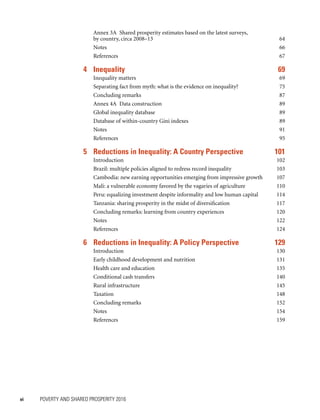
vi	 POVERTY AND SHARED PROSPERITY 2016
	 Annex 3A  Shared prosperity estimates based on the latest surveys,
by country, circa 2008–13	 64
	Notes	 66
	References	 67
4	Inequality	 69
	 Inequality matters	 69
	 Separating fact from myth: what is the evidence on inequality?	 75
	 Concluding remarks	 87
	 Annex 4A  Data construction	 89
	 Global inequality database	 89
	 Database of within-country Gini indexes	 89
	Notes	 91
	References	 95
5	 Reductions in Inequality: A Country Perspective	 101
	Introduction	 102
	 Brazil: multiple policies aligned to redress record inequality	 103
	 Cambodia: new earning opportunities emerging from impressive growth	 107
	 Mali: a vulnerable economy favored by the vagaries of agriculture	 110
	 Peru: equalizing investment despite informality and low human capital	 114
	 Tanzania: sharing prosperity in the midst of diversification	 117
	 Concluding remarks: learning from country experiences	 120
	Notes	 122
	References	 124
6	 Reductions in Inequality: A Policy Perspective	 129
	Introduction	 130
	 Early childhood development and nutrition	 131
	 Health care and education	 135
	 Conditional cash transfers	 140
	 Rural infrastructure	 145
	Taxation	 148
	 Concluding remarks	 152
	Notes	 154
	References	 159
CONTENTS 	 vii
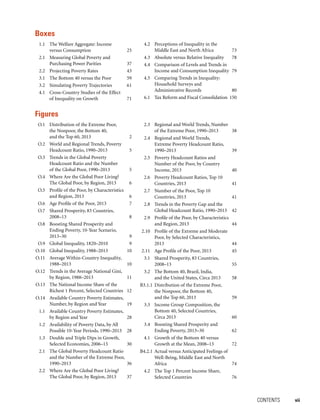
	 1.1	 The Welfare Aggregate: Income
versus Consumption	 25
	 2.1	 Measuring Global Poverty and
Purchasing Power Parities	 37
	 2.2	 Projecting Poverty Rates	 43
	 3.1	 The Bottom 40 versus the Poor	 59
	 3.2	 Simulating Poverty Trajectories	 61
	 4.1	 Cross-Country Studies of the Effect
of Inequality on Growth	 71
	 O.1	 Distribution of the Extreme Poor,
the Nonpoor, the Bottom 40,
and the Top 60, 2013	 2
	 O.2	 World and Regional Trends, Poverty
Headcount Ratio, 1990–2013	 5
	 O.3	 Trends in the Global Poverty
Headcount Ratio and the Number
of the Global Poor, 1990–2013	 5
	 O.4	 Where Are the Global Poor Living?
The Global Poor, by Region, 2013	 6
	 O.5	 Profile of the Poor, by Characteristics
and Region, 2013	 6
	 O.6	 Age Profile of the Poor, 2013	 7
	 O.7	 Shared Prosperity, 83 Countries,
2008–13	8
	 O.8	 Boosting Shared Prosperity and
Ending Poverty, 10-Year Scenario,
2013–30	9
	 O.9	 Global Inequality, 1820–2010	 9
	O.10	 Global Inequality, 1988–2013	 10
	O.11	 Average Within-Country Inequality,
1988–2013	10
	O.12	 Trends in the Average National Gini,
by Region, 1988–2013	 11
	O.13	 The National Income Share of the
Richest 1 Percent, Selected Countries	 12
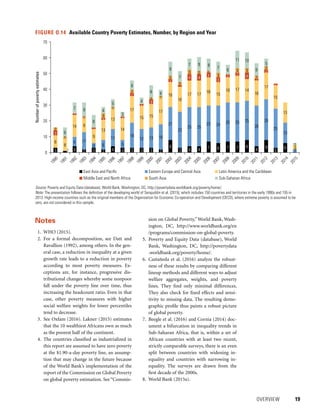
	O.14	 Available Country Poverty Estimates,
Number, by Region and Year	 19
	 1.1	 Available Country Poverty Estimates,
by Region and Year	 28
	 1.2	 Availability of Poverty Data, by All
Possible 10-Year Periods, 1990–2013	 28
	 1.3	 Double and Triple Dips in Growth,
Selected Economies, 2006–15	 30
	 2.1	 The Global Poverty Headcount Ratio
and the Number of the Extreme Poor,
1990–2013	36
	 2.2	 Where Are the Global Poor Living?
The Global Poor, by Region, 2013	 37
	 4.2	 Perceptions of Inequality in the
Middle East and North Africa	 73
	 4.3	 Absolute versus Relative Inequality	 78
	 4.4	 Comparison of Levels and Trends in
Income and Consumption Inequality	 79
	 4.5	 Comparing Trends in Inequality:
Household Surveys and
Administrative Records	 80
	 6.1	 Tax Reform and Fiscal Consolidation	 150
	 2.3	 Regional and World Trends, Number
of the Extreme Poor, 1990–2013	 38
	 2.4	 Regional and World Trends,
Extreme Poverty Headcount Ratio,
1990–2013	39
	 2.5	 Poverty Headcount Ratios and
Number of the Poor, by Country
Income, 2013	 40
	 2.6	 Poverty Headcount Ratios, Top 10
Countries, 2013	 41
	 2.7	 Number of the Poor, Top 10
Countries, 2013	 41
	 2.8	 Trends in the Poverty Gap and the
Global Headcount Ratio, 1990–2013	 42
	 2.9	 Profile of the Poor, by Characteristics
and Region, 2013	 44
	2.10	 Profile of the Extreme and Moderate
Poor, by Selected Characteristics,
2013	44
	2.11	 Age Profile of the Poor, 2013	 45
	 3.1	 Shared Prosperity, 83 Countries,
2008–13	55
	 3.2	 The Bottom 40, Brazil, India,
and the United States, Circa 2013	 58
	B3.1.1	 Distribution of the Extreme Poor,
the Nonpoor, the Bottom 40,
and the Top 60, 2013	 59
	 3.3	 Income Group Composition, the
Bottom 40, Selected Countries,
Circa 2013	 60
	 3.4	 Boosting Shared Prosperity and
Ending Poverty, 2013–30	 62
	 4.1	 Growth of the Bottom 40 versus
Growth at the Mean, 2008–13	 72
B4.2.1	 Actual versus Anticipated Feelings of
Well-Being, Middle East and North
Africa	74
	 4.2	 The Top 1 Percent Income Share,
Selected Countries	 76
Boxes
Figures
viii	 POVERTY AND SHARED PROSPERITY 2016
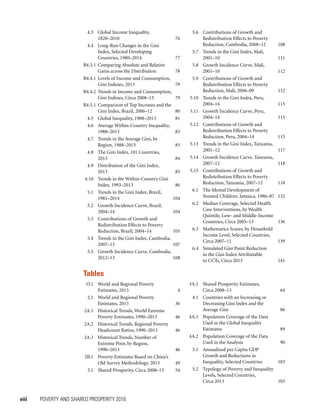
	 5.6	 Contributions of Growth and
Redistribution Effects to Poverty
Reduction, Cambodia, 2008–12	 108
	 5.7	 Trends in the Gini Index, Mali,
2001–10	111
	 5.8	 Growth Incidence Curve, Mali,
2001–10	112
	 5.9	 Contributions of Growth and
Redistribution Effects to Poverty
Reduction, Mali, 2006–09	 112
	5.10	 Trends in the Gini Index, Peru,
2004–14	115
	5.11	 Growth Incidence Curve, Peru,
2004–14	115
	5.12	 Contributions of Growth and
Redistribution Effects to Poverty
Reduction, Peru, 2004–14	 115
	5.13	 Trends in the Gini Index, Tanzania,
2001–12	117
	5.14	 Growth Incidence Curve, Tanzania,
2007–12	118
	5.15	 Contributions of Growth and
Redistribution Effects to Poverty
Reduction, Tanzania, 2007–12	 118
	 6.1	 The Mental Development of
Stunted Children, Jamaica, 1986–87	 132
	 6.2	 Median Coverage, Selected Health
Care Interventions, by Wealth
Quintile, Low- and Middle-Income
Countries, Circa 2005–13	 136
	 6.3	 Mathematics Scores, by Household
Income Level, Selected Countries,
Circa 2007–11	 139
	 6.4	 Simulated Gini Point Reduction
in the Gini Index Attributable
to CCTs, Circa 2013	 141
		
	 4.3	 Global Income Inequality,
1820–2010	76
	 4.4	 Long-Run Changes in the Gini
Index, Selected Developing
Countries, 1980–2014	 77
	B4.3.1	 Comparing Absolute and Relative
Gains across the Distribution	 78
B4.4.1	 Levels of Income and Consumption,
Gini Indexes, 2013	 79
	B4.4.2	 Trends in Income and Consumption,
Gini Indexes, Circa 2008–13	 79
	B4.5.1	 Comparison of Top Incomes and the
Gini Index, Brazil, 2006–12	 80
	 4.5	 Global Inequality, 1988–2013	 81
	 4.6	 Average Within-Country Inequality,
1988–2013	83
	 4.7	 Trends in the Average Gini, by
Region, 1988–2013	 83
	 4.8	 The Gini Index, 101 Countries,
2013	84
	 4.9	 Distribution of the Gini Index,
2013	85
	4.10	 Trends in the Within-Country Gini
Index, 1993–2013	 86
	 5.1	 Trends in the Gini Index, Brazil,
1981–2014	104
	 5.2	 Growth Incidence Curve, Brazil,
2004–14	104
	 5.3	 Contributions of Growth and
Redistribution Effects to Poverty
Reduction, Brazil, 2004–14	 105
	 5.4	 Trends in the Gini Index, Cambodia,
2007–13	107
	 5.5	 Growth Incidence Curve, Cambodia,
2012–13	108
	 O.1	 World and Regional Poverty
Estimates, 2013	 4
	 2.1	 World and Regional Poverty
Estimates, 2013	 36
	2A.1	 Historical Trends, World Extreme
Poverty Estimates, 1990–2013	 46
	2A.2	 Historical Trends, Regional Poverty
Headcount Ratios, 1990–2013	 46
	2A.3	 Historical Trends, Number of
Extreme Poor, by Region,
1990–2013	46
	2B.1	 Poverty Estimates Based on China’s
Old Survey Methodology, 2013	 49
	 3.1	 Shared Prosperity, Circa 2008–13	 54
	3A.1	 Shared Prosperity Estimates,
Circa 2008–13	 64
	 4.1	 Countries with an Increasing or
Decreasing Gini Index and the
Average Gini	 86
	4A.1	 Population Coverage of the Data
Used in the Global Inequality
Estimates	89
	4A.2	 Population Coverage of the Data
Used in the Analysis	 90
	 5.1	 Annualized per Capita GDP
Growth and Reductions in
Inequality, Selected Countries	 103
	 5.2	 Typology of Poverty and Inequality
Levels, Selected Countries,
Circa 2013	 103
Tables
ix
The World Bank Group’s goals are clear—we are committed to ending extreme poverty by
2030 and boosting shared prosperity of the bottom 40 percent of populations in every coun-
try. If we are to reach our goals, it’s crucial to report on both the progress and the barriers
to improving people’s lives.
We have created the Poverty and Shared Prosperity annual flagship series to do just
that, providing the latest and most accurate statistics and analysis on extreme poverty and
shared prosperity.
As we work toward the end-poverty goal in 2030, it’s important to remember that the
developing world has made unprecedented progress in reducing extreme poverty. Since
1990, nearly 1.1 billion people have lifted themselves out of extreme poverty. In areas rang-
ing from child survival to primary school enrollments, the improvements to people’s lives
have advanced with a momentum that few could have imagined when the World Bank was
founded more than 70 years ago.
But today we face a powerful threat to progress around the world: Inequality.
High income inequality is hardly new in human history. But today, inequality is constrain-
ing national economies and destabilizing global collaboration in ways that put humanity’s
most critical achievements and aspirations at risk. This includes the goal of ending extreme
poverty by 2030.
That is why this first Poverty and Shared Prosperity report took a deeper look at inequal-
ity—making the case for action by explaining the benefits for countries in closing persistent
gaps. More equal countries tend to have healthier people and be more economically effi-
cient than highly unequal countries. And countries that invest smartly in reducing inequality
today are likely to see more prolonged economic growth than those that don’t. Less in-
equality can benefit the vast majority of the world’s population.
The last part of this report describes the successful strategies that many countries are
already using to fight inequality. World Bank Group economists have conducted a com-
prehensive review of policies that can raise the incomes of the poor, analyzed a vast body
of evidence, and singled out some of the policies that are well known to work best. Their
results offer policy options that can be relevant for most countries in the world.
Whether you’re a government leader, an entrepreneur, an activist, or a frontline service
provider, my hope is that this report will inform your decisions and inspire you to make your
actions count.
Thank you for your work to build a fairer, more equal, and more prosperous future for all.
Jim Yong Kim
President, World Bank Group
Foreword
xi
This report has been prepared by a team led by José Cuesta and Mario Negre and com-
prising Timm Bönke, Soumya Chattopadhyay, Shaohua Chen, Will Durbin, María Eugenia
Genoni, Aparajita Goyal, Christoph Lakner, Terra Lawson-Remer, Maura K. Leary, Renzo
Massari, Jose Montes, David Newhouse, Stace Nicholson, Espen Beer Prydz, Maika
Schmidt, and Ani Silwal.
The work has been carried out under the general supervision of Francisco H. G. Ferreira
and Ana Revenga and the guidance of Kaushik Basu and Jan Walliser. World Bank President
Jim Yong Kim was an invaluable source of encouragement to the team.
Kathleen Beegle, Branko Milanovic´, Ambar Narayan, and Sudhir Shetty served as peer
reviewers. Robert Zimmermann edited the document, and Susan Graham was the pro-
duction editor. The report’s publishing was supervised by Patricia Katayama. Venkat Gopal-
akrishnan, Phil Hay, Mary D. Lewis, and Mikael Ello Reventar contributed to dissemination.
Additional support was provided by Anna Regina Rillo Bonfield, Pamela Gaye C. Gunio,
Estella Malayika, Nelly Obias, and Clara Serraino.
The team would like to thank François Bourguignon, Branko Milanovic´, and Matthew
Wai-Poi for sharing data. The team would also like to acknowledge the following peo-
ple for insightful discussions, including Omar Arias, João Pedro Azevedo, Benu Bidani,
Andrés Castañeda, Luc Christiansen, Andrew Dabalen, Klaus Deininger, Dung Doan, Martin
C. Evans, Deon Filmer, Alan Fuchs, Emanuela Galasso, Xavier Gine, Stephane Hallegatte,
Ruth Hill, Leora Klapper, Jose R. Lopez-Calix, Carolina Mejia-Mantilla, Rinku Murgai, Luis F.
López-Calva, Minh Cong Nguyen, Pedro Olinto, Maria Beatriz Orlando, Carlos Rodríguez-
Castelán, Halsey Rogers, Julie Rozenberg, Carlos Silva-Jauregui, Emmanuel Skoufias, Pablo
Suárez-Becerra, Hiroki Uematsu, Adam Wagstaff, and Yukata Yoshino. Comments to pre-
vious versions of the report were provided by Pedro Alba, Maurizio Bussolo, Jose Familiar
Calderon, Anna Chytla, Amit Dar, Augusto de la Torre, Shanta Devarajan, Marianne Fay, Erik
Feyen, Norbert Fiess, Lisa Finneran, Haisan Fu, Ejaz Ghani, Aart Kraay, Cyril Muller, Mamta
Murthi, Alberto Ninio, Martin Rama, Sheila Redzepi, Jose G. Reis, Joanna Silva, Philip
Schellekens, Richard Scobey, Radwan Shaban, Nikola Spatafora, Hans Timmer, Yvonne
Tsikata, Laura Tuck, Jos Verbeek, and Xiaoqing Yu.
The report benefited from substantial support from the German Development Institute/
Deutsches Institut für Entwicklungspolitik (DIE).
Acknowledgments
Dedicated to the loving memory of Martin Andres Cuesta Lopez.
xiii
The Core Team
José Cuesta, co-director of the report, is a World Bank senior economist with a PhD in
economics from Oxford University. He is also an affiliated professor at Georgetown Uni-
versity’s McCourt School of Public Policy. Cuesta was previously an assistant professor in
development economics at the Institute of Social Studies in The Hague. He also worked
as a research economist and social sector specialist for the Inter-American Development
Bank and as an economist for the United Nations Development Programme in Hondu-
ras. His research interests revolve around poverty and conflict economics, specifically
the distributive analysis of social policies, intrahousehold allocation, social protection,
and labor distortions. He also studies the interaction among poverty, conflict, and culture.
A Spanish national, Cuesta has experience in countries in Africa, Asia, and Latin America.
He is currently an associate editor for the European Journal of Development Research and
the Journal of Economic Policy Reform, and the editor of the World Bank’s quarterly Food
Price Watch.
Mario Negre, co-director of the report, is a senior economist in the World Bank Devel-
opment Economics Research Group, where he is seconded by the German Development
Institute. He is a nonresidential research fellow at Maastricht School of Management. He
has worked at the European Parliament, first as an adviser to the chairman of the Develop-
ment Committee and then for all external relations committees. Since 2012, he has been a
senior researcher at the German Development Institute. His fields of specialization are pro-
poor growth, inclusiveness, inequality, and poverty measurement, as well as development
cooperation policy, particularly in Europe. Mario holds a BSc in physics from the University
of Barcelona, an MA in development policies from the University of Bremen, and a PhD in
development economics from the Jawaharlal Nehru University, India.
Soumya Chattopadhyay is a research fellow in the Growth, Poverty, and Inequality Pro-
gramme at the Overseas Development Institute. His research interests include assessing
the impact on subjective well-being of macro conditions and policy interventions using
household surveys, identifying the vulnerable and the marginalized, and the issues revolving
around infrastructure investment and service delivery. Previously, he worked at the World
Bank. He was a senior research associate in the Global Economy and Development Pro-
gram at the Brookings Institution, and taught at the School of Public Policy at the University
of Maryland. Soumya holds a BA in economics from the University of Delhi and the Univer-
sity of Cambridge, a masters in public management, and a PhD in international economic
policy from the University of Maryland.
About the Core Team
and the Contributors
xiv	 POVERTY AND SHARED PROSPERITY 2016
Shaohua Chen is a lead statistician in the Development Economics Research Group of the
World Bank. Her main research interests over the past 20 years have been on poverty and
inequality measurement. She has managed the global poverty monitoring and online com-
putational tool PovcalNet at the World Bank since 1991. She is also responsible for the mea-
surement and projection of global poverty for the major reports of the World Bank, such as
World Development Indicators and the Global Monitoring Report. Before joining the World
Bank, Shaohua was a lecturer at Huazhong University of Science and Technology. Her re-
search findings have been published in major economic and statistical journals, including
the Journal of Development Economics, the Journal of Public Economics, The Quarterly
Journal of Economics, and The Review of Economics and Statistics. She received her MSc
in statistical computing from the American University.
María Eugenia Genoni is a senior economist at the Poverty and Equity Global Practice at
the World Bank. Her fields of specialization are survey design, poverty and inequality, migra-
tion, and risk management. At the World Bank, she has led the poverty and equity programs
in Bolivia and Peru. She has also contributed to the poverty work in Argentina and Central
America and to the Regional Gender Impact Evaluation Initiative. Before joining the World
Bank, María worked in the research department at the Inter-American Development Bank
and the Ministry of Finance of the Province of Buenos Aires in Argentina. She holds a PhD
in economics from Duke University.
Christoph Lakner is an economist in the Development Research Group at the World Bank
(Poverty and Inequality Team). He previously worked in the World Bank’s Poverty Practice
on Poverty and Inequality issues in Argentina. His research interests include inequality, pov-
erty, and labor markets in developing countries. In particular, he has been working on global
inequality, the relationship between inequality of opportunity and growth, the implications
of regional price differences for inequality, and the income composition of top incomes. He
holds a BA, MPhil, and DPhil in economics from the University of Oxford.
Maura K. Leary is the communications lead for the World Bank Group’s Poverty and Equity
Global Practice, where she manages strategic communications and outreach on poverty
reduction, equity, shared prosperity, and inequality. From 2011 to 2013, she was the part-
nerships and communications specialist on the Gender and Development team. Prior to
joining the World Bank in 2011, she worked at George Washington University and Tufts
University, managing academic programs in France and the United States for high school,
university, graduate, and adult students. She holds a BA in French from Connecticut College
and a master’s degree in international affairs from the Elliott School of International Affairs
at the George Washington University.
José Montes is a data scientist in the Poverty and Equity Global Practice of the World Bank.
He has been working for more than 10 years in poverty and inequality measurement and
helping national statistics offices improve the quality, consistency, and documentation of
their household surveys. Since 2013, he has been part of Europe and Central Asia Team
Statistics Development, and since 2016, part of the core team of the Global Team Statistics
Development. Prior to the World Bank, he worked at the Inter-American Development Bank
as a household survey specialist in the Poverty and Advisory Unit. He was also a lecturer at
the Universidad del Pacífico. José holds a BA in economics from the Universidad del Pacíf-
ico and an MSc in economics and an MSc in statistics from Texas A&M University.
Espen Beer Prydz is an economist in the World Bank’s Development Economics Research
Group. His research interests include issues of poverty, inequality, and survey methods.
He has worked in Cambodia, Indonesia, and South Sudan on poverty, social protection, and
economic policy. Prior to joining the World Bank, Espen undertook research on poverty,
ABOUT THE CORE TEAM AND THE CONTRIBUTORS 	 xv
labor markets, and gender with the Development Centre of the Organisation for Economic
Co-operation and Development and the Abdul Latif Jameel Poverty Action Lab. Prydz is a
Norwegian national who holds a BS from the London School of Economics and an MPA
in international development from the John F. Kennedy School of Government at Harvard
University.
Maika Schmidt is a consultant in the World Bank’s Development Economics Research
Group. Her research interests are poverty, inequality, and pro-poor growth with a focus on
measurement issues, specifically multidimensional indicators. Maika has worked for the
Deutsche Gesellschaft für Internationale Zusammenarbeit. She holds a BSc in economics
from the University of Mannheim, a master’s from the Barcelona Graduate School of Eco-
nomics, and a master of research from Pompeu Fabra University, Barcelona. She is cur-
rently pursuing her PhD in development economics from the University of Sussex.
Ani Silwal is a consultant in the World Bank’s Development Economics Research Group.
He holds a BA from Swarthmore College, an MSc from the University of Maryland, and
a PhD in economics from the University of Sussex. He has also worked on international
migration and remittances. His research interest is the constraints that households face in
escaping poverty.
The Contributors
Timm Bönke is assistant professor of public economics at the School of Business and
Economics at Freie Universität Berlin. His research interests revolve mainly around inequal-
ity and the distribution of income and wealth, the inclusiveness of growth, the design and
incentives of state welfare institutions, and redistribution and insurance through tax-benefit
systems. Since 2015, he has been associate editor of the Journal of Income Distribution
and scientific board member of the Research Institute Economics of Inequality at Vienna
University of Economics and Business. In addition, he is a regular reviewer for scientific
foundations and acts as a scientific and political consultant. Timm holds a masters and a
PhD in economics from Freie Universität Berlin.
Will Durbin studied ethics, politics, and economics as an undergraduate at Yale University
and international development for a master’s degree at the Woodrow Wilson School of
Public and International Affairs, Princeton University. He previously worked on climate
change and environmental policy and currently focuses on poverty reduction.
Aparajita Goyal is a senior economist in the Poverty and Equity Global Practice of the
World Bank. Her work focuses on microeconomic issues of development, with an empha-
sis on technological innovation in agriculture, access to markets, and intellectual property
rights. Her research has been published in leading academic journals, such as American
Economic Review, Journal of Human Resources, and Journal of Development Economics,
and has been featured in the popular press, including Frontline, Economist, and Wall Street
Journal. Within the World Bank, she has previously worked in the Development Economics
Research Group, Office of the Chief Economist for the Latin America and Caribbean Region,
and Agriculture Global Practice after joining the Young Professionals Program. She holds a
BA in economics from St. Stephen’s College, University of Delhi, India, an MSc from the
London School of Economics, and a PhD in economics from the University of Maryland.
Renzo Massari is a consultant in the World Bank’s Development Economics Research
Group. His research interests include developing and applying econometric and machine
learning methods to poverty and inequality measurement, the use of big data in develop-
ment, imputation methods, and survey methodology. Previously, he worked at the Labor
xvi	 POVERTY AND SHARED PROSPERITY 2016
and Social Protection Unit at the Inter-American Development Bank and as a consultant in
empirical regulatory and policy issues in Peru and in the United States. He holds a certifica-
tion in data science and a PhD in economics from Duke University.
Terra Lawson-Remer’s work addresses the determinants and consequences of sustain-
able development, poverty and inequality, and social and economic rights fulfillment within
and across generations. Her expertise includes health care, education, international eco-
nomic law, legal empowerment, natural resource governance, global trade and transna-
tional investment, extractive industries, democratic transitions, civil society, property rights,
and business and human rights. She is the author of dozens of academic books and articles,
including, most recently, Fulfilling Social and Economic Rights (with Sakiko Fukuda-Parr and
Susan Randolph), published by Oxford University Press. Terra earned her BA in ethics, pol-
itics, and economics from Yale University; her JD from New York University School of Law,
where she was a Dean’s Merit Scholar; and her PhD in political economy from the Law and
Society Institute, New York University.
David Newhouse is a senior economist in the Poverty and Equity Global Practice. He cur-
rently leads the Bank’s engagement on poverty in Sri Lanka, as well as on projects that
aim to understand the nature of global poverty and incorporate satellite imagery into pov-
erty measurement. He was formerly a labor economist in the Social Protection and Labor
Practice, where he helped lead efforts to analyze labor markets and the policy response in
the wake of the 2008 financial crisis. He first joined the Bank in August 2007 and co-led
the Indonesian Jobs Report. Previously, he worked in the Fiscal Affairs Department of the
International Monetary Fund providing policy advice on energy and food subsidies. David
holds a PhD in economics from Cornell University. He has co-authored a book and several
journal articles on a wide range of issues relating to labor, health, and education in develop-
ing countries.
Stace Nicholson is a senior program officer for international economic and financial affairs
at the Japan International Cooperation Agency’s U.S. office. In this position, he conducts
and oversees research that supports credit risk assessment of the agency’s concessional
loan portfolio and serves as the agency’s junior liaison with multilateral financial institutions
based in Washington. His work includes tracking macroeconomic developments across a
range of emerging and frontier, or developing economies, facilitating research partnerships
and project co-financing on an ad hoc basis, and reporting on development finance trends.
Prior to joining the agency, Stace interned with the Ghana Center for Democratic Devel-
opment and undertook field research in Uganda as a microfinance client assessment fel-
low for the Foundation for International Community Assistance. He is a summa cum laude
graduate (political science) of Manchester College and holds a master’s degree in global
finance, trade, and economic integration from the Josef Korbel School for International
Studies, University of Denver.
xvii
BRICS	 Brazil, Russian Federation, India, China, and South Africa
CCT	 conditional cash transfer
CPI	 consumer price index
ECD	 early childhood development
EU	 European Union
GDP	 gross domestic product
IQ	 intelligence quotient
OECD	 Organisation for Economic Co-operation and Development
PPP	 purchasing power parity
SEDLAC	 Socio-Economic Database for Latin America and the Caribbean
UNESCO	 United Nations Educational, Scientific, and Cultural Organization
VAT	 value added tax
WDI	 World Development Indicators
Note: All dollar amounts are U.S. dollars (US$) unless otherwise indicated.
For a list of the 3-letter country codes used by the World Bank, please go to:
https://datahelpdesk.worldbank.org/knowledgebase/articles/906519-world-bank-country
-and-lending-groups.
Abbreviations
Overview
	 OVERVIEW 	 1
On April 20, 2013, the Board of Executive
Directors of the World Bank adopted two
ambitious goals: end global extreme pov-
erty and promote shared prosperity in every
country in a sustainable way. This implies
reducing the poverty headcount ratio from
10.7 percent globally in 2013 to 3.0 percent
by 2030 and fostering the growth in the in-
come or the consumption expenditure of
the poorest 40 percent of the population
(the bottom 40) in each country. These two
goals are part of a wider international devel-
opment agenda and are intimately related to
United Nation’s Sustainable Development
Goals 1 and 10, respectively, which have
been adopted by the global community.
Each goal has an intrinsic value on its
own merits, but the two goals are also highly
complementary. Take the example of a
low-income Sub-Saharan African country
with a high poverty headcount ratio and an
upper-middle-income country in Eastern
Europe or Latin America with low levels of
extreme poverty, but rising concerns about
inequality. Ending extreme poverty is espe-
cially relevant in the former, while expand-
ing shared prosperity is especially meaning-
ful in the latter. The complementarity of the
two goals also derives from the composition
of the world’s poor and bottom 40 popula-
tions. At a global scale, while 9 in every 10 of
the extreme poor were among the national
bottom 40 in 2013, only a quarter of the bot-
tom 40 were among the extreme poor (both
cases refer to the orange area in figure O.1).
This complementarity has three import-
ant implications. First, by choosing these
two goals, the World Bank focuses squarely
on improving the welfare of the least well
off across the world, effectively ensuring
that everyone is part of a dynamic and in-
clusive growth process, no matter the cir-
cumstances, the country context, or the
time period. Second, monitoring the two
goals separately is necessary to understand
with precision the progress in achieving
better living conditions among those most
in need. Third, policy interventions that
reduce extreme poverty may or may not be
effective in boosting shared prosperity if the
two groups—the poor and the bottom 40—
are composed of distinct populations.
To understand more clearly the prog-
ress toward the achievement of the goals,
the World Bank is launching the annual
Poverty and Shared Prosperity report series,
which this report inaugurates. The report
series will inform a global audience com-
prising development practitioners, policy
makers, researchers, advocates, and citizens
in general with the latest and most accu-
rate estimates on trends in global poverty
and shared prosperity. Every year, it will
update information on the global number
of the poor, the poverty headcount ratio
worldwide, the regions that have been more
successful or that have been lagging in
advancing toward the goals, and the en-
hancements in monitoring and measuring
poverty. In addition, it will feature a special
Two complementary goals to leave no one behind
2	 POVERTY AND SHARED PROSPERITY 2016
These substantive considerations highlight
the importance of directing attention to the
problem of inequality.
There are other reasons too. Sustaining
the rapid progress in reducing poverty and
boosting shared prosperity that has been
achieved over the last 25 years is at risk be-
cause of the struggles across economies to
recover from the global financial crisis that
started in 2008 and the subsequent slow-
down in global growth. The goal of elimi-
nating extreme poverty by 2030—which is
likely to become more difficult as we ap-
proach more closely to it—might not be
achieved without accelerated economic
growth or reductions in within-country
inequalities, especially among those coun-
tries with large concentrations of the poor.
Generally speaking, poverty can be reduced
through higher average growth, a narrow-
ing in inequality, or a combination of the
two.2
Achieving the same poverty reduction
during a slowdown in growth therefore re-
quires a more equal income distribution. It
follows that, to reach the goals, efforts to fos-
focal theme. This year, the focal theme is
inequality.
Inequality matters for
achieving the goals,
but also for other reasons
Despite decades of substantial progress in
boosting prosperity and reducing poverty,
the world continues to suffer from substan-
tial inequalities. For example, the poorest
children are four times less likely than the
richest children to be enrolled in primary ed-
ucation across developing countries. Among
the estimated 780 million illiterate adults
worldwide, nearly two-thirds are women.
Poor people face higher risks of malnutri-
tion and death in childhood and lower odds
of receiving key health care interventions.1
Such inequalities are associated with
high financial cost, affect economic growth,
and generate social and political burdens
and barriers. But leveling the playing field
is also an issue of fairness and justice that
resonates across societies on its own merits.
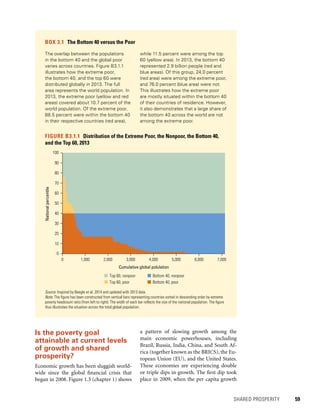
FIGURE O.1  Distribution of the Extreme Poor, the Nonpoor, the Bottom 40, and the Top 60,
2013
Source: Inspired by Beegle et al. 2014 and updated with 2013 data.
Note: The figure has been constructed from vertical bars representing countries sorted in descending order by extreme poverty
headcount ratio (from left to right). The width of each bar reflects the size of the national population. The figure thus illustrates the
situation across the total global population.
Nationalpercentile
0
10
20
30
40
50
60
70
80
90
0 1,000 2,000 3,000 4,000 5,000 6,000 7,000
Cumulative global polulation
Top 60, nonpoor
Top 60, poor
Bottom 40, nonpoor
Bottom 40, poor
100
OVERVIEW 	 3
mean that such forms of inequality do not
deserve attention. According to Oxfam, 62
individuals in 2015 had the same wealth as
the bottom half of the world’s population;
within the African continent, this statistic
is even more extreme.3
However, the report
looks into inequality in income, in out-
comes such as in health care and education,
and inequality in opportunities. Income in-
equality and unequal opportunities are in-
timately related. This report aims to dispel
myths around income inequality. Reflecting
on what has worked in addressing this pro-
found problem is key to taking on inequal-
ity more successfully.
The report makes four main contribu-
tions. First, it presents the most recent num-
bers on poverty, shared prosperity, and in-
equality.Second,it stresses the importance of
inequality reduction in ending poverty and
boosting shared prosperity by 2030, partic-
ularly in a context of weaker growth. Third,
it highlights the diversity of within-country
inequality reduction episodes and synthe-
sizes the experiences of several countries
and policies in addressing the roots of in-
equality without compromising economic
growth. Along the way, the report shatters
some myths and sharpens our knowledge of
what works in reducing inequalities. Finally,
it also ­advocates for the need to expand and
improve data collection—availability, com-
parability, and quality—and rigorous evi-
dence on inequality impacts. This is essential
for high-quality poverty and shared pros-
perity monitoring and the policy decisions
such an exercise ought to support.
Extreme poverty is
shrinking worldwide, but is
still widespread in Africa
In 2013, the year of the latest comprehen-
sive data on global poverty, 767 million
people are estimated to have been living
below the international poverty line of
US$1.90 per person per day (table O.1). Al-
most 11 people in every 100 in the world,
or 10.7 percent of the global population,
were poor by this standard, about 1.7 per-
centage points down from the global pov-
erty headcount ratio in 2012. Although this
ter growth need to be complemented by eq-
uity-enhancing policies and interventions.
Some level of inequality is desirable to
maintain an appropriate incentive struc-
ture in the economy or simply because
inequality also reflects different levels of
talent and effort among individuals. How-
ever, the substantial inequality observed
in the world today offers ample room for
taking on inequality. Doing so without
compromising growth is not only possible,
but can be beneficial for poverty reduction
and shared prosperity if done smartly. A
trade-off between efficiency and equity is
not inevitable. The evidence that equity-
enhancing interventions can also bolster
economic growth and long-term prosperity
is wide-ranging. To the extent that such in-
terventions interrupt the intergenerational
reproduction of inequalities of opportu-
nity, they address the roots and drivers of
inequality, while laying the foundations for
boosting shared prosperity and fostering
long-term growth. Reducing inequalities
of opportunity among individuals, econ-
omies, and regions may also be conducive
to political and societal stability and social
cohesion. In more cohesive societies, threats
arising from extremism, political turmoil,
and institutional fragility are less likely.
The key question the report
addresses: what can be
done to take on inequality?
This report addresses the issue of inequality
by documenting trends in inequality, iden-
tifying recent country experiences in suc-
cessfully reducing inequality and boosting
shared prosperity, examining key lessons,
and synthesizing the evidence on public
policies that lessen inequality by reducing
poverty and promoting shared prosperity.
Inequality exists in many dimensions,
and the question “inequality of what?” is
essential. The report focuses on inequalities
in income or consumption expenditures,
but it also analyzes the deprivations among
the extreme poor and the well-being of the
bottom 40. However, it does not address all
types of inequality, for example, inequality
related to ownership of assets. This does not
4	 POVERTY AND SHARED PROSPERITY 2016
global extreme poverty headcount ratio
dropped steadily over this period. Despite
more rapid demographic growth in poorer
areas, the forceful trend in poverty reduc-
tion culminated with 114 million people
lifting themselves out of extreme poverty in
2013 alone (in net terms).
The geography of global
extreme poverty is
changing as poverty
declines
As extreme poverty declines globally, the
regional poverty profile has been chang-
ing. This is a direct result of uneven prog-
ress, mainly at the expense of Sub-Saharan
Africa, which has the world’s largest head-
count ratio (41.0 percent) and houses the
largest number of the poor (389 million),
more than all other regions combined. This
is a notable shift with respect to 1990, when
half of the poor were living in East Asia
and Pacific, which, today, is home to only
9.3 percent of the global poor. South Asia
has another third of the poor, while Latin
America and the Caribbean, along with
Eastern Europe and Central Asia, complete
the global count with 4.4 percent and 1.4
percent, respectively (figure O.4).4
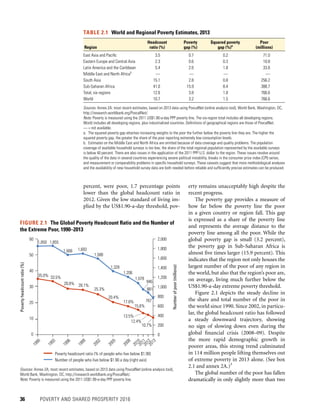
represented a noticeable decline, the pov-
erty rate remains unacceptably high given
the low standard of living implied by the
$1.90-a-day threshold.
The substantial decline is mostly ex-
plained by the lower number of the ex-
treme poor in two regions, East Asia and
Pacific (71 million fewer poor) and South
Asia (37 million fewer poor), that showed
cuts in the extreme poverty headcount ratio
of 3.6 and 2.4 percentage points, respec-
tively. The former is explained in large part
by lower estimates on China and Indonesia,
whereas the decrease in South Asia is driven
by India’s growth. The number of the poor
in Sub-Saharan Africa fell by only 4 million
between 2012 and 2013, a 1.6 percentage
point drop that leaves the headcount ratio
at a still high 41.0 percent. Eastern Europe
and Central Asia’s headcount ratio shrank by
about a quarter of a percentage point, down
to 2.3 percent, while, in Latin America and
the Caribbean, the ratio declined by 0.2 per-
centage points, to 5.4 percent (figure O.2).
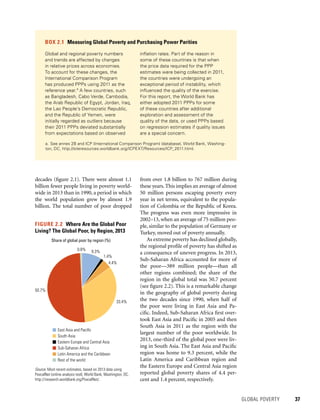
Both the extreme poverty headcount
ratio and the total number of the extreme
poor have steadily declined worldwide since
1990 (figure O.3). The world had almost 1.1
billion fewer poor in 2013 than in 1990, a
period in which the world population grew
by almost 1.9 billion people. Overall, the
Region
Headcount
ratio (%)
Poverty
gap (%)
Squared poverty
gap (%)
Poor
(millions)
East Asia and Pacific 3.5 0.7 0.2 71.0
Eastern Europe and Central Asia 2.3 0.6 0.3 10.8
Latin America and the Caribbean 5.4 2.6 1.8 33.6
Middle East and North Africaa
— — — —
South Asia 15.1 2.8 0.8 256.2
Sub-Saharan Africa 41.0 15.9 8.4 388.7
Total, six regions 12.6 3.8 1.8 766.6
World 10.7 3.2 1.5 766.6
Source: Latest estimates based on 2013 data using PovcalNet (online analysis tool), World Bank, Washington, DC, http://iresearch
.worldbank.org/PovcalNet/.
Note: Poverty is measured using the US$1.90-a-day 2011 purchasing power parity (PPP) poverty line. The six-region total includes all
developing regions. World includes all developing regions, plus industrialized countries. Definitions of geographical regions are those
of PovcalNet. — = not available.
a.  Estimates on the Middle East and North Africa are omitted because of data coverage and quality problems. The population cover-
age of available household surveys is too low; the share of the total regional population represented by the available surveys is below
40 percent. There are also issues in the application of the 2011 PPP U.S. dollar to the region. These issues revolve around the quality
of the data in several countries experiencing severe political instability, breaks in the consumer price index (CPI) series, and measure-
ment or comparability problems in specific household surveys. These caveats suggest that further methodological analyses and the
availability of new household survey data are both needed before reliable and sufficiently precise estimates can be produced.
TABLE O.1  World and Regional Poverty Estimates, 2013
OVERVIEW 	 5
Who are the poor?
Exploring the characteristics of the poor is
key to a better understanding of the circum-
stances and contexts surrounding poverty.
A large database of household surveys in
89 developing countries provides insights
into this issue by facilitating a demographic
profile of the poor at the US$1.90 pov-
erty line.5
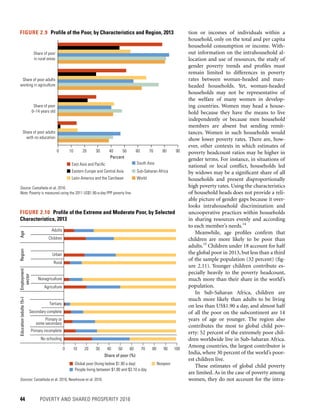
This poverty profile reveals that
the global poor are predominantly rural,
young, poorly educated, mostly employed
in the agricultural sector, and live in larger
households with more children. Indeed, 80
percent of the worldwide poor live in rural
areas; 64 percent work in agriculture; 44
percent are 14 years old or younger; and 39
percent have no formal education at all. The
data also confirm wide regional variations
in the distribution of the poor across these
characteristics (figure O.5).
When looking at the incidence of pov-
erty across different population groups,
poverty headcount ratios are more than
three times higher among rural residents
FIGURE O.2  World and Regional Trends, Poverty Headcount Ratio, 1990–2013
Source: Latest estimates based on 2013 data using PovcalNet (online analysis tool), World Bank, Washington, DC, http://iresearch
.worldbank.org/PovcalNet/.
Note: Poverty is measured using the US$1.90-a-day 2011 PPP poverty line. Breaks in trends arise because of a lack of good-quality
data.
Povertyheadcountratio(%)
0
10
20
30
40
50
60
70
1990 1993 1996 1999 2002 2005 2008 2011 2013
World
East Asia and Pacific
Eastern Europe and Central Asia
Latin America and the Caribbean
Middle East and North Africa
South Asia
Sub-Saharan Africa
FIGURE O.3  Trends in the Global Poverty Headcount Ratio and the
Number of the Global Poor, 1990–2013
Source: Latest estimates based on 2013 data using PovcalNet (online analysis tool), World Bank, Wash-
ington, DC, http://iresearch.worldbank.org/PovcalNet/.
Note: Poverty is measured using the US$1.90-a-day 2011 PPP poverty line.
35.0% 33.5%
28.8% 28.1%
25.3%
20.4%
17.8%
15.6%
13.5%
12.4%
10.7%
1,850 1,855
1,666 1,693
1,588
1,328
1,206
1,078
946
881
767
0
200
400
600
800
1,000
1,200
1,400
1,600
1,800
2,000
0
1990
1993
1996
1999
2002
2005
2008
2010201120122013
10
20
30
40
50
60
Numberofpoor(millions)
Povertyheadcountratio(%)
Poverty headcount ratio (% of people who live below $1.90)
Number of people who live below $1.90 a day (right axis)
6	 POVERTY AND SHARED PROSPERITY 2016
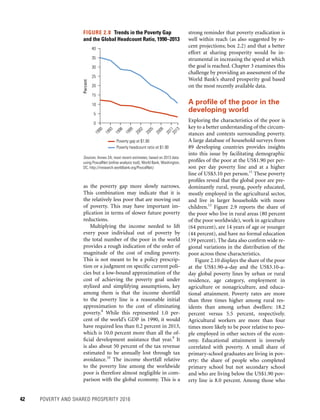
than among urban dwellers: 18.2 percent
versus 5.5 percent, respectively. Agricultural
workers are over four times more likely than
people employed in other sectors of the
economy to be poor. Educational attain-
ment is inversely correlated with poverty. A
small share of primary-school graduates are
living in poverty: fewer than 8.0 percent of
people who completed primary school, but
not secondary school, are living below the
US$1.90 poverty line. Among individuals
who have attended university, the share is
less than 1.5 percent.6
Similar differences are
observed if poverty incidence is measured
relative to the US$3.10-a-day poverty line.
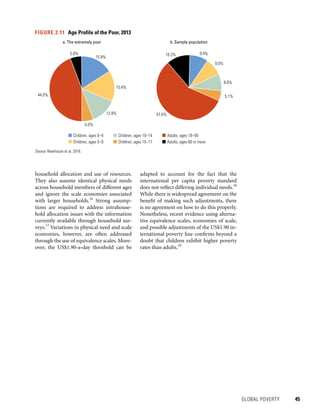
Age profiles confirm that children are
more likely than adults to be poor. Children
under 18 account for half the global poor in
2013, but less than a third of the sample pop-
ulation (32 percent) (figure O.6). Younger
children (ages 0–14) contribute especially
heavily to the poverty headcount,much more
than their share in the world’s population.
Progress in boosting shared
prosperity worldwide is
uneven
Shared prosperity is measured as the growth
in the average income or consumption of
the bottom 40. The larger the growth rate
in the income of the bottom 40, the more
quickly prosperity is shared with the most
disadvantaged sectors in society.
To the extent that greater economic
growth is associated with rising incomes
among the poor and the bottom 40, more
rapid growth will lead to greater shared
prosperity and poverty reduction. Likewise,
a more rapid increase in shared prosperity
and in the narrowing of inequality typically
accelerates the decline in poverty at any
given rate of growth.
Progress on this indicator is examined
in this report using the latest information
available on each country, currently circa
2008–13. To take into account the share
of prosperity going to groups other than
the bottom 40, the report also monitors the
shared prosperity premium, defined as the
difference between the growth in the in-
come of the bottom 40 and the growth in
income at the mean in each country. A pos-
FIGURE O.4  Where Are the Global Poor
Living? The Global Poor, by Region, 2013
Source: Latest estimates based on 2013 data using PovcalNet
(online analysis tool), World Bank, Washington, DC, http://
iresearch.worldbank.org/PovcalNet/.
9.3%
1.4%
4.4%
33.4%
50.7%
0.8%
Share of global poor by region (%)
East Asia and Pacific
South Asia
Eastern Europe and Central Asia
Sub-Saharan Africa
Latin America and the Caribbean
Rest of the world
FIGURE O.5  Profile of the Poor, by Characteristics and Region, 2013
Source: Castañeda et al. 2016.
Note: Poverty is measured using the US$1.90-a-day 2011 PPP poverty line.
0 10 20 30 40 50
Percent
60 70 80 90
Share of poor
in rural areas
Share of poor adults
working in agriculture
Share of poor
0–14 years old
Share of poor adults
with no education
East Asia and Pacific
Eastern Europe and Central Asia
Latin America and the Carribean
South Asia
Sub-Saharan Africa
World
OVERVIEW 	 7
the Caribbean, the income of the bottom
40 grew by 8.0 percent in Paraguay, while
in Honduras, income contracted by about
2.5 percent annually during the same spell.
A source of concern is the small value
of the shared prosperity premium. While
the average annualized growth in the in-
come or consumption of the bottom 40
was 2.0 percent worldwide circa 2008–13
(a population-weighted 4.6 percent), the
average shared prosperity premium was
only 0.5 percentage points during the same
period (a population-weighted 0.4 percent-
age point). Is this sufficient to expect large
reductions in inequality and poverty so as
to achieve the World Bank goals by 2030?
A more rapid decline in
inequality is needed to
end poverty
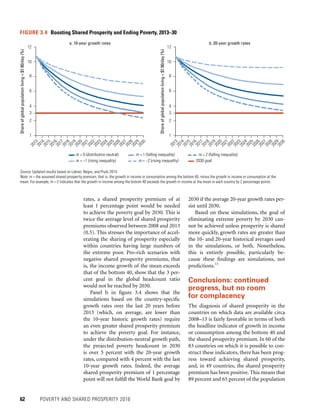
Figure O.8 makes it clear that the goal of
ending poverty by 2030 cannot be reached
at current levels of economic growth. It
shows the trajectory of the global poverty
headcount ratio under various assumptions
about distributional changes and under the
assumption that every country will grow at
its rate of the last 10 years. These changes
are modeled by means of alternative shared
prosperity premiums in each country.
Thus, in the scenario of a premium labeled
itive premium indicates that the growth in
the income or consumption of the bottom
40 exceeds that of the mean, and by impli-
cation, that of the rest of the population. A
higher or lower premium indicates the ex-
tent to which distributional changes favor
the bottom 40 relative to the top 60.
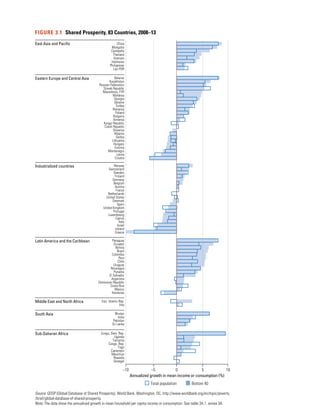
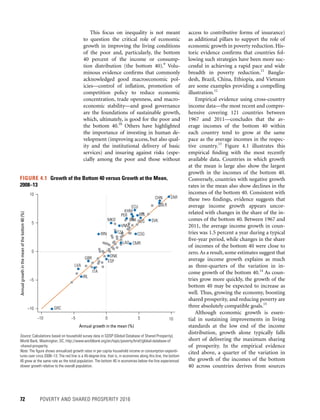
The bottom 40 benefited from solid eco-
nomic growth in many countries in 2008–
13. Overall, the bottom 40 in 60 of the 83
countries monitored experienced positive
income growth, representing 67 percent of
the world’s population and 89 percent of the
population represented by the surveys (fig-
ure O.7). A total of 49 countries reported a
positive shared prosperity premium: income
growth among the bottom 40 exceeded that
of the mean (and therefore, that of the top
60). However, there is no room for compla-
cency: in 23 countries, the incomes of the
bottom 40 declined during the period.
There are wide regional differences in
shared prosperity and the shared prosperity
premium. The best performers were in East
Asia and Pacific and in Latin America and
the Caribbean, while high-income indus-
trialized countries performed the least well.
Greece, a high-income country, experienced
an annualized contraction of 10.0 percent
in the income of the bottom 40, while the
Democratic Republic of Congo recorded
a rise of 9.6 percent. In Latin America and
a. The extremely poor b. Sample population
15.9%
15.4%
12.9%
6.0%
44.0%
5.8% 9.4%
9.0%
8.6%
5.1%
57.6%
10.3%
Children, ages 0–4
Children, ages 5–9
Children, ages 10–14
Children, ages 15–17
Adults, ages 18–59
Adults, ages 60 or more
FIGURE O.6  Age Profile of the Poor, 2013
Source: Newhouse et al. 2016.
Source: GDSP (Global Database of Shared Prosperity), World Bank, Washington, DC, http://www.worldbank.org/en/topic/poverty
/brief/global-database-of-shared-prosperity.
Note: The data show the annualized growth in mean household per capita income or consumption according to surveys.
FIGURE O.7  Shared Prosperity, 83 Countries, 2008–13
Middle East and North Africa
Latin America and the Caribbean
Industrialized countries
Eastern Europe and Central Asia
East Asia and Pacific
South Asia
Sub-Saharan Africa
Annualized growth in mean income or consumption (%)
10
Senegal
Rwanda
Mauritius
Cameroon
Togo
Congo, Rep.
Tanzania
Uganda
Congo, Dem. Rep.
Sri Lanka
Pakistan
India
Bhutan
Iraq
Iran, Islamic Rep.
Honduras
Mexico
Costa Rica
Dominican Republic
Argentina
El Salvador
Panama
Nicaragua
Uruguay
Chile
Peru
Colombia
Brazil
Bolivia
Ecuador
Paraguay
Greece
Ireland
Israel
Italy
Cyprus
Luxembourg
Portugal
United Kingdom
Spain
Denmark
United States
Netherlands
France
Austria
Belgium
Germany
Finland
Sweden
Switzerland
Norway
Croatia
Latvia
Montenegro
Estonia
Hungary
Lithuania
Serbia
Albania
Slovenia
Czech Republic
Kyrgyz Republic
Armenia
Bulgaria
Poland
Romania
Turkey
Ukraine
Georgia
Moldova
Macedonia, FYR
Slovak Republic
Russian Federation
Kazakhstan
Belarus
Lao PDR
Philippines
Indonesia
Vietnam
Thailand
Cambodia
Mongolia
China
5–5–10 0
Total population Bottom 40
OVERVIEW 	 9
erty goal by 2030. However, it illustrates that
under current average growth rates, reduc-
tions in inequality will be key to reaching
the poverty goal by 2030. This is so under
specific assumptions about how economic
growth will occur until 2030. If the poverty
goal is to be accomplished by 2030, the in-
come distribution must improve, especially
among countries in which there are high
numbers of poor, relatively wide inequality
levels, and weak economic growth.
Globally, the narrowing in
inequality since the 1990s is
an historical exception to a
rising trend
Data since the 1990s show a substantial nar-
rowing in inequality in income or consump-
tion worldwide, irrespective of residence.
This is the first such reduction since the
industrial revolution (figure O.9). This un-
precedented decline occurred during a pe-
riod of increasing global integration. From
1820 to the 1990s, global inequality steadily
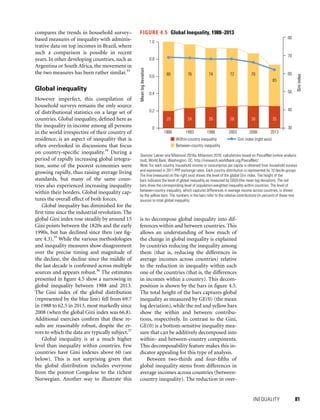
rose.Then,the Gini index fell to 62.5 in 2013,
most markedly beginning in 2008, when the
Gini was 66.8 (the blue line in figure O.10).
m = 1, the growth in the income of the bot-
tom 40 in each country is assumed to ex-
ceed the growth rate in the mean by 1 per-
centage point. Meanwhile, in the scenario
m = 0, growth is distributionally neu-
tral: the income of the bottom 40 and the
mean grow at the same pace. Under these
scenarios, the poverty goal would only be
reached if the shared prosperity premium
is in excess of 1 percentage point, which is
double the simple average premium coun-
tries are able to achieve today (0.5 percent-
age points). Thus, income or consumption
needs to grow more quickly among the
bottom 40 than at the mean, and at a more
rapid pace than today, especially in coun-
tries with substantial numbers of the poor.
This is the analytical result of a set of
simulations. In practice, this does not mean
that every country worldwide must improve
its income distribution to achieve the pov-
FIGURE O.8  Boosting Shared Prosperity
and Ending Poverty, 10-Year Scenario,
2013–30
Source: Updated results based on Lakner, Negre, and Prydz
2014.
Note: m = the assumed shared prosperity premium, that is, the
growth in income or consumption among the bottom 40, minus
the growth in income or consumption at the mean. Thus, for
example, m = 2 indicates that the growth in income among the
bottom 40 exceeds the growth in income at the mean by 2 per-
centage points in each country. Poverty is measured using the
US$1.90-a-day 2011 PPP poverty line.
0
5
3
10
15
20
25
30
200220062010201220142016201820202022202420262028
2030
Povertyheadcountratio(%)
m = 0 m = 1 m = 2
m = –1 m = –2 2030 goal
FIGURE O.9  Global Inequality, 1820–2010
Source: Based on figure 1 (p. 27) of The Globalization of Inequal-
ity by Francois Bourguignon (Princeton University Press 2015).
Used with permission.
Note: The discontinuity in the series represents the change in
the base year of the purchasing power parity (PPP) exchange
rates from 1990 to 2005. The figure uses GDP per capita in com-
bination with distributional statistics from household surveys.
Figure O.10 uses income (or consumption) per capita directly
from household surveys (in 2011 PPP exchange rates).
30
40
50
60
70
Giniindex
1820 1870 1920 1970 1990 2010
10	 POVERTY AND SHARED PROSPERITY 2016
This unprecedented drop in global inequal-
ity was driven by a convergence in average
incomes across countries that was spurred by
rising incomes in populous countries such
as China and India. As a result, between-
country inequality declined. In contrast,
within-country inequality, the other com-
ponent of global inequality, took on a
greater role in global inequality (explaining
a third of the total variation) (figure O.10).
Despite recent progress,
average within-country
inequality is greater now
than 25 years ago
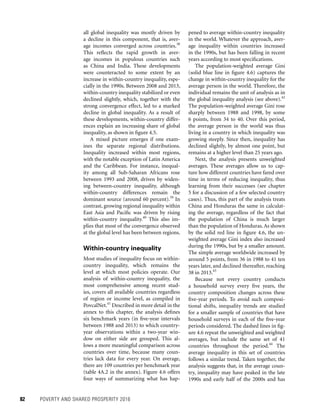
The population-weighted Gini index cap-
tures within-country inequality relative to
the average person across the countries on
which data are available (figure O.11). This
indicator rose steeply, by 6 points, from 34
to 40 between 1988 and 1998. Since then,
inequality has declined more moderately,
by almost 1 point, to a Gini of 39 in 2013.
Thus, within-country inequality for the av-
erage person in the world was wider in 2013
than 25 years previously.
The population-weighted result on
within-country inequality is largely robust
to other specifications, such as population-
unweighted estimates or estimates draw-
ing on different country samples. As shown
in figure O.11, the unweighted Gini index
of within-country inequality worldwide
also rose during the 1990s, but by a smaller
amount than the population-weighted
index. The simple average Gini increased by
around 5 points, from 36 in 1988 to 41 ten
years later, before declining steadily thereaf-
ter, reaching 38 in 2013.
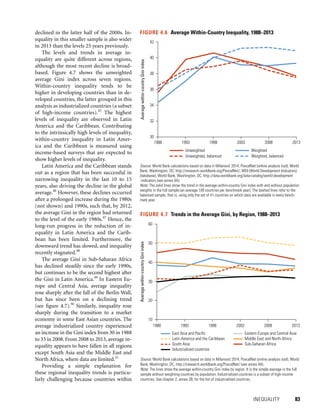
The levels and trends in average in-
equality are quite different across regions,
although the most recent decline is broad-
based (figure O.12). Developing countries
tend to exhibit wider within-country in-
equality relative to developed countries.
Latin America and the Caribbean, as well
as Sub-Saharan Africa, stand out as high-
inequality regions. The former is also the
region most successful in reducing inequal-
ity. Sub-Saharan Africa has likewise steadily
narrowed inequality since the early 1990s,
FIGURE O.10  Global Inequality, 1988–2013
Sources: Lakner and Milanovic´ 2016; Milanovic´ 2016; World Bank calculations based on PovcalNet (online
analysis tool), World Bank, Washington, DC, http://iresearch.worldbank.org/PovcalNet/.
Note: For each country, household income or consumption per capita is obtained directly from house-
hold surveys and expressed in 2011 PPP exchange rates. Each country distribution is represented by 10
decile groups. The line (measured on the right axis) shows the level of the global Gini index. The height
of the bars indicates the level of global inequality as measured by GE(0) (the mean log deviation). The
red bars show the corresponding level of population-weighted inequality within countries. The level of
between-country inequality, which captures differences in average incomes across countries, is shown
by the yellow bars. The numbers in the bars refer to the relative contributions (in percent) of these two
sources to total global inequality.
30
40
50
60
70
80
0
0.2
0.4
80
20 24 26 28 30 35
76 74 72 70
65
0.6
0.8
1.0
1988 1993 1998 2003 2008 2013
Giniindex
Meanlogdeviation
Within-country inequality
Between-country inequality
Gini index (right axis)
FIGURE O.11  Average Within-Country Inequality, 1988–2013
Source: World Bank calculations based on data in Milanovic´ 2014; PovcalNet (online analysis tool), World
Bank, Washington, DC, http://iresearch.worldbank.org/PovcalNet/; WDI (World Development Indicators)
(database), World Bank, Washington, DC, http://data.worldbank.org/data-catalog/world-development
-indicators.
Note: The solid lines show the trend in the average within-country Gini index with and without population
weights in the full sample (an average of 109 countries per benchmark year). The dashed lines refer to the
balanced sample, that is, using only the set of 41 countries on which data are available in every bench-
mark year.
30
32
34
36
38
40
42
1988 1993 1998 2003 2008 2013
Averagewithin-countryGiniindex
Unweighted Weighted
Unweighted, balanced Weighted, balanced
OVERVIEW 	 11
bution is available, such as Argentina; India;
the Republic of Korea; South Africa; Taiwan,
China; and the United States, the share of
the top 1 percent in total income has been
increasing. In South Africa, the top income
share roughly doubled over 20 years to lev-
els comparable with those observed in the
United States (figure O.13).
Inequality reduction is not
limited to a few countries,
settings, and policy choices
Some countries have performed remarkably
well in reducing inequality and boosting
shared prosperity. Others have not. Among
the constellation of policies that have been
implemented, what have been the key levers
in boosting shared prosperity and narrow-
ing inequality among countries?
The report focuses on the experiences
of five low- and middle-income countries,
covering Asia, Latin America and the Carib-
bean, and Sub-Saharan Africa. The countries
although this progress hides wide-ranging
variations within the continent.7
In Eastern
Europe and Central Asia, average inequality
rose sharply after the fall of the Berlin Wall,
but has since been on a declining trend.
The average industrialized country saw an
increase in the Gini index from 30 to 33 be-
tween 1988 and 2008. In the five years lead-
ing up to 2013, average within-income in-
equality appears to have fallen in all regions
except in the Middle East and North Africa
and in South Asia.
Providing a simple explanation behind
regional inequality trends is particularly
challenging because the patterns may be
distinctive and the drivers specific to the
trends exhibited by countries within a re-
gion. Rather than providing a simplistic
explanation, it may therefore be useful
to examine closely the country variations
within regions to understand the extent
to which the common drivers behind in-
equality—gaps in human capital accumu-
lation, varying access to jobs and income-
generating opportunities, and government
interventions to address market-based in-
equalities—are relevant in each country.
Indeed, between 2008 and 2013, the
number of countries experiencing declin-
ing inequality was twice the number exhib-
iting widening inequality. This shows that
within-country inequality can widen or
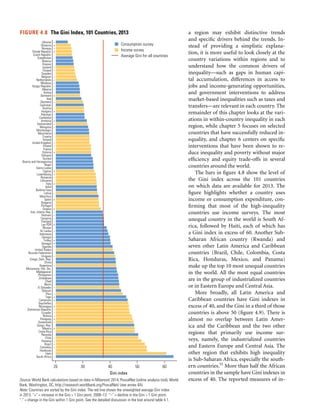
narrow. Despite the progress, stark inequal-
ities persist. For example, Haiti and South
Africa are the most unequal countries in
the world (for which data are available),
with a Gini exceeding 60 points in 2013.
Another Sub-Saharan African country
(Rwanda) and another seven Latin America
and Caribbean countries (Brazil, Chile, Co-
lombia, Costa Rica, Honduras, Mexico, and
Panama) make up the top 10 most unequal
countries in the world, with Gini indexes in
excess of or close to 50.
In many countries, the
income share of the
top income groups is
expanding
In many economies in which information
on the top 1 percent of the income distri-
10
20
30
40
50
60
1988 1993 1998 2003 2008 2013
Averagewithin-countryGiniindex
East Asia and Pacific Eastern Europe and Central Asia
Latin America and the Caribbean Middle East and North Africa
South Asia Sub-Saharan Africa
Industrialized countries
FIGURE O.12  Trends in the Average National Gini, by Region, 1988–
2013
Source: World Bank calculations based on data in Milanovic´ 2014; PovcalNet (online analysis tool), World
Bank, Washington, DC, http://iresearch.worldbank.org/PovcalNet/.
Note: The lines show the average within-country Gini index by region. It is the simple average in the full
sample without weighting countries by population. Industrialized countries are a subset of high-income
countries. See chapter 2, annex 2B, for the list of industrialized countries.
12	 POVERTY AND SHARED PROSPERITY 2016
also play a role in reducing inequalities. For
example, the minimum wage and safety nets
have been crucial in allowing Brazil to lessen
inequality, while diversification from agri-
culture into light manufacturing and ser-
vices in Cambodia opened job opportunities
to the poor.
Overall, these country cases also high-
light that success in reducing inequality
and boosting shared prosperity in a given
period does not necessarily translate into
similar success on other economic, social,
or political fronts, nor into sustainable re-
ductions in inequality over time. Indeed,
conflict emerged in Mali after the period
of inequality reduction, in large part be-
cause of protracted flaws in governance.8
The marked differences in the most recent
policy choices between Brazil and Peru on
fiscal consolidation and the control of infla-
tion largely explain the stark differences in
their most recent growth patterns: gradual
recovery in Peru, recession in Brazil. Mean-
while, long-standing barriers constraining
productivity and investments in agriculture
in Cambodia and an unfinished transition
to a market-based economy in Tanzania call
into question the sustainability of inequal-
ity reduction in these two countries.9
analyzed are Brazil, Cambodia, Mali, Peru,
and Tanzania. These are among the best per-
formers, showing good shared prosperity
premiums and strong records in narrowing
income inequality and reducing extreme
poverty. They are also sufficiently diverse
to embody different development strategies
and historical circumstances.
The five countries exercised judicious
macroeconomic management, appropriately
dealt with external shocks, and implemented
more or less protracted and coherent eco-
nomic and social sector reforms. They also
benefited from favorable external conditions
in the form of cheap and abundant interna-
tional credit, high commodity prices, and
booming trade. Decision making and the
context allowed rapid, sustainable, and in-
clusive growth. The countries also highlight
the importance of labor markets in trans-
lating economic growth into inequality re-
duction by increasing job opportunities and
earnings, reintegrating individuals who have
been excluded from economic opportuni-
ties, and narrowing gaps across workers be-
cause of gender, residence, or sector of em-
ployment. Notwithstanding these common
factors, country-specific choices and eco-
nomic developments—deliberate or not—
FIGURE O.13  The National Income Share of the Richest 1 Percent, Selected Economies
Source: Calculations based on data of WID (World Wealth and Income Database), Paris School of Economics, Paris, http://www
.parisschoolofeconomics.eu/en/research/the-world-wealth-income-database/.
Note: The income share excludes capital gains. These measures are typically derived from tax record data. For South Africa, the
income share refers to adults.
Incomeshareoftop1percent(%)
20
a. Industralized economies since 1900 b. Developing economies since 1980
15
10
5
Incomeshareoftop1percent(%)
20
15
10
5
1980 1990 2000 2010 2013
South Africa
Korea, Rep. Taiwan, China
Argentina India
1900 1925 1950 1975 2000 2015
United States Japan France
OVERVIEW 	 13
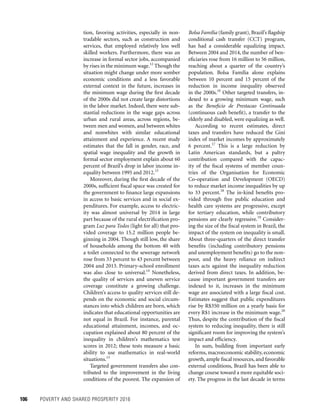
placing the country among the most rap-
idly growing economies in the world. Poor
Cambodians harnessed the opportunities
created by this growth. They seized jobs
in labor-intensive industries and services,
diversifying their incomes away from sub-
sistence agriculture and reaping higher re-
turns from traditional agricultural activi-
ties. Annual consumption growth among
the bottom 40 averaged 6.3 percent between
2008 and 2013, twice the consumption
growth of the top 60.
A proliferation of employment opportu-
nities followed expansions in the garment,
tourism, and real estate sectors.12
Relative
to other sectors, wages in the garment in-
dustry tended to be higher and more stable,
while the gender gap tended to be narrower.
Meanwhile, the agricultural sector’s vitality
at a time of historically high international
prices explains how farm incomes from
paddy rice farming more than doubled
between 2004 and 2009.13
Indeed, rural
areas largely drove the country’s success in
inequality and poverty reduction. Nonethe-
less, obstacles are evident in the inadequate
pace of job creation, given Cambodia’s
young demographic and structural con-
straints that weigh on leading sectors.
Mali, 2001–10: vagaries of
agriculture rescue a weak
economy
Before the outbreak of conflict in the
country’s northern region in 2012, Mali
had made important strides in reducing
inequality. Between 2001 and 2010, GDP
growth averaged 5.7 percent a year. During
the period, the Gini index fell 7 points. The
income of the bottom 40 grew, while the
mean contracted.
Agriculture has been a key driver be-
hind the improvement in living conditions
among the poor. Approximately 73 per-
cent of Malians and 90 percent of the poor
live in rural areas. For those involved in
farming activities, own-account production
typically does not permit self-sufficiency,
and income has to be supplemented with
casual labor and private transfers. Higher
cereal production in the 2000s benefited the
The common elements and country-
specific peculiarities are summarized below.
Brazil, 2004–14: policies aligned
to redress record inequality
In 1989, Brazil’s Gini index was 63, the sec-
ond highest in the world. However, the in-
comes of the less well off in Brazil surged be-
tween 2004 and 2014 amid rapid economic
growth. The Gini dropped to 51 in 2014,
while income growth among the bottom 40
averaged 6.8 percent a year, well above the
average 4.5 percent among all Brazilians.
Multiple drivers underlie Brazil’s suc-
cess. The 1988 Constitution laid the foun-
dations for tackling historical inequalities by
guaranteeing basic social rights such as free
public education, free universal health care,
pensions, and social assistance. A macroeco-
nomic framework established in the 1990s
allowed inflation to be curbed,promoted the
prudent management of fiscal balances, and
created an enabling environment for poli-
cies to address inequality. During the 2000s,
the boom in commodity prices generated
positive terms of trade. Macroeconomic sta-
bility, combined with this favorable external
context, propelled economic growth. Labor
market dynamics—including increasing
wage premiums for the less skilled, more
formal jobs, and a rising minimum wage—
and the expansion of social policies helped
boost the incomes of the poor. These two
factors accounted for approximately 80 per-
cent of the decline in inequality in 2003–13:
41 percent of the Gini decline in these years
stemmed from labor incomes, and 39 per-
cent from nonlabor income sources such as
government transfers.10
According to some
estimates, Bolsa Família, Brazil’s flagship
conditional cash transfer (CCT) program,
alone explains between 10 percent and 15
percent of the narrowing income inequality
observed in the 2000s.11
Cambodia, 2004–14: earning
opportunities emerging from
growth
Cambodia’s annual economic growth av-
eraged 7.8 percent between 2004 and 2014,
14	 POVERTY AND SHARED PROSPERITY 2016
mal workers, high labor force participation
rates, and low unemployment.
Challenges remain. Analysts question
the quality of public spending, notably in
education. Despite significant gains in en-
rollments, Peru lags comparator countries
in international assessments of education
quality outcomes,such as student test scores.
This is a serious consideration because the
favorable external conditions that have
under­pinned Peru’s growth have recently
begun to recede. Maintaining the impressive
gains in a much less favorable environment
will require policy reforms that address the
limited productivity resulting from the low
quality of human capital and the high rates
of informality.
Tanzania, 2004–14: sharing
prosperity amid diversification
Tanzania maintained robust and stable
economic growth between 2004 and 2014,
averaging 6.5 percent a year. The national
poverty headcount ratio fell from 34.4 per-
cent in 2007 to 28.2 percent in 2012. The
Gini index declined from around 39 to 36
over the same period. Annual consumption
growth among the bottom 40, at 3.4 per-
cent, was more than three times the growth
among the top 60, at 1.0 percent.
Since the early 2000s, the country’s eco-
nomic expansion has been driven primarily
by rapidly growing sectors, especially com-
munications, financial services, and con-
struction. However, the growth in these sec-
tors has not been translated into substantive
improvements in the living conditions of
the poor, the less well educated, or rural
residents. After 2007, there was a surge in
retail trade and manufacturing, particularly
agroprocessing in products such as food,
beverages, and tobacco, which has allowed
the inclusion of less highly skilled workers
in the economy.17
Among policies explicitly
aimed at rendering the income distribution
more equitable, the Tanzania Social Action
Fund stands out. It encompasses a CCT
program, public works, and a community
savings component that is expected to en-
able the poorest segments of the popula-
tion to increase their savings and their in-
labor income of the poor by raising both
farm production and off-farm labor income
through greater demand for wage labor by
commercial cereal producers. In the latter
half of the first decade of the 2000s, while
manufacturing was contracting, agricul-
tural production, favored by good weather
conditions, boomed, resulting in reduced
inequality.14
Since 2012, however, the con-
flict in the north has put the brakes on the
progress of the previous decade. The crisis
has disrupted education and health care
services in the north, and displaced popula-
tions are exerting pressure on service deliv-
ery in the south. This resurgence of conflict
comes after two decades of relative stabil-
ity, including multiparty elections, and is
associated with a long-term deterioration
in governance, the expanding presence of
political pay-offs and co-optation, and an
army with limited capacity to face increas-
ing security threats.15
Peru, 2004–14: equalizing
growth through capital
investment
The improvement in living conditions
among the poor and the bottom 40 in Peru
has been remarkable. The Gini index fell
from 51 in 2004 to 44 in 2014, and poverty
rates dropped from 12 percent in 2004 to 3
percent in 2014. The outstanding growth of
the economy (6.6 percent annually during
the period) in a context of macroeconomic
stability, favorable external conditions, and
important structural reforms was respon-
sible for this progress. In the early 2000s,
prudent macroeconomic policies and high
commodity prices attracted foreign direct
investment into the economy, particularly
in the mining sector. Capital accumulation
became the main driver of growth, account-
ing for more than two-thirds of total growth
after 2001. The labor market was the main
pathway for the translation of the country’s
impressive growth into less inequality and
poverty, explaining about 80 percent of the
reduction in the Gini and three-quarters of
the reduction in extreme poverty during the
last decade.16
Critical to this success were a
closing wage gap between formal and infor-
OVERVIEW 	 15
Tanzania point to the need to realign fis-
cal systems to produce a greater impact in
reducing inequality. Infrastructure is ap-
parently still a significant obstacle in Cam-
bodia, while in Mali, in addition to con-
flict, dependence on external factors, from
donor flows to the vagaries of weather,
threaten sustained improvement. In Peru,
the quality of education is below regional
standards and represents a barrier to main-
taining and enhancing economic produc-
tivity should favorable external conditions
disappear.
Countries willing to make the appropri-
ate policy choices are more likely to narrow
inequality. Those that are not willing to
make these choices might continue to suffer
the disadvantages of growing inequality.
Taking on inequality
involves human capital
accumulation, income
generating opportunities,
consumption smoothing,
and redistribution
The report assesses what we know about key
domestic policy interventions that are effec-
tive in reducing inequality, the benefits they
generate, the choices that need to be made
concerning their design and implementa-
tion, and the trade-offs with which they are
associated. It is not meant to provide an ex-
haustive or comprehensive review of every
intervention that could reduce inequality,
nor does it seek to supply universal pre-
scriptions. Instead, it focuses on a few policy
areas on which a body of rigorous evidence
allows lessons to be drawn with confidence.
The policies, if well designed, have favorable
effects not only on inequality reduction, but
also on poverty reduction without major
efficiency and equity trade-offs. The pol-
icy areas are early childhood development
(ECD), universal health care, universal ac-
cess to good-quality education, CCTs, in-
vestments in new or improved rural roads
and electrification, and taxation, mainly on
personal income and consumption.
There are many pathways through which
policy interventions can affect inequality,
vestments in livestock and to become more
resilient.18
Despite this progress, much re-
mains to be done to trim regional dispar-
ities and expand access to basic services in
a context of rapid urbanization. Indeed, to-
day’s economy is still characterized by a lack
of competition in the private sector and the
absence of growth, as well as a strongly reg-
ulated economic environment.
There are some common
building blocks behind
successful inequality
reductions
The experiences of five countries cannot
supply precise policy prescriptions that
are valid everywhere and in all circum-
stances. However, they demonstrate that
narrowing inequality and sharing prosper-
ity are possible in many settings, including
low- and middle-income countries; rural
economies; more highly diversified, mod-
ern economies; and countries benefiting
from external booms, but also countries
facing unfavorable conditions, such as a
history of conflict or substantial, long-term
inequality. The building blocks of success
have been prudent macroeconomic pol-
icies, strong growth, functioning labor
markets, and coherent domestic policies
focusing on safety nets, human capital, and
infrastructure.
As the building blocks get in place,
many approaches to narrowing inequality
are possible. However, sustaining this suc-
cess may require similar approaches. The
accumulation of good-quality human cap-
ital, diversification in the income-earning
opportunities available to the poor, safety
nets capable of protecting the poorest from
risk, and enhanced infrastructure to con-
nect lagging regions to economically more
vibrant ones are all potentially desirable
approaches to sharing prosperity and re-
ducing inequality.
Thus, the experiences of Cambodia,
Mali, and Tanzania underscore the need
to expand safety nets, which have not been
sufficient to protect the poorest in these
countries. The experiences of Brazil and
16	 POVERTY AND SHARED PROSPERITY 2016
cent of the population, including 18 million
previously uninsured people.21
Recent assessments in developed and de-
veloping countries highlight the important
consequences of successful experiences in
improving the quality of teaching. For ex-
ample, estimates in the United States indi-
cate that pupils taught by teachers who are
at the 90th percentile in effectiveness are
able to learn 1.5 years’ worth of material in
a single academic year, while pupils taught
by teachers at the 10th percentile learn only
a half-year’s worth of material.22
Increased
schooling has been linked to more produc-
tive nonfarm activities in China, Ghana,
and Pakistan.23
In Bangladesh, the Shombob Pilot Pro-
gram reduced the incidence of wasting
among 10- to 22-month-old infants by 40
percent.24
Mexico’s Prospera Program has
helped lower infant mortality and maternal
mortality by as much as 11 percent.25
The
Nahouri Pilot Project in Burkina Faso is
credited with raising primary and secondary
enrollment rates by 22 percent among boys.26
In Pakistan, CCTs made available only in
favor of girls led to increases in enrollment in
the range of 11–13 percentage points.27
Also in Bangladesh, the Rural Develop-
ment Program and the Rural Roads and
Markets Improvement and Maintenance
Program have boosted employment and
wages in agricultural and nonagricultural
activities, as well as aggregate harvest out-
puts. Per capita annual spending across
households in the program areas has risen
by about 10 percent.28
In rural Vietnam,
school enrollment rates among children in
households on the electricity grid were 9.0
percentage points higher among girls and
6.3 percentage points higher among boys
relative to children in households not on
the grid. Electrification was also associated
with almost an extra year in the average
years of schooling among girls and an extra
0.13 year among boys.29
Similarly, access in
rural areas to telenovelas (television soap
operas) resulted in lower fertility rates in
Brazil, which may be related to the empow-
erment of women through the imitation of
role models of emancipated women and the
representation of smaller families.30
whether this effect is intended or unin-
tended. The impacts can be large or small,
short term or lifelong, and they may narrow
disparities in income, well-being, or oppor-
tunity. For example, taxes can have direct
and deliberate redistributive effects, reach-
ing up to 20 points of the Gini index of
market incomes in some European Union
(EU) economies.19
In contrast, investments
in rural roads and electrification influence
income generation opportunities, employ-
ment, and even perceptions of gender roles.
Expanding ECD, health care coverage, and
good-quality education often reduces cog-
nitive, nutritional, and health status gaps,
thereby narrowing inequalities in human
capital development and future income
opportunities. By smoothing consumption
among the most deprived, especially during
shocks, CCTs help prevent the widening of
inequality.
Evidence of the benefits of such interven-
tions is encouraging. For example, in 1986,
a Jamaican intervention sought to support
toddlers ages 9–24 months who suffered
from stunting.20
The intervention consisted
of weekly visits to the households of the tod-
dlers by community health workers to teach
parenting skills aimed at fostering cognitive
and socioemotional development among
the children. It also provided nutrition
supplements and psychosocial stimulation.
Researchers followed up among the partic-
ipants 20 years after the intervention and
found that the groups of children receiving
stimulation (with or without the nutrition
supplements) had, as adults, 25 percent
higher earnings than the control group. The
greater earnings had allowed individuals
in the stimulation program to enjoy liveli-
hoods at a similar level as the members of
a nonstunted comparison group, effectively
eliminating the inequality in incomes be-
tween the groups.
Thailand’s Universal Coverage Scheme
enhances equity by bringing a large unin-
sured population under the umbrella of a
national insurance program, thereby greatly
reducing catastrophic health care payments
and improving access to essential health
services among the poor. Within a year of
its launch, the scheme was covering 75 per-
OVERVIEW 	 17
equalizing without compromising efficiency.
Different choices in Chile and Mexico in
recent tax reforms with the same objectives
led to different impacts. The ultrarich bore
the brunt of the income tax component of
the reform in Chile, while in Mexico, the
middle class also largely shared the cost of
the reform.32
ECD programs are most effec-
tive if they are aimed at the first 1,000 days
of the lives of children, continue during
childhood, and integrate stimulation, par-
enting, and nutrition components. In many
contexts, incentivizing higher quality in
teaching, while making social transfers con-
ditional on school completion may have
a greater impact than constructing new
schools.
Avoid unexamined reliance on univer-
sal prescriptions and unique models of suc-
cess. Evidence strongly suggests that the
implementation of such prescriptions and
models does not automatically ensure a
reduction in inequality. Nonetheless, some
initiatives are more likely than others to
generate inequality reductions and im-
provements in the well-being of the poor-
est. For example, integrated interventions
are more likely to succeed than isolated,
monolithic interventions. Composition in-
fluences the degree of success. If CCTs are
combined with other safety net interven-
tions, such as transfers of productive assets,
skills training, and access to credit and fi-
nance, they have been shown to generate
wide-ranging benefits. Investments in rural
roads that attract additional investments in
public services, such as electrification, ag-
ricultural extension services, and enhanced
water and sanitation services, improve not
only the connectivity of people to eco-
nomic opportunities, but also security, pro-
ductivity, and the quality of services. Sim-
plicity and flexibility often drive success.
Thus, the ability of the safety net system in
the Philippines to scale up to reach hun-
dreds of thousands of beneficiaries after
catastrophic events is in part explained by
the flexibility of the system in the face of
emergency situations. Exclusive and pro-
longed breastfeeding is another example of
a simple and extraordinarily cost-efficient
intervention to improve ECD.33
Such evidence demonstrates that inter-
ventions can be designed successfully in a
variety of settings. Yet, the long road ahead
argues against any complacency and against
the fallacy of sweeping prescriptions. The
challenges and uncertainties are diverse and
complicated, as follows:
Despite progress, intolerable disparities in
well-being still exist that concrete policy inter-
ventions could confront directly.In many low-
and middle-income countries, preschool
enrollment rates among the poorest quin-
tile are less than a third of the rates among
the richest quintile. Mothers in the bottom
40 across developing countries are 50 per-
cent less likely to receive antenatal care. The
poorest children are four times less likely
than the richest children to be enrolled in
primary education and systematically record
lower test scores than children in the richest
households. Among the estimated 780 mil-
lion illiterate adults worldwide, nearly two-
thirds are women. Only one-quarter of the
poorest quintile are covered by safety nets,
and the share is even smaller in Sub-Saharan
Africa and South Asia.31
Trade-offs in implementation should not
be overlooked because of excessive attention
to efficiency and equity trade-offs. Invest-
ments in ECD, universal health care, and
good-quality education have both equity
and efficiency benefits given the current
gaps in access. Connecting poor farmers to
urban markets can positively affect the in-
come of farm households as well as reduce
their income gaps with the rest of the pop-
ulation. In reducing inequality, many policy
choices are less often restricted by an imbal-
ance in the equity-efficiency trade-off than
by an imbalance in the trade-offs between
expanding the coverage of an intervention
and increasing the benefits, between en-
hancing the quality of services and increas-
ing access to services through the construc-
tion of facilities such as schools or clinics,
between expanding the coverage of electrifi-
cation in rural areas and ensuring program
financial viability, between cash or in-kind
resource transfers, and between condition-
ality and the lack of conditionality.
The fine points of policy design absolutely
matter in ensuring that interventions are
18	 POVERTY AND SHARED PROSPERITY 2016
keep electrification campaigns financially
feasible, but this often means the poorest
households must opt out.35
Policy design
needs to take such outcomes into account
up front and explicitly.
More knowledge! Despite the growing
evidence on the impacts of policy interven-
tions, improving the evidence base on ini-
tiatives that successfully narrow inequality
requires more investment in filling data gaps
and enhancing the understanding of the spe-
cific pathways—whether intended or unin-
tended—through which programs affect in-
equality. For example, rigorous evaluations
have played a critical role in fine-tuning the
design of CCTs and advocating for CCT
desirability. Monitoring ECD programs for
decades has made the quantification of the
long-term effects of such programs pos-
sible. Yet, the road ahead is still long and
steep. Especially important is the long-term
generation of more microeconomic house-
hold data, more compelling evidence on
the benefits of the integration of multiple
interventions, and more information on the
potential distributional effects of policy in-
terventions aimed at addressing long-term
challenges such as climate change.36
Data need to allow for more compre-
hensive monitoring of specific changes in
inequality, but also in poverty and shared
prosperity. Substantial efforts are required
to address the poor quality, comparability,
and availability of data, especially in low-
income countries. Figure O.14 shows the
availability of poverty estimates by country
and region. The availability is particularly
limited in Sub-Saharan Africa and in the
Middle East and North Africa. This report
makes a strong case for expanding the avail-
ability of and access to data on inequality,
poverty, and shared prosperity.
Equalizing interventions are not a luxury
reserved for middle- and high-income coun-
tries, nor an option only available during
periods of prosperity. There are numerous
instances of the implementation of suc-
cessful interventions in ECD, universal
health care coverage, CCTs, investment in
rural infrastructure, and redistributive tax
schemes across low-income countries. This
evidence should dispel the notion that only
middle- and high-income countries can
afford equalizing policies. Of course, con-
text always matters: weak capacity, lack of
political will, restricted fiscal space, vulner-
ability to external crises or climate change,
internal conflict, and challenging geography
are among the obstacles to the reduction of
inequality worldwide. These obstacles are
not insurmountable, however. This is also
the case during periods of crisis. Examples
of CCTs integrated in safety nets that effec-
tively protect the most vulnerable against
natural disasters demonstrate that a crisis is
not an excuse for inaction, but an incentive
for the adoption of equalizing interventions.
The poor must be able to participate in
and benefit from interventions: good policy
choices benefit the poorest. Evidence on ECD
programs, initiatives to promote univer-
sal health care coverage, and efforts to fos-
ter good-quality teaching proves that the
most underprivileged children often bene-
fit the most.34
Yet, this outcome should not
be taken for granted. Thus, the more well
off households among the targeted pop-
ulation, that is, households with children
with higher baseline levels of development
and more well educated mothers, are typ-
ically more likely to send their children to
preschool or to take part in parenting pro-
grams. Many rural electrification initiatives
are associated with high connection costs to
OVERVIEW 	 19
sion on Global Poverty,” World Bank, Wash-
ington, DC, http://www.worldbank.org/en
/programs/commission-on-global-poverty.
  5. Poverty and Equity Data (database), World
Bank, Washington, DC, http://povertydata
.worldbank.org/poverty/home/.
  6. Castañeda et al. (2016) analyze the robust-
ness of these results by comparing different
lineup methods and different ways to adjust
welfare aggregates, weights, and poverty
lines. They find only minimal differences.
They also check for fixed effects and sensi-
tivity to missing data. The resulting demo-
graphic profile thus paints a robust picture
of global poverty.
  7. Beegle et al. (2016) and Cornia (2014) doc-
ument a bifurcation in inequality trends in
Sub-Saharan Africa, that is, within a set of
African countries with at least two recent,
strictly comparable surveys, there is an even
split between countries with widening in-
equality and countries with narrowing in-
equality. The surveys are drawn from the
first decade of the 2000s.
  8. World Bank (2015a).
Notes
  1. WHO (2015).
 2. For a formal decomposition, see Datt and
Ravallion (1992), among others. In the gen-
eral case, a reduction in inequality at a given
growth rate leads to a reduction in poverty
according to most poverty measures. Ex-
ceptions are, for instance, progressive dis-
tributional changes whereby some nonpoor
fall under the poverty line over time, thus
increasing the headcount ratio. Even in that
case, other poverty measures with higher
social welfare weights for lower percentiles
tend to decrease.
  3. See Oxfam (2016). Lakner (2015) estimates
that the 10 wealthiest Africans own as much
as the poorest half of the continent.
  4. The countries classified as industrialized in
this report are assumed to have zero poverty
at the $1.90-a-day poverty line, an assump-
tion that may change in the future because
of the World Bank’s implementation of the
report of the Commission on Global Poverty
on global poverty estimation. See “Commis-
3 1 4 2 3 2 4 3 3 3 3 2
8
3 4 4
7 6 7 7 8
4
8
3
6
6 11
3 6
11
5
16
12 13 16
21
23
25 25
23 24
25 25 25
26
26
25
13
2
8
8
14 9
9
13
13
14
17
15 15
17
16
16
17 17
18
15
16 17 14
16
17
15
13
3
3
1
1
1 1
2
1
3
2
1
4 4
3
3
2 2 4
1
2
1
2
1
1 3
1
2
1 1
2
2
3 2 1
3
3 3
2
2
6
7 9
8
4
5
3
6
4
8 4
9
7
7 9 8
7
6
11 10
8
5
1
0
1990
1991
1992
1993
1994
1995
1996
1997
1998
1999
2000
2001
2002
2003
2004
2005
2006
2007
2008
2009
2010
2011
2012
2013
2014
2015
10
20
30
40
50
60
70
Numberofpovertyestimates
East Asia and Pacific
Middle East and North Africa
Eastern Europe and Central Asia
South Asia
Latin America and the Caribbean
Sub-Saharan Africa
FIGURE O.14  Available Country Poverty Estimates, Number, by Region and Year
Source: Poverty and Equity Data (database), World Bank, Washington, DC, http://povertydata.worldbank.org/poverty/home/.
Note: The presentation follows the definition of the developing world of Serajuddin et al. (2015), which includes 150 countries and territories in the early 1990s and 155 in
2013. High-income countries such as the original members of the Organisation for Economic Co-operation and Development (OECD), where extreme poverty is assumed to be
zero, are not considered in this sample.
20	 POVERTY AND SHARED PROSPERITY 2016
2014. “Challenges to Promoting Social In-
clusion of the Extreme Poor: Evidence from
a Large Scale Experiment in Colombia.” IFS
Working Paper W14/33, Institute for Fiscal
Studies, London.
ADB (Asian Development Bank). 2014. Cambo-
dia: Diversifying beyond Garments and Tour-
ism, Country Diagnostic Study. November.
Manila: Economics and Research Depart-
ment, ADB.
Aggarwal, Shilpa. 2015. “Do Rural Roads ­Create
Pathways Out of Poverty? Evidence from
India.” Working paper, Indian School of
Business, Hyderabad, India.
Akresh, Richard, Damien de Walque, Harounan
Kazianga. 2013. “Cash Transfers and Child
Schooling: Evidence from a Randomized
Evaluation of the Role of Conditionality.”
Policy Research Working Paper 6340, World
Bank, Washington, DC.
Araujo, María Caridad, Pedro Carneiro, Yyannú
Cruz-Aguayo, and Norbert Schady. 2016.
“Teacher Quality and Learning Outcomes in
Kindergarten.” Quarterly Journal of Econom-
ics 125 (1): 175–214.
Asher, Sam, and Paul Novosad. 2016.“Market Ac-
cess and Structural Transformation: Evi­dence
from Rural Roads in India.” Working paper
(April 20), University of Oxford, Oxford.
Avram, Silvia, Horacio Levy, and Holly Suther-
land. 2014. “Income Redistribution in the
European Union.” IZA Journal of European
Labor Studies 3 (22): 1–29.
Barros, Ricardo Paes de, Mirela De Carvalho,
Samuel Franco, and Rosane Mendonça. 2010.
“Markets, the State, and the Dynamics of
Inequality in Brazil.” In Declining Inequality
in Latin America: A Decade of Progress?, ed-
ited by Luis F. López-Calva and Nora Lustig,
134–74. New York: United Nations Develop-
ment Programme; Baltimore: Brookings In-
stitution Press.
Beegle, Kathleen, Luc Christiaensen, Andrew
Dabalen, and Isis Gaddis. 2016. Poverty in a
Rising Africa. Washington, DC: World Bank.
Beegle, Kathleen, Pedro Olinto, Carlos E.
Sobrado, Hiroki Uematsu, and Yeon Soo
Kim. 2014. “Ending Extreme Poverty and
Promoting Shared Prosperity: Could There
Be Trade-Offs between These Two Goals?”
Inequality in Focus 3 (1): 1–6.
Behrman, Jere R., and John Hoddinott. 2005.
“Programme Evaluation with Unobserved
Heterogeneity and Selective Implementation:
 9. In Cambodia, these difficulties revolve
around problems in land tenure, bottlenecks
in fertilizer and seed markets, inadequate
extension services and irrigation systems,
and, among farmers, the lack of savings and
access to credit. In addition, recent agricul-
tural productivity gains from an expansion
in the arable land under cultivation are not
sustainable indefinitely and are thus unable
to offset these problems. As a result, small-
holders are generally vulnerable to swings in
the international prices for rice. In Tanzania,
the unfinished transition to a market-based
economy translates into a private sector
characterized by a lack of competition, an
absence of growth, and a heavy regulatory
burden associated with the public sector.
See World Bank (2014, 2016a).
10. World Bank (2016b).
11. Barros et al. (2010); Osorio and Souza (2012).
12. ADB (2014).
13. World Bank (2009, 2014).
14. Josz (2013).
15. World Bank (2015a).
16. Genoni and Salazar (2015).
17. World Bank (2015b).
18. World Bank (2016c).
19. Avram, Levy, and Sunderland (2014); De
Agostini, Paulus, and Tasseva (2015).
20. Gertler et al. (2014); Grantham-McGregor
et al. (1991).
21. UNICEF (2016).
22. Araujo et al. (2016).
23. Fafchamps and Quisumbing (1999); Jolliffe
(1998); Yang (1997).
24. Ferré and Sharif (2014).
25. Behrman and Hoddinott (2005); Gertler
(2004).
26. Akresh, de Walque, and Kazianga (2013).
27. Fiszbein and Schady (2009).
28. Aggarwal (2015); Asher and Novosad (2016).
29. Khandker, Barnes, and Samad (2013).
30. La Ferrara, Chong, and Duryea (2012).
31. See the evidence presented in chapter 6.
32. Abramovsky et al. (2014); World Bank
(2016d).
33. See the evidence presented in chapter 6.
34. See the evidence presented in chapter 6.
35. See the evidence presented in chapter 6.
36. Hallegate et al. (2016).
References
Abramovsky, Laura, Orazio Attanasio, Kai
Barron, Pedro Carneiro, and George Stoye.
OVERVIEW 	 21
from PROGRESA’s Control Randomized Ex-
periment.” American Economic Review 94 (2):
336–41.
Gertler, Paul J., James J. Heckman, Rodrigo
Pinto,Arianna Zanolini, Christel Vermeersch,
Susan Walker, Susan M. Chang, and Sally
Grantham-McGregor. 2014. “Labor Market
Returns to an Early Childhood Stimulation
Intervention in Jamaica.” Science 344 (6187):
998–1001.
Grantham-McGregor, Sally M., Christine A.
Powell, Susan P. Walker, and John H. Himes.
1991.“Nutritional Supplementation, Psycho-
social Stimulation, and Mental Development
of Stunted Children: The Jamaican Study.”
Lancet 338 (8758): 1–5.
Hallegatte, Stephane, Mook Bangalore, Laura
Bonzanigo, Marianne Fay, Tomaro Kane,
Ulf Narloch, Julie Rozenberg, David Treguer,
and Adrien Vogt-Schilb. 2016. Shock Waves:
Managing the Impacts of Climate Change on
Poverty. Climate Change and Development
Series. Washington, DC: World Bank.
Jolliffe, Dean. 1998. “Skills, Schooling, and
Household Income in Ghana.” World Bank
Economic Review 12 (1): 81–104.
Josz, Christian. 2013. “Mali: Achieving Strong
and Inclusive Growth with Macroeconomic
Stability.” African Development 13/08, Inter-
national Monetary Fund, Washington, DC.
Khandker, Shahidur R., Douglas F. Barnes, and
Hussain A. Samad. 2013. “Welfare Impacts of
Rural Electrification: A Panel Data Analysis
from Vietnam.” Economic Development and
Cultural Change 61 (3): 659–92.
La Ferrara, Eliana, Alberto Chong, and Suzanne
Duryea. 2012. “Soap Operas and Fertility:
Evidence from Brazil.” American Economic
Review 4 (4): 1–31.
Lakner, Christoph. 2015. “The Ten Richest Af-
ricans Own as Much as the Poorest Half
of the Continent.” Let’s Talk Development
(blog), March 11. http://blogs.worldbank.org
/developmenttalk/ten-richest-africans-own
-much-poorest-halfcontinent.
Lakner, Christoph, and Branko Milanovic´. 2016.
“Global Income Distribution: From the Fall
of the Berlin Wall to the Great Recession.”
World Bank Economic Review 30 (2): 203–32.
Lakner, Christoph, Mario Negre, and Espen Beer
Prydz. 2014. “Twinning the Goals: How Can
Shared Prosperity Help to Reduce Global
Poverty?” Policy Research Working Paper
7106, World Bank, Washington, DC.
The Mexican PROGRESA Impact on Child
Nutrition.” Oxford Bulletin of Economics and
Statistics 67 (4): 547–69.
Bourguignon, François. 2015. The Globalization
of Inequality. Translated by Thomas Scott-
Railton. Princeton, NJ: Princeton University
Press.
Castañeda, Andres, Dung Doan, David New-
house, Minh C. Nguyen, Hiroki Uematsu,
João Pedro Azevedo, and Data for Goals
Group. 2016. “Who Are the Poor in the De-
veloping World?” Policy Research Working
Paper 7844, World Bank, Washington DC.
Cornia, Giovanni Andrea. 2014. “Income In-
equality Levels, Trends, and Determinants
in Sub-Saharan Africa: An Overview of the
Main Changes.” Università degli Studi di
Firenze, Florence.
Datt, Gaurav, and Martin Ravallion. 1992.
“Growth and Redistribution Components of
Changes in Poverty Measures: A Decomposi-
tion with Applications to Brazil and India in
the 1980s.” Journal of Development Economics
38 (2): 275–95.
De Agostini, Paola, Alari Paulus, and Iva Val-
entinova Tasseva. 2015. “The Effect of Tax-
Benefit Changes on the Income Distribution
in 2008–2014.” Euromod Working Paper
EM11/15, Institute for Social and Economic
Research, University of Essex, Colchester,
United Kingdom.
Fafchamps, Marcel, and Agnes R. Quisumbing.
1999. “Human Capital, Productivity, and
Labor Allocation in Rural Pakistan.” Journal
of Human Resources 34 (2): 369–406.
Ferré, Céline, and Iffath Sharif. 2014. “Can Con-
ditional Cash Transfers Improve Education
and Nutrition Outcomes for Poor Children
in Bangladesh? Evidence from a Pilot Project.”
Policy Research Working Paper 7077, World
Bank, Washington, DC.
Fiszbein, Ariel, and Norbert Schady. 2009. Con-
ditional Cash Transfers: Reducing Present and
Future Poverty.Washington, DC: World Bank.
Genoni, María Eugenia, and Mateo Salazar. 2015.
“Steering toward Shared Prosperity in Peru.”
In Shared Prosperity and Poverty Eradication
in Latin America and the Caribbean, edited
by Louise Cord, María Eugenia Genoni, and
Carlos Rodríguez-Castelán, 269–302. Wash-
ington, DC: World Bank.
Gertler, Paul J. 2004. “Do Conditional Cash
Transfers Improve Child Health? Evidence
22	 POVERTY AND SHARED PROSPERITY 2016
of Cambodia: Proposed Smallholder Agri-
culture and Social Protection Support Op-
eration.” Report 48083-KH (June 19), World
Bank, Washington, DC.
———. 2014. “Where Have All the Poor Gone?
Cambodia Poverty Assessment 2013.” Report
ACS4545, World Bank, Washington, DC.
———. 2015a. “Republic of Mali, Priorities
for Ending Poverty and Boosting Shared
Prosperity: Systematic Country Diagnostic
(SCD).” Report 94191-ML (June 22), World
Bank, Washington, DC.
———. 2015b.“Tanzania Mainland: Poverty As-
sessment.” Report AUS6819 v2, World Bank,
Washington, DC.
———. 2016a. “Ngazi Ya Pili (To the Next
Level): United Republic of Tanzania Sys-
tematic Country Diagnostics.” Regional Op-
erations Committee Decision Review Draft
(June 2), World Bank, Washington, DC.
———. 2016b. Brazil Systematic Country Diag-
nostic: Retaking the Path to Inclusion, Growth,
and Sustainability. Report 101431-BR, Wash-
ington, DC: World Bank.
———. 2016c. “International Development
Association Project Paper, United Republic
of Tanzania: Productive Social Safety Net
(PSSN).” Report PAD1500 (May 20), World
Bank, Washington, DC.
———. 2016d. “Chile: Distributional Effects of
the 2014 Tax Reform,”World Bank, Washing-
ton, DC.
Yang, Dennis. 1997. “Education and Off-Farm
Work.” Economic Development and Cultural
Change 45 (3): 613–32.
Milanovic´, Branko. 2014. “All the Ginis, 1950–
2012 (updated in Autumn 2014).” Novem-
ber, World Bank, Washington, DC. http://
go.worldbank.org/9VCQW66LA0.
———. 2016. Global Inequality: A New Approach
for the Age of Globalization. Cambridge, MA:
Harvard University Press.
Newhouse, David, Pablo Suarez-Becerra, Martin
C. Evans, and Data for Goals Group. 2016.
“New Estimates of Extreme Poverty for Chil-
dren.” Policy Research Working Paper 7845,
World Bank, Washington, DC.
Osorio, Rafael Guerreiro, and Pedro H. G.
Ferreira de Souza. 2012. “O Bolsa Família de-
pois do Brasil Carinhoso: uma análise do po-
tencial de redução da pobreza extrema.”Insti-
tute for Applied Economic Research, Brasília.
Oxfam. 2016. “An Economy for the 1%: How
Privilege and Power in the Economy Drive
Extreme Inequality and How This Can Be
Stopped.” Oxfam Briefing Paper 210, Oxfam
GB, Oxford.
Serajuddin, Umar, Hiroki Uematsu, Christina
Wieser, Nobuo Yoshida, and Andrew Dabalen.
2015. “Data Deprivation: Another Depriva-
tion to End.” Policy Research Working Paper
7252, World Bank, Washington, DC.
UNICEF (United Nations Children’s Fund).
2016. The State of the World’s Children 2016:
A Fair Chance for Every Child. June. New
York: UNICEF.
WHO (World Health Organization). 2015.
World Health Statistics. Geneva: WHO.
World Bank. 2009. “International Development
Association Program Document, Kingdom
1
The World Bank goals
On April 20, 2013, the Board of Executive
Directors of the World Bank adopted two
ambitious goals: end extreme poverty glob-
ally and promote shared prosperity in every
country in a sustainable way.
Progress toward the first of these goals
is measured by monitoring the rate of ex-
treme poverty using the international pov-
erty standard. The World Bank set a target
of reducing the poverty headcount ratio
from 12.4 percent globally in 2012 to 3.0
percent by 2030, and, to avoid overreliance
on efforts toward the end of the period, the
institution set an interim target of 9.0 per-
cent by 2020, consistent with an annual re-
duction in global extreme poverty of a half
percentage point over 2012–20.1
The second goal is not defined globally,
but tracks progress at the level of countries.
Despite not providing a single global target,
the shared prosperity goal is universal be-
cause it includes developed countries that
do not contribute to the global poverty
count, but are still monitored in terms of
shared prosperity. Progress on the shared
prosperity goal is measured by the growth
in the average income or consumption ex-
penditure of the poorest 40 percent of the
population distribution (the bottom 40)
within each country.2
This goal is not asso-
ciated with a target in 2030, but it reflects
the aim that every country should promote
the welfare of its least privileged citizens.
Poverty and Shared
Prosperity: Setting the Stage
	 POVERTY AND SHARED PROSPERITY: SETTING THE STAGE 	 23
Measuring the World Bank
goals
Poverty
The first World Bank goal, ending poverty,
is global, and measurement involves adding
up the number of poor people in all coun-
tries. Three specific components are critical
to this aggregation. The first component is
cost-of-living comparability across coun-
tries. The key information for ensuring this
comparability is data to gauge purchasing
power parities (PPPs). The data are col-
lected through the International Compar-
ison Program, an independent worldwide
statistical partnership that gathers data on
prices and expenditures within economies.
The comparison of incomes across house-
holds in different countries entails the use of
exchange rates between local currencies, the
units of value used by household surveys.
However, the use of market exchange rates
is not sufficient because market exchange
rates do not accurately assess differences in
purchasing power and are inaccurate in cap-
turing the costs faced by the poor. Despite
the limitations stemming from the com-
plexity of a global exercise of this nature, the
PPPs fill this gap by allowing income com-
parisons in real terms, while accounting for
differences in prices across countries. Com-
paring prices across the world is a tricky en-
deavor because most products are not sold
everywhere, or, even if they are, the quality
may vary considerably country-by-country
Concepts, measurement, and data
24	 POVERTY AND SHARED PROSPERITY 2016
although a nonnegligible share of house-
holds in these countries report incomes
below the international poverty line. The
United States is a good example. According
to some estimates, 1 percent to 4 percent of
the population there (measured by income)
is living below a $2.00-a-day poverty line (in
2005 prices).6
If welfare is measured by con-
sumption, however, high-income countries
typically report no poverty at all. This is be-
cause the poor in these countries generally
have access to free public services and social
transfers that are not accounted for in the
income aggregate, but that ensure that the
population’s consumption levels are above
the recognized poverty standards. Box 1.1
discusses key issues in the use of incomes
and consumption as welfare aggregates.
Shared prosperity
To analyze both prosperity and equity dy-
namically, the World Bank focuses, in the
second goal, on the growth experienced by
people at the bottom of the income or con-
sumption distribution within a country. In
practice, this is defined as the growth in the
average income or consumption of the bot-
tom 40, which is measured through house-
hold surveys.7
Although the choice of the
bottom 40 is somewhat arbitrary, the bot-
tom 40 has been a focus of poverty analysis
for quite some time.8
Indeed, the bottom 40
threshold reflects a commitment to focus
on the least well off regardless of the actual
poverty rate. In cases where the national
poverty headcount is above 40 percent, the
shared prosperity indicator centers on the
poorest of the poor.
Why choose an income growth indica-
tor that focuses only on the bottom of the
distribution? One of the most widely used
indicators of economic prosperity is growth
in per capita gross domestic product (GDP).
The economic health and development of
countries are often judged on this basis.
However, a per capita growth rate says lit-
tle about how specific population groups
benefit from economic progress. Similarly,
standard indicators of inequality, such as
the Gini index, do not offer information on
the size of the pie being shared.
The shared prosperity indicator therefore
represents a practical compromise between a
and region-by-region. Moreover, an every-
day product in one country may be a lux-
ury item in another. Likewise, prices may
also vary widely within a single country;
so, spatial price variations should also be
taken into account where possible. Because
relative prices evolve, updates of PPPs may
be necessary so that PPP exchange rates are
used reliably in price comparisons.
A second key component of the aggrega-
tion of the poor is the definition of an inter-
national poverty line in PPP terms. Coun-
tries determine their own poverty lines
mostly by means of a basic needs standard
that is linked to a predefined consumption
basket of essential goods and services, or
relative to an agreed position along the dis-
tribution of income or consumption (for
example, 60 percent of the median national
household income). The World Bank uses
an international poverty line based on the
national thresholds of some of the poorest
countries.3
To account for changes in rela-
tive prices across countries over time, the
2011 PPP was adopted in 2015 as the stan-
dard. This involved an upward adjustment
of the international poverty line to US$1.90
a day in income or consumption expendi-
ture so as to preserve the real value of the
US$1.25-a-day line in 2005 PPP that was
the previous international line. Global pov-
erty incidence changes little as a result, and
progress toward the global poverty target
for 2030 is unaffected.4
The third element in a proper aggrega-
tion of the poverty count is the treatment of
the lack of reliable data on some economies
and a range of difficulties in the aggrega-
tion of existing and available data. Hence,
for those countries lacking reliable income
or consumption data or on which data are
not available for analysis, a regional average
poverty rate is used. In calculating this rate,
available and reliable evidence is gathered
on countries within the same region and
then extrapolated onto the countries on
which data are unavailable.5
These three ingredients permit the esti-
mation of the global count of the poor. Yet,
the global aggregation exercise rests on var-
ious assumptions. Most significantly, zero
poverty is assumed in most high-income
countries, that is, industrialized countries,
POVERTY AND SHARED PROSPERITY: SETTING THE STAGE 	 25
matter the circumstances, the country con-
text, or the time period.9
Linking shared prosperity and
inequality: the shared prosperity
premium
Tracking the growth rate of the average in-
come of the poorest two-fifths of the pop-
ulation is crucial for assessing the inclusive
nature of growth. However, taking this mea-
sure a step further and comparing it to the
performance of the mean provides import-
prosperity indicator that fails to capture in-
equality and an equity indicator that fails to
capture growth. By focusing on the growth
in incomes of the bottom 40, the shared
prosperity indicator incorporates a measure
of prosperity and distributional dimensions.
Furthermore, by choosing this indicator to
measure one of its goals, the World Bank fo-
cuses squarely on improving the welfare of
the least well off within every country across
the world, ensuring that everyone is part of
a dynamic and inclusive growth process, no
BOX 1.1  The Welfare Aggregate: Income versus Consumption
The global poverty headcount requires
that the number of the poor within a
country be measured by adding up the
poor based on a welfare aggregate
obtained through household surveys.
In most countries, the aggregate of
choice is per capita consumption.
Indeed, 75 percent of the countries in
the World Bank PovcalNet database—
the official online repository of World
Bank poverty data—use this aggregate.a
The countries in the database that
use incomes are mostly high-income
countries and Latin America and
Caribbean countries.
Are these two aggregates—income
and consumption—the same? They
are not. Conceptually, income is a
measure of the potential set of all
goods and services that an individual
or a household could obtain based on
their purchasing power. Meanwhile,
consumption represents a direct
measure of the goods and services that
the individual or household has actually
obtained. Therefore, consumption does
not capture opportunities, but realized
outcomes that directly determine an
individual or household’s well-being.
In practice, income is generally more
volatile in the sense that it may be
influenced greatly by seasonal factors
or by a lack of regularity, particularly in
agriculture and in the informal sector. It
also has other important shortcomings,
such as the frequent case of households
that declare zero income on a survey,
but exhibit a consumption level that
is not zero. This may occur because
the households lack income during a
survey recall period, are dissaving, or are
experiencing a spell of unemployment,
or because the consumption of home-
produced goods has not been correctly
measured.
In contrast, consumption does not
normally vary as widely; it displays
a much smoother behavior. For this
reason, consumption tends to be the
preferred aggregate in measuring
poverty in developing economies, which
typically depend more on agriculture and
have a larger informal sector.
Despite these differences, both
aggregates are used indistinctively in the
measurement of the World Bank goals
to maximize the number of countries
monitored. Although this creates issues
of comparability in the measurement
of poverty, it allows the coverage of
the global goals to be expanded. The
distinction may be more problematic,
however, in the analysis of inequality.
This is a result of the fact that the
coverage of household surveys is
generally incomplete among top earners,
entrepreneurial and capital incomes are
inadequately reported, and measures of
consumption often underestimate the
living conditions of the rich.
a.	PovcalNet (online analysis tool), World Bank, Washington, DC, http://iresearch.worldbank.org
/PovcalNet/.
26	 POVERTY AND SHARED PROSPERITY 2016
tended metric of growth and not an in-
equality indicator.
Rewriting equation 1.1, one may easily
appreciate that the shared prosperity pre-
mium represents the change in the total in-
come share of the bottom 40, as follows:
gshareB40 = g40 – gmean = the shared prosperity
premium	(1.2)
where gshareB40 is the growth in the income
share of the bottom 40; g40 is the income
growth of the bottom 40; and gmean is the
growth of the mean.
While the shared prosperity indicator is
useful in gauging the progress in achieving
the ambition of leaving no one behind, a
positive value in the shared prosperity pre-
mium ensures an extra focus on the partic-
ular progress of those who are most in need.
It shows that the relative growth in incomes
or consumption among this population
segment is larger than that observed among
the rest of the distribution.
Poverty, shared prosperity,
and the global goals
The World Bank’s first goal—reducing the
poverty rate to 3.0 percent by 2030—en-
compasses the world. Yet, not all countries
or regions or groups within countries can
be expected to reach the goal individually.
However, an even more ambitious target,
eradicating extreme poverty “for all people
everywhere” by 2030, was adopted by the
United Nations General Assembly in Sep-
tember 2015 as part of the first Sustainable
Development Goal.
This slight difference in targets between
the World Bank’s goal and the Sustain-
able Development Goal—3 percent versus
zero—is not accidental. As countries have
eradicated extreme poverty, the speed at
which they have been able to eliminate
the last pockets of poverty has varied con-
siderably. Some countries have witnessed
a slowdown in poverty reduction in the
last stages of the process, such as Austra-
lia, Canada, the United Kingdom, and the
United States.12
Moreover, even if most
countries significantly reduce poverty by
2030, the persistence of conflicts and disas-
ant additional insights. Whether the income
or consumption of the bottom 40 grows
more quickly or more slowly than the aver-
age determines whether or not the bottom
40 disproportionately benefit from growth
relative to the average individual in society.
If incomes among the bottom 40 grow at a
rate above the rate at the mean, this implies
that the incomes of the bottom 40 are rising
more rapidly than the incomes among the
rest of the population, that is, the top 60.
This concept has been embodied in the
shared prosperity premium, an indicator
that is defined as the difference between the
growth in the incomes or the consumption
of the bottom 40 and the growth in the in-
comes or consumption of the mean.10
The shared prosperity goal thus pos-
sesses an inequality dimension even though
it is not an inequality indicator. This di-
mension can be readily assessed by com-
paring growth among the bottom 40 with
growth at the mean. The difference is posi-
tive if the former grows more quickly than
the latter and negative otherwise. The indi-
cator can easily be used to provide a rough
assessment of the magnitude of changes in
inequality. One may also decompose the
sources of the growth measured: the growth
of the bottom 40 may derive from growth
in the mean income (or consumption) of
the overall population, or it may arise from
changes in the share of overall income that
accrues to the bottom 40 according to the
following accounting relationship:11
g40 = gmean + gshareB40,	(1.1)
where g40 is the income growth of the bot-
tom 40; gmean is the growth of the mean; and
gshareB40 is the growth in the income share of
the bottom 40.
The growth in income or consump-
tion among the bottom 40 may therefore
be associated with participation in average
growth, with a rising share of the bottom 40
in total income or consumption, or, ideally,
with both so that achievements through
one channel are not offset by poor perfor-
mance in the other. Such a decomposition
synthesizes the distributional character of
the shared prosperity indicator, although
the indicator, strictly speaking, is an ex-
POVERTY AND SHARED PROSPERITY: SETTING THE STAGE 	 27
may drive significant changes in the shared
prosperity indicator.15
Amid such issues, the availability of
good-quality household surveys is perhaps
the most critical need. Indeed, limited avail-
ability or a complete lack of household sur-
veys not only hampers efforts to monitor
poverty and shared prosperity, but also the
capacity to design policies and interven-
tions that can reach those who need them
the most. Household surveys therefore need
to be undertaken with regularity, must be
comparable from one round to another,
and must be of good quality. Meeting any of
these requirements is not common practice
in many developing countries.
Figure 1.1 illustrates the status of house-
hold survey availability among develop-
ing countries by reporting the number
of national poverty estimates available
each year. Household survey data availabil-
ity has considerably improved over time.
How­ever, poverty and welfare estimates are
typically not available immediately after a
survey has been conducted because pro-
cessing the data with confidence takes time.
This is the cause of the precipitous drop
in available poverty estimates in 2014 and
2015: household surveys collected in those
years have not yet yielded an official, val-
idated poverty estimate. Global poverty
estimates are therefore typically reported
with a three-year lag, although ambitious
efforts are under way to ensure more fre-
quent household surveys and hopefully
allow for more up-to-date reporting in the
future.16
To monitor the trends in poverty, sur-
veys need to be conducted regularly, at least
every three years or even more frequently.
Figure 1.2 shows the data availability during
all possible 10-year periods between 1990
and 2013. The progress is evident. The
number of countries on which there is no
poverty estimate over any 10-year period
fell from 50 in 1990–99 to 21 in 2004–13.
That the progress achieved so far is insuf-
ficient is equally evident. In 2004–13, 74
countries still lacked the basic data required
to monitor poverty and shared prosperity
over two points in time within a 10-year
span. Indeed, these countries have no data
ters means there will likely remain a small,
but significant number of people living in
extreme poverty. In part for this reason,
the World Bank goal of reducing poverty
is restricted to narrowing the share of the
world population living below the interna-
tional poverty line to less than 3.0 percent
by 2030.
The United Nations has also built on the
concept of shared prosperity for Sustainable
Development Goal 10, on inequality. This
development goal aims to “progressively
achieve and sustain income growth of the
bottom 40 percent of the population at a
rate higher than the national average” by
2030 (target 10.1).13
The United Nations is
using the shared prosperity premium, de-
fined above, to measure progress.
In addition, in 2016, the G20 adopted
the shared prosperity premium indicator
to monitor the progress of its members in
making their economies more inclusive.
The global community, by putting these
issues at the forefront of policy making, has
an unprecedented opportunity to help push
governments and citizens into action to end
extreme poverty and promote more inclu-
sive societies.
The importance of data in
tracking progress and spurring
action
Monitoring progress on the two World
Bank goals involves a massive effort in data
collection and harmonization. Though not
the only essential element, national house-
hold surveys are mandatory in estimating
the proportion of people who are living in
extreme poverty based on the international
poverty line and in gauging the extent to
which the bottom 40 benefit from eco-
nomic growth.14
While measurement of the shared pros-
perity goal is not associated with specific
additional data requirements relative to the
poverty goal, and while it does not rely on
the use of PPPs, it does pose specific chal-
lenges. Thus, within countries, slight meth-
odological changes in survey questionnaires
from round to round or in the composition
of the consumption or income indicator
28	 POVERTY AND SHARED PROSPERITY 2016
Numberofcountries
50 46 42 41 38 33 30 25 23 24 24 22 22 21 21
37 42 47 44 45 51
46 52 49 50 48 51 49 50 53
63 62 62 66 68 67
75 76 81 80 82 81 84 84 81
0
1990–99
1992–2001
1991–2000
1993–2002
1995–2004
1994–2003
1996–2005
1998–2007
1997–2006
1999–2008
2001–10
2000–09
2002–11
2004–13
2003–12
20
40
60
80
100
120
140
160
Deprived (0 data points) Deprived (1 or 2 data points, more than 5 years apart) Non-deprived
FIGURE 1.2  Availability of Poverty Data, by All Possible 10-Year Periods, 1990–2013
Source: Poverty and Equity Data (database), World Bank, Washington, DC, http://povertydata.worldbank.org/poverty/home/.
FIGURE 1.1  Available Country Poverty Estimates, by Region and Year
Source: Poverty and Equity Data (database), World Bank, Washington, DC, http://povertydata.worldbank.org/poverty/home/.
Note: The presentation follows the definition of the developing world employed by Serajuddin et al. (2015), which includes 150 countries and territories in the early 1990s and
155 in 2013. High-income countries such as the original members of the Organisation for Economic Co-operation and Development (OECD), where extreme poverty is assumed
to be zero, are not considered in this sample.
3 1 4 2 3 2 4 3 3 3 3 2
8
3 4 4
7 6 7 7 8
4
8
3
6
6 11
3 6
11
5
16
12 13 16
21
23
25 25
23 24
25 25 25
26
26
25
13
2
8
8
14 9
9
13
13
14
17
15 15
17
16
16
17 17
18
15
16 17 14
16
17
15
13
3
3
1
1
1 1
2
1
3
2
1
4 4
3
3
2 2 4
1
2
1
2
1
1 3
1
2
1 1
2
2
3 2 1
3
3 3
2
2
6
7 9
8
4
5
3
6
4
8 4
9
7
7 9 8
7
6
11 10
8
5
1
0
1990
1991
1992
1993
1994
1995
1996
1997
1998
1999
2000
2001
2002
2003
2004
2005
2006
2007
2008
2009
2010
2011
2012
2013
2014
2015
10
20
30
40
50
60
70
Numberofpovertyestimates
East Asia and Pacific
Middle East and North Africa
Eastern Europe and Central Asia
South Asia
Latin America and the Caribbean
Sub-Saharan Africa
POVERTY AND SHARED PROSPERITY: SETTING THE STAGE 	 29
upgrade and expand the availability of ap-
propriate data, particularly where these are
needed the most. In 2015, the World Bank
committed to supporting the poorest coun-
tries in undertaking at least one household
survey every three years and is now working
closely with governments and partner insti-
tutions to broaden and improve data qual-
ity and availability in other crucial areas.19
A special focus in 2016:
taking on inequality
Preceding the launch of the new World
Bank goals by several years, World Develop-
ment Report 2006: Equity and Development
described the extraordinary inequality of
opportunity across the world.20
Since 2006,
substantial progress has been made in re-
ducing poverty, expanding prosperity, com-
bating hunger, enhancing education and
health services, and lowering maternal and
child mortality. Do the large inequalities
of 10 years ago persist today? What can be
done to eliminate them?
The World Bank devotes this first flag-
ship report on poverty and shared prosper-
ity to addressing these questions. Although
the findings indicate that there has been
progress in establishing greater equality
across the globe, there is also no room for
complacency: we continue to live in a world
characterized by intolerable inequality of
opportunity, gender disparities, and depri-
vations, particularly in health, education,
safe water and sanitation, nutrition, and
consumption.
The issue of the sustainability of pros-
perity is as relevant today as 10 years ago.
People worldwide are paying closer atten-
tion and taking and demanding action to
tackle a broad range of inequalities more
effectively. Today, few stakeholders ques-
tion that equality of opportunity should be
a central concern in the design and imple-
mentation of policies to foster development
and inclusive growth.
Taking on inequality implies that pros-
perity must be shared meaningfully within
developed and developing countries. The
less well off must be at center stage if so-
cieties worldwide are to achieve the sta-
points at all, have only one data point each,
or have two data points, but more than five
years apart. This constitutes the definition
of a country that is data deprived, which is
the case of these 74 countries today.
It is also worrisome that data depriva-
tion is unequally distributed worldwide.
The data gaps within regions vary widely.
In Eastern Europe and Central Asia, 28 of
30 countries have at least three data points
in the most recent 10-year period, 2004–13.
At the other extreme, most Sub-Saharan
African countries only have one survey for
the entire 10-year span: a total of 35 of 48
countries in Sub-Saharan Africa are data
deprived. The Middle East and North Africa
region and the East Asia and Pacific region
are also severely data deprived. In Latin
America and the Caribbean, countries typ-
ically either have excellent survey coverage
(with a data point for almost every year) or
no data points at all (often, in the Carib-
bean subregion).
Zero data points does not necessarily
mean that no survey has been carried out.
It may be that surveys are deemed insuffi-
cient in quality and comparability or that
access to the data is not granted to the
World Bank and its partners. The following
statistics provide an illustration of the dire
effects of one of these issues, comparability.
If one discounts the surveys in Sub-Saharan
Africa that are not nationally representative,
that were not conducted at similar times of
the year (to control for seasonality in con-
sumption patterns), and that use different
instruments in collection, the typical Afri-
can country would have conducted only 1.6
comparable surveys in the 22 years between
1990 and 2012.17
Multiple challenges drive data depri-
vation. The funding of surveys is often ad
hoc and unpredictable, reflecting lack of
commitment, competing priorities, poor
coordination, or a combination of all these
factors. Weak technical capacity, weak gov-
ernance in data collection, and a lack of
globally accepted methodological standards
also pose severe challenges.18
The World Bank’s commitment to mon-
itoring extreme poverty and shared pros-
perity therefore represents a critical call to
30	 POVERTY AND SHARED PROSPERITY 2016
are experiencing double or triple dips in
growth. The first dip took place in 2009,
when the per capita GDP growth of these
economies plummeted to negative values or
zero, followed by a strong rebound in 2010.
Growth then declined again in these econ-
omies, marking a second dip. In the United
States, the dip was short-lived because the
economy rebounded again in 2012, but
slowed once more in 2013 (the third dip).
In Europe, the rebound took longer and
materialized in 2014. The BRICS economies
have been slowing since 2011.
This report finds that the goal of elimi-
nating extreme poverty will not be achieved
by 2030 without significant shifts in within-
country inequality. Ultimately, poverty
reduction can occur through higher aver-
age growth, a narrowing in inequality, or
a combination of the two. So, if poverty
reduction is to be achieved in a context of
slow growth, such as the current context,
more equitable income or consumption
distribution will be required.
Taking on inequality also matters for
other reasons. It can bolster economic
growth if it is carried out smartly.21
There
is no inevitable trade-off between efficiency
and equity.22
For example, investing in early
childhood development (ECD) among un-
derprivileged children can help prevent
the emergence of inequalities in cognitive
development and health status and, by
enabling a more successful accumulation
of human capital among individuals who
would otherwise lag throughout the rest of
the life cycle, improve future earnings and
life chances. Trimming down inequalities
in opportunity and outcomes among indi-
viduals, populations, and regions may also
generate additional benefits through polit-
ical and social stability and social cohesion.
This inaugural flagship report on poverty
and shared prosperity documents trends in
income inequality, identifies recent coun-
try experiences that have been successful
in reducing such inequalities, analyzes key
lessons drawn from these experiences, and
synthesizes the rigorous evidence on public
policies that can shift inequality to bolster
poverty reduction and shared prosperity.
Specifically, the report addresses the follow-
ing questions:
bility and well-being to which they aspire.
Growth alone will not do the job; any
type of growth will not suffice. Growth
must be sustainable to achieve the maxi-
mum possible increase in living standards
among the less well-off.
Reducing deprivations among the poor-
est, increasing their living standards, and
leveling the playing field correspond to
notions of fairness and justice and reso-
nate across societies on their own merits.
Nonetheless, continuing the notable prog-
ress in poverty reduction and shared pros-
perity that took place over the first decade
of the 2000s is at risk because of the some-
what lower growth today and the projected
global slowdown. In the last few years, eco-
nomic growth has been sluggish worldwide,
a period typically described as the Great Re-
cession. Figure 1.3 illustrates the pattern of
slowing growth among the main economic
powerhouses, such as Brazil, the Russian
Federation, India, China, and South Africa
(together known as BRICS), the European
Union (EU), and the United States, in which
per capita GDP growth rates are exhibiting
recurrent ups and downs. These economies
FIGURE 1.3  Double and Triple Dips in Growth, Selected Economies,
2006–15
Source: WDI (World Development Indicators) (database), World Bank, Washington, DC, http://data.world
bank.org/data-catalog/world-development-indicators.
Note: The data on the European Union and BRICS are population-weighted averages of the respective
national per capita GDP growth rates.
IndexofannualizedGDPpercapitagrowthrates(2006=100)
–250
–200
–150
–100
–50
0
50
100
150
2006 2007 20092008 2010 2011 2012 2013 2014 2015
United States European Union BRICS
POVERTY AND SHARED PROSPERITY: SETTING THE STAGE 	 31
fusion on global trends, which can often be
properly explained simply by selecting the
appropriate inequality indicator, country,
or time period for analysis.
Chapter 5 briefly discusses the driv-
ers that explain recent notable successes in
boosting shared prosperity and reducing
inequality within countries. What have suc-
cessful countries done to reduce income in-
equality, while inequality has been widening
in other economies? Among the constella-
tion of policies that have been implemented,
this chapter identifies key levers in reduc-
ing income inequality and boosting shared
prosperity in selected countries. Country
cases assess how macroeconomic manage-
ment, sectoral reforms, the expansion of
safety nets, responses to external shocks, and
initial conditions or context all contribute
to boost shared prosperity. Five countries
have been chosen based on their success in
sharing prosperity and reducing inequality:
Brazil, Cambodia, Mali, Peru, and Tanza-
nia. These countries have also been chosen
with the aim of achieving diversity in terms
of region, income group, and distinctive
contexts.
Chapter 6 explores the drivers of inequal-
ity reduction by examining interventions
rather than country-specific experiences.
It reviews emerging as well as consolidated
evidence on how interventions successfully
address the roots, drivers, and outcomes
of inequality, while supporting economic
growth and poverty reduction. The chap-
ter focuses on early childhood develop-
ment (including breastfeeding), universal
health care, quality teaching, conditional
cash transfers (CCTs), investments in rural
infrastructure (roads and electrification),
and taxation. The choice of policy inter-
ventions is highly selective and responds
to the availability of rigorous evidence that
supports reliable lessons and reflects some
of the policy areas highlighted by the coun-
try narratives in chapter 5. The interven-
tions chosen confirm the multiple pathways
through which policies can successfully
promote equality. The chapter also provides
several general lessons useful in establishing
a basic agenda of interventions that over-
come equity-efficiency and implementation
trade-offs.
• What is the latest evidence on the levels
and evolution of global extreme poverty
and shared prosperity?
• Which countries and regions have been
more successful in terms of progress to-
ward these goals and which are lagging?
• What does the global context of lower
economic growth mean for the poorest
people and countries?
• How can narrowing inequality contribute
to ending extreme poverty and improving
the welfare of the least well off?
• What does the evidence show concerning
global and between- and within-country
inequality trends?
• What does the evidence tell us about how
countries and interventions have success-
fully reduced inequality?
To address these questions, the report
is organized in six chapters, including this
introduction. Chapter 2 presents the latest
numbers on global and regional poverty
using the international extreme poverty line
of US$1.90 (2011 PPP). The chapter also
discusses the geographical concentration of
poverty and the composition of global pov-
erty, complementing the global headcount
numbers with a profile of global poverty.
Chapter 3 presents the latest shared
prosperity data on the largest possible set of
countries on which at least two comparable
data points are available circa 2008–13, that
is, 83 countries covering 75 percent of the
world’s population. The analysis identifies
the best and worst performers in terms of
the growth of the bottom 40. The chapter
also shows that, in the context of declining
global and regional growth rates and an
outlook of weaker growth, the continuation
of the progress achieved so far toward end-
ing poverty by 2030 is at serious risk. Pov-
erty trajectories to 2030 are simulated under
several scenarios of growth and changes in
shared prosperity, providing insights on the
additional reductions in inequality required
to end poverty.
Chapter 4 focuses on income inequality.
It presents the most recent trends on global
and between- and within-country inequal-
ities and contrasts them with secular long-
term trends. The analysis separates fact
from fiction and clarifies much of the con-
32	 POVERTY AND SHARED PROSPERITY 2016
and ensure geographical comparability; and
national accounts and administrative data,
which can be used, for example, to adjust for
under­reported incomes or consumption.
15. Estimates of the growth in income or con-
sumption of the bottom 40 are based on
comparisons at two points in time, which
may include years that do not correspond to
the most recent survey in all countries. The
growth rates must therefore be annualized,
and, although this makes them more readily
comparable, the operation is only performed
on rates in those countries on which more
than two surveys are available within the
period under analysis.
16. United Nations (2014).
17. Beegle et al. (2016).
18. World Bank (2015a).
19. World Bank (2015b).
20. World Bank (2005).
21. Interventions aimed at narrowing inequality
can also result in economic distortions, thus
affecting efficiency and, ultimately, growth.
22. Interventions that reduce inequality without
compromising economic growth are de-
scribed here generically as equity-enhancing
policies. World Development Report 2006:
Equity and Development (World Bank 2005)
calls them efficient redistribution policies.
The change in the term in this report aims to
avoid any confusion around the notion of
redistribution. Redistribution may be strictly
understood as removing resources from one
individual or group and giving them to an-
other individual or group. However, not all
equity-enhancing policies must rely on re-
distribution in this strict sense. Some may
achieve progressive distributional changes
simply through legislation. For example, leg-
islation on the minimum wage does not in-
volve any direct government redistribution
of resources, but often nonetheless affects
the distribution of income. Moreover, the
term redistribution is frequently used among
pundits to refer to anonymous changes in
the distribution regardless of their cause. Ef-
ficiency is also subject to alternative interpre-
tations. The arguments presented in this re-
port that tackle inequality draw from an idea
of efficiency developed by Kaldor and Hicks
in the late 1930s whereby an increase in over-
all incomes may be desirable even at the cost
Notes
 1. Basu (2013).
 2. Unless otherwise indicated, income
and consumption are henceforth used
interchangeably.
  3. The methodology was originally applied by
Ravallion, Chen, and Sangraula (2008), who
established a first set of countries.
  4. Ferreira et al. (2016).
  5. World Bank (2015a).
  6. Chandy and Smith (2014).
  7. In this report, shared prosperity is estimated
as the growth rate of real survey per capita
income or consumption among the bottom
40 over a five-year period that ends three
years before the publication of the report.
Only countries with surveys meeting the
following criteria are included: (a) the lat-
est household survey for the country falls
between 2011 and 2015 and (b) the survey
for the first year of the period is the nearest
survey collected five years before the most
recent survey available; thus, only surveys
collected between three and seven years be-
fore the most recent survey are considered in
the inclusion or exclusion of countries.
 8. Among the prominent references to the
bottom 40, see Kuznets (1955); McNamara
(1972).
 9. Saavedra-Chanduvi (2013).
10. Lakner, Negre, and Prydz (2014).
11. Where gshareB40 denotes the growth rate of
the income share of the bottom 40. Equation
1.1 follows from differentiating the follow-
ing identity: m40 =
s
0.4
40
* m, where s40 is the
income share of the bottom 40, and m and
m40 are the overall mean and the mean of
bottom 40, respectively. Equation 1.1 holds
in continuous time; as t becomes larger, it
becomes an approximation. Also see Dollar,
Kleineberg and Kraay (2016); Rosenblatt
and McGavock (2013).
12. World Bank (2015a).
13. Sustainable Development Knowledge Plat-
form (database), Department of Economic
and Social Affairs, United Nations, New York,
https://sustainabledevelopment.un.org/.
14. The following are also essential: censuses, be-
cause they make possible the design of the
household surveys; price data, to adjust
trends in income and consumption over time
POVERTY AND SHARED PROSPERITY: SETTING THE STAGE 	 33
McNamara, Robert S. 1972. “Annual Address by
Robert S. McNamara, President of the Bank
and Its Affiliates.” Summary Proceedings, An-
nual Meetings of the Boards of Governors, Re-
port 53408, 16–31. Washington, DC: World
Bank.
Pareto, Vilfredo. 1906. Manuale di economia
politica: Con una introduzione alla scienza
sociale. Milan: Società editrice libraria.
Ravallion, Martin, Shaohua Chen, and Prem
Sangraula. 2008. “Dollar a Day Revisited.”
Policy Research Working Paper 4620, World
Bank, Washington, DC.
Rosenblatt, David, and Tamara J. McGavock.
2013. “A Note on the Simple Algebra of the
Shared Prosperity Indicator.” Policy Research
Working Paper 6645, World Bank, Washing-
ton, DC.
Saavedra-Chanduvi, Jaime. 2013. “Why Didn’t
the World Bank Make Reducing Inequality
One of Its Goals?” Let’s Talk Development
(blog), September 23, https://blogs.world
bank.org/developmenttalk/why-didn-t-world
-bank-make-reducing-inequality-one-its
-goals.
Serajuddin, Umar, Hiroki Uematsu, Christina
Wieser, Nobuo Yoshida, and Andrew Dabalen.
2015. “Data Deprivation: Another Depriva-
tion to End.” Policy Research Working Paper
7252, World Bank, Washington, DC.
United Nations. 2014. “A World That Counts:
Mobilising the Data Revolution for Sustain-
able Development.” November, Independent
Expert Advisory Group on a Data Revolution
for Sustainable Development, United Na-
tions, New York.
World Bank. 2005. World Development Report
2006: Equity and Development. Washington,
DC: World Bank; New York: Oxford Univer-
sity Press.
———. 2015a. A Measured Approach to Ending
Poverty and Boosting Shared Prosperity: Con-
cepts, Data, and the Twin Goals. Policy Re-
search Report. Washington, DC: World Bank.
———. 2015b. “World Bank’s New End-
Poverty Tool: Surveys in Poorest Countries.”
Press Release, October 15. http://www.world
bank.org/en/news/press-release/2015/10/15
/world-bank-new-end-poverty-tool-surveys
-in-poorest-countries.
of a few losers (Hicks 1939; Kaldor 1939). In
contrast, efficiency can also be understood in
the Pareto (1906) sense that no one can be
made more well off without hurting some-
one else. The efficient equity-enhancing ini-
tiatives discussed in this report are based on
the concepts of Kaldor and Hicks.
References
Basu, Kaushik. 2013. “Shared Prosperity and the
Mitigation of Poverty: In Practice and Pre-
cept.” Policy Research Working Paper 6700,
World Bank, Washington, DC.
Beegle, Kathleen, Luc Christiaensen, Andrew
Dabalen, and Isis Gaddis. 2016. Poverty in a
Rising Africa. Africa Poverty Report. Washing-
ton, DC: World Bank.
Chandy, Laurence, and Cory Smith. 2014. “How
Poor are America’s Poorest? U.S. $2 a Day
Poverty in a Global Context.” Policy Paper
2014–03, Global Economy and Development
at Brookings, Brookings Institution, Wash-
ington, DC.
Dollar,David,Tatjana Kleineberg,andAart Kraay.
2016. “Growth is Still Good for the Poor.”
European Economic Review 81 (C): 68–85.
Ferreira, Francisco H. G., Shaohua Chen, Andrew
Dabalen, Yuri Dikhanov, Nada Hamadeh,
Dean Jolliffe, Ambar Narayan, Espen Beer
Prydz, Ana Revenga, Prem Sangraula, Umar
Serajuddin, and Nobuo Yoshida. 2016. “A
Global Count of the Extreme Poor in 2012:
Data Issues, Methodology, and Initial Results.”
Journal of Economic Inequality 14 (2): 141–72.
Hicks, John. 1939. “The Foundations of Wel-
fare Economics.” Economic Journal 49 (196):
696–712.
Kaldor, Nicholas. 1939. “Welfare Propositions
in Economics and Interpersonal Compar-
isons of Utility.” Economic Journal 49 (195):
549–52.
Kuznets, Simon. 1955. “Economic Growth and
Income Inequality.” American Economic Re-
view 45 (1): 1–28.
Lakner, Christoph, Mario Negre, and Espen B.
Prydz. 2014. “Twinning the Goals: How Can
Shared Prosperity Help to Reduce Global
Poverty?” Policy Research Working Paper
7106, World Bank, Washington, DC.
2
Chapter 2 presents the latest data on global and regional poverty using the international
extreme poverty line of US$1.90 (2011 purchasing power parity [PPP] U.S. dollars). The
chapter discusses the geographical concentration of poverty and complements the global
headcount ratio and data by providing a profile of global poverty. It also reflects on recent
methodological changes and their consequences on global estimates.
The global poverty estimate for 2013 is 10.7 percent of the world’s population, or 767
million people. This confirms the continuation of the rapid downward trend in the poverty
headcount ratio since 1990 (an average of 1.1 percentage points per year). The reduc-
tion in 2013 is even greater than the average, with a decline in the headcount ratio of 1.7
percentage points. In absolute net terms, this represents 114 million fewer poor people in
a single year. Much of the observed reduction was driven by remarkable progress in the
East Asia and Pacific region (71 million fewer poor) and South Asia (37 million fewer poor).
A significant change in the geography of poverty has meant that Sub-Saharan Africa was
hosting more than half the world’s poor in 2013. This is despite the fact that the African
subcontinent experienced progress in lowering both the headcount ratio (1.6 percentage
points) and the number of the poor (4 million in 2012–13). However, these achievements are
modest compared with reductions in East Asia and Pacific and in South Asia. Other regions
with lower poverty rates and totals—notably, Eastern Europe and Central Asia, as well as
Latin America and the Caribbean—saw marginal declines in 2012–13. The profile of the
global poor shows they are predominantly rural, young, poorly educated, mostly employed in
the agricultural sector, and living in larger households with more children.
Global Poverty
	 GLOBAL POVERTY 	 35
Ever since the first World Development
Report, World Development Report 1990:
Poverty, the share of people living on less
than US$1.90 per person per day has been
steadily declining.1
This has occurred at a
rapid average pace of 1.1 percentage points
a year. Overall, the total number of poor
has also decreased steadily and dramati-
cally throughout the period, except for the
1997–99 span of increasing poverty associ-
ated with the Asian financial crisis. Signifi-
cant progress in poverty reduction has been
accompanied by important improvements
in data availability, although substantial
gaps remain (see chapter 1). As a result,
the global poverty headcount in 2013 in-
corporated survey-based estimates on 137
countries.2
In 2013, an estimated 767 million peo-
ple were living under the international pov-
erty line of US$1.90 a day (table 2.1). This
means that almost 11 people in 100, or 10.7
Monitoring global poverty
36	 POVERTY AND SHARED PROSPERITY 2016
erty remains unacceptably high despite the
recent progress.
The poverty gap provides a measure of
how far below the poverty line the poor
in a given country or region fall. This gap
is expressed as a share of the poverty line
and represents the average distance to the
poverty line among all the poor. While the
global poverty gap is small (3.2 percent),
the poverty gap in Sub-Saharan Africa is
almost five times larger (15.9 percent). This
indicates that the region not only houses the
largest number of the poor of any region in
the world, but also that the region’s poor are,
on average, living much further below the
US$1.90-a-day extreme poverty threshold.
Figure 2.1 depicts the steady decline in
the share and total number of the poor in
the world since 1990. Since 2002, in particu-
lar, the global headcount ratio has followed
a steady downward trajectory, showing
no sign of slowing down even during the
global financial crisis (2008–09). Despite
the more rapid demographic growth in
poorer areas, this strong trend culminated
in 114 million people lifting themselves out
of extreme poverty in 2013 alone. (See box
2.1 and annex 2A.)3
The global number of the poor has fallen
dramatically in only slightly more than two
percent, were poor, 1.7 percentage points
lower than the global headcount ratio in
2012. Given the low standard of living im-
plied by the US$1.90-a-day threshold, pov-
FIGURE 2.1  The Global Poverty Headcount Ratio and the Number of
the Extreme Poor, 1990–2013
Sources: Annex 2A; most recent estimates, based on 2013 data using PovcalNet (online analysis tool),
World Bank, Washington, DC, http://iresearch.worldbank.org/PovcalNet/.
Note: Poverty is measured using the 2011 US$1.90-a-day PPP poverty line.
Region
Headcount
ratio (%)
Poverty
gap (%)
Squared poverty
gap (%)a
Poor
(millions)
East Asia and Pacific 3.5 0.7 0.2 71.0
Eastern Europe and Central Asia 2.3 0.6 0.3 10.8
Latin America and the Caribbean 5.4 2.6 1.8 33.6
Middle East and North Africab
— — — —
South Asia 15.1 2.8 0.8 256.2
Sub-Saharan Africa 41.0 15.9 8.4 388.7
Total, six regions 12.6 3.8 1.8 766.6
World 10.7 3.2 1.5 766.6
Sources: Annex 2A; most recent estimates, based on 2013 data using PovcalNet (online analysis tool), World Bank, Washington, DC,
http://iresearch.worldbank.org/PovcalNet/.
Note: Poverty is measured using the 2011 US$1.90-a-day PPP poverty line. The six-region total includes all developing regions.
World includes all developing regions, plus industrialized countries. Definitions of geographical regions are those of PovcalNet.
— = not available.
a.  The squared poverty gap attaches increasing weights to the poor the further below the poverty line they are. The higher the
squared poverty gap, the greater the share of the poor reporting extremely low consumption levels.
b.  Estimates on the Middle East and North Africa are omitted because of data coverage and quality problems. The population
coverage of available household surveys is too low; the share of the total regional population represented by the available surveys
is below 40 percent. There are also issues in the application of the 2011 PPP U.S. dollar to the region. These issues revolve around
the quality of the data in several countries experiencing severe political instability, breaks in the consumer price index (CPI) series,
and measurement or comparability problems in specific household surveys. These caveats suggest that more methodological analyses
and the availability of new household survey data are both needed before reliable and sufficiently precise estimates can be produced.
TABLE 2.1  World and Regional Poverty Estimates, 2013
35.0% 33.5%
28.8% 28.1%
25.3%
20.4%
17.8%
15.6%
13.5%
12.4%
10.7%
1,850 1,855
1,666 1,693
1,588
1,328
1,206
1,078
946
881
767
0
200
400
600
800
1,000
1,200
1,400
1,600
1,800
2,000
0
1990
1993
1996
1999
2002
2005
2008
2010201120122013
10
20
30
40
50
60
Numberofpoor(millions)
Povertyheadcountratio(%)
Poverty headcount ratio (% of people who live below $1.90)
Number of people who live below $1.90 a day (right axis)
GLOBAL POVERTY 	 37
from over 1.8 billion to 767 million during
these years.This implies an average of almost
50 million persons escaping poverty every
year in net terms, equivalent to the popula-
tion of Colombia or the Republic of Korea.
The progress was even more impressive in
2002–13, when an average of 75 million peo-
ple, similar to the population of Germany or
Turkey, moved out of poverty annually.
As extreme poverty has declined globally,
the regional profile of poverty has shifted as
a consequence of uneven progress. In 2013,
Sub-Saharan Africa accounted for more of
the poor—389 million people—than all
other regions combined; the share of the
region in the global total was 50.7 percent
(see figure 2.2). This is a remarkable change
in the geography of global poverty during
the two decades since 1990, when half of
the poor were living in East Asia and Pa-
cific. Indeed, Sub-Saharan Africa first over-
took East Asia and Pacific in 2005 and then
South Asia in 2011 as the region with the
largest number of the poor worldwide. In
2013, one-third of the global poor were liv-
ing in South Asia. The East Asia and Pacific
region was home to 9.3 percent, while the
Latin America and Caribbean region and
the Eastern Europe and Central Asia region
reported global poverty shares of 4.4 per-
cent and 1.4 percent, respectively.
decades (figure 2.1). There were almost 1.1
billion fewer people living in poverty world-
wide in 2013 than in 1990, a period in which
the world population grew by almost 1.9
billion. The total number of poor dropped
BOX 2.1  Measuring Global Poverty and Purchasing Power Parities
Global and regional poverty numbers
and trends are affected by changes
in relative prices across economies.
To account for these changes, the
International Comparison Program
has produced PPPs using 2011 as the
reference year.a
A few countries, such
as Bangladesh, Cabo Verde, Cambodia,
the Arab Republic of Egypt, Jordan, Iraq,
the Lao People’s Democratic Republic,
and the Republic of Yemen, were
initially regarded as outliers because
their 2011 PPPs deviated substantially
from expectations based on observed
inflation rates. Part of the reason in
some of these countries is that when
the price data required for the PPP
estimates were being collected in 2011,
the countries were undergoing an
exceptional period of instability, which
influenced the quality of the exercise.
For this report, the World Bank has
either adopted 2011 PPPs for some
of these countries after additional
exploration and assessment of the
quality of the data, or used PPPs based
on regression estimates if quality issues
are a special concern.
a.	See annex 2B and ICP (International Comparison Program) (database), World Bank, Washing-
ton, DC, http://siteresources.worldbank.org/ICPEXT/Resources/ICP_2011.html.
FIGURE 2.2  Where Are the Global Poor
Living? The Global Poor, by Region, 2013
Source: Most recent estimates, based on 2013 data using
PovcalNet (online analysis tool), World Bank, Washington, DC,
http://iresearch.worldbank.org/PovcalNet/.
9.3%
1.4%
4.4%
33.4%
50.7%
0.8%
Share of global poor by region (%)
East Asia and Pacific
South Asia
Eastern Europe and Central Asia
Sub-Saharan Africa
Latin America and the Caribbean
Rest of the world
38	 POVERTY AND SHARED PROSPERITY 2016
The implication of the current geogra-
phy of global and regional poverty is that if
the goal of ending poverty is to be achieved,
most of any future decline will have to come
from Sub-Saharan Africa, and to a lesser
extent, South Asia. This is so because the
future role of East Asia and Pacific in total
poverty reduction will narrow following the
rapid reductions already attained. In sum,
future progress toward the global poverty
goal is likely to taper off in coming years
if an acceleration in current poverty re-
duction trends does not take place in Sub-
Saharan Africa.
The trends in regional poverty reduction
help unpack the global trend in the head-
count ratio (see figure 2.4). In this case,
the East Asia and Pacific region showed a
strong performance. In the 23-year period
up to 2013, the region managed to reduce
its headcount ratio by a staggering 56.7
percentage points, down to 3.5 percent,
close to the World Bank’s global target of
3.0 percent by 2030. In the latest 2013 data
round, the poverty rate in the Latin Amer-
Most of the changing geography of
global poverty arises from the lagging per-
formance of Sub-Saharan Africa in reduc-
ing poverty relative to East Asia and Pacific
and to South Asia. The growing number of
the poor in Sub-Saharan Africa stands out
as an exception (figure 2.3). The increase in
Sub-Saharan Africa occurred despite sig-
nificant reductions in the share of the poor
in the regional population and substantial
economic growth in the subcontinent (fig-
ure 2.4).4
As a result, the number of people
living below the international poverty line
in Sub-Saharan Africa has gradually ex-
panded since the early 1990s—with the ex-
ception of 2002–05—and peaked in 2010.
Thereafter, the total number of the poor
in the region appears to have somewhat
declined, from 399 million to 389 million
by 2013. In absolute terms, the ability of
economic progress to reduce poverty in
Sub-Saharan Africa has been partly offset
by population growth, and in many cases,
an unequal distribution of the benefits of
the economic growth.5
0
200
Numberofextremepoor(millions)
400
600
800
1,000
1,200
1,400
1,600
1,800
2,000
1990 1993 1996 1999 2002 2005 2008 2011 2013
World
East Asia and Pacific
Eastern Europe and Central Asia
Latin America and the Caribbean
Middle East and North Africa
South Asia
Sub-Saharan Africa
FIGURE 2.3  Regional and World Trends, Number of the Extreme Poor, 1990–2013
Sources: Annex 2A; most recent estimates, based on 2013 data using PovcalNet (online analysis tool), World Bank, Washington, DC,
http://iresearch.worldbank.org/PovcalNet/.
Note: Poverty is measured using the 2011 US$1.90-a-day PPP poverty line. The breaks in the trends shown in the figure arise because
of the lack of good-quality data.
GLOBAL POVERTY 	 39
gion (71 million) and South Asia (37 mil-
lion), which represent respective reductions
in the headcount of 3.6 and 2.4 percentage
points. The former is explained largely by
the substantial contraction in the estimates
for China and Indonesia, whereas the latter
is driven by India’s performance. (For a dis-
cussion of the methodological changes in
these countries, see annex 2B.) Meanwhile,
in Sub-Saharan Africa, the number of the
poor declined by only 4 million, a 1.6 per-
centage point change that leaves the average
regional headcount ratio at 41.0 percent,
which is still high. The share of the poor in
Eastern Europe and Central Asia decreased
by about a quarter of a percentage point,
down to 2.3 percent, while in Latin America
and the Caribbean, the share was reduced
by 0.2 percentage points, leaving the 2013
headcount ratio at 5.4 percent.
The largest number of the global poor
live in lower-middle-income countries (fig-
ure 2.5). This is despite the greater aver-
age income and lower headcount ratios of
these countries relative to low-income coun-
ica and Caribbean region (5.4 percent) ap-
peared to taper off in 2008–13, following
the significant declines in 2002–08, with
annual rates of reduction of 1.0 percent-
age point in the latter, but only 0.3 in the
former. The Eastern Europe and Central
Asia region maintained a slow, but steady
decline in the headcount ratio, to around
2 percent.6
The poverty estimates in South
Asia indicate substantial progress, particu-
larly in the five years up to 2013, when the
annual average reduction reached 2.9 per-
centage points. Indeed, the region, in which
almost one person in two was extremely
poor only 25 years ago, reduced the share
of poverty dramatically, to 15.1 percent, at
an average decline of 1.3 percentage points
a year.
In 2012–13, the changes in poverty were
remarkable. The world’s headcount ratio
fell from 12.4 percent to 10.7 percent, and
the number of the poor declined by 114
million. This sharp drop is mostly explained
by the cuts in the number of the poor in
two regions, the East Asia and Pacific re-
Povertyheadcountratio(%)
0
10
20
30
40
50
60
70
1990 1993 1996 1999 2002 2005 2008 2011 2013
World
East Asia and Pacific
Eastern Europe and Central Asia
Latin America and the Caribbean
Middle East and North Africa
South Asia
Sub-Saharan Africa
FIGURE 2.4  Regional and World Trends, Extreme Poverty Headcount Ratio, 1990–2013
Sources: Annex 2A; most recent estimates, based on 2013 data using PovcalNet (online analysis tool), World Bank, Washington, DC,
http://iresearch.worldbank.org/PovcalNet/.
Note: Poverty is measured using the 2011 US$1.90-a-day PPP poverty line. Breaks in the trends shown in the figure arise because of
the lack of good-quality data.
40	 POVERTY AND SHARED PROSPERITY 2016
car, and Mozambique. The red bars super-
imposed on the headcount ratios in figure
2.6 show the number of the poor. Among
the countries with the highest headcount
ratios, at almost 60 percent and above, the
Democratic Republic of Congo is the coun-
try housing the largest number of poor by
far through a combination of an extremely
high poverty rate (75.9 percent) and a large
population, implying around 55 million
poor people. The high rates in Madagascar
(78.0 percent) and Mozambique (60.0 per-
cent) result in lower absolute poverty num-
bers, 17.9 million and 15.9 million, respec-
tively, because of the smaller populations of
these countries.
Although over half the world’s poor
live in Sub-Saharan Africa, four of the top
10 countries by the number of the poor
are not in this region, namely, Bangladesh,
China, India, and Indonesia (see figure 2.7,
where the red bars show the number of the
poor). This is because, despite the relatively
low headcount ratios, these four countries
have large populations. India is by far the
country with the largest number of people
living under the international US$1.90-a-
day poverty line, 224 million, more than 2.5
times as many as the 86 million in Nigeria,
which has the second-largest population of
the poor worldwide. Thus, Sub-Saharan Af-
rica has one in two of the poor worldwide,
while India accounts for one in three (see
table 2.1).
Overall, in our sample, 243.5 million
people live in countries with poverty head-
count ratios above 50 percent, while around
356.0 million live in economies where the
ratio ranges from 30 percent to 50 percent.
These figures are relevant in so far as a
higher share of poverty is often associated
with lower average income or consumption
among the poor and therefore a wider pov-
erty gap. Thus, in Sub-Saharan Africa, the
average consumption of the poor is US$1.16
a day (2011 PPP), which is US$0.74 below
the international poverty line.7
The magni-
tude of the poverty gap indicates how dif-
ficult the eradication of poverty will be in
the near future as the World Bank goal of
eradicating extreme poverty comes within
reach. The gap gives a sense of the urgency
and also the effort still required to lift up
tries. Around 439 million people in lower-
middle-income countries live below the
international poverty line (the right y-axis
in figure 2.5). This is 181 million more than
in low-income countries. Driving this result
is the fact that some of the most populous
countries in the world, with large num-
bers of poor in absolute terms, are in this
lower-middle-income category. More gen-
erally, fewer people live in low-income
countries, which accounted for 8 percent
of the global population in 2013, compared
with 40 percent in lower-middle-income
countries and 35 percent in upper-middle-
income countries.
The countries with the highest poverty
headcount ratios and the largest number of
the poor are not the same (figures 2.6 and
2.7). All countries in the first category—
the highest poverty headcount ratios—are
in Sub-Saharan Africa, and only three of
them appear in both categories, namely, the
­Democratic Republic of Congo, Madagas-
FIGURE 2.5  Poverty Headcount Ratios
and Number of the Poor, by Country
Income, 2013
Source: Most recent estimates, based on 2013 data using
PovcalNet (online analysis tool), World Bank, Washington, DC,
http://iresearch.worldbank.org/PovcalNet/.
Note: Poverty is measured using the 2011 US$1.90-a-day PPP
poverty line. Countries are grouped into income categories
following the 2016 classification of lower-, lower-middle, and
upper-middle-income countries in PovcalNet.
Low
income
Lower
middle
income
Upper
middle
income
Povertyheadcountratio(%)
Numberofpoor(millions)
Population-weighted poverty rate
Number of poor (right axis)
50
0
100
150
200
250
300
350
400
450
500
0
5
10
15
20
25
30
35
40
45
GLOBAL POVERTY 	 41
count ratio shows a more rapid decline than
the poverty gap. This difference in pace has
been particularly marked since 2010. If this
difference persists, the downward trend in
the headcount ratio may begin to taper off
people living below the poverty line, espe-
cially those living far below it.
Figure 2.8 shows the downward trends in
the global poverty gap and in the headcount
ratio over the last two decades. The head-
FIGURE 2.6  Poverty Headcount Ratios, Top 10 Countries, 2013
Source: Most recent estimates, based on 2013 data using PovcalNet (online analysis tool), World Bank, Washington, DC, http://
iresearch.worldbank.org/PovcalNet/.
Note: Poverty is measured using the 2011 US$1.90-a-day PPP poverty line.
0
10
20
30
40
50
60
0
M
ozambique
Rwanda
Zambia
Guinea-Bissau
M
alawi
SouthSudan
Burundi
Congo,Dem.Rep.
M
adagascarCentralAfrican
Republic
10
20
30
40
50
60
70
80
90
Numberofpoor(millions)
Povertyheadcountratio(%)
Poverty headcount ratio Number of poor (right axis)
FIGURE 2.7  Number of the Poor, Top 10 Countries, 2013
Source: Most recent estimates, based on 2013 data using PovcalNet (online analysis tool), World Bank, Washington, DC, http://
iresearch.worldbank.org/PovcalNet/.
Note: Poverty is measured using the 2011 US$1.90-a-day PPP poverty line.
M
ozambique
Congo,Dem.Rep.
M
adagascar
Bangladesh
Ethiopia
China
India
Nigeria
Indonesia
Tanzania
Numberofpoor(millions)
Povertyheadcountratio(%)
Poverty headcount ratio Number of poor (right axis)
0
50
100
150
200
250
0
10
20
30
40
50
60
70
80
90
42	 POVERTY AND SHARED PROSPERITY 2016
strong reminder that poverty eradication is
well within reach (as also suggested by re-
cent projections; box 2.2) and that a better
effort at sharing prosperity would be in-
strumental in increasing the speed at which
the goal is reached. Chapter 3 examines this
challenge by providing an assessment of the
World Bank’s shared prosperity goal based
on the most recently available data.
A profile of the poor in the
developing world
Exploring the characteristics of the poor is
key to a better understanding of the circum-
stances and contexts surrounding poverty.
A large database of household surveys from
89 developing countries provides insights
into this issue by facilitating demographic
profiles of the poor at the US$1.90 per per-
son per day poverty line and at a higher
line of US$3.10 per person.11
These poverty
profiles reveal that the global poor are pre-
dominantly rural, young, poorly educated,
mostly employed in the agricultural sector,
and live in larger households with more
children.12
Figure 2.9 reports the share of
the poor who live in rural areas (80 percent
of the poor worldwide), work in agriculture
(64 percent), are 14 years of age or younger
(44 percent), and have no formal education
(39 percent). The data also confirm wide re-
gional variations in the distribution of the
poor across these characteristics.
Figure 2.10 displays the share of the poor
at the US$1.90-a-day and the US$3.10-a-
day global poverty lines by urban or rural
residence, age category, employment in
agriculture or nonagriculture, and educa-
tional attainment. Poverty rates are more
than three times higher among rural res-
idents than among urban dwellers: 18.2
percent versus 5.5 percent, respectively.
Agricultural workers are more than four
times more likely to be poor relative to peo-
ple employed in other sectors of the econ-
omy. Educational attainment is inversely
correlated with poverty. A small share of
­primary-school graduates are living in pov-
erty: the share of people who completed
primary school but not secondary school
and who are living below the US$1.90 pov-
erty line is 8.0 percent. Among those who
as the poverty gap more slowly narrows.
This combination may indicate that it is
the relatively less poor that are moving out
of poverty. This may have important im-
plication in terms of slower future poverty
reductions.
Multiplying the income needed to lift
every poor individual out of poverty by
the total number of the poor in the world
provides a rough indication of the order of
magnitude of the cost of ending poverty.
This is not meant to be a policy prescrip-
tion or a judgment on specific current poli-
cies but a low-bound approximation of the
cost of achieving the poverty goal under
stylized and simplifying assumptions, key
among them is that the income shortfall
to the poverty line is a reasonable initial
approximation to the cost of eliminating
poverty.8
While this represented 1.0 per-
cent of the world’s GDP in 1990, it would
have required less than 0.2 percent in 2013,
which is 10.0 percent more than all the of-
ficial development assistance that year.9
It
is also about 50 percent of the tax revenue
estimated to be annually lost through tax
avoidance.10
The income shortfall relative
to the poverty line among the worldwide
poor is therefore almost negligible in com-
parison with the global economy. This is a
FIGURE 2.8  Trends in the Poverty Gap
and the Global Headcount Ratio, 1990–2013
Sources: Annex 2A; most recent estimates, based on 2013 data
using PovcalNet (online analysis tool), World Bank, Washington,
DC, http://iresearch.worldbank.org/PovcalNet/.
0
5
10
15
Percent 20
25
30
35
40
1990
1993
1996
1999
2002
2005
2008
20112013
Poverty gap at $1.90
Poverty headcount ratio at $1.90
GLOBAL POVERTY 	 43
A complete demographic poverty profile
should also include a gender dimension.
However, the global poverty database does
not contain information on the consump-
have attended university, the share is 1.5
percent.13
Similar differences are observed
if poverty incidence is measured relative to
the US$3.10-a-day poverty line.
BOX 2.2  Projecting Poverty Rates
In 2015, the World Bank published a
projected extreme poverty headcount
ratio—9.6 percent of the world’s
population for that year—using $1.90-
a-day poverty line at 2011 PPP. In 2016,
the analytical exercise was repeated
using the same methodology. The
projected global poverty headcount ratio
for 2016 is 9.1 percent.
This projection is based on the latest
available household survey information
on each country and incorporates
assumptions that allow past
consumption and income to be updated
to current levels. Thus, the exercise
applied a national accounts–based
growth rate to adjust the latest available
survey mean income or consumption
to 2016. The growth projection of per
capita private consumption expenditure
was used across the board except for
the Sub-Saharan Africa region, where
the growth projection of per capita GDP
was used instead. Elsewhere, projected
GDP growth was used only if growth
projections for private consumption
expenditure were missing in a given
country. In four countries, both GDP
and private consumption expenditure
were missing; so the average growth
rate of per capita GDP during the three
most recent years available was used.
Empirically, it has been established that,
on average, household survey–based
growth captures about 87 percent
of national accounts–based growth.a
As a consequence, in the application
of national accounts–based growth
projections to update household survey–
based consumption or income means,
an adjustment factor of 0.87 was used
across the board, except for China and
India, where alternative factors reflect
the discrepancies between national
account– and household survey–based
growth more accurately: 0.72 for
China and 0.51 for India. Furthermore,
it is assumed that projected growth
was distributionally neutral between
2013—the latest year for which poverty
is actually estimated, not projected—
and 2016. This means that the gains
of growth are assumed to have been
equally distributed across population
groups in each country, for example,
among poor and nonpoor households.
This methodological description
highlights that poverty projections are
associated with additional challenges
relative to poverty estimates. This
increases the uncertainty around the
accuracy of the projections. Producing
projections requires that consumption
or income data derived from actual
observations in every country, for
instance, from household surveys,
be adjusted to estimate more recent
income or consumption. This is so
because, in the projected year, 2016 in
this case, there is no available household
survey from which to draw estimates.
Moreover, the growth rates used in this
exercise rely on projections rather than
observed, revised, and vetted rates for
2016. The further ahead projections
look relative to a reference year, the
more the assumption that the past is a
good measure of the future becomes
questionable. Thus, even the growth
projections between 2013 and 2016
do not fully capture global and regional
shifts, such as the weakening of
international commodity prices or the
slower growth in Latin America and the
Caribbean, in Sub-Saharan Africa, or,
more generally, among emerging market
economies and low-income economies.b
For these reasons, poverty projections
need to be viewed with extreme
caution.
Source: World Bank calculations.
a.	Ravallion (2003).
b.	World Bank (2016).
44	 POVERTY AND SHARED PROSPERITY 2016
tion or incomes of individuals within a
household, only on the total and per capita
household consumption or income. With-
out information on the intrahousehold al-
location and use of resources, the study of
gender poverty trends and profiles must
remain limited to differences in poverty
rates between woman-headed and man-
headed households. Yet, woman-headed
households may not be representative of
the welfare of many women in develop-
ing countries. Women may head a house-
hold because they have the means to live
independently or because men household
members are absent but sending remit-
tances. Women in such households would
show lower poverty rates. There are, how-
ever, other contexts in which estimates of
poverty headcount ratios may be higher in
gender terms. For instance, in situations of
national or local conflict, households led
by widows may be a significant share of all
households and present disproportionally
high poverty rates. Using the characteristics
of household heads does not provide a reli-
able picture of gender gaps because it over-
looks intrahousehold discrimination and
uncooperative practices within households
in sharing resources evenly and according
to each member’s needs.14
Meanwhile, age profiles confirm that
children are more likely to be poor than
adults.15
Children under 18 account for half
the global poor in 2013, but less than a third
of the sample population (32 percent) (fig-
ure 2.11). Younger children contribute es-
pecially heavily to the poverty headcount,
much more than their share in the world’s
population.
In Sub-Saharan Africa, children are
much more likely than adults to be living
on less than US$1.90 a day, and almost half
of all the poor on the subcontinent are 14
years of age or younger. The region also
contributes the most to global child pov-
erty: 52 percent of the extremely poor chil-
dren worldwide live in Sub-Saharan Africa.
Among countries, the largest contributor is
India, where 30 percent of the world’s poor-
est children live.
These estimates of global child poverty
are limited. As in the case of poverty among
women, they do not account for the intra-
FIGURE 2.9  Profile of the Poor, by Characteristics and Region, 2013
Source: Castañeda et al. 2016.
Note: Poverty is measured using the 2011 US$1.90-a-day PPP poverty line.
0 10 20 30 40 50
Percent
60 70 80 90
Share of poor
in rural areas
Share of poor adults
working in agriculture
Share of poor
0–14 years old
Share of poor adults
with no education
East Asia and Pacific
Eastern Europe and Central Asia
Latin America and the Carribean
South Asia
Sub-Saharan Africa
World
FIGURE 2.10  Profile of the Extreme and Moderate Poor, by Selected
Characteristics, 2013
Sources: Castañeda et al. 2016; Newhouse et al. 2016.
0 10 20 30 40 50
Share of poor (%)
60 70 80 90 100
No schooling
Primary incomplete
Primary or
some secondary
Tertiary
Secondary complete
Agriculture
Nonagriculture
Rural
Urban
Children
Adults
Education(adults15+)Employment
sector
RegionAge
Global poor (living below $1.90 a day)
People living between $1.90 and $3.10 a day
Nonpoor
GLOBAL POVERTY 	 45
adapted to account for the fact that the
international per capita poverty standard
does not reflect differing individual needs.18
While there is widespread agreement on the
benefit of making such adjustments, there
is no agreement on how to do this properly.
Nonetheless, recent evidence using alterna-
tive equivalence scales, economies of scale,
and possible adjustments of the US$1.90 in-
ternational poverty line confirms beyond a
doubt that children exhibit higher poverty
rates than adults.19
household allocation and use of resources.
They also assume identical physical needs
across household members of different ages
and ignore the scale economies associated
with larger households.16
Strong assump-
tions are required to address intrahouse-
hold allocation issues with the information
currently available through household sur-
veys.17
Variations in physical need and scale
economies, however, are often addressed
through the use of equivalence scales. More-
over, the US$1.90-a-day threshold can be
FIGURE 2.11  Age Profile of the Poor, 2013
Source: Newhouse et al. 2016.
a. The extremely poor b. Sample population
15.9%
15.4%
12.9%
6.0%
44.0%
5.8% 9.4%
9.0%
8.6%
5.1%
57.6%
10.3%
Children, ages 0–4
Children, ages 5–9
Children, ages 10–14
Children, ages 15–17
Adults, ages 18–59
Adults, ages 60 or more
46	 POVERTY AND SHARED PROSPERITY 2016
Annex 2A
Historical global and regional poverty estimates
Year Poverty line
(PPP US$/day)
Headcount
ratio (%)
Poverty
gap (%)
Squared poverty
gap (%)
Poor
(millions)
Population
(millions)
1990 1.9 35.0 12.2 5.8 1,850.1 5,283.1
1993 1.9 33.5 11.6 5.5 1,855.4 5,537.8
1996 1.9 28.8 9.4 4.4 1,666.3 5,788.6
1999 1.9 28.1 9.2 4.3 1,692.9 6,034.9
2002 1.9 25.3 8.1 3.8 1,588.1 6,274.7
2005 1.9 20.4 6.2 2.9 1,327.5 6,514.0
2008 1.9 17.8 5.3 2.4 1,205.6 6,758.3
2010 1.9 15.6 4.6 2.1 1,077.5 6,923.7
2011 1.9 13.5 4.0 1.8 946.3 7,006.9
2012 1.9 12.4 3.7 1.7 880.9 7,089.5
2013 1.9 10.7 3.2 1.5 766.6 7,176.1
TABLE 2A.1  Historical Trends, World Extreme Poverty Estimates, 1990–2013
Source: Most recent estimates, based on 2013 data using PovcalNet (online analysis tool), World Bank, Washington, DC, http://iresearch.worldbank.org/PovcalNet/.
Region 1990 1993 1996 1999 2002 2005 2008 2010 2011 2012 2013
East Asia and Pacific 60.2 52.4 39.4 37.2 29.0 18.4 14.9 11.1 8.4 7.1 3.5
Eastern Europe and Central Asia 4.0 6.9 7.8 8.1 6.3 5.1 3.3 3.0 2.7 2.6 2.3
Latin America and the Caribbean 15.8 14.4 14.2 13.9 13.0 9.8 7.1 6.5 6.0 5.6 5.4
Middle East and North Africa 6.0 5.6 4.8 3.0 2.8
South Asia 44.6 44.8 40.3 38.5 33.6 29.4 24.6 19.9 17.5 15.1
Sub-Saharan Africa 54.3 58.4 57.7 57.1 55.6 50.0 47.0 45.7 44.1 42.6 41.0
World 35.0 33.5 28.8 28.1 25.3 20.4 17.8 15.6 13.5 12.4 10.7
TABLE 2A.2  Historical Trends, Regional Poverty Headcount Ratios, 1990–2013
Percent
Source: Most recent estimates, based on 2013 data using PovcalNet (online analysis tool), World Bank, Washington, DC, http://iresearch.worldbank.org/PovcalNet/.
Region 1990 1993 1996 1999 2002 2005 2008 2010 2011 2012 2013
East Asia and Pacific 965.9 876.8 683.8 669.0 535.1 349.2 288.2 218.2 166.9 141.8 71.0
Eastern Europe and Central Asia 18.2 32.2 36.3 37.8 29.3 23.8 15.5 14.2 13.0 12.2 10.8
Latin America and the Caribbean 71.2 68.3 70.7 72.2 70.6 55.6 41.9 38.8 36.4 34.1 33.6
Middle East and North Africa 13.7 13.6 12.4 9.2 6.7
South Asia 505.0 541.5 517.0 552.4 508.3 464.7 400.3 327.9 293.3 256.2
Sub-Saharan Africa 276.1 323.1 346.1 371.3 391.3 381.5 389.1 399.1 395.7 393.1 388.7
World 1,850.1 1,855.4 1,666.3 1,692.9 1,588.1 1,327.5 1,205.6 1,077.5 946.3 880.9 766.6
TABLE 2A.3  Historical Trends, Number of Extreme Poor, by Region, 1990–2013
Millions
Source: Most recent estimates, based on 2013 data using PovcalNet (online analysis tool), World Bank, Washington, DC, http://iresearch.worldbank.org/PovcalNet/.
GLOBAL POVERTY 	 47
The new 2016 round of global poverty mea-
sures based on the most recent available
data incorporates the following changes
from the 2015 round of poverty measures.
This annex explains changes in the PPPs,
the household survey data, the consumer
price index (CPI), population data, and na-
tional accounts. It also defines the regions
used throughout the report.
Changes in purchasing power
parities
In the new 2016 round, the poverty mea-
sures for all countries are based on con-
sumption PPPs from the 2011 round of
data collection by the International Com­
parison Program; see ICP (International
Comparison Program) (database), World
Bank, Washington, DC, http://siteresources.
world bank.org/ICPEXT/Resources/ICP
_2011.html. The PPP exchange rates in-
clude benchmark countries where actual
price surveys were conducted, as well as re-
gression-based PPP estimates where such
surveys were not conducted. Details on the
regression model for the PPP estimation
can be found in World Bank (2015).
Changes in the countries that, in the
previous 2015 round, still used 2005 PPPs
instead of 2011 PPPs include the follow-
ing: (1) the 2005 PPPs of Bangladesh, Cabo
Verde, Cambodia, and Lao PDR are re-
placed in this round by 2011 PPPs; (2) for
countries in the International Comparison
Program region of West Asia, 2011 regres-
sion-based consumption PPPs are used in
this round.
Changes in household survey
data
More than 35 new household surveys have
been added to the World Bank’s global data-
base, and over 100 other surveys have been
updated. See Global Consumption Data-
base, World Bank, Washington, DC, http://
datatopics.worldbank.org/consumption/.
The World Bank’s global poverty and
shared prosperity monitoring taskforce uses
more than 1,200 household surveys from
about 150 countries. See, for example, GDSP
(Global Data­base of Shared Prosperity),
World Bank, Washington, DC, http://www
.worldbank.org/en/topic/poverty/brief/
global-database-of-shared-prosperity.
Changes in the CPI, population
data, and national accounts
data
The CPI data used for global poverty
estimation among 116 countries are taken
from the WDI database. See WDI (World
De­velopment Indicators) (data­base), World
Bank, Washington, DC, http://data.world
bank.org/data-catalog/world-development
-indicators.
China and India use rural and urban
CPIs (as provided by the national statis-
tics offices). Monthly CPIs are used by
25 countries; most are in the Latin America
and the Caribbean region. Another seven
countries—Bangladesh, Cambodia, Ghana,
Iraq, Lao PDR, Malawi, and Tajikistan—use
the implied, that is, the expected CPI.
Annex 2B
Technical note: global poverty
measurement using 2013 data
48	 POVERTY AND SHARED PROSPERITY 2016
Population data have been updated as
part of the global poverty estimation exer-
cise. Most population data differ from the
data of the previous year. Total population
changes in 21 countries are significant, that
is, they range between 0.5 million and 4.5
million.
National accounts data have also been
updated: per capita GDP, private consump-
tion, and expenditure data have all been
updated.
Middle East and North Africa
region
As part of this new round of global pov-
erty measurement, a detailed reassessment
of the 2011 PPPs has been conducted for
Egypt, Iraq, Jordan, and the Republic of
Yemen. It found that the coverage and qual-
ity of the 2011 PPP price data for most of
these countries were hindered by the ex-
ceptional period of instability they faced at
the time of the 2011 exercise of the Inter-
national Comparison Program. Moreover,
the poverty estimates resulting from using
alternative regression-based PPPs still seem
to underestimate poverty severely in these
economies, as well as in Lebanon and the
Syrian Arab Republic (but not in West Bank
and Gaza).
In the Middle East and North Africa re-
gion, the exclusion of Egypt, Iraq, Jordan,
and the Republic of Yemen and the lack of
recent data on Algeria and Syria imply that
the remaining countries account for only
a third of the region’s population, below
the 40 percent threshold of regional pop-
ulation coverage needed to report region-
representative estimates.
Adding to this low coverage is the fact
that the failure to include data on Egypt,
Iraq, and the Republic of Yemen and the
lack of recent data on Syria, which are likely
to face increasing poverty rates due to insta-
bility and civil conflicts, will seriously un-
derestimate regional poverty rates.
As a compromise between precision
and coverage, the regional poverty to-
tals and headcount ratios are not reported
for the Middle East and North Africa, but
an estimate of the number of the poor
is included in the global total (based on
regression-based PPPs and 2011 PPPs, de-
pending on the country).
Bangladesh’s poverty numbers
A detailed assessment of price data in Ban-
gladesh involving the Bangladesh Bureau of
Statistics and the Asian Development Bank
has recently determined that the price data
is of good quality and that the 2011 PPP
reflects the purchasing power of the Ban-
gladesh taka relative to the U.S. dollar more
accurately than the 2005 PPP does. There-
fore, the World Bank has adopted the 2011
US$1.90 a day PPP to measure the extreme
poverty index for Bangladesh in the context
of global extreme poverty monitoring. Ac-
cording to the new estimates, the propor-
tion of the extreme poor in Bangladesh was
18.5 percent in 2010, the year of the most
recent household survey. This represents a
significantly lower estimate than the pre-
vious one for that year (43.3 percent). Yet,
the update of the historical poverty rates in
Bangladesh using the US$1.90 poverty line
consistently shows the stable and sizable
reduction in poverty since 1990 more ac-
curately than the previous series using the
2005 $1.25-a-day PPP poverty line.
China’s 2013 survey
A large part of the decline in poverty inci-
dence in East Asia and Pacific in this new
round based on 2013 data is attributable to
China and Indonesia. The 2013 household
survey in China is the first integrated na-
tionwide household survey in that country.
This means that it is not comparable with
the previous household surveys, in which
rural and urban areas were sampled sep-
arately. In addition, the most significant
change in the 2013 national household sur-
vey relative to previous household surveys
was the inclusion of imputed rents into in-
come and consumption aggregates for the
first time.
In 2012–13, China’s poverty rate based
on a US$1.90-a-day poverty line (in 2011
PPP) declined by about 4 percentage points,
of which half, that is, about 2 percentage
points, can be traced to changes in the sur-
vey methodology. The actual poverty reduc-
GLOBAL POVERTY 	 49
tion not explained by these methodological
changes was therefore 2 percentage points
in 2012–13 (table 2.1 in the main text and
table 2B.1 above).
The World Bank’s poverty estimates on
China are based on grouped distributions,
which are often not as precise as direct
estimates based on the full distribution of
household income and consumption aggre-
gates. In 2013, China’s poverty headcount
ratio under the US$1.90-a-day poverty line
was 2.2 percent using individual record
data, as confirmed by the National Bureau
of Statistics, while it was 1.9 percent based
on grouped data.
India’s poverty numbers
For this report, as with many other coun-
tries, the total poor population in India is
based on estimates rather than actual num-
bers provided through a household survey
collected in the year of reference, in this
case, 2013. Such estimates are subject to a
great deal of uncertainty, which typically
arises because of revisions of national ac-
counts in each country. This is also the case
in India, on which the estimates for 2013
and the adjusted historical series reflect
the government’s periodic revisions of the
growth in private consumption expenditure
and the population. Notwithstanding the
revisions, no methodological change un-
derpins the 2013 poverty estimates for India
with respect to 2012.
In addition, the poverty estimates for
India at the global poverty line are histor-
ically based on the Uniform Reference Pe-
riod consumption aggregate, which involves
a 30-day recall among respondents in the
recording of all items of consumption. For
2011/2012, this implies a poverty rate of
21.2 percent at the US$1.90 poverty line.
Since 2009, however, the Multiple Mixed
Reference Period has also been used in
the collection of consumption data. The
methodology is closer to best international
practice. It relies on recall periods among
respondents of 7, 30, and 365 days, depend-
ing on the items of consumption. If the con-
sumption estimate derived from the latter
methodology had been used to estimate In-
dia’s poverty rate, the result at the US$1.90
poverty line would have been a substantially
lower 12.4 percent in 2011/2012. The ap-
plication of the methodology is still being
tested. Its adoption would eventually lead to
a substantial downward revision of the pov-
erty numbers in India.
Definition of geographical
regions and industrialized
economies
In the past,PovcalNet used the World Bank’s
income classification back to 1990 to track
the Millennium Development Goals. Start-
ing this round, a new regional geographical
classification is used. The income-coun-
try categories within the six geographical
regions are (a) low- and middle-income
countries and (b) countries eligible to re-
ceive loans from the World Bank (such as
Chile) and recently graduated countries
(such as Estonia). See“World Bank Country
and Lending Groups,” World Bank, Wash-
ington, DC, https://datahelpdesk.world
bank.org/knowledgebase/articles/906519
-world-bank-country-and-lending-groups.
See also PovcalNet (online analysis tool),
World Bank, Washington, DC, http://
iresearch.worldbank.org/PovcalNet/.
The rest of the high-income economies
are listed within the category of industri-
alized economies, including the following:
Andorra; Antigua and Barbuda; Aruba;
Australia; Austria; The Bahamas; Bahrain;
Barbados; Belgium; Bermuda; British Vir-
Coverage
Poverty line,
(PPP US$/day)
Headcount
ratio (%)
Poverty
gap (%)
Squared poverty
gap (%)
Poor
(millions)
East Asia and Pacific 1.9  5.1 0.66 0.22 102.2
World 1.9 11.1 3.23 1.54 797.8
Sources: Annex 2A; most recent estimates, based on 2013 data using PovcalNet (online analysis tool), World Bank, Washington, DC,
http://iresearch.worldbank.org/PovcalNet/.
TABLE 2B.1  Poverty Estimates Based on China’s Old Survey Methodology, 2013
50	 POVERTY AND SHARED PROSPERITY 2016
Monaco; Netherlands; New Caledonia; New
Zealand; Norway; Oman; Portugal; Qatar;
Saint-Martin; Saudi Arabia; Singapore; Sint
Maarten; Spain; St. Kitts and Nevis; Sweden;
Switzerland; Taiwan, China; Turks and Ca-
icos Islands; United Arab Emirates; United
Kingdom; United States; and the U.S.Virgin
Islands.
gin Islands; Brunei Darussalam; Canada;
Cayman Islands; Channel Islands; Curacao;
Cyprus; Denmark; Finland; France; French
Guiana; French Polynesia; Germany; Gi-
braltar; Greece; Greenland; Guadeloupe;
Guam; Iceland; Ireland; Isle of Man; Israel;
Italy; Japan; Korea; Kuwait; Liechtenstein;
Luxembourg; Macao SAR, China; Malta;
Notes
  1. World Bank (1990).
 2. The remarkable increase in the availability
and use of household surveys has allowed an
enhancement in the coverage of global pov-
erty data. During the early stages of global
poverty measurement, much depended on
imputations based on a few countries. Over
two decades later, the World Bank’s global
poverty and shared prosperity monitoring
task relies on more than 1,200 household
surveys from about 150 countries.
  3. The calculation is in net terms. Of the 114
million reduction in the number of the
poor, 31 million correspond to methodolog-
ical changes implemented in China’s 2013
national survey, which, for the first time,
incorporated imputed rents and replaces the
previously separate rural and urban surveys.
  4. This means that the number of the poor was
growing more slowly than the total popula-
tion during this period.
 5. Bifurcation is the term sometimes used to
describe the fact that half the countries in
Sub-Saharan Africa have done relatively well
in terms of distributional changes, while the
other half have not (Beegle et al. 2016).
  6. If the historical experiences of countries that
have already eliminated poverty is a good
indication of the future, the pace of poverty
reduction in some regions should taper off.
Some countries that have eliminated pov-
erty experienced poverty rates falling al-
most linearly to zero, while the rates in other
countries declined more slowly. For exam-
ple, Austria and Japan sustained a linear re-
duction in both the number and the share of
the poor as they neared poverty eradication.
If the Latin America and Caribbean region
and the Eastern Europe and Central Asia
region were to continue their trends in the
reduction of the number of the poor in the
last decade, they may be close to eradicating
extreme poverty soon. This will depend on
their success in addressing remaining pock-
ets of poverty.
 7. With the exception of the Seychelles, the re-
gion’s poverty data are based on consumption.
 8. The resources needed to help all the poor
reach a standard of living at the poverty
line through policy interventions would
surely be greater than the aggregated in-
come shortfall to the poverty line if realistic
assumptions about the administrative costs
involved in identifying the poor, targeting,
ensuring effectiveness, delivery, coordina-
tion, use of country systems, and respond-
ing to political economy considerations are
taken into account. These costs would cer-
tainly render the amount identified in the
text insufficient to eradicate poverty even if
the allocation was perfect. The analysis here
is therefore merely informative about orders
of magnitude in relative economic terms.
 9. WDI (World Development Indicators)
(database), World Bank, Washington, DC,
http://data.worldbank.org/data-catalog
/world-development-indicators.
10. Zucman (2015).
11. This section draws largely on Castañeda
et al. (2016) and Newhouse et al. (2016).
12. Castañeda et al. (2016).
13. Castañeda et al. (2016) analyze the robust-
ness of these results by comparing different
lineup methods and different ways to adjust
welfare aggregates, weights, and poverty
lines. They find only minimal differences.
They also check for fixed effects and sensi-
tivity to missing data. The resulting demo-
GLOBAL POVERTY 	 51
mation, and an Application to Child Poverty
in Malawi.” American Economic Review 103
(1): 438–71.
Lanjouw, Peter F., and Martin Ravallion. 1995.
“Poverty and Household Size.” Economic
Journal 105 (433): 1415–34.
Newhouse, David, Pablo Suarez-Becerra, Martin
C. Evans, and Data for Goals Group. 2016.
“New Estimates of Extreme Poverty for Chil-
dren.” Policy Research Working Paper 7845,
World Bank, Washington, DC.
Ravallion, Martin. 2003. “Measuring Aggregate
Welfare in Developing Countries: How Well
Do National Accounts and Surveys Agree?”
Review of Economics and Statistics 85 (3):
645–52.
———. 2015. “On Testing the Scale Sensitivity
of Poverty Measures.” Economics Letters 137
(C): 88–90.
World Bank. 1990. World Development Report
1990: Poverty. Washington, DC: World Bank;
New York: Oxford University Press.
———. 2011. World Development Report 2012:
Gender Equality and Development. Washing-
ton, DC: World Bank.
———. 2015. Purchasing Power Parities and the
Real Size of World Economies: A Comprehen-
sive Report of the 2011 International Compar-
ison Program. Washington, DC: World Bank.
http://siteresources.worldbank.org/ICPEXT
/Resources/ICP-2011-report.pdf.
Zucman, Gabriel, 2015. The Hidden Wealth of
Nations. Chicago: University of Chicago Press.
graphic profile thus paints a robust picture
of global poverty.
14. Doss (2013); World Bank (2011).
15. This subsection draws on Newhouse et al.
(2016).
16. Lanjouw and Ravallion (1995).
17. Dunbar, Lewbel, and Pendakur (2013).
18. Batana, Bussolo, and Cockburn (2013);
Ravallion (2015).
19. Newhouse et al. (2016).
References
Batana, Yélé, Maurizio Bussolo, and John Cock-
burn. 2013. “Global Extreme Poverty Rates
for Children, Adults, and the Elderly.” Eco-
nomics Letters 120 (3): 405–07.
Beegle, Kathleen, Luc Christiaensen, Andrew
Dabalen, and Isis Gaddis. 2016. Poverty in a
Rising Africa. Washington, DC: World Bank.
Castañeda, Andres, Dung Doan, David New-
house, Minh C. Nguyen, Hiroki Uematsu,
João Pedro Azevedo, and Data for Goals
Group. 2016. “Who Are the Poor in the De-
veloping World?” Policy Research Working
Paper 7844, World Bank, Washington DC.
Doss, Cheryl. 2013. “Intrahousehold Bargain-
ing and Resource Allocation in Developing
Countries.” World Bank Research Observer 28
(1): 52–78.
Dunbar, Geoffrey, Arthur Lewbel, and Krishna
Pendakur. 2013. “Children’s Resources in
Collective Households: Identification, Esti-
3
This chapter reports on the latest progress achieved in the promotion of shared prosperity
worldwide. Shared prosperity is measured as the growth in the income or consumption of
the bottom 40 percent of the population in a country (the bottom 40). The larger the growth
rate in the incomes of the bottom 40, the more quickly economic progress is shared with
the poorer segments of society. Performance on this indicator is examined by country rather
than globally.
The latest data suggest that the bottom 40 benefited from income growth in many coun-
tries in circa 2008–13 even though the period encompasses the global financial crisis of
2008–09. Overall, the bottom 40 experienced positive income growth in 60 of the 83 coun-
tries monitored. This means that 89 percent of the population covered in the dataset resided
in countries in which the income or consumption of the bottom 40 grew. A total of 49 coun-
tries reported a positive shared prosperity premium: the income growth among the bottom
40 exceeded that of the mean (and therefore, the income growth of the top 60).
Nonetheless, there is no room for complacency. In 23 of the countries, the incomes
of the bottom 40 declined, and, in 15 of the countries, the contraction in the income or
consumption of the bottom 40 was larger than the corresponding contraction at the mean.
In these countries, the living conditions deteriorated more quickly among the bottom 40 than
among the rest of the population.
Shared Prosperity
	 SHARED PROSPERITY 	 53
In 2016, based on data on the most up-
dated spell, circa 2008–13, the World Bank’s
Global Database of Shared Prosperity re-
ported annualized growth rates among the
bottom 40 and the overall mean growth
rate for 83 countries.1
Though the sample
covered 75 percent of the world’s popu-
lation in 2013, it included fewer than half
the world’s countries. The geographical
coverage across regions was not uniform.
Of the 83 countries, 24 belonged to a sin-
gle region, Eastern Europe and Central Asia,
while East Asia and Pacific, Latin America
and the ­Caribbean, and Sub-Saharan ­Africa
contributed 8, 16, and 9 countries, respec-
tively. In South Asia, 4 countries were cov-
ered, and, in the Middle East and North
Africa, 2. The population coverage also
differed across regions. At the high end, the
coverage was 94 percent in the East Asia and
Pacific region and somewhat lower in East-
ern Europe and Central Asia (89 percent),
South Asia (87 percent), and Latin America
and the Caribbean (86 percent). The cover-
age in the Middle East and North Africa was
lower, at 32 percent, and the share of the
population covered in Sub-Saharan Africa
was substantially lower, at 23 percent.2
The
Shared prosperity: where we stand
54	 POVERTY AND SHARED PROSPERITY 2016
growth rates of 2.7 percent in Sub-Saharan
Africa, 1.8 percent in the Middle East and
North Africa, and 1.5 percent in Eastern
Europe and Central Asia. The bottom 40 in
industrialized countries experienced an av-
erage contraction of 1.0 percent of income.
Figure 3.1 reports country-specific per-
formance. Countries are ranked by the size
of theincomegrowthof thebottom40(from
largest positive growth to largest contrac-
tion) within each region. For each country,
the growth in the income or consumption of
the bottom 40 is compared with the growth
in income or consumption of the mean. The
Democratic Republic of Congo showed the
largest income growth rate among the bot-
tom 40, an annualized rate of 9.6 percent in
circa 2008–13. Five countries saw growth
rates of income or consumption of the
bottom 40 of 8.0 percent or above, namely,
Belarus, China, Democratic Republic of
Congo, Mongolia, and Paraguay. A growth
rate in the income or consumption of the
bottom 40 ranging between 4.0 percent and
8.0 percent was reported in 19 countries:
Bhutan, Bolivia, Brazil, Cambodia, Chile,
Colombia, Ecuador, Georgia, Kazakhstan,
the former Yugoslav Republic of Macedo-
nia, Moldova, Nicaragua, Panama, Peru, the
Russian Federation, the Slovak Republic,
Thailand, Uruguay, and Vietnam. This rank-
ing suggests that large increases occurred
in all regions and among low-, middle-, and
high-income countries.
latter is a stark reminder of the data gaps
(see chapter 1).
Though the period encompassed the
global financial crisis of 2008–09, the growth
in income of the bottom 40 was positive in 60
of the 83 countries, and negative in the other
23 in 2008–13 (table 3.1).Of the world’s pop-
ulation, 67 percent (89 percent of the pop-
ulation captured by the Global Database of
Shared Prosperity) were living in countries
in which the income or the consumption of
the bottom 40 grew in 2008–13.3
This is a
substantial proportion, particularly because
one-quarter of the world’s population is not
covered by the dataset and could presum-
ably increase the share.4
The simple average
income or consumption growth among the
bottom 40 across all countries monitored
was 2.0 percent. If the worldwide estimate
is calculated weighing each country’s popu-
lation, the resulting average shared prosper-
ity is more than double the unweighted in-
dicator, reaching an annualized 4.3 percent.
The strong performance of highly populated
countries such as Brazil, China, India, and
Indonesia drive this result.
All regions report positive average in-
come or consumption growth among the
bottom 40. East Asia and Pacific, Latin
America and the Caribbean, and South Asia
showed the best average growth perfor-
mance among the bottom 40, with annual-
ized rates of 5.0 percent, 4.1 percent, and 3.7
percent, respectively. They are followed by
Region
Countries
(number)
Population
(millions)
Population
(%)
Countries,
growth in
mean  0
(number)
Countries,
SP  0
(number)
Country
average
SP (%)
Countries,
SP premium
 0 (number)
Population-
weighted
average, SP
premium (pp)a
Countries,
Palma
premium,  0
(pp) (number)b
East Asia and Pacific 8 2006.2 94 0 8 5.0 7 0.7 7
Eastern Europe and Central Asia 24 479.1 89 10 15 1.5 12 0.3 14
Latin American and the Caribbean 16 622.0 86 3 15 4.1 12 1.4 12
Middle East and North Africa 2 350.1 32 1 2 1.8 1 2.7 1
South Asia 4 1,698.1 87 0 4 3.7 3 −0.4 2
Sub-Saharan Africa 9 948.3 23 1 8 2.7 4 0.6 5
Industrialized countries 20 1,072.4 68 10 8 −1.0 10 0.2 11
World 83 7,176.1 75 25 60 2.0 49 0.4 52
Source: GDSP (Global Database of Shared Prosperity), World Bank, Washington, DC, http://www.worldbank.org/en/topic/poverty/brief/global-database-of-shared-prosperity.
Note: SP = shared prosperity (growth in average income or consumption of bottom 40). pp = percentage point. Population coverage refers to 2013.
a. Population-weighted shared prosperity premiums are relative to the covered population in each region or in the world.
b. The Palma premium (p) is here defined as the difference between the growth in the mean of the bottom 40 and the growth in the mean of the top decile (p ≡ g40 – gt10).
TABLE 3.1  Shared Prosperity, Circa 2008–13
FIGURE 3.1  Shared Prosperity, 83 Countries, 2008–13
Source: GDSP (Global Database of Shared Prosperity), World Bank, Washington, DC, http://www.worldbank.org/en/topic/poverty
/brief/global-database-of-shared-prosperity.
Note: The data show the annualized growth in mean household per capita income or consumption. See table 3A.1, annex 3A.
Middle East and North Africa
Latin America and the Caribbean
Industrialized countries
Eastern Europe and Central Asia
East Asia and Pacific
South Asia
Sub-Saharan Africa
Annualized growth in mean income or consumption (%)
10
Senegal
Rwanda
Mauritius
Cameroon
Togo
Congo, Rep.
Tanzania
Uganda
Congo, Dem. Rep.
Sri Lanka
Pakistan
India
Bhutan
Iraq
Iran, Islamic Rep.
Honduras
Mexico
Costa Rica
Dominican Republic
Argentina
El Salvador
Panama
Nicaragua
Uruguay
Chile
Peru
Colombia
Brazil
Bolivia
Ecuador
Paraguay
Greece
Ireland
Israel
Italy
Cyprus
Luxembourg
Portugal
United Kingdom
Spain
Denmark
United States
Netherlands
France
Austria
Belgium
Germany
Finland
Sweden
Switzerland
Norway
Croatia
Latvia
Montenegro
Estonia
Hungary
Lithuania
Serbia
Albania
Slovenia
Czech Republic
Kyrgyz Republic
Armenia
Bulgaria
Poland
Romania
Turkey
Ukraine
Georgia
Moldova
Macedonia, FYR
Slovak Republic
Russian Federation
Kazakhstan
Belarus
Lao PDR
Philippines
Indonesia
Vietnam
Thailand
Cambodia
Mongolia
China
5–5–10 0
Total population Bottom 40
56	 POVERTY AND SHARED PROSPERITY 2016
the top 60 was 2.1 percent a year in Cam-
bodia and 5.3 percent in Cameroon. Such
differences produce contrasting effects on
inequality trends. While, in Cambodia, the
Gini index fell by 4.4 points during the spell,
and it rose by 3.7 points in Cameroon.6
A comparison of shared prosperity
premiums across the countries on which
information is available—the monitored
sample of 83 countries—describes a gen-
erally positive picture. Of the entire sample
circa 2008–13, income growth among the
bottom 40 was greater than the growth of
the mean in 49 countries. In the remaining
34 countries, the bottom 40 fared less well
than the rest of the population. Globally,
the population-weighted shared prosperity
premium is positive, but small, at 0.4 per-
centage points, similar to the average across
countries (0.5 percentage points).
Around 3.5 billion people were living
in countries in which the shared prosper-
ity premium was positive in circa 2008–13.
This represents 65 percent of the popu-
lation covered by the sample of countries
monitored (5.4 billion people, or 75 per-
cent of the world population). In contrast,
almost 1.9 billion people, or 35 percent of
the population covered, are living in coun-
tries that experienced a negative premium.
China and India, which, together, represent
37 percent of the world population and 49
percent of the population covered in the
monitored sample, drive much of these ag-
gregate results, with opposed shared pros-
perity premiums of 0.6 and −0.5 percentage
points, respectively.
Regionally, 7 of 8 countries in East Asia
and Pacific (almost 100 percent of the re-
gional population) and 12 of 16 countries
in Latin America and the Caribbean (74
percent) show positive shared prosperity
premiums, while this is true of 3 of 4 coun-
tries in South Asia (only 14 percent of the
regional population because of India’s neg-
ative shared prosperity premium). Less en-
couraging are the results in Eastern Europe
and Central Asia, in industrialized coun-
tries, and in Sub-Saharan Africa, where
positive and negative shared prosperity pre-
miums are observed in similar proportions
within each of the three regions. This is also
true of the Middle East and North Africa,
Greece experienced the largest contrac-
tion in incomes among the bottom 40, an
annualized 10.0 percent decline in 2008–13.
Other countries with large contractions in
the income or consumption of the bottom
40, at 3.0 percent or more annually, were
Croatia, Ireland, Israel, Italy, and Latvia. The
negative performance reflects the problems
of a period marked by the 2008–09 global
financial crisis and its repercussions, which
are still widely felt in Western Europe and in
Eastern Europe and Central Asia. In Latin
America, Honduras is the only country
showing a contraction (2.5 percent annu-
ally). In 15 of the 23 countries exhibiting
negative growth in the income or consump-
tion of the bottom 40, the contraction was
greater than that of the mean (see figure 3.1).
The bottom 40 in relative
terms: the shared
prosperity premium
The second World Bank goal, enhancing
shared prosperity, focuses on growth in
the income or consumption of the bottom
40, but a comparison between this and the
income or consumption growth of the en-
tire population, that is, the growth of the
mean, supplies insights into how the gains
of economic growth are shared across so-
ciety more generally. Such a comparison
indicates the extent to which distributional
changes favor this group relative to the
top 60. The additional growth represents a
premium among the bottom 40 relative to
the mean, the shared prosperity premium.
If the premium is positive, the bottom 40
outperforms the average growth rate of
total income and of the top 60. If the pre-
mium is negative, the overall growth rate
and that of the top 60 exceed that of the
bottom 40.5
Consider the stark comparison between
Cambodia and Cameroon, two countries
with similar average consumption growth
across the population, 3.9 percent and 3.7
percent, respectively, circa 2008–13, but
showing different growth values among the
bottom 40: high in Cambodia, 6.5 percent,
but weak in Cameroon, 1.3 percent. This
implies that the growth in consumption of
SHARED PROSPERITY 	 57
ically larger in absolute terms than the gain
of the average household in the bottom 40.
Of the 83 countries in the sample in
2008–13, the income or consumption of
the bottom 40 in 52 countries grew more
quickly relative to the top 10, while the op-
posite occurred in the remaining 31 coun-
tries. The differences in the growth rates of
the bottom 40 and the top 10 are reported
in the Palma premium column in table 3.1.
The larger number of countries with pos-
itive Palma premiums suggests that more
countries experienced narrowing income
inequality than widening inequality over
the period. An examination of the Gini
index in a separate dataset—PovcalNet—
confirms this (see chapter 4).8
These en-
couraging results were driven primarily
by three regions, namely, East Asia and
Pacific, Latin America and the Caribbean,
and South Asia.
Care should be taken in interpreting
these results, however, given the well-known
shortcomings in household survey data,
from which the Palma premium is calcu-
lated, namely, the high rates of survey non-
response at the top; the underreporting of
incomes, particularly (but not only) capital
incomes; and the use of consumption (in-
stead of incomes) in many countries, thus
omitting the greater savings at the top.9
Who are the bottom 40?
People in the bottom 40 differ in income
or consumption across countries. They
also differ in other dimensions of well-
being such as the educational performance
of children, women’s access to health care
services, food insecurity and child stunting,
access to safe water, and access to the Inter-
net, as recently detailed in the World Bank
Global Monitoring Report 2015/16.10
Moreover, the populations monitored
to construct the indicator of the growth in
income or consumption among the bot-
tom 40 differ from the global extreme poor.
Measured according to the global poverty
line of US$1.90 (2011 purchasing power
parity [PPP]) per person a day, all the poor
in, say, Brazil, China, Honduras, India, or
South Africa have similar incomes below
the monetary threshold, that is, less than
but this only includes a limited sample of 2
countries.
The average population-weighted shared
prosperity premium is positive in all re-
gions, save South Asia, where India’s large
population and negative premium heavily
influences the negative regional average.
In the remaining regions, the shared pros-
perity premiums are positive: under 1 per-
centage point in East Asia and Pacific (0.7),
Eastern Europe and Central Asia (0.3), and
Sub-Saharan Africa (0.6) and in excess of 1
percentage point in Latin America and the
Caribbean (1.4) and the Middle East and
North Africa (2.7). Industrialized countries
have a meager shared prosperity premium
of only 0.2 percentage points.
The share of countries that experienced
a positive shared prosperity premium was
practically the same in circa 2008–13 as in
2007–12. Around 60 percent of the coun-
tries in the sample reported a positive pre-
mium in both rounds. This comparison re-
quires caution, however. Possible changes in
the shares of countries with positive premi-
ums respond to changes both in the growth
performance of countries and in the com-
position of the sample of countries, and the
impact of the latter can easily dominate that
of the former.
Incomes of the bottom 40
and the top 10: the Palma
premium
The shared prosperity premium fails to
capture much of the variation in incomes
that affects the topmost earners. To account
for such intragroup differences, especially
among the top earners, an indicator com-
paring income growth among the bottom
40 and the top 10 is used, the Palma pre-
mium.7
Similar to the shared prosperity pre-
mium, which compares the relative growth
in income or consumption among the bot-
tom 40 and the mean, the Palma premium
reports the growth rate in income or con-
sumption among the bottom 40, minus the
growth rate in the top 10. Even if the top 10
achieves lower income growth than the bot-
tom 40, the income or consumption gain of
the average household in the top 10 is typ-
58	 POVERTY AND SHARED PROSPERITY 2016
the group of people on whom the second
World Bank goal, the shared prosperity goal,
focuses is not the same as the poor globally,
on whom the first goal focuses. The most
recently updated estimates available show
that, while 88.5 percent of the extreme poor
in the world are among the bottom 40 in
their respective countries, around 11.5 per-
cent of the world’s extreme poor are not
captured by the national bottom 40 thresh-
olds (box 3.1). This is because the incidence
of extreme poverty in the countries in which
these people live exceeds 40 percent. Con-
versely, 76 percent of the people who are
among the bottom 40 in their countries are
not among the extreme poor according to
the US$1.90-a-day global poverty line.
The distinctions between the bottom 40
and the extreme poor are relevant in mon-
itoring poverty and shared prosperity and
in policy design. Progress in the extreme
poverty goal does not automatically mean
progress in shared prosperity and vice versa.
The people in the bottom 40 have different
incomes across countries (figure 3.3). In
some, such as the Democratic Republic of
Congo and Togo, all the bottom 40 are also
among the extreme poor. In contrast, only a
fraction of people in the bottom 40 in Chile,
Russia, and Turkey are also living below
the international poverty line. A significant
share of the bottom 40 in these countries
are living on five or more times the equiv-
alent of the global poverty line. Meanwhile,
in other countries, the bottom 40 are liv-
ing on less than five times the global pov-
erty line. This is the case in Armenia, Bra-
zil, Costa Rica, the Kyrgyz Republic, Peru,
and Thailand, in which the shares of the
extreme poor among the bottom 40 are
insignificant. In these countries, monitor-
ing the two World Bank goals separately
is necessary to understand with precision
the progress in achieving better living con-
ditions among those most in need. In the
latter two groups of countries, policy inter-
ventions that reduce extreme poverty may
or may not be effective in boosting shared
prosperity if the two groups—the poor and
the bottom 40—are composed of distinct
populations. Chapters 5 and 6 examine
policy interventions that may boost shared
prosperity successfully.
US$1.90 PPP. However, in the case of shared
prosperity, income or consumption among
the bottom 40 may differ considerably
across countries. Figure 3.2 illustrates this by
plotting the average income or consumption
for each decile of the income distribution
in three countries at starkly different levels
of development, namely, Brazil, India, and
the United States, in around 2013. Clearly,
the bottom 40 in these three countries ex-
perience different living standards. Thus,
the mean incomes of the bottom 40 in Bra-
zil are equivalent to the living standards of
the ninth richest decile in India. An analo-
gous comparison holds between the United
States and Brazil. Whereas the annual mean
income among the bottom 40 in the United
States is US$8,861 per person (in 2011 PPP),
the bottom 40 earn US$1,819 in Brazil and
US$664 in India, about 13 times less than in
the United States. Only the top 10 in India
earn sufficient average incomes to be part of
the bottom 40 in the United States if that is
where they had been located.
An immediate consequence of this coun-
try heterogeneity in absolute income or
consumption across the bottom 40 is that
FIGURE 3.2  The Bottom 40, Brazil, India, and the United States,
circa 2013
Sources: Updated from Lakner and Milanovic´ 2013; World Bank 2015.
250
500
1,000
2,000
4,000
8,000
16,000
32,000
64,000
1 2 3 4 5 6 7 8 9 10
United States, 2013
Brazil, 2013
India, 2011
Annualincome/consumptionpercapita
(2011PPP,logscale)
Deciles
United States 2013, bottom 40
India 2011, bottom 40
Brazil 2013, bottom 40
Bottom 40, mean values
Decile mean values
SHARED PROSPERITY 	 59
a pattern of slowing growth among the
main economic powerhouses, including
Brazil, Russia, India, China, and South Af-
rica (together known as the BRICS), the Eu-
ropean Union (EU), and the United States.
These economies are experiencing double
or triple dips in growth. The first dip took
place in 2009, when the per capita growth
Is the poverty goal
attainable at current levels
of growth and shared
prosperity?
Economic growth has been sluggish world-
wide since the global financial crisis that
began in 2008. Figure 1.3 (chapter 1) shows
FIGURE B3.1.1  Distribution of the Extreme Poor, the Nonpoor, the Bottom 40,
and the Top 60, 2013
Source: Inspired by Beegle et al. 2014 and updated with 2013 data.
Note: The figure has been constructed from vertical bars representing countries sorted in descending order by extreme
poverty headcount ratio (from left to right). The width of each bar reflects the size of the national population. The figure
thus illustrates the situation across the total global population.
BOX 3.1  The Bottom 40 versus the Poor
The overlap between the populations
in the bottom 40 and the global poor
varies across countries. Figure B3.1.1
illustrates how the extreme poor,
the bottom 40, and the top 60 were
distributed globally in 2013. The full
area represents the world population. In
2013, the extreme poor (yellow and red
areas) covered about 10.7 percent of the
world population. Of the extreme poor,
88.5 percent were within the bottom 40
in their respective countries (red area),
while 11.5 percent were among the top
60 (yellow area). In 2013, the bottom 40
represented 2.9 billion people (red and
blue areas). Of this group, 24.0 percent
(red area) were among the extreme poor,
and 76.0 percent (blue area) were not.
This illustrates how the extreme poor
are mostly situated within the bottom 40
of their countries of residence. However,
it also demonstrates that a large share of
the bottom 40 across the world are not
among the extreme poor.
Nationalpercentile
0
10
20
30
40
50
60
70
80
90
0 1,000 2,000 3,000 4,000 5,000 6,000 7,000
Cumulative global polulation
Top 60, nonpoor
Top 60, poor
Bottom 40, nonpoor
Bottom 40, poor
100
60	 POVERTY AND SHARED PROSPERITY 2016
changes in distribution has been the main
driver of poverty reduction. However, it is
a mathematical fact that, in a context of a
slowdown in growth, a more equal distri-
bution will be required to achieve the same
poverty reduction.
This begs the question of whether the
goal of ending poverty is still within reach
if such sluggish growth rates and inequal-
ity levels were to persist. Simulations have
been conducted to address this question
(box 3.2). Figure 3.4 shows the results of
simulations of the trajectory of the global
poverty headcount ratio under various as-
sumptions about the level of growth and
changes in the distribution, as measured by
the shared prosperity premium (see above).
This helps simulate the impact that changes
in the shared prosperity premium have on
the global headcount ratio over time. As-
suming, in these simulations, that every
economy continues to grow at the rate of
the 10 years leading up to 2013, the poverty
goal can only be reached with a positive
shared prosperity premium (panel a, figure
3.4). This means that the bottom 40 needs
to grow on average more quickly than the
mean. The solid line in panel a, figure 3.4,
in gross domestic product (GDP) of these
economies plummeted to negative values
or zero, followed by a strong rebound in
2010. Growth then declined again, mark-
ing a second dip. In the United States, the
dip was short-lived because the economy
rebounded in 2012, but then dipped once
more in 2013 (the third dip). In Europe, the
rebound took longer and materialized in
2014. Growth in the BRICS economies has
been slowing since 2011.
More recently, the worldwide growth
outlook has been revised downward sev-
eral times, especially among commodity-
exporting countries. For example, the World
Bank growth update in June 2016 reduced
its estimate of global GDP growth for 2017
from 3.1 percent to 2.8 percent relative
to the forecast in January 2016 and from
3.2 percent to 2.4 percent for commodity-
exporting emerging and developing econ-
omies.11
Longer-term projections also sug-
gest declining growth rates in 2010–30, well
below the 2000–10 average rates.12
These
downward revisions of economic growth
should not lead to doubts about the ability
of growth to reduce poverty and the com-
pelling evidence that growth rather than
FIGURE 3.3  Income Group Composition, the Bottom 40, Selected Countries, Circa 2013
Source: Updated from World Bank 2015.
Note: Countries are sorted by increasing poverty headcount ratio.
0 10 20 30 40 50
Share of population (%)
60 70 80 90 100
Extreme poor ( $1.90 a day)
 5x the poverty line
 2x the poverty line
 5x the poverty line
Congo, Dem. Rep.
Togo
India
Honduras
Brazil
Peru
Armenia
Costa Rica
Kyrgyz Republic
Chile
Turkey
Russian Federation
Thailand
SHARED PROSPERITY 	 61
to be clear that this is the analytical result
from a set of simulations. However, in prac-
tice, this does not mean that every country
must improve the distribution of incomes
to achieve the poverty goal by 2030. The
result indicates that, under current average
growth trajectories, reductions in inequal-
ity will be key to reaching the poverty goal
by 2030. This is so under specific assump-
tions about how economic growth and
the related distributive changes will occur
up to 2030. For the poverty goal to be ac-
complished by 2030, improvements in the
distribution of incomes need to take place
among countries in which there are high
numbers of poor, relatively wide inequality
levels, and weak economic growth.
These simulations offer a good indica-
tion of the challenges ahead. Under a sce-
nario based on the 10-year historic growth
shows the distribution-neutral scenario,
which is the poverty trajectory without any
distributional change, that is, if the growth
of the bottom 40 and the growth of the
mean are equal. Without distributional
changes, more than 4 percent of the world’s
population are projected to be poor in 2030,
above the World Bank 3 percent goal.
Under a scenario whereby growth is more
inclusive, the global poverty headcount is
simulated to reach less than 3 percent in
2030. This would be achieved through a
shared prosperity premium of 1 percentage
point, that is, a scenario whereby the growth
in the income of the bottom 40 exceeds, on
average, the growth in the income of the
mean by 1 percentage point worldwide. If
the premium were 2 percentage points, the
goal of a 3 percent global headcount ratio
would be achieved by 2025. It is important
BOX 3.2  Simulating Poverty Trajectories
The simulations in figure 3.4 begin with
the most updated household surveys
in 2013.a
In the simulations up to 2030,
country mean income is assumed to
grow at a constant country-specific
rate based on historic growth rates
in the national accounts, adjusted for
the observed differences between the
national accounts and the growth shown
in household surveys. For the historic
growth rates, two periods are presented
here: the 10 years and 20 years leading
up to 2013. For country population,
United Nations projections are used.b
Different distributional changes defined
by the shared prosperity premium are
incorporated. This premium is defined
as the difference between the growth
of the bottom 40 and the growth in
the mean, and it can be positive (the
pro-poor scenario) or negative (the pro-
rich scenario). The different headcount
trajectories correspond to a single value
for the shared prosperity premium
imposed on all countries. A linear
growth incidence curve is assumed so
as to specify the distributional change
fully, which, for simplicity, is imposed
on all countries regardless of past
performance. This is only one of the
possible assumptions about the nature
of the pro-poor growth that could take
place in the future among the infinite
ways one might attain a given positive
shared prosperity premium consistent
with a specific growth rate in the
mean. The report website incorporates
an interactive online tool that allows
users to produce their own simulations
independently by choosing a growth
rate for the mean across countries and
for the shared prosperity premium.
The Stata program developed for these
simulations is also publicly available on
the website. This program can be used
with both grouped and microdata and
accommodates a range of functional
forms of the growth incidence curve.
Source: Lakner, Negre, and Prydz 2014.
a.	See Lakner, Negre, and Prydz (2014) for details on the methodology. These household sur-
veys are also used in the estimation of the regional and global poverty headcount ratios reported
in this chapter and in chapter 2.
b.	Health Nutrition and Population Statistics (database), World Bank, Washington, DC, http://
databank.worldbank.org/data/reports.aspx?source=health-nutrition-and-population-statistics.
62	 POVERTY AND SHARED PROSPERITY 2016
2030 if the average 20-year growth rates per-
sist until 2030.
Based on these simulations, the goal of
eliminating extreme poverty by 2030 can-
not be achieved unless prosperity is shared
more quickly, growth rates are greater than
the 10- and 20-year historical averages used
in the simulations, or both. Nonetheless,
this is entirely possible, particularly be-
cause these findings are simulations, not
predictions.13
Conclusions: continued
progress, but no room
for complacency
The diagnosis of shared prosperity in the
countries on which data are available circa
2008–13 is fairly favorable in terms of both
the headline indicator of growth in income
or consumption among the bottom 40 and
the shared prosperity premium. In 60 of the
83 countries on which it is possible to con-
struct these indicators, there has been prog-
ress toward achieving shared prosperity,
and, in 49 countries, the shared prosperity
premium has been positive. This means that
89 percent and 65 percent of the population
rates, a shared prosperity premium of at
least 1 percentage point would be needed
to achieve the poverty goal by 2030. This is
twice the average level of shared prosperity
premiums observed between 2008 and 2013
(0.5). This stresses the importance of accel-
erating the sharing of prosperity especially
within countries having large numbers of
the extreme poor. Pro-rich scenarios with
negative shared prosperity premiums, that
is, the income growth of the mean exceeds
that of the bottom 40, show that the 3 per-
cent goal in the global headcount ratio
would not be reached by 2030.
Panel b in figure 3.4 shows that the
simulations based on the country-specific
growth rates over the last 20 years before
2013 (which, on average, are lower than
the 10-year historic growth rates) require
an even greater shared prosperity premium
to achieve the poverty goal. For instance,
under the distribution-neutral growth path,
the projected poverty headcount in 2030
is over 5 percent with the 20-year growth
rates, compared with 4 percent with the last
10-year growth rates. Indeed, the average
shared prosperity premium of 1 percentage
point will not fulfill the World Bank goal by
FIGURE 3.4  Boosting Shared Prosperity and Ending Poverty, 2013–30
Source: Updated results based on Lakner, Negre, and Prydz 2014.
Note: m = the assumed shared prosperity premium, that is, the growth in income or consumption among the bottom 40, minus the growth in income or consumption at the
mean. For example, m = 2 indicates that the growth in income among the bottom 40 exceeds the growth in income at the mean in each country by 2 percentage points.
12
10
8
6
4
2
1
201320142015201620172018201920202021202220232024202520262027202820292030
Shareofglobalpopulationliving$1.90/day(%)
a. 10-year growth rates b. 20-year growth rates
m = 0 (distribution neutral)
m = –1 (rising inequality)
m = 1 (falling inequality)
m = –2 (rising inequality)
m = 2 (falling inequality)
2030 goal
3
12
10
8
6
4
2
1
201320142015201620172018201920202021202220232024202520262027202820292030
Shareofglobalpopulationliving$1.90/day(%)
3
SHARED PROSPERITY 	 63
data are population-weighted), the average
shared prosperity premium was only 0.5
percent during the same spell (or 0.4 per-
cent if the data are population-weighted).
Is this average in the premium sufficient to
support large reductions in inequality and
poverty so as to achieve the World Bank’s
twin goals by 2030? Simulations in this
chapter suggest that greater prosperity shar-
ing will be required to end poverty by 2030.
Behind the global aggregates lie large
regional differences and large differences
within each region. Among high-income
countries,Greece has experienced a contrac-
tion of 10.0 percent a year in the incomes of
the bottom 40, while, in Eastern Europe and
Central Asia, Belarus has reported a rise in
the incomes of the bottom 40 in excess of
an annualized 8.0 percent. In Latin Amer-
ica and the Caribbean, the incomes of the
bottom 40 contracted by more than 2.5 per-
cent in Honduras, while, in Paraguay, they
expanded by 8.0 percent annually. In Sub-
Saharan Africa, the annualized growth in
consumption among the bottom 40 aver-
aged 9.6 percent in the Democratic Repub-
lic of Congo during 2008–13.
The results reported here are subject
to significant caveats on data quality, par-
ticularly the accuracy of the income and
consumption data on the top of the distri-
bution,which is known to be severely under-
represented in the household surveys used
in this monitoring exercise. Information
available in the World Wealth and Income
Database suggests that accounting for bet-
ter information on top incomes (typically
by accessing income tax data) can change
trend conclusions across countries (also
see box 4.5, chapter 4).15
Furthermore, re-
garding data availability, it is worth stress-
ing that before the results of this monitor-
ing exercise can be truly global, around 25
percent of the world’s population will need
to be included in the Global Database of
Shared Prosperity.16
covered in this sample are living in coun-
tries showing positive advances in shared
prosperity or in the shared prosperity pre-
mium, respectively. The Palma premium,
which measures the difference between the
bottom 40 and the top 10 in average in-
come growth, is positive in 52 of the 83 (or
67 percent of the population covered in the
sample).
This suggests that the number of coun-
tries experiencing improvements in the
living conditions of the bottom 40 and de-
clining relative income inequality is greater
than the number of countries experiencing
deterioration in living conditions and rising
inequality. This is confirmed through an ex-
amination of the Gini index from a separate
dataset, PovcalNet (see chapter 4).14
This
progress is all the more significant given
that it has taken place in a period marked
by the global financial crisis of 2008–09,
the magnitude of which had not been seen
since the Great Depression of the 1930s.
There was also a crisis involving spikes in
food prices in 2008 and 2010 with profound
effects on developing countries.
Nonetheless, it is a source of concern that
40 percent of the population covered in the
sample is living in countries where income
or consumption is growing more quickly
among the top 60 than among the bottom
40, and a 10th of the population covered in
the sample is living in countries in which
income among the bottom 40 is contract-
ing. This reinforces the need for prudential
macroeconomic policies to prevent such
large systemic crises, as well as policy in-
terventions that raise income-earning op-
portunities among the poor, enable their
human capital accumulation, and protect
them from risks (see chapters 5 and 6).
Another source of concern is the small
value of shared prosperity. While the av-
erage growth of income and consumption
among the bottom 40 worldwide was 2.0
percent circa 2008–13 (4.3 percent if the
64	 POVERTY AND SHARED PROSPERITY 2016
Annex 3A
Shared prosperity estimates based on the
latest surveys, by country, circa 2008–13
TABLE 3A.1  Shared Prosperity Estimates, Circa 2008–13
Country Perioda
Typeb
Annualized growth in mean consumption
or income per capita (%)c, d
Mean consumption or income per capita (US$ a day PPP)c
Baseline Most recent year
Bottom 40 Total population Bottom 40 Total population Bottom 40 Total population
Albania 2008–12 c −1.22 −1.31 4.28 7.81 4.08 7.41
Argentinae
2009–14 i 1.51 −0.43 6.45 19.70 6.95 19.28
Armenia 2009–14 c 0.69 1.64 3.20 5.76 3.31 6.25
Austria 2007–12 i 0.37 0.39 27.78 52.68 28.31 53.73
Belarus 2009–14 c 8.46 8.16 7.54 13.16 11.32 19.48
Belgium 2007–12 i 1.14 0.44 25.79 46.88 27.29 47.92
Bhutan 2007–12 c 6.53 6.47 2.58 5.91 3.54 8.08
Bolivia 2009–14 i 6.32 4.78 3.09 10.83 4.20 13.69
Brazil 2009–14 i 6.14 4.07 3.96 15.18 5.34 18.53
Bulgaria 2007–12 i 1.29 1.37 6.77 14.70 7.22 15.73
Cambodia 2008–12 c 6.52 3.89 2.39 4.60 3.08 5.36
Cameroon 2007–14 c 1.33 3.71 1.56 4.08 1.71 5.27
Chile 2009–13 i 5.57 4.13 6.16 20.14 7.65 23.68
China 2008–12 C 8.87 8.23 — — — —
Colombia 2009–14 i 5.80 3.97 3.00 12.20 3.98 14.82
Congo, Dem. Rep. 2004–12 c 9.58 9.63 0.29 0.76 0.58 1.51
Congo, Rep. 2005–11 c 3.07 4.52 1.00 2.96 1.20 3.86
Costa Rica 2010–14 i 1.23 2.24 6.62 20.34 6.95 22.23
Croatia 2009–12 i −5.40 −5.35 9.97 20.33 8.44 17.24
Cyprus 2007–12 i −2.75 −1.58 27.10 50.79 23.57 46.91
Czech Republic 2007–12 i 0.15 0.37 15.70 25.81 15.82 26.30
Denmark 2007–12 i −0.75 0.32 28.65 48.29 27.58 49.05
Dominican Republic 2009–13 i 1.42 −0.18 4.02 12.48 4.26 12.40
Ecuador 2009–14 i 7.25 4.38 2.98 9.58 4.23 11.88
El Salvador 2009–14 i 3.74 1.35 3.28 9.32 3.94 9.96
Estonia 2007–12 i −2.10 −1.24 12.84 24.56 11.55 23.07
Finland 2007–12 i 1.55 1.07 26.72 46.79 28.86 49.35
France 2007–12 i 0.19 0.39 26.58 51.51 26.83 52.53
Georgia 2009–14 c 4.58 4.00 2.11 5.41 2.64 6.58
Germany 2006–11 i 1.35 0.14 26.51 52.41 28.35 52.79
Greece 2007–12 i −10.02 −8.40 16.32 34.68 9.63 22.36
Honduras 2009–14 i −2.53 −3.13 2.48 9.11 2.18 7.77
Hungary 2007–12 i −1.93 −0.67 10.89 19.32 9.88 18.69
India 2004–11 c 3.20 3.70 1.46 2.81 1.82 3.63
Indonesia 2011–14 c 3.84 3.41 2.11 4.82 2.36 5.33
Iran, Islamic Rep. 2009–13 C 3.05 −1.20 6.57 17.41 7.41 16.59
Iraq 2007–12 c 0.46 1.11 3.97 7.00 4.06 7.41
Ireland 2007–12 i −4.38 −3.88 26.17 50.03 20.92 41.05
Israel 2007–12 i −3.85 −4.56 33.07 58.69 27.17 46.47
Italy 2007–12 i −2.86 −1.82 21.24 43.54 18.37 39.72
Kazakhstan 2008–13 c 6.65 5.59 5.17 9.13 7.13 11.99
(Box continues next page)
SHARED PROSPERITY 	 65
Kyrgyz Republic 2009–14 c 0.40 −1.09 3.08 5.57 3.14 5.28
Lao PDR 2007–12 c 1.53 2.24 1.90 3.84 2.05 4.29
Latvia 2007–12 i −3.04 −4.33 9.69 22.38 8.31 17.94
Lithuania 2007–12 i −1.77 −1.16 10.14 20.99 9.28 19.79
Luxembourg 2007–12 i −2.67 −0.54 38.29 72.80 33.44 70.85
Macedonia, FYR 2009–13 I 4.98 0.73 3.36 9.46 4.08 9.74
Mauritius 2006–12 c 0.76 0.86 5.31 11.02 5.54 11.56
Mexico 2010–14 i 0.66 0.96 3.42 10.29 3.51 10.69
Moldova 2009–14 c 4.84 1.32 4.33 8.76 5.48 9.35
Mongolia 2010–14 c 8.03 7.05 4.01 8.05 5.46 10.58
Montenegro 2009–14 c −2.72 −2.27 8.64 16.27 7.53 14.51
Netherlands 2007–12 i −0.01 −0.99 28.06 51.72 28.05 49.21
Nicaragua 2009–14 i 4.71 4.72 2.62 7.54 3.30 9.50
Norway 2007–12 i 3.17 2.39 33.37 58.45 39.00 65.77
Pakistan 2007–13 c 2.81 2.53 2.07 3.81 2.44 4.42
Panama 2009–14 i 4.14 3.58 4.83 17.38 5.91 20.72
Paraguay 2009–14 i 8.01 8.16 3.80 12.68 5.59 18.77
Peru 2009–14 i 5.78 3.11 3.71 11.96 4.91 13.94
Philippines 2006–12 i 1.71 1.22 2.17 6.42 2.40 6.91
Poland 2007–12 i 2.57 2.26 9.68 19.97 10.98 22.34
Portugal 2007–12 i −1.99 −2.14 12.89 27.97 11.65 25.11
Romania 2007–12 i 2.59 1.62 3.71 8.80 4.21 9.54
Russian Federation 2007–12 c 5.86 5.27 7.60 19.42 10.10 25.11
Rwanda 2010–13 c 0.04 −0.57 0.92 2.76 0.93 2.71
Senegal 2005–11 c −0.01 0.54 1.30 3.06 1.29 3.16
Serbia 2008–13 c −1.73 −1.13 7.60 13.44 6.96 12.70
Slovak Republic 2007–12 i 5.48 6.67 12.46 20.27 16.27 28.00
Slovenia 2007–12 i −0.84 −0.28 20.64 33.44 19.79 32.97
Spain 2007–12 i −1.32 0.00 17.14 36.25 16.04 36.25
Sri Lanka 2006–12 c 2.21 1.66 2.96 6.80 3.37 7.51
Sweden 2007–12 i 2.04 2.25 26.22 45.14 29.01 50.46
Switzerland 2007–12 i 2.43 0.93 30.49 63.18 34.38 66.19
Tanzaniaf
2007–11 c 3.36 1.42 1.05 2.49 1.23 2.67
Thailand 2008–13 c 4.89 3.47 5.15 12.45 6.54 14.77
Togo 2011–15 c 2.76 0.82 0.89 2.63 0.99 2.71
Turkey 2008–13 c 3.18 3.54 5.94 14.29 6.94 17.01
Uganda 2009–12 c 3.59 1.37 1.28 3.25 1.42 3.39
Ukraine 2009–14 c 3.93 3.29 6.51 10.74 7.89 12.63
United Kingdom 2007–12 i −1.67 −2.78 23.89 51.10 21.96 44.38
United States 2007–13 i −0.16 −0.43 — — — —
Uruguay 2009–14 i 5.48 2.95 7.33 21.72 9.56 25.12
Vietnam 2010–14 c 4.51 2.00 3.29 7.61 3.93 8.24
TABLE 3A.1  Shared Prosperity Estimates, Circa 2008–13  (continued)
Country Perioda
Typeb
Annualized growth in mean consumption
or income per capita (%)c, d
Mean consumption or income per capita (US$ a day PPP)c
Baseline Most recent year
Bottom 40 Total population Bottom 40 Total population Bottom 40 Total population
Source: GDSP (Global Database of Shared Prosperity), World Bank, Washington, DC, http://www.worldbank.org/en/topic/poverty/brief/global-database-of-shared-prosperity.
Note: All estimates are in 2011 PPP U.S. dollars. — = not available.
a.	 Refers to the years in which the underlying household survey data were collected. In cases in which the data collection period bridged two calendar years, the first year in
which data were collected is reported. The range of years refers to two survey collections, the most recent survey within the range and the nearest survey collected five years
before the most recent survey. For the final year, the most recent survey available between 2011 and 2015 is used. Only surveys collected between three and seven years before
the most recent survey are considered for the earlier survey.
b.	 Denotes whether the data reported is based on consumption (c) or income (i). Capital letters indicate that grouped data are used.
c.	 Based on real mean per capita consumption or income measured at 2011 PPP using data in PovcalNet (online analysis tool), World Bank, Washington, DC, http://iresearch
.worldbank.org/PovcalNet/. On some countries, the means are not reported because of grouped or confidential data.
d.	The annualized growth rate is computed as (Mean in year 2/Mean in year 1)^(1/(Year 2 − Year 1)) − 1.
e.	 Covers urban areas only.
f.	 Ex ante evaluation of these surveys suggest that they are not comparable. However, the poverty assessment attempted to create a more comparable series and also applied
additional methodological techniques to establish comparability and consistency among welfare aggregates.
66	 POVERTY AND SHARED PROSPERITY 2016
(2009–14), at 2.1 percentage points; yet, the
bottom 40 gained only an extra US$1.38 a
day, while the population as a whole gained
an extra US$3.35 on average. In Russia
(2007–12), a small positive shared prosperity
premium translated into a gain of US$2.50
among the bottom 40 and a gain of US$5.69
at the national mean. The more unequal a
country is initially, the less effective a posi-
tive shared prosperity premium becomes in
offsetting inequality. A more unequal coun-
try is also much more likely to have a positive
shared prosperity premium. If the bottom
40 are quite poor, then every extra US$0.01
will make a large difference in the growth
rate. Conversely, if the top of the popula-
tion distribution is quite rich, they will need
much more extra income to make a dent in
the growth rate in income. A positive shared
prosperity premium is a necessary first step
in promoting equality, but it is rarely suffi-
cient alone to close the inequality gap.
  6. Reported changes refer to 2008–12 in Cam-
bodia and 2007–14 in Cameroon.
 7. The premium is named after José Gabriel
Palma, a Chilean economist who has long
been devoted to the study of inequality. The
Palma premium is inspired by the Palma
ratio, but they are not identical. The latter
is the ratio of the income share of the top
10 to that of the bottom 40, while the pre-
mium is defined as the difference in income
growth among these groups. See Cobham
and Sumner (2016); Palma (2016).
 8. PovcalNet (online analysis tool), World
Bank, Washington, DC, http://iresearch
.worldbank.org/PovcalNet/.
 9. The issue of missing top incomes is dis-
cussed in more detail in chapter 4, box 4.5.
The chapter also discusses evidence based
on tax records in selected countries show-
ing that top income shares have increased
sharply in recent years. However, this type
of evidence is not available in all countries.
An increasing income share among the top
1 percent is also not necessarily inconsistent
with a positive Palma premium, that is, with
more rapid growth in the incomes of the
bottom 40 than in the incomes of the top 10.
10. World Bank (2016a).
11. World Bank (2016b).
12. IMF (2015, 2016); OECD (2014); World
Bank (2016b).
Notes
  1. GDSP (Global Database of Shared Prosper-
ity), World Bank, Washington, DC, http://
www.worldbank.org/en/topic/poverty/brief
/global-database-of-shared-prosperity.
 2. As a consequence, the results on shared
prosperity may be affected by selection bias
if countries having poorer survey coverage
also perform relatively poorly.
  3. GDSP (Global Database of Shared Prosper-
ity), World Bank, Washington, DC, http://
www.worldbank.org/en/topic/poverty/brief
/global-database-of-shared-prosperity.
  4. The sample-based average may even under-
estimate the true share of the population
exhibiting positive growth in the income of
the bottom 40 worldwide. This is so because
the dataset used for this analysis covers 75
percent of the total population. To the ex-
tent that the remaining 25 percent includes
countries in which the incomes of the bot-
tom 40 grew, the reported average underesti-
mates the true value.
  5. The shared prosperity premium is a relative
measure in the sense that it analyzes income
gains relative to initial income. For an indi-
vidual with an initial income of US$1.00, a
10 percent increase in income means an extra
US$0.10 in income, whereas, for an individ-
ual with an income of US$1,000, a 10 percent
increase corresponds to an extra US$100. A
positive shared prosperity premium means
that the relative income or consumption
growth rate among the bottom 40 is larger
than the relative growth rate in the rest of
society. However, this does not necessarily
mean that the bottom 40 gain more income
in absolute terms. If the initial inequality is
wide, the bottom 40 may show above aver-
age growth in incomes, but still gain less in
absolute terms than the ­average individual.
Chile exhibited a positive shared prosperity
premium in 2009–13. The incomes of the
bottom 40 grew an average of 1.4 percentage
points a year more quickly than the national
average. However, this translated into an in-
come gain per capita of only US$1.49 a day
among the bottom 40, whereas the entire
population received an average extra income
of US$3.54 a day. Growth in Brazil and Rus-
sia followed a similar pattern. The shared
prosperity premium in Brazil was positive
SHARED PROSPERITY 	 67
Hoy, Chris, and Emma Samman. 2015. “What
If Growth Had Been as Good for the Poor
as Everyone Else?” Report (May), Overseas
Development Institute, London.
IMF (International Monetary Fund). 2015.
World Economic Outlook, October 2015: Ad-
justing to Lower Commodity Prices. World
Economic and Financial Surveys Series.
Wash­­ington, DC: IMF.
———. 2016. “Subdued Demand, Diminished
Prospects.” World Economic Outlook Up-
date, January 19, IMF, Washington, DC.
Lakner, Christoph, and Branko Milanovic´. 2013.
“Global Income Distribution: From the Fall
of the Berlin Wall to the Great Recession.”
Policy Research Working Paper 6719, World
Bank, Washington, DC.
Lakner, Christoph, Mario Negre, and Espen Beer
Prydz. 2014. “Twinning the Goals: How Can
Shared Prosperity Help to Reduce Global
Poverty?” Policy Research Working Paper
7106, World Bank, Washington, DC.
OECD (Organisation for Economic Co-
operation and Development). 2014. OECD
Economic Outlook. Vol. 2014/2 (November).
Paris: OECD.
Palma, José Gabriel. 2016. “Measuring Income
Inequality: Comments on ‘Do Nations Just
Get the Inequality They Deserve? The “Palma
Ratio” Reexamined.’” In Regions and Regular-
ities, vol. 2 of Inequality and Growth: Patterns
and Policy, edited by Basu Kaushik and Joseph
E. Stiglitz, 35–97. International Economic As-
sociation Series. London: Palgrave Macmillan.
World Bank. 2015. A Measured Approach to End-
ing Poverty and Boosting Shared Prosperity:
Concepts, Data, and the Twin Goals. Policy Re-
search Report. Washington, DC: World Bank.
———. 2016a. Global Monitoring Report
2015/16: Development Goals in an Era of De-
mographic Change. Washington, DC: World
Bank.
———. 2016b. Global Economic Prospects, June
2016: Divergences and Risks. Washington, DC:
World Bank.
13. Relative to historic growth rates, the growth
rates over the last 10 years have been rather
high, especially in developing countries.
Furthermore, there are substantial down-
side risks to any long-run growth projection,
for example, because of climate change
(Hallegatte et al. 2016).
14. PovcalNet (online analysis tool), World
Bank, Washington, DC, http://iresearch
.worldbank.org/PovcalNet/.
15	 WID (World Wealth and Income Database),
Paris School of Economics, Paris, http://
www.parisschoolofeconomics.eu/en/research
/the-world-wealth-income-database/. See
Alvaredo et al. (2013).
16. GDSP (Global Database of Shared Prosper-
ity), World Bank, Washington, DC, http://
www.worldbank.org/en/topic/poverty/brief
/global-database-of-shared-prosperity.
References
Alvaredo, Facundo, Anthony B. Atkinson,
Thomas Piketty, and Emmanuel Saez. 2013.
“The Top 1 Percent in International and His-
torical Perspective.” Journal of Economic Per-
spectives 27 (3): 3–20.
Beegle, Kathleen, Pedro Olinto, Carlos E. Sob-
rado, Hiroki Uematsu, and Yeon Soo Kim.
2014. “Ending Extreme Poverty and Pro-
moting Shared Prosperity: Could There Be
Trade-Offs between These Two Goals?” In-
equality in Focus 3 (1): 1–6.
Cobham, Alex, and Andy Sumner. 2016.“Is It All
About the Tails? The Palma Measure of In-
come Inequality.” Center for Global Develop-
ment Working Paper 343, Center for Global
Development, Washington, DC.
Hallegatte, Stephane, Mook Bangalore, Laura
Bonzanigo, Marianne Fay, Tomaro Kane,
Ulf Narloch, Julie Rozenberg, David Treguer,
and Adrien Vogt-Schilb. 2016. Shock Waves:
Managing the Impacts of Climate Change on
Poverty. Climate Change and Development
Series. Washington, DC: World Bank.
4
Chapter 4 first explains why inequality of outcomes—specifically, the inequality in income
or consumption expenditure—matters both by itself and in the context of reducing poverty.
Second, it documents trends in income inequality, distinguishing between global, between-,
and within-country inequalities. In doing so, it relies on a recent and comprehensive sample
of countries.
Evidence points to several facts, some largely acknowledged, others likely to surprise.
Fact number one: global inequality—the inequality among all citizens worldwide, regard-
less of country of residence—increased from the industrial revolution through the 1980s.
Fact number two: an exceptional period of falling global inequality has been observed since
the early 1990s, which has been especially marked since 2008. Fact number three: global
inequality is wider today than it was in the 1820s, despite the recent reduction. Fact number
four: most of the recent reduction in global inequality derives from the convergence of
income among countries mostly because of the rapid growth in populous developing coun-
tries, notably China and India. Fact number five: the share of income going to the top 1
percent is known to have increased in many countries on which information is available.
Fact number six: within-country inequality for the average country, that is, considering the
country-specific trends in all countries, only started to narrow in 1998. Fact number seven:
for every country showing an increase in the Gini index of more than one Gini point between
2008 and 2013, there are more than two other countries showing a reduction in the Gini by
the same amount. And fact number eight: while inequality may certainly widen, it can also
narrow. Despite all these facts, inequality remains unacceptably high: the Gini exceeds 50 in
several countries, and, in Haiti and South Africa, it even exceeds 60.
Inequality
	 INEQUALITY 	 69
Inequality matters
The strong progress in poverty reduction
and shared prosperity that took place over
the first decade of the 2000s is at risk be-
cause of the global slowdown in growth.
Indeed, the World Bank goal of eliminating
extreme poverty by 2030 cannot be achieved
in the current global context without signif-
icant shifts in within-country inequalities.
Poverty reduction in a country can typically
be decomposed into higher average growth,
a reduction in inequality, or a combination
of the two.1
So, to achieve the same poverty
reduction during a slowdown in growth, a
more equal distribution is required.
Inequality is the thematic focus of this
year’s report. Addressing inequality because
it slows down poverty reduction implies an
instrumental concern for inequality, that
is, addressing inequality is only a means to
confront another problem, namely, abso-
70	 POVERTY AND SHARED PROSPERITY 2016
lute poverty. This report examines inequal-
ity because of this instrumental concern,
but also for intrinsic reasons. Individuals
express concern with rising inequality,
broadly defined. In fact, their perceptions of
increasing inequality—even though objec-
tive measures of inequality declined—have
been argued to be one of the factors con-
tributing to the Arab Spring (see box 4.2).
Furthermore, evidence from experimental
studies suggests that individuals do not act
exclusively in a purely self-interested man-
ner, but often reveal a deep-rooted con-
cern for fairness in outcomes.2
Leveling the
playing field, that is, reducing inequality of
opportunity, therefore relates to notions of
fairness and justice and resonates across so-
cieties on its own merits.3
Inequality in outcomes and inequality
of opportunity are intimately connected.4
While reasonable people might disagree
over the desirable level of inequality in
incomes or consumption expenditures or
whether a particular increase should be of
concern, an important reason for caring
about inequality in outcomes today is that
it leads to inequality of opportunity among
the next generation.5
If families have vastly
different economic resources,some children
in some families will face an unfair start in
life, and public policy will have to make a
great effort to overcome these differences in
initial conditions. At the same time, reduc-
ing inequality of opportunity today reduces
inequality of outcomes tomorrow (see
chapter 6). The focus is therefore not only
on preventing the transmission of poverty
and income disparities across generations,
but also on the transmission of unfair ad-
vantages to the next generation.
Furthermore, narrowing inequality—as
in the case of reducing poverty—is compat-
ible with boosting economic growth. World
Development Report 2006: Equity and De-
velopment provides a strong empirical un-
derpinning to the claim that interventions
that narrow inequality—whether intended
or not—can also be good for growth and
long-term prosperity.6
This type of inter-
vention can boost economic efficiency if
markets are missing or imperfect, because
they fail to provide credit opportunities,
insurance against shocks, or access to prop-
erty rights by the poor, and if institutions
are inequitable (disproportionally benefit-
ing the wealthy through, for example, re-
gressive subsidies). To the extent that this
efficient redistribution breaks off the inter-
generational reproduction of inequalities,
it both addresses the roots and drivers of
inequality and lays out the foundations for
long-term growth, which helps end pov-
erty and expand shared prosperity. Other-
wise, societies may fall into inequality traps
whereby children in disadvantaged fam-
ilies lack the same opportunities to attend
good-quality schools, end up earning less in
the labor market, or continue to have less
voice in the political process, and the cycle
of underachievement persists.
Evidence also suggests that there are
no inevitable trade-offs between efficiency
and equity considerations. Cross-country
studies of the effect of inequality on growth
have failed to produce evidence that sup-
ports the existence of a trade-off in this
case. Rather, they point to inconclusive
results (box 4.1). In addition to these
macro­level studies, analysts have also used
microlevel evidence to examine equity-
efficiency trade-offs associated with specific
policies, where they may certainly exist. For
example, taxation may create disincentives
on labor supply or drive economic activity
into informality. In Mexico, efficiency costs
in the form of lower productivity and lower
growth in gross domestic product (GDP),
caused by high social security contribu-
tions from formal employment and gener-
ous noncontributory social safety nets, are
estimated to be on the order of 0.9 percent
and 1.4 percent of GDP, respectively.7
An-
other classic example is consumer subsidies.
While these subsidies are typically intended
to protect the consumption of the poor,
they often end up disproportionally bene-
fiting the rich, who consume more in abso-
lute terms than the poor. For instance, the
International Monetary Fund reports that,
in a sample of 32 countries in the Middle
East and North Africa, Sub-Saharan Africa,
and Latin America and the Caribbean, the
richest 20 percent of the population cap-
tures more than six times as much of the
benefit of fuel subsidies as the poorest 20
percent.8
INEQUALITY 	 71
BOX 4.1  Cross-Country Studies of the Effect of Inequality on Growth
A large body of literature uses cross-
country data to examine whether
inequality is bad for subsequent growth.
Conceptually, the effect of inequality
might go either way: if higher inequality
leads to the more rapid accumulation of
savings, it may spur growth; if it leads
to suboptimal investment in education
or in health care, it may have a negative
effect on growth.
Recent research by the International
Monetary Fund has claimed that
lower inequality in disposable income
is associated with more rapid and
more durable growth for a given level
of redistribution.a
The robustness of
the findings has been questioned,
however, because of the presence of
weak instruments in the econometric
technique, a pervasive issue in this
field of research.b
After accounting for
weak instruments, the coefficients turn
insignificant; so, it is not possible to
draw any conclusion about the effect of
inequality on growth, whether positive
or negative. Furthermore, the analysis
relies on a dataset that extensively
imputes inequality measures across
countries, thus warranting further
validation of estimates as more data are
collected.c
Previous studies have also found
inconclusive results using a wider
range of econometric techniques and
datasets.d
World Development Report
2006 found many examples of specific
policies that reduce inequality and are
also good for growth, but this sort of
evidence has not been confirmed with
macroeconomic data.e
The earliest
macrolevel papers used data for a single
cross-section of countries and found a
negative effect of inequality on growth.f
Later papers, which used panel data,
found positive effects of inequality on
subsequent growth.g
Yet other studies
argued for a nonlinear relationship, which
could explain these unstable results.h
Motivated by the ambiguity of the
effect of inequality on growth both
conceptually and empirically, a recent
set of papers decomposes overall
inequality into components that may
be especially harmful to growth. In
particular, it may be expected that
inequality of opportunity is harmful for
growth, while the effect of inequalities
that arise because of differences in
effort may act in the opposite direction.i
There is some evidence that inequality
of opportunity may be bad for growth, at
least subnationally. Across U.S. states,
inequality of opportunity is found to
have a negative effect on growth.j
A
similar effect is found across Brazilian
municipalities.k
Across countries in
the world, however, there is no robust
evidence of a negative effect.l
Source: Ferreira et al. 2014.
a.	Ostry, Berg, and Tsangarides (2014); also see Dabla-Norris et al. (2015).
b.	Kraay (2015) shows that confidence intervals consistent with weak instruments are much
wider. In particular, they include a wide range of positive and negative values for the coefficient
on inequality in the growth regression. Kraay examines a number of papers using similar econo-
metric techniques and considers alternative instrument specifications. This methodological cri-
tique is not unique to Ostry, Berg, and Tsangarides (2014), but applies to many studies using
system generalized method of moments estimators. These estimators are frequently used in
cross-country growth regressions.
c.	The dataset being used is the Standardized World Income Inequality Dataset (Solt 2016).
Jenkins (2015) offers a detailed description of the dataset and the conceptual issues with the
cross-country imputations.
d.	See the summary by Voitchovsky (2009).
e.	World Bank (2005).
f.	 Alesina and Rodrik (1994); Persson and Tabellini (1994).
g.	Forbes (2000).
h.	Banerjee and Duflo (2003).
i.	 The decomposition of inequality into components related to opportunities and effort, respec-
tively, has been suggested by Roemer (1998).
j.	 Marrero and Rodríguez (2013).
k.	Teyssier (2015).
l.	 Using two global datasets, Ferreira et al. (2014) do not find support for the proposition that
inequality of opportunity is bad for growth.
72	 POVERTY AND SHARED PROSPERITY 2016
This focus on inequality is not meant
to question the critical role of economic
growth in improving the living conditions
of the poor and, particularly, the bottom
40 percent of the income or consump-
tion distribution (the bottom 40).9
Volu-
minous evi­dence confirms that commonly
acknowledged good macroeconomic pol-
icies—control of inflation, promotion of
competition policy to reduce economic
concentration, trade openness, and macro-
economic ­stability—and good governance
are the foundations of sustainable growth,
which, ultimately, is good for the poor and
the bottom 40.10
Others have highlighted
the importance of investing in human de-
velopment (improving access, but also qual-
ity and the institutional delivery of basic
services) and insuring against risks (espe-
cially among the poor and those without
access to contributive forms of insurance)
as additional pillars to support the role of
economic growth in poverty reduction. His-
toric evidence confirms that countries fol-
lowing such strategies have been more suc-
cessful in achieving a rapid pace and wide
breadth in poverty reduction.11
Bangla-
desh, Brazil, China, Ethiopia, and Vietnam
are some examples providing a compelling
illustration.12
Empirical evidence using ­cross-country
income data—the most recent and compre­
hensive covering 121 countries between
1967 and 2011—concludes that the av-
erage incomes of the bottom 40 within
each country tend to grow at the same
pace as the average incomes in the respec-
tive country.13
Figure 4.1 illustrates this
empirical finding with the most recently
available data. Countries in which growth
at the mean is large also show the largest
growth in the incomes of the bottom 40.
Conversely, countries with negative growth
rates in the mean also show declines in the
incomes of the bottom 40. Consistent with
these two findings, evidence suggests that
average income growth appears uncor-
related with changes in the share of the in-
comes of the bottom 40. Between 1967 and
2011, the average income growth in coun-
tries was 1.5 percent a year during a typical
five-year period, while changes in the share
of incomes of the bottom 40 were close to
zero. As a result, some estimates suggest that
average income growth explains as much
as three-quarters of the variation in in-
come growth of the bottom 40.14
As coun-
tries grow more quickly, the growth of the
bottom 40 may be expected to increase as
well. Thus, growing the economy, boosting
shared prosperity, and reducing poverty are
three absolutely compatible goals.15
Although economic growth is essen-
tial in sustaining improvements in living
standards at the low end of the income
distribution, growth alone typically falls
short of delivering the maximum sharing
of prosperity. In the empirical evidence
cited above, a quarter of the variation in
the growth of the incomes of the bottom
40 across countries derives from sources
FIGURE 4.1  Growth of the Bottom 40 versus Growth at the Mean,
2008–13
Source: Calculations based on household survey data in GDSP (Global Database of Shared Prosperity),
World Bank, Washington, DC, http://www.worldbank.org/en/topic/poverty/brief/global-database-of
-shared-prosperity.
Note: The figure shows annualized growth rates in per capita household income or consumption expendi-
tures over circa 2008–13. The red line is a 45-degree line, that is, in economies along this line, the bottom
40 grew at the same rate as the total population. The bottom 40 in economies below the line experienced
slower growth relative to the overall population.
CHN
KHM
LAO
VNM
BLR
LVA
MKD RUS SVK
BOL
BRA
ECU
PER
IRN
CMR
COG
ZAR
TZA
DNK
ESP
GBR
GRC
IRL
ITA
−10 −5 0 5 10
Annualgrowthinthemeanofthebottom40(%)
10
5
0
–5
–10
Annual growth in the mean (%)
INEQUALITY 	 73
other than economic growth. It is also clear
in figure 4.1 that, in a substantial number
of countries, the growth in the income or
consumption of the bottom 40 lies below
the growth in the mean. In such countries,
the growth of the top 60 exceeds that of the
bottom 40, and increasing inequality may
emerge from this type of growth. This is
the case even in settings characterized by
rapid economic growth (and, thus, high
growth in mean incomes) and lower-than-
average growth in incomes among the
bottom 40, such as the Republic of Congo
and the Lao People’s Democratic Republic.
Consequently, regardless of the importance
of economic growth in boosting shared
prosperity, a premium associated with pov-
erty reduction that arises from narrowing
inequality needs to be directly exploited
through specific policy interventions. For
instance, from 2008 to 2013, Cambodia
and Cameroon had similar growth rates in
the mean (3.9 and 3.7 percent, respec-
tively), but the average incomes of the
bottom 40 grew at 6.5 percent in the
former and only 1.3 percent in the latter
(see figure 4.1). (The specific choices a
few countries have made to boost shared
prosperity successfully and the specific pol-
icy interventions that are more conducive
to narrowing inequality are addressed in
chapters 5 and 6.)
Including the less privileged in the pro-
cess of growth and investing in their human
capital may also be good for growth. For ex-
ample, removing credit constraints on the
poorest and the bottom 40 and developing
insurance mechanisms for them are ex-
pected,respectively,to lead to higher growth
through productivity gains and to limit the
impacts of natural disasters on economies.
Improving the human capital of the poor
by promoting early childhood development
(ECD) and good-quality edu­cation; invest-
ing in infrastructure that connects, for ex-
ample, smallholder farmers with markets;
and enhancing the coverage and quality of
electricity services have been shown to have
positive effects on economic growth, while
improving the living conditions of the poor
(see chapters 5 and 6). Policy choices and
economic growth from now until 2030 will
continue to affect the pace of sharing pros-
perity and ending poverty. If these choices
are made smartly, and economic growth is
strong and sustainable, the twin goals of the
World Bank will be within reach.16
There are still other reasons why in-
equality matters for the twin goals.17
Re-
ducing inequalities of opportunity and of
outcomes among individuals, populations,
and regions is conducive to political and so-
cial stability as well as social cohesion. Yet,
this outcome is not certain, as the recent
BOX 4.2  Perceptions of Inequality in the Middle East and North Africa
Inequality is a multifaceted
phenomenon; yet, discussions
about it are often restricted to
income-wealth-consumption
metrics.a
Increasingly, however,
evidence from the field on
subjective well-being has
demonstrated the importance
of individual perceptions in the
analysis of inequality, for example,
on satisfaction with basic services,
governance, or economic mobility.
Inequality in the Middle East
and North Africa region presents
an illustrative case of marked
differences between subjective
assessments and objective
measures. These differences help
explain the conditions leading to
the Arab Spring in early 2011 that
traditional metrics of income or
wealth inequality failed to capture.
From 1950 through the 1990s,
countries in the region had made
steady progress in the equitable
distribution of the gains from
economic growth.b
Low by
comparison with other developing
regions, the population share of
the extreme poor had declined
further in almost all countries.c
In
the early 2000s, income inequality
was also moderately low in
comparison with other developing
regions. The region achieved the
Millennium Development Goals in
(Box continues next page)
74	 POVERTY AND SHARED PROSPERITY 2016
BOX 4.2  Perceptions of Inequality in the Middle East and North Africa  (continued)
poverty reduction and access to
infrastructure services (especially
Internet connectivity and drinking
water and sanitation), and was also
successful in reducing hunger and
child and maternal mortality and in
raising school enrollments.d
Nonetheless, the period was
also accompanied by a deterioration
in critical factors associated with
life satisfaction. These factors
include declining trust in the
governance of institutions; declining
standards in public services and
local and national government
accountability; an erosion in law
and order and the impartiality and
independence of the judiciary;
a growing shortage of formal
sector jobs offering job security
and benefits, especially among
educated youth; and a growing
sense of despondency whereby
people believe their opportunities
for success are shrinking, economic
mobility is becoming divorced from
their efforts, and future generations
are less likely to enjoy any gains in
standards of living.e
Average life satisfaction in the
region since the early 2000s has
been declining.f
It is below the
global average and lower than the
average expected for countries
at a similar level of development.
Part of this effect may be caused
by the unhappy growth paradox,
whereby rapid economic growth
is destabilizing in the short
run, particularly in transition
economies. According to this
paradox, improving macroeconomic
conditions and the anticipation of
benefits from this growth lead to
disappointment when the level
of self-reported well-being fails
to meet the expectations (figure
B4.2.1).g
The systematic gap between
trends in the actual income
distribution and how the distribution
is perceived is expanding in the
region. Thus, in the Arab Republic
of Egypt during the early 2000s,
people at lower incomes felt they
were more affluent than they
actually were, but this perception
had reversed by 2008–09, when
the same groups thought they were
less well off than they actually
were.h
This sense of declining
economic fortunes in the lower
end of the income distribution was
compounded by a rising sense of
vulnerability and dissatisfaction
among middle groups in the income
distribution above the bottom 40.i
The rising dissatisfaction
and the widening gap between
objective and subjective measures
of satisfaction have consequences.
The three most important
motivations of the unrest behind
the Arab Spring cited by more
than half of the respondents to
recent Arab Barometer surveys
are a desire to enhance economic
conditions, fight corruption and
cronyism, and promote social and
economic justice.j
Is the experience in the region
likely to be replicated elsewhere?
Evidence across countries
suggests that the association
between perceptions of relative
inequality and reported life
satisfaction is neither linear nor
unidirectional. Individuals and
Source: Chattopadhyay and Graham 2015, based on data in Gallup World Poll, Gallup, Washington, DC,
http://www.gallup.com/services/170945/world-poll.aspx.
Note: Data refer to Algeria, Bahrain, Egypt, the Islamic Republic of Iran, Iraq, Israel, Jordan, Kuwait,
Lebanon, Libya, Morocco, Oman, Qatar, Saudi Arabia, Syria, Tunisia, United Arab Emirates, West Bank
and Gaza, and the Republic of Yemen. The estimates are population weighted. The 0–10 Cantril Scale of
Well-Being (the Cantril Self-Anchoring Scale), a metric of self-reported individual well-being, is presented
to respondents as follows: “Imagine a ladder with steps numbered 0–10. Suppose 10 represents the best
possible life for you, and 0 represents the worst possible life for you. On which step of the ladder would
you say you personally feel you stand today (current)” and “about five years from now (anticipated).” For
additional details, see Gallup (2011a).
4
5
6
7
8
2006
Cantrilscaleofwell-being
2007 2008 2009 2010 2011 2012 2013 2014 2015
Actual Anticipated
FIGURE B4.2.1  Actual versus Anticipated Feelings of Well-Being,
Middle East and North Africa
(Box continues next page)
INEQUALITY 	 75
experience of Brazil and the Arab Spring
indicate (box 4.2). Overall, however, threats
to achieving the World Bank goals arising
from extremism, political turmoil, and in-
stitutional fragility are less likely in more
cohesive societies. In contrast, political in-
stability is more likely to emerge and more
difficult to eradicate in societies where
economic growth and social policies have
reduced poverty without addressing inter-
personal and regional disparities, whether
objectively measured or subjectively per-
ceived. It is worth recalling that the Arab
Spring began in Tunisia, a country with a
long and strong record of economic growth
and poverty reduction, but also with per-
vasive regional disparities and a history of
cronyism and corruption.18
Separating fact from myth:
what is the evidence on
inequality?
Reductions in inequality are important in-
trinsically and because they are associated
with reductions in absolute poverty and
greater sharing of prosperity. There are
also a lot of misconceptions about recent
changes in inequality. Some narratives sug-
gest there has been an unrelenting increase
in inequality worldwide. Many will be fa-
miliar with the evidence on top incomes
rising more quickly than average incomes in
a number of countries.19
Figure 4.2, panel a,
shows that the income share of the richest 1
percent in the United States has been rising
steeply since the 1970s, after falling in the
BOX 4.2  Perceptions of Inequality in the Middle East and North Africa  (continued)
societies differ in who they regard
as a reference group, and this
leads to differences in subjective
evaluation. In addition, people
tend to misstate their own income
and wealth.k
Moreover, different
societies view the significance
of relative inequality differently.
Some countries are more tolerant
of greater income disparities if they
genuinely regard such disparities
as the result of fair returns within
a meritocratic system, whereas
other societies consider the
same income disparities as
unacceptable.l
The Arab Spring
demonstrates that attitudes toward
historical norms can change if a
broadening share of a population
yearns for a more equitable
distribution of prosperity.m
The
combination of shifting attitudes
and growing frustration because of
long-run unmet expectations may
constitute a serious threat to social
and political stability, especially
if macroeconomic growth is
perceived to have no benefits for
low- and middle-income population
groups.
Sources: Arampatzi et al. 2015; Chattopadhyay and Graham 2015; Gallup 2011b; Gallup World Poll, Gallup, Washington, DC, http://
www.gallup.com/services/170945/world-poll.aspx; Graham 2016; Graham and Lora 2009; Hassine 2015; Iqbal and Kiendrebeogo
2014; Khouri and Myers 2015; Ncube and Hausken 2013; Verme et al. 2014; World Bank 2015, 2016a.
a.	 World Bank (2016a).
b.	 Hassine (2015); Ncube, Anyanwu, and Hausken (2013).
c.	 World Bank (2015).
d.	 Iqbal and Kiendrebeogo (2014).
e.	 Arampatzi et al. (2015); Chattopadhyay and Graham (2015); Khouri and Myers (2015).
f.	 Life satisfaction is often measured using the Cantril ladder of life metric (Cantril 1965).
g.	 Graham and Lora (2009) coined the phrase “unhappy growth paradox” as a reflection of the declines in life satisfaction during
periods of rapid economic growth that also results in drastic upheaval in old social and economic norms, while the new ones that
replace them take time to stabilize. This pattern was evident in transition economies of Eastern Europe in the 1990s and, more
recently, in China and India.
h.	 Gallup (2011b).
i.	 Gallup (2011b).
j.	 Verme et al. (2014), using data in WVS (World Values Survey) (database), King’s College, Old Aberdeen, United Kingdom,
http://www.worldvaluessurvey.org/wvs.jsp. See also Arab Barometer Public Opinion Survey Series (database), Inter-university
Consortium for Political and Social Research, Institute for Social Research, University of Michigan, Ann Arbor, MI, http://www
.icpsr.umich.edu/icpsrweb/ICPSR/series/508.
k.	 van der Weide, Lakner, and Ianchovichina (2016).
l.	 Arampatzi et al. (2015); Chattopadhyay and Graham (2015).
m.	Arampatzi et al. (2015) using 2012–14 data in Arab Barometer Public Opinion Survey Series (database), Inter-university
Consortium for Political and Social Research, Institute for Social Research, University of Michigan, Ann Arbor, MI, http://www
.icpsr.umich.edu/icpsrweb/ICPSR/series/508.
76	 POVERTY AND SHARED PROSPERITY 2016
first half of the 20th century. In contrast, in
France and Japan, not only do the richest
control a much smaller share of national
income, but their share has also risen much
less. This is remarkable because all three
countries had similar top income shares
at the beginning of the 20th century. The
long-run evidence on developing countries
is more limited because of the lack of tax re-
cord data. Figure 4.2, panel b, shows the up-
ward trends in the income shares of the top
1 percent in selected developing countries
since the 1980s. In South Africa, the top in-
come share roughly doubled over a period
of 20 years and is comparable to the levels
observed in the United States.
Globally, there has been a long-term sec-
ular rise in interpersonal inequality. Figure
4.3 shows the global Gini index since 1820,
when relevant data first became available.
The industrial revolution led to a world-
wide divergence in incomes across coun-
tries, as today’s advanced economies began
pulling away from others. However, the fig-
ure also shows that, in the late 1980s and
early 1990s, the global Gini index began to
fall. This coincided with a period of rapid
globalization and substantial growth in
populous poor countries, such as China
and India.
According to household surveys, na-
tional inequality measured by the Gini
index also rose steeply in a number of de-
veloping countries. Figure 4.4 shows the
FIGURE 4.3  Global Income Inequality,
1820–2010
Source: Based on figure 1 (p. 27) of The Globalization of
Inequality by Francois Bourguignon (Princeton University Press
2015). Used with permission.
Note: The discontinuity in the series represents the change in
the base year of the purchasing power parity (PPP) exchange
rates from 1990 to 2005. The figure uses GDP per capita in
combination with distributional statistics from household
surveys. Figure 4.5 uses income (or consumption) per capita
directly from household surveys, expressed in 2011 PPP
exchange rates.
FIGURE 4.2  The Top 1 Percent Income Share, Selected Economies
Source: Calculations based on data of WID (World Wealth and Income Database), Paris School of Economics, Paris, http://www
.parisschoolofeconomics.eu/en/research/the-world-wealth-income-database/.
Note: The figure shows the share of national income (excluding capital gains) going to the richest 1 percent of national populations.
These measures are typically derived from tax record data. For South Africa, the figure shows the top 1 percent income share
among adults.
Incomeshareoftop1percent(%)
20
a. Industralized economies since 1900 b. Developing economies since 1980
15
10
5
Incomeshareoftop1percent(%)
20
15
10
5
1980 1990 2000 2010 2013
South Africa
Korea, Rep. Taiwan, China
Argentina India
1900 1925 1950 1975 2000 2015
United States Japan France
30
40
50
60
70
Giniindex
1820 1870 1920 1970 1990 2010
INEQUALITY 	 77
Gini index of Argentina, China, India, and
Indonesia, on which longer-run data are
available. In Argentina and China, inequality
widened appreciably until the early 2000s,
while the rise in Indonesia began around
the same time. The increase in inequality in
India has been more muted and began in the
second half of the 2000s. In contrast, during
the 2000s, inequality narrowed sharply in
Argentina and in some other Latin American
countries.20
The drop was so pronounced
that the inequality levels in Argentina and
China became comparable.21
Inequality has
been stabilizing in China and, to some ex-
tent, in Indonesia in recent years, though at a
much higher level than 20 years ago.
Against the context of these long-run de-
velopments, the remainder of this chapter
analyzes recent changes in inequality more
systematically. In this report, inequality in
disposable income or consumption expen-
diture is measured among individuals.22
Disposable income is defined as net market
income (that is, after personal income taxes
and social security contributions have been
deducted), plus any direct social transfers.
Other outcome measures,whether monetary
(such as wealth) or nonmonetary (such as
health care and education) are ignored as are
the inequalities among subgroups (for ex-
ample, by sex or ethnicity).23
Income or ex-
penditure is measured at the household level
(thus ignoring inequality among household
members) and assigned to each individ-
ual on a per capita basis (thus avoiding the
complication of accounting for economies
of scale in larger households). The analysis is
conducted in two stages. First, estimates are
reported for interpersonal global inequality.
Second, the focus shifts to inequality within
countries. Only relative measures of inequal-
ity, typically the Gini index, are considered.24
This is only one perspective on inequal-
ity. Other dimensions are no less important
and may be trending in different directions.
Thus, people’s perceptions about inequality
may be different from actual trends (see box
4.2). People might care about wealth in-
equality, inequalities in access to basic ser-
vices, or the inequality between urban and
rural areas or across geographical regions.
Furthermore, all the standard inequality
measures used here are relative, but peo-
ple may be concerned with absolute differ-
ences (box 4.3). While the results here are
compared with alternative datasets, such
comparisons are difficult because inequal-
ity measures may be different, for example,
after the application of equivalence scales or
the use of households instead of individu-
als as the unit of analysis.25
For instance, in
Argentina, the use of equivalence scales—
adjusting consumption by size and age—
reduces the Gini index from 41.9 to 39.4,
compared with the per capita estimates.26
There are several reasons for interpreting
these results carefully.27
First, as with any
global analysis, the data coverage of coun-
tries is incomplete. Despite considerable
progress, good-quality data are still missing
in various countries. These include many
fragile countries, as well as some countries
in the Middle East, the African continent,
the Caribbean, and the Pacific.Annex 4A de-
scribes the countries included in the analysis
and their shares in regional populations. For
example, in 2013, the data covered about a
third of the population in the Middle East
and North Africa region and around half the
population in Sub-Saharan Africa.
Sources: World Bank 2016b; PovcalNet (online analysis tool),
World Bank, Washington, DC, http://iresearch.worldbank.org
/PovcalNet/.
Note: The welfare aggregate in Argentina is income; in all other
countries it is consumption.
FIGURE 4.4  Long-Run Changes in the
Gini Index, Selected Developing Countries,
1980–2014
GiniIndex
30
35
40
45
50
55
1980 1990 2000 2010 2014
Argentina Indonesia
China India
78	 POVERTY AND SHARED PROSPERITY 2016
Second, for the sake of consistency, the
analysis relies on the same welfare aggre-
gate to measure inequality that is used in
chapters 2 and 3 to estimate poverty and
shared prosperity, respectively. This means
that the analysis tends to use consumption
expenditure for most developing countries
and income for the industrialized countries
BOX 4.3  Absolute versus Relative Inequality
Standard measures of inequality,
such as the Gini index, are relative.
Relative measures of inequality
obey the scale invariance axiom,
which says that an inequality
measure ought to remain
unchanged in the face of any
transformation that multiplies all
incomes by the same constant,
such as a simple rescaling from
euros to U.S. dollars. This implies
that, if all incomes grow at the
same rate, the Gini index remains
unchanged. This may be associated
with quite different absolute
gains, however, depending on the
dispersion in incomes in the initial
distribution.
The red lines in figure B4.3.1
show how average incomes or
consumption of deciles have grown
in Argentina (panel a) and Uganda
(panel b) over the past 10 years.
In Argentina, incomes have grown
much more quickly among the
poor than among the rich. As a
result, the Gini index fell from 50.2
to 42.3. In Uganda, consumption
among the bottom nine deciles
grew at almost the same rate,
while the consumption of the top
decile grew more slowly. Thus, the
Gini index fell from 45.2 to 42.4.
The blue lines in the two panels
show the absolute annual gains by
decile. In absolute terms, the richer
deciles gained much more over the
period, reversing the conclusions
based on relative gains.
Relative measures of inequality
are conceptually appealing
because, for instance, they allow
inequality and economic growth to
be analyzed separately. However,
perceptions about widening
income gaps often carry absolute
connotations. Thus, in experimental
studies, university students
in Germany, Israel, the United
Kingdom, and the United States are
approximately evenly split between
caring about relative measures and
caring about absolute measures.a
An analysis of absolute differences
can, in any case, provide a
complementary perspective.b
FIGURE B4.3.1  Comparing Absolute and Relative Gains across the Distribution
Growth Absolute gain
0
100
200
300
400
500
600
0
2
4
6
8
10
12
1 2 3 4 5 6 7 8 9 10
Annualizedgrowthrate(%)
Averageannualgain(2011US$PPP)
Decile
0
20
40
60
80
100
120
140
0
1
2
3
4
5
Averageannualgain(2011US$PPP)
Annualizedgrowthrate(%)
1 2 3 4 5 6 7 8 9 10
Decile
a. Argentina (2004–13) b. Uganda (2002–12)
Source: PovcalNet (online analysis tool), World Bank, Washington, DC, http://iresearch.worldbank.org/PovcalNet/.
Note: The welfare aggregate in Argentina is income, while consumption expenditure is used in Uganda. According to Beegle et al. (2016), the spell used for
Uganda is based on two comparable surveys. The red line is a variant of the growth incidence curve showing annualized growth rates of average income or
consumption by decile group. The blue line shows absolute gains per year in 2011 PPP U.S. dollars.
a.	Ravallion (2016).
b.	For instance, Atkinson and Brandolini (2010) argue that global inequality analyses in particular need to consider both absolute
and relative differences.
INEQUALITY 	 79
and for Latin America.28
Given that the
marginal propensity to consume declines
with income, or that savings increase with
income, consumption expenditure tends to
be more equally distributed than income.
Compared with an analysis using income
distributions exclusively, the data presented
here would therefore systematically under-
state inequality in some countries. While
this is a serious issue, an income distribu-
tion cannot be inferred reliably from an ex-
penditure distribution.29
Box 4.4 assesses the effects of using in-
come or consumption surveys in Eastern
Europe and Central Asia, where it is possi-
ble to measure Gini indexes for both welfare
aggregates in the same year. The ranking of
countries by the Gini index is somewhat
robust to whether consumption or income
is used, although there are some notable
exceptions. However, this only considers
the ranking within a region, not across the
world, and it is not obvious that this rela-
tionship would also hold in other regions.
It is important to keep this in mind when
comparing inequality levels between, for
example, Latin America and the Caribbean
(mostly income surveys) and Sub-Saharan
BOX 4.4  Comparison of Levels and Trends in Income and Consumption Inequality
In a number of countries in
Eastern Europe and Central Asia,
both income- and consumption-
based Gini indexes are available for
the same years. Figure B4.4.1 plots
the income Gini (left axis) against
the consumption Gini (right axis)
for all the countries where such a
comparison is possible for 2013. It
is clear that consumption-based Gini
indexes are considerably lower than
income-based Gini indexes. But
rankings remain somewhat similar.
For example, Georgia and Turkey
are the two most unequal countries
in the sample, but Poland moves up
from rank 8 to rank 3 if consumption
is used instead of income.
Figure B4.4.2 addresses the
issue of whether inequality trends
are different if consumption is used
instead of income. For the set of
shared prosperity spells introduced
in chapter 3 (from around 2008 to
2013), the figure plots the change
in the Gini index for the two
welfare aggregates. While there are
some large differences (notably,
Romania), both welfare aggregates
point in the same direction, and
one aggregate does not produce a
consistently smaller change than
the other.
FIGURE B4.4.1  Levels of Income and Consumption,
Gini Indexes, 2013
FIGURE B4.4.2  Trends in Income and
Consumption, Gini Indexes, Circa 2008–13
Source: Calculations based on data from the ECAPOV database harmonization as of April 2016, Europe and Central Asia Team for Statistical
Development, World Bank, Washington, DC.
Note: In Poland and Romania, the World Bank uses income surveys for poverty monitoring. All other countries in the two figures use consumption
expenditure.
Armenia
Belarus
Kazakhstan
Kyrgyz Republic
Moldova
Romania
Romania
Poland
Serbia
Turkey
Ukraine
Georgia
Armenia
Belarus
Georgia
Kyrgyz Republic
Poland
Serbia
Turkey
Kazakhstan
Moldova
Ukraine
Giniindexofconsumptionexpenditure
Giniindexofincome
Change in Gini index
Change in income−based Gini
Change in consumption−based Gini
25
30
34
38
45
26
30
34
40
45
−6 −4 −2 0 2
Turkey
Serbia
Romania
Moldova
Kyrgyz Republic
Kazakhstan
Belarus
Armenia
Albania
80	 POVERTY AND SHARED PROSPERITY 2016
Africa (mostly consumption surveys). Box
4.4 also shows that time trends are similar
between the two welfare aggregates.
A third reason for caution is that the cov-
erage of household surveys within countries
is also typically incomplete at the top tail.
While this is not an issue in measuring pov-
erty, it is important in measuring inequality
accurately (see chapter 1), as well as in other
areas of public policy such as fiscal policy.
Survey enumerators typically face difficul-
ties interviewing the richest households,
and, if they do conduct interviews, the rich
may understate their incomes. Furthermore,
the coverage of the income surveys that are
used for some emerging economies is in-
complete in terms of entrepreneurial and
capital incomes (important income sources
at the top).30
Finally, consumption surveys
tend to understate true living standards at
the top because consumption declines with
income or because expenditure on durables
(which are more important at the top) is
poorly measured.31
Thus, it is likely that the household sur-
veys used in this chapter understate the
level of inequality. While the evidence from
administrative records remains seriously
limited in developing countries, comple-
mentary evidence suggests that top in-
comes might have been rising more quickly.
Household surveys may therefore also un-
derestimate the trend in inequality. For ex-
ample, the labor share has been declining in
many countries, while billionaire wealth on
rich lists has been growing rapidly.32
Box 4.5
BOX 4.5  Comparing Trends in Inequality: Household Surveys and Administrative
Records
Administrative data on top incomes,
typically based on tax records, have
become available for a sizable number of
rich countries.a
In developing countries,
the availability of these data is more
limited, and, where they are available,
data quality may be problematic given
the absence of broad income taxes
in many developing countries and the
incomplete taxation of capital incomes.
Figure B4.5.1 compares the income
share of the top 1 percent and the Gini
index of Brazil between 2006 and 2012.
While the Gini index has been falling
steadily over this period, by almost 4
Gini points, the top income share has
been on an upward trend. Part of this
divergence may derive from definitional
differences, such as the use of tax units
versus households or of gross incomes
versus disposable incomes. However,
this evidence may also suggest that the
Gini index misses important changes in
the top tail; particularly that top incomes
have grown more quickly than mean
incomes.
a.	Thanks to the pioneering work of Alvaredo et al. (2013). See WID (World Wealth and Income
Database), Paris School of Economics, Paris, http://www.parisschoolofeconomics.eu/en/research
/the-world-wealth-income-database/.
FIGURE B4.5.1  Comparison of Top
Incomes and the Gini Index, Brazil,
2006–12
50
52
54
56
58
20
22
24
26
28
2006 2007 2008 2009 2010 2011 2012
Giniindex
Incomeshareoftop1percent(%)
Top 1 percent
Gini index (right axis)
Source: World Bank compilation based on Souza, Medeiros,
and Castro 2015; PovcalNet (online analysis tool), World
Bank, Washington, DC, http://iresearch
.worldbank.org/PovcalNet/.
Note: The red line shows the trend in the income share
of the top 1 percent of individuals from tax record data.
The two data series rely on different units of analysis (tax
units versus households) and different welfare aggregates
(disposable versus taxable gross income).
INEQUALITY 	 81
compares the trends in household survey–
based measures of inequality with adminis-
trative data on top incomes in Brazil, where
such a comparison is possible in recent
years. In other developing countries, such as
Argentina or South Africa, the movement in
the two measures has been rather similar.33
Global inequality
However imperfect, this compilation of
household surveys remains the only source
of distributional statistics on a large set of
countries. Global inequality, defined here as
the inequality in income among all persons
in the world irrespective of their country of
residence, is an aspect of inequality that is
often overlooked in discussions that focus
on country-specific inequality.34
During a
period of rapidly increasing global integra-
tion, some of the poorest economies were
growing rapidly, thus raising average living
standards, but many of the same coun-
tries also experienced increasing inequality
within their borders. Global inequality cap-
tures the overall effect of both forces.
Global inequality has diminished for the
first time since the industrial revolution. The
global Gini index rose steadily by around 15
Gini points between the 1820s and the early
1990s, but has declined since then (see fig-
ure 4.3).35
While the various methodologies
and inequality measures show disagreement
over the precise timing and magnitude of
the decline, the decline since the middle of
the last decade is confirmed across multiple
sources and appears robust.36
The estimates
presented in figure 4.5 show a narrowing in
global inequality between 1988 and 2013.
The Gini index of the global distribution
(represented by the blue line) fell from 69.7
in 1988 to 62.5 in 2013, most markedly since
2008 (when the global Gini index was 66.8).
Additional exercises confirm that these re-
sults are reasonably robust, despite the er-
rors to which the data are typically subject.37
Global inequality is at a much higher
level than inequality within countries. Few
countries have Gini indexes above 60 (see
below). This is not surprising given that
the global distribution includes everyone
from the poorest Congolese to the richest
Norwegian. Another way to illustrate this
is to decompose global inequality into dif-
ferences within and between countries. This
allows an understanding of how much of
the change in global inequality is explained
by countries reducing the inequality among
them (that is, reducing the differences in
average incomes across countries) relative
to the reduction in inequality within each
one of the countries (that is, the differences
in incomes within a country). This decom-
position is shown by the bars in figure 4.5.
The total height of the bars captures global
inequality as measured by GE(0) (the mean
log deviation), while the red and yellow bars
show the within and between contribu-
tions, respectively. In contrast to the Gini,
GE(0) is a bottom-sensitive inequality mea-
sure that can be additively decomposed into
within- and between-country components.
This decomposability feature makes this in-
dicator appealing for this type of analysis.
Between two-thirds and four-fifths of
global inequality stems from differences in
average incomes across countries (between-
country inequality). The reduction in over-
FIGURE 4.5  Global Inequality, 1988–2013
Sources: Lakner and Milanovic´ 2016a; Milanovic´ 2016; calculations based on PovcalNet (online analysis
tool), World Bank, Washington, DC, http://iresearch.worldbank.org/PovcalNet/.
Note: For each country, household income or consumption per capita is obtained from household surveys
and expressed in 2011 PPP exchange rates. Each country distribution is represented by 10 decile groups.
The line (measured on the right axis) shows the level of the global Gini index. The height of the
bars indicates the level of global inequality as measured by GE(0) (the mean log deviation). The red
bars show the corresponding level of population-weighted inequality within countries. The level of
between-country inequality, which captures differences in average income across countries, is shown
by the yellow bars. The numbers in the bars refer to the relative contributions (in percent) of these two
sources to total global inequality.
30
40
50
60
70
80
0
0.2
0.4
80
20 24 26 28 30 35
76 74 72 70
65
0.6
0.8
1.0
1988 1993 1998 2003 2008 2013
Giniindex
Meanlogdeviation
Within-country inequality
Between-country inequality
Gini index (right axis)
82	 POVERTY AND SHARED PROSPERITY 2016
all global inequality was mostly driven by
a decline in this component, that is, aver-
age incomes converged across countries.38
This reflects the rapid growth in aver-
age incomes in populous countries such
as China and India. These developments
were counteracted to some extent by an
increase in within-country inequality, espe-
cially in the 1990s. Between 2008 and 2013,
­within-country inequality stabilized or even
declined slightly, which, together with the
strong convergence effect, led to a marked
decline in global inequality. As a result of
these developments, within-country differ-
ences explain an increasing share of global
inequality, as shown in figure 4.5.
A mixed picture emerges if one exam-
ines the separate regional distributions.
Inequality increased within most regions,
with the notable exception of Latin America
and the Caribbean. For instance, inequal-
ity among all Sub-Saharan Africans rose
between 1993 and 2008, driven by widen-
ing between-country inequality, although
­within-country differences remain the
dominant source (around 60 percent).39
In
contrast, growing regional inequality within
East Asia and Pacific was driven by rising
within-country inequality.40
This also im-
plies that most of the convergence observed
at the global level has been between regions.
Within-country inequality
Most studies of inequality focus on within-
country inequality, which remains the
level at which most policies operate. Our
analysis of within-country inequality, the
most comprehensive among recent stud-
ies, covers all available countries regardless
of region or income level, as compiled in
PovcalNet.41
Described in more detail in the
annex to this chapter, the analysis defines
six benchmark years (in five-year intervals
between 1988 and 2013) to which country-
year observations within a two-year win-
dow on either side are grouped. This al-
lows a more meaningful comparison across
countries over time, because many coun-
tries lack data for every year. On average,
there are 109 countries per benchmark year
(table 4A.2 in the annex). Figure 4.6 offers
four ways of summarizing what has hap-
pened to average within-country inequality
in the world. Whatever the approach, aver-
age inequality within countries increased
in the 1990s, but has been falling in recent
years according to most specifications.
The population-weighted average Gini
(solid blue line in figure 4.6) captures the
change in within-country inequality for the
average person in the world. Therefore, the
individual remains the unit of analysis as in
the global inequality analysis (see above).42
The population-weighted average Gini rose
sharply between 1988 and 1998, by some
6 points, from 34 to 40. Over this period,
the average person in the world was thus
living in a country in which inequality was
growing steeply. Since then, inequality has
declined slightly, by almost one point, but
remains at a higher level than 25 years ago.
Next, the analysis presents unweighted
averages. These averages allow us to cap-
ture how different countries have fared over
time in terms of reducing inequality, thus
learning from their successes (see chapter
5 for a discussion of a few selected country
cases). Thus, this part of the analysis treats
China and Honduras the same in calculat-
ing the average, regardless of the fact that
the population of China is much larger
than the population of Honduras.As shown
by the solid red line in figure 4.6, the un-
weighted average Gini index also increased
during the 1990s, but by a smaller amount.
The simple average worldwide increased by
around 5 points, from 36 in 1988 to 41 ten
years later, and declined thereafter, reaching
38 in 2013.43
Because not every country conducts
a household survey every five years, the
country composition changes across these
five-year periods. To avoid such composi-
tional shifts, inequality trends are studied
for a smaller sample of countries that have
household surveys in each of the five-year
periods considered. The dashed lines in fig-
ure 4.6 repeat the unweighted and weighted
averages, but include the same set of 41
countries throughout the period.44
The
average inequality in this set of countries
follows a similar trend. Taken together, the
analysis suggests that, in the average coun-
try, inequality may have peaked in the late
1990s and early half of the 2000s and has
INEQUALITY 	 83
declined in the latter half of the 2000s. In-
equality in this smaller sample is also wider
in 2013 than the levels 25 years previously.
The levels and trends in average in-
equality are quite different across regions,
although the most recent decline is broad-
based. Figure 4.7 shows the unweighted
­average Gini index across seven regions.
Within-country inequality tends to be
higher in developing countries than in de-
veloped countries, the latter grouped in this
analysis as industrialized countries (a subset
of high-income countries).45
The highest
levels of inequality are observed in Latin
America and the Caribbean. Contributing
to the intrinsically high levels of inequality,
within-country inequality in Latin Amer-
ica and the Caribbean is measured using
income-based surveys that are expected to
show higher levels of inequality.
Latin America and the Caribbean stands
out as a region that has been successful in
narrowing inequality in the last 10 to 15
years, also driving the decline in the global
average.46
However, these declines occurred
after a prolonged increase during the 1980s
(not shown) and 1990s, such that, by 2012,
the average Gini in the region had returned
to the level of the early 1980s.47
Hence, the
long-run progress in the reduction of in-
equality in Latin America and the Carib-
bean has been limited. Furthermore, the
downward trend has slowed, and inequality
recently stagnated.48
The average Gini in Sub-Saharan Africa
has declined steadily since the early 1990s,
but continues to be the second highest after
the Gini in Latin America.49
In Eastern Eu-
rope and Central Asia, average inequality
rose sharply after the fall of the Berlin Wall,
but has since been on a declining trend
(see figure 4.7).50
Similarly, inequality rose
sharply during the transition to a market
economy in some East Asian countries. The
average industrialized country experienced
an increase in the Gini index from 30 in 1988
to 33 in 2008. From 2008 to 2013, average in-
equality appears to have fallen in all regions
except South Asia and the Middle East and
North Africa, where data are limited.51
Providing a simple explanation for
these regional inequality trends is particu-
larly challenging because countries within
FIGURE 4.6  Average Within-Country Inequality, 1988–2013
Source: World Bank calculations based on data in Milanovic´ 2014; PovcalNet (online analysis tool), World
Bank, Washington, DC, http://iresearch.worldbank.org/PovcalNet/; WDI (World Development Indicators)
(database), World Bank, Washington, DC, http://data.worldbank.org/data-catalog/world-development
-indicators (see annex 4A).
Note: The solid lines show the trend in the average within-country Gini index with and without population
weights in the full sample (an average 109 countries per benchmark year). The dashed lines refer to the
balanced sample, that is, using only the set of 41 countries on which data are available in every bench-
mark year.
30
32
34
36
38
40
42
1988 1993 1998 2003 2008 2013Averagewithin-countryGiniindex
Unweighted Weighted
Unweighted, balanced Weighted, balanced
FIGURE 4.7  Trends in the Average Gini, by Region, 1988–2013
Source: World Bank calculations based on data in Milanovic´ 2014; PovcalNet (online analysis tool), World
Bank, Washington, DC, http://iresearch.worldbank.org/PovcalNet/ (see annex 4A).
Note: The lines show the average within-country Gini index by region. It is the simple average in the full
sample without weighting countries by population. Industrialized countries is a subset of high-income
countries. See chapter 2, annex 2B, for the list of industrialized countries.
10
20
30
40
50
60
1988 1993 1998 2003 2008 2013
Averagewithin-countryGiniindex
East Asia and Pacific Eastern Europe and Central Asia
Latin America and the Caribbean Middle East and North Africa
South Asia Sub-Saharan Africa
Industrialized countries
a region may exhibit distinctive trends
and specific drivers behind the trends. In-
stead of providing a simplistic explana-
tion, it is more useful to look closely at the
country variations within regions and to
understand how the common drivers of
inequality––such as gaps in human capi-
tal accumulation, differences in access to
jobs and income-generating opportunities,
and government interventions to address
­market-based inequalities such as taxes and
transfers––are relevant in each country. The
remainder of this chapter looks at the vari-
ations in within-country inequality in each
region, while chapter 5 focuses on selected
countries that have successfully reduced in-
equality, and chapter 6 centers on specific
interventions that have been shown to re-
duce inequality and poverty without major
efficiency and equity trade-offs in several
countries around the world.
The bars in figure 4.8 show the level of
the Gini index across the 101 countries
on which data are available for 2013. The
figure highlights whether a country uses
income or consumption expenditure, con-
firming that most of the high-inequality
countries use income surveys. The most
unequal country in the world is South Af-
rica, followed by Haiti, each of which has
a Gini index in excess of 60. Another Sub-
Saharan African country (Rwanda) and
seven other Latin America and Caribbean
countries (Brazil, Chile, Colombia, Costa
Rica, Honduras, Mexico, and Panama)
make up the top 10 most unequal countries
in the world. All the most equal countries
are in the group of industrialized countries
or in Eastern Europe and Central Asia.
More broadly, all Latin America and
Caribbean countries have Gini indexes in
excess of 40, and the Gini in a third of those
countries is above 50 (figure 4.9). There is
almost no overlap between Latin Amer-
ica and the Caribbean and the two other
regions that primarily use income sur-
veys, namely, the industrialized countries
and Eastern Europe and Central Asia. The
other region that exhibits high inequality
is Sub-Saharan Africa, especially the south-
ern countries.52
More than half the African
countries in the sample have Gini indexes in
excess of 40. The reported measures of in-
FIGURE 4.8  The Gini Index, 101 Countries, 2013
Source: World Bank calculations based on data in Milanovic´ 2014; PovcalNet (online analysis tool), World
Bank, Washington, DC, http://iresearch.worldbank.org/PovcalNet/ (see annex 4A).
Note: Countries are sorted by the Gini index. The red line shows the unweighted average Gini index
in 2013. “+” = increase in the Gini  1 Gini point, 2008–13. “–” = decline in the Gini  1 Gini point.
“.” = change in the Gini within 1 Gini point. See the detailed discussion in the text around table 4.1.
−
−
+
.
−
.
.
−
−
.
−
−
.
+
−
.
+
.
−
+
−
−
+
+
−
.
−
−
+
−
.
.
+
.
−
.
−
+
−
−
−
+
−
.
+
−
−
−
+
.
−
−
.
+
−
−
−
−
−
−
−
.
+
.
.
−
.
+
+
.
+
−
+
+
−
−
−
−
.
−
−South Africa
Haiti
Honduras
Colombia
Brazil
Panama
Chile
Rwanda
Costa Rica
Mexico
Congo, Rep.
Guatemala
Paraguay
Bolivia
Ecuador
Dominican Republic
Nicaragua
Seychelles
Cameroon
Togo
Peru
Djibouti
El Salvador
Benin
Chad
Zimbabwe
Philippines
Madagascar
Micronesia, Fed. Sts.
Argentina
China
Congo, Dem. Rep.
Uruguay
Russian Federation
United States
Uganda
Senegal
Turkey
Georgia
Indonesia
Sri Lanka
Bhutan
Lao PDR
Thailand
Tanzania
Vietnam
Iran, Islamic Rep.
Greece
Portugal
Bulgaria
Spain
Mauritius
Latvia
Burkina Faso
India
Italy
Lithuania
Romania
Luxembourg
Cyprus
Sierra Leone
Niger
Bosnia and Herzegovina
Guinea
Ethiopia
Estonia
France
Poland
United Kingdom
Ireland
Croatia
Mauritania
Montenegro
Mongolia
Switzerland
Armenia
Cambodia
Pakistan
Hungary
Austria
Tajikistan
Germany
Iraq
Denmark
Serbia
Albania
Kyrgyz Republic
Moldova
Netherlands
Belgium
Sweden
Finland
Iceland
Kosovo
Belarus
Kazakhstan
Czech Republic
Slovak Republic
Norway
Slovenia
Ukraine
20 30 40 50 60
Gini index
Consumption survey
Income survey
Average Gini for all countries
INEQUALITY 	 85
equality in Sub-Saharan Africa use predom-
inantly consumption expenditure; income-
based inequality statistics would likely be
higher.
Short- and long-run trends in
within-country inequality
Results based on an analysis of trends are
often sensitive to the beginning and end
points. The trends chosen in this chapter
begin around 1993 given the limited data
availability in the developing world (espe-
cially Africa) before that year. This choice
might underestimate the rise in inequal-
ity. For example, the surge in inequality in
many Eastern European countries follow-
ing the fall of the Berlin Wall had already
occurred. During the 1980s, inequality rose
steeply in some rich countries, such as the
Netherlands, the United Kingdom, and the
United States.53
For these reasons, two sets
of country-level spells are analyzed (as dis-
cussed in annex 4A). First, the long-run
spells include all countries that have an ob-
servation around 1993 and 2008, as long as
the welfare aggregate (income or consump-
tion) is the same. Second, the sample of
short-run trends from 2008 to 2013 is based
on the strictly comparable shared prosperity
spells used in chapter 3. Comparisons need
to be drawn carefully because the regional
composition of the two sets of spells is dif-
ferent. Thus, the set of short-run spells in-
cludes fewer countries, especially in South
Asia and Sub-Saharan Africa. This reflects
issues of data comparability and availability,
which are discussed in detail in a recent re-
port on Sub-Saharan Africa.54
Figure 4.10 plots the final year against
initial year Gini indexes for the long-run
(panel a) and short-run (panel b) spells.
Countries above the line experienced in-
creasing inequality, whereas countries below
the line saw a decline. Between 1993 and
2008, large falls are observed. This might
indicate successful reductions in inequality,
but also some problems with survey com-
parability, especially in Sub-Saharan Africa.
The other major region with declining in-
equality appears to have been Latin America
and the Caribbean. The changes between
2008 and 2013 were smaller for the (also
smaller) sample of countries. The majority
of countries appear to fall below the line,
that is, they show a declining Gini index, and
the decline in Latin America and the Ca-
ribbean appears even more pronounced. A
few country examples are highlighted in
figure 4.10,panel b,indicating that decreases
in inequality have been observed across all
levels of inequality (high and low), income
groups (low- and middle-income catego-
ries), and regions.
Table 4.1 summarizes within-country
trends in inequality by region more system-
atically. The sample in the 15 years between
1993 and 2008 includes 91 countries, 42 of
which showed increasing inequality; 39 had
a declining Gini index; and 10 showed no
significant changes, that is, changes below 1
Gini point in either direction.55
Hence, the
number of countries with rising inequality
FIGURE 4.9  Distribution of the Gini Index, 2013
Source: World Bank calculations based on data in Milanovic´ 2014; PovcalNet (online analysis tool), World
Bank, Washington, DC, http://iresearch.worldbank.org/PovcalNet/ (see annex 4A).
Note: The figure shows that 2013 data were available on 101 countries. Of these, 8 had a Gini index
exceeding 50; 6 were in Latin America and the Caribbean, and 2 in Sub-Saharan Africa. Some 31 had a
Gini index between 40 and 50: 12 in Latin America and the Caribbean, 11 in Sub-Saharan Africa, 3 each
in East Asia and Pacific and Eastern Europe and Central Asia, and 1 each in the Middle East and North
Africa and in the industrialized countries. Some 43 countries had a Gini index between 30 and 40: 12 each
in Eastern Europe and Central Asia and in the industrialized countries, 8 in Sub-Saharan Africa, 6 in East
Asia and Pacific, 4 in South Asia, and 1 in the Middle East and North Africa. Some 19 countries had a
Gini index below 30: 11 in Eastern Europe and Central Asia, 7 in the industrialized countries, and 1 in the
Middle East and North Africa.
Gini below 30
Gini between 30 and 40
Gini between 40 and 50
Gini above 50
4 surveys
20 surveys
3 surveys
26 surveys
9 surveys
101 surveys
21 surveys
18 surveys
0 20 40 60
Percent
80 100
World
Industrialized countries
Sub-Saharan Africa
South Asia
Middle East and North Africa
Latin America and the Caribbean
Eastern Europe and Central Asia
East Asia and Pacific
86	 POVERTY AND SHARED PROSPERITY 2016
was slightly higher than the number of coun-
tries with falling inequality. Yet, the average
Gini among these 91 countries actually de-
clined by 0.8 Gini points, from 40.1 to 39.3
(thus, barely significant). This is because,
among countries with narrowing inequality,
the Gini index fell by a larger amount than
it increased in the rising countries. However,
FIGURE 4.10  Trends in the Within-Country Gini Index, 1993–2013
Source: Calculations based on data in Milanovic´ 2014; PovcalNet (online analysis tool), World Bank, Washington, DC, http://iresearch.worldbank.org/PovcalNet/ (see annex 4A).
Note: Economies along the red (45-degree) line experienced no change in inequality. In economies below (above) the line, inequality narrowed (widened).
VNM
KGZ
RUS
SVK
SVN
BOL
BRA
COL
ECU
NIC
PAN
UKR
URY
JOR
LKA
GNB
LSO
MLI
MRT
TZA
ZAF
DEU
DNK
20
30
40
50
60
70
20
30
40
50
60
70
Giniindex(around2008)
20 30 40 50 60 70
Gini index (around 1993)
a. 1993–2008 b. 2008–13
East Asia and Pacific
Eastern Europe and Central Asia
Latin America and the Caribbean
Middle East and North Africa
South Asia
Sub-Saharan Africa
Industrialized countries
KHM
VNM
MDA
SVN
UKR
BOL
BRA
ECU
PER
PRY
IRQ
PAK
TGO
TZA
ZAF
DEU
GRC
Giniindex(around2013) 20 30 40 50 60 70
Gini index (around 2008)
KHM
LVA
  Long-run trend (1993–2008)   Short-run trend (2008–13)
  Number of countries: Mean Gini   Number of countries: Mean Gini
  ↑ +/– pp ↓ Total 1993 2008   ↑ +/– pp ↓ Total 2008 2013
East Asia and Pacific  5  1 3  9 37.8 39.1    1  1  5  7 39.2 37.3
Eastern Europe and Central Asia  5  2  6 13 33.9 32.5    6  8  9 23 31.9 31.4
Latin America and the Caribbean  8  0 11 19 49.0 47.0    3  2 12 17 49.7 48.0
Middle East and North Africa  1  1  3  5 39.8 36.4    0  1  1  2 35.3 33.4
South Asia  3  0  1  4 31.0 34.5    0  1  2  3 36.7 36.2
Sub-Saharan Africa  8  2 10 20 47.6 45.1    3  2  4  9 44.1 43.8
Industrialized countries 12  4  5 21 31.4 32.6    6  6  8 20 32.0 31.8
World 42 10 39 91 40.1 39.3   19 21 41 81 37.9 37.1
Source: World Bank calculations based on data in Milanovic´ 2014; PovcalNet (online analysis tool), World Bank, Washington, DC, http://iresearch.worldbank.org/PovcalNet/
(see annex 4A).
Note: Increases and decreases refer to changes that are greater than 1 Gini point in absolute value. The unweighted average Gini index is estimated over the sample of 91
countries (left panel) and 81 countries (right panel).
TABLE 4.1  Countries with an Increasing or Decreasing Gini Index and the Average Gini
Number
INEQUALITY 	 87
inequality widened more rapidly in larger
countries. The populous countries where
the Gini index increased sharply include
Bangladesh (5 points), China (7 points), and
Indonesia (5 points).56
During the long-term spell, 1993–2008,
the Latin America and Caribbean region
stands out because of falling Gini indexes:
58 percent of the countries in the region
showed a decline, and the average Gini
declined by 2 points (3.5 points with pop-
ulation weights). Meanwhile, many East
Asia and Pacific countries (56 percent of
the countries) and South Asian countries
(75 percent) in the sample saw inequality
rising. The ­average Gini in East Asia and
Pacific and in South Asia rose by 1.3 points
(5.7 with weights) and 3.5 points (2.8 with
weights), respectively. In the industrialized
countries, the average Gini increased, and
inequality increased in over half the coun-
tries. The Sub-Saharan African countries
are roughly evenly split into increasing and
decreasing inequality, with a decline on
average.57
The conclusions for the Middle
East and North Africa region need to be in-
terpreted carefully because of limited data
availability in the region.
The evidence suggests that there was a
shift toward declining inequality between
2008 and 2013. However, the interpreta-
tion of the analysis needs to be cautious
because the global financial crisis occurred
during this period. The number of coun-
tries with decreasing inequality in this more
recent spell is more than double the num-
ber of the countries with rising inequality.
The Gini index fell by more than 1 point in
41 of 81 countries (51 percent of the sam-
ple of countries). On average, the Gini fell
marginally by 0.8 points during this period.
Populous countries with falling Gini in-
dexes include Brazil (−2.4 points), Pakistan
(−1.2), and Vietnam (−5.1). This develop-
ment toward narrowing inequality can be
observed across all regions. Hence, relative
to the earlier period, the change has been
most pronounced in East Asia and Pacific
and in South Asia, where inequality had
increased steeply between 1993 and 2008.
Latin America and the Caribbean made the
biggest contribution to declining inequality,
accounting for almost half the total decline.
Concluding remarks
This chapter has presented empirical evi­
dence on trends in income inequality using
the latest available data from household
surveys. The number of countries and
household surveys analyzed makes this
exercise the most current and complete
assessment of within-country inequality
worldwide. Yet, the analysis has limita-
tions, namely, the changing and incomplete
country composition of the sample and
the likely underreporting of top incomes
in household surveys. These caveats aside,
there was a steady reduction in global in-
equality, defined as inequality among all
individuals in the world, between 1988 and
2013. This was driven by the strong con-
vergence in average incomes across coun-
tries, that is, by reductions in the inequality
between countries. This fall in between-
country inequality coincided with a period
of rapid globalization and high growth, no-
tably in some populous developing coun-
tries, such as China and India. Furthermore,
the most marked reduction in global in-
equality occurred between 2008 and 2013,
straddling the period of the global financial
crisis and the subsequent slowdown in the
global economy.
This reduction in global inequality con-
stitutes a recent shift in an otherwise long-
term secular rise in interpersonal inequality
that began during the industrial revolution
in the 1820s, which is as far back as the data
allow, and that lasted through the 1980s.
Furthermore, during the recent exceptional
period of global inequality reduction, the
share of the incomes of the top 1 percent
has increased in a number of countries on
which information is available. This is true
in developed and emerging economies as
long-term evidence from Argentina, India,
the Republic of Korea, South Africa, and the
United States confirms. Clearly, there are
no grounds for complacency. In fact, even
after the recent decline, global inequality is
wider than the within-country inequality
observed in most countries in the world.
The average country is more unequal
today than 25 years ago. Within-country
inequality as a whole—that is, consider-
ing together the trends of all countries on
88	 POVERTY AND SHARED PROSPERITY 2016
which evidence is available—only started to
narrow in the last decade, after peaking in
the 1990s. Inequality remains unacceptably
high in many countries around the world.
Developing countries tend to exhibit higher
levels of inequality than developed coun-
tries. Latin America and the Caribbean,
along with Sub-Saharan Africa, stand out as
historically high-inequality regions. But it is
precisely the Latin American region that has
been more successful in reducing inequality
than any other region.
Another critical finding of the country
analysis is that, for every country in which
inequality widened by more than 1 Gini
point (19 of 81 countries) in recent years,
it narrowed in more than two countries by
over 1 point (41 out of 81 countries). More
than a third of the population in the sample
were living in a country in which the Gini
had fallen by more than 1 point.
While this is good news, overoptimism is
out of place. There should be no presump-
tion that these favorable and exceptional
recent trends will continue. The growth
slowdown in developing and emerging
economies, if it becomes protracted, is
likely to delay further reductions in global
inequality. Closely related is the secular
decline in commodity prices. (The earlier
boom in commodity prices had funded
many equity-enhancing public investments
within countries.) Climate change is pro-
jected to have significant negative distribu-
tional as well as poverty effects both globally
and within countries.A recent analysis proj-
ects a larger decline in the incomes of the
bottom 40 than the expected decline in the
average incomes of the entire population,
a consistent result across several scenarios
of climate change projections, economic
growth, and adoption of adaptive policy
interventions.58
This is because this group
has lower-quality assets, less access to pro-
tection mechanisms, and is more vulnerable
to the negative effects of climate change on
agricultural productivity, weather shocks,
food prices, and diseases. Finally, signs of
a backlash against the free movement of
goods, people, and ideas have emerged in
a number of countries. Even though it is
entirely speculative, such a backlash could
hurt the poor if it were to reverse the in-
equality reductions observed since 2008 at
a global level. While globalization has cer-
tainly produced both winners and losers, it
is highly unlikely that undoing it will lead
to sustaining or increasing the pace of the
recent reduction in global inequality into
the long run.
Beyond global processes, a country’s in-
come inequality is also a choice. Domestic
policy choices explain, to a large extent, re-
cent within-country inequality reductions,
often combining solid macroeconomic
management with coherent sectoral policies.
(Chapter 5 examines the policy choices that
have led to a reduction in inequality and an
expansion in shared prosperity in selected
countries. Chapter 6 assesses specific policy
interventions that have had a demonstrated
effect in reducing inequalities.)
INEQUALITY 	 89
Annex 4A
Data construction
Global inequality database
The estimates of global interpersonal in-
equality (see figure 4.5) are primarily based
on Lakner and Milanovic´ (2016a), who
cover the period 1988 to 2008. Here, their
data have been converted into 2011 pur-
chasing power parity (PPP) exchange rates,
and their estimates have been updated to
2013 using data from PovcalNet and Mi-
lanovic´ (2016). The data update is con-
structed in exactly the same way as the Lak-
ner and Milanovic´ (2016a) dataset: surveys
need to be within two years of a benchmark
year; consecutive surveys need to be at least
three and no more than seven years apart;
and the welfare aggregate (income or con-
sumption expenditure) must remain the
same for a country over time.59
Table 4A.1
shows the share of the global or regional
population that is covered by the surveys
included in the database. The regional defi-
nitions in table 4A.1 follow Lakner and Mi-
lanovic´ (2016a) and are different from the
regions used in this chapter. In 2013, 80 per-
cent of the global population was covered.
The regions with the lowest coverage are the
Middle East and North Africa, Sub-Saharan
Africa, and Other Asia. This is relevant be-
cause changes in the sample composition
could have important effects on the level of
global inequality. However, the decline in
global inequality between 2008 and 2013 is
robust to a number of modifications, such
as using a balanced sample of countries
throughout.
Database of within-country
Gini indexes
The primary source of the country-level
Gini data is the October 2016 release of
PovcalNet.60
For most countries, PovcalNet
computes these statistics directly from mi-
crodata.61
To increase the geographic cov-
erage, data from the All the Ginis database
(Milanovic´ 2014) are also used.62
Because
not every country holds a household survey
annually, observations are grouped into six
benchmark years from 1988 to 2013 in five-
year intervals. If data for a benchmark year
are not available, the nearest year within a
TABLE 4A.1  Population Coverage of the Data Used in the Global Inequality Estimates
Sources: Lakner and Milanovic´ 2016a; Milanovic´ 2016; World Bank calculations based on PovcalNet (online analysis tool), World Bank, Washington, DC, http://iresearch
.worldbank.org/PovcalNet/
Note: The cells in the table show the share of the global or regional population (in percent) accounted for by the surveys included in the database. The last column is the simple
average over the benchmark years from 1988 to 2013. The regions are defined in Lakner and Milanovic´ (2016a).
Region
Benchmark year
Mean1988 1993 1998 2003 2008 2013
World 81 92 92 94 94 80 89
  (Number of surveys) (74) (114) (119) (137) (139) (103) (114)
Mature economies 95 99 99 96 98 86 96
China 100 100 100 100 100 100 100
India 100 100 100 100 100 100 100
Other Asia 75 86 89 89 90 69 83
Middle East and North Africa 61 69 64 68 70 19 59
Sub-Saharan Africa 28 73 68 80 86 40 62
Latin America and the Caribbean 89 94 96 97 95 97 95
Russian Federation, Central Asia, Southeastern Europe 22 80 86 100 90 88 78
90	 POVERTY AND SHARED PROSPERITY 2016
two-year window around the benchmark
year is chosen.63
These estimates do not
extrapolate or interpolate, and they mix
income and consumption surveys, as dis-
cussed in the main text.
Table 4A.2 shows the population cov-
erage of the resulting database by region.64
The regional definition used throughout
this chapter follows the World Bank’s geo-
graphical classification, except for the in-
dustrialized countries category, which is
a subcategory of the World Bank’s high-
income countries group.65
In the main sample, as many countries as
possible are used in each benchmark year.
This implies, however, that the country
sample may change from year to year, which
could lead to spurious changes arising from
such sample attrition. To abstract from
such changes, results are also presented for
the sample of countries that are present in
every benchmark year between 1988 and
2013 (see the balanced sample row in table
4A.2). Countries included in this sample
also need to have the same welfare metric
(income or consumption) in all years.
Figure 4.10 in the main text compares
changes in inequality over two periods:
1993–2008 (long run) and 2008–13 (short
run). The population coverage of these sam-
ples is shown in the last two rows of table
4A.2. These samples are different from those
described above because, if a country is to be
included, it needs to be observed in the ini-
tial and final year of the period considered.66
Furthermore, only countries that have the
same welfare measure (income or consump-
tion) in both these years are included.67
The
long-run trend sample is thus a subset of
the benchmark-year sample. The short-run
sample is based on the World Bank Global
Database of Shared Prosperity (see chapter
3).68
This database includes countries with
surveys around 2008 and 2013 in which
welfare aggregates satisfy a high standard of
comparability.69
The subset of 75 countries
for which the initial and final years fit the
benchmark years 2008 and 2013 is then se-
lected.70
In particular, the initial year has to
be between 2006 and 2010 and the final year
between 2011 and 2015. Where possible, ad-
ditional countries from last year’s version
of the shared prosperity database (covering
2007–12 on average) are included, as long as
they fit these requirements. This produces
the sample of 81 countries’ short-run spells.
There exists a large number of alternative
sources for data on Gini indexes (or other
distributional statistics). As reviewed in de-
tail in a recent special issue of the Journal
of Economic Inequality (Ferreira, Lustig, and
Teles 2015), these databases cover distribu-
TABLE 4A.2  Population Coverage of the Data Used in the Analysis
Share of regional population covered by data (%)
Sources: WDI (World Development Indicators) (database), World Bank, Washington, DC, http://data.worldbank.org/data-catalog/world-development-indicators; World
Economic Outlook Database, International Monetary Fund, Washington, DC, https://www.imf.org/external/pubs/ft/weo/2016/01/weodata/index.aspx.
Note: The cells in the table show the share of the global or regional population (in percent) accounted for by the surveys included in the database. For the balanced and trend
samples, the population coverage refers to the final year.
a.  For the balanced and trend samples, the population coverage refers to the final year.
World
East Asia
and Pacific
Eastern
Europe and
Central Asia
Latin America
and the
Caribbean
Middle East
and North
Africa
South
Asia
Sub-Saharan
Africa
Industrialized
countries
A. Full sample                
1988 (73 countries) 79 90 93 91 42 96 10 75
1993 (102 countries) 88 95 87 93 76 97 68 77
1998 (106 countries) 71 95 82 95 70 22 71 75
2003 (135 countries) 91 95 99 94 77 98 77 78
2008 (136 countries) 92 96 93 95 72 98 70 95
2013 (101 countries) 80 94 90 92 32 87 52 69
B. Sub-samples                
Balanceda
(41 countries) 46 88 14 79 22 11 4 66
Long-run trendsa
(91 countries) 84 95 83 87 62 97 53 76
Short-run trendsa
(81 countries) 54 81 87 90 32 12 21 69
INEQUALITY 	 91
tional statistics that are calculated directly
from microdata, compiled from secondary
data, or imputed. PovcalNet is the only da-
tabase that uses (almost exclusively) mi-
crodata and that covers all countries in the
world. Other microdata-based sources have
a more limited geographical coverage. For
instance, Eurostat, the Luxembourg Income
Study, and the Organisation for Economic
Co-operation and Development (OECD)
focus on high-income countries, while the
Socio-Economic Database for Latin Amer-
ica and the Caribbean (SEDLAC) covers
only countries in Latin America and the
Caribbean. The global coverage of Povcal-
Net comes at a cost of lower comparabil-
ity, such as in the use of both income and
consumption surveys. PovcalNet is used
here because it is based on microdata (as
opposed to, for example, the World Income
Inequality Database) and because of its
global coverage.
In a background paper for this report, the
results discussed here are compared with the
other microdata-based sources mentioned
above. Comparisons need to be done care-
fully because these sources may use differ-
ent equivalence scales, welfare aggregates, or
surveys.71
While the within-country trends
are quite similar, the levels of inequality can
be quite different. However, the ranking of
countries by level of inequality is reasonably
robust across the data sources.
Notes
 1. As discussed in the Overview, this decom-
position was formalized by Datt and Raval-
lion (1992). This does not imply that every
inequality-reducing transfer would re-
duce the poverty headcount ratio. For in-
stance, a pro-poor transfer among the poor
would leave the poverty headcount ratio
unchanged.
  2. Clark and D’Ambrosio (2015); World Bank
(2005).
  3. Leveling the playing field aims at removing
obstacles to a decent life that individuals
may face because of circumstances fixed at
birth, such as sex, belonging to a particu-
lar ethnic group or race, or family religious
environment. These circumstances are, to
a large extent, external to the decisions, ef-
forts, or talents of the individual. (Chapter
6 discusses interventions that have been suc-
cessful in equalizing opportunities.)
  4. According to World Development Report 2006:
Equity and Development, while “outcomes
matter, we are concerned with them mainly
fortheirinfluenceonabsolutedeprivationand
their role in shaping opportunities” (World
Bank 2005, 3). Brunori, Ferreira, and Peragine
(2013) find that, across countries, measures
of inequality of opportunity are positively
correlated with measures of inequality of out-
comes. They also find a negative correlation
between inequality of opportunity and inter-
generational mobility. Similarly, Corak (2013)
shows a negative correlation between inequal-
ity of outcomes and mobility.
  5. Atkinson (2015).
  6. WorldBank(2005).Interventionsthatreduce
inequality without compromising economic
growth are described here generically as
equity-enhancing policies (see chapter 1).
World Development Report 2006: Equity and
Development calls these “efficient redistribu-
tion” policies (see World Bank 2005, 74).
 7. Levy (2008).
  8. Clements et al. (2015).
 9. Dollar, Kleineberg, and Kraay (2016) and
Dollar and Kraay (2002) document the
central importance of growth for a range
of social welfare functions, including, for
instance, the growth of the bottom 20 and
the bottom 40 or the growth of the income
share of the bottom 20.
10. The evidence is exhaustively reviewed by the
Commission on Growth and Development
(2008).
11. For example, see Gill, Revenga, and Zeballos
(2016).
12. For example, as discussed in Gill, Revenga,
and Zeballos (2016), China’s economic
growth has been critical to poverty reduction
since the onset of China’s deep economic
transformation in 1978, first based on ag-
ricultural productivity gains and then on
export orientation. China’s levels of human
capital were already acceptable at the start of
the reforms, and its traditional safety net has
been transformed into a modern social assis-
tance system.
13. Dollar, Kleineberg, and Kraay (2015, 2016);
World Bank (2016a).
92	 POVERTY AND SHARED PROSPERITY 2016
14. Dollar, Kleineberg, and Kraay (2015, 2016);
World Bank (2016a).
15. Bourguignon (2004) described this poverty-
growth-inequality triangle more than 10
years ago. A sizable literature discusses the
relationships among poverty reduction,
growth, and inequality. Analogous to the
­evidence presented here, this literature im-
plies that changes in inequality are, on aver-
age, uncorrelated with economic growth, as
reviewed by Ferreira (2012).
16. World Bank (2016a).
17. Reducing inequality is not always associated
with good outcomes. For example, the re-
duction of inequality observed in the Mid-
dle East and North Africa region coexisted
with an increasing sense of frustration and
resentment drawing from redistribution
without voice, a shortage of quality jobs in
the formal sector, poor-quality public ser-
vices, and a lack of government account-
ability. A lesson from this experience is that
how inequality is reduced matters: a system
of generalized subsidies conceived to reduce
poverty and inequality did not overcome the
rising frustration because of waning oppor-
tunities. See World Bank (2015).
18. World Bank (2014).
19. For example, see Atkinson and Piketty
(2007, 2010).
20. See, for instance, López-Calva and Lustig
(2010).
21. This is remarkable given that the house-
hold survey in Argentina uses income, while
China uses consumption expenditure. In-
equality in income tends to be greater than
inequality in consumption.
22. This section uses household surveys from
around the world, relying primarily on
PovcalNet, an online tool that allows users to
access the World Bank’s repository of house-
hold surveys. It is designed mainly to allow
users to replicate World Bank estimates
of absolute poverty, but it also provides
distributional statistics such as the Gini
index. See PovcalNet (online analysis tool),
WorldBank,Washington,DC,http://iresearch
.worldbank.org/PovcalNet/.
23. This chapter concentrates on vertical in-
equality, that is, comparing the rich and the
poor. A horizontal perspective might look
at differences among people based on sex,
ethnicity, location of residence, or age. These
are beyond the scope of this chapter. The
World Bank has worked extensively on mea-
suring and monitoring horizontal inequali-
ties, for example, through the calculation of
the human opportunity index. This index
measures access to basic services and cor-
rects the observed access rate by the degree
of intergroup inequality. The relevant roles
played by race and ethnicity, gender, age, lo-
cation, and socioeconomic status of house-
holds have been accounted for and com-
pared in Latin America and the Caribbean,
Sub-Saharan Africa, and the Middle East
and North Africa. See Barros et al. (2009);
Dabalen et al. (2015); Krishnan et al. (2016).
24. A relative measure obeys the scale invari-
ance axiom (see box 4.3). Among relative
measures, the analysis here does not involve
tests for robustness to alternative measures
(or Lorenz dominance more generally), but
mostly relies on the Gini index.
25. Detailed robustness checks are presented
in Lakner and Silwal (2016). See also the
special issue of the Journal of Economic In-
equality that reviews the various inequality
databases (Ferreira, Lustig, and Teles 2015).
26. SEDLAC (Socio-Economic Database for
Latin America and the Caribbean), Center
for Distributive, Labor, and Social Studies,
Facultad de Ciencias Económicas, Universi-
dad Nacional de La Plata,La Plata,Argentina;
Equity Lab, Team for Statistical Develop-
ment, World Bank, Washington, DC, http://
sedlac.econo.unlp.edu.ar/eng/statistics.php.
27. As summarized by Beegle et al. (2016), other
aspects that could make surveys incompa-
rable include changes in survey design (for
instance, urban or national coverage), im-
plementation (such as effects of seasonality),
or the questionnaires (for example, a recall
period for consumption expenditure). Al-
though PovcalNet enforces some degree of
comparability across countries, differences
might exist in terms of these aspects or the
type of spatial price adjustment. In addition
to the potential nonresponse at the top tail,
surveys might exclude the poorest living in
remote regions or poorly measure their in-
comes; for instance, Meyer et al. (2015) dis-
cuss missing transfer incomes in the United
States.
28. See the explanation of the twin goals in the
Overview and in chapter 1. For ease of expo-
INEQUALITY 	 93
sition, we tend to refer to income and con-
sumption interchangeably in this chapter,
unless otherwise indicated.
29. See Anand and Segal (2015). Some authors,
such as Alvaredo and Gasparini (2015) in
their recent review of inequality trends in
developing countries, use an additive or
multiplicative adjustment factor to reduce
the income-based Gini indexes in Latin
America. Regarding definitional differences
in general (such as gross versus net income,
or equivalence scales), Atkinson and Bran-
dolini (2001) caution against simple across-
the-board adjustments. Furthermore, any
such adjustment would be inconsistent with
the World Bank approach to measuring pov-
erty and shared prosperity.
30. Alvaredo and Gasparini (2015).
31. Aguiar and Bils (2015).
32. Karabarbounis and Neiman (2014).
33. Alvaredo and Gasparini (2015).
34. The perspective of global inequality adopted
here corresponds to Concept 3 in the Mila-
novic´ (2005) taxonomy.
35. Bourguignon (2015).
36. As reviewed by Anand and Segal (2015), the
main methodological differences concern
(1) the use of GDP per capita or average
household survey income, (2) the adjust-
ment for differences between income and
consumption surveys, and (3) different PPP
exchange rates. The methodology used in
figure 4.5, which is described in more de-
tail in Lakner and Milanovic´ (2016a), is
consistent with the approach to global pov-
erty measurement (see chapter 2). It uses
household survey income or consumption
expressed in 2011 PPP U.S. dollars without
adjusting for differences between income
and consumption surveys. Given the data
limitations in the early years, each country
distribution is approximated by 10 deciles.
This tends to underestimate within-country
(and thus global) inequality, but the differ-
ence is small (Anand and Segal 2015). In a
slightly different version of the global distri-
bution, the shift from percentiles to deciles
reduces the global Gini by around 0.5 points.
37. These errors refer to both sampling- and
nonsampling-related sources, which analysts
can do little to correct once the surveys are
collected. However, while no estimates of
sampling uncertainty are available, the de-
cline between 1988 and 2013 is robust to a
number of robustness checks (Lakner and
Milanovic´ 2016b). First, there exists Lorenz
dominance; so, the assessment is robust to
alternative measures of inequality (Atkinson
1970). Second, the decline is similar if the
same set of countries is used throughout, in-
stead of the largest possible sample in every
year. This is important because the popula-
tion coverage declines in 2013, especially in
Sub-Saharan Africa (see annex 4A). Further-
more, as shown by Lakner and Milanovic´
(2016a), the fall between 2003 and 2008 is
even more dramatic if an adjustment for the
underreporting of top incomes is included.
38. This convergence effect is greater if GDP
per capita is used instead of the means from
household surveys. As a result, studies that
adjust to GDP per capita, such as Bour-
guignon (2015), find a decline in global in-
equality that is more rapid than the results
presented here.
39. Jirasavetakul and Lakner (2016).
40. China’s growth has pushed down between-
country inequality in the region, while the
increase in inequality in China has pushed
up the within-country component.
41. These are not the first results on average
within-country inequality. For instance,
World Bank (2005) and Ferreira and Raval-
lion (2009) follow a similar structure of dis-
cussing the context of global inequality be-
fore focusing on within-country inequality.
What sets our analysis apart from the recent
literature is that it covers all available coun-
tries regardless of region or income level.
In contrast, Alvaredo and Gasparini (2015),
who also use PovcalNet data, only cover
developing countries and adjust for differ-
ences in inequality levels between income
and consumption surveys. Morelli, Smeed-
ing, and Thompson (2015) are also closely
related, but they cover only rich and (some)
middle-income countries. See PovcalNet
(online analysis tool), World Bank, Wash-
ington, DC, http://iresearch.worldbank.org
/PovcalNet/.
42. In fact, this estimate can be directly com-
pared with the within-country inequality
part of the global decomposition (figure
4.5), although there exist small differences.
However, these differences are unlikely to
be significant. Furthermore, they may arise
94	 POVERTY AND SHARED PROSPERITY 2016
from multiple sources, such as differences
in the inequality measure (mean log devi-
ation vs. Gini index), the country cover-
age, and the use of decile groups vs. the full
microdata.
43. Owing to the equal treatment of countries
in the unweighted analysis, the impact on
the worldwide trend of the rapid increase in
inequality in large countries, notably, China,
is less than the impact on the weighted esti-
mates of average within-country inequality.
44. In addition, for a country to be included in
the balanced sample, it needs to have the
same welfare measure (income or consump-
tion) throughout, as explained in more de-
tail in annex 4A.
45. See chapter 2, annex 2B, for the list of indus-
trialized countries.
46. The decline in inequality in the region is
supported by the expansion in real hourly
earnings among the bottom of the wage dis-
tribution and, to a lesser extent, the middle
part of the earnings distribution. The de-
cline in wage inequality in Latin America
has been closely associated with a reversal
in the college/primary education premium
and in the urban-rural earnings gap, cou-
pled with a steady drop (which accelerated
markedly beginning in the first decade of the
2000s) in the high school/primary education
premium as well as a decline in the experi-
ence premium across all age-groups. See
Rodríguez-Castelán et al. (2016).
47. Székely and Mendoza (2015).
48. Cord et al. (2016); Gasparini, Cruces, and
Tornarolli (2016).
49. Regional averages can mask substantial vari-
ability across countries. This is also notable
in the case of Sub-Saharan Africa, where
countries are almost evenly split across ris-
ing and falling inequality in recent years (see
Beegle et al. 2016; Cornia 2014).
50. Milanovic´ and Ersado (2010).
51. One reason the trends in regional averages
need to be interpreted carefully is the change
in country composition from one bench-
mark year to the next, especially in regions
with many countries that do not have sur-
veys every five years. This explains some of
the large changes in East Asia and South Asia
illustrated in figure 4.7.
52. This has been noted by Ferreira and Raval-
lion (2009). Africa’s wide inequality has also
been discussed by Beegle et al. (2016) and
Cornia (2014). Milanovic´ (2003) argues that
African inequality is too high given the rela-
tively widely shared land ownership.
53. Morelli, Smeeding, and Thompson (2015)
report trends in the Gini index of equivalent
household income drawn from data of the
Organisation for Economic Co-operation
and Development (OECD) and national
statistical offices.
54. See Beegle et al. (2016).
55. As a rough adjustment for sampling errors,
we ignore changes within 1 point. With a
lack of confidence intervals, any such cut-
off value is essentially arbitrary. We follow
Alvaredo and Gasparini (2015), who use 1
point, which, they argue, is typically signifi-
cant in the SEDLAC surveys (also see Statis-
tics Canada, referenced by Atkinson 2003).
Atkinson, Rainwater, and Smeeding (1995)
refer to a change in the Gini index between
1 and 2 points as a modest increase.Other au-
thors have used +/− 1 percent or +/− 2 per-
cent (Burniaux et al. 1998; Smeeding 2000),
which would correspond to 0.4 Gini points
and 0.8 points, respectively, evaluated at the
average within-country Gini of 40 in our
sample. This suggests that our cutoff value is
relatively conservative. However, even if such
changes may be statistically significant, they
are not necessarily economically significant,
for which Atkinson (2003) proposes a 3 point
cutoff (in his sample of OECD countries).
Without any adjustment for sampling errors,
inequality increases (falls) in 46 (45) coun-
tries in the long-run spells, and in 30 (51)
countries in the short-run spells.
56. As a result, the population-weighted aver-
age Gini in this sample increased by 2.1
points, from 37.1 to 39.2, between 1993 and
2008.
57. However, there might be issues with survey
comparability. Cornia (2014) also docu-
mented this bifurcation of inequality trends
in Sub-Saharan Africa. Recently, Beegle et al.
(2016) find that a set of African countries
with at least two strictly comparable and
recent surveys is split evenly into rising and
falling inequality. Their surveys are drawn
from the 2000s and, so, concern a slightly
different period relative to the trends in this
chapter.
58. Hallegatte et al. (2016).
INEQUALITY 	 95
59. Lakner and Milanovic´ (2016a) explain the
data construction in more detail. In the 2013
benchmark year, one exception has been
made to achieve sufficient population cov-
erage: the 2009/10 and 2011/12 surveys in
India are only two years apart.
60. These data are publicly available from
PovcalNet(onlineanalysistool),WorldBank,
Washington, DC, http://iresearch.worldbank
.org/PovcalNet/. They are supplemented
with data from the earlier releases of
PovcalNet where possible.
61. For a small number of countries on which
microdata are not available (for example,
China), PovcalNet continues to use grouped
data, in combination with a parametric
Lorenz curve.
62. In the final database of benchmark years,
about 9 percent of observations are drawn
from the All the Ginis database, especially
during the earlier years. While the All the
Ginis database includes a mix of primary and
secondary sources, it is used here only for
the observations that are based on the Lux-
embourg Income Study. These observations
are calculated directly from microdata using
per capita household disposable income
among individuals (Milanovic´ 2014), which
is consistent with PovcalNet. For the data-
base, see All the Ginis (dataset), World Bank,
Washington, DC, http://go.worldbank.org
/9VCQW66LA0.
63. Among surveys that are equidistant to the
benchmark year, the more recent survey is
preferred. For a few countries, the years that
were used for a particular benchmark year
were changed so that the countries have the
same welfare aggregate throughout and can
thus be included in the balanced subsample.
64. Population data are obtained from World
Development Indicators, supplemented
with data in World Economic Outlook for
any missing countries. See World Economic
Outlook Database, International Monetary
Fund, Washington, DC, https://www.imf
.org/external/pubs/ft/weo/2016/01/weodata
/index.aspx;WDI(WorldDevelopmentIndi-
cators) (database),World Bank,Washington,
DC, http://data.worldbank.org/data-catalog
/world-development-indicators.
65. The World Bank geographical classification is
available at “World Bank Country and Lend-
ing Groups,” World Bank, Washington, DC,
https://datahelpdesk.worldbank.org/knowl
edgebase/articles/906519-world-bank-coun
try-and-lending-groups. See chap­ter 2, annex
2B, for the list of industrialized countries.
66. This is also different from the balanced sam-
ple, in which countries need to be present in
all years in between.
67. For countries for which the welfare measure
changes, the initial and final years (within
the two-year window defined by the bench-
mark years) are changed where possible. For
these countries, some of the observations in-
cluded in the trend sample are thus slightly
different from the ones included in the orig-
inal cross-sectional benchmark-year sam-
ple. For instance, this applies to Bulgaria,
Kazakhstan, and Ukraine.
68. For the data and documentation, see GDSP
(Global Database of Shared Prosperity),
World Bank, Washington, DC, http://www
.worldbank.org/en/topic/poverty/brief
/global-database-of-shared-prosperity.
69. These comparability standards are stricter
than for the long-run sample, for which it is
only required that the welfare aggregate be
either income or consumption. Beegle et al.
(2016) discuss the issues around comparing
consumption aggregates over time.
70. Another requirement is that an estimate of
the Gini index be available in PovcalNet for
the same year and welfare aggregate. The
World Bank Global Database of Shared
Prosperity reports estimates of shared pros-
perity, but no Gini indexes.
71. See Lakner and Silwal (2016). For example,
the Luxembourg Income Study and OECD
use the square root of household size, while,
in Eurostat’s scale, the weight varies with the
age of the household member.
References
Aguiar, Mark, and Mark Bils. 2015. “Has Con-
sumption Inequality Mirrored Income In-
equality.” American Economic Review 105 (9):
2725–56.
Alesina, Alberto, and Dani Rodrik. 1994, “Dis-
tributive Politics and Economic Growth.”
Quarterly Journal of Economics 109 (2):
465–90.
Alvaredo, Facundo, Anthony B. Atkinson,
Thomas Piketty, and Emmanuel Saez. 2013.
“The Top 1 Percent in International and His-
96	 POVERTY AND SHARED PROSPERITY 2016
torical Perspective.” Journal of Economic Per-
spectives 27 (3): 3–20.
Alvaredo, Facundo, and Leonardo Gasparini.
2015. “Recent Trends in Inequality and Pov-
erty in Developing Countries.” In Handbook
of Income Distribution, vol. 2A, edited by
Anthony B. Atkinson and François Bour-
guignon, 697–805. Handbooks in Economics.
Amsterdam: North-Holland.
Anand, Sudhir, and Paul Segal. 2015. “The
Global Distribution of Income.” In Hand-
book of Income Distribution, vol. 2A, edited
by Anthony B. Atkinson and François Bour-
guignon, 937–79. Handbooks in Economics.
Amsterdam: North-Holland.
Arampatzi, Efstratia, Martijn Burger, Elena Ian-
chovichina, Tina Röhricht, and Ruut Veen-
hoven. 2015. “Unhappy Development: Dis-
satisfaction with Life in the Wake of the Arab
Spring.”Policy Research Working Paper 7488,
World Bank, Washington, DC.
Atkinson, Anthony B. 1970. “On the Measure-
ment of Inequality.” Journal of Economic
­Theory 2 (3): 244–63.
———. 2003. “Income Inequality in OECD
Countries: Data and Explanations.” CESifo
Economic Studies 49 (4): 479–513.
———. 2015. Inequality: What Can Be Done?
Cambridge, MA: Harvard University Press.
Atkinson, Anthony B., and Andrea Brandolini.
2001. “Promise and Pitfalls in the Use of
‘Secondary’ Data-Sets: Income Inequality in
OECD Countries as a Case Study.” Journal of
Economic Literature 39 (3): 771–99.
———. 2010. “On Analyzing the World Dis-
tribution of Income.” World Bank Economic
Review 24 (1): 1–37.
Atkinson, Anthony B., and Thomas Piketty, eds.
2007. Top Incomes over the Twentieth Century:
A Contrast between Continental European
and English-Speaking Countries. New York:
Oxford University Press.
———, eds. 2010. Top Incomes: A Global Per-
spective. New York: Oxford University Press.
Atkinson, Anthony B., Lee Rainwater, and Timo-
thy M. Smeeding. 1995.“Income Distribution
in Advanced Economies: Evidence from the
Luxembourg Income Study (LIS).” Luxem-
bourg Income Study Working Paper 120, LIS
Cross-National Data Center, Luxembourg.
Banerjee, Abhijit, and Esther Duflo. 2003. “In-
equality and Growth: What Can the Data
Say?” Journal of Economic Growth 8 (3):
267–99.
Barros, Ricardo Paes de, Francisco H. G. Ferreira,
José R. Molinas Vega, and Jaime Saavedra-
Chanduvi. 2009. Measuring Inequality of
Opportunities in Latin America and Carib­
bean. With Mirela de Carvalho, Samuel
Franco, Samuel Freije-Rodríguez, and
Jérémie Gignoux. Latin American Develop-
ment Forum Series. Washington, DC: World
Bank; New York: Palgrave Macmillan.
Beegle, Kathleen, Luc Christiaensen, Andrew
Dabalen, and Isis Gaddis. 2016. Poverty in a
Rising Africa. Washington, DC: World Bank.
Bourguignon, François. 2004. “The Poverty-
Growth-Inequality Triangle.” Working Paper
125, Indian Council for Research on Interna-
tional Economic Relations, New Delhi.
———. 2015. The Globalization of Inequality.
Translated by Thomas Scott-Railton. Prince-
ton, NJ: Princeton University Press.
Brunori, Paolo, Francisco H. G. Ferreira, and
Vito Peragine. 2013. “Inequality of Oppor-
tunity, Income Inequality, and Economic
Mobility: Some International Comparisons.”
Policy Research Working Paper 6304, World
Bank, Washington, DC.
Burniaux, Jean-Marc, Thai-Thanh Dang, Doug-
las Fore, Michael F. Förster, Marco Mira
d’Ercole, and Howard Oxley. 1998. “Income
Distribution and Poverty in Selected OECD
Countries.” OECD Economics Department
Working Paper 189 (March), Organisation
for Economic Co-operation and Develop-
ment, Paris.
Cantril, Hadley. 1965. The Pattern of Human
Concerns. New Brunswick, NJ: Rutgers Uni-
versity Press.
Chattopadhyay, Soumya, and Carol L. Graham.
2015. “From Arab Spring to Fall: Some In-
sights from the Economics of Well-Being.”
Brookings Institution, Washington, DC.
Clark, Andrew E., and Conchita D’Ambrosio.
2015. “Attitudes to Income Inequality: Ex-
perimental and Survey Evidence.” In Hand-
book of Income Distribution, vol. 2A, edited
by Anthony B. Atkinson and François Bour-
guignon, 1127–1208. Handbooks in Eco-
nomics. Amsterdam: North-Holland.
Clements, Benedict, Ruud de Mooij, Sanjeev
Gupta, and Michael Keen, eds. 2015. Inequal-
ity and Fiscal Policy. Washington, DC: Inter-
national Monetary Fund.
INEQUALITY 	 97
Commission on Growth and Development.2008.
The Growth Report: Strategies for Sustained
Growth and Inclusive Development. Washing-
ton, DC: World Bank. https://openknowledge
.worldbank.org/handle/10986/6507.
Corak, Miles. 2013.“Income Inequality, Equality
of Opportunity, and Intergenerational Mo-
bility. Journal of Economic Perspectives 27 (3):
79–102.
Cord, Louise, Oscar Barriga Cabanillas, Leonardo
Lucchetti, Carlos Rodríguez-Castelán, Lili-
ana D. Sousa, and Daniel Valderrama, 2016.
“Inequality Stagnation in Latin America in
the Aftermath of the Global Financial Crisis.”
Review of Development Economics May 19.
Cornia, Giovanni Andrea. 2014. “Income In-
equality Levels, Trends, and Determinants
in Sub-Saharan Africa: An Overview of the
Main Changes.” Università degli Studi di
Firenze, Florence.
Dabalen, Andrew, Ambar Narayan, Jaime
Saavedra-Chanduvi, and Alejandro Hoyos
Suarez. 2015. Do African Children Have an
Equal Chance? A Human Opportunity Report
for Sub-Saharan Africa. With Ana Abras and
Sailesh Tiwari. Directions in Development:
Poverty Series. Washington, DC: World Bank.
Dabla-Norris, Era, Kalpana Kochhar, Frantisek
Ricka, Nujin Suphaphiphat, and Evridiki
Tsounta. 2015. “Causes and Consequences
of Income Inequality: A Global Perspec-
tive.” IMF Staff Discussion Note SDN/15/13
(June), International Monetary Fund, Wash-
ington, DC.
Datt, Gaurav, and Martin Ravallion. 1992.
“Growth and Redistribution Components of
Changes in Poverty Measures: A Decomposi-
tion with Applications to Brazil and India in
the 1980s.” Journal of Development Economics
38 (2): 275–95.
Dollar, David, Tatjana Kleineberg, and Aart
Kraay. 2015. “Growth, Inequality, and Social
Welfare: Cross-Country Evidence.” Economic
Policy 30 (82): 335–77.
———. 2016. “Growth is Still Good for the
Poor.” European Economic Review 81: 68–85.
Dollar, David, and Aart Kraay. 2002. “Growth
Is Good for the Poor.” Journal of Economic
Growth 7 (3): 195–225.
Ferreira, Francisco H. G. 2012. “Distributions in
Motion: Economic Growth, Inequality, and
Poverty Dynamics.” In The Oxford Handbook
of the Economics of Poverty, edited by Philip
N. Jefferson, 427–62. New York: Oxford Uni-
versity Press.
Ferreira, Francisco H. G., Christoph Lakner,
María Ana Lugo, and Berk Özler. 2014. “In-
equality of Opportunity and Economic
Growth: A Cross-Country Analysis.” Policy
Research Working Paper 6915, World Bank,
Washington, DC.
Ferreira, Francisco H. G., Nora Lustig, and Dan-
iel C. Teles. 2015. “Appraising Cross-National
Income Inequality Databases: An Introduc-
tion.” Journal of Economic Inequality 13 (4):
497–526.
Ferreira, Francisco H. G., and Martin Ravallion,
2009. “Poverty and Inequality: The Global
Context.” In The Oxford Handbook of Eco-
nomic Inequality, edited by Wiemer Salverda,
Brian Nolan, and Timothy M. Smeeding,
599–638. New York: Oxford University Press.
Forbes, Kristin. 2000.“A Reassessment of the Re-
lationship between Inequality and Growth.”
American Economic Review 90 (4): 869–87.
Gallup. 2011a. “Understanding How Gallup
Uses the Cantril Scale.” Latest News. Gallup,
Washington,DC.http://www.gallup.com/poll
/122453/understanding-gallup-uses-cantril
-scale.aspx.
———. 2011b. “Egypt from Tahrir to Transi-
tion.” Latest News. Abu Dhabi Gallup Center,
UnitedArabEmirates.http://www.gallup.com
/poll/157046/egypt-tahrir-transition.aspx.
Gasparini, Leonardo, Guillermo Cruces, and
Leopoldo Tornarolli. 2016. “Chronicle of a
Deceleration Foretold: Income inequality in
Latin America in the 2010s.” Documento de
Trabajo 198 (May), Center for Distributive,
Labor, and Social Studies, Facultad de Cien-
cias Económicas, Universidad Nacional de La
Plata, La Plata, Argentina.
Gill, Indermit, Ana Revenga, and Christian
Zeballos. 2016. Grow, Invest, Insure: A Game
Plan to End Poverty. Washington, DC: World
Bank.
Graham, Carol L. 2016. Happiness for All? Un-
equal Lives and Unequal Hopes in the Land of
the Dream. Princeton, NJ: Princeton Univer-
sity Press.
Graham, Carol L., and Eduardo Lora. 2009. Par-
adox and Perceptions: Quality of Life in Latin
America. Washington, DC: Brookings Institu-
tion Press.
Hallegatte, Stephane, Mook Bangalore, Laura
Bonzanigo, Marianne Fay, Tomaro Kane,
98	 POVERTY AND SHARED PROSPERITY 2016
Ulf Narloch, Julie Rozenberg, David Treguer,
and Adrien Vogt-Schilb. 2016. Shock Waves:
Managing the Impacts of Climate Change on
Poverty. Climate Change and Development
Series. Washington, DC: World Bank.
Hassine, Nadia Belhaj. 2015.“Economic Inequal-
ity in the Arab Region.” World Development
66: 532-56.
Iqbal, Farrukh, and Youssouf Kiendrebeogo.
2014. “The Reduction of Child Mortality in
the Middle East and North Africa: A Success
Story.” Policy Research Working Paper 7023,
World Bank, Washington, DC.
Jenkins, Stephen P. 2015. “World Income In-
equality Databases: An Assessment of WIID
and SWIID.” Journal of Economic Inequality
13 (4): 629–71.
Jirasavetakul, La-Bhus Fah, and Christoph
Lakner. 2016. “The Distribution of Con-
sumption Expenditure in Sub-Saharan Af-
rica: The Inequality among All Africans.”
Policy Research Working Paper 7557, World
Bank, Washington, DC.
Karabarbounis, Loukas, and Brent Neiman.
2014. “The Global Decline of the Labor
Share.” Quarterly Journal of Economics 129
(1): 61–103.
Khouri, Rami, and Joanne J. Myers. 2015. “Per-
spectives from Inside a Tumultuous Middle
East: Syria-Iraq-ISIS-Russia and Iran.” Pub-
lic Affairs, Global Ethics Forum TV Series
(November 18), Carnegie Council for Ethics
in International Affairs, New York. http://
www.carnegiecouncil.org/studio/multime-
dia/20151118/index.html.
Kraay, Aart. 2015. “Weak Instruments in
Growth Regressions: Implications for Re-
cent Cross-Country Evidence on Inequality
and Growth.” Policy Research Working Paper
7494, World Bank, Washington, DC.
Krishnan, Nandini, Gabriel Lara Ibarra, Ambar
Narayan, Sailesh Tiwari, and Tara Vishwa-
nath. 2016. Uneven Odds, Unequal Outcomes:
Inequality of Opportunity in the Middle East
and North Africa. Directions in Development:
Poverty Series. Washington, DC: World Bank.
Lakner, Christoph, and Branko Milanovic´.
2016a. “Global Income Distribution: From
the Fall of the Berlin Wall to the Great Re-
cession.” World Bank Economic Review 30 (2):
203–32.
———. 2016b.“Global Inequality after the Great
Recession.” World Bank, Washington, DC.
Lakner, Christoph, and Ani Rudra Silwal. 2016.
“Inequality Increasing Everywhere? Conflict-
ing Evidence from an Updated Global Data­
base of Household Surveys.” World Bank,
Washington, DC.
Levy, Santiago. 2008. Good Intentions, Bad Out-
comes: Social Policy, Informality, and Eco-
nomic Growth in Mexico. Washington, DC:
Brookings Institution Press.
López-Calva, Luis F., and Nora Lustig, eds. 2010.
Declining Inequality in Latin America: A De-
cade of Progress? New York: United Nations
Development Programme; Washington, DC:
Brookings Institution.
Marrero, Gustavo A., and Juan Gabriel Rodrí-
guez. 2013. “Inequality of Opportunity and
Growth.” Journal of Development Economics
104: 107–22.
Meyer, Bruce D., Wallace K. C. Mok, and
James X. Sullivan. 2015. “Household Surveys
in Crisis.” Journal of Economic Perspectives 29
(4): 199–226.
Milanovic´, Branko. 2003, “Is Inequality in Africa
Really Different?” Policy Research Working
Paper 3169, World Bank, Washington, DC.
———. 2005. Worlds Apart: Measuring Interna-
tional and Global Inequality. Princeton, NJ:
Princeton University Press.
———. 2014. “All the Ginis, 1950–2012 (up-
dated in Autumn 2014).” November, World
Bank, Washington, DC. http://go.worldbank
.org/9VCQW66LA0.
———. 2016. Global Inequality: A New Approach
for the Age of Globalization. Cambridge, MA:
Harvard University Press.
Milanovic´, Branko, and Ersado, Lire, 2010. “Re-
form and Inequality during the Transition:
An Analysis Using Panel Household Survey
Data, 1990–2006.” Working Paper 2010–62,
World Institute for Development Economics
Research, Helsinki.
Morelli, Salvatore, Timothy Smeeding, and Jef-
frey Thompson. 2015. “Post-1970 Trends in
within-Country Inequality and Poverty: Rich
and Middle-Income Countries.” In Hand-
book of Income Distribution, vol. 2A, edited
by Anthony B. Atkinson and François Bour-
guignon, 593–696. Handbooks in Economics.
Amsterdam: North-Holland.
Ncube, Mthuli, John Anyanwu, and Kjell
Hausken. 2013. “Inequality, Economic
Growth, and Poverty in the Middle East and
North Africa (MENA).” Working Paper 193
INEQUALITY 	 99
(December), African Development Bank,
Tunis, Tunisia.
Ostry, Jonathan, Andrew Berg, and Charalambos
Tsangarides. 2014. “Redistribution, Inequal-
ity, and Growth.” IMF Staff Discussion Note
SDN/14/02 (April), International Monetary
Fund, Washington, DC.
Persson, Torsten, and Guido Tabellini. 1994. “Is
Inequality Harmful for Growth?” American
Economic Review 84 (3): 600–21.
Ravallion, Martin. 2016. The Economics of Pov-
erty: History, Measurement, and Policy. New
York: Oxford University Press.
Rodríguez-Castelán, Carlos, Luis F. López-Calva,
Nora Lustig, and Daniel Valderrama. 2016.
“Understanding the Dynamics of Labor In-
come Inequality in Latin America.” Policy
Research Working Paper 7795, World Bank,
Washington, DC.
Roemer, John E. 1998. Equality of Opportunity.
Cambridge, MA: Harvard University Press.
SEDLAC (Socio-Economic Database for Latin
America and the Caribbean), Center for Dis-
tributive, Labor, and Social Studies, Univer-
sidad de La Plata, La Plata, Argentina; World
Bank, Washington, DC (accessed June 14),
http://sedlac.econo.unlp.edu.ar/eng/index
.php.
Smeeding, Timothy M., 2000 “Changing In-
come Inequality in OECD Countries: Up-
dated Results from the Luxembourg Income
Study (LIS).” In The Personal Distribution of
Income in an International Perspective, edited
by Richard Hauser and Irene Becker, 205–24.
Berlin: Springer-Verlag.
Solt, Frederick. 2016. “Standardizing the World
Income Inequality Database.” Social Science
Quarterly 90 (2): 231–42.
Souza,Pedro H.G.Ferreira de,Marcelo Medeiros,
and Fabio A. Castro. 2015. “‘Top Incomes in
Brazil: Preliminary Results.” Economics Bulle-
tin 35 (2): 998–1004.
Székely, Miguel, and Pamela Mendoza. 2015. “Is
the Decline in Inequality in Latin America
Here to Stay?” Journal of Human Develop-
ment and Capabilities 16 (3): 397–419.
Teyssier, Geoffrey. 2015.“Inequality of Opportu-
nity and Growth: An Empirical Investigation
in Brazil.” Paper presented at the sixth meet-
ing of the Society for the Study of Economic
Inequality, Université du Luxembourg, Cam-
pus Kirchberg, Luxembourg, July 13–15.
van der Weide, Roy, Christoph Lakner, and Elena
Ianchovichina. 2016. “Is Inequality Under-
estimated in Egypt? Evidence from House
Prices.” Policy Research Working Paper 7727,
World Bank, Washington, DC.
Verme, Paolo, Branko Milanovic´, Sherine Al-
Shawarby, Sahar El Tawila, May Gadallah,
and Enas Ali A. El-Majeed. 2014. Inside In-
equality in the Arab Republic of Egypt: Facts
and Perceptions across People, Time, and
Space. World Bank Study Series. Washington,
DC: World Bank.
Voitchovsky, Sarah. 2009. “Inequality and Eco-
nomic Growth.” In The Oxford Handbook of
Economic Inequality, edited by Wiemer Sal-
verda, Brian Nolan, and Timothy M. Smeed-
ing, 549–74. New York: Oxford University
Press.
World Bank. 2005. World Development Report
2006: Equity and Development. Washington,
DC: World Bank; New York: Oxford Univer-
sity Press.
———. 2014. The Unfinished Revolution: Bring-
ing Opportunity, Good Jobs, and Greater
Wealth to All Tunisians. Development Policy
Review (May). Washington, DC: World Bank.
———. 2015. “Inequality, Uprisings, and Con-
flict in the Arab World.” MENA Economic
Monitor (October), World Bank, Washington,
DC.
———.2016a.Global Monitoring Report 2015/16:
Development Goals in an Era of Demographic
Change. Washington, DC: World Bank.
———. 2016b. Indonesia’s Rising Divide: Why
Inequality Is Rising, Why It Matters, and What
Can Be Done. Jakarta: World Bank.
5
This chapter describes the key drivers behind the remarkable progress achieved by selected
countries in boosting shared prosperity, narrowing inequality, and reducing poverty. These
countries—Brazil, Cambodia, Mali, Peru, and Tanzania—are diverse in terms of geographical
location, income status, development trajectory, and historical background. The heteroge-
neity of their experiences facilitates an examination of how environment, macroeconomic
policies, sectoral strategies, and the management of external shocks interact to produce
successful outcomes.
The countries all exercised cautious macroeconomic management, appropriately dealt
with external shocks, and implemented extensive and orderly economic and social sector
reforms. They also benefited from a global context that was particularly favorable, with abun-
dant and cheap credit in international markets, booming trade, and high commodity prices.
These steps and the context allowed rapid, sustainable, and inclusive growth. They also
highlight the importance of labor markets in translating economic growth into an expan-
sion in opportunities by creating jobs and increasing earnings, promoting the integration of
individuals otherwise excluded from economic and social advancement, and reducing gaps
among workers owing to gender, residence, or sector. Country-specific choices also play
a role in rolling back inequalities. Thus, the minimum wage and safety nets have played
a substantial role in Brazil, while the shift from agriculture toward light manufacturing and
services in Cambodia opened up employment for the poor.
The examples confirm that good macroeconomic policies are essential to fostering shared
prosperity. Rapid, sustained economic growth and a favorable context render the effort to
establish equality easier. Coherent domestic policies, fiscal space, and improvement in the
functioning of labor markets help undermine inequality. While the specific drivers are likely to
diverge across countries, sustaining inequality reduction into the future may require some of
the same elements: regular investments in human capital accumulation, enhanced produc-
tivity, economic diversification, spending on infrastructure to link lagging regions, and the
framing of adequate safety nets. These country experiences also demonstrate that success
in narrowing inequality does not necessarily translate into success on other economic, polit-
ical, and social fronts. For example, conflict has recently resurged in Mali after two decades
of relative stability. Despite some diversification in the economy, the absence of growth and
competition continue to characterize the private sector in Tanzania. And recent decisions
regarding the control of fiscal balances and inflation in Brazil have contributed to the reces-
sion in that economy as the global context has become less favorable.
Reductions in Inequality:
A Country Perspective
	 REDUCTIONS IN INEQUALITY: A COUNTRY PERSPECTIVE 	 101
102	 POVERTY AND SHARED PROSPERITY 2016
been well in excess of the average growth
across the population in each country. Ac-
cording to the latest available information,
the growth in the bottom 40 exceeds that of
the mean, ranging from about 2 percentage
points in Tanzania to almost 5 percentage
points in Mali (one of the few countries in
the world with negative average growth at
the mean), while incomes among the bot-
tom 40 expanded at robust, positive rates.
These achievements place these five coun-
tries among the top performers in boost-
ing shared prosperity (see chapter 3). As
expected from the links between shared
prosperity and distributional changes, most
of the countries that have achieved large
premiums in shared prosperity also exhibit
a narrowing in income inequality as mea-
sured by the Gini index.
Rather than an exhaustive and detailed
causal analysis, the country case studies
provide a modest and focused review of the
ways in which the nature of growth, policy,
and context influence the reduction in in-
equality and the growth among the bottom
40. The case studies benefit from existing
academic research, international and local
analytical work, and the evidence of proj-
ect and operational assessments. Evidence
is provided by both partial and economy-
wide general equilibrium analyses. It is
from multiple sources, such as the wealth of
country reports on poverty and social im-
pact analysis that examine the distributive
effects of policy reform; systematic country
diagnostic reports that establish the key pri-
orities of countries in the effort to achieve
the twin World Bank goals of ending pov-
erty and boosting shared prosperity; the
Commitment to Equity Initiative, which
offers a thorough assessment of the con-
tribution to equality of markets, taxation,
and social spending; and decomposition
analyses of trends in poverty and inequality
reduction.1
While the five countries cannot fully rep-
resent a global scale, they portray wide-
ranging diversity. They are in three regions:
Asia, Latin America and the Caribbean,
and Sub-Saharan Africa. They are low- or
middle-income-countries. Two, Brazil and
Peru, are predominantly urban societies,
while the populations of the other three
Introduction
Since the early 1990s, income inequality has
been declining globally. There are, however,
large regional differences. The Latin Amer-
ica and Caribbean region, which has shown
historically high levels of income inequal-
ity, has witnessed more progress. Overall,
country experiences confirm that inequal-
ity can widen as well as narrow. This begs
a fundamental question: what have suc-
cessful countries done to cut into income
inequality that other economies have not
done? Among the constellation of policies
that have been implemented, this chapter
identifies the key levers in a few selected
countries. It also stresses the importance
of the favorable global context during much
of the period analyzed: low interest rates,
high international commodity prices, and
booming international trade. Some coun-
tries also experienced favorable shocks that
were external to any policy decisions by gov-
ernments, such as good weather spells and
the redirection of trade flows in Mali from
neighboring countries affected by conflict.
This chapter assesses how good macro-
economic management, sectoral reform,
the strengthening of safety nets, responses
to external shocks, and initial conditions
all contribute to the effort to trim away at
inequality and support shared prosper-
ity. The countries have been chosen with a
view to extracting relevant lessons across
a wide variety of successful experiences.
They are therefore among the top perform-
ers in promoting shared prosperity, less-
ening inequality, and combating extreme
poverty during the periods analyzed. To
reflect the diversity of experiences, the se-
lection also highlights regional differences;
covers low- and middle-income-countries;
includes countries at distinct stages of de-
velopment, for example, agrarian and mod-
ern economies; and is sensitive to special
historical contexts, such as conflict or high
and pervasive levels of inequality.
The countries selected are Brazil, Cam-
bodia, Mali, Peru, and Tanzania. These
countries have had great success in shar-
ing prosperity. The rates of income growth
among the bottom 40 percent of the in-
come distribution (the bottom 40) have
REDUCTIONS IN INEQUALITY: A COUNTRY PERSPECTIVE 	 103
generalizations. Instead, these country as-
sessments provide succinct narratives on
the extent to which shared factors, distinct
features, and specific contexts determine
recent successes in boosting shared pros-
perity and reducing inequality in selected
countries.
Brazil: multiple policies
aligned to redress record
inequality
Inequality reduction
Brazil is historically known for its high and
pervasive inequality in incomes, in access to
basic services, such as education and health
care, and in other measures of well-being. In
1989, Brazil’s Gini index was 63 and ranked
second highest in the world.2
However, be-
ginning in the mid-1990s, these stubborn
levels of inequality started to cede. Mirror-
ing the regional trend in Latin America and
the Caribbean, the Gini reached 51 in 2014,
19 percent lower than in 1989 (figure 5.1).
countries are largely concentrated in rural
areas. In terms of economic growth, the ex-
periences are wide-ranging as well. Most of
the countries showed solid annual per cap-
ita growth in gross domestic product (GDP)
during the period of study: Brazil, 2004–14;
Cambodia, 2007–13; Mali, 2001–10; Peru,
2004–14; and Tanzania, 2007–12. However,
while robust, per capita GDP growth has
been more modest in Brazil and Mali, with
annual rates of 2.3 percent in Brazil and 1.2
percent in Mali. Annual per capita GDP
growth in the other three countries exceeds
these rates: 4.7 percent in Peru, 3.4 percent
in Cambodia, and 3.0 percent in Tanzania
during their respective spells.
The experience of these countries in re-
ducing poverty and inequality is remark-
able. Poverty reductions have been substan-
tial in all five countries, but especially in
Brazil, Cambodia, and Peru. The reduction
in income inequality has also been consid-
erable in Brazil, Cambodia, Mali, and Peru,
though more modest in Tanzania (table
5.1). Hence, in these countries, large pov-
erty declines have typically been coupled
with substantive inequality reductions. Not­
withstanding these favorable trends, the
countries differ in the levels of poverty and
inequality. The two Latin American coun-
tries showed low poverty and wide inequal-
ity; Cambodia had low poverty and narrow
inequality; and the two African countries
experienced high poverty and wide inequal-
ity (table 5.2).
The selected country cases also provide a
relevant lesson: success in reducing inequal-
ity does not automatically translate into a
similar success on other economic, political,
or social fronts. For example, the deterio-
ration of governance in Mali that brewed
for two decades culminated in conflict in
2012, thus putting a brake on the reductions
achieved during the previous decade. In
fact, inequality reductions can be short-
lived. While achieving substantive reduc-
tions in inequality is an accomplishment,
sustaining these reductions is a superior feat.
The assessment of country experiences
does not seek to provide precise equalizing
policy prescriptions. The small number of
countries reviewed is a sound argument
against any attempt at deriving sweeping
Country Years
Per capita GDP growth,
annualized, % Gini reduction, points
Brazil 2004–14 2.4 5.5
Cambodia 2007–13 3.4 11.0
Mali 2001–10 1.5 6.9
Peru 2004–14 4.8 7.1
Tanzania 2007–12 3.0 2.7
Sources: Tabulations of Equity Lab, Team for Statistical Development, World Bank, Washington, DC, based
on data in SEDLAC (Socio-Economic Database for Latin America and the Caribbean); “Measuring Inequal-
ity,” World Bank, Washington, DC, http://go.worldbank.org/3SLYUTVY00; WDI (World Development Indi-
cators) (database), World Bank, Washington, DC, http://data.worldbank.org/data-catalog
/world-development-indicators; PovcalNet (online analysis tool), World Bank, Washington, DC, http://
iresearch.worldbank.org/PovcalNet/.
TABLE 5.1  Annualized per Capita GDP Growth and Reductions in
Inequality, Selected Countries
Level of inequality Low to moderate poverty,  10% High poverty,  10%
Low to moderate, Gini  30 Cambodia
High, Gini  30
Brazil Tanzania
Peru Mali
TABLE 5.2  Typology of Poverty and Inequality Levels, Selected
Countries, Circa 2013
Note: Poverty is defined at the international extreme poverty line of US$1.90 a day in 2011 purchasing
power parity (PPP) U.S. dollars. Brazil and Peru’s poverty and inequality measures are based on income,
while the remaining countries use consumption-based measures. Income inequality is considered high if
the Gini index exceeds 30, while poverty is considered high if the incidence is 10 percent or greater.
104	 POVERTY AND SHARED PROSPERITY 2016
individual incomes of top earners, confirms
the decline in the Gini, but at a more mod-
est pace.3
The marked drop in income inequal-
ity helped translate economic growth into
large poverty reductions. Between 2004 and
2014, 26.5 million Brazilians exited pov-
erty.4
While 22 in every 100 people were
living on an income of less than R$140 a
month in 2004, this was only true of 7 in
100 Brazilians 10 years later.5
The share of
the population living on less than US$1.90
a day (in 2011 purchasing power parity
[PPP] U.S. dollars) fell from 11.0 percent
to 3.7 percent during the period. Decom-
position exercises conclude that about 60
percent of this reduction was caused by the
average increase in incomes among Brazil-
ian households (the growth effect), while
the remaining 40 percent can be attributed
to improvements in income distribution
among Brazilians (figure 5.3).
Despite these achievements, the country
is still highly unequal. In 2014, the bottom
40 held approximately 12 percent of total
income, while the top 20 held 56 percent.6
That year, Brazil’s Gini index of 51, while
notably lower than 10 years previously, was
The incomes of the less well off surged
between 2004 and 2014 amid rapid eco-
nomic growth. Figure 5.2 shows that the
­average annual growth in the incomes of
the bottom 10 doubles that of the top 10.
The World Bank’s indicator of shared pros-
perity—the growth rate of household in-
come per capita of the bottom 40—high-
lights how Brazil’s growth in the recent past
has disproportionally benefited the poorest
households. Between 2004 and 2014, the
income growth among the bottom 40 aver-
aged 6.8 percent a year, compared with 4.5
percent for the average Brazilian. Over the
same period, incomes among the bottom
40 in Brazil rose at the second fastest rate in
the region, only surpassed by Bolivia. This
suggests that most of the decline in overall
inequality occurred because of a reduction
in inequality at the bottom of the income
distribution. Alternative evidence drawing
on tax records, which are more effective
than household surveys at capturing the
FIGURE 5.1  Trends in the Gini Index, Brazil, 1981–2014
Sources: Tabulations of Equity Lab, Team for Statistical Development, World Bank, Washington, DC, based
on data in the SEDLAC database; WDI (World Development Indicators) (database), World Bank, Washing-
ton, DC, http://data.worldbank.org/data-catalog/world-development-indicators; PovcalNet (online analysis
tool), World Bank, Washington, DC, http://iresearch.worldbank.org/PovcalNet/.
Note: The data are based on a regional data harmonization effort that increases cross-country com­
parability and may differ from official statistics reported by governments and national statistical offices.
The welfare indicator used to compute the Gini is household per capita income. The Gini ranges from
0 (perfect equality) to 100 (perfect inequality). The Latin America and Caribbean aggregate is based on
17 countries in the region on which microdata are available. The Gini index of the Latin America and
Caribbean region is computed based on pooled country-specific data previously collapsed into 8,000
percentiles. In cases where data are unavailable for a given country in a given year, values have been
interpolated by projecting incomes for that year based on GDP growth and assuming no changes in the
distribution of incomes in the interpolated year. Dotted lines cover years in which data are not available
or present quality issues.
Giniindex
50
52
54
56
58
60
62
64
1981 198419871990 1993 19961999 20022005 2008 2011 2014
Brazil Latin America and the Caribbean
FIGURE 5.2  Growth Incidence Curve,
Brazil, 2004–14
Source: Tabulations of Equity Lab, Team for Statistical Devel-
opment, World Bank, Washington, DC, based on data in the
SEDLAC database.
Annualgrowthrate(%)
0
1
2
3
4
5
6
7
8
5 20 35 50 65 80 95
Income percentile
Annualized growth of percentile
Average growth
REDUCTIONS IN INEQUALITY: A COUNTRY PERSPECTIVE 	 105
for basic education (Lei e Diretrizes de
Bases) and national curriculum guidelines.
Subsequent education policies were aimed
at decentralizing the school system, reduc-
ing the costs of education for poor children,
and measuring and monitoring results.7
A new macro framework in the 1990s
created an enabling environment for in-
equality reduction. First, the introduction
of the Real Plan in 1994 allowed the high
levels of inflation to be cut that had been
an important contributor to increasing in-
equality in previous years.8
In the late 1990s,
the adoption of inflation targets, floating
exchange rates, and a more prudent fiscal
policy supported by the Fiscal Responsibil-
ity Law in 2000 created a context of macro-
economic stability that prevailed during the
next decade.
During the 2000s, the boom in com-
modity prices generated positive terms of
trade to the advantage of Brazil as a major
commodity exporter. The resulting macro­
economic stability, combined with the fa-
vorable external context, propelled Brazil’s
economic growth during the 2000s, which
accelerated the decline in inequality. The
dynamics of the labor market and the ex-
pansion of social policies boosted the in-
comes of the poor.9
According to World
Bank estimates, these two factors accounted
for the bulk of the decline in inequality, ap-
proximately 80 percent, between 2003 and
2013. Of the decline in the Gini index be-
tween these two years, 41 percent was ac-
counted for by labor incomes, and 39 per-
cent by nonlabor income sources such as
government transfers.10
In terms of the labor market, a fall in
the wage gap between skilled and unskilled
workers explains a great deal of the decrease
in labor income inequality. Various factors
drove the narrowing in the wage gap. The
large expansion in access to education led
to a significant increase in the relative sup-
ply of skilled workers. Between 1995 and
2010, the average years of schooling among
adults above 25 years of age rose 56 percent,
to 7.2 years. More than 4 in 10 workers in
2010 had 11 or more years of formal edu­
cation, twice the share in the mid-1990s.11
In addition, positive external conditions fos-
tered an expansion in domestic consump-
the third highest in the region, and Brazil
was still the 15th most unequal country in
the world.
What drives the reductions in
inequality?
The 1988 Constitution, which was adopted
following the reinstatement of democracy
in 1985, aimed to address the country’s his-
torical inequalities by guaranteeing basic
social rights, such as free public educa-
tion, free universal health care, pensions,
and social assistance. Policies launched in
the 1990s laid the foundations for the in-
equality declines observed years later. For
instance, the creation of the unified health
system (Sistema Único de Saúde) allowed
substantial progress in the level and equity
of health outcomes. In addition, education
reforms were fundamental in closing edu-
cation gaps and producing a more highly
skilled labor force. In 1996, the government
introduced the first broad legal framework
FIGURE 5.3  Contributions of Growth
and Redistribution Effects to Poverty
Reduction, Brazil, 2004–14
Source: Tabulations of Equity Lab, Team for Statistical Devel-
opment, World Bank, Washington, DC, based on data in the
SEDLAC database.
Note: The data have been calculated using a Shapley approach
(Shorrocks 2013) that decomposes the change in the US$1.90-
a-day poverty rate (2011 PPP U.S. dollars) into two components:
the growth in household per capita income keeping distribution
constant (the growth effect) and the change in the distribution
of income keeping average income constant (the redistribution
effect) as developed by Datt and Ravallion (1992).
–4.5
–2.9
–8.0
–7.0
–6.0
–5.0
–4.0
–3.0
–2.0
–1.0
0
Poverty $1.90 (2011 PPP)
Changeinpovertyheadcount(percentagepoints)
Growth Redistribution
106	 POVERTY AND SHARED PROSPERITY 2016
Bolsa Família (family grant), Brazil’s flagship
conditional cash transfer (CCT) program,
has had a considerable equalizing impact.
Between 2004 and 2014, the number of ben-
eficiaries rose from 16 million to 56 million,
reaching about a quarter of the country’s
population. Bolsa Família alone explains
between 10 percent and 15 percent of the
reduction in income inequality observed
in the 2000s.16
Other targeted transfers, in-
dexed to a growing minimum wage, such
as the Beneficio de Prestacao Continuada
(continuous cash benefit), a transfer to the
elderly and disabled, were equalizing as well.
According to recent estimates, direct
taxes and transfers have reduced the Gini
index of market incomes by approximately
6 percent.17
This is a large reduction by
Latin American standards, but a paltry
contribution compared with the capac-
ity of the fiscal systems of member coun-
tries of the Organisation for Economic
Co-operation and Development (OECD)
to reduce market income inequalities by up
to 33 percent.18
The in-kind benefits pro-
vided through free public education and
health care systems are progressive, except
for tertiary education, while contributory
pensions are clearly regressive.19
Consider-
ing the size of the fiscal system in Brazil, the
impact of the system on inequality is small.
About three-quarters of the direct transfer
benefits (including contributory pensions
and unemployment benefits) go to the non-
poor, and the heavy reliance on indirect
taxes acts against the inequality reduction
derived from direct taxes. In addition, be-
cause important government transfers are
indexed to it, increases in the minimum
wage are associated with a large fiscal cost.
Estimates suggest that public expenditures
rise by R$350 million on a yearly basis for
every R$1 increase in the minimum wage.20
Thus, despite the contribution of the fiscal
system to reducing inequality, there is still
significant room for improving the system’s
impact and efficiency.
In sum, building from important early
reforms, macroeconomic stability, economic
growth, ample fiscal resources, and favorable
external conditions, Brazil has been able to
change course toward a more equitable soci-
ety. The progress in the last decade in terms
tion, favoring activities, especially in non-
tradable sectors, such as construction and
services, that employed relatively less well
skilled workers. Furthermore, there was an
increase in formal sector jobs, accompanied
by rises in the minimum wage.12
Though the
situation might change under more somber
economic conditions and a less favorable
external context in the future, increases in
the minimum wage during the first decade
of the 2000s did not create large distortions
in the labor market. Indeed, there were sub-
stantial reductions in the wage gaps across
urban and rural areas, across regions, be-
tween men and women, and between whites
and nonwhites with similar educational
attainment and experience. A recent study
estimates that the fall in gender, race, and
spatial wage inequality and the growth in
formal sector employment explain about 60
percent of Brazil’s drop in labor income in-
equality between 1995 and 2012.13
Moreover, during the first decade of the
2000s, sufficient fiscal space was created for
the government to finance large expansions
in access to basic services and in social ex-
penditures. For example, access to electric-
ity was almost universal by 2014 in large
part because of the rural electrification pro-
gram Luz para Todos (light for all) that pro-
vided coverage to 15.2 million people be-
ginning in 2004. Though still low, the share
of households among the bottom 40 with
a toilet connected to the sewerage network
rose from 33 percent to 43 percent between
2004 and 2013. Primary-school enrollment
was also close to universal.14
Nonetheless,
the quality of services and uneven service
coverage constitute a growing challenge.
Children’s access to quality services still de-
pends on the economic and social circum-
stances into which children are born, which
indicates that educational opportunities are
not equal in Brazil. For instance, parental
educational attainment, incomes, and oc-
cupation explained about 80 percent of the
inequality in children’s mathematics test
scores in 2012; these tests measure a basic
ability to use mathematics in real-world
situations.15
Targeted government transfers also con-
tributed to the improvement in the living
conditions of the poorest. The expansion of
REDUCTIONS IN INEQUALITY: A COUNTRY PERSPECTIVE 	 107
reduction in inequality was evident in both
urban and rural settings, although at a dif-
ferent pace: more rapid in urban areas other
than Phnom Penh and in rural areas and
slower in Phnom Penh.23
Consumption has grown more rap-
idly among less well off Cambodians than
among the more well off. Annual consump-
tion growth among the bottom 40 averaged
6.3 percent between 2008 and 2013, well
above the 3.7 percent average consumption
growth across the population and twice the
rate among the top 60. During the last two
years on which data are available, that is,
2012 and 2013, the growth of consumption
among the poorest households surpassed
that of richer households significantly
(figure 5.5). Indeed, consumption growth
among the richest households—the top 33
percent—was below average during these
two years. This was so everywhere except
in Phnom Penh, where the growth of the
poorest 20 percent was negative.24
of poverty and inequality is undeniable.
However, the shift in the global economy,
the end of the commodity price boom, and
a number of policy choices (including, nota-
bly, the weakening of fiscal discipline) cur-
rently threaten Brazil’s past success in reduc-
ing income inequality.Reigniting sustainable
growth by increasing investment and pro-
ductivity—including nontradable services
produced by low-skilled workers—will be
an important precondition for sustaining
job creation and boosting the earnings of the
poor and vulnerable. Otherwise, the decline
in income inequality in Brazil––associated
with decisions on minimum wages, social
transfers, and shifts in labor demand––runs
the risk of being short-lived in the absence
of more rapid productivity growth and fa-
vorable external conditions.21
Furthermore,
in a context of much tighter fiscal resources,
there is a growing need to improve the pro-
gressivity and efficiency of taxes and trans-
fers. Expanding the access to basic services—
thereby closing the remaining gaps—and
improving the quality of these services con-
stitute an immediate priority in the effort to
maintain previous successes.
Cambodia: new earning
opportunities emerging
from impressive growth
Inequality reduction
Cambodia has made significant progress
in countering inequality over much of the
first decade of the 2000s. This is the result
of large segments of Cambodian society, in-
cluding rural populations, benefiting from
the country’s impressive economic growth.
Annual economic growth averaged 7.8 per-
cent between 2004 and 2014,ranking among
the top 15 most rapidly growing economies
in the world. GDP per capita increased
fourfold, from US$253 in 1993 to around
US$1,090 in 2014, and Cambodia is pro-
jected to become a lower-middle-income
country by 2017.22
Poor Cambodians have
harnessed the opportunities being made
available to them by economic growth. As a
result, the Gini index fell appreciably, from
37 in 2007 to 26 in 2013, the latest year for
which data are available (figure 5.4). This
FIGURE 5.4  Trends in the Gini Index,
Cambodia, 2007–13
Source: Calculations based on data in “Measuring Inequality,”
World Bank, Washington, DC, http://go.worldbank.org
/3SLYUTVY00; PovcalNet (online analysis tool), World Bank,
Washington, DC, http://iresearch.worldbank.org/PovcalNet/.
Note: The numbers presented here are based on a regional data
harmonization effort that increases cross-country comparability
and may differ from official statistics reported by governments
and national statistical offices. The welfare indicator used to
compute the Gini is total household per capita consumption.
The Gini ranges from 0 (perfect equality) to 100 (perfect
inequality).
Giniindex
35.5
37.0
26.0
20
30
40
2004 2007 2013
108	 POVERTY AND SHARED PROSPERITY 2016
policy making, have generally gone hand in
hand with a favorable regional and global
environment. In the recent past, the govern-
ment has maintained the credibility of the
macroeconomic policy making that it had
built up prior to the global financial crisis
and recession in 2008–09. It has adopted a
series of countercyclical measures meant
to offset the negative effects of downturns.
Also, it has gradually moved to restrain
fiscal deficits by mobilizing additional rev-
enue and limiting current and capital ex-
penditures. After peaking at 25 percent in
2008, inflation was modest and even fell
to roughly 2 percent throughout 2014 and
2015 as a result of low food and oil prices.
In addition, official development assistance
to finance major infrastructure projects has
helped keep the debt under control that
might otherwise have soared.26
The country’s brisk growth since the
middle years of the first decade of the 2000s
Poverty reduction likewise followed an
impressive path during the last decade, an
achievement few could have foreseen upon
the country’s emergence in the 1990s from
a past of conflict. The proportion of the
population living below the global poverty
line declined significantly, from 21 percent
to 5 percent, between 2008 and 2012.25
The
rural poverty rate dropped precipitously,
coming close to the rates in the capital
and other urban areas. According to World
Bank estimates, the average growth in con-
sumption across households is responsible
for about half the poverty reduction (the
growth effect) that took place in Cambodia
between 2008 and 2012 (figure 5.6). The
other half is explained by the unequal in-
crease in consumption across households,
that is, by a consumption growth pattern
that favored the less well off (the redistribu-
tion effect).
What is behind the reductions
in inequality?
In Cambodia, stable domestic macroeco-
nomic conditions, supported by prudent
0
5
10
Annualgrowthrate(%)
15
0 20 40 60
Consumption percentile
80 100
Annualized growth of percentile
Average growth
FIGURE 5.5  Growth Incidence Curve,
Cambodia, 2012–13
Source: “Measuring Inequality,” World Bank, Washington,
DC, http://go.worldbank.org/3SLYUTVY00; PovcalNet (online
analysis tool), World Bank, Washington, DC, http://iresearch
.worldbank.org/PovcalNet/.
FIGURE 5.6  Contributions of Growth
and Redistribution Effects to Poverty
Reduction, Cambodia, 2008–12
Source: World Bank calculations.
Note: The data have been calculated using a Shapley approach
(Shorrocks 2013) that decomposes the change in the US$1.90-
a-day poverty rate (2011 PPP U.S. dollars) into two components:
the growth in household per capita income, keeping distribution
constant (the growth effect), and the change in the distribution
of income, keeping average income constant (the redistribution
effect), as developed by Datt and Ravallion (1992).
–7.9
–7.9
US$1.90 (2011 PPP)
Changeinpovertyheadcount(percentagepoints)
Growth Redistribution
–20
–19
–18
–17
–16
–15
–14
–13
–12
–11
–10
–9
–8
–7
–6
–5
–4
–3
–2
–1
0
REDUCTIONS IN INEQUALITY: A COUNTRY PERSPECTIVE 	 109
than doubled between 2004 and 2009, in
large part because of rising prices and, to a
lesser extent, because of expanding produc-
tivity in the smaller agricultural labor force.
The government has supported the sector
by, for instance, increasing investments in
rural roads and working to improve seed
distribution, strengthen oversight on the
quality and price of imported fertilizers, and
support the operation and maintenance of
irrigation schemes.30
The abandonment of
commodity price controls and related tax
levies arguably had a larger role in helping
the poor.31
Increasing nonfarm self-employment
and rising wages have also been key features
of the strides in reducing rural inequality.
The trend among the rural poor to diversify
household incomes away from agriculture
has been rising recently. More well paid em-
ployment supported the well-being of rural
households with little or no landholdings
during the recent agricultural commodity
price boom.32
Average per capita incomes
from daily wage labor among rural resi-
dents rose 9.5 percent annually in 2004–09,
and, as of 2013, wages and salaries repre-
sented 43 percent of total rural household
income.33
Notwithstanding the positive effects of
the nonagricultural sectors of the economy
on employment and labor incomes, job
growth in these sectors has been insuffi-
cient to absorb new labor market entrants,
reflecting in part the country’s young demo­
graphic. The seemingly sagging competi-
tiveness of the garment industry since 2012,
reflected in the greater real wage growth rel-
ative to productivity growth, is also grounds
for concern.34
Several long-standing barriers
constraining productivity and investments
in agriculture are particularly detrimental to
smallholder farmers. These revolve around
problems in land tenure, bottlenecks in fer-
tilizer and seed markets, inadequate exten-
sion services and irrigation systems, and,
among farmers, the lack of savings and ac-
cess to credit.35
As a result, smallholders are
generally vulnerable to swings in the inter-
national prices for rice.
Upgraded infrastructure and social pro-
tection are urgent in light of the constraints.
Enhanced capacity in electricity generation
has been largely driven by garment and
apparel exports, tourism, real estate, and
construction amid a transition away from
agriculture.27
A proliferation of employ-
ment opportunities, particularly in salaried
or wage positions, has followed the expan-
sion of these sectors. Paid employees consti-
tuted 41 percent of the workforce in 2013,
up from 22.6 percent in 2004, in large part
because of the availability of more of these
jobs in the capital.28
The garment and ap-
parel industry contributed to this observed
increase in employment, especially among
the poor. Now accounting for fully 80 per-
cent of Cambodia’s total exports, garments
and related apparel employ the bulk of the
country’s manufacturing labor force. Be-
cause production in the sector is heavily
oriented toward exports and because of the
prevalence of foreign direct investment in
the sector, wages are higher and more sta-
ble in garment jobs relative to other jobs.
New research indicates that garment jobs
improve the well-being of the bottom 40
insofar as these households are more in-
clined to experience consumption gains
from participating in this sector, suffer less
from food insufficiency, and report higher
school enrollment rates. There have also
been increased agricultural investments by
rural households that are receiving remit-
tances from nonresident members working
in the garment industry. This is a reflection
of the fact that this sector predominantly
employs young women migrants from rural
areas.29
Furthermore, the garment sector is
characterized by a much lower gender wage
gap than other sectors and is an import-
ant reason why Cambodia has been able
to incorporate women into the productive
economy. The services sector—encompass-
ing communication, hospitality, trade, and
transport—has also improved the employ-
ment prospects of the poor.
Although its aggregate economic im-
portance has been declining, agriculture
has also contributed to the narrowing in
inequality in rural areas over the last sev-
eral years. The fall in inequality and poverty
in the midst of the global financial crisis is
partly explained by the agricultural sector’s
vitality at that time. Farm incomes from ag-
ricultural crops, mainly paddy rice, more
110	 POVERTY AND SHARED PROSPERITY 2016
narrowing in inequality and reductions of
poverty are evident in the slowing pace of
job creation, which is troublesome, espe-
cially given Cambodia’s young demographic
and the structural constraints that weigh on
leading sectors. Scaling up policy efforts
and investments in infrastructure and rural
development, together with social protec-
tion, would help eliminate bottlenecks and
sustain the success already achieved.
Mali: a vulnerable economy
favored by the vagaries of
agriculture
Inequality reduction
In 2014, Mali’s gross national income per
person was US$650, placing the coun-
try among the 15 poorest countries in the
world.38
According to the human devel-
opment index, which embodies life ex-
pectancy, education, and income indica-
tors, the country ranks 179th among 188
countries.39
About half the population is
living in extreme poverty according to the
US$1.90 per person per day line; two-thirds
of the adult population is illiterate; and life
expectancy at birth is 58 years.40
The econ-
omy is undiversified, and the population
largely depends on rainfed agriculture. The
country is thus highly vulnerable to changes
in international prices and weather-related
shocks. The conflict and security crisis that
originated in the country’s northern region
in 2012 has added to the current challenges
involved in reducing poverty and boosting
shared prosperity.

The resurgence of conflict put an end
to two decades of political stability. Both
the stability and its later demise are attrib-
utable to an unsustainable practice of the
constant redistribution of positions and
resources among a small elite, tendencies
to co-opt any potential opposition through
payoffs, corruption, nepotism, and impu-
nity. The approach, known as the politics
of consensus, has undermined the creation
of a professional bureaucracy, indepen-
dent oversight institutions, and a proper
judiciary and weakened the army.41
There-
fore, the reduction of inequality took place
during a period of protracted flawed gov-
and distribution, transport (especially rural
roads), irrigation, and information and
communication technology are often cited
as areas of infrastructure in need of expan-
sion or upgrading. In social protection, the
government has strived to extend coverage
beyond formal employment–based schemes
by scaling up the national household tar-
geting system and strengthening relevant
governance arrangements in an attempt to
safeguard the well-being of the informally
employed. Chief among those efforts is the
launching of a health equity fund to extend
the coverage of health care (see chapter 6).
As of 2013, the funds covered more than
2.5 million people in 51 of Cambodia’s 81
districts. More recently, the country is un-
dertaking a pilot cash transfer project fo-
cused on mother and child health and nu-
trition. However, there are major problems
in coverage and the size of benefits in so-
cial assistance programs. Only 2 percent of
the poorest 20 percent of Cambodians re-
ceive any form of assistance through social
safety nets, and the transfers they receive
only total 2 percent of poverty-threshold
expenditures per intended beneficiary.36
This adds to the insufficient levels of pub-
lic spending on health care and education,
which, though rising recently, are rather low
by international comparison, at approxi-
mately 4 percent of GDP combined.37
In sum, inequality in Cambodia has
declined steadily in the midst of sustained
and rapid economic growth and the ex-
panding dynamism of sectors that employ
large numbers of relatively less well skilled
workers, of which the country has an abun-
dance. Women in the bottom 40 have lev-
eraged their occupations in the production
of garments, Cambodia’s primary export, to
improve the well-being of their households.
The service sector, the growth of which is
linked to increasing internal demand and
tourism, has also facilitated the integration
of greater numbers of Cambodians into the
labor market. In rural areas, higher agricul-
tural wages, growing off-farm employment,
and earnings from rice farming have all
had an appreciable impact on inequality.
Indeed, rural areas have largely driven the
overall trends in inequality and poverty
reduction. Even so, obstacles to additional
REDUCTIONS IN INEQUALITY: A COUNTRY PERSPECTIVE 	 111
ant dimensions such as nutrition and asset
ownership. For instance, the prevalence of
stunting among under-5-year-olds declined
from 43 percent in 2001 to 28 percent in
2010. In addition, mobile phone owner-
ship surged from nearly zero to 67 percent;
household ownership of refrigerators dou-
bled, from 5 percent to 11 percent, while
television ownership almost tripled, to 37
percent, in the same period.44
The progress in reducing poverty and
inequality reflects the more rapid consump-
tion growth of the poorest households rel-
ative to the consumption growth of richer
households (figure 5.8, panel a). The poor-
est 10 percent showed the largest increases
in consumption growth during the period,
and households in the top 25 percent ac-
tually reduced their consumption between
2001 and 2010. Decomposition exercises
that estimate the contribution of growth
and redistribution effects to the change
in poverty indicate that about 82 percent
of the poverty decline observed between
2001 and 2010 originated in changes in the
distribution of consumption across house-
holds (the redistribution effect), while the
remaining 18 percent arose because of the
effect of growth, that is, the average increase
in consumption experienced by Malian
households.45
Behind this equalizing pattern, there
were important differences across the first
decade of the 2000s. During the first part of
the decade, the gains in per capita consump-
tion were lower in magnitude, but more
widespread across households (figure 5.8,
panel b). This allowed more households to
exit poverty during this period with respect
to the second half: indeed, about 85 percent
of the poverty decline that occurred during
the decade took place in the first five years.
Consumption growth among the poor and
nonpoor was similar during the period,
which meant that, paradoxically, despite the
manifest poverty reduction, there was not a
substantive narrowing in inequality. In con-
trast, during the second part of the decade,
the poorest households saw, for reasons
explained below, their consumption grow
more quickly than the consumption of richer
households, which, in fact, declined during
the period (figure 5.8, panel c). Because of
ernance, which may have affected the pace
of inequality reduction, but did not prevent
it. Meanwhile, the narrowing of inequality
during the past decade was not sufficient to
avert conflict.
Before the outbreak of conflict, Mali had
made important strides in reducing poverty
and improving well-being. Between 2001
and 2010, GDP growth averaged 5.7 percent
a year, while GDP per capita growth aver-
aged 1.5 percent.42
During the period, the
growth in the economy was largely inclusive
and translated into substantial poverty and
inequality declines. Thus, the reduction in
inequality was sizable, underscored by a 7
point decrease in the Gini index between
2001 and 2010 (figure 5.7).43
The share of
Malians living on less than US$1.90 a day
fell from 57.9 percent to 49.3 percent, al-
though the decline was not sufficient to
reduce the number of the poor, which in-
creased to about 360,000 because of the
country’s high population growth. The im-
provements in monetary well-being were
also accompanied by gains in other import-
FIGURE 5.7  Trends in the Gini Index,
Mali, 2001–10
Source: PovcalNet (online analysis tool), World Bank, Wash­
ington, DC, http://iresearch.worldbank.org/PovcalNet/.
Note: The numbers presented here are based on a regional data
harmonization effort that increases cross-country comparability
and may differ from official statistics reported by governments
and national statistical offices. The welfare indicator used to
compute the Gini is total household per capita consumption.
The Gini ranges from 0 (perfect equality) to 100 (perfect
inequality).
Giniindex
30
35
40
2001 2007 2011
39.9
38.9
33.0
112	 POVERTY AND SHARED PROSPERITY 2016
these distinctive changes in consumption
across households, inequality declined (a
5.9 point reduction in the Gini index), while
the poverty reduction in the second half of
the decade was meager. Indeed, a decompo-
sition of the changes in poverty in 2006–09
reveals that the paltry reduction of poverty
in this period is linked to large distributional
changes (the redistribution effect) that were
partially offset by a growth effect in the op-
posite direction (figure 5.9).
What is behind the reductions
in inequality?
During the 1980s and 1990s, the govern-
ment of Mali implemented a series of
structural reforms aimed at shifting from
a state-controlled economy toward a more
market-oriented system. The reforms in-
cluded price and trade liberalization, tax
reform, and legal and regulatory reforms.
In addition, the transition to democracy
that had started in the 1990s was followed
by two decades of relative political stability
FIGURE 5.8  Growth Incidence Curve, Mali, 2001–10
Source: Tabulations based on SSAPOV database harmonization, Sub-Saharan Africa Team for Statistical
Development, World Bank, Washington, DC.
–2
–1
0
1
2
3
4
5
a. 2001–10
Consumption percentile
2 14 26 38 50 62 74 86 98
Annualgrowthrate(%)
b. 2001–06
0
1
1
2
2
3
3
Annualgrowthrate(%)
Consumption percentile
2 14 26 38 50 62 74 86 98
Annualgrowthrate(%)
–10
–8
–6
–4
–2
0
2
4
6
8
10
12
c. 2001–10
Consumption percentile
2 14 26 38 50 62 74 86 98
Annualized growth of percentile Average growth
FIGURE 5.9  Contributions of Growth
and Redistribution Effects to Poverty
Reduction, Mali, 2006–09
Source: World Bank calculations.
Note: The data have been calculated using a Shapley approach
(Shorrocks 2013) that decomposes the change in the US$1.90-
a-day poverty rate (2011 PPP U.S. dollars) into two components:
the growth in household per capita income, keeping distribution
constant (the growth effect), and the change in the distribution
of income, keeping average income constant (the redistribution
effect), as developed by Datt and Ravallion (1992).
Poverty $1.90 (2011 PPP)
Changeinpovertyheadcount(percentagepoints)
Growth Redistribution
0.4
–1.5
–2
–1.5
–1
–0.5
0
0.5
REDUCTIONS IN INEQUALITY: A COUNTRY PERSPECTIVE 	 113
Mauritania that depended on income from
relatives working abroad,mainly in France.46
The distinct patterns of inequality and
poverty reduction in each half of the first
decade of the 2000s described above depend
on the changing role of nonagricultural sec-
tors as contributors to growth. In 2001–06,
the industry and service sectors and the
agricultural sector grew at a similar pace.
Hence, the growth of household consump-
tion was fairly widespread so that a vast ma-
jority of Malians benefited from growth. In
contrast, during 2006–10, manufacturing
contracted, while agricultural production,
favored by good weather, boomed. The dy-
namics of the expansion of the agricultural
sector did not translate into economy-wide
gains, but helped raise the consumption of
the poorest households, which were mostly
working in agriculture. The boom in agri-
culture thus improved the well-being of the
extreme poor relative to the rest of the pop-
ulation, thereby narrowing inequality.47
Public spending has been aligned with
the government’s poverty reduction strat-
egy and focused on agriculture and educa­
tion. During the decade, there were import-
ant achievements in education and in access
to basic services. For instance, between
2001 and 2011, the gross enrollment ratio
in primary education rose by about 28 per-
centage points, reaching about 80 percent.
Electricity coverage expanded from 8 per-
cent to 34 percent in these same years. In
addition, access to clean drinking water in-
creased from 69 percent to 81 percent. Yet,
the coverage and quality of basic services
still lagged significantly in rural areas. Pub-
lic spending in Mali is sensitive to economic
shocks as might be expected in an economy
highly exposed to weather shocks. This is
compounded by the fact that infrastructure
investments in health care and education
largely depend on donor funding. Target-
ing remains a challenge. Electricity and fuel
subsidies mostly benefit the urban nonpoor,
while fertilizer subsidies support the more
well off farmers. In 2010, only 3 percent
of households in the poorest consumption
quintile had access to electricity, compared
with 62 percent of the households in the
richest quintile. It is also estimated that the
top 20 benefited from about three-quarters
that allowed the expansion of access to basic
services and improvements in development
outcomes.
Relative to previous decades, the 2000s
benefited from less volatility in GDP growth.
One contributor to the reduced fluctua-
tions was the expansion in cereal produc-
tion, explained by the liberalization of pro-
ducer prices, more open cereal markets,
and persistently good weather in the second
half of the decade. Improvements in cereal
production were also supported by water
management and irrigation policies and by
sustained input subsidies. Subsidies helped
expand access and predictability in the sup-
ply of fertilizers, and this contributed to the
expansion of maize and rice production
over the decade.
Because of a surge in its growth, agri-
culture has been a key driver behind the
improvement in living conditions among
poor Malians. Approximately 73 percent of
Malians and 90 percent of the poor live in
rural areas. Most of the poor are net buyers
of food. Among those involved in farming
activities, own-account production does
not permit self-sufficiency, and income has
to be supplemented with casual labor and
private transfers. The increased production
in cereals benefited the labor income of the
poor by raising both farm production and
off-farm labor income through a higher de-
mand for wage labor by commercial cereal
producers. The increased supply of cereals
also helped lower local cereal prices and
enhance the purchasing power of the poor.
Gains in household consumption during
the last decade were visible in regions that
grow rice (the most important cash crop)
and maize and sorghum (two of the main
consumption crops).
Another contributor to the higher off-
farm incomes of the poor was the expansion
in artisanal gold mining in some regions of
the country. In addition, the region border-
ing Senegal benefited from the redirection
of trade following the 2002 crisis in Côte
d’Ivoire and the improved infrastructure
connecting Bamako, the Malian capital, and
Senegal. Another contributing factor was
remittances. Between 2001 and 2010, there
was a threefold rise in per capita remittances
among households in border areas with
114	 POVERTY AND SHARED PROSPERITY 2016
among the 15 highest rates in the world.
High international mineral prices; rising
incomes, mainly in labor-intensive services,
commerce, and agriculture; increasing pub-
lic transfers; and prudent fiscal policies all
contributed to improving the distribution
of incomes, especially at the bottom of the
distribution. Poverty reduction has been re-
markable, from poverty rates of 59 percent
in 2004 to 23 percent in 2014 (measured
using the national poverty line). Extreme
poverty also fell by a significant margin,
some 12 percentage points, to 4.3 percent
in 2014. This implies that about 9 million
Peruvians—30 percent of the population—
exited from poverty, while 3.2 million es-
caped extreme poverty (all in net terms).
The share of the population living on less
than US$1.90 a day (2011 PPP) fell from 12
percent to 3 percent during the period.
The Gini index fell from 51 in 2004 to
44 in 2014, more impressive than the re-
duction observed in the Latin America and
Caribbean region as a whole (figure 5.10).
However, income inequality has not nar-
rowed at the same pace in urban and rural
areas, with more limited declines in rural
settings. Inequality in rural areas, tradi-
tionally at lower levels than in urban areas,
surpassed urban income inequality in 2008
and has remained wider ever since.51
Illus-
trative is the fact that the incidence of stunt-
ing among under-5-year-olds was 20 per-
centage points higher in rural areas than in
urban areas despite substantial reductions
in stunting overall.
The bottom 40 experienced substantially
larger income growth than the top 60. Be-
tween 2004 and 2014, the growth rate of
real income per capita among the bottom
40 was 6.5 percent, compared to 4.1 percent
among the overall population.52
The growth
incidence curve shows that the largest in-
come growth between 2004 and 2014 took
place among the poorest households. It also
shows that the annual income growth rates
were highest among the poorest 25 percent
of households and declined among more
well off households. Households in the
bottom 25 experienced annualized growth
rates of about 7 percent between 2004 and
2013, while households in the top 10 saw
increases of 3 percent or less (figure 5.11).
of the resources allocated through the pub-
lic education system.48
The redistributive role of social trans-
fers has been limited. Most of the country’s
safety nets are concentrated on food support
through subsidized prices and price stabili-
zation. Cash transfers are implemented at
a limited scale, and labor-intensive public
works programs have been introduced in re-
sponse to crises. In 2009, around 0.5 percent
of GDP was spent on social safety nets, a low
amount considering that about one person
in two is counted among the extreme poor,
and one person in four is food insecure.49
Overall, the progress in reducing in-
equality and poverty in Mali in recent years
has been remarkable. In part, this is the re-
sult of deliberate policies and political sta-
bility and, in part, to good luck in the form
of favorable weather and positive external
events that have offset negative shocks.
However, there are signs of a recent stall in
rainfall trends and a progressive increase in
temperatures (by 0.8° Celsius since 1975) as
a consequence of global warming that will
keep the economy highly exposed to cli-
mate hazards.50
Moreover, since 2012, the
conflict in the north of the country has put
the brakes on the progress of the previous
decade. The crisis has disrupted education
and health care services in the north, and
displaced populations are exerting pressure
on service delivery in the south. Restoring
security and the realization of the peace
agreement are necessary steps to supporting
economic growth and sustaining the im-
provement of living conditions, particularly
among those affected by the conflict. Cou-
pled with this priority, enhanced service de-
livery is still a challenge in sharing prosper-
ity and reducing poverty.
Peru: equalizing investment
despite informality and low
human capital
Inequality reduction
Between 2001 and 2014, Peru’s unprece-
dented growth led to an increase in real per
capita income by a factor of almost two.
The economy expanded during the period
at an average rate of 5.5 percent a year,
REDUCTIONS IN INEQUALITY: A COUNTRY PERSPECTIVE 	 115
The contributions of the growth of the
economy and improvements in the dis-
tribution differ considerably. The World
Bank’s decomposition of the drivers of
poverty reduction suggests that the growth
effect explains about 61 percent of the re-
duction in poverty, while the remaining 39
percent is explained by the improvements
in the distribution of income across house-
holds (figure 5.12).
What is behind the reduction in
inequality?
The remarkable improvement in the living
conditions of the poor and the bottom 40
results from the outstanding growth of the
economy in a context of macroeconomic
stability, favorable external conditions, and
important structural reforms. The structural
reforms implemented in the 1990s laid the
foundations for the economic recovery ob-
served since the early 2000s. These reforms
included trade and financial liberalization,
a more flexible exchange rate regime, and
FIGURE 5.10  Trends in the Gini Index,
Peru, 2004–14
Source: Tabulations of Equity Lab, Team for Statistical Devel-
opment, World Bank, Washington, DC, based on data in the
SEDLAC database.
Note: The numbers presented here are based on a regional data
harmonization effort that increases cross-country comparability
and may differ from official statistics reported by governments
and national statistical offices. The welfare indicator used to
compute the Gini is total household per capita income. The
Gini ranges from 0 (perfect equality) to 100 (perfect inequality).
The aggregate for Latin America and the Caribbean is based
on 17 countries in the region on which microdata are available.
The Gini index of the Latin American and Caribbean region
is computed based on pooled country-specific data that have
been collapsed into 8,000 percentiles. In cases where data are
unavailable for a given country in a given year, values have
been interpolated by projecting incomes for that year based
on GDP growth and assuming no changes in the distribution of
incomes in the interpolated year.
Giniindex
40
42
44
46
48
50
52
54
56
2004 2006 2008 2010 2012 2014
Peru Latin America and the Caribbean
FIGURE 5.11  Growth Incidence Curve,
Peru, 2004–14
Source: Tabulations of Equity Lab, Team for Statistical Devel-
opment, World Bank, Washington, DC, based on data in the
SEDLAC database.
Annualgrowthrate(%)
0
1
2
3
4
5
6
7
8
2010 30 40 50 60 70 80 90 100
Income percentile
Annualized growth of percentile
Average growth
FIGURE 5.12  Contributions of Growth
and Redistribution Effects to Poverty
Reduction, Peru, 2004–14
Source: World Bank calculations.
Note: The data have been calculated using a Shapley approach
(Shorrocks 2013) that decomposes the change in the US$1.90-
a-day poverty rate (2011 PPP U.S. dollars) into two components:
the growth in household per capita income, keeping distribution
constant (the growth effect), and the change in the distribution
of income, keeping average income constant (the redistribution
effect), as developed by Datt and Ravallion (1992).
Poverty $1.90 (2011 PPP)
Changeinpovertyheadcount(percentagepoints)
Growth Redistribution
–5.5
–3.5
–10
–9
–8
–7
–6
–5
–4
–3
–2
–1
0
116	 POVERTY AND SHARED PROSPERITY 2016
sector doubled during the period.57
Yet, re-
strictive labor regulations, particularly those
related to dismissals and nonwage labor
costs, contributed to the persistently high
rates in informality, at around 70 percent,
one of the highest rates in Latin America.
This evidence for Peru confirms that a
unique factor cannot explain the trends in
labor income inequality. Recent analyses in
Peru and elsewhere in the region compel-
lingly show that other factors drive wage
inequality, although the evidence on the
effects is not always conclusive. These driv-
ers refer, for example, to the following: the
quality of education, shifts in the returns
to experience, the obsolescence of skills,
within-industry wage gaps reflecting the
heterogeneity of firms, and the degree of
compliance with the minimum wage. These
are some of the many aspects underpinning
labor inequality trends.58
Social spending played a limited role in
addressing inequality and poverty during
the decade. Recent estimates suggest that
public transfers are responsible for less than
10 percent of the poverty reduction during
the last decade.59
One important reason for
this limited role is the low level of spend-
ing. In 2013, social protection spending was
US$375 per person, approximately a third
of Mexico’s spending and half of Colom-
bia’s. Indeed, in Latin America, the level
of social spending in Peru exceeded only
the social protection spending in Bolivia
and Paraguay.60
Social spending was gen-
erally progressive. The introduction of the
country’s flagship CCT, Juntos (together),
in 2005, the adoption of results-based bud-
geting beginning in 2007, and the creation
of the Ministry of Social Inclusion in 2011
have all contributed to rendering social pro-
tection more well targeted and effective.
Analysts question the quality of public
spending in Peru.61
One manifest case is ed-
ucation. Despite significant gains in prepri-
mary and secondary enrollments, Peru lags
comparator countries in scores on the Pro-
gram for International Student Assessment
of the OECD. In 2013, 75 percent of students
at level 5 in mathematics in Peru did not
possess the standard expected basic math-
ematics skills of a level-2 student.62
Public
education spending increased during the
the privatization of state-owned enterprises.
The Central Bank was granted more auton-
omy to strengthen monetary policy, while
the National Customs and Tax Administra-
tion Superintendence was created to sup-
port fiscal policies.
In the early 2000s, prudent macroeco-
nomic policies and high commodity prices
brought foreign direct investment into Peru,
particularly into the mining sector, boosting
private investment. This capital accumula-
tion reached 26 percent of GDP in 2014, up
from 18 percent in 2000, and was the main
driver of growth, accounting for more than
two-thirds of total growth since 2001.53
The
economic growth and high urbanization
rates also boosted the demand for services
(such as commerce, hotels and restaurants,
and transport), thereby expanding employ-
ment in the urban informal sector. In rural
areas, agricultural productivity rose because
of the better connectivity in the sierra re-
gion (highlands) following roadbuilding,
the introduction of mobile phones, and the
expanding industrial production of agro-
exports in the costa (coastal) region. Non-
traditional agricultural exports have ex-
perienced substantial growth in the last 15
years. They include asparagus, grapes, man-
goes, paprika, and quinoa. The expansion
of employment in urban informal services
and higher agricultural productivity have
improved labor incomes, which have fueled
growth by raising domestic consumption.54
The labor market was the main contrib-
utor to the reduction in poverty and in-
equality in the last decade, explaining about
three-quarters of the reduction in extreme
poverty and 80 percent of the reduction
in the Gini.55
The expansion in the educa-
tional attainment of the labor force, which
resulted in the more equal distribution of
educational attainment, contributed to the
decline in labor income inequality.56
More-
over, the labor market was characterized by
high participation rates and low unemploy-
ment rates. There was a large narrowing in
the wage gap between formal and informal
workers, leading to reduced wage inequality.
The median monthly wage among informal
workers doubled, while formal sector wages
grew by 55 percent between 2004 and 2014.
The share of the employed in the formal
REDUCTIONS IN INEQUALITY: A COUNTRY PERSPECTIVE 	 117
The favorable performance in economic
growth and poverty reduction was accom-
panied by narrowing inequality, although
the levels in Tanzania are low relative to
the Sub-Saharan African region and much
lower than in Latin America and the Ca-
ribbean, the world’s most unequal region.64
The Gini index declined from around 39 to
36 between 2007 and 2012 (figure 5.13).65
Evidence on the shared prosperity indica-
tor suggests that inequality reductions were
mainly driven by a larger increase in the con-
sumption accruing to the bottom quintiles.
The annual consumption growth among the
bottom 40, at 3.4 percent, was well above
three times the growth among the top 60,
at 1.0 percent. The growth incidence curve
between 2007 and 2012 shows that the larg-
est relative increase in consumption took
place among the poorest 20 percent, while
growth was more moderate among other
middle-income groups and negative among
the top 15 (figure 5.14). However, because
this growth took place from a low base,
the absolute gains were modest: it translated
decade, but education expenditures—2.6
percent of GDP—are still low by interna-
tional standards. Aiming to improve the
quality of secondary education, the govern-
ment has been implementing a merit-based
system for all tenured teachers since 2012.
The quality of human capital is crucial
because the favorable conditions that have
underpinned growth in Peru have recently
started to recede. The external environment
is shifting after a sharp decline in com-
modity prices over the past few years. This
spotlights the need to boost the aggregate
productivity of the economy to expand the
demand for well-paid formal sector jobs.
In sum, the reduction in poverty and in-
equality in Peru in the last decade took place
because of more favorable external condi-
tions, increased internal demand, improved
educational attainment, advances in rural
connectivity, and the performance of la-
bor-intensive sectors, leading to higher, more
equal labor incomes. Educational upgrad-
ing was equalizing, though large challenges
remain in terms of quality. To a much lesser
extent, safety nets contributed to the shrink-
ing in inequality. Maintaining these impres-
sive gains in a much less favorable environ-
ment will require that the Peruvian economy
sustain policy reforms addressing the main
structural weaknesses, the limited productiv-
ity resulting from the low quality of human
capital, and the high rates of informality.
Tanzania: sharing
prosperity in the midst of
diversification
Inequality reduction
Tanzania maintained robust and stable
economic growth between 2004 and 2014,
averaging 6.5 percent a year. After a long
period of stagnation, the poverty headcount
declined from 34.4 percent in 2007 to 28.2
percent in 2012, while extreme poverty fell
from 11.7 percent to 9.7 percent.63
The re-
duction in poverty appears more substan-
tial if one uses the international poverty line
of US$1.90 per person per day. Based on
this measure, the headcount ratio dropped
from 59.9 percent to 48.8 percent between
2007 and 2012.
FIGURE 5.13  Trends in the Gini Index,
Tanzania, 2001–12
Source: PovcalNet (online analysis tool), World Bank, Wash­
ington, DC, http://iresearch.worldbank.org/PovcalNet/.
Note: The numbers presented here are based on a regional data
harmonization effort that increases cross-country comparability
and may differ from official statistics reported by governments
and national statistical offices. The welfare indicator used to
compute the Gini is total household per capita consumption.
The Gini ranges from 0 (perfect equality) to 100 (perfect
inequality).
38.8
38.5
35.8
Giniindex
30
35
40
2001 2007 2012
118	 POVERTY AND SHARED PROSPERITY 2016
accelerated economic growth, benefits that
continued into the 2000s.67
The surge in
growth in the early 2000s is partly attribut-
able to the pursuit of reforms through the
1990s that sought to increase exports, use
scarce foreign exchange more efficiently,
reduce the involvement of the public sec-
tor in commercial activities, and liberalize
the market for goods and services.68
Steady
economic growth was also based on pru-
dent macroeconomic policies to control
inflation and restore stability in exchange
rates: achievements that were nonetheless
challenged by, for example, a high inflation
episode in 2011–12. In addition, the tran-
sition from a socialist to a market-based
economy gave a further, significant boost to
domestic production. However, this transi-
tion to a market-based economy is not fully
completed: the private sector is still charac-
terized by high levels of market concentra-
tion and informality and low levels of pro-
ductivity, mainly because of weak market
to an additional consumption value of only
T Sh 4,300 per adult per month among
the poorest quintile, equivalent to approxi-
mately 10 percent of the cost of basic con-
sumption needs (less than US$3.00).
A decomposition of the reduction in
poverty at the national level between an
increase in mean household consumption
(the growth effect) and changes in the dis-
tribution of household consumption (the
redistribution effect) between 2007 and
2012 suggests that distributional changes
are more important than growth changes
in explaining the reduction.66
Household
consumption growth contributed around
40 percent (or 2.5 percentage points) of
Tanzania’s poverty reduction, while the nar-
rowing in inequality contributed 60 percent
(3.7 percentage points) (figure 5.15).
What is behind the reductions
in inequality?
Since independence in 1962, the govern-
ment of Tanzania has undertaken a grad-
ual and partial transition from a state-led
development strategy to a market-based
economy. Following the debt crisis in 1986,
it undertook structural reforms that opened
up the economy to foreign investors and
FIGURE 5.14  Growth Incidence Curve,
Tanzania, 2007–12
Source: World Bank 2015c based on data of the 2007 and
2011/12 household budget surveys.
Annualgrowthrate(%)
Comsumption percentile
Annualized growth of percentile
Average growth
–4
–2
0
2
4
6
8
10
0 20 40 60 80 100
FIGURE 5.15  Contributions of Growth
and Redistribution Effects to Poverty
Reduction, Tanzania, 2007–12
Source: World Bank 2015c using the 2007 and 2011/12 house-
hold budget surveys.
Note: The data have been calculated using a Shapley approach
(Shorrocks 2013) that decomposes the change in the poverty
rate using a national poverty line of T Sh 36,482 per adult per
month, equivalent to a US$1.00-a-day poverty rate (2005 PPP
U.S. dollars), into two components: the growth in household per
capita income, keeping distribution constant (the growth effect),
and the change in the distribution of income, keeping average
income constant (the redistribution effect), as developed by Datt
and Ravallion (1992).
Poverty $1.00 (2005 PPP)
Changeinpovertyheadcount(percentagepoints)
Growth Redistribution
–2.5
–3.7
–7
–6
–5
–4
–3
–2
–1
0
REDUCTIONS IN INEQUALITY: A COUNTRY PERSPECTIVE 	 119
from agriculture toward wage employment
opportunities amid a process of urbaniza-
tion within the country.
In addition, advances in the ownership
of land and livestock, more-intensive activ-
ity among agricultural enterprises, and ris-
ing nonfarm employment have contributed
to the better living conditions among the
poorest. From 2007 to 2012, the enhance-
ments in household endowments were more
significant among the bottom 40. The same
is true of human development outcomes in
the prevalence of malnutrition, infant and
maternal mortality, the female literacy rate,
secondary-school enrollments, and access
to clean drinking water. Nonetheless, much
more needs to be done to reduce regional
disparities and to expand the access to basic
services; coverage rates are still especially
low in the supply of electricity and in im-
proved sanitation services.
Although rigorous evaluations have not
yet been conducted to confirm the impact,
the explicit commitment of the government
to adopt policies unambiguously aimed at
reducing poverty is consistent with render-
ing the distribution of income more equi-
table. This commitment has been realized
through two programs: (1) MKUKUTA II,
a national strategy for growth and poverty
reduction designed to boost the access of
the poor to basic services, including health
care, primary education, and water and san-
itation, and to mobilize financial resources,
and (2) the Tanzania Social Action Fund,
which encompasses a CCT program, public
works, and a community savings compo-
nent. Although expected to be rolled out
among up to 275,000 households, Tanza-
nia’s nascent CCT program is reportedly
aimed at targeting the poor effectively.71
The poorest households use resources from
this program to increase savings and invest
in livestock, an indication that the pro-
gram helps households reduce risk and im-
prove livelihoods rather than merely raise
consumption.72
From a fiscal point of view, Tanzania
tends to redistribute more than anticipated
based on its relatively low income level.
Nonetheless, the fiscal system contributes
little to reducing inequality. This is largely
because several components of the fiscal
institutions and a weak business environ-
ment. The country is still facing persistent
state control over the market, particularly in
agriculture.69
The economic expansion has been driven
since the early 2000s primarily by rapidly
growing sectors, particularly communica-
tion, financial services, and construction.
However, growth in these sectors did not
translate into substantive improvements in
the living conditions of the poor, the less
well educated, or rural residents relative to
the more highly skilled residing in urban
areas, notably, Dar es Salaam. This explains,
in part, a more limited ability of economic
growth to reduce poverty during the early
years of the first decade of the 2000s.
Thus, in 2001–07, consumption growth was
greater among the top 60 than the bottom
40, and growth rates were negative among
the poorest 10 percent of the population.
Since 2007, there has been a surge in basic
metal industries, such as construction ma-
terials, and in retail trade and manufactur-
ing, particularly agroprocessing in food,
beverage, and tobacco products. The expan-
sion of these sectors has allowed greater in-
clusion in the economy among low-skilled
workers, thereby boosting the incomes of
the poorer segments of the population.
Despite the increasing importance of
manufacturing and services and despite the
plans for the future, the economy has his-
torically depended heavily on agriculture,
which accounts for around 33 percent of
GDP, provides approximately 47 percent
of exports, and employs about 70 percent
of the workforce. Over two-thirds of the
population lives in rural areas, and an esti-
mated 98 percent of rural households en-
gage in agricultural activities. The sector
thus plays a key role in supplying food and
generating incomes among the rural popu-
lation. It has also proven highly strategic in
the industrialization process through the in-
puts that it generates for the industrial sec-
tor (65 percent) and the food it produces for
the urban and industrial labor force.70
Agri-
culture has also been subject to greater di-
versification toward higher-value cash crops
(cotton, cashews, tea, and coffee), along with
an increase in land productivity, in part be-
cause poor households have been shifting
120	 POVERTY AND SHARED PROSPERITY 2016
icant reductions in inequality under partic-
ular circumstances. Despite the small num-
ber of experiences reviewed in this chapter,
there is no dearth of countries that have
recently narrowed income inequality. The
bottom 40 enjoyed income or consumption
growth rates exceeding the income growth
of the mean between 2008 and 2013 in 49
countries. In recent years, reducing inequal-
ity is thus not a rare feat even in challeng-
ing contexts marked by international crises,
local instability and conflict, and unfavor-
able initial conditions such as substantial
poverty and inequality.
The countries reviewed, without excep-
tion, have made serious commitments to
establishing a stable macroeconomic envi-
ronment and reducing inflation. They have
also benefitted from favorable global con-
ditions in terms of low interest rates, high
commodity prices, and booming interna-
tional trade. In some cases, good macro­
economic policy has been associated with
the appropriate management of an external
commodity boom, as in Brazil and Peru. In
other cases, as in Mali and Tanzania, trans-
formations away from an outdated eco-
nomic model have been implemented be-
fore prudent macroeconomic management
emerged. That sound macroeconomic pol-
icy is good for equality is hardly surprising
given the comprehensive evidence linking
such policy with poverty reduction.74
Our
small but diverse sample of countries sup-
ports this conclusion across different spe-
cific contexts and challenges.
The contribution of economic growth to
shared prosperity and inequality reduction
is critical. All country cases report vigorous
and, in some cases, such as Cambodia, Peru,
and Tanzania, impressive average growth
rates during the period of analysis. The ev-
idence in each of these countries confirms
that rising average income or consumption
explains a great deal of the improvement in
the living conditions of the poor. More than
60 percent of the decline in poverty in Bra-
zil and Peru has been attributed to a growth
effect, that is, a rise in average household
incomes, while a more moderate 20 percent
contribution is found in Mali (although
growth there is found to contribute to rais-
ing poverty).
system impact the distribution of incomes
in different directions. Direct taxes, in-kind
benefits in education (except in tertiary
­education), and cash transfers are progres-
sive. Some favorable features among other-
wise regressive fiscal tools also contribute
to improving the equalizing capacity of the
fiscal system. For example, indirect taxes
are more progressive in Tanzania than in
many Sub-Saharan African countries; bev-
erage and communication excise taxes are
progressive; and fertilizer subsidies are close
to neutral.73
Yet, electricity subsidies and
tertiary education are regressive, and other
programs that are progressive in many
countries, such as health care and food as-
sistance, are only neutral in Tanzania.
In sum, Tanzania has achieved a signif-
icant improvement in the reduction of in-
come inequality and enhancement in the
living conditions of the bottom quintiles of
the population despite low income levels.
The increasing diversification of the econ-
omy into labor-intensive manufacturing
and commerce and greater agricultural pro-
ductivity help explain part of this success.
The diversification is being realized within
a framework of macroeconomic stability
and decades of liberalization, although the
private sector remains unproductive and
uncompetitive. The new Five Year Devel-
opment Plan 2016–21 is designed to ac-
celerate structural transformation to turn
Tanzania into a semi-industrialized econ-
omy, increasingly urbanized, with room for
further rural diversification and secondary
town development to promote the reduc-
tion of regional disparities within the coun-
try. Strategic investments in infrastructure
and basic services such as electricity and
improved sanitation are also expected to
promote economic growth and shared
prosperity.
Concluding remarks:
learning from country
experiences
A handful of country experiences cannot be
representative at a global scale or sufficient
to provide policy prescriptions valid around
the world. They are, however, illustrative of
the practices and conditions behind signif-
REDUCTIONS IN INEQUALITY: A COUNTRY PERSPECTIVE 	 121
economy. The economic gains generated
by the sudden reorientation of trade flows
following conflict in a neighboring country
largely fell outside the responsibility of Ma-
lian policy makers. However, strengthening
the country’s fiscal position, preventing a
climb in inflation, promoting productive
investments and economic diversification,
weaving together more effective safety nets,
combating corruption and elite capture fol-
lowing such lucky gains do fall under the di-
rect responsibility of policy makers. Coun-
tries more willing to undertake such policy
choices are also those more likely to sustain
inequality reductions. Those that do not
make these choices will experience short-
lived and fragile reductions in inequality.
Thus, the marked differences in the most re-
cent policy choices between Brazil and Peru
on fiscal consolidation, the control of in-
flation, and investments largely explain the
stark differences in the most recent growth
patterns in these countries (gradual recov-
ery in Peru, recession in Brazil), and the out-
look for poverty and inequality (positive in
Peru, pessimistic in Brazil).75
Beyond the constants of good macroeco-
nomic policy, strong growth, functioning
labor markets, and coherent policies, the
levers of inequality reduction may also vary
considerably across countries. In Brazil,
several policies combined led to narrowing
inequality, including reforms in health care
and education, raising the minimum wage
and creating formal jobs, and a remarkable
expansion in safety nets. The role of safety
nets has been more marked in Brazil than
in any other country. In contrast, impressive
economic growth in Cambodia has been
linked to the emergence of garment manu-
facturing, tourism, and construction. These
sectors opened employment opportunities
among the less highly skilled, thus diver-
sifying the incomes of the poor away from
subsistence agriculture. In Mali, which is an
agrarian economy, the expansion in cereal
production has been key to reductions in
inequality, along with increased remittances
and new trading opportunities with neigh-
boring countries. In Tanzania, diversifica-
tion in agriculture (toward cash crops) and
in the rest of the economy (toward manu-
factures and retail commerce) explains a
The functioning labor markets have
been instrumental in all the countries under
analysis in helping translate economic
growth and sound macro­economic policies
into a narrowing in inequality and an in-
crease in shared prosperity. The experiences
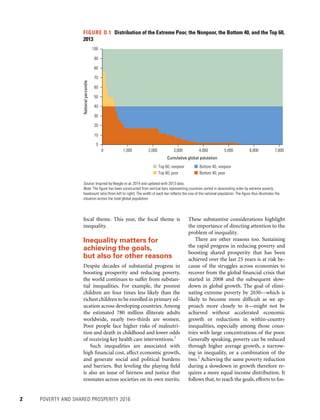
of these countries show that labor markets
can help reduce inequalities by expanding
job opportunities across emerging mar-
kets, as in Cambodia, or traditional sectors,
as in Mali and Tanzania; sharing earning
opportunities with individuals previously
excluded from growth, such as the low-
skilled and women in Tanzania and Cam-
bodia; and narrowing earnings gaps across
workers, such as between men and women
in Cambodia, between economic sectors in
Mali, between formal and informal jobs in
Brazil and Peru, and between urban and
rural residents in Peru.
These five successful cases also highlight
the importance of aligning macroeconomic
and fiscal policies with sound sector-specific
interventions and public investments. Thus,
improving the coverage and quality of ed-
ucation, expanding the coverage of public
health care, enhancing market connectivity,
and establishing or scaling up safety nets to
protect vulnerable populations recur in the
country narratives. Although not all such
interventions took place simultaneously in
each country, the lesson is that the coher-
ence of policy choices in macroeconomic
and sectoral dimensions is critical to en-
abling steady reductions in inequality. Thus,
appropriate policies and investments were
identified and implemented in low-income
Cambodia, Mali, and Tanzania during pe-
riods of economic diversification and in
Brazil and Peru during periods of booming
commodity prices.
This does not mean every policy decision
in these countries was appropriate. In fact,
these country experiences show that good
luck—in the form of favorable external
events unexpectedly benefiting a country—
cannot be a substitute for policy coherence.
Positive external shocks may magnify local
efforts to reduce inequality. The surge in
commodity prices favored the economies
of Brazil and Peru, while the rise in the in-
ternational rice prices clearly helped to raise
the inclusive capacity of the Cambodian
122	 POVERTY AND SHARED PROSPERITY 2016
try. While Brazil is marked by historically
record inequalities, conflict has affected
Cambodia and, recently, Mali. Indeed, Mali
shows that, although inequality can be re-
duced during periods of weak governance,
such achievements may not be sustained or
long-lived. Rapid population growth is also
a dominant feature in Mali, which, along
with Tanzania, is a low-income country. In
Peru, the extent of informality in the econ-
omy is among the largest in the region. This
chapter thus provides suggestive insights
on policy interventions that, among a myr-
iad of alternatives, have worked in specific
contexts.
Notes
 1. See Azevedo, Inchauste, and Sanfelice
(2013); Azevedo, Sanfelice, and Nguyen
(2012); Barros et al. (2006); Datt and Rav-
allion (1992); Inchauste et al. (2014); Lustig
(2015) for methodological discussions of
the Commitment to Equity Initiative and
the decompositions.
  2. Ferreira, Leite, and Litchfield (2008).
 3. Using data from the national household
surveys and tax records to construct a full
individual income distribution, Souza, Me-
deiros, and Castro (2015) show that the Gini
index fell by about 1 point between 2006
and 2012, compared with a fall of around 3
points if only household per capita income
from the survey is used.
  4. The estimate is based on a national poverty
line. However, Brazil does not have an offi-
cial poverty line. The R$140 per capita per
month moderate poverty line is derived
from the administrative poverty lines de-
fined for the Bolsa Família Program and the
Brasil Sem Miséria Program.
  5. World Bank (2016a).
 6. Tabulations of Equity Lab, Team for Statis-
tical Development, World Bank, Washing-
ton, DC, based on household survey data,
data in the SEDLAC database, and data de-
rived through PovcalNet (online analysis
tool), World Bank, Washington, DC, http://
iresearch.worldbank.org/PovcalNet/. The in­
formation has been updated as of April 2016.
  7. López-Calva and Rocha (2012); World Bank
(2016a).
  8. Ferreira, Leite, and Litchfield (2008).
good deal of the success. In Peru, rising do-
mestic demand owing to substantial foreign
investment in mining has expanded the em-
ployment opportunities in the urban infor-
mal sector, while a dynamic agriculture has
diversified into new exports. Earnings gaps
narrowed between formal and informal
workers following economic growth, as in
the case of Brazil and Cambodia.
While the experiences reviewed in this
chapter suggest that reducing inequality can
be achieved in many different ways if appro-
priate building blocks are put in place, sus-
taining this success may require decisions
that are similar to those outlined here. Thus,
the five country cases suggest that there are
still common policy interventions likely to
sustain inequality reduction in developing
countries. For example, the situation in
countries such as Cambodia, Mali, and Tan-
zania underscores the need to expand safety
nets, which are currently not large enough
to protect the poorest. The Brazilian experi-
ence, a renowned example of safety net ex-
pansion, shows that the entire fiscal system
can be designed to have a greater impact in
reducing inequality. This is also the case in
Tanzania. Improving competition and pro-
ductivity in the private sector is also a prior-
ity in that country. Infrastructure is report-
edly a huge obstacle in Cambodia, while,
in Mali, dependence on external factors,
from donor flows to the vagaries of weather,
threaten sustained improvement. In Peru,
the quality of education is below regional
standards and would represent an obsta-
cle to maintaining or improving economic
productivity should more favorable exter-
nal conditions disappear. The accumulation
of quality human capital, diversification in
income-earning opportunities among the
poor, safety nets that are sufficiently large
to protect the poorest, and improved infra-
structure to connect lagging regions to eco-
nomic growth opportunities are all desir-
able strategies to sustain success in boosting
shared prosperity and narrowing inequality.
However, caution needs to be exerted to
turn these findings into prescriptions with
international validity. This is not only be-
cause of the small number of cases analyzed,
but also because of the large differences in
the contexts and challenges in each coun-
REDUCTIONS IN INEQUALITY: A COUNTRY PERSPECTIVE 	 123
percent and 27 percent, respectively, while,
in Phnom Penh, the index fell by 19 percent
between 2007 and 2013.
24. World Bank (2016b).
25. The proportion of the population living
below the national poverty line declined by
nearly half, to 23.9 percent, from 2007 to
2009 alone and continued to decline there-
after, although more moderately. In rural
areas, poverty was reduced by half between
2007 and 2011, from 51.8 percent to 23.7
percent. World Bank (2014a).
26. IMF (2015).
27. Agriculture’s share in GDP was eclipsed by
industry’s share for the first time in 2007,
which was also the year that investment first
surpassed the flows of official development
assistance to Cambodia.
28. ADB (2014a).
29. Mejia-Mantilla and Woldemichael (2016).
30. In addition, in 2010, the government un-
veiled an official rice policy that set out to
increase annual milled rice exports to a mil-
lion tons by 2015, a target that went unful-
filled (World Bank 2009).
31. World Bank (2014a).
32. ADB (2014b). Average per capita income
from nonfarm self-employment jumped 63
percent between 2004 and 2009, and daily
rural wages more than doubled between
2007 and 2012.
33. World Bank (2014a, 2016b).
34. IMF (2015).
35. Recent agricultural productivity gains from
an expansion in the arable land under cul-
tivation are not sustainable indefinitely and
are thus unable to offset these problems.
36. ADB (2014b); ASPIRE (Atlas of Social Pro-
tection Indicators of Resilience and Equity)
(database), World Bank, Washington, DC,
http://datatopics.worldbank.org/aspire/.
37. Kanbur, Rhee, and Zhuang (2014).
38. Using the Atlas method, in current U.S. dol-
lars; see WDI (World Development Indica-
tors) (database), World Bank, Washington,
DC, http://data.worldbank.org/data-catalog
/world-development-indicators.
39. UNDP (2014).
40. Data for 2014, WDI (World Development
Indicators) (database), World Bank, Wash-
ington, DC, http://data.worldbank.org/data
-catalog/world-development-indicators.
41. World Bank (2015a).
 9. Azevedo et al. (2013); Barros et al. (2010);
Ferreira, Firpo, and Messina (2014); Lustig,
López-Calva, and Ortiz-Juárez (2013).
10. World Bank (2016a).
11. López-Calva and Rocha (2012).
12. The widening in formality was supported
by institutional policies aiming to enforce
labor legislation (Ferreira, Firpo, and Mes-
sina 2014). In particular, the government ex-
panded the role of the Brazilian Public Pros-
ecutor’s Office (Ministério Público) and the
Ministry of Labor and Employment. In ad-
dition, reforms to improve the efficiency of
labor inspections were implemented in 1995.
Corseuil, Almeida, and Carneiro (2012) pro-
vide evidence from 1996–2006 that estab-
lishes a causal relationship between the re-
forms and increases in formal employment.
13. Ferreira, Firpo, and Messina (2014).
14. World Bank (2016a).
15. Equity Lab tabulations based on house-
hold survey data and data in the SEDLAC
database.
16. Barros et al. (2010); Osorio and Souza
(2012).
17. This means that the income inequality gen-
erated by the functioning of the markets—
estimated at a Gini index of 55 in 2009—
was reduced by 6 percent, or 3.3 percentage
points, after direct taxes and transfers are
taken into account. Higgins and Pereira
(2014); Higgins et al. (2013).
18. Clements et al. (2015); Immervoll et al.
(2006). The 33 percent reduction is equiv-
alent to a reduction of about 14 percentage
points in the average market income Gini in
the OECD.
19. Higgins and Pereira (2014); Higgins et al.
(2013).
20. Carneiro (2006).
21. Recent analyses also include other factors in
the discussion of trends in labor inequality in
Brazil, such as degradation of tertiary educa-
tion, obsolescence of skills, the heterogeneity
of firms within industries, skill-biased tech-
nological change, and the role of unions. The
interplay of all factors in final wage inequality
is complex, and there does not seem to exist
a strong consensus on the contribution of
these factors. See Silva and Messina (2016).
22. World Bank (2016b).
23. Other urban and rural areas experienced
the greatest declines in the Gini index, by 35
124	 POVERTY AND SHARED PROSPERITY 2016
65. There are also issues of comparability
among surveys in Tanzania stemming from
changes in the survey design and method-
ological improvements implemented during
the 2011/12 household budget survey. The
World Bank (2015c) addresses these issues
using different methods, including the re-
evaluation of the consumption aggregates
for the 2007 household budget survey using
the same approach as in 2011/12, as well as
nonparametric and parametric imputation
procedures. The various adjustment meth-
ods support the main results presented here.
66. World Bank (2016d).
67. Edwards (2012).
68. Robinson, Gaertner, and Papageorgiou
(2011).
69. World Bank (2016d).
70. World Bank (2015c).
71. World Bank (2016e). The estimate includes
beneficiaries of public works programs and
the expansion of cash transfers.
72. World Bank (2015c).
73. Younger, Myamba, and Mdadila (2016).
74. Commission on Growth and Development
(2008).
75. World Bank (2016f).
References
ADB (Asian Development Bank). 2014a. Cambo-
dia: Diversifying beyond Garments and Tour-
ism, Country Diagnostic Study. November.
Manila: Economics and Research Depart-
ment, ADB.
———. 2014b. “Cambodia: Country Poverty
Analysis 2014.” ADB, Manila.
Azevedo, João Pedro, María Eugenia Dávalos,
Carolina Díaz-Bonilla, Bernardo Atuesta, and
Raul Andres Castañeda.2013.“FifteenYears of
Inequality in Latin America: How Have Labor
Markets Helped?” Policy Research Working
Paper 6384, World Bank, Washington, DC.
Azevedo, João Pedro, Gabriela Inchauste, and
Viviane Sanfelice. 2013. “Growth without
Reductions in Inequality.” Background paper,
Poverty and Gender Unit,World Bank,Wash-
ington, DC.
Azevedo, João Pedro, Viviane Sanfelice, and
Minh Cong Nguyen. 2012. “Shapley Decom-
position by Components of a Welfare Mea-
sure.” Unpublished working paper, World
Bank, Washington, DC.
42. World Bank (2015b, 100).
43. Beegle et al. (2016) have questioned the
comparability of surveys in Mali. However,
after a careful analysis of the robustness of
welfare estimates using the same household
surveys, the World Bank (2013) has con-
cluded that the results are robust to alterna-
tive choices of poverty lines accounting for
comparability issues.
44. World Bank (2015a).
45. World Bank (2015b).
46. World Bank (2015a, 2015b).
47. Josz (2013).
48. World Bank (2015a, 2015b).
49. Cherrier, del Ninno, and Razmara (2011).
50. World Bank (2015a).
51. Vakis, Rigolini, and Lucchetti (2015).
52. World Bank (2016c).
53. WDI (World Development Indicators (data-
­base), World Bank, Washington, DC, http://
data.worldbank.org/data-catalog/world
-development-indicators.
54. World Bank (2016c).
55. Genoni and Salazar (2015).
56. Jaramillo and Saavedra-Chanduvi (2011).
57. World Bank (2016c).
58. Rodríguez-Castelán et al (2016); Silva and
Messina (2016).
59. Inchauste et al. (2014).
60. World Bank (2016c).
61. Jaramillo (2013); Lustig et al. (2012).
62. Genoni and Salazar (2015).
63. The poverty figures are for Tanzania main-
land only and come from 2007 and 2011/12
Household Budget Survey data. They are
estimated using, respectively, the national
basic needs poverty line of T Sh 36,482 per
adult per month and the national food pov-
erty line of T Sh 26,085 per adult per month.
See World Bank (2016d).
64. Tanzania’s Gini index in 2012 (35.8) was
lower than the 45.1 Sub-Saharan African
average and, among East African countries,
it was below that of Burundi (46.0), Kenya
(47.7), Uganda (44.3), and Rwanda (50.8).
It was only slightly higher than the index of
Ethiopia (33.6). It was on par with levels of
inequality in South Asia and East Asia, which
were grouped around 38.4, and significantly
lower relative to indexes in Latin America,
such as Bolivia, Brazil, and Mexico, where the
levels of inequality ranged from 47.0 to 55.2
(World Bank 2015c).
REDUCTIONS IN INEQUALITY: A COUNTRY PERSPECTIVE 	 125
Fall of Brazilian Inequality: 1981–2004.”
Macro­economic Dynamics 12 (S2): 199–230.
Ferreira, Francisco H. G., Sergio P. Firpo, and
Julian Messina. 2014. “A More Level Playing
Field? Explaining the Decline in Earnings In-
equality in Brazil, 1995–2012.” IRIBA Work-
ing Paper 12 (September), International Re-
search Initiative on Brazil and Africa, School
of Environment, Education, and Develop-
ment, University of Manchester, Manchester,
United Kingdom.
Genoni, María Eugenia, and Mateo Salazar. 2015.
“Steering toward Shared Prosperity in Peru.”
In Shared Prosperity and Poverty Eradication
in Latin America and the Caribbean, edited
by Louise Cord, María Eugenia Genoni, and
Carlos Rodríguez-Castelán, 269–302. Wash-
ington, DC: World Bank.
Higgins, Sean, Nora Lustig, Whitney Ruble, and
Timothy M. Smeeding. 2013. “Comparing
the Incidence of Taxes and Social Spend-
ing in Brazil and the United States.” CEQ
Working Paper 16, Commitment to Equity,
Inter-American Dialogue, Washington, DC;
Center for Inter-American Policy and Re-
search and Department of Economics, Tu-
lane University, New Orleans.
Higgins, Sean, and Claudiney Pereira. 2014.
“The Effects of Brazil’s Taxation and Social
Spending on the Distribution of Household
Income.” In “Analyzing the Redistributive
Impact of Taxes and Transfers in Latin Amer-
ica,” edited by Nora Lustig, Carola Pessino,
and John Scott, special issue, Public Finance
Review 42 (3): 346–67.
IMF (International Monetary Fund). 2015.
“Cambodia: Staff Report for the 2015 Arti-
cle IV Consultation.” IMF Country Report
15/307 (October 1), IMF, Washington, DC.
Immervoll, Herwig, Horacio Levy, José Ricardo
Nogueira, Cathal O’Donoghue, and Rozane
Bezerra de Siqueira. 2009. “The Impact of
Brazil’s Tax-Benefit System on Inequality and
Poverty.” In Poverty, Inequality, and Policy in
Latin America, edited by Stephan Klasen and
Felicitas Nowak-Lehmann, 271–301. CESifo
Seminar Series. Cambridge, MA: MIT Press.
Inchauste, Gabriela, João Pedro Azevedo, B.
Essama-Nssah, Sergio Olivieri, Trang Van
Nguyen, Jaime Saavedra-Chanduvi, and Her-
nan Winkler. 2014. Understanding Changes in
Poverty. Directions in Development: Poverty
Series. Washington, DC: World Bank.
Barros, Ricardo Paes de, Mirela De Carvalho,
Samuel Franco, and Rosane Mendonça.
2006. “Uma Análise das Principais Causas da
Queda Recente na Desigualdade de Renda
Brasileira.” Revista Econômica 8 (1): 117–47.
———. 2010. “Markets, the State, and the Dy-
namics of Inequality in Brazil.” In Declin-
ing Inequality in Latin America: A Decade of
Progress?, edited by Luis F. López-Calva and
Nora Lustig, 134–74. New York: United Na-
tions Development Programme; Baltimore:
Brookings Institution Press.
Beegle, Kathleen, Luc Christiaensen, Andrew
Dabalen, and Isis Gaddis. 2016. Poverty in a
Rising Africa. Africa Poverty Report. Wash-
ington, DC: World Bank.
Carneiro, Francisco Galrão. 2006.“The Effects of
the Minimum Wage on the Brazilian Labor
Market.” In The Third Dimension of Labor
Markets: Demand, Supply, and Institutions in
Brazil, edited by Francisco Galrão Carneiro,
Indermit S. Gill, and Ricardo Paes de Barros,
113–44. New York: Nova Science Publishers.
Cherrier, Cécile, Carlo del Ninno, and Setareh
Razmara. 2011. “Mali Social Safety Nets.” So-
cial Protection and Labor Discussion Paper
1412, World Bank, Washington, DC.
Clements, Benedict, Ruud de Mooij, Sanjeev
Gupta, and Michael Keen, eds. 2015. Inequal-
ity and Fiscal Policy. Washington, DC: Inter-
national Monetary Fund.
Corseuil, Carlos Henrique L., Rita Almeida, and
Pedro Carneiro. 2012. “Inspeção do trabalho
e evolução do emprego formal no Brasil.”
Texto para Discussão TD 1688, Institute for
Applied Economic Research, Brasília.
Commission on Growth and Development.2008.
The Growth Report: Strategies for Sustained
Growth and Inclusive Development. Wash-
ington, DC: World Bank. https://openknowl
edge.worldbank.org/handle/10986/6507.
Datt, Gaurav, and Martin Ravallion. 1992.
“Growth and Redistribution Components of
Changes in Poverty Measures: A Decomposi-
tion with Applications to Brazil and India in
the 1980s.” Journal of Development Economics
38 (2): 275–95.
Edwards, Sebastian. 2012. “Is Tanzania a Success
Story? A Long Term Analysis.” NBER Work-
ing Paper 17764 (January), National Bureau
of Economic Research, Cambridge, MA.
Ferreira, Francisco H. G., Phillippe George Leite,
and Julie A. Litchfield. 2008. “The Rise and
126	 POVERTY AND SHARED PROSPERITY 2016
Mejia-Mantilla, Carolina, and Martha Tesfaye
Woldemichael. 2016. “To Sew or Not to Sew?
Assessing the Welfare Effects of the Garment
Industry in Cambodia.” World Bank, Wash-
ington, DC.
Osorio, Rafael Guerreiro, and Pedro H. G.
Ferreira de Souza. 2012. “O Bolsa Família de-
pois do Brasil Carinhoso: uma análise do po-
tencial de redução da pobreza extrema.” Insti-
tute for Applied Economic Research, Brasília.
Robinson, David O., Matthew Gaertner, and
Chris Papageorgiou.2011.“Tanzania: Growth
Acceleration and Increased Public Spending
with Macroeconomic Stability.” In Yes Africa
Can: Success Stories from a Dynamic Conti-
nent, edited by Punam Chuhan-Pole and
Manka Angwafo, 21–50. Washington, DC:
World Bank.
Rodríguez-Castelán, Carlos, Luis F. López-Calva,
Nora Lustig, and Daniel Valderrama. 2016.
“Understanding the Dynamics of Labor In-
come Inequality in Latin America.” Policy
Research Working Paper 7795, World Bank,
Washington, DC.
SEDLAC (Socio-Economic Database for Latin
America and the Caribbean), Center for Dis-
tributive, Labor, and Social Studies, Univer-
sidad de La Plata, La Plata, Argentina; World
Bank, Washington, DC, http://sedlac.econo
.unlp.edu.ar/eng/index.php.
Shorrocks, Anthony. 2013. “Decomposition Pro-
cedures for Distributional Analysis: A Uni-
fied Framework Based on the Shapley Value.”
Journal of Income Inequality 11 (1): 99–126.
Silva, Joana, and Julián Messina. 2016. “Wage
Inequality in Latin America: Trends and Puz-
zles.”Unpublished regional study, Office of the
Chief Economist, Latin America and Carib-
bean Region, World Bank, Washington, DC.
Souza, Pedro H. G. Ferreira de, Marcelo Me-
deiros, and Fabio Avila de Castro. 2015.“‘Top
Incomes in Brazil: Preliminary Results.” Eco-
nomics Bulletin 35 (2): 998–1004.
UNDP (United Nations Development Pro-
gramme). 2014. Human Development Report
2014; Sustaining Human Progress: Reducing
Vulnerabilities and Building Resilience. New
York: UNDP.
Vakis, Renos, Jamele Rigolini, and Leonardo Luc-
chetti. 2015.“Overview; Left Behind: Chronic
Poverty in Latin America and the Caribbean.”
World Bank: Washington, DC.
Jaramillo, Miguel. 2013.“The Incidence of Social
Spending and Taxes in Peru.” CEQ Working
Paper 9 (January), Commitment to Equity,
Inter-American Dialogue, Washington, DC;
Center for Inter-American Policy and Re-
search and Department of Economics, Tulane
University, New Orleans.
Jaramillo, Miguel, and Jaime Saavedra-Chanduvi.
2011. “Menos desiguales: la distribución del
ingreso luego de las reformas estructurales.”
Documento de investigación 59, Grupo de
Analisis para el Desarrollo, Lima, Peru.
Josz, Christian. 2013. “Mali: Achieving Strong
and Inclusive Growth with Macroeconomic
Stability.” African Development 13/08, Inter-
national Monetary Fund, Washington, DC.
Kanbur, Ravi, Changyong Rhee, and Juzhong
Zhuang, eds. 2014. Inequality in Asia and the
Pacific: Trends, Drivers, and Policy Implica-
tions. Manila: Asian Development Bank; New
York: Routledge.
López-Calva, Luis F., and Sonia Rocha. 2012.
“Exiting Belindia? Lesson from the Recent
Decline in Income Inequality in Brazil.” Re-
port 70155, Poverty, Gender, and Equity
Unit, Latin America and Caribbean Region,
World Bank, Washington, DC.
Lustig, Nora. 2015. “Inequality and Fiscal Re-
distribution in Middle Income Countries:
Brazil, Chile, Colombia, Indonesia, Mexico,
Peru and South Africa.” CEQ Working Paper
31 (July), Commitment to Equity, Inter-
American Dialogue, Washington, DC; Center
for Inter-American Policy and Research and
Department of Economics, Tulane Univer-
sity, New Orleans.
Lustig, Nora, Luis F. López-Calva, and Eduardo
Ortiz-Juárez. 2013. “Declining Inequality
in Latin America in the 2000s: The Cases of
­Argentina, Brazil, and Mexico.” World Devel-
opment 44 (C): 129–41.
Lustig, Nora, George Gray Molina, Sean Higgins,
Miguel Jaramillo, Wilson Jiménez, Veronica
Paz, Claudiney Pereira, Carola Pessino, John
Scott, and Ernesto Yañez. 2012. “The Impact
of Taxes and Social Spending on Inequal-
ity and Poverty in Argentina, Bolivia, Brazil,
Mexico and Peru: A Synthesis of Results.”
CEQ Working Paper 3, Commitment to Eq-
uity, Inter-American Dialogue, Washington,
DC; Center for Inter-American Policy and Re-
search and Department of Economics, Tulane
University, New Orleans.
REDUCTIONS IN INEQUALITY: A COUNTRY PERSPECTIVE 	 127
———. 2016a. Brazil Systematic Country Diag-
nostic: Retaking the Path to Inclusion, Growth,
and Sustainability. Report 101431-BR, Wash-
ington, DC: World Bank.
———. 2016b. “Cambodia: Poverty Reduction
and Equity in 2013.” World Bank, Washing-
ton, DC
———. 2016c. “Peru Systematic Country Diag-
nostic: Concept Note.” World Bank, Wash-
ington, DC.
———. 2016d. “Tanzania Systematic Coun-
try Diagnostic: Concept Note.” World Bank,
Washington, DC.
———. 2016e. “International Development
Association Project Paper, United Republic
of Tanzania: Productive Social Safety Net
(PSSN).” Report PAD1500 (May 20), World
Bank, Washington, DC.
———. 2016f. “Macro and Poverty Outlook:
Spring Meetings Edition, 2016.” World Bank,
Washington, DC.
Younger, Stephen D., Flora Myamba, and
Kenneth Mdadila. 2016. “Fiscal Incidence in
Tanzania.” CEQ Working Paper 36, Commit-
ment to Equity, Inter-American Dialogue,
Washington, DC; Center for Inter-American
Policy and Research and Department of Eco-
nomics, Tulane University, New Orleans.
World Bank. 2009. “International Development
Association Program Document, Kingdom
of Cambodia: Proposed Smallholder Agri-
culture and Social Protection Support Op-
eration.” Report 48083-KH (June 19), World
Bank, Washington, DC.
———. 2013.“Mali: Poverty and Gender Notes.”
Report 77752-ML (May 31), World Bank,
Washington, DC.
———. 2014a. “Where Have All the Poor Gone?
Cambodia Poverty Assessment 2013.” Report
ACS4545, World Bank, Washington, DC.
———. 2014b. “Social Gains in the Balance: A
Fiscal Policy Challenge for Latin America and
the Caribbean.”LAC Poverty and Labor Brief,
Report 85162 rev (February), Latin America
and Caribbean Region, World Bank, Wash-
ington, DC.
———. 2015a. “Republic of Mali, Priorities for
Ending Poverty and Boosting Shared Prosper-
ity: Systematic Country Diagnostic (SCD).”
Report 94191-ML (June 22), World Bank,
Washington, DC.
———. 2015b. “The Geography of Poverty in
Mali.” Report 88880-ML (April 23), World
Bank, Washington, DC.
———. 2015c.“Tanzania Mainland: Poverty As-
sessment.” Report AUS6819 v2, World Bank,
Washington, DC.
6
This chapter discusses what we know about key domestic policy interventions that are effec-
tive in reducing inequality, the benefits they generate, the choices that need to be made
concerning their design and implementation, and the trade-offs with which they are asso­
ciated. The chapter does not provide an exhaustive or comprehensive review of every inter-
vention that could reduce inequality, nor does it supply universal prescriptions. Instead,
it focuses on a few policy areas on which there is a sufficient body of rigorous evidence
to draw out useful lessons with confidence: early childhood development (ECD), including
breastfeeding; universal health care; good-quality education; conditional cash transfers (CCTs);
investments in rural infrastructure; and taxation. The several lessons that are revealed through
the examination are supported by consolidated and emerging evidence and appear to be
generally valid.
Despite progress, disparities persist today that are affecting well-being, the access to
basic services, and current and future economic opportunities among the poor. Pathways
to reduce inequality are many, from narrowing gaps in income generation opportunities to
reducing the potential for inequalities in human capital development before they emerge;
smoothing consumption among the most deprived, especially during shocks; and redistrib-
uting in favor of the poor.
Although many interventions do not have equalizing objectives, they are associated with
equalizing outcomes. Improved competition and economic efficiency are compatible with
reducing inequality. The fine points of policy design absolutely matter in determining the
extent to which policy interventions lead to reductions in inequality without compromising
efficiency. Therefore, in the design of equalizing policies, implementation trade-offs should
not be overlooked because of too much attention to efficiency and equity trade-offs.
Nonetheless, universal prescriptions and unique models are problematic. Evidence indi-
cates the value of general principles and the analysis of lessons learned. Integrated, simple,
and flexible interventions are more likely to succeed than individual interventions, and the
composition of interventions dictates the extent of success. Equalizing interventions are not
a luxury exclusive to middle- and high-income countries, nor an option only during periods of
prosperity. Good interventions are possible in all settings and at all times, including among
low-income countries and during crises, and they may disproportionally favor the poorest
households. To achieve this, the most deprived and the most vulnerable must be involved
in the interventions. Knowledge about appropriate policies and interventions has increased
significantly in recent decades, but more microeconomic data and better analysis of these
data are needed.
Reductions in Inequality:
A Policy Perspective
	 REDUCTIONS IN INEQUALITY: A POLICY PERSPECTIVE 	 129
130	 POVERTY AND SHARED PROSPERITY 2016
specific interventions discussed are ECD,
including breastfeeding; universal health
care coverage; good-quality education; cash
transfers, mostly conditional transfers; in-
vestments in rural infrastructure, specif-
ically, rural roads and electrification; and
income and consumption taxes.
The selection means that other policy
interventions with potential effects on in-
equality are not included in the assessment.
This is not intended to deny the potential
equalizing effects of these other interven-
tions; the evidence of the equalizing effects
is merely less compelling, is currently being
collected, or a general consensus is absent
on how to frame the policies to reduce in-
equality while reaching other objectives.
This is the reason interventions revolving
around land redistribution or financial
inclusion, measures to adapt to climate
change, or steps to promote technology and
innovation are not included, for example.1
Even the highly selective choice of in-
terventions demonstrates that inequality
can be successfully confronted from mul-
tiple angles. Pathways to reduce inequality
are many, from narrowing gaps in income
generation opportunities to reducing the
potential for inequalities in human capital
development to emerge; smoothing con-
sumption among the most deprived, espe-
cially during shocks; and redistributing in
favor of the poor. The interventions selected
in this chapter cover each of these pathways.
One approach to analyzing the evidence
consists of following the effects of inter-
ventions during an individual’s life cycle,
which helps determine the short- and long-
term equalizing impacts of interventions.
Thus, breastfeeding during the first year
of life and ECD interventions during the
first 1,000 days of life set the foundations
for greater opportunities later by prevent-
ing nutritional and cognitive development
gaps among the poorest children. They are
predistribution interventions, that is, they
address potential inequalities early on, be-
fore the inequalities emerge. By prevent-
ing or reducing nutritional and cognitive
development gaps, which have long-run
consequences on health, education, and
future earnings, the interventions also level
the playing field and help equalize oppor-
Introduction
Countries can reduce inequality. This is
true of low- and middle-income countries
as well as high-income countries. Success-
ful country experiences confirm that good
macroeconomic management, solid and
steady growth, functioning labor markets,
and coherent space for the play of domestic
policy lead to reductions in inequality (see
chapter 5).
Chapter 6 focuses on what is known
about domestic policy interventions that
are effective in reducing inequality, the ben-
efits they create, the choices that are neces-
sary in designing and implementing them,
and the trade-offs that tend to emerge. The
trade-offs involve choices between more eq-
uity and more economic efficiency, but also
along many other dimensions, for example,
deciding who might benefit from an inter-
vention and who may not, who should pay,
and whether to promote greater generosity
or lower costs.
The focus is on a narrow group of inter-
ventions within the coherent space of do-
mestic policies identified in chapter 5 that
can successfully reduce inequality without
compromising efficiency. There is no at-
tempt to be exhaustive or to offer a com-
prehensive review of every policy that may
narrow inequality or enhance the scope for
equality of opportunity. Voluminous re-
views of sectoral interventions already exist
that provide relevant in-depth assessments.
There is much less analysis available on the
capacity of certain policies to reduce in-
equality and the pathways through which
this may be accomplished.
The policy areas examined in this chap-
ter are those the evaluation in chapter
5 shows to be relevant in the effort to re-
duce inequality, alongside macroeconomic
management, steady growth, and function-
ing labor markets. These policy areas are
human capital accumulation, investments
in infra­structure, and progressive fiscal
policies. Within these policy domains, this
chapter tightens the focus to selected in-
terventions on which a body of rigorous
evidence has been accumulated, including
evaluation evidence, thereby allowing les-
sons to be drawn out with confidence. The
REDUCTIONS IN INEQUALITY: A POLICY PERSPECTIVE 	 131
pathways, and implementation issues most
relevant to each of these interventions.
The assessment offers analysis of multiple
evidence-based lessons on successful equal-
izing interventions across low- and middle-
income countries, regions, and contexts.
Early childhood
development and nutrition
ECD promotes physical, socioemotional,
language, and cognitive development dur-
ing a child’s early years. Breastfeeding and
complementary feeding are often integrated
in ECD interventions. Investing in such in-
terventions shapes an individual’s educa-
tional attainment, health, social behavior,
and earnings in adulthood.3
The first 1,000
days of life are especially important: nutri-
tional deficiencies and cognitive underde-
velopment during this period are associ-
ated with later cognitive delays and lower
academic achievement. Reducing inequality
through ECD therefore reduces inequalities
in ability, educational achievement, health
status, and expected adult earnings, gains
that are carried over throughout an individ-
ual’s life.
The current inequalities in ECD are
stark. Thus, worldwide, poor children enjoy
far less access to ECD programs than their
richer peers.Data show that,in 21 of 27 low-
or middle-income countries, preschool en-
rollment rates among the poorest quintile
are less than a third of the rates among the
richest quintile.4
These disadvantages are
compounded by the fact that poor children
also have less access to adequate nutrition,
health care services, basic water and sani-
tation infrastructure, and childcare, which
make them more prone to inadequate de-
velopment. As a result, nearly one under-
5-year-old in four worldwide still suffers
from stunting (low height for age), a sign of
chronic malnutrition and abbreviated child
development.5
Unlike some policy interventions, ECD
programs are not associated with equity-
efficiency trade-offs.6
Investments in ECD
interventions typically have economic bene-
fits among individuals as well as society. For
example, earnings at ages 28–40 among par-
ticipants in the HighScope Perry Preschool
tunities throughout the life of an individ-
ual. Universal health care coverage and
good-quality education increase the human
capital of children, youth, and adults. Given
the daunting inequalities in health care
and education prevailing today, achieving
universal health care coverage and good-
quality education for all requires that those
who are currently excluded from health care
and quality education benefit from inter-
ventions. Raising the human capital of the
excluded also helps level the future playing
field. In contrast, CCTs and taxation have
short-term effects on income distribution
if they, respectively, smooth consumption
among the most deprived and redistribute
income from the rich to the poor. The con-
struction or improvement of rural roads
likewise has immediate effects on the gen-
eration of income opportunities by expand-
ing the market connectivity of, for instance,
isolated smallholder farmers. In so far as
these investments allow the poorest com-
munities to increase and diversify incomes,
the strategy should also have an impact on
inequality.
Another approach through which one
may analyze how policy interventions af-
fect inequality is by way of the functions
of the policies. To end poverty, policies can
grow the incomes of the poorest; boost
their human capital, thereby reducing the
gaps between them and other population
groups; and protect them from unequaliz-
ing shocks, that is, shocks having dispropor-
tionate consequences on the poorest relative
to less vulnerable population groups.2
For
example, investment in rural infrastructure
supports economic growth and other phys-
ical investments; ECD, universal health care
coverage, and good-quality education con-
stitute investments in human capital; and
cash transfers allow individuals to be pro-
tected against various consumption shocks
and other risks. Policy choices in taxation
may affect economic growth as well as the
availability of household resources to invest
in human capital and access other protec-
tion mechanisms.
Organizing the policy discussion around
such analytical frameworks allows the fol-
lowing sections to briefly describe the ex-
isting evidence on the benefits, impacts,
132	 POVERTY AND SHARED PROSPERITY 2016
a more rapid rate than undersized children
who were not participating (figure 6.1).12
Researchers followed up among the partic-
ipants 20 years after the intervention and
found that the groups receiving stimula-
tion (with or without the nutrition supple-
ment) had 25 percent higher earnings than
the control group. This increase in earnings
had allowed those in the stimulation pro-
gram to catch up completely with the
nonstunted comparison group, effectively
reducing the inequality of incomes across
the groups. Meanwhile, the nutrition-only
group showed no statistically significant
difference with the control group.13
Building on the Jamaican success, other
countries have adapted the program to local
conditions. The results have been widely
positive. For instance, a recent randomized
controlled trial involving 1,400 children in
Colombia that enlisted local mothers to
make home visits found substantial ben-
efits in children’s cognitive and language
development.14
The program achieved the
most success among children with higher
baseline levels of development and among
children whose mothers had higher levels of
schooling. In Bangladesh, another random-
Study in the 1960s in the United States (de-
tailed below) were 28 percent higher than
the earnings among the control group.7
Such
individual benefits represent about a third
to a half of the total payoffs from such inter-
ventions, once social benefits—the reduced
public spending required to address grade
repetition, social assistance transfers, and
crime—are taken into account.8
On breast-
feeding, a recent meta-analysis estimates the
economic impact of exclusive breastfeeding
during a prolonged period (until age 12
months or later) at US$302 billion, or 0.5
percent of the world’s gross income.9
Given the broad nature of ECD inter-
ventions, those interventions reported to
have the largest benefits and associated with
the most compelling supporting evidence
of such benefits are examined here: par-
enting skills, preschool, breastfeeding, and
nutrition.10
Parenting skills
Because of the preeminent role the home en-
vironment plays in the early development of
children, many ECD programs concentrate
on parenting skills to promote greater cogni-
tive stimulation among children and higher-
quality parent-child interactions. These pro-
grams generally involve one or more of three
initiatives: home visits, group sessions, and
clinic appointments. Research suggests all
these programs are largely effective.
The most well known program of this
kind in the developing world is a Jamaican
intervention that began in 1986 and lasted
two years. The Jamaican study targeted tod-
dlers ages 9–24 months who suffered from
stunting. The intervention consisted of
weekly visits by community health workers
to teach parenting skills aimed at fostering
cognitive and socioemotional develop-
ment.11
It also provided nutrition supple-
ments and psychosocial stimulation. The
sample was divided into four groups: one
group received stimulation only; one re-
ceived nutrition only; one received both;
and one received neither. Undersized chil-
dren benefiting from psycho­social stimu-
lation and nutrition interventions caught
up with normally sized children 18 months
after the start of the program, developing at
FIGURE 6.1  The Mental Development of
Stunted Children, Jamaica, 1986–87
Source: Grantham-McGregor et al. 1991.
Note: Development quotient = age of the group into which test
scores place the child, divided by the child’s chronological age
and multiplied by 100.
85
90
95
100
105
110
115
Birth 6 12
Age (months)
Developmentquotient
18 24
Children of normal height
Stimulation and nutritional supplement
Control group
REDUCTIONS IN INEQUALITY: A POLICY PERSPECTIVE 	 133
pression. The estimated premium in lifetime
net benefits per program participant relative
to the control group was US$78,000.21
Other
preschool programs evaluated in the United
States, including the Abecedarian Project
and state programs, suggest that the aver-
age benefit-to-cost ratio was 6:1–7:1, that is,
US$6.00–US$7.00 per US$1.00 invested in
preschool.22
While no longitudinal study has been
conducted in the developing world over
such a long period, a number of studies
have investigated short-term impacts. In
Mozambique, a Save the Children pilot
­program begun in 2008 in 30 villages in
rural Gaza Province has shown positive
­results, all for an investment of less than
US$3 per child per month. A rigorous eval-
uation shows that the program improves
outcomes among children in cognitive,
socioemotional, and fine-motor develop-
ment; increases the chances that children
will be in primary school and at their age-
appropriate grade; and improves self-
reported parental behavior in early stimula-
tion and discipline.23
A program in Argen-
tina also demonstrates the positive effects of
preschool. Between 1993 and 1999, the gov-
ernment built classrooms so an additional
175,000 children could attend preschool. A
study in 2006 found that children attending
one year of these preschools had higher test
scores and better school behavior, including
greater attention, effort, and class participa-
tion and better discipline.24
Improving preschool quality is another
avenue to enhancing outcomes among the
most disadvantaged children. Quality refers
to several aspects of learning, from teacher-
student interaction, curriculum selection,
professional development, and staff accred-
itation to classroom size and learning mate-
rials. In general, higher quality leads to bet-
ter learning outcomes, as demonstrated, for
example, in Bangladesh and several coun-
tries in East Africa.25
Evidence on preschools
as well as primary and secondary education
(see the next section) points to the experi-
ence and incentives of teachers rather than
teacher training as the most effective driv-
ers of improved learning.26
For example, in
Uruguay, among children of mothers with
low educational attainment, those who at-
ized controlled trial involved weekly group
meetings, coupled with home visits.15
The
program led to significant benefits in men-
tal development, and children in the pro-
gram were happier, more cooperative, more
vocal, and more responsive. A program in
Ecuador found significant improvements
in language, memory, and fine motor skills,
while a quasi-experiment in Brazil found
significant benefits in mental and psycho-
motor development in a project involving
group workshops among mothers, along
with 10 home visits promoting play.16
A
randomized evaluation in Antigua, Jamaica,
and St. Lucia studied the impact of a com-
bination of home visits and a package of
instructional videos and materials shown to
mothers while they waited to see nurses in
clinics. The study found substantial benefits
to child cognitive development and the par-
enting knowledge of mothers.17
Preschool
A growing body of evidence demonstrates
that cognitive and socioemotional gaps be-
come apparent even before children enter
primary school. By the age of 4, children
in poorer households typically show lower
levels of cognitive and language develop-
ment with respect to their peers.18
The most
well known programs addressing such early
cognitive and emotional delays through
preschool education are two studies in the
United States that followed participants
for decades and demonstrated the bene-
fits of preschool.19
Initiated in 1962, the
HighScope Perry Preschool Study randomly
assigned 3- and 4-year-olds in low-income
households to preschool or no preschool
groups, with follow-ups at ages 19, 27, and
40. By age 40, adults who had been in the
preschool group had higher earnings, were
more likely to be employed and to have
graduated from high school, and were less
likely to have been arrested, spent time in
jail, or used drugs.20
The other well-known
intervention was launched in the early 1980s
at the Chicago Child-Parent Center. By age
24, the program participants showed higher
high school completion rates, higher rates of
four-year college attendance, lower rates of
incarceration, and a lower incidence of de-
134	 POVERTY AND SHARED PROSPERITY 2016
ucation (0.9 years), and higher monthly in-
comes (R$341, about a third of the current
minimum wage) relative to people who had
been breastfed for less than a month during
a corresponding period in the past.35
A large
randomized trial in Belarus estimated a sys-
tematic higher mean of about 6 IQ points
among treated children age 6 who had been
breastfed throughout the first 12 months of
life relative to a control group of nonbreast-
fed children.36
Furthermore, breastfeeding is one of the
few positive health behaviors that is more
prevalent among poor women than among
rich women in low- and middle-income
countries. This suggests that promoting
breastfeeding can reduce cognitive, health,
and future income gaps between rich and
poor children. For example, the program
evaluated in Belarus randomly assigned ma-
ternity hospitals to encourage breastfeed-
ing using the World Health Organization–
United Nations Children’s Fund guidelines,
while similar hospitals served as the con-
trol. The intervention led to much higher
breastfeeding rates and lower diarrhea rates
among infants.37
Alive and Thrive, a breast-
feeding program launched in Bangladesh,
Ethiopia, and Vietnam, combines advocacy,
community mobilization, and mass media
to encourage exclusive breastfeeding. Since
2010, the share of infants under 6 months
of age who are exclusively breastfed has
increased from 49 percent to 86 percent
in places that received the comprehen-
sive communication intervention package.
Thus, in Vietnam, exclusive breastfeeding
tripled in areas where interpersonal coun-
seling services in health facilities supported
mass media campaigns.
However, many women in the develop-
ing world do not visit health facilities for
prenatal care or to give birth, especially
among the poorest quintiles, raising the
need for community- or home-based in-
terventions.38
Evidence from such interven-
tions in Bangladesh, Burkina Faso, India,
Mexico, South Africa, and Uganda shows
success in initiating and extending the du-
ration of breastfeeding.39
For example, Ban-
gladesh’s large-scale community-based nu-
trition program, Shouhardo II, reportedly
reduced the prevalence of stunting among
tended preschool were 27 percentage points
more likely to remain in school at age 15
than a control group of children who did
not participate in preschool. Among chil-
dren of more well educated mothers, the
corresponding effect of preschool was only
8 percentage points.27
Richer households are more likely to
send their children to preschool, but the
children of poor households enjoy bigger
benefits if they attend preschool. A survey
of 52 countries in the early 2000s found a
strong correlation between preschool at-
tendance and wealth and an even stronger
correlation with mother’s education.28
Lon-
gitudinal studies in the United States and
some nonexperimental studies in the devel-
oping world show that children with low so-
cioeconomic status or whose mothers have
low educational attainment enjoy greater
benefits from preschool than more affluent
students.29
In Nepal, Nicaragua, and Uru-
guay, preschool benefits poor children more
than their wealthier counterparts.30
Breastfeeding and nutrition
The World Health Organization recom-
mends that mothers start breastfeeding
within an hour of birth and exclusively
breastfeed for the first six months of life.31
Exclusive breastfeeding is correlated with
lower child mortality; increasing the rate
of exclusive breastfeeding to 90 percent
worldwide would prevent up to 13 percent
of child deaths.32
Nonbreastfed infants face
eight times more risk of death than infants
benefiting from exclusive breastfeeding in
the first 12 months of life. These risks are
larger among girls than boys.33
A meta-
analysis of breastfeeding in low- and mid-
dle- income countries estimates that breast-
feeding avoids about half of all cases of
diarrhea and a third of respiratory infec-
tions among infants.34
Prolonged, exclusive
breastfeeding also improves children’s cog-
nitive development. A study in Brazil re-
ports the substantial effects of breastfeeding
on intelligence, educational attainment, and
adult earnings. After 30 years, participants
who were breastfed for 12 months or more
showed higher intelligence quotients (IQs)
(about 4 points higher), more years of ed-
REDUCTIONS IN INEQUALITY: A POLICY PERSPECTIVE 	 135
reported above, has been attributed to the
combination of nutrition-specific maternal
and child interventions with other inter-
ventions designed to empower women, pro-
mote livelihoods, and improve the health
environment of households.
Health care and education
Achieving universal health care
The world has seen significant and sus-
tained improvements in health care ac-
cess and health outcomes, but inequalities
in access and outcomes associated with
wealth, sex, and location are still pervasive.
From 1990 to 2011, the annual number of
deaths among under-5-year-olds fell from
12.0 million to 6.9 million worldwide. The
annual global number of maternal deaths
and the maternal mortality ratio fell by
nearly 50 percent, short of the two-thirds
reduction at which the Millennium Devel-
opment Goals aimed. Over the second half
of the 20th century, life expectancy rates in-
creased twice as quickly in middle-income
countries such as China and Mexico as in
high-income countries.45
The prevalence of
stunting has fallen in 65 percent of coun-
tries worldwide, while antenatal care cover-
age has increased in an even higher share of
countries, 78 percent.46
During the last 25
years, the rate of decline in adult mortality
across low-income countries has been more
rapid among women than men.47
Inequalities in health care are still stark.
Poor people face higher risks of malnutri-
tion and death in childhood and lower odds
of receiving key health care interventions.
In low- and middle-income countries, only
23 percent of households in the poorest
quintile have access to improved sanitation,
compared with 71 percent in the richest
quintile (figure 6.2).48
Antenatal care cover-
age declines steeply in poorer populations;
the median coverage is less than 50 percent
among the poorest quintile of households,
compared with a median of 83 percent in
the richest quintile. Skilled attendance at
birth, an important indicator of the ro-
bustness of health service delivery, presents
a similar pattern. Immunization coverage
and access to improved drinking water
under-5-year-olds from 62 percent at the
time of the project’s inception to 49 percent
only four years later. Other countries, Bra-
zil chief among them, have engaged for de-
cades in large-scale multidimensional strat-
egies of behavioral change (in Brazil, as part
of the National Program for the Promotion
of Breastfeeding) with the same sort of pos-
itive results described above.40
Some programs also deliver comple-
mentary feeding. For example, a protein
supplement program in Guatemala found
that, four decades after the intervention,
individuals who were not stunted at age 3
went on to enjoy levels of consumption 66
percent higher relative to individuals who
were stunted. Beneficiaries also completed
more schooling, had higher cognitive skills,
earned higher wages, and were more likely
to be employed in higher-paying skilled
labor and white-collar jobs. Women in the
sample had fewer pregnancies and faced less
risk of miscarriages and stillbirths.41
Despite this evidence on successful nu-
trition-only programs, nutrition programs
that include stimulation are generally
more effective.42
Similar to the results in
the ­Jamaican home visit study mentioned
above, a program in rural Vietnam shows
that infants who receive stimulation and
nutrition do better than children who only
receive stimulation.43
The stimulation had
a greater impact on stunted children, sug-
gesting that the most disadvantaged chil-
dren may benefit most from integrated ap-
proaches. Nutrition programs that include
components other than stimulation have
also been found to be successful. In Burkina
Faso, the Enhanced Homestead Food Pro-
duction program combined nutrition in-
terventions during the first 1,000 days of
life with home gardening, small animal
production, and behavioral change com-
munication components over two years. An
impact evaluation of the program reports a
significant reduction in anemia (14.6 per-
cent) and diarrhea (15.9 percent) among
children ages 3–12 months, a reduction in
wasting (8.8 percent) in such children, and
increases in dietary diversity and the intake
of nutrient-rich foods among all age ben-
eficiaries.44
The success of the Shouhardo
community-based program in Bangladesh,
136	 POVERTY AND SHARED PROSPERITY 2016
across different contexts, from farm workers
in Indonesia to factory workers in China.52
For example, in an experimental study in
Indonesia, nonanemic workers were found
to be 20 percent more productive as mea-
sured by kilograms of latex collected per
day. A different experimental study in In-
donesia found that the income gap between
men beneficiaries of iron supplements and
nonbeneficiaries had increased by about
20 percent after four months of the inter-
vention (only 6 percent in favor of women
beneficiaries). In China, a randomized con-
trolled trial of women cotton mill work-
ers found a 17 percent rise in productivity
among women who received 12 weeks of
iron supplementation relative to a control
group.53
Better health improves educational per-
formance among children, because health-
ier children are more likely to attend school
and have greater cognitive capacity for
learning. For example, child-deworming
inter­ventions in Kenya significantly reduce
sickness and improve school attendance
among school-age children.54
Among girls
younger than 13 and all boys, school partic-
ipation rose by 9.3 percent in the first year
after deworming relative to the compari-
son group. The Kenya study estimated the
long-run increase in adult incomes deriving
from mass deworming at 17 percent, simi-
lar to average estimates elsewhere in Africa
that deworming could boost income by 24
percent.55
The 2013 Lancet Commission esti-
mated the costs and benefits of scaling up
core health interventions in 34 low-income
countries and 48 lower-middle-income
countries.56
Feasible scenarios involving the
narrowing of disparities affecting the poor,
rural, and ethnic minority populations
would prevent about 10 million deaths by
2035, relative to a scenario of stagnant in-
vestments in these countries.57
Other esti-
mates suggest that expanding the coverage
of key existing interventions would cut the
preventable deaths associated with pneu-
monia and diarrhea by two-thirds, at a total
cost of US$6.7 billion.58
Similarly, expand-
ing access through 10 proven interventions,
ranging from the treatment of acute malnu-
show narrower disparities. Rural areas have
lower median health care access than urban
areas across low- and middle-income coun-
tries.49
Health care inequalities also have a
regional dimension: one-third of the coun-
tries worldwide that are not making prog-
ress in reducing under-5 mortality and ex-
panding immunization are in Sub-Saharan
Africa and South Asia.50
Reducing such health inequalities is not
only fair, it also promotes improvement in
the well-being of the poorest, enables their
accumulation of human capital, increases
their future earnings opportunities, and,
as seen in the case of ECD, reduces income
gaps with respect to the more well off. In-
deed, poor health among the less well off
has important economic and distributional
impacts besides the obvious implications
for health status. Disparities in health out-
comes affect the accumulation of human
capital among poor children and adults.
Improved health raises income through
multiple channels.51
Thus,better health raises
individual productivity because healthier
workers are more productive and exhibit
lower rates of absenteeism. Studies have
found strong causal relationships between
levels of nutrition and worker productivity
FIGURE 6.2  Median Coverage, Selected Health Care Interventions,
by Wealth Quintile, Low- and Middle-Income Countries, Circa 2005–13
Source: “The World Health Organization’s Infant Feeding Recommendation,” World Health Organization,
Geneva (accessed June 2016), http://www.who.int/nutrition/topics/infantfeeding_recommendation/en/.
Note: Results based on a sample of 83 countries using 2005–13 data or data on the closest available year
in STATcompiler (DHS Program STATcompiler) (database), ICF International, Rockville, MD, http://www
.statcompiler.com/; MICS (Multiple Indicator Cluster Surveys) (database), United Nations Children’s Fund,
New York, http://mics.unicef.org/.
0 20 40
Quintile 1 (poorest) Quintile 5 (richest)
60
Median coverage (%)
80 100
Antenatal care
coverage
Skilled birth
attendance
Access to improved
drinking water
sources
Access to improved
sanitation
REDUCTIONS IN INEQUALITY: A POLICY PERSPECTIVE 	 137
cilities to serve patients.63
As of 2013, health
funds covered more than 2.5 million people
in 51 of Cambodia’s 81 districts, supporting
more than a million health center consulta-
tions. Between 2000 and 2015, the under-5
mortality rate in Cambodia fell from 108 to
29 deaths per 1,000 live births, one of the
most rapid rates of decline in the world.64
In Kwara State, one of the poorest states
in Nigeria, a community-based health in-
surance pilot scheme that was conducted
in partnership with the national health in-
surance system and private providers is re-
ported to have increased the use of health
care by 90 percent among beneficiaries of
the program. It raised their use of mod-
ern health care providers and facilities, cut
health expenditures by half among benefi-
ciaries, and increased their awareness of the
importance of health status. Services were
financed by contributions from the state
government, the national health insurance
system, and payments from community
insurance programs. Beneficiaries incurred
meager copremiums of US$0.14 per person
per year without having to make other out-
of-pocket payments.65
In Rwanda, the national health insur-
ance program, Mutuelle de Santé, currently
covers about 90 percent of the population
and provides free coverage for the extreme
poor.66
Out-of-pocket spending fell from 28
percent to 12 percent of total health expen-
ditures during the program’s first decade.
These and many other experiences con-
firm that there is no unique model of suc-
cess in universal health care.67
For example,
direct public provision networks in China,
Colombia, Mexico, and Thailand effec-
tively cover everyone not covered by exist-
ing social health insurance mechanisms.
Brazil and Costa Rica have unified govern-
ment-run health insurance and the public
provision network into a single health sys-
tem aimed at covering everyone.68
Most
of these countries have defined an explicit
benefit package, legally mandated in some
cases, as in Colombia and Thailand, while
others simply guarantee a minimum pack-
age of services, as in Chile. Other countries
have expanded coverage to specific popu-
lation groups or specific types of interven-
trition to vitamin A and zinc supplemen-
tation, would avert 900,000 deaths among
under-5-year-olds in the 34 countries with
the highest under-5 mortality rates, at a cost
of US$9.6 billion.59
Because of such vast benefits in terms of
the lives saved, progress toward universal
health care constitutes the most promising
and fair strategy to reduce health inequal-
ities, raise the human capital of the poor,
and contribute to increasing future earn-
ings and narrowing income gaps simulta-
neously. Achieving universal health care re-
quires the delivery of timely health services
to those who need them, but who are cur-
rently outside any form of health care be-
cause of their inability to pay, geographical
distance to care providers, cultural and gen-
der norms, or citizenship status. Universal
health care also implies financial protection
against catastrophic or impoverishing ex-
penditures among those who receive health
services. Reaching underserved populations
inevitably requires narrowing existing cov-
erage gaps and supplying affordable ser-
vices. In practice, to reach universal cover-
age, health coverage among the poorest 20
percent of a population must expand much
more quickly than the coverage among the
more well off.60
There are multiple examples of substan-
tial progress toward universal health care
among low- and middle-income countries.
Thailand’s Universal Coverage Scheme en-
hances equity by bringing a large uninsured
population under the umbrella of a national
program, greatly reducing catastrophic
health payments among the poor, and im-
proving access to essential health services.61
Within a year of its launch, the scheme was
covering 75 percent of the population, in-
cluding 18 million previously uninsured
people.62
In Cambodia, efforts to achieve more
comprehensive access to health services are
articulated through health equity funds.
The funds are multistakeholder initiatives in
which nongovernmental organizations re-
imburse public health facilities for treating
poor patients, largely eliminating prohibi-
tive fees and improving the quality of care
by supplying cash incentives for staff and fa-
138	 POVERTY AND SHARED PROSPERITY 2016
quality within each stage of education.
Countries made definite progress toward
these goals. For example, worldwide, there
was a 64 percent rise in enrollment in pre-
primary education, and 80 million more
children are now enrolled in school rela-
tive to a few years ago. Yet, only a third of
countries met all the goals by 2015. Indeed,
UNESCO data show that 58 million children
of primary-school age and 63 million chil-
dren of lower-secondary-school age are cur-
rently not in school.72
At least 250 million
children of primary-school age either fail
to advance to grade 4 or do not achieve the
minimum learning targets in a given year. In
India, 47 percent of children in grade 5 were
unable to read a second-grade text; in Peru,
half of grade 2 pupils could not read at all.73
Poor-quality education has a strong
socioeconomic dimension. The poorest
children are four times less likely than the
richest children to receive primary educa-
tion. Among the estimated 780 million il-
literate adults worldwide, nearly two-thirds
are women. (In Sub-Saharan Africa, half of
all women are reportedly illiterate.) Within
countries, certain population groups—the
poor, women, rural residents—face greater
hurdles in gaining access to quality educa-
tion. Large differences in learning outcomes
measured through test scores among chil-
dren are correlated with household incomes
across the developing world. Children in
the poorest households systematically score
below children in the richest households
in developing countries; the gap exceeds
50 percentage points in countries such as
Gabon, Peru, and South Africa (figure 6.3).
For example, there is no reason poor
children in Gabon or India should perform,
on average, three or four times less well in
mathematics than their richer peers. Allow-
ing such educational disparities to prevail
is unjust and inefficient. The disparities ex-
acerbate existing inequalities in knowledge,
skills, employability, and future economic
prospects. Disparities in the access to and
quality of education are a major driver of
income inequality within countries world-
wide.74
Such disparities are known to re-
sult in persistent, intergenerational poverty
gaps because the lack of education among
tions as a way of reducing coverage gaps.
Thus, Indonesia, Tunisia, Turkey, and Viet-
nam have expanded programs to poor pop-
ulations, while programs in Argentina, Ethi-
opia, India, Kenya, and Peru have focused
exclusively on maternal and child health
among the poor. Another Indian program
focuses on inpatient care for the poor, while
Jamaica has focused on the affordable pro-
vision of medicines for all.69
Successful experiences must typically
overcome some trade-offs before univer-
sal health care is effectively achieved. Chief
among these is the trade-off between service
coverage and financial protection. For ex-
ample, despite substantive progress, Ethio-
pia has achieved a high level of financial pro-
tection, but a low level of service coverage.
Brazil and Colombia perform well in service
coverage, but do worse in financial protec-
tion than Mexico and South Africa. Peru
and Vietnam are at similar levels of univer-
sal coverage, but Peru dominates in the cov-
erage of prevention services, while Vietnam
dominates in treatment. In addressing such
trade-offs, countries choose different inter-
ventions depending on various factors such
as the access to and availability of financing
resources, political economy considerations
among opposing interest groups, a govern-
ment’s willingness or lack of willingness to
launch universal health care–inspired re-
forms, local technical capacity, and the ev-
idence available to set appropriate priorities
in the coverage, beneficiaries, and benefits
targeted by universal health care strategies.70
Shifting the focus from rising
enrollments to achieving
education for all
Enrollments of children and adolescents
in education systems have grown glob-
ally, but universal access to education re-
mains an elusive goal, and progress toward
good-quality education is uneven. In 2000,
United Nations Educational, Scientific, and
Cultural Organization (UNESCO) mem-
ber countries adopted the target of achiev-
ing Education for All by 2015.71
The effort
consisted in reaching measurable goals in
promoting gender parity and education
REDUCTIONS IN INEQUALITY: A POLICY PERSPECTIVE 	 139
worth.81
Quality teaching also helps instill
in children skills and behaviors that—in
addition to enabling learning—are re-
warded by labor markets.82
These include
attentiveness, memory, self-control, and the
ability to shift attention among competing
tasks, all developed early in life and proven
to be affected by teaching quality.83
There is
also evidence on the impact of teachers on
long-term outcomes, such as the probability
of college attendance, teenage pregnancies,
and future earnings. This evidence, com-
ing from Ecuador and the United States,
strongly suggests that the way children are
segments of a society feed into economic
and political inequalities, driving differ-
ences in life chances and opportunities.75
For example, higher scores on international
assessments of reading and mathematics
among students are associated with ap-
preciably higher annual per capita growth
rates in gross domestic product (GDP).76
Cross-country comparisons of educational
achievement and aggregate growth rates
show that an increase of one standard de-
viation in student reading and mathematics
scores—roughly equivalent to improving a
country’s performance from the median to
the top 15 percent—is associated with an
increase of 2 percentage points in annual
GDP per capita growth.77
In India, farmers
who exhibit a higher level of skills are able to
adapt more effectively to new technologies,
including the use of mobile phones to make
more well informed decisions, and regions
characterized by better rates of schooling
also show higher rates in the adoption of
newer farming techniques and technolo-
gies.78
Schooling has likewise been linked
to more productive nonfarm activities in
China, Ghana, and Pakistan.79
More well ed-
ucated parents also enjoy better health and
greater ability to cope with economic down-
turns.80
Consequently, developing countries
characterized by relatively poor and unequal
levels of access to schooling and inadequate
quality in education suffer a persistent
handicap in growth prospects.
Among the wide-ranging interventions
that have sought to address the failings of
existing education systems, those attempt-
ing to improve the quality of education by
focusing on learning, knowledge, and mar-
ketable skill development merit special at-
tention. Recent assessments in developed
and developing countries highlight success-
ful experiences with improving teaching
quality, a critical contributor to increases
in learning achievement as measured by
test scores. For example, estimates for the
United States indicate that, during an aca-
demic year, pupils taught by teachers who
are at the 90th percentile in effectiveness,
are able to learn 1.5 years’ worth of mate-
rial, whereas those taught by teachers at
the 10th percentile learn only a half-year’s
FIGURE 6.3  Mathematics Scores, by Household Income Level,
Selected Countries, Circa 2007–11
Source: World Bank calculations based on data in WIDE (World Inequality Database on Education), United
Nations Educational, Scientific, and Cultural Organization, Paris, http://www.education-inequalities.org/.
Note: The figure indicates the share of primary-school students who satisfy international test standards
in mathematics and who are in households in the bottom wealth quintile or in the top wealth quintile.
Countries are sorted according to the maximum test score in mathematics reported for any quintile.
0 20 40 60
Percent
80 100
Yemen, Rep.
Côte d’Ivoire
Mauritania
Kuwait
El Salvador
Malawi
Philippines
India
Morocco
Colombia
Congo, Dem. Rep.
Chad
Gabon
Qatar
South Africa
Peru
Argentina
Botswana
Cuba
Tanzania
Costa Rica
Australia
United States
Netherlands
Germany
Korea, Rep.
Quintile 1 (poorest) Quintile 5 (richest)
140	 POVERTY AND SHARED PROSPERITY 2016
rural locations in different world regions.
For example, interventions that focus on
improvements in physical facilities, books,
other teaching materials, and school man-
agement, such as the Programa para Abatir el
Rezago Educativo in the poorest rural regions
of Mexico, or the supplementary classes
and library initiatives among children in
the Pratham Shishuvachan Program in the
slums of urban Mumbai, improved the test
scores of poor, chronically disadvantaged
urban and rural students.90
Similarly, in-
creasing the duration of the school day had
a positive effect on scholastic achievement
and graduation levels in some Latin Amer-
ican countries, particularly among the de-
prived sections of the society. Evidence indi-
cates that expanding compulsory schooling
has had a substantial effect on educational
outcomes in Norway, the United Kingdom,
and the United States.91
Furthermore, finan-
cial incentives to enroll and remain in school
such as CCTs, subsidies, and scholarships
have been shown to produce greater gains in
scholastic achievements among poorer and
disadvantaged students (see below).
All such interventions show great prom-
ise to realize education for all and reduce
learning gaps among the poorest children.
The same is true of emphasizing the mea-
surement of educational achievement based
on learning, and not merely coverage, even
in countries with a chronic shortage of
physical inputs. This calls for greater use of
robust and consistent data across countries
and across time using sources such as the
Trends in International Mathematics and
Science Study and the Programme for Inter-
national Student Assessment for aggregate
comparisons and survey-based randomized
controlled trials for rigorous microevalua-
tions. Current outstanding efforts to bench-
mark and monitor progress in learning
achievement and socioeconomic correlates
include the World Bank’s Systems Approach
for Better Education Results and UNESCO’s
Global Education Monitoring Report and
World Inequality Database on Education.92
Conditional cash transfers
CCTs serve multiple purposes. The first
among them is providing the severely de-
taught affects their future earning trajecto-
ries, as well as overall income gaps.84
An effective way to improve teacher qual-
ity is through financial incentives rewarding
teacher attendance and better pedagogy.
Quality teaching depends on interactions
with children in areas such as emotional
support, classroom organization, and in-
struction.85
A program for teachers in rural
Kenya involving scholarships and teacher
incentives improved student test scores, al-
though these benefits were only temporary.
In an intervention in rural India, salary in-
centives among teachers helped improve
student test scores, but the impact was
greater if the incentives went to individual
teachers rather than collectively.There is also
evidence in rural India that student atten-
dance increases if incentives are introduced
to reduce teacher absenteeism and foster the
monitoring of teacher attendance.86
In Ecuador, children assigned to rookie
teachers—less than three years of experi-
ence—learned less than children taught by
experienced teachers (after controlling for
teacher and classroom characteristics). The
same study notes that teacher IQs and per-
sonality do not have any significant influ-
ence on the differences in learning among
students. Instead, the quality of interactions
was found to positively correlate with higher
test scores and children’s attention, self-
control, and memory skills.87
This is consis-
tent with evidence from the United King-
dom gathered by the Education Endowment
Foundation.88
The evidence suggests that
strategies aimed at raising teaching quality
by promoting greater engagement with pu-
pils and a more open intellectual environ-
ment able to foster collaborative peer learn-
ing are more effective than additional formal
teacher training. In settings as distinctive as
India, Kenya, and the United States, teacher
certification, tenure, and the type of contract
do not seem to make a difference in chil-
dren’s learning.89
Evaluations (typically involving random-
ized controlled trials) confirm that numer-
ous interventions besides teacher quality
are correlated with improvements in test
scores. The gains have been achieved across
diverse educational levels, class sizes, income
groups, and settings, including urban and
REDUCTIONS IN INEQUALITY: A POLICY PERSPECTIVE 	 141
36 months. The program also reduced the
probability of child stunting—by about a
sixth among that age-group—and led to a 12
percent reduction in the incidence of illness
among participants ages 0 to 5 years.97
Nic-
aragua’s Red de Protección Social Program
also increased children’s height, by 5.5 per-
centage points among stunted children, 1.7
times more quickly than the rate of annual
improvement nationally between 1998 and
2001.98
In Lesotho, an unconditional cash
transfer scheme has been associated with a
16 percentage point drop in the risk of mal-
nourishment among beneficiary children
relative to similar children not receiving the
transfers.99
In Ecuador, cash transfers re-
portedly increased the height of preschool
children in the poorest households.100
CCTs have been used to promote the
adoption of health care services by helping
to defray the cost to households otherwise
unable to bear the expenses and by encour-
aging healthy lifestyle habits that would
prived with the incomes necessary to meet
basic needs. CCTs also protect the poor
against the impacts of income shocks asso-
ciated with seasonal income variations, loss
of family breadwinners, famines, or adverse
economic shocks.93
CCTs smooth the con-
sumption of the poor in the face of such
shocks. Finally, CCTs enable households to
take up investments that they would not
otherwise take up, from their children’s ed-
ucation to the purchase of livestock or other
productive assets.94
As a result of their multi-
ple functions, CCTs can reduce poverty con-
siderably. Even though it is not an explicit
objective of CCTs, by targeting additional
incomes on most needy households and
preventing household consumption to fall
appreciably during periods of stress, CCTs
may have equalizing effects in the short run.
When they enable investments in ECD and
nutrition, education, health care, or pro-
ductive assets, CCTs contribute to leveling
the playing field through greater access to
basic services today and increasing income
opportunities tomorrow.95
World Bank sim-
ulations using the ASPIRE database suggest
reductions in the Gini index by between 0.2
and 2.3 points across the five largest CCT
programs worldwide (figure 6.4).
CCTs have been designed and imple-
mented with specific and focused policy
objectives, such as Bolsa Escola in Brazil,
which targets education. Others, such as the
Prospera Program in Mexico (the rebranded
Oportunidades Program) and Bolsa Família
in Brazil, have broad impacts spanning mul-
tiple dimensions, such as children’s educa-
tion and health and household consump-
tion expenditures.
CCTs have generally shown positive re-
sults at improving child development and
nutritional outcomes. In Bangladesh, the
Shombob Pilot Program—conditional on
mandated regular growth monitoring of
children and the participation of mothers
in monthly nutrition-related sessions—sig-
nificantly reduced the incidence of wasting
among 10- to 22-month-old infants by 40
percent.96
Mexico’s Prospera Program has in-
creased child growth at the equivalent of 16
percent in mean growth rate per year (cor-
responding to 1 centimeter) among infants
who received treatment between ages 12 and
FIGURE 6.4  Simulated Gini Point
Reduction in the Gini Index Attributable to
CCTs, Circa 2013
Source: Estimates based on data in ASPIRE (Atlas of Social
Protection Indicators of Resilience and Equity) (database), World
Bank, Washington, DC, http://datatopics.worldbank.org/aspire/.
Note: The Gini index of income distribution is measured
assuming the absence of transfer programs (pretransfer wel-
fare distribution). Specifically, the Gini inequality reduction is
computed as follows: inequality pretransfer, less inequality
post-transfer, divided by inequality pretransfer assuming no
change in behavior.
0 0.5 1.0
Reduction in Gini index
1.5 2.0 2.5
4P
(Philippines)
Prospera
(Mexico)
Bolsa Família
(Brazil)
Familias en Accion
(Colombia)
Stipend for
Primary Students
(Bangladesh)
142	 POVERTY AND SHARED PROSPERITY 2016
mance at school and grade completion. The
results indicate substantive overall benefits
accruing from the programs. CCTs have suc-
cessfully raised school enrollments among
recipient children worldwide. For example,
the Nahouri Pilot Project—a two-year cash
transfer program in Burkina Faso that had
both conditional and unconditional compo-
nents—is credited with raising primary and
secondary enrollment rates by 22 percent
among boys.109
Similarly, Chile Solidario
boosted preschool enrollments by 4–5 per-
centage points and increased the probability
among all children ages 6–14 of enrollment
in school by 7 percentage points.110
In Cam-
bodia, CCTs have raised secondary-school
attendance by 26 percentage points, while,
in Malawi, the Philippines, and Zimbabwe,
the effects on secondary-school attendance
are—albeit more modest—still significant,
between 5 and 10 percentage points. Evi-
dence on the effects of CCTs where eligibil-
ity is limited to only girls, such as in Bangla-
desh and Pakistan, also demonstrates large
rises in enrollments in the range of 11–13
percentage points. Evidence from Mexi-
co’s Prospera indicates that such interven-
tions have helped improve enrollment rates
mostly by reducing the incidence of drop-
ping out in the critical transition between
the primary and lower-secondary levels and
between the lower-secondary and higher-
secondary levels.111
A few studies have also found gains in
cognitive ability among children who have
been beneficiaries of CCTs in Ecuador and
Nicaragua, reporting significant increases
in language skills and personal-behavioral
skills even after only brief exposure to the
programs. Evidence also points to greater
benefits among such children in poorer
households.112
In Malawi, enrollments, test
scores in English, and the probability of re-
maining in school among girls in grades 5–8
are reportedly larger—relative to enrolled
girls—among recent dropouts rejoining
school, who were, on average, poorer and
had lower baseline cognitive skills.113
In Ec-
uador, on account of Bono de Desarrollo
Humano, significant improvement in cog-
nitive skills was reported among children
from the poorest quartile of the household
income distribution compared with more
not emerge without behavioral condition-
ing. These CCTs focus on the demand side
of health care services, that is, patients, by
seeking to increase their use of preventive
health care through regular checkups and
vaccinations.101
Evidence on such CCTs sug-
gests multiple benefits. They can be quite
effective at increasing antenatal visits, child-
births with skilled health care professionals
in attendance, delivery at health facilities,
and the incidence of tetanus toxoid vaccina-
tions among mothers.102
For example, Mex-
ico’s Prospera Program has helped reduce
infant mortality and maternal mortality by
as much as 11 percent.103
The benefits are
not restricted to children: adult beneficiaries
(ages 18–50) had 17 percent fewer sick days
and 22 percent fewer days in bed because
of illness.104
Women benefiting from Peru’s
Juntos cash transfer are 91 percent more
likely to be attended by a doctor at childbirth
compared with women who are not in the
program.105
Antenatal and postnatal care
have been shown to improve, along with
facility-based deliveries, in Indonesia and
the Philippines.106
Evidence on the Program
Keluarga Harapan, the first household-based
CCT in Indonesia, which was implemented
in 2007, shows greater usage of primary
health care services among all eligible house-
holds in areas covered by the program.Ante-
natal visits by pregnant women rose by over
7 percentage points, the share of assisted
deliveries (by midwives, nurses, or doctors,
or at medical facilities) increased by approx-
imately 5 percentage points.107
In India, an
impact evaluation of the Janani Suraksha
Yojana CCT estimates that the expansion
in the use of health facilities attributed to
the program resulted in 4.1 fewer perina-
tal deaths per 1,000 pregnancies, 2.4 fewer
neonatal deaths per 1,000 live births, and an
increase of 9.1 percentage points in the pro-
portion of fully vaccinated children.108
CCTs are also policy instruments affect-
ing the access to and quality of education.
The most common forms of demand-side
interventions involve transfers that finan-
cially incentivize poor households to enroll
their children and keep them in school.Also,
CCTs provide conditional stipends based on
school performance, continued attendance,
and graduation that seek to improve perfor-
REDUCTIONS IN INEQUALITY: A POLICY PERSPECTIVE 	 143
and poor targeting. Fragmentation occurs if
a collection of typically small, unconnected
programs target the same demographic
groups, regions, and vulnerabilities without
coordination or cost-benefit considerations.
Multiple ministries often have responsibil-
ity for the implementation of the programs,
making coordination cumbersome and re-
quiring an institutional vitality that is rare
in many low-income countries. However,
this does not need to be the case. A recent
encouraging example of an effort to tackle
fragmentation is Vietnam’s commitment
to broaden coverage, expand the profile of
new beneficiaries, and integrate the mul-
tiple objectives of its several cash transfers
programs targeted on poor rural regions
that, until recently, were not covered by ac-
tive labor market programs.121
Poor targeting occurs if CCT programs
fail to reach part of the target population.
Poor targeting is often a reflection of weak
governance and limited administrative ca-
pacity. Context also plays a critical role. The
functioning of markets, seasonality, house-
hold preferences, and community dynamics
all affect the capacity of the programs to
deliver benefits effectively to priority bene-
ficiaries.122
For example, cash transfers are
often preferred over in-kind transfers in
locations with well-functioning food mar-
kets, where recipients can exercise their
expanded budgetary options. In contrast,
in-kind transfers are preferred in contexts
where the market prices for food are volatile
and public distribution systems are reliable.
Another example is the frequent preference
of women for in-kind transfers in social and
household contexts where they have less
control over the cash.
Numerous design factors also determine
the success of CCT programs, such as the
size of the transfer, the nature of the condi-
tionality, or the characteristics of the target
population. Increasing the size of the trans-
fer often raises the impact of the program.
For example, one study concludes that dou-
bling the amount of the transfer in Brazil’s
Bolsa Escola program would halve the per-
centage of children in poor households who
do not attend school.123
In Cambodia, an
analysis of a program that delivers transfers
to students based on poverty status shows
well off children as a result of the interven-
tion. In Nicaragua, the Atención a Crisis
Program resulted in cognitive skill improve-
ments similar to those in Ecuador.
Regarding the unintended effects of
CCTs, recent evaluations of programs in
Brazil, Chile, Honduras, Mexico, Nicaragua,
and the Philippines fail to demonstrate re-
ductions in the labor market participation
of beneficiaries relative to nonbeneficiaries
or increases in the consumption of alcohol
or tobacco or in gambling.114
In the Philip-
pines, a steep decline in the consumption
of alcohol of 39 percentage points has been
documented among beneficiary households
relative to control groups.115
The evidence is
beginning to show that these programs may
also have positive effects in reducing inter-
personal violence and street crime in Ecua-
dor and Brazil, respectively.116
Regarding
fertility, evidence suggests that these pro-
grams have little or no impact. For example,
no effects were found on the total fertility
rate among beneficiaries of Prospera in
Mexico, and only a slight rise in the fertility
rate of 2–4 percentage points was revealed
among eligible households in Honduras.117
Trade-offs in design and
implementation
CCT programs frequently identify eligi-
ble recipients geographically and through
means testing based on qualifying criteria
to rationalize the use of scarce resources and
improve program targeting efficiency. Typi-
cally, CCT programs incur low administra-
tive costs. The largest five CCT programs
in the world spend between 0.09 percent
and 0.44 percent of GDP.118
However, the
low costs mask a fundamental trade-off be-
tween the size of the benefits and coverage.
Most recent data indicate that only about
a third of households in the poorest quin-
tile are covered by CCTs worldwide.119
The
average benefit is also small in most coun-
tries, especially in low-income countries.
The average transfer in the five largest CCT
programs worldwide is about 15 percent of
the average household consumption of the
poorest quintile.120
Part of this trade-off is explained by
fragmentation in program interventions
144	 POVERTY AND SHARED PROSPERITY 2016
Several general lessons on implementa-
tion may be drawn from recent CCT pro-
grams. First, transfer programs of all types
benefit from the adoption of technological
innovations. Technology aids in improving
targeting. This was the case of the biometric
smart cards used in the Targeted Public Dis-
tribution System in Andhra Pradesh, India.
Electronic cash disbursements based on
smart cards and mobile banking platforms
have resulted in lower transaction costs and
reduced opportunities for corruption and
other losses. For example, the electronic
payment of a social transfer in Niger cuts
the overall travel time required to collect
cash transfers by three-quarters.129
In South
Africa, the cost of disbursing social grants
using smart cards is a third of the cost in-
volved in cash disbursements.130
In Argen-
tina, electronic payments for Plan Jefes, a
large national antipoverty program, virtu-
ally eliminated the reporting of kickbacks,
which stood at 4 percent of the payments
when these were made in cash. The ease
of accessing program benefits and the im-
proved targeting have boosted the adoption
of transfer programs even in low-income
countries.131
Second, CCT programs are enhanced
by constant monitoring, evaluation, and
adjustment.132
This is particularly the case
in the identification of beneficiaries. Eligi-
bility requirements must be governed by
transparent rules, frequently fine-tuned,
and flexible, especially if the portfolio of
transfers is rich or integrated with other
interventions or CCTs as part of crisis re-
sponse strategies. Increasingly, rigorous
evaluations, comprising randomized con-
trolled trials, are being used to assess the
direct and spillover effects of interventions
integrated within broader safety nets. This
is the case of a recent experimental eval-
uation of multi­ple interventions involv-
ing cash transfers, transfers of productive
assets, technical skills training, nutrition
and hygiene programs, and access to bank
accounts in Ethiopia, Ghana, Honduras,
India, Pakistan, and Peru.133
Successful
CCT programs are associated not only
with efficient beneficiary identification
and targeting, but also precise evaluations
of transfer effectiveness. This is the case
that the impacts are not linearly correlated
with the size of the transfers. Thus, the dif-
ferences in student enrollment associated
with no stipend relative to a stipend of
US$45 were large, but there was no observ-
able difference in outcomes between a sti-
pend of US$45 and a stipend of US$60.124
In Malawi, the variation in the size of the
transfer to the parents of adolescent girls in
grades 5–8 did not cause differences in en-
rollment rates or literacy test scores. How-
ever the proportion of cash given directly to
schoolgirls was associated with significantly
improved school attendance and progress if
conditional on school attendance.125
There is broad evidence that condition-
ality determines the impact of a program.
Analyses have found that school enrollment
was significantly lower among those house-
holds in Ecuador and Mexico that believed
their cash transfers were unconditional,
although the benefits were conditional on
school attendance.126
Simulations in Bra-
zil conclude that CCTs would not have had
any impact on school enrollment if they had
been delivered as unconditional transfers,
while in Mexico, the simulated impact of
unconditional transfers on educational at-
tainment would have been only 20 percent
of that of conditional transfers.127
However,
this does not imply that conditionality inev-
itably has an impact. The Malawi program
evaluation shows that, relative to the con-
trol group of girls, the significant impacts of
the transfers on school enrollment and test
scores, the probability of early marriage, and
pregnancy did not vary between the benefi-
ciaries of the conditional and unconditional
transfers associated with the program.
The focus on CCTs is not intended to
indicate that unconditional cash transfers
exert insignificant impacts on inequality or
the living conditions of the poorest. Under
some circumstances, such as frail service
delivery or onerous targeting, they may be
superior to CCTs. Evidence on uncondi-
tional cash transfers in Burkina Faso, Kenya,
Lesotho, and Zambia shows remarkable im-
pacts on educational attainment, food secu-
rity, agricultural production, and stimulus
to local economies. Indeed, 40 of 48 coun-
tries in Sub-Saharan Africa apply these sorts
of transfers.128
REDUCTIONS IN INEQUALITY: A POLICY PERSPECTIVE 	 145
and remote rural areas to obtain higher
prices for their outputs and pay lower prices
for inputs and consumer goods. Improved
rural roads also eliminate or reduce barriers
to the reallocation of labor away from agri-
culture and contribute to the development
of new local markets.138
Roads may lessen
credit constraints by helping increase the
value of land and, therefore, its collateral
price, thus reinforcing the positive effects
that cheaper transportation also has on the
adoption of fertilizers and new technol-
ogy. The incentive to invest in physical and
human capital has reportedly increased as
new off-farm income-generating opportu-
nities emerge because of new or improved
rural roads. These fresh opportunities may
affect the perceived returns to education,
including the returns to the education of
women and girls. Women also benefit di-
rectly if they are able to participate in con-
struction, rehabilitation, and maintenance
activities, typically within a context of pub-
lic works programs aimed at rural roads.
Although the vast majority of these
programs do not aim directly to reduce in-
equality, but to promote connectivity and
improve the living conditions of the poor,
they become equalizing because they dis-
proportionally benefit the poorest. This oc-
curs when, for instance, roads benefit rural
residents with the least agricultural wealth,
such as smallholding farmers and landless
workers; when they help diversify earning
activities among those who would otherwise
spend their time in low-productivity activi-
ties or household chores, such as women; or
when they contribute to reducing discrim-
ination by, for example, allowing low caste
villagers to abandon agriculture and search
for more well paid activities.139
A Bangla-
desh study suggests that the benefits of the
two rural roads programs discussed below
are greater among the poorest quartile and
are insignificant among the well off in the
affected villages.140
In Georgia, the poor
benefited more from an expansion in off-
farm employment among women, while
the nonpoor benefited more from increased
nonagricultural employment and greater
access to medical services.141
The US$37 billion Pradhan Mantri Gram
Sadak Yojana (the prime minister’s rural
of programs in Brazil, Chile, ­Mexico, and,
more recently, Ethiopia and the Philippines.
Part of the success of emerging CCT pro-
grams integrated within other safety net
interventions is flexibility. Thus, the ability
of safety nets in Ethiopia (the Productive
Safety Net Program) and the Philippines
(the Pantawid Pamiliya Pilipino Program)
to reach thousands of new beneficiaries
(millions in the case of Ethiopia) after cata-
strophic events indicates that the coordina-
tion of cash transfers, emergency response,
and postdisaster reconstruction is possible
and effective in protecting the poor from
natural disasters. This was the case of the
4P program in the Philippines, which, in a
situation of national calamity, was effective
after the conditionality was voided tempo-
rarily, and the CCTs were delivered without
compliance verification requirements for
the duration of the emergency.134
Rural infrastructure
Investing in rural roads
New or improved rural roads reduce trans-
portation costs, facilitate the relocation
of labor, foster the diversification of live-
lihoods, enhance access to markets and
services, and promote human capital in-
vestments. Indeed, good transportation in-
frastructure has been widely acknowledged
to facilitate growth, poverty reduction,
and income equality.135
Empirical estimates
across the globe suggest that, along with
communication and power infrastructure,
the quantity and quality of transportation
infrastructure are positively correlated with
growth and negatively correlated with in-
come inequality.136
While the links between
infrastructure, growth, and equality are
generally recognized across various types of
infrastructure, one type—roads—is partic-
ularly relevant in rural areas. Of the world’s
rural population, about a third—one bil-
lion people—still live in settlements that are
each more than 2 kilometers from the near-
est paved road.137
New or improved all-weather roads re-
duce transportation costs and the time
needed to reach markets. This enhanced
access to markets allows farmers in poor
146	 POVERTY AND SHARED PROSPERITY 2016
project villages, while declining in control
villages; and waiting times for the arrival of
ambulance services were reduced.145
Competition is a critical factor in ensur-
ing that benefits reach the poorest. Invest-
ments in roads lead to higher transport vol-
umes and lower transport fees only if there
is competition among providers. If com-
petition does not exist or is not promoted,
more transport opportunities and falling
travel times may still emerge, but the poor
are less likely to benefit from the improved
connectivity because they cannot afford to
change their travel patterns (for example,
traveling to other villages in search of eco-
nomic opportunities) or because service
quality is not enhanced. Evidence from case
studies in Asia confirms that the promotion
of competition following the expansion of
rural roads disproportionally benefits the
poorest.146
A study among villages in Indo-
nesia, the Philippines, and Sri Lanka finds
that, relative to control villages, villagers
who benefited from the expansion or reha-
bilitation of rural roads and the promotion
of competition in transportation traveled
more frequently to buy provisions, for em-
ployment and business, and to obtain doc-
uments, and they also required travel times
that were shorter by about two-thirds.147
Evidence from community-based proj-
ects in Georgia, including the rehabilitation
of schools, roads, and water supply systems
illustrate that the equalizing impacts of in-
vestments in roads in poor, isolated, and
less densely populated rural settlements are
multiplied if the investments are coupled
with expansions in schools, medical facili-
ties, banks, agricultural extension services,
water and sanitation, and electrification.
Interventions must also avoid unintended
negative effects on the poor such as an in-
crease in child labor or trading in contra-
band.148
Thus, rural road improvements
that are accompanied by good maintenance
plans help encourage poor households to
invest in alternative livelihoods, which they
might not undertake if they believe the new
all-weather roads will not be maintained.
Women-inclusive practices in the rehabili-
tation and maintenance of roads, the inclu-
sion of girls in new schooling opportuni-
roads scheme), a large rural road construc-
tion program in India, has provided paved
roads for more than 110 million people, or
half the unconnected rural population in
the country at the onset of the program in
2001. According to a quasi-experimental
analysis, the benefits in newly connected
districts include reduction in the levels and
dispersion of food prices.142
Food secu-
rity improved through diet diversification.
Households began spending more on pro-
cessed and perishable foods and consuming
more nonperishable staples. The cultivated
area treated with fertilizers expanded by 3
percent, mostly for food rather than cash
crops, while 10 percent fewer households
reported agriculture as the main source of
income. Household earnings rose an aver-
age of 8 percent entirely because of wage
labor. Enrollment rates among children ages
5–14 increased among both boys and girls,
although enrollments among the 14–20
age-group declined. This suggests that rural
roads boosted education returns among
younger children and employment oppor-
tunities among young people.
In Vietnam, the Rural Transport Proj-
ect I improved 5,000 kilometers of rural
roads. The benefits—typically observed two
years after the completion of the program—
included a 10 percent rise in the share of
communes participating in new markets
relative to a control group of communes
that were not part of the project, a 20 per-
cent growth in private businesses involved
in services, such as tailoring and hairdress-
ing, and a 15 percent rise in primary-school
completion rates.143
In Bangladesh, the Rural Development
Program and the Rural Roads and Markets
Improvement and Maintenance Program
have boosted employment and wages in ag-
ricultural and nonagricultural activities, as
well as aggregate harvest outputs. Per capita
annual spending across households in the
projected program areas has risen by about
10 percent.144
In Georgia, the share of villages hosting
small nonagricultural enterprises increased
in project villages more than in control
villages; employment and wages among
women in off-farm activities also rose in
REDUCTIONS IN INEQUALITY: A POLICY PERSPECTIVE 	 147
ity grid were 9.0 percentage points higher
among girls and 6.3 percentage points
higher among boys.152
Electrification was
also associated with more average years of
schooling by almost a year among girls and
0.13 years among boys.
Rural electrification can have positive
community effects. For example, street
lighting improves security; clinics with ac-
cess to electricity can stay open longer and
provide cold chains for vaccines; and access
to electricity can help reduce absenteeism
among health workers and teachers. In Paki­
stan, absenteeism among teachers in public
schools that have electricity is half the rate
in other schools. This is particularly rele-
vant for the women teachers required for
the education of girls.153
Moreover, elec-
trification programs can have large and
immediate health benefits by decreasing
indoor air pollution in poor households,
typically by allowing kerosene and firewood
to be replaced as energy sources for lighting
or cooking. This leads to large reductions
in respiratory infections among under-
5-year-olds and can potentially lessen the
risk of lung cancer among household mem-
bers. Two years after the baseline in a recent
electrification program in northern El Salva-
dor, particle pollution concentration was an
average 67 percent lower among households
that had been randomly encouraged to elec-
trify relative to those that had not.154
The
change is driven by less kerosene use. These
various factors contribute to improving
human capital formation among the poorest
and therefore have the potential to level the
playing field and reduce future inequality.
Electrification can also promote gender
equality by freeing up women’s time from
household chores, such as the collection
of firewood, and raising women’s employ-
ment. There is also evidence that access to
electricity increases the income controlled
by women through formal employment
and the creation of small woman-run en-
terprises. In South Africa, a rural electricity
project led to a large expansion in the use
of electric lighting and cooking and steady
reductions in wood-fueled cooking, as well
as a 9.5 percentage point rise in women’s
employment.155
One of the most important
ties, and the recognition of equal property
rights for women that promote increases
in the prices for land need be part of rural
road improvement plans.
Electrification
Several studies find that access to electric-
ity boosts household incomes by expanding
labor supply and fostering a shift from farm
labor to formal employment. Thus, electri-
fication in rural communities in Guatemala
and South Africa has led to a 9 percentage
point rise in women’s employment that
cannot be attributed to greater demand
because there has been no comparable in-
crease in men’s employment.149
In India,
household electrification has been found
to raise labor supply by about 16 days a
year among men and 6 days a year among
women. The increase in labor among men
is attributable to a shift from casual wage
work and leisure activities, while, among
women, it is attributable to an expansion in
casual work.150
Electrification can also generate addi-
tional household income by making small
home-based businesses economically via-
ble or more productive. Small enterprises
and informal sector businesses often suffer
most from the erratic supply of electricity
by public utilities, because they cannot af-
ford generators to produce their own elec-
tricity and insulate themselves from power
outages. Stable supplies of electricity often
make business activities, including access
to export markets, more productive and
economically viable. Indeed, evidence from
rural Vietnam shows that households con-
nected to the electricity grid are nine times
more likely to be involved in home produc-
tion than households without such a con-
nection.151
Incomes from nonfarm activi-
ties among the former rose an estimated 29
percent as a result of electrification.
The availability of electric lighting also
provides additional opportunities to study
and is associated with greater school atten-
dance and school completion rates, espe-
cially among girls. The study in Vietnam
reports that school enrollment rates among
children in households on the electric-
148	 POVERTY AND SHARED PROSPERITY 2016
services need to be financed. Taxes there-
fore constitute an essential component of
any successful strategy for guaranteeing
equal opportunity. Taxes also raise the rev-
enues needed to finance interventions such
as noncontributory pensions or housing
subsidies that have deliberate distributional
objectives. Some historical examples of tax
and benefit reforms aimed at sharing the
gains of economic growth and enhancing
equity are the 1990 tax reform in Chile im-
mediately after the country’s return to de-
mocracy and the 1994–99 tax reform of the
Katz Commission in postapartheid South
Africa. More recently, European Union (EU)
countries have embarked on comprehensive
fiscal consolidations based on clear equity
considerations in response to the 2008–09
financial crisis.159
Taxes also have a redistributive role on
their own, whether deliberate or unintended.
Taxes redistribute income in two ways. They
address the income inequality emerging
from labor and capital markets by establish-
ing different tax rates to balance the relative
contributions of individuals, households,
and firms in total revenue collection. This
is done in multiple ways, including impos-
ing a tax rate that rises with earned incomes,
offering tax credits based on age or house-
hold composition for individuals earning
similar labor incomes, or exempting some
consumption goods from the value added
tax (VAT), while raising this tax on others
to reflect, for example, the differences in the
consumers of basic goods and luxury goods.
Taxes also affect the generation of in-
comes in labor and capital markets. They
influence the labor, savings, and investment
decisions of individuals and firms, thus ex-
erting an impact on the market incomes of
these individuals and firms. For instance,
introducing high tax rates on labor and
capital earnings may discourage labor effort
among individuals and reduce the extent
to which individuals and firms save and
invest. High social insurance contributions
and payroll taxes make formal work less at-
tractive in highly informal economies with
generous noncontributory pension benefits
such as Colombia and Mexico. To the ex-
tent that taxes introduce distortions, they
restrict economic growth and revenue col-
uses of electricity after lighting is for televi-
sion, which can potentially improve health
education, reduce fertility, and challenge
entrenched perceptions of gender roles.156
In rural India, access to cable television may
result in less tolerance for spousal abuse,
less preference for sons rather than daugh-
ters, and a greater likelihood young girls will
attend school.157
Similarly, access in rural
areas to telenovelas (television soap operas)
resulted in higher divorce and lower fertility
rates in Brazil, which may be related to the
empowerment of women through the imita-
tion of role models of emancipated women
and the presentation of smaller families.158
The potential benefits of electrification
are enormous. The International Energy
Agency estimates that there were 1.2 billion
people without access to electricity in 2013,
or 17 percent of the global population.Many
more have access only to an insufficient
or unreliable supply. Worldwide, approx-
imately 80 percent of people without elec-
tricity live in rural areas, and more than 95
percent live in Asia and Sub-Saharan Africa.
However, efforts to expand electrification
in rural areas often face a trade-off between
keeping electrification financially viable by
defraying the costs and reaching people who
are least able to pay. Households are often
required to pay at least part of the connec-
tion cost, which can be prohibitively high
for the poorest. Yet, there are several ways
affordability can be ensured. Bangladesh
and Brazil have progressive pricing schemes
that offer lower prices to households that
consume only small amounts of electric-
ity. South Africa offers a poverty tariff that
provides poor households with 50 kilowatt
hours of electricity per month at no cost.
Taxation
Choices in the composition and progres-
sivity of taxes determine the capacity of a
government to finance interventions that
help redistribute income. Moreover, taxes
can be designed to ensure that inequal-
ity narrows, while keeping efficiency costs
low. Programs that foster childhood devel-
opment and adequate nutrition, improve
the access to and quality of education, or
ensure broadbased or universal health care
REDUCTIONS IN INEQUALITY: A POLICY PERSPECTIVE 	 149
tax, but also on the composition of taxes
that support the fiscal system. Conventional
wisdom suggests that the more tax systems
rely on indirect rather than direct taxes, the
less these systems are able to narrow in-
equalities.162
This is because indirect taxes
are typically more regressive than direct
taxes.163
However, such generalizations are
sometimes deceptive.164
For example, while
indirect taxes widen inequality in many
middle-income countries, this is not true in
Mexico and Peru, where indirect taxes alone
reduce market income inequalities, or in
Ghana, South Africa, and Sri Lanka, where
indirect taxes are mostly neutral. In eight
Sub-Saharan African countries, the VAT is
reportedly less unequally distributed than
market incomes.165
Specific country experiences help clar-
ify how composition influences the redis-
tributive capacity of tax systems. Box 6.1
compares how the choice of taxes and the
amount of progressivity in two recent tax
reforms with similar objectives affect redis-
tributive outcomes. It also describes how
the design of fiscal consolidation measures
during periods of crisis may have particular
redistributive effects.
The redistributive role of taxes is poten-
tially great. In some cases, along with large,
well-targeted benefits, taxes can redress
market income inequalities dramatically.
For example, together, taxes and transfers
redistribute important shares of market in-
comes in the EU, reducing the Gini index
of the market income inequalities of the 27
member states by an average of 20 points.166
But this is not always the case, especially in
developing countries. Indeed, the redistrib-
utive role of taxes and fiscal systems more
generally is often rather limited. A recent
comprehensive study comparing the tax and
benefit systems of 150 countries concludes
that tax systems have had a limited, but
inequality-increasing impact since 1990.167
There are multiple reasons for the lim-
ited redistributive effects of tax systems.
The administrative systems of countries,
especially low-income countries, are often
inadequately funded and staffed, and lack
the autonomy, transparency, accountabil-
ity, and technology to operate in the face of
challenges such as a large informal sector
lection. In the case of Mexico, the efficiency
costs of taxation have been estimated at 0.9
to 1.4 percentage points of GDP owing to
lower labor productivity and GDP growth
deriving from the fragmented social secu-
rity system.160
Redistribution can thus en-
tail high efficiency costs.
But this does not have to be. There are
many ways the efficiency costs of taxes—
such as administrative and compliance
costs—can be kept to a minimum even
if they are difficult to avoid. Taxes can be
designed to encourage risk-taking behav-
ior that, ultimately, may boost the returns
on investment, or credit constraints can be
relaxed so poor households can invest on
health care and education. Likewise, there
are many ways to achieve effective redistri-
bution, including broadening the tax base.
Personal income tax deductions can be
carefully designed to avoid those that un-
duly benefit the more well off and do not
generate significant revenue gains, such as
deductions for mortgage interest or chari-
table donations. Earned income tax credits
can be used instead of tax allowances to
favor labor force participation and engage-
ment in the formal sector because, to earn
the credits, taxpayers must be working in
the formal sector. Corporate income tax
rates can be harmonized with personal in-
come tax rates to prevent distortions in
savings and investment decisions relative
to hiring. Reduced VAT rates and exemp-
tions can be limited because more well off
households benefit the most from their
greater consumption, and these reductions
and exemptions erode the revenue base and,
ultimately, lower the financing available for
social spending. Other measures that in-
crease the progressivity of the tax system
while raising revenues include property and
inheritance taxes, which can also help limit
intergenerational inequality. In developing
countries, property taxes are underutilized,
representing about 0.5 percent of GDP, and
declining at a time when the concentration
and accumulation of wealth are on the rise
worldwide.161
All these measures boost rev-
enue collection in an equalizing manner,
while keeping disincentives to a minimum.
The impact of taxes on inequality de-
pends on the degree of progressivity of each
150	 POVERTY AND SHARED PROSPERITY 2016
BOX 6.1  Tax Reform and Fiscal Consolidation
Equity-enhancing tax reforms in
Chile and Mexico
The recent tax reforms in Chile and
Mexico in 2014 and 2010, respectively,
confirm the importance of design
and composition in determining the
redistributive effects of taxes. With
similar reform goals, the choices were
different, and so were the impacts.
Both sets of reforms aimed at reducing
fiscal deficits, raising revenue to finance
social spending, and enhancing tax
equity, that is, ensuring that the tax
reforms were progressive. Mexico
relied on a combination of increases in
the VAT and special taxes on alcohol
and tobacco, as well as lottery tickets
and telecommunication services.
Additionally, Mexico raised the three
top rates in the personal income tax
schedule. In Chile, the reform focused
mainly on corporate taxes. It also
increased special indirect taxes, but, in
contrast with Mexico, these taxes were
not intended to boost revenues, but
to reduce the consumption of alcohol,
tobacco, and beverages containing
sugar.
The two reforms were generally
progressive, that is, the more well
off bore a higher share of the burden
of the reform. However, there were
substantive differences in the impacts.
In Chile, the top 3 percent of the
income distribution bore the burden of
the income tax reform. In Mexico, the
effects of the changes in income tax
rates affected the top 40 percent of the
distribution.
The effects of the special
consumption taxes were opposite in
the two countries: the impacts were
progressive in Mexico, but regressive
in Chile. In Mexico, the richer deciles
ended up paying more in absolute and
relative terms than the poor. In Chile,
the bottom 40 percent of the income
distribution (the bottom 40) paid a
higher share of their expenditures than
the more well off (though a smaller
absolute bill). This is because the share
of expenditures for these goods in Chile
was greater among the poor than among
other socioeconomic groups. The two
countries converge in that the reduction
in the expenditures on health-damaging
goods was fairly limited, less than 0.5
percent of total household expenditures.
The distributional effects of fiscal
consolidation
Reinforcing efficiency and equity
considerations becomes more important
during periods of crises or protracted
fiscal consolidation when the pressures
to cut spending and raise revenues
grow along with the need to protect the
most vulnerable from the consequences
of a crisis. However, tax decisions in
response to crises also have distributive
consequences. In the short run, fiscal
consolidation may lead to declines in
output, employment, and wages that
compound the initial effects of a crisis.
These effects tend to widen inequalities
because unskilled workers constitute
a larger share of wage earners, and
unemployment hits already vulnerable
youth and women the hardest. Fiscal
adjustment affects the level of taxes and
spending and often their composition.
If, for example, these adjustments
rely on raising VAT rates, imposing
pension freezes, or cutting the benefits
to families with children, they widen
inequality, especially in a context of high
unemployment and recession.
Nonetheless, it is possible to design
fiscal responses to a crisis that are
progressive and prevent further widening
in inequality. For example, in a sample
of 27 episodes of fiscal adjustment in
19 middle-income countries between
1971 and 2001, the Gini index either
remained virtually unchanged after
the adjustment or rose slightly if the
adjustment coincided with a period of
economic contraction.a
In a context of
falling oil and natural gas prices, Algeria
and Morocco recently reduced the scope
of their poorly targeted energy subsidies.
Some progressive features of Greece’s
(Box continues next page)
REDUCTIONS IN INEQUALITY: A POLICY PERSPECTIVE 	 151
ciency reasons, Eastern European countries
impose flat-rate income taxes, which render
personal income taxes less redistributive
than progressive personal income taxes at
the same level of revenue collection.
While some analysts believe that more-
unequal countries redistribute more, this
belief is called into question by the large dif-
ferences in the level of redistribution across
countries at similar levels of inequality.171
For example, Chile and Colombia share
similarly high levels of market inequality,
but Chile redistributes income significantly
more than Colombia. Mexico and Peru also
have similar levels of inequality, but only
Mexico redistributes income substantially.
Indonesia and the Russian Federation also
show comparable, though much lower lev-
els of inequality, but only Russia appears to
redistribute significantly.172
Redistribution
is also limited in Ethiopia and Sri Lanka;
in South Africa, it is more appreciable.173
The norm is that the size of the tax benefit
system is closely correlated with the redis-
tributive effect. This is important because
countries with large tax systems also tend
to provide large benefit transfers, which,
ultimately, show more redistributive im-
pacts.174
This explains how Russia and
South Africa achieve greater redistribution
through the fiscal system than Indonesia
or conflict. This weak capacity prevents au-
thorities from raising significant revenues,
launching progressive schedules, avoiding
evasion, and ensuring compliance.168
A limited redistributive role is sometimes
the result of the small size of the pie, which
does not allow significant redistribution.
Even if poor countries were politically and
administratively able to shift large shares of
income from the rich to the poor,they would
need prohibitive marginal income tax rates
to end poverty and substantially narrow in-
equality.169
However, a recent analysis shows
that much of global poverty as defined by
the US$1.90 per capita per day poverty line
could be eliminated in developing countries
by reallocating regressive fossil-fuel energy
subsidies and excessive military spending to
cash transfers.170
Limited redistribution is not exclusively
related to low-income countries or, more
generally, to a country’s level of develop-
ment. Indeed, certain tax choices limit the
redistributive capacity of tax systems in
middle- and high-income countries. Thus,
Brazil’s heavy reliance on consumption
taxes that include basic foodstuffs, which
represent a disproportionally large share
of the poor’s consumption budget, reduces
the redistributive impact of the fiscal system
(chapter 5). For administrative and effi-
BOX 6.1  Tax Reform and Fiscal Consolidation  (continued)
successive fiscal packages to combat
the 2008–09 global financial crisis
reportedly prevented additional surges
in inequality. Thus, public sector wages
were capped, and special allowances
for civil servants were reduced to avoid
widening the disparities arising because
of transfers to comparatively more
well paid civil servants. The 13th and
14th monthly salaries were eliminated
among high-income workers. A lump
sum transfer was introduced in 2014 for
low-income families and the vulnerable,
along with emergency property taxes.
Additional pension taxes were created
with separate, rising rates based on
the amount of the pensions received.
Interest income taxes were raised.
These interventions did not prevent
Greece from suffering the largest fiscal
contraction in the EU between 2008
and 2014. However, they helped block
further increases in inequality. The
richest 20 percent of Greek households
have borne the brunt of the fiscal
consolidation, although the poorest
household decile was hit the hardest by
the VAT increases.
Sources: Abramovsky et al. 2014; Avram, Levy, and Sutherland 2014; Clements et al. 2015;
De Agostini, Paulus, and Tasseva 2015; Fabrizio and Flamini 2015; Tsibouris et al. 2006;
World Bank 2016c.
a.	IMF (2014).
152	 POVERTY AND SHARED PROSPERITY 2016
methods for addressing inequality. Thus,
investments in rural roads and electrifica-
tion influence income generation opportu-
nities, employment, and even perceptions
of gender roles. Expanding ECD, health care
coverage, and good-quality education can
reduce cognitive, nutritional, and health
status gaps, thereby narrowing inequalities
in human capital development and future
income opportunities. By smoothing con-
sumption among the most deprived, espe-
cially during shocks, CCTs help prevent the
widening of inequalities.
Improved competition and economic ef-
ficiency are compatible with reducing in-
equalities. The example of investments in
new roads highlights the importance of im-
proving competition in programs aimed at
benefiting the poorest. Investments in roads
help expand transport volume and lower
fares only if there is competition among
transport providers. Otherwise, the benefits
among the poor are seriously compromised.
The resources offered by CCTs can offset
numerous economic inefficiencies that, for
instance, impede the acquisition of pro-
ductive assets among poor farmers (such
as obstacles in the access to credit markets)
and hamper investments in education and
health care. Examples of successful efforts
to achieve universal health care include ini-
tiatives that incentivize health providers to
offer more competitive services to people
who are excluded.
Trade-offs in implementation should not
be overlooked because of excessive attention
to efficiency and equity trade-offs. There are
numerous examples of equalizing policies
that do not compromise economic growth.
Given the current gaps in access, invest-
ments in ECD, universal health care, and
good-quality education have both equity
and efficiency benefits. Connecting poor
farmers to urban markets can affect the in-
comes of farm households as well as income
gaps among a population. Indeed, in the ef-
fort to reduce inequality, policy choices are
less often restricted by an imbalance in the
equity-efficiency trade-off than by an imbal-
ance in the trade-off between expanding the
coverage of an intervention and increasing
the benefits; in the trade-off between en-
hancing the quality of services and increas-
and Sri Lanka. Regardless of the inherent
ability of taxes to reduce inequality, choices
about progressivity, composition, and size
thus largely determine the equity effects.175
Concluding remarks
The progress documented in this chapter
suggests that policy interventions can be
designed to narrow inequality and improve
the living conditions of the poor in a variety
of settings. Yet, the long road ahead argues
against any complacency and against the fal-
lacy of sweeping prescriptions that promise
success regardless of the diverse challenges,
contexts, and uncertainties. Meaningful les-
sons nonetheless emerge from the evidence
of the policy interventions examined in this
chapter.
Despite progress, intolerable disparities in
well-being still exist that concrete policy in-
terventions could confront directly. In many
low- and middle-income countries, pre-
school enrollment rates among the poorest
quintile are less than a third the rates among
the richest quintile. Mothers in the bottom
40 across developing countries are 50 per-
cent less likely to receive antenatal care. The
poorest children are four times less likely
than the richest children to be enrolled in
primary education. These children system-
atically record lower tests scores than chil-
dren in the richest households, and this gap
exceeds 50 percentage points in some devel-
oping countries. Among the estimated 780
million illiterate adults worldwide, nearly
two-thirds are women. Only one-quarter
of the poorest quintile are covered by safety
nets, and the share is even smaller in Sub-
Saharan Africa and South Asia.
The equalizing effect of interventions must
be judged by the impacts they achieve, not
those originally (un)intended.Most interven-
tions register impacts on inequality whether
unintended or deliberate. These effects can
be large or small or short term or lifelong,
and they can widen or narrow disparities in
incomes, well-being, and opportunity. They
occur over multiple pathways. For example,
taxes have direct and deliberate redistribu-
tive effects, reaching up to 20 points of the
Gini index of market incomes in some EU
countries. However, there are many other
REDUCTIONS IN INEQUALITY: A POLICY PERSPECTIVE 	 153
been shown to generate wide-ranging ben-
efits. Investments in rural roads that attract
additional investments in public services
such as electrification, agricultural exten-
sion services, and enhanced water and san-
itation services improve not only the con-
nectivity of people to opportunities to meet
basic needs, but also security, productivity,
and quality of services. Yet, composition is
also important if various interventions are
combined. For example, at a given level of
revenue, fiscal systems in Eastern European
countries that depend on flat-rate income
taxes sacrifice the redistributive power of
progressive personal income taxes, while
yielding the same level of revenue collection.
Simplicity and flexibility often drive suc-
cess. Thus, the ability of the safety net sys-
tem in the Philippines to scale up to reach
hundreds of thousands of beneficiaries after
catastrophic events is in part related to the
flexibility of the system in the face of emer-
gency situations. CCTs are delivered uncon-
ditionally, thereby allowing quick delivery
and the scaling-up of the benefits. Exclusive
and prolonged breastfeeding is another ex-
ample of a simple and extraordinarily cost-
efficient intervention to improve ECD.
Equalizing interventions are not a luxury
reserved for middle- and high-income coun-
tries, nor an option only available during
periods of prosperity. This chapter provides
numerous examples of the implementation
of successful interventions in ECD, univer-
sal health care coverage, good-quality teach-
ing, CCTs, investment in rural infrastruc-
ture, and redistributive tax schemes across
low-income countries that should dispel the
notion that only middle-income countries
can afford equalizing policies. Of course,
context always matters: weak capacity,
lack of political will, restricted fiscal space,
vulnerability to external crises or climate
change, internal conflict, and challenging
geography are among the obstacles to the
reduction of inequality worldwide. They are
not insurmountable, however. This is also
the case during periods of crises. Examples
of CCTs integrated in safety nets that effec-
tively protect the most vulnerable against
natural disasters, choices in the way fiscal
consolidation occurred in Europe during
the 2008–09 financial crisis, and the reform
ing access to services through the construc-
tion of facilities such as schools or clinics;
in the trade-off between expanding the
coverage of electrification in rural areas and
ensuring program financial viability; in the
trade-off between cash or in-kind resource
transfers; and in the tradeoff between condi-
tionality and the lack of conditionality. Eco-
nomic growth and good macroeconomic
management contribute to circumventing
such implementation policy trade-offs by
providing resources, stability, and opportu-
nities to adopt appropriate policies.
The fine points of policy design absolutely
matter in ensuring that interventions are
equalizing but do not compromise efficiency.
Different choices in Chile and Mexico in tax
reforms with the same objectives led to dif-
ferent impacts. The ultrarich bore the brunt
of the income tax component of the reform
in Chile, while, in Mexico, the middle class
also largely shared the cost of the reform.
ECD programs are most effective if they are
aimed at the first 1,000 days of the lives of
children, continue during childhood, and
integrate psychosocial stimulation, parent-
ing, and nutrition components. In many
contexts, incentivizing higher quality in
teaching, while making social transfers con-
ditional on school completion may have a
greater impact than simply constructing a
new school. Defining the package of services
that are provided, the level of user contribu-
tions in the financing of interventions, and
the composition of the target population
are all critical to successful reforms aimed
at achieving universal health care coverage.
Avoid unexamined reliance on universal
prescriptions and unique models of success.
Evidence strongly suggests that the imple-
mentation of such prescriptions and mod-
els do not automatically ensure a reduction
in inequality. Nonetheless, some initiatives
are more likely than others to generate in-
equality reductions and improvements in
the well-being of the poorest.
Integrated interventions are more likely
to succeed than isolated, monolithic inter-
ventions, but composition influences the
degree of success. If CCTs are combined
with other safety net interventions such as
transfers of productive assets, skills training,
and access to credit and finance, they have
154	 POVERTY AND SHARED PROSPERITY 2016
erment and address criminal behavior, risky
sexual behavior, and adolescent pregnancy
beyond the effects on incomes, employ-
ment, and service use that are normally an-
alyzed. Yet, the road ahead is still long and
steep. Especially important is the generation
of more microeconomic household data,
long-term evaluations and panel data, more
compelling evidence on the benefits of the
integration of multiple interventions, and
more information on the potential distribu-
tional effects of policy interventions aimed
at addressing long-term challenges such as
climate change.
Notes
1. On each one of these policy areas, the
World Bank has recently published com-
prehensive reviews, identified sectoral
strategies, or conducted evaluations.
2. The approach borrows from the frame-
work of Gill, Revenga, and Zeballos (2016).
3. Duncan et al. (2007); Georgieff (2007);
Glewwe, Jacoby, and King (2001);
Grantham-McGregor et al. (2007); Ha-
nushek and Woessmann (2008); Heckman,
Pinto, and Savelyev (2013); Naudeau et al.
(2011a, 2011b); Vegas and Santibáñez
(2010); Walker et al. 2007; World Bank
(2009).
4. These results refer to data on around 2005
(Alderman 2011).
5. Other forms of undernutrition among chil-
dren—wasting (low weight for height) and
underweight—are more prevalent among
the poor by a wide margin worldwide. See
UNICEF (2016); World Bank (2015a).
6. Alderman (2011).
7. These estimated income benefits refer to
men participants.Among women, the earn­
ings were 22 percent higher than the earn-
ings among the control group. See Heck-
man et al. (2010).
8. Barnett and Masse (2007); Heckman et al.
(2010); Temple,Reynolds,andWhite (2007).
9. Gillespie et al. (2016).
10. Other common ECD interventions include
pregnancy- and birth-related programs,
which are discussed in the section on health
care from the perspective of mothers.
11. Gertler et al. (2014).
12. Grantham-McGregor et al. (1991).
of energy subsidies in some North African
countries demonstrate that crisis is not an
excuse for failure, but an incentive for the
adoption of equalizing interventions.
The poor must be able to participate in
and benefit from interventions: good policy
choices benefit the poorest. Evidence from
ECD programs, initiatives to promote uni-
versal health care coverage, and efforts to
foster good-quality teaching shows that the
most underprivileged children often ben-
efit the most. Yet, this outcome should not
be taken for granted. Thus, the more well
off households among the targeted pop-
ulation, that is, households with children
with higher baseline levels of development
and more well educated mothers, are typ-
ically more likely to send their children to
preschool or to take part in parenting pro-
grams. Many rural electrification initiatives
are associated with high connection costs to
keep electrification campaigns financially
feasible, but this often means the poorest
households must opt out. Likewise, the
immediate winners in new or rehabilitated
rural road programs in South Asia are re-
portedly people who already operate trans-
port vehicles or who can afford to invest
in small motorized vehicles. Policy design
needs to take such outcomes into account
up front and explicitly.
More knowledge! Despite the growing
evidence on the impacts of policy interven-
tions, improving the evidence base on ini-
tiatives that successfully narrow inequality
requires more investment in filling data gaps
and enhancing the understanding of the
specific pathways through which programs
affect inequality (whether intended or unin-
tended). For example, rigorous evaluations
have played a critical role in fine-tuning the
design of CCTs and advocacy for the desir-
ability of CCTs. Monitoring ECD programs
for decades has made the quantification
of the long-term effects of such programs
possible. The widespread use of random-
ized controlled trials in new policy areas
facilitates the more precise measurement of
causal effects of interventions. The formu-
lation of new indicators on, for example,
learning or socioemotional development
has expanded our knowledge of the impacts
of programs to promote women’s empow-
REDUCTIONS IN INEQUALITY: A POLICY PERSPECTIVE 	 155
45. Jamison et al. (2013).
46. Wagstaff, Bredenkamp, and Buisman
(2014).
47. For example, in India and the Islamic Re-
public of Iran, the annual rate of decline in
adult mortality has been more than 1.0 and
3.5 percentage points higher, respectively,
among women than men. See Jamison et
al. (2013).
48. “The World Health Organization’s In-
fant Feeding Recommendation,” World
Health Organization, Geneva (accessed
June 2016), http://www.who.int/nutrition
/topics/infantfeeding_recommendation/en/.
49. “The World Health Organization’s In-
fant Feeding Recommendation,” World
Health Organization, Geneva (accessed
June 2016), http://www.who.int/nutrition
/topics/infantfeeding_recommendation/en/.
50. Wagstaff, Bredenkamp, and Buisman
(2014).
51. Bloom and Fisk (2013); Jamison et al. (2013).
52. The studies use iron deficiency, caloric in-
take, or height as proxies for nutrition. See
Alleyne and Cohen (2002).
53. Basta et al. (1979); Li et al. (1994); Thomas
et al. (2006).
54. Baird et al. (2015); Miguel and Kremer
(2004).
55. See Bleakley (2007). In addition, attempts
to quantify the aggregate benefits from
improved health care suggest that there
are substantive gains in economic growth.
Thus, Jamison et al. (2013) report that re-
ductions in adult mortality might have ac-
counted for as much as 11 percent of the
overall economic growth seen in low- and
middle-income countries in 1970–2000.
These trends echo findings on developed
countries. For example, improvements
in health and nutrition are estimated to
account for up to 30 percent of growth
in gross domestic product (GDP) in the
United Kingdom between 1780 and 1979.
56. See Jamison et al. (2013). The interven-
tions spanned reproductive, maternal,
newborn, and child health care; pregnancy-
related interventions (antenatal care, treat-
ment of complications associated with
pregnancy, delivery interventions, and
postpartum care); abortion and associated
complications; family planning; diarrhea
management; pneumonia treatment; im-
13. Gertler et al. (2014).
14. Attanasio et al. (2014).
15. Hamadani et al. (2006), cited in Alderman
(2011).
16. Berlinksi and Schady (2015); Eickmann
et al. (2003); Rosero and Oosterbeek (2011).
17. Berlinksi and Schady (2015); Chang et al.
(2015).
18. Berlinksi and Schady (2015); Naudeau
et al. (2011a).
19. Murphy at al. (2015).
20. Alderman (2011); Reynolds et al. (2007).
21. Reynolds et al. (2007).
22. Reynolds et al. (2007).
23. Martinez, Naudeau, and Pereira (2012).
24. Berlinski, Galiani, and Gertler (2006).
25. Naudeau et al. (2011a).
26. Araujo et al. (2016); Britto, Yoshikawa, and
Boller (2011); Chetty, Friedman, and Rock-
off (2014); Engle et al. (2011).
27. Berlinski, Galiani, and Manacorda (2008).
28. Alderman (2011).
29. Nadeau et al. (2011a).
30. Berlinksi and Schady (2015).
31. WHO and UNICEF (2003).
32. Naudeau et al. (2011a); Papp (2014); “The
World Health Organization’s Infant Feed-
ing Recommendation,” World Health Or-
ganization, Geneva (accessed June 2016),
http://www.who.int/nutrition/topics
/infantfeeding_recommendation/en/.
33. The results refer to Bangladesh, Brazil, The
Gambia, Ghana, Guinea-Bissau, India, Pa-
kistan, Peru, the Philippines, and Senegal
(Sankar et al. 2015). The results disaggre-
gated by boys and girls refer only to Brazil,
The Gambia, Ghana, Pakistan, the Philip-
pines, and Senegal. See WHO (2000).
34. Horta and Victora (2013).
35. Victora et al. (2015).
36. Kramer et al. (2008).
37. Der, Batty, and Deary (2008); Kramer et al.
(2001, 2002, 2008); Oster (2015).
38. Berlinksi and Schady (2015).
39. Bhandari et al. (2003); Haider et al. (2000);
Morrow et al. (1999); Tylleskär et al. (2011).
40. Berlinksi and Schady (2015); Pérez-
Escamilla et al. (2012).
41. Hoddinott et al. (2011).
42. Black et al. (2008), cited in World Bank
(2009).
43. Naudeau et al. (2011a).
44. Gillespie et al. (2016).
156	 POVERTY AND SHARED PROSPERITY 2016
(2008, 2010); Lucas (1988); Rebelo (1991);
Romer (1990) ; Schultz (1961).
77. Hanushek and Woessmann. (2010); World
Bank (2011a).
78. Mittal and Tripathi (2009); Rosenzweig
and Foster (2010).
79. See Yang (1997) on China; Jolliffe (1998)
on Ghana; Fafchamps and Quisumbing
(1999) on Pakistan.
80. See Gakidou et al. (2010) on the associa-
tion between education and good health;
Frankensberg, Smith, and Thomas (2003)
and Corbacho, Garcia-Escribano, and In-
chauste (2007) on the resilience to eco-
nomic shocks.
81. Effectiveness in teaching is often measured
by the value added, that is, student test
scores. See Araujo et al. (2016).
82. Araujo et al. (2016).
83. Heckman and Kautz (2012).
84. Araujo et al. (2016); Bau and Das (2016);
Chetty, Friedman, and Rockoff (2014).
85. Araujo et al. (2016).
86. See Bau and Das (2016). Some evidence
gathered in schools in the United States
suggests there is no causal link between
teacher incentives and student outcomes.
See Fryer (2013); Springer et al. (2012).
87. Teacher behavior is measured by Class-
room Assessment Scoring System scores,
a protocol that measures teacher behav-
ior in three domains: emotional support,
classroom organization, and instruction
support. Each domain captures different
dimensions, such as positive or negative
classroom atmosphere, teacher sensitiv-
ity, and regard for the student perspective.
Each dimension is given a score of 1–6,
from which a total score is obtained. (See
Araujo et al. 2016.) The attention, self-
control, and memory effects are distinct
from the effects of classroom atmosphere
and parental influence.
88. Higgins et al. (2015). See also Teaching and
Learning Toolkit (database), Education
Endowment Foundation, London, https://
educationendowmentfoundation.org.uk
/evidence/teaching-learning-toolkit/.
89. Dobbie and Fryer (2013); Duflo, Dupas,
and Kremer (2011); Kane and Staiger
(2008); Muralidharan and Sundararaman
(2011).
munization; nutrition (breastfeeding and
supplementation); HIV prevention activities
(community mobilization and work with
specific groups such as intravenous drug
users and men who have sex with men); the
management of opportunistic infections,
care, and treatment; collaborative tubercu-
losis–HIV treatment; malaria (treatment
with appropriate drugs for adults, children,
pregnant women, and those with severe ma-
laria; indoor residual spraying; long-lasting
insecticide-treated mosquito nets; intermit-
tent presumptive treatment in pregnancy);
tuberculosis (diagnosis, care, and treatment
of drug-sensitive tuberculosis; diagnosis,
care, and treatment of multidrug-resistant
tuberculosis); neglected tropical diseases;
and community-directed interventions to
control lymphatic filariasis, onchocerciasis,
schistosomiasis, trachoma, and soil-trans-
mitted helminths.
57. See Jamison et al. (2013). Most of the in-
cremental investment costs would be as-
sociated with improving health care sys-
tems, accounting for 70 percent of all costs
in the first 10 years and 60 percent in the
second 10 years. Such investments would
lead to functional health care systems that
can tackle long-term health challenges, not
merely temporary improvements in infec-
tious disease or mortality rates.
58. UNICEF (2016).
59. UNICEF (2016).
60. UNICEF (2016).
61. UNICEF (2016).
62. UNICEF (2016).
63. UNICEF (2016).
64. UNICEF (2016).
65. Gustafsson-Wright and Schellekens (2013).
66. UNICEF (2016).
67. Reviewed in Wagstaff et al. (2016).
68. Wagstaff et al. (2016).
69. Wagstaff et al. (2016).
70. Wagstaff et al. (2016).
71. UNESCO (2000).
72. World Bank (2016a).
73. See ASER Center (2011); Crouch (2006);
Das, Pandey, and Zajonc (2006).
74. World Bank (2016a).
75. World Bank (2005).
76. See Becker (1962); Becker, Murphy, and
Tamura (1990); Hanushek and Woessmann
REDUCTIONS IN INEQUALITY: A POLICY PERSPECTIVE 	 157
106. Orbeta et al. (2014).
107. World Bank (2011b).
108. Carvalho et al. (2015); Lim et al. (2010).
109. Akresh, de Walque, and Kazianga. (2013).
110. Galasso (2006).
111. Fizsbein and Schady (2009), citing evi-
dence from Schady and Araujo (2008).
112. See Schady and Araujo (2008) for an eval-
uation of the Bono de Desarrollo in Ecua-
dor; Macours, Schady, and Vakis (2008) on
Atención a Crisis and Maluccio and Flores
(2005) on Red de Protección Social (the
latter two in Nicaragua). The benefits of
the programs are limited to enrollments
and additional years of schooling, with no
gains in the quality of learning, but some in
cognitive abilities. The lack of quality gains
is also supported by the small increase in
wages among students who have bene-
fited from CCT-aided school enrollments.
Behrman, Parker, and Todd (2009) find
that children exposed to the Prospera Pro-
gram (the rebranded Oportunidades Pro-
gram) for two more years earn wages that
are about 2 percent higher than the wages
earned by other children.
113. See Baird, McIntosh, and Özler (2009). If
evaluations fail to find significant impacts
on test scores, it is often argued that this
might be the result of programs that bring
students with less ability back to school.
See Filmer and Schady (2009).
114. Evans and Popova (2014).
115. Chaudhury, Friedman, and Onishi (2014).
116. Chioda, de Mello, and Soares (2012); Hid-
robo et al. (2012); Walker et al. (2011).
117. Stecklov et al. (2007).
118. Brazil: 0.44 percent of GDP (2011); Mexico:
0.22 percent (2010); the Philippines: 0.40
percent (2013); Colombia: 0.35 percent
(2010); Bangladesh 0.09 percent (2009)
(World Bank 2015b).
119. This represents the unweighted average of
17 countries on which incidence analysis
is available and in which the CCTs are not
delivered through pilot programs. Bolivia
and Uruguay, where CCTs cover about
two-thirds of the poorest quintile, are ex-
ceptions. See World Bank (2015b).
120. The value of the average benefit relative to
the average income of the poorest house-
holds varies widely, from 2.8 percent in
90. See He, Linden, and MacLeod (2009);
Lopez-Acevedo (1999). The findings on the
program in Mexico also suggest that dou-
bling the resources allocated per student
could overcome a 30 percent deficit in test
scores among rural students. However, a
meta-study of 30 primary-school interven-
tions associated with physical infrastruc-
ture (textbooks, improved buildings) in de-
veloping countries finds that only one-third
had a significant impact on test scores. See
Kremer, Brannen, and Glennerster (2013).
91. Angrist and Krueger (1991); Black, De-
vereux, and Salvanes (2008); Oreopoulos
(2006a, 2006b).
92. See Global Education Monitoring Report
(database), United Nations Educational,
Scientific, and Cultural Organization,
Paris, http://en.unesco.org/gem-report/;
SABER (Systems Approach for Better Ed-
ucation Results) (database), World Bank,
Washington, DC, http://saber.worldbank
.org/index.cfm; WIDE (World Inequality
Database on Education), United Nations
Educational, Scientific, and Cultural Or-
ganization, Paris, http://www.education
-inequalities.org/.
93. Gill, Revenga, and Zeballos (2016).
94. Gill, Revenga, and Zeballos (2016).
95. World Bank (2016b).
96. Ferré and Sharif (2014).
97. Behrman and Hoddinott (2005); Gertler
(2004).
98. Maluccio and Flores (2005).
99. Pellerano et al. (2014).
100. According to Paxson and Schady (2010),
physical outcomes that include improved
hemoglobin, height, and fine motor con-
trol were 16 percent more likely among
children in the bottom income quintile of
households who were beneficiaries of the
program. In contrast, the program had no
statistically significant impact on children
in higher-income household quintiles that
also received CCTs.
101. Ahmed and Morgan (2011).
102. Glassman et al. (2013); Lagarde, Haines,
and Palmer (2009).
103. Fiszbein and Schady (2009), citing Hernán-
dez et al. (2005).
104. Gertler and Boyce (2001).
105. Perova and Vakis (2012).
158	 POVERTY AND SHARED PROSPERITY 2016
139. Asher and Novosad (2016) referring to evi­
dence in India.
140. Khandker, Bakht, and Koolwal (2009).
141. Lokshin and Yemtsov (2005).
142. Aggarwal (2015); Asher and Novosad
(2016).
143. Mu and van de Walle (2011).
144. Khandker, Bakht, and Koolwal (2009).
145. Lokshin and Yemtsov (2009).
146. See Hettige (2006). In other cases, safe-
guards are needed to ensure the more well
off in rural communities do not benefit
disproportionately from new roads. In case
studies in Indonesia, the Philippines, and
Sri Lanka, the direct winners of new or im-
proved rural roads were people who already
operated transport vehicles or who were
able to afford to invest in smaller motorized
three-wheelers. The more well educated,
the more well informed, and people own-
ing bicycles were able to obtain better wage
opportunities because of the improved in-
frastructure. Relative to the extreme poor,
the more well off were twice as likely to
start or expand small businesses following
the improvements.
147. See Hettige (2006).
148. Hettige (2006).
149. Dinkelman (2011); Grogan and Sadanand
(2013).
150. van de Walle et al. (2013).
151. Khandker, Barnes, and Samad (2013).
152. Khandker, Barnes, and Samad (2013).
153. Ghuman and Llloyd (2007).
154. See Barron and Torero (2015). Particle
pollution is measured according to the
amount of PM2.5—or fine inhalable parti-
cles with diameters generally 2.5 microm-
eters or smaller—that is found in the air
(definition of the U.S. Environmental Pro-
tection Agency).
155. Dinkelman (2011).
156. Clark (2008); Dinkelman (2011); Lipscomb,
Mobarak, and Barham (2013); Moser
and Holland (1997); World Bank (2011a,
2011c).
157. Jensen and Oster (2009).
158. LaFerrara, Chong, and Duryea (2012).
159. De Agostini, Paulus, and Tasseva (2015);
Manuel (2002); Mideplan (1999); Vivian
(2006).
160. See Levy (2008). Cuesta and Oliveira
(2014) find similar effects in Colombia.
Bangladesh to 22.5 percent in Mexico. See
World Bank (2015b).
121. Robalino, Rawlings, and Walker (2012).
122. See Gentilini (2014) for a detailed
discussion.
123. See Bourguignon, Ferreira, and Leite
(2003). Todd and Wolpin (2006) estimate
that incremental increases in the size of
transfers in Mexico would have diminish-
ing effects on educational attainment.
124. Filmer and Schady (2009).
125. Baird, McIntosh, and Özler (2009).
126. de Brauw and Hoddinott (2008); Schady
and Araujo (2008).
127. Bourguignon, Ferreira, and Leite (2003);
Todd and Wolpin (2006).
128. World Bank (2015b). These impacts refer
to Burkina Faso’s Cash Transfers to Or-
phans and Vulnerable Children Program,
Lesotho’s Child Grant Program, Kenya’s
GiveDirect, and Zambia’s Child Grant
Program.
129. Aker et al. (2013).
130. CGAP (2011).
131. Aker et al. (2013); Muralidharan, Niehaus,
and Sukhtankar (2014); Omamo, Gentilini,
and Sandström (2010); Vincent and Cull
(2011).
132. Berlinksi and Schady (2015).
133. Banerjee et al. (2015).
134. Hallegatte et al. (2016).
135. Calderón and Chong (2004); Calderón and
Servén (2004, 2008); Estache, Foster, and
Wodon (2002); Ndulu (2006); Seneviratne
and Sun (2013); World Bank (2005).
136. Based on a sample of 100 countries,
Calderón and Servén (2008) attribute to
infrastructure in, respectively, South Asia
and Sub-Saharan Africa 2.7 percentage
points and 0.7 percentage points of annual
GDP growth in 2001–05 and 6 points and
2 points of the reduction in the regional
Gini.
137. World Bank (2015c).
138. These benefits are not automatic, how-
ever. Asher and Novosad (2016) describe
a successful case of labor reallocation out
of agriculture in India, while Banerjee,
Duflo, and Qian (2012) present a less suc-
cessful case of resource reallocation follow-
ing rural road construction in China, and
Bryan, Chowdhury, and Mobarak (2014)
do the same in Bangladesh.
REDUCTIONS IN INEQUALITY: A POLICY PERSPECTIVE 	 159
a reduction of over 7 points in the market
income Gini, is an exception among mod-
erate redistributive effects. Redistribution
is associated with a reduction in the market
income Gini of about 1–3 points in Ethio-
pia, Jordan, and Sri Lanka; the reductions
are larger in Georgia and Russia. See In-
chauste and Lustig (forthcoming); Lustig
(2015); Younger, Osei-Assibey, and Op-
pong (2015).
174. See IMF (2014). For example, personal
income taxation in developing countries
raises an average 1–3 percent of GDP, com-
pared with 9–11 percent of GDP among
advanced countries.
175. Country-by-country comparative results
need to viewed with caution, however. They
are derived based on different methodolo-
gies (incidence analysis versus ex ante simu-
lations), the indicator analyzed (income or
consumption), conventions (the treatment
of pension income), and the categories in-
cluded (health care and education spend-
ing). This implies that the analyses cover
different (but always incomplete) segments
of the fiscal system. See Inchauste and
Lustig (forthcoming).
References
Abramovsky, Laura, Orazio Attanasio, Kai
Barron, Pedro Carneiro, and George Stoye.
2014. “Challenges to Promoting Social In-
clusion of the Extreme Poor: Evidence from
a Large Scale Experiment in Colombia.” IFS
Working Paper W14/33, Institute for Fiscal
Studies, London.
Aggarwal, Shilpa. 2015. “Do Rural Roads ­Create
Pathways out of Poverty? Evidence from
India.”Working paper, Indian School of Busi-
ness, Hyderabad, India.
Ahmed, Shakil, and Chris Morgan. 2011.
“Demand-Side Financing for Maternal
Health Care: The Current State of Knowledge
on Design and Impact.” Issues Brief 1 (Sep-
tember), Nossal Institute for Global Health,
University of Melbourne, Melbourne.
Aker, Jenny, Rachid Boumnijel, Amanda
McClelland, and Niall Tierney. 2013. “How
Do Electronic Transfers Compare? Evidence
from a Mobile Money Cash Transfer Experi-
ment in Niger.” Technical Report, Tufts Uni-
versity, Medford, MA.
161. Some countries, such as Colombia, Na-
mibia, the Russian Federation, South Af-
rica, and Uruguay, collect more than 1
percent of GDP as recurrent property taxes
(Broadway, Chamberlain, and Emmerson
2010; de Ferranti et al. 2004; IMF 2014;
Martinez-Vasquez 2008; World Bank 2005).
162. Lustig (2015).
163. Direct taxes cause the more well off to bear
the brunt, while indirect taxes cause the
poor to bear a larger relative share of the
burden, given that the poor spend a higher
share of their incomes on consumption.
164. Bird and Zolt (2003).
165. Sahn and Younger (2000).
166. Yet, large country variations are observed
across the EU. Reductions in market in-
equalities are large in Western Europe,
but much more limited in the Baltic States
(Avram, Levy, and Sutherland 2014; De
Agostini, Palaus, and Tasseva 2015).
167. See Martinez-Vasquez, Vulovic, and
Moreno-Dodson (2014). Taxes are respon-
sible for an average increase of 1.5 percent
in the Gini index of market incomes in the
country sample since 1990.
168. Bird and Zolt (2003, 2008).
169. According to the definition of Ravallion
(2009), poor countries show consumption
per capita under US$2,000 a year (2005
purchasing power parity [PPP] U.S. dol-
lars).However,the more well off developing
countries—countries with consumption
per capita at US$4,000 per year—would re-
quire little additional taxation on the rich
to eliminate extreme poverty. (Additional
marginal tax rates between 1 percent and 6
percent would be required.) In each coun-
try, a rich household is a household that,
in the United States, would be categorized
as nonpoor. No economic distortions, be-
havioral changes, or political economy or
administrative considerations are taken
into account in the analysis, which includes
90 countries on which there are data for
around the late 2000s.
170. Hoy and Sumner (2016).
171. Ostry, Berg, and Tsangarides (2014).
172. Inchauste and Lustig (forthcoming); Lustig
(2015).
173. Redistributive effects range from less than
1 point to over 4 points (in Brazil) of the
Gini for market incomes. South Africa with
160	 POVERTY AND SHARED PROSPERITY 2016
reau of Economic Research, Cambridge, MA.
http://www.nber.org/papers/w21428.
Baird, Sarah, Craig McIntosh, and Berk Özler.
2009. “Designing Cost-Effective Cash Trans-
fer Programs to Boost Schooling among
Young Women in Sub-Saharan Africa.” Policy
Research Working Paper 5090, World Bank,
Washington, DC.
Banerjee, Abhijit, Esther Duflo, Nathanael Gold-
berg, Dean Karlan, Robert Osei, William
Parienté, Jeremy Shapiro, Bram Thuysbaert,
and Christopher Udry. 2015. “A Multifaceted
Program Causes Lasting Progress for the Very
Poor: Evidence from Six Countries.” Science
348 (6236): 772–89.
Banerjee, Abhijit, Esther Duflo, and Nancy Qian.
2012. “On the Road: Access to Transporta-
tion Infrastructure and Economic Growth
in China.” NBER Working Paper 17897, Na-
tional Bureau of Economic Research, Cam-
bridge, MA.
Barnett, W. Steven, Leonard N. Masse. 2007.
“Comparative Benefit-Cost Analysis of the
Abecedarian Program and Its Policy Implica-
tions.” Economics of Education Review 26 (1):
113–25.
Barron, Manuel, and Maximo Torero. 2015.
“Fixed Costs, Spillovers, and Adoption of
Electric Connections.” MPRA Paper 63804,
University Library of Munich, Munich.
Basta, Samir S., Soekirman, Darwin Karyadi,
Nevin S. Scrimshaw. 1979. “Iron Deficiency
Anemia and the Productivity of Adult Males
in Indonesia.” American Journal of Clinical
Nutrition 32 (4): 916–25.
Bau, Natalie, and Jishnu Das. 2016. “The Mis­
allocation of Pay and Productivity in the
Public Sector: Evidence from the Labor
Market for Teachers.” Paper presented at the
United Nations University–World Institute
for Development Economics Research’s De-
velopment Conference, “Human Capital and
Growth,” Helsinki, June 6–7.
Becker, Gary S. 1962. “Investment in Human
Capital: A Theoretical Analysis.” Journal of
Political Economy 70 (5, part 2): 9–49.
Becker, Gary S., Kevin M. Murphy, and Robert
Tamura. 1990. “Human Growth, Fertility,
and Economic Growth.” Journal of Political
Economy 98 (5): S12–S37.
Behrman, Jere R., and John Hoddinott. 2005.
“Programme Evaluation with Unobserved
Heterogeneity and Selective Implementation:
Akresh, Richard, Damien de Walque, Harounan
Kazianga. 2013. “Cash Transfers and Child
Schooling: Evidence from a Randomized
Evaluation of the Role of Conditionality.”
Policy Research Working Paper 6340, World
Bank, Washington, DC.
Alderman, Harold, ed. 2011. No Small Matter:
The Impact of Poverty, Shocks, and Human
Capital Investments in Early Childhood Devel-
opment. Human Development Perspectives
Series. Washington, DC: World Bank.
Alleyne, George A. O., and Daniel Cohen. 2002.
“Health, Economic Growth, and Poverty
Reduction: The Report of Working Group 1
of the Commission on Macroeconomics
and Health.”World Health Organization, Ge-
neva. http://whqlibdoc.who.int/publications
/9241590092.pdf.
Angrist, Joshua D., and Alan B. Krueger. 1991.
“Does Compulsory School Attendance Affect
Schooling and Earnings?” Quarterly Journal
of Economics 106 (4): 979–1014.
Araujo, María Caridad, Pedro Carneiro, Yyannú
Cruz-Aguayo, and Norbert Schady. 2016.
“Teacher Quality and Learning Outcomes in
Kindergarten.” Quarterly Journal of Econom-
ics 125 (1): 175–214.
ASER Center. 2011. “Annual Status of Education
Report (Rural) 2010.”Pratham Resource Cen-
ter, Mumbai. http://img.asercentre.org/docs
/Publications/ASER%20Reports/ASER_2010
/ASERReport2010.pdf.
Asher, Sam, and Paul Novosad. 2016.“Market Ac-
cess and Structural Transformation: Evi­dence
from Rural Roads in India.” Working paper
(April 20), University of Oxford, Oxford.
Attanasio, Orazio P., Camila Fernández, Emla
O. A. Fitzsimons, Sally M. Grantham-
McGregor, Costas Meghir, and Marta Rubio-
Codina. 2014. “Using the Infrastructure of a
Conditional Cash Transfer Program to De-
liver a Scalable Integrated Early Child De-
velopment Program in Colombia: Cluster
Randomized Controlled Trial.”BMJ 349 (Sep-
tember 29): g5785.
Avram, Silvia, Horacio Levy, and Holly Suther-
land. 2014. “Income Redistribution in the
European Union.” IZA Journal of European
Labor Studies 3 (22): 1-29.
Baird, Sarah, Joan Hicks, Michael Kremer, and
Edward Miguel. 2015. “Worms at Work:
Long-Run Impacts of a Child Health Invest-
ment.” Working Paper 21428, National Bu-
REDUCTIONS IN INEQUALITY: A POLICY PERSPECTIVE 	 161
American South.” Quarterly Journal of Eco-
nomics 122 (1): 73–117.
Bloom, David E., and Günther Fink. 2013. “The
Economic Case for Devoting Public Re-
sources to Health.” PGDA Working Paper
104, Program on the Global Demography of
Aging, Harvard University, Cambridge, MA.
Bourguignon, Francois, Francisco Ferreira, and
Phillippe Leite. 2003. “Conditional Cash
Transfers,Schooling,and Child Labor:Micro-
Simulating Brazil’s Bolsa Escola Program.”
World Bank Economic Review 17 (2): 229–54.
Britto, Pia Rebello, Hirokazu Yoshikawa, and
Kimberly Boller. 2011. “Quality of Early
Childhood Development Programs in Global
Contexts: Rationale for Investment, Con-
ceptual Framework, and Implications for
Equity.” Society for Research in Child Develop-
ment Social Policy Report 25 (2): 1–30.
Broadway, Robin, Emma Chamberlain, and Carl
Emmerson. 2010. “Taxation of Wealth and
Wealth Transfers.” In Dimensions of Tax De-
sign: The Mirrlees Review, edited by Stuart
Adam, Tim Besley, Richard Blundell, Steve
Bond, Robert Chote, Malcolm Gammie, Paul
Johnson, Gareth Myles, and James Poterba,
737–824. London: Institute for Fiscal Studies;
Oxford: Oxford University Press.
Bryan, Gharad, Shyamal K. Chowdhury, and
Ahmed Mushfiq Mobarak. 2014. “Under-
investment in a Profitable Technology: The
Case of Seasonal Migration in Bangladesh.”
Econometrica 82 (5): 1671–1748.
Calderón, César A., and Alberto Chong. 2004.
“Volume and Quality of Infrastructure and
the Distribution of Income: An Empirical In-
vestigation.” Review of Income and Wealth 50
(1): 87-106.
Calderón, César A., and Luis Servén. 2004.
“Trends in Infrastructure in Latin America.”
Policy Research Working Paper 3401, World
Bank, Washington, DC.
———. 2008. “Infrastructure and Economic
Development in Sub-Saharan Africa.” Policy
Research Working Paper 4712, World Bank,
Washington, DC.
Carvalho, Natalie, Naveen Thacker, Subodh S.
Gupta, and Joshua A. Salomon. 2015. “More
Evidence on the Impact of India’s Condi-
tional Cash Transfer Program, Janani Surak-
sha Yojana: Quasi-Experimental Evaluation
of the Effects on Childhood Immunization
The Mexican PROGRESA Impact on Child
Nutrition.” Oxford Bulletin of Economics and
Statistics 67 (4): 547–69.
Behrman, Jere R., Susan W. Parker, and Petra E.
Todd. 2009. “Schooling Impacts of Con­
ditional Cash Transfers on Young Children:
Evidence from Mexico.” Economic Develop-
ment and Cultural Change 57 (3): 439–77.
Berlinski, Samuel, Sebastian Galiani, and Paul
J. Gertler. 2006. “The Effect of Pre-primary
Education on Primary School Performance.”
IFS Working Paper W06/04, Institute for Fis-
cal Studies, London.
Berlinski, Samuel, Sebastian Galiani, and Marco
Manacorda. 2008. “Giving Children a Bet-
ter Start: Preschool Attendance and School-
Age Profiles.” Journal of Public Economics 92
(5–6): 1416–40.
Berlinski, Samuel, and Norbert Schady, eds.
2015. The Early Years: Child Well-Being and
the Role of Public Policy. Development in
the Americas Series. Washington, DC: Inter-
American Development Bank; New York:
Palgrave Macmillan.
Bhandari, Nita, Rajiv Bahl, Sarmila Mazumdar,
Jose Martines, Robert E. Black, Maharaj K.
Bhan, and Infant Feeding Study Group. 2003.
“Effect of Community-Based Promotion of
Exclusive Breastfeeding on Diarrhoeal Illness
and Growth: A Cluster Randomised Con-
trolled Trial.” Lancet 361 (9367): 1418–23.
Bird, Richard, and Eric Zolt. 2003. “Introduc-
tion to Tax Policy Design and Development.”
Draft prepared for “A Course on Practical
­Issues of Tax Policy in Developing Coun-
tries,” World Bank, Washington, DC, April
28–May 1.
———. 2008. “Technology and Taxation in De-
veloping Countries: From Hand to Mouse.”
National Tax Journal 61 (4): 791–821.
Black, Robert E., Lindsay H. Allen, Zulfiqar A.
Bhutta, Laura E. Caulfield, Mercedes de
Onis, Majid Ezzati, Colin Mathers, and Juan
Rivera. 2008. “Maternal and Child Undernu-
trition: Global and Regional Exposures and
Health Consequences.” Lancet 371 (9608):
243–60.
Black, Sandra E., Paul J. Devereux, and Kjell G.
Salvanes. 2011.“Too Young to Leave the Nest?
The Effects of School Starting Age.” Review of
Economics and Statistics 93 (2): 455–67.
Bleakley, Hoyt. 2007.“Disease and Development:
Evidence from Hookworm Eradication in the
162	 POVERTY AND SHARED PROSPERITY 2016
Labor Market: The Case of Colombia.” Jour-
nal of Policy Modeling 36 (6): 1118–34.
Das, Jishnu, Priyanka Pandey, and Tristan Za-
jonc. 2006. “Learning Levels and Gaps in Pa-
kistan.” Policy Research Working Paper 4067,
World Bank, Washington, DC.
De Agostini, Paola, Alari Paulus, and Iva
Valentinova Tasseva. 2015. “The Effect of
Tax-Benefit Changes on the Income Distri-
bution in 2008–2014.” Euromod Working
Paper EM11/15, Institute for Social and Eco-
nomic Research, University of Essex, Col-
chester, United Kingdom.
de Brauw, Alan, and John Hoddinott. 2008.
“Must Conditional Cash Transfer Programs
Be Conditioned to Be Effective? The Impact
of Conditioning Transfers on School Enroll-
ment in Mexico.” IFPRI Discussion Paper
757, International Food Policy Research In-
stitute, Washington, D.C.
de Ferranti, David, Guillermo E. Perry, Francisco
H. G. Ferreira, and Michael Walton. 2004.
Inequality in Latin America: Breaking with
History? World Bank Latin American and
Caribbean Studies Series. Washington, DC:
World Bank.
Der, Geoff, G. David Batty, and Ian J. Deary.
2008. “Results from the PROBIT Breastfeed-
ing Trial May Have Been Overinterpreted.”
Archives of General Psychiatry 65 (12):
1456–57.
Dinkelman, Taryn. 2011. “The Effects of Rural
Electrification on Employment: New Evi-
dence from South Africa.”American Economic
Review 101 (7): 3078–3108.
Dobbie, Will, and Roland G. Fryer, Jr. 2013.“Get-
ting Beneath the Veil of Effective Schools: Ev-
idence From New York City.” American Eco-
nomic Journal: Applied Economics 5 (4): 28–60.
Duflo, Esther, Pascaline Dupas, and Michael
Kremer. 2011. “Peer Effects, Teacher Incen-
tives, and the Impact of Tracking: Evidence
from a Randomized Evaluation in Kenya.”
American Economic Review 101 (5): 1739–74.
Duncan, Greg J., Chantelle J. Dowsett, Amy
Claessens, Katherine Magnuson, Aletha C.
Huston, Pamela Klebanov, Linda S. Pagani
et al. 2007. “School Readiness and Later
Achievement.” Developmental Psychology 43
(6): 1428–46.
Eickmann, Sophie H., Ana C. V. Lima, Miriam
Q. Guerra, Marilia C. Lima, Pedro I. C. Lira,
and Other Reproductive and Child Health
Outcomes.” PLoS ONE 9 (10): e109311.
CGAP (Consultative Group to Assist the Poor).
2011. “CGAP G2P Research Project: South
Africa Report.” CGAP, Washington, DC.
Chang, Susan M., Sally M. Grantham-McGregor,
Christine A. Powell, Marcos Vera-Hernández,
Florencia Lopez-Boo, Helen Baker-
Henningham, and Susan P. Walker. 2015
“Integrating a Parenting Intervention with
Routine Primary Health Care: A Cluster Ran-
domized Trial.” Pediatrics 136 (2): 272–80.
Chaudhury, Nazmul, Jed Friedman, and Junko
Onishi. 2014. “Philippines Conditional Cash
Transfer Program: Impact Evaluation 2012.”
Report 75533-PH, World Bank, Washington,
DC.
Chetty, Raj, John N. Friedman, and Jonah E.
Rockoff. 2014. “Measuring the Impacts of
Teachers: Teacher Value-Added and Student
Outcomes in Adulthood.” American Eco-
nomic Review 104 (9): 2593–2679.
Chioda, Laura, João Manoel P. de Mello, and
Rodrigo Soares. 2012. “Spillovers from Con-
ditional Cash Transfer Programs: Bolsa
Família and Crime in Urban Brazil.” World
Bank, Washington, DC.
Clarke, Ronald. 2008. “Improving Street Light-
ing to Reduce Crime in Residential Areas:
Problem-Oriented Guides for Police.” Re-
sponse Guides Series 8, Office of Commu-
nity Oriented Policing Services, Center for
­Problem-Oriented Policing, U.S. Department
of Justice, Washington, DC.
Clements, Benedict, Ruud de Mooij, Sanjeev
Gupta, and Michael Keen, eds. 2015. Inequal-
ity and Fiscal Policy. Washington, DC: Inter-
national Monetary Fund.
Corbacho, Ana, Mercedes Garcia-Escribano,
and Gabriela Inchauste. 2007. “Argentina:
Macroeconomic Crisis and Household Vul-
nerability.” Review of Development Economics
11 (1): 92–106.
Crouch, Luis. 2006. “Education Sector: Stan-
dards, Accountability, and Support.” In A
New Social Contract for Peru: An Agenda for
Improving Education, Health Care, and the
Social Safety Net, edited by Daniel Cotlear,
71–106. World Bank Country Study Series.
Washington, DC: World Bank.
Cuesta, Jose, and Mauricio Olivera. 2014. “The
Impact of Social Security Reform on the
REDUCTIONS IN INEQUALITY: A POLICY PERSPECTIVE 	 163
Wealth, and Welfare.” Journal of Human Re-
sources 38 (2): 280–321.
Fryer, Roland G. 2013. “Teacher Incentives and
Student Achievement: Evidence from New
York City Public Schools.” Journal of Labor
Economics 31 (2): 373–407.
Gakidou, Emmanuela, Krycia Cowling, Rafael
Lozano, and Christopher J.L. Murray. 2010.
“Increased Educational Attainment and Its
Effect on Child Mortality in 175 Countries
between 1970 and 2009: A Systematic Anal-
ysis.” Lancet 376 (9745): 959–74.
Galasso, Emanuela. 2006.“With Their Effort and
One Opportunity: Alleviating Extreme Pov-
erty in Chile.” Unpublished working paper,
World Bank, . Washington, DC.
Gentilini, Ugo. 2014. “Our Daily Bread: What
Is the Evidence on Comparing Cash versus
Food Transfers?” Social Protection and Labor
Discussion Paper 1420, World Bank, Wash-
ington, DC.
Georgieff, Michael. 2007. “Nutrition and the
Developing Brain: Nutrient Priorities and
Measurement.” American Journal for Clinical
Nutrition 85 (2): 614s–620s.
Gertler, Paul J. 2004. “Do Conditional Cash
Transfers Improve Child Health? Evidence
from PROGRESA’s Control Randomized Ex-
periment.” American Economic Review 94 (2):
336–41.
Gertler, Paul J., and Simone Boyce. 2001. “An
Experiment in Incentive-Based Welfare: The
Impact of Progresa on Health in Mexico.”
Working paper, Haas School of Business,
University of California, Berkeley, CA.
Gertler, Paul J., James J. Heckman, Rodrigo
Pinto,Arianna Zanolini, Christel Vermeersch,
Susan Walker, Susan M. Chang, and Sally
Grantham-McGregor. 2014. “Labor Market
Returns to an Early Childhood Stimulation
Intervention in Jamaica.” Science 344 (6187):
998–1001.
Ghuman, Sharon, and Cynthia B. Lloyd. 2007.
“Poverty, Gender, and Youth: Teacher Ab-
sence as a Factor in Gender Inequalities in
Access to Primary Schooling in Rural Paki-
stan.” Population Council Working Paper 1,
Population Council, New York.
Gill, Indermit, Ana Revenga, and Christian Ze-
ballos. 2016. Grow, Invest, Insure: A Game
Plan to End Poverty. Washington, DC: World
Bank.
Sharon R. Huttly, and Ann Ashworth. 2003.
“Improved Cognitive and Motor Develop-
ment in a Community-Based Intervention of
Psychosocial Stimulation in Northeast Bra-
zil.” Developmental Medicine and Child Neu-
rology 45 (8): 536–41.
Engle, Patrice L., Lia C. H. Fernald, Harold
Alderman, Jere Behrman, Chloe O’Gara,
Aisha Yousafzai, Meena Cabral de Mello,
Melissa Hidrobo, Nurper Ulkuer, Ilgi Ertem,
Semil Iltus, and the Global Child Develop-
ment Steering Group. 2011. “Strategies for
Reducing Inequalities and Improving Devel-
opmental Outcomes for Young Children in
Low-Income and Middle-Income Countries.”
Lancet 378 (9799): 1339–53.
Estache, Antonio, Vivien Foster, and Quentin
Wodon. 2002. “Accounting for Poverty in
Infrastructure Reform: Learning from Latin
America’s Experience.” World Bank Institute
Development Studies, World Bank, Washing-
ton, DC.
Evans, David, and Anna Popova. 2014. “Cash
Transfers and Temptation Goods: A Review
of Global Evidence.”Policy Research Working
Paper 6886, World Bank, Washington, DC.
Fabrizio, Stefania, and Valentina Flamini. 2015.
“Fiscal Consolidation and Income Inequal-
ity.” In Inequality and Fiscal Policy, edited by
Benedict Clements, Ruud de Mooij, Sanjeev
Gupta, and Michael Keen, 159–74. Washing-
ton, DC: International Monetary Fund.
Fafchamps, Marcel, and Agnes R. Quisumbing.
1999. “Human Capital, Productivity, and
Labor Allocation in Rural Pakistan.” Journal
of Human Resources 34 (2): 369–406.
Ferré, Céline, and Iffath Sharif. 2014. “Can Con-
ditional Cash Transfers Improve Education
and Nutrition Outcomes for Poor Children
in Bangladesh? Evidence from a Pilot Proj-
ect.” Policy Research Working Paper 7077,
World Bank, Washington, DC.
Filmer, Deon, and Norbert Schady. 2009. “Are
There Diminishing Returns to Transfer Size
in Conditional Cash Transfers?” Policy Re-
search Working Paper 4999, World Bank.
Washington, DC.
Fiszbein, Ariel, and Norbert Schady. 2009. Con-
ditional Cash Transfers: Reducing Present and
Future Poverty.Washington, DC: World Bank.
Frankenberg, Elizabeth, James Smith, and
Duncan Thomas. 2003. “Economic Shocks,
164	 POVERTY AND SHARED PROSPERITY 2016
and Adrien Vogt-Schilb. 2016. Shock Waves:
Managing the Impacts of Climate Change on
Poverty. Climate Change and Development
Series. Washington, DC: World Bank.
Hamadani, Jena D., Syed N. Huda, Fahmida
Khatun, and Sally M. Grantham-McGregor.
2006. “Psychosocial Stimulation Improves
the Development of Undernourished Chil-
dren in Rural Bangladesh.” Journal of Nutri-
tion 136 (10): 2645–52.
Hanushek, Eric A., and Ludger Woessmann.
2008. “The Role of Cognitive Skills in Eco-
nomic Development.” Journal of Economic
Literature 46 (3): 607–68.
———. 2010. “The Economics of International
Differences in Educational Achievement.”
NBER Working Paper 15949, National Bu-
reau of Economic Research, Cambridge, MA.
He, Fang, Leigh L. Linden, and Margaret
MacLeod. 2009. “A Better Way to Teach Chil-
dren to Read? Evidence from a Randomized
Controlled Trial.” Unpublished working
paper, Columbia University, New York.
Heckman, James J., and Tim Kautz. 2012. “Hard
Evidence on Soft Skills.” Labour Economics 19
(4): 451–64.
Heckman, James J., Seong Hyeok Moon, Rodrigo
Pinto, Peter A. Savelyev, and Adam Yavitz.
2010. “The Rate of Return to the HighScope
Perry Preschool Program.” Journal of Public
Economics 94 (1–2): 114–28.
Heckman, James J., Rodrigo Pinto, and Peter
Savelyev. 2013. “Understanding the Mech-
anisms through Which an Influential Early
Childhood Program Boosted Adult Out-
comes.” American Economic Review 103 (6):
2052–86.
Hernández, Bernardo, Dolores Ramírez, Hort-
ensia Moreno, and Nan Laird. 2005. “Evalu-
ación del Impacto de Oportunidades en la
Mortalidad Materna e Infantil.”In Evaluación
Externa de Impacto del Programa de Desar-
rollo Humano Oportunidades 2004 (External
evaluation of the impact of the human de-
velopment program oportunidades 2004),
­edited by Bernardo Hernández Prado and
Mauricio Hernández Ávila, 73–95. Cuer-
navaca, Morales, Mexico: National Institute
of Public Health.
Hettige, Hemamala. 2006. “When Do Rural
Roads Benefit the Poor and How? An In-
depth Analysis Based on Case Studies.”Work-
Gillespie, Stuart, Judith Hodge, Sivan Yosef, and
Rajul Pandya-Lorch, eds. 2016. Nourish-
ing Millions: Stories of Change in Nutrition.
Washington, DC: International Food Policy
Research Institute.
Glassman, Amanda, Denizhan Duran, Lisa
Fleisher, Daniel Singer, Rachel Sturke,
Gustavo Angeles, Jodi Charles, et al. 2013.
“Impact of Conditional Cash Transfers on
Maternal and Newborn Health.” Journal of
Health, Population, and Nutrition 31 (4 Suppl
2): S48–S66.
Glewwe, Paul, Hanan G. Jacoby, and Elizabeth
M. King. 2001. “Early Childhood Nutrition
and Academic Achievement: A Longitudinal
Study.” Journal of Public Economics 81 (3):
345–68.
Grantham-McGregor, Sally M.,Yin Bun Cheung,
Santiago Cueto, Paul Glewwe, Linda Richer,
Barbara Trupp, and the International Child
Development Steering Group. 2007. “Child
Development in Developing Countries: De-
velopmental Potential in the First Five Years
for Children in Developing Countries.” Lan-
cet 369 (9555): 60–70.
Grantham-McGregor, Sally M., Christine A.
Powell, Susan P. Walker, and John H. Himes.
1991.“Nutritional Supplementation, Psycho-
social Stimulation, and Mental Development
of Stunted Children: The Jamaican Study.”
Lancet 338 (8758): 1–5.
Grogan, Louise, and Asha Sadanand. 2013.
“Rural Electrification and Employment in
Poor Countries: Evidence from Nicaragua.”
World Development 43: 252–65.
Gustafsson-Wright, Emily, and Onno Schellekens.
2013.“Achieving Universal Health Coverage in
Nigeria One State at a Time: A Public-Private
Partnership Community-Based Health Insur-
ance Model.” Brooke Shearer Working Paper
2, Global Economy and Development at
Brookings, Brookings Institution, Washing-
ton, DC.
Haider, Rukhsana, Ann Ashworth, Iqbal Kabir,
and Sharon R.A. Huttly. 2000. “Effect of
Community-Based Peer Counsellors on Ex-
clusive Breastfeeding Practices in Dhaka,
Bangladesh: A Randomised Controlled Trial.”
Lancet 356 (9242): 1643–47.
Hallegatte, Stephane, Mook Bangalore, Laura
Bonzanigo, Marianne Fay, Tomaro Kane,
Ulf Narloch, Julie Rozenberg, David Treguer,
REDUCTIONS IN INEQUALITY: A POLICY PERSPECTIVE 	 165
Jolliffe, Dean. 1998. “Skills, Schooling, and
Household Income in Ghana.” World Bank
Economic Review 12 (1): 81–104.
Kane, Thomas J., and Douglas O. Staiger. 2008.
“Estimating Teacher Impacts on Student
Achievement: An Experimental Evaluation.”
NBER Working Paper 14607 (December),
National Bureau of Economic Research,
Cambridge, MA.
Khandker, Shahidur R., Zaid Bakht, and Gayatri
Koolwal. 2009. “The Poverty Impact of Rural
Roads: Evidence from Bangladesh.” Economic
Development and Cultural Change 57 (4):
685–722.
Khandker, Shahidur R., Douglas F. Barnes, and
Hussain A. Samad. 2013. “Welfare Impacts of
Rural Electrification: A Panel Data Analysis
from Vietnam.” Economic Development and
Cultural Change 61 (3): 659–92.
Khandker, Shahidur R., and Gayatri Koolwal.
2011. “Estimating the Long-Term Impacts of
Rural Roads: A Dynamic Panel Approach.”
Policy Research Working Paper 5867, World
Bank, Washington, DC.
Kramer, Michael S., Frances Aboud, Elena
Mironova, Irina Vanilovich, Robert W. Platt,
Lidia Matush, Sergei Igumnov, et al. 2008.
“Breastfeeding and Child Cognitive Develop-
ment: New Evidence from a Large Random-
ized Trial.” Archives of General Psychiatry 65
(5): 578–84.
Kramer, Michael S., Beverley Chalmers, Ellen D.
Hodnett, Zinaida Sevkovskaya, Irina Dzikov-
ich, Stanley Shapiro, Jean-Paul Collet, et al.
2001. “Promotion of Breastfeeding Interven-
tion Trial (PROBIT): A Randomized Trial in
the Republic of Belarus.” Journal of the Amer-
ican Medical Association 285 (4): 413–20.
Kramer, Michael S., Tong Guo, Robert W.
Platt, Stanley Shapiro, Jean-Paul Collet,
Beverley Chalmers, Ellen Hodnett, Zinaida
Sevkovskaya, Irina Dzikovich, Irina Vani-
lovich, and PROBIT (Promotion of Breast-
feeding Intervention Trial) Study Group. 2002.
“Breastfeeding and Infant Growth: Biology or
Bias?” Pediatrics 110 (2): 343–47.
Kremer, Michael, Conner Brannen, and Rachel
Glennerster. 2013. “The Challenge of Educa-
tion and Learning in the Developing World.”
Science 340 (6130): 297–300.
La Ferrara, Eliana, Alberto Chong, and Suzanne
Duryea. 2012. “Soap Operas and Fertility:
ing paper, Operations Evaluation Depart-
ment, Asian Development Bank, Manila.
Hidrobo, Melissa, John Hoddinott, Amy Mar-
golies, Vanessa Moreira, and Amber Peter-
man. 2012. “Impact Evaluation of Cash, Food
Vouchers, and Food Transfers among Colom-
bian Refugees and Poor Ecuadorians in Carchi
and Sucumbíos.” Final Report, International
Food Policy Research Institute, Washington,
DC; World Food Programme, Rome.
Higgins, Steve, Maria Katsipataki, Rob Coe,
Lee Elliot Major, Robbie Coleman, Peter
Henderson, and Danielle Mason. 2015. “The
Sutton Trust–Education Endowment Foun-
dation Teaching and Learning Toolkit.” July,
Edu­cation Endowment Foundation, London.
https://educationendowmentfoundation.org
.uk/evidence/about-the-toolkits/about-the
-toolkits/.
Hoddinott John J., John A. Maluccio, Jere R.
Behrman, Reynaldo Martorell, Paul Melgar,
Agnes R. Quisumbing, Manuel Ramirez-
Zea, Aryeh D. Stein, and Kathryn M. Yount.
2011.“The Consequences of Early Childhood
Growth Failure over the Life Course.” IFPRI
Discussion Paper 1073, International Food
Policy Research Institute, Washington, DC.
Horta, Bernardo Lessa, and Cesar G. Victora.
2013.“Short-Term Effects of Breastfeeding: A
Systematic Review of the Benefits of Breast-
feeding on Diarrhoea and Pneumonia Mor-
tality.” World Health Organization, Geneva.
Hoy, Chris, and Andy Sumner. 2016.“Global Pov-
erty and Inequality: Is There New Capacity
for Redistribution in Developing Countries?”
Working paper, University of Sydney, Sydney.
IMF (International Monetary Fund). 2014. “Fis-
cal Policy and Income Inequality” IMF Policy
Paper (January 23), IMF, Washington, DC.
Inchauste, Gabriela, and Nora Lustig, eds. Forth-
coming. The Distributional Impact of Fiscal
Policy: Evidence from Developing Countries.
Washington, DC: World Bank.
Jamison, Dean, Lawrence H. Summers, George
Alleyne, Kenneth J. Arrow, Seth Berkley, Agnes
Binagwaho, Flavia Bustreo, et al. 2013.“Global
Health 2035: A World Converging within a
Generation.” Lancet 382 (9908): 1898–1955.
Jensen, Robert, and Emily Oster. 2009. “The
Power of Cable TV: Cable Television and
Women’s Status in India.” Quarterly Journal
of Economics 124 (3): 1057–94.
166	 POVERTY AND SHARED PROSPERITY 2016
Macours, Karen, Norbert Schady, and Renos
Vakis. 2008. “Cash Transfers, Behavioral
Changes, and Cognitive Development in
Early Childhood: Evidence from a Random-
ized Experiment.” Policy Research Working
Paper 4759, World Bank, Washington, DC.
Maluccio, John A., and Rafael Flores. 2005. “Im-
pact Evaluation of a Conditional Cash Trans-
fer Program: The Nicaraguan Red de Pro-
tección Social.” IFPRI Research Report 141,
International Food Policy Research Institute,
Washington, DC.
Manuel, Trevor. 2002. “The South African Tax
Reform Experience Since 1994.” Address pre-
sented at the International Bar Association’s
Annual Conference, Durban, South Africa,
October 20–25.
Martinez, Sebastian, Sophie Naudeau, and Vitor
Pereira. 2012. “The Promise of Preschool in
Africa: A Randomized Impact Evaluation of
Early Childhood Development in Rural
Mozambique.” February 14, Save the Chil-
dren, Fairfield, CT; World Bank, Washington,
DC. http://siteresources.worldbank.org
/INTAFRICA/Resources/The_Promise_of
_Preschool_in_Africa_ECD_REPORT.pdf.
Martinez-Vazquez, Jorge. 2008. “The Impact of
Budgets on the Poor: Tax and Expenditure
Benefit Incidence Analysis.” In Public Finance
for Poverty Reduction: Concepts and Case
Studies from Africa and Latin America, ­edited
by Blanca Moreno-Dodson and Quentin
Wodon, 113–62. Directions in Development:
Poverty Series. Washington, DC: World Bank.
Martinez-Vazquez, Jorge, Violeta Vulovic, and
Blanca Moreno-Dodson. 2014. “The Impact
of Tax and Expenditure Policies on Income
Distribution: Evidence from a Large Panel of
Countries.” Hacienda Publica Española 200
(4): 95–130.
Mideplan (Chile, Ministry of Social Develop­
ment). 1999. “Pobreza y distribucion del in-
gresoenChile,1990–1998.”Mideplan,Santiago.
Miguel, Edward, and Michael Kremer. 2004.
“Worms: Identifying Impacts on Education
and Health in the Presence of Treatment Ex-
ternalities.” Econometrica 72 (1): 159–217.
Mittal, Surabhi, and Gaurav Tripathi. 2009.“Role
of Mobile Phone Technology in Improving
Small Farm Productivity.” Agricultural Eco-
nomics Research Review 22: 451–59.
Morrow, Ardythe L., M. Lourdes Guerrero, Jus-
tine Shults, Juan J. Calva, Chessa Lutter, Jane
Evidence from Brazil.” American Economic
Review 4 (4): 1–31.
Lagarde, Mylene, Andy Haines, and Natasha
Palmer. 2009. “The Impact of Conditional
Cash Transfers on Health Outcomes and
Use of Health Services in Low and Middle
Income Countries (Review).” Cochrane Data­
base of Systematic Reviews 4 (October 7),
Cochrane Collaboration, London.
Levy, Santiago. 2008. Good Intentions, Bad Out-
comes: Social Policy, Informality, and Eco-
nomic Growth in Mexico. Washington, DC:
Brookings Institution Press.
Li Ruowei, Chen Xue-Cun, Yan Huai-Cheng,
P. Deurenberg, L. Garby, and J. G. Hautvast.
1994.“Functional Consequences of Iron Sup-
plementation in Iron-Deficient Female Cot-
ton Mill Workers in Beijing, China.”American
Journal of Clinical Nutrition 59 (4): 908–13.
Lim, Stephen S., Lalit Dandona, Joseph A.
Hoisington, Spencer L. James, Margaret C.
Hogan, and Emmanuela Gakidou. 2010. “In-
dia’s Janani Suraksha Yojana, A Conditional
Cash Transfer Programme to Increase Births
in Health Facilities: An Impact Evaluation.”
Lancet 375 (9730): 2009–23.
Lipscomb, Molly, A. Mushfiq Mobarak, and
Tania Barham. 2013. “Development Effects
of Electrification: Evidence from the Topo-
graphic Placement of Hydropower Plants in
Brazil.” American Economic Journal: Applied
Economics 5 (2): 200–31.
Lokshin, Michael, and Ruslan Yemtsov. 2005.
“Has Rural Infrastructure Rehabilitation in
Georgia Helped the Poor?” World Bank Eco-
nomic Review 19 (2): 311–33.
Lopez Acevedo, Gladys. 1999. “Learning Out-
comes and School Cost-Effectiveness in Mex-
ico: The PARE Program.” Policy Research
Working Paper 2128, World Bank, Washing-
ton, DC.
Lucas, Robert E., Jr. 1988. “On the Mechanics of
Economic Development.” Journal of Mone-
tary Economics 22: 3-42.
Lustig, Nora. 2015. “Inequality and Fiscal Re-
distribution in Middle Income Countries:
Brazil, Chile, Colombia, Indonesia, Mexico,
Peru and South Africa.” CEQ Working Paper
31 (July), Commitment to Equity, Inter-
American Dialogue, Washington, DC; Center
for Inter-American Policy and Research and
Department of Economics, Tulane Univer-
sity, New Orleans.
REDUCTIONS IN INEQUALITY: A POLICY PERSPECTIVE 	 167
Journal of African Economies 15 (supplement
2): 212–44.
Omamo, Steven, Ugo Gentilini, and Susanna
Sandström, eds. 2010. Revolution: From
Food Aid to Food Assistance; Innovations in
Overcoming Hunger. Rome: World Food
Programme.
Orbeta, Aniceto C., Jr., Arnelyn Abdon, Michael
del Mundo, Melba Tutor, Marian Theresia
Valera, and Damaris Yarcia. 2014. “Keeping
Children Healthy and in School: Evaluating
the Pantawid Pamilya Using Regression Dis-
continuity Design Second Wave Impact Eval-
uation Results.”World Bank,Washington, DC.
Oreopoulos, Philip. 2006a. “The Compelling
Effects of Compulsory Schooling: Evidence
from Canada.” Canadian Journal of Econom-
ics 39 (1): 22–52.
Oreopoulos, Philip. 2006b. “Estimating Average
and Local Average Treatment Effects of Ed-
ucation When Compulsory Schooling Laws
Really Matter.” American Economic Review 96
(1): 152–75.
Oster, Emily. 2015. “Everybody Calm Down
about Breastfeeding.” FiveThirtyEight, May
20. http://fivethirtyeight.com/features/every
body-calm-down-about-breastfeeding/.
Ostry, Jonathan, Andrew Berg, and Charalambos
Tsangarides. 2014. “Redistribution, Inequal-
ity, and Growth.” IMF Staff Discussion Note,
International Monetary Fund, Washington,
DC.
Papp, Lauren M. 2014. “Longitudinal Associa-
tions between Breastfeeding and Observed
Mother-Child Interaction Qualities in Early
Childhood.” Child: Care, Health, and Devel-
opment 40 (5): 740–46.
Paxson, Christina, and Norbert Schady. 2010.
“Does Money Matter? The Effects of Cash
Transfers on Child Development in Rural Ec-
uador.” Economic Development and Cultural
Change 59 (1): 187–229.
Pellerano, Luca, Marta Moratti, Maja Jakobsen,
Mateˇj Bajgar, and Valentina Barca. 2014.“The
Lesotho Child Grants Programme Impact
Evaluation: Follow-up Report.” United Na-
tions Children’s Fund. Maseru, Lesotho.
Pérez-Escamilla, Rafael, Leslie Curry, Dilpreet
Minhas, Lauren Taylor, and Elizabeth Brad-
ley. 2012. “Scaling Up of Breastfeeding Pro-
motion Programs in Low- and Middle-
Income Countries: The ‘Breastfeeding Gear’
Model.” Advances in Nutrition 3 (6): 790–800.
Bravo, Guillermo Ruiz-Palacios, Robert C.
Morrow, and Frances D. Butterfoss. 1999.
“Efficacy of Home-Based Peer Counsel-
ling to Promote Exclusive Breastfeeding: A
Randomised Controlled Trial.” Lancet 353
(9160): 1226–31.
Moser, Caroline, and Jeremy Holland. 1997.
“Urban Poverty and Violence in Jamaica.”
World Bank Latin American and Caribbean
Studies: Viewpoints, World Bank, Washing-
ton, DC.
Mu, Ren, and Dominique van de Walle. 2011.
“Rural Roads and Local Market Develop-
ment in Vietnam.” Journal of Development
Studies 47 (5): 709–34.
Muralidharan, Karthik, Paul Niehaus, and
Sandip Sukhtankar. 2014. “Payments Infra-
structure and the Performance of Public Pro-
grams: Evidence from Biometric Smartcards
in India.” NBER Working Paper 1999, Na-
tional Bureau of Economic Research, Cam-
bridge, MA.
Muralidharan, Karthik, and Venkatesh Sunda-
raraman. 2011. “Teacher Performance Pay:
Experimental Evidence from India.” Journal
of Political Economy 119 (1): 39–77.
Murphy, Cristina B., Andressa K. Peres, Elaine C.
Zachi, Dora F.Ventura, Luciana Pagan-Neves,
Haydee F. Wertzner, and Elaine Schochat.
2015. “Generalization of Sensory Auditory
Learning to Top-Down Skills in a Random-
ized Controlled Trial.” Journal of the Ameri-
can Academy of Audiology 26 (1): 19–29.
Naudeau, Sophie, Naoko Kataoka, Alexandria
Valerio, Michelle J. Neuman, and Leslie Ken-
nedy Elder. 2011a. Investing in Young Chil-
dren: An Early Childhood Development Guide
for Policy Dialogue and Project Preparation.
Directions in Development: Human Devel-
opment Series.Washington, DC: World Bank.
Naudeau, Sophie, Sebastian Martinez, Patrick
Premand, and Deon Filmer. 2011b. “Cogni-
tive Development among Young Children in
Low-Income Countries.” In No Small Matter:
The Impact of Poverty, Shocks, and Human
Capital Investments in Early Childhood De-
velopment, edited by Harold Alderman, 9–50.
Human Development Perspectives Series.
Washington, DC: World Bank.
Ndulu, Benno J. 2006. “Infrastructure, Regional
Integration, and Growth in Sub-Saharan
Africa: Dealing with the Disadvantages of
Geography and Sovereign Fragmentation.”
168	 POVERTY AND SHARED PROSPERITY 2016
Schultz, Theodore W. 1961. “Investment in
Human Capital.” American Economic Review
51 (1): 1–17.
Seneviratne, Dulani, and Yan Sun. 2013. “In-
frastructure and Income Distribution in
ASEAN-5: What are the Links?” IMF Work-
ing Paper WP/13/11, International Monetary
Fund, Washington, DC.
Springer, Matthew G., John F. Pane, Vi-Nhuan
Le, Daniel F. McCaffrey, Susan Freeman
Burns, Laura S. Hamilton, and Brian Stecher.
2012. “Team Pay for Performance: Experi-
mental Evidence from the Round Rock Pilot
Project on Team Incentives.” Educational
Evaluation and Policy Analysis 34 (4): 367–90.
Stecklov, Guy, Paul Winters, Jessica Todd, and
Ferdinando Regalia. 2007. “Unintended Ef-
fects of Poverty Programmes on Childbear-
ing in Less Developed Countries: Experimen-
tal Evidence from Latin America.” Population
Studies 61 (2): 125–40.
Temple, Judy A., Arthur J. Reynolds, and Barry A.
B. White. 2007. “Age 21 Cost-Benefit Analysis
of the Title I Chicago Child-Parent Centers:
Technical Report.”May, Chicago Longitudinal
Study, University of Minnesota, Minneapolis.
Thomas, Duncan, Elizabeth Frankenberg, Jed
Friedman, Jean-Pierre Habicht, Mohammed
Hakimi, Nicholas Ingwersen, Jaswadi, et al.
2006. “Causal Effect of Health on Labor
Market Outcomes: Experimental Evidence.”
Working Paper 2006–07, California Center
for Population Research, University of Cali-
fornia, Los Angeles, Los Angeles.
Todd, Petra E., and Kenneth I. Wolpin. 2006.
“Assessing the Impact of a School Subsidy
Program in Mexico: Using a Social Experi-
ment toValidate a Dynamic Behavioral Model
of Child Schooling and Fertility.” American
Economic Review 96 (5): 1384–1417.
Tsibouris, George C., Mark A. Horton, Mark J.
Flanagan, and Wojciech S. Maliszewski. 2006.
“Experience with Large Fiscal Adjustments.”
Occasional Paper 246, International Mone-
tary Fund, Washington, DC.
Tylleskär, Thorkild, Debra Jackson, Nicolas
Meda, Ingunn Marie S. Engebretsen, Mickey
Chopra, Abdoulaye Hama Diallo, Tanya
Doherty, et al. 2011. “Exclusive Breastfeeding
Promotion by Peer Counsellors in Sub-
Saharan Africa (PROMISE-EBF): A Cluster-
Randomised Trial.” Lancet 378 (9789):
420–27.
Perova, Elizaveta, and Renos Vakis. 2012.“5 Years
in Juntos: New Evidence on the Program’s
Short and Long-Term Impacts.” Economía 35
(69): 53–82.
Ravallion, Martin. 2009. “Do Poorer Countries
Have Less Capacity for Redistribution?”
Policy Research Working Paper 5046, World
Bank, Washington, DC.
Rebelo, Sergio T. 1991. “Growth in Open Econ-
omies.” Policy Research Working Paper 799,
World Bank, Washington, DC.
Reynolds, Arthur J., Judy A. Temple, Suh-Ruu
Ou, Dylan L. Robertson, Joshua P. Mersky,
James W. Topitzes, and Michael D. Niles.
2007.“Effects of a School-Based, Early Child-
hood Intervention on Adult Health and
Well-Being: A 19-Year Follow-up of Low-
Income Families.” Archives of Pediatric and
Adolescent Medicine 161 (8): 730–39.
Robalino, David A., Laura Rawlings, and Ian
Walker. 2012.“Building Social Protection and
Labor Systems: Concepts and Operational
Implications.” Background paper, Social Pro-
tection and Labor Strategy 2012–22, World
Bank, Washington, DC.
Romer, Paul M. 1990. “Human Capital and
Growth: Theory and Evidence.” Carnegie-
Rochester Conference Series on Public Policy 32
(1): 251–86.
Rosenzweig, Mark R., and Andrew D. Foster.
2010.“Microeconomics of Technology Adop-
tion.” Annual Review of Economics 2 (1):
395–424.
Rosero, José, and Hessel Oosterbeek. 2011.
“Trade-Offs between Different Early Child-
hood Interventions: Evidence from Ecua-
dor.” Tinbergen Institute Discussion Paper TI
2011–102/3, Faculty of Economics and Busi-
ness, University of Amsterdam, and Tinber-
gen Institute, Amsterdam.
Sahn,David,and StephenYounger.2000.“Expen-
diture Incidence in Africa: Microeconomic
Evidence.” Fiscal Studies 21 (3): 329–47.
Sankar, Mari Jeeva, Bireshwar Sinha, Ranadip
Chowdhury, Nita Bhandari, Sunita Taneja,
Jose Martines, and Rajiv Bahl. 2015 “Optimal
Breastfeeding Practices and Infant and Child
Mortality: A Systematic Review and Meta-
analysis.” Acta Pædriatica 104 (S467): 3–13.
Schady, Norbert, and María Caridad Araujo.
2008. “Cash Transfers, Conditions, and
School Enrollment in Ecuador.” Economia 8
(2): 43–70.
REDUCTIONS IN INEQUALITY: A POLICY PERSPECTIVE 	 169
Adult Competence and Reduces Violent Be-
havior.” Pediatrics 127 (5): 849–57.
Walker, Susan P., Theodore D Wachs, Julie Meeks
Gardner, Betsy Lozoff, Gail A Wasserman,
Ernesto Pollitt, Julie A Carter, and the Inter-
national Child Development Steering Group.
2007. “Child Development: Risk Factors for
Adverse Outcomes in Developing Countries.”
Lancet 369 (9556): 145–57.
WHO (Collaborative Study Team on the Role
of Breastfeeding on the Prevention of Infant
Mortality, World Heath Organization). 2000.
“Effect of Breastfeeding on Infant and Child
Mortality Due to Infectious Diseases in Less
Developed Countries: A Pooled Analysis.”
Lancet 355 (9202): 451–55.
WHO (World Health Organization) and
UNICEF (United Nations Children’s Fund).
2003. “Global Strategy for Infant and Young
Child Feeding.” WHO, Geneva. http://www
.who.int/nutrition/publications/infantfeeding
/9241562218/en/.
World Bank. 2005. World Development Report
2006: Equity and Development. Washington,
DC: World Bank; New York: Oxford Univer-
sity Press.
———. 2009. “Supplementing Nutrition in the
Early Years: The Role of Early Childhood
Stimulation to Maximize Nutritional Inputs.”
Child and Youth Development Notes 3 (1),
World Bank, Washington, DC.
———. 2011a. “Learning for All: Investing in
People’s Knowledge and Skills to Promote
Development; World Bank Group Education
Strategy 2020.”World Bank,Washington, DC.
———. 2011b. “Program Keluarga Harapan:
Main Findings from the Impact Evaluation
of Indonesia’s Pilot Household Conditional
Cash Transfer Program.”World Bank, Jakarta.
———. 2011c. World Development Report 2011:
Conflict, Security, and Development. Washing-
ton, DC: World Bank.
———. 2015a. World Bank Support to Early
Childhood Development: An Independent
Evaluation. Washington, DC: World Bank.
———. 2015b. “The State of Social Safety Nets
2015.” World Bank, Washington, DC.
———. 2015c. “Achieving Results for Wom-
en’s and Children’s Health: Progress Report
2015.” World Bank, Washington, DC.
———. 2016a. “SABER: Equity and Inclusion
Brief, 2016.” World Bank, Washington, DC.
http://wbgfiles.worldbank.org/documents
UNESCO (United Nations Educational, Scien-
tific, and Cultural Organization). 2000. “The
Dakar Framework for Action.” UNESCO,
Paris. http://unesdoc.unesco.org/images/0012
/001211/121147e.pdf.
UNICEF (United Nations Children’s Fund).2016.
The State of the World’s Children 2016: A Fair
Chance for Every Child. New York: UNICEF.
van de Walle, Dominique, Martin Ravallion,
Vibhuti Mendiratta, and Gayatri Koolwal.
2013. “Long-Term Impacts of Household
Electrification in Rural India.” Policy Re-
search Working Paper 6527, World Bank,
Washington, DC.
Vegas, Emiliana, and Lucrecia Santibáñez. 2010.
The Promise of Early Childhood Development
in Latin America and the Caribbean. With
Bénédicte Leroy de la Brière, Alejandro Ca-
ballero, Julien Alexis Hautier, and Domenec
Ruiz Devesa. Latin American Development
Forum Series. Washington, DC: World Bank.
Victora, Cesar G., Bernardo Lessa Horta, Chris-
tian Loret de Mola, Luciana Quevedo, Ricardo
Tavares Pinheiro, Denise P. Gigante, Helen
Gonçalves, and Fernando C. Barros. 2015.
“Association between Breastfeeding and Intel-
ligence, Educational Attainment, and Income
at 30 Years of Age: A Prospective Birth Cohort
Study from Brazil. Lancet Global Health 3 (4):
e199–e205.
Vincent, Katharine, and Tracy Cull. 2011. “Cell
Phones, Electronic Delivery Systems, and
Social Cash Transfers: Recent Evidence and
Experiences from Africa.” International Social
Security Review 64 (1): 37–51.
Vivian, Robert. 2006. “Equality and Personal In-
come Tax: The Classical Economists and the
Katz Commission.” South African Journal of
Economics 74 (1): 79–109.
Wagstaff, Adam, Caryn Bredenkamp, and Lean-
der R. Buisman. 2014. “Progress on Global
Health Goals: Are the Poor Being Left Be-
hind?” World Bank Research Observer 29 (2):
137–62.
Wagstaff, Adam, Daniel Cotlear, Patrick Hoang-
Vu Eozenou, and Leander R. Buisman.
2016. “Measuring Progress toward Univer-
sal Health Coverage: With an Application to
24 Developing Countries.” Oxford Review of
Economic Policy 32 (1): 147–89.
Walker, Susan P., Susan Chang, Marcos Vera-
Hernández, and Sally Grantham-McGregor.
2011. “Early Childhood Stimulation Benefits
170	 POVERTY AND SHARED PROSPERITY 2016
Younger, Stephen D., Eric Osei-Assibey, and Felix
Oppong. 2015. “Fiscal Incidence in Ghana.”
CEQ Working Paper 35 (December), Com-
mitment to Equity, Inter-American Dialogue,
Washington, DC; Center for Inter-American
Policy and Research and Department of Eco-
nomics, Tulane University, New Orleans.
/hdn/ed/saber/supporting_doc/brief/SABER
_EAI_Brief.pdf.
———. 2016b. Global Monitoring Report
2015/16: Development Goals in an Era of De-
mographic Change. Washington, DC: World
Bank.
———. 2016c. Chile: Distributional Effects of
the 2014 Tax Reform. Washington, DC: World
Bank.
Yang, Dennis. 1997. “Education and Off-Farm
Work.” Economic Development and Cultural
Change 45 (3): 613–32.
ECO-AUDIT
Environmental Benefits Statement
The World Bank Group is committed to reducing its environmental footprint. In
support of this commitment, we leverage electronic publishing options and print-
on-demand technology, which is located in regional hubs worldwide. Together, these
initiatives enable print runs to be lowered and shipping distances decreased, resulting
in reduced paper consumption, chemical use, greenhouse gas emissions, and waste.
We follow the recommended standards for paper use set by the Green Press
Initiative. The majority of our books are printed on Forest Stewardship Council
(FSC)–certified paper, with nearly all containing 50–100 percent recycled content.
The recycled fiber in our book paper is either unbleached or bleached using totally
chlorine-free (TCF), processed chlorine–free (PCF), or enhanced elemental chlorine–
free (EECF) processes.
More information about the Bank’s environmental philosophy can be found at
http://www.worldbank.org/corporateresponsibility.
The Poverty and Shared Prosperity series provides a global audience of development
practitioners, policy makers, researchers, advocates, and citizens with the latest and most
accurate estimates on trends in global poverty and shared prosperity, as well as in-depth
research into policies and interventions that can make a difference for the world’s poorest.
The 2016 edition takes a close look at the role that inequality reduction plays in ending
extreme poverty and improving the livelihoods of the poorest in every country. It looks at
recent country experiences that have been successful in reducing inequality, provides key
lessons from those experiences, and synthesizes the rigorous evidence on public policies
that can shift inequality in a way that bolsters poverty reduction and shared prosperity in a
sustainable manner. In doing so, the report addresses some myths about the global picture
of inequality, and what works to reduce it.
Poverty and Shared Prosperity 2016: Taking on Inequality strongly advocates for expanded
and improved data collection—data availability, comparability, and quality—and rigorous
evidence on poverty, shared prosperity, and inequality. This information can help people
around the world better understand what is driving or hindering progress in these crucial
areas, track progress more closely, and advocate for policies and programs that can be
better targeted to reach those who need them the most.
For more information, please visit www.worldbank.org/PSP.
SKU 210958
ISBN 978-1-4648-0958-3

Banque mondiale pauvreté

  • 6.
    © 2016 InternationalBank for Reconstruction and Development / The World Bank 1818 H Street NW, Washington, DC 20433 Telephone: 202-473-1000; Internet: www.worldbank.org Some rights reserved 1 2 3 4 19 18 17 16 This work is a product of the staff of The World Bank with external contributions. The findings, in- terpretations, and conclusions expressed in this work do not necessarily reflect the views of The World Bank, its Board of Executive Directors, or the governments they represent. The World Bank does not guarantee the accuracy of the data included in this work. The boundaries, colors, denominations, and other information shown on any map in this work do not imply any judgment on the part of The World Bank concerning the legal status of any territory or the endorsement or acceptance of such boundaries. Nothing herein shall constitute or be considered to be a limitation upon or waiver of the privileges and immunities of The World Bank, all of which are specifically reserved. Rights and Permissions This work is available under the Creative Commons Attribution 3.0 IGO license (CC BY 3.0 IGO) http://creativecommons.org/licenses/by/3.0/igo. Under the Creative Commons Attribution license, you are free to copy, distribute, transmit, and adapt this work, including for commercial purposes, under the following conditions: Attribution—Please cite the work as follows: World Bank. 2016. Poverty and Shared Prosperity 2016: Taking on Inequality. Washington, DC: World Bank. doi:10.1596/978-1-4648-0958-3. License: Creative Commons Attribution CC BY 3.0 IGO Translations—If you create a translation of this work, please add the following disclaimer along with the attribution: This translation was not created by The World Bank and should not be considered an offi- cial World Bank translation. The World Bank shall not be liable for any content or error in this translation. Adaptations—If you create an adaptation of this work, please add the following disclaimer along with the attribution: This is an adaptation of an original work by The World Bank. Views and opinions expressed in the adaptation are the sole responsibility of the author or authors of the adaptation and are not endorsed by The World Bank. Third-party content—The World Bank does not necessarily own each component of the content contained within the work. The World Bank therefore does not warrant that the use of any third- party-owned individual component or part contained in the work will not infringe on the rights of those third parties. The risk of claims resulting from such infringement rests solely with you. If you wish to re-use a component of the work, it is your responsibility to determine whether permission is needed for that re-use and to obtain permission from the copyright owner. Examples of components can include, but are not limited to, tables, figures, or images. All queries on rights and licenses should be addressed to World Bank Publications, The World Bank Group, 1818 H Street NW, Washington, DC 20433, USA; fax: 202-522-2625; e-mail: pubrights @worldbank.org. ISBN (paper): 978-1-4648-0958-3 ISBN (electronic): 978-1-4648-0979-8 DOI: 10.1596/978-1-4648-0958-3 Cover design: Patricia Hord Graphik Design Library of Congress Cataloging-in-Publication Data has been applied for.
  • 7.
    v Foreword ix Acknowledgments xi About the Core Team and the Contributors xiii Abbreviations xvii Overview 1 Notes 19 References 20 1 Poverty and Shared Prosperity: Setting the Stage 23 Concepts, measurement, and data 23 A special focus in 2016: taking on inequality 29 Notes 32 References 33 2 Global Poverty 35 Monitoring global poverty 35 A profile of the poor in the developing world 42 Annex 2A  Historical global and regional poverty estimates 46 Annex 2B  Technical note: global poverty measurement using 2013 data 47 Notes 50 References 51 3 Shared Prosperity 53 Shared prosperity: where we stand 53 The bottom 40 in relative terms: the shared prosperity premium 56 Incomes of the bottom 40 and the top 10: the Palma premium 57 Who are the bottom 40? 57 Is the poverty goal attainable at current levels of growth and shared prosperity? 59 Conclusions: continued progress, but no room for complacency 62 Contents
  • 8.
    vi POVERTY ANDSHARED PROSPERITY 2016 Annex 3A  Shared prosperity estimates based on the latest surveys, by country, circa 2008–13 64 Notes 66 References 67 4 Inequality 69 Inequality matters 69 Separating fact from myth: what is the evidence on inequality? 75 Concluding remarks 87 Annex 4A  Data construction 89 Global inequality database 89 Database of within-country Gini indexes 89 Notes 91 References 95 5 Reductions in Inequality: A Country Perspective 101 Introduction 102 Brazil: multiple policies aligned to redress record inequality 103 Cambodia: new earning opportunities emerging from impressive growth 107 Mali: a vulnerable economy favored by the vagaries of agriculture 110 Peru: equalizing investment despite informality and low human capital 114 Tanzania: sharing prosperity in the midst of diversification 117 Concluding remarks: learning from country experiences 120 Notes 122 References 124 6 Reductions in Inequality: A Policy Perspective 129 Introduction 130 Early childhood development and nutrition 131 Health care and education 135 Conditional cash transfers 140 Rural infrastructure 145 Taxation 148 Concluding remarks 152 Notes 154 References 159
  • 9.
    CONTENTS vii 1.1 The Welfare Aggregate: Income versus Consumption 25 2.1 Measuring Global Poverty and Purchasing Power Parities 37 2.2 Projecting Poverty Rates 43 3.1 The Bottom 40 versus the Poor 59 3.2 Simulating Poverty Trajectories 61 4.1 Cross-Country Studies of the Effect of Inequality on Growth 71 O.1 Distribution of the Extreme Poor, the Nonpoor, the Bottom 40, and the Top 60, 2013 2 O.2 World and Regional Trends, Poverty Headcount Ratio, 1990–2013 5 O.3 Trends in the Global Poverty Headcount Ratio and the Number of the Global Poor, 1990–2013 5 O.4 Where Are the Global Poor Living? The Global Poor, by Region, 2013 6 O.5 Profile of the Poor, by Characteristics and Region, 2013 6 O.6 Age Profile of the Poor, 2013 7 O.7 Shared Prosperity, 83 Countries, 2008–13 8 O.8 Boosting Shared Prosperity and Ending Poverty, 10-Year Scenario, 2013–30 9 O.9 Global Inequality, 1820–2010 9 O.10 Global Inequality, 1988–2013 10 O.11 Average Within-Country Inequality, 1988–2013 10 O.12 Trends in the Average National Gini, by Region, 1988–2013 11 O.13 The National Income Share of the Richest 1 Percent, Selected Countries 12 O.14 Available Country Poverty Estimates, Number, by Region and Year 19 1.1 Available Country Poverty Estimates, by Region and Year 28 1.2 Availability of Poverty Data, by All Possible 10-Year Periods, 1990–2013 28 1.3 Double and Triple Dips in Growth, Selected Economies, 2006–15 30 2.1 The Global Poverty Headcount Ratio and the Number of the Extreme Poor, 1990–2013 36 2.2 Where Are the Global Poor Living? The Global Poor, by Region, 2013 37 4.2 Perceptions of Inequality in the Middle East and North Africa 73 4.3 Absolute versus Relative Inequality 78 4.4 Comparison of Levels and Trends in Income and Consumption Inequality 79 4.5 Comparing Trends in Inequality: Household Surveys and Administrative Records 80 6.1 Tax Reform and Fiscal Consolidation 150 2.3 Regional and World Trends, Number of the Extreme Poor, 1990–2013 38 2.4 Regional and World Trends, Extreme Poverty Headcount Ratio, 1990–2013 39 2.5 Poverty Headcount Ratios and Number of the Poor, by Country Income, 2013 40 2.6 Poverty Headcount Ratios, Top 10 Countries, 2013 41 2.7 Number of the Poor, Top 10 Countries, 2013 41 2.8 Trends in the Poverty Gap and the Global Headcount Ratio, 1990–2013 42 2.9 Profile of the Poor, by Characteristics and Region, 2013 44 2.10 Profile of the Extreme and Moderate Poor, by Selected Characteristics, 2013 44 2.11 Age Profile of the Poor, 2013 45 3.1 Shared Prosperity, 83 Countries, 2008–13 55 3.2 The Bottom 40, Brazil, India, and the United States, Circa 2013 58 B3.1.1 Distribution of the Extreme Poor, the Nonpoor, the Bottom 40, and the Top 60, 2013 59 3.3 Income Group Composition, the Bottom 40, Selected Countries, Circa 2013 60 3.4 Boosting Shared Prosperity and Ending Poverty, 2013–30 62 4.1 Growth of the Bottom 40 versus Growth at the Mean, 2008–13 72 B4.2.1 Actual versus Anticipated Feelings of Well-Being, Middle East and North Africa 74 4.2 The Top 1 Percent Income Share, Selected Countries 76 Boxes Figures
  • 10.
    viii POVERTY ANDSHARED PROSPERITY 2016 5.6 Contributions of Growth and Redistribution Effects to Poverty Reduction, Cambodia, 2008–12 108 5.7 Trends in the Gini Index, Mali, 2001–10 111 5.8 Growth Incidence Curve, Mali, 2001–10 112 5.9 Contributions of Growth and Redistribution Effects to Poverty Reduction, Mali, 2006–09 112 5.10 Trends in the Gini Index, Peru, 2004–14 115 5.11 Growth Incidence Curve, Peru, 2004–14 115 5.12 Contributions of Growth and Redistribution Effects to Poverty Reduction, Peru, 2004–14 115 5.13 Trends in the Gini Index, Tanzania, 2001–12 117 5.14 Growth Incidence Curve, Tanzania, 2007–12 118 5.15 Contributions of Growth and Redistribution Effects to Poverty Reduction, Tanzania, 2007–12 118 6.1 The Mental Development of Stunted Children, Jamaica, 1986–87 132 6.2 Median Coverage, Selected Health Care Interventions, by Wealth Quintile, Low- and Middle-Income Countries, Circa 2005–13 136 6.3 Mathematics Scores, by Household Income Level, Selected Countries, Circa 2007–11 139 6.4 Simulated Gini Point Reduction in the Gini Index Attributable to CCTs, Circa 2013 141 4.3 Global Income Inequality, 1820–2010 76 4.4 Long-Run Changes in the Gini Index, Selected Developing Countries, 1980–2014 77 B4.3.1 Comparing Absolute and Relative Gains across the Distribution 78 B4.4.1 Levels of Income and Consumption, Gini Indexes, 2013 79 B4.4.2 Trends in Income and Consumption, Gini Indexes, Circa 2008–13 79 B4.5.1 Comparison of Top Incomes and the Gini Index, Brazil, 2006–12 80 4.5 Global Inequality, 1988–2013 81 4.6 Average Within-Country Inequality, 1988–2013 83 4.7 Trends in the Average Gini, by Region, 1988–2013 83 4.8 The Gini Index, 101 Countries, 2013 84 4.9 Distribution of the Gini Index, 2013 85 4.10 Trends in the Within-Country Gini Index, 1993–2013 86 5.1 Trends in the Gini Index, Brazil, 1981–2014 104 5.2 Growth Incidence Curve, Brazil, 2004–14 104 5.3 Contributions of Growth and Redistribution Effects to Poverty Reduction, Brazil, 2004–14 105 5.4 Trends in the Gini Index, Cambodia, 2007–13 107 5.5 Growth Incidence Curve, Cambodia, 2012–13 108 O.1 World and Regional Poverty Estimates, 2013 4 2.1 World and Regional Poverty Estimates, 2013 36 2A.1 Historical Trends, World Extreme Poverty Estimates, 1990–2013 46 2A.2 Historical Trends, Regional Poverty Headcount Ratios, 1990–2013 46 2A.3 Historical Trends, Number of Extreme Poor, by Region, 1990–2013 46 2B.1 Poverty Estimates Based on China’s Old Survey Methodology, 2013 49 3.1 Shared Prosperity, Circa 2008–13 54 3A.1 Shared Prosperity Estimates, Circa 2008–13 64 4.1 Countries with an Increasing or Decreasing Gini Index and the Average Gini 86 4A.1 Population Coverage of the Data Used in the Global Inequality Estimates 89 4A.2 Population Coverage of the Data Used in the Analysis 90 5.1 Annualized per Capita GDP Growth and Reductions in Inequality, Selected Countries 103 5.2 Typology of Poverty and Inequality Levels, Selected Countries, Circa 2013 103 Tables
  • 11.
    ix The World BankGroup’s goals are clear—we are committed to ending extreme poverty by 2030 and boosting shared prosperity of the bottom 40 percent of populations in every coun- try. If we are to reach our goals, it’s crucial to report on both the progress and the barriers to improving people’s lives. We have created the Poverty and Shared Prosperity annual flagship series to do just that, providing the latest and most accurate statistics and analysis on extreme poverty and shared prosperity. As we work toward the end-poverty goal in 2030, it’s important to remember that the developing world has made unprecedented progress in reducing extreme poverty. Since 1990, nearly 1.1 billion people have lifted themselves out of extreme poverty. In areas rang- ing from child survival to primary school enrollments, the improvements to people’s lives have advanced with a momentum that few could have imagined when the World Bank was founded more than 70 years ago. But today we face a powerful threat to progress around the world: Inequality. High income inequality is hardly new in human history. But today, inequality is constrain- ing national economies and destabilizing global collaboration in ways that put humanity’s most critical achievements and aspirations at risk. This includes the goal of ending extreme poverty by 2030. That is why this first Poverty and Shared Prosperity report took a deeper look at inequal- ity—making the case for action by explaining the benefits for countries in closing persistent gaps. More equal countries tend to have healthier people and be more economically effi- cient than highly unequal countries. And countries that invest smartly in reducing inequality today are likely to see more prolonged economic growth than those that don’t. Less in- equality can benefit the vast majority of the world’s population. The last part of this report describes the successful strategies that many countries are already using to fight inequality. World Bank Group economists have conducted a com- prehensive review of policies that can raise the incomes of the poor, analyzed a vast body of evidence, and singled out some of the policies that are well known to work best. Their results offer policy options that can be relevant for most countries in the world. Whether you’re a government leader, an entrepreneur, an activist, or a frontline service provider, my hope is that this report will inform your decisions and inspire you to make your actions count. Thank you for your work to build a fairer, more equal, and more prosperous future for all. Jim Yong Kim President, World Bank Group Foreword
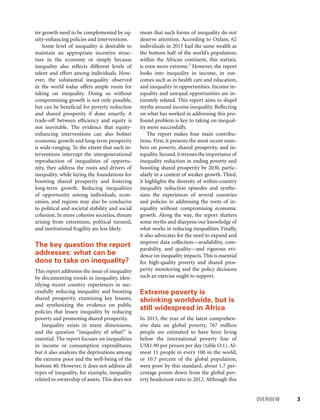
  • 13.
    xi This report hasbeen prepared by a team led by José Cuesta and Mario Negre and com- prising Timm Bönke, Soumya Chattopadhyay, Shaohua Chen, Will Durbin, María Eugenia Genoni, Aparajita Goyal, Christoph Lakner, Terra Lawson-Remer, Maura K. Leary, Renzo Massari, Jose Montes, David Newhouse, Stace Nicholson, Espen Beer Prydz, Maika Schmidt, and Ani Silwal. The work has been carried out under the general supervision of Francisco H. G. Ferreira and Ana Revenga and the guidance of Kaushik Basu and Jan Walliser. World Bank President Jim Yong Kim was an invaluable source of encouragement to the team. Kathleen Beegle, Branko Milanovic´, Ambar Narayan, and Sudhir Shetty served as peer reviewers. Robert Zimmermann edited the document, and Susan Graham was the pro- duction editor. The report’s publishing was supervised by Patricia Katayama. Venkat Gopal- akrishnan, Phil Hay, Mary D. Lewis, and Mikael Ello Reventar contributed to dissemination. Additional support was provided by Anna Regina Rillo Bonfield, Pamela Gaye C. Gunio, Estella Malayika, Nelly Obias, and Clara Serraino. The team would like to thank François Bourguignon, Branko Milanovic´, and Matthew Wai-Poi for sharing data. The team would also like to acknowledge the following peo- ple for insightful discussions, including Omar Arias, João Pedro Azevedo, Benu Bidani, Andrés Castañeda, Luc Christiansen, Andrew Dabalen, Klaus Deininger, Dung Doan, Martin C. Evans, Deon Filmer, Alan Fuchs, Emanuela Galasso, Xavier Gine, Stephane Hallegatte, Ruth Hill, Leora Klapper, Jose R. Lopez-Calix, Carolina Mejia-Mantilla, Rinku Murgai, Luis F. López-Calva, Minh Cong Nguyen, Pedro Olinto, Maria Beatriz Orlando, Carlos Rodríguez- Castelán, Halsey Rogers, Julie Rozenberg, Carlos Silva-Jauregui, Emmanuel Skoufias, Pablo Suárez-Becerra, Hiroki Uematsu, Adam Wagstaff, and Yukata Yoshino. Comments to pre- vious versions of the report were provided by Pedro Alba, Maurizio Bussolo, Jose Familiar Calderon, Anna Chytla, Amit Dar, Augusto de la Torre, Shanta Devarajan, Marianne Fay, Erik Feyen, Norbert Fiess, Lisa Finneran, Haisan Fu, Ejaz Ghani, Aart Kraay, Cyril Muller, Mamta Murthi, Alberto Ninio, Martin Rama, Sheila Redzepi, Jose G. Reis, Joanna Silva, Philip Schellekens, Richard Scobey, Radwan Shaban, Nikola Spatafora, Hans Timmer, Yvonne Tsikata, Laura Tuck, Jos Verbeek, and Xiaoqing Yu. The report benefited from substantial support from the German Development Institute/ Deutsches Institut für Entwicklungspolitik (DIE). Acknowledgments Dedicated to the loving memory of Martin Andres Cuesta Lopez.
  • 15.
    xiii The Core Team JoséCuesta, co-director of the report, is a World Bank senior economist with a PhD in economics from Oxford University. He is also an affiliated professor at Georgetown Uni- versity’s McCourt School of Public Policy. Cuesta was previously an assistant professor in development economics at the Institute of Social Studies in The Hague. He also worked as a research economist and social sector specialist for the Inter-American Development Bank and as an economist for the United Nations Development Programme in Hondu- ras. His research interests revolve around poverty and conflict economics, specifically the distributive analysis of social policies, intrahousehold allocation, social protection, and labor distortions. He also studies the interaction among poverty, conflict, and culture. A Spanish national, Cuesta has experience in countries in Africa, Asia, and Latin America. He is currently an associate editor for the European Journal of Development Research and the Journal of Economic Policy Reform, and the editor of the World Bank’s quarterly Food Price Watch. Mario Negre, co-director of the report, is a senior economist in the World Bank Devel- opment Economics Research Group, where he is seconded by the German Development Institute. He is a nonresidential research fellow at Maastricht School of Management. He has worked at the European Parliament, first as an adviser to the chairman of the Develop- ment Committee and then for all external relations committees. Since 2012, he has been a senior researcher at the German Development Institute. His fields of specialization are pro- poor growth, inclusiveness, inequality, and poverty measurement, as well as development cooperation policy, particularly in Europe. Mario holds a BSc in physics from the University of Barcelona, an MA in development policies from the University of Bremen, and a PhD in development economics from the Jawaharlal Nehru University, India. Soumya Chattopadhyay is a research fellow in the Growth, Poverty, and Inequality Pro- gramme at the Overseas Development Institute. His research interests include assessing the impact on subjective well-being of macro conditions and policy interventions using household surveys, identifying the vulnerable and the marginalized, and the issues revolving around infrastructure investment and service delivery. Previously, he worked at the World Bank. He was a senior research associate in the Global Economy and Development Pro- gram at the Brookings Institution, and taught at the School of Public Policy at the University of Maryland. Soumya holds a BA in economics from the University of Delhi and the Univer- sity of Cambridge, a masters in public management, and a PhD in international economic policy from the University of Maryland. About the Core Team and the Contributors
  • 16.
    xiv POVERTY ANDSHARED PROSPERITY 2016 Shaohua Chen is a lead statistician in the Development Economics Research Group of the World Bank. Her main research interests over the past 20 years have been on poverty and inequality measurement. She has managed the global poverty monitoring and online com- putational tool PovcalNet at the World Bank since 1991. She is also responsible for the mea- surement and projection of global poverty for the major reports of the World Bank, such as World Development Indicators and the Global Monitoring Report. Before joining the World Bank, Shaohua was a lecturer at Huazhong University of Science and Technology. Her re- search findings have been published in major economic and statistical journals, including the Journal of Development Economics, the Journal of Public Economics, The Quarterly Journal of Economics, and The Review of Economics and Statistics. She received her MSc in statistical computing from the American University. María Eugenia Genoni is a senior economist at the Poverty and Equity Global Practice at the World Bank. Her fields of specialization are survey design, poverty and inequality, migra- tion, and risk management. At the World Bank, she has led the poverty and equity programs in Bolivia and Peru. She has also contributed to the poverty work in Argentina and Central America and to the Regional Gender Impact Evaluation Initiative. Before joining the World Bank, María worked in the research department at the Inter-American Development Bank and the Ministry of Finance of the Province of Buenos Aires in Argentina. She holds a PhD in economics from Duke University. Christoph Lakner is an economist in the Development Research Group at the World Bank (Poverty and Inequality Team). He previously worked in the World Bank’s Poverty Practice on Poverty and Inequality issues in Argentina. His research interests include inequality, pov- erty, and labor markets in developing countries. In particular, he has been working on global inequality, the relationship between inequality of opportunity and growth, the implications of regional price differences for inequality, and the income composition of top incomes. He holds a BA, MPhil, and DPhil in economics from the University of Oxford. Maura K. Leary is the communications lead for the World Bank Group’s Poverty and Equity Global Practice, where she manages strategic communications and outreach on poverty reduction, equity, shared prosperity, and inequality. From 2011 to 2013, she was the part- nerships and communications specialist on the Gender and Development team. Prior to joining the World Bank in 2011, she worked at George Washington University and Tufts University, managing academic programs in France and the United States for high school, university, graduate, and adult students. She holds a BA in French from Connecticut College and a master’s degree in international affairs from the Elliott School of International Affairs at the George Washington University. José Montes is a data scientist in the Poverty and Equity Global Practice of the World Bank. He has been working for more than 10 years in poverty and inequality measurement and helping national statistics offices improve the quality, consistency, and documentation of their household surveys. Since 2013, he has been part of Europe and Central Asia Team Statistics Development, and since 2016, part of the core team of the Global Team Statistics Development. Prior to the World Bank, he worked at the Inter-American Development Bank as a household survey specialist in the Poverty and Advisory Unit. He was also a lecturer at the Universidad del Pacífico. José holds a BA in economics from the Universidad del Pacíf- ico and an MSc in economics and an MSc in statistics from Texas A&M University. Espen Beer Prydz is an economist in the World Bank’s Development Economics Research Group. His research interests include issues of poverty, inequality, and survey methods. He has worked in Cambodia, Indonesia, and South Sudan on poverty, social protection, and economic policy. Prior to joining the World Bank, Espen undertook research on poverty,
  • 17.
    ABOUT THE CORETEAM AND THE CONTRIBUTORS xv labor markets, and gender with the Development Centre of the Organisation for Economic Co-operation and Development and the Abdul Latif Jameel Poverty Action Lab. Prydz is a Norwegian national who holds a BS from the London School of Economics and an MPA in international development from the John F. Kennedy School of Government at Harvard University. Maika Schmidt is a consultant in the World Bank’s Development Economics Research Group. Her research interests are poverty, inequality, and pro-poor growth with a focus on measurement issues, specifically multidimensional indicators. Maika has worked for the Deutsche Gesellschaft für Internationale Zusammenarbeit. She holds a BSc in economics from the University of Mannheim, a master’s from the Barcelona Graduate School of Eco- nomics, and a master of research from Pompeu Fabra University, Barcelona. She is cur- rently pursuing her PhD in development economics from the University of Sussex. Ani Silwal is a consultant in the World Bank’s Development Economics Research Group. He holds a BA from Swarthmore College, an MSc from the University of Maryland, and a PhD in economics from the University of Sussex. He has also worked on international migration and remittances. His research interest is the constraints that households face in escaping poverty. The Contributors Timm Bönke is assistant professor of public economics at the School of Business and Economics at Freie Universität Berlin. His research interests revolve mainly around inequal- ity and the distribution of income and wealth, the inclusiveness of growth, the design and incentives of state welfare institutions, and redistribution and insurance through tax-benefit systems. Since 2015, he has been associate editor of the Journal of Income Distribution and scientific board member of the Research Institute Economics of Inequality at Vienna University of Economics and Business. In addition, he is a regular reviewer for scientific foundations and acts as a scientific and political consultant. Timm holds a masters and a PhD in economics from Freie Universität Berlin. Will Durbin studied ethics, politics, and economics as an undergraduate at Yale University and international development for a master’s degree at the Woodrow Wilson School of Public and International Affairs, Princeton University. He previously worked on climate change and environmental policy and currently focuses on poverty reduction. Aparajita Goyal is a senior economist in the Poverty and Equity Global Practice of the World Bank. Her work focuses on microeconomic issues of development, with an empha- sis on technological innovation in agriculture, access to markets, and intellectual property rights. Her research has been published in leading academic journals, such as American Economic Review, Journal of Human Resources, and Journal of Development Economics, and has been featured in the popular press, including Frontline, Economist, and Wall Street Journal. Within the World Bank, she has previously worked in the Development Economics Research Group, Office of the Chief Economist for the Latin America and Caribbean Region, and Agriculture Global Practice after joining the Young Professionals Program. She holds a BA in economics from St. Stephen’s College, University of Delhi, India, an MSc from the London School of Economics, and a PhD in economics from the University of Maryland. Renzo Massari is a consultant in the World Bank’s Development Economics Research Group. His research interests include developing and applying econometric and machine learning methods to poverty and inequality measurement, the use of big data in develop- ment, imputation methods, and survey methodology. Previously, he worked at the Labor
  • 18.
    xvi POVERTY ANDSHARED PROSPERITY 2016 and Social Protection Unit at the Inter-American Development Bank and as a consultant in empirical regulatory and policy issues in Peru and in the United States. He holds a certifica- tion in data science and a PhD in economics from Duke University. Terra Lawson-Remer’s work addresses the determinants and consequences of sustain- able development, poverty and inequality, and social and economic rights fulfillment within and across generations. Her expertise includes health care, education, international eco- nomic law, legal empowerment, natural resource governance, global trade and transna- tional investment, extractive industries, democratic transitions, civil society, property rights, and business and human rights. She is the author of dozens of academic books and articles, including, most recently, Fulfilling Social and Economic Rights (with Sakiko Fukuda-Parr and Susan Randolph), published by Oxford University Press. Terra earned her BA in ethics, pol- itics, and economics from Yale University; her JD from New York University School of Law, where she was a Dean’s Merit Scholar; and her PhD in political economy from the Law and Society Institute, New York University. David Newhouse is a senior economist in the Poverty and Equity Global Practice. He cur- rently leads the Bank’s engagement on poverty in Sri Lanka, as well as on projects that aim to understand the nature of global poverty and incorporate satellite imagery into pov- erty measurement. He was formerly a labor economist in the Social Protection and Labor Practice, where he helped lead efforts to analyze labor markets and the policy response in the wake of the 2008 financial crisis. He first joined the Bank in August 2007 and co-led the Indonesian Jobs Report. Previously, he worked in the Fiscal Affairs Department of the International Monetary Fund providing policy advice on energy and food subsidies. David holds a PhD in economics from Cornell University. He has co-authored a book and several journal articles on a wide range of issues relating to labor, health, and education in develop- ing countries. Stace Nicholson is a senior program officer for international economic and financial affairs at the Japan International Cooperation Agency’s U.S. office. In this position, he conducts and oversees research that supports credit risk assessment of the agency’s concessional loan portfolio and serves as the agency’s junior liaison with multilateral financial institutions based in Washington. His work includes tracking macroeconomic developments across a range of emerging and frontier, or developing economies, facilitating research partnerships and project co-financing on an ad hoc basis, and reporting on development finance trends. Prior to joining the agency, Stace interned with the Ghana Center for Democratic Devel- opment and undertook field research in Uganda as a microfinance client assessment fel- low for the Foundation for International Community Assistance. He is a summa cum laude graduate (political science) of Manchester College and holds a master’s degree in global finance, trade, and economic integration from the Josef Korbel School for International Studies, University of Denver.
  • 19.
    xvii BRICS Brazil, RussianFederation, India, China, and South Africa CCT conditional cash transfer CPI consumer price index ECD early childhood development EU European Union GDP gross domestic product IQ intelligence quotient OECD Organisation for Economic Co-operation and Development PPP purchasing power parity SEDLAC Socio-Economic Database for Latin America and the Caribbean UNESCO United Nations Educational, Scientific, and Cultural Organization VAT value added tax WDI World Development Indicators Note: All dollar amounts are U.S. dollars (US$) unless otherwise indicated. For a list of the 3-letter country codes used by the World Bank, please go to: https://datahelpdesk.worldbank.org/knowledgebase/articles/906519-world-bank-country -and-lending-groups. Abbreviations
  • 21.
    Overview OVERVIEW 1 On April 20, 2013, the Board of Executive Directors of the World Bank adopted two ambitious goals: end global extreme pov- erty and promote shared prosperity in every country in a sustainable way. This implies reducing the poverty headcount ratio from 10.7 percent globally in 2013 to 3.0 percent by 2030 and fostering the growth in the in- come or the consumption expenditure of the poorest 40 percent of the population (the bottom 40) in each country. These two goals are part of a wider international devel- opment agenda and are intimately related to United Nation’s Sustainable Development Goals 1 and 10, respectively, which have been adopted by the global community. Each goal has an intrinsic value on its own merits, but the two goals are also highly complementary. Take the example of a low-income Sub-Saharan African country with a high poverty headcount ratio and an upper-middle-income country in Eastern Europe or Latin America with low levels of extreme poverty, but rising concerns about inequality. Ending extreme poverty is espe- cially relevant in the former, while expand- ing shared prosperity is especially meaning- ful in the latter. The complementarity of the two goals also derives from the composition of the world’s poor and bottom 40 popula- tions. At a global scale, while 9 in every 10 of the extreme poor were among the national bottom 40 in 2013, only a quarter of the bot- tom 40 were among the extreme poor (both cases refer to the orange area in figure O.1). This complementarity has three import- ant implications. First, by choosing these two goals, the World Bank focuses squarely on improving the welfare of the least well off across the world, effectively ensuring that everyone is part of a dynamic and in- clusive growth process, no matter the cir- cumstances, the country context, or the time period. Second, monitoring the two goals separately is necessary to understand with precision the progress in achieving better living conditions among those most in need. Third, policy interventions that reduce extreme poverty may or may not be effective in boosting shared prosperity if the two groups—the poor and the bottom 40— are composed of distinct populations. To understand more clearly the prog- ress toward the achievement of the goals, the World Bank is launching the annual Poverty and Shared Prosperity report series, which this report inaugurates. The report series will inform a global audience com- prising development practitioners, policy makers, researchers, advocates, and citizens in general with the latest and most accu- rate estimates on trends in global poverty and shared prosperity. Every year, it will update information on the global number of the poor, the poverty headcount ratio worldwide, the regions that have been more successful or that have been lagging in advancing toward the goals, and the en- hancements in monitoring and measuring poverty. In addition, it will feature a special Two complementary goals to leave no one behind
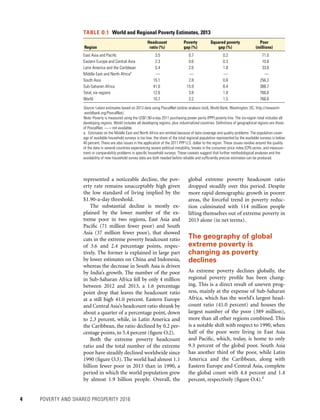
  • 22.
    2 POVERTY ANDSHARED PROSPERITY 2016 These substantive considerations highlight the importance of directing attention to the problem of inequality. There are other reasons too. Sustaining the rapid progress in reducing poverty and boosting shared prosperity that has been achieved over the last 25 years is at risk be- cause of the struggles across economies to recover from the global financial crisis that started in 2008 and the subsequent slow- down in global growth. The goal of elimi- nating extreme poverty by 2030—which is likely to become more difficult as we ap- proach more closely to it—might not be achieved without accelerated economic growth or reductions in within-country inequalities, especially among those coun- tries with large concentrations of the poor. Generally speaking, poverty can be reduced through higher average growth, a narrow- ing in inequality, or a combination of the two.2 Achieving the same poverty reduction during a slowdown in growth therefore re- quires a more equal income distribution. It follows that, to reach the goals, efforts to fos- focal theme. This year, the focal theme is inequality. Inequality matters for achieving the goals, but also for other reasons Despite decades of substantial progress in boosting prosperity and reducing poverty, the world continues to suffer from substan- tial inequalities. For example, the poorest children are four times less likely than the richest children to be enrolled in primary ed- ucation across developing countries. Among the estimated 780 million illiterate adults worldwide, nearly two-thirds are women. Poor people face higher risks of malnutri- tion and death in childhood and lower odds of receiving key health care interventions.1 Such inequalities are associated with high financial cost, affect economic growth, and generate social and political burdens and barriers. But leveling the playing field is also an issue of fairness and justice that resonates across societies on its own merits. FIGURE O.1  Distribution of the Extreme Poor, the Nonpoor, the Bottom 40, and the Top 60, 2013 Source: Inspired by Beegle et al. 2014 and updated with 2013 data. Note: The figure has been constructed from vertical bars representing countries sorted in descending order by extreme poverty headcount ratio (from left to right). The width of each bar reflects the size of the national population. The figure thus illustrates the situation across the total global population. Nationalpercentile 0 10 20 30 40 50 60 70 80 90 0 1,000 2,000 3,000 4,000 5,000 6,000 7,000 Cumulative global polulation Top 60, nonpoor Top 60, poor Bottom 40, nonpoor Bottom 40, poor 100
  • 23.
    OVERVIEW 3 meanthat such forms of inequality do not deserve attention. According to Oxfam, 62 individuals in 2015 had the same wealth as the bottom half of the world’s population; within the African continent, this statistic is even more extreme.3 However, the report looks into inequality in income, in out- comes such as in health care and education, and inequality in opportunities. Income in- equality and unequal opportunities are in- timately related. This report aims to dispel myths around income inequality. Reflecting on what has worked in addressing this pro- found problem is key to taking on inequal- ity more successfully. The report makes four main contribu- tions. First, it presents the most recent num- bers on poverty, shared prosperity, and in- equality.Second,it stresses the importance of inequality reduction in ending poverty and boosting shared prosperity by 2030, partic- ularly in a context of weaker growth. Third, it highlights the diversity of within-country inequality reduction episodes and synthe- sizes the experiences of several countries and policies in addressing the roots of in- equality without compromising economic growth. Along the way, the report shatters some myths and sharpens our knowledge of what works in reducing inequalities. Finally, it also ­advocates for the need to expand and improve data collection—availability, com- parability, and quality—and rigorous evi- dence on inequality impacts. This is essential for high-quality poverty and shared pros- perity monitoring and the policy decisions such an exercise ought to support. Extreme poverty is shrinking worldwide, but is still widespread in Africa In 2013, the year of the latest comprehen- sive data on global poverty, 767 million people are estimated to have been living below the international poverty line of US$1.90 per person per day (table O.1). Al- most 11 people in every 100 in the world, or 10.7 percent of the global population, were poor by this standard, about 1.7 per- centage points down from the global pov- erty headcount ratio in 2012. Although this ter growth need to be complemented by eq- uity-enhancing policies and interventions. Some level of inequality is desirable to maintain an appropriate incentive struc- ture in the economy or simply because inequality also reflects different levels of talent and effort among individuals. How- ever, the substantial inequality observed in the world today offers ample room for taking on inequality. Doing so without compromising growth is not only possible, but can be beneficial for poverty reduction and shared prosperity if done smartly. A trade-off between efficiency and equity is not inevitable. The evidence that equity- enhancing interventions can also bolster economic growth and long-term prosperity is wide-ranging. To the extent that such in- terventions interrupt the intergenerational reproduction of inequalities of opportu- nity, they address the roots and drivers of inequality, while laying the foundations for boosting shared prosperity and fostering long-term growth. Reducing inequalities of opportunity among individuals, econ- omies, and regions may also be conducive to political and societal stability and social cohesion. In more cohesive societies, threats arising from extremism, political turmoil, and institutional fragility are less likely. The key question the report addresses: what can be done to take on inequality? This report addresses the issue of inequality by documenting trends in inequality, iden- tifying recent country experiences in suc- cessfully reducing inequality and boosting shared prosperity, examining key lessons, and synthesizing the evidence on public policies that lessen inequality by reducing poverty and promoting shared prosperity. Inequality exists in many dimensions, and the question “inequality of what?” is essential. The report focuses on inequalities in income or consumption expenditures, but it also analyzes the deprivations among the extreme poor and the well-being of the bottom 40. However, it does not address all types of inequality, for example, inequality related to ownership of assets. This does not
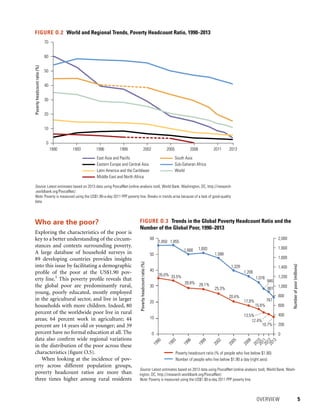
  • 24.
    4 POVERTY ANDSHARED PROSPERITY 2016 global extreme poverty headcount ratio dropped steadily over this period. Despite more rapid demographic growth in poorer areas, the forceful trend in poverty reduc- tion culminated with 114 million people lifting themselves out of extreme poverty in 2013 alone (in net terms). The geography of global extreme poverty is changing as poverty declines As extreme poverty declines globally, the regional poverty profile has been chang- ing. This is a direct result of uneven prog- ress, mainly at the expense of Sub-Saharan Africa, which has the world’s largest head- count ratio (41.0 percent) and houses the largest number of the poor (389 million), more than all other regions combined. This is a notable shift with respect to 1990, when half of the poor were living in East Asia and Pacific, which, today, is home to only 9.3 percent of the global poor. South Asia has another third of the poor, while Latin America and the Caribbean, along with Eastern Europe and Central Asia, complete the global count with 4.4 percent and 1.4 percent, respectively (figure O.4).4 represented a noticeable decline, the pov- erty rate remains unacceptably high given the low standard of living implied by the $1.90-a-day threshold. The substantial decline is mostly ex- plained by the lower number of the ex- treme poor in two regions, East Asia and Pacific (71 million fewer poor) and South Asia (37 million fewer poor), that showed cuts in the extreme poverty headcount ratio of 3.6 and 2.4 percentage points, respec- tively. The former is explained in large part by lower estimates on China and Indonesia, whereas the decrease in South Asia is driven by India’s growth. The number of the poor in Sub-Saharan Africa fell by only 4 million between 2012 and 2013, a 1.6 percentage point drop that leaves the headcount ratio at a still high 41.0 percent. Eastern Europe and Central Asia’s headcount ratio shrank by about a quarter of a percentage point, down to 2.3 percent, while, in Latin America and the Caribbean, the ratio declined by 0.2 per- centage points, to 5.4 percent (figure O.2). Both the extreme poverty headcount ratio and the total number of the extreme poor have steadily declined worldwide since 1990 (figure O.3). The world had almost 1.1 billion fewer poor in 2013 than in 1990, a period in which the world population grew by almost 1.9 billion people. Overall, the Region Headcount ratio (%) Poverty gap (%) Squared poverty gap (%) Poor (millions) East Asia and Pacific 3.5 0.7 0.2 71.0 Eastern Europe and Central Asia 2.3 0.6 0.3 10.8 Latin America and the Caribbean 5.4 2.6 1.8 33.6 Middle East and North Africaa — — — — South Asia 15.1 2.8 0.8 256.2 Sub-Saharan Africa 41.0 15.9 8.4 388.7 Total, six regions 12.6 3.8 1.8 766.6 World 10.7 3.2 1.5 766.6 Source: Latest estimates based on 2013 data using PovcalNet (online analysis tool), World Bank, Washington, DC, http://iresearch .worldbank.org/PovcalNet/. Note: Poverty is measured using the US$1.90-a-day 2011 purchasing power parity (PPP) poverty line. The six-region total includes all developing regions. World includes all developing regions, plus industrialized countries. Definitions of geographical regions are those of PovcalNet. — = not available. a.  Estimates on the Middle East and North Africa are omitted because of data coverage and quality problems. The population cover- age of available household surveys is too low; the share of the total regional population represented by the available surveys is below 40 percent. There are also issues in the application of the 2011 PPP U.S. dollar to the region. These issues revolve around the quality of the data in several countries experiencing severe political instability, breaks in the consumer price index (CPI) series, and measure- ment or comparability problems in specific household surveys. These caveats suggest that further methodological analyses and the availability of new household survey data are both needed before reliable and sufficiently precise estimates can be produced. TABLE O.1  World and Regional Poverty Estimates, 2013
  • 25.
    OVERVIEW 5 Whoare the poor? Exploring the characteristics of the poor is key to a better understanding of the circum- stances and contexts surrounding poverty. A large database of household surveys in 89 developing countries provides insights into this issue by facilitating a demographic profile of the poor at the US$1.90 pov- erty line.5 This poverty profile reveals that the global poor are predominantly rural, young, poorly educated, mostly employed in the agricultural sector, and live in larger households with more children. Indeed, 80 percent of the worldwide poor live in rural areas; 64 percent work in agriculture; 44 percent are 14 years old or younger; and 39 percent have no formal education at all. The data also confirm wide regional variations in the distribution of the poor across these characteristics (figure O.5). When looking at the incidence of pov- erty across different population groups, poverty headcount ratios are more than three times higher among rural residents FIGURE O.2  World and Regional Trends, Poverty Headcount Ratio, 1990–2013 Source: Latest estimates based on 2013 data using PovcalNet (online analysis tool), World Bank, Washington, DC, http://iresearch .worldbank.org/PovcalNet/. Note: Poverty is measured using the US$1.90-a-day 2011 PPP poverty line. Breaks in trends arise because of a lack of good-quality data. Povertyheadcountratio(%) 0 10 20 30 40 50 60 70 1990 1993 1996 1999 2002 2005 2008 2011 2013 World East Asia and Pacific Eastern Europe and Central Asia Latin America and the Caribbean Middle East and North Africa South Asia Sub-Saharan Africa FIGURE O.3  Trends in the Global Poverty Headcount Ratio and the Number of the Global Poor, 1990–2013 Source: Latest estimates based on 2013 data using PovcalNet (online analysis tool), World Bank, Wash- ington, DC, http://iresearch.worldbank.org/PovcalNet/. Note: Poverty is measured using the US$1.90-a-day 2011 PPP poverty line. 35.0% 33.5% 28.8% 28.1% 25.3% 20.4% 17.8% 15.6% 13.5% 12.4% 10.7% 1,850 1,855 1,666 1,693 1,588 1,328 1,206 1,078 946 881 767 0 200 400 600 800 1,000 1,200 1,400 1,600 1,800 2,000 0 1990 1993 1996 1999 2002 2005 2008 2010201120122013 10 20 30 40 50 60 Numberofpoor(millions) Povertyheadcountratio(%) Poverty headcount ratio (% of people who live below $1.90) Number of people who live below $1.90 a day (right axis)
  • 26.
    6 POVERTY ANDSHARED PROSPERITY 2016 than among urban dwellers: 18.2 percent versus 5.5 percent, respectively. Agricultural workers are over four times more likely than people employed in other sectors of the economy to be poor. Educational attain- ment is inversely correlated with poverty. A small share of primary-school graduates are living in poverty: fewer than 8.0 percent of people who completed primary school, but not secondary school, are living below the US$1.90 poverty line. Among individuals who have attended university, the share is less than 1.5 percent.6 Similar differences are observed if poverty incidence is measured relative to the US$3.10-a-day poverty line. Age profiles confirm that children are more likely than adults to be poor. Children under 18 account for half the global poor in 2013, but less than a third of the sample pop- ulation (32 percent) (figure O.6). Younger children (ages 0–14) contribute especially heavily to the poverty headcount,much more than their share in the world’s population. Progress in boosting shared prosperity worldwide is uneven Shared prosperity is measured as the growth in the average income or consumption of the bottom 40. The larger the growth rate in the income of the bottom 40, the more quickly prosperity is shared with the most disadvantaged sectors in society. To the extent that greater economic growth is associated with rising incomes among the poor and the bottom 40, more rapid growth will lead to greater shared prosperity and poverty reduction. Likewise, a more rapid increase in shared prosperity and in the narrowing of inequality typically accelerates the decline in poverty at any given rate of growth. Progress on this indicator is examined in this report using the latest information available on each country, currently circa 2008–13. To take into account the share of prosperity going to groups other than the bottom 40, the report also monitors the shared prosperity premium, defined as the difference between the growth in the in- come of the bottom 40 and the growth in income at the mean in each country. A pos- FIGURE O.4  Where Are the Global Poor Living? The Global Poor, by Region, 2013 Source: Latest estimates based on 2013 data using PovcalNet (online analysis tool), World Bank, Washington, DC, http:// iresearch.worldbank.org/PovcalNet/. 9.3% 1.4% 4.4% 33.4% 50.7% 0.8% Share of global poor by region (%) East Asia and Pacific South Asia Eastern Europe and Central Asia Sub-Saharan Africa Latin America and the Caribbean Rest of the world FIGURE O.5  Profile of the Poor, by Characteristics and Region, 2013 Source: Castañeda et al. 2016. Note: Poverty is measured using the US$1.90-a-day 2011 PPP poverty line. 0 10 20 30 40 50 Percent 60 70 80 90 Share of poor in rural areas Share of poor adults working in agriculture Share of poor 0–14 years old Share of poor adults with no education East Asia and Pacific Eastern Europe and Central Asia Latin America and the Carribean South Asia Sub-Saharan Africa World
  • 27.
    OVERVIEW 7 theCaribbean, the income of the bottom 40 grew by 8.0 percent in Paraguay, while in Honduras, income contracted by about 2.5 percent annually during the same spell. A source of concern is the small value of the shared prosperity premium. While the average annualized growth in the in- come or consumption of the bottom 40 was 2.0 percent worldwide circa 2008–13 (a population-weighted 4.6 percent), the average shared prosperity premium was only 0.5 percentage points during the same period (a population-weighted 0.4 percent- age point). Is this sufficient to expect large reductions in inequality and poverty so as to achieve the World Bank goals by 2030? A more rapid decline in inequality is needed to end poverty Figure O.8 makes it clear that the goal of ending poverty by 2030 cannot be reached at current levels of economic growth. It shows the trajectory of the global poverty headcount ratio under various assumptions about distributional changes and under the assumption that every country will grow at its rate of the last 10 years. These changes are modeled by means of alternative shared prosperity premiums in each country. Thus, in the scenario of a premium labeled itive premium indicates that the growth in the income or consumption of the bottom 40 exceeds that of the mean, and by impli- cation, that of the rest of the population. A higher or lower premium indicates the ex- tent to which distributional changes favor the bottom 40 relative to the top 60. The bottom 40 benefited from solid eco- nomic growth in many countries in 2008– 13. Overall, the bottom 40 in 60 of the 83 countries monitored experienced positive income growth, representing 67 percent of the world’s population and 89 percent of the population represented by the surveys (fig- ure O.7). A total of 49 countries reported a positive shared prosperity premium: income growth among the bottom 40 exceeded that of the mean (and therefore, that of the top 60). However, there is no room for compla- cency: in 23 countries, the incomes of the bottom 40 declined during the period. There are wide regional differences in shared prosperity and the shared prosperity premium. The best performers were in East Asia and Pacific and in Latin America and the Caribbean, while high-income indus- trialized countries performed the least well. Greece, a high-income country, experienced an annualized contraction of 10.0 percent in the income of the bottom 40, while the Democratic Republic of Congo recorded a rise of 9.6 percent. In Latin America and a. The extremely poor b. Sample population 15.9% 15.4% 12.9% 6.0% 44.0% 5.8% 9.4% 9.0% 8.6% 5.1% 57.6% 10.3% Children, ages 0–4 Children, ages 5–9 Children, ages 10–14 Children, ages 15–17 Adults, ages 18–59 Adults, ages 60 or more FIGURE O.6  Age Profile of the Poor, 2013 Source: Newhouse et al. 2016.
  • 28.
    Source: GDSP (GlobalDatabase of Shared Prosperity), World Bank, Washington, DC, http://www.worldbank.org/en/topic/poverty /brief/global-database-of-shared-prosperity. Note: The data show the annualized growth in mean household per capita income or consumption according to surveys. FIGURE O.7  Shared Prosperity, 83 Countries, 2008–13 Middle East and North Africa Latin America and the Caribbean Industrialized countries Eastern Europe and Central Asia East Asia and Pacific South Asia Sub-Saharan Africa Annualized growth in mean income or consumption (%) 10 Senegal Rwanda Mauritius Cameroon Togo Congo, Rep. Tanzania Uganda Congo, Dem. Rep. Sri Lanka Pakistan India Bhutan Iraq Iran, Islamic Rep. Honduras Mexico Costa Rica Dominican Republic Argentina El Salvador Panama Nicaragua Uruguay Chile Peru Colombia Brazil Bolivia Ecuador Paraguay Greece Ireland Israel Italy Cyprus Luxembourg Portugal United Kingdom Spain Denmark United States Netherlands France Austria Belgium Germany Finland Sweden Switzerland Norway Croatia Latvia Montenegro Estonia Hungary Lithuania Serbia Albania Slovenia Czech Republic Kyrgyz Republic Armenia Bulgaria Poland Romania Turkey Ukraine Georgia Moldova Macedonia, FYR Slovak Republic Russian Federation Kazakhstan Belarus Lao PDR Philippines Indonesia Vietnam Thailand Cambodia Mongolia China 5–5–10 0 Total population Bottom 40
  • 29.
    OVERVIEW 9 ertygoal by 2030. However, it illustrates that under current average growth rates, reduc- tions in inequality will be key to reaching the poverty goal by 2030. This is so under specific assumptions about how economic growth will occur until 2030. If the poverty goal is to be accomplished by 2030, the in- come distribution must improve, especially among countries in which there are high numbers of poor, relatively wide inequality levels, and weak economic growth. Globally, the narrowing in inequality since the 1990s is an historical exception to a rising trend Data since the 1990s show a substantial nar- rowing in inequality in income or consump- tion worldwide, irrespective of residence. This is the first such reduction since the industrial revolution (figure O.9). This un- precedented decline occurred during a pe- riod of increasing global integration. From 1820 to the 1990s, global inequality steadily rose.Then,the Gini index fell to 62.5 in 2013, most markedly beginning in 2008, when the Gini was 66.8 (the blue line in figure O.10). m = 1, the growth in the income of the bot- tom 40 in each country is assumed to ex- ceed the growth rate in the mean by 1 per- centage point. Meanwhile, in the scenario m = 0, growth is distributionally neu- tral: the income of the bottom 40 and the mean grow at the same pace. Under these scenarios, the poverty goal would only be reached if the shared prosperity premium is in excess of 1 percentage point, which is double the simple average premium coun- tries are able to achieve today (0.5 percent- age points). Thus, income or consumption needs to grow more quickly among the bottom 40 than at the mean, and at a more rapid pace than today, especially in coun- tries with substantial numbers of the poor. This is the analytical result of a set of simulations. In practice, this does not mean that every country worldwide must improve its income distribution to achieve the pov- FIGURE O.8  Boosting Shared Prosperity and Ending Poverty, 10-Year Scenario, 2013–30 Source: Updated results based on Lakner, Negre, and Prydz 2014. Note: m = the assumed shared prosperity premium, that is, the growth in income or consumption among the bottom 40, minus the growth in income or consumption at the mean. Thus, for example, m = 2 indicates that the growth in income among the bottom 40 exceeds the growth in income at the mean by 2 per- centage points in each country. Poverty is measured using the US$1.90-a-day 2011 PPP poverty line. 0 5 3 10 15 20 25 30 200220062010201220142016201820202022202420262028 2030 Povertyheadcountratio(%) m = 0 m = 1 m = 2 m = –1 m = –2 2030 goal FIGURE O.9  Global Inequality, 1820–2010 Source: Based on figure 1 (p. 27) of The Globalization of Inequal- ity by Francois Bourguignon (Princeton University Press 2015). Used with permission. Note: The discontinuity in the series represents the change in the base year of the purchasing power parity (PPP) exchange rates from 1990 to 2005. The figure uses GDP per capita in com- bination with distributional statistics from household surveys. Figure O.10 uses income (or consumption) per capita directly from household surveys (in 2011 PPP exchange rates). 30 40 50 60 70 Giniindex 1820 1870 1920 1970 1990 2010
  • 30.
    10 POVERTY ANDSHARED PROSPERITY 2016 This unprecedented drop in global inequal- ity was driven by a convergence in average incomes across countries that was spurred by rising incomes in populous countries such as China and India. As a result, between- country inequality declined. In contrast, within-country inequality, the other com- ponent of global inequality, took on a greater role in global inequality (explaining a third of the total variation) (figure O.10). Despite recent progress, average within-country inequality is greater now than 25 years ago The population-weighted Gini index cap- tures within-country inequality relative to the average person across the countries on which data are available (figure O.11). This indicator rose steeply, by 6 points, from 34 to 40 between 1988 and 1998. Since then, inequality has declined more moderately, by almost 1 point, to a Gini of 39 in 2013. Thus, within-country inequality for the av- erage person in the world was wider in 2013 than 25 years previously. The population-weighted result on within-country inequality is largely robust to other specifications, such as population- unweighted estimates or estimates draw- ing on different country samples. As shown in figure O.11, the unweighted Gini index of within-country inequality worldwide also rose during the 1990s, but by a smaller amount than the population-weighted index. The simple average Gini increased by around 5 points, from 36 in 1988 to 41 ten years later, before declining steadily thereaf- ter, reaching 38 in 2013. The levels and trends in average in- equality are quite different across regions, although the most recent decline is broad- based (figure O.12). Developing countries tend to exhibit wider within-country in- equality relative to developed countries. Latin America and the Caribbean, as well as Sub-Saharan Africa, stand out as high- inequality regions. The former is also the region most successful in reducing inequal- ity. Sub-Saharan Africa has likewise steadily narrowed inequality since the early 1990s, FIGURE O.10  Global Inequality, 1988–2013 Sources: Lakner and Milanovic´ 2016; Milanovic´ 2016; World Bank calculations based on PovcalNet (online analysis tool), World Bank, Washington, DC, http://iresearch.worldbank.org/PovcalNet/. Note: For each country, household income or consumption per capita is obtained directly from house- hold surveys and expressed in 2011 PPP exchange rates. Each country distribution is represented by 10 decile groups. The line (measured on the right axis) shows the level of the global Gini index. The height of the bars indicates the level of global inequality as measured by GE(0) (the mean log deviation). The red bars show the corresponding level of population-weighted inequality within countries. The level of between-country inequality, which captures differences in average incomes across countries, is shown by the yellow bars. The numbers in the bars refer to the relative contributions (in percent) of these two sources to total global inequality. 30 40 50 60 70 80 0 0.2 0.4 80 20 24 26 28 30 35 76 74 72 70 65 0.6 0.8 1.0 1988 1993 1998 2003 2008 2013 Giniindex Meanlogdeviation Within-country inequality Between-country inequality Gini index (right axis) FIGURE O.11  Average Within-Country Inequality, 1988–2013 Source: World Bank calculations based on data in Milanovic´ 2014; PovcalNet (online analysis tool), World Bank, Washington, DC, http://iresearch.worldbank.org/PovcalNet/; WDI (World Development Indicators) (database), World Bank, Washington, DC, http://data.worldbank.org/data-catalog/world-development -indicators. Note: The solid lines show the trend in the average within-country Gini index with and without population weights in the full sample (an average of 109 countries per benchmark year). The dashed lines refer to the balanced sample, that is, using only the set of 41 countries on which data are available in every bench- mark year. 30 32 34 36 38 40 42 1988 1993 1998 2003 2008 2013 Averagewithin-countryGiniindex Unweighted Weighted Unweighted, balanced Weighted, balanced
  • 31.
    OVERVIEW 11 butionis available, such as Argentina; India; the Republic of Korea; South Africa; Taiwan, China; and the United States, the share of the top 1 percent in total income has been increasing. In South Africa, the top income share roughly doubled over 20 years to lev- els comparable with those observed in the United States (figure O.13). Inequality reduction is not limited to a few countries, settings, and policy choices Some countries have performed remarkably well in reducing inequality and boosting shared prosperity. Others have not. Among the constellation of policies that have been implemented, what have been the key levers in boosting shared prosperity and narrow- ing inequality among countries? The report focuses on the experiences of five low- and middle-income countries, covering Asia, Latin America and the Carib- bean, and Sub-Saharan Africa. The countries although this progress hides wide-ranging variations within the continent.7 In Eastern Europe and Central Asia, average inequality rose sharply after the fall of the Berlin Wall, but has since been on a declining trend. The average industrialized country saw an increase in the Gini index from 30 to 33 be- tween 1988 and 2008. In the five years lead- ing up to 2013, average within-income in- equality appears to have fallen in all regions except in the Middle East and North Africa and in South Asia. Providing a simple explanation behind regional inequality trends is particularly challenging because the patterns may be distinctive and the drivers specific to the trends exhibited by countries within a re- gion. Rather than providing a simplistic explanation, it may therefore be useful to examine closely the country variations within regions to understand the extent to which the common drivers behind in- equality—gaps in human capital accumu- lation, varying access to jobs and income- generating opportunities, and government interventions to address market-based in- equalities—are relevant in each country. Indeed, between 2008 and 2013, the number of countries experiencing declin- ing inequality was twice the number exhib- iting widening inequality. This shows that within-country inequality can widen or narrow. Despite the progress, stark inequal- ities persist. For example, Haiti and South Africa are the most unequal countries in the world (for which data are available), with a Gini exceeding 60 points in 2013. Another Sub-Saharan African country (Rwanda) and another seven Latin America and Caribbean countries (Brazil, Chile, Co- lombia, Costa Rica, Honduras, Mexico, and Panama) make up the top 10 most unequal countries in the world, with Gini indexes in excess of or close to 50. In many countries, the income share of the top income groups is expanding In many economies in which information on the top 1 percent of the income distri- 10 20 30 40 50 60 1988 1993 1998 2003 2008 2013 Averagewithin-countryGiniindex East Asia and Pacific Eastern Europe and Central Asia Latin America and the Caribbean Middle East and North Africa South Asia Sub-Saharan Africa Industrialized countries FIGURE O.12  Trends in the Average National Gini, by Region, 1988– 2013 Source: World Bank calculations based on data in Milanovic´ 2014; PovcalNet (online analysis tool), World Bank, Washington, DC, http://iresearch.worldbank.org/PovcalNet/. Note: The lines show the average within-country Gini index by region. It is the simple average in the full sample without weighting countries by population. Industrialized countries are a subset of high-income countries. See chapter 2, annex 2B, for the list of industrialized countries.
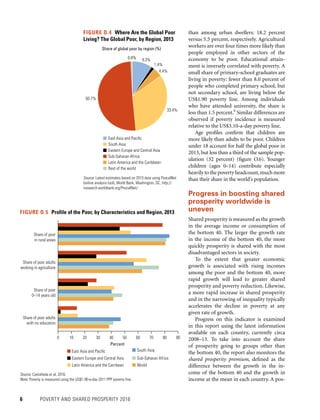
  • 32.
    12 POVERTY ANDSHARED PROSPERITY 2016 also play a role in reducing inequalities. For example, the minimum wage and safety nets have been crucial in allowing Brazil to lessen inequality, while diversification from agri- culture into light manufacturing and ser- vices in Cambodia opened job opportunities to the poor. Overall, these country cases also high- light that success in reducing inequality and boosting shared prosperity in a given period does not necessarily translate into similar success on other economic, social, or political fronts, nor into sustainable re- ductions in inequality over time. Indeed, conflict emerged in Mali after the period of inequality reduction, in large part be- cause of protracted flaws in governance.8 The marked differences in the most recent policy choices between Brazil and Peru on fiscal consolidation and the control of infla- tion largely explain the stark differences in their most recent growth patterns: gradual recovery in Peru, recession in Brazil. Mean- while, long-standing barriers constraining productivity and investments in agriculture in Cambodia and an unfinished transition to a market-based economy in Tanzania call into question the sustainability of inequal- ity reduction in these two countries.9 analyzed are Brazil, Cambodia, Mali, Peru, and Tanzania. These are among the best per- formers, showing good shared prosperity premiums and strong records in narrowing income inequality and reducing extreme poverty. They are also sufficiently diverse to embody different development strategies and historical circumstances. The five countries exercised judicious macroeconomic management, appropriately dealt with external shocks, and implemented more or less protracted and coherent eco- nomic and social sector reforms. They also benefited from favorable external conditions in the form of cheap and abundant interna- tional credit, high commodity prices, and booming trade. Decision making and the context allowed rapid, sustainable, and in- clusive growth. The countries also highlight the importance of labor markets in trans- lating economic growth into inequality re- duction by increasing job opportunities and earnings, reintegrating individuals who have been excluded from economic opportuni- ties, and narrowing gaps across workers be- cause of gender, residence, or sector of em- ployment. Notwithstanding these common factors, country-specific choices and eco- nomic developments—deliberate or not— FIGURE O.13  The National Income Share of the Richest 1 Percent, Selected Economies Source: Calculations based on data of WID (World Wealth and Income Database), Paris School of Economics, Paris, http://www .parisschoolofeconomics.eu/en/research/the-world-wealth-income-database/. Note: The income share excludes capital gains. These measures are typically derived from tax record data. For South Africa, the income share refers to adults. Incomeshareoftop1percent(%) 20 a. Industralized economies since 1900 b. Developing economies since 1980 15 10 5 Incomeshareoftop1percent(%) 20 15 10 5 1980 1990 2000 2010 2013 South Africa Korea, Rep. Taiwan, China Argentina India 1900 1925 1950 1975 2000 2015 United States Japan France
  • 33.
    OVERVIEW 13 placingthe country among the most rap- idly growing economies in the world. Poor Cambodians harnessed the opportunities created by this growth. They seized jobs in labor-intensive industries and services, diversifying their incomes away from sub- sistence agriculture and reaping higher re- turns from traditional agricultural activi- ties. Annual consumption growth among the bottom 40 averaged 6.3 percent between 2008 and 2013, twice the consumption growth of the top 60. A proliferation of employment opportu- nities followed expansions in the garment, tourism, and real estate sectors.12 Relative to other sectors, wages in the garment in- dustry tended to be higher and more stable, while the gender gap tended to be narrower. Meanwhile, the agricultural sector’s vitality at a time of historically high international prices explains how farm incomes from paddy rice farming more than doubled between 2004 and 2009.13 Indeed, rural areas largely drove the country’s success in inequality and poverty reduction. Nonethe- less, obstacles are evident in the inadequate pace of job creation, given Cambodia’s young demographic and structural con- straints that weigh on leading sectors. Mali, 2001–10: vagaries of agriculture rescue a weak economy Before the outbreak of conflict in the country’s northern region in 2012, Mali had made important strides in reducing inequality. Between 2001 and 2010, GDP growth averaged 5.7 percent a year. During the period, the Gini index fell 7 points. The income of the bottom 40 grew, while the mean contracted. Agriculture has been a key driver be- hind the improvement in living conditions among the poor. Approximately 73 per- cent of Malians and 90 percent of the poor live in rural areas. For those involved in farming activities, own-account production typically does not permit self-sufficiency, and income has to be supplemented with casual labor and private transfers. Higher cereal production in the 2000s benefited the The common elements and country- specific peculiarities are summarized below. Brazil, 2004–14: policies aligned to redress record inequality In 1989, Brazil’s Gini index was 63, the sec- ond highest in the world. However, the in- comes of the less well off in Brazil surged be- tween 2004 and 2014 amid rapid economic growth. The Gini dropped to 51 in 2014, while income growth among the bottom 40 averaged 6.8 percent a year, well above the average 4.5 percent among all Brazilians. Multiple drivers underlie Brazil’s suc- cess. The 1988 Constitution laid the foun- dations for tackling historical inequalities by guaranteeing basic social rights such as free public education, free universal health care, pensions, and social assistance. A macroeco- nomic framework established in the 1990s allowed inflation to be curbed,promoted the prudent management of fiscal balances, and created an enabling environment for poli- cies to address inequality. During the 2000s, the boom in commodity prices generated positive terms of trade. Macroeconomic sta- bility, combined with this favorable external context, propelled economic growth. Labor market dynamics—including increasing wage premiums for the less skilled, more formal jobs, and a rising minimum wage— and the expansion of social policies helped boost the incomes of the poor. These two factors accounted for approximately 80 per- cent of the decline in inequality in 2003–13: 41 percent of the Gini decline in these years stemmed from labor incomes, and 39 per- cent from nonlabor income sources such as government transfers.10 According to some estimates, Bolsa Família, Brazil’s flagship conditional cash transfer (CCT) program, alone explains between 10 percent and 15 percent of the narrowing income inequality observed in the 2000s.11 Cambodia, 2004–14: earning opportunities emerging from growth Cambodia’s annual economic growth av- eraged 7.8 percent between 2004 and 2014,
  • 34.
    14 POVERTY ANDSHARED PROSPERITY 2016 mal workers, high labor force participation rates, and low unemployment. Challenges remain. Analysts question the quality of public spending, notably in education. Despite significant gains in en- rollments, Peru lags comparator countries in international assessments of education quality outcomes,such as student test scores. This is a serious consideration because the favorable external conditions that have under­pinned Peru’s growth have recently begun to recede. Maintaining the impressive gains in a much less favorable environment will require policy reforms that address the limited productivity resulting from the low quality of human capital and the high rates of informality. Tanzania, 2004–14: sharing prosperity amid diversification Tanzania maintained robust and stable economic growth between 2004 and 2014, averaging 6.5 percent a year. The national poverty headcount ratio fell from 34.4 per- cent in 2007 to 28.2 percent in 2012. The Gini index declined from around 39 to 36 over the same period. Annual consumption growth among the bottom 40, at 3.4 per- cent, was more than three times the growth among the top 60, at 1.0 percent. Since the early 2000s, the country’s eco- nomic expansion has been driven primarily by rapidly growing sectors, especially com- munications, financial services, and con- struction. However, the growth in these sec- tors has not been translated into substantive improvements in the living conditions of the poor, the less well educated, or rural residents. After 2007, there was a surge in retail trade and manufacturing, particularly agroprocessing in products such as food, beverages, and tobacco, which has allowed the inclusion of less highly skilled workers in the economy.17 Among policies explicitly aimed at rendering the income distribution more equitable, the Tanzania Social Action Fund stands out. It encompasses a CCT program, public works, and a community savings component that is expected to en- able the poorest segments of the popula- tion to increase their savings and their in- labor income of the poor by raising both farm production and off-farm labor income through greater demand for wage labor by commercial cereal producers. In the latter half of the first decade of the 2000s, while manufacturing was contracting, agricul- tural production, favored by good weather conditions, boomed, resulting in reduced inequality.14 Since 2012, however, the con- flict in the north has put the brakes on the progress of the previous decade. The crisis has disrupted education and health care services in the north, and displaced popula- tions are exerting pressure on service deliv- ery in the south. This resurgence of conflict comes after two decades of relative stabil- ity, including multiparty elections, and is associated with a long-term deterioration in governance, the expanding presence of political pay-offs and co-optation, and an army with limited capacity to face increas- ing security threats.15 Peru, 2004–14: equalizing growth through capital investment The improvement in living conditions among the poor and the bottom 40 in Peru has been remarkable. The Gini index fell from 51 in 2004 to 44 in 2014, and poverty rates dropped from 12 percent in 2004 to 3 percent in 2014. The outstanding growth of the economy (6.6 percent annually during the period) in a context of macroeconomic stability, favorable external conditions, and important structural reforms was respon- sible for this progress. In the early 2000s, prudent macroeconomic policies and high commodity prices attracted foreign direct investment into the economy, particularly in the mining sector. Capital accumulation became the main driver of growth, account- ing for more than two-thirds of total growth after 2001. The labor market was the main pathway for the translation of the country’s impressive growth into less inequality and poverty, explaining about 80 percent of the reduction in the Gini and three-quarters of the reduction in extreme poverty during the last decade.16 Critical to this success were a closing wage gap between formal and infor-
  • 35.
    OVERVIEW 15 Tanzaniapoint to the need to realign fis- cal systems to produce a greater impact in reducing inequality. Infrastructure is ap- parently still a significant obstacle in Cam- bodia, while in Mali, in addition to con- flict, dependence on external factors, from donor flows to the vagaries of weather, threaten sustained improvement. In Peru, the quality of education is below regional standards and represents a barrier to main- taining and enhancing economic produc- tivity should favorable external conditions disappear. Countries willing to make the appropri- ate policy choices are more likely to narrow inequality. Those that are not willing to make these choices might continue to suffer the disadvantages of growing inequality. Taking on inequality involves human capital accumulation, income generating opportunities, consumption smoothing, and redistribution The report assesses what we know about key domestic policy interventions that are effec- tive in reducing inequality, the benefits they generate, the choices that need to be made concerning their design and implementa- tion, and the trade-offs with which they are associated. It is not meant to provide an ex- haustive or comprehensive review of every intervention that could reduce inequality, nor does it seek to supply universal pre- scriptions. Instead, it focuses on a few policy areas on which a body of rigorous evidence allows lessons to be drawn with confidence. The policies, if well designed, have favorable effects not only on inequality reduction, but also on poverty reduction without major efficiency and equity trade-offs. The pol- icy areas are early childhood development (ECD), universal health care, universal ac- cess to good-quality education, CCTs, in- vestments in new or improved rural roads and electrification, and taxation, mainly on personal income and consumption. There are many pathways through which policy interventions can affect inequality, vestments in livestock and to become more resilient.18 Despite this progress, much re- mains to be done to trim regional dispar- ities and expand access to basic services in a context of rapid urbanization. Indeed, to- day’s economy is still characterized by a lack of competition in the private sector and the absence of growth, as well as a strongly reg- ulated economic environment. There are some common building blocks behind successful inequality reductions The experiences of five countries cannot supply precise policy prescriptions that are valid everywhere and in all circum- stances. However, they demonstrate that narrowing inequality and sharing prosper- ity are possible in many settings, including low- and middle-income countries; rural economies; more highly diversified, mod- ern economies; and countries benefiting from external booms, but also countries facing unfavorable conditions, such as a history of conflict or substantial, long-term inequality. The building blocks of success have been prudent macroeconomic pol- icies, strong growth, functioning labor markets, and coherent domestic policies focusing on safety nets, human capital, and infrastructure. As the building blocks get in place, many approaches to narrowing inequality are possible. However, sustaining this suc- cess may require similar approaches. The accumulation of good-quality human cap- ital, diversification in the income-earning opportunities available to the poor, safety nets capable of protecting the poorest from risk, and enhanced infrastructure to con- nect lagging regions to economically more vibrant ones are all potentially desirable approaches to sharing prosperity and re- ducing inequality. Thus, the experiences of Cambodia, Mali, and Tanzania underscore the need to expand safety nets, which have not been sufficient to protect the poorest in these countries. The experiences of Brazil and
  • 36.
    16 POVERTY ANDSHARED PROSPERITY 2016 cent of the population, including 18 million previously uninsured people.21 Recent assessments in developed and de- veloping countries highlight the important consequences of successful experiences in improving the quality of teaching. For ex- ample, estimates in the United States indi- cate that pupils taught by teachers who are at the 90th percentile in effectiveness are able to learn 1.5 years’ worth of material in a single academic year, while pupils taught by teachers at the 10th percentile learn only a half-year’s worth of material.22 Increased schooling has been linked to more produc- tive nonfarm activities in China, Ghana, and Pakistan.23 In Bangladesh, the Shombob Pilot Pro- gram reduced the incidence of wasting among 10- to 22-month-old infants by 40 percent.24 Mexico’s Prospera Program has helped lower infant mortality and maternal mortality by as much as 11 percent.25 The Nahouri Pilot Project in Burkina Faso is credited with raising primary and secondary enrollment rates by 22 percent among boys.26 In Pakistan, CCTs made available only in favor of girls led to increases in enrollment in the range of 11–13 percentage points.27 Also in Bangladesh, the Rural Develop- ment Program and the Rural Roads and Markets Improvement and Maintenance Program have boosted employment and wages in agricultural and nonagricultural activities, as well as aggregate harvest out- puts. Per capita annual spending across households in the program areas has risen by about 10 percent.28 In rural Vietnam, school enrollment rates among children in households on the electricity grid were 9.0 percentage points higher among girls and 6.3 percentage points higher among boys relative to children in households not on the grid. Electrification was also associated with almost an extra year in the average years of schooling among girls and an extra 0.13 year among boys.29 Similarly, access in rural areas to telenovelas (television soap operas) resulted in lower fertility rates in Brazil, which may be related to the empow- erment of women through the imitation of role models of emancipated women and the representation of smaller families.30 whether this effect is intended or unin- tended. The impacts can be large or small, short term or lifelong, and they may narrow disparities in income, well-being, or oppor- tunity. For example, taxes can have direct and deliberate redistributive effects, reach- ing up to 20 points of the Gini index of market incomes in some European Union (EU) economies.19 In contrast, investments in rural roads and electrification influence income generation opportunities, employ- ment, and even perceptions of gender roles. Expanding ECD, health care coverage, and good-quality education often reduces cog- nitive, nutritional, and health status gaps, thereby narrowing inequalities in human capital development and future income opportunities. By smoothing consumption among the most deprived, especially during shocks, CCTs help prevent the widening of inequality. Evidence of the benefits of such interven- tions is encouraging. For example, in 1986, a Jamaican intervention sought to support toddlers ages 9–24 months who suffered from stunting.20 The intervention consisted of weekly visits to the households of the tod- dlers by community health workers to teach parenting skills aimed at fostering cognitive and socioemotional development among the children. It also provided nutrition supplements and psychosocial stimulation. Researchers followed up among the partic- ipants 20 years after the intervention and found that the groups of children receiving stimulation (with or without the nutrition supplements) had, as adults, 25 percent higher earnings than the control group. The greater earnings had allowed individuals in the stimulation program to enjoy liveli- hoods at a similar level as the members of a nonstunted comparison group, effectively eliminating the inequality in incomes be- tween the groups. Thailand’s Universal Coverage Scheme enhances equity by bringing a large unin- sured population under the umbrella of a national insurance program, thereby greatly reducing catastrophic health care payments and improving access to essential health services among the poor. Within a year of its launch, the scheme was covering 75 per-
  • 37.
    OVERVIEW 17 equalizingwithout compromising efficiency. Different choices in Chile and Mexico in recent tax reforms with the same objectives led to different impacts. The ultrarich bore the brunt of the income tax component of the reform in Chile, while in Mexico, the middle class also largely shared the cost of the reform.32 ECD programs are most effec- tive if they are aimed at the first 1,000 days of the lives of children, continue during childhood, and integrate stimulation, par- enting, and nutrition components. In many contexts, incentivizing higher quality in teaching, while making social transfers con- ditional on school completion may have a greater impact than constructing new schools. Avoid unexamined reliance on univer- sal prescriptions and unique models of suc- cess. Evidence strongly suggests that the implementation of such prescriptions and models does not automatically ensure a reduction in inequality. Nonetheless, some initiatives are more likely than others to generate inequality reductions and im- provements in the well-being of the poor- est. For example, integrated interventions are more likely to succeed than isolated, monolithic interventions. Composition in- fluences the degree of success. If CCTs are combined with other safety net interven- tions, such as transfers of productive assets, skills training, and access to credit and fi- nance, they have been shown to generate wide-ranging benefits. Investments in rural roads that attract additional investments in public services, such as electrification, ag- ricultural extension services, and enhanced water and sanitation services, improve not only the connectivity of people to eco- nomic opportunities, but also security, pro- ductivity, and the quality of services. Sim- plicity and flexibility often drive success. Thus, the ability of the safety net system in the Philippines to scale up to reach hun- dreds of thousands of beneficiaries after catastrophic events is in part explained by the flexibility of the system in the face of emergency situations. Exclusive and pro- longed breastfeeding is another example of a simple and extraordinarily cost-efficient intervention to improve ECD.33 Such evidence demonstrates that inter- ventions can be designed successfully in a variety of settings. Yet, the long road ahead argues against any complacency and against the fallacy of sweeping prescriptions. The challenges and uncertainties are diverse and complicated, as follows: Despite progress, intolerable disparities in well-being still exist that concrete policy inter- ventions could confront directly.In many low- and middle-income countries, preschool enrollment rates among the poorest quin- tile are less than a third of the rates among the richest quintile. Mothers in the bottom 40 across developing countries are 50 per- cent less likely to receive antenatal care. The poorest children are four times less likely than the richest children to be enrolled in primary education and systematically record lower test scores than children in the richest households. Among the estimated 780 mil- lion illiterate adults worldwide, nearly two- thirds are women. Only one-quarter of the poorest quintile are covered by safety nets, and the share is even smaller in Sub-Saharan Africa and South Asia.31 Trade-offs in implementation should not be overlooked because of excessive attention to efficiency and equity trade-offs. Invest- ments in ECD, universal health care, and good-quality education have both equity and efficiency benefits given the current gaps in access. Connecting poor farmers to urban markets can positively affect the in- come of farm households as well as reduce their income gaps with the rest of the pop- ulation. In reducing inequality, many policy choices are less often restricted by an imbal- ance in the equity-efficiency trade-off than by an imbalance in the trade-offs between expanding the coverage of an intervention and increasing the benefits, between en- hancing the quality of services and increas- ing access to services through the construc- tion of facilities such as schools or clinics, between expanding the coverage of electrifi- cation in rural areas and ensuring program financial viability, between cash or in-kind resource transfers, and between condition- ality and the lack of conditionality. The fine points of policy design absolutely matter in ensuring that interventions are
  • 38.
    18 POVERTY ANDSHARED PROSPERITY 2016 keep electrification campaigns financially feasible, but this often means the poorest households must opt out.35 Policy design needs to take such outcomes into account up front and explicitly. More knowledge! Despite the growing evidence on the impacts of policy interven- tions, improving the evidence base on ini- tiatives that successfully narrow inequality requires more investment in filling data gaps and enhancing the understanding of the spe- cific pathways—whether intended or unin- tended—through which programs affect in- equality. For example, rigorous evaluations have played a critical role in fine-tuning the design of CCTs and advocating for CCT desirability. Monitoring ECD programs for decades has made the quantification of the long-term effects of such programs pos- sible. Yet, the road ahead is still long and steep. Especially important is the long-term generation of more microeconomic house- hold data, more compelling evidence on the benefits of the integration of multiple interventions, and more information on the potential distributional effects of policy in- terventions aimed at addressing long-term challenges such as climate change.36 Data need to allow for more compre- hensive monitoring of specific changes in inequality, but also in poverty and shared prosperity. Substantial efforts are required to address the poor quality, comparability, and availability of data, especially in low- income countries. Figure O.14 shows the availability of poverty estimates by country and region. The availability is particularly limited in Sub-Saharan Africa and in the Middle East and North Africa. This report makes a strong case for expanding the avail- ability of and access to data on inequality, poverty, and shared prosperity. Equalizing interventions are not a luxury reserved for middle- and high-income coun- tries, nor an option only available during periods of prosperity. There are numerous instances of the implementation of suc- cessful interventions in ECD, universal health care coverage, CCTs, investment in rural infrastructure, and redistributive tax schemes across low-income countries. This evidence should dispel the notion that only middle- and high-income countries can afford equalizing policies. Of course, con- text always matters: weak capacity, lack of political will, restricted fiscal space, vulner- ability to external crises or climate change, internal conflict, and challenging geography are among the obstacles to the reduction of inequality worldwide. These obstacles are not insurmountable, however. This is also the case during periods of crisis. Examples of CCTs integrated in safety nets that effec- tively protect the most vulnerable against natural disasters demonstrate that a crisis is not an excuse for inaction, but an incentive for the adoption of equalizing interventions. The poor must be able to participate in and benefit from interventions: good policy choices benefit the poorest. Evidence on ECD programs, initiatives to promote univer- sal health care coverage, and efforts to fos- ter good-quality teaching proves that the most underprivileged children often bene- fit the most.34 Yet, this outcome should not be taken for granted. Thus, the more well off households among the targeted pop- ulation, that is, households with children with higher baseline levels of development and more well educated mothers, are typ- ically more likely to send their children to preschool or to take part in parenting pro- grams. Many rural electrification initiatives are associated with high connection costs to
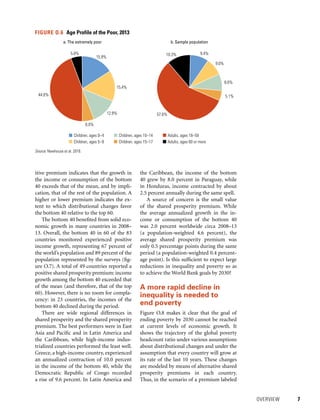
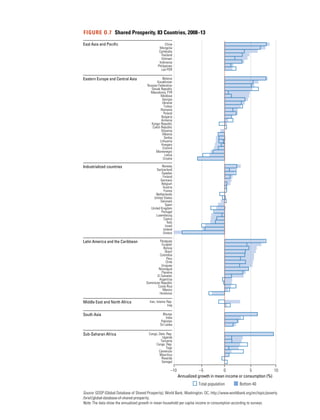
  • 39.
    OVERVIEW 19 sionon Global Poverty,” World Bank, Wash- ington, DC, http://www.worldbank.org/en /programs/commission-on-global-poverty.   5. Poverty and Equity Data (database), World Bank, Washington, DC, http://povertydata .worldbank.org/poverty/home/.   6. Castañeda et al. (2016) analyze the robust- ness of these results by comparing different lineup methods and different ways to adjust welfare aggregates, weights, and poverty lines. They find only minimal differences. They also check for fixed effects and sensi- tivity to missing data. The resulting demo- graphic profile thus paints a robust picture of global poverty.   7. Beegle et al. (2016) and Cornia (2014) doc- ument a bifurcation in inequality trends in Sub-Saharan Africa, that is, within a set of African countries with at least two recent, strictly comparable surveys, there is an even split between countries with widening in- equality and countries with narrowing in- equality. The surveys are drawn from the first decade of the 2000s.   8. World Bank (2015a). Notes   1. WHO (2015).  2. For a formal decomposition, see Datt and Ravallion (1992), among others. In the gen- eral case, a reduction in inequality at a given growth rate leads to a reduction in poverty according to most poverty measures. Ex- ceptions are, for instance, progressive dis- tributional changes whereby some nonpoor fall under the poverty line over time, thus increasing the headcount ratio. Even in that case, other poverty measures with higher social welfare weights for lower percentiles tend to decrease.   3. See Oxfam (2016). Lakner (2015) estimates that the 10 wealthiest Africans own as much as the poorest half of the continent.   4. The countries classified as industrialized in this report are assumed to have zero poverty at the $1.90-a-day poverty line, an assump- tion that may change in the future because of the World Bank’s implementation of the report of the Commission on Global Poverty on global poverty estimation. See “Commis- 3 1 4 2 3 2 4 3 3 3 3 2 8 3 4 4 7 6 7 7 8 4 8 3 6 6 11 3 6 11 5 16 12 13 16 21 23 25 25 23 24 25 25 25 26 26 25 13 2 8 8 14 9 9 13 13 14 17 15 15 17 16 16 17 17 18 15 16 17 14 16 17 15 13 3 3 1 1 1 1 2 1 3 2 1 4 4 3 3 2 2 4 1 2 1 2 1 1 3 1 2 1 1 2 2 3 2 1 3 3 3 2 2 6 7 9 8 4 5 3 6 4 8 4 9 7 7 9 8 7 6 11 10 8 5 1 0 1990 1991 1992 1993 1994 1995 1996 1997 1998 1999 2000 2001 2002 2003 2004 2005 2006 2007 2008 2009 2010 2011 2012 2013 2014 2015 10 20 30 40 50 60 70 Numberofpovertyestimates East Asia and Pacific Middle East and North Africa Eastern Europe and Central Asia South Asia Latin America and the Caribbean Sub-Saharan Africa FIGURE O.14  Available Country Poverty Estimates, Number, by Region and Year Source: Poverty and Equity Data (database), World Bank, Washington, DC, http://povertydata.worldbank.org/poverty/home/. Note: The presentation follows the definition of the developing world of Serajuddin et al. (2015), which includes 150 countries and territories in the early 1990s and 155 in 2013. High-income countries such as the original members of the Organisation for Economic Co-operation and Development (OECD), where extreme poverty is assumed to be zero, are not considered in this sample.
  • 40.
    20 POVERTY ANDSHARED PROSPERITY 2016 2014. “Challenges to Promoting Social In- clusion of the Extreme Poor: Evidence from a Large Scale Experiment in Colombia.” IFS Working Paper W14/33, Institute for Fiscal Studies, London. ADB (Asian Development Bank). 2014. Cambo- dia: Diversifying beyond Garments and Tour- ism, Country Diagnostic Study. November. Manila: Economics and Research Depart- ment, ADB. Aggarwal, Shilpa. 2015. “Do Rural Roads ­Create Pathways Out of Poverty? Evidence from India.” Working paper, Indian School of Business, Hyderabad, India. Akresh, Richard, Damien de Walque, Harounan Kazianga. 2013. “Cash Transfers and Child Schooling: Evidence from a Randomized Evaluation of the Role of Conditionality.” Policy Research Working Paper 6340, World Bank, Washington, DC. Araujo, María Caridad, Pedro Carneiro, Yyannú Cruz-Aguayo, and Norbert Schady. 2016. “Teacher Quality and Learning Outcomes in Kindergarten.” Quarterly Journal of Econom- ics 125 (1): 175–214. Asher, Sam, and Paul Novosad. 2016.“Market Ac- cess and Structural Transformation: Evi­dence from Rural Roads in India.” Working paper (April 20), University of Oxford, Oxford. Avram, Silvia, Horacio Levy, and Holly Suther- land. 2014. “Income Redistribution in the European Union.” IZA Journal of European Labor Studies 3 (22): 1–29. Barros, Ricardo Paes de, Mirela De Carvalho, Samuel Franco, and Rosane Mendonça. 2010. “Markets, the State, and the Dynamics of Inequality in Brazil.” In Declining Inequality in Latin America: A Decade of Progress?, ed- ited by Luis F. López-Calva and Nora Lustig, 134–74. New York: United Nations Develop- ment Programme; Baltimore: Brookings In- stitution Press. Beegle, Kathleen, Luc Christiaensen, Andrew Dabalen, and Isis Gaddis. 2016. Poverty in a Rising Africa. Washington, DC: World Bank. Beegle, Kathleen, Pedro Olinto, Carlos E. Sobrado, Hiroki Uematsu, and Yeon Soo Kim. 2014. “Ending Extreme Poverty and Promoting Shared Prosperity: Could There Be Trade-Offs between These Two Goals?” Inequality in Focus 3 (1): 1–6. Behrman, Jere R., and John Hoddinott. 2005. “Programme Evaluation with Unobserved Heterogeneity and Selective Implementation:  9. In Cambodia, these difficulties revolve around problems in land tenure, bottlenecks in fertilizer and seed markets, inadequate extension services and irrigation systems, and, among farmers, the lack of savings and access to credit. In addition, recent agricul- tural productivity gains from an expansion in the arable land under cultivation are not sustainable indefinitely and are thus unable to offset these problems. As a result, small- holders are generally vulnerable to swings in the international prices for rice. In Tanzania, the unfinished transition to a market-based economy translates into a private sector characterized by a lack of competition, an absence of growth, and a heavy regulatory burden associated with the public sector. See World Bank (2014, 2016a). 10. World Bank (2016b). 11. Barros et al. (2010); Osorio and Souza (2012). 12. ADB (2014). 13. World Bank (2009, 2014). 14. Josz (2013). 15. World Bank (2015a). 16. Genoni and Salazar (2015). 17. World Bank (2015b). 18. World Bank (2016c). 19. Avram, Levy, and Sunderland (2014); De Agostini, Paulus, and Tasseva (2015). 20. Gertler et al. (2014); Grantham-McGregor et al. (1991). 21. UNICEF (2016). 22. Araujo et al. (2016). 23. Fafchamps and Quisumbing (1999); Jolliffe (1998); Yang (1997). 24. Ferré and Sharif (2014). 25. Behrman and Hoddinott (2005); Gertler (2004). 26. Akresh, de Walque, and Kazianga (2013). 27. Fiszbein and Schady (2009). 28. Aggarwal (2015); Asher and Novosad (2016). 29. Khandker, Barnes, and Samad (2013). 30. La Ferrara, Chong, and Duryea (2012). 31. See the evidence presented in chapter 6. 32. Abramovsky et al. (2014); World Bank (2016d). 33. See the evidence presented in chapter 6. 34. See the evidence presented in chapter 6. 35. See the evidence presented in chapter 6. 36. Hallegate et al. (2016). References Abramovsky, Laura, Orazio Attanasio, Kai Barron, Pedro Carneiro, and George Stoye.
  • 41.
    OVERVIEW 21 fromPROGRESA’s Control Randomized Ex- periment.” American Economic Review 94 (2): 336–41. Gertler, Paul J., James J. Heckman, Rodrigo Pinto,Arianna Zanolini, Christel Vermeersch, Susan Walker, Susan M. Chang, and Sally Grantham-McGregor. 2014. “Labor Market Returns to an Early Childhood Stimulation Intervention in Jamaica.” Science 344 (6187): 998–1001. Grantham-McGregor, Sally M., Christine A. Powell, Susan P. Walker, and John H. Himes. 1991.“Nutritional Supplementation, Psycho- social Stimulation, and Mental Development of Stunted Children: The Jamaican Study.” Lancet 338 (8758): 1–5. Hallegatte, Stephane, Mook Bangalore, Laura Bonzanigo, Marianne Fay, Tomaro Kane, Ulf Narloch, Julie Rozenberg, David Treguer, and Adrien Vogt-Schilb. 2016. Shock Waves: Managing the Impacts of Climate Change on Poverty. Climate Change and Development Series. Washington, DC: World Bank. Jolliffe, Dean. 1998. “Skills, Schooling, and Household Income in Ghana.” World Bank Economic Review 12 (1): 81–104. Josz, Christian. 2013. “Mali: Achieving Strong and Inclusive Growth with Macroeconomic Stability.” African Development 13/08, Inter- national Monetary Fund, Washington, DC. Khandker, Shahidur R., Douglas F. Barnes, and Hussain A. Samad. 2013. “Welfare Impacts of Rural Electrification: A Panel Data Analysis from Vietnam.” Economic Development and Cultural Change 61 (3): 659–92. La Ferrara, Eliana, Alberto Chong, and Suzanne Duryea. 2012. “Soap Operas and Fertility: Evidence from Brazil.” American Economic Review 4 (4): 1–31. Lakner, Christoph. 2015. “The Ten Richest Af- ricans Own as Much as the Poorest Half of the Continent.” Let’s Talk Development (blog), March 11. http://blogs.worldbank.org /developmenttalk/ten-richest-africans-own -much-poorest-halfcontinent. Lakner, Christoph, and Branko Milanovic´. 2016. “Global Income Distribution: From the Fall of the Berlin Wall to the Great Recession.” World Bank Economic Review 30 (2): 203–32. Lakner, Christoph, Mario Negre, and Espen Beer Prydz. 2014. “Twinning the Goals: How Can Shared Prosperity Help to Reduce Global Poverty?” Policy Research Working Paper 7106, World Bank, Washington, DC. The Mexican PROGRESA Impact on Child Nutrition.” Oxford Bulletin of Economics and Statistics 67 (4): 547–69. Bourguignon, François. 2015. The Globalization of Inequality. Translated by Thomas Scott- Railton. Princeton, NJ: Princeton University Press. Castañeda, Andres, Dung Doan, David New- house, Minh C. Nguyen, Hiroki Uematsu, João Pedro Azevedo, and Data for Goals Group. 2016. “Who Are the Poor in the De- veloping World?” Policy Research Working Paper 7844, World Bank, Washington DC. Cornia, Giovanni Andrea. 2014. “Income In- equality Levels, Trends, and Determinants in Sub-Saharan Africa: An Overview of the Main Changes.” Università degli Studi di Firenze, Florence. Datt, Gaurav, and Martin Ravallion. 1992. “Growth and Redistribution Components of Changes in Poverty Measures: A Decomposi- tion with Applications to Brazil and India in the 1980s.” Journal of Development Economics 38 (2): 275–95. De Agostini, Paola, Alari Paulus, and Iva Val- entinova Tasseva. 2015. “The Effect of Tax- Benefit Changes on the Income Distribution in 2008–2014.” Euromod Working Paper EM11/15, Institute for Social and Economic Research, University of Essex, Colchester, United Kingdom. Fafchamps, Marcel, and Agnes R. Quisumbing. 1999. “Human Capital, Productivity, and Labor Allocation in Rural Pakistan.” Journal of Human Resources 34 (2): 369–406. Ferré, Céline, and Iffath Sharif. 2014. “Can Con- ditional Cash Transfers Improve Education and Nutrition Outcomes for Poor Children in Bangladesh? Evidence from a Pilot Project.” Policy Research Working Paper 7077, World Bank, Washington, DC. Fiszbein, Ariel, and Norbert Schady. 2009. Con- ditional Cash Transfers: Reducing Present and Future Poverty.Washington, DC: World Bank. Genoni, María Eugenia, and Mateo Salazar. 2015. “Steering toward Shared Prosperity in Peru.” In Shared Prosperity and Poverty Eradication in Latin America and the Caribbean, edited by Louise Cord, María Eugenia Genoni, and Carlos Rodríguez-Castelán, 269–302. Wash- ington, DC: World Bank. Gertler, Paul J. 2004. “Do Conditional Cash Transfers Improve Child Health? Evidence
  • 42.
    22 POVERTY ANDSHARED PROSPERITY 2016 of Cambodia: Proposed Smallholder Agri- culture and Social Protection Support Op- eration.” Report 48083-KH (June 19), World Bank, Washington, DC. ———. 2014. “Where Have All the Poor Gone? Cambodia Poverty Assessment 2013.” Report ACS4545, World Bank, Washington, DC. ———. 2015a. “Republic of Mali, Priorities for Ending Poverty and Boosting Shared Prosperity: Systematic Country Diagnostic (SCD).” Report 94191-ML (June 22), World Bank, Washington, DC. ———. 2015b.“Tanzania Mainland: Poverty As- sessment.” Report AUS6819 v2, World Bank, Washington, DC. ———. 2016a. “Ngazi Ya Pili (To the Next Level): United Republic of Tanzania Sys- tematic Country Diagnostics.” Regional Op- erations Committee Decision Review Draft (June 2), World Bank, Washington, DC. ———. 2016b. Brazil Systematic Country Diag- nostic: Retaking the Path to Inclusion, Growth, and Sustainability. Report 101431-BR, Wash- ington, DC: World Bank. ———. 2016c. “International Development Association Project Paper, United Republic of Tanzania: Productive Social Safety Net (PSSN).” Report PAD1500 (May 20), World Bank, Washington, DC. ———. 2016d. “Chile: Distributional Effects of the 2014 Tax Reform,”World Bank, Washing- ton, DC. Yang, Dennis. 1997. “Education and Off-Farm Work.” Economic Development and Cultural Change 45 (3): 613–32. Milanovic´, Branko. 2014. “All the Ginis, 1950– 2012 (updated in Autumn 2014).” Novem- ber, World Bank, Washington, DC. http:// go.worldbank.org/9VCQW66LA0. ———. 2016. Global Inequality: A New Approach for the Age of Globalization. Cambridge, MA: Harvard University Press. Newhouse, David, Pablo Suarez-Becerra, Martin C. Evans, and Data for Goals Group. 2016. “New Estimates of Extreme Poverty for Chil- dren.” Policy Research Working Paper 7845, World Bank, Washington, DC. Osorio, Rafael Guerreiro, and Pedro H. G. Ferreira de Souza. 2012. “O Bolsa Família de- pois do Brasil Carinhoso: uma análise do po- tencial de redução da pobreza extrema.”Insti- tute for Applied Economic Research, Brasília. Oxfam. 2016. “An Economy for the 1%: How Privilege and Power in the Economy Drive Extreme Inequality and How This Can Be Stopped.” Oxfam Briefing Paper 210, Oxfam GB, Oxford. Serajuddin, Umar, Hiroki Uematsu, Christina Wieser, Nobuo Yoshida, and Andrew Dabalen. 2015. “Data Deprivation: Another Depriva- tion to End.” Policy Research Working Paper 7252, World Bank, Washington, DC. UNICEF (United Nations Children’s Fund). 2016. The State of the World’s Children 2016: A Fair Chance for Every Child. June. New York: UNICEF. WHO (World Health Organization). 2015. World Health Statistics. Geneva: WHO. World Bank. 2009. “International Development Association Program Document, Kingdom
  • 43.
    1 The World Bankgoals On April 20, 2013, the Board of Executive Directors of the World Bank adopted two ambitious goals: end extreme poverty glob- ally and promote shared prosperity in every country in a sustainable way. Progress toward the first of these goals is measured by monitoring the rate of ex- treme poverty using the international pov- erty standard. The World Bank set a target of reducing the poverty headcount ratio from 12.4 percent globally in 2012 to 3.0 percent by 2030, and, to avoid overreliance on efforts toward the end of the period, the institution set an interim target of 9.0 per- cent by 2020, consistent with an annual re- duction in global extreme poverty of a half percentage point over 2012–20.1 The second goal is not defined globally, but tracks progress at the level of countries. Despite not providing a single global target, the shared prosperity goal is universal be- cause it includes developed countries that do not contribute to the global poverty count, but are still monitored in terms of shared prosperity. Progress on the shared prosperity goal is measured by the growth in the average income or consumption ex- penditure of the poorest 40 percent of the population distribution (the bottom 40) within each country.2 This goal is not asso- ciated with a target in 2030, but it reflects the aim that every country should promote the welfare of its least privileged citizens. Poverty and Shared Prosperity: Setting the Stage POVERTY AND SHARED PROSPERITY: SETTING THE STAGE 23 Measuring the World Bank goals Poverty The first World Bank goal, ending poverty, is global, and measurement involves adding up the number of poor people in all coun- tries. Three specific components are critical to this aggregation. The first component is cost-of-living comparability across coun- tries. The key information for ensuring this comparability is data to gauge purchasing power parities (PPPs). The data are col- lected through the International Compar- ison Program, an independent worldwide statistical partnership that gathers data on prices and expenditures within economies. The comparison of incomes across house- holds in different countries entails the use of exchange rates between local currencies, the units of value used by household surveys. However, the use of market exchange rates is not sufficient because market exchange rates do not accurately assess differences in purchasing power and are inaccurate in cap- turing the costs faced by the poor. Despite the limitations stemming from the com- plexity of a global exercise of this nature, the PPPs fill this gap by allowing income com- parisons in real terms, while accounting for differences in prices across countries. Com- paring prices across the world is a tricky en- deavor because most products are not sold everywhere, or, even if they are, the quality may vary considerably country-by-country Concepts, measurement, and data
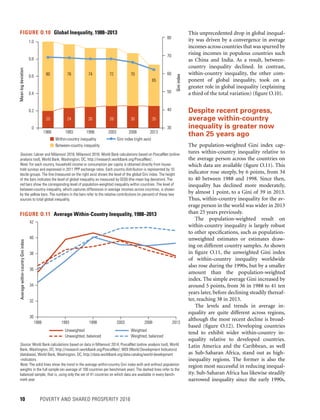
  • 44.
    24 POVERTY ANDSHARED PROSPERITY 2016 although a nonnegligible share of house- holds in these countries report incomes below the international poverty line. The United States is a good example. According to some estimates, 1 percent to 4 percent of the population there (measured by income) is living below a $2.00-a-day poverty line (in 2005 prices).6 If welfare is measured by con- sumption, however, high-income countries typically report no poverty at all. This is be- cause the poor in these countries generally have access to free public services and social transfers that are not accounted for in the income aggregate, but that ensure that the population’s consumption levels are above the recognized poverty standards. Box 1.1 discusses key issues in the use of incomes and consumption as welfare aggregates. Shared prosperity To analyze both prosperity and equity dy- namically, the World Bank focuses, in the second goal, on the growth experienced by people at the bottom of the income or con- sumption distribution within a country. In practice, this is defined as the growth in the average income or consumption of the bot- tom 40, which is measured through house- hold surveys.7 Although the choice of the bottom 40 is somewhat arbitrary, the bot- tom 40 has been a focus of poverty analysis for quite some time.8 Indeed, the bottom 40 threshold reflects a commitment to focus on the least well off regardless of the actual poverty rate. In cases where the national poverty headcount is above 40 percent, the shared prosperity indicator centers on the poorest of the poor. Why choose an income growth indica- tor that focuses only on the bottom of the distribution? One of the most widely used indicators of economic prosperity is growth in per capita gross domestic product (GDP). The economic health and development of countries are often judged on this basis. However, a per capita growth rate says lit- tle about how specific population groups benefit from economic progress. Similarly, standard indicators of inequality, such as the Gini index, do not offer information on the size of the pie being shared. The shared prosperity indicator therefore represents a practical compromise between a and region-by-region. Moreover, an every- day product in one country may be a lux- ury item in another. Likewise, prices may also vary widely within a single country; so, spatial price variations should also be taken into account where possible. Because relative prices evolve, updates of PPPs may be necessary so that PPP exchange rates are used reliably in price comparisons. A second key component of the aggrega- tion of the poor is the definition of an inter- national poverty line in PPP terms. Coun- tries determine their own poverty lines mostly by means of a basic needs standard that is linked to a predefined consumption basket of essential goods and services, or relative to an agreed position along the dis- tribution of income or consumption (for example, 60 percent of the median national household income). The World Bank uses an international poverty line based on the national thresholds of some of the poorest countries.3 To account for changes in rela- tive prices across countries over time, the 2011 PPP was adopted in 2015 as the stan- dard. This involved an upward adjustment of the international poverty line to US$1.90 a day in income or consumption expendi- ture so as to preserve the real value of the US$1.25-a-day line in 2005 PPP that was the previous international line. Global pov- erty incidence changes little as a result, and progress toward the global poverty target for 2030 is unaffected.4 The third element in a proper aggrega- tion of the poverty count is the treatment of the lack of reliable data on some economies and a range of difficulties in the aggrega- tion of existing and available data. Hence, for those countries lacking reliable income or consumption data or on which data are not available for analysis, a regional average poverty rate is used. In calculating this rate, available and reliable evidence is gathered on countries within the same region and then extrapolated onto the countries on which data are unavailable.5 These three ingredients permit the esti- mation of the global count of the poor. Yet, the global aggregation exercise rests on var- ious assumptions. Most significantly, zero poverty is assumed in most high-income countries, that is, industrialized countries,
  • 45.
    POVERTY AND SHAREDPROSPERITY: SETTING THE STAGE 25 matter the circumstances, the country con- text, or the time period.9 Linking shared prosperity and inequality: the shared prosperity premium Tracking the growth rate of the average in- come of the poorest two-fifths of the pop- ulation is crucial for assessing the inclusive nature of growth. However, taking this mea- sure a step further and comparing it to the performance of the mean provides import- prosperity indicator that fails to capture in- equality and an equity indicator that fails to capture growth. By focusing on the growth in incomes of the bottom 40, the shared prosperity indicator incorporates a measure of prosperity and distributional dimensions. Furthermore, by choosing this indicator to measure one of its goals, the World Bank fo- cuses squarely on improving the welfare of the least well off within every country across the world, ensuring that everyone is part of a dynamic and inclusive growth process, no BOX 1.1  The Welfare Aggregate: Income versus Consumption The global poverty headcount requires that the number of the poor within a country be measured by adding up the poor based on a welfare aggregate obtained through household surveys. In most countries, the aggregate of choice is per capita consumption. Indeed, 75 percent of the countries in the World Bank PovcalNet database— the official online repository of World Bank poverty data—use this aggregate.a The countries in the database that use incomes are mostly high-income countries and Latin America and Caribbean countries. Are these two aggregates—income and consumption—the same? They are not. Conceptually, income is a measure of the potential set of all goods and services that an individual or a household could obtain based on their purchasing power. Meanwhile, consumption represents a direct measure of the goods and services that the individual or household has actually obtained. Therefore, consumption does not capture opportunities, but realized outcomes that directly determine an individual or household’s well-being. In practice, income is generally more volatile in the sense that it may be influenced greatly by seasonal factors or by a lack of regularity, particularly in agriculture and in the informal sector. It also has other important shortcomings, such as the frequent case of households that declare zero income on a survey, but exhibit a consumption level that is not zero. This may occur because the households lack income during a survey recall period, are dissaving, or are experiencing a spell of unemployment, or because the consumption of home- produced goods has not been correctly measured. In contrast, consumption does not normally vary as widely; it displays a much smoother behavior. For this reason, consumption tends to be the preferred aggregate in measuring poverty in developing economies, which typically depend more on agriculture and have a larger informal sector. Despite these differences, both aggregates are used indistinctively in the measurement of the World Bank goals to maximize the number of countries monitored. Although this creates issues of comparability in the measurement of poverty, it allows the coverage of the global goals to be expanded. The distinction may be more problematic, however, in the analysis of inequality. This is a result of the fact that the coverage of household surveys is generally incomplete among top earners, entrepreneurial and capital incomes are inadequately reported, and measures of consumption often underestimate the living conditions of the rich. a. PovcalNet (online analysis tool), World Bank, Washington, DC, http://iresearch.worldbank.org /PovcalNet/.
  • 46.
    26 POVERTY ANDSHARED PROSPERITY 2016 tended metric of growth and not an in- equality indicator. Rewriting equation 1.1, one may easily appreciate that the shared prosperity pre- mium represents the change in the total in- come share of the bottom 40, as follows: gshareB40 = g40 – gmean = the shared prosperity premium (1.2) where gshareB40 is the growth in the income share of the bottom 40; g40 is the income growth of the bottom 40; and gmean is the growth of the mean. While the shared prosperity indicator is useful in gauging the progress in achieving the ambition of leaving no one behind, a positive value in the shared prosperity pre- mium ensures an extra focus on the partic- ular progress of those who are most in need. It shows that the relative growth in incomes or consumption among this population segment is larger than that observed among the rest of the distribution. Poverty, shared prosperity, and the global goals The World Bank’s first goal—reducing the poverty rate to 3.0 percent by 2030—en- compasses the world. Yet, not all countries or regions or groups within countries can be expected to reach the goal individually. However, an even more ambitious target, eradicating extreme poverty “for all people everywhere” by 2030, was adopted by the United Nations General Assembly in Sep- tember 2015 as part of the first Sustainable Development Goal. This slight difference in targets between the World Bank’s goal and the Sustain- able Development Goal—3 percent versus zero—is not accidental. As countries have eradicated extreme poverty, the speed at which they have been able to eliminate the last pockets of poverty has varied con- siderably. Some countries have witnessed a slowdown in poverty reduction in the last stages of the process, such as Austra- lia, Canada, the United Kingdom, and the United States.12 Moreover, even if most countries significantly reduce poverty by 2030, the persistence of conflicts and disas- ant additional insights. Whether the income or consumption of the bottom 40 grows more quickly or more slowly than the aver- age determines whether or not the bottom 40 disproportionately benefit from growth relative to the average individual in society. If incomes among the bottom 40 grow at a rate above the rate at the mean, this implies that the incomes of the bottom 40 are rising more rapidly than the incomes among the rest of the population, that is, the top 60. This concept has been embodied in the shared prosperity premium, an indicator that is defined as the difference between the growth in the incomes or the consumption of the bottom 40 and the growth in the in- comes or consumption of the mean.10 The shared prosperity goal thus pos- sesses an inequality dimension even though it is not an inequality indicator. This di- mension can be readily assessed by com- paring growth among the bottom 40 with growth at the mean. The difference is posi- tive if the former grows more quickly than the latter and negative otherwise. The indi- cator can easily be used to provide a rough assessment of the magnitude of changes in inequality. One may also decompose the sources of the growth measured: the growth of the bottom 40 may derive from growth in the mean income (or consumption) of the overall population, or it may arise from changes in the share of overall income that accrues to the bottom 40 according to the following accounting relationship:11 g40 = gmean + gshareB40, (1.1) where g40 is the income growth of the bot- tom 40; gmean is the growth of the mean; and gshareB40 is the growth in the income share of the bottom 40. The growth in income or consump- tion among the bottom 40 may therefore be associated with participation in average growth, with a rising share of the bottom 40 in total income or consumption, or, ideally, with both so that achievements through one channel are not offset by poor perfor- mance in the other. Such a decomposition synthesizes the distributional character of the shared prosperity indicator, although the indicator, strictly speaking, is an ex-
  • 47.
    POVERTY AND SHAREDPROSPERITY: SETTING THE STAGE 27 may drive significant changes in the shared prosperity indicator.15 Amid such issues, the availability of good-quality household surveys is perhaps the most critical need. Indeed, limited avail- ability or a complete lack of household sur- veys not only hampers efforts to monitor poverty and shared prosperity, but also the capacity to design policies and interven- tions that can reach those who need them the most. Household surveys therefore need to be undertaken with regularity, must be comparable from one round to another, and must be of good quality. Meeting any of these requirements is not common practice in many developing countries. Figure 1.1 illustrates the status of house- hold survey availability among develop- ing countries by reporting the number of national poverty estimates available each year. Household survey data availabil- ity has considerably improved over time. How­ever, poverty and welfare estimates are typically not available immediately after a survey has been conducted because pro- cessing the data with confidence takes time. This is the cause of the precipitous drop in available poverty estimates in 2014 and 2015: household surveys collected in those years have not yet yielded an official, val- idated poverty estimate. Global poverty estimates are therefore typically reported with a three-year lag, although ambitious efforts are under way to ensure more fre- quent household surveys and hopefully allow for more up-to-date reporting in the future.16 To monitor the trends in poverty, sur- veys need to be conducted regularly, at least every three years or even more frequently. Figure 1.2 shows the data availability during all possible 10-year periods between 1990 and 2013. The progress is evident. The number of countries on which there is no poverty estimate over any 10-year period fell from 50 in 1990–99 to 21 in 2004–13. That the progress achieved so far is insuf- ficient is equally evident. In 2004–13, 74 countries still lacked the basic data required to monitor poverty and shared prosperity over two points in time within a 10-year span. Indeed, these countries have no data ters means there will likely remain a small, but significant number of people living in extreme poverty. In part for this reason, the World Bank goal of reducing poverty is restricted to narrowing the share of the world population living below the interna- tional poverty line to less than 3.0 percent by 2030. The United Nations has also built on the concept of shared prosperity for Sustainable Development Goal 10, on inequality. This development goal aims to “progressively achieve and sustain income growth of the bottom 40 percent of the population at a rate higher than the national average” by 2030 (target 10.1).13 The United Nations is using the shared prosperity premium, de- fined above, to measure progress. In addition, in 2016, the G20 adopted the shared prosperity premium indicator to monitor the progress of its members in making their economies more inclusive. The global community, by putting these issues at the forefront of policy making, has an unprecedented opportunity to help push governments and citizens into action to end extreme poverty and promote more inclu- sive societies. The importance of data in tracking progress and spurring action Monitoring progress on the two World Bank goals involves a massive effort in data collection and harmonization. Though not the only essential element, national house- hold surveys are mandatory in estimating the proportion of people who are living in extreme poverty based on the international poverty line and in gauging the extent to which the bottom 40 benefit from eco- nomic growth.14 While measurement of the shared pros- perity goal is not associated with specific additional data requirements relative to the poverty goal, and while it does not rely on the use of PPPs, it does pose specific chal- lenges. Thus, within countries, slight meth- odological changes in survey questionnaires from round to round or in the composition of the consumption or income indicator
  • 48.
    28 POVERTY ANDSHARED PROSPERITY 2016 Numberofcountries 50 46 42 41 38 33 30 25 23 24 24 22 22 21 21 37 42 47 44 45 51 46 52 49 50 48 51 49 50 53 63 62 62 66 68 67 75 76 81 80 82 81 84 84 81 0 1990–99 1992–2001 1991–2000 1993–2002 1995–2004 1994–2003 1996–2005 1998–2007 1997–2006 1999–2008 2001–10 2000–09 2002–11 2004–13 2003–12 20 40 60 80 100 120 140 160 Deprived (0 data points) Deprived (1 or 2 data points, more than 5 years apart) Non-deprived FIGURE 1.2  Availability of Poverty Data, by All Possible 10-Year Periods, 1990–2013 Source: Poverty and Equity Data (database), World Bank, Washington, DC, http://povertydata.worldbank.org/poverty/home/. FIGURE 1.1  Available Country Poverty Estimates, by Region and Year Source: Poverty and Equity Data (database), World Bank, Washington, DC, http://povertydata.worldbank.org/poverty/home/. Note: The presentation follows the definition of the developing world employed by Serajuddin et al. (2015), which includes 150 countries and territories in the early 1990s and 155 in 2013. High-income countries such as the original members of the Organisation for Economic Co-operation and Development (OECD), where extreme poverty is assumed to be zero, are not considered in this sample. 3 1 4 2 3 2 4 3 3 3 3 2 8 3 4 4 7 6 7 7 8 4 8 3 6 6 11 3 6 11 5 16 12 13 16 21 23 25 25 23 24 25 25 25 26 26 25 13 2 8 8 14 9 9 13 13 14 17 15 15 17 16 16 17 17 18 15 16 17 14 16 17 15 13 3 3 1 1 1 1 2 1 3 2 1 4 4 3 3 2 2 4 1 2 1 2 1 1 3 1 2 1 1 2 2 3 2 1 3 3 3 2 2 6 7 9 8 4 5 3 6 4 8 4 9 7 7 9 8 7 6 11 10 8 5 1 0 1990 1991 1992 1993 1994 1995 1996 1997 1998 1999 2000 2001 2002 2003 2004 2005 2006 2007 2008 2009 2010 2011 2012 2013 2014 2015 10 20 30 40 50 60 70 Numberofpovertyestimates East Asia and Pacific Middle East and North Africa Eastern Europe and Central Asia South Asia Latin America and the Caribbean Sub-Saharan Africa
  • 49.
    POVERTY AND SHAREDPROSPERITY: SETTING THE STAGE 29 upgrade and expand the availability of ap- propriate data, particularly where these are needed the most. In 2015, the World Bank committed to supporting the poorest coun- tries in undertaking at least one household survey every three years and is now working closely with governments and partner insti- tutions to broaden and improve data qual- ity and availability in other crucial areas.19 A special focus in 2016: taking on inequality Preceding the launch of the new World Bank goals by several years, World Develop- ment Report 2006: Equity and Development described the extraordinary inequality of opportunity across the world.20 Since 2006, substantial progress has been made in re- ducing poverty, expanding prosperity, com- bating hunger, enhancing education and health services, and lowering maternal and child mortality. Do the large inequalities of 10 years ago persist today? What can be done to eliminate them? The World Bank devotes this first flag- ship report on poverty and shared prosper- ity to addressing these questions. Although the findings indicate that there has been progress in establishing greater equality across the globe, there is also no room for complacency: we continue to live in a world characterized by intolerable inequality of opportunity, gender disparities, and depri- vations, particularly in health, education, safe water and sanitation, nutrition, and consumption. The issue of the sustainability of pros- perity is as relevant today as 10 years ago. People worldwide are paying closer atten- tion and taking and demanding action to tackle a broad range of inequalities more effectively. Today, few stakeholders ques- tion that equality of opportunity should be a central concern in the design and imple- mentation of policies to foster development and inclusive growth. Taking on inequality implies that pros- perity must be shared meaningfully within developed and developing countries. The less well off must be at center stage if so- cieties worldwide are to achieve the sta- points at all, have only one data point each, or have two data points, but more than five years apart. This constitutes the definition of a country that is data deprived, which is the case of these 74 countries today. It is also worrisome that data depriva- tion is unequally distributed worldwide. The data gaps within regions vary widely. In Eastern Europe and Central Asia, 28 of 30 countries have at least three data points in the most recent 10-year period, 2004–13. At the other extreme, most Sub-Saharan African countries only have one survey for the entire 10-year span: a total of 35 of 48 countries in Sub-Saharan Africa are data deprived. The Middle East and North Africa region and the East Asia and Pacific region are also severely data deprived. In Latin America and the Caribbean, countries typ- ically either have excellent survey coverage (with a data point for almost every year) or no data points at all (often, in the Carib- bean subregion). Zero data points does not necessarily mean that no survey has been carried out. It may be that surveys are deemed insuffi- cient in quality and comparability or that access to the data is not granted to the World Bank and its partners. The following statistics provide an illustration of the dire effects of one of these issues, comparability. If one discounts the surveys in Sub-Saharan Africa that are not nationally representative, that were not conducted at similar times of the year (to control for seasonality in con- sumption patterns), and that use different instruments in collection, the typical Afri- can country would have conducted only 1.6 comparable surveys in the 22 years between 1990 and 2012.17 Multiple challenges drive data depri- vation. The funding of surveys is often ad hoc and unpredictable, reflecting lack of commitment, competing priorities, poor coordination, or a combination of all these factors. Weak technical capacity, weak gov- ernance in data collection, and a lack of globally accepted methodological standards also pose severe challenges.18 The World Bank’s commitment to mon- itoring extreme poverty and shared pros- perity therefore represents a critical call to
  • 50.
    30 POVERTY ANDSHARED PROSPERITY 2016 are experiencing double or triple dips in growth. The first dip took place in 2009, when the per capita GDP growth of these economies plummeted to negative values or zero, followed by a strong rebound in 2010. Growth then declined again in these econ- omies, marking a second dip. In the United States, the dip was short-lived because the economy rebounded again in 2012, but slowed once more in 2013 (the third dip). In Europe, the rebound took longer and materialized in 2014. The BRICS economies have been slowing since 2011. This report finds that the goal of elimi- nating extreme poverty will not be achieved by 2030 without significant shifts in within- country inequality. Ultimately, poverty reduction can occur through higher aver- age growth, a narrowing in inequality, or a combination of the two. So, if poverty reduction is to be achieved in a context of slow growth, such as the current context, more equitable income or consumption distribution will be required. Taking on inequality also matters for other reasons. It can bolster economic growth if it is carried out smartly.21 There is no inevitable trade-off between efficiency and equity.22 For example, investing in early childhood development (ECD) among un- derprivileged children can help prevent the emergence of inequalities in cognitive development and health status and, by enabling a more successful accumulation of human capital among individuals who would otherwise lag throughout the rest of the life cycle, improve future earnings and life chances. Trimming down inequalities in opportunity and outcomes among indi- viduals, populations, and regions may also generate additional benefits through polit- ical and social stability and social cohesion. This inaugural flagship report on poverty and shared prosperity documents trends in income inequality, identifies recent coun- try experiences that have been successful in reducing such inequalities, analyzes key lessons drawn from these experiences, and synthesizes the rigorous evidence on public policies that can shift inequality to bolster poverty reduction and shared prosperity. Specifically, the report addresses the follow- ing questions: bility and well-being to which they aspire. Growth alone will not do the job; any type of growth will not suffice. Growth must be sustainable to achieve the maxi- mum possible increase in living standards among the less well-off. Reducing deprivations among the poor- est, increasing their living standards, and leveling the playing field correspond to notions of fairness and justice and reso- nate across societies on their own merits. Nonetheless, continuing the notable prog- ress in poverty reduction and shared pros- perity that took place over the first decade of the 2000s is at risk because of the some- what lower growth today and the projected global slowdown. In the last few years, eco- nomic growth has been sluggish worldwide, a period typically described as the Great Re- cession. Figure 1.3 illustrates the pattern of slowing growth among the main economic powerhouses, such as Brazil, the Russian Federation, India, China, and South Africa (together known as BRICS), the European Union (EU), and the United States, in which per capita GDP growth rates are exhibiting recurrent ups and downs. These economies FIGURE 1.3  Double and Triple Dips in Growth, Selected Economies, 2006–15 Source: WDI (World Development Indicators) (database), World Bank, Washington, DC, http://data.world bank.org/data-catalog/world-development-indicators. Note: The data on the European Union and BRICS are population-weighted averages of the respective national per capita GDP growth rates. IndexofannualizedGDPpercapitagrowthrates(2006=100) –250 –200 –150 –100 –50 0 50 100 150 2006 2007 20092008 2010 2011 2012 2013 2014 2015 United States European Union BRICS
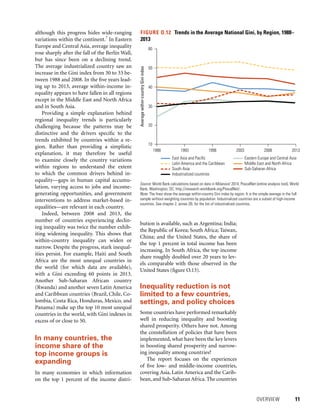
  • 51.
    POVERTY AND SHAREDPROSPERITY: SETTING THE STAGE 31 fusion on global trends, which can often be properly explained simply by selecting the appropriate inequality indicator, country, or time period for analysis. Chapter 5 briefly discusses the driv- ers that explain recent notable successes in boosting shared prosperity and reducing inequality within countries. What have suc- cessful countries done to reduce income in- equality, while inequality has been widening in other economies? Among the constella- tion of policies that have been implemented, this chapter identifies key levers in reduc- ing income inequality and boosting shared prosperity in selected countries. Country cases assess how macroeconomic manage- ment, sectoral reforms, the expansion of safety nets, responses to external shocks, and initial conditions or context all contribute to boost shared prosperity. Five countries have been chosen based on their success in sharing prosperity and reducing inequality: Brazil, Cambodia, Mali, Peru, and Tanza- nia. These countries have also been chosen with the aim of achieving diversity in terms of region, income group, and distinctive contexts. Chapter 6 explores the drivers of inequal- ity reduction by examining interventions rather than country-specific experiences. It reviews emerging as well as consolidated evidence on how interventions successfully address the roots, drivers, and outcomes of inequality, while supporting economic growth and poverty reduction. The chap- ter focuses on early childhood develop- ment (including breastfeeding), universal health care, quality teaching, conditional cash transfers (CCTs), investments in rural infrastructure (roads and electrification), and taxation. The choice of policy inter- ventions is highly selective and responds to the availability of rigorous evidence that supports reliable lessons and reflects some of the policy areas highlighted by the coun- try narratives in chapter 5. The interven- tions chosen confirm the multiple pathways through which policies can successfully promote equality. The chapter also provides several general lessons useful in establishing a basic agenda of interventions that over- come equity-efficiency and implementation trade-offs. • What is the latest evidence on the levels and evolution of global extreme poverty and shared prosperity? • Which countries and regions have been more successful in terms of progress to- ward these goals and which are lagging? • What does the global context of lower economic growth mean for the poorest people and countries? • How can narrowing inequality contribute to ending extreme poverty and improving the welfare of the least well off? • What does the evidence show concerning global and between- and within-country inequality trends? • What does the evidence tell us about how countries and interventions have success- fully reduced inequality? To address these questions, the report is organized in six chapters, including this introduction. Chapter 2 presents the latest numbers on global and regional poverty using the international extreme poverty line of US$1.90 (2011 PPP). The chapter also discusses the geographical concentration of poverty and the composition of global pov- erty, complementing the global headcount numbers with a profile of global poverty. Chapter 3 presents the latest shared prosperity data on the largest possible set of countries on which at least two comparable data points are available circa 2008–13, that is, 83 countries covering 75 percent of the world’s population. The analysis identifies the best and worst performers in terms of the growth of the bottom 40. The chapter also shows that, in the context of declining global and regional growth rates and an outlook of weaker growth, the continuation of the progress achieved so far toward end- ing poverty by 2030 is at serious risk. Pov- erty trajectories to 2030 are simulated under several scenarios of growth and changes in shared prosperity, providing insights on the additional reductions in inequality required to end poverty. Chapter 4 focuses on income inequality. It presents the most recent trends on global and between- and within-country inequal- ities and contrasts them with secular long- term trends. The analysis separates fact from fiction and clarifies much of the con-
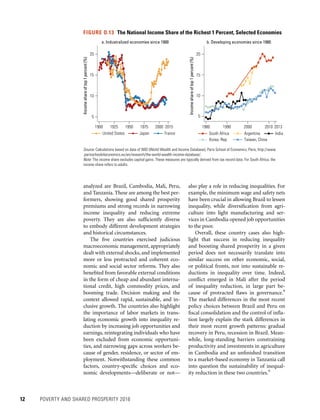
  • 52.
    32 POVERTY ANDSHARED PROSPERITY 2016 and ensure geographical comparability; and national accounts and administrative data, which can be used, for example, to adjust for under­reported incomes or consumption. 15. Estimates of the growth in income or con- sumption of the bottom 40 are based on comparisons at two points in time, which may include years that do not correspond to the most recent survey in all countries. The growth rates must therefore be annualized, and, although this makes them more readily comparable, the operation is only performed on rates in those countries on which more than two surveys are available within the period under analysis. 16. United Nations (2014). 17. Beegle et al. (2016). 18. World Bank (2015a). 19. World Bank (2015b). 20. World Bank (2005). 21. Interventions aimed at narrowing inequality can also result in economic distortions, thus affecting efficiency and, ultimately, growth. 22. Interventions that reduce inequality without compromising economic growth are de- scribed here generically as equity-enhancing policies. World Development Report 2006: Equity and Development (World Bank 2005) calls them efficient redistribution policies. The change in the term in this report aims to avoid any confusion around the notion of redistribution. Redistribution may be strictly understood as removing resources from one individual or group and giving them to an- other individual or group. However, not all equity-enhancing policies must rely on re- distribution in this strict sense. Some may achieve progressive distributional changes simply through legislation. For example, leg- islation on the minimum wage does not in- volve any direct government redistribution of resources, but often nonetheless affects the distribution of income. Moreover, the term redistribution is frequently used among pundits to refer to anonymous changes in the distribution regardless of their cause. Ef- ficiency is also subject to alternative interpre- tations. The arguments presented in this re- port that tackle inequality draw from an idea of efficiency developed by Kaldor and Hicks in the late 1930s whereby an increase in over- all incomes may be desirable even at the cost Notes  1. Basu (2013).  2. Unless otherwise indicated, income and consumption are henceforth used interchangeably.   3. The methodology was originally applied by Ravallion, Chen, and Sangraula (2008), who established a first set of countries.   4. Ferreira et al. (2016).   5. World Bank (2015a).   6. Chandy and Smith (2014).   7. In this report, shared prosperity is estimated as the growth rate of real survey per capita income or consumption among the bottom 40 over a five-year period that ends three years before the publication of the report. Only countries with surveys meeting the following criteria are included: (a) the lat- est household survey for the country falls between 2011 and 2015 and (b) the survey for the first year of the period is the nearest survey collected five years before the most recent survey available; thus, only surveys collected between three and seven years be- fore the most recent survey are considered in the inclusion or exclusion of countries.  8. Among the prominent references to the bottom 40, see Kuznets (1955); McNamara (1972).  9. Saavedra-Chanduvi (2013). 10. Lakner, Negre, and Prydz (2014). 11. Where gshareB40 denotes the growth rate of the income share of the bottom 40. Equation 1.1 follows from differentiating the follow- ing identity: m40 = s 0.4 40 * m, where s40 is the income share of the bottom 40, and m and m40 are the overall mean and the mean of bottom 40, respectively. Equation 1.1 holds in continuous time; as t becomes larger, it becomes an approximation. Also see Dollar, Kleineberg and Kraay (2016); Rosenblatt and McGavock (2013). 12. World Bank (2015a). 13. Sustainable Development Knowledge Plat- form (database), Department of Economic and Social Affairs, United Nations, New York, https://sustainabledevelopment.un.org/. 14. The following are also essential: censuses, be- cause they make possible the design of the household surveys; price data, to adjust trends in income and consumption over time
  • 53.
    POVERTY AND SHAREDPROSPERITY: SETTING THE STAGE 33 McNamara, Robert S. 1972. “Annual Address by Robert S. McNamara, President of the Bank and Its Affiliates.” Summary Proceedings, An- nual Meetings of the Boards of Governors, Re- port 53408, 16–31. Washington, DC: World Bank. Pareto, Vilfredo. 1906. Manuale di economia politica: Con una introduzione alla scienza sociale. Milan: Società editrice libraria. Ravallion, Martin, Shaohua Chen, and Prem Sangraula. 2008. “Dollar a Day Revisited.” Policy Research Working Paper 4620, World Bank, Washington, DC. Rosenblatt, David, and Tamara J. McGavock. 2013. “A Note on the Simple Algebra of the Shared Prosperity Indicator.” Policy Research Working Paper 6645, World Bank, Washing- ton, DC. Saavedra-Chanduvi, Jaime. 2013. “Why Didn’t the World Bank Make Reducing Inequality One of Its Goals?” Let’s Talk Development (blog), September 23, https://blogs.world bank.org/developmenttalk/why-didn-t-world -bank-make-reducing-inequality-one-its -goals. Serajuddin, Umar, Hiroki Uematsu, Christina Wieser, Nobuo Yoshida, and Andrew Dabalen. 2015. “Data Deprivation: Another Depriva- tion to End.” Policy Research Working Paper 7252, World Bank, Washington, DC. United Nations. 2014. “A World That Counts: Mobilising the Data Revolution for Sustain- able Development.” November, Independent Expert Advisory Group on a Data Revolution for Sustainable Development, United Na- tions, New York. World Bank. 2005. World Development Report 2006: Equity and Development. Washington, DC: World Bank; New York: Oxford Univer- sity Press. ———. 2015a. A Measured Approach to Ending Poverty and Boosting Shared Prosperity: Con- cepts, Data, and the Twin Goals. Policy Re- search Report. Washington, DC: World Bank. ———. 2015b. “World Bank’s New End- Poverty Tool: Surveys in Poorest Countries.” Press Release, October 15. http://www.world bank.org/en/news/press-release/2015/10/15 /world-bank-new-end-poverty-tool-surveys -in-poorest-countries. of a few losers (Hicks 1939; Kaldor 1939). In contrast, efficiency can also be understood in the Pareto (1906) sense that no one can be made more well off without hurting some- one else. The efficient equity-enhancing ini- tiatives discussed in this report are based on the concepts of Kaldor and Hicks. References Basu, Kaushik. 2013. “Shared Prosperity and the Mitigation of Poverty: In Practice and Pre- cept.” Policy Research Working Paper 6700, World Bank, Washington, DC. Beegle, Kathleen, Luc Christiaensen, Andrew Dabalen, and Isis Gaddis. 2016. Poverty in a Rising Africa. Africa Poverty Report. Washing- ton, DC: World Bank. Chandy, Laurence, and Cory Smith. 2014. “How Poor are America’s Poorest? U.S. $2 a Day Poverty in a Global Context.” Policy Paper 2014–03, Global Economy and Development at Brookings, Brookings Institution, Wash- ington, DC. Dollar,David,Tatjana Kleineberg,andAart Kraay. 2016. “Growth is Still Good for the Poor.” European Economic Review 81 (C): 68–85. Ferreira, Francisco H. G., Shaohua Chen, Andrew Dabalen, Yuri Dikhanov, Nada Hamadeh, Dean Jolliffe, Ambar Narayan, Espen Beer Prydz, Ana Revenga, Prem Sangraula, Umar Serajuddin, and Nobuo Yoshida. 2016. “A Global Count of the Extreme Poor in 2012: Data Issues, Methodology, and Initial Results.” Journal of Economic Inequality 14 (2): 141–72. Hicks, John. 1939. “The Foundations of Wel- fare Economics.” Economic Journal 49 (196): 696–712. Kaldor, Nicholas. 1939. “Welfare Propositions in Economics and Interpersonal Compar- isons of Utility.” Economic Journal 49 (195): 549–52. Kuznets, Simon. 1955. “Economic Growth and Income Inequality.” American Economic Re- view 45 (1): 1–28. Lakner, Christoph, Mario Negre, and Espen B. Prydz. 2014. “Twinning the Goals: How Can Shared Prosperity Help to Reduce Global Poverty?” Policy Research Working Paper 7106, World Bank, Washington, DC.
  • 55.
    2 Chapter 2 presentsthe latest data on global and regional poverty using the international extreme poverty line of US$1.90 (2011 purchasing power parity [PPP] U.S. dollars). The chapter discusses the geographical concentration of poverty and complements the global headcount ratio and data by providing a profile of global poverty. It also reflects on recent methodological changes and their consequences on global estimates. The global poverty estimate for 2013 is 10.7 percent of the world’s population, or 767 million people. This confirms the continuation of the rapid downward trend in the poverty headcount ratio since 1990 (an average of 1.1 percentage points per year). The reduc- tion in 2013 is even greater than the average, with a decline in the headcount ratio of 1.7 percentage points. In absolute net terms, this represents 114 million fewer poor people in a single year. Much of the observed reduction was driven by remarkable progress in the East Asia and Pacific region (71 million fewer poor) and South Asia (37 million fewer poor). A significant change in the geography of poverty has meant that Sub-Saharan Africa was hosting more than half the world’s poor in 2013. This is despite the fact that the African subcontinent experienced progress in lowering both the headcount ratio (1.6 percentage points) and the number of the poor (4 million in 2012–13). However, these achievements are modest compared with reductions in East Asia and Pacific and in South Asia. Other regions with lower poverty rates and totals—notably, Eastern Europe and Central Asia, as well as Latin America and the Caribbean—saw marginal declines in 2012–13. The profile of the global poor shows they are predominantly rural, young, poorly educated, mostly employed in the agricultural sector, and living in larger households with more children. Global Poverty GLOBAL POVERTY 35 Ever since the first World Development Report, World Development Report 1990: Poverty, the share of people living on less than US$1.90 per person per day has been steadily declining.1 This has occurred at a rapid average pace of 1.1 percentage points a year. Overall, the total number of poor has also decreased steadily and dramati- cally throughout the period, except for the 1997–99 span of increasing poverty associ- ated with the Asian financial crisis. Signifi- cant progress in poverty reduction has been accompanied by important improvements in data availability, although substantial gaps remain (see chapter 1). As a result, the global poverty headcount in 2013 in- corporated survey-based estimates on 137 countries.2 In 2013, an estimated 767 million peo- ple were living under the international pov- erty line of US$1.90 a day (table 2.1). This means that almost 11 people in 100, or 10.7 Monitoring global poverty
  • 56.
    36 POVERTY ANDSHARED PROSPERITY 2016 erty remains unacceptably high despite the recent progress. The poverty gap provides a measure of how far below the poverty line the poor in a given country or region fall. This gap is expressed as a share of the poverty line and represents the average distance to the poverty line among all the poor. While the global poverty gap is small (3.2 percent), the poverty gap in Sub-Saharan Africa is almost five times larger (15.9 percent). This indicates that the region not only houses the largest number of the poor of any region in the world, but also that the region’s poor are, on average, living much further below the US$1.90-a-day extreme poverty threshold. Figure 2.1 depicts the steady decline in the share and total number of the poor in the world since 1990. Since 2002, in particu- lar, the global headcount ratio has followed a steady downward trajectory, showing no sign of slowing down even during the global financial crisis (2008–09). Despite the more rapid demographic growth in poorer areas, this strong trend culminated in 114 million people lifting themselves out of extreme poverty in 2013 alone. (See box 2.1 and annex 2A.)3 The global number of the poor has fallen dramatically in only slightly more than two percent, were poor, 1.7 percentage points lower than the global headcount ratio in 2012. Given the low standard of living im- plied by the US$1.90-a-day threshold, pov- FIGURE 2.1  The Global Poverty Headcount Ratio and the Number of the Extreme Poor, 1990–2013 Sources: Annex 2A; most recent estimates, based on 2013 data using PovcalNet (online analysis tool), World Bank, Washington, DC, http://iresearch.worldbank.org/PovcalNet/. Note: Poverty is measured using the 2011 US$1.90-a-day PPP poverty line. Region Headcount ratio (%) Poverty gap (%) Squared poverty gap (%)a Poor (millions) East Asia and Pacific 3.5 0.7 0.2 71.0 Eastern Europe and Central Asia 2.3 0.6 0.3 10.8 Latin America and the Caribbean 5.4 2.6 1.8 33.6 Middle East and North Africab — — — — South Asia 15.1 2.8 0.8 256.2 Sub-Saharan Africa 41.0 15.9 8.4 388.7 Total, six regions 12.6 3.8 1.8 766.6 World 10.7 3.2 1.5 766.6 Sources: Annex 2A; most recent estimates, based on 2013 data using PovcalNet (online analysis tool), World Bank, Washington, DC, http://iresearch.worldbank.org/PovcalNet/. Note: Poverty is measured using the 2011 US$1.90-a-day PPP poverty line. The six-region total includes all developing regions. World includes all developing regions, plus industrialized countries. Definitions of geographical regions are those of PovcalNet. — = not available. a.  The squared poverty gap attaches increasing weights to the poor the further below the poverty line they are. The higher the squared poverty gap, the greater the share of the poor reporting extremely low consumption levels. b.  Estimates on the Middle East and North Africa are omitted because of data coverage and quality problems. The population coverage of available household surveys is too low; the share of the total regional population represented by the available surveys is below 40 percent. There are also issues in the application of the 2011 PPP U.S. dollar to the region. These issues revolve around the quality of the data in several countries experiencing severe political instability, breaks in the consumer price index (CPI) series, and measurement or comparability problems in specific household surveys. These caveats suggest that more methodological analyses and the availability of new household survey data are both needed before reliable and sufficiently precise estimates can be produced. TABLE 2.1  World and Regional Poverty Estimates, 2013 35.0% 33.5% 28.8% 28.1% 25.3% 20.4% 17.8% 15.6% 13.5% 12.4% 10.7% 1,850 1,855 1,666 1,693 1,588 1,328 1,206 1,078 946 881 767 0 200 400 600 800 1,000 1,200 1,400 1,600 1,800 2,000 0 1990 1993 1996 1999 2002 2005 2008 2010201120122013 10 20 30 40 50 60 Numberofpoor(millions) Povertyheadcountratio(%) Poverty headcount ratio (% of people who live below $1.90) Number of people who live below $1.90 a day (right axis)
  • 57.
    GLOBAL POVERTY 37 from over 1.8 billion to 767 million during these years.This implies an average of almost 50 million persons escaping poverty every year in net terms, equivalent to the popula- tion of Colombia or the Republic of Korea. The progress was even more impressive in 2002–13, when an average of 75 million peo- ple, similar to the population of Germany or Turkey, moved out of poverty annually. As extreme poverty has declined globally, the regional profile of poverty has shifted as a consequence of uneven progress. In 2013, Sub-Saharan Africa accounted for more of the poor—389 million people—than all other regions combined; the share of the region in the global total was 50.7 percent (see figure 2.2). This is a remarkable change in the geography of global poverty during the two decades since 1990, when half of the poor were living in East Asia and Pa- cific. Indeed, Sub-Saharan Africa first over- took East Asia and Pacific in 2005 and then South Asia in 2011 as the region with the largest number of the poor worldwide. In 2013, one-third of the global poor were liv- ing in South Asia. The East Asia and Pacific region was home to 9.3 percent, while the Latin America and Caribbean region and the Eastern Europe and Central Asia region reported global poverty shares of 4.4 per- cent and 1.4 percent, respectively. decades (figure 2.1). There were almost 1.1 billion fewer people living in poverty world- wide in 2013 than in 1990, a period in which the world population grew by almost 1.9 billion. The total number of poor dropped BOX 2.1  Measuring Global Poverty and Purchasing Power Parities Global and regional poverty numbers and trends are affected by changes in relative prices across economies. To account for these changes, the International Comparison Program has produced PPPs using 2011 as the reference year.a A few countries, such as Bangladesh, Cabo Verde, Cambodia, the Arab Republic of Egypt, Jordan, Iraq, the Lao People’s Democratic Republic, and the Republic of Yemen, were initially regarded as outliers because their 2011 PPPs deviated substantially from expectations based on observed inflation rates. Part of the reason in some of these countries is that when the price data required for the PPP estimates were being collected in 2011, the countries were undergoing an exceptional period of instability, which influenced the quality of the exercise. For this report, the World Bank has either adopted 2011 PPPs for some of these countries after additional exploration and assessment of the quality of the data, or used PPPs based on regression estimates if quality issues are a special concern. a. See annex 2B and ICP (International Comparison Program) (database), World Bank, Washing- ton, DC, http://siteresources.worldbank.org/ICPEXT/Resources/ICP_2011.html. FIGURE 2.2  Where Are the Global Poor Living? The Global Poor, by Region, 2013 Source: Most recent estimates, based on 2013 data using PovcalNet (online analysis tool), World Bank, Washington, DC, http://iresearch.worldbank.org/PovcalNet/. 9.3% 1.4% 4.4% 33.4% 50.7% 0.8% Share of global poor by region (%) East Asia and Pacific South Asia Eastern Europe and Central Asia Sub-Saharan Africa Latin America and the Caribbean Rest of the world
  • 58.
    38 POVERTY ANDSHARED PROSPERITY 2016 The implication of the current geogra- phy of global and regional poverty is that if the goal of ending poverty is to be achieved, most of any future decline will have to come from Sub-Saharan Africa, and to a lesser extent, South Asia. This is so because the future role of East Asia and Pacific in total poverty reduction will narrow following the rapid reductions already attained. In sum, future progress toward the global poverty goal is likely to taper off in coming years if an acceleration in current poverty re- duction trends does not take place in Sub- Saharan Africa. The trends in regional poverty reduction help unpack the global trend in the head- count ratio (see figure 2.4). In this case, the East Asia and Pacific region showed a strong performance. In the 23-year period up to 2013, the region managed to reduce its headcount ratio by a staggering 56.7 percentage points, down to 3.5 percent, close to the World Bank’s global target of 3.0 percent by 2030. In the latest 2013 data round, the poverty rate in the Latin Amer- Most of the changing geography of global poverty arises from the lagging per- formance of Sub-Saharan Africa in reduc- ing poverty relative to East Asia and Pacific and to South Asia. The growing number of the poor in Sub-Saharan Africa stands out as an exception (figure 2.3). The increase in Sub-Saharan Africa occurred despite sig- nificant reductions in the share of the poor in the regional population and substantial economic growth in the subcontinent (fig- ure 2.4).4 As a result, the number of people living below the international poverty line in Sub-Saharan Africa has gradually ex- panded since the early 1990s—with the ex- ception of 2002–05—and peaked in 2010. Thereafter, the total number of the poor in the region appears to have somewhat declined, from 399 million to 389 million by 2013. In absolute terms, the ability of economic progress to reduce poverty in Sub-Saharan Africa has been partly offset by population growth, and in many cases, an unequal distribution of the benefits of the economic growth.5 0 200 Numberofextremepoor(millions) 400 600 800 1,000 1,200 1,400 1,600 1,800 2,000 1990 1993 1996 1999 2002 2005 2008 2011 2013 World East Asia and Pacific Eastern Europe and Central Asia Latin America and the Caribbean Middle East and North Africa South Asia Sub-Saharan Africa FIGURE 2.3  Regional and World Trends, Number of the Extreme Poor, 1990–2013 Sources: Annex 2A; most recent estimates, based on 2013 data using PovcalNet (online analysis tool), World Bank, Washington, DC, http://iresearch.worldbank.org/PovcalNet/. Note: Poverty is measured using the 2011 US$1.90-a-day PPP poverty line. The breaks in the trends shown in the figure arise because of the lack of good-quality data.
  • 59.
    GLOBAL POVERTY 39 gion (71 million) and South Asia (37 mil- lion), which represent respective reductions in the headcount of 3.6 and 2.4 percentage points. The former is explained largely by the substantial contraction in the estimates for China and Indonesia, whereas the latter is driven by India’s performance. (For a dis- cussion of the methodological changes in these countries, see annex 2B.) Meanwhile, in Sub-Saharan Africa, the number of the poor declined by only 4 million, a 1.6 per- centage point change that leaves the average regional headcount ratio at 41.0 percent, which is still high. The share of the poor in Eastern Europe and Central Asia decreased by about a quarter of a percentage point, down to 2.3 percent, while in Latin America and the Caribbean, the share was reduced by 0.2 percentage points, leaving the 2013 headcount ratio at 5.4 percent. The largest number of the global poor live in lower-middle-income countries (fig- ure 2.5). This is despite the greater aver- age income and lower headcount ratios of these countries relative to low-income coun- ica and Caribbean region (5.4 percent) ap- peared to taper off in 2008–13, following the significant declines in 2002–08, with annual rates of reduction of 1.0 percent- age point in the latter, but only 0.3 in the former. The Eastern Europe and Central Asia region maintained a slow, but steady decline in the headcount ratio, to around 2 percent.6 The poverty estimates in South Asia indicate substantial progress, particu- larly in the five years up to 2013, when the annual average reduction reached 2.9 per- centage points. Indeed, the region, in which almost one person in two was extremely poor only 25 years ago, reduced the share of poverty dramatically, to 15.1 percent, at an average decline of 1.3 percentage points a year. In 2012–13, the changes in poverty were remarkable. The world’s headcount ratio fell from 12.4 percent to 10.7 percent, and the number of the poor declined by 114 million. This sharp drop is mostly explained by the cuts in the number of the poor in two regions, the East Asia and Pacific re- Povertyheadcountratio(%) 0 10 20 30 40 50 60 70 1990 1993 1996 1999 2002 2005 2008 2011 2013 World East Asia and Pacific Eastern Europe and Central Asia Latin America and the Caribbean Middle East and North Africa South Asia Sub-Saharan Africa FIGURE 2.4  Regional and World Trends, Extreme Poverty Headcount Ratio, 1990–2013 Sources: Annex 2A; most recent estimates, based on 2013 data using PovcalNet (online analysis tool), World Bank, Washington, DC, http://iresearch.worldbank.org/PovcalNet/. Note: Poverty is measured using the 2011 US$1.90-a-day PPP poverty line. Breaks in the trends shown in the figure arise because of the lack of good-quality data.
  • 60.
    40 POVERTY ANDSHARED PROSPERITY 2016 car, and Mozambique. The red bars super- imposed on the headcount ratios in figure 2.6 show the number of the poor. Among the countries with the highest headcount ratios, at almost 60 percent and above, the Democratic Republic of Congo is the coun- try housing the largest number of poor by far through a combination of an extremely high poverty rate (75.9 percent) and a large population, implying around 55 million poor people. The high rates in Madagascar (78.0 percent) and Mozambique (60.0 per- cent) result in lower absolute poverty num- bers, 17.9 million and 15.9 million, respec- tively, because of the smaller populations of these countries. Although over half the world’s poor live in Sub-Saharan Africa, four of the top 10 countries by the number of the poor are not in this region, namely, Bangladesh, China, India, and Indonesia (see figure 2.7, where the red bars show the number of the poor). This is because, despite the relatively low headcount ratios, these four countries have large populations. India is by far the country with the largest number of people living under the international US$1.90-a- day poverty line, 224 million, more than 2.5 times as many as the 86 million in Nigeria, which has the second-largest population of the poor worldwide. Thus, Sub-Saharan Af- rica has one in two of the poor worldwide, while India accounts for one in three (see table 2.1). Overall, in our sample, 243.5 million people live in countries with poverty head- count ratios above 50 percent, while around 356.0 million live in economies where the ratio ranges from 30 percent to 50 percent. These figures are relevant in so far as a higher share of poverty is often associated with lower average income or consumption among the poor and therefore a wider pov- erty gap. Thus, in Sub-Saharan Africa, the average consumption of the poor is US$1.16 a day (2011 PPP), which is US$0.74 below the international poverty line.7 The magni- tude of the poverty gap indicates how dif- ficult the eradication of poverty will be in the near future as the World Bank goal of eradicating extreme poverty comes within reach. The gap gives a sense of the urgency and also the effort still required to lift up tries. Around 439 million people in lower- middle-income countries live below the international poverty line (the right y-axis in figure 2.5). This is 181 million more than in low-income countries. Driving this result is the fact that some of the most populous countries in the world, with large num- bers of poor in absolute terms, are in this lower-middle-income category. More gen- erally, fewer people live in low-income countries, which accounted for 8 percent of the global population in 2013, compared with 40 percent in lower-middle-income countries and 35 percent in upper-middle- income countries. The countries with the highest poverty headcount ratios and the largest number of the poor are not the same (figures 2.6 and 2.7). All countries in the first category— the highest poverty headcount ratios—are in Sub-Saharan Africa, and only three of them appear in both categories, namely, the ­Democratic Republic of Congo, Madagas- FIGURE 2.5  Poverty Headcount Ratios and Number of the Poor, by Country Income, 2013 Source: Most recent estimates, based on 2013 data using PovcalNet (online analysis tool), World Bank, Washington, DC, http://iresearch.worldbank.org/PovcalNet/. Note: Poverty is measured using the 2011 US$1.90-a-day PPP poverty line. Countries are grouped into income categories following the 2016 classification of lower-, lower-middle, and upper-middle-income countries in PovcalNet. Low income Lower middle income Upper middle income Povertyheadcountratio(%) Numberofpoor(millions) Population-weighted poverty rate Number of poor (right axis) 50 0 100 150 200 250 300 350 400 450 500 0 5 10 15 20 25 30 35 40 45
  • 61.
    GLOBAL POVERTY 41 count ratio shows a more rapid decline than the poverty gap. This difference in pace has been particularly marked since 2010. If this difference persists, the downward trend in the headcount ratio may begin to taper off people living below the poverty line, espe- cially those living far below it. Figure 2.8 shows the downward trends in the global poverty gap and in the headcount ratio over the last two decades. The head- FIGURE 2.6  Poverty Headcount Ratios, Top 10 Countries, 2013 Source: Most recent estimates, based on 2013 data using PovcalNet (online analysis tool), World Bank, Washington, DC, http:// iresearch.worldbank.org/PovcalNet/. Note: Poverty is measured using the 2011 US$1.90-a-day PPP poverty line. 0 10 20 30 40 50 60 0 M ozambique Rwanda Zambia Guinea-Bissau M alawi SouthSudan Burundi Congo,Dem.Rep. M adagascarCentralAfrican Republic 10 20 30 40 50 60 70 80 90 Numberofpoor(millions) Povertyheadcountratio(%) Poverty headcount ratio Number of poor (right axis) FIGURE 2.7  Number of the Poor, Top 10 Countries, 2013 Source: Most recent estimates, based on 2013 data using PovcalNet (online analysis tool), World Bank, Washington, DC, http:// iresearch.worldbank.org/PovcalNet/. Note: Poverty is measured using the 2011 US$1.90-a-day PPP poverty line. M ozambique Congo,Dem.Rep. M adagascar Bangladesh Ethiopia China India Nigeria Indonesia Tanzania Numberofpoor(millions) Povertyheadcountratio(%) Poverty headcount ratio Number of poor (right axis) 0 50 100 150 200 250 0 10 20 30 40 50 60 70 80 90
  • 62.
    42 POVERTY ANDSHARED PROSPERITY 2016 strong reminder that poverty eradication is well within reach (as also suggested by re- cent projections; box 2.2) and that a better effort at sharing prosperity would be in- strumental in increasing the speed at which the goal is reached. Chapter 3 examines this challenge by providing an assessment of the World Bank’s shared prosperity goal based on the most recently available data. A profile of the poor in the developing world Exploring the characteristics of the poor is key to a better understanding of the circum- stances and contexts surrounding poverty. A large database of household surveys from 89 developing countries provides insights into this issue by facilitating demographic profiles of the poor at the US$1.90 per per- son per day poverty line and at a higher line of US$3.10 per person.11 These poverty profiles reveal that the global poor are pre- dominantly rural, young, poorly educated, mostly employed in the agricultural sector, and live in larger households with more children.12 Figure 2.9 reports the share of the poor who live in rural areas (80 percent of the poor worldwide), work in agriculture (64 percent), are 14 years of age or younger (44 percent), and have no formal education (39 percent). The data also confirm wide re- gional variations in the distribution of the poor across these characteristics. Figure 2.10 displays the share of the poor at the US$1.90-a-day and the US$3.10-a- day global poverty lines by urban or rural residence, age category, employment in agriculture or nonagriculture, and educa- tional attainment. Poverty rates are more than three times higher among rural res- idents than among urban dwellers: 18.2 percent versus 5.5 percent, respectively. Agricultural workers are more than four times more likely to be poor relative to peo- ple employed in other sectors of the econ- omy. Educational attainment is inversely correlated with poverty. A small share of ­primary-school graduates are living in pov- erty: the share of people who completed primary school but not secondary school and who are living below the US$1.90 pov- erty line is 8.0 percent. Among those who as the poverty gap more slowly narrows. This combination may indicate that it is the relatively less poor that are moving out of poverty. This may have important im- plication in terms of slower future poverty reductions. Multiplying the income needed to lift every poor individual out of poverty by the total number of the poor in the world provides a rough indication of the order of magnitude of the cost of ending poverty. This is not meant to be a policy prescrip- tion or a judgment on specific current poli- cies but a low-bound approximation of the cost of achieving the poverty goal under stylized and simplifying assumptions, key among them is that the income shortfall to the poverty line is a reasonable initial approximation to the cost of eliminating poverty.8 While this represented 1.0 per- cent of the world’s GDP in 1990, it would have required less than 0.2 percent in 2013, which is 10.0 percent more than all the of- ficial development assistance that year.9 It is also about 50 percent of the tax revenue estimated to be annually lost through tax avoidance.10 The income shortfall relative to the poverty line among the worldwide poor is therefore almost negligible in com- parison with the global economy. This is a FIGURE 2.8  Trends in the Poverty Gap and the Global Headcount Ratio, 1990–2013 Sources: Annex 2A; most recent estimates, based on 2013 data using PovcalNet (online analysis tool), World Bank, Washington, DC, http://iresearch.worldbank.org/PovcalNet/. 0 5 10 15 Percent 20 25 30 35 40 1990 1993 1996 1999 2002 2005 2008 20112013 Poverty gap at $1.90 Poverty headcount ratio at $1.90
  • 63.
    GLOBAL POVERTY 43 A complete demographic poverty profile should also include a gender dimension. However, the global poverty database does not contain information on the consump- have attended university, the share is 1.5 percent.13 Similar differences are observed if poverty incidence is measured relative to the US$3.10-a-day poverty line. BOX 2.2  Projecting Poverty Rates In 2015, the World Bank published a projected extreme poverty headcount ratio—9.6 percent of the world’s population for that year—using $1.90- a-day poverty line at 2011 PPP. In 2016, the analytical exercise was repeated using the same methodology. The projected global poverty headcount ratio for 2016 is 9.1 percent. This projection is based on the latest available household survey information on each country and incorporates assumptions that allow past consumption and income to be updated to current levels. Thus, the exercise applied a national accounts–based growth rate to adjust the latest available survey mean income or consumption to 2016. The growth projection of per capita private consumption expenditure was used across the board except for the Sub-Saharan Africa region, where the growth projection of per capita GDP was used instead. Elsewhere, projected GDP growth was used only if growth projections for private consumption expenditure were missing in a given country. In four countries, both GDP and private consumption expenditure were missing; so the average growth rate of per capita GDP during the three most recent years available was used. Empirically, it has been established that, on average, household survey–based growth captures about 87 percent of national accounts–based growth.a As a consequence, in the application of national accounts–based growth projections to update household survey– based consumption or income means, an adjustment factor of 0.87 was used across the board, except for China and India, where alternative factors reflect the discrepancies between national account– and household survey–based growth more accurately: 0.72 for China and 0.51 for India. Furthermore, it is assumed that projected growth was distributionally neutral between 2013—the latest year for which poverty is actually estimated, not projected— and 2016. This means that the gains of growth are assumed to have been equally distributed across population groups in each country, for example, among poor and nonpoor households. This methodological description highlights that poverty projections are associated with additional challenges relative to poverty estimates. This increases the uncertainty around the accuracy of the projections. Producing projections requires that consumption or income data derived from actual observations in every country, for instance, from household surveys, be adjusted to estimate more recent income or consumption. This is so because, in the projected year, 2016 in this case, there is no available household survey from which to draw estimates. Moreover, the growth rates used in this exercise rely on projections rather than observed, revised, and vetted rates for 2016. The further ahead projections look relative to a reference year, the more the assumption that the past is a good measure of the future becomes questionable. Thus, even the growth projections between 2013 and 2016 do not fully capture global and regional shifts, such as the weakening of international commodity prices or the slower growth in Latin America and the Caribbean, in Sub-Saharan Africa, or, more generally, among emerging market economies and low-income economies.b For these reasons, poverty projections need to be viewed with extreme caution. Source: World Bank calculations. a. Ravallion (2003). b. World Bank (2016).
  • 64.
    44 POVERTY ANDSHARED PROSPERITY 2016 tion or incomes of individuals within a household, only on the total and per capita household consumption or income. With- out information on the intrahousehold al- location and use of resources, the study of gender poverty trends and profiles must remain limited to differences in poverty rates between woman-headed and man- headed households. Yet, woman-headed households may not be representative of the welfare of many women in develop- ing countries. Women may head a house- hold because they have the means to live independently or because men household members are absent but sending remit- tances. Women in such households would show lower poverty rates. There are, how- ever, other contexts in which estimates of poverty headcount ratios may be higher in gender terms. For instance, in situations of national or local conflict, households led by widows may be a significant share of all households and present disproportionally high poverty rates. Using the characteristics of household heads does not provide a reli- able picture of gender gaps because it over- looks intrahousehold discrimination and uncooperative practices within households in sharing resources evenly and according to each member’s needs.14 Meanwhile, age profiles confirm that children are more likely to be poor than adults.15 Children under 18 account for half the global poor in 2013, but less than a third of the sample population (32 percent) (fig- ure 2.11). Younger children contribute es- pecially heavily to the poverty headcount, much more than their share in the world’s population. In Sub-Saharan Africa, children are much more likely than adults to be living on less than US$1.90 a day, and almost half of all the poor on the subcontinent are 14 years of age or younger. The region also contributes the most to global child pov- erty: 52 percent of the extremely poor chil- dren worldwide live in Sub-Saharan Africa. Among countries, the largest contributor is India, where 30 percent of the world’s poor- est children live. These estimates of global child poverty are limited. As in the case of poverty among women, they do not account for the intra- FIGURE 2.9  Profile of the Poor, by Characteristics and Region, 2013 Source: Castañeda et al. 2016. Note: Poverty is measured using the 2011 US$1.90-a-day PPP poverty line. 0 10 20 30 40 50 Percent 60 70 80 90 Share of poor in rural areas Share of poor adults working in agriculture Share of poor 0–14 years old Share of poor adults with no education East Asia and Pacific Eastern Europe and Central Asia Latin America and the Carribean South Asia Sub-Saharan Africa World FIGURE 2.10  Profile of the Extreme and Moderate Poor, by Selected Characteristics, 2013 Sources: Castañeda et al. 2016; Newhouse et al. 2016. 0 10 20 30 40 50 Share of poor (%) 60 70 80 90 100 No schooling Primary incomplete Primary or some secondary Tertiary Secondary complete Agriculture Nonagriculture Rural Urban Children Adults Education(adults15+)Employment sector RegionAge Global poor (living below $1.90 a day) People living between $1.90 and $3.10 a day Nonpoor
  • 65.
    GLOBAL POVERTY 45 adapted to account for the fact that the international per capita poverty standard does not reflect differing individual needs.18 While there is widespread agreement on the benefit of making such adjustments, there is no agreement on how to do this properly. Nonetheless, recent evidence using alterna- tive equivalence scales, economies of scale, and possible adjustments of the US$1.90 in- ternational poverty line confirms beyond a doubt that children exhibit higher poverty rates than adults.19 household allocation and use of resources. They also assume identical physical needs across household members of different ages and ignore the scale economies associated with larger households.16 Strong assump- tions are required to address intrahouse- hold allocation issues with the information currently available through household sur- veys.17 Variations in physical need and scale economies, however, are often addressed through the use of equivalence scales. More- over, the US$1.90-a-day threshold can be FIGURE 2.11  Age Profile of the Poor, 2013 Source: Newhouse et al. 2016. a. The extremely poor b. Sample population 15.9% 15.4% 12.9% 6.0% 44.0% 5.8% 9.4% 9.0% 8.6% 5.1% 57.6% 10.3% Children, ages 0–4 Children, ages 5–9 Children, ages 10–14 Children, ages 15–17 Adults, ages 18–59 Adults, ages 60 or more
  • 66.
    46 POVERTY ANDSHARED PROSPERITY 2016 Annex 2A Historical global and regional poverty estimates Year Poverty line (PPP US$/day) Headcount ratio (%) Poverty gap (%) Squared poverty gap (%) Poor (millions) Population (millions) 1990 1.9 35.0 12.2 5.8 1,850.1 5,283.1 1993 1.9 33.5 11.6 5.5 1,855.4 5,537.8 1996 1.9 28.8 9.4 4.4 1,666.3 5,788.6 1999 1.9 28.1 9.2 4.3 1,692.9 6,034.9 2002 1.9 25.3 8.1 3.8 1,588.1 6,274.7 2005 1.9 20.4 6.2 2.9 1,327.5 6,514.0 2008 1.9 17.8 5.3 2.4 1,205.6 6,758.3 2010 1.9 15.6 4.6 2.1 1,077.5 6,923.7 2011 1.9 13.5 4.0 1.8 946.3 7,006.9 2012 1.9 12.4 3.7 1.7 880.9 7,089.5 2013 1.9 10.7 3.2 1.5 766.6 7,176.1 TABLE 2A.1  Historical Trends, World Extreme Poverty Estimates, 1990–2013 Source: Most recent estimates, based on 2013 data using PovcalNet (online analysis tool), World Bank, Washington, DC, http://iresearch.worldbank.org/PovcalNet/. Region 1990 1993 1996 1999 2002 2005 2008 2010 2011 2012 2013 East Asia and Pacific 60.2 52.4 39.4 37.2 29.0 18.4 14.9 11.1 8.4 7.1 3.5 Eastern Europe and Central Asia 4.0 6.9 7.8 8.1 6.3 5.1 3.3 3.0 2.7 2.6 2.3 Latin America and the Caribbean 15.8 14.4 14.2 13.9 13.0 9.8 7.1 6.5 6.0 5.6 5.4 Middle East and North Africa 6.0 5.6 4.8 3.0 2.8 South Asia 44.6 44.8 40.3 38.5 33.6 29.4 24.6 19.9 17.5 15.1 Sub-Saharan Africa 54.3 58.4 57.7 57.1 55.6 50.0 47.0 45.7 44.1 42.6 41.0 World 35.0 33.5 28.8 28.1 25.3 20.4 17.8 15.6 13.5 12.4 10.7 TABLE 2A.2  Historical Trends, Regional Poverty Headcount Ratios, 1990–2013 Percent Source: Most recent estimates, based on 2013 data using PovcalNet (online analysis tool), World Bank, Washington, DC, http://iresearch.worldbank.org/PovcalNet/. Region 1990 1993 1996 1999 2002 2005 2008 2010 2011 2012 2013 East Asia and Pacific 965.9 876.8 683.8 669.0 535.1 349.2 288.2 218.2 166.9 141.8 71.0 Eastern Europe and Central Asia 18.2 32.2 36.3 37.8 29.3 23.8 15.5 14.2 13.0 12.2 10.8 Latin America and the Caribbean 71.2 68.3 70.7 72.2 70.6 55.6 41.9 38.8 36.4 34.1 33.6 Middle East and North Africa 13.7 13.6 12.4 9.2 6.7 South Asia 505.0 541.5 517.0 552.4 508.3 464.7 400.3 327.9 293.3 256.2 Sub-Saharan Africa 276.1 323.1 346.1 371.3 391.3 381.5 389.1 399.1 395.7 393.1 388.7 World 1,850.1 1,855.4 1,666.3 1,692.9 1,588.1 1,327.5 1,205.6 1,077.5 946.3 880.9 766.6 TABLE 2A.3  Historical Trends, Number of Extreme Poor, by Region, 1990–2013 Millions Source: Most recent estimates, based on 2013 data using PovcalNet (online analysis tool), World Bank, Washington, DC, http://iresearch.worldbank.org/PovcalNet/.
  • 67.
    GLOBAL POVERTY 47 The new 2016 round of global poverty mea- sures based on the most recent available data incorporates the following changes from the 2015 round of poverty measures. This annex explains changes in the PPPs, the household survey data, the consumer price index (CPI), population data, and na- tional accounts. It also defines the regions used throughout the report. Changes in purchasing power parities In the new 2016 round, the poverty mea- sures for all countries are based on con- sumption PPPs from the 2011 round of data collection by the International Com­ parison Program; see ICP (International Comparison Program) (database), World Bank, Washington, DC, http://siteresources. world bank.org/ICPEXT/Resources/ICP _2011.html. The PPP exchange rates in- clude benchmark countries where actual price surveys were conducted, as well as re- gression-based PPP estimates where such surveys were not conducted. Details on the regression model for the PPP estimation can be found in World Bank (2015). Changes in the countries that, in the previous 2015 round, still used 2005 PPPs instead of 2011 PPPs include the follow- ing: (1) the 2005 PPPs of Bangladesh, Cabo Verde, Cambodia, and Lao PDR are re- placed in this round by 2011 PPPs; (2) for countries in the International Comparison Program region of West Asia, 2011 regres- sion-based consumption PPPs are used in this round. Changes in household survey data More than 35 new household surveys have been added to the World Bank’s global data- base, and over 100 other surveys have been updated. See Global Consumption Data- base, World Bank, Washington, DC, http:// datatopics.worldbank.org/consumption/. The World Bank’s global poverty and shared prosperity monitoring taskforce uses more than 1,200 household surveys from about 150 countries. See, for example, GDSP (Global Data­base of Shared Prosperity), World Bank, Washington, DC, http://www .worldbank.org/en/topic/poverty/brief/ global-database-of-shared-prosperity. Changes in the CPI, population data, and national accounts data The CPI data used for global poverty estimation among 116 countries are taken from the WDI database. See WDI (World De­velopment Indicators) (data­base), World Bank, Washington, DC, http://data.world bank.org/data-catalog/world-development -indicators. China and India use rural and urban CPIs (as provided by the national statis- tics offices). Monthly CPIs are used by 25 countries; most are in the Latin America and the Caribbean region. Another seven countries—Bangladesh, Cambodia, Ghana, Iraq, Lao PDR, Malawi, and Tajikistan—use the implied, that is, the expected CPI. Annex 2B Technical note: global poverty measurement using 2013 data
  • 68.
    48 POVERTY ANDSHARED PROSPERITY 2016 Population data have been updated as part of the global poverty estimation exer- cise. Most population data differ from the data of the previous year. Total population changes in 21 countries are significant, that is, they range between 0.5 million and 4.5 million. National accounts data have also been updated: per capita GDP, private consump- tion, and expenditure data have all been updated. Middle East and North Africa region As part of this new round of global pov- erty measurement, a detailed reassessment of the 2011 PPPs has been conducted for Egypt, Iraq, Jordan, and the Republic of Yemen. It found that the coverage and qual- ity of the 2011 PPP price data for most of these countries were hindered by the ex- ceptional period of instability they faced at the time of the 2011 exercise of the Inter- national Comparison Program. Moreover, the poverty estimates resulting from using alternative regression-based PPPs still seem to underestimate poverty severely in these economies, as well as in Lebanon and the Syrian Arab Republic (but not in West Bank and Gaza). In the Middle East and North Africa re- gion, the exclusion of Egypt, Iraq, Jordan, and the Republic of Yemen and the lack of recent data on Algeria and Syria imply that the remaining countries account for only a third of the region’s population, below the 40 percent threshold of regional pop- ulation coverage needed to report region- representative estimates. Adding to this low coverage is the fact that the failure to include data on Egypt, Iraq, and the Republic of Yemen and the lack of recent data on Syria, which are likely to face increasing poverty rates due to insta- bility and civil conflicts, will seriously un- derestimate regional poverty rates. As a compromise between precision and coverage, the regional poverty to- tals and headcount ratios are not reported for the Middle East and North Africa, but an estimate of the number of the poor is included in the global total (based on regression-based PPPs and 2011 PPPs, de- pending on the country). Bangladesh’s poverty numbers A detailed assessment of price data in Ban- gladesh involving the Bangladesh Bureau of Statistics and the Asian Development Bank has recently determined that the price data is of good quality and that the 2011 PPP reflects the purchasing power of the Ban- gladesh taka relative to the U.S. dollar more accurately than the 2005 PPP does. There- fore, the World Bank has adopted the 2011 US$1.90 a day PPP to measure the extreme poverty index for Bangladesh in the context of global extreme poverty monitoring. Ac- cording to the new estimates, the propor- tion of the extreme poor in Bangladesh was 18.5 percent in 2010, the year of the most recent household survey. This represents a significantly lower estimate than the pre- vious one for that year (43.3 percent). Yet, the update of the historical poverty rates in Bangladesh using the US$1.90 poverty line consistently shows the stable and sizable reduction in poverty since 1990 more ac- curately than the previous series using the 2005 $1.25-a-day PPP poverty line. China’s 2013 survey A large part of the decline in poverty inci- dence in East Asia and Pacific in this new round based on 2013 data is attributable to China and Indonesia. The 2013 household survey in China is the first integrated na- tionwide household survey in that country. This means that it is not comparable with the previous household surveys, in which rural and urban areas were sampled sep- arately. In addition, the most significant change in the 2013 national household sur- vey relative to previous household surveys was the inclusion of imputed rents into in- come and consumption aggregates for the first time. In 2012–13, China’s poverty rate based on a US$1.90-a-day poverty line (in 2011 PPP) declined by about 4 percentage points, of which half, that is, about 2 percentage points, can be traced to changes in the sur- vey methodology. The actual poverty reduc-
  • 69.
    GLOBAL POVERTY 49 tion not explained by these methodological changes was therefore 2 percentage points in 2012–13 (table 2.1 in the main text and table 2B.1 above). The World Bank’s poverty estimates on China are based on grouped distributions, which are often not as precise as direct estimates based on the full distribution of household income and consumption aggre- gates. In 2013, China’s poverty headcount ratio under the US$1.90-a-day poverty line was 2.2 percent using individual record data, as confirmed by the National Bureau of Statistics, while it was 1.9 percent based on grouped data. India’s poverty numbers For this report, as with many other coun- tries, the total poor population in India is based on estimates rather than actual num- bers provided through a household survey collected in the year of reference, in this case, 2013. Such estimates are subject to a great deal of uncertainty, which typically arises because of revisions of national ac- counts in each country. This is also the case in India, on which the estimates for 2013 and the adjusted historical series reflect the government’s periodic revisions of the growth in private consumption expenditure and the population. Notwithstanding the revisions, no methodological change un- derpins the 2013 poverty estimates for India with respect to 2012. In addition, the poverty estimates for India at the global poverty line are histor- ically based on the Uniform Reference Pe- riod consumption aggregate, which involves a 30-day recall among respondents in the recording of all items of consumption. For 2011/2012, this implies a poverty rate of 21.2 percent at the US$1.90 poverty line. Since 2009, however, the Multiple Mixed Reference Period has also been used in the collection of consumption data. The methodology is closer to best international practice. It relies on recall periods among respondents of 7, 30, and 365 days, depend- ing on the items of consumption. If the con- sumption estimate derived from the latter methodology had been used to estimate In- dia’s poverty rate, the result at the US$1.90 poverty line would have been a substantially lower 12.4 percent in 2011/2012. The ap- plication of the methodology is still being tested. Its adoption would eventually lead to a substantial downward revision of the pov- erty numbers in India. Definition of geographical regions and industrialized economies In the past,PovcalNet used the World Bank’s income classification back to 1990 to track the Millennium Development Goals. Start- ing this round, a new regional geographical classification is used. The income-coun- try categories within the six geographical regions are (a) low- and middle-income countries and (b) countries eligible to re- ceive loans from the World Bank (such as Chile) and recently graduated countries (such as Estonia). See“World Bank Country and Lending Groups,” World Bank, Wash- ington, DC, https://datahelpdesk.world bank.org/knowledgebase/articles/906519 -world-bank-country-and-lending-groups. See also PovcalNet (online analysis tool), World Bank, Washington, DC, http:// iresearch.worldbank.org/PovcalNet/. The rest of the high-income economies are listed within the category of industri- alized economies, including the following: Andorra; Antigua and Barbuda; Aruba; Australia; Austria; The Bahamas; Bahrain; Barbados; Belgium; Bermuda; British Vir- Coverage Poverty line, (PPP US$/day) Headcount ratio (%) Poverty gap (%) Squared poverty gap (%) Poor (millions) East Asia and Pacific 1.9  5.1 0.66 0.22 102.2 World 1.9 11.1 3.23 1.54 797.8 Sources: Annex 2A; most recent estimates, based on 2013 data using PovcalNet (online analysis tool), World Bank, Washington, DC, http://iresearch.worldbank.org/PovcalNet/. TABLE 2B.1  Poverty Estimates Based on China’s Old Survey Methodology, 2013
  • 70.
    50 POVERTY ANDSHARED PROSPERITY 2016 Monaco; Netherlands; New Caledonia; New Zealand; Norway; Oman; Portugal; Qatar; Saint-Martin; Saudi Arabia; Singapore; Sint Maarten; Spain; St. Kitts and Nevis; Sweden; Switzerland; Taiwan, China; Turks and Ca- icos Islands; United Arab Emirates; United Kingdom; United States; and the U.S.Virgin Islands. gin Islands; Brunei Darussalam; Canada; Cayman Islands; Channel Islands; Curacao; Cyprus; Denmark; Finland; France; French Guiana; French Polynesia; Germany; Gi- braltar; Greece; Greenland; Guadeloupe; Guam; Iceland; Ireland; Isle of Man; Israel; Italy; Japan; Korea; Kuwait; Liechtenstein; Luxembourg; Macao SAR, China; Malta; Notes   1. World Bank (1990).  2. The remarkable increase in the availability and use of household surveys has allowed an enhancement in the coverage of global pov- erty data. During the early stages of global poverty measurement, much depended on imputations based on a few countries. Over two decades later, the World Bank’s global poverty and shared prosperity monitoring task relies on more than 1,200 household surveys from about 150 countries.   3. The calculation is in net terms. Of the 114 million reduction in the number of the poor, 31 million correspond to methodolog- ical changes implemented in China’s 2013 national survey, which, for the first time, incorporated imputed rents and replaces the previously separate rural and urban surveys.   4. This means that the number of the poor was growing more slowly than the total popula- tion during this period.  5. Bifurcation is the term sometimes used to describe the fact that half the countries in Sub-Saharan Africa have done relatively well in terms of distributional changes, while the other half have not (Beegle et al. 2016).   6. If the historical experiences of countries that have already eliminated poverty is a good indication of the future, the pace of poverty reduction in some regions should taper off. Some countries that have eliminated pov- erty experienced poverty rates falling al- most linearly to zero, while the rates in other countries declined more slowly. For exam- ple, Austria and Japan sustained a linear re- duction in both the number and the share of the poor as they neared poverty eradication. If the Latin America and Caribbean region and the Eastern Europe and Central Asia region were to continue their trends in the reduction of the number of the poor in the last decade, they may be close to eradicating extreme poverty soon. This will depend on their success in addressing remaining pock- ets of poverty.  7. With the exception of the Seychelles, the re- gion’s poverty data are based on consumption.  8. The resources needed to help all the poor reach a standard of living at the poverty line through policy interventions would surely be greater than the aggregated in- come shortfall to the poverty line if realistic assumptions about the administrative costs involved in identifying the poor, targeting, ensuring effectiveness, delivery, coordina- tion, use of country systems, and respond- ing to political economy considerations are taken into account. These costs would cer- tainly render the amount identified in the text insufficient to eradicate poverty even if the allocation was perfect. The analysis here is therefore merely informative about orders of magnitude in relative economic terms.  9. WDI (World Development Indicators) (database), World Bank, Washington, DC, http://data.worldbank.org/data-catalog /world-development-indicators. 10. Zucman (2015). 11. This section draws largely on Castañeda et al. (2016) and Newhouse et al. (2016). 12. Castañeda et al. (2016). 13. Castañeda et al. (2016) analyze the robust- ness of these results by comparing different lineup methods and different ways to adjust welfare aggregates, weights, and poverty lines. They find only minimal differences. They also check for fixed effects and sensi- tivity to missing data. The resulting demo-
  • 71.
    GLOBAL POVERTY 51 mation, and an Application to Child Poverty in Malawi.” American Economic Review 103 (1): 438–71. Lanjouw, Peter F., and Martin Ravallion. 1995. “Poverty and Household Size.” Economic Journal 105 (433): 1415–34. Newhouse, David, Pablo Suarez-Becerra, Martin C. Evans, and Data for Goals Group. 2016. “New Estimates of Extreme Poverty for Chil- dren.” Policy Research Working Paper 7845, World Bank, Washington, DC. Ravallion, Martin. 2003. “Measuring Aggregate Welfare in Developing Countries: How Well Do National Accounts and Surveys Agree?” Review of Economics and Statistics 85 (3): 645–52. ———. 2015. “On Testing the Scale Sensitivity of Poverty Measures.” Economics Letters 137 (C): 88–90. World Bank. 1990. World Development Report 1990: Poverty. Washington, DC: World Bank; New York: Oxford University Press. ———. 2011. World Development Report 2012: Gender Equality and Development. Washing- ton, DC: World Bank. ———. 2015. Purchasing Power Parities and the Real Size of World Economies: A Comprehen- sive Report of the 2011 International Compar- ison Program. Washington, DC: World Bank. http://siteresources.worldbank.org/ICPEXT /Resources/ICP-2011-report.pdf. Zucman, Gabriel, 2015. The Hidden Wealth of Nations. Chicago: University of Chicago Press. graphic profile thus paints a robust picture of global poverty. 14. Doss (2013); World Bank (2011). 15. This subsection draws on Newhouse et al. (2016). 16. Lanjouw and Ravallion (1995). 17. Dunbar, Lewbel, and Pendakur (2013). 18. Batana, Bussolo, and Cockburn (2013); Ravallion (2015). 19. Newhouse et al. (2016). References Batana, Yélé, Maurizio Bussolo, and John Cock- burn. 2013. “Global Extreme Poverty Rates for Children, Adults, and the Elderly.” Eco- nomics Letters 120 (3): 405–07. Beegle, Kathleen, Luc Christiaensen, Andrew Dabalen, and Isis Gaddis. 2016. Poverty in a Rising Africa. Washington, DC: World Bank. Castañeda, Andres, Dung Doan, David New- house, Minh C. Nguyen, Hiroki Uematsu, João Pedro Azevedo, and Data for Goals Group. 2016. “Who Are the Poor in the De- veloping World?” Policy Research Working Paper 7844, World Bank, Washington DC. Doss, Cheryl. 2013. “Intrahousehold Bargain- ing and Resource Allocation in Developing Countries.” World Bank Research Observer 28 (1): 52–78. Dunbar, Geoffrey, Arthur Lewbel, and Krishna Pendakur. 2013. “Children’s Resources in Collective Households: Identification, Esti-
  • 73.
    3 This chapter reportson the latest progress achieved in the promotion of shared prosperity worldwide. Shared prosperity is measured as the growth in the income or consumption of the bottom 40 percent of the population in a country (the bottom 40). The larger the growth rate in the incomes of the bottom 40, the more quickly economic progress is shared with the poorer segments of society. Performance on this indicator is examined by country rather than globally. The latest data suggest that the bottom 40 benefited from income growth in many coun- tries in circa 2008–13 even though the period encompasses the global financial crisis of 2008–09. Overall, the bottom 40 experienced positive income growth in 60 of the 83 coun- tries monitored. This means that 89 percent of the population covered in the dataset resided in countries in which the income or consumption of the bottom 40 grew. A total of 49 coun- tries reported a positive shared prosperity premium: the income growth among the bottom 40 exceeded that of the mean (and therefore, the income growth of the top 60). Nonetheless, there is no room for complacency. In 23 of the countries, the incomes of the bottom 40 declined, and, in 15 of the countries, the contraction in the income or consumption of the bottom 40 was larger than the corresponding contraction at the mean. In these countries, the living conditions deteriorated more quickly among the bottom 40 than among the rest of the population. Shared Prosperity SHARED PROSPERITY 53 In 2016, based on data on the most up- dated spell, circa 2008–13, the World Bank’s Global Database of Shared Prosperity re- ported annualized growth rates among the bottom 40 and the overall mean growth rate for 83 countries.1 Though the sample covered 75 percent of the world’s popu- lation in 2013, it included fewer than half the world’s countries. The geographical coverage across regions was not uniform. Of the 83 countries, 24 belonged to a sin- gle region, Eastern Europe and Central Asia, while East Asia and Pacific, Latin America and the ­Caribbean, and Sub-Saharan ­Africa contributed 8, 16, and 9 countries, respec- tively. In South Asia, 4 countries were cov- ered, and, in the Middle East and North Africa, 2. The population coverage also differed across regions. At the high end, the coverage was 94 percent in the East Asia and Pacific region and somewhat lower in East- ern Europe and Central Asia (89 percent), South Asia (87 percent), and Latin America and the Caribbean (86 percent). The cover- age in the Middle East and North Africa was lower, at 32 percent, and the share of the population covered in Sub-Saharan Africa was substantially lower, at 23 percent.2 The Shared prosperity: where we stand
  • 74.
    54 POVERTY ANDSHARED PROSPERITY 2016 growth rates of 2.7 percent in Sub-Saharan Africa, 1.8 percent in the Middle East and North Africa, and 1.5 percent in Eastern Europe and Central Asia. The bottom 40 in industrialized countries experienced an av- erage contraction of 1.0 percent of income. Figure 3.1 reports country-specific per- formance. Countries are ranked by the size of theincomegrowthof thebottom40(from largest positive growth to largest contrac- tion) within each region. For each country, the growth in the income or consumption of the bottom 40 is compared with the growth in income or consumption of the mean. The Democratic Republic of Congo showed the largest income growth rate among the bot- tom 40, an annualized rate of 9.6 percent in circa 2008–13. Five countries saw growth rates of income or consumption of the bottom 40 of 8.0 percent or above, namely, Belarus, China, Democratic Republic of Congo, Mongolia, and Paraguay. A growth rate in the income or consumption of the bottom 40 ranging between 4.0 percent and 8.0 percent was reported in 19 countries: Bhutan, Bolivia, Brazil, Cambodia, Chile, Colombia, Ecuador, Georgia, Kazakhstan, the former Yugoslav Republic of Macedo- nia, Moldova, Nicaragua, Panama, Peru, the Russian Federation, the Slovak Republic, Thailand, Uruguay, and Vietnam. This rank- ing suggests that large increases occurred in all regions and among low-, middle-, and high-income countries. latter is a stark reminder of the data gaps (see chapter 1). Though the period encompassed the global financial crisis of 2008–09, the growth in income of the bottom 40 was positive in 60 of the 83 countries, and negative in the other 23 in 2008–13 (table 3.1).Of the world’s pop- ulation, 67 percent (89 percent of the pop- ulation captured by the Global Database of Shared Prosperity) were living in countries in which the income or the consumption of the bottom 40 grew in 2008–13.3 This is a substantial proportion, particularly because one-quarter of the world’s population is not covered by the dataset and could presum- ably increase the share.4 The simple average income or consumption growth among the bottom 40 across all countries monitored was 2.0 percent. If the worldwide estimate is calculated weighing each country’s popu- lation, the resulting average shared prosper- ity is more than double the unweighted in- dicator, reaching an annualized 4.3 percent. The strong performance of highly populated countries such as Brazil, China, India, and Indonesia drive this result. All regions report positive average in- come or consumption growth among the bottom 40. East Asia and Pacific, Latin America and the Caribbean, and South Asia showed the best average growth perfor- mance among the bottom 40, with annual- ized rates of 5.0 percent, 4.1 percent, and 3.7 percent, respectively. They are followed by Region Countries (number) Population (millions) Population (%) Countries, growth in mean 0 (number) Countries, SP 0 (number) Country average SP (%) Countries, SP premium 0 (number) Population- weighted average, SP premium (pp)a Countries, Palma premium, 0 (pp) (number)b East Asia and Pacific 8 2006.2 94 0 8 5.0 7 0.7 7 Eastern Europe and Central Asia 24 479.1 89 10 15 1.5 12 0.3 14 Latin American and the Caribbean 16 622.0 86 3 15 4.1 12 1.4 12 Middle East and North Africa 2 350.1 32 1 2 1.8 1 2.7 1 South Asia 4 1,698.1 87 0 4 3.7 3 −0.4 2 Sub-Saharan Africa 9 948.3 23 1 8 2.7 4 0.6 5 Industrialized countries 20 1,072.4 68 10 8 −1.0 10 0.2 11 World 83 7,176.1 75 25 60 2.0 49 0.4 52 Source: GDSP (Global Database of Shared Prosperity), World Bank, Washington, DC, http://www.worldbank.org/en/topic/poverty/brief/global-database-of-shared-prosperity. Note: SP = shared prosperity (growth in average income or consumption of bottom 40). pp = percentage point. Population coverage refers to 2013. a. Population-weighted shared prosperity premiums are relative to the covered population in each region or in the world. b. The Palma premium (p) is here defined as the difference between the growth in the mean of the bottom 40 and the growth in the mean of the top decile (p ≡ g40 – gt10). TABLE 3.1  Shared Prosperity, Circa 2008–13
  • 75.
    FIGURE 3.1  SharedProsperity, 83 Countries, 2008–13 Source: GDSP (Global Database of Shared Prosperity), World Bank, Washington, DC, http://www.worldbank.org/en/topic/poverty /brief/global-database-of-shared-prosperity. Note: The data show the annualized growth in mean household per capita income or consumption. See table 3A.1, annex 3A. Middle East and North Africa Latin America and the Caribbean Industrialized countries Eastern Europe and Central Asia East Asia and Pacific South Asia Sub-Saharan Africa Annualized growth in mean income or consumption (%) 10 Senegal Rwanda Mauritius Cameroon Togo Congo, Rep. Tanzania Uganda Congo, Dem. Rep. Sri Lanka Pakistan India Bhutan Iraq Iran, Islamic Rep. Honduras Mexico Costa Rica Dominican Republic Argentina El Salvador Panama Nicaragua Uruguay Chile Peru Colombia Brazil Bolivia Ecuador Paraguay Greece Ireland Israel Italy Cyprus Luxembourg Portugal United Kingdom Spain Denmark United States Netherlands France Austria Belgium Germany Finland Sweden Switzerland Norway Croatia Latvia Montenegro Estonia Hungary Lithuania Serbia Albania Slovenia Czech Republic Kyrgyz Republic Armenia Bulgaria Poland Romania Turkey Ukraine Georgia Moldova Macedonia, FYR Slovak Republic Russian Federation Kazakhstan Belarus Lao PDR Philippines Indonesia Vietnam Thailand Cambodia Mongolia China 5–5–10 0 Total population Bottom 40
  • 76.
    56 POVERTY ANDSHARED PROSPERITY 2016 the top 60 was 2.1 percent a year in Cam- bodia and 5.3 percent in Cameroon. Such differences produce contrasting effects on inequality trends. While, in Cambodia, the Gini index fell by 4.4 points during the spell, and it rose by 3.7 points in Cameroon.6 A comparison of shared prosperity premiums across the countries on which information is available—the monitored sample of 83 countries—describes a gen- erally positive picture. Of the entire sample circa 2008–13, income growth among the bottom 40 was greater than the growth of the mean in 49 countries. In the remaining 34 countries, the bottom 40 fared less well than the rest of the population. Globally, the population-weighted shared prosperity premium is positive, but small, at 0.4 per- centage points, similar to the average across countries (0.5 percentage points). Around 3.5 billion people were living in countries in which the shared prosper- ity premium was positive in circa 2008–13. This represents 65 percent of the popu- lation covered by the sample of countries monitored (5.4 billion people, or 75 per- cent of the world population). In contrast, almost 1.9 billion people, or 35 percent of the population covered, are living in coun- tries that experienced a negative premium. China and India, which, together, represent 37 percent of the world population and 49 percent of the population covered in the monitored sample, drive much of these ag- gregate results, with opposed shared pros- perity premiums of 0.6 and −0.5 percentage points, respectively. Regionally, 7 of 8 countries in East Asia and Pacific (almost 100 percent of the re- gional population) and 12 of 16 countries in Latin America and the Caribbean (74 percent) show positive shared prosperity premiums, while this is true of 3 of 4 coun- tries in South Asia (only 14 percent of the regional population because of India’s neg- ative shared prosperity premium). Less en- couraging are the results in Eastern Europe and Central Asia, in industrialized coun- tries, and in Sub-Saharan Africa, where positive and negative shared prosperity pre- miums are observed in similar proportions within each of the three regions. This is also true of the Middle East and North Africa, Greece experienced the largest contrac- tion in incomes among the bottom 40, an annualized 10.0 percent decline in 2008–13. Other countries with large contractions in the income or consumption of the bottom 40, at 3.0 percent or more annually, were Croatia, Ireland, Israel, Italy, and Latvia. The negative performance reflects the problems of a period marked by the 2008–09 global financial crisis and its repercussions, which are still widely felt in Western Europe and in Eastern Europe and Central Asia. In Latin America, Honduras is the only country showing a contraction (2.5 percent annu- ally). In 15 of the 23 countries exhibiting negative growth in the income or consump- tion of the bottom 40, the contraction was greater than that of the mean (see figure 3.1). The bottom 40 in relative terms: the shared prosperity premium The second World Bank goal, enhancing shared prosperity, focuses on growth in the income or consumption of the bottom 40, but a comparison between this and the income or consumption growth of the en- tire population, that is, the growth of the mean, supplies insights into how the gains of economic growth are shared across so- ciety more generally. Such a comparison indicates the extent to which distributional changes favor this group relative to the top 60. The additional growth represents a premium among the bottom 40 relative to the mean, the shared prosperity premium. If the premium is positive, the bottom 40 outperforms the average growth rate of total income and of the top 60. If the pre- mium is negative, the overall growth rate and that of the top 60 exceed that of the bottom 40.5 Consider the stark comparison between Cambodia and Cameroon, two countries with similar average consumption growth across the population, 3.9 percent and 3.7 percent, respectively, circa 2008–13, but showing different growth values among the bottom 40: high in Cambodia, 6.5 percent, but weak in Cameroon, 1.3 percent. This implies that the growth in consumption of
  • 77.
    SHARED PROSPERITY 57 ically larger in absolute terms than the gain of the average household in the bottom 40. Of the 83 countries in the sample in 2008–13, the income or consumption of the bottom 40 in 52 countries grew more quickly relative to the top 10, while the op- posite occurred in the remaining 31 coun- tries. The differences in the growth rates of the bottom 40 and the top 10 are reported in the Palma premium column in table 3.1. The larger number of countries with pos- itive Palma premiums suggests that more countries experienced narrowing income inequality than widening inequality over the period. An examination of the Gini index in a separate dataset—PovcalNet— confirms this (see chapter 4).8 These en- couraging results were driven primarily by three regions, namely, East Asia and Pacific, Latin America and the Caribbean, and South Asia. Care should be taken in interpreting these results, however, given the well-known shortcomings in household survey data, from which the Palma premium is calcu- lated, namely, the high rates of survey non- response at the top; the underreporting of incomes, particularly (but not only) capital incomes; and the use of consumption (in- stead of incomes) in many countries, thus omitting the greater savings at the top.9 Who are the bottom 40? People in the bottom 40 differ in income or consumption across countries. They also differ in other dimensions of well- being such as the educational performance of children, women’s access to health care services, food insecurity and child stunting, access to safe water, and access to the Inter- net, as recently detailed in the World Bank Global Monitoring Report 2015/16.10 Moreover, the populations monitored to construct the indicator of the growth in income or consumption among the bot- tom 40 differ from the global extreme poor. Measured according to the global poverty line of US$1.90 (2011 purchasing power parity [PPP]) per person a day, all the poor in, say, Brazil, China, Honduras, India, or South Africa have similar incomes below the monetary threshold, that is, less than but this only includes a limited sample of 2 countries. The average population-weighted shared prosperity premium is positive in all re- gions, save South Asia, where India’s large population and negative premium heavily influences the negative regional average. In the remaining regions, the shared pros- perity premiums are positive: under 1 per- centage point in East Asia and Pacific (0.7), Eastern Europe and Central Asia (0.3), and Sub-Saharan Africa (0.6) and in excess of 1 percentage point in Latin America and the Caribbean (1.4) and the Middle East and North Africa (2.7). Industrialized countries have a meager shared prosperity premium of only 0.2 percentage points. The share of countries that experienced a positive shared prosperity premium was practically the same in circa 2008–13 as in 2007–12. Around 60 percent of the coun- tries in the sample reported a positive pre- mium in both rounds. This comparison re- quires caution, however. Possible changes in the shares of countries with positive premi- ums respond to changes both in the growth performance of countries and in the com- position of the sample of countries, and the impact of the latter can easily dominate that of the former. Incomes of the bottom 40 and the top 10: the Palma premium The shared prosperity premium fails to capture much of the variation in incomes that affects the topmost earners. To account for such intragroup differences, especially among the top earners, an indicator com- paring income growth among the bottom 40 and the top 10 is used, the Palma pre- mium.7 Similar to the shared prosperity pre- mium, which compares the relative growth in income or consumption among the bot- tom 40 and the mean, the Palma premium reports the growth rate in income or con- sumption among the bottom 40, minus the growth rate in the top 10. Even if the top 10 achieves lower income growth than the bot- tom 40, the income or consumption gain of the average household in the top 10 is typ-
  • 78.
    58 POVERTY ANDSHARED PROSPERITY 2016 the group of people on whom the second World Bank goal, the shared prosperity goal, focuses is not the same as the poor globally, on whom the first goal focuses. The most recently updated estimates available show that, while 88.5 percent of the extreme poor in the world are among the bottom 40 in their respective countries, around 11.5 per- cent of the world’s extreme poor are not captured by the national bottom 40 thresh- olds (box 3.1). This is because the incidence of extreme poverty in the countries in which these people live exceeds 40 percent. Con- versely, 76 percent of the people who are among the bottom 40 in their countries are not among the extreme poor according to the US$1.90-a-day global poverty line. The distinctions between the bottom 40 and the extreme poor are relevant in mon- itoring poverty and shared prosperity and in policy design. Progress in the extreme poverty goal does not automatically mean progress in shared prosperity and vice versa. The people in the bottom 40 have different incomes across countries (figure 3.3). In some, such as the Democratic Republic of Congo and Togo, all the bottom 40 are also among the extreme poor. In contrast, only a fraction of people in the bottom 40 in Chile, Russia, and Turkey are also living below the international poverty line. A significant share of the bottom 40 in these countries are living on five or more times the equiv- alent of the global poverty line. Meanwhile, in other countries, the bottom 40 are liv- ing on less than five times the global pov- erty line. This is the case in Armenia, Bra- zil, Costa Rica, the Kyrgyz Republic, Peru, and Thailand, in which the shares of the extreme poor among the bottom 40 are insignificant. In these countries, monitor- ing the two World Bank goals separately is necessary to understand with precision the progress in achieving better living con- ditions among those most in need. In the latter two groups of countries, policy inter- ventions that reduce extreme poverty may or may not be effective in boosting shared prosperity if the two groups—the poor and the bottom 40—are composed of distinct populations. Chapters 5 and 6 examine policy interventions that may boost shared prosperity successfully. US$1.90 PPP. However, in the case of shared prosperity, income or consumption among the bottom 40 may differ considerably across countries. Figure 3.2 illustrates this by plotting the average income or consumption for each decile of the income distribution in three countries at starkly different levels of development, namely, Brazil, India, and the United States, in around 2013. Clearly, the bottom 40 in these three countries ex- perience different living standards. Thus, the mean incomes of the bottom 40 in Bra- zil are equivalent to the living standards of the ninth richest decile in India. An analo- gous comparison holds between the United States and Brazil. Whereas the annual mean income among the bottom 40 in the United States is US$8,861 per person (in 2011 PPP), the bottom 40 earn US$1,819 in Brazil and US$664 in India, about 13 times less than in the United States. Only the top 10 in India earn sufficient average incomes to be part of the bottom 40 in the United States if that is where they had been located. An immediate consequence of this coun- try heterogeneity in absolute income or consumption across the bottom 40 is that FIGURE 3.2  The Bottom 40, Brazil, India, and the United States, circa 2013 Sources: Updated from Lakner and Milanovic´ 2013; World Bank 2015. 250 500 1,000 2,000 4,000 8,000 16,000 32,000 64,000 1 2 3 4 5 6 7 8 9 10 United States, 2013 Brazil, 2013 India, 2011 Annualincome/consumptionpercapita (2011PPP,logscale) Deciles United States 2013, bottom 40 India 2011, bottom 40 Brazil 2013, bottom 40 Bottom 40, mean values Decile mean values
  • 79.
    SHARED PROSPERITY 59 a pattern of slowing growth among the main economic powerhouses, including Brazil, Russia, India, China, and South Af- rica (together known as the BRICS), the Eu- ropean Union (EU), and the United States. These economies are experiencing double or triple dips in growth. The first dip took place in 2009, when the per capita growth Is the poverty goal attainable at current levels of growth and shared prosperity? Economic growth has been sluggish world- wide since the global financial crisis that began in 2008. Figure 1.3 (chapter 1) shows FIGURE B3.1.1  Distribution of the Extreme Poor, the Nonpoor, the Bottom 40, and the Top 60, 2013 Source: Inspired by Beegle et al. 2014 and updated with 2013 data. Note: The figure has been constructed from vertical bars representing countries sorted in descending order by extreme poverty headcount ratio (from left to right). The width of each bar reflects the size of the national population. The figure thus illustrates the situation across the total global population. BOX 3.1  The Bottom 40 versus the Poor The overlap between the populations in the bottom 40 and the global poor varies across countries. Figure B3.1.1 illustrates how the extreme poor, the bottom 40, and the top 60 were distributed globally in 2013. The full area represents the world population. In 2013, the extreme poor (yellow and red areas) covered about 10.7 percent of the world population. Of the extreme poor, 88.5 percent were within the bottom 40 in their respective countries (red area), while 11.5 percent were among the top 60 (yellow area). In 2013, the bottom 40 represented 2.9 billion people (red and blue areas). Of this group, 24.0 percent (red area) were among the extreme poor, and 76.0 percent (blue area) were not. This illustrates how the extreme poor are mostly situated within the bottom 40 of their countries of residence. However, it also demonstrates that a large share of the bottom 40 across the world are not among the extreme poor. Nationalpercentile 0 10 20 30 40 50 60 70 80 90 0 1,000 2,000 3,000 4,000 5,000 6,000 7,000 Cumulative global polulation Top 60, nonpoor Top 60, poor Bottom 40, nonpoor Bottom 40, poor 100
  • 80.
    60 POVERTY ANDSHARED PROSPERITY 2016 changes in distribution has been the main driver of poverty reduction. However, it is a mathematical fact that, in a context of a slowdown in growth, a more equal distri- bution will be required to achieve the same poverty reduction. This begs the question of whether the goal of ending poverty is still within reach if such sluggish growth rates and inequal- ity levels were to persist. Simulations have been conducted to address this question (box 3.2). Figure 3.4 shows the results of simulations of the trajectory of the global poverty headcount ratio under various as- sumptions about the level of growth and changes in the distribution, as measured by the shared prosperity premium (see above). This helps simulate the impact that changes in the shared prosperity premium have on the global headcount ratio over time. As- suming, in these simulations, that every economy continues to grow at the rate of the 10 years leading up to 2013, the poverty goal can only be reached with a positive shared prosperity premium (panel a, figure 3.4). This means that the bottom 40 needs to grow on average more quickly than the mean. The solid line in panel a, figure 3.4, in gross domestic product (GDP) of these economies plummeted to negative values or zero, followed by a strong rebound in 2010. Growth then declined again, mark- ing a second dip. In the United States, the dip was short-lived because the economy rebounded in 2012, but then dipped once more in 2013 (the third dip). In Europe, the rebound took longer and materialized in 2014. Growth in the BRICS economies has been slowing since 2011. More recently, the worldwide growth outlook has been revised downward sev- eral times, especially among commodity- exporting countries. For example, the World Bank growth update in June 2016 reduced its estimate of global GDP growth for 2017 from 3.1 percent to 2.8 percent relative to the forecast in January 2016 and from 3.2 percent to 2.4 percent for commodity- exporting emerging and developing econ- omies.11 Longer-term projections also sug- gest declining growth rates in 2010–30, well below the 2000–10 average rates.12 These downward revisions of economic growth should not lead to doubts about the ability of growth to reduce poverty and the com- pelling evidence that growth rather than FIGURE 3.3  Income Group Composition, the Bottom 40, Selected Countries, Circa 2013 Source: Updated from World Bank 2015. Note: Countries are sorted by increasing poverty headcount ratio. 0 10 20 30 40 50 Share of population (%) 60 70 80 90 100 Extreme poor ( $1.90 a day) 5x the poverty line 2x the poverty line 5x the poverty line Congo, Dem. Rep. Togo India Honduras Brazil Peru Armenia Costa Rica Kyrgyz Republic Chile Turkey Russian Federation Thailand
  • 81.
    SHARED PROSPERITY 61 to be clear that this is the analytical result from a set of simulations. However, in prac- tice, this does not mean that every country must improve the distribution of incomes to achieve the poverty goal by 2030. The result indicates that, under current average growth trajectories, reductions in inequal- ity will be key to reaching the poverty goal by 2030. This is so under specific assump- tions about how economic growth and the related distributive changes will occur up to 2030. For the poverty goal to be ac- complished by 2030, improvements in the distribution of incomes need to take place among countries in which there are high numbers of poor, relatively wide inequality levels, and weak economic growth. These simulations offer a good indica- tion of the challenges ahead. Under a sce- nario based on the 10-year historic growth shows the distribution-neutral scenario, which is the poverty trajectory without any distributional change, that is, if the growth of the bottom 40 and the growth of the mean are equal. Without distributional changes, more than 4 percent of the world’s population are projected to be poor in 2030, above the World Bank 3 percent goal. Under a scenario whereby growth is more inclusive, the global poverty headcount is simulated to reach less than 3 percent in 2030. This would be achieved through a shared prosperity premium of 1 percentage point, that is, a scenario whereby the growth in the income of the bottom 40 exceeds, on average, the growth in the income of the mean by 1 percentage point worldwide. If the premium were 2 percentage points, the goal of a 3 percent global headcount ratio would be achieved by 2025. It is important BOX 3.2  Simulating Poverty Trajectories The simulations in figure 3.4 begin with the most updated household surveys in 2013.a In the simulations up to 2030, country mean income is assumed to grow at a constant country-specific rate based on historic growth rates in the national accounts, adjusted for the observed differences between the national accounts and the growth shown in household surveys. For the historic growth rates, two periods are presented here: the 10 years and 20 years leading up to 2013. For country population, United Nations projections are used.b Different distributional changes defined by the shared prosperity premium are incorporated. This premium is defined as the difference between the growth of the bottom 40 and the growth in the mean, and it can be positive (the pro-poor scenario) or negative (the pro- rich scenario). The different headcount trajectories correspond to a single value for the shared prosperity premium imposed on all countries. A linear growth incidence curve is assumed so as to specify the distributional change fully, which, for simplicity, is imposed on all countries regardless of past performance. This is only one of the possible assumptions about the nature of the pro-poor growth that could take place in the future among the infinite ways one might attain a given positive shared prosperity premium consistent with a specific growth rate in the mean. The report website incorporates an interactive online tool that allows users to produce their own simulations independently by choosing a growth rate for the mean across countries and for the shared prosperity premium. The Stata program developed for these simulations is also publicly available on the website. This program can be used with both grouped and microdata and accommodates a range of functional forms of the growth incidence curve. Source: Lakner, Negre, and Prydz 2014. a. See Lakner, Negre, and Prydz (2014) for details on the methodology. These household sur- veys are also used in the estimation of the regional and global poverty headcount ratios reported in this chapter and in chapter 2. b. Health Nutrition and Population Statistics (database), World Bank, Washington, DC, http:// databank.worldbank.org/data/reports.aspx?source=health-nutrition-and-population-statistics.
  • 82.
    62 POVERTY ANDSHARED PROSPERITY 2016 2030 if the average 20-year growth rates per- sist until 2030. Based on these simulations, the goal of eliminating extreme poverty by 2030 can- not be achieved unless prosperity is shared more quickly, growth rates are greater than the 10- and 20-year historical averages used in the simulations, or both. Nonetheless, this is entirely possible, particularly be- cause these findings are simulations, not predictions.13 Conclusions: continued progress, but no room for complacency The diagnosis of shared prosperity in the countries on which data are available circa 2008–13 is fairly favorable in terms of both the headline indicator of growth in income or consumption among the bottom 40 and the shared prosperity premium. In 60 of the 83 countries on which it is possible to con- struct these indicators, there has been prog- ress toward achieving shared prosperity, and, in 49 countries, the shared prosperity premium has been positive. This means that 89 percent and 65 percent of the population rates, a shared prosperity premium of at least 1 percentage point would be needed to achieve the poverty goal by 2030. This is twice the average level of shared prosperity premiums observed between 2008 and 2013 (0.5). This stresses the importance of accel- erating the sharing of prosperity especially within countries having large numbers of the extreme poor. Pro-rich scenarios with negative shared prosperity premiums, that is, the income growth of the mean exceeds that of the bottom 40, show that the 3 per- cent goal in the global headcount ratio would not be reached by 2030. Panel b in figure 3.4 shows that the simulations based on the country-specific growth rates over the last 20 years before 2013 (which, on average, are lower than the 10-year historic growth rates) require an even greater shared prosperity premium to achieve the poverty goal. For instance, under the distribution-neutral growth path, the projected poverty headcount in 2030 is over 5 percent with the 20-year growth rates, compared with 4 percent with the last 10-year growth rates. Indeed, the average shared prosperity premium of 1 percentage point will not fulfill the World Bank goal by FIGURE 3.4  Boosting Shared Prosperity and Ending Poverty, 2013–30 Source: Updated results based on Lakner, Negre, and Prydz 2014. Note: m = the assumed shared prosperity premium, that is, the growth in income or consumption among the bottom 40, minus the growth in income or consumption at the mean. For example, m = 2 indicates that the growth in income among the bottom 40 exceeds the growth in income at the mean in each country by 2 percentage points. 12 10 8 6 4 2 1 201320142015201620172018201920202021202220232024202520262027202820292030 Shareofglobalpopulationliving$1.90/day(%) a. 10-year growth rates b. 20-year growth rates m = 0 (distribution neutral) m = –1 (rising inequality) m = 1 (falling inequality) m = –2 (rising inequality) m = 2 (falling inequality) 2030 goal 3 12 10 8 6 4 2 1 201320142015201620172018201920202021202220232024202520262027202820292030 Shareofglobalpopulationliving$1.90/day(%) 3
  • 83.
    SHARED PROSPERITY 63 data are population-weighted), the average shared prosperity premium was only 0.5 percent during the same spell (or 0.4 per- cent if the data are population-weighted). Is this average in the premium sufficient to support large reductions in inequality and poverty so as to achieve the World Bank’s twin goals by 2030? Simulations in this chapter suggest that greater prosperity shar- ing will be required to end poverty by 2030. Behind the global aggregates lie large regional differences and large differences within each region. Among high-income countries,Greece has experienced a contrac- tion of 10.0 percent a year in the incomes of the bottom 40, while, in Eastern Europe and Central Asia, Belarus has reported a rise in the incomes of the bottom 40 in excess of an annualized 8.0 percent. In Latin Amer- ica and the Caribbean, the incomes of the bottom 40 contracted by more than 2.5 per- cent in Honduras, while, in Paraguay, they expanded by 8.0 percent annually. In Sub- Saharan Africa, the annualized growth in consumption among the bottom 40 aver- aged 9.6 percent in the Democratic Repub- lic of Congo during 2008–13. The results reported here are subject to significant caveats on data quality, par- ticularly the accuracy of the income and consumption data on the top of the distri- bution,which is known to be severely under- represented in the household surveys used in this monitoring exercise. Information available in the World Wealth and Income Database suggests that accounting for bet- ter information on top incomes (typically by accessing income tax data) can change trend conclusions across countries (also see box 4.5, chapter 4).15 Furthermore, re- garding data availability, it is worth stress- ing that before the results of this monitor- ing exercise can be truly global, around 25 percent of the world’s population will need to be included in the Global Database of Shared Prosperity.16 covered in this sample are living in coun- tries showing positive advances in shared prosperity or in the shared prosperity pre- mium, respectively. The Palma premium, which measures the difference between the bottom 40 and the top 10 in average in- come growth, is positive in 52 of the 83 (or 67 percent of the population covered in the sample). This suggests that the number of coun- tries experiencing improvements in the living conditions of the bottom 40 and de- clining relative income inequality is greater than the number of countries experiencing deterioration in living conditions and rising inequality. This is confirmed through an ex- amination of the Gini index from a separate dataset, PovcalNet (see chapter 4).14 This progress is all the more significant given that it has taken place in a period marked by the global financial crisis of 2008–09, the magnitude of which had not been seen since the Great Depression of the 1930s. There was also a crisis involving spikes in food prices in 2008 and 2010 with profound effects on developing countries. Nonetheless, it is a source of concern that 40 percent of the population covered in the sample is living in countries where income or consumption is growing more quickly among the top 60 than among the bottom 40, and a 10th of the population covered in the sample is living in countries in which income among the bottom 40 is contract- ing. This reinforces the need for prudential macroeconomic policies to prevent such large systemic crises, as well as policy in- terventions that raise income-earning op- portunities among the poor, enable their human capital accumulation, and protect them from risks (see chapters 5 and 6). Another source of concern is the small value of shared prosperity. While the av- erage growth of income and consumption among the bottom 40 worldwide was 2.0 percent circa 2008–13 (4.3 percent if the
  • 84.
    64 POVERTY ANDSHARED PROSPERITY 2016 Annex 3A Shared prosperity estimates based on the latest surveys, by country, circa 2008–13 TABLE 3A.1  Shared Prosperity Estimates, Circa 2008–13 Country Perioda Typeb Annualized growth in mean consumption or income per capita (%)c, d Mean consumption or income per capita (US$ a day PPP)c Baseline Most recent year Bottom 40 Total population Bottom 40 Total population Bottom 40 Total population Albania 2008–12 c −1.22 −1.31 4.28 7.81 4.08 7.41 Argentinae 2009–14 i 1.51 −0.43 6.45 19.70 6.95 19.28 Armenia 2009–14 c 0.69 1.64 3.20 5.76 3.31 6.25 Austria 2007–12 i 0.37 0.39 27.78 52.68 28.31 53.73 Belarus 2009–14 c 8.46 8.16 7.54 13.16 11.32 19.48 Belgium 2007–12 i 1.14 0.44 25.79 46.88 27.29 47.92 Bhutan 2007–12 c 6.53 6.47 2.58 5.91 3.54 8.08 Bolivia 2009–14 i 6.32 4.78 3.09 10.83 4.20 13.69 Brazil 2009–14 i 6.14 4.07 3.96 15.18 5.34 18.53 Bulgaria 2007–12 i 1.29 1.37 6.77 14.70 7.22 15.73 Cambodia 2008–12 c 6.52 3.89 2.39 4.60 3.08 5.36 Cameroon 2007–14 c 1.33 3.71 1.56 4.08 1.71 5.27 Chile 2009–13 i 5.57 4.13 6.16 20.14 7.65 23.68 China 2008–12 C 8.87 8.23 — — — — Colombia 2009–14 i 5.80 3.97 3.00 12.20 3.98 14.82 Congo, Dem. Rep. 2004–12 c 9.58 9.63 0.29 0.76 0.58 1.51 Congo, Rep. 2005–11 c 3.07 4.52 1.00 2.96 1.20 3.86 Costa Rica 2010–14 i 1.23 2.24 6.62 20.34 6.95 22.23 Croatia 2009–12 i −5.40 −5.35 9.97 20.33 8.44 17.24 Cyprus 2007–12 i −2.75 −1.58 27.10 50.79 23.57 46.91 Czech Republic 2007–12 i 0.15 0.37 15.70 25.81 15.82 26.30 Denmark 2007–12 i −0.75 0.32 28.65 48.29 27.58 49.05 Dominican Republic 2009–13 i 1.42 −0.18 4.02 12.48 4.26 12.40 Ecuador 2009–14 i 7.25 4.38 2.98 9.58 4.23 11.88 El Salvador 2009–14 i 3.74 1.35 3.28 9.32 3.94 9.96 Estonia 2007–12 i −2.10 −1.24 12.84 24.56 11.55 23.07 Finland 2007–12 i 1.55 1.07 26.72 46.79 28.86 49.35 France 2007–12 i 0.19 0.39 26.58 51.51 26.83 52.53 Georgia 2009–14 c 4.58 4.00 2.11 5.41 2.64 6.58 Germany 2006–11 i 1.35 0.14 26.51 52.41 28.35 52.79 Greece 2007–12 i −10.02 −8.40 16.32 34.68 9.63 22.36 Honduras 2009–14 i −2.53 −3.13 2.48 9.11 2.18 7.77 Hungary 2007–12 i −1.93 −0.67 10.89 19.32 9.88 18.69 India 2004–11 c 3.20 3.70 1.46 2.81 1.82 3.63 Indonesia 2011–14 c 3.84 3.41 2.11 4.82 2.36 5.33 Iran, Islamic Rep. 2009–13 C 3.05 −1.20 6.57 17.41 7.41 16.59 Iraq 2007–12 c 0.46 1.11 3.97 7.00 4.06 7.41 Ireland 2007–12 i −4.38 −3.88 26.17 50.03 20.92 41.05 Israel 2007–12 i −3.85 −4.56 33.07 58.69 27.17 46.47 Italy 2007–12 i −2.86 −1.82 21.24 43.54 18.37 39.72 Kazakhstan 2008–13 c 6.65 5.59 5.17 9.13 7.13 11.99 (Box continues next page)
  • 85.
    SHARED PROSPERITY 65 Kyrgyz Republic 2009–14 c 0.40 −1.09 3.08 5.57 3.14 5.28 Lao PDR 2007–12 c 1.53 2.24 1.90 3.84 2.05 4.29 Latvia 2007–12 i −3.04 −4.33 9.69 22.38 8.31 17.94 Lithuania 2007–12 i −1.77 −1.16 10.14 20.99 9.28 19.79 Luxembourg 2007–12 i −2.67 −0.54 38.29 72.80 33.44 70.85 Macedonia, FYR 2009–13 I 4.98 0.73 3.36 9.46 4.08 9.74 Mauritius 2006–12 c 0.76 0.86 5.31 11.02 5.54 11.56 Mexico 2010–14 i 0.66 0.96 3.42 10.29 3.51 10.69 Moldova 2009–14 c 4.84 1.32 4.33 8.76 5.48 9.35 Mongolia 2010–14 c 8.03 7.05 4.01 8.05 5.46 10.58 Montenegro 2009–14 c −2.72 −2.27 8.64 16.27 7.53 14.51 Netherlands 2007–12 i −0.01 −0.99 28.06 51.72 28.05 49.21 Nicaragua 2009–14 i 4.71 4.72 2.62 7.54 3.30 9.50 Norway 2007–12 i 3.17 2.39 33.37 58.45 39.00 65.77 Pakistan 2007–13 c 2.81 2.53 2.07 3.81 2.44 4.42 Panama 2009–14 i 4.14 3.58 4.83 17.38 5.91 20.72 Paraguay 2009–14 i 8.01 8.16 3.80 12.68 5.59 18.77 Peru 2009–14 i 5.78 3.11 3.71 11.96 4.91 13.94 Philippines 2006–12 i 1.71 1.22 2.17 6.42 2.40 6.91 Poland 2007–12 i 2.57 2.26 9.68 19.97 10.98 22.34 Portugal 2007–12 i −1.99 −2.14 12.89 27.97 11.65 25.11 Romania 2007–12 i 2.59 1.62 3.71 8.80 4.21 9.54 Russian Federation 2007–12 c 5.86 5.27 7.60 19.42 10.10 25.11 Rwanda 2010–13 c 0.04 −0.57 0.92 2.76 0.93 2.71 Senegal 2005–11 c −0.01 0.54 1.30 3.06 1.29 3.16 Serbia 2008–13 c −1.73 −1.13 7.60 13.44 6.96 12.70 Slovak Republic 2007–12 i 5.48 6.67 12.46 20.27 16.27 28.00 Slovenia 2007–12 i −0.84 −0.28 20.64 33.44 19.79 32.97 Spain 2007–12 i −1.32 0.00 17.14 36.25 16.04 36.25 Sri Lanka 2006–12 c 2.21 1.66 2.96 6.80 3.37 7.51 Sweden 2007–12 i 2.04 2.25 26.22 45.14 29.01 50.46 Switzerland 2007–12 i 2.43 0.93 30.49 63.18 34.38 66.19 Tanzaniaf 2007–11 c 3.36 1.42 1.05 2.49 1.23 2.67 Thailand 2008–13 c 4.89 3.47 5.15 12.45 6.54 14.77 Togo 2011–15 c 2.76 0.82 0.89 2.63 0.99 2.71 Turkey 2008–13 c 3.18 3.54 5.94 14.29 6.94 17.01 Uganda 2009–12 c 3.59 1.37 1.28 3.25 1.42 3.39 Ukraine 2009–14 c 3.93 3.29 6.51 10.74 7.89 12.63 United Kingdom 2007–12 i −1.67 −2.78 23.89 51.10 21.96 44.38 United States 2007–13 i −0.16 −0.43 — — — — Uruguay 2009–14 i 5.48 2.95 7.33 21.72 9.56 25.12 Vietnam 2010–14 c 4.51 2.00 3.29 7.61 3.93 8.24 TABLE 3A.1  Shared Prosperity Estimates, Circa 2008–13  (continued) Country Perioda Typeb Annualized growth in mean consumption or income per capita (%)c, d Mean consumption or income per capita (US$ a day PPP)c Baseline Most recent year Bottom 40 Total population Bottom 40 Total population Bottom 40 Total population Source: GDSP (Global Database of Shared Prosperity), World Bank, Washington, DC, http://www.worldbank.org/en/topic/poverty/brief/global-database-of-shared-prosperity. Note: All estimates are in 2011 PPP U.S. dollars. — = not available. a. Refers to the years in which the underlying household survey data were collected. In cases in which the data collection period bridged two calendar years, the first year in which data were collected is reported. The range of years refers to two survey collections, the most recent survey within the range and the nearest survey collected five years before the most recent survey. For the final year, the most recent survey available between 2011 and 2015 is used. Only surveys collected between three and seven years before the most recent survey are considered for the earlier survey. b. Denotes whether the data reported is based on consumption (c) or income (i). Capital letters indicate that grouped data are used. c. Based on real mean per capita consumption or income measured at 2011 PPP using data in PovcalNet (online analysis tool), World Bank, Washington, DC, http://iresearch .worldbank.org/PovcalNet/. On some countries, the means are not reported because of grouped or confidential data. d. The annualized growth rate is computed as (Mean in year 2/Mean in year 1)^(1/(Year 2 − Year 1)) − 1. e. Covers urban areas only. f. Ex ante evaluation of these surveys suggest that they are not comparable. However, the poverty assessment attempted to create a more comparable series and also applied additional methodological techniques to establish comparability and consistency among welfare aggregates.
  • 86.
    66 POVERTY ANDSHARED PROSPERITY 2016 (2009–14), at 2.1 percentage points; yet, the bottom 40 gained only an extra US$1.38 a day, while the population as a whole gained an extra US$3.35 on average. In Russia (2007–12), a small positive shared prosperity premium translated into a gain of US$2.50 among the bottom 40 and a gain of US$5.69 at the national mean. The more unequal a country is initially, the less effective a posi- tive shared prosperity premium becomes in offsetting inequality. A more unequal coun- try is also much more likely to have a positive shared prosperity premium. If the bottom 40 are quite poor, then every extra US$0.01 will make a large difference in the growth rate. Conversely, if the top of the popula- tion distribution is quite rich, they will need much more extra income to make a dent in the growth rate in income. A positive shared prosperity premium is a necessary first step in promoting equality, but it is rarely suffi- cient alone to close the inequality gap.   6. Reported changes refer to 2008–12 in Cam- bodia and 2007–14 in Cameroon.  7. The premium is named after José Gabriel Palma, a Chilean economist who has long been devoted to the study of inequality. The Palma premium is inspired by the Palma ratio, but they are not identical. The latter is the ratio of the income share of the top 10 to that of the bottom 40, while the pre- mium is defined as the difference in income growth among these groups. See Cobham and Sumner (2016); Palma (2016).  8. PovcalNet (online analysis tool), World Bank, Washington, DC, http://iresearch .worldbank.org/PovcalNet/.  9. The issue of missing top incomes is dis- cussed in more detail in chapter 4, box 4.5. The chapter also discusses evidence based on tax records in selected countries show- ing that top income shares have increased sharply in recent years. However, this type of evidence is not available in all countries. An increasing income share among the top 1 percent is also not necessarily inconsistent with a positive Palma premium, that is, with more rapid growth in the incomes of the bottom 40 than in the incomes of the top 10. 10. World Bank (2016a). 11. World Bank (2016b). 12. IMF (2015, 2016); OECD (2014); World Bank (2016b). Notes   1. GDSP (Global Database of Shared Prosper- ity), World Bank, Washington, DC, http:// www.worldbank.org/en/topic/poverty/brief /global-database-of-shared-prosperity.  2. As a consequence, the results on shared prosperity may be affected by selection bias if countries having poorer survey coverage also perform relatively poorly.   3. GDSP (Global Database of Shared Prosper- ity), World Bank, Washington, DC, http:// www.worldbank.org/en/topic/poverty/brief /global-database-of-shared-prosperity.   4. The sample-based average may even under- estimate the true share of the population exhibiting positive growth in the income of the bottom 40 worldwide. This is so because the dataset used for this analysis covers 75 percent of the total population. To the ex- tent that the remaining 25 percent includes countries in which the incomes of the bot- tom 40 grew, the reported average underesti- mates the true value.   5. The shared prosperity premium is a relative measure in the sense that it analyzes income gains relative to initial income. For an indi- vidual with an initial income of US$1.00, a 10 percent increase in income means an extra US$0.10 in income, whereas, for an individ- ual with an income of US$1,000, a 10 percent increase corresponds to an extra US$100. A positive shared prosperity premium means that the relative income or consumption growth rate among the bottom 40 is larger than the relative growth rate in the rest of society. However, this does not necessarily mean that the bottom 40 gain more income in absolute terms. If the initial inequality is wide, the bottom 40 may show above aver- age growth in incomes, but still gain less in absolute terms than the ­average individual. Chile exhibited a positive shared prosperity premium in 2009–13. The incomes of the bottom 40 grew an average of 1.4 percentage points a year more quickly than the national average. However, this translated into an in- come gain per capita of only US$1.49 a day among the bottom 40, whereas the entire population received an average extra income of US$3.54 a day. Growth in Brazil and Rus- sia followed a similar pattern. The shared prosperity premium in Brazil was positive
  • 87.
    SHARED PROSPERITY 67 Hoy, Chris, and Emma Samman. 2015. “What If Growth Had Been as Good for the Poor as Everyone Else?” Report (May), Overseas Development Institute, London. IMF (International Monetary Fund). 2015. World Economic Outlook, October 2015: Ad- justing to Lower Commodity Prices. World Economic and Financial Surveys Series. Wash­­ington, DC: IMF. ———. 2016. “Subdued Demand, Diminished Prospects.” World Economic Outlook Up- date, January 19, IMF, Washington, DC. Lakner, Christoph, and Branko Milanovic´. 2013. “Global Income Distribution: From the Fall of the Berlin Wall to the Great Recession.” Policy Research Working Paper 6719, World Bank, Washington, DC. Lakner, Christoph, Mario Negre, and Espen Beer Prydz. 2014. “Twinning the Goals: How Can Shared Prosperity Help to Reduce Global Poverty?” Policy Research Working Paper 7106, World Bank, Washington, DC. OECD (Organisation for Economic Co- operation and Development). 2014. OECD Economic Outlook. Vol. 2014/2 (November). Paris: OECD. Palma, José Gabriel. 2016. “Measuring Income Inequality: Comments on ‘Do Nations Just Get the Inequality They Deserve? The “Palma Ratio” Reexamined.’” In Regions and Regular- ities, vol. 2 of Inequality and Growth: Patterns and Policy, edited by Basu Kaushik and Joseph E. Stiglitz, 35–97. International Economic As- sociation Series. London: Palgrave Macmillan. World Bank. 2015. A Measured Approach to End- ing Poverty and Boosting Shared Prosperity: Concepts, Data, and the Twin Goals. Policy Re- search Report. Washington, DC: World Bank. ———. 2016a. Global Monitoring Report 2015/16: Development Goals in an Era of De- mographic Change. Washington, DC: World Bank. ———. 2016b. Global Economic Prospects, June 2016: Divergences and Risks. Washington, DC: World Bank. 13. Relative to historic growth rates, the growth rates over the last 10 years have been rather high, especially in developing countries. Furthermore, there are substantial down- side risks to any long-run growth projection, for example, because of climate change (Hallegatte et al. 2016). 14. PovcalNet (online analysis tool), World Bank, Washington, DC, http://iresearch .worldbank.org/PovcalNet/. 15  WID (World Wealth and Income Database), Paris School of Economics, Paris, http:// www.parisschoolofeconomics.eu/en/research /the-world-wealth-income-database/. See Alvaredo et al. (2013). 16. GDSP (Global Database of Shared Prosper- ity), World Bank, Washington, DC, http:// www.worldbank.org/en/topic/poverty/brief /global-database-of-shared-prosperity. References Alvaredo, Facundo, Anthony B. Atkinson, Thomas Piketty, and Emmanuel Saez. 2013. “The Top 1 Percent in International and His- torical Perspective.” Journal of Economic Per- spectives 27 (3): 3–20. Beegle, Kathleen, Pedro Olinto, Carlos E. Sob- rado, Hiroki Uematsu, and Yeon Soo Kim. 2014. “Ending Extreme Poverty and Pro- moting Shared Prosperity: Could There Be Trade-Offs between These Two Goals?” In- equality in Focus 3 (1): 1–6. Cobham, Alex, and Andy Sumner. 2016.“Is It All About the Tails? The Palma Measure of In- come Inequality.” Center for Global Develop- ment Working Paper 343, Center for Global Development, Washington, DC. Hallegatte, Stephane, Mook Bangalore, Laura Bonzanigo, Marianne Fay, Tomaro Kane, Ulf Narloch, Julie Rozenberg, David Treguer, and Adrien Vogt-Schilb. 2016. Shock Waves: Managing the Impacts of Climate Change on Poverty. Climate Change and Development Series. Washington, DC: World Bank.
  • 89.
    4 Chapter 4 firstexplains why inequality of outcomes—specifically, the inequality in income or consumption expenditure—matters both by itself and in the context of reducing poverty. Second, it documents trends in income inequality, distinguishing between global, between-, and within-country inequalities. In doing so, it relies on a recent and comprehensive sample of countries. Evidence points to several facts, some largely acknowledged, others likely to surprise. Fact number one: global inequality—the inequality among all citizens worldwide, regard- less of country of residence—increased from the industrial revolution through the 1980s. Fact number two: an exceptional period of falling global inequality has been observed since the early 1990s, which has been especially marked since 2008. Fact number three: global inequality is wider today than it was in the 1820s, despite the recent reduction. Fact number four: most of the recent reduction in global inequality derives from the convergence of income among countries mostly because of the rapid growth in populous developing coun- tries, notably China and India. Fact number five: the share of income going to the top 1 percent is known to have increased in many countries on which information is available. Fact number six: within-country inequality for the average country, that is, considering the country-specific trends in all countries, only started to narrow in 1998. Fact number seven: for every country showing an increase in the Gini index of more than one Gini point between 2008 and 2013, there are more than two other countries showing a reduction in the Gini by the same amount. And fact number eight: while inequality may certainly widen, it can also narrow. Despite all these facts, inequality remains unacceptably high: the Gini exceeds 50 in several countries, and, in Haiti and South Africa, it even exceeds 60. Inequality INEQUALITY 69 Inequality matters The strong progress in poverty reduction and shared prosperity that took place over the first decade of the 2000s is at risk be- cause of the global slowdown in growth. Indeed, the World Bank goal of eliminating extreme poverty by 2030 cannot be achieved in the current global context without signif- icant shifts in within-country inequalities. Poverty reduction in a country can typically be decomposed into higher average growth, a reduction in inequality, or a combination of the two.1 So, to achieve the same poverty reduction during a slowdown in growth, a more equal distribution is required. Inequality is the thematic focus of this year’s report. Addressing inequality because it slows down poverty reduction implies an instrumental concern for inequality, that is, addressing inequality is only a means to confront another problem, namely, abso-
  • 90.
    70 POVERTY ANDSHARED PROSPERITY 2016 lute poverty. This report examines inequal- ity because of this instrumental concern, but also for intrinsic reasons. Individuals express concern with rising inequality, broadly defined. In fact, their perceptions of increasing inequality—even though objec- tive measures of inequality declined—have been argued to be one of the factors con- tributing to the Arab Spring (see box 4.2). Furthermore, evidence from experimental studies suggests that individuals do not act exclusively in a purely self-interested man- ner, but often reveal a deep-rooted con- cern for fairness in outcomes.2 Leveling the playing field, that is, reducing inequality of opportunity, therefore relates to notions of fairness and justice and resonates across so- cieties on its own merits.3 Inequality in outcomes and inequality of opportunity are intimately connected.4 While reasonable people might disagree over the desirable level of inequality in incomes or consumption expenditures or whether a particular increase should be of concern, an important reason for caring about inequality in outcomes today is that it leads to inequality of opportunity among the next generation.5 If families have vastly different economic resources,some children in some families will face an unfair start in life, and public policy will have to make a great effort to overcome these differences in initial conditions. At the same time, reduc- ing inequality of opportunity today reduces inequality of outcomes tomorrow (see chapter 6). The focus is therefore not only on preventing the transmission of poverty and income disparities across generations, but also on the transmission of unfair ad- vantages to the next generation. Furthermore, narrowing inequality—as in the case of reducing poverty—is compat- ible with boosting economic growth. World Development Report 2006: Equity and De- velopment provides a strong empirical un- derpinning to the claim that interventions that narrow inequality—whether intended or not—can also be good for growth and long-term prosperity.6 This type of inter- vention can boost economic efficiency if markets are missing or imperfect, because they fail to provide credit opportunities, insurance against shocks, or access to prop- erty rights by the poor, and if institutions are inequitable (disproportionally benefit- ing the wealthy through, for example, re- gressive subsidies). To the extent that this efficient redistribution breaks off the inter- generational reproduction of inequalities, it both addresses the roots and drivers of inequality and lays out the foundations for long-term growth, which helps end pov- erty and expand shared prosperity. Other- wise, societies may fall into inequality traps whereby children in disadvantaged fam- ilies lack the same opportunities to attend good-quality schools, end up earning less in the labor market, or continue to have less voice in the political process, and the cycle of underachievement persists. Evidence also suggests that there are no inevitable trade-offs between efficiency and equity considerations. Cross-country studies of the effect of inequality on growth have failed to produce evidence that sup- ports the existence of a trade-off in this case. Rather, they point to inconclusive results (box 4.1). In addition to these macro­level studies, analysts have also used microlevel evidence to examine equity- efficiency trade-offs associated with specific policies, where they may certainly exist. For example, taxation may create disincentives on labor supply or drive economic activity into informality. In Mexico, efficiency costs in the form of lower productivity and lower growth in gross domestic product (GDP), caused by high social security contribu- tions from formal employment and gener- ous noncontributory social safety nets, are estimated to be on the order of 0.9 percent and 1.4 percent of GDP, respectively.7 An- other classic example is consumer subsidies. While these subsidies are typically intended to protect the consumption of the poor, they often end up disproportionally bene- fiting the rich, who consume more in abso- lute terms than the poor. For instance, the International Monetary Fund reports that, in a sample of 32 countries in the Middle East and North Africa, Sub-Saharan Africa, and Latin America and the Caribbean, the richest 20 percent of the population cap- tures more than six times as much of the benefit of fuel subsidies as the poorest 20 percent.8
  • 91.
    INEQUALITY 71 BOX4.1  Cross-Country Studies of the Effect of Inequality on Growth A large body of literature uses cross- country data to examine whether inequality is bad for subsequent growth. Conceptually, the effect of inequality might go either way: if higher inequality leads to the more rapid accumulation of savings, it may spur growth; if it leads to suboptimal investment in education or in health care, it may have a negative effect on growth. Recent research by the International Monetary Fund has claimed that lower inequality in disposable income is associated with more rapid and more durable growth for a given level of redistribution.a The robustness of the findings has been questioned, however, because of the presence of weak instruments in the econometric technique, a pervasive issue in this field of research.b After accounting for weak instruments, the coefficients turn insignificant; so, it is not possible to draw any conclusion about the effect of inequality on growth, whether positive or negative. Furthermore, the analysis relies on a dataset that extensively imputes inequality measures across countries, thus warranting further validation of estimates as more data are collected.c Previous studies have also found inconclusive results using a wider range of econometric techniques and datasets.d World Development Report 2006 found many examples of specific policies that reduce inequality and are also good for growth, but this sort of evidence has not been confirmed with macroeconomic data.e The earliest macrolevel papers used data for a single cross-section of countries and found a negative effect of inequality on growth.f Later papers, which used panel data, found positive effects of inequality on subsequent growth.g Yet other studies argued for a nonlinear relationship, which could explain these unstable results.h Motivated by the ambiguity of the effect of inequality on growth both conceptually and empirically, a recent set of papers decomposes overall inequality into components that may be especially harmful to growth. In particular, it may be expected that inequality of opportunity is harmful for growth, while the effect of inequalities that arise because of differences in effort may act in the opposite direction.i There is some evidence that inequality of opportunity may be bad for growth, at least subnationally. Across U.S. states, inequality of opportunity is found to have a negative effect on growth.j A similar effect is found across Brazilian municipalities.k Across countries in the world, however, there is no robust evidence of a negative effect.l Source: Ferreira et al. 2014. a. Ostry, Berg, and Tsangarides (2014); also see Dabla-Norris et al. (2015). b. Kraay (2015) shows that confidence intervals consistent with weak instruments are much wider. In particular, they include a wide range of positive and negative values for the coefficient on inequality in the growth regression. Kraay examines a number of papers using similar econo- metric techniques and considers alternative instrument specifications. This methodological cri- tique is not unique to Ostry, Berg, and Tsangarides (2014), but applies to many studies using system generalized method of moments estimators. These estimators are frequently used in cross-country growth regressions. c. The dataset being used is the Standardized World Income Inequality Dataset (Solt 2016). Jenkins (2015) offers a detailed description of the dataset and the conceptual issues with the cross-country imputations. d. See the summary by Voitchovsky (2009). e. World Bank (2005). f. Alesina and Rodrik (1994); Persson and Tabellini (1994). g. Forbes (2000). h. Banerjee and Duflo (2003). i. The decomposition of inequality into components related to opportunities and effort, respec- tively, has been suggested by Roemer (1998). j. Marrero and Rodríguez (2013). k. Teyssier (2015). l. Using two global datasets, Ferreira et al. (2014) do not find support for the proposition that inequality of opportunity is bad for growth.
  • 92.
    72 POVERTY ANDSHARED PROSPERITY 2016 This focus on inequality is not meant to question the critical role of economic growth in improving the living conditions of the poor and, particularly, the bottom 40 percent of the income or consump- tion distribution (the bottom 40).9 Volu- minous evi­dence confirms that commonly acknowledged good macroeconomic pol- icies—control of inflation, promotion of competition policy to reduce economic concentration, trade openness, and macro- economic ­stability—and good governance are the foundations of sustainable growth, which, ultimately, is good for the poor and the bottom 40.10 Others have highlighted the importance of investing in human de- velopment (improving access, but also qual- ity and the institutional delivery of basic services) and insuring against risks (espe- cially among the poor and those without access to contributive forms of insurance) as additional pillars to support the role of economic growth in poverty reduction. His- toric evidence confirms that countries fol- lowing such strategies have been more suc- cessful in achieving a rapid pace and wide breadth in poverty reduction.11 Bangla- desh, Brazil, China, Ethiopia, and Vietnam are some examples providing a compelling illustration.12 Empirical evidence using ­cross-country income data—the most recent and compre­ hensive covering 121 countries between 1967 and 2011—concludes that the av- erage incomes of the bottom 40 within each country tend to grow at the same pace as the average incomes in the respec- tive country.13 Figure 4.1 illustrates this empirical finding with the most recently available data. Countries in which growth at the mean is large also show the largest growth in the incomes of the bottom 40. Conversely, countries with negative growth rates in the mean also show declines in the incomes of the bottom 40. Consistent with these two findings, evidence suggests that average income growth appears uncor- related with changes in the share of the in- comes of the bottom 40. Between 1967 and 2011, the average income growth in coun- tries was 1.5 percent a year during a typical five-year period, while changes in the share of incomes of the bottom 40 were close to zero. As a result, some estimates suggest that average income growth explains as much as three-quarters of the variation in in- come growth of the bottom 40.14 As coun- tries grow more quickly, the growth of the bottom 40 may be expected to increase as well. Thus, growing the economy, boosting shared prosperity, and reducing poverty are three absolutely compatible goals.15 Although economic growth is essen- tial in sustaining improvements in living standards at the low end of the income distribution, growth alone typically falls short of delivering the maximum sharing of prosperity. In the empirical evidence cited above, a quarter of the variation in the growth of the incomes of the bottom 40 across countries derives from sources FIGURE 4.1  Growth of the Bottom 40 versus Growth at the Mean, 2008–13 Source: Calculations based on household survey data in GDSP (Global Database of Shared Prosperity), World Bank, Washington, DC, http://www.worldbank.org/en/topic/poverty/brief/global-database-of -shared-prosperity. Note: The figure shows annualized growth rates in per capita household income or consumption expendi- tures over circa 2008–13. The red line is a 45-degree line, that is, in economies along this line, the bottom 40 grew at the same rate as the total population. The bottom 40 in economies below the line experienced slower growth relative to the overall population. CHN KHM LAO VNM BLR LVA MKD RUS SVK BOL BRA ECU PER IRN CMR COG ZAR TZA DNK ESP GBR GRC IRL ITA −10 −5 0 5 10 Annualgrowthinthemeanofthebottom40(%) 10 5 0 –5 –10 Annual growth in the mean (%)
  • 93.
    INEQUALITY 73 otherthan economic growth. It is also clear in figure 4.1 that, in a substantial number of countries, the growth in the income or consumption of the bottom 40 lies below the growth in the mean. In such countries, the growth of the top 60 exceeds that of the bottom 40, and increasing inequality may emerge from this type of growth. This is the case even in settings characterized by rapid economic growth (and, thus, high growth in mean incomes) and lower-than- average growth in incomes among the bottom 40, such as the Republic of Congo and the Lao People’s Democratic Republic. Consequently, regardless of the importance of economic growth in boosting shared prosperity, a premium associated with pov- erty reduction that arises from narrowing inequality needs to be directly exploited through specific policy interventions. For instance, from 2008 to 2013, Cambodia and Cameroon had similar growth rates in the mean (3.9 and 3.7 percent, respec- tively), but the average incomes of the bottom 40 grew at 6.5 percent in the former and only 1.3 percent in the latter (see figure 4.1). (The specific choices a few countries have made to boost shared prosperity successfully and the specific pol- icy interventions that are more conducive to narrowing inequality are addressed in chapters 5 and 6.) Including the less privileged in the pro- cess of growth and investing in their human capital may also be good for growth. For ex- ample, removing credit constraints on the poorest and the bottom 40 and developing insurance mechanisms for them are ex- pected,respectively,to lead to higher growth through productivity gains and to limit the impacts of natural disasters on economies. Improving the human capital of the poor by promoting early childhood development (ECD) and good-quality edu­cation; invest- ing in infrastructure that connects, for ex- ample, smallholder farmers with markets; and enhancing the coverage and quality of electricity services have been shown to have positive effects on economic growth, while improving the living conditions of the poor (see chapters 5 and 6). Policy choices and economic growth from now until 2030 will continue to affect the pace of sharing pros- perity and ending poverty. If these choices are made smartly, and economic growth is strong and sustainable, the twin goals of the World Bank will be within reach.16 There are still other reasons why in- equality matters for the twin goals.17 Re- ducing inequalities of opportunity and of outcomes among individuals, populations, and regions is conducive to political and so- cial stability as well as social cohesion. Yet, this outcome is not certain, as the recent BOX 4.2  Perceptions of Inequality in the Middle East and North Africa Inequality is a multifaceted phenomenon; yet, discussions about it are often restricted to income-wealth-consumption metrics.a Increasingly, however, evidence from the field on subjective well-being has demonstrated the importance of individual perceptions in the analysis of inequality, for example, on satisfaction with basic services, governance, or economic mobility. Inequality in the Middle East and North Africa region presents an illustrative case of marked differences between subjective assessments and objective measures. These differences help explain the conditions leading to the Arab Spring in early 2011 that traditional metrics of income or wealth inequality failed to capture. From 1950 through the 1990s, countries in the region had made steady progress in the equitable distribution of the gains from economic growth.b Low by comparison with other developing regions, the population share of the extreme poor had declined further in almost all countries.c In the early 2000s, income inequality was also moderately low in comparison with other developing regions. The region achieved the Millennium Development Goals in (Box continues next page)
  • 94.
    74 POVERTY ANDSHARED PROSPERITY 2016 BOX 4.2  Perceptions of Inequality in the Middle East and North Africa  (continued) poverty reduction and access to infrastructure services (especially Internet connectivity and drinking water and sanitation), and was also successful in reducing hunger and child and maternal mortality and in raising school enrollments.d Nonetheless, the period was also accompanied by a deterioration in critical factors associated with life satisfaction. These factors include declining trust in the governance of institutions; declining standards in public services and local and national government accountability; an erosion in law and order and the impartiality and independence of the judiciary; a growing shortage of formal sector jobs offering job security and benefits, especially among educated youth; and a growing sense of despondency whereby people believe their opportunities for success are shrinking, economic mobility is becoming divorced from their efforts, and future generations are less likely to enjoy any gains in standards of living.e Average life satisfaction in the region since the early 2000s has been declining.f It is below the global average and lower than the average expected for countries at a similar level of development. Part of this effect may be caused by the unhappy growth paradox, whereby rapid economic growth is destabilizing in the short run, particularly in transition economies. According to this paradox, improving macroeconomic conditions and the anticipation of benefits from this growth lead to disappointment when the level of self-reported well-being fails to meet the expectations (figure B4.2.1).g The systematic gap between trends in the actual income distribution and how the distribution is perceived is expanding in the region. Thus, in the Arab Republic of Egypt during the early 2000s, people at lower incomes felt they were more affluent than they actually were, but this perception had reversed by 2008–09, when the same groups thought they were less well off than they actually were.h This sense of declining economic fortunes in the lower end of the income distribution was compounded by a rising sense of vulnerability and dissatisfaction among middle groups in the income distribution above the bottom 40.i The rising dissatisfaction and the widening gap between objective and subjective measures of satisfaction have consequences. The three most important motivations of the unrest behind the Arab Spring cited by more than half of the respondents to recent Arab Barometer surveys are a desire to enhance economic conditions, fight corruption and cronyism, and promote social and economic justice.j Is the experience in the region likely to be replicated elsewhere? Evidence across countries suggests that the association between perceptions of relative inequality and reported life satisfaction is neither linear nor unidirectional. Individuals and Source: Chattopadhyay and Graham 2015, based on data in Gallup World Poll, Gallup, Washington, DC, http://www.gallup.com/services/170945/world-poll.aspx. Note: Data refer to Algeria, Bahrain, Egypt, the Islamic Republic of Iran, Iraq, Israel, Jordan, Kuwait, Lebanon, Libya, Morocco, Oman, Qatar, Saudi Arabia, Syria, Tunisia, United Arab Emirates, West Bank and Gaza, and the Republic of Yemen. The estimates are population weighted. The 0–10 Cantril Scale of Well-Being (the Cantril Self-Anchoring Scale), a metric of self-reported individual well-being, is presented to respondents as follows: “Imagine a ladder with steps numbered 0–10. Suppose 10 represents the best possible life for you, and 0 represents the worst possible life for you. On which step of the ladder would you say you personally feel you stand today (current)” and “about five years from now (anticipated).” For additional details, see Gallup (2011a). 4 5 6 7 8 2006 Cantrilscaleofwell-being 2007 2008 2009 2010 2011 2012 2013 2014 2015 Actual Anticipated FIGURE B4.2.1  Actual versus Anticipated Feelings of Well-Being, Middle East and North Africa (Box continues next page)
  • 95.
    INEQUALITY 75 experienceof Brazil and the Arab Spring indicate (box 4.2). Overall, however, threats to achieving the World Bank goals arising from extremism, political turmoil, and in- stitutional fragility are less likely in more cohesive societies. In contrast, political in- stability is more likely to emerge and more difficult to eradicate in societies where economic growth and social policies have reduced poverty without addressing inter- personal and regional disparities, whether objectively measured or subjectively per- ceived. It is worth recalling that the Arab Spring began in Tunisia, a country with a long and strong record of economic growth and poverty reduction, but also with per- vasive regional disparities and a history of cronyism and corruption.18 Separating fact from myth: what is the evidence on inequality? Reductions in inequality are important in- trinsically and because they are associated with reductions in absolute poverty and greater sharing of prosperity. There are also a lot of misconceptions about recent changes in inequality. Some narratives sug- gest there has been an unrelenting increase in inequality worldwide. Many will be fa- miliar with the evidence on top incomes rising more quickly than average incomes in a number of countries.19 Figure 4.2, panel a, shows that the income share of the richest 1 percent in the United States has been rising steeply since the 1970s, after falling in the BOX 4.2  Perceptions of Inequality in the Middle East and North Africa  (continued) societies differ in who they regard as a reference group, and this leads to differences in subjective evaluation. In addition, people tend to misstate their own income and wealth.k Moreover, different societies view the significance of relative inequality differently. Some countries are more tolerant of greater income disparities if they genuinely regard such disparities as the result of fair returns within a meritocratic system, whereas other societies consider the same income disparities as unacceptable.l The Arab Spring demonstrates that attitudes toward historical norms can change if a broadening share of a population yearns for a more equitable distribution of prosperity.m The combination of shifting attitudes and growing frustration because of long-run unmet expectations may constitute a serious threat to social and political stability, especially if macroeconomic growth is perceived to have no benefits for low- and middle-income population groups. Sources: Arampatzi et al. 2015; Chattopadhyay and Graham 2015; Gallup 2011b; Gallup World Poll, Gallup, Washington, DC, http:// www.gallup.com/services/170945/world-poll.aspx; Graham 2016; Graham and Lora 2009; Hassine 2015; Iqbal and Kiendrebeogo 2014; Khouri and Myers 2015; Ncube and Hausken 2013; Verme et al. 2014; World Bank 2015, 2016a. a. World Bank (2016a). b. Hassine (2015); Ncube, Anyanwu, and Hausken (2013). c. World Bank (2015). d. Iqbal and Kiendrebeogo (2014). e. Arampatzi et al. (2015); Chattopadhyay and Graham (2015); Khouri and Myers (2015). f. Life satisfaction is often measured using the Cantril ladder of life metric (Cantril 1965). g. Graham and Lora (2009) coined the phrase “unhappy growth paradox” as a reflection of the declines in life satisfaction during periods of rapid economic growth that also results in drastic upheaval in old social and economic norms, while the new ones that replace them take time to stabilize. This pattern was evident in transition economies of Eastern Europe in the 1990s and, more recently, in China and India. h. Gallup (2011b). i. Gallup (2011b). j. Verme et al. (2014), using data in WVS (World Values Survey) (database), King’s College, Old Aberdeen, United Kingdom, http://www.worldvaluessurvey.org/wvs.jsp. See also Arab Barometer Public Opinion Survey Series (database), Inter-university Consortium for Political and Social Research, Institute for Social Research, University of Michigan, Ann Arbor, MI, http://www .icpsr.umich.edu/icpsrweb/ICPSR/series/508. k. van der Weide, Lakner, and Ianchovichina (2016). l. Arampatzi et al. (2015); Chattopadhyay and Graham (2015). m. Arampatzi et al. (2015) using 2012–14 data in Arab Barometer Public Opinion Survey Series (database), Inter-university Consortium for Political and Social Research, Institute for Social Research, University of Michigan, Ann Arbor, MI, http://www .icpsr.umich.edu/icpsrweb/ICPSR/series/508.
  • 96.
    76 POVERTY ANDSHARED PROSPERITY 2016 first half of the 20th century. In contrast, in France and Japan, not only do the richest control a much smaller share of national income, but their share has also risen much less. This is remarkable because all three countries had similar top income shares at the beginning of the 20th century. The long-run evidence on developing countries is more limited because of the lack of tax re- cord data. Figure 4.2, panel b, shows the up- ward trends in the income shares of the top 1 percent in selected developing countries since the 1980s. In South Africa, the top in- come share roughly doubled over a period of 20 years and is comparable to the levels observed in the United States. Globally, there has been a long-term sec- ular rise in interpersonal inequality. Figure 4.3 shows the global Gini index since 1820, when relevant data first became available. The industrial revolution led to a world- wide divergence in incomes across coun- tries, as today’s advanced economies began pulling away from others. However, the fig- ure also shows that, in the late 1980s and early 1990s, the global Gini index began to fall. This coincided with a period of rapid globalization and substantial growth in populous poor countries, such as China and India. According to household surveys, na- tional inequality measured by the Gini index also rose steeply in a number of de- veloping countries. Figure 4.4 shows the FIGURE 4.3  Global Income Inequality, 1820–2010 Source: Based on figure 1 (p. 27) of The Globalization of Inequality by Francois Bourguignon (Princeton University Press 2015). Used with permission. Note: The discontinuity in the series represents the change in the base year of the purchasing power parity (PPP) exchange rates from 1990 to 2005. The figure uses GDP per capita in combination with distributional statistics from household surveys. Figure 4.5 uses income (or consumption) per capita directly from household surveys, expressed in 2011 PPP exchange rates. FIGURE 4.2  The Top 1 Percent Income Share, Selected Economies Source: Calculations based on data of WID (World Wealth and Income Database), Paris School of Economics, Paris, http://www .parisschoolofeconomics.eu/en/research/the-world-wealth-income-database/. Note: The figure shows the share of national income (excluding capital gains) going to the richest 1 percent of national populations. These measures are typically derived from tax record data. For South Africa, the figure shows the top 1 percent income share among adults. Incomeshareoftop1percent(%) 20 a. Industralized economies since 1900 b. Developing economies since 1980 15 10 5 Incomeshareoftop1percent(%) 20 15 10 5 1980 1990 2000 2010 2013 South Africa Korea, Rep. Taiwan, China Argentina India 1900 1925 1950 1975 2000 2015 United States Japan France 30 40 50 60 70 Giniindex 1820 1870 1920 1970 1990 2010
  • 97.
    INEQUALITY 77 Giniindex of Argentina, China, India, and Indonesia, on which longer-run data are available. In Argentina and China, inequality widened appreciably until the early 2000s, while the rise in Indonesia began around the same time. The increase in inequality in India has been more muted and began in the second half of the 2000s. In contrast, during the 2000s, inequality narrowed sharply in Argentina and in some other Latin American countries.20 The drop was so pronounced that the inequality levels in Argentina and China became comparable.21 Inequality has been stabilizing in China and, to some ex- tent, in Indonesia in recent years, though at a much higher level than 20 years ago. Against the context of these long-run de- velopments, the remainder of this chapter analyzes recent changes in inequality more systematically. In this report, inequality in disposable income or consumption expen- diture is measured among individuals.22 Disposable income is defined as net market income (that is, after personal income taxes and social security contributions have been deducted), plus any direct social transfers. Other outcome measures,whether monetary (such as wealth) or nonmonetary (such as health care and education) are ignored as are the inequalities among subgroups (for ex- ample, by sex or ethnicity).23 Income or ex- penditure is measured at the household level (thus ignoring inequality among household members) and assigned to each individ- ual on a per capita basis (thus avoiding the complication of accounting for economies of scale in larger households). The analysis is conducted in two stages. First, estimates are reported for interpersonal global inequality. Second, the focus shifts to inequality within countries. Only relative measures of inequal- ity, typically the Gini index, are considered.24 This is only one perspective on inequal- ity. Other dimensions are no less important and may be trending in different directions. Thus, people’s perceptions about inequality may be different from actual trends (see box 4.2). People might care about wealth in- equality, inequalities in access to basic ser- vices, or the inequality between urban and rural areas or across geographical regions. Furthermore, all the standard inequality measures used here are relative, but peo- ple may be concerned with absolute differ- ences (box 4.3). While the results here are compared with alternative datasets, such comparisons are difficult because inequal- ity measures may be different, for example, after the application of equivalence scales or the use of households instead of individu- als as the unit of analysis.25 For instance, in Argentina, the use of equivalence scales— adjusting consumption by size and age— reduces the Gini index from 41.9 to 39.4, compared with the per capita estimates.26 There are several reasons for interpreting these results carefully.27 First, as with any global analysis, the data coverage of coun- tries is incomplete. Despite considerable progress, good-quality data are still missing in various countries. These include many fragile countries, as well as some countries in the Middle East, the African continent, the Caribbean, and the Pacific.Annex 4A de- scribes the countries included in the analysis and their shares in regional populations. For example, in 2013, the data covered about a third of the population in the Middle East and North Africa region and around half the population in Sub-Saharan Africa. Sources: World Bank 2016b; PovcalNet (online analysis tool), World Bank, Washington, DC, http://iresearch.worldbank.org /PovcalNet/. Note: The welfare aggregate in Argentina is income; in all other countries it is consumption. FIGURE 4.4  Long-Run Changes in the Gini Index, Selected Developing Countries, 1980–2014 GiniIndex 30 35 40 45 50 55 1980 1990 2000 2010 2014 Argentina Indonesia China India
  • 98.
    78 POVERTY ANDSHARED PROSPERITY 2016 Second, for the sake of consistency, the analysis relies on the same welfare aggre- gate to measure inequality that is used in chapters 2 and 3 to estimate poverty and shared prosperity, respectively. This means that the analysis tends to use consumption expenditure for most developing countries and income for the industrialized countries BOX 4.3  Absolute versus Relative Inequality Standard measures of inequality, such as the Gini index, are relative. Relative measures of inequality obey the scale invariance axiom, which says that an inequality measure ought to remain unchanged in the face of any transformation that multiplies all incomes by the same constant, such as a simple rescaling from euros to U.S. dollars. This implies that, if all incomes grow at the same rate, the Gini index remains unchanged. This may be associated with quite different absolute gains, however, depending on the dispersion in incomes in the initial distribution. The red lines in figure B4.3.1 show how average incomes or consumption of deciles have grown in Argentina (panel a) and Uganda (panel b) over the past 10 years. In Argentina, incomes have grown much more quickly among the poor than among the rich. As a result, the Gini index fell from 50.2 to 42.3. In Uganda, consumption among the bottom nine deciles grew at almost the same rate, while the consumption of the top decile grew more slowly. Thus, the Gini index fell from 45.2 to 42.4. The blue lines in the two panels show the absolute annual gains by decile. In absolute terms, the richer deciles gained much more over the period, reversing the conclusions based on relative gains. Relative measures of inequality are conceptually appealing because, for instance, they allow inequality and economic growth to be analyzed separately. However, perceptions about widening income gaps often carry absolute connotations. Thus, in experimental studies, university students in Germany, Israel, the United Kingdom, and the United States are approximately evenly split between caring about relative measures and caring about absolute measures.a An analysis of absolute differences can, in any case, provide a complementary perspective.b FIGURE B4.3.1  Comparing Absolute and Relative Gains across the Distribution Growth Absolute gain 0 100 200 300 400 500 600 0 2 4 6 8 10 12 1 2 3 4 5 6 7 8 9 10 Annualizedgrowthrate(%) Averageannualgain(2011US$PPP) Decile 0 20 40 60 80 100 120 140 0 1 2 3 4 5 Averageannualgain(2011US$PPP) Annualizedgrowthrate(%) 1 2 3 4 5 6 7 8 9 10 Decile a. Argentina (2004–13) b. Uganda (2002–12) Source: PovcalNet (online analysis tool), World Bank, Washington, DC, http://iresearch.worldbank.org/PovcalNet/. Note: The welfare aggregate in Argentina is income, while consumption expenditure is used in Uganda. According to Beegle et al. (2016), the spell used for Uganda is based on two comparable surveys. The red line is a variant of the growth incidence curve showing annualized growth rates of average income or consumption by decile group. The blue line shows absolute gains per year in 2011 PPP U.S. dollars. a. Ravallion (2016). b. For instance, Atkinson and Brandolini (2010) argue that global inequality analyses in particular need to consider both absolute and relative differences.
  • 99.
    INEQUALITY 79 andfor Latin America.28 Given that the marginal propensity to consume declines with income, or that savings increase with income, consumption expenditure tends to be more equally distributed than income. Compared with an analysis using income distributions exclusively, the data presented here would therefore systematically under- state inequality in some countries. While this is a serious issue, an income distribu- tion cannot be inferred reliably from an ex- penditure distribution.29 Box 4.4 assesses the effects of using in- come or consumption surveys in Eastern Europe and Central Asia, where it is possi- ble to measure Gini indexes for both welfare aggregates in the same year. The ranking of countries by the Gini index is somewhat robust to whether consumption or income is used, although there are some notable exceptions. However, this only considers the ranking within a region, not across the world, and it is not obvious that this rela- tionship would also hold in other regions. It is important to keep this in mind when comparing inequality levels between, for example, Latin America and the Caribbean (mostly income surveys) and Sub-Saharan BOX 4.4  Comparison of Levels and Trends in Income and Consumption Inequality In a number of countries in Eastern Europe and Central Asia, both income- and consumption- based Gini indexes are available for the same years. Figure B4.4.1 plots the income Gini (left axis) against the consumption Gini (right axis) for all the countries where such a comparison is possible for 2013. It is clear that consumption-based Gini indexes are considerably lower than income-based Gini indexes. But rankings remain somewhat similar. For example, Georgia and Turkey are the two most unequal countries in the sample, but Poland moves up from rank 8 to rank 3 if consumption is used instead of income. Figure B4.4.2 addresses the issue of whether inequality trends are different if consumption is used instead of income. For the set of shared prosperity spells introduced in chapter 3 (from around 2008 to 2013), the figure plots the change in the Gini index for the two welfare aggregates. While there are some large differences (notably, Romania), both welfare aggregates point in the same direction, and one aggregate does not produce a consistently smaller change than the other. FIGURE B4.4.1  Levels of Income and Consumption, Gini Indexes, 2013 FIGURE B4.4.2  Trends in Income and Consumption, Gini Indexes, Circa 2008–13 Source: Calculations based on data from the ECAPOV database harmonization as of April 2016, Europe and Central Asia Team for Statistical Development, World Bank, Washington, DC. Note: In Poland and Romania, the World Bank uses income surveys for poverty monitoring. All other countries in the two figures use consumption expenditure. Armenia Belarus Kazakhstan Kyrgyz Republic Moldova Romania Romania Poland Serbia Turkey Ukraine Georgia Armenia Belarus Georgia Kyrgyz Republic Poland Serbia Turkey Kazakhstan Moldova Ukraine Giniindexofconsumptionexpenditure Giniindexofincome Change in Gini index Change in income−based Gini Change in consumption−based Gini 25 30 34 38 45 26 30 34 40 45 −6 −4 −2 0 2 Turkey Serbia Romania Moldova Kyrgyz Republic Kazakhstan Belarus Armenia Albania
  • 100.
    80 POVERTY ANDSHARED PROSPERITY 2016 Africa (mostly consumption surveys). Box 4.4 also shows that time trends are similar between the two welfare aggregates. A third reason for caution is that the cov- erage of household surveys within countries is also typically incomplete at the top tail. While this is not an issue in measuring pov- erty, it is important in measuring inequality accurately (see chapter 1), as well as in other areas of public policy such as fiscal policy. Survey enumerators typically face difficul- ties interviewing the richest households, and, if they do conduct interviews, the rich may understate their incomes. Furthermore, the coverage of the income surveys that are used for some emerging economies is in- complete in terms of entrepreneurial and capital incomes (important income sources at the top).30 Finally, consumption surveys tend to understate true living standards at the top because consumption declines with income or because expenditure on durables (which are more important at the top) is poorly measured.31 Thus, it is likely that the household sur- veys used in this chapter understate the level of inequality. While the evidence from administrative records remains seriously limited in developing countries, comple- mentary evidence suggests that top in- comes might have been rising more quickly. Household surveys may therefore also un- derestimate the trend in inequality. For ex- ample, the labor share has been declining in many countries, while billionaire wealth on rich lists has been growing rapidly.32 Box 4.5 BOX 4.5  Comparing Trends in Inequality: Household Surveys and Administrative Records Administrative data on top incomes, typically based on tax records, have become available for a sizable number of rich countries.a In developing countries, the availability of these data is more limited, and, where they are available, data quality may be problematic given the absence of broad income taxes in many developing countries and the incomplete taxation of capital incomes. Figure B4.5.1 compares the income share of the top 1 percent and the Gini index of Brazil between 2006 and 2012. While the Gini index has been falling steadily over this period, by almost 4 Gini points, the top income share has been on an upward trend. Part of this divergence may derive from definitional differences, such as the use of tax units versus households or of gross incomes versus disposable incomes. However, this evidence may also suggest that the Gini index misses important changes in the top tail; particularly that top incomes have grown more quickly than mean incomes. a. Thanks to the pioneering work of Alvaredo et al. (2013). See WID (World Wealth and Income Database), Paris School of Economics, Paris, http://www.parisschoolofeconomics.eu/en/research /the-world-wealth-income-database/. FIGURE B4.5.1  Comparison of Top Incomes and the Gini Index, Brazil, 2006–12 50 52 54 56 58 20 22 24 26 28 2006 2007 2008 2009 2010 2011 2012 Giniindex Incomeshareoftop1percent(%) Top 1 percent Gini index (right axis) Source: World Bank compilation based on Souza, Medeiros, and Castro 2015; PovcalNet (online analysis tool), World Bank, Washington, DC, http://iresearch .worldbank.org/PovcalNet/. Note: The red line shows the trend in the income share of the top 1 percent of individuals from tax record data. The two data series rely on different units of analysis (tax units versus households) and different welfare aggregates (disposable versus taxable gross income).
  • 101.
    INEQUALITY 81 comparesthe trends in household survey– based measures of inequality with adminis- trative data on top incomes in Brazil, where such a comparison is possible in recent years. In other developing countries, such as Argentina or South Africa, the movement in the two measures has been rather similar.33 Global inequality However imperfect, this compilation of household surveys remains the only source of distributional statistics on a large set of countries. Global inequality, defined here as the inequality in income among all persons in the world irrespective of their country of residence, is an aspect of inequality that is often overlooked in discussions that focus on country-specific inequality.34 During a period of rapidly increasing global integra- tion, some of the poorest economies were growing rapidly, thus raising average living standards, but many of the same coun- tries also experienced increasing inequality within their borders. Global inequality cap- tures the overall effect of both forces. Global inequality has diminished for the first time since the industrial revolution. The global Gini index rose steadily by around 15 Gini points between the 1820s and the early 1990s, but has declined since then (see fig- ure 4.3).35 While the various methodologies and inequality measures show disagreement over the precise timing and magnitude of the decline, the decline since the middle of the last decade is confirmed across multiple sources and appears robust.36 The estimates presented in figure 4.5 show a narrowing in global inequality between 1988 and 2013. The Gini index of the global distribution (represented by the blue line) fell from 69.7 in 1988 to 62.5 in 2013, most markedly since 2008 (when the global Gini index was 66.8). Additional exercises confirm that these re- sults are reasonably robust, despite the er- rors to which the data are typically subject.37 Global inequality is at a much higher level than inequality within countries. Few countries have Gini indexes above 60 (see below). This is not surprising given that the global distribution includes everyone from the poorest Congolese to the richest Norwegian. Another way to illustrate this is to decompose global inequality into dif- ferences within and between countries. This allows an understanding of how much of the change in global inequality is explained by countries reducing the inequality among them (that is, reducing the differences in average incomes across countries) relative to the reduction in inequality within each one of the countries (that is, the differences in incomes within a country). This decom- position is shown by the bars in figure 4.5. The total height of the bars captures global inequality as measured by GE(0) (the mean log deviation), while the red and yellow bars show the within and between contribu- tions, respectively. In contrast to the Gini, GE(0) is a bottom-sensitive inequality mea- sure that can be additively decomposed into within- and between-country components. This decomposability feature makes this in- dicator appealing for this type of analysis. Between two-thirds and four-fifths of global inequality stems from differences in average incomes across countries (between- country inequality). The reduction in over- FIGURE 4.5  Global Inequality, 1988–2013 Sources: Lakner and Milanovic´ 2016a; Milanovic´ 2016; calculations based on PovcalNet (online analysis tool), World Bank, Washington, DC, http://iresearch.worldbank.org/PovcalNet/. Note: For each country, household income or consumption per capita is obtained from household surveys and expressed in 2011 PPP exchange rates. Each country distribution is represented by 10 decile groups. The line (measured on the right axis) shows the level of the global Gini index. The height of the bars indicates the level of global inequality as measured by GE(0) (the mean log deviation). The red bars show the corresponding level of population-weighted inequality within countries. The level of between-country inequality, which captures differences in average income across countries, is shown by the yellow bars. The numbers in the bars refer to the relative contributions (in percent) of these two sources to total global inequality. 30 40 50 60 70 80 0 0.2 0.4 80 20 24 26 28 30 35 76 74 72 70 65 0.6 0.8 1.0 1988 1993 1998 2003 2008 2013 Giniindex Meanlogdeviation Within-country inequality Between-country inequality Gini index (right axis)
  • 102.
    82 POVERTY ANDSHARED PROSPERITY 2016 all global inequality was mostly driven by a decline in this component, that is, aver- age incomes converged across countries.38 This reflects the rapid growth in aver- age incomes in populous countries such as China and India. These developments were counteracted to some extent by an increase in within-country inequality, espe- cially in the 1990s. Between 2008 and 2013, ­within-country inequality stabilized or even declined slightly, which, together with the strong convergence effect, led to a marked decline in global inequality. As a result of these developments, within-country differ- ences explain an increasing share of global inequality, as shown in figure 4.5. A mixed picture emerges if one exam- ines the separate regional distributions. Inequality increased within most regions, with the notable exception of Latin America and the Caribbean. For instance, inequal- ity among all Sub-Saharan Africans rose between 1993 and 2008, driven by widen- ing between-country inequality, although ­within-country differences remain the dominant source (around 60 percent).39 In contrast, growing regional inequality within East Asia and Pacific was driven by rising within-country inequality.40 This also im- plies that most of the convergence observed at the global level has been between regions. Within-country inequality Most studies of inequality focus on within- country inequality, which remains the level at which most policies operate. Our analysis of within-country inequality, the most comprehensive among recent stud- ies, covers all available countries regardless of region or income level, as compiled in PovcalNet.41 Described in more detail in the annex to this chapter, the analysis defines six benchmark years (in five-year intervals between 1988 and 2013) to which country- year observations within a two-year win- dow on either side are grouped. This al- lows a more meaningful comparison across countries over time, because many coun- tries lack data for every year. On average, there are 109 countries per benchmark year (table 4A.2 in the annex). Figure 4.6 offers four ways of summarizing what has hap- pened to average within-country inequality in the world. Whatever the approach, aver- age inequality within countries increased in the 1990s, but has been falling in recent years according to most specifications. The population-weighted average Gini (solid blue line in figure 4.6) captures the change in within-country inequality for the average person in the world. Therefore, the individual remains the unit of analysis as in the global inequality analysis (see above).42 The population-weighted average Gini rose sharply between 1988 and 1998, by some 6 points, from 34 to 40. Over this period, the average person in the world was thus living in a country in which inequality was growing steeply. Since then, inequality has declined slightly, by almost one point, but remains at a higher level than 25 years ago. Next, the analysis presents unweighted averages. These averages allow us to cap- ture how different countries have fared over time in terms of reducing inequality, thus learning from their successes (see chapter 5 for a discussion of a few selected country cases). Thus, this part of the analysis treats China and Honduras the same in calculat- ing the average, regardless of the fact that the population of China is much larger than the population of Honduras.As shown by the solid red line in figure 4.6, the un- weighted average Gini index also increased during the 1990s, but by a smaller amount. The simple average worldwide increased by around 5 points, from 36 in 1988 to 41 ten years later, and declined thereafter, reaching 38 in 2013.43 Because not every country conducts a household survey every five years, the country composition changes across these five-year periods. To avoid such composi- tional shifts, inequality trends are studied for a smaller sample of countries that have household surveys in each of the five-year periods considered. The dashed lines in fig- ure 4.6 repeat the unweighted and weighted averages, but include the same set of 41 countries throughout the period.44 The average inequality in this set of countries follows a similar trend. Taken together, the analysis suggests that, in the average coun- try, inequality may have peaked in the late 1990s and early half of the 2000s and has
  • 103.
    INEQUALITY 83 declinedin the latter half of the 2000s. In- equality in this smaller sample is also wider in 2013 than the levels 25 years previously. The levels and trends in average in- equality are quite different across regions, although the most recent decline is broad- based. Figure 4.7 shows the unweighted ­average Gini index across seven regions. Within-country inequality tends to be higher in developing countries than in de- veloped countries, the latter grouped in this analysis as industrialized countries (a subset of high-income countries).45 The highest levels of inequality are observed in Latin America and the Caribbean. Contributing to the intrinsically high levels of inequality, within-country inequality in Latin Amer- ica and the Caribbean is measured using income-based surveys that are expected to show higher levels of inequality. Latin America and the Caribbean stands out as a region that has been successful in narrowing inequality in the last 10 to 15 years, also driving the decline in the global average.46 However, these declines occurred after a prolonged increase during the 1980s (not shown) and 1990s, such that, by 2012, the average Gini in the region had returned to the level of the early 1980s.47 Hence, the long-run progress in the reduction of in- equality in Latin America and the Carib- bean has been limited. Furthermore, the downward trend has slowed, and inequality recently stagnated.48 The average Gini in Sub-Saharan Africa has declined steadily since the early 1990s, but continues to be the second highest after the Gini in Latin America.49 In Eastern Eu- rope and Central Asia, average inequality rose sharply after the fall of the Berlin Wall, but has since been on a declining trend (see figure 4.7).50 Similarly, inequality rose sharply during the transition to a market economy in some East Asian countries. The average industrialized country experienced an increase in the Gini index from 30 in 1988 to 33 in 2008. From 2008 to 2013, average in- equality appears to have fallen in all regions except South Asia and the Middle East and North Africa, where data are limited.51 Providing a simple explanation for these regional inequality trends is particu- larly challenging because countries within FIGURE 4.6  Average Within-Country Inequality, 1988–2013 Source: World Bank calculations based on data in Milanovic´ 2014; PovcalNet (online analysis tool), World Bank, Washington, DC, http://iresearch.worldbank.org/PovcalNet/; WDI (World Development Indicators) (database), World Bank, Washington, DC, http://data.worldbank.org/data-catalog/world-development -indicators (see annex 4A). Note: The solid lines show the trend in the average within-country Gini index with and without population weights in the full sample (an average 109 countries per benchmark year). The dashed lines refer to the balanced sample, that is, using only the set of 41 countries on which data are available in every bench- mark year. 30 32 34 36 38 40 42 1988 1993 1998 2003 2008 2013Averagewithin-countryGiniindex Unweighted Weighted Unweighted, balanced Weighted, balanced FIGURE 4.7  Trends in the Average Gini, by Region, 1988–2013 Source: World Bank calculations based on data in Milanovic´ 2014; PovcalNet (online analysis tool), World Bank, Washington, DC, http://iresearch.worldbank.org/PovcalNet/ (see annex 4A). Note: The lines show the average within-country Gini index by region. It is the simple average in the full sample without weighting countries by population. Industrialized countries is a subset of high-income countries. See chapter 2, annex 2B, for the list of industrialized countries. 10 20 30 40 50 60 1988 1993 1998 2003 2008 2013 Averagewithin-countryGiniindex East Asia and Pacific Eastern Europe and Central Asia Latin America and the Caribbean Middle East and North Africa South Asia Sub-Saharan Africa Industrialized countries
  • 104.
    a region mayexhibit distinctive trends and specific drivers behind the trends. In- stead of providing a simplistic explana- tion, it is more useful to look closely at the country variations within regions and to understand how the common drivers of inequality––such as gaps in human capi- tal accumulation, differences in access to jobs and income-generating opportunities, and government interventions to address ­market-based inequalities such as taxes and transfers––are relevant in each country. The remainder of this chapter looks at the vari- ations in within-country inequality in each region, while chapter 5 focuses on selected countries that have successfully reduced in- equality, and chapter 6 centers on specific interventions that have been shown to re- duce inequality and poverty without major efficiency and equity trade-offs in several countries around the world. The bars in figure 4.8 show the level of the Gini index across the 101 countries on which data are available for 2013. The figure highlights whether a country uses income or consumption expenditure, con- firming that most of the high-inequality countries use income surveys. The most unequal country in the world is South Af- rica, followed by Haiti, each of which has a Gini index in excess of 60. Another Sub- Saharan African country (Rwanda) and seven other Latin America and Caribbean countries (Brazil, Chile, Colombia, Costa Rica, Honduras, Mexico, and Panama) make up the top 10 most unequal countries in the world. All the most equal countries are in the group of industrialized countries or in Eastern Europe and Central Asia. More broadly, all Latin America and Caribbean countries have Gini indexes in excess of 40, and the Gini in a third of those countries is above 50 (figure 4.9). There is almost no overlap between Latin Amer- ica and the Caribbean and the two other regions that primarily use income sur- veys, namely, the industrialized countries and Eastern Europe and Central Asia. The other region that exhibits high inequality is Sub-Saharan Africa, especially the south- ern countries.52 More than half the African countries in the sample have Gini indexes in excess of 40. The reported measures of in- FIGURE 4.8  The Gini Index, 101 Countries, 2013 Source: World Bank calculations based on data in Milanovic´ 2014; PovcalNet (online analysis tool), World Bank, Washington, DC, http://iresearch.worldbank.org/PovcalNet/ (see annex 4A). Note: Countries are sorted by the Gini index. The red line shows the unweighted average Gini index in 2013. “+” = increase in the Gini 1 Gini point, 2008–13. “–” = decline in the Gini 1 Gini point. “.” = change in the Gini within 1 Gini point. See the detailed discussion in the text around table 4.1. − − + . − . . − − . − − . + − . + . − + − − + + − . − − + − . . + . − . − + − − − + − . + − − − + . − − . + − − − − − − − . + . . − . + + . + − + + − − − − . − −South Africa Haiti Honduras Colombia Brazil Panama Chile Rwanda Costa Rica Mexico Congo, Rep. Guatemala Paraguay Bolivia Ecuador Dominican Republic Nicaragua Seychelles Cameroon Togo Peru Djibouti El Salvador Benin Chad Zimbabwe Philippines Madagascar Micronesia, Fed. Sts. Argentina China Congo, Dem. Rep. Uruguay Russian Federation United States Uganda Senegal Turkey Georgia Indonesia Sri Lanka Bhutan Lao PDR Thailand Tanzania Vietnam Iran, Islamic Rep. Greece Portugal Bulgaria Spain Mauritius Latvia Burkina Faso India Italy Lithuania Romania Luxembourg Cyprus Sierra Leone Niger Bosnia and Herzegovina Guinea Ethiopia Estonia France Poland United Kingdom Ireland Croatia Mauritania Montenegro Mongolia Switzerland Armenia Cambodia Pakistan Hungary Austria Tajikistan Germany Iraq Denmark Serbia Albania Kyrgyz Republic Moldova Netherlands Belgium Sweden Finland Iceland Kosovo Belarus Kazakhstan Czech Republic Slovak Republic Norway Slovenia Ukraine 20 30 40 50 60 Gini index Consumption survey Income survey Average Gini for all countries
  • 105.
    INEQUALITY 85 equalityin Sub-Saharan Africa use predom- inantly consumption expenditure; income- based inequality statistics would likely be higher. Short- and long-run trends in within-country inequality Results based on an analysis of trends are often sensitive to the beginning and end points. The trends chosen in this chapter begin around 1993 given the limited data availability in the developing world (espe- cially Africa) before that year. This choice might underestimate the rise in inequal- ity. For example, the surge in inequality in many Eastern European countries follow- ing the fall of the Berlin Wall had already occurred. During the 1980s, inequality rose steeply in some rich countries, such as the Netherlands, the United Kingdom, and the United States.53 For these reasons, two sets of country-level spells are analyzed (as dis- cussed in annex 4A). First, the long-run spells include all countries that have an ob- servation around 1993 and 2008, as long as the welfare aggregate (income or consump- tion) is the same. Second, the sample of short-run trends from 2008 to 2013 is based on the strictly comparable shared prosperity spells used in chapter 3. Comparisons need to be drawn carefully because the regional composition of the two sets of spells is dif- ferent. Thus, the set of short-run spells in- cludes fewer countries, especially in South Asia and Sub-Saharan Africa. This reflects issues of data comparability and availability, which are discussed in detail in a recent re- port on Sub-Saharan Africa.54 Figure 4.10 plots the final year against initial year Gini indexes for the long-run (panel a) and short-run (panel b) spells. Countries above the line experienced in- creasing inequality, whereas countries below the line saw a decline. Between 1993 and 2008, large falls are observed. This might indicate successful reductions in inequality, but also some problems with survey com- parability, especially in Sub-Saharan Africa. The other major region with declining in- equality appears to have been Latin America and the Caribbean. The changes between 2008 and 2013 were smaller for the (also smaller) sample of countries. The majority of countries appear to fall below the line, that is, they show a declining Gini index, and the decline in Latin America and the Ca- ribbean appears even more pronounced. A few country examples are highlighted in figure 4.10,panel b,indicating that decreases in inequality have been observed across all levels of inequality (high and low), income groups (low- and middle-income catego- ries), and regions. Table 4.1 summarizes within-country trends in inequality by region more system- atically. The sample in the 15 years between 1993 and 2008 includes 91 countries, 42 of which showed increasing inequality; 39 had a declining Gini index; and 10 showed no significant changes, that is, changes below 1 Gini point in either direction.55 Hence, the number of countries with rising inequality FIGURE 4.9  Distribution of the Gini Index, 2013 Source: World Bank calculations based on data in Milanovic´ 2014; PovcalNet (online analysis tool), World Bank, Washington, DC, http://iresearch.worldbank.org/PovcalNet/ (see annex 4A). Note: The figure shows that 2013 data were available on 101 countries. Of these, 8 had a Gini index exceeding 50; 6 were in Latin America and the Caribbean, and 2 in Sub-Saharan Africa. Some 31 had a Gini index between 40 and 50: 12 in Latin America and the Caribbean, 11 in Sub-Saharan Africa, 3 each in East Asia and Pacific and Eastern Europe and Central Asia, and 1 each in the Middle East and North Africa and in the industrialized countries. Some 43 countries had a Gini index between 30 and 40: 12 each in Eastern Europe and Central Asia and in the industrialized countries, 8 in Sub-Saharan Africa, 6 in East Asia and Pacific, 4 in South Asia, and 1 in the Middle East and North Africa. Some 19 countries had a Gini index below 30: 11 in Eastern Europe and Central Asia, 7 in the industrialized countries, and 1 in the Middle East and North Africa. Gini below 30 Gini between 30 and 40 Gini between 40 and 50 Gini above 50 4 surveys 20 surveys 3 surveys 26 surveys 9 surveys 101 surveys 21 surveys 18 surveys 0 20 40 60 Percent 80 100 World Industrialized countries Sub-Saharan Africa South Asia Middle East and North Africa Latin America and the Caribbean Eastern Europe and Central Asia East Asia and Pacific
  • 106.
    86 POVERTY ANDSHARED PROSPERITY 2016 was slightly higher than the number of coun- tries with falling inequality. Yet, the average Gini among these 91 countries actually de- clined by 0.8 Gini points, from 40.1 to 39.3 (thus, barely significant). This is because, among countries with narrowing inequality, the Gini index fell by a larger amount than it increased in the rising countries. However, FIGURE 4.10  Trends in the Within-Country Gini Index, 1993–2013 Source: Calculations based on data in Milanovic´ 2014; PovcalNet (online analysis tool), World Bank, Washington, DC, http://iresearch.worldbank.org/PovcalNet/ (see annex 4A). Note: Economies along the red (45-degree) line experienced no change in inequality. In economies below (above) the line, inequality narrowed (widened). VNM KGZ RUS SVK SVN BOL BRA COL ECU NIC PAN UKR URY JOR LKA GNB LSO MLI MRT TZA ZAF DEU DNK 20 30 40 50 60 70 20 30 40 50 60 70 Giniindex(around2008) 20 30 40 50 60 70 Gini index (around 1993) a. 1993–2008 b. 2008–13 East Asia and Pacific Eastern Europe and Central Asia Latin America and the Caribbean Middle East and North Africa South Asia Sub-Saharan Africa Industrialized countries KHM VNM MDA SVN UKR BOL BRA ECU PER PRY IRQ PAK TGO TZA ZAF DEU GRC Giniindex(around2013) 20 30 40 50 60 70 Gini index (around 2008) KHM LVA   Long-run trend (1993–2008)   Short-run trend (2008–13)   Number of countries: Mean Gini   Number of countries: Mean Gini   ↑ +/– pp ↓ Total 1993 2008   ↑ +/– pp ↓ Total 2008 2013 East Asia and Pacific  5  1 3  9 37.8 39.1    1  1  5  7 39.2 37.3 Eastern Europe and Central Asia  5  2  6 13 33.9 32.5    6  8  9 23 31.9 31.4 Latin America and the Caribbean  8  0 11 19 49.0 47.0    3  2 12 17 49.7 48.0 Middle East and North Africa  1  1  3  5 39.8 36.4    0  1  1  2 35.3 33.4 South Asia  3  0  1  4 31.0 34.5    0  1  2  3 36.7 36.2 Sub-Saharan Africa  8  2 10 20 47.6 45.1    3  2  4  9 44.1 43.8 Industrialized countries 12  4  5 21 31.4 32.6    6  6  8 20 32.0 31.8 World 42 10 39 91 40.1 39.3   19 21 41 81 37.9 37.1 Source: World Bank calculations based on data in Milanovic´ 2014; PovcalNet (online analysis tool), World Bank, Washington, DC, http://iresearch.worldbank.org/PovcalNet/ (see annex 4A). Note: Increases and decreases refer to changes that are greater than 1 Gini point in absolute value. The unweighted average Gini index is estimated over the sample of 91 countries (left panel) and 81 countries (right panel). TABLE 4.1  Countries with an Increasing or Decreasing Gini Index and the Average Gini Number
  • 107.
    INEQUALITY 87 inequalitywidened more rapidly in larger countries. The populous countries where the Gini index increased sharply include Bangladesh (5 points), China (7 points), and Indonesia (5 points).56 During the long-term spell, 1993–2008, the Latin America and Caribbean region stands out because of falling Gini indexes: 58 percent of the countries in the region showed a decline, and the average Gini declined by 2 points (3.5 points with pop- ulation weights). Meanwhile, many East Asia and Pacific countries (56 percent of the countries) and South Asian countries (75 percent) in the sample saw inequality rising. The ­average Gini in East Asia and Pacific and in South Asia rose by 1.3 points (5.7 with weights) and 3.5 points (2.8 with weights), respectively. In the industrialized countries, the average Gini increased, and inequality increased in over half the coun- tries. The Sub-Saharan African countries are roughly evenly split into increasing and decreasing inequality, with a decline on average.57 The conclusions for the Middle East and North Africa region need to be in- terpreted carefully because of limited data availability in the region. The evidence suggests that there was a shift toward declining inequality between 2008 and 2013. However, the interpreta- tion of the analysis needs to be cautious because the global financial crisis occurred during this period. The number of coun- tries with decreasing inequality in this more recent spell is more than double the num- ber of the countries with rising inequality. The Gini index fell by more than 1 point in 41 of 81 countries (51 percent of the sam- ple of countries). On average, the Gini fell marginally by 0.8 points during this period. Populous countries with falling Gini in- dexes include Brazil (−2.4 points), Pakistan (−1.2), and Vietnam (−5.1). This develop- ment toward narrowing inequality can be observed across all regions. Hence, relative to the earlier period, the change has been most pronounced in East Asia and Pacific and in South Asia, where inequality had increased steeply between 1993 and 2008. Latin America and the Caribbean made the biggest contribution to declining inequality, accounting for almost half the total decline. Concluding remarks This chapter has presented empirical evi­ dence on trends in income inequality using the latest available data from household surveys. The number of countries and household surveys analyzed makes this exercise the most current and complete assessment of within-country inequality worldwide. Yet, the analysis has limita- tions, namely, the changing and incomplete country composition of the sample and the likely underreporting of top incomes in household surveys. These caveats aside, there was a steady reduction in global in- equality, defined as inequality among all individuals in the world, between 1988 and 2013. This was driven by the strong con- vergence in average incomes across coun- tries, that is, by reductions in the inequality between countries. This fall in between- country inequality coincided with a period of rapid globalization and high growth, no- tably in some populous developing coun- tries, such as China and India. Furthermore, the most marked reduction in global in- equality occurred between 2008 and 2013, straddling the period of the global financial crisis and the subsequent slowdown in the global economy. This reduction in global inequality con- stitutes a recent shift in an otherwise long- term secular rise in interpersonal inequality that began during the industrial revolution in the 1820s, which is as far back as the data allow, and that lasted through the 1980s. Furthermore, during the recent exceptional period of global inequality reduction, the share of the incomes of the top 1 percent has increased in a number of countries on which information is available. This is true in developed and emerging economies as long-term evidence from Argentina, India, the Republic of Korea, South Africa, and the United States confirms. Clearly, there are no grounds for complacency. In fact, even after the recent decline, global inequality is wider than the within-country inequality observed in most countries in the world. The average country is more unequal today than 25 years ago. Within-country inequality as a whole—that is, consider- ing together the trends of all countries on
  • 108.
    88 POVERTY ANDSHARED PROSPERITY 2016 which evidence is available—only started to narrow in the last decade, after peaking in the 1990s. Inequality remains unacceptably high in many countries around the world. Developing countries tend to exhibit higher levels of inequality than developed coun- tries. Latin America and the Caribbean, along with Sub-Saharan Africa, stand out as historically high-inequality regions. But it is precisely the Latin American region that has been more successful in reducing inequality than any other region. Another critical finding of the country analysis is that, for every country in which inequality widened by more than 1 Gini point (19 of 81 countries) in recent years, it narrowed in more than two countries by over 1 point (41 out of 81 countries). More than a third of the population in the sample were living in a country in which the Gini had fallen by more than 1 point. While this is good news, overoptimism is out of place. There should be no presump- tion that these favorable and exceptional recent trends will continue. The growth slowdown in developing and emerging economies, if it becomes protracted, is likely to delay further reductions in global inequality. Closely related is the secular decline in commodity prices. (The earlier boom in commodity prices had funded many equity-enhancing public investments within countries.) Climate change is pro- jected to have significant negative distribu- tional as well as poverty effects both globally and within countries.A recent analysis proj- ects a larger decline in the incomes of the bottom 40 than the expected decline in the average incomes of the entire population, a consistent result across several scenarios of climate change projections, economic growth, and adoption of adaptive policy interventions.58 This is because this group has lower-quality assets, less access to pro- tection mechanisms, and is more vulnerable to the negative effects of climate change on agricultural productivity, weather shocks, food prices, and diseases. Finally, signs of a backlash against the free movement of goods, people, and ideas have emerged in a number of countries. Even though it is entirely speculative, such a backlash could hurt the poor if it were to reverse the in- equality reductions observed since 2008 at a global level. While globalization has cer- tainly produced both winners and losers, it is highly unlikely that undoing it will lead to sustaining or increasing the pace of the recent reduction in global inequality into the long run. Beyond global processes, a country’s in- come inequality is also a choice. Domestic policy choices explain, to a large extent, re- cent within-country inequality reductions, often combining solid macroeconomic management with coherent sectoral policies. (Chapter 5 examines the policy choices that have led to a reduction in inequality and an expansion in shared prosperity in selected countries. Chapter 6 assesses specific policy interventions that have had a demonstrated effect in reducing inequalities.)
  • 109.
    INEQUALITY 89 Annex4A Data construction Global inequality database The estimates of global interpersonal in- equality (see figure 4.5) are primarily based on Lakner and Milanovic´ (2016a), who cover the period 1988 to 2008. Here, their data have been converted into 2011 pur- chasing power parity (PPP) exchange rates, and their estimates have been updated to 2013 using data from PovcalNet and Mi- lanovic´ (2016). The data update is con- structed in exactly the same way as the Lak- ner and Milanovic´ (2016a) dataset: surveys need to be within two years of a benchmark year; consecutive surveys need to be at least three and no more than seven years apart; and the welfare aggregate (income or con- sumption expenditure) must remain the same for a country over time.59 Table 4A.1 shows the share of the global or regional population that is covered by the surveys included in the database. The regional defi- nitions in table 4A.1 follow Lakner and Mi- lanovic´ (2016a) and are different from the regions used in this chapter. In 2013, 80 per- cent of the global population was covered. The regions with the lowest coverage are the Middle East and North Africa, Sub-Saharan Africa, and Other Asia. This is relevant be- cause changes in the sample composition could have important effects on the level of global inequality. However, the decline in global inequality between 2008 and 2013 is robust to a number of modifications, such as using a balanced sample of countries throughout. Database of within-country Gini indexes The primary source of the country-level Gini data is the October 2016 release of PovcalNet.60 For most countries, PovcalNet computes these statistics directly from mi- crodata.61 To increase the geographic cov- erage, data from the All the Ginis database (Milanovic´ 2014) are also used.62 Because not every country holds a household survey annually, observations are grouped into six benchmark years from 1988 to 2013 in five- year intervals. If data for a benchmark year are not available, the nearest year within a TABLE 4A.1  Population Coverage of the Data Used in the Global Inequality Estimates Sources: Lakner and Milanovic´ 2016a; Milanovic´ 2016; World Bank calculations based on PovcalNet (online analysis tool), World Bank, Washington, DC, http://iresearch .worldbank.org/PovcalNet/ Note: The cells in the table show the share of the global or regional population (in percent) accounted for by the surveys included in the database. The last column is the simple average over the benchmark years from 1988 to 2013. The regions are defined in Lakner and Milanovic´ (2016a). Region Benchmark year Mean1988 1993 1998 2003 2008 2013 World 81 92 92 94 94 80 89   (Number of surveys) (74) (114) (119) (137) (139) (103) (114) Mature economies 95 99 99 96 98 86 96 China 100 100 100 100 100 100 100 India 100 100 100 100 100 100 100 Other Asia 75 86 89 89 90 69 83 Middle East and North Africa 61 69 64 68 70 19 59 Sub-Saharan Africa 28 73 68 80 86 40 62 Latin America and the Caribbean 89 94 96 97 95 97 95 Russian Federation, Central Asia, Southeastern Europe 22 80 86 100 90 88 78
  • 110.
    90 POVERTY ANDSHARED PROSPERITY 2016 two-year window around the benchmark year is chosen.63 These estimates do not extrapolate or interpolate, and they mix income and consumption surveys, as dis- cussed in the main text. Table 4A.2 shows the population cov- erage of the resulting database by region.64 The regional definition used throughout this chapter follows the World Bank’s geo- graphical classification, except for the in- dustrialized countries category, which is a subcategory of the World Bank’s high- income countries group.65 In the main sample, as many countries as possible are used in each benchmark year. This implies, however, that the country sample may change from year to year, which could lead to spurious changes arising from such sample attrition. To abstract from such changes, results are also presented for the sample of countries that are present in every benchmark year between 1988 and 2013 (see the balanced sample row in table 4A.2). Countries included in this sample also need to have the same welfare metric (income or consumption) in all years. Figure 4.10 in the main text compares changes in inequality over two periods: 1993–2008 (long run) and 2008–13 (short run). The population coverage of these sam- ples is shown in the last two rows of table 4A.2. These samples are different from those described above because, if a country is to be included, it needs to be observed in the ini- tial and final year of the period considered.66 Furthermore, only countries that have the same welfare measure (income or consump- tion) in both these years are included.67 The long-run trend sample is thus a subset of the benchmark-year sample. The short-run sample is based on the World Bank Global Database of Shared Prosperity (see chapter 3).68 This database includes countries with surveys around 2008 and 2013 in which welfare aggregates satisfy a high standard of comparability.69 The subset of 75 countries for which the initial and final years fit the benchmark years 2008 and 2013 is then se- lected.70 In particular, the initial year has to be between 2006 and 2010 and the final year between 2011 and 2015. Where possible, ad- ditional countries from last year’s version of the shared prosperity database (covering 2007–12 on average) are included, as long as they fit these requirements. This produces the sample of 81 countries’ short-run spells. There exists a large number of alternative sources for data on Gini indexes (or other distributional statistics). As reviewed in de- tail in a recent special issue of the Journal of Economic Inequality (Ferreira, Lustig, and Teles 2015), these databases cover distribu- TABLE 4A.2  Population Coverage of the Data Used in the Analysis Share of regional population covered by data (%) Sources: WDI (World Development Indicators) (database), World Bank, Washington, DC, http://data.worldbank.org/data-catalog/world-development-indicators; World Economic Outlook Database, International Monetary Fund, Washington, DC, https://www.imf.org/external/pubs/ft/weo/2016/01/weodata/index.aspx. Note: The cells in the table show the share of the global or regional population (in percent) accounted for by the surveys included in the database. For the balanced and trend samples, the population coverage refers to the final year. a.  For the balanced and trend samples, the population coverage refers to the final year. World East Asia and Pacific Eastern Europe and Central Asia Latin America and the Caribbean Middle East and North Africa South Asia Sub-Saharan Africa Industrialized countries A. Full sample                 1988 (73 countries) 79 90 93 91 42 96 10 75 1993 (102 countries) 88 95 87 93 76 97 68 77 1998 (106 countries) 71 95 82 95 70 22 71 75 2003 (135 countries) 91 95 99 94 77 98 77 78 2008 (136 countries) 92 96 93 95 72 98 70 95 2013 (101 countries) 80 94 90 92 32 87 52 69 B. Sub-samples                 Balanceda (41 countries) 46 88 14 79 22 11 4 66 Long-run trendsa (91 countries) 84 95 83 87 62 97 53 76 Short-run trendsa (81 countries) 54 81 87 90 32 12 21 69
  • 111.
    INEQUALITY 91 tionalstatistics that are calculated directly from microdata, compiled from secondary data, or imputed. PovcalNet is the only da- tabase that uses (almost exclusively) mi- crodata and that covers all countries in the world. Other microdata-based sources have a more limited geographical coverage. For instance, Eurostat, the Luxembourg Income Study, and the Organisation for Economic Co-operation and Development (OECD) focus on high-income countries, while the Socio-Economic Database for Latin Amer- ica and the Caribbean (SEDLAC) covers only countries in Latin America and the Caribbean. The global coverage of Povcal- Net comes at a cost of lower comparabil- ity, such as in the use of both income and consumption surveys. PovcalNet is used here because it is based on microdata (as opposed to, for example, the World Income Inequality Database) and because of its global coverage. In a background paper for this report, the results discussed here are compared with the other microdata-based sources mentioned above. Comparisons need to be done care- fully because these sources may use differ- ent equivalence scales, welfare aggregates, or surveys.71 While the within-country trends are quite similar, the levels of inequality can be quite different. However, the ranking of countries by level of inequality is reasonably robust across the data sources. Notes  1. As discussed in the Overview, this decom- position was formalized by Datt and Raval- lion (1992). This does not imply that every inequality-reducing transfer would re- duce the poverty headcount ratio. For in- stance, a pro-poor transfer among the poor would leave the poverty headcount ratio unchanged.   2. Clark and D’Ambrosio (2015); World Bank (2005).   3. Leveling the playing field aims at removing obstacles to a decent life that individuals may face because of circumstances fixed at birth, such as sex, belonging to a particu- lar ethnic group or race, or family religious environment. These circumstances are, to a large extent, external to the decisions, ef- forts, or talents of the individual. (Chapter 6 discusses interventions that have been suc- cessful in equalizing opportunities.)   4. According to World Development Report 2006: Equity and Development, while “outcomes matter, we are concerned with them mainly fortheirinfluenceonabsolutedeprivationand their role in shaping opportunities” (World Bank 2005, 3). Brunori, Ferreira, and Peragine (2013) find that, across countries, measures of inequality of opportunity are positively correlated with measures of inequality of out- comes. They also find a negative correlation between inequality of opportunity and inter- generational mobility. Similarly, Corak (2013) shows a negative correlation between inequal- ity of outcomes and mobility.   5. Atkinson (2015).   6. WorldBank(2005).Interventionsthatreduce inequality without compromising economic growth are described here generically as equity-enhancing policies (see chapter 1). World Development Report 2006: Equity and Development calls these “efficient redistribu- tion” policies (see World Bank 2005, 74).  7. Levy (2008).   8. Clements et al. (2015).  9. Dollar, Kleineberg, and Kraay (2016) and Dollar and Kraay (2002) document the central importance of growth for a range of social welfare functions, including, for instance, the growth of the bottom 20 and the bottom 40 or the growth of the income share of the bottom 20. 10. The evidence is exhaustively reviewed by the Commission on Growth and Development (2008). 11. For example, see Gill, Revenga, and Zeballos (2016). 12. For example, as discussed in Gill, Revenga, and Zeballos (2016), China’s economic growth has been critical to poverty reduction since the onset of China’s deep economic transformation in 1978, first based on ag- ricultural productivity gains and then on export orientation. China’s levels of human capital were already acceptable at the start of the reforms, and its traditional safety net has been transformed into a modern social assis- tance system. 13. Dollar, Kleineberg, and Kraay (2015, 2016); World Bank (2016a).
  • 112.
    92 POVERTY ANDSHARED PROSPERITY 2016 14. Dollar, Kleineberg, and Kraay (2015, 2016); World Bank (2016a). 15. Bourguignon (2004) described this poverty- growth-inequality triangle more than 10 years ago. A sizable literature discusses the relationships among poverty reduction, growth, and inequality. Analogous to the ­evidence presented here, this literature im- plies that changes in inequality are, on aver- age, uncorrelated with economic growth, as reviewed by Ferreira (2012). 16. World Bank (2016a). 17. Reducing inequality is not always associated with good outcomes. For example, the re- duction of inequality observed in the Mid- dle East and North Africa region coexisted with an increasing sense of frustration and resentment drawing from redistribution without voice, a shortage of quality jobs in the formal sector, poor-quality public ser- vices, and a lack of government account- ability. A lesson from this experience is that how inequality is reduced matters: a system of generalized subsidies conceived to reduce poverty and inequality did not overcome the rising frustration because of waning oppor- tunities. See World Bank (2015). 18. World Bank (2014). 19. For example, see Atkinson and Piketty (2007, 2010). 20. See, for instance, López-Calva and Lustig (2010). 21. This is remarkable given that the house- hold survey in Argentina uses income, while China uses consumption expenditure. In- equality in income tends to be greater than inequality in consumption. 22. This section uses household surveys from around the world, relying primarily on PovcalNet, an online tool that allows users to access the World Bank’s repository of house- hold surveys. It is designed mainly to allow users to replicate World Bank estimates of absolute poverty, but it also provides distributional statistics such as the Gini index. See PovcalNet (online analysis tool), WorldBank,Washington,DC,http://iresearch .worldbank.org/PovcalNet/. 23. This chapter concentrates on vertical in- equality, that is, comparing the rich and the poor. A horizontal perspective might look at differences among people based on sex, ethnicity, location of residence, or age. These are beyond the scope of this chapter. The World Bank has worked extensively on mea- suring and monitoring horizontal inequali- ties, for example, through the calculation of the human opportunity index. This index measures access to basic services and cor- rects the observed access rate by the degree of intergroup inequality. The relevant roles played by race and ethnicity, gender, age, lo- cation, and socioeconomic status of house- holds have been accounted for and com- pared in Latin America and the Caribbean, Sub-Saharan Africa, and the Middle East and North Africa. See Barros et al. (2009); Dabalen et al. (2015); Krishnan et al. (2016). 24. A relative measure obeys the scale invari- ance axiom (see box 4.3). Among relative measures, the analysis here does not involve tests for robustness to alternative measures (or Lorenz dominance more generally), but mostly relies on the Gini index. 25. Detailed robustness checks are presented in Lakner and Silwal (2016). See also the special issue of the Journal of Economic In- equality that reviews the various inequality databases (Ferreira, Lustig, and Teles 2015). 26. SEDLAC (Socio-Economic Database for Latin America and the Caribbean), Center for Distributive, Labor, and Social Studies, Facultad de Ciencias Económicas, Universi- dad Nacional de La Plata,La Plata,Argentina; Equity Lab, Team for Statistical Develop- ment, World Bank, Washington, DC, http:// sedlac.econo.unlp.edu.ar/eng/statistics.php. 27. As summarized by Beegle et al. (2016), other aspects that could make surveys incompa- rable include changes in survey design (for instance, urban or national coverage), im- plementation (such as effects of seasonality), or the questionnaires (for example, a recall period for consumption expenditure). Al- though PovcalNet enforces some degree of comparability across countries, differences might exist in terms of these aspects or the type of spatial price adjustment. In addition to the potential nonresponse at the top tail, surveys might exclude the poorest living in remote regions or poorly measure their in- comes; for instance, Meyer et al. (2015) dis- cuss missing transfer incomes in the United States. 28. See the explanation of the twin goals in the Overview and in chapter 1. For ease of expo-
  • 113.
    INEQUALITY 93 sition,we tend to refer to income and con- sumption interchangeably in this chapter, unless otherwise indicated. 29. See Anand and Segal (2015). Some authors, such as Alvaredo and Gasparini (2015) in their recent review of inequality trends in developing countries, use an additive or multiplicative adjustment factor to reduce the income-based Gini indexes in Latin America. Regarding definitional differences in general (such as gross versus net income, or equivalence scales), Atkinson and Bran- dolini (2001) caution against simple across- the-board adjustments. Furthermore, any such adjustment would be inconsistent with the World Bank approach to measuring pov- erty and shared prosperity. 30. Alvaredo and Gasparini (2015). 31. Aguiar and Bils (2015). 32. Karabarbounis and Neiman (2014). 33. Alvaredo and Gasparini (2015). 34. The perspective of global inequality adopted here corresponds to Concept 3 in the Mila- novic´ (2005) taxonomy. 35. Bourguignon (2015). 36. As reviewed by Anand and Segal (2015), the main methodological differences concern (1) the use of GDP per capita or average household survey income, (2) the adjust- ment for differences between income and consumption surveys, and (3) different PPP exchange rates. The methodology used in figure 4.5, which is described in more de- tail in Lakner and Milanovic´ (2016a), is consistent with the approach to global pov- erty measurement (see chapter 2). It uses household survey income or consumption expressed in 2011 PPP U.S. dollars without adjusting for differences between income and consumption surveys. Given the data limitations in the early years, each country distribution is approximated by 10 deciles. This tends to underestimate within-country (and thus global) inequality, but the differ- ence is small (Anand and Segal 2015). In a slightly different version of the global distri- bution, the shift from percentiles to deciles reduces the global Gini by around 0.5 points. 37. These errors refer to both sampling- and nonsampling-related sources, which analysts can do little to correct once the surveys are collected. However, while no estimates of sampling uncertainty are available, the de- cline between 1988 and 2013 is robust to a number of robustness checks (Lakner and Milanovic´ 2016b). First, there exists Lorenz dominance; so, the assessment is robust to alternative measures of inequality (Atkinson 1970). Second, the decline is similar if the same set of countries is used throughout, in- stead of the largest possible sample in every year. This is important because the popula- tion coverage declines in 2013, especially in Sub-Saharan Africa (see annex 4A). Further- more, as shown by Lakner and Milanovic´ (2016a), the fall between 2003 and 2008 is even more dramatic if an adjustment for the underreporting of top incomes is included. 38. This convergence effect is greater if GDP per capita is used instead of the means from household surveys. As a result, studies that adjust to GDP per capita, such as Bour- guignon (2015), find a decline in global in- equality that is more rapid than the results presented here. 39. Jirasavetakul and Lakner (2016). 40. China’s growth has pushed down between- country inequality in the region, while the increase in inequality in China has pushed up the within-country component. 41. These are not the first results on average within-country inequality. For instance, World Bank (2005) and Ferreira and Raval- lion (2009) follow a similar structure of dis- cussing the context of global inequality be- fore focusing on within-country inequality. What sets our analysis apart from the recent literature is that it covers all available coun- tries regardless of region or income level. In contrast, Alvaredo and Gasparini (2015), who also use PovcalNet data, only cover developing countries and adjust for differ- ences in inequality levels between income and consumption surveys. Morelli, Smeed- ing, and Thompson (2015) are also closely related, but they cover only rich and (some) middle-income countries. See PovcalNet (online analysis tool), World Bank, Wash- ington, DC, http://iresearch.worldbank.org /PovcalNet/. 42. In fact, this estimate can be directly com- pared with the within-country inequality part of the global decomposition (figure 4.5), although there exist small differences. However, these differences are unlikely to be significant. Furthermore, they may arise
  • 114.
    94 POVERTY ANDSHARED PROSPERITY 2016 from multiple sources, such as differences in the inequality measure (mean log devi- ation vs. Gini index), the country cover- age, and the use of decile groups vs. the full microdata. 43. Owing to the equal treatment of countries in the unweighted analysis, the impact on the worldwide trend of the rapid increase in inequality in large countries, notably, China, is less than the impact on the weighted esti- mates of average within-country inequality. 44. In addition, for a country to be included in the balanced sample, it needs to have the same welfare measure (income or consump- tion) throughout, as explained in more de- tail in annex 4A. 45. See chapter 2, annex 2B, for the list of indus- trialized countries. 46. The decline in inequality in the region is supported by the expansion in real hourly earnings among the bottom of the wage dis- tribution and, to a lesser extent, the middle part of the earnings distribution. The de- cline in wage inequality in Latin America has been closely associated with a reversal in the college/primary education premium and in the urban-rural earnings gap, cou- pled with a steady drop (which accelerated markedly beginning in the first decade of the 2000s) in the high school/primary education premium as well as a decline in the experi- ence premium across all age-groups. See Rodríguez-Castelán et al. (2016). 47. Székely and Mendoza (2015). 48. Cord et al. (2016); Gasparini, Cruces, and Tornarolli (2016). 49. Regional averages can mask substantial vari- ability across countries. This is also notable in the case of Sub-Saharan Africa, where countries are almost evenly split across ris- ing and falling inequality in recent years (see Beegle et al. 2016; Cornia 2014). 50. Milanovic´ and Ersado (2010). 51. One reason the trends in regional averages need to be interpreted carefully is the change in country composition from one bench- mark year to the next, especially in regions with many countries that do not have sur- veys every five years. This explains some of the large changes in East Asia and South Asia illustrated in figure 4.7. 52. This has been noted by Ferreira and Raval- lion (2009). Africa’s wide inequality has also been discussed by Beegle et al. (2016) and Cornia (2014). Milanovic´ (2003) argues that African inequality is too high given the rela- tively widely shared land ownership. 53. Morelli, Smeeding, and Thompson (2015) report trends in the Gini index of equivalent household income drawn from data of the Organisation for Economic Co-operation and Development (OECD) and national statistical offices. 54. See Beegle et al. (2016). 55. As a rough adjustment for sampling errors, we ignore changes within 1 point. With a lack of confidence intervals, any such cut- off value is essentially arbitrary. We follow Alvaredo and Gasparini (2015), who use 1 point, which, they argue, is typically signifi- cant in the SEDLAC surveys (also see Statis- tics Canada, referenced by Atkinson 2003). Atkinson, Rainwater, and Smeeding (1995) refer to a change in the Gini index between 1 and 2 points as a modest increase.Other au- thors have used +/− 1 percent or +/− 2 per- cent (Burniaux et al. 1998; Smeeding 2000), which would correspond to 0.4 Gini points and 0.8 points, respectively, evaluated at the average within-country Gini of 40 in our sample. This suggests that our cutoff value is relatively conservative. However, even if such changes may be statistically significant, they are not necessarily economically significant, for which Atkinson (2003) proposes a 3 point cutoff (in his sample of OECD countries). Without any adjustment for sampling errors, inequality increases (falls) in 46 (45) coun- tries in the long-run spells, and in 30 (51) countries in the short-run spells. 56. As a result, the population-weighted aver- age Gini in this sample increased by 2.1 points, from 37.1 to 39.2, between 1993 and 2008. 57. However, there might be issues with survey comparability. Cornia (2014) also docu- mented this bifurcation of inequality trends in Sub-Saharan Africa. Recently, Beegle et al. (2016) find that a set of African countries with at least two strictly comparable and recent surveys is split evenly into rising and falling inequality. Their surveys are drawn from the 2000s and, so, concern a slightly different period relative to the trends in this chapter. 58. Hallegatte et al. (2016).
  • 115.
    INEQUALITY 95 59. Laknerand Milanovic´ (2016a) explain the data construction in more detail. In the 2013 benchmark year, one exception has been made to achieve sufficient population cov- erage: the 2009/10 and 2011/12 surveys in India are only two years apart. 60. These data are publicly available from PovcalNet(onlineanalysistool),WorldBank, Washington, DC, http://iresearch.worldbank .org/PovcalNet/. They are supplemented with data from the earlier releases of PovcalNet where possible. 61. For a small number of countries on which microdata are not available (for example, China), PovcalNet continues to use grouped data, in combination with a parametric Lorenz curve. 62. In the final database of benchmark years, about 9 percent of observations are drawn from the All the Ginis database, especially during the earlier years. While the All the Ginis database includes a mix of primary and secondary sources, it is used here only for the observations that are based on the Lux- embourg Income Study. These observations are calculated directly from microdata using per capita household disposable income among individuals (Milanovic´ 2014), which is consistent with PovcalNet. For the data- base, see All the Ginis (dataset), World Bank, Washington, DC, http://go.worldbank.org /9VCQW66LA0. 63. Among surveys that are equidistant to the benchmark year, the more recent survey is preferred. For a few countries, the years that were used for a particular benchmark year were changed so that the countries have the same welfare aggregate throughout and can thus be included in the balanced subsample. 64. Population data are obtained from World Development Indicators, supplemented with data in World Economic Outlook for any missing countries. See World Economic Outlook Database, International Monetary Fund, Washington, DC, https://www.imf .org/external/pubs/ft/weo/2016/01/weodata /index.aspx;WDI(WorldDevelopmentIndi- cators) (database),World Bank,Washington, DC, http://data.worldbank.org/data-catalog /world-development-indicators. 65. The World Bank geographical classification is available at “World Bank Country and Lend- ing Groups,” World Bank, Washington, DC, https://datahelpdesk.worldbank.org/knowl edgebase/articles/906519-world-bank-coun try-and-lending-groups. See chap­ter 2, annex 2B, for the list of industrialized countries. 66. This is also different from the balanced sam- ple, in which countries need to be present in all years in between. 67. For countries for which the welfare measure changes, the initial and final years (within the two-year window defined by the bench- mark years) are changed where possible. For these countries, some of the observations in- cluded in the trend sample are thus slightly different from the ones included in the orig- inal cross-sectional benchmark-year sam- ple. For instance, this applies to Bulgaria, Kazakhstan, and Ukraine. 68. For the data and documentation, see GDSP (Global Database of Shared Prosperity), World Bank, Washington, DC, http://www .worldbank.org/en/topic/poverty/brief /global-database-of-shared-prosperity. 69. These comparability standards are stricter than for the long-run sample, for which it is only required that the welfare aggregate be either income or consumption. Beegle et al. (2016) discuss the issues around comparing consumption aggregates over time. 70. Another requirement is that an estimate of the Gini index be available in PovcalNet for the same year and welfare aggregate. The World Bank Global Database of Shared Prosperity reports estimates of shared pros- perity, but no Gini indexes. 71. See Lakner and Silwal (2016). For example, the Luxembourg Income Study and OECD use the square root of household size, while, in Eurostat’s scale, the weight varies with the age of the household member. References Aguiar, Mark, and Mark Bils. 2015. “Has Con- sumption Inequality Mirrored Income In- equality.” American Economic Review 105 (9): 2725–56. Alesina, Alberto, and Dani Rodrik. 1994, “Dis- tributive Politics and Economic Growth.” Quarterly Journal of Economics 109 (2): 465–90. Alvaredo, Facundo, Anthony B. Atkinson, Thomas Piketty, and Emmanuel Saez. 2013. “The Top 1 Percent in International and His-
  • 116.
    96 POVERTY ANDSHARED PROSPERITY 2016 torical Perspective.” Journal of Economic Per- spectives 27 (3): 3–20. Alvaredo, Facundo, and Leonardo Gasparini. 2015. “Recent Trends in Inequality and Pov- erty in Developing Countries.” In Handbook of Income Distribution, vol. 2A, edited by Anthony B. Atkinson and François Bour- guignon, 697–805. Handbooks in Economics. Amsterdam: North-Holland. Anand, Sudhir, and Paul Segal. 2015. “The Global Distribution of Income.” In Hand- book of Income Distribution, vol. 2A, edited by Anthony B. Atkinson and François Bour- guignon, 937–79. Handbooks in Economics. Amsterdam: North-Holland. Arampatzi, Efstratia, Martijn Burger, Elena Ian- chovichina, Tina Röhricht, and Ruut Veen- hoven. 2015. “Unhappy Development: Dis- satisfaction with Life in the Wake of the Arab Spring.”Policy Research Working Paper 7488, World Bank, Washington, DC. Atkinson, Anthony B. 1970. “On the Measure- ment of Inequality.” Journal of Economic ­Theory 2 (3): 244–63. ———. 2003. “Income Inequality in OECD Countries: Data and Explanations.” CESifo Economic Studies 49 (4): 479–513. ———. 2015. Inequality: What Can Be Done? Cambridge, MA: Harvard University Press. Atkinson, Anthony B., and Andrea Brandolini. 2001. “Promise and Pitfalls in the Use of ‘Secondary’ Data-Sets: Income Inequality in OECD Countries as a Case Study.” Journal of Economic Literature 39 (3): 771–99. ———. 2010. “On Analyzing the World Dis- tribution of Income.” World Bank Economic Review 24 (1): 1–37. Atkinson, Anthony B., and Thomas Piketty, eds. 2007. Top Incomes over the Twentieth Century: A Contrast between Continental European and English-Speaking Countries. New York: Oxford University Press. ———, eds. 2010. Top Incomes: A Global Per- spective. New York: Oxford University Press. Atkinson, Anthony B., Lee Rainwater, and Timo- thy M. Smeeding. 1995.“Income Distribution in Advanced Economies: Evidence from the Luxembourg Income Study (LIS).” Luxem- bourg Income Study Working Paper 120, LIS Cross-National Data Center, Luxembourg. Banerjee, Abhijit, and Esther Duflo. 2003. “In- equality and Growth: What Can the Data Say?” Journal of Economic Growth 8 (3): 267–99. Barros, Ricardo Paes de, Francisco H. G. Ferreira, José R. Molinas Vega, and Jaime Saavedra- Chanduvi. 2009. Measuring Inequality of Opportunities in Latin America and Carib­ bean. With Mirela de Carvalho, Samuel Franco, Samuel Freije-Rodríguez, and Jérémie Gignoux. Latin American Develop- ment Forum Series. Washington, DC: World Bank; New York: Palgrave Macmillan. Beegle, Kathleen, Luc Christiaensen, Andrew Dabalen, and Isis Gaddis. 2016. Poverty in a Rising Africa. Washington, DC: World Bank. Bourguignon, François. 2004. “The Poverty- Growth-Inequality Triangle.” Working Paper 125, Indian Council for Research on Interna- tional Economic Relations, New Delhi. ———. 2015. The Globalization of Inequality. Translated by Thomas Scott-Railton. Prince- ton, NJ: Princeton University Press. Brunori, Paolo, Francisco H. G. Ferreira, and Vito Peragine. 2013. “Inequality of Oppor- tunity, Income Inequality, and Economic Mobility: Some International Comparisons.” Policy Research Working Paper 6304, World Bank, Washington, DC. Burniaux, Jean-Marc, Thai-Thanh Dang, Doug- las Fore, Michael F. Förster, Marco Mira d’Ercole, and Howard Oxley. 1998. “Income Distribution and Poverty in Selected OECD Countries.” OECD Economics Department Working Paper 189 (March), Organisation for Economic Co-operation and Develop- ment, Paris. Cantril, Hadley. 1965. The Pattern of Human Concerns. New Brunswick, NJ: Rutgers Uni- versity Press. Chattopadhyay, Soumya, and Carol L. Graham. 2015. “From Arab Spring to Fall: Some In- sights from the Economics of Well-Being.” Brookings Institution, Washington, DC. Clark, Andrew E., and Conchita D’Ambrosio. 2015. “Attitudes to Income Inequality: Ex- perimental and Survey Evidence.” In Hand- book of Income Distribution, vol. 2A, edited by Anthony B. Atkinson and François Bour- guignon, 1127–1208. Handbooks in Eco- nomics. Amsterdam: North-Holland. Clements, Benedict, Ruud de Mooij, Sanjeev Gupta, and Michael Keen, eds. 2015. Inequal- ity and Fiscal Policy. Washington, DC: Inter- national Monetary Fund.
  • 117.
    INEQUALITY 97 Commissionon Growth and Development.2008. The Growth Report: Strategies for Sustained Growth and Inclusive Development. Washing- ton, DC: World Bank. https://openknowledge .worldbank.org/handle/10986/6507. Corak, Miles. 2013.“Income Inequality, Equality of Opportunity, and Intergenerational Mo- bility. Journal of Economic Perspectives 27 (3): 79–102. Cord, Louise, Oscar Barriga Cabanillas, Leonardo Lucchetti, Carlos Rodríguez-Castelán, Lili- ana D. Sousa, and Daniel Valderrama, 2016. “Inequality Stagnation in Latin America in the Aftermath of the Global Financial Crisis.” Review of Development Economics May 19. Cornia, Giovanni Andrea. 2014. “Income In- equality Levels, Trends, and Determinants in Sub-Saharan Africa: An Overview of the Main Changes.” Università degli Studi di Firenze, Florence. Dabalen, Andrew, Ambar Narayan, Jaime Saavedra-Chanduvi, and Alejandro Hoyos Suarez. 2015. Do African Children Have an Equal Chance? A Human Opportunity Report for Sub-Saharan Africa. With Ana Abras and Sailesh Tiwari. Directions in Development: Poverty Series. Washington, DC: World Bank. Dabla-Norris, Era, Kalpana Kochhar, Frantisek Ricka, Nujin Suphaphiphat, and Evridiki Tsounta. 2015. “Causes and Consequences of Income Inequality: A Global Perspec- tive.” IMF Staff Discussion Note SDN/15/13 (June), International Monetary Fund, Wash- ington, DC. Datt, Gaurav, and Martin Ravallion. 1992. “Growth and Redistribution Components of Changes in Poverty Measures: A Decomposi- tion with Applications to Brazil and India in the 1980s.” Journal of Development Economics 38 (2): 275–95. Dollar, David, Tatjana Kleineberg, and Aart Kraay. 2015. “Growth, Inequality, and Social Welfare: Cross-Country Evidence.” Economic Policy 30 (82): 335–77. ———. 2016. “Growth is Still Good for the Poor.” European Economic Review 81: 68–85. Dollar, David, and Aart Kraay. 2002. “Growth Is Good for the Poor.” Journal of Economic Growth 7 (3): 195–225. Ferreira, Francisco H. G. 2012. “Distributions in Motion: Economic Growth, Inequality, and Poverty Dynamics.” In The Oxford Handbook of the Economics of Poverty, edited by Philip N. Jefferson, 427–62. New York: Oxford Uni- versity Press. Ferreira, Francisco H. G., Christoph Lakner, María Ana Lugo, and Berk Özler. 2014. “In- equality of Opportunity and Economic Growth: A Cross-Country Analysis.” Policy Research Working Paper 6915, World Bank, Washington, DC. Ferreira, Francisco H. G., Nora Lustig, and Dan- iel C. Teles. 2015. “Appraising Cross-National Income Inequality Databases: An Introduc- tion.” Journal of Economic Inequality 13 (4): 497–526. Ferreira, Francisco H. G., and Martin Ravallion, 2009. “Poverty and Inequality: The Global Context.” In The Oxford Handbook of Eco- nomic Inequality, edited by Wiemer Salverda, Brian Nolan, and Timothy M. Smeeding, 599–638. New York: Oxford University Press. Forbes, Kristin. 2000.“A Reassessment of the Re- lationship between Inequality and Growth.” American Economic Review 90 (4): 869–87. Gallup. 2011a. “Understanding How Gallup Uses the Cantril Scale.” Latest News. Gallup, Washington,DC.http://www.gallup.com/poll /122453/understanding-gallup-uses-cantril -scale.aspx. ———. 2011b. “Egypt from Tahrir to Transi- tion.” Latest News. Abu Dhabi Gallup Center, UnitedArabEmirates.http://www.gallup.com /poll/157046/egypt-tahrir-transition.aspx. Gasparini, Leonardo, Guillermo Cruces, and Leopoldo Tornarolli. 2016. “Chronicle of a Deceleration Foretold: Income inequality in Latin America in the 2010s.” Documento de Trabajo 198 (May), Center for Distributive, Labor, and Social Studies, Facultad de Cien- cias Económicas, Universidad Nacional de La Plata, La Plata, Argentina. Gill, Indermit, Ana Revenga, and Christian Zeballos. 2016. Grow, Invest, Insure: A Game Plan to End Poverty. Washington, DC: World Bank. Graham, Carol L. 2016. Happiness for All? Un- equal Lives and Unequal Hopes in the Land of the Dream. Princeton, NJ: Princeton Univer- sity Press. Graham, Carol L., and Eduardo Lora. 2009. Par- adox and Perceptions: Quality of Life in Latin America. Washington, DC: Brookings Institu- tion Press. Hallegatte, Stephane, Mook Bangalore, Laura Bonzanigo, Marianne Fay, Tomaro Kane,
  • 118.
    98 POVERTY ANDSHARED PROSPERITY 2016 Ulf Narloch, Julie Rozenberg, David Treguer, and Adrien Vogt-Schilb. 2016. Shock Waves: Managing the Impacts of Climate Change on Poverty. Climate Change and Development Series. Washington, DC: World Bank. Hassine, Nadia Belhaj. 2015.“Economic Inequal- ity in the Arab Region.” World Development 66: 532-56. Iqbal, Farrukh, and Youssouf Kiendrebeogo. 2014. “The Reduction of Child Mortality in the Middle East and North Africa: A Success Story.” Policy Research Working Paper 7023, World Bank, Washington, DC. Jenkins, Stephen P. 2015. “World Income In- equality Databases: An Assessment of WIID and SWIID.” Journal of Economic Inequality 13 (4): 629–71. Jirasavetakul, La-Bhus Fah, and Christoph Lakner. 2016. “The Distribution of Con- sumption Expenditure in Sub-Saharan Af- rica: The Inequality among All Africans.” Policy Research Working Paper 7557, World Bank, Washington, DC. Karabarbounis, Loukas, and Brent Neiman. 2014. “The Global Decline of the Labor Share.” Quarterly Journal of Economics 129 (1): 61–103. Khouri, Rami, and Joanne J. Myers. 2015. “Per- spectives from Inside a Tumultuous Middle East: Syria-Iraq-ISIS-Russia and Iran.” Pub- lic Affairs, Global Ethics Forum TV Series (November 18), Carnegie Council for Ethics in International Affairs, New York. http:// www.carnegiecouncil.org/studio/multime- dia/20151118/index.html. Kraay, Aart. 2015. “Weak Instruments in Growth Regressions: Implications for Re- cent Cross-Country Evidence on Inequality and Growth.” Policy Research Working Paper 7494, World Bank, Washington, DC. Krishnan, Nandini, Gabriel Lara Ibarra, Ambar Narayan, Sailesh Tiwari, and Tara Vishwa- nath. 2016. Uneven Odds, Unequal Outcomes: Inequality of Opportunity in the Middle East and North Africa. Directions in Development: Poverty Series. Washington, DC: World Bank. Lakner, Christoph, and Branko Milanovic´. 2016a. “Global Income Distribution: From the Fall of the Berlin Wall to the Great Re- cession.” World Bank Economic Review 30 (2): 203–32. ———. 2016b.“Global Inequality after the Great Recession.” World Bank, Washington, DC. Lakner, Christoph, and Ani Rudra Silwal. 2016. “Inequality Increasing Everywhere? Conflict- ing Evidence from an Updated Global Data­ base of Household Surveys.” World Bank, Washington, DC. Levy, Santiago. 2008. Good Intentions, Bad Out- comes: Social Policy, Informality, and Eco- nomic Growth in Mexico. Washington, DC: Brookings Institution Press. López-Calva, Luis F., and Nora Lustig, eds. 2010. Declining Inequality in Latin America: A De- cade of Progress? New York: United Nations Development Programme; Washington, DC: Brookings Institution. Marrero, Gustavo A., and Juan Gabriel Rodrí- guez. 2013. “Inequality of Opportunity and Growth.” Journal of Development Economics 104: 107–22. Meyer, Bruce D., Wallace K. C. Mok, and James X. Sullivan. 2015. “Household Surveys in Crisis.” Journal of Economic Perspectives 29 (4): 199–226. Milanovic´, Branko. 2003, “Is Inequality in Africa Really Different?” Policy Research Working Paper 3169, World Bank, Washington, DC. ———. 2005. Worlds Apart: Measuring Interna- tional and Global Inequality. Princeton, NJ: Princeton University Press. ———. 2014. “All the Ginis, 1950–2012 (up- dated in Autumn 2014).” November, World Bank, Washington, DC. http://go.worldbank .org/9VCQW66LA0. ———. 2016. Global Inequality: A New Approach for the Age of Globalization. Cambridge, MA: Harvard University Press. Milanovic´, Branko, and Ersado, Lire, 2010. “Re- form and Inequality during the Transition: An Analysis Using Panel Household Survey Data, 1990–2006.” Working Paper 2010–62, World Institute for Development Economics Research, Helsinki. Morelli, Salvatore, Timothy Smeeding, and Jef- frey Thompson. 2015. “Post-1970 Trends in within-Country Inequality and Poverty: Rich and Middle-Income Countries.” In Hand- book of Income Distribution, vol. 2A, edited by Anthony B. Atkinson and François Bour- guignon, 593–696. Handbooks in Economics. Amsterdam: North-Holland. Ncube, Mthuli, John Anyanwu, and Kjell Hausken. 2013. “Inequality, Economic Growth, and Poverty in the Middle East and North Africa (MENA).” Working Paper 193
  • 119.
    INEQUALITY 99 (December),African Development Bank, Tunis, Tunisia. Ostry, Jonathan, Andrew Berg, and Charalambos Tsangarides. 2014. “Redistribution, Inequal- ity, and Growth.” IMF Staff Discussion Note SDN/14/02 (April), International Monetary Fund, Washington, DC. Persson, Torsten, and Guido Tabellini. 1994. “Is Inequality Harmful for Growth?” American Economic Review 84 (3): 600–21. Ravallion, Martin. 2016. The Economics of Pov- erty: History, Measurement, and Policy. New York: Oxford University Press. Rodríguez-Castelán, Carlos, Luis F. López-Calva, Nora Lustig, and Daniel Valderrama. 2016. “Understanding the Dynamics of Labor In- come Inequality in Latin America.” Policy Research Working Paper 7795, World Bank, Washington, DC. Roemer, John E. 1998. Equality of Opportunity. Cambridge, MA: Harvard University Press. SEDLAC (Socio-Economic Database for Latin America and the Caribbean), Center for Dis- tributive, Labor, and Social Studies, Univer- sidad de La Plata, La Plata, Argentina; World Bank, Washington, DC (accessed June 14), http://sedlac.econo.unlp.edu.ar/eng/index .php. Smeeding, Timothy M., 2000 “Changing In- come Inequality in OECD Countries: Up- dated Results from the Luxembourg Income Study (LIS).” In The Personal Distribution of Income in an International Perspective, edited by Richard Hauser and Irene Becker, 205–24. Berlin: Springer-Verlag. Solt, Frederick. 2016. “Standardizing the World Income Inequality Database.” Social Science Quarterly 90 (2): 231–42. Souza,Pedro H.G.Ferreira de,Marcelo Medeiros, and Fabio A. Castro. 2015. “‘Top Incomes in Brazil: Preliminary Results.” Economics Bulle- tin 35 (2): 998–1004. Székely, Miguel, and Pamela Mendoza. 2015. “Is the Decline in Inequality in Latin America Here to Stay?” Journal of Human Develop- ment and Capabilities 16 (3): 397–419. Teyssier, Geoffrey. 2015.“Inequality of Opportu- nity and Growth: An Empirical Investigation in Brazil.” Paper presented at the sixth meet- ing of the Society for the Study of Economic Inequality, Université du Luxembourg, Cam- pus Kirchberg, Luxembourg, July 13–15. van der Weide, Roy, Christoph Lakner, and Elena Ianchovichina. 2016. “Is Inequality Under- estimated in Egypt? Evidence from House Prices.” Policy Research Working Paper 7727, World Bank, Washington, DC. Verme, Paolo, Branko Milanovic´, Sherine Al- Shawarby, Sahar El Tawila, May Gadallah, and Enas Ali A. El-Majeed. 2014. Inside In- equality in the Arab Republic of Egypt: Facts and Perceptions across People, Time, and Space. World Bank Study Series. Washington, DC: World Bank. Voitchovsky, Sarah. 2009. “Inequality and Eco- nomic Growth.” In The Oxford Handbook of Economic Inequality, edited by Wiemer Sal- verda, Brian Nolan, and Timothy M. Smeed- ing, 549–74. New York: Oxford University Press. World Bank. 2005. World Development Report 2006: Equity and Development. Washington, DC: World Bank; New York: Oxford Univer- sity Press. ———. 2014. The Unfinished Revolution: Bring- ing Opportunity, Good Jobs, and Greater Wealth to All Tunisians. Development Policy Review (May). Washington, DC: World Bank. ———. 2015. “Inequality, Uprisings, and Con- flict in the Arab World.” MENA Economic Monitor (October), World Bank, Washington, DC. ———.2016a.Global Monitoring Report 2015/16: Development Goals in an Era of Demographic Change. Washington, DC: World Bank. ———. 2016b. Indonesia’s Rising Divide: Why Inequality Is Rising, Why It Matters, and What Can Be Done. Jakarta: World Bank.
  • 121.
    5 This chapter describesthe key drivers behind the remarkable progress achieved by selected countries in boosting shared prosperity, narrowing inequality, and reducing poverty. These countries—Brazil, Cambodia, Mali, Peru, and Tanzania—are diverse in terms of geographical location, income status, development trajectory, and historical background. The heteroge- neity of their experiences facilitates an examination of how environment, macroeconomic policies, sectoral strategies, and the management of external shocks interact to produce successful outcomes. The countries all exercised cautious macroeconomic management, appropriately dealt with external shocks, and implemented extensive and orderly economic and social sector reforms. They also benefited from a global context that was particularly favorable, with abun- dant and cheap credit in international markets, booming trade, and high commodity prices. These steps and the context allowed rapid, sustainable, and inclusive growth. They also highlight the importance of labor markets in translating economic growth into an expan- sion in opportunities by creating jobs and increasing earnings, promoting the integration of individuals otherwise excluded from economic and social advancement, and reducing gaps among workers owing to gender, residence, or sector. Country-specific choices also play a role in rolling back inequalities. Thus, the minimum wage and safety nets have played a substantial role in Brazil, while the shift from agriculture toward light manufacturing and services in Cambodia opened up employment for the poor. The examples confirm that good macroeconomic policies are essential to fostering shared prosperity. Rapid, sustained economic growth and a favorable context render the effort to establish equality easier. Coherent domestic policies, fiscal space, and improvement in the functioning of labor markets help undermine inequality. While the specific drivers are likely to diverge across countries, sustaining inequality reduction into the future may require some of the same elements: regular investments in human capital accumulation, enhanced produc- tivity, economic diversification, spending on infrastructure to link lagging regions, and the framing of adequate safety nets. These country experiences also demonstrate that success in narrowing inequality does not necessarily translate into success on other economic, polit- ical, and social fronts. For example, conflict has recently resurged in Mali after two decades of relative stability. Despite some diversification in the economy, the absence of growth and competition continue to characterize the private sector in Tanzania. And recent decisions regarding the control of fiscal balances and inflation in Brazil have contributed to the reces- sion in that economy as the global context has become less favorable. Reductions in Inequality: A Country Perspective REDUCTIONS IN INEQUALITY: A COUNTRY PERSPECTIVE 101
  • 122.
    102 POVERTY ANDSHARED PROSPERITY 2016 been well in excess of the average growth across the population in each country. Ac- cording to the latest available information, the growth in the bottom 40 exceeds that of the mean, ranging from about 2 percentage points in Tanzania to almost 5 percentage points in Mali (one of the few countries in the world with negative average growth at the mean), while incomes among the bot- tom 40 expanded at robust, positive rates. These achievements place these five coun- tries among the top performers in boost- ing shared prosperity (see chapter 3). As expected from the links between shared prosperity and distributional changes, most of the countries that have achieved large premiums in shared prosperity also exhibit a narrowing in income inequality as mea- sured by the Gini index. Rather than an exhaustive and detailed causal analysis, the country case studies provide a modest and focused review of the ways in which the nature of growth, policy, and context influence the reduction in in- equality and the growth among the bottom 40. The case studies benefit from existing academic research, international and local analytical work, and the evidence of proj- ect and operational assessments. Evidence is provided by both partial and economy- wide general equilibrium analyses. It is from multiple sources, such as the wealth of country reports on poverty and social im- pact analysis that examine the distributive effects of policy reform; systematic country diagnostic reports that establish the key pri- orities of countries in the effort to achieve the twin World Bank goals of ending pov- erty and boosting shared prosperity; the Commitment to Equity Initiative, which offers a thorough assessment of the con- tribution to equality of markets, taxation, and social spending; and decomposition analyses of trends in poverty and inequality reduction.1 While the five countries cannot fully rep- resent a global scale, they portray wide- ranging diversity. They are in three regions: Asia, Latin America and the Caribbean, and Sub-Saharan Africa. They are low- or middle-income-countries. Two, Brazil and Peru, are predominantly urban societies, while the populations of the other three Introduction Since the early 1990s, income inequality has been declining globally. There are, however, large regional differences. The Latin Amer- ica and Caribbean region, which has shown historically high levels of income inequal- ity, has witnessed more progress. Overall, country experiences confirm that inequal- ity can widen as well as narrow. This begs a fundamental question: what have suc- cessful countries done to cut into income inequality that other economies have not done? Among the constellation of policies that have been implemented, this chapter identifies the key levers in a few selected countries. It also stresses the importance of the favorable global context during much of the period analyzed: low interest rates, high international commodity prices, and booming international trade. Some coun- tries also experienced favorable shocks that were external to any policy decisions by gov- ernments, such as good weather spells and the redirection of trade flows in Mali from neighboring countries affected by conflict. This chapter assesses how good macro- economic management, sectoral reform, the strengthening of safety nets, responses to external shocks, and initial conditions all contribute to the effort to trim away at inequality and support shared prosper- ity. The countries have been chosen with a view to extracting relevant lessons across a wide variety of successful experiences. They are therefore among the top perform- ers in promoting shared prosperity, less- ening inequality, and combating extreme poverty during the periods analyzed. To reflect the diversity of experiences, the se- lection also highlights regional differences; covers low- and middle-income-countries; includes countries at distinct stages of de- velopment, for example, agrarian and mod- ern economies; and is sensitive to special historical contexts, such as conflict or high and pervasive levels of inequality. The countries selected are Brazil, Cam- bodia, Mali, Peru, and Tanzania. These countries have had great success in shar- ing prosperity. The rates of income growth among the bottom 40 percent of the in- come distribution (the bottom 40) have
  • 123.
    REDUCTIONS IN INEQUALITY:A COUNTRY PERSPECTIVE 103 generalizations. Instead, these country as- sessments provide succinct narratives on the extent to which shared factors, distinct features, and specific contexts determine recent successes in boosting shared pros- perity and reducing inequality in selected countries. Brazil: multiple policies aligned to redress record inequality Inequality reduction Brazil is historically known for its high and pervasive inequality in incomes, in access to basic services, such as education and health care, and in other measures of well-being. In 1989, Brazil’s Gini index was 63 and ranked second highest in the world.2 However, be- ginning in the mid-1990s, these stubborn levels of inequality started to cede. Mirror- ing the regional trend in Latin America and the Caribbean, the Gini reached 51 in 2014, 19 percent lower than in 1989 (figure 5.1). countries are largely concentrated in rural areas. In terms of economic growth, the ex- periences are wide-ranging as well. Most of the countries showed solid annual per cap- ita growth in gross domestic product (GDP) during the period of study: Brazil, 2004–14; Cambodia, 2007–13; Mali, 2001–10; Peru, 2004–14; and Tanzania, 2007–12. However, while robust, per capita GDP growth has been more modest in Brazil and Mali, with annual rates of 2.3 percent in Brazil and 1.2 percent in Mali. Annual per capita GDP growth in the other three countries exceeds these rates: 4.7 percent in Peru, 3.4 percent in Cambodia, and 3.0 percent in Tanzania during their respective spells. The experience of these countries in re- ducing poverty and inequality is remark- able. Poverty reductions have been substan- tial in all five countries, but especially in Brazil, Cambodia, and Peru. The reduction in income inequality has also been consid- erable in Brazil, Cambodia, Mali, and Peru, though more modest in Tanzania (table 5.1). Hence, in these countries, large pov- erty declines have typically been coupled with substantive inequality reductions. Not­ withstanding these favorable trends, the countries differ in the levels of poverty and inequality. The two Latin American coun- tries showed low poverty and wide inequal- ity; Cambodia had low poverty and narrow inequality; and the two African countries experienced high poverty and wide inequal- ity (table 5.2). The selected country cases also provide a relevant lesson: success in reducing inequal- ity does not automatically translate into a similar success on other economic, political, or social fronts. For example, the deterio- ration of governance in Mali that brewed for two decades culminated in conflict in 2012, thus putting a brake on the reductions achieved during the previous decade. In fact, inequality reductions can be short- lived. While achieving substantive reduc- tions in inequality is an accomplishment, sustaining these reductions is a superior feat. The assessment of country experiences does not seek to provide precise equalizing policy prescriptions. The small number of countries reviewed is a sound argument against any attempt at deriving sweeping Country Years Per capita GDP growth, annualized, % Gini reduction, points Brazil 2004–14 2.4 5.5 Cambodia 2007–13 3.4 11.0 Mali 2001–10 1.5 6.9 Peru 2004–14 4.8 7.1 Tanzania 2007–12 3.0 2.7 Sources: Tabulations of Equity Lab, Team for Statistical Development, World Bank, Washington, DC, based on data in SEDLAC (Socio-Economic Database for Latin America and the Caribbean); “Measuring Inequal- ity,” World Bank, Washington, DC, http://go.worldbank.org/3SLYUTVY00; WDI (World Development Indi- cators) (database), World Bank, Washington, DC, http://data.worldbank.org/data-catalog /world-development-indicators; PovcalNet (online analysis tool), World Bank, Washington, DC, http:// iresearch.worldbank.org/PovcalNet/. TABLE 5.1  Annualized per Capita GDP Growth and Reductions in Inequality, Selected Countries Level of inequality Low to moderate poverty, 10% High poverty, 10% Low to moderate, Gini 30 Cambodia High, Gini 30 Brazil Tanzania Peru Mali TABLE 5.2  Typology of Poverty and Inequality Levels, Selected Countries, Circa 2013 Note: Poverty is defined at the international extreme poverty line of US$1.90 a day in 2011 purchasing power parity (PPP) U.S. dollars. Brazil and Peru’s poverty and inequality measures are based on income, while the remaining countries use consumption-based measures. Income inequality is considered high if the Gini index exceeds 30, while poverty is considered high if the incidence is 10 percent or greater.
  • 124.
    104 POVERTY ANDSHARED PROSPERITY 2016 individual incomes of top earners, confirms the decline in the Gini, but at a more mod- est pace.3 The marked drop in income inequal- ity helped translate economic growth into large poverty reductions. Between 2004 and 2014, 26.5 million Brazilians exited pov- erty.4 While 22 in every 100 people were living on an income of less than R$140 a month in 2004, this was only true of 7 in 100 Brazilians 10 years later.5 The share of the population living on less than US$1.90 a day (in 2011 purchasing power parity [PPP] U.S. dollars) fell from 11.0 percent to 3.7 percent during the period. Decom- position exercises conclude that about 60 percent of this reduction was caused by the average increase in incomes among Brazil- ian households (the growth effect), while the remaining 40 percent can be attributed to improvements in income distribution among Brazilians (figure 5.3). Despite these achievements, the country is still highly unequal. In 2014, the bottom 40 held approximately 12 percent of total income, while the top 20 held 56 percent.6 That year, Brazil’s Gini index of 51, while notably lower than 10 years previously, was The incomes of the less well off surged between 2004 and 2014 amid rapid eco- nomic growth. Figure 5.2 shows that the ­average annual growth in the incomes of the bottom 10 doubles that of the top 10. The World Bank’s indicator of shared pros- perity—the growth rate of household in- come per capita of the bottom 40—high- lights how Brazil’s growth in the recent past has disproportionally benefited the poorest households. Between 2004 and 2014, the income growth among the bottom 40 aver- aged 6.8 percent a year, compared with 4.5 percent for the average Brazilian. Over the same period, incomes among the bottom 40 in Brazil rose at the second fastest rate in the region, only surpassed by Bolivia. This suggests that most of the decline in overall inequality occurred because of a reduction in inequality at the bottom of the income distribution. Alternative evidence drawing on tax records, which are more effective than household surveys at capturing the FIGURE 5.1  Trends in the Gini Index, Brazil, 1981–2014 Sources: Tabulations of Equity Lab, Team for Statistical Development, World Bank, Washington, DC, based on data in the SEDLAC database; WDI (World Development Indicators) (database), World Bank, Washing- ton, DC, http://data.worldbank.org/data-catalog/world-development-indicators; PovcalNet (online analysis tool), World Bank, Washington, DC, http://iresearch.worldbank.org/PovcalNet/. Note: The data are based on a regional data harmonization effort that increases cross-country com­ parability and may differ from official statistics reported by governments and national statistical offices. The welfare indicator used to compute the Gini is household per capita income. The Gini ranges from 0 (perfect equality) to 100 (perfect inequality). The Latin America and Caribbean aggregate is based on 17 countries in the region on which microdata are available. The Gini index of the Latin America and Caribbean region is computed based on pooled country-specific data previously collapsed into 8,000 percentiles. In cases where data are unavailable for a given country in a given year, values have been interpolated by projecting incomes for that year based on GDP growth and assuming no changes in the distribution of incomes in the interpolated year. Dotted lines cover years in which data are not available or present quality issues. Giniindex 50 52 54 56 58 60 62 64 1981 198419871990 1993 19961999 20022005 2008 2011 2014 Brazil Latin America and the Caribbean FIGURE 5.2  Growth Incidence Curve, Brazil, 2004–14 Source: Tabulations of Equity Lab, Team for Statistical Devel- opment, World Bank, Washington, DC, based on data in the SEDLAC database. Annualgrowthrate(%) 0 1 2 3 4 5 6 7 8 5 20 35 50 65 80 95 Income percentile Annualized growth of percentile Average growth
  • 125.
    REDUCTIONS IN INEQUALITY:A COUNTRY PERSPECTIVE 105 for basic education (Lei e Diretrizes de Bases) and national curriculum guidelines. Subsequent education policies were aimed at decentralizing the school system, reduc- ing the costs of education for poor children, and measuring and monitoring results.7 A new macro framework in the 1990s created an enabling environment for in- equality reduction. First, the introduction of the Real Plan in 1994 allowed the high levels of inflation to be cut that had been an important contributor to increasing in- equality in previous years.8 In the late 1990s, the adoption of inflation targets, floating exchange rates, and a more prudent fiscal policy supported by the Fiscal Responsibil- ity Law in 2000 created a context of macro- economic stability that prevailed during the next decade. During the 2000s, the boom in com- modity prices generated positive terms of trade to the advantage of Brazil as a major commodity exporter. The resulting macro­ economic stability, combined with the fa- vorable external context, propelled Brazil’s economic growth during the 2000s, which accelerated the decline in inequality. The dynamics of the labor market and the ex- pansion of social policies boosted the in- comes of the poor.9 According to World Bank estimates, these two factors accounted for the bulk of the decline in inequality, ap- proximately 80 percent, between 2003 and 2013. Of the decline in the Gini index be- tween these two years, 41 percent was ac- counted for by labor incomes, and 39 per- cent by nonlabor income sources such as government transfers.10 In terms of the labor market, a fall in the wage gap between skilled and unskilled workers explains a great deal of the decrease in labor income inequality. Various factors drove the narrowing in the wage gap. The large expansion in access to education led to a significant increase in the relative sup- ply of skilled workers. Between 1995 and 2010, the average years of schooling among adults above 25 years of age rose 56 percent, to 7.2 years. More than 4 in 10 workers in 2010 had 11 or more years of formal edu­ cation, twice the share in the mid-1990s.11 In addition, positive external conditions fos- tered an expansion in domestic consump- the third highest in the region, and Brazil was still the 15th most unequal country in the world. What drives the reductions in inequality? The 1988 Constitution, which was adopted following the reinstatement of democracy in 1985, aimed to address the country’s his- torical inequalities by guaranteeing basic social rights, such as free public educa- tion, free universal health care, pensions, and social assistance. Policies launched in the 1990s laid the foundations for the in- equality declines observed years later. For instance, the creation of the unified health system (Sistema Único de Saúde) allowed substantial progress in the level and equity of health outcomes. In addition, education reforms were fundamental in closing edu- cation gaps and producing a more highly skilled labor force. In 1996, the government introduced the first broad legal framework FIGURE 5.3  Contributions of Growth and Redistribution Effects to Poverty Reduction, Brazil, 2004–14 Source: Tabulations of Equity Lab, Team for Statistical Devel- opment, World Bank, Washington, DC, based on data in the SEDLAC database. Note: The data have been calculated using a Shapley approach (Shorrocks 2013) that decomposes the change in the US$1.90- a-day poverty rate (2011 PPP U.S. dollars) into two components: the growth in household per capita income keeping distribution constant (the growth effect) and the change in the distribution of income keeping average income constant (the redistribution effect) as developed by Datt and Ravallion (1992). –4.5 –2.9 –8.0 –7.0 –6.0 –5.0 –4.0 –3.0 –2.0 –1.0 0 Poverty $1.90 (2011 PPP) Changeinpovertyheadcount(percentagepoints) Growth Redistribution
  • 126.
    106 POVERTY ANDSHARED PROSPERITY 2016 Bolsa Família (family grant), Brazil’s flagship conditional cash transfer (CCT) program, has had a considerable equalizing impact. Between 2004 and 2014, the number of ben- eficiaries rose from 16 million to 56 million, reaching about a quarter of the country’s population. Bolsa Família alone explains between 10 percent and 15 percent of the reduction in income inequality observed in the 2000s.16 Other targeted transfers, in- dexed to a growing minimum wage, such as the Beneficio de Prestacao Continuada (continuous cash benefit), a transfer to the elderly and disabled, were equalizing as well. According to recent estimates, direct taxes and transfers have reduced the Gini index of market incomes by approximately 6 percent.17 This is a large reduction by Latin American standards, but a paltry contribution compared with the capac- ity of the fiscal systems of member coun- tries of the Organisation for Economic Co-operation and Development (OECD) to reduce market income inequalities by up to 33 percent.18 The in-kind benefits pro- vided through free public education and health care systems are progressive, except for tertiary education, while contributory pensions are clearly regressive.19 Consider- ing the size of the fiscal system in Brazil, the impact of the system on inequality is small. About three-quarters of the direct transfer benefits (including contributory pensions and unemployment benefits) go to the non- poor, and the heavy reliance on indirect taxes acts against the inequality reduction derived from direct taxes. In addition, be- cause important government transfers are indexed to it, increases in the minimum wage are associated with a large fiscal cost. Estimates suggest that public expenditures rise by R$350 million on a yearly basis for every R$1 increase in the minimum wage.20 Thus, despite the contribution of the fiscal system to reducing inequality, there is still significant room for improving the system’s impact and efficiency. In sum, building from important early reforms, macroeconomic stability, economic growth, ample fiscal resources, and favorable external conditions, Brazil has been able to change course toward a more equitable soci- ety. The progress in the last decade in terms tion, favoring activities, especially in non- tradable sectors, such as construction and services, that employed relatively less well skilled workers. Furthermore, there was an increase in formal sector jobs, accompanied by rises in the minimum wage.12 Though the situation might change under more somber economic conditions and a less favorable external context in the future, increases in the minimum wage during the first decade of the 2000s did not create large distortions in the labor market. Indeed, there were sub- stantial reductions in the wage gaps across urban and rural areas, across regions, be- tween men and women, and between whites and nonwhites with similar educational attainment and experience. A recent study estimates that the fall in gender, race, and spatial wage inequality and the growth in formal sector employment explain about 60 percent of Brazil’s drop in labor income in- equality between 1995 and 2012.13 Moreover, during the first decade of the 2000s, sufficient fiscal space was created for the government to finance large expansions in access to basic services and in social ex- penditures. For example, access to electric- ity was almost universal by 2014 in large part because of the rural electrification pro- gram Luz para Todos (light for all) that pro- vided coverage to 15.2 million people be- ginning in 2004. Though still low, the share of households among the bottom 40 with a toilet connected to the sewerage network rose from 33 percent to 43 percent between 2004 and 2013. Primary-school enrollment was also close to universal.14 Nonetheless, the quality of services and uneven service coverage constitute a growing challenge. Children’s access to quality services still de- pends on the economic and social circum- stances into which children are born, which indicates that educational opportunities are not equal in Brazil. For instance, parental educational attainment, incomes, and oc- cupation explained about 80 percent of the inequality in children’s mathematics test scores in 2012; these tests measure a basic ability to use mathematics in real-world situations.15 Targeted government transfers also con- tributed to the improvement in the living conditions of the poorest. The expansion of
  • 127.
    REDUCTIONS IN INEQUALITY:A COUNTRY PERSPECTIVE 107 reduction in inequality was evident in both urban and rural settings, although at a dif- ferent pace: more rapid in urban areas other than Phnom Penh and in rural areas and slower in Phnom Penh.23 Consumption has grown more rap- idly among less well off Cambodians than among the more well off. Annual consump- tion growth among the bottom 40 averaged 6.3 percent between 2008 and 2013, well above the 3.7 percent average consumption growth across the population and twice the rate among the top 60. During the last two years on which data are available, that is, 2012 and 2013, the growth of consumption among the poorest households surpassed that of richer households significantly (figure 5.5). Indeed, consumption growth among the richest households—the top 33 percent—was below average during these two years. This was so everywhere except in Phnom Penh, where the growth of the poorest 20 percent was negative.24 of poverty and inequality is undeniable. However, the shift in the global economy, the end of the commodity price boom, and a number of policy choices (including, nota- bly, the weakening of fiscal discipline) cur- rently threaten Brazil’s past success in reduc- ing income inequality.Reigniting sustainable growth by increasing investment and pro- ductivity—including nontradable services produced by low-skilled workers—will be an important precondition for sustaining job creation and boosting the earnings of the poor and vulnerable. Otherwise, the decline in income inequality in Brazil––associated with decisions on minimum wages, social transfers, and shifts in labor demand––runs the risk of being short-lived in the absence of more rapid productivity growth and fa- vorable external conditions.21 Furthermore, in a context of much tighter fiscal resources, there is a growing need to improve the pro- gressivity and efficiency of taxes and trans- fers. Expanding the access to basic services— thereby closing the remaining gaps—and improving the quality of these services con- stitute an immediate priority in the effort to maintain previous successes. Cambodia: new earning opportunities emerging from impressive growth Inequality reduction Cambodia has made significant progress in countering inequality over much of the first decade of the 2000s. This is the result of large segments of Cambodian society, in- cluding rural populations, benefiting from the country’s impressive economic growth. Annual economic growth averaged 7.8 per- cent between 2004 and 2014,ranking among the top 15 most rapidly growing economies in the world. GDP per capita increased fourfold, from US$253 in 1993 to around US$1,090 in 2014, and Cambodia is pro- jected to become a lower-middle-income country by 2017.22 Poor Cambodians have harnessed the opportunities being made available to them by economic growth. As a result, the Gini index fell appreciably, from 37 in 2007 to 26 in 2013, the latest year for which data are available (figure 5.4). This FIGURE 5.4  Trends in the Gini Index, Cambodia, 2007–13 Source: Calculations based on data in “Measuring Inequality,” World Bank, Washington, DC, http://go.worldbank.org /3SLYUTVY00; PovcalNet (online analysis tool), World Bank, Washington, DC, http://iresearch.worldbank.org/PovcalNet/. Note: The numbers presented here are based on a regional data harmonization effort that increases cross-country comparability and may differ from official statistics reported by governments and national statistical offices. The welfare indicator used to compute the Gini is total household per capita consumption. The Gini ranges from 0 (perfect equality) to 100 (perfect inequality). Giniindex 35.5 37.0 26.0 20 30 40 2004 2007 2013
  • 128.
    108 POVERTY ANDSHARED PROSPERITY 2016 policy making, have generally gone hand in hand with a favorable regional and global environment. In the recent past, the govern- ment has maintained the credibility of the macroeconomic policy making that it had built up prior to the global financial crisis and recession in 2008–09. It has adopted a series of countercyclical measures meant to offset the negative effects of downturns. Also, it has gradually moved to restrain fiscal deficits by mobilizing additional rev- enue and limiting current and capital ex- penditures. After peaking at 25 percent in 2008, inflation was modest and even fell to roughly 2 percent throughout 2014 and 2015 as a result of low food and oil prices. In addition, official development assistance to finance major infrastructure projects has helped keep the debt under control that might otherwise have soared.26 The country’s brisk growth since the middle years of the first decade of the 2000s Poverty reduction likewise followed an impressive path during the last decade, an achievement few could have foreseen upon the country’s emergence in the 1990s from a past of conflict. The proportion of the population living below the global poverty line declined significantly, from 21 percent to 5 percent, between 2008 and 2012.25 The rural poverty rate dropped precipitously, coming close to the rates in the capital and other urban areas. According to World Bank estimates, the average growth in con- sumption across households is responsible for about half the poverty reduction (the growth effect) that took place in Cambodia between 2008 and 2012 (figure 5.6). The other half is explained by the unequal in- crease in consumption across households, that is, by a consumption growth pattern that favored the less well off (the redistribu- tion effect). What is behind the reductions in inequality? In Cambodia, stable domestic macroeco- nomic conditions, supported by prudent 0 5 10 Annualgrowthrate(%) 15 0 20 40 60 Consumption percentile 80 100 Annualized growth of percentile Average growth FIGURE 5.5  Growth Incidence Curve, Cambodia, 2012–13 Source: “Measuring Inequality,” World Bank, Washington, DC, http://go.worldbank.org/3SLYUTVY00; PovcalNet (online analysis tool), World Bank, Washington, DC, http://iresearch .worldbank.org/PovcalNet/. FIGURE 5.6  Contributions of Growth and Redistribution Effects to Poverty Reduction, Cambodia, 2008–12 Source: World Bank calculations. Note: The data have been calculated using a Shapley approach (Shorrocks 2013) that decomposes the change in the US$1.90- a-day poverty rate (2011 PPP U.S. dollars) into two components: the growth in household per capita income, keeping distribution constant (the growth effect), and the change in the distribution of income, keeping average income constant (the redistribution effect), as developed by Datt and Ravallion (1992). –7.9 –7.9 US$1.90 (2011 PPP) Changeinpovertyheadcount(percentagepoints) Growth Redistribution –20 –19 –18 –17 –16 –15 –14 –13 –12 –11 –10 –9 –8 –7 –6 –5 –4 –3 –2 –1 0
  • 129.
    REDUCTIONS IN INEQUALITY:A COUNTRY PERSPECTIVE 109 than doubled between 2004 and 2009, in large part because of rising prices and, to a lesser extent, because of expanding produc- tivity in the smaller agricultural labor force. The government has supported the sector by, for instance, increasing investments in rural roads and working to improve seed distribution, strengthen oversight on the quality and price of imported fertilizers, and support the operation and maintenance of irrigation schemes.30 The abandonment of commodity price controls and related tax levies arguably had a larger role in helping the poor.31 Increasing nonfarm self-employment and rising wages have also been key features of the strides in reducing rural inequality. The trend among the rural poor to diversify household incomes away from agriculture has been rising recently. More well paid em- ployment supported the well-being of rural households with little or no landholdings during the recent agricultural commodity price boom.32 Average per capita incomes from daily wage labor among rural resi- dents rose 9.5 percent annually in 2004–09, and, as of 2013, wages and salaries repre- sented 43 percent of total rural household income.33 Notwithstanding the positive effects of the nonagricultural sectors of the economy on employment and labor incomes, job growth in these sectors has been insuffi- cient to absorb new labor market entrants, reflecting in part the country’s young demo­ graphic. The seemingly sagging competi- tiveness of the garment industry since 2012, reflected in the greater real wage growth rel- ative to productivity growth, is also grounds for concern.34 Several long-standing barriers constraining productivity and investments in agriculture are particularly detrimental to smallholder farmers. These revolve around problems in land tenure, bottlenecks in fer- tilizer and seed markets, inadequate exten- sion services and irrigation systems, and, among farmers, the lack of savings and ac- cess to credit.35 As a result, smallholders are generally vulnerable to swings in the inter- national prices for rice. Upgraded infrastructure and social pro- tection are urgent in light of the constraints. Enhanced capacity in electricity generation has been largely driven by garment and apparel exports, tourism, real estate, and construction amid a transition away from agriculture.27 A proliferation of employ- ment opportunities, particularly in salaried or wage positions, has followed the expan- sion of these sectors. Paid employees consti- tuted 41 percent of the workforce in 2013, up from 22.6 percent in 2004, in large part because of the availability of more of these jobs in the capital.28 The garment and ap- parel industry contributed to this observed increase in employment, especially among the poor. Now accounting for fully 80 per- cent of Cambodia’s total exports, garments and related apparel employ the bulk of the country’s manufacturing labor force. Be- cause production in the sector is heavily oriented toward exports and because of the prevalence of foreign direct investment in the sector, wages are higher and more sta- ble in garment jobs relative to other jobs. New research indicates that garment jobs improve the well-being of the bottom 40 insofar as these households are more in- clined to experience consumption gains from participating in this sector, suffer less from food insufficiency, and report higher school enrollment rates. There have also been increased agricultural investments by rural households that are receiving remit- tances from nonresident members working in the garment industry. This is a reflection of the fact that this sector predominantly employs young women migrants from rural areas.29 Furthermore, the garment sector is characterized by a much lower gender wage gap than other sectors and is an import- ant reason why Cambodia has been able to incorporate women into the productive economy. The services sector—encompass- ing communication, hospitality, trade, and transport—has also improved the employ- ment prospects of the poor. Although its aggregate economic im- portance has been declining, agriculture has also contributed to the narrowing in inequality in rural areas over the last sev- eral years. The fall in inequality and poverty in the midst of the global financial crisis is partly explained by the agricultural sector’s vitality at that time. Farm incomes from ag- ricultural crops, mainly paddy rice, more
  • 130.
    110 POVERTY ANDSHARED PROSPERITY 2016 narrowing in inequality and reductions of poverty are evident in the slowing pace of job creation, which is troublesome, espe- cially given Cambodia’s young demographic and the structural constraints that weigh on leading sectors. Scaling up policy efforts and investments in infrastructure and rural development, together with social protec- tion, would help eliminate bottlenecks and sustain the success already achieved. Mali: a vulnerable economy favored by the vagaries of agriculture Inequality reduction In 2014, Mali’s gross national income per person was US$650, placing the coun- try among the 15 poorest countries in the world.38 According to the human devel- opment index, which embodies life ex- pectancy, education, and income indica- tors, the country ranks 179th among 188 countries.39 About half the population is living in extreme poverty according to the US$1.90 per person per day line; two-thirds of the adult population is illiterate; and life expectancy at birth is 58 years.40 The econ- omy is undiversified, and the population largely depends on rainfed agriculture. The country is thus highly vulnerable to changes in international prices and weather-related shocks. The conflict and security crisis that originated in the country’s northern region in 2012 has added to the current challenges involved in reducing poverty and boosting shared prosperity. The resurgence of conflict put an end to two decades of political stability. Both the stability and its later demise are attrib- utable to an unsustainable practice of the constant redistribution of positions and resources among a small elite, tendencies to co-opt any potential opposition through payoffs, corruption, nepotism, and impu- nity. The approach, known as the politics of consensus, has undermined the creation of a professional bureaucracy, indepen- dent oversight institutions, and a proper judiciary and weakened the army.41 There- fore, the reduction of inequality took place during a period of protracted flawed gov- and distribution, transport (especially rural roads), irrigation, and information and communication technology are often cited as areas of infrastructure in need of expan- sion or upgrading. In social protection, the government has strived to extend coverage beyond formal employment–based schemes by scaling up the national household tar- geting system and strengthening relevant governance arrangements in an attempt to safeguard the well-being of the informally employed. Chief among those efforts is the launching of a health equity fund to extend the coverage of health care (see chapter 6). As of 2013, the funds covered more than 2.5 million people in 51 of Cambodia’s 81 districts. More recently, the country is un- dertaking a pilot cash transfer project fo- cused on mother and child health and nu- trition. However, there are major problems in coverage and the size of benefits in so- cial assistance programs. Only 2 percent of the poorest 20 percent of Cambodians re- ceive any form of assistance through social safety nets, and the transfers they receive only total 2 percent of poverty-threshold expenditures per intended beneficiary.36 This adds to the insufficient levels of pub- lic spending on health care and education, which, though rising recently, are rather low by international comparison, at approxi- mately 4 percent of GDP combined.37 In sum, inequality in Cambodia has declined steadily in the midst of sustained and rapid economic growth and the ex- panding dynamism of sectors that employ large numbers of relatively less well skilled workers, of which the country has an abun- dance. Women in the bottom 40 have lev- eraged their occupations in the production of garments, Cambodia’s primary export, to improve the well-being of their households. The service sector, the growth of which is linked to increasing internal demand and tourism, has also facilitated the integration of greater numbers of Cambodians into the labor market. In rural areas, higher agricul- tural wages, growing off-farm employment, and earnings from rice farming have all had an appreciable impact on inequality. Indeed, rural areas have largely driven the overall trends in inequality and poverty reduction. Even so, obstacles to additional
  • 131.
    REDUCTIONS IN INEQUALITY:A COUNTRY PERSPECTIVE 111 ant dimensions such as nutrition and asset ownership. For instance, the prevalence of stunting among under-5-year-olds declined from 43 percent in 2001 to 28 percent in 2010. In addition, mobile phone owner- ship surged from nearly zero to 67 percent; household ownership of refrigerators dou- bled, from 5 percent to 11 percent, while television ownership almost tripled, to 37 percent, in the same period.44 The progress in reducing poverty and inequality reflects the more rapid consump- tion growth of the poorest households rel- ative to the consumption growth of richer households (figure 5.8, panel a). The poor- est 10 percent showed the largest increases in consumption growth during the period, and households in the top 25 percent ac- tually reduced their consumption between 2001 and 2010. Decomposition exercises that estimate the contribution of growth and redistribution effects to the change in poverty indicate that about 82 percent of the poverty decline observed between 2001 and 2010 originated in changes in the distribution of consumption across house- holds (the redistribution effect), while the remaining 18 percent arose because of the effect of growth, that is, the average increase in consumption experienced by Malian households.45 Behind this equalizing pattern, there were important differences across the first decade of the 2000s. During the first part of the decade, the gains in per capita consump- tion were lower in magnitude, but more widespread across households (figure 5.8, panel b). This allowed more households to exit poverty during this period with respect to the second half: indeed, about 85 percent of the poverty decline that occurred during the decade took place in the first five years. Consumption growth among the poor and nonpoor was similar during the period, which meant that, paradoxically, despite the manifest poverty reduction, there was not a substantive narrowing in inequality. In con- trast, during the second part of the decade, the poorest households saw, for reasons explained below, their consumption grow more quickly than the consumption of richer households, which, in fact, declined during the period (figure 5.8, panel c). Because of ernance, which may have affected the pace of inequality reduction, but did not prevent it. Meanwhile, the narrowing of inequality during the past decade was not sufficient to avert conflict. Before the outbreak of conflict, Mali had made important strides in reducing poverty and improving well-being. Between 2001 and 2010, GDP growth averaged 5.7 percent a year, while GDP per capita growth aver- aged 1.5 percent.42 During the period, the growth in the economy was largely inclusive and translated into substantial poverty and inequality declines. Thus, the reduction in inequality was sizable, underscored by a 7 point decrease in the Gini index between 2001 and 2010 (figure 5.7).43 The share of Malians living on less than US$1.90 a day fell from 57.9 percent to 49.3 percent, al- though the decline was not sufficient to reduce the number of the poor, which in- creased to about 360,000 because of the country’s high population growth. The im- provements in monetary well-being were also accompanied by gains in other import- FIGURE 5.7  Trends in the Gini Index, Mali, 2001–10 Source: PovcalNet (online analysis tool), World Bank, Wash­ ington, DC, http://iresearch.worldbank.org/PovcalNet/. Note: The numbers presented here are based on a regional data harmonization effort that increases cross-country comparability and may differ from official statistics reported by governments and national statistical offices. The welfare indicator used to compute the Gini is total household per capita consumption. The Gini ranges from 0 (perfect equality) to 100 (perfect inequality). Giniindex 30 35 40 2001 2007 2011 39.9 38.9 33.0
  • 132.
    112 POVERTY ANDSHARED PROSPERITY 2016 these distinctive changes in consumption across households, inequality declined (a 5.9 point reduction in the Gini index), while the poverty reduction in the second half of the decade was meager. Indeed, a decompo- sition of the changes in poverty in 2006–09 reveals that the paltry reduction of poverty in this period is linked to large distributional changes (the redistribution effect) that were partially offset by a growth effect in the op- posite direction (figure 5.9). What is behind the reductions in inequality? During the 1980s and 1990s, the govern- ment of Mali implemented a series of structural reforms aimed at shifting from a state-controlled economy toward a more market-oriented system. The reforms in- cluded price and trade liberalization, tax reform, and legal and regulatory reforms. In addition, the transition to democracy that had started in the 1990s was followed by two decades of relative political stability FIGURE 5.8  Growth Incidence Curve, Mali, 2001–10 Source: Tabulations based on SSAPOV database harmonization, Sub-Saharan Africa Team for Statistical Development, World Bank, Washington, DC. –2 –1 0 1 2 3 4 5 a. 2001–10 Consumption percentile 2 14 26 38 50 62 74 86 98 Annualgrowthrate(%) b. 2001–06 0 1 1 2 2 3 3 Annualgrowthrate(%) Consumption percentile 2 14 26 38 50 62 74 86 98 Annualgrowthrate(%) –10 –8 –6 –4 –2 0 2 4 6 8 10 12 c. 2001–10 Consumption percentile 2 14 26 38 50 62 74 86 98 Annualized growth of percentile Average growth FIGURE 5.9  Contributions of Growth and Redistribution Effects to Poverty Reduction, Mali, 2006–09 Source: World Bank calculations. Note: The data have been calculated using a Shapley approach (Shorrocks 2013) that decomposes the change in the US$1.90- a-day poverty rate (2011 PPP U.S. dollars) into two components: the growth in household per capita income, keeping distribution constant (the growth effect), and the change in the distribution of income, keeping average income constant (the redistribution effect), as developed by Datt and Ravallion (1992). Poverty $1.90 (2011 PPP) Changeinpovertyheadcount(percentagepoints) Growth Redistribution 0.4 –1.5 –2 –1.5 –1 –0.5 0 0.5
  • 133.
    REDUCTIONS IN INEQUALITY:A COUNTRY PERSPECTIVE 113 Mauritania that depended on income from relatives working abroad,mainly in France.46 The distinct patterns of inequality and poverty reduction in each half of the first decade of the 2000s described above depend on the changing role of nonagricultural sec- tors as contributors to growth. In 2001–06, the industry and service sectors and the agricultural sector grew at a similar pace. Hence, the growth of household consump- tion was fairly widespread so that a vast ma- jority of Malians benefited from growth. In contrast, during 2006–10, manufacturing contracted, while agricultural production, favored by good weather, boomed. The dy- namics of the expansion of the agricultural sector did not translate into economy-wide gains, but helped raise the consumption of the poorest households, which were mostly working in agriculture. The boom in agri- culture thus improved the well-being of the extreme poor relative to the rest of the pop- ulation, thereby narrowing inequality.47 Public spending has been aligned with the government’s poverty reduction strat- egy and focused on agriculture and educa­ tion. During the decade, there were import- ant achievements in education and in access to basic services. For instance, between 2001 and 2011, the gross enrollment ratio in primary education rose by about 28 per- centage points, reaching about 80 percent. Electricity coverage expanded from 8 per- cent to 34 percent in these same years. In addition, access to clean drinking water in- creased from 69 percent to 81 percent. Yet, the coverage and quality of basic services still lagged significantly in rural areas. Pub- lic spending in Mali is sensitive to economic shocks as might be expected in an economy highly exposed to weather shocks. This is compounded by the fact that infrastructure investments in health care and education largely depend on donor funding. Target- ing remains a challenge. Electricity and fuel subsidies mostly benefit the urban nonpoor, while fertilizer subsidies support the more well off farmers. In 2010, only 3 percent of households in the poorest consumption quintile had access to electricity, compared with 62 percent of the households in the richest quintile. It is also estimated that the top 20 benefited from about three-quarters that allowed the expansion of access to basic services and improvements in development outcomes. Relative to previous decades, the 2000s benefited from less volatility in GDP growth. One contributor to the reduced fluctua- tions was the expansion in cereal produc- tion, explained by the liberalization of pro- ducer prices, more open cereal markets, and persistently good weather in the second half of the decade. Improvements in cereal production were also supported by water management and irrigation policies and by sustained input subsidies. Subsidies helped expand access and predictability in the sup- ply of fertilizers, and this contributed to the expansion of maize and rice production over the decade. Because of a surge in its growth, agri- culture has been a key driver behind the improvement in living conditions among poor Malians. Approximately 73 percent of Malians and 90 percent of the poor live in rural areas. Most of the poor are net buyers of food. Among those involved in farming activities, own-account production does not permit self-sufficiency, and income has to be supplemented with casual labor and private transfers. The increased production in cereals benefited the labor income of the poor by raising both farm production and off-farm labor income through a higher de- mand for wage labor by commercial cereal producers. The increased supply of cereals also helped lower local cereal prices and enhance the purchasing power of the poor. Gains in household consumption during the last decade were visible in regions that grow rice (the most important cash crop) and maize and sorghum (two of the main consumption crops). Another contributor to the higher off- farm incomes of the poor was the expansion in artisanal gold mining in some regions of the country. In addition, the region border- ing Senegal benefited from the redirection of trade following the 2002 crisis in Côte d’Ivoire and the improved infrastructure connecting Bamako, the Malian capital, and Senegal. Another contributing factor was remittances. Between 2001 and 2010, there was a threefold rise in per capita remittances among households in border areas with
  • 134.
    114 POVERTY ANDSHARED PROSPERITY 2016 among the 15 highest rates in the world. High international mineral prices; rising incomes, mainly in labor-intensive services, commerce, and agriculture; increasing pub- lic transfers; and prudent fiscal policies all contributed to improving the distribution of incomes, especially at the bottom of the distribution. Poverty reduction has been re- markable, from poverty rates of 59 percent in 2004 to 23 percent in 2014 (measured using the national poverty line). Extreme poverty also fell by a significant margin, some 12 percentage points, to 4.3 percent in 2014. This implies that about 9 million Peruvians—30 percent of the population— exited from poverty, while 3.2 million es- caped extreme poverty (all in net terms). The share of the population living on less than US$1.90 a day (2011 PPP) fell from 12 percent to 3 percent during the period. The Gini index fell from 51 in 2004 to 44 in 2014, more impressive than the re- duction observed in the Latin America and Caribbean region as a whole (figure 5.10). However, income inequality has not nar- rowed at the same pace in urban and rural areas, with more limited declines in rural settings. Inequality in rural areas, tradi- tionally at lower levels than in urban areas, surpassed urban income inequality in 2008 and has remained wider ever since.51 Illus- trative is the fact that the incidence of stunt- ing among under-5-year-olds was 20 per- centage points higher in rural areas than in urban areas despite substantial reductions in stunting overall. The bottom 40 experienced substantially larger income growth than the top 60. Be- tween 2004 and 2014, the growth rate of real income per capita among the bottom 40 was 6.5 percent, compared to 4.1 percent among the overall population.52 The growth incidence curve shows that the largest in- come growth between 2004 and 2014 took place among the poorest households. It also shows that the annual income growth rates were highest among the poorest 25 percent of households and declined among more well off households. Households in the bottom 25 experienced annualized growth rates of about 7 percent between 2004 and 2013, while households in the top 10 saw increases of 3 percent or less (figure 5.11). of the resources allocated through the pub- lic education system.48 The redistributive role of social trans- fers has been limited. Most of the country’s safety nets are concentrated on food support through subsidized prices and price stabili- zation. Cash transfers are implemented at a limited scale, and labor-intensive public works programs have been introduced in re- sponse to crises. In 2009, around 0.5 percent of GDP was spent on social safety nets, a low amount considering that about one person in two is counted among the extreme poor, and one person in four is food insecure.49 Overall, the progress in reducing in- equality and poverty in Mali in recent years has been remarkable. In part, this is the re- sult of deliberate policies and political sta- bility and, in part, to good luck in the form of favorable weather and positive external events that have offset negative shocks. However, there are signs of a recent stall in rainfall trends and a progressive increase in temperatures (by 0.8° Celsius since 1975) as a consequence of global warming that will keep the economy highly exposed to cli- mate hazards.50 Moreover, since 2012, the conflict in the north of the country has put the brakes on the progress of the previous decade. The crisis has disrupted education and health care services in the north, and displaced populations are exerting pressure on service delivery in the south. Restoring security and the realization of the peace agreement are necessary steps to supporting economic growth and sustaining the im- provement of living conditions, particularly among those affected by the conflict. Cou- pled with this priority, enhanced service de- livery is still a challenge in sharing prosper- ity and reducing poverty. Peru: equalizing investment despite informality and low human capital Inequality reduction Between 2001 and 2014, Peru’s unprece- dented growth led to an increase in real per capita income by a factor of almost two. The economy expanded during the period at an average rate of 5.5 percent a year,
  • 135.
    REDUCTIONS IN INEQUALITY:A COUNTRY PERSPECTIVE 115 The contributions of the growth of the economy and improvements in the dis- tribution differ considerably. The World Bank’s decomposition of the drivers of poverty reduction suggests that the growth effect explains about 61 percent of the re- duction in poverty, while the remaining 39 percent is explained by the improvements in the distribution of income across house- holds (figure 5.12). What is behind the reduction in inequality? The remarkable improvement in the living conditions of the poor and the bottom 40 results from the outstanding growth of the economy in a context of macroeconomic stability, favorable external conditions, and important structural reforms. The structural reforms implemented in the 1990s laid the foundations for the economic recovery ob- served since the early 2000s. These reforms included trade and financial liberalization, a more flexible exchange rate regime, and FIGURE 5.10  Trends in the Gini Index, Peru, 2004–14 Source: Tabulations of Equity Lab, Team for Statistical Devel- opment, World Bank, Washington, DC, based on data in the SEDLAC database. Note: The numbers presented here are based on a regional data harmonization effort that increases cross-country comparability and may differ from official statistics reported by governments and national statistical offices. The welfare indicator used to compute the Gini is total household per capita income. The Gini ranges from 0 (perfect equality) to 100 (perfect inequality). The aggregate for Latin America and the Caribbean is based on 17 countries in the region on which microdata are available. The Gini index of the Latin American and Caribbean region is computed based on pooled country-specific data that have been collapsed into 8,000 percentiles. In cases where data are unavailable for a given country in a given year, values have been interpolated by projecting incomes for that year based on GDP growth and assuming no changes in the distribution of incomes in the interpolated year. Giniindex 40 42 44 46 48 50 52 54 56 2004 2006 2008 2010 2012 2014 Peru Latin America and the Caribbean FIGURE 5.11  Growth Incidence Curve, Peru, 2004–14 Source: Tabulations of Equity Lab, Team for Statistical Devel- opment, World Bank, Washington, DC, based on data in the SEDLAC database. Annualgrowthrate(%) 0 1 2 3 4 5 6 7 8 2010 30 40 50 60 70 80 90 100 Income percentile Annualized growth of percentile Average growth FIGURE 5.12  Contributions of Growth and Redistribution Effects to Poverty Reduction, Peru, 2004–14 Source: World Bank calculations. Note: The data have been calculated using a Shapley approach (Shorrocks 2013) that decomposes the change in the US$1.90- a-day poverty rate (2011 PPP U.S. dollars) into two components: the growth in household per capita income, keeping distribution constant (the growth effect), and the change in the distribution of income, keeping average income constant (the redistribution effect), as developed by Datt and Ravallion (1992). Poverty $1.90 (2011 PPP) Changeinpovertyheadcount(percentagepoints) Growth Redistribution –5.5 –3.5 –10 –9 –8 –7 –6 –5 –4 –3 –2 –1 0
  • 136.
    116 POVERTY ANDSHARED PROSPERITY 2016 sector doubled during the period.57 Yet, re- strictive labor regulations, particularly those related to dismissals and nonwage labor costs, contributed to the persistently high rates in informality, at around 70 percent, one of the highest rates in Latin America. This evidence for Peru confirms that a unique factor cannot explain the trends in labor income inequality. Recent analyses in Peru and elsewhere in the region compel- lingly show that other factors drive wage inequality, although the evidence on the effects is not always conclusive. These driv- ers refer, for example, to the following: the quality of education, shifts in the returns to experience, the obsolescence of skills, within-industry wage gaps reflecting the heterogeneity of firms, and the degree of compliance with the minimum wage. These are some of the many aspects underpinning labor inequality trends.58 Social spending played a limited role in addressing inequality and poverty during the decade. Recent estimates suggest that public transfers are responsible for less than 10 percent of the poverty reduction during the last decade.59 One important reason for this limited role is the low level of spend- ing. In 2013, social protection spending was US$375 per person, approximately a third of Mexico’s spending and half of Colom- bia’s. Indeed, in Latin America, the level of social spending in Peru exceeded only the social protection spending in Bolivia and Paraguay.60 Social spending was gen- erally progressive. The introduction of the country’s flagship CCT, Juntos (together), in 2005, the adoption of results-based bud- geting beginning in 2007, and the creation of the Ministry of Social Inclusion in 2011 have all contributed to rendering social pro- tection more well targeted and effective. Analysts question the quality of public spending in Peru.61 One manifest case is ed- ucation. Despite significant gains in prepri- mary and secondary enrollments, Peru lags comparator countries in scores on the Pro- gram for International Student Assessment of the OECD. In 2013, 75 percent of students at level 5 in mathematics in Peru did not possess the standard expected basic math- ematics skills of a level-2 student.62 Public education spending increased during the the privatization of state-owned enterprises. The Central Bank was granted more auton- omy to strengthen monetary policy, while the National Customs and Tax Administra- tion Superintendence was created to sup- port fiscal policies. In the early 2000s, prudent macroeco- nomic policies and high commodity prices brought foreign direct investment into Peru, particularly into the mining sector, boosting private investment. This capital accumula- tion reached 26 percent of GDP in 2014, up from 18 percent in 2000, and was the main driver of growth, accounting for more than two-thirds of total growth since 2001.53 The economic growth and high urbanization rates also boosted the demand for services (such as commerce, hotels and restaurants, and transport), thereby expanding employ- ment in the urban informal sector. In rural areas, agricultural productivity rose because of the better connectivity in the sierra re- gion (highlands) following roadbuilding, the introduction of mobile phones, and the expanding industrial production of agro- exports in the costa (coastal) region. Non- traditional agricultural exports have ex- perienced substantial growth in the last 15 years. They include asparagus, grapes, man- goes, paprika, and quinoa. The expansion of employment in urban informal services and higher agricultural productivity have improved labor incomes, which have fueled growth by raising domestic consumption.54 The labor market was the main contrib- utor to the reduction in poverty and in- equality in the last decade, explaining about three-quarters of the reduction in extreme poverty and 80 percent of the reduction in the Gini.55 The expansion in the educa- tional attainment of the labor force, which resulted in the more equal distribution of educational attainment, contributed to the decline in labor income inequality.56 More- over, the labor market was characterized by high participation rates and low unemploy- ment rates. There was a large narrowing in the wage gap between formal and informal workers, leading to reduced wage inequality. The median monthly wage among informal workers doubled, while formal sector wages grew by 55 percent between 2004 and 2014. The share of the employed in the formal
  • 137.
    REDUCTIONS IN INEQUALITY:A COUNTRY PERSPECTIVE 117 The favorable performance in economic growth and poverty reduction was accom- panied by narrowing inequality, although the levels in Tanzania are low relative to the Sub-Saharan African region and much lower than in Latin America and the Ca- ribbean, the world’s most unequal region.64 The Gini index declined from around 39 to 36 between 2007 and 2012 (figure 5.13).65 Evidence on the shared prosperity indica- tor suggests that inequality reductions were mainly driven by a larger increase in the con- sumption accruing to the bottom quintiles. The annual consumption growth among the bottom 40, at 3.4 percent, was well above three times the growth among the top 60, at 1.0 percent. The growth incidence curve between 2007 and 2012 shows that the larg- est relative increase in consumption took place among the poorest 20 percent, while growth was more moderate among other middle-income groups and negative among the top 15 (figure 5.14). However, because this growth took place from a low base, the absolute gains were modest: it translated decade, but education expenditures—2.6 percent of GDP—are still low by interna- tional standards. Aiming to improve the quality of secondary education, the govern- ment has been implementing a merit-based system for all tenured teachers since 2012. The quality of human capital is crucial because the favorable conditions that have underpinned growth in Peru have recently started to recede. The external environment is shifting after a sharp decline in com- modity prices over the past few years. This spotlights the need to boost the aggregate productivity of the economy to expand the demand for well-paid formal sector jobs. In sum, the reduction in poverty and in- equality in Peru in the last decade took place because of more favorable external condi- tions, increased internal demand, improved educational attainment, advances in rural connectivity, and the performance of la- bor-intensive sectors, leading to higher, more equal labor incomes. Educational upgrad- ing was equalizing, though large challenges remain in terms of quality. To a much lesser extent, safety nets contributed to the shrink- ing in inequality. Maintaining these impres- sive gains in a much less favorable environ- ment will require that the Peruvian economy sustain policy reforms addressing the main structural weaknesses, the limited productiv- ity resulting from the low quality of human capital, and the high rates of informality. Tanzania: sharing prosperity in the midst of diversification Inequality reduction Tanzania maintained robust and stable economic growth between 2004 and 2014, averaging 6.5 percent a year. After a long period of stagnation, the poverty headcount declined from 34.4 percent in 2007 to 28.2 percent in 2012, while extreme poverty fell from 11.7 percent to 9.7 percent.63 The re- duction in poverty appears more substan- tial if one uses the international poverty line of US$1.90 per person per day. Based on this measure, the headcount ratio dropped from 59.9 percent to 48.8 percent between 2007 and 2012. FIGURE 5.13  Trends in the Gini Index, Tanzania, 2001–12 Source: PovcalNet (online analysis tool), World Bank, Wash­ ington, DC, http://iresearch.worldbank.org/PovcalNet/. Note: The numbers presented here are based on a regional data harmonization effort that increases cross-country comparability and may differ from official statistics reported by governments and national statistical offices. The welfare indicator used to compute the Gini is total household per capita consumption. The Gini ranges from 0 (perfect equality) to 100 (perfect inequality). 38.8 38.5 35.8 Giniindex 30 35 40 2001 2007 2012
  • 138.
    118 POVERTY ANDSHARED PROSPERITY 2016 accelerated economic growth, benefits that continued into the 2000s.67 The surge in growth in the early 2000s is partly attribut- able to the pursuit of reforms through the 1990s that sought to increase exports, use scarce foreign exchange more efficiently, reduce the involvement of the public sec- tor in commercial activities, and liberalize the market for goods and services.68 Steady economic growth was also based on pru- dent macroeconomic policies to control inflation and restore stability in exchange rates: achievements that were nonetheless challenged by, for example, a high inflation episode in 2011–12. In addition, the tran- sition from a socialist to a market-based economy gave a further, significant boost to domestic production. However, this transi- tion to a market-based economy is not fully completed: the private sector is still charac- terized by high levels of market concentra- tion and informality and low levels of pro- ductivity, mainly because of weak market to an additional consumption value of only T Sh 4,300 per adult per month among the poorest quintile, equivalent to approxi- mately 10 percent of the cost of basic con- sumption needs (less than US$3.00). A decomposition of the reduction in poverty at the national level between an increase in mean household consumption (the growth effect) and changes in the dis- tribution of household consumption (the redistribution effect) between 2007 and 2012 suggests that distributional changes are more important than growth changes in explaining the reduction.66 Household consumption growth contributed around 40 percent (or 2.5 percentage points) of Tanzania’s poverty reduction, while the nar- rowing in inequality contributed 60 percent (3.7 percentage points) (figure 5.15). What is behind the reductions in inequality? Since independence in 1962, the govern- ment of Tanzania has undertaken a grad- ual and partial transition from a state-led development strategy to a market-based economy. Following the debt crisis in 1986, it undertook structural reforms that opened up the economy to foreign investors and FIGURE 5.14  Growth Incidence Curve, Tanzania, 2007–12 Source: World Bank 2015c based on data of the 2007 and 2011/12 household budget surveys. Annualgrowthrate(%) Comsumption percentile Annualized growth of percentile Average growth –4 –2 0 2 4 6 8 10 0 20 40 60 80 100 FIGURE 5.15  Contributions of Growth and Redistribution Effects to Poverty Reduction, Tanzania, 2007–12 Source: World Bank 2015c using the 2007 and 2011/12 house- hold budget surveys. Note: The data have been calculated using a Shapley approach (Shorrocks 2013) that decomposes the change in the poverty rate using a national poverty line of T Sh 36,482 per adult per month, equivalent to a US$1.00-a-day poverty rate (2005 PPP U.S. dollars), into two components: the growth in household per capita income, keeping distribution constant (the growth effect), and the change in the distribution of income, keeping average income constant (the redistribution effect), as developed by Datt and Ravallion (1992). Poverty $1.00 (2005 PPP) Changeinpovertyheadcount(percentagepoints) Growth Redistribution –2.5 –3.7 –7 –6 –5 –4 –3 –2 –1 0
  • 139.
    REDUCTIONS IN INEQUALITY:A COUNTRY PERSPECTIVE 119 from agriculture toward wage employment opportunities amid a process of urbaniza- tion within the country. In addition, advances in the ownership of land and livestock, more-intensive activ- ity among agricultural enterprises, and ris- ing nonfarm employment have contributed to the better living conditions among the poorest. From 2007 to 2012, the enhance- ments in household endowments were more significant among the bottom 40. The same is true of human development outcomes in the prevalence of malnutrition, infant and maternal mortality, the female literacy rate, secondary-school enrollments, and access to clean drinking water. Nonetheless, much more needs to be done to reduce regional disparities and to expand the access to basic services; coverage rates are still especially low in the supply of electricity and in im- proved sanitation services. Although rigorous evaluations have not yet been conducted to confirm the impact, the explicit commitment of the government to adopt policies unambiguously aimed at reducing poverty is consistent with render- ing the distribution of income more equi- table. This commitment has been realized through two programs: (1) MKUKUTA II, a national strategy for growth and poverty reduction designed to boost the access of the poor to basic services, including health care, primary education, and water and san- itation, and to mobilize financial resources, and (2) the Tanzania Social Action Fund, which encompasses a CCT program, public works, and a community savings compo- nent. Although expected to be rolled out among up to 275,000 households, Tanza- nia’s nascent CCT program is reportedly aimed at targeting the poor effectively.71 The poorest households use resources from this program to increase savings and invest in livestock, an indication that the pro- gram helps households reduce risk and im- prove livelihoods rather than merely raise consumption.72 From a fiscal point of view, Tanzania tends to redistribute more than anticipated based on its relatively low income level. Nonetheless, the fiscal system contributes little to reducing inequality. This is largely because several components of the fiscal institutions and a weak business environ- ment. The country is still facing persistent state control over the market, particularly in agriculture.69 The economic expansion has been driven since the early 2000s primarily by rapidly growing sectors, particularly communica- tion, financial services, and construction. However, growth in these sectors did not translate into substantive improvements in the living conditions of the poor, the less well educated, or rural residents relative to the more highly skilled residing in urban areas, notably, Dar es Salaam. This explains, in part, a more limited ability of economic growth to reduce poverty during the early years of the first decade of the 2000s. Thus, in 2001–07, consumption growth was greater among the top 60 than the bottom 40, and growth rates were negative among the poorest 10 percent of the population. Since 2007, there has been a surge in basic metal industries, such as construction ma- terials, and in retail trade and manufactur- ing, particularly agroprocessing in food, beverage, and tobacco products. The expan- sion of these sectors has allowed greater in- clusion in the economy among low-skilled workers, thereby boosting the incomes of the poorer segments of the population. Despite the increasing importance of manufacturing and services and despite the plans for the future, the economy has his- torically depended heavily on agriculture, which accounts for around 33 percent of GDP, provides approximately 47 percent of exports, and employs about 70 percent of the workforce. Over two-thirds of the population lives in rural areas, and an esti- mated 98 percent of rural households en- gage in agricultural activities. The sector thus plays a key role in supplying food and generating incomes among the rural popu- lation. It has also proven highly strategic in the industrialization process through the in- puts that it generates for the industrial sec- tor (65 percent) and the food it produces for the urban and industrial labor force.70 Agri- culture has also been subject to greater di- versification toward higher-value cash crops (cotton, cashews, tea, and coffee), along with an increase in land productivity, in part be- cause poor households have been shifting
  • 140.
    120 POVERTY ANDSHARED PROSPERITY 2016 icant reductions in inequality under partic- ular circumstances. Despite the small num- ber of experiences reviewed in this chapter, there is no dearth of countries that have recently narrowed income inequality. The bottom 40 enjoyed income or consumption growth rates exceeding the income growth of the mean between 2008 and 2013 in 49 countries. In recent years, reducing inequal- ity is thus not a rare feat even in challeng- ing contexts marked by international crises, local instability and conflict, and unfavor- able initial conditions such as substantial poverty and inequality. The countries reviewed, without excep- tion, have made serious commitments to establishing a stable macroeconomic envi- ronment and reducing inflation. They have also benefitted from favorable global con- ditions in terms of low interest rates, high commodity prices, and booming interna- tional trade. In some cases, good macro­ economic policy has been associated with the appropriate management of an external commodity boom, as in Brazil and Peru. In other cases, as in Mali and Tanzania, trans- formations away from an outdated eco- nomic model have been implemented be- fore prudent macroeconomic management emerged. That sound macroeconomic pol- icy is good for equality is hardly surprising given the comprehensive evidence linking such policy with poverty reduction.74 Our small but diverse sample of countries sup- ports this conclusion across different spe- cific contexts and challenges. The contribution of economic growth to shared prosperity and inequality reduction is critical. All country cases report vigorous and, in some cases, such as Cambodia, Peru, and Tanzania, impressive average growth rates during the period of analysis. The ev- idence in each of these countries confirms that rising average income or consumption explains a great deal of the improvement in the living conditions of the poor. More than 60 percent of the decline in poverty in Bra- zil and Peru has been attributed to a growth effect, that is, a rise in average household incomes, while a more moderate 20 percent contribution is found in Mali (although growth there is found to contribute to rais- ing poverty). system impact the distribution of incomes in different directions. Direct taxes, in-kind benefits in education (except in tertiary ­education), and cash transfers are progres- sive. Some favorable features among other- wise regressive fiscal tools also contribute to improving the equalizing capacity of the fiscal system. For example, indirect taxes are more progressive in Tanzania than in many Sub-Saharan African countries; bev- erage and communication excise taxes are progressive; and fertilizer subsidies are close to neutral.73 Yet, electricity subsidies and tertiary education are regressive, and other programs that are progressive in many countries, such as health care and food as- sistance, are only neutral in Tanzania. In sum, Tanzania has achieved a signif- icant improvement in the reduction of in- come inequality and enhancement in the living conditions of the bottom quintiles of the population despite low income levels. The increasing diversification of the econ- omy into labor-intensive manufacturing and commerce and greater agricultural pro- ductivity help explain part of this success. The diversification is being realized within a framework of macroeconomic stability and decades of liberalization, although the private sector remains unproductive and uncompetitive. The new Five Year Devel- opment Plan 2016–21 is designed to ac- celerate structural transformation to turn Tanzania into a semi-industrialized econ- omy, increasingly urbanized, with room for further rural diversification and secondary town development to promote the reduc- tion of regional disparities within the coun- try. Strategic investments in infrastructure and basic services such as electricity and improved sanitation are also expected to promote economic growth and shared prosperity. Concluding remarks: learning from country experiences A handful of country experiences cannot be representative at a global scale or sufficient to provide policy prescriptions valid around the world. They are, however, illustrative of the practices and conditions behind signif-
  • 141.
    REDUCTIONS IN INEQUALITY:A COUNTRY PERSPECTIVE 121 economy. The economic gains generated by the sudden reorientation of trade flows following conflict in a neighboring country largely fell outside the responsibility of Ma- lian policy makers. However, strengthening the country’s fiscal position, preventing a climb in inflation, promoting productive investments and economic diversification, weaving together more effective safety nets, combating corruption and elite capture fol- lowing such lucky gains do fall under the di- rect responsibility of policy makers. Coun- tries more willing to undertake such policy choices are also those more likely to sustain inequality reductions. Those that do not make these choices will experience short- lived and fragile reductions in inequality. Thus, the marked differences in the most re- cent policy choices between Brazil and Peru on fiscal consolidation, the control of in- flation, and investments largely explain the stark differences in the most recent growth patterns in these countries (gradual recov- ery in Peru, recession in Brazil), and the out- look for poverty and inequality (positive in Peru, pessimistic in Brazil).75 Beyond the constants of good macroeco- nomic policy, strong growth, functioning labor markets, and coherent policies, the levers of inequality reduction may also vary considerably across countries. In Brazil, several policies combined led to narrowing inequality, including reforms in health care and education, raising the minimum wage and creating formal jobs, and a remarkable expansion in safety nets. The role of safety nets has been more marked in Brazil than in any other country. In contrast, impressive economic growth in Cambodia has been linked to the emergence of garment manu- facturing, tourism, and construction. These sectors opened employment opportunities among the less highly skilled, thus diver- sifying the incomes of the poor away from subsistence agriculture. In Mali, which is an agrarian economy, the expansion in cereal production has been key to reductions in inequality, along with increased remittances and new trading opportunities with neigh- boring countries. In Tanzania, diversifica- tion in agriculture (toward cash crops) and in the rest of the economy (toward manu- factures and retail commerce) explains a The functioning labor markets have been instrumental in all the countries under analysis in helping translate economic growth and sound macro­economic policies into a narrowing in inequality and an in- crease in shared prosperity. The experiences of these countries show that labor markets can help reduce inequalities by expanding job opportunities across emerging mar- kets, as in Cambodia, or traditional sectors, as in Mali and Tanzania; sharing earning opportunities with individuals previously excluded from growth, such as the low- skilled and women in Tanzania and Cam- bodia; and narrowing earnings gaps across workers, such as between men and women in Cambodia, between economic sectors in Mali, between formal and informal jobs in Brazil and Peru, and between urban and rural residents in Peru. These five successful cases also highlight the importance of aligning macroeconomic and fiscal policies with sound sector-specific interventions and public investments. Thus, improving the coverage and quality of ed- ucation, expanding the coverage of public health care, enhancing market connectivity, and establishing or scaling up safety nets to protect vulnerable populations recur in the country narratives. Although not all such interventions took place simultaneously in each country, the lesson is that the coher- ence of policy choices in macroeconomic and sectoral dimensions is critical to en- abling steady reductions in inequality. Thus, appropriate policies and investments were identified and implemented in low-income Cambodia, Mali, and Tanzania during pe- riods of economic diversification and in Brazil and Peru during periods of booming commodity prices. This does not mean every policy decision in these countries was appropriate. In fact, these country experiences show that good luck—in the form of favorable external events unexpectedly benefiting a country— cannot be a substitute for policy coherence. Positive external shocks may magnify local efforts to reduce inequality. The surge in commodity prices favored the economies of Brazil and Peru, while the rise in the in- ternational rice prices clearly helped to raise the inclusive capacity of the Cambodian
  • 142.
    122 POVERTY ANDSHARED PROSPERITY 2016 try. While Brazil is marked by historically record inequalities, conflict has affected Cambodia and, recently, Mali. Indeed, Mali shows that, although inequality can be re- duced during periods of weak governance, such achievements may not be sustained or long-lived. Rapid population growth is also a dominant feature in Mali, which, along with Tanzania, is a low-income country. In Peru, the extent of informality in the econ- omy is among the largest in the region. This chapter thus provides suggestive insights on policy interventions that, among a myr- iad of alternatives, have worked in specific contexts. Notes  1. See Azevedo, Inchauste, and Sanfelice (2013); Azevedo, Sanfelice, and Nguyen (2012); Barros et al. (2006); Datt and Rav- allion (1992); Inchauste et al. (2014); Lustig (2015) for methodological discussions of the Commitment to Equity Initiative and the decompositions.   2. Ferreira, Leite, and Litchfield (2008).  3. Using data from the national household surveys and tax records to construct a full individual income distribution, Souza, Me- deiros, and Castro (2015) show that the Gini index fell by about 1 point between 2006 and 2012, compared with a fall of around 3 points if only household per capita income from the survey is used.   4. The estimate is based on a national poverty line. However, Brazil does not have an offi- cial poverty line. The R$140 per capita per month moderate poverty line is derived from the administrative poverty lines de- fined for the Bolsa Família Program and the Brasil Sem Miséria Program.   5. World Bank (2016a).  6. Tabulations of Equity Lab, Team for Statis- tical Development, World Bank, Washing- ton, DC, based on household survey data, data in the SEDLAC database, and data de- rived through PovcalNet (online analysis tool), World Bank, Washington, DC, http:// iresearch.worldbank.org/PovcalNet/. The in­ formation has been updated as of April 2016.   7. López-Calva and Rocha (2012); World Bank (2016a).   8. Ferreira, Leite, and Litchfield (2008). good deal of the success. In Peru, rising do- mestic demand owing to substantial foreign investment in mining has expanded the em- ployment opportunities in the urban infor- mal sector, while a dynamic agriculture has diversified into new exports. Earnings gaps narrowed between formal and informal workers following economic growth, as in the case of Brazil and Cambodia. While the experiences reviewed in this chapter suggest that reducing inequality can be achieved in many different ways if appro- priate building blocks are put in place, sus- taining this success may require decisions that are similar to those outlined here. Thus, the five country cases suggest that there are still common policy interventions likely to sustain inequality reduction in developing countries. For example, the situation in countries such as Cambodia, Mali, and Tan- zania underscores the need to expand safety nets, which are currently not large enough to protect the poorest. The Brazilian experi- ence, a renowned example of safety net ex- pansion, shows that the entire fiscal system can be designed to have a greater impact in reducing inequality. This is also the case in Tanzania. Improving competition and pro- ductivity in the private sector is also a prior- ity in that country. Infrastructure is report- edly a huge obstacle in Cambodia, while, in Mali, dependence on external factors, from donor flows to the vagaries of weather, threaten sustained improvement. In Peru, the quality of education is below regional standards and would represent an obsta- cle to maintaining or improving economic productivity should more favorable exter- nal conditions disappear. The accumulation of quality human capital, diversification in income-earning opportunities among the poor, safety nets that are sufficiently large to protect the poorest, and improved infra- structure to connect lagging regions to eco- nomic growth opportunities are all desir- able strategies to sustain success in boosting shared prosperity and narrowing inequality. However, caution needs to be exerted to turn these findings into prescriptions with international validity. This is not only be- cause of the small number of cases analyzed, but also because of the large differences in the contexts and challenges in each coun-
  • 143.
    REDUCTIONS IN INEQUALITY:A COUNTRY PERSPECTIVE 123 percent and 27 percent, respectively, while, in Phnom Penh, the index fell by 19 percent between 2007 and 2013. 24. World Bank (2016b). 25. The proportion of the population living below the national poverty line declined by nearly half, to 23.9 percent, from 2007 to 2009 alone and continued to decline there- after, although more moderately. In rural areas, poverty was reduced by half between 2007 and 2011, from 51.8 percent to 23.7 percent. World Bank (2014a). 26. IMF (2015). 27. Agriculture’s share in GDP was eclipsed by industry’s share for the first time in 2007, which was also the year that investment first surpassed the flows of official development assistance to Cambodia. 28. ADB (2014a). 29. Mejia-Mantilla and Woldemichael (2016). 30. In addition, in 2010, the government un- veiled an official rice policy that set out to increase annual milled rice exports to a mil- lion tons by 2015, a target that went unful- filled (World Bank 2009). 31. World Bank (2014a). 32. ADB (2014b). Average per capita income from nonfarm self-employment jumped 63 percent between 2004 and 2009, and daily rural wages more than doubled between 2007 and 2012. 33. World Bank (2014a, 2016b). 34. IMF (2015). 35. Recent agricultural productivity gains from an expansion in the arable land under cul- tivation are not sustainable indefinitely and are thus unable to offset these problems. 36. ADB (2014b); ASPIRE (Atlas of Social Pro- tection Indicators of Resilience and Equity) (database), World Bank, Washington, DC, http://datatopics.worldbank.org/aspire/. 37. Kanbur, Rhee, and Zhuang (2014). 38. Using the Atlas method, in current U.S. dol- lars; see WDI (World Development Indica- tors) (database), World Bank, Washington, DC, http://data.worldbank.org/data-catalog /world-development-indicators. 39. UNDP (2014). 40. Data for 2014, WDI (World Development Indicators) (database), World Bank, Wash- ington, DC, http://data.worldbank.org/data -catalog/world-development-indicators. 41. World Bank (2015a).  9. Azevedo et al. (2013); Barros et al. (2010); Ferreira, Firpo, and Messina (2014); Lustig, López-Calva, and Ortiz-Juárez (2013). 10. World Bank (2016a). 11. López-Calva and Rocha (2012). 12. The widening in formality was supported by institutional policies aiming to enforce labor legislation (Ferreira, Firpo, and Mes- sina 2014). In particular, the government ex- panded the role of the Brazilian Public Pros- ecutor’s Office (Ministério Público) and the Ministry of Labor and Employment. In ad- dition, reforms to improve the efficiency of labor inspections were implemented in 1995. Corseuil, Almeida, and Carneiro (2012) pro- vide evidence from 1996–2006 that estab- lishes a causal relationship between the re- forms and increases in formal employment. 13. Ferreira, Firpo, and Messina (2014). 14. World Bank (2016a). 15. Equity Lab tabulations based on house- hold survey data and data in the SEDLAC database. 16. Barros et al. (2010); Osorio and Souza (2012). 17. This means that the income inequality gen- erated by the functioning of the markets— estimated at a Gini index of 55 in 2009— was reduced by 6 percent, or 3.3 percentage points, after direct taxes and transfers are taken into account. Higgins and Pereira (2014); Higgins et al. (2013). 18. Clements et al. (2015); Immervoll et al. (2006). The 33 percent reduction is equiv- alent to a reduction of about 14 percentage points in the average market income Gini in the OECD. 19. Higgins and Pereira (2014); Higgins et al. (2013). 20. Carneiro (2006). 21. Recent analyses also include other factors in the discussion of trends in labor inequality in Brazil, such as degradation of tertiary educa- tion, obsolescence of skills, the heterogeneity of firms within industries, skill-biased tech- nological change, and the role of unions. The interplay of all factors in final wage inequality is complex, and there does not seem to exist a strong consensus on the contribution of these factors. See Silva and Messina (2016). 22. World Bank (2016b). 23. Other urban and rural areas experienced the greatest declines in the Gini index, by 35
  • 144.
    124 POVERTY ANDSHARED PROSPERITY 2016 65. There are also issues of comparability among surveys in Tanzania stemming from changes in the survey design and method- ological improvements implemented during the 2011/12 household budget survey. The World Bank (2015c) addresses these issues using different methods, including the re- evaluation of the consumption aggregates for the 2007 household budget survey using the same approach as in 2011/12, as well as nonparametric and parametric imputation procedures. The various adjustment meth- ods support the main results presented here. 66. World Bank (2016d). 67. Edwards (2012). 68. Robinson, Gaertner, and Papageorgiou (2011). 69. World Bank (2016d). 70. World Bank (2015c). 71. World Bank (2016e). The estimate includes beneficiaries of public works programs and the expansion of cash transfers. 72. World Bank (2015c). 73. Younger, Myamba, and Mdadila (2016). 74. Commission on Growth and Development (2008). 75. World Bank (2016f). References ADB (Asian Development Bank). 2014a. Cambo- dia: Diversifying beyond Garments and Tour- ism, Country Diagnostic Study. November. Manila: Economics and Research Depart- ment, ADB. ———. 2014b. “Cambodia: Country Poverty Analysis 2014.” ADB, Manila. Azevedo, João Pedro, María Eugenia Dávalos, Carolina Díaz-Bonilla, Bernardo Atuesta, and Raul Andres Castañeda.2013.“FifteenYears of Inequality in Latin America: How Have Labor Markets Helped?” Policy Research Working Paper 6384, World Bank, Washington, DC. Azevedo, João Pedro, Gabriela Inchauste, and Viviane Sanfelice. 2013. “Growth without Reductions in Inequality.” Background paper, Poverty and Gender Unit,World Bank,Wash- ington, DC. Azevedo, João Pedro, Viviane Sanfelice, and Minh Cong Nguyen. 2012. “Shapley Decom- position by Components of a Welfare Mea- sure.” Unpublished working paper, World Bank, Washington, DC. 42. World Bank (2015b, 100). 43. Beegle et al. (2016) have questioned the comparability of surveys in Mali. However, after a careful analysis of the robustness of welfare estimates using the same household surveys, the World Bank (2013) has con- cluded that the results are robust to alterna- tive choices of poverty lines accounting for comparability issues. 44. World Bank (2015a). 45. World Bank (2015b). 46. World Bank (2015a, 2015b). 47. Josz (2013). 48. World Bank (2015a, 2015b). 49. Cherrier, del Ninno, and Razmara (2011). 50. World Bank (2015a). 51. Vakis, Rigolini, and Lucchetti (2015). 52. World Bank (2016c). 53. WDI (World Development Indicators (data- ­base), World Bank, Washington, DC, http:// data.worldbank.org/data-catalog/world -development-indicators. 54. World Bank (2016c). 55. Genoni and Salazar (2015). 56. Jaramillo and Saavedra-Chanduvi (2011). 57. World Bank (2016c). 58. Rodríguez-Castelán et al (2016); Silva and Messina (2016). 59. Inchauste et al. (2014). 60. World Bank (2016c). 61. Jaramillo (2013); Lustig et al. (2012). 62. Genoni and Salazar (2015). 63. The poverty figures are for Tanzania main- land only and come from 2007 and 2011/12 Household Budget Survey data. They are estimated using, respectively, the national basic needs poverty line of T Sh 36,482 per adult per month and the national food pov- erty line of T Sh 26,085 per adult per month. See World Bank (2016d). 64. Tanzania’s Gini index in 2012 (35.8) was lower than the 45.1 Sub-Saharan African average and, among East African countries, it was below that of Burundi (46.0), Kenya (47.7), Uganda (44.3), and Rwanda (50.8). It was only slightly higher than the index of Ethiopia (33.6). It was on par with levels of inequality in South Asia and East Asia, which were grouped around 38.4, and significantly lower relative to indexes in Latin America, such as Bolivia, Brazil, and Mexico, where the levels of inequality ranged from 47.0 to 55.2 (World Bank 2015c).
  • 145.
    REDUCTIONS IN INEQUALITY:A COUNTRY PERSPECTIVE 125 Fall of Brazilian Inequality: 1981–2004.” Macro­economic Dynamics 12 (S2): 199–230. Ferreira, Francisco H. G., Sergio P. Firpo, and Julian Messina. 2014. “A More Level Playing Field? Explaining the Decline in Earnings In- equality in Brazil, 1995–2012.” IRIBA Work- ing Paper 12 (September), International Re- search Initiative on Brazil and Africa, School of Environment, Education, and Develop- ment, University of Manchester, Manchester, United Kingdom. Genoni, María Eugenia, and Mateo Salazar. 2015. “Steering toward Shared Prosperity in Peru.” In Shared Prosperity and Poverty Eradication in Latin America and the Caribbean, edited by Louise Cord, María Eugenia Genoni, and Carlos Rodríguez-Castelán, 269–302. Wash- ington, DC: World Bank. Higgins, Sean, Nora Lustig, Whitney Ruble, and Timothy M. Smeeding. 2013. “Comparing the Incidence of Taxes and Social Spend- ing in Brazil and the United States.” CEQ Working Paper 16, Commitment to Equity, Inter-American Dialogue, Washington, DC; Center for Inter-American Policy and Re- search and Department of Economics, Tu- lane University, New Orleans. Higgins, Sean, and Claudiney Pereira. 2014. “The Effects of Brazil’s Taxation and Social Spending on the Distribution of Household Income.” In “Analyzing the Redistributive Impact of Taxes and Transfers in Latin Amer- ica,” edited by Nora Lustig, Carola Pessino, and John Scott, special issue, Public Finance Review 42 (3): 346–67. IMF (International Monetary Fund). 2015. “Cambodia: Staff Report for the 2015 Arti- cle IV Consultation.” IMF Country Report 15/307 (October 1), IMF, Washington, DC. Immervoll, Herwig, Horacio Levy, José Ricardo Nogueira, Cathal O’Donoghue, and Rozane Bezerra de Siqueira. 2009. “The Impact of Brazil’s Tax-Benefit System on Inequality and Poverty.” In Poverty, Inequality, and Policy in Latin America, edited by Stephan Klasen and Felicitas Nowak-Lehmann, 271–301. CESifo Seminar Series. Cambridge, MA: MIT Press. Inchauste, Gabriela, João Pedro Azevedo, B. Essama-Nssah, Sergio Olivieri, Trang Van Nguyen, Jaime Saavedra-Chanduvi, and Her- nan Winkler. 2014. Understanding Changes in Poverty. Directions in Development: Poverty Series. Washington, DC: World Bank. Barros, Ricardo Paes de, Mirela De Carvalho, Samuel Franco, and Rosane Mendonça. 2006. “Uma Análise das Principais Causas da Queda Recente na Desigualdade de Renda Brasileira.” Revista Econômica 8 (1): 117–47. ———. 2010. “Markets, the State, and the Dy- namics of Inequality in Brazil.” In Declin- ing Inequality in Latin America: A Decade of Progress?, edited by Luis F. López-Calva and Nora Lustig, 134–74. New York: United Na- tions Development Programme; Baltimore: Brookings Institution Press. Beegle, Kathleen, Luc Christiaensen, Andrew Dabalen, and Isis Gaddis. 2016. Poverty in a Rising Africa. Africa Poverty Report. Wash- ington, DC: World Bank. Carneiro, Francisco Galrão. 2006.“The Effects of the Minimum Wage on the Brazilian Labor Market.” In The Third Dimension of Labor Markets: Demand, Supply, and Institutions in Brazil, edited by Francisco Galrão Carneiro, Indermit S. Gill, and Ricardo Paes de Barros, 113–44. New York: Nova Science Publishers. Cherrier, Cécile, Carlo del Ninno, and Setareh Razmara. 2011. “Mali Social Safety Nets.” So- cial Protection and Labor Discussion Paper 1412, World Bank, Washington, DC. Clements, Benedict, Ruud de Mooij, Sanjeev Gupta, and Michael Keen, eds. 2015. Inequal- ity and Fiscal Policy. Washington, DC: Inter- national Monetary Fund. Corseuil, Carlos Henrique L., Rita Almeida, and Pedro Carneiro. 2012. “Inspeção do trabalho e evolução do emprego formal no Brasil.” Texto para Discussão TD 1688, Institute for Applied Economic Research, Brasília. Commission on Growth and Development.2008. The Growth Report: Strategies for Sustained Growth and Inclusive Development. Wash- ington, DC: World Bank. https://openknowl edge.worldbank.org/handle/10986/6507. Datt, Gaurav, and Martin Ravallion. 1992. “Growth and Redistribution Components of Changes in Poverty Measures: A Decomposi- tion with Applications to Brazil and India in the 1980s.” Journal of Development Economics 38 (2): 275–95. Edwards, Sebastian. 2012. “Is Tanzania a Success Story? A Long Term Analysis.” NBER Work- ing Paper 17764 (January), National Bureau of Economic Research, Cambridge, MA. Ferreira, Francisco H. G., Phillippe George Leite, and Julie A. Litchfield. 2008. “The Rise and
  • 146.
    126 POVERTY ANDSHARED PROSPERITY 2016 Mejia-Mantilla, Carolina, and Martha Tesfaye Woldemichael. 2016. “To Sew or Not to Sew? Assessing the Welfare Effects of the Garment Industry in Cambodia.” World Bank, Wash- ington, DC. Osorio, Rafael Guerreiro, and Pedro H. G. Ferreira de Souza. 2012. “O Bolsa Família de- pois do Brasil Carinhoso: uma análise do po- tencial de redução da pobreza extrema.” Insti- tute for Applied Economic Research, Brasília. Robinson, David O., Matthew Gaertner, and Chris Papageorgiou.2011.“Tanzania: Growth Acceleration and Increased Public Spending with Macroeconomic Stability.” In Yes Africa Can: Success Stories from a Dynamic Conti- nent, edited by Punam Chuhan-Pole and Manka Angwafo, 21–50. Washington, DC: World Bank. Rodríguez-Castelán, Carlos, Luis F. López-Calva, Nora Lustig, and Daniel Valderrama. 2016. “Understanding the Dynamics of Labor In- come Inequality in Latin America.” Policy Research Working Paper 7795, World Bank, Washington, DC. SEDLAC (Socio-Economic Database for Latin America and the Caribbean), Center for Dis- tributive, Labor, and Social Studies, Univer- sidad de La Plata, La Plata, Argentina; World Bank, Washington, DC, http://sedlac.econo .unlp.edu.ar/eng/index.php. Shorrocks, Anthony. 2013. “Decomposition Pro- cedures for Distributional Analysis: A Uni- fied Framework Based on the Shapley Value.” Journal of Income Inequality 11 (1): 99–126. Silva, Joana, and Julián Messina. 2016. “Wage Inequality in Latin America: Trends and Puz- zles.”Unpublished regional study, Office of the Chief Economist, Latin America and Carib- bean Region, World Bank, Washington, DC. Souza, Pedro H. G. Ferreira de, Marcelo Me- deiros, and Fabio Avila de Castro. 2015.“‘Top Incomes in Brazil: Preliminary Results.” Eco- nomics Bulletin 35 (2): 998–1004. UNDP (United Nations Development Pro- gramme). 2014. Human Development Report 2014; Sustaining Human Progress: Reducing Vulnerabilities and Building Resilience. New York: UNDP. Vakis, Renos, Jamele Rigolini, and Leonardo Luc- chetti. 2015.“Overview; Left Behind: Chronic Poverty in Latin America and the Caribbean.” World Bank: Washington, DC. Jaramillo, Miguel. 2013.“The Incidence of Social Spending and Taxes in Peru.” CEQ Working Paper 9 (January), Commitment to Equity, Inter-American Dialogue, Washington, DC; Center for Inter-American Policy and Re- search and Department of Economics, Tulane University, New Orleans. Jaramillo, Miguel, and Jaime Saavedra-Chanduvi. 2011. “Menos desiguales: la distribución del ingreso luego de las reformas estructurales.” Documento de investigación 59, Grupo de Analisis para el Desarrollo, Lima, Peru. Josz, Christian. 2013. “Mali: Achieving Strong and Inclusive Growth with Macroeconomic Stability.” African Development 13/08, Inter- national Monetary Fund, Washington, DC. Kanbur, Ravi, Changyong Rhee, and Juzhong Zhuang, eds. 2014. Inequality in Asia and the Pacific: Trends, Drivers, and Policy Implica- tions. Manila: Asian Development Bank; New York: Routledge. López-Calva, Luis F., and Sonia Rocha. 2012. “Exiting Belindia? Lesson from the Recent Decline in Income Inequality in Brazil.” Re- port 70155, Poverty, Gender, and Equity Unit, Latin America and Caribbean Region, World Bank, Washington, DC. Lustig, Nora. 2015. “Inequality and Fiscal Re- distribution in Middle Income Countries: Brazil, Chile, Colombia, Indonesia, Mexico, Peru and South Africa.” CEQ Working Paper 31 (July), Commitment to Equity, Inter- American Dialogue, Washington, DC; Center for Inter-American Policy and Research and Department of Economics, Tulane Univer- sity, New Orleans. Lustig, Nora, Luis F. López-Calva, and Eduardo Ortiz-Juárez. 2013. “Declining Inequality in Latin America in the 2000s: The Cases of ­Argentina, Brazil, and Mexico.” World Devel- opment 44 (C): 129–41. Lustig, Nora, George Gray Molina, Sean Higgins, Miguel Jaramillo, Wilson Jiménez, Veronica Paz, Claudiney Pereira, Carola Pessino, John Scott, and Ernesto Yañez. 2012. “The Impact of Taxes and Social Spending on Inequal- ity and Poverty in Argentina, Bolivia, Brazil, Mexico and Peru: A Synthesis of Results.” CEQ Working Paper 3, Commitment to Eq- uity, Inter-American Dialogue, Washington, DC; Center for Inter-American Policy and Re- search and Department of Economics, Tulane University, New Orleans.
  • 147.
    REDUCTIONS IN INEQUALITY:A COUNTRY PERSPECTIVE 127 ———. 2016a. Brazil Systematic Country Diag- nostic: Retaking the Path to Inclusion, Growth, and Sustainability. Report 101431-BR, Wash- ington, DC: World Bank. ———. 2016b. “Cambodia: Poverty Reduction and Equity in 2013.” World Bank, Washing- ton, DC ———. 2016c. “Peru Systematic Country Diag- nostic: Concept Note.” World Bank, Wash- ington, DC. ———. 2016d. “Tanzania Systematic Coun- try Diagnostic: Concept Note.” World Bank, Washington, DC. ———. 2016e. “International Development Association Project Paper, United Republic of Tanzania: Productive Social Safety Net (PSSN).” Report PAD1500 (May 20), World Bank, Washington, DC. ———. 2016f. “Macro and Poverty Outlook: Spring Meetings Edition, 2016.” World Bank, Washington, DC. Younger, Stephen D., Flora Myamba, and Kenneth Mdadila. 2016. “Fiscal Incidence in Tanzania.” CEQ Working Paper 36, Commit- ment to Equity, Inter-American Dialogue, Washington, DC; Center for Inter-American Policy and Research and Department of Eco- nomics, Tulane University, New Orleans. World Bank. 2009. “International Development Association Program Document, Kingdom of Cambodia: Proposed Smallholder Agri- culture and Social Protection Support Op- eration.” Report 48083-KH (June 19), World Bank, Washington, DC. ———. 2013.“Mali: Poverty and Gender Notes.” Report 77752-ML (May 31), World Bank, Washington, DC. ———. 2014a. “Where Have All the Poor Gone? Cambodia Poverty Assessment 2013.” Report ACS4545, World Bank, Washington, DC. ———. 2014b. “Social Gains in the Balance: A Fiscal Policy Challenge for Latin America and the Caribbean.”LAC Poverty and Labor Brief, Report 85162 rev (February), Latin America and Caribbean Region, World Bank, Wash- ington, DC. ———. 2015a. “Republic of Mali, Priorities for Ending Poverty and Boosting Shared Prosper- ity: Systematic Country Diagnostic (SCD).” Report 94191-ML (June 22), World Bank, Washington, DC. ———. 2015b. “The Geography of Poverty in Mali.” Report 88880-ML (April 23), World Bank, Washington, DC. ———. 2015c.“Tanzania Mainland: Poverty As- sessment.” Report AUS6819 v2, World Bank, Washington, DC.
  • 149.
    6 This chapter discusseswhat we know about key domestic policy interventions that are effec- tive in reducing inequality, the benefits they generate, the choices that need to be made concerning their design and implementation, and the trade-offs with which they are asso­ ciated. The chapter does not provide an exhaustive or comprehensive review of every inter- vention that could reduce inequality, nor does it supply universal prescriptions. Instead, it focuses on a few policy areas on which there is a sufficient body of rigorous evidence to draw out useful lessons with confidence: early childhood development (ECD), including breastfeeding; universal health care; good-quality education; conditional cash transfers (CCTs); investments in rural infrastructure; and taxation. The several lessons that are revealed through the examination are supported by consolidated and emerging evidence and appear to be generally valid. Despite progress, disparities persist today that are affecting well-being, the access to basic services, and current and future economic opportunities among the poor. Pathways to reduce inequality are many, from narrowing gaps in income generation opportunities to reducing the potential for inequalities in human capital development before they emerge; smoothing consumption among the most deprived, especially during shocks; and redistrib- uting in favor of the poor. Although many interventions do not have equalizing objectives, they are associated with equalizing outcomes. Improved competition and economic efficiency are compatible with reducing inequality. The fine points of policy design absolutely matter in determining the extent to which policy interventions lead to reductions in inequality without compromising efficiency. Therefore, in the design of equalizing policies, implementation trade-offs should not be overlooked because of too much attention to efficiency and equity trade-offs. Nonetheless, universal prescriptions and unique models are problematic. Evidence indi- cates the value of general principles and the analysis of lessons learned. Integrated, simple, and flexible interventions are more likely to succeed than individual interventions, and the composition of interventions dictates the extent of success. Equalizing interventions are not a luxury exclusive to middle- and high-income countries, nor an option only during periods of prosperity. Good interventions are possible in all settings and at all times, including among low-income countries and during crises, and they may disproportionally favor the poorest households. To achieve this, the most deprived and the most vulnerable must be involved in the interventions. Knowledge about appropriate policies and interventions has increased significantly in recent decades, but more microeconomic data and better analysis of these data are needed. Reductions in Inequality: A Policy Perspective REDUCTIONS IN INEQUALITY: A POLICY PERSPECTIVE 129
  • 150.
    130 POVERTY ANDSHARED PROSPERITY 2016 specific interventions discussed are ECD, including breastfeeding; universal health care coverage; good-quality education; cash transfers, mostly conditional transfers; in- vestments in rural infrastructure, specif- ically, rural roads and electrification; and income and consumption taxes. The selection means that other policy interventions with potential effects on in- equality are not included in the assessment. This is not intended to deny the potential equalizing effects of these other interven- tions; the evidence of the equalizing effects is merely less compelling, is currently being collected, or a general consensus is absent on how to frame the policies to reduce in- equality while reaching other objectives. This is the reason interventions revolving around land redistribution or financial inclusion, measures to adapt to climate change, or steps to promote technology and innovation are not included, for example.1 Even the highly selective choice of in- terventions demonstrates that inequality can be successfully confronted from mul- tiple angles. Pathways to reduce inequality are many, from narrowing gaps in income generation opportunities to reducing the potential for inequalities in human capital development to emerge; smoothing con- sumption among the most deprived, espe- cially during shocks; and redistributing in favor of the poor. The interventions selected in this chapter cover each of these pathways. One approach to analyzing the evidence consists of following the effects of inter- ventions during an individual’s life cycle, which helps determine the short- and long- term equalizing impacts of interventions. Thus, breastfeeding during the first year of life and ECD interventions during the first 1,000 days of life set the foundations for greater opportunities later by prevent- ing nutritional and cognitive development gaps among the poorest children. They are predistribution interventions, that is, they address potential inequalities early on, be- fore the inequalities emerge. By prevent- ing or reducing nutritional and cognitive development gaps, which have long-run consequences on health, education, and future earnings, the interventions also level the playing field and help equalize oppor- Introduction Countries can reduce inequality. This is true of low- and middle-income countries as well as high-income countries. Success- ful country experiences confirm that good macroeconomic management, solid and steady growth, functioning labor markets, and coherent space for the play of domestic policy lead to reductions in inequality (see chapter 5). Chapter 6 focuses on what is known about domestic policy interventions that are effective in reducing inequality, the ben- efits they create, the choices that are neces- sary in designing and implementing them, and the trade-offs that tend to emerge. The trade-offs involve choices between more eq- uity and more economic efficiency, but also along many other dimensions, for example, deciding who might benefit from an inter- vention and who may not, who should pay, and whether to promote greater generosity or lower costs. The focus is on a narrow group of inter- ventions within the coherent space of do- mestic policies identified in chapter 5 that can successfully reduce inequality without compromising efficiency. There is no at- tempt to be exhaustive or to offer a com- prehensive review of every policy that may narrow inequality or enhance the scope for equality of opportunity. Voluminous re- views of sectoral interventions already exist that provide relevant in-depth assessments. There is much less analysis available on the capacity of certain policies to reduce in- equality and the pathways through which this may be accomplished. The policy areas examined in this chap- ter are those the evaluation in chapter 5 shows to be relevant in the effort to re- duce inequality, alongside macroeconomic management, steady growth, and function- ing labor markets. These policy areas are human capital accumulation, investments in infra­structure, and progressive fiscal policies. Within these policy domains, this chapter tightens the focus to selected in- terventions on which a body of rigorous evidence has been accumulated, including evaluation evidence, thereby allowing les- sons to be drawn out with confidence. The
  • 151.
    REDUCTIONS IN INEQUALITY:A POLICY PERSPECTIVE 131 pathways, and implementation issues most relevant to each of these interventions. The assessment offers analysis of multiple evidence-based lessons on successful equal- izing interventions across low- and middle- income countries, regions, and contexts. Early childhood development and nutrition ECD promotes physical, socioemotional, language, and cognitive development dur- ing a child’s early years. Breastfeeding and complementary feeding are often integrated in ECD interventions. Investing in such in- terventions shapes an individual’s educa- tional attainment, health, social behavior, and earnings in adulthood.3 The first 1,000 days of life are especially important: nutri- tional deficiencies and cognitive underde- velopment during this period are associ- ated with later cognitive delays and lower academic achievement. Reducing inequality through ECD therefore reduces inequalities in ability, educational achievement, health status, and expected adult earnings, gains that are carried over throughout an individ- ual’s life. The current inequalities in ECD are stark. Thus, worldwide, poor children enjoy far less access to ECD programs than their richer peers.Data show that,in 21 of 27 low- or middle-income countries, preschool en- rollment rates among the poorest quintile are less than a third of the rates among the richest quintile.4 These disadvantages are compounded by the fact that poor children also have less access to adequate nutrition, health care services, basic water and sani- tation infrastructure, and childcare, which make them more prone to inadequate de- velopment. As a result, nearly one under- 5-year-old in four worldwide still suffers from stunting (low height for age), a sign of chronic malnutrition and abbreviated child development.5 Unlike some policy interventions, ECD programs are not associated with equity- efficiency trade-offs.6 Investments in ECD interventions typically have economic bene- fits among individuals as well as society. For example, earnings at ages 28–40 among par- ticipants in the HighScope Perry Preschool tunities throughout the life of an individ- ual. Universal health care coverage and good-quality education increase the human capital of children, youth, and adults. Given the daunting inequalities in health care and education prevailing today, achieving universal health care coverage and good- quality education for all requires that those who are currently excluded from health care and quality education benefit from inter- ventions. Raising the human capital of the excluded also helps level the future playing field. In contrast, CCTs and taxation have short-term effects on income distribution if they, respectively, smooth consumption among the most deprived and redistribute income from the rich to the poor. The con- struction or improvement of rural roads likewise has immediate effects on the gen- eration of income opportunities by expand- ing the market connectivity of, for instance, isolated smallholder farmers. In so far as these investments allow the poorest com- munities to increase and diversify incomes, the strategy should also have an impact on inequality. Another approach through which one may analyze how policy interventions af- fect inequality is by way of the functions of the policies. To end poverty, policies can grow the incomes of the poorest; boost their human capital, thereby reducing the gaps between them and other population groups; and protect them from unequaliz- ing shocks, that is, shocks having dispropor- tionate consequences on the poorest relative to less vulnerable population groups.2 For example, investment in rural infrastructure supports economic growth and other phys- ical investments; ECD, universal health care coverage, and good-quality education con- stitute investments in human capital; and cash transfers allow individuals to be pro- tected against various consumption shocks and other risks. Policy choices in taxation may affect economic growth as well as the availability of household resources to invest in human capital and access other protec- tion mechanisms. Organizing the policy discussion around such analytical frameworks allows the fol- lowing sections to briefly describe the ex- isting evidence on the benefits, impacts,
  • 152.
    132 POVERTY ANDSHARED PROSPERITY 2016 a more rapid rate than undersized children who were not participating (figure 6.1).12 Researchers followed up among the partic- ipants 20 years after the intervention and found that the groups receiving stimula- tion (with or without the nutrition supple- ment) had 25 percent higher earnings than the control group. This increase in earnings had allowed those in the stimulation pro- gram to catch up completely with the nonstunted comparison group, effectively reducing the inequality of incomes across the groups. Meanwhile, the nutrition-only group showed no statistically significant difference with the control group.13 Building on the Jamaican success, other countries have adapted the program to local conditions. The results have been widely positive. For instance, a recent randomized controlled trial involving 1,400 children in Colombia that enlisted local mothers to make home visits found substantial ben- efits in children’s cognitive and language development.14 The program achieved the most success among children with higher baseline levels of development and among children whose mothers had higher levels of schooling. In Bangladesh, another random- Study in the 1960s in the United States (de- tailed below) were 28 percent higher than the earnings among the control group.7 Such individual benefits represent about a third to a half of the total payoffs from such inter- ventions, once social benefits—the reduced public spending required to address grade repetition, social assistance transfers, and crime—are taken into account.8 On breast- feeding, a recent meta-analysis estimates the economic impact of exclusive breastfeeding during a prolonged period (until age 12 months or later) at US$302 billion, or 0.5 percent of the world’s gross income.9 Given the broad nature of ECD inter- ventions, those interventions reported to have the largest benefits and associated with the most compelling supporting evidence of such benefits are examined here: par- enting skills, preschool, breastfeeding, and nutrition.10 Parenting skills Because of the preeminent role the home en- vironment plays in the early development of children, many ECD programs concentrate on parenting skills to promote greater cogni- tive stimulation among children and higher- quality parent-child interactions. These pro- grams generally involve one or more of three initiatives: home visits, group sessions, and clinic appointments. Research suggests all these programs are largely effective. The most well known program of this kind in the developing world is a Jamaican intervention that began in 1986 and lasted two years. The Jamaican study targeted tod- dlers ages 9–24 months who suffered from stunting. The intervention consisted of weekly visits by community health workers to teach parenting skills aimed at fostering cognitive and socioemotional develop- ment.11 It also provided nutrition supple- ments and psychosocial stimulation. The sample was divided into four groups: one group received stimulation only; one re- ceived nutrition only; one received both; and one received neither. Undersized chil- dren benefiting from psycho­social stimu- lation and nutrition interventions caught up with normally sized children 18 months after the start of the program, developing at FIGURE 6.1  The Mental Development of Stunted Children, Jamaica, 1986–87 Source: Grantham-McGregor et al. 1991. Note: Development quotient = age of the group into which test scores place the child, divided by the child’s chronological age and multiplied by 100. 85 90 95 100 105 110 115 Birth 6 12 Age (months) Developmentquotient 18 24 Children of normal height Stimulation and nutritional supplement Control group
  • 153.
    REDUCTIONS IN INEQUALITY:A POLICY PERSPECTIVE 133 pression. The estimated premium in lifetime net benefits per program participant relative to the control group was US$78,000.21 Other preschool programs evaluated in the United States, including the Abecedarian Project and state programs, suggest that the aver- age benefit-to-cost ratio was 6:1–7:1, that is, US$6.00–US$7.00 per US$1.00 invested in preschool.22 While no longitudinal study has been conducted in the developing world over such a long period, a number of studies have investigated short-term impacts. In Mozambique, a Save the Children pilot ­program begun in 2008 in 30 villages in rural Gaza Province has shown positive ­results, all for an investment of less than US$3 per child per month. A rigorous eval- uation shows that the program improves outcomes among children in cognitive, socioemotional, and fine-motor develop- ment; increases the chances that children will be in primary school and at their age- appropriate grade; and improves self- reported parental behavior in early stimula- tion and discipline.23 A program in Argen- tina also demonstrates the positive effects of preschool. Between 1993 and 1999, the gov- ernment built classrooms so an additional 175,000 children could attend preschool. A study in 2006 found that children attending one year of these preschools had higher test scores and better school behavior, including greater attention, effort, and class participa- tion and better discipline.24 Improving preschool quality is another avenue to enhancing outcomes among the most disadvantaged children. Quality refers to several aspects of learning, from teacher- student interaction, curriculum selection, professional development, and staff accred- itation to classroom size and learning mate- rials. In general, higher quality leads to bet- ter learning outcomes, as demonstrated, for example, in Bangladesh and several coun- tries in East Africa.25 Evidence on preschools as well as primary and secondary education (see the next section) points to the experi- ence and incentives of teachers rather than teacher training as the most effective driv- ers of improved learning.26 For example, in Uruguay, among children of mothers with low educational attainment, those who at- ized controlled trial involved weekly group meetings, coupled with home visits.15 The program led to significant benefits in men- tal development, and children in the pro- gram were happier, more cooperative, more vocal, and more responsive. A program in Ecuador found significant improvements in language, memory, and fine motor skills, while a quasi-experiment in Brazil found significant benefits in mental and psycho- motor development in a project involving group workshops among mothers, along with 10 home visits promoting play.16 A randomized evaluation in Antigua, Jamaica, and St. Lucia studied the impact of a com- bination of home visits and a package of instructional videos and materials shown to mothers while they waited to see nurses in clinics. The study found substantial benefits to child cognitive development and the par- enting knowledge of mothers.17 Preschool A growing body of evidence demonstrates that cognitive and socioemotional gaps be- come apparent even before children enter primary school. By the age of 4, children in poorer households typically show lower levels of cognitive and language develop- ment with respect to their peers.18 The most well known programs addressing such early cognitive and emotional delays through preschool education are two studies in the United States that followed participants for decades and demonstrated the bene- fits of preschool.19 Initiated in 1962, the HighScope Perry Preschool Study randomly assigned 3- and 4-year-olds in low-income households to preschool or no preschool groups, with follow-ups at ages 19, 27, and 40. By age 40, adults who had been in the preschool group had higher earnings, were more likely to be employed and to have graduated from high school, and were less likely to have been arrested, spent time in jail, or used drugs.20 The other well-known intervention was launched in the early 1980s at the Chicago Child-Parent Center. By age 24, the program participants showed higher high school completion rates, higher rates of four-year college attendance, lower rates of incarceration, and a lower incidence of de-
  • 154.
    134 POVERTY ANDSHARED PROSPERITY 2016 ucation (0.9 years), and higher monthly in- comes (R$341, about a third of the current minimum wage) relative to people who had been breastfed for less than a month during a corresponding period in the past.35 A large randomized trial in Belarus estimated a sys- tematic higher mean of about 6 IQ points among treated children age 6 who had been breastfed throughout the first 12 months of life relative to a control group of nonbreast- fed children.36 Furthermore, breastfeeding is one of the few positive health behaviors that is more prevalent among poor women than among rich women in low- and middle-income countries. This suggests that promoting breastfeeding can reduce cognitive, health, and future income gaps between rich and poor children. For example, the program evaluated in Belarus randomly assigned ma- ternity hospitals to encourage breastfeed- ing using the World Health Organization– United Nations Children’s Fund guidelines, while similar hospitals served as the con- trol. The intervention led to much higher breastfeeding rates and lower diarrhea rates among infants.37 Alive and Thrive, a breast- feeding program launched in Bangladesh, Ethiopia, and Vietnam, combines advocacy, community mobilization, and mass media to encourage exclusive breastfeeding. Since 2010, the share of infants under 6 months of age who are exclusively breastfed has increased from 49 percent to 86 percent in places that received the comprehen- sive communication intervention package. Thus, in Vietnam, exclusive breastfeeding tripled in areas where interpersonal coun- seling services in health facilities supported mass media campaigns. However, many women in the develop- ing world do not visit health facilities for prenatal care or to give birth, especially among the poorest quintiles, raising the need for community- or home-based in- terventions.38 Evidence from such interven- tions in Bangladesh, Burkina Faso, India, Mexico, South Africa, and Uganda shows success in initiating and extending the du- ration of breastfeeding.39 For example, Ban- gladesh’s large-scale community-based nu- trition program, Shouhardo II, reportedly reduced the prevalence of stunting among tended preschool were 27 percentage points more likely to remain in school at age 15 than a control group of children who did not participate in preschool. Among chil- dren of more well educated mothers, the corresponding effect of preschool was only 8 percentage points.27 Richer households are more likely to send their children to preschool, but the children of poor households enjoy bigger benefits if they attend preschool. A survey of 52 countries in the early 2000s found a strong correlation between preschool at- tendance and wealth and an even stronger correlation with mother’s education.28 Lon- gitudinal studies in the United States and some nonexperimental studies in the devel- oping world show that children with low so- cioeconomic status or whose mothers have low educational attainment enjoy greater benefits from preschool than more affluent students.29 In Nepal, Nicaragua, and Uru- guay, preschool benefits poor children more than their wealthier counterparts.30 Breastfeeding and nutrition The World Health Organization recom- mends that mothers start breastfeeding within an hour of birth and exclusively breastfeed for the first six months of life.31 Exclusive breastfeeding is correlated with lower child mortality; increasing the rate of exclusive breastfeeding to 90 percent worldwide would prevent up to 13 percent of child deaths.32 Nonbreastfed infants face eight times more risk of death than infants benefiting from exclusive breastfeeding in the first 12 months of life. These risks are larger among girls than boys.33 A meta- analysis of breastfeeding in low- and mid- dle- income countries estimates that breast- feeding avoids about half of all cases of diarrhea and a third of respiratory infec- tions among infants.34 Prolonged, exclusive breastfeeding also improves children’s cog- nitive development. A study in Brazil re- ports the substantial effects of breastfeeding on intelligence, educational attainment, and adult earnings. After 30 years, participants who were breastfed for 12 months or more showed higher intelligence quotients (IQs) (about 4 points higher), more years of ed-
  • 155.
    REDUCTIONS IN INEQUALITY:A POLICY PERSPECTIVE 135 reported above, has been attributed to the combination of nutrition-specific maternal and child interventions with other inter- ventions designed to empower women, pro- mote livelihoods, and improve the health environment of households. Health care and education Achieving universal health care The world has seen significant and sus- tained improvements in health care ac- cess and health outcomes, but inequalities in access and outcomes associated with wealth, sex, and location are still pervasive. From 1990 to 2011, the annual number of deaths among under-5-year-olds fell from 12.0 million to 6.9 million worldwide. The annual global number of maternal deaths and the maternal mortality ratio fell by nearly 50 percent, short of the two-thirds reduction at which the Millennium Devel- opment Goals aimed. Over the second half of the 20th century, life expectancy rates in- creased twice as quickly in middle-income countries such as China and Mexico as in high-income countries.45 The prevalence of stunting has fallen in 65 percent of coun- tries worldwide, while antenatal care cover- age has increased in an even higher share of countries, 78 percent.46 During the last 25 years, the rate of decline in adult mortality across low-income countries has been more rapid among women than men.47 Inequalities in health care are still stark. Poor people face higher risks of malnutri- tion and death in childhood and lower odds of receiving key health care interventions. In low- and middle-income countries, only 23 percent of households in the poorest quintile have access to improved sanitation, compared with 71 percent in the richest quintile (figure 6.2).48 Antenatal care cover- age declines steeply in poorer populations; the median coverage is less than 50 percent among the poorest quintile of households, compared with a median of 83 percent in the richest quintile. Skilled attendance at birth, an important indicator of the ro- bustness of health service delivery, presents a similar pattern. Immunization coverage and access to improved drinking water under-5-year-olds from 62 percent at the time of the project’s inception to 49 percent only four years later. Other countries, Bra- zil chief among them, have engaged for de- cades in large-scale multidimensional strat- egies of behavioral change (in Brazil, as part of the National Program for the Promotion of Breastfeeding) with the same sort of pos- itive results described above.40 Some programs also deliver comple- mentary feeding. For example, a protein supplement program in Guatemala found that, four decades after the intervention, individuals who were not stunted at age 3 went on to enjoy levels of consumption 66 percent higher relative to individuals who were stunted. Beneficiaries also completed more schooling, had higher cognitive skills, earned higher wages, and were more likely to be employed in higher-paying skilled labor and white-collar jobs. Women in the sample had fewer pregnancies and faced less risk of miscarriages and stillbirths.41 Despite this evidence on successful nu- trition-only programs, nutrition programs that include stimulation are generally more effective.42 Similar to the results in the ­Jamaican home visit study mentioned above, a program in rural Vietnam shows that infants who receive stimulation and nutrition do better than children who only receive stimulation.43 The stimulation had a greater impact on stunted children, sug- gesting that the most disadvantaged chil- dren may benefit most from integrated ap- proaches. Nutrition programs that include components other than stimulation have also been found to be successful. In Burkina Faso, the Enhanced Homestead Food Pro- duction program combined nutrition in- terventions during the first 1,000 days of life with home gardening, small animal production, and behavioral change com- munication components over two years. An impact evaluation of the program reports a significant reduction in anemia (14.6 per- cent) and diarrhea (15.9 percent) among children ages 3–12 months, a reduction in wasting (8.8 percent) in such children, and increases in dietary diversity and the intake of nutrient-rich foods among all age ben- eficiaries.44 The success of the Shouhardo community-based program in Bangladesh,
  • 156.
    136 POVERTY ANDSHARED PROSPERITY 2016 across different contexts, from farm workers in Indonesia to factory workers in China.52 For example, in an experimental study in Indonesia, nonanemic workers were found to be 20 percent more productive as mea- sured by kilograms of latex collected per day. A different experimental study in In- donesia found that the income gap between men beneficiaries of iron supplements and nonbeneficiaries had increased by about 20 percent after four months of the inter- vention (only 6 percent in favor of women beneficiaries). In China, a randomized con- trolled trial of women cotton mill work- ers found a 17 percent rise in productivity among women who received 12 weeks of iron supplementation relative to a control group.53 Better health improves educational per- formance among children, because health- ier children are more likely to attend school and have greater cognitive capacity for learning. For example, child-deworming inter­ventions in Kenya significantly reduce sickness and improve school attendance among school-age children.54 Among girls younger than 13 and all boys, school partic- ipation rose by 9.3 percent in the first year after deworming relative to the compari- son group. The Kenya study estimated the long-run increase in adult incomes deriving from mass deworming at 17 percent, simi- lar to average estimates elsewhere in Africa that deworming could boost income by 24 percent.55 The 2013 Lancet Commission esti- mated the costs and benefits of scaling up core health interventions in 34 low-income countries and 48 lower-middle-income countries.56 Feasible scenarios involving the narrowing of disparities affecting the poor, rural, and ethnic minority populations would prevent about 10 million deaths by 2035, relative to a scenario of stagnant in- vestments in these countries.57 Other esti- mates suggest that expanding the coverage of key existing interventions would cut the preventable deaths associated with pneu- monia and diarrhea by two-thirds, at a total cost of US$6.7 billion.58 Similarly, expand- ing access through 10 proven interventions, ranging from the treatment of acute malnu- show narrower disparities. Rural areas have lower median health care access than urban areas across low- and middle-income coun- tries.49 Health care inequalities also have a regional dimension: one-third of the coun- tries worldwide that are not making prog- ress in reducing under-5 mortality and ex- panding immunization are in Sub-Saharan Africa and South Asia.50 Reducing such health inequalities is not only fair, it also promotes improvement in the well-being of the poorest, enables their accumulation of human capital, increases their future earnings opportunities, and, as seen in the case of ECD, reduces income gaps with respect to the more well off. In- deed, poor health among the less well off has important economic and distributional impacts besides the obvious implications for health status. Disparities in health out- comes affect the accumulation of human capital among poor children and adults. Improved health raises income through multiple channels.51 Thus,better health raises individual productivity because healthier workers are more productive and exhibit lower rates of absenteeism. Studies have found strong causal relationships between levels of nutrition and worker productivity FIGURE 6.2  Median Coverage, Selected Health Care Interventions, by Wealth Quintile, Low- and Middle-Income Countries, Circa 2005–13 Source: “The World Health Organization’s Infant Feeding Recommendation,” World Health Organization, Geneva (accessed June 2016), http://www.who.int/nutrition/topics/infantfeeding_recommendation/en/. Note: Results based on a sample of 83 countries using 2005–13 data or data on the closest available year in STATcompiler (DHS Program STATcompiler) (database), ICF International, Rockville, MD, http://www .statcompiler.com/; MICS (Multiple Indicator Cluster Surveys) (database), United Nations Children’s Fund, New York, http://mics.unicef.org/. 0 20 40 Quintile 1 (poorest) Quintile 5 (richest) 60 Median coverage (%) 80 100 Antenatal care coverage Skilled birth attendance Access to improved drinking water sources Access to improved sanitation
  • 157.
    REDUCTIONS IN INEQUALITY:A POLICY PERSPECTIVE 137 cilities to serve patients.63 As of 2013, health funds covered more than 2.5 million people in 51 of Cambodia’s 81 districts, supporting more than a million health center consulta- tions. Between 2000 and 2015, the under-5 mortality rate in Cambodia fell from 108 to 29 deaths per 1,000 live births, one of the most rapid rates of decline in the world.64 In Kwara State, one of the poorest states in Nigeria, a community-based health in- surance pilot scheme that was conducted in partnership with the national health in- surance system and private providers is re- ported to have increased the use of health care by 90 percent among beneficiaries of the program. It raised their use of mod- ern health care providers and facilities, cut health expenditures by half among benefi- ciaries, and increased their awareness of the importance of health status. Services were financed by contributions from the state government, the national health insurance system, and payments from community insurance programs. Beneficiaries incurred meager copremiums of US$0.14 per person per year without having to make other out- of-pocket payments.65 In Rwanda, the national health insur- ance program, Mutuelle de Santé, currently covers about 90 percent of the population and provides free coverage for the extreme poor.66 Out-of-pocket spending fell from 28 percent to 12 percent of total health expen- ditures during the program’s first decade. These and many other experiences con- firm that there is no unique model of suc- cess in universal health care.67 For example, direct public provision networks in China, Colombia, Mexico, and Thailand effec- tively cover everyone not covered by exist- ing social health insurance mechanisms. Brazil and Costa Rica have unified govern- ment-run health insurance and the public provision network into a single health sys- tem aimed at covering everyone.68 Most of these countries have defined an explicit benefit package, legally mandated in some cases, as in Colombia and Thailand, while others simply guarantee a minimum pack- age of services, as in Chile. Other countries have expanded coverage to specific popu- lation groups or specific types of interven- trition to vitamin A and zinc supplemen- tation, would avert 900,000 deaths among under-5-year-olds in the 34 countries with the highest under-5 mortality rates, at a cost of US$9.6 billion.59 Because of such vast benefits in terms of the lives saved, progress toward universal health care constitutes the most promising and fair strategy to reduce health inequal- ities, raise the human capital of the poor, and contribute to increasing future earn- ings and narrowing income gaps simulta- neously. Achieving universal health care re- quires the delivery of timely health services to those who need them, but who are cur- rently outside any form of health care be- cause of their inability to pay, geographical distance to care providers, cultural and gen- der norms, or citizenship status. Universal health care also implies financial protection against catastrophic or impoverishing ex- penditures among those who receive health services. Reaching underserved populations inevitably requires narrowing existing cov- erage gaps and supplying affordable ser- vices. In practice, to reach universal cover- age, health coverage among the poorest 20 percent of a population must expand much more quickly than the coverage among the more well off.60 There are multiple examples of substan- tial progress toward universal health care among low- and middle-income countries. Thailand’s Universal Coverage Scheme en- hances equity by bringing a large uninsured population under the umbrella of a national program, greatly reducing catastrophic health payments among the poor, and im- proving access to essential health services.61 Within a year of its launch, the scheme was covering 75 percent of the population, in- cluding 18 million previously uninsured people.62 In Cambodia, efforts to achieve more comprehensive access to health services are articulated through health equity funds. The funds are multistakeholder initiatives in which nongovernmental organizations re- imburse public health facilities for treating poor patients, largely eliminating prohibi- tive fees and improving the quality of care by supplying cash incentives for staff and fa-
  • 158.
    138 POVERTY ANDSHARED PROSPERITY 2016 quality within each stage of education. Countries made definite progress toward these goals. For example, worldwide, there was a 64 percent rise in enrollment in pre- primary education, and 80 million more children are now enrolled in school rela- tive to a few years ago. Yet, only a third of countries met all the goals by 2015. Indeed, UNESCO data show that 58 million children of primary-school age and 63 million chil- dren of lower-secondary-school age are cur- rently not in school.72 At least 250 million children of primary-school age either fail to advance to grade 4 or do not achieve the minimum learning targets in a given year. In India, 47 percent of children in grade 5 were unable to read a second-grade text; in Peru, half of grade 2 pupils could not read at all.73 Poor-quality education has a strong socioeconomic dimension. The poorest children are four times less likely than the richest children to receive primary educa- tion. Among the estimated 780 million il- literate adults worldwide, nearly two-thirds are women. (In Sub-Saharan Africa, half of all women are reportedly illiterate.) Within countries, certain population groups—the poor, women, rural residents—face greater hurdles in gaining access to quality educa- tion. Large differences in learning outcomes measured through test scores among chil- dren are correlated with household incomes across the developing world. Children in the poorest households systematically score below children in the richest households in developing countries; the gap exceeds 50 percentage points in countries such as Gabon, Peru, and South Africa (figure 6.3). For example, there is no reason poor children in Gabon or India should perform, on average, three or four times less well in mathematics than their richer peers. Allow- ing such educational disparities to prevail is unjust and inefficient. The disparities ex- acerbate existing inequalities in knowledge, skills, employability, and future economic prospects. Disparities in the access to and quality of education are a major driver of income inequality within countries world- wide.74 Such disparities are known to re- sult in persistent, intergenerational poverty gaps because the lack of education among tions as a way of reducing coverage gaps. Thus, Indonesia, Tunisia, Turkey, and Viet- nam have expanded programs to poor pop- ulations, while programs in Argentina, Ethi- opia, India, Kenya, and Peru have focused exclusively on maternal and child health among the poor. Another Indian program focuses on inpatient care for the poor, while Jamaica has focused on the affordable pro- vision of medicines for all.69 Successful experiences must typically overcome some trade-offs before univer- sal health care is effectively achieved. Chief among these is the trade-off between service coverage and financial protection. For ex- ample, despite substantive progress, Ethio- pia has achieved a high level of financial pro- tection, but a low level of service coverage. Brazil and Colombia perform well in service coverage, but do worse in financial protec- tion than Mexico and South Africa. Peru and Vietnam are at similar levels of univer- sal coverage, but Peru dominates in the cov- erage of prevention services, while Vietnam dominates in treatment. In addressing such trade-offs, countries choose different inter- ventions depending on various factors such as the access to and availability of financing resources, political economy considerations among opposing interest groups, a govern- ment’s willingness or lack of willingness to launch universal health care–inspired re- forms, local technical capacity, and the ev- idence available to set appropriate priorities in the coverage, beneficiaries, and benefits targeted by universal health care strategies.70 Shifting the focus from rising enrollments to achieving education for all Enrollments of children and adolescents in education systems have grown glob- ally, but universal access to education re- mains an elusive goal, and progress toward good-quality education is uneven. In 2000, United Nations Educational, Scientific, and Cultural Organization (UNESCO) mem- ber countries adopted the target of achiev- ing Education for All by 2015.71 The effort consisted in reaching measurable goals in promoting gender parity and education
  • 159.
    REDUCTIONS IN INEQUALITY:A POLICY PERSPECTIVE 139 worth.81 Quality teaching also helps instill in children skills and behaviors that—in addition to enabling learning—are re- warded by labor markets.82 These include attentiveness, memory, self-control, and the ability to shift attention among competing tasks, all developed early in life and proven to be affected by teaching quality.83 There is also evidence on the impact of teachers on long-term outcomes, such as the probability of college attendance, teenage pregnancies, and future earnings. This evidence, com- ing from Ecuador and the United States, strongly suggests that the way children are segments of a society feed into economic and political inequalities, driving differ- ences in life chances and opportunities.75 For example, higher scores on international assessments of reading and mathematics among students are associated with ap- preciably higher annual per capita growth rates in gross domestic product (GDP).76 Cross-country comparisons of educational achievement and aggregate growth rates show that an increase of one standard de- viation in student reading and mathematics scores—roughly equivalent to improving a country’s performance from the median to the top 15 percent—is associated with an increase of 2 percentage points in annual GDP per capita growth.77 In India, farmers who exhibit a higher level of skills are able to adapt more effectively to new technologies, including the use of mobile phones to make more well informed decisions, and regions characterized by better rates of schooling also show higher rates in the adoption of newer farming techniques and technolo- gies.78 Schooling has likewise been linked to more productive nonfarm activities in China, Ghana, and Pakistan.79 More well ed- ucated parents also enjoy better health and greater ability to cope with economic down- turns.80 Consequently, developing countries characterized by relatively poor and unequal levels of access to schooling and inadequate quality in education suffer a persistent handicap in growth prospects. Among the wide-ranging interventions that have sought to address the failings of existing education systems, those attempt- ing to improve the quality of education by focusing on learning, knowledge, and mar- ketable skill development merit special at- tention. Recent assessments in developed and developing countries highlight success- ful experiences with improving teaching quality, a critical contributor to increases in learning achievement as measured by test scores. For example, estimates for the United States indicate that, during an aca- demic year, pupils taught by teachers who are at the 90th percentile in effectiveness, are able to learn 1.5 years’ worth of mate- rial, whereas those taught by teachers at the 10th percentile learn only a half-year’s FIGURE 6.3  Mathematics Scores, by Household Income Level, Selected Countries, Circa 2007–11 Source: World Bank calculations based on data in WIDE (World Inequality Database on Education), United Nations Educational, Scientific, and Cultural Organization, Paris, http://www.education-inequalities.org/. Note: The figure indicates the share of primary-school students who satisfy international test standards in mathematics and who are in households in the bottom wealth quintile or in the top wealth quintile. Countries are sorted according to the maximum test score in mathematics reported for any quintile. 0 20 40 60 Percent 80 100 Yemen, Rep. Côte d’Ivoire Mauritania Kuwait El Salvador Malawi Philippines India Morocco Colombia Congo, Dem. Rep. Chad Gabon Qatar South Africa Peru Argentina Botswana Cuba Tanzania Costa Rica Australia United States Netherlands Germany Korea, Rep. Quintile 1 (poorest) Quintile 5 (richest)
  • 160.
    140 POVERTY ANDSHARED PROSPERITY 2016 rural locations in different world regions. For example, interventions that focus on improvements in physical facilities, books, other teaching materials, and school man- agement, such as the Programa para Abatir el Rezago Educativo in the poorest rural regions of Mexico, or the supplementary classes and library initiatives among children in the Pratham Shishuvachan Program in the slums of urban Mumbai, improved the test scores of poor, chronically disadvantaged urban and rural students.90 Similarly, in- creasing the duration of the school day had a positive effect on scholastic achievement and graduation levels in some Latin Amer- ican countries, particularly among the de- prived sections of the society. Evidence indi- cates that expanding compulsory schooling has had a substantial effect on educational outcomes in Norway, the United Kingdom, and the United States.91 Furthermore, finan- cial incentives to enroll and remain in school such as CCTs, subsidies, and scholarships have been shown to produce greater gains in scholastic achievements among poorer and disadvantaged students (see below). All such interventions show great prom- ise to realize education for all and reduce learning gaps among the poorest children. The same is true of emphasizing the mea- surement of educational achievement based on learning, and not merely coverage, even in countries with a chronic shortage of physical inputs. This calls for greater use of robust and consistent data across countries and across time using sources such as the Trends in International Mathematics and Science Study and the Programme for Inter- national Student Assessment for aggregate comparisons and survey-based randomized controlled trials for rigorous microevalua- tions. Current outstanding efforts to bench- mark and monitor progress in learning achievement and socioeconomic correlates include the World Bank’s Systems Approach for Better Education Results and UNESCO’s Global Education Monitoring Report and World Inequality Database on Education.92 Conditional cash transfers CCTs serve multiple purposes. The first among them is providing the severely de- taught affects their future earning trajecto- ries, as well as overall income gaps.84 An effective way to improve teacher qual- ity is through financial incentives rewarding teacher attendance and better pedagogy. Quality teaching depends on interactions with children in areas such as emotional support, classroom organization, and in- struction.85 A program for teachers in rural Kenya involving scholarships and teacher incentives improved student test scores, al- though these benefits were only temporary. In an intervention in rural India, salary in- centives among teachers helped improve student test scores, but the impact was greater if the incentives went to individual teachers rather than collectively.There is also evidence in rural India that student atten- dance increases if incentives are introduced to reduce teacher absenteeism and foster the monitoring of teacher attendance.86 In Ecuador, children assigned to rookie teachers—less than three years of experi- ence—learned less than children taught by experienced teachers (after controlling for teacher and classroom characteristics). The same study notes that teacher IQs and per- sonality do not have any significant influ- ence on the differences in learning among students. Instead, the quality of interactions was found to positively correlate with higher test scores and children’s attention, self- control, and memory skills.87 This is consis- tent with evidence from the United King- dom gathered by the Education Endowment Foundation.88 The evidence suggests that strategies aimed at raising teaching quality by promoting greater engagement with pu- pils and a more open intellectual environ- ment able to foster collaborative peer learn- ing are more effective than additional formal teacher training. In settings as distinctive as India, Kenya, and the United States, teacher certification, tenure, and the type of contract do not seem to make a difference in chil- dren’s learning.89 Evaluations (typically involving random- ized controlled trials) confirm that numer- ous interventions besides teacher quality are correlated with improvements in test scores. The gains have been achieved across diverse educational levels, class sizes, income groups, and settings, including urban and
  • 161.
    REDUCTIONS IN INEQUALITY:A POLICY PERSPECTIVE 141 36 months. The program also reduced the probability of child stunting—by about a sixth among that age-group—and led to a 12 percent reduction in the incidence of illness among participants ages 0 to 5 years.97 Nic- aragua’s Red de Protección Social Program also increased children’s height, by 5.5 per- centage points among stunted children, 1.7 times more quickly than the rate of annual improvement nationally between 1998 and 2001.98 In Lesotho, an unconditional cash transfer scheme has been associated with a 16 percentage point drop in the risk of mal- nourishment among beneficiary children relative to similar children not receiving the transfers.99 In Ecuador, cash transfers re- portedly increased the height of preschool children in the poorest households.100 CCTs have been used to promote the adoption of health care services by helping to defray the cost to households otherwise unable to bear the expenses and by encour- aging healthy lifestyle habits that would prived with the incomes necessary to meet basic needs. CCTs also protect the poor against the impacts of income shocks asso- ciated with seasonal income variations, loss of family breadwinners, famines, or adverse economic shocks.93 CCTs smooth the con- sumption of the poor in the face of such shocks. Finally, CCTs enable households to take up investments that they would not otherwise take up, from their children’s ed- ucation to the purchase of livestock or other productive assets.94 As a result of their multi- ple functions, CCTs can reduce poverty con- siderably. Even though it is not an explicit objective of CCTs, by targeting additional incomes on most needy households and preventing household consumption to fall appreciably during periods of stress, CCTs may have equalizing effects in the short run. When they enable investments in ECD and nutrition, education, health care, or pro- ductive assets, CCTs contribute to leveling the playing field through greater access to basic services today and increasing income opportunities tomorrow.95 World Bank sim- ulations using the ASPIRE database suggest reductions in the Gini index by between 0.2 and 2.3 points across the five largest CCT programs worldwide (figure 6.4). CCTs have been designed and imple- mented with specific and focused policy objectives, such as Bolsa Escola in Brazil, which targets education. Others, such as the Prospera Program in Mexico (the rebranded Oportunidades Program) and Bolsa Família in Brazil, have broad impacts spanning mul- tiple dimensions, such as children’s educa- tion and health and household consump- tion expenditures. CCTs have generally shown positive re- sults at improving child development and nutritional outcomes. In Bangladesh, the Shombob Pilot Program—conditional on mandated regular growth monitoring of children and the participation of mothers in monthly nutrition-related sessions—sig- nificantly reduced the incidence of wasting among 10- to 22-month-old infants by 40 percent.96 Mexico’s Prospera Program has in- creased child growth at the equivalent of 16 percent in mean growth rate per year (cor- responding to 1 centimeter) among infants who received treatment between ages 12 and FIGURE 6.4  Simulated Gini Point Reduction in the Gini Index Attributable to CCTs, Circa 2013 Source: Estimates based on data in ASPIRE (Atlas of Social Protection Indicators of Resilience and Equity) (database), World Bank, Washington, DC, http://datatopics.worldbank.org/aspire/. Note: The Gini index of income distribution is measured assuming the absence of transfer programs (pretransfer wel- fare distribution). Specifically, the Gini inequality reduction is computed as follows: inequality pretransfer, less inequality post-transfer, divided by inequality pretransfer assuming no change in behavior. 0 0.5 1.0 Reduction in Gini index 1.5 2.0 2.5 4P (Philippines) Prospera (Mexico) Bolsa Família (Brazil) Familias en Accion (Colombia) Stipend for Primary Students (Bangladesh)
  • 162.
    142 POVERTY ANDSHARED PROSPERITY 2016 mance at school and grade completion. The results indicate substantive overall benefits accruing from the programs. CCTs have suc- cessfully raised school enrollments among recipient children worldwide. For example, the Nahouri Pilot Project—a two-year cash transfer program in Burkina Faso that had both conditional and unconditional compo- nents—is credited with raising primary and secondary enrollment rates by 22 percent among boys.109 Similarly, Chile Solidario boosted preschool enrollments by 4–5 per- centage points and increased the probability among all children ages 6–14 of enrollment in school by 7 percentage points.110 In Cam- bodia, CCTs have raised secondary-school attendance by 26 percentage points, while, in Malawi, the Philippines, and Zimbabwe, the effects on secondary-school attendance are—albeit more modest—still significant, between 5 and 10 percentage points. Evi- dence on the effects of CCTs where eligibil- ity is limited to only girls, such as in Bangla- desh and Pakistan, also demonstrates large rises in enrollments in the range of 11–13 percentage points. Evidence from Mexi- co’s Prospera indicates that such interven- tions have helped improve enrollment rates mostly by reducing the incidence of drop- ping out in the critical transition between the primary and lower-secondary levels and between the lower-secondary and higher- secondary levels.111 A few studies have also found gains in cognitive ability among children who have been beneficiaries of CCTs in Ecuador and Nicaragua, reporting significant increases in language skills and personal-behavioral skills even after only brief exposure to the programs. Evidence also points to greater benefits among such children in poorer households.112 In Malawi, enrollments, test scores in English, and the probability of re- maining in school among girls in grades 5–8 are reportedly larger—relative to enrolled girls—among recent dropouts rejoining school, who were, on average, poorer and had lower baseline cognitive skills.113 In Ec- uador, on account of Bono de Desarrollo Humano, significant improvement in cog- nitive skills was reported among children from the poorest quartile of the household income distribution compared with more not emerge without behavioral condition- ing. These CCTs focus on the demand side of health care services, that is, patients, by seeking to increase their use of preventive health care through regular checkups and vaccinations.101 Evidence on such CCTs sug- gests multiple benefits. They can be quite effective at increasing antenatal visits, child- births with skilled health care professionals in attendance, delivery at health facilities, and the incidence of tetanus toxoid vaccina- tions among mothers.102 For example, Mex- ico’s Prospera Program has helped reduce infant mortality and maternal mortality by as much as 11 percent.103 The benefits are not restricted to children: adult beneficiaries (ages 18–50) had 17 percent fewer sick days and 22 percent fewer days in bed because of illness.104 Women benefiting from Peru’s Juntos cash transfer are 91 percent more likely to be attended by a doctor at childbirth compared with women who are not in the program.105 Antenatal and postnatal care have been shown to improve, along with facility-based deliveries, in Indonesia and the Philippines.106 Evidence on the Program Keluarga Harapan, the first household-based CCT in Indonesia, which was implemented in 2007, shows greater usage of primary health care services among all eligible house- holds in areas covered by the program.Ante- natal visits by pregnant women rose by over 7 percentage points, the share of assisted deliveries (by midwives, nurses, or doctors, or at medical facilities) increased by approx- imately 5 percentage points.107 In India, an impact evaluation of the Janani Suraksha Yojana CCT estimates that the expansion in the use of health facilities attributed to the program resulted in 4.1 fewer perina- tal deaths per 1,000 pregnancies, 2.4 fewer neonatal deaths per 1,000 live births, and an increase of 9.1 percentage points in the pro- portion of fully vaccinated children.108 CCTs are also policy instruments affect- ing the access to and quality of education. The most common forms of demand-side interventions involve transfers that finan- cially incentivize poor households to enroll their children and keep them in school.Also, CCTs provide conditional stipends based on school performance, continued attendance, and graduation that seek to improve perfor-
  • 163.
    REDUCTIONS IN INEQUALITY:A POLICY PERSPECTIVE 143 and poor targeting. Fragmentation occurs if a collection of typically small, unconnected programs target the same demographic groups, regions, and vulnerabilities without coordination or cost-benefit considerations. Multiple ministries often have responsibil- ity for the implementation of the programs, making coordination cumbersome and re- quiring an institutional vitality that is rare in many low-income countries. However, this does not need to be the case. A recent encouraging example of an effort to tackle fragmentation is Vietnam’s commitment to broaden coverage, expand the profile of new beneficiaries, and integrate the mul- tiple objectives of its several cash transfers programs targeted on poor rural regions that, until recently, were not covered by ac- tive labor market programs.121 Poor targeting occurs if CCT programs fail to reach part of the target population. Poor targeting is often a reflection of weak governance and limited administrative ca- pacity. Context also plays a critical role. The functioning of markets, seasonality, house- hold preferences, and community dynamics all affect the capacity of the programs to deliver benefits effectively to priority bene- ficiaries.122 For example, cash transfers are often preferred over in-kind transfers in locations with well-functioning food mar- kets, where recipients can exercise their expanded budgetary options. In contrast, in-kind transfers are preferred in contexts where the market prices for food are volatile and public distribution systems are reliable. Another example is the frequent preference of women for in-kind transfers in social and household contexts where they have less control over the cash. Numerous design factors also determine the success of CCT programs, such as the size of the transfer, the nature of the condi- tionality, or the characteristics of the target population. Increasing the size of the trans- fer often raises the impact of the program. For example, one study concludes that dou- bling the amount of the transfer in Brazil’s Bolsa Escola program would halve the per- centage of children in poor households who do not attend school.123 In Cambodia, an analysis of a program that delivers transfers to students based on poverty status shows well off children as a result of the interven- tion. In Nicaragua, the Atención a Crisis Program resulted in cognitive skill improve- ments similar to those in Ecuador. Regarding the unintended effects of CCTs, recent evaluations of programs in Brazil, Chile, Honduras, Mexico, Nicaragua, and the Philippines fail to demonstrate re- ductions in the labor market participation of beneficiaries relative to nonbeneficiaries or increases in the consumption of alcohol or tobacco or in gambling.114 In the Philip- pines, a steep decline in the consumption of alcohol of 39 percentage points has been documented among beneficiary households relative to control groups.115 The evidence is beginning to show that these programs may also have positive effects in reducing inter- personal violence and street crime in Ecua- dor and Brazil, respectively.116 Regarding fertility, evidence suggests that these pro- grams have little or no impact. For example, no effects were found on the total fertility rate among beneficiaries of Prospera in Mexico, and only a slight rise in the fertility rate of 2–4 percentage points was revealed among eligible households in Honduras.117 Trade-offs in design and implementation CCT programs frequently identify eligi- ble recipients geographically and through means testing based on qualifying criteria to rationalize the use of scarce resources and improve program targeting efficiency. Typi- cally, CCT programs incur low administra- tive costs. The largest five CCT programs in the world spend between 0.09 percent and 0.44 percent of GDP.118 However, the low costs mask a fundamental trade-off be- tween the size of the benefits and coverage. Most recent data indicate that only about a third of households in the poorest quin- tile are covered by CCTs worldwide.119 The average benefit is also small in most coun- tries, especially in low-income countries. The average transfer in the five largest CCT programs worldwide is about 15 percent of the average household consumption of the poorest quintile.120 Part of this trade-off is explained by fragmentation in program interventions
  • 164.
    144 POVERTY ANDSHARED PROSPERITY 2016 Several general lessons on implementa- tion may be drawn from recent CCT pro- grams. First, transfer programs of all types benefit from the adoption of technological innovations. Technology aids in improving targeting. This was the case of the biometric smart cards used in the Targeted Public Dis- tribution System in Andhra Pradesh, India. Electronic cash disbursements based on smart cards and mobile banking platforms have resulted in lower transaction costs and reduced opportunities for corruption and other losses. For example, the electronic payment of a social transfer in Niger cuts the overall travel time required to collect cash transfers by three-quarters.129 In South Africa, the cost of disbursing social grants using smart cards is a third of the cost in- volved in cash disbursements.130 In Argen- tina, electronic payments for Plan Jefes, a large national antipoverty program, virtu- ally eliminated the reporting of kickbacks, which stood at 4 percent of the payments when these were made in cash. The ease of accessing program benefits and the im- proved targeting have boosted the adoption of transfer programs even in low-income countries.131 Second, CCT programs are enhanced by constant monitoring, evaluation, and adjustment.132 This is particularly the case in the identification of beneficiaries. Eligi- bility requirements must be governed by transparent rules, frequently fine-tuned, and flexible, especially if the portfolio of transfers is rich or integrated with other interventions or CCTs as part of crisis re- sponse strategies. Increasingly, rigorous evaluations, comprising randomized con- trolled trials, are being used to assess the direct and spillover effects of interventions integrated within broader safety nets. This is the case of a recent experimental eval- uation of multi­ple interventions involv- ing cash transfers, transfers of productive assets, technical skills training, nutrition and hygiene programs, and access to bank accounts in Ethiopia, Ghana, Honduras, India, Pakistan, and Peru.133 Successful CCT programs are associated not only with efficient beneficiary identification and targeting, but also precise evaluations of transfer effectiveness. This is the case that the impacts are not linearly correlated with the size of the transfers. Thus, the dif- ferences in student enrollment associated with no stipend relative to a stipend of US$45 were large, but there was no observ- able difference in outcomes between a sti- pend of US$45 and a stipend of US$60.124 In Malawi, the variation in the size of the transfer to the parents of adolescent girls in grades 5–8 did not cause differences in en- rollment rates or literacy test scores. How- ever the proportion of cash given directly to schoolgirls was associated with significantly improved school attendance and progress if conditional on school attendance.125 There is broad evidence that condition- ality determines the impact of a program. Analyses have found that school enrollment was significantly lower among those house- holds in Ecuador and Mexico that believed their cash transfers were unconditional, although the benefits were conditional on school attendance.126 Simulations in Bra- zil conclude that CCTs would not have had any impact on school enrollment if they had been delivered as unconditional transfers, while in Mexico, the simulated impact of unconditional transfers on educational at- tainment would have been only 20 percent of that of conditional transfers.127 However, this does not imply that conditionality inev- itably has an impact. The Malawi program evaluation shows that, relative to the con- trol group of girls, the significant impacts of the transfers on school enrollment and test scores, the probability of early marriage, and pregnancy did not vary between the benefi- ciaries of the conditional and unconditional transfers associated with the program. The focus on CCTs is not intended to indicate that unconditional cash transfers exert insignificant impacts on inequality or the living conditions of the poorest. Under some circumstances, such as frail service delivery or onerous targeting, they may be superior to CCTs. Evidence on uncondi- tional cash transfers in Burkina Faso, Kenya, Lesotho, and Zambia shows remarkable im- pacts on educational attainment, food secu- rity, agricultural production, and stimulus to local economies. Indeed, 40 of 48 coun- tries in Sub-Saharan Africa apply these sorts of transfers.128
  • 165.
    REDUCTIONS IN INEQUALITY:A POLICY PERSPECTIVE 145 and remote rural areas to obtain higher prices for their outputs and pay lower prices for inputs and consumer goods. Improved rural roads also eliminate or reduce barriers to the reallocation of labor away from agri- culture and contribute to the development of new local markets.138 Roads may lessen credit constraints by helping increase the value of land and, therefore, its collateral price, thus reinforcing the positive effects that cheaper transportation also has on the adoption of fertilizers and new technol- ogy. The incentive to invest in physical and human capital has reportedly increased as new off-farm income-generating opportu- nities emerge because of new or improved rural roads. These fresh opportunities may affect the perceived returns to education, including the returns to the education of women and girls. Women also benefit di- rectly if they are able to participate in con- struction, rehabilitation, and maintenance activities, typically within a context of pub- lic works programs aimed at rural roads. Although the vast majority of these programs do not aim directly to reduce in- equality, but to promote connectivity and improve the living conditions of the poor, they become equalizing because they dis- proportionally benefit the poorest. This oc- curs when, for instance, roads benefit rural residents with the least agricultural wealth, such as smallholding farmers and landless workers; when they help diversify earning activities among those who would otherwise spend their time in low-productivity activi- ties or household chores, such as women; or when they contribute to reducing discrim- ination by, for example, allowing low caste villagers to abandon agriculture and search for more well paid activities.139 A Bangla- desh study suggests that the benefits of the two rural roads programs discussed below are greater among the poorest quartile and are insignificant among the well off in the affected villages.140 In Georgia, the poor benefited more from an expansion in off- farm employment among women, while the nonpoor benefited more from increased nonagricultural employment and greater access to medical services.141 The US$37 billion Pradhan Mantri Gram Sadak Yojana (the prime minister’s rural of programs in Brazil, Chile, ­Mexico, and, more recently, Ethiopia and the Philippines. Part of the success of emerging CCT pro- grams integrated within other safety net interventions is flexibility. Thus, the ability of safety nets in Ethiopia (the Productive Safety Net Program) and the Philippines (the Pantawid Pamiliya Pilipino Program) to reach thousands of new beneficiaries (millions in the case of Ethiopia) after cata- strophic events indicates that the coordina- tion of cash transfers, emergency response, and postdisaster reconstruction is possible and effective in protecting the poor from natural disasters. This was the case of the 4P program in the Philippines, which, in a situation of national calamity, was effective after the conditionality was voided tempo- rarily, and the CCTs were delivered without compliance verification requirements for the duration of the emergency.134 Rural infrastructure Investing in rural roads New or improved rural roads reduce trans- portation costs, facilitate the relocation of labor, foster the diversification of live- lihoods, enhance access to markets and services, and promote human capital in- vestments. Indeed, good transportation in- frastructure has been widely acknowledged to facilitate growth, poverty reduction, and income equality.135 Empirical estimates across the globe suggest that, along with communication and power infrastructure, the quantity and quality of transportation infrastructure are positively correlated with growth and negatively correlated with in- come inequality.136 While the links between infrastructure, growth, and equality are generally recognized across various types of infrastructure, one type—roads—is partic- ularly relevant in rural areas. Of the world’s rural population, about a third—one bil- lion people—still live in settlements that are each more than 2 kilometers from the near- est paved road.137 New or improved all-weather roads re- duce transportation costs and the time needed to reach markets. This enhanced access to markets allows farmers in poor
  • 166.
    146 POVERTY ANDSHARED PROSPERITY 2016 project villages, while declining in control villages; and waiting times for the arrival of ambulance services were reduced.145 Competition is a critical factor in ensur- ing that benefits reach the poorest. Invest- ments in roads lead to higher transport vol- umes and lower transport fees only if there is competition among providers. If com- petition does not exist or is not promoted, more transport opportunities and falling travel times may still emerge, but the poor are less likely to benefit from the improved connectivity because they cannot afford to change their travel patterns (for example, traveling to other villages in search of eco- nomic opportunities) or because service quality is not enhanced. Evidence from case studies in Asia confirms that the promotion of competition following the expansion of rural roads disproportionally benefits the poorest.146 A study among villages in Indo- nesia, the Philippines, and Sri Lanka finds that, relative to control villages, villagers who benefited from the expansion or reha- bilitation of rural roads and the promotion of competition in transportation traveled more frequently to buy provisions, for em- ployment and business, and to obtain doc- uments, and they also required travel times that were shorter by about two-thirds.147 Evidence from community-based proj- ects in Georgia, including the rehabilitation of schools, roads, and water supply systems illustrate that the equalizing impacts of in- vestments in roads in poor, isolated, and less densely populated rural settlements are multiplied if the investments are coupled with expansions in schools, medical facili- ties, banks, agricultural extension services, water and sanitation, and electrification. Interventions must also avoid unintended negative effects on the poor such as an in- crease in child labor or trading in contra- band.148 Thus, rural road improvements that are accompanied by good maintenance plans help encourage poor households to invest in alternative livelihoods, which they might not undertake if they believe the new all-weather roads will not be maintained. Women-inclusive practices in the rehabili- tation and maintenance of roads, the inclu- sion of girls in new schooling opportuni- roads scheme), a large rural road construc- tion program in India, has provided paved roads for more than 110 million people, or half the unconnected rural population in the country at the onset of the program in 2001. According to a quasi-experimental analysis, the benefits in newly connected districts include reduction in the levels and dispersion of food prices.142 Food secu- rity improved through diet diversification. Households began spending more on pro- cessed and perishable foods and consuming more nonperishable staples. The cultivated area treated with fertilizers expanded by 3 percent, mostly for food rather than cash crops, while 10 percent fewer households reported agriculture as the main source of income. Household earnings rose an aver- age of 8 percent entirely because of wage labor. Enrollment rates among children ages 5–14 increased among both boys and girls, although enrollments among the 14–20 age-group declined. This suggests that rural roads boosted education returns among younger children and employment oppor- tunities among young people. In Vietnam, the Rural Transport Proj- ect I improved 5,000 kilometers of rural roads. The benefits—typically observed two years after the completion of the program— included a 10 percent rise in the share of communes participating in new markets relative to a control group of communes that were not part of the project, a 20 per- cent growth in private businesses involved in services, such as tailoring and hairdress- ing, and a 15 percent rise in primary-school completion rates.143 In Bangladesh, the Rural Development Program and the Rural Roads and Markets Improvement and Maintenance Program have boosted employment and wages in ag- ricultural and nonagricultural activities, as well as aggregate harvest outputs. Per capita annual spending across households in the projected program areas has risen by about 10 percent.144 In Georgia, the share of villages hosting small nonagricultural enterprises increased in project villages more than in control villages; employment and wages among women in off-farm activities also rose in
  • 167.
    REDUCTIONS IN INEQUALITY:A POLICY PERSPECTIVE 147 ity grid were 9.0 percentage points higher among girls and 6.3 percentage points higher among boys.152 Electrification was also associated with more average years of schooling by almost a year among girls and 0.13 years among boys. Rural electrification can have positive community effects. For example, street lighting improves security; clinics with ac- cess to electricity can stay open longer and provide cold chains for vaccines; and access to electricity can help reduce absenteeism among health workers and teachers. In Paki­ stan, absenteeism among teachers in public schools that have electricity is half the rate in other schools. This is particularly rele- vant for the women teachers required for the education of girls.153 Moreover, elec- trification programs can have large and immediate health benefits by decreasing indoor air pollution in poor households, typically by allowing kerosene and firewood to be replaced as energy sources for lighting or cooking. This leads to large reductions in respiratory infections among under- 5-year-olds and can potentially lessen the risk of lung cancer among household mem- bers. Two years after the baseline in a recent electrification program in northern El Salva- dor, particle pollution concentration was an average 67 percent lower among households that had been randomly encouraged to elec- trify relative to those that had not.154 The change is driven by less kerosene use. These various factors contribute to improving human capital formation among the poorest and therefore have the potential to level the playing field and reduce future inequality. Electrification can also promote gender equality by freeing up women’s time from household chores, such as the collection of firewood, and raising women’s employ- ment. There is also evidence that access to electricity increases the income controlled by women through formal employment and the creation of small woman-run en- terprises. In South Africa, a rural electricity project led to a large expansion in the use of electric lighting and cooking and steady reductions in wood-fueled cooking, as well as a 9.5 percentage point rise in women’s employment.155 One of the most important ties, and the recognition of equal property rights for women that promote increases in the prices for land need be part of rural road improvement plans. Electrification Several studies find that access to electric- ity boosts household incomes by expanding labor supply and fostering a shift from farm labor to formal employment. Thus, electri- fication in rural communities in Guatemala and South Africa has led to a 9 percentage point rise in women’s employment that cannot be attributed to greater demand because there has been no comparable in- crease in men’s employment.149 In India, household electrification has been found to raise labor supply by about 16 days a year among men and 6 days a year among women. The increase in labor among men is attributable to a shift from casual wage work and leisure activities, while, among women, it is attributable to an expansion in casual work.150 Electrification can also generate addi- tional household income by making small home-based businesses economically via- ble or more productive. Small enterprises and informal sector businesses often suffer most from the erratic supply of electricity by public utilities, because they cannot af- ford generators to produce their own elec- tricity and insulate themselves from power outages. Stable supplies of electricity often make business activities, including access to export markets, more productive and economically viable. Indeed, evidence from rural Vietnam shows that households con- nected to the electricity grid are nine times more likely to be involved in home produc- tion than households without such a con- nection.151 Incomes from nonfarm activi- ties among the former rose an estimated 29 percent as a result of electrification. The availability of electric lighting also provides additional opportunities to study and is associated with greater school atten- dance and school completion rates, espe- cially among girls. The study in Vietnam reports that school enrollment rates among children in households on the electric-
  • 168.
    148 POVERTY ANDSHARED PROSPERITY 2016 services need to be financed. Taxes there- fore constitute an essential component of any successful strategy for guaranteeing equal opportunity. Taxes also raise the rev- enues needed to finance interventions such as noncontributory pensions or housing subsidies that have deliberate distributional objectives. Some historical examples of tax and benefit reforms aimed at sharing the gains of economic growth and enhancing equity are the 1990 tax reform in Chile im- mediately after the country’s return to de- mocracy and the 1994–99 tax reform of the Katz Commission in postapartheid South Africa. More recently, European Union (EU) countries have embarked on comprehensive fiscal consolidations based on clear equity considerations in response to the 2008–09 financial crisis.159 Taxes also have a redistributive role on their own, whether deliberate or unintended. Taxes redistribute income in two ways. They address the income inequality emerging from labor and capital markets by establish- ing different tax rates to balance the relative contributions of individuals, households, and firms in total revenue collection. This is done in multiple ways, including impos- ing a tax rate that rises with earned incomes, offering tax credits based on age or house- hold composition for individuals earning similar labor incomes, or exempting some consumption goods from the value added tax (VAT), while raising this tax on others to reflect, for example, the differences in the consumers of basic goods and luxury goods. Taxes also affect the generation of in- comes in labor and capital markets. They influence the labor, savings, and investment decisions of individuals and firms, thus ex- erting an impact on the market incomes of these individuals and firms. For instance, introducing high tax rates on labor and capital earnings may discourage labor effort among individuals and reduce the extent to which individuals and firms save and invest. High social insurance contributions and payroll taxes make formal work less at- tractive in highly informal economies with generous noncontributory pension benefits such as Colombia and Mexico. To the ex- tent that taxes introduce distortions, they restrict economic growth and revenue col- uses of electricity after lighting is for televi- sion, which can potentially improve health education, reduce fertility, and challenge entrenched perceptions of gender roles.156 In rural India, access to cable television may result in less tolerance for spousal abuse, less preference for sons rather than daugh- ters, and a greater likelihood young girls will attend school.157 Similarly, access in rural areas to telenovelas (television soap operas) resulted in higher divorce and lower fertility rates in Brazil, which may be related to the empowerment of women through the imita- tion of role models of emancipated women and the presentation of smaller families.158 The potential benefits of electrification are enormous. The International Energy Agency estimates that there were 1.2 billion people without access to electricity in 2013, or 17 percent of the global population.Many more have access only to an insufficient or unreliable supply. Worldwide, approx- imately 80 percent of people without elec- tricity live in rural areas, and more than 95 percent live in Asia and Sub-Saharan Africa. However, efforts to expand electrification in rural areas often face a trade-off between keeping electrification financially viable by defraying the costs and reaching people who are least able to pay. Households are often required to pay at least part of the connec- tion cost, which can be prohibitively high for the poorest. Yet, there are several ways affordability can be ensured. Bangladesh and Brazil have progressive pricing schemes that offer lower prices to households that consume only small amounts of electric- ity. South Africa offers a poverty tariff that provides poor households with 50 kilowatt hours of electricity per month at no cost. Taxation Choices in the composition and progres- sivity of taxes determine the capacity of a government to finance interventions that help redistribute income. Moreover, taxes can be designed to ensure that inequal- ity narrows, while keeping efficiency costs low. Programs that foster childhood devel- opment and adequate nutrition, improve the access to and quality of education, or ensure broadbased or universal health care
  • 169.
    REDUCTIONS IN INEQUALITY:A POLICY PERSPECTIVE 149 tax, but also on the composition of taxes that support the fiscal system. Conventional wisdom suggests that the more tax systems rely on indirect rather than direct taxes, the less these systems are able to narrow in- equalities.162 This is because indirect taxes are typically more regressive than direct taxes.163 However, such generalizations are sometimes deceptive.164 For example, while indirect taxes widen inequality in many middle-income countries, this is not true in Mexico and Peru, where indirect taxes alone reduce market income inequalities, or in Ghana, South Africa, and Sri Lanka, where indirect taxes are mostly neutral. In eight Sub-Saharan African countries, the VAT is reportedly less unequally distributed than market incomes.165 Specific country experiences help clar- ify how composition influences the redis- tributive capacity of tax systems. Box 6.1 compares how the choice of taxes and the amount of progressivity in two recent tax reforms with similar objectives affect redis- tributive outcomes. It also describes how the design of fiscal consolidation measures during periods of crisis may have particular redistributive effects. The redistributive role of taxes is poten- tially great. In some cases, along with large, well-targeted benefits, taxes can redress market income inequalities dramatically. For example, together, taxes and transfers redistribute important shares of market in- comes in the EU, reducing the Gini index of the market income inequalities of the 27 member states by an average of 20 points.166 But this is not always the case, especially in developing countries. Indeed, the redistrib- utive role of taxes and fiscal systems more generally is often rather limited. A recent comprehensive study comparing the tax and benefit systems of 150 countries concludes that tax systems have had a limited, but inequality-increasing impact since 1990.167 There are multiple reasons for the lim- ited redistributive effects of tax systems. The administrative systems of countries, especially low-income countries, are often inadequately funded and staffed, and lack the autonomy, transparency, accountabil- ity, and technology to operate in the face of challenges such as a large informal sector lection. In the case of Mexico, the efficiency costs of taxation have been estimated at 0.9 to 1.4 percentage points of GDP owing to lower labor productivity and GDP growth deriving from the fragmented social secu- rity system.160 Redistribution can thus en- tail high efficiency costs. But this does not have to be. There are many ways the efficiency costs of taxes— such as administrative and compliance costs—can be kept to a minimum even if they are difficult to avoid. Taxes can be designed to encourage risk-taking behav- ior that, ultimately, may boost the returns on investment, or credit constraints can be relaxed so poor households can invest on health care and education. Likewise, there are many ways to achieve effective redistri- bution, including broadening the tax base. Personal income tax deductions can be carefully designed to avoid those that un- duly benefit the more well off and do not generate significant revenue gains, such as deductions for mortgage interest or chari- table donations. Earned income tax credits can be used instead of tax allowances to favor labor force participation and engage- ment in the formal sector because, to earn the credits, taxpayers must be working in the formal sector. Corporate income tax rates can be harmonized with personal in- come tax rates to prevent distortions in savings and investment decisions relative to hiring. Reduced VAT rates and exemp- tions can be limited because more well off households benefit the most from their greater consumption, and these reductions and exemptions erode the revenue base and, ultimately, lower the financing available for social spending. Other measures that in- crease the progressivity of the tax system while raising revenues include property and inheritance taxes, which can also help limit intergenerational inequality. In developing countries, property taxes are underutilized, representing about 0.5 percent of GDP, and declining at a time when the concentration and accumulation of wealth are on the rise worldwide.161 All these measures boost rev- enue collection in an equalizing manner, while keeping disincentives to a minimum. The impact of taxes on inequality de- pends on the degree of progressivity of each
  • 170.
    150 POVERTY ANDSHARED PROSPERITY 2016 BOX 6.1  Tax Reform and Fiscal Consolidation Equity-enhancing tax reforms in Chile and Mexico The recent tax reforms in Chile and Mexico in 2014 and 2010, respectively, confirm the importance of design and composition in determining the redistributive effects of taxes. With similar reform goals, the choices were different, and so were the impacts. Both sets of reforms aimed at reducing fiscal deficits, raising revenue to finance social spending, and enhancing tax equity, that is, ensuring that the tax reforms were progressive. Mexico relied on a combination of increases in the VAT and special taxes on alcohol and tobacco, as well as lottery tickets and telecommunication services. Additionally, Mexico raised the three top rates in the personal income tax schedule. In Chile, the reform focused mainly on corporate taxes. It also increased special indirect taxes, but, in contrast with Mexico, these taxes were not intended to boost revenues, but to reduce the consumption of alcohol, tobacco, and beverages containing sugar. The two reforms were generally progressive, that is, the more well off bore a higher share of the burden of the reform. However, there were substantive differences in the impacts. In Chile, the top 3 percent of the income distribution bore the burden of the income tax reform. In Mexico, the effects of the changes in income tax rates affected the top 40 percent of the distribution. The effects of the special consumption taxes were opposite in the two countries: the impacts were progressive in Mexico, but regressive in Chile. In Mexico, the richer deciles ended up paying more in absolute and relative terms than the poor. In Chile, the bottom 40 percent of the income distribution (the bottom 40) paid a higher share of their expenditures than the more well off (though a smaller absolute bill). This is because the share of expenditures for these goods in Chile was greater among the poor than among other socioeconomic groups. The two countries converge in that the reduction in the expenditures on health-damaging goods was fairly limited, less than 0.5 percent of total household expenditures. The distributional effects of fiscal consolidation Reinforcing efficiency and equity considerations becomes more important during periods of crises or protracted fiscal consolidation when the pressures to cut spending and raise revenues grow along with the need to protect the most vulnerable from the consequences of a crisis. However, tax decisions in response to crises also have distributive consequences. In the short run, fiscal consolidation may lead to declines in output, employment, and wages that compound the initial effects of a crisis. These effects tend to widen inequalities because unskilled workers constitute a larger share of wage earners, and unemployment hits already vulnerable youth and women the hardest. Fiscal adjustment affects the level of taxes and spending and often their composition. If, for example, these adjustments rely on raising VAT rates, imposing pension freezes, or cutting the benefits to families with children, they widen inequality, especially in a context of high unemployment and recession. Nonetheless, it is possible to design fiscal responses to a crisis that are progressive and prevent further widening in inequality. For example, in a sample of 27 episodes of fiscal adjustment in 19 middle-income countries between 1971 and 2001, the Gini index either remained virtually unchanged after the adjustment or rose slightly if the adjustment coincided with a period of economic contraction.a In a context of falling oil and natural gas prices, Algeria and Morocco recently reduced the scope of their poorly targeted energy subsidies. Some progressive features of Greece’s (Box continues next page)
  • 171.
    REDUCTIONS IN INEQUALITY:A POLICY PERSPECTIVE 151 ciency reasons, Eastern European countries impose flat-rate income taxes, which render personal income taxes less redistributive than progressive personal income taxes at the same level of revenue collection. While some analysts believe that more- unequal countries redistribute more, this belief is called into question by the large dif- ferences in the level of redistribution across countries at similar levels of inequality.171 For example, Chile and Colombia share similarly high levels of market inequality, but Chile redistributes income significantly more than Colombia. Mexico and Peru also have similar levels of inequality, but only Mexico redistributes income substantially. Indonesia and the Russian Federation also show comparable, though much lower lev- els of inequality, but only Russia appears to redistribute significantly.172 Redistribution is also limited in Ethiopia and Sri Lanka; in South Africa, it is more appreciable.173 The norm is that the size of the tax benefit system is closely correlated with the redis- tributive effect. This is important because countries with large tax systems also tend to provide large benefit transfers, which, ultimately, show more redistributive im- pacts.174 This explains how Russia and South Africa achieve greater redistribution through the fiscal system than Indonesia or conflict. This weak capacity prevents au- thorities from raising significant revenues, launching progressive schedules, avoiding evasion, and ensuring compliance.168 A limited redistributive role is sometimes the result of the small size of the pie, which does not allow significant redistribution. Even if poor countries were politically and administratively able to shift large shares of income from the rich to the poor,they would need prohibitive marginal income tax rates to end poverty and substantially narrow in- equality.169 However, a recent analysis shows that much of global poverty as defined by the US$1.90 per capita per day poverty line could be eliminated in developing countries by reallocating regressive fossil-fuel energy subsidies and excessive military spending to cash transfers.170 Limited redistribution is not exclusively related to low-income countries or, more generally, to a country’s level of develop- ment. Indeed, certain tax choices limit the redistributive capacity of tax systems in middle- and high-income countries. Thus, Brazil’s heavy reliance on consumption taxes that include basic foodstuffs, which represent a disproportionally large share of the poor’s consumption budget, reduces the redistributive impact of the fiscal system (chapter 5). For administrative and effi- BOX 6.1  Tax Reform and Fiscal Consolidation  (continued) successive fiscal packages to combat the 2008–09 global financial crisis reportedly prevented additional surges in inequality. Thus, public sector wages were capped, and special allowances for civil servants were reduced to avoid widening the disparities arising because of transfers to comparatively more well paid civil servants. The 13th and 14th monthly salaries were eliminated among high-income workers. A lump sum transfer was introduced in 2014 for low-income families and the vulnerable, along with emergency property taxes. Additional pension taxes were created with separate, rising rates based on the amount of the pensions received. Interest income taxes were raised. These interventions did not prevent Greece from suffering the largest fiscal contraction in the EU between 2008 and 2014. However, they helped block further increases in inequality. The richest 20 percent of Greek households have borne the brunt of the fiscal consolidation, although the poorest household decile was hit the hardest by the VAT increases. Sources: Abramovsky et al. 2014; Avram, Levy, and Sutherland 2014; Clements et al. 2015; De Agostini, Paulus, and Tasseva 2015; Fabrizio and Flamini 2015; Tsibouris et al. 2006; World Bank 2016c. a. IMF (2014).
  • 172.
    152 POVERTY ANDSHARED PROSPERITY 2016 methods for addressing inequality. Thus, investments in rural roads and electrifica- tion influence income generation opportu- nities, employment, and even perceptions of gender roles. Expanding ECD, health care coverage, and good-quality education can reduce cognitive, nutritional, and health status gaps, thereby narrowing inequalities in human capital development and future income opportunities. By smoothing con- sumption among the most deprived, espe- cially during shocks, CCTs help prevent the widening of inequalities. Improved competition and economic ef- ficiency are compatible with reducing in- equalities. The example of investments in new roads highlights the importance of im- proving competition in programs aimed at benefiting the poorest. Investments in roads help expand transport volume and lower fares only if there is competition among transport providers. Otherwise, the benefits among the poor are seriously compromised. The resources offered by CCTs can offset numerous economic inefficiencies that, for instance, impede the acquisition of pro- ductive assets among poor farmers (such as obstacles in the access to credit markets) and hamper investments in education and health care. Examples of successful efforts to achieve universal health care include ini- tiatives that incentivize health providers to offer more competitive services to people who are excluded. Trade-offs in implementation should not be overlooked because of excessive attention to efficiency and equity trade-offs. There are numerous examples of equalizing policies that do not compromise economic growth. Given the current gaps in access, invest- ments in ECD, universal health care, and good-quality education have both equity and efficiency benefits. Connecting poor farmers to urban markets can affect the in- comes of farm households as well as income gaps among a population. Indeed, in the ef- fort to reduce inequality, policy choices are less often restricted by an imbalance in the equity-efficiency trade-off than by an imbal- ance in the trade-off between expanding the coverage of an intervention and increasing the benefits; in the trade-off between en- hancing the quality of services and increas- and Sri Lanka. Regardless of the inherent ability of taxes to reduce inequality, choices about progressivity, composition, and size thus largely determine the equity effects.175 Concluding remarks The progress documented in this chapter suggests that policy interventions can be designed to narrow inequality and improve the living conditions of the poor in a variety of settings. Yet, the long road ahead argues against any complacency and against the fal- lacy of sweeping prescriptions that promise success regardless of the diverse challenges, contexts, and uncertainties. Meaningful les- sons nonetheless emerge from the evidence of the policy interventions examined in this chapter. Despite progress, intolerable disparities in well-being still exist that concrete policy in- terventions could confront directly. In many low- and middle-income countries, pre- school enrollment rates among the poorest quintile are less than a third the rates among the richest quintile. Mothers in the bottom 40 across developing countries are 50 per- cent less likely to receive antenatal care. The poorest children are four times less likely than the richest children to be enrolled in primary education. These children system- atically record lower tests scores than chil- dren in the richest households, and this gap exceeds 50 percentage points in some devel- oping countries. Among the estimated 780 million illiterate adults worldwide, nearly two-thirds are women. Only one-quarter of the poorest quintile are covered by safety nets, and the share is even smaller in Sub- Saharan Africa and South Asia. The equalizing effect of interventions must be judged by the impacts they achieve, not those originally (un)intended.Most interven- tions register impacts on inequality whether unintended or deliberate. These effects can be large or small or short term or lifelong, and they can widen or narrow disparities in incomes, well-being, and opportunity. They occur over multiple pathways. For example, taxes have direct and deliberate redistribu- tive effects, reaching up to 20 points of the Gini index of market incomes in some EU countries. However, there are many other
  • 173.
    REDUCTIONS IN INEQUALITY:A POLICY PERSPECTIVE 153 been shown to generate wide-ranging ben- efits. Investments in rural roads that attract additional investments in public services such as electrification, agricultural exten- sion services, and enhanced water and san- itation services improve not only the con- nectivity of people to opportunities to meet basic needs, but also security, productivity, and quality of services. Yet, composition is also important if various interventions are combined. For example, at a given level of revenue, fiscal systems in Eastern European countries that depend on flat-rate income taxes sacrifice the redistributive power of progressive personal income taxes, while yielding the same level of revenue collection. Simplicity and flexibility often drive suc- cess. Thus, the ability of the safety net sys- tem in the Philippines to scale up to reach hundreds of thousands of beneficiaries after catastrophic events is in part related to the flexibility of the system in the face of emer- gency situations. CCTs are delivered uncon- ditionally, thereby allowing quick delivery and the scaling-up of the benefits. Exclusive and prolonged breastfeeding is another ex- ample of a simple and extraordinarily cost- efficient intervention to improve ECD. Equalizing interventions are not a luxury reserved for middle- and high-income coun- tries, nor an option only available during periods of prosperity. This chapter provides numerous examples of the implementation of successful interventions in ECD, univer- sal health care coverage, good-quality teach- ing, CCTs, investment in rural infrastruc- ture, and redistributive tax schemes across low-income countries that should dispel the notion that only middle-income countries can afford equalizing policies. Of course, context always matters: weak capacity, lack of political will, restricted fiscal space, vulnerability to external crises or climate change, internal conflict, and challenging geography are among the obstacles to the reduction of inequality worldwide. They are not insurmountable, however. This is also the case during periods of crises. Examples of CCTs integrated in safety nets that effec- tively protect the most vulnerable against natural disasters, choices in the way fiscal consolidation occurred in Europe during the 2008–09 financial crisis, and the reform ing access to services through the construc- tion of facilities such as schools or clinics; in the trade-off between expanding the coverage of electrification in rural areas and ensuring program financial viability; in the trade-off between cash or in-kind resource transfers; and in the tradeoff between condi- tionality and the lack of conditionality. Eco- nomic growth and good macroeconomic management contribute to circumventing such implementation policy trade-offs by providing resources, stability, and opportu- nities to adopt appropriate policies. The fine points of policy design absolutely matter in ensuring that interventions are equalizing but do not compromise efficiency. Different choices in Chile and Mexico in tax reforms with the same objectives led to dif- ferent impacts. The ultrarich bore the brunt of the income tax component of the reform in Chile, while, in Mexico, the middle class also largely shared the cost of the reform. ECD programs are most effective if they are aimed at the first 1,000 days of the lives of children, continue during childhood, and integrate psychosocial stimulation, parent- ing, and nutrition components. In many contexts, incentivizing higher quality in teaching, while making social transfers con- ditional on school completion may have a greater impact than simply constructing a new school. Defining the package of services that are provided, the level of user contribu- tions in the financing of interventions, and the composition of the target population are all critical to successful reforms aimed at achieving universal health care coverage. Avoid unexamined reliance on universal prescriptions and unique models of success. Evidence strongly suggests that the imple- mentation of such prescriptions and mod- els do not automatically ensure a reduction in inequality. Nonetheless, some initiatives are more likely than others to generate in- equality reductions and improvements in the well-being of the poorest. Integrated interventions are more likely to succeed than isolated, monolithic inter- ventions, but composition influences the degree of success. If CCTs are combined with other safety net interventions such as transfers of productive assets, skills training, and access to credit and finance, they have
  • 174.
    154 POVERTY ANDSHARED PROSPERITY 2016 erment and address criminal behavior, risky sexual behavior, and adolescent pregnancy beyond the effects on incomes, employ- ment, and service use that are normally an- alyzed. Yet, the road ahead is still long and steep. Especially important is the generation of more microeconomic household data, long-term evaluations and panel data, more compelling evidence on the benefits of the integration of multiple interventions, and more information on the potential distribu- tional effects of policy interventions aimed at addressing long-term challenges such as climate change. Notes 1. On each one of these policy areas, the World Bank has recently published com- prehensive reviews, identified sectoral strategies, or conducted evaluations. 2. The approach borrows from the frame- work of Gill, Revenga, and Zeballos (2016). 3. Duncan et al. (2007); Georgieff (2007); Glewwe, Jacoby, and King (2001); Grantham-McGregor et al. (2007); Ha- nushek and Woessmann (2008); Heckman, Pinto, and Savelyev (2013); Naudeau et al. (2011a, 2011b); Vegas and Santibáñez (2010); Walker et al. 2007; World Bank (2009). 4. These results refer to data on around 2005 (Alderman 2011). 5. Other forms of undernutrition among chil- dren—wasting (low weight for height) and underweight—are more prevalent among the poor by a wide margin worldwide. See UNICEF (2016); World Bank (2015a). 6. Alderman (2011). 7. These estimated income benefits refer to men participants.Among women, the earn­ ings were 22 percent higher than the earn- ings among the control group. See Heck- man et al. (2010). 8. Barnett and Masse (2007); Heckman et al. (2010); Temple,Reynolds,andWhite (2007). 9. Gillespie et al. (2016). 10. Other common ECD interventions include pregnancy- and birth-related programs, which are discussed in the section on health care from the perspective of mothers. 11. Gertler et al. (2014). 12. Grantham-McGregor et al. (1991). of energy subsidies in some North African countries demonstrate that crisis is not an excuse for failure, but an incentive for the adoption of equalizing interventions. The poor must be able to participate in and benefit from interventions: good policy choices benefit the poorest. Evidence from ECD programs, initiatives to promote uni- versal health care coverage, and efforts to foster good-quality teaching shows that the most underprivileged children often ben- efit the most. Yet, this outcome should not be taken for granted. Thus, the more well off households among the targeted pop- ulation, that is, households with children with higher baseline levels of development and more well educated mothers, are typ- ically more likely to send their children to preschool or to take part in parenting pro- grams. Many rural electrification initiatives are associated with high connection costs to keep electrification campaigns financially feasible, but this often means the poorest households must opt out. Likewise, the immediate winners in new or rehabilitated rural road programs in South Asia are re- portedly people who already operate trans- port vehicles or who can afford to invest in small motorized vehicles. Policy design needs to take such outcomes into account up front and explicitly. More knowledge! Despite the growing evidence on the impacts of policy interven- tions, improving the evidence base on ini- tiatives that successfully narrow inequality requires more investment in filling data gaps and enhancing the understanding of the specific pathways through which programs affect inequality (whether intended or unin- tended). For example, rigorous evaluations have played a critical role in fine-tuning the design of CCTs and advocacy for the desir- ability of CCTs. Monitoring ECD programs for decades has made the quantification of the long-term effects of such programs possible. The widespread use of random- ized controlled trials in new policy areas facilitates the more precise measurement of causal effects of interventions. The formu- lation of new indicators on, for example, learning or socioemotional development has expanded our knowledge of the impacts of programs to promote women’s empow-
  • 175.
    REDUCTIONS IN INEQUALITY:A POLICY PERSPECTIVE 155 45. Jamison et al. (2013). 46. Wagstaff, Bredenkamp, and Buisman (2014). 47. For example, in India and the Islamic Re- public of Iran, the annual rate of decline in adult mortality has been more than 1.0 and 3.5 percentage points higher, respectively, among women than men. See Jamison et al. (2013). 48. “The World Health Organization’s In- fant Feeding Recommendation,” World Health Organization, Geneva (accessed June 2016), http://www.who.int/nutrition /topics/infantfeeding_recommendation/en/. 49. “The World Health Organization’s In- fant Feeding Recommendation,” World Health Organization, Geneva (accessed June 2016), http://www.who.int/nutrition /topics/infantfeeding_recommendation/en/. 50. Wagstaff, Bredenkamp, and Buisman (2014). 51. Bloom and Fisk (2013); Jamison et al. (2013). 52. The studies use iron deficiency, caloric in- take, or height as proxies for nutrition. See Alleyne and Cohen (2002). 53. Basta et al. (1979); Li et al. (1994); Thomas et al. (2006). 54. Baird et al. (2015); Miguel and Kremer (2004). 55. See Bleakley (2007). In addition, attempts to quantify the aggregate benefits from improved health care suggest that there are substantive gains in economic growth. Thus, Jamison et al. (2013) report that re- ductions in adult mortality might have ac- counted for as much as 11 percent of the overall economic growth seen in low- and middle-income countries in 1970–2000. These trends echo findings on developed countries. For example, improvements in health and nutrition are estimated to account for up to 30 percent of growth in gross domestic product (GDP) in the United Kingdom between 1780 and 1979. 56. See Jamison et al. (2013). The interven- tions spanned reproductive, maternal, newborn, and child health care; pregnancy- related interventions (antenatal care, treat- ment of complications associated with pregnancy, delivery interventions, and postpartum care); abortion and associated complications; family planning; diarrhea management; pneumonia treatment; im- 13. Gertler et al. (2014). 14. Attanasio et al. (2014). 15. Hamadani et al. (2006), cited in Alderman (2011). 16. Berlinksi and Schady (2015); Eickmann et al. (2003); Rosero and Oosterbeek (2011). 17. Berlinksi and Schady (2015); Chang et al. (2015). 18. Berlinksi and Schady (2015); Naudeau et al. (2011a). 19. Murphy at al. (2015). 20. Alderman (2011); Reynolds et al. (2007). 21. Reynolds et al. (2007). 22. Reynolds et al. (2007). 23. Martinez, Naudeau, and Pereira (2012). 24. Berlinski, Galiani, and Gertler (2006). 25. Naudeau et al. (2011a). 26. Araujo et al. (2016); Britto, Yoshikawa, and Boller (2011); Chetty, Friedman, and Rock- off (2014); Engle et al. (2011). 27. Berlinski, Galiani, and Manacorda (2008). 28. Alderman (2011). 29. Nadeau et al. (2011a). 30. Berlinksi and Schady (2015). 31. WHO and UNICEF (2003). 32. Naudeau et al. (2011a); Papp (2014); “The World Health Organization’s Infant Feed- ing Recommendation,” World Health Or- ganization, Geneva (accessed June 2016), http://www.who.int/nutrition/topics /infantfeeding_recommendation/en/. 33. The results refer to Bangladesh, Brazil, The Gambia, Ghana, Guinea-Bissau, India, Pa- kistan, Peru, the Philippines, and Senegal (Sankar et al. 2015). The results disaggre- gated by boys and girls refer only to Brazil, The Gambia, Ghana, Pakistan, the Philip- pines, and Senegal. See WHO (2000). 34. Horta and Victora (2013). 35. Victora et al. (2015). 36. Kramer et al. (2008). 37. Der, Batty, and Deary (2008); Kramer et al. (2001, 2002, 2008); Oster (2015). 38. Berlinksi and Schady (2015). 39. Bhandari et al. (2003); Haider et al. (2000); Morrow et al. (1999); Tylleskär et al. (2011). 40. Berlinksi and Schady (2015); Pérez- Escamilla et al. (2012). 41. Hoddinott et al. (2011). 42. Black et al. (2008), cited in World Bank (2009). 43. Naudeau et al. (2011a). 44. Gillespie et al. (2016).
  • 176.
    156 POVERTY ANDSHARED PROSPERITY 2016 (2008, 2010); Lucas (1988); Rebelo (1991); Romer (1990) ; Schultz (1961). 77. Hanushek and Woessmann. (2010); World Bank (2011a). 78. Mittal and Tripathi (2009); Rosenzweig and Foster (2010). 79. See Yang (1997) on China; Jolliffe (1998) on Ghana; Fafchamps and Quisumbing (1999) on Pakistan. 80. See Gakidou et al. (2010) on the associa- tion between education and good health; Frankensberg, Smith, and Thomas (2003) and Corbacho, Garcia-Escribano, and In- chauste (2007) on the resilience to eco- nomic shocks. 81. Effectiveness in teaching is often measured by the value added, that is, student test scores. See Araujo et al. (2016). 82. Araujo et al. (2016). 83. Heckman and Kautz (2012). 84. Araujo et al. (2016); Bau and Das (2016); Chetty, Friedman, and Rockoff (2014). 85. Araujo et al. (2016). 86. See Bau and Das (2016). Some evidence gathered in schools in the United States suggests there is no causal link between teacher incentives and student outcomes. See Fryer (2013); Springer et al. (2012). 87. Teacher behavior is measured by Class- room Assessment Scoring System scores, a protocol that measures teacher behav- ior in three domains: emotional support, classroom organization, and instruction support. Each domain captures different dimensions, such as positive or negative classroom atmosphere, teacher sensitiv- ity, and regard for the student perspective. Each dimension is given a score of 1–6, from which a total score is obtained. (See Araujo et al. 2016.) The attention, self- control, and memory effects are distinct from the effects of classroom atmosphere and parental influence. 88. Higgins et al. (2015). See also Teaching and Learning Toolkit (database), Education Endowment Foundation, London, https:// educationendowmentfoundation.org.uk /evidence/teaching-learning-toolkit/. 89. Dobbie and Fryer (2013); Duflo, Dupas, and Kremer (2011); Kane and Staiger (2008); Muralidharan and Sundararaman (2011). munization; nutrition (breastfeeding and supplementation); HIV prevention activities (community mobilization and work with specific groups such as intravenous drug users and men who have sex with men); the management of opportunistic infections, care, and treatment; collaborative tubercu- losis–HIV treatment; malaria (treatment with appropriate drugs for adults, children, pregnant women, and those with severe ma- laria; indoor residual spraying; long-lasting insecticide-treated mosquito nets; intermit- tent presumptive treatment in pregnancy); tuberculosis (diagnosis, care, and treatment of drug-sensitive tuberculosis; diagnosis, care, and treatment of multidrug-resistant tuberculosis); neglected tropical diseases; and community-directed interventions to control lymphatic filariasis, onchocerciasis, schistosomiasis, trachoma, and soil-trans- mitted helminths. 57. See Jamison et al. (2013). Most of the in- cremental investment costs would be as- sociated with improving health care sys- tems, accounting for 70 percent of all costs in the first 10 years and 60 percent in the second 10 years. Such investments would lead to functional health care systems that can tackle long-term health challenges, not merely temporary improvements in infec- tious disease or mortality rates. 58. UNICEF (2016). 59. UNICEF (2016). 60. UNICEF (2016). 61. UNICEF (2016). 62. UNICEF (2016). 63. UNICEF (2016). 64. UNICEF (2016). 65. Gustafsson-Wright and Schellekens (2013). 66. UNICEF (2016). 67. Reviewed in Wagstaff et al. (2016). 68. Wagstaff et al. (2016). 69. Wagstaff et al. (2016). 70. Wagstaff et al. (2016). 71. UNESCO (2000). 72. World Bank (2016a). 73. See ASER Center (2011); Crouch (2006); Das, Pandey, and Zajonc (2006). 74. World Bank (2016a). 75. World Bank (2005). 76. See Becker (1962); Becker, Murphy, and Tamura (1990); Hanushek and Woessmann
  • 177.
    REDUCTIONS IN INEQUALITY:A POLICY PERSPECTIVE 157 106. Orbeta et al. (2014). 107. World Bank (2011b). 108. Carvalho et al. (2015); Lim et al. (2010). 109. Akresh, de Walque, and Kazianga. (2013). 110. Galasso (2006). 111. Fizsbein and Schady (2009), citing evi- dence from Schady and Araujo (2008). 112. See Schady and Araujo (2008) for an eval- uation of the Bono de Desarrollo in Ecua- dor; Macours, Schady, and Vakis (2008) on Atención a Crisis and Maluccio and Flores (2005) on Red de Protección Social (the latter two in Nicaragua). The benefits of the programs are limited to enrollments and additional years of schooling, with no gains in the quality of learning, but some in cognitive abilities. The lack of quality gains is also supported by the small increase in wages among students who have bene- fited from CCT-aided school enrollments. Behrman, Parker, and Todd (2009) find that children exposed to the Prospera Pro- gram (the rebranded Oportunidades Pro- gram) for two more years earn wages that are about 2 percent higher than the wages earned by other children. 113. See Baird, McIntosh, and Özler (2009). If evaluations fail to find significant impacts on test scores, it is often argued that this might be the result of programs that bring students with less ability back to school. See Filmer and Schady (2009). 114. Evans and Popova (2014). 115. Chaudhury, Friedman, and Onishi (2014). 116. Chioda, de Mello, and Soares (2012); Hid- robo et al. (2012); Walker et al. (2011). 117. Stecklov et al. (2007). 118. Brazil: 0.44 percent of GDP (2011); Mexico: 0.22 percent (2010); the Philippines: 0.40 percent (2013); Colombia: 0.35 percent (2010); Bangladesh 0.09 percent (2009) (World Bank 2015b). 119. This represents the unweighted average of 17 countries on which incidence analysis is available and in which the CCTs are not delivered through pilot programs. Bolivia and Uruguay, where CCTs cover about two-thirds of the poorest quintile, are ex- ceptions. See World Bank (2015b). 120. The value of the average benefit relative to the average income of the poorest house- holds varies widely, from 2.8 percent in 90. See He, Linden, and MacLeod (2009); Lopez-Acevedo (1999). The findings on the program in Mexico also suggest that dou- bling the resources allocated per student could overcome a 30 percent deficit in test scores among rural students. However, a meta-study of 30 primary-school interven- tions associated with physical infrastruc- ture (textbooks, improved buildings) in de- veloping countries finds that only one-third had a significant impact on test scores. See Kremer, Brannen, and Glennerster (2013). 91. Angrist and Krueger (1991); Black, De- vereux, and Salvanes (2008); Oreopoulos (2006a, 2006b). 92. See Global Education Monitoring Report (database), United Nations Educational, Scientific, and Cultural Organization, Paris, http://en.unesco.org/gem-report/; SABER (Systems Approach for Better Ed- ucation Results) (database), World Bank, Washington, DC, http://saber.worldbank .org/index.cfm; WIDE (World Inequality Database on Education), United Nations Educational, Scientific, and Cultural Or- ganization, Paris, http://www.education -inequalities.org/. 93. Gill, Revenga, and Zeballos (2016). 94. Gill, Revenga, and Zeballos (2016). 95. World Bank (2016b). 96. Ferré and Sharif (2014). 97. Behrman and Hoddinott (2005); Gertler (2004). 98. Maluccio and Flores (2005). 99. Pellerano et al. (2014). 100. According to Paxson and Schady (2010), physical outcomes that include improved hemoglobin, height, and fine motor con- trol were 16 percent more likely among children in the bottom income quintile of households who were beneficiaries of the program. In contrast, the program had no statistically significant impact on children in higher-income household quintiles that also received CCTs. 101. Ahmed and Morgan (2011). 102. Glassman et al. (2013); Lagarde, Haines, and Palmer (2009). 103. Fiszbein and Schady (2009), citing Hernán- dez et al. (2005). 104. Gertler and Boyce (2001). 105. Perova and Vakis (2012).
  • 178.
    158 POVERTY ANDSHARED PROSPERITY 2016 139. Asher and Novosad (2016) referring to evi­ dence in India. 140. Khandker, Bakht, and Koolwal (2009). 141. Lokshin and Yemtsov (2005). 142. Aggarwal (2015); Asher and Novosad (2016). 143. Mu and van de Walle (2011). 144. Khandker, Bakht, and Koolwal (2009). 145. Lokshin and Yemtsov (2009). 146. See Hettige (2006). In other cases, safe- guards are needed to ensure the more well off in rural communities do not benefit disproportionately from new roads. In case studies in Indonesia, the Philippines, and Sri Lanka, the direct winners of new or im- proved rural roads were people who already operated transport vehicles or who were able to afford to invest in smaller motorized three-wheelers. The more well educated, the more well informed, and people own- ing bicycles were able to obtain better wage opportunities because of the improved in- frastructure. Relative to the extreme poor, the more well off were twice as likely to start or expand small businesses following the improvements. 147. See Hettige (2006). 148. Hettige (2006). 149. Dinkelman (2011); Grogan and Sadanand (2013). 150. van de Walle et al. (2013). 151. Khandker, Barnes, and Samad (2013). 152. Khandker, Barnes, and Samad (2013). 153. Ghuman and Llloyd (2007). 154. See Barron and Torero (2015). Particle pollution is measured according to the amount of PM2.5—or fine inhalable parti- cles with diameters generally 2.5 microm- eters or smaller—that is found in the air (definition of the U.S. Environmental Pro- tection Agency). 155. Dinkelman (2011). 156. Clark (2008); Dinkelman (2011); Lipscomb, Mobarak, and Barham (2013); Moser and Holland (1997); World Bank (2011a, 2011c). 157. Jensen and Oster (2009). 158. LaFerrara, Chong, and Duryea (2012). 159. De Agostini, Paulus, and Tasseva (2015); Manuel (2002); Mideplan (1999); Vivian (2006). 160. See Levy (2008). Cuesta and Oliveira (2014) find similar effects in Colombia. Bangladesh to 22.5 percent in Mexico. See World Bank (2015b). 121. Robalino, Rawlings, and Walker (2012). 122. See Gentilini (2014) for a detailed discussion. 123. See Bourguignon, Ferreira, and Leite (2003). Todd and Wolpin (2006) estimate that incremental increases in the size of transfers in Mexico would have diminish- ing effects on educational attainment. 124. Filmer and Schady (2009). 125. Baird, McIntosh, and Özler (2009). 126. de Brauw and Hoddinott (2008); Schady and Araujo (2008). 127. Bourguignon, Ferreira, and Leite (2003); Todd and Wolpin (2006). 128. World Bank (2015b). These impacts refer to Burkina Faso’s Cash Transfers to Or- phans and Vulnerable Children Program, Lesotho’s Child Grant Program, Kenya’s GiveDirect, and Zambia’s Child Grant Program. 129. Aker et al. (2013). 130. CGAP (2011). 131. Aker et al. (2013); Muralidharan, Niehaus, and Sukhtankar (2014); Omamo, Gentilini, and Sandström (2010); Vincent and Cull (2011). 132. Berlinksi and Schady (2015). 133. Banerjee et al. (2015). 134. Hallegatte et al. (2016). 135. Calderón and Chong (2004); Calderón and Servén (2004, 2008); Estache, Foster, and Wodon (2002); Ndulu (2006); Seneviratne and Sun (2013); World Bank (2005). 136. Based on a sample of 100 countries, Calderón and Servén (2008) attribute to infrastructure in, respectively, South Asia and Sub-Saharan Africa 2.7 percentage points and 0.7 percentage points of annual GDP growth in 2001–05 and 6 points and 2 points of the reduction in the regional Gini. 137. World Bank (2015c). 138. These benefits are not automatic, how- ever. Asher and Novosad (2016) describe a successful case of labor reallocation out of agriculture in India, while Banerjee, Duflo, and Qian (2012) present a less suc- cessful case of resource reallocation follow- ing rural road construction in China, and Bryan, Chowdhury, and Mobarak (2014) do the same in Bangladesh.
  • 179.
    REDUCTIONS IN INEQUALITY:A POLICY PERSPECTIVE 159 a reduction of over 7 points in the market income Gini, is an exception among mod- erate redistributive effects. Redistribution is associated with a reduction in the market income Gini of about 1–3 points in Ethio- pia, Jordan, and Sri Lanka; the reductions are larger in Georgia and Russia. See In- chauste and Lustig (forthcoming); Lustig (2015); Younger, Osei-Assibey, and Op- pong (2015). 174. See IMF (2014). For example, personal income taxation in developing countries raises an average 1–3 percent of GDP, com- pared with 9–11 percent of GDP among advanced countries. 175. Country-by-country comparative results need to viewed with caution, however. They are derived based on different methodolo- gies (incidence analysis versus ex ante simu- lations), the indicator analyzed (income or consumption), conventions (the treatment of pension income), and the categories in- cluded (health care and education spend- ing). This implies that the analyses cover different (but always incomplete) segments of the fiscal system. See Inchauste and Lustig (forthcoming). References Abramovsky, Laura, Orazio Attanasio, Kai Barron, Pedro Carneiro, and George Stoye. 2014. “Challenges to Promoting Social In- clusion of the Extreme Poor: Evidence from a Large Scale Experiment in Colombia.” IFS Working Paper W14/33, Institute for Fiscal Studies, London. Aggarwal, Shilpa. 2015. “Do Rural Roads ­Create Pathways out of Poverty? Evidence from India.”Working paper, Indian School of Busi- ness, Hyderabad, India. Ahmed, Shakil, and Chris Morgan. 2011. “Demand-Side Financing for Maternal Health Care: The Current State of Knowledge on Design and Impact.” Issues Brief 1 (Sep- tember), Nossal Institute for Global Health, University of Melbourne, Melbourne. Aker, Jenny, Rachid Boumnijel, Amanda McClelland, and Niall Tierney. 2013. “How Do Electronic Transfers Compare? Evidence from a Mobile Money Cash Transfer Experi- ment in Niger.” Technical Report, Tufts Uni- versity, Medford, MA. 161. Some countries, such as Colombia, Na- mibia, the Russian Federation, South Af- rica, and Uruguay, collect more than 1 percent of GDP as recurrent property taxes (Broadway, Chamberlain, and Emmerson 2010; de Ferranti et al. 2004; IMF 2014; Martinez-Vasquez 2008; World Bank 2005). 162. Lustig (2015). 163. Direct taxes cause the more well off to bear the brunt, while indirect taxes cause the poor to bear a larger relative share of the burden, given that the poor spend a higher share of their incomes on consumption. 164. Bird and Zolt (2003). 165. Sahn and Younger (2000). 166. Yet, large country variations are observed across the EU. Reductions in market in- equalities are large in Western Europe, but much more limited in the Baltic States (Avram, Levy, and Sutherland 2014; De Agostini, Palaus, and Tasseva 2015). 167. See Martinez-Vasquez, Vulovic, and Moreno-Dodson (2014). Taxes are respon- sible for an average increase of 1.5 percent in the Gini index of market incomes in the country sample since 1990. 168. Bird and Zolt (2003, 2008). 169. According to the definition of Ravallion (2009), poor countries show consumption per capita under US$2,000 a year (2005 purchasing power parity [PPP] U.S. dol- lars).However,the more well off developing countries—countries with consumption per capita at US$4,000 per year—would re- quire little additional taxation on the rich to eliminate extreme poverty. (Additional marginal tax rates between 1 percent and 6 percent would be required.) In each coun- try, a rich household is a household that, in the United States, would be categorized as nonpoor. No economic distortions, be- havioral changes, or political economy or administrative considerations are taken into account in the analysis, which includes 90 countries on which there are data for around the late 2000s. 170. Hoy and Sumner (2016). 171. Ostry, Berg, and Tsangarides (2014). 172. Inchauste and Lustig (forthcoming); Lustig (2015). 173. Redistributive effects range from less than 1 point to over 4 points (in Brazil) of the Gini for market incomes. South Africa with
  • 180.
    160 POVERTY ANDSHARED PROSPERITY 2016 reau of Economic Research, Cambridge, MA. http://www.nber.org/papers/w21428. Baird, Sarah, Craig McIntosh, and Berk Özler. 2009. “Designing Cost-Effective Cash Trans- fer Programs to Boost Schooling among Young Women in Sub-Saharan Africa.” Policy Research Working Paper 5090, World Bank, Washington, DC. Banerjee, Abhijit, Esther Duflo, Nathanael Gold- berg, Dean Karlan, Robert Osei, William Parienté, Jeremy Shapiro, Bram Thuysbaert, and Christopher Udry. 2015. “A Multifaceted Program Causes Lasting Progress for the Very Poor: Evidence from Six Countries.” Science 348 (6236): 772–89. Banerjee, Abhijit, Esther Duflo, and Nancy Qian. 2012. “On the Road: Access to Transporta- tion Infrastructure and Economic Growth in China.” NBER Working Paper 17897, Na- tional Bureau of Economic Research, Cam- bridge, MA. Barnett, W. Steven, Leonard N. Masse. 2007. “Comparative Benefit-Cost Analysis of the Abecedarian Program and Its Policy Implica- tions.” Economics of Education Review 26 (1): 113–25. Barron, Manuel, and Maximo Torero. 2015. “Fixed Costs, Spillovers, and Adoption of Electric Connections.” MPRA Paper 63804, University Library of Munich, Munich. Basta, Samir S., Soekirman, Darwin Karyadi, Nevin S. Scrimshaw. 1979. “Iron Deficiency Anemia and the Productivity of Adult Males in Indonesia.” American Journal of Clinical Nutrition 32 (4): 916–25. Bau, Natalie, and Jishnu Das. 2016. “The Mis­ allocation of Pay and Productivity in the Public Sector: Evidence from the Labor Market for Teachers.” Paper presented at the United Nations University–World Institute for Development Economics Research’s De- velopment Conference, “Human Capital and Growth,” Helsinki, June 6–7. Becker, Gary S. 1962. “Investment in Human Capital: A Theoretical Analysis.” Journal of Political Economy 70 (5, part 2): 9–49. Becker, Gary S., Kevin M. Murphy, and Robert Tamura. 1990. “Human Growth, Fertility, and Economic Growth.” Journal of Political Economy 98 (5): S12–S37. Behrman, Jere R., and John Hoddinott. 2005. “Programme Evaluation with Unobserved Heterogeneity and Selective Implementation: Akresh, Richard, Damien de Walque, Harounan Kazianga. 2013. “Cash Transfers and Child Schooling: Evidence from a Randomized Evaluation of the Role of Conditionality.” Policy Research Working Paper 6340, World Bank, Washington, DC. Alderman, Harold, ed. 2011. No Small Matter: The Impact of Poverty, Shocks, and Human Capital Investments in Early Childhood Devel- opment. Human Development Perspectives Series. Washington, DC: World Bank. Alleyne, George A. O., and Daniel Cohen. 2002. “Health, Economic Growth, and Poverty Reduction: The Report of Working Group 1 of the Commission on Macroeconomics and Health.”World Health Organization, Ge- neva. http://whqlibdoc.who.int/publications /9241590092.pdf. Angrist, Joshua D., and Alan B. Krueger. 1991. “Does Compulsory School Attendance Affect Schooling and Earnings?” Quarterly Journal of Economics 106 (4): 979–1014. Araujo, María Caridad, Pedro Carneiro, Yyannú Cruz-Aguayo, and Norbert Schady. 2016. “Teacher Quality and Learning Outcomes in Kindergarten.” Quarterly Journal of Econom- ics 125 (1): 175–214. ASER Center. 2011. “Annual Status of Education Report (Rural) 2010.”Pratham Resource Cen- ter, Mumbai. http://img.asercentre.org/docs /Publications/ASER%20Reports/ASER_2010 /ASERReport2010.pdf. Asher, Sam, and Paul Novosad. 2016.“Market Ac- cess and Structural Transformation: Evi­dence from Rural Roads in India.” Working paper (April 20), University of Oxford, Oxford. Attanasio, Orazio P., Camila Fernández, Emla O. A. Fitzsimons, Sally M. Grantham- McGregor, Costas Meghir, and Marta Rubio- Codina. 2014. “Using the Infrastructure of a Conditional Cash Transfer Program to De- liver a Scalable Integrated Early Child De- velopment Program in Colombia: Cluster Randomized Controlled Trial.”BMJ 349 (Sep- tember 29): g5785. Avram, Silvia, Horacio Levy, and Holly Suther- land. 2014. “Income Redistribution in the European Union.” IZA Journal of European Labor Studies 3 (22): 1-29. Baird, Sarah, Joan Hicks, Michael Kremer, and Edward Miguel. 2015. “Worms at Work: Long-Run Impacts of a Child Health Invest- ment.” Working Paper 21428, National Bu-
  • 181.
    REDUCTIONS IN INEQUALITY:A POLICY PERSPECTIVE 161 American South.” Quarterly Journal of Eco- nomics 122 (1): 73–117. Bloom, David E., and Günther Fink. 2013. “The Economic Case for Devoting Public Re- sources to Health.” PGDA Working Paper 104, Program on the Global Demography of Aging, Harvard University, Cambridge, MA. Bourguignon, Francois, Francisco Ferreira, and Phillippe Leite. 2003. “Conditional Cash Transfers,Schooling,and Child Labor:Micro- Simulating Brazil’s Bolsa Escola Program.” World Bank Economic Review 17 (2): 229–54. Britto, Pia Rebello, Hirokazu Yoshikawa, and Kimberly Boller. 2011. “Quality of Early Childhood Development Programs in Global Contexts: Rationale for Investment, Con- ceptual Framework, and Implications for Equity.” Society for Research in Child Develop- ment Social Policy Report 25 (2): 1–30. Broadway, Robin, Emma Chamberlain, and Carl Emmerson. 2010. “Taxation of Wealth and Wealth Transfers.” In Dimensions of Tax De- sign: The Mirrlees Review, edited by Stuart Adam, Tim Besley, Richard Blundell, Steve Bond, Robert Chote, Malcolm Gammie, Paul Johnson, Gareth Myles, and James Poterba, 737–824. London: Institute for Fiscal Studies; Oxford: Oxford University Press. Bryan, Gharad, Shyamal K. Chowdhury, and Ahmed Mushfiq Mobarak. 2014. “Under- investment in a Profitable Technology: The Case of Seasonal Migration in Bangladesh.” Econometrica 82 (5): 1671–1748. Calderón, César A., and Alberto Chong. 2004. “Volume and Quality of Infrastructure and the Distribution of Income: An Empirical In- vestigation.” Review of Income and Wealth 50 (1): 87-106. Calderón, César A., and Luis Servén. 2004. “Trends in Infrastructure in Latin America.” Policy Research Working Paper 3401, World Bank, Washington, DC. ———. 2008. “Infrastructure and Economic Development in Sub-Saharan Africa.” Policy Research Working Paper 4712, World Bank, Washington, DC. Carvalho, Natalie, Naveen Thacker, Subodh S. Gupta, and Joshua A. Salomon. 2015. “More Evidence on the Impact of India’s Condi- tional Cash Transfer Program, Janani Surak- sha Yojana: Quasi-Experimental Evaluation of the Effects on Childhood Immunization The Mexican PROGRESA Impact on Child Nutrition.” Oxford Bulletin of Economics and Statistics 67 (4): 547–69. Behrman, Jere R., Susan W. Parker, and Petra E. Todd. 2009. “Schooling Impacts of Con­ ditional Cash Transfers on Young Children: Evidence from Mexico.” Economic Develop- ment and Cultural Change 57 (3): 439–77. Berlinski, Samuel, Sebastian Galiani, and Paul J. Gertler. 2006. “The Effect of Pre-primary Education on Primary School Performance.” IFS Working Paper W06/04, Institute for Fis- cal Studies, London. Berlinski, Samuel, Sebastian Galiani, and Marco Manacorda. 2008. “Giving Children a Bet- ter Start: Preschool Attendance and School- Age Profiles.” Journal of Public Economics 92 (5–6): 1416–40. Berlinski, Samuel, and Norbert Schady, eds. 2015. The Early Years: Child Well-Being and the Role of Public Policy. Development in the Americas Series. Washington, DC: Inter- American Development Bank; New York: Palgrave Macmillan. Bhandari, Nita, Rajiv Bahl, Sarmila Mazumdar, Jose Martines, Robert E. Black, Maharaj K. Bhan, and Infant Feeding Study Group. 2003. “Effect of Community-Based Promotion of Exclusive Breastfeeding on Diarrhoeal Illness and Growth: A Cluster Randomised Con- trolled Trial.” Lancet 361 (9367): 1418–23. Bird, Richard, and Eric Zolt. 2003. “Introduc- tion to Tax Policy Design and Development.” Draft prepared for “A Course on Practical ­Issues of Tax Policy in Developing Coun- tries,” World Bank, Washington, DC, April 28–May 1. ———. 2008. “Technology and Taxation in De- veloping Countries: From Hand to Mouse.” National Tax Journal 61 (4): 791–821. Black, Robert E., Lindsay H. Allen, Zulfiqar A. Bhutta, Laura E. Caulfield, Mercedes de Onis, Majid Ezzati, Colin Mathers, and Juan Rivera. 2008. “Maternal and Child Undernu- trition: Global and Regional Exposures and Health Consequences.” Lancet 371 (9608): 243–60. Black, Sandra E., Paul J. Devereux, and Kjell G. Salvanes. 2011.“Too Young to Leave the Nest? The Effects of School Starting Age.” Review of Economics and Statistics 93 (2): 455–67. Bleakley, Hoyt. 2007.“Disease and Development: Evidence from Hookworm Eradication in the
  • 182.
    162 POVERTY ANDSHARED PROSPERITY 2016 Labor Market: The Case of Colombia.” Jour- nal of Policy Modeling 36 (6): 1118–34. Das, Jishnu, Priyanka Pandey, and Tristan Za- jonc. 2006. “Learning Levels and Gaps in Pa- kistan.” Policy Research Working Paper 4067, World Bank, Washington, DC. De Agostini, Paola, Alari Paulus, and Iva Valentinova Tasseva. 2015. “The Effect of Tax-Benefit Changes on the Income Distri- bution in 2008–2014.” Euromod Working Paper EM11/15, Institute for Social and Eco- nomic Research, University of Essex, Col- chester, United Kingdom. de Brauw, Alan, and John Hoddinott. 2008. “Must Conditional Cash Transfer Programs Be Conditioned to Be Effective? The Impact of Conditioning Transfers on School Enroll- ment in Mexico.” IFPRI Discussion Paper 757, International Food Policy Research In- stitute, Washington, D.C. de Ferranti, David, Guillermo E. Perry, Francisco H. G. Ferreira, and Michael Walton. 2004. Inequality in Latin America: Breaking with History? World Bank Latin American and Caribbean Studies Series. Washington, DC: World Bank. Der, Geoff, G. David Batty, and Ian J. Deary. 2008. “Results from the PROBIT Breastfeed- ing Trial May Have Been Overinterpreted.” Archives of General Psychiatry 65 (12): 1456–57. Dinkelman, Taryn. 2011. “The Effects of Rural Electrification on Employment: New Evi- dence from South Africa.”American Economic Review 101 (7): 3078–3108. Dobbie, Will, and Roland G. Fryer, Jr. 2013.“Get- ting Beneath the Veil of Effective Schools: Ev- idence From New York City.” American Eco- nomic Journal: Applied Economics 5 (4): 28–60. Duflo, Esther, Pascaline Dupas, and Michael Kremer. 2011. “Peer Effects, Teacher Incen- tives, and the Impact of Tracking: Evidence from a Randomized Evaluation in Kenya.” American Economic Review 101 (5): 1739–74. Duncan, Greg J., Chantelle J. Dowsett, Amy Claessens, Katherine Magnuson, Aletha C. Huston, Pamela Klebanov, Linda S. Pagani et al. 2007. “School Readiness and Later Achievement.” Developmental Psychology 43 (6): 1428–46. Eickmann, Sophie H., Ana C. V. Lima, Miriam Q. Guerra, Marilia C. Lima, Pedro I. C. Lira, and Other Reproductive and Child Health Outcomes.” PLoS ONE 9 (10): e109311. CGAP (Consultative Group to Assist the Poor). 2011. “CGAP G2P Research Project: South Africa Report.” CGAP, Washington, DC. Chang, Susan M., Sally M. Grantham-McGregor, Christine A. Powell, Marcos Vera-Hernández, Florencia Lopez-Boo, Helen Baker- Henningham, and Susan P. Walker. 2015 “Integrating a Parenting Intervention with Routine Primary Health Care: A Cluster Ran- domized Trial.” Pediatrics 136 (2): 272–80. Chaudhury, Nazmul, Jed Friedman, and Junko Onishi. 2014. “Philippines Conditional Cash Transfer Program: Impact Evaluation 2012.” Report 75533-PH, World Bank, Washington, DC. Chetty, Raj, John N. Friedman, and Jonah E. Rockoff. 2014. “Measuring the Impacts of Teachers: Teacher Value-Added and Student Outcomes in Adulthood.” American Eco- nomic Review 104 (9): 2593–2679. Chioda, Laura, João Manoel P. de Mello, and Rodrigo Soares. 2012. “Spillovers from Con- ditional Cash Transfer Programs: Bolsa Família and Crime in Urban Brazil.” World Bank, Washington, DC. Clarke, Ronald. 2008. “Improving Street Light- ing to Reduce Crime in Residential Areas: Problem-Oriented Guides for Police.” Re- sponse Guides Series 8, Office of Commu- nity Oriented Policing Services, Center for ­Problem-Oriented Policing, U.S. Department of Justice, Washington, DC. Clements, Benedict, Ruud de Mooij, Sanjeev Gupta, and Michael Keen, eds. 2015. Inequal- ity and Fiscal Policy. Washington, DC: Inter- national Monetary Fund. Corbacho, Ana, Mercedes Garcia-Escribano, and Gabriela Inchauste. 2007. “Argentina: Macroeconomic Crisis and Household Vul- nerability.” Review of Development Economics 11 (1): 92–106. Crouch, Luis. 2006. “Education Sector: Stan- dards, Accountability, and Support.” In A New Social Contract for Peru: An Agenda for Improving Education, Health Care, and the Social Safety Net, edited by Daniel Cotlear, 71–106. World Bank Country Study Series. Washington, DC: World Bank. Cuesta, Jose, and Mauricio Olivera. 2014. “The Impact of Social Security Reform on the
  • 183.
    REDUCTIONS IN INEQUALITY:A POLICY PERSPECTIVE 163 Wealth, and Welfare.” Journal of Human Re- sources 38 (2): 280–321. Fryer, Roland G. 2013. “Teacher Incentives and Student Achievement: Evidence from New York City Public Schools.” Journal of Labor Economics 31 (2): 373–407. Gakidou, Emmanuela, Krycia Cowling, Rafael Lozano, and Christopher J.L. Murray. 2010. “Increased Educational Attainment and Its Effect on Child Mortality in 175 Countries between 1970 and 2009: A Systematic Anal- ysis.” Lancet 376 (9745): 959–74. Galasso, Emanuela. 2006.“With Their Effort and One Opportunity: Alleviating Extreme Pov- erty in Chile.” Unpublished working paper, World Bank, . Washington, DC. Gentilini, Ugo. 2014. “Our Daily Bread: What Is the Evidence on Comparing Cash versus Food Transfers?” Social Protection and Labor Discussion Paper 1420, World Bank, Wash- ington, DC. Georgieff, Michael. 2007. “Nutrition and the Developing Brain: Nutrient Priorities and Measurement.” American Journal for Clinical Nutrition 85 (2): 614s–620s. Gertler, Paul J. 2004. “Do Conditional Cash Transfers Improve Child Health? Evidence from PROGRESA’s Control Randomized Ex- periment.” American Economic Review 94 (2): 336–41. Gertler, Paul J., and Simone Boyce. 2001. “An Experiment in Incentive-Based Welfare: The Impact of Progresa on Health in Mexico.” Working paper, Haas School of Business, University of California, Berkeley, CA. Gertler, Paul J., James J. Heckman, Rodrigo Pinto,Arianna Zanolini, Christel Vermeersch, Susan Walker, Susan M. Chang, and Sally Grantham-McGregor. 2014. “Labor Market Returns to an Early Childhood Stimulation Intervention in Jamaica.” Science 344 (6187): 998–1001. Ghuman, Sharon, and Cynthia B. Lloyd. 2007. “Poverty, Gender, and Youth: Teacher Ab- sence as a Factor in Gender Inequalities in Access to Primary Schooling in Rural Paki- stan.” Population Council Working Paper 1, Population Council, New York. Gill, Indermit, Ana Revenga, and Christian Ze- ballos. 2016. Grow, Invest, Insure: A Game Plan to End Poverty. Washington, DC: World Bank. Sharon R. Huttly, and Ann Ashworth. 2003. “Improved Cognitive and Motor Develop- ment in a Community-Based Intervention of Psychosocial Stimulation in Northeast Bra- zil.” Developmental Medicine and Child Neu- rology 45 (8): 536–41. Engle, Patrice L., Lia C. H. Fernald, Harold Alderman, Jere Behrman, Chloe O’Gara, Aisha Yousafzai, Meena Cabral de Mello, Melissa Hidrobo, Nurper Ulkuer, Ilgi Ertem, Semil Iltus, and the Global Child Develop- ment Steering Group. 2011. “Strategies for Reducing Inequalities and Improving Devel- opmental Outcomes for Young Children in Low-Income and Middle-Income Countries.” Lancet 378 (9799): 1339–53. Estache, Antonio, Vivien Foster, and Quentin Wodon. 2002. “Accounting for Poverty in Infrastructure Reform: Learning from Latin America’s Experience.” World Bank Institute Development Studies, World Bank, Washing- ton, DC. Evans, David, and Anna Popova. 2014. “Cash Transfers and Temptation Goods: A Review of Global Evidence.”Policy Research Working Paper 6886, World Bank, Washington, DC. Fabrizio, Stefania, and Valentina Flamini. 2015. “Fiscal Consolidation and Income Inequal- ity.” In Inequality and Fiscal Policy, edited by Benedict Clements, Ruud de Mooij, Sanjeev Gupta, and Michael Keen, 159–74. Washing- ton, DC: International Monetary Fund. Fafchamps, Marcel, and Agnes R. Quisumbing. 1999. “Human Capital, Productivity, and Labor Allocation in Rural Pakistan.” Journal of Human Resources 34 (2): 369–406. Ferré, Céline, and Iffath Sharif. 2014. “Can Con- ditional Cash Transfers Improve Education and Nutrition Outcomes for Poor Children in Bangladesh? Evidence from a Pilot Proj- ect.” Policy Research Working Paper 7077, World Bank, Washington, DC. Filmer, Deon, and Norbert Schady. 2009. “Are There Diminishing Returns to Transfer Size in Conditional Cash Transfers?” Policy Re- search Working Paper 4999, World Bank. Washington, DC. Fiszbein, Ariel, and Norbert Schady. 2009. Con- ditional Cash Transfers: Reducing Present and Future Poverty.Washington, DC: World Bank. Frankenberg, Elizabeth, James Smith, and Duncan Thomas. 2003. “Economic Shocks,
  • 184.
    164 POVERTY ANDSHARED PROSPERITY 2016 and Adrien Vogt-Schilb. 2016. Shock Waves: Managing the Impacts of Climate Change on Poverty. Climate Change and Development Series. Washington, DC: World Bank. Hamadani, Jena D., Syed N. Huda, Fahmida Khatun, and Sally M. Grantham-McGregor. 2006. “Psychosocial Stimulation Improves the Development of Undernourished Chil- dren in Rural Bangladesh.” Journal of Nutri- tion 136 (10): 2645–52. Hanushek, Eric A., and Ludger Woessmann. 2008. “The Role of Cognitive Skills in Eco- nomic Development.” Journal of Economic Literature 46 (3): 607–68. ———. 2010. “The Economics of International Differences in Educational Achievement.” NBER Working Paper 15949, National Bu- reau of Economic Research, Cambridge, MA. He, Fang, Leigh L. Linden, and Margaret MacLeod. 2009. “A Better Way to Teach Chil- dren to Read? Evidence from a Randomized Controlled Trial.” Unpublished working paper, Columbia University, New York. Heckman, James J., and Tim Kautz. 2012. “Hard Evidence on Soft Skills.” Labour Economics 19 (4): 451–64. Heckman, James J., Seong Hyeok Moon, Rodrigo Pinto, Peter A. Savelyev, and Adam Yavitz. 2010. “The Rate of Return to the HighScope Perry Preschool Program.” Journal of Public Economics 94 (1–2): 114–28. Heckman, James J., Rodrigo Pinto, and Peter Savelyev. 2013. “Understanding the Mech- anisms through Which an Influential Early Childhood Program Boosted Adult Out- comes.” American Economic Review 103 (6): 2052–86. Hernández, Bernardo, Dolores Ramírez, Hort- ensia Moreno, and Nan Laird. 2005. “Evalu- ación del Impacto de Oportunidades en la Mortalidad Materna e Infantil.”In Evaluación Externa de Impacto del Programa de Desar- rollo Humano Oportunidades 2004 (External evaluation of the impact of the human de- velopment program oportunidades 2004), ­edited by Bernardo Hernández Prado and Mauricio Hernández Ávila, 73–95. Cuer- navaca, Morales, Mexico: National Institute of Public Health. Hettige, Hemamala. 2006. “When Do Rural Roads Benefit the Poor and How? An In- depth Analysis Based on Case Studies.”Work- Gillespie, Stuart, Judith Hodge, Sivan Yosef, and Rajul Pandya-Lorch, eds. 2016. Nourish- ing Millions: Stories of Change in Nutrition. Washington, DC: International Food Policy Research Institute. Glassman, Amanda, Denizhan Duran, Lisa Fleisher, Daniel Singer, Rachel Sturke, Gustavo Angeles, Jodi Charles, et al. 2013. “Impact of Conditional Cash Transfers on Maternal and Newborn Health.” Journal of Health, Population, and Nutrition 31 (4 Suppl 2): S48–S66. Glewwe, Paul, Hanan G. Jacoby, and Elizabeth M. King. 2001. “Early Childhood Nutrition and Academic Achievement: A Longitudinal Study.” Journal of Public Economics 81 (3): 345–68. Grantham-McGregor, Sally M.,Yin Bun Cheung, Santiago Cueto, Paul Glewwe, Linda Richer, Barbara Trupp, and the International Child Development Steering Group. 2007. “Child Development in Developing Countries: De- velopmental Potential in the First Five Years for Children in Developing Countries.” Lan- cet 369 (9555): 60–70. Grantham-McGregor, Sally M., Christine A. Powell, Susan P. Walker, and John H. Himes. 1991.“Nutritional Supplementation, Psycho- social Stimulation, and Mental Development of Stunted Children: The Jamaican Study.” Lancet 338 (8758): 1–5. Grogan, Louise, and Asha Sadanand. 2013. “Rural Electrification and Employment in Poor Countries: Evidence from Nicaragua.” World Development 43: 252–65. Gustafsson-Wright, Emily, and Onno Schellekens. 2013.“Achieving Universal Health Coverage in Nigeria One State at a Time: A Public-Private Partnership Community-Based Health Insur- ance Model.” Brooke Shearer Working Paper 2, Global Economy and Development at Brookings, Brookings Institution, Washing- ton, DC. Haider, Rukhsana, Ann Ashworth, Iqbal Kabir, and Sharon R.A. Huttly. 2000. “Effect of Community-Based Peer Counsellors on Ex- clusive Breastfeeding Practices in Dhaka, Bangladesh: A Randomised Controlled Trial.” Lancet 356 (9242): 1643–47. Hallegatte, Stephane, Mook Bangalore, Laura Bonzanigo, Marianne Fay, Tomaro Kane, Ulf Narloch, Julie Rozenberg, David Treguer,
  • 185.
    REDUCTIONS IN INEQUALITY:A POLICY PERSPECTIVE 165 Jolliffe, Dean. 1998. “Skills, Schooling, and Household Income in Ghana.” World Bank Economic Review 12 (1): 81–104. Kane, Thomas J., and Douglas O. Staiger. 2008. “Estimating Teacher Impacts on Student Achievement: An Experimental Evaluation.” NBER Working Paper 14607 (December), National Bureau of Economic Research, Cambridge, MA. Khandker, Shahidur R., Zaid Bakht, and Gayatri Koolwal. 2009. “The Poverty Impact of Rural Roads: Evidence from Bangladesh.” Economic Development and Cultural Change 57 (4): 685–722. Khandker, Shahidur R., Douglas F. Barnes, and Hussain A. Samad. 2013. “Welfare Impacts of Rural Electrification: A Panel Data Analysis from Vietnam.” Economic Development and Cultural Change 61 (3): 659–92. Khandker, Shahidur R., and Gayatri Koolwal. 2011. “Estimating the Long-Term Impacts of Rural Roads: A Dynamic Panel Approach.” Policy Research Working Paper 5867, World Bank, Washington, DC. Kramer, Michael S., Frances Aboud, Elena Mironova, Irina Vanilovich, Robert W. Platt, Lidia Matush, Sergei Igumnov, et al. 2008. “Breastfeeding and Child Cognitive Develop- ment: New Evidence from a Large Random- ized Trial.” Archives of General Psychiatry 65 (5): 578–84. Kramer, Michael S., Beverley Chalmers, Ellen D. Hodnett, Zinaida Sevkovskaya, Irina Dzikov- ich, Stanley Shapiro, Jean-Paul Collet, et al. 2001. “Promotion of Breastfeeding Interven- tion Trial (PROBIT): A Randomized Trial in the Republic of Belarus.” Journal of the Amer- ican Medical Association 285 (4): 413–20. Kramer, Michael S., Tong Guo, Robert W. Platt, Stanley Shapiro, Jean-Paul Collet, Beverley Chalmers, Ellen Hodnett, Zinaida Sevkovskaya, Irina Dzikovich, Irina Vani- lovich, and PROBIT (Promotion of Breast- feeding Intervention Trial) Study Group. 2002. “Breastfeeding and Infant Growth: Biology or Bias?” Pediatrics 110 (2): 343–47. Kremer, Michael, Conner Brannen, and Rachel Glennerster. 2013. “The Challenge of Educa- tion and Learning in the Developing World.” Science 340 (6130): 297–300. La Ferrara, Eliana, Alberto Chong, and Suzanne Duryea. 2012. “Soap Operas and Fertility: ing paper, Operations Evaluation Depart- ment, Asian Development Bank, Manila. Hidrobo, Melissa, John Hoddinott, Amy Mar- golies, Vanessa Moreira, and Amber Peter- man. 2012. “Impact Evaluation of Cash, Food Vouchers, and Food Transfers among Colom- bian Refugees and Poor Ecuadorians in Carchi and Sucumbíos.” Final Report, International Food Policy Research Institute, Washington, DC; World Food Programme, Rome. Higgins, Steve, Maria Katsipataki, Rob Coe, Lee Elliot Major, Robbie Coleman, Peter Henderson, and Danielle Mason. 2015. “The Sutton Trust–Education Endowment Foun- dation Teaching and Learning Toolkit.” July, Edu­cation Endowment Foundation, London. https://educationendowmentfoundation.org .uk/evidence/about-the-toolkits/about-the -toolkits/. Hoddinott John J., John A. Maluccio, Jere R. Behrman, Reynaldo Martorell, Paul Melgar, Agnes R. Quisumbing, Manuel Ramirez- Zea, Aryeh D. Stein, and Kathryn M. Yount. 2011.“The Consequences of Early Childhood Growth Failure over the Life Course.” IFPRI Discussion Paper 1073, International Food Policy Research Institute, Washington, DC. Horta, Bernardo Lessa, and Cesar G. Victora. 2013.“Short-Term Effects of Breastfeeding: A Systematic Review of the Benefits of Breast- feeding on Diarrhoea and Pneumonia Mor- tality.” World Health Organization, Geneva. Hoy, Chris, and Andy Sumner. 2016.“Global Pov- erty and Inequality: Is There New Capacity for Redistribution in Developing Countries?” Working paper, University of Sydney, Sydney. IMF (International Monetary Fund). 2014. “Fis- cal Policy and Income Inequality” IMF Policy Paper (January 23), IMF, Washington, DC. Inchauste, Gabriela, and Nora Lustig, eds. Forth- coming. The Distributional Impact of Fiscal Policy: Evidence from Developing Countries. Washington, DC: World Bank. Jamison, Dean, Lawrence H. Summers, George Alleyne, Kenneth J. Arrow, Seth Berkley, Agnes Binagwaho, Flavia Bustreo, et al. 2013.“Global Health 2035: A World Converging within a Generation.” Lancet 382 (9908): 1898–1955. Jensen, Robert, and Emily Oster. 2009. “The Power of Cable TV: Cable Television and Women’s Status in India.” Quarterly Journal of Economics 124 (3): 1057–94.
  • 186.
    166 POVERTY ANDSHARED PROSPERITY 2016 Macours, Karen, Norbert Schady, and Renos Vakis. 2008. “Cash Transfers, Behavioral Changes, and Cognitive Development in Early Childhood: Evidence from a Random- ized Experiment.” Policy Research Working Paper 4759, World Bank, Washington, DC. Maluccio, John A., and Rafael Flores. 2005. “Im- pact Evaluation of a Conditional Cash Trans- fer Program: The Nicaraguan Red de Pro- tección Social.” IFPRI Research Report 141, International Food Policy Research Institute, Washington, DC. Manuel, Trevor. 2002. “The South African Tax Reform Experience Since 1994.” Address pre- sented at the International Bar Association’s Annual Conference, Durban, South Africa, October 20–25. Martinez, Sebastian, Sophie Naudeau, and Vitor Pereira. 2012. “The Promise of Preschool in Africa: A Randomized Impact Evaluation of Early Childhood Development in Rural Mozambique.” February 14, Save the Chil- dren, Fairfield, CT; World Bank, Washington, DC. http://siteresources.worldbank.org /INTAFRICA/Resources/The_Promise_of _Preschool_in_Africa_ECD_REPORT.pdf. Martinez-Vazquez, Jorge. 2008. “The Impact of Budgets on the Poor: Tax and Expenditure Benefit Incidence Analysis.” In Public Finance for Poverty Reduction: Concepts and Case Studies from Africa and Latin America, ­edited by Blanca Moreno-Dodson and Quentin Wodon, 113–62. Directions in Development: Poverty Series. Washington, DC: World Bank. Martinez-Vazquez, Jorge, Violeta Vulovic, and Blanca Moreno-Dodson. 2014. “The Impact of Tax and Expenditure Policies on Income Distribution: Evidence from a Large Panel of Countries.” Hacienda Publica Española 200 (4): 95–130. Mideplan (Chile, Ministry of Social Develop­ ment). 1999. “Pobreza y distribucion del in- gresoenChile,1990–1998.”Mideplan,Santiago. Miguel, Edward, and Michael Kremer. 2004. “Worms: Identifying Impacts on Education and Health in the Presence of Treatment Ex- ternalities.” Econometrica 72 (1): 159–217. Mittal, Surabhi, and Gaurav Tripathi. 2009.“Role of Mobile Phone Technology in Improving Small Farm Productivity.” Agricultural Eco- nomics Research Review 22: 451–59. Morrow, Ardythe L., M. Lourdes Guerrero, Jus- tine Shults, Juan J. Calva, Chessa Lutter, Jane Evidence from Brazil.” American Economic Review 4 (4): 1–31. Lagarde, Mylene, Andy Haines, and Natasha Palmer. 2009. “The Impact of Conditional Cash Transfers on Health Outcomes and Use of Health Services in Low and Middle Income Countries (Review).” Cochrane Data­ base of Systematic Reviews 4 (October 7), Cochrane Collaboration, London. Levy, Santiago. 2008. Good Intentions, Bad Out- comes: Social Policy, Informality, and Eco- nomic Growth in Mexico. Washington, DC: Brookings Institution Press. Li Ruowei, Chen Xue-Cun, Yan Huai-Cheng, P. Deurenberg, L. Garby, and J. G. Hautvast. 1994.“Functional Consequences of Iron Sup- plementation in Iron-Deficient Female Cot- ton Mill Workers in Beijing, China.”American Journal of Clinical Nutrition 59 (4): 908–13. Lim, Stephen S., Lalit Dandona, Joseph A. Hoisington, Spencer L. James, Margaret C. Hogan, and Emmanuela Gakidou. 2010. “In- dia’s Janani Suraksha Yojana, A Conditional Cash Transfer Programme to Increase Births in Health Facilities: An Impact Evaluation.” Lancet 375 (9730): 2009–23. Lipscomb, Molly, A. Mushfiq Mobarak, and Tania Barham. 2013. “Development Effects of Electrification: Evidence from the Topo- graphic Placement of Hydropower Plants in Brazil.” American Economic Journal: Applied Economics 5 (2): 200–31. Lokshin, Michael, and Ruslan Yemtsov. 2005. “Has Rural Infrastructure Rehabilitation in Georgia Helped the Poor?” World Bank Eco- nomic Review 19 (2): 311–33. Lopez Acevedo, Gladys. 1999. “Learning Out- comes and School Cost-Effectiveness in Mex- ico: The PARE Program.” Policy Research Working Paper 2128, World Bank, Washing- ton, DC. Lucas, Robert E., Jr. 1988. “On the Mechanics of Economic Development.” Journal of Mone- tary Economics 22: 3-42. Lustig, Nora. 2015. “Inequality and Fiscal Re- distribution in Middle Income Countries: Brazil, Chile, Colombia, Indonesia, Mexico, Peru and South Africa.” CEQ Working Paper 31 (July), Commitment to Equity, Inter- American Dialogue, Washington, DC; Center for Inter-American Policy and Research and Department of Economics, Tulane Univer- sity, New Orleans.
  • 187.
    REDUCTIONS IN INEQUALITY:A POLICY PERSPECTIVE 167 Journal of African Economies 15 (supplement 2): 212–44. Omamo, Steven, Ugo Gentilini, and Susanna Sandström, eds. 2010. Revolution: From Food Aid to Food Assistance; Innovations in Overcoming Hunger. Rome: World Food Programme. Orbeta, Aniceto C., Jr., Arnelyn Abdon, Michael del Mundo, Melba Tutor, Marian Theresia Valera, and Damaris Yarcia. 2014. “Keeping Children Healthy and in School: Evaluating the Pantawid Pamilya Using Regression Dis- continuity Design Second Wave Impact Eval- uation Results.”World Bank,Washington, DC. Oreopoulos, Philip. 2006a. “The Compelling Effects of Compulsory Schooling: Evidence from Canada.” Canadian Journal of Econom- ics 39 (1): 22–52. Oreopoulos, Philip. 2006b. “Estimating Average and Local Average Treatment Effects of Ed- ucation When Compulsory Schooling Laws Really Matter.” American Economic Review 96 (1): 152–75. Oster, Emily. 2015. “Everybody Calm Down about Breastfeeding.” FiveThirtyEight, May 20. http://fivethirtyeight.com/features/every body-calm-down-about-breastfeeding/. Ostry, Jonathan, Andrew Berg, and Charalambos Tsangarides. 2014. “Redistribution, Inequal- ity, and Growth.” IMF Staff Discussion Note, International Monetary Fund, Washington, DC. Papp, Lauren M. 2014. “Longitudinal Associa- tions between Breastfeeding and Observed Mother-Child Interaction Qualities in Early Childhood.” Child: Care, Health, and Devel- opment 40 (5): 740–46. Paxson, Christina, and Norbert Schady. 2010. “Does Money Matter? The Effects of Cash Transfers on Child Development in Rural Ec- uador.” Economic Development and Cultural Change 59 (1): 187–229. Pellerano, Luca, Marta Moratti, Maja Jakobsen, Mateˇj Bajgar, and Valentina Barca. 2014.“The Lesotho Child Grants Programme Impact Evaluation: Follow-up Report.” United Na- tions Children’s Fund. Maseru, Lesotho. Pérez-Escamilla, Rafael, Leslie Curry, Dilpreet Minhas, Lauren Taylor, and Elizabeth Brad- ley. 2012. “Scaling Up of Breastfeeding Pro- motion Programs in Low- and Middle- Income Countries: The ‘Breastfeeding Gear’ Model.” Advances in Nutrition 3 (6): 790–800. Bravo, Guillermo Ruiz-Palacios, Robert C. Morrow, and Frances D. Butterfoss. 1999. “Efficacy of Home-Based Peer Counsel- ling to Promote Exclusive Breastfeeding: A Randomised Controlled Trial.” Lancet 353 (9160): 1226–31. Moser, Caroline, and Jeremy Holland. 1997. “Urban Poverty and Violence in Jamaica.” World Bank Latin American and Caribbean Studies: Viewpoints, World Bank, Washing- ton, DC. Mu, Ren, and Dominique van de Walle. 2011. “Rural Roads and Local Market Develop- ment in Vietnam.” Journal of Development Studies 47 (5): 709–34. Muralidharan, Karthik, Paul Niehaus, and Sandip Sukhtankar. 2014. “Payments Infra- structure and the Performance of Public Pro- grams: Evidence from Biometric Smartcards in India.” NBER Working Paper 1999, Na- tional Bureau of Economic Research, Cam- bridge, MA. Muralidharan, Karthik, and Venkatesh Sunda- raraman. 2011. “Teacher Performance Pay: Experimental Evidence from India.” Journal of Political Economy 119 (1): 39–77. Murphy, Cristina B., Andressa K. Peres, Elaine C. Zachi, Dora F.Ventura, Luciana Pagan-Neves, Haydee F. Wertzner, and Elaine Schochat. 2015. “Generalization of Sensory Auditory Learning to Top-Down Skills in a Random- ized Controlled Trial.” Journal of the Ameri- can Academy of Audiology 26 (1): 19–29. Naudeau, Sophie, Naoko Kataoka, Alexandria Valerio, Michelle J. Neuman, and Leslie Ken- nedy Elder. 2011a. Investing in Young Chil- dren: An Early Childhood Development Guide for Policy Dialogue and Project Preparation. Directions in Development: Human Devel- opment Series.Washington, DC: World Bank. Naudeau, Sophie, Sebastian Martinez, Patrick Premand, and Deon Filmer. 2011b. “Cogni- tive Development among Young Children in Low-Income Countries.” In No Small Matter: The Impact of Poverty, Shocks, and Human Capital Investments in Early Childhood De- velopment, edited by Harold Alderman, 9–50. Human Development Perspectives Series. Washington, DC: World Bank. Ndulu, Benno J. 2006. “Infrastructure, Regional Integration, and Growth in Sub-Saharan Africa: Dealing with the Disadvantages of Geography and Sovereign Fragmentation.”
  • 188.
    168 POVERTY ANDSHARED PROSPERITY 2016 Schultz, Theodore W. 1961. “Investment in Human Capital.” American Economic Review 51 (1): 1–17. Seneviratne, Dulani, and Yan Sun. 2013. “In- frastructure and Income Distribution in ASEAN-5: What are the Links?” IMF Work- ing Paper WP/13/11, International Monetary Fund, Washington, DC. Springer, Matthew G., John F. Pane, Vi-Nhuan Le, Daniel F. McCaffrey, Susan Freeman Burns, Laura S. Hamilton, and Brian Stecher. 2012. “Team Pay for Performance: Experi- mental Evidence from the Round Rock Pilot Project on Team Incentives.” Educational Evaluation and Policy Analysis 34 (4): 367–90. Stecklov, Guy, Paul Winters, Jessica Todd, and Ferdinando Regalia. 2007. “Unintended Ef- fects of Poverty Programmes on Childbear- ing in Less Developed Countries: Experimen- tal Evidence from Latin America.” Population Studies 61 (2): 125–40. Temple, Judy A., Arthur J. Reynolds, and Barry A. B. White. 2007. “Age 21 Cost-Benefit Analysis of the Title I Chicago Child-Parent Centers: Technical Report.”May, Chicago Longitudinal Study, University of Minnesota, Minneapolis. Thomas, Duncan, Elizabeth Frankenberg, Jed Friedman, Jean-Pierre Habicht, Mohammed Hakimi, Nicholas Ingwersen, Jaswadi, et al. 2006. “Causal Effect of Health on Labor Market Outcomes: Experimental Evidence.” Working Paper 2006–07, California Center for Population Research, University of Cali- fornia, Los Angeles, Los Angeles. Todd, Petra E., and Kenneth I. Wolpin. 2006. “Assessing the Impact of a School Subsidy Program in Mexico: Using a Social Experi- ment toValidate a Dynamic Behavioral Model of Child Schooling and Fertility.” American Economic Review 96 (5): 1384–1417. Tsibouris, George C., Mark A. Horton, Mark J. Flanagan, and Wojciech S. Maliszewski. 2006. “Experience with Large Fiscal Adjustments.” Occasional Paper 246, International Mone- tary Fund, Washington, DC. Tylleskär, Thorkild, Debra Jackson, Nicolas Meda, Ingunn Marie S. Engebretsen, Mickey Chopra, Abdoulaye Hama Diallo, Tanya Doherty, et al. 2011. “Exclusive Breastfeeding Promotion by Peer Counsellors in Sub- Saharan Africa (PROMISE-EBF): A Cluster- Randomised Trial.” Lancet 378 (9789): 420–27. Perova, Elizaveta, and Renos Vakis. 2012.“5 Years in Juntos: New Evidence on the Program’s Short and Long-Term Impacts.” Economía 35 (69): 53–82. Ravallion, Martin. 2009. “Do Poorer Countries Have Less Capacity for Redistribution?” Policy Research Working Paper 5046, World Bank, Washington, DC. Rebelo, Sergio T. 1991. “Growth in Open Econ- omies.” Policy Research Working Paper 799, World Bank, Washington, DC. Reynolds, Arthur J., Judy A. Temple, Suh-Ruu Ou, Dylan L. Robertson, Joshua P. Mersky, James W. Topitzes, and Michael D. Niles. 2007.“Effects of a School-Based, Early Child- hood Intervention on Adult Health and Well-Being: A 19-Year Follow-up of Low- Income Families.” Archives of Pediatric and Adolescent Medicine 161 (8): 730–39. Robalino, David A., Laura Rawlings, and Ian Walker. 2012.“Building Social Protection and Labor Systems: Concepts and Operational Implications.” Background paper, Social Pro- tection and Labor Strategy 2012–22, World Bank, Washington, DC. Romer, Paul M. 1990. “Human Capital and Growth: Theory and Evidence.” Carnegie- Rochester Conference Series on Public Policy 32 (1): 251–86. Rosenzweig, Mark R., and Andrew D. Foster. 2010.“Microeconomics of Technology Adop- tion.” Annual Review of Economics 2 (1): 395–424. Rosero, José, and Hessel Oosterbeek. 2011. “Trade-Offs between Different Early Child- hood Interventions: Evidence from Ecua- dor.” Tinbergen Institute Discussion Paper TI 2011–102/3, Faculty of Economics and Busi- ness, University of Amsterdam, and Tinber- gen Institute, Amsterdam. Sahn,David,and StephenYounger.2000.“Expen- diture Incidence in Africa: Microeconomic Evidence.” Fiscal Studies 21 (3): 329–47. Sankar, Mari Jeeva, Bireshwar Sinha, Ranadip Chowdhury, Nita Bhandari, Sunita Taneja, Jose Martines, and Rajiv Bahl. 2015 “Optimal Breastfeeding Practices and Infant and Child Mortality: A Systematic Review and Meta- analysis.” Acta Pædriatica 104 (S467): 3–13. Schady, Norbert, and María Caridad Araujo. 2008. “Cash Transfers, Conditions, and School Enrollment in Ecuador.” Economia 8 (2): 43–70.
  • 189.
    REDUCTIONS IN INEQUALITY:A POLICY PERSPECTIVE 169 Adult Competence and Reduces Violent Be- havior.” Pediatrics 127 (5): 849–57. Walker, Susan P., Theodore D Wachs, Julie Meeks Gardner, Betsy Lozoff, Gail A Wasserman, Ernesto Pollitt, Julie A Carter, and the Inter- national Child Development Steering Group. 2007. “Child Development: Risk Factors for Adverse Outcomes in Developing Countries.” Lancet 369 (9556): 145–57. WHO (Collaborative Study Team on the Role of Breastfeeding on the Prevention of Infant Mortality, World Heath Organization). 2000. “Effect of Breastfeeding on Infant and Child Mortality Due to Infectious Diseases in Less Developed Countries: A Pooled Analysis.” Lancet 355 (9202): 451–55. WHO (World Health Organization) and UNICEF (United Nations Children’s Fund). 2003. “Global Strategy for Infant and Young Child Feeding.” WHO, Geneva. http://www .who.int/nutrition/publications/infantfeeding /9241562218/en/. World Bank. 2005. World Development Report 2006: Equity and Development. Washington, DC: World Bank; New York: Oxford Univer- sity Press. ———. 2009. “Supplementing Nutrition in the Early Years: The Role of Early Childhood Stimulation to Maximize Nutritional Inputs.” Child and Youth Development Notes 3 (1), World Bank, Washington, DC. ———. 2011a. “Learning for All: Investing in People’s Knowledge and Skills to Promote Development; World Bank Group Education Strategy 2020.”World Bank,Washington, DC. ———. 2011b. “Program Keluarga Harapan: Main Findings from the Impact Evaluation of Indonesia’s Pilot Household Conditional Cash Transfer Program.”World Bank, Jakarta. ———. 2011c. World Development Report 2011: Conflict, Security, and Development. Washing- ton, DC: World Bank. ———. 2015a. World Bank Support to Early Childhood Development: An Independent Evaluation. Washington, DC: World Bank. ———. 2015b. “The State of Social Safety Nets 2015.” World Bank, Washington, DC. ———. 2015c. “Achieving Results for Wom- en’s and Children’s Health: Progress Report 2015.” World Bank, Washington, DC. ———. 2016a. “SABER: Equity and Inclusion Brief, 2016.” World Bank, Washington, DC. http://wbgfiles.worldbank.org/documents UNESCO (United Nations Educational, Scien- tific, and Cultural Organization). 2000. “The Dakar Framework for Action.” UNESCO, Paris. http://unesdoc.unesco.org/images/0012 /001211/121147e.pdf. UNICEF (United Nations Children’s Fund).2016. The State of the World’s Children 2016: A Fair Chance for Every Child. New York: UNICEF. van de Walle, Dominique, Martin Ravallion, Vibhuti Mendiratta, and Gayatri Koolwal. 2013. “Long-Term Impacts of Household Electrification in Rural India.” Policy Re- search Working Paper 6527, World Bank, Washington, DC. Vegas, Emiliana, and Lucrecia Santibáñez. 2010. The Promise of Early Childhood Development in Latin America and the Caribbean. With Bénédicte Leroy de la Brière, Alejandro Ca- ballero, Julien Alexis Hautier, and Domenec Ruiz Devesa. Latin American Development Forum Series. Washington, DC: World Bank. Victora, Cesar G., Bernardo Lessa Horta, Chris- tian Loret de Mola, Luciana Quevedo, Ricardo Tavares Pinheiro, Denise P. Gigante, Helen Gonçalves, and Fernando C. Barros. 2015. “Association between Breastfeeding and Intel- ligence, Educational Attainment, and Income at 30 Years of Age: A Prospective Birth Cohort Study from Brazil. Lancet Global Health 3 (4): e199–e205. Vincent, Katharine, and Tracy Cull. 2011. “Cell Phones, Electronic Delivery Systems, and Social Cash Transfers: Recent Evidence and Experiences from Africa.” International Social Security Review 64 (1): 37–51. Vivian, Robert. 2006. “Equality and Personal In- come Tax: The Classical Economists and the Katz Commission.” South African Journal of Economics 74 (1): 79–109. Wagstaff, Adam, Caryn Bredenkamp, and Lean- der R. Buisman. 2014. “Progress on Global Health Goals: Are the Poor Being Left Be- hind?” World Bank Research Observer 29 (2): 137–62. Wagstaff, Adam, Daniel Cotlear, Patrick Hoang- Vu Eozenou, and Leander R. Buisman. 2016. “Measuring Progress toward Univer- sal Health Coverage: With an Application to 24 Developing Countries.” Oxford Review of Economic Policy 32 (1): 147–89. Walker, Susan P., Susan Chang, Marcos Vera- Hernández, and Sally Grantham-McGregor. 2011. “Early Childhood Stimulation Benefits
  • 190.
    170 POVERTY ANDSHARED PROSPERITY 2016 Younger, Stephen D., Eric Osei-Assibey, and Felix Oppong. 2015. “Fiscal Incidence in Ghana.” CEQ Working Paper 35 (December), Com- mitment to Equity, Inter-American Dialogue, Washington, DC; Center for Inter-American Policy and Research and Department of Eco- nomics, Tulane University, New Orleans. /hdn/ed/saber/supporting_doc/brief/SABER _EAI_Brief.pdf. ———. 2016b. Global Monitoring Report 2015/16: Development Goals in an Era of De- mographic Change. Washington, DC: World Bank. ———. 2016c. Chile: Distributional Effects of the 2014 Tax Reform. Washington, DC: World Bank. Yang, Dennis. 1997. “Education and Off-Farm Work.” Economic Development and Cultural Change 45 (3): 613–32.
  • 192.
    ECO-AUDIT Environmental Benefits Statement TheWorld Bank Group is committed to reducing its environmental footprint. In support of this commitment, we leverage electronic publishing options and print- on-demand technology, which is located in regional hubs worldwide. Together, these initiatives enable print runs to be lowered and shipping distances decreased, resulting in reduced paper consumption, chemical use, greenhouse gas emissions, and waste. We follow the recommended standards for paper use set by the Green Press Initiative. The majority of our books are printed on Forest Stewardship Council (FSC)–certified paper, with nearly all containing 50–100 percent recycled content. The recycled fiber in our book paper is either unbleached or bleached using totally chlorine-free (TCF), processed chlorine–free (PCF), or enhanced elemental chlorine– free (EECF) processes. More information about the Bank’s environmental philosophy can be found at http://www.worldbank.org/corporateresponsibility.
  • 193.
    The Poverty andShared Prosperity series provides a global audience of development practitioners, policy makers, researchers, advocates, and citizens with the latest and most accurate estimates on trends in global poverty and shared prosperity, as well as in-depth research into policies and interventions that can make a difference for the world’s poorest. The 2016 edition takes a close look at the role that inequality reduction plays in ending extreme poverty and improving the livelihoods of the poorest in every country. It looks at recent country experiences that have been successful in reducing inequality, provides key lessons from those experiences, and synthesizes the rigorous evidence on public policies that can shift inequality in a way that bolsters poverty reduction and shared prosperity in a sustainable manner. In doing so, the report addresses some myths about the global picture of inequality, and what works to reduce it. Poverty and Shared Prosperity 2016: Taking on Inequality strongly advocates for expanded and improved data collection—data availability, comparability, and quality—and rigorous evidence on poverty, shared prosperity, and inequality. This information can help people around the world better understand what is driving or hindering progress in these crucial areas, track progress more closely, and advocate for policies and programs that can be better targeted to reach those who need them the most. For more information, please visit www.worldbank.org/PSP. SKU 210958 ISBN 978-1-4648-0958-3