Sunday, January 17 th , 2010
Overview of UCREC Winter 2010 Educational Components Finance Basics (i.e Accounting and Valuation) REITs – Real Estate Investment Trusts (RE stocks) Introduction, How they grow, International market of REITs, Healthcare REITs, Future of REITs etc.  Leasing, Affordable Housing, Gaming, Lodging, and Real Estate Investments Company Presentations (most are in Fall quarter) Bank of America – February 1 st   Google - TBA Mentorship/ Interview Help
UCREC Member Opportunities Networking – panels, company presentations Educational Program Bank of America Affordable Housing Challenge Team (4 to 12 people) Scholarship for Women Members All members are able to attend Booth Real Estate Group meetings Members able to attend annual Booth Real Estate Conference Hosting of Real Estate Case Competition - 2011
Accomplishments Fall 2009  Fall 2009 Meetings Included:  www.ucrec.com   Morgan Stanley JP Morgan – Associate Investment Banker/Intern Chicago Managing Director – Tishman Speyer Introduction to REITs / Overview of UCREC SEO information session  Panel Discussions with Booth alumni Booth School Real Estate Professor Lecture Blackstone Group (Park Hill Real Estate Group) Chicago Office Managing Director….
 
Four basic financial statements: Balance Sheet Income Statement Statement of Cash Flows Statement of Retained Earnings Published by public companies in their annual reports (called 10K's) Remember to read notes/footnotes Often contain important information
Presents the financial position of a company at a given point in time Comprised of three parts: Assets, Liabilities, and (Ownership/Stockholder's) Equity Remember the important basic equation: Assets = Liabilities + Equity
Assets are the economic resources of the company  Consists of Cash, Inventory, and Equipment Examples: For a farm, Inventory might be the farmer's crops; Equipment could consist of things like a barn or a tractor
Companies normally obtain resources by incurring debt, getting new investors, or through re-investing operating earnings Liabilities are the debts owed by the company Equity is comprised of the claims that investors have on the company's resources after all debts have been paid off “ net worth” of the company
 
When companies incur debt, they make a promise to pay over a certain time period Payment schedule is independent of the operating performance of the company When companies make stock offerings (equity), they don't promise to pay investors over a certain period Offer a return on investment contingent on operating performance  No guarantee, so riskier but unlimited upside
Presents the results of operations over a period of time Composed of Revenues, Expenses, and Net Income Revenue: source of income normally arising from the sales of goods and services and is recorded when it occurs
Expenses: costs incurred over a period of time to generate the revenues earned over that same period of time Example: Wages When a company incurs an expense outside of its normal operations, it is considered a loss Example: Destruction of a building in a fire A purchase is only considered an asset if it also provides future economic benefit outside of the current period.  Paying for wages vs. Paying for equipment
Net Income: Revenue, less Expenses Positive Net Income indicates the company generated a profit (net profit) Negative Net Income indicates the company suffered a “net loss”
 
Retained earnings is the amount the company reinvests in itself Remember that this is one of the ways to purchase new assets (aside from incurring debt and raising new equity) Reconciliation of the Retained Earnings account from beginning to the end of year Net Income increases the Retained Earnings account, while Net Losses and dividend payments decrease it
 
Does not provide any new information not already available But it does tell you what management is doing with the company's earnings Is management more focused on reinvesting earnings within the company? Or is it distributing profits to shareholders? Investors can use this knowledge to align their investment style with the strategy of a company's management
Provides a detailed summary of all the cash in- and outflows during a time period Three sections-- Cash flows from: Operating activities- includes transactions involved in calculating net income Investing Activities- activities outside of the normal scope of business, such as sale or purchase of assets Financing Activities- Involves items classified as liabilities or equity on the balance sheet Examples: Dividends or payment of debt
 
Gets all its information from other 3 statements Net income from the Income Statement shown in cash flows from operating activities Dividends from Retained Earnings Statement shown in financing activities Investments, Accounts Payable, and other asset and liability accounts from the Balance Sheet are shown in all three sections
REITS = Real Estate Investment Trusts Real Estate Stocks
Pay consistent quarterly dividends Provide the individual investor a way to invest in real estate Comprise only about 10% of the $4 trillion CRE market Liquid assets Low-to-zero corporate tax rates 90% of income -> dividends
Equity REITs buys, manages, renovates, maintains, and occasionally sells real properties Example: Simon Property Group (NYSE: SPG) owns and manages malls Mortgage REITs Makes and holds loans and bond-like obligations backed by real estate Example: MFA Financial takes out low interest loans to buy higher interest mortgage-backed securities
Over long periods, REITs provide investors with compounded annual returns close to that of the S&P 500 At the same time, REITs enjoy benefits not extended to other stocks that keep pace with the market: Low volatility and correlation Predictability/limited risk
REITs initially were defined by the Real Estate Investment Trust Act of 1960 REITs must: Hold 75% of assets in real estate/cash Derive 75% of income from real estate activities Distribute 90% of income to shareholders Derive no more than 30% of income from short term property sales REITs avoid double taxation
Myth #1: REITs are just portfolios of real properties REITs are more than just a collection of properties held collectively by shareholders. REITs are companies that are actively managed for profit and to a lesser extent, growth.
Myth #2: Bad real estate markets mean bad news for REITs Real estate is sub-divided further into sectors; not all sectors are equally hit by a real estate bubble Furthermore, REITs that are especially well-managed with a solid business plan can actually excel in times that are bad for the overall real estate market
Myth #3: REIT stocks are for active trading Quite the contrary, REITs are close to the ultimate for the ‘buy and hold’ strategy; they provide solid returns over many years
Dividend yield Funds from operations (FFO) yield Adjusted funds from operations (AFFO) yield Net asset value (NAV) Dividend discount or discounted cash flow (DCF) model
Easy to calculate and compare Also easily manipulated Can be substantially increased on a temporary basis (for example, using leverage) Ignores true recurring cash flow Does not take growth prospects into account
Widely used method FFO = Net income + Depreciation – Gains from sales on depreciated properties Accounting treats depreciation as an expense, charged against the bottom line Ignores maintenance costs of business Ignore development of land
AFFO = FFO – recurring maintenance items (and possibly other deductions) Better measure of operating performance However does not use standardized method of calculation since it does not use standardized accounting techniques Other disadvantages of FFO also apply; ignores growth and development of land
Total value of underlying real estate Relies on prices in private real  estate market Assumed to be an efficient market since there are many buyers and sellers REITs have a long term tendency to revert back to parity with NAV NAV = Assets – Liabilities (adjusted for depreciation for REITs)
Closest model to intrinsic stock value Takes into account both near and long term growth prospects Almost all determinants of stock boiled down to quantifiable inputs for this model However, it is only as good as its assumptions (and there are many) Principle of “garbage in, garbage out”
INSIDERS GUIDE REMEMBER: INTERVIEWING IS HARD AND TAKES PRACTICE
COMMON MISTAKES: Majoring in Econ/Business with no passion  Believing going to Uchicago is enough Relying on CAPS Believing you don’t need a high GPA Believing you don’t need leadership Believing that getting an interview is enough READ WSJ EVERYDAY KNOW WHAT IS ON YOUR RESUME  WE GO TO A LIBERAL ARTS SCHOOL – IT IS OK IF YOU ARE NOT FAMILIAR WITH FINANCE, IT IS NOT OK TO NOT BE FAMILIAR WITH WORLD EVENTS AND HOW THEY RELATE TO INVESTMENT BANKING UNDERESTIMATING COMPETITION Believing you are SPECIAL Not being PROACTIVE This is your life! DO NOT LIE!!!!!!!!!!!!!!!!!!!!!!!!!!!!!!
COMMON INTERVIEW QUESTIONS  WALK ME THROUGH YOUR RESUME  WHY DID YOU CHOOSE UNIVERSITY OF CHICAGO? TELL ME WHERE THE HOUSING MARKET IS HEADED PITCH A STOCK TO ME  WHAT DO INVESTMENT BANKERS DO?  WALK ME THROUGH A DCF  WHAT’S THE BIGGEST RISK YOU HAVE TAKEN? WHAT ARE YOU PASSIONATE ABOUT?  What sector are you following and why – and then they ask spinoff questions so just be well read If there were no college textbooks and every college student had to have a kindle – guess  how many kindles would be sold to students at 4 year colleges in 2012 – does the number go up or down the next year Read a newspaper article on a merger and acquisition and tell me what’s the most important news Why is gas prices going up but oil prices going down?
MORE INTERVIEW QUESTIONS: What sectors are you following and why? How would you invest 100 million dollars When would you issue Bond vs. Equity – which is cheaper?  Know what industry groups you are interested in and what has been happening in them  What is a Tombstone?  What is BETA?  Provide an example of a situation in which you had multiple competing deadlines – how did you prioritize? Were the deadlines met? What did you do or would have done if you were unable to meet the deadlines?  Why this company?  What motivates you?  Why did you choose your major? ( 1 st  phone interview) Tell me about a moment where you were a problem solver?  What’s the biggest risk you’ve taken?  Know about balance sheet/ income statement/ statement of cashflows and links between them What commodities would you invest in and why?  What are your SAT scores?
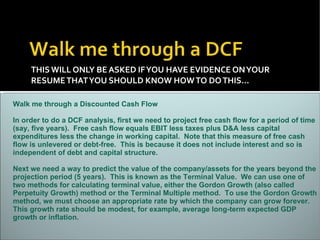
THIS WILL ONLY BE ASKED IF YOU HAVE EVIDENCE ON YOUR RESUME THAT YOU SHOULD KNOW HOW TO DO THIS…  Walk me through a Discounted Cash Flow In order to do a DCF analysis, first we need to project free cash flow for a period of time (say, five years).  Free cash flow equals EBIT less taxes plus D&A less capital expenditures less the change in working capital.  Note that this measure of free cash flow is unlevered or debt-free.  This is because it does not include interest and so is independent of debt and capital structure. Next we need a way to predict the value of the company/assets for the years beyond the projection period (5 years).  This is known as the Terminal Value.  We can use one of two methods for calculating terminal value, either the Gordon Growth (also called Perpetuity Growth) method or the Terminal Multiple method.  To use the Gordon Growth method, we must choose an appropriate rate by which the company can grow forever.  This growth rate should be modest, for example, average long-term expected GDP growth or inflation. 
DCF Continued/// To calculate terminal value we multiply the last year’s free cash flow (year 5) by 1 plus the chosen growth rate, and then divide by the discount rate less growth rate. The second method, the Terminal Multiple method, is the one that is more often used in banking.  Here we take an operating metric for the last projected period (year 5) and multiply it by an appropriate valuation multiple.  This most common metric to use is EBITDA.  We typically select the appropriate EBITDA multiple by taking what we concluded for our comparable company analysis on a last twelve months (LTM) basis. Now that we have our projections of free cash flows and terminal value, we need to “present value” these at the appropriate discount rate, also known as weighted average cost of capital (WACC).  For discussion of calculating the WACC, please read the next topic.   Finally, summing up the present value of the projected cash flows and the present value of the terminal value gives us the DCF value.  Note that because we used unlevered cash flows and WACC as our discount rate, the DCF value is a representation of Enterprise Value, not Equity Value.
QUESTIONS?

Ucre cpres1

  • 1.
  • 2.
    Overview of UCRECWinter 2010 Educational Components Finance Basics (i.e Accounting and Valuation) REITs – Real Estate Investment Trusts (RE stocks) Introduction, How they grow, International market of REITs, Healthcare REITs, Future of REITs etc. Leasing, Affordable Housing, Gaming, Lodging, and Real Estate Investments Company Presentations (most are in Fall quarter) Bank of America – February 1 st Google - TBA Mentorship/ Interview Help
  • 3.
    UCREC Member OpportunitiesNetworking – panels, company presentations Educational Program Bank of America Affordable Housing Challenge Team (4 to 12 people) Scholarship for Women Members All members are able to attend Booth Real Estate Group meetings Members able to attend annual Booth Real Estate Conference Hosting of Real Estate Case Competition - 2011
  • 4.
    Accomplishments Fall 2009 Fall 2009 Meetings Included: www.ucrec.com Morgan Stanley JP Morgan – Associate Investment Banker/Intern Chicago Managing Director – Tishman Speyer Introduction to REITs / Overview of UCREC SEO information session Panel Discussions with Booth alumni Booth School Real Estate Professor Lecture Blackstone Group (Park Hill Real Estate Group) Chicago Office Managing Director….
  • 5.
  • 6.
    Four basic financialstatements: Balance Sheet Income Statement Statement of Cash Flows Statement of Retained Earnings Published by public companies in their annual reports (called 10K's) Remember to read notes/footnotes Often contain important information
  • 7.
    Presents the financialposition of a company at a given point in time Comprised of three parts: Assets, Liabilities, and (Ownership/Stockholder's) Equity Remember the important basic equation: Assets = Liabilities + Equity
  • 8.
    Assets are theeconomic resources of the company Consists of Cash, Inventory, and Equipment Examples: For a farm, Inventory might be the farmer's crops; Equipment could consist of things like a barn or a tractor
  • 9.
    Companies normally obtainresources by incurring debt, getting new investors, or through re-investing operating earnings Liabilities are the debts owed by the company Equity is comprised of the claims that investors have on the company's resources after all debts have been paid off “ net worth” of the company
  • 10.
  • 11.
    When companies incurdebt, they make a promise to pay over a certain time period Payment schedule is independent of the operating performance of the company When companies make stock offerings (equity), they don't promise to pay investors over a certain period Offer a return on investment contingent on operating performance No guarantee, so riskier but unlimited upside
  • 12.
    Presents the resultsof operations over a period of time Composed of Revenues, Expenses, and Net Income Revenue: source of income normally arising from the sales of goods and services and is recorded when it occurs
  • 13.
    Expenses: costs incurredover a period of time to generate the revenues earned over that same period of time Example: Wages When a company incurs an expense outside of its normal operations, it is considered a loss Example: Destruction of a building in a fire A purchase is only considered an asset if it also provides future economic benefit outside of the current period. Paying for wages vs. Paying for equipment
  • 14.
    Net Income: Revenue,less Expenses Positive Net Income indicates the company generated a profit (net profit) Negative Net Income indicates the company suffered a “net loss”
  • 15.
  • 16.
    Retained earnings isthe amount the company reinvests in itself Remember that this is one of the ways to purchase new assets (aside from incurring debt and raising new equity) Reconciliation of the Retained Earnings account from beginning to the end of year Net Income increases the Retained Earnings account, while Net Losses and dividend payments decrease it
  • 17.
  • 18.
    Does not provideany new information not already available But it does tell you what management is doing with the company's earnings Is management more focused on reinvesting earnings within the company? Or is it distributing profits to shareholders? Investors can use this knowledge to align their investment style with the strategy of a company's management
  • 19.
    Provides a detailedsummary of all the cash in- and outflows during a time period Three sections-- Cash flows from: Operating activities- includes transactions involved in calculating net income Investing Activities- activities outside of the normal scope of business, such as sale or purchase of assets Financing Activities- Involves items classified as liabilities or equity on the balance sheet Examples: Dividends or payment of debt
  • 20.
  • 21.
    Gets all itsinformation from other 3 statements Net income from the Income Statement shown in cash flows from operating activities Dividends from Retained Earnings Statement shown in financing activities Investments, Accounts Payable, and other asset and liability accounts from the Balance Sheet are shown in all three sections
  • 22.
    REITS = RealEstate Investment Trusts Real Estate Stocks
  • 23.
    Pay consistent quarterlydividends Provide the individual investor a way to invest in real estate Comprise only about 10% of the $4 trillion CRE market Liquid assets Low-to-zero corporate tax rates 90% of income -> dividends
  • 24.
    Equity REITs buys,manages, renovates, maintains, and occasionally sells real properties Example: Simon Property Group (NYSE: SPG) owns and manages malls Mortgage REITs Makes and holds loans and bond-like obligations backed by real estate Example: MFA Financial takes out low interest loans to buy higher interest mortgage-backed securities
  • 25.
    Over long periods,REITs provide investors with compounded annual returns close to that of the S&P 500 At the same time, REITs enjoy benefits not extended to other stocks that keep pace with the market: Low volatility and correlation Predictability/limited risk
  • 26.
    REITs initially weredefined by the Real Estate Investment Trust Act of 1960 REITs must: Hold 75% of assets in real estate/cash Derive 75% of income from real estate activities Distribute 90% of income to shareholders Derive no more than 30% of income from short term property sales REITs avoid double taxation
  • 27.
    Myth #1: REITsare just portfolios of real properties REITs are more than just a collection of properties held collectively by shareholders. REITs are companies that are actively managed for profit and to a lesser extent, growth.
  • 28.
    Myth #2: Badreal estate markets mean bad news for REITs Real estate is sub-divided further into sectors; not all sectors are equally hit by a real estate bubble Furthermore, REITs that are especially well-managed with a solid business plan can actually excel in times that are bad for the overall real estate market
  • 29.
    Myth #3: REITstocks are for active trading Quite the contrary, REITs are close to the ultimate for the ‘buy and hold’ strategy; they provide solid returns over many years
  • 30.
    Dividend yield Fundsfrom operations (FFO) yield Adjusted funds from operations (AFFO) yield Net asset value (NAV) Dividend discount or discounted cash flow (DCF) model
  • 31.
    Easy to calculateand compare Also easily manipulated Can be substantially increased on a temporary basis (for example, using leverage) Ignores true recurring cash flow Does not take growth prospects into account
  • 32.
    Widely used methodFFO = Net income + Depreciation – Gains from sales on depreciated properties Accounting treats depreciation as an expense, charged against the bottom line Ignores maintenance costs of business Ignore development of land
  • 33.
    AFFO = FFO– recurring maintenance items (and possibly other deductions) Better measure of operating performance However does not use standardized method of calculation since it does not use standardized accounting techniques Other disadvantages of FFO also apply; ignores growth and development of land
  • 34.
    Total value ofunderlying real estate Relies on prices in private real estate market Assumed to be an efficient market since there are many buyers and sellers REITs have a long term tendency to revert back to parity with NAV NAV = Assets – Liabilities (adjusted for depreciation for REITs)
  • 35.
    Closest model tointrinsic stock value Takes into account both near and long term growth prospects Almost all determinants of stock boiled down to quantifiable inputs for this model However, it is only as good as its assumptions (and there are many) Principle of “garbage in, garbage out”
  • 36.
    INSIDERS GUIDE REMEMBER:INTERVIEWING IS HARD AND TAKES PRACTICE
  • 37.
    COMMON MISTAKES: Majoringin Econ/Business with no passion Believing going to Uchicago is enough Relying on CAPS Believing you don’t need a high GPA Believing you don’t need leadership Believing that getting an interview is enough READ WSJ EVERYDAY KNOW WHAT IS ON YOUR RESUME WE GO TO A LIBERAL ARTS SCHOOL – IT IS OK IF YOU ARE NOT FAMILIAR WITH FINANCE, IT IS NOT OK TO NOT BE FAMILIAR WITH WORLD EVENTS AND HOW THEY RELATE TO INVESTMENT BANKING UNDERESTIMATING COMPETITION Believing you are SPECIAL Not being PROACTIVE This is your life! DO NOT LIE!!!!!!!!!!!!!!!!!!!!!!!!!!!!!!
  • 38.
    COMMON INTERVIEW QUESTIONS WALK ME THROUGH YOUR RESUME WHY DID YOU CHOOSE UNIVERSITY OF CHICAGO? TELL ME WHERE THE HOUSING MARKET IS HEADED PITCH A STOCK TO ME WHAT DO INVESTMENT BANKERS DO? WALK ME THROUGH A DCF WHAT’S THE BIGGEST RISK YOU HAVE TAKEN? WHAT ARE YOU PASSIONATE ABOUT? What sector are you following and why – and then they ask spinoff questions so just be well read If there were no college textbooks and every college student had to have a kindle – guess how many kindles would be sold to students at 4 year colleges in 2012 – does the number go up or down the next year Read a newspaper article on a merger and acquisition and tell me what’s the most important news Why is gas prices going up but oil prices going down?
  • 39.
    MORE INTERVIEW QUESTIONS:What sectors are you following and why? How would you invest 100 million dollars When would you issue Bond vs. Equity – which is cheaper? Know what industry groups you are interested in and what has been happening in them What is a Tombstone? What is BETA? Provide an example of a situation in which you had multiple competing deadlines – how did you prioritize? Were the deadlines met? What did you do or would have done if you were unable to meet the deadlines? Why this company? What motivates you? Why did you choose your major? ( 1 st phone interview) Tell me about a moment where you were a problem solver? What’s the biggest risk you’ve taken? Know about balance sheet/ income statement/ statement of cashflows and links between them What commodities would you invest in and why? What are your SAT scores?
  • 40.
    THIS WILL ONLYBE ASKED IF YOU HAVE EVIDENCE ON YOUR RESUME THAT YOU SHOULD KNOW HOW TO DO THIS… Walk me through a Discounted Cash Flow In order to do a DCF analysis, first we need to project free cash flow for a period of time (say, five years).  Free cash flow equals EBIT less taxes plus D&A less capital expenditures less the change in working capital.  Note that this measure of free cash flow is unlevered or debt-free.  This is because it does not include interest and so is independent of debt and capital structure. Next we need a way to predict the value of the company/assets for the years beyond the projection period (5 years).  This is known as the Terminal Value.  We can use one of two methods for calculating terminal value, either the Gordon Growth (also called Perpetuity Growth) method or the Terminal Multiple method.  To use the Gordon Growth method, we must choose an appropriate rate by which the company can grow forever.  This growth rate should be modest, for example, average long-term expected GDP growth or inflation. 
  • 41.
    DCF Continued/// Tocalculate terminal value we multiply the last year’s free cash flow (year 5) by 1 plus the chosen growth rate, and then divide by the discount rate less growth rate. The second method, the Terminal Multiple method, is the one that is more often used in banking.  Here we take an operating metric for the last projected period (year 5) and multiply it by an appropriate valuation multiple.  This most common metric to use is EBITDA.  We typically select the appropriate EBITDA multiple by taking what we concluded for our comparable company analysis on a last twelve months (LTM) basis. Now that we have our projections of free cash flows and terminal value, we need to “present value” these at the appropriate discount rate, also known as weighted average cost of capital (WACC).  For discussion of calculating the WACC, please read the next topic.   Finally, summing up the present value of the projected cash flows and the present value of the terminal value gives us the DCF value.  Note that because we used unlevered cash flows and WACC as our discount rate, the DCF value is a representation of Enterprise Value, not Equity Value.
  • 42.