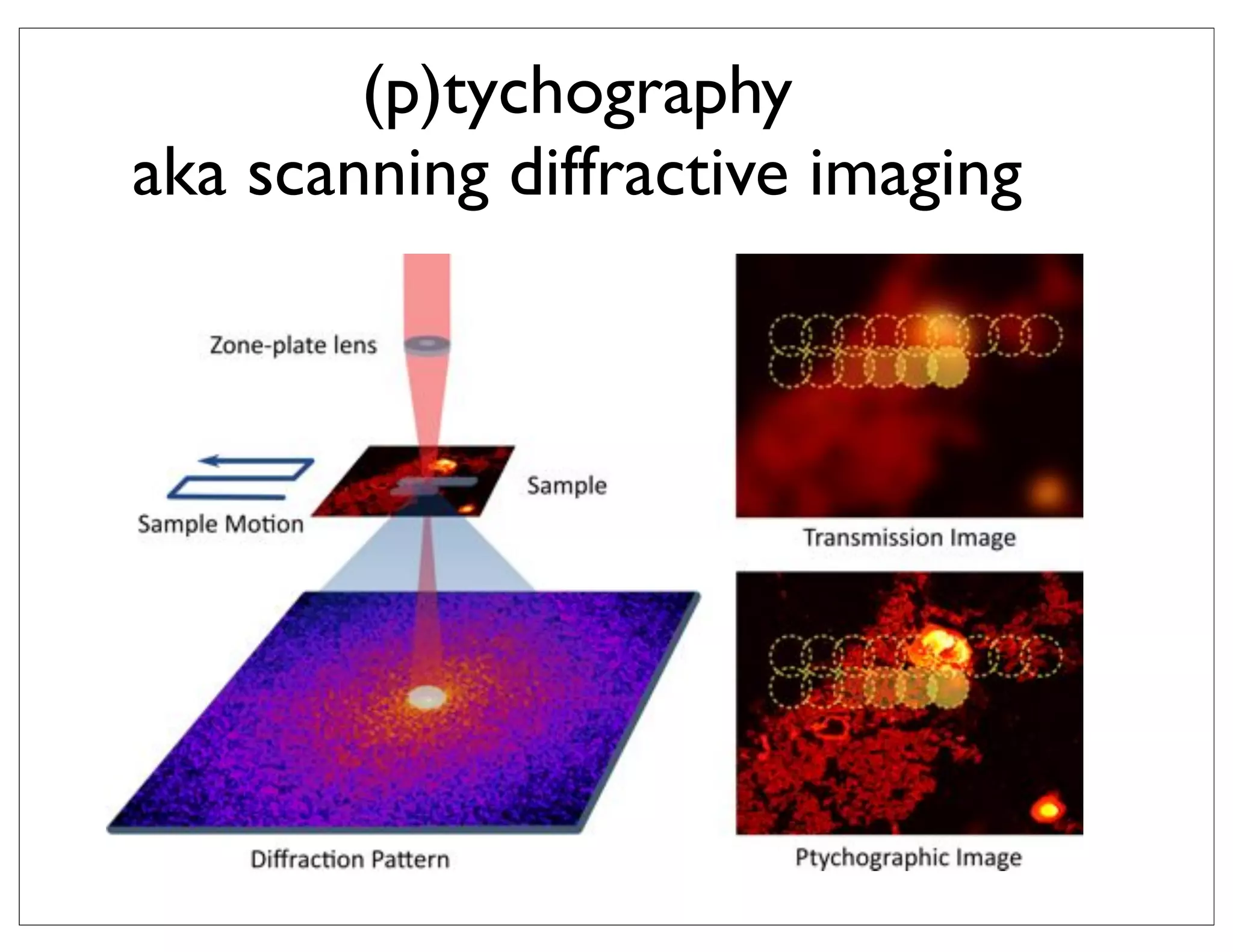
(p)tychography
aka scanning diffractive imaging
.                           m             n
                                        .            =         i
      |ai |   2                                i                                  x2
                                       z1                                               d
                   ptychography (5.3.2.1 STXM-ALS)
                                                               r2                 x1
                                m×m                                         r2
                                            m                                                n
                                          r         q1                  1         r1

 R. Celestre, A D. Kilcoyne, Tolek T, A. Schirotzek, T. Warwick(ALS),
    microscopy                              ptychography                               SEM
   70 nm probe
   Figure 1: Forward ptychographic problem: diffraction data ai is related to the unkown object
                                ˆ
   to reconstruct ψ by a = |FQψ|. The intermediate variable zi describing individual frames is
   used in many iterative methods [?].

      In the following, we concatenate indices q and i of ai (q) and express
                                                                    
                  a1             Q1             F                       z1
                                                                        ˆ
                .            .                                  . 
          a =  . , Q =  . , F = 
                   .              .
                                                    ..
                                                       .      , z =  . , k = κ
                                                                  ˆ      .
                                                                                  2
                                                                                                 (3)
                  ak             Qk                       F             zk
                                                                        ˆ
   and rewrite (Eq. 1) as
                                            |F z| = a,
                                               ˆ                                                 (4)
                                               ˆ    ˆ
                                               z = Qψ,                                           (5)
   referred to as a Fourier magnitude problem and an overlapping illumination problem. The
   ptychographic reconstruction problem Maia GPU/MPI knowing a, Q. Many iterative
                                            F. consists in finding ψ ˆ                                  5.3.2.1
    1 micron                                  reconstruction
   methods introduce an intermediate variable z, and attempt to solve the two problems in Eqs.
   (??) using projection algorithms, iterative transform methods, or alternating direction methods

E=1keV
   [?].
                15 nm resolution
        In the following section we will describe the standard operators commonly used in the
   literature. In section 3 we will introduce an intermediate variable ci , replacing Eq. (5) with
700 ms exposure
   ci zi = Qi ψ, i = (1, . . . , k). This intermediate variable allows us to fix perturbations in the
   incident flux and increase rate of convergence for large scale problems.
  longer exposure
                       2
should give 7 nm res
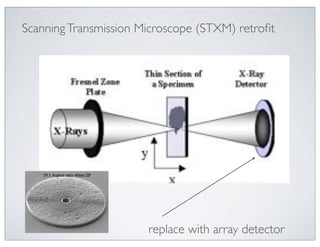
Scanning Transmission Microscope (STXM) retrofit


                       replace with array detector
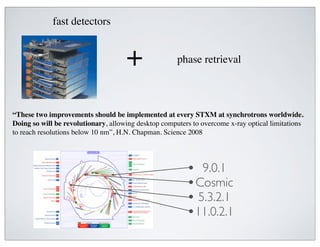
fast detectors


                                     +
                            Pilatus 1M,
                                                      phase retrieval
                            frame rate 30 Hz


“These two improvements should be implemented at every STXM at synchrotrons worldwide.
Doing so will be revolutionary, allowing desktop computers to overcome x-ray optical limitations
to reach resolutions below 10 nm”, H.N. Chapman. Science 2008


                                                         • 9.0.1
                                                         • Cosmic
                                                         • 5.3.2.1
                                                         •11.0.2.1
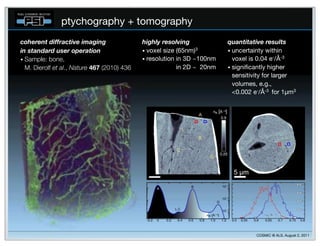
ptychography + tomography
coherent!diffractive!imaging                 highly!resolving            quantitative!results
in!standard!user!operation                   • voxel size (65nm)3        • uncertainty within
• Sample: bone,                              • resolution in 3D ~100nm     voxel is 0.04 e-/Å-3
  M.!Dierolf et al., Nature 467 (2010) 436     resolution in 2D ~120nm   • significantly higher
                                                                           sensitivity for larger
                                                                           volumes, e.g.,
                                                                           <0.002 e-/Å-3 for 1µm3


                                                                                   COSMIC @ ALS, August 2, 2011
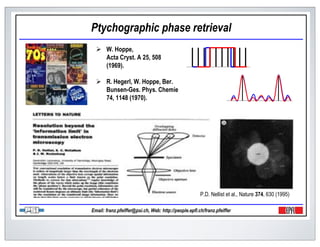
Ptychographic phase retrieval
       W. Hoppe,
       Acta Cryst. A 25, 508
       (1969).

       R. Hegerl, W. Hoppe, Ber.
       Bunsen-Ges. Phys. Chemie
       74, 1148 (1970).


                                                       P.D. Nellist et al., Nature 374, 630 (1995)

Email: franz.pfeiffer@psi.ch, Web: http://people.epfl.ch/franz.pfeiffer
men PHASE-RETRIEVAL X-RAY MICROSCOPY BY WIGNER-DISTRIBUTION
      with complex transmission ψ(r) is situated in the focal plane and
  in that plane. At DECONVOLUTION:scan the sample is displaced
                     a given point in the SIGNAL PROCESSING
e optical axis by a vector −x.Microscopy Stony 1997 (Pages 67-80) sample
                        Scanning (On the Vol. 11, Brook STXM the
ly scanned in the negative directions, International, ChicagoWignermotion IL 60666 USA
                        Scanning Microscopy soN. Chapman apparent O’Hare), of x-ray microscopy
                                                 that the
      pixel sample is in the positive directions.) The x-ray deconvolution
be across the translation
                                         Henry                  (AMF
                                                                      wavefield
                                                      Fourier transform
ately behind the specimen will then SUNY at Stony a(r)ψ(r + x), and the
                    Department of Physics, be given by Brook, Stony Brook, NY
                illuminationPHASE-RETRIEVAL X-RAY MICROSCOPY BY WIGNER-
y at the far-field microdiffraction object be written as [1]
                                       plane can
                                                                       intensity
                                                     DECONVOLUTION: SIGNAL PROCESSIN
                                                                        2
                                                                       
        m(r , x) Abstract 
           
                 =  A(r
                                  − x )Ψ(x ) exp(2πix              
                                                                · x) dx  .                  (1)
                                                                                       Introduction
                                                                                     Henry N. Chapman
  Phase and amplitude images have been                                Wigner-deconvolution phase-retrieval microscop
 structed from data collected in a scanning                  Department of Physics, retrievingStony Brook, Stony Brook
                                                              is a new technique for SUNY at the phase and amplitude o
                
mission x-ray microscope by applying the method of referred to in microscope images (Rodenburg and Bates
 ensity m(r , x) for constant x (further                      transmission this paper as
lane of m)deconvolution. This required collecting pattern, recordedRodenburg, 1989). This technique can b
 r-distribution is a single microdiffraction                   1992; Bates and as a single
ent microdiffraction patterns (1) shows thattwo- microdiffraction microscope of either the scanning o
 f the CCD. Equation at each point of a the                   employed in a wavefield is
                                                         Abstract                                                        In
 rier transform object and then deconvolving the of conventional geometry and allows the formation o
 sional scan of an of the complex transmission                 the specimen, multiplied
 imensional Wigner-distribution function of the lens          superresolved images (Rodenburg and Bates, 1992; Nellis
 asedata set. and processconvolvedanalyses the pupil function. This1994). The phase-retrieval an
the
       ramp, The then essentially with the
                                       Phase and amplitude images have equation
                                                              and Rodenburg, been                       Wigner-deconvo
 much about the imaging processplane anddata collected in a characteristics ofis a new technique for re
 rence which occurs in the microdiffraction and the role of the microdiffraction the technique have bee
                              reconstructed from              superresolution scanning
                  the object transmission transmission grating, which has of transmission microscopes tha
                                scanned. x-ray microscopedemonstratedthe method a dis- transmission microscop
Consider aasspecimen,issuch as a The image-
  modulates                                                    by applying in scanning
ssing steps required to deconvolve experimental deconvolution. This required collecting
                              Wigner-distribution                                                1992; Bates and Rodenb
ourier transform consisting of severaldata patterns atorders. light a incident employed in a micros
                                                     diffraction each point of (McCallum and Rodenburg, 1992)
                                                              utilise visible The
                              coherent microdiffraction
 scribed. These steps result in the reconstructions of                                 two-
                                                              electrons (Rodenburg et al., 1993; Nellist et al., 1995), an
 ent beam is diffracted by the object so object and then deconvolving the of conventional geometr
                              dimensional scan of an that soft x-rays (Chapman, order In a scanning microscope th
                                                               each diffraction
 tion-limited phased images, to a spatial-frequency cut-
                                                                                     1996).
cimen -1. The estimated accuracy)] yields Wigner-distribution function ofcollecting a two-dimensional micro
 1/45 nm [each non-zero four-dimensional a pupil function A(r ) in the mi- superresolved images (R
                               Ψ(x of the images is           method requires the lens
action plane, centred fromData data set. The  = x and multiplied by convergent beam diffractio
ad in phase and 10% in amplitude. the frequency r process essentially analyses the the and Rodenburg, 199
                              at the were collected           diffraction pattern (a coherent
                      
 -ray wavelength of 3.1 nm.   interference which occurs in the microdiffraction plane a two-dimensional scan. The abilit
                                                              pattern) at each point in and      superresolution characte
=       F (r )F (r − x ) exp(2πir · r ) dr .                                                      (5)
  F (rwith (r  − x ) transmission  ψ(r)
        
          )F ∗ complex exp(2πir · r ) MICROSCOPY the focal plane and
                                                 
men PHASE-RETRIEVAL X-RAYdr . is situated inBY WIGNER-DISTRIBUTION        (5)
r inx) is plane. At DECONVOLUTION:scan the sample is displaced of the
    , that actually a given point in the SIGNAL PROCESSING WDF
                            a four-dimensional convolution of the
bution withby a vector −x.Microscopy Stony 1997 (Pages 67-80)the sample object.
eactuallyaxis the WDF of(On the Vol. 11, Brook STXMthe of the
    optical a four-dimensional convolution of the WDF of
                              Scanning the complex transmission
with of thisthe negative directions, International, ChicagoWignermotion IL 60666 USA
ly scanned in of the complex transmissionthe apparent O’Hare), of x-ray microscopy
                              Scanning Microscopy soN. Chapman deconvolution.
namethe WDFmethod, Wigner-distributionthe object.      that of
       pixel sample is in the positivedeconvolution. x-ray deconvolution
f this method, translation
                                                Henry
be across the Wigner-distribution directions.) The
                                                                      (AMF
                                                                            wavefield
                     illumination object Fourier transform decon-
ately behind the specimen will then SUNY at Stony a(r)ψ(r + x), and the
                          Department of Physics, be given by Brook, Stony Brook, NY
WDF, Wa , contains zerosPHASE-RETRIEVAL X-RAY MICROSCOPY BY WIGNER-
y a , contains zeros and regionsand regions of low decon-
W                                            plane intensity, the intensity, the
    at the far-field microdiffractionof low can be written as [1]
best performed usingfilter. That is, an estimate, Wan of intensity˜ψ , of
                                                             That is, ˜ψ , estimate, W
 rformed using a Wiener a Wiener filter. DECONVOLUTION: SIGNAL PROCESSIN
                          
                                                                   2
 f them(r  specimen is − x )Ψ(x ) exp(2πix · x) dx  .
                given by given by
pecimen is, x) Abstract
                    =  A(r                                     
                                                                                    (1)
                                                                              Introduction
                                                                                      Henry N. Chapman
  Phase and amplitude images a (r, −x ) W ∗ (r, −x )
                                         W ∗ have been
W         a linear problem
  ˜ψ (r, x )˜= M(r, x )
                                                                                   illumination
                                                                         Wigner-deconvolution phase-retrieval microscop
                                                              , is a new technique(6)SUNY at the phase and amplitude o
                           collected in a scanning a Department of Physics, retrievingStony Brook, Stony Brook
 structed Wψ (r, x ) = M(r, x ) 2                
                                                             referred 2 in ,                               (6)
              from data
                                                   )| + φ                        for
                                  |Wa (r, −x
 ensityx-ray microscope by applying the method (r, −x )|to+ φthis paper as (Rodenburg and Bates
           m(r , x) for constant x (further a transmission microscope images
mission                         −1            −1
                                                      |Wof
                                                         a                       a
                       a =          microdiffraction m(r  , x)] = and Rodenburg,1989). (r, x )
lane of m)deconvolution.F  required collecting pattern, recordeda (r,a single ψThis technique can b
                    isx) single This
         M(r,An estimate →r the specimen transmission can −x )W  1992; Bates W as
                                     r of Fx→x
 r-distribution
ent constant. Equation (1) shows thattwo- microdiffraction microscope of either the scanning o
 ll the CCD.
 f amicrodiffraction patterns atAn estimate of the specimen transmission can
      small constant. then deconvolving theAbstract
                                      each point of a            employed in a wavefield is
 rier transform object and      FT       FT             Data
by first Fourier transforming transmission of conventional geometry and allows the formation In
 sional scan of an of the complex the WDF to give specimen, multiplied
                                                        the       the
                                                                                                unknown
                                                                                                                        o
tained byand then convolved with the pupilsuperresolved Thisgive
       ramp, first Fourier Phase  and amplitude images have 1994). The phase-retrieval an
                                           transforming the WDF imagesequation and Bates, 1992; Nellis
 imensional Wigner-distribution function of the lens
 asedata set. The process essentially analyses the                 function. to been
                                                                                       (Rodenburg
                        ˜ψ                   ˜       ˜
the, x ) = F {W (r, x )} = Ψ(r )Ψ∗ (r  − x and Rodenburg,                                             Wigner-deconvo
 r                r                                             ), of the in a scanning
                                                                                   (7)
 rence which occurs in the microdiffraction and the role 
                      
                                 reconstructed from
Consider aas,the object Frscanned. a The )} =
      W
  modulates          x ) = {W                                ˜ superresolution scanning
                                                                       ˜∗
                                                                  by Ψ (r in x ),
                                                                                     
                                               x-ray microscopedemonstrated −method a dis-    Wigner
 much about the imaging processplane anddata collected microdiffraction is a new technique for re
         ˜ψ (r specimen,issuch ˜ψ (r, ximage- Ψ(r )applying thecharacteristics oftransmission microscop
                                                                                                   the technique have bee
                                                                                                           (7)
                                 transmission transmission grating, which has of transmission microscopes tha
                                          as
  WDF to give the specimen’s transform as utilise visible        follows:
ssing steps required to deconvolve experimental deconvolution. This required collecting
                                 Wigner-distribution                                        distribution
                                                                                                  1992; Bates and Rodenb
ourier transform consisting of severaldata patterns atorders. light a incident employed in a micros
                                                         diffraction each point of (McCallum and Rodenburg, 1992)
                                 coherent microdiffraction
                                                                                 The two-
                                          
ing beamWDF ∗to give the˜specimen’s electrons (Rodenburgfollows:conventional 1995), an
 ent the is diffracted by the object so object transform as etthe 1993; Nellist et al., geometr
 scribed. These steps result in the reconstructions of
                                                            that and then deconvolving al., of
                                                                  each diffraction order       function
 1/45 nm
        ˜
       Ψ(x ) = Wψ                dimensional scan of an
 tion-limited phased ˜ (0, −xspatial-frequency cut-
                        images, to a  )/ Wψ (0, 0).      solution                (8)
                                                                 soft x-rays (Chapman, 1996). In a scanning microscope th
cimen -1. The estimated accuracy)] yields Wigner-distribution function ofcollecting a two-dimensional micro
          [each non-zero four-dimensional a pupil function A(r ) in the mi- superresolved images (R
                                  Ψ(x of the images is method requires the lens
action plane, centred fromData data set. The  =˜x and multiplied by convergent beam diffractio
ad in phase and 10% in amplitude. the∗ frequency r process essentially analyses the the and Rodenburg, 199
                                         the
                              at ˜ were collected
                      ˜ found by inverse Fourier thediffraction patternplane and
                      Ψ(x ) interference which occurs Wψmicrodiffraction (a in
 -ray wavelength of 3.1                                           (0, 0).each point coherent superresolution characte
 ct, ψ(x), is then nm. = Wψ (0, −x )/ in transformation of a two-dimensional scan. The abilit
       ˜
                                                                 pattern) at
                                                                                                           (8)
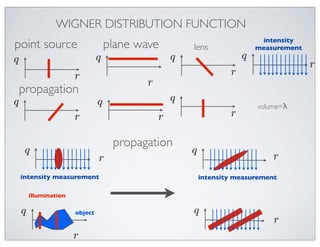
WIGNER DISTRIBUTION FUNCTION
ψ(r) wavefield
                             Wigner distribution function
Wψ (r, dr) = ψ(r + dr/2)ψ(r − dr/2)
                                                        phase space
Wψ (r, q) = [Fdr→q ] ψ(r + dr/2)ψ(r − dr/2)     quasi probability distribution

                   lifting            cyclic permutation
  note:              ψ ψ    rank 1   ψ(r + dr/2)ψ(r − dr/2)
WIGNER DISTRIBUTION FUNCTION
ψ(r) wavefield

Wψ (r, dr) = ψ(r + dr/2)ψ(r − dr/2)
                                                         phase space
Wψ (r, q) = [Fdr→q ] ψ(r + dr/2)ψ(r − dr/2)      quasi probability distribution

                    lifting            cyclic permutation
  note:              ψ ψ     rank 1   ψ(r + dr/2)ψ(r − dr/2)

               phase space description of light
light source                              phase space                2π
                                                               q=     λ θ
  r                 propagation
                                         q
ψ(r)
                                                           r
           θ      direction
WIGNER DISTRIBUTION FUNCTION
                                                                             intensity
point source                        plane wave          lens                measurement
q                               q                   q                   q
                                                                                          r
                       r                                            r
                                            r
    propagation
q                               q                   q
                                                                            volume=λ
                       r                        r                   r

                                     propagation
     q                                                  q
                                r                                               r
    intensity measurement                                   intensity measurement

        illumination

    q                  object                           q
                                                                                r
                       r
on m×m illuminates an unknown object of interest ψ(r+x). For simplicity we conside
 ill summarizeusedptychographic problem following the notation of Yang et al.
                 the in many iterative methods [?].
 hography experiment, a two dimensional small beam with distribution w(r)also be considered. One collect
 matrices, generalization to non-square matrices can of
                                                 ˆ

       PROJECTION ALGORITHMS
 nce of k diffraction images a2 (q) of dimension m × m
×m illuminates an unknown object of interest ψ(r+x). For simplicity we consideras the position x of the objec
                      to non-square matricesx
 es, generalization In the following, we introduce be sequences of various matrices as follows
                                               can also k considered. One collects
red. Eachimages ax a of dimension m the the position xof the discrete two dimensional Fourie
 k diffraction frame         2 (q)x represents× m asmagnitude of the object
                                                                                         
  m Fˆ of w(r)ψ(r      ˆ the magnitude
 ach frame ax represents + x): a1 of the discrete1 two dimensional Fourier
                                                        Q              z1
                                                                       ˆ             F
               illumination
 f w(r)ψ(r + x):                      unknown
                                      .             .            .              ..      
                               a =  .  , Q =  .  , z =  .  , F = 
                                        .            .        ˆ       .                 .            (2)
                                        ˆ                          z = 2π(1)
 ax (q) =axFw(r)ψ(r + x)Fw(r)rm, q + 2π m , Qkr = rm, qˆk
              (q) ˆ=   , r =aψ(r = x)                                    r m                            (1
                                          k       r
                                                                                            F
    Ff =
             
               diffraction edata
                  eiq·r f (r),  m = as a = |F Qψ|,(0 . .using 1), intermediate variable z as:
                and rewrite (Eq. iq·r(µ, ν) , µ, ν ˆ or . m − the
               Ff =           f (r),  1)               =
                                                             feasibility problem          ˆ
                                                       m = (µ, ν) , µ, ν = (0 . . . m − 1),
               r

          probe translate
 gthscale, and the sum over r is given on all the indices m × m = r. z|,
                              r                             a of |F ˆ         Fourier magnitude   (3)
 stered around, r + x spans a grid of dimension n × n, n  m. We denote Qx
                                                                       ˆ
   “illumination matrix” that             frames             ˆ
  s a lengthscale, andextracts a frame containinggiven = Qψ, thean
                                                             z                Split into frames
                                the sum over r is m × m on all of indices m × m of r.
                                                                 pixels out
                                                                                                  (4)
  ining rastered andto as Fourier magnitude grid of dimension n × illumination We denote
 x is n × n pixels, around,a r + x spans a illuminationand an overlapping n, n  m.problem respec- Q
                referred multiplies the frame by the problem function w(r):
             ˆ + x) Qx (r)ψ matrix” (r) = extracts
                               ˆ ˆ                         a                F      ˆ Q
m2 × w(r)ψ(rtively.= The ptychographic xreconstruction. problem consists in findingm × m pixels out of a
        n2 “illumination = zx (r), Q that w(r)eix∂r a frame containing ψ knowing a,ψQ. Many


                                                    ( )( )( )( )
ˆ
ψ containing n × methodsindividual multiplies thevariable z, and attempt to solve thefunction w(r)
              iterative n pixels,  introduce an intermediate
 intermediate variable describing w and frames that we a1 frame convi-
                                                          introduce for by the illumination
                                                                                                 two problems
                                ψˆ
              in Eqs. (??) using projection algorithms, iterative transform methods, or w Q
                                                                                          alternating direction
                                       w
                                                         a2
                                                                      F                   wQ
                                                                                              1


              methods [?].
                   w(r)ψ(r                                              F
                          ˆ + x) = Qx (r)ψ = zx (r), Qx (r) = w(r)eix∂r .
                                              zi  ˆ ˆ
                                                                                               2     ψ

                   Inw                                          the       F
                      the following section we will describe = standard operators commonly used in the
        xi                       1         m                                F
              literature. In section 3 we will introduce an intermediate variable ci , replacing Eq. (4) with
   is an intermediate ivariable, k). The linear projection operator Fthat we introduce for conv
              ci zi = Qi ψ, = (1, . . . n
                                         describing individual framescorresponding to the augmented
                                                                               F
                                     z
                   problem is computationally more intensive than for (Eq. 8), and speed may not always improve.
                                               zk
                                                .
                                                .
                                                .
                                                            =
                   However the benefits of introducing this augmented problem are the following:
      |ai |2
                      • Intensity fluctuation introduced1 instabilities F the storage ring, optics etc, are given
                                               z1       by               in                  Q
                        by the coefficients cmand their effect can be removed (see Fig. 4).
                                       m×i
                      • Accelerated convergence per iteration (Fig.2). A heuristic interpretation is that long
                        range phase fluctuations are poorly constrained by standard projection operators, result-
                        ing in degraded convergence rate for large scale problems. See also (Fig. 3) where the
arg min zi − zi , subject to |F z| = a,
               ¯              ψ    ¯                                                             (6)
     ¯
      z
                                    
   Q1          z1
                ˆ          F
mes. and zset .overlap=projection operator PQSimultaneous reconstruction of probe  specimen
 . norm. The . illuminations . .
 ian         of 
 . , ˆ =  . , F 
                              respectively. The (2) to enforce
                                     
                                     
                                                   running estimate
                                               is used

               PROJECTION ALGORITHMS
                                  .
nsQQ:
btained by solving the least squares problem in Eq. (7):
              zk
              ˆ                  F
    k                                                                                                                Current object guess                   Illumination function

ψmin , using the (Q∗ Q)−1 Q∗ z. z − as: 2 ,
ψ|, or ψ where intermediate min
 ˆ            = ψmin = arg variable z Qψ
                                    ˆ                                                            (7) (8)
          min                        ψ

        a = of |,             Fourier magnitude
  multiplies |F ˆilluminations respectively. The and merges all
ames and setby zthe conjugate of the probe w running estimate the
                                                  (3)

 is the operator which splitsReduce frames Eq. and
        ˆ
        z = Qψ, ˆ                                 (4)
obtained by solving the least squares problem frames (7): multiplies
                                an image into in
 −1 is a normalization factor. The linear projection operator P
 de problem and an overlapping illumination problem respec-             Q                                                           Q*


                                                                 ()
                    ∗    −1 ∗
        ψproblem consists and solving (Eq. 13)Many                (8) Q
          min = (Q Q) in finding ψ knowing a, Q. is required when merging
                           Q z.

                                                                                          ( )
olve independently,                  ˆ


                                                                                                                                  )(
struction
                                                          W
ntermediate variable z, and−1 ∗ to solve the two problems
                      ∗    attempt
at multiplies bytransform methods, or alternatingw and merges all the (9) Nested loop on O(r)  P(r) !
        Piterative the Q) Q , of the probe direction
 orithms, Q = Q(Q conjugate                                             Idea:
Q is the operator which splits an image intoP.frames and multipliesPfeiffer, Science 321, 379-382 (2008)
                                               Thibault, M. Dierolf, A. Menzel, C. David, O. Bunk, and F.

Q)−1describe the standard factor. The the solutions the (7) and (6) are
 lgorithm,        approximation to linear                       of
     split normalize                          merge
                                                                           Email: franz.pfeiffer@psi.ch, Web: http://people.epfl.ch/franz.pfeiffer
will is a normalization operators commonly projection operator PQ
              the                            used in
 ction algorithms
 ntroduce an intermediate variable ci , replacing Eq. (4) with
                         ∗  −1 ∗
   linear projection operator corresponding to the augmented
      (+1)PQ = Q(Q Q) () ,   Q                                                 (9)
  intensive P= for used ] and speed may not always frames
    z              [PQ PF z
        Fourier amplitude
                                                                          Alternating direction Methods for Classical and
 jection thanthe (Eq. 8),to ensure the solutions of (7) satisfy measurements
   algorithm,  F is approximation to that the
                                                         improve.         Ptychographic Phase Retrieval
      this augmented problem are the following: Phase Retrieval and (6) are Wen , Chao Yang , Xin Liu , Stefano Marchesini
 ing (+1)             ∗    −1 ∗ (+1) ADM for
essed as: = (Q Q) Q z
    ψ                                     .
           projection
                                                                                                                       1                  2             3
                                                                                    Zaiwen
                                                           A test case: far-field phase retrieval with laser light
                                                                                                      1 Department of Mathematics and Institute of Natural Sciences, Shanghai
                                                                                                      Jiaotong University, Shanghai, 200240, CHINA
duced by instabilities in the storage ring, optics Algorithm given
                                                   etc, are Formula                                   2 Computational Research Division, Lawrence Berkeley National Laboratory,

                                                                                                      Berkeley, CA 94720, USA


   estimate =be ˆ Q ∗F ] Qψ. A number ofER
                                ˆ                                                                     3 Academy of Mathematics and Systems Science, Chinese Academy of Sciences,

       effect        [P ˆ = zz
heir z(+1)canof ψ, zP F(see Fig. 4).
                    removed ()                        diffrent algorithms has                         Beijing 100080, CHINA
                                                               xk+1 = PS PM (xk )
serare(+1) F= = FA |F z| ∗·za. ∈ [0, 1] is is that long = (PS PM + I − PM ) (x ) (5) k
             P z Tab. 1,
                                                                                                      E-mail: zw2109@sjtu.edu.cn, cyang@lbl.gov and liuxin@lsec.cc.ac.cn


                in (Q heuristic interpretation BIO
         given(Fig.2). ∗ Q)−1with(+1) .
                                     β                         xk+1
                                                      a relaxation parameter.
                                                                                               k
     iteration
      ψ                       Q                       HIO
                                                                                                      Abstract. In this paper, we apply the widely used augmented Lagrangian

                                                               xk+1 = ((1 + β)PS PM + I − PS − βPM ) (x ).
                                                                                                      alternating direction method (ADM) for solving both the classical and
                                                                                                      Ptychographic phase retrieval problems. Although the sequence produced by

 e poorly constrained by standard projection operators, result- = (1 + β)PS+ PM + I − PS+ − βPM (xk )
                                                     HPR       xk+1
                                                                                                      the hybrid input-output and hybrid projection algorithms can be generated from
                                                                                                      these from the ADM method on the classical phase retrieval problem, they usually
                                                                                                      perform quite differently in practice and the latter can often be much less sensitive

m ratetransform z problems. A PF is(Fig. 3) where xalgorithmsPhas βI that+ + (1 − 2β)PM (xk )
ng estimate of scale =updatingnumber of RAAR thein theS+sense − βPS
 rier for large ψ, ˆ Qψ. See formula diffrent k+1 = 2βP M +
ce                   ˆ operator.
                               ˆ        also a projection                                             to the choice of the relaxation parameters. Similar behavior can also be observed
                                                                                                      on Ptychographic phase retrieval problem. Moreover, the ADM method can
                                                                                                      be competitive with the nonlinear conjugate gradient and Newton’s methods


          z(+1) Tab. P with β ∈ PQ )(I a βPTable z() parameter.
                                                                                                      on difficult instances in terms of both reconstruction quality and computational

 les are given in = [PQ1, F + (I − [0, 1] is − relaxation list of projection algorithms for phase retrieval.
                                                   F )] 1. A
                                                                                                      efficiency.


divide the problem inQ PF subject2β)PF z| = a, − I)]
     z min zi − ¯ , + (1 − to |F ¯ and
= arg(+1) = [2βPzisubreconstruction regionsβ(PQreduce z()
                                         +                                         1. Introduction                                        (6)
hm         ¯
           z                  updating formula                                     Phase retrieval is a challenging inverse problem arising from a number of scientific
ROBUST RECONSTRUCTION TECHNIQUE

       ptychography                                   Diffractive imaging
 0
                  RAAR ii=140
10

 −2
10

 −4
10

 −6
10                              |[Pf−I]   x|

 −8
                                |[Po−I] Pf x|
10
                                |Po x−xsol |

 −10
10
      0     100       200          300          400

                                                                iterations
          reaches double precision
POTENTIAL PROBLEMS
                      method         CPU   Matlab+GPU   c++/cuda/mpi        remarks
phase retrieval           x           x        x             x         [arXiv:1105.5628]
 probe retrieval          x           x                      x

   beamstop          no good          x                      x         regularization/high
                    solution yet                                          pass filter?
                                                                       recovered probe larger
detector binning          x                                               than field of view

   intensity                                                             exact solution,
                          x           x                    partial        accelerated
  fluctuations
                                                                         convergence
                                                                         works ok, we
 position error      fit/correct       x                                 know how to do
                                                                            better

 step size/ccd                                                         can someone compute
                      trial/error
    distance                                                              gradient/matvec

                                                                       works ok, in the fit
   vibrations      fit/deconvolve      x      partial                     vibrations are
                                                                           averaged
  incoherent                                                             only unknown
                     simulations
  backtround                                                                 offset

  background       numerical tests
                       needed
                                             detector dynamic range is
     noise         more numerical
                    tests needed
                                      x      an issue, we can’t fix it by
                                              x         x

compressive...     more numerical
                    tests needed                numerical methods
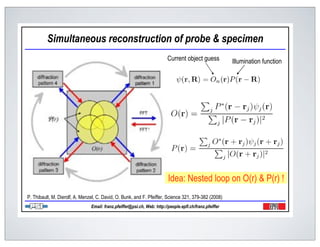
Simultaneous reconstruction of probe  specimen
                                                                          Current object guess            Illumination function


                                                                          Idea: Nested loop on O(r)  P(r) !
P. Thibault, M. Dierolf, A. Menzel, C. David, O. Bunk, and F. Pfeiffer, Science 321, 379-382 (2008)
                                Email: franz.pfeiffer@psi.ch, Web: http://people.epfl.ch/franz.pfeiffer
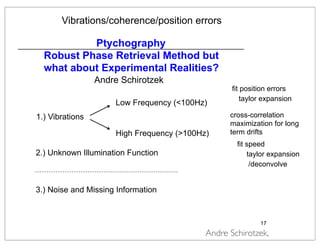
Vibrations/coherence/position errors

           Ptychography
  Robust Phase Retrieval Method but
  what about Experimental Realities?
                 Andre Schirotzek
                                                  fit position errors
                                                     taylor expansion
                     Low Frequency (100Hz)
1.) Vibrations                                   cross-correlation
                                                 maximization for long
                     High Frequency (100Hz)     term drifts
                                                   fit speed
2.) Unknown Illumination Function                      taylor expansion
                                                        /deconvolve


3.) Noise and Missing Information


                                                           17
                                           Andre Schirotzek,
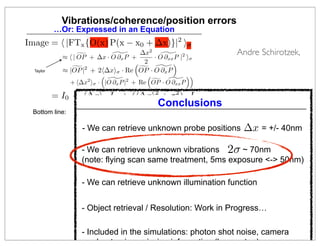
Vibrations/coherence/position errors
           …Or: Expressed in an Equation
Image =  |FTx {O(x) P(x − x0 + ∆x)}|2 σ
                            
             ≈  | OP + ∆x · O ∂x P +
                                      ∆x   2
                                             
                                          · O ∂xx P |2 σ
                                                                       Andre Schirotzek,
                                      2         
  Taylor     ≈ |OP                     
                 |2 + 2∆xσ · Re OP · O ∂x P
                                                     
                      2           2       
               + ∆x σ · |O ∂x P | + Re OP · O ∂xx P

           = I0 + ∆x · Ix + (∆x2 + σ 2 ) · Ixx
                                               Conclusions
 Bottom line:    - Shift probe by Taylor expansion
                          ∆x and Vibration Parameter σ
                 - Find Shift
                   - We can retrieve unknown probe positions             ∆x = +/- 40nm
                   through Least Squares Method
                 - Find Illumination iteratively (just like Object)
                    - We can retrieve unknown vibrations              2σ ~ 70nm
                                              d
                   (note: flying scan same treatment, 5ms exposure - 50nm)

                   - We can retrieve unknown illumination function


                   - Object retrieval / Resolution: Work in Progress…
                                                                             18
                   - Included in the simulations: photon shot noise, camera
                   read-out noise, missing information (beam stop)
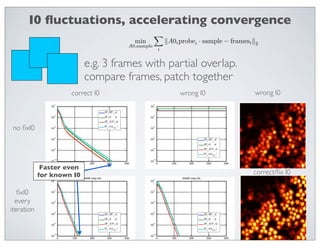
I0 fluctuations, accelerating convergence
                                                 
                                       min           A0i probei · sample − framesi 2
                                     A0,sample
                                                 i


                           e.g. 3 frames with partial overlap.
                           compare frames, patch together
                     correct I0                           wrong I0                  wrong I0


no fixI0


             Faster even
            for known I0                                                            correct/fix I0

   fixI0
  every
iteration
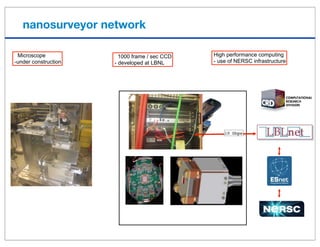
nanosurveyor network

 Microscope             1000 frame / sec CCD   High performance computing
-under construction   - developed at LBNL      - use of NERSC infrastructure


                                                   10 Gbps
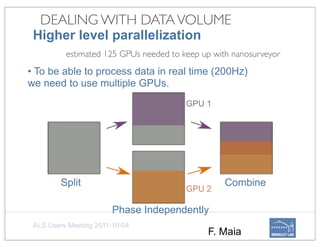
DEALING WITH DATA VOLUME
 Higher level parallelization
        estimated 125 GPUs needed to keep up with nanosurveyor
• To be able to process data in real time (200Hz)
we need to use multiple GPUs.
                                      GPU 1


       Split                                    Combine
                                      GPU 2

                   Phase Independently

                                           F. Maia
Ptychography
•   ongoing investment by all synchrotrons

•   massive data rates (1 TB/h)

•   interesting computational problem (no proof of convergence,
    but numerical tests suggest otherwise... and then there is
    phaselift)

•   problems:
    !   vibrations, camera distance, orientation, broadband
        illumination, partial coherence data volume....
    !   3D reconstruction using multi-slice propagation, denoising
        strategies?
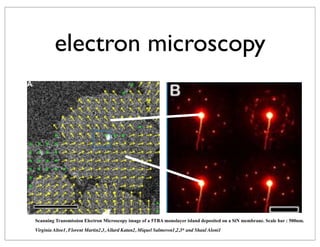
electron microscopy


Scanning Transmission Electron Microscopy image of a 5TBA monolayer island deposited on a SiN membrane. Scale bar : 500nm.
Virginia Altoe1, Florent Martin2,3, Allard Katan2, Miquel Salmeron1,2,3* and Shaul Aloni1

UCB 2012-02-28

  • 1.
  • 2.
    . m n . = i |ai | 2 i x2 z1 d ptychography (5.3.2.1 STXM-ALS) r2 x1 m×m r2 m n r q1 1 r1 R. Celestre, A D. Kilcoyne, Tolek T, A. Schirotzek, T. Warwick(ALS), microscopy ptychography SEM 70 nm probe Figure 1: Forward ptychographic problem: diffraction data ai is related to the unkown object ˆ to reconstruct ψ by a = |FQψ|. The intermediate variable zi describing individual frames is used in many iterative methods [?]. In the following, we concatenate indices q and i of ai (q) and express         a1 Q1 F z1 ˆ  .   .     .  a =  . , Q =  . , F =  . . .. . , z =  . , k = κ ˆ . 2 (3) ak Qk F zk ˆ and rewrite (Eq. 1) as |F z| = a, ˆ (4) ˆ ˆ z = Qψ, (5) referred to as a Fourier magnitude problem and an overlapping illumination problem. The ptychographic reconstruction problem Maia GPU/MPI knowing a, Q. Many iterative F. consists in finding ψ ˆ 5.3.2.1 1 micron reconstruction methods introduce an intermediate variable z, and attempt to solve the two problems in Eqs. (??) using projection algorithms, iterative transform methods, or alternating direction methods E=1keV [?]. 15 nm resolution In the following section we will describe the standard operators commonly used in the literature. In section 3 we will introduce an intermediate variable ci , replacing Eq. (5) with 700 ms exposure ci zi = Qi ψ, i = (1, . . . , k). This intermediate variable allows us to fix perturbations in the incident flux and increase rate of convergence for large scale problems. longer exposure 2 should give 7 nm res
  • 3.
    Scanning Transmission Microscope(STXM) retrofit replace with array detector
  • 4.
    fast detectors + Pilatus 1M, phase retrieval frame rate 30 Hz “These two improvements should be implemented at every STXM at synchrotrons worldwide. Doing so will be revolutionary, allowing desktop computers to overcome x-ray optical limitations to reach resolutions below 10 nm”, H.N. Chapman. Science 2008 • 9.0.1 • Cosmic • 5.3.2.1 •11.0.2.1
  • 5.
    ptychography + tomography coherent!diffractive!imaging highly!resolving quantitative!results in!standard!user!operation • voxel size (65nm)3 • uncertainty within • Sample: bone, • resolution in 3D ~100nm voxel is 0.04 e-/Å-3 M.!Dierolf et al., Nature 467 (2010) 436 resolution in 2D ~120nm • significantly higher sensitivity for larger volumes, e.g., <0.002 e-/Å-3 for 1µm3 COSMIC @ ALS, August 2, 2011
  • 6.
    Ptychographic phase retrieval W. Hoppe, Acta Cryst. A 25, 508 (1969). R. Hegerl, W. Hoppe, Ber. Bunsen-Ges. Phys. Chemie 74, 1148 (1970). P.D. Nellist et al., Nature 374, 630 (1995) Email: franz.pfeiffer@psi.ch, Web: http://people.epfl.ch/franz.pfeiffer
  • 7.
    men PHASE-RETRIEVAL X-RAYMICROSCOPY BY WIGNER-DISTRIBUTION with complex transmission ψ(r) is situated in the focal plane and in that plane. At DECONVOLUTION:scan the sample is displaced a given point in the SIGNAL PROCESSING e optical axis by a vector −x.Microscopy Stony 1997 (Pages 67-80) sample Scanning (On the Vol. 11, Brook STXM the ly scanned in the negative directions, International, ChicagoWignermotion IL 60666 USA Scanning Microscopy soN. Chapman apparent O’Hare), of x-ray microscopy that the pixel sample is in the positive directions.) The x-ray deconvolution be across the translation Henry (AMF wavefield Fourier transform ately behind the specimen will then SUNY at Stony a(r)ψ(r + x), and the Department of Physics, be given by Brook, Stony Brook, NY illuminationPHASE-RETRIEVAL X-RAY MICROSCOPY BY WIGNER- y at the far-field microdiffraction object be written as [1] plane can intensity DECONVOLUTION: SIGNAL PROCESSIN 2 m(r , x) Abstract = A(r − x )Ψ(x ) exp(2πix · x) dx . (1) Introduction Henry N. Chapman Phase and amplitude images have been Wigner-deconvolution phase-retrieval microscop structed from data collected in a scanning Department of Physics, retrievingStony Brook, Stony Brook is a new technique for SUNY at the phase and amplitude o mission x-ray microscope by applying the method of referred to in microscope images (Rodenburg and Bates ensity m(r , x) for constant x (further transmission this paper as lane of m)deconvolution. This required collecting pattern, recordedRodenburg, 1989). This technique can b r-distribution is a single microdiffraction 1992; Bates and as a single ent microdiffraction patterns (1) shows thattwo- microdiffraction microscope of either the scanning o f the CCD. Equation at each point of a the employed in a wavefield is Abstract In rier transform object and then deconvolving the of conventional geometry and allows the formation o sional scan of an of the complex transmission the specimen, multiplied imensional Wigner-distribution function of the lens superresolved images (Rodenburg and Bates, 1992; Nellis asedata set. and processconvolvedanalyses the pupil function. This1994). The phase-retrieval an the ramp, The then essentially with the Phase and amplitude images have equation and Rodenburg, been Wigner-deconvo much about the imaging processplane anddata collected in a characteristics ofis a new technique for re rence which occurs in the microdiffraction and the role of the microdiffraction the technique have bee reconstructed from superresolution scanning the object transmission transmission grating, which has of transmission microscopes tha scanned. x-ray microscopedemonstratedthe method a dis- transmission microscop Consider aasspecimen,issuch as a The image- modulates by applying in scanning ssing steps required to deconvolve experimental deconvolution. This required collecting Wigner-distribution 1992; Bates and Rodenb ourier transform consisting of severaldata patterns atorders. light a incident employed in a micros diffraction each point of (McCallum and Rodenburg, 1992) utilise visible The coherent microdiffraction scribed. These steps result in the reconstructions of two- electrons (Rodenburg et al., 1993; Nellist et al., 1995), an ent beam is diffracted by the object so object and then deconvolving the of conventional geometr dimensional scan of an that soft x-rays (Chapman, order In a scanning microscope th each diffraction tion-limited phased images, to a spatial-frequency cut- 1996). cimen -1. The estimated accuracy)] yields Wigner-distribution function ofcollecting a two-dimensional micro 1/45 nm [each non-zero four-dimensional a pupil function A(r ) in the mi- superresolved images (R Ψ(x of the images is method requires the lens action plane, centred fromData data set. The = x and multiplied by convergent beam diffractio ad in phase and 10% in amplitude. the frequency r process essentially analyses the the and Rodenburg, 199 at the were collected diffraction pattern (a coherent -ray wavelength of 3.1 nm. interference which occurs in the microdiffraction plane a two-dimensional scan. The abilit pattern) at each point in and superresolution characte
  • 8.
    = F (r )F (r − x ) exp(2πir · r ) dr . (5) F (rwith (r − x ) transmission ψ(r) )F ∗ complex exp(2πir · r ) MICROSCOPY the focal plane and men PHASE-RETRIEVAL X-RAYdr . is situated inBY WIGNER-DISTRIBUTION (5) r inx) is plane. At DECONVOLUTION:scan the sample is displaced of the , that actually a given point in the SIGNAL PROCESSING WDF a four-dimensional convolution of the bution withby a vector −x.Microscopy Stony 1997 (Pages 67-80)the sample object. eactuallyaxis the WDF of(On the Vol. 11, Brook STXMthe of the optical a four-dimensional convolution of the WDF of Scanning the complex transmission with of thisthe negative directions, International, ChicagoWignermotion IL 60666 USA ly scanned in of the complex transmissionthe apparent O’Hare), of x-ray microscopy Scanning Microscopy soN. Chapman deconvolution. namethe WDFmethod, Wigner-distributionthe object. that of pixel sample is in the positivedeconvolution. x-ray deconvolution f this method, translation Henry be across the Wigner-distribution directions.) The (AMF wavefield illumination object Fourier transform decon- ately behind the specimen will then SUNY at Stony a(r)ψ(r + x), and the Department of Physics, be given by Brook, Stony Brook, NY WDF, Wa , contains zerosPHASE-RETRIEVAL X-RAY MICROSCOPY BY WIGNER- y a , contains zeros and regionsand regions of low decon- W plane intensity, the intensity, the at the far-field microdiffractionof low can be written as [1] best performed usingfilter. That is, an estimate, Wan of intensity˜ψ , of That is, ˜ψ , estimate, W rformed using a Wiener a Wiener filter. DECONVOLUTION: SIGNAL PROCESSIN 2 f them(r specimen is − x )Ψ(x ) exp(2πix · x) dx . given by given by pecimen is, x) Abstract = A(r (1) Introduction Henry N. Chapman Phase and amplitude images a (r, −x ) W ∗ (r, −x ) W ∗ have been W a linear problem ˜ψ (r, x )˜= M(r, x ) illumination Wigner-deconvolution phase-retrieval microscop , is a new technique(6)SUNY at the phase and amplitude o collected in a scanning a Department of Physics, retrievingStony Brook, Stony Brook structed Wψ (r, x ) = M(r, x ) 2 referred 2 in , (6) from data )| + φ for |Wa (r, −x ensityx-ray microscope by applying the method (r, −x )|to+ φthis paper as (Rodenburg and Bates m(r , x) for constant x (further a transmission microscope images mission −1 −1 |Wof a a a = microdiffraction m(r , x)] = and Rodenburg,1989). (r, x ) lane of m)deconvolution.F required collecting pattern, recordeda (r,a single ψThis technique can b isx) single This M(r,An estimate →r the specimen transmission can −x )W 1992; Bates W as r of Fx→x r-distribution ent constant. Equation (1) shows thattwo- microdiffraction microscope of either the scanning o ll the CCD. f amicrodiffraction patterns atAn estimate of the specimen transmission can small constant. then deconvolving theAbstract each point of a employed in a wavefield is rier transform object and FT FT Data by first Fourier transforming transmission of conventional geometry and allows the formation In sional scan of an of the complex the WDF to give specimen, multiplied the the unknown o tained byand then convolved with the pupilsuperresolved Thisgive ramp, first Fourier Phase and amplitude images have 1994). The phase-retrieval an transforming the WDF imagesequation and Bates, 1992; Nellis imensional Wigner-distribution function of the lens asedata set. The process essentially analyses the function. to been (Rodenburg ˜ψ ˜ ˜ the, x ) = F {W (r, x )} = Ψ(r )Ψ∗ (r − x and Rodenburg, Wigner-deconvo r r ), of the in a scanning (7) rence which occurs in the microdiffraction and the role reconstructed from Consider aas,the object Frscanned. a The )} = W modulates x ) = {W ˜ superresolution scanning ˜∗ by Ψ (r in x ), x-ray microscopedemonstrated −method a dis- Wigner much about the imaging processplane anddata collected microdiffraction is a new technique for re ˜ψ (r specimen,issuch ˜ψ (r, ximage- Ψ(r )applying thecharacteristics oftransmission microscop the technique have bee (7) transmission transmission grating, which has of transmission microscopes tha as WDF to give the specimen’s transform as utilise visible follows: ssing steps required to deconvolve experimental deconvolution. This required collecting Wigner-distribution distribution 1992; Bates and Rodenb ourier transform consisting of severaldata patterns atorders. light a incident employed in a micros diffraction each point of (McCallum and Rodenburg, 1992) coherent microdiffraction The two- ing beamWDF ∗to give the˜specimen’s electrons (Rodenburgfollows:conventional 1995), an ent the is diffracted by the object so object transform as etthe 1993; Nellist et al., geometr scribed. These steps result in the reconstructions of that and then deconvolving al., of each diffraction order function 1/45 nm ˜ Ψ(x ) = Wψ dimensional scan of an tion-limited phased ˜ (0, −xspatial-frequency cut- images, to a )/ Wψ (0, 0). solution (8) soft x-rays (Chapman, 1996). In a scanning microscope th cimen -1. The estimated accuracy)] yields Wigner-distribution function ofcollecting a two-dimensional micro [each non-zero four-dimensional a pupil function A(r ) in the mi- superresolved images (R Ψ(x of the images is method requires the lens action plane, centred fromData data set. The =˜x and multiplied by convergent beam diffractio ad in phase and 10% in amplitude. the∗ frequency r process essentially analyses the the and Rodenburg, 199 the at ˜ were collected ˜ found by inverse Fourier thediffraction patternplane and Ψ(x ) interference which occurs Wψmicrodiffraction (a in -ray wavelength of 3.1 (0, 0).each point coherent superresolution characte ct, ψ(x), is then nm. = Wψ (0, −x )/ in transformation of a two-dimensional scan. The abilit ˜ pattern) at (8)
  • 9.
    WIGNER DISTRIBUTION FUNCTION ψ(r)wavefield Wigner distribution function Wψ (r, dr) = ψ(r + dr/2)ψ(r − dr/2) phase space Wψ (r, q) = [Fdr→q ] ψ(r + dr/2)ψ(r − dr/2) quasi probability distribution lifting cyclic permutation note: ψ ψ rank 1 ψ(r + dr/2)ψ(r − dr/2)
  • 10.
    WIGNER DISTRIBUTION FUNCTION ψ(r)wavefield Wψ (r, dr) = ψ(r + dr/2)ψ(r − dr/2) phase space Wψ (r, q) = [Fdr→q ] ψ(r + dr/2)ψ(r − dr/2) quasi probability distribution lifting cyclic permutation note: ψ ψ rank 1 ψ(r + dr/2)ψ(r − dr/2) phase space description of light light source phase space 2π q= λ θ r propagation q ψ(r) r θ direction
  • 11.
    WIGNER DISTRIBUTION FUNCTION intensity point source plane wave lens measurement q q q q r r r r propagation q q q volume=λ r r r propagation q q r r intensity measurement intensity measurement illumination q object q r r
  • 12.
    on m×m illuminatesan unknown object of interest ψ(r+x). For simplicity we conside ill summarizeusedptychographic problem following the notation of Yang et al. the in many iterative methods [?]. hography experiment, a two dimensional small beam with distribution w(r)also be considered. One collect matrices, generalization to non-square matrices can of ˆ PROJECTION ALGORITHMS nce of k diffraction images a2 (q) of dimension m × m ×m illuminates an unknown object of interest ψ(r+x). For simplicity we consideras the position x of the objec to non-square matricesx es, generalization In the following, we introduce be sequences of various matrices as follows can also k considered. One collects red. Eachimages ax a of dimension m the the position xof the discrete two dimensional Fourie k diffraction frame 2 (q)x represents× m asmagnitude of the object        m Fˆ of w(r)ψ(r ˆ the magnitude ach frame ax represents + x): a1 of the discrete1 two dimensional Fourier Q z1 ˆ F illumination f w(r)ψ(r + x): unknown  .   .   .   ..  a =  .  , Q =  .  , z =  .  , F =  . . ˆ . .  (2) ˆ z = 2π(1) ax (q) =axFw(r)ψ(r + x)Fw(r)rm, q + 2π m , Qkr = rm, qˆk (q) ˆ= , r =aψ(r = x) r m (1 k r F Ff = diffraction edata eiq·r f (r), m = as a = |F Qψ|,(0 . .using 1), intermediate variable z as: and rewrite (Eq. iq·r(µ, ν) , µ, ν ˆ or . m − the Ff = f (r), 1) = feasibility problem ˆ m = (µ, ν) , µ, ν = (0 . . . m − 1), r probe translate gthscale, and the sum over r is given on all the indices m × m = r. z|, r a of |F ˆ Fourier magnitude (3) stered around, r + x spans a grid of dimension n × n, n m. We denote Qx ˆ “illumination matrix” that frames ˆ s a lengthscale, andextracts a frame containinggiven = Qψ, thean z Split into frames the sum over r is m × m on all of indices m × m of r. pixels out (4) ining rastered andto as Fourier magnitude grid of dimension n × illumination We denote x is n × n pixels, around,a r + x spans a illuminationand an overlapping n, n m.problem respec- Q referred multiplies the frame by the problem function w(r): ˆ + x) Qx (r)ψ matrix” (r) = extracts ˆ ˆ a F ˆ Q m2 × w(r)ψ(rtively.= The ptychographic xreconstruction. problem consists in findingm × m pixels out of a n2 “illumination = zx (r), Q that w(r)eix∂r a frame containing ψ knowing a,ψQ. Many ( )( )( )( ) ˆ ψ containing n × methodsindividual multiplies thevariable z, and attempt to solve thefunction w(r) iterative n pixels, introduce an intermediate intermediate variable describing w and frames that we a1 frame convi- introduce for by the illumination two problems ψˆ in Eqs. (??) using projection algorithms, iterative transform methods, or w Q alternating direction w a2 F wQ 1 methods [?]. w(r)ψ(r F ˆ + x) = Qx (r)ψ = zx (r), Qx (r) = w(r)eix∂r . zi ˆ ˆ 2 ψ Inw the F the following section we will describe = standard operators commonly used in the xi 1 m F literature. In section 3 we will introduce an intermediate variable ci , replacing Eq. (4) with is an intermediate ivariable, k). The linear projection operator Fthat we introduce for conv ci zi = Qi ψ, = (1, . . . n describing individual framescorresponding to the augmented F z problem is computationally more intensive than for (Eq. 8), and speed may not always improve. zk . . . = However the benefits of introducing this augmented problem are the following: |ai |2 • Intensity fluctuation introduced1 instabilities F the storage ring, optics etc, are given z1 by in Q by the coefficients cmand their effect can be removed (see Fig. 4). m×i • Accelerated convergence per iteration (Fig.2). A heuristic interpretation is that long range phase fluctuations are poorly constrained by standard projection operators, result- ing in degraded convergence rate for large scale problems. See also (Fig. 3) where the
  • 13.
    arg min zi− zi , subject to |F z| = a, ¯ ψ ¯ (6)  ¯ z      Q1 z1 ˆ F mes. and zset .overlap=projection operator PQSimultaneous reconstruction of probe specimen  . norm. The . illuminations . . ian  of   . , ˆ =  . , F   respectively. The (2) to enforce   running estimate is used PROJECTION ALGORITHMS . nsQQ: btained by solving the least squares problem in Eq. (7): zk ˆ F k Current object guess Illumination function ψmin , using the (Q∗ Q)−1 Q∗ z. z − as: 2 , ψ|, or ψ where intermediate min ˆ = ψmin = arg variable z Qψ ˆ (7) (8) min ψ a = of |, Fourier magnitude multiplies |F ˆilluminations respectively. The and merges all ames and setby zthe conjugate of the probe w running estimate the (3) is the operator which splitsReduce frames Eq. and ˆ z = Qψ, ˆ (4) obtained by solving the least squares problem frames (7): multiplies an image into in −1 is a normalization factor. The linear projection operator P de problem and an overlapping illumination problem respec- Q Q* () ∗ −1 ∗ ψproblem consists and solving (Eq. 13)Many (8) Q min = (Q Q) in finding ψ knowing a, Q. is required when merging Q z. ( ) olve independently, ˆ )( struction W ntermediate variable z, and−1 ∗ to solve the two problems ∗ attempt at multiplies bytransform methods, or alternatingw and merges all the (9) Nested loop on O(r) P(r) ! Piterative the Q) Q , of the probe direction orithms, Q = Q(Q conjugate Idea: Q is the operator which splits an image intoP.frames and multipliesPfeiffer, Science 321, 379-382 (2008) Thibault, M. Dierolf, A. Menzel, C. David, O. Bunk, and F. Q)−1describe the standard factor. The the solutions the (7) and (6) are lgorithm, approximation to linear of split normalize merge Email: franz.pfeiffer@psi.ch, Web: http://people.epfl.ch/franz.pfeiffer will is a normalization operators commonly projection operator PQ the used in ction algorithms ntroduce an intermediate variable ci , replacing Eq. (4) with ∗ −1 ∗ linear projection operator corresponding to the augmented (+1)PQ = Q(Q Q) () , Q (9) intensive P= for used ] and speed may not always frames z [PQ PF z Fourier amplitude Alternating direction Methods for Classical and jection thanthe (Eq. 8),to ensure the solutions of (7) satisfy measurements algorithm, F is approximation to that the improve. Ptychographic Phase Retrieval this augmented problem are the following: Phase Retrieval and (6) are Wen , Chao Yang , Xin Liu , Stefano Marchesini ing (+1) ∗ −1 ∗ (+1) ADM for essed as: = (Q Q) Q z ψ . projection 1 2 3 Zaiwen A test case: far-field phase retrieval with laser light 1 Department of Mathematics and Institute of Natural Sciences, Shanghai Jiaotong University, Shanghai, 200240, CHINA duced by instabilities in the storage ring, optics Algorithm given etc, are Formula 2 Computational Research Division, Lawrence Berkeley National Laboratory, Berkeley, CA 94720, USA estimate =be ˆ Q ∗F ] Qψ. A number ofER ˆ 3 Academy of Mathematics and Systems Science, Chinese Academy of Sciences, effect [P ˆ = zz heir z(+1)canof ψ, zP F(see Fig. 4). removed () diffrent algorithms has Beijing 100080, CHINA xk+1 = PS PM (xk ) serare(+1) F= = FA |F z| ∗·za. ∈ [0, 1] is is that long = (PS PM + I − PM ) (x ) (5) k P z Tab. 1, E-mail: zw2109@sjtu.edu.cn, cyang@lbl.gov and liuxin@lsec.cc.ac.cn in (Q heuristic interpretation BIO given(Fig.2). ∗ Q)−1with(+1) . β xk+1 a relaxation parameter. k iteration ψ Q HIO Abstract. In this paper, we apply the widely used augmented Lagrangian xk+1 = ((1 + β)PS PM + I − PS − βPM ) (x ). alternating direction method (ADM) for solving both the classical and Ptychographic phase retrieval problems. Although the sequence produced by e poorly constrained by standard projection operators, result- = (1 + β)PS+ PM + I − PS+ − βPM (xk ) HPR xk+1 the hybrid input-output and hybrid projection algorithms can be generated from these from the ADM method on the classical phase retrieval problem, they usually perform quite differently in practice and the latter can often be much less sensitive m ratetransform z problems. A PF is(Fig. 3) where xalgorithmsPhas βI that+ + (1 − 2β)PM (xk ) ng estimate of scale =updatingnumber of RAAR thein theS+sense − βPS rier for large ψ, ˆ Qψ. See formula diffrent k+1 = 2βP M + ce ˆ operator. ˆ also a projection to the choice of the relaxation parameters. Similar behavior can also be observed on Ptychographic phase retrieval problem. Moreover, the ADM method can be competitive with the nonlinear conjugate gradient and Newton’s methods z(+1) Tab. P with β ∈ PQ )(I a βPTable z() parameter. on difficult instances in terms of both reconstruction quality and computational les are given in = [PQ1, F + (I − [0, 1] is − relaxation list of projection algorithms for phase retrieval. F )] 1. A efficiency. divide the problem inQ PF subject2β)PF z| = a, − I)] z min zi − ¯ , + (1 − to |F ¯ and = arg(+1) = [2βPzisubreconstruction regionsβ(PQreduce z() + 1. Introduction (6) hm ¯ z updating formula Phase retrieval is a challenging inverse problem arising from a number of scientific
  • 14.
    ROBUST RECONSTRUCTION TECHNIQUE ptychography Diffractive imaging 0 RAAR ii=140 10 −2 10 −4 10 −6 10 |[Pf−I] x| −8 |[Po−I] Pf x| 10 |Po x−xsol | −10 10 0 100 200 300 400 iterations reaches double precision
  • 15.
    POTENTIAL PROBLEMS method CPU Matlab+GPU c++/cuda/mpi remarks phase retrieval x x x x [arXiv:1105.5628] probe retrieval x x x beamstop no good x x regularization/high solution yet pass filter? recovered probe larger detector binning x than field of view intensity exact solution, x x partial accelerated fluctuations convergence works ok, we position error fit/correct x know how to do better step size/ccd can someone compute trial/error distance gradient/matvec works ok, in the fit vibrations fit/deconvolve x partial vibrations are averaged incoherent only unknown simulations backtround offset background numerical tests needed detector dynamic range is noise more numerical tests needed x an issue, we can’t fix it by x x compressive... more numerical tests needed numerical methods
  • 16.
    Simultaneous reconstruction ofprobe specimen Current object guess Illumination function Idea: Nested loop on O(r) P(r) ! P. Thibault, M. Dierolf, A. Menzel, C. David, O. Bunk, and F. Pfeiffer, Science 321, 379-382 (2008) Email: franz.pfeiffer@psi.ch, Web: http://people.epfl.ch/franz.pfeiffer
  • 17.
    Vibrations/coherence/position errors Ptychography Robust Phase Retrieval Method but what about Experimental Realities? Andre Schirotzek fit position errors taylor expansion Low Frequency (100Hz) 1.) Vibrations cross-correlation maximization for long High Frequency (100Hz) term drifts fit speed 2.) Unknown Illumination Function taylor expansion /deconvolve 3.) Noise and Missing Information 17 Andre Schirotzek,
  • 18.
    Vibrations/coherence/position errors …Or: Expressed in an Equation Image = |FTx {O(x) P(x − x0 + ∆x)}|2 σ ≈ | OP + ∆x · O ∂x P + ∆x 2 · O ∂xx P |2 σ Andre Schirotzek, 2 Taylor ≈ |OP |2 + 2∆xσ · Re OP · O ∂x P 2 2 + ∆x σ · |O ∂x P | + Re OP · O ∂xx P = I0 + ∆x · Ix + (∆x2 + σ 2 ) · Ixx Conclusions Bottom line: - Shift probe by Taylor expansion ∆x and Vibration Parameter σ - Find Shift - We can retrieve unknown probe positions ∆x = +/- 40nm through Least Squares Method - Find Illumination iteratively (just like Object) - We can retrieve unknown vibrations 2σ ~ 70nm d (note: flying scan same treatment, 5ms exposure - 50nm) - We can retrieve unknown illumination function - Object retrieval / Resolution: Work in Progress… 18 - Included in the simulations: photon shot noise, camera read-out noise, missing information (beam stop)
  • 19.
    I0 fluctuations, acceleratingconvergence min A0i probei · sample − framesi 2 A0,sample i e.g. 3 frames with partial overlap. compare frames, patch together correct I0 wrong I0 wrong I0 no fixI0 Faster even for known I0 correct/fix I0 fixI0 every iteration
  • 20.
    nanosurveyor network Microscope 1000 frame / sec CCD High performance computing -under construction - developed at LBNL - use of NERSC infrastructure 10 Gbps
  • 21.
    DEALING WITH DATAVOLUME Higher level parallelization estimated 125 GPUs needed to keep up with nanosurveyor • To be able to process data in real time (200Hz) we need to use multiple GPUs. GPU 1 Split Combine GPU 2 Phase Independently F. Maia
  • 22.
    Ptychography • ongoing investment by all synchrotrons • massive data rates (1 TB/h) • interesting computational problem (no proof of convergence, but numerical tests suggest otherwise... and then there is phaselift) • problems: ! vibrations, camera distance, orientation, broadband illumination, partial coherence data volume.... ! 3D reconstruction using multi-slice propagation, denoising strategies?
  • 23.
    electron microscopy Scanning TransmissionElectron Microscopy image of a 5TBA monolayer island deposited on a SiN membrane. Scale bar : 500nm. Virginia Altoe1, Florent Martin2,3, Allard Katan2, Miquel Salmeron1,2,3* and Shaul Aloni1