The moduli space of BPS vortex-antivortex pairs
René García
Work supervised by prof. Martin Speight
1
School of Mathematics
University of Leeds
Encuentro Iberoamericano de Geometría en Granada
Granada, Spain
June 10th – 12th, 2019
EIG-GR 2019 June 10th - 12th, Granada, Spain. 1 / 38
Overview
The O(3) Sigma model on euclidean space
Geometry on compact domains
Conclusions
EIG-GR 2019 June 10th - 12th, Granada, Spain. 2 / 38
O(3) Sigma Model on the Euclidean Plane
We consider space-time R1,2
with signature (+, −, −). Let
ϕ : R1,2
→ S2
, a ∈ Ω1
(
R1,2
)
and let us fix n ∈ S2
such that we can
define the height ϕ3 = ϕ · n. The abelian O(3) sigma model is given by
the functional
∫
R2
1
2
Dµϕ · Dµ
ϕ −
1
4
fµνfµν
−
1
2
(τ − ϕ3)
2
d2
x, (1)
where,
Dµϕ = ∂µϕ − aµn × ϕ, (2)
is the covariant derivative on the trivial fibered bundle R1,2
× S2
associated with the connection form and the real constant τ is chosen in
the interval [−1, 1].
EIG-GR 2019 June 10th - 12th, Granada, Spain. 3 / 38
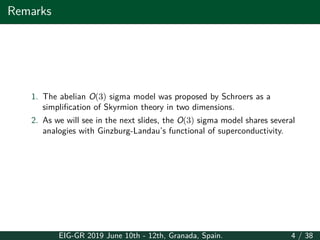
Remarks
1. The abelian O(3) sigma model was proposed by Schroers as a
simplification of Skyrmion theory in two dimensions.
2. As we will see in the next slides, the O(3) sigma model shares several
analogies with Ginzburg-Landau’s functional of superconductivity.
EIG-GR 2019 June 10th - 12th, Granada, Spain. 4 / 38
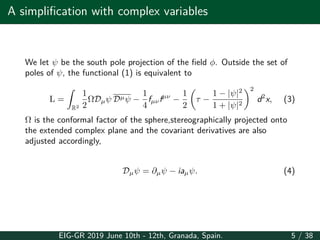
A simplification with complex variables
We let ψ be the south pole projection of the field ϕ. Outside the set of
poles of ψ, the functional (1) is equivalent to
L =
∫
R2
1
2
ΩDµψ Dµψ −
1
4
fµνfµν
−
1
2
(
τ −
1 − |ψ|2
1 + |ψ|2
)2
d2
x, (3)
Ω is the conformal factor of the sphere,stereographically projected onto
the extended complex plane and the covariant derivatives are also
adjusted accordingly,
Dµψ = ∂µψ − iaµψ. (4)
EIG-GR 2019 June 10th - 12th, Granada, Spain. 5 / 38
Some simplifications on the model
In order to describe the set of minimizers of the O(3) Sigma model
Lagrangian, we look for stationary solutions.
EIG-GR 2019 June 10th - 12th, Granada, Spain. 6 / 38
The static Lagrangian
For a stationary configuration of fields, we can take a particular gauge,
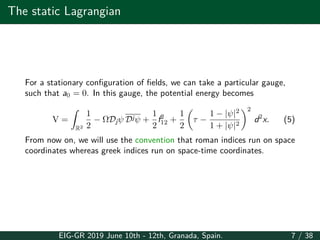
such that a0 = 0. In this gauge, the potential energy becomes
V =
∫
R2
1
2
− ΩDjψ Djψ +
1
2
f2
12 +
1
2
(
τ −
1 − |ψ|2
1 + |ψ|2
)2
d2
x. (5)
From now on, we will use the convention that roman indices run on space
coordinates whereas greek indices run on space-time coordinates.
EIG-GR 2019 June 10th - 12th, Granada, Spain. 7 / 38
Bogomol’nyi’s trick
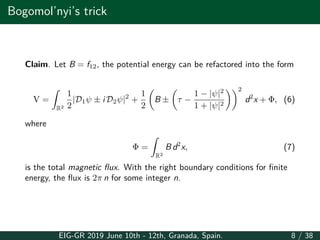
Claim. Let B = f12, the potential energy can be refactored into the form
V =
∫
R2
1
2
|D1ψ ± i D2ψ|2
+
1
2
(
B ±
(
τ −
1 − |ψ|2
1 + |ψ|2
))2
d2
x + Φ, (6)
where
Φ =
∫
R2
B d2
x, (7)
is the total magnetic flux. With the right boundary conditions for finite
energy, the flux is 2π n for some integer n.
EIG-GR 2019 June 10th - 12th, Granada, Spain. 8 / 38
Remarks
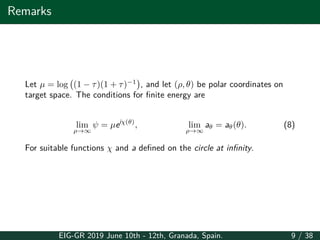
Let µ = log
(
(1 − τ)(1 + τ)−1
)
, and let (ρ, θ) be polar coordinates on
target space. The conditions for finite energy are
lim
ρ→∞
ψ = µeiχ(θ)
, lim
ρ→∞
aθ = aθ(θ). (8)
For suitable functions χ and a defined on the circle at infinity.
EIG-GR 2019 June 10th - 12th, Granada, Spain. 9 / 38
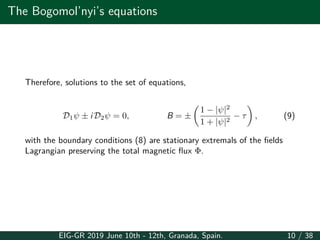
The Bogomol’nyi’s equations
Therefore, solutions to the set of equations,
D1ψ ± i D2ψ = 0, B = ±
(
1 − |ψ|2
1 + |ψ|2
− τ
)
, (9)
with the boundary conditions (8) are stationary extremals of the fields
Lagrangian preserving the total magnetic flux Φ.
EIG-GR 2019 June 10th - 12th, Granada, Spain. 10 / 38
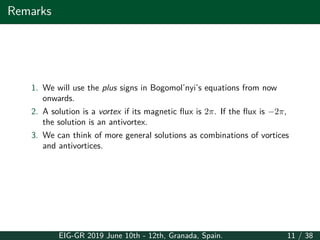
Remarks
1. We will use the plus signs in Bogomol’nyi’s equations from now
onwards.
2. A solution is a vortex if its magnetic flux is 2π. If the flux is −2π,
the solution is an antivortex.
3. We can think of more general solutions as combinations of vortices
and antivortices.
EIG-GR 2019 June 10th - 12th, Granada, Spain. 11 / 38
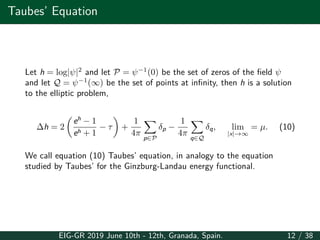
Taubes’ Equation
Let h = log|ψ|2
and let P = ψ−1
(0) be the set of zeros of the field ψ
and let Q = ψ−1
(∞) be the set of points at infinity, then h is a solution
to the elliptic problem,
∆h = 2
(
eh
− 1
eh + 1
− τ
)
+
1
4π
∑
p∈P
δp −
1
4π
∑
q∈Q
δq, lim
|x|→∞
= µ. (10)
We call equation (10) Taubes’ equation, in analogy to the equation
studied by Taubes’ for the Ginzburg-Landau energy functional.
EIG-GR 2019 June 10th - 12th, Granada, Spain. 12 / 38
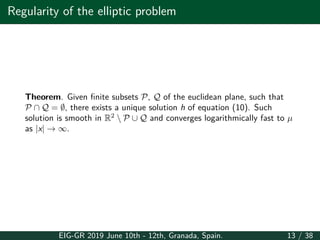
Regularity of the elliptic problem
Theorem. Given finite subsets P, Q of the euclidean plane, such that
P ∩ Q = ∅, there exists a unique solution h of equation (10). Such
solution is smooth in R2
 P ∪ Q and converges logarithmically fast to µ
as |x| → ∞.
EIG-GR 2019 June 10th - 12th, Granada, Spain. 13 / 38
Vortex-Antivortex on the plane
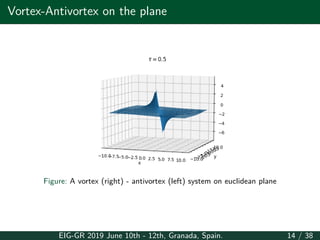
Figure: A vortex (right) - antivortex (left) system on euclidean plane
EIG-GR 2019 June 10th - 12th, Granada, Spain. 14 / 38
The moduli space of stationary solutions
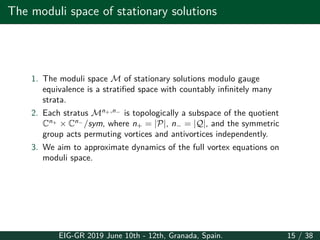
1. The moduli space M of stationary solutions modulo gauge
equivalence is a stratified space with countably infinitely many
strata.
2. Each stratus Mn+,n−
is topologically a subspace of the quotient
Cn+
× Cn−
/sym, where n+ = |P|, n− = |Q|, and the symmetric
group acts permuting vortices and antivortices independently.
3. We aim to approximate dynamics of the full vortex equations on
moduli space.
EIG-GR 2019 June 10th - 12th, Granada, Spain. 15 / 38
Approximated dynamics on moduli space
1. If a system of vortices and antivortices is moving slowly, it can be
approximated to some degree by parametric motion on moduli space.
2. We make the assumption that stationary solutions dependent on a
real parameter are approximations to truly dynamical solutions to
the field equations.
3. This assumption has been thoroughly tested for Ginzburg-Landau
vortices [2].
EIG-GR 2019 June 10th - 12th, Granada, Spain. 16 / 38
Localization formula
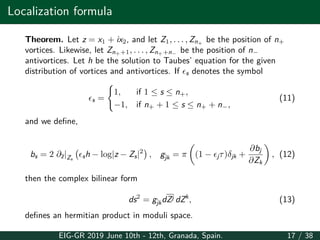
Theorem. Let z = x1 + ix2, and let Z1, . . . , Zn+
be the position of n+
vortices. Likewise, let Zn++1, . . . , Zn++n−
be the position of n−
antivortices. Let h be the solution to Taubes’ equation for the given
distribution of vortices and antivortices. If ϵs denotes the symbol
ϵs =
{
1, if 1 ≤ s ≤ n+,
−1, if n+ + 1 ≤ s ≤ n+ + n−,
(11)
and we define,
bs = 2 ∂z|Zs
(
ϵsh − log|z − Zs|2
)
, gjk = π
(
(1 − ϵjτ)δjk +
∂bj
∂Zk
)
, (12)
then the complex bilinear form
ds2
= gjkdZj dZk
, (13)
defines an hermitian product in moduli space.
EIG-GR 2019 June 10th - 12th, Granada, Spain. 17 / 38
Localization formula
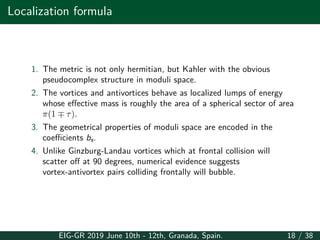
1. The metric is not only hermitian, but Kahler with the obvious
pseudocomplex structure in moduli space.
2. The vortices and antivortices behave as localized lumps of energy
whose effective mass is roughly the area of a spherical sector of area
π(1 ∓ τ).
3. The geometrical properties of moduli space are encoded in the
coefficients bs.
4. Unlike Ginzburg-Landau vortices which at frontal collision will
scatter off at 90 degrees, numerical evidence suggests
vortex-antivortex pairs colliding frontally will bubble.
EIG-GR 2019 June 10th - 12th, Granada, Spain. 18 / 38
Vortex-Antivortex systems
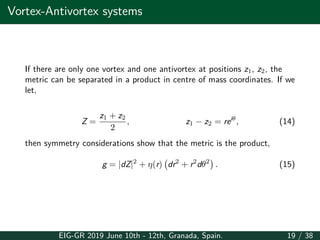
If there are only one vortex and one antivortex at positions z1, z2, the
metric can be separated in a product in centre of mass coordinates. If we
let,
Z =
z1 + z2
2
, z1 − z2 = reiθ
, (14)
then symmetry considerations show that the metric is the product,
g = |dZ|2
+ η(r)
(
dr2
+ r2
dθ2
)
. (15)
EIG-GR 2019 June 10th - 12th, Granada, Spain. 19 / 38
Vortex-antivortex systems
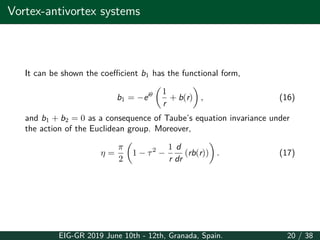
It can be shown the coefficient b1 has the functional form,
b1 = −eiθ
(
1
r
+ b(r)
)
, (16)
and b1 + b2 = 0 as a consequence of Taube’s equation invariance under
the action of the Euclidean group. Moreover,
η =
π
2
(
1 − τ2
−
1
r
d
dr
(rb(r))
)
. (17)
EIG-GR 2019 June 10th - 12th, Granada, Spain. 20 / 38
Vortex-Antivortex collisions
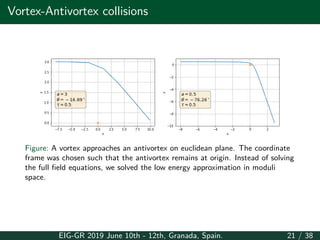
Figure: A vortex approaches an antivortex on euclidean plane. The coordinate
frame was chosen such that the antivortex remains at origin. Instead of solving
the full field equations, we solved the low energy approximation in moduli
space.
EIG-GR 2019 June 10th - 12th, Granada, Spain. 21 / 38
The centre of mass metric on a vortex-antivortex system
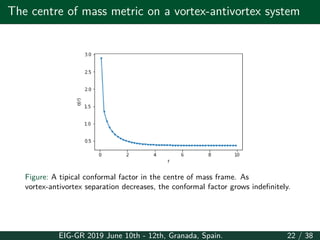
Figure: A tipical conformal factor in the centre of mass frame. As
vortex-antivortex separation decreases, the conformal factor grows indefinitely.
EIG-GR 2019 June 10th - 12th, Granada, Spain. 22 / 38
Geometry on compact domains
Let Σ be a closed surface with a Riemannian metric g and compatible
pseudocomplex structure. A construction by Sibner et al. [3] extends the
fields to take values on a fiber bundle with base Σ and fibers S2
. This
construction is further generalized in the work of Romao and Speight [1].
We can extend the previous discussion about the O(3) Sigma model to
R × Σ with the metric dt2
− g.
EIG-GR 2019 June 10th - 12th, Granada, Spain. 23 / 38
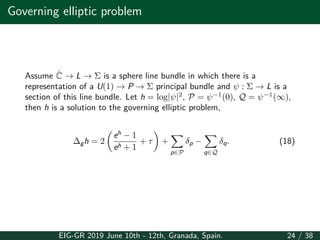
Governing elliptic problem
Assume ˆC → L → Σ is a sphere line bundle in which there is a
representation of a U(1) → P → Σ principal bundle and ψ : Σ → L is a
section of this line bundle. Let h = log|ψ|2
, P = ψ−1
(0), Q = ψ−1
(∞),
then h is a solution to the governing elliptic problem,
∆gh = 2
(
eh
− 1
eh + 1
+ τ
)
+
∑
p∈P
δp −
∑
q∈Q
δq. (18)
EIG-GR 2019 June 10th - 12th, Granada, Spain. 24 / 38
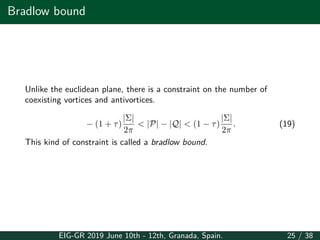
Bradlow bound
Unlike the euclidean plane, there is a constraint on the number of
coexisting vortices and antivortices.
− (1 + τ)
|Σ|
2π
< |P| − |Q| < (1 − τ)
|Σ|
2π
. (19)
This kind of constraint is called a bradlow bound.
EIG-GR 2019 June 10th - 12th, Granada, Spain. 25 / 38
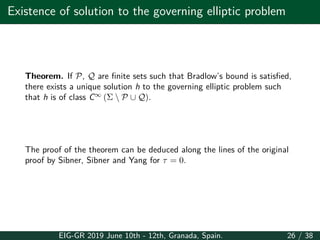
Existence of solution to the governing elliptic problem
Theorem. If P, Q are finite sets such that Bradlow’s bound is satisfied,
there exists a unique solution h to the governing elliptic problem such
that h is of class C∞
(Σ  P ∪ Q).
The proof of the theorem can be deduced along the lines of the original
proof by Sibner, Sibner and Yang for τ = 0.
EIG-GR 2019 June 10th - 12th, Granada, Spain. 26 / 38
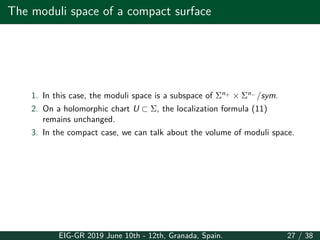
The moduli space of a compact surface
1. In this case, the moduli space is a subspace of Σn+
× Σn−
/sym.
2. On a holomorphic chart U ⊂ Σ, the localization formula (11)
remains unchanged.
3. In the compact case, we can talk about the volume of moduli space.
EIG-GR 2019 June 10th - 12th, Granada, Spain. 27 / 38
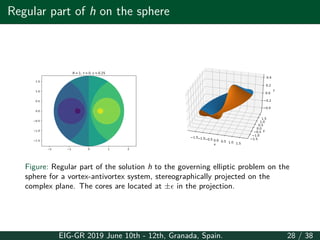
Regular part of h on the sphere
2 1 0 1 2
1.5
1.0
0.5
0.0
0.5
1.0
1.5
R=1, =0, =0.25
x
1.5 1.0 0.5 0.0 0.5 1.0 1.5
y
1.5
1.0
0.5
0.0
0.5
1.0
1.5
z
0.4
0.2
0.0
0.2
0.4
Figure: Regular part of the solution h to the governing elliptic problem on the
sphere for a vortex-antivortex system, stereographically projected on the
complex plane. The cores are located at ±ϵ in the projection.
EIG-GR 2019 June 10th - 12th, Granada, Spain. 28 / 38
The volume formula on a compact domain
Unlike in the Euclidean plane, on a compact manifold it is conjectured
the volume of moduli space is finite.
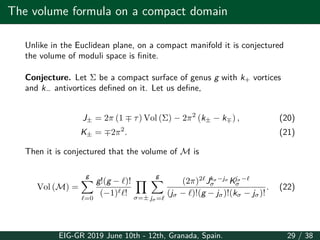
Conjecture. Let Σ be a compact surface of genus g with k+ vortices
and k− antivortices defined on it. Let us define,
J± = 2π (1 ∓ τ) Vol (Σ) − 2π2
(k± − k∓) , (20)
K± = ∓2π2
. (21)
Then it is conjectured that the volume of M is
Vol (M) =
g
∑
ℓ=0
g!(g − ℓ)!
(−1)ℓℓ!
∏
σ=±
g
∑
jσ=ℓ
(2π)2ℓ
Jkσ−jσ
σ Kjσ−ℓ
σ
(jσ − ℓ)!(g − jσ)!(kσ − jσ)!
. (22)
EIG-GR 2019 June 10th - 12th, Granada, Spain. 29 / 38
Volume conjecture
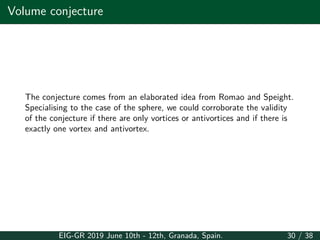
The conjecture comes from an elaborated idea from Romao and Speight.
Specialising to the case of the sphere, we could corroborate the validity
of the conjecture if there are only vortices or antivortices and if there is
exactly one vortex and antivortex.
EIG-GR 2019 June 10th - 12th, Granada, Spain. 30 / 38
The volume of moduli space
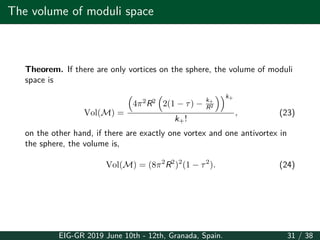
Theorem. If there are only vortices on the sphere, the volume of moduli
space is
Vol(M) =
(
4π2
R2
(
2(1 − τ) − k+
R2
))k+
k+!
, (23)
on the other hand, if there are exactly one vortex and one antivortex in
the sphere, the volume is,
Vol(M) = (8π2
R2
)2
(1 − τ2
). (24)
EIG-GR 2019 June 10th - 12th, Granada, Spain. 31 / 38
Volume formula for a vortex-antivortex pair on the sphere
Let
A = 2π
(
4R2
1 + ϵ2
− ϵB1 − 2R2
− 1
)
, c = 8πR2
τ (25)
the volume of the vortex-antivortex moduli can be calculated with the
formula
Vol = 4π2
lim
ϵ→0
A(ϵ)2
− c2
π2
, (26)
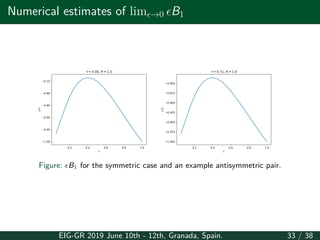
numerical evidence suggested limϵ→0 ϵB1 = −1, which can be probed
with elliptic estimates.
EIG-GR 2019 June 10th - 12th, Granada, Spain. 32 / 38
Numerical estimates of limϵ→0 ϵB1
0.2 0.4 0.6 0.8 1.0
1.00
0.95
0.90
0.85
0.80
0.75
b
=0.00, R=1.0
0.2 0.4 0.6 0.8 1.0
1.000
0.975
0.950
0.925
0.900
0.875
0.850
b
=0.71, R=1.0
Figure: ϵB1 for the symmetric case and an example antisymmetric pair.
EIG-GR 2019 June 10th - 12th, Granada, Spain. 33 / 38
The moduli is incomplete
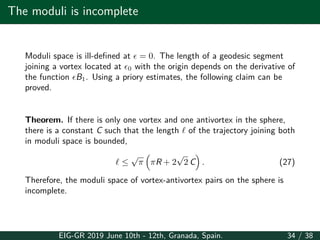
Moduli space is ill-defined at ϵ = 0. The length of a geodesic segment
joining a vortex located at ϵ0 with the origin depends on the derivative of
the function ϵB1. Using a priory estimates, the following claim can be
proved.
Theorem. If there is only one vortex and one antivortex in the sphere,
there is a constant C such that the length ℓ of the trajectory joining both
in moduli space is bounded,
ℓ ≤
√
π
(
πR + 2
√
2 C
)
. (27)
Therefore, the moduli space of vortex-antivortex pairs on the sphere is
incomplete.
EIG-GR 2019 June 10th - 12th, Granada, Spain. 34 / 38
Behaviour of the family hϵ as ϵ → 0
0.0 0.2 0.4 0.6 0.8 1.0
/
1.8
2.0
2.2
2.4
2.6
2.8
3.0
h
= 0.71, R = 1.00
1.00 0.75 0.50 0.25 0.00 0.25 0.50 0.75 1.00
x
1.4
1.2
1.0
0.8
0.6
hlower
R=1.0, =0.4
=0.25
=0.20
=0.15
=0.10
=0.05
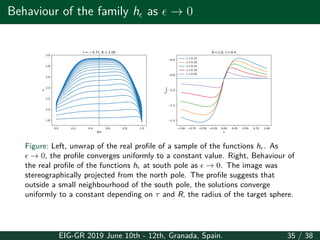
Figure: Left, unwrap of the real profile of a sample of the functions hϵ. As
ϵ → 0, the profile converges uniformly to a constant value. Right, Behaviour of
the real profile of the functions hϵ at south pole as ϵ → 0. The image was
stereographically projected from the north pole. The profile suggests that
outside a small neighbourhood of the south pole, the solutions converge
uniformly to a constant depending on τ and R, the radius of the target sphere.
EIG-GR 2019 June 10th - 12th, Granada, Spain. 35 / 38
Conclusions
1. The presence of an inner spin in the abelian O(3) Sigma model splits
the cores in two types: vortices and antivortices.
2. It is conjectured that moduli space is geodesically incomplete for any
compact surface. This claim was proved in general for a spherical
domain.
3. In the euclidean plane, numerical evidence suggests vortex-antivortex
scattering angle can grow arbitrarily large as the impact parameter
converges to 0.
4. At impact parameter 0, the vortex and antivortex collide in finite
time, hence the fields are expected to develop singularities.
EIG-GR 2019 June 10th - 12th, Granada, Spain. 36 / 38
References I
N. M. Romão and J. M. Speight.
The geometry of the space of BPS vortex-antivortex pairs.
jul 2018.
T. M. Samols.
Mathematical Physics Vortex Scattering.
Commun. Math. Phys, 145(1):149–179, 1992.
L. Sibner, R. Sibner, and Y. Yang.
Abelian gauge theory on Riemann surfaces and new topological
invariants.
Proceedings of the Royal Society of London A: Mathematical,
Physical and Engineering Sciences, 456(1995):593–613, 2000.
EIG-GR 2019 June 10th - 12th, Granada, Spain. 37 / 38
Thank you!
Any questions?
EIG-GR 2019 June 10th - 12th, Granada, Spain. 38 / 38

Presentacion granada

  • 1.
    The moduli spaceof BPS vortex-antivortex pairs René García Work supervised by prof. Martin Speight 1 School of Mathematics University of Leeds Encuentro Iberoamericano de Geometría en Granada Granada, Spain June 10th – 12th, 2019 EIG-GR 2019 June 10th - 12th, Granada, Spain. 1 / 38
  • 2.
    Overview The O(3) Sigmamodel on euclidean space Geometry on compact domains Conclusions EIG-GR 2019 June 10th - 12th, Granada, Spain. 2 / 38
  • 3.
    O(3) Sigma Modelon the Euclidean Plane We consider space-time R1,2 with signature (+, −, −). Let ϕ : R1,2 → S2 , a ∈ Ω1 ( R1,2 ) and let us fix n ∈ S2 such that we can define the height ϕ3 = ϕ · n. The abelian O(3) sigma model is given by the functional ∫ R2 1 2 Dµϕ · Dµ ϕ − 1 4 fµνfµν − 1 2 (τ − ϕ3) 2 d2 x, (1) where, Dµϕ = ∂µϕ − aµn × ϕ, (2) is the covariant derivative on the trivial fibered bundle R1,2 × S2 associated with the connection form and the real constant τ is chosen in the interval [−1, 1]. EIG-GR 2019 June 10th - 12th, Granada, Spain. 3 / 38
  • 4.
    Remarks 1. The abelianO(3) sigma model was proposed by Schroers as a simplification of Skyrmion theory in two dimensions. 2. As we will see in the next slides, the O(3) sigma model shares several analogies with Ginzburg-Landau’s functional of superconductivity. EIG-GR 2019 June 10th - 12th, Granada, Spain. 4 / 38
  • 5.
    A simplification withcomplex variables We let ψ be the south pole projection of the field ϕ. Outside the set of poles of ψ, the functional (1) is equivalent to L = ∫ R2 1 2 ΩDµψ Dµψ − 1 4 fµνfµν − 1 2 ( τ − 1 − |ψ|2 1 + |ψ|2 )2 d2 x, (3) Ω is the conformal factor of the sphere,stereographically projected onto the extended complex plane and the covariant derivatives are also adjusted accordingly, Dµψ = ∂µψ − iaµψ. (4) EIG-GR 2019 June 10th - 12th, Granada, Spain. 5 / 38
  • 6.
    Some simplifications onthe model In order to describe the set of minimizers of the O(3) Sigma model Lagrangian, we look for stationary solutions. EIG-GR 2019 June 10th - 12th, Granada, Spain. 6 / 38
  • 7.
    The static Lagrangian Fora stationary configuration of fields, we can take a particular gauge, such that a0 = 0. In this gauge, the potential energy becomes V = ∫ R2 1 2 − ΩDjψ Djψ + 1 2 f2 12 + 1 2 ( τ − 1 − |ψ|2 1 + |ψ|2 )2 d2 x. (5) From now on, we will use the convention that roman indices run on space coordinates whereas greek indices run on space-time coordinates. EIG-GR 2019 June 10th - 12th, Granada, Spain. 7 / 38
  • 8.
    Bogomol’nyi’s trick Claim. LetB = f12, the potential energy can be refactored into the form V = ∫ R2 1 2 |D1ψ ± i D2ψ|2 + 1 2 ( B ± ( τ − 1 − |ψ|2 1 + |ψ|2 ))2 d2 x + Φ, (6) where Φ = ∫ R2 B d2 x, (7) is the total magnetic flux. With the right boundary conditions for finite energy, the flux is 2π n for some integer n. EIG-GR 2019 June 10th - 12th, Granada, Spain. 8 / 38
  • 9.
    Remarks Let µ =log ( (1 − τ)(1 + τ)−1 ) , and let (ρ, θ) be polar coordinates on target space. The conditions for finite energy are lim ρ→∞ ψ = µeiχ(θ) , lim ρ→∞ aθ = aθ(θ). (8) For suitable functions χ and a defined on the circle at infinity. EIG-GR 2019 June 10th - 12th, Granada, Spain. 9 / 38
  • 10.
    The Bogomol’nyi’s equations Therefore,solutions to the set of equations, D1ψ ± i D2ψ = 0, B = ± ( 1 − |ψ|2 1 + |ψ|2 − τ ) , (9) with the boundary conditions (8) are stationary extremals of the fields Lagrangian preserving the total magnetic flux Φ. EIG-GR 2019 June 10th - 12th, Granada, Spain. 10 / 38
  • 11.
    Remarks 1. We willuse the plus signs in Bogomol’nyi’s equations from now onwards. 2. A solution is a vortex if its magnetic flux is 2π. If the flux is −2π, the solution is an antivortex. 3. We can think of more general solutions as combinations of vortices and antivortices. EIG-GR 2019 June 10th - 12th, Granada, Spain. 11 / 38
  • 12.
    Taubes’ Equation Let h= log|ψ|2 and let P = ψ−1 (0) be the set of zeros of the field ψ and let Q = ψ−1 (∞) be the set of points at infinity, then h is a solution to the elliptic problem, ∆h = 2 ( eh − 1 eh + 1 − τ ) + 1 4π ∑ p∈P δp − 1 4π ∑ q∈Q δq, lim |x|→∞ = µ. (10) We call equation (10) Taubes’ equation, in analogy to the equation studied by Taubes’ for the Ginzburg-Landau energy functional. EIG-GR 2019 June 10th - 12th, Granada, Spain. 12 / 38
  • 13.
    Regularity of theelliptic problem Theorem. Given finite subsets P, Q of the euclidean plane, such that P ∩ Q = ∅, there exists a unique solution h of equation (10). Such solution is smooth in R2 P ∪ Q and converges logarithmically fast to µ as |x| → ∞. EIG-GR 2019 June 10th - 12th, Granada, Spain. 13 / 38
  • 14.
    Vortex-Antivortex on theplane Figure: A vortex (right) - antivortex (left) system on euclidean plane EIG-GR 2019 June 10th - 12th, Granada, Spain. 14 / 38
  • 15.
    The moduli spaceof stationary solutions 1. The moduli space M of stationary solutions modulo gauge equivalence is a stratified space with countably infinitely many strata. 2. Each stratus Mn+,n− is topologically a subspace of the quotient Cn+ × Cn− /sym, where n+ = |P|, n− = |Q|, and the symmetric group acts permuting vortices and antivortices independently. 3. We aim to approximate dynamics of the full vortex equations on moduli space. EIG-GR 2019 June 10th - 12th, Granada, Spain. 15 / 38
  • 16.
    Approximated dynamics onmoduli space 1. If a system of vortices and antivortices is moving slowly, it can be approximated to some degree by parametric motion on moduli space. 2. We make the assumption that stationary solutions dependent on a real parameter are approximations to truly dynamical solutions to the field equations. 3. This assumption has been thoroughly tested for Ginzburg-Landau vortices [2]. EIG-GR 2019 June 10th - 12th, Granada, Spain. 16 / 38
  • 17.
    Localization formula Theorem. Letz = x1 + ix2, and let Z1, . . . , Zn+ be the position of n+ vortices. Likewise, let Zn++1, . . . , Zn++n− be the position of n− antivortices. Let h be the solution to Taubes’ equation for the given distribution of vortices and antivortices. If ϵs denotes the symbol ϵs = { 1, if 1 ≤ s ≤ n+, −1, if n+ + 1 ≤ s ≤ n+ + n−, (11) and we define, bs = 2 ∂z|Zs ( ϵsh − log|z − Zs|2 ) , gjk = π ( (1 − ϵjτ)δjk + ∂bj ∂Zk ) , (12) then the complex bilinear form ds2 = gjkdZj dZk , (13) defines an hermitian product in moduli space. EIG-GR 2019 June 10th - 12th, Granada, Spain. 17 / 38
  • 18.
    Localization formula 1. Themetric is not only hermitian, but Kahler with the obvious pseudocomplex structure in moduli space. 2. The vortices and antivortices behave as localized lumps of energy whose effective mass is roughly the area of a spherical sector of area π(1 ∓ τ). 3. The geometrical properties of moduli space are encoded in the coefficients bs. 4. Unlike Ginzburg-Landau vortices which at frontal collision will scatter off at 90 degrees, numerical evidence suggests vortex-antivortex pairs colliding frontally will bubble. EIG-GR 2019 June 10th - 12th, Granada, Spain. 18 / 38
  • 19.
    Vortex-Antivortex systems If thereare only one vortex and one antivortex at positions z1, z2, the metric can be separated in a product in centre of mass coordinates. If we let, Z = z1 + z2 2 , z1 − z2 = reiθ , (14) then symmetry considerations show that the metric is the product, g = |dZ|2 + η(r) ( dr2 + r2 dθ2 ) . (15) EIG-GR 2019 June 10th - 12th, Granada, Spain. 19 / 38
  • 20.
    Vortex-antivortex systems It canbe shown the coefficient b1 has the functional form, b1 = −eiθ ( 1 r + b(r) ) , (16) and b1 + b2 = 0 as a consequence of Taube’s equation invariance under the action of the Euclidean group. Moreover, η = π 2 ( 1 − τ2 − 1 r d dr (rb(r)) ) . (17) EIG-GR 2019 June 10th - 12th, Granada, Spain. 20 / 38
  • 21.
    Vortex-Antivortex collisions Figure: Avortex approaches an antivortex on euclidean plane. The coordinate frame was chosen such that the antivortex remains at origin. Instead of solving the full field equations, we solved the low energy approximation in moduli space. EIG-GR 2019 June 10th - 12th, Granada, Spain. 21 / 38
  • 22.
    The centre ofmass metric on a vortex-antivortex system Figure: A tipical conformal factor in the centre of mass frame. As vortex-antivortex separation decreases, the conformal factor grows indefinitely. EIG-GR 2019 June 10th - 12th, Granada, Spain. 22 / 38
  • 23.
    Geometry on compactdomains Let Σ be a closed surface with a Riemannian metric g and compatible pseudocomplex structure. A construction by Sibner et al. [3] extends the fields to take values on a fiber bundle with base Σ and fibers S2 . This construction is further generalized in the work of Romao and Speight [1]. We can extend the previous discussion about the O(3) Sigma model to R × Σ with the metric dt2 − g. EIG-GR 2019 June 10th - 12th, Granada, Spain. 23 / 38
  • 24.
    Governing elliptic problem AssumeˆC → L → Σ is a sphere line bundle in which there is a representation of a U(1) → P → Σ principal bundle and ψ : Σ → L is a section of this line bundle. Let h = log|ψ|2 , P = ψ−1 (0), Q = ψ−1 (∞), then h is a solution to the governing elliptic problem, ∆gh = 2 ( eh − 1 eh + 1 + τ ) + ∑ p∈P δp − ∑ q∈Q δq. (18) EIG-GR 2019 June 10th - 12th, Granada, Spain. 24 / 38
  • 25.
    Bradlow bound Unlike theeuclidean plane, there is a constraint on the number of coexisting vortices and antivortices. − (1 + τ) |Σ| 2π < |P| − |Q| < (1 − τ) |Σ| 2π . (19) This kind of constraint is called a bradlow bound. EIG-GR 2019 June 10th - 12th, Granada, Spain. 25 / 38
  • 26.
    Existence of solutionto the governing elliptic problem Theorem. If P, Q are finite sets such that Bradlow’s bound is satisfied, there exists a unique solution h to the governing elliptic problem such that h is of class C∞ (Σ P ∪ Q). The proof of the theorem can be deduced along the lines of the original proof by Sibner, Sibner and Yang for τ = 0. EIG-GR 2019 June 10th - 12th, Granada, Spain. 26 / 38
  • 27.
    The moduli spaceof a compact surface 1. In this case, the moduli space is a subspace of Σn+ × Σn− /sym. 2. On a holomorphic chart U ⊂ Σ, the localization formula (11) remains unchanged. 3. In the compact case, we can talk about the volume of moduli space. EIG-GR 2019 June 10th - 12th, Granada, Spain. 27 / 38
  • 28.
    Regular part ofh on the sphere 2 1 0 1 2 1.5 1.0 0.5 0.0 0.5 1.0 1.5 R=1, =0, =0.25 x 1.5 1.0 0.5 0.0 0.5 1.0 1.5 y 1.5 1.0 0.5 0.0 0.5 1.0 1.5 z 0.4 0.2 0.0 0.2 0.4 Figure: Regular part of the solution h to the governing elliptic problem on the sphere for a vortex-antivortex system, stereographically projected on the complex plane. The cores are located at ±ϵ in the projection. EIG-GR 2019 June 10th - 12th, Granada, Spain. 28 / 38
  • 29.
    The volume formulaon a compact domain Unlike in the Euclidean plane, on a compact manifold it is conjectured the volume of moduli space is finite. Conjecture. Let Σ be a compact surface of genus g with k+ vortices and k− antivortices defined on it. Let us define, J± = 2π (1 ∓ τ) Vol (Σ) − 2π2 (k± − k∓) , (20) K± = ∓2π2 . (21) Then it is conjectured that the volume of M is Vol (M) = g ∑ ℓ=0 g!(g − ℓ)! (−1)ℓℓ! ∏ σ=± g ∑ jσ=ℓ (2π)2ℓ Jkσ−jσ σ Kjσ−ℓ σ (jσ − ℓ)!(g − jσ)!(kσ − jσ)! . (22) EIG-GR 2019 June 10th - 12th, Granada, Spain. 29 / 38
  • 30.
    Volume conjecture The conjecturecomes from an elaborated idea from Romao and Speight. Specialising to the case of the sphere, we could corroborate the validity of the conjecture if there are only vortices or antivortices and if there is exactly one vortex and antivortex. EIG-GR 2019 June 10th - 12th, Granada, Spain. 30 / 38
  • 31.
    The volume ofmoduli space Theorem. If there are only vortices on the sphere, the volume of moduli space is Vol(M) = ( 4π2 R2 ( 2(1 − τ) − k+ R2 ))k+ k+! , (23) on the other hand, if there are exactly one vortex and one antivortex in the sphere, the volume is, Vol(M) = (8π2 R2 )2 (1 − τ2 ). (24) EIG-GR 2019 June 10th - 12th, Granada, Spain. 31 / 38
  • 32.
    Volume formula fora vortex-antivortex pair on the sphere Let A = 2π ( 4R2 1 + ϵ2 − ϵB1 − 2R2 − 1 ) , c = 8πR2 τ (25) the volume of the vortex-antivortex moduli can be calculated with the formula Vol = 4π2 lim ϵ→0 A(ϵ)2 − c2 π2 , (26) numerical evidence suggested limϵ→0 ϵB1 = −1, which can be probed with elliptic estimates. EIG-GR 2019 June 10th - 12th, Granada, Spain. 32 / 38
  • 33.
    Numerical estimates oflimϵ→0 ϵB1 0.2 0.4 0.6 0.8 1.0 1.00 0.95 0.90 0.85 0.80 0.75 b =0.00, R=1.0 0.2 0.4 0.6 0.8 1.0 1.000 0.975 0.950 0.925 0.900 0.875 0.850 b =0.71, R=1.0 Figure: ϵB1 for the symmetric case and an example antisymmetric pair. EIG-GR 2019 June 10th - 12th, Granada, Spain. 33 / 38
  • 34.
    The moduli isincomplete Moduli space is ill-defined at ϵ = 0. The length of a geodesic segment joining a vortex located at ϵ0 with the origin depends on the derivative of the function ϵB1. Using a priory estimates, the following claim can be proved. Theorem. If there is only one vortex and one antivortex in the sphere, there is a constant C such that the length ℓ of the trajectory joining both in moduli space is bounded, ℓ ≤ √ π ( πR + 2 √ 2 C ) . (27) Therefore, the moduli space of vortex-antivortex pairs on the sphere is incomplete. EIG-GR 2019 June 10th - 12th, Granada, Spain. 34 / 38
  • 35.
    Behaviour of thefamily hϵ as ϵ → 0 0.0 0.2 0.4 0.6 0.8 1.0 / 1.8 2.0 2.2 2.4 2.6 2.8 3.0 h = 0.71, R = 1.00 1.00 0.75 0.50 0.25 0.00 0.25 0.50 0.75 1.00 x 1.4 1.2 1.0 0.8 0.6 hlower R=1.0, =0.4 =0.25 =0.20 =0.15 =0.10 =0.05 Figure: Left, unwrap of the real profile of a sample of the functions hϵ. As ϵ → 0, the profile converges uniformly to a constant value. Right, Behaviour of the real profile of the functions hϵ at south pole as ϵ → 0. The image was stereographically projected from the north pole. The profile suggests that outside a small neighbourhood of the south pole, the solutions converge uniformly to a constant depending on τ and R, the radius of the target sphere. EIG-GR 2019 June 10th - 12th, Granada, Spain. 35 / 38
  • 36.
    Conclusions 1. The presenceof an inner spin in the abelian O(3) Sigma model splits the cores in two types: vortices and antivortices. 2. It is conjectured that moduli space is geodesically incomplete for any compact surface. This claim was proved in general for a spherical domain. 3. In the euclidean plane, numerical evidence suggests vortex-antivortex scattering angle can grow arbitrarily large as the impact parameter converges to 0. 4. At impact parameter 0, the vortex and antivortex collide in finite time, hence the fields are expected to develop singularities. EIG-GR 2019 June 10th - 12th, Granada, Spain. 36 / 38
  • 37.
    References I N. M.Romão and J. M. Speight. The geometry of the space of BPS vortex-antivortex pairs. jul 2018. T. M. Samols. Mathematical Physics Vortex Scattering. Commun. Math. Phys, 145(1):149–179, 1992. L. Sibner, R. Sibner, and Y. Yang. Abelian gauge theory on Riemann surfaces and new topological invariants. Proceedings of the Royal Society of London A: Mathematical, Physical and Engineering Sciences, 456(1995):593–613, 2000. EIG-GR 2019 June 10th - 12th, Granada, Spain. 37 / 38
  • 38.
    Thank you! Any questions? EIG-GR2019 June 10th - 12th, Granada, Spain. 38 / 38