The Five Steps
1. Define the problem
2. Form a hypothesis
3. Test the hypothesis
4. Analyze and draw conclusions
5. Report observations
Step 1: Define the problem
• What is the problem?
• The problem is the question. It is the
question that we want to know the answer
to.
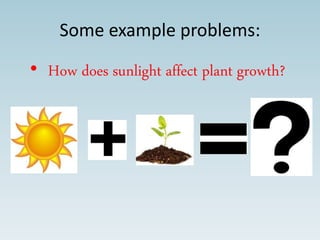
Some example problems:
• How does sunlight affect plant growth?
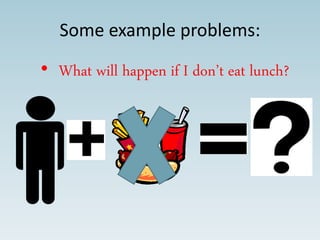
Some example problems:
• What will happen if I don’t eat lunch?
Step 1: Define the problem
• Open your books to page 7.
• Now, think of two problems you want to
answer using the scientific method.
Step 2: Form a hypothesis
• What is a hypothesis?
• A hypothesis is a
prediction. It’s what we
think will happen.
Example hypothesis
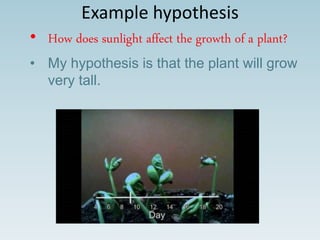
• How does sunlight affect the growth of a plant?
• My hypothesis is that the plant will grow
very tall.
Example hypothesis
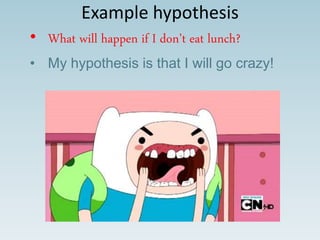
• What will happen if I don’t eat lunch?
• My hypothesis is that I will go crazy!
Step 2: Form a hypothesis
• Now look at your problems
on page 7.
• With your partner, discuss
your hypothesis of what will
happen.
Step 2: Form a hypothesis
• Great, now let’s read page
8 together.
Next time…
• We will continue on to
3. Test the hypothesis
4. Analyze and draw conclusions
5. Report observations
The Five Steps: Who can fill in the
blanks?
1. Define the ________________
2. Form a _____________________
3. Test the ________________________
4. Analyze and draw
____________________
5. Report ________________
Step 3: Test the hypothesis
• We can also say this is the time to….
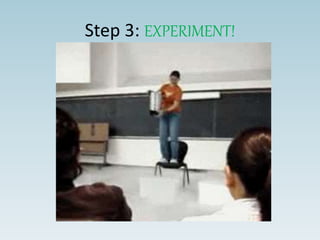
Step 3: EXPERIMENT!
Step 3: Test the
hypothesis/experiment
• During the experiment we take notes to understand
what happens during the experiment.
• The notes help us find the reasons the experiment
happened.
Step 4: Analyze and draw conclusions
• Now, it’s time to look at the facts.
• Here’s my experiment:
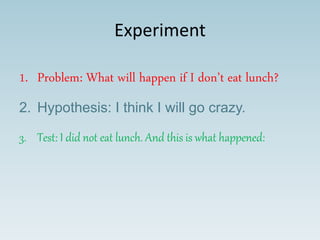
Experiment
1. Problem: What will happen if I don’t eat lunch?
2. Hypothesis: I think I will go crazy.
3. Test: I did not eat lunch. And this is what happened:
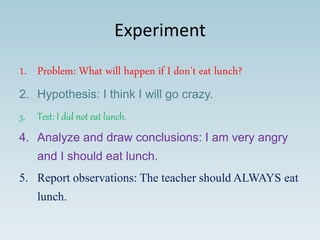
Experiment
1. Problem: What will happen if I don’t eat lunch?
2. Hypothesis: I think I will go crazy.
3. Test: I did not eat lunch.
4. Analyze and draw conclusions: I am very angry
and I should eat lunch.
5. Report observations: The teacher should ALWAYS eat
lunch.
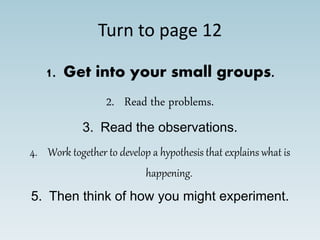
Turn to page 12
1. Get into your small groups.
2. Read the problems.
3. Read the observations.
4. Work together to develop a hypothesis that explains what is
happening.
5. Then think of how you might experiment.

U1L2 - scientific method

  • 2.
    The Five Steps 1.Define the problem 2. Form a hypothesis 3. Test the hypothesis 4. Analyze and draw conclusions 5. Report observations
  • 3.
    Step 1: Definethe problem • What is the problem? • The problem is the question. It is the question that we want to know the answer to.
  • 4.
    Some example problems: •How does sunlight affect plant growth?
  • 5.
    Some example problems: •What will happen if I don’t eat lunch?
  • 6.
    Step 1: Definethe problem • Open your books to page 7. • Now, think of two problems you want to answer using the scientific method.
  • 7.
    Step 2: Forma hypothesis • What is a hypothesis? • A hypothesis is a prediction. It’s what we think will happen.
  • 8.
    Example hypothesis • Howdoes sunlight affect the growth of a plant? • My hypothesis is that the plant will grow very tall.
  • 9.
    Example hypothesis • Whatwill happen if I don’t eat lunch? • My hypothesis is that I will go crazy!
  • 10.
    Step 2: Forma hypothesis • Now look at your problems on page 7. • With your partner, discuss your hypothesis of what will happen.
  • 11.
    Step 2: Forma hypothesis • Great, now let’s read page 8 together.
  • 12.
    Next time… • Wewill continue on to 3. Test the hypothesis 4. Analyze and draw conclusions 5. Report observations
  • 13.
    The Five Steps:Who can fill in the blanks? 1. Define the ________________ 2. Form a _____________________ 3. Test the ________________________ 4. Analyze and draw ____________________ 5. Report ________________
  • 14.
    Step 3: Testthe hypothesis • We can also say this is the time to….
  • 15.
  • 16.
    Step 3: Testthe hypothesis/experiment • During the experiment we take notes to understand what happens during the experiment. • The notes help us find the reasons the experiment happened.
  • 17.
    Step 4: Analyzeand draw conclusions • Now, it’s time to look at the facts. • Here’s my experiment:
  • 18.
    Experiment 1. Problem: Whatwill happen if I don’t eat lunch? 2. Hypothesis: I think I will go crazy. 3. Test: I did not eat lunch. And this is what happened:
  • 20.
    Experiment 1. Problem: Whatwill happen if I don’t eat lunch? 2. Hypothesis: I think I will go crazy. 3. Test: I did not eat lunch. 4. Analyze and draw conclusions: I am very angry and I should eat lunch. 5. Report observations: The teacher should ALWAYS eat lunch.
  • 21.
    Turn to page12 1. Get into your small groups. 2. Read the problems. 3. Read the observations. 4. Work together to develop a hypothesis that explains what is happening. 5. Then think of how you might experiment.