Unit 2 Lesson 1 What Is the Design Process?
Copyright © Houghton Mifflin Harcourt Publishing Company
Unit 2 Lesson 1 What Is the Design Process?
Works of Ingenuity
Copyright © Houghton Mifflin Harcourt Publishing Company
• Computers and other engineered devices help us
solve many problems.
• Engineers use computers and hand-drawn
diagrams to plan designs.
• People use products of engineering every day,
such as toothbrushes, faucets, cars, and buses.
Works of Ingenuity
Copyright © Houghton Mifflin Harcourt Publishing Company
• Engineers are problem solvers who invent or
improve products that help us meet our needs.
• Engineering is the process of using science and
mathematics to find solutions to everyday
problems.
• Engineers work in many fields. They can design
and test materials, work in factories or on farms,
or work in medical laboratories.
Unit 2 Lesson 1 What Is the Design Process?
The Right Tool for the Right Job
Copyright © Houghton Mifflin Harcourt Publishing Company
• Technology is any device that people use to meet
their needs and solve practical problems.
• Technologies such as tools and machines, medicines,
and even weather satellites play an important role in
improving lives.
Unit 2 Lesson 1 What Is the Design Process?
The Right Tool for the Right Job
Copyright © Houghton Mifflin Harcourt Publishing Company
• Technology changes as people’s knowledge increases
and they find better ways to meet their needs.
• For example, over the past 150 years electric
washing machines have replaced washboards and
hand-cranked washing machines.
Unit 2 Lesson 1 What Is the Design Process?
The Design Process (Part 1)
Copyright © Houghton Mifflin Harcourt Publishing Company
• Engineers follow a design process to design new
technologies. The process includes a series of
steps.
• Engineers identify a need, or problem, and then
brainstorm possible solutions.
• Engineers also choose the most practical solution
and build a working model, or prototype, to test.
Unit 2 Lesson 1 What Is the Design Process?
Copyright © Houghton Mifflin Harcourt Publishing Company
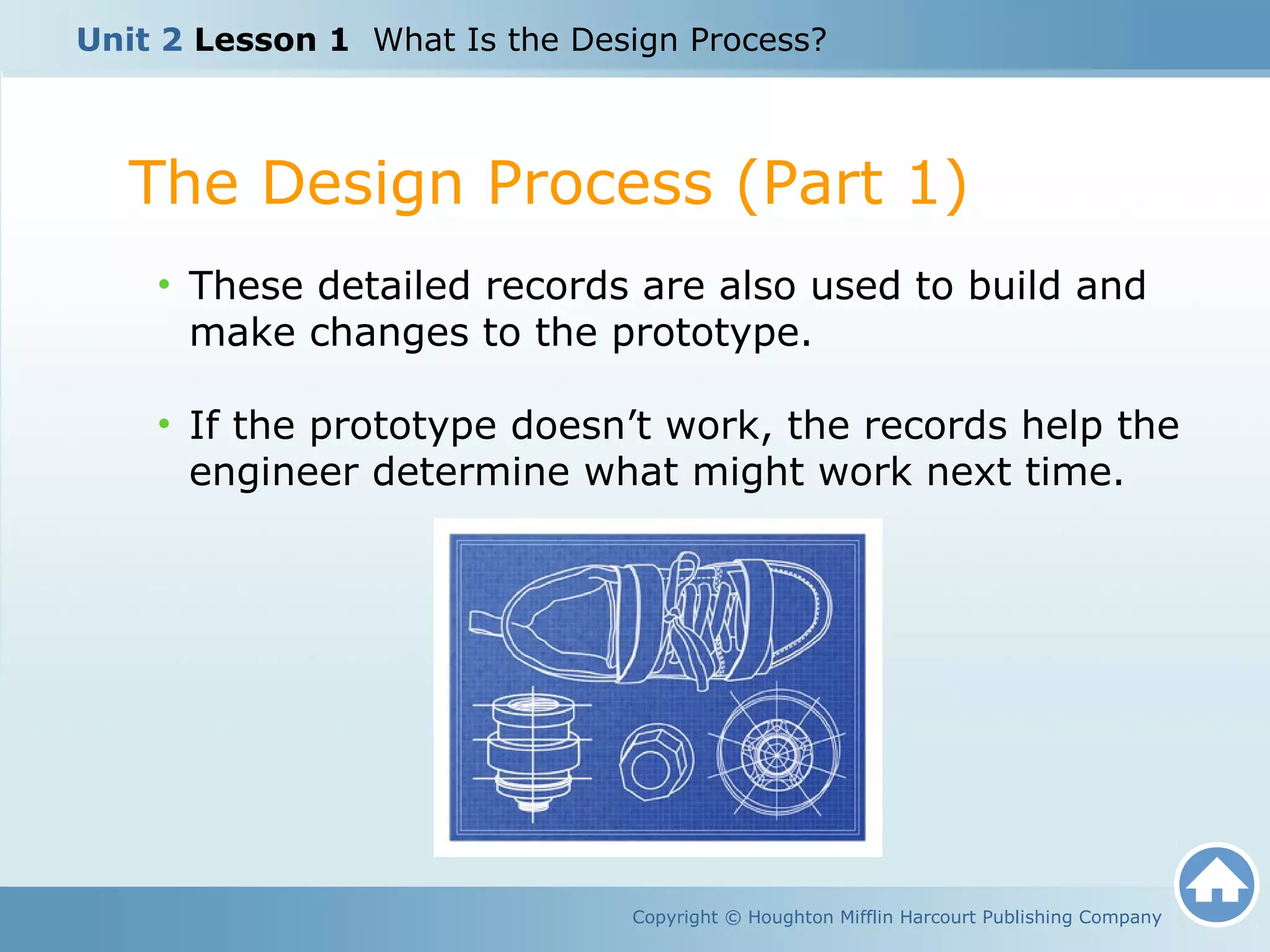
• Engineers keep careful records, such as detailed
notes and drawings, throughout the design
process.
• These records help engineers remember what
they have done and provide information to others
working on similar problems.
The Design Process (Part 1)
Unit 2 Lesson 1 What Is the Design Process?
Copyright © Houghton Mifflin Harcourt Publishing Company
• These detailed records are also used to build and
make changes to the prototype.
• If the prototype doesn’t work, the records help the
engineer determine what might work next time.
The Design Process (Part 1)
Unit 2 Lesson 1 What Is the Design Process?
Copyright © Houghton Mifflin Harcourt Publishing Company
The Design Process (Part 2)
• Engineers test and improve the prototype based
on criteria, or standards that determine how well
the design is doing its job.
• They also redesign and modify the design if it
does not meet all criteria or is unsafe.
• Engineers then communicate the design results
orally and in written reports.
Unit 2 Lesson 1 What Is the Design Process?
Copyright © Houghton Mifflin Harcourt Publishing Company
• Materials, cost, production time, and safety are
some of the criteria that engineers consider when
designing products.
• Thomas Edison tried a thousand times and took
two years to develop a longer-lasting light bulb.
• Finding materials that work well affects the design
process. When designing the light bulb, Edison
had to find materials that can handle heat.
If At First You Don’t Succeed...
Unit 2 Lesson 1 What Is the Design Process?
Copyright © Houghton Mifflin Harcourt Publishing Company
• Some technologies are costly to develop. The high
cost of building prototypes can affect the cost of
the final product.
• Some products, such as cars, can take years to
develop because they must undergo safety and
environmental testing.
If At First You Don’t Succeed...
Unit 2 Lesson 1 What Is the Design Process?

U 2 lesson 1

  • 1.
    Unit 2 Lesson1 What Is the Design Process? Copyright © Houghton Mifflin Harcourt Publishing Company
  • 2.
    Unit 2 Lesson1 What Is the Design Process? Works of Ingenuity Copyright © Houghton Mifflin Harcourt Publishing Company • Computers and other engineered devices help us solve many problems. • Engineers use computers and hand-drawn diagrams to plan designs. • People use products of engineering every day, such as toothbrushes, faucets, cars, and buses.
  • 3.
    Works of Ingenuity Copyright© Houghton Mifflin Harcourt Publishing Company • Engineers are problem solvers who invent or improve products that help us meet our needs. • Engineering is the process of using science and mathematics to find solutions to everyday problems. • Engineers work in many fields. They can design and test materials, work in factories or on farms, or work in medical laboratories. Unit 2 Lesson 1 What Is the Design Process?
  • 4.
    The Right Toolfor the Right Job Copyright © Houghton Mifflin Harcourt Publishing Company • Technology is any device that people use to meet their needs and solve practical problems. • Technologies such as tools and machines, medicines, and even weather satellites play an important role in improving lives. Unit 2 Lesson 1 What Is the Design Process?
  • 5.
    The Right Toolfor the Right Job Copyright © Houghton Mifflin Harcourt Publishing Company • Technology changes as people’s knowledge increases and they find better ways to meet their needs. • For example, over the past 150 years electric washing machines have replaced washboards and hand-cranked washing machines. Unit 2 Lesson 1 What Is the Design Process?
  • 6.
    The Design Process(Part 1) Copyright © Houghton Mifflin Harcourt Publishing Company • Engineers follow a design process to design new technologies. The process includes a series of steps. • Engineers identify a need, or problem, and then brainstorm possible solutions. • Engineers also choose the most practical solution and build a working model, or prototype, to test. Unit 2 Lesson 1 What Is the Design Process?
  • 7.
    Copyright © HoughtonMifflin Harcourt Publishing Company • Engineers keep careful records, such as detailed notes and drawings, throughout the design process. • These records help engineers remember what they have done and provide information to others working on similar problems. The Design Process (Part 1) Unit 2 Lesson 1 What Is the Design Process?
  • 8.
    Copyright © HoughtonMifflin Harcourt Publishing Company • These detailed records are also used to build and make changes to the prototype. • If the prototype doesn’t work, the records help the engineer determine what might work next time. The Design Process (Part 1) Unit 2 Lesson 1 What Is the Design Process?
  • 9.
    Copyright © HoughtonMifflin Harcourt Publishing Company The Design Process (Part 2) • Engineers test and improve the prototype based on criteria, or standards that determine how well the design is doing its job. • They also redesign and modify the design if it does not meet all criteria or is unsafe. • Engineers then communicate the design results orally and in written reports. Unit 2 Lesson 1 What Is the Design Process?
  • 10.
    Copyright © HoughtonMifflin Harcourt Publishing Company • Materials, cost, production time, and safety are some of the criteria that engineers consider when designing products. • Thomas Edison tried a thousand times and took two years to develop a longer-lasting light bulb. • Finding materials that work well affects the design process. When designing the light bulb, Edison had to find materials that can handle heat. If At First You Don’t Succeed... Unit 2 Lesson 1 What Is the Design Process?
  • 11.
    Copyright © HoughtonMifflin Harcourt Publishing Company • Some technologies are costly to develop. The high cost of building prototypes can affect the cost of the final product. • Some products, such as cars, can take years to develop because they must undergo safety and environmental testing. If At First You Don’t Succeed... Unit 2 Lesson 1 What Is the Design Process?