Topics
 What is network ?
 Types of networks
• LAN (Local Area Network)
• MAN (Metropolitan Area Network)
• WAN (Wide Area Network)
 Comparison between the three
networks.
NETWORKS
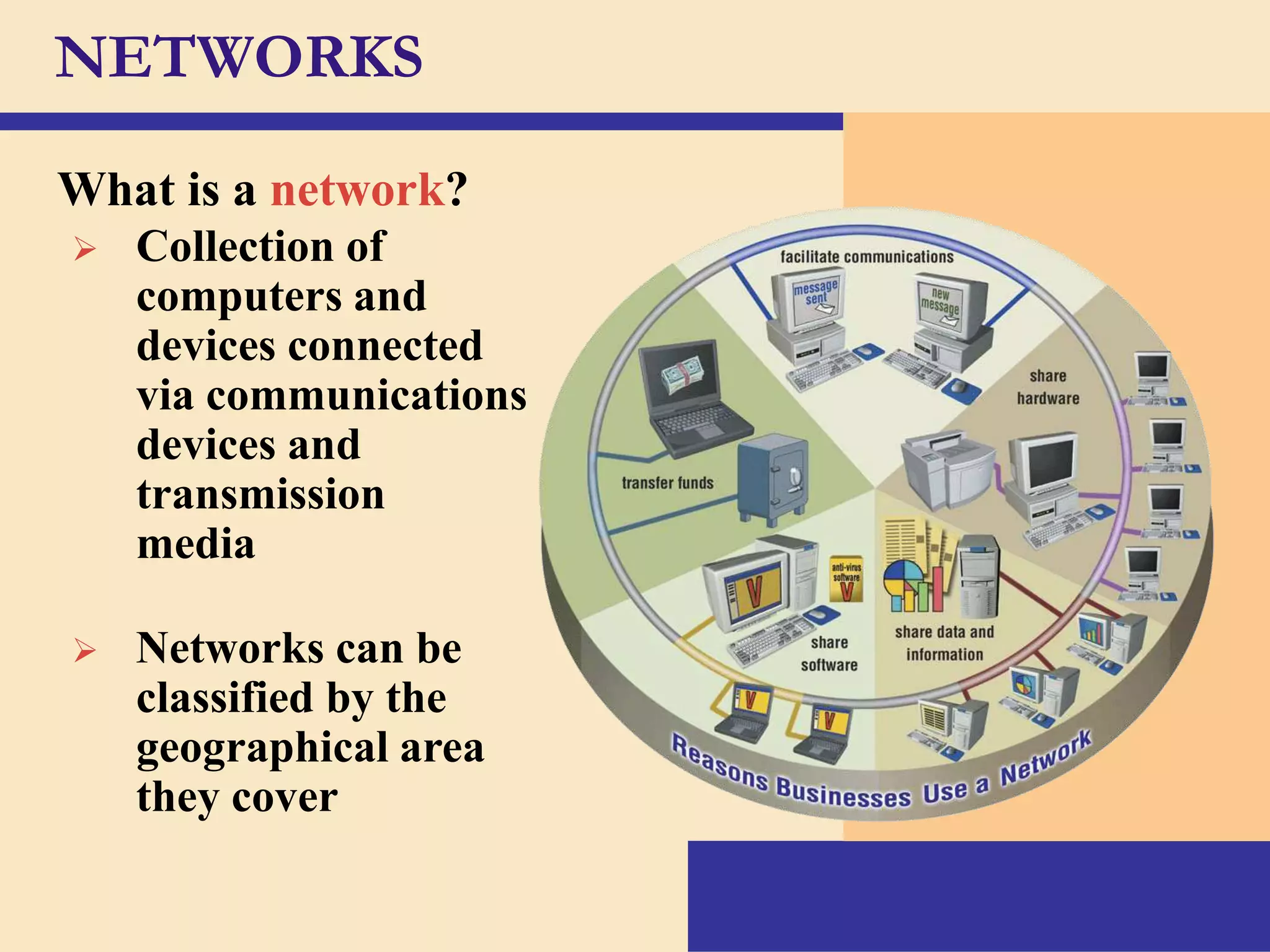
What is a network?
 Collection of
computers and
devices connected
via communications
devices and
transmission
media
 Networks can be
classified by the
geographical area
they cover
There are 3 types of computer networks
 LAN (Local Area Networks)
 MAN (Metropolitan Area Network)
 WAN(Wide Area Network)
TYPES OF NETWORKS
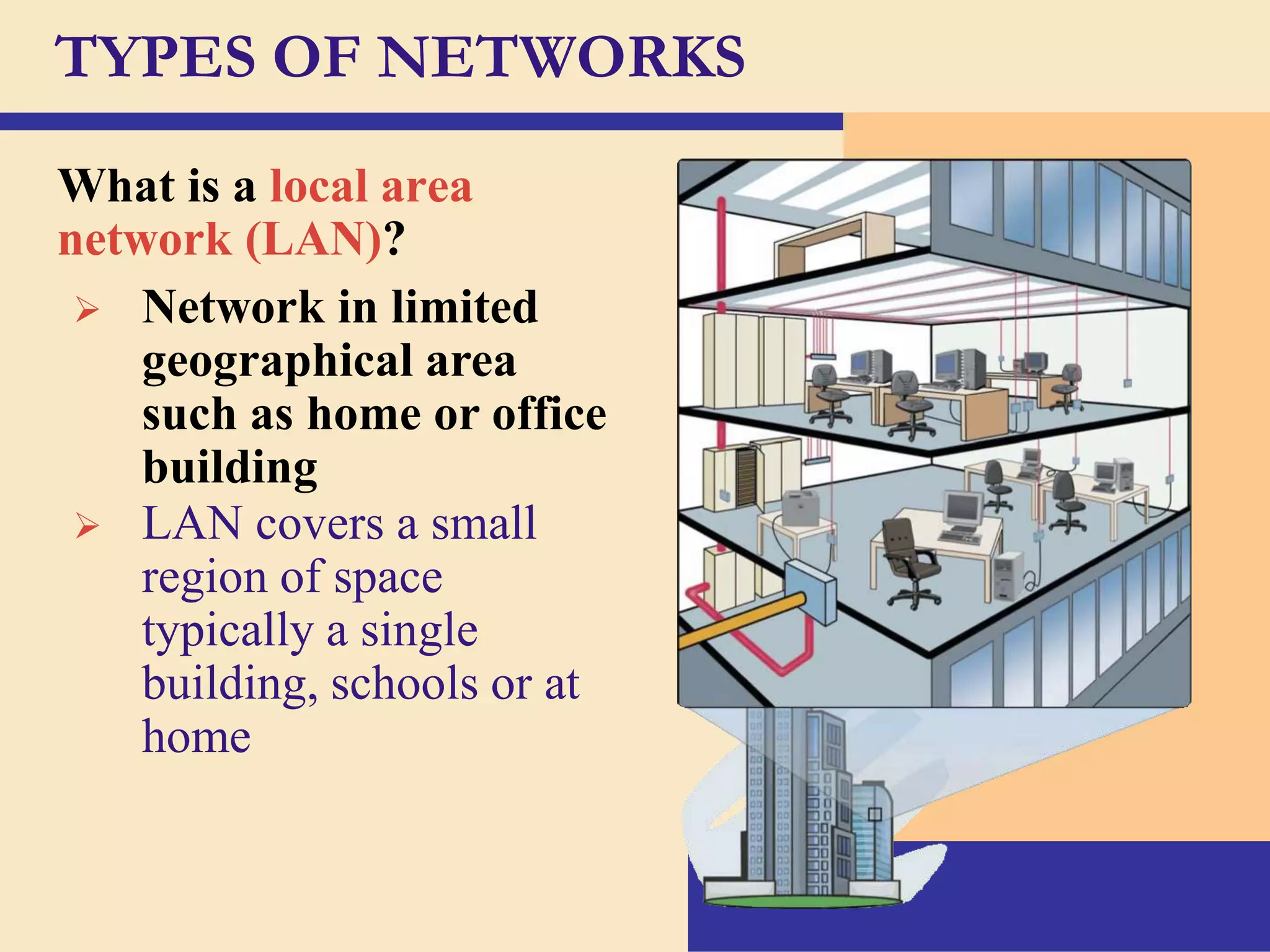
What is a local area
network (LAN)?
 Network in limited
geographical area
such as home or office
building
 LAN covers a small
region of space
typically a single
building, schools or at
home
 LAN can pass data to one and all as well as can
share resources.
 Once PC’s are physically connected, software
designed specifically for LAN allows the exchange of
program and data files among users connected to the
network.
 The network software allows any user to access
shared data storage(hardware) and output devices
(printers) connected to networks.
 A group of computers and other devices dispersed
over a relatively limited area say within a building and
connected by a communication link that enables each
device to interact with any other device on the network
is called LAN.
Advantages of LAN
 LAN allow sharing of expensive resources such as
laser printers and high-capacity , high speed mass
storage devices among a number of users.
 LAN allows high speed exchange of essential
information between key people in an organization.
If properly managed, this will provide greater
efficiency and productivity.
 Through LAN, one can store all critical data at a
central place and many users can then access and
work on this data.
 Since data can be stored centrally, you can take the
back-up of all important files daily on tapes or hard
disk drives,
Disadvantages of LAN
 LAN software requires memory space in each of
the computers used on the network. About 20% of
the computer’s memory will be needed to manage
the network interface. This reduces the memory
space available for user’s programs.
 LAN adds another level of complexity to the
computer operation. Users may have difficulty in
learning the network commands.
 Some control on the part of a user is lost. For
example , suppose you have to share a printer with
other users, then you can face a situation where the
entire network suddenly locking up because one
user has made a mistake.
Disadvantages of LAN
 LAN has security problems. Some types of security
system must be implemented for protecting data.
Any user can play foul and destroy the centrally
stored data easily on a network.
Example on LAN:
Two or more computers connected in a
building or small office or a internet café.
TYPES OF NETWORKS
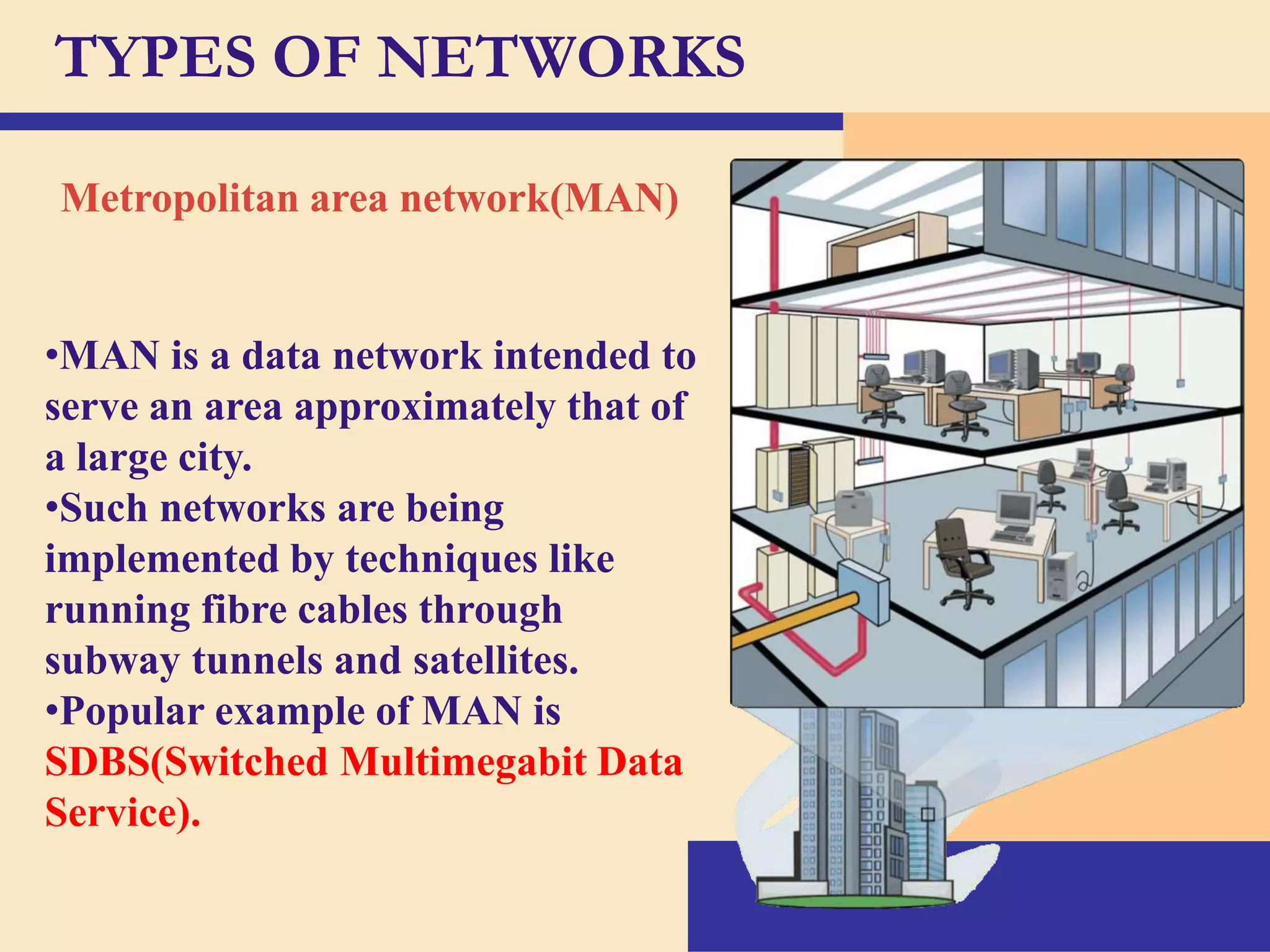
Metropolitan area network(MAN)
•MAN is a data network intended to
serve an area approximately that of
a large city.
•Such networks are being
implemented by techniques like
running fibre cables through
subway tunnels and satellites.
•Popular example of MAN is
SDBS(Switched Multimegabit Data
Service).
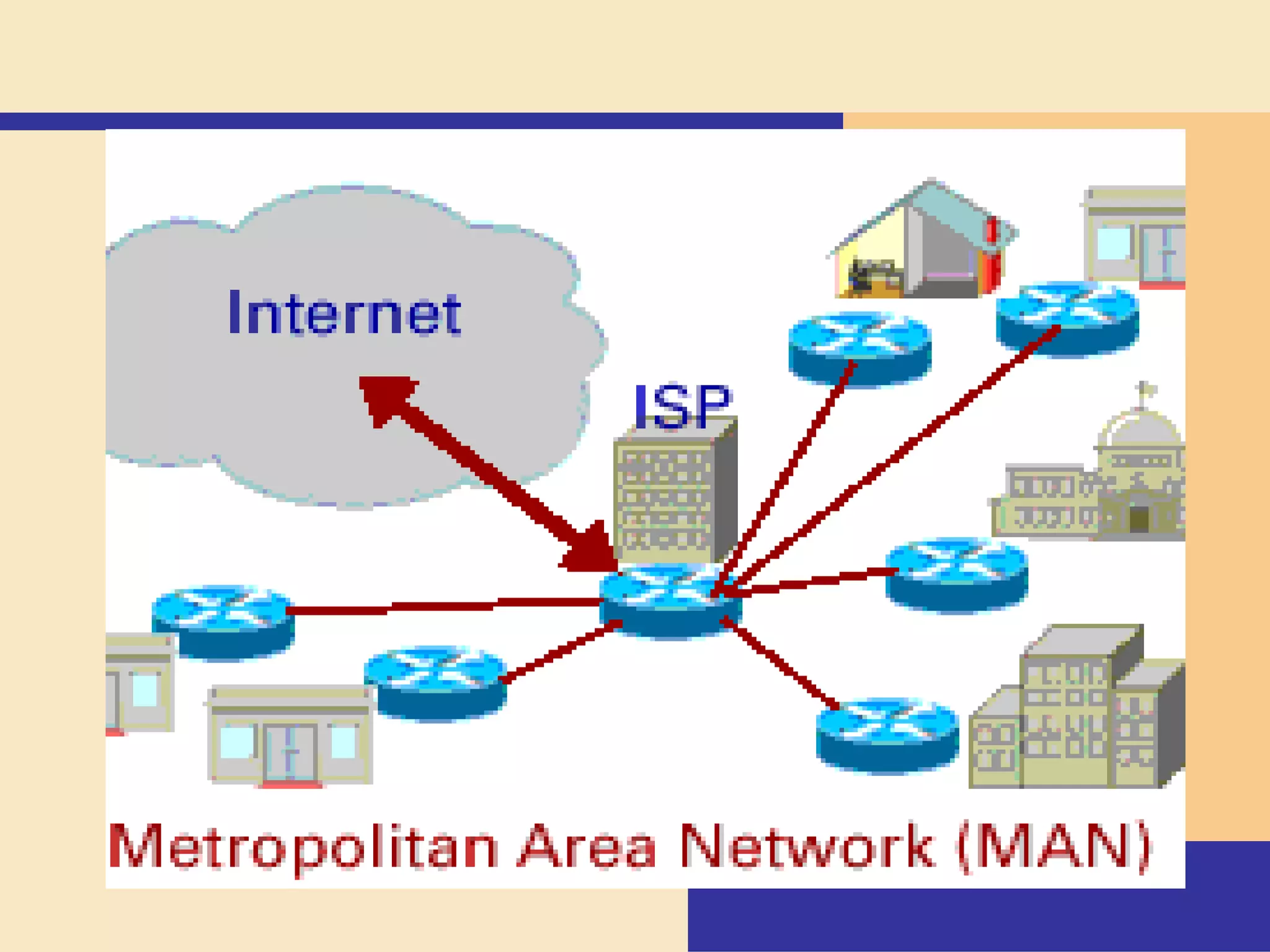
Example of MAN:
 Popular example of MAN is
SDBS(Switched Multimegabit Data
Service).
 SDBS is a high-speed, packet-switched,
datagram-based WAN networking
technology used for communication over
public data networks(PDNs). SMDS can use
fiber- or copper-based media; it supports
speeds of 1.544 Mbps.
TYPES OF NETWORKS
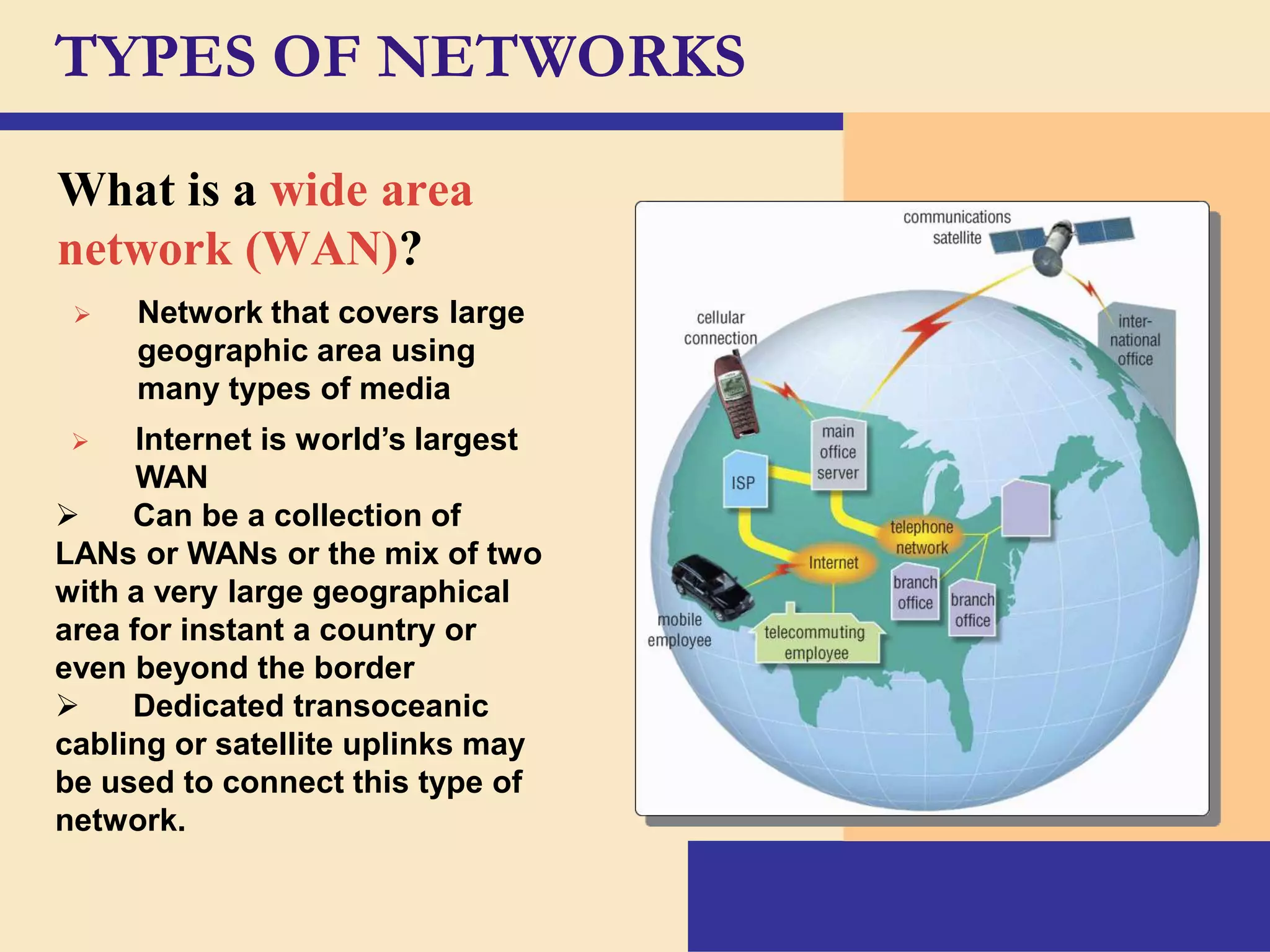
What is a wide area
network (WAN)?
 Network that covers large
geographic area using
many types of media
 Internet is world’s largest
WAN
 Can be a collection of
LANs or WANs or the mix of two
with a very large geographical
area for instant a country or
even beyond the border
 Dedicated transoceanic
cabling or satellite uplinks may
be used to connect this type of
network.
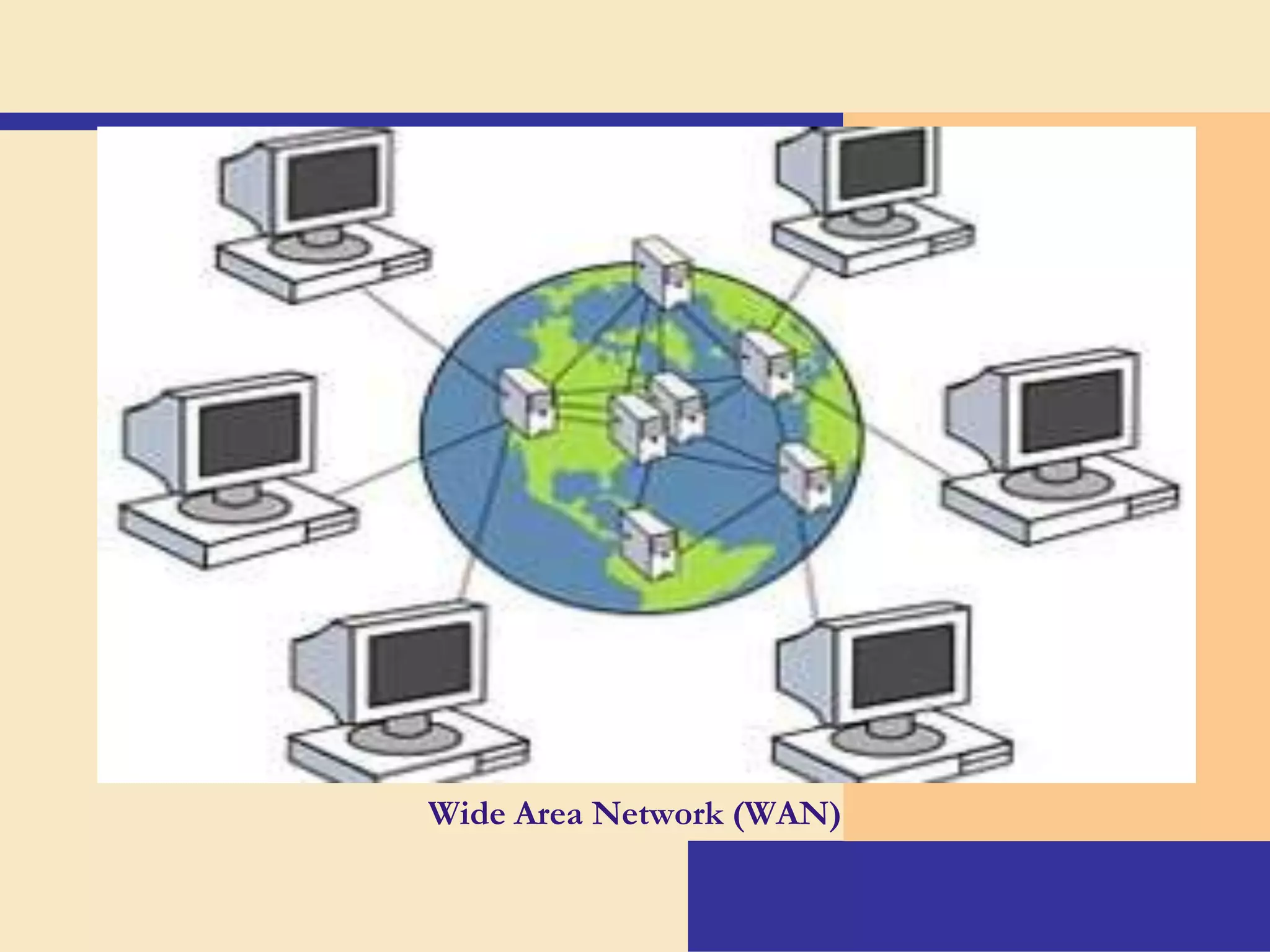
Wide Area Network (WAN)
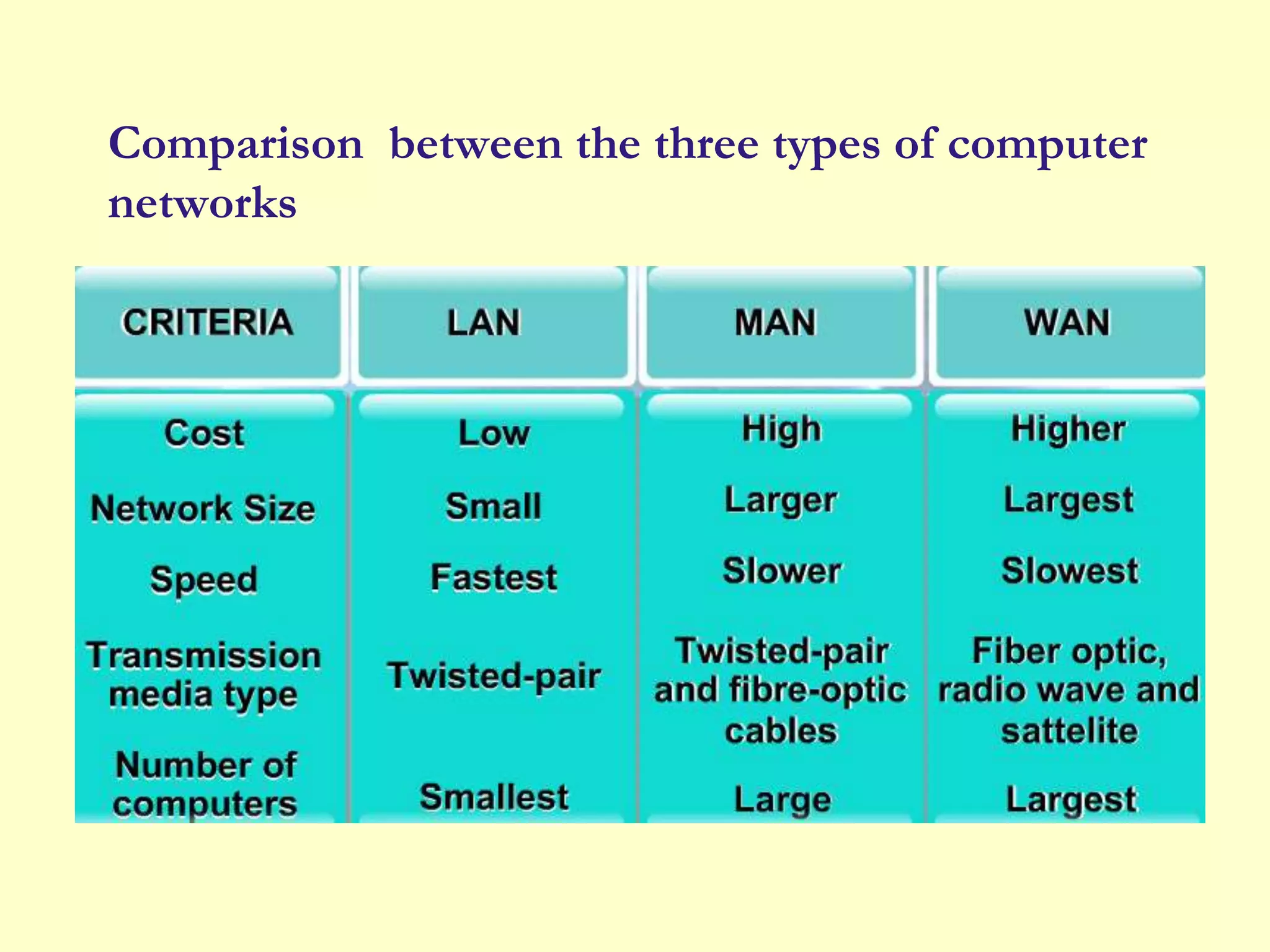
Comparison between the three types of computer
networks
Any Queries ?
typesofnetwork-131016134128-phpapp02 (1).pdf

typesofnetwork-131016134128-phpapp02 (1).pdf

  • 2.
    Topics  What isnetwork ?  Types of networks • LAN (Local Area Network) • MAN (Metropolitan Area Network) • WAN (Wide Area Network)  Comparison between the three networks.
  • 3.
    NETWORKS What is anetwork?  Collection of computers and devices connected via communications devices and transmission media  Networks can be classified by the geographical area they cover
  • 4.
    There are 3types of computer networks  LAN (Local Area Networks)  MAN (Metropolitan Area Network)  WAN(Wide Area Network)
  • 5.
    TYPES OF NETWORKS Whatis a local area network (LAN)?  Network in limited geographical area such as home or office building  LAN covers a small region of space typically a single building, schools or at home
  • 6.
     LAN canpass data to one and all as well as can share resources.  Once PC’s are physically connected, software designed specifically for LAN allows the exchange of program and data files among users connected to the network.  The network software allows any user to access shared data storage(hardware) and output devices (printers) connected to networks.  A group of computers and other devices dispersed over a relatively limited area say within a building and connected by a communication link that enables each device to interact with any other device on the network is called LAN.
  • 7.
    Advantages of LAN LAN allow sharing of expensive resources such as laser printers and high-capacity , high speed mass storage devices among a number of users.  LAN allows high speed exchange of essential information between key people in an organization. If properly managed, this will provide greater efficiency and productivity.  Through LAN, one can store all critical data at a central place and many users can then access and work on this data.  Since data can be stored centrally, you can take the back-up of all important files daily on tapes or hard disk drives,
  • 8.
    Disadvantages of LAN LAN software requires memory space in each of the computers used on the network. About 20% of the computer’s memory will be needed to manage the network interface. This reduces the memory space available for user’s programs.  LAN adds another level of complexity to the computer operation. Users may have difficulty in learning the network commands.  Some control on the part of a user is lost. For example , suppose you have to share a printer with other users, then you can face a situation where the entire network suddenly locking up because one user has made a mistake.
  • 9.
    Disadvantages of LAN LAN has security problems. Some types of security system must be implemented for protecting data. Any user can play foul and destroy the centrally stored data easily on a network.
  • 10.
    Example on LAN: Twoor more computers connected in a building or small office or a internet café.
  • 11.
    TYPES OF NETWORKS Metropolitanarea network(MAN) •MAN is a data network intended to serve an area approximately that of a large city. •Such networks are being implemented by techniques like running fibre cables through subway tunnels and satellites. •Popular example of MAN is SDBS(Switched Multimegabit Data Service).
  • 13.
    Example of MAN: Popular example of MAN is SDBS(Switched Multimegabit Data Service).  SDBS is a high-speed, packet-switched, datagram-based WAN networking technology used for communication over public data networks(PDNs). SMDS can use fiber- or copper-based media; it supports speeds of 1.544 Mbps.
  • 14.
    TYPES OF NETWORKS Whatis a wide area network (WAN)?  Network that covers large geographic area using many types of media  Internet is world’s largest WAN  Can be a collection of LANs or WANs or the mix of two with a very large geographical area for instant a country or even beyond the border  Dedicated transoceanic cabling or satellite uplinks may be used to connect this type of network.
  • 15.
  • 16.
    Comparison between thethree types of computer networks
  • 17.