Types of Mixtures
Solutions
• Solutions are homogeneous mixtures made up of
two components.
• The part of the solution that does the dissolving
is called the solvent.
• The part of the solution that gets dissolved is
called the solute.
• In a sugar water solution, what is the solute?
• Sugar
• In a sugar water solution, what is the solvent?
• Water
Solutions (continued)
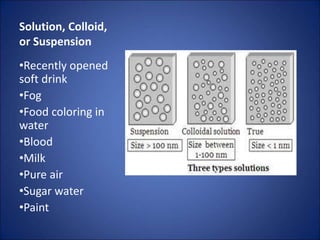
• The solute particles are < 1 nm in diameter.
• How large are these particles in cm?
• 0.0000001 cm
• As a result, solutions often appear clear.
• Due to the extremely small particle size solutions
remain mixed and do not separate (settle out) upon
standing.
• Solutions cannot be separated by filtration (particles
are so small they pass through the paper with the
solvent.
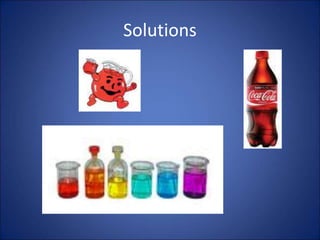
• Examples include: kool-aid, flat soft drink
Solutions
Colloids
• Colloids are heterogeneous mixtures.
• The particles mixed into the main component are
between 1 and 100 nm in diameter.
• Due to the slightly larger particle size, colloids
appear cloudy.
• Although the particles are larger than in a
solution, they are still small enough that they stay
mixed and do not separate upon standing and
cannot be separated by filtration.
• Examples: milk, whipped cream
Colloids
Tyndall Effect
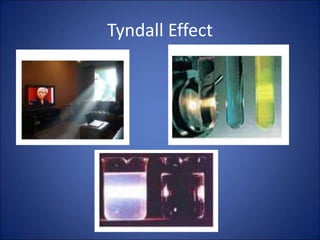
• Particles in a colloid are large enough that
they will reflect (scatter) light.
• This phenomenon is referred to as the Tyndall
Effect.
Tyndall Effect
Suspensions
• Suspensions are also heterogeneous mixtures.
• The particles in a suspension are the largest
and have a diameter > 100 nm.
• Due to the larger size these particles will
separate (settle out) upon standing.
• If all of the particles have separated, the liquid
may appear clear. If not, the liquid may
appear cloudy.
Suspensions
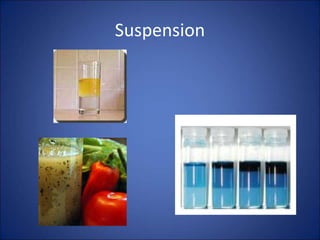
• The larger particle size allows for suspensions
to be separated by filtration.
• The Tyndall effect may be observed if the
particles have not settled out.
• Examples: muddy water, Italian salad dressing.
Suspension
Solution, Colloid,
or Suspension
•Recently opened
soft drink
•Fog
•Food coloring in
water
•Blood
•Milk
•Pure air
•Sugar water
•Paint
types_of_mixtures.ppt

types_of_mixtures.ppt

  • 1.
  • 2.
    Solutions • Solutions arehomogeneous mixtures made up of two components. • The part of the solution that does the dissolving is called the solvent. • The part of the solution that gets dissolved is called the solute. • In a sugar water solution, what is the solute? • Sugar • In a sugar water solution, what is the solvent? • Water
  • 3.
    Solutions (continued) • Thesolute particles are < 1 nm in diameter. • How large are these particles in cm? • 0.0000001 cm • As a result, solutions often appear clear. • Due to the extremely small particle size solutions remain mixed and do not separate (settle out) upon standing. • Solutions cannot be separated by filtration (particles are so small they pass through the paper with the solvent. • Examples include: kool-aid, flat soft drink
  • 4.
  • 5.
    Colloids • Colloids areheterogeneous mixtures. • The particles mixed into the main component are between 1 and 100 nm in diameter. • Due to the slightly larger particle size, colloids appear cloudy. • Although the particles are larger than in a solution, they are still small enough that they stay mixed and do not separate upon standing and cannot be separated by filtration. • Examples: milk, whipped cream

  • 6.
  • 7.
    Tyndall Effect • Particlesin a colloid are large enough that they will reflect (scatter) light. • This phenomenon is referred to as the Tyndall Effect.
  • 8.
  • 9.
    Suspensions • Suspensions arealso heterogeneous mixtures. • The particles in a suspension are the largest and have a diameter > 100 nm. • Due to the larger size these particles will separate (settle out) upon standing. • If all of the particles have separated, the liquid may appear clear. If not, the liquid may appear cloudy.
  • 10.
    Suspensions • The largerparticle size allows for suspensions to be separated by filtration. • The Tyndall effect may be observed if the particles have not settled out. • Examples: muddy water, Italian salad dressing.
  • 11.
  • 12.
    Solution, Colloid, or Suspension •Recentlyopened soft drink •Fog •Food coloring in water •Blood •Milk •Pure air •Sugar water •Paint