BEST FOR You
OR G A N I C S C O M P A N Y
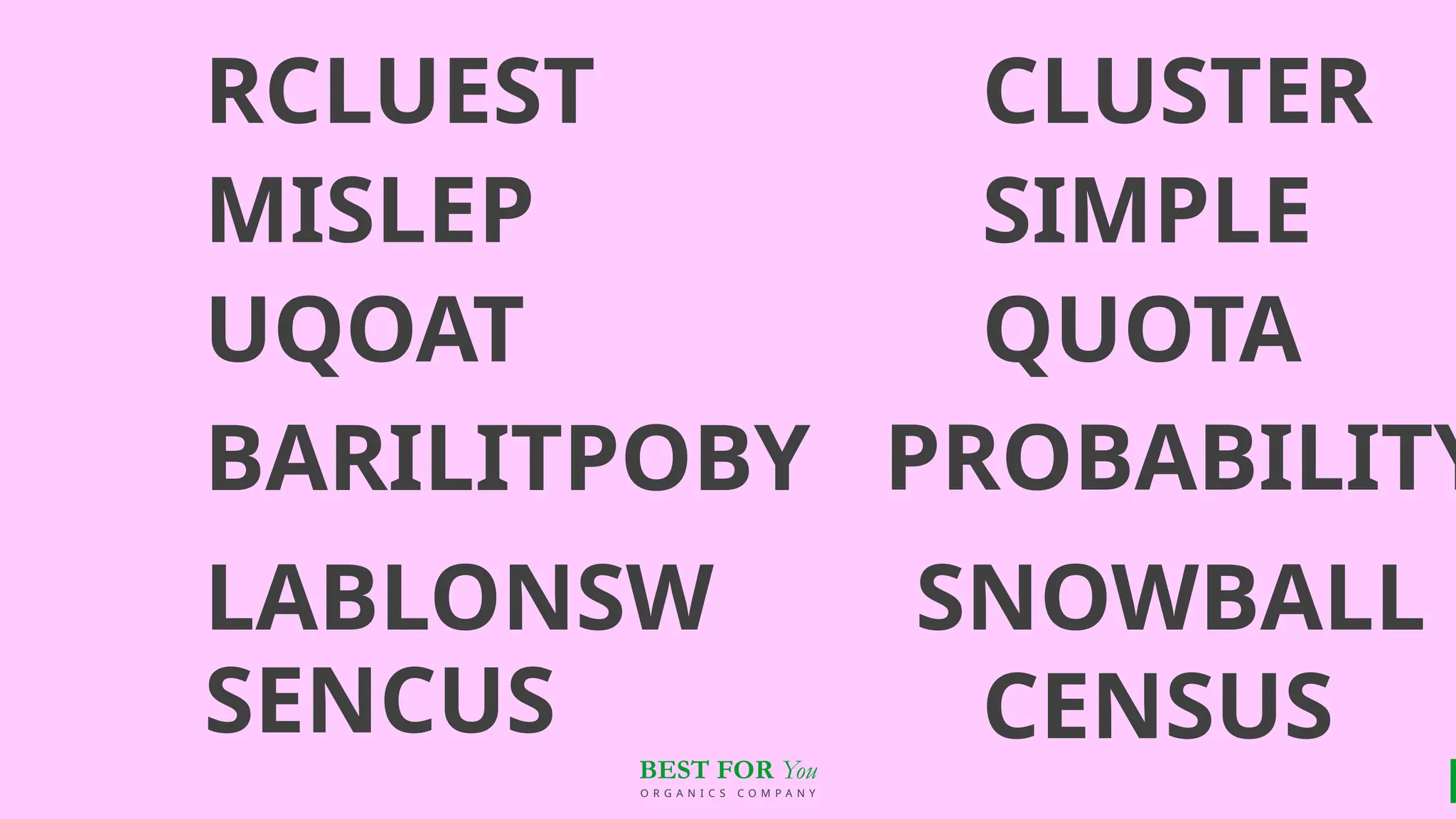
RCLUEST
MISLEP
UQOAT
BARILITPOBY
LABLONSW
SENCUS
CLUSTER
SIMPLE
QUOTA
PROBABILITY
SNOWBALL
CENSUS
2.
BEST FOR You
OR G A N I C S C O M P A N Y
Types of
Sampling
TOPIC 4
3.
BEST FOR You
OR G A N I C S C O M P A N Y
Sampling
is the process of choosing participants or
respondents from a target population for
your study.
4.
BEST FOR You
OR G A N I C S C O M P A N Y
Sampling
technique
is a process of selecting samples from a
target population (Uy et.al., 2016).
5.
BEST FOR You
OR G A N I C S C O M P A N Y
TWO TYPES
OF SAMPLING
TECHNIQUE
6.
BEST FOR You
OR G A N I C S C O M P A N Y
Probability
sampling
is the method of drawing samples
where every member of the target
population has an equal chance of
being selected. It requires the
presence of a complete list of
members of the target population.
7.
BEST FOR You
OR G A N I C S C O M P A N Y
Non-probability
sampling
does not ensure that every member
of the target population is given an
equal chance of being selected. Thus,
the non-probability sampling is less
precise. It is usually used when just
approximation is required.
8.
BEST FOR You
OR G A N I C S C O M P A N Y
Types of
Probability
Sampling
Techniques
9.
BEST FOR You
OR G A N I C S C O M P A N Y
Simple Random
Sampling
• simplest probability sampling
techniques
• no particular order is used in the
actual selection of samples
• each member of the target
population has an equal chance of
being included since the samples are
just chosen at random
• may be done by a lottery that is why
at times this method is sometimes
called a lottery method or by the use
of the table of or computer-
generated random numbers
• is normally used when the target
population is small, e.g. the process
10.
BEST FOR You
OR G A N I C S C O M P A N Y
Systematic
Sampling
• random sampling process where a pre-
selection system is in place to complement the
randomness of the selection process
• requires a complete list of the members of the
target population in the sampling frame
• K value is computed by dividing the population
size by the desired sample size and is used to
determine the kth (sample) element to be taken
from the population. Take for example, if your
study is about the attitude of the students
towards their involvement in conducting
Scientific Research, the total population of the
students in a school is divided by the desired
sample. The students in the school are then
assigned control numbers. Assuming the k
value is 74, then every 74th in the list is taken as
11.
BEST FOR You
OR G A N I C S C O M P A N Y
Stratified
Sampling
the target population is first divided into
strata (groups) according to certain
predefined characteristics
• for each stratum, samples are then drawn
either randomly or according to a systematic
approach
• done to make sure that the samples selected
are not from one stratum or group only, and
that the results are representative of the target
population. A clear example is a study on the
efficacy of the X-Brand COVID-19 vaccine on
people ages 18-65, the target population may
be divided into various strata according to their
age groups. After determining the strata,
people belonging to the same age range (e.g.
18-25) are grouped as one. The researcher has
12.
BEST FOR You
OR G A N I C S C O M P A N Y
Cluster Sampling
used when the population is dispersed
over a wide geographic region, and it is
costly to gather a complete list of the
members of the population
similar to stratified sampling in that
population is first divided into strata
(groups) or clusters, and then clusters
are randomly chosen and from these
clusters, samples are taken
requires a larger sample to be as
efficient. Take, for example, to study the
efficacy of the X-Brand COVID-19
vaccine among Filipinos. To better
assess and get the needed data for this
study, since Filipinos are living across
each region in the country, the
researcher may first randomly select a
certain number of regions in the
country to be used as a target
population. Then, samples (participants
13.
BEST FOR You
OR G A N I C S C O M P A N Y
Types of
Non-Probability
Sampling
Techniques
14.
BEST FOR You
OR G A N I C S C O M P A N Y
Purposeful
Sampling
• the process of selecting a sample with a specific
‘purpose’ in mind
• appropriate for qualitative research studies and is
usually used for researches wherein respondents
are limited and the chosen issue is of little
knowledge
• various considerations in selecting samples using
this technique:
(a) respondents qualify with the criteria of interest in
your research; and
(b) they have and/or exhibit diverse attitude,
knowledge, practice, or skill on a particular issue.
Example:
If you wanted to know the people’s opinion on
vaccination against COVID-19, then the criteria, “Are
you willing to be vaccinated …?” and those who
answered “No” will be excluded from the study.
15.
BEST FOR You
OR G A N I C S C O M P A N Y
Quota Sampling
• sampling technique that makes
sure the representative
characteristics are well-
represented from a certain
number of participants from
different sub-groups of specific
characteristics
• quota is a specified number that is
included in the sample
Example:
If you think that people with pre-
determined respiratory diseases are
prone to the transmission of COVID-
19, so you include 25% of the
participants from each identified
16.
BEST FOR You
OR G A N I C S C O M P A N Y
Snowball
Sampling
• used when the target population can be
accessed or identified easily
• used for topics that are highly sensitive and are
not usually openly-discussed. Thus, samples are
built up through referrals.
• Example:
If your study is about AIDS among the “third sex”
individuals then, you may start asking someone
you knew having this disease. You may ask also
this person for a further recommendation on
people having the same disease. Like a snowball,
starting from a small form of snow as it continues
to roll down a hill of snow, collects up more snow
to form a larger one – this is the same as a
snowball sample in a research study.
17.
BEST FOR You
OR G A N I C S C O M P A N Y
Census
Sampling
• census is the systematic recording of
information of each member of a
population. It is more reliable, and less
prone to error
• usually used if the population of the
study is heterogeneous (mixed)
• for example, if you wanted to know the
number of family members in a
household, this sampling technique can
be used



![ANIMAL_CELL_,_TISSUE_AND_ORGAN_CULTURE[1].pptx](https://cdn.slidesharecdn.com/ss_thumbnails/animalcelltissueandorganculture1-260204172026-4462b440-thumbnail.jpg?width=640&height=640&fit=bounds)
