Types of Research Design
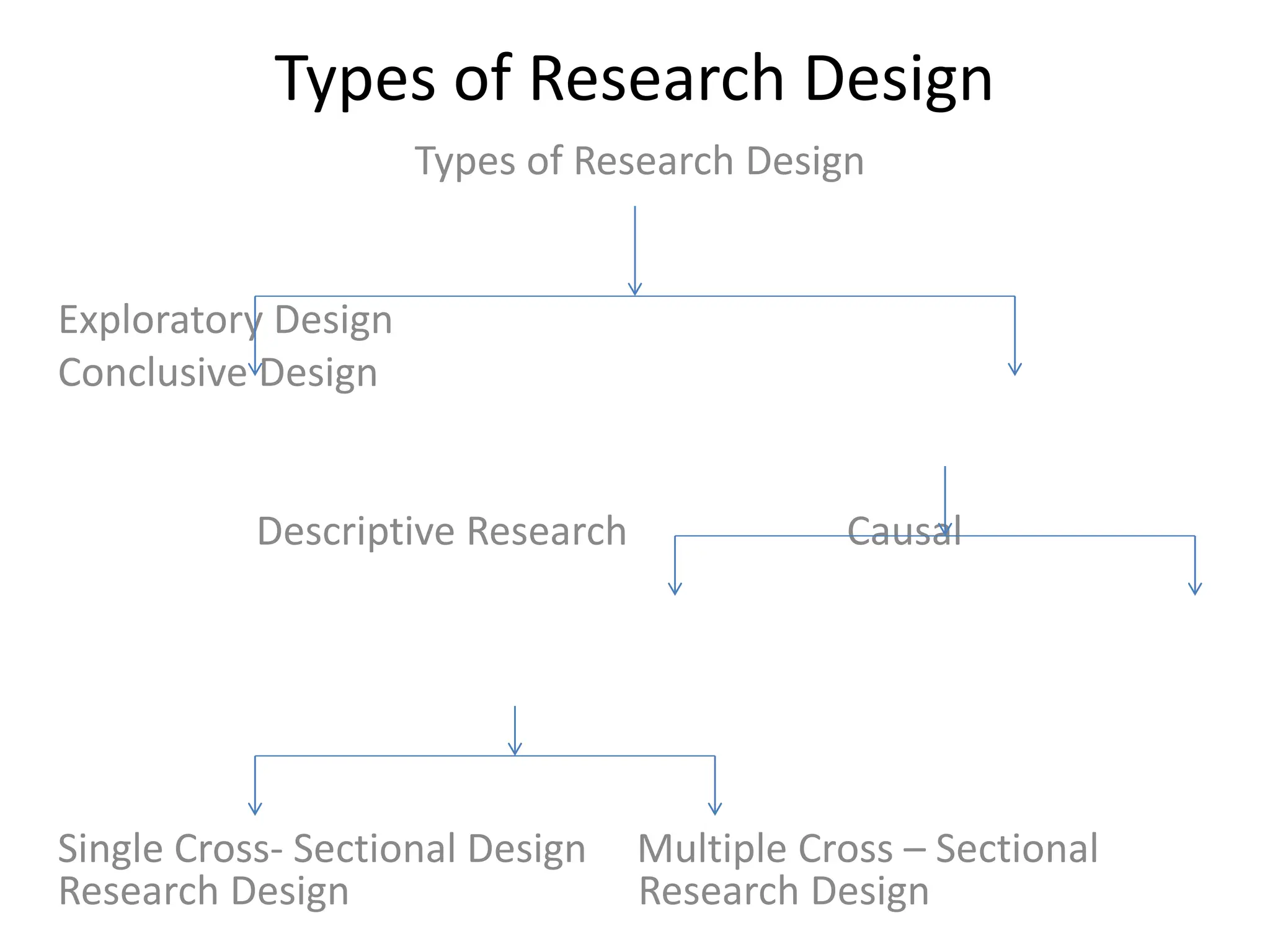
Exploratory Design
Conclusive Design
Descriptive Research Causal
Single Cross- Sectional Design Multiple Cross – Sectional
Research Design Research Design
Types of research design
Exploratory research design.
Conclusive research design.
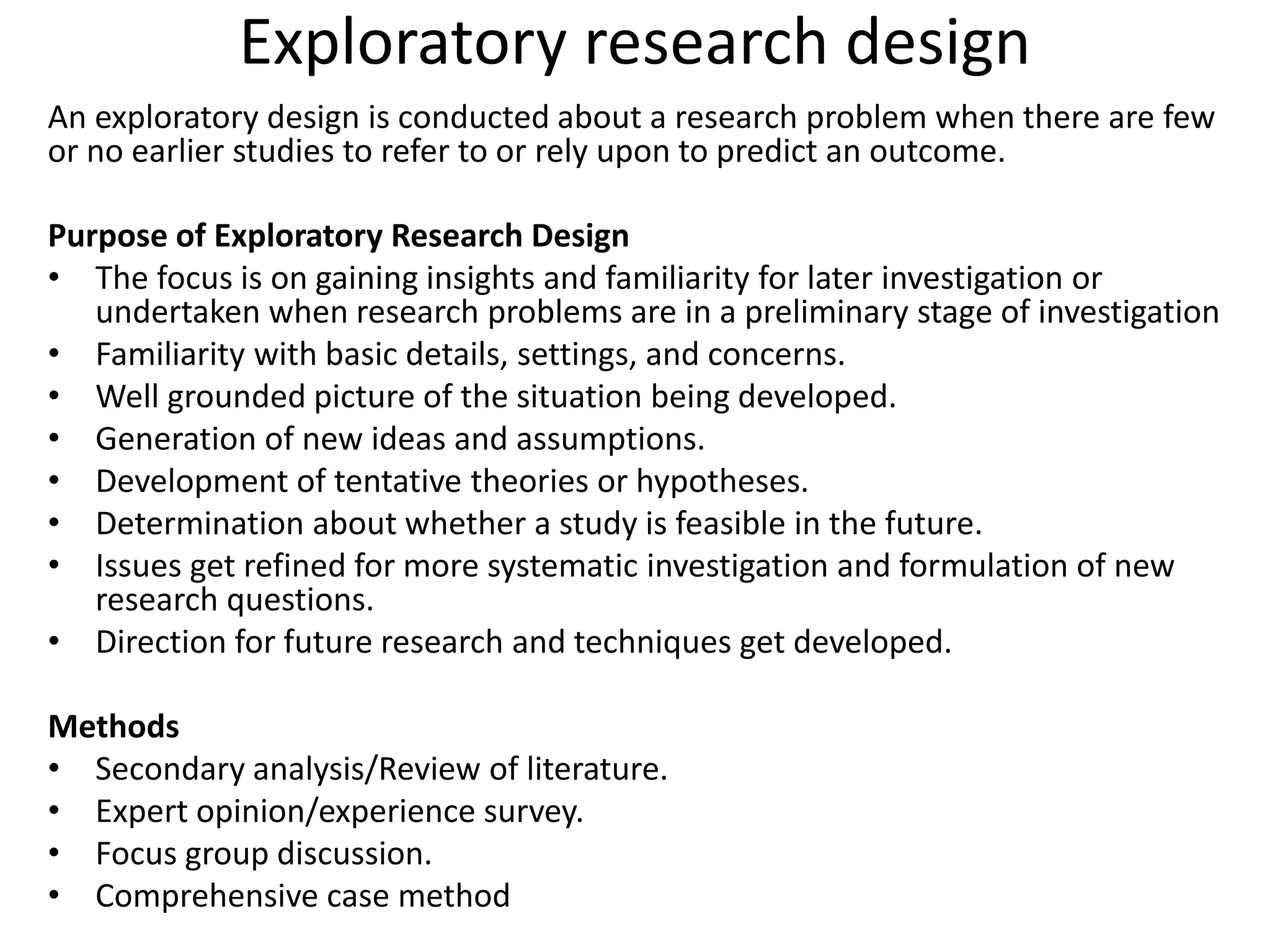
Exploratory research design
An exploratory design is conducted about a research problem when there are few
or no earlier studies to refer to or rely upon to predict an outcome.
Purpose of Exploratory Research Design
• The focus is on gaining insights and familiarity for later investigation or
undertaken when research problems are in a preliminary stage of investigation
• Familiarity with basic details, settings, and concerns.
• Well grounded picture of the situation being developed.
• Generation of new ideas and assumptions.
• Development of tentative theories or hypotheses.
• Determination about whether a study is feasible in the future.
• Issues get refined for more systematic investigation and formulation of new
research questions.
• Direction for future research and techniques get developed.
Methods
• Secondary analysis/Review of literature.
• Expert opinion/experience survey.
• Focus group discussion.
• Comprehensive case method
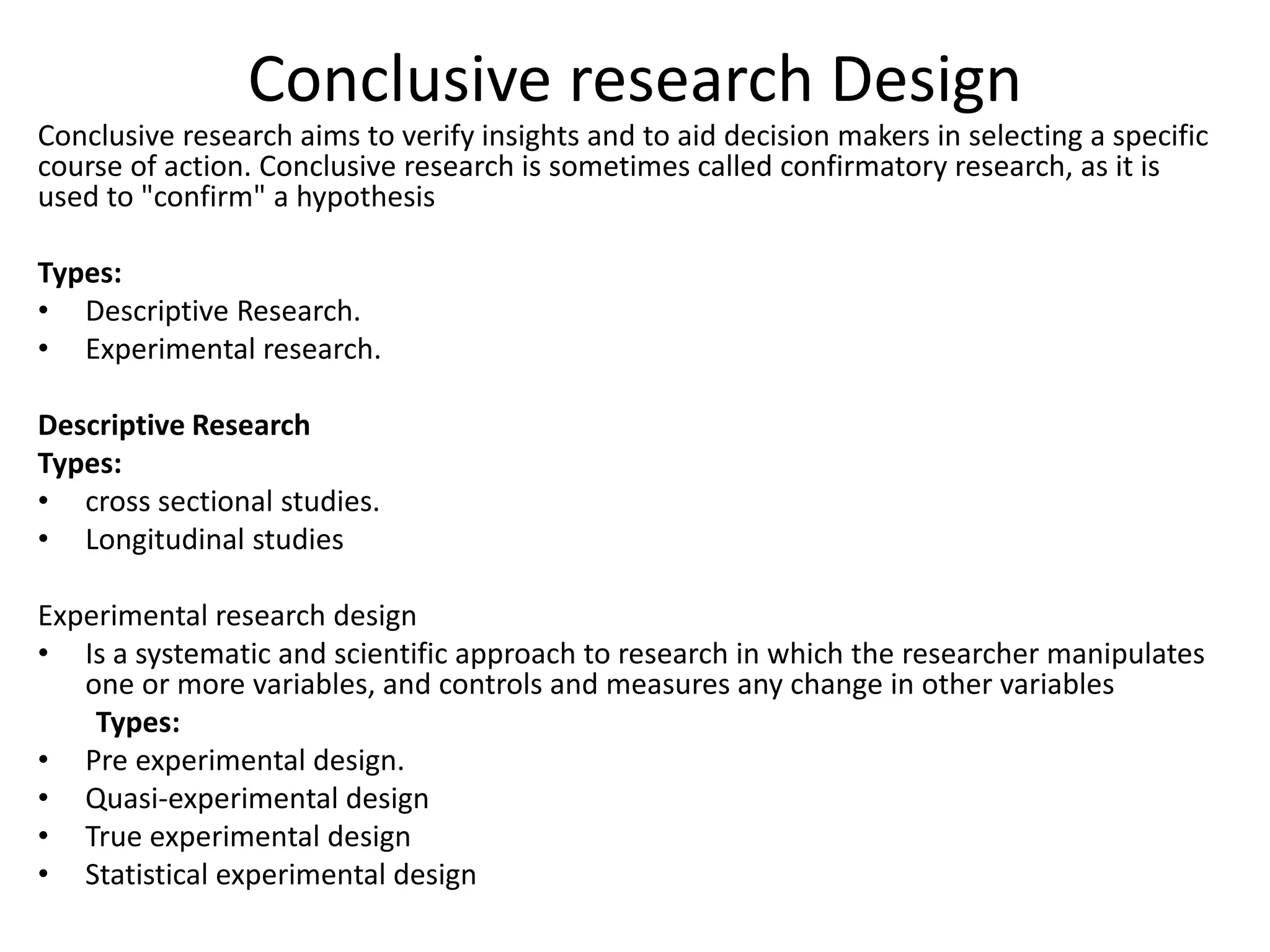
Conclusive research Design
Conclusive research aims to verify insights and to aid decision makers in selecting a specific
course of action. Conclusive research is sometimes called confirmatory research, as it is
used to "confirm" a hypothesis
Types:
• Descriptive Research.
• Experimental research.
Descriptive Research
Types:
• cross sectional studies.
• Longitudinal studies
Experimental research design
• Is a systematic and scientific approach to research in which the researcher manipulates
one or more variables, and controls and measures any change in other variables
Types:
• Pre experimental design.
• Quasi-experimental design
• True experimental design
• Statistical experimental design
Quasi-experimental design
• No random assignment of participants.
• May or May not have a control group.
• May or may not have a control over
manipulation of variable.
True experimental design
• For an experiment to be classed as a true
experimental design, it must fit all of the
following criteria.
• The sample groups must be assigned randomly.
• There must be a viable control group.
• The tested subjects must be randomly assigned
to either control or experimental groups
Statistical experimental design
• The term Statistical experimental design refers to
a plan for assigning experimental units to
treatment conditions. A good experimental
design serves three purposes
• Causation. It allows the experimenter to make
causal inferences about the relationship between
independent variables and a dependent variable
• Control. It allows the experimenter to rule out
alternative explanations due to the confounding
effects of extraneous variables (i.e., variables
other than the independent variables).
• Variability. It reduces variability within treatment
conditions, which makes it easier to detect
differences in treatment outcomes

Types of Research Design.pptxBusiness research methods

  • 1.
    Types of ResearchDesign Types of Research Design Exploratory Design Conclusive Design Descriptive Research Causal Single Cross- Sectional Design Multiple Cross – Sectional Research Design Research Design
  • 2.
    Types of researchdesign Exploratory research design. Conclusive research design.
  • 3.
    Exploratory research design Anexploratory design is conducted about a research problem when there are few or no earlier studies to refer to or rely upon to predict an outcome. Purpose of Exploratory Research Design • The focus is on gaining insights and familiarity for later investigation or undertaken when research problems are in a preliminary stage of investigation • Familiarity with basic details, settings, and concerns. • Well grounded picture of the situation being developed. • Generation of new ideas and assumptions. • Development of tentative theories or hypotheses. • Determination about whether a study is feasible in the future. • Issues get refined for more systematic investigation and formulation of new research questions. • Direction for future research and techniques get developed. Methods • Secondary analysis/Review of literature. • Expert opinion/experience survey. • Focus group discussion. • Comprehensive case method
  • 4.
    Conclusive research Design Conclusiveresearch aims to verify insights and to aid decision makers in selecting a specific course of action. Conclusive research is sometimes called confirmatory research, as it is used to "confirm" a hypothesis Types: • Descriptive Research. • Experimental research. Descriptive Research Types: • cross sectional studies. • Longitudinal studies Experimental research design • Is a systematic and scientific approach to research in which the researcher manipulates one or more variables, and controls and measures any change in other variables Types: • Pre experimental design. • Quasi-experimental design • True experimental design • Statistical experimental design
  • 5.
    Quasi-experimental design • Norandom assignment of participants. • May or May not have a control group. • May or may not have a control over manipulation of variable.
  • 6.
    True experimental design •For an experiment to be classed as a true experimental design, it must fit all of the following criteria. • The sample groups must be assigned randomly. • There must be a viable control group. • The tested subjects must be randomly assigned to either control or experimental groups
  • 7.
    Statistical experimental design •The term Statistical experimental design refers to a plan for assigning experimental units to treatment conditions. A good experimental design serves three purposes • Causation. It allows the experimenter to make causal inferences about the relationship between independent variables and a dependent variable • Control. It allows the experimenter to rule out alternative explanations due to the confounding effects of extraneous variables (i.e., variables other than the independent variables). • Variability. It reduces variability within treatment conditions, which makes it easier to detect differences in treatment outcomes