Introduction to NoSQL
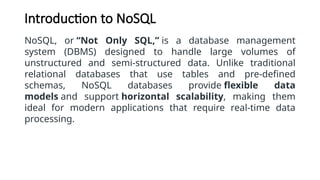
NoSQL, or “Not Only SQL,” is a database management
system (DBMS) designed to handle large volumes of
unstructured and semi-structured data. Unlike traditional
relational databases that use tables and pre-defined
schemas, NoSQL databases provide flexible data
models and support horizontal scalability, making them
ideal for modern applications that require real-time data
processing.
Why Use NoSQL?
•Scalability – Can scale horizontally by adding more nodes
instead of upgrading a single machine.
•Flexibility – Supports unstructured or semi-structured data
without a rigid schema.
•High Performance – Optimized for fast read/write
operations with large datasets.
•Distributed Architecture – Designed for high availability
and partition tolerance in distributed systems.
Types of NoSQL
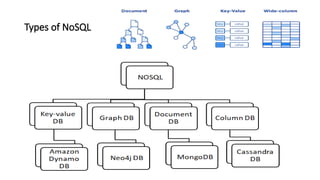
1. Document databases
•Data is stored as documents that can contain varying
attributes.
•Examples: MongoDB, CouchDB, Cloudant
•Ideal for content management systems, user profiles,
and catalogs where flexible schemas are needed.
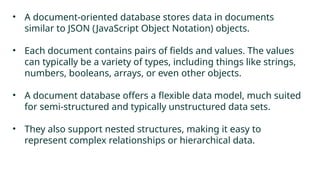
• A document-oriented database stores data in documents
similar to JSON (JavaScript Object Notation) objects.
• Each document contains pairs of fields and values. The values
can typically be a variety of types, including things like strings,
numbers, booleans, arrays, or even other objects.
• A document database offers a flexible data model, much suited
for semi-structured and typically unstructured data sets.
• They also support nested structures, making it easy to
represent complex relationships or hierarchical data.
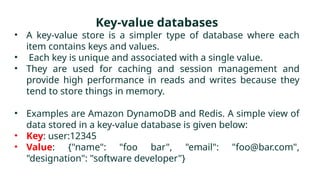
Key-value databases
• A key-value store is a simpler type of database where each
item contains keys and values.
• Each key is unique and associated with a single value.
• They are used for caching and session management and
provide high performance in reads and writes because they
tend to store things in memory.
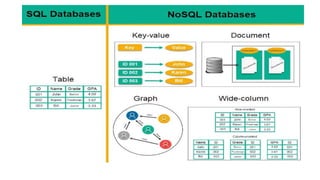
• Examples are Amazon DynamoDB and Redis. A simple view of
data stored in a key-value database is given below:
• Key: user:12345
• Value: {"name": "foo bar", "email": "foo@bar.com",
"designation": "software developer"}
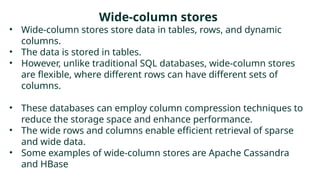
Wide-column stores
• Wide-column stores store data in tables, rows, and dynamic
columns.
• The data is stored in tables.
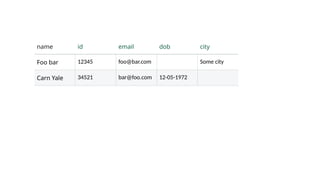
• However, unlike traditional SQL databases, wide-column stores
are flexible, where different rows can have different sets of
columns.
• These databases can employ column compression techniques to
reduce the storage space and enhance performance.
• The wide rows and columns enable efficient retrieval of sparse
and wide data.
• Some examples of wide-column stores are Apache Cassandra
and HBase
name id email dob city
Foo bar 12345 foo@bar.com Some city
Carn Yale 34521 bar@foo.com 12-05-1972
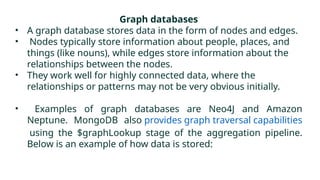
Graph databases
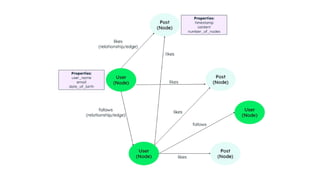
• A graph database stores data in the form of nodes and edges.
• Nodes typically store information about people, places, and
things (like nouns), while edges store information about the
relationships between the nodes.
• They work well for highly connected data, where the
relationships or patterns may not be very obvious initially.
• Examples of graph databases are Neo4J and Amazon
Neptune. MongoDB also provides graph traversal capabilities
using the $graphLookup stage of the aggregation pipeline.
Below is an example of how data is stored:
Unit 5.pptx computer graphics and gaming

Unit 5.pptx computer graphics and gaming

  • 1.
    Introduction to NoSQL NoSQL,or “Not Only SQL,” is a database management system (DBMS) designed to handle large volumes of unstructured and semi-structured data. Unlike traditional relational databases that use tables and pre-defined schemas, NoSQL databases provide flexible data models and support horizontal scalability, making them ideal for modern applications that require real-time data processing.
  • 2.
    Why Use NoSQL? •Scalability– Can scale horizontally by adding more nodes instead of upgrading a single machine. •Flexibility – Supports unstructured or semi-structured data without a rigid schema. •High Performance – Optimized for fast read/write operations with large datasets. •Distributed Architecture – Designed for high availability and partition tolerance in distributed systems.
  • 3.
  • 5.
    1. Document databases •Datais stored as documents that can contain varying attributes. •Examples: MongoDB, CouchDB, Cloudant •Ideal for content management systems, user profiles, and catalogs where flexible schemas are needed.
  • 6.
    • A document-orienteddatabase stores data in documents similar to JSON (JavaScript Object Notation) objects. • Each document contains pairs of fields and values. The values can typically be a variety of types, including things like strings, numbers, booleans, arrays, or even other objects. • A document database offers a flexible data model, much suited for semi-structured and typically unstructured data sets. • They also support nested structures, making it easy to represent complex relationships or hierarchical data.
  • 7.
    Key-value databases • Akey-value store is a simpler type of database where each item contains keys and values. • Each key is unique and associated with a single value. • They are used for caching and session management and provide high performance in reads and writes because they tend to store things in memory. • Examples are Amazon DynamoDB and Redis. A simple view of data stored in a key-value database is given below: • Key: user:12345 • Value: {"name": "foo bar", "email": "foo@bar.com", "designation": "software developer"}
  • 8.
    Wide-column stores • Wide-columnstores store data in tables, rows, and dynamic columns. • The data is stored in tables. • However, unlike traditional SQL databases, wide-column stores are flexible, where different rows can have different sets of columns. • These databases can employ column compression techniques to reduce the storage space and enhance performance. • The wide rows and columns enable efficient retrieval of sparse and wide data. • Some examples of wide-column stores are Apache Cassandra and HBase
  • 9.
    name id emaildob city Foo bar 12345 foo@bar.com Some city Carn Yale 34521 bar@foo.com 12-05-1972
  • 10.
    Graph databases • Agraph database stores data in the form of nodes and edges. • Nodes typically store information about people, places, and things (like nouns), while edges store information about the relationships between the nodes. • They work well for highly connected data, where the relationships or patterns may not be very obvious initially. • Examples of graph databases are Neo4J and Amazon Neptune. MongoDB also provides graph traversal capabilities using the $graphLookup stage of the aggregation pipeline. Below is an example of how data is stored: