NOSQL
- Dhanshri M.Nagargoje
Contents
 Introduction to NOSQL
 Why NOSQL?
 Architecture
 Examples of NOSQL database
 NoSQL types
 Real World Use
 Conclusion
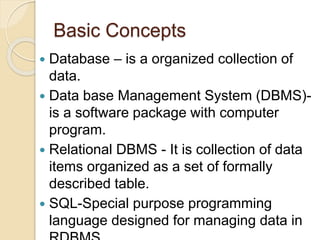
Basic Concepts
 Database – is a organized collection of
data.
 Data base Management System (DBMS)-
is a software package with computer
program.
 Relational DBMS - It is collection of data
items organized as a set of formally
described table.
 SQL-Special purpose programming
language designed for managing data in
NOSQL
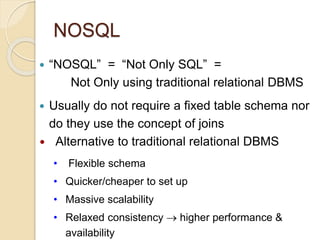
 “NOSQL” = “Not Only SQL” =
Not Only using traditional relational DBMS
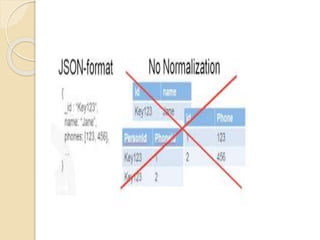
 Usually do not require a fixed table schema nor
do they use the concept of joins
 Alternative to traditional relational DBMS
• Flexible schema
• Quicker/cheaper to set up
• Massive scalability
• Relaxed consistency  higher performance &
availability
Why NOSQL?
 Every problem cannot be solved by
traditional relational database system
exclusively.
 Handles huge databases.
 Super flexible queries using map/reduce
 Rapid development (no fixed schema)
 Scale easily by adding servers
 High-write situations (eg activity tracking
or timeline rendering for millions of users)
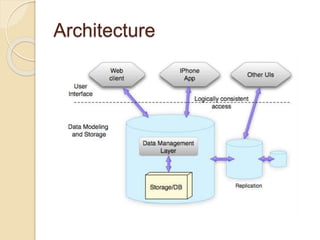
Architecture
Characterstics
 Almost infinite horizontal scaling
 Very fast
 non-relational
 schema-free
 open source
 simple APIs
 Structured storage
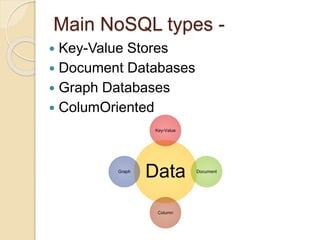
Main NoSQL types -
 Key-Value Stores
 Document Databases
 Graph Databases
 ColumOriented
Data
Key-Value
Document
Column
Graph
Documents
 Documents are self contained,
aggregate data structures they consist
of attributes (name- value pairs)
attribute values have data types,which
can also be nested/hierarchical
Example document (JSON)
{
"id" : 1234,
"name" : {
"first" : “ddd",
"last" : “vvv"
},
"topics": [
"skating",
"music"
]
}
Key-value
 In a key-value store, a value is mapped
to a unique key to store data, supply
both key and value:
> store.set("user1234","...");
 To retrieve a value, supply its key:
> value = store.get("user1234");
keys are organised in databases,
buckets,
keyspaces etc.
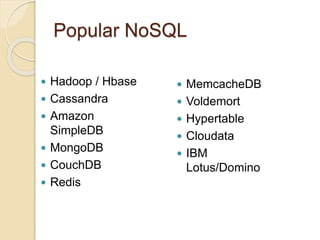
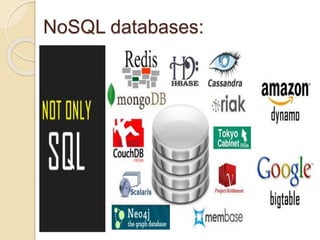
Popular NoSQL
 Hadoop / Hbase
 Cassandra
 Amazon
SimpleDB
 MongoDB
 CouchDB
 Redis
 MemcacheDB
 Voldemort
 Hypertable
 Cloudata
 IBM
Lotus/Domino
NoSQL databases:
Real World Use
 Cassandra
◦ Facebook (original developer, used it till late 2010)
◦ Twitter
◦ Digg
◦ Reddit
◦ Rackspace
◦ Cisco
 BigTable
◦ Google (open-source version is HBase)
 MongoDB
◦ Foursquare
◦ Craigslist
◦ Bit.ly
◦ SourceForge
◦ GitHub
Conclusion
 NoSQL is a great problem solver
 Choose your NoSQL platform carefully
as each is designed for specific
purpose
 Get used to Map/Reduce
THANK
YOU..!!
Any
Questions????

Nosql

  • 1.
  • 2.
    Contents  Introduction toNOSQL  Why NOSQL?  Architecture  Examples of NOSQL database  NoSQL types  Real World Use  Conclusion
  • 3.
    Basic Concepts  Database– is a organized collection of data.  Data base Management System (DBMS)- is a software package with computer program.  Relational DBMS - It is collection of data items organized as a set of formally described table.  SQL-Special purpose programming language designed for managing data in
  • 4.
    NOSQL  “NOSQL” =“Not Only SQL” = Not Only using traditional relational DBMS  Usually do not require a fixed table schema nor do they use the concept of joins  Alternative to traditional relational DBMS • Flexible schema • Quicker/cheaper to set up • Massive scalability • Relaxed consistency  higher performance & availability
  • 6.
    Why NOSQL?  Everyproblem cannot be solved by traditional relational database system exclusively.  Handles huge databases.  Super flexible queries using map/reduce  Rapid development (no fixed schema)  Scale easily by adding servers  High-write situations (eg activity tracking or timeline rendering for millions of users)
  • 7.
  • 8.
    Characterstics  Almost infinitehorizontal scaling  Very fast  non-relational  schema-free  open source  simple APIs  Structured storage
  • 9.
    Main NoSQL types-  Key-Value Stores  Document Databases  Graph Databases  ColumOriented Data Key-Value Document Column Graph
  • 10.
    Documents  Documents areself contained, aggregate data structures they consist of attributes (name- value pairs) attribute values have data types,which can also be nested/hierarchical
  • 11.
    Example document (JSON) { "id": 1234, "name" : { "first" : “ddd", "last" : “vvv" }, "topics": [ "skating", "music" ] }
  • 12.
    Key-value  In akey-value store, a value is mapped to a unique key to store data, supply both key and value: > store.set("user1234","...");  To retrieve a value, supply its key: > value = store.get("user1234"); keys are organised in databases, buckets, keyspaces etc.
  • 13.
    Popular NoSQL  Hadoop/ Hbase  Cassandra  Amazon SimpleDB  MongoDB  CouchDB  Redis  MemcacheDB  Voldemort  Hypertable  Cloudata  IBM Lotus/Domino
  • 14.
  • 15.
    Real World Use Cassandra ◦ Facebook (original developer, used it till late 2010) ◦ Twitter ◦ Digg ◦ Reddit ◦ Rackspace ◦ Cisco  BigTable ◦ Google (open-source version is HBase)  MongoDB ◦ Foursquare ◦ Craigslist ◦ Bit.ly ◦ SourceForge ◦ GitHub
  • 16.
    Conclusion  NoSQL isa great problem solver  Choose your NoSQL platform carefully as each is designed for specific purpose  Get used to Map/Reduce
  • 17.
  • 18.