TYPES OF NETWORK
TAGORE GOVERNMENT COLLEGE OF EDUCATION
PRESENTED BY
ISHAN IBRAHIM
PEDAGOGY OF COMPUTER SCIENCE
B.SC. B.ED. 3RD
YEAR (MATHEMATICS)
(PRACTICUM 2)
Types of Networks
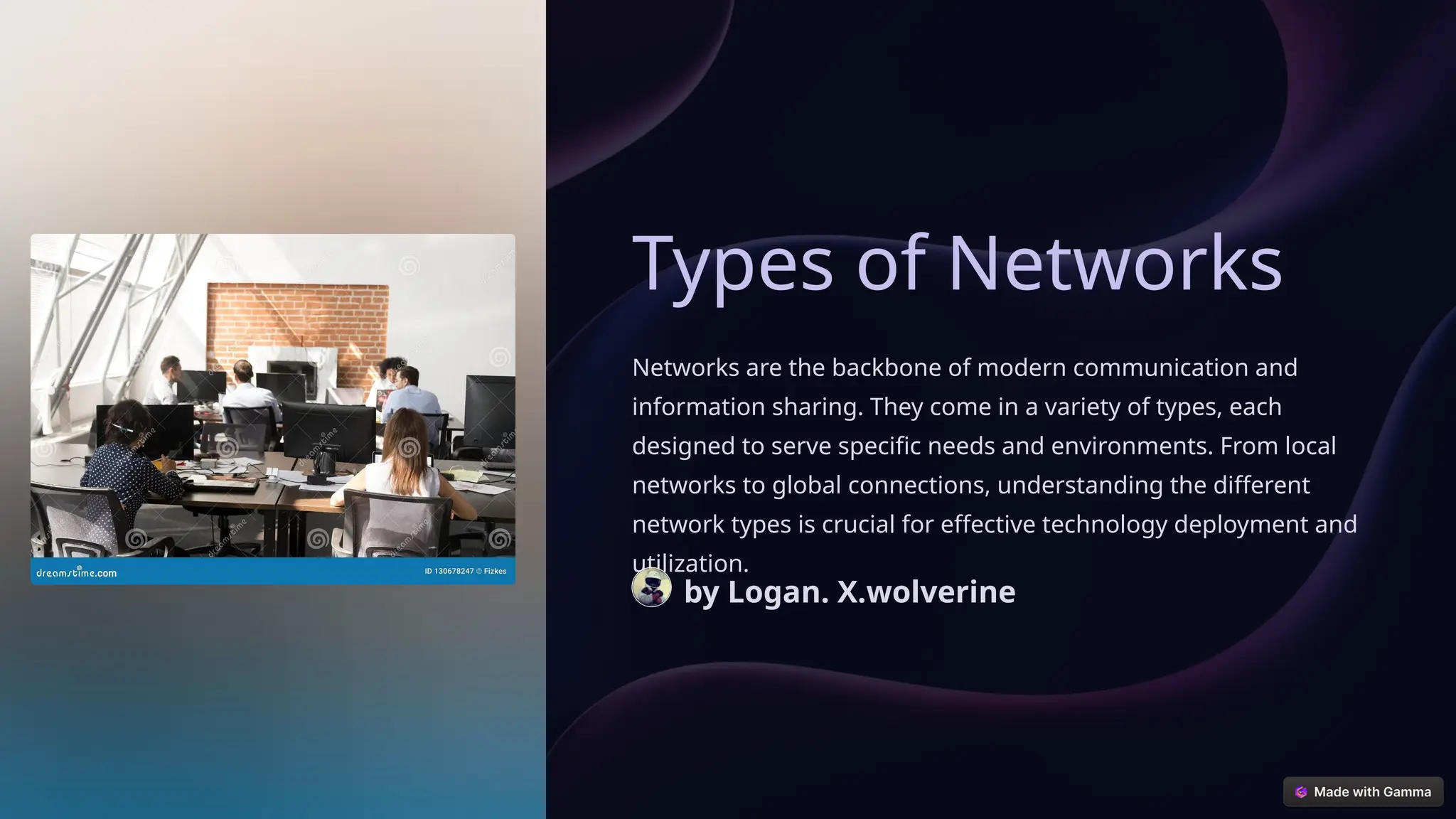
Networks are the backbone of modern communication and
information sharing. They come in a variety of types, each
designed to serve specific needs and environments. From local
networks to global connections, understanding the different
network types is crucial for effective technology deployment and
utilization.
by Logan. X.wolverine
Local Area Network (LAN)
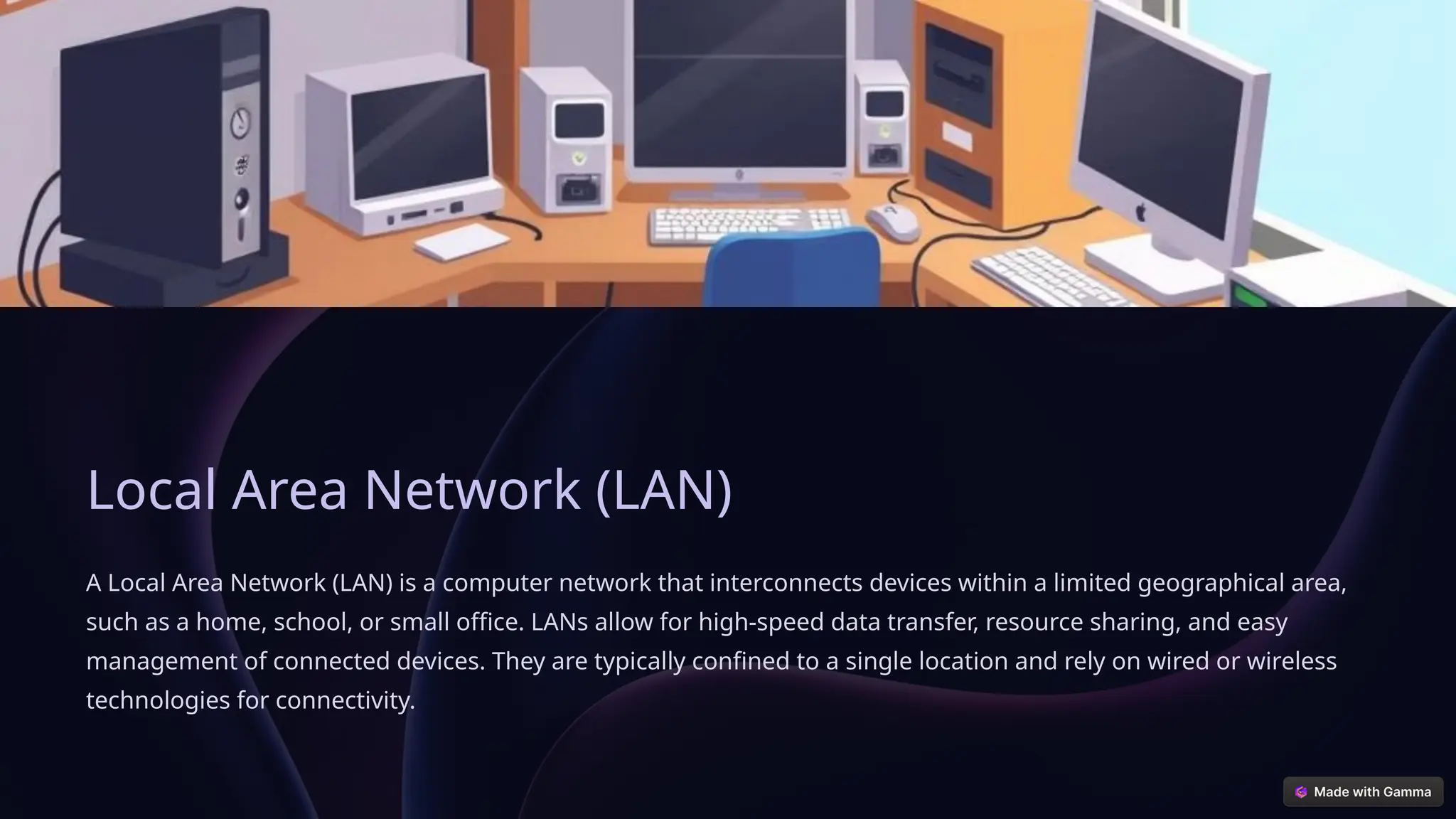
A Local Area Network (LAN) is a computer network that interconnects devices within a limited geographical area,
such as a home, school, or small office. LANs allow for high-speed data transfer, resource sharing, and easy
management of connected devices. They are typically confined to a single location and rely on wired or wireless
technologies for connectivity.
Wide Area Network (WAN)
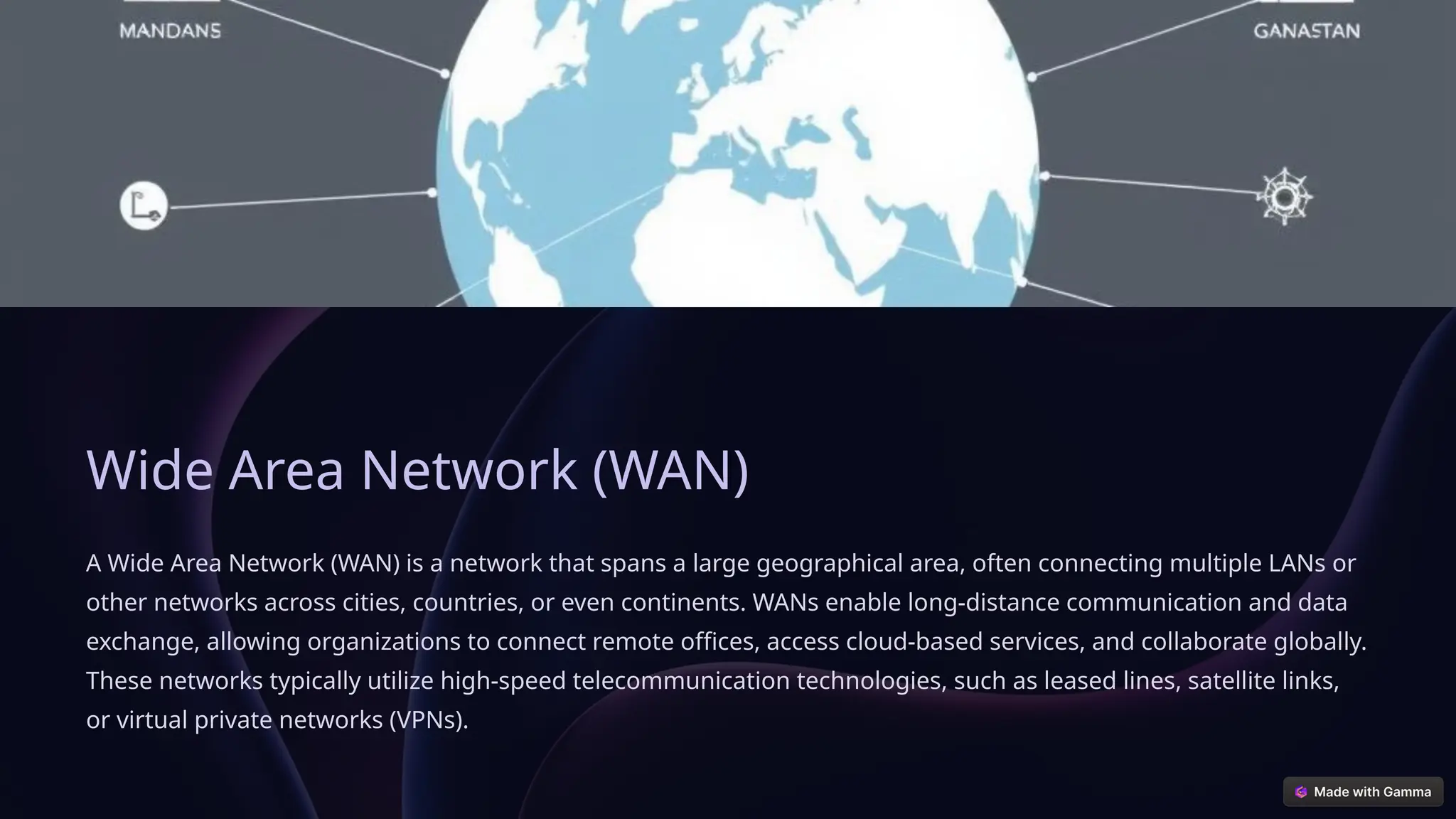
A Wide Area Network (WAN) is a network that spans a large geographical area, often connecting multiple LANs or
other networks across cities, countries, or even continents. WANs enable long-distance communication and data
exchange, allowing organizations to connect remote offices, access cloud-based services, and collaborate globally.
These networks typically utilize high-speed telecommunication technologies, such as leased lines, satellite links,
or virtual private networks (VPNs).
Metropolitan Area Network (MAN)
Overview
A Metropolitan Area Network
(MAN) is a computer network that
covers a metropolitan area,
typically a city or a large town.
MANs are larger in scale than
LANs but smaller than WANs,
often serving an entire city or
region.
Applications
MANs are commonly used to
interconnect LANs within a city,
enabling resource sharing, data
exchange, and coordinated
services among organizations and
communities. They are also used
for municipal services, such as
traffic control, public safety, and
smart city initiatives.
Technologies
MANs often utilize fiber-optic
cables, high-speed wireless
technologies, or a combination of
both to provide reliable and high-
bandwidth connections across the
metropolitan area.
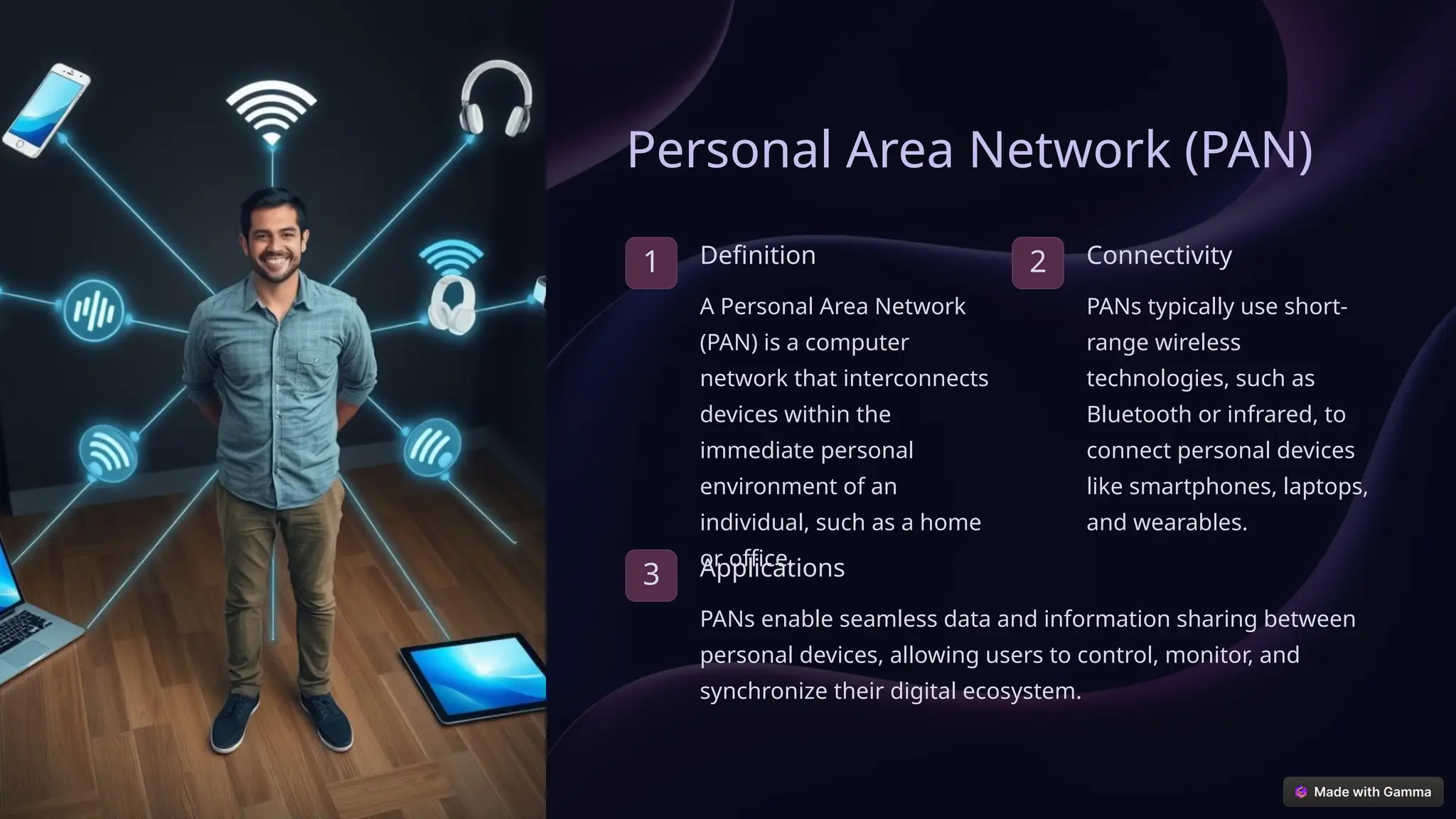
Personal Area Network (PAN)
1 Definition
A Personal Area Network
(PAN) is a computer
network that interconnects
devices within the
immediate personal
environment of an
individual, such as a home
or office.
2 Connectivity
PANs typically use short-
range wireless
technologies, such as
Bluetooth or infrared, to
connect personal devices
like smartphones, laptops,
and wearables.
3 Applications
PANs enable seamless data and information sharing between
personal devices, allowing users to control, monitor, and
synchronize their digital ecosystem.
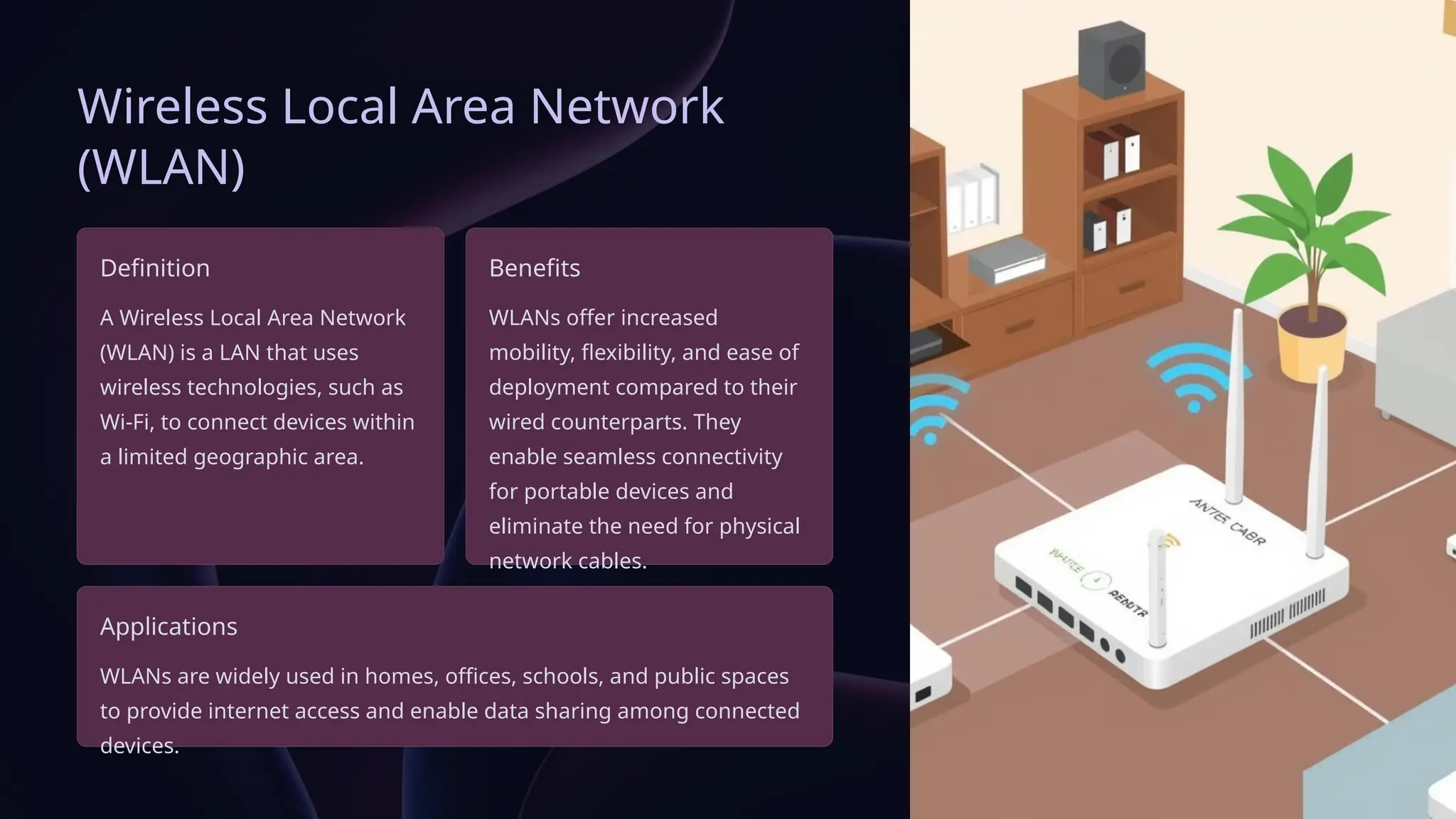
Wireless Local Area Network
(WLAN)
Definition
A Wireless Local Area Network
(WLAN) is a LAN that uses
wireless technologies, such as
Wi-Fi, to connect devices within
a limited geographic area.
Benefits
WLANs offer increased
mobility, flexibility, and ease of
deployment compared to their
wired counterparts. They
enable seamless connectivity
for portable devices and
eliminate the need for physical
network cables.
Applications
WLANs are widely used in homes, offices, schools, and public spaces
to provide internet access and enable data sharing among connected
devices.
Virtual Private Network (VPN)
Security
VPNs create a secure, encrypted
connection between a user's device
and a remote network, protecting
sensitive data from unauthorized
access.
Global Connectivity
VPNs enable users to access
resources and services from
anywhere in the world, overcoming
geographical restrictions and
content limitations.
Privacy
VPNs help protect user privacy by
masking the user's IP address and
hiding their online activities from
prying eyes.
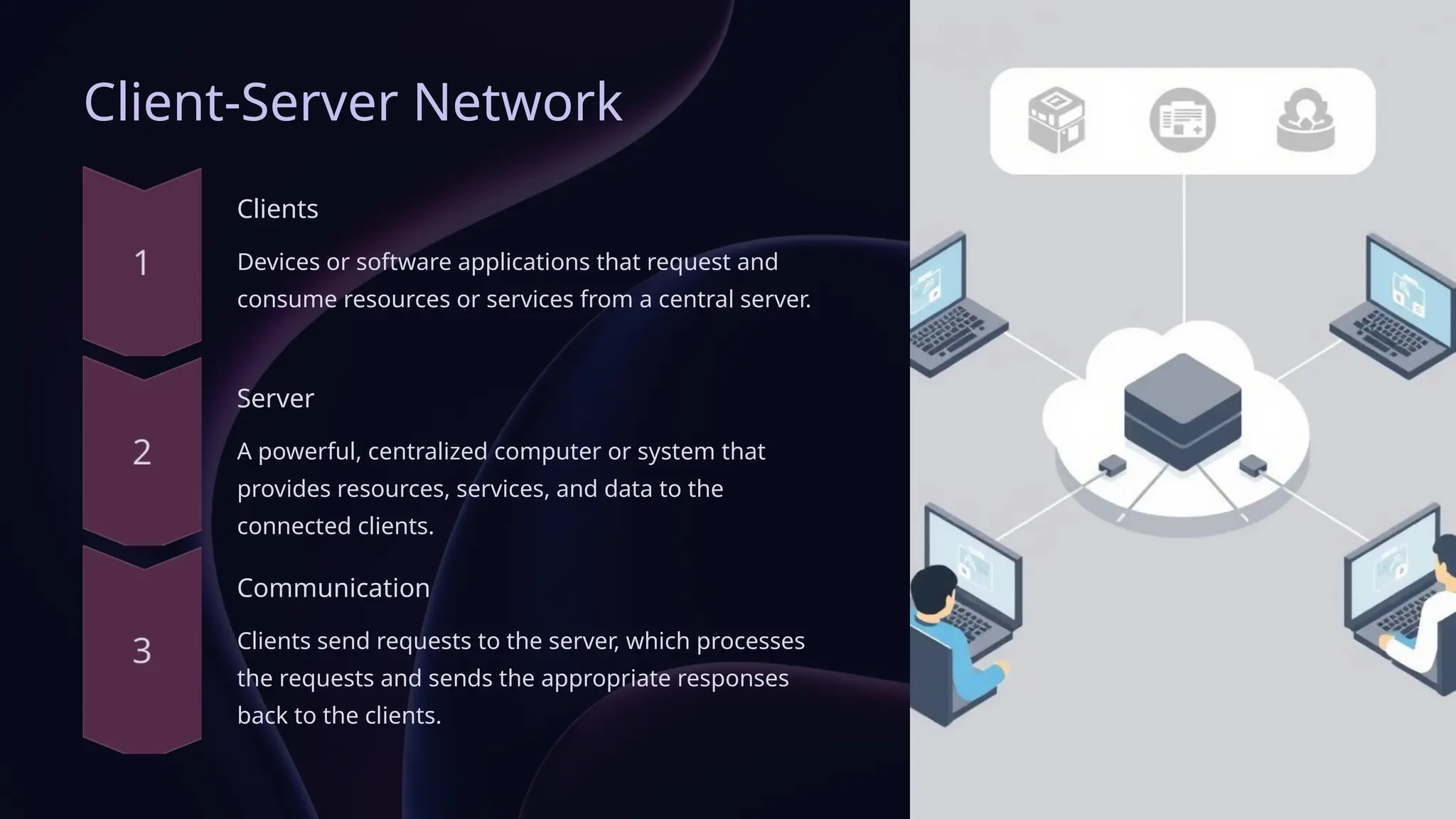
Client-Server Network
Clients
Devices or software applications that request and
consume resources or services from a central server.
Server
A powerful, centralized computer or system that
provides resources, services, and data to the
connected clients.
Communication
Clients send requests to the server, which processes
the requests and sends the appropriate responses
back to the clients.
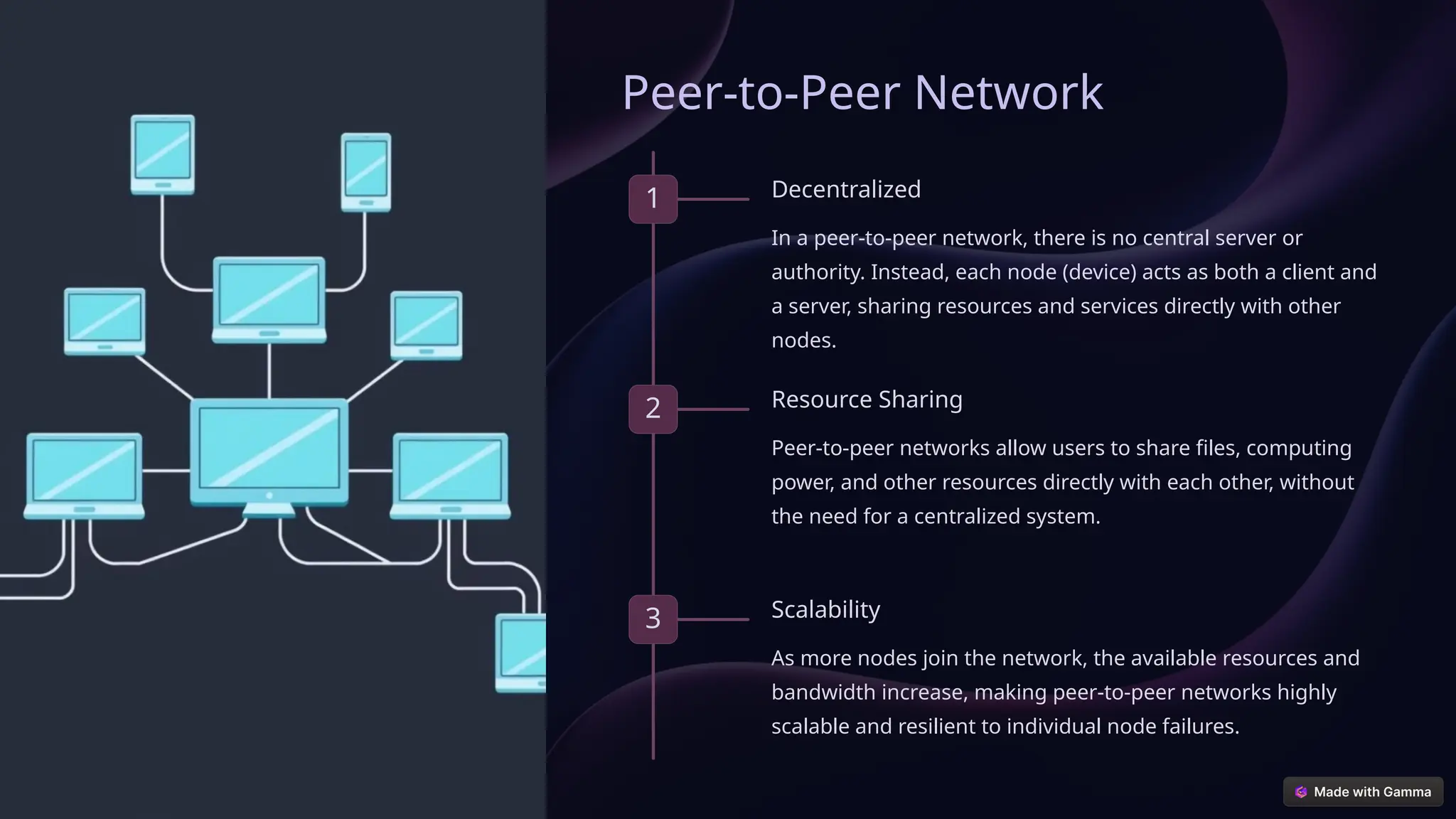
Peer-to-Peer Network
1 Decentralized
In a peer-to-peer network, there is no central server or
authority. Instead, each node (device) acts as both a client and
a server, sharing resources and services directly with other
nodes.
2 Resource Sharing
Peer-to-peer networks allow users to share files, computing
power, and other resources directly with each other, without
the need for a centralized system.
3 Scalability
As more nodes join the network, the available resources and
bandwidth increase, making peer-to-peer networks highly
scalable and resilient to individual node failures.
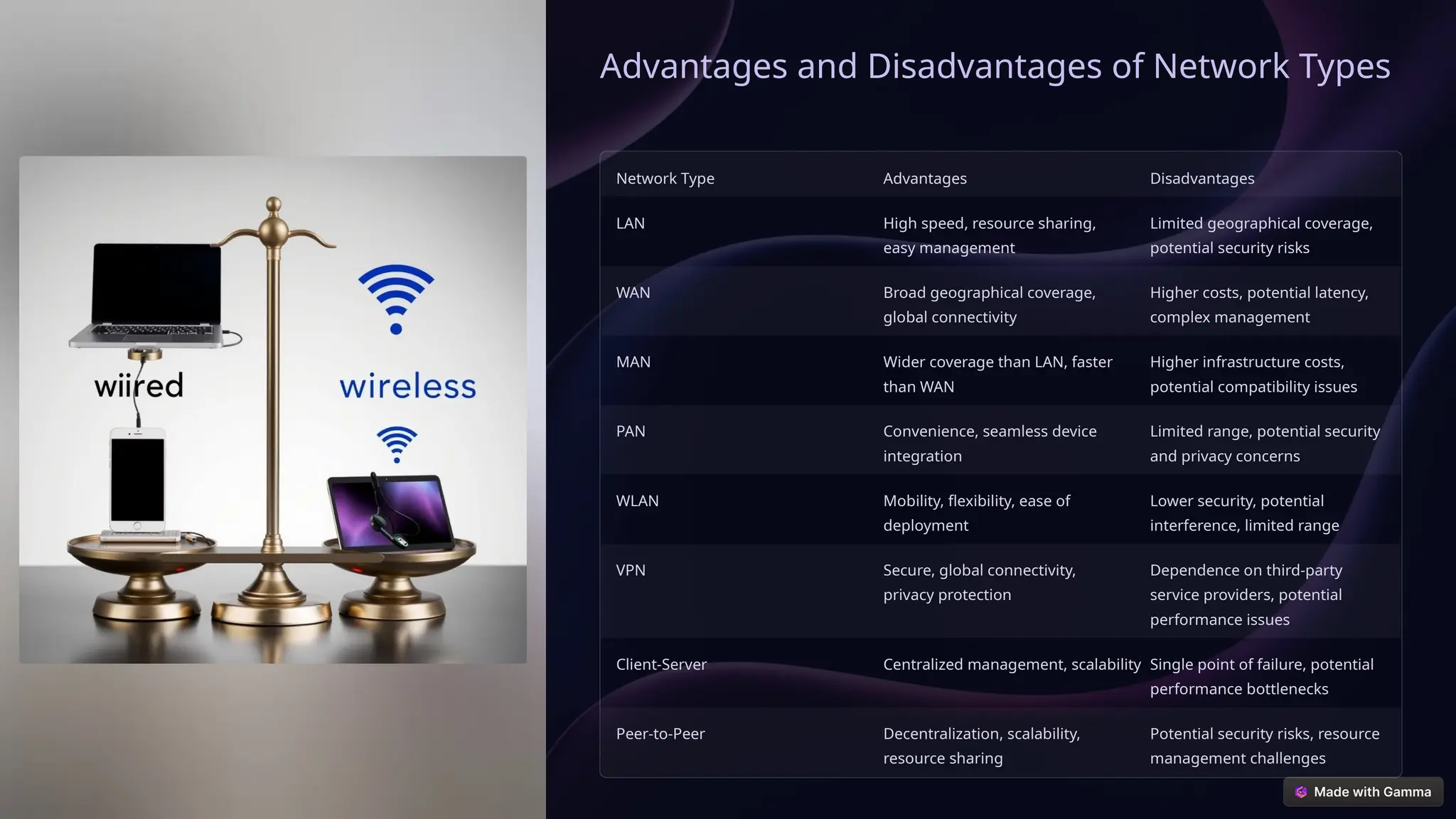
Advantages and Disadvantages of Network Types
Network Type Advantages Disadvantages
LAN High speed, resource sharing,
easy management
Limited geographical coverage,
potential security risks
WAN Broad geographical coverage,
global connectivity
Higher costs, potential latency,
complex management
MAN Wider coverage than LAN, faster
than WAN
Higher infrastructure costs,
potential compatibility issues
PAN Convenience, seamless device
integration
Limited range, potential security
and privacy concerns
WLAN Mobility, flexibility, ease of
deployment
Lower security, potential
interference, limited range
VPN Secure, global connectivity,
privacy protection
Dependence on third-party
service providers, potential
performance issues
Client-Server Centralized management, scalability Single point of failure, potential
performance bottlenecks
Peer-to-Peer Decentralization, scalability,
resource sharing
Potential security risks, resource
management challenges

Types of Networks, Its definition, types- LAN, MAN, WAN, PAN,

  • 1.
    TYPES OF NETWORK TAGOREGOVERNMENT COLLEGE OF EDUCATION PRESENTED BY ISHAN IBRAHIM PEDAGOGY OF COMPUTER SCIENCE B.SC. B.ED. 3RD YEAR (MATHEMATICS) (PRACTICUM 2)
  • 2.
    Types of Networks Networksare the backbone of modern communication and information sharing. They come in a variety of types, each designed to serve specific needs and environments. From local networks to global connections, understanding the different network types is crucial for effective technology deployment and utilization. by Logan. X.wolverine
  • 3.
    Local Area Network(LAN) A Local Area Network (LAN) is a computer network that interconnects devices within a limited geographical area, such as a home, school, or small office. LANs allow for high-speed data transfer, resource sharing, and easy management of connected devices. They are typically confined to a single location and rely on wired or wireless technologies for connectivity.
  • 4.
    Wide Area Network(WAN) A Wide Area Network (WAN) is a network that spans a large geographical area, often connecting multiple LANs or other networks across cities, countries, or even continents. WANs enable long-distance communication and data exchange, allowing organizations to connect remote offices, access cloud-based services, and collaborate globally. These networks typically utilize high-speed telecommunication technologies, such as leased lines, satellite links, or virtual private networks (VPNs).
  • 5.
    Metropolitan Area Network(MAN) Overview A Metropolitan Area Network (MAN) is a computer network that covers a metropolitan area, typically a city or a large town. MANs are larger in scale than LANs but smaller than WANs, often serving an entire city or region. Applications MANs are commonly used to interconnect LANs within a city, enabling resource sharing, data exchange, and coordinated services among organizations and communities. They are also used for municipal services, such as traffic control, public safety, and smart city initiatives. Technologies MANs often utilize fiber-optic cables, high-speed wireless technologies, or a combination of both to provide reliable and high- bandwidth connections across the metropolitan area.
  • 6.
    Personal Area Network(PAN) 1 Definition A Personal Area Network (PAN) is a computer network that interconnects devices within the immediate personal environment of an individual, such as a home or office. 2 Connectivity PANs typically use short- range wireless technologies, such as Bluetooth or infrared, to connect personal devices like smartphones, laptops, and wearables. 3 Applications PANs enable seamless data and information sharing between personal devices, allowing users to control, monitor, and synchronize their digital ecosystem.
  • 7.
    Wireless Local AreaNetwork (WLAN) Definition A Wireless Local Area Network (WLAN) is a LAN that uses wireless technologies, such as Wi-Fi, to connect devices within a limited geographic area. Benefits WLANs offer increased mobility, flexibility, and ease of deployment compared to their wired counterparts. They enable seamless connectivity for portable devices and eliminate the need for physical network cables. Applications WLANs are widely used in homes, offices, schools, and public spaces to provide internet access and enable data sharing among connected devices.
  • 8.
    Virtual Private Network(VPN) Security VPNs create a secure, encrypted connection between a user's device and a remote network, protecting sensitive data from unauthorized access. Global Connectivity VPNs enable users to access resources and services from anywhere in the world, overcoming geographical restrictions and content limitations. Privacy VPNs help protect user privacy by masking the user's IP address and hiding their online activities from prying eyes.
  • 9.
    Client-Server Network Clients Devices orsoftware applications that request and consume resources or services from a central server. Server A powerful, centralized computer or system that provides resources, services, and data to the connected clients. Communication Clients send requests to the server, which processes the requests and sends the appropriate responses back to the clients.
  • 10.
    Peer-to-Peer Network 1 Decentralized Ina peer-to-peer network, there is no central server or authority. Instead, each node (device) acts as both a client and a server, sharing resources and services directly with other nodes. 2 Resource Sharing Peer-to-peer networks allow users to share files, computing power, and other resources directly with each other, without the need for a centralized system. 3 Scalability As more nodes join the network, the available resources and bandwidth increase, making peer-to-peer networks highly scalable and resilient to individual node failures.
  • 11.
    Advantages and Disadvantagesof Network Types Network Type Advantages Disadvantages LAN High speed, resource sharing, easy management Limited geographical coverage, potential security risks WAN Broad geographical coverage, global connectivity Higher costs, potential latency, complex management MAN Wider coverage than LAN, faster than WAN Higher infrastructure costs, potential compatibility issues PAN Convenience, seamless device integration Limited range, potential security and privacy concerns WLAN Mobility, flexibility, ease of deployment Lower security, potential interference, limited range VPN Secure, global connectivity, privacy protection Dependence on third-party service providers, potential performance issues Client-Server Centralized management, scalability Single point of failure, potential performance bottlenecks Peer-to-Peer Decentralization, scalability, resource sharing Potential security risks, resource management challenges