Types of
multiple
choice
questions
True / False
select EITHER the 'true' (correct) OR the
'false' (incorrect) answer.
eg. True or false: Zafirlukast is a
leukotriene receptor antagonist.
Odd one out
You need to establish a pattern
amongst answer alternatives and then
choose which answer option is the
'odd one out'.
Common examples are number or
object patterns or sequences in
intelligence tests.
Most Accurate
In subjects where exact answers are less likely, you may
be asked to choose the 'most accurate' answer to a
question.
eg:Which of the following options provides the best
description of hypnosis?
a) high suggestibility
b) mind control
c) hallucinatory sleep
d) deep sleep
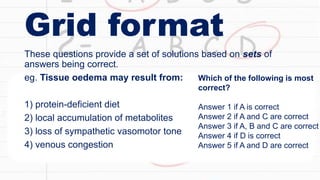
Grid format
These questions provide a set of solutions based on sets of
answers being correct.
eg. Tissue oedema may result from:
1) protein-deficient diet
2) local accumulation of metabolites
3) loss of sympathetic vasomotor tone
4) venous congestion
Which of the following is most
correct?
Answer 1 if A is correct
Answer 2 if A and C are correct
Answer 3 if A, B and C are correct
Answer 4 if D is correct
Answer 5 if A and D are correct
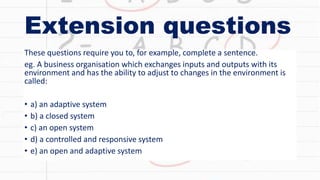
Extension questions
These questions require you to, for example, complete a sentence.
eg. A business organisation which exchanges inputs and outputs with its
environment and has the ability to adjust to changes in the environment is
called:
• a) an adaptive system
• b) a closed system
• c) an open system
• d) a controlled and responsive system
• e) an open and adaptive system
When you don’t
know the
answer…
As with all exams you
should always make a
calculated guess rather
than leave an question
blank. Here are some
tips to help you guess
'intelligently'.
Use a process of
elimination
Which answer is most likely to be correct?
Is it in the right range?
Does it sound reasonable?
Be wary of extremes and
generalisations
Words like
‘always’, ‘only’, ‘never’
indicate that the answer is less likely
to be correct.
Favour look-alike options
Which of the following is least likely to be correct,
given that three of them deal with aspects of the
same topic?
a) Tourism
b) Tourists
c) Tourism promoters
d) Fairy Penguins
Favour more inclusive options
Which of these is more likely to be
correct?
a) An adaptive system
b) An open system
c) A closed system
d) An open and adaptive system

Types of multiple choice questions

  • 1.
  • 2.
    True / False selectEITHER the 'true' (correct) OR the 'false' (incorrect) answer. eg. True or false: Zafirlukast is a leukotriene receptor antagonist.
  • 3.
    Odd one out Youneed to establish a pattern amongst answer alternatives and then choose which answer option is the 'odd one out'. Common examples are number or object patterns or sequences in intelligence tests.
  • 4.
    Most Accurate In subjectswhere exact answers are less likely, you may be asked to choose the 'most accurate' answer to a question. eg:Which of the following options provides the best description of hypnosis? a) high suggestibility b) mind control c) hallucinatory sleep d) deep sleep
  • 5.
    Grid format These questionsprovide a set of solutions based on sets of answers being correct. eg. Tissue oedema may result from: 1) protein-deficient diet 2) local accumulation of metabolites 3) loss of sympathetic vasomotor tone 4) venous congestion Which of the following is most correct? Answer 1 if A is correct Answer 2 if A and C are correct Answer 3 if A, B and C are correct Answer 4 if D is correct Answer 5 if A and D are correct
  • 6.
    Extension questions These questionsrequire you to, for example, complete a sentence. eg. A business organisation which exchanges inputs and outputs with its environment and has the ability to adjust to changes in the environment is called: • a) an adaptive system • b) a closed system • c) an open system • d) a controlled and responsive system • e) an open and adaptive system
  • 7.
    When you don’t knowthe answer…
  • 8.
    As with allexams you should always make a calculated guess rather than leave an question blank. Here are some tips to help you guess 'intelligently'.
  • 9.
    Use a processof elimination Which answer is most likely to be correct? Is it in the right range? Does it sound reasonable?
  • 10.
    Be wary ofextremes and generalisations Words like ‘always’, ‘only’, ‘never’ indicate that the answer is less likely to be correct.
  • 11.
    Favour look-alike options Whichof the following is least likely to be correct, given that three of them deal with aspects of the same topic? a) Tourism b) Tourists c) Tourism promoters d) Fairy Penguins
  • 12.
    Favour more inclusiveoptions Which of these is more likely to be correct? a) An adaptive system b) An open system c) A closed system d) An open and adaptive system