FUNCTIONS
FUNCTIONS
FUNCTIONS
PROBLEMS BASED ON
DOMAIN & RANGE
FUNCTIONS
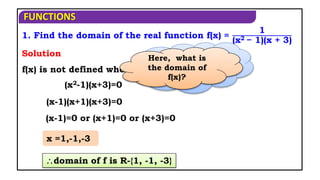
1. Find the domain of the real function f(x) =
1
(x2 − 1)(x + 3)
f(x) is not defined when,
(x2-1)(x+3)=0
(x-1)(x+1)(x+3)=0
x =1,-1,-3
domain of f is R-{1, -1, -3}
Solution
(x-1)=0 or (x+1)=0 or (x+3)=0
Given function is
in the form of
1
f(x)
Here, what is
the domain of
f(x)?
FUNCTIONS
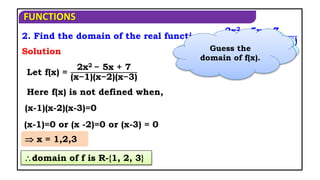
2. Find the domain of the real function
2x2 − 5x + 7
(x − 1) (x − 2) (x − 3)
Here f(x) is not defined when,
(x-1)(x-2)(x-3)=0
Let f(x) =
2x2 − 5x + 7
(x−1)(x−2)(x−3)
Solution
(x-1)=0 or (x -2)=0 or (x-3) = 0
Where f(x) is not
defined?
 x = 1,2,3
domain of f is R-{1, 2, 3}
Guess the
domain of f(x).
FUNCTIONS
3. Find the domain of the real function f(x)= 16 − x𝟐
Domain of f(x) is [-4, 4]
16−x𝟐 is defined when,
x2 -16  0
x  [-4, 4]
Solution
(x + 4) (x - 4)  0
16 - x2  0
When f(x) is
defined?
If
(x-) (x-)≤0x[,]
(x-(-4)(x - 4)  0
FUNCTIONS
Domain of f(x) is (-, -5][5, )
4. Find the domain of the real function f(x) = x𝟐 − 25
x𝟐 − 25 is defined when,
(x-5)(x+5)  0
x(-, -5][5, )
Solution
x𝟐
− 25  0
x-5 x  5
(or)
When f(x) is
defined?
(x-5)(x-(-5))  0
If
(x-) (x-)≥0x(-, ][, )
x≤ or x≥ 
FUNCTIONS
5. Find the domain of the real function f(x) = 4x − x𝟐
Domain of f(x) is [0,4]
4x − x𝟐 is defined when,
x𝟐
-4x  0
x[0,4]
(x-0)(x-4)  0
Solution
4x − x𝟐
 0
x(x-4)  0
0x 4
When f(x) is
defined?
If
(x-) (x-)≤0x[,]
FUNCTIONS
6. Find the domain of the real function f(x) = 2−x + 1+x
x  -1(2)
2−x is defined when,
x - 2  0
1+x is defined when,
Solution
2 - x  0
x  2(1)
1 + x  0
Here we find
domain of
2−x , 1+x
seperately
When 2−x is
defined?
When 1+x is
defined?
-2 -1 0 1 2 
-
Hence from (1)
-1  x  2 x  [-1, 2]
and (2)
FUNCTIONS
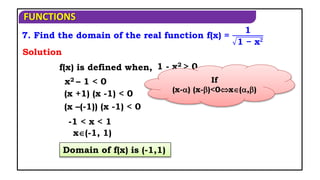
7. Find the domain of the real function f(x) =
1
1 − x𝟐
f(x) is defined when,
x2 – 1 < 0
Solution
(x +1) (x -1) < 0
1 - x2 > 0
(x –(-1)) (x -1) < 0
Domain of f(x) is (-1,1)
x(-1, 1)
-1 < x < 1
If
(x-) (x-)<0x(,)
FUNCTIONS
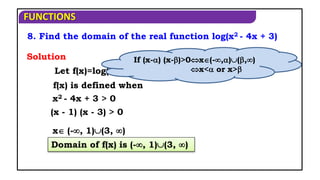
8. Find the domain of the real function log(x2 - 4x + 3)
Let f(x)=log(x2 -4x + 3)
f(x) is defined when
(x - 1) (x - 3) > 0
Domain of f(x) is (-, 1)(3, )
x (-, 1)(3, )
Solution
x2 - 4x + 3 > 0
If (x-) (x-)>0x(-,)(,)
x< or x>
FUNCTIONS
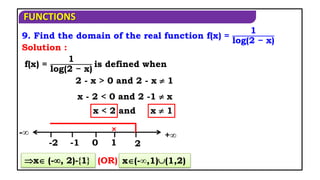
9. Find the domain of the real function f(x) =
1
log(2 − x)
2 - x > 0 and 2 - x  1
x - 2 < 0 and 2 -1  x
f(x) =
1
log(2 − x)
is defined when
Solution :
x < 2 and x  1
2
1
0
-1
-2
×
-∞ +∞
(OR) x(-∞,1)(1,2)
x (-, 2)-{1}
FUNCTIONS
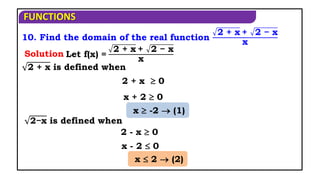
10. Find the domain of the real function
2 + x + 2 − x
x
Let f(x) =
2 + x + 2 − x
x
2 + x is defined when
x + 2  0
2−x is defined when
Solution
2 + x  0
x  -2  (1)
2 - x  0
x - 2  0
x  2  (2)
FUNCTIONS
2
1
0
-1
-2
×
-∞ +∞
From (1), (2) and (3)
1
x
is defined when x  0(3)
x  -2  (1)
x  2  (2)
 x  [-2, 0)  (0, 2]
FUNCTIONS
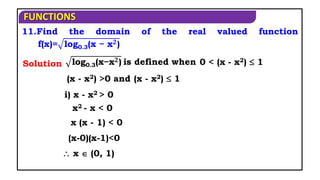
11.Find the domain of the real valued function
f(x)= log0.3(x − x𝟐)
log0.3(x−x𝟐) is defined when
Solution 0 < (x - x2)  1
(x - x2) >0 and (x - x2)  1
i) x - x2 > 0
x2 - x < 0
x (x - 1) < 0
(x-0)(x-1)<0
 x  (0, 1)
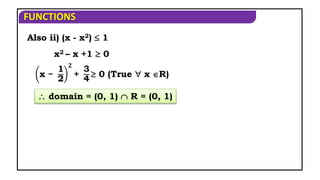
FUNCTIONS
Also ii) (x - x2)  1
x2 – x +1  0
x −
1
2
𝟐
+
3
4
 0 (True  x R)
 domain = (0, 1)  R = (0, 1)
FUNCTIONS
12. Find the domain f(x)= x − [x]
Domain of f(x) is R
x − [x] is defined when
Solution
x - [x]  0 
which is true  x  R
x  [x]
When f(x)
is defined?
FUNCTIONS
13. Find the domain of f(x)= [x]−x
But [x] > x is not possible.
f(x) exists when
[x] > x (or)
Now [x] = x
Domain of f(x) is Z
Solution
[x] - x  0
[x]  x
[x] = x
 x  Z
So, we must have [x] = x
Is it
possible?
FUNCTIONS
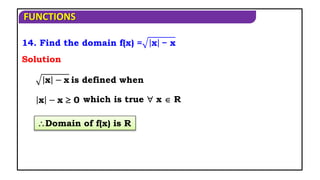
14. Find the domain f(x) = x − x
Domain of f(x) is R
x − x is defined when
Solution
x − x  0 which is true  x  R
FUNCTIONS
15. Find the domain of f(x) = log(x - [x]) ?
 Domain of f(x) is R - Z.
log(x - [x]) is defined when
Solution
x - [x] > 0
x > [x] which is true  x R - Z.
FUNCTIONS
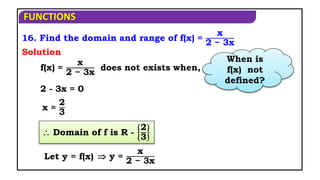
16. Find the domain and range of f(x) =
x
2 − 3x
f(x) =
x
2 − 3x
does not exists when,
 Domain of f is R -
2
3
Let y = f(x)
Solution
2 - 3x = 0
x =
2
3
 y =
x
2 − 3x
When is
f(x) not
defined?
FUNCTIONS
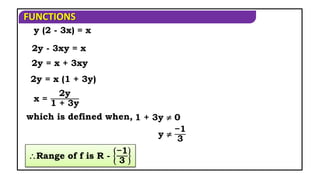
2y - 3xy = x
x =
2y
1 + 3y
Range of f is R -
−1
3
y (2 - 3x) = x
2y = x (1 + 3y)
which is defined when, 1 + 3y  0
y 
−1
3
2y = x + 3xy
FUNCTIONS
17. Find the domain and range of the f(x)= 9−x𝟐
Domain of f(x) is [-3, 3]
(i) Domain
f(x)= 9 − x𝟐 is defined when,
x2 – 9  0
x  [-3, 3]
Solution
9 - x2  0
(x + 3) (x - 3)  0
-3  x  3
(x – (-3)) (x - 3)  0
FUNCTIONS
(ii) Range
We know that x2  0
The range of the f(x) is [0, 3]
-x2  0
9 – x2  9
9 − x2  3
and We know that 9−x2  0
𝟎 9−x2 (2)
From (1) & (2), 𝟎  9 − x2  3
f(x)= 9−x𝟐 0,  x  [-3,3]
(1)
FUNCTIONS
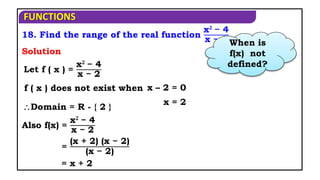
18. Find the range of the real function
x𝟐
− 4
x − 2
Let f ( x ) =
x𝟐
− 4
x − 2
Solution
f ( x ) does not exist when x – 2 = 0
x = 2
Domain = R - { 2 }
Also f(x) =
x𝟐
− 4
x − 2
= x + 2
=
(x + 2) (x − 2)
(x − 2)
When is
f(x) not
defined?
FUNCTIONS
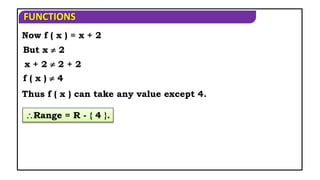
Now f ( x ) = x + 2
Thus f ( x ) can take any value except 4.
Range = R - { 4 }.
But x  2
x + 2  2 + 2
f ( x )  4
FUNCTIONS
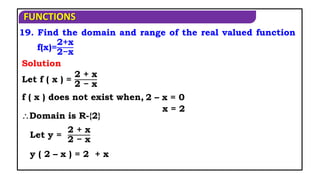
19. Find the domain and range of the real valued function
f(x)=
2+x
2−x
Domain is R-{2}
Let f ( x ) =
2 + x
2 − x
Let y =
2 + x
2 − x
Solution
2 – x = 0
f ( x ) does not exist when,
x = 2
y ( 2 – x ) = 2 + x
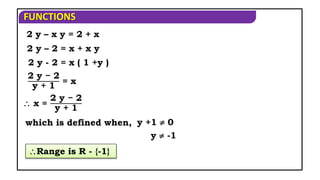
FUNCTIONS
y +1  0
Range is R - {-1}
2 y – x y = 2 + x
 x =
2 y − 2
y + 1
2 y – 2 = x + x y
2 y - 2 = x ( 1 +y )
which is defined when,
y  -1
2 y − 2
y + 1
= x
FUNCTIONS
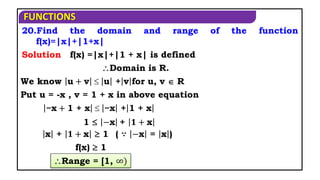
20.Find the domain and range of the function
f(x)=|x|+|1+x|
f(x) =|x|+|1 + x| is defined
Domain is R.
We know u + v  u + v for u, v  R
Put u = -x , v = 1 + x in above equation
x + 𝟏 + x  1
f(x)  1
Solution
1  −x + 𝟏 + x
−x + 1 + x  −x + 1 + x
( ∵ −x = x )
Range = [1, ∞)
FUNCTIONS
Thank you…

FUNCTION PROBLEMS FOR JEE ANS STATE BOARD PRACTICE

  • 1.
  • 2.
  • 3.
    FUNCTIONS 1. Find thedomain of the real function f(x) = 1 (x2 − 1)(x + 3) f(x) is not defined when, (x2-1)(x+3)=0 (x-1)(x+1)(x+3)=0 x =1,-1,-3 domain of f is R-{1, -1, -3} Solution (x-1)=0 or (x+1)=0 or (x+3)=0 Given function is in the form of 1 f(x) Here, what is the domain of f(x)?
  • 4.
    FUNCTIONS 2. Find thedomain of the real function 2x2 − 5x + 7 (x − 1) (x − 2) (x − 3) Here f(x) is not defined when, (x-1)(x-2)(x-3)=0 Let f(x) = 2x2 − 5x + 7 (x−1)(x−2)(x−3) Solution (x-1)=0 or (x -2)=0 or (x-3) = 0 Where f(x) is not defined?  x = 1,2,3 domain of f is R-{1, 2, 3} Guess the domain of f(x).
  • 5.
    FUNCTIONS 3. Find thedomain of the real function f(x)= 16 − x𝟐 Domain of f(x) is [-4, 4] 16−x𝟐 is defined when, x2 -16  0 x  [-4, 4] Solution (x + 4) (x - 4)  0 16 - x2  0 When f(x) is defined? If (x-) (x-)≤0x[,] (x-(-4)(x - 4)  0
  • 6.
    FUNCTIONS Domain of f(x)is (-, -5][5, ) 4. Find the domain of the real function f(x) = x𝟐 − 25 x𝟐 − 25 is defined when, (x-5)(x+5)  0 x(-, -5][5, ) Solution x𝟐 − 25  0 x-5 x  5 (or) When f(x) is defined? (x-5)(x-(-5))  0 If (x-) (x-)≥0x(-, ][, ) x≤ or x≥ 
  • 7.
    FUNCTIONS 5. Find thedomain of the real function f(x) = 4x − x𝟐 Domain of f(x) is [0,4] 4x − x𝟐 is defined when, x𝟐 -4x  0 x[0,4] (x-0)(x-4)  0 Solution 4x − x𝟐  0 x(x-4)  0 0x 4 When f(x) is defined? If (x-) (x-)≤0x[,]
  • 8.
    FUNCTIONS 6. Find thedomain of the real function f(x) = 2−x + 1+x x  -1(2) 2−x is defined when, x - 2  0 1+x is defined when, Solution 2 - x  0 x  2(1) 1 + x  0 Here we find domain of 2−x , 1+x seperately When 2−x is defined? When 1+x is defined? -2 -1 0 1 2  - Hence from (1) -1  x  2 x  [-1, 2] and (2)
  • 9.
    FUNCTIONS 7. Find thedomain of the real function f(x) = 1 1 − x𝟐 f(x) is defined when, x2 – 1 < 0 Solution (x +1) (x -1) < 0 1 - x2 > 0 (x –(-1)) (x -1) < 0 Domain of f(x) is (-1,1) x(-1, 1) -1 < x < 1 If (x-) (x-)<0x(,)
  • 10.
    FUNCTIONS 8. Find thedomain of the real function log(x2 - 4x + 3) Let f(x)=log(x2 -4x + 3) f(x) is defined when (x - 1) (x - 3) > 0 Domain of f(x) is (-, 1)(3, ) x (-, 1)(3, ) Solution x2 - 4x + 3 > 0 If (x-) (x-)>0x(-,)(,) x< or x>
  • 11.
    FUNCTIONS 9. Find thedomain of the real function f(x) = 1 log(2 − x) 2 - x > 0 and 2 - x  1 x - 2 < 0 and 2 -1  x f(x) = 1 log(2 − x) is defined when Solution : x < 2 and x  1 2 1 0 -1 -2 × -∞ +∞ (OR) x(-∞,1)(1,2) x (-, 2)-{1}
  • 12.
    FUNCTIONS 10. Find thedomain of the real function 2 + x + 2 − x x Let f(x) = 2 + x + 2 − x x 2 + x is defined when x + 2  0 2−x is defined when Solution 2 + x  0 x  -2  (1) 2 - x  0 x - 2  0 x  2  (2)
  • 13.
    FUNCTIONS 2 1 0 -1 -2 × -∞ +∞ From (1),(2) and (3) 1 x is defined when x  0(3) x  -2  (1) x  2  (2)  x  [-2, 0)  (0, 2]
  • 14.
    FUNCTIONS 11.Find the domainof the real valued function f(x)= log0.3(x − x𝟐) log0.3(x−x𝟐) is defined when Solution 0 < (x - x2)  1 (x - x2) >0 and (x - x2)  1 i) x - x2 > 0 x2 - x < 0 x (x - 1) < 0 (x-0)(x-1)<0  x  (0, 1)
  • 15.
    FUNCTIONS Also ii) (x- x2)  1 x2 – x +1  0 x − 1 2 𝟐 + 3 4  0 (True  x R)  domain = (0, 1)  R = (0, 1)
  • 16.
    FUNCTIONS 12. Find thedomain f(x)= x − [x] Domain of f(x) is R x − [x] is defined when Solution x - [x]  0  which is true  x  R x  [x] When f(x) is defined?
  • 17.
    FUNCTIONS 13. Find thedomain of f(x)= [x]−x But [x] > x is not possible. f(x) exists when [x] > x (or) Now [x] = x Domain of f(x) is Z Solution [x] - x  0 [x]  x [x] = x  x  Z So, we must have [x] = x Is it possible?
  • 18.
    FUNCTIONS 14. Find thedomain f(x) = x − x Domain of f(x) is R x − x is defined when Solution x − x  0 which is true  x  R
  • 19.
    FUNCTIONS 15. Find thedomain of f(x) = log(x - [x]) ?  Domain of f(x) is R - Z. log(x - [x]) is defined when Solution x - [x] > 0 x > [x] which is true  x R - Z.
  • 20.
    FUNCTIONS 16. Find thedomain and range of f(x) = x 2 − 3x f(x) = x 2 − 3x does not exists when,  Domain of f is R - 2 3 Let y = f(x) Solution 2 - 3x = 0 x = 2 3  y = x 2 − 3x When is f(x) not defined?
  • 21.
    FUNCTIONS 2y - 3xy= x x = 2y 1 + 3y Range of f is R - −1 3 y (2 - 3x) = x 2y = x (1 + 3y) which is defined when, 1 + 3y  0 y  −1 3 2y = x + 3xy
  • 22.
    FUNCTIONS 17. Find thedomain and range of the f(x)= 9−x𝟐 Domain of f(x) is [-3, 3] (i) Domain f(x)= 9 − x𝟐 is defined when, x2 – 9  0 x  [-3, 3] Solution 9 - x2  0 (x + 3) (x - 3)  0 -3  x  3 (x – (-3)) (x - 3)  0
  • 23.
    FUNCTIONS (ii) Range We knowthat x2  0 The range of the f(x) is [0, 3] -x2  0 9 – x2  9 9 − x2  3 and We know that 9−x2  0 𝟎 9−x2 (2) From (1) & (2), 𝟎  9 − x2  3 f(x)= 9−x𝟐 0,  x  [-3,3] (1)
  • 24.
    FUNCTIONS 18. Find therange of the real function x𝟐 − 4 x − 2 Let f ( x ) = x𝟐 − 4 x − 2 Solution f ( x ) does not exist when x – 2 = 0 x = 2 Domain = R - { 2 } Also f(x) = x𝟐 − 4 x − 2 = x + 2 = (x + 2) (x − 2) (x − 2) When is f(x) not defined?
  • 25.
    FUNCTIONS Now f (x ) = x + 2 Thus f ( x ) can take any value except 4. Range = R - { 4 }. But x  2 x + 2  2 + 2 f ( x )  4
  • 26.
    FUNCTIONS 19. Find thedomain and range of the real valued function f(x)= 2+x 2−x Domain is R-{2} Let f ( x ) = 2 + x 2 − x Let y = 2 + x 2 − x Solution 2 – x = 0 f ( x ) does not exist when, x = 2 y ( 2 – x ) = 2 + x
  • 27.
    FUNCTIONS y +1 0 Range is R - {-1} 2 y – x y = 2 + x  x = 2 y − 2 y + 1 2 y – 2 = x + x y 2 y - 2 = x ( 1 +y ) which is defined when, y  -1 2 y − 2 y + 1 = x
  • 28.
    FUNCTIONS 20.Find the domainand range of the function f(x)=|x|+|1+x| f(x) =|x|+|1 + x| is defined Domain is R. We know u + v  u + v for u, v  R Put u = -x , v = 1 + x in above equation x + 𝟏 + x  1 f(x)  1 Solution 1  −x + 𝟏 + x −x + 1 + x  −x + 1 + x ( ∵ −x = x ) Range = [1, ∞)
  • 29.