Types of Data Cables
Cat5, Cat5e, Cat6, Cat6a, Cat7
https://www.cablify.ca
FR
Data Cable Type
Eth ern et cab les
We use Data cables in our office and home. Also
called Ethernet cables, these cables have seen a
major transformation capable of carrying huge
amounts of data. Data Cables can be divided
into different categories with each category
having certain strengths and weaknesses. Each
category offers different data transmitting
speeds, an electromagnetic shield, frequency
range, and gauge size (SWG or AWG). Let’s
discuss these cable types in details.
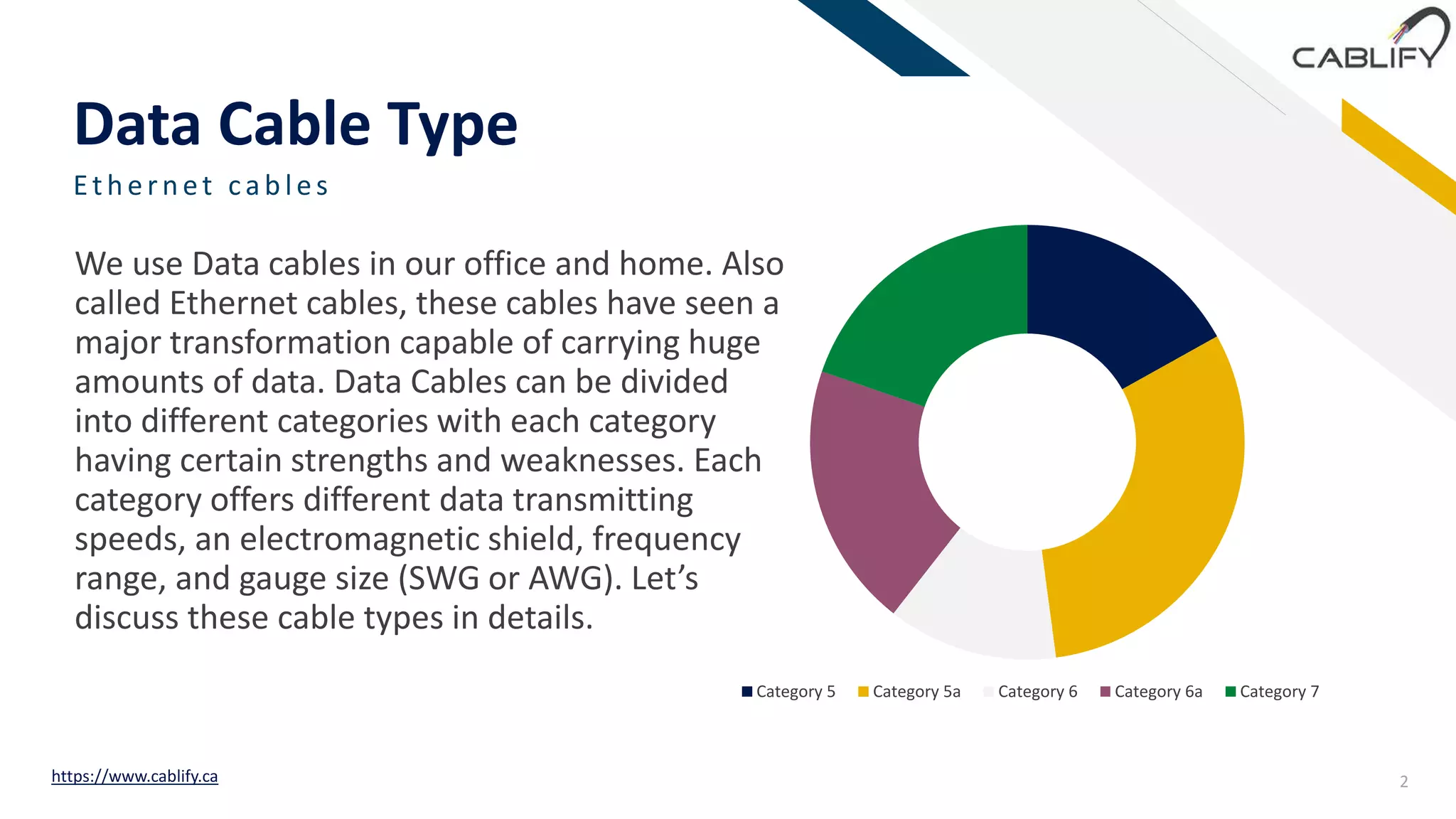
Chart Title
Category 5 Category 5a Category 6 Category 6a Category 7
2https://www.cablify.ca
FR
Cat 5e Cable
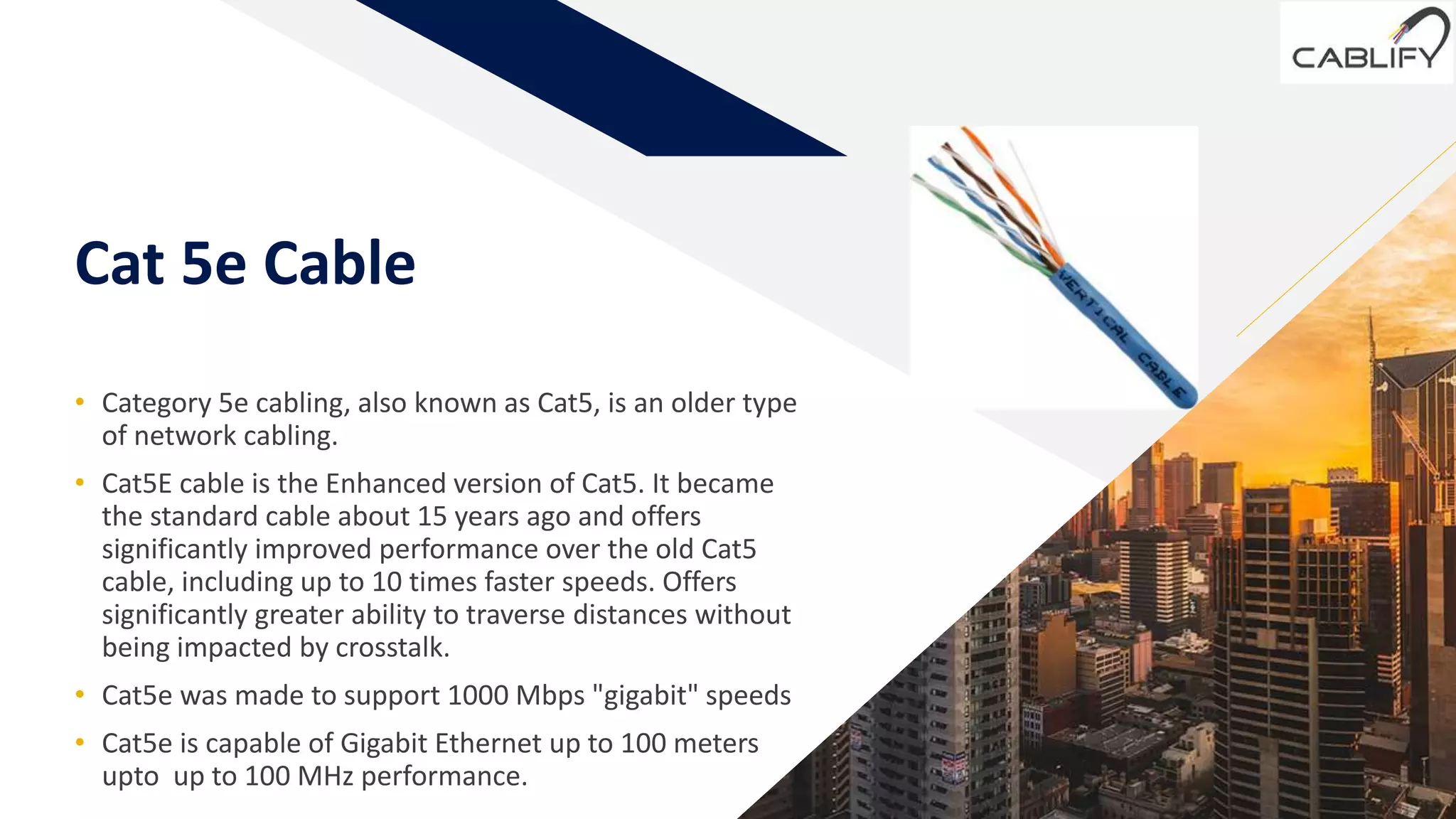
• Category 5e cabling, also known as Cat5, is an older type
of network cabling.
• Cat5E cable is the Enhanced version of Cat5. It became
the standard cable about 15 years ago and offers
significantly improved performance over the old Cat5
cable, including up to 10 times faster speeds. Offers
significantly greater ability to traverse distances without
being impacted by crosstalk.
• Cat5e was made to support 1000 Mbps "gigabit" speeds
• Cat5e is capable of Gigabit Ethernet up to 100 meters
upto up to 100 MHz performance. 3
FR
Cat 6 Cable
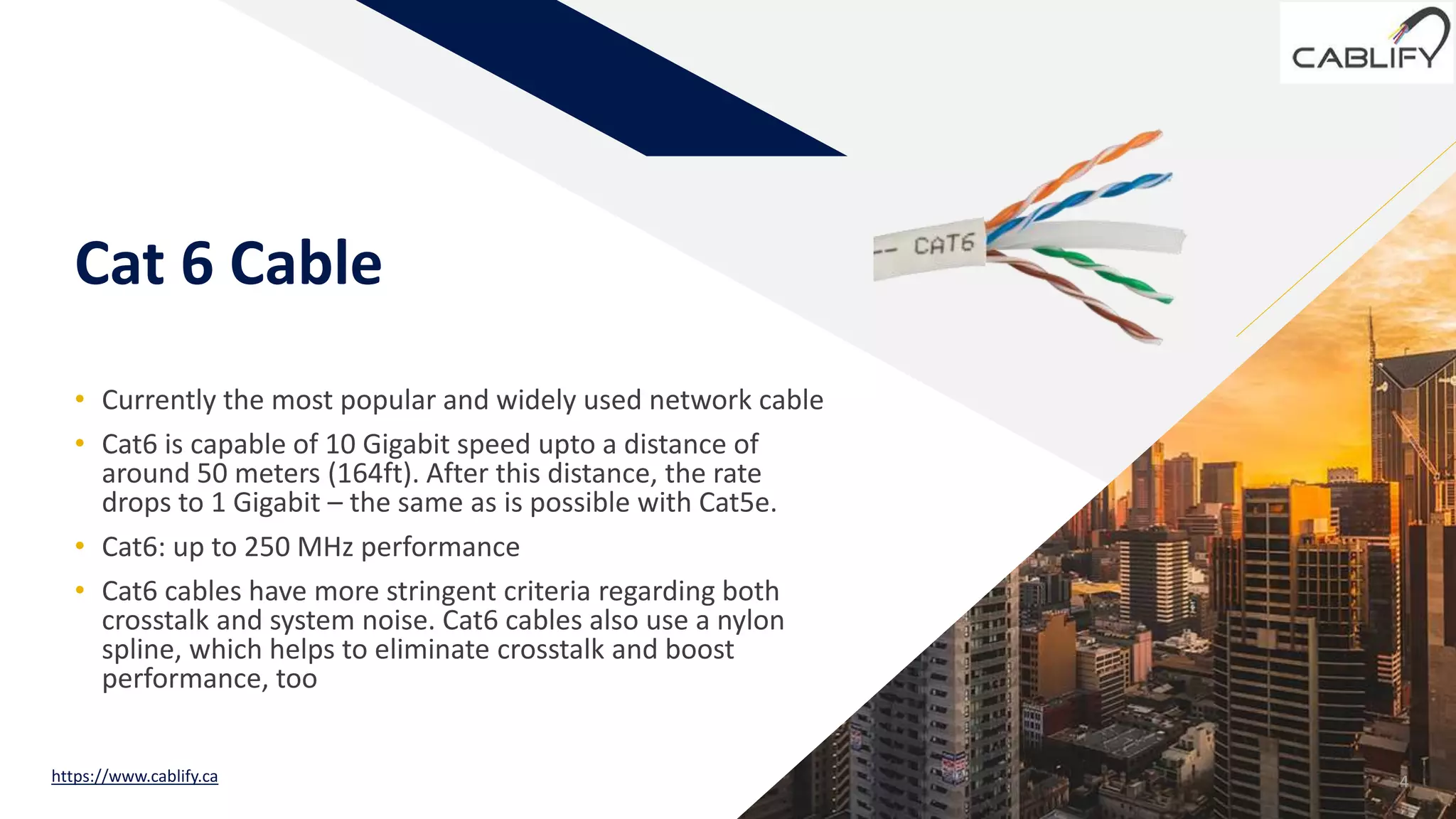
• Currently the most popular and widely used network cable
• Cat6 is capable of 10 Gigabit speed upto a distance of
around 50 meters (164ft). After this distance, the rate
drops to 1 Gigabit – the same as is possible with Cat5e.
• Cat6: up to 250 MHz performance
• Cat6 cables have more stringent criteria regarding both
crosstalk and system noise. Cat6 cables also use a nylon
spline, which helps to eliminate crosstalk and boost
performance, too
4https://www.cablify.ca
FR
Cat 6a Cable
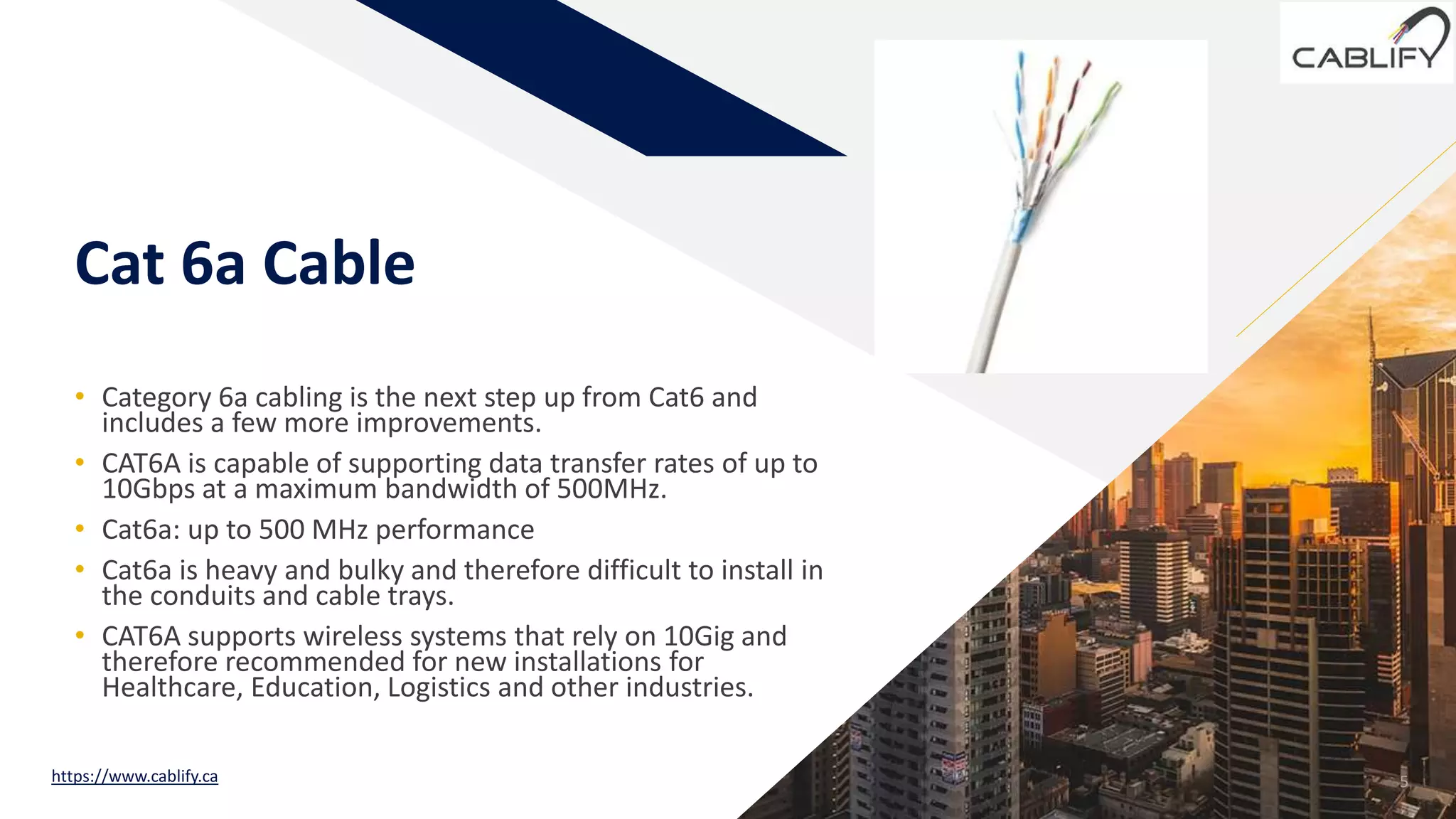
• Category 6a cabling is the next step up from Cat6 and
includes a few more improvements.
• CAT6A is capable of supporting data transfer rates of up to
10Gbps at a maximum bandwidth of 500MHz.
• Cat6a: up to 500 MHz performance
• Cat6a is heavy and bulky and therefore difficult to install in
the conduits and cable trays.
• CAT6A supports wireless systems that rely on 10Gig and
therefore recommended for new installations for
Healthcare, Education, Logistics and other industries.
5https://www.cablify.ca
FR
Cat 7 Cable
• With compatible network hardware, Cat7 can operate at
up to 40Gbps at distances up to 50m, and 10Gbps at
lengths up to 100m.
• Cat 7: up to 600MHz-1GHz MHz performance
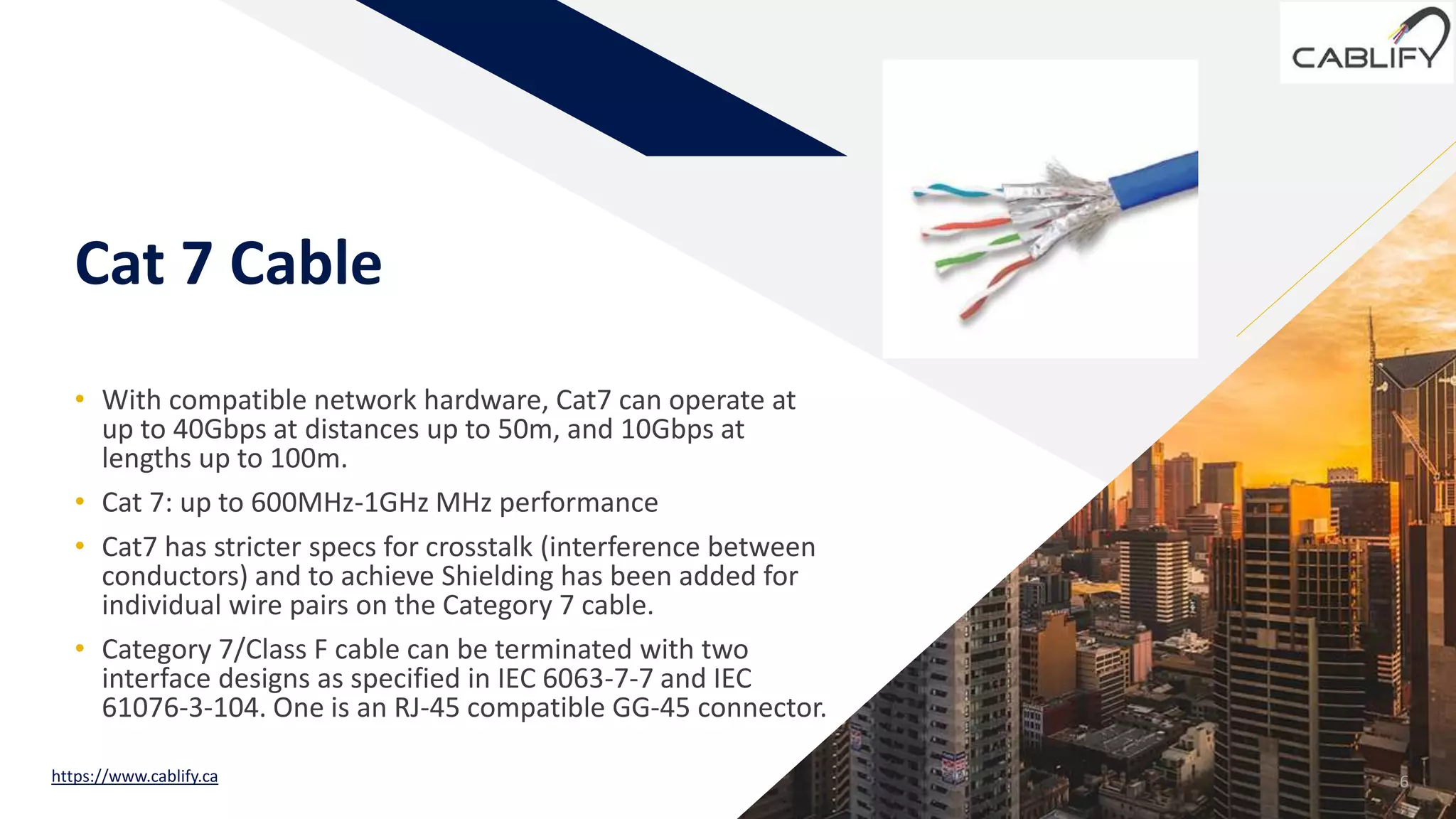
• Cat7 has stricter specs for crosstalk (interference between
conductors) and to achieve Shielding has been added for
individual wire pairs on the Category 7 cable.
• Category 7/Class F cable can be terminated with two
interface designs as specified in IEC 6063-7-7 and IEC
61076-3-104. One is an RJ-45 compatible GG-45 connector.
6https://www.cablify.ca
FR
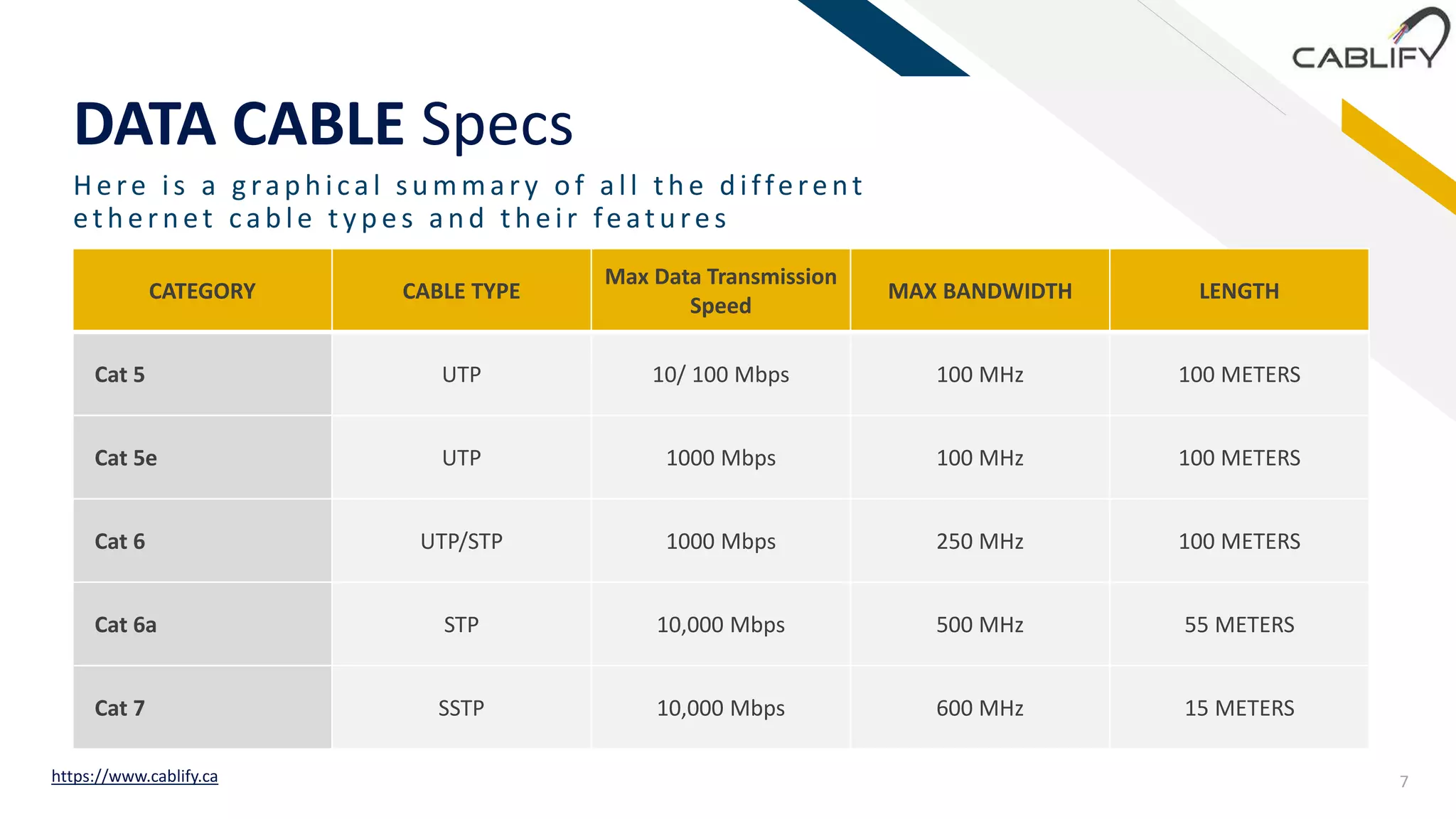
DATA CABLE Specs
Here is a g rap h ical su mmar y of all th e d ifferent
eth ern et cab le ty p es an d th eir featu res
CATEGORY CABLE TYPE
Max Data Transmission
Speed
MAX BANDWIDTH LENGTH
Cat 5 UTP 10/ 100 Mbps 100 MHz 100 METERS
Cat 5e UTP 1000 Mbps 100 MHz 100 METERS
Cat 6 UTP/STP 1000 Mbps 250 MHz 100 METERS
Cat 6a STP 10,000 Mbps 500 MHz 55 METERS
Cat 7 SSTP 10,000 Mbps 600 MHz 15 METERS
7https://www.cablify.ca
FR
So Which Cable Should You Use?
• Over the years, Category 6 (CAT6) cable have become a basic requirement for new
buildings in order to support Gigabit network applications and support bandwidths
of up to 250MHz. Category 6A (CAT6A) which supports data rates of 10G up to 100
metres and a bandwidth of up to 500MHz has begun to grow in popularity. Cat 7
and above are still in the nascent stage of development but will take over quickly
as further improvement takes place in their development and production. Don’t go
for an overkill and on the same time, do consider future bandwidth usage. Factor
in all your requirements including bandwidth usage, environment and budget
before going for a particular Cable type. If you are still unsure, contact our team of
expert Data Cabling techs for expert advice.
Cat5e, Cat6, Cat6a or Cat7?
8https://www.cablify.ca
About Us
CA BLIF Y CA BLING
• Cablify Cabling is a leading
structured cabling expert having a
team of highly experienced and
certified Data and Fiber optic techs
specializing in low voltage cabling
across Canada and USA.
• Data, Fiber and Security Solutions.
https://www.cablify.ca 9
Thank You.
Cablify - Data and Fiber optic Cabling Experts
1-877-855-3865
info@cablify.ca
www.cablify.ca
https://www.cablify.ca

Types of data cables

  • 1.
    Types of DataCables Cat5, Cat5e, Cat6, Cat6a, Cat7 https://www.cablify.ca
  • 2.
    FR Data Cable Type Ethern et cab les We use Data cables in our office and home. Also called Ethernet cables, these cables have seen a major transformation capable of carrying huge amounts of data. Data Cables can be divided into different categories with each category having certain strengths and weaknesses. Each category offers different data transmitting speeds, an electromagnetic shield, frequency range, and gauge size (SWG or AWG). Let’s discuss these cable types in details. Chart Title Category 5 Category 5a Category 6 Category 6a Category 7 2https://www.cablify.ca
  • 3.
    FR Cat 5e Cable •Category 5e cabling, also known as Cat5, is an older type of network cabling. • Cat5E cable is the Enhanced version of Cat5. It became the standard cable about 15 years ago and offers significantly improved performance over the old Cat5 cable, including up to 10 times faster speeds. Offers significantly greater ability to traverse distances without being impacted by crosstalk. • Cat5e was made to support 1000 Mbps "gigabit" speeds • Cat5e is capable of Gigabit Ethernet up to 100 meters upto up to 100 MHz performance. 3
  • 4.
    FR Cat 6 Cable •Currently the most popular and widely used network cable • Cat6 is capable of 10 Gigabit speed upto a distance of around 50 meters (164ft). After this distance, the rate drops to 1 Gigabit – the same as is possible with Cat5e. • Cat6: up to 250 MHz performance • Cat6 cables have more stringent criteria regarding both crosstalk and system noise. Cat6 cables also use a nylon spline, which helps to eliminate crosstalk and boost performance, too 4https://www.cablify.ca
  • 5.
    FR Cat 6a Cable •Category 6a cabling is the next step up from Cat6 and includes a few more improvements. • CAT6A is capable of supporting data transfer rates of up to 10Gbps at a maximum bandwidth of 500MHz. • Cat6a: up to 500 MHz performance • Cat6a is heavy and bulky and therefore difficult to install in the conduits and cable trays. • CAT6A supports wireless systems that rely on 10Gig and therefore recommended for new installations for Healthcare, Education, Logistics and other industries. 5https://www.cablify.ca
  • 6.
    FR Cat 7 Cable •With compatible network hardware, Cat7 can operate at up to 40Gbps at distances up to 50m, and 10Gbps at lengths up to 100m. • Cat 7: up to 600MHz-1GHz MHz performance • Cat7 has stricter specs for crosstalk (interference between conductors) and to achieve Shielding has been added for individual wire pairs on the Category 7 cable. • Category 7/Class F cable can be terminated with two interface designs as specified in IEC 6063-7-7 and IEC 61076-3-104. One is an RJ-45 compatible GG-45 connector. 6https://www.cablify.ca
  • 7.
    FR DATA CABLE Specs Hereis a g rap h ical su mmar y of all th e d ifferent eth ern et cab le ty p es an d th eir featu res CATEGORY CABLE TYPE Max Data Transmission Speed MAX BANDWIDTH LENGTH Cat 5 UTP 10/ 100 Mbps 100 MHz 100 METERS Cat 5e UTP 1000 Mbps 100 MHz 100 METERS Cat 6 UTP/STP 1000 Mbps 250 MHz 100 METERS Cat 6a STP 10,000 Mbps 500 MHz 55 METERS Cat 7 SSTP 10,000 Mbps 600 MHz 15 METERS 7https://www.cablify.ca
  • 8.
    FR So Which CableShould You Use? • Over the years, Category 6 (CAT6) cable have become a basic requirement for new buildings in order to support Gigabit network applications and support bandwidths of up to 250MHz. Category 6A (CAT6A) which supports data rates of 10G up to 100 metres and a bandwidth of up to 500MHz has begun to grow in popularity. Cat 7 and above are still in the nascent stage of development but will take over quickly as further improvement takes place in their development and production. Don’t go for an overkill and on the same time, do consider future bandwidth usage. Factor in all your requirements including bandwidth usage, environment and budget before going for a particular Cable type. If you are still unsure, contact our team of expert Data Cabling techs for expert advice. Cat5e, Cat6, Cat6a or Cat7? 8https://www.cablify.ca
  • 9.
    About Us CA BLIFY CA BLING • Cablify Cabling is a leading structured cabling expert having a team of highly experienced and certified Data and Fiber optic techs specializing in low voltage cabling across Canada and USA. • Data, Fiber and Security Solutions. https://www.cablify.ca 9
  • 10.
    Thank You. Cablify -Data and Fiber optic Cabling Experts 1-877-855-3865 info@cablify.ca www.cablify.ca https://www.cablify.ca