TYPES OF CROPS
BY-ARYA HARDAS
INTRODUCTION
• India is one of the major crop growing countries in the world.
The crops are grown throughout the year.
• Agriculture is the biggest economical activity in India to
produce food and also for generating money.
• Throughout India, crops are grown in different seasons. Based
on the seasons in which they are grown, crops are divided
into 3 types.
• Season and location of the place greatly determine the type
of crop grown in the region.
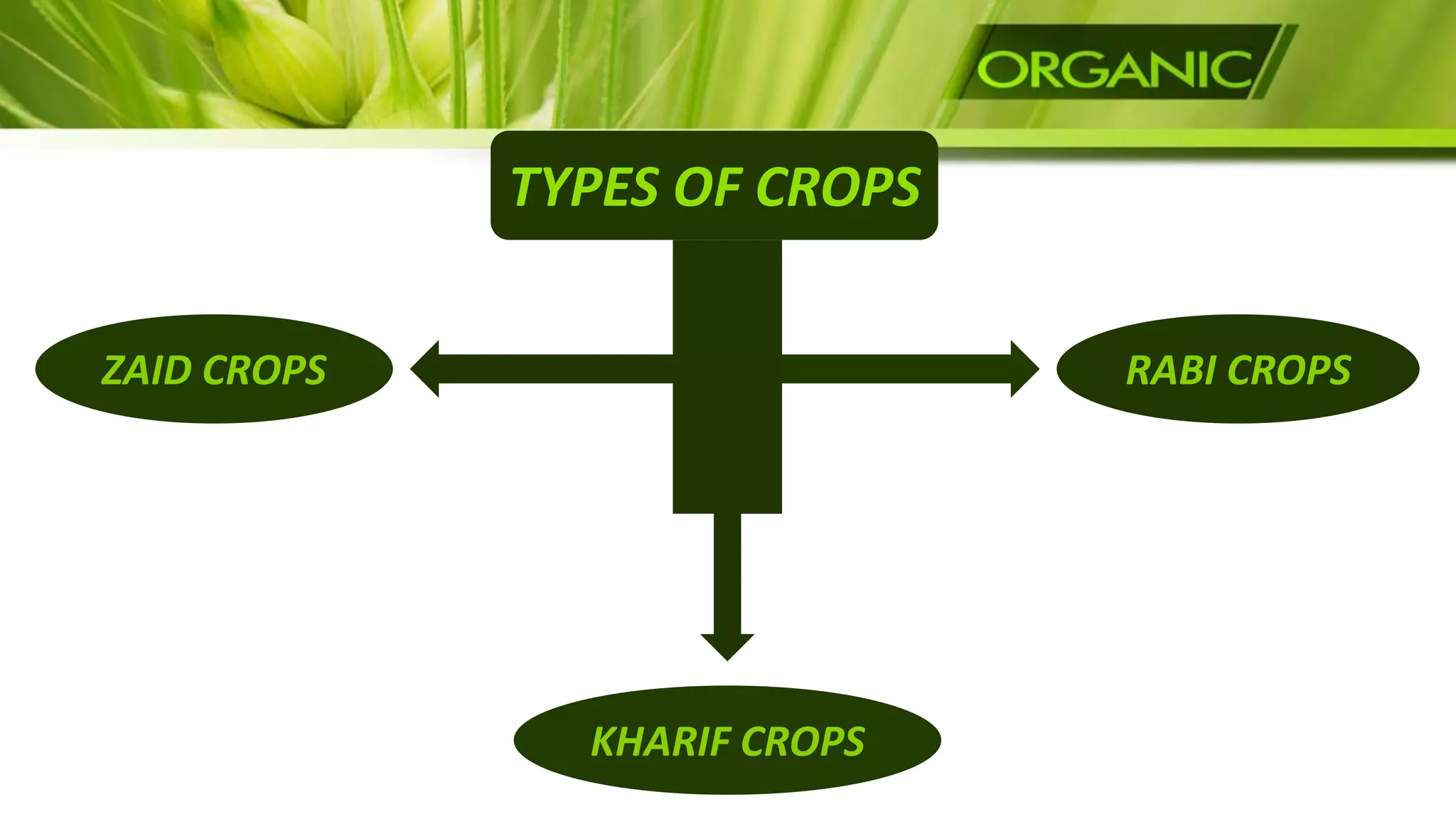
TYPES OF CROPS
ZAID CROPS RABI CROPS
KHARIF CROPS
ZAID CROPS
• Crops that are mostly grown in the period between the Rabi
and Kharif crops mainly in months of March to June, that is, in
the summer season are called Zaid Crops.
• The main feature of these crops is that they require warm and
dry weather for proper growth and a longer duration of the
day.
• They mainly produce seasonal fruits and vegetables.
• Examples are watermelon, musk melon, cucumber and
sugarcane.
KHARIF CROPS
• Crops that are sown in the rainy season and harvested in
winters are called Kharif crops.
• The main months of cultivating the crops are July to October.
• These crops require proper amount of rainwater as well as
the timing. Excess or no rainfall can result in total crop failure.
• Examples are groundnut, maize, paddy and soybean.
These are some of the major
rice-growing states in India.
They are:-
• WEST BENGAL
• UTTAR PRADESH
• ANDHRA PRADESH
• TELANGANA
• PUNJAB
• BIHAR
• ORISSA
• CHHATISGARH
• ASSAM
• TAMIL NADU
• HARYANA
RABI CROPS
• Crops that are grown in the winter season and harvested at
the beginning of summer are called Rabi crops.
• They are usually sown in the month of November and
harvested in March.
• Irrigation is a necessity for the growth of plants. But a rainfall
in winter can spoil the cultivated crops.
• Examples are gram, peas, wheat are mustard.
Here are some of the
wheat-producing states.
They are:-
• UTTAR PRADESH
• PUNJAB
• HARYANA
• MADHYA PRADESH
• RAJASTHAN
• BIHAR
• GUJARAT
• MAHARASHTRA
• UTTARANCHAL
• WEST BENGAL
• The previous slide was an analysis of the Precipitation
amount in the past two years – 2015 and 2016 on left and
right maps, respectively.
• This concludes that human activities have led to a certain
decrease in the amount of precipitation.
• The change in precipitation amount and time can affect the
crops severely and also result in the change of months for
platation and harvesting.
~THANK YOU

Types of crops

  • 1.
  • 2.
    INTRODUCTION • India isone of the major crop growing countries in the world. The crops are grown throughout the year. • Agriculture is the biggest economical activity in India to produce food and also for generating money. • Throughout India, crops are grown in different seasons. Based on the seasons in which they are grown, crops are divided into 3 types. • Season and location of the place greatly determine the type of crop grown in the region.
  • 3.
    TYPES OF CROPS ZAIDCROPS RABI CROPS KHARIF CROPS
  • 4.
    ZAID CROPS • Cropsthat are mostly grown in the period between the Rabi and Kharif crops mainly in months of March to June, that is, in the summer season are called Zaid Crops. • The main feature of these crops is that they require warm and dry weather for proper growth and a longer duration of the day. • They mainly produce seasonal fruits and vegetables. • Examples are watermelon, musk melon, cucumber and sugarcane.
  • 6.
    KHARIF CROPS • Cropsthat are sown in the rainy season and harvested in winters are called Kharif crops. • The main months of cultivating the crops are July to October. • These crops require proper amount of rainwater as well as the timing. Excess or no rainfall can result in total crop failure. • Examples are groundnut, maize, paddy and soybean.
  • 8.
    These are someof the major rice-growing states in India. They are:- • WEST BENGAL • UTTAR PRADESH • ANDHRA PRADESH • TELANGANA • PUNJAB • BIHAR • ORISSA • CHHATISGARH • ASSAM • TAMIL NADU • HARYANA
  • 9.
    RABI CROPS • Cropsthat are grown in the winter season and harvested at the beginning of summer are called Rabi crops. • They are usually sown in the month of November and harvested in March. • Irrigation is a necessity for the growth of plants. But a rainfall in winter can spoil the cultivated crops. • Examples are gram, peas, wheat are mustard.
  • 11.
    Here are someof the wheat-producing states. They are:- • UTTAR PRADESH • PUNJAB • HARYANA • MADHYA PRADESH • RAJASTHAN • BIHAR • GUJARAT • MAHARASHTRA • UTTARANCHAL • WEST BENGAL
  • 13.
    • The previousslide was an analysis of the Precipitation amount in the past two years – 2015 and 2016 on left and right maps, respectively. • This concludes that human activities have led to a certain decrease in the amount of precipitation. • The change in precipitation amount and time can affect the crops severely and also result in the change of months for platation and harvesting.
  • 14.