Mr. Satvir Singh Bhaglal
Life Science Teacher
M.Sc. Advance Zoology
M.Ed.
Website:
innovativelearningclasses.com/Sa
tvir@Zoology
YouTube channel :
innovativelearningclasses
Asexual Reproduction and its
types
Satvir@Zoology
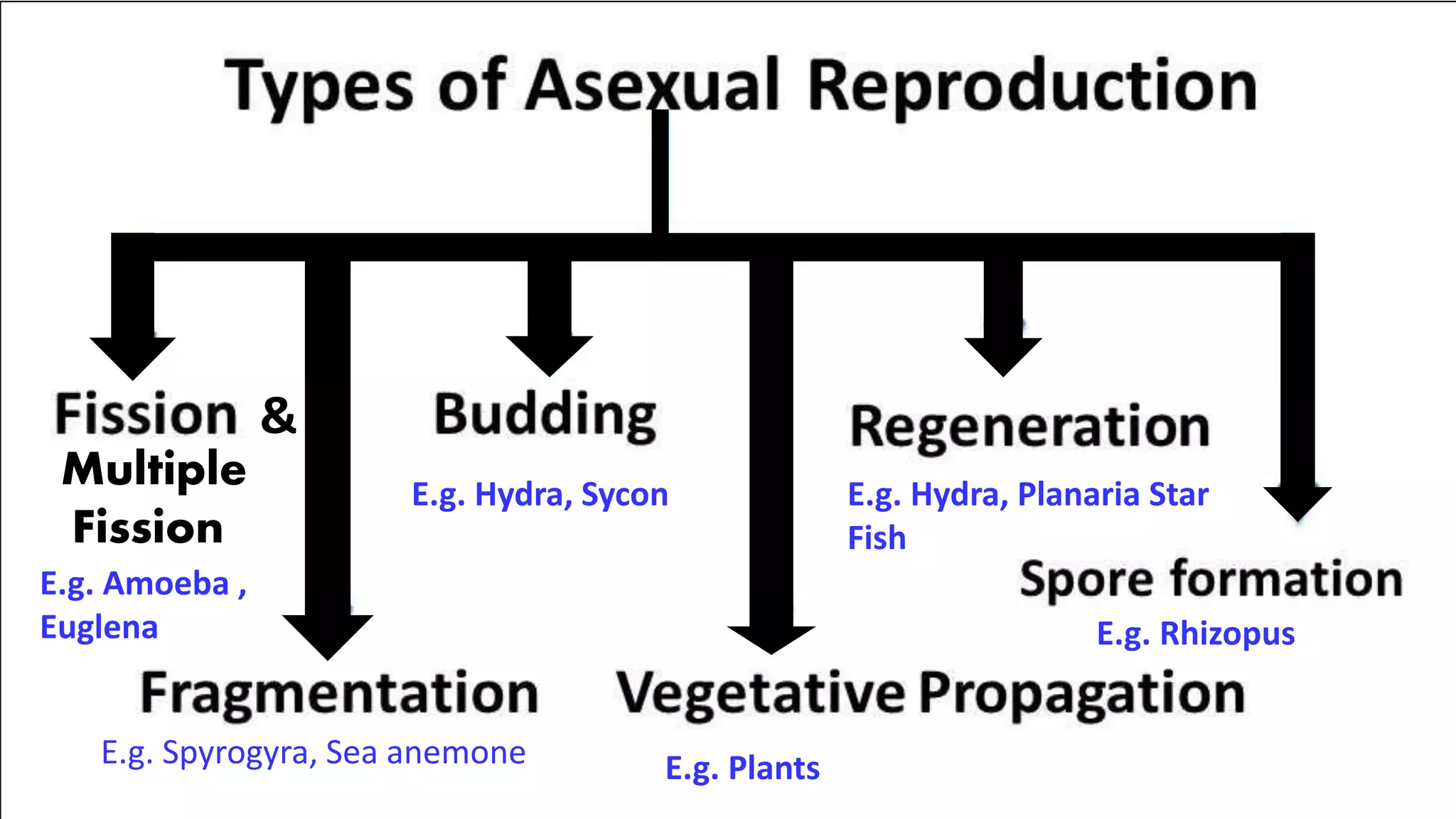
E.g. Amoeba ,
Euglena
E.g. Hydra, Sycon E.g. Hydra, Planaria Star
Fish
E.g. Rhizopus
E.g. Spyrogyra, Sea anemone E.g. Plants
Multiple
Fission
&
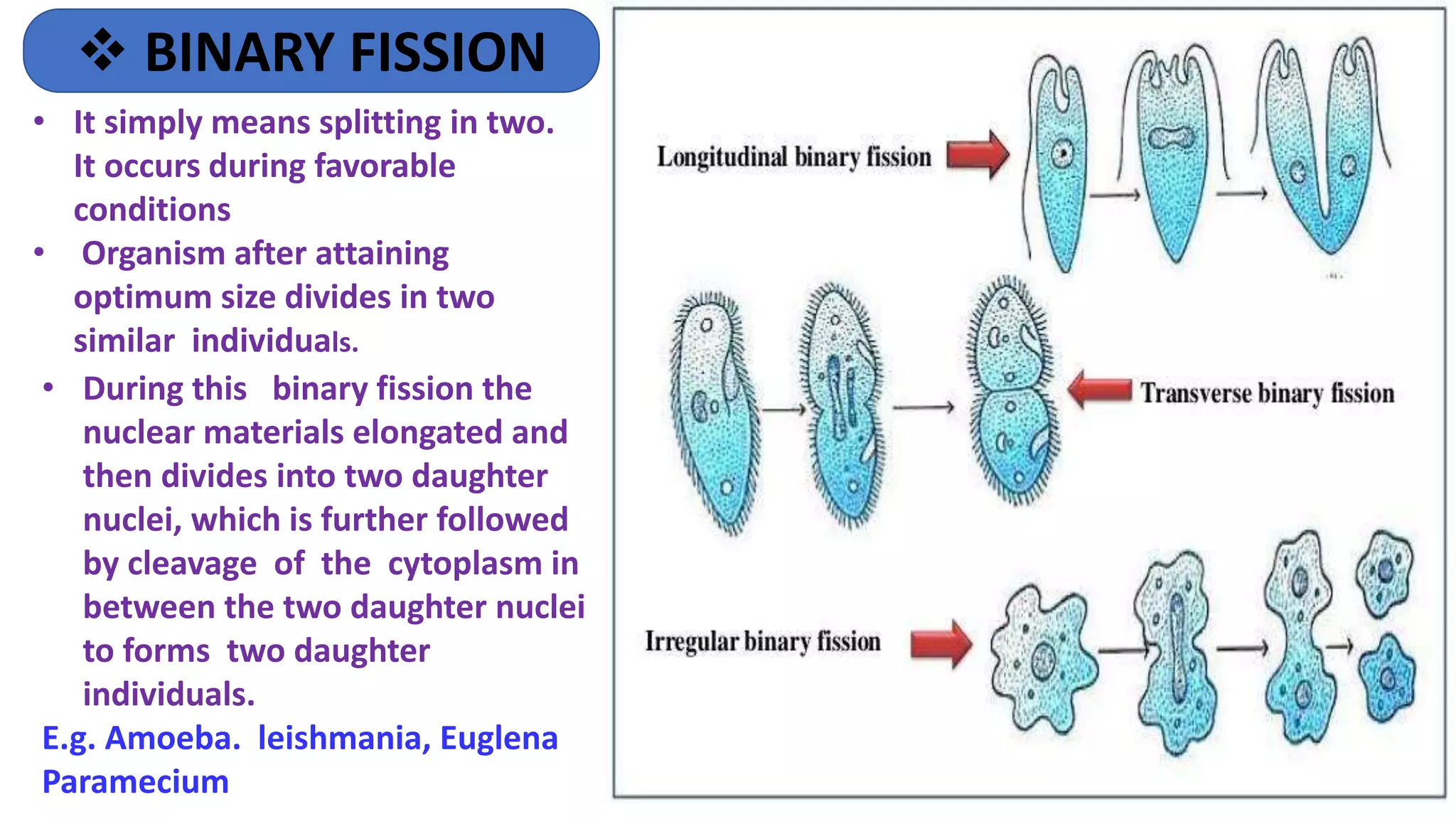
• It simply means splitting in two.
It occurs during favorable
conditions
• Organism after attaining
optimum size divides in two
similar individuals.
 BINARY FISSION
• During this binary fission the
nuclear materials elongated and
then divides into two daughter
nuclei, which is further followed
by cleavage of the cytoplasm in
between the two daughter nuclei
to forms two daughter
individuals.
E.g. Amoeba. leishmania, Euglena
Paramecium
 MULTIPLE FISSION
.
• Multiple fission is the process of asexual reproduction in which instead of 2 daughter cells, many
daughter cells are produced from the parent cell. E.g Amoeba and Plasmodium
• Here the organism first develop a cyst wall around it with in the cyst wall the nucleus undergoes
repeated division to produce a large number of nuclei.
• Each nuclei along with little bit of cytoplasm forms a membrane around it. These structures are k/as
pseudopodiospores which on favorable condition comes out due to the exocytosis.
• All the daughter cells are equal sized and are similar.
Multiple fission in Amoeba
Satvir@Zoology
Satvir@Zoology
• It give rise to two individuals
• It occurs in favorable condition only
• Nucleus of the parent divides only
once to form two daughters' nuclei
• Cytoplasm cleavage occurs after each
nucleus division
• No part of the parent is left after the
division
• It give rise to several several individuals
• Occurs both in favorable and unfavorable condition
• Nucleus undergo repeated division to form no. of
daughter nuclei
• Cytoplasm does not divide after each nuclear
division.
• A part of the body covering, and cytoplasm is left
behind
DIFFERENCE BETWEEN BINARY FISSION AND MULTIPLE FISSION
• Budding is the process of producing an individual through the buds or an outgrouth that develop on the
parent body.. The bud derives its nutrition and shelter from the parent body and get detaches once it is fully
grown to live as new organism. Depending upon the location of bud it is of two types
• EXOGENOUS BUDDING ENDOGENOUS BUDDING
• Exogenous Budding involves a formation of small bud on the external lower part of parent body through the repeated
mitotic division of its cells. The small bud initially receives its nutrition from the parent body and grows healthy. Once
mouth and the tentacles developed it get detached from the parent body to live independently.
• E.g. Hydra Sycon (in sycon buds remained attached with the parent body to form colony)
 BUDDING
Satvir@Zoology
 ENDOGENOUS BUDDING
• Buds are formed inside the body of the organism k/as gemmules.
• They are basically small group of cells that are enclosed by a protected coat.
• During the favorable condition the mass of archeocyte's cell will comes out of the
micropyle and forms a new colony.
• E.g. Spongilla.
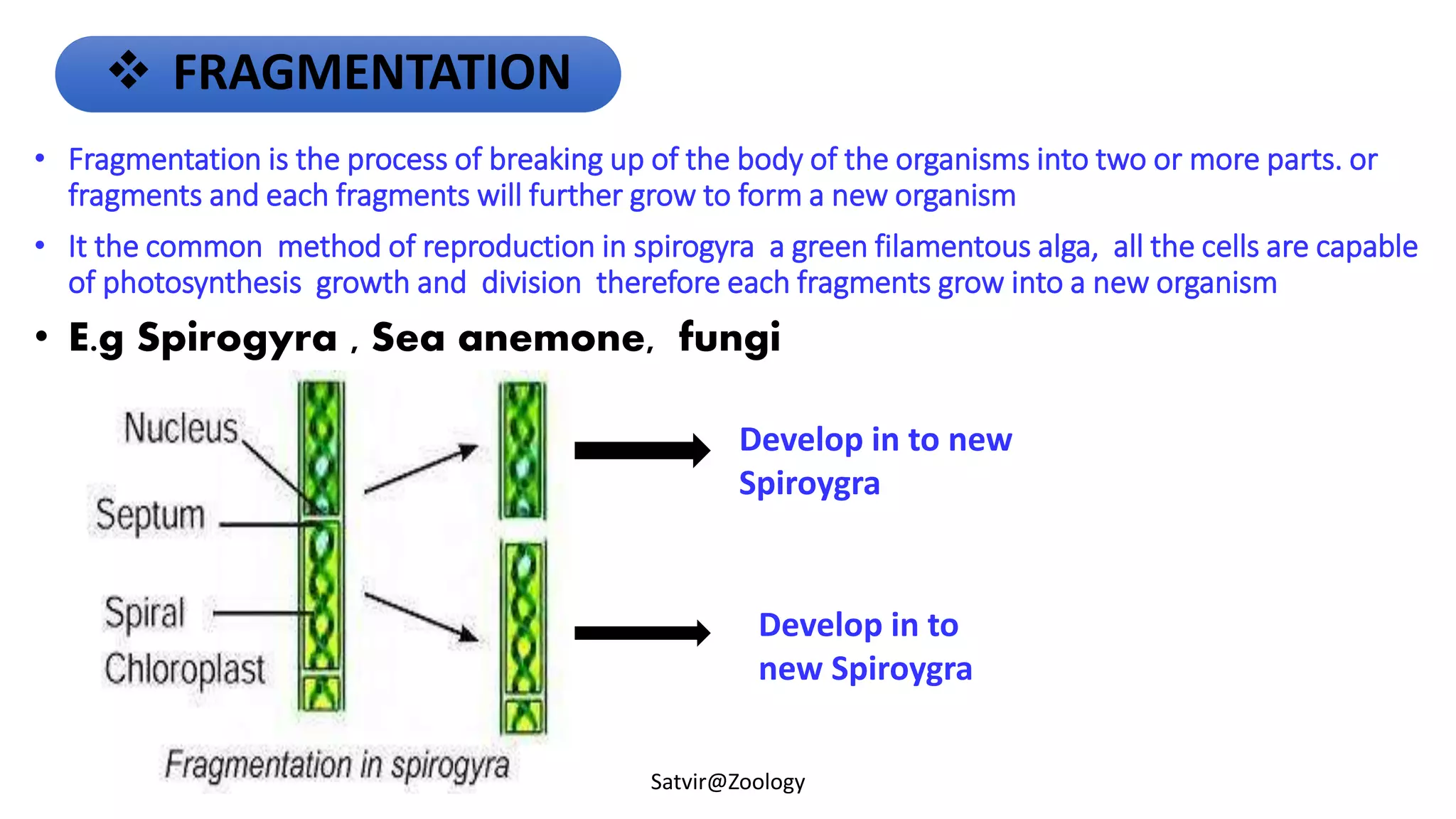
• Fragmentation is the process of breaking up of the body of the organisms into two or more parts. or
fragments and each fragments will further grow to form a new organism
• It the common method of reproduction in spirogyra a green filamentous alga, all the cells are capable
of photosynthesis growth and division therefore each fragments grow into a new organism
• E.g Spirogyra , Sea anemone, fungi
Satvir@Zoology
 FRAGMENTATION
Develop in to new
Spiroygra
Develop in to
new Spiroygra
Satvir@Zoology
• Regeneration is the ability to repair the injured
part or replace the ones lost through accident
/Autotomy or forms a new organism from the
lost body part.
• Tembley
• For e.g., when a lizard loses its tail, a new tail
grows. Some organisms can developed a
complete organism from the last part.
• This is because the specialized cells present in
the organism can differentiate and grow into a
new individual.
• Organisms like Hydra and Planaria exhibit high
power of regeneration.
• MORPHOLAXIS
• EPIMORPHOLAXIS
 Regeneration
• Reparative regeneration
• Restorative regeneration
Satvir@Zoology
• Spore formation is another means of asexual
reproduction.
• During unfavorable conditions, the organism develops
sac-like structures called sporangium that contain
spores.
• The spores are covered by thick wall that protect
them. (Zoospores endospores Exospores)
• When the conditions are favorable, the sporangium
burst opens and spores are released that germinate,
to forms a new organisms
• E.g
 SPORULATION
 ADVANTAGES OF ASEXUAL REPRODUCTION
 DISADVANTAGE OF ASEXUAL REPRODUCTION
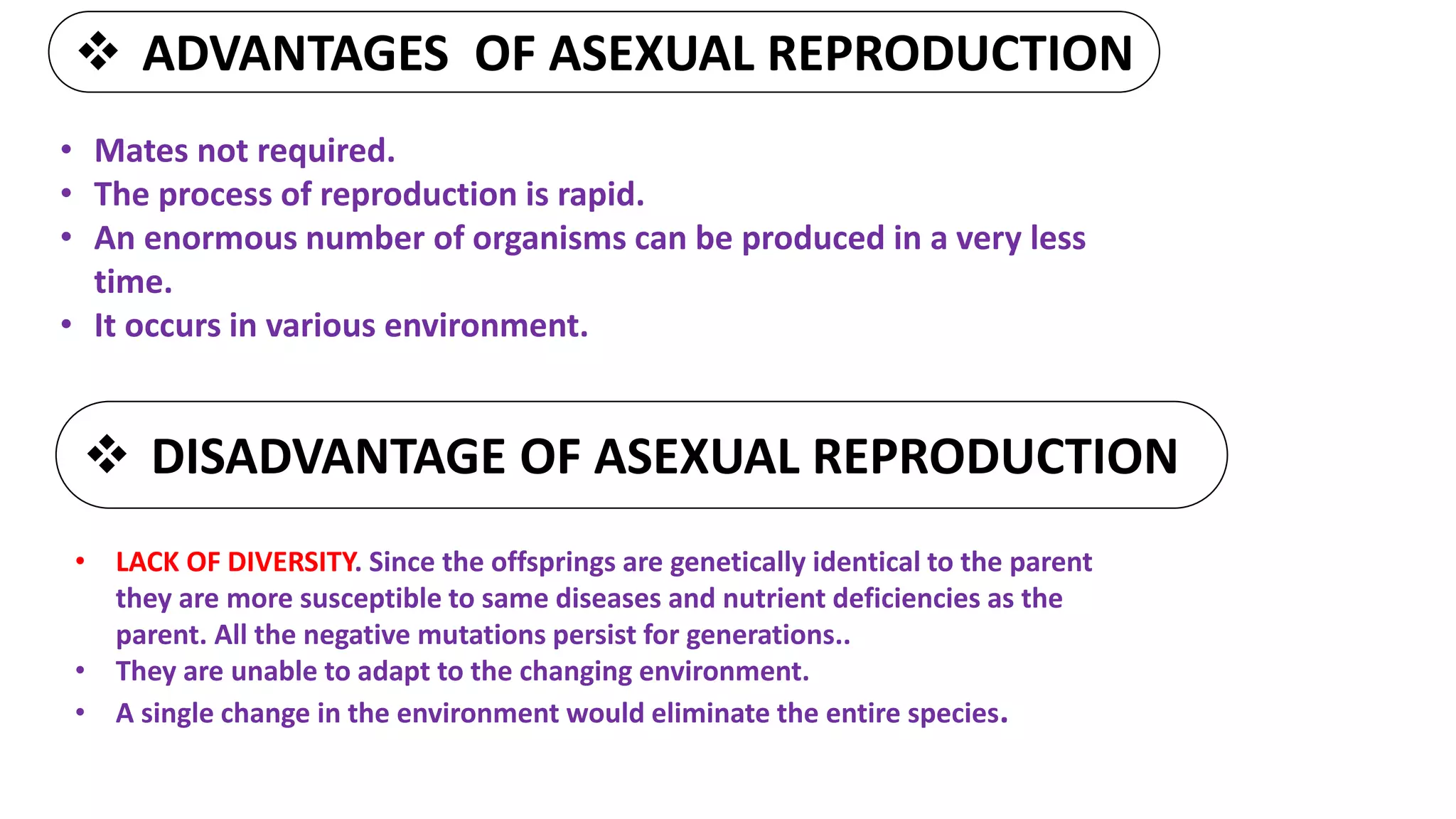
• Mates not required.
• The process of reproduction is rapid.
• An enormous number of organisms can be produced in a very less
time.
• It occurs in various environment.
• LACK OF DIVERSITY. Since the offsprings are genetically identical to the parent
they are more susceptible to same diseases and nutrient deficiencies as the
parent. All the negative mutations persist for generations..
• They are unable to adapt to the changing environment.
• A single change in the environment would eliminate the entire species.
innovativelearningclasses/Satvir@Zoology
Thanks for patience
Subscribe and keep watching my YouTube channel
and follow my Website
Stay bless Stay Safe
INNOVATIVELEARNINGCLASSES
Innovativelearningclasses.com

Types of asexual reproduction

  • 1.
    Mr. Satvir SinghBhaglal Life Science Teacher M.Sc. Advance Zoology M.Ed. Website: innovativelearningclasses.com/Sa tvir@Zoology YouTube channel : innovativelearningclasses Asexual Reproduction and its types
  • 2.
    Satvir@Zoology E.g. Amoeba , Euglena E.g.Hydra, Sycon E.g. Hydra, Planaria Star Fish E.g. Rhizopus E.g. Spyrogyra, Sea anemone E.g. Plants Multiple Fission &
  • 3.
    • It simplymeans splitting in two. It occurs during favorable conditions • Organism after attaining optimum size divides in two similar individuals.  BINARY FISSION • During this binary fission the nuclear materials elongated and then divides into two daughter nuclei, which is further followed by cleavage of the cytoplasm in between the two daughter nuclei to forms two daughter individuals. E.g. Amoeba. leishmania, Euglena Paramecium
  • 4.
     MULTIPLE FISSION . •Multiple fission is the process of asexual reproduction in which instead of 2 daughter cells, many daughter cells are produced from the parent cell. E.g Amoeba and Plasmodium • Here the organism first develop a cyst wall around it with in the cyst wall the nucleus undergoes repeated division to produce a large number of nuclei. • Each nuclei along with little bit of cytoplasm forms a membrane around it. These structures are k/as pseudopodiospores which on favorable condition comes out due to the exocytosis. • All the daughter cells are equal sized and are similar. Multiple fission in Amoeba
  • 5.
  • 6.
    Satvir@Zoology • It giverise to two individuals • It occurs in favorable condition only • Nucleus of the parent divides only once to form two daughters' nuclei • Cytoplasm cleavage occurs after each nucleus division • No part of the parent is left after the division • It give rise to several several individuals • Occurs both in favorable and unfavorable condition • Nucleus undergo repeated division to form no. of daughter nuclei • Cytoplasm does not divide after each nuclear division. • A part of the body covering, and cytoplasm is left behind DIFFERENCE BETWEEN BINARY FISSION AND MULTIPLE FISSION
  • 7.
    • Budding isthe process of producing an individual through the buds or an outgrouth that develop on the parent body.. The bud derives its nutrition and shelter from the parent body and get detaches once it is fully grown to live as new organism. Depending upon the location of bud it is of two types • EXOGENOUS BUDDING ENDOGENOUS BUDDING • Exogenous Budding involves a formation of small bud on the external lower part of parent body through the repeated mitotic division of its cells. The small bud initially receives its nutrition from the parent body and grows healthy. Once mouth and the tentacles developed it get detached from the parent body to live independently. • E.g. Hydra Sycon (in sycon buds remained attached with the parent body to form colony)  BUDDING
  • 8.
    Satvir@Zoology  ENDOGENOUS BUDDING •Buds are formed inside the body of the organism k/as gemmules. • They are basically small group of cells that are enclosed by a protected coat. • During the favorable condition the mass of archeocyte's cell will comes out of the micropyle and forms a new colony. • E.g. Spongilla.
  • 9.
    • Fragmentation isthe process of breaking up of the body of the organisms into two or more parts. or fragments and each fragments will further grow to form a new organism • It the common method of reproduction in spirogyra a green filamentous alga, all the cells are capable of photosynthesis growth and division therefore each fragments grow into a new organism • E.g Spirogyra , Sea anemone, fungi Satvir@Zoology  FRAGMENTATION Develop in to new Spiroygra Develop in to new Spiroygra
  • 10.
    Satvir@Zoology • Regeneration isthe ability to repair the injured part or replace the ones lost through accident /Autotomy or forms a new organism from the lost body part. • Tembley • For e.g., when a lizard loses its tail, a new tail grows. Some organisms can developed a complete organism from the last part. • This is because the specialized cells present in the organism can differentiate and grow into a new individual. • Organisms like Hydra and Planaria exhibit high power of regeneration. • MORPHOLAXIS • EPIMORPHOLAXIS  Regeneration • Reparative regeneration • Restorative regeneration
  • 11.
    Satvir@Zoology • Spore formationis another means of asexual reproduction. • During unfavorable conditions, the organism develops sac-like structures called sporangium that contain spores. • The spores are covered by thick wall that protect them. (Zoospores endospores Exospores) • When the conditions are favorable, the sporangium burst opens and spores are released that germinate, to forms a new organisms • E.g  SPORULATION
  • 12.
     ADVANTAGES OFASEXUAL REPRODUCTION  DISADVANTAGE OF ASEXUAL REPRODUCTION • Mates not required. • The process of reproduction is rapid. • An enormous number of organisms can be produced in a very less time. • It occurs in various environment. • LACK OF DIVERSITY. Since the offsprings are genetically identical to the parent they are more susceptible to same diseases and nutrient deficiencies as the parent. All the negative mutations persist for generations.. • They are unable to adapt to the changing environment. • A single change in the environment would eliminate the entire species.
  • 13.
    innovativelearningclasses/Satvir@Zoology Thanks for patience Subscribeand keep watching my YouTube channel and follow my Website Stay bless Stay Safe INNOVATIVELEARNINGCLASSES Innovativelearningclasses.com