Chapter 4


Writing formats
    We all experience different writing formats in our everyday lives: the charity leaflet
    through the door, the newspaper we buy, the review we read for the film we want to
    watch at the cinema etc. The examinations and assessments in GCSE English and
    English Language require that you can recognise and write in a range of different
    key formats. You should consider these to be like formulae or the frames within
    which you write. For example, if you are asked to write a letter or an article in the
    exam, you need to know what makes a successful letter or article.
      You might ask: why do I need to learn how to write an article or a review, for
    example? This is because in your everyday life, you will come across situations where
    you will probably read them and maybe even be influenced by them. You need to
    understand how they are created, what their purpose is and be able to interpret
    them and distinguish between the bias elements so that you can reach your own
    independent conclusions. Writing non-fiction successfully, especially letters, is an
    important functional skill in life.
      This chapter is designed to give you an insight into the main features of the key
    writing formats and provide you with the opportunity to use them in your own writ-
    ing. The features list for each format is not exhaustive and your teacher may point
    out additional ones.


                                                                 Skills for Language & Literature 59
Section B             Writing

                         Try to learn the features of each writing format, practise listing them and creating
                      examples of your own in response to examination questions or tasks you have created.
                      It would also be a good idea to start collecting real-life examples of writing formats
                      as you come across them — try to highlight and label their key features. Focus on
                      the formats you have had less opportunity to develop or are the least confident in
                      tackling.
                         The key writing formats we are going to look at in this chapter are shown below.

                                                              Articles


                                 Reports                                                    Letters


                                                      Key writing formats


                                  Leaflets                                                   Reviews


                                                             Speeches


             AO3
                      For GCSE English, your writing will be assessed against the following Assessment
                      Objectives (AOs) in both Units 1 and 3. The key words are emboldened. These
                      were explained in Chapter 2 (pages 36, 38 and 40). Note that at least one third of
                      the available marks will be allocated to AO3(iii).

                       AO3(i)           •	 Communicate clearly and imaginatively, using, adapting and
                                           selecting vocabulary appropriate to task and purpose in ways
                                           that engage the reader.
                       AO3(ii)          •	 Organise information and ideas into structured and sequenced
                                           sentences, paragraphs and whole texts, using a variety of
                                           linguistic structural features to support cohesion and overall
                                           coherence.
                       AO3(iii)         • Use a range of sentence structures for clarity, purpose and
                                        	
                                          effect with accurate punctuation and spelling.

                        This Assessment Objective, AO3, is known as AO4 in the English Language
                      specifications. The content is exactly the same and for ease of reference and to avoid
                      confusion, it is mainly referred to as AO3 in this book.
                        For more information about where and how AO3 is assessed refer back to Chapters
                      2 and 3.


60 AQA GCSE English
Writing formats
                                                                                                         4
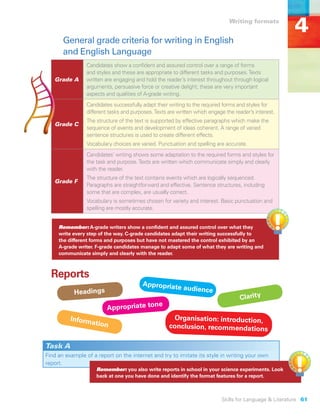
       General grade criteria for writing in English
       and English Language
                 Candidates show a confident and assured control over a range of forms
                 and styles and these are appropriate to different tasks and purposes. Texts
   Grade A       written are engaging and hold the reader’s interest throughout through logical
                 arguments, persuasive force or creative delight; these are very important
                 aspects and qualities of A-grade writing.
                 Candidates successfully adapt their writing to the required forms and styles for
                 different tasks and purposes. Texts are written which engage the reader’s interest.
                 The structure of the text is supported by effective paragraphs which make the
   Grade C
                 sequence of events and development of ideas coherent. A range of varied
                 sentence structures is used to create different effects.
                 Vocabulary choices are varied. Punctuation and spelling are accurate.
                 Candidates’ writing shows some adaptation to the required forms and styles for
                 the task and purpose. Texts are written which communicate simply and clearly
                 with the reader.
                 The structure of the text contains events which are logically sequenced.
   Grade F
                 Paragraphs are straightforward and effective. Sentence structures, including
                 some that are complex, are usually correct.
                 Vocabulary is sometimes chosen for variety and interest. Basic punctuation and
                 spelling are mostly accurate.


     Remember: A-grade writers show a confident and assured control over what they
     write every step of the way. C-grade candidates adapt their writing successfully to
     the different forms and purposes but have not mastered the control exhibited by an
     A-grade writer. F-grade candidates manage to adapt some of what they are writing and
     communicate simply and clearly with the reader.


  Reports
                                         Appropriate
                                                           audience
           Headings
                                                                                    Clarity
                                               ne
                          Appropriate to
          Inform                                      Organisation: introduction,
                   ation
                                                     conclusion, recommendations

Task A
Find an example of a report on the internet and try to imitate its style in writing your own
report.
                     Remember: you also write reports in school in your science experiments. Look
                     back at one you have done and identify the format features for a report.


                                                                            Skills for Language & Literature 61
Section B              Writing


            Articles                                              Caption
                                ith a pun
          Catchy title, often w                                                                    aragrap
                                                                                                           h
                 (play on words)                                                        rst p
                                                                                Clear fi

                                          t paragra
                                                        phs                               to the article
                             en                                       Photograph related
                    four cont                                                               a one-line
           Three or                                                    (do not draw, write
                                                                                                ace)
                                                                          description in the sp

           Charts, diagrams etc. (indicate where
             these would go, but do not draw)                                Short and cle
                                                                                                   ar summary


          Task A
          Read the article below and identify evidence/use of the above features in it.


                Miss issippi madness

                                                                                                                 TopFoto


                                                                                                or suspension
                                                  en this         There were no high towers
                 Travel chaos struck drivers wh rted to           cables. Yet its smooth sur
                                                                                             face was hiding
                 bridge across the Mi ssissippi sta                                              . The effects
                                                collapsed         a tragedy waiting to happen
                 creak and its concrete pillars                   of corrosion, the weight of
                                                                                                all the traffic
                                              one of the most                                    lly eroded the
                  The motorway bridge was                          and the weather had gradua
                                                the Mississippi
                  used stretches of road across                    bridge’s structure.
                                             ,000 vehicles                                        at the height of
                  in Minneapolis. Over 140                            On Wednesday 1 August
                                              n expanse of
                  crossed it each day. An eve                       the rush hour it gave wa y.
                                               k like a bridge.
                  concrete, it didn’t even loo


62 AQA GCSE English
Writing formats
                                                                                                         4
 Task B
 Now try writing your own article using the format features listed above.


       Assessment for Learning
             Cut out two newspaper articles. Stick them into your book and identify the features
             of this writing format, the article. Use these to write your own examples and ask a
             friend to see if they can identify the obvious features in the articles you have created.


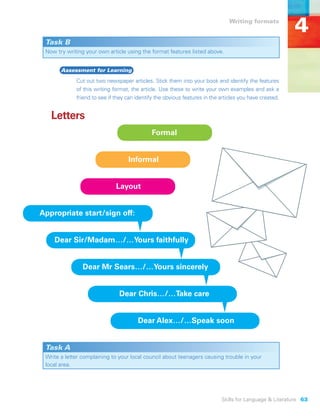
   Letters
                                              Formal


                                   Informal


                              Layout


Appropriate start/sign off:


    Dear Sir/Madam…/…Yours faithfully


                Dear Mr Sears…/…Yours sincerely


                               Dear Chris…/…Take care


                                        Dear Alex…/…Speak soon


 Task A
 Write a letter complaining to your local council about teenagers causing trouble in your
 local area.


                                                                            Skills for Language & Literature 63
Section B             Writing

               Student response to Task A

                                                                                K i C r w ig
                                                                                  49 Br Cl
                                                                                         B s
                                                                                    B r ngh
                                                                                        B22 3JC

                      C nc l r T. R v
                      333 R    D v
                      B s
                       B r ngh
                       B22 5JC
                       De r C nc l r R v                                           s         -
                       I           ng t x r       y c nc r s v r t gr w ng l v             e rs, I
                                              y l c re . As        id       B s r 20
                         ci h vi r                                    I      v ng y f          er
                                  r n w t ngs t           ba . I
                       hv v                                            c r n             t uc t
                            rs s         t nag rs       r
                        h         l r        ng        t r h vi r.
                                                               ty        s r ngly s I d . A l
                         M ny           rs t l c c
                                           c e by t nag rs            r oy i ng c rs ry uc
                         r l hs                                         id ts, p i ly c l r ,
                           nd r t     r ng r i th sc n                                             ay
                               . O ly l            c l     s q t i ly j re s
                          sc                                       t id r            th l ng,
                           ig t ne          n uc c r, r ig
                                                                . Ex r m ly ig t ng! D
                              r n r c r s p e ng                    t     k t c nc d m ng
                            m ng r i s e t h                       ny m             n        st
                          t to t s? W h v c l ne
                                …
                                                                 s         r rg ncy.
                           Il           r t e n
                           Y rs nc r ly

                          K. C r w ig
                          (Ms K i C r w ig )


               Assessment for Learning
                      Before you read the examiner’s comment below, identify the format features this
                      student has used successfully. Point out and correct the ones this student has not
                      quite managed to develop.


64 AQA GCSE English
Examiner’s comment
                                                                         Writing formats
                                                                                                   4
       This student has used the required format of writing a formal letter, using formal
       language. The text itself is interesting and engaging and the reference to the incident
       involving a child at danger from a joy-rider gives the letter substance and a sense of
       reality.
         The structure is supported by effective, varied paragraphs, containing coherent ideas.
       Vocabulary is varied and punctuation and spelling are correct and accurate. This fulfils
       the writing criteria for a Grade C.
  Assessment for Learning
       1 Imagine you are a teenager who has read this letter in your local newspaper. Using
         the Grade C criteria in the ‘Key words success ladder for AO3(i) and AO3(ii)’ on
         page 48, write a Grade C formal letter as a response, in role, as a teenager who is
         upset by this damaging view of what seems to be all teenagers.
       2 Read through your letter and draw arrows to highlight and label where you think
         you have met the Grade C criteria. Set yourself a target, highlighting one thing you
         need to improve. Address this in your next attempt.
       3 Once you are confident you can do this, try to redraft your letter to meet the Grade
         A criteria in the ‘Key words success ladder for AO3(i) and AO3(ii)’ on page 48.


Leaflets
                        Purpose/audience


                     Heading


           Sub-heading


            Bullet points


                      Pictures


                                Language


                                         Overall impact


                                                                      Skills for Language & Literature 65
Section B             Writing

                      You will have many leaflets posted through your door, maybe even given out at
                      school. Collect these and make a list of common and uncommon features. You may
                      even spot some new features. You can view many different types of leaflets on the
                      internet too.

            Speeches
                      The rhetorical devices listed on page 75 in Chapter 5 are vital in writing speeches
                      and persuasive texts. Refer to these to help you write your answers to the tasks in
                      this section.

                                                         Opening to dra
                      Persuasive                                       w audience in

                            Rhetorical techniques
                                                                                        Outline

                      Main parts                                        Conclusion

          Task A
          Write a speech opposing the view that most young people are involved in anti-social
          behaviour. The speech is to be given at a meeting of the local community and students from
          the area.

                Student response to Task A

                      Ladies and gentleman, fellow students, welcome to today’s meeting about anti-
                      social behaviour.
                        I would like to begin this speech by pointing out that not all teenagers are
                      involved in anti-social behaviour. In fact, they suffer at the hands of the very
                      society in which we live. You may ask why that is. It is the same question other
                      students from local schools and I have been asking of ourselves.
                       We are not all the terrible vicious vandals that the press would have you believe.
                      We are not crazy bullies you have to confront on every street corner. No we are not!
                        At every opportunity given to us, many of us have raised money for local
                      charities such as Cancer Research and children who have to spend their time in
                      hospices, who are not as fortunate as we are…
                      Examiner’s comment
                      This student has used the format of a speech successfully and included some rhetorical
                      devices such as repetition, emotive language and forceful phrases. The speech is
                      successful in its purpose and makes the reader consider how teenagers are presented
                      in the media.


66 AQA GCSE English
Writing formats

                                                  Paragraphs are used effectively and spelling and punctuation is accurate. This fulfils
                                                                                                                                                               4
                                                the writing criteria for a Grade C.

                                        Assessment for Learning
                                                Continue this speech for another three paragraphs. Try to include at least three new
                                                rhetorical devices that have not been used in it so far. When you have finished writing,
                                                either underline the rhetorical devices you have used yourself or swap with a friend
                                                and see if you can identify them in each other’s work. Check you have used them
                                                correctly. Make any necessary corrections.


                                   Reviews
                                                                           interest                                           ould
                                                      reader’s                                             Some detail…but sh
                                             Keep the                                                      not give too much
                                                                                                                             away


                                                Often about films, plays,                                               Lively, engag
                                                                                                                                             ing
                                                   books, shows etc.


                                Task A
                                1 Read this review of the film, The Poison Chalice. Pick out the key features of a review.
                                2 Write a review of your own favourite film in the same style. Refer back to the general
                                  criteria for writing in English and English Language on page 61 to remind yourself of what
                                  is required.
                                                                                                                                             Review
                                                                                                                                                      s
                                                                                                              e        As the plot develops, it doe
                                                                    half ma   chine, has powers which hav                                          x
                                                                                                                    become much more comple
                         The Poison Chalice                         developed since the preque
                                                                                                   l and his
                                                                                                  thers, are        and int riguing. This is
                                                                    band of followers, the bro                      a film that will take you
                         ✪	✪	✪	✪	✪                                  enslaved to him after he sav
                                                                                                     es their
                                                                                                                    to the edge of your seat
                                                                     lives.                                          as secrets are revealed and
                              his is a film for the whole
                         T    family, though if you are an
                         older viewer, the plot is a
                                                       little
                                                                         Set in the year 2090, the jou
                                                                      that the men go on, after dri
                                                                                                         rney
                                                                                                      nking
                                                                                                   m through
                                                                                                                     each man in the band of
                                                                                                                     brothers experiences poison
                                                                                                                                                    ous
                                                         e band of    from the chalice, leads the                     revelatio ns about their lives,
                         simplistic on occasions. Th                  new lands and their meetin
                                                                                                    g with
                                               a little too readily                                                   leaving us asking questions
                         brothers fight just                           Ganronde’s mother, Dinessa
                                                                                                      , in the
                                                        lity is                                                       about our own…
                         but the quest for immorta                     land of dreams is quite mo
                                                                                                    ving, as we                                         for
                          portrayed brilliantly, encaps
                                                           ulating                                     his father’s      Extract from a film review
                                                                       learn of his desire to avenge
Vuk Vukmirovic/Fotolia


                                                           ment                                                        The Poison Chalice, 201 1 release, by
                          both suspense and entertain                   death at the hands of hum
                                                                                                    ankind who
                          while holding the    viewer’s interest.                                                      Zakki Matthew.
                                               tagonist, half-man,      existed many moons ago.
                          Ganronde, the pro


                                                                                                                          Skills for Language & Literature 67
Section B             Writing


               Assessment for Learning

                      Look back at the general criteria for writing in English and English Language on page
                      61 and check which ones your answer meets. Have you written an A or C grade
                      answer?
                        You can use the checklist below to help you check if you have met the C-grade
                      criteria. Check you:
                          •	 Adapt your writing to the required format.
                          •	 Engage the reader.
                          •	 Use effective paragraphs.
                          •	 Sequence ideas and events coherently.
                          •	 Use a range of varied paragraphs.
                          •	 Vary vocabulary choices.
                          •	 Use accurate spelling and punctuation.

                      Highlight and label where each of these requirements is met in your work.


            And finally…
                      Familiarise yourself with the different writing forms and formats. Learn the
                      different styles for each writing format. Consider form, audience, purpose and
                      tone in your writing. These are the ‘tools’ that prepare you for writing well.
                        Practise writing in a range of different formats. Create questions of your own to
                      practise what you have learned. Plan and answer them in timed conditions. Discover
                      what your strengths and weaknesses as a writer are, set personal targets and focus on
                      improving these areas in your work.
                        Writing is like any other craft: master the key skills and you are well on the way
                      to being an engaging and successful writer.


                            Tone                                      Audience


                                        Form                                        Purpose

                            Letters                                      Reports

                                              Leaflets
                                                                                         Speeches

                            Reviews                                     Articles


68 AQA GCSE English

Txtengglanglit

  • 1.
    Chapter 4 Writing formats We all experience different writing formats in our everyday lives: the charity leaflet through the door, the newspaper we buy, the review we read for the film we want to watch at the cinema etc. The examinations and assessments in GCSE English and English Language require that you can recognise and write in a range of different key formats. You should consider these to be like formulae or the frames within which you write. For example, if you are asked to write a letter or an article in the exam, you need to know what makes a successful letter or article. You might ask: why do I need to learn how to write an article or a review, for example? This is because in your everyday life, you will come across situations where you will probably read them and maybe even be influenced by them. You need to understand how they are created, what their purpose is and be able to interpret them and distinguish between the bias elements so that you can reach your own independent conclusions. Writing non-fiction successfully, especially letters, is an important functional skill in life. This chapter is designed to give you an insight into the main features of the key writing formats and provide you with the opportunity to use them in your own writ- ing. The features list for each format is not exhaustive and your teacher may point out additional ones. Skills for Language & Literature 59
  • 2.
    Section B Writing Try to learn the features of each writing format, practise listing them and creating examples of your own in response to examination questions or tasks you have created. It would also be a good idea to start collecting real-life examples of writing formats as you come across them — try to highlight and label their key features. Focus on the formats you have had less opportunity to develop or are the least confident in tackling. The key writing formats we are going to look at in this chapter are shown below. Articles Reports Letters Key writing formats Leaflets Reviews Speeches AO3 For GCSE English, your writing will be assessed against the following Assessment Objectives (AOs) in both Units 1 and 3. The key words are emboldened. These were explained in Chapter 2 (pages 36, 38 and 40). Note that at least one third of the available marks will be allocated to AO3(iii). AO3(i) • Communicate clearly and imaginatively, using, adapting and selecting vocabulary appropriate to task and purpose in ways that engage the reader. AO3(ii) • Organise information and ideas into structured and sequenced sentences, paragraphs and whole texts, using a variety of linguistic structural features to support cohesion and overall coherence. AO3(iii) • Use a range of sentence structures for clarity, purpose and effect with accurate punctuation and spelling. This Assessment Objective, AO3, is known as AO4 in the English Language specifications. The content is exactly the same and for ease of reference and to avoid confusion, it is mainly referred to as AO3 in this book. For more information about where and how AO3 is assessed refer back to Chapters 2 and 3. 60 AQA GCSE English
  • 3.
    Writing formats 4 General grade criteria for writing in English and English Language Candidates show a confident and assured control over a range of forms and styles and these are appropriate to different tasks and purposes. Texts Grade A written are engaging and hold the reader’s interest throughout through logical arguments, persuasive force or creative delight; these are very important aspects and qualities of A-grade writing. Candidates successfully adapt their writing to the required forms and styles for different tasks and purposes. Texts are written which engage the reader’s interest. The structure of the text is supported by effective paragraphs which make the Grade C sequence of events and development of ideas coherent. A range of varied sentence structures is used to create different effects. Vocabulary choices are varied. Punctuation and spelling are accurate. Candidates’ writing shows some adaptation to the required forms and styles for the task and purpose. Texts are written which communicate simply and clearly with the reader. The structure of the text contains events which are logically sequenced. Grade F Paragraphs are straightforward and effective. Sentence structures, including some that are complex, are usually correct. Vocabulary is sometimes chosen for variety and interest. Basic punctuation and spelling are mostly accurate. Remember: A-grade writers show a confident and assured control over what they write every step of the way. C-grade candidates adapt their writing successfully to the different forms and purposes but have not mastered the control exhibited by an A-grade writer. F-grade candidates manage to adapt some of what they are writing and communicate simply and clearly with the reader. Reports Appropriate audience Headings Clarity ne Appropriate to Inform Organisation: introduction, ation conclusion, recommendations Task A Find an example of a report on the internet and try to imitate its style in writing your own report. Remember: you also write reports in school in your science experiments. Look back at one you have done and identify the format features for a report. Skills for Language & Literature 61
  • 4.
    Section B Writing Articles Caption ith a pun Catchy title, often w aragrap h (play on words) rst p Clear fi t paragra phs to the article en Photograph related four cont a one-line Three or (do not draw, write ace) description in the sp Charts, diagrams etc. (indicate where these would go, but do not draw) Short and cle ar summary Task A Read the article below and identify evidence/use of the above features in it. Miss issippi madness TopFoto or suspension en this There were no high towers Travel chaos struck drivers wh rted to cables. Yet its smooth sur face was hiding bridge across the Mi ssissippi sta . The effects collapsed a tragedy waiting to happen creak and its concrete pillars of corrosion, the weight of all the traffic one of the most lly eroded the The motorway bridge was and the weather had gradua the Mississippi used stretches of road across bridge’s structure. ,000 vehicles at the height of in Minneapolis. Over 140 On Wednesday 1 August n expanse of crossed it each day. An eve the rush hour it gave wa y. k like a bridge. concrete, it didn’t even loo 62 AQA GCSE English
  • 5.
    Writing formats 4 Task B Now try writing your own article using the format features listed above. Assessment for Learning Cut out two newspaper articles. Stick them into your book and identify the features of this writing format, the article. Use these to write your own examples and ask a friend to see if they can identify the obvious features in the articles you have created. Letters Formal Informal Layout Appropriate start/sign off: Dear Sir/Madam…/…Yours faithfully Dear Mr Sears…/…Yours sincerely Dear Chris…/…Take care Dear Alex…/…Speak soon Task A Write a letter complaining to your local council about teenagers causing trouble in your local area. Skills for Language & Literature 63
  • 6.
    Section B Writing Student response to Task A K i C r w ig 49 Br Cl B s B r ngh B22 3JC C nc l r T. R v 333 R D v B s B r ngh B22 5JC De r C nc l r R v s - I ng t x r y c nc r s v r t gr w ng l v e rs, I y l c re . As id B s r 20 ci h vi r I v ng y f er r n w t ngs t ba . I hv v c r n t uc t rs s t nag rs r h l r ng t r h vi r. ty s r ngly s I d . A l M ny rs t l c c c e by t nag rs r oy i ng c rs ry uc r l hs id ts, p i ly c l r , nd r t r ng r i th sc n ay . O ly l c l s q t i ly j re s sc t id r th l ng, ig t ne n uc c r, r ig . Ex r m ly ig t ng! D r n r c r s p e ng t k t c nc d m ng m ng r i s e t h ny m n st t to t s? W h v c l ne … s r rg ncy. Il r t e n Y rs nc r ly K. C r w ig (Ms K i C r w ig ) Assessment for Learning Before you read the examiner’s comment below, identify the format features this student has used successfully. Point out and correct the ones this student has not quite managed to develop. 64 AQA GCSE English
  • 7.
    Examiner’s comment Writing formats 4 This student has used the required format of writing a formal letter, using formal language. The text itself is interesting and engaging and the reference to the incident involving a child at danger from a joy-rider gives the letter substance and a sense of reality. The structure is supported by effective, varied paragraphs, containing coherent ideas. Vocabulary is varied and punctuation and spelling are correct and accurate. This fulfils the writing criteria for a Grade C. Assessment for Learning 1 Imagine you are a teenager who has read this letter in your local newspaper. Using the Grade C criteria in the ‘Key words success ladder for AO3(i) and AO3(ii)’ on page 48, write a Grade C formal letter as a response, in role, as a teenager who is upset by this damaging view of what seems to be all teenagers. 2 Read through your letter and draw arrows to highlight and label where you think you have met the Grade C criteria. Set yourself a target, highlighting one thing you need to improve. Address this in your next attempt. 3 Once you are confident you can do this, try to redraft your letter to meet the Grade A criteria in the ‘Key words success ladder for AO3(i) and AO3(ii)’ on page 48. Leaflets Purpose/audience Heading Sub-heading Bullet points Pictures Language Overall impact Skills for Language & Literature 65
  • 8.
    Section B Writing You will have many leaflets posted through your door, maybe even given out at school. Collect these and make a list of common and uncommon features. You may even spot some new features. You can view many different types of leaflets on the internet too. Speeches The rhetorical devices listed on page 75 in Chapter 5 are vital in writing speeches and persuasive texts. Refer to these to help you write your answers to the tasks in this section. Opening to dra Persuasive w audience in Rhetorical techniques Outline Main parts Conclusion Task A Write a speech opposing the view that most young people are involved in anti-social behaviour. The speech is to be given at a meeting of the local community and students from the area. Student response to Task A Ladies and gentleman, fellow students, welcome to today’s meeting about anti- social behaviour. I would like to begin this speech by pointing out that not all teenagers are involved in anti-social behaviour. In fact, they suffer at the hands of the very society in which we live. You may ask why that is. It is the same question other students from local schools and I have been asking of ourselves. We are not all the terrible vicious vandals that the press would have you believe. We are not crazy bullies you have to confront on every street corner. No we are not! At every opportunity given to us, many of us have raised money for local charities such as Cancer Research and children who have to spend their time in hospices, who are not as fortunate as we are… Examiner’s comment This student has used the format of a speech successfully and included some rhetorical devices such as repetition, emotive language and forceful phrases. The speech is successful in its purpose and makes the reader consider how teenagers are presented in the media. 66 AQA GCSE English
  • 9.
    Writing formats Paragraphs are used effectively and spelling and punctuation is accurate. This fulfils 4 the writing criteria for a Grade C. Assessment for Learning Continue this speech for another three paragraphs. Try to include at least three new rhetorical devices that have not been used in it so far. When you have finished writing, either underline the rhetorical devices you have used yourself or swap with a friend and see if you can identify them in each other’s work. Check you have used them correctly. Make any necessary corrections. Reviews interest ould reader’s Some detail…but sh Keep the not give too much away Often about films, plays, Lively, engag ing books, shows etc. Task A 1 Read this review of the film, The Poison Chalice. Pick out the key features of a review. 2 Write a review of your own favourite film in the same style. Refer back to the general criteria for writing in English and English Language on page 61 to remind yourself of what is required. Review s e As the plot develops, it doe half ma chine, has powers which hav x become much more comple The Poison Chalice developed since the preque l and his thers, are and int riguing. This is band of followers, the bro a film that will take you ✪ ✪ ✪ ✪ ✪ enslaved to him after he sav es their to the edge of your seat lives. as secrets are revealed and his is a film for the whole T family, though if you are an older viewer, the plot is a little Set in the year 2090, the jou that the men go on, after dri rney nking m through each man in the band of brothers experiences poison ous e band of from the chalice, leads the revelatio ns about their lives, simplistic on occasions. Th new lands and their meetin g with a little too readily leaving us asking questions brothers fight just Ganronde’s mother, Dinessa , in the lity is about our own… but the quest for immorta land of dreams is quite mo ving, as we for portrayed brilliantly, encaps ulating his father’s Extract from a film review learn of his desire to avenge Vuk Vukmirovic/Fotolia ment The Poison Chalice, 201 1 release, by both suspense and entertain death at the hands of hum ankind who while holding the viewer’s interest. Zakki Matthew. tagonist, half-man, existed many moons ago. Ganronde, the pro Skills for Language & Literature 67
  • 10.
    Section B Writing Assessment for Learning Look back at the general criteria for writing in English and English Language on page 61 and check which ones your answer meets. Have you written an A or C grade answer? You can use the checklist below to help you check if you have met the C-grade criteria. Check you: • Adapt your writing to the required format. • Engage the reader. • Use effective paragraphs. • Sequence ideas and events coherently. • Use a range of varied paragraphs. • Vary vocabulary choices. • Use accurate spelling and punctuation. Highlight and label where each of these requirements is met in your work. And finally… Familiarise yourself with the different writing forms and formats. Learn the different styles for each writing format. Consider form, audience, purpose and tone in your writing. These are the ‘tools’ that prepare you for writing well. Practise writing in a range of different formats. Create questions of your own to practise what you have learned. Plan and answer them in timed conditions. Discover what your strengths and weaknesses as a writer are, set personal targets and focus on improving these areas in your work. Writing is like any other craft: master the key skills and you are well on the way to being an engaging and successful writer. Tone Audience Form Purpose Letters Reports Leaflets Speeches Reviews Articles 68 AQA GCSE English