Value Proposition“The Westwood Review provides high school studentswith more focused tutoring guaranteed to get them into at least one major university; it does this by focusing primarily on subjects designated by University of California, as necessary to get into at least one campus.”Eligibility in the Local ContextUC-calculated GPA of 3.0 or higher Complete 11 UC-approved “a-g” coursesRank in top 4 percent of the expected graduating class
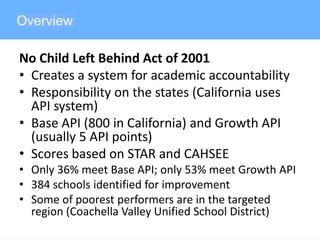
No Child Left Behind Act of 2001Creates a system for academic accountabilityResponsibility on the states (California uses API system)Base API (800 in California) and Growth API (usually 5 API points)Scores based on STAR and CAHSEEOnly 36% meet Base API; only 53% meet Growth API384 schools identified for improvementSome of poorest performers are in the targeted region (Coachella Valley Unified School District)
Company Website is being developedResearch continues on marketsIn process of developing survey to gauge consumer preferences
Parents want children to succeed academicallyDissatisfaction with public schoolsDependence on private tutoringIncreased competition for college and jobsThey will pay because of the long-term benefit$30-$70per session (in-home); $20-$80 (in-class)Benefit of self-sufficiency > Cost of tutoringHigh quality service increases prospect of attending college, becoming self-sufficientWilling to pay higher rate for higher qualityThe Westwood Review has a concrete goal
In-home tutoring for subjects according to “a-g” requirement of the University of CaliforniaIn-class tutoring for general reading/writing/science coursesThese courses usually are those in the “a-g” requirement anywayMatch competitor guarantees to ensure qualityBig company with small company feel (strong tutor-student bond)Advanced intranet and Internet site, for communicationwith (and between) tutors and with customers
Approximately $4 billion market in totalFragmented market (test prep, subjects, in-home, in-class)Market SizeOverall Market Size: 5140 to 9388 studentsSouthern California Market: 2570 to 4700 studentsIn-Class (NCLB) Market Size:  79,000 studentsSan Diego Unified: 10,000 students (83% < Base API)Los Angeles Unified: 55,000 students (83% < Base API)Long Beach Unified: 7000 students Santa Ana Unified: 4500 students (52% < Base API)Riverside Unified: 3400 students (2% < Base API)Only 20% of high schools in these counties meet Growth API(80% face penalties, which includes mandatory tutoring)
Size of market (those between 2.8 and 3.2 GPA) is 9,388 studentsOnly 53% of ELC applicants were accepted to UC Berkeley or UCLA42% of applicants who apply to UC Berkeley or UCLA might not be qualified  at allApplied to total number of applicants (ELC and non-ELC) gives market of 5140 studentsSize of target market: 2570 to 4700 studentsRevenue expected: $5.2 million (3635 students)
Size of target market: 79,000 studentsRevenue expected: $5.2 million (3635 students)Approximately 15% of each school district’s students qualify for tutoring under NCLBSan Diego Unified: 10,000 students (83% < Base API)Los Angeles Unified: 55,000 students (83% < Base API)Long Beach Unified: 7000 students Santa Ana Unified: 4500 students (52% < Base API)Riverside Unified: 3400 students (2% < Base API)
Can help achieve guaranteed admission to collegeCan focus resources on training students in only a handful of subjects (University of California a-g requirement)No property investment required (savings reinvested in company)Target market attracted by:Quality and experience of tutorsProspect of guaranteed admission to collegeConvenience of in-home tutoringAbility to meet API growth requirements
Direct: Private academic tutoring firmsIndirect: Schools and public-tutoring firmsMarket split between national firms and smaller firmsNational firms: Educate, Kaplan, The Princeton Review, Club Z!The Westwood Review targets market that is underservedIn-home, academic subjects tutoringMore professional than largest competitorFocused on short-term and long-term results (guaranteed admission)Will honor competitor guarantees
Kaplan: has two divisions which provide test prep and academic tutoring for students K-10. Tutoring is done at a learning centerThe Princeton Review: provides test prep and academic tutoring for K-12 students; Tutoring is done in classroomsEducate: provides tutoring for K-12 students  at learning center and at home.  Test prep primarily done at home, and academic tutoring done at a learning centerClub Z!: provides only in-home tutoring in many subjects; but appears rather too informal with no long-term goal.
Target customers:High school students between range of 2.8 and 3.2 GPASchool districts below state performance requirementsCustomers can enroll onlineCustomers learn through word-of-mouth, and traditional channels (radio, television, print advertisements)Price: $40 per session (in-home); $45 per session (in-class)Marketing targets students, parents, and school districtsDetailing: school districts receive materials that eventually go homeIncentives for referralsParents ultimately decide with in-home and in-class tutoring
Each divisionwill:Have its own marketing budget
Be in charge of managing its own hiring and expansion
Haveadministrative staff responsible for building and maintaining relationships with the unique target audienceMost communication is done on company Internet website and intranetCentral location should be close to all districts, because of heavy involvement in eachCommuting required to hire tutors; training done at central headquartersAs company grows, it can setup satellite offices in each county (near University of California campuses)55,000 students (5,500 tutors)3400 students (340 tutors)4500 students (450 tutors)10,000 students (1000 tutors)
Break-even expected in the third quarter of the first yearBulk of costs: Tutoring and Administrative ExpenseAdministration necessary to install tutors in the fieldFunding primarily used to pay tutors and support administration
Oshin Aivazian, MBA (‘09)Founder and PresidentPlatrasha (2008)Marketing – Strategy InternRevolution Test Prep (2007-2008)Proctor and Subjects TutorEducate Inc (2002-2005)	SAT Mathematics and Subjects TutorPrivate Tutor (2003-2004)Aivazian Process Servers (2006-2007)Founder and President
Seeking $2 million Dollars (to cover mostly tutoring and administrative expenses)This is one-time amount, company will be self-supportiveUsed mainly to fund expenses while accounts are receivableCash from operating activities will be positive, during the third year.

The Westwood Review - Lab to Market Class

  • 2.
    Value Proposition“The WestwoodReview provides high school studentswith more focused tutoring guaranteed to get them into at least one major university; it does this by focusing primarily on subjects designated by University of California, as necessary to get into at least one campus.”Eligibility in the Local ContextUC-calculated GPA of 3.0 or higher Complete 11 UC-approved “a-g” coursesRank in top 4 percent of the expected graduating class
  • 3.
    No Child LeftBehind Act of 2001Creates a system for academic accountabilityResponsibility on the states (California uses API system)Base API (800 in California) and Growth API (usually 5 API points)Scores based on STAR and CAHSEEOnly 36% meet Base API; only 53% meet Growth API384 schools identified for improvementSome of poorest performers are in the targeted region (Coachella Valley Unified School District)
  • 4.
    Company Website isbeing developedResearch continues on marketsIn process of developing survey to gauge consumer preferences
  • 5.
    Parents want childrento succeed academicallyDissatisfaction with public schoolsDependence on private tutoringIncreased competition for college and jobsThey will pay because of the long-term benefit$30-$70per session (in-home); $20-$80 (in-class)Benefit of self-sufficiency > Cost of tutoringHigh quality service increases prospect of attending college, becoming self-sufficientWilling to pay higher rate for higher qualityThe Westwood Review has a concrete goal
  • 6.
    In-home tutoring forsubjects according to “a-g” requirement of the University of CaliforniaIn-class tutoring for general reading/writing/science coursesThese courses usually are those in the “a-g” requirement anywayMatch competitor guarantees to ensure qualityBig company with small company feel (strong tutor-student bond)Advanced intranet and Internet site, for communicationwith (and between) tutors and with customers
  • 7.
    Approximately $4 billionmarket in totalFragmented market (test prep, subjects, in-home, in-class)Market SizeOverall Market Size: 5140 to 9388 studentsSouthern California Market: 2570 to 4700 studentsIn-Class (NCLB) Market Size: 79,000 studentsSan Diego Unified: 10,000 students (83% < Base API)Los Angeles Unified: 55,000 students (83% < Base API)Long Beach Unified: 7000 students Santa Ana Unified: 4500 students (52% < Base API)Riverside Unified: 3400 students (2% < Base API)Only 20% of high schools in these counties meet Growth API(80% face penalties, which includes mandatory tutoring)
  • 8.
    Size of market(those between 2.8 and 3.2 GPA) is 9,388 studentsOnly 53% of ELC applicants were accepted to UC Berkeley or UCLA42% of applicants who apply to UC Berkeley or UCLA might not be qualified at allApplied to total number of applicants (ELC and non-ELC) gives market of 5140 studentsSize of target market: 2570 to 4700 studentsRevenue expected: $5.2 million (3635 students)
  • 9.
    Size of targetmarket: 79,000 studentsRevenue expected: $5.2 million (3635 students)Approximately 15% of each school district’s students qualify for tutoring under NCLBSan Diego Unified: 10,000 students (83% < Base API)Los Angeles Unified: 55,000 students (83% < Base API)Long Beach Unified: 7000 students Santa Ana Unified: 4500 students (52% < Base API)Riverside Unified: 3400 students (2% < Base API)
  • 10.
    Can help achieveguaranteed admission to collegeCan focus resources on training students in only a handful of subjects (University of California a-g requirement)No property investment required (savings reinvested in company)Target market attracted by:Quality and experience of tutorsProspect of guaranteed admission to collegeConvenience of in-home tutoringAbility to meet API growth requirements
  • 11.
    Direct: Private academictutoring firmsIndirect: Schools and public-tutoring firmsMarket split between national firms and smaller firmsNational firms: Educate, Kaplan, The Princeton Review, Club Z!The Westwood Review targets market that is underservedIn-home, academic subjects tutoringMore professional than largest competitorFocused on short-term and long-term results (guaranteed admission)Will honor competitor guarantees
  • 12.
    Kaplan: has twodivisions which provide test prep and academic tutoring for students K-10. Tutoring is done at a learning centerThe Princeton Review: provides test prep and academic tutoring for K-12 students; Tutoring is done in classroomsEducate: provides tutoring for K-12 students at learning center and at home. Test prep primarily done at home, and academic tutoring done at a learning centerClub Z!: provides only in-home tutoring in many subjects; but appears rather too informal with no long-term goal.
  • 13.
    Target customers:High schoolstudents between range of 2.8 and 3.2 GPASchool districts below state performance requirementsCustomers can enroll onlineCustomers learn through word-of-mouth, and traditional channels (radio, television, print advertisements)Price: $40 per session (in-home); $45 per session (in-class)Marketing targets students, parents, and school districtsDetailing: school districts receive materials that eventually go homeIncentives for referralsParents ultimately decide with in-home and in-class tutoring
  • 14.
    Each divisionwill:Have itsown marketing budget
  • 15.
    Be in chargeof managing its own hiring and expansion
  • 16.
    Haveadministrative staff responsiblefor building and maintaining relationships with the unique target audienceMost communication is done on company Internet website and intranetCentral location should be close to all districts, because of heavy involvement in eachCommuting required to hire tutors; training done at central headquartersAs company grows, it can setup satellite offices in each county (near University of California campuses)55,000 students (5,500 tutors)3400 students (340 tutors)4500 students (450 tutors)10,000 students (1000 tutors)
  • 17.
    Break-even expected inthe third quarter of the first yearBulk of costs: Tutoring and Administrative ExpenseAdministration necessary to install tutors in the fieldFunding primarily used to pay tutors and support administration
  • 20.
    Oshin Aivazian, MBA(‘09)Founder and PresidentPlatrasha (2008)Marketing – Strategy InternRevolution Test Prep (2007-2008)Proctor and Subjects TutorEducate Inc (2002-2005) SAT Mathematics and Subjects TutorPrivate Tutor (2003-2004)Aivazian Process Servers (2006-2007)Founder and President
  • 21.
    Seeking $2 millionDollars (to cover mostly tutoring and administrative expenses)This is one-time amount, company will be self-supportiveUsed mainly to fund expenses while accounts are receivableCash from operating activities will be positive, during the third year.