Federal Stimulus American Recovery and Reinvestment Act and OER: An Update and Key Opportunities
Agenda Introduction Key Federal Stimulus Opportunities Race to the Top $4B Investing in Innovation (i3) $650M  Opportunities On the Horizon  SAFRA (open online courses $500 M/10 years) Elementary and Secondary Education Act
Introduction: OER Advocacy Coalition iNACOL CCSSO Education Counsel OER Community Catalyze  opportunities, raise awareness, provide leadership for advocacy WH, Hill, ED, FCC, National Ed Tech Plan Letters and outreach Technical assistance around OER to catalyze state adoptions
National Drivers Context: CCSSO & NGA Common Core  Next Generation Learners Innovation Labs Competency-based pathways
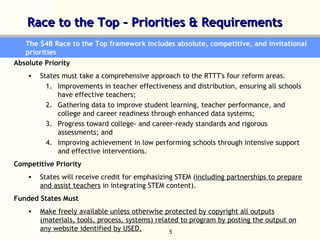
Race to the Top – Priorities & Requirements The $4B Race to the Top framework includes absolute, competitive, and invitational priorities Absolute Priority  States must take a comprehensive approach to the RTTT's four reform areas.  Improvements in teacher effectiveness and distribution, ensuring all schools have effective teachers;  Gathering data to improve student learning, teacher performance, and college and career readiness through enhanced data systems;  Progress toward college- and career-ready standards and rigorous assessments; and  Improving achievement in low performing schools through intensive support and effective interventions. Competitive Priority  States will receive credit for emphasizing STEM ( including partnerships to prepare and assist teachers  in integrating STEM content). Funded States Must Make freely available unless otherwise protected by copyright all outputs (materials, tools, process, systems) related to program by posting the output on any website identified by USED.
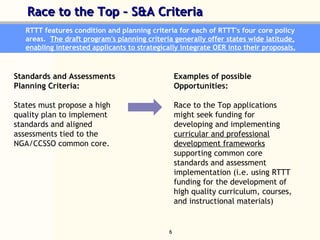
Race to the Top – S&A Criteria   RTTT features condition and planning criteria for each of RTTT's four core policy areas.  The draft program's planning criteria generally offer states wide latitude, enabling interested applicants to strategically integrate OER into their proposals.   Standards and Assessments Planning Criteria:  States must propose a high quality plan to implement standards and aligned assessments tied to the NGA/CCSSO common core.  Examples of possible Opportunities:  Race to the Top applications might seek funding for developing and implementing  curricular and professional development frameworks  supporting common core standards and assessment implementation (i.e. using RTTT funding for the development of high quality curriculum, courses, and instructional materials)
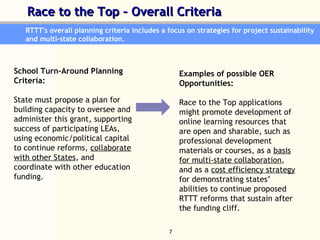
Race to the Top – Overall Criteria   RTTT's overall planning criteria includes a focus on strategies for project sustainability and multi-state collaboration.  School Turn-Around Planning Criteria:  State must propose a plan for building capacity to oversee and administer this grant, supporting success of participating LEAs, using economic/political capital to continue reforms,  collaborate with other States , and coordinate with other education funding.  Examples of possible OER  Opportunities:  Race to the Top applications might promote development of online learning resources that are open and sharable, such as professional development materials or courses, as a  basis for multi-state collaboration , and as a  cost efficiency strategy  for demonstrating states’ abilities to continue proposed RTTT reforms that sustain after the funding cliff.
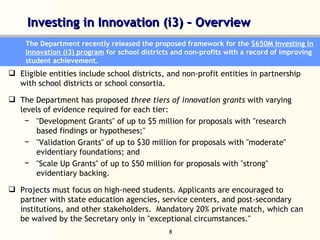
Investing in Innovation (i3) – Overview  The Department recently released the proposed framework for the  $650M Investing in Innovation (i3) program  for school districts and non-profits with a record of improving student achievement.  Eligible entities include school districts, and non-profit entities in partnership with school districts or school consortia. The Department has proposed  three tiers of innovation grants  with varying levels of evidence required for each tier:  "Development Grants" of up to $5 million for proposals with "research based findings or hypotheses;" "Validation Grants" of up to $30 million for proposals with "moderate" evidentiary foundations; and "Scale Up Grants" of up to $50 million for proposals with "strong" evidentiary backing. Projects must focus on high-need students. Applicants are encouraged to partner with state education agencies, service centers, and post-secondary institutions, and other stakeholders.  Mandatory 20% private match, which can be waived by the Secretary only in "exceptional circumstances."
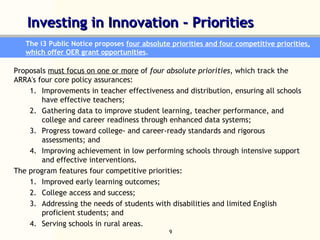
Investing in Innovation - Priorities  The i3 Public Notice proposes  four absolute priorities and four competitive priorities, which offer OER grant opportunities .  Proposals  must focus on one or more  of  four absolute priorities , which track the ARRA's four core policy assurances: Improvements in teacher effectiveness and distribution, ensuring all schools have effective teachers;  Gathering data to improve student learning, teacher performance, and college and career readiness through enhanced data systems;  Progress toward college- and career-ready standards and rigorous assessments; and  Improving achievement in low performing schools through intensive support and effective interventions. The program features four competitive priorities:  Improved early learning outcomes; College access and success;  Addressing the needs of students with disabilities and limited English proficient students; and Serving schools in rural areas.
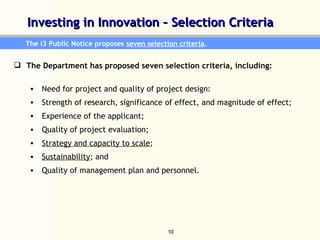
Investing in Innovation – Selection Criteria  The i3 Public Notice proposes  seven selection criteria .  The Department has proposed seven selection criteria, including:  Need for project and quality of project design:  Strength of research, significance of effect, and magnitude of effect; Experience of the applicant; Quality of project evaluation;  Strategy and capacity to scale ; Sustainability ; and  Quality of management plan and personnel.
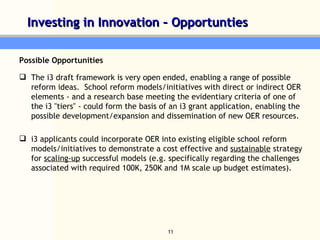
Investing in Innovation – Opportunties  Possible Opportunities The i3 draft framework is very open ended, enabling a range of possible reform ideas.  School reform models/initiatives with direct or indirect OER elements - and a research base meeting the evidentiary criteria of one of the i3 "tiers" - could form the basis of an i3 grant application, enabling the possible development/expansion and dissemination of new OER resources.   i3 applicants could incorporate OER into existing eligible school reform models/initiatives to demonstrate a cost effective and  sustainable  strategy for  scaling-up  successful models (e.g. specifically regarding the challenges associated with required 100K, 250K and 1M scale up budget estimates).
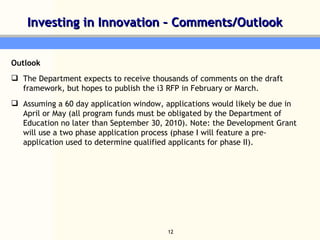
Investing in Innovation – Comments/Outlook  Outlook  The Department expects to receive thousands of comments on the draft framework, but hopes to publish the i3 RFP in February or March.  Assuming a 60 day application window, applications would likely be due in April or May (all program funds must be obligated by the Department of Education no later than September 30, 2010). Note: the Development Grant will use a two phase application process (phase I will feature a pre-application used to determine qualified applicants for phase II).
ESEA Reauthorization Outlook  Although securing passage of ESEA reauthorization prior to the mid-term elections will be challenging, the Administration and Congress have launched a serious effort to move forward.  ESEA reauthorization process underway - including possible mention in State of the Union Address - making next few months a critical time to urge thoughtful action and a focus on online learning.  The Department of Education recently launched a formal process for establishing the Administration's ESEA reauthorization platform.  House and Senate conversations are also underway.  The Department has held three stakeholder forums, with a fourth scheduled for November 4, to identify and discuss key reauthorization ideas (iNACOL was invited to participate as a panelist in the third forum on innovation).  Final action may not occur in 2010, but present reauthorization work will be critical to final product.
Next Steps: Statewide Adoptions Technical Assistance for states and districts Need to develop Implementation Guidelines Business models Cost-effectiveness  I3 and Next Race-to-the-Top Round Get involved OER Pre-conference Workshop at VSS & NROC
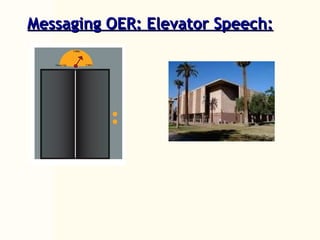
Messaging OER: Elevator Speech:
Learning Beyond Textbooks Better Content. Better Schools. Better Results.
Elevator Speech Today’s education system is outdated. Transforming beyond textbooks through Open Educational Resources (OER) is a pathway to deliver engaging, customized, and up-to-date content to students much faster and more cost effectively than today.  Open Educational Resources (OER) carry unobstructed licenses that permit educators to share, access, and collaborate so they can customize and personalize content and instruction. Today's textbooks are obsolete and the acquisition process is broken. OER and unobstructed licenses are a ready solution that permits delivery of customized content to students much faster and more cost effectively than today.  Unobstructed licenses unlock educational content and provide students with access to the information they need to succeed.
The Problem Today's current system is broken.  Students lose because few schools have high-quality, engaging, customized, and up-to-date content they need to learn effectively. Students cannot prepare for 21 st  century challenges using obsolete textbooks. Why force our students to wait years to learn Pluto is no longer a planet when solutions exist to update this content today?  Despite being purchased with taxpayer dollars, textbook content is locked up, preventing sharing and customization. Most students already do much of their work, play, research, and learning through engaging technologies.  Limiting students to antiquated textbook models in the classroom limits their growth and achievement potential.  There is a solution.
The Solution A lasting solution to the antiquated model must move beyond traditional textbooks to transform how content can be created, shared, and customized; how teachers teach; and how students learn. OER simply applies an unobstructed license to educational materials to protect the integrity of the original content while permitting sharing and customization. Unobstructed licenses expand student access to high-quality, up-to-date, engaging, and customized content more quickly, cost-effectively, and efficiently than today.  In Virginia, experts developed an updated and engaging physics textbook that was adopted by the state, aligned to curriculum standards, and made openly available to any school in Virginia at no cost.  What took xx months would have taken xx years under the typical system.
… the Solution (cont’d) Unobstructed licenses unlock educational resources that are developed using taxpayer dollars so they can be shared, customized, and improved, yielding a far greater return on investment to the public. Open educational resources with unobstructed licenses are the path forward to ensure every student has access to high-quality, engaging, personalized, and up-to-date content. Ultimately, open educational resources with unobstructed licenses can help transform our schools by producing better equipped teachers, better prepared students, and better education outcomes.  In the Omaha School District, this content has helped yield improved student performances across the board, increase graduation rates, and reduce costs.(What examples can we use here?  Need data.)
The Recommendation Any textbooks and related content developed or purchased using taxpayer dollars should carry an unobstructed license to permit access, sharing, and customization and to move us toward better schools and better results.
The Online Learning Imperative: Solution to Three Looming Crises in Education 3 Crises: Global competitiveness and skills Economic downturn Teacher shortages Governor Wise: “If you think about how much the world around us has changed just in the last twenty years, it becomes clear that the education sector is like a massive mainframe computer trying to fit itself into a smartphone world.”
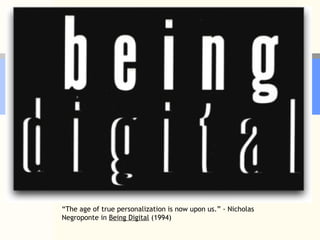
“ The age of true personalization is now upon us.” - Nicholas Negroponte in  Being Digital  (1994)

Federal Stimulus and OER

  • 1.
    Federal Stimulus AmericanRecovery and Reinvestment Act and OER: An Update and Key Opportunities
  • 2.
    Agenda Introduction KeyFederal Stimulus Opportunities Race to the Top $4B Investing in Innovation (i3) $650M Opportunities On the Horizon SAFRA (open online courses $500 M/10 years) Elementary and Secondary Education Act
  • 3.
    Introduction: OER AdvocacyCoalition iNACOL CCSSO Education Counsel OER Community Catalyze opportunities, raise awareness, provide leadership for advocacy WH, Hill, ED, FCC, National Ed Tech Plan Letters and outreach Technical assistance around OER to catalyze state adoptions
  • 4.
    National Drivers Context:CCSSO & NGA Common Core Next Generation Learners Innovation Labs Competency-based pathways
  • 5.
    Race to theTop – Priorities & Requirements The $4B Race to the Top framework includes absolute, competitive, and invitational priorities Absolute Priority States must take a comprehensive approach to the RTTT's four reform areas. Improvements in teacher effectiveness and distribution, ensuring all schools have effective teachers; Gathering data to improve student learning, teacher performance, and college and career readiness through enhanced data systems; Progress toward college- and career-ready standards and rigorous assessments; and Improving achievement in low performing schools through intensive support and effective interventions. Competitive Priority States will receive credit for emphasizing STEM ( including partnerships to prepare and assist teachers in integrating STEM content). Funded States Must Make freely available unless otherwise protected by copyright all outputs (materials, tools, process, systems) related to program by posting the output on any website identified by USED.
  • 6.
    Race to theTop – S&A Criteria RTTT features condition and planning criteria for each of RTTT's four core policy areas. The draft program's planning criteria generally offer states wide latitude, enabling interested applicants to strategically integrate OER into their proposals. Standards and Assessments Planning Criteria: States must propose a high quality plan to implement standards and aligned assessments tied to the NGA/CCSSO common core. Examples of possible Opportunities: Race to the Top applications might seek funding for developing and implementing curricular and professional development frameworks supporting common core standards and assessment implementation (i.e. using RTTT funding for the development of high quality curriculum, courses, and instructional materials)
  • 7.
    Race to theTop – Overall Criteria RTTT's overall planning criteria includes a focus on strategies for project sustainability and multi-state collaboration. School Turn-Around Planning Criteria: State must propose a plan for building capacity to oversee and administer this grant, supporting success of participating LEAs, using economic/political capital to continue reforms, collaborate with other States , and coordinate with other education funding. Examples of possible OER Opportunities: Race to the Top applications might promote development of online learning resources that are open and sharable, such as professional development materials or courses, as a basis for multi-state collaboration , and as a cost efficiency strategy for demonstrating states’ abilities to continue proposed RTTT reforms that sustain after the funding cliff.
  • 8.
    Investing in Innovation(i3) – Overview The Department recently released the proposed framework for the $650M Investing in Innovation (i3) program for school districts and non-profits with a record of improving student achievement. Eligible entities include school districts, and non-profit entities in partnership with school districts or school consortia. The Department has proposed three tiers of innovation grants with varying levels of evidence required for each tier: "Development Grants" of up to $5 million for proposals with "research based findings or hypotheses;" "Validation Grants" of up to $30 million for proposals with "moderate" evidentiary foundations; and "Scale Up Grants" of up to $50 million for proposals with "strong" evidentiary backing. Projects must focus on high-need students. Applicants are encouraged to partner with state education agencies, service centers, and post-secondary institutions, and other stakeholders. Mandatory 20% private match, which can be waived by the Secretary only in "exceptional circumstances."
  • 9.
    Investing in Innovation- Priorities The i3 Public Notice proposes four absolute priorities and four competitive priorities, which offer OER grant opportunities . Proposals must focus on one or more of four absolute priorities , which track the ARRA's four core policy assurances: Improvements in teacher effectiveness and distribution, ensuring all schools have effective teachers; Gathering data to improve student learning, teacher performance, and college and career readiness through enhanced data systems; Progress toward college- and career-ready standards and rigorous assessments; and Improving achievement in low performing schools through intensive support and effective interventions. The program features four competitive priorities: Improved early learning outcomes; College access and success; Addressing the needs of students with disabilities and limited English proficient students; and Serving schools in rural areas.
  • 10.
    Investing in Innovation– Selection Criteria The i3 Public Notice proposes seven selection criteria . The Department has proposed seven selection criteria, including: Need for project and quality of project design: Strength of research, significance of effect, and magnitude of effect; Experience of the applicant; Quality of project evaluation; Strategy and capacity to scale ; Sustainability ; and Quality of management plan and personnel.
  • 11.
    Investing in Innovation– Opportunties Possible Opportunities The i3 draft framework is very open ended, enabling a range of possible reform ideas. School reform models/initiatives with direct or indirect OER elements - and a research base meeting the evidentiary criteria of one of the i3 "tiers" - could form the basis of an i3 grant application, enabling the possible development/expansion and dissemination of new OER resources. i3 applicants could incorporate OER into existing eligible school reform models/initiatives to demonstrate a cost effective and sustainable strategy for scaling-up successful models (e.g. specifically regarding the challenges associated with required 100K, 250K and 1M scale up budget estimates).
  • 12.
    Investing in Innovation– Comments/Outlook Outlook The Department expects to receive thousands of comments on the draft framework, but hopes to publish the i3 RFP in February or March. Assuming a 60 day application window, applications would likely be due in April or May (all program funds must be obligated by the Department of Education no later than September 30, 2010). Note: the Development Grant will use a two phase application process (phase I will feature a pre-application used to determine qualified applicants for phase II).
  • 13.
    ESEA Reauthorization Outlook Although securing passage of ESEA reauthorization prior to the mid-term elections will be challenging, the Administration and Congress have launched a serious effort to move forward. ESEA reauthorization process underway - including possible mention in State of the Union Address - making next few months a critical time to urge thoughtful action and a focus on online learning. The Department of Education recently launched a formal process for establishing the Administration's ESEA reauthorization platform. House and Senate conversations are also underway. The Department has held three stakeholder forums, with a fourth scheduled for November 4, to identify and discuss key reauthorization ideas (iNACOL was invited to participate as a panelist in the third forum on innovation). Final action may not occur in 2010, but present reauthorization work will be critical to final product.
  • 14.
    Next Steps: StatewideAdoptions Technical Assistance for states and districts Need to develop Implementation Guidelines Business models Cost-effectiveness I3 and Next Race-to-the-Top Round Get involved OER Pre-conference Workshop at VSS & NROC
  • 15.
  • 16.
    Learning Beyond TextbooksBetter Content. Better Schools. Better Results.
  • 17.
    Elevator Speech Today’seducation system is outdated. Transforming beyond textbooks through Open Educational Resources (OER) is a pathway to deliver engaging, customized, and up-to-date content to students much faster and more cost effectively than today.  Open Educational Resources (OER) carry unobstructed licenses that permit educators to share, access, and collaborate so they can customize and personalize content and instruction. Today's textbooks are obsolete and the acquisition process is broken. OER and unobstructed licenses are a ready solution that permits delivery of customized content to students much faster and more cost effectively than today. Unobstructed licenses unlock educational content and provide students with access to the information they need to succeed.
  • 18.
    The Problem Today'scurrent system is broken. Students lose because few schools have high-quality, engaging, customized, and up-to-date content they need to learn effectively. Students cannot prepare for 21 st century challenges using obsolete textbooks. Why force our students to wait years to learn Pluto is no longer a planet when solutions exist to update this content today? Despite being purchased with taxpayer dollars, textbook content is locked up, preventing sharing and customization. Most students already do much of their work, play, research, and learning through engaging technologies. Limiting students to antiquated textbook models in the classroom limits their growth and achievement potential. There is a solution.
  • 19.
    The Solution Alasting solution to the antiquated model must move beyond traditional textbooks to transform how content can be created, shared, and customized; how teachers teach; and how students learn. OER simply applies an unobstructed license to educational materials to protect the integrity of the original content while permitting sharing and customization. Unobstructed licenses expand student access to high-quality, up-to-date, engaging, and customized content more quickly, cost-effectively, and efficiently than today. In Virginia, experts developed an updated and engaging physics textbook that was adopted by the state, aligned to curriculum standards, and made openly available to any school in Virginia at no cost. What took xx months would have taken xx years under the typical system.
  • 20.
    … the Solution(cont’d) Unobstructed licenses unlock educational resources that are developed using taxpayer dollars so they can be shared, customized, and improved, yielding a far greater return on investment to the public. Open educational resources with unobstructed licenses are the path forward to ensure every student has access to high-quality, engaging, personalized, and up-to-date content. Ultimately, open educational resources with unobstructed licenses can help transform our schools by producing better equipped teachers, better prepared students, and better education outcomes. In the Omaha School District, this content has helped yield improved student performances across the board, increase graduation rates, and reduce costs.(What examples can we use here? Need data.)
  • 21.
    The Recommendation Anytextbooks and related content developed or purchased using taxpayer dollars should carry an unobstructed license to permit access, sharing, and customization and to move us toward better schools and better results.
  • 22.
    The Online LearningImperative: Solution to Three Looming Crises in Education 3 Crises: Global competitiveness and skills Economic downturn Teacher shortages Governor Wise: “If you think about how much the world around us has changed just in the last twenty years, it becomes clear that the education sector is like a massive mainframe computer trying to fit itself into a smartphone world.”
  • 23.
    “ The ageof true personalization is now upon us.” - Nicholas Negroponte in Being Digital (1994)