N.S.A.P
ENROLL NO. -131343
DRAWING NAME - TV TOWER
SCALE-
SIGNATURE-
CLASS- 4th YEAR 7th SEM B.ARCH
All the dimensions are in metre &
mm.
SUBMITTED BY-ER. BHAWESH JHOSI
SHEET NO. 02
TV TOWER HEIGHT- 304.8M
(1000 FT)
TV TOWER-
1. T.V. towers are, typically, tall structures designed to support antennas for telecommunication sand broadcasting, including
television.
2. They are among the tallest man-made structures.
3. Similar structures include electricity pylonsand towers for wind turbines.
4. These are sometimes named after the broadcasting organizations that use them, or after a nearby city or town.
5. TheWarsaw Radio Mast(Warszawa radio mast)was the world's tallest supported structure on land,but it collapsed in 1991, leaving
theKVLY/KTHI-TVmastas the tallest.
6. In the case of amast radiatoror radiating tower, the whole mast or tower is itself the transmitting antenna.
7. Typical tower heights will vary between 100 and250 feet.
RESTING PLATFORM
AT EVERY 15.Om INTERVAL
30m SQUARE
SELF SUPPORT TOWER
114Øx5mm PIPE MW MOUNT
LENGHT = 1.5m
90Øx5mm PIPE GSM MOUNT
LENGHT = 3.0m
TYPICAL FOR 3 SECTORS
WORKING PLATFORM
ABOUT TOP
OBSTRUCTION LIGHT
LIGHTNING ROD
SITE LIGHT - LED TYPE 50-60 WATTS
WITH PHOTOCELL
(4.5m ABOVE THE GROUND)
OUTDOOR 400mm WIDE
CABLE TRAY WITH
COVER
EXTERNAL LIGHT
SHELTER
EQUIPMENT
INNER DIMENSION
(2.4 x 3.5m)
POST
(SEE DETAILS)
FENCE BEAM
FGL
LADDER BASE (SEE DETAILS)
TOWER FOUNDATION
LEAN CONCRETE
TOWER ELEVATION
A
LAYOUT PLAN
SHELTER
EQUIPMENT
INNER DIMENSION
(2.4 x 3.5m)
B C
POWER METER BOX
PERIMETER FENCE
(10x12m)
FGL
SHELTER FOUNDATION
AC OUTDOOR UNIT 1 & 2
Foundation Depth
The depth of the foundation may vary from 1.5 to 3.5 meters.
(a) Normal dry type :
(b) Wet type :
To be used for location in normal day cohesive or non-cohesive soils To used for locations-
Where sub-soil water is met at 1.5 m or more below the ground line. or
Which are in surface water for long periods with water penetration not exceeding one metre below the ground line.
and
iii) In black cotton soils
(c) Partially sub- merged type :
(d) Fully sub-merged type :
To be used at locations where sub soil water table is met between 0.75 metre below the ground line.
To be used at locations where sub-soil water table is met at less than 0.75 metre below the ground line.
In addition to the above, depending on the site conditions, other types of foundations may be introduced suitable for-
Intermediate conditions under the above classification to effect more economy, or For locations in hilly and rocky areas.
For locations where special foundations (well type or piles) are necessitated. The proposal for this shall be submitted by the
contractor based on the Board.
CLASSIFICATION OF FOUNDATION
SPACE RESERVED FOR
GENERATPOR SET
FOUNDATION LINE
NEW 30M
SS TOWER
POST
OUTDOOR CABLE TRAY
WITH COVER
20-34MM
GRAVEL BED
POWER METER BOX
NEW TRANSFORMER
(SEE DETAIL)
PERIMETER FENCE WITH DOUBLE BARBED WIRE (3-LAYERS)
NEETU KUMAWAT
¾ T.V. towers are, typically, tall structures
designed to support antennas for telecommunications
and broadcasting, including television.
¾ They are among the tallest man-made structures.
¾ Similar structures include electricity pylons and
towers for wind turbines.
¾ These are sometimes named after the
broadcasting organizations that use them, or after a
nearby city or town.
¾ The Warsaw Radio Mast (Warszawa radio mast)
was the world's tallest supported structure on land,
but it collapsed in 1991, leaving the KVLY/KTHI-TV
mast as the tallest.
¾ In the case of a mast radiator or radiating
tower, the whole mast or tower is itself the
transmitting antenna.
¾Typical tower heights will vary between 100 and
250 feet.
INTRODUCTION STRUCTURE TYPES
1.) Guyed Towers
2.) Self Support Towers
3.) Monopole Structures
GUYED TOWER
¾ Guyed towers are generally the least costly .
¾ They also require the greatest amount of land to
erect due to the area needed for the cable guy wire
stays.
¾ As a result, guyed towers are most often seen in rural
or suburban settings where land is not at a premium.
¾ Guyed towers may be constructed with either 3 legs
(triangular) or 4 legs. The distance between the tower
legs will increase as the height of the tower and wind
load increases.
¾ Two variables are required when collecting guyed
towers;
¾Distance between tower legs
¾Tower height.
¾ distance between the tower legs
ranges from 1 to 7 feet.
¾ 100’ – 500’ height.
SELF SUPPORTING TOWER
¾ Self-supporting towers tend to be the most expensive towers to
erect.
¾ They can be constructed with either three or four legs and are
free standing with a lattice frame design.
¾ These towers are generally the strongest and can support the
largest wind and ice loads of the three tower types.
¾ 100’ – 300’ heights
¾ Flexibility for Mounting
¾ Accommodate Multiple Tenants.
¾ LATTICE SELF SUPPORTING TOWER is
ideally suited for light to medium-duty
cellular applications, microwave links, and
self supporting FM radio antennas.
¾ Wind speed capacities range up to 90
mph.
¾ Member sizes are project specified for
maximum efficiency.
¾ Available in pipe and rod leg sections.
MONOPOLE TOWER
¾ These towers are free standing and are most commonly used in cellular and
personal communication service (PCS) applications.
¾ They are typically constructed of different diameter steel sections either
cylindrical or multi sided in shape.
¾ The individual sections are bolted or welded together with the largest diameter
sections at the base and each successive section is smaller in diameter.
¾ One variable is required when collecting monopole towers.
¾ Tower heights ranging from 30 to 490 feet.
¾ Tapered, polygonal poles and conical poles are also
being fabricated nowadays.
¾ Land Constraints
¾ Urban Environments
¾ Most Costly Structure
ADVANTAGES
¾ Less installation time& cost
¾ Occupies less floor space
¾ Maintenance free
¾ Long life because of galvanization
¾ Strong because of aerodynamic construction
¾ It is aesthetic and elegant
¾ Less time taking in time of repairs and renewals
¾ Shorter delivery period
USES
Monopoles/high masts can be used for:
¾ Telecommunication Towers
¾ Transmission line towers
¾ Highway and junction lighting
¾ Yard lighting
¾ Parking lots lighting
¾ Airport, Railway, seaports and yard lighting
¾ Power plants lighting
¾ Stadium yard lighting
¾ Park /garden lighting
SITE PREPARATION
1) Erosion control
2) Clearing / Grabbing earth work
3) Access Road
4) Compound Wall
FOUNDATIONS
1) Tower foundation
2) Shelter cabinet
Foundation
STEEL LATTICE
¾The steel lattice is the most widespread form of
construction.
¾It provides great strength, low wind resistance and
economy in the use of materials.
¾Such structures are usually triangular or square in
cross-section.
¾When built as a tower, the structure may be
parallel-sided or taper over part or all of its height.
¾When constructed of several sections which taper
exponentially with height, in the manner of the Eiffel
Tower, the tower is said to be an Eiffelized one.
¾The Crystal Palace tower in London is an example.
TUBULAR STEEL
¾Some towers are constructed out of steel
tubes.
¾In the UK, these were the subject of
collapses at the Emley Moor and Waltham-on-
the-Wolds TV stations in the 1960s.
MATERIAL
S
FIBERGLASS
¾Fiberglass poles are occasionally used for low-power non-directional beacons or
medium-wave broadcast transmitters.
REINFORCED CONCRETE
¾Reinforced concrete towers are relatively
expensive to build
¾provide a high degree of mechanical rigidity in
strong winds.
¾This can be important when antennas with narrow
beam widths are used, such as those used for
microwave point-to-point links, and when the
structure is to be occupied by people.
¾In Germany and the Netherlands most towers are
built of reinforced concrete.
WOODEN TOWER
¾There are fewer wooden towers now than
in the past.
¾Many were built in the UK during World
War II because of a shortage of steel.
¾In Germany before World War II in
nearly all medium wave transmission sites
towers built of wood were used.
¾Nowadays these towers are demolished.
¾ Concrete towers can form prestigious landmarks, such as the CN Tower
in Toronto.
¾ As well as accommodating technical staff, these buildings may have
public areas such as observation decks or restaurants.
¾ The Stuttgart TV tower was the first tower in the world to be built in
reinforced concrete. It was designed in 1956 by the local civil engineer,
Fritz Leonhardt.
Aircraft warning lamps
• Taller structures are often equipped with
lamps, usually red in colour, to warn pilots of
the structure's existence.
• In the past, ruggedized and under-run
filament lamps were used to maximise the bulb
life.
• Nowadays such lamps tend to use LED arrays.
Wind-induced oscillations
• One problem with radio masts is the danger of wind-induced
oscillations.
•This is particularly a concern with steel tube construction.
•One can reduce this by building cylindrical shock-mounts into the
construction.
CLIMBING FACILITIES
Access Ladders
- Hot dip Galvanized, in standard 20'
sections
- Mountable to all tower models and
monopoles
- Inside or outside mounting
- To be used in conjunction with the safety
system
Step-Bolts
- Can be used on Self Support towers
and monopoles
- Hot dip galvanized steel
- To be used in conjunction with the
safety system
Work/Rest Platforms
- Hot dip Galvanized frame and heavy duty
grating
- Safety railing optional
- Assembly hardware provided
Safety Hoops
- Available galvanized and Red/White
painted
- Assembly hardware provided
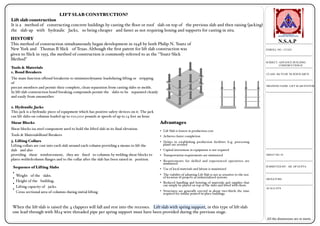
LIFT SLAB CONSTRUCTION?
Lift slab construction
It is a method of constructing concrete buildings by casting the floor or roof slab on top of the previous slab and then raising (jacking)
the slab up with hydraulic Jacks, so being cheaper and faster as not requiring boxing and supports for casting in situ.
HISTORY
This method of construction simultaneously began development in 1948 by both Philip N. Youtz of
New York and Thomas B Slick of Texas. Although the first patent for lift slab construction was
given to Slick in 1955, the method of construction is commonly referred to as the "Youtz-Slick
Method"
Advantages:
• Lift Slab is lowest in production cost
• Achieves faster completion
• Delays in establishing production facilities (e.g. processing
plant) are avoided
• Capital investment in equipment is not required
• Transportation requirements are minimized
• Requirements for skilled and experienced operatives are
minimized
• Use of local materials and labour is maximized
• The viability of adopting Lift Slab is not as sensitive to the size
of location of projects as industrialized systems
• Reduced handling and hoisting of materials and supplies that
can simply be placed on top of the slabs and lifted with them.
• Structures are generally erected in about two-thirds the time
required for similar poured-in-place buildings
Tools & Materials
1. Bond Breakers
The main function ofbond breakersis to minimizedynamic loadsduring lifting or stripping
of
precast members and permit their complete, clean separation from casting slabs or molds.
In lift-slab construction bond-breaking compounds permit the slabs to be separated cleanly
and easily from oneanother
2. Hydraulic Jacks
This jack is a hydraulic piece of equipment which has positive safety devices on it. The jack
can lift slabs on columns loaded up to 100,000 pounds at speeds of up to 14 feet an hour.
Shear Blocks
Shear blocks isa steel component used to hold the lifted slab in its final elevation.
Tools & MaterialsBond Breakers
3. Lifting Collars
Lifting collars are cast into each slab around each column providing a means to lift the
slab and also
providing shear reinforcement, they are fixed to columns by welding shear blocks to
plates weldedcolumn flanges and to the collar after the slab has been raised in position.
N.S.A.P
SUBJECT- ADVANCE BUILDING
CONSTRUCTION-II
DRAWING NAME -LIFT SLAB SYSTEM
SCALE-NTS
SIGNATURE-
CLASS- 4th YEAR 7th SEM B.ARCH
All the dimensions are in metre.
SUBMITTED BY- AR. OP GUPTA
SHEET NO. 01
ENROLL NO. -131343
Sequence of Lifting Slabs
•
Weight of the slabs.
•
Height of the building.
•
Lifting capacity of jacks.
•
Cross sectional area of columns during initial lifting
When the lift-slab is raised the 4 clappers will fall and rest into the recesses. Lift-slab with spring support, in this type of lift-slab
one lead-through with M24-wire threaded pipe per spring support must have been provided during the previous stage.
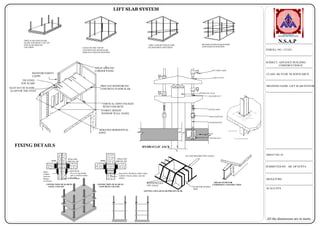
LIFT SLAB SYSTEM
N.S.A.P
SUBJECT- ADVANCE BUILDING
CONSTRUCTION-II
DRAWING NAME -LIFT SLAB SYSTEM
SCALE-NTS
SIGNATURE-
CLASS- 4th YEAR 7th SEM B.ARCH
All the dimensions are in metre.
SUBMITTED BY- AR. OP GUPTA
SHEET NO. 01
ENROLL NO. -131343
ENROLL NO. -131344
(POOJA KHIRIA)
LIFT SLAB SYSTEM
SCALE-
SIGNATURE-
CLASS- 4th YEAR 7th SEM B.ARCH
All the dimensions are in metre &
mm.
SUBMITTED BY-
SHEET NO. 01
SITE PLAN
CONNECTION OF SLAB TO
STEEL COLUMN
CONNECTION OF SLAB TO
CONCRETE COLUMN
SHEAR STUDS FOR
COMPOSITE CONSTRUCTION
FIRST & SECOND FLOOR
SLABS AND ROOF CAST ON
SITE SLAB AROUND
COLUMNS JACKS ON THE TOP OF
COLUMN FACE ROOF SLAB
WHICH IS FIXED IN POSITION
FIRST AND SECOND FLOOR
SLAB RAISED AND FIXED
SECOND FLOOR SLAB RAISED
AND FIXED IN POSITION
VERTICAL JOINT PACKED
WITH CONCRETE
STOREY HEIGHT
WINDOW WALL PANEL
PRECAST REINFORCED
CONCRETE FLOOR SLAB
WRAP AROUND
CORNER PANEL
REINFORCEMENT
LOOPS
TIE STEEL
B/W SLABS
SLOT OUT IN FLOOR
SLAB FOR THE STEEL
REBATED HORIZONTAL
JOINT
NUT DRIVE ARM
TAKE UP NUT
HYDRAULIC JACK
HOLDING NUT
LIFTING ROD
ROD COUPLLER
EXTENSION ROD
SLAB
LIFTING NUT
shear block
fits over top of plate
and is welded to plate
& collar
Web of column
lifting collar
cast into slab
grout
plates
welded
between
flenges
of column
shear block Welded to collar E plate
welded to beam sechan -cast into
column
-lifting collar
cast into slab
grout
FIXING DETAILS HYDRAULIC JACK
LIFTING COLLAR SLAB FOR LIFT SLAB
PLATED WELDED
TWO ANGLE
SLAB FOR LIFTING
ROD
PLATED WELDED TWO ANGLE
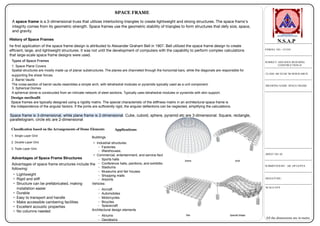
Buildings
• Industrial structures:
◦ Factories
◦ Warehouses,
• Commercial, entertainment, and service facilities:
◦ Sports halls
◦ Conference halls, pavilions, and exhibition centers
◦ Stadiums
◦ Museums and fair houses
◦ Shopping malls
◦ Airports
Vehicles:
◦ Aircraft
◦ Automobiles
◦ Motorcycles
◦ Bicycles
◦ Spacecraft
Architectural design elements
◦ Atriums
◦ Geodesics
SPACE FRAME
N.S.A.P
SUBJECT- ADVANCE BUILDING
CONSTRUCTION-II
DRAWING NAME -SPACE FRAME
SCALE-NTS
SIGNATURE-
CLASS- 4th YEAR 7th SEM B.ARCH
All the dimensions are in metre.
SUBMITTED BY- AR. OP GUPTA
SHEET NO. 02
ENROLL NO. -131343
A space frame is a 3-dimensional truss that utilizes interlocking triangles to create lightweight and strong structures. The space frams's
integrity comes from its geometric strength. Space frames use the geometric stability of triangles to form structures that defy size, space,
and gravity.
History of Space Frames
he first application of the space frame design is attributed to Alexander Graham Bell in 1907. Bell utilized the space frame design to create
efficient, large, and lightweight structures. It was not until the development of computers with the capability to perform complex calculations
that large-scale space frame designs were used.
Advantages of Space Frame Structures
Advantages of space frame structures include the
following:
• Lightweight
• Rigid and stiff
• Structure can be prefabricated, making
installation easier
• Durable
• Easy to transport and handle
• Make accessible cambering facilities
• Excellent acoustic properties
• No columns needed
Space frame is 3-dimensional, while plane frame is 2-dimensional. Cube, cuboid, sphere, pyramid etc are 3-dimensional. Square, rectangle,
parallelogram, circle etc are 2-dimensional
Design methodS
Space frames are typically designed using a rigidity matrix. The special characteristic of the stiffness matrix in an architectural space frame is
the independence of the angular factors. If the joints are sufficiently rigid, the angular deflections can be neglected, simplifying the calculations.
Applications
Types of Space Frames
1. Space Plane Covers
Spatial structures are mostly made up of planar substructures. The planes are channeled through the horizontal bars, while the diagonals are responsible for
supporting the shear forces.
2. Barrel Vaults
The cross-section of barrel vaults resembles a simple arch, with tetrahedral modules or pyramids typically used as a unit component.
3. Spherical Domes
A spherical dome is constructed from an intricate network of steel sections. Typically uses tetrahedral modules or pyramids with skin support.
Classification based on the Arrangements of Dome Elements
1. Single Layer Grid
2. Double-Layer Grid
3. Triple Layer Grid
N.S.A.P
SUBJECT- ADVANCE BUILDING
CONSTRUCTION-II
DRAWING NAME -GRIDERS
SCALE-NTS
SIGNATURE-
CLASS- 4th YEAR 7th SEM B.ARCH
All the dimensions are in metre.
SUBMITTED BY- AR. OP GUPTA
SHEET NO. 04
ENROLL NO. -131343
GIRDERS
INTRODUCTION
A large iron or steel beam or compound structure
used for building bridges and the framework of
large buildings.
A girder is a beam used in construction. It is the
main horizontal support of a structure which
supports smaller beams. Girders often have an I-
beam cross section composed of two load-bearing
flanges separated by a stabilizing web, but may
also have a box shape, Z shape, or other forms.
WHAT IS GIRDER USED FOR?
A girder is a large and deep type of beam that is
used in construction. It is typically capable of
longer spans and taking greater loads than a
normal beam, and is often used as a main
horizontal structural support for smaller beams,
such as in
Bridge construction,
High-rise building
BASIC DIFFERENCE B/W BEAM
AND GIRDER
Beams are horizontal primary structures that are
designed elements of a building.
Girders are a larger type of beam that carries smaller
beams.
Generally, a large horizontal beam supports smaller
beams; the large beam is the girder.
SIZE
Girder spans also range from 15 feet to 45 feet in 5-
foot increments for each of the beam spans noted.
Therefore, beam/girder depths tabulated cover 28
different bay sizes for each of three load cases. Dead
loads address the self-weight of the floor/roof
framing system.
DEPTH
Generally, the depth of the girder is no less than ⁄
the span, and for a given load bearing capacity, a
depth of around ⁄ the span minimizes the weight of
the girder.
STEEL GIRDER BRIDGES
A steel girder bridge is a type of bridge that uses
steel girders as the primary support structure.
Girders are horizontal beams that span between
two abutments or piers, carrying the weight of the
bridge deck, which is the roadway or pedestrian
path that sits on top of the girders.
Steel girder bridges are known for their strength
and durability, which makes them an ideal choice
for heavily trafficked roads and areas with high
seismic activity.
They can be built in a variety of configurations,
including straight, curved, and skewed alignments,
and are often used for long spans that require a
relatively shallow depth.
COMPONENTS OF STEEL GIRDER
BRIDGES
Girders: Horizontal beams that span between two
abutments or piers, carrying the weight of the
bridge deck.
Deck: The roadway or pedestrian path that sits on
top of the girders.
Abutments and Piers: The supports that hold up
the bridge deck and transfer the weight of the
bridge to the ground.
Bearings: Devices that allow for the movement of
the bridge deck due to thermal expansion and
contraction, wind, and seismic activity.
Expansion Joints: Devices that allow for the
movement of the bridge deck and prevent damage
to the structure due to thermal expansion and
contraction.
Drainage System: A system of gutters and
downspouts that collect and carry away rainwater
and prevent damage to the bridge deck and
supports.
Access Points: Stairways, ramps, or elevators that
allow pedestrians and vehicles to access the
bridge deck.
Lighting: Lights that illuminate the bridge deck
and improve visibility for drivers and pedestrians
at night.
Guardrails: Barriers that prevent vehicles and
pedestrians from falling off the sides of the
bridge.
DETAILS
TYPES OF STEEL GIRDER BRIDGES
Plate Girder Bridges: These bridges are made up of steel plates that
are welded or bolted together to form girders. They are commonly
used for shorter spans and have a lower profile than other types of
steel girder bridges.
Box Girder Bridges: These bridges are made up of a hollow steel box
that forms the girder. They are commonly used for longer spans and
are more resistant to torsional forces than other types of steel girder
bridges.
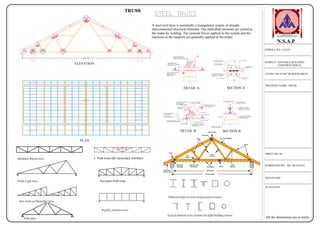
TRUSS
N.S.A.P
SUBJECT- ADVANCE BUILDING
CONSTRUCTION-II
DRAWING NAME -SPACE FRAME
SCALE-NTS
SIGNATURE-
CLASS- 4th YEAR 7th SEM B.ARCH
All the dimensions are in metre.
SUBMITTED BY- AR. OP GUPTA
SHEET NO. 02
ENROLL NO. -131343
INTRODUCTION
In structural engineering, a truss is an important type of structure characterised by a triangulated system of members. Trusses are structural elements
that can carry loads with relatively long spans compared to beams. Trusses are characterized by having tensions and compression members. These
structures are often used in roof, floor and bridge structuresThe members of a truss are considered two-force members because the forces are only
applied at either end of the member, resulting in either a compression or tension force. Trusses are commonly used in bridge designs due to their ability
to efficiently span long distances.
TRUSS COMPONETS & TERMINOLOGY
Trusses typically follow a pretty general and common structure, made up of
various components.
◦ Principal rafter or Top Chord
◦ Bottom chord or main tie
◦ Ties
◦ Struts
◦ Sag tie
◦ Purlins
◦ Rafters
◦ Ridge line
◦ Eaves
◦ Panel points
◦ Roof covering
◦ Shoe angle
◦ Base plate, anchor plate and anchor bolts.
Here’s the list of common types of trusses: 1. Steel truss
2. King post Truss
3. Queen post Truss
K Truss 5.Fink Truss 6.Gambrel Truss
Roof Truss Advantages
◦ Roof trusses can save on-site costs.
◦ Better project cost control, with component costs known in advance
◦ Better cash flow with earlier occupancy due to reduced on-site labour
◦ Faster shell completion time
◦ Using trusses of smaller dimension lumber, in place of beams and columns
◦ Greater flexibility in locating plumbing, duct work, and electrical wiring
◦ Floor plan freedom in locating interior partitions often without additional
support required
◦ Pre-determined, pre-engineered truss system
◦ Fewer pieces to handle and reduced installation time
◦ Wide 3-1/2” nailing surface for easy floor deck application
◦ Eliminate notching and boring joists for electrical wiring and plumbing
◦ Floor trusses offer better availability and less in-place cost than 2×8 or 2×10
joists
◦ Factory-manufactured components to exact span requirements
◦ Reduced HVAC, plumbing, and electrical subcontractor time on job
Types of Roof Trusses
◦ King Post Truss
◦ Pratt Truss
◦ Queen Post Truss
◦ Howe Truss
◦ Fan Truss
◦ North Light Roof Truss
◦ Quadrangular Roof Trusses
◦ Parallel Chord Roof Truss
◦ Scissor Roof Truss
◦ Raised Heel Roof Truss
Use of trusses in buildings
Trusses are used in a broad range of buildings, mainly where there is a
requirement for very long spans, such as in airport terminals, aircraft hangers,
sports stadia roofs, auditoriums and other leisure buildings. Trusses are also
used to carry heavy loads and are sometimes used as transfer structures. This
article focuses on typical single storey industrial buildings, where trusses are
widely used to serve two main functions:
▪ To carry the roof load
▪ To provide horizontal stability.
Truss count = ((roof length * 12) / 24) + 1
The simplest form of this equation is to take the length of your roof and divide it by 2.
For example, if your roof is 40-feet long, it will need a total of 20 trusses.
TRUSS
DETAIL A SECTION A
DETAIL B SECTION B
A steel roof truss is essentially a triangulated system of straight
interconnected structural elements. The individual elements are joined at
the nodes by welding. The external forces applied to the system and the
reactions at the supports are generally applied at the nodes
ELEVATION
PLAN
N.S.A.P
SUBJECT- ADVANCE BUILDING
CONSTRUCTION-II
DRAWING NAME -TRUSS
SCALE-NTS
SIGNATURE-
CLASS- 4th YEAR 7th SEM B.ARCH
All the dimensions are in metre.
SUBMITTED BY- AR. OP GUPTA
SHEET NO. 04
ENROLL NO. -131343
Modified Warren truss
North Light truss
Saw-tooth (or Butterfly) truss
Fink truss
Typical element cross sections for light building trusses
Different types of steel section used in trusses
Rigidly-jointed trusses
▪ Pratt truss with secondary members
Duo-pitch Pratt truss
LARGE SPAN STRUCTURE
MOHAMMAD IMRAN.
VTH YEAR B. ARCH
BUILDING CONSTRUCTION
DATE :- 26/11/2023
ROLL NO. : - _ _ _ _
BARREL VAULT
NORTH STAMP
NOTES
x THE WIDTH OF THE BARREL VAULT IS HALF THE SPAN
AND THE RISE IS APPROXIMATELY ONE FIFTH THE
WIDTH
x BARREL VAULT 50 - 100 mm THICK FOR SPANS OF 12 -
30 M RESPECTIVELY
x THE SHELL IS 150 mm THICK FOR A SPAN OF 2 M FROM
THE ARCH RIB
x THE SPRINGING THICKNESS OF THE SHELL IS 250 MM
x EXPANSION JOINTS ARE USED AT 30 M INTERVALS
x COLUMNS ARE IN A 9 x 18 M GRID
x ADDITIONAL COLUMNS ARE LOCATED AT THE
PERIPHERY 4.5 M APART
x ALL DIMENSIONS ARE IN MILLIMETERS UNLESS
SPECIFIED
x WRITTEN DIMENSIONS SUPERCEDE SCALED
DRAWINGS
9000
R
8
0
0
0
54
M
36 M
9000
18000
400
900
25 Ø ARCH RIB R/F
8 Ø STIRRUPS
150
900 x 400 ARCH RIB
12 mm Ø DISTRIBUTION
STEEL R/F
16 mm Ø MAIN STEEL R/F
2000
150 THK RCC SHELL
FOR 2 M FROM
ARCH RIB
2
5
0
8 Ø STIRRUP AT 150 c/c
4 12 Ø BEAM MAIN STEEL R/F
1200 x 300 R.C.C. EDGE BEAM
16 Ø SHELL R/F AT 100 c/c
12 Ø FABRIC R/F AT 200 c/c
8 M SHELL INTERNAL RADIUS
15 mm THK INTERNAL PLASTER
25 mm CLEAR COVER
230 mm THK BRICK WALL
ASPHALT ON FELT WATER PROOFING
CONSTRUCTION JOINT
25 mm THK EXTERNAL PLASTER
1.5 m TANGENT
1
0
0
100mm THK SHELL
CONSTRUCTION JOINT
16 mm Ø STEEL R/F @ 100 C/C
25 mm THK ASPHALT ON FELT WATER PROOFING
8 Ø STIRRUP AT 150 c/c
2 20 Ø VALLEY BEAM BENT-UP STEEL R/F
900 x 300 R.C.C. VALLEY BEAM
12 Ø FABRIC R/F
8 M SHELL INTERNAL RADIUS
15 mm THK INTERNAL PLASTER
25 mm CLEAR COVER
25 mm SPACER
R
8
0
0
0
600
300
8 Ø STIRRUP AT 150 c/c
2 25 Ø STEEL R/F
25 mm SPACERS
20 Ø VALLEY BEAM MAIN R/F
25 Ø COLUMN R/F
8 Ø TWO LEGGED STIRRUPS
45 mm CLEAR COVER
300 x 400 R.C.C. COLUMN
900 x 400 ARCH RIB
25 Ø ARCH RIB R/F
10 Ø REINFORCEMENT
25 Ø REINFORCEMENT
150 THK RCC BARREL
VAULT FOR 2M
900 x 300 R.C.C. VALLEY BEAM
2 20 Ø VALLEY BEAM MAIN R/F
2 20 Ø VALLEY BEAM
BENT-UP STEEL R/F
25 THK FELT AND ASPHALT
WATER PROOFING
15 mm THK INTERNAL PLASTER
A A' B
C C'
D
D'
75
75
G.L.
SECTION A - A'
SC :- 1:10
SECTION B - B'
SC :- 1:10
SECTION C - C' THROUGH ARCH RIB
SC :- 1:10
SECTION D - D' THROUGH ARCH RIB
SC :- 1:10
LONGITUDINAL
EXPANSION
JOINT
ENLARGED KEY PLAN
SC :- 1:250
ISOMETRIC VIEW :-
SC :- 1:200
KEY PLAN :-
SC :- 1:500
B'
UP - STAND ARCH RIB
DOWN - STAND ARCH RIB
DOWN - STAND STIFFENING BEAM
UP - STAND STIFFENING BEAM
LONGITUDINAL EXPANSION
JOINT ISO :-
SC :- 1:20
900 x 300 R.C.C.
VALLEY BEAM
EXPANSION JOINT
COPPER FLASHING
100 THK SHELL
WATER PROOFING
25 mm WIDE EXPANSION JOINT
25 x 38 WOODEN BATTEN
0.6 mm THK GI FLASHING NAILED
TO BATTEN
BITUMEN FELT
ASPHALT
LONGITUDINAL EXPANSION
JOINT SECTION :-
SC :- 1:5
900 x 300 R.C.C.
VALLEY BEAM
900 x 400 R.C.C.
ARCH RIB
300 x 400 R.C.C.
COLUMN
1200 x 300 R.C.C.
EDGE BEAM
150 THK R.C.C. SHELL
G.L.
G.L.
G.L.
G.L.
5500
R8000
KEY SECTION :-
SC :- 1:500
WIDTH
SPAN
9 M
18
M
1:6:12 BRICK BAT COBA SLOPED AT 1:100
75 mm THK BRICK BAT
COBA SLPOED
AT 1:100
1200
300
150 x 300 PCC COPING
9
0
0
300
90
0
4500
4500
4500 4500 4500
N.S.A.P
SUBJECT- ADVANCE BUILDING
CONSTRUCTION-II
DRAWING NAME -LARGE SPAN
STRUCTURE
SCALE-NTS
SIGNATURE-
CLASS- 4th YEAR 7th SEM B.ARCH
All the dimensions are in metre.
SUBMITTED BY- AR. OP GUPTA
SHEET NO. 02
ENROLL NO. -131343
SHEAR WALL
N.S.A.P
SUBJECT- ADVANCE BUILDING
CONSTRUCTION-II
DRAWING NAME -SHEAR WALL
SCALE-NTS
SIGNATURE-
CLASS- 4th YEAR 7th SEM B.ARCH
All the dimensions are in metre.
SUBMITTED BY- AR. OP GUPTA
SHEET NO. 04
ENROLL NO. -131343
CORE-2
SW1
F5 F6
SECTION
A
SECTION
B
E6
E4
DISASTER RESISTANCE CONSTRUCTION SYSTEM
N.S.A.P
SUBJECT- ADVANCE BUILDING
CONSTRUCTION-II
DRAWING NAME -SPACE FRAME
SCALE-NTS
SIGNATURE-
CLASS- 4th YEAR 7th SEM B.ARCH
All the dimensions are in metre.
SUBMITTED BY- AR. OP GUPTA
SHEET NO. 02
ENROLL NO. -131343
Disaster means occurrence of uncontrolled, painful and serious conditions. There are various natural disasters like:
Earthquakes
Volcanic eruptions
Cyclones
Fire
Landsliding
Tsunami (a long high sea wave generated by an earthquake)
Flood.
Earthquakes, cyclone and fire needs special considerations in building design and construction since they are more frequent, widespread and more disastrous. In this
chapter this aspect of building design and constructions are discussed.
Disaster Resistant Buildings1 Earthquakes Resistant Buildings
2 Types of Earthquakes
3 Terminology
4 Magnitude and Intensity
5 Seismograph
6 I.S: Codes on Earthquake Resistant Building Design
7 Improving Earthquake Resistance of Small Buildings
8 Improving Earthquake Resistance of Tall Buildings
9 Cyclone Resistant Buildings
Fire Resistant Building
CONICAL DOMES
N.S.A.P
SUBJECT- ADVANCE BUILDING
CONSTRUCTION-II
DRAWING NAME -CONICAL DOMES
SCALE-NTS
SIGNATURE-
CLASS- 4th YEAR 7th SEM B.ARCH
All the dimensions are in metre.
SUBMITTED BY- AR. OP GUPTA
SHEET NO. 05
ENROLL NO. -131343
1) STANDING SEAM ROOF ON CONICAL SPIRE
DESCRIPTION: THE DETAILS SHOW A CONICAL SPIRE CLAD WITH COPPER
STANDING SEAM ROOFING. SPIRES USUALLY HAVE LONG SEAM RUNS (SEE
DETAIL A). HOWEVER, DUE TO THE DIFFICULTY OF HANDING LONG PANS
ON STEEP SLOPES, THE PANS ARE TYPICALLY CONSTRUCTED USING
SHORTER LENGTHS.
THE MINIMUM RECOMMENDED WEIGHT FOR STANDING SEAM SPIRE
ROOFING IS 16-OUNCE COPPER.
SUBSTRATE: CONTINUOUS NAILABLE SUBSTRATE.
FASTENING METHOD: CLEATS.
A) ELEVATION
THIS DETAIL SHOWS THE "SHORT". PANS OF COPPER
STANDING SEAM ROOFING, WITH TRANSVERSE SEAM JOINING
SUCCESSIVE PANS. A FINIAL IS USED TO CAP THE TOP OF THE
SPIRE. ALTERNATE COURSING OF THE PANS MAY BE USED
NEAR THE TOP, TO SIMPLIFY CONSTRUCTION. SEE THE PLAN
ON DETAIL A.
B) PLAN
THIS DETAIL SHOWS THE 28 PANS USED ON THIS
PARTICULAR SPIRE. THE NUMBER OF PANS DEPENDS ON
THE DIAMETER AND HEIGHT OF THE SPIRE AND ON THE
DESIRED SEAM SPACING SINCE THE PANS TAPER
TOWARDS THE SPIRE APEX, SPECIAL ATTENTION IS
REQUIRED TO LIMIT THE SEAM SPACING TO 6" OR MORE.
FOR SEAMS CONVERGING TO LESS THAN 6" SPACING,
ALTERNATE PANELS CAN BE DELETED AND REPLACED
WITH LARGER PANELS IN ORDER TO FACILITATE
INSTALLATION, AS SHOWN IN THE LEFT SIDE OF DETAILS A
AND B. THE COPPER FINIAL SHOULD BE SIZED SUCH THAT
THE STANDING SEAMS ARE NOT LESS THAN 6" APART
WHERE THEY TERMINATE AT THE PERIMETER OF THE
FINIAL.
C) PATTERN LAYOUT
THE DETAIL SHOWS THE LAYOUT OF A SINGLE SEAM
RUN. NOTE THE TAPERED SHAPE OF THE PAN. THE
MINIMUM PAN WIDTH IS 6". IF THE STANDARD SEAM
LAYOUT WOULD RESULT IN NARROWER PANS, THEN
ALTERNATE PAN COURSING SHOULD BE USED, SEE
DETAILS A AND B.
IN ORDER TO MINIMIZE THERMAL MOVEMENT, THE
MAXIMUM LENGTH OF A SINGLE PAN IS 10 FEET. THE
SIDES OF THE PAN ARE TURNED UP TO FORM THE
STANDING SEAM. AT THE BASE, THE ROOFING PAN IS
TURNED DOWN TO FORM A LOCK.
D) SECTION
THIS DETAIL SHOWS THE TRANSITION BETWEEN THE COPPER FINIAL
AND THE COPPER STANDING SEAM ROOFING. THE FINIAL CAN BE
FABRICATED OUT OF DECORATIVE ELEMENTS, SUCH AS THE
COPPER TUBING SHOWN.
THE ROOFING PANS EXTEND AT LEAST 6" UNDER THE FINIAL.
COPPER LOCK STRIPS ARE SOLDERED TO EACH PAN AND ENGAGE
THE LOWER EDGE OF THE FINIAL. NOTCHES MUST BE CUT INTO THE
BOTTOM OF THE FINIAL TO ACCOMMODATE EACH STANDING SEAM.
DUE TO THE STEEP SLOPES ON MOST SPIRES, THE PANS MAY,
DURING CONSTRUCTION, BE SUSPENDED FROM CLEATS AT THEIR
UPPER EDGE. SUCH CLEATS SHOULD THEREFORE BE DESIGNED AS
STRUCTURAL SUPPORT ELEMENTS AND THEIR SIZE, WEIGHT,
SPACING, AND FASTENING DETERMINED BY A STRUCTURAL
ENGINEER.
E) SECTION
A CONTINUOUS COPPER LOCK STRIP IS NAILED TO
THE LOWER EDGE OF THE SPIRE AT 3" O.C. THE
COPPER ROOFING PANS AND CORNICE CLOSURE
STRIP ARE LOCKED ONTO THIS STRIP. A COPPER
CORNICE IS USED AT THE BASE OF THE SPIRE.
INTRODUCTION
A DOME IS A HOLLOW SEMI-SPHERICAL STRUCTURAL ELEMENT. HOWEVER, THERE ARE MANY VARIATIONS
ON THIS BASIC SHAPE, AND THE ‘BUILDING CONSTRUCTION HANDBOOK’ DESCRIBES DOMES AS: ‘DOUBLE
CURVATURE SHELLS WHICH CAN BE ROTATIONALLY FORMED BY ANY CURVED GEOMETRICAL PLANE FIGURE
ROTATING ABOUT A CENTRAL VERTICAL AXIS.’
SOME OF THE TERMINOLOGY THAT IS OFTEN ASSOCIATED WITH DOMES INCLUDE:
a) APEX: THE UPPERMOST POINT OF A DOME (ALSO KNOWN AS THE ‘CROWN’).
b) CUPOLA: A SMALL DOME LOCATED ON A ROOF OR TURRET.
c) EXTRADOS: THE OUTER CURVE OF A DOME.
d) HAUNCH: PART OF AN ARCH THAT THAT LIES ROUGHLY HALFWAY BETWEEN THE BASE AND THE TOP.
e) INTRADOS: THE INNER CURVE OF A DOME.
f) SPRINGING: THE POINT FROM WHICH THE DOME RISES.
CONICAL DOME
DATE : 30.09.23 NAME : ARPANA TIWARY
SUB: ADVANCE BUILDING CONSTRUCTION II
YEAR / SEM : IV th YEAR / VIIth SEM
SHEET NO. : 01
SCALE : NTS
BATCH: 2020-2025
DETAIL A
DETAIL B DETAIL E
DETAIL D
DETAIL C

BUILDING CONSTRUCTION PRESENTATION TV TOWER

  • 1.
    N.S.A.P ENROLL NO. -131343 DRAWINGNAME - TV TOWER SCALE- SIGNATURE- CLASS- 4th YEAR 7th SEM B.ARCH All the dimensions are in metre & mm. SUBMITTED BY-ER. BHAWESH JHOSI SHEET NO. 02 TV TOWER HEIGHT- 304.8M (1000 FT) TV TOWER- 1. T.V. towers are, typically, tall structures designed to support antennas for telecommunication sand broadcasting, including television. 2. They are among the tallest man-made structures. 3. Similar structures include electricity pylonsand towers for wind turbines. 4. These are sometimes named after the broadcasting organizations that use them, or after a nearby city or town. 5. TheWarsaw Radio Mast(Warszawa radio mast)was the world's tallest supported structure on land,but it collapsed in 1991, leaving theKVLY/KTHI-TVmastas the tallest. 6. In the case of amast radiatoror radiating tower, the whole mast or tower is itself the transmitting antenna. 7. Typical tower heights will vary between 100 and250 feet. RESTING PLATFORM AT EVERY 15.Om INTERVAL 30m SQUARE SELF SUPPORT TOWER 114Øx5mm PIPE MW MOUNT LENGHT = 1.5m 90Øx5mm PIPE GSM MOUNT LENGHT = 3.0m TYPICAL FOR 3 SECTORS WORKING PLATFORM ABOUT TOP OBSTRUCTION LIGHT LIGHTNING ROD SITE LIGHT - LED TYPE 50-60 WATTS WITH PHOTOCELL (4.5m ABOVE THE GROUND) OUTDOOR 400mm WIDE CABLE TRAY WITH COVER EXTERNAL LIGHT SHELTER EQUIPMENT INNER DIMENSION (2.4 x 3.5m) POST (SEE DETAILS) FENCE BEAM FGL LADDER BASE (SEE DETAILS) TOWER FOUNDATION LEAN CONCRETE TOWER ELEVATION A LAYOUT PLAN SHELTER EQUIPMENT INNER DIMENSION (2.4 x 3.5m) B C POWER METER BOX PERIMETER FENCE (10x12m) FGL SHELTER FOUNDATION AC OUTDOOR UNIT 1 & 2 Foundation Depth The depth of the foundation may vary from 1.5 to 3.5 meters. (a) Normal dry type : (b) Wet type : To be used for location in normal day cohesive or non-cohesive soils To used for locations- Where sub-soil water is met at 1.5 m or more below the ground line. or Which are in surface water for long periods with water penetration not exceeding one metre below the ground line. and iii) In black cotton soils (c) Partially sub- merged type : (d) Fully sub-merged type : To be used at locations where sub soil water table is met between 0.75 metre below the ground line. To be used at locations where sub-soil water table is met at less than 0.75 metre below the ground line. In addition to the above, depending on the site conditions, other types of foundations may be introduced suitable for- Intermediate conditions under the above classification to effect more economy, or For locations in hilly and rocky areas. For locations where special foundations (well type or piles) are necessitated. The proposal for this shall be submitted by the contractor based on the Board. CLASSIFICATION OF FOUNDATION SPACE RESERVED FOR GENERATPOR SET FOUNDATION LINE NEW 30M SS TOWER POST OUTDOOR CABLE TRAY WITH COVER 20-34MM GRAVEL BED POWER METER BOX NEW TRANSFORMER (SEE DETAIL) PERIMETER FENCE WITH DOUBLE BARBED WIRE (3-LAYERS) NEETU KUMAWAT
  • 2.
    ¾ T.V. towersare, typically, tall structures designed to support antennas for telecommunications and broadcasting, including television. ¾ They are among the tallest man-made structures. ¾ Similar structures include electricity pylons and towers for wind turbines. ¾ These are sometimes named after the broadcasting organizations that use them, or after a nearby city or town. ¾ The Warsaw Radio Mast (Warszawa radio mast) was the world's tallest supported structure on land, but it collapsed in 1991, leaving the KVLY/KTHI-TV mast as the tallest. ¾ In the case of a mast radiator or radiating tower, the whole mast or tower is itself the transmitting antenna. ¾Typical tower heights will vary between 100 and 250 feet. INTRODUCTION STRUCTURE TYPES 1.) Guyed Towers 2.) Self Support Towers 3.) Monopole Structures GUYED TOWER ¾ Guyed towers are generally the least costly . ¾ They also require the greatest amount of land to erect due to the area needed for the cable guy wire stays. ¾ As a result, guyed towers are most often seen in rural or suburban settings where land is not at a premium. ¾ Guyed towers may be constructed with either 3 legs (triangular) or 4 legs. The distance between the tower legs will increase as the height of the tower and wind load increases. ¾ Two variables are required when collecting guyed towers; ¾Distance between tower legs ¾Tower height. ¾ distance between the tower legs ranges from 1 to 7 feet. ¾ 100’ – 500’ height. SELF SUPPORTING TOWER ¾ Self-supporting towers tend to be the most expensive towers to erect. ¾ They can be constructed with either three or four legs and are free standing with a lattice frame design. ¾ These towers are generally the strongest and can support the largest wind and ice loads of the three tower types. ¾ 100’ – 300’ heights ¾ Flexibility for Mounting ¾ Accommodate Multiple Tenants. ¾ LATTICE SELF SUPPORTING TOWER is ideally suited for light to medium-duty cellular applications, microwave links, and self supporting FM radio antennas. ¾ Wind speed capacities range up to 90 mph. ¾ Member sizes are project specified for maximum efficiency. ¾ Available in pipe and rod leg sections. MONOPOLE TOWER ¾ These towers are free standing and are most commonly used in cellular and personal communication service (PCS) applications. ¾ They are typically constructed of different diameter steel sections either cylindrical or multi sided in shape. ¾ The individual sections are bolted or welded together with the largest diameter sections at the base and each successive section is smaller in diameter. ¾ One variable is required when collecting monopole towers. ¾ Tower heights ranging from 30 to 490 feet. ¾ Tapered, polygonal poles and conical poles are also being fabricated nowadays. ¾ Land Constraints ¾ Urban Environments ¾ Most Costly Structure ADVANTAGES ¾ Less installation time& cost ¾ Occupies less floor space ¾ Maintenance free ¾ Long life because of galvanization ¾ Strong because of aerodynamic construction ¾ It is aesthetic and elegant ¾ Less time taking in time of repairs and renewals ¾ Shorter delivery period USES Monopoles/high masts can be used for: ¾ Telecommunication Towers ¾ Transmission line towers ¾ Highway and junction lighting ¾ Yard lighting ¾ Parking lots lighting ¾ Airport, Railway, seaports and yard lighting ¾ Power plants lighting ¾ Stadium yard lighting ¾ Park /garden lighting SITE PREPARATION 1) Erosion control 2) Clearing / Grabbing earth work 3) Access Road 4) Compound Wall FOUNDATIONS 1) Tower foundation 2) Shelter cabinet Foundation STEEL LATTICE ¾The steel lattice is the most widespread form of construction. ¾It provides great strength, low wind resistance and economy in the use of materials. ¾Such structures are usually triangular or square in cross-section. ¾When built as a tower, the structure may be parallel-sided or taper over part or all of its height. ¾When constructed of several sections which taper exponentially with height, in the manner of the Eiffel Tower, the tower is said to be an Eiffelized one. ¾The Crystal Palace tower in London is an example. TUBULAR STEEL ¾Some towers are constructed out of steel tubes. ¾In the UK, these were the subject of collapses at the Emley Moor and Waltham-on- the-Wolds TV stations in the 1960s. MATERIAL S FIBERGLASS ¾Fiberglass poles are occasionally used for low-power non-directional beacons or medium-wave broadcast transmitters. REINFORCED CONCRETE ¾Reinforced concrete towers are relatively expensive to build ¾provide a high degree of mechanical rigidity in strong winds. ¾This can be important when antennas with narrow beam widths are used, such as those used for microwave point-to-point links, and when the structure is to be occupied by people. ¾In Germany and the Netherlands most towers are built of reinforced concrete. WOODEN TOWER ¾There are fewer wooden towers now than in the past. ¾Many were built in the UK during World War II because of a shortage of steel. ¾In Germany before World War II in nearly all medium wave transmission sites towers built of wood were used. ¾Nowadays these towers are demolished. ¾ Concrete towers can form prestigious landmarks, such as the CN Tower in Toronto. ¾ As well as accommodating technical staff, these buildings may have public areas such as observation decks or restaurants. ¾ The Stuttgart TV tower was the first tower in the world to be built in reinforced concrete. It was designed in 1956 by the local civil engineer, Fritz Leonhardt. Aircraft warning lamps • Taller structures are often equipped with lamps, usually red in colour, to warn pilots of the structure's existence. • In the past, ruggedized and under-run filament lamps were used to maximise the bulb life. • Nowadays such lamps tend to use LED arrays. Wind-induced oscillations • One problem with radio masts is the danger of wind-induced oscillations. •This is particularly a concern with steel tube construction. •One can reduce this by building cylindrical shock-mounts into the construction. CLIMBING FACILITIES Access Ladders - Hot dip Galvanized, in standard 20' sections - Mountable to all tower models and monopoles - Inside or outside mounting - To be used in conjunction with the safety system Step-Bolts - Can be used on Self Support towers and monopoles - Hot dip galvanized steel - To be used in conjunction with the safety system Work/Rest Platforms - Hot dip Galvanized frame and heavy duty grating - Safety railing optional - Assembly hardware provided Safety Hoops - Available galvanized and Red/White painted - Assembly hardware provided
  • 3.
    LIFT SLAB CONSTRUCTION? Liftslab construction It is a method of constructing concrete buildings by casting the floor or roof slab on top of the previous slab and then raising (jacking) the slab up with hydraulic Jacks, so being cheaper and faster as not requiring boxing and supports for casting in situ. HISTORY This method of construction simultaneously began development in 1948 by both Philip N. Youtz of New York and Thomas B Slick of Texas. Although the first patent for lift slab construction was given to Slick in 1955, the method of construction is commonly referred to as the "Youtz-Slick Method" Advantages: • Lift Slab is lowest in production cost • Achieves faster completion • Delays in establishing production facilities (e.g. processing plant) are avoided • Capital investment in equipment is not required • Transportation requirements are minimized • Requirements for skilled and experienced operatives are minimized • Use of local materials and labour is maximized • The viability of adopting Lift Slab is not as sensitive to the size of location of projects as industrialized systems • Reduced handling and hoisting of materials and supplies that can simply be placed on top of the slabs and lifted with them. • Structures are generally erected in about two-thirds the time required for similar poured-in-place buildings Tools & Materials 1. Bond Breakers The main function ofbond breakersis to minimizedynamic loadsduring lifting or stripping of precast members and permit their complete, clean separation from casting slabs or molds. In lift-slab construction bond-breaking compounds permit the slabs to be separated cleanly and easily from oneanother 2. Hydraulic Jacks This jack is a hydraulic piece of equipment which has positive safety devices on it. The jack can lift slabs on columns loaded up to 100,000 pounds at speeds of up to 14 feet an hour. Shear Blocks Shear blocks isa steel component used to hold the lifted slab in its final elevation. Tools & MaterialsBond Breakers 3. Lifting Collars Lifting collars are cast into each slab around each column providing a means to lift the slab and also providing shear reinforcement, they are fixed to columns by welding shear blocks to plates weldedcolumn flanges and to the collar after the slab has been raised in position. N.S.A.P SUBJECT- ADVANCE BUILDING CONSTRUCTION-II DRAWING NAME -LIFT SLAB SYSTEM SCALE-NTS SIGNATURE- CLASS- 4th YEAR 7th SEM B.ARCH All the dimensions are in metre. SUBMITTED BY- AR. OP GUPTA SHEET NO. 01 ENROLL NO. -131343 Sequence of Lifting Slabs • Weight of the slabs. • Height of the building. • Lifting capacity of jacks. • Cross sectional area of columns during initial lifting When the lift-slab is raised the 4 clappers will fall and rest into the recesses. Lift-slab with spring support, in this type of lift-slab one lead-through with M24-wire threaded pipe per spring support must have been provided during the previous stage.
  • 4.
    LIFT SLAB SYSTEM N.S.A.P SUBJECT-ADVANCE BUILDING CONSTRUCTION-II DRAWING NAME -LIFT SLAB SYSTEM SCALE-NTS SIGNATURE- CLASS- 4th YEAR 7th SEM B.ARCH All the dimensions are in metre. SUBMITTED BY- AR. OP GUPTA SHEET NO. 01 ENROLL NO. -131343 ENROLL NO. -131344 (POOJA KHIRIA) LIFT SLAB SYSTEM SCALE- SIGNATURE- CLASS- 4th YEAR 7th SEM B.ARCH All the dimensions are in metre & mm. SUBMITTED BY- SHEET NO. 01 SITE PLAN CONNECTION OF SLAB TO STEEL COLUMN CONNECTION OF SLAB TO CONCRETE COLUMN SHEAR STUDS FOR COMPOSITE CONSTRUCTION FIRST & SECOND FLOOR SLABS AND ROOF CAST ON SITE SLAB AROUND COLUMNS JACKS ON THE TOP OF COLUMN FACE ROOF SLAB WHICH IS FIXED IN POSITION FIRST AND SECOND FLOOR SLAB RAISED AND FIXED SECOND FLOOR SLAB RAISED AND FIXED IN POSITION VERTICAL JOINT PACKED WITH CONCRETE STOREY HEIGHT WINDOW WALL PANEL PRECAST REINFORCED CONCRETE FLOOR SLAB WRAP AROUND CORNER PANEL REINFORCEMENT LOOPS TIE STEEL B/W SLABS SLOT OUT IN FLOOR SLAB FOR THE STEEL REBATED HORIZONTAL JOINT NUT DRIVE ARM TAKE UP NUT HYDRAULIC JACK HOLDING NUT LIFTING ROD ROD COUPLLER EXTENSION ROD SLAB LIFTING NUT shear block fits over top of plate and is welded to plate & collar Web of column lifting collar cast into slab grout plates welded between flenges of column shear block Welded to collar E plate welded to beam sechan -cast into column -lifting collar cast into slab grout FIXING DETAILS HYDRAULIC JACK LIFTING COLLAR SLAB FOR LIFT SLAB PLATED WELDED TWO ANGLE SLAB FOR LIFTING ROD PLATED WELDED TWO ANGLE
  • 5.
    Buildings • Industrial structures: ◦Factories ◦ Warehouses, • Commercial, entertainment, and service facilities: ◦ Sports halls ◦ Conference halls, pavilions, and exhibition centers ◦ Stadiums ◦ Museums and fair houses ◦ Shopping malls ◦ Airports Vehicles: ◦ Aircraft ◦ Automobiles ◦ Motorcycles ◦ Bicycles ◦ Spacecraft Architectural design elements ◦ Atriums ◦ Geodesics SPACE FRAME N.S.A.P SUBJECT- ADVANCE BUILDING CONSTRUCTION-II DRAWING NAME -SPACE FRAME SCALE-NTS SIGNATURE- CLASS- 4th YEAR 7th SEM B.ARCH All the dimensions are in metre. SUBMITTED BY- AR. OP GUPTA SHEET NO. 02 ENROLL NO. -131343 A space frame is a 3-dimensional truss that utilizes interlocking triangles to create lightweight and strong structures. The space frams's integrity comes from its geometric strength. Space frames use the geometric stability of triangles to form structures that defy size, space, and gravity. History of Space Frames he first application of the space frame design is attributed to Alexander Graham Bell in 1907. Bell utilized the space frame design to create efficient, large, and lightweight structures. It was not until the development of computers with the capability to perform complex calculations that large-scale space frame designs were used. Advantages of Space Frame Structures Advantages of space frame structures include the following: • Lightweight • Rigid and stiff • Structure can be prefabricated, making installation easier • Durable • Easy to transport and handle • Make accessible cambering facilities • Excellent acoustic properties • No columns needed Space frame is 3-dimensional, while plane frame is 2-dimensional. Cube, cuboid, sphere, pyramid etc are 3-dimensional. Square, rectangle, parallelogram, circle etc are 2-dimensional Design methodS Space frames are typically designed using a rigidity matrix. The special characteristic of the stiffness matrix in an architectural space frame is the independence of the angular factors. If the joints are sufficiently rigid, the angular deflections can be neglected, simplifying the calculations. Applications Types of Space Frames 1. Space Plane Covers Spatial structures are mostly made up of planar substructures. The planes are channeled through the horizontal bars, while the diagonals are responsible for supporting the shear forces. 2. Barrel Vaults The cross-section of barrel vaults resembles a simple arch, with tetrahedral modules or pyramids typically used as a unit component. 3. Spherical Domes A spherical dome is constructed from an intricate network of steel sections. Typically uses tetrahedral modules or pyramids with skin support. Classification based on the Arrangements of Dome Elements 1. Single Layer Grid 2. Double-Layer Grid 3. Triple Layer Grid
  • 6.
    N.S.A.P SUBJECT- ADVANCE BUILDING CONSTRUCTION-II DRAWINGNAME -GRIDERS SCALE-NTS SIGNATURE- CLASS- 4th YEAR 7th SEM B.ARCH All the dimensions are in metre. SUBMITTED BY- AR. OP GUPTA SHEET NO. 04 ENROLL NO. -131343 GIRDERS INTRODUCTION A large iron or steel beam or compound structure used for building bridges and the framework of large buildings. A girder is a beam used in construction. It is the main horizontal support of a structure which supports smaller beams. Girders often have an I- beam cross section composed of two load-bearing flanges separated by a stabilizing web, but may also have a box shape, Z shape, or other forms. WHAT IS GIRDER USED FOR? A girder is a large and deep type of beam that is used in construction. It is typically capable of longer spans and taking greater loads than a normal beam, and is often used as a main horizontal structural support for smaller beams, such as in Bridge construction, High-rise building BASIC DIFFERENCE B/W BEAM AND GIRDER Beams are horizontal primary structures that are designed elements of a building. Girders are a larger type of beam that carries smaller beams. Generally, a large horizontal beam supports smaller beams; the large beam is the girder. SIZE Girder spans also range from 15 feet to 45 feet in 5- foot increments for each of the beam spans noted. Therefore, beam/girder depths tabulated cover 28 different bay sizes for each of three load cases. Dead loads address the self-weight of the floor/roof framing system. DEPTH Generally, the depth of the girder is no less than ⁄ the span, and for a given load bearing capacity, a depth of around ⁄ the span minimizes the weight of the girder. STEEL GIRDER BRIDGES A steel girder bridge is a type of bridge that uses steel girders as the primary support structure. Girders are horizontal beams that span between two abutments or piers, carrying the weight of the bridge deck, which is the roadway or pedestrian path that sits on top of the girders. Steel girder bridges are known for their strength and durability, which makes them an ideal choice for heavily trafficked roads and areas with high seismic activity. They can be built in a variety of configurations, including straight, curved, and skewed alignments, and are often used for long spans that require a relatively shallow depth. COMPONENTS OF STEEL GIRDER BRIDGES Girders: Horizontal beams that span between two abutments or piers, carrying the weight of the bridge deck. Deck: The roadway or pedestrian path that sits on top of the girders. Abutments and Piers: The supports that hold up the bridge deck and transfer the weight of the bridge to the ground. Bearings: Devices that allow for the movement of the bridge deck due to thermal expansion and contraction, wind, and seismic activity. Expansion Joints: Devices that allow for the movement of the bridge deck and prevent damage to the structure due to thermal expansion and contraction. Drainage System: A system of gutters and downspouts that collect and carry away rainwater and prevent damage to the bridge deck and supports. Access Points: Stairways, ramps, or elevators that allow pedestrians and vehicles to access the bridge deck. Lighting: Lights that illuminate the bridge deck and improve visibility for drivers and pedestrians at night. Guardrails: Barriers that prevent vehicles and pedestrians from falling off the sides of the bridge. DETAILS TYPES OF STEEL GIRDER BRIDGES Plate Girder Bridges: These bridges are made up of steel plates that are welded or bolted together to form girders. They are commonly used for shorter spans and have a lower profile than other types of steel girder bridges. Box Girder Bridges: These bridges are made up of a hollow steel box that forms the girder. They are commonly used for longer spans and are more resistant to torsional forces than other types of steel girder bridges.
  • 7.
    TRUSS N.S.A.P SUBJECT- ADVANCE BUILDING CONSTRUCTION-II DRAWINGNAME -SPACE FRAME SCALE-NTS SIGNATURE- CLASS- 4th YEAR 7th SEM B.ARCH All the dimensions are in metre. SUBMITTED BY- AR. OP GUPTA SHEET NO. 02 ENROLL NO. -131343 INTRODUCTION In structural engineering, a truss is an important type of structure characterised by a triangulated system of members. Trusses are structural elements that can carry loads with relatively long spans compared to beams. Trusses are characterized by having tensions and compression members. These structures are often used in roof, floor and bridge structuresThe members of a truss are considered two-force members because the forces are only applied at either end of the member, resulting in either a compression or tension force. Trusses are commonly used in bridge designs due to their ability to efficiently span long distances. TRUSS COMPONETS & TERMINOLOGY Trusses typically follow a pretty general and common structure, made up of various components. ◦ Principal rafter or Top Chord ◦ Bottom chord or main tie ◦ Ties ◦ Struts ◦ Sag tie ◦ Purlins ◦ Rafters ◦ Ridge line ◦ Eaves ◦ Panel points ◦ Roof covering ◦ Shoe angle ◦ Base plate, anchor plate and anchor bolts. Here’s the list of common types of trusses: 1. Steel truss 2. King post Truss 3. Queen post Truss K Truss 5.Fink Truss 6.Gambrel Truss Roof Truss Advantages ◦ Roof trusses can save on-site costs. ◦ Better project cost control, with component costs known in advance ◦ Better cash flow with earlier occupancy due to reduced on-site labour ◦ Faster shell completion time ◦ Using trusses of smaller dimension lumber, in place of beams and columns ◦ Greater flexibility in locating plumbing, duct work, and electrical wiring ◦ Floor plan freedom in locating interior partitions often without additional support required ◦ Pre-determined, pre-engineered truss system ◦ Fewer pieces to handle and reduced installation time ◦ Wide 3-1/2” nailing surface for easy floor deck application ◦ Eliminate notching and boring joists for electrical wiring and plumbing ◦ Floor trusses offer better availability and less in-place cost than 2×8 or 2×10 joists ◦ Factory-manufactured components to exact span requirements ◦ Reduced HVAC, plumbing, and electrical subcontractor time on job Types of Roof Trusses ◦ King Post Truss ◦ Pratt Truss ◦ Queen Post Truss ◦ Howe Truss ◦ Fan Truss ◦ North Light Roof Truss ◦ Quadrangular Roof Trusses ◦ Parallel Chord Roof Truss ◦ Scissor Roof Truss ◦ Raised Heel Roof Truss Use of trusses in buildings Trusses are used in a broad range of buildings, mainly where there is a requirement for very long spans, such as in airport terminals, aircraft hangers, sports stadia roofs, auditoriums and other leisure buildings. Trusses are also used to carry heavy loads and are sometimes used as transfer structures. This article focuses on typical single storey industrial buildings, where trusses are widely used to serve two main functions: ▪ To carry the roof load ▪ To provide horizontal stability. Truss count = ((roof length * 12) / 24) + 1 The simplest form of this equation is to take the length of your roof and divide it by 2. For example, if your roof is 40-feet long, it will need a total of 20 trusses.
  • 8.
    TRUSS DETAIL A SECTIONA DETAIL B SECTION B A steel roof truss is essentially a triangulated system of straight interconnected structural elements. The individual elements are joined at the nodes by welding. The external forces applied to the system and the reactions at the supports are generally applied at the nodes ELEVATION PLAN N.S.A.P SUBJECT- ADVANCE BUILDING CONSTRUCTION-II DRAWING NAME -TRUSS SCALE-NTS SIGNATURE- CLASS- 4th YEAR 7th SEM B.ARCH All the dimensions are in metre. SUBMITTED BY- AR. OP GUPTA SHEET NO. 04 ENROLL NO. -131343 Modified Warren truss North Light truss Saw-tooth (or Butterfly) truss Fink truss Typical element cross sections for light building trusses Different types of steel section used in trusses Rigidly-jointed trusses ▪ Pratt truss with secondary members Duo-pitch Pratt truss
  • 9.
    LARGE SPAN STRUCTURE MOHAMMADIMRAN. VTH YEAR B. ARCH BUILDING CONSTRUCTION DATE :- 26/11/2023 ROLL NO. : - _ _ _ _ BARREL VAULT NORTH STAMP NOTES x THE WIDTH OF THE BARREL VAULT IS HALF THE SPAN AND THE RISE IS APPROXIMATELY ONE FIFTH THE WIDTH x BARREL VAULT 50 - 100 mm THICK FOR SPANS OF 12 - 30 M RESPECTIVELY x THE SHELL IS 150 mm THICK FOR A SPAN OF 2 M FROM THE ARCH RIB x THE SPRINGING THICKNESS OF THE SHELL IS 250 MM x EXPANSION JOINTS ARE USED AT 30 M INTERVALS x COLUMNS ARE IN A 9 x 18 M GRID x ADDITIONAL COLUMNS ARE LOCATED AT THE PERIPHERY 4.5 M APART x ALL DIMENSIONS ARE IN MILLIMETERS UNLESS SPECIFIED x WRITTEN DIMENSIONS SUPERCEDE SCALED DRAWINGS 9000 R 8 0 0 0 54 M 36 M 9000 18000 400 900 25 Ø ARCH RIB R/F 8 Ø STIRRUPS 150 900 x 400 ARCH RIB 12 mm Ø DISTRIBUTION STEEL R/F 16 mm Ø MAIN STEEL R/F 2000 150 THK RCC SHELL FOR 2 M FROM ARCH RIB 2 5 0 8 Ø STIRRUP AT 150 c/c 4 12 Ø BEAM MAIN STEEL R/F 1200 x 300 R.C.C. EDGE BEAM 16 Ø SHELL R/F AT 100 c/c 12 Ø FABRIC R/F AT 200 c/c 8 M SHELL INTERNAL RADIUS 15 mm THK INTERNAL PLASTER 25 mm CLEAR COVER 230 mm THK BRICK WALL ASPHALT ON FELT WATER PROOFING CONSTRUCTION JOINT 25 mm THK EXTERNAL PLASTER 1.5 m TANGENT 1 0 0 100mm THK SHELL CONSTRUCTION JOINT 16 mm Ø STEEL R/F @ 100 C/C 25 mm THK ASPHALT ON FELT WATER PROOFING 8 Ø STIRRUP AT 150 c/c 2 20 Ø VALLEY BEAM BENT-UP STEEL R/F 900 x 300 R.C.C. VALLEY BEAM 12 Ø FABRIC R/F 8 M SHELL INTERNAL RADIUS 15 mm THK INTERNAL PLASTER 25 mm CLEAR COVER 25 mm SPACER R 8 0 0 0 600 300 8 Ø STIRRUP AT 150 c/c 2 25 Ø STEEL R/F 25 mm SPACERS 20 Ø VALLEY BEAM MAIN R/F 25 Ø COLUMN R/F 8 Ø TWO LEGGED STIRRUPS 45 mm CLEAR COVER 300 x 400 R.C.C. COLUMN 900 x 400 ARCH RIB 25 Ø ARCH RIB R/F 10 Ø REINFORCEMENT 25 Ø REINFORCEMENT 150 THK RCC BARREL VAULT FOR 2M 900 x 300 R.C.C. VALLEY BEAM 2 20 Ø VALLEY BEAM MAIN R/F 2 20 Ø VALLEY BEAM BENT-UP STEEL R/F 25 THK FELT AND ASPHALT WATER PROOFING 15 mm THK INTERNAL PLASTER A A' B C C' D D' 75 75 G.L. SECTION A - A' SC :- 1:10 SECTION B - B' SC :- 1:10 SECTION C - C' THROUGH ARCH RIB SC :- 1:10 SECTION D - D' THROUGH ARCH RIB SC :- 1:10 LONGITUDINAL EXPANSION JOINT ENLARGED KEY PLAN SC :- 1:250 ISOMETRIC VIEW :- SC :- 1:200 KEY PLAN :- SC :- 1:500 B' UP - STAND ARCH RIB DOWN - STAND ARCH RIB DOWN - STAND STIFFENING BEAM UP - STAND STIFFENING BEAM LONGITUDINAL EXPANSION JOINT ISO :- SC :- 1:20 900 x 300 R.C.C. VALLEY BEAM EXPANSION JOINT COPPER FLASHING 100 THK SHELL WATER PROOFING 25 mm WIDE EXPANSION JOINT 25 x 38 WOODEN BATTEN 0.6 mm THK GI FLASHING NAILED TO BATTEN BITUMEN FELT ASPHALT LONGITUDINAL EXPANSION JOINT SECTION :- SC :- 1:5 900 x 300 R.C.C. VALLEY BEAM 900 x 400 R.C.C. ARCH RIB 300 x 400 R.C.C. COLUMN 1200 x 300 R.C.C. EDGE BEAM 150 THK R.C.C. SHELL G.L. G.L. G.L. G.L. 5500 R8000 KEY SECTION :- SC :- 1:500 WIDTH SPAN 9 M 18 M 1:6:12 BRICK BAT COBA SLOPED AT 1:100 75 mm THK BRICK BAT COBA SLPOED AT 1:100 1200 300 150 x 300 PCC COPING 9 0 0 300 90 0 4500 4500 4500 4500 4500 N.S.A.P SUBJECT- ADVANCE BUILDING CONSTRUCTION-II DRAWING NAME -LARGE SPAN STRUCTURE SCALE-NTS SIGNATURE- CLASS- 4th YEAR 7th SEM B.ARCH All the dimensions are in metre. SUBMITTED BY- AR. OP GUPTA SHEET NO. 02 ENROLL NO. -131343
  • 10.
    SHEAR WALL N.S.A.P SUBJECT- ADVANCEBUILDING CONSTRUCTION-II DRAWING NAME -SHEAR WALL SCALE-NTS SIGNATURE- CLASS- 4th YEAR 7th SEM B.ARCH All the dimensions are in metre. SUBMITTED BY- AR. OP GUPTA SHEET NO. 04 ENROLL NO. -131343 CORE-2 SW1 F5 F6 SECTION A SECTION B E6 E4
  • 11.
    DISASTER RESISTANCE CONSTRUCTIONSYSTEM N.S.A.P SUBJECT- ADVANCE BUILDING CONSTRUCTION-II DRAWING NAME -SPACE FRAME SCALE-NTS SIGNATURE- CLASS- 4th YEAR 7th SEM B.ARCH All the dimensions are in metre. SUBMITTED BY- AR. OP GUPTA SHEET NO. 02 ENROLL NO. -131343 Disaster means occurrence of uncontrolled, painful and serious conditions. There are various natural disasters like: Earthquakes Volcanic eruptions Cyclones Fire Landsliding Tsunami (a long high sea wave generated by an earthquake) Flood. Earthquakes, cyclone and fire needs special considerations in building design and construction since they are more frequent, widespread and more disastrous. In this chapter this aspect of building design and constructions are discussed. Disaster Resistant Buildings1 Earthquakes Resistant Buildings 2 Types of Earthquakes 3 Terminology 4 Magnitude and Intensity 5 Seismograph 6 I.S: Codes on Earthquake Resistant Building Design 7 Improving Earthquake Resistance of Small Buildings 8 Improving Earthquake Resistance of Tall Buildings 9 Cyclone Resistant Buildings Fire Resistant Building
  • 12.
    CONICAL DOMES N.S.A.P SUBJECT- ADVANCEBUILDING CONSTRUCTION-II DRAWING NAME -CONICAL DOMES SCALE-NTS SIGNATURE- CLASS- 4th YEAR 7th SEM B.ARCH All the dimensions are in metre. SUBMITTED BY- AR. OP GUPTA SHEET NO. 05 ENROLL NO. -131343 1) STANDING SEAM ROOF ON CONICAL SPIRE DESCRIPTION: THE DETAILS SHOW A CONICAL SPIRE CLAD WITH COPPER STANDING SEAM ROOFING. SPIRES USUALLY HAVE LONG SEAM RUNS (SEE DETAIL A). HOWEVER, DUE TO THE DIFFICULTY OF HANDING LONG PANS ON STEEP SLOPES, THE PANS ARE TYPICALLY CONSTRUCTED USING SHORTER LENGTHS. THE MINIMUM RECOMMENDED WEIGHT FOR STANDING SEAM SPIRE ROOFING IS 16-OUNCE COPPER. SUBSTRATE: CONTINUOUS NAILABLE SUBSTRATE. FASTENING METHOD: CLEATS. A) ELEVATION THIS DETAIL SHOWS THE "SHORT". PANS OF COPPER STANDING SEAM ROOFING, WITH TRANSVERSE SEAM JOINING SUCCESSIVE PANS. A FINIAL IS USED TO CAP THE TOP OF THE SPIRE. ALTERNATE COURSING OF THE PANS MAY BE USED NEAR THE TOP, TO SIMPLIFY CONSTRUCTION. SEE THE PLAN ON DETAIL A. B) PLAN THIS DETAIL SHOWS THE 28 PANS USED ON THIS PARTICULAR SPIRE. THE NUMBER OF PANS DEPENDS ON THE DIAMETER AND HEIGHT OF THE SPIRE AND ON THE DESIRED SEAM SPACING SINCE THE PANS TAPER TOWARDS THE SPIRE APEX, SPECIAL ATTENTION IS REQUIRED TO LIMIT THE SEAM SPACING TO 6" OR MORE. FOR SEAMS CONVERGING TO LESS THAN 6" SPACING, ALTERNATE PANELS CAN BE DELETED AND REPLACED WITH LARGER PANELS IN ORDER TO FACILITATE INSTALLATION, AS SHOWN IN THE LEFT SIDE OF DETAILS A AND B. THE COPPER FINIAL SHOULD BE SIZED SUCH THAT THE STANDING SEAMS ARE NOT LESS THAN 6" APART WHERE THEY TERMINATE AT THE PERIMETER OF THE FINIAL. C) PATTERN LAYOUT THE DETAIL SHOWS THE LAYOUT OF A SINGLE SEAM RUN. NOTE THE TAPERED SHAPE OF THE PAN. THE MINIMUM PAN WIDTH IS 6". IF THE STANDARD SEAM LAYOUT WOULD RESULT IN NARROWER PANS, THEN ALTERNATE PAN COURSING SHOULD BE USED, SEE DETAILS A AND B. IN ORDER TO MINIMIZE THERMAL MOVEMENT, THE MAXIMUM LENGTH OF A SINGLE PAN IS 10 FEET. THE SIDES OF THE PAN ARE TURNED UP TO FORM THE STANDING SEAM. AT THE BASE, THE ROOFING PAN IS TURNED DOWN TO FORM A LOCK. D) SECTION THIS DETAIL SHOWS THE TRANSITION BETWEEN THE COPPER FINIAL AND THE COPPER STANDING SEAM ROOFING. THE FINIAL CAN BE FABRICATED OUT OF DECORATIVE ELEMENTS, SUCH AS THE COPPER TUBING SHOWN. THE ROOFING PANS EXTEND AT LEAST 6" UNDER THE FINIAL. COPPER LOCK STRIPS ARE SOLDERED TO EACH PAN AND ENGAGE THE LOWER EDGE OF THE FINIAL. NOTCHES MUST BE CUT INTO THE BOTTOM OF THE FINIAL TO ACCOMMODATE EACH STANDING SEAM. DUE TO THE STEEP SLOPES ON MOST SPIRES, THE PANS MAY, DURING CONSTRUCTION, BE SUSPENDED FROM CLEATS AT THEIR UPPER EDGE. SUCH CLEATS SHOULD THEREFORE BE DESIGNED AS STRUCTURAL SUPPORT ELEMENTS AND THEIR SIZE, WEIGHT, SPACING, AND FASTENING DETERMINED BY A STRUCTURAL ENGINEER. E) SECTION A CONTINUOUS COPPER LOCK STRIP IS NAILED TO THE LOWER EDGE OF THE SPIRE AT 3" O.C. THE COPPER ROOFING PANS AND CORNICE CLOSURE STRIP ARE LOCKED ONTO THIS STRIP. A COPPER CORNICE IS USED AT THE BASE OF THE SPIRE. INTRODUCTION A DOME IS A HOLLOW SEMI-SPHERICAL STRUCTURAL ELEMENT. HOWEVER, THERE ARE MANY VARIATIONS ON THIS BASIC SHAPE, AND THE ‘BUILDING CONSTRUCTION HANDBOOK’ DESCRIBES DOMES AS: ‘DOUBLE CURVATURE SHELLS WHICH CAN BE ROTATIONALLY FORMED BY ANY CURVED GEOMETRICAL PLANE FIGURE ROTATING ABOUT A CENTRAL VERTICAL AXIS.’ SOME OF THE TERMINOLOGY THAT IS OFTEN ASSOCIATED WITH DOMES INCLUDE: a) APEX: THE UPPERMOST POINT OF A DOME (ALSO KNOWN AS THE ‘CROWN’). b) CUPOLA: A SMALL DOME LOCATED ON A ROOF OR TURRET. c) EXTRADOS: THE OUTER CURVE OF A DOME. d) HAUNCH: PART OF AN ARCH THAT THAT LIES ROUGHLY HALFWAY BETWEEN THE BASE AND THE TOP. e) INTRADOS: THE INNER CURVE OF A DOME. f) SPRINGING: THE POINT FROM WHICH THE DOME RISES. CONICAL DOME DATE : 30.09.23 NAME : ARPANA TIWARY SUB: ADVANCE BUILDING CONSTRUCTION II YEAR / SEM : IV th YEAR / VIIth SEM SHEET NO. : 01 SCALE : NTS BATCH: 2020-2025 DETAIL A DETAIL B DETAIL E DETAIL D DETAIL C