Tutorial EDW1
Learning activity 4
Inst. Carolina Dimas D.
 Seasons of the year / Estaciones del año
 The weather / El clima
 Present progressive / Presente progresivo
 Clothes and accesories / Ropa y accesorios
 Body parts / Partes del cuerpo
Topics to study
Temas a estudiar
Ruta: Program materials > Training materials > Learning Activity 4
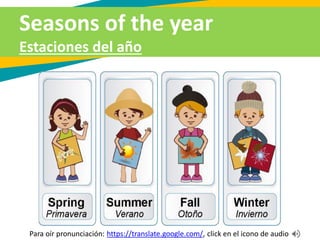
Seasons of the year
Estaciones del año
Para oír pronunciación: https://translate.google.com/, click en el icono de audio
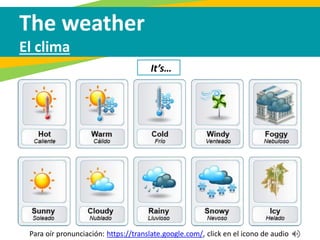
The weather
El clima
It’s…
Para oír pronunciación: https://translate.google.com/, click en el icono de audio
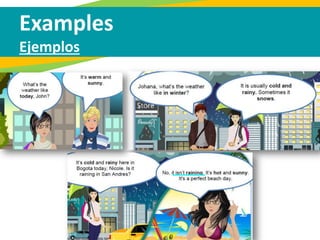
Examples
Ejemplos
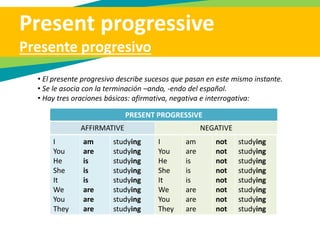
Present progressive
Presente progresivo
PRESENT PROGRESSIVE
AFFIRMATIVE NEGATIVE
am
are
is
is
is
are
are
are
am
are
is
is
is
are
are
are
• El presente progresivo describe sucesos que pasan en este mismo instante.
• Se le asocia con la terminación –ando, -endo del español.
• Hay tres oraciones básicas: afirmativa, negativa e interrogativa:
studying
studying
studying
studying
studying
studying
studying
studying
studying
studying
studying
studying
studying
studying
studying
studying
I
You
He
She
It
We
You
They
I
You
He
She
It
We
You
They
not
not
not
not
not
not
not
not
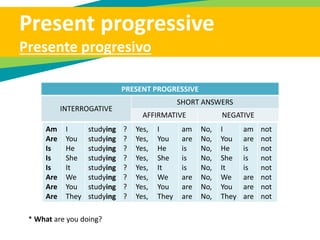
PRESENT PROGRESSIVE
INTERROGATIVE
SHORT ANSWERS
AFFIRMATIVE NEGATIVE
* What are you doing?
I
You
He
She
It
We
You
They
am
are
is
is
is
are
are
are
not
not
not
not
not
not
not
not
Yes,
Yes,
Yes,
Yes,
Yes,
Yes,
Yes,
Yes,
I
You
He
She
It
We
You
They
am
are
is
is
is
are
are
are
No,
No,
No,
No,
No,
No,
No,
No,
Am
Are
Is
Is
Is
Are
Are
Are
I
You
He
She
It
We
You
They
studying
studying
studying
studying
studying
studying
studying
studying
?
?
?
?
?
?
?
?
Present progressive
Presente progresivo
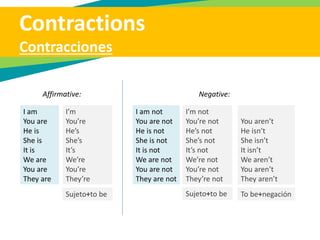
Contractions
Contracciones
I’m
You’re
He’s
She’s
It’s
We’re
You’re
They’re
I am
You are
He is
She is
It is
We are
You are
They are
I am not
You are not
He is not
She is not
It is not
We are not
You are not
They are not
I’m not
You’re not
He’s not
She’s not
It’s not
We’re not
You’re not
They’re not
You aren’t
He isn’t
She isn’t
It isn’t
We aren’t
You aren’t
They aren’t
Sujeto+to be To be+negaciónSujeto+to be
Affirmative: Negative:
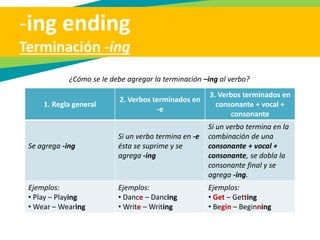
-ing ending
Terminación -ing
1. Regla general
2. Verbos terminados en
-e
3. Verbos terminados en
consonante + vocal +
consonante
Se agrega -ing
Si un verbo termina en -e
ésta se suprime y se
agrega -ing
Si un verbo termina en la
combinación de una
consonante + vocal +
consonante, se dobla la
consonante final y se
agrega -ing.
Ejemplos:
• Play – Playing
• Wear – Wearing
Ejemplos:
• Dance – Dancing
• Write – Writing
Ejemplos:
• Get – Getting
• Begin – Beginning
¿Cómo se le debe agregar la terminación –ing al verbo?
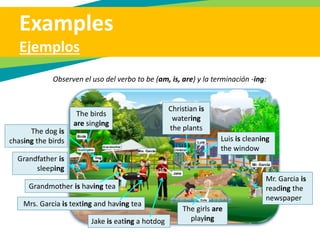
The birds
are singing
The dog is
chasing the birds
Grandfather is
sleeping
Grandmother is having tea
Mrs. Garcia is texting and having tea
Mr. Garcia is
reading the
newspaper
Luis is cleaning
the window
The girls are
playing
Christian is
watering
the plants
Jake is eating a hotdog
Observen el uso del verbo to be (am, is, are) y la terminación -ing:
Examples
Ejemplos
Clothes and accesories
Ropa y accesorios
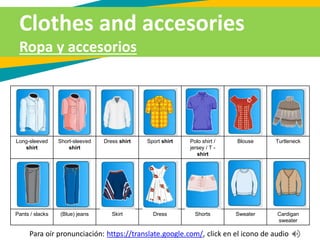
Long-sleeved
shirt
Short-sleeved
shirt
Dress shirt Sport shirt Polo shirt /
jersey / T -
shirt
Blouse Turtleneck
Pants / slacks (Blue) jeans Skirt Dress Shorts Sweater Cardigan
sweater
Para oír pronunciación: https://translate.google.com/, click en el icono de audio
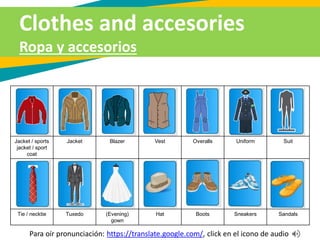
Jacket / sports
jacket / sport
coat
Jacket Blazer Vest Overalls Uniform Suit
Tie / necktie Tuxedo (Evening)
gown
Hat Boots Sneakers Sandals
Para oír pronunciación: https://translate.google.com/, click en el icono de audio
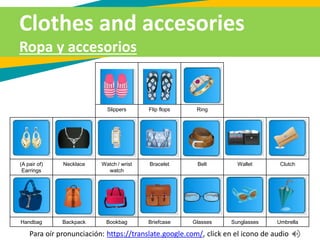
Clothes and accesories
Ropa y accesorios
Slippers Flip flops Ring
(A pair of)
Earrings
Necklace Watch / wrist
watch
Bracelet Belt Wallet Clutch
Handbag Backpack Bookbag Briefcase Glasses Sunglasses Umbrella
Para oír pronunciación: https://translate.google.com/, click en el icono de audio
Clothes and accesories
Ropa y accesorios
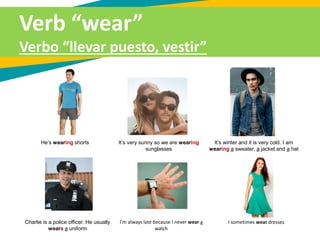
He’s wearing shorts It’s very sunny so we are wearing
sunglasses
It’s winter and it is very cold. I am
wearing a sweater, a jacket and a hat
Verb “wear”
Verbo “llevar puesto, vestir”
Charlie is a police officer. He usually
wears a uniform
I’m always late because I never wear a
watch
I sometimes wear dresses
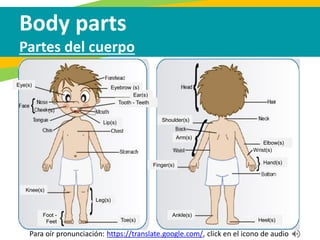
Body parts
Partes del cuerpo
Eyebrow (s)
Foot -
Feet
Arm(s)
Wrist(s)
Hand(s)
Elbow(s)
Finger(s)
Ankle(s)
Heel(s)
Shoulder(s)
Toe(s)
Leg(s)
Knee(s)
Lip(s)
Ear(s)
Tooth - Teeth
Eye(s)
(s)
Para oír pronunciación: https://translate.google.com/, click en el icono de audio
Let’s start with the
evidences!
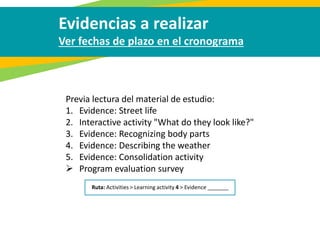
Evidencias a realizar
Ver fechas de plazo en el cronograma
Previa lectura del material de estudio:
1. Evidence: Street life
2. Interactive activity "What do they look like?"
3. Evidence: Recognizing body parts
4. Evidence: Describing the weather
5. Evidence: Consolidation activity
 Program evaluation survey
Ruta: Activities > Learning activity 4 > Evidence _______
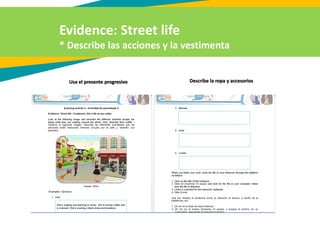
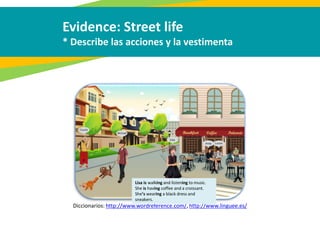
Evidence: Street life
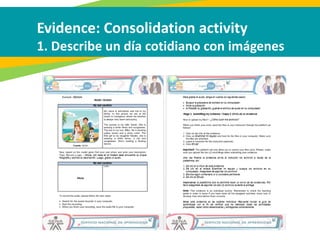
* Describe las acciones y la vestimenta
Usa el presente progresivo Describe la ropa y accesorios
Evidence: Street life
* Describe las acciones y la vestimenta
Diccionarios: http://www.wordreference.com/, http://www.linguee.es/
Lisa is walking and listening to music.
She is having coffee and a croissant.
She’s wearing a black dress and
sneakers.
Evidence: Street life
* Describe las acciones y la vestimenta
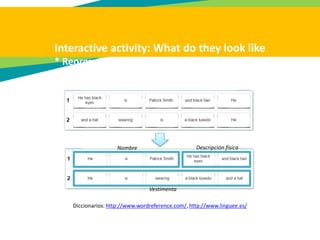
Interactive activity: What do they look like
* Reorganiza las oraciones
Interactive activity: What do they look like
* Reorganiza las oraciones
Diccionarios: http://www.wordreference.com/, http://www.linguee.es/
Nombre Descripción física
Vestimenta
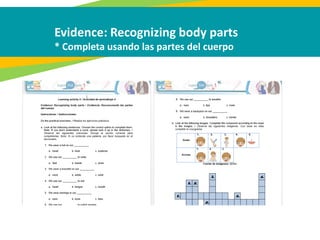
Evidence: Recognizing body parts
* Completa usando las partes del cuerpo
Evidence: Recognizing body parts
* Completa usando las partes del cuerpo
Diccionarios: http://www.wordreference.com/, http://www.linguee.es/
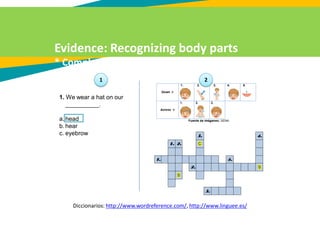
1. We wear a hat on our
__________.
a. head
b. hear
c. eyebrow
1 2
Evidence: Recognizing body parts
* Completa usando las partes del cuerpo
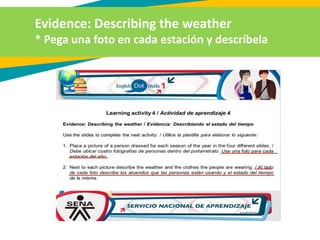
Evidence: Describing the weather
* Pega una foto en cada estación y descríbela
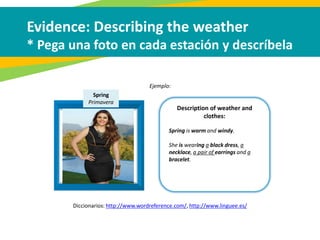
Ejemplo:
Evidence: Describing the weather
* Pega una foto en cada estación y descríbela
Description of weather and
clothes:
Spring
Primavera
Spring is warm and windy.
She is wearing a black dress, a
necklace, a pair of earrings and a
bracelet.
Diccionarios: http://www.wordreference.com/, http://www.linguee.es/
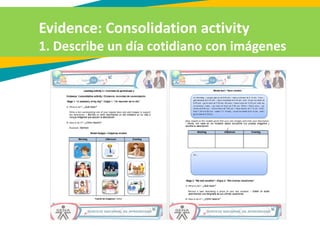
Evidence: Consolidation activity
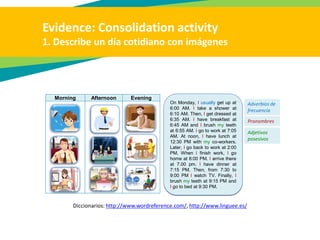
1. Describe un día cotidiano con imágenes
Evidence: Consolidation activity
1. Describe un día cotidiano con imágenes
Evidence: Consolidation activity
1. Describe un día cotidiano con imágenes
Diccionarios: http://www.wordreference.com/, http://www.linguee.es/
Morning Afternoon Evening
On Monday, I usually get up at
6:00 AM. I take a shower at
6:10 AM. Then, I get dressed at
6:35 AM. I have breakfast at
6:45 AM and I brush my teeth
at 6:55 AM. I go to work at 7:05
AM. At noon, I have lunch at
12:30 PM with my co-workers.
Later, I go back to work at 2:00
PM. When I finish work, I go
home at 6:00 PM. I arrive there
at 7.00 pm. I have dinner at
7:15 PM. Then, from 7:30 to
9:00 PM I watch TV. Finally, I
brush my teeth at 9:15 PM and
I go to bed at 9:30 PM.
Adverbios de
frecuencia
Pronombres
Adjetivos
posesivos
Evidence: Consolidation activity
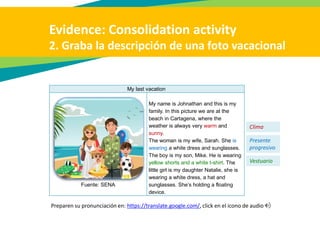
2. Graba la descripción de una foto vacacional
My last vacation
Fuente: SENA
My name is Johnathan and this is my
family. In this picture we are at the
beach in Cartagena, where the
weather is always very warm and
sunny.
The woman is my wife, Sarah. She is
wearing a white dress and sunglasses.
The boy is my son, Mike. He is wearing
yellow shorts and a white t-shirt. The
little girl is my daughter Natalie, she is
wearing a white dress, a hat and
sunglasses. She’s holding a floating
device.
Clima
Presente
progresivo
Vestuario
Preparen su pronunciación en: https://translate.google.com/, click en el icono de audio
Program evaluation survey
* Obligatorio
PREGUNTA 1
El funcionamiento de la plataforma virtual SENA fue:
Excelente / Bueno / Regular / Deficiente
PREGUNTA 2
¿Cómo le pareció el programa de formación English Dot Works Beginner? Justifique su respuesta.
PREGUNTA 3
¿El contenido temático del programa de formación cumplió con sus expectativas?
Sí / No
PREGUNTA 4
Las actividades propuestas en el programa de formación fueron:
Excelentes / Buenas / Regulares / Deficientes
PREGUNTA 5
¿En general cómo califica el desempeño del instructor en relación a: acompañamiento, tiempo de
respuesta al calificar evidencias, foros, organización del programa de formación, entre otros?
Excelente / Bueno / Regular / Deficiente
Dirección de Empleo y Trabajo
GRACIAS

Tutorial English Dot Works 1 learning activity 4

  • 1.
    Tutorial EDW1 Learning activity4 Inst. Carolina Dimas D.
  • 2.
     Seasons ofthe year / Estaciones del año  The weather / El clima  Present progressive / Presente progresivo  Clothes and accesories / Ropa y accesorios  Body parts / Partes del cuerpo Topics to study Temas a estudiar Ruta: Program materials > Training materials > Learning Activity 4
  • 3.
    Seasons of theyear Estaciones del año Para oír pronunciación: https://translate.google.com/, click en el icono de audio
  • 4.
    The weather El clima It’s… Paraoír pronunciación: https://translate.google.com/, click en el icono de audio
  • 5.
  • 6.
    Present progressive Presente progresivo PRESENTPROGRESSIVE AFFIRMATIVE NEGATIVE am are is is is are are are am are is is is are are are • El presente progresivo describe sucesos que pasan en este mismo instante. • Se le asocia con la terminación –ando, -endo del español. • Hay tres oraciones básicas: afirmativa, negativa e interrogativa: studying studying studying studying studying studying studying studying studying studying studying studying studying studying studying studying I You He She It We You They I You He She It We You They not not not not not not not not
  • 7.
    PRESENT PROGRESSIVE INTERROGATIVE SHORT ANSWERS AFFIRMATIVENEGATIVE * What are you doing? I You He She It We You They am are is is is are are are not not not not not not not not Yes, Yes, Yes, Yes, Yes, Yes, Yes, Yes, I You He She It We You They am are is is is are are are No, No, No, No, No, No, No, No, Am Are Is Is Is Are Are Are I You He She It We You They studying studying studying studying studying studying studying studying ? ? ? ? ? ? ? ? Present progressive Presente progresivo
  • 8.
    Contractions Contracciones I’m You’re He’s She’s It’s We’re You’re They’re I am You are Heis She is It is We are You are They are I am not You are not He is not She is not It is not We are not You are not They are not I’m not You’re not He’s not She’s not It’s not We’re not You’re not They’re not You aren’t He isn’t She isn’t It isn’t We aren’t You aren’t They aren’t Sujeto+to be To be+negaciónSujeto+to be Affirmative: Negative:
  • 9.
    -ing ending Terminación -ing 1.Regla general 2. Verbos terminados en -e 3. Verbos terminados en consonante + vocal + consonante Se agrega -ing Si un verbo termina en -e ésta se suprime y se agrega -ing Si un verbo termina en la combinación de una consonante + vocal + consonante, se dobla la consonante final y se agrega -ing. Ejemplos: • Play – Playing • Wear – Wearing Ejemplos: • Dance – Dancing • Write – Writing Ejemplos: • Get – Getting • Begin – Beginning ¿Cómo se le debe agregar la terminación –ing al verbo?
  • 10.
    The birds are singing Thedog is chasing the birds Grandfather is sleeping Grandmother is having tea Mrs. Garcia is texting and having tea Mr. Garcia is reading the newspaper Luis is cleaning the window The girls are playing Christian is watering the plants Jake is eating a hotdog Observen el uso del verbo to be (am, is, are) y la terminación -ing: Examples Ejemplos
  • 11.
    Clothes and accesories Ropay accesorios Long-sleeved shirt Short-sleeved shirt Dress shirt Sport shirt Polo shirt / jersey / T - shirt Blouse Turtleneck Pants / slacks (Blue) jeans Skirt Dress Shorts Sweater Cardigan sweater Para oír pronunciación: https://translate.google.com/, click en el icono de audio
  • 12.
    Jacket / sports jacket/ sport coat Jacket Blazer Vest Overalls Uniform Suit Tie / necktie Tuxedo (Evening) gown Hat Boots Sneakers Sandals Para oír pronunciación: https://translate.google.com/, click en el icono de audio Clothes and accesories Ropa y accesorios
  • 13.
    Slippers Flip flopsRing (A pair of) Earrings Necklace Watch / wrist watch Bracelet Belt Wallet Clutch Handbag Backpack Bookbag Briefcase Glasses Sunglasses Umbrella Para oír pronunciación: https://translate.google.com/, click en el icono de audio Clothes and accesories Ropa y accesorios
  • 14.
    He’s wearing shortsIt’s very sunny so we are wearing sunglasses It’s winter and it is very cold. I am wearing a sweater, a jacket and a hat Verb “wear” Verbo “llevar puesto, vestir” Charlie is a police officer. He usually wears a uniform I’m always late because I never wear a watch I sometimes wear dresses
  • 15.
    Body parts Partes delcuerpo Eyebrow (s) Foot - Feet Arm(s) Wrist(s) Hand(s) Elbow(s) Finger(s) Ankle(s) Heel(s) Shoulder(s) Toe(s) Leg(s) Knee(s) Lip(s) Ear(s) Tooth - Teeth Eye(s) (s) Para oír pronunciación: https://translate.google.com/, click en el icono de audio
  • 16.
    Let’s start withthe evidences!
  • 17.
    Evidencias a realizar Verfechas de plazo en el cronograma Previa lectura del material de estudio: 1. Evidence: Street life 2. Interactive activity "What do they look like?" 3. Evidence: Recognizing body parts 4. Evidence: Describing the weather 5. Evidence: Consolidation activity  Program evaluation survey Ruta: Activities > Learning activity 4 > Evidence _______
  • 18.
    Evidence: Street life *Describe las acciones y la vestimenta Usa el presente progresivo Describe la ropa y accesorios
  • 20.
    Evidence: Street life *Describe las acciones y la vestimenta Diccionarios: http://www.wordreference.com/, http://www.linguee.es/ Lisa is walking and listening to music. She is having coffee and a croissant. She’s wearing a black dress and sneakers.
  • 21.
    Evidence: Street life *Describe las acciones y la vestimenta
  • 22.
    Interactive activity: Whatdo they look like * Reorganiza las oraciones
  • 23.
    Interactive activity: Whatdo they look like * Reorganiza las oraciones Diccionarios: http://www.wordreference.com/, http://www.linguee.es/ Nombre Descripción física Vestimenta
  • 24.
    Evidence: Recognizing bodyparts * Completa usando las partes del cuerpo
  • 25.
    Evidence: Recognizing bodyparts * Completa usando las partes del cuerpo Diccionarios: http://www.wordreference.com/, http://www.linguee.es/ 1. We wear a hat on our __________. a. head b. hear c. eyebrow 1 2
  • 26.
    Evidence: Recognizing bodyparts * Completa usando las partes del cuerpo
  • 27.
    Evidence: Describing theweather * Pega una foto en cada estación y descríbela
  • 28.
    Ejemplo: Evidence: Describing theweather * Pega una foto en cada estación y descríbela Description of weather and clothes: Spring Primavera Spring is warm and windy. She is wearing a black dress, a necklace, a pair of earrings and a bracelet. Diccionarios: http://www.wordreference.com/, http://www.linguee.es/
  • 30.
    Evidence: Consolidation activity 1.Describe un día cotidiano con imágenes
  • 31.
    Evidence: Consolidation activity 1.Describe un día cotidiano con imágenes
  • 32.
    Evidence: Consolidation activity 1.Describe un día cotidiano con imágenes Diccionarios: http://www.wordreference.com/, http://www.linguee.es/ Morning Afternoon Evening On Monday, I usually get up at 6:00 AM. I take a shower at 6:10 AM. Then, I get dressed at 6:35 AM. I have breakfast at 6:45 AM and I brush my teeth at 6:55 AM. I go to work at 7:05 AM. At noon, I have lunch at 12:30 PM with my co-workers. Later, I go back to work at 2:00 PM. When I finish work, I go home at 6:00 PM. I arrive there at 7.00 pm. I have dinner at 7:15 PM. Then, from 7:30 to 9:00 PM I watch TV. Finally, I brush my teeth at 9:15 PM and I go to bed at 9:30 PM. Adverbios de frecuencia Pronombres Adjetivos posesivos
  • 33.
    Evidence: Consolidation activity 2.Graba la descripción de una foto vacacional My last vacation Fuente: SENA My name is Johnathan and this is my family. In this picture we are at the beach in Cartagena, where the weather is always very warm and sunny. The woman is my wife, Sarah. She is wearing a white dress and sunglasses. The boy is my son, Mike. He is wearing yellow shorts and a white t-shirt. The little girl is my daughter Natalie, she is wearing a white dress, a hat and sunglasses. She’s holding a floating device. Clima Presente progresivo Vestuario Preparen su pronunciación en: https://translate.google.com/, click en el icono de audio
  • 34.
    Program evaluation survey *Obligatorio PREGUNTA 1 El funcionamiento de la plataforma virtual SENA fue: Excelente / Bueno / Regular / Deficiente PREGUNTA 2 ¿Cómo le pareció el programa de formación English Dot Works Beginner? Justifique su respuesta. PREGUNTA 3 ¿El contenido temático del programa de formación cumplió con sus expectativas? Sí / No PREGUNTA 4 Las actividades propuestas en el programa de formación fueron: Excelentes / Buenas / Regulares / Deficientes PREGUNTA 5 ¿En general cómo califica el desempeño del instructor en relación a: acompañamiento, tiempo de respuesta al calificar evidencias, foros, organización del programa de formación, entre otros? Excelente / Bueno / Regular / Deficiente
  • 35.
    Dirección de Empleoy Trabajo GRACIAS