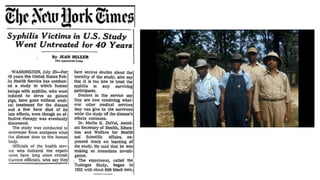
Tuskegee Syphilis Study
Syphilis overview
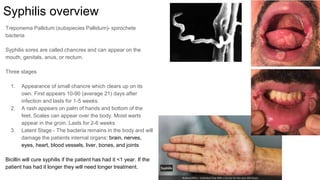
Treponema Pallidum (subspecies Pallidum)- spirochete
bacteria
Syphilis sores are called chancres and can appear on the
mouth, genitals, anus, or rectum.
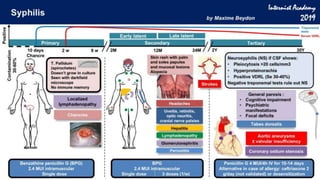
Three stages
1. Appearance of small chancre which clears up on its
own. First appears 10-90 (average 21) days after
infection and lasts for 1-5 weeks.
2. A rash appears on palm of hands and bottom of the
feet. Scales can appear over the body. Moist warts
appear in the groin. Lasts for 2-6 weeks
3. Latent Stage - The bacteria remains in the body and will
damage the patients internal organs: brain, nerves,
eyes, heart, blood vessels, liver, bones, and joints
Bicillin will cure syphilis if the patient has had it <1 year. If the
patient has had it longer they will need longer treatment.
1930
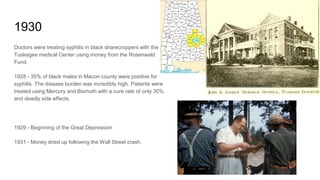
Doctors were treating syphilis in black sharecroppers with the
Tuskegee medical Center using money from the Rosenwald
Fund.
1928 - 35% of black males in Macon county were positive for
syphilis. The disease burden was incredibly high. Patients were
treated using Mercury and Bismuth with a cure rate of only 30%
and deadly side effects.
1929 - Beginning of the Great Depression
1931 - Money dried up following the Wall Street crash.
“Tuskegee Study of Untreated Syphilis in the Negro Male.”
https://www.cdc.gov/tuskegee/timeline.htm
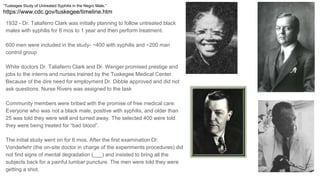
1932 - Dr. Taliaferro Clark was initially planning to follow untreated black
males with syphilis for 6 mos to 1 year and then perform treatment.
600 men were included in the study- ~400 with syphilis and ~200 man
control group
White doctors Dr. Taliaferro Clark and Dr. Wenger promised prestige and
jobs to the interns and nurses trained by the Tuskegee Medical Center.
Because of the dire need for employment Dr. Dibble approved and did not
ask questions. Nurse Rivers was assigned to the task
Community members were bribed with the promise of free medical care.
Everyone who was not a black male, positive with syphilis, and older than
25 was told they were well and turned away. The selected 400 were told
they were being treated for “bad blood”.
The initial study went on for 6 mos. After the first examination Dr.
Vonderlehr (the on-site doctor in charge of the experiments procedures) did
not find signs of mental degradation (___) and insisted to bring all the
subjects back for a painful lumbar puncture. The men were told they were
getting a shot.
New management
Dr. Clark returned to Washington where he took over as the
head of the US Public Health Service. He immediately
restarted the program. This time he intended to watch the
subjects until they died of late stage syphilis. The study
intended to mirror a similar study of syphilis done in Norway
to see if the belief that in black men the disease had more
cardiovascular rather than neural effects.
Within weeks the first patient died from their condition.
1936 - Dr. Vonderlehr urged local physicians are requested
to not treat test subjects with syphilis.
1945 - Penicillin is found to be an effective treatment for
syphilis. However, the patients continued to be untreated
and were actually advised not to go to the widespread
treatment centers where others were getting treatment.
Questions raised
1966, 1968 - Peter Buxton writes letters to the CDC in Atlanta and raises
questions at the conference for venereal disease in Washington. The rest of the
physicians insist the value of the information to science outweighs the ethical
obligation of obtain “informed consent.” These physicians claimed that by
obtaining the consent of the local physicians in the area they satisfied their moral
duty.
Reveal Party
1970 - Buxton meets Jean Heller at a party
while in law school and informs the news.
1972 - News reveals the study to the public.
It is worth noting the study was well known
in the medical community and the results
were being published in medical journals for
years. The study ends.
As much justice as you could hope for in the 70s I guess
1974 - Initially the government did not
want to give money. They first agreed
to only give free medical care to the
study victims. Attorney Fred D. Gray
took the government to court in Pollard
v United States and reached a
$10million dollar settlement to be paid
to the victims and their descendants.
1972 - 74 subjects are still alive. 28
subjects of the 399 died of syphilis. 100
died of related complications. 40 of
their wives had been infected and 19 of
their children had been born with
congenital syphilis.

Tuskegee Syphilis Study.pptx

  • 1.
  • 2.
    Syphilis overview Treponema Pallidum(subspecies Pallidum)- spirochete bacteria Syphilis sores are called chancres and can appear on the mouth, genitals, anus, or rectum. Three stages 1. Appearance of small chancre which clears up on its own. First appears 10-90 (average 21) days after infection and lasts for 1-5 weeks. 2. A rash appears on palm of hands and bottom of the feet. Scales can appear over the body. Moist warts appear in the groin. Lasts for 2-6 weeks 3. Latent Stage - The bacteria remains in the body and will damage the patients internal organs: brain, nerves, eyes, heart, blood vessels, liver, bones, and joints Bicillin will cure syphilis if the patient has had it <1 year. If the patient has had it longer they will need longer treatment.
  • 5.
    1930 Doctors were treatingsyphilis in black sharecroppers with the Tuskegee medical Center using money from the Rosenwald Fund. 1928 - 35% of black males in Macon county were positive for syphilis. The disease burden was incredibly high. Patients were treated using Mercury and Bismuth with a cure rate of only 30% and deadly side effects. 1929 - Beginning of the Great Depression 1931 - Money dried up following the Wall Street crash.
  • 6.
    “Tuskegee Study ofUntreated Syphilis in the Negro Male.” https://www.cdc.gov/tuskegee/timeline.htm 1932 - Dr. Taliaferro Clark was initially planning to follow untreated black males with syphilis for 6 mos to 1 year and then perform treatment. 600 men were included in the study- ~400 with syphilis and ~200 man control group White doctors Dr. Taliaferro Clark and Dr. Wenger promised prestige and jobs to the interns and nurses trained by the Tuskegee Medical Center. Because of the dire need for employment Dr. Dibble approved and did not ask questions. Nurse Rivers was assigned to the task Community members were bribed with the promise of free medical care. Everyone who was not a black male, positive with syphilis, and older than 25 was told they were well and turned away. The selected 400 were told they were being treated for “bad blood”. The initial study went on for 6 mos. After the first examination Dr. Vonderlehr (the on-site doctor in charge of the experiments procedures) did not find signs of mental degradation (___) and insisted to bring all the subjects back for a painful lumbar puncture. The men were told they were getting a shot.
  • 7.
    New management Dr. Clarkreturned to Washington where he took over as the head of the US Public Health Service. He immediately restarted the program. This time he intended to watch the subjects until they died of late stage syphilis. The study intended to mirror a similar study of syphilis done in Norway to see if the belief that in black men the disease had more cardiovascular rather than neural effects. Within weeks the first patient died from their condition. 1936 - Dr. Vonderlehr urged local physicians are requested to not treat test subjects with syphilis. 1945 - Penicillin is found to be an effective treatment for syphilis. However, the patients continued to be untreated and were actually advised not to go to the widespread treatment centers where others were getting treatment.
  • 8.
    Questions raised 1966, 1968- Peter Buxton writes letters to the CDC in Atlanta and raises questions at the conference for venereal disease in Washington. The rest of the physicians insist the value of the information to science outweighs the ethical obligation of obtain “informed consent.” These physicians claimed that by obtaining the consent of the local physicians in the area they satisfied their moral duty.
  • 10.
    Reveal Party 1970 -Buxton meets Jean Heller at a party while in law school and informs the news. 1972 - News reveals the study to the public. It is worth noting the study was well known in the medical community and the results were being published in medical journals for years. The study ends.
  • 12.
    As much justiceas you could hope for in the 70s I guess 1974 - Initially the government did not want to give money. They first agreed to only give free medical care to the study victims. Attorney Fred D. Gray took the government to court in Pollard v United States and reached a $10million dollar settlement to be paid to the victims and their descendants. 1972 - 74 subjects are still alive. 28 subjects of the 399 died of syphilis. 100 died of related complications. 40 of their wives had been infected and 19 of their children had been born with congenital syphilis.

Editor's Notes

  • #9 http://tuskegeestudy.weebly.com/termination.html