Why do your employees leave?
A straightforward approach to identifying the causes of turnover and an approach to minimising  Dr Gerry Treuren
Despite the  Global Financial Collapse,  labour, skill and talent shortage  is still the medium term  reality for all of us.
What is your organisation  doing about it?
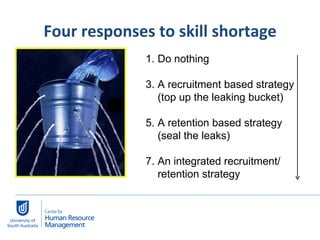
Four responses to skill shortage Do nothing A recruitment based strategy (top up the leaking bucket) A retention based strategy (seal the leaks) An integrated recruitment/ retention strategy
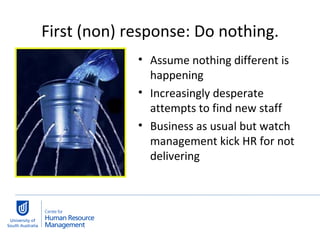
First (non) response: Do nothing. Assume nothing different is happening Increasingly desperate attempts to find new staff Business as usual but watch management kick HR for not delivering
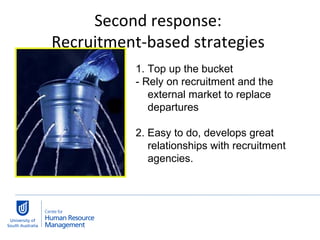
Second response:  Recruitment-based strategies  Top up the bucket - Rely on recruitment and the external market to replace departures 2. Easy to do, develops great relationships with recruitment agencies.
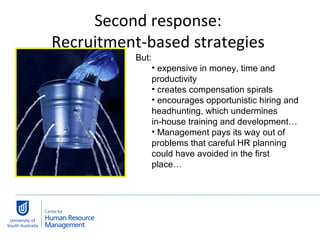
Second response:  Recruitment-based strategies  But:  expensive in money, time and productivity creates compensation spirals encourages opportunistic hiring and headhunting, which undermines  in-house training and development… Management pays its way out of problems that careful HR planning could have avoided in the first place…
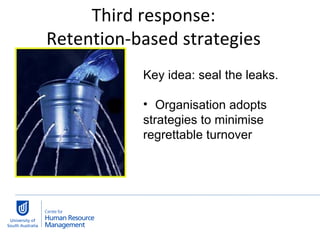
Key idea: seal the leaks. Organisation adopts  strategies to minimise  regrettable turnover Third response:  Retention-based strategies
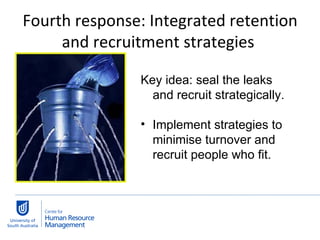
Fourth response: Integrated retention and recruitment strategies  Key idea: seal the leaks and recruit strategically. Implement strategies to minimise turnover and recruit people who fit.
First  big  question:  Why do people leave their jobs? Lots of theories,  not many reliable answers
Why do people leave organisations?  Ad hoc reasons: Not enough money ‘ People leave managers, not companies’ Lack of career planning Generation Y  All of these are true at times and in specific situations. None of these is the complete answer.
Why do people leave organisations?  Understanding turnover has been the biggest area of research in organisation behaviour and industrial psychology over the last 50 years. Commonsense answer…
Why do people leave organisations?  People leave a job because:  they are unhappy/ dissatisfied AND (ii) they have a new job or are confident that they can easily find one.
But… Can you think of instances in your organisation when someone left, who : was very happy with their job, with great prospects if they stayed, but they wanted to go travelling or spend more time with the family ? went to a job they perceived as better despite being very happy at work? just quit, and stormed out…
True, people do leave for new jobs because of dissatisfaction…. But this only explains maybe 30% of turnover… What about the  rest  of people who leave?
An example  Well managed, internationally recognised brand name  Employees have interesting, challenging jobs and well-paid career paths.  HR is able to implement its plans.  Only 33% of people rated themselves as unhappy in their jobs before they left. Only 55% of people had a job to go to.
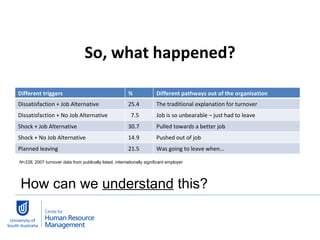
So, what happened? N=228,  2007 turnover data from publically listed, internationally significant employer How can we  understand  this?  Different triggers  % Different pathways out of the organisation Dissatisfaction + Job Alternative 25.4 The traditional explanation for turnover Dissatisfaction + No Job Alternative 7.5 Job is so unbearable – just had to leave Shock + Job Alternative  30.7 Pulled towards a better job Shock + No Job Alternative  14.9 Pushed out of job Planned leaving  21.5 Was going to leave when…
The new explanations of turnover Two interconnected explanations for why people stay/why people leave organisations Unfolding theory of turnover Job Embeddedness Theory Taken together, these approaches provide a guide to managements to minimise their turnover problems…
The Unfolding Theory of Turnover In addition to the traditional model’s reasons, people leave because of ‘shocks’… These events  jolt  the employee into comparing their current situation with a possible new one… Sometimes resulting in the decision to leave immediately or when a new job has been found…
The Unfolding Theory of Turnover These shocks may be: Internal (knocked back on a promotion) or external (a job offer) Expected (imminent graduation) or unexpected (upsetting incident with manager)
The Unfolding Theory of Turnover These shocks may be: Positive (the great job offer), neutral (partner offered a job in Hong Kong) or negative (harsh performance review) Personal (comes from your out-of-work life) or Organisational (comes from work)
The Unfolding Theory of Turnover Another key concept is that of ‘scripts’…a plan to do something at some point in time… A plan to go travelling before we start a family The decision to live in sunny Queensland When I finish my accounting studies, to get a job as an accountant Etc… Can you think of examples?
Five Pathways out of the organisation Pathway Different triggers  Different pathways out of the organisation 1 Planned leaving activated by a shock Was going to leave when…[…..]…happens 2 Shock + No Job Alternative  Pushed out of job 3 Shock + Job Alternative  Pulled towards a better job 4a Dissatisfaction + No Job Alternative Job is so unbearable – just had to leave 4b Dissatisfaction + Job Alternative The traditional explanation for turnover
  Pathway 1: Script based I intend to leave when [-----] happens ‘ Offered a contract with a basketball club in America, once in a life time opportunity.’ ‘ On return from Vanuatu made a family decision on where we wanted to live and planned 3-5yrs to move to Darwin. Opportunity came along to achieve this move in shorter timeframe.’ ‘ Nothing to do with the job. Leaving to better meet family commitments - daughter in full time day care and wanted to commit to family. Always going to leave once I had the money to go overseas
  Pathway 2: Pushed out…  Something happens that makes it impossible for you to continue…  and you go, quickly, even if you have nowhere to go to… ‘ forced into full-time logistics role and not interested in logistics’ ‘ No future at [---].  No light at the end of the tunnel.  Negative feedback from Team Leader’ ‘ If the manner in which the [---] incident had been handled was different I would not be leaving the company.’
  Pathway 3: Pulled to a new job:  Something occurs that makes you want to leave the company  (even though you might be quite happy…) ‘ Presented with opportunity too good to refuse - was not even looking’ ‘ Great career/financial opportunity. Logistics manager position - opportunity to design and implement new stock management system.’  ‘ I was offered and accepted a position in the same function however it is a promotion in a happier workgroup with a pay increase’ ‘ invitation to own a business, great opportunity’
  Pathway 4a. So dissatisfied that  you cannot bear to stay… You hate your job  so much  that you just have to leave, with nowhere to go to… ‘ Combination of all factors, once performance management started felt it was very unfair as was working hard already’ ‘ Job wasn't going where he wanted he wanted to go. Poor management over the past few years was the main reason. ‘ I felt like treated like second class citizen.’
  Pathway 4b. Dissatisfied but waited until the right job came along… And then you left… ‘ Major reason is lifestyle choice, position as an IT system administrator is very demanding with very long hours, EE made the decision to move into contracting based on flexible hours and more effective/healthy lifestyle.’ ‘ Combination of team disintegration, dissatisfaction with management and poor remuneration.’ ‘ Frustrated with constraints - systems / politics.’
The Unfolding Theory of Turnover Each organisation has its own particular pattern of turnover, because of:  Nature of occupational labour market Local history Quality of management practice Labour market The personalities Empirical question…local patterns can be identified through the careful use of exit interviews…
What can management do? Work out WHY people are leaving Don’t assume you know already Exit interview design/execution is important Work out what proportion of leaving is: Regrettable Avoidable
What can management do? Introduce practices aimed at increasing  job embeddedness the set of various ties that connect a person to their organisation and job… The more  embedded  an employee is, the more likely a staff member is to stay…
What can management do? Apply employment practices aimed at increasing the employees:  Fit  with the organisation and other employees Linkages  with the organisation and other employees The financial and social  sacrifice  of leaving
Job Embeddedness can act as a buffer  to the impulse to leave…  Embedded employees are less likely to be dissatisfied with their job and their employment Less likely to let shocks push or pull them into resignation… Management can increase the level of embeddedness (and thus, reduce turnover)
Fit-based embeddedness Does the person fit the job and the organisation? Have similar values?  Management:  Recruits for Person-Job fit Recruits for Person-Organisation fit (especially for organisational values) Designs jobs to better suit high capability/ highly mobile employees
Linkage-based embeddedness How well connected to their their job and the organisation?  Management can adopt in-house activities Mentoring schemes Workgroups; reward team achievements Consultative processes Internal development programs Carefully considered induction and socialisation schemes
Linkage-based embeddedness Management can assist development of  outside-of-work-embeddedness, such as:  Social functions Corporate volunteering and activities Work-based fitness and health programs Sponsorship of kid’s sporting teams
Sacrifice-based embeddedness Make it harder for an employee to decide to leave… Employment based incentives Salary/conditions On-site/subsidised childcare Car parking Seniority-based promotion
How can you implement  this approach?  Do an assessment of job embeddedness  via a survey supplemented by pulse surveys Figure out WHY people leave  via a carefully designed and implemented exit interview
How can you implement  this approach?  See if there is a connection between the different types of embeddedness and turnover types… an organisation specifically recruited for entrepreneurs…who then left under Path 1 and 3 Another had negligible turnover (which was dysfunctional) because of the high sacrifice for people who could see no better jobs around Another’s workforce hated the organisation but loved the work…
How can you implement  this approach?  Different organisation: Different turnover patterns Different emphasis on fit/linkage/sacrifice
How can you implement  this approach? (continued)  4. Once you have made the assessments, you can work out the areas in which your organisation is deficient… 5. Implement remedies.
  How can you implement  this approach? (continued)  The friendly researchers at the UniSA Centre for HRM would be very happy to work with you in implementing this system in your organisation.
  Thank you.  Any questions?

lga

  • 1.
    Why do youremployees leave?
  • 2.
    A straightforward approachto identifying the causes of turnover and an approach to minimising Dr Gerry Treuren
  • 3.
    Despite the Global Financial Collapse, labour, skill and talent shortage is still the medium term reality for all of us.
  • 4.
    What is yourorganisation doing about it?
  • 5.
    Four responses toskill shortage Do nothing A recruitment based strategy (top up the leaking bucket) A retention based strategy (seal the leaks) An integrated recruitment/ retention strategy
  • 6.
    First (non) response:Do nothing. Assume nothing different is happening Increasingly desperate attempts to find new staff Business as usual but watch management kick HR for not delivering
  • 7.
    Second response: Recruitment-based strategies Top up the bucket - Rely on recruitment and the external market to replace departures 2. Easy to do, develops great relationships with recruitment agencies.
  • 8.
    Second response: Recruitment-based strategies But: expensive in money, time and productivity creates compensation spirals encourages opportunistic hiring and headhunting, which undermines in-house training and development… Management pays its way out of problems that careful HR planning could have avoided in the first place…
  • 9.
    Key idea: sealthe leaks. Organisation adopts strategies to minimise regrettable turnover Third response: Retention-based strategies
  • 10.
    Fourth response: Integratedretention and recruitment strategies Key idea: seal the leaks and recruit strategically. Implement strategies to minimise turnover and recruit people who fit.
  • 11.
    First big question: Why do people leave their jobs? Lots of theories, not many reliable answers
  • 12.
    Why do peopleleave organisations? Ad hoc reasons: Not enough money ‘ People leave managers, not companies’ Lack of career planning Generation Y All of these are true at times and in specific situations. None of these is the complete answer.
  • 13.
    Why do peopleleave organisations? Understanding turnover has been the biggest area of research in organisation behaviour and industrial psychology over the last 50 years. Commonsense answer…
  • 14.
    Why do peopleleave organisations? People leave a job because: they are unhappy/ dissatisfied AND (ii) they have a new job or are confident that they can easily find one.
  • 15.
    But… Can youthink of instances in your organisation when someone left, who : was very happy with their job, with great prospects if they stayed, but they wanted to go travelling or spend more time with the family ? went to a job they perceived as better despite being very happy at work? just quit, and stormed out…
  • 16.
    True, people doleave for new jobs because of dissatisfaction…. But this only explains maybe 30% of turnover… What about the rest of people who leave?
  • 17.
    An example Well managed, internationally recognised brand name Employees have interesting, challenging jobs and well-paid career paths. HR is able to implement its plans. Only 33% of people rated themselves as unhappy in their jobs before they left. Only 55% of people had a job to go to.
  • 18.
    So, what happened?N=228, 2007 turnover data from publically listed, internationally significant employer How can we understand this? Different triggers % Different pathways out of the organisation Dissatisfaction + Job Alternative 25.4 The traditional explanation for turnover Dissatisfaction + No Job Alternative 7.5 Job is so unbearable – just had to leave Shock + Job Alternative 30.7 Pulled towards a better job Shock + No Job Alternative 14.9 Pushed out of job Planned leaving 21.5 Was going to leave when…
  • 19.
    The new explanationsof turnover Two interconnected explanations for why people stay/why people leave organisations Unfolding theory of turnover Job Embeddedness Theory Taken together, these approaches provide a guide to managements to minimise their turnover problems…
  • 20.
    The Unfolding Theoryof Turnover In addition to the traditional model’s reasons, people leave because of ‘shocks’… These events jolt the employee into comparing their current situation with a possible new one… Sometimes resulting in the decision to leave immediately or when a new job has been found…
  • 21.
    The Unfolding Theoryof Turnover These shocks may be: Internal (knocked back on a promotion) or external (a job offer) Expected (imminent graduation) or unexpected (upsetting incident with manager)
  • 22.
    The Unfolding Theoryof Turnover These shocks may be: Positive (the great job offer), neutral (partner offered a job in Hong Kong) or negative (harsh performance review) Personal (comes from your out-of-work life) or Organisational (comes from work)
  • 23.
    The Unfolding Theoryof Turnover Another key concept is that of ‘scripts’…a plan to do something at some point in time… A plan to go travelling before we start a family The decision to live in sunny Queensland When I finish my accounting studies, to get a job as an accountant Etc… Can you think of examples?
  • 24.
    Five Pathways outof the organisation Pathway Different triggers Different pathways out of the organisation 1 Planned leaving activated by a shock Was going to leave when…[…..]…happens 2 Shock + No Job Alternative Pushed out of job 3 Shock + Job Alternative Pulled towards a better job 4a Dissatisfaction + No Job Alternative Job is so unbearable – just had to leave 4b Dissatisfaction + Job Alternative The traditional explanation for turnover
  • 25.
    Pathway1: Script based I intend to leave when [-----] happens ‘ Offered a contract with a basketball club in America, once in a life time opportunity.’ ‘ On return from Vanuatu made a family decision on where we wanted to live and planned 3-5yrs to move to Darwin. Opportunity came along to achieve this move in shorter timeframe.’ ‘ Nothing to do with the job. Leaving to better meet family commitments - daughter in full time day care and wanted to commit to family. Always going to leave once I had the money to go overseas
  • 26.
    Pathway2: Pushed out… Something happens that makes it impossible for you to continue… and you go, quickly, even if you have nowhere to go to… ‘ forced into full-time logistics role and not interested in logistics’ ‘ No future at [---]. No light at the end of the tunnel. Negative feedback from Team Leader’ ‘ If the manner in which the [---] incident had been handled was different I would not be leaving the company.’
  • 27.
    Pathway3: Pulled to a new job: Something occurs that makes you want to leave the company (even though you might be quite happy…) ‘ Presented with opportunity too good to refuse - was not even looking’ ‘ Great career/financial opportunity. Logistics manager position - opportunity to design and implement new stock management system.’ ‘ I was offered and accepted a position in the same function however it is a promotion in a happier workgroup with a pay increase’ ‘ invitation to own a business, great opportunity’
  • 28.
    Pathway4a. So dissatisfied that you cannot bear to stay… You hate your job so much that you just have to leave, with nowhere to go to… ‘ Combination of all factors, once performance management started felt it was very unfair as was working hard already’ ‘ Job wasn't going where he wanted he wanted to go. Poor management over the past few years was the main reason. ‘ I felt like treated like second class citizen.’
  • 29.
    Pathway4b. Dissatisfied but waited until the right job came along… And then you left… ‘ Major reason is lifestyle choice, position as an IT system administrator is very demanding with very long hours, EE made the decision to move into contracting based on flexible hours and more effective/healthy lifestyle.’ ‘ Combination of team disintegration, dissatisfaction with management and poor remuneration.’ ‘ Frustrated with constraints - systems / politics.’
  • 30.
    The Unfolding Theoryof Turnover Each organisation has its own particular pattern of turnover, because of: Nature of occupational labour market Local history Quality of management practice Labour market The personalities Empirical question…local patterns can be identified through the careful use of exit interviews…
  • 31.
    What can managementdo? Work out WHY people are leaving Don’t assume you know already Exit interview design/execution is important Work out what proportion of leaving is: Regrettable Avoidable
  • 32.
    What can managementdo? Introduce practices aimed at increasing job embeddedness the set of various ties that connect a person to their organisation and job… The more embedded an employee is, the more likely a staff member is to stay…
  • 33.
    What can managementdo? Apply employment practices aimed at increasing the employees: Fit with the organisation and other employees Linkages with the organisation and other employees The financial and social sacrifice of leaving
  • 34.
    Job Embeddedness canact as a buffer to the impulse to leave… Embedded employees are less likely to be dissatisfied with their job and their employment Less likely to let shocks push or pull them into resignation… Management can increase the level of embeddedness (and thus, reduce turnover)
  • 35.
    Fit-based embeddedness Doesthe person fit the job and the organisation? Have similar values? Management: Recruits for Person-Job fit Recruits for Person-Organisation fit (especially for organisational values) Designs jobs to better suit high capability/ highly mobile employees
  • 36.
    Linkage-based embeddedness Howwell connected to their their job and the organisation? Management can adopt in-house activities Mentoring schemes Workgroups; reward team achievements Consultative processes Internal development programs Carefully considered induction and socialisation schemes
  • 37.
    Linkage-based embeddedness Managementcan assist development of outside-of-work-embeddedness, such as: Social functions Corporate volunteering and activities Work-based fitness and health programs Sponsorship of kid’s sporting teams
  • 38.
    Sacrifice-based embeddedness Makeit harder for an employee to decide to leave… Employment based incentives Salary/conditions On-site/subsidised childcare Car parking Seniority-based promotion
  • 39.
    How can youimplement this approach? Do an assessment of job embeddedness via a survey supplemented by pulse surveys Figure out WHY people leave via a carefully designed and implemented exit interview
  • 40.
    How can youimplement this approach? See if there is a connection between the different types of embeddedness and turnover types… an organisation specifically recruited for entrepreneurs…who then left under Path 1 and 3 Another had negligible turnover (which was dysfunctional) because of the high sacrifice for people who could see no better jobs around Another’s workforce hated the organisation but loved the work…
  • 41.
    How can youimplement this approach? Different organisation: Different turnover patterns Different emphasis on fit/linkage/sacrifice
  • 42.
    How can youimplement this approach? (continued) 4. Once you have made the assessments, you can work out the areas in which your organisation is deficient… 5. Implement remedies.
  • 43.
    Howcan you implement this approach? (continued) The friendly researchers at the UniSA Centre for HRM would be very happy to work with you in implementing this system in your organisation.
  • 44.
    Thankyou. Any questions?