The Reflection Cycle
CAP-Do
Check - Act - Plan – Do
- popularized by Brian Joiner and Yoji Akao
How to Reflect
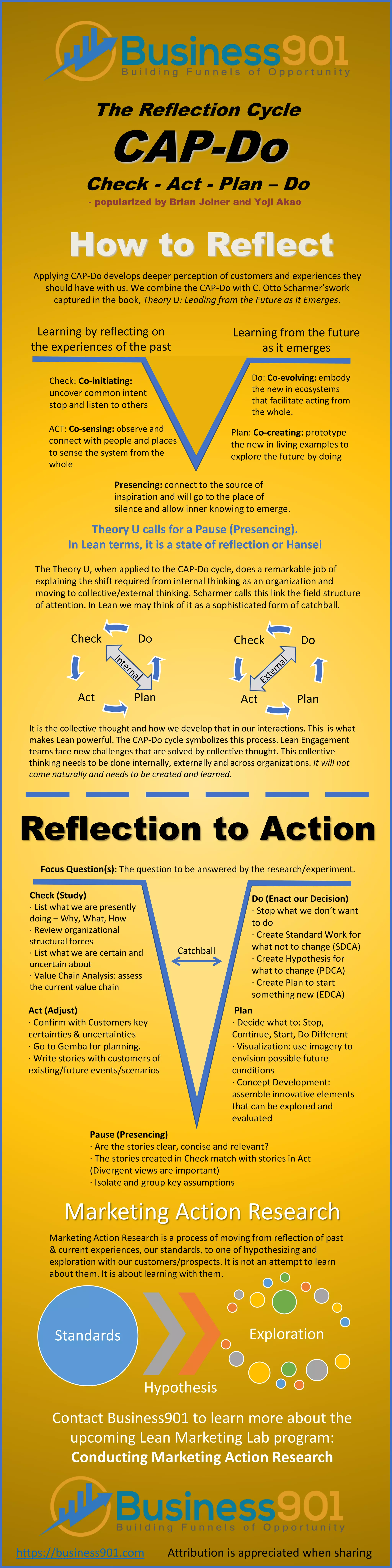
Applying CAP-Do develops deeper perception of customers and experiences they
should have with us. We combine the CAP-Do with C. Otto Scharmer’swork
captured in the book, Theory U: Leading from the Future as It Emerges.
Do: Co-evolving: embody
the new in ecosystems
that facilitate acting from
the whole.
Check: Co-initiating:
uncover common intent
stop and listen to others
ACT: Co-sensing: observe and
connect with people and places
to sense the system from the
whole
It is the collective thought and how we develop that in our interactions. This is what
makes Lean powerful. The CAP-Do cycle symbolizes this process. Lean Engagement
teams face new challenges that are solved by collective thought. This collective
thinking needs to be done internally, externally and across organizations. It will not
come naturally and needs to be created and learned.
Learning by reflecting on
the experiences of the past
Learning from the future
as it emerges
Check
Act Plan
Do
Plan: Co-creating: prototype
the new in living examples to
explore the future by doing
Presencing: connect to the source of
inspiration and will go to the place of
silence and allow inner knowing to emerge.
Theory U calls for a Pause (Presencing).
In Lean terms, it is a state of reflection or Hansei
The Theory U, when applied to the CAP-Do cycle, does a remarkable job of
explaining the shift required from internal thinking as an organization and
moving to collective/external thinking. Scharmer calls this link the field structure
of attention. In Lean we may think of it as a sophisticated form of catchball.
Check
Act Plan
Do
Reflection to Action
Focus Question(s): The question to be answered by the research/experiment.
Catchball
Check (Study)
· List what we are presently
doing – Why, What, How
· Review organizational
structural forces
· List what we are certain and
uncertain about
· Value Chain Analysis: assess
the current value chain
Act (Adjust)
· Confirm with Customers key
certainties & uncertainties
· Go to Gemba for planning.
· Write stories with customers of
existing/future events/scenarios
Pause (Presencing)
· Are the stories clear, concise and relevant?
· The stories created in Check match with stories in Act
(Divergent views are important)
· Isolate and group key assumptions
Plan
· Decide what to: Stop,
Continue, Start, Do Different
· Visualization: use imagery to
envision possible future
conditions
· Concept Development:
assemble innovative elements
that can be explored and
evaluated
Do (Enact our Decision)
· Stop what we don’t want
to do
· Create Standard Work for
what not to change (SDCA)
· Create Hypothesis for
what to change (PDCA)
· Create Plan to start
something new (EDCA)
ExplorationStandards
Hypothesis
Marketing Action Research
Marketing Action Research is a process of moving from reflection of past
& current experiences, our standards, to one of hypothesizing and
exploration with our customers/prospects. It is not an attempt to learn
about them. It is about learning with them.
Contact Business901 to learn more about the
upcoming Lean Marketing Lab program:
Conducting Marketing Action Research
https://business901.com Attribution is appreciated when sharing

Turning Reflection into Action using the Lean Process of CAP-Do

  • 1.
    The Reflection Cycle CAP-Do Check- Act - Plan – Do - popularized by Brian Joiner and Yoji Akao How to Reflect Applying CAP-Do develops deeper perception of customers and experiences they should have with us. We combine the CAP-Do with C. Otto Scharmer’swork captured in the book, Theory U: Leading from the Future as It Emerges. Do: Co-evolving: embody the new in ecosystems that facilitate acting from the whole. Check: Co-initiating: uncover common intent stop and listen to others ACT: Co-sensing: observe and connect with people and places to sense the system from the whole It is the collective thought and how we develop that in our interactions. This is what makes Lean powerful. The CAP-Do cycle symbolizes this process. Lean Engagement teams face new challenges that are solved by collective thought. This collective thinking needs to be done internally, externally and across organizations. It will not come naturally and needs to be created and learned. Learning by reflecting on the experiences of the past Learning from the future as it emerges Check Act Plan Do Plan: Co-creating: prototype the new in living examples to explore the future by doing Presencing: connect to the source of inspiration and will go to the place of silence and allow inner knowing to emerge. Theory U calls for a Pause (Presencing). In Lean terms, it is a state of reflection or Hansei The Theory U, when applied to the CAP-Do cycle, does a remarkable job of explaining the shift required from internal thinking as an organization and moving to collective/external thinking. Scharmer calls this link the field structure of attention. In Lean we may think of it as a sophisticated form of catchball. Check Act Plan Do Reflection to Action Focus Question(s): The question to be answered by the research/experiment. Catchball Check (Study) · List what we are presently doing – Why, What, How · Review organizational structural forces · List what we are certain and uncertain about · Value Chain Analysis: assess the current value chain Act (Adjust) · Confirm with Customers key certainties & uncertainties · Go to Gemba for planning. · Write stories with customers of existing/future events/scenarios Pause (Presencing) · Are the stories clear, concise and relevant? · The stories created in Check match with stories in Act (Divergent views are important) · Isolate and group key assumptions Plan · Decide what to: Stop, Continue, Start, Do Different · Visualization: use imagery to envision possible future conditions · Concept Development: assemble innovative elements that can be explored and evaluated Do (Enact our Decision) · Stop what we don’t want to do · Create Standard Work for what not to change (SDCA) · Create Hypothesis for what to change (PDCA) · Create Plan to start something new (EDCA) ExplorationStandards Hypothesis Marketing Action Research Marketing Action Research is a process of moving from reflection of past & current experiences, our standards, to one of hypothesizing and exploration with our customers/prospects. It is not an attempt to learn about them. It is about learning with them. Contact Business901 to learn more about the upcoming Lean Marketing Lab program: Conducting Marketing Action Research https://business901.com Attribution is appreciated when sharing