Turkey
Selecting Breeds
• Turkeys are suitable for commercial meat production.
The suitable breeds for farming in India are listed
below.(Species : Meleagris gallopavo)
• Beltsville
• Bronze
• Bourbon Red
• Black and Slate
• Narragansett
• Small White
• White Holland
Housing
• For proper growth and management of turkey, good housing is a
must.
• Both intensive and free range system are suitable for raising turkey.
• Turkey housing design has similarity with chicken house.
• As turkeys are big sized poultry bird so cage rearing system is not
suitable for them.
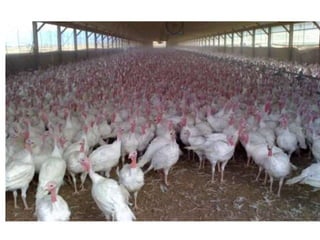
• Most farmer raise them in deep litter system.
• In free range turkey farming system, you can keep about 250 to 300
turkeys in one acre of fenced land.
• In this system you have to ensure 3-4 square feet space per bird for
sheltering during the night.
• And in deep litter turkey farming system, you can raise them in the
same way of raising chickens.
• While making house for the turkeys ensure availability of adequate
floor.
• Keep the house always neat and clean. Make proper ventilation
system. And always try to protect them from all types of predators
and harmful animals.
Feeding
• Feeding healthy and nutritious food ensures proper
growth and maximize production. So, it is very
important to feed the turkey well balanced and
nutritious food.
• Generally, the turkeys need about 3.25 kg of feed to
gain 1 kg of body weight.
• You can easily feed your turkeys poultry/chicken feeds
that are available in the market. But you have to add
some extra amount of protein with the poultry feed.
• Along with providing well balanced and nutritious feed,
always try to serve them sufficient amount of fresh and
clean water according to their demand.
Care & Management
• Proper care and management can ensure better
production. Turkeys are like other domestic birds.
And they also suffer by various types of diseases
and parasites.
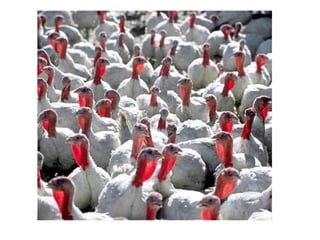
• The most common parasites of turkeys are round
worms and fowl mite.
• Dipping and deworming the birds after a several
period can keep them healthy and help them to
grow well.
• Turkeys also get affected by various types of
fungal, bacterial or viral diseases.
• Harmful diseases of turkeys are
• fowl cholera,
• blue comb disease,
• coccidiosis,
• new castle disease,
• arizonosis,
• chronic respiratory disease,
• paratyphoid,
• turkey coryza,
• turkey venereal disease etc.
• Timely vaccination and proper care can keep the birds
healthy and diseases free.
Marketing
• Turkey farming and meat consuming rate is
increasing in India.
• In proper care and management, a male turkey
become suitable for slaughtering purpose within
their 24 weeks of age.
• At this age they weigh around 10 to 15 kg. Female
turkeys take slightly more time and weigh less
then the male.
• You can sell your products in almost everywhere.
You can choose your local market and some large
supermarket in the country.
turkey farming.pptx

turkey farming.pptx

  • 1.
  • 2.
    Selecting Breeds • Turkeysare suitable for commercial meat production. The suitable breeds for farming in India are listed below.(Species : Meleagris gallopavo) • Beltsville • Bronze • Bourbon Red • Black and Slate • Narragansett • Small White • White Holland
  • 4.
    Housing • For propergrowth and management of turkey, good housing is a must. • Both intensive and free range system are suitable for raising turkey. • Turkey housing design has similarity with chicken house. • As turkeys are big sized poultry bird so cage rearing system is not suitable for them. • Most farmer raise them in deep litter system. • In free range turkey farming system, you can keep about 250 to 300 turkeys in one acre of fenced land. • In this system you have to ensure 3-4 square feet space per bird for sheltering during the night. • And in deep litter turkey farming system, you can raise them in the same way of raising chickens. • While making house for the turkeys ensure availability of adequate floor. • Keep the house always neat and clean. Make proper ventilation system. And always try to protect them from all types of predators and harmful animals.
  • 5.
    Feeding • Feeding healthyand nutritious food ensures proper growth and maximize production. So, it is very important to feed the turkey well balanced and nutritious food. • Generally, the turkeys need about 3.25 kg of feed to gain 1 kg of body weight. • You can easily feed your turkeys poultry/chicken feeds that are available in the market. But you have to add some extra amount of protein with the poultry feed. • Along with providing well balanced and nutritious feed, always try to serve them sufficient amount of fresh and clean water according to their demand.
  • 7.
    Care & Management •Proper care and management can ensure better production. Turkeys are like other domestic birds. And they also suffer by various types of diseases and parasites. • The most common parasites of turkeys are round worms and fowl mite. • Dipping and deworming the birds after a several period can keep them healthy and help them to grow well. • Turkeys also get affected by various types of fungal, bacterial or viral diseases.
  • 9.
    • Harmful diseasesof turkeys are • fowl cholera, • blue comb disease, • coccidiosis, • new castle disease, • arizonosis, • chronic respiratory disease, • paratyphoid, • turkey coryza, • turkey venereal disease etc. • Timely vaccination and proper care can keep the birds healthy and diseases free.
  • 10.
    Marketing • Turkey farmingand meat consuming rate is increasing in India. • In proper care and management, a male turkey become suitable for slaughtering purpose within their 24 weeks of age. • At this age they weigh around 10 to 15 kg. Female turkeys take slightly more time and weigh less then the male. • You can sell your products in almost everywhere. You can choose your local market and some large supermarket in the country.